EXPONENTS Zero and Negative
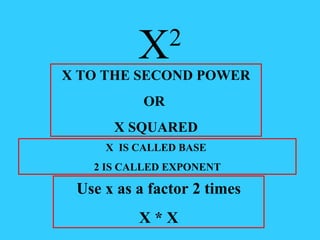
X 2 X TO THE SECOND POWER OR  X SQUARED X  IS CALLED BASE  2 IS CALLED EXPONENT Use x as a factor 2 times X * X
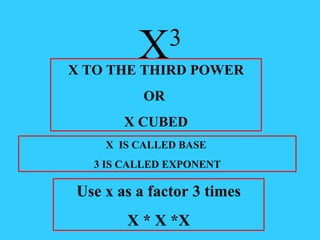
X 3 X TO THE THIRD POWER OR  X CUBED X  IS CALLED BASE  3 IS CALLED EXPONENT Use x as a factor 3 times X * X *X
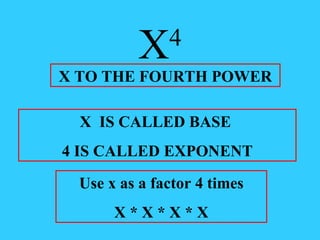
X 4 X TO THE FOURTH POWER X  IS CALLED BASE  4 IS CALLED EXPONENT Use x as a factor 4 times X * X * X * X
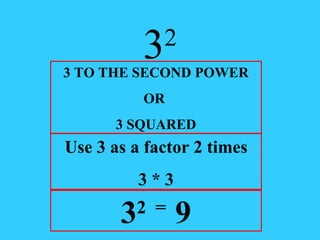
3 2 3 TO THE SECOND POWER OR  3 SQUARED Use 3 as a factor 2 times 3 * 3 3 2  =  9
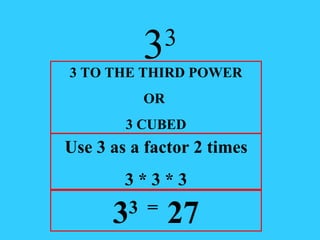
3 3 3 TO THE THIRD POWER OR  3 CUBED Use 3 as a factor 2 times 3 * 3 * 3 3 3  =  27
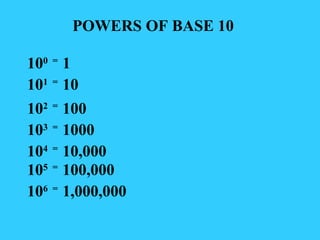
POWERS OF BASE 10 10 0  =  1 10 1  =  10 10 2  =  100 10 3  =  1000 10 4  =  10,000 10 5  =  100,000 10 6  =  1,000,000
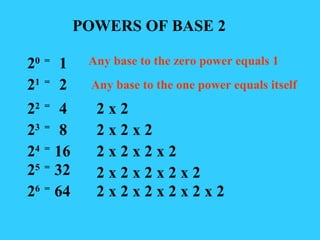
POWERS OF BASE 2 2 0  =  1 2 1  =  2 2 2  =  4 2 3  =  8 2 4  =  16 2 5  =  32 2 6  =  64 Any base to the zero power equals 1 Any base to the one power equals itself 2 x 2 2 x 2 x 2 2 x 2 x 2 x 2 2 x 2 x 2 x 2 x 2 2 x 2 x 2 x 2 x 2 x 2
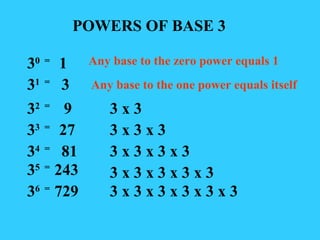
POWERS OF BASE 3 3 0  =  1 3 1  =  3 3 2  =  9 3 3  =  27 3 4  =  81 3 5  =  243 3 6  =  729 Any base to the zero power equals 1 Any base to the one power equals itself 3 x 3 3 x 3 x 3 3 x 3 x 3 x 3 3 x 3 x 3 x 3 x 3 3 x 3 x 3 x 3 x 3 x 3
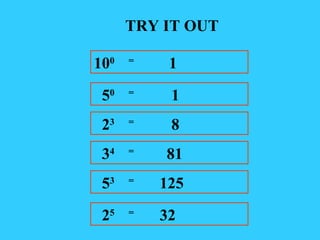
TRY IT OUT 10 0  =  1 5 0  =  1 2 3  =  8 3 4  =  81 5 3  =  125 2 5  =  32
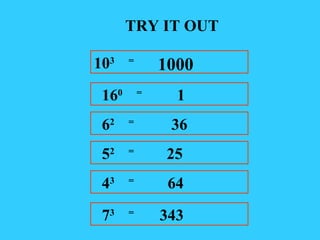
TRY IT OUT 10 3  = 16 0  =  1 6 2  =  36 5 2  =  25 4 3  =  64 7 3  =  343 1000
MULTIPLYING EXPONENTS WITH THE SAME BASE
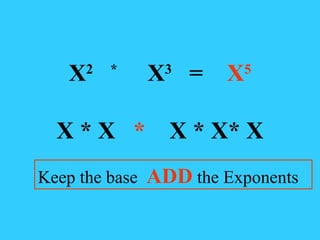
X 2  *   X 3  =  X 5 X * X  *  X * X* X Keep the base  ADD  the Exponents
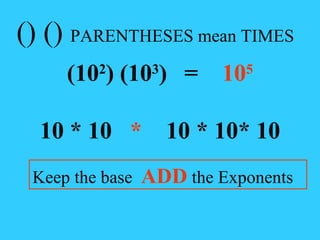
(10 2 ) (10 3 )   =  10 5 10 * 10  *  10 * 10* 10 Keep the base  ADD  the Exponents () ()  PARENTHESES mean TIMES
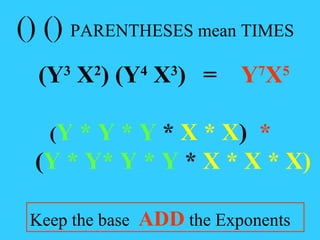
(Y 3  X 2 ) (Y 4  X 3 )   =  Y 7 X 5  ( Y * Y * Y  *  X * X )  *    ( Y * Y* Y * Y  *  X * X * X) Keep the base  ADD  the Exponents () ()  PARENTHESES mean TIMES
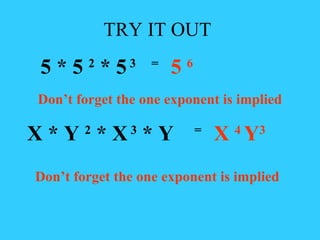
TRY IT OUT 5 * 5  2  * 5  3  =  5  6 Don’t forget the one exponent is implied X * Y  2  * X  3  * Y  =  X  4  Y 3 Don’t forget the one exponent is implied
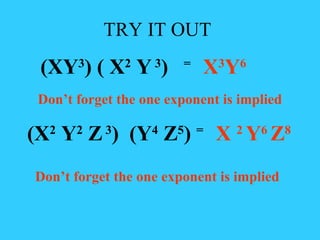
TRY IT OUT (XY 3 ) ( X 2  Y  3 )   =  X 3 Y 6 Don’t forget the one exponent is implied (X 2  Y 2  Z  3 )  (Y 4  Z 5 )  =  X  2  Y 6  Z 8 Don’t forget the one exponent is implied
DIVIDING  EXPONENTS WITH THE SAME BASE
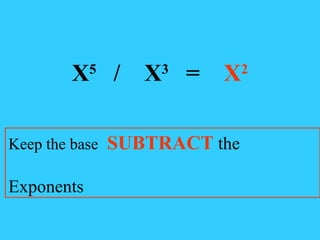
X 5  /  X 3  =  X 2 Keep the base   SUBTRACT  the  Exponents
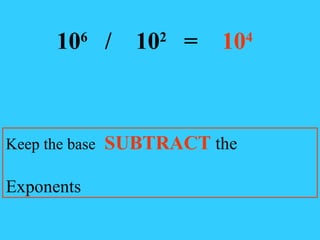
10 6  /  10 2  =  10 4 Keep the base   SUBTRACT  the  Exponents
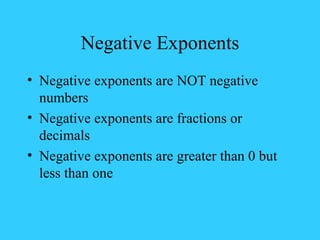
Negative Exponents Negative exponents are NOT negative numbers Negative exponents are fractions or decimals Negative exponents are greater than 0 but less than one
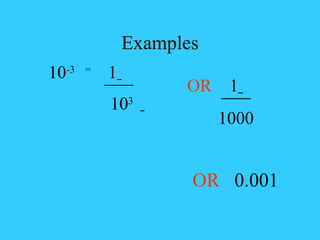
Examples 10 -3  =  1   10 3   OR   1   1000 OR   0.001
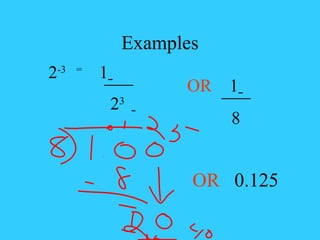
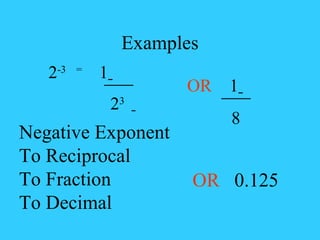
Examples 2 -3  =  1   2 3   OR   1   8 OR   0.125
Examples 2 -3  =  1   2 3   OR   1   8 OR   0.125 Negative Exponent To Reciprocal To Fraction To Decimal
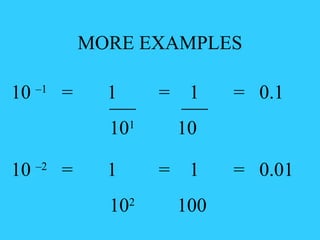
MORE EXAMPLES 10  –1   =  1    =  1  =  0.1   10 1  10   10  –2   =  1    =  1  =  0.01   10 2  100
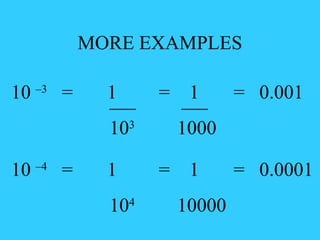
MORE EXAMPLES 10  –3   =  1    =  1  =  0.001   10 3  1000   10  –4   =  1    =  1  =  0.0001   10 4  10000
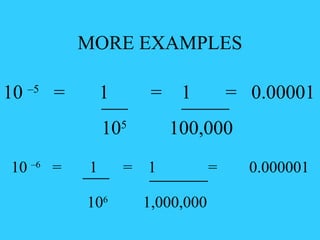
MORE EXAMPLES 10  –5   =  1    =  1  =  0.00001   10 5  100,000   10  –6   =  1    =  1  =  0.000001   10 6  1,000,000
Created by: pmastro.weebly.com/uploads/2/8/2/7/.../ exponents .801116. ppt

Exponents

  • 1.
  • 2.
    X 2 XTO THE SECOND POWER OR X SQUARED X IS CALLED BASE 2 IS CALLED EXPONENT Use x as a factor 2 times X * X
  • 3.
    X 3 XTO THE THIRD POWER OR X CUBED X IS CALLED BASE 3 IS CALLED EXPONENT Use x as a factor 3 times X * X *X
  • 4.
    X 4 XTO THE FOURTH POWER X IS CALLED BASE 4 IS CALLED EXPONENT Use x as a factor 4 times X * X * X * X
  • 5.
    3 2 3TO THE SECOND POWER OR 3 SQUARED Use 3 as a factor 2 times 3 * 3 3 2 = 9
  • 6.
    3 3 3TO THE THIRD POWER OR 3 CUBED Use 3 as a factor 2 times 3 * 3 * 3 3 3 = 27
  • 7.
    POWERS OF BASE10 10 0 = 1 10 1 = 10 10 2 = 100 10 3 = 1000 10 4 = 10,000 10 5 = 100,000 10 6 = 1,000,000
  • 8.
    POWERS OF BASE2 2 0 = 1 2 1 = 2 2 2 = 4 2 3 = 8 2 4 = 16 2 5 = 32 2 6 = 64 Any base to the zero power equals 1 Any base to the one power equals itself 2 x 2 2 x 2 x 2 2 x 2 x 2 x 2 2 x 2 x 2 x 2 x 2 2 x 2 x 2 x 2 x 2 x 2
  • 9.
    POWERS OF BASE3 3 0 = 1 3 1 = 3 3 2 = 9 3 3 = 27 3 4 = 81 3 5 = 243 3 6 = 729 Any base to the zero power equals 1 Any base to the one power equals itself 3 x 3 3 x 3 x 3 3 x 3 x 3 x 3 3 x 3 x 3 x 3 x 3 3 x 3 x 3 x 3 x 3 x 3
  • 10.
    TRY IT OUT10 0 = 1 5 0 = 1 2 3 = 8 3 4 = 81 5 3 = 125 2 5 = 32
  • 11.
    TRY IT OUT10 3 = 16 0 = 1 6 2 = 36 5 2 = 25 4 3 = 64 7 3 = 343 1000
  • 12.
  • 13.
    X 2 * X 3 = X 5 X * X * X * X* X Keep the base ADD the Exponents
  • 14.
    (10 2 )(10 3 ) = 10 5 10 * 10 * 10 * 10* 10 Keep the base ADD the Exponents () () PARENTHESES mean TIMES
  • 15.
    (Y 3 X 2 ) (Y 4 X 3 ) = Y 7 X 5 ( Y * Y * Y * X * X ) * ( Y * Y* Y * Y * X * X * X) Keep the base ADD the Exponents () () PARENTHESES mean TIMES
  • 16.
    TRY IT OUT5 * 5 2 * 5 3 = 5 6 Don’t forget the one exponent is implied X * Y 2 * X 3 * Y = X 4 Y 3 Don’t forget the one exponent is implied
  • 17.
    TRY IT OUT(XY 3 ) ( X 2 Y 3 ) = X 3 Y 6 Don’t forget the one exponent is implied (X 2 Y 2 Z 3 ) (Y 4 Z 5 ) = X 2 Y 6 Z 8 Don’t forget the one exponent is implied
  • 18.
    DIVIDING EXPONENTSWITH THE SAME BASE
  • 19.
    X 5 / X 3 = X 2 Keep the base SUBTRACT the Exponents
  • 20.
    10 6 / 10 2 = 10 4 Keep the base SUBTRACT the Exponents
  • 21.
    Negative Exponents Negativeexponents are NOT negative numbers Negative exponents are fractions or decimals Negative exponents are greater than 0 but less than one
  • 22.
    Examples 10 -3 = 1 10 3 OR 1 1000 OR 0.001
  • 23.
    Examples 2 -3 = 1 2 3 OR 1 8 OR 0.125
  • 24.
    Examples 2 -3 = 1 2 3 OR 1 8 OR 0.125 Negative Exponent To Reciprocal To Fraction To Decimal
  • 25.
    MORE EXAMPLES 10 –1 = 1 = 1 = 0.1 10 1 10 10 –2 = 1 = 1 = 0.01 10 2 100
  • 26.
    MORE EXAMPLES 10 –3 = 1 = 1 = 0.001 10 3 1000 10 –4 = 1 = 1 = 0.0001 10 4 10000
  • 27.
    MORE EXAMPLES 10 –5 = 1 = 1 = 0.00001 10 5 100,000 10 –6 = 1 = 1 = 0.000001 10 6 1,000,000
  • 28.