Exponential growth
Prepared by
Ismail Mohammad El-Badawy
ismailelbadawy@gmail.com
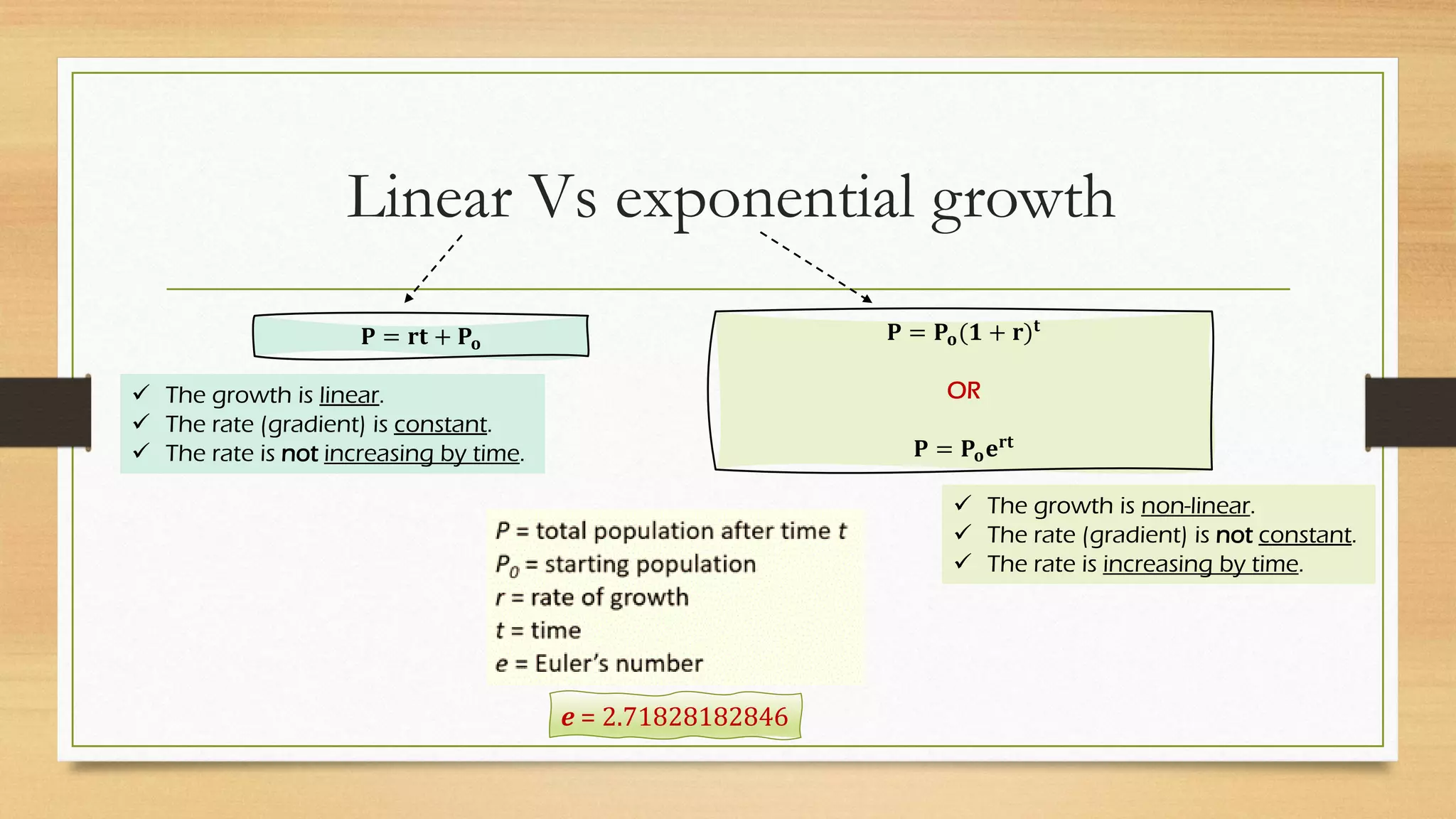
Linear Vs exponential growth
𝐏 = 𝐫𝐭 + 𝐏𝐨
𝐏 = 𝐏𝐨(𝟏 + 𝐫)𝐭
OR
𝐏 = 𝐏𝐨 𝐞 𝐫𝐭
e = 2.71828182846
✓ The growth is linear.
✓ The rate (gradient) is constant.
✓ The rate is not increasing by time.
✓ The growth is non-linear.
✓ The rate (gradient) is not constant.
✓ The rate is increasing by time.
Exponential growth
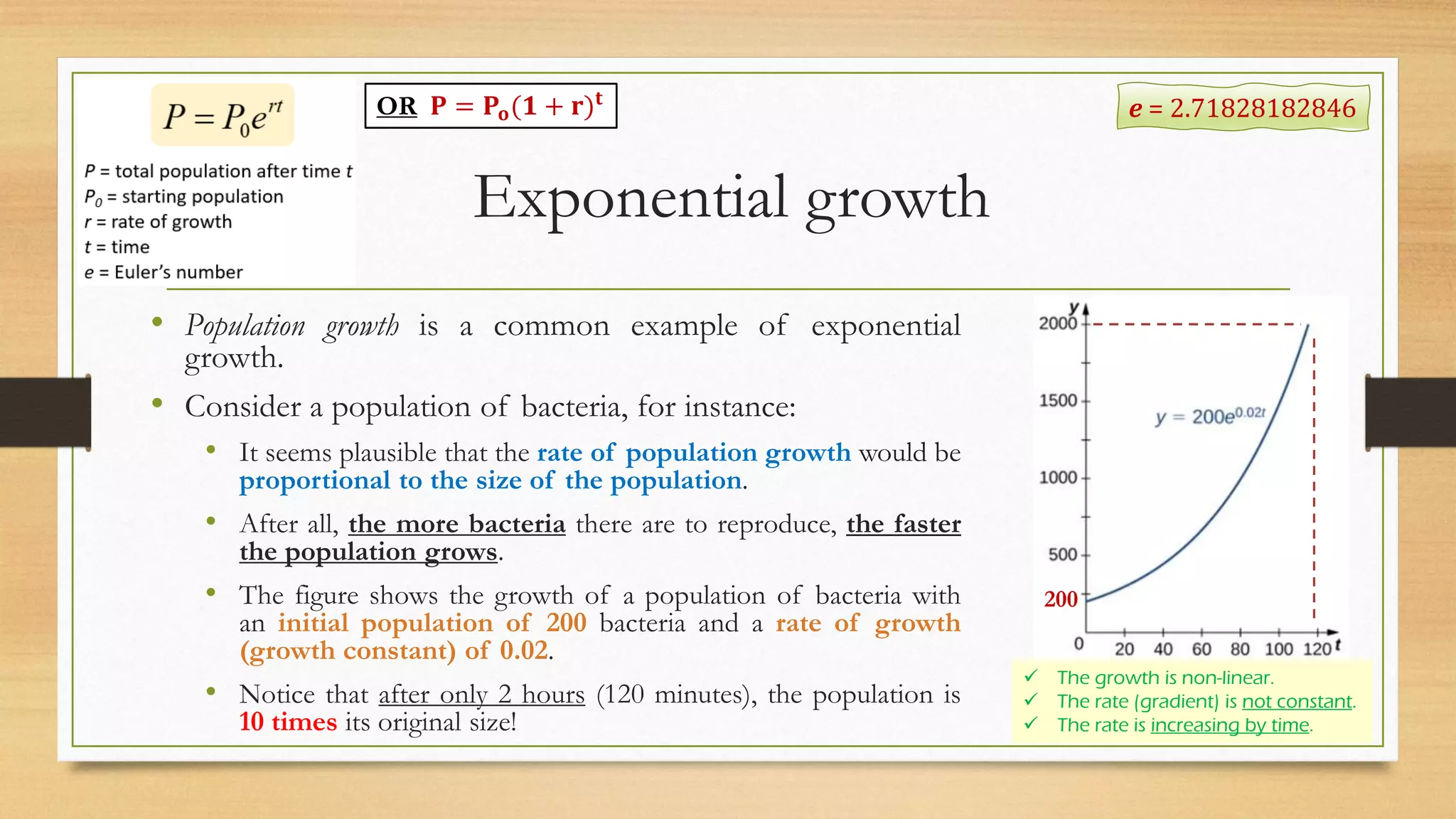
• Population growth is a common example of exponential
growth.
• Consider a population of bacteria, for instance:
• It seems plausible that the rate of population growth would be
proportional to the size of the population.
• After all, the more bacteria there are to reproduce, the faster
the population grows.
• The figure shows the growth of a population of bacteria with
an initial population of 200 bacteria and a rate of growth
(growth constant) of 0.02.
• Notice that after only 2 hours (120 minutes), the population is
10 times its original size!
200
✓ The growth is non-linear.
✓ The rate (gradient) is not constant.
✓ The rate is increasing by time.
e = 2.71828182846OR 𝐏 = 𝐏𝐨(𝟏 + 𝐫)𝐭
H1N1 flu outbreak 2009 in
Japan
Time (days) Recorded cases
0 98
25 183
50 326
75 534
100 768
(25, 183)
(50, 326)
(75, 534)
(100, 768)
(0, 98)
𝐏 = 𝐏𝐨 𝐞 𝐫𝐭
𝐏 = 𝐏𝐨(𝟏 + 𝐫)𝐭
OR
Let’s find the model
Rate of change (Δy/Δx) is not fixed …….
That’s why a straight line cannot be used to model the data
Make r subject of the formula
P = Poert P = Po(1 + r)t
Make r subject of the formula
P = Poert
P
Po
= ert
ln
P
Po
= ln ert
ln
P
Po
= rt ln e
ln
P
Po
= rt
∴ 𝐫 =
𝟏
𝐭
𝐥𝐧
𝐏
𝐏𝐨
P = Po(1 + r)t
P
Po
= (1 + r)t
Log
P
Po
= Log(1 + r)t
Log
P
Po
= t Log 1 + r
1
t
Log
P
Po
= Log 1 + r
10
1
t
log
P
Po = 1 + r
∴ 𝐫 = 𝟏𝟎
𝟏
𝐭
𝐥𝐨𝐠
𝐏
𝐏 𝐨 −𝟏
Let’s find the model
Time (days) Recorded cases Growth rate ‘ r ‘
0 98 -
25 183
50 326
75 534
100 768
𝐫 =
𝟏
𝐭
𝐥𝐧
𝐏
𝐏𝐨
𝐏 = 𝐏𝐨 𝐞 𝐫𝐭
Let’s find the model
Time (days) Recorded cases Growth rate ‘ r ‘
0 98 -
25 183 0.025
50 326 0.024
75 534 0.023
100 768 0.021
✓ Average growth rate = 0.023
𝐫 =
𝟏
𝐭
𝐥𝐧
𝐏
𝐏𝐨
𝐏 = 𝐏𝐨 𝐞 𝐫𝐭
𝐏𝐨
98 𝑒0.023𝑡
98
𝐏 = 𝟗𝟖 𝐞 𝟎.𝟎𝟐𝟑𝐭
Time
(days)
Actual
cases
Predicted
cases
Error
0 98
25 183
50 326
75 534
100 768
98 𝑒0.023𝑡
98
𝐏 = 𝟗𝟖 𝐞 𝟎.𝟎𝟐𝟑𝐭
Time
(days)
Actual
cases
Predicted
cases
Error
0 98 98 0
25 183 174.16 8.84
50 326 309.50 16.5
75 534 550.03 -16.03
100 768 977.47 -209.47
𝐀𝐯𝐞𝐫𝐚𝐠𝐞 𝐚𝐛𝐬𝐨𝐥𝐮𝐭𝐞 𝐞𝐫𝐫𝐨𝐫
=
𝟎 + 𝟖. 𝟖𝟒 + 𝟏𝟔. 𝟓 + 𝟏𝟔. 𝟎𝟑 + 𝟐𝟎𝟗. 𝟒𝟕
𝟓
= 𝟓𝟎. 𝟏𝟔
Let’s find the model
Time (days) Recorded cases Growth rate ‘ r ‘
0 98 -
25 183
50 326
75 534
100 768
𝐫 = 𝟏𝟎
𝟏
𝐭 𝐥𝐨𝐠
𝐏
𝐏 𝐨 − 𝟏
𝐏 = 𝐏𝐨(𝟏 + 𝐫)𝐭
Let’s find the model
Time (days) Recorded cases Growth rate ‘ r ‘
0 98 -
25 183 0.025
50 326 0.024
75 534 0.023
100 768 0.021
✓ Average growth rate = 0.023
𝐏𝐨
𝐏 = 𝐏𝐨(𝟏 + 𝐫)𝐭
𝐫 = 𝟏𝟎
𝟏
𝐭 𝐥𝐨𝐠
𝐏
𝐏 𝐨 − 𝟏
98(1 + 0.023) 𝑡
98
𝐏 = 𝟗𝟖(𝟏 + 𝟎. 𝟎𝟐𝟑)𝐭
Time
(days)
Actual
cases
Predicted
cases
Error
0 98
25 183
50 326
75 534
100 768
98(1 + 0.023) 𝑡
98
𝐏 = 𝟗𝟖(𝟏 + 𝟎. 𝟎𝟐𝟑)𝐭
Time
(days)
Actual
cases
Predicted
cases
Error
0 98 98 0
25 183 173.03 9.97
50 326 305.48 20.52
75 534 539.38 -5.38
100 768 952.33 -184.33
𝐀𝐯𝐞𝐫𝐚𝐠𝐞 𝐚𝐛𝐬𝐨𝐥𝐮𝐭𝐞 𝐞𝐫𝐫𝐨𝐫
=
𝟎 + 𝟗. 𝟗𝟕 + 𝟐𝟎. 𝟓𝟐 + 𝟓. 𝟑𝟖 + 𝟏𝟖𝟒. 𝟑𝟑
𝟓
= 𝟒𝟒. 𝟎𝟒
Which model shall you
choose ?
98
𝐏 = 𝟗𝟖𝐞 𝟎.𝟎𝟐𝟑𝐭
𝐏 = 𝟗𝟖(𝟏 + 𝟎. 𝟎𝟐𝟑)𝐭
OR
Average
error
50.16
44.04

Exponential growth

  • 1.
    Exponential growth Prepared by IsmailMohammad El-Badawy ismailelbadawy@gmail.com
  • 2.
    Linear Vs exponentialgrowth 𝐏 = 𝐫𝐭 + 𝐏𝐨 𝐏 = 𝐏𝐨(𝟏 + 𝐫)𝐭 OR 𝐏 = 𝐏𝐨 𝐞 𝐫𝐭 e = 2.71828182846 ✓ The growth is linear. ✓ The rate (gradient) is constant. ✓ The rate is not increasing by time. ✓ The growth is non-linear. ✓ The rate (gradient) is not constant. ✓ The rate is increasing by time.
  • 3.
    Exponential growth • Populationgrowth is a common example of exponential growth. • Consider a population of bacteria, for instance: • It seems plausible that the rate of population growth would be proportional to the size of the population. • After all, the more bacteria there are to reproduce, the faster the population grows. • The figure shows the growth of a population of bacteria with an initial population of 200 bacteria and a rate of growth (growth constant) of 0.02. • Notice that after only 2 hours (120 minutes), the population is 10 times its original size! 200 ✓ The growth is non-linear. ✓ The rate (gradient) is not constant. ✓ The rate is increasing by time. e = 2.71828182846OR 𝐏 = 𝐏𝐨(𝟏 + 𝐫)𝐭
  • 4.
    H1N1 flu outbreak2009 in Japan Time (days) Recorded cases 0 98 25 183 50 326 75 534 100 768 (25, 183) (50, 326) (75, 534) (100, 768) (0, 98) 𝐏 = 𝐏𝐨 𝐞 𝐫𝐭 𝐏 = 𝐏𝐨(𝟏 + 𝐫)𝐭 OR Let’s find the model Rate of change (Δy/Δx) is not fixed ……. That’s why a straight line cannot be used to model the data
  • 5.
    Make r subjectof the formula P = Poert P = Po(1 + r)t
  • 6.
    Make r subjectof the formula P = Poert P Po = ert ln P Po = ln ert ln P Po = rt ln e ln P Po = rt ∴ 𝐫 = 𝟏 𝐭 𝐥𝐧 𝐏 𝐏𝐨 P = Po(1 + r)t P Po = (1 + r)t Log P Po = Log(1 + r)t Log P Po = t Log 1 + r 1 t Log P Po = Log 1 + r 10 1 t log P Po = 1 + r ∴ 𝐫 = 𝟏𝟎 𝟏 𝐭 𝐥𝐨𝐠 𝐏 𝐏 𝐨 −𝟏
  • 7.
    Let’s find themodel Time (days) Recorded cases Growth rate ‘ r ‘ 0 98 - 25 183 50 326 75 534 100 768 𝐫 = 𝟏 𝐭 𝐥𝐧 𝐏 𝐏𝐨 𝐏 = 𝐏𝐨 𝐞 𝐫𝐭
  • 8.
    Let’s find themodel Time (days) Recorded cases Growth rate ‘ r ‘ 0 98 - 25 183 0.025 50 326 0.024 75 534 0.023 100 768 0.021 ✓ Average growth rate = 0.023 𝐫 = 𝟏 𝐭 𝐥𝐧 𝐏 𝐏𝐨 𝐏 = 𝐏𝐨 𝐞 𝐫𝐭 𝐏𝐨
  • 9.
    98 𝑒0.023𝑡 98 𝐏 =𝟗𝟖 𝐞 𝟎.𝟎𝟐𝟑𝐭 Time (days) Actual cases Predicted cases Error 0 98 25 183 50 326 75 534 100 768
  • 10.
    98 𝑒0.023𝑡 98 𝐏 =𝟗𝟖 𝐞 𝟎.𝟎𝟐𝟑𝐭 Time (days) Actual cases Predicted cases Error 0 98 98 0 25 183 174.16 8.84 50 326 309.50 16.5 75 534 550.03 -16.03 100 768 977.47 -209.47 𝐀𝐯𝐞𝐫𝐚𝐠𝐞 𝐚𝐛𝐬𝐨𝐥𝐮𝐭𝐞 𝐞𝐫𝐫𝐨𝐫 = 𝟎 + 𝟖. 𝟖𝟒 + 𝟏𝟔. 𝟓 + 𝟏𝟔. 𝟎𝟑 + 𝟐𝟎𝟗. 𝟒𝟕 𝟓 = 𝟓𝟎. 𝟏𝟔
  • 11.
    Let’s find themodel Time (days) Recorded cases Growth rate ‘ r ‘ 0 98 - 25 183 50 326 75 534 100 768 𝐫 = 𝟏𝟎 𝟏 𝐭 𝐥𝐨𝐠 𝐏 𝐏 𝐨 − 𝟏 𝐏 = 𝐏𝐨(𝟏 + 𝐫)𝐭
  • 12.
    Let’s find themodel Time (days) Recorded cases Growth rate ‘ r ‘ 0 98 - 25 183 0.025 50 326 0.024 75 534 0.023 100 768 0.021 ✓ Average growth rate = 0.023 𝐏𝐨 𝐏 = 𝐏𝐨(𝟏 + 𝐫)𝐭 𝐫 = 𝟏𝟎 𝟏 𝐭 𝐥𝐨𝐠 𝐏 𝐏 𝐨 − 𝟏
  • 13.
    98(1 + 0.023)𝑡 98 𝐏 = 𝟗𝟖(𝟏 + 𝟎. 𝟎𝟐𝟑)𝐭 Time (days) Actual cases Predicted cases Error 0 98 25 183 50 326 75 534 100 768
  • 14.
    98(1 + 0.023)𝑡 98 𝐏 = 𝟗𝟖(𝟏 + 𝟎. 𝟎𝟐𝟑)𝐭 Time (days) Actual cases Predicted cases Error 0 98 98 0 25 183 173.03 9.97 50 326 305.48 20.52 75 534 539.38 -5.38 100 768 952.33 -184.33 𝐀𝐯𝐞𝐫𝐚𝐠𝐞 𝐚𝐛𝐬𝐨𝐥𝐮𝐭𝐞 𝐞𝐫𝐫𝐨𝐫 = 𝟎 + 𝟗. 𝟗𝟕 + 𝟐𝟎. 𝟓𝟐 + 𝟓. 𝟑𝟖 + 𝟏𝟖𝟒. 𝟑𝟑 𝟓 = 𝟒𝟒. 𝟎𝟒
  • 15.
    Which model shallyou choose ? 98 𝐏 = 𝟗𝟖𝐞 𝟎.𝟎𝟐𝟑𝐭 𝐏 = 𝟗𝟖(𝟏 + 𝟎. 𝟎𝟐𝟑)𝐭 OR Average error 50.16 44.04