Explore the ways in which John
Steinbeck presents and uses setting
   in his novel Of Mice and Men.


                Year 11
      Extended Reading Controlled
             Assessment
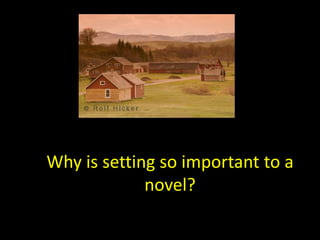
Why is setting so important to a
             novel?
•   It can create atmosphere and a certain tone.
•   It can help reinforce some key messages that
    the author is wanting to get across to the
    reader.
•   It can be symbolic, a metaphor for
    something.
Does he use
                  particular words?
Presents
                  Does he use any
                  imagery or other
                  techniques?

           Is there anything
           poetic he does?
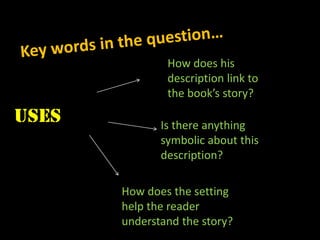
How does his
               description link to
               the book’s story?

USes          Is there anything
              symbolic about this
              description?

       How does the setting
       help the reader
       understand the story?
Chapter 1: Steinbeck presents to us a
beautiful place, an idyll and a paradise.
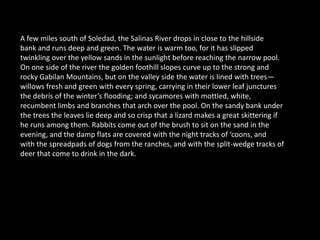
A few miles south of Soledad, the Salinas River drops in close to the hillside
bank and runs deep and green. The water is warm too, for it has slipped
twinkling over the yellow sands in the sunlight before reaching the narrow pool.
On one side of the river the golden foothill slopes curve up to the strong and
rocky Gabilan Mountains, but on the valley side the water is lined with trees—
willows fresh and green with every spring, carrying in their lower leaf junctures
the debris of the winter’s flooding; and sycamores with mottled, white,
recumbent limbs and branches that arch over the pool. On the sandy bank under
the trees the leaves lie deep and so crisp that a lizard makes a great skittering if
he runs among them. Rabbits come out of the brush to sit on the sand in the
evening, and the damp flats are covered with the night tracks of ‘coons, and
with the spreadpads of dogs from the ranches, and with the split-wedge tracks of
deer that come to drink in the dark.
Steinbeck creates a
    soothing and
calming setting – is
   he leading the
reader into a false
 sense of security?
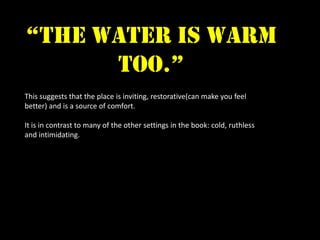
“the water is warm
      too.”
This suggests that the place is inviting, restorative(can make you feel
better) and is a source of comfort.

It is in contrast to many of the other settings in the book: cold, ruthless
and intimidating.
“green”

Connotations of life, vitality and new growth. This is a place that is alive, a
place of hope.

Perhaps these feelings are those of George and Lennie? They hope to
start a new life and they desire a better future. The setting could
represent the best laid plans of mice and men. Does this change by the
end?
“slopes curve up to
   the strong ”
Even the sounds of the description are soft and soothing: sibilance.

It is a calming place, perhaps contrasting with other settings in the book.
“…slipped
twinkling over the yellow
sands in the sunlight
before…golden foothills.”
• Twinkling is a word that suggests something magical, something
  mystical. It is almost a childlike word. Could this suggest that our hopes
  and dreams are just a mirage and are never going to happen? Could
  the childish words suggest that thinking dreams will come true is just
  naivety?

• The colour yellow/gold is vital to this piece. It turns the place into an
  idyll, a place that is almost heavenly. Gold suggests wealth, something
  valuable. Is this what G&L are searching for?

• Is Steinbeck suggesting that this place is almost too good to be true? Is
  he lulling his reader into thinking that all will be well? We know it
  won’t!
“… winter’s flooding.”

 • Steninbeck is suggesting that this place can be dangerous. Things can
   turn on their heads quickly.

 • This links to the lives of George and Lennie – just as their dream seems
   a reality, it is taken away from them.
“branches that arch over
the pool”
 • It is almost an image of protection: is Steinbeck suggesting that this
   place is a sanctuary, a place offering protection? Why do we need
   protection? Because the world of ranch working and dreams not
   coming true is harsh and ruthless.
There is a path through the willows and among the sycamores, a path
beaten hard by boys coming down from the ranches to swim in the deep
pool, and beaten hard by tramps who come wearily down from the highway
in the evening to jungle-up near water. In front of the low horizontal limb of
a giant sycamore there is an ash pile made by many fires; the limb is worn
smooth by men who have sat on it.
Evening of a hot day started the little wind to moving among the leaves. The
shade climbed up the hills toward the top. On the sand banks the rabbits sat
as quietly as little gray sculptured stones. And then from the direction of the
state highway came the sound of footsteps on crisp sycamore leaves. The
rabbits hurried noiselessly for cover. A stilted heron labored up into the air
and pounded down river. For a moment the place was lifeless, and then two
men emerged from the path and came into the opening by the green pool.
“beaten hard by boys”
“beaten hard by tramps who
come wearily down”

 • In contrast to the soothing world of nature, mankind is aggressive and
   destructive.

 • Is Steinbeck suggesting that we are responsible for our own downfall?

 • The adverb ‘wearily’ is in contrast to the vitality and energy of nature.
“the limb is worn smooth by
men who have sat on it.”


 • Steinbeck is suggesting that many men, quite literally, follow the same
   path – it is fate that they will be here.

 • This links to the idea that ranchworkers, whatever their dreams, will be
   in this position.
“the rabbits hurried
noiselessly for cover.”


 • As George and Lennie arrive, the previously still rabbits feel the need
   to get out of danger.

 • Is this Steinbeck foreshadowing what is to come?
Chapter 2: The Bunkhouse is a metaphor
      for the ranch workers’ lives
The bunk house was a long, rectangular building. Inside, the walls were
whitewashed and the floor unpainted. In three walls there were small, square
windows, and in the fourth, a solid door with a wooden latch. Against the walls
were eight bunks, five of them made up with blankets and the other three
showing their burlap ticking. Over each bunk there was nailed an apple box with
the opening forward so that it made two shelves for the personal
belongings of the occupant of the bunk. And these shelves were loaded with little
articles, soap and talcum powder, razors and those Western magazines ranch
men love to read and scoff at and secretly believe. And there were
medicines on the shelves, and little vials, combs; and from nails on the box
sides, a few neckties. Near one wall there was a black cast-iron stove, its
stovepipe going straight up through the ceiling. In the middle of the room stood
a big square table littered with playing cards, and around it were grouped boxes
for the players to sit on.
At about ten o’clock in the morning the sun threw a bright dust-laden bar through
one of the side windows, and in and out of the beam flies shot like
rushing stars. The wooden latch raised. The door opened and a tall, stoop-
shouldered old man came in. He was dressed in blue jeans and he carried a big
push-broom in his left hand. Behind him came George, and behind
George, Lennie.
The first line is lacking in
colour, description; it is
also a mundane, monotonous
rhythm.

The first line implies
routine and boredom.
“the bunkhouse”


 • The very name is simply functional – it is a place where people exist
   rather than live.

 • It shows how unimportant the ranchworkers are – they live in a place
   that is unimpressive, insignificant and lacking character.
“long, rectangular
building”


• The shape that Steinbeck gives us is common. There are no
  distinguishing or interesting features. Perhaps this represents the lives
  of the ranchworkers?

• It almost presents an image of a prison – the workers are certainly
  trapped in their existence.
“inside, the walls were
whitewashed and the floor
unpainted.”

• In contrast to the opening of the book, this place is uninviting and
  cold. Whitewash is a cheap form of paint – it shows that the workers
  are uncared . The floor unpainted almost suggests that they are like
  animals, wandering around a barn.

• Steinbeck is shaping the readers’ minds – we do not like the place that
  George and Lennie have come to.
“in three walls there were
small, square windows”


• Steinbeck creates an image of darkness and isolation here.

• Perhaps he is trying to show how cut off from the outside world these
  workers are. It could also be a metaphor for their dreams – they still
  have a small piece of hope.
“against the walls
were eight bunks…”


• Suggests that all workers were the same.

• This is in-keeping with the rest of the novel. Although Lennie and
  George try to be different from other workers, in the end their dreams
  are dashed.
“there was nailed an apple
  box”


• The world ‘nailed’ shows that not much thought has been put into it: it
  suggests clumsiness and lack of care.

• The only way in which the ranch workers can distinguish themselves
  from each other is by a mere apple box.

• It is also second-hand! Not particularly homely!
“loaded with little
 articles”


• The word ‘loaded’ implies that the workers were desperate to try and
  make themselves unique, to try and turn their mundane, bring
  existence into something unique.

• Perhaps Steinbeck is highlighting the plight of these men, wanting to
  get away from this world.
“western magazines ranch
men love to read and scoff at
and secretly believe”
  • These show how the ranchworkers wanted some escapism.


  • Perhaps Steinbeck is highlighting the plight of these men, wanting to
    get away from this world.
“and there were
 medicines on the
 shelves, and little vials…”
• These show how the workers felt ill and needed some ford of remedy.


• This is highly symbolic. Perhaps Steinbeck is suggesting that life on the
  ranch is a disease, something that the workers need curing of.

• The word ‘vial’ is highly suggestive: it has connotations with drugs as a
  form of getting away from the mental torment of the ranch.
“the sun threw a bright
 dust-laden bar through one
 of the side windows”
• This image seems to stand out from all of the other pieces of
  description. It is a real contrast.

• Perhaps it is a classic metaphor: darkness is overpowering light; evil is
  overpowering good.

• However, even the one piece of beauty is being tainted with dust and
  becoming overpowered.
Chapter 4: Crooks’ room is symbolic of
               his life.
Crooks, the Negro stable buck, had his bunk in the harness room; a little shed
that leaned off the wall of the barn. On one side of the little room there was a
square four-paned window, and on the other, a narrow plank door leading into
the barn. Crooks’ bunk was a long box filled with straw, on which his blankets
were flung. On the wall by the window there were pegs on which hung broken
harness in process of being mended; strips of new leather; and under the
window itself a little bench for leather-working tools, curved knives and needles
and balls of linen thread, and a small hand riveter. On pegs were also pieces of
harness, a split collar with the horsehair stuffing sticking out, a broken hame,
and a trace chain with its leather covering split. Crooks had his apple box over
his bunk, and in it a range of medicine bottles, both for himself and for the
horses. There were cans of saddle soap and a drippy can of tar with its paint
brush sticking over the edge. And scattered about the floor were a number of
personal possessions; for, being alone, Crooks could leave his things about, and
being a stable buck and a cripple, he was more permanent than the other men,
and he had accumulated more possessions than he could carry on his back.
“…had his bunk in the
 harness room.”


• Contrast to the main bunkhouse where there were eight together.

• Steinbeck is making it very clear to the reader that he is on his
  own, isolated and separated from the main body of men.
“a little shed
 that leaned off the wall of
 the barn.”
• The word ‘leaned’ has all sorts of implications. It suggests that Crooks
  is something of an afterthought and annoying addition.

• ‘Leaned’ also suggests insecurity, instability. Is this a metaphor for his
  state of mind?

• Leaning off the wall of the barn almost implies that the animals have
  better accommodation than him. Is Steinbeck using this to show
  hierarchy and that a black such as Crooks has such a low status in
  society.
“crooks’ bunk was a long
box filled with straw, on
which his blankets
were flung.”
  • Steinbeck suggests that it wasn’t a bunk at all – this is almost a
    metaphor! Once more, it extends the idea that he is treated like an
    animal. IMAGERY.

  • The word ‘flung’ is vital here. It suggests that Crooks has a lack of care:
    perhaps Steinbeck is implying that this man has been so
    treated, victimised and bullied that he has little aptitude for life.
“on the wall by the window there were pegs
on which hung broken harness in process of
being mended; strips of new leather; and
under the window itself a little bench for
leather-working tools, curved knives and
needles and balls of linen thread, and a small
hand riveter.”


    • It seems that Crooks sleeps where he works – there is a lack of
      distinction between the two places.

    • This is a very long list of tools here. Does this represent the
      hard, unrelenting work that he has to do?

    • This perhaps shows that Crooks is defined by his work not by his
      character. This reinforces the idea that many refer to him as ‘stable
      buck’ and not by his name.
“…it a range of medicine
bottles, both for himself and for
the
horses.”
  • Once more, Steinbeck suggests that Crooks’ health is no more
    important that the horses’.

  • Perhaps the medicine is a metaphor: does Crooks need curing from
    the illness of the world.

  • In both this setting and the bunkhouse, Steinbeck draws our attentions
    to the medicines. This follows his idea of mans’ illness – unable to fulfil
    dreams.
“there were cans of saddle soap
and a drippy can of tar with its
paint
brush sticking over the edge.”
  • Steinbeck provides us with some disgusting images here, accompanied
    by some foul sensory description.

  • The word ‘drippy’ suggests ugliness and tar is a strong, overpowering
    smell.

  • Steinbeck, through his sensory description, is providing us with a
    setting that is unpleasant and nothing short of undesirable.
“and scattered about the floor were a
number of personal possessions; for, being
alone, Crooks could leave his things
about, and being a stable buck and a
cripple, he was more permanent than the
other men,
and he had accumulated more possessions
than he could carry on his back.”
   • The word ‘scattered’ once more suggests that he lacks care or, to some
     degree, self-respect.

   • ‘For being alone’ – Steinbeck uses the subordinate clause to remind
     the reader that Crooks is lonely.
Crooks possessed several pairs of shoes, a pair of rubber boots, a big alarm
clock and a single-barreled shotgun. And he had books, too; a tattered
dictionary and a mauled copy of the California civil code for 1905. There were
battered magazines and a few dirty books on a special shelf over his bunk. A
pair of large gold-rimmed spectacles hung from a nail on the wall above his bed.
This room was swept and fairly neat, for Crooks was a proud, aloof man. He
kept his distance and demanded that other people keep theirs. His body was
bent
over to the left by his crooked spine, and his eyes lay deep in his head, and
because of their depth seemed to glitter with intensity. His lean face was lined
with deep black wrinkles, and he had thin, pain-tightened lips which were
lighter than his face.
It was Saturday night. Through the open door that led into the barn came the
sound of moving horses, of feet stirring, of teeth champing on hay, of the rattle
of halter chains. In the stable buck’s room a small electric globe threw a meager
yellow light.
“crooks possessed several pairs of shoes, a
pair of rubber boots, a big alarm
clock and a single-barreled shotgun.”

   • Steinbeck provides us with an interesting list of his possessions:
     ‘rubber boots’ suggests that he is protecting himself from something:
     horse manure? Does he have a lowly job?

   • ‘Alarm clock’ suggests that he is a man of routine: we know that he
     should be scared of the boss if he is late – he would be beaten.

   • The shotgun suggests that he, perhaps, has reason to be scared of
     something – is this preparing us for the later threat from Curley’s wife?
“mauled copy of the california civil code for
1905.”


   • The word ‘mauled’ here is key. Is the suggestion that he has attacked
     this book in a fit of anger? It could show a bitter hatred against the
     way that negroes are treated.
“gold-rimmed spectacles”


  • We usually associate glasses with intelligence and wisdom. The word
    ‘gold’ seems to reinforce this fact: he is clearly a wise man.

  • Steinbeck is possibly preparing the reader to take note of what he
    says: especially his view on ranch workers and their dreams.
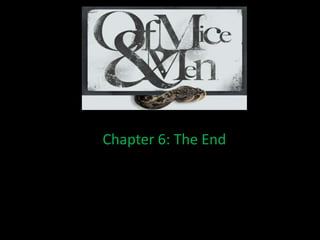
Chapter 6: The End
The deep green pool of the Salinas River was still in the late afternoon.
Already the sun had left the valley to go climbing up the slopes of the Gabilan
Mountains, and the hilltops were rosy in the sun. But by the pool among the
mottled sycamores, a pleasant shade had fallen.
A water snake glided smoothly up the pool, twisting its periscope head from
side to side; and it swam the length of the pool and came to the legs of a
motionless heron that stood in the shallows. A silent head and beak lanced
down and plucked it out by the head, and the beak swallowed the little snake
while its tail waved frantically.
A far rush of wind sounded and a gust drove through the tops of the trees like
a wave. The sycamore leaves turned up their silver sides, the brown, dry
leaves
on the ground scudded a few feet. And row on row of tiny wind waves flowed
up the pool’s green surface.
As quickly as it had come, the wind died, and the clearing was quiet again.
The heron stood in the shallows, motionless and waiting. Another little water
snake swam up the pool, turning its periscope head from side to side.
“twisting its periscope head ”


  • The word ‘periscope’ is from the semantic-field of war and the
    military.

  • Steinbeck is presenting a very different world from the secure
    sanctuary at the start.

  • This is a world of danger and insecurity.
“already the sun had left the valley”
“ShadE”

  • Symbolic of death – life leaving the valley. Moving towards darkness?

  • Is this foreshadowing the death of Lennie?
“a silent head and beak lanced
down and plucked it out by the head”


  • Steinbeck creates a ruthless image with the heron. There is something
    very sinister about the word ‘silent’.

  • The word ‘lanced’ is another military word symbolising death and an
    aggressive one at that.

  • The word ‘plucked’ creates some rather harsh sounds – it is
    onomatopoeia. Totally contrasting tone and atmosphere to the start.
“ its tail waved frantically.”


  • The adverb ‘frantically’ suggests that the snake is desperate to escape
    its doom.

  • Perhaps this is a metaphor for all the ranch workers: they try to escape
    their fate and it doesn’t work.
“another little water
snake swam up the pool, turning its
periscope head from side to side.”

  • This suggests that history is repeating itself.

  • Steinbeck uses this as a metaphor for the ranch workers. They all come
    along the same path with their hopes, dreams and aspirations.

  • It represents the whole aspect of the novel: the best laid plans of mice
    and men often go wrong.

Explore the ways in which john steinbeck presents

  • 1.
    Explore the waysin which John Steinbeck presents and uses setting in his novel Of Mice and Men. Year 11 Extended Reading Controlled Assessment
  • 2.
    Why is settingso important to a novel?
  • 3.
    It can create atmosphere and a certain tone. • It can help reinforce some key messages that the author is wanting to get across to the reader. • It can be symbolic, a metaphor for something.
  • 4.
    Does he use particular words? Presents Does he use any imagery or other techniques? Is there anything poetic he does?
  • 5.
    How does his description link to the book’s story? USes Is there anything symbolic about this description? How does the setting help the reader understand the story?
  • 6.
    Chapter 1: Steinbeckpresents to us a beautiful place, an idyll and a paradise.
  • 7.
    A few milessouth of Soledad, the Salinas River drops in close to the hillside bank and runs deep and green. The water is warm too, for it has slipped twinkling over the yellow sands in the sunlight before reaching the narrow pool. On one side of the river the golden foothill slopes curve up to the strong and rocky Gabilan Mountains, but on the valley side the water is lined with trees— willows fresh and green with every spring, carrying in their lower leaf junctures the debris of the winter’s flooding; and sycamores with mottled, white, recumbent limbs and branches that arch over the pool. On the sandy bank under the trees the leaves lie deep and so crisp that a lizard makes a great skittering if he runs among them. Rabbits come out of the brush to sit on the sand in the evening, and the damp flats are covered with the night tracks of ‘coons, and with the spreadpads of dogs from the ranches, and with the split-wedge tracks of deer that come to drink in the dark.
  • 8.
    Steinbeck creates a soothing and calming setting – is he leading the reader into a false sense of security?
  • 9.
    “the water iswarm too.” This suggests that the place is inviting, restorative(can make you feel better) and is a source of comfort. It is in contrast to many of the other settings in the book: cold, ruthless and intimidating.
  • 10.
    “green” Connotations of life,vitality and new growth. This is a place that is alive, a place of hope. Perhaps these feelings are those of George and Lennie? They hope to start a new life and they desire a better future. The setting could represent the best laid plans of mice and men. Does this change by the end?
  • 11.
    “slopes curve upto the strong ” Even the sounds of the description are soft and soothing: sibilance. It is a calming place, perhaps contrasting with other settings in the book.
  • 12.
    “…slipped twinkling over theyellow sands in the sunlight before…golden foothills.” • Twinkling is a word that suggests something magical, something mystical. It is almost a childlike word. Could this suggest that our hopes and dreams are just a mirage and are never going to happen? Could the childish words suggest that thinking dreams will come true is just naivety? • The colour yellow/gold is vital to this piece. It turns the place into an idyll, a place that is almost heavenly. Gold suggests wealth, something valuable. Is this what G&L are searching for? • Is Steinbeck suggesting that this place is almost too good to be true? Is he lulling his reader into thinking that all will be well? We know it won’t!
  • 13.
    “… winter’s flooding.” • Steninbeck is suggesting that this place can be dangerous. Things can turn on their heads quickly. • This links to the lives of George and Lennie – just as their dream seems a reality, it is taken away from them.
  • 14.
    “branches that archover the pool” • It is almost an image of protection: is Steinbeck suggesting that this place is a sanctuary, a place offering protection? Why do we need protection? Because the world of ranch working and dreams not coming true is harsh and ruthless.
  • 15.
    There is apath through the willows and among the sycamores, a path beaten hard by boys coming down from the ranches to swim in the deep pool, and beaten hard by tramps who come wearily down from the highway in the evening to jungle-up near water. In front of the low horizontal limb of a giant sycamore there is an ash pile made by many fires; the limb is worn smooth by men who have sat on it. Evening of a hot day started the little wind to moving among the leaves. The shade climbed up the hills toward the top. On the sand banks the rabbits sat as quietly as little gray sculptured stones. And then from the direction of the state highway came the sound of footsteps on crisp sycamore leaves. The rabbits hurried noiselessly for cover. A stilted heron labored up into the air and pounded down river. For a moment the place was lifeless, and then two men emerged from the path and came into the opening by the green pool.
  • 16.
    “beaten hard byboys” “beaten hard by tramps who come wearily down” • In contrast to the soothing world of nature, mankind is aggressive and destructive. • Is Steinbeck suggesting that we are responsible for our own downfall? • The adverb ‘wearily’ is in contrast to the vitality and energy of nature.
  • 17.
    “the limb isworn smooth by men who have sat on it.” • Steinbeck is suggesting that many men, quite literally, follow the same path – it is fate that they will be here. • This links to the idea that ranchworkers, whatever their dreams, will be in this position.
  • 18.
    “the rabbits hurried noiselesslyfor cover.” • As George and Lennie arrive, the previously still rabbits feel the need to get out of danger. • Is this Steinbeck foreshadowing what is to come?
  • 19.
    Chapter 2: TheBunkhouse is a metaphor for the ranch workers’ lives
  • 20.
    The bunk housewas a long, rectangular building. Inside, the walls were whitewashed and the floor unpainted. In three walls there were small, square windows, and in the fourth, a solid door with a wooden latch. Against the walls were eight bunks, five of them made up with blankets and the other three showing their burlap ticking. Over each bunk there was nailed an apple box with the opening forward so that it made two shelves for the personal belongings of the occupant of the bunk. And these shelves were loaded with little articles, soap and talcum powder, razors and those Western magazines ranch men love to read and scoff at and secretly believe. And there were medicines on the shelves, and little vials, combs; and from nails on the box sides, a few neckties. Near one wall there was a black cast-iron stove, its stovepipe going straight up through the ceiling. In the middle of the room stood a big square table littered with playing cards, and around it were grouped boxes for the players to sit on. At about ten o’clock in the morning the sun threw a bright dust-laden bar through one of the side windows, and in and out of the beam flies shot like rushing stars. The wooden latch raised. The door opened and a tall, stoop- shouldered old man came in. He was dressed in blue jeans and he carried a big push-broom in his left hand. Behind him came George, and behind George, Lennie.
  • 21.
    The first lineis lacking in colour, description; it is also a mundane, monotonous rhythm. The first line implies routine and boredom.
  • 22.
    “the bunkhouse” •The very name is simply functional – it is a place where people exist rather than live. • It shows how unimportant the ranchworkers are – they live in a place that is unimpressive, insignificant and lacking character.
  • 23.
    “long, rectangular building” • Theshape that Steinbeck gives us is common. There are no distinguishing or interesting features. Perhaps this represents the lives of the ranchworkers? • It almost presents an image of a prison – the workers are certainly trapped in their existence.
  • 24.
    “inside, the wallswere whitewashed and the floor unpainted.” • In contrast to the opening of the book, this place is uninviting and cold. Whitewash is a cheap form of paint – it shows that the workers are uncared . The floor unpainted almost suggests that they are like animals, wandering around a barn. • Steinbeck is shaping the readers’ minds – we do not like the place that George and Lennie have come to.
  • 25.
    “in three wallsthere were small, square windows” • Steinbeck creates an image of darkness and isolation here. • Perhaps he is trying to show how cut off from the outside world these workers are. It could also be a metaphor for their dreams – they still have a small piece of hope.
  • 26.
    “against the walls wereeight bunks…” • Suggests that all workers were the same. • This is in-keeping with the rest of the novel. Although Lennie and George try to be different from other workers, in the end their dreams are dashed.
  • 27.
    “there was nailedan apple box” • The world ‘nailed’ shows that not much thought has been put into it: it suggests clumsiness and lack of care. • The only way in which the ranch workers can distinguish themselves from each other is by a mere apple box. • It is also second-hand! Not particularly homely!
  • 28.
    “loaded with little articles” • The word ‘loaded’ implies that the workers were desperate to try and make themselves unique, to try and turn their mundane, bring existence into something unique. • Perhaps Steinbeck is highlighting the plight of these men, wanting to get away from this world.
  • 29.
    “western magazines ranch menlove to read and scoff at and secretly believe” • These show how the ranchworkers wanted some escapism. • Perhaps Steinbeck is highlighting the plight of these men, wanting to get away from this world.
  • 30.
    “and there were medicines on the shelves, and little vials…” • These show how the workers felt ill and needed some ford of remedy. • This is highly symbolic. Perhaps Steinbeck is suggesting that life on the ranch is a disease, something that the workers need curing of. • The word ‘vial’ is highly suggestive: it has connotations with drugs as a form of getting away from the mental torment of the ranch.
  • 31.
    “the sun threwa bright dust-laden bar through one of the side windows” • This image seems to stand out from all of the other pieces of description. It is a real contrast. • Perhaps it is a classic metaphor: darkness is overpowering light; evil is overpowering good. • However, even the one piece of beauty is being tainted with dust and becoming overpowered.
  • 32.
    Chapter 4: Crooks’room is symbolic of his life.
  • 33.
    Crooks, the Negrostable buck, had his bunk in the harness room; a little shed that leaned off the wall of the barn. On one side of the little room there was a square four-paned window, and on the other, a narrow plank door leading into the barn. Crooks’ bunk was a long box filled with straw, on which his blankets were flung. On the wall by the window there were pegs on which hung broken harness in process of being mended; strips of new leather; and under the window itself a little bench for leather-working tools, curved knives and needles and balls of linen thread, and a small hand riveter. On pegs were also pieces of harness, a split collar with the horsehair stuffing sticking out, a broken hame, and a trace chain with its leather covering split. Crooks had his apple box over his bunk, and in it a range of medicine bottles, both for himself and for the horses. There were cans of saddle soap and a drippy can of tar with its paint brush sticking over the edge. And scattered about the floor were a number of personal possessions; for, being alone, Crooks could leave his things about, and being a stable buck and a cripple, he was more permanent than the other men, and he had accumulated more possessions than he could carry on his back.
  • 34.
    “…had his bunkin the harness room.” • Contrast to the main bunkhouse where there were eight together. • Steinbeck is making it very clear to the reader that he is on his own, isolated and separated from the main body of men.
  • 35.
    “a little shed that leaned off the wall of the barn.” • The word ‘leaned’ has all sorts of implications. It suggests that Crooks is something of an afterthought and annoying addition. • ‘Leaned’ also suggests insecurity, instability. Is this a metaphor for his state of mind? • Leaning off the wall of the barn almost implies that the animals have better accommodation than him. Is Steinbeck using this to show hierarchy and that a black such as Crooks has such a low status in society.
  • 36.
    “crooks’ bunk wasa long box filled with straw, on which his blankets were flung.” • Steinbeck suggests that it wasn’t a bunk at all – this is almost a metaphor! Once more, it extends the idea that he is treated like an animal. IMAGERY. • The word ‘flung’ is vital here. It suggests that Crooks has a lack of care: perhaps Steinbeck is implying that this man has been so treated, victimised and bullied that he has little aptitude for life.
  • 37.
    “on the wallby the window there were pegs on which hung broken harness in process of being mended; strips of new leather; and under the window itself a little bench for leather-working tools, curved knives and needles and balls of linen thread, and a small hand riveter.” • It seems that Crooks sleeps where he works – there is a lack of distinction between the two places. • This is a very long list of tools here. Does this represent the hard, unrelenting work that he has to do? • This perhaps shows that Crooks is defined by his work not by his character. This reinforces the idea that many refer to him as ‘stable buck’ and not by his name.
  • 38.
    “…it a rangeof medicine bottles, both for himself and for the horses.” • Once more, Steinbeck suggests that Crooks’ health is no more important that the horses’. • Perhaps the medicine is a metaphor: does Crooks need curing from the illness of the world. • In both this setting and the bunkhouse, Steinbeck draws our attentions to the medicines. This follows his idea of mans’ illness – unable to fulfil dreams.
  • 39.
    “there were cansof saddle soap and a drippy can of tar with its paint brush sticking over the edge.” • Steinbeck provides us with some disgusting images here, accompanied by some foul sensory description. • The word ‘drippy’ suggests ugliness and tar is a strong, overpowering smell. • Steinbeck, through his sensory description, is providing us with a setting that is unpleasant and nothing short of undesirable.
  • 40.
    “and scattered aboutthe floor were a number of personal possessions; for, being alone, Crooks could leave his things about, and being a stable buck and a cripple, he was more permanent than the other men, and he had accumulated more possessions than he could carry on his back.” • The word ‘scattered’ once more suggests that he lacks care or, to some degree, self-respect. • ‘For being alone’ – Steinbeck uses the subordinate clause to remind the reader that Crooks is lonely.
  • 41.
    Crooks possessed severalpairs of shoes, a pair of rubber boots, a big alarm clock and a single-barreled shotgun. And he had books, too; a tattered dictionary and a mauled copy of the California civil code for 1905. There were battered magazines and a few dirty books on a special shelf over his bunk. A pair of large gold-rimmed spectacles hung from a nail on the wall above his bed. This room was swept and fairly neat, for Crooks was a proud, aloof man. He kept his distance and demanded that other people keep theirs. His body was bent over to the left by his crooked spine, and his eyes lay deep in his head, and because of their depth seemed to glitter with intensity. His lean face was lined with deep black wrinkles, and he had thin, pain-tightened lips which were lighter than his face. It was Saturday night. Through the open door that led into the barn came the sound of moving horses, of feet stirring, of teeth champing on hay, of the rattle of halter chains. In the stable buck’s room a small electric globe threw a meager yellow light.
  • 42.
    “crooks possessed severalpairs of shoes, a pair of rubber boots, a big alarm clock and a single-barreled shotgun.” • Steinbeck provides us with an interesting list of his possessions: ‘rubber boots’ suggests that he is protecting himself from something: horse manure? Does he have a lowly job? • ‘Alarm clock’ suggests that he is a man of routine: we know that he should be scared of the boss if he is late – he would be beaten. • The shotgun suggests that he, perhaps, has reason to be scared of something – is this preparing us for the later threat from Curley’s wife?
  • 43.
    “mauled copy ofthe california civil code for 1905.” • The word ‘mauled’ here is key. Is the suggestion that he has attacked this book in a fit of anger? It could show a bitter hatred against the way that negroes are treated.
  • 44.
    “gold-rimmed spectacles” • We usually associate glasses with intelligence and wisdom. The word ‘gold’ seems to reinforce this fact: he is clearly a wise man. • Steinbeck is possibly preparing the reader to take note of what he says: especially his view on ranch workers and their dreams.
  • 45.
  • 46.
    The deep greenpool of the Salinas River was still in the late afternoon. Already the sun had left the valley to go climbing up the slopes of the Gabilan Mountains, and the hilltops were rosy in the sun. But by the pool among the mottled sycamores, a pleasant shade had fallen. A water snake glided smoothly up the pool, twisting its periscope head from side to side; and it swam the length of the pool and came to the legs of a motionless heron that stood in the shallows. A silent head and beak lanced down and plucked it out by the head, and the beak swallowed the little snake while its tail waved frantically. A far rush of wind sounded and a gust drove through the tops of the trees like a wave. The sycamore leaves turned up their silver sides, the brown, dry leaves on the ground scudded a few feet. And row on row of tiny wind waves flowed up the pool’s green surface. As quickly as it had come, the wind died, and the clearing was quiet again. The heron stood in the shallows, motionless and waiting. Another little water snake swam up the pool, turning its periscope head from side to side.
  • 47.
    “twisting its periscopehead ” • The word ‘periscope’ is from the semantic-field of war and the military. • Steinbeck is presenting a very different world from the secure sanctuary at the start. • This is a world of danger and insecurity.
  • 48.
    “already the sunhad left the valley” “ShadE” • Symbolic of death – life leaving the valley. Moving towards darkness? • Is this foreshadowing the death of Lennie?
  • 49.
    “a silent headand beak lanced down and plucked it out by the head” • Steinbeck creates a ruthless image with the heron. There is something very sinister about the word ‘silent’. • The word ‘lanced’ is another military word symbolising death and an aggressive one at that. • The word ‘plucked’ creates some rather harsh sounds – it is onomatopoeia. Totally contrasting tone and atmosphere to the start.
  • 50.
    “ its tailwaved frantically.” • The adverb ‘frantically’ suggests that the snake is desperate to escape its doom. • Perhaps this is a metaphor for all the ranch workers: they try to escape their fate and it doesn’t work.
  • 51.
    “another little water snakeswam up the pool, turning its periscope head from side to side.” • This suggests that history is repeating itself. • Steinbeck uses this as a metaphor for the ranch workers. They all come along the same path with their hopes, dreams and aspirations. • It represents the whole aspect of the novel: the best laid plans of mice and men often go wrong.