With Compliments From
                       Michael Neaylon


        Strategies for Success
       from Leading Experts in
Personal and Professional Development

  This is a FREE e-book. Please share it with friends, family, colleagues, clients – and whoever
  else you think will get value from it for 2012! The only restriction is that you must not change it
  in any way. Each contributing author retains their copyright for their individual content. This
  entire e-book is copyright Gihan Perera.

  The material contained in this e-book is general and is not intended as advice on any particular
  matter. The authors expressly disclaim all and any liability to any persons whatsoever in respect
  of anything done by any such person in reliance, whether in whole or in part, on this e-book.
TABLE OF CONTENTS

 6 Tips for More Engaging Webinars........................................... Gihan Perera

 Reducing Friction in Your Business ...................................... Mark Sutherland

 10 Questions You Should Be Asking This Time of Year .......... Karen Schmidt

 Change Whatʼs Normal ..................................................................... Ian Berry

 Formula for Lifelong Fitness......................................................... David Beard

 SMS – Your Sales Motivation System .......................................... Paul Archer

 How to Bake Strategy Pie ....................................................Shelley Dunstone

 By The Book ......................................................................... Michael Neaylon

 New Rules of Written Communication ....................................... Shirley Taylor

 Master the Six Soft Skills For Personal Leadership .................... Maree Harris

 Employers Perplexed ................................................................ Ross Clennett

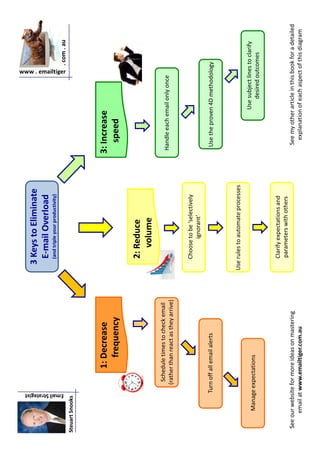
 3 Keys to Eliminate E-mail Overload - Overview..................... Steuart Snooks

 Five Tips for a Great First Impression (for Women) .............. Sharon Kyrwood

 The Mentoring Mindset .................................................................... Ann Rolfe

 Keep Your Team Connected in 2012 ..................................... Lynne Schinella

 Focus On Where You Are Going ................................................ Clive Murphy

 Thrive, Don’t Just Survive! ................................................... Shirley McKinnon

 Working With the Brain In Mind................................................. Jenny Brockis

 A Saleable Business Is Well Worth Keeping! .............................. John Denton
Ways of Working “Out Of Office”................................................ Chris Pudney

Creating Emails That Get Action ................................................. Jani Murphy

Great Service Still Matters in 2012!................................................ Gary Ryan

How to Create An Idea That Lasts Forever ............................ Geoff McDonald

Three Simple Steps to Avoid Micromanaging ....................... Alan Hargreaves

Cross Cultural Communication ................................................... Trisha Carter

Learning to SOAR ............................................................................ John Loty

7 Keys of Inspired Leadership................................................... Garth Roberts

Optimism Maximises your Opportunities in 2012 ........................... Helen Mac

In Memory of James E Rohn..................................................... Rob Salisbury

Don’t Let People Drive You Nuts ................................................ Anne Riches

Become an Authority On-Line .................................................... Gihan Perera

Fly In the Pan – New Sales Strategies for 2012 ........................... Paul Archer

Empathy – Your Secret Superpower ...................................... Lynne Schinella

So You Want To Be An Excellent Manager? ........................ Alan Hargreaves

Whooooo Are You?................................................................... Rob Salisbury

3 Keys to Eliminate Email Overload ........................................ Steuart Snooks

Five Tips for a Great First Impression (for Men) ................... Sharon Kyrwood
6 Tips for More Engaging Webinars - by Gihan Perera
                 1. SOLVE THEIR PROBLEMS: It doesn’t matter if you have scratchy audio, poor
                 slides, a slow Internet connection, or anything else. If you know your audience’s
                 questions, challenges and problems, and you can answer them in the webinar,
                 your presentation will still be compelling.


                 2. EDUCATE OR INFORM: Webinar audiences don’t come to be inspired,
                 motivated or entertained. They expect to learn something – so focus on
                 educating or informing them. Even if your purpose is to sell them something,
                 teach them first – and then go into your sales pitch.


                 3. GET THEM DOING SOMETHING SOON: Ask them to do something simple
                 early in your presentation. This forces them to take notice, involves them right
                 from the start, and demonstrates that this isn’t just another boring
                 presentation. For example, you could conduct a poll, ask them to write
                 something or invite people to speak out loud.

                 4. USE MORE VISUALS: In a face-to-face presentation, your slides are a visual
                 aid; in a webinar, they are the visuals. So use more slides than you normally
                 would. This keeps your audience’s interest, and provides a visual reinforcement
                 to your words. The rule of thumb is to ensure that your slides match what
                 you’re saying at the time.

                 5. START ON TIME: Webinars are very time-efficient, so your audience has high
                 expectations that you’ll respect their time. So be sure you start on time;
                 otherwise it sets a bad precedent, and your audience worries about whether
                 you will keep to time. If you’re worried about the technology or the logistics,
                 log in early and test the technology so you can start on time.

                 6. GET GOOD! There’s nothing more off-putting than seeing a presenter
                 struggling with the technology. Unfortunately, this happens a lot. So get good!
                 You don’t have to do it all at once. Start with just a PowerPoint presentation for
                 your first webinar. In later webinars, you can add polls, audience questions,
                 switching between windows, and other advanced features.

Gihan Perera is the author of the book Webinar Smarts, the smart way for
professional speakers, trainers, thought leaders and business owners to deliver
engaging and profitable webinars. To learn how to reach the world with mic,
screen and mouse, visit WebinarSmarts.com for your copy. You can also download
a free chapter on how to create effective webinar visuals.
Reducing Friction in Your Business by Mark Sutherland
Every business has friction points to varying degrees. Common frictions are staff
relationships, clients not paying on time, suppliers letting you down, lack of
customers and more. These are all frictions that make you anxious and worried
about business progress. To feel better and overcome these friction points use
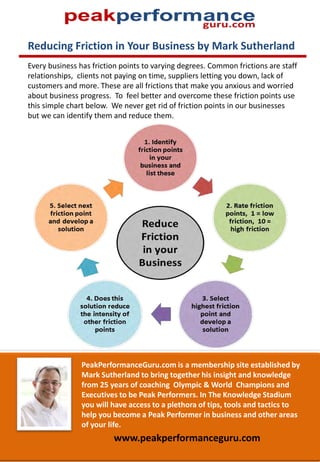
this simple chart below. We never get rid of friction points in our businesses
but we can identify them and reduce them.


                PeakPerformanceGuru.com is a membership site established by
                Mark Sutherland to bring together his insight and knowledge
                from 25 years of coaching Olympic & World Champions and
                Executives to be Peak Performers. In The Knowledge Stadium
                you will have access to a plethora of tips, tools and tactics to
                help you become a Peak Performer in business and other areas
                of your life.
                         www.peakperformanceguru.com
10 questions you should be asking this time of year

So, another year is about to begin. Besides running around getting all those holiday
related tasks organised, many leaders turn their thoughts to analysing the year that was and
planning for the new year ahead. This time of year gardeners are also turning their
thoughts to the past growing season and planning for the next one. The way I see it the
questions each group needs to ask, are the same . . .

1. What grew? What new ideas that you planted came to life and grew . . . in a good way.
Remember, weeds are prolific growers too and you don’t want more of them. For example,
which of your people have grown this year in terms of knowledge, abilities and confidence?
How have you grown as a leader? Has your team grown closer?

2. What died? What didn’t work this past year? Was it a new policy or procedure,
transferring someone to a new role, re-organising job responsibilities, taking on a new client
or a hire that failed to thrive? On the positive side, what unhelpful or negative attitudes died
off this year?

3. What would I plant again? Who would you hire again? What projects would you do
again? Which marketing campaigns or training programs would you repeat? Remember, just
because something grew doesn’t mean you would plant it again. Some people and projects
require too much effort to be worthwhile repeat investments.

4. What new things would I like to try? If you’ve been keeping an eye on the latest
thinking in your industry then you should have some ideas on what you could try next. So
what research and reading have you done to identify new things? What is on your “to do list”
for the coming year?

5. What is ready to be moved? Do you have people that are ready for their next role in
your team, elsewhere in the organisation or maybe outside the organisation? What about
you? Do you need to consider your next move?

6. What worked for others? Look around your organisation for signs of what worked for
other leaders and their teams. Maybe those same initiatives could work for your team. If you
can learn from other leaders you will shortcut the path to success.

7. What needs a rest? Gardeners rest beds to allow the soil to regenerate or they can run
out of nutrients. What projects need a rest this coming year? Which of your staff need a
holiday or at least a break from demanding tasks? What long established practices could do
with a rest?

8. What circumstances were within or outside of my control? The weather and the GFC
you can’t control but there are many other things that you can control. Did you ignore the
early warning signs of a problem? Did you make decisions that you knew from the start had
a minimal chance of success? Did you fail to take action when you should have, hoping the
problem would solve itself?

9. What’s changed since this time last year? People and plants grow, changing the look
and feel of an environment. How can you summarise the way your team has changed, for
the better or the worse, since this time last year.

10. What do I want to change by this time next year? Imagine your team a year from now
and describe exactly what it would be like . . . what it would and wouldn’t contain, where it
would be headed and how it would be performing.

Karen Schmidt from Let’s Grow! describes herself as a workplace gardener who can
help your business bloom by growing your managers into engaging leaders. To
book Karen for your next conference or professional development event contact
her on 0411 745 430 or visit www.letsgrow.com.au.
Change Whatʼs Normal
                            by Ian Berry © All rights reserved.


To expect more from 2012 firstly, be happy with what you have.
When we are grateful for what weʼve got we can have more of what we want!

Secondly, break free from the status quo. Change whatʼs normal.

Here are 3 ways to change whatʼs normal:

1) Make both evolutionary and revolutionary change

Change is evolution and revolution and usually at the same time. The trouble is we often see
change as either/or rather than both/and.

What will you change this year that's both? Think small change/s. Think incremental. Most
revolutions were/are a tipping point preceded by a whole lot of small changes that in
themselves were revolutionary for those who made them.

Conscious evolution starts with a conscious conversation with ourselves and then a decision to
change.

What are you saying to yourself? What are you doing about what youʼre hearing?

2) Eliminate show from your leadership and deliver more value

There is a saying about professional golf that goes something like “driving is for show and
putting is for dough.” The folk who win golf tournaments have great short games and are not
necessarily great at the big shots.

What will you eliminate this year from your leadership that is show and what will you
add that other people will find really valuable?

3) Have a red-hot go

Every master-piece began with an idea and a blank canvas. I am willing to bet that you have an
idea and you still have a blank canvas i.e. you havenʼt yet done anything about your idea.

What are you waiting for?

Get started today. Take massive action on your idea this week. It may not turn our to be a
master-piece. Who cares! It has been said “The journey is the reward.” Yet every now and
then, because of our commitment to the journey, something remarkable happens. Make this
week and every week this year, remarkable.

You will never know until you have a red-hot go.


            Since 1991 Ian Berry has partnered with passionate people
          to break fee from the status quo and turn possibility into reality.
                   He is the author of Changing Whatʼs Normal.

                www.changingwhatsnormal.com              +61 418 807 898
Formula for Lifelong Fitness – David Beard

Many people struggle to maintain their fitness for
life. But it isn’t that hard. Here’s my formula for an
active life guaranteed to keep you fit, forever.

1. Love the feeling you get when you finish
exercising

Many people say they don’t like to exercise because
it hurts. Unfortunately, they are focusing on the
wrong thing. Of course exercise is uncomfortable at
times. If it wasn’t, it wouldn’t be exercise. The
whole idea of exercise is to push yourself out of
your comfort zone for short periods so the rest of
your day feels easy. The best part of an exercise session is when you stop. That feeling
of satisfaction from taking action, reduced stress due to balanced body chemistry and
feeling of being in control. Don’t focus on how you fell while you are exercising. Instead
focus on how you feel when you stop.


2. Find people who love to do what you do

Long term commitment to an exercise routine is much easier if you have people who also
like to do what you do. It is much easier to get up in the morning or stop on the way
home from work if you know there will be someone else there to exercise with. On days
when you just don’t feel like it, the energy of a group or training partner can get you
started when it would have been easier to go home. Once you’ve started, it’s much
easier to keep going. Having committed exercise buddies means you are less likely to
skip a session. Committing to other people is better than a commitment to yourself.

3. Include a variety of activities in your exercise

Having variety in your exercise program means you’re less likely to get bored, stale or
injured; all things that can derail even the most committed exerciser. If you rely on one
mode of exercise the chance of you suffering an overuse injury is much greater than if
you do different things during a week. Variety in your exercise also means you’re likely
to be fitter as more muscles are working in different ways. Don’t rely on one form of
activity either. Incorporate aerobic training with some strength and flexibility sessions.

4. Relax and enjoy feeling fit

Regular exercise shouldn’t be a struggle. If it is, you haven’t found the right combination
of activities or you are doing too much. Your body doesn’t need a lot of exercise to stay
fit, so focus on quality not quantity. Your body adapts after you’ve exercised so build in
some relaxation time. Doing a variety of activities helps with this. Adding in some
meditation helps the body to recover and adapt to the training.
Remember, it’s supposed to be fun, so enjoy it. And love how good it feels to be fit.


     David Beard is a fitness and performance specialist. He shows successful
     people how to stay at the top of their game for as long as they want. He
     works with executives and business owners who know they have to stay in
     shape to perform at the level they need. He provides assessment, education,
     coaching   and   consulting     to  individuals and    organisations. Visit
     www.lifelongfitness.net to see how David can help you.
SMS – Your Sales Motivation System
How to boost your motivation in sales
by Paul Archer
I help to run and coach our village Under 12’s Junior Rugby Team called the Bredon
Buzzards. Look us up on the web www.bredonrugby.org
At the beginning of this season, we got off to a great start winning our first two matches
convincingly but then the rot set in and we lost five matches on the bounce. Now you can
imagine by Christmas, how the boys were feeling – pretty depressed and as for the coaching
team, we were distraught…devastated. We began to question our ability and drive, our
motivation dropped, we kept debating our coaching strategies, questioning ourselves,         
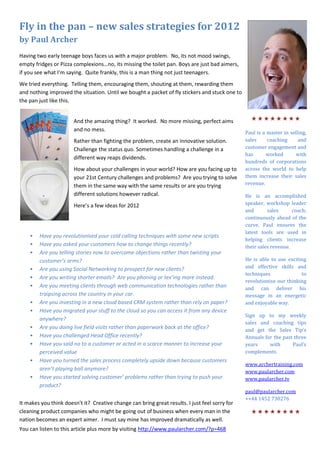
blaming ourselves…we panicked.                                                             Paul is a master in selling,
Does this ring a bell in sales or management when times get tough – maybe a lean spell, a  sales     coaching      and
period of bad news and unforced errors? How do we rise above it? One way is my SMS         customer engagement and
                                                                                           has      worked        with
System or Sales Motivation System
                                                                                                  hundreds of corporations
The secret to an SMS is to break down what you do and rather than wait until a major              across the world to help
success like a big sale, you reward yourself for achieving the small increments that lead to      them increase their sales
the goal. And when you reward yourself regularly for the small achievements, you boost            revenue.
your motivation and self esteem.                                                              He is an accomplished
Let me explain.                                                                               speaker, workshop leader
                                                                                              and       sales      coach;
We sat down and examined our coaching system and training drills. We broke down what it
                                                                                              continuously ahead of the
was, during a game that led to tries and points and eventual victories. We talked about       curve, Paul ensures the
winning scrums, line-outs, rucks, mauls, passing without dropping the ball, tackling well. We latest tools are used in
then devised new Skill Drills to practise these core elements and rewarded the boys when      helping clients increase
they did these things well especially during matches.                                         their sales revenue.

All the little rewards started to have an affect on our motivation and the kids’ drive. Even if   He is able to use exciting
we lost a match, which we did early in the New Year, we still remunerated ourselves for           and effective skills and
winning scrums, tackles, line outs etc…and soon enough we had our first, very narrow,             techniques              to
victory and haven’t looked back since.                                                            revolutionise our thinking
                                                                                                  and can deliver his
So break down your sales process or your coaching process into smaller chunks and reward          message in an energetic
yourself with points or Mars bars, it doesn’t matter. That fact that you achieved the small       and enjoyable way.
segments will, eventually lead to a big success, a sale or a rugby victory.
                                                                                                  Sign up to my weekly
The strange twist though, is what the boys really thought. Apparently they weren’t too            sales and coaching tips
bothered about losing every match. By the time they had arrived home, been dipped into a          and get the Sales Tip’s
bath and fed a roast dinner, washed down with copious amounts of ginger beer…they had             Annuals for the past three
                                                         totally forgotten the game               years     with      Paul’s
                                                         preferring to remember the fun           complements.
                                                         they had with their mates.               www.archertraining.com
                                                           It was us parents and coaches that     www.paularcher.com
                                                           took it all to heart and worried       www.paularcher.tv
                                                           about things. Dwelled and              paul@paularcher.com
                                                           resented the referee’s decisions.      ++44 1452 730276
                                                           Perhaps we shouldn’t grow up so
                                                           quickly and learn to think more          
                                                           like a 12 year old.
How to Bake Strategy Pie – Shelley Dunstone
   I’m a fan of the Masterchef TV cooking contest. I love to relax
   on the couch with a glass of wine and a take-away meal, and
   watch other people slaving in the kitchen. I’m not very keen on
   cooking!
   Developing a competitive strategy for your business is a bit like
   a Masterchef team challenge. The contestants come into the
   studio, with no idea what they will have produced by the end of
   the day. They’re told “You’ll be making lunch for a law firm” or
   “You’re doing dinner for the Dalai Lama”. They stand around in
   shock, wondering how they are going to achieve this. Then they
   find themselves with a basket of ingredients and they know just
   one thing – by the end of the day, they must have their dishes
   ready to “plate up”. Usually (apart from the occasional culinary
   disaster) by combining their knowledge, ideas and expertise, they produce a
   delectable meal that they can all be proud of.


Like a Masterchef challenge, creating a competitive strategy is an exercise in dealing with
uncertainty. Your challenge is to bake a unique strategy, using only the ingredients at
your disposal. Like me, you might prefer to save time and effort by buying a ready-
made meal – but an “off-the-shelf” strategy won’t produce competitive advantage.
Creating an original strategy takes time, motivation and creativity - but at the end of the
process you must be ready to “plate up”.

   Ingredients for Strategy Pie
   Definition of your industry and market

   Strategic assets, e.g. your core competencies

   SWOT analysis (Strengths, Weaknesses, Opportunities and Strengths)

   Environmental scan - global, national, local

   Competitor analysis

   Customer base, segmented


Method

Slice and dice, layer the ingredients, shake and stir, let it bubble around, agitate with
questions, leaven with laughter, allow to rise, and chill for a while.

Find the “sweet spot” where you can work in your strengths and create maximum value
for your target market.

Bake, then plate up your unique strategy and enjoy business success!


     Shelley Dunstone helps businesses to innovate in their strategy to create
     sustainable competitive advantage. She facilitates strategic discussions that
     bring clarity and focus to your business planning. She also works individually
     with business leaders and is an international conference speaker. Visit her
     Web site www.shelleydunstone.com and subscribe to her FREE ezine “The
     Cauldron of Innovation”.
By The Book


Writing a book has become an increasingly popular way to position yourself, especially if you’re a
service professional or business owner looking to increase your personal profile.

But is positioning enough of a reason to write a book?

The short answer: no.

And now for the longer answer. Writing a book can put you in the spotlight, but no amount of
publicity will make up for a book that has no significant reason for being. Just like your business,
your book needs to satisfy your readers’ needs. In other words, have something to say, not just a
business to promote.

How do you achieve that crucial balance? Firstly, remember that readers love war stories, about
mistakes you’ve made and jams you got out of, how you’ve conquered challenges and helped
others to do the same. They liked to be inspired, uplifted, educated and valued. They’re looking for
tangible takeaways they can put into action, ideas to flip their thinking, save their money or give
them more time. They want to know you’ve been there, done that, understand their concerns and
now you’ve earned the right to advise them with authority.

They want nuggets of knowledge, not pages of self aggrandising advertisements.

The irony is, if you give your book integrity it will stand out. And sell out. Look at the success of Tim
Ferris’ Four Hour Work Week, Gihan’s Fast, Flat and Free, or Stephen Covey’s books on the habits
of highly effective people. These books have all been popular, but it’s not just pure promotion that’s
made that happen. It’s the stuff between the covers that’s made the real difference.

Here are three top tips I discovered in writing, publishing and promoting my own.

   1. Start writing. If you don’t have the big idea yet, write a list of all the problems you see your
      clients challenged with and then write a response that gives a solution to each. Then keep
      writing.

   2. Research your topic and name on Amazon. Is this hot right now? Or perhaps there’s a gap
      that’s waiting to be filled? What’s your unique angle on this topic? What fresh insights can
      you give?

   3. Write as you’re writing. That is, once you’re happy with the idea and you’re ready to road test
      the content, blog about the book and share it with your social media channels. You create a
      community around the book and gain PR momentum before it’s released.

There are many more ways to make your book stand out, such as getting quality peer reviews,
testimonials from prominent experts, hiring a good editor, speaking opportunities, and finding a
good distributor. But it all starts with what’s on the pages. What’s on yours?


Michael Neaylon is a brand and marketing speaker, consultant and coach. He is
also the author of ‘True Brand Toolkit: How to Bring in Big Money for Your Small
Business.’ Released in May 2011, the book is now in its third print run.

www.mcme.com.au/truebrandtoolkit
New Rules of Written Communication – by Shirley Taylor
As we are writing more than ever now, we depend on our writing skills to influence, persuade, encourage,
collaborate, and to lead. However, most people don't really notice the quality of the writing they read – they
simply react positively, negatively, or not at all. If you have ever wondered if there's a better way to write
your messages so they get better results, there is! Here are three of the new rules for achieving more
through effective written communication:

1. If you can say it, you can write it
   We connect with the world today largely through e-mail, web sites, blogs, texting, and social media. With
   all these channels we have only bare facts, without tone of voice, facial expressions, body language, or
   pauses. Doesn’t it make sense, then, to use writing that's as close as possible to spoken language? When
   you do this, you gain yourself a great advantage – you put your personality and individuality into your
   message. This will help you to stand out more and make a greater connection with your reader.

2. Write for today, not yesterday
   Yesterday's writing is passive, wordy, and also really dull. It puts a distance between you and the reader.
   The way it is written also slows down understanding. Today's writing sounds more conversational. It's
   crisp, clear, transparent, and the personal context makes it more positive and interesting.

   Yesterday: Please be advised that a meeting of the Annual Convention Committee will be held on 24
   February (Thursday) at 9.30 am. You are required to attend to report on progress made since the last
   meeting. Kindly advise your availability.

   Today: I'd like to hold another meeting of the Annual Convention Committee on Tuesday 24 February at
   9.30 am. I hope you can attend to report on the great ideas you mentioned at the last meeting. Please
   confirm if you can join us.

3. Aim to build relationships
   In writing, people will judge you based on what you write and how you write it. In today's fast-paced,
   communication-crazy world, it's essential to come across as a human being. If you insist on using old
   fashioned or redundant jargon (Please be reminded, Kindly be advised, Please find attached herewith,
   above-mentioned, etc) you will obscure the real meaning and will not be adding any personality of your
   own. Make your writing positive, stimulating and interesting, add some feeling and a personal touch.
   Help your readers get to know the real person behind the message.

Good writing makes a difference. Good writing will give you a huge advantage in today's business world.
Good writing can help you work more efficiently, build credibility, improve relationships, influence people,
win more clients and achieve your goals.

So take another look at the messages you receive, and at the messages you send. Are they full of yesterday's
jargon or today's conversational expressions? Will they help to enhance your professional reputation or ruin
it? Will they help to build relationships or break them? Give yourself an edge in this very competitive world
by getting to grips with effective writing now, before it's too late!


                     Shirley Taylor is a popular speaker, trainer and author of many successful books on e-mail,
                     communication and business writing skills. Shirley lives in Singapore and conducts interactive
                     workshops on business writing, communication skills and e-mail writing. To receive five
                     complimentary special reports in the Success Skills series, visit www.shirleytaylortraining.com.
                     Sign up for free Success Boosters at www.stsuccessskills.com
Discover How To Get The Professional Edge In 2012.
Master The Six Soft Skills For Personal Leadership.
_____________________________________________
They used to be regarded with derision not so long ago.
They were too warm and fuzzy and too touchy-feely for
professionals. They deprofessionalised what we held near
and dear. Yet, in recent times, Soft Skills are being discussed
in such elite circles as the Harvard Business Review, the Wall
Street Journal and the Financial Times, as well as entering the
curriculums of business schools everywhere.

It is now becoming apparent that excelling in the hard
technical skills of our profession or industry may get us our
job, but it will be how well-developed our Soft Skills are that
will determine whether we keep it – or whether we move up the ladder.

The irony is that these Soft Skills are actually the Hard Skills – hard to learn, hard to
sustain. They are the skills associated with self-mastery and self-management, the skills
that call on us to change from within ourselves. They are also the skills that enhance our
potential to motivate and inspire our people to work WITH us, not just FOR us. In short,
they are the skills that enable us to firstly lead ourselves, so that we can then lead our
people.

We could draw up a list of 60, 600 or 6000. I’ve chosen 6. If we get these right,
everything else will follow.

1.     Know What Makes You Tick
       - Discover Self Awareness.

2.     Work Smarter And In Harmony With Your World
       - Discover Work/Life Balance.

3.     Bounce Back From Adversity
       - Discover Resilience.

4.     Be A Catalyst For Change
       - Discover Pro-activity.

5.     Be The Self-Manager Of Your Own Emotions
       - Discover Emotional Intelligence.

6.     Build Networks Of Support For Yourself
       - Discover Networking.

We are the CEOs of our own success – not our managers or our organisations. A large
part of that success is about how we manage the Soft Stuff for therein lies the key to
getting the Hard Results.


     Maree Harris PhD is the Director of People Empowered where she works with
     professionals helping them become leaders who create outstanding outcomes
     by enhancing their personal leadership skills – their Soft Skills. As a coach,
     mentor and workshop facilitator, she creates empowering spaces where they
     can take risks and stretch themselves and stop living their lives with their foot
     on the brake, discovering talent and potential they never knew they had. To
     stay in touch with her work, join her mailing list at
     www.peopleempowered.com.au
Employers perplexed: Elite performer is short, has a beer
gut and is 51 years old by Ross Clennett
                            As a keen student of high performance and a casual golf fan,
                            I was delighted when, late in 2010, 51 year old Peter Senior
                            won the 2010 Australian PGA title, ahead of runner-up, 33
                            year-old Geoff Ogilvy, the 2006 US Open champion.

                            Both players finished the 72 hole tournament tied on 276 and
                            Senior won on the second extra hole in sudden death play-
                            off.

                            This was a remarkable result for a number of reasons.

                            Firstly, Peter Senior has not been a full-time member of
                            either of the major tours in the golfing world, the European
                            Tour or the US PGA Tour, for many years. And as a result, at
                            the time of his PGA win Senior was ranked 255th in the world.

                            Geoff Ogilvy has been a full-time member of the US PGA Tour
for 10 years and at the time was ranked at number 25 in the world.

Geoff Ogilvy has career earnings in excess of USD$25 million and his last tournament
victory was in January this year, whereas Peter Senior's career earnings just exceed
AUD$6 million and he had failed to chalk up a victory on the regular tour (as distinct
from the Senior tour) since his previous Australian PGA victory in 2003.

Secondly, Peter Senior stands at 170cm (5 feet, 7 inches), weighs 80kg (12 stone, 8lb),
has a beer gut, waddles and has a golf swing more akin to a suburban weekend golfer.

Geoff Ogilvy is 188cm (6 feet, 2 inches), weighs 82 kg (13 stone), has the taut and lean
appearance of a global athlete and possesses a golf swing that makes the purists sigh in
delight.

One of the beauties of sport is that the scoreboard doesn't lie. The player who delivers
the performance when it matters, takes home the trophy and the winner's cheque.

How good an athlete ‘looks' is irrelevant. The player the experts ‘think' should win
doesn't matter. All that matters is a player doing what's required, better than their
competitors, to win.

When you interview candidates for jobs, do you ignore the Peter Seniors’ that apply? The
people who, on the surface, might look average but are in fact, high performers.

Are you taken in by how a candidate looks? How they sound? Do you know the right
questions to ask to discover whether they are a high performer, or not?

My advice? Don't judge a book by its cover. The next time you are recruiting don't write
off the next old, short guy with a beer gut you interview.


     Ross Clennett is a recruitment expert and the author of “Succeed Quickly or
     Fail Slowly: A High Performance Framework for Recruiters". For a free
     copy of Ross’s book, to subscribe to Ross’ free weekly newsletter or to read
     any of Ross’s articles on recruitment please visit www.rossclennett.com
3 Keys to Eliminate
                                                                          E-mail Overload
                                                                           (and triple your productivity)


            Email Strategist
                                                                                                                                          www . emailtiger
                                                                                                                                                             . com . au
Steuart Snooks


                                         1: Decrease                                                        3: Increase
                                            frequency                                                          speed

                                                                           2: Reduce
                                                                              volume
                                   Schedule times to check email
                                                                                                            Handle each email only once
                                  (rather than react as they arrive)


                                                                           Choose to be ‘selectively
                                                                                  ignorant’
                               Turn off all email alerts                                                     Use the proven 4D methodology


                                                                       Use rules to automate processes
                                                                                                                            Use subject lines to clarify
        Manage expectations
                                                                                                                                desired outcomes


                                                                           Clarify expectations and
                                                                           parameters with others
 See our website for more ideas on mastering                                                                  See my other article in this book for a detailed
      email at www.emailtiger.com.au                                                                            explanation of each aspect of this diagram
Five Tips for a Great First Impression (for Women)
– by Sharon Kyrwood
                               We all know that first impressions matter, now more than ever, with so many people
                               changing jobs, looking for new business and attending networking events. Like it or
                               not, people do make snap judgements about us, so give them every opportunity to
                               make them positive.

                               Greet with a Strong Handshake
                               It’s amazing how many men and women still don’t know how to shake hands well. If
                               you have a limp handshake, a “cold fish” handshake, or a fingertip handshake, you’ll
                               appear weak or unsure of yourself, not an ideal image for a professional. Here are two
simple tips for a stronger and more confident handshake: Be the first person to extend your hand; and use a full palm-
to-palm handshake with a firm grasp.

 Tone Down Colours
Whether it’s make-up, nail polish or clothes, keep the bright, loud colours in your wardrobe for social occasions. Use
a more neutral palette for a professional look. To add a splash of colour and personality, use colour accents through
the use of your accessories – such as a colourful scarf, earrings or a statement necklace.

 No Party Hair!
When people look at you they see your face, and your hair is the frame for your face so it is immediately noticed.
Like it or not instant decisions are made about your personality, reliability and professionalism. So avoid big hair,
party hair and excessively styled hair. For your professional look, keep your hair clean, neat and tidy and in a
fashionable style.

 Neat, Appropriate Dress
It’s not fair, but men can get away with the more casual work look – T-shirt, jacket and blue jeans are considered the
norm for some professions! But as women, we are automatically judged by the clothes we wear. If you’re expected to
wear a suit, there are many fashionable alternatives to the traditional severe 3-piece business suit, some even with
shorts. If you don’t need to wear a suit, wear what’s appropriate to your position. For example if I need to jump in
and out of my car on a certain day, then wearing a mini skirt is an unsuitable option. If in doubt, dress slightly better
than you feel you should.

 Stand Up, Look Up, Speak Up
Making a good first impression is difficult because often you don’t know what to expect, so you are on guard. You
know those people who always look confident in any situation, even when it’s new to them? They’re faking it! It’s all
about looking confident even if you’re not and then the confidence follows. So how do you look confident? Three
quick tips: Stand up straight and walk with purpose, with your shoulders back. Look people in the eye all the time,
because looking at the ground will show nerves and make you appear weak. Speak clearly and concisely.


       Sharon Kyrwood is a make-up artist, stylist and image consultant with 16 years experience working
       with professional photographers, film and TV companies, and the public, helping men and women
       from all walks of life look and feel more professional, confident and yes, even glamorous!

       Visit her Web site www.SharonKyrwood.com to read her blog and subscribe to her newsletter.
The	
  Mentoring	
  Mindset	
  –	
  Ann	
  Rolfe	


                                      When	
   you	
   are	
   clear	
   about	
   your	
   values	
   it’s	
   easy	
   to	
   make	
   your	
   own	
   decisions	
  
                                      without	
   a	
   lot	
   of	
   rules	
   or	
   instructions.	
   You	
   develop	
   a	
   mindset	
   –	
   a	
   philosophy	
  
                                      of	
  life,	
  principles	
  that	
  guides	
  your	
  approach	
  to	
  any	
  situation.	


                                      Over	
  the	
  years	
  I’ve	
  observed	
  a	
  mentoring	
  mindset	
  that	
  helps	
  people	
  get	
  the	
  
                                      most	
  from	
  conversations	
  and	
  relationships.	
  The	
  mentoring	
  mindset	
  values:	
  
                                      Positivity,	
  Courage,	
  Difference,	
  Dialogue,	
  being	
  constructive	
  and	
  
                                 	
   responsibility.	


Positivity	
                                                                                                                                                                 	
  
Increasing	
   heartfelt	
   positive	
   emotions	
   has	
   been	
   shown	
   to	
   transform	
   people	
   and	
   help	
   them	
  
become	
  their	
  best.	
  Mentors	
  improve	
  their	
  own	
  lives	
  and	
  those	
  of	
  their	
  mentorees,	
  by	
  increasing	
  
positivity	
  in	
  conversations.	


Courage	
  
Mentoring	
   is	
   a	
   unique	
   relationship.	
   It	
   opens	
   minds,	
   challenges	
   thinking,	
   stretches	
   the	
   comfort	
  
zone.	
  It	
  presents	
  a	
  challenge.	
  Courage	
  is	
  the	
  willingness	
  to	
  face	
  that	
  challenge.	


Difference	
  
Mentoring	
   is	
   an	
   opportunity	
   to	
   learn	
   open-­‐mindedness.	
   It	
   is	
   the	
   chance	
   not	
   just	
   to	
   accept	
  
different	
  views	
  but	
  to	
  welcome	
  and	
  value	
  them.	


Dialogue	
  
Listening	
   and	
   questioning	
   skills	
   ensure	
   real	
   communication	
   occurs	
   rather	
   than	
   superficial	
   talk.	
  
This	
  involves	
  being	
  present,	
  attentive	
  and	
  focussed	
  on	
  understanding	
  each	
  other,	
  not	
  just	
  waiting	
  
for	
  a	
  turn	
  to	
  talk	
  or	
  dominating	
  airtime	
  with	
  words.	


Being	
  Constructive	
  
Mentoring	
   supports	
   achievement.	
   Four	
   questions	
   provide	
   a	
   framework	
   mentoring:	
   “Where	
   are	
  
you	
   now?”,	
   “Where	
   do	
   you	
   want	
   to	
   be?”,	
   “How	
   will	
   you	
   get	
   there?’,	
   and	
   once	
   action	
   is	
   taken,	
  
“How	
  is	
  it	
  going?”.	
  Mentoring	
  uses	
  feedback	
  and	
  feed-­‐forward	
  to	
  fine-­‐tune	
  responses.	


Responsibility	
  
A	
   mentor	
   provides	
   information	
   and	
   may	
   express	
   opinions	
   however,	
   it	
   is	
   always	
   the	
   mentoree	
  
that	
   decides,	
   acts	
   and	
   produces	
   outcomes.	
   The	
   mentor	
   exercises	
   their	
   “duty	
   of	
   care”,	
   if	
   the	
  
mentoree	
   proposes	
   a	
   course	
   of	
   action	
   that	
   is	
   dangerous,	
   by	
   helping	
   them	
   become	
   aware	
   of	
  
possible	
  consequences.	
  The	
  mentoree	
  is	
  responsible	
  for	
  their	
  actions	
  and	
  outcomes.	


        Ann	
  Rolfe	
  is	
  an	
  expert	
  in	
  workplace	
  mentoring.	
  She	
  can	
  show	
  you	
  how	
  to	
  attract,	
  retain	
  and	
  
        develop	
  people	
  by	
  building	
  a	
  mentoring	
  culture	
  and	
  learning	
  the	
  mentoring	
  mindset	
  and	
  
        skills.	
  
  Get	
  her	
  free	
  ebook:	
  Mentoring	
  Demystified	
  at	
  www.mentoring-­‐works.com	
  
KEEP YOUR TEAM CONNECTED IN 2012
                                   LYNNE SCHINELLA

With more and more of us             also a breeding ground for greater connectivity and
working remotely, and those in       silo mentality.            effectiveness.
an office busy and working
                                     Look for diversity when        Use common sense
within their own silos, the
                                     you’re recruiting. Diverse     though. Sometimes there’s
answer to connection in 2012
                                     teams of race, gender,         a need for an
is a collaborative approach,
                                     personality and                authoritarian approach.
from the top down.
                                     generations bring fresh        Endless collaboration
Collaborative leaders help           perspectives, new ideas        means endless meetings
their people engage on               and innovation becomes         means results that never
shared commitments.                  an inevitable result.          happen.
Unfortunately many leadership
                                     Create a culture where         Prepare for some robust,
teams are exactly the
                                     there’s an expectation         transparent conversation
opposite - tight silos that                                         and keep your team
                                     that people will disagree
operate within the confines of                                      connected for greater
                                     openly in meetings (even       productivity in 2012.
their own unit, only emerging
                                     with their leader). This not
to fight for a budget or to
                                     only helps to minimise
oppose any other silo that
                                     politics but encourages
threatens them.
                                     dynamic debate until the
Tips                                 best idea wins.

If you let them people will          Once the idea is in,
naturally gravitate to their own     encourage unity.
tribe, hanging out with their
                                     Encourage collaboration
own kind who have similar
                                     but don’t get stuck on the
values, thoughts, background,
                                     same people, all the time.
ways of doing things. This can
                                     Create and disband
make for easier work but it’s
                                     teams as projects arise for


                                Lynne Schinella works with organisations to add dollars
                                straight to their bottom line through improved
                                communication. This translates to reduced staff turnover,
                                hiring costs & increased employee engagement.

                                She’s a speaker and trainer, and author of”Bite Me! and
                                other do’s and don’ts for dealing with our differences.”

                                Check her out at www.lynneschinella.com.au or
                                contact her directly at lynne@lynneschinella.com.au
Focus On Where You Are Going – by Clive Murphy


When	
  things	
  fail	
  to	
  work	
  out	
  in	
  your	
  life	
  –	
  there	
  is	
          Where	
  are	
  you	
  going	
  “slowly”	
  in	
  life?	
  	
  
always	
  a	
  reason.	
                                                                         Where	
  are	
  things	
  not	
  working?	
  
                                                                                                 Make	
  a	
  list:	
  
One	
  reason	
  is	
  you	
  may	
  not	
  be	
  clear	
  on	
  what	
  you	
  
                                                                                                  ______________________________________	
  
want.	
  Many	
  people	
  only	
  think	
  about	
  getting	
  out	
  of	
  
the	
  state	
  they	
  don’t	
  want.	
  For	
  example:	
                                        ______________________________________	


           “I	
  don’t	
  want	
  to	
  be	
  poor”	


               “I	
  hate	
  being	
  fat”	
                                                   What	
  obstacles	
  are	
  you	
  hitting?	
  Eg	
  Attracting	
  the	
  
	
               “It	
  feels	
  terrible	
  being	
  depressed”	
                               wrong	
  person	
  in	
  a	
  relationship,	
  business	
  not	
  
                                                                                                 succeeding,	
  always	
  something	
  going	
  wrong.	
  
I’ll	
  ask	
  people:	
  What	
  do	
  you	
  want	
  from	
  life?	
  	
                         ______________________________________	
  
	
              “I	
  don’t	
  want	
  what	
  I’ve	
  got	
  now”	
  
                                                                                                      ______________________________________	
  
	
              “I’m	
  sick	
  of	
  failing”	


                “I	
  want	
  things	
  to	
  be	
  better”	
  	
  
                                                                                                 Go	
  back	
  to	
  the	
  “Don’t	
  Want”	
  corner	
  in	
  your	
  chair	
  
                “I	
  don’t	
  know”	
  
                                                                                                 and	
  now	
  drive	
  yourself	
  to	
  the	
  “Want”	
  corner.	
  
When	
  you	
  constantly	
  think	
  about	
  the	
  unwanted	
  
                                                                                                 Much	
  easier,	
  isn’t	
  it?	
  
state,	
  you	
  receive	
  more	
  of	
  the	
  same.	
  When	
  you	
  
hate	
  or	
  fear	
  something,	
  it	
  controls	
  how	
  you	
  feel.	
  	
  
                                                                                                 You	
  drive	
  a	
  car	
  looking	
  out	
  the	
  windscreen	
  because	
  
Complete	
  this	
  Exercise:	
  Sit	
  in	
  a	
  rolling	
  chair	
  in	
  one	
               you	
  can	
  see	
  where	
  you	
  are	
  going.	
  Focus	
  on	
  what	
  
corner	
  of	
  a	
  room.	
  This	
  corner	
  represents	
  what	
  you	
                      you	
  want	
  and	
  drive	
  yourself	
  to	
  it.	
  
don’t	
  want	
  and	
  the	
  diagonally	
  opposite	
  corner	
  
                                                                                                 Make	
  a	
  list	
  of	
  what	
  you	
  want	
  in	
  life.	
  Turn	
  the	
  clock	
  
represents	
  what	
  you	
  do	
  want.	
  
                                                                                                 forward	
  10	
  years	
  and	
  wave	
  your	
  magic	
  wand.	
  
Sit	
  in	
  the	
  ‘What	
  you	
  don’t	
  want’	
  corner	
  facing	
  the	
                  What	
  does	
  your	
  Ideal	
  life	
  look	
  like?	
  Be	
  specific.	
  	
  
corner.	
  Now	
  back	
  yourself	
  out	
  of	
  that	
  whilst	
                              Health:	
  ______________________________	
  
looking	
  at	
  the	
  ‘What	
  you	
  don’t	
  want’	
  corner.	
  
                                                                                                 Relationship:	
  _________________________	
  
No	
  matter	
  how	
  far	
  you	
  go,	
  you	
  can	
  still	
  see	
  that	
                 Work:	
  _______________________________	
  
corner.	
  You	
  continue	
  to	
  take	
  it	
  with	
  you.	
  
                                                                                                 Income:	
  _____________________________	
  
I	
  call	
  this	
  driving	
  looking	
  out	
  the	
  back	
  window.	
  You	
                Assets:	
  ______________________________	
  
drive	
  through	
  life	
  looking	
  out	
  the	
  back	
  window	
  at	
  
what	
  you	
  don’t	
  want.	
  If	
  you	
  drive	
  your	
  car	
  forward	
                  Spirituality:	
  __________________________	
  
looking	
  out	
  the	
  back	
  window,	
  what	
  is	
  going	
  to	
                          Happiness:	
  __________________________	
  
happen?	


  	
  you	
  will	
  go	
  very	
  slowly	
                                   Avoid	
  using	
  words	
  like	
  ‘better’	
  and	
  ‘more’.	
  ‘Better’	
  
                                                                                                 and	
  ‘more’	
  can	
  be	
  a	
  very	
  slight	
  increase.	
  Aim	
  for	


  	
  lots	
  of	
  accidents	
  as	
  you	
  run	
  into	
  things	
  
                                                                                                 the	
  total.	
  
This	
  is	
  what	
  happens	
  to	
  many	
  people	
  in	
  life.	
  They	
  
                                                                                 Know	
  what	
  you	
  want	
  and	
  drive	
  yourself	
  to	
  that	
  
go	
  forward	
  very	
  slowly	
  and	
  continually	
  hit	
  
                                                                                 destination.	
  	
  
obstacles,	
  which	
  stop	
  them	
  from	
  proceeding.	


        Clive Murphy is a best selling author and the creator of “Live Your Life Potential”


          (released in Feb 2012). This is a 10 Module course covering how your mind
	
        works, how to stop others from affecting the way you feel, how to feel happy,


        why you have good and bad thoughts and ways to resolve conflict in your life.
          For more information, go to:
	
  
                                                                                   www.clivemurphy.com
Your Best Year Ever in
Thrive, don’t   2012
                   just survive!
Good years and bad years. It’s called being in business.
So, how do you weather the economy, the global impact, the
pessimism and actually thrive? Let’s face it, a lot more money
always helps. So, here are my tips:

      1) Set Bigger Goals
      2) Create a Financial Buffer
      3) Track and Measure what you’re doing

1) Set Bigger Goals
When the economy shrinks, when there’s the threat of
a recession, we seem to shrink our thinking also. This
is exactly the time when successful companies really get their skates on, set
even bigger goals and put massive action into implementation. Don’t try to compete, aim for
domination. Aim bigger, try harder and get more excited. I’m not encouraging you to go rashly
forward, but I am encouraging you not to shrink your goals because of the pessimism of the
media. The worst that can happen is that you aim much higher and slightly miss. This means
that you have gone much further than you originally aimed for. What a wild ride that would be.

2) Create a Financial Buffer
Create a financial buffer both for your business and in your personal budget. Never
underestimate the confidence this will give you. Everything looks better with money in the
account. Everything! It gives you a sense of being in control and yet prepared for the worst. Aim
high and go for the best, but have a plan which prepares you for the worst. This way, if your
clients buy into the media hype and slow down their payments, you are not strangled for cash
flow.

3) Track and Measure
Set goals each week and track your progress towards your goals. We are brilliant at deceiving
ourselves. We go to the gym once a week and feel like we’ve been three times. We phone two
clients and feel like we’ve talked to 10. Face the reality and measure what you are actually
doing and the results you are getting from your activities. Do it weekly and successful activities
will become how you work. Compound interest counts in all activities.
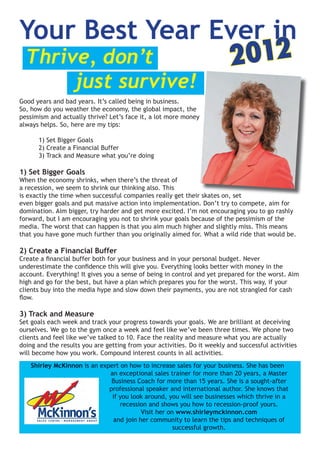
    Shirley McKinnon is an expert on how to increase sales for your business. She has been
                              an exceptional sales trainer for more than 20 years, a Master
                               Business Coach for more than 15 years. She is a sought-after
                              professional speaker and international author. She knows that
                               if you look around, you will see businesses which thrive in a
                                  recession and shows you how to recession-proof yours.
                                         Visit her on www.shirleymckinnon.com
                               and join her community to learn the tips and techniques of
                                                     successful growth.
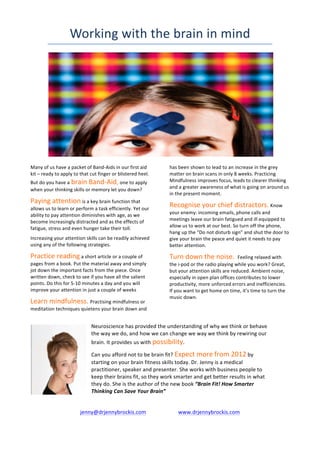
Working	
  with	
  the	
  brain	
  in	
  mind	


Many	
  of	
  us	
  have	
  a	
  packet	
  of	
  Band-­‐Aids	
  in	
  our	
  first	
  aid	
                                                                                                 has	
  been	
  shown	
  to	
  lead	
  to	
  an	
  increase	
  in	
  the	
  grey	
  
kit	
  –	
  ready	
  to	
  apply	
  to	
  that	
  cut	
  finger	
  or	
  blistered	
  heel.	
                                                                                               matter	
  on	
  brain	
  scans	
  in	
  only	
  8	
  weeks.	
  Practicing	
  
But	
  do	
  you	
  have	
  a	
  brain	
  Band-­‐Aid,	
  one	
  to	
  apply	
                                                                                                               Mindfulness	
  improves	
  focus,	
  leads	
  to	
  clearer	
  thinking	
  
when	
  your	
  thinking	
  skills	
  or	
  memory	
  let	
  you	
  down?	
                                                                                                                 and	
  a	
  greater	
  awareness	
  of	
  what	
  is	
  going	
  on	
  around	
  us	
  
                                                                                                                                                                                            in	
  the	
  present	
  moment.	
  
Paying	
  attention	
  is	
  a	
  key	
  brain	
  function	
  that	
  
allows	
  us	
  to	
  learn	
  or	
  perform	
  a	
  task	
  efficiently.	
  Yet	
  our	
  
                                                                                                                                                                                            Recognise	
  your	
  chief	
  distractors.	
  Know	
  
ability	
  to	
  pay	
  attention	
  diminishes	
  with	
  age,	
  as	
  we	
                                                                                                               your	
  enemy:	
  incoming	
  emails,	
  phone	
  calls	
  and	
  
become	
  increasingly	
  distracted	
  and	
  as	
  the	
  effects	
  of	
                                                                                                                 meetings	
  leave	
  our	
  brain	
  fatigued	
  and	
  ill	
  equipped	
  to	
  
fatigue,	
  stress	
  and	
  even	
  hunger	
  take	
  their	
  toll.	
  	
                                                                                                                 allow	
  us	
  to	
  work	
  at	
  our	
  best.	
  So	
  turn	
  off	
  the	
  phone,	
  
                                                                                                                                                                                            hang	
  up	
  the	
  “Do	
  not	
  disturb	
  sign”	
  and	
  shut	
  the	
  door	
  to	
  
Increasing	
  your	
  attention	
  skills	
  can	
  be	
  readily	
  achieved	
                                                                                                             give	
  your	
  brain	
  the	
  peace	
  and	
  quiet	
  it	
  needs	
  to	
  pay	
  
using	
  any	
  of	
  the	
  following	
  strategies.	
                                                                                                                                     better	
  attention.	
  

Practice	
  reading	
  a	
  short	
  article	
  or	
  a	
  couple	
  of	
                                                                                                                   Turn	
  down	
  the	
  noise.	
  	
  Feeling	
  relaxed	
  with	
  
pages	
  from	
  a	
  book.	
  Put	
  the	
  material	
  away	
  and	
  simply	
                                                                                                            the	
  i-­‐pod	
  or	
  the	
  radio	
  playing	
  while	
  you	
  work?	
  Great,	
  
jot	
  down	
  the	
  important	
  facts	
  from	
  the	
  piece.	
  Once	
                                                                                                                 but	
  your	
  attention	
  skills	
  are	
  reduced.	
  Ambient	
  noise,	
  
written	
  down,	
  check	
  to	
  see	
  if	
  you	
  have	
  all	
  the	
  salient	
                                                                                                      especially	
  in	
  open	
  plan	
  offices	
  contributes	
  to	
  lower	
  
points.	
  Do	
  this	
  for	
  5-­‐10	
  minutes	
  a	
  day	
  and	
  you	
  will	
                                                                                                       productivity,	
  more	
  unforced	
  errors	
  and	
  inefficiencies.	
  
improve	
  your	
  attention	
  in	
  just	
  a	
  couple	
  of	
  weeks	
                                                                                                                  If	
  you	
  want	
  to	
  get	
  home	
  on	
  time,	
  it’s	
  time	
  to	
  turn	
  the	
  
                                                                                                                                                                                            music	
  down.	
  
Learn	
  mindfulness.	
  Practising	
  mindfulness	
  or	
  
meditation	
  techniques	
  quietens	
  your	
  brain	
  down	
  and	


                                                                                                                                     Neuroscience	
  has	
  provided	
  the	
  understanding	
  of	
  why	
  we	
  think	
  or	
  behave	
  
                                                                                                                                     the	
  way	
  we	
  do,	
  and	
  how	
  we	
  can	
  change	
  we	
  way	
  we	
  think	
  by	
  rewiring	
  our	
  
                                                                                                                                     brain.	
  It	
  provides	
  us	
  with	
  possibility.	


                                                                                                                                     Can	
  you	
  afford	
  not	
  to	
  be	
  brain	
  fit?	
  Expect	
  more	
  from	
  2012	
  by	
  
                                                                                                                                     starting	
  on	
  your	
  brain	
  fitness	
  skills	
  today.	
  Dr.	
  Jenny	
  is	
  a	
  medical	
  
                                                                                                                                     practitioner,	
  speaker	
  and	
  presenter.	
  She	
  works	
  with	
  business	
  people	
  to	
  
                                                                                                                                     keep	
  their	
  brains	
  fit,	
  so	
  they	
  work	
  smarter	
  and	
  get	
  better	
  results	
  in	
  what	
  
                                                                                                                                     they	
  do.	
  She	
  is	
  the	
  author	
  of	
  the	
  new	
  book	
  “Brain	
  Fit!	
  How	
  Smarter	
  
                                                                                                                                     Thinking	
  Can	
  Save	
  Your	
  Brain”	


                                                                                                             jenny@drjennybrockis.com	


  www.drjennybrockis.com
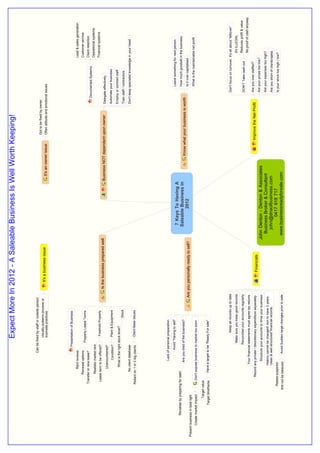
Expect More In 2012 - A Saleable Business Is Well Worth Keeping!


                                                             Can be fixed by staff or outside person
                                                                                                                                                                                                 Got to be fixed by owner
                                                                         Usually systems process or
                                                                                                               It's a business issue                                    It's an owner issue      Often attitude and emotional issues
                                                                         business practices


                                                                   Presentation of Business
                                                  Rent reviews                                                                                                                                                                                              Lead & sales generation
                                            Renewal options                                                                                                                                                                                                 Customer service
                                                                      Property Lease Terms
                                     Transfer or new lease?                                                                                                                                                                                                 Client retention
                                                                                                                                                                                                                            Documented Systems
                                             Realistic market rent                                                                                                                                                                                          Operational systems

                                       Lease term to be offered?          Freehold Property                                                                                                                                                                 Financial systems
                                                                                                           Is the business prepared well                              Business NOT dependent upon owner               Delegate effectively
                                                  Unencumbered?
                                                        Condition?        Plant & Equipment                                                                                                                           Automate your business
                                                                                                                                                                                                                      Employ or contract staff
                                                   What is the right stock level?
                                                                                          Stock                                                                                                                       Train staff / contractors
                                              No client database                                                                                                                                                      Don't keep specialist knowledge in your head
                                     Reliant on 1 or 2 big clients        Client Base Issues


                                                        Lack of personal preparation
                                                                 Avoid "Having to sell"                                                                                                                                            Leave something for next person
                                                                                                                                               7 Keys To Having A
               Revialise by preparing for sale!                                                                                                                                                                                    How much goodwill in the business
                                                      Are you tired of the business?                                                           Saleable Business in                Know what your business is worth
                                                                                                      Are you personally ready to sell?                2012                                                                        Is it over capitalised
Present business in best light
                                                                                                                                                                                                                                   What is the maintainable net profit
        Create market impact             Don't expose business to market too soon

                           Target value
                      Target timeframe        Have a target to be "Ready For sale"


                                                                             Keep all records up to date                                                                                                                       Don't focus on turnover. It's all about "leftover"
                                                                      Make sure you keep good records                                                                                                                                                          It's ILLEGAL
                                                                     Reconciled your accounts regularly                                                                                                                                                        Reduces profit & value
                                                                                                                                                                                                                               DON'T Take cash out
                                                                                                                                                                                                                                                               No proof of cash anyway
                                                     Your financial statements must agree tax returns
                                                                                                                                                                                                                               Are you over staffed?
                                           Record any private / discretionary expenditure separately                                                                                          Improve the Net Profit
                                                                                                                     Financials
                                                                                                                                                                                                                               Are your prices too low?
                                                        Structure your accounts to drive your business                                    John Denton - Denton & Associates
                                                                                                                                             Business Broker & Consultant                                                      Are your expenses too high?
                                                    History cannot be changed! Aim to have 3 years
                                                    'clean & well structured' financial records.                                              john@dnaofbusiness.com                                                           Are you short of clients/sales
                                    Raises suspicion                                                                                                0417 918 717                                                               Is your stock too high / low?
                                 Will not be believed        Avoid Sudden large changes prior to sale                                       www.businessreadyforsale.com
Ways of Working “Out Of Office” – by Chris Pudney
You’ve probably received an “Out Of Office” e-mail message from someone, telling
you that they’re temporarily unavailable. Now a small – but growing – number of
people are Out Of Office permanently – and by choice. The Internet – or more
specifically, Cloud Computing – has made it easier than ever before to work away
from the traditional shared office environment.
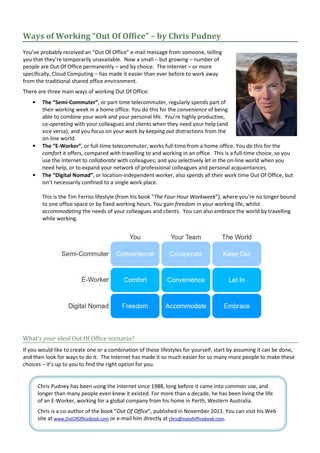
There are three main ways of working Out Of Office:
    •    The “Semi-Commuter”, or part-time telecommuter, regularly spends part of
         their working week in a home office. You do this for the convenience of being
         able to combine your work and your personal life. You’re highly productive,
         co-operating with your colleagues and clients when they need your help (and
         vice versa); and you focus on your work by keeping out distractions from the
         on-line world.
    •    The “E-Worker”, or full-time telecommuter, works full-time from a home office. You do this for the
         comfort it offers, compared with travelling to and working in an office. This is a full-time choice, so you
         use the Internet to collaborate with colleagues; and you selectively let in the on-line world when you
         need help, or to expand your network of professional colleagues and personal acquaintances.
    •    The “Digital Nomad”, or location-independent worker, also spends all their work time Out Of Office, but
         isn’t necessarily confined to a single work place.

         This is the Tim Ferriss lifestyle (from his book “The Four-Hour Workweek”), where you’re no longer bound
         to one office space or by fixed working hours. You gain freedom in your working life, whilst
         accommodating the needs of your colleagues and clients. You can also embrace the world by travelling
         while working.


What’s your ideal Out Of Office scenario?
If you would like to create one or a combination of these lifestyles for yourself, start by assuming it can be done,
and then look for ways to do it. The Internet has made it so much easier for so many more people to make these
choices – it’s up to you to find the right option for you.


        Chris Pudney has been using the Internet since 1988, long before it came into common use, and
        longer than many people even knew it existed. For more than a decade, he has been living the life
        of an E-Worker, working for a global company from his home in Perth, Western Australia.
        Chris is a co-author of the book “Out Of Office”, published in November 2011. You can visit his Web
        site at www.OutOfOfficeBook.com or e-mail him directly at chris@outofofficebook.com.
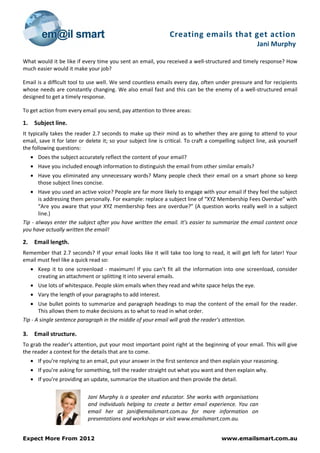
Creating emails that get action
                                                                                                       Jani Murphy

What would it be like if every time you sent an email, you received a well-structured and timely response? How
much easier would it make your job?

Email is a difficult tool to use well. We send countless emails every day, often under pressure and for recipients
whose needs are constantly changing. We also email fast and this can be the enemy of a well-structured email
designed to get a timely response.

To get action from every email you send, pay attention to three areas:

1.    Subject line.
It typically takes the reader 2.7 seconds to make up their mind as to whether they are going to attend to your
email, save it for later or delete it; so your subject line is critical. To craft a compelling subject line, ask yourself
the following questions:
     • Does the subject accurately reflect the content of your email?
     • Have you included enough information to distinguish the email from other similar emails?
     • Have you eliminated any unnecessary words? Many people check their email on a smart phone so keep
       those subject lines concise.
   • Have you used an active voice? People are far more likely to engage with your email if they feel the subject
       is addressing them personally. For example: replace a subject line of “XYZ Membership Fees Overdue” with
       “Are you aware that your XYZ membership fees are overdue?” (A question works really well in a subject
       line.)
Tip - always enter the subject after you have written the email. It’s easier to summarize the email content once
you have actually written the email!

2.    Email length.
Remember that 2.7 seconds? If your email looks like it will take too long to read, it will get left for later! Your
email must feel like a quick read so:
     • Keep it to one screenload - maximum! If you can’t fit all the information into one screenload, consider
       creating an attachment or splitting it into several emails.
     • Use lots of whitespace. People skim emails when they read and white space helps the eye.
     • Vary the length of your paragraphs to add interest.
   • Use bullet points to summarize and paragraph headings to map the content of the email for the reader.
       This allows them to make decisions as to what to read in what order.
Tip - A single sentence paragraph in the middle of your email will grab the reader’s attention.

3.    Email structure.
To grab the reader’s attention, put your most important point right at the beginning of your email. This will give
the reader a context for the details that are to come.
     • If you’re replying to an email, put your answer in the first sentence and then explain your reasoning.
     • If you’re asking for something, tell the reader straight out what you want and then explain why.
     • If you’re providing an update, summarize the situation and then provide the detail.

                             Jani Murphy is a speaker and educator. She works with organisations
                             and individuals helping to create a better email experience. You can
                             email her at jani@emailsmart.com.au for more information on
                             presentations and workshops or visit www.emailsmart.com.au.


Expect More From 2012                                                                  www.emailsmart.com.au
Gary Ryan - Organisations That Matter
Great Service Still Matters in 2012!

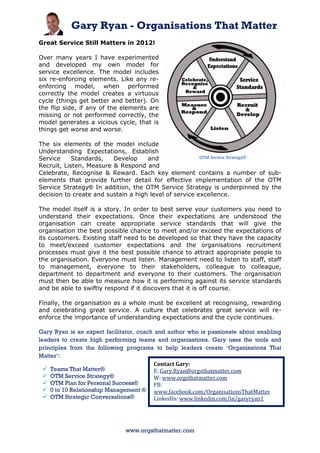
Over many years I have experimented
and developed my own model for
service excellence. The model includes
six re-enforcing elements. Like any re-
enforcing model, when performed
correctly the model creates a virtuous
cycle (things get better and better). On
the flip side, if any of the elements are
missing or not performed correctly, the
model generates a vicious cycle, that is
things get worse and worse.

The six elements of the model include
Understanding Expectations, Establish
Service     Standards,   Develop     and                OTM Service Strategy®
Recruit, Listen, Measure & Respond and
Celebrate, Recognise & Reward. Each key element contains a number of sub-
elements that provide further detail for effective implementation of the OTM
Service Strategy® In addition, the OTM Service Strategy is underpinned by the
decision to create and sustain a high level of service excellence.

The model itself is a story. In order to best serve your customers you need to
understand their expectations. Once their expectations are understood the
organisation can create appropriate service standards that will give the
organisation the best possible chance to meet and/or exceed the expectations of
its customers. Existing staff need to be developed so that they have the capacity
to meet/exceed customer expectations and the organisations recruitment
processes must give it the best possible chance to attract appropriate people to
the organisation. Everyone must listen. Management need to listen to staff, staff
to management, everyone to their stakeholders, colleague to colleague,
department to department and everyone to their customers. The organisation
must then be able to measure how it is performing against its service standards
and be able to swiftly respond if it discovers that it is off course.

Finally, the organisation as a whole must be excellent at recognising, rewarding
and celebrating great service. A culture that celebrates great service will re-
enforce the importance of understanding expectations and the cycle continues.

Gary Ryan is an expert facilitator, coach and author who is passionate about enabling
leaders to create high performing teams and organisations. Gary uses the tools and
principles from the following programs to help leaders create ‘Organisations That
Matter’:
                                          Contact Gary:
   Teams That Matter®                    E: Gary.Ryan@orgsthatmatter.com
   OTM Service Strategy®                 W: www.orgsthatmatter.com
   OTM Plan for Personal Success®        FB:
   0 to 10 Relationship Management ® www.facebook.com/OrganisationsThatMatter
   OTM Strategic Conversations®          LinkedIn: www.linkedin.com/in/garyryan1
                                          Cell: 61 417 136 731 M: 0417 136 731


                              www.orgsthatmatter.com
How To Create An Idea That Lasts Forever
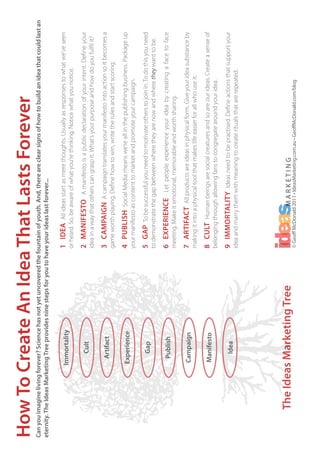
Can you imagine living forever? Science has not yet uncovered the fountain of youth. And, there are clear signs of how to build an idea that could last an
eternity. The Ideas Marketing Tree provides nine steps for you to have your ideas last forever...


                          Immortality                                1 IdEA All ideas start as mere thoughts. Usually as responses to what we’ve seen
                                                                     or heard. So, be aware of what you’re thinking. Notice what you notice.

                              Cult                                   2 MAnIFESTo A manifesto is a public declaration of your intent. Define your
                                                                     idea in a way that others can grasp it. What’s your purpose and how do you fulfil it?

                             Artifact                                3 CAMPAIGn A campaign translates your manifesto into action so it becomes a
                                                                     game worth playing. Define how to win, write the rules and start scoring.

                           Experience                                4 PubLISH Social Media means we’re all in the publishing business. Package up
                                                                     your manifesto as content to market and promote your campaign.

                              Gap                                    5 GAP To be successful you need to motivate others to join in. To do this you need
                                                                     to demonstrate the gap between where they are now and where they want to be.

                             Publish                                 6 ExPErIEnCE Let people experience your idea by creating a face to face
                                                                     meeting. Make it emotional, memorable and worth sharing.

                           Campaign                                  7 ArTIFACT All products are ideas in physical form. Give your idea substance by
                                                                     making it into a physical tool that makes life easier for all who use it.

                           Manifesto                                 8 CuLT Human beings are social creatures and so are our ideas. Create a sense of
                                                                     belonging through allowing fans to congregate around your idea.

                              Idea                                   9 IMMorTALITy Ideas need to be practised. Define actions that support your
                                                                     idea and marry them with meaning to create rituals that are repeated.


          The Ideas Marketing Tree                                   © Geoff McDonald 2011 • IdeasMarketing.com.au • GeoffMcDonald.com/blog
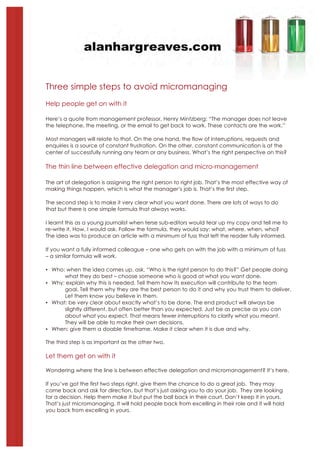
Three simple steps to avoid micromanaging
Help people get on with it

Here’s a quote from management professor, Henry Mintzberg: “The manager does not leave
the telephone, the meeting, or the email to get back to work. These contacts are the work.”

Most managers will relate to that. On the one hand, the flow of interruptions, requests and
enquiries is a source of constant frustration. On the other, constant communication is at the
center of successfully running any team or any business. What’s the right perspective on this?

The thin line between effective delegation and micro-management

The art of delegation is assigning the right person to right job. That’s the most effective way of
making things happen, which is what the manager’s job is. That’s the first step.

The second step is to make it very clear what you want done. There are lots of ways to do
that but there is one simple formula that always works.

I learnt this as a young journalist when terse sub-editors would tear up my copy and tell me to
re-write it. How, I would ask. Follow the formula, they would say: what, where, when, who?
The idea was to produce an article with a minimum of fuss that left the reader fully informed.

If you want a fully informed colleague – one who gets on with the job with a minimum of fuss
– a similar formula will work.

! Who: when the idea comes up, ask, “Who is the right person to do this?” Get people doing
      what they do best – choose someone who is good at what you want done.
! Why: explain why this is needed. Tell them how its execution will contribute to the team
      goal. Tell them why they are the best person to do it and why you trust them to deliver.
      Let them know you believe in them.
! What: be very clear about exactly what’s to be done. The end product will always be
      slightly different, but often better than you expected. Just be as precise as you can
      about what you expect. That means fewer interruptions to clarify what you meant.
      They will be able to make their own decisions.
! When: give them a doable timeframe. Make it clear when it is due and why.

The third step is as important as the other two.

Let them get on with it

Wondering where the line is between effective delegation and micromanagement? It’s here.

If you’ve got the first two steps right, give them the chance to do a great job. They may
come back and ask for direction, but that’s just asking you to do your job. They are looking
for a decision. Help them make it but put the ball back in their court. Don’t keep it in yours.
That’s just micromanaging. It will hold people back from excelling in their role and it will hold
you back from excelling in yours.
In business as in life our ability to communicate is critical to success and satisfaction.

                          For global businesspeople some new communication skills are needed. Even where
                          the common business language is English there is still significant potential for
                          miscommunication.

                          Like all of our values and behaviours, the "right" way to communicate has been
TRISHA CARTER             taught to us as part of our social development. From a young age we have been
                          acculturated to see certain things as polite or educated and other things as rude or
                          inappropriate. Our global business clients and colleagues will often have received
                          different messages as part of their early age learning. These messages often result in
                          different beliefs, values and behaviour patterns around communication.

                          So what are some of the aspects of communication which vary across cultures? And
                          do you have the cultural intelligence to enable you to adapt your behaviour in areas
                          when you observe differences?

                          Adapt your volume – How loudly or softly are you speaking compared to your
                          global colleagues? Cultures vary in the norm for loudness or softness and also the
                          message which is conveyed when volume is increased or decreased.

                          Adapt your pace – How fast are you speaking compared to your clients? To some
      To receive a free   cultures Australians speak very fast and that speed combined with our tendency not
        newsletter and    to enunciate clearly can make us difficult to understand.
     special report on
                          Adapt your turn-taking – Linguists have studied the complex rules around
building your cultural
                          turn-taking in conversations and how content, pace, and tone change at a transition
  intelligence register   point when one person stops talking and another one can begin. However those rules
your email address at     change between cultures. In some cultures simultaneous speech is the norm and in
www.cicollective.com      others a polite back-down will occur in situations of simultaneous speech. In some
                          cultures a long gap shows respect for the previous speaker while in others the gap is
                          minimal or non-existent.

                          Be aware of value differences and look beyond the words – Value
                          differences around communication can be a major source of miscommunication.
                          Direct cultures place value on communicating directly, and take pride in addressing
                          issues in conversation while indirect cultures place value in maintaining harmony,
                          taking pride in subtle communication which protects face.

                          To an Australian accustomed to a more direct communication style where the
                          message is in the up-front words, we may miss the subtle communication given by
                          context, by non-verbal signs, or in the back words rather than the initial “Yes”.

                          “Can you get that completed for me by next Friday?”
                          “Yes, next Friday…Yes....We have an audit this week”

                          These are just a few of the factors that can impact on global communication and
                          block business success. To learn how to increase your cultural intelligence – a key
                          predictor of international business success – contact Trisha Carter.

                          Trisha Carter is an Intercultural Specialist, helping people from different cultures work
                          effectively together. As an Organisational Psychologist she coaches, trains and counsels you
                          and your team to work well and live well in another culture and manage the challenges of
                          communicating, managing people and adapting. Her previous business, TransCulturalCareers,
                          provided training to expatriates and their families, multi-cultural teams and global business
                          executives for over 10 years. Her new initiative, Cultural Intelligence Collective, provides
                          extensive cultural adaptation resources.

                          For more information please contact trisha@cicollective.com or visit www.cicollective.com
Learning to SOAR with John Loty
A strengths-based approach to building strategic
capacity
John Loty invites you to consider a new way of “making things happen” - a
new way of thinking about strategic planning - a leap forward from the SWOT
analysis and that is to SOAR™ (strengths, opportunities, aspirations, results).

SOAR is an emerging framework that is a strengths-based approach which
enables the stakeholders to see where they are today and establish a vision of
where they want to go. It will be a co-creation.


SOAR has evolved from Appreciative Inquiry and works because people feel good as they clearly
identify & understand the positive core of the organisation, imagining new possibilities and
opportunities for building strategic capacity and sustainable development.


       Strategic                   Strengths                            Opportunities
        Inquiry
                        What are our greatest assets              What are the best possible
                                                                       opportunities

     Appreciative                 Aspirations                                Results
       Intent            Who do we want to be and                 What are the measurable
                         what is our preferred future            results we want to achieve


The SOAR approach to strategy starts with a strategic inquiry.               During this inquiry an
organization’s greatest Strengths and Opportunities are discovered and explored among the
participants. The participants are invited to share their Aspirations and co-construct their most
preferred future. Then, outlining specific outcomes allows achievement of measurable Results.

Strategic planning is an opportunity to help organisations soar with their strengths and to elevate an
entire system’s learning capacity to innovate from thought to finish. It can be a way to generate
energy needed to accomplish the needed changes.

This can be and usually is an exhilarating and fun tim e!

While we do not often talk about strategic business planning this way it is clear that strategic planning
can be one of the most positive times in an organisation’s life.

When people are enjoying themselves and feeling good they are more likely to create and innovate
which spirals and inspires others in the organisation to SOAR.

This all adds up to transformational organisational change.


John Loty provides assistance with and/or coaching in Strengths-based
approaches to Strategic Planning for Improvement & Sustainability (the
business opportunity of our times) utilising AI (Appreciative Inquiry) and
SOAR. Call John on 0411 809 404
Visit:www.appreciativeinquiry.net.au
Email: focus@appreciativeinquiry.net.au


Expect More From 2012                                                                        Page
7 Keys of Inspired Leadership

       Through the years I’ve had various coaches and mentors who helped me
    become a better leader. I believe all of us need such coaches and mentors.
    From each, if we have an open mind, we learn, even with unusual methods.
    One of my most unusual coaches was a horse … named Ben.

        Ben helped me recognize three prime ingredients for being a successful
    leader.

         1. Plan – most of us plan our vacations better than we plan our lives. Trust me, if
            you’re working with a horse, planning is required and a well laid out plan helps you
            stay on and have an enjoyable ride. So, …
                a. Have a clear objective.
                b. Begin with the end in mind by using backward planning.
                c. Open your mind to all possibilities.
                d. Document all discussions so nothing is lost, even the seemingly poor ideas.
                e. Engage all your resources, including all the people. The folks closest to the
                    problem frequently have the answers and another committee isn’t even
                    necessary.

         2. Communicate – communication is the doing part of any activity. Without
            communication no one, especially a horse, really knows what is expected or desired.
            Remember, it’s not about you, it’s about your listener. You must talk in the style
            your listener understands, both verbally and non-verbally.
               a. Communicate your plan, often, using various written and verbal methods.
               b. Listen, listen and listen some more.
               c. Ask great open questions with who, what, why, when, and how.
               d. Limit your closed, yes or no, questions.
               e. Don’t debate. For the ideas that aren’t worth much, honour the sender
                     with, “That’s interesting. Thank you.”

         3. Follow-up – one of the factors that convinced me to leave a place, a perfectly good
            place of employment, was the conversation that began, “We’d better put a
            committee together to deal with this problem.” I’d been on at least three
            committees, over a number of years, that supposedly dealt with this problem. No
            one, in a position to do something, had followed-up to make sure the recommended
            actions were actually accomplished. And, incidentally, a horse gives you a better ride
            next time if a follow-up with food, water, and a good bushing down.
                a. Review your plan and communication.
                b. Make sure action was taken, if not, know why?
                c. Start a new plan for the next project.


       All three of these ingredients – plan, communicate and follow-up – need to be
    happening all the time. Remember, I know this works. A horse taught me.


Garth Roberts is a Thought Leader who works international, training Frontline Managers and Supervisors to be Inspired Leaders.

                               Email: garth@garthroberts.com          Web: www.garthroberts.com
Optimism maximises your Opportunities in 2012
The definition of insanity is to keep doing the same thing and expect different results. If you want
more from 2012, then you’ll need to DO something different! I don’t believe that we can change
our outcomes just by thinking positively. We need less positive thinking and more positive doing!
Don’t misunderstand – attitude is vital to our success. The key here is the application of ‘optimism’
rather than ‘positivity’. The word comes from the Latin ‘optimus’ which means “best or most
favourable” and the Oxford Dictionary describes optimism as ‘a tendency or disposition to look for
the most favourable outcome’. In my definition, there is also a critical aspect that includes taking
action - doing something about it.

                                                Three critical elements need to come together to
                                                create and deliver optimal results in your business
                                                and your life, in 2012 and beyond. They help you
                                                build and maintain an optimistic approach – what I
                                                call being in the “OZone”. Working on the three key
                                                activities in each element gives you the ability to
                                                identify and maximise your opportunities and create
                                                better outcomes.

                                                (1) Attitude Awareness. It’s not just having a
                                                positive attitude - it’s about having an awareness of
                                                what your attitude is at any particular time. How
                                                contagious are your good moods? How about your
                                                negative ones?
                                              It’s also about recognising that there are peaks &
                                              troughs in a day, in a week, in a month, and that
                                              sometimes you should just take it easy because
things are not going so well. When you are aware of your attitude, you can take absolute
advantage of when you are feeling 100% full of energy and get the most from your efforts!

(2) Activity Management. This is about understanding exactly what it is that you need to do,
then turning up ready to do the right activity at the right time. It’s also about making sure that you
measure and monitor the things that you need to track.
Be careful not to get so caught up in what’s the right thing to do that you end up in analysis
paralysis: “I don’t know whether to do this thing or that thing.” Here’s my suggestion – do
something. Get into action and the universe will give you feedback; either, “That was a really good
thing, keep doing it,” or, “I don’t think so, maybe you need to change direction.” Get into activity
and then measure the bits that work and do more of those.

(3) Achievement Focus. How well do you see the big vision that you are headed towards? Make
sure that you have clearly articulated where you want to go. It’s also important to identify the
things that might distract you from this focus. Work out how to remove, reduce or limit their
impact. To improve your success rate, create visual reminders of the goal that will help keep you
on track. Monitor & reward your progress as well as completion to stay motivated!

Take advantage of the “fresh start” energy of the beginning of 2012 to take realistic look at what is
truly going on in your life and your business. Decide where you would rather be at the other end of
the year. Build a road map of how to get there, then search for the best
possible outcome, gather your resources and take action! Apply a dose of
Optimism to maximise the opportunities and you’ll get better results!


Helen Mac BA(Psych) CSP is Australia’s Corporate Optimist. She works with
leaders, individual contributors and teams improving attitude awareness,
activity management and achievement focus. The result is an optimistic
culture, delivering optimal performance. Author/contributor of 6 books, Helen
is a sought-after speaker around the Asia-Pacific rim. You can sign up for her
free 9-week Optimism Booster program at www.OptimismZone.com
e: helen@helenmac.com            m: 0419 930 864     w: www.helenmac.com


   © Helen Macdonald 2011                                               Expect More From 2012
In Memory of James E Rohn – Rob Salisbury
                                Flashback 1991: I had won a company sales contest that included a two hour one
                                on one breakfast with a businessman whom millions considered one of the great-
                                est speakers, philosophers and authors in modern times – Mr James E. Rohn.

                                Prior to 1991, I had heard Mr Rohn speak on two previous occasions. Once in Se-
                                attle, Washington and the other time in Phoenix, Arizona to ballroom capacity
                                crowds. In confirming my breakfast meeting on the telephone to his Scottsdale
                                Hilton Hotel room, Mr. Rohn said, “Rob, please call me Jim. I will be in the lobby
                                restaurant by 7:30 am - bring your questions, I look forward to meeting you again”.

                                Today, 20 years have passed since our breakfast meeting in Arizona. Fortunately I
was able to see him on a few other occasions when he spoke in the United States and Australia. The world lost a
great ambassador, teacher and mentor of the human spirit when he passed away 5 December 2009.

Perhaps some of the following tips Jim shared with me at our 1991 breakfast will help motivate and inspire you to
have one of your best years ever in 2012.


                TIP 1: GET HEALTHY: There is nothing worse than being sick. Having a Ferrari mindset is
                fine; yet arriving at your destination in a VW bug body is not success. Invest 1-4% each day in
                keeping your body and mind fine-tuned. Stress reduction, physical conditioning, healthy eat-
                ing, low or no alcohol and no smoking are minimums. There is truth in the old saying, ‘good
                health is true wealth’.

                     TIP 2: GET SERIOUS: Define your short and long term goals. Understand that being
                     ‘successful’ in any endeavour requires a commitment and daily focus to achieve it.
                     Becoming an authority in any field is easier with role models and mentors who have done
                     that which you aspire to do. Cut the learning curve by adapting their proven methods and
                     adopting new systems until they work for you.

             TIP 3: GET SMART: The libraries of the world are full of books and they are free to use. Experts
             have produced learning programs to save you time and to enable you to learn from their
             examples and insights. Acquire the books, DVD’s or on line learning to become competent and
             excel in your field.

           TIP 4: GET GOING: Activity is a high priority. Doing well requires handling more failure than the
           average person. Get good at using the telephone to make more appointments and meet more
           people who are able to make decisions about your products and services.

                   TIP 5: GET AWAY: Plan mini breaks to refresh, rejuvenate and rekindle your spirit. Having
                   something to look forward to is a great way to stay focused on the work at hand until the
                   rewards of our achievements have been realized. Mini holidays with family or good friends
                   can make it all worthwhile.

            TIP 6: KEEP A JOURNAL: While the destination is important, the journey can be a rewarding
            insight as to how you arrived in style. Record your daily ideas and experiences in a journal.


                                  Rob Salisbury, B. Com, CSP is a corporate train-
                                  er, conference speaker and highly rated emcee,
                                  event host and facilitator. Hired by over 500 dif-
                                  ferent groups and booked for over 2000 engage-
                                  ments in North America, Australia, New Zealand,
                                  SE Asia, Asia, Europe and the UAE, he can be
                                  reached at SRI Australia + 61 412 414 835 or
                                  SRI Singapore + 65 9017 1825
                                  www.strategicresources.com.au
Don't let people drive you nuts
Thoughts are not facts. Think about that.

Thoughts are simply your brain's responses to input from your senses
every nanosecond of every day. But they might not reflect reality.

In fact, most of our thoughts are automatic, incredibly fast and
negative (ANTs - Automatic Negative Thoughts). And ANTs drive our
responses which sometimes are not what we wish they had been!

Two almond-shaped and sized parts of your brain called the
amygdala are responsible for setting off alarm bells and the
flight/fright, aggressive/defensive response whenever they perceive that something is
not quite the way you expect it to be. They are highly sensitively geared to notice any
change from the ‘norm’, no matter how big or small.

And that’s the problem. Often, if we had stopped and really thought about the situation,
we would have reacted differently. We wouldn’t have done or said something that we
later regret. I call this The Almond Effect ®

For example, your manager wants to see you without warning; your colleagues are
looking at you and giggling; your best staff member resigns unexpectedly; people don’t
get your name right; you don’t get the promotion you were promised. And at home, your
partner is late and doesn’t tell you where they are; your teenager won’t clean up their
room; the cat is missing and the fridge broke down. You’ll have plenty of your own ANTs
to add to this list!

Any one of these things might drive you nuts immediately or the build-up over time
certainly will. The ‘straw that broke the camel’s back’ is really an imploding ANTs nest!

Take the following STAR steps to sort the ANTs ‘noise’ from the reality:


S Stop! Learn to catch yourself getting wound up and take a deep breath immediately.

T Think! Ask yourself what emotions are you feeling and what is causing it? Is the
feeling justified? Is the action you feel the urge to take best in the short and long term?

A Act! Do something to either deal with the situation or ‘walk away’ from it either
actually or in your mind.

R Rewire! When the emotion of the situation has cooled down take the time to work out
what triggered the ANTs? Were there any EWS (Early Warnings Signs)? What can you do
to prevent getting sucked in to negative emotional responses in the future?

ANTs have a vital function when your life is at risk. But it’s a response we developed for
Neanderthal days. Mostly all that ANTs do now is cause stress, anxiety and depression.

Your brain can learn new ways to respond. We call that plasticity. So practice STAR and
don’t let people’s behavior drive you nuts or make you sick.


     Anne presents and mentors leaders on life-changing ways to bring out the full
     potential of their people. Her special blend of extensive corporate experience,
     open, fun and heartfelt style and her deep research means audiences easily
     and quickly gain strategies and tools for themselves and to use at work. Visit
     www.AnneRiches.com for more information, free resources and CLUES.


Expect More From 2012                                         www.AnneRiches.com
Become an Authority On-Line – by Gihan Perera
        5. Participate actively on
          social media platforms
       and on-line communities


     Send your blog posts
    automatically to social
         media platforms


  2. Publish a regular blog
     and e-mail newsletter


                                                    3. Publish videos,
                              www                      a radio show or
1. Build a Web site about
 problems and solutions                                   a free report


                                     www.FastFlatAndFree.com
Fly in the pan – new sales strategies for 2012
by Paul Archer
Having two early teenage boys faces us with a major problem. No, its not mood swings,
empty fridges or Pizza complexions…no, its missing the toilet pan. Boys are just bad aimers,
if you see what I’m saying. Quite frankly, this is a man thing not just teenagers.
We tried everything. Telling them, encouraging them, shouting at them, rewarding them
and nothing improved the situation. Until we bought a packet of fly stickers and stuck one to
the pan just like this.


                       And the amazing thing? It worked. No more missing, perfect aims            
                       and no mess.
                                                                                                Paul is a master in selling,
                       Rather than fighting the problem, create an innovative solution.         sales     coaching      and
                       Challenge the status quo. Sometimes handling a challenge in a            customer engagement and
                                                                                                has      worked        with
                       different way reaps dividends.
                                                                                                hundreds of corporations
                       How about your challenges in your world? How are you facing up to        across the world to help
                       your 21st Century challenges and problems? Are you trying to solve       them increase their sales
                       them in the same way with the same results or are you trying             revenue.

                       different solutions however radical.                                     He is an accomplished
                       Here’s a few ideas for 2012                                              speaker, workshop leader
                                                                                                and       sales      coach;
                                                                                                continuously ahead of the
                                                                                                curve, Paul ensures the
                                                                                                latest tools are used in
    •   Have you revolutionised your cold calling techniques with some new scripts
                                                                                                helping clients increase
    •   Have you asked your customers how to change things recently?                            their sales revenue.
    •   Are you telling stories now to overcome objections rather than twisting your
        customer’s arms?                                                                        He is able to use exciting
    •   Are you using Social Networking to prospect for new clients?                            and effective skills and
                                                                                                techniques              to
    •   Are you writing shorter emails? Are you phoning or tex’ing more instead.
                                                                                                revolutionise our thinking
    •   Are you meeting clients through web communication technologies rather than              and can deliver his
        traipsing across the country in your car.                                               message in an energetic
    •   Are you investing in a new cloud based CRM system rather than rely on paper?            and enjoyable way.
    •   Have you migrated your stuff to the cloud so you can access it from any device
                                                                                                Sign up to my weekly
        anywhere?
                                                                                                sales and coaching tips
    •   Are you doing live field visits rather than paperwork back at the office?               and get the Sales Tip’s
    •   Have you challenged Head Office recently?                                               Annuals for the past three
    •   Have you said no to a customer or acted in a scarce manner to increase your             years     with      Paul’s
        perceived value                                                                         complements.
    •   Have you turned the sales process completely upside down because customers
                                                                                                www.archertraining.com
        aren’t playing ball anymore?                                                            www.paularcher.com
    •   Have you started solving customer’ problems rather than trying to push your             www.paularcher.tv
        product?
                                                                                                paul@paularcher.com
                                                                                                ++44 1452 730276
It makes you think doesn’t it? Creative change can bring great results. I just feel sorry for
cleaning product companies who might be going out of business when every man in the               
nation becomes an expert aimer. I must say mine has improved dramatically as well.
You can listen to this article plus more by visiting http://www.paularcher.com/?p=468
EMPATHY - YOUR SECRET SUPERPOWER
                                    LYNNE SCHINELLA

Each year, companies lose            Face up to it                  important to them. As a
millions of dollars in lost                                         leader it takes strategic
                                     Have you ever been
productivity due to stress                                          commitment to
                                     cranky with someone and
leave, counselling time, hiring                                     consciously look at the
                                     you chew and stew and
costs and training of new staff                                     world through another’s
                                     mull over it, only to soften
that could have been                                                lense, which will be as
                                     your whole attitude when
avoided if the workplace                                            complex and as individual
                                     you see them face to
communication was more                                              as your own. Surely if you
                                     face? If we don’t get to
empathic.                                                           can imagine someone
                                     do this, the “offence”
                                                                    else’s point of view you’re
What is empathy?                     committed can multiply to
                                                                    in a position to positively
                                     gargantuan proportions.
Empathy is the ability to stand                                     influence that person. You
                                     When we meet face to
in someone else’s shoes, to                                         may not agree with that
                                     face, it is our empathy that
feel what they feel and see                                         person’s current point of
                                     will win out in the end
what they see. Empathy is the                                       view but do you want to
                                     amongst those with
ultimate in understanding                                           influence, to persuade? To
                                     mutually respectful
other people; to slide into their                                   develop a strong
                                     relationships. We may be
minds and see what the world                                        respectful relationship?
                                     connected but we’ve
is like from their perspective in                                   Then empathy gives you
                                     greatly reduced our face
order to better understand                                          power.
                                     to face contact and
them. It allows us to connect
                                     therefore our transference     Do it
with each other on a level
                                     of empathy. We’re
where we have a chance of                                           So in 2012 make a
                                     operating as individuals in
making better decisions on                                          commitment to
                                     our own little bubbles. We
how we act towards each                                             encourage empathy in
                                     have limited opportunities
other.
                                     to read others let alone       yourself and your team,
                                     understand what they’re        see tensions diminish and
                                     feeling and what’s             productivity rise.


                                Lynne Schinella works with organisations to add dollars
                                straight to their bottom line through improved
                                communication. This translates to reduced staff turnover,
                                hiring costs & increased employee engagement.

                                She’s a speaker and trainer, and author of”Bite Me! and
                                other do’s and don’ts for dealing with our differences.”

                                Check her out at www.lynneschinella.com.au or
                                contact her directly at lynne@lynneschinella.com.au
So you want to be an excellent manager?
Are the usual things holding you back?

What are the usual things? They relate to these personal questions: do I have what it takes?
Can I lead? Is my strongest suit strong enough?

The answer to all three is yes, but we often stumble over these questions. That’s ok. It means
you are self-aware. If you don’t stumble over them, you may not have the humility to survive
as a manager, let alone take the steps to make you one in the first place. Here’s five simple
things you should do if you want to be a great manager.

▪   Micromanage yourself
        Start the day with an action. We are saturated with advice to work “on” our business
        rather than “in” it. Yet nothing happens if one doesn’t follow the other. Find something
        that will take 15 minutes or less and do it. People notice when you take action.
        Virtually everyone I have promoted was a self-starter. Start getting noticed now.

▪   Collaborate
        Start your own think tank. Get together three or four like-minded colleagues or friends.
        Develop a mutually supportive brainstorming group. Thrash out new ideas with them.
        Take your problems to them and help them with theirs. It can be in the boardroom or
        over coffee or dinner. Get excited about your issues. There is massive career leverage
        in this process.

▪   Be yourself
        There will be people in your business environment who do some things much better
        than you. Celebrate them. Encourage them, so that you don’t have to spend time on
        those things. Instead, look at the things you do really well. What are they? If you do
        what you do well, and do it often, and continue to take it to the next level, people will
        notice. How can you make your strengths integral to the success of the business? How
        can the business leverage off you?

▪   Help others
        Spend time forgetting about yourself. The best way to do that is help your team. The
        best bosses encourage others to excel. They worry less about their own stature and
        more about that of others. Their own stature will take care of itself. Helping your team
        climb a hill will put you nearer the top yourself.

▪ Market yourself
        This is not about arrogant statements of personal ability. It is about proposing
        strategies you can deliver. Ask your think tank: what is the best initiative I can take that
        will assist this business? It might be a simple action or it might be a major project.
        Regardless of its scale, it will draw on your strengths. It will have the backing of your
        team and it will be something on which you can take real action. Don’t hold back on
        this. Pick up the ball and run with it. Your strong suit will be strong enough, because
        that is what this initiative is based on. By taking action, you will be taking the lead. In
        doing so, both you and others will start to notice that you have what it takes.
Whooooo Are You?
It’s hard to believe that the UK rock band ‘The Who formed in 1964.

                                        Lead guitarist and songwriter Pete Townshend wrote songs that created 27
                                       top 40 singles. Combining the talents of other band members and lead singer
                                       Roger Daltry, ‘The Who’ was inducted into the Rock & Roll Hall of Fame in
                                       2001 - their first year of eligibility.

                                       Highly honoured for their legendary creativity, they have kept their music
                                       current with their aging fan base for over four decades and sold nearly 100
                                       million albums along their musical journey.

                                       You may even be one of the tens of millions of people who watch CSI: Crime
                                       Scene Investigation each week around the world. Show producer Jerry
                                       Bruckheimer has used the song ‘Who Are You’ in every one of the opening
                                       show credits since the first episode aired on the 6th October, 2000.

The song’s title does ask a profound question worth investigating and so I ask, ‘Who Are You’ and how did you get to
be and arrive at being ‘YOU’?

                                       6 tips to get more out of 2012
1. Reflect – Review - Renew
What have you achieved personally and professionally that you are most proud of? Who has inspired you as a role
model or as a mentor along your journey in life or business? Where have you travelled to that is beyond your
neighbourhood or city that has offered a different perspective on other cultures or history?

2. Manage change and adaption
Psychologists suggest that any significant change in one of the following areas will cause undue stress to a person.
Three or more issues at once can lead to depression or anxiety issues.

* Death of a family member, close friend or beloved pet * Moving home or city location * Job lose or career change *
A serious health or medical issue involving a relative, friend or self. * A personal relationship change like separation,
divorce or new marriage.

3. What professional skills have your learnt or accreditations have you gained?
A professional colleague in Singapore is a CPA and has completed an in depth Singapore Institute of Company
Directors Program. She is now qualified to consult to private and public company boards. She has ‘skilled up’ and has
already started working with clients who can justify her higher fees.

4. Limit community, church or social club contributions.
The constant yet limited resource at our disposal is time. Factually, if we take 24 hours in a day and multiply that by
365 days/nights in a year, we have 8760 hours to use. A 1% use is 88 hours or about two 40 hour work weeks for
most employed people. Be very wise in using or giving away your most valuable commodity and asset.

5. Balance health, spouse, family, friends and work.
Easier said than done you say? Consider outsourcing some of the ‘things’ on your list of to do’s and gain new time and
personal space each week in the year ahead.

6. What do you want to celebrate and enjoy in the year ahead?

                   Rob Salisbury, B. Com, CSP is a corporate trainer, conference speaker and highly rated emcee,
                   event host and facilitator. Hired by over 500 different groups and booked for over 2000
                   engagements in North America, Australia, New Zealand, SE Asia, Asia, Europe and UAE.

                                    Rob can be reached at SRI Australia + 61 412 414 835
                            or SRI Singapore + 65 9017 1825 or www.strategicresources.com.au
3 keys to Eliminate Email Overload                                           by Steuart Snooks (CEO, Solutions for Success)
Many people consider e-mail to be the biggest time waster and source of frustration in modern business life. This article
complements the mind map on an earlier page and gives you 3 strategic steps and 9 specific actions you can take to eliminate
email overload, save an enormous amount of time, reduce frustration, gain control and dramatically improve your productivity.

 1 Decrease frequency - The first step to eliminating email overload is to decrease the frequency of checking e-mail.
     Schedule times to check email: The key to decreasing frequency is to schedule times when you will check e-mail rather than
     allow it to interrupt you whenever it arrives. How often you should check e-mail depends on your role of course. Research
     shows that for most of us, 4 planned times a day is the best frequency. The key is that for most of the time we must ignore e-
     mail so that we can concentrate on the current (usually higher priority) task, activity or project we are working on.
     Turn off email alerts: Now that we’ve scheduled times to check e-mail, we can turn off all the e-mail alerts. This will eliminate
     the distraction that results every time an e-mail arrives. The productivity damage that e-mail so often does is not so much
     because of WHAT the e-mail content is but by WHEN it arrives. Turning off the alerts eliminates this problem.
     Manage expectations: The way to handle concerns about missing an urgent message when alerts are off is to manage other
     people's expectations. We must push back on the unrealistic expectation of instant communication when it comes to e-mail.
     You can do this by setting up an out-of-office message to let people know when you expect to respond to their message. This
     can be done by adding a PS to your signature block saying something like “I’m not always at my desk and check e-mail 4 times
     a day. If your message requires an urgent response, please call my mobile number.” As people begin to NOT expect instant
     responses, they’ll tend to send you less e-mail and the e-mail you do receive is likely to be of higher importance.

 2 Reduce volume - Do you feel you don’t get enough e-mail? Are you struggling with too little or too much information?
     Selective ignorance: The way to manage overload is, as Timothy Ferriss says in his best seller ‘The Four Hour Work Week’, to
     be selectively ignorant. As Herbert Simon once said, “a wealth or overload of information creates a poverty of attention and
     the need to allocate our limited attention, our limited energy, and our limited time efficiently.” Unfortunately, we can’t know
     everything and we can’t keep up with all the information that is proliferating in our world. So the key is to be selectively
     ignorant, to tune out the noise, to ignore the trivial many so that we can focus on the critical few.
     Use email rules: Automate some of the routine decisions and processes involved with your e-mail responses. One of the most
     powerful rules to set up, and one that reduces e-mail volumes enormously, is the ‘cc rule’. This is a rule you set up for all e-
     mail received as cc and redirects them to a CC (or reading) folder, not your inbox. CC e-mails are not urgent and often don’t
     require any action from you at all, so they can be stored in the cc folder for you to review at a later and more appropriate
     date and time. The same rule can be applied to ‘all staff’ e-mails, newsletters or other distribution lists.
     Clarify expectations and parameters: Another way to reduce email volumes is to clarify expectations and parameters with
     others. Set expectations so you don’t have to respond to non-question e-mail at all (eg: by adding a PS to your signature
     block). As a manager, you can establish financial thresholds that allow for independent decision-making, allowing staff to use
     their own judgement to solve issues up to a certain dollar value and minimising a stream of endless low priority e-mail
     requests. Use ‘if-then’ instructions when sending e-mail to prevent most follow up questions and speed up decision-making.
 3 Increase speed – As we receive increasing volumes of email, we must learn how to handle it once and process it quickly
     Handle each message only once: Most of us have a backlog of e-mail in the inbox. This is ‘unfinished business’ which has to
     be handled at some stage in the future, even if it only means filing or deleting the e-mail. Many of these e-mails will have
     already been scanned or read two, three, five, ten times or even more. By checking email at a scheduled time as outlined
     above and using the 4D method outlined below, we will be able to handle each message only once.
     Use the 4D method - every e-mail only ever has one of 4 possible actions, as follows;
        Delete/ditch everybody’s favourite action. Unwanted or irrelevant messages can immediately delete it
        Deal . . . . . . . . for emails you can handle with in two minutes or less, deal with it straight away
        Delegate . . . . when the next action needs to be done by someone else
        Decide . . . . . . there are 3 possible decisions about the next action required, as follows;
             Where . . store the e-mail when there is no further action but you need to keep it for future reference
             When . . for e-mails you can’t process in two minutes or less, convert the e-mail to a Calendar or Task item as
                             planned and prioritised work to be done at a more appropriate time
             Wait . . . when the next action can’t be taken because you’re waiting on some one or some thing else, move the
                             email to a waitlist or pending reply folder rather than in the in-box where you’ll keep being distracted by it
     Use subject lines to clarify desired outcomes – Just as every incoming email only requires one of four decisions, likewise
     every email we send only has one of four possible desired outcomes (set up as 4 draft emails).
         Action Required . . . . the reader needs to take a specific action
         Response requested the reader needs only to respond to your message; no other action is necessary
         Read only . . . . . . . . . it’s important they read the message but no other action or response is necessary
         FYI . . . . . . . . . . . . . . . reading the email is optional, not essential (eg: an interesting article or joke).

For more details on how we can help you or your organisation to implement these ideas, check our website to see workshops,
presentations, coaching, webinars and other solutions that will help you to get control of email - www.emailtiger.com.au
FIVE TIPS FOR A GREAT FIRST IMPRESSION (FOR MEN)
                          – BY SHARON KYRWOOD
                                      We all know that first impressions matter, now more than ever, with so many
                                      people changing jobs, looking for new business and attending networking
                                      events. Like it or not, people do make snap judgments about us, so give them
                                      every opportunity to make them positive.

                                      SHOES! PEOPLE NOTICE SHOES
                                      OK. Maybe women notice shoes first, but even other men will notice if your
                                      shoes are falling apart or are in the wrong colour. Here’s a simple rule: Wear
                                      shoes in the same colour as your trousers, or darker. Never let anyone convince
                                      you that brown shoes look good with black pants, they don’t!

                                      Also polish your shoes regularly – this helps them look better and last longer.

                                      TIME FOR A MEN’S MANICURE

When you walk in to greet a prospective client and extend your hand for that all important handshake, having dirt
under your nails is off-putting. In this day and age, with so many nail salons around, there is no excuse for not
having a manicure. No, you won’t come out with red nail polish, and the nail technicians are used to working with
men! They can advise you on how often you will need to return, based on the condition of your nails.

CLEAN STYLED HAIR

You shave, shower and brush your teeth every day – but do you give your hair the same care and attention to
detail? Many men don’t, but I would caution against this. Hair builds up natural oils, which over time make the hair
look greasy. Wash your hair more regularly – ask your hairdresser for the best advice for your type of hair.

How many of you have had the same hairstyle for the last 10 years – or even 5? Next time, ask your hairdresser to
suggest a more modern hairstyle.

PRESSED SUITABLE CLOTHING

Getting up in the morning, grabbing the cleanest shirt from the pile on the floor, giving it a shake, a quick whiff and
on it goes, is not going to give the best first impression! Admit it – I know you have all done this at some point in your
lives. Always wear suitable clothing for the job that you are doing and ensure it is clean and pressed.

WALKING WITH CONFIDENCE, NOT ARROGANCE

Confidence in men can sometimes be mistaken for arrogance. There are a few little pointers that will help banish
the arrogant image:

        Don’t be loud just for the sake of it. Walk into a room with an air of quiet confidence, and people will still
         notice you.
        Don’t raise your chin too high – it makes you appear as if you are looking down your nose at everyone.
         Keep your head up, but your chin tucked slightly down.
        Don’t dress flashy – you know the type, the ones you won’t let your girlfriend, wife, daughters or sisters talk
         to. Dress well – be smart, clean and professional.


        Sharon Kyrwood is a make-up artist, stylist and image consultant with 16 years experience working
        with professional photographers, film and TV companies, and the public, helping men and women from
        all walks of life look and feel more professional, confident and yes, even glamorous!

        Visit her Web site www.SharonKyrwood.com to read her blog and subscribe to her newsletter.
This is a FREE e-book. Please share it with friends, family,
colleagues, clients – and whoever else you think will get value
  from it for 2012! The only restriction is that you must not
 change it in any way. Each contributing author retains their
 copyright for their individual content. This entire e-book is
                    copyright Gihan Perera.

 The material contained in this e-book is general and is not
 intended as advice on any particular matter. The authors
   expressly disclaim all and any liability to any persons
whatsoever in respect of anything done by any such person in
   reliance, whether in whole or in part, on this e-book.

Expect More From 2012

  • 1.
    With Compliments From Michael Neaylon Strategies for Success from Leading Experts in Personal and Professional Development This is a FREE e-book. Please share it with friends, family, colleagues, clients – and whoever else you think will get value from it for 2012! The only restriction is that you must not change it in any way. Each contributing author retains their copyright for their individual content. This entire e-book is copyright Gihan Perera. The material contained in this e-book is general and is not intended as advice on any particular matter. The authors expressly disclaim all and any liability to any persons whatsoever in respect of anything done by any such person in reliance, whether in whole or in part, on this e-book.
  • 2.
    TABLE OF CONTENTS 6 Tips for More Engaging Webinars........................................... Gihan Perera Reducing Friction in Your Business ...................................... Mark Sutherland 10 Questions You Should Be Asking This Time of Year .......... Karen Schmidt Change Whatʼs Normal ..................................................................... Ian Berry Formula for Lifelong Fitness......................................................... David Beard SMS – Your Sales Motivation System .......................................... Paul Archer How to Bake Strategy Pie ....................................................Shelley Dunstone By The Book ......................................................................... Michael Neaylon New Rules of Written Communication ....................................... Shirley Taylor Master the Six Soft Skills For Personal Leadership .................... Maree Harris Employers Perplexed ................................................................ Ross Clennett 3 Keys to Eliminate E-mail Overload - Overview..................... Steuart Snooks Five Tips for a Great First Impression (for Women) .............. Sharon Kyrwood The Mentoring Mindset .................................................................... Ann Rolfe Keep Your Team Connected in 2012 ..................................... Lynne Schinella Focus On Where You Are Going ................................................ Clive Murphy Thrive, Don’t Just Survive! ................................................... Shirley McKinnon Working With the Brain In Mind................................................. Jenny Brockis A Saleable Business Is Well Worth Keeping! .............................. John Denton
  • 3.
    Ways of Working“Out Of Office”................................................ Chris Pudney Creating Emails That Get Action ................................................. Jani Murphy Great Service Still Matters in 2012!................................................ Gary Ryan How to Create An Idea That Lasts Forever ............................ Geoff McDonald Three Simple Steps to Avoid Micromanaging ....................... Alan Hargreaves Cross Cultural Communication ................................................... Trisha Carter Learning to SOAR ............................................................................ John Loty 7 Keys of Inspired Leadership................................................... Garth Roberts Optimism Maximises your Opportunities in 2012 ........................... Helen Mac In Memory of James E Rohn..................................................... Rob Salisbury Don’t Let People Drive You Nuts ................................................ Anne Riches Become an Authority On-Line .................................................... Gihan Perera Fly In the Pan – New Sales Strategies for 2012 ........................... Paul Archer Empathy – Your Secret Superpower ...................................... Lynne Schinella So You Want To Be An Excellent Manager? ........................ Alan Hargreaves Whooooo Are You?................................................................... Rob Salisbury 3 Keys to Eliminate Email Overload ........................................ Steuart Snooks Five Tips for a Great First Impression (for Men) ................... Sharon Kyrwood
  • 4.
    6 Tips forMore Engaging Webinars - by Gihan Perera 1. SOLVE THEIR PROBLEMS: It doesn’t matter if you have scratchy audio, poor slides, a slow Internet connection, or anything else. If you know your audience’s questions, challenges and problems, and you can answer them in the webinar, your presentation will still be compelling. 2. EDUCATE OR INFORM: Webinar audiences don’t come to be inspired, motivated or entertained. They expect to learn something – so focus on educating or informing them. Even if your purpose is to sell them something, teach them first – and then go into your sales pitch. 3. GET THEM DOING SOMETHING SOON: Ask them to do something simple early in your presentation. This forces them to take notice, involves them right from the start, and demonstrates that this isn’t just another boring presentation. For example, you could conduct a poll, ask them to write something or invite people to speak out loud. 4. USE MORE VISUALS: In a face-to-face presentation, your slides are a visual aid; in a webinar, they are the visuals. So use more slides than you normally would. This keeps your audience’s interest, and provides a visual reinforcement to your words. The rule of thumb is to ensure that your slides match what you’re saying at the time. 5. START ON TIME: Webinars are very time-efficient, so your audience has high expectations that you’ll respect their time. So be sure you start on time; otherwise it sets a bad precedent, and your audience worries about whether you will keep to time. If you’re worried about the technology or the logistics, log in early and test the technology so you can start on time. 6. GET GOOD! There’s nothing more off-putting than seeing a presenter struggling with the technology. Unfortunately, this happens a lot. So get good! You don’t have to do it all at once. Start with just a PowerPoint presentation for your first webinar. In later webinars, you can add polls, audience questions, switching between windows, and other advanced features. Gihan Perera is the author of the book Webinar Smarts, the smart way for professional speakers, trainers, thought leaders and business owners to deliver engaging and profitable webinars. To learn how to reach the world with mic, screen and mouse, visit WebinarSmarts.com for your copy. You can also download a free chapter on how to create effective webinar visuals.
  • 5.
    Reducing Friction inYour Business by Mark Sutherland Every business has friction points to varying degrees. Common frictions are staff relationships, clients not paying on time, suppliers letting you down, lack of customers and more. These are all frictions that make you anxious and worried about business progress. To feel better and overcome these friction points use this simple chart below. We never get rid of friction points in our businesses but we can identify them and reduce them. PeakPerformanceGuru.com is a membership site established by Mark Sutherland to bring together his insight and knowledge from 25 years of coaching Olympic & World Champions and Executives to be Peak Performers. In The Knowledge Stadium you will have access to a plethora of tips, tools and tactics to help you become a Peak Performer in business and other areas of your life. www.peakperformanceguru.com
  • 6.
    10 questions youshould be asking this time of year So, another year is about to begin. Besides running around getting all those holiday related tasks organised, many leaders turn their thoughts to analysing the year that was and planning for the new year ahead. This time of year gardeners are also turning their thoughts to the past growing season and planning for the next one. The way I see it the questions each group needs to ask, are the same . . . 1. What grew? What new ideas that you planted came to life and grew . . . in a good way. Remember, weeds are prolific growers too and you don’t want more of them. For example, which of your people have grown this year in terms of knowledge, abilities and confidence? How have you grown as a leader? Has your team grown closer? 2. What died? What didn’t work this past year? Was it a new policy or procedure, transferring someone to a new role, re-organising job responsibilities, taking on a new client or a hire that failed to thrive? On the positive side, what unhelpful or negative attitudes died off this year? 3. What would I plant again? Who would you hire again? What projects would you do again? Which marketing campaigns or training programs would you repeat? Remember, just because something grew doesn’t mean you would plant it again. Some people and projects require too much effort to be worthwhile repeat investments. 4. What new things would I like to try? If you’ve been keeping an eye on the latest thinking in your industry then you should have some ideas on what you could try next. So what research and reading have you done to identify new things? What is on your “to do list” for the coming year? 5. What is ready to be moved? Do you have people that are ready for their next role in your team, elsewhere in the organisation or maybe outside the organisation? What about you? Do you need to consider your next move? 6. What worked for others? Look around your organisation for signs of what worked for other leaders and their teams. Maybe those same initiatives could work for your team. If you can learn from other leaders you will shortcut the path to success. 7. What needs a rest? Gardeners rest beds to allow the soil to regenerate or they can run out of nutrients. What projects need a rest this coming year? Which of your staff need a holiday or at least a break from demanding tasks? What long established practices could do with a rest? 8. What circumstances were within or outside of my control? The weather and the GFC you can’t control but there are many other things that you can control. Did you ignore the early warning signs of a problem? Did you make decisions that you knew from the start had a minimal chance of success? Did you fail to take action when you should have, hoping the problem would solve itself? 9. What’s changed since this time last year? People and plants grow, changing the look and feel of an environment. How can you summarise the way your team has changed, for the better or the worse, since this time last year. 10. What do I want to change by this time next year? Imagine your team a year from now and describe exactly what it would be like . . . what it would and wouldn’t contain, where it would be headed and how it would be performing. Karen Schmidt from Let’s Grow! describes herself as a workplace gardener who can help your business bloom by growing your managers into engaging leaders. To book Karen for your next conference or professional development event contact her on 0411 745 430 or visit www.letsgrow.com.au.
  • 7.
    Change Whatʼs Normal by Ian Berry © All rights reserved. To expect more from 2012 firstly, be happy with what you have. When we are grateful for what weʼve got we can have more of what we want! Secondly, break free from the status quo. Change whatʼs normal. Here are 3 ways to change whatʼs normal: 1) Make both evolutionary and revolutionary change Change is evolution and revolution and usually at the same time. The trouble is we often see change as either/or rather than both/and. What will you change this year that's both? Think small change/s. Think incremental. Most revolutions were/are a tipping point preceded by a whole lot of small changes that in themselves were revolutionary for those who made them. Conscious evolution starts with a conscious conversation with ourselves and then a decision to change. What are you saying to yourself? What are you doing about what youʼre hearing? 2) Eliminate show from your leadership and deliver more value There is a saying about professional golf that goes something like “driving is for show and putting is for dough.” The folk who win golf tournaments have great short games and are not necessarily great at the big shots. What will you eliminate this year from your leadership that is show and what will you add that other people will find really valuable? 3) Have a red-hot go Every master-piece began with an idea and a blank canvas. I am willing to bet that you have an idea and you still have a blank canvas i.e. you havenʼt yet done anything about your idea. What are you waiting for? Get started today. Take massive action on your idea this week. It may not turn our to be a master-piece. Who cares! It has been said “The journey is the reward.” Yet every now and then, because of our commitment to the journey, something remarkable happens. Make this week and every week this year, remarkable. You will never know until you have a red-hot go. Since 1991 Ian Berry has partnered with passionate people to break fee from the status quo and turn possibility into reality. He is the author of Changing Whatʼs Normal. www.changingwhatsnormal.com +61 418 807 898
  • 8.
    Formula for LifelongFitness – David Beard Many people struggle to maintain their fitness for life. But it isn’t that hard. Here’s my formula for an active life guaranteed to keep you fit, forever. 1. Love the feeling you get when you finish exercising Many people say they don’t like to exercise because it hurts. Unfortunately, they are focusing on the wrong thing. Of course exercise is uncomfortable at times. If it wasn’t, it wouldn’t be exercise. The whole idea of exercise is to push yourself out of your comfort zone for short periods so the rest of your day feels easy. The best part of an exercise session is when you stop. That feeling of satisfaction from taking action, reduced stress due to balanced body chemistry and feeling of being in control. Don’t focus on how you fell while you are exercising. Instead focus on how you feel when you stop. 2. Find people who love to do what you do Long term commitment to an exercise routine is much easier if you have people who also like to do what you do. It is much easier to get up in the morning or stop on the way home from work if you know there will be someone else there to exercise with. On days when you just don’t feel like it, the energy of a group or training partner can get you started when it would have been easier to go home. Once you’ve started, it’s much easier to keep going. Having committed exercise buddies means you are less likely to skip a session. Committing to other people is better than a commitment to yourself. 3. Include a variety of activities in your exercise Having variety in your exercise program means you’re less likely to get bored, stale or injured; all things that can derail even the most committed exerciser. If you rely on one mode of exercise the chance of you suffering an overuse injury is much greater than if you do different things during a week. Variety in your exercise also means you’re likely to be fitter as more muscles are working in different ways. Don’t rely on one form of activity either. Incorporate aerobic training with some strength and flexibility sessions. 4. Relax and enjoy feeling fit Regular exercise shouldn’t be a struggle. If it is, you haven’t found the right combination of activities or you are doing too much. Your body doesn’t need a lot of exercise to stay fit, so focus on quality not quantity. Your body adapts after you’ve exercised so build in some relaxation time. Doing a variety of activities helps with this. Adding in some meditation helps the body to recover and adapt to the training. Remember, it’s supposed to be fun, so enjoy it. And love how good it feels to be fit. David Beard is a fitness and performance specialist. He shows successful people how to stay at the top of their game for as long as they want. He works with executives and business owners who know they have to stay in shape to perform at the level they need. He provides assessment, education, coaching and consulting to individuals and organisations. Visit www.lifelongfitness.net to see how David can help you.
  • 9.
    SMS – YourSales Motivation System How to boost your motivation in sales by Paul Archer I help to run and coach our village Under 12’s Junior Rugby Team called the Bredon Buzzards. Look us up on the web www.bredonrugby.org At the beginning of this season, we got off to a great start winning our first two matches convincingly but then the rot set in and we lost five matches on the bounce. Now you can imagine by Christmas, how the boys were feeling – pretty depressed and as for the coaching team, we were distraught…devastated. We began to question our ability and drive, our motivation dropped, we kept debating our coaching strategies, questioning ourselves,  blaming ourselves…we panicked. Paul is a master in selling, Does this ring a bell in sales or management when times get tough – maybe a lean spell, a sales coaching and period of bad news and unforced errors? How do we rise above it? One way is my SMS customer engagement and has worked with System or Sales Motivation System hundreds of corporations The secret to an SMS is to break down what you do and rather than wait until a major across the world to help success like a big sale, you reward yourself for achieving the small increments that lead to them increase their sales the goal. And when you reward yourself regularly for the small achievements, you boost revenue. your motivation and self esteem. He is an accomplished Let me explain. speaker, workshop leader and sales coach; We sat down and examined our coaching system and training drills. We broke down what it continuously ahead of the was, during a game that led to tries and points and eventual victories. We talked about curve, Paul ensures the winning scrums, line-outs, rucks, mauls, passing without dropping the ball, tackling well. We latest tools are used in then devised new Skill Drills to practise these core elements and rewarded the boys when helping clients increase they did these things well especially during matches. their sales revenue. All the little rewards started to have an affect on our motivation and the kids’ drive. Even if He is able to use exciting we lost a match, which we did early in the New Year, we still remunerated ourselves for and effective skills and winning scrums, tackles, line outs etc…and soon enough we had our first, very narrow, techniques to victory and haven’t looked back since. revolutionise our thinking and can deliver his So break down your sales process or your coaching process into smaller chunks and reward message in an energetic yourself with points or Mars bars, it doesn’t matter. That fact that you achieved the small and enjoyable way. segments will, eventually lead to a big success, a sale or a rugby victory. Sign up to my weekly The strange twist though, is what the boys really thought. Apparently they weren’t too sales and coaching tips bothered about losing every match. By the time they had arrived home, been dipped into a and get the Sales Tip’s bath and fed a roast dinner, washed down with copious amounts of ginger beer…they had Annuals for the past three totally forgotten the game years with Paul’s preferring to remember the fun complements. they had with their mates. www.archertraining.com It was us parents and coaches that www.paularcher.com took it all to heart and worried www.paularcher.tv about things. Dwelled and paul@paularcher.com resented the referee’s decisions. ++44 1452 730276 Perhaps we shouldn’t grow up so quickly and learn to think more  like a 12 year old.
  • 10.
    How to BakeStrategy Pie – Shelley Dunstone I’m a fan of the Masterchef TV cooking contest. I love to relax on the couch with a glass of wine and a take-away meal, and watch other people slaving in the kitchen. I’m not very keen on cooking! Developing a competitive strategy for your business is a bit like a Masterchef team challenge. The contestants come into the studio, with no idea what they will have produced by the end of the day. They’re told “You’ll be making lunch for a law firm” or “You’re doing dinner for the Dalai Lama”. They stand around in shock, wondering how they are going to achieve this. Then they find themselves with a basket of ingredients and they know just one thing – by the end of the day, they must have their dishes ready to “plate up”. Usually (apart from the occasional culinary disaster) by combining their knowledge, ideas and expertise, they produce a delectable meal that they can all be proud of. Like a Masterchef challenge, creating a competitive strategy is an exercise in dealing with uncertainty. Your challenge is to bake a unique strategy, using only the ingredients at your disposal. Like me, you might prefer to save time and effort by buying a ready- made meal – but an “off-the-shelf” strategy won’t produce competitive advantage. Creating an original strategy takes time, motivation and creativity - but at the end of the process you must be ready to “plate up”. Ingredients for Strategy Pie Definition of your industry and market Strategic assets, e.g. your core competencies SWOT analysis (Strengths, Weaknesses, Opportunities and Strengths) Environmental scan - global, national, local Competitor analysis Customer base, segmented Method Slice and dice, layer the ingredients, shake and stir, let it bubble around, agitate with questions, leaven with laughter, allow to rise, and chill for a while. Find the “sweet spot” where you can work in your strengths and create maximum value for your target market. Bake, then plate up your unique strategy and enjoy business success! Shelley Dunstone helps businesses to innovate in their strategy to create sustainable competitive advantage. She facilitates strategic discussions that bring clarity and focus to your business planning. She also works individually with business leaders and is an international conference speaker. Visit her Web site www.shelleydunstone.com and subscribe to her FREE ezine “The Cauldron of Innovation”.
  • 11.
    By The Book Writinga book has become an increasingly popular way to position yourself, especially if you’re a service professional or business owner looking to increase your personal profile. But is positioning enough of a reason to write a book? The short answer: no. And now for the longer answer. Writing a book can put you in the spotlight, but no amount of publicity will make up for a book that has no significant reason for being. Just like your business, your book needs to satisfy your readers’ needs. In other words, have something to say, not just a business to promote. How do you achieve that crucial balance? Firstly, remember that readers love war stories, about mistakes you’ve made and jams you got out of, how you’ve conquered challenges and helped others to do the same. They liked to be inspired, uplifted, educated and valued. They’re looking for tangible takeaways they can put into action, ideas to flip their thinking, save their money or give them more time. They want to know you’ve been there, done that, understand their concerns and now you’ve earned the right to advise them with authority. They want nuggets of knowledge, not pages of self aggrandising advertisements. The irony is, if you give your book integrity it will stand out. And sell out. Look at the success of Tim Ferris’ Four Hour Work Week, Gihan’s Fast, Flat and Free, or Stephen Covey’s books on the habits of highly effective people. These books have all been popular, but it’s not just pure promotion that’s made that happen. It’s the stuff between the covers that’s made the real difference. Here are three top tips I discovered in writing, publishing and promoting my own. 1. Start writing. If you don’t have the big idea yet, write a list of all the problems you see your clients challenged with and then write a response that gives a solution to each. Then keep writing. 2. Research your topic and name on Amazon. Is this hot right now? Or perhaps there’s a gap that’s waiting to be filled? What’s your unique angle on this topic? What fresh insights can you give? 3. Write as you’re writing. That is, once you’re happy with the idea and you’re ready to road test the content, blog about the book and share it with your social media channels. You create a community around the book and gain PR momentum before it’s released. There are many more ways to make your book stand out, such as getting quality peer reviews, testimonials from prominent experts, hiring a good editor, speaking opportunities, and finding a good distributor. But it all starts with what’s on the pages. What’s on yours? Michael Neaylon is a brand and marketing speaker, consultant and coach. He is also the author of ‘True Brand Toolkit: How to Bring in Big Money for Your Small Business.’ Released in May 2011, the book is now in its third print run. www.mcme.com.au/truebrandtoolkit
  • 12.
    New Rules ofWritten Communication – by Shirley Taylor As we are writing more than ever now, we depend on our writing skills to influence, persuade, encourage, collaborate, and to lead. However, most people don't really notice the quality of the writing they read – they simply react positively, negatively, or not at all. If you have ever wondered if there's a better way to write your messages so they get better results, there is! Here are three of the new rules for achieving more through effective written communication: 1. If you can say it, you can write it We connect with the world today largely through e-mail, web sites, blogs, texting, and social media. With all these channels we have only bare facts, without tone of voice, facial expressions, body language, or pauses. Doesn’t it make sense, then, to use writing that's as close as possible to spoken language? When you do this, you gain yourself a great advantage – you put your personality and individuality into your message. This will help you to stand out more and make a greater connection with your reader. 2. Write for today, not yesterday Yesterday's writing is passive, wordy, and also really dull. It puts a distance between you and the reader. The way it is written also slows down understanding. Today's writing sounds more conversational. It's crisp, clear, transparent, and the personal context makes it more positive and interesting. Yesterday: Please be advised that a meeting of the Annual Convention Committee will be held on 24 February (Thursday) at 9.30 am. You are required to attend to report on progress made since the last meeting. Kindly advise your availability. Today: I'd like to hold another meeting of the Annual Convention Committee on Tuesday 24 February at 9.30 am. I hope you can attend to report on the great ideas you mentioned at the last meeting. Please confirm if you can join us. 3. Aim to build relationships In writing, people will judge you based on what you write and how you write it. In today's fast-paced, communication-crazy world, it's essential to come across as a human being. If you insist on using old fashioned or redundant jargon (Please be reminded, Kindly be advised, Please find attached herewith, above-mentioned, etc) you will obscure the real meaning and will not be adding any personality of your own. Make your writing positive, stimulating and interesting, add some feeling and a personal touch. Help your readers get to know the real person behind the message. Good writing makes a difference. Good writing will give you a huge advantage in today's business world. Good writing can help you work more efficiently, build credibility, improve relationships, influence people, win more clients and achieve your goals. So take another look at the messages you receive, and at the messages you send. Are they full of yesterday's jargon or today's conversational expressions? Will they help to enhance your professional reputation or ruin it? Will they help to build relationships or break them? Give yourself an edge in this very competitive world by getting to grips with effective writing now, before it's too late! Shirley Taylor is a popular speaker, trainer and author of many successful books on e-mail, communication and business writing skills. Shirley lives in Singapore and conducts interactive workshops on business writing, communication skills and e-mail writing. To receive five complimentary special reports in the Success Skills series, visit www.shirleytaylortraining.com. Sign up for free Success Boosters at www.stsuccessskills.com
  • 13.
    Discover How ToGet The Professional Edge In 2012. Master The Six Soft Skills For Personal Leadership. _____________________________________________ They used to be regarded with derision not so long ago. They were too warm and fuzzy and too touchy-feely for professionals. They deprofessionalised what we held near and dear. Yet, in recent times, Soft Skills are being discussed in such elite circles as the Harvard Business Review, the Wall Street Journal and the Financial Times, as well as entering the curriculums of business schools everywhere. It is now becoming apparent that excelling in the hard technical skills of our profession or industry may get us our job, but it will be how well-developed our Soft Skills are that will determine whether we keep it – or whether we move up the ladder. The irony is that these Soft Skills are actually the Hard Skills – hard to learn, hard to sustain. They are the skills associated with self-mastery and self-management, the skills that call on us to change from within ourselves. They are also the skills that enhance our potential to motivate and inspire our people to work WITH us, not just FOR us. In short, they are the skills that enable us to firstly lead ourselves, so that we can then lead our people. We could draw up a list of 60, 600 or 6000. I’ve chosen 6. If we get these right, everything else will follow. 1. Know What Makes You Tick - Discover Self Awareness. 2. Work Smarter And In Harmony With Your World - Discover Work/Life Balance. 3. Bounce Back From Adversity - Discover Resilience. 4. Be A Catalyst For Change - Discover Pro-activity. 5. Be The Self-Manager Of Your Own Emotions - Discover Emotional Intelligence. 6. Build Networks Of Support For Yourself - Discover Networking. We are the CEOs of our own success – not our managers or our organisations. A large part of that success is about how we manage the Soft Stuff for therein lies the key to getting the Hard Results. Maree Harris PhD is the Director of People Empowered where she works with professionals helping them become leaders who create outstanding outcomes by enhancing their personal leadership skills – their Soft Skills. As a coach, mentor and workshop facilitator, she creates empowering spaces where they can take risks and stretch themselves and stop living their lives with their foot on the brake, discovering talent and potential they never knew they had. To stay in touch with her work, join her mailing list at www.peopleempowered.com.au
  • 14.
    Employers perplexed: Eliteperformer is short, has a beer gut and is 51 years old by Ross Clennett As a keen student of high performance and a casual golf fan, I was delighted when, late in 2010, 51 year old Peter Senior won the 2010 Australian PGA title, ahead of runner-up, 33 year-old Geoff Ogilvy, the 2006 US Open champion. Both players finished the 72 hole tournament tied on 276 and Senior won on the second extra hole in sudden death play- off. This was a remarkable result for a number of reasons. Firstly, Peter Senior has not been a full-time member of either of the major tours in the golfing world, the European Tour or the US PGA Tour, for many years. And as a result, at the time of his PGA win Senior was ranked 255th in the world. Geoff Ogilvy has been a full-time member of the US PGA Tour for 10 years and at the time was ranked at number 25 in the world. Geoff Ogilvy has career earnings in excess of USD$25 million and his last tournament victory was in January this year, whereas Peter Senior's career earnings just exceed AUD$6 million and he had failed to chalk up a victory on the regular tour (as distinct from the Senior tour) since his previous Australian PGA victory in 2003. Secondly, Peter Senior stands at 170cm (5 feet, 7 inches), weighs 80kg (12 stone, 8lb), has a beer gut, waddles and has a golf swing more akin to a suburban weekend golfer. Geoff Ogilvy is 188cm (6 feet, 2 inches), weighs 82 kg (13 stone), has the taut and lean appearance of a global athlete and possesses a golf swing that makes the purists sigh in delight. One of the beauties of sport is that the scoreboard doesn't lie. The player who delivers the performance when it matters, takes home the trophy and the winner's cheque. How good an athlete ‘looks' is irrelevant. The player the experts ‘think' should win doesn't matter. All that matters is a player doing what's required, better than their competitors, to win. When you interview candidates for jobs, do you ignore the Peter Seniors’ that apply? The people who, on the surface, might look average but are in fact, high performers. Are you taken in by how a candidate looks? How they sound? Do you know the right questions to ask to discover whether they are a high performer, or not? My advice? Don't judge a book by its cover. The next time you are recruiting don't write off the next old, short guy with a beer gut you interview. Ross Clennett is a recruitment expert and the author of “Succeed Quickly or Fail Slowly: A High Performance Framework for Recruiters". For a free copy of Ross’s book, to subscribe to Ross’ free weekly newsletter or to read any of Ross’s articles on recruitment please visit www.rossclennett.com
  • 15.
    3 Keys toEliminate E-mail Overload (and triple your productivity) Email Strategist www . emailtiger . com . au Steuart Snooks 1: Decrease 3: Increase frequency speed 2: Reduce volume Schedule times to check email Handle each email only once (rather than react as they arrive) Choose to be ‘selectively ignorant’ Turn off all email alerts Use the proven 4D methodology Use rules to automate processes Use subject lines to clarify Manage expectations desired outcomes Clarify expectations and parameters with others See our website for more ideas on mastering See my other article in this book for a detailed email at www.emailtiger.com.au explanation of each aspect of this diagram
  • 16.
    Five Tips fora Great First Impression (for Women) – by Sharon Kyrwood We all know that first impressions matter, now more than ever, with so many people changing jobs, looking for new business and attending networking events. Like it or not, people do make snap judgements about us, so give them every opportunity to make them positive. Greet with a Strong Handshake It’s amazing how many men and women still don’t know how to shake hands well. If you have a limp handshake, a “cold fish” handshake, or a fingertip handshake, you’ll appear weak or unsure of yourself, not an ideal image for a professional. Here are two simple tips for a stronger and more confident handshake: Be the first person to extend your hand; and use a full palm- to-palm handshake with a firm grasp. Tone Down Colours Whether it’s make-up, nail polish or clothes, keep the bright, loud colours in your wardrobe for social occasions. Use a more neutral palette for a professional look. To add a splash of colour and personality, use colour accents through the use of your accessories – such as a colourful scarf, earrings or a statement necklace. No Party Hair! When people look at you they see your face, and your hair is the frame for your face so it is immediately noticed. Like it or not instant decisions are made about your personality, reliability and professionalism. So avoid big hair, party hair and excessively styled hair. For your professional look, keep your hair clean, neat and tidy and in a fashionable style. Neat, Appropriate Dress It’s not fair, but men can get away with the more casual work look – T-shirt, jacket and blue jeans are considered the norm for some professions! But as women, we are automatically judged by the clothes we wear. If you’re expected to wear a suit, there are many fashionable alternatives to the traditional severe 3-piece business suit, some even with shorts. If you don’t need to wear a suit, wear what’s appropriate to your position. For example if I need to jump in and out of my car on a certain day, then wearing a mini skirt is an unsuitable option. If in doubt, dress slightly better than you feel you should. Stand Up, Look Up, Speak Up Making a good first impression is difficult because often you don’t know what to expect, so you are on guard. You know those people who always look confident in any situation, even when it’s new to them? They’re faking it! It’s all about looking confident even if you’re not and then the confidence follows. So how do you look confident? Three quick tips: Stand up straight and walk with purpose, with your shoulders back. Look people in the eye all the time, because looking at the ground will show nerves and make you appear weak. Speak clearly and concisely. Sharon Kyrwood is a make-up artist, stylist and image consultant with 16 years experience working with professional photographers, film and TV companies, and the public, helping men and women from all walks of life look and feel more professional, confident and yes, even glamorous! Visit her Web site www.SharonKyrwood.com to read her blog and subscribe to her newsletter.
  • 17.
    The  Mentoring  Mindset  –  Ann  Rolfe       When   you   are   clear   about   your   values   it’s   easy   to   make   your   own   decisions   without   a   lot   of   rules   or   instructions.   You   develop   a   mindset   –   a   philosophy   of  life,  principles  that  guides  your  approach  to  any  situation.     Over  the  years  I’ve  observed  a  mentoring  mindset  that  helps  people  get  the   most  from  conversations  and  relationships.  The  mentoring  mindset  values:   Positivity,  Courage,  Difference,  Dialogue,  being  constructive  and     responsibility.     Positivity     Increasing   heartfelt   positive   emotions   has   been   shown   to   transform   people   and   help   them   become  their  best.  Mentors  improve  their  own  lives  and  those  of  their  mentorees,  by  increasing   positivity  in  conversations.     Courage   Mentoring   is   a   unique   relationship.   It   opens   minds,   challenges   thinking,   stretches   the   comfort   zone.  It  presents  a  challenge.  Courage  is  the  willingness  to  face  that  challenge.     Difference   Mentoring   is   an   opportunity   to   learn   open-­‐mindedness.   It   is   the   chance   not   just   to   accept   different  views  but  to  welcome  and  value  them.     Dialogue   Listening   and   questioning   skills   ensure   real   communication   occurs   rather   than   superficial   talk.   This  involves  being  present,  attentive  and  focussed  on  understanding  each  other,  not  just  waiting   for  a  turn  to  talk  or  dominating  airtime  with  words.         Being  Constructive   Mentoring   supports   achievement.   Four   questions   provide   a   framework   mentoring:   “Where   are   you   now?”,   “Where   do   you   want   to   be?”,   “How   will   you   get   there?’,   and   once   action   is   taken,   “How  is  it  going?”.  Mentoring  uses  feedback  and  feed-­‐forward  to  fine-­‐tune  responses.     Responsibility   A   mentor   provides   information   and   may   express   opinions   however,   it   is   always   the   mentoree   that   decides,   acts   and   produces   outcomes.   The   mentor   exercises   their   “duty   of   care”,   if   the   mentoree   proposes   a   course   of   action   that   is   dangerous,   by   helping   them   become   aware   of   possible  consequences.  The  mentoree  is  responsible  for  their  actions  and  outcomes.       Ann  Rolfe  is  an  expert  in  workplace  mentoring.  She  can  show  you  how  to  attract,  retain  and   develop  people  by  building  a  mentoring  culture  and  learning  the  mentoring  mindset  and   skills.   Get  her  free  ebook:  Mentoring  Demystified  at  www.mentoring-­‐works.com  
  • 18.
    KEEP YOUR TEAMCONNECTED IN 2012 LYNNE SCHINELLA With more and more of us also a breeding ground for greater connectivity and working remotely, and those in silo mentality. effectiveness. an office busy and working Look for diversity when Use common sense within their own silos, the you’re recruiting. Diverse though. Sometimes there’s answer to connection in 2012 teams of race, gender, a need for an is a collaborative approach, personality and authoritarian approach. from the top down. generations bring fresh Endless collaboration Collaborative leaders help perspectives, new ideas means endless meetings their people engage on and innovation becomes means results that never shared commitments. an inevitable result. happen. Unfortunately many leadership Create a culture where Prepare for some robust, teams are exactly the there’s an expectation transparent conversation opposite - tight silos that and keep your team that people will disagree operate within the confines of connected for greater openly in meetings (even productivity in 2012. their own unit, only emerging with their leader). This not to fight for a budget or to only helps to minimise oppose any other silo that politics but encourages threatens them. dynamic debate until the Tips best idea wins. If you let them people will Once the idea is in, naturally gravitate to their own encourage unity. tribe, hanging out with their Encourage collaboration own kind who have similar but don’t get stuck on the values, thoughts, background, same people, all the time. ways of doing things. This can Create and disband make for easier work but it’s teams as projects arise for Lynne Schinella works with organisations to add dollars straight to their bottom line through improved communication. This translates to reduced staff turnover, hiring costs & increased employee engagement. She’s a speaker and trainer, and author of”Bite Me! and other do’s and don’ts for dealing with our differences.” Check her out at www.lynneschinella.com.au or contact her directly at lynne@lynneschinella.com.au
  • 19.
    Focus On WhereYou Are Going – by Clive Murphy     When  things  fail  to  work  out  in  your  life  –  there  is   Where  are  you  going  “slowly”  in  life?     always  a  reason.   Where  are  things  not  working?   Make  a  list:   One  reason  is  you  may  not  be  clear  on  what  you   ______________________________________   want.  Many  people  only  think  about  getting  out  of   the  state  they  don’t  want.  For  example:   ______________________________________       “I  don’t  want  to  be  poor”       “I  hate  being  fat”   What  obstacles  are  you  hitting?  Eg  Attracting  the     “It  feels  terrible  being  depressed”   wrong  person  in  a  relationship,  business  not   succeeding,  always  something  going  wrong.   I’ll  ask  people:  What  do  you  want  from  life?     ______________________________________     “I  don’t  want  what  I’ve  got  now”   ______________________________________     “I’m  sick  of  failing”     “I  want  things  to  be  better”     Go  back  to  the  “Don’t  Want”  corner  in  your  chair   “I  don’t  know”   and  now  drive  yourself  to  the  “Want”  corner.   When  you  constantly  think  about  the  unwanted   Much  easier,  isn’t  it?   state,  you  receive  more  of  the  same.  When  you   hate  or  fear  something,  it  controls  how  you  feel.     You  drive  a  car  looking  out  the  windscreen  because   Complete  this  Exercise:  Sit  in  a  rolling  chair  in  one   you  can  see  where  you  are  going.  Focus  on  what   corner  of  a  room.  This  corner  represents  what  you   you  want  and  drive  yourself  to  it.   don’t  want  and  the  diagonally  opposite  corner   Make  a  list  of  what  you  want  in  life.  Turn  the  clock   represents  what  you  do  want.   forward  10  years  and  wave  your  magic  wand.   Sit  in  the  ‘What  you  don’t  want’  corner  facing  the   What  does  your  Ideal  life  look  like?  Be  specific.     corner.  Now  back  yourself  out  of  that  whilst   Health:  ______________________________   looking  at  the  ‘What  you  don’t  want’  corner.   Relationship:  _________________________   No  matter  how  far  you  go,  you  can  still  see  that   Work:  _______________________________   corner.  You  continue  to  take  it  with  you.   Income:  _____________________________   I  call  this  driving  looking  out  the  back  window.  You   Assets:  ______________________________   drive  through  life  looking  out  the  back  window  at   what  you  don’t  want.  If  you  drive  your  car  forward   Spirituality:  __________________________   looking  out  the  back  window,  what  is  going  to   Happiness:  __________________________   happen?              you  will  go  very  slowly   Avoid  using  words  like  ‘better’  and  ‘more’.  ‘Better’   and  ‘more’  can  be  a  very  slight  increase.  Aim  for              lots  of  accidents  as  you  run  into  things   the  total.   This  is  what  happens  to  many  people  in  life.  They   Know  what  you  want  and  drive  yourself  to  that   go  forward  very  slowly  and  continually  hit   destination.     obstacles,  which  stop  them  from  proceeding.                 Clive Murphy is a best selling author and the creator of “Live Your Life Potential”     (released in Feb 2012). This is a 10 Module course covering how your mind   works, how to stop others from affecting the way you feel, how to feel happy,     why you have good and bad thoughts and ways to resolve conflict in your life. For more information, go to:   www.clivemurphy.com
  • 20.
    Your Best YearEver in Thrive, don’t 2012 just survive! Good years and bad years. It’s called being in business. So, how do you weather the economy, the global impact, the pessimism and actually thrive? Let’s face it, a lot more money always helps. So, here are my tips: 1) Set Bigger Goals 2) Create a Financial Buffer 3) Track and Measure what you’re doing 1) Set Bigger Goals When the economy shrinks, when there’s the threat of a recession, we seem to shrink our thinking also. This is exactly the time when successful companies really get their skates on, set even bigger goals and put massive action into implementation. Don’t try to compete, aim for domination. Aim bigger, try harder and get more excited. I’m not encouraging you to go rashly forward, but I am encouraging you not to shrink your goals because of the pessimism of the media. The worst that can happen is that you aim much higher and slightly miss. This means that you have gone much further than you originally aimed for. What a wild ride that would be. 2) Create a Financial Buffer Create a financial buffer both for your business and in your personal budget. Never underestimate the confidence this will give you. Everything looks better with money in the account. Everything! It gives you a sense of being in control and yet prepared for the worst. Aim high and go for the best, but have a plan which prepares you for the worst. This way, if your clients buy into the media hype and slow down their payments, you are not strangled for cash flow. 3) Track and Measure Set goals each week and track your progress towards your goals. We are brilliant at deceiving ourselves. We go to the gym once a week and feel like we’ve been three times. We phone two clients and feel like we’ve talked to 10. Face the reality and measure what you are actually doing and the results you are getting from your activities. Do it weekly and successful activities will become how you work. Compound interest counts in all activities. Shirley McKinnon is an expert on how to increase sales for your business. She has been an exceptional sales trainer for more than 20 years, a Master Business Coach for more than 15 years. She is a sought-after professional speaker and international author. She knows that if you look around, you will see businesses which thrive in a recession and shows you how to recession-proof yours. Visit her on www.shirleymckinnon.com and join her community to learn the tips and techniques of successful growth.
  • 21.
    Working  with  the  brain  in  mind       Many  of  us  have  a  packet  of  Band-­‐Aids  in  our  first  aid   has  been  shown  to  lead  to  an  increase  in  the  grey   kit  –  ready  to  apply  to  that  cut  finger  or  blistered  heel.   matter  on  brain  scans  in  only  8  weeks.  Practicing   But  do  you  have  a  brain  Band-­‐Aid,  one  to  apply   Mindfulness  improves  focus,  leads  to  clearer  thinking   when  your  thinking  skills  or  memory  let  you  down?   and  a  greater  awareness  of  what  is  going  on  around  us   in  the  present  moment.   Paying  attention  is  a  key  brain  function  that   allows  us  to  learn  or  perform  a  task  efficiently.  Yet  our   Recognise  your  chief  distractors.  Know   ability  to  pay  attention  diminishes  with  age,  as  we   your  enemy:  incoming  emails,  phone  calls  and   become  increasingly  distracted  and  as  the  effects  of   meetings  leave  our  brain  fatigued  and  ill  equipped  to   fatigue,  stress  and  even  hunger  take  their  toll.     allow  us  to  work  at  our  best.  So  turn  off  the  phone,   hang  up  the  “Do  not  disturb  sign”  and  shut  the  door  to   Increasing  your  attention  skills  can  be  readily  achieved   give  your  brain  the  peace  and  quiet  it  needs  to  pay   using  any  of  the  following  strategies.   better  attention.   Practice  reading  a  short  article  or  a  couple  of   Turn  down  the  noise.    Feeling  relaxed  with   pages  from  a  book.  Put  the  material  away  and  simply   the  i-­‐pod  or  the  radio  playing  while  you  work?  Great,   jot  down  the  important  facts  from  the  piece.  Once   but  your  attention  skills  are  reduced.  Ambient  noise,   written  down,  check  to  see  if  you  have  all  the  salient   especially  in  open  plan  offices  contributes  to  lower   points.  Do  this  for  5-­‐10  minutes  a  day  and  you  will   productivity,  more  unforced  errors  and  inefficiencies.   improve  your  attention  in  just  a  couple  of  weeks   If  you  want  to  get  home  on  time,  it’s  time  to  turn  the   music  down.   Learn  mindfulness.  Practising  mindfulness  or   meditation  techniques  quietens  your  brain  down  and   Neuroscience  has  provided  the  understanding  of  why  we  think  or  behave   the  way  we  do,  and  how  we  can  change  we  way  we  think  by  rewiring  our   brain.  It  provides  us  with  possibility.     Can  you  afford  not  to  be  brain  fit?  Expect  more  from  2012  by   starting  on  your  brain  fitness  skills  today.  Dr.  Jenny  is  a  medical   practitioner,  speaker  and  presenter.  She  works  with  business  people  to   keep  their  brains  fit,  so  they  work  smarter  and  get  better  results  in  what   they  do.  She  is  the  author  of  the  new  book  “Brain  Fit!  How  Smarter   Thinking  Can  Save  Your  Brain”                                                                               jenny@drjennybrockis.com                                                www.drjennybrockis.com
  • 22.
    Expect More In2012 - A Saleable Business Is Well Worth Keeping! Can be fixed by staff or outside person Got to be fixed by owner Usually systems process or It's a business issue It's an owner issue Often attitude and emotional issues business practices Presentation of Business Rent reviews Lead & sales generation Renewal options Customer service Property Lease Terms Transfer or new lease? Client retention Documented Systems Realistic market rent Operational systems Lease term to be offered? Freehold Property Financial systems Is the business prepared well Business NOT dependent upon owner Delegate effectively Unencumbered? Condition? Plant & Equipment Automate your business Employ or contract staff What is the right stock level? Stock Train staff / contractors No client database Don't keep specialist knowledge in your head Reliant on 1 or 2 big clients Client Base Issues Lack of personal preparation Avoid "Having to sell" Leave something for next person 7 Keys To Having A Revialise by preparing for sale! How much goodwill in the business Are you tired of the business? Saleable Business in Know what your business is worth Are you personally ready to sell? 2012 Is it over capitalised Present business in best light What is the maintainable net profit Create market impact Don't expose business to market too soon Target value Target timeframe Have a target to be "Ready For sale" Keep all records up to date Don't focus on turnover. It's all about "leftover" Make sure you keep good records It's ILLEGAL Reconciled your accounts regularly Reduces profit & value DON'T Take cash out No proof of cash anyway Your financial statements must agree tax returns Are you over staffed? Record any private / discretionary expenditure separately Improve the Net Profit Financials Are your prices too low? Structure your accounts to drive your business John Denton - Denton & Associates Business Broker & Consultant Are your expenses too high? History cannot be changed! Aim to have 3 years 'clean & well structured' financial records. john@dnaofbusiness.com Are you short of clients/sales Raises suspicion 0417 918 717 Is your stock too high / low? Will not be believed Avoid Sudden large changes prior to sale www.businessreadyforsale.com
  • 23.
    Ways of Working“Out Of Office” – by Chris Pudney You’ve probably received an “Out Of Office” e-mail message from someone, telling you that they’re temporarily unavailable. Now a small – but growing – number of people are Out Of Office permanently – and by choice. The Internet – or more specifically, Cloud Computing – has made it easier than ever before to work away from the traditional shared office environment. There are three main ways of working Out Of Office: • The “Semi-Commuter”, or part-time telecommuter, regularly spends part of their working week in a home office. You do this for the convenience of being able to combine your work and your personal life. You’re highly productive, co-operating with your colleagues and clients when they need your help (and vice versa); and you focus on your work by keeping out distractions from the on-line world. • The “E-Worker”, or full-time telecommuter, works full-time from a home office. You do this for the comfort it offers, compared with travelling to and working in an office. This is a full-time choice, so you use the Internet to collaborate with colleagues; and you selectively let in the on-line world when you need help, or to expand your network of professional colleagues and personal acquaintances. • The “Digital Nomad”, or location-independent worker, also spends all their work time Out Of Office, but isn’t necessarily confined to a single work place. This is the Tim Ferriss lifestyle (from his book “The Four-Hour Workweek”), where you’re no longer bound to one office space or by fixed working hours. You gain freedom in your working life, whilst accommodating the needs of your colleagues and clients. You can also embrace the world by travelling while working. What’s your ideal Out Of Office scenario? If you would like to create one or a combination of these lifestyles for yourself, start by assuming it can be done, and then look for ways to do it. The Internet has made it so much easier for so many more people to make these choices – it’s up to you to find the right option for you. Chris Pudney has been using the Internet since 1988, long before it came into common use, and longer than many people even knew it existed. For more than a decade, he has been living the life of an E-Worker, working for a global company from his home in Perth, Western Australia. Chris is a co-author of the book “Out Of Office”, published in November 2011. You can visit his Web site at www.OutOfOfficeBook.com or e-mail him directly at chris@outofofficebook.com.
  • 24.
    Creating emails thatget action Jani Murphy What would it be like if every time you sent an email, you received a well-structured and timely response? How much easier would it make your job? Email is a difficult tool to use well. We send countless emails every day, often under pressure and for recipients whose needs are constantly changing. We also email fast and this can be the enemy of a well-structured email designed to get a timely response. To get action from every email you send, pay attention to three areas: 1. Subject line. It typically takes the reader 2.7 seconds to make up their mind as to whether they are going to attend to your email, save it for later or delete it; so your subject line is critical. To craft a compelling subject line, ask yourself the following questions: • Does the subject accurately reflect the content of your email? • Have you included enough information to distinguish the email from other similar emails? • Have you eliminated any unnecessary words? Many people check their email on a smart phone so keep those subject lines concise. • Have you used an active voice? People are far more likely to engage with your email if they feel the subject is addressing them personally. For example: replace a subject line of “XYZ Membership Fees Overdue” with “Are you aware that your XYZ membership fees are overdue?” (A question works really well in a subject line.) Tip - always enter the subject after you have written the email. It’s easier to summarize the email content once you have actually written the email! 2. Email length. Remember that 2.7 seconds? If your email looks like it will take too long to read, it will get left for later! Your email must feel like a quick read so: • Keep it to one screenload - maximum! If you can’t fit all the information into one screenload, consider creating an attachment or splitting it into several emails. • Use lots of whitespace. People skim emails when they read and white space helps the eye. • Vary the length of your paragraphs to add interest. • Use bullet points to summarize and paragraph headings to map the content of the email for the reader. This allows them to make decisions as to what to read in what order. Tip - A single sentence paragraph in the middle of your email will grab the reader’s attention. 3. Email structure. To grab the reader’s attention, put your most important point right at the beginning of your email. This will give the reader a context for the details that are to come. • If you’re replying to an email, put your answer in the first sentence and then explain your reasoning. • If you’re asking for something, tell the reader straight out what you want and then explain why. • If you’re providing an update, summarize the situation and then provide the detail. Jani Murphy is a speaker and educator. She works with organisations and individuals helping to create a better email experience. You can email her at jani@emailsmart.com.au for more information on presentations and workshops or visit www.emailsmart.com.au. Expect More From 2012 www.emailsmart.com.au
  • 25.
    Gary Ryan -Organisations That Matter Great Service Still Matters in 2012! Over many years I have experimented and developed my own model for service excellence. The model includes six re-enforcing elements. Like any re- enforcing model, when performed correctly the model creates a virtuous cycle (things get better and better). On the flip side, if any of the elements are missing or not performed correctly, the model generates a vicious cycle, that is things get worse and worse. The six elements of the model include Understanding Expectations, Establish Service Standards, Develop and OTM Service Strategy® Recruit, Listen, Measure & Respond and Celebrate, Recognise & Reward. Each key element contains a number of sub- elements that provide further detail for effective implementation of the OTM Service Strategy® In addition, the OTM Service Strategy is underpinned by the decision to create and sustain a high level of service excellence. The model itself is a story. In order to best serve your customers you need to understand their expectations. Once their expectations are understood the organisation can create appropriate service standards that will give the organisation the best possible chance to meet and/or exceed the expectations of its customers. Existing staff need to be developed so that they have the capacity to meet/exceed customer expectations and the organisations recruitment processes must give it the best possible chance to attract appropriate people to the organisation. Everyone must listen. Management need to listen to staff, staff to management, everyone to their stakeholders, colleague to colleague, department to department and everyone to their customers. The organisation must then be able to measure how it is performing against its service standards and be able to swiftly respond if it discovers that it is off course. Finally, the organisation as a whole must be excellent at recognising, rewarding and celebrating great service. A culture that celebrates great service will re- enforce the importance of understanding expectations and the cycle continues. Gary Ryan is an expert facilitator, coach and author who is passionate about enabling leaders to create high performing teams and organisations. Gary uses the tools and principles from the following programs to help leaders create ‘Organisations That Matter’: Contact Gary:  Teams That Matter® E: Gary.Ryan@orgsthatmatter.com  OTM Service Strategy® W: www.orgsthatmatter.com  OTM Plan for Personal Success® FB:  0 to 10 Relationship Management ® www.facebook.com/OrganisationsThatMatter  OTM Strategic Conversations® LinkedIn: www.linkedin.com/in/garyryan1 Cell: 61 417 136 731 M: 0417 136 731 www.orgsthatmatter.com
  • 26.
    How To CreateAn Idea That Lasts Forever Can you imagine living forever? Science has not yet uncovered the fountain of youth. And, there are clear signs of how to build an idea that could last an eternity. The Ideas Marketing Tree provides nine steps for you to have your ideas last forever... Immortality 1 IdEA All ideas start as mere thoughts. Usually as responses to what we’ve seen or heard. So, be aware of what you’re thinking. Notice what you notice. Cult 2 MAnIFESTo A manifesto is a public declaration of your intent. Define your idea in a way that others can grasp it. What’s your purpose and how do you fulfil it? Artifact 3 CAMPAIGn A campaign translates your manifesto into action so it becomes a game worth playing. Define how to win, write the rules and start scoring. Experience 4 PubLISH Social Media means we’re all in the publishing business. Package up your manifesto as content to market and promote your campaign. Gap 5 GAP To be successful you need to motivate others to join in. To do this you need to demonstrate the gap between where they are now and where they want to be. Publish 6 ExPErIEnCE Let people experience your idea by creating a face to face meeting. Make it emotional, memorable and worth sharing. Campaign 7 ArTIFACT All products are ideas in physical form. Give your idea substance by making it into a physical tool that makes life easier for all who use it. Manifesto 8 CuLT Human beings are social creatures and so are our ideas. Create a sense of belonging through allowing fans to congregate around your idea. Idea 9 IMMorTALITy Ideas need to be practised. Define actions that support your idea and marry them with meaning to create rituals that are repeated. The Ideas Marketing Tree © Geoff McDonald 2011 • IdeasMarketing.com.au • GeoffMcDonald.com/blog
  • 27.
    Three simple stepsto avoid micromanaging Help people get on with it Here’s a quote from management professor, Henry Mintzberg: “The manager does not leave the telephone, the meeting, or the email to get back to work. These contacts are the work.” Most managers will relate to that. On the one hand, the flow of interruptions, requests and enquiries is a source of constant frustration. On the other, constant communication is at the center of successfully running any team or any business. What’s the right perspective on this? The thin line between effective delegation and micro-management The art of delegation is assigning the right person to right job. That’s the most effective way of making things happen, which is what the manager’s job is. That’s the first step. The second step is to make it very clear what you want done. There are lots of ways to do that but there is one simple formula that always works. I learnt this as a young journalist when terse sub-editors would tear up my copy and tell me to re-write it. How, I would ask. Follow the formula, they would say: what, where, when, who? The idea was to produce an article with a minimum of fuss that left the reader fully informed. If you want a fully informed colleague – one who gets on with the job with a minimum of fuss – a similar formula will work. ! Who: when the idea comes up, ask, “Who is the right person to do this?” Get people doing what they do best – choose someone who is good at what you want done. ! Why: explain why this is needed. Tell them how its execution will contribute to the team goal. Tell them why they are the best person to do it and why you trust them to deliver. Let them know you believe in them. ! What: be very clear about exactly what’s to be done. The end product will always be slightly different, but often better than you expected. Just be as precise as you can about what you expect. That means fewer interruptions to clarify what you meant. They will be able to make their own decisions. ! When: give them a doable timeframe. Make it clear when it is due and why. The third step is as important as the other two. Let them get on with it Wondering where the line is between effective delegation and micromanagement? It’s here. If you’ve got the first two steps right, give them the chance to do a great job. They may come back and ask for direction, but that’s just asking you to do your job. They are looking for a decision. Help them make it but put the ball back in their court. Don’t keep it in yours. That’s just micromanaging. It will hold people back from excelling in their role and it will hold you back from excelling in yours.
  • 28.
    In business asin life our ability to communicate is critical to success and satisfaction. For global businesspeople some new communication skills are needed. Even where the common business language is English there is still significant potential for miscommunication. Like all of our values and behaviours, the "right" way to communicate has been TRISHA CARTER taught to us as part of our social development. From a young age we have been acculturated to see certain things as polite or educated and other things as rude or inappropriate. Our global business clients and colleagues will often have received different messages as part of their early age learning. These messages often result in different beliefs, values and behaviour patterns around communication. So what are some of the aspects of communication which vary across cultures? And do you have the cultural intelligence to enable you to adapt your behaviour in areas when you observe differences? Adapt your volume – How loudly or softly are you speaking compared to your global colleagues? Cultures vary in the norm for loudness or softness and also the message which is conveyed when volume is increased or decreased. Adapt your pace – How fast are you speaking compared to your clients? To some To receive a free cultures Australians speak very fast and that speed combined with our tendency not newsletter and to enunciate clearly can make us difficult to understand. special report on Adapt your turn-taking – Linguists have studied the complex rules around building your cultural turn-taking in conversations and how content, pace, and tone change at a transition intelligence register point when one person stops talking and another one can begin. However those rules your email address at change between cultures. In some cultures simultaneous speech is the norm and in www.cicollective.com others a polite back-down will occur in situations of simultaneous speech. In some cultures a long gap shows respect for the previous speaker while in others the gap is minimal or non-existent. Be aware of value differences and look beyond the words – Value differences around communication can be a major source of miscommunication. Direct cultures place value on communicating directly, and take pride in addressing issues in conversation while indirect cultures place value in maintaining harmony, taking pride in subtle communication which protects face. To an Australian accustomed to a more direct communication style where the message is in the up-front words, we may miss the subtle communication given by context, by non-verbal signs, or in the back words rather than the initial “Yes”. “Can you get that completed for me by next Friday?” “Yes, next Friday…Yes....We have an audit this week” These are just a few of the factors that can impact on global communication and block business success. To learn how to increase your cultural intelligence – a key predictor of international business success – contact Trisha Carter. Trisha Carter is an Intercultural Specialist, helping people from different cultures work effectively together. As an Organisational Psychologist she coaches, trains and counsels you and your team to work well and live well in another culture and manage the challenges of communicating, managing people and adapting. Her previous business, TransCulturalCareers, provided training to expatriates and their families, multi-cultural teams and global business executives for over 10 years. Her new initiative, Cultural Intelligence Collective, provides extensive cultural adaptation resources. For more information please contact trisha@cicollective.com or visit www.cicollective.com
  • 29.
    Learning to SOARwith John Loty A strengths-based approach to building strategic capacity John Loty invites you to consider a new way of “making things happen” - a new way of thinking about strategic planning - a leap forward from the SWOT analysis and that is to SOAR™ (strengths, opportunities, aspirations, results). SOAR is an emerging framework that is a strengths-based approach which enables the stakeholders to see where they are today and establish a vision of where they want to go. It will be a co-creation. SOAR has evolved from Appreciative Inquiry and works because people feel good as they clearly identify & understand the positive core of the organisation, imagining new possibilities and opportunities for building strategic capacity and sustainable development. Strategic Strengths Opportunities Inquiry What are our greatest assets What are the best possible opportunities Appreciative Aspirations Results Intent Who do we want to be and What are the measurable what is our preferred future results we want to achieve The SOAR approach to strategy starts with a strategic inquiry. During this inquiry an organization’s greatest Strengths and Opportunities are discovered and explored among the participants. The participants are invited to share their Aspirations and co-construct their most preferred future. Then, outlining specific outcomes allows achievement of measurable Results. Strategic planning is an opportunity to help organisations soar with their strengths and to elevate an entire system’s learning capacity to innovate from thought to finish. It can be a way to generate energy needed to accomplish the needed changes. This can be and usually is an exhilarating and fun tim e! While we do not often talk about strategic business planning this way it is clear that strategic planning can be one of the most positive times in an organisation’s life. When people are enjoying themselves and feeling good they are more likely to create and innovate which spirals and inspires others in the organisation to SOAR. This all adds up to transformational organisational change. John Loty provides assistance with and/or coaching in Strengths-based approaches to Strategic Planning for Improvement & Sustainability (the business opportunity of our times) utilising AI (Appreciative Inquiry) and SOAR. Call John on 0411 809 404 Visit:www.appreciativeinquiry.net.au Email: focus@appreciativeinquiry.net.au Expect More From 2012 Page
  • 30.
    7 Keys ofInspired Leadership Through the years I’ve had various coaches and mentors who helped me become a better leader. I believe all of us need such coaches and mentors. From each, if we have an open mind, we learn, even with unusual methods. One of my most unusual coaches was a horse … named Ben. Ben helped me recognize three prime ingredients for being a successful leader. 1. Plan – most of us plan our vacations better than we plan our lives. Trust me, if you’re working with a horse, planning is required and a well laid out plan helps you stay on and have an enjoyable ride. So, … a. Have a clear objective. b. Begin with the end in mind by using backward planning. c. Open your mind to all possibilities. d. Document all discussions so nothing is lost, even the seemingly poor ideas. e. Engage all your resources, including all the people. The folks closest to the problem frequently have the answers and another committee isn’t even necessary. 2. Communicate – communication is the doing part of any activity. Without communication no one, especially a horse, really knows what is expected or desired. Remember, it’s not about you, it’s about your listener. You must talk in the style your listener understands, both verbally and non-verbally. a. Communicate your plan, often, using various written and verbal methods. b. Listen, listen and listen some more. c. Ask great open questions with who, what, why, when, and how. d. Limit your closed, yes or no, questions. e. Don’t debate. For the ideas that aren’t worth much, honour the sender with, “That’s interesting. Thank you.” 3. Follow-up – one of the factors that convinced me to leave a place, a perfectly good place of employment, was the conversation that began, “We’d better put a committee together to deal with this problem.” I’d been on at least three committees, over a number of years, that supposedly dealt with this problem. No one, in a position to do something, had followed-up to make sure the recommended actions were actually accomplished. And, incidentally, a horse gives you a better ride next time if a follow-up with food, water, and a good bushing down. a. Review your plan and communication. b. Make sure action was taken, if not, know why? c. Start a new plan for the next project. All three of these ingredients – plan, communicate and follow-up – need to be happening all the time. Remember, I know this works. A horse taught me. Garth Roberts is a Thought Leader who works international, training Frontline Managers and Supervisors to be Inspired Leaders. Email: garth@garthroberts.com Web: www.garthroberts.com
  • 31.
    Optimism maximises yourOpportunities in 2012 The definition of insanity is to keep doing the same thing and expect different results. If you want more from 2012, then you’ll need to DO something different! I don’t believe that we can change our outcomes just by thinking positively. We need less positive thinking and more positive doing! Don’t misunderstand – attitude is vital to our success. The key here is the application of ‘optimism’ rather than ‘positivity’. The word comes from the Latin ‘optimus’ which means “best or most favourable” and the Oxford Dictionary describes optimism as ‘a tendency or disposition to look for the most favourable outcome’. In my definition, there is also a critical aspect that includes taking action - doing something about it. Three critical elements need to come together to create and deliver optimal results in your business and your life, in 2012 and beyond. They help you build and maintain an optimistic approach – what I call being in the “OZone”. Working on the three key activities in each element gives you the ability to identify and maximise your opportunities and create better outcomes. (1) Attitude Awareness. It’s not just having a positive attitude - it’s about having an awareness of what your attitude is at any particular time. How contagious are your good moods? How about your negative ones? It’s also about recognising that there are peaks & troughs in a day, in a week, in a month, and that sometimes you should just take it easy because things are not going so well. When you are aware of your attitude, you can take absolute advantage of when you are feeling 100% full of energy and get the most from your efforts! (2) Activity Management. This is about understanding exactly what it is that you need to do, then turning up ready to do the right activity at the right time. It’s also about making sure that you measure and monitor the things that you need to track. Be careful not to get so caught up in what’s the right thing to do that you end up in analysis paralysis: “I don’t know whether to do this thing or that thing.” Here’s my suggestion – do something. Get into action and the universe will give you feedback; either, “That was a really good thing, keep doing it,” or, “I don’t think so, maybe you need to change direction.” Get into activity and then measure the bits that work and do more of those. (3) Achievement Focus. How well do you see the big vision that you are headed towards? Make sure that you have clearly articulated where you want to go. It’s also important to identify the things that might distract you from this focus. Work out how to remove, reduce or limit their impact. To improve your success rate, create visual reminders of the goal that will help keep you on track. Monitor & reward your progress as well as completion to stay motivated! Take advantage of the “fresh start” energy of the beginning of 2012 to take realistic look at what is truly going on in your life and your business. Decide where you would rather be at the other end of the year. Build a road map of how to get there, then search for the best possible outcome, gather your resources and take action! Apply a dose of Optimism to maximise the opportunities and you’ll get better results! Helen Mac BA(Psych) CSP is Australia’s Corporate Optimist. She works with leaders, individual contributors and teams improving attitude awareness, activity management and achievement focus. The result is an optimistic culture, delivering optimal performance. Author/contributor of 6 books, Helen is a sought-after speaker around the Asia-Pacific rim. You can sign up for her free 9-week Optimism Booster program at www.OptimismZone.com e: helen@helenmac.com m: 0419 930 864 w: www.helenmac.com © Helen Macdonald 2011 Expect More From 2012
  • 32.
    In Memory ofJames E Rohn – Rob Salisbury Flashback 1991: I had won a company sales contest that included a two hour one on one breakfast with a businessman whom millions considered one of the great- est speakers, philosophers and authors in modern times – Mr James E. Rohn. Prior to 1991, I had heard Mr Rohn speak on two previous occasions. Once in Se- attle, Washington and the other time in Phoenix, Arizona to ballroom capacity crowds. In confirming my breakfast meeting on the telephone to his Scottsdale Hilton Hotel room, Mr. Rohn said, “Rob, please call me Jim. I will be in the lobby restaurant by 7:30 am - bring your questions, I look forward to meeting you again”. Today, 20 years have passed since our breakfast meeting in Arizona. Fortunately I was able to see him on a few other occasions when he spoke in the United States and Australia. The world lost a great ambassador, teacher and mentor of the human spirit when he passed away 5 December 2009. Perhaps some of the following tips Jim shared with me at our 1991 breakfast will help motivate and inspire you to have one of your best years ever in 2012. TIP 1: GET HEALTHY: There is nothing worse than being sick. Having a Ferrari mindset is fine; yet arriving at your destination in a VW bug body is not success. Invest 1-4% each day in keeping your body and mind fine-tuned. Stress reduction, physical conditioning, healthy eat- ing, low or no alcohol and no smoking are minimums. There is truth in the old saying, ‘good health is true wealth’. TIP 2: GET SERIOUS: Define your short and long term goals. Understand that being ‘successful’ in any endeavour requires a commitment and daily focus to achieve it. Becoming an authority in any field is easier with role models and mentors who have done that which you aspire to do. Cut the learning curve by adapting their proven methods and adopting new systems until they work for you. TIP 3: GET SMART: The libraries of the world are full of books and they are free to use. Experts have produced learning programs to save you time and to enable you to learn from their examples and insights. Acquire the books, DVD’s or on line learning to become competent and excel in your field. TIP 4: GET GOING: Activity is a high priority. Doing well requires handling more failure than the average person. Get good at using the telephone to make more appointments and meet more people who are able to make decisions about your products and services. TIP 5: GET AWAY: Plan mini breaks to refresh, rejuvenate and rekindle your spirit. Having something to look forward to is a great way to stay focused on the work at hand until the rewards of our achievements have been realized. Mini holidays with family or good friends can make it all worthwhile. TIP 6: KEEP A JOURNAL: While the destination is important, the journey can be a rewarding insight as to how you arrived in style. Record your daily ideas and experiences in a journal. Rob Salisbury, B. Com, CSP is a corporate train- er, conference speaker and highly rated emcee, event host and facilitator. Hired by over 500 dif- ferent groups and booked for over 2000 engage- ments in North America, Australia, New Zealand, SE Asia, Asia, Europe and the UAE, he can be reached at SRI Australia + 61 412 414 835 or SRI Singapore + 65 9017 1825 www.strategicresources.com.au
  • 33.
    Don't let peopledrive you nuts Thoughts are not facts. Think about that. Thoughts are simply your brain's responses to input from your senses every nanosecond of every day. But they might not reflect reality. In fact, most of our thoughts are automatic, incredibly fast and negative (ANTs - Automatic Negative Thoughts). And ANTs drive our responses which sometimes are not what we wish they had been! Two almond-shaped and sized parts of your brain called the amygdala are responsible for setting off alarm bells and the flight/fright, aggressive/defensive response whenever they perceive that something is not quite the way you expect it to be. They are highly sensitively geared to notice any change from the ‘norm’, no matter how big or small. And that’s the problem. Often, if we had stopped and really thought about the situation, we would have reacted differently. We wouldn’t have done or said something that we later regret. I call this The Almond Effect ® For example, your manager wants to see you without warning; your colleagues are looking at you and giggling; your best staff member resigns unexpectedly; people don’t get your name right; you don’t get the promotion you were promised. And at home, your partner is late and doesn’t tell you where they are; your teenager won’t clean up their room; the cat is missing and the fridge broke down. You’ll have plenty of your own ANTs to add to this list! Any one of these things might drive you nuts immediately or the build-up over time certainly will. The ‘straw that broke the camel’s back’ is really an imploding ANTs nest! Take the following STAR steps to sort the ANTs ‘noise’ from the reality: S Stop! Learn to catch yourself getting wound up and take a deep breath immediately. T Think! Ask yourself what emotions are you feeling and what is causing it? Is the feeling justified? Is the action you feel the urge to take best in the short and long term? A Act! Do something to either deal with the situation or ‘walk away’ from it either actually or in your mind. R Rewire! When the emotion of the situation has cooled down take the time to work out what triggered the ANTs? Were there any EWS (Early Warnings Signs)? What can you do to prevent getting sucked in to negative emotional responses in the future? ANTs have a vital function when your life is at risk. But it’s a response we developed for Neanderthal days. Mostly all that ANTs do now is cause stress, anxiety and depression. Your brain can learn new ways to respond. We call that plasticity. So practice STAR and don’t let people’s behavior drive you nuts or make you sick. Anne presents and mentors leaders on life-changing ways to bring out the full potential of their people. Her special blend of extensive corporate experience, open, fun and heartfelt style and her deep research means audiences easily and quickly gain strategies and tools for themselves and to use at work. Visit www.AnneRiches.com for more information, free resources and CLUES. Expect More From 2012 www.AnneRiches.com
  • 34.
    Become an AuthorityOn-Line – by Gihan Perera 5. Participate actively on social media platforms and on-line communities Send your blog posts automatically to social media platforms 2. Publish a regular blog and e-mail newsletter 3. Publish videos, www a radio show or 1. Build a Web site about problems and solutions a free report www.FastFlatAndFree.com
  • 35.
    Fly in thepan – new sales strategies for 2012 by Paul Archer Having two early teenage boys faces us with a major problem. No, its not mood swings, empty fridges or Pizza complexions…no, its missing the toilet pan. Boys are just bad aimers, if you see what I’m saying. Quite frankly, this is a man thing not just teenagers. We tried everything. Telling them, encouraging them, shouting at them, rewarding them and nothing improved the situation. Until we bought a packet of fly stickers and stuck one to the pan just like this. And the amazing thing? It worked. No more missing, perfect aims  and no mess. Paul is a master in selling, Rather than fighting the problem, create an innovative solution. sales coaching and Challenge the status quo. Sometimes handling a challenge in a customer engagement and has worked with different way reaps dividends. hundreds of corporations How about your challenges in your world? How are you facing up to across the world to help your 21st Century challenges and problems? Are you trying to solve them increase their sales them in the same way with the same results or are you trying revenue. different solutions however radical. He is an accomplished Here’s a few ideas for 2012 speaker, workshop leader and sales coach; continuously ahead of the curve, Paul ensures the latest tools are used in • Have you revolutionised your cold calling techniques with some new scripts helping clients increase • Have you asked your customers how to change things recently? their sales revenue. • Are you telling stories now to overcome objections rather than twisting your customer’s arms? He is able to use exciting • Are you using Social Networking to prospect for new clients? and effective skills and techniques to • Are you writing shorter emails? Are you phoning or tex’ing more instead. revolutionise our thinking • Are you meeting clients through web communication technologies rather than and can deliver his traipsing across the country in your car. message in an energetic • Are you investing in a new cloud based CRM system rather than rely on paper? and enjoyable way. • Have you migrated your stuff to the cloud so you can access it from any device Sign up to my weekly anywhere? sales and coaching tips • Are you doing live field visits rather than paperwork back at the office? and get the Sales Tip’s • Have you challenged Head Office recently? Annuals for the past three • Have you said no to a customer or acted in a scarce manner to increase your years with Paul’s perceived value complements. • Have you turned the sales process completely upside down because customers www.archertraining.com aren’t playing ball anymore? www.paularcher.com • Have you started solving customer’ problems rather than trying to push your www.paularcher.tv product? paul@paularcher.com ++44 1452 730276 It makes you think doesn’t it? Creative change can bring great results. I just feel sorry for cleaning product companies who might be going out of business when every man in the  nation becomes an expert aimer. I must say mine has improved dramatically as well. You can listen to this article plus more by visiting http://www.paularcher.com/?p=468
  • 36.
    EMPATHY - YOURSECRET SUPERPOWER LYNNE SCHINELLA Each year, companies lose Face up to it important to them. As a millions of dollars in lost leader it takes strategic Have you ever been productivity due to stress commitment to cranky with someone and leave, counselling time, hiring consciously look at the you chew and stew and costs and training of new staff world through another’s mull over it, only to soften that could have been lense, which will be as your whole attitude when avoided if the workplace complex and as individual you see them face to communication was more as your own. Surely if you face? If we don’t get to empathic. can imagine someone do this, the “offence” else’s point of view you’re What is empathy? committed can multiply to in a position to positively gargantuan proportions. Empathy is the ability to stand influence that person. You When we meet face to in someone else’s shoes, to may not agree with that face, it is our empathy that feel what they feel and see person’s current point of will win out in the end what they see. Empathy is the view but do you want to amongst those with ultimate in understanding influence, to persuade? To mutually respectful other people; to slide into their develop a strong relationships. We may be minds and see what the world respectful relationship? connected but we’ve is like from their perspective in Then empathy gives you greatly reduced our face order to better understand power. to face contact and them. It allows us to connect therefore our transference Do it with each other on a level of empathy. We’re where we have a chance of So in 2012 make a operating as individuals in making better decisions on commitment to our own little bubbles. We how we act towards each encourage empathy in have limited opportunities other. to read others let alone yourself and your team, understand what they’re see tensions diminish and feeling and what’s productivity rise. Lynne Schinella works with organisations to add dollars straight to their bottom line through improved communication. This translates to reduced staff turnover, hiring costs & increased employee engagement. She’s a speaker and trainer, and author of”Bite Me! and other do’s and don’ts for dealing with our differences.” Check her out at www.lynneschinella.com.au or contact her directly at lynne@lynneschinella.com.au
  • 37.
    So you wantto be an excellent manager? Are the usual things holding you back? What are the usual things? They relate to these personal questions: do I have what it takes? Can I lead? Is my strongest suit strong enough? The answer to all three is yes, but we often stumble over these questions. That’s ok. It means you are self-aware. If you don’t stumble over them, you may not have the humility to survive as a manager, let alone take the steps to make you one in the first place. Here’s five simple things you should do if you want to be a great manager. ▪ Micromanage yourself Start the day with an action. We are saturated with advice to work “on” our business rather than “in” it. Yet nothing happens if one doesn’t follow the other. Find something that will take 15 minutes or less and do it. People notice when you take action. Virtually everyone I have promoted was a self-starter. Start getting noticed now. ▪ Collaborate Start your own think tank. Get together three or four like-minded colleagues or friends. Develop a mutually supportive brainstorming group. Thrash out new ideas with them. Take your problems to them and help them with theirs. It can be in the boardroom or over coffee or dinner. Get excited about your issues. There is massive career leverage in this process. ▪ Be yourself There will be people in your business environment who do some things much better than you. Celebrate them. Encourage them, so that you don’t have to spend time on those things. Instead, look at the things you do really well. What are they? If you do what you do well, and do it often, and continue to take it to the next level, people will notice. How can you make your strengths integral to the success of the business? How can the business leverage off you? ▪ Help others Spend time forgetting about yourself. The best way to do that is help your team. The best bosses encourage others to excel. They worry less about their own stature and more about that of others. Their own stature will take care of itself. Helping your team climb a hill will put you nearer the top yourself. ▪ Market yourself This is not about arrogant statements of personal ability. It is about proposing strategies you can deliver. Ask your think tank: what is the best initiative I can take that will assist this business? It might be a simple action or it might be a major project. Regardless of its scale, it will draw on your strengths. It will have the backing of your team and it will be something on which you can take real action. Don’t hold back on this. Pick up the ball and run with it. Your strong suit will be strong enough, because that is what this initiative is based on. By taking action, you will be taking the lead. In doing so, both you and others will start to notice that you have what it takes.
  • 38.
    Whooooo Are You? It’shard to believe that the UK rock band ‘The Who formed in 1964. Lead guitarist and songwriter Pete Townshend wrote songs that created 27 top 40 singles. Combining the talents of other band members and lead singer Roger Daltry, ‘The Who’ was inducted into the Rock & Roll Hall of Fame in 2001 - their first year of eligibility. Highly honoured for their legendary creativity, they have kept their music current with their aging fan base for over four decades and sold nearly 100 million albums along their musical journey. You may even be one of the tens of millions of people who watch CSI: Crime Scene Investigation each week around the world. Show producer Jerry Bruckheimer has used the song ‘Who Are You’ in every one of the opening show credits since the first episode aired on the 6th October, 2000. The song’s title does ask a profound question worth investigating and so I ask, ‘Who Are You’ and how did you get to be and arrive at being ‘YOU’? 6 tips to get more out of 2012 1. Reflect – Review - Renew What have you achieved personally and professionally that you are most proud of? Who has inspired you as a role model or as a mentor along your journey in life or business? Where have you travelled to that is beyond your neighbourhood or city that has offered a different perspective on other cultures or history? 2. Manage change and adaption Psychologists suggest that any significant change in one of the following areas will cause undue stress to a person. Three or more issues at once can lead to depression or anxiety issues. * Death of a family member, close friend or beloved pet * Moving home or city location * Job lose or career change * A serious health or medical issue involving a relative, friend or self. * A personal relationship change like separation, divorce or new marriage. 3. What professional skills have your learnt or accreditations have you gained? A professional colleague in Singapore is a CPA and has completed an in depth Singapore Institute of Company Directors Program. She is now qualified to consult to private and public company boards. She has ‘skilled up’ and has already started working with clients who can justify her higher fees. 4. Limit community, church or social club contributions. The constant yet limited resource at our disposal is time. Factually, if we take 24 hours in a day and multiply that by 365 days/nights in a year, we have 8760 hours to use. A 1% use is 88 hours or about two 40 hour work weeks for most employed people. Be very wise in using or giving away your most valuable commodity and asset. 5. Balance health, spouse, family, friends and work. Easier said than done you say? Consider outsourcing some of the ‘things’ on your list of to do’s and gain new time and personal space each week in the year ahead. 6. What do you want to celebrate and enjoy in the year ahead? Rob Salisbury, B. Com, CSP is a corporate trainer, conference speaker and highly rated emcee, event host and facilitator. Hired by over 500 different groups and booked for over 2000 engagements in North America, Australia, New Zealand, SE Asia, Asia, Europe and UAE. Rob can be reached at SRI Australia + 61 412 414 835 or SRI Singapore + 65 9017 1825 or www.strategicresources.com.au
  • 39.
    3 keys toEliminate Email Overload by Steuart Snooks (CEO, Solutions for Success) Many people consider e-mail to be the biggest time waster and source of frustration in modern business life. This article complements the mind map on an earlier page and gives you 3 strategic steps and 9 specific actions you can take to eliminate email overload, save an enormous amount of time, reduce frustration, gain control and dramatically improve your productivity. 1 Decrease frequency - The first step to eliminating email overload is to decrease the frequency of checking e-mail. Schedule times to check email: The key to decreasing frequency is to schedule times when you will check e-mail rather than allow it to interrupt you whenever it arrives. How often you should check e-mail depends on your role of course. Research shows that for most of us, 4 planned times a day is the best frequency. The key is that for most of the time we must ignore e- mail so that we can concentrate on the current (usually higher priority) task, activity or project we are working on. Turn off email alerts: Now that we’ve scheduled times to check e-mail, we can turn off all the e-mail alerts. This will eliminate the distraction that results every time an e-mail arrives. The productivity damage that e-mail so often does is not so much because of WHAT the e-mail content is but by WHEN it arrives. Turning off the alerts eliminates this problem. Manage expectations: The way to handle concerns about missing an urgent message when alerts are off is to manage other people's expectations. We must push back on the unrealistic expectation of instant communication when it comes to e-mail. You can do this by setting up an out-of-office message to let people know when you expect to respond to their message. This can be done by adding a PS to your signature block saying something like “I’m not always at my desk and check e-mail 4 times a day. If your message requires an urgent response, please call my mobile number.” As people begin to NOT expect instant responses, they’ll tend to send you less e-mail and the e-mail you do receive is likely to be of higher importance. 2 Reduce volume - Do you feel you don’t get enough e-mail? Are you struggling with too little or too much information? Selective ignorance: The way to manage overload is, as Timothy Ferriss says in his best seller ‘The Four Hour Work Week’, to be selectively ignorant. As Herbert Simon once said, “a wealth or overload of information creates a poverty of attention and the need to allocate our limited attention, our limited energy, and our limited time efficiently.” Unfortunately, we can’t know everything and we can’t keep up with all the information that is proliferating in our world. So the key is to be selectively ignorant, to tune out the noise, to ignore the trivial many so that we can focus on the critical few. Use email rules: Automate some of the routine decisions and processes involved with your e-mail responses. One of the most powerful rules to set up, and one that reduces e-mail volumes enormously, is the ‘cc rule’. This is a rule you set up for all e- mail received as cc and redirects them to a CC (or reading) folder, not your inbox. CC e-mails are not urgent and often don’t require any action from you at all, so they can be stored in the cc folder for you to review at a later and more appropriate date and time. The same rule can be applied to ‘all staff’ e-mails, newsletters or other distribution lists. Clarify expectations and parameters: Another way to reduce email volumes is to clarify expectations and parameters with others. Set expectations so you don’t have to respond to non-question e-mail at all (eg: by adding a PS to your signature block). As a manager, you can establish financial thresholds that allow for independent decision-making, allowing staff to use their own judgement to solve issues up to a certain dollar value and minimising a stream of endless low priority e-mail requests. Use ‘if-then’ instructions when sending e-mail to prevent most follow up questions and speed up decision-making. 3 Increase speed – As we receive increasing volumes of email, we must learn how to handle it once and process it quickly Handle each message only once: Most of us have a backlog of e-mail in the inbox. This is ‘unfinished business’ which has to be handled at some stage in the future, even if it only means filing or deleting the e-mail. Many of these e-mails will have already been scanned or read two, three, five, ten times or even more. By checking email at a scheduled time as outlined above and using the 4D method outlined below, we will be able to handle each message only once. Use the 4D method - every e-mail only ever has one of 4 possible actions, as follows; Delete/ditch everybody’s favourite action. Unwanted or irrelevant messages can immediately delete it Deal . . . . . . . . for emails you can handle with in two minutes or less, deal with it straight away Delegate . . . . when the next action needs to be done by someone else Decide . . . . . . there are 3 possible decisions about the next action required, as follows; Where . . store the e-mail when there is no further action but you need to keep it for future reference When . . for e-mails you can’t process in two minutes or less, convert the e-mail to a Calendar or Task item as planned and prioritised work to be done at a more appropriate time Wait . . . when the next action can’t be taken because you’re waiting on some one or some thing else, move the email to a waitlist or pending reply folder rather than in the in-box where you’ll keep being distracted by it Use subject lines to clarify desired outcomes – Just as every incoming email only requires one of four decisions, likewise every email we send only has one of four possible desired outcomes (set up as 4 draft emails). Action Required . . . . the reader needs to take a specific action Response requested the reader needs only to respond to your message; no other action is necessary Read only . . . . . . . . . it’s important they read the message but no other action or response is necessary FYI . . . . . . . . . . . . . . . reading the email is optional, not essential (eg: an interesting article or joke). For more details on how we can help you or your organisation to implement these ideas, check our website to see workshops, presentations, coaching, webinars and other solutions that will help you to get control of email - www.emailtiger.com.au
  • 40.
    FIVE TIPS FORA GREAT FIRST IMPRESSION (FOR MEN) – BY SHARON KYRWOOD We all know that first impressions matter, now more than ever, with so many people changing jobs, looking for new business and attending networking events. Like it or not, people do make snap judgments about us, so give them every opportunity to make them positive. SHOES! PEOPLE NOTICE SHOES OK. Maybe women notice shoes first, but even other men will notice if your shoes are falling apart or are in the wrong colour. Here’s a simple rule: Wear shoes in the same colour as your trousers, or darker. Never let anyone convince you that brown shoes look good with black pants, they don’t! Also polish your shoes regularly – this helps them look better and last longer. TIME FOR A MEN’S MANICURE When you walk in to greet a prospective client and extend your hand for that all important handshake, having dirt under your nails is off-putting. In this day and age, with so many nail salons around, there is no excuse for not having a manicure. No, you won’t come out with red nail polish, and the nail technicians are used to working with men! They can advise you on how often you will need to return, based on the condition of your nails. CLEAN STYLED HAIR You shave, shower and brush your teeth every day – but do you give your hair the same care and attention to detail? Many men don’t, but I would caution against this. Hair builds up natural oils, which over time make the hair look greasy. Wash your hair more regularly – ask your hairdresser for the best advice for your type of hair. How many of you have had the same hairstyle for the last 10 years – or even 5? Next time, ask your hairdresser to suggest a more modern hairstyle. PRESSED SUITABLE CLOTHING Getting up in the morning, grabbing the cleanest shirt from the pile on the floor, giving it a shake, a quick whiff and on it goes, is not going to give the best first impression! Admit it – I know you have all done this at some point in your lives. Always wear suitable clothing for the job that you are doing and ensure it is clean and pressed. WALKING WITH CONFIDENCE, NOT ARROGANCE Confidence in men can sometimes be mistaken for arrogance. There are a few little pointers that will help banish the arrogant image:  Don’t be loud just for the sake of it. Walk into a room with an air of quiet confidence, and people will still notice you.  Don’t raise your chin too high – it makes you appear as if you are looking down your nose at everyone. Keep your head up, but your chin tucked slightly down.  Don’t dress flashy – you know the type, the ones you won’t let your girlfriend, wife, daughters or sisters talk to. Dress well – be smart, clean and professional. Sharon Kyrwood is a make-up artist, stylist and image consultant with 16 years experience working with professional photographers, film and TV companies, and the public, helping men and women from all walks of life look and feel more professional, confident and yes, even glamorous! Visit her Web site www.SharonKyrwood.com to read her blog and subscribe to her newsletter.
  • 41.
    This is aFREE e-book. Please share it with friends, family, colleagues, clients – and whoever else you think will get value from it for 2012! The only restriction is that you must not change it in any way. Each contributing author retains their copyright for their individual content. This entire e-book is copyright Gihan Perera. The material contained in this e-book is general and is not intended as advice on any particular matter. The authors expressly disclaim all and any liability to any persons whatsoever in respect of anything done by any such person in reliance, whether in whole or in part, on this e-book.