Structure and Evolution of the Universe  Workshop  Our Expanding Universe: Humanity’s changing vision of the cosmos Presented by: Loreto C. Morales BEED IIIA GEN. Location and Date here BEED ‘s
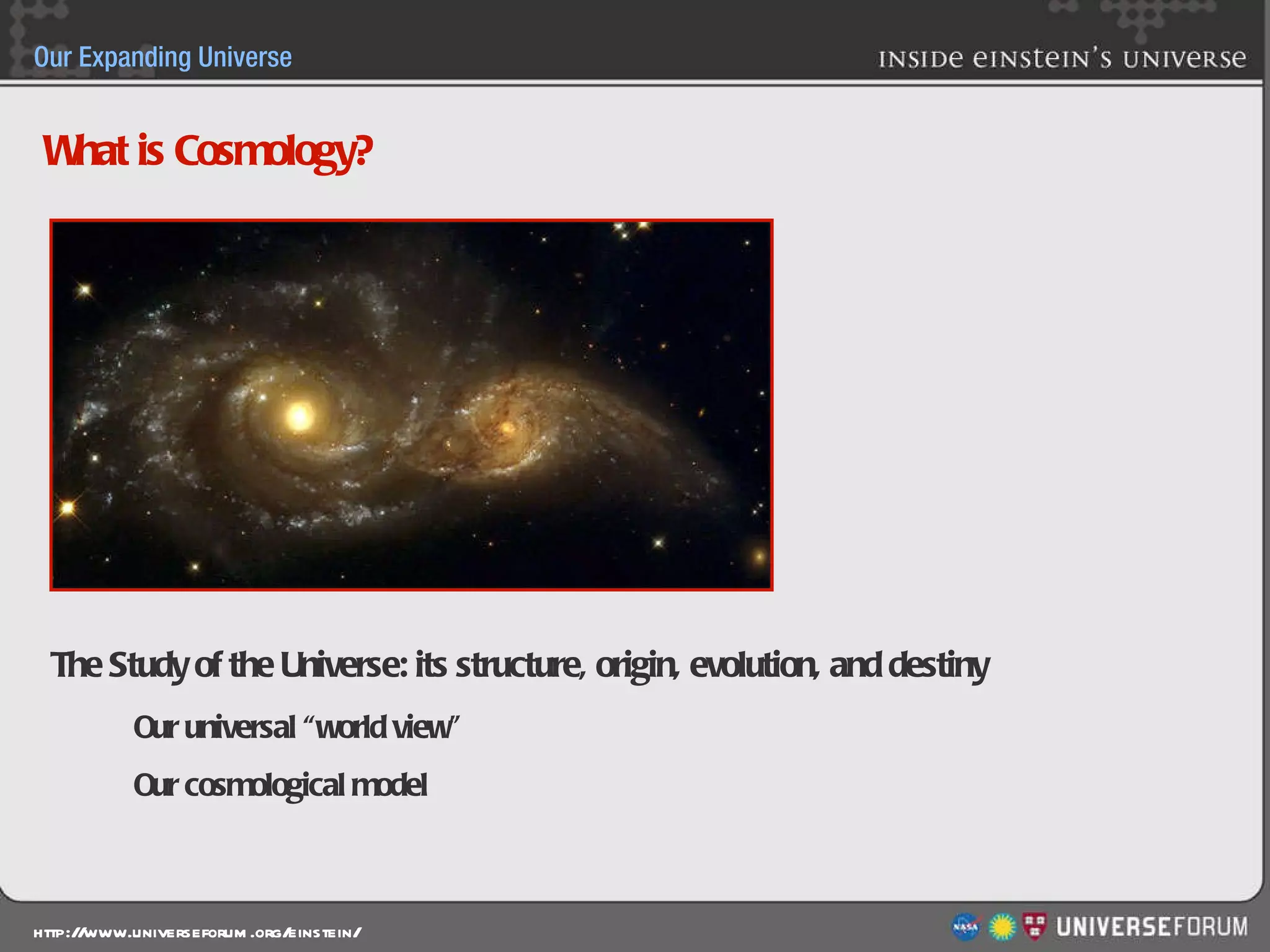
What is Cosmology? The Study of the Universe: its structure, origin, evolution, and destiny Our universal “world view” Our cosmological model
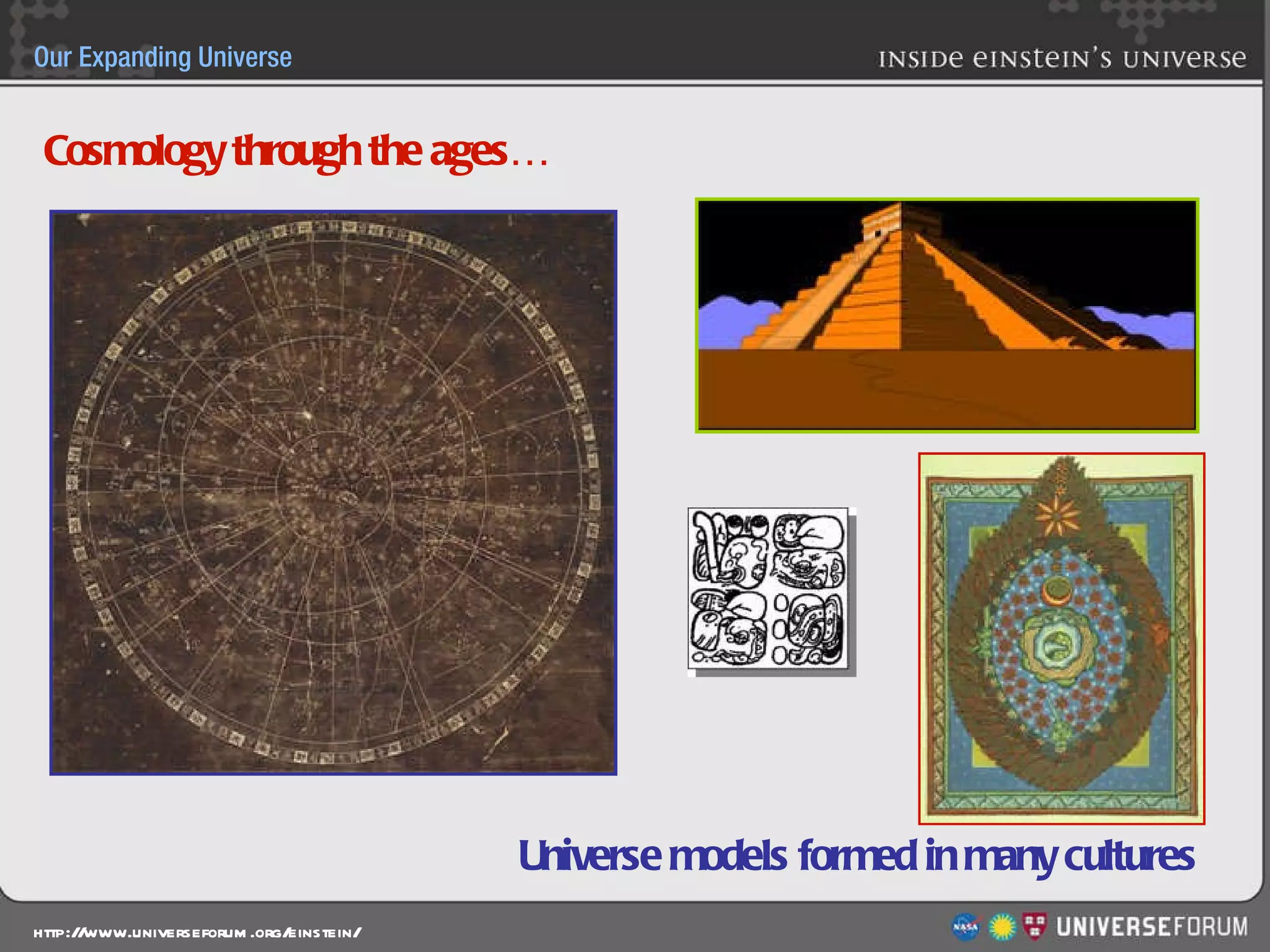
Universe models formed in many cultures Cosmology through the ages…
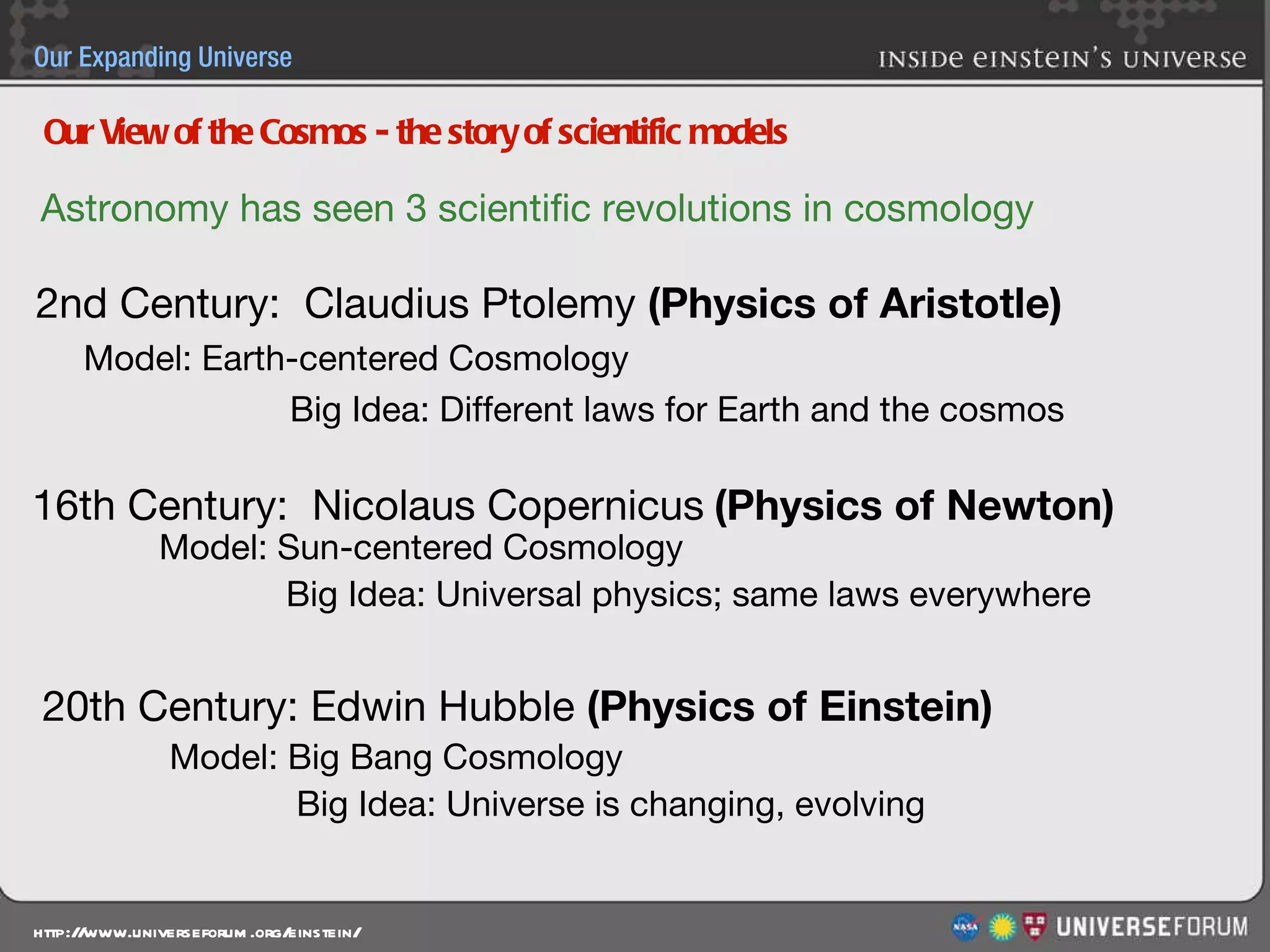
2nd Century:  Claudius Ptolemy  (Physics of Aristotle) Model: Earth-centered Cosmology Big Idea: Different laws for Earth and the cosmos Astronomy has seen 3 scientific revolutions in cosmology 16th Century:  Nicolaus Copernicus   (Physics of Newton)  Model: Sun-centered Cosmology Big Idea: Universal physics; same laws everywhere 20th Century: Edwin Hubble  (Physics of Einstein) Model: Big Bang Cosmology  Big Idea: Universe is changing, evolving Our View of the Cosmos - the story of scientific models
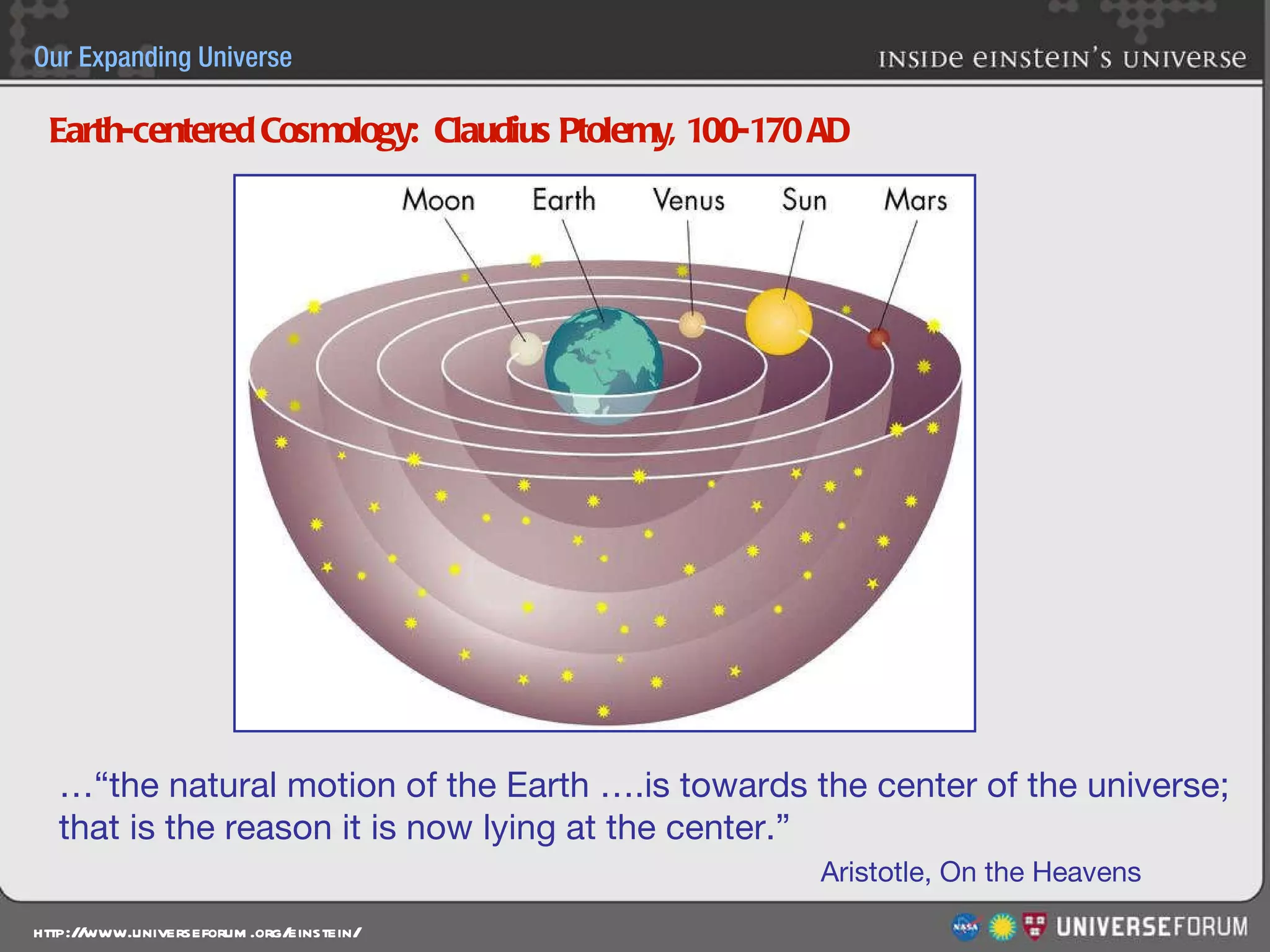
…“ the natural motion of the Earth ….is towards the center of the universe; that is the reason it is now lying at the center.” Aristotle, On the Heavens Earth-centered Cosmology:  Claudius Ptolemy, 100-170 AD
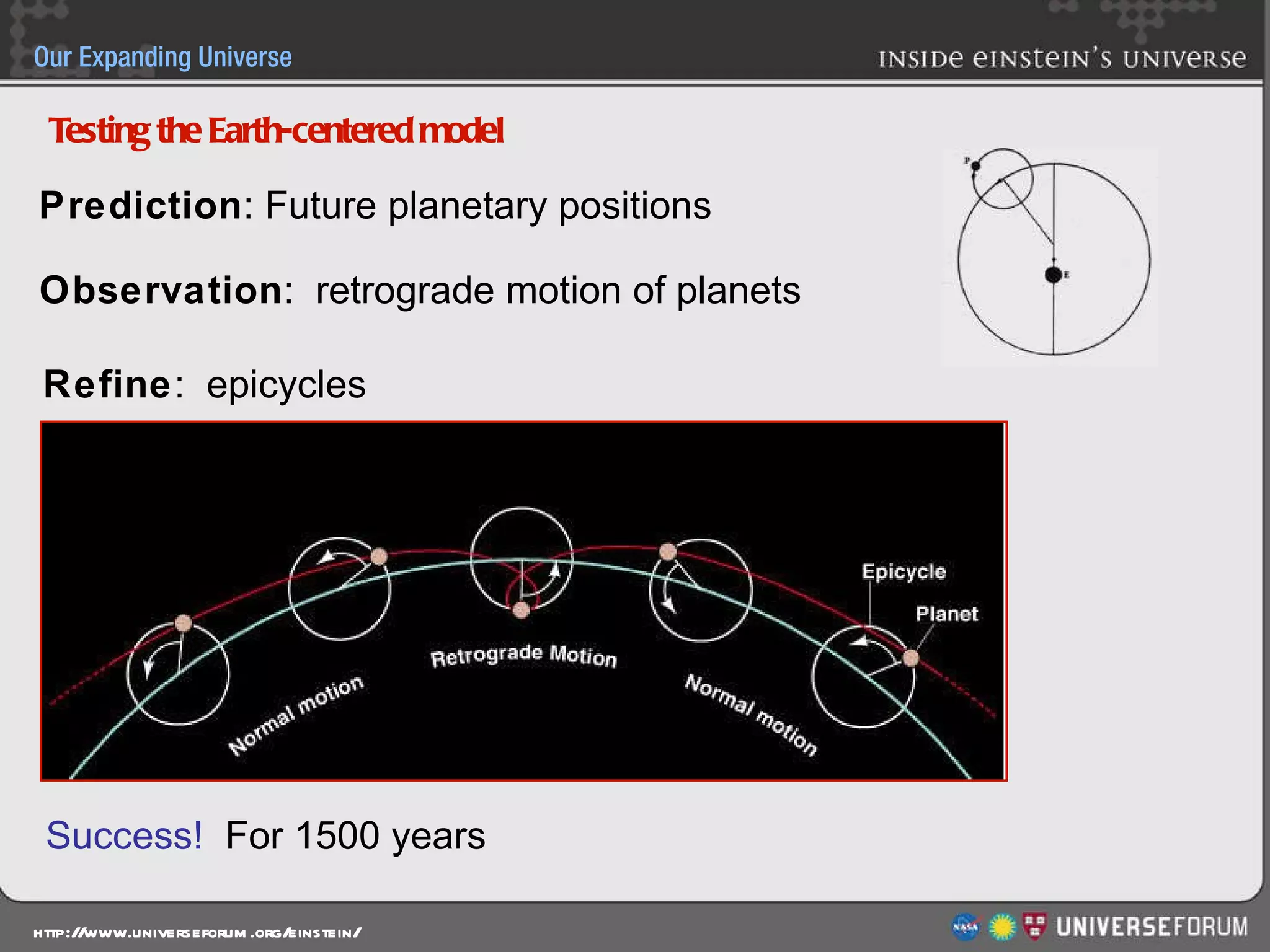
Prediction : Future planetary positions  Observation :  retrograde motion of planets Refine :  epicycles  Success!   For 1500 years Testing the Earth-centered model
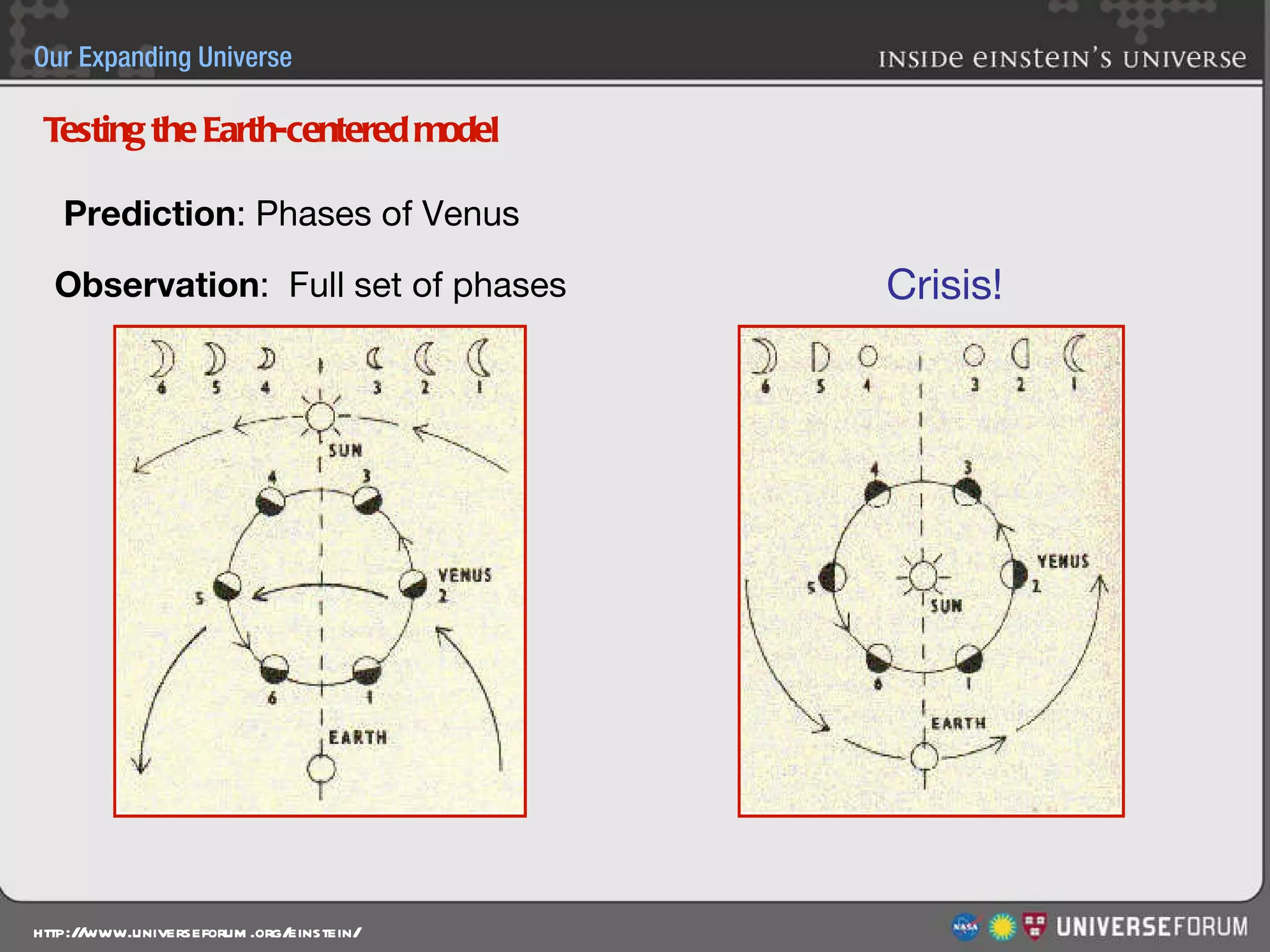
Prediction : Phases of Venus   Observation :  Full set of phases Crisis! Testing the Earth-centered model
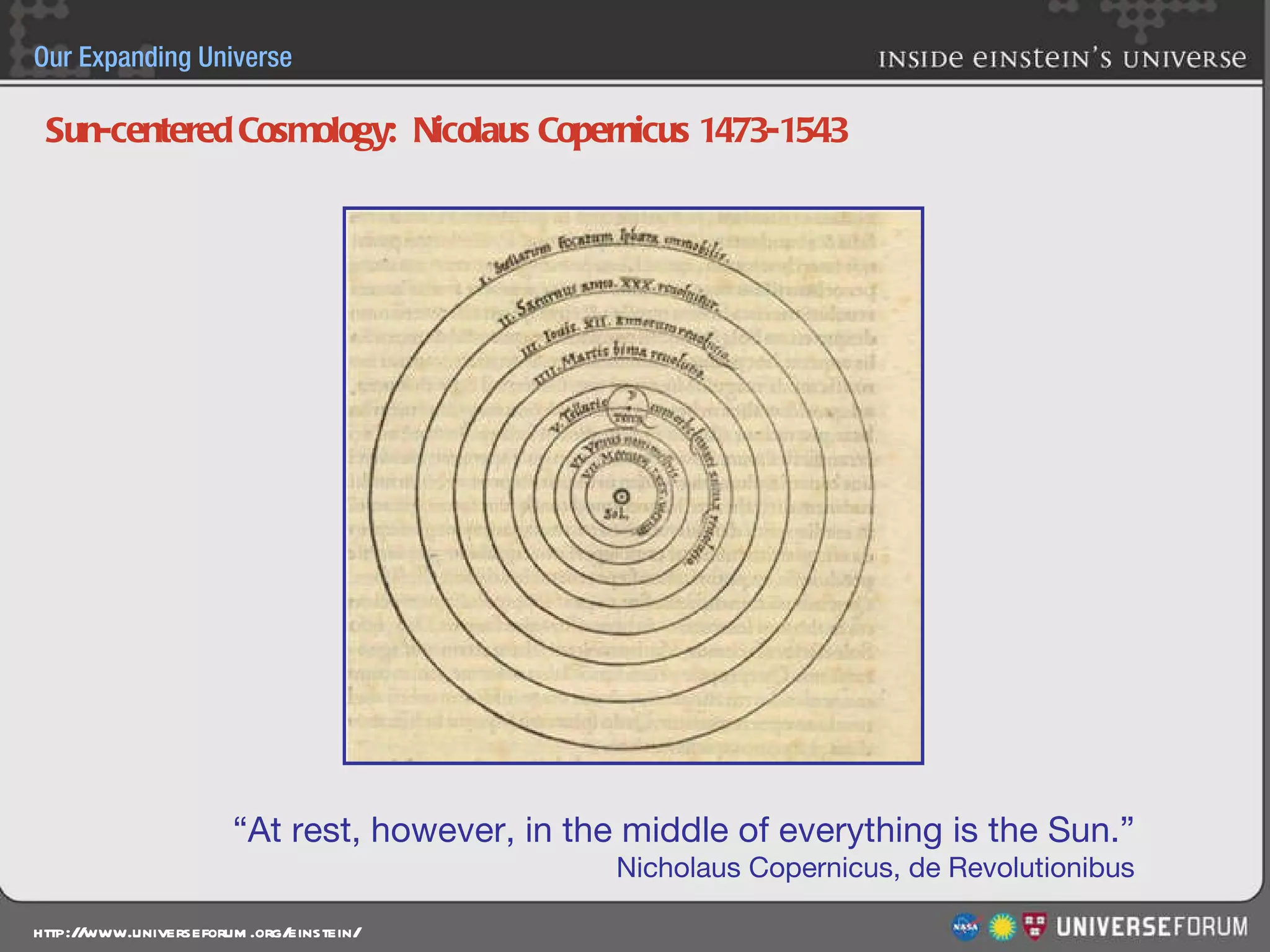
Sun-centered Cosmology:   Nicolaus Copernicus 1473-1543 “ At rest, however, in the middle of everything is the Sun.” Nicholaus Copernicus, de Revolutionibus
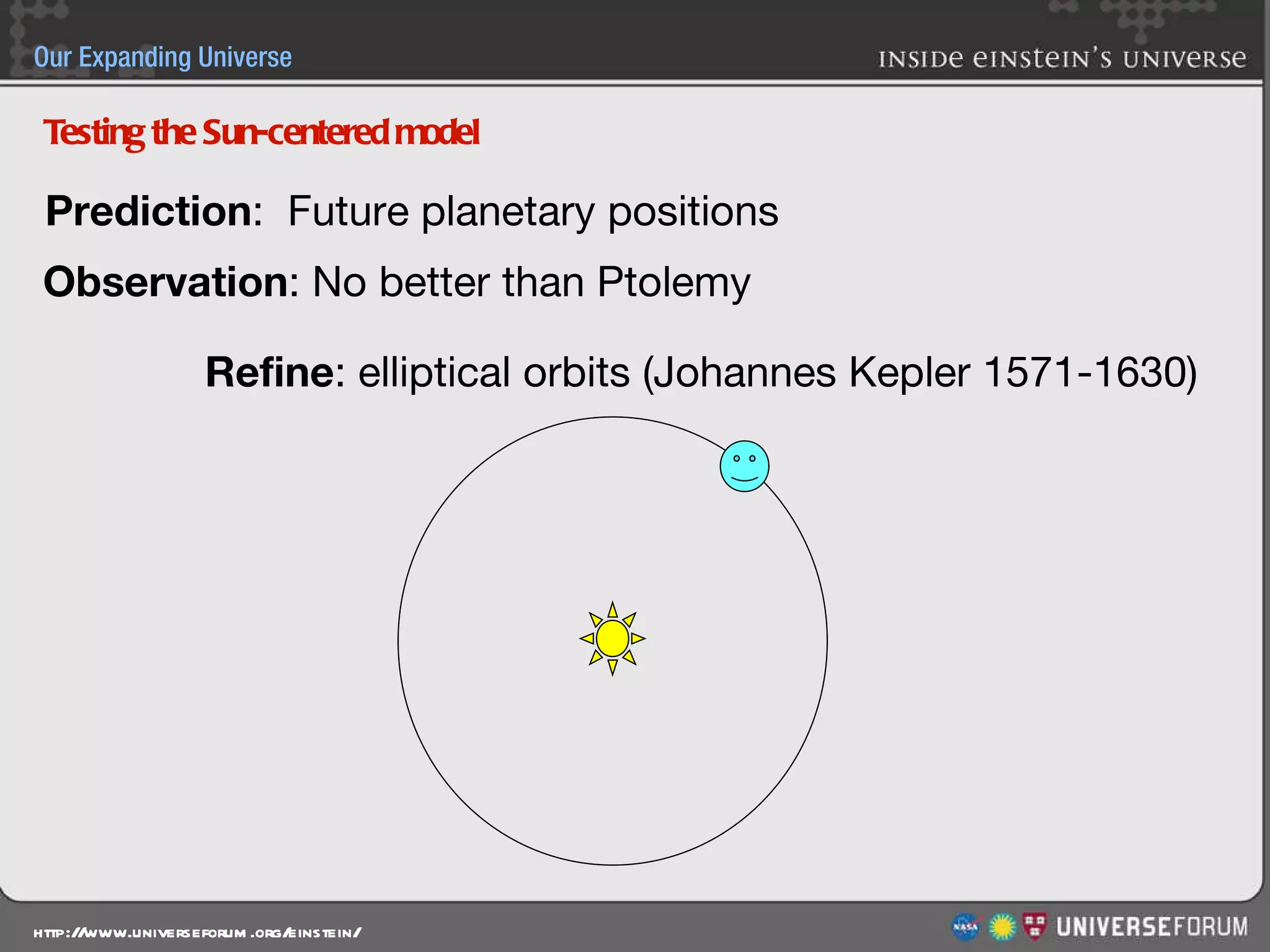
Prediction :  Future planetary positions  Observation : No better than Ptolemy Testing the Sun-centered model Refine : elliptical orbits (Johannes Kepler 1571-1630)
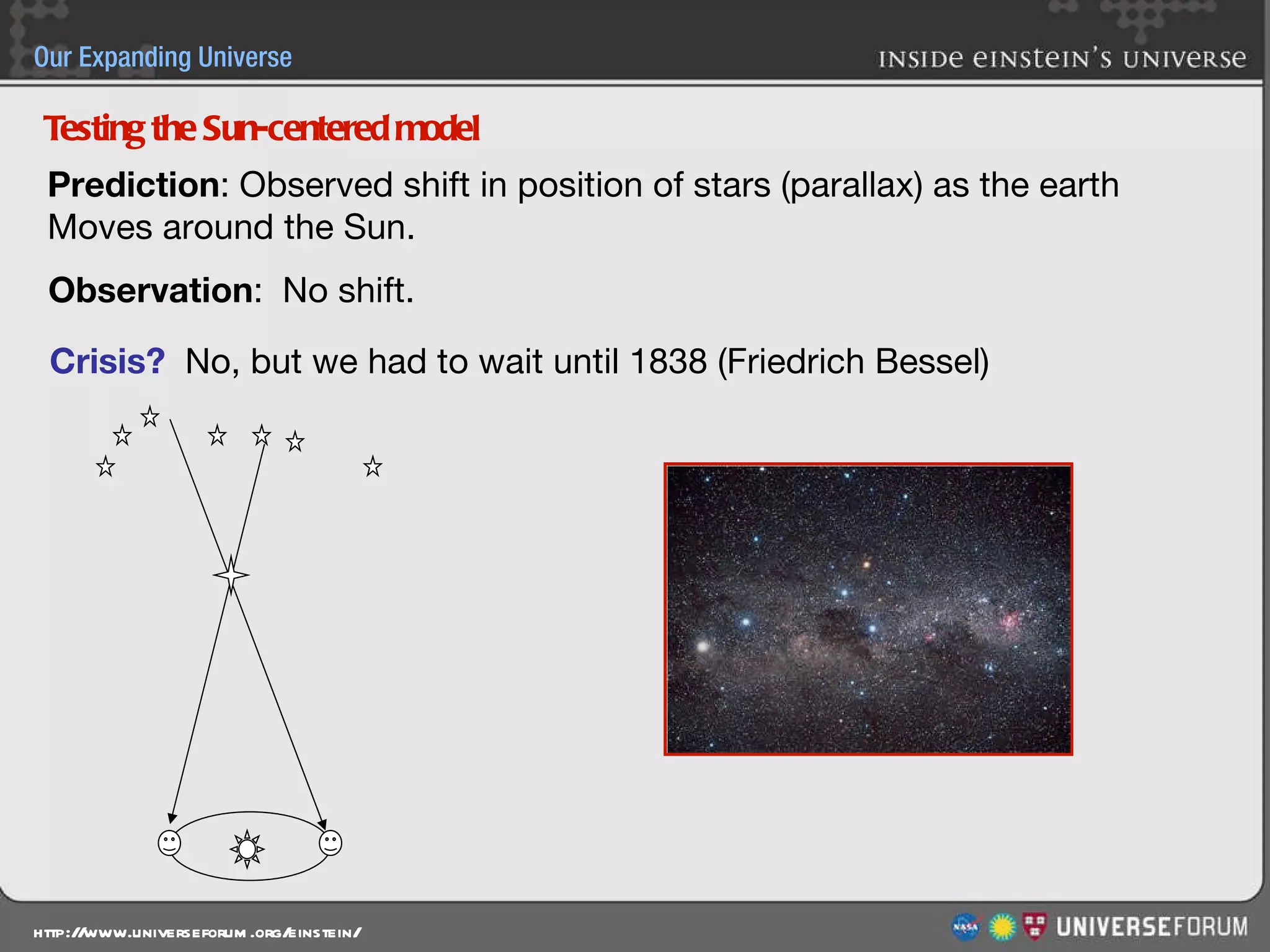
Prediction : Observed shift in position of stars (parallax) as the earth  Moves around the Sun. Observation :  No shift.  Crisis?   No, but we had to wait until 1838 (Friedrich Bessel) Testing the Sun-centered model
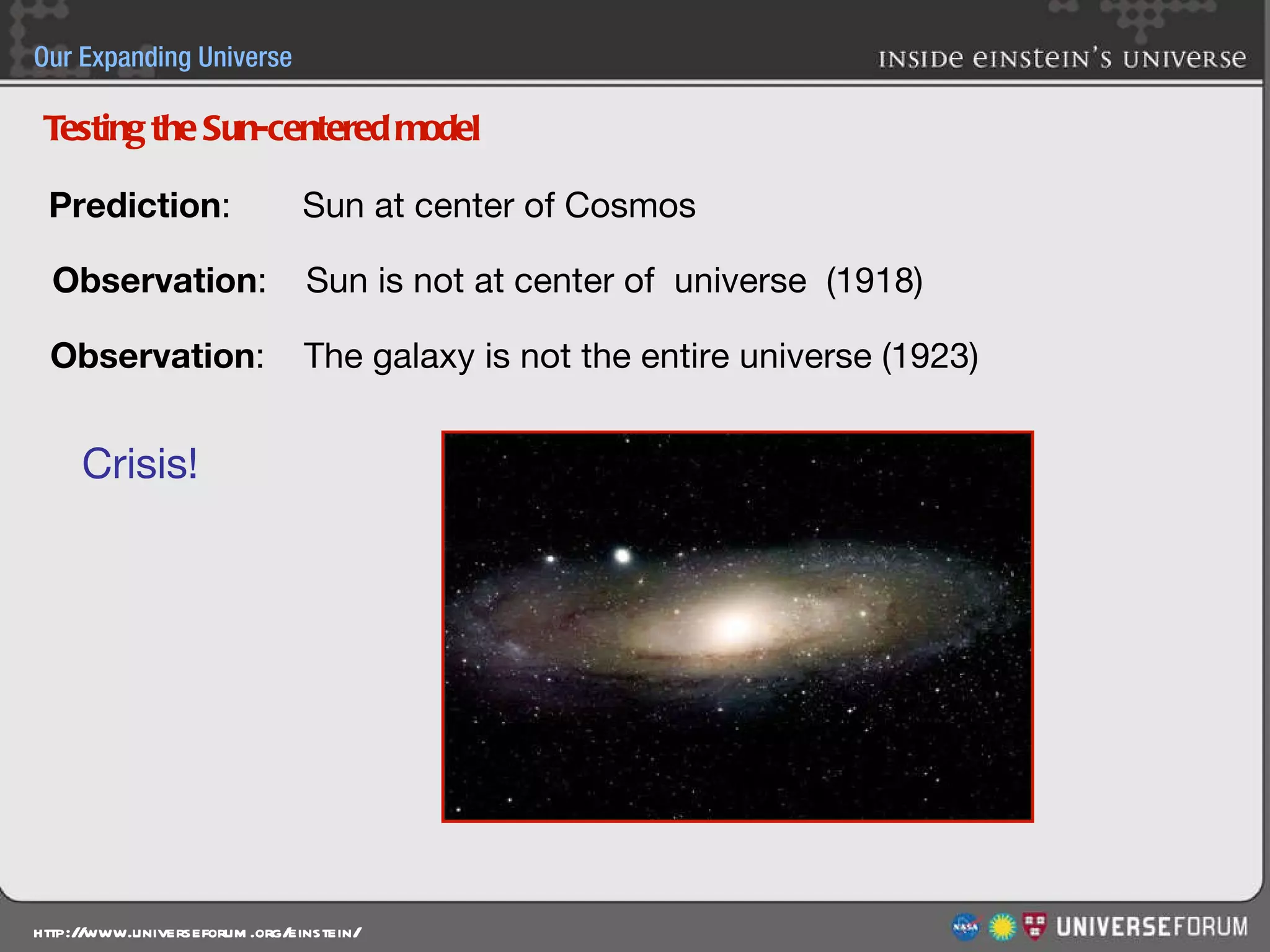
Prediction :  Sun at center of Cosmos Observation :  Sun is not at center of  universe  (1918) Testing the Sun-centered model Crisis! Observation :  The galaxy is not the entire universe (1923)
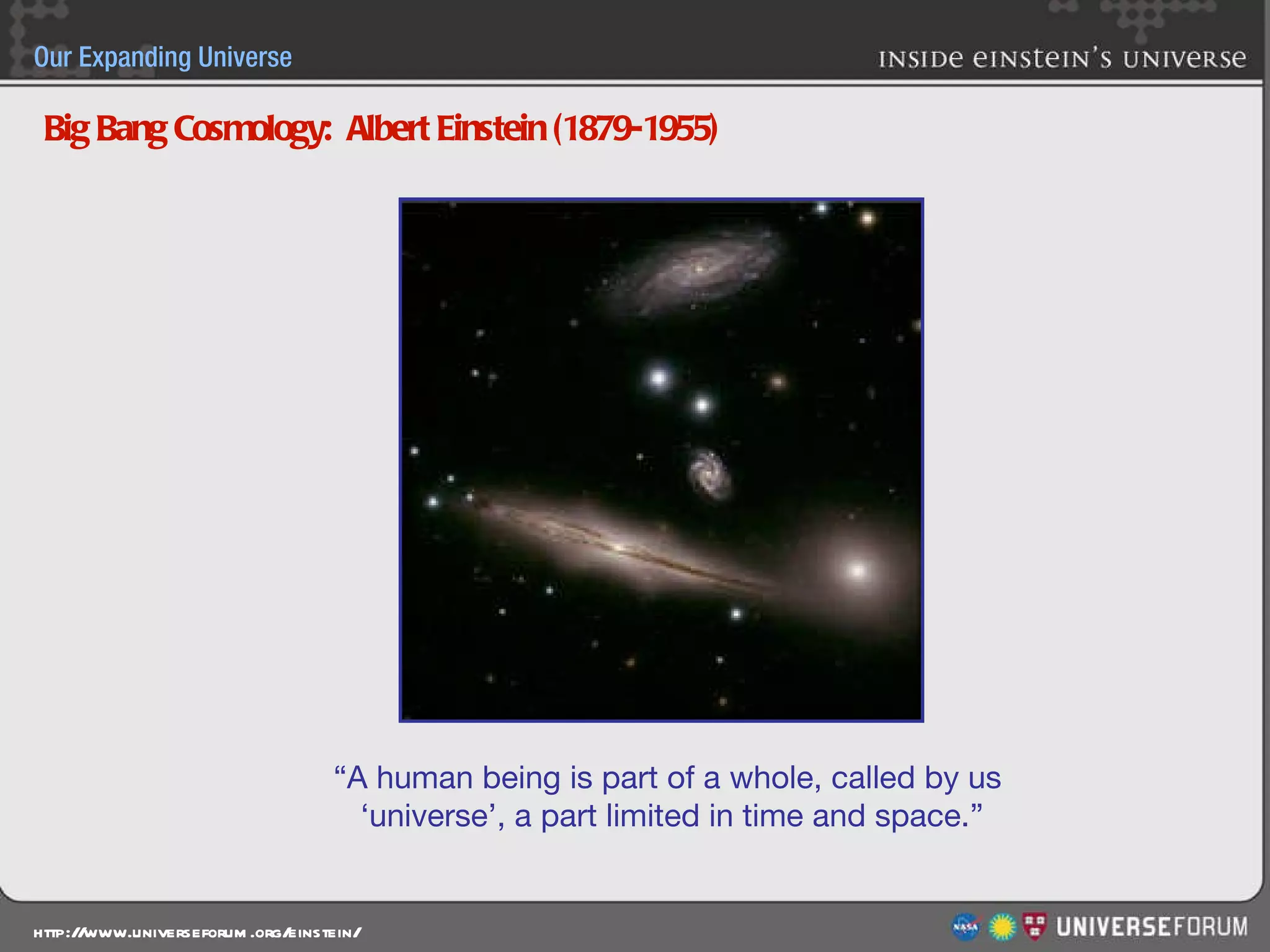
Big Bang Cosmology:  Albert Einstein (1879-1955) “ A human being is part of a whole, called by us  ‘universe’, a part limited in time and space.”
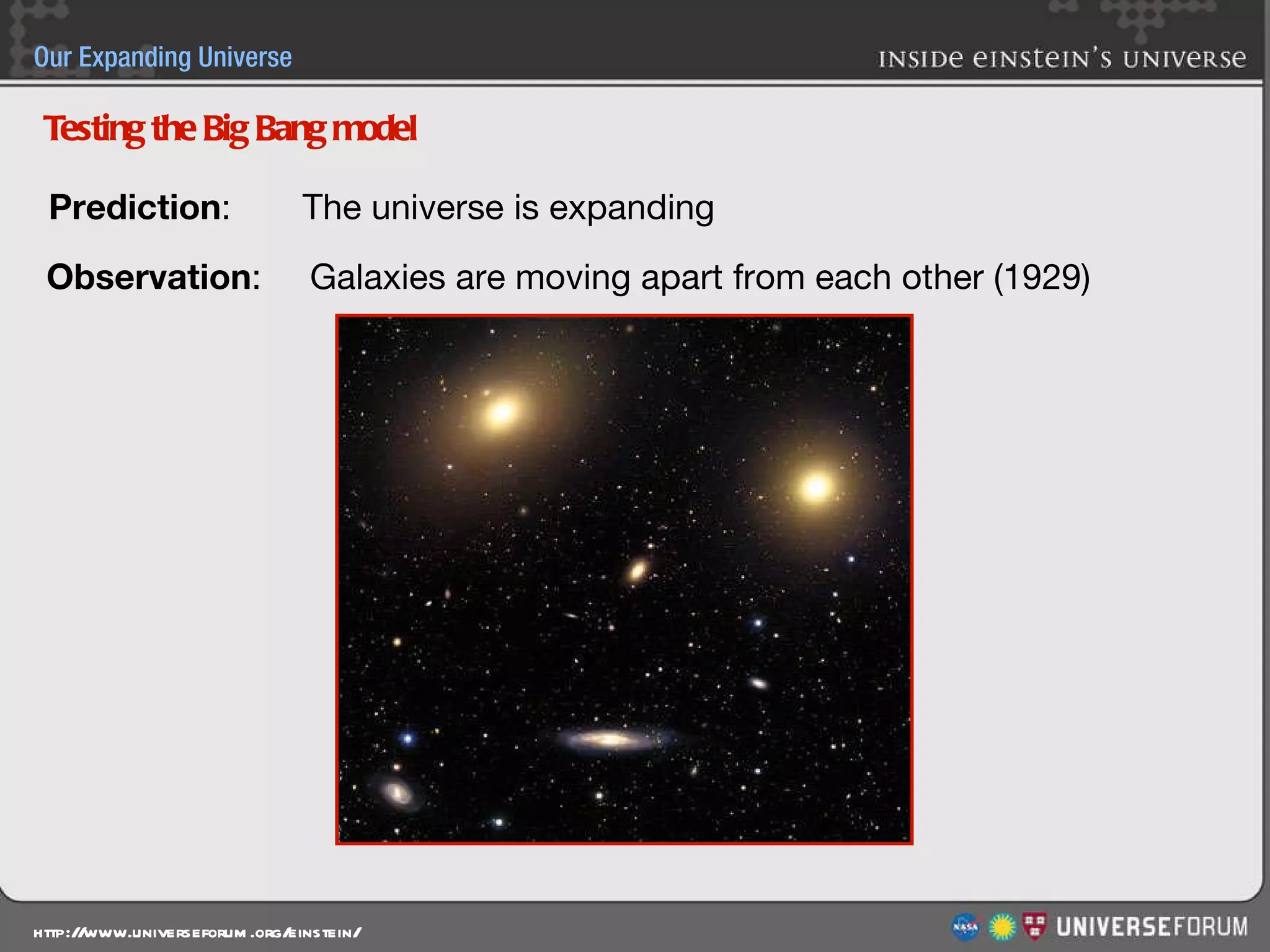
Prediction :  The universe is expanding Observation :  Galaxies are moving apart from each other (1929) Testing the Big Bang model
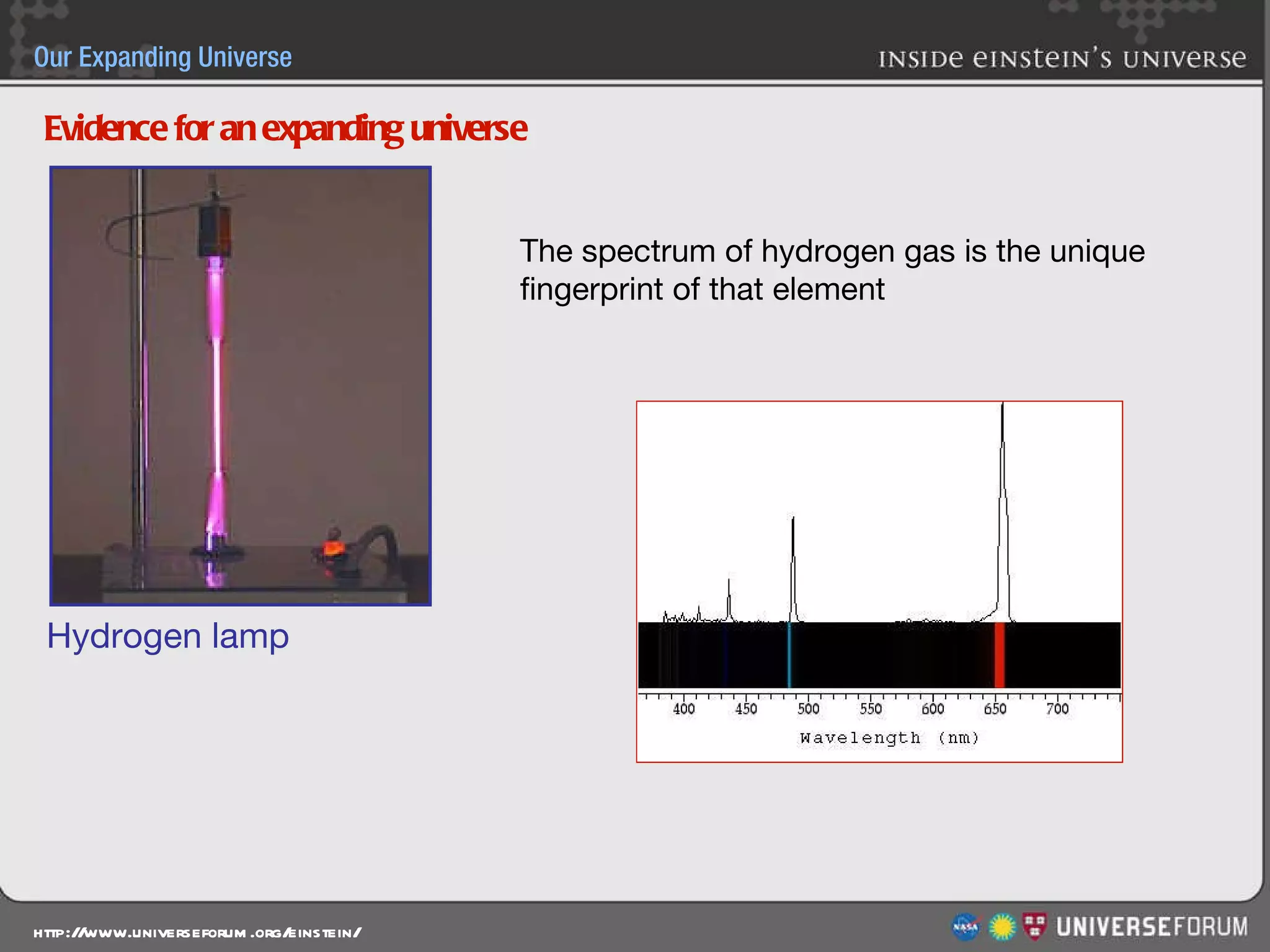
Evidence for an expanding universe The spectrum of hydrogen gas is the unique  fingerprint of that element Hydrogen lamp
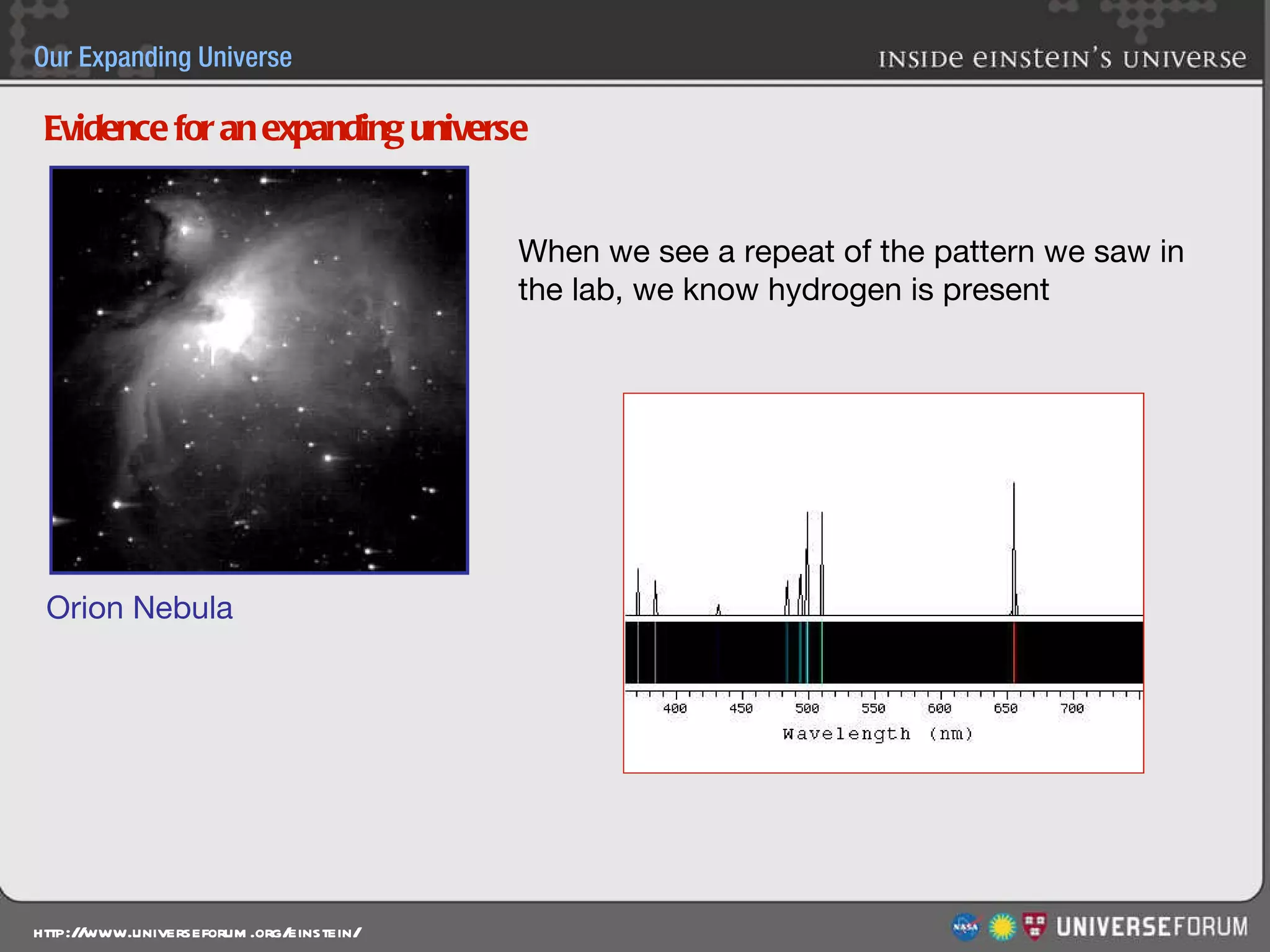
Evidence for an expanding universe Orion Nebula When we see a repeat of the pattern we saw in the lab, we know hydrogen is present
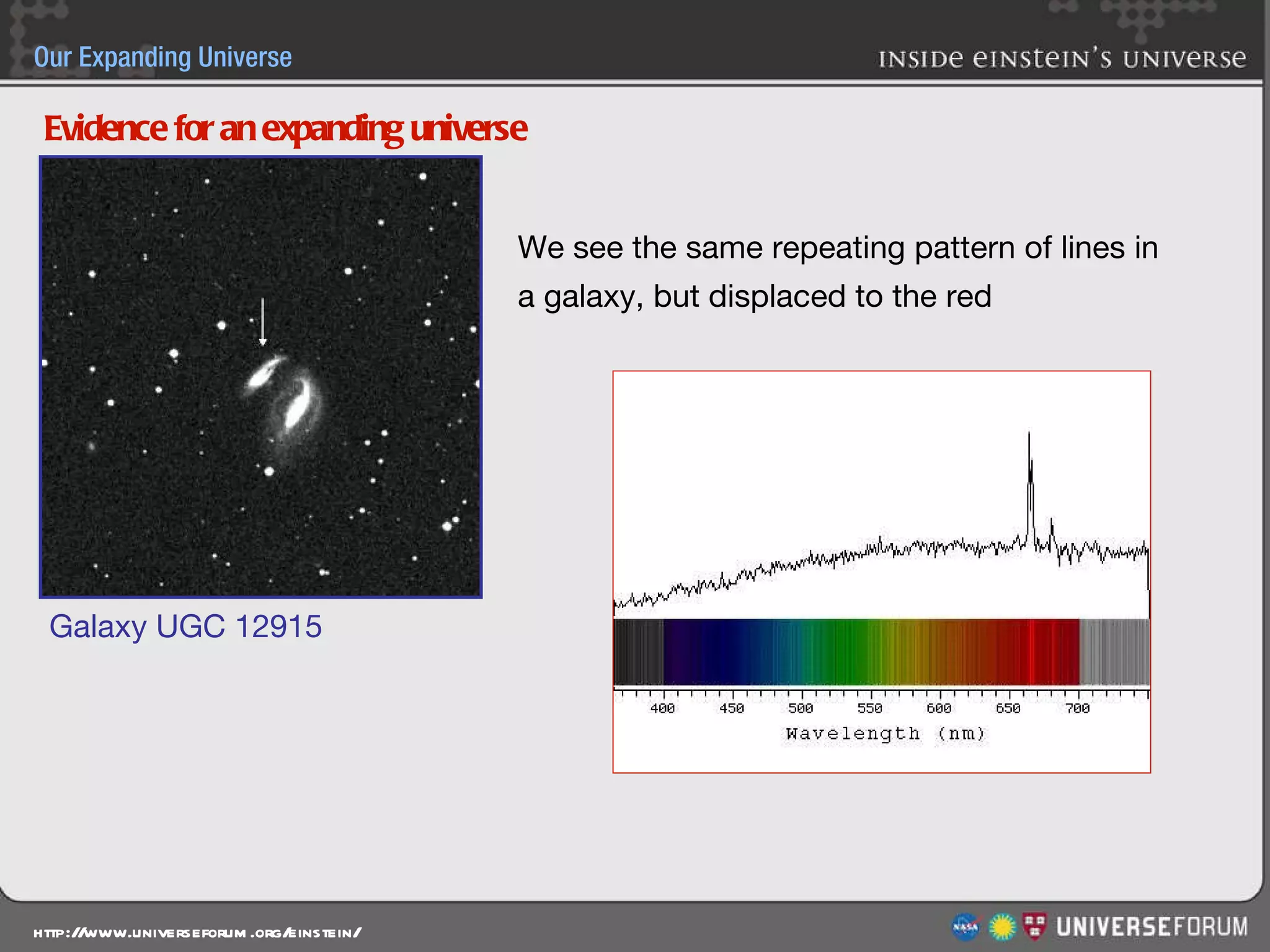
Evidence for an expanding universe We see the same repeating pattern of lines in  a galaxy, but displaced to the red   Galaxy UGC 12915
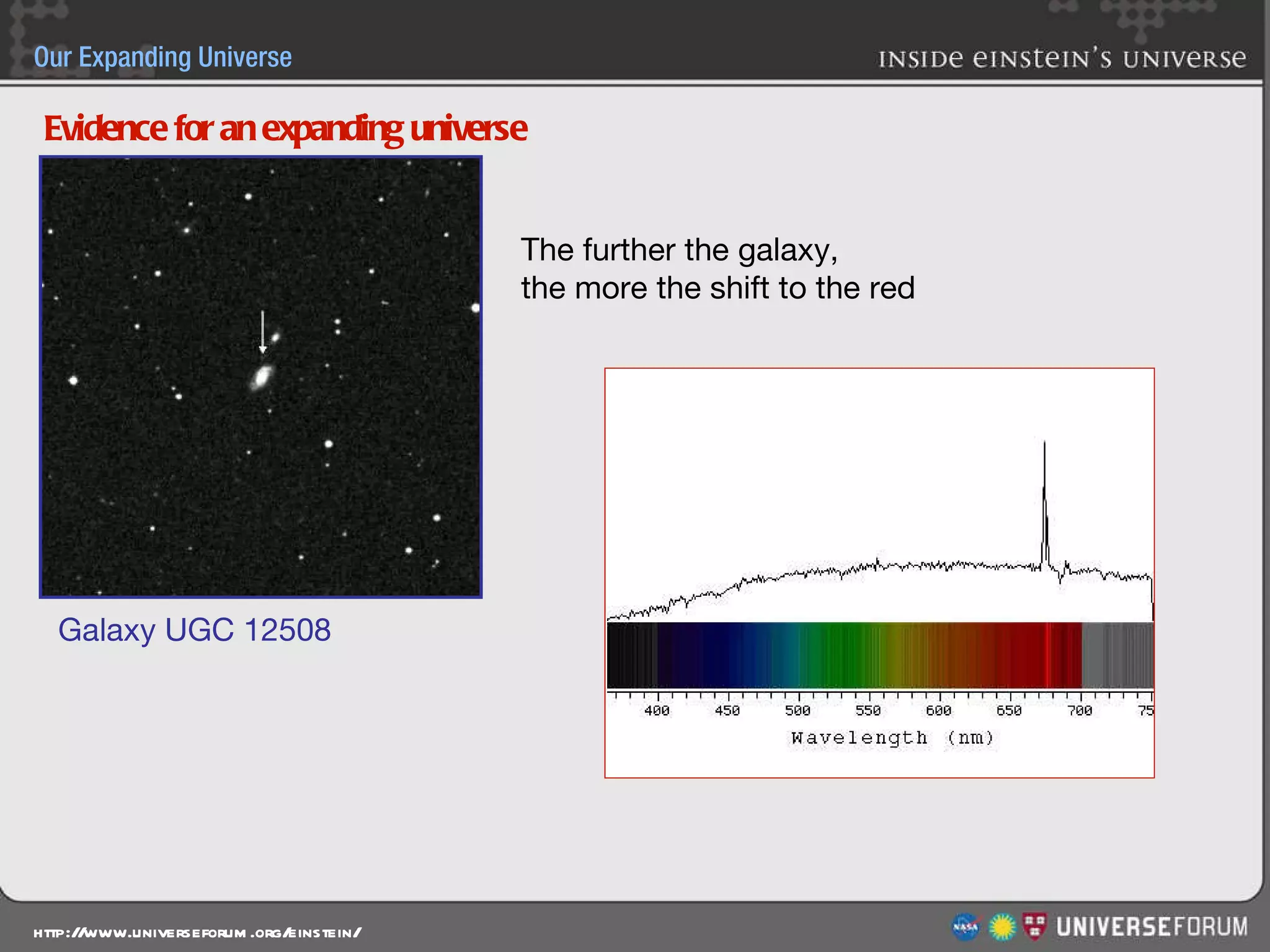
Evidence for an expanding universe The further the galaxy,  the more the shift to the red Galaxy UGC 12508
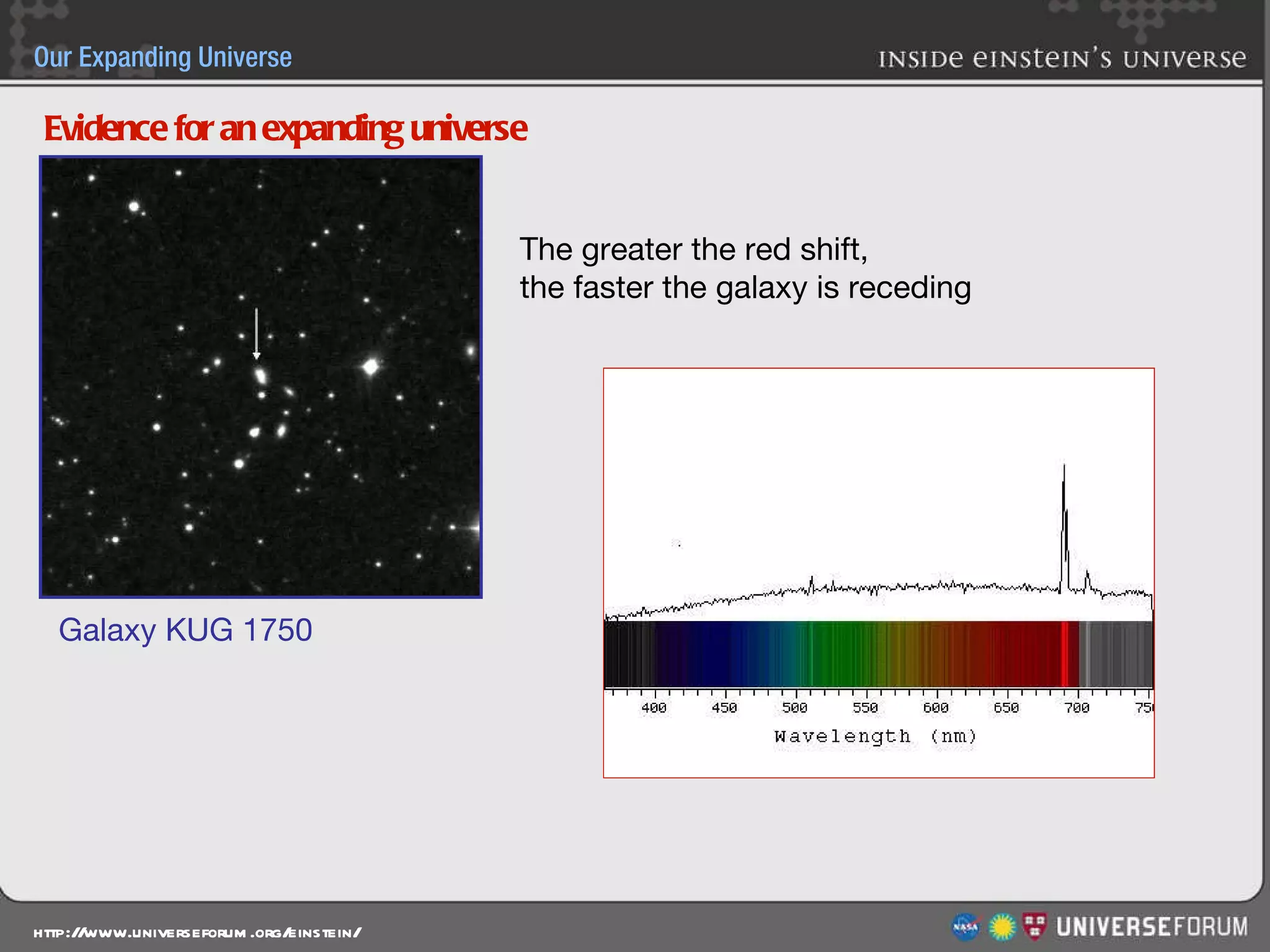
Evidence for an expanding universe Galaxy KUG 1750 The greater the red shift,  the faster the galaxy is receding
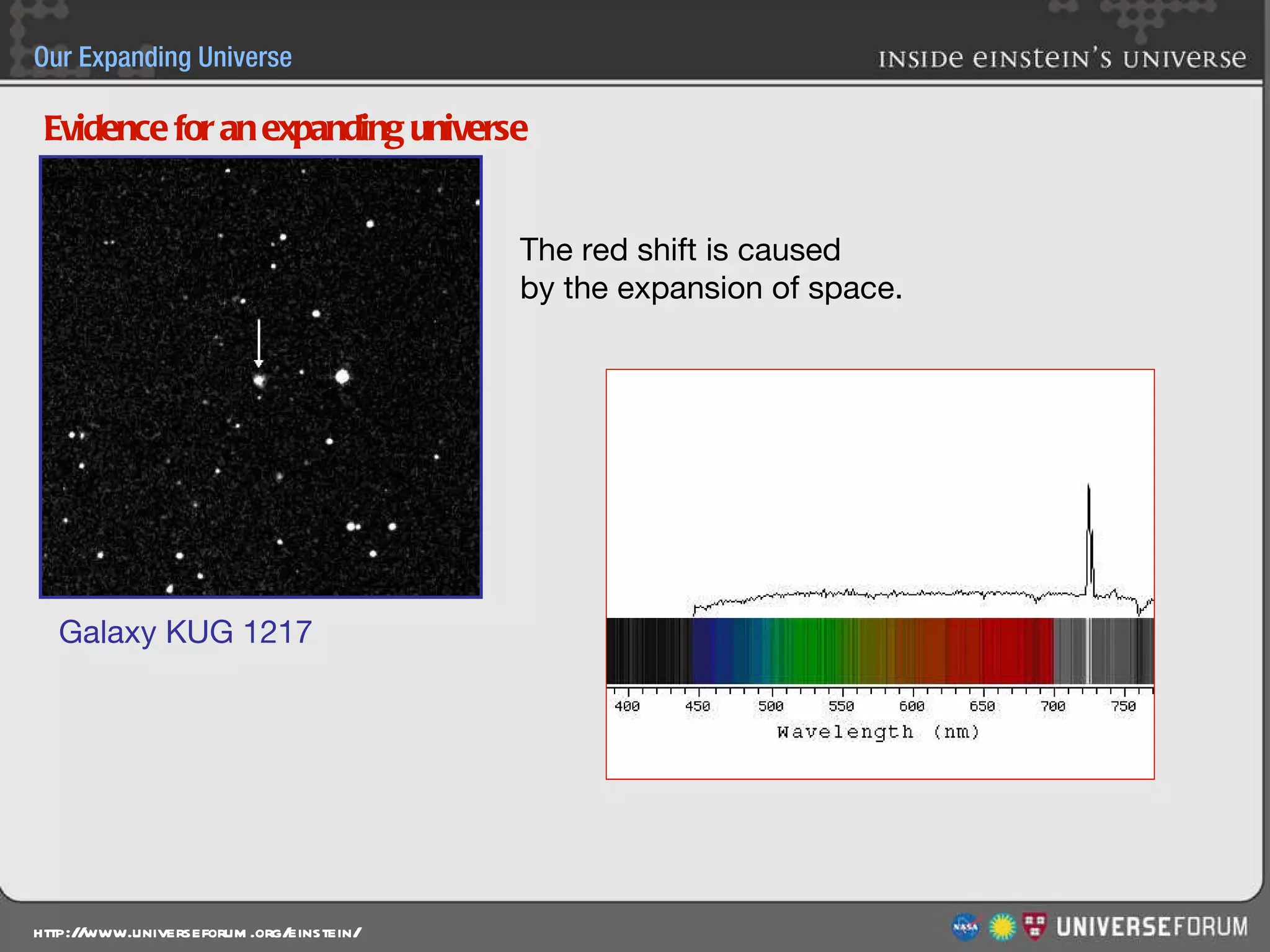
Evidence for an expanding universe The red shift is caused  by the expansion of space.  Galaxy KUG 1217
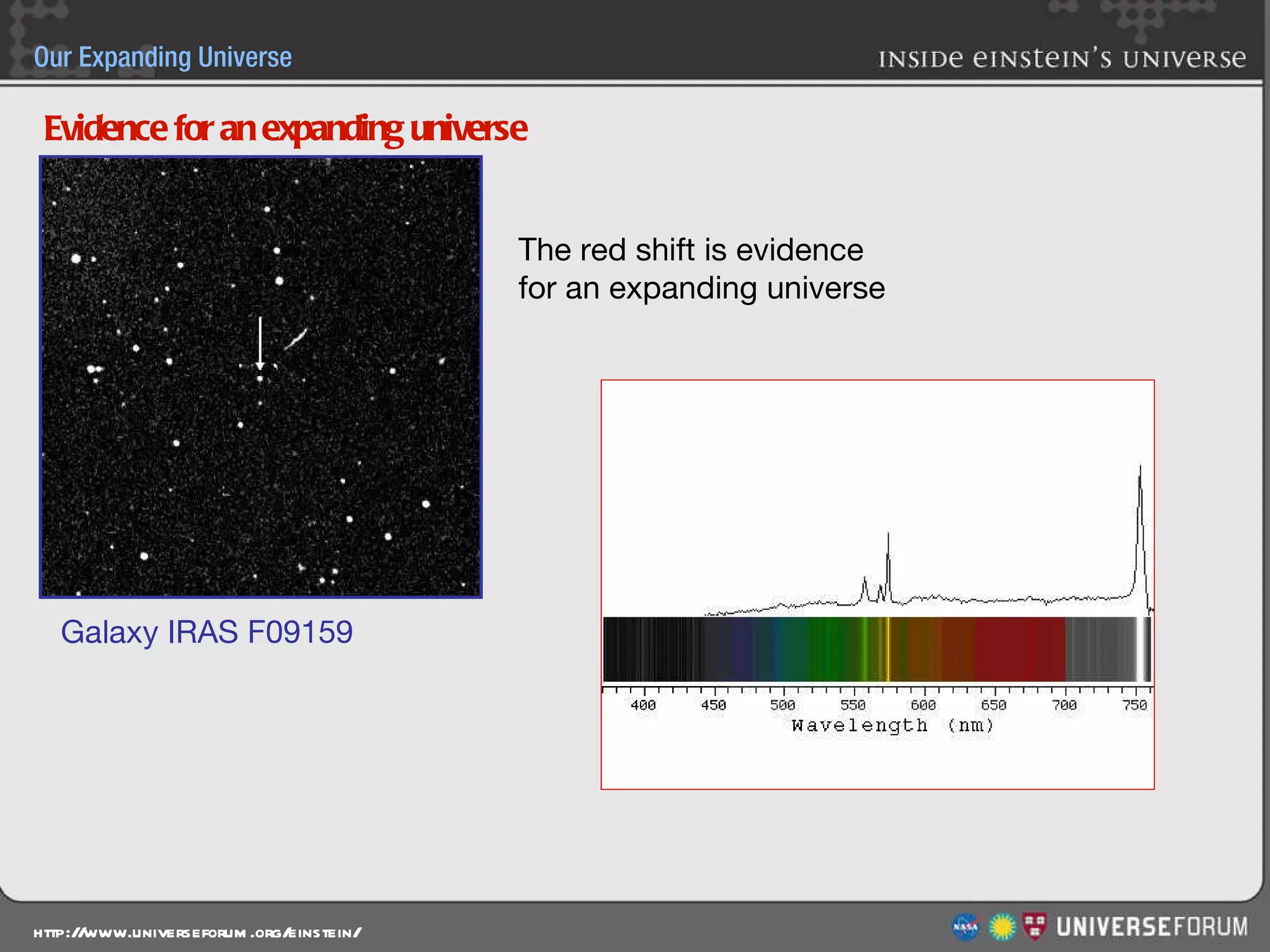
Evidence for an expanding universe The red shift is evidence  for an expanding universe  Galaxy IRAS F09159
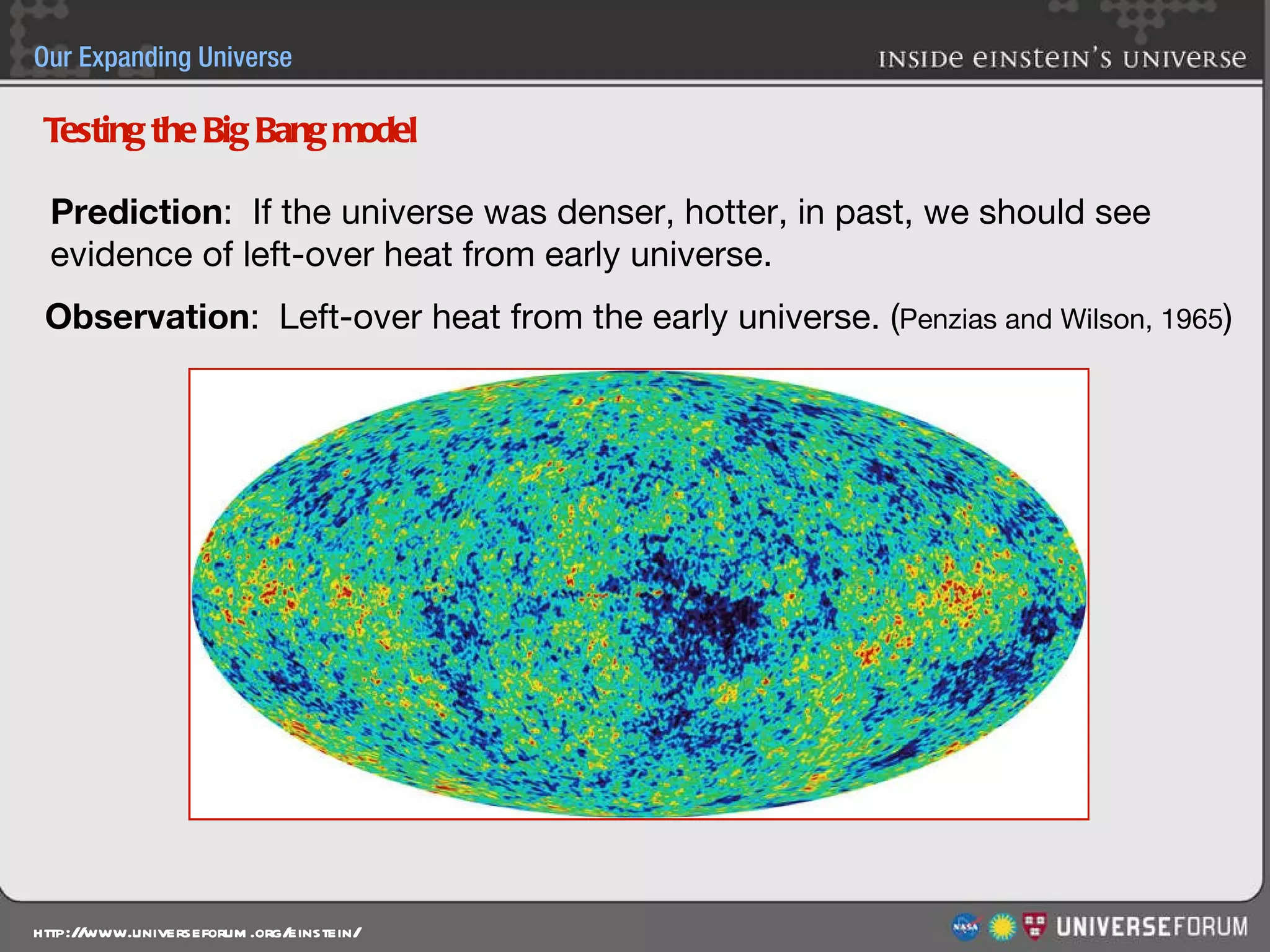
Prediction :  If the universe was denser, hotter, in past, we should see  evidence of left-over heat from early universe. Observation :  Left-over heat from the early universe. ( Penzias and Wilson, 1965 )  Testing the Big Bang model
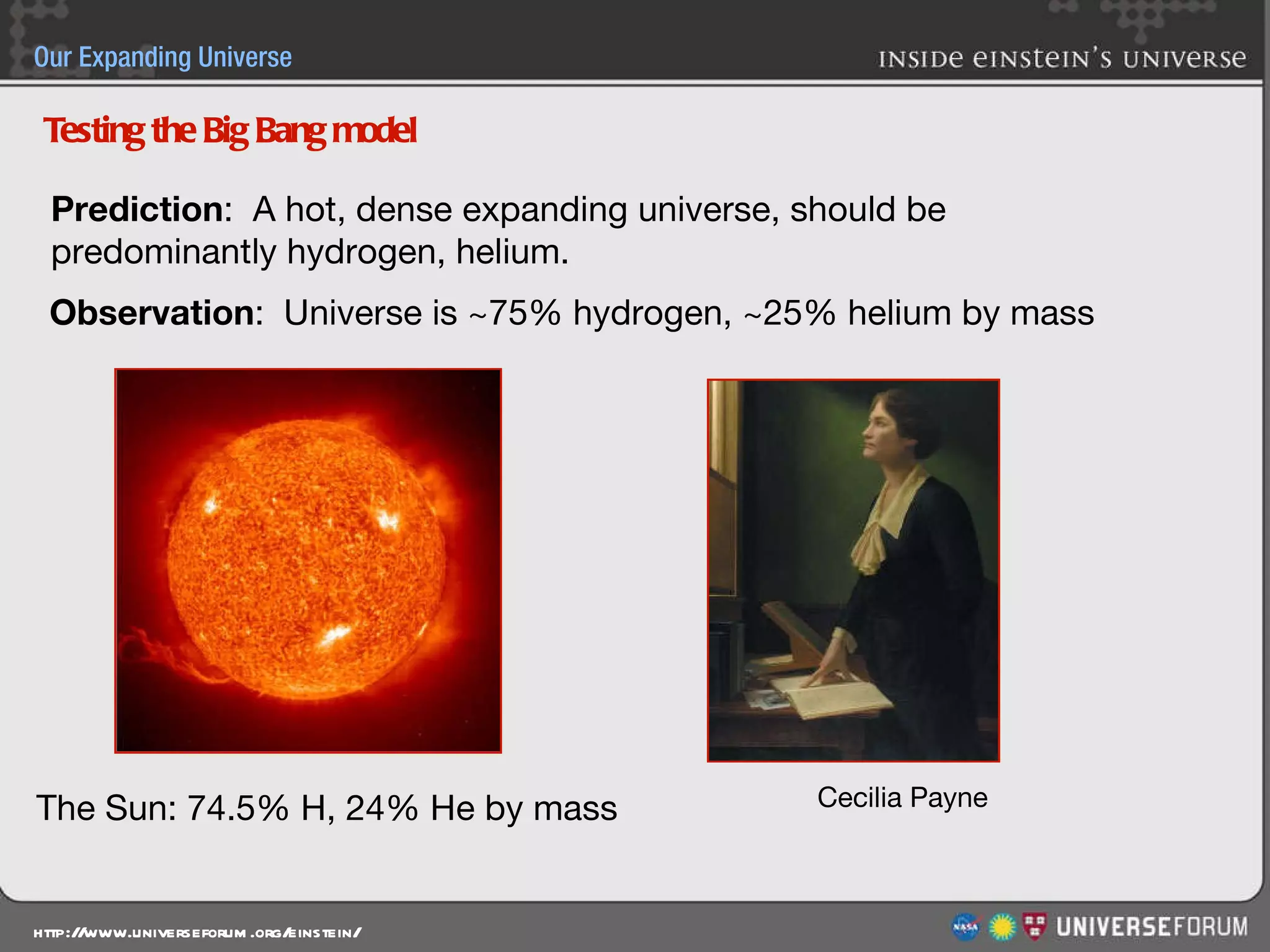
Prediction :  A hot, dense expanding universe, should be  predominantly hydrogen, helium. The Sun: 74.5% H, 24% He by mass Observation :  Universe is ~75% hydrogen, ~25% helium by mass Testing the Big Bang model Cecilia Payne
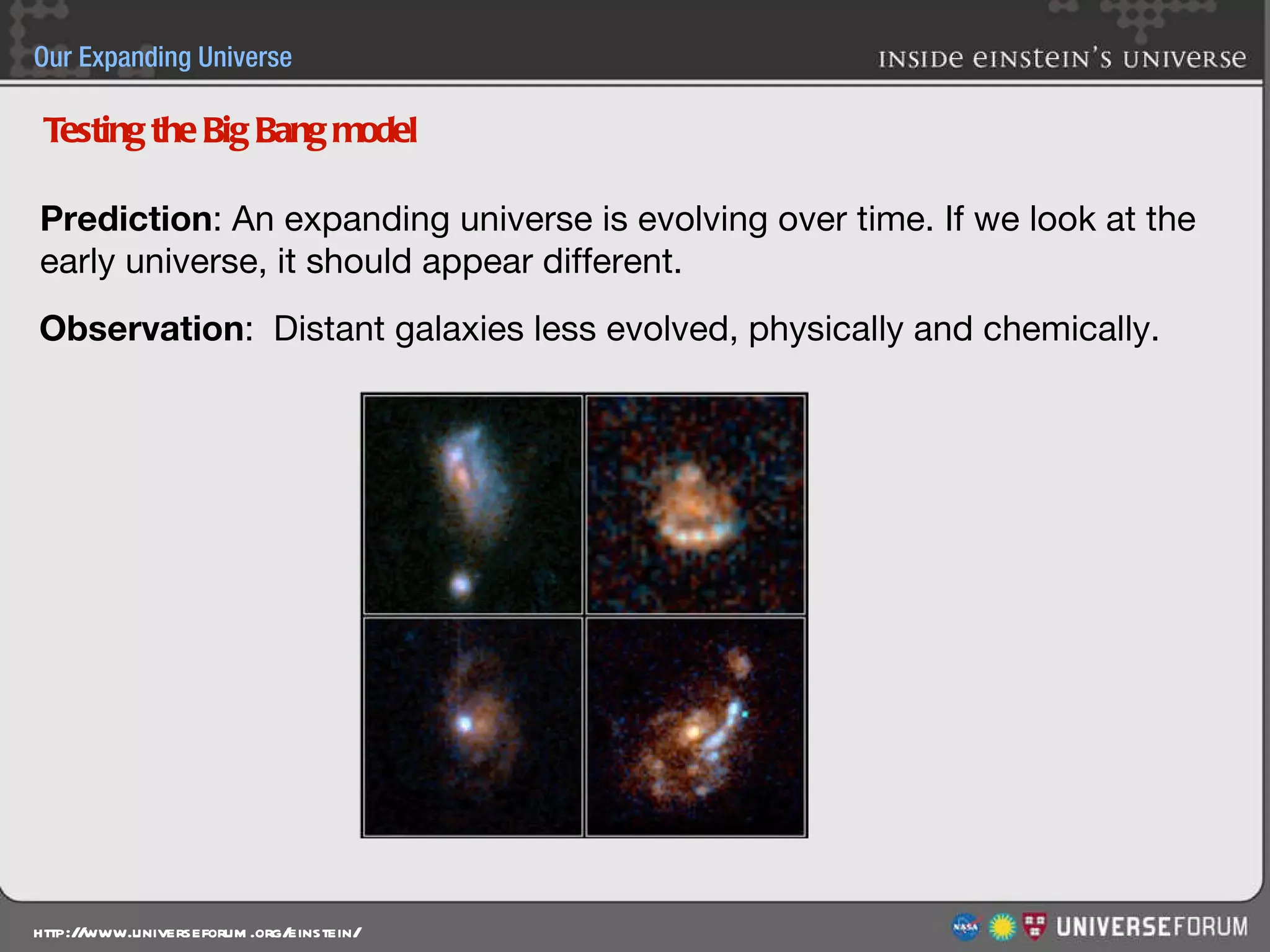
Prediction : An expanding universe is evolving over time. If we look at the early universe, it should appear different. Observation :  Distant galaxies less evolved, physically and chemically. Testing the Big Bang model
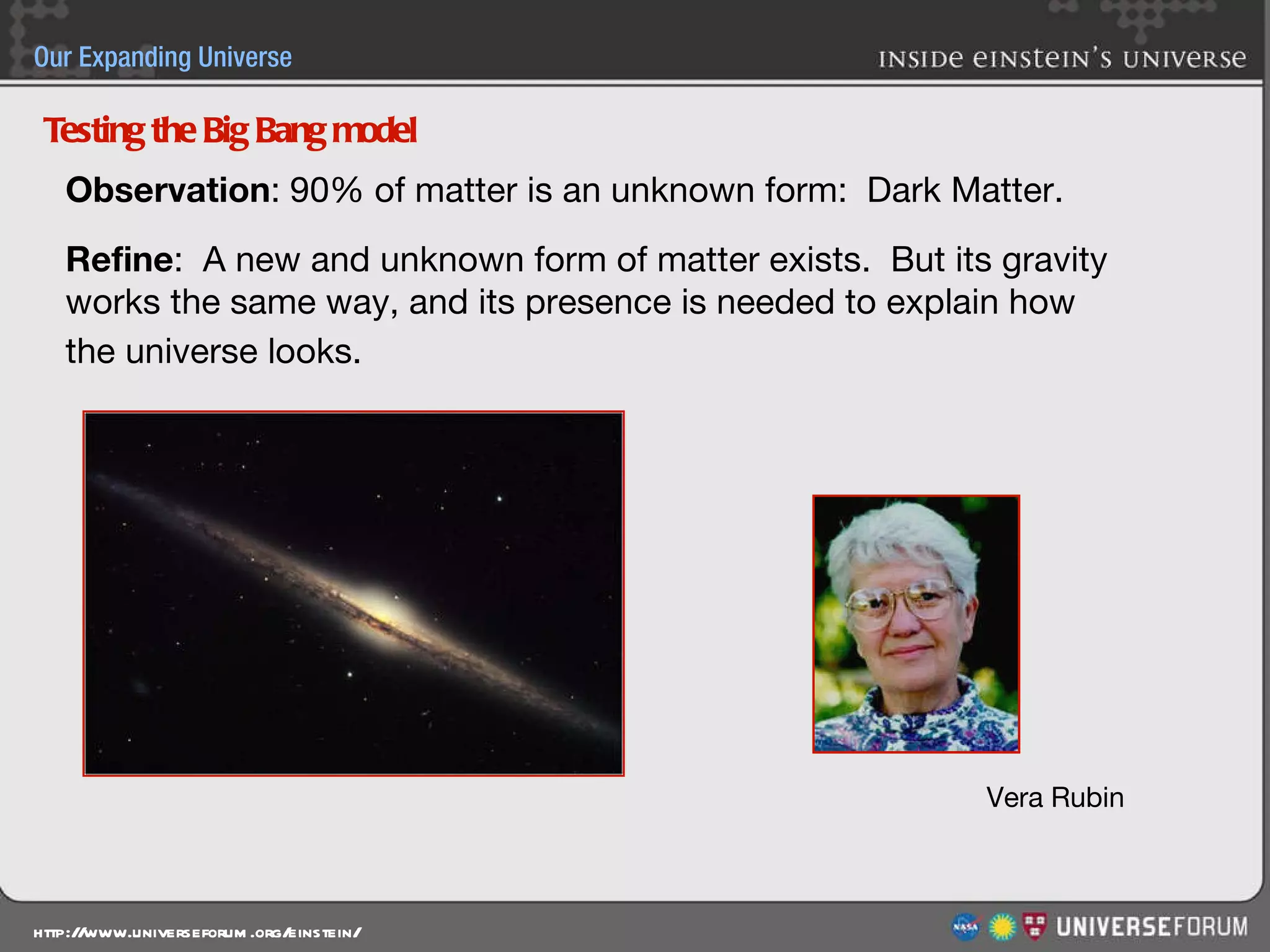
Observation : 90% of matter is an unknown form:  Dark Matter. Refine :  A new and unknown form of matter exists.  But its gravity  works the same way, and its presence is needed to explain how  the universe looks.   Testing the Big Bang model Vera Rubin
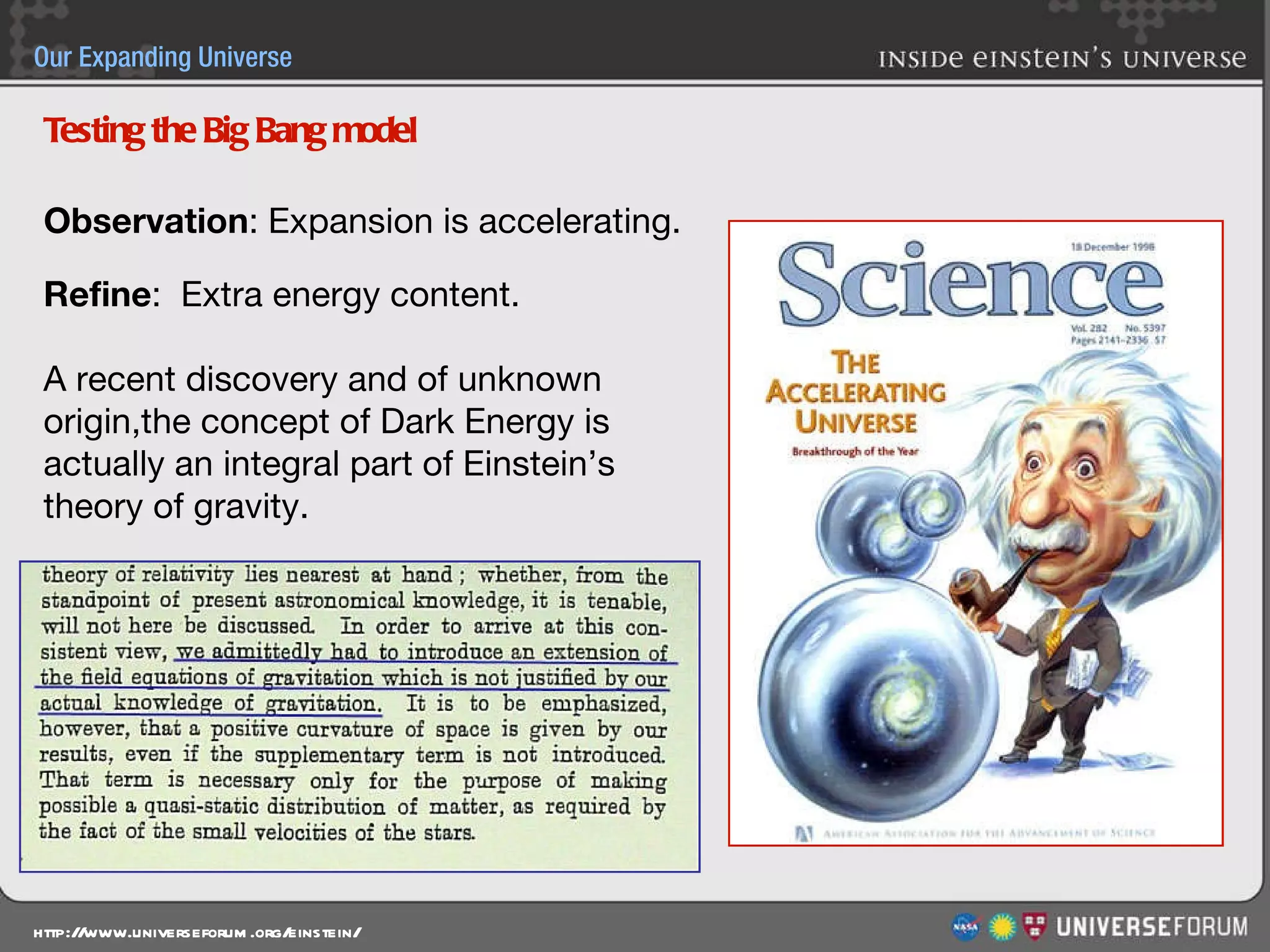
Observation : Expansion is accelerating. Refine :  Extra energy content. A recent discovery and of unknown  origin,the concept of Dark Energy is  actually an integral part of Einstein’s  theory of gravity. Testing the Big Bang model
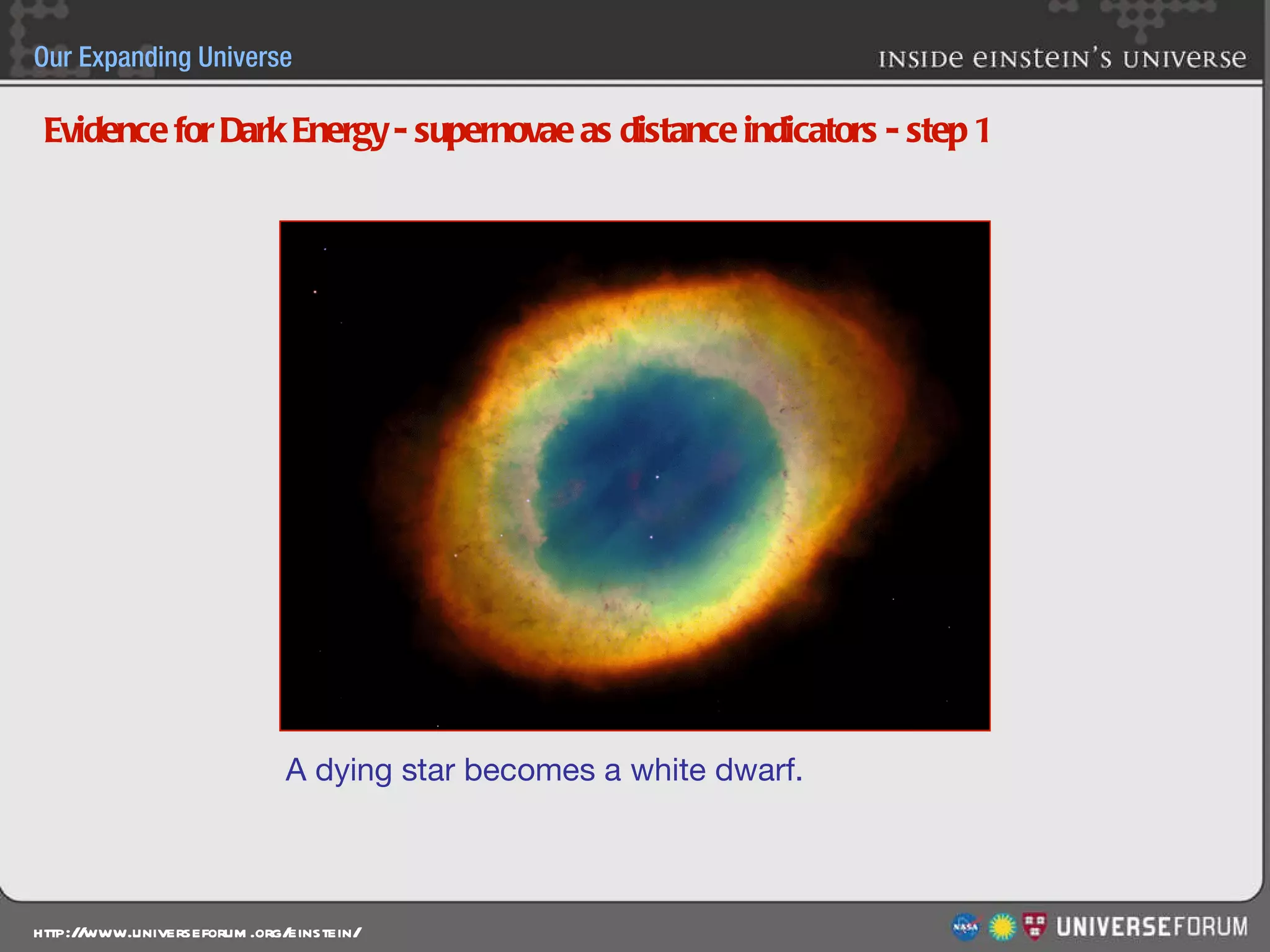
Evidence for Dark Energy - supernovae as distance indicators - step 1 A dying star becomes a white dwarf.
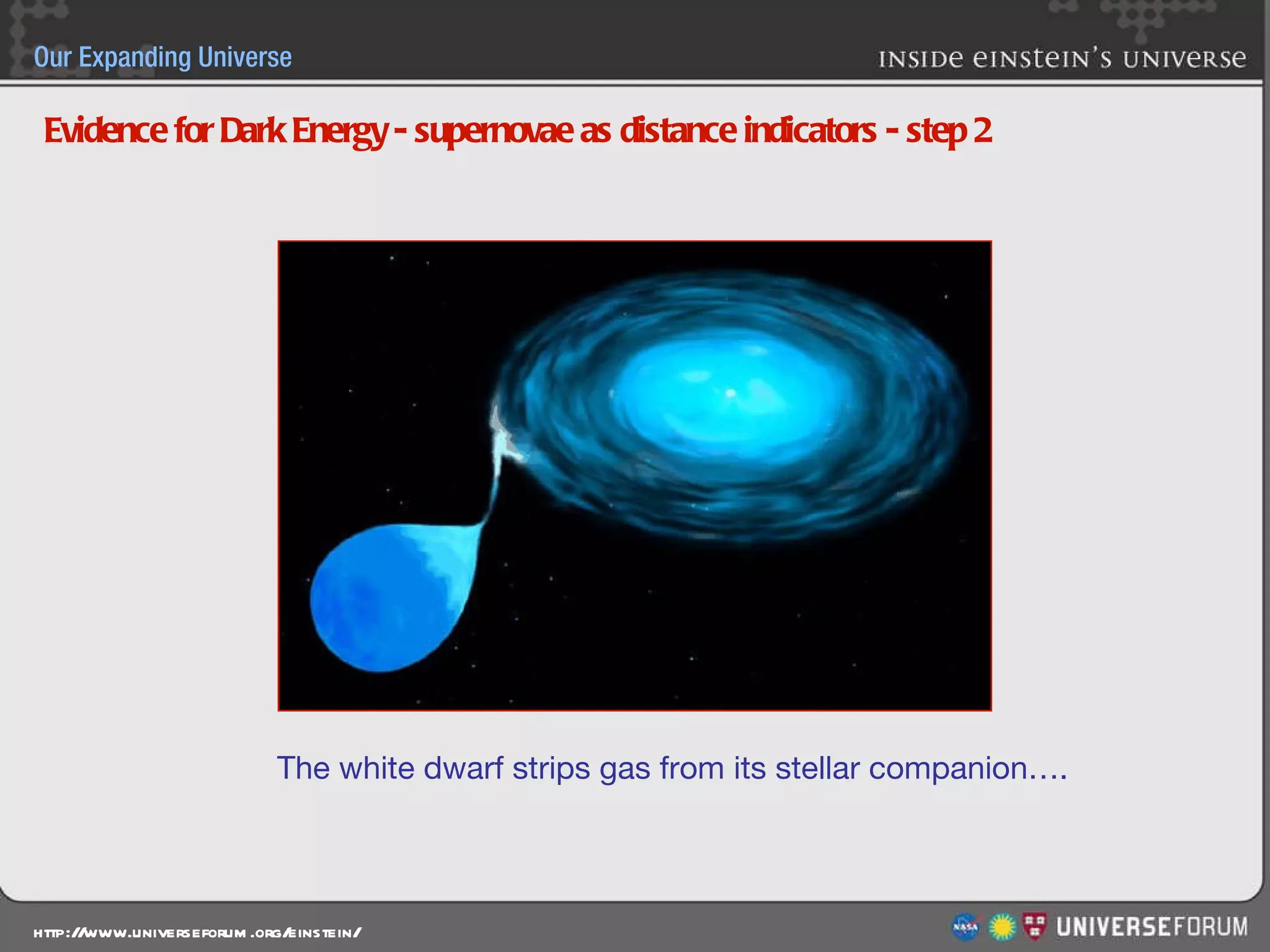
Evidence for Dark Energy - supernovae as distance indicators - step 2 The white dwarf strips gas from its stellar companion….
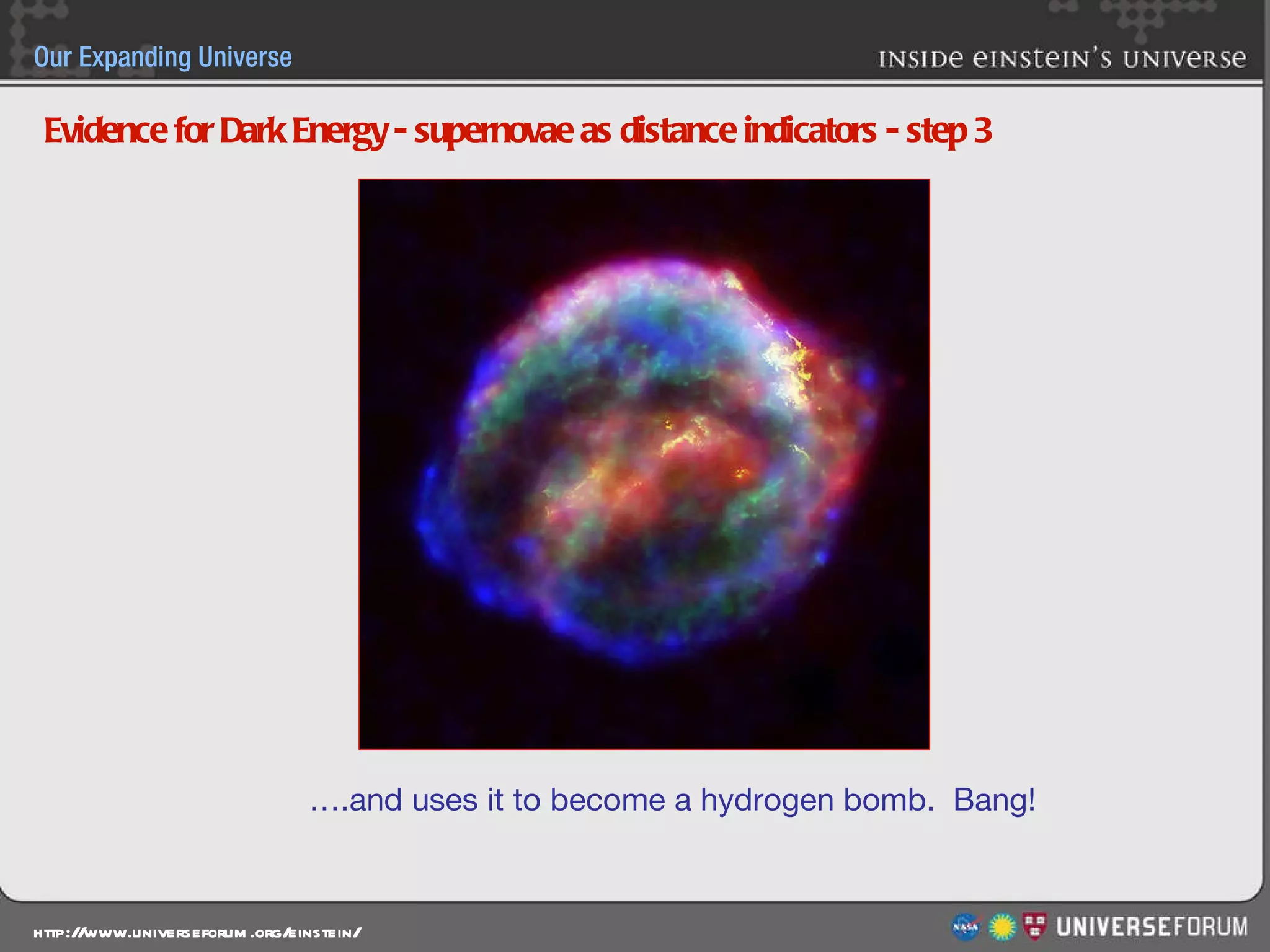
Evidence for Dark Energy - supernovae as distance indicators - step 3 … .and uses it to become a hydrogen bomb.  Bang!
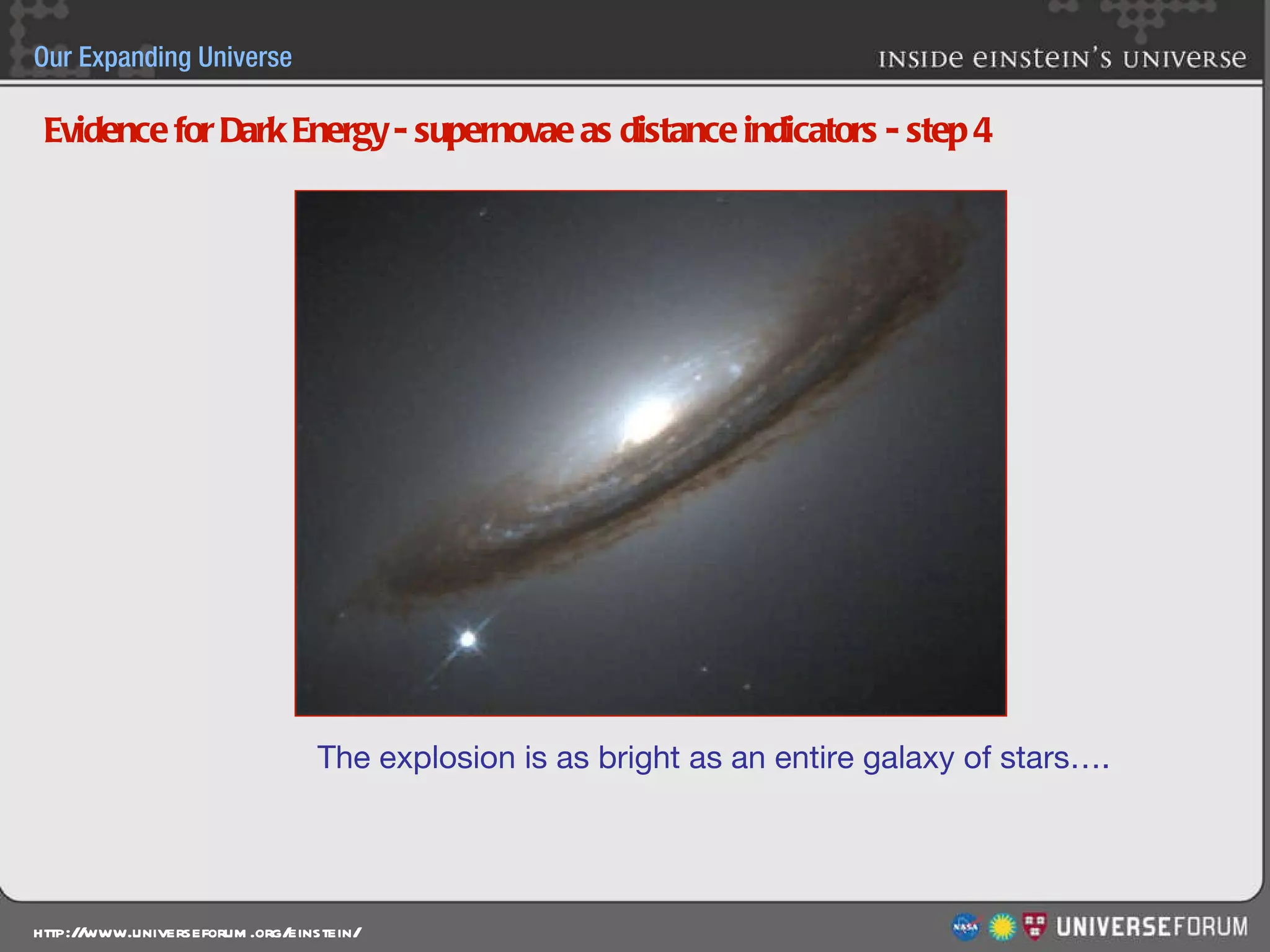
Evidence for Dark Energy - supernovae as distance indicators - step 4 The explosion is as bright as an entire galaxy of stars….
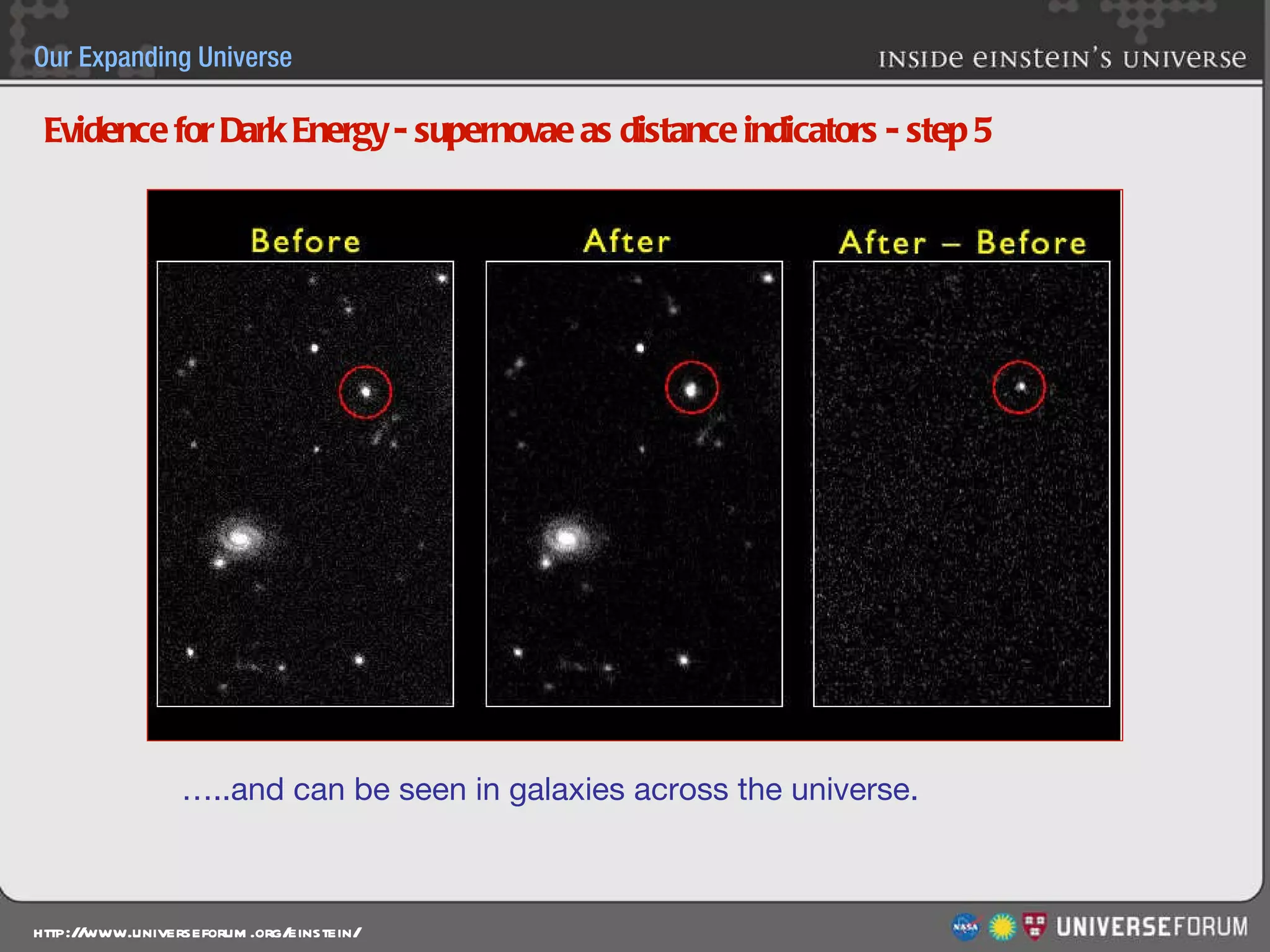
Evidence for Dark Energy - supernovae as distance indicators - step 5 … ..and can be seen in galaxies across the universe.
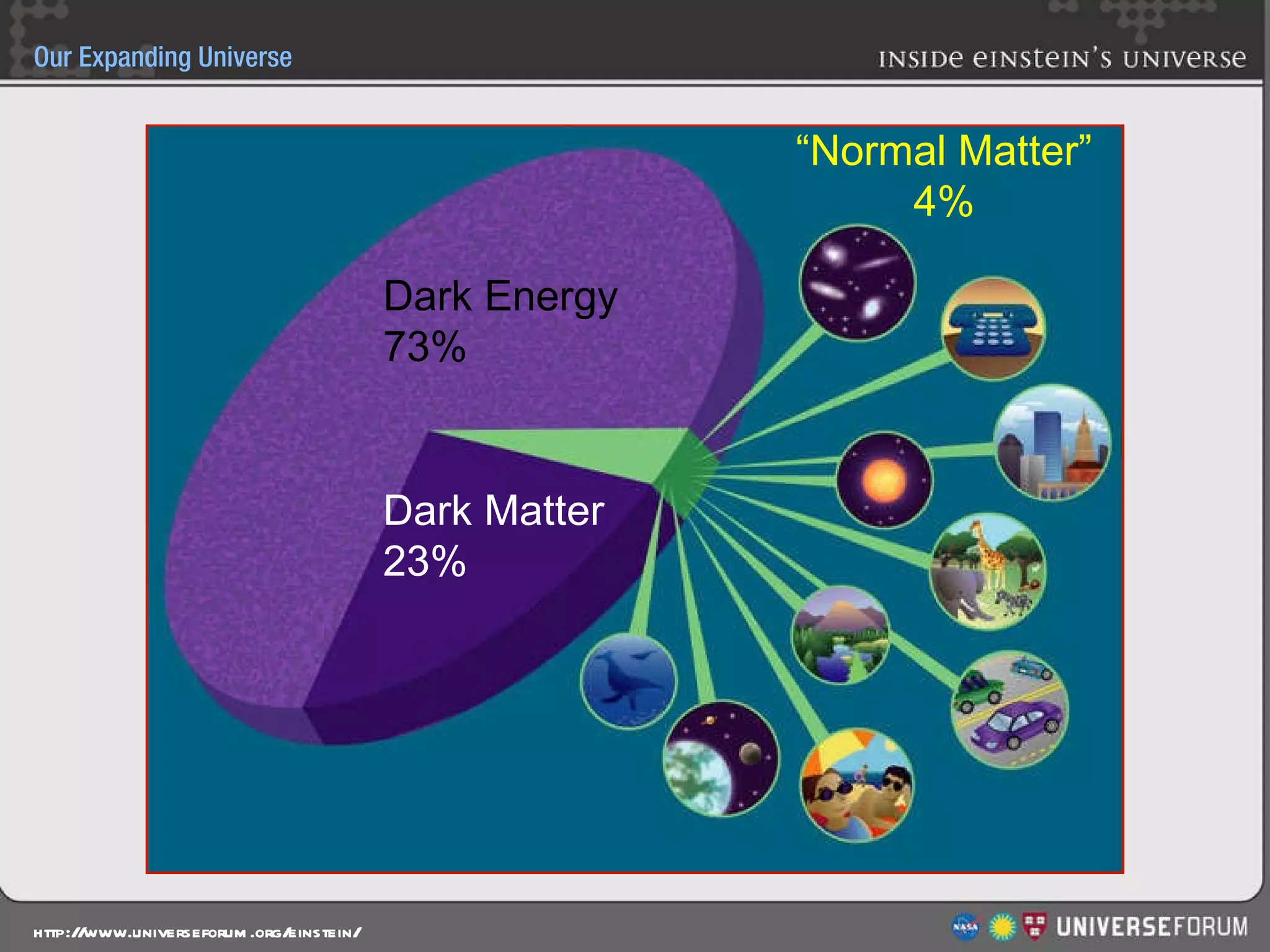
Dark Energy 73% Dark Matter 23% “ Normal Matter” 4%
Conclusions Big Bang model describes our current understanding of the universe. New discoveries, such as dark matter and accelerating  expansion (Dark Energy), lead us to refine our model,  but there is no crisis in our understanding (yet). Science is an ongoing process - forcing us to test  our model through prediction and observation.  The  more tests it passes, the greater is our confidence in it.
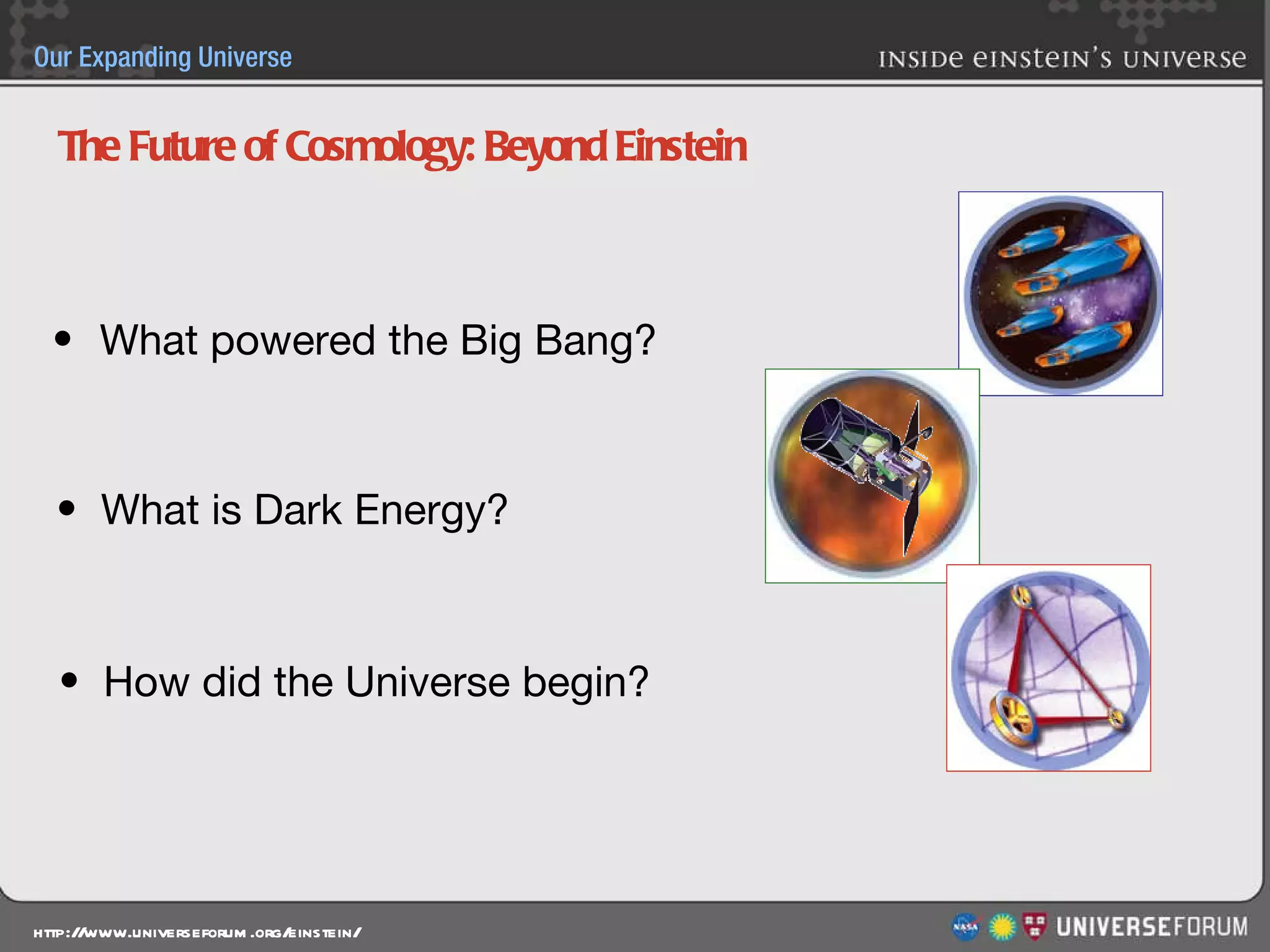
The Future of Cosmology: Beyond Einstein What powered the Big Bang? What is Dark Energy? How did the Universe begin?
Credits URL or program name here http://www.universeforum.org/einstein/ Colliding galaxies: NASA & the Hubble Heritage Team (STScI) Phases of Venus: Albert Van Helden Star field: NASA/GSFC Andromeda: Palomar Observatory, P. Challis, CfA HGC 87: Gemini Observatory/GMOS-S Galaxy cluster:  Jean-Charles Cuillandre (CFHT),  Hawaiian Starlight, CFHT Orion nebula: MicroObservatory, SAO Galaxy data: courtesy Emilio Falco, CfA Comic microwave background: NASA/WMAP Sun: SOHO/NASA/ESA Cecilia Payne: President and Fellows of Harvard College Early galaxies:  NASA, Richard Griffiths/JHU, Medium  Deep Survey Team Edge-on galaxy:  Bruce Hugo and Leslie Gaul, Adam Block (KPNO Visitor Program), NOAO, AURA, NSF Ring nebula:  H. Bond et al.,  Hubble Heritage Team  (STScI / AURA),  NASA White dwarf accretion: STScI, NASA Supernova Remnant: NASA/ESA/JHU/R.Sankrit  & W.Blair Galaxy and supernova data: High-Z Supernova  Search Team, HST, NASA Composition of the universe: SAO Spacecraft and Einstein probes: NASA  ALBERT EINSTEIN and related rights ™/© of The Hebrew University of Jerusalem, used under license. Represented by the Roger Richman Agency, Inc., www.albert-einstein.net Please contact einstein2005@cfa.harvard.edu for more information about non-credited historical images.
Additional Credits URL or program name here http://www.universeforum.org/einstein/ This presentation was initially developed for the “Modeling the Universe” educator workshop by the Universe Education Forum and our NASA mission partners. For additional information and activities related to the themes of this presentation, please visit the “Modeling the Universe” web site:    http://www.universeforum.org/mtu/ This collaboration is part of the education and public outreach program from NASA’s Science Mission Directorate.

Expanding universe

  • 1.
    Structure and Evolutionof the Universe Workshop Our Expanding Universe: Humanity’s changing vision of the cosmos Presented by: Loreto C. Morales BEED IIIA GEN. Location and Date here BEED ‘s
  • 2.
    What is Cosmology?The Study of the Universe: its structure, origin, evolution, and destiny Our universal “world view” Our cosmological model
  • 3.
    Universe models formedin many cultures Cosmology through the ages…
  • 4.
    2nd Century: Claudius Ptolemy (Physics of Aristotle) Model: Earth-centered Cosmology Big Idea: Different laws for Earth and the cosmos Astronomy has seen 3 scientific revolutions in cosmology 16th Century: Nicolaus Copernicus (Physics of Newton) Model: Sun-centered Cosmology Big Idea: Universal physics; same laws everywhere 20th Century: Edwin Hubble (Physics of Einstein) Model: Big Bang Cosmology Big Idea: Universe is changing, evolving Our View of the Cosmos - the story of scientific models
  • 5.
    …“ the naturalmotion of the Earth ….is towards the center of the universe; that is the reason it is now lying at the center.” Aristotle, On the Heavens Earth-centered Cosmology: Claudius Ptolemy, 100-170 AD
  • 6.
    Prediction : Futureplanetary positions Observation : retrograde motion of planets Refine : epicycles Success! For 1500 years Testing the Earth-centered model
  • 7.
    Prediction : Phasesof Venus Observation : Full set of phases Crisis! Testing the Earth-centered model
  • 8.
    Sun-centered Cosmology: Nicolaus Copernicus 1473-1543 “ At rest, however, in the middle of everything is the Sun.” Nicholaus Copernicus, de Revolutionibus
  • 9.
    Prediction : Future planetary positions Observation : No better than Ptolemy Testing the Sun-centered model Refine : elliptical orbits (Johannes Kepler 1571-1630)
  • 10.
    Prediction : Observedshift in position of stars (parallax) as the earth Moves around the Sun. Observation : No shift. Crisis? No, but we had to wait until 1838 (Friedrich Bessel) Testing the Sun-centered model
  • 11.
    Prediction : Sun at center of Cosmos Observation : Sun is not at center of universe (1918) Testing the Sun-centered model Crisis! Observation : The galaxy is not the entire universe (1923)
  • 12.
    Big Bang Cosmology: Albert Einstein (1879-1955) “ A human being is part of a whole, called by us ‘universe’, a part limited in time and space.”
  • 13.
    Prediction : The universe is expanding Observation : Galaxies are moving apart from each other (1929) Testing the Big Bang model
  • 14.
    Evidence for anexpanding universe The spectrum of hydrogen gas is the unique fingerprint of that element Hydrogen lamp
  • 15.
    Evidence for anexpanding universe Orion Nebula When we see a repeat of the pattern we saw in the lab, we know hydrogen is present
  • 16.
    Evidence for anexpanding universe We see the same repeating pattern of lines in a galaxy, but displaced to the red Galaxy UGC 12915
  • 17.
    Evidence for anexpanding universe The further the galaxy, the more the shift to the red Galaxy UGC 12508
  • 18.
    Evidence for anexpanding universe Galaxy KUG 1750 The greater the red shift, the faster the galaxy is receding
  • 19.
    Evidence for anexpanding universe The red shift is caused by the expansion of space. Galaxy KUG 1217
  • 20.
    Evidence for anexpanding universe The red shift is evidence for an expanding universe Galaxy IRAS F09159
  • 21.
    Prediction : If the universe was denser, hotter, in past, we should see evidence of left-over heat from early universe. Observation : Left-over heat from the early universe. ( Penzias and Wilson, 1965 ) Testing the Big Bang model
  • 22.
    Prediction : A hot, dense expanding universe, should be predominantly hydrogen, helium. The Sun: 74.5% H, 24% He by mass Observation : Universe is ~75% hydrogen, ~25% helium by mass Testing the Big Bang model Cecilia Payne
  • 23.
    Prediction : Anexpanding universe is evolving over time. If we look at the early universe, it should appear different. Observation : Distant galaxies less evolved, physically and chemically. Testing the Big Bang model
  • 24.
    Observation : 90%of matter is an unknown form: Dark Matter. Refine : A new and unknown form of matter exists. But its gravity works the same way, and its presence is needed to explain how the universe looks. Testing the Big Bang model Vera Rubin
  • 25.
    Observation : Expansionis accelerating. Refine : Extra energy content. A recent discovery and of unknown origin,the concept of Dark Energy is actually an integral part of Einstein’s theory of gravity. Testing the Big Bang model
  • 26.
    Evidence for DarkEnergy - supernovae as distance indicators - step 1 A dying star becomes a white dwarf.
  • 27.
    Evidence for DarkEnergy - supernovae as distance indicators - step 2 The white dwarf strips gas from its stellar companion….
  • 28.
    Evidence for DarkEnergy - supernovae as distance indicators - step 3 … .and uses it to become a hydrogen bomb. Bang!
  • 29.
    Evidence for DarkEnergy - supernovae as distance indicators - step 4 The explosion is as bright as an entire galaxy of stars….
  • 30.
    Evidence for DarkEnergy - supernovae as distance indicators - step 5 … ..and can be seen in galaxies across the universe.
  • 31.
    Dark Energy 73%Dark Matter 23% “ Normal Matter” 4%
  • 32.
    Conclusions Big Bangmodel describes our current understanding of the universe. New discoveries, such as dark matter and accelerating expansion (Dark Energy), lead us to refine our model, but there is no crisis in our understanding (yet). Science is an ongoing process - forcing us to test our model through prediction and observation. The more tests it passes, the greater is our confidence in it.
  • 33.
    The Future ofCosmology: Beyond Einstein What powered the Big Bang? What is Dark Energy? How did the Universe begin?
  • 34.
    Credits URL orprogram name here http://www.universeforum.org/einstein/ Colliding galaxies: NASA & the Hubble Heritage Team (STScI) Phases of Venus: Albert Van Helden Star field: NASA/GSFC Andromeda: Palomar Observatory, P. Challis, CfA HGC 87: Gemini Observatory/GMOS-S Galaxy cluster: Jean-Charles Cuillandre (CFHT), Hawaiian Starlight, CFHT Orion nebula: MicroObservatory, SAO Galaxy data: courtesy Emilio Falco, CfA Comic microwave background: NASA/WMAP Sun: SOHO/NASA/ESA Cecilia Payne: President and Fellows of Harvard College Early galaxies: NASA, Richard Griffiths/JHU, Medium Deep Survey Team Edge-on galaxy: Bruce Hugo and Leslie Gaul, Adam Block (KPNO Visitor Program), NOAO, AURA, NSF Ring nebula: H. Bond et al., Hubble Heritage Team (STScI / AURA), NASA White dwarf accretion: STScI, NASA Supernova Remnant: NASA/ESA/JHU/R.Sankrit & W.Blair Galaxy and supernova data: High-Z Supernova Search Team, HST, NASA Composition of the universe: SAO Spacecraft and Einstein probes: NASA ALBERT EINSTEIN and related rights ™/© of The Hebrew University of Jerusalem, used under license. Represented by the Roger Richman Agency, Inc., www.albert-einstein.net Please contact einstein2005@cfa.harvard.edu for more information about non-credited historical images.
  • 35.
    Additional Credits URLor program name here http://www.universeforum.org/einstein/ This presentation was initially developed for the “Modeling the Universe” educator workshop by the Universe Education Forum and our NASA mission partners. For additional information and activities related to the themes of this presentation, please visit the “Modeling the Universe” web site: http://www.universeforum.org/mtu/ This collaboration is part of the education and public outreach program from NASA’s Science Mission Directorate.