Evolution of CSS
In this presentation, we'll take a journey back in time to explore the
inception of CSS and follow its evolution as it grew to meet the
ever-changing demands of modern web design. From its humble
beginnings with CSS1 to the sophisticated layouts enabled by Flexbox and
CSS Grid, we'll witness how CSS has transformed from a basic styling tool
into a powerful and flexible technology that empowers developers to
create immersive digital experiences.
- By Dave Jay 21C22006
CSS1, the inaugural version, laid
the groundwork for web styling in
1996. It introduced basic control
over fonts, colors, and spacing,
marking the start of web design
separation from structure.
CSS1 offered foundational styling
tools in 1996, enabling font
choices, color adjustments, and
spacing control, thus initiating the
separation of presentation and
content on the web.
CSS1: The Foundation (1996)
CSS1's innovation lay in
untangling style from structure
(1996). It enabled designers to
define presentation
independently, fostering cleaner
HTML and enhanced design
flexibility.
01
02
CSS2: Expanding
Possibilities (1998)
CSS2 (1998) introduced media types, empowering
tailored styles for diverse devices. This enhanced
control over output, adapting designs for screens,
printers, and more.
CSS2 (1998) advanced with features like positioning
and z-index, enabling precise layout control.
Designers could place elements and control layering
for complex designs.
CSS2.1: Refinement
and Compatibility
(2004)
● CSS2.1 (2004) focused on refining
specifications and enhancing browser
compatibility. It aimed to provide clearer
rules, ensuring consistent rendering
across different web browsers.
● CSS2.1 improved consistency by
clarifying rules (2004). This aided
rendering uniformity across various
browsers, leading to a more predictable
user experience.
01
02
03
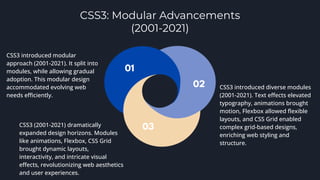
CSS3 introduced diverse modules
(2001-2021). Text effects elevated
typography, animations brought
motion, Flexbox allowed flexible
layouts, and CSS Grid enabled
complex grid-based designs,
enriching web styling and
structure.
CSS3: Modular Advancements
(2001-2021)
CSS3 introduced modular
approach (2001-2021). It split into
modules, while allowing gradual
adoption. This modular design
accommodated evolving web
needs efficiently.
CSS3 (2001-2021) dramatically
expanded design horizons. Modules
like animations, Flexbox, CSS Grid
brought dynamic layouts,
interactivity, and intricate visual
effects, revolutionizing web aesthetics
and user experiences.
01
02
CSS Custom Properties
(CSS Variables)
CSS variables (custom properties) bolster
maintainability and reusability. They allow
centralizing values, easing updates, and promoting
consistent styles throughout a project, streamlining
development and design changes.
CSS custom properties (variables) are placeholders
(2000s). They store values, enabling reuse,
consistency, and easy updates across stylesheets.
This enhances code organization, maintenance, and
adaptability.
01
02
Responsive Design and
Media Queries
Media queries (2000s) adapt websites to screens.
They evaluate screen characteristics, applying
different styles based on conditions. This
responsiveness ensures optimal presentation on
diverse devices and screen sizes.
Media queries arose (2000s) for responsive design. By
evaluating device attributes, they adjust styles
accordingly, allowing sites to fluidly adapt, ensuring
an optimal user experience on various devices and
orientations.
CSS-in-JS and
Preprocessors
● CSS-in-JS libraries (2010s) integrate CSS
into JS. Preprocessors like Sass, Less
(2000s) extend CSS, offering variables,
functions, and modularization, enhancing
maintainability, and easing development.
● CSS-in-JS libraries and preprocessors
(Sass, Less, etc.) elevate CSS (2010s).
They introduce variables, functions,
nesting, and more, akin to programming.
This boosts modularity, reduces
redundancy, and simplifies complex
styling tasks.
01
02
CSS Frameworks and
Libraries
Frameworks (Bootstrap, Foundation, etc.) offer
pre-designed elements (2010s). These ready-to-use
components—menus, forms—accelerate
development by providing consistent, styled building
blocks, saving time and effort in design and coding.
Prominent CSS frameworks include Bootstrap,
Foundation, and Materialize. These frameworks offer
pre-styled components and layout systems,
streamlining web development and ensuring
consistent designs.
01
02
03
Conclusion
CSS evolves continually. It adapts to evolving web
needs—mobile-first design, performance optimization, user
experience enhancements—ensuring it remains a dynamic
and relevant technology in modern web development.
CSS, originating with CSS1, separated style from structure.
CSS2 added advanced features, while CSS3 modules
brought expansive design possibilities. Media queries
enabled responsiveness. CSS-in-JS and preprocessors
improved coding. Frameworks expedited development.
CSS's evolution meets modern web demands, ensuring
dynamic, responsive, and efficient styling.
CSS evolved from basic styling in CSS1 to advanced layouts,
responsive designs in CSS3. It progressed through modules,
frameworks, and tools, enhancing web aesthetics and
adaptability.
Thank you for your time 😊

Evolution of CSS

  • 1.
    Evolution of CSS Inthis presentation, we'll take a journey back in time to explore the inception of CSS and follow its evolution as it grew to meet the ever-changing demands of modern web design. From its humble beginnings with CSS1 to the sophisticated layouts enabled by Flexbox and CSS Grid, we'll witness how CSS has transformed from a basic styling tool into a powerful and flexible technology that empowers developers to create immersive digital experiences. - By Dave Jay 21C22006
  • 2.
    CSS1, the inauguralversion, laid the groundwork for web styling in 1996. It introduced basic control over fonts, colors, and spacing, marking the start of web design separation from structure. CSS1 offered foundational styling tools in 1996, enabling font choices, color adjustments, and spacing control, thus initiating the separation of presentation and content on the web. CSS1: The Foundation (1996) CSS1's innovation lay in untangling style from structure (1996). It enabled designers to define presentation independently, fostering cleaner HTML and enhanced design flexibility.
  • 3.
    01 02 CSS2: Expanding Possibilities (1998) CSS2(1998) introduced media types, empowering tailored styles for diverse devices. This enhanced control over output, adapting designs for screens, printers, and more. CSS2 (1998) advanced with features like positioning and z-index, enabling precise layout control. Designers could place elements and control layering for complex designs.
  • 4.
    CSS2.1: Refinement and Compatibility (2004) ●CSS2.1 (2004) focused on refining specifications and enhancing browser compatibility. It aimed to provide clearer rules, ensuring consistent rendering across different web browsers. ● CSS2.1 improved consistency by clarifying rules (2004). This aided rendering uniformity across various browsers, leading to a more predictable user experience.
  • 5.
    01 02 03 CSS3 introduced diversemodules (2001-2021). Text effects elevated typography, animations brought motion, Flexbox allowed flexible layouts, and CSS Grid enabled complex grid-based designs, enriching web styling and structure. CSS3: Modular Advancements (2001-2021) CSS3 introduced modular approach (2001-2021). It split into modules, while allowing gradual adoption. This modular design accommodated evolving web needs efficiently. CSS3 (2001-2021) dramatically expanded design horizons. Modules like animations, Flexbox, CSS Grid brought dynamic layouts, interactivity, and intricate visual effects, revolutionizing web aesthetics and user experiences.
  • 6.
    01 02 CSS Custom Properties (CSSVariables) CSS variables (custom properties) bolster maintainability and reusability. They allow centralizing values, easing updates, and promoting consistent styles throughout a project, streamlining development and design changes. CSS custom properties (variables) are placeholders (2000s). They store values, enabling reuse, consistency, and easy updates across stylesheets. This enhances code organization, maintenance, and adaptability.
  • 7.
    01 02 Responsive Design and MediaQueries Media queries (2000s) adapt websites to screens. They evaluate screen characteristics, applying different styles based on conditions. This responsiveness ensures optimal presentation on diverse devices and screen sizes. Media queries arose (2000s) for responsive design. By evaluating device attributes, they adjust styles accordingly, allowing sites to fluidly adapt, ensuring an optimal user experience on various devices and orientations.
  • 8.
    CSS-in-JS and Preprocessors ● CSS-in-JSlibraries (2010s) integrate CSS into JS. Preprocessors like Sass, Less (2000s) extend CSS, offering variables, functions, and modularization, enhancing maintainability, and easing development. ● CSS-in-JS libraries and preprocessors (Sass, Less, etc.) elevate CSS (2010s). They introduce variables, functions, nesting, and more, akin to programming. This boosts modularity, reduces redundancy, and simplifies complex styling tasks.
  • 9.
    01 02 CSS Frameworks and Libraries Frameworks(Bootstrap, Foundation, etc.) offer pre-designed elements (2010s). These ready-to-use components—menus, forms—accelerate development by providing consistent, styled building blocks, saving time and effort in design and coding. Prominent CSS frameworks include Bootstrap, Foundation, and Materialize. These frameworks offer pre-styled components and layout systems, streamlining web development and ensuring consistent designs.
  • 10.
    01 02 03 Conclusion CSS evolves continually.It adapts to evolving web needs—mobile-first design, performance optimization, user experience enhancements—ensuring it remains a dynamic and relevant technology in modern web development. CSS, originating with CSS1, separated style from structure. CSS2 added advanced features, while CSS3 modules brought expansive design possibilities. Media queries enabled responsiveness. CSS-in-JS and preprocessors improved coding. Frameworks expedited development. CSS's evolution meets modern web demands, ensuring dynamic, responsive, and efficient styling. CSS evolved from basic styling in CSS1 to advanced layouts, responsive designs in CSS3. It progressed through modules, frameworks, and tools, enhancing web aesthetics and adaptability.
  • 11.
    Thank you foryour time 😊