Mental Health Evidence Based Practices in Washington State Dennis McBride, PhD William Voss, PhD Heather Mertz, PhD Terri Villanueva Genevieve De Nevers The Washington Institute for Mental Health Research & Training University of Washington, Seattle For further information contact Dennis McBride:  dmcb@u.washington.edu or (253) 756-2335 www.wimirt.washington.edu THE  WASHINGTON  INSTITUTE FOR  MENTAL  HEALTH  RESEARCH  &  TRAINING
Goal of the EBP Survey To identify and assess the use of mental health EBPs from publicly funded social service agencies in Washington State Information collected is intended to inform state policymakers, providers, consumers, and other stakeholders about: Current planning and programming efforts Provide baseline for tracking future EBP implementation
Participants* Mental Health Division (MHD) Division of Alcohol and Substance Abuse (DASA) Juvenile Rehabilitation Administration (JRA) Children’s Administration (CA) * Aging and Disability Services Administration (ADSA) was invited to participate but did not.
Definition Evidenced Based Practices  – “means employing clinical interventions that research has shown to be effective in helping consumers recover and achieve goals.” Drake, R. E., Merrens, M. R., & Lynde, D.W. (2005) Evidenced-Based Mental Health Practice. WW Norton & Co. p.67.
EBP Identification Initial EBP Selection Family Members Researchers Mental Health Consumers Service Providers Literature Search
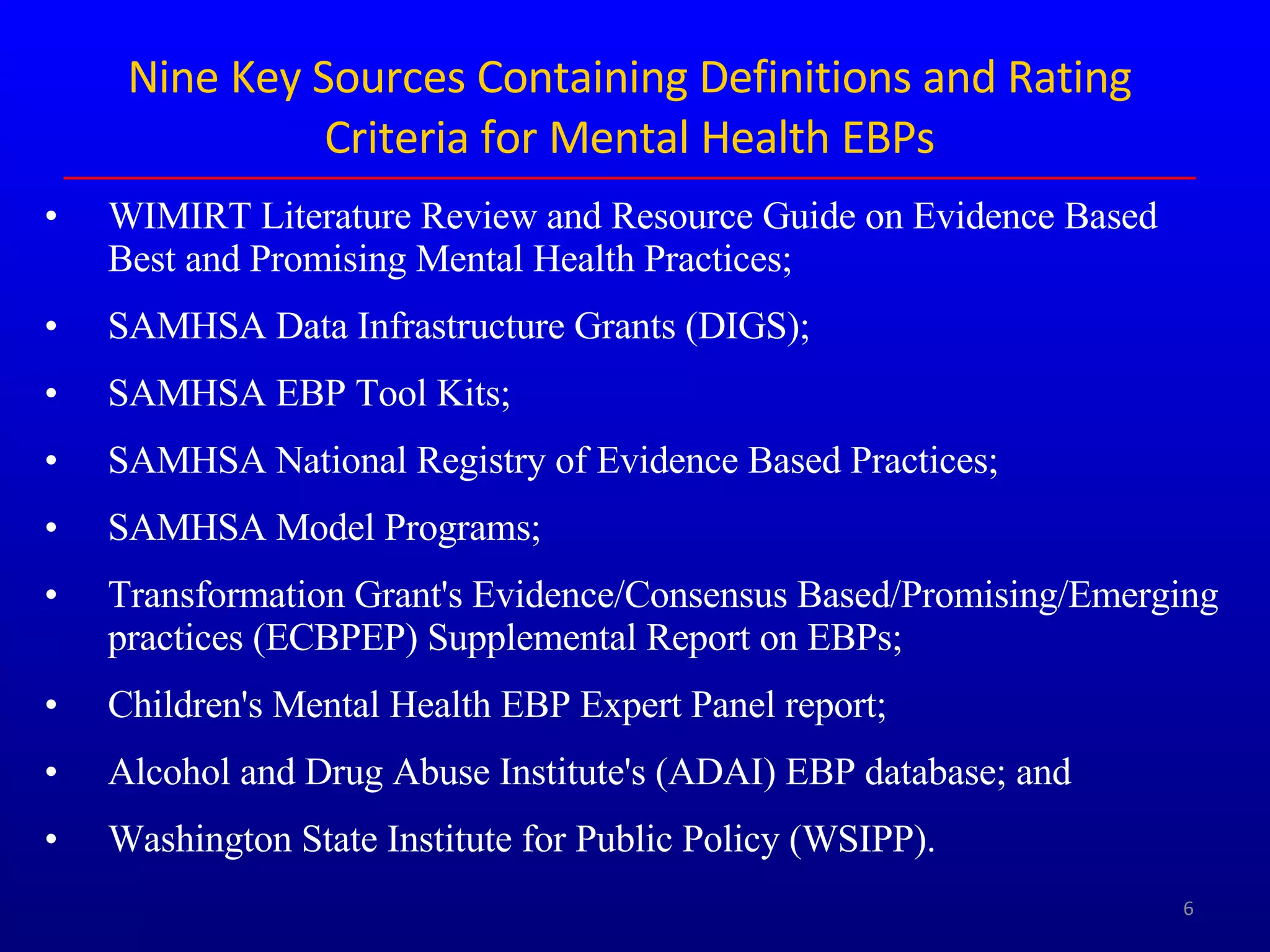
Nine Key Sources Containing Definitions and Rating Criteria for Mental Health EBPs WIMIRT Literature Review and Resource Guide on Evidence Based Best and Promising Mental Health Practices;  SAMHSA Data Infrastructure Grants (DIGS);  SAMHSA EBP Tool Kits;  SAMHSA National Registry of Evidence Based Practices; SAMHSA Model Programs;  Transformation Grant's Evidence/Consensus Based/Promising/Emerging practices (ECBPEP) Supplemental Report on EBPs;  Children's Mental Health EBP Expert Panel report;  Alcohol and Drug Abuse Institute's (ADAI) EBP database; and  Washington State Institute for Public Policy (WSIPP).
Level of Evidence Over 350 Practices were selected from the Nine Sources. Each Practice was rated by each source to be one of the following: Emerging Practices Promising Practices Evidence Based Practices
Selected EBPs and Definitions  (Appendix B) The number of times the practice was endorsed by the nine sources;  The level of evidence that each practice received; and  Whether or not the practice was currently offered in Washington State.  34 Practices were selected from the 350 based upon the following criteria:
EBP Scoring Total Score = SUM (Number of sources that endorse each EBP X Level of Evidence). Minimum score of 6 if not offered in Washington; Minimum score of 5 if offered in Washington.* * 2 practices (peer Support and Supported Housing) did not meet these criteria but were included. Score3  Number of EBP (3) Selections Score2  Number of "Promising" (2) Selections Score1  Number of  "Emerging" (1) Selections Total_Count  Total Number of Endorsements Numeric_Score Total Score Washington Currently offered in Washington State Aggression Replacement Training 2.00 .00 .00 2.00 6.00 1 Assertive Community Treatment (ACT/PACT) 5.00 .00 1.00 6.00 16.00 1
Selected EBPs and Definitions  (Appendix B) Cognitive Behavior Therapies (CBT) A form of psychotherapy focusing on decreasing symptoms and improving quality of life by changing a person’s thoughts and behaviors.  The treatment involves a collaborative agreement on treatment goals which the patient tracks each week, learning and practicing new skills and ways of thinking in the treatment session and practicing via homework assignments throughout the week. Many EBP's on this list are based on CBT.  For this survey, only rate this if CBT is used in your site separate from another EBP in this list.   Motivational Interviewing Motivational interviewing is a directive, client-centered counseling style for eliciting behavior change by helping clients to explore and resolve ambivalence.
EBP Survey Content Appendix C UTILIZATION OF EBPS   FIDELITY TRAINING TARGET POPULATION    IMPLEMENTATION SUCCESS    EBP EFFECTIVENESS  FUTURE EBP UTILIZATION BARRIERS MOST NEEDED ASSISTANCE TO ADOPT EBPS POPULATION SERVED BY NO KNOWN EBPs INTEREST IN EBP IMPLEMENTATION  EBP INITIATIVES SYSTEMATIC ASSESSMENT OF EBP EFFECTS  CLIENT COUNTS
Data Collection
Sample Frame 156 MHD Agencies  239 DASA Agencies 17 JRA Agencies 15 CA Agencies 427 Total Agencies
Response Rates Total Response Rate: 65.8%  N = 281 Agency Response Rate MHD 61.5% DASA 64.4% JRA 100% CA 93.3%
MHD Map Asotin
Agency Characteristics  Services Provided  - Intake, assessment and referral services 87.5% - Chemical dependency treatment 67.6% - Mental health treatment 56.6% - Co-occurring Disorders (COD) 47.7% Service Area Population < 5,000 11.0%  5,001 – 50,000 18.9% 50,001-500,000 41.3% > 500,000 28.8%
In the list below, please indicate which of the  following evidence based practices your  agency currently provides.
Top 5 EBPs* Currently in Use MHD & DASA *Only the top 5 EBPs per agency are listed.
Top 5 EBPs* Currently in Use JRA & CA *Only the top 5 EBPs per agency are listed.
Average Number of EBP’s Offered Per Site  by Agency Type N Min. Max. Mean MHD 96 0 22 6.0208 CA 14 0 2 1.1429 JRA 17 0 3 1.5882 DASA 154 0 18 3.6039
Fidelity Fidelity refers to whether a program or practice is being implemented as intended according to established guidelines or manuals (e.g., SAMHSA Fidelity Scales).
Indicate whether program fidelity is assessed or monitored for those practices you are currently providing, and if so, what fidelity measure or method are you using.
Are there any EBPs that you are NOT currently using but want to use in the future?
Top 6 Future Use EBPs * MHD & DASA * Not now in use *Only the top 6 EBPs per agency are listed.
Top 6 Future Use EBPs * JRA & CA * Not now in use *Only the top 6 EBPs per agency are listed.
For the practices your agency currently provides,  please indicate which mechanisms are used to provide training.
For the practices your agency currently provides, please indicate which target populations you are providing the EBP for.
For the practices your agency currently provides, please indicate how successful your agency has been in implementing the EBPs.
For the practices your agency currently provides, how effective do you think the EBP is at producing positive client outcomes?
Please indicate whether any of the barriers listed below interfere with your agency in providing EBPs you are using or want to use.
What type of assistance is most needed by your agency to help facilitate the adoption and implementation of evidence-based practices?
Does your agency serve populations or address specific client needs for which there are no known or available evidence-based practices?
Please rate your agency’s interest in continuing/ beginning to implement EBPs into your treatment program?
What initiatives, if any, is your agency  implementing to promote the adoption of  evidence-based practices (EBPs)?
Is your agency conducting any systematic assessment of the effects of the evidence-based interventions that you are using?
Average Number of Clients Served  Per Agency in Fiscal Year 2007 * *  Client counts for Fiscal Year 2007 could not be obtained from CA Agencies and are not included in this figure.
Number of Clients Receiving EBPs  Across All Sites 33  EBPs were offered 636 times across 281 agencies in 2007.  On average, 192 clients received an EBP each time it was offered.
Summary 34 of ~350 practices were selected as EBPs for this study. 33 of these 34 practices are being offered in the state of Washington.  The 33 EBPs were offered 636 times across 281 agencies in 2007. On average, 192 clients received an EBP each time it was offered.  Most agencies report that they are successful in implementing their EBPs, and that the EPBs offered by their agency are highly effective in producing positive outcomes for their clients. Over 90% of all agencies say they are interested in continuing EBPs use in the future. Most want to use EBPs that they are not now using.  More than one-third of the agencies report that they serve clients whose needs are not met by currently available EBPs.  A shortage of an appropriately trained workforce and financing issues are the most often cited barriers to implementing EBPs as well as the most needed assistance to facilitate the adoption and implementation of EBPs.

Evidence-based Practices in Washington State

  • 1.
    Mental Health EvidenceBased Practices in Washington State Dennis McBride, PhD William Voss, PhD Heather Mertz, PhD Terri Villanueva Genevieve De Nevers The Washington Institute for Mental Health Research & Training University of Washington, Seattle For further information contact Dennis McBride: dmcb@u.washington.edu or (253) 756-2335 www.wimirt.washington.edu THE WASHINGTON INSTITUTE FOR MENTAL HEALTH RESEARCH & TRAINING
  • 2.
    Goal of theEBP Survey To identify and assess the use of mental health EBPs from publicly funded social service agencies in Washington State Information collected is intended to inform state policymakers, providers, consumers, and other stakeholders about: Current planning and programming efforts Provide baseline for tracking future EBP implementation
  • 3.
    Participants* Mental HealthDivision (MHD) Division of Alcohol and Substance Abuse (DASA) Juvenile Rehabilitation Administration (JRA) Children’s Administration (CA) * Aging and Disability Services Administration (ADSA) was invited to participate but did not.
  • 4.
    Definition Evidenced BasedPractices – “means employing clinical interventions that research has shown to be effective in helping consumers recover and achieve goals.” Drake, R. E., Merrens, M. R., & Lynde, D.W. (2005) Evidenced-Based Mental Health Practice. WW Norton & Co. p.67.
  • 5.
    EBP Identification InitialEBP Selection Family Members Researchers Mental Health Consumers Service Providers Literature Search
  • 6.
    Nine Key SourcesContaining Definitions and Rating Criteria for Mental Health EBPs WIMIRT Literature Review and Resource Guide on Evidence Based Best and Promising Mental Health Practices; SAMHSA Data Infrastructure Grants (DIGS); SAMHSA EBP Tool Kits; SAMHSA National Registry of Evidence Based Practices; SAMHSA Model Programs; Transformation Grant's Evidence/Consensus Based/Promising/Emerging practices (ECBPEP) Supplemental Report on EBPs; Children's Mental Health EBP Expert Panel report; Alcohol and Drug Abuse Institute's (ADAI) EBP database; and Washington State Institute for Public Policy (WSIPP).
  • 7.
    Level of EvidenceOver 350 Practices were selected from the Nine Sources. Each Practice was rated by each source to be one of the following: Emerging Practices Promising Practices Evidence Based Practices
  • 8.
    Selected EBPs andDefinitions (Appendix B) The number of times the practice was endorsed by the nine sources; The level of evidence that each practice received; and Whether or not the practice was currently offered in Washington State. 34 Practices were selected from the 350 based upon the following criteria:
  • 9.
    EBP Scoring TotalScore = SUM (Number of sources that endorse each EBP X Level of Evidence). Minimum score of 6 if not offered in Washington; Minimum score of 5 if offered in Washington.* * 2 practices (peer Support and Supported Housing) did not meet these criteria but were included. Score3 Number of EBP (3) Selections Score2 Number of &quot;Promising&quot; (2) Selections Score1 Number of &quot;Emerging&quot; (1) Selections Total_Count Total Number of Endorsements Numeric_Score Total Score Washington Currently offered in Washington State Aggression Replacement Training 2.00 .00 .00 2.00 6.00 1 Assertive Community Treatment (ACT/PACT) 5.00 .00 1.00 6.00 16.00 1
  • 10.
    Selected EBPs andDefinitions (Appendix B) Cognitive Behavior Therapies (CBT) A form of psychotherapy focusing on decreasing symptoms and improving quality of life by changing a person’s thoughts and behaviors.  The treatment involves a collaborative agreement on treatment goals which the patient tracks each week, learning and practicing new skills and ways of thinking in the treatment session and practicing via homework assignments throughout the week. Many EBP's on this list are based on CBT.  For this survey, only rate this if CBT is used in your site separate from another EBP in this list. Motivational Interviewing Motivational interviewing is a directive, client-centered counseling style for eliciting behavior change by helping clients to explore and resolve ambivalence.
  • 11.
    EBP Survey ContentAppendix C UTILIZATION OF EBPS   FIDELITY TRAINING TARGET POPULATION   IMPLEMENTATION SUCCESS   EBP EFFECTIVENESS FUTURE EBP UTILIZATION BARRIERS MOST NEEDED ASSISTANCE TO ADOPT EBPS POPULATION SERVED BY NO KNOWN EBPs INTEREST IN EBP IMPLEMENTATION EBP INITIATIVES SYSTEMATIC ASSESSMENT OF EBP EFFECTS CLIENT COUNTS
  • 12.
  • 13.
    Sample Frame 156MHD Agencies 239 DASA Agencies 17 JRA Agencies 15 CA Agencies 427 Total Agencies
  • 14.
    Response Rates TotalResponse Rate: 65.8% N = 281 Agency Response Rate MHD 61.5% DASA 64.4% JRA 100% CA 93.3%
  • 15.
  • 16.
    Agency Characteristics Services Provided - Intake, assessment and referral services 87.5% - Chemical dependency treatment 67.6% - Mental health treatment 56.6% - Co-occurring Disorders (COD) 47.7% Service Area Population < 5,000 11.0% 5,001 – 50,000 18.9% 50,001-500,000 41.3% > 500,000 28.8%
  • 17.
    In the listbelow, please indicate which of the following evidence based practices your agency currently provides.
  • 18.
    Top 5 EBPs*Currently in Use MHD & DASA *Only the top 5 EBPs per agency are listed.
  • 19.
    Top 5 EBPs*Currently in Use JRA & CA *Only the top 5 EBPs per agency are listed.
  • 20.
    Average Number ofEBP’s Offered Per Site by Agency Type N Min. Max. Mean MHD 96 0 22 6.0208 CA 14 0 2 1.1429 JRA 17 0 3 1.5882 DASA 154 0 18 3.6039
  • 21.
    Fidelity Fidelity refersto whether a program or practice is being implemented as intended according to established guidelines or manuals (e.g., SAMHSA Fidelity Scales).
  • 22.
    Indicate whether programfidelity is assessed or monitored for those practices you are currently providing, and if so, what fidelity measure or method are you using.
  • 23.
    Are there anyEBPs that you are NOT currently using but want to use in the future?
  • 24.
    Top 6 FutureUse EBPs * MHD & DASA * Not now in use *Only the top 6 EBPs per agency are listed.
  • 25.
    Top 6 FutureUse EBPs * JRA & CA * Not now in use *Only the top 6 EBPs per agency are listed.
  • 26.
    For the practicesyour agency currently provides, please indicate which mechanisms are used to provide training.
  • 27.
    For the practicesyour agency currently provides, please indicate which target populations you are providing the EBP for.
  • 28.
    For the practicesyour agency currently provides, please indicate how successful your agency has been in implementing the EBPs.
  • 29.
    For the practicesyour agency currently provides, how effective do you think the EBP is at producing positive client outcomes?
  • 30.
    Please indicate whetherany of the barriers listed below interfere with your agency in providing EBPs you are using or want to use.
  • 31.
    What type ofassistance is most needed by your agency to help facilitate the adoption and implementation of evidence-based practices?
  • 32.
    Does your agencyserve populations or address specific client needs for which there are no known or available evidence-based practices?
  • 33.
    Please rate youragency’s interest in continuing/ beginning to implement EBPs into your treatment program?
  • 34.
    What initiatives, ifany, is your agency implementing to promote the adoption of evidence-based practices (EBPs)?
  • 35.
    Is your agencyconducting any systematic assessment of the effects of the evidence-based interventions that you are using?
  • 36.
    Average Number ofClients Served Per Agency in Fiscal Year 2007 * * Client counts for Fiscal Year 2007 could not be obtained from CA Agencies and are not included in this figure.
  • 37.
    Number of ClientsReceiving EBPs Across All Sites 33 EBPs were offered 636 times across 281 agencies in 2007. On average, 192 clients received an EBP each time it was offered.
  • 38.
    Summary 34 of~350 practices were selected as EBPs for this study. 33 of these 34 practices are being offered in the state of Washington. The 33 EBPs were offered 636 times across 281 agencies in 2007. On average, 192 clients received an EBP each time it was offered. Most agencies report that they are successful in implementing their EBPs, and that the EPBs offered by their agency are highly effective in producing positive outcomes for their clients. Over 90% of all agencies say they are interested in continuing EBPs use in the future. Most want to use EBPs that they are not now using. More than one-third of the agencies report that they serve clients whose needs are not met by currently available EBPs. A shortage of an appropriately trained workforce and financing issues are the most often cited barriers to implementing EBPs as well as the most needed assistance to facilitate the adoption and implementation of EBPs.