LOOKING BACK AT YOUR
PRELIMINARY TASK, WHAT
DO YOU FEEL YOU HAVE
LEARNT FROM IT TO THE
FULL PRODUCT?
THE PRELIMINARY TASK
Before I started planning my music magazine, I did a preliminary task of creating a front page
and contents page for a college magazine. This was a quick task which was done to learn the
general conventions of magazine layout, and also to learn how to use Photoshop, before we
begun our final product. No research was done into the target audience, and the magazine was
not compared to other existing similar magazines. This meant that I had no idea whether or not
I was creating something my audience would want to read.
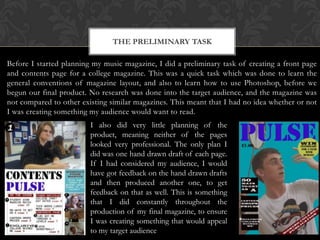
I also did very little planning of the
product, meaning neither of the pages
looked very professional. The only plan I
did was one hand drawn draft of each page.
If I had considered my audience, I would
have got feedback on the hand drawn drafts
and then produced another one, to get
feedback on that as well. This is something
that I did constantly throughout the
production of my final magazine, to ensure
I was creating something that would appeal
to my target audience
THE FRONT COVER

Preliminary Task Front
Cover

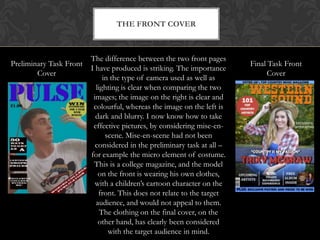
The difference between the two front pages
I have produced is striking. The importance
in the type of camera used as well as
lighting is clear when comparing the two
images; the image on the right is clear and
colourful, whereas the image on the left is
dark and blurry. I now know how to take
effective pictures, by considering mise-enscene. Mise-en-scene had not been
considered in the preliminary task at all –
for example the micro element of costume.
This is a college magazine, and the model
on the front is wearing his own clothes,
with a children’s cartoon character on the
front. This does not relate to the target
audience, and would not appeal to them.
The clothing on the final cover, on the
other hand, has clearly been considered
with the target audience in mind.

Final Task Front
Cover
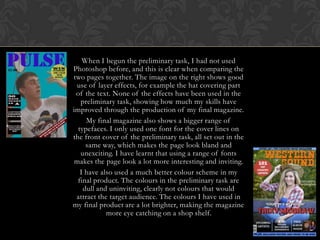
When I begun the preliminary task, I had not used
Photoshop before, and this is clear when comparing the
two pages together. The image on the right shows good
use of layer effects, for example the hat covering part
of the text. None of the effects have been used in the
preliminary task, showing how much my skills have
improved through the production of my final magazine.
My final magazine also shows a bigger range of
typefaces. I only used one font for the cover lines on
the front cover of the preliminary task, all set out in the
same way, which makes the page look bland and
unexciting. I have learnt that using a range of fonts
makes the page look a lot more interesting and inviting.
I have also used a much better colour scheme in my
final product. The colours in the preliminary task are
dull and uninviting, clearly not colours that would
attract the target audience. The colours I have used in
my final product are a lot brighter, making the magazine
more eye catching on a shop shelf.
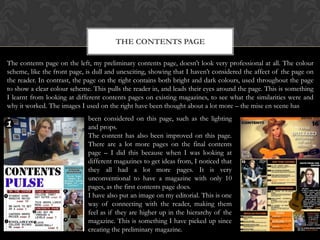
THE CONTENTS PAGE
The contents page on the left, my preliminary contents page, doesn’t look very professional at all. The colour
scheme, like the front page, is dull and unexciting, showing that I haven’t considered the affect of the page on
the reader. In contrast, the page on the right contains both bright and dark colours, used throughout the page
to show a clear colour scheme. This pulls the reader in, and leads their eyes around the page. This is something
I learnt from looking at different contents pages on existing magazines, to see what the similarities were and
why it worked. The images I used on the right have been thought about a lot more – the mise en scene has
been considered on this page, such as the lighting
and props.
The content has also been improved on this page.
There are a lot more pages on the final contents
page – I did this because when I was looking at
different magazines to get ideas from, I noticed that
they all had a lot more pages. It is very
unconventional to have a magazine with only 10
pages, as the first contents page does.
I have also put an image on my editorial. This is one
way of connecting with the reader, making them
feel as if they are higher up in the hierarchy of the
magazine. This is something I have picked up since
creating the preliminary magazine.
DOUBLE PAGE SPREAD

I didn’t have to create a double page spread
for my preliminary task, which meant I had
nothing to improve on, leaving me at a
disadvantage. This is where I really learnt the
importance of research, so that I had
something to base my magazine on and
something to aspire to. I learnt a lot about my
target audience when creating my double page
spread; I found out that they liked to read
interviews, which is why I produce an
interview for the article. I also learnt, from
feedback I was given, colours that they like
and don’t like, what things they want to know
about artists and what they don’t want to read
about. I learnt that knowing your readers
allows you to create a magazine that would
appeal to them.

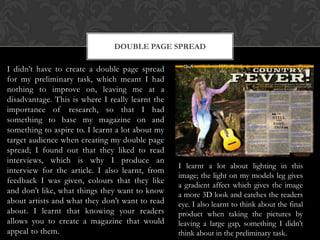
I learnt a lot about lighting in this
image; the light on my models leg gives
a gradient affect which gives the image
a more 3D look and catches the readers
eye. I also learnt to think about the final
product when taking the pictures by
leaving a large gap, something I didn’t
think about in the preliminary task.
HOW COULD I FURTHER
IMPROVE MY PRODUCT?

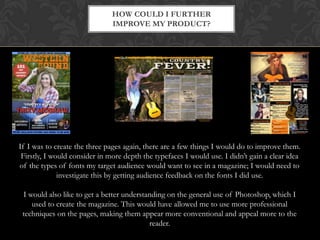
If I was to create the three pages again, there are a few things I would do to improve them.
Firstly, I would consider in more depth the typefaces I would use. I didn’t gain a clear idea
of the types of fonts my target audience would want to see in a magazine; I would need to
investigate this by getting audience feedback on the fonts I did use.
I would also like to get a better understanding on the general use of Photoshop, which I
used to create the magazine. This would have allowed me to use more professional
techniques on the pages, making them appear more conventional and appeal more to the
reader.

Evaluation Question 7

  • 1.
    LOOKING BACK ATYOUR PRELIMINARY TASK, WHAT DO YOU FEEL YOU HAVE LEARNT FROM IT TO THE FULL PRODUCT?
  • 2.
    THE PRELIMINARY TASK BeforeI started planning my music magazine, I did a preliminary task of creating a front page and contents page for a college magazine. This was a quick task which was done to learn the general conventions of magazine layout, and also to learn how to use Photoshop, before we begun our final product. No research was done into the target audience, and the magazine was not compared to other existing similar magazines. This meant that I had no idea whether or not I was creating something my audience would want to read. I also did very little planning of the product, meaning neither of the pages looked very professional. The only plan I did was one hand drawn draft of each page. If I had considered my audience, I would have got feedback on the hand drawn drafts and then produced another one, to get feedback on that as well. This is something that I did constantly throughout the production of my final magazine, to ensure I was creating something that would appeal to my target audience
  • 3.
    THE FRONT COVER PreliminaryTask Front Cover The difference between the two front pages I have produced is striking. The importance in the type of camera used as well as lighting is clear when comparing the two images; the image on the right is clear and colourful, whereas the image on the left is dark and blurry. I now know how to take effective pictures, by considering mise-enscene. Mise-en-scene had not been considered in the preliminary task at all – for example the micro element of costume. This is a college magazine, and the model on the front is wearing his own clothes, with a children’s cartoon character on the front. This does not relate to the target audience, and would not appeal to them. The clothing on the final cover, on the other hand, has clearly been considered with the target audience in mind. Final Task Front Cover
  • 4.
    When I begunthe preliminary task, I had not used Photoshop before, and this is clear when comparing the two pages together. The image on the right shows good use of layer effects, for example the hat covering part of the text. None of the effects have been used in the preliminary task, showing how much my skills have improved through the production of my final magazine. My final magazine also shows a bigger range of typefaces. I only used one font for the cover lines on the front cover of the preliminary task, all set out in the same way, which makes the page look bland and unexciting. I have learnt that using a range of fonts makes the page look a lot more interesting and inviting. I have also used a much better colour scheme in my final product. The colours in the preliminary task are dull and uninviting, clearly not colours that would attract the target audience. The colours I have used in my final product are a lot brighter, making the magazine more eye catching on a shop shelf.
  • 5.
    THE CONTENTS PAGE Thecontents page on the left, my preliminary contents page, doesn’t look very professional at all. The colour scheme, like the front page, is dull and unexciting, showing that I haven’t considered the affect of the page on the reader. In contrast, the page on the right contains both bright and dark colours, used throughout the page to show a clear colour scheme. This pulls the reader in, and leads their eyes around the page. This is something I learnt from looking at different contents pages on existing magazines, to see what the similarities were and why it worked. The images I used on the right have been thought about a lot more – the mise en scene has been considered on this page, such as the lighting and props. The content has also been improved on this page. There are a lot more pages on the final contents page – I did this because when I was looking at different magazines to get ideas from, I noticed that they all had a lot more pages. It is very unconventional to have a magazine with only 10 pages, as the first contents page does. I have also put an image on my editorial. This is one way of connecting with the reader, making them feel as if they are higher up in the hierarchy of the magazine. This is something I have picked up since creating the preliminary magazine.
  • 6.
    DOUBLE PAGE SPREAD Ididn’t have to create a double page spread for my preliminary task, which meant I had nothing to improve on, leaving me at a disadvantage. This is where I really learnt the importance of research, so that I had something to base my magazine on and something to aspire to. I learnt a lot about my target audience when creating my double page spread; I found out that they liked to read interviews, which is why I produce an interview for the article. I also learnt, from feedback I was given, colours that they like and don’t like, what things they want to know about artists and what they don’t want to read about. I learnt that knowing your readers allows you to create a magazine that would appeal to them. I learnt a lot about lighting in this image; the light on my models leg gives a gradient affect which gives the image a more 3D look and catches the readers eye. I also learnt to think about the final product when taking the pictures by leaving a large gap, something I didn’t think about in the preliminary task.
  • 7.
    HOW COULD IFURTHER IMPROVE MY PRODUCT? If I was to create the three pages again, there are a few things I would do to improve them. Firstly, I would consider in more depth the typefaces I would use. I didn’t gain a clear idea of the types of fonts my target audience would want to see in a magazine; I would need to investigate this by getting audience feedback on the fonts I did use. I would also like to get a better understanding on the general use of Photoshop, which I used to create the magazine. This would have allowed me to use more professional techniques on the pages, making them appear more conventional and appeal more to the reader.