INSTITUTIONAL
                                              GENRE


ICONOGRAPHY                   AUTEUR THEORY
Conventions of the SCI-FI genre
•   1. The genre is used by scientists to display their theories about the future.
•   * We applied this theory to our opening sequence through our narrative. Using the idea that there was an
    unexpected nuclear bomb. We researched into what Scientists believe the results of a nuclear bomb would have
    and have displayed them through our protagonists life, through his loneliness, his scars and burns and the
    flashbacks he experiences displaying an interpretation of the disaster.
•   2. “The Day the Earth stood still.”
•   *This convention is particularly convenient for our narrative as our planet leads the audience to believe if is the
    end of the world for most of civilisation.
•   3. It is conventional for the genre to use quick cuts and fast paced editing at moments of climax and intensity.
•   *We used this convention when it came to editing our flashbacks – this ensured we showed a distinct contrast
    between the disaster, and the recovery – also editing our flashbacks with quick cuts and having fast paced clips
    enabled us to portray an intense scene and display our climax.
•   4. It is conventional to have a galaxy interpretation setting.
•   *We decided on a different location interpretation as a galaxy setting did not match our narrative which would
    then lose the continuity.
•   5. Their is usually high tech machinery involved, which even though the audience are digital natives it is still too
    advanced for them to recognise.
•   *Part of our iconography in the final shot, where the camera zooms out revealing our disequilibrium involves the
    antagonist looking at a computer screen which we could use in a more advance way acting as high tech machinery.
•   6. The pacing within the shot relies on the level of action within the scene.
•   * We applied this convention by making the shots of the protagonist on his own, far more slow paced
    when he was building up his recovery but still lonely, contrasting with the higher action shots, such as the
    flashbacks, where we use faster pacing and loud sound effects to represent more action, also when we
    reveal our dis-equilibrium to the audience we speed up pace in our shots to convey are climax.
CONVENTIONS OF THE DRAMA GENRE
•   1. Involves real life situations when describing the characters, narrative and setting.
•   *We challenged this convention in our opening sequence by following our narrative by having an extreme disaster
    take place, which takes real life situations to an unlucky extreme. However, we still believe we have following the
    convention when it comes to the character, as our protagonist is real in a way he experiences similar emotions to
    many of our audience.
•   2. The characters develop throughout the film.
•   *Our film narrative involves the character seeking out the truth as to why he is being held hostage, and lead to
    believe he is the last man on earth. This follows the convention of a hero and how he saves the day, by saving
    himself and learning a lot about himself, developing into a stronger and braver character.
•   3. Delivers intense social interaction.
•   This uses and gratifications applies to our audience, as we believe the shocking disequilibrium of the discovery
    that our protagonist is infact NOT the last man on earth will get the audience interacting with each other socially
    by discussing their views on the plot.
•   4. The storyline is dramatic, often moving the audience emotionally.
•   This convention should apply to our audience, as they watch the protagonist suffer and recover it may be quite
    moving for the audience to watch causing them to react emotionally.
•    5. Conflict inner and outer struggles.
•   *Inner conflict struggle – we demonstrated this convention in our opening sequence with the distress the
    protagonist experiences, such as his insecurity and unawareness which we represented through extreme close ups
    and slow paced shots.
•   *Outer conflict struggle – this is an element that is beyond the protagonists control, we represented this through
    the nuclear bomb and the antagonists being seen as the unknown.
•   6. Audiences can relate to the character through personal identity.
•   *We support this convention as our protagonist is in a very lonely state of mind, which the audience would all
    experience at times.
•   7. The narrative is structured with many climaxes and anti climaxes to keep the audience attached.
•   *Our narrative in our opening sequence is built around introducing the disequilibrium, which builds up tension for
    the audience keeping them attached.
•   8. There is usually a form of realisation at the end.
•   *We challenged this convention in our opening sequence by leaving the narrative on a cliff-hanger, however in
    our full narrative we introduce a form of realisation by bringing in the new equilibrium as the hero resolves the
    enigma.
Conventions of an opening sequence
•   The main conventions of an opening sequence are:
•   Credits (of main people - protagonist, director, writer etc.)
•   *In our production we show all the key names and titles required in an opening sequence.
•   Title of film
•   *We used this convention as our final shot, where we quick cut to “SPENT FUEL”
•   Company that the film is made by. (possible logo)
•   *Our company is “KARMA PRODUCTIONS” and there name is titled in shot 1.
•   Hint to genre of film/theme
•   *We followed the conventions of a sci-fi and a drama genre to ensure the audience was aware of the
    genres.
•   Sound
•   *We used an un-copyrighted song for the backing track, and also natural sounds. Also when it came to the
    flashback shots, we added in loud explosion sounds, and screams to represent the effect of the nuclear
    bomb.
•   Encoded signifiers (iconography)
•   *Some of our iconography is the gasmask throughout the film, and the computer in the final shot this
    signifies the sci-fi genre.
•   Possible introduction of character/s
•   *Our protagonist is the main focus of our opening sequence, however we introduce his family in the
    flashback, and in the final shot when we zoom out to reveal the antagonist the audience is introduced to
    him.
•   Narrative enigma
•   *We leave the final shot of our opening sequence on a cliff-hanger, therefore creating an enigma for the
    audience to solve.
•   linear/non-linear narrative
•   *Our narrative in our opening sequence is non-linear as we introduce a montage of flashbacks unordered.
•   possible mise-en-scene and location
•   *Our location completely sets up the narrative, as they are wide, lonely open spaces connoting the
    emotions of our protagonist.
Institutional Conventions
•   INSTITUTIONAL CONVENTIONS – our production is rated a 12 by the BBFC. It is given to films that are best suited
    to those aged 12 or older.
•   No one younger than 12 may rent or buy a 12 rated video or DVD. Exactly the same rules are used to classify films
    at 12A as used to classify videos and DVDs at 12.
•   The Guidelines
•   Suitable for 12 years and over. No-one younger than 12 may see a ‘12A’ film in a cinema unless accompanied by an
    adult. No-one younger than 12 may rent or buy a ‘12’ rated video or DVD. Responsibility for allowing under 12s to
    view lies with the accompanying or supervising adult.
•   Theme: Mature themes are acceptable, but their treatment must be suitable for young teenagers.
•   Language: The use of strong language must be infrequent. Racist abuse is also of particular concern.
•   Nudity: Nudity is allowed, but in a sexual context it must be brief and discreet.
•   Sex: Sexual activity may be implied. Sex references may reflect what is likely to be familiar to most adolescents but
    should not go beyond what is suitable for them.
•   Violence: Violence must not dwell on detail. There should be no emphasis on injuries or blood. Sexual violence
    may only be implied or briefly and discreetly indicated.
•   Imitable techniques: Dangerous techniques (eg combat, hanging, suicide and self-harming) should not dwell on
    imitable detail or appear pain or harm free. Easily accessible weapons should not be glamorised.
•   Horror: Sustained moderate threat and menace are permitted. Occasional gory moments only.
•   Drugs: Any misuse of drugs must be infrequent and should not be glamorised or instructional.
•   Discrimination: The film or DVD as a whole must not approve of language or behaviour that would offend a
    person’s religion, colour, gender, sexuality or disability. Aggressive use of this type of language and behaviour is
    unacceptable unless clearly not approved of.
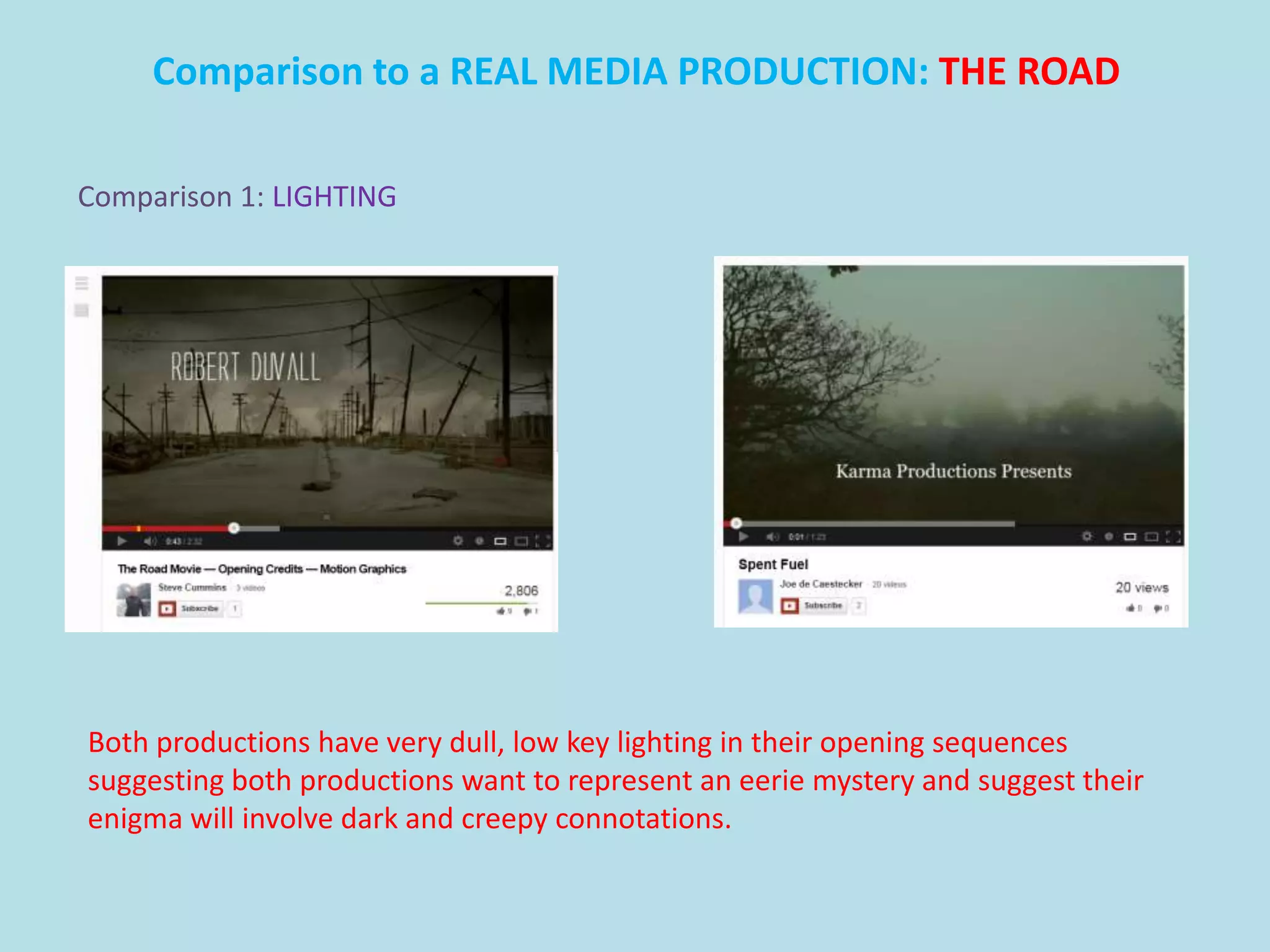
Comparison to a REAL MEDIA PRODUCTION: THE ROAD

Comparison 1: LIGHTING


Both productions have very dull, low key lighting in their opening sequences
suggesting both productions want to represent an eerie mystery and suggest their
enigma will involve dark and creepy connotations.
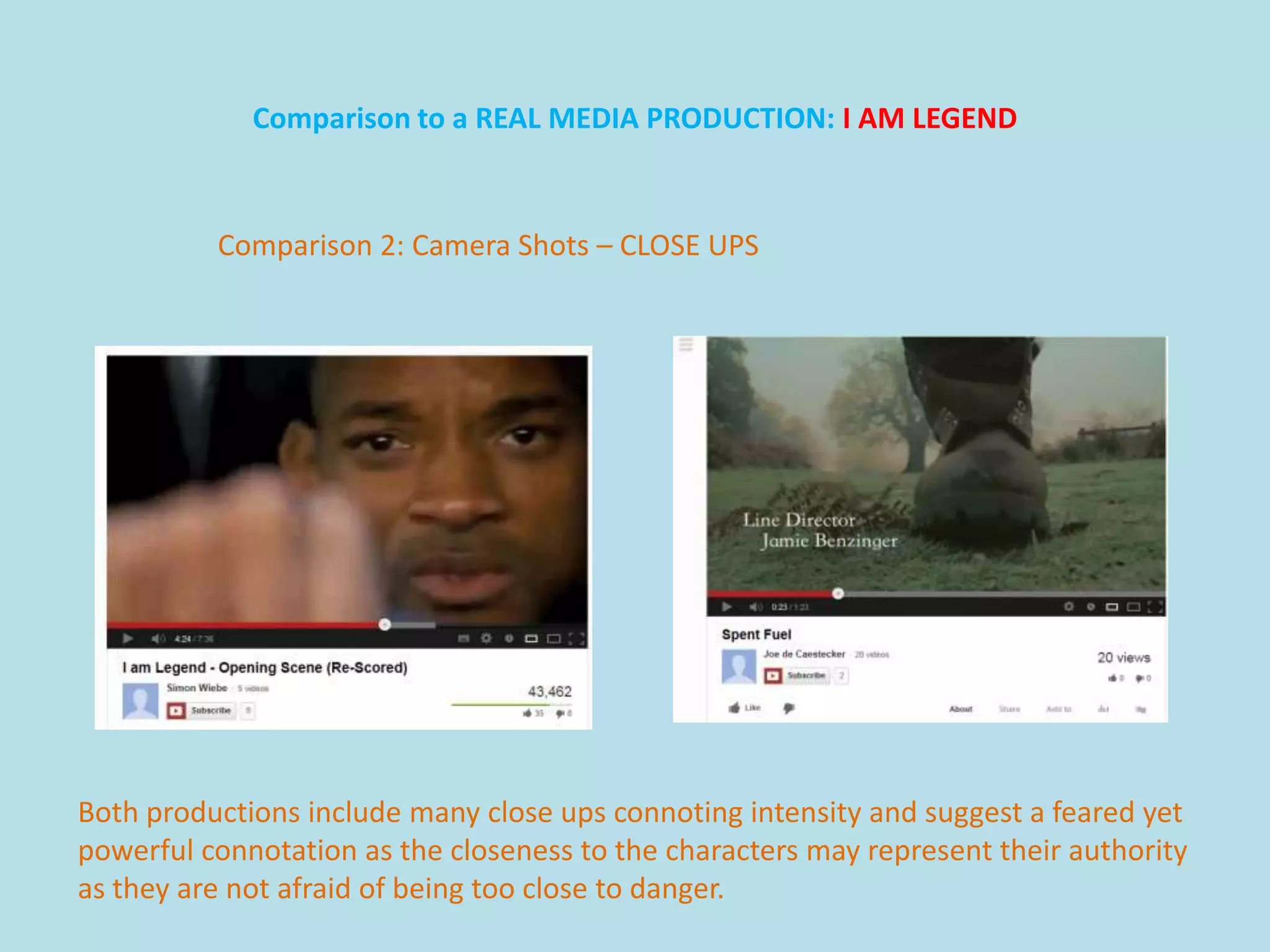
Comparison to a REAL MEDIA PRODUCTION: I AM LEGEND


          Comparison 2: Camera Shots – CLOSE UPS


Both productions include many close ups connoting intensity and suggest a feared yet
powerful connotation as the closeness to the characters may represent their authority
as they are not afraid of being too close to danger.
AUTEUR THEORY

• The auteur theory, in film criticism, suggests that a directors personal
  creative vision is what is reflected in their production. As the production is
  a process, the theory suggests that the director treats the product as a
  ‘work of art’ and as the creator of the film they influence their work.
• HOW AM I AN AUTEUR?
• I am an auteur in the way that the production I have completed with my
  group for AS has been influenced by my, and my groups, personal
  imagination and ideas. We have been creative artists in the way that we
  created and thought up all our ideas as film directors.
Conclusion
• All in all, I believe our production has to stuck
  to the conventions of the sci-fi genre and the
  drama genre. Also we have followed the
  opening sequence conventions for existing
  media products.

Evaluation - Question 1

  • 1.
    INSTITUTIONAL GENRE ICONOGRAPHY AUTEUR THEORY
  • 2.
    Conventions of theSCI-FI genre • 1. The genre is used by scientists to display their theories about the future. • * We applied this theory to our opening sequence through our narrative. Using the idea that there was an unexpected nuclear bomb. We researched into what Scientists believe the results of a nuclear bomb would have and have displayed them through our protagonists life, through his loneliness, his scars and burns and the flashbacks he experiences displaying an interpretation of the disaster. • 2. “The Day the Earth stood still.” • *This convention is particularly convenient for our narrative as our planet leads the audience to believe if is the end of the world for most of civilisation. • 3. It is conventional for the genre to use quick cuts and fast paced editing at moments of climax and intensity. • *We used this convention when it came to editing our flashbacks – this ensured we showed a distinct contrast between the disaster, and the recovery – also editing our flashbacks with quick cuts and having fast paced clips enabled us to portray an intense scene and display our climax. • 4. It is conventional to have a galaxy interpretation setting. • *We decided on a different location interpretation as a galaxy setting did not match our narrative which would then lose the continuity. • 5. Their is usually high tech machinery involved, which even though the audience are digital natives it is still too advanced for them to recognise. • *Part of our iconography in the final shot, where the camera zooms out revealing our disequilibrium involves the antagonist looking at a computer screen which we could use in a more advance way acting as high tech machinery. • 6. The pacing within the shot relies on the level of action within the scene. • * We applied this convention by making the shots of the protagonist on his own, far more slow paced when he was building up his recovery but still lonely, contrasting with the higher action shots, such as the flashbacks, where we use faster pacing and loud sound effects to represent more action, also when we reveal our dis-equilibrium to the audience we speed up pace in our shots to convey are climax.
  • 3.
    CONVENTIONS OF THEDRAMA GENRE • 1. Involves real life situations when describing the characters, narrative and setting. • *We challenged this convention in our opening sequence by following our narrative by having an extreme disaster take place, which takes real life situations to an unlucky extreme. However, we still believe we have following the convention when it comes to the character, as our protagonist is real in a way he experiences similar emotions to many of our audience. • 2. The characters develop throughout the film. • *Our film narrative involves the character seeking out the truth as to why he is being held hostage, and lead to believe he is the last man on earth. This follows the convention of a hero and how he saves the day, by saving himself and learning a lot about himself, developing into a stronger and braver character. • 3. Delivers intense social interaction. • This uses and gratifications applies to our audience, as we believe the shocking disequilibrium of the discovery that our protagonist is infact NOT the last man on earth will get the audience interacting with each other socially by discussing their views on the plot. • 4. The storyline is dramatic, often moving the audience emotionally. • This convention should apply to our audience, as they watch the protagonist suffer and recover it may be quite moving for the audience to watch causing them to react emotionally. • 5. Conflict inner and outer struggles. • *Inner conflict struggle – we demonstrated this convention in our opening sequence with the distress the protagonist experiences, such as his insecurity and unawareness which we represented through extreme close ups and slow paced shots. • *Outer conflict struggle – this is an element that is beyond the protagonists control, we represented this through the nuclear bomb and the antagonists being seen as the unknown. • 6. Audiences can relate to the character through personal identity. • *We support this convention as our protagonist is in a very lonely state of mind, which the audience would all experience at times. • 7. The narrative is structured with many climaxes and anti climaxes to keep the audience attached. • *Our narrative in our opening sequence is built around introducing the disequilibrium, which builds up tension for the audience keeping them attached. • 8. There is usually a form of realisation at the end. • *We challenged this convention in our opening sequence by leaving the narrative on a cliff-hanger, however in our full narrative we introduce a form of realisation by bringing in the new equilibrium as the hero resolves the enigma.
  • 4.
    Conventions of anopening sequence • The main conventions of an opening sequence are: • Credits (of main people - protagonist, director, writer etc.) • *In our production we show all the key names and titles required in an opening sequence. • Title of film • *We used this convention as our final shot, where we quick cut to “SPENT FUEL” • Company that the film is made by. (possible logo) • *Our company is “KARMA PRODUCTIONS” and there name is titled in shot 1. • Hint to genre of film/theme • *We followed the conventions of a sci-fi and a drama genre to ensure the audience was aware of the genres. • Sound • *We used an un-copyrighted song for the backing track, and also natural sounds. Also when it came to the flashback shots, we added in loud explosion sounds, and screams to represent the effect of the nuclear bomb. • Encoded signifiers (iconography) • *Some of our iconography is the gasmask throughout the film, and the computer in the final shot this signifies the sci-fi genre. • Possible introduction of character/s • *Our protagonist is the main focus of our opening sequence, however we introduce his family in the flashback, and in the final shot when we zoom out to reveal the antagonist the audience is introduced to him. • Narrative enigma • *We leave the final shot of our opening sequence on a cliff-hanger, therefore creating an enigma for the audience to solve. • linear/non-linear narrative • *Our narrative in our opening sequence is non-linear as we introduce a montage of flashbacks unordered. • possible mise-en-scene and location • *Our location completely sets up the narrative, as they are wide, lonely open spaces connoting the emotions of our protagonist.
  • 5.
    Institutional Conventions • INSTITUTIONAL CONVENTIONS – our production is rated a 12 by the BBFC. It is given to films that are best suited to those aged 12 or older. • No one younger than 12 may rent or buy a 12 rated video or DVD. Exactly the same rules are used to classify films at 12A as used to classify videos and DVDs at 12. • The Guidelines • Suitable for 12 years and over. No-one younger than 12 may see a ‘12A’ film in a cinema unless accompanied by an adult. No-one younger than 12 may rent or buy a ‘12’ rated video or DVD. Responsibility for allowing under 12s to view lies with the accompanying or supervising adult. • Theme: Mature themes are acceptable, but their treatment must be suitable for young teenagers. • Language: The use of strong language must be infrequent. Racist abuse is also of particular concern. • Nudity: Nudity is allowed, but in a sexual context it must be brief and discreet. • Sex: Sexual activity may be implied. Sex references may reflect what is likely to be familiar to most adolescents but should not go beyond what is suitable for them. • Violence: Violence must not dwell on detail. There should be no emphasis on injuries or blood. Sexual violence may only be implied or briefly and discreetly indicated. • Imitable techniques: Dangerous techniques (eg combat, hanging, suicide and self-harming) should not dwell on imitable detail or appear pain or harm free. Easily accessible weapons should not be glamorised. • Horror: Sustained moderate threat and menace are permitted. Occasional gory moments only. • Drugs: Any misuse of drugs must be infrequent and should not be glamorised or instructional. • Discrimination: The film or DVD as a whole must not approve of language or behaviour that would offend a person’s religion, colour, gender, sexuality or disability. Aggressive use of this type of language and behaviour is unacceptable unless clearly not approved of.
  • 6.
    Comparison to aREAL MEDIA PRODUCTION: THE ROAD Comparison 1: LIGHTING Both productions have very dull, low key lighting in their opening sequences suggesting both productions want to represent an eerie mystery and suggest their enigma will involve dark and creepy connotations.
  • 7.
    Comparison to aREAL MEDIA PRODUCTION: I AM LEGEND Comparison 2: Camera Shots – CLOSE UPS Both productions include many close ups connoting intensity and suggest a feared yet powerful connotation as the closeness to the characters may represent their authority as they are not afraid of being too close to danger.
  • 8.
    AUTEUR THEORY • Theauteur theory, in film criticism, suggests that a directors personal creative vision is what is reflected in their production. As the production is a process, the theory suggests that the director treats the product as a ‘work of art’ and as the creator of the film they influence their work. • HOW AM I AN AUTEUR? • I am an auteur in the way that the production I have completed with my group for AS has been influenced by my, and my groups, personal imagination and ideas. We have been creative artists in the way that we created and thought up all our ideas as film directors.
  • 9.
    Conclusion • All inall, I believe our production has to stuck to the conventions of the sci-fi genre and the drama genre. Also we have followed the opening sequence conventions for existing media products.