TECH4102 Evaluation in Educational Technology   Ev aluat ion of Online Learning   Dr. Alaa Sadik Department of Instructional & Learning Technologies www.alaasadik.net [email_address] March 2009
Evaluation of online learning   Evaluating student performance. Evaluating the learning environment itself.
Evaluating student performance Used to assess students’ learning. Apply a  mix of  traditional and online evaluation forms . Cover the multiple dimensions of learning.
Evaluating student performance Different forms of assessment include: Quizzes  End of semester essays  Group projects Case studies Journals Online portfolios Chat room responses Threaded discussions participation
Evaluation of discussion participation Example Participation in discussions Indicators of success Degree of participation  Interaction Cognitive and content-related posts
Evaluation of discussion participation Degree of participation  The total number of messages per student in the course.  Number of messages per student in every discussion topic.  Number of messages in earlier lessons. Number of messages in later lessons. Lengths of message per student (in statements). Number of statements directly related to learning per student.
Evaluation of discussion participation Interaction Self-introduction. Statements that social in nature. Statements that comment in another message. Repeating information in another message. Responding to the tutor's views or advises.  Responding to accept others’ views and opinions without explanation.
Evaluation of discussion participation Cognitive and content-related   Providing solution with explanation. Providing more than one solution. Asking question related to the discussion topic. Asking for more clarification. Judging the relevance of solution. Repeating information contained in the course materials. Drawing conclusions .
Evaluation of discussion participation Example: Interaction ‘ […] the relation between the two lines of the equations is changing a changes the slope of the equation as Mona said’. ‘ I think Walied’s found the correct answer. My answer is the same as his’. 2.38% Responding to accept or reject others’ views and opinions without explanation. ‘ I used Grapher to graph the negative values. The difference is the graph will be plotted in the quof page […]’. ‘ Hello Mr […], I'll do that at home because there is no time today’. 7.14% Responding to the tutor’s views or advice. ‘ The relationship between the height of a plant and its age’ ‘ The relationship between the age and the height of a person is a function’. 35.71% Repeating information in another message . ‘ So do I […]’. ‘ I found the same results as Mohamed Abd Elrahman […]’. ‘ I think Walied found the correct answer […]’. ‘ Of course Ahmed, for example […]’. ‘ Mark, you can’t use the Grapher […]’. 19.05% Statements that comment on another message. ‘ My opinion is this equation […]’. ‘ I solved […]’. 23.81% Self-introduction. Examples of responses Percent Patterns
Evaluating online learning environment Components of online learning environments Tutorial and assessment component  Interaction component Management component Support component
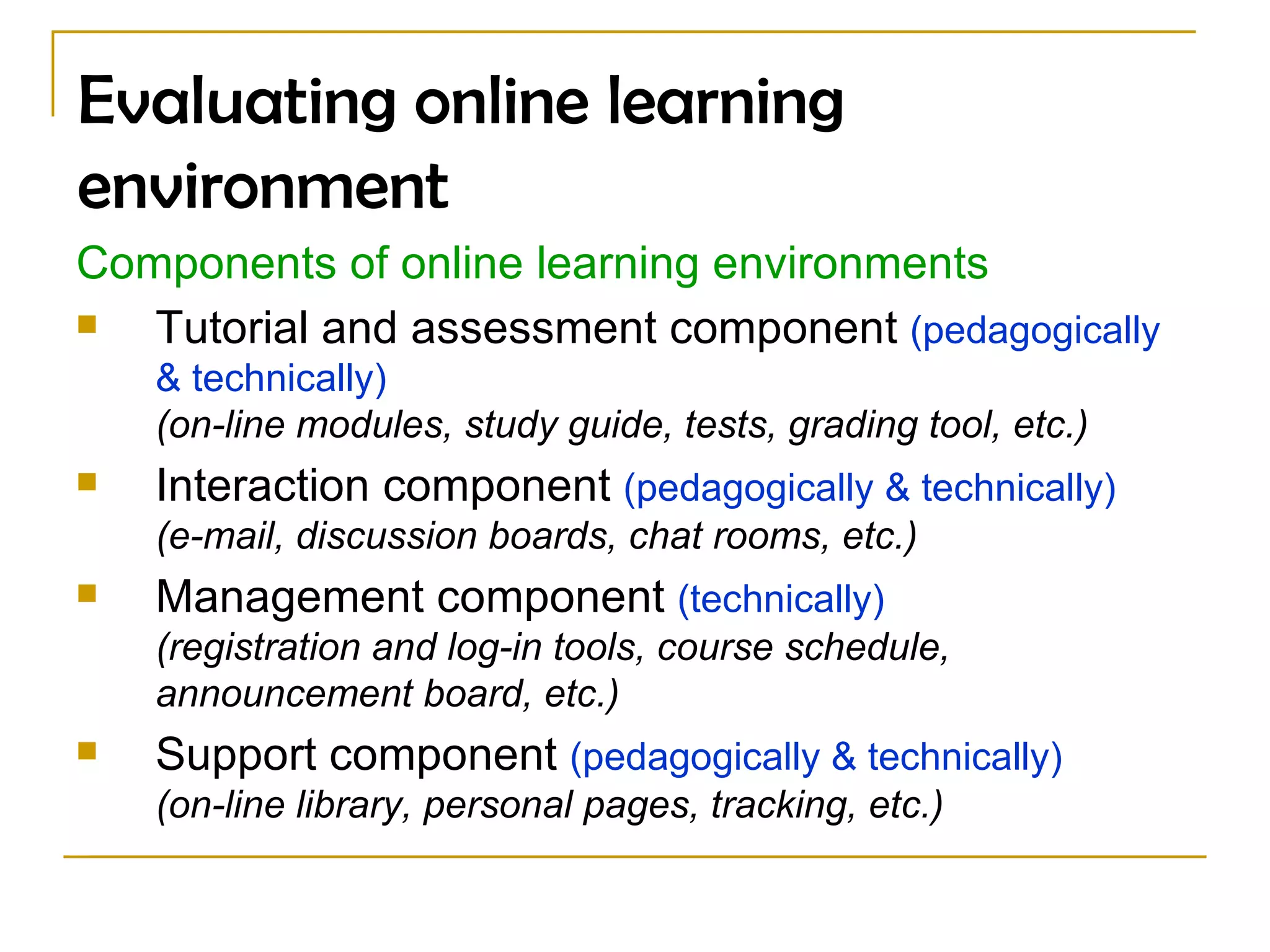
Evaluating online learning environment Components of online learning environments Tutorial and assessment component  (pedagogically & technically) (on-line modules, study guide, tests, grading tool, etc.) Interaction component  (pedagogically & technically) (e-mail, discussion boards, chat rooms, etc.) Management component  (technically) (registration and log-in tools, course schedule, announcement board, etc.) Support component  (pedagogically & technically)   (on-line library, personal pages, tracking, etc.)
Evaluating online learning environment Example of evaluation standards Resources are easily located.  Powerful as well as suitable research engines are available for learners. Resources are suitable for the learners’ level.  … Which component?
Evaluating online learning environment Example of evaluation standards The design of learning provides many opportunities for interactivity by enabling students to work co-operatively.  The design of course content challenges the student to play an active role in assimilating knowledge.  Students are engaged in active problem-solving situations to construct their own knowledge.  Which component?
Evaluating online learning environment Application Evaluate an online learning environment in terms of:  Student learning Effectiveness of the learning environment

Evaluation of online learning

  • 1.
    TECH4102 Evaluation inEducational Technology Ev aluat ion of Online Learning Dr. Alaa Sadik Department of Instructional & Learning Technologies www.alaasadik.net [email_address] March 2009
  • 2.
    Evaluation of onlinelearning Evaluating student performance. Evaluating the learning environment itself.
  • 3.
    Evaluating student performanceUsed to assess students’ learning. Apply a mix of traditional and online evaluation forms . Cover the multiple dimensions of learning.
  • 4.
    Evaluating student performanceDifferent forms of assessment include: Quizzes End of semester essays Group projects Case studies Journals Online portfolios Chat room responses Threaded discussions participation
  • 5.
    Evaluation of discussionparticipation Example Participation in discussions Indicators of success Degree of participation Interaction Cognitive and content-related posts
  • 6.
    Evaluation of discussionparticipation Degree of participation The total number of messages per student in the course. Number of messages per student in every discussion topic. Number of messages in earlier lessons. Number of messages in later lessons. Lengths of message per student (in statements). Number of statements directly related to learning per student.
  • 7.
    Evaluation of discussionparticipation Interaction Self-introduction. Statements that social in nature. Statements that comment in another message. Repeating information in another message. Responding to the tutor's views or advises. Responding to accept others’ views and opinions without explanation.
  • 8.
    Evaluation of discussionparticipation Cognitive and content-related Providing solution with explanation. Providing more than one solution. Asking question related to the discussion topic. Asking for more clarification. Judging the relevance of solution. Repeating information contained in the course materials. Drawing conclusions .
  • 9.
    Evaluation of discussionparticipation Example: Interaction ‘ […] the relation between the two lines of the equations is changing a changes the slope of the equation as Mona said’. ‘ I think Walied’s found the correct answer. My answer is the same as his’. 2.38% Responding to accept or reject others’ views and opinions without explanation. ‘ I used Grapher to graph the negative values. The difference is the graph will be plotted in the quof page […]’. ‘ Hello Mr […], I'll do that at home because there is no time today’. 7.14% Responding to the tutor’s views or advice. ‘ The relationship between the height of a plant and its age’ ‘ The relationship between the age and the height of a person is a function’. 35.71% Repeating information in another message . ‘ So do I […]’. ‘ I found the same results as Mohamed Abd Elrahman […]’. ‘ I think Walied found the correct answer […]’. ‘ Of course Ahmed, for example […]’. ‘ Mark, you can’t use the Grapher […]’. 19.05% Statements that comment on another message. ‘ My opinion is this equation […]’. ‘ I solved […]’. 23.81% Self-introduction. Examples of responses Percent Patterns
  • 10.
    Evaluating online learningenvironment Components of online learning environments Tutorial and assessment component Interaction component Management component Support component
  • 11.
    Evaluating online learningenvironment Components of online learning environments Tutorial and assessment component (pedagogically & technically) (on-line modules, study guide, tests, grading tool, etc.) Interaction component (pedagogically & technically) (e-mail, discussion boards, chat rooms, etc.) Management component (technically) (registration and log-in tools, course schedule, announcement board, etc.) Support component (pedagogically & technically) (on-line library, personal pages, tracking, etc.)
  • 12.
    Evaluating online learningenvironment Example of evaluation standards Resources are easily located. Powerful as well as suitable research engines are available for learners. Resources are suitable for the learners’ level. … Which component?
  • 13.
    Evaluating online learningenvironment Example of evaluation standards The design of learning provides many opportunities for interactivity by enabling students to work co-operatively. The design of course content challenges the student to play an active role in assimilating knowledge. Students are engaged in active problem-solving situations to construct their own knowledge. Which component?
  • 14.
    Evaluating online learningenvironment Application Evaluate an online learning environment in terms of: Student learning Effectiveness of the learning environment