Evaluation and
Management
Coding
Psychiatry Related Coding
Outpatient Care
This Photo by Unknown Author is licensed under CC BY-NC-ND
Created by Laura Murdock, CPPM, CMPE, SHRM-SCP, WCCP, SIP, CPC
Psychiatric
Services
Created by Laura Murdock, CPPM, CMPE, SHRM-SCP, WCCP, SIP, CPC
Evaluation and Management
Types of Services
 Consultation
 Hospital Admission
 Office Visits
 Well Visits
 Emergency Visits
 Nursing Facility Visits
 Etc.
Created by Laura Murdock, CPPM, CMPE, SHRM-SCP, WCCP, SIP, CPC
What do payers want and why?
The site of service
The medical necessity and
appropriateness of the
diagnostic and/or
therapeutic services
provided
Services provided have been
accurately reported
Created by Laura Murdock, CPPM, CMPE, SHRM-SCP, WCCP, SIP, CPC
Evaluation and
Management
Guidelines
 *Required and published by CMS
 *Two Versions—1995 and 1997
 *Provider selects a version for consistent use
with all E/M services
 *The 1997 Guidelines calls for a greater detail
or a “bullet point” approach
Created by Laura Murdock, CPPM, CMPE, SHRM-SCP, WCCP, SIP, CPC
Difference between 1995 and 1997
Guidelines
 1995 Guidelines provide a great level of detail regarding the history and
examination but leave the medical decision making vague.
 Many providers felt the medical necessity should be the driving force behind
the code selection. This lead to upcoding evaluation and management
services.
Created by Laura Murdock, CPPM, CMPE, SHRM-SCP, WCCP, SIP, CPC
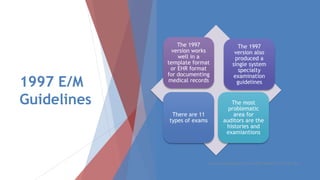
1997 E/M
Guidelines
The 1997
version works
well in a
template format
or EHR format
for documenting
medical records
The 1997
version also
produced a
single system
specialty
examination
guidelines
There are 11
types of exams
The most
problematic
area for
auditors are the
histories and
examiantions
Created by Laura Murdock, CPPM, CMPE, SHRM-SCP, WCCP, SIP, CPC
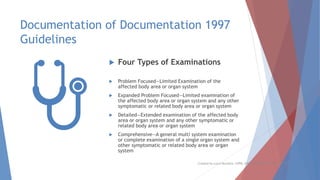
Documentation of Documentation 1997
Guidelines
 Four Types of Examinations
 Problem Focused—Limited Examination of the
affected body area or organ system
 Expanded Problem Focused—Limited examination of
the affected body area or organ system and any other
symptomatic or related body area or organ system
 Detailed—Extended examination of the affected body
area or organ system and any other symptomatic or
related body area or organ system
 Comprehensive—A general multi system examination
or complete examination of a single organ system and
other symptomatic or related body area or organ
system
Created by Laura Murdock, CPPM, CMPE, SHRM-SCP, WCCP, SIP, CPC
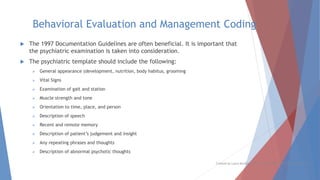
Behavioral Evaluation and Management Coding
 The 1997 Documentation Guidelines are often beneficial. It is important that
the psychiatric examination is taken into consideration.
 The psychiatric template should include the following:
➢ General appearance (development, nutrition, body habitus, grooming
➢ Vital Signs
➢ Examination of gait and station
➢ Muscle strength and tone
➢ Orientation to time, place, and person
➢ Description of speech
➢ Recent and remote memory
➢ Description of patient’s judgement and insight
➢ Any repeating phrases and thoughts
➢ Description of abnormal psychotic thoughts
Created by Laura Murdock, CPPM, CMPE, SHRM-SCP, WCCP, SIP, CPC
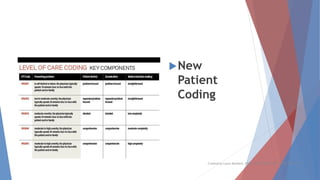
New
Patient
Coding
Created by Laura Murdock, CPPM, CMPE, SHRM-SCP, WCCP, SIP, CPC
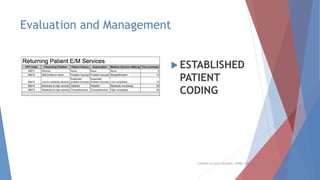
Evaluation and Management
 ESTABLISHED
PATIENT
CODING
Created by Laura Murdock, CPPM, CMPE, SHRM-SCP, WCCP, SIP, CPC
Documentation
for Patient
Encounters
A reason for the encounter and relevant
history, physical examination findings, and
prior diagnostic tests results.
Assessment, clinical impression, or
diagnosis
Plan for care
Date and legible identity of provider
Created by Laura Murdock, CPPM, CMPE, SHRM-SCP, WCCP, SIP, CPC
Patient Status
New patient—One who has not
received professional service
from the physician or another
physician of the exact same
specialty and subspecialty who
belongs to the same group
practice, within the past 3
years.
Established patient—One who
has received professional
service from the physician or
another physician of the exact
same specialty and
subspecialty who belongs to
the same group practice,
within the past 3 years.
Created by Laura Murdock, CPPM, CMPE, SHRM-SCP, WCCP, SIP, CPC
Evaluation &
Management
Factors
Three Factors of Evaluation and
Management Code
1. Place of Service
2. Type of Service
3. Patient Status
Created by Laura Murdock, CPPM, CMPE, SHRM-SCP, WCCP, SIP, CPC
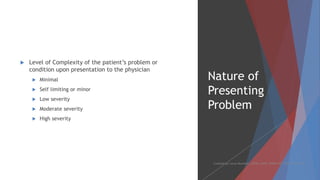
Nature of
Presenting
Problem
 Level of Complexity of the patient’s problem or
condition upon presentation to the physician
 Minimal
 Self limiting or minor
 Low severity
 Moderate severity
 High severity
Created by Laura Murdock, CPPM, CMPE, SHRM-SCP, WCCP, SIP, CPC
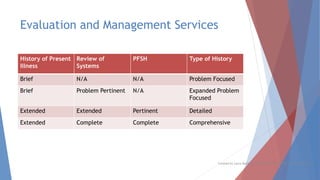
Evaluation and Management Services
History of Present
Illness
Review of
Systems
PFSH Type of History
Brief N/A N/A Problem Focused
Brief Problem Pertinent N/A Expanded Problem
Focused
Extended Extended Pertinent Detailed
Extended Complete Complete Comprehensive
Created by Laura Murdock, CPPM, CMPE, SHRM-SCP, WCCP, SIP, CPC
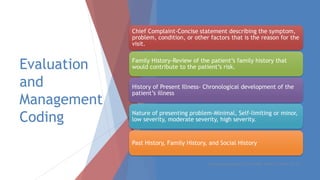
Evaluation
and
Management
Coding
Chief Complaint-Concise statement describing the symptom,
problem, condition, or other factors that is the reason for the
visit.
Family History-Review of the patient’s family history that
would contribute to the patient’s risk.
History of Present Illness- Chronological development of the
patient’s illness
Nature of presenting problem-Minimal, Self-limiting or minor,
low severity, moderate severity, high severity.
Past History, Family History, and Social History
Created by Laura Murdock, CPPM, CMPE, SHRM-SCP, WCCP, SIP, CPC
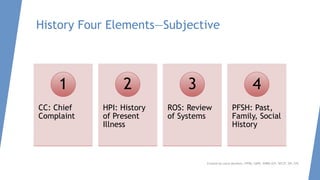
History Four Elements—Subjective
CC: Chief
Complaint
1
HPI: History
of Present
Illness
2
ROS: Review
of Systems
3
PFSH: Past,
Family, Social
History
4
Created by Laura Murdock, CPPM, CMPE, SHRM-SCP, WCCP, SIP, CPC
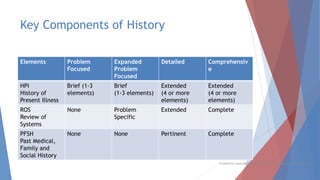
Key Components of History
Elements Problem
Focused
Expanded
Problem
Focused
Detailed Comprehensiv
e
HPI
History of
Present Illness
Brief (1-3
elements)
Brief
(1-3 elements)
Extended
(4 or more
elements)
Extended
(4 or more
elements)
ROS
Review of
Systems
None Problem
Specific
Extended Complete
PFSH
Past Medical,
Family and
Social History
None None Pertinent Complete
Created by Laura Murdock, CPPM, CMPE, SHRM-SCP, WCCP, SIP, CPC
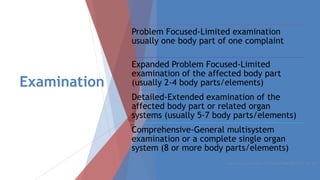
Examination
Problem Focused-Limited examination
usually one body part of one complaint
Expanded Problem Focused-Limited
examination of the affected body part
(usually 2-4 body parts/elements)
Detailed-Extended examination of the
affected body part or related organ
systems (usually 5-7 body parts/elements)
Comprehensive-General multisystem
examination or a complete single organ
system (8 or more body parts/elements)
Created by Laura Murdock, CPPM, CMPE, SHRM-SCP, WCCP, SIP, CPC
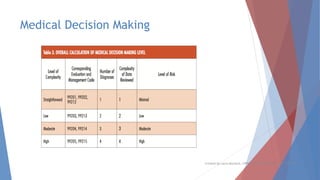
Medical Decision Making (MDM) Complexity
Diagnosis or
management
option
Amount and
complexity of
data to review
Patient Risk
Created by Laura Murdock, CPPM, CMPE, SHRM-SCP, WCCP, SIP, CPC
Medical Decision Making
Created by Laura Murdock, CPPM, CMPE, SHRM-SCP, WCCP, SIP, CPC
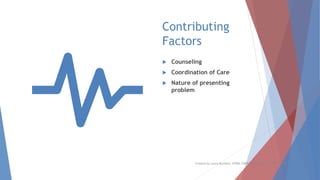
Contributing
Factors
 Counseling
 Coordination of Care
 Nature of presenting
problem
Created by Laura Murdock, CPPM, CMPE, SHRM-SCP, WCCP, SIP, CPC
Counseling
 Documentation must
support that greater
than 50% of the face
to face visit was
spent in counseling or
coordination of care.
Created by Laura Murdock, CPPM, CMPE, SHRM-SCP, WCCP, SIP, CPC
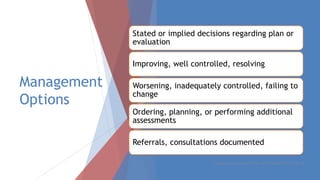
Management
Options
Stated or implied decisions regarding plan or
evaluation
Improving, well controlled, resolving
Worsening, inadequately controlled, failing to
change
Ordering, planning, or performing additional
assessments
Referrals, consultations documented
Created by Laura Murdock, CPPM, CMPE, SHRM-SCP, WCCP, SIP, CPC

Evaluation and management coding training

  • 1.
    Evaluation and Management Coding Psychiatry RelatedCoding Outpatient Care This Photo by Unknown Author is licensed under CC BY-NC-ND Created by Laura Murdock, CPPM, CMPE, SHRM-SCP, WCCP, SIP, CPC
  • 2.
    Psychiatric Services Created by LauraMurdock, CPPM, CMPE, SHRM-SCP, WCCP, SIP, CPC
  • 3.
    Evaluation and Management Typesof Services  Consultation  Hospital Admission  Office Visits  Well Visits  Emergency Visits  Nursing Facility Visits  Etc. Created by Laura Murdock, CPPM, CMPE, SHRM-SCP, WCCP, SIP, CPC
  • 4.
    What do payerswant and why? The site of service The medical necessity and appropriateness of the diagnostic and/or therapeutic services provided Services provided have been accurately reported Created by Laura Murdock, CPPM, CMPE, SHRM-SCP, WCCP, SIP, CPC
  • 5.
    Evaluation and Management Guidelines  *Requiredand published by CMS  *Two Versions—1995 and 1997  *Provider selects a version for consistent use with all E/M services  *The 1997 Guidelines calls for a greater detail or a “bullet point” approach Created by Laura Murdock, CPPM, CMPE, SHRM-SCP, WCCP, SIP, CPC
  • 6.
    Difference between 1995and 1997 Guidelines  1995 Guidelines provide a great level of detail regarding the history and examination but leave the medical decision making vague.  Many providers felt the medical necessity should be the driving force behind the code selection. This lead to upcoding evaluation and management services. Created by Laura Murdock, CPPM, CMPE, SHRM-SCP, WCCP, SIP, CPC
  • 7.
    1997 E/M Guidelines The 1997 versionworks well in a template format or EHR format for documenting medical records The 1997 version also produced a single system specialty examination guidelines There are 11 types of exams The most problematic area for auditors are the histories and examiantions Created by Laura Murdock, CPPM, CMPE, SHRM-SCP, WCCP, SIP, CPC
  • 8.
    Documentation of Documentation1997 Guidelines  Four Types of Examinations  Problem Focused—Limited Examination of the affected body area or organ system  Expanded Problem Focused—Limited examination of the affected body area or organ system and any other symptomatic or related body area or organ system  Detailed—Extended examination of the affected body area or organ system and any other symptomatic or related body area or organ system  Comprehensive—A general multi system examination or complete examination of a single organ system and other symptomatic or related body area or organ system Created by Laura Murdock, CPPM, CMPE, SHRM-SCP, WCCP, SIP, CPC
  • 9.
    Behavioral Evaluation andManagement Coding  The 1997 Documentation Guidelines are often beneficial. It is important that the psychiatric examination is taken into consideration.  The psychiatric template should include the following: ➢ General appearance (development, nutrition, body habitus, grooming ➢ Vital Signs ➢ Examination of gait and station ➢ Muscle strength and tone ➢ Orientation to time, place, and person ➢ Description of speech ➢ Recent and remote memory ➢ Description of patient’s judgement and insight ➢ Any repeating phrases and thoughts ➢ Description of abnormal psychotic thoughts Created by Laura Murdock, CPPM, CMPE, SHRM-SCP, WCCP, SIP, CPC
  • 10.
    New Patient Coding Created by LauraMurdock, CPPM, CMPE, SHRM-SCP, WCCP, SIP, CPC
  • 11.
    Evaluation and Management ESTABLISHED PATIENT CODING Created by Laura Murdock, CPPM, CMPE, SHRM-SCP, WCCP, SIP, CPC
  • 12.
    Documentation for Patient Encounters A reasonfor the encounter and relevant history, physical examination findings, and prior diagnostic tests results. Assessment, clinical impression, or diagnosis Plan for care Date and legible identity of provider Created by Laura Murdock, CPPM, CMPE, SHRM-SCP, WCCP, SIP, CPC
  • 13.
    Patient Status New patient—Onewho has not received professional service from the physician or another physician of the exact same specialty and subspecialty who belongs to the same group practice, within the past 3 years. Established patient—One who has received professional service from the physician or another physician of the exact same specialty and subspecialty who belongs to the same group practice, within the past 3 years. Created by Laura Murdock, CPPM, CMPE, SHRM-SCP, WCCP, SIP, CPC
  • 14.
    Evaluation & Management Factors Three Factorsof Evaluation and Management Code 1. Place of Service 2. Type of Service 3. Patient Status Created by Laura Murdock, CPPM, CMPE, SHRM-SCP, WCCP, SIP, CPC
  • 15.
    Nature of Presenting Problem  Levelof Complexity of the patient’s problem or condition upon presentation to the physician  Minimal  Self limiting or minor  Low severity  Moderate severity  High severity Created by Laura Murdock, CPPM, CMPE, SHRM-SCP, WCCP, SIP, CPC
  • 16.
    Evaluation and ManagementServices History of Present Illness Review of Systems PFSH Type of History Brief N/A N/A Problem Focused Brief Problem Pertinent N/A Expanded Problem Focused Extended Extended Pertinent Detailed Extended Complete Complete Comprehensive Created by Laura Murdock, CPPM, CMPE, SHRM-SCP, WCCP, SIP, CPC
  • 17.
    Evaluation and Management Coding Chief Complaint-Concise statementdescribing the symptom, problem, condition, or other factors that is the reason for the visit. Family History-Review of the patient’s family history that would contribute to the patient’s risk. History of Present Illness- Chronological development of the patient’s illness Nature of presenting problem-Minimal, Self-limiting or minor, low severity, moderate severity, high severity. Past History, Family History, and Social History Created by Laura Murdock, CPPM, CMPE, SHRM-SCP, WCCP, SIP, CPC
  • 18.
    History Four Elements—Subjective CC:Chief Complaint 1 HPI: History of Present Illness 2 ROS: Review of Systems 3 PFSH: Past, Family, Social History 4 Created by Laura Murdock, CPPM, CMPE, SHRM-SCP, WCCP, SIP, CPC
  • 19.
    Key Components ofHistory Elements Problem Focused Expanded Problem Focused Detailed Comprehensiv e HPI History of Present Illness Brief (1-3 elements) Brief (1-3 elements) Extended (4 or more elements) Extended (4 or more elements) ROS Review of Systems None Problem Specific Extended Complete PFSH Past Medical, Family and Social History None None Pertinent Complete Created by Laura Murdock, CPPM, CMPE, SHRM-SCP, WCCP, SIP, CPC
  • 20.
    Examination Problem Focused-Limited examination usuallyone body part of one complaint Expanded Problem Focused-Limited examination of the affected body part (usually 2-4 body parts/elements) Detailed-Extended examination of the affected body part or related organ systems (usually 5-7 body parts/elements) Comprehensive-General multisystem examination or a complete single organ system (8 or more body parts/elements) Created by Laura Murdock, CPPM, CMPE, SHRM-SCP, WCCP, SIP, CPC
  • 21.
    Medical Decision Making(MDM) Complexity Diagnosis or management option Amount and complexity of data to review Patient Risk Created by Laura Murdock, CPPM, CMPE, SHRM-SCP, WCCP, SIP, CPC
  • 22.
    Medical Decision Making Createdby Laura Murdock, CPPM, CMPE, SHRM-SCP, WCCP, SIP, CPC
  • 23.
    Contributing Factors  Counseling  Coordinationof Care  Nature of presenting problem Created by Laura Murdock, CPPM, CMPE, SHRM-SCP, WCCP, SIP, CPC
  • 24.
    Counseling  Documentation must supportthat greater than 50% of the face to face visit was spent in counseling or coordination of care. Created by Laura Murdock, CPPM, CMPE, SHRM-SCP, WCCP, SIP, CPC
  • 25.
    Management Options Stated or implieddecisions regarding plan or evaluation Improving, well controlled, resolving Worsening, inadequately controlled, failing to change Ordering, planning, or performing additional assessments Referrals, consultations documented Created by Laura Murdock, CPPM, CMPE, SHRM-SCP, WCCP, SIP, CPC