Topic:
Numerical method for ODEs
Euler Method
Improved Euler Method
Runge-kutta’s Method
Prepared by:
Sohaib Siddique Butt
University of Gujrat
NUMERICALANALYSIS
Ordinary Differential Equation
Definition:
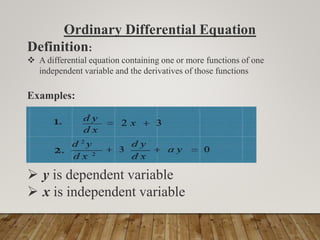
 A differential equation containing one or more functions of one
independent variable and the derivatives of those functions
Examples:
 y is dependent variable
 x is independent variable
Solution to Ordinary Differential
Equations
Analytical solutions: Eigenvalues, time
constants, damping coefficients
Numerical solutions: Euler Method, Runge-
Kutta Method
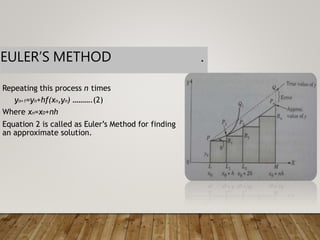
EULER’S METHOD
𝑑𝑥
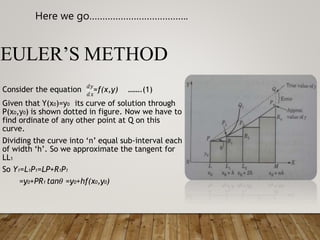
Consider the equation 𝑑𝑦
=f(x,y) …….(1)
Given that Y(x0)=y0 its curve of solution through
P(x0,y0) is shown dotted in figure. Now we have to
find ordinate of any other point at Q on this
curve.
Dividing the curve into ‘n’ equal sub-interval each
of width ‘h’. So we approximate the tangent for
LL1
So Y1=L1P1=LP+R1P1
=y0+PR1 tan𝜃 =y0+hf(x0,y0)
Here we go………………………………..
EULER’S METHOD .
Repeating this process n times
yn+1=yn+hf(xn,yn) ……….(2)
Where xn=x0+nh
Equation 2 is called as Euler’s Method for finding
an approximate solution.
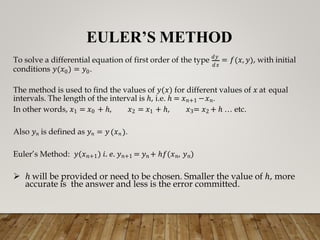
EULER’S METHOD
𝑑𝑥
To solve a differential equation of first order of the type 𝑑𝑦
= 𝑓 𝑥, 𝑦 , with initial
0 0conditions 𝑦 𝑥 = 𝑦 .
The method is used to find the values of 𝑦(𝑥) for different values of 𝑥 at equal
intervals. The length of the interval is ℎ, i.e. ℎ = 𝑥 𝑛+1 −𝑥 𝑛.
In other words, 𝑥1 = 𝑥0 + ℎ, 𝑥2 = 𝑥1 + ℎ, 𝑥3= 𝑥2 + ℎ … etc.
Also 𝑦 𝑛 is defined as 𝑦 𝑛 = 𝑦 𝑥 𝑛 .
Euler’s Method: 𝑦 𝑥 𝑛+1 𝑖. 𝑒. 𝑦 𝑛+1 = 𝑦 𝑛 + ℎ𝑓(𝑥 𝑛, 𝑦 𝑛)
 ℎ will be provided or need to be chosen. Smaller the value of ℎ, more
accurate is the answer and less is the error committed.
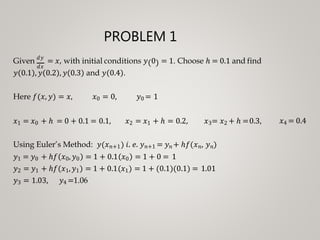
PROBLEM 1
Given 𝑑𝑦
= 𝑥, with initial conditions 𝑦 0 = 1. Choose ℎ = 0.1 and find
𝑑𝑥
𝑦 0.1 , 𝑦 0.2 , 𝑦 0.3 and 𝑦 0.4 .
Here 𝑓 𝑥, 𝑦 = 𝑥, 𝑥0 = 0, 𝑦0 = 1
𝑥1 = 𝑥0 + ℎ = 0 + 0.1 = 0.1, 𝑥2 = 𝑥1 + ℎ = 0.2, 𝑥3= 𝑥2 + ℎ =0.3, 𝑥4 = 0.4
Using Euler’s Method: 𝑦 𝑥 𝑛+1 𝑖. 𝑒. 𝑦 𝑛+1 = 𝑦 𝑛 + ℎ𝑓(𝑥 𝑛, 𝑦 𝑛)
𝑦1 = 𝑦0 + ℎ𝑓 𝑥0, 𝑦0
𝑦2 = 𝑦1 + ℎ𝑓 𝑥1, 𝑦1
= 1 + 0.1 𝑥0
= 1 + 0.1 𝑥1
= 1 + 0 = 1
= 1 + (0.1)(0.1) = 1.01
𝑦3 = 1.03, 𝑦4 =1.06
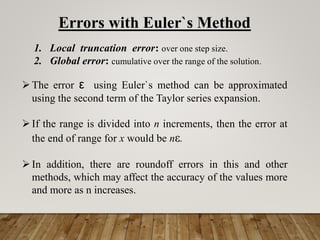
Errors with Euler`s Method
1. Local truncation error: over one step size.
2. Global error: cumulative over the range of the solution.
The error ε using Euler`s method can be approximated
using the second term of the Taylor series expansion.
If the range is divided into n increments, then the error at
the end of range for x would be nε.
In addition, there are roundoff errors in this and other
methods, which may affect the accuracy of the values more
and more as n increases.
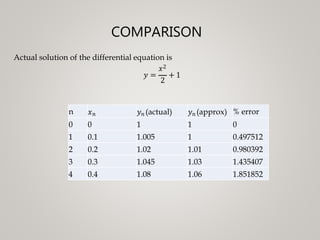
COMPARISON
Actual solution of the differential equation is
𝑥2
2
𝑦 = + 1
n 𝑥 𝑛 𝑦 𝑛 (actual) 𝑦 𝑛 (approx) % error
0 0 1 1 0
1 0.1 1.005 1 0.497512
2 0.2 1.02 1.01 0.980392
3 0.3 1.045 1.03 1.435407
4 0.4 1.08 1.06 1.851852
IMPROVED EULER’S METHOD
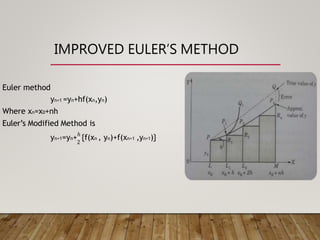
In the Euler’s improved method , The curve of the solution in the interval LL1 is
approximates by the tangent at P such as at P1 we have,
Y1=y0+hf(x0,y0)
Than the slope of the curve of the solution through P1 is computed at the tangent at P1
to P1Q1 is drawn meeting the ordinate through L2 in P2(x0+2h,y2)……1
Now we find better approximation y1’ of y(x0+h) by taking the slope of the curve as the
mean of the slope of the tangent at P and P1 i.e.
Y1’=y0+ ℎ
{f(x0+y0)+f(X0+h,Y1)}…..2
2
As the slope of the tangent at P1 is not known, We take Y1 is found in equation (1)
IMPROVED EULER’S METHOD
Euler method
yn+1 =yn+hf(xn,yn)
Where xn=x0+nh
Euler’s Modified Method is
2
yn+1=yn+ℎ
{f(xn , yn)+f(xn+1 ,yn+1)}
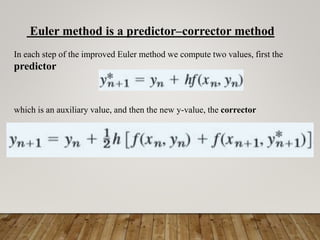
Euler method is a predictor–corrector method
In each step of the improved Euler method we compute two values, first the
predictor
which is an auxiliary value, and then the new y-value, the corrector
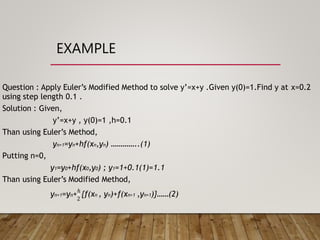
EXAMPLE
Question : Apply Euler’s Modified Method to solve y’=x+y .Given y(0)=1.Find y at x=0.2
using step length 0.1 .
Solution : Given,
y’=x+y , y(0)=1 ,h=0.1
Than using Euler’s Method,
yn+1=yn+hf(xn,yn) …………..(1)
Putting n=0,
y1=y0+hf(x0,y0) ; y1=1+0.1(1)=1.1
Than using Euler’s Modified Method,
2
yn+1=yn+ℎ
{f(xn , yn)+f(xn+1 ,yn+1)}……(2)
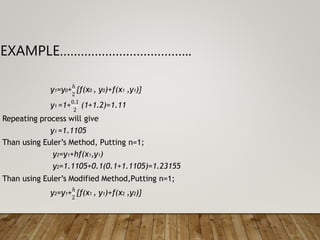
EXAMPLE………………………………..
2
y1=y0+ℎ
{f(x0 , y0)+f(x1 ,y1)}
y1 =1+0.1
(1+1.2)=1.11
2
Repeating process will give
y1 =1.1105
Than using Euler’s Method, Putting n=1;
y2=y1+hf(x1,y1)
y2=1.1105+0.1(0.1+1.1105)=1.23155
Than using Euler’s Modified Method,Putting n=1;
2
y2=y1+ℎ
{f(x1 , y1)+f(x2 ,y2)}
CONTINUE…………………………..
y2=1.1105+0.1
(1.2105+1.43155)=1.2426
2
Repeating process will give
y2=1.2432
At y(0.2)=1.2432 Answer.
RUNGE-KUTTA’S METHOD
Method of great practical importance
Much greater accuracy than that of the improved
Euler method
The classical Runge–Kutta method of fourth
order, which we call briefly the Runge–Kutta
method.
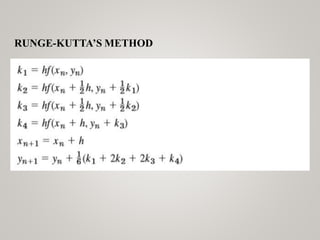
RUNGE-KUTTA’S METHOD
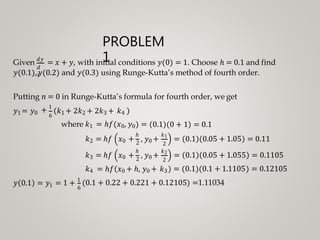
PROBLEM
1
𝑑
𝑥
Given 𝑑𝑦
= 𝑥 + 𝑦, with initial conditions 𝑦 0 = 1. Choose ℎ = 0.1 and find
𝑦 0.1 , 𝑦 0.2 and 𝑦 0.3 using Runge-Kutta’s method of fourth order.
Putting 𝑛 = 0 in Runge-Kutta’s formula for fourth order, we get
𝑦1 = 𝑦0 + 1
6
𝑘1 + 2𝑘2 + 2𝑘3 + 𝑘4
where 𝑘1 = ℎ𝑓 𝑥0, 𝑦0 = 0.1 0 + 1 = 0.1
ℎ
= 0.1 0.05 + 1.05 = 0.11𝑘2 = ℎ𝑓
𝑘3 = ℎ𝑓
ℎ
𝑥0 + 2
, 𝑦0 +
𝑥0 + 2
, 𝑦0 +
𝑘1
2
𝑘2
2
𝑘4 = ℎ𝑓 𝑥0 + ℎ, 𝑦0 + 𝑘3
= 0.1 0.05 + 1.055
= 0.1 0.1 + 1.1105
= 0.1105
= 0.12105
1𝑦 0.1 = 𝑦 = 1 + 1
6
0.1 + 0.22 + 0.221 + 0.12105 =1.11034
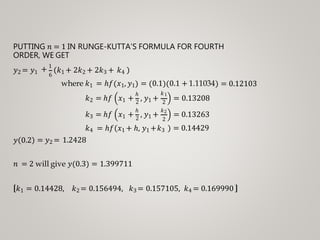
PUTTING 𝑛 = 1 IN RUNGE-KUTTA’S FORMULA FOR FOURTH
ORDER, WE GET
𝑦2 = 𝑦1 + 1
6
𝑘1 + 2𝑘2 + 2𝑘3 + 𝑘4
where 𝑘1 = ℎ𝑓 𝑥1, 𝑦1 = = 0.12103
ℎ
0.1 0.1 + 1.11034
= 0.13208𝑘2 = ℎ𝑓
𝑘3 = ℎ𝑓
ℎ
𝑥1 + 2
, 𝑦1 +
𝑥1 + 2
, 𝑦1 +
𝑘1
2
𝑘2
2
= 0.13263
= 0.14429
𝑦 0.2
𝑘4 = ℎ𝑓 𝑥1 + ℎ, 𝑦1 +𝑘3
= 𝑦2 = 1.2428
𝑛 = 2 will give 𝑦 0.3 = 1.399711
𝑘1 = 0.14428, 𝑘2 = 0.156494, 𝑘3 = 0.157105, 𝑘4 = 0.169990
Euler and improved euler method

Euler and improved euler method

  • 1.
    Topic: Numerical method forODEs Euler Method Improved Euler Method Runge-kutta’s Method Prepared by: Sohaib Siddique Butt University of Gujrat NUMERICALANALYSIS
  • 2.
    Ordinary Differential Equation Definition: A differential equation containing one or more functions of one independent variable and the derivatives of those functions Examples:  y is dependent variable  x is independent variable
  • 3.
    Solution to OrdinaryDifferential Equations Analytical solutions: Eigenvalues, time constants, damping coefficients Numerical solutions: Euler Method, Runge- Kutta Method
  • 4.
    EULER’S METHOD 𝑑𝑥 Consider theequation 𝑑𝑦 =f(x,y) …….(1) Given that Y(x0)=y0 its curve of solution through P(x0,y0) is shown dotted in figure. Now we have to find ordinate of any other point at Q on this curve. Dividing the curve into ‘n’ equal sub-interval each of width ‘h’. So we approximate the tangent for LL1 So Y1=L1P1=LP+R1P1 =y0+PR1 tan𝜃 =y0+hf(x0,y0) Here we go………………………………..
  • 5.
    EULER’S METHOD . Repeatingthis process n times yn+1=yn+hf(xn,yn) ……….(2) Where xn=x0+nh Equation 2 is called as Euler’s Method for finding an approximate solution.
  • 6.
    EULER’S METHOD 𝑑𝑥 To solvea differential equation of first order of the type 𝑑𝑦 = 𝑓 𝑥, 𝑦 , with initial 0 0conditions 𝑦 𝑥 = 𝑦 . The method is used to find the values of 𝑦(𝑥) for different values of 𝑥 at equal intervals. The length of the interval is ℎ, i.e. ℎ = 𝑥 𝑛+1 −𝑥 𝑛. In other words, 𝑥1 = 𝑥0 + ℎ, 𝑥2 = 𝑥1 + ℎ, 𝑥3= 𝑥2 + ℎ … etc. Also 𝑦 𝑛 is defined as 𝑦 𝑛 = 𝑦 𝑥 𝑛 . Euler’s Method: 𝑦 𝑥 𝑛+1 𝑖. 𝑒. 𝑦 𝑛+1 = 𝑦 𝑛 + ℎ𝑓(𝑥 𝑛, 𝑦 𝑛)  ℎ will be provided or need to be chosen. Smaller the value of ℎ, more accurate is the answer and less is the error committed.
  • 7.
    PROBLEM 1 Given 𝑑𝑦 =𝑥, with initial conditions 𝑦 0 = 1. Choose ℎ = 0.1 and find 𝑑𝑥 𝑦 0.1 , 𝑦 0.2 , 𝑦 0.3 and 𝑦 0.4 . Here 𝑓 𝑥, 𝑦 = 𝑥, 𝑥0 = 0, 𝑦0 = 1 𝑥1 = 𝑥0 + ℎ = 0 + 0.1 = 0.1, 𝑥2 = 𝑥1 + ℎ = 0.2, 𝑥3= 𝑥2 + ℎ =0.3, 𝑥4 = 0.4 Using Euler’s Method: 𝑦 𝑥 𝑛+1 𝑖. 𝑒. 𝑦 𝑛+1 = 𝑦 𝑛 + ℎ𝑓(𝑥 𝑛, 𝑦 𝑛) 𝑦1 = 𝑦0 + ℎ𝑓 𝑥0, 𝑦0 𝑦2 = 𝑦1 + ℎ𝑓 𝑥1, 𝑦1 = 1 + 0.1 𝑥0 = 1 + 0.1 𝑥1 = 1 + 0 = 1 = 1 + (0.1)(0.1) = 1.01 𝑦3 = 1.03, 𝑦4 =1.06
  • 8.
    Errors with Euler`sMethod 1. Local truncation error: over one step size. 2. Global error: cumulative over the range of the solution. The error ε using Euler`s method can be approximated using the second term of the Taylor series expansion. If the range is divided into n increments, then the error at the end of range for x would be nε. In addition, there are roundoff errors in this and other methods, which may affect the accuracy of the values more and more as n increases.
  • 9.
    COMPARISON Actual solution ofthe differential equation is 𝑥2 2 𝑦 = + 1 n 𝑥 𝑛 𝑦 𝑛 (actual) 𝑦 𝑛 (approx) % error 0 0 1 1 0 1 0.1 1.005 1 0.497512 2 0.2 1.02 1.01 0.980392 3 0.3 1.045 1.03 1.435407 4 0.4 1.08 1.06 1.851852
  • 10.
    IMPROVED EULER’S METHOD Inthe Euler’s improved method , The curve of the solution in the interval LL1 is approximates by the tangent at P such as at P1 we have, Y1=y0+hf(x0,y0) Than the slope of the curve of the solution through P1 is computed at the tangent at P1 to P1Q1 is drawn meeting the ordinate through L2 in P2(x0+2h,y2)……1 Now we find better approximation y1’ of y(x0+h) by taking the slope of the curve as the mean of the slope of the tangent at P and P1 i.e. Y1’=y0+ ℎ {f(x0+y0)+f(X0+h,Y1)}…..2 2 As the slope of the tangent at P1 is not known, We take Y1 is found in equation (1)
  • 11.
    IMPROVED EULER’S METHOD Eulermethod yn+1 =yn+hf(xn,yn) Where xn=x0+nh Euler’s Modified Method is 2 yn+1=yn+ℎ {f(xn , yn)+f(xn+1 ,yn+1)}
  • 12.
    Euler method isa predictor–corrector method In each step of the improved Euler method we compute two values, first the predictor which is an auxiliary value, and then the new y-value, the corrector
  • 13.
    EXAMPLE Question : ApplyEuler’s Modified Method to solve y’=x+y .Given y(0)=1.Find y at x=0.2 using step length 0.1 . Solution : Given, y’=x+y , y(0)=1 ,h=0.1 Than using Euler’s Method, yn+1=yn+hf(xn,yn) …………..(1) Putting n=0, y1=y0+hf(x0,y0) ; y1=1+0.1(1)=1.1 Than using Euler’s Modified Method, 2 yn+1=yn+ℎ {f(xn , yn)+f(xn+1 ,yn+1)}……(2)
  • 14.
    EXAMPLE……………………………….. 2 y1=y0+ℎ {f(x0 , y0)+f(x1,y1)} y1 =1+0.1 (1+1.2)=1.11 2 Repeating process will give y1 =1.1105 Than using Euler’s Method, Putting n=1; y2=y1+hf(x1,y1) y2=1.1105+0.1(0.1+1.1105)=1.23155 Than using Euler’s Modified Method,Putting n=1; 2 y2=y1+ℎ {f(x1 , y1)+f(x2 ,y2)}
  • 15.
  • 16.
    RUNGE-KUTTA’S METHOD Method ofgreat practical importance Much greater accuracy than that of the improved Euler method The classical Runge–Kutta method of fourth order, which we call briefly the Runge–Kutta method.
  • 17.
  • 18.
    PROBLEM 1 𝑑 𝑥 Given 𝑑𝑦 = 𝑥+ 𝑦, with initial conditions 𝑦 0 = 1. Choose ℎ = 0.1 and find 𝑦 0.1 , 𝑦 0.2 and 𝑦 0.3 using Runge-Kutta’s method of fourth order. Putting 𝑛 = 0 in Runge-Kutta’s formula for fourth order, we get 𝑦1 = 𝑦0 + 1 6 𝑘1 + 2𝑘2 + 2𝑘3 + 𝑘4 where 𝑘1 = ℎ𝑓 𝑥0, 𝑦0 = 0.1 0 + 1 = 0.1 ℎ = 0.1 0.05 + 1.05 = 0.11𝑘2 = ℎ𝑓 𝑘3 = ℎ𝑓 ℎ 𝑥0 + 2 , 𝑦0 + 𝑥0 + 2 , 𝑦0 + 𝑘1 2 𝑘2 2 𝑘4 = ℎ𝑓 𝑥0 + ℎ, 𝑦0 + 𝑘3 = 0.1 0.05 + 1.055 = 0.1 0.1 + 1.1105 = 0.1105 = 0.12105 1𝑦 0.1 = 𝑦 = 1 + 1 6 0.1 + 0.22 + 0.221 + 0.12105 =1.11034
  • 19.
    PUTTING 𝑛 =1 IN RUNGE-KUTTA’S FORMULA FOR FOURTH ORDER, WE GET 𝑦2 = 𝑦1 + 1 6 𝑘1 + 2𝑘2 + 2𝑘3 + 𝑘4 where 𝑘1 = ℎ𝑓 𝑥1, 𝑦1 = = 0.12103 ℎ 0.1 0.1 + 1.11034 = 0.13208𝑘2 = ℎ𝑓 𝑘3 = ℎ𝑓 ℎ 𝑥1 + 2 , 𝑦1 + 𝑥1 + 2 , 𝑦1 + 𝑘1 2 𝑘2 2 = 0.13263 = 0.14429 𝑦 0.2 𝑘4 = ℎ𝑓 𝑥1 + ℎ, 𝑦1 +𝑘3 = 𝑦2 = 1.2428 𝑛 = 2 will give 𝑦 0.3 = 1.399711 𝑘1 = 0.14428, 𝑘2 = 0.156494, 𝑘3 = 0.157105, 𝑘4 = 0.169990