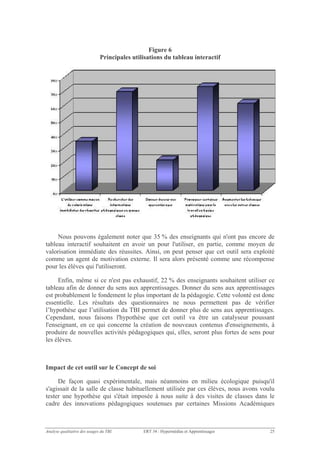
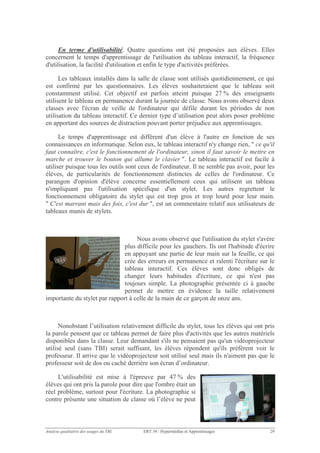
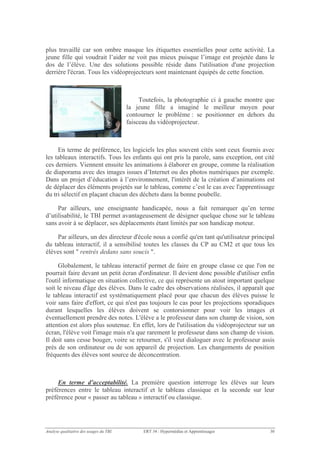
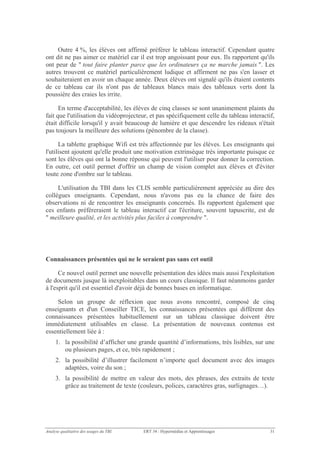
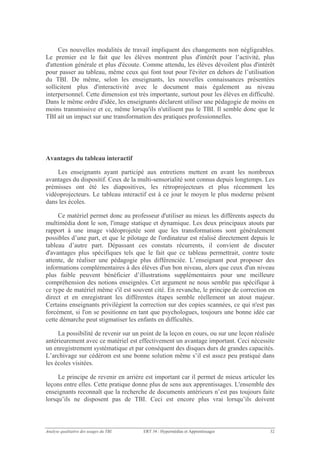
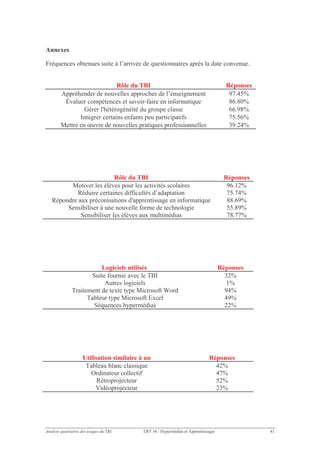
K ;% ' % % &#
A ;% 7# ' %/
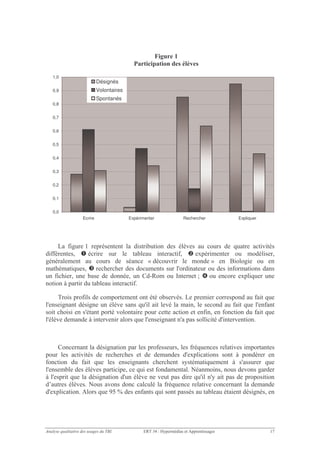
'G & , '
5 % #
# '5 #
A H./ IT
1 # '
% ' " " ;% RP/R T
0 #
(5 % % ' # PP/HRT
> ' " % ' " .I/IPT
$ :% % #
# ;% " ## H/ T
'G
& , '
$ # #7 %# ' '# HP/ T
% ' "'# A
"% .I/. T
%9 ' ( " ;% RR/PHT
, # &% % # "
# ' #
5 II/RHT
, # # #7 % %
9 # .R/..T
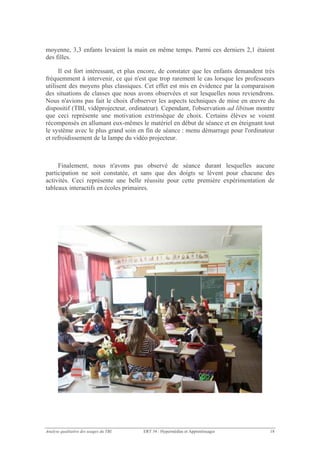
E '
,% "% '# => T
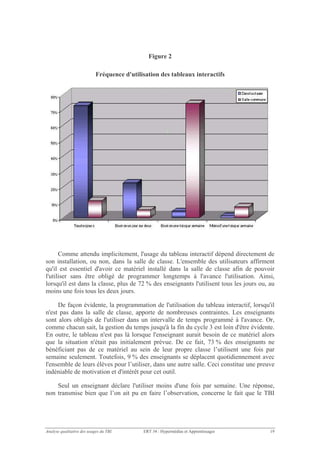
% # '# T
9 $ ' "E H T
#% $' " 9 #
' HT
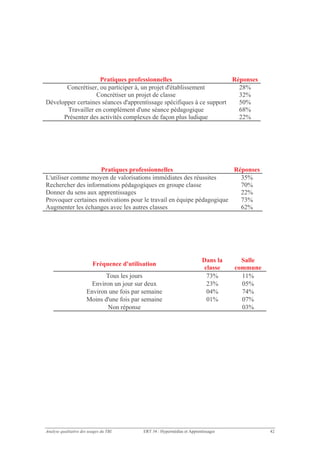
, ;% ' 5 T
9 ( '
# % # '' ;%
# T
- % '# ' "
# .T
3' % I T
G 3' % T
42.
1 @ '
@ ' % ' &% 3 ( # RT
@ ' % 3 '# T
8 # ' ' ( '";% &' % I T
#
# ' # (
% ' ;% PRT
! ' ' #9 "B # # ;%
% % T
1 @ '
( # '
% # % IT
' '
5 5 " ;% % '# . T
8 % %9 T
! ;% ' %# # ;% ;% . T
% # '5 '# % '# P T
) +
@ ?
% # 3% . T T
% 3% % %9 T IT
% " T . T
$ ( "
% T .T
2 T
43.
'
1
Viau, R. (1997). La motivation en contexte scolaire. Bruxelles : De Boeck Université.
2
Smith, H. J., Higgins, S., Wall, K., & Miller, J. (2005). Interactive whiteboards: boon or
bandwagon? A critical review of the literature. Journal of Computer Assisted Learning,
21(2), 91-101.
3
Goodison, T. A. (2002). Learning with ICT at primary level: pupil's perceptions. Journal of
Computer Assisted Learning, 18, 282-295.
4
Latham, P. (2002). Teaching and Learning Mathematics: the Impact of Interactive
Whiteboards - results of the north islington education action zone RM Easiteach
Mathematics Project. London: BEAM Education.
5
Levy, P. (2005). Interactive Whiteboards in learning and teaching in two Sheffield schools:
a developmental study. Sheffield: University of Sheffield.
6
Walker, D. (2002). White enlightening. Times Educational Supplement. 13 September
2002.
7
Edwards, J.-A., Hartnell, M., & Martin, R. (2002). Interactive Whiteboards: some lessons
from the classroom. Micromaths, 18, 30-33.
8
Ball, B. (2003). Teaching and learning mathematics with an interactive whiteboard.
Micromaths, 19, 4-7.
9
Bell, M. A. (2001). Update to survey of use of interactive electronic whiteboard in
instruction. Retrieved 10 july 2003, from
http://www.shsu.edu/~lis_mah/documents/updateboardindex.htm.
10
BECTA : British Educational Communications and Technology Agency (2005). What the
research says about interactive whiteboards. Retrieved June 8, 2005, from
http://www.becta.org.uk/page_documents/research/wtrs_whiteboards.pdf
11
Greinffenhagen, C. (2002). Out of the office into the school: electronic whiteboards for
education. Retrieved 15 june 2003, from
http://web.comlab.ox.ac.uk/oucl/work/christian.greiffenhagen/pub/boards.
12
Miller, D. J., Glover, D., & Averis, D. (2002). Enhancing mathematics teaching through new
technology: the use of the interactive whiteboard - Advice for teachers of mathematics.
Retrieved June 8, 2005, from
http://www.keele.ac.uk/depts/ed/iaw/docs/Advice%20for%20teachers%20of%20mathemati
cs.pdf
13
Lautrey, J., & Caroff, X. (1996). Variability and cognitive development. Polish Quarterly of
developmental psychology, 2, 2, 71-89.
14
Weimer, W., & Necula, G. (2004). Finding and Preventing Run-Time Error Handling
Mistakes. In Proceedings of the 19th Annual ACM Conference on Object-Oriented
Programming, Systems, Languages, and Applications, pp 419-431, Vancouver, British
Columbia, Canada, October 2004.
15
Higgins et al. (2005). Embedding ICT in the Literacy and Numeracy Strategies. Étude
réalisée par le Center for Learning and Teaching de l'Université de Newcastle
(http://www.becta.org.uk).
16
Université Autonome de Barcelonne (http://dewey.uab.es/pmarques/pdigital/es/uni.htm#1)
17
Domingo Gallego, professeur à l'UNED (Universidad Nacional Educación a Distancia) ;
http:// www.uned.es
18
Laurent Odic, responsable du projet PrimTice à la DT-SDTICE.
19
Données du 17/05/2005. Résultats arrêtés au 20 septembre 2005 représentant 163
réponses.
44.
20
Lamia, A. (1998). L’estime de soi chez les enfants français de six à dix ans. In M. Bolognini
& Y. Prêteur (Eds.). Estime de soi : perspective développementale. Lausanne : Delachaux
& Niestlé, 107-123.
21
Morcillo, A (2001). Représentations et comportements socio-scolaires chez le collégien.
Conférence plénière. Deuxième Biennal'Ado de Paris V - Europ'Ado 2001 "Les jeunes et la
Loi… Repères, Transgressions, Violences, Interventions sociales.
22
Brandibas, G., & Jeunier, B. (2004). , 5 #
' " #
% 9 ,5 #! ' #
' 5
> # I /
23
Mynatt, E. D. (1999). Six themes of the communicative appropriation of communication
systems. Works of the Georgia Institute of Technology. Atlanta, 171-180.