1
A Primer for Teaching Health Care
Ethics Using A
Multicultural/Interdisciplinary
Approach
Ethics and Morality
• Ethics is a set of moral
principles and a code for
behavior that govern an
individual’s actions with other
individuals and within society.
• Morality is what people believe
to be right and good, while
ethics is a critical reflection
about morality.
2
Law
• Laws are brought about by
tension, agitation and conflict by
dramatic situations.
• Laws are societal rules or
regulations that are obligatory to
observe.
3
Law Continued
• Laws protect the welfare and
safety of society, resolve
conflicts, and are constantly
evolving.
• Laws have governed the practice
of medicine for over one hundred
of years.
4
Bioethics
• Bioethics refers to the moral issues
and problems that have arisen as a
result of modern medicine and
medical research.
• Issues in bioethics are usually life-
and-death issues!
• Ethical and bioethical principles can
be personal, organizational,
institutional or worldwide.
5
Comparing Law and Ethics
• Law, ethics, and bioethics are
different but related concepts.
• Laws are mandatory to which all
citizens must adhere or risk civil
or criminal liability.
• Ethics relate to morals and help
us organize complex
information and competing
values and interests to
formulate consistent and
coherent decisions. 6
7
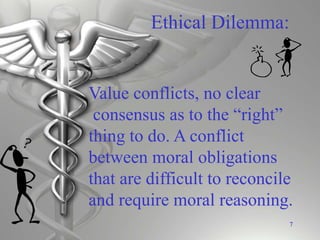
Value conflicts, no clear
consensus as to the “right”
thing to do. A conflict
between moral obligations
that are difficult to reconcile
and require moral reasoning.
Ethical Dilemma:
8
Situations necessitating a
choice between two equal
(usually undesirable)
alternatives.
Ethical Dilemma:
Ethical Issues in
Modern Healthcare
In modern healthcare and research,
value conflicts arise where often there
appears to be no clear consensus as to
the “Right thing to do.” These conflicts
present problems requiring moral
decisions, and necessitates a
choice between two or more
alternatives.
Examples:
• Should a parent have a right to refuse
immunizations for his or her child?
• Does public safety supersede an
9
Ethical Questions, Cont.
• Should children with serious birth defects
be kept alive?
• Should a woman be allowed an abortion
for any reason?
• Should terrorists be tortured to gain
information possibly saving hundreds of
lives?
• Should health care workers be required to
receive small pox vaccination?
• Who should get the finite number of
organs for transplantation? 10
Ethical Theories:
Ideas and Actions
• Deontology (duty)
• Consequentialism (actions)
• Virtue Ethics/Intuition (morals and
values)
Beliefs
• Rights Ethics (individuality and
the American culture)
11
Ethical Theories
• Deontology /Nonconsequentialism:
Derived from the Greek word, Deon,
meaning duty. Considers that some
acts are right or wrong independent
of their consequences. Looks to
one’s obligation to determine what
is ethical and answers the question:
What should I do and why should I
do it?
12
An Individual’s Ideas and Actions
Deontology: A duty
Example: Zelda, a
practitioner, believes she has
a duty to give cardiac clients
detailed information on the
pathology involved in their
condition even though the
client has indicated that they
are not ready or may be
terrified to hear the
information causing the client
distress.
13
Ethical Theories Continued
• Consequentialism: Also called
Teleological, Greek word, Telos,
meaning end or consequence. Actions
are determined and justified by the
consequence of the act.
Consequentialists consider all the
consequences of what they are about
to do prior to deciding a right action.
This also answers the question: What
should I do and why should I do it?
14
An Individual’s Ideas and Actions
Consequentialism: Action
Example: Had Zelda respected the
wishes of her clients, she would
have given them only the
information which would have been
a benefit to them and not caused
them undue stress. She would
have been motivated by her desire
to do good (beneficence), rather
than her sense of duty. This is a
Deontological betrayal.
15
Ethical Theories Continued
• Utilitarian Ethics: Considers the
greatest good for the largest number
of people. Also answers the
question: What should I do and why
should I do it?
• Intuitionism: Resolves ethical
dilemmas by appealing to one’s
intuition, a moral faculty of a person
which directly knows what is right or
wrong. (A gut feeling of knowing
what is right). 16
Ethical Theories Continued
• Rights: This popular American
theory resolves ethical
dilemmas by first determining
what rights or moral claims are
involved and take precedence,
(consider the abortion debate-
personal – mom vs.
fetus/child, societal- women’s
choice vs. murder. 17
Ethical Theories Continued
• Virtue Ethics: Contrary to
other ethical theories, virtue
ethics tells us what kind of
person one ought to be, rather
than what they do. The focus
is on the character (goodness)
of the person.
18
Two questions when faced
with a dilemma:
• Behavior: What should I do?
• Motivation: Why should I do it?
19
The Identity Argument
• Premise 1: What is understood to be
morally right depends (at least in part)
on one’s identity as a moral person.
• Premise 2: Ones’ race ethnicity and
culture is central to one’s identity as a
moral person.
• Conclusion: Thus, what is understood
to be morally right by an individual
depends (at least in part) on that
person’s race, ethnicity, and culture.
20
Cultural Diversity and
Ethics
• Increased recognition,interest
and respect for diverse societal
values. Why?
• Fundamental question: What
place, if any, do race, ethnicity,
and culture have in moral
theory?
21
Why Now?
What exactly do we
mean by race, ethnicity
and culture?
– Race –Genetically there is only one race,
which is the human race. Society makes
judgments about the varieties of biological
characteristics. Eventually, biological
characteristics are seen as socially
constructed which often leads to
stereotyping.
22
What exactly do we
mean by race, ethnicity
and culture?
– Ethnicity - An individual’s
identification with a particular cultural
group to which they are biologically
related.
23
What exactly do we
mean by race, ethnicity
and culture?
– Culture - A set of beliefs, values and
traditions that are socially transmitted
from one generation to another. It
defines a group’s norm’s or
community’s identity.
24
Cultural Assimilation
• A process by which persons of
different backgrounds adopt
Another group’s main values,
traditions and mores.
• Cultural Assimilation:
– Often occurs in different stages.
– It may never be complete due to the
group’s efforts in maintaining their
identity.
– May occur in degrees by choice.
25
Cultural Differences
• Value the family over the
individual.
• Engage and expect the family’s
support in their self-care.
• Value the institution’s that are
sensitive to their cultural
needs.
26
MAY INCLUDE:
Cultural Differences
– Liberal visiting hours and an un-
limited number of visitors (Family
based care).
– Incorporation of religious beliefs
and cultural traditions in tandem
with Western medicine.
27
Cultural Differences
• Can effect the quality of client care
• Can have a negative effect on the
family
• Should be evaluated carefully to
improve healthcare outcomes and
prevent:
– Misunderstandings
– Stereotyping
– Barriers
– Conflict 28
Stereotypes:
Are oversimplifications to
conceptions or images of what a
particular group or person should
look like, or how they should act by
disregarding each person’s
uniqueness.
– Represent the end-point of one’s
understanding (all members of a
particular group fit the same pattern or
mold).
– Do not encourage further exploration of
the individual or assimilation into the
majority group.
29
Generalizations
• Generalizations – Statements that
represent common trends in a group
with the understanding that further
information needs to be gathered to
verify its application to a particular
person.
– Represent a starting point and have been
used by anthropologists whenever they see
broad patterns of similarities among groups
of people.
– May lead to inaccuracies in their application
to a specific client 30
Generalizations
• Can assist the health care
professional to introduce open-
ended guiding questions. This may
help the healthcare professional to
identify the individual’s values and
cultural needs. This may
profoundly improve healthcare
outcomes.
31
Diversity & Bioethics
Contemporary bioethical
principles are all derived,
directly or indirectly from the
principle of autonomy.
Within the world, no two
people are exactly alike.
Therefore, their values,
motivations, moral beliefs,
and moral characters may
differ much more than their
physical appearances.
32
Organizational Ideas and
Actions
• Cultural Relativism: “Everyone
does it.”
• Cheating
• Stealing office supplies
• Conducting personal
business at work
33
Organizational Ideas and
Actions
Although “everyone does it”, it
still comes down to an
individual’s decision about
how one is going to act using
or not using ethical
principles.
34
What Are Ethical Principles,
and How Do They Help
With Decision Making?
35
Ethical Principles
Conflict is inevitable. Ethical
principles provide the
framework/ tools which may
facilitate individuals and society
to resolve conflict in a fair, just
and moral manner.
36
Ethical Principles
• Autonomy/Freedom
• Veracity
• Privacy/Confidentiality
• Beneficence/Nonmaleficence
• Fidelity
• Justice
37
Autonomy
• The right to participate in and
decide on a course of action
without undue influence.
• Self-Determination: which is
the freedom to act
independently. Individual
actions are directed toward
goals that are exclusively
one’s own.
38
Veracity
• The duty to tell the truth.
Truth-telling, honesty.
39
Privacy/Confidentiality
• Respecting privileged knowledge
• Respecting the “self” of others.
40
Beneficence/Nonmaleficenc
• The principle and obligation of
doing good and avoiding harm.
• This principle counsels a provider to
relate to clients in a way that will
always be in the best interest of the
client, rather than the provider.
41
Fidelity
• Strict observance of promises or
duties.
• This principle, as well as other
principles, should be honored by
both provider and client.
42
Justice
• The principle that deals with fairness,
equity and equality and provides for an
individual to claim that to which they are
entitled.
– Comparative Justice: Making a decision
based on criteria and outcomes. ie: How to
determine who qualifies for one available
kidney. 55 year old male with three children
versus a 13 old girl.
– Noncomparative Justice: ie: a method of
distributing needed kidneys using a lottery
system.
43
Why Employ Ethical
Principles?
44
Respect for the Individual
• In our pluralistic society individuals
often misunderstand each other.
• Even when they do understand each
other, it is possible for them to
disagree.
• The Healthcare arena, in common
with every other segment of society
has found it necessary to find ways to
create understanding and agreement.
45
How to Create Understanding
and Agreement?
• Common ground must be created or
found.
• A function of Ethics, in our society, is
to make agreement possible.
• As healthcare professionals and
patients meet, they meet as strangers
from diverse backgrounds therefore,
their ways of looking at and
approaching the world are usually
quite different.
46
Creating Harmony is Difficult
In The Healthcare
Arena.
• Power
• Self esteem
• Communication
• Personality/Attitude
• Education Level
• Socioeconomic Class
• Culture (which constitutes the most
profound difference).
• Values 47
Changing Healthcare
Environment
• Managed Care
• Increased Healthcare Costs
• Technology
• Baby Boomers
• Young and Old Life Spans
• Decrease in Healthy Lifestyles
• Lack of Healthcare Access/Insurance
• Feelings of Entitlements for
Healthcare at a minimal personal co
48
External Forces
• Political Influences/Forces
– Immigration/Migration of the elderly
– Medicare/Prescription drugs – life
style driven
– Decrease in extended families
– Decrease in resources
• Work force
• Family Caretakers
• Support/Finances Services in the Community
• Socio-economic Disparities –
healthcare right or privilege? 49
How May Harmony Be
Achieved?
• Through ethical
principles/behaviors, because
they:
– Provide a unique opportunity for
personal fulfillment and self respect.
– Serve to make it possible for
professionals to deal with each other
on a human level with respect
across all disciplines.
50
Ethical Principles/Behaviors
Continued:
– Serve to make it possible for
professionals and clients to deal with
each other on a human level with
respect across all cultures and
communities.
– Make it possible for strangers to
achieve understanding (if agreement
is not reached, toleration may be
achieved).
51
Ethical Principles/Behaviors
Continued:
– May make it possible for professional and
clients to agree on and respect each others
rights.
– May make it possible for this agreement to
carry over into other aspects of life outside
the healthcare setting where the idea of
Ethics may be first introduced to the
professional.
– May make it possible for provider and patient
to interact on the basis of shared goals.
52
Cultural Values Influence
Decision Making
53
Ethical Dilemma:
Deciding People’s Fate
54
You are on a sinking ship and there is only ONE
lifeboat available. Posted on the side of the
lifeboat is a sign which reads, “Maximum
Occupancy” - 8 persons…this boat will sink if
over occupied.” Standing on the deck and
waiting
on board the lifeboat are nine adults and one
child.
You must decide who dies. Be prepared to
defend your decision.
55
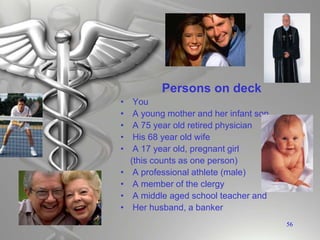
Persons on deck
• You
• A young mother and her infant son
• A 75 year old retired physician
• His 68 year old wife
• A 17 year old, pregnant girl
(this counts as one person)
• A professional athlete (male)
• A member of the clergy
• A middle aged school teacher and
• Her husband, a banker
56
Who Boards the Lifeboat? Why?
• 1.
• 2.
• 3.
• 4.
• 5.
• 6.
• 7.
• 8.
57
Who goes down with the ship?
Why?
1.
2.
58
• Does Ethics Drive the Law or
Does the Law Drive Ethics?
59
How Ethical Principles and
Laws Interface
• Patient Self Determination Act of
1990 (PSDA)
• Health Insurance Portability and
Accountability Act of 1996 (HIPPA)
(Implementation April 2003)
60
HIPAA
Health Insurance Portability and Accountability Act
of 1996 (Implementation April 2003)
• Ensures privacy and confidentiality of medical
records (a legal document that identifies the patient,
diagnoses, and justification for treatment).
• Healthcare providers are responsible for hiring, and
educating personnel to be knowledgeable of HIPAA
rules and regulations governing privacy and security of
medical records.
61
HIPAA - Continued
• Holds all healthcare providers accountable
for non-consented release of medical
information.
• Healthcare providers are responsible for
hiring and educating personnel to be
knowledgeable about HIPAA rules
and regulations governing privacy and
security of medical records.
62
Research Driven
Ethical Issues
With the advent and benefits of
modern research, moral conflict
is inevitable now and in the
future.
• Stem Cell Research
• Research Cloning
• Genome Project Results
• Fertility Research
63
An Example of A
Decision Making Model
(ADPIE)
• Assessment
– Gather the facts/collect
information from a variety of
sources
• Diagnosis
– Identify the problem or issue
64
• Plan
– Explore alternatives and/options.
– Identify the consequences of
actions/non-actions.
– Analyze the values and
professional issues at stake.
– Select the course of
action/make a decision.
– Justify the decision.
65
ADPIE Continued
• Implementation
– Carry out the plan.
• Evaluation
– Determine how this ethical
problem could possibly have
been prevented.
– Lessons learned.
– Assessment of outcomes.
66
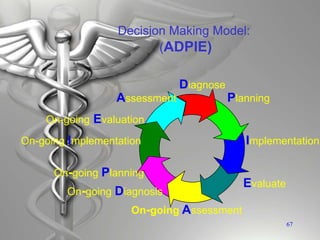
Decision Making Model:
(ADPIE)
67
Assessment
Evaluate
Diagnose
Planning
Implementation
On-going Assessment
On-going Diagnosis
On-going Planning
On-going Implementation
On-going Evaluation
Ethical Communication
• How to explore positive
communication techniques which
can be used in obtaining consent
for treatments (Feature Benefit
Check)!
68
Ethics Committees
• Decision making in health care often
involves more than just medical
facts of the case
• Ethical principles and values will be
the determining factor in which
course of action to take.
• Many health care facilities have
established Ethics committees.
69
Ethics Committees
• Found in most health care facility’s
• Usually twelve to fifteen members
• Multidisciplinary members
– A representative from the Board of Trustees
– The facility administrator
– The facility’s director of Nursing
– A staff nurse
– A physician
– An area clergy
– A Social Worker
– An Attorney
– An Ethic ist (Usually a philosophy or theology
professor)
– Lay persons from the community 70
Functions of the Committee
• Education
– To committee members themselves
– Continuing education and inservice to
facility’s staff
– To the community
71
Functions continued
• Development and review of laws,
standards of care, institutional
policies and guidelines
– About withdrawing and withholding
nutrition and hydration
– Do Not Resuscitate
– Utilization of facility’s/communities
resources
72
Functions continued
• Case Consultation with:
– Family members
– Patients
– Health care providers
– Staff
– And their own clergy
73
Changing Scope of Ethics
Committees
• Committees are expanding their scope
of their activity to include
organizational ethics, considering
questions regarding:
– Finances
– Administration
– Organization
– Human Resource
74
Expanding Scope
In the future, ethics consults may
provide for the management of a
health care facility just as ethics
consults are now available to
patients, family members, and
staff for particular medical
treatment decisions.
75

Ethics-Primer-4-17.ppt

  • 1.
    1 A Primer forTeaching Health Care Ethics Using A Multicultural/Interdisciplinary Approach
  • 2.
    Ethics and Morality •Ethics is a set of moral principles and a code for behavior that govern an individual’s actions with other individuals and within society. • Morality is what people believe to be right and good, while ethics is a critical reflection about morality. 2
  • 3.
    Law • Laws arebrought about by tension, agitation and conflict by dramatic situations. • Laws are societal rules or regulations that are obligatory to observe. 3
  • 4.
    Law Continued • Lawsprotect the welfare and safety of society, resolve conflicts, and are constantly evolving. • Laws have governed the practice of medicine for over one hundred of years. 4
  • 5.
    Bioethics • Bioethics refersto the moral issues and problems that have arisen as a result of modern medicine and medical research. • Issues in bioethics are usually life- and-death issues! • Ethical and bioethical principles can be personal, organizational, institutional or worldwide. 5
  • 6.
    Comparing Law andEthics • Law, ethics, and bioethics are different but related concepts. • Laws are mandatory to which all citizens must adhere or risk civil or criminal liability. • Ethics relate to morals and help us organize complex information and competing values and interests to formulate consistent and coherent decisions. 6
  • 7.
    7 Value conflicts, noclear consensus as to the “right” thing to do. A conflict between moral obligations that are difficult to reconcile and require moral reasoning. Ethical Dilemma:
  • 8.
    8 Situations necessitating a choicebetween two equal (usually undesirable) alternatives. Ethical Dilemma:
  • 9.
    Ethical Issues in ModernHealthcare In modern healthcare and research, value conflicts arise where often there appears to be no clear consensus as to the “Right thing to do.” These conflicts present problems requiring moral decisions, and necessitates a choice between two or more alternatives. Examples: • Should a parent have a right to refuse immunizations for his or her child? • Does public safety supersede an 9
  • 10.
    Ethical Questions, Cont. •Should children with serious birth defects be kept alive? • Should a woman be allowed an abortion for any reason? • Should terrorists be tortured to gain information possibly saving hundreds of lives? • Should health care workers be required to receive small pox vaccination? • Who should get the finite number of organs for transplantation? 10
  • 11.
    Ethical Theories: Ideas andActions • Deontology (duty) • Consequentialism (actions) • Virtue Ethics/Intuition (morals and values) Beliefs • Rights Ethics (individuality and the American culture) 11
  • 12.
    Ethical Theories • Deontology/Nonconsequentialism: Derived from the Greek word, Deon, meaning duty. Considers that some acts are right or wrong independent of their consequences. Looks to one’s obligation to determine what is ethical and answers the question: What should I do and why should I do it? 12
  • 13.
    An Individual’s Ideasand Actions Deontology: A duty Example: Zelda, a practitioner, believes she has a duty to give cardiac clients detailed information on the pathology involved in their condition even though the client has indicated that they are not ready or may be terrified to hear the information causing the client distress. 13
  • 14.
    Ethical Theories Continued •Consequentialism: Also called Teleological, Greek word, Telos, meaning end or consequence. Actions are determined and justified by the consequence of the act. Consequentialists consider all the consequences of what they are about to do prior to deciding a right action. This also answers the question: What should I do and why should I do it? 14
  • 15.
    An Individual’s Ideasand Actions Consequentialism: Action Example: Had Zelda respected the wishes of her clients, she would have given them only the information which would have been a benefit to them and not caused them undue stress. She would have been motivated by her desire to do good (beneficence), rather than her sense of duty. This is a Deontological betrayal. 15
  • 16.
    Ethical Theories Continued •Utilitarian Ethics: Considers the greatest good for the largest number of people. Also answers the question: What should I do and why should I do it? • Intuitionism: Resolves ethical dilemmas by appealing to one’s intuition, a moral faculty of a person which directly knows what is right or wrong. (A gut feeling of knowing what is right). 16
  • 17.
    Ethical Theories Continued •Rights: This popular American theory resolves ethical dilemmas by first determining what rights or moral claims are involved and take precedence, (consider the abortion debate- personal – mom vs. fetus/child, societal- women’s choice vs. murder. 17
  • 18.
    Ethical Theories Continued •Virtue Ethics: Contrary to other ethical theories, virtue ethics tells us what kind of person one ought to be, rather than what they do. The focus is on the character (goodness) of the person. 18
  • 19.
    Two questions whenfaced with a dilemma: • Behavior: What should I do? • Motivation: Why should I do it? 19
  • 20.
    The Identity Argument •Premise 1: What is understood to be morally right depends (at least in part) on one’s identity as a moral person. • Premise 2: Ones’ race ethnicity and culture is central to one’s identity as a moral person. • Conclusion: Thus, what is understood to be morally right by an individual depends (at least in part) on that person’s race, ethnicity, and culture. 20
  • 21.
    Cultural Diversity and Ethics •Increased recognition,interest and respect for diverse societal values. Why? • Fundamental question: What place, if any, do race, ethnicity, and culture have in moral theory? 21 Why Now?
  • 22.
    What exactly dowe mean by race, ethnicity and culture? – Race –Genetically there is only one race, which is the human race. Society makes judgments about the varieties of biological characteristics. Eventually, biological characteristics are seen as socially constructed which often leads to stereotyping. 22
  • 23.
    What exactly dowe mean by race, ethnicity and culture? – Ethnicity - An individual’s identification with a particular cultural group to which they are biologically related. 23
  • 24.
    What exactly dowe mean by race, ethnicity and culture? – Culture - A set of beliefs, values and traditions that are socially transmitted from one generation to another. It defines a group’s norm’s or community’s identity. 24
  • 25.
    Cultural Assimilation • Aprocess by which persons of different backgrounds adopt Another group’s main values, traditions and mores. • Cultural Assimilation: – Often occurs in different stages. – It may never be complete due to the group’s efforts in maintaining their identity. – May occur in degrees by choice. 25
  • 26.
    Cultural Differences • Valuethe family over the individual. • Engage and expect the family’s support in their self-care. • Value the institution’s that are sensitive to their cultural needs. 26 MAY INCLUDE:
  • 27.
    Cultural Differences – Liberalvisiting hours and an un- limited number of visitors (Family based care). – Incorporation of religious beliefs and cultural traditions in tandem with Western medicine. 27
  • 28.
    Cultural Differences • Caneffect the quality of client care • Can have a negative effect on the family • Should be evaluated carefully to improve healthcare outcomes and prevent: – Misunderstandings – Stereotyping – Barriers – Conflict 28
  • 29.
    Stereotypes: Are oversimplifications to conceptionsor images of what a particular group or person should look like, or how they should act by disregarding each person’s uniqueness. – Represent the end-point of one’s understanding (all members of a particular group fit the same pattern or mold). – Do not encourage further exploration of the individual or assimilation into the majority group. 29
  • 30.
    Generalizations • Generalizations –Statements that represent common trends in a group with the understanding that further information needs to be gathered to verify its application to a particular person. – Represent a starting point and have been used by anthropologists whenever they see broad patterns of similarities among groups of people. – May lead to inaccuracies in their application to a specific client 30
  • 31.
    Generalizations • Can assistthe health care professional to introduce open- ended guiding questions. This may help the healthcare professional to identify the individual’s values and cultural needs. This may profoundly improve healthcare outcomes. 31
  • 32.
    Diversity & Bioethics Contemporarybioethical principles are all derived, directly or indirectly from the principle of autonomy. Within the world, no two people are exactly alike. Therefore, their values, motivations, moral beliefs, and moral characters may differ much more than their physical appearances. 32
  • 33.
    Organizational Ideas and Actions •Cultural Relativism: “Everyone does it.” • Cheating • Stealing office supplies • Conducting personal business at work 33
  • 34.
    Organizational Ideas and Actions Although“everyone does it”, it still comes down to an individual’s decision about how one is going to act using or not using ethical principles. 34
  • 35.
    What Are EthicalPrinciples, and How Do They Help With Decision Making? 35
  • 36.
    Ethical Principles Conflict isinevitable. Ethical principles provide the framework/ tools which may facilitate individuals and society to resolve conflict in a fair, just and moral manner. 36
  • 37.
    Ethical Principles • Autonomy/Freedom •Veracity • Privacy/Confidentiality • Beneficence/Nonmaleficence • Fidelity • Justice 37
  • 38.
    Autonomy • The rightto participate in and decide on a course of action without undue influence. • Self-Determination: which is the freedom to act independently. Individual actions are directed toward goals that are exclusively one’s own. 38
  • 39.
    Veracity • The dutyto tell the truth. Truth-telling, honesty. 39
  • 40.
    Privacy/Confidentiality • Respecting privilegedknowledge • Respecting the “self” of others. 40
  • 41.
    Beneficence/Nonmaleficenc • The principleand obligation of doing good and avoiding harm. • This principle counsels a provider to relate to clients in a way that will always be in the best interest of the client, rather than the provider. 41
  • 42.
    Fidelity • Strict observanceof promises or duties. • This principle, as well as other principles, should be honored by both provider and client. 42
  • 43.
    Justice • The principlethat deals with fairness, equity and equality and provides for an individual to claim that to which they are entitled. – Comparative Justice: Making a decision based on criteria and outcomes. ie: How to determine who qualifies for one available kidney. 55 year old male with three children versus a 13 old girl. – Noncomparative Justice: ie: a method of distributing needed kidneys using a lottery system. 43
  • 44.
  • 45.
    Respect for theIndividual • In our pluralistic society individuals often misunderstand each other. • Even when they do understand each other, it is possible for them to disagree. • The Healthcare arena, in common with every other segment of society has found it necessary to find ways to create understanding and agreement. 45
  • 46.
    How to CreateUnderstanding and Agreement? • Common ground must be created or found. • A function of Ethics, in our society, is to make agreement possible. • As healthcare professionals and patients meet, they meet as strangers from diverse backgrounds therefore, their ways of looking at and approaching the world are usually quite different. 46
  • 47.
    Creating Harmony isDifficult In The Healthcare Arena. • Power • Self esteem • Communication • Personality/Attitude • Education Level • Socioeconomic Class • Culture (which constitutes the most profound difference). • Values 47
  • 48.
    Changing Healthcare Environment • ManagedCare • Increased Healthcare Costs • Technology • Baby Boomers • Young and Old Life Spans • Decrease in Healthy Lifestyles • Lack of Healthcare Access/Insurance • Feelings of Entitlements for Healthcare at a minimal personal co 48
  • 49.
    External Forces • PoliticalInfluences/Forces – Immigration/Migration of the elderly – Medicare/Prescription drugs – life style driven – Decrease in extended families – Decrease in resources • Work force • Family Caretakers • Support/Finances Services in the Community • Socio-economic Disparities – healthcare right or privilege? 49
  • 50.
    How May HarmonyBe Achieved? • Through ethical principles/behaviors, because they: – Provide a unique opportunity for personal fulfillment and self respect. – Serve to make it possible for professionals to deal with each other on a human level with respect across all disciplines. 50
  • 51.
    Ethical Principles/Behaviors Continued: – Serveto make it possible for professionals and clients to deal with each other on a human level with respect across all cultures and communities. – Make it possible for strangers to achieve understanding (if agreement is not reached, toleration may be achieved). 51
  • 52.
    Ethical Principles/Behaviors Continued: – Maymake it possible for professional and clients to agree on and respect each others rights. – May make it possible for this agreement to carry over into other aspects of life outside the healthcare setting where the idea of Ethics may be first introduced to the professional. – May make it possible for provider and patient to interact on the basis of shared goals. 52
  • 53.
  • 54.
  • 55.
    You are ona sinking ship and there is only ONE lifeboat available. Posted on the side of the lifeboat is a sign which reads, “Maximum Occupancy” - 8 persons…this boat will sink if over occupied.” Standing on the deck and waiting on board the lifeboat are nine adults and one child. You must decide who dies. Be prepared to defend your decision. 55
  • 56.
    Persons on deck •You • A young mother and her infant son • A 75 year old retired physician • His 68 year old wife • A 17 year old, pregnant girl (this counts as one person) • A professional athlete (male) • A member of the clergy • A middle aged school teacher and • Her husband, a banker 56
  • 57.
    Who Boards theLifeboat? Why? • 1. • 2. • 3. • 4. • 5. • 6. • 7. • 8. 57
  • 58.
    Who goes downwith the ship? Why? 1. 2. 58
  • 59.
    • Does EthicsDrive the Law or Does the Law Drive Ethics? 59
  • 60.
    How Ethical Principlesand Laws Interface • Patient Self Determination Act of 1990 (PSDA) • Health Insurance Portability and Accountability Act of 1996 (HIPPA) (Implementation April 2003) 60
  • 61.
    HIPAA Health Insurance Portabilityand Accountability Act of 1996 (Implementation April 2003) • Ensures privacy and confidentiality of medical records (a legal document that identifies the patient, diagnoses, and justification for treatment). • Healthcare providers are responsible for hiring, and educating personnel to be knowledgeable of HIPAA rules and regulations governing privacy and security of medical records. 61
  • 62.
    HIPAA - Continued •Holds all healthcare providers accountable for non-consented release of medical information. • Healthcare providers are responsible for hiring and educating personnel to be knowledgeable about HIPAA rules and regulations governing privacy and security of medical records. 62
  • 63.
    Research Driven Ethical Issues Withthe advent and benefits of modern research, moral conflict is inevitable now and in the future. • Stem Cell Research • Research Cloning • Genome Project Results • Fertility Research 63
  • 64.
    An Example ofA Decision Making Model (ADPIE) • Assessment – Gather the facts/collect information from a variety of sources • Diagnosis – Identify the problem or issue 64
  • 65.
    • Plan – Explorealternatives and/options. – Identify the consequences of actions/non-actions. – Analyze the values and professional issues at stake. – Select the course of action/make a decision. – Justify the decision. 65
  • 66.
    ADPIE Continued • Implementation –Carry out the plan. • Evaluation – Determine how this ethical problem could possibly have been prevented. – Lessons learned. – Assessment of outcomes. 66
  • 67.
    Decision Making Model: (ADPIE) 67 Assessment Evaluate Diagnose Planning Implementation On-goingAssessment On-going Diagnosis On-going Planning On-going Implementation On-going Evaluation
  • 68.
    Ethical Communication • Howto explore positive communication techniques which can be used in obtaining consent for treatments (Feature Benefit Check)! 68
  • 69.
    Ethics Committees • Decisionmaking in health care often involves more than just medical facts of the case • Ethical principles and values will be the determining factor in which course of action to take. • Many health care facilities have established Ethics committees. 69
  • 70.
    Ethics Committees • Foundin most health care facility’s • Usually twelve to fifteen members • Multidisciplinary members – A representative from the Board of Trustees – The facility administrator – The facility’s director of Nursing – A staff nurse – A physician – An area clergy – A Social Worker – An Attorney – An Ethic ist (Usually a philosophy or theology professor) – Lay persons from the community 70
  • 71.
    Functions of theCommittee • Education – To committee members themselves – Continuing education and inservice to facility’s staff – To the community 71
  • 72.
    Functions continued • Developmentand review of laws, standards of care, institutional policies and guidelines – About withdrawing and withholding nutrition and hydration – Do Not Resuscitate – Utilization of facility’s/communities resources 72
  • 73.
    Functions continued • CaseConsultation with: – Family members – Patients – Health care providers – Staff – And their own clergy 73
  • 74.
    Changing Scope ofEthics Committees • Committees are expanding their scope of their activity to include organizational ethics, considering questions regarding: – Finances – Administration – Organization – Human Resource 74
  • 75.
    Expanding Scope In thefuture, ethics consults may provide for the management of a health care facility just as ethics consults are now available to patients, family members, and staff for particular medical treatment decisions. 75