McGraw-Hill
McGraw-Hill
4th
2016 - 20
Topic
Mam, Qoseen
BS(IT)
311, 315, 317,
323
ETHERNET
Semester
Roll No
Class
Submitted to
Session
McGraw-Hill ©The McGraw-Hill Companies, Inc., 2000
SR:#
STATEMENT
1 ETHERNET
2 HISTORY OF ETHERNET
3 INTRODUCTION
4 TYPES & CATEGORIES OF ETHERNET CABLES
5 WORKING
6 ADRRESSING SCHEME
7 SCOPE
8 ADVANTAGES & DISADVANTAGES
McGraw-Hill
13-1 IEEE STANDARDS13-1 IEEE STANDARDS
Ethernet: It is a LAN protocol that is used in Bus and Star
topologies and implements CSMA/CD as the medium access
method
Original (traditional) Ethernet developed in 1980 byOriginal (traditional) Ethernet developed in 1980 by
three companies:three companies: DDigital,igital, IIntel,ntel, XXerox (DIX).erox (DIX).
In 1985, the Computer Society of the IEEE started aIn 1985, the Computer Society of the IEEE started a
project, calledproject, called Project 802Project 802, to set standards to enable, to set standards to enable
intercommunication among equipment from a variety ofintercommunication among equipment from a variety of
manufacturers.manufacturers.
 Current version is calledCurrent version is called IEEE EthernetIEEE Ethernet
McGraw-Hill
Ethernet
Frame formats. (a) DIX Ethernet , (b) IEEE 802.3.
FCS
FCS
 Ethernet Frame format
McGraw-Hill
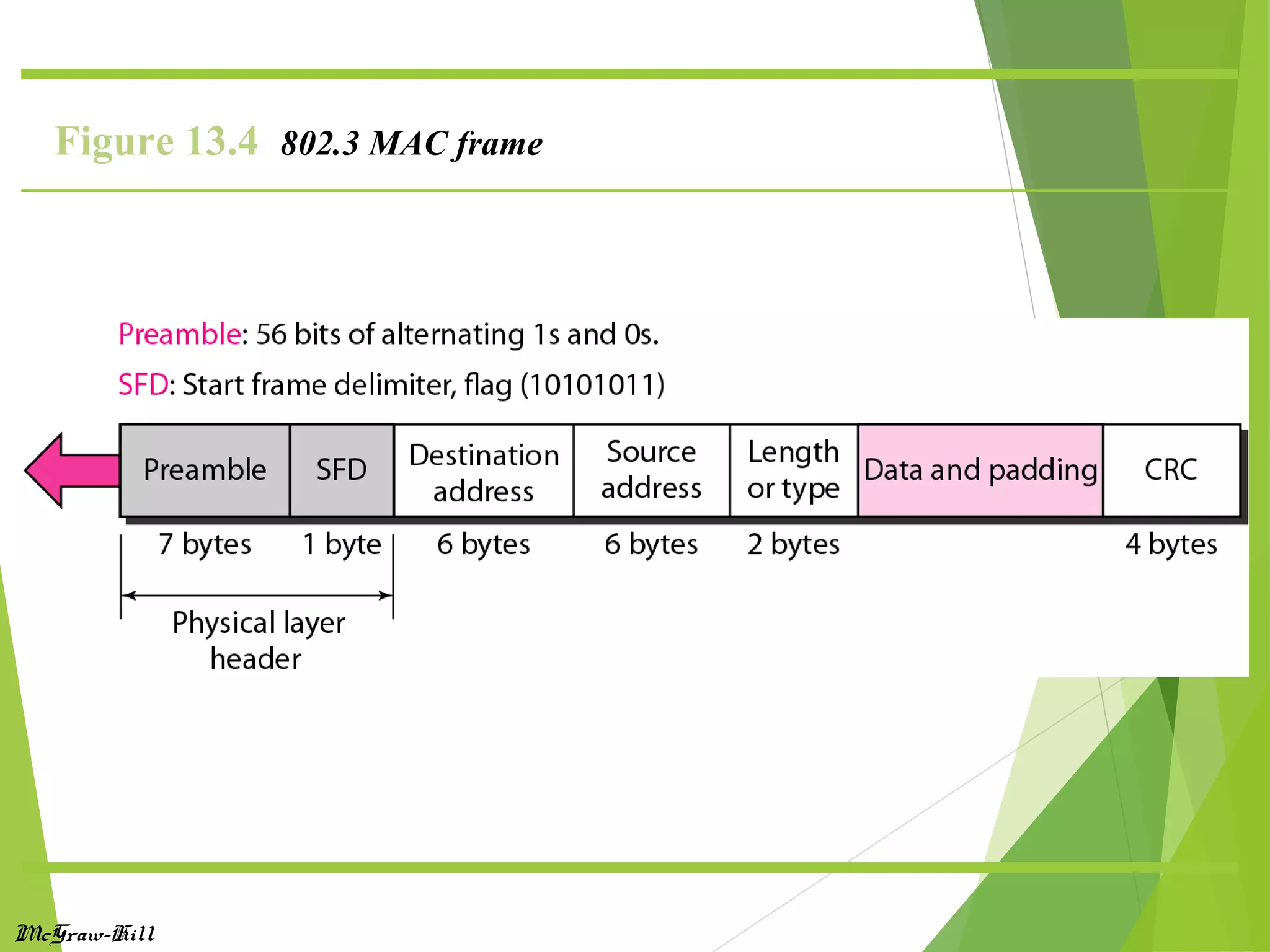
Figure 13.4 802.3 MAC frame
McGraw-Hill
IEEE Ethernet
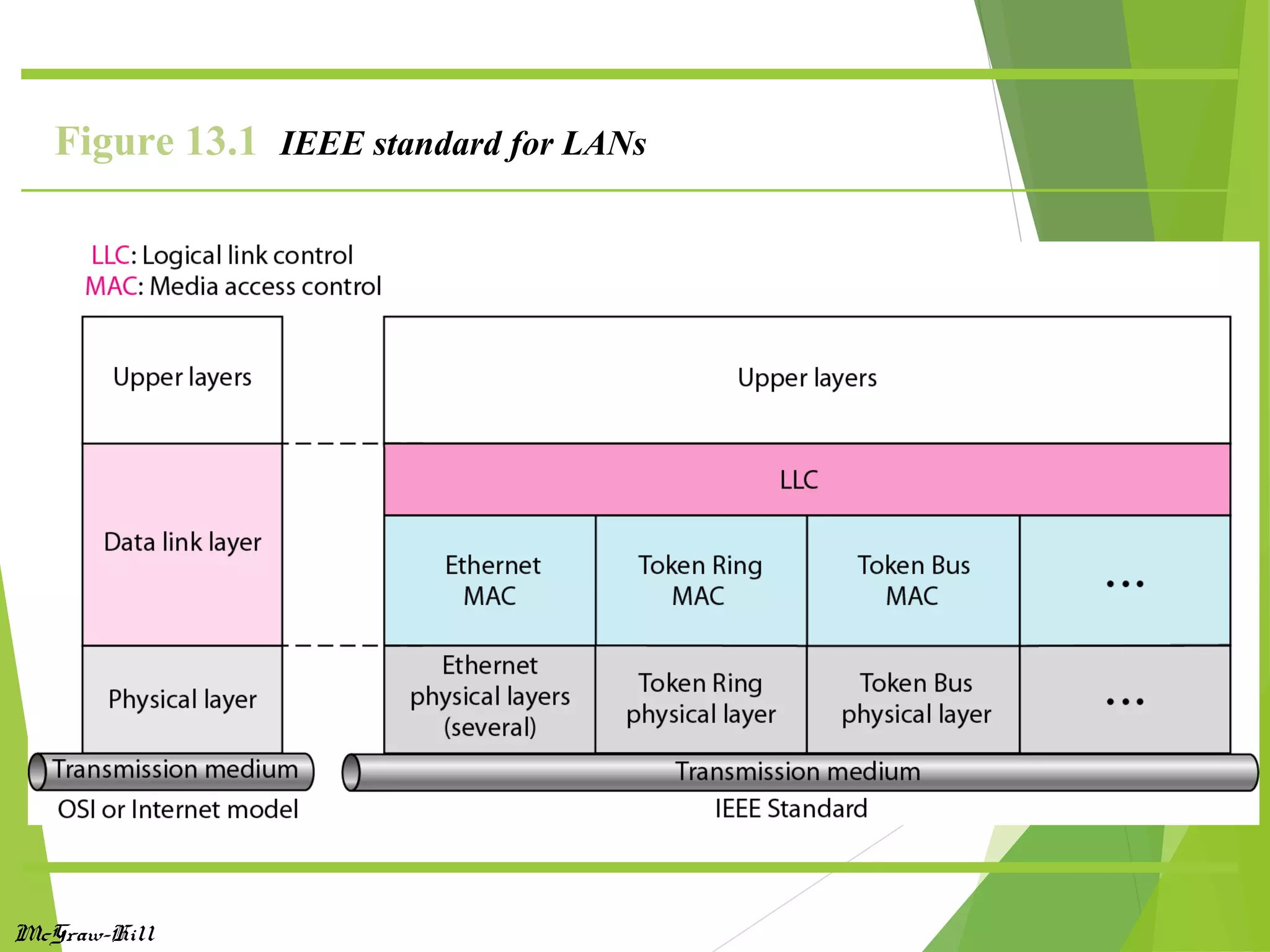
 In IEEE 802.3 Ethernet Data link layer is split into two
sublayers:
 Bottom part: MAC
 The frame is called IEEE 802.3
 Handles framing, MAC addressing, Medium Access control
 Specific implementation for each LAN protocol
 Defines CSMA/CD as the access method for Ethernet LANs and Token
passing method for Token Ring.
 Implemented in hardware
 Top part: LLC (Logical Link Control)
 The subframe is called IEEE 802.2
 Provides error and flow control if needed
 It makes the MAC sublayer transparent
 Allows interconnectivity between different LANs data link layers
 Used to multiplex multiple network layer protocols in the data link layer
frame
 Implemented in software
McGraw-Hill
Figure 13.1 IEEE standard for LANs
McGraw-Hill
Ethernet Provides Unreliable, connectionless Service
 Ethernet data link layer protocol provides
connectionless service to the network layer
 No handshaking between sending and receiving adapter.
 Ethernet protocol provides Unreliable service to the
network layer :
 Receiving adapter doesn’t send ACK or NAK to sending adapter
 This means stream of datagrams passed to network layer can have gaps (missing data)
 Gaps will be filled if application is using reliable transport layer protocol
 Otherwise, application will see the gaps
McGraw-Hill
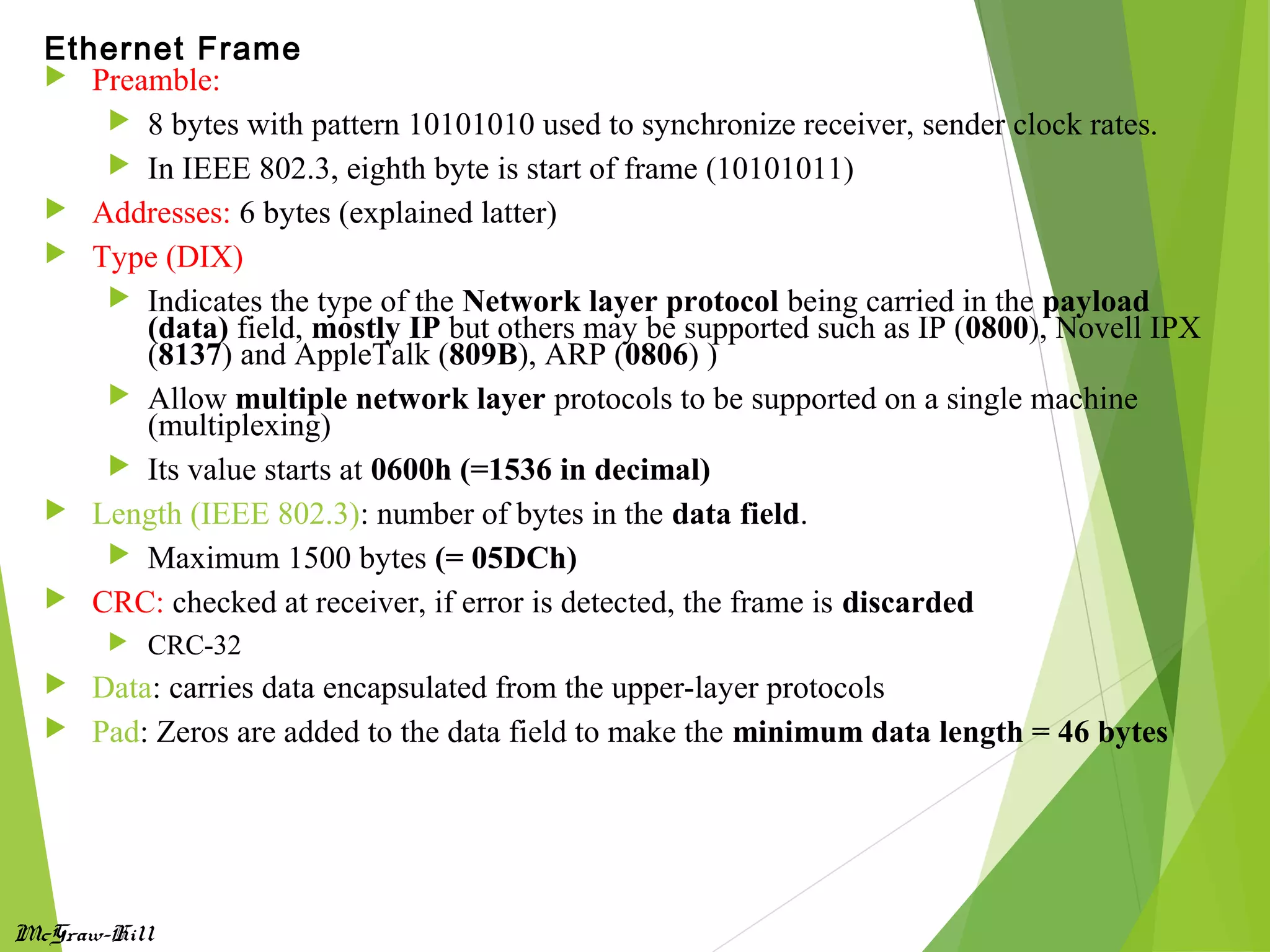
 Preamble:
 8 bytes with pattern 10101010 used to synchronize receiver, sender clock rates.
 In IEEE 802.3, eighth byte is start of frame (10101011)
 Addresses: 6 bytes (explained latter)
 Type (DIX)
 Indicates the type of the Network layer protocol being carried in the payload
(data) field, mostly IP but others may be supported such as IP (0800), Novell IPX
(8137) and AppleTalk (809B), ARP (0806) )
 Allow multiple network layer protocols to be supported on a single machine
(multiplexing)
 Its value starts at 0600h (=1536 in decimal)
 Length (IEEE 802.3): number of bytes in the data field.
 Maximum 1500 bytes (= 05DCh)
 CRC: checked at receiver, if error is detected, the frame is discarded
 CRC-32
 Data: carries data encapsulated from the upper-layer protocols
 Pad: Zeros are added to the data field to make the minimum data length = 46 bytes
Ethernet Frame
McGraw-Hill
Ethernet address
 Six bytes = 48 bits
 Flat address not hierarchical
 Burned into the NIC ROM
 First three bytes from left specify the vendor. Cisco
00-00-0C, 3Com 02-60-8C and the last 24 bit should
be created uniquely by the company
 Destination Address can be:
 Unicast: second digit from left is even (one
recipient)
 Multicast: Second digit from left is odd (group
of stations to receive the frame – conferencing
applications)
 Broadcast (ALL ones) (all stations receive the
frame)
 Source address is always Unicast
McGraw-Hill
McGraw-Hill
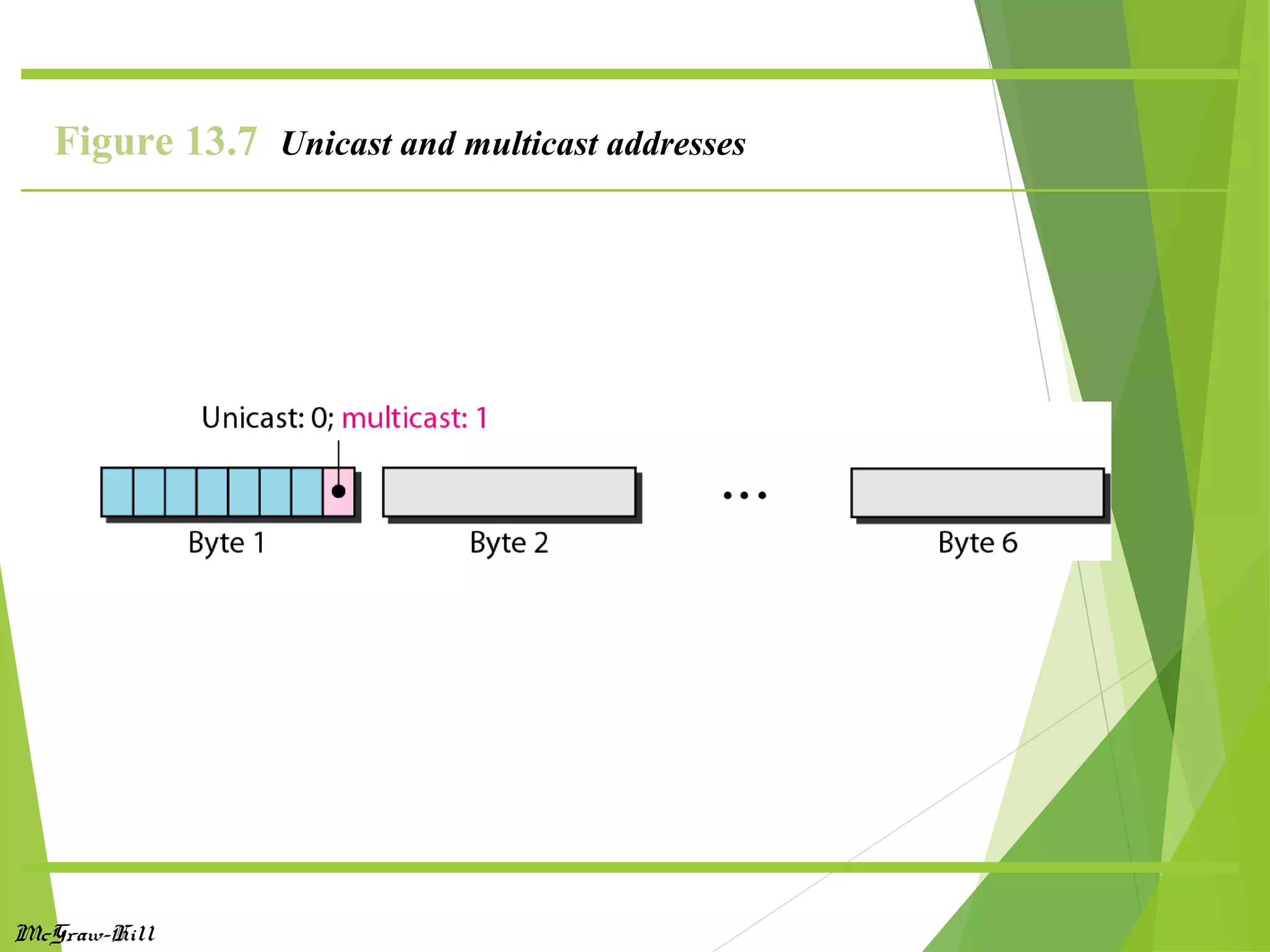
The least significant bit of the first byte
defines the type of address.
If the bit is 0, the address is unicast;
otherwise, it is multicast.
Note
McGraw-Hill
The broadcast destination address is a
special case of the multicast address in
which all bits are 1s.
Note
McGraw-Hill
Figure 13.7 Unicast and multicast addresses
McGraw-Hill
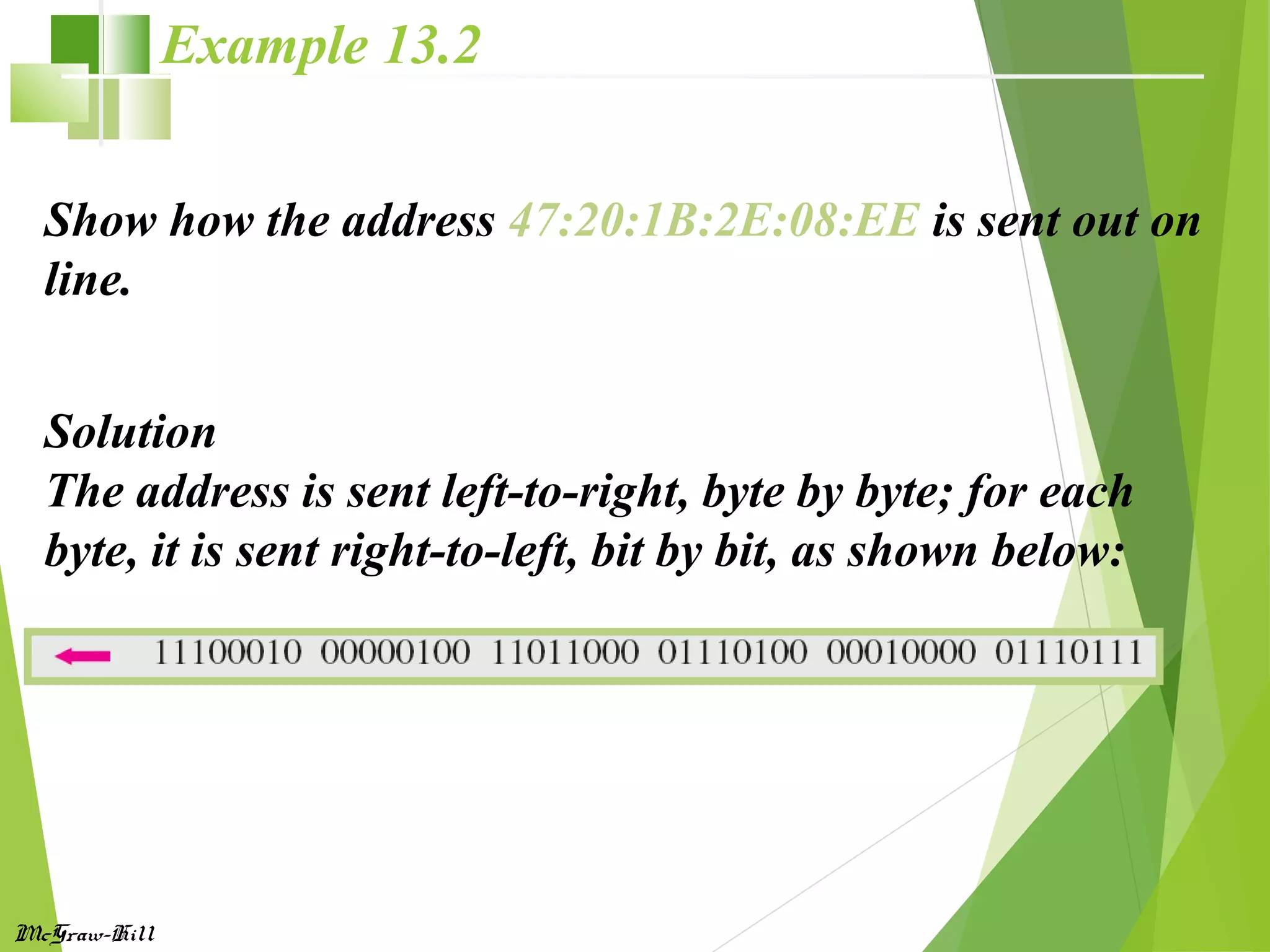
Show how the address 47:20:1B:2E:08:EE is sent out on
line.
Solution
The address is sent left-to-right, byte by byte; for each
byte, it is sent right-to-left, bit by bit, as shown below:
Example 13.2
McGraw-Hill
Define the type of the following destination addresses:
a. 4A:30:10:21:10:1A b. 47:20:1B:2E:08:EE
c. FF:FF:FF:FF:FF:FF
Solution
To find the type of the address, we need to look at the
second hexadecimal digit from the left. If it is even, the
address is unicast. If it is odd, the address is multicast. If
all digits are F’s, the address is broadcast. Therefore, we
have the following:
a. This is a unicast address because A in binary is 1010.
b. This is a multicast address because 7 in binary is 0111.
c. This is a broadcast address because all digits are F’s.
Example 13.1
McGraw-Hill
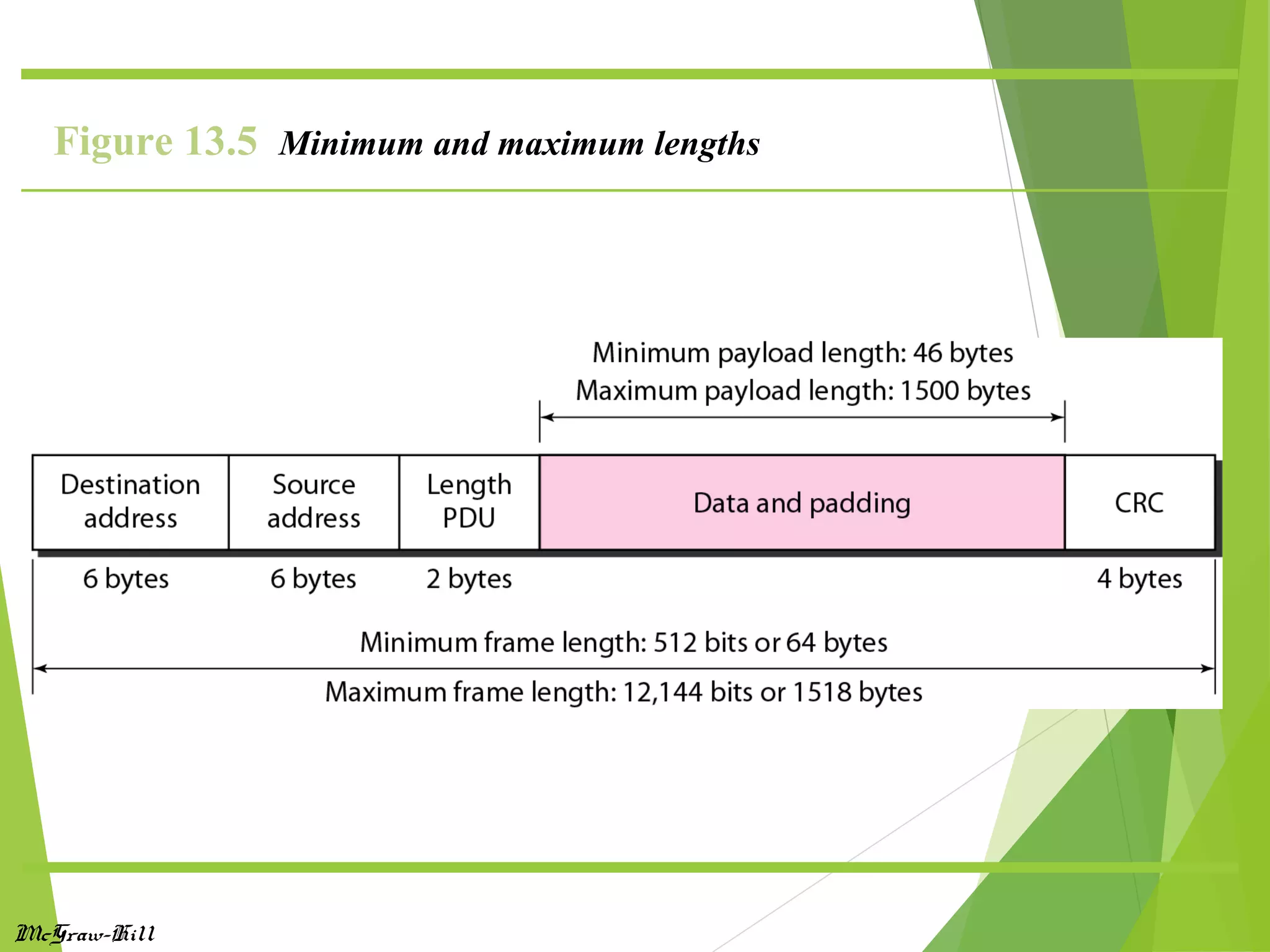
Figure 13.5 Minimum and maximum lengths
McGraw-Hill
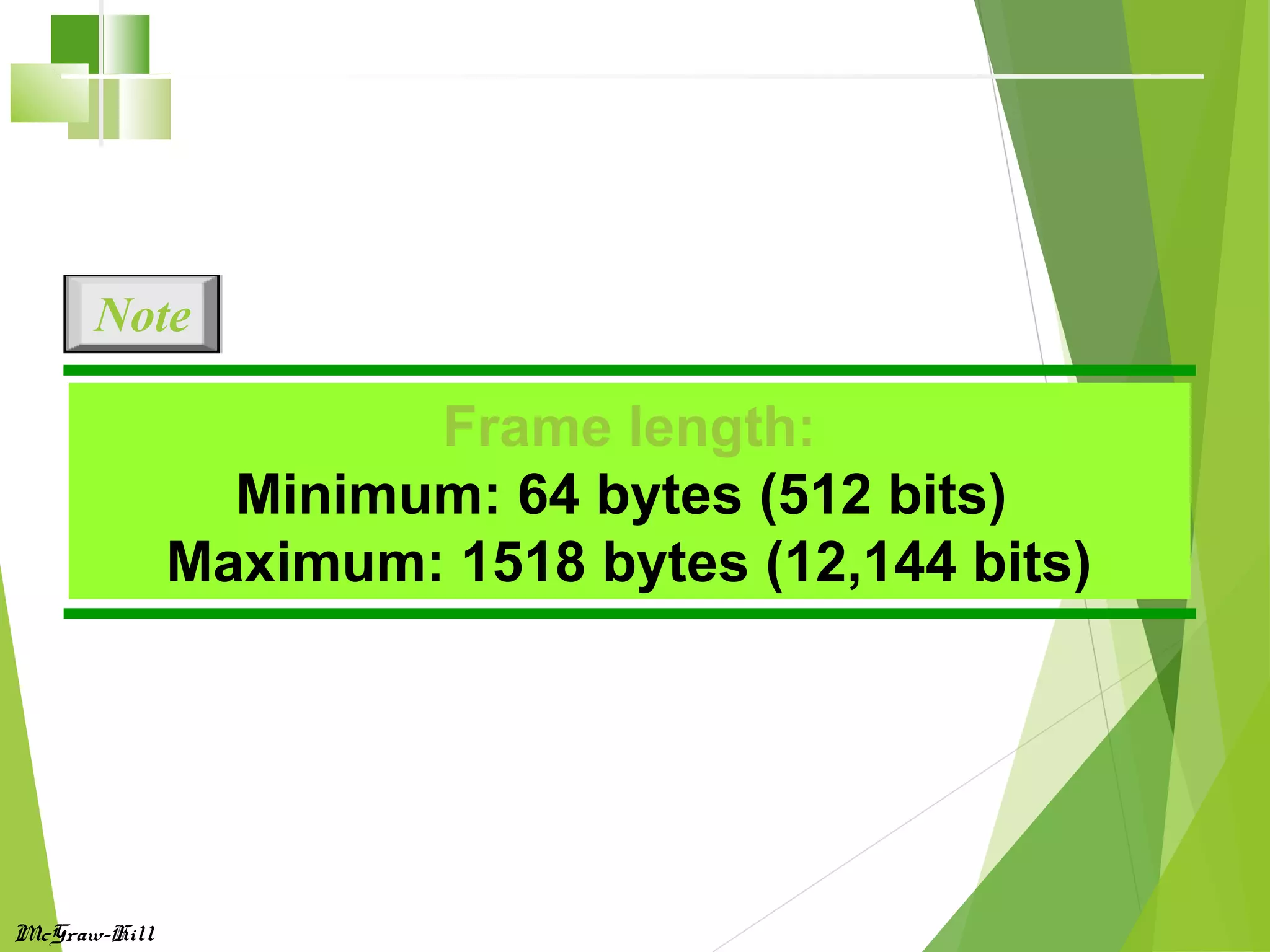
Frame length:
Minimum: 64 bytes (512 bits)
Maximum: 1518 bytes (12,144 bits)
Note
McGraw-Hill
Figure 13.3 Ethernet evolution through four generations
McGraw-Hill
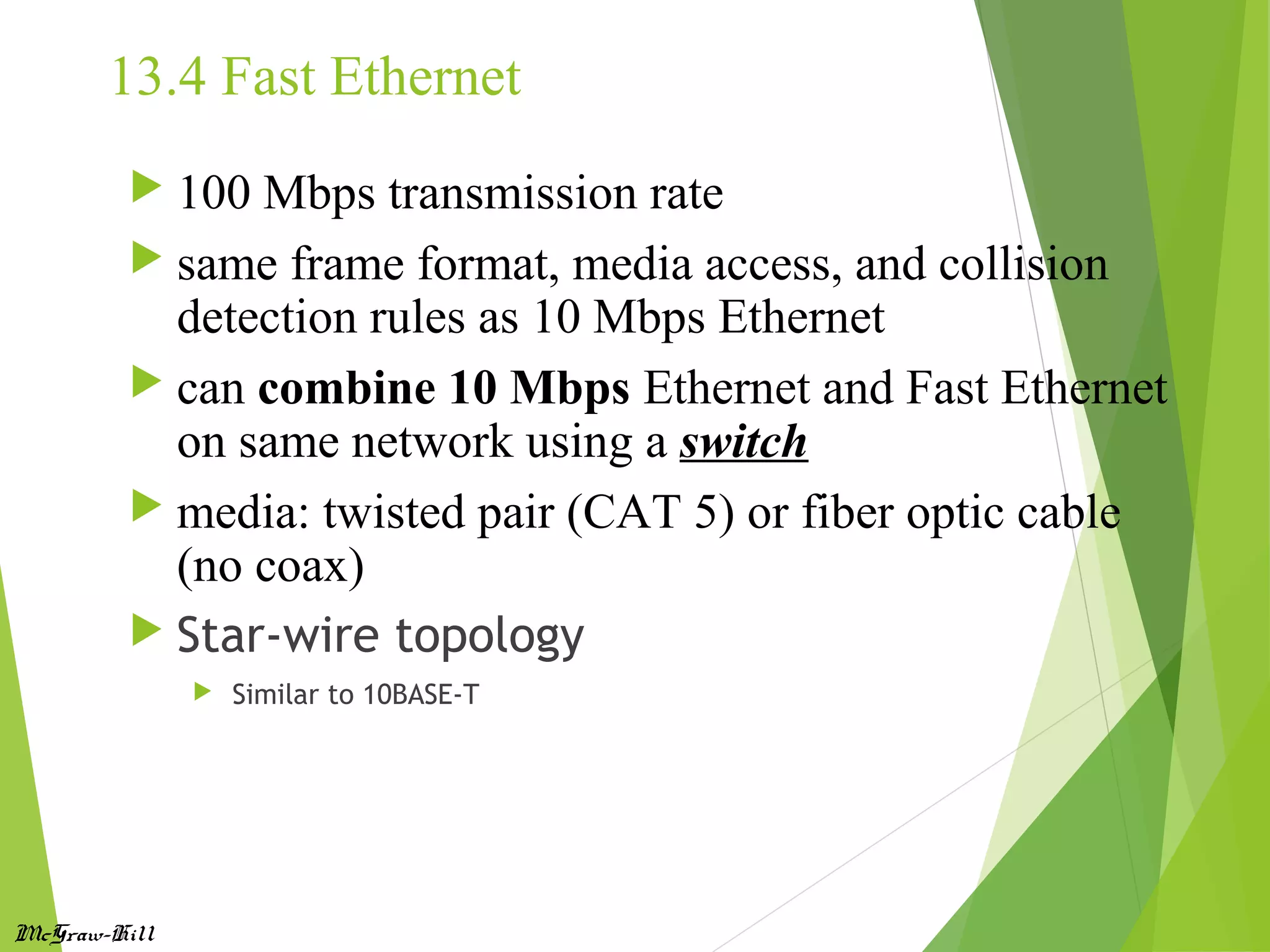
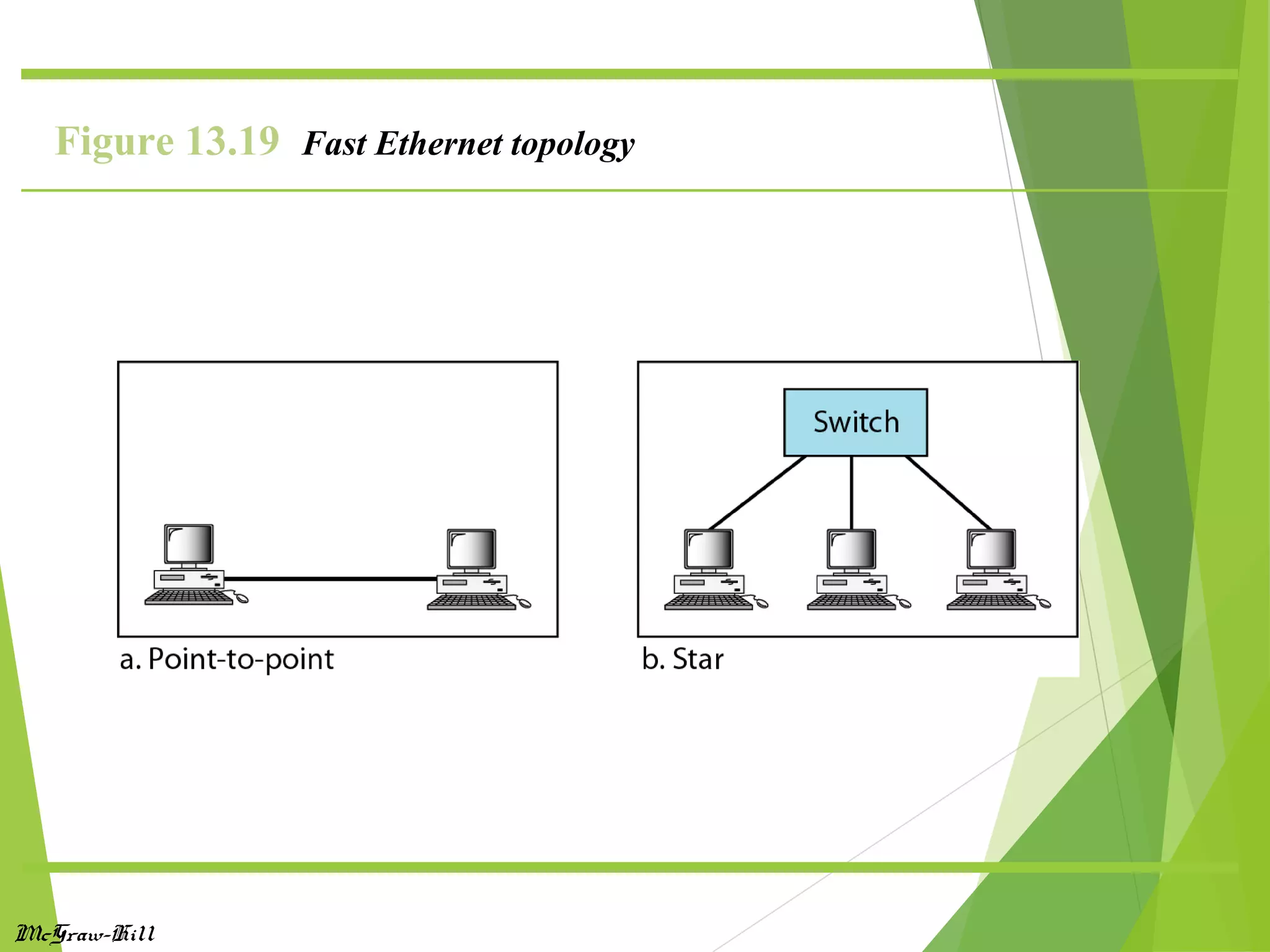
13.4 Fast Ethernet
 100 Mbps transmission rate
 same frame format, media access, and collision
detection rules as 10 Mbps Ethernet
 can combine 10 Mbps Ethernet and Fast Ethernet
on same network using a switch
 media: twisted pair (CAT 5) or fiber optic cable
(no coax)
 Star-wire topology
 Similar to 10BASE-T
McGraw-Hill
Figure 13.19 Fast Ethernet topology
McGraw-Hill
Full Duplex Operation
 Traditional Ethernet is half duplex
 Either transmit or receive but not both simultaneously
 With full-duplex, station can transmit and receive data simultaneously
 With full duplex, Throughput (actual transmission rate) is doubled.
 10-Mbps Ethernet in full-duplex mode, theoretical transfer rate
becomes 20 Mbps
 100-Mbps Ethernet in full-duplex mode, theoretical transfer rate
becomes 200 Mbps
 Changes that should be made with any computer in order to operate
in Full-Duplex Mode
1) Attached stations must have full-duplex NIC cards
2) Must use two pairs of wire one pair for transmitting from host to
switch (inbound) and the other pair for transmitting from switch to
host (outbound)
3) Must use a switch as a central device not a hub
4) Devices must be connected point-to-point (dedicated) to the switch
 Each station constitutes separate collision domain
 CSMA/CD algorithm no longer needed (no collision)
 No limit on the segment length
 Same 802.3 MAC frame format used
McGraw-Hill
Figure 13.18 Full-duplex switched Ethernet
McGraw-Hill
Figure 13.17 Switched Ethernet
McGraw-Hill
13.5 Gigabit Ethernet
 Speed 1Gpbs
 Minimum frame length is 512 bytes
 Operates in full/half duplex modes mostly full duplex
McGraw-Hill
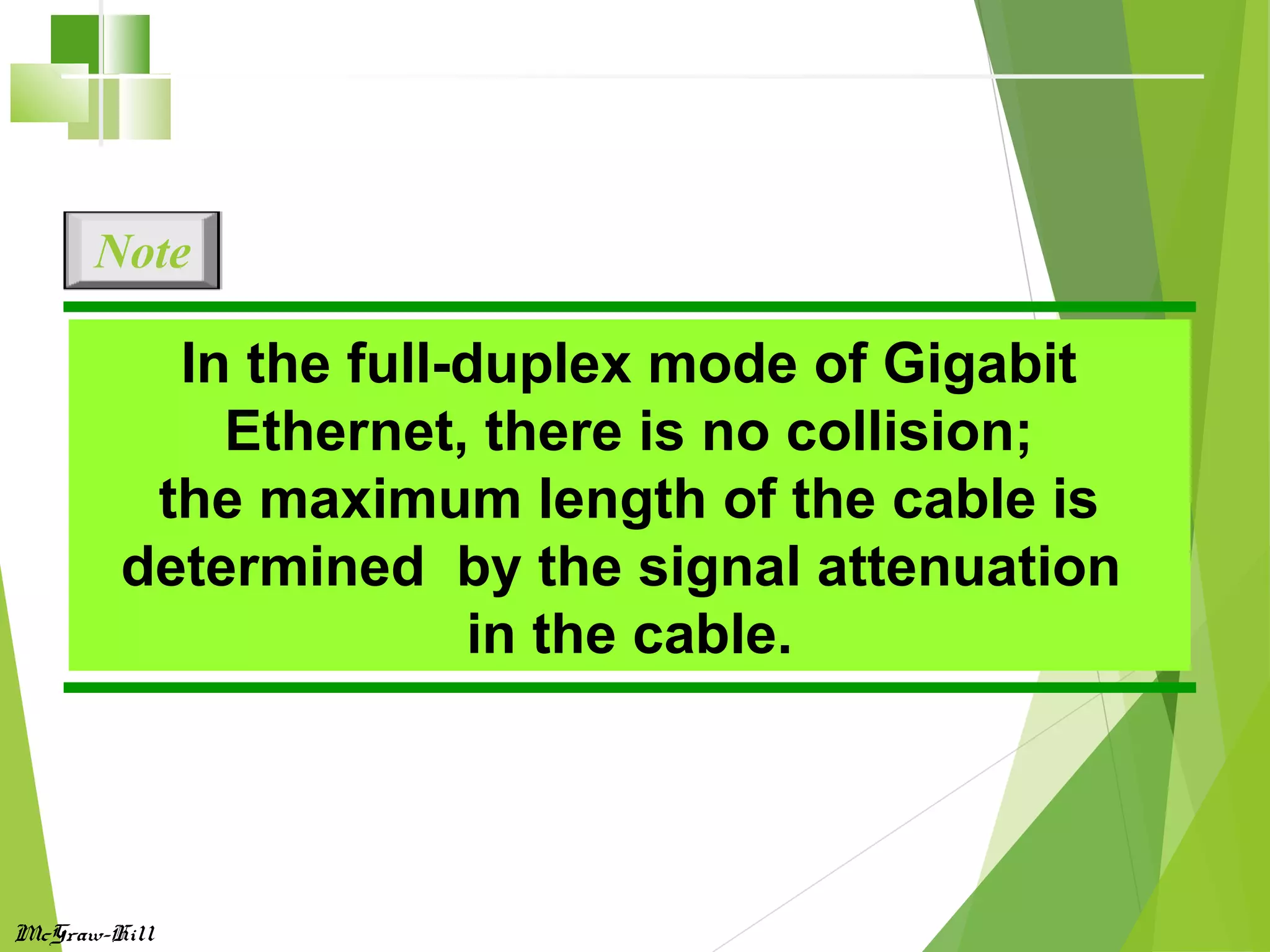
In the full-duplex mode of Gigabit
Ethernet, there is no collision;
the maximum length of the cable is
determined by the signal attenuation
in the cable.
Note
McGraw-Hill
Figure 13.22 Topologies of Gigabit Ethernet
McGraw-Hill
10Gbps Ethernet
 Maximum link distances cover 300 m to 40 km
 Full-duplex mode only
 No CSMA/CD
 Uses optical fiber only
McGraw-Hill

Ethernet

  • 1.
  • 2.
    McGraw-Hill 4th 2016 - 20 Topic Mam,Qoseen BS(IT) 311, 315, 317, 323 ETHERNET Semester Roll No Class Submitted to Session
  • 3.
    McGraw-Hill ©The McGraw-HillCompanies, Inc., 2000 SR:# STATEMENT 1 ETHERNET 2 HISTORY OF ETHERNET 3 INTRODUCTION 4 TYPES & CATEGORIES OF ETHERNET CABLES 5 WORKING 6 ADRRESSING SCHEME 7 SCOPE 8 ADVANTAGES & DISADVANTAGES
  • 4.
    McGraw-Hill 13-1 IEEE STANDARDS13-1IEEE STANDARDS Ethernet: It is a LAN protocol that is used in Bus and Star topologies and implements CSMA/CD as the medium access method Original (traditional) Ethernet developed in 1980 byOriginal (traditional) Ethernet developed in 1980 by three companies:three companies: DDigital,igital, IIntel,ntel, XXerox (DIX).erox (DIX). In 1985, the Computer Society of the IEEE started aIn 1985, the Computer Society of the IEEE started a project, calledproject, called Project 802Project 802, to set standards to enable, to set standards to enable intercommunication among equipment from a variety ofintercommunication among equipment from a variety of manufacturers.manufacturers.  Current version is calledCurrent version is called IEEE EthernetIEEE Ethernet
  • 5.
    McGraw-Hill Ethernet Frame formats. (a)DIX Ethernet , (b) IEEE 802.3. FCS FCS  Ethernet Frame format
  • 6.
  • 7.
    McGraw-Hill IEEE Ethernet  InIEEE 802.3 Ethernet Data link layer is split into two sublayers:  Bottom part: MAC  The frame is called IEEE 802.3  Handles framing, MAC addressing, Medium Access control  Specific implementation for each LAN protocol  Defines CSMA/CD as the access method for Ethernet LANs and Token passing method for Token Ring.  Implemented in hardware  Top part: LLC (Logical Link Control)  The subframe is called IEEE 802.2  Provides error and flow control if needed  It makes the MAC sublayer transparent  Allows interconnectivity between different LANs data link layers  Used to multiplex multiple network layer protocols in the data link layer frame  Implemented in software
  • 8.
  • 9.
    McGraw-Hill Ethernet Provides Unreliable,connectionless Service  Ethernet data link layer protocol provides connectionless service to the network layer  No handshaking between sending and receiving adapter.  Ethernet protocol provides Unreliable service to the network layer :  Receiving adapter doesn’t send ACK or NAK to sending adapter  This means stream of datagrams passed to network layer can have gaps (missing data)  Gaps will be filled if application is using reliable transport layer protocol  Otherwise, application will see the gaps
  • 10.
    McGraw-Hill  Preamble:  8bytes with pattern 10101010 used to synchronize receiver, sender clock rates.  In IEEE 802.3, eighth byte is start of frame (10101011)  Addresses: 6 bytes (explained latter)  Type (DIX)  Indicates the type of the Network layer protocol being carried in the payload (data) field, mostly IP but others may be supported such as IP (0800), Novell IPX (8137) and AppleTalk (809B), ARP (0806) )  Allow multiple network layer protocols to be supported on a single machine (multiplexing)  Its value starts at 0600h (=1536 in decimal)  Length (IEEE 802.3): number of bytes in the data field.  Maximum 1500 bytes (= 05DCh)  CRC: checked at receiver, if error is detected, the frame is discarded  CRC-32  Data: carries data encapsulated from the upper-layer protocols  Pad: Zeros are added to the data field to make the minimum data length = 46 bytes Ethernet Frame
  • 11.
    McGraw-Hill Ethernet address  Sixbytes = 48 bits  Flat address not hierarchical  Burned into the NIC ROM  First three bytes from left specify the vendor. Cisco 00-00-0C, 3Com 02-60-8C and the last 24 bit should be created uniquely by the company  Destination Address can be:  Unicast: second digit from left is even (one recipient)  Multicast: Second digit from left is odd (group of stations to receive the frame – conferencing applications)  Broadcast (ALL ones) (all stations receive the frame)  Source address is always Unicast
  • 12.
  • 13.
    McGraw-Hill The least significantbit of the first byte defines the type of address. If the bit is 0, the address is unicast; otherwise, it is multicast. Note
  • 14.
    McGraw-Hill The broadcast destinationaddress is a special case of the multicast address in which all bits are 1s. Note
  • 15.
    McGraw-Hill Figure 13.7 Unicastand multicast addresses
  • 16.
    McGraw-Hill Show how theaddress 47:20:1B:2E:08:EE is sent out on line. Solution The address is sent left-to-right, byte by byte; for each byte, it is sent right-to-left, bit by bit, as shown below: Example 13.2
  • 17.
    McGraw-Hill Define the typeof the following destination addresses: a. 4A:30:10:21:10:1A b. 47:20:1B:2E:08:EE c. FF:FF:FF:FF:FF:FF Solution To find the type of the address, we need to look at the second hexadecimal digit from the left. If it is even, the address is unicast. If it is odd, the address is multicast. If all digits are F’s, the address is broadcast. Therefore, we have the following: a. This is a unicast address because A in binary is 1010. b. This is a multicast address because 7 in binary is 0111. c. This is a broadcast address because all digits are F’s. Example 13.1
  • 18.
  • 19.
    McGraw-Hill Frame length: Minimum: 64bytes (512 bits) Maximum: 1518 bytes (12,144 bits) Note
  • 20.
    McGraw-Hill Figure 13.3 Ethernetevolution through four generations
  • 21.
    McGraw-Hill 13.4 Fast Ethernet 100 Mbps transmission rate  same frame format, media access, and collision detection rules as 10 Mbps Ethernet  can combine 10 Mbps Ethernet and Fast Ethernet on same network using a switch  media: twisted pair (CAT 5) or fiber optic cable (no coax)  Star-wire topology  Similar to 10BASE-T
  • 22.
  • 23.
    McGraw-Hill Full Duplex Operation Traditional Ethernet is half duplex  Either transmit or receive but not both simultaneously  With full-duplex, station can transmit and receive data simultaneously  With full duplex, Throughput (actual transmission rate) is doubled.  10-Mbps Ethernet in full-duplex mode, theoretical transfer rate becomes 20 Mbps  100-Mbps Ethernet in full-duplex mode, theoretical transfer rate becomes 200 Mbps  Changes that should be made with any computer in order to operate in Full-Duplex Mode 1) Attached stations must have full-duplex NIC cards 2) Must use two pairs of wire one pair for transmitting from host to switch (inbound) and the other pair for transmitting from switch to host (outbound) 3) Must use a switch as a central device not a hub 4) Devices must be connected point-to-point (dedicated) to the switch  Each station constitutes separate collision domain  CSMA/CD algorithm no longer needed (no collision)  No limit on the segment length  Same 802.3 MAC frame format used
  • 24.
  • 25.
  • 26.
    McGraw-Hill 13.5 Gigabit Ethernet Speed 1Gpbs  Minimum frame length is 512 bytes  Operates in full/half duplex modes mostly full duplex
  • 27.
    McGraw-Hill In the full-duplexmode of Gigabit Ethernet, there is no collision; the maximum length of the cable is determined by the signal attenuation in the cable. Note
  • 28.
  • 29.
    McGraw-Hill 10Gbps Ethernet  Maximumlink distances cover 300 m to 40 km  Full-duplex mode only  No CSMA/CD  Uses optical fiber only
  • 30.