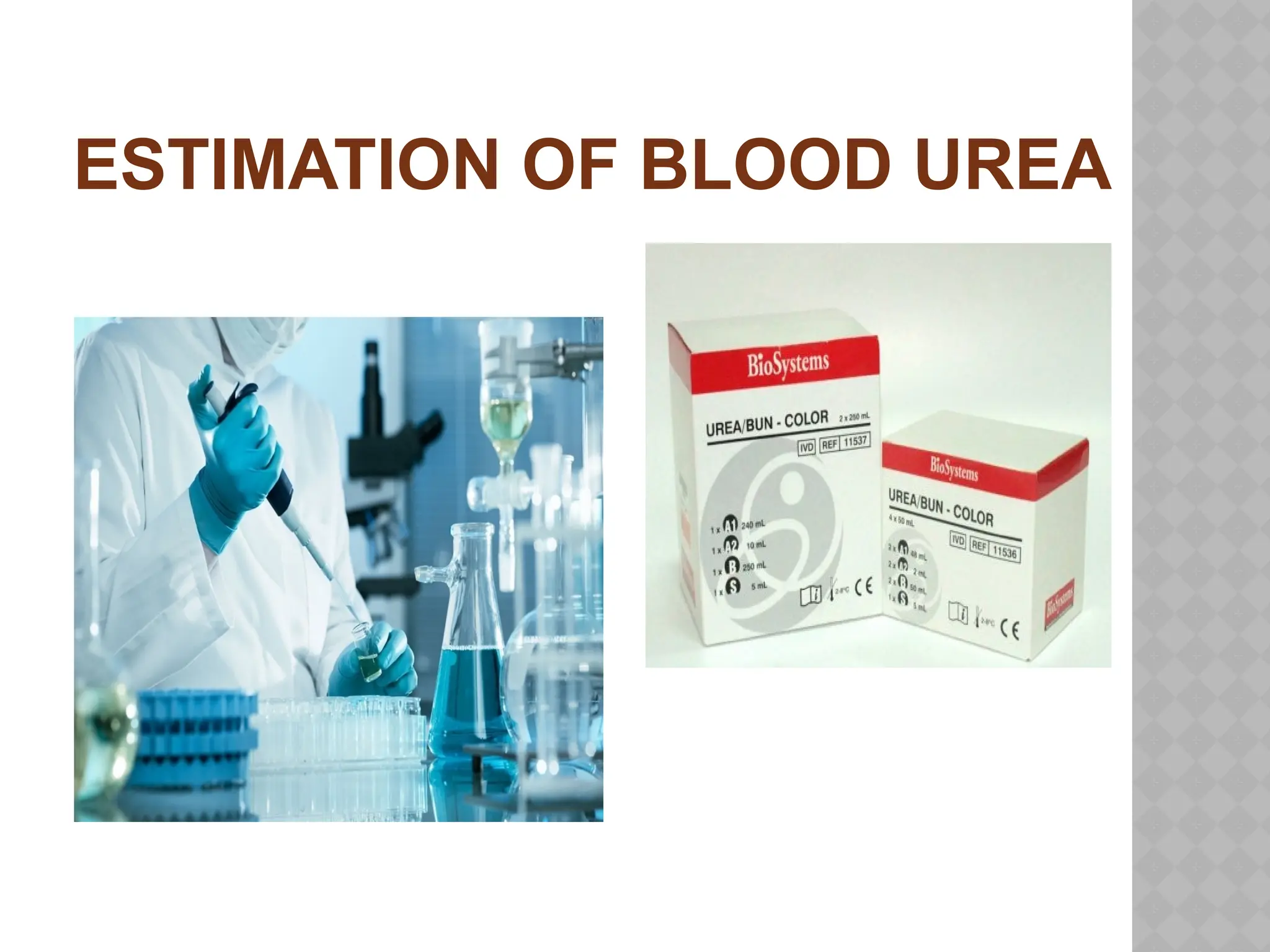
ESTIMATION OF BLOOD UREA
 Introduction :-
 Urea is the end product of protein catabolism
 Major component (> 75%)of NPN substance
 Formed in the liver and excreted by kidneys
 It is freely filtered by glomeruli and neither reabsorbed
nor secreted by renal tubes
 Estimation of blood urea level is important in diagnosis
of renal diseases.
 Aim :-
To estimate the amount of blood urea in a given sample
 Apparatus Required :-
Test tube , test tube stands , pipettes , colorimeter.
Method :- Berthelot method
Principle :-
 Urease reacts with urea and forms Ammonia and
carbondioxide.
 The Ammonia released reacts with Salicylates ,Nitroprusside
and Hypochlorite to yield Blue Green Indophenol Compound .
 The Intensity of colour produced is proportional to the
concentration of urea in the sample and is measured
photometrically at 570nm or Yellow filter.
Urea + H2O 2NH3+CO2
NH3 + Salicylate + 2-2- Dicarboxy-
Nitroprusside + Hypochlorite Indophenol
Urease
Principle :-
 SAMPLE – Serum / Urine
 Reagents :-
 1.Urease reagent : Contains Urease enzyme
 2. Color reagent : Contains Salicylates , Nitroprusside
and Hypochlorite.
 3.Urea standard : 40 mg%
Procedure :
Label 3 test tubes as Blank (B) , Standard (S) and Test (T)
Reagents Blank Standard Test
Urease reagent 1ml 1ml 1ml
Distilled water 10 µl --- ---
Urea Standard --- 10 µl ---
Serum / Plasma --- --- 10 µl
Mix and Incubate at Room temperature for 5 Minutes
Colour reagent 1ml 1ml 1ml
Mix and Incubate at Room temperature for 5 Minutes
Measure the absorbance of the test, standard ,against blank on
the
colorimeter with yellow filter at 570 nm.
Calculations :-
UREA in mg% =
O.D of Test – O.D of Blank x Concentration of Standard x 100
O.D of Std. – O.D of Blank Volume of sample
 Urea standard : 40 mg% - 100 ml contain 40mg
 1ml contain 0.4mg
 0.01ml contain 0.004mg
 Volume of sample – 0.01ml
Test – Blank x 0.004 x 100
Std. – Blank 0.01
 T/S x 40 mg%
 Reference Ranges:
 Normal serum levels – 15- 40 mg/dl
 Normal urinary levels – 15- 30 g/day
 Clinical Interpretation :-
 Increased blood urea level
 Physiological variation - Increased protein diet
Increased protein catabolism
 Azotemia: An excess concentration of urea or other nitrogenous
compounds in blood.
 Uremia :Increased levels of urea in blood accompanied by renal
failure is called uremia, or the uremic syndrome
 Pathological :
 Pre renal, renal ,post renal
 Pathological :
 Pre renal - extra renal factors
 Due to decreased plasma volume – decreased renal blood
flow- decreased GFR- increased urea retention - increased
plasma urea.
 Dehydration- prolonged vomiting,diarrhoea,shock,burns
 Congestive cardiac failure
 Increased catabolism: High fever, thyrotoxicosis, diabetes
mellitus, haemorrhage in GIT
 Renal –kidney diseases- decreased GFR-
increased urea retention
 ARF,CRF,glomerulonephritis,pyelonephritis,polycys
tic kidney disease,nephrotic syndrome,TB of
kidney,nephro toxicity due to drugs and toxins.
 Post Renal - decreased GFR due to obstruction to
urine flow beyond the kidneys leading to urea retention
 Stones in urinary tract, stricture urethra, enlarge of
prostate, malignant tumor of urinary tract
 Decrease blood urea level
 Hepatic failure
 Genetic-deficiency of urea cycle enzymes
 Protein Energy Malnutrition
 Blood urea nitrogen (BUN) :
 It is a measurement of nitrogen in blood in
form of urea
 Molecular weight of urea is 60 and about half (28)
of it is contributed by 2 nitrogen atoms
 Blood urea (mg/dl) = BUN (mg/dl) x 2.14
 BUN (mg/dl) = Blood urea (mg/dl) x 0.467
 Normal value : 7- 21 mg/dl
 Other methods
 Chemical methods
1. DAM
 Enzymatic Methods
1. Urease nesslerization
2. Glutamate dehydrogenase method
 Urea clearance
 The clearance tests, measuring the glomerular filtration
rate (GFR) - the most useful in assessing renal function
 volume of plasma that would be completely cleared of
a substance per minute.
 expressed as ml/minute
 U = Concentration of the substance in urine.
V = Volume of urine in ml excreted per minute.
P = Concentration of the substance in plasma
 Urea clearance
 volume of plasma that would be completely
cleared of a (substance)urea per minute.
 expressed as ml/minute
 Based on urine flow rate
 maximum urea clearance :
 more than 2 ml per minute.
 Normal value is around 75 ml/min
 Standard urea clearance
 volume of urine is less than 2 ml/min.
 Normal value is around 54 ml/min.

ESTIMATION OF BLOOD UREA for biochemistry Mbbs 1st year.pptx

  • 1.
  • 2.
    ESTIMATION OF BLOODUREA  Introduction :-  Urea is the end product of protein catabolism  Major component (> 75%)of NPN substance  Formed in the liver and excreted by kidneys  It is freely filtered by glomeruli and neither reabsorbed nor secreted by renal tubes  Estimation of blood urea level is important in diagnosis of renal diseases.
  • 3.
     Aim :- Toestimate the amount of blood urea in a given sample  Apparatus Required :- Test tube , test tube stands , pipettes , colorimeter.
  • 4.
    Method :- Berthelotmethod Principle :-  Urease reacts with urea and forms Ammonia and carbondioxide.  The Ammonia released reacts with Salicylates ,Nitroprusside and Hypochlorite to yield Blue Green Indophenol Compound .  The Intensity of colour produced is proportional to the concentration of urea in the sample and is measured photometrically at 570nm or Yellow filter.
  • 5.
    Urea + H2O2NH3+CO2 NH3 + Salicylate + 2-2- Dicarboxy- Nitroprusside + Hypochlorite Indophenol Urease Principle :-
  • 6.
     SAMPLE –Serum / Urine  Reagents :-  1.Urease reagent : Contains Urease enzyme  2. Color reagent : Contains Salicylates , Nitroprusside and Hypochlorite.  3.Urea standard : 40 mg%
  • 7.
    Procedure : Label 3test tubes as Blank (B) , Standard (S) and Test (T) Reagents Blank Standard Test Urease reagent 1ml 1ml 1ml Distilled water 10 µl --- --- Urea Standard --- 10 µl --- Serum / Plasma --- --- 10 µl Mix and Incubate at Room temperature for 5 Minutes Colour reagent 1ml 1ml 1ml Mix and Incubate at Room temperature for 5 Minutes Measure the absorbance of the test, standard ,against blank on the colorimeter with yellow filter at 570 nm.
  • 8.
    Calculations :- UREA inmg% = O.D of Test – O.D of Blank x Concentration of Standard x 100 O.D of Std. – O.D of Blank Volume of sample  Urea standard : 40 mg% - 100 ml contain 40mg  1ml contain 0.4mg  0.01ml contain 0.004mg  Volume of sample – 0.01ml Test – Blank x 0.004 x 100 Std. – Blank 0.01  T/S x 40 mg%
  • 9.
     Reference Ranges: Normal serum levels – 15- 40 mg/dl  Normal urinary levels – 15- 30 g/day  Clinical Interpretation :-  Increased blood urea level  Physiological variation - Increased protein diet Increased protein catabolism  Azotemia: An excess concentration of urea or other nitrogenous compounds in blood.  Uremia :Increased levels of urea in blood accompanied by renal failure is called uremia, or the uremic syndrome
  • 10.
     Pathological : Pre renal, renal ,post renal
  • 11.
     Pathological : Pre renal - extra renal factors  Due to decreased plasma volume – decreased renal blood flow- decreased GFR- increased urea retention - increased plasma urea.  Dehydration- prolonged vomiting,diarrhoea,shock,burns  Congestive cardiac failure  Increased catabolism: High fever, thyrotoxicosis, diabetes mellitus, haemorrhage in GIT
  • 12.
     Renal –kidneydiseases- decreased GFR- increased urea retention  ARF,CRF,glomerulonephritis,pyelonephritis,polycys tic kidney disease,nephrotic syndrome,TB of kidney,nephro toxicity due to drugs and toxins.  Post Renal - decreased GFR due to obstruction to urine flow beyond the kidneys leading to urea retention  Stones in urinary tract, stricture urethra, enlarge of prostate, malignant tumor of urinary tract
  • 13.
     Decrease bloodurea level  Hepatic failure  Genetic-deficiency of urea cycle enzymes  Protein Energy Malnutrition
  • 14.
     Blood ureanitrogen (BUN) :  It is a measurement of nitrogen in blood in form of urea  Molecular weight of urea is 60 and about half (28) of it is contributed by 2 nitrogen atoms  Blood urea (mg/dl) = BUN (mg/dl) x 2.14  BUN (mg/dl) = Blood urea (mg/dl) x 0.467  Normal value : 7- 21 mg/dl
  • 15.
     Other methods Chemical methods 1. DAM  Enzymatic Methods 1. Urease nesslerization 2. Glutamate dehydrogenase method
  • 16.
     Urea clearance The clearance tests, measuring the glomerular filtration rate (GFR) - the most useful in assessing renal function  volume of plasma that would be completely cleared of a substance per minute.  expressed as ml/minute  U = Concentration of the substance in urine. V = Volume of urine in ml excreted per minute. P = Concentration of the substance in plasma
  • 17.
     Urea clearance volume of plasma that would be completely cleared of a (substance)urea per minute.  expressed as ml/minute
  • 18.
     Based onurine flow rate  maximum urea clearance :  more than 2 ml per minute.  Normal value is around 75 ml/min  Standard urea clearance  volume of urine is less than 2 ml/min.  Normal value is around 54 ml/min.