























































From Confusion to Conclusion
   How to Write a First-Class Essay


           Vlad Mackevic

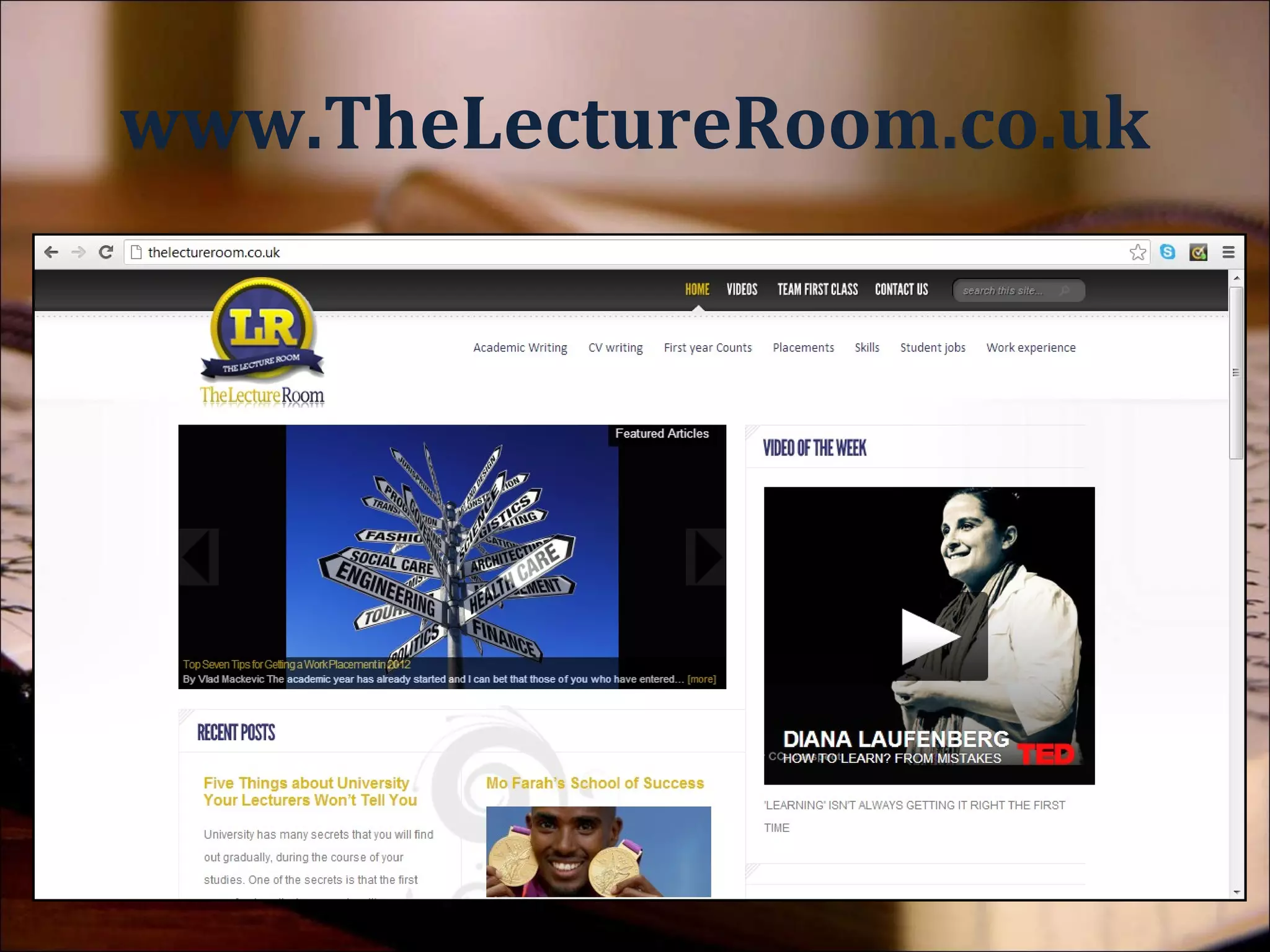
     www.thelectureroom.co.uk
www.TheLectureRoom.co.uk
Objectives

 How to answer essay and exam
  questions?
 How to come up with an essay topic?
 How to be critical?
 How to structure your essay?
 How to research efficiently?
 How to become a better writer?
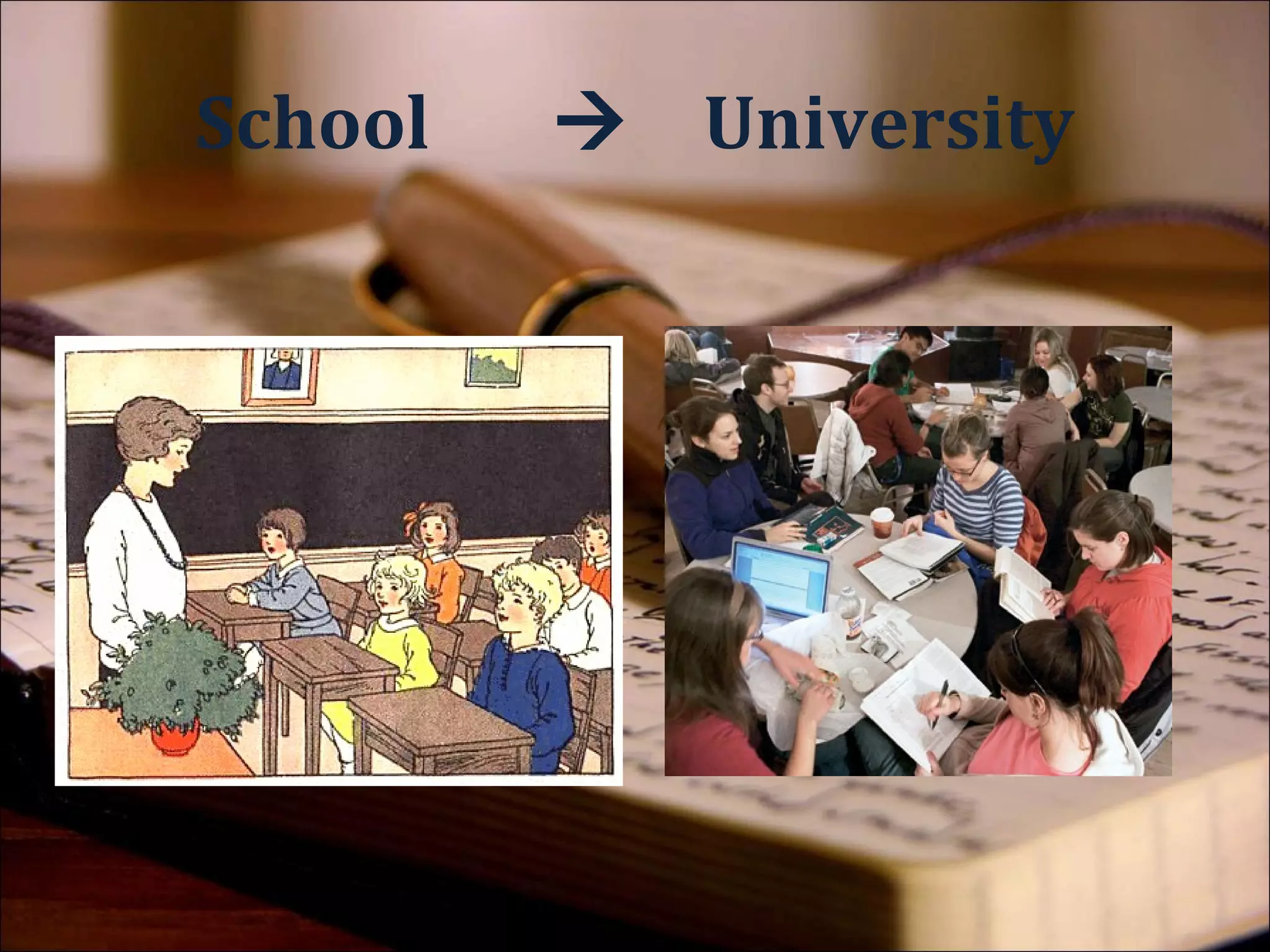
School    University
Overwhelmed!
What Earns You Points?
 Answering the
  Question (!)
 Structure
 Style and language
 Research and
  Analysis
 References
 Formatting and
  Presentation
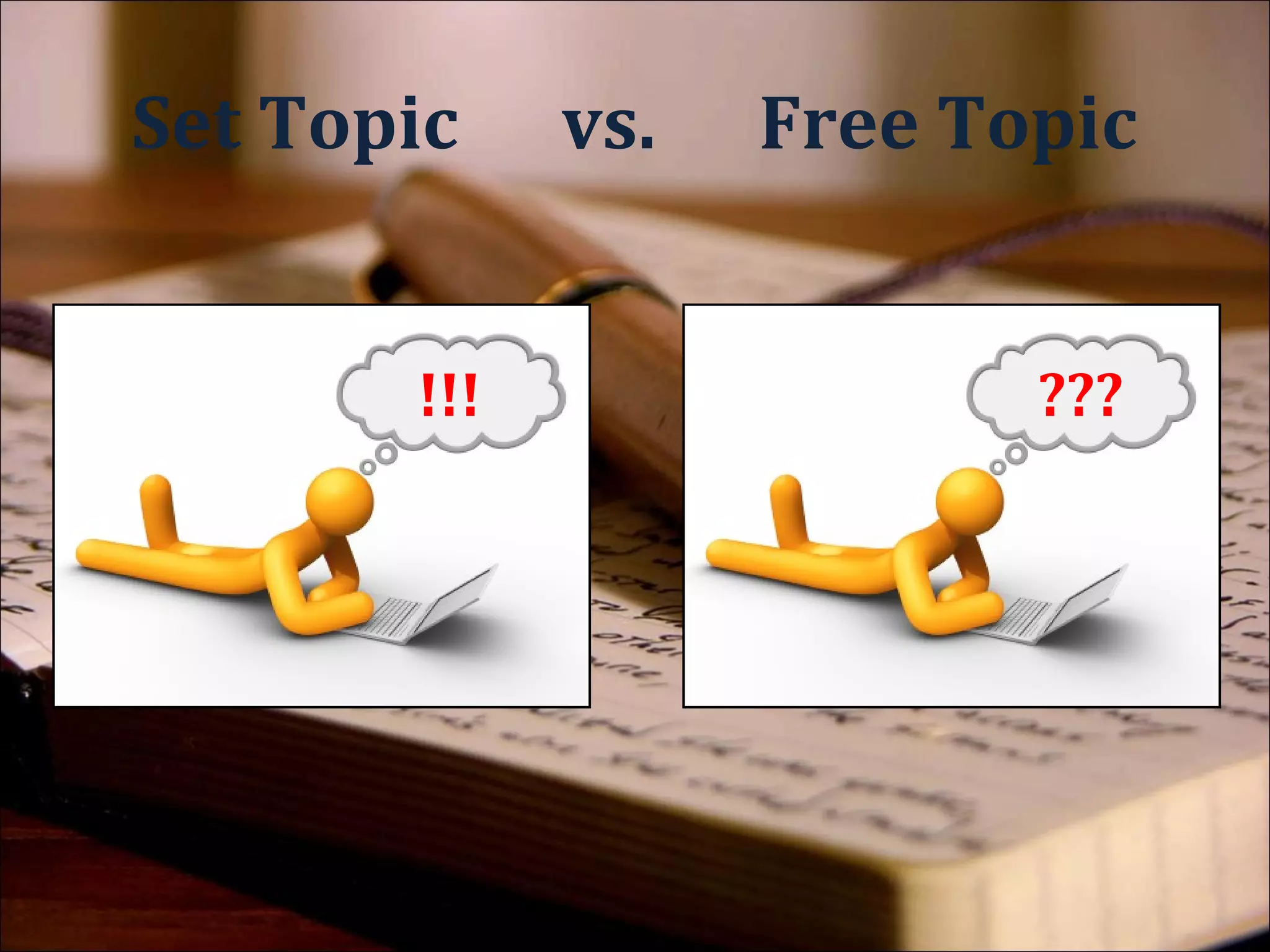
Set Topic    vs.   Free Topic


       !!!                ???
Set Topic
The Assignment Question


1.The Object of the Study
2.The Context of the Study
3.The Method of the Study
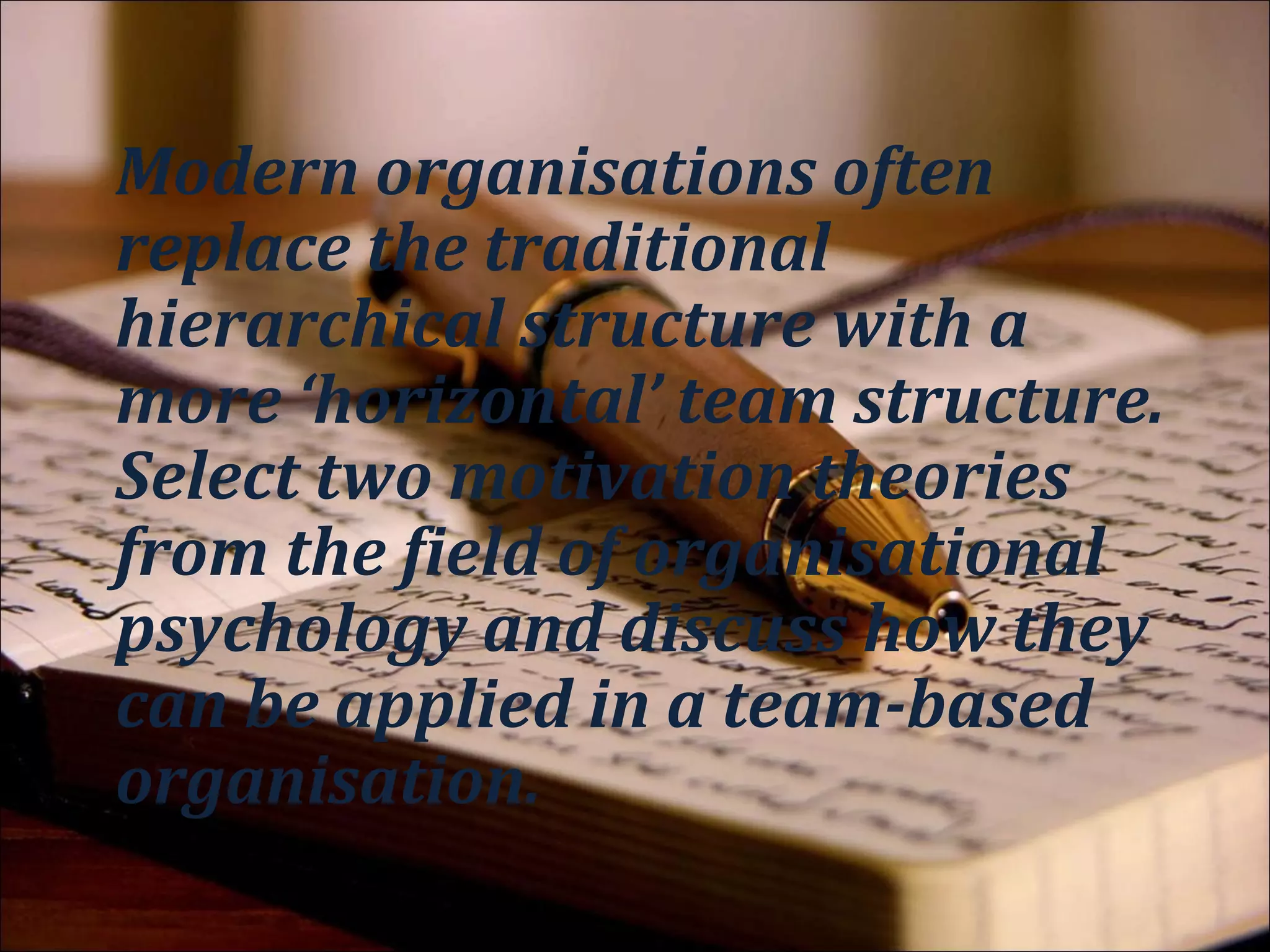
Modern organisations often
replace the traditional
hierarchical structure with a
more ‘horizontal’ team structure.
Select two motivation theories
from the field of organisational
psychology and discuss how they
can be applied in a team-based
organisation.
Action Verbs
Modern organisations often replace
the traditional hierarchical structure
with a more ‘horizontal’ team
structure. Select two motivation
theories from the field of
organisational psychology and
discuss how they can be applied in a
team-based organisation.
Object
Modern organisations often replace
the traditional hierarchical structure
with a more ‘horizontal’ team
structure. Select two motivation
theories from the field of
organisational psychology and
discuss how they can be applied in a
team-based organisation.
Context
Modern organisations often replace
the traditional hierarchical structure
with a more ‘horizontal’ team
structure. Select two motivation
theories from the field of
organisational psychology and
discuss how they can be applied in a
team-based organisation.
Method
Modern organisations often replace
the traditional hierarchical structure
with a more ‘horizontal’ team
structure. Select two motivation
theories from the field of
organisational psychology and
discuss how they can be applied in a
team-based organisation.
Discuss
1. It is the case because
Reason A
Reason B
Reason C
2. On the other hand, it is not the case because
Reason A
Reason B
Reason C
Do you agree with Hedley Bull’s
comment that the notion of
‘international society has always
been present’ in the world
political system?
Object

Do you agree with Hedley Bull’s
comment that the notion of
‘international society has always
been present’ in the world
political system?
Context

Do you agree with Hedley Bull’s
comment that the notion of
‘international society has always
been present’ in the world
political system?
Method

Do you agree with Hedley Bull’s
comment that the notion of
‘international society has always
been present’ in the world
political system?
What were the reasons for the
economic miracle of South Korea
in the second half of the twentieth
century?
Object

What were the reasons for the
economic miracle of South Korea
in the second half of the twentieth
century?
Context

What were the reasons for the
economic miracle of South Korea
in the second half of the twentieth
century?
Method

What were the reasons for the
economic miracle of South Korea
in the second half of the twentieth
century?
Reasons


 Internal vs. External
 Levels: individual, organisation,
  society, country
 Not universal, but a good start
Other ‘Action Words’

 Compare and contrast (similarities
  and differences)
 Advantages and disadvantages
  (‘Evaluate’)
 Outline (describe the main features)
 Enumerate (‘number’, list something)
Always define the object of
       your study.

Show your understanding of
      the key terms

Sometimes also define the
       context
What about Exams?
Exams are just like
essays, but you’ve got
   much less time
Exam Tips
 Research
 Practise
 Object, Context, Method
 Prepare an outline
 Manage your time
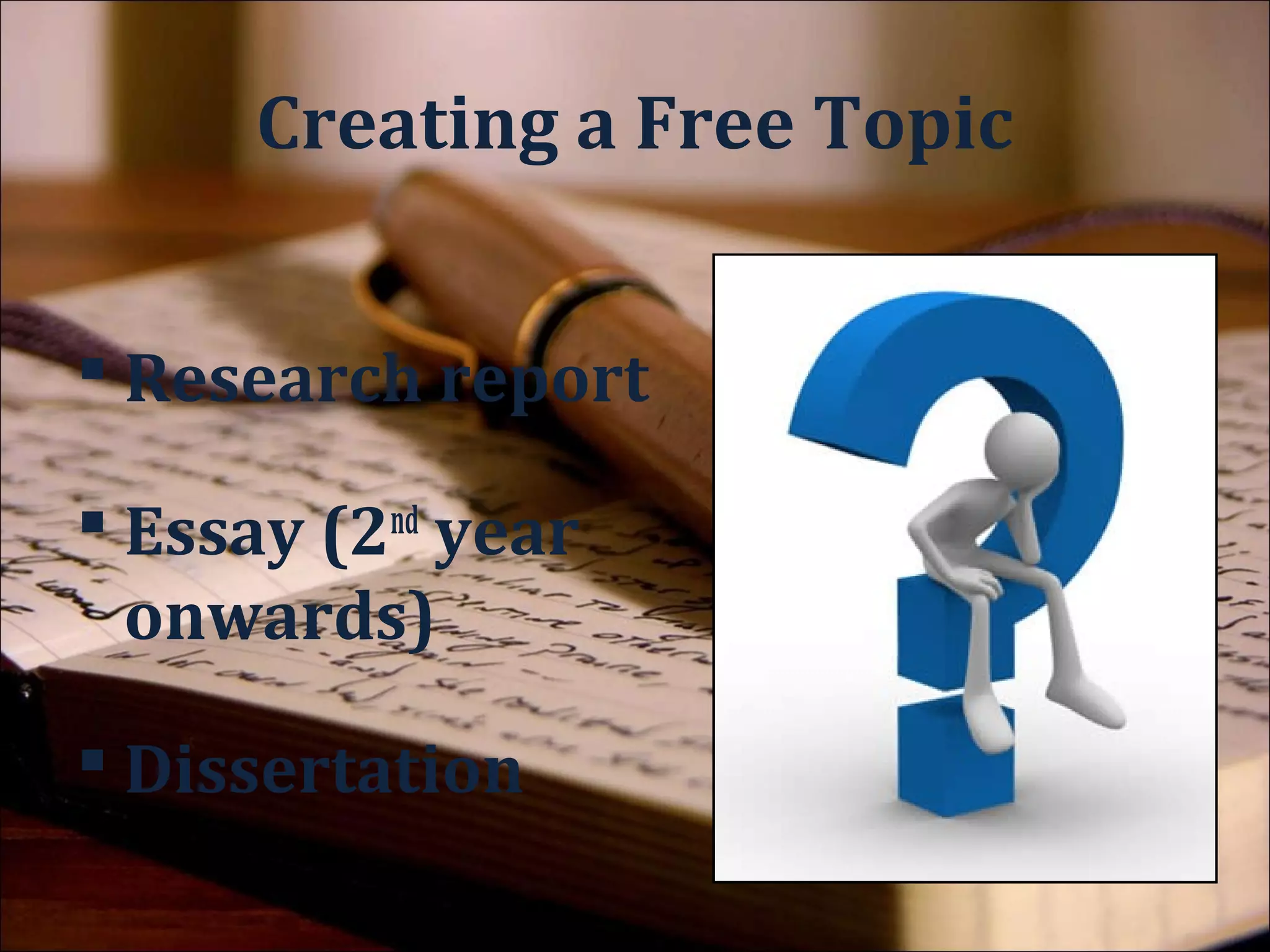
Creating a Free Topic


 Research report

 Essay (2nd year
  onwards)

 Dissertation
Keep It Simple and Narrow


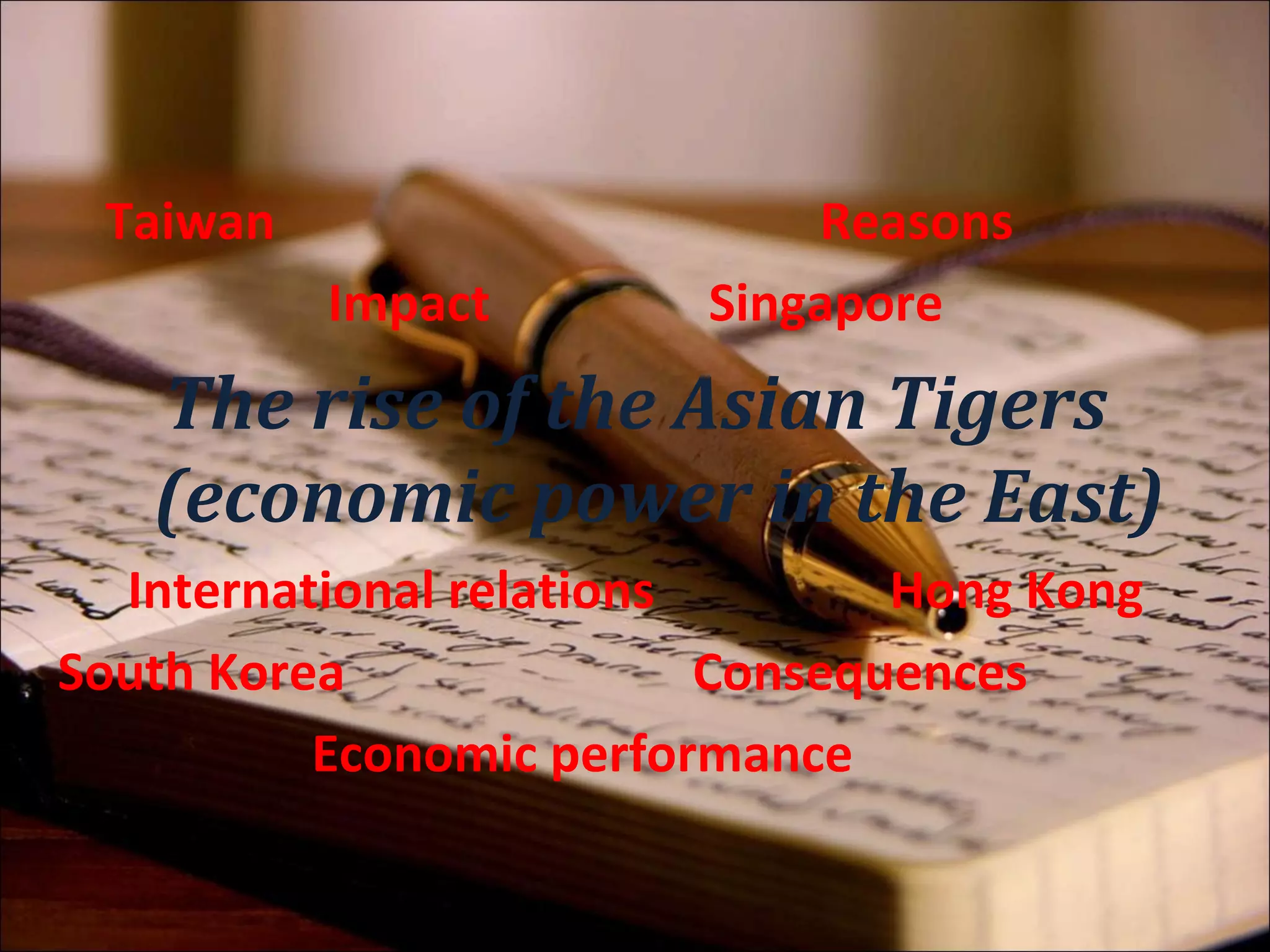
The rise of the Asian Tigers
(economic power in the East)
Taiwan                      Reasons
          Impact         Singapore
   The rise of the Asian Tigers
   (economic power in the East)
  International relations        Hong Kong
South Korea               Consequences
          Economic performance
What were the reasons for the
economic miracle of South Korea
in the second half of the twentieth
century?
What were the reasons for the
 economic miracle of South Korea
 in the second half of the twentieth
 century?

• Not consequences
What were the reasons for the
 economic miracle of South Korea
 in the second half of the twentieth
 century?

• Not consequences
• Not Taiwan, Singapore or Hong Kong
What were the reasons for the
 economic miracle of South Korea
 in the second half of the twentieth
 century?

• Not consequences;
• Not Taiwan, Singapore or Hong Kong
• Not any other time
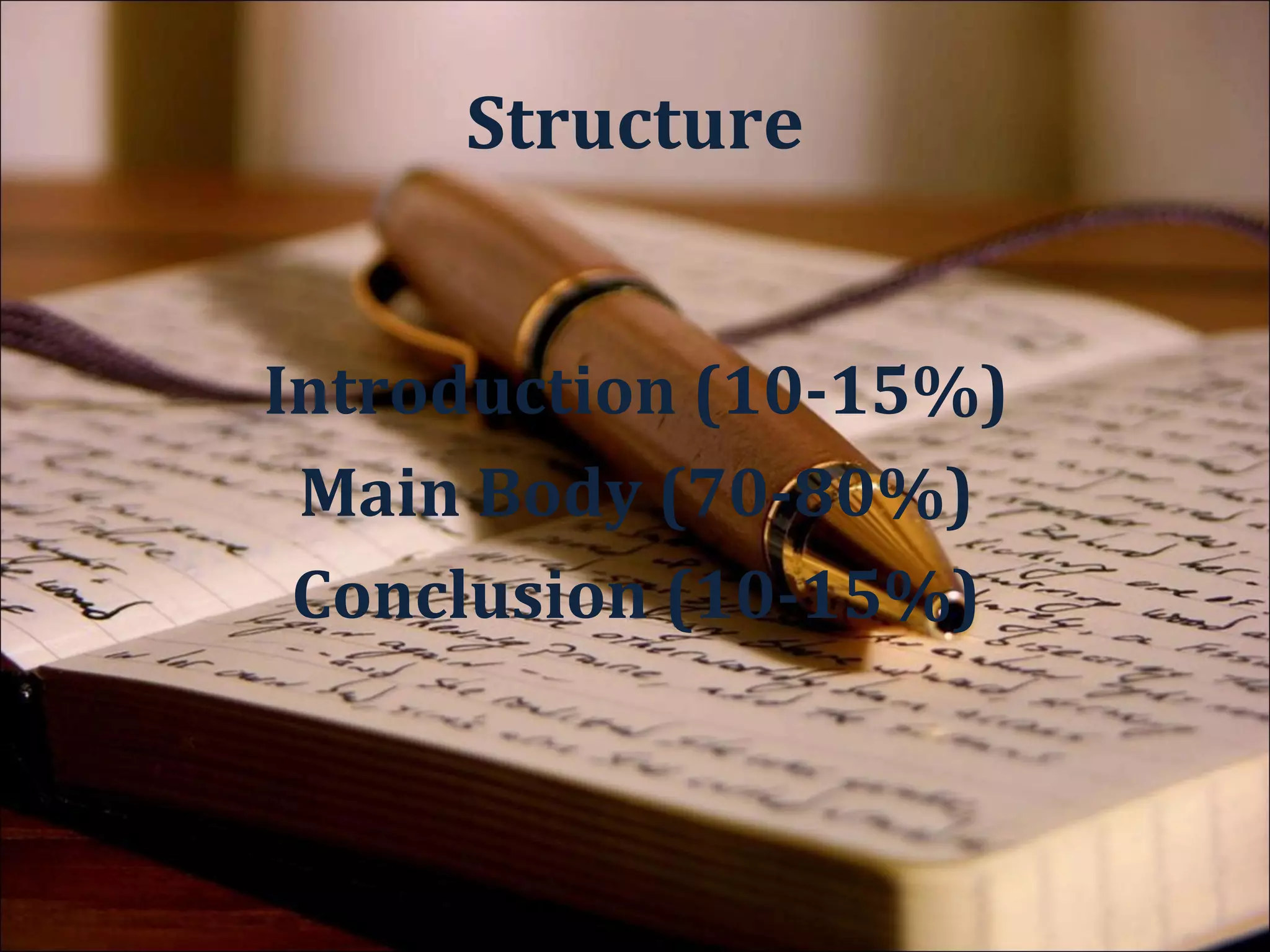
Structure


Introduction (10-15%)
 Main Body (70-80%)
 Conclusion (10-15%)
Structure


1.Say what you’re going to say;
2.Say it;
3.Say what you’ve just said.
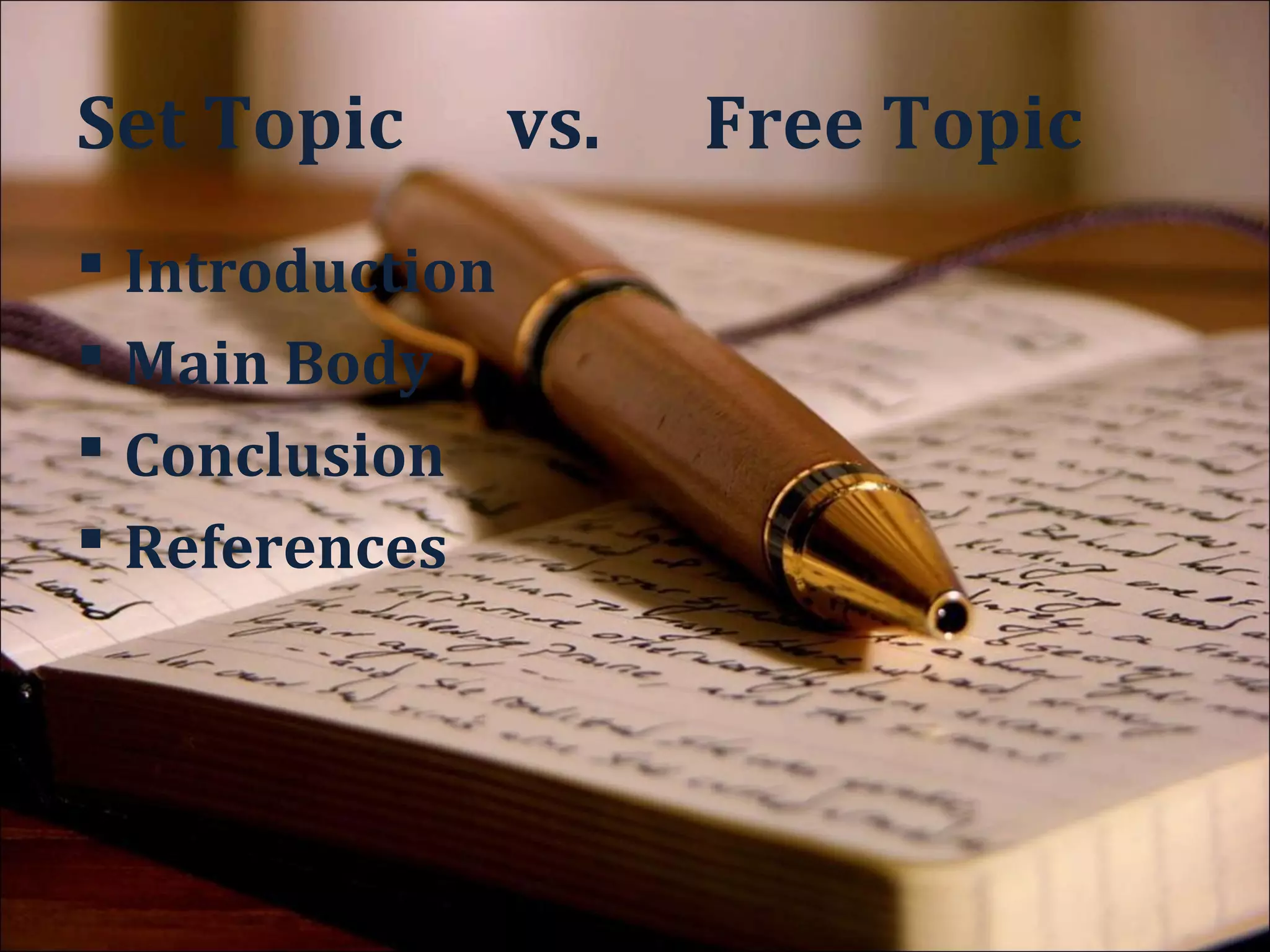
Set Topic        vs.   Free Topic
 Introduction
 Main Body
 Conclusion
 References
Set Topic        vs.   Free Topic
 Introduction          Introduction
 Main Body             Literature
 Conclusion             Review
 References            Methodology
                        Analysis and
                         Discussion
                        Conclusion
                        References
Introduction
Introduction


 Explain what you are writing
  about
 Guide your reader
 Mention the Object, the Context
  and the Method
Write Your
Introduction at the
       End
Why?
 It’s hard
 You don’t have all the information yet
     Theory
     Applications of the theory
     Arguments of the essay
     Outline and structure
 Write about your most recent actions
Main Body

 Main arguments
 Evidence
 Reading/knowledge
 References
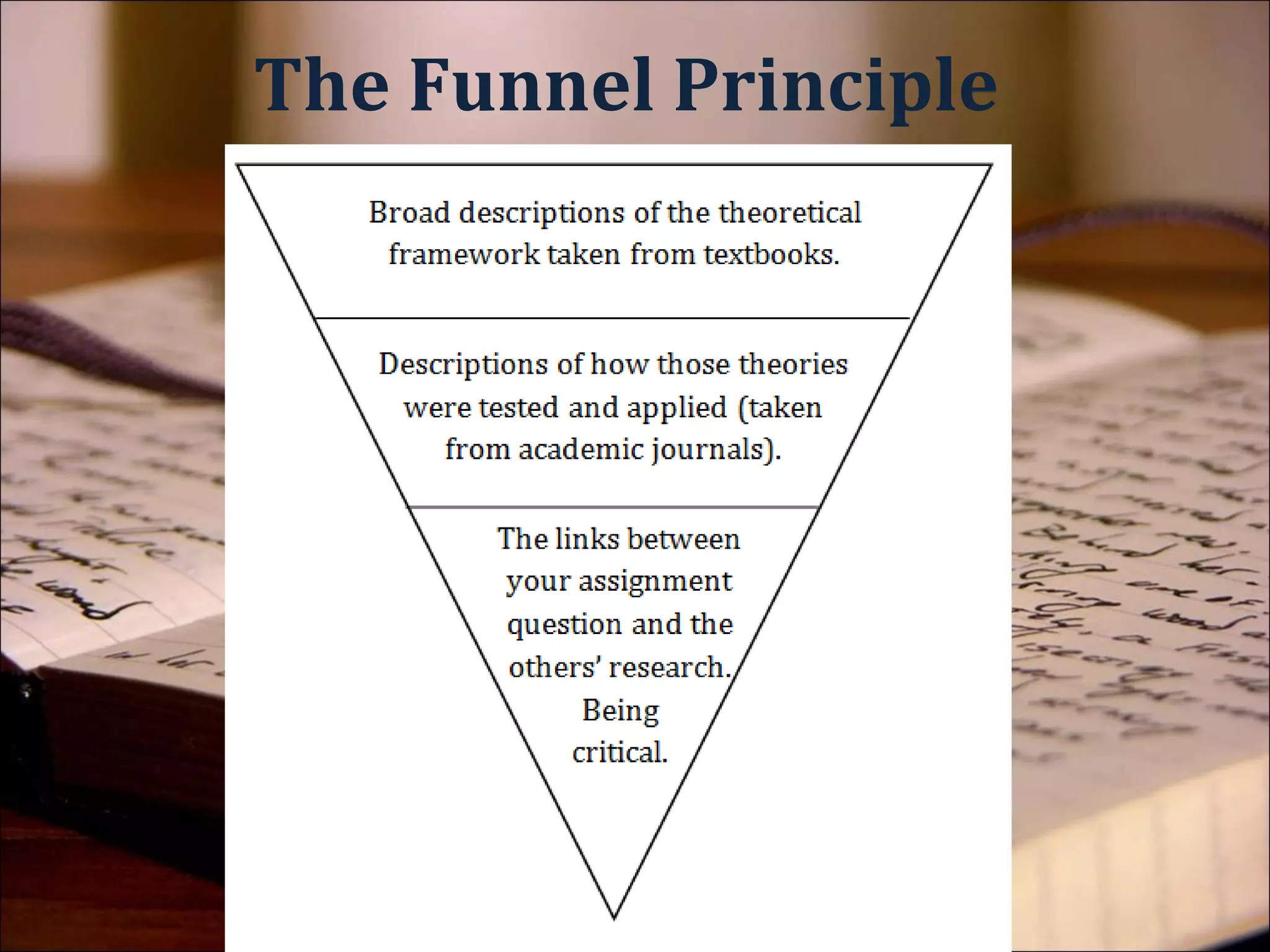
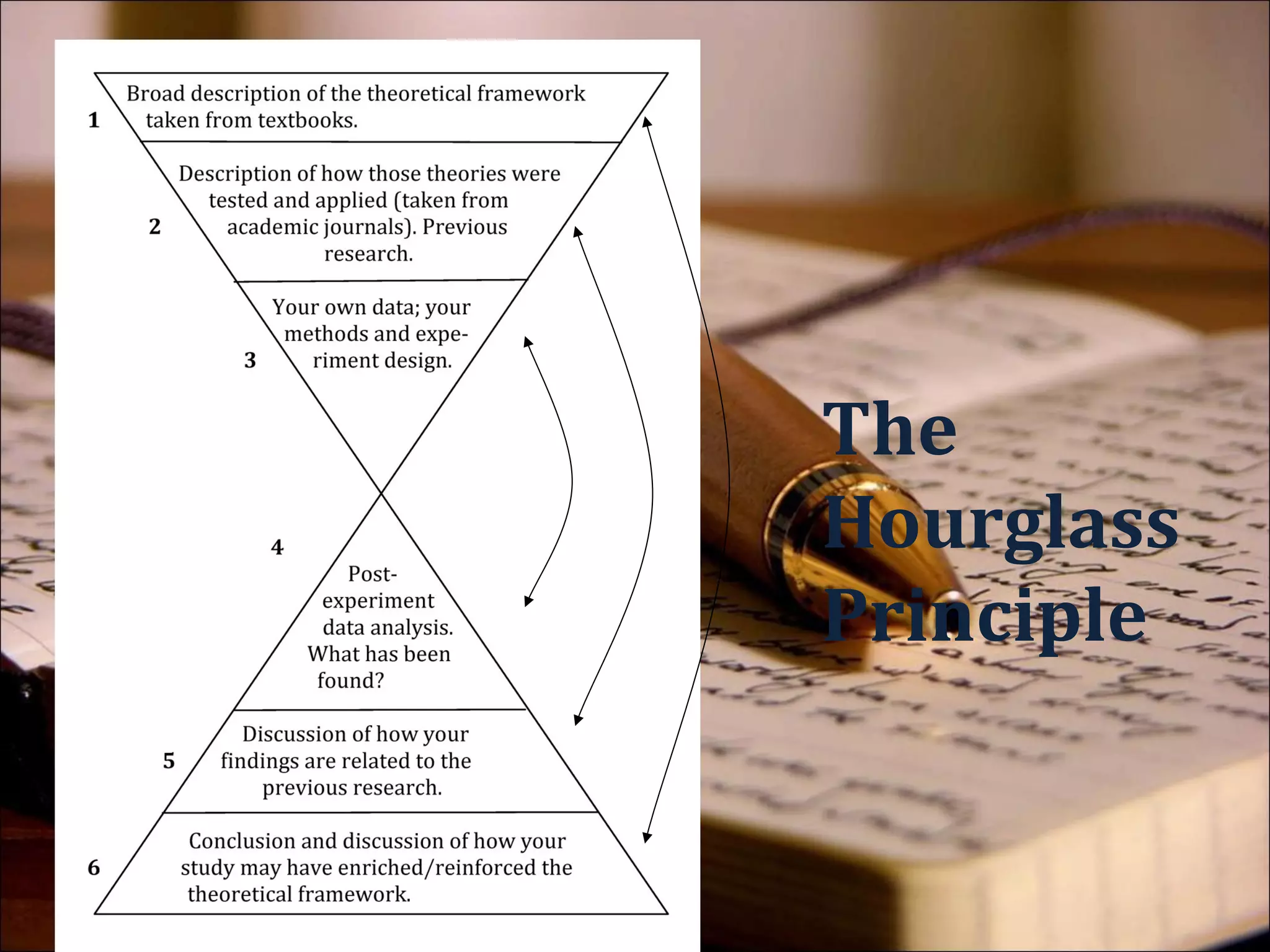
The Funnel and the Hourglass
Set Topic   Free Topic
Broad to Narrow
The Funnel Principle
Link all your
arguments back to the
   essay question!
Broad to Narrow and Back to Broad
The
Hourglass
Principle
Copy from one, it’s plagiarism;
 copy from two, it’s research.

                 Wilson Mizner
   US screenwriter (1876 - 1933)
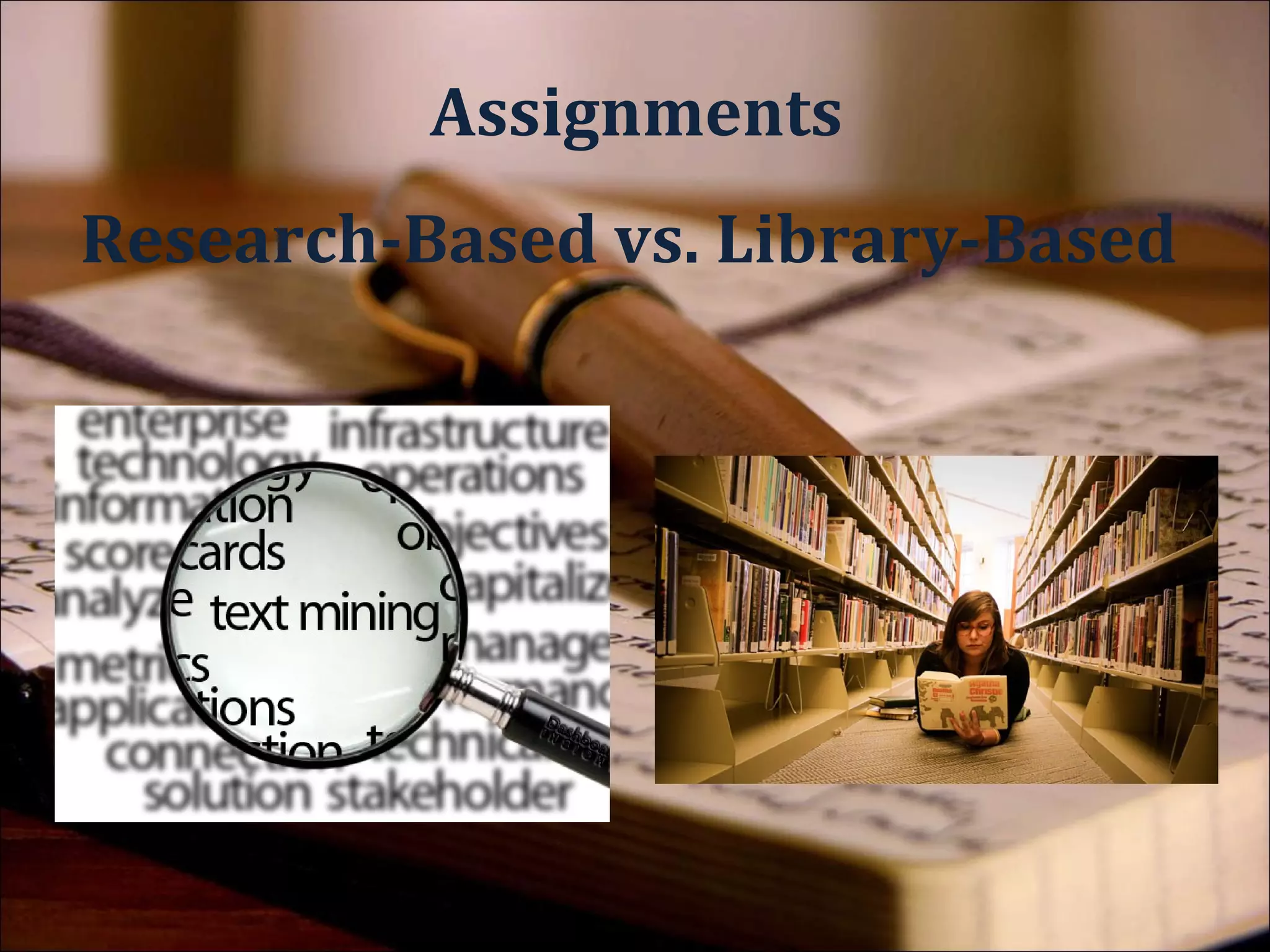
Assignments
Research-Based vs. Library-Based
Research
Primary          Secondary
Research


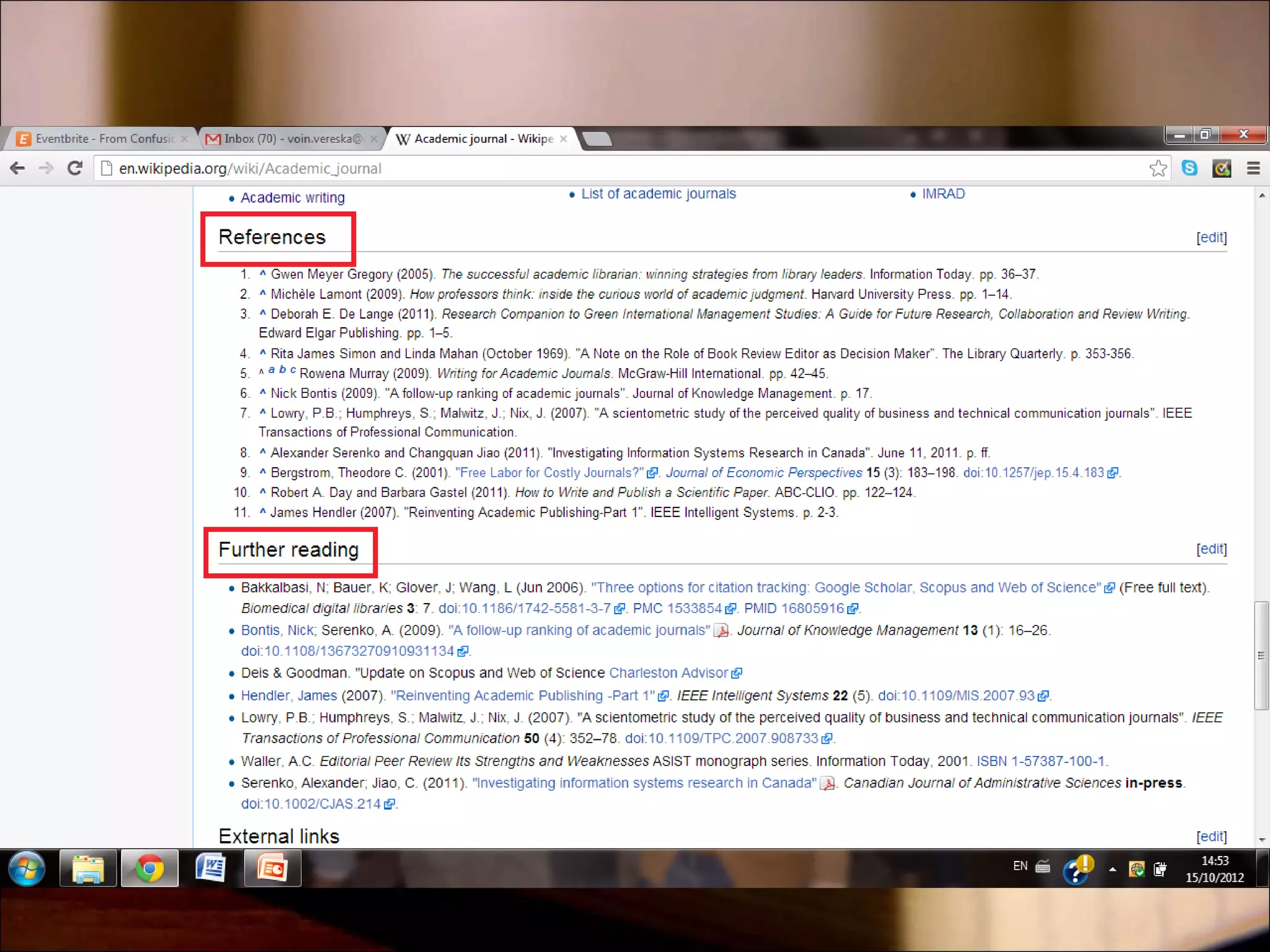
 Wikipedia (ONLY for general
  knowledge)
 Not to be included in the list of
  references
 References on Wikipedia
Research


 Textbooks and their chapters
  (theory)

 Research articles and conference
  papers (application of theory in
  practice)
http://scholar.google.com
Research


 Websites

 Serious journalism

 Email correspondence
Research Tips
 Relevant – answer the question
 Research ethics
 Make notes while you’re reading
 Carefully note down full
  references
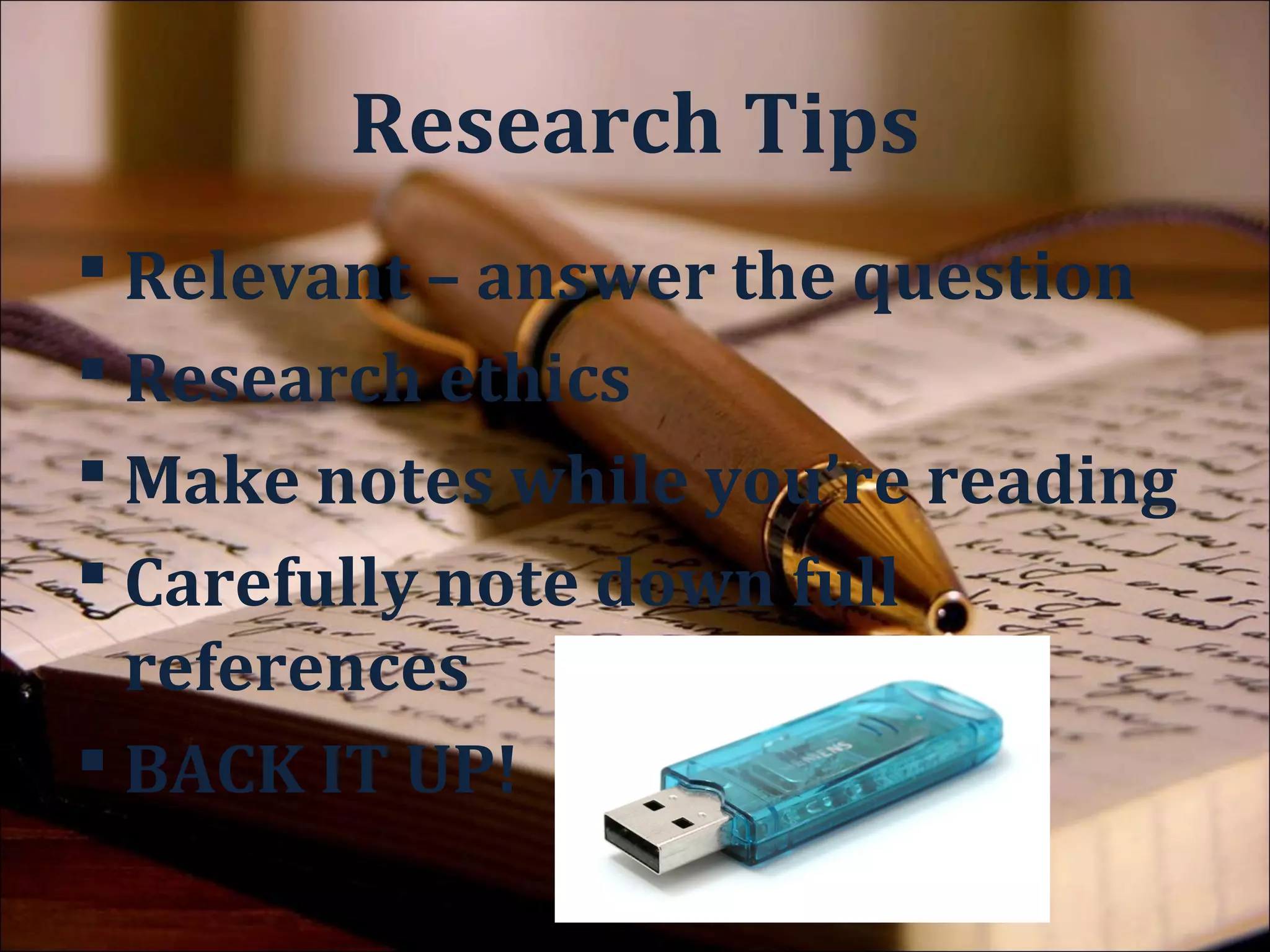
 BACK IT UP!
Literature Review
Literature Review

A critical summary of main
research you have found on
          the subject
Why?

  Done your reading
   Know your topic
Aware of the weaknesses
‘Passable’ Literature Review

 Main theories
 How they were applied
 Research methods used by
  others
 Research design used by others
First-Class Literature Review

 Why did you choose these theories?
 How did others obtain their
  results?
 Similarities/differences in study
  design
 Predict your results
 An original contribution
Analysis and Discussion


Insanity: doing the same thing
over and over again and expecting
different results.

      Albert Einstein (attributed)
Analysis and Discussion

 What has been found?
 Why such results?
 Differences between your
  research and that of the others
 Different methods; different
  participants
Limitations
In the beginner's mind there are
many possibilities, in the expert's
there are few.
                   Shunryu Suzuki
Acknowledge Your Limitations

 Your lecturer will like it
 All researchers do it
 No theory is perfect
 No dataset is perfect
 No research method is perfect
Conclusion
 Mention the topic again
 Describe methods, data analysed etc.
 Summarise the findings
 How your findings correspond to the
  previous research
 Only write about your data and your
  research.
Speak confidently about your
        own results.

 Do not make generalisations
about the world based on your
     limited data sample.
Referencing
Why Reference?


 To avoid failing the module
 Because it’s fair
 To back up your claims
 Evidence of extensive reading
Referencing
 Who wrote it?
 What is the book/article called?
 Who published it?
 Where was it published?
 When was it published?
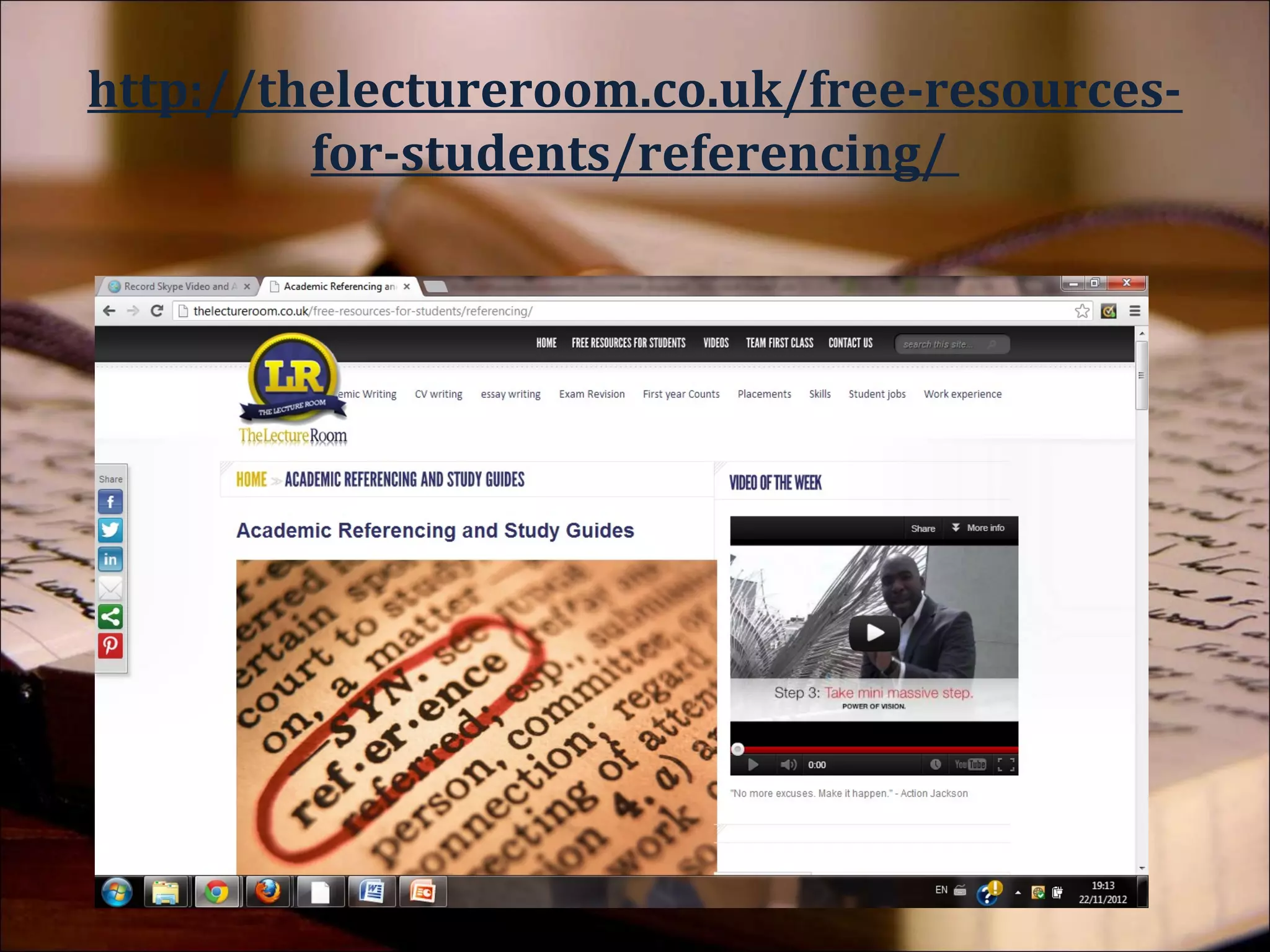
http://thelectureroom.co.uk/free-resources-for-s
The Writing Process
No Perfect First Draft
Never Leave Your Sheet Blank
Good Writers Read
Always Carry a Notebook
Linking Words
Do Not Complicate Things
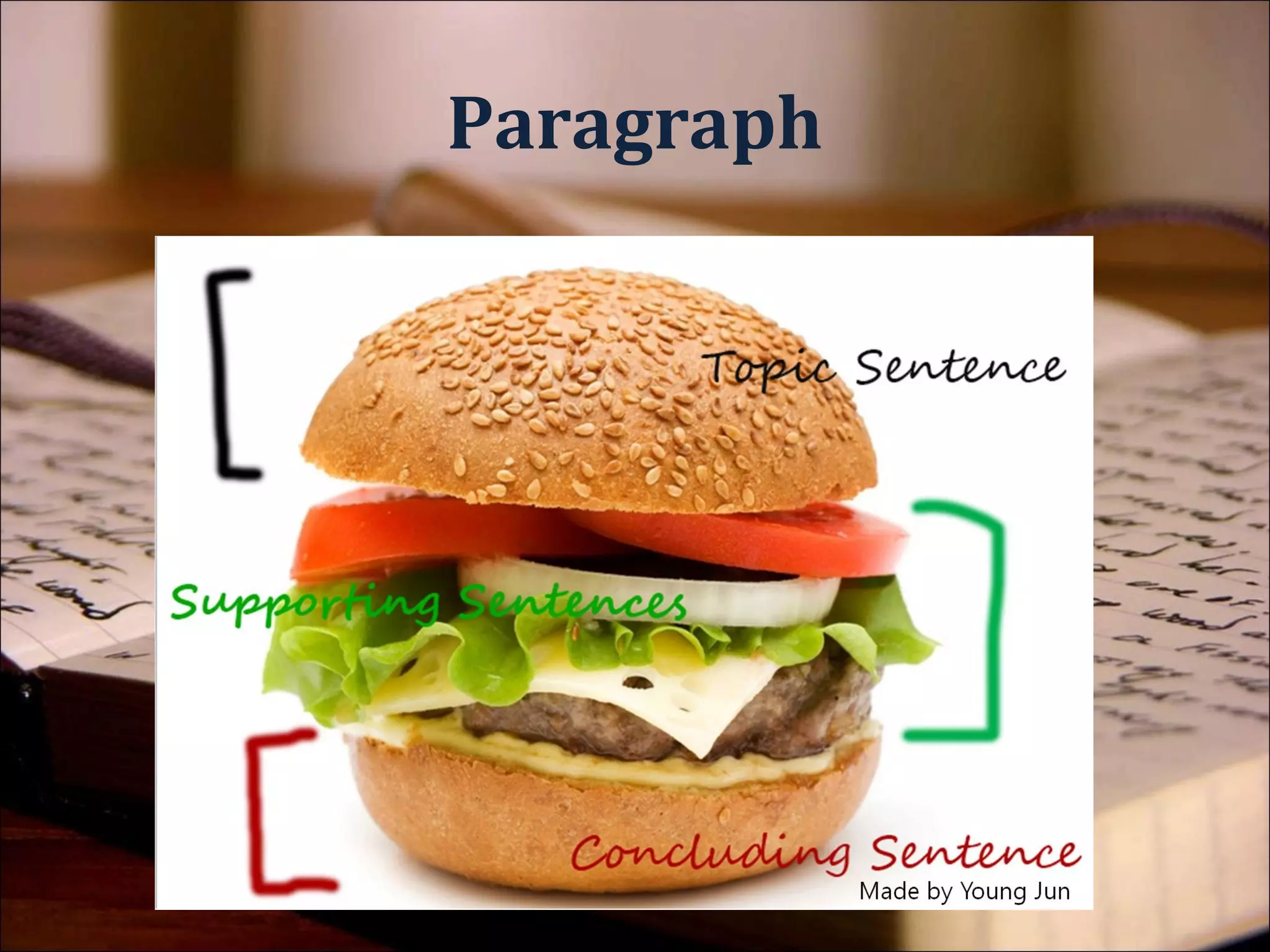
Paragraph
Speak to Your
 Lecturers!
Facebook.com/thelectureroom1
Facebook.com/howtogetafirstclass
Facebook.com/First.year.counts
The Lecture Room Newsletter
 Click here to subscribe and get
           free eBooks:
    ‘How to Write a CV with Little or No Work
                     Experience’
 ‘From Confusion to Conclusion: How to Write a
      First-Class Essay’ (sample – 4 chapters)
Thank you!

Essay writing exclusive to the lecture room's fans