ERRORS IN 
CHEMICAL 
ANALYSIS AND 
SAMPLING
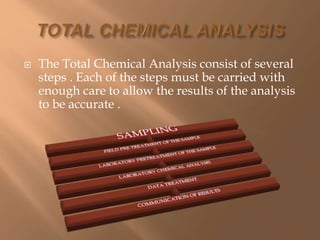
 The Total Chemical Analysis consist of several 
steps . Each of the steps must be carried with 
enough care to allow the results of the analysis 
to be accurate .
ERRORS IN CHEMICAL ANALYSIS 
There is a certain amount of error in each step of chemical analysis . 
Errors can be classified into the two categories of determinate and indeterminate 
Error . 
DETERMINATE ERROR 
Errors due to the design and execution of the experiment. They can be 
identified through a careful analysis of the experiment and associated 
experiments, and measures can be taken to correct them. Systematic 
errors occur with the same magnitude and sign every time the 
experiment is performed, and affect the accuracy of the results, but not 
the precision. If an experiment has small systematic errors, it is accurate.
 There are two types of determinate error . 
 1. Constant Determinate Error 
 2. Proportional Determinate Error 
1. Constant Determinate Error 
A constant determinate error gives the same amount of the sample 
regardless of the concentration of the substance being analyzed .
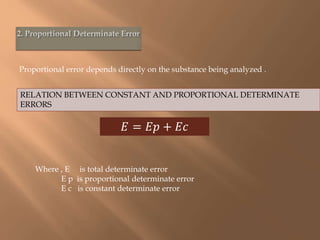
Proportional error depends directly on the substance being analyzed . 
RELATION BETWEEN CONSTANT AND PROPORTIONAL DETERMINATE 
ERRORS 
퐸 = 퐸푝 + 퐸푐 
Where , E is total determinate error 
E p is proportional determinate error 
E c is constant determinate error
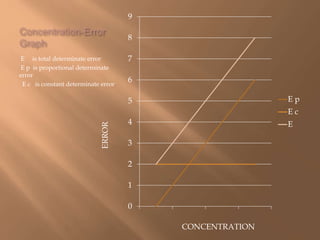
Concentration-Error 
Graph 
E is total determinate error 
E p is proportional determinate 
error 
E c is constant determinate error 
9 
8 
7 
6 
5 
4 
3 
2 
1 
0 
E p 
E c 
E 
CONCENTRATION 
ERROR
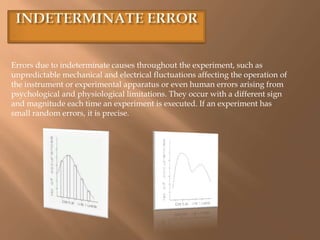
Errors due to indeterminate causes throughout the experiment, such as 
unpredictable mechanical and electrical fluctuations affecting the operation of 
the instrument or experimental apparatus or even human errors arising from 
psychological and physiological limitations. They occur with a different sign 
and magnitude each time an experiment is executed. If an experiment has 
small random errors, it is precise.
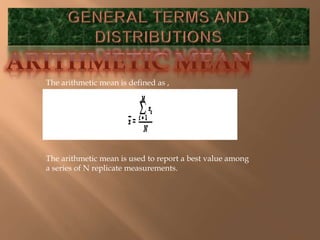
The arithmetic mean is defined as , 
The arithmetic mean is used to report a best value among 
a series of N replicate measurements.
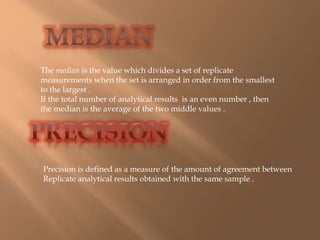
The median is the value which divides a set of replicate 
measurements when the set is arranged in order from the smallest 
to the largest . 
If the total number of analytical results is an even number , then 
the median is the average of the two middle values . 
Precision is defined as a measure of the amount of agreement between 
Replicate analytical results obtained with the same sample .
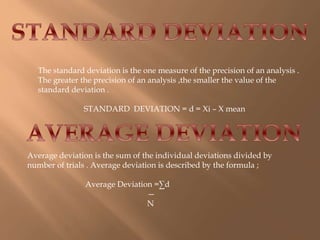
The standard deviation is the one measure of the precision of an analysis . 
The greater the precision of an analysis ,the smaller the value of the 
standard deviation . 
STANDARD DEVIATION = d = Xi – X mean 
Average deviation is the sum of the individual deviations divided by 
number of trials . Average deviation is described by the formula ; 
Average Deviation =Σd 
— 
N
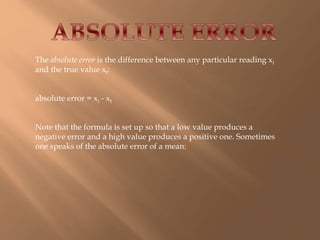
The absolute error is the difference between any particular reading xi 
and the true value xt: 
absolute error = xi - xt 
Note that the formula is set up so that a low value produces a 
negative error and a high value produces a positive one. Sometimes 
one speaks of the absolute error of a mean:
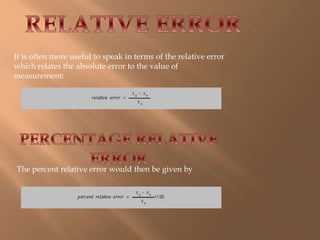
It is often more useful to speak in terms of the relative error 
which relates the absolute error to the value of 
measurement: 
The percent relative error would then be given by
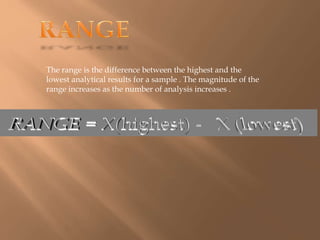
The range is the difference between the highest and the 
lowest analytical results for a sample . The magnitude of the 
range increases as the number of analysis increases .
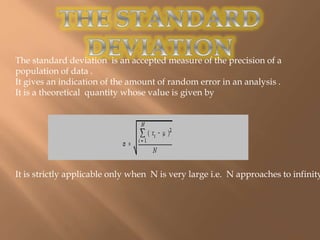
The standard deviation is an accepted measure of the precision of a 
population of data . 
It gives an indication of the amount of random error in an analysis . 
It is a theoretical quantity whose value is given by 
It is strictly applicable only when N is very large i.e. N approaches to infinity
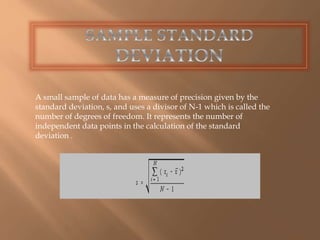
A small sample of data has a measure of precision given by the 
standard deviation, s, and uses a divisor of N-1 which is called the 
number of degrees of freedom. It represents the number of 
independent data points in the calculation of the standard 
deviation .
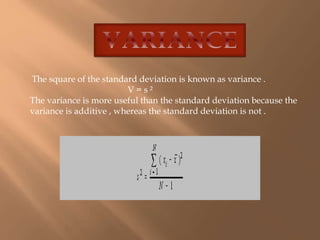
The square of the standard deviation is known as variance . 
V = s ² 
The variance is more useful than the standard deviation because the 
variance is additive , whereas the standard deviation is not .
CONTROL CHART ANALYSIS 
Control Chart Analysis is one of the better methods of checking for statistical 
Control . By that method , the analytical procedure is regularly used in an 
analysis of a reference substance .
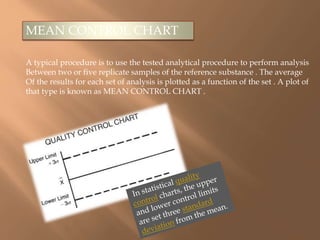
MEAN CONTROL CHART 
A typical procedure is to use the tested analytical procedure to perform analysis 
Between two or five replicate samples of the reference substance . The average 
Of the results for each set of analysis is plotted as a function of the set . A plot of 
that type is known as MEAN CONTROL CHART .
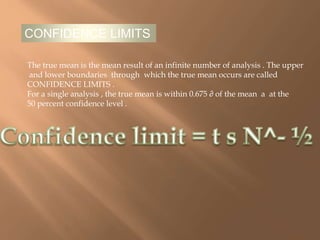
CONFIDENCE LIMITS 
The true mean is the mean result of an infinite number of analysis . The upper 
and lower boundaries through which the true mean occurs are called 
CONFIDENCE LIMITS . 
For a single analysis , the true mean is within 0.675 ∂ of the mean a at the 
50 percent confidence level .
Errors in chemical analysis

Errors in chemical analysis

  • 1.
    ERRORS IN CHEMICAL ANALYSIS AND SAMPLING
  • 2.
     The TotalChemical Analysis consist of several steps . Each of the steps must be carried with enough care to allow the results of the analysis to be accurate .
  • 3.
    ERRORS IN CHEMICALANALYSIS There is a certain amount of error in each step of chemical analysis . Errors can be classified into the two categories of determinate and indeterminate Error . DETERMINATE ERROR Errors due to the design and execution of the experiment. They can be identified through a careful analysis of the experiment and associated experiments, and measures can be taken to correct them. Systematic errors occur with the same magnitude and sign every time the experiment is performed, and affect the accuracy of the results, but not the precision. If an experiment has small systematic errors, it is accurate.
  • 4.
     There aretwo types of determinate error .  1. Constant Determinate Error  2. Proportional Determinate Error 1. Constant Determinate Error A constant determinate error gives the same amount of the sample regardless of the concentration of the substance being analyzed .
  • 5.
    Proportional error dependsdirectly on the substance being analyzed . RELATION BETWEEN CONSTANT AND PROPORTIONAL DETERMINATE ERRORS 퐸 = 퐸푝 + 퐸푐 Where , E is total determinate error E p is proportional determinate error E c is constant determinate error
  • 6.
    Concentration-Error Graph Eis total determinate error E p is proportional determinate error E c is constant determinate error 9 8 7 6 5 4 3 2 1 0 E p E c E CONCENTRATION ERROR
  • 7.
    Errors due toindeterminate causes throughout the experiment, such as unpredictable mechanical and electrical fluctuations affecting the operation of the instrument or experimental apparatus or even human errors arising from psychological and physiological limitations. They occur with a different sign and magnitude each time an experiment is executed. If an experiment has small random errors, it is precise.
  • 8.
    The arithmetic meanis defined as , The arithmetic mean is used to report a best value among a series of N replicate measurements.
  • 9.
    The median isthe value which divides a set of replicate measurements when the set is arranged in order from the smallest to the largest . If the total number of analytical results is an even number , then the median is the average of the two middle values . Precision is defined as a measure of the amount of agreement between Replicate analytical results obtained with the same sample .
  • 10.
    The standard deviationis the one measure of the precision of an analysis . The greater the precision of an analysis ,the smaller the value of the standard deviation . STANDARD DEVIATION = d = Xi – X mean Average deviation is the sum of the individual deviations divided by number of trials . Average deviation is described by the formula ; Average Deviation =Σd — N
  • 11.
    The absolute erroris the difference between any particular reading xi and the true value xt: absolute error = xi - xt Note that the formula is set up so that a low value produces a negative error and a high value produces a positive one. Sometimes one speaks of the absolute error of a mean:
  • 12.
    It is oftenmore useful to speak in terms of the relative error which relates the absolute error to the value of measurement: The percent relative error would then be given by
  • 13.
    The range isthe difference between the highest and the lowest analytical results for a sample . The magnitude of the range increases as the number of analysis increases .
  • 14.
    The standard deviationis an accepted measure of the precision of a population of data . It gives an indication of the amount of random error in an analysis . It is a theoretical quantity whose value is given by It is strictly applicable only when N is very large i.e. N approaches to infinity
  • 15.
    A small sampleof data has a measure of precision given by the standard deviation, s, and uses a divisor of N-1 which is called the number of degrees of freedom. It represents the number of independent data points in the calculation of the standard deviation .
  • 16.
    The square ofthe standard deviation is known as variance . V = s ² The variance is more useful than the standard deviation because the variance is additive , whereas the standard deviation is not .
  • 17.
    CONTROL CHART ANALYSIS Control Chart Analysis is one of the better methods of checking for statistical Control . By that method , the analytical procedure is regularly used in an analysis of a reference substance .
  • 18.
    MEAN CONTROL CHART A typical procedure is to use the tested analytical procedure to perform analysis Between two or five replicate samples of the reference substance . The average Of the results for each set of analysis is plotted as a function of the set . A plot of that type is known as MEAN CONTROL CHART .
  • 19.
    CONFIDENCE LIMITS Thetrue mean is the mean result of an infinite number of analysis . The upper and lower boundaries through which the true mean occurs are called CONFIDENCE LIMITS . For a single analysis , the true mean is within 0.675 ∂ of the mean a at the 50 percent confidence level .