EROSIONAL & DEPOSITIONAL
GLACIAL LANDFORMS
BY NEHA GUPTA, M.SC(EVS)
EROSIONAL GLACIAL
LANDFORMS
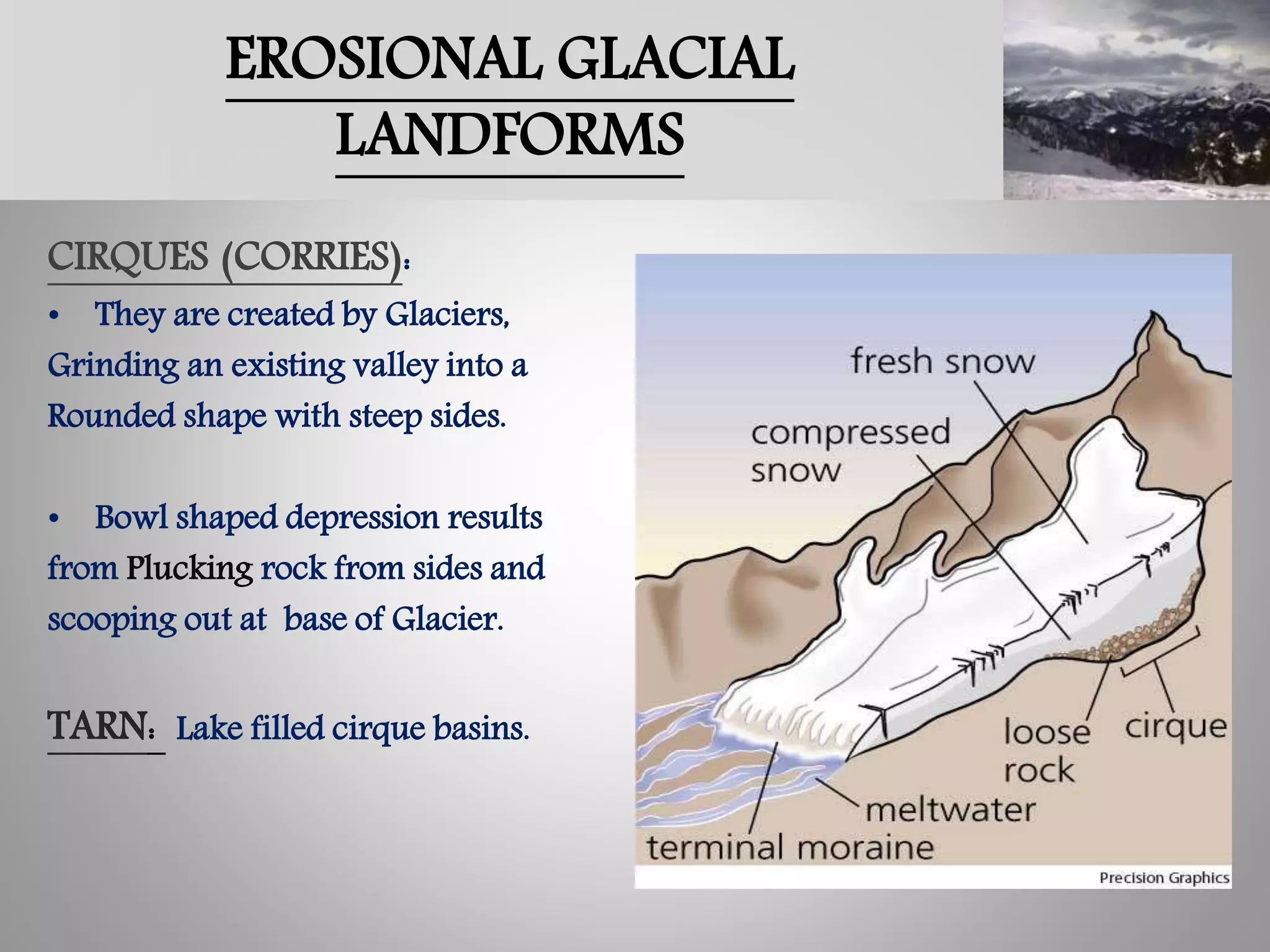
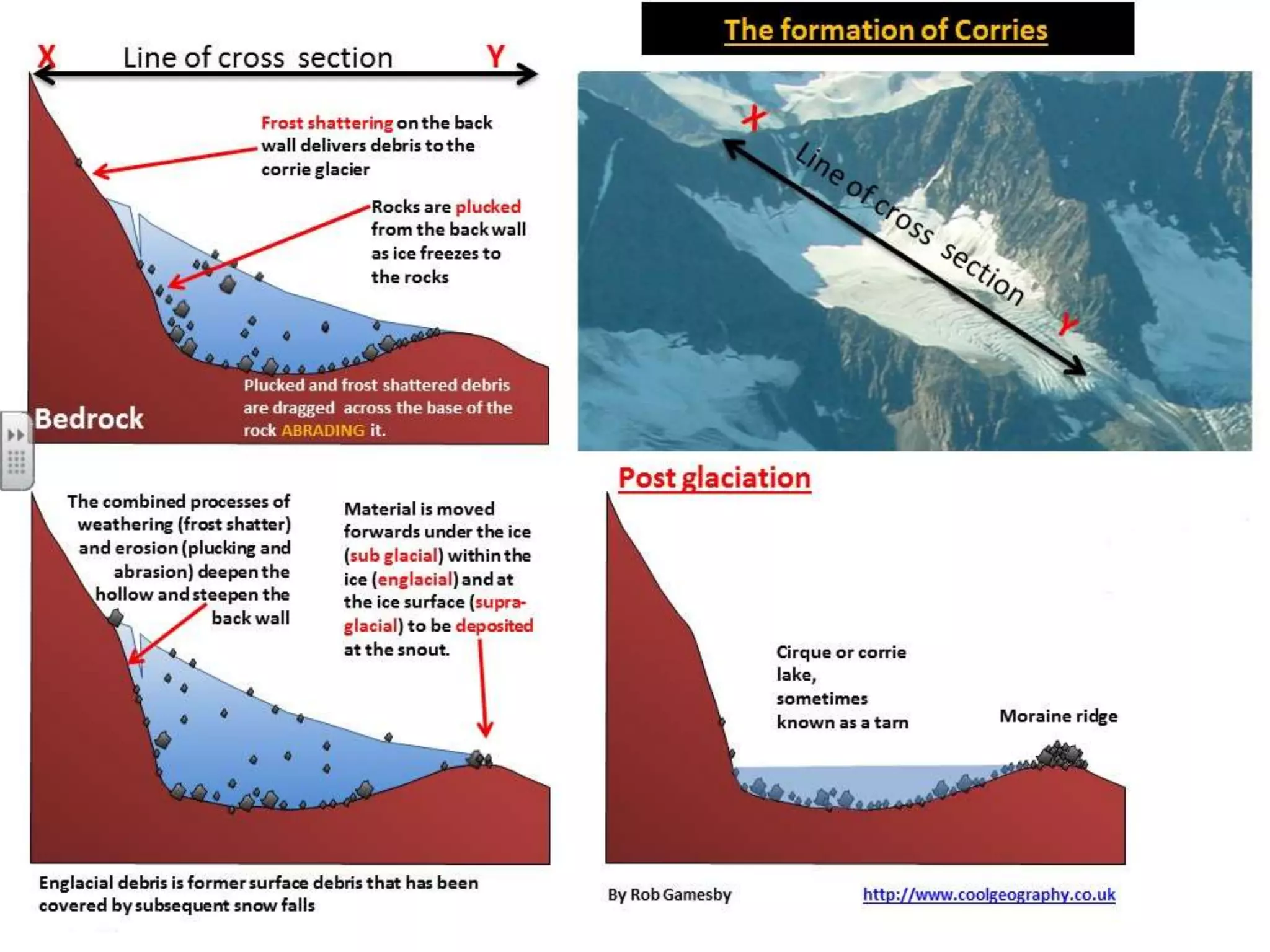
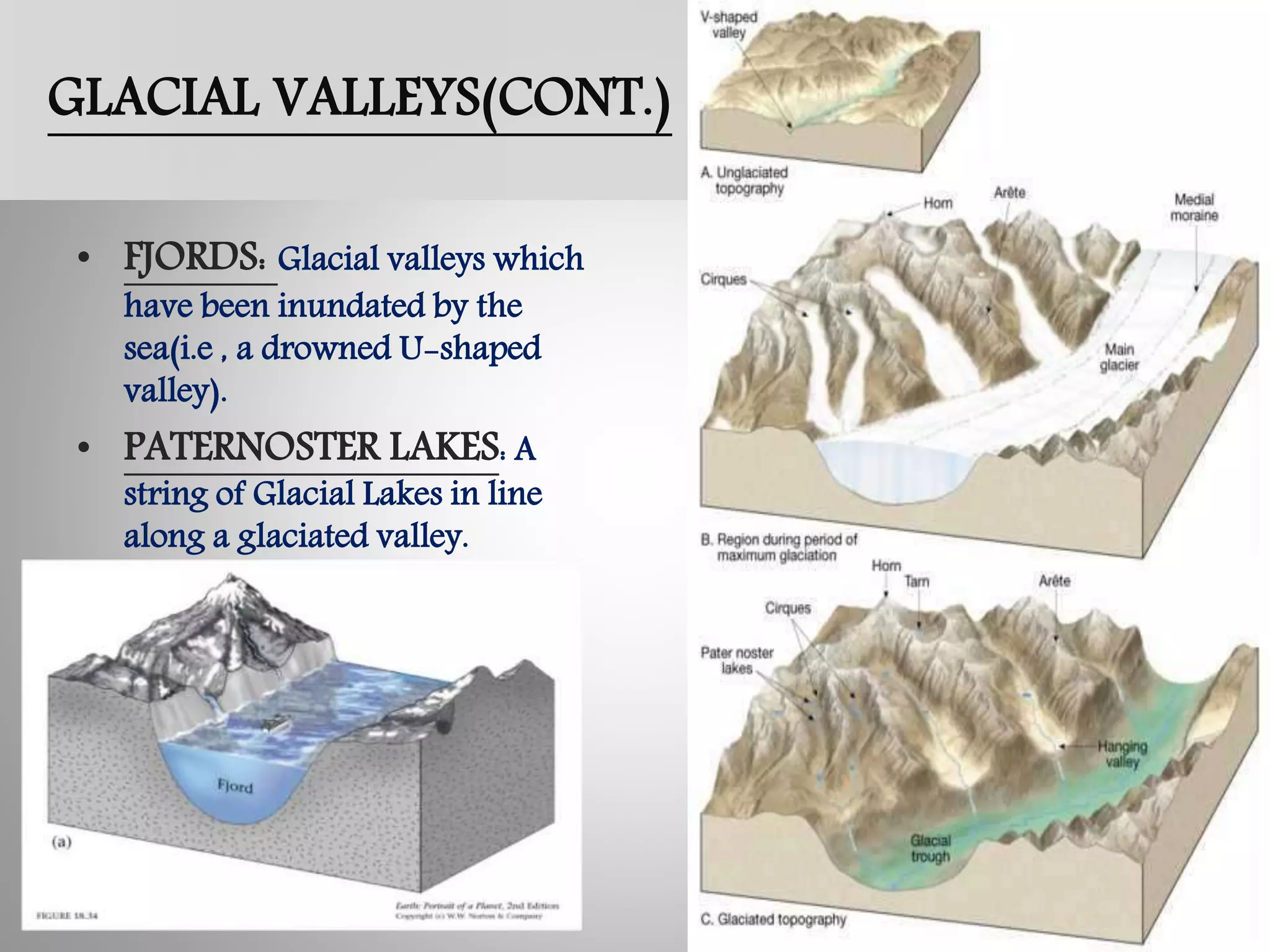
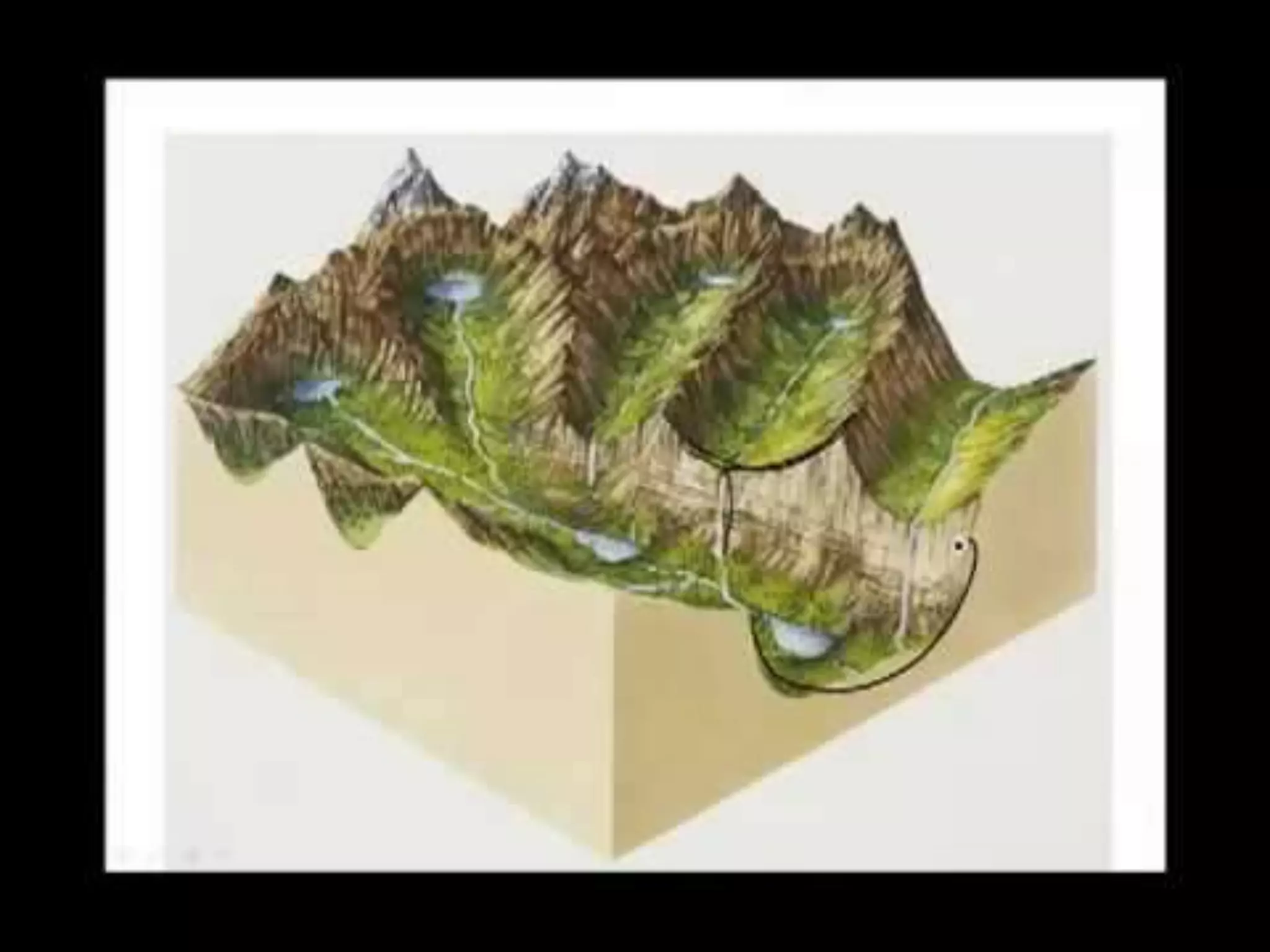
CIRQUES (CORRIES):
• They are created by Glaciers,
Grinding an existing valley into a
Rounded shape with steep sides.
• Bowl shaped depression results
from Plucking rock from sides and
scooping out at base of Glacier.
TARN: Lake filled cirque basins.
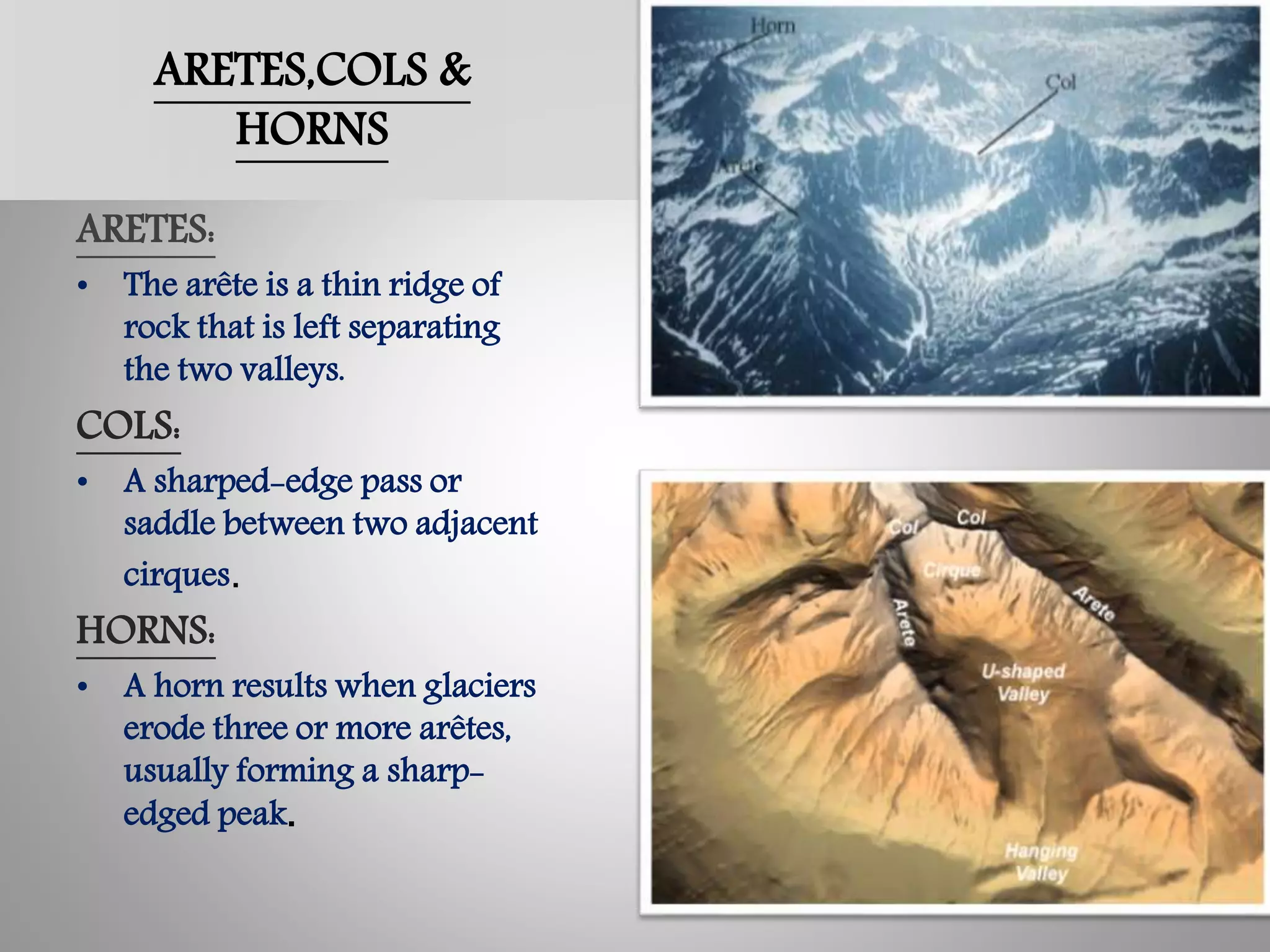
ARETES,COLS &
HORNS
ARETES:
• The arête is a thin ridge of
rock that is left separating
the two valleys.
COLS:
• A sharped-edge pass or
saddle between two adjacent
cirques.
HORNS:
• A horn results when glaciers
erode three or more arêtes,
usually forming a sharp-
edged peak.
GLACIAL VALLEYS
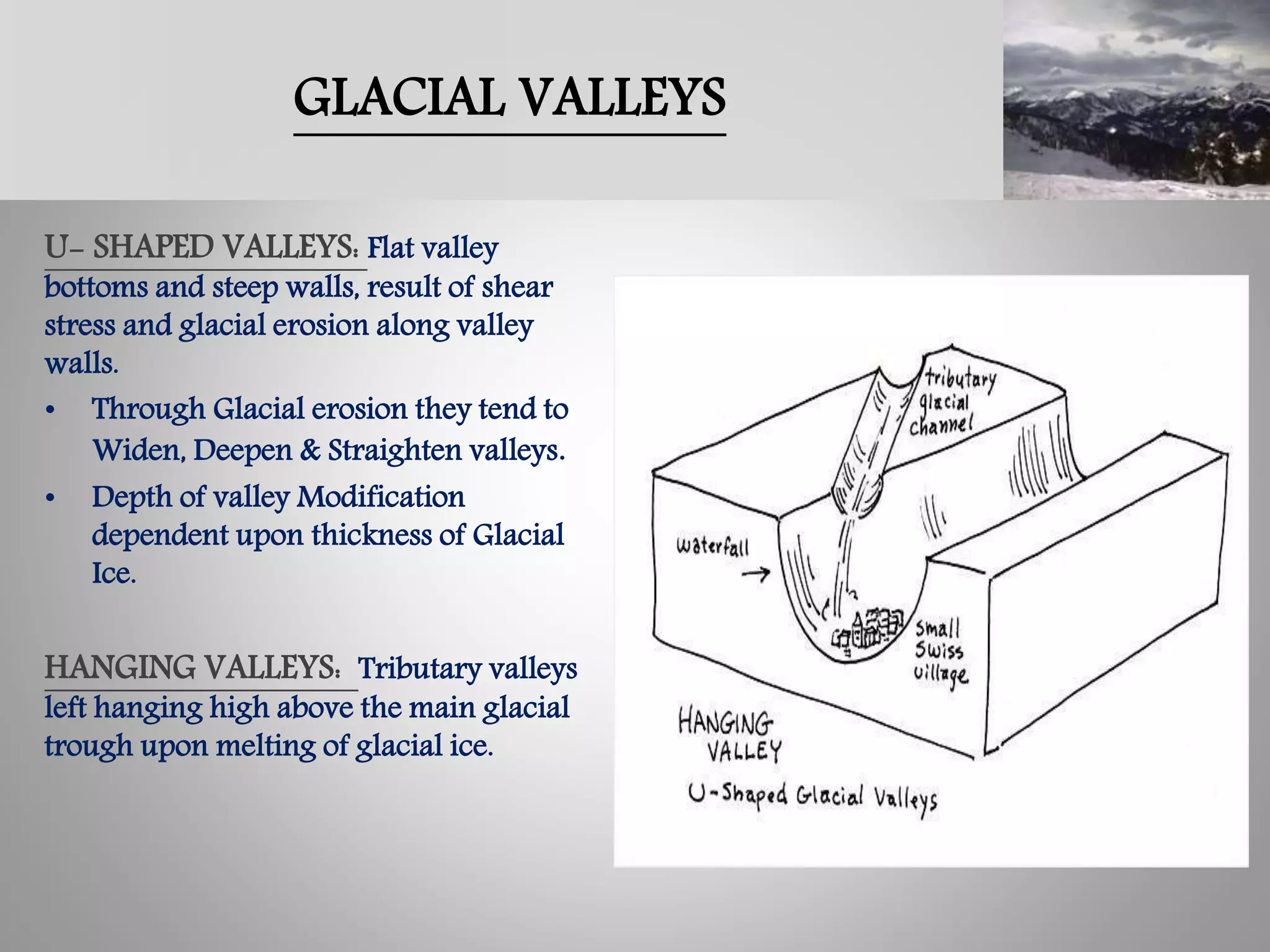
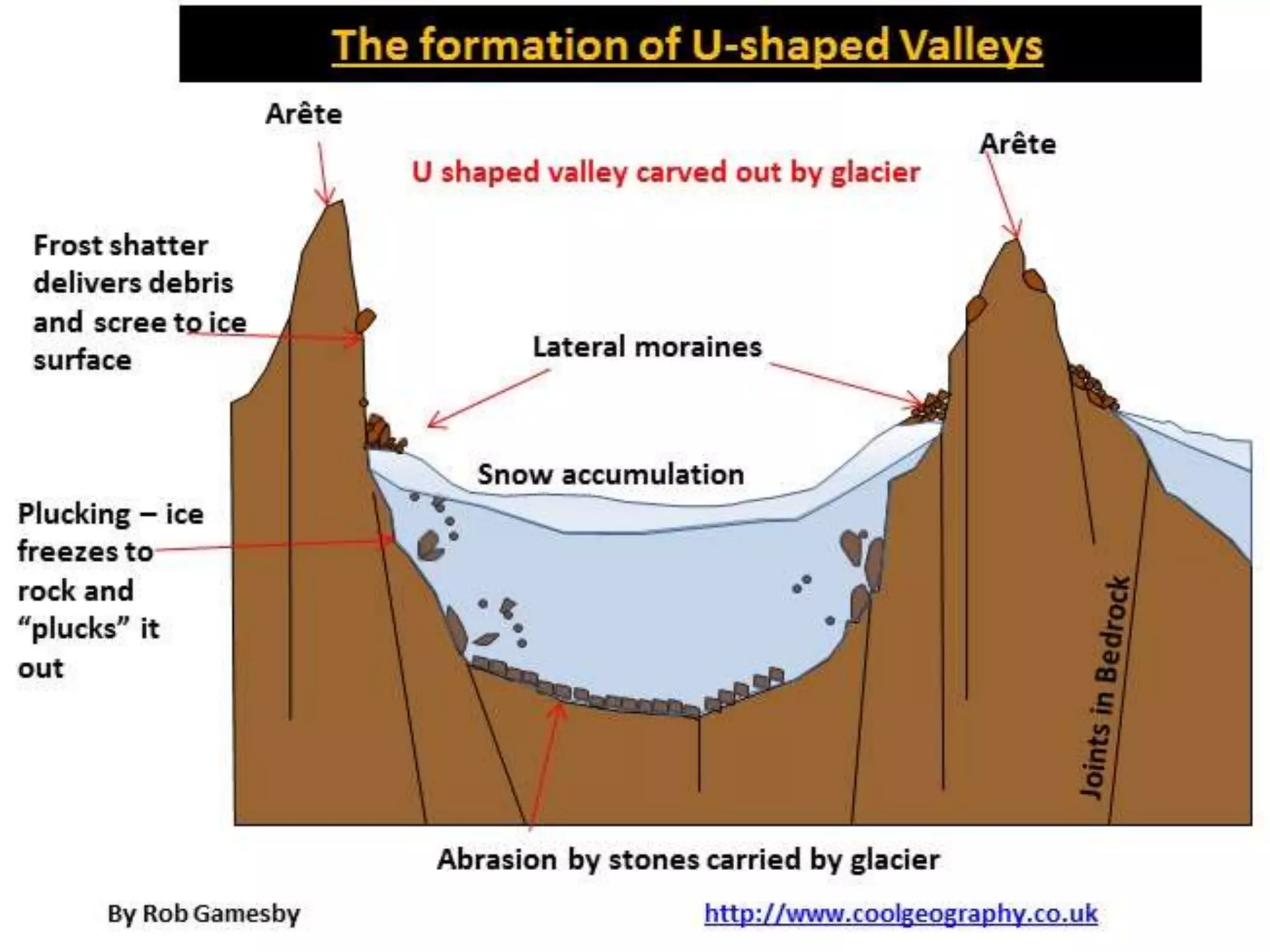
U- SHAPED VALLEYS: Flat valley
bottoms and steep walls, result of shear
stress and glacial erosion along valley
walls.
• Through Glacial erosion they tend to
Widen, Deepen & Straighten valleys.
• Depth of valley Modification
dependent upon thickness of Glacial
Ice.
HANGING VALLEYS: Tributary valleys
left hanging high above the main glacial
trough upon melting of glacial ice.
GLACIAL VALLEYS(CONT.)
• FJORDS: Glacial valleys which
have been inundated by the
sea(i.e , a drowned U-shaped
valley).
• PATERNOSTER LAKES: A
string of Glacial Lakes in line
along a glaciated valley.
GLACIAL VALLEYS(CONT.)
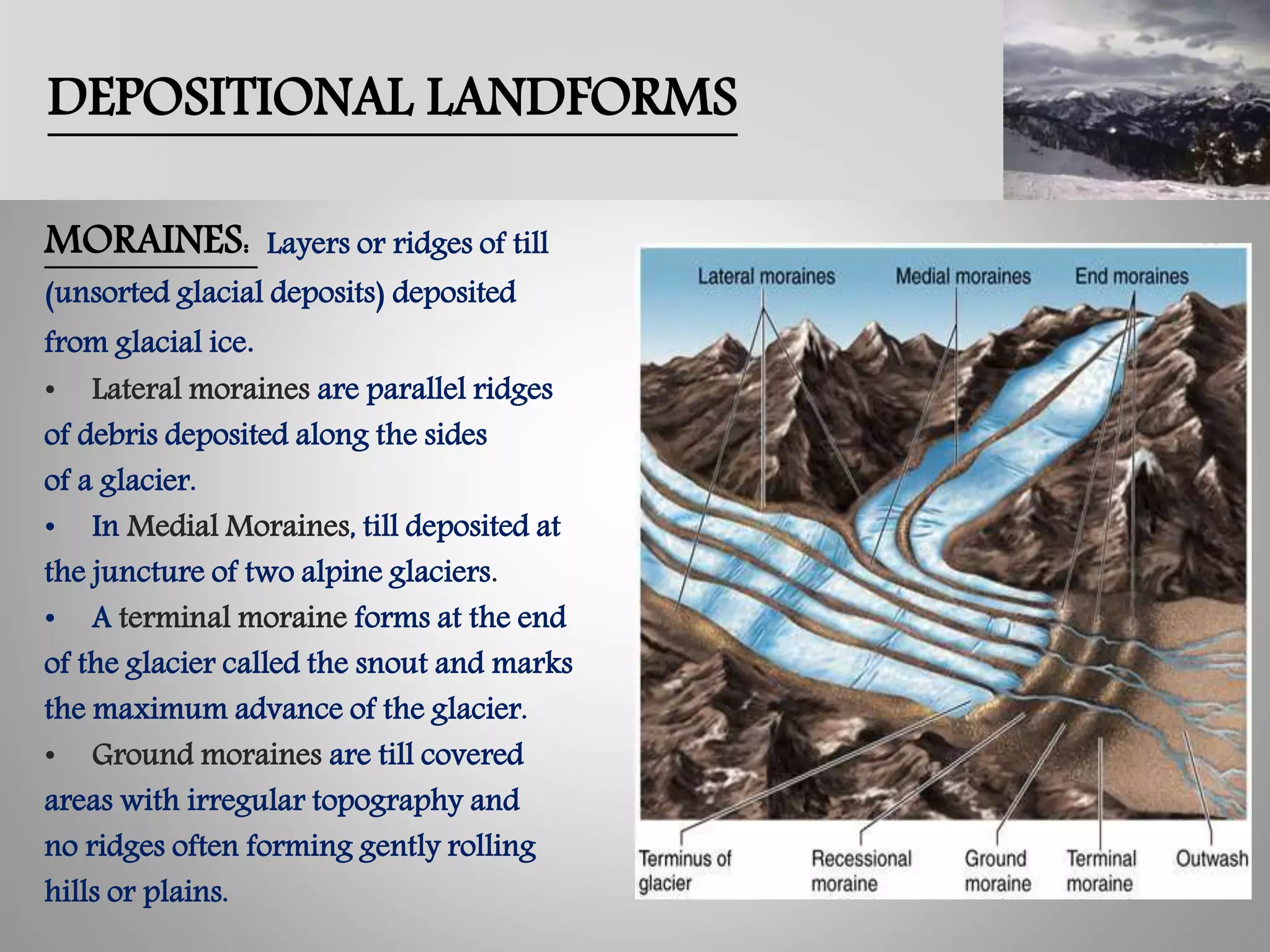
GLACIAL SCOUR:
Erosion resulting from glacial action,
whereby the surface material is
removed and the rock fragments
carried by the glacier abrade, scratch,
and polish the bedrock.
Also known as scouring.
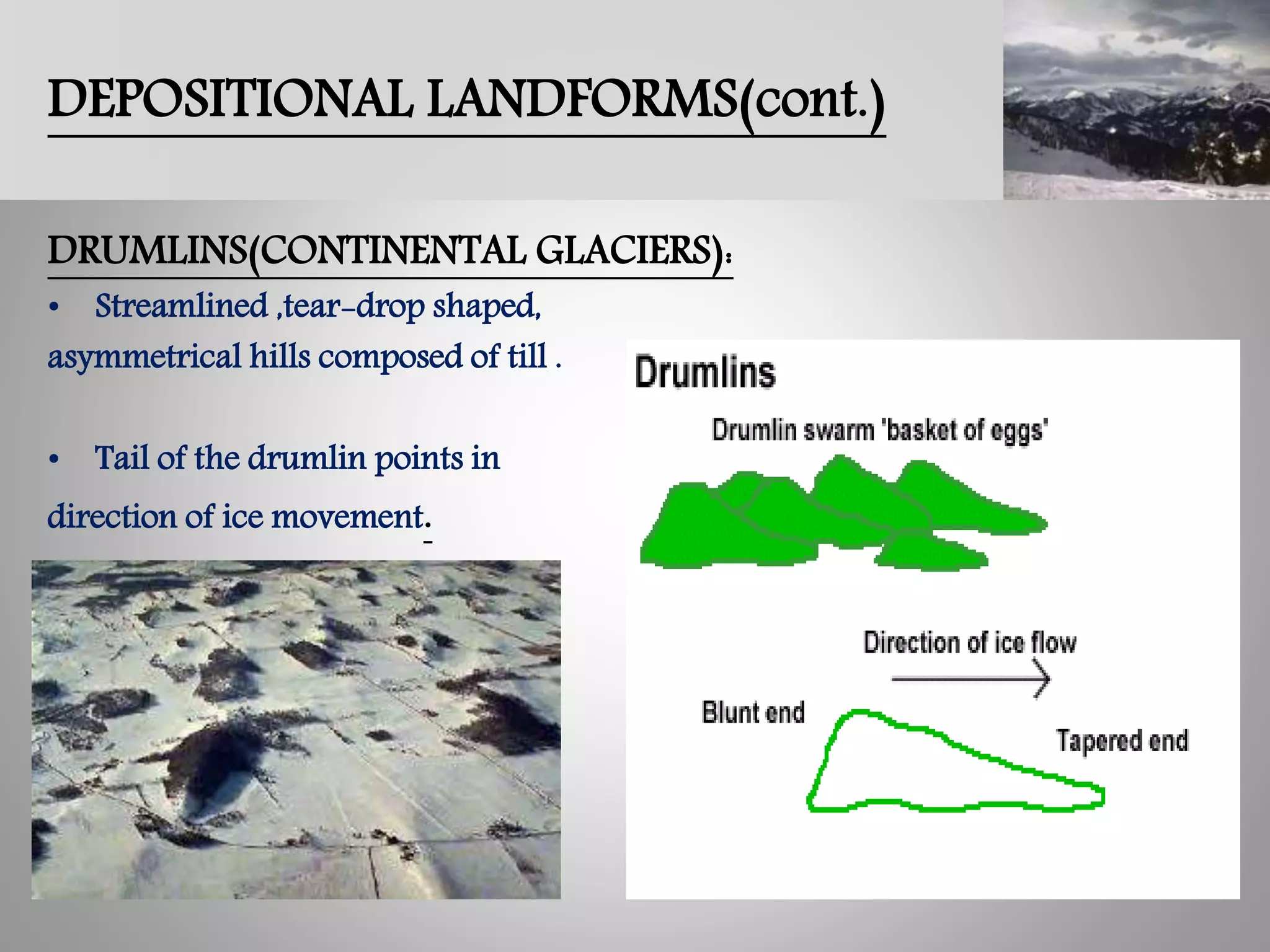
STRIATIONS:
Abrasion scratches on underlying
bedrock pavement, evident upon
removal of glacial ice.
DEPOSITIONAL LANDFORMS
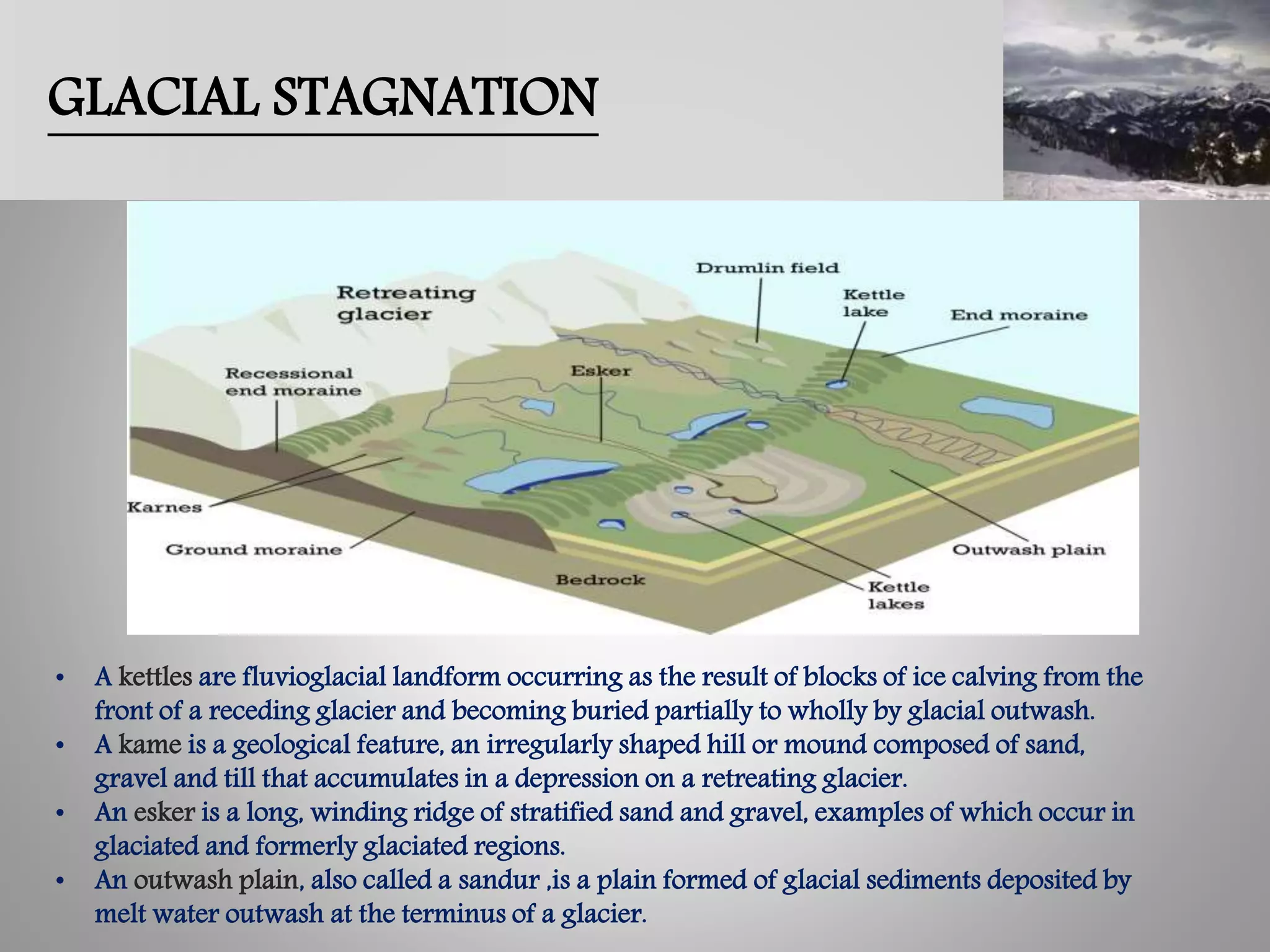
MORAINES: Layers or ridges of till
(unsorted glacial deposits) deposited
from glacial ice.
• Lateral moraines are parallel ridges
of debris deposited along the sides
of a glacier.
• In Medial Moraines, till deposited at
the juncture of two alpine glaciers.
• A terminal moraine forms at the end
of the glacier called the snout and marks
the maximum advance of the glacier.
• Ground moraines are till covered
areas with irregular topography and
no ridges often forming gently rolling
hills or plains.
DEPOSITIONAL LANDFORMS(cont.)
DRUMLINS(CONTINENTAL GLACIERS):
• Streamlined ,tear-drop shaped,
asymmetrical hills composed of till .
• Tail of the drumlin points in
direction of ice movement.
GLACIAL STAGNATION
• A kettles are fluvioglacial landform occurring as the result of blocks of ice calving from the
front of a receding glacier and becoming buried partially to wholly by glacial outwash.
• A kame is a geological feature, an irregularly shaped hill or mound composed of sand,
gravel and till that accumulates in a depression on a retreating glacier.
• An esker is a long, winding ridge of stratified sand and gravel, examples of which occur in
glaciated and formerly glaciated regions.
• An outwash plain, also called a sandur ,is a plain formed of glacial sediments deposited by
melt water outwash at the terminus of a glacier.
IMPACT OF CLIMATE CHANGE ON
GLACIERS
IMPACT OF CLIMATE CHANGE ON
GLACIERS
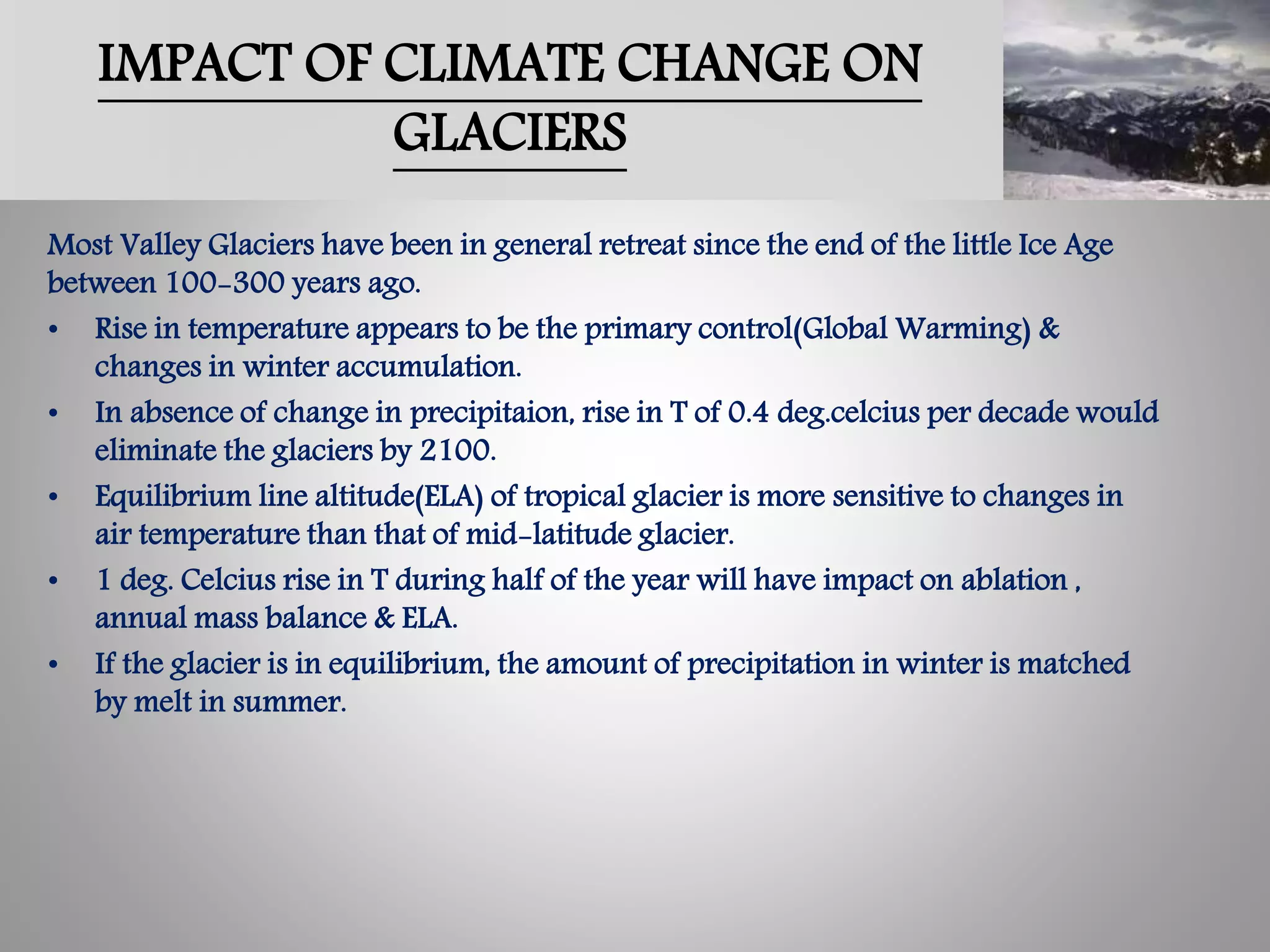
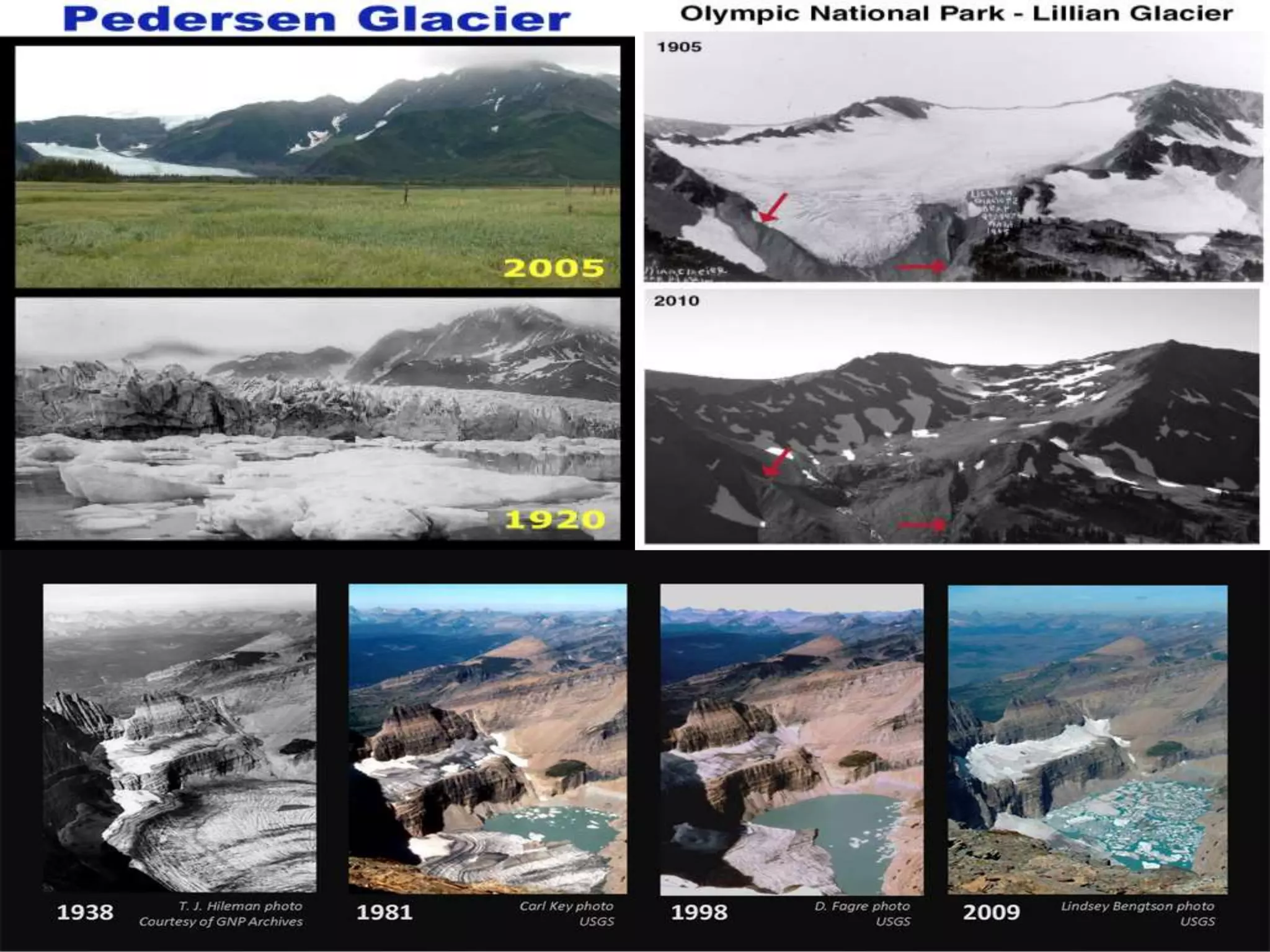
Most Valley Glaciers have been in general retreat since the end of the little Ice Age
between 100-300 years ago.
• Rise in temperature appears to be the primary control(Global Warming) &
changes in winter accumulation.
• In absence of change in precipitaion, rise in T of 0.4 deg.celcius per decade would
eliminate the glaciers by 2100.
• Equilibrium line altitude(ELA) of tropical glacier is more sensitive to changes in
air temperature than that of mid-latitude glacier.
• 1 deg. Celcius rise in T during half of the year will have impact on ablation ,
annual mass balance & ELA.
• If the glacier is in equilibrium, the amount of precipitation in winter is matched
by melt in summer.
MASS BALANCE STUDIES
Glaciers are sensitive to climate change, due to changes in their
mass, contributing to the rate of sea level rise.
• To evaluate this, we need to know the rate of change of total
glacier mass.
Multiplying specific mass balance for a typical glacier in each
region with the total glacier area of the region. Then sum over
all regions.
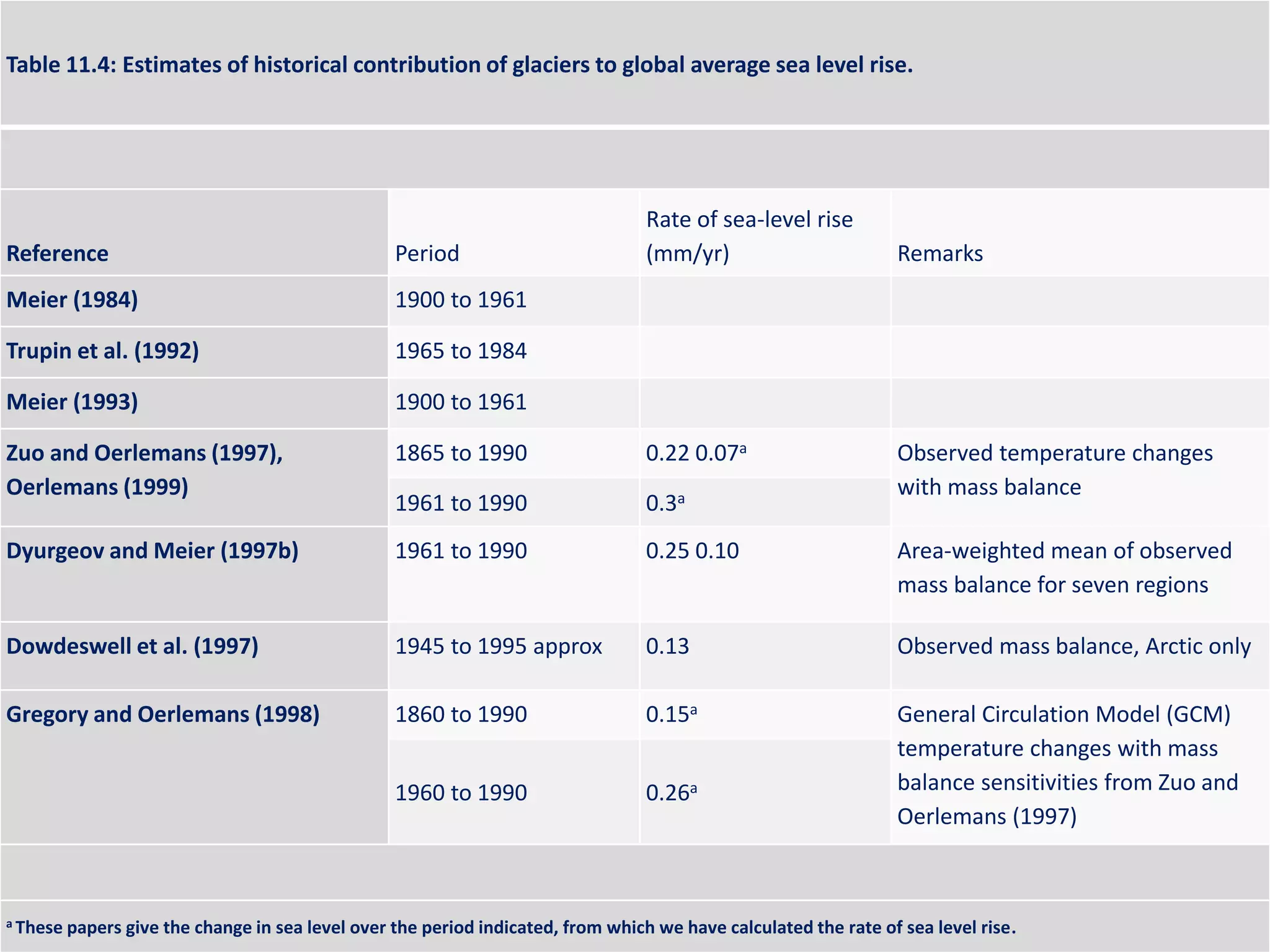
Table 11.4: Estimates of historical contribution of glaciers to global average sea level rise.
Reference Period
Rate of sea-level rise
(mm/yr) Remarks
Meier (1984) 1900 to 1961
Trupin et al. (1992) 1965 to 1984
Meier (1993) 1900 to 1961
Zuo and Oerlemans (1997),
Oerlemans (1999)
1865 to 1990 0.22 0.07a Observed temperature changes
with mass balance
1961 to 1990 0.3a
Dyurgeov and Meier (1997b) 1961 to 1990 0.25 0.10 Area-weighted mean of observed
mass balance for seven regions
Dowdeswell et al. (1997) 1945 to 1995 approx 0.13 Observed mass balance, Arctic only
Gregory and Oerlemans (1998) 1860 to 1990 0.15a General Circulation Model (GCM)
temperature changes with mass
balance sensitivities from Zuo and
Oerlemans (1997)
1960 to 1990 0.26a
a These papers give the change in sea level over the period indicated, from which we have calculated the rate of sea level rise.
MASS BALANCE SENSITIVITY TO
TEMPERATURE & PRECIPITATION
• Change in ablation of a glacier is modelled using bT, the sensitivity of the
mean specific surface mass balance to temperature.
• One approach determines bT by energy balance modelling, includes
dependence on monthly temperature and precipitation changes.
• Another approach uses a degree-day method, in which ablation is
proportional to integral of mean daily temperature above freezing point.
• For seasonally uniform temperature rise, increase in precipitation of 20-
50% 0C-1 is required to balance increased ablation variations of regional
–scale hygric seasonality.
GLACIERS N GREENLAND &
ANTARCTICA
• Indicates an addition of about 6% to the sea level contribution in 21st
century.
• Using a degree day scheme, estimates that ablation of glaciers in the
Antarctica peninsula presently amounts to 0.008 to 0.055 mm Yr-1 of a
sea level, 1 to 9% of the contribution from outside Greenland & Antarctica
glaciers.
• Ablation increases non-linearly with temperature.
• Results suggest that the Antarctic & Greenland will together give 10-20%
of the sea level contribution in future decades.
HIMALAYAN GLACIERS
• The Himalayas have nearly 1500 glaciers; it is estimated that these
glaciers cover an area of about 33000 Km2.
• Almost 675 of the glaciers in the Himalayan and Tienshan mountain
ranges have retreated in the past decade.
• The mean equilibrium-line altitude at which snow accumulation is equal
to snow ablation for glaciers is estimated to be about 50-80 m higher
than the altitude during the first half of the 19th century.
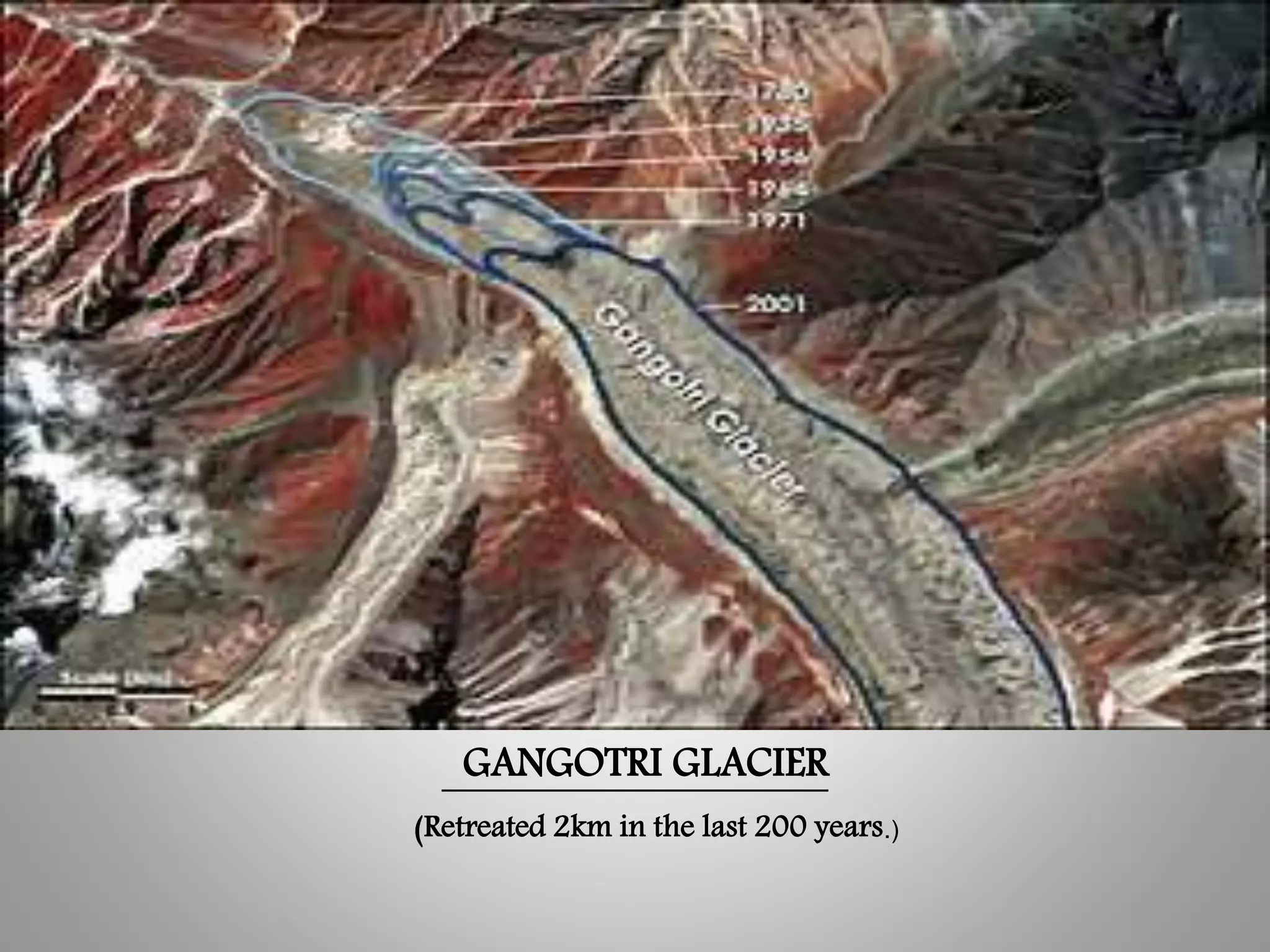
• Available records suggest that Gangotri glacier is retreating by about 30
m Yr-1 .
• A warming is likely to increase melting far more rapidly than
accumulation.
• As reported in IPCC(1998), glacial melt is expected to increase under
changed climate conditions, which would lead to increased summer flows
in some river systems for a few decades, followed by a reduction in flow
as the glaciers disappear.
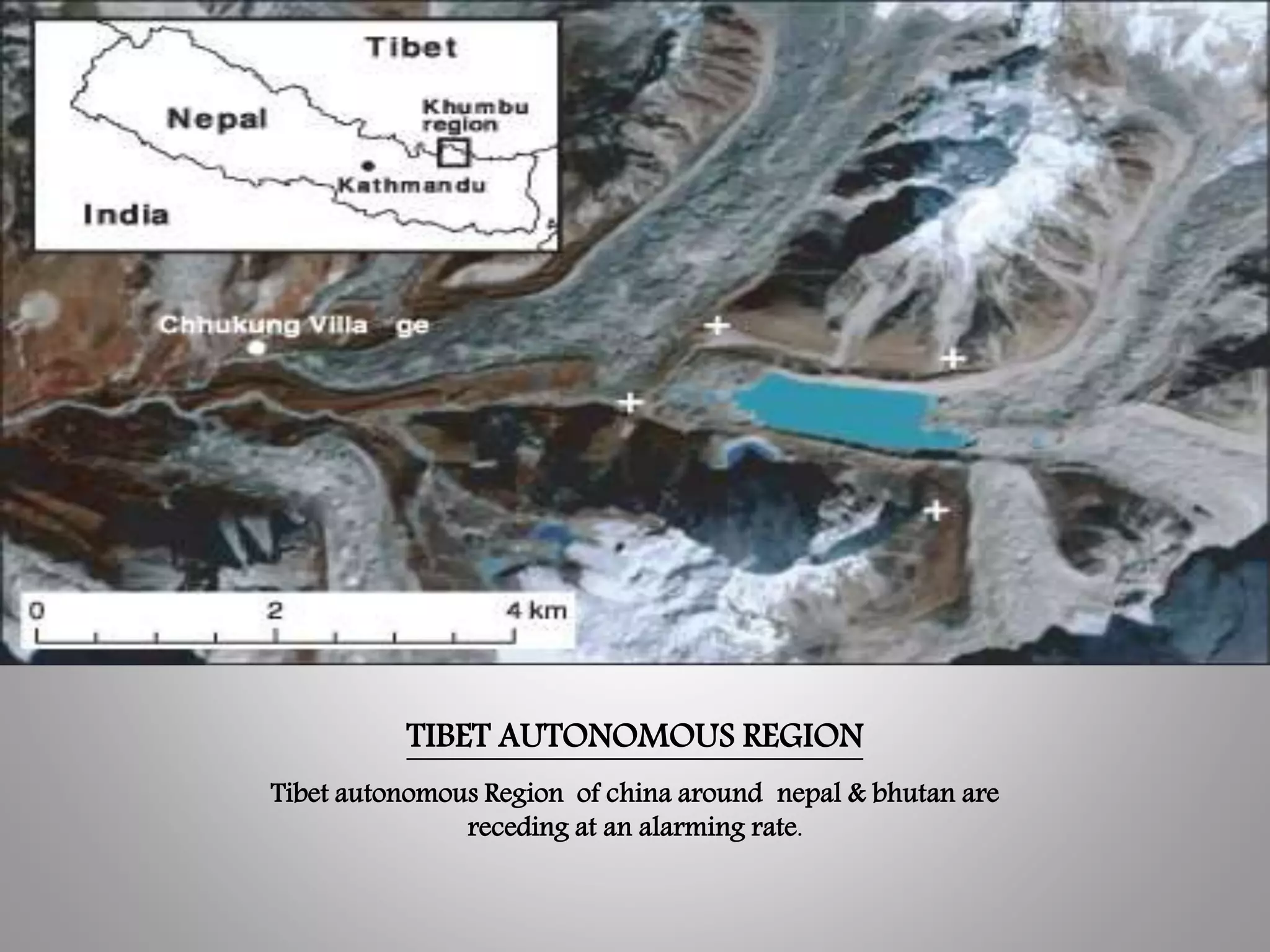
TIBET AUTONOMOUS REGION
Tibet autonomous Region of china around nepal & bhutan are
receding at an alarming rate.
GANGOTRI GLACIER
(Retreated 2km in the last 200 years.)
Erosional & depositional glacial landforms

Erosional & depositional glacial landforms

  • 1.
    EROSIONAL & DEPOSITIONAL GLACIALLANDFORMS BY NEHA GUPTA, M.SC(EVS)
  • 2.
    EROSIONAL GLACIAL LANDFORMS CIRQUES (CORRIES): •They are created by Glaciers, Grinding an existing valley into a Rounded shape with steep sides. • Bowl shaped depression results from Plucking rock from sides and scooping out at base of Glacier. TARN: Lake filled cirque basins.
  • 4.
    ARETES,COLS & HORNS ARETES: • Thearête is a thin ridge of rock that is left separating the two valleys. COLS: • A sharped-edge pass or saddle between two adjacent cirques. HORNS: • A horn results when glaciers erode three or more arêtes, usually forming a sharp- edged peak.
  • 5.
    GLACIAL VALLEYS U- SHAPEDVALLEYS: Flat valley bottoms and steep walls, result of shear stress and glacial erosion along valley walls. • Through Glacial erosion they tend to Widen, Deepen & Straighten valleys. • Depth of valley Modification dependent upon thickness of Glacial Ice. HANGING VALLEYS: Tributary valleys left hanging high above the main glacial trough upon melting of glacial ice.
  • 7.
    GLACIAL VALLEYS(CONT.) • FJORDS:Glacial valleys which have been inundated by the sea(i.e , a drowned U-shaped valley). • PATERNOSTER LAKES: A string of Glacial Lakes in line along a glaciated valley.
  • 9.
    GLACIAL VALLEYS(CONT.) GLACIAL SCOUR: Erosionresulting from glacial action, whereby the surface material is removed and the rock fragments carried by the glacier abrade, scratch, and polish the bedrock. Also known as scouring. STRIATIONS: Abrasion scratches on underlying bedrock pavement, evident upon removal of glacial ice.
  • 10.
    DEPOSITIONAL LANDFORMS MORAINES: Layersor ridges of till (unsorted glacial deposits) deposited from glacial ice. • Lateral moraines are parallel ridges of debris deposited along the sides of a glacier. • In Medial Moraines, till deposited at the juncture of two alpine glaciers. • A terminal moraine forms at the end of the glacier called the snout and marks the maximum advance of the glacier. • Ground moraines are till covered areas with irregular topography and no ridges often forming gently rolling hills or plains.
  • 11.
    DEPOSITIONAL LANDFORMS(cont.) DRUMLINS(CONTINENTAL GLACIERS): •Streamlined ,tear-drop shaped, asymmetrical hills composed of till . • Tail of the drumlin points in direction of ice movement.
  • 12.
    GLACIAL STAGNATION • Akettles are fluvioglacial landform occurring as the result of blocks of ice calving from the front of a receding glacier and becoming buried partially to wholly by glacial outwash. • A kame is a geological feature, an irregularly shaped hill or mound composed of sand, gravel and till that accumulates in a depression on a retreating glacier. • An esker is a long, winding ridge of stratified sand and gravel, examples of which occur in glaciated and formerly glaciated regions. • An outwash plain, also called a sandur ,is a plain formed of glacial sediments deposited by melt water outwash at the terminus of a glacier.
  • 13.
    IMPACT OF CLIMATECHANGE ON GLACIERS
  • 14.
    IMPACT OF CLIMATECHANGE ON GLACIERS Most Valley Glaciers have been in general retreat since the end of the little Ice Age between 100-300 years ago. • Rise in temperature appears to be the primary control(Global Warming) & changes in winter accumulation. • In absence of change in precipitaion, rise in T of 0.4 deg.celcius per decade would eliminate the glaciers by 2100. • Equilibrium line altitude(ELA) of tropical glacier is more sensitive to changes in air temperature than that of mid-latitude glacier. • 1 deg. Celcius rise in T during half of the year will have impact on ablation , annual mass balance & ELA. • If the glacier is in equilibrium, the amount of precipitation in winter is matched by melt in summer.
  • 15.
    MASS BALANCE STUDIES Glaciersare sensitive to climate change, due to changes in their mass, contributing to the rate of sea level rise. • To evaluate this, we need to know the rate of change of total glacier mass. Multiplying specific mass balance for a typical glacier in each region with the total glacier area of the region. Then sum over all regions.
  • 16.
    Table 11.4: Estimatesof historical contribution of glaciers to global average sea level rise. Reference Period Rate of sea-level rise (mm/yr) Remarks Meier (1984) 1900 to 1961 Trupin et al. (1992) 1965 to 1984 Meier (1993) 1900 to 1961 Zuo and Oerlemans (1997), Oerlemans (1999) 1865 to 1990 0.22 0.07a Observed temperature changes with mass balance 1961 to 1990 0.3a Dyurgeov and Meier (1997b) 1961 to 1990 0.25 0.10 Area-weighted mean of observed mass balance for seven regions Dowdeswell et al. (1997) 1945 to 1995 approx 0.13 Observed mass balance, Arctic only Gregory and Oerlemans (1998) 1860 to 1990 0.15a General Circulation Model (GCM) temperature changes with mass balance sensitivities from Zuo and Oerlemans (1997) 1960 to 1990 0.26a a These papers give the change in sea level over the period indicated, from which we have calculated the rate of sea level rise.
  • 17.
    MASS BALANCE SENSITIVITYTO TEMPERATURE & PRECIPITATION • Change in ablation of a glacier is modelled using bT, the sensitivity of the mean specific surface mass balance to temperature. • One approach determines bT by energy balance modelling, includes dependence on monthly temperature and precipitation changes. • Another approach uses a degree-day method, in which ablation is proportional to integral of mean daily temperature above freezing point. • For seasonally uniform temperature rise, increase in precipitation of 20- 50% 0C-1 is required to balance increased ablation variations of regional –scale hygric seasonality.
  • 18.
    GLACIERS N GREENLAND& ANTARCTICA • Indicates an addition of about 6% to the sea level contribution in 21st century. • Using a degree day scheme, estimates that ablation of glaciers in the Antarctica peninsula presently amounts to 0.008 to 0.055 mm Yr-1 of a sea level, 1 to 9% of the contribution from outside Greenland & Antarctica glaciers. • Ablation increases non-linearly with temperature. • Results suggest that the Antarctic & Greenland will together give 10-20% of the sea level contribution in future decades.
  • 19.
    HIMALAYAN GLACIERS • TheHimalayas have nearly 1500 glaciers; it is estimated that these glaciers cover an area of about 33000 Km2. • Almost 675 of the glaciers in the Himalayan and Tienshan mountain ranges have retreated in the past decade. • The mean equilibrium-line altitude at which snow accumulation is equal to snow ablation for glaciers is estimated to be about 50-80 m higher than the altitude during the first half of the 19th century. • Available records suggest that Gangotri glacier is retreating by about 30 m Yr-1 . • A warming is likely to increase melting far more rapidly than accumulation. • As reported in IPCC(1998), glacial melt is expected to increase under changed climate conditions, which would lead to increased summer flows in some river systems for a few decades, followed by a reduction in flow as the glaciers disappear.
  • 20.
    TIBET AUTONOMOUS REGION Tibetautonomous Region of china around nepal & bhutan are receding at an alarming rate.
  • 21.
    GANGOTRI GLACIER (Retreated 2kmin the last 200 years.)