Chapter 3 
Data Modeling Using the 
Entity-Relationship (ER) Model 
Copyright © 2004 Pearson Education, Inc.
Chapter Outline 
ïŹExample Database Application (COMPANY) 
ïŹER Model Concepts 
– Entities and Attributes 
– Entity Types, Value Sets, and Key Attributes 
– Relationships and Relationship Types 
– Weak Entity Types 
– Roles and Attributes in Relationship Types 
ïŹER Diagrams - Notation 
ïŹER Diagram for COMPANY Schema 
ïŹAlternative Notations – UML class diagrams, others 
Chapter 3-3 Copyright © 2004 Pearson Education, Inc. 
Elmasri/Navathe, Fundamentals of Database Systems, Fourth Edition
Example COMPANY 
Database 
ïŹRequirements of the Company (oversimplified for 
illustrative purposes) 
– The company is organized into DEPARTMENTs. 
Each department has a name, number and an 
employee who manages the department. We keep 
track of the start date of the department manager. 
– Each department controls a number of PROJECTs. 
Each project has a name, number and is located at a 
single location. 
Chapter 3-4 Copyright © 2004 Pearson Education, Inc. 
Elmasri/Navathe, Fundamentals of Database Systems, Fourth Edition
Example COMPANY Database 
(Cont.) 
–We store each EMPLOYEE’s social security number, 
address, salary, sex, and birthdate. Each employee 
works for one department but may work on several 
projects. We keep track of the number of hours per 
week that an employee currently works on each 
project. We also keep track of the direct supervisor of 
each employee. 
–Each employee may have a number of 
DEPENDENTs. For each dependent, we keep track 
of their name, sex, birthdate, and relationship to 
employee. 
Chapter 3-5 Copyright © 2004 Pearson Education, Inc. 
Elmasri/Navathe, Fundamentals of Database Systems, Fourth Edition
ER Model Concepts 
ïŹEntities and Attributes 
– Entities are specific objects or things in the mini-world that are 
represented in the database. For example the EMPLOYEE John 
Smith, the Research DEPARTMENT, the ProductX PROJECT 
– Attributes are properties used to describe an entity. For example 
an EMPLOYEE entity may have a Name, SSN, Address, Sex, 
BirthDate 
– A specific entity will have a value for each of its attributes. For 
example a specific employee entity may have Name='John Smith', 
SSN='123456789', Address ='731, Fondren, Houston, TX', 
Sex='M', BirthDate='09-JAN-55‘ 
– Each attribute has a value set (or data type) associated with it – 
e.g. integer, string, subrange, enumerated type, 
 
Chapter 3-6 Copyright © 2004 Pearson Education, Inc. 
Elmasri/Navathe, Fundamentals of Database Systems, Fourth Edition
Types of Attributes (1) 
– Each entity has a single atomic value for the attribute. For 
example, SSN or Sex. 
– The attribute may be composed of several components. For 
example, Address (Apt#, House#, Street, City, State, ZipCode, 
Country) or Name (FirstName, MiddleName, LastName). 
Composition may form a hierarchy where some components are 
themselves composite. 
– An entity may have multiple values for that attribute. For example, 
Color of a CAR or PreviousDegrees of a STUDENT. Denoted as 
{Color} or {PreviousDegrees}. 
Chapter 3-7 Copyright © 2004 Pearson Education, Inc. 
ïŹSimple 
ïŹComposite 
ïŹMulti-valued 
Elmasri/Navathe, Fundamentals of Database Systems, Fourth Edition
Types of Attributes (2) 
ïŹIn general, composite and multi-valued attributes may be 
nested arbitrarily to any number of levels although this is 
rare. For example, PreviousDegrees of a STUDENT is a 
composite multi-valued attribute denoted by 
{PreviousDegrees (College, Year, Degree, Field)}. 
Chapter 3-8 Copyright © 2004 Pearson Education, Inc. 
Elmasri/Navathe, Fundamentals of Database Systems, Fourth Edition
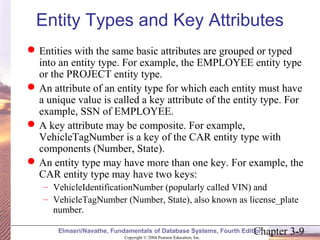
Entity Types and Key Attributes 
ïŹEntities with the same basic attributes are grouped or typed 
into an entity type. For example, the EMPLOYEE entity type 
or the PROJECT entity type. 
ïŹAn attribute of an entity type for which each entity must have 
a unique value is called a key attribute of the entity type. For 
example, SSN of EMPLOYEE. 
ïŹA key attribute may be composite. For example, 
VehicleTagNumber is a key of the CAR entity type with 
components (Number, State). 
ïŹAn entity type may have more than one key. For example, the 
CAR entity type may have two keys: 
– VehicleIdentificationNumber (popularly called VIN) and 
– VehicleTagNumber (Number, State), also known as license_plate 
number. 
Chapter 3-9 Copyright © 2004 Pearson Education, Inc. 
Elmasri/Navathe, Fundamentals of Database Systems, Fourth Edition
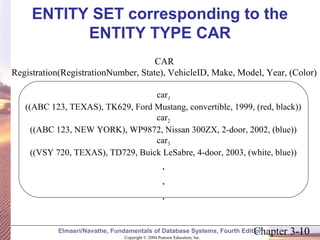
ENTITY SET corresponding to the 
ENTITY TYPE CAR 
CAR 
Registration(RegistrationNumber, State), VehicleID, Make, Model, Year, (Color) 
car1 
((ABC 123, TEXAS), TK629, Ford Mustang, convertible, 1999, (red, black)) 
car2 
((ABC 123, NEW YORK), WP9872, Nissan 300ZX, 2-door, 2002, (blue)) 
car3 
((VSY 720, TEXAS), TD729, Buick LeSabre, 4-door, 2003, (white, blue)) 
... 
Chapter 3-10 Copyright © 2004 Pearson Education, Inc. 
Elmasri/Navathe, Fundamentals of Database Systems, Fourth Edition
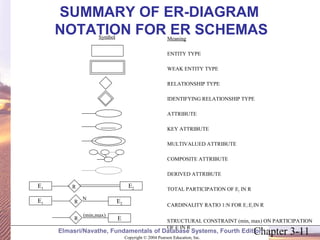
SUMMARY OF ER-DIAGRAM 
NOTATION FOR ER SCHEMAS Meaning 
ENTITY TYPE 
WEAK ENTITY TYPE 
RELATIONSHIP TYPE 
IDENTIFYING RELATIONSHIP TYPE 
ATTRIBUTE 
KEY ATTRIBUTE 
MULTIVALUED ATTRIBUTE 
COMPOSITE ATTRIBUTE 
DERIVED ATTRIBUTE 
TOTAL PARTICIPATION OF E2 IN R 
CARDINALITY RATIO 1:N FOR E1:E2 IN R 
STRUCTURAL CONSTRAINT (min, max) ON PARTICIPATION 
OF E IN R 
E1 R E2 
E1 R E2 
Chapter 3-11 Copyright © 2004 Pearson Education, Inc. 
Symbol 
N 
R (min,max) E 
Elmasri/Navathe, Fundamentals of Database Systems, Fourth Edition
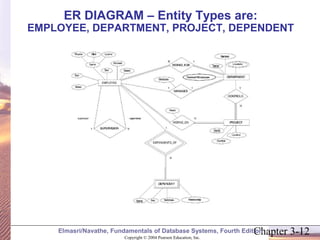
ER DIAGRAM – Entity Types are: 
EMPLOYEE, DEPARTMENT, PROJECT, DEPENDENT 
Chapter 3-12 Copyright © 2004 Pearson Education, Inc. 
Elmasri/Navathe, Fundamentals of Database Systems, Fourth Edition
Relationships and Relationship 
Types (1) 
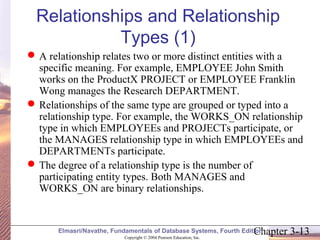
ïŹA relationship relates two or more distinct entities with a 
specific meaning. For example, EMPLOYEE John Smith 
works on the ProductX PROJECT or EMPLOYEE Franklin 
Wong manages the Research DEPARTMENT. 
ïŹRelationships of the same type are grouped or typed into a 
relationship type. For example, the WORKS_ON relationship 
type in which EMPLOYEEs and PROJECTs participate, or 
the MANAGES relationship type in which EMPLOYEEs and 
DEPARTMENTs participate. 
ïŹThe degree of a relationship type is the number of 
participating entity types. Both MANAGES and 
WORKS_ON are binary relationships. 
Chapter 3-13 Copyright © 2004 Pearson Education, Inc. 
Elmasri/Navathe, Fundamentals of Database Systems, Fourth Edition
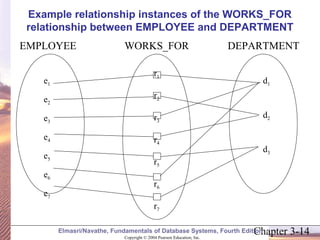
Example relationship instances of the WORKS_FOR 
relationship between EMPLOYEE and DEPARTMENT 
WORKS_FOR 
DEPARTMENT 
Chapter 3-14 Copyright © 2004 Pearson Education, Inc. 
EMPLOYEE 
Elmasri/Navathe, Fundamentals of Database Systems, Fourth Edition 
e1  
e2  
e3  
e4  
e5  
e6  
e7  
r1 
r2 
r3 
r4 
r5 
r6 
r7 
 d1 
 d2 
 d3
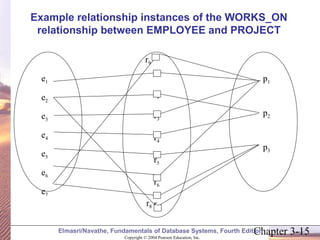
Example relationship instances of the WORKS_ON 
relationship between EMPLOYEE and PROJECT 
r9 
Chapter 3-15 Copyright © 2004 Pearson Education, Inc. 
Elmasri/Navathe, Fundamentals of Database Systems, Fourth Edition 
e1  
e2  
e3  
e4  
e5  
e6  
e7  
r1 
r2 
r3 
r4 
r5 
r6 
r7 
 p1 
 p2 
 p3 
r8
Relationships and Relationship 
Types (2) 
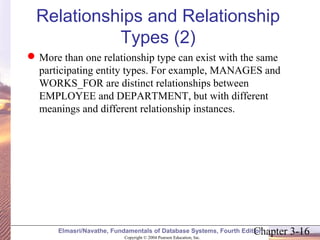
ïŹMore than one relationship type can exist with the same 
participating entity types. For example, MANAGES and 
WORKS_FOR are distinct relationships between 
EMPLOYEE and DEPARTMENT, but with different 
meanings and different relationship instances. 
Chapter 3-16 Copyright © 2004 Pearson Education, Inc. 
Elmasri/Navathe, Fundamentals of Database Systems, Fourth Edition
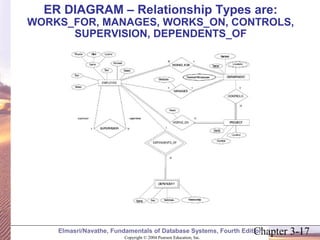
ER DIAGRAM – Relationship Types are: 
WORKS_FOR, MANAGES, WORKS_ON, CONTROLS, 
SUPERVISION, DEPENDENTS_OF 
Chapter 3-17 Copyright © 2004 Pearson Education, Inc. 
Elmasri/Navathe, Fundamentals of Database Systems, Fourth Edition
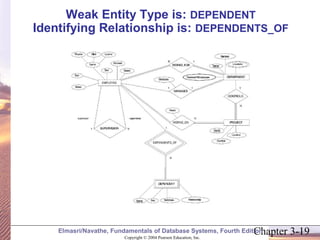
Weak Entity Types 
ïŹAn entity that does not have a key attribute 
ïŹA weak entity must participate in an identifying relationship 
type with an owner or identifying entity type 
ïŹEntities are identified by the combination of: 
– A partial key of the weak entity type 
– The particular entity they are related to in the 
identifying entity type 
Example: 
Suppose that a DEPENDENT entity is identified by the 
dependent’s first name and birhtdate, and the specific 
EMPLOYEE that the dependent is related to. 
DEPENDENT is a weak entity type with EMPLOYEE as its 
identifying entity type via the identifying relationship type 
DEPENDENT_OF 
Chapter 3-18 Copyright © 2004 Pearson Education, Inc. 
Elmasri/Navathe, Fundamentals of Database Systems, Fourth Edition
Weak Entity Type is: DEPENDENT 
Identifying Relationship is: DEPENDENTS_OF 
Chapter 3-19 Copyright © 2004 Pearson Education, Inc. 
Elmasri/Navathe, Fundamentals of Database Systems, Fourth Edition
Constraints on Relationships 
ïŹConstraints on Relationship Types 
– ( Also known as ratio constraints ) 
– Maximum Cardinality 
ïŹ One-to-one (1:1) 
ïŹ One-to-many (1:N) or Many-to-one (N:1) 
ïŹ Many-to-many 
– Minimum Cardinality (also called participation 
constraint or existence dependency constraints) 
ïŹ zero (optional participation, not existence-dependent) 
ïŹ one or more (mandatory, existence-dependent) 
Chapter 3-20 Copyright © 2004 Pearson Education, Inc. 
Elmasri/Navathe, Fundamentals of Database Systems, Fourth Edition
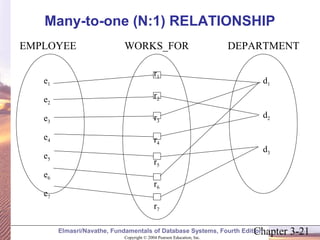
Many-to-one (N:1) RELATIONSHIP 
WORKS_FOR 
DEPARTMENT 
Chapter 3-21 Copyright © 2004 Pearson Education, Inc. 
EMPLOYEE 
Elmasri/Navathe, Fundamentals of Database Systems, Fourth Edition 
e1  
e2  
e3  
e4  
e5  
e6  
e7  
r1 
r2 
r3 
r4 
r5 
r6 
r7 
 d1 
 d2 
 d3
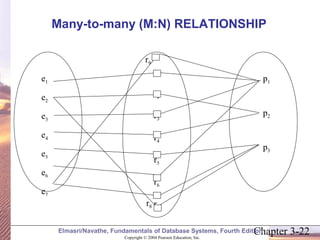
Many-to-many (M:N) RELATIONSHIP 
r9 
Chapter 3-22 Copyright © 2004 Pearson Education, Inc. 
Elmasri/Navathe, Fundamentals of Database Systems, Fourth Edition 
e1  
e2  
e3  
e4  
e5  
e6  
e7  
r1 
r2 
r3 
r4 
r5 
r6 
r7 
 p1 
 p2 
 p3 
r8
Relationships and Relationship 
Types (3) 
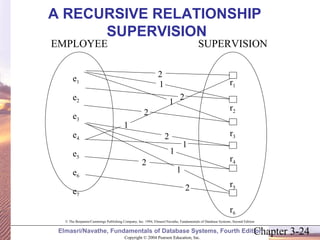
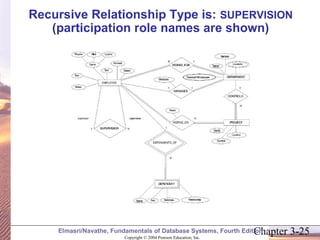
ïŹWe can also have a recursive relationship type. 
ïŹBoth participations are same entity type in different roles. 
ïŹFor example, SUPERVISION relationships between 
EMPLOYEE (in role of supervisor or boss) and (another) 
EMPLOYEE (in role of subordinate or worker). 
ïŹIn following figure, first role participation labeled with 1 and 
second role participation labeled with 2. 
ïŹIn ER diagram, need to display role names to distinguish 
participations. 
Chapter 3-23 Copyright © 2004 Pearson Education, Inc. 
Elmasri/Navathe, Fundamentals of Database Systems, Fourth Edition
A RECURSIVE RELATIONSHIP 
SUPERVISION 
SUPERVISION 
r1 
r2 
r3 
r4 
r5 
r6 
2 
1 
1 2 
2 
1 
1 
1 
2 
1 
2 
2 
© The Benjamin/Cummings Publishing Company, Inc. 1994, Elmasri/Navathe, Fundamentals of Database Systems, Second Edition 
Chapter 3-24 Copyright © 2004 Pearson Education, Inc. 
EMPLOYEE 
e1  
e2  
e3  
e4  
e5  
e6  
e7  
Elmasri/Navathe, Fundamentals of Database Systems, Fourth Edition
Recursive Relationship Type is: SUPERVISION 
(participation role names are shown) 
Chapter 3-25 Copyright © 2004 Pearson Education, Inc. 
Elmasri/Navathe, Fundamentals of Database Systems, Fourth Edition
Attributes of Relationship types 
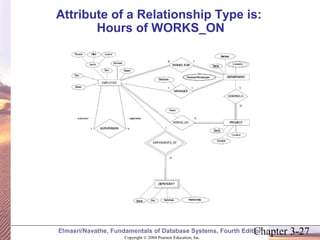
ïŹA relationship type can have attributes; for 
example, HoursPerWeek of WORKS_ON; its 
value for each relationship instance describes 
the number of hours per week that an 
EMPLOYEE works on a PROJECT. 
Chapter 3-26 Copyright © 2004 Pearson Education, Inc. 
Elmasri/Navathe, Fundamentals of Database Systems, Fourth Edition
Attribute of a Relationship Type is: 
Hours of WORKS_ON 
Chapter 3-27 Copyright © 2004 Pearson Education, Inc. 
Elmasri/Navathe, Fundamentals of Database Systems, Fourth Edition
Structural Constraints – 
one way to express semantics 
of relationships 
Structural constraints on relationships: 
 Cardinality ratio (of a binary relationship): 1:1, 1:N, N:1, 
or M:N 
SHOWN BY PLACING APPROPRIATE NUMBER ON 
THE LINK. 
 Participation constraint (on each participating entity 
type): total (called existence dependency) or partial. 
SHOWN BY DOUBLE LINING THE LINK 
NOTE: These are easy to specify for Binary Relationship 
Types. 
Chapter 3-28 Copyright © 2004 Pearson Education, Inc. 
Elmasri/Navathe, Fundamentals of Database Systems, Fourth Edition
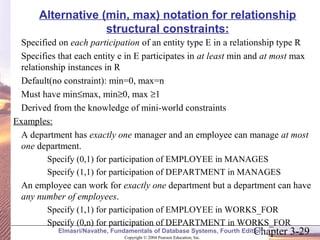
Alternative (min, max) notation for relationship 
structural constraints: 
 Specified on each participation of an entity type E in a relationship type R 
 Specifies that each entity e in E participates in at least min and at most max 
relationship instances in R 
 Default(no constraint): min=0, max=n 
 Must have minÂŁmax, minÂł0, max Âł1 
 Derived from the knowledge of mini-world constraints 
Examples: 
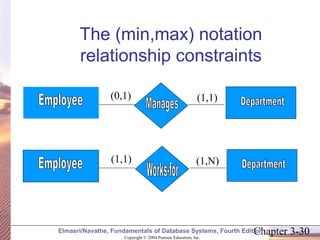
 A department has exactly one manager and an employee can manage at most 
one department. 
– Specify (0,1) for participation of EMPLOYEE in MANAGES 
– Specify (1,1) for participation of DEPARTMENT in MANAGES 
 An employee can work for exactly one department but a department can have 
any number of employees. 
– Specify (1,1) for participation of EMPLOYEE in WORKS_FOR 
– Specify (0,n) for participation of DEPARTMENT in WORKS_FOR 
Chapter 3-29 Copyright © 2004 Pearson Education, Inc. 
Elmasri/Navathe, Fundamentals of Database Systems, Fourth Edition
The (min,max) notation 
relationship constraints 
(0,1) (1,1) 
(1,1) (1,N) 
Chapter 3-30 Copyright © 2004 Pearson Education, Inc. 
Elmasri/Navathe, Fundamentals of Database Systems, Fourth Edition
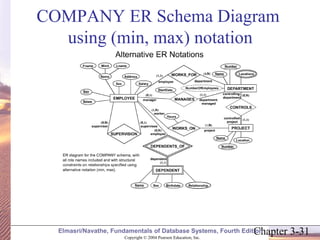
COMPANY ER Schema Diagram 
using (min, max) notation 
Chapter 3-31 Copyright © 2004 Pearson Education, Inc. 
Elmasri/Navathe, Fundamentals of Database Systems, Fourth Edition
Relationships of Higher Degree 
Relationship types of degree 2 are called binary 
Relationship types of degree 3 are called ternary and of 
degree n are called n-ary 
In general, an n-ary relationship is not equivalent to n 
binary relationships 
Higher-order relationships discussed further in Chapter 4 
Chapter 3-32 Copyright © 2004 Pearson Education, Inc. 
Elmasri/Navathe, Fundamentals of Database Systems, Fourth Edition
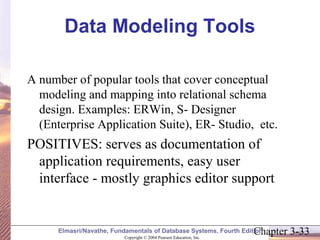
Data Modeling Tools 
A number of popular tools that cover conceptual 
modeling and mapping into relational schema 
design. Examples: ERWin, S- Designer 
(Enterprise Application Suite), ER- Studio, etc. 
POSITIVES: serves as documentation of 
application requirements, easy user 
interface - mostly graphics editor support 
Chapter 3-33 Copyright © 2004 Pearson Education, Inc. 
Elmasri/Navathe, Fundamentals of Database Systems, Fourth Edition
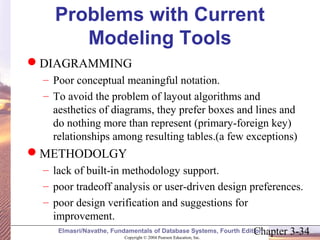
Problems with Current 
Modeling Tools 
ïŹDIAGRAMMING 
– Poor conceptual meaningful notation. 
– To avoid the problem of layout algorithms and 
aesthetics of diagrams, they prefer boxes and lines and 
do nothing more than represent (primary-foreign key) 
relationships among resulting tables.(a few exceptions) 
ïŹMETHODOLGY 
– lack of built-in methodology support. 
– poor tradeoff analysis or user-driven design preferences. 
– poor design verification and suggestions for 
improvement. 
Chapter 3-34 Copyright © 2004 Pearson Education, Inc. 
Elmasri/Navathe, Fundamentals of Database Systems, Fourth Edition
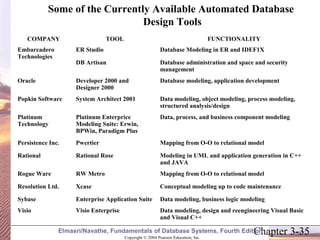
Some of the Currently Available Automated Database 
Design Tools 
COMPANY TOOL FUNCTIONALITY 
Chapter 3-35 Copyright © 2004 Pearson Education, Inc. 
Elmasri/Navathe, Fundamentals of Database Systems, Fourth Edition 
Embarcadero 
Technologies 
ER Studio Database Modeling in ER and IDEF1X 
DB Artisan Database administration and space and security 
management 
Oracle Developer 2000 and 
Designer 2000 
Database modeling, application development 
Popkin Software System Architect 2001 Data modeling, object modeling, process modeling, 
structured analysis/design 
Platinum 
Technology 
Platinum Enterprice 
Modeling Suite: Erwin, 
BPWin, Paradigm Plus 
Data, process, and business component modeling 
Persistence Inc. Pwertier Mapping from O-O to relational model 
Rational Rational Rose Modeling in UML and application generation in C++ 
and JAVA 
Rogue Ware RW Metro Mapping from O-O to relational model 
Resolution Ltd. Xcase Conceptual modeling up to code maintenance 
Sybase Enterprise Application Suite Data modeling, business logic modeling 
Visio Visio Enterprise Data modeling, design and reengineering Visual Basic 
and Visual C++
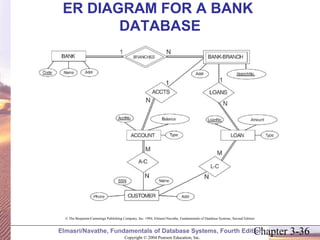
ER DIAGRAM FOR A BANK 
DATABASE 
© The Benjamin/Cummings Publishing Company, Inc. 1994, Elmasri/Navathe, Fundamentals of Database Systems, Second Edition 
Chapter 3-36 Copyright © 2004 Pearson Education, Inc. 
Elmasri/Navathe, Fundamentals of Database Systems, Fourth Edition
PROBLEM with ER notation 
THE ENTITY RELATIONSHIP MODEL IN 
ITS ORIGINAL FORM DID NOT 
SUPPORT THE SPECIALIZATION/ 
GENERALIZATION ABSTRACTIONS 
Chapter 3-37 Copyright © 2004 Pearson Education, Inc. 
Elmasri/Navathe, Fundamentals of Database Systems, Fourth Edition
Extended Entity-Relationship 
(EER) Model 
ïŹIncorporates Set-subset relationships 
ïŹIncorporates Specialization/Generalization Hierarchies 
NEXT CHAPTER ILLUSTRATES HOW THE ER 
MODEL CAN BE EXTENDED WITH 
- Set-subset relationships and 
Specialization/Generalization Hierarchies and how to 
display them in EER diagrams 
Chapter 3-38 Copyright © 2004 Pearson Education, Inc. 
Elmasri/Navathe, Fundamentals of Database Systems, Fourth Edition

ER Diagram

  • 2.
    Chapter 3 DataModeling Using the Entity-Relationship (ER) Model Copyright © 2004 Pearson Education, Inc.
  • 3.
    Chapter Outline ïŹExampleDatabase Application (COMPANY) ïŹER Model Concepts – Entities and Attributes – Entity Types, Value Sets, and Key Attributes – Relationships and Relationship Types – Weak Entity Types – Roles and Attributes in Relationship Types ïŹER Diagrams - Notation ïŹER Diagram for COMPANY Schema ïŹAlternative Notations – UML class diagrams, others Chapter 3-3 Copyright © 2004 Pearson Education, Inc. Elmasri/Navathe, Fundamentals of Database Systems, Fourth Edition
  • 4.
    Example COMPANY Database ïŹRequirements of the Company (oversimplified for illustrative purposes) – The company is organized into DEPARTMENTs. Each department has a name, number and an employee who manages the department. We keep track of the start date of the department manager. – Each department controls a number of PROJECTs. Each project has a name, number and is located at a single location. Chapter 3-4 Copyright © 2004 Pearson Education, Inc. Elmasri/Navathe, Fundamentals of Database Systems, Fourth Edition
  • 5.
    Example COMPANY Database (Cont.) –We store each EMPLOYEE’s social security number, address, salary, sex, and birthdate. Each employee works for one department but may work on several projects. We keep track of the number of hours per week that an employee currently works on each project. We also keep track of the direct supervisor of each employee. –Each employee may have a number of DEPENDENTs. For each dependent, we keep track of their name, sex, birthdate, and relationship to employee. Chapter 3-5 Copyright © 2004 Pearson Education, Inc. Elmasri/Navathe, Fundamentals of Database Systems, Fourth Edition
  • 6.
    ER Model Concepts ïŹEntities and Attributes – Entities are specific objects or things in the mini-world that are represented in the database. For example the EMPLOYEE John Smith, the Research DEPARTMENT, the ProductX PROJECT – Attributes are properties used to describe an entity. For example an EMPLOYEE entity may have a Name, SSN, Address, Sex, BirthDate – A specific entity will have a value for each of its attributes. For example a specific employee entity may have Name='John Smith', SSN='123456789', Address ='731, Fondren, Houston, TX', Sex='M', BirthDate='09-JAN-55‘ – Each attribute has a value set (or data type) associated with it – e.g. integer, string, subrange, enumerated type, 
 Chapter 3-6 Copyright © 2004 Pearson Education, Inc. Elmasri/Navathe, Fundamentals of Database Systems, Fourth Edition
  • 7.
    Types of Attributes(1) – Each entity has a single atomic value for the attribute. For example, SSN or Sex. – The attribute may be composed of several components. For example, Address (Apt#, House#, Street, City, State, ZipCode, Country) or Name (FirstName, MiddleName, LastName). Composition may form a hierarchy where some components are themselves composite. – An entity may have multiple values for that attribute. For example, Color of a CAR or PreviousDegrees of a STUDENT. Denoted as {Color} or {PreviousDegrees}. Chapter 3-7 Copyright © 2004 Pearson Education, Inc. ïŹSimple ïŹComposite ïŹMulti-valued Elmasri/Navathe, Fundamentals of Database Systems, Fourth Edition
  • 8.
    Types of Attributes(2) ïŹIn general, composite and multi-valued attributes may be nested arbitrarily to any number of levels although this is rare. For example, PreviousDegrees of a STUDENT is a composite multi-valued attribute denoted by {PreviousDegrees (College, Year, Degree, Field)}. Chapter 3-8 Copyright © 2004 Pearson Education, Inc. Elmasri/Navathe, Fundamentals of Database Systems, Fourth Edition
  • 9.
    Entity Types andKey Attributes ïŹEntities with the same basic attributes are grouped or typed into an entity type. For example, the EMPLOYEE entity type or the PROJECT entity type. ïŹAn attribute of an entity type for which each entity must have a unique value is called a key attribute of the entity type. For example, SSN of EMPLOYEE. ïŹA key attribute may be composite. For example, VehicleTagNumber is a key of the CAR entity type with components (Number, State). ïŹAn entity type may have more than one key. For example, the CAR entity type may have two keys: – VehicleIdentificationNumber (popularly called VIN) and – VehicleTagNumber (Number, State), also known as license_plate number. Chapter 3-9 Copyright © 2004 Pearson Education, Inc. Elmasri/Navathe, Fundamentals of Database Systems, Fourth Edition
  • 10.
    ENTITY SET correspondingto the ENTITY TYPE CAR CAR Registration(RegistrationNumber, State), VehicleID, Make, Model, Year, (Color) car1 ((ABC 123, TEXAS), TK629, Ford Mustang, convertible, 1999, (red, black)) car2 ((ABC 123, NEW YORK), WP9872, Nissan 300ZX, 2-door, 2002, (blue)) car3 ((VSY 720, TEXAS), TD729, Buick LeSabre, 4-door, 2003, (white, blue)) ... Chapter 3-10 Copyright © 2004 Pearson Education, Inc. Elmasri/Navathe, Fundamentals of Database Systems, Fourth Edition
  • 11.
    SUMMARY OF ER-DIAGRAM NOTATION FOR ER SCHEMAS Meaning ENTITY TYPE WEAK ENTITY TYPE RELATIONSHIP TYPE IDENTIFYING RELATIONSHIP TYPE ATTRIBUTE KEY ATTRIBUTE MULTIVALUED ATTRIBUTE COMPOSITE ATTRIBUTE DERIVED ATTRIBUTE TOTAL PARTICIPATION OF E2 IN R CARDINALITY RATIO 1:N FOR E1:E2 IN R STRUCTURAL CONSTRAINT (min, max) ON PARTICIPATION OF E IN R E1 R E2 E1 R E2 Chapter 3-11 Copyright © 2004 Pearson Education, Inc. Symbol N R (min,max) E Elmasri/Navathe, Fundamentals of Database Systems, Fourth Edition
  • 12.
    ER DIAGRAM –Entity Types are: EMPLOYEE, DEPARTMENT, PROJECT, DEPENDENT Chapter 3-12 Copyright © 2004 Pearson Education, Inc. Elmasri/Navathe, Fundamentals of Database Systems, Fourth Edition
  • 13.
    Relationships and Relationship Types (1) ïŹA relationship relates two or more distinct entities with a specific meaning. For example, EMPLOYEE John Smith works on the ProductX PROJECT or EMPLOYEE Franklin Wong manages the Research DEPARTMENT. ïŹRelationships of the same type are grouped or typed into a relationship type. For example, the WORKS_ON relationship type in which EMPLOYEEs and PROJECTs participate, or the MANAGES relationship type in which EMPLOYEEs and DEPARTMENTs participate. ïŹThe degree of a relationship type is the number of participating entity types. Both MANAGES and WORKS_ON are binary relationships. Chapter 3-13 Copyright © 2004 Pearson Education, Inc. Elmasri/Navathe, Fundamentals of Database Systems, Fourth Edition
  • 14.
    Example relationship instancesof the WORKS_FOR relationship between EMPLOYEE and DEPARTMENT WORKS_FOR DEPARTMENT Chapter 3-14 Copyright © 2004 Pearson Education, Inc. EMPLOYEE Elmasri/Navathe, Fundamentals of Database Systems, Fourth Edition e1 e2 e3 e4 e5 e6 e7 r1 r2 r3 r4 r5 r6 r7 d1 d2 d3
  • 15.
    Example relationship instancesof the WORKS_ON relationship between EMPLOYEE and PROJECT r9 Chapter 3-15 Copyright © 2004 Pearson Education, Inc. Elmasri/Navathe, Fundamentals of Database Systems, Fourth Edition e1 e2 e3 e4 e5 e6 e7 r1 r2 r3 r4 r5 r6 r7 p1 p2 p3 r8
  • 16.
    Relationships and Relationship Types (2) ïŹMore than one relationship type can exist with the same participating entity types. For example, MANAGES and WORKS_FOR are distinct relationships between EMPLOYEE and DEPARTMENT, but with different meanings and different relationship instances. Chapter 3-16 Copyright © 2004 Pearson Education, Inc. Elmasri/Navathe, Fundamentals of Database Systems, Fourth Edition
  • 17.
    ER DIAGRAM –Relationship Types are: WORKS_FOR, MANAGES, WORKS_ON, CONTROLS, SUPERVISION, DEPENDENTS_OF Chapter 3-17 Copyright © 2004 Pearson Education, Inc. Elmasri/Navathe, Fundamentals of Database Systems, Fourth Edition
  • 18.
    Weak Entity Types ïŹAn entity that does not have a key attribute ïŹA weak entity must participate in an identifying relationship type with an owner or identifying entity type ïŹEntities are identified by the combination of: – A partial key of the weak entity type – The particular entity they are related to in the identifying entity type Example: Suppose that a DEPENDENT entity is identified by the dependent’s first name and birhtdate, and the specific EMPLOYEE that the dependent is related to. DEPENDENT is a weak entity type with EMPLOYEE as its identifying entity type via the identifying relationship type DEPENDENT_OF Chapter 3-18 Copyright © 2004 Pearson Education, Inc. Elmasri/Navathe, Fundamentals of Database Systems, Fourth Edition
  • 19.
    Weak Entity Typeis: DEPENDENT Identifying Relationship is: DEPENDENTS_OF Chapter 3-19 Copyright © 2004 Pearson Education, Inc. Elmasri/Navathe, Fundamentals of Database Systems, Fourth Edition
  • 20.
    Constraints on Relationships ïŹConstraints on Relationship Types – ( Also known as ratio constraints ) – Maximum Cardinality ïŹ One-to-one (1:1) ïŹ One-to-many (1:N) or Many-to-one (N:1) ïŹ Many-to-many – Minimum Cardinality (also called participation constraint or existence dependency constraints) ïŹ zero (optional participation, not existence-dependent) ïŹ one or more (mandatory, existence-dependent) Chapter 3-20 Copyright © 2004 Pearson Education, Inc. Elmasri/Navathe, Fundamentals of Database Systems, Fourth Edition
  • 21.
    Many-to-one (N:1) RELATIONSHIP WORKS_FOR DEPARTMENT Chapter 3-21 Copyright © 2004 Pearson Education, Inc. EMPLOYEE Elmasri/Navathe, Fundamentals of Database Systems, Fourth Edition e1 e2 e3 e4 e5 e6 e7 r1 r2 r3 r4 r5 r6 r7 d1 d2 d3
  • 22.
    Many-to-many (M:N) RELATIONSHIP r9 Chapter 3-22 Copyright © 2004 Pearson Education, Inc. Elmasri/Navathe, Fundamentals of Database Systems, Fourth Edition e1 e2 e3 e4 e5 e6 e7 r1 r2 r3 r4 r5 r6 r7 p1 p2 p3 r8
  • 23.
    Relationships and Relationship Types (3) ïŹWe can also have a recursive relationship type. ïŹBoth participations are same entity type in different roles. ïŹFor example, SUPERVISION relationships between EMPLOYEE (in role of supervisor or boss) and (another) EMPLOYEE (in role of subordinate or worker). ïŹIn following figure, first role participation labeled with 1 and second role participation labeled with 2. ïŹIn ER diagram, need to display role names to distinguish participations. Chapter 3-23 Copyright © 2004 Pearson Education, Inc. Elmasri/Navathe, Fundamentals of Database Systems, Fourth Edition
  • 24.
    A RECURSIVE RELATIONSHIP SUPERVISION SUPERVISION r1 r2 r3 r4 r5 r6 2 1 1 2 2 1 1 1 2 1 2 2 © The Benjamin/Cummings Publishing Company, Inc. 1994, Elmasri/Navathe, Fundamentals of Database Systems, Second Edition Chapter 3-24 Copyright © 2004 Pearson Education, Inc. EMPLOYEE e1 e2 e3 e4 e5 e6 e7 Elmasri/Navathe, Fundamentals of Database Systems, Fourth Edition
  • 25.
    Recursive Relationship Typeis: SUPERVISION (participation role names are shown) Chapter 3-25 Copyright © 2004 Pearson Education, Inc. Elmasri/Navathe, Fundamentals of Database Systems, Fourth Edition
  • 26.
    Attributes of Relationshiptypes ïŹA relationship type can have attributes; for example, HoursPerWeek of WORKS_ON; its value for each relationship instance describes the number of hours per week that an EMPLOYEE works on a PROJECT. Chapter 3-26 Copyright © 2004 Pearson Education, Inc. Elmasri/Navathe, Fundamentals of Database Systems, Fourth Edition
  • 27.
    Attribute of aRelationship Type is: Hours of WORKS_ON Chapter 3-27 Copyright © 2004 Pearson Education, Inc. Elmasri/Navathe, Fundamentals of Database Systems, Fourth Edition
  • 28.
    Structural Constraints – one way to express semantics of relationships Structural constraints on relationships: Cardinality ratio (of a binary relationship): 1:1, 1:N, N:1, or M:N SHOWN BY PLACING APPROPRIATE NUMBER ON THE LINK. Participation constraint (on each participating entity type): total (called existence dependency) or partial. SHOWN BY DOUBLE LINING THE LINK NOTE: These are easy to specify for Binary Relationship Types. Chapter 3-28 Copyright © 2004 Pearson Education, Inc. Elmasri/Navathe, Fundamentals of Database Systems, Fourth Edition
  • 29.
    Alternative (min, max)notation for relationship structural constraints: Specified on each participation of an entity type E in a relationship type R Specifies that each entity e in E participates in at least min and at most max relationship instances in R Default(no constraint): min=0, max=n Must have minÂŁmax, minÂł0, max Âł1 Derived from the knowledge of mini-world constraints Examples: A department has exactly one manager and an employee can manage at most one department. – Specify (0,1) for participation of EMPLOYEE in MANAGES – Specify (1,1) for participation of DEPARTMENT in MANAGES An employee can work for exactly one department but a department can have any number of employees. – Specify (1,1) for participation of EMPLOYEE in WORKS_FOR – Specify (0,n) for participation of DEPARTMENT in WORKS_FOR Chapter 3-29 Copyright © 2004 Pearson Education, Inc. Elmasri/Navathe, Fundamentals of Database Systems, Fourth Edition
  • 30.
    The (min,max) notation relationship constraints (0,1) (1,1) (1,1) (1,N) Chapter 3-30 Copyright © 2004 Pearson Education, Inc. Elmasri/Navathe, Fundamentals of Database Systems, Fourth Edition
  • 31.
    COMPANY ER SchemaDiagram using (min, max) notation Chapter 3-31 Copyright © 2004 Pearson Education, Inc. Elmasri/Navathe, Fundamentals of Database Systems, Fourth Edition
  • 32.
    Relationships of HigherDegree Relationship types of degree 2 are called binary Relationship types of degree 3 are called ternary and of degree n are called n-ary In general, an n-ary relationship is not equivalent to n binary relationships Higher-order relationships discussed further in Chapter 4 Chapter 3-32 Copyright © 2004 Pearson Education, Inc. Elmasri/Navathe, Fundamentals of Database Systems, Fourth Edition
  • 33.
    Data Modeling Tools A number of popular tools that cover conceptual modeling and mapping into relational schema design. Examples: ERWin, S- Designer (Enterprise Application Suite), ER- Studio, etc. POSITIVES: serves as documentation of application requirements, easy user interface - mostly graphics editor support Chapter 3-33 Copyright © 2004 Pearson Education, Inc. Elmasri/Navathe, Fundamentals of Database Systems, Fourth Edition
  • 34.
    Problems with Current Modeling Tools ïŹDIAGRAMMING – Poor conceptual meaningful notation. – To avoid the problem of layout algorithms and aesthetics of diagrams, they prefer boxes and lines and do nothing more than represent (primary-foreign key) relationships among resulting tables.(a few exceptions) ïŹMETHODOLGY – lack of built-in methodology support. – poor tradeoff analysis or user-driven design preferences. – poor design verification and suggestions for improvement. Chapter 3-34 Copyright © 2004 Pearson Education, Inc. Elmasri/Navathe, Fundamentals of Database Systems, Fourth Edition
  • 35.
    Some of theCurrently Available Automated Database Design Tools COMPANY TOOL FUNCTIONALITY Chapter 3-35 Copyright © 2004 Pearson Education, Inc. Elmasri/Navathe, Fundamentals of Database Systems, Fourth Edition Embarcadero Technologies ER Studio Database Modeling in ER and IDEF1X DB Artisan Database administration and space and security management Oracle Developer 2000 and Designer 2000 Database modeling, application development Popkin Software System Architect 2001 Data modeling, object modeling, process modeling, structured analysis/design Platinum Technology Platinum Enterprice Modeling Suite: Erwin, BPWin, Paradigm Plus Data, process, and business component modeling Persistence Inc. Pwertier Mapping from O-O to relational model Rational Rational Rose Modeling in UML and application generation in C++ and JAVA Rogue Ware RW Metro Mapping from O-O to relational model Resolution Ltd. Xcase Conceptual modeling up to code maintenance Sybase Enterprise Application Suite Data modeling, business logic modeling Visio Visio Enterprise Data modeling, design and reengineering Visual Basic and Visual C++
  • 36.
    ER DIAGRAM FORA BANK DATABASE © The Benjamin/Cummings Publishing Company, Inc. 1994, Elmasri/Navathe, Fundamentals of Database Systems, Second Edition Chapter 3-36 Copyright © 2004 Pearson Education, Inc. Elmasri/Navathe, Fundamentals of Database Systems, Fourth Edition
  • 37.
    PROBLEM with ERnotation THE ENTITY RELATIONSHIP MODEL IN ITS ORIGINAL FORM DID NOT SUPPORT THE SPECIALIZATION/ GENERALIZATION ABSTRACTIONS Chapter 3-37 Copyright © 2004 Pearson Education, Inc. Elmasri/Navathe, Fundamentals of Database Systems, Fourth Edition
  • 38.
    Extended Entity-Relationship (EER)Model ïŹIncorporates Set-subset relationships ïŹIncorporates Specialization/Generalization Hierarchies NEXT CHAPTER ILLUSTRATES HOW THE ER MODEL CAN BE EXTENDED WITH - Set-subset relationships and Specialization/Generalization Hierarchies and how to display them in EER diagrams Chapter 3-38 Copyright © 2004 Pearson Education, Inc. Elmasri/Navathe, Fundamentals of Database Systems, Fourth Edition