EPIGENETICS
ā€œThe Correlation: The Food that you eat and your child somedayā€
Presented by:
Paul S. Magbanua
Basic
Concepts
in Genetics
Cells are fundamental working units
of every human being. All the
instructions required to direct their
activities are contained within the
chemical deoxyribonucleic acid,
also known as DNA.
DNA from humans is made up of
approximately 3 billion nucleotide bases.
There are four fundamental types
of bases that comprise DNA – adenine,
cytosine, guanine, and thymine, commonly
abbreviated as A, C, G, and T,
respectively.
The sequence, or the order, of the bases is
what determines our life
instructions. Interestingly enough, our
DNA sequence is more than 99 percent
similar to that of a chimpanzee. Less than
1 percent, or 15 million bases, has a
distinctively different sequence that makes
us human.
Within the 3 billion bases, there are about
20,000+ genes. Genes are specific
sequences of bases that provide
instructions on how to make
important proteins – complex molecules
that trigger various biological actions to
carry out life functions.
A genome is an organism’s complete set of DNA,
including all of its genes. Each genome contains
all of the information needed to build and
maintain that organism. In humans, a copy of the
entire genome—more than 3 billion DNA base
pairs—is contained in all cells that have a
nucleus.
What is Epigenetics?
Epigenetics literally means "above" or "on
top of" genetics. It refers to external
modifications to DNA that turn genes "on"
or "off." These modifications do not change
the DNA sequence, but instead, they affect
how cells "read" genes.
The term epigenetics refers to heritable
changes in gene expression (active versus
inactive genes) that does not involve
changes to the underlying DNA sequence;
a change in phenotype without a change
in genotype.
Epigenetic change is a regular and natural
occurrence but can also be influenced by
several factors including age, the
environment/lifestyle, and disease state.
Epigenetic modifications can manifest as
commonly as the manner in which cells
terminally differentiate to end up as skin
cells, liver cells, brain cells, etc.
Epigenetic change can have more damaging
effects that can result in diseases like cancer. At
least three systems including
– DNA methylation,
– histone modification and
– non-coding RNA (ncRNA)-associated gene
silencing are currently considered to initiate and
sustain epigenetic change.
History of
Epigenetics
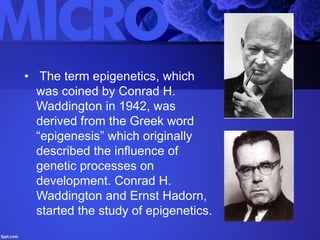
• The term epigenetics, which
was coined by Conrad H.
Waddington in 1942, was
derived from the Greek word
ā€œepigenesisā€ which originally
described the influence of
genetic processes on
development. Conrad H.
Waddington and Ernst Hadorn,
started the study of epigenetics.
• During the 1990s there became a renewed
interest in genetic assimilation. This lead to
elucidation of the molecular basis of Conrad
Waddington’s observations in which
environmental stress caused genetic
assimilation of certain phenotypic characteristics
inDrosophila fruit flies. Since then, research
efforts have been focused on unraveling the
epigenetic mechanisms related to these types of
changes.
• Currently, DNA methylation is one of the most
broadly studied and well-characterized
epigenetic modifications dating back to studies
done by Griffith and Mahler in 1969 which
suggested that DNA methylation may be
important in long term memory function.
How does epigenetics
works?
Let us start with...
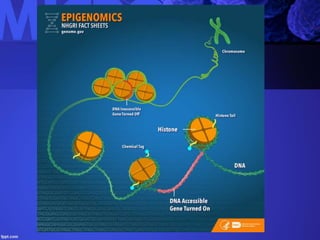
• An epigenome consists of a record of the
chemical changes to the DNA and histone
proteins of an organism; these changes can be
passed down to an organism's offspring.
Changes to the epigenome can result in
changes to the structure of chromatin and
changes to the function of the genome.
• The epigenome is a multitude of chemical
compounds that can tell the genome what to do.
The human genome is the complete assembly of
DNA (deoxyribonucleic acid)-about 3 billion base
pairs - that makes each individual unique.
• DNA holds the instructions for building the
proteins that carry out a variety of functions in a
cell. The epigenome is made up of chemical
compounds and proteins that can attach to DNA
and direct such actions as turning genes on or
off, controlling the production of proteins in
particular cells.
• When epigenomic compounds attach to DNA
and modify its function, they are said to have
"marked" the genome. These marks do not
change the sequence of the DNA. Rather, they
change the way cells use the DNA's instructions.
The marks are sometimes passed on from cell to
cell as cells divide. They also can be passed
down from one generation to the next.
• Epigenetic tags act as a kind of cellular
memory. A cell's epigenetic profile -- a collection
of tags that tell genes whether to be on or off --
is the sum of the signals it has received during
its lifetime.
The Changing Epigenome Informs Gene
Expression
• As a fertilized egg develops into a baby, dozens
of signals received over days, weeks, and
months cause incremental changes in gene
expression patterns. Epigenetic tags record the
cell's experiences on the DNA, helping to
stabilize gene expression.
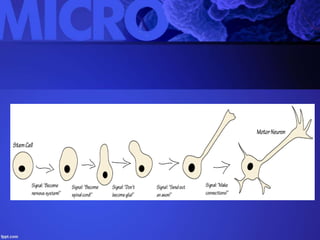
• Each signal shuts down some genes and
activates others as it nudges a cell toward its
final fate. Different experiences cause the
epigenetic profiles of each cell type to grow
increasingly different over time. In the end,
hundreds of cell types form, each with a distinct
identity and a specialized function.
• Even in differentiated cells, signals fine-tune cell
functions through changes in gene expression. A
flexible epigenome allows us to adjust to
changes in the world around us, and to learn
from our experiences.
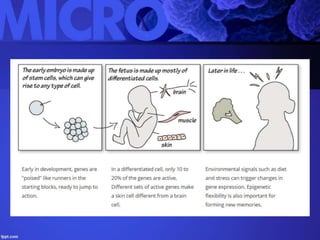
The epigenome changes in response to signals.
Signals come from inside the cell, from
neighboring cells, or from the outside world
(environment).
Early in development
Most signals come from within cells or from
neighboring cells. Mom's nutrition is also
important at this stage. The food she brings into
her body forms the building blocks for shaping
the growing fetus and its developing epigenome.
Other types of signals, such as stress hormones,
can also travel from mom to fetus.
After birth and as life continues
A wider variety of environmental factors start to
play a role in shaping the epigenome. Social
interactions, physical activity, diet and other
inputs generate signals that travel from cell to
cell throughout the body. As in early
development, signals from within the body
continue to be important for many processes,
including physical growth and learning.
Hormonal signals trigger big changes at puberty.
Even into old age
Cells continue to listen for signals. Environmental
signals trigger changes in the epigenome,
allowing cells to respond dynamically to the
outside world. Internal signals direct activities
that are necessary for body maintenance, such
as replenishing blood cells and skin, and
repairing damaged tissues and organs.
Even into old age
During these processes, just like during embryonic
development, the cell's experiences are
transferred to the epigenome, where they shut
down and activate specific sets of genes.
Mechanisms of Epigenetics
• DNA methylation
• Histone Modification
• Non-coding RNA (ncRNA)-
associated gene
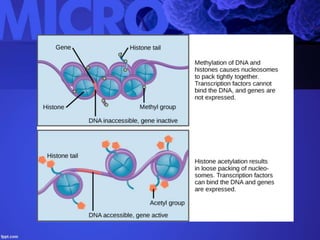
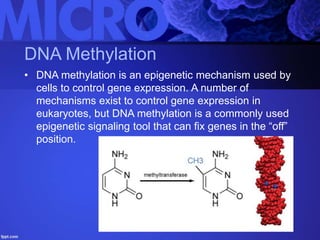
DNA Methylation
• DNA methylation is an epigenetic mechanism used by
cells to control gene expression. A number of
mechanisms exist to control gene expression in
eukaryotes, but DNA methylation is a commonly used
epigenetic signaling tool that can fix genes in the ā€œoffā€
position.
DNA Methylation
• DNA methylation is an epigenetic mechanism
used by cells to control gene expression. A
number of mechanisms exist to control gene
expression in eukaryotes, but DNA methylation
is a commonly used epigenetic signaling tool
that can fix genes in the ā€œoffā€ position.
Histone Modification
• Histones are subject to a wide variety of
posttranslational modifications including but not
limited to, lysine acetylation, lysine and arginine
methylation, serine and threonine
phosphorylation, and lysine ubiquitination and
sumoylation (Vasquero 2003). These
modifications occur primarily within the histone
amino-terminal tails protruding from the surface
of the nucleosome as well as on the globular
core region (Cosgrove 2004).
Histone Modification
• Histone modifications are proposed to affect
chromosome function through at least two
distinct mechanisms. The first mechanism
suggests modifications may alter the
electrostatic charge of the histone resulting in a
structural change in histones or their binding to
DNA.
Histone Modification
• The second mechanism proposes that these
modifications are binding sites for protein
recognition modules, such as the bromodomains
or chromodomains, that recognize acetylated
lysines or methylated lysine, respectively.
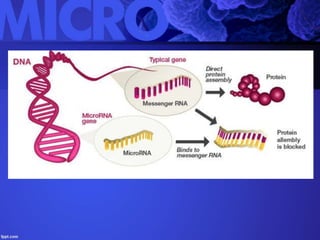
Non-coding RNA (ncRNA)-associated gene
• miRNAs or ncRNA represent small RNA
molecules encoded in the genomes of plants
and animals. These highly conserved 22
nucleotides long RNA sequences regulate the
expression of genes by binding to the 3'-
untranslated regions (3'-UTR) of specific
mRNAs. A growing body of evidence shows that
miRNAs are one of the key players in cell
differentiation and growth, mobility and apoptosis
(programmed cell death).
• miRNAs regulate diverse aspects of
development and physiology, thus
understanding its biological role is proving more
and more important. Analysis of miRNA
expression may provide valuable information, as
dysregulation of its function can lead to human
diseases such as cancer, cardiovascular and
metabolic diseases, liver conditions and immune
dysfunction.
Epigenetics and the Environment:
How Lifestyle Can Influence
Epigenetic Change from One
Generation to the Next
• The field of epigenetics is quickly growing and
with it the understanding that both the
environment and individual lifestyle can also
directly interact with the genome to influence
epigenetic change. These changes may be
reflected at various stages throughout a person’s
life and even in later generations.
• For example, human epidemiological studies
have provided evidence that prenatal and
early postnatal environmental factors
influence the adult risk of developing various
chronic diseases and behavioral disorders.
• Studies have shown that children born during
the period of the Dutch famine from 1944-1945
have increased rates of coronary heart disease
and obesity after maternal exposure to famine
during early pregnancy compared to those not
exposed to famine.
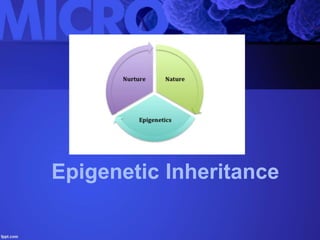
Epigenetic Inheritance
• It may be possible to pass down epigenetic
changes to future generations if the changes
occur in sperm or egg cells. Most epigenetic
changes that occur in sperm and egg cells get
erased when the two combine to form a fertilized
egg, in a process called ā€œreprogramming.ā€ This
reprogramming allows the cells of the fetus to
"start from scratch" and make their own
epigenetic changes.
• But scientists think some of the epigenetic
changes in parents' sperm and egg cells may
avoid the reprogramming process, and make it
through to the next generation. If this is true,
things like the food a person eats before they
conceive could affect their future child. However,
this has not been proven in people.
Epigenetics and Cancer
• Scientists now think epigentics can play some
role is the development of some cancer. For
instance, an epigenetic change that silences a
tumor suppressor gene — such as a gene that
keeps the growth of the cell in check — could
lead to uncontrolled cellular growth. Another
example might be an epigenetic change that
"turns off" genes that help repair damaged DNA,
leading to an increase in DNA damage, which in
turn, increases cancer risk.
Application of Epigenetics
• Chemicals that enter our bodies can also affect
the epigenome. Bisphenol A (BPA) is a
compound used to make polycarbonate plastic.
It is in many consumer products, including
water bottles and tin cans. Controversial reports
questioning the safety of BPA came out in 2008,
prompting some manufacturers to stop using
the chemical.
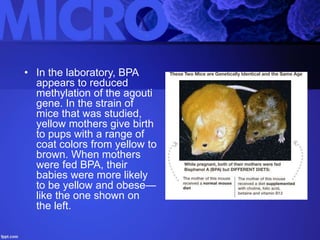
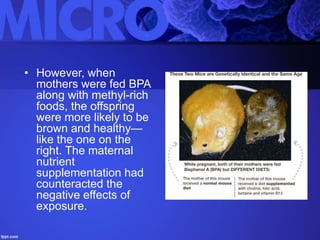
• In the laboratory, BPA
appears to reduced
methylation of the agouti
gene. In the strain of
mice that was studied,
yellow mothers give birth
to pups with a range of
coat colors from yellow to
brown. When mothers
were fed BPA, their
babies were more likely
to be yellow and obese—
like the one shown on
the left.
• However, when
mothers were fed BPA
along with methyl-rich
foods, the offspring
were more likely to be
brown and healthy—
like the one on the
right. The maternal
nutrient
supplementation had
counteracted the
negative effects of
exposure.
Mental Retardation Disorders
• Epigenetic changes are also linked to several
disorders that result in intellectual disabilities
such as ATR-X, Fragile X, Rett, Beckwith-
Weidman (BWS), Prader-Willi and Angelman
syndromes. For example, the imprint disorders
Prader-Willi syndrome and Angelman syndrome,
display an abnormal phenotype as a result of the
absence of the paternal or maternal copy of a
gene, respectively.
Mental Retardation Disorders
• In these imprint disorders, there is a genetic
deletion in chromosome 15 in a majority of
patients. The same gene on the corresponding
chromosome cannot compensate for the
deletion because it has been turned off by
methylation, an epigenetic modification. Genetic
deletions inherited from the father result in
Prader-Willi syndrome, and those inherited from
the mother, Angelman syndrome.
Neuropsychiatric Disorders
• Epigenetic errors also play a role in the
causation of complex adult psychiatric, autistic,
and neurodegenerative disorders. Several
reports have associated schizophrenia and
mood disorders with DNA rearrangements that
include the DNMT genes.
Neuropsychiatric Disorders
• DNMT1 is selectively overexpressed in gamma-
aminobutyric acid (GABA)-ergic interneurons of
schizophrenic brains,
whereas hypermethylation has been shown to
repress expression of Reelin (a protein required
for normal neurotransmission, memory formation
and synaptic plasticity) in brain tissue from
patients with schizophrenia and patients with
bipolar illness and psychosis.
References
• http://www.livescience.com/
• https://www.genome.gov
• http://learn.genetics.utah.edu/
• http://www.whatisepigenetics.com/

Epigenetics

  • 1.
    EPIGENETICS ā€œThe Correlation: TheFood that you eat and your child somedayā€ Presented by: Paul S. Magbanua
  • 2.
  • 3.
    Cells are fundamentalworking units of every human being. All the instructions required to direct their activities are contained within the chemical deoxyribonucleic acid, also known as DNA.
  • 4.
    DNA from humansis made up of approximately 3 billion nucleotide bases. There are four fundamental types of bases that comprise DNA – adenine, cytosine, guanine, and thymine, commonly abbreviated as A, C, G, and T, respectively.
  • 5.
    The sequence, orthe order, of the bases is what determines our life instructions. Interestingly enough, our DNA sequence is more than 99 percent similar to that of a chimpanzee. Less than 1 percent, or 15 million bases, has a distinctively different sequence that makes us human.
  • 6.
    Within the 3billion bases, there are about 20,000+ genes. Genes are specific sequences of bases that provide instructions on how to make important proteins – complex molecules that trigger various biological actions to carry out life functions.
  • 7.
    A genome isan organism’s complete set of DNA, including all of its genes. Each genome contains all of the information needed to build and maintain that organism. In humans, a copy of the entire genome—more than 3 billion DNA base pairs—is contained in all cells that have a nucleus.
  • 8.
  • 10.
    Epigenetics literally means"above" or "on top of" genetics. It refers to external modifications to DNA that turn genes "on" or "off." These modifications do not change the DNA sequence, but instead, they affect how cells "read" genes.
  • 11.
    The term epigeneticsrefers to heritable changes in gene expression (active versus inactive genes) that does not involve changes to the underlying DNA sequence; a change in phenotype without a change in genotype.
  • 12.
    Epigenetic change isa regular and natural occurrence but can also be influenced by several factors including age, the environment/lifestyle, and disease state. Epigenetic modifications can manifest as commonly as the manner in which cells terminally differentiate to end up as skin cells, liver cells, brain cells, etc.
  • 13.
    Epigenetic change canhave more damaging effects that can result in diseases like cancer. At least three systems including – DNA methylation, – histone modification and – non-coding RNA (ncRNA)-associated gene silencing are currently considered to initiate and sustain epigenetic change.
  • 14.
  • 15.
    • The termepigenetics, which was coined by Conrad H. Waddington in 1942, was derived from the Greek word ā€œepigenesisā€ which originally described the influence of genetic processes on development. Conrad H. Waddington and Ernst Hadorn, started the study of epigenetics.
  • 16.
    • During the1990s there became a renewed interest in genetic assimilation. This lead to elucidation of the molecular basis of Conrad Waddington’s observations in which environmental stress caused genetic assimilation of certain phenotypic characteristics inDrosophila fruit flies. Since then, research efforts have been focused on unraveling the epigenetic mechanisms related to these types of changes.
  • 17.
    • Currently, DNAmethylation is one of the most broadly studied and well-characterized epigenetic modifications dating back to studies done by Griffith and Mahler in 1969 which suggested that DNA methylation may be important in long term memory function.
  • 18.
  • 19.
    Let us startwith... • An epigenome consists of a record of the chemical changes to the DNA and histone proteins of an organism; these changes can be passed down to an organism's offspring. Changes to the epigenome can result in changes to the structure of chromatin and changes to the function of the genome.
  • 20.
    • The epigenomeis a multitude of chemical compounds that can tell the genome what to do. The human genome is the complete assembly of DNA (deoxyribonucleic acid)-about 3 billion base pairs - that makes each individual unique.
  • 21.
    • DNA holdsthe instructions for building the proteins that carry out a variety of functions in a cell. The epigenome is made up of chemical compounds and proteins that can attach to DNA and direct such actions as turning genes on or off, controlling the production of proteins in particular cells.
  • 22.
    • When epigenomiccompounds attach to DNA and modify its function, they are said to have "marked" the genome. These marks do not change the sequence of the DNA. Rather, they change the way cells use the DNA's instructions. The marks are sometimes passed on from cell to cell as cells divide. They also can be passed down from one generation to the next.
  • 24.
    • Epigenetic tagsact as a kind of cellular memory. A cell's epigenetic profile -- a collection of tags that tell genes whether to be on or off -- is the sum of the signals it has received during its lifetime.
  • 26.
    The Changing EpigenomeInforms Gene Expression • As a fertilized egg develops into a baby, dozens of signals received over days, weeks, and months cause incremental changes in gene expression patterns. Epigenetic tags record the cell's experiences on the DNA, helping to stabilize gene expression.
  • 27.
    • Each signalshuts down some genes and activates others as it nudges a cell toward its final fate. Different experiences cause the epigenetic profiles of each cell type to grow increasingly different over time. In the end, hundreds of cell types form, each with a distinct identity and a specialized function.
  • 28.
    • Even indifferentiated cells, signals fine-tune cell functions through changes in gene expression. A flexible epigenome allows us to adjust to changes in the world around us, and to learn from our experiences.
  • 30.
    The epigenome changesin response to signals. Signals come from inside the cell, from neighboring cells, or from the outside world (environment).
  • 31.
    Early in development Mostsignals come from within cells or from neighboring cells. Mom's nutrition is also important at this stage. The food she brings into her body forms the building blocks for shaping the growing fetus and its developing epigenome. Other types of signals, such as stress hormones, can also travel from mom to fetus.
  • 32.
    After birth andas life continues A wider variety of environmental factors start to play a role in shaping the epigenome. Social interactions, physical activity, diet and other inputs generate signals that travel from cell to cell throughout the body. As in early development, signals from within the body continue to be important for many processes, including physical growth and learning. Hormonal signals trigger big changes at puberty.
  • 33.
    Even into oldage Cells continue to listen for signals. Environmental signals trigger changes in the epigenome, allowing cells to respond dynamically to the outside world. Internal signals direct activities that are necessary for body maintenance, such as replenishing blood cells and skin, and repairing damaged tissues and organs.
  • 34.
    Even into oldage During these processes, just like during embryonic development, the cell's experiences are transferred to the epigenome, where they shut down and activate specific sets of genes.
  • 35.
    Mechanisms of Epigenetics •DNA methylation • Histone Modification • Non-coding RNA (ncRNA)- associated gene
  • 36.
    DNA Methylation • DNAmethylation is an epigenetic mechanism used by cells to control gene expression. A number of mechanisms exist to control gene expression in eukaryotes, but DNA methylation is a commonly used epigenetic signaling tool that can fix genes in the ā€œoffā€ position.
  • 37.
    DNA Methylation • DNAmethylation is an epigenetic mechanism used by cells to control gene expression. A number of mechanisms exist to control gene expression in eukaryotes, but DNA methylation is a commonly used epigenetic signaling tool that can fix genes in the ā€œoffā€ position.
  • 38.
    Histone Modification • Histonesare subject to a wide variety of posttranslational modifications including but not limited to, lysine acetylation, lysine and arginine methylation, serine and threonine phosphorylation, and lysine ubiquitination and sumoylation (Vasquero 2003). These modifications occur primarily within the histone amino-terminal tails protruding from the surface of the nucleosome as well as on the globular core region (Cosgrove 2004).
  • 39.
    Histone Modification • Histonemodifications are proposed to affect chromosome function through at least two distinct mechanisms. The first mechanism suggests modifications may alter the electrostatic charge of the histone resulting in a structural change in histones or their binding to DNA.
  • 40.
    Histone Modification • Thesecond mechanism proposes that these modifications are binding sites for protein recognition modules, such as the bromodomains or chromodomains, that recognize acetylated lysines or methylated lysine, respectively.
  • 42.
    Non-coding RNA (ncRNA)-associatedgene • miRNAs or ncRNA represent small RNA molecules encoded in the genomes of plants and animals. These highly conserved 22 nucleotides long RNA sequences regulate the expression of genes by binding to the 3'- untranslated regions (3'-UTR) of specific mRNAs. A growing body of evidence shows that miRNAs are one of the key players in cell differentiation and growth, mobility and apoptosis (programmed cell death).
  • 43.
    • miRNAs regulatediverse aspects of development and physiology, thus understanding its biological role is proving more and more important. Analysis of miRNA expression may provide valuable information, as dysregulation of its function can lead to human diseases such as cancer, cardiovascular and metabolic diseases, liver conditions and immune dysfunction.
  • 45.
    Epigenetics and theEnvironment: How Lifestyle Can Influence Epigenetic Change from One Generation to the Next
  • 46.
    • The fieldof epigenetics is quickly growing and with it the understanding that both the environment and individual lifestyle can also directly interact with the genome to influence epigenetic change. These changes may be reflected at various stages throughout a person’s life and even in later generations.
  • 47.
    • For example,human epidemiological studies have provided evidence that prenatal and early postnatal environmental factors influence the adult risk of developing various chronic diseases and behavioral disorders.
  • 48.
    • Studies haveshown that children born during the period of the Dutch famine from 1944-1945 have increased rates of coronary heart disease and obesity after maternal exposure to famine during early pregnancy compared to those not exposed to famine.
  • 49.
  • 50.
    • It maybe possible to pass down epigenetic changes to future generations if the changes occur in sperm or egg cells. Most epigenetic changes that occur in sperm and egg cells get erased when the two combine to form a fertilized egg, in a process called ā€œreprogramming.ā€ This reprogramming allows the cells of the fetus to "start from scratch" and make their own epigenetic changes.
  • 51.
    • But scientiststhink some of the epigenetic changes in parents' sperm and egg cells may avoid the reprogramming process, and make it through to the next generation. If this is true, things like the food a person eats before they conceive could affect their future child. However, this has not been proven in people.
  • 52.
  • 53.
    • Scientists nowthink epigentics can play some role is the development of some cancer. For instance, an epigenetic change that silences a tumor suppressor gene — such as a gene that keeps the growth of the cell in check — could lead to uncontrolled cellular growth. Another example might be an epigenetic change that "turns off" genes that help repair damaged DNA, leading to an increase in DNA damage, which in turn, increases cancer risk.
  • 54.
  • 56.
    • Chemicals thatenter our bodies can also affect the epigenome. Bisphenol A (BPA) is a compound used to make polycarbonate plastic. It is in many consumer products, including water bottles and tin cans. Controversial reports questioning the safety of BPA came out in 2008, prompting some manufacturers to stop using the chemical.
  • 57.
    • In thelaboratory, BPA appears to reduced methylation of the agouti gene. In the strain of mice that was studied, yellow mothers give birth to pups with a range of coat colors from yellow to brown. When mothers were fed BPA, their babies were more likely to be yellow and obese— like the one shown on the left.
  • 58.
    • However, when motherswere fed BPA along with methyl-rich foods, the offspring were more likely to be brown and healthy— like the one on the right. The maternal nutrient supplementation had counteracted the negative effects of exposure.
  • 59.
    Mental Retardation Disorders •Epigenetic changes are also linked to several disorders that result in intellectual disabilities such as ATR-X, Fragile X, Rett, Beckwith- Weidman (BWS), Prader-Willi and Angelman syndromes. For example, the imprint disorders Prader-Willi syndrome and Angelman syndrome, display an abnormal phenotype as a result of the absence of the paternal or maternal copy of a gene, respectively.
  • 60.
    Mental Retardation Disorders •In these imprint disorders, there is a genetic deletion in chromosome 15 in a majority of patients. The same gene on the corresponding chromosome cannot compensate for the deletion because it has been turned off by methylation, an epigenetic modification. Genetic deletions inherited from the father result in Prader-Willi syndrome, and those inherited from the mother, Angelman syndrome.
  • 61.
    Neuropsychiatric Disorders • Epigeneticerrors also play a role in the causation of complex adult psychiatric, autistic, and neurodegenerative disorders. Several reports have associated schizophrenia and mood disorders with DNA rearrangements that include the DNMT genes.
  • 62.
    Neuropsychiatric Disorders • DNMT1is selectively overexpressed in gamma- aminobutyric acid (GABA)-ergic interneurons of schizophrenic brains, whereas hypermethylation has been shown to repress expression of Reelin (a protein required for normal neurotransmission, memory formation and synaptic plasticity) in brain tissue from patients with schizophrenia and patients with bipolar illness and psychosis.
  • 63.
    References • http://www.livescience.com/ • https://www.genome.gov •http://learn.genetics.utah.edu/ • http://www.whatisepigenetics.com/