Epidemiology study design and data analysis 3rd edition Edition Woodward
Epidemiology study design and data analysis 3rd edition Edition Woodward
Epidemiology study design and data analysis 3rd edition Edition Woodward
Epidemiology study design and data analysis 3rd edition Edition Woodward
Epidemiology study design and data analysis 3rd edition Edition Woodward
1.
Download the fullversion and explore a variety of ebooks
or textbooks at https://ebookultra.com
Epidemiology study design and data analysis 3rd
edition Edition Woodward
_____ Follow the link below to get your download now _____
https://ebookultra.com/download/epidemiology-study-design-
and-data-analysis-3rd-edition-edition-woodward/
Access ebookultra.com now to download high-quality
ebooks or textbooks
2.
We have selectedsome products that you may be interested in
Click the link to download now or visit ebookultra.com
for more options!.
Applied Longitudinal Data Analysis for Epidemiology A
Practical Guide 1st Edition Jos W. R. Twisk
https://ebookultra.com/download/applied-longitudinal-data-analysis-
for-epidemiology-a-practical-guide-1st-edition-jos-w-r-twisk/
Introduction to Statistics and Data Analysis 3rd Edition
Roxy Peck
https://ebookultra.com/download/introduction-to-statistics-and-data-
analysis-3rd-edition-roxy-peck/
Experimental Design and Data Analysis for Biologists 1st
Edition Gerry P. Quinn
https://ebookultra.com/download/experimental-design-and-data-analysis-
for-biologists-1st-edition-gerry-p-quinn/
Requirements analysis and system design 3rd Edition
Edition Leszek Maciaszek
https://ebookultra.com/download/requirements-analysis-and-system-
design-3rd-edition-edition-leszek-maciaszek/
3.
Antenna Theory Analysisand Design 3rd Edition Constantine
A. Balanis
https://ebookultra.com/download/antenna-theory-analysis-and-
design-3rd-edition-constantine-a-balanis/
Real Time Systems Design and Analysis 3rd Edition Phillip
A. Laplante
https://ebookultra.com/download/real-time-systems-design-and-
analysis-3rd-edition-phillip-a-laplante/
Excel Data Analysis Your visual blueprint for creating and
analyzing data charts and PivotTables 3rd Edition Denise
Etheridge
https://ebookultra.com/download/excel-data-analysis-your-visual-
blueprint-for-creating-and-analyzing-data-charts-and-pivottables-3rd-
edition-denise-etheridge/
Cancer Epidemiology and Prevention 3rd ed Edition David
Schottenfeld
https://ebookultra.com/download/cancer-epidemiology-and-
prevention-3rd-ed-edition-david-schottenfeld/
Introduction to Research Methods and Data Analysis in
Psychology 3rd Edition Darren Langdridge
https://ebookultra.com/download/introduction-to-research-methods-and-
data-analysis-in-psychology-3rd-edition-darren-langdridge/
5.
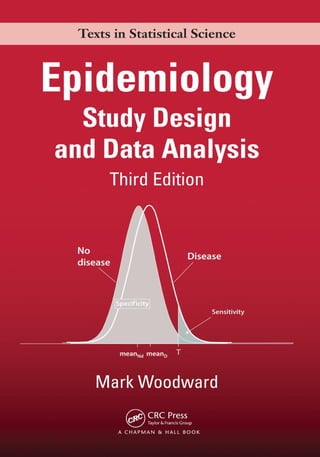
Epidemiology study designand data analysis 3rd edition
Edition Woodward Digital Instant Download
Author(s): Woodward, Mark
ISBN(s): 9781482244335, 1482244330
Edition: 3rd edition
File Details: PDF, 10.68 MB
Year: 2014
Language: english
7.
K11828_C00.fm Page iTuesday, November 19, 2013 4:18 PM
Epidemiology
Study Design
and Data Analysis
Third Edition
8.
K11828_C00.fm Page iiTuesday, November 19, 2013 4:18 PM
CHAPMAN & HALL/CRC
Texts in Statistical Science Series
Series Editors
Franccsca Dominici, Harvard ,"choo{ ofPublic Health, USA
Julian J. Faraway, University ofBath, UK
Martin Tanner, Northwestern University, USIl.
Jim Zidek, University (�lBritish Columhia, Canada
Analysis of Failure and Survival Data
P.]. Smith
'lheAnalysis of Time Series:An Introduction,
Sixth Edition
C. Chatfield
Applied Bayesian Forecasting and T ime Series
Analysis
A. Pole, Nl. -'lest, andJ. llarrison
Applied Categorical and Count DataAnalysis
.v. Tang, H. He, and X.NI.Tu
Applied Nonparametric Statistical Methods,
Fourth Edition
P. Sprcnt and N,C. Smccton
Applied Statistics: HandbookofGENSTAT
Analyses
E.J. Snell and H. Simpson
Applied Statistics: Principles and Examples
D.R. Cox and EJ Snell
Applied Stochastic .Modelling, Second Edition
B.].TlVlorgan
Bayesian DablAnalysis, llLird Edition
A. Gelman,].R. Carlin, H.S. Stern, D.B. Dunson,
A. Vchtari, and D,ll. Rubin
BayeSian Ideas and DataAnalysis: An
Introduction for Scientists and Statisticians
R.Christensen, '.Johnson,A. Branscum,
and TE. Hanson
Bayesian .Methods for DataAnalysis,
Third Edition
ll.p. Carlin and1:A. Louis
Beyond ANOVA: Basics ofApplied Statistics
R.G.lVIiUer,Jr.
The BUGS Book:A Practical Introduction to
BayesianAnalysis
D. Lunn, C.Jackson, N. Best,A.1homas, and
D. Spiegelhalter
A Course in Catcgorical DataAnalysis
T. Leonard
A Course in Large SampleTheory
T.S. Ferguson
Data Driven Statistiealltlethods
P. Sprent
DecisionAnalysis:A BayesianApproach
J.QSmith
Design and Analysis ofExperiments with SAS
J. Lawson
ElementaryApplications of ProbabilityTheory,
Second Edition
H.C. Tuckwell
Elements ofSimulation
BlT :rvlorgan
Epidemiology: Study Design and
DataAnalysis,1h.ird Edition
M. '""oodward
Essential Statistics,Fourth Edition
D.A.G.Rees
E.-..::ercises and Solutions in StatisticalTheory
L.L. Kupper, B.H. Nedon, and S.:rvL O'Brien
Exercises and So]utions in BiostatistiealThcory
L.L. Kupper, RH. Neelon, and S.:rvl. O'Brien
Extending the Linear Model with R:
Generalized Linea.-,1'vTixed Effects and
Nonparametrie Regression Models
J.J. Faraway
A First Course in Linear ModelTheory
N. Ravishanker and D.K. Dey
GeneralizedAdditive Models:
An Introduction with R
S.Wood
Generalized Linear Mixcd Models:
Modern Concepts, .Methods and Applications
V. Vl Stroup
Graphics for Statistics andDataAnalysiswith R
K.J. Keen
Interpreting Data:A First Course
in Statistics
A.J.B. Anderson
Introduction toGeneral andGeneralized
Linear .Models
H. 1tfadsen and P. ThJTegod
9.
K11828_C00.fm Page iiiTuesday, November 19, 2013 4:18 PM
An Introduction to Generalized
Linear Models,Third Edition
A.J.lJobson and A.C.Barnett
Introduction to .Multivariate Analysis
C. Chatfield and A.J. Collins
Introduction to Optimization :Methods and
Thdr Applications in Statistics
B.S.Everitt
Introduction to Probabilitywith R
K. Badawski
Introduction to Randomized Controlled
Clinical Trials, Second Edition
].N.S. I1atthe,;vs
Intraduction to Statistical Inference and Its
Applications with R
l1.,.Trosset
Introduction to Statistical LimitTheory
A.M. Polansh.)'
Introduction to Statistical Methods for
Clinical Trials
T.D. Cook and D.L. DeMets
Introduction to Statistical Process Control
P. Qiu
Introduction to theTheory of Statistical
Inference
11. Licro and S. Zwanzig
Large Sample Methods in Statistics
P.K. Sen andJ. da l.·Totta Singer
Linear Algebra and Matrix Analysis for
Statistics
S. Ban�Ij�� and A. Roy
Logistic Regression .Models
J.M.llilbe
ltlarkov Chainltlonte Carlo:
Stochastic Simulation for Bayesian Inference,
Second Edition
D. Gamerman and H.E Lopes
.Mathematieal Statistics
K. Knight
l.tlodeling and Analysis of Stochastic Systems,
Second Edition
V.G. Kulkarni
.ModeUing Binary Data, Second Edition
D. Collett
l.tlodelling Survival Data in l.tledical Research,
Second Edition
D. Collett
.Multivariate Analysis of Variance and
Repeated Measures: A Practical Approach for
Behavionral Scientists
DJ Hand and C.C.Taylo,
Multivariate Statistics: A Practical Approach
R. Flury and H. Riedwyl
.ltlultivariate Survival Analysis and Competing
Risks
Iv!. Crowd�r
Nonparametric Methods in Statistics with SAS
Applications
O. K or
ostc1 e
....
<l
Polya Urn Models
H.Ivlahmoud
Practical Data Analysis for Designed
Experiments
B.S. Yandell
Practical Longitudinal Data Analysis
D.j.l1and and 1.1. Crowder
Practical.Multivariate Analysis, Fifth Edition
A. Afifi, S. May, and VA Cla,k
Practical Statistics for .Medical Research
D.C. Altman
A Primer on Linear ltlodels
].F. Monahan
Principles of Uncertainty
J.Il. Kadane
Probability:.Methods andltleasurement
A. O'Hagan
Problem Solving: A Statistician's Cuide,
Second Edition
C. Chatfield
R.uldom..ization, Bootstrap and Monte Carlo
lVlethods in Biology,"Third Edition
B.FJ Manly
Readings in Decision Analysis
S. French
Sampling Methodologies with Applications
P.S.R.S. Rao
Stationary Stochastic Processes: Theory and
Applications
G. Lindgren
Statistical Analysis of Reliability Data
IV1.j. Cro'wdcr, A.C.Kimber,
T.J. Sweeting, and RL. Smith
Statistical Methods for Spatial Data Analysis
O. Schabenh�rger and C.A. Gotvvay
Statistical Methods for SPC andTQM
D.Bissell
Statisticalltlethods in Agriculture and
Experimental Riology, Second Edition
R. Mead, R.N. Cu rno'w, and A..
M. Hasted
10.
K11828_C00.fm Page ivTuesday, November 19, 2013 4:18 PM
Statistical Process Control: Theory and
Practice,Third Edition
G.B.'etherill and D..v. BrOvn
StatisticalTheory: A Concise Introduction
F. Abramovich and Y. Ritov
StatisticalTheory, Fourth Edition
B.W. Lindgren
Statistics for Accountants
S. Letchford
Statistics for Epidemiology
N.P.Jewell
Statistics for Technology: A Course in Applied
Statistics,111ird Edition
C. Chatfield
Statistics in Engineering: A Practical Approach
A.V. Metcalfe
Statistics in Research and Development,
Second Edition
R. Caulcutt
Stochastic Processes: An Introduction,
Second Edition
P.'.Jones and P. Smith
Survival Analysis Using S:Analysis of
Time-to-Event Data
M.Tableman andJ.S. Kim
The Theory of Linear Models
B.J0Tgensen
Time Series Analysis
H.Madscn
Time Series: l1odeling, Computation, and
Inference
R. Prado and M. West
Understanding Advanced Statistical Methods
PH. Vestfall and K.S.S. Henning
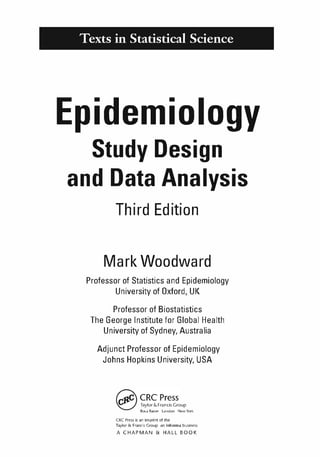
11.
K11828_C00.fm Page vTuesday, November 19, 2013 4:18 PM
Texts in Statistical Science
Epidemiology
Study Design
and Data Analysis
Third Edition
Mark Woodward
Professor of Statistics and Epidemiology
University of Oxford, UK
Professor of Biostatistics
The George Institute for Global Health
University of Sydney, Australia
Adjunct Professor of Epidemiology
Johns Hopkins University, USA
� CRCPress
� Taylor &Francis Group
Boc� R�ton London New York
eRe Press is an imprint of the
Taylor &; Francis Group an informa business
A CHAPMAN & HALL BOOK
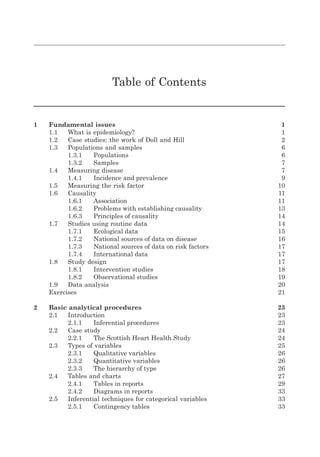
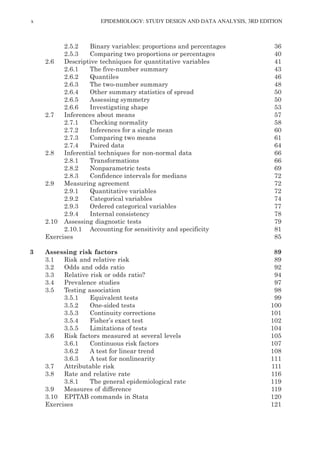
Table of Contents
1Fundamental issues 1
1.1 What is epidemiology? 1
1.2 Case studies: the work of Doll and Hill 2
1.3 Populations and samples 6
1.3.1 Populations 6
1.3.2 Samples 7
1.4 Measuring disease 7
1.4.1 Incidence and prevalence 9
1.5 Measuring the risk factor 10
1.6 Causality 11
1.6.1 Association 11
1.6.2 Problems with establishing causality 13
1.6.3 Principles of causality 14
1.7 Studies using routine data 14
1.7.1 Ecological data 15
1.7.2 National sources of data on disease 16
1.7.3 National sources of data on risk factors 17
1.7.4 International data 17
1.8 Study design 17
1.8.1 Intervention studies 18
1.8.2 Observational studies 19
1.9 Data analysis 20
Exercises 21
2 Basic analytical procedures 23
2.1 Introduction 23
2.1.1 Inferential procedures 23
2.2 Case study 24
2.2.1 The Scottish Heart Health Study 24
2.3 Types of variables 25
2.3.1 Qualitative variables 26
2.3.2 Quantitative variables 26
2.3.3 The hierarchy of type 26
2.4 Tables and charts 27
2.4.1 Tables in reports 29
2.4.2 Diagrams in reports 33
2.5 Inferential techniques for categorical variables 33
2.5.1 Contingency tables 33
K11828_C00.fm Page ix Tuesday, November 19, 2013 4:18 PM
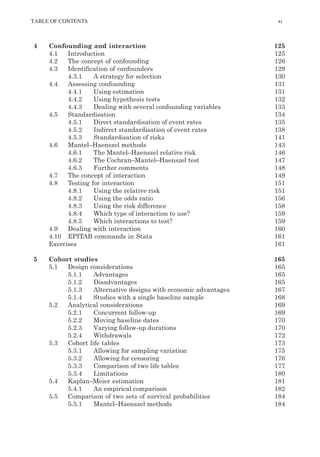
16.
x EPIDEMIOLOGY: STUDYDESIGN AND DATA ANALYSIS, 3RD EDITION
2.5.2 Binary variables: proportions and percentages 36
2.5.3 Comparing two proportions or percentages 40
2.6 Descriptive techniques for quantitative variables 41
2.6.1 The five-number summary 43
2.6.2 Quantiles 46
2.6.3 The two-number summary 48
2.6.4 Other summary statistics of spread 50
2.6.5 Assessing symmetry 50
2.6.6 Investigating shape 53
2.7 Inferences about means 57
2.7.1 Checking normality 58
2.7.2 Inferences for a single mean 60
2.7.3 Comparing two means 61
2.7.4 Paired data 64
2.8 Inferential techniques for non-normal data 66
2.8.1 Transformations 66
2.8.2 Nonparametric tests 69
2.8.3 Confidence intervals for medians 72
2.9 Measuring agreement 72
2.9.1 Quantitative variables 72
2.9.2 Categorical variables 74
2.9.3 Ordered categorical variables 77
2.9.4 Internal consistency 78
2.10 Assessing diagnostic tests 79
2.10.1 Accounting for sensitivity and specificity 81
Exercises 85
3 Assessing risk factors 89
3.1 Risk and relative risk 89
3.2 Odds and odds ratio 92
3.3 Relative risk or odds ratio? 94
3.4 Prevalence studies 97
3.5 Testing association 98
3.5.1 Equivalent tests 99
3.5.2 One-sided tests 100
3.5.3 Continuity corrections 101
3.5.4 Fisher’s exact test 102
3.5.5 Limitations of tests 104
3.6 Risk factors measured at several levels 105
3.6.1 Continuous risk factors 107
3.6.2 A test for linear trend 108
3.6.3 A test for nonlinearity 111
3.7 Attributable risk 111
3.8 Rate and relative rate 116
3.8.1 The general epidemiological rate 119
3.9 Measures of difference 119
3.10 EPITAB commands in Stata 120
Exercises 121
K11828_C00.fm Page x Tuesday, November 19, 2013 4:18 PM
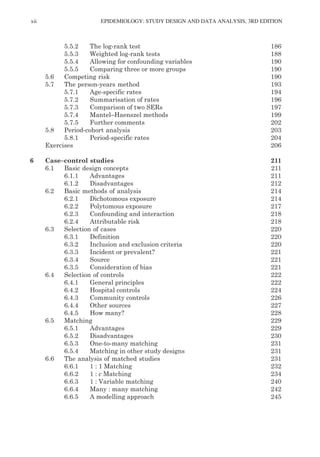
17.
TABLE OF CONTENTSxi
4 Confounding and interaction 125
4.1 Introduction 125
4.2 The concept of confounding 126
4.3 Identification of confounders 129
4.3.1 A strategy for selection 130
4.4 Assessing confounding 131
4.4.1 Using estimation 131
4.4.2 Using hypothesis tests 132
4.4.3 Dealing with several confounding variables 133
4.5 Standardisation 134
4.5.1 Direct standardisation of event rates 135
4.5.2 Indirect standardisation of event rates 138
4.5.3 Standardisation of risks 141
4.6 Mantel–Haenszel methods 143
4.6.1 The Mantel–Haenszel relative risk 146
4.6.2 The Cochran–Mantel–Haenszel test 147
4.6.3 Further comments 148
4.7 The concept of interaction 149
4.8 Testing for interaction 151
4.8.1 Using the relative risk 151
4.8.2 Using the odds ratio 156
4.8.3 Using the risk difference 158
4.8.4 Which type of interaction to use? 159
4.8.5 Which interactions to test? 159
4.9 Dealing with interaction 160
4.10 EPITAB commands in Stata 161
Exercises 161
5 Cohort studies 165
5.1 Design considerations 165
5.1.1 Advantages 165
5.1.2 Disadvantages 165
5.1.3 Alternative designs with economic advantages 167
5.1.4 Studies with a single baseline sample 168
5.2 Analytical considerations 169
5.2.1 Concurrent follow-up 169
5.2.2 Moving baseline dates 170
5.2.3 Varying follow-up durations 170
5.2.4 Withdrawals 172
5.3 Cohort life tables 173
5.3.1 Allowing for sampling variation 175
5.3.2 Allowing for censoring 176
5.3.3 Comparison of two life tables 177
5.3.4 Limitations 180
5.4 Kaplan–Meier estimation 181
5.4.1 An empirical comparison 182
5.5 Comparison of two sets of survival probabilities 184
5.5.1 Mantel–Haenszel methods 184
K11828_C00.fm Page xi Tuesday, November 19, 2013 4:18 PM
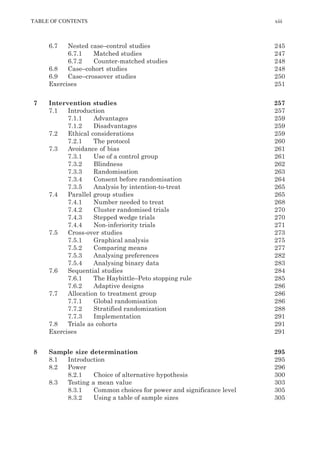
18.
xii EPIDEMIOLOGY: STUDYDESIGN AND DATA ANALYSIS, 3RD EDITION
5.5.2 The log-rank test 186
5.5.3 Weighted log-rank tests 188
5.5.4 Allowing for confounding variables 190
5.5.5 Comparing three or more groups 190
5.6 Competing risk 190
5.7 The person-years method 193
5.7.1 Age-specific rates 194
5.7.2 Summarisation of rates 196
5.7.3 Comparison of two SERs 197
5.7.4 Mantel–Haenszel methods 199
5.7.5 Further comments 202
5.8 Period-cohort analysis 203
5.8.1 Period-specific rates 204
Exercises 206
6 Case–control studies 211
6.1 Basic design concepts 211
6.1.1 Advantages 211
6.1.2 Disadvantages 212
6.2 Basic methods of analysis 214
6.2.1 Dichotomous exposure 214
6.2.2 Polytomous exposure 217
6.2.3 Confounding and interaction 218
6.2.4 Attributable risk 218
6.3 Selection of cases 220
6.3.1 Definition 220
6.3.2 Inclusion and exclusion criteria 220
6.3.3 Incident or prevalent? 221
6.3.4 Source 221
6.3.5 Consideration of bias 221
6.4 Selection of controls 222
6.4.1 General principles 222
6.4.2 Hospital controls 224
6.4.3 Community controls 226
6.4.4 Other sources 227
6.4.5 How many? 228
6.5 Matching 229
6.5.1 Advantages 229
6.5.2 Disadvantages 230
6.5.3 One-to-many matching 231
6.5.4 Matching in other study designs 231
6.6 The analysis of matched studies 231
6.6.1 1 : 1 Matching 232
6.6.2 1 : c Matching 234
6.6.3 1 : Variable matching 240
6.6.4 Many : many matching 242
6.6.5 A modelling approach 245
K11828_C00.fm Page xii Tuesday, November 19, 2013 4:18 PM
19.
TABLE OF CONTENTSxiii
6.7 Nested case–control studies 245
6.7.1 Matched studies 247
6.7.2 Counter-matched studies 248
6.8 Case–cohort studies 248
6.9 Case–crossover studies 250
Exercises 251
7 Intervention studies 257
7.1 Introduction 257
7.1.1 Advantages 259
7.1.2 Disadvantages 259
7.2 Ethical considerations 259
7.2.1 The protocol 260
7.3 Avoidance of bias 261
7.3.1 Use of a control group 261
7.3.2 Blindness 262
7.3.3 Randomisation 263
7.3.4 Consent before randomisation 264
7.3.5 Analysis by intention-to-treat 265
7.4 Parallel group studies 265
7.4.1 Number needed to treat 268
7.4.2 Cluster randomised trials 270
7.4.3 Stepped wedge trials 270
7.4.4 Non-inferiority trials 271
7.5 Cross-over studies 273
7.5.1 Graphical analysis 275
7.5.2 Comparing means 277
7.5.3 Analysing preferences 282
7.5.4 Analysing binary data 283
7.6 Sequential studies 284
7.6.1 The Haybittle–Peto stopping rule 285
7.6.2 Adaptive designs 286
7.7 Allocation to treatment group 286
7.7.1 Global randomisation 286
7.7.2 Stratified randomization 288
7.7.3 Implementation 291
7.8 Trials as cohorts 291
Exercises 291
8 Sample size determination 295
8.1 Introduction 295
8.2 Power 296
8.2.1 Choice of alternative hypothesis 300
8.3 Testing a mean value 303
8.3.1 Common choices for power and significance level 305
8.3.2 Using a table of sample sizes 305
K11828_C00.fm Page xiii Tuesday, November 19, 2013 4:18 PM
20.
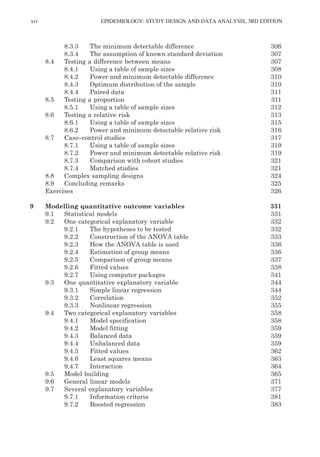
xiv EPIDEMIOLOGY: STUDYDESIGN AND DATA ANALYSIS, 3RD EDITION
8.3.3 The minimum detectable difference 306
8.3.4 The assumption of known standard deviation 307
8.4 Testing a difference between means 307
8.4.1 Using a table of sample sizes 308
8.4.2 Power and minimum detectable difference 310
8.4.3 Optimum distribution of the sample 310
8.4.4 Paired data 311
8.5 Testing a proportion 311
8.5.1 Using a table of sample sizes 312
8.6 Testing a relative risk 313
8.6.1 Using a table of sample sizes 315
8.6.2 Power and minimum detectable relative risk 316
8.7 Case–control studies 317
8.7.1 Using a table of sample sizes 319
8.7.2 Power and minimum detectable relative risk 319
8.7.3 Comparison with cohort studies 321
8.7.4 Matched studies 321
8.8 Complex sampling designs 324
8.9 Concluding remarks 325
Exercises 326
9 Modelling quantitative outcome variables 331
9.1 Statistical models 331
9.2 One categorical explanatory variable 332
9.2.1 The hypotheses to be tested 332
9.2.2 Construction of the ANOVA table 333
9.2.3 How the ANOVA table is used 336
9.2.4 Estimation of group means 336
9.2.5 Comparison of group means 337
9.2.6 Fitted values 338
9.2.7 Using computer packages 341
9.3 One quantitative explanatory variable 344
9.3.1 Simple linear regression 344
9.3.2 Correlation 352
9.3.3 Nonlinear regression 355
9.4 Two categorical explanatory variables 358
9.4.1 Model specification 358
9.4.2 Model fitting 359
9.4.3 Balanced data 359
9.4.4 Unbalanced data 359
9.4.5 Fitted values 362
9.4.6 Least squares means 363
9.4.7 Interaction 364
9.5 Model building 365
9.6 General linear models 371
9.7 Several explanatory variables 377
9.7.1 Information criteria 381
9.7.2 Boosted regression 383
K11828_C00.fm Page xiv Tuesday, November 19, 2013 4:18 PM
This ebook isfor the use of anyone anywhere in the United
States and most other parts of the world at no cost and with
almost no restrictions whatsoever. You may copy it, give it away
or re-use it under the terms of the Project Gutenberg License
included with this ebook or online at www.gutenberg.org. If you
are not located in the United States, you will have to check the
laws of the country where you are located before using this
eBook.
Title: The Ghost Camp; or, the Avengers
Author: Rolf Boldrewood
Release date: January 23, 2016 [eBook #51011]
Most recently updated: October 22, 2024
Language: English
Credits: Produced by MWS, Sonya Schermann and the Online
Distributed
Proofreading Team at http://www.pgdp.net (This file
was
produced from images generously made available by
The
Internet Archive/American Libraries.)
*** START OF THE PROJECT GUTENBERG EBOOK THE GHOST
CAMP; OR, THE AVENGERS ***
28.
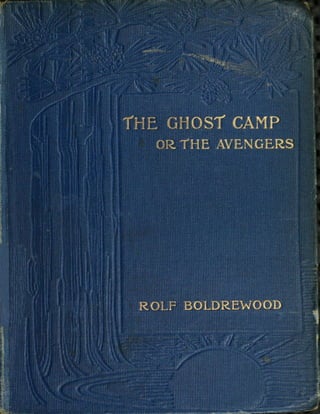
THE GHOST CAMP
OR
THEAVENGERS
THE WORKS OF ROLF
BOLDREWOOD.
Uniform Edition. Cr. 8vo. 3s. 6d. each.
29.
ROBBERY UNDER ARMS.
ACOLONIAL REFORMER.
THE MINER’S RIGHT.
A MODERN BUCCANEER.
NEVERMORE.
THE SQUATTER’S DREAM.
A SYDNEY-SIDE SAXON.
OLD MELBOURNE MEMORIES.
MY RUN HOME.
THE SEALSKIN CLOAK.
THE CROOKED STICK; OR, POLLIE’S PROBATION.
PLAIN LIVING.
A ROMANCE OF CANVAS TOWN.
WAR TO THE KNIFE.
BABES IN THE BUSH.
THE SPHINX OF EAGLEHAWK. Fcap. 8vo. 2s.
IN BAD COMPANY, and other Stories. Crown 8vo.
6s.
London: MACMILLAN AND CO., Ltd.
THE GHOST CAMP
OR
THE AVENGERS
30.
BY
ROLF BOLDREWOOD
AUTHOR OF“ROBBERY UNDER ARMS,” “THE MINER’S RIGHT,” ETC.
London
MACMILLAN AND CO., Limited
NEW YORK: THE MACMILLAN COMPANY
1902
Richard Clay and Sons, Limited,
LONDON AND BUNGAY.
31.
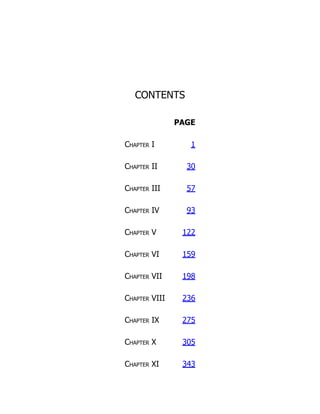
CONTENTS
PAGE
Chapter I 1
ChapterII 30
Chapter III 57
Chapter IV 93
Chapter V 122
Chapter VI 159
Chapter VII 198
Chapter VIII 236
Chapter IX 275
Chapter X 305
Chapter XI 343
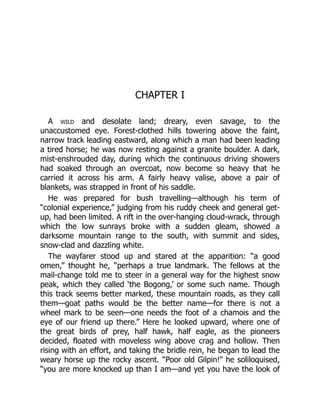
CHAPTER I
A wildand desolate land; dreary, even savage, to the
unaccustomed eye. Forest-clothed hills towering above the faint,
narrow track leading eastward, along which a man had been leading
a tired horse; he was now resting against a granite boulder. A dark,
mist-enshrouded day, during which the continuous driving showers
had soaked through an overcoat, now become so heavy that he
carried it across his arm. A fairly heavy valise, above a pair of
blankets, was strapped in front of his saddle.
He was prepared for bush travelling—although his term of
“colonial experience,” judging from his ruddy cheek and general get-
up, had been limited. A rift in the over-hanging cloud-wrack, through
which the low sunrays broke with a sudden gleam, showed a
darksome mountain range to the south, with summit and sides,
snow-clad and dazzling white.
The wayfarer stood up and stared at the apparition: “a good
omen,” thought he, “perhaps a true landmark. The fellows at the
mail-change told me to steer in a general way for the highest snow
peak, which they called ‘the Bogong,’ or some such name. Though
this track seems better marked, these mountain roads, as they call
them—goat paths would be the better name—for there is not a
wheel mark to be seen—one needs the foot of a chamois and the
eye of our friend up there.” Here he looked upward, where one of
the great birds of prey, half hawk, half eagle, as the pioneers
decided, floated with moveless wing above crag and hollow. Then
rising with an effort, and taking the bridle rein, he began to lead the
weary horse up the rocky ascent. “Poor old Gilpin!” he soliloquised,
“you are more knocked up than I am—and yet you have the look of
34.
a clever cob—suchas we should have fancied in England for a
roadster, or a covert hack. But roads are roads there, while in this
benighted land, people either don’t know how to make them, or
seem to do their cross-country work without them. I wonder if I
shall fall in with bed and board to-night. The last was rough, but
sufficing—a good fire too, now I think of it, and precious cold it was.
Well, come along, John! I must bustle you a bit when we get to the
top of this everlasting hill—truly biblical in that respect. What a
lonesome place it is, now that the sun has gone under again! I
suppose there’s no one within fifty miles—Hulloa!”
This exclamation was called forth by the appearance of a
horseman at no great distance—along the line of track. Man and
horse were motionless, though so near that he wondered he had not
observed them before. The rider’s face, which was towards him,
bore, as far as he could judge, an expression of keenest attention.
“Wonder if he is a bushranger?” thought the traveller; “ought to
have brought one of my revolvers; but everybody told me that there
were none ‘out’ now; that I was as safe as if I was in England—
safer, in fact, than ‘south the water’ in the little village. However, I
shall soon know.”
Before he had time to decide seriously, the horseman came
towards him. He saw a slight, dark, wiry individual, something above
the middle height, sunburned, and almost blackened as to such
portions of his neck and face as could be perceived for an abundant
beard and moustache. The horse, blood-looking, and in hard
condition, presented a striking contrast to his own leg-weary,
disconsolate animal. The traveller thought him capable of fast and
far performances. His sure and easy gait, as he stepped freely along
the rocky path, stamped him as “mountain-bred,” or, if not “to the
manner born,” having lived long enough amid these tremendous
glens and rocky fastnesses, to negotiate their ladder-like declivities
with ease and safety.
“Good evening!” said the stranger, civilly enough. “Going to
‘Haunted Creek?’—a bit off the road, ar’n’t you?”
35.
“I was doubtfulabout the track, but I thought it might lead there.
I was told that it was only eight miles.”
“It’s a good fourteen, and you won’t get there to-night. Not with
that horse, anyhow. But look here! I’m going to my place, a few
miles off, with these cattle—if you like to give me a hand, I can put
you up for the night, and show you the way in the morning.”
“Thanks very much, really I feel much obliged to you. I was afraid
I should have had to camp out, and it looks like a bad night.”
“All right,” said the bushman, for such he evidently was; “these
crawlin’ cattle are brutes to straggle, and I’m lost without my dog.
I’ll bring ’em up, and if you’ll keep the tail going, we’ll get along easy
enough.”
“But where are they?” inquired the tourist, looking around, as if he
expected to see them rise out of the earth.
“Close by,” answered the stranger, laconically, at the same time
riding down the slope of the mountain with loose rein, and careless
seat, as if the jumble of rocks, tree-roots, and rolling stones, was the
most level high road in the world. Looking after the new
acquaintance he descried a small lot of cattle perched on a rocky
pinnacle, partly covered by a patch of scrub. The grass around them
was high and green—but, with one exception, that of a cow
munching a tussac in an undecided way, they did not appear to care
about the green herbage, or tall kangaroo grass which grew around
them. Had he known anything about the habits of cattle, he would
have seen by their appearance that these fat beasts (for such they
were) had come far and fast; were like his horse, thoroughly
exhausted, and as such, indifferent to the attractions of wayside
pasture.
However, with the aid of a hunting crop, which he flourished
behind them, with threatening action, the bushman soon managed
to get them on to the track, and with the aid of his newly-made
comrade induced them to move with a decent show of alacrity. That
some were footsore, and two painfully lame, was apparent to the
new assistant, also that they were well-bred animals, heavy weights,
36.
and in thatstate and condition which is provincially alluded to as
“rolling fat.”
“Nice meat, ar’n’t they?” said the bushman; “come a good way
too. Beastly rough track; I was half a mind to bring them by Wagga
—but this is the shortest way—straight over the ranges. I’m
butchering just now, with gold-mining for a change, but that’s
mostly winter work.”
“Where do you buy your cattle?” asked the Englishman—not that
he cared as to that part of the occupation, but the gold-mining
seemed to him a romantic, independent way of earning a living. He
was even now turning over in his mind the idea of a few months
camping among these Alpine regions, with, of course, the off-chance
of coming upon an untouched gold mine.
“Oh! a few here and there, in all sorts of places.” Here the
stranger shot a searching glance, tinged with suspicion, towards the
questioner. “I buy the chance of stray cattle now and then, and pick
’em up as I come across ’em. We’d as well jog along here, it’s better
going.”
The track had become more marked. There were no wheel marks,
the absence of which had surprised the traveller, since the beginning
of his day’s march, but tracks of cattle and unshod horses were
numerous; while the ground being less rocky, indeed commencing to
be marshy, no difficulty was found in driving the cattle briskly along
it. His horse too, having “company,” had become less dilatory and
despondent.
“We’re not far off, now,” said his companion, “and it’s just as well.
We’ll have rain to-night—may be snow. So a roof and a fire won’t be
too bad.”
To this statement the tourist cheerfully assented, his spirits rising
somewhat, when another mile being passed, they turned to the
north at a sharp angle to the road, and following a devious track,
found themselves at the slip-rails of a small but well-fenced
paddock, into which the cattle were turned, and permitted to stray
at will. Fastening the slip rails with scrupulous care, and following
the line of fence for a hundred yards, they came to a hut built of
37.
slabs, and neatlyroofed with sheets of the stringy bark tree
(Eucalyptus obliqua) where his guide unsaddled, and motioned to
the guest to do likewise. As also to put the saddle against the wall of
the hut, with the stuffing outward. “That’ll dry ’em a bit,” he said;
“mine’s wet enough anyhow. Just bring your horse after me.”
Passing through a hand gate, he released his horse, first, however,
putting on a pair of hobbles; “the feed’s good,” he said, “but this
moke’s just out of the bush, and rather flash—he might jump the
fence in the night, so it’s best to make sure. Yours won’t care about
anything but filling his belly, not to-night anyhow, so he can go
loose. Now we’ll see about a fire, and boil the billy for tea. Come
along in.”
Entering the hut, which though small, was neat and clean; it was
seen to contain two rooms, the inner one apparently used as a
bedroom, there being two bed-places, on each of which was a rude
mattress covered with a blanket. A store of brushwood and dry
billets had been placed in a corner, from which a fire was soon
blazing in the rude stone chimney, while a camp kettle (provincially a
“billy”) was on the way to boil without loss of time.
A good-sized piece of corned beef, part of a round, with half a
“damper” loaf being extracted from a cupboard or locker, was placed
on the rude slab table; after which pannikins and tin plates, with
knives and forks, provided from the same receptacle, were brought
forth, completing the preparations for a meal that the guest believed
he was likely to relish.
“Oh! I nearly forgot,” said the traveller, as his entertainer, dropping
a handful of tea into the “billy,” now at the boil, and stirring it with a
twig, put on the lid. “I brought a flask, it’s very fair whisky, and a tot
won’t hurt either of us, after a long day and a wet one.” Going to his
coat, he brought out a flask, and nearly filling the tin cup which was
closed over the upper part, offered it to his host. He, rather to the
surprise of the Englishman, hesitated and motioned as if to refuse,
but on second thoughts smiled in a mysterious way, and taking the
tin cup, nodded, and saying “Well, here’s fortune!” tossed it off.
Blount took one of the pannikins, and pouring out a moderate
38.
allowance, filled itup with the clear spring water, and drank it by
instalments.
“I must say I feel better after that,” he observed, “and if a dram
needs an excuse, a long, cold ride, stiff legs, and a wetting ought to
be sufficient.”
“They don’t look about for excuses up here,” said his new
acquaintance, “and some takes a deal more than is good for them. I
don’t hold with that, but a nip or two’s neither here nor there,
particular after a long day. Help yourself to the meat and damper,
you see your supper.”
The traveller needed no second invitation; he did not, like the
clerk of Copmanhurst, plunge his fingers into the venison pasty,
there being neither venison nor pasty, but after cutting off several
slices of the excellent round of beef which had apparently sustained
previous assaults, he made good time, with the aid of a well-baked
“damper,” and an occasional reference to a pannikin of hot tea, so
that as their appetites declined, more leisure was afforded for
conversation.
“And now,” he said, after filling up a second pannikin of tea, and
lighting his pipe, “I’m sure I’m very much obliged to you, as I hear
the rain coming down, and the wind rising. May I ask whose
hospitality I’m enjoying? I’m Valentine Blount of Langley in
Herefordshire. Not long out, as I dare say you have noticed. Just
travelling about to have a look at the country.”
“My name’s John Carter,” said the bushman, with apparent
frankness, as he confronted Blount’s steady eye, “but I’m better
known from here to Omeo, as ‘Little River Jack’; there’s lots of
people knows me by that name, that don’t know me by any other.”
“And what do you do when you get gold—take it to Melbourne to
sell?”
“There’s no call to do that. Melbourne’s a good way off, and it
takes time to get there. But there’s always gold buyers about
townships, that are on for a little business. They give a trifle under
market price, but they pay cash, and it suits us mountain chaps to
39.
deal that way.Sometimes I’m a buyer myself, along with the cattle-
dealing. Look here!” As he spoke, he detached a leather pouch from
his belt, looking like one that stockriders wear for carrying pipe and
tobacco, which he threw on the table. The grog had inclined to
confidences and relaxed his attitude of caution. Blount lifted it,
rather surprised at its weight. “This is gold, isn’t it?”
“Yes! a good sample too. Worth four pound an ounce. Like to look
at it?”
“Very much. I don’t know that I’ve ever seen gold in the raw state
before.”
“Well, here it is—the real thing, and no mistake. Right if a chap
could only get enough of it.” Here he opened the mouth of the
pouch, which seemed three parts full, and pouring some of it on a
tin plate, awaited Blount’s remarks.
As the precious metal, partly in dust, partly in larger fragments,
rattled on the plate, Blount looked on with deep interest, and then,
on being invited so to do, handled it with the air of a man to whom
a new and astonishing object is presented for the first time.
“So,” he said musingly, “here is one of the great lures which have
moved the world since the dawn of history. Love, war, and ambition,
have been subservient to it. Priests and philosophers, kings and
queens, the court beauty and the Prime Minister, have vainly
struggled against its influence. But—” he broke off with a laugh, as
he noted his companion’s look of wonder, “here am I, another
example of its fascination, moralising in a mountain hut and
mystifying my worthy entertainer.”
“And now, my friend!” he inquired, relapsing into the manner of
everyday life, “what may be the market value of this heavy little
parcel?”
“Well—I put it at fifty ounces, or thereabouts,” said Mr. “Little River
Jack,” carefully pouring back the contents of the pouch, to the last
grain; “at, say four pound an ounce, it’s worth a couple of hundred
notes, though we sha’n’t get that price for it. But at Melbourne mint,
it’s worth every shilling, maybe a trifle more.” Before closing the
40.
pouch, he tookout a small nugget of, perhaps, half an ounce in
weight, and saying, “You’re welcome to this. It’ll make a decent scarf
pin,” handed it to Mr. Blount.
But that gentleman declined it, saying, “Thanks, very much, but
I’d rather not.” Then, seeing that the owner seemed hurt, even
resentful, qualified the refusal by saying, “But if you would do me a
service, which I should value far more, you might introduce me to
some party of miners, with whom I could work for a month or two,
and learn, perhaps, how to get a few ounces by my own exertions. I
think I should like the work. It must be very interesting.”
“It’s that interesting,” said the bushman, all signs of annoyance
clearing from his countenance, “that once a man takes to it he never
quits it till he makes a fortune or dies so poor that the Government
has to bury him. I’ve known many a man that used a cheque book
as big as a school slate, and could draw for a hundred thousand or
more, drop it all in a few years, and be found dead in a worse
‘humpy’ than this, where he’d been living alone for years.”
“Strange to have been rich by his own handiwork, and not to be
able to keep something for his old age,” said Blount; “how is it to be
accounted for?”
“By luck, d—d hard luck!” said John Carter, whom the subject
seemed to have excited. “Every miner’s a born gambler; if he don’t
do it with cards, he puts his earnings, his time, his life blood, as one
might say, on the chance of a claim turning out well. It’s good luck,
and not hard work, that gives him a ‘golden hole,’ where he can’t
help digging up gold like potatoes, and it’s luck, bad luck, that turns
him out a beggar from every ‘show’ for years, till he hasn’t got a
shirt to his back. Why do I stick to it, you’ll say? Because I’m a fool,
always have been, always will be, I expect. But I like the game, and
I can’t leave it for the life of me. However, that says nothing. I’m no
worse than others. I can just keep myself and my horse, while
there’s an old mate of mine living in London and Paris, and swelling
it about with the best! You’d like to have a look in, you say? Well,
you stop at Bunjil for a week, till I come back from Bago; it’s a good
41.
inn, clean andcomfortable, and the girl there, if I tell her, will look
after you; see you have a fire too, these cold nights. Are you on?”
“Yes! most decidedly,” replied Blount, with great heartiness. “A
mountain hotel should be a new experience.”
“Then it’s a bargain. I’m going down the river for a few days.
When I get back, I’ll pick you up at Bunjil, and we’ll go to a place
such as you never seen before, and might never have dropped on as
long as you lived, if you hadn’t met me, accidental like. And now
we’d as well turn in. I expect some chaps that’s bought the cattle,
and they won’t be here later than daylight.” Accepting another glass
of whisky as nightcap, and subsequently removing merely his boots
and breeches, both of which he placed before the fire, but at a safe
distance, Mr. “Little River Jack” “turned in” as he expressed it, and
was shortly wrapped in the embrace of the kind deity who favours
the dwellers in the Waste, though often rejecting the advances of
the luxurious inhabitants of cities. Mr. Blount delayed his retirement,
as he smoked before the still glowing “back log” and dwelt upon the
adventures of the day.
“How that fellow must enjoy his slumbers!” thought he. “In the
saddle before daylight, as he told me; up and down these rocky
fastnesses—fifteen hours of slow, monotonous work, more wearying
than any amount of fast going—and now, by his unlaboured
breathing, sleeping like a tired child; his narrow world—its few cares
—its honest, if sometimes exhausting labours, as completely shut
out as if he was in another planet. Enviable mortal! I should like to
change places with him.”
After expressing this imprudent desire, as indeed are often those
of men, who, unacquainted with the conditions surrounding untried
modes of life, believe that they could attain happiness by merely
exchanging positions, Mr. Blount undressed before the fire, and
bestowed himself upon the unoccupied couch, where he speedily fell
asleep, just as he had imagined himself extracting large lumps of
gold from a vein of virgin quartz, in a romantic fern-shaded ravine,
discovered by himself.
42.
From this pleasingstate of matters, he was awakened by a sound
as of horse hoofs and the low growl of a dog. It was not quite dark.
He sat up and listened intently. There was no illusion. He went to
the hut door and looked out. Day was breaking, and through the
misty dawnlight he was enabled to distinguish his host in
conversation with a man on horseback, outside of the slip-rails.
Presently the cattle, driven by another horseman, with whom was a
dog, apparently of more than ordinary intelligence, came to the slip-
rails. They made a rush as soon as they were through, as is the
manner of such, on strange ground—but the second horseman
promptly “wheeled” them towards the faint dawn line now becoming
more distinct, and disappeared through the forest arches. Mr. Blount
discerning that the day had begun, for practical purposes, proceeded
to dress.
Walking over to the chimney, he found that the smouldering logs
had been put together, and a cheerful blaze was beginning to show
itself. The billy, newly filled, was close to it, and by the time he had
washed the upper part of his body in a tin bucket placed on a log
end, outside the door, his friend of the previous night appeared with
both horses, which he fastened to the paddock fence.
“Those fellows woke you up, coming for the cattle? Thought you’d
sleep through it. I was going to rouse you when breakfast was
ready.”
“I slept soundly in all conscience, but still I was quite ready to turn
out. I suppose those were the butchers that you sold the cattle to?”
“Two of their men—it’s all the same. They stopped close by last
night so as to get an early start. They’ve a good way to go, and’ll
want all their time, these short days. Your horse looks different this
morning. It’s wonderful what a good paddock and a night’s rest will
do!”
“Yes, indeed, he does look different,” as he saddled him up, and,
plucking some of the tall grass which grew abundantly around,
treated him to a partial rub down. “How far is it to Bunjil, as you call
it?”
43.
“Well, not morethan twenty miles, but the road’s middlin’ rough.
Anyhow we’ll get there latish, and you can take it easy till I come
back. I mightn’t be away more than three or four days.”
Misty, even threatening, at the commencement, the day became
fine, even warm, after breakfast. Wind is rarely an accompaniment
of such weather, and as the sun rode higher in the cloudless sky,
Blount thought he had rarely known a finer day. “What bracing
mountain air!” he said to himself. “Recalls the Highlands; but I see
no oat fields, and the peasantry are absent. These hills should rear a
splendid race of men—and rosy-cheeked lasses in abundance. The
roads I cannot recommend.”
Mr. John Carter had admitted that the way was rough. His
companion thought he had understated the case. It was well nigh
impassable. When not climbing hills as steep as the side of a house,
they were sliding down bridle tracks like the “Ladder of Cattaro.”
These Mr. Carter’s horse hardly noticed; a down grade being
negotiated with ease and security, while he seemed, to Blount’s
amazement, to step from rock to rock like a chamois. That
gentleman’s own horse had no such accomplishments, but blundered
perilously from time to time, so that his owner was fain to lead him
over the rougher passes. This rendered their progress slower than it
would otherwise have been, while he was fain to look enviously at
his companion, who, either smoking or discoursing on local topics,
rode with careless rein, trusting implicitly, as it seemed, to his
horse’s intelligence.
“Here’s the Divide!” he said at length, pointing to a ridge which
rose almost at right angles from the accepted track. “We leave the
road here, and head straight for Bunjil mountain. There he stands
with his cap on! The snow’s fell early this season.”
As he spoke he pointed towards a mountain peak of unusual
height, snow-capped, and even as to its spreading flanks, streaked
with patches and lines of the same colour. The white clouds which
hung round the lofty summit—six thousand feet from earth, were
soft-hued and fleecy; but their pallor was blurred and dingy
44.
compared with thesilver coronet which glorified the dark-hued
Titan.
“Road!” echoed Mr. Blount, “I don’t see any; what passes for it, I
shall be pleased to leave. If we are to go along this ‘Divide,’ as you
call it, I hope it will be pleasanter riding.”
“Well, it is a queerish track for a bit, but after Razor Back’s passed,
it’s leveller like. We can raise a trot for a mile or two afore we make
Bunjil township. Razor Back’s a narrer cut with a big drop both sides,
as we shall have to go stiddy over.”
“The Divide,” as John Carter called it, was an improvement upon
the track they quitted. It was less rocky, and passably level. There
was a gradual ascent however, which Mr. Blount did not notice until
he observed that the timber was becoming more sparse, while the
view around them was disclosing features of a grand, even awful
character. On either side the forest commenced to slope downwards,
at an increasingly sharp gradient. Instead of the ordinary precipice,
above which the travellers rode, on one or other side of the bridle
track, having the hill on the other, there appeared to be a precipice
of unknown depth on either hand. As the ascent became more
marked, Blount perceived that the winding path led towards a
pinnacle from which the view was extensive, and in a sense,
dreadful, from its dizzy altitude—its abysmal depths,—and, as he
began to realise, its far from improbable danger.
“This here’s what we call the leadin’ range; it follers the divide
from the head waters of the Tambo; that’s where we stopped last
night. It’s the only road between that side of the country and the
river. If you don’t strike this ‘cut,’ and there’s not more than a score
or so of us mountain chaps as knows it, it would take a man days to
cross over, and then he mightn’t do it.”
“What would happen to him?” asked Blount, feeling a natural
curiosity to learn more of this weird region, differing so widely from
any idea that he had ever gathered from descriptions of Australia.
“Well, he’d most likely get bushed, and have to turn back, though
he mightn’t find it too easy to do that, or make where he come
from. In winter time, if it come on to snow, he’d never get home at
45.
all. I’ve knownthings happen like that. There was one poor cove last
winter, as we chaps were days out searchin’ for, and then found him
stiff, and dead—he’d got sleepy, and never woke up!”
While this enlivening conversation was proceeding, the man from
a far country discovered that the pathway, level enough for ordinary
purposes, though he and his guide were no longer riding side by
side, was rapidly narrowing. What breadth it would be, when they
ascended to the pinnacle above them, he began to consider with a
shade of apprehension. His hackney, which Mr. Jack Carter had
regarded with slightly-veiled contempt as a “flat country horse, as
had never seen a rise bigger than a haystack,” evidently shared his
uneasiness, inasmuch as he had stopped, stared and trembled from
time to time, at awkward places on the road, before they came to
the celebrated “leading range.”
In another mile they reached the pinnacle, where Blount realised
the true nature and surroundings of this Alpine Pass. Such indeed it
proved to be. A narrow pathway, looking down on either side, upon
fathomless glens, with so abrupt a drop that it seemed as if the
wind, now rising, might blow them off their exposed perch.
The trees which grew at the depths below, though in reality tall
and massive eucalypts, appeared scarce larger than berry bushes.
The wedge-tailed eagles soared above and around. One pair
indeed came near and gazed on them with unblenching eye, as
though speculating on the duration of their sojourn. They seemed to
be the natural denizens of this dizzy and perilous height, from which
the vision ranged, in wondering amaze over a vast lone region,
which stretched to the horizon; appearing indeed to include no
inconsiderable portion of the continent.
Below, around, even to the far, misty sky-line, was a grey, green
ocean, the billows of which, through the branches of mighty forest
trees, were reduced by distance to a level and uniform contour.
Tremendous glens, under which ran clear cold mountain streams,
tinkling and rippling ever, mimic waterfalls and flashing rivulets, the
long dry summer through diversified the landscape.
46.
Silver streams crossedthese plains and downs of solemn leafage,
distinguishable only when the sun flashed on their hurrying waters.
These were rivers—not inconsiderable either—while companies of
snow-crowned Alps stood ranged between, tier upon tier above
them and the outlined rim, where earth and sky met, vast, regal,
awful, as Kings of the Over-world! On guard since the birth of time,
rank upon rank they stood—silent, immovable, scornful—defying the
puny trespassers on their immemorial demesne. “What a land! what
a vast expanse!” thought the Englishman, “rugged, untamed, but
not more so than ‘Caledonia stern and wild,’ more fertile and
productive, and as to extent—boundless. I see before me,” he
mused, “a country larger than Sweden, capable in time of carrying a
dense population; and what a breed of men it should give birth to,
athletic, hardy, brave! Horsemen too, in the words of Australia’s
forest poet, whom I read but of late. ‘For the horse was never
saddled that the Jebungs couldn’t ride.’ Good rifle shots! What sons
of the Empire should these Australian highlands rear, to do battle for
Old England in the wars of the giants yet to come!”
This soliloquy, and its utterance in thought came simultaneously to
a halt of a decisive nature, by reason of the conduct of Mr. Blount’s
horse. This animal had been gradually acquiring a fixed distrust of
the highway—all too literally—on which he was required to travel.
Looking first on one side, then on the other, and apparently realising
the dreadful alternative of a slip or stumble, he became unnerved
and demoralised. Mr. Blount had ridden a mule over many a mauvais
pas in Switzerland, when the sagacious animal, for reasons known to
himself, had insisted on walking on the outer edge of the roadway,
over-hanging the gulf, where a crumbling ledge might cause the fall
into immeasurable, glacial depths. In that situation his nerve had not
faltered. “Trust to old ‘Pilatus,’” said the guide; “do not interfere with
him, I beseech you; he is under the immediate protection of the
saints, and the holy St. Bernard.” He had in such a position been
cool and composed. The old mule’s wise, experienced air, his sure
and cautious mode of progression, had been calculated to reassure a
nervous novice. But here, the case was different. His cob was
47.
evidently not underthe protection of the saints. St. Bernard was
absent, or indifferent. With the recklessness of fear, he was likely to
back—to lose his balance—to hurl himself and rider over the
perpendicular drop, where he would not have touched ground at a
thousand feet. At this moment Jack Carter looked round. “Keep him
quiet, for God’s sake! till I get to you—don’t stir!” As he spoke he slid
from his horse, though so small was the vacant space on the ledge,
that as he leaned against the shoulder of his well-trained mount,
there seemed barely room for his feet. Buckling a strap to the snaffle
rein, which held it in front of the saddle, and throwing the stirrup
iron over, he passed to the head of the other horse, whose rein he
took in a firm grasp. “Steady,” he said in a voice of command, which,
strangely, the shaking creature seemed to obey. “Now, Boss! you get
off, and slip behind him—there’s just room.” Blount did as directed,
and with care and steadiness, effected a movement to the rear,
while Jack Carter fastened rein and stirrup as before.
Then giving the cob a sounding slap on the quarter, he uttered a
peculiar cry, and the leading horse stepped along the track at a fast
amble, followed by the cob at a slow trot, in which he seemed to
have recovered confidence.
“That’s a quick way out of the difficulty,” said Blount, with an air of
relief. “I really didn’t know what was going to happen. But won’t
they bolt when they get to the other side of this natural bridge over
the bottomless pit?”
“When they get to the end of this ‘race,’ as you may call it, there’s
a trap yard that we put up years back for wild horses—many a
hundred’s been there before my time. Some of us mountain chaps
keep it mended up. It comes in useful now and again.”
“I should think it did,” assented his companion, with decision. “But
how will they get in? Will your clever horse take down the slip-rails,
and put them up again?”
“Not quite that!” said the bushman smiling—“but near enough;
we’ll find ’em both there, I’ll go bail!”
“How far is it?” asked Blount, with a natural desire to get clear of
this picturesque, but too exciting part of the country, and to
48.
exchange it formore commonplace scenery, with better foothold.
“Only a couple of mile—so we might as well step out, as I’ve filled
my pipe. Won’t you have a draw for company?”
“Not just yet, I’ll wait till we’re mounted again.” For though the
invariable, inexhaustible tobacco pipe is the steadfast friend of the
Australian under all and every condition of life, Blount did not feel in
the humour for it just after he had escaped, as he now began to
believe, from a sudden and violent death.
“A well-trained horse! I should think he was,” he told himself; “and
yet, before I left England, I was always being warned against the
half-broken horses of Australia. What a hackney to be sure!—fast,
easy, sure-footed, intelligent—and what sort of breaking in has he
had? Mostly ridden by people whom no living horse can throw; but
that is a disadvantage—as he instinctively recognises the rider he
can throw. Well! every country has its own way of doing things; and
though we Englishmen are unchangeably fixed in our own methods,
we may have something to learn yet from our kinsmen in this new
land.”
“I suppose there have been accidents on this peculiar track of
yours?” he said, after they had walked in silence for a hundred yards
or more.
“Accidents!” he replied, “I should jolly well think there have. You
see, horses are like men and women, though people don’t hardly
believe it. Some’s born one way, and some another; teaching don’t
make much difference to ’em, nor beltin’ either. Some of ’em, like
some men, are born cowards, and when they get into a narrer track
with a big drop both sides of ’em, they’re that queer in the head—
though it’s the heart that’s wrong with ’em—that they feel like
pitching theirselves over, just to get shut of the tremblin’ on the
brink feelin’. Your horse was in a blue funk; he’d have slipped or
backed over in another minute or two. That was the matter with
him. When he seen old Keewah skip along by himself, it put
confidence like, into him.”
“You’ve known of accidents, then?”
49.
“My word! Imind when poor Paddy Farrell went down. He and his
horse both. He was leadin’ a packer, as it might be one of us now.
Well, his moke was a nervous sort of brute, and just as he got to the
Needle Rock, it’s a bit farther on before the road widens out, but it’s
terrible narrer there, and poor Paddy was walking ahead leadin’ the
brute with a green hide halter, when a hawk flies out from behind a
rock and frightened the packer. He draws back with a jerk, and his
hind leg goes over the edge. Paddy had the end of the halter round
his wrist, and it got jammed somehow, and down goes the lot, horse
and pack, and him atop of ’em. Three or four of us were out all day
looking for him at the foot of the range. We knew where we’d likely
find him, and sure enough there they were, he and his horse, stone
dead and smashed to pieces. We took him back to Bunjil, and buried
him decent in the little graveyard. We managed to fish up a prayer-
book, and got ‘Gentleman Jack’ to read the service over him. My
word! he could read no end. They said he was college taught. He
could drink too, more’s the pity.”
“Does every one drink that lives in these parts?”
“Well, a good few. Us young ones not so bad, but if a man stays
here, after a few years he always drinks, partickler if he’s seen better
days.”
“Now why is that? It’s a free healthy life, with riding, shooting,
and a chance of a golden hole, as you call it. There are worse places
to live in.”
“Nobody knows why, but they all do; they’ll work hard and keep
sober for months. Then they get tired of having no one to talk to—
nobody like theirselves, I mean. They go away, and come back
stone-broke, or knock it all down in Bunjil, if they’ve made a few
pounds.”
“That sounds bad after working hard and risking their lives on
these Devil’s Bridges. How old was this Patrick Farrell?”
“Twenty-four, his name wasn’t Patrick. It was Aloysius William,
named after a saint, I’m told. The boys called him ‘Paddy’ for short.
At home, I believe they called him ‘Ally.’ But Paddy he always was in
these parts. It don’t matter much now. See that tall rock sticking up
50.
Welcome to ourwebsite – the ideal destination for book lovers and
knowledge seekers. With a mission to inspire endlessly, we offer a
vast collection of books, ranging from classic literary works to
specialized publications, self-development books, and children's
literature. Each book is a new journey of discovery, expanding
knowledge and enriching the soul of the reade
Our website is not just a platform for buying books, but a bridge
connecting readers to the timeless values of culture and wisdom. With
an elegant, user-friendly interface and an intelligent search system,
we are committed to providing a quick and convenient shopping
experience. Additionally, our special promotions and home delivery
services ensure that you save time and fully enjoy the joy of reading.
Let us accompany you on the journey of exploring knowledge and
personal growth!
ebookultra.com




![K11828_C00.fm Page ii Tuesday, November 19, 2013 4:18 PM
CHAPMAN & HALL/CRC
Texts in Statistical Science Series
Series Editors
Franccsca Dominici, Harvard ,"choo{ ofPublic Health, USA
Julian J. Faraway, University ofBath, UK
Martin Tanner, Northwestern University, USIl.
Jim Zidek, University (�lBritish Columhia, Canada
Analysis of Failure and Survival Data
P.]. Smith
'lheAnalysis of Time Series:An Introduction,
Sixth Edition
C. Chatfield
Applied Bayesian Forecasting and T ime Series
Analysis
A. Pole, Nl. -'lest, andJ. llarrison
Applied Categorical and Count DataAnalysis
.v. Tang, H. He, and X.NI.Tu
Applied Nonparametric Statistical Methods,
Fourth Edition
P. Sprcnt and N,C. Smccton
Applied Statistics: HandbookofGENSTAT
Analyses
E.J. Snell and H. Simpson
Applied Statistics: Principles and Examples
D.R. Cox and EJ Snell
Applied Stochastic .Modelling, Second Edition
B.].TlVlorgan
Bayesian DablAnalysis, llLird Edition
A. Gelman,].R. Carlin, H.S. Stern, D.B. Dunson,
A. Vchtari, and D,ll. Rubin
BayeSian Ideas and DataAnalysis: An
Introduction for Scientists and Statisticians
R.Christensen, '.Johnson,A. Branscum,
and TE. Hanson
Bayesian .Methods for DataAnalysis,
Third Edition
ll.p. Carlin and1:A. Louis
Beyond ANOVA: Basics ofApplied Statistics
R.G.lVIiUer,Jr.
The BUGS Book:A Practical Introduction to
BayesianAnalysis
D. Lunn, C.Jackson, N. Best,A.1homas, and
D. Spiegelhalter
A Course in Catcgorical DataAnalysis
T. Leonard
A Course in Large SampleTheory
T.S. Ferguson
Data Driven Statistiealltlethods
P. Sprent
DecisionAnalysis:A BayesianApproach
J.QSmith
Design and Analysis ofExperiments with SAS
J. Lawson
ElementaryApplications of ProbabilityTheory,
Second Edition
H.C. Tuckwell
Elements ofSimulation
BlT :rvlorgan
Epidemiology: Study Design and
DataAnalysis,1h.ird Edition
M. '""oodward
Essential Statistics,Fourth Edition
D.A.G.Rees
E.-..::ercises and Solutions in StatisticalTheory
L.L. Kupper, B.H. Nedon, and S.:rvL O'Brien
Exercises and So]utions in BiostatistiealThcory
L.L. Kupper, RH. Neelon, and S.:rvl. O'Brien
Extending the Linear Model with R:
Generalized Linea.-,1'vTixed Effects and
Nonparametrie Regression Models
J.J. Faraway
A First Course in Linear ModelTheory
N. Ravishanker and D.K. Dey
GeneralizedAdditive Models:
An Introduction with R
S.Wood
Generalized Linear Mixcd Models:
Modern Concepts, .Methods and Applications
V. Vl Stroup
Graphics for Statistics andDataAnalysiswith R
K.J. Keen
Interpreting Data:A First Course
in Statistics
A.J.B. Anderson
Introduction toGeneral andGeneralized
Linear .Models
H. 1tfadsen and P. ThJTegod](https://image.slidesharecdn.com/67574-250327045358-f0192bea/85/Epidemiology-study-design-and-data-analysis-3rd-edition-Edition-Woodward-8-320.jpg)
![K11828_C00.fm Page iii Tuesday, November 19, 2013 4:18 PM
An Introduction to Generalized
Linear Models,Third Edition
A.J.lJobson and A.C.Barnett
Introduction to .Multivariate Analysis
C. Chatfield and A.J. Collins
Introduction to Optimization :Methods and
Thdr Applications in Statistics
B.S.Everitt
Introduction to Probabilitywith R
K. Badawski
Introduction to Randomized Controlled
Clinical Trials, Second Edition
].N.S. I1atthe,;vs
Intraduction to Statistical Inference and Its
Applications with R
l1.,.Trosset
Introduction to Statistical LimitTheory
A.M. Polansh.)'
Introduction to Statistical Methods for
Clinical Trials
T.D. Cook and D.L. DeMets
Introduction to Statistical Process Control
P. Qiu
Introduction to theTheory of Statistical
Inference
11. Licro and S. Zwanzig
Large Sample Methods in Statistics
P.K. Sen andJ. da l.·Totta Singer
Linear Algebra and Matrix Analysis for
Statistics
S. Ban�Ij�� and A. Roy
Logistic Regression .Models
J.M.llilbe
ltlarkov Chainltlonte Carlo:
Stochastic Simulation for Bayesian Inference,
Second Edition
D. Gamerman and H.E Lopes
.Mathematieal Statistics
K. Knight
l.tlodeling and Analysis of Stochastic Systems,
Second Edition
V.G. Kulkarni
.ModeUing Binary Data, Second Edition
D. Collett
l.tlodelling Survival Data in l.tledical Research,
Second Edition
D. Collett
.Multivariate Analysis of Variance and
Repeated Measures: A Practical Approach for
Behavionral Scientists
DJ Hand and C.C.Taylo,
Multivariate Statistics: A Practical Approach
R. Flury and H. Riedwyl
.ltlultivariate Survival Analysis and Competing
Risks
Iv!. Crowd�r
Nonparametric Methods in Statistics with SAS
Applications
O. K or
ostc1 e
....
<l
Polya Urn Models
H.Ivlahmoud
Practical Data Analysis for Designed
Experiments
B.S. Yandell
Practical Longitudinal Data Analysis
D.j.l1and and 1.1. Crowder
Practical.Multivariate Analysis, Fifth Edition
A. Afifi, S. May, and VA Cla,k
Practical Statistics for .Medical Research
D.C. Altman
A Primer on Linear ltlodels
].F. Monahan
Principles of Uncertainty
J.Il. Kadane
Probability:.Methods andltleasurement
A. O'Hagan
Problem Solving: A Statistician's Cuide,
Second Edition
C. Chatfield
R.uldom..ization, Bootstrap and Monte Carlo
lVlethods in Biology,"Third Edition
B.FJ Manly
Readings in Decision Analysis
S. French
Sampling Methodologies with Applications
P.S.R.S. Rao
Stationary Stochastic Processes: Theory and
Applications
G. Lindgren
Statistical Analysis of Reliability Data
IV1.j. Cro'wdcr, A.C.Kimber,
T.J. Sweeting, and RL. Smith
Statistical Methods for Spatial Data Analysis
O. Schabenh�rger and C.A. Gotvvay
Statistical Methods for SPC andTQM
D.Bissell
Statisticalltlethods in Agriculture and
Experimental Riology, Second Edition
R. Mead, R.N. Cu rno'w, and A..
M. Hasted](https://image.slidesharecdn.com/67574-250327045358-f0192bea/85/Epidemiology-study-design-and-data-analysis-3rd-edition-Edition-Woodward-9-320.jpg)





![This ebook is for the use of anyone anywhere in the United
States and most other parts of the world at no cost and with
almost no restrictions whatsoever. You may copy it, give it away
or re-use it under the terms of the Project Gutenberg License
included with this ebook or online at www.gutenberg.org. If you
are not located in the United States, you will have to check the
laws of the country where you are located before using this
eBook.
Title: The Ghost Camp; or, the Avengers
Author: Rolf Boldrewood
Release date: January 23, 2016 [eBook #51011]
Most recently updated: October 22, 2024
Language: English
Credits: Produced by MWS, Sonya Schermann and the Online
Distributed
Proofreading Team at http://www.pgdp.net (This file
was
produced from images generously made available by
The
Internet Archive/American Libraries.)
*** START OF THE PROJECT GUTENBERG EBOOK THE GHOST
CAMP; OR, THE AVENGERS ***](https://image.slidesharecdn.com/67574-250327045358-f0192bea/85/Epidemiology-study-design-and-data-analysis-3rd-edition-Edition-Woodward-26-320.jpg)