Dr. Monika Nema
Dr. Monika Nema
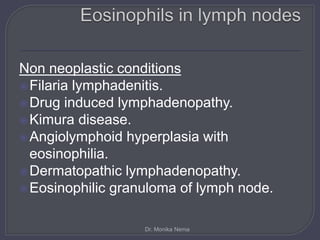
Non neoplastic conditions
Filaria lymphadenitis.
Drug induced lymphadenopathy.
Kimura disease.
Angiolymphoid hyperplasia with
eosinophilia.
Dermatopathic lymphadenopathy.
Eosinophilic granuloma of lymph node.
Dr. Monika Nema
Neoplastic conditions
Mixed cellularity Hodgkin disease
Eosinophilic myeloid disorder
Angioimmunoblastic T cell Lymphoma
Dr. Monika Nema
Dr. Monika Nema
Endemic in tropical countries.
Transmitted by mosquitoes.
Caused by infection with filarial parasite like
Wuchereria bancrofti,
Brugia malayi,Brugia timor.
Dr. Monika Nema
 In humans, adult filariae worms colonize
lymphatic vessels and lymph nodes.
 In men, the worms are most commonly found
in the lymphatics of the epididymis and testis,
and in women in the lymphatics of the breast.
 They also invade the lymphatics of the legs
and the inguinal and pelvic lymph nodes.
 The lymphatics become occluded and
inflammed.
Dr. Monika Nema
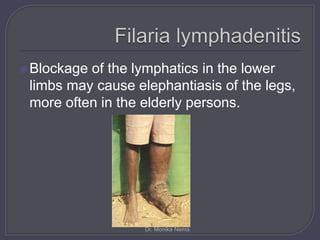
Blockage of the lymphatics in the lower
limbs may cause elephantiasis of the legs,
more often in the elderly persons.
Dr. Monika Nema
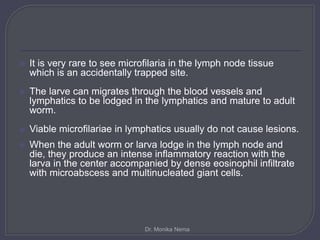
 It is very rare to see microfilaria in the lymph node tissue
which is an accidentally trapped site.
 The larve can migrates through the blood vessels and
lymphatics to be lodged in the lymphatics and mature to adult
worm.
 Viable microfilariae in lymphatics usually do not cause lesions.
 When the adult worm or larva lodge in the lymph node and
die, they produce an intense inflammatory reaction with the
larva in the center accompanied by dense eosinophil infiltrate
with microabscess and multinucleated giant cells.
Dr. Monika Nema
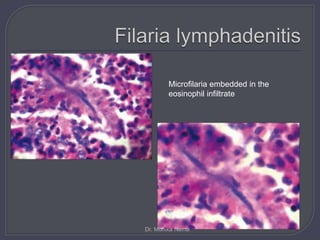
Microfilaria embedded in the
eosinophil infiltrate
Dr. Monika Nema
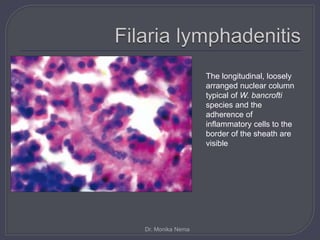
The longitudinal, loosely
arranged nuclear column
typical of W. bancrofti
species and the
adherence of
inflammatory cells to the
border of the sheath are
visible
Dr. Monika Nema
Dr. Monika Nema
Associated with a systemic hypersensitivity
reaction to arene oxide- producing
anticonvulsant drugs.
Triad of fever,rash and lymphadenopathy.
Lymph node abormalities usually appear
early, within weeks or months, after the
initiation of anticonvulsant drug therapy.
Dr. Monika Nema
Clinical feature- hepatitis, gingival
hyperplasia,fever,
skin rash,eosinophilia,gum hyperplasia
and lymphadenopathy,
hepatospleenomegaly ,facial edema.
Dr. Monika Nema
Lymphodenopathy,regress after
anticonvulsants are discontinued, but they
may reappear if the same drug is resumed.
Dr. Monika Nema
Dr. Monika Nema
Dr. Monika Nema
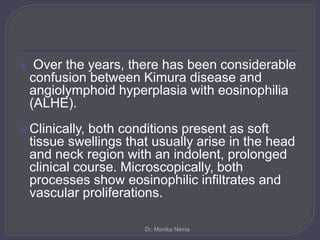
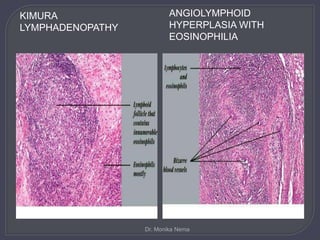
 Over the years, there has been considerable
confusion between Kimura disease and
angiolymphoid hyperplasia with eosinophilia
(ALHE).
 Clinically, both conditions present as soft
tissue swellings that usually arise in the head
and neck region with an indolent, prolonged
clinical course. Microscopically, both
processes show eosinophilic infiltrates and
vascular proliferations.
Dr. Monika Nema
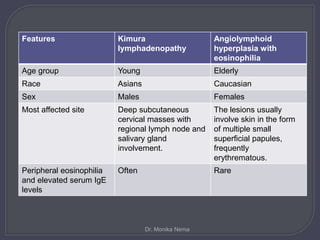
Features Kimura
lymphadenopathy
Angiolymphoid
hyperplasia with
eosinophilia
Age group Young Elderly
Race Asians Caucasian
Sex Males Females
Most affected site Deep subcutaneous
cervical masses with
regional lymph node and
salivary gland
involvement.
The lesions usually
involve skin in the form
of multiple small
superficial papules,
frequently
erythrematous.
Peripheral eosinophilia
and elevated serum IgE
levels
Often Rare
Dr. Monika Nema
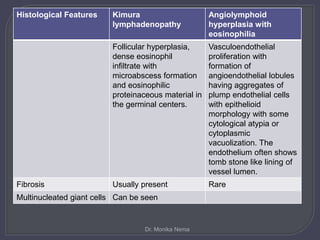
Histological Features Kimura
lymphadenopathy
Angiolymphoid
hyperplasia with
eosinophilia
Follicular hyperplasia,
dense eosinophil
infiltrate with
microabscess formation
and eosinophilic
proteinaceous material in
the germinal centers.
Vasculoendothelial
proliferation with
formation of
angioendothelial lobules
having aggregates of
plump endothelial cells
with epithelioid
morphology with some
cytological atypia or
cytoplasmic
vacuolization. The
endothelium often shows
tomb stone like lining of
vessel lumen.
Fibrosis Usually present Rare
Multinucleated giant cells Can be seen
Dr. Monika Nema
KIMURA
LYMPHADENOPATHY
ANGIOLYMPHOID
HYPERPLASIA WITH
EOSINOPHILIA
Dr. Monika Nema
Dr. Monika Nema
 Lymphadenopathy associated with chronic
dermatologic lesions representing the lymph
node reaction to the drainage of melanin and
various skin antigens.
 Axillary and inguinal lymph nodes are most
commonly involved.
 Lymph nodes are enlarged,firm,movable and
nontender.
 Peripheral eosinophilia is frequently present.
Dr. Monika Nema
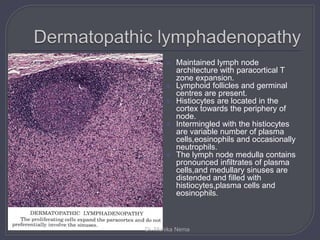
 Maintained lymph node
architecture with paracortical T
zone expansion.
 Lymphoid follicles and germinal
centres are present.
 Histiocytes are located in the
cortex towards the periphery of
node.
 Intermingled with the histiocytes
are variable number of plasma
cells,eosinophils and occasionally
neutrophils.
 The lymph node medulla contains
pronounced infiltrates of plasma
cells,and medullary sinuses are
distended and filled with
histiocytes,plasma cells and
eosinophils.
Dr. Monika Nema
Dr. Monika Nema
It is a form of Langerhans Cell
Histiocytosis that inolves only lymph nodes
and does not infiltrate any other organ.
Considered as a benign disease and
resolves spontaneously.
Occurs mainly in children and young adults
and show a slight preponderance of males.
Dr. Monika Nema
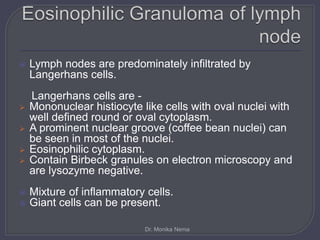
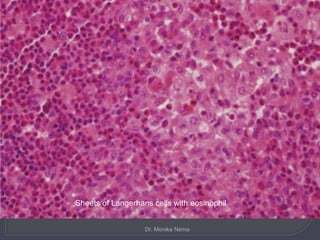
 Lymph nodes are predominately infiltrated by
Langerhans cells.
Langerhans cells are -
 Mononuclear histiocyte like cells with oval nuclei with
well defined round or oval cytoplasm.
 A prominent nuclear groove (coffee bean nuclei) can
be seen in most of the nuclei.
 Eosinophilic cytoplasm.
 Contain Birbeck granules on electron microscopy and
are lysozyme negative.
 Mixture of inflammatory cells.
 Giant cells can be present.
Dr. Monika Nema
Sheets of Langerhans cells with eosinophil
Sheets of Langerhans cells with eosinophil
Dr. Monika Nema
Dr. Monika Nema
• 2nd most common type of Hodgkin
lymphoma in general population.
• The most common variety in HIV+
patients.
• Most patients present with peripheral
and/or abdominal adenopathy and B-
symptoms (fever, night sweats, and
weight-loss).
Dr. Monika Nema
 The lymph node architecture is diffusely
effaced by a polymorphous population of
small lymphocytes, histiocytes, plasma
cells, and eosinophils in varying
proportions along with Reed-Sternberg
cells
Dr. Monika Nema
Dr. Monika Nema
Dr. Monika Nema
 Represent a heterogenous group of disorders.
WHO classification-
 (1) myeloid and lymphoid neoplasms with
PDGFRA rearrangement.
 (2) myeloid neoplasms with PDGFRB
rearrangement.
 (3) myeloid and lymphoid neoplasms with FGFR1
abnormalities.
 (4) chronic eosinophilic leukemia not otherwise
specified.
 (5) idiopathic hypereosinophilic syndrome.
 (6) idiopathic hypereosinophilia.
Dr. Monika Nema
Dr. Monika Nema
Dr. Monika Nema
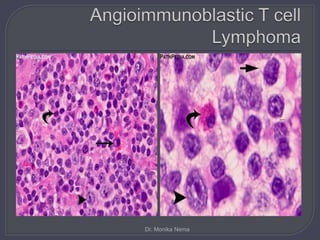
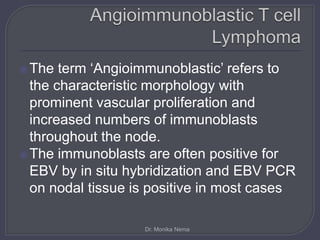
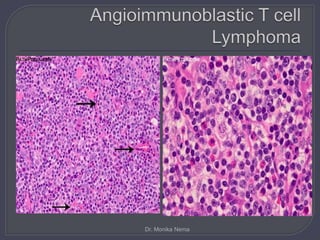
The term ‘Angioimmunoblastic’ refers to
the characteristic morphology with
prominent vascular proliferation and
increased numbers of immunoblasts
throughout the node.
The immunoblasts are often positive for
EBV by in situ hybridization and EBV PCR
on nodal tissue is positive in most cases
Dr. Monika Nema
Dr. Monika Nema
Dr. Monika Nema
 Effaced lymph node architecture.
 Diffuse cellular proliferation.
 Characteristic triad of (a)
arborization,hyperplasia of small vessels; (b)
immunoblasts,predominately T-cell type;(c)
PAS positive material,clear cell
immunoblasts,Reed Sternberg like
cells,plasma cells,eosinophils,epithelioid
cells.
 Bone marrow,spleen,liver,lung may be
involved.
Dr. Monika Nema
 Whenever there is tissue or peripheral blood
eosinophilia, especially in a patient from
tropics or subtropics, the possibility of a
parasitic infection should be thought.
 If the organism is not seen in the initial
sections, extensive sampling, adequate serial
sectioning and vigilant search should be
made to arrive at a correct diagnosis and to
avoid misdiagnosis and mismanagement of
the patient.
Dr. Monika Nema
Presentation by – Dr. Monika Nema
Dr. Monika Nema

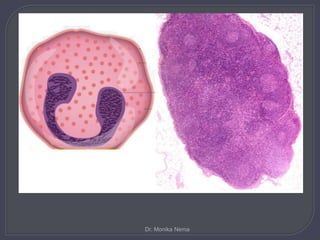
Eosinophils in lymph node

  • 1.
  • 2.
  • 3.
    Non neoplastic conditions Filarialymphadenitis. Drug induced lymphadenopathy. Kimura disease. Angiolymphoid hyperplasia with eosinophilia. Dermatopathic lymphadenopathy. Eosinophilic granuloma of lymph node. Dr. Monika Nema
  • 4.
    Neoplastic conditions Mixed cellularityHodgkin disease Eosinophilic myeloid disorder Angioimmunoblastic T cell Lymphoma Dr. Monika Nema
  • 5.
  • 6.
    Endemic in tropicalcountries. Transmitted by mosquitoes. Caused by infection with filarial parasite like Wuchereria bancrofti, Brugia malayi,Brugia timor. Dr. Monika Nema
  • 7.
     In humans,adult filariae worms colonize lymphatic vessels and lymph nodes.  In men, the worms are most commonly found in the lymphatics of the epididymis and testis, and in women in the lymphatics of the breast.  They also invade the lymphatics of the legs and the inguinal and pelvic lymph nodes.  The lymphatics become occluded and inflammed. Dr. Monika Nema
  • 8.
    Blockage of thelymphatics in the lower limbs may cause elephantiasis of the legs, more often in the elderly persons. Dr. Monika Nema
  • 9.
     It isvery rare to see microfilaria in the lymph node tissue which is an accidentally trapped site.  The larve can migrates through the blood vessels and lymphatics to be lodged in the lymphatics and mature to adult worm.  Viable microfilariae in lymphatics usually do not cause lesions.  When the adult worm or larva lodge in the lymph node and die, they produce an intense inflammatory reaction with the larva in the center accompanied by dense eosinophil infiltrate with microabscess and multinucleated giant cells. Dr. Monika Nema
  • 10.
    Microfilaria embedded inthe eosinophil infiltrate Dr. Monika Nema
  • 11.
    The longitudinal, loosely arrangednuclear column typical of W. bancrofti species and the adherence of inflammatory cells to the border of the sheath are visible Dr. Monika Nema
  • 12.
  • 13.
    Associated with asystemic hypersensitivity reaction to arene oxide- producing anticonvulsant drugs. Triad of fever,rash and lymphadenopathy. Lymph node abormalities usually appear early, within weeks or months, after the initiation of anticonvulsant drug therapy. Dr. Monika Nema
  • 14.
    Clinical feature- hepatitis,gingival hyperplasia,fever, skin rash,eosinophilia,gum hyperplasia and lymphadenopathy, hepatospleenomegaly ,facial edema. Dr. Monika Nema
  • 15.
    Lymphodenopathy,regress after anticonvulsants arediscontinued, but they may reappear if the same drug is resumed. Dr. Monika Nema
  • 16.
  • 17.
  • 18.
     Over theyears, there has been considerable confusion between Kimura disease and angiolymphoid hyperplasia with eosinophilia (ALHE).  Clinically, both conditions present as soft tissue swellings that usually arise in the head and neck region with an indolent, prolonged clinical course. Microscopically, both processes show eosinophilic infiltrates and vascular proliferations. Dr. Monika Nema
  • 19.
    Features Kimura lymphadenopathy Angiolymphoid hyperplasia with eosinophilia Agegroup Young Elderly Race Asians Caucasian Sex Males Females Most affected site Deep subcutaneous cervical masses with regional lymph node and salivary gland involvement. The lesions usually involve skin in the form of multiple small superficial papules, frequently erythrematous. Peripheral eosinophilia and elevated serum IgE levels Often Rare Dr. Monika Nema
  • 20.
    Histological Features Kimura lymphadenopathy Angiolymphoid hyperplasiawith eosinophilia Follicular hyperplasia, dense eosinophil infiltrate with microabscess formation and eosinophilic proteinaceous material in the germinal centers. Vasculoendothelial proliferation with formation of angioendothelial lobules having aggregates of plump endothelial cells with epithelioid morphology with some cytological atypia or cytoplasmic vacuolization. The endothelium often shows tomb stone like lining of vessel lumen. Fibrosis Usually present Rare Multinucleated giant cells Can be seen Dr. Monika Nema
  • 21.
  • 22.
  • 23.
     Lymphadenopathy associatedwith chronic dermatologic lesions representing the lymph node reaction to the drainage of melanin and various skin antigens.  Axillary and inguinal lymph nodes are most commonly involved.  Lymph nodes are enlarged,firm,movable and nontender.  Peripheral eosinophilia is frequently present. Dr. Monika Nema
  • 24.
     Maintained lymphnode architecture with paracortical T zone expansion.  Lymphoid follicles and germinal centres are present.  Histiocytes are located in the cortex towards the periphery of node.  Intermingled with the histiocytes are variable number of plasma cells,eosinophils and occasionally neutrophils.  The lymph node medulla contains pronounced infiltrates of plasma cells,and medullary sinuses are distended and filled with histiocytes,plasma cells and eosinophils. Dr. Monika Nema
  • 25.
  • 26.
    It is aform of Langerhans Cell Histiocytosis that inolves only lymph nodes and does not infiltrate any other organ. Considered as a benign disease and resolves spontaneously. Occurs mainly in children and young adults and show a slight preponderance of males. Dr. Monika Nema
  • 27.
     Lymph nodesare predominately infiltrated by Langerhans cells. Langerhans cells are -  Mononuclear histiocyte like cells with oval nuclei with well defined round or oval cytoplasm.  A prominent nuclear groove (coffee bean nuclei) can be seen in most of the nuclei.  Eosinophilic cytoplasm.  Contain Birbeck granules on electron microscopy and are lysozyme negative.  Mixture of inflammatory cells.  Giant cells can be present. Dr. Monika Nema
  • 28.
    Sheets of Langerhanscells with eosinophil Sheets of Langerhans cells with eosinophil Dr. Monika Nema
  • 29.
  • 30.
    • 2nd mostcommon type of Hodgkin lymphoma in general population. • The most common variety in HIV+ patients. • Most patients present with peripheral and/or abdominal adenopathy and B- symptoms (fever, night sweats, and weight-loss). Dr. Monika Nema
  • 31.
     The lymphnode architecture is diffusely effaced by a polymorphous population of small lymphocytes, histiocytes, plasma cells, and eosinophils in varying proportions along with Reed-Sternberg cells Dr. Monika Nema
  • 32.
  • 33.
  • 34.
     Represent aheterogenous group of disorders. WHO classification-  (1) myeloid and lymphoid neoplasms with PDGFRA rearrangement.  (2) myeloid neoplasms with PDGFRB rearrangement.  (3) myeloid and lymphoid neoplasms with FGFR1 abnormalities.  (4) chronic eosinophilic leukemia not otherwise specified.  (5) idiopathic hypereosinophilic syndrome.  (6) idiopathic hypereosinophilia. Dr. Monika Nema
  • 35.
  • 36.
  • 37.
    The term ‘Angioimmunoblastic’refers to the characteristic morphology with prominent vascular proliferation and increased numbers of immunoblasts throughout the node. The immunoblasts are often positive for EBV by in situ hybridization and EBV PCR on nodal tissue is positive in most cases Dr. Monika Nema
  • 38.
  • 39.
  • 40.
     Effaced lymphnode architecture.  Diffuse cellular proliferation.  Characteristic triad of (a) arborization,hyperplasia of small vessels; (b) immunoblasts,predominately T-cell type;(c) PAS positive material,clear cell immunoblasts,Reed Sternberg like cells,plasma cells,eosinophils,epithelioid cells.  Bone marrow,spleen,liver,lung may be involved. Dr. Monika Nema
  • 41.
     Whenever thereis tissue or peripheral blood eosinophilia, especially in a patient from tropics or subtropics, the possibility of a parasitic infection should be thought.  If the organism is not seen in the initial sections, extensive sampling, adequate serial sectioning and vigilant search should be made to arrive at a correct diagnosis and to avoid misdiagnosis and mismanagement of the patient. Dr. Monika Nema
  • 42.
    Presentation by –Dr. Monika Nema Dr. Monika Nema

Editor's Notes

  • #29 The affected lymph nodes are characterized by a striking sinus histiocytosis, a heavy infiltration with mature eosinophils and retention of normal lymphoid follicles.
  • #35  CEL-NOS is a myeloproliferative neoplasm defined by eosinophils of 1500 per microlitre ,evidence of eosinophil clonality or increase in either peripheral blood or bone marrow blasts and absence of rearrangements of BCR-ABL,PDGFRA,PDGFRB and FGFR1. A diagnosis of Idiopathic hypereosinophilic syndrome requires an absolute eosinophilic count of over 1500 per microlitre for atleast 6 months and evidence of organ involvement and dysfunction.
  • #39 The node shows a polymorphous population of cells including small neoplastic lymphocytes with clear cytoplasm,occasional larger lymphocytes, immunoblasts,eosinophils and plasma cells. It is however,the presence of increased eosinophils,plasma cells, and immunoblasts that gives the lymphoma its characteristic appearance. The presence of small to medium sized lymphoma cells with moderate to abundant clear to pale cytoplasm is also a characteristic feature.
  • #40 A higher magnification image shows abundant clear cytoplasm in neoplastic small to medium sized neoplastic lymphocytes and an eosinophil is also shown.
  • #41 Histopathological features show diffusely effaced lymph node architecture without follicles and minimal to absent sinuses,numerous arborizing blood vessels,the size of postcapillary venules,lined by hyperplastic endothelial cells and mixed population of immunoblasts,Reed Sternberg like cells,plasma cells,eosinophils,epithelioid cells. Necrosis and fibrosis are not seen. Mitoses are frequent. Sometime have Either absent or burned out germinal centers.