Enzymes
• Enzymes are the organic catalysts produced by living
organisms.
• They are biological catalyst and increase the rate of
chemical reaction.
• They make possible the many complex chemical
reactions that make up life processes. Although
produced by living organisms, enzyme are lifeless.
When isolated, they still exert their characteristic
catalytic effect.
• Are specific for
what they will
catalyze
• Are Reusable
• End in –ase
-Sucrase
-Lactase
-Maltase
General properties of enzymes
1. Enzyme are colloids and are soluble in water and
dilute alcohol, but are precipitated by concentrated
alcohol.
2. Most enzyme act best at temperature between 35-
40°C, temperature above 65°C, especially in the
presence of moisture, usually completely destroy
them, where as their activity is negligible at 0°C.
3. Certain heavy metals, formaldehydes and free iodine
retard the enzyme activity. Their activity is markedly
affected by the pH of the medium in which they act or
by the presence of other substances in this medium.
4. They are highly selective in their action.
5.The enzyme are proteins that range in molecular
weight from about 13,000 to as much as 8,40,000
Dalton.
6.Minute quantities of enzymes are required to complete
a chemical reaction.
Chemical nature of enzymes
• Many enzymes are inactive when first
produced. Such enzymes in inactive form are
called pro-enzymes or zymogens.
• They are inactive because the active site is not
exposed and unable to bind with substrate.
Later by the action of essential coenzymes or
activator they made active.
• Enzymes often occur in combination with
inorganic and organic substances that have an
important part in the catalytic action. If these
are non protein organic compounds known as
coenzymes. If they are inorganic ions, they are
referred as activator.
• Coenzymes are integral part of enzyme
system. Several vitamins, thiamine chloride,
riboflavin, nicotinic acid are recognized as
having a co-enzymatic function.
• Both are collectively called cofactors. The cofactors
bound to the protein part of enzyme tightly. In this
case cofactor is termed as prosthetic cofactor or
prosthetic group.
• In globular structure of enzymes, one or more
polypeptide chains twist and fold, brining together a
small number of amino acids to form active site.
• Active site is that location on the enzyme where the
substrate binds. Enzyme and substrate fails to bind if
there shape does not match exactly.
Enzyme energy activation
Without Enzyme
With Enzyme
Free
Energy
Progress of the reaction
Reactants
Products
Free energy of activation
Enzyme-Substrate Complex
The substance
(reactant) an
enzyme acts
on is the
substrate
SUBSTRATE JOINS Enzyme
Enzyme-lock and key theory
• first postulated in 1894 by Emil Fischer.
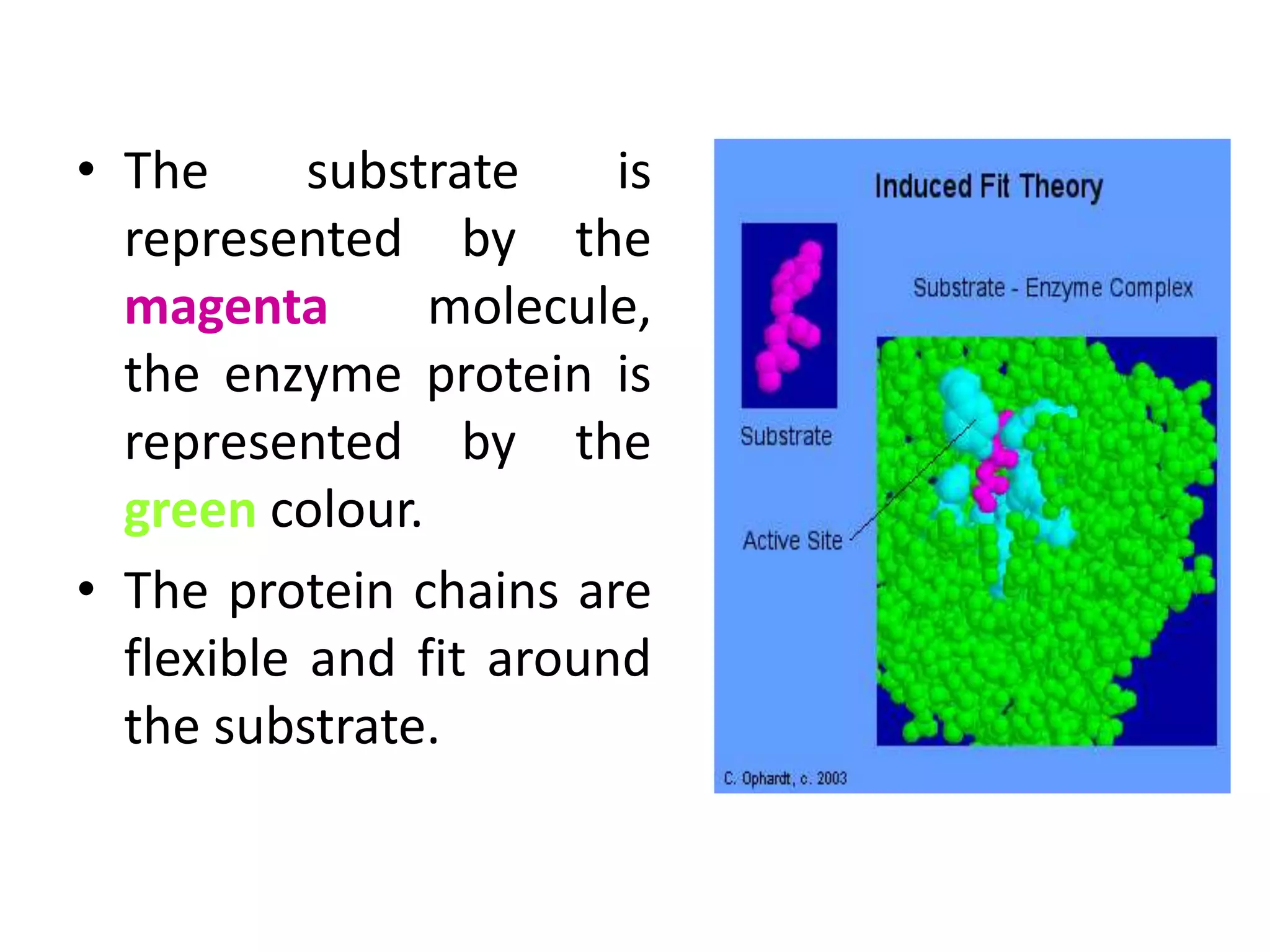
Induced Fit Theory:
• determining the final shape of the enzyme and
that the enzyme is partially flexible.
• This explains why certain compounds can bind
to the enzyme but do not react because the
enzyme has been distorted too much.
• Only the proper substrate is capable of
inducing the proper alignment of the active
site.
• The substrate is
represented by the
magenta molecule,
the enzyme protein is
represented by the
green colour.
• The protein chains are
flexible and fit around
the substrate.
Classification of enzymes
There are several methods for classification of
enzymes few are given below.
• Classification on the basis of reaction they
control
• Classification on the basis of site of action
• Classification on the basis of nature of
substrate
1. Classification on the basis of
reaction they control
• Six major classes are recognized
1. Oxido-reductases
2. Transferases
3. Hydrolases
4. Lyases
5. Isomerases
6. Ligases
1. Oxido-reductases: Catalyzing oxido-reductions
between two substances.
e.g. peroxides, glucose 6-phosphate
2. Transferases: Catalyzing a transfer of group,
other than hydrogen, between a pair of
substrates. e.g. transmethylase, transaminase
3. Hydrolases: Catalyzing hydrolysis of esters, ether,
peptide, glycosyl, acid-anhydride, C-C, C-halide or
P-N bonds. e.g. carbohydrases, lipases,
proteinases
4. Lyases: catalyzing removal of groups from
substrates by mechanisms other than
hydrolysis, leaving double bond. e.g. Fumerase
5. Isomerases: catalyzing inter conversion of
optic, geometric or positional isomers. e.g.
G-6-phosphate isomerase
6. Ligases: Catalyzing linkage of 2 compounds
coupled to the breaking of a pyrophosphate
bond in ATP or a similar compound. e.g.
Acetyl Co-A carboxylase.
• Because the nomenclature of enzymes was
rather well established prior to the
promulgation of this system, the well known
trivial names are still ordinarily employed in
the pharmaceutical literature. Those
encountered with some frequency are:
1. Esterases: including lipase, phospholipase,
acety cholinesterase and others
2.Carbohydrases: including diastase, lactase,
maltase, invertase, cellulase, lysozyme etc.
3.Nucleases: including ribonuclease,
desoxyribonuclease, nucleophosphatase etc.
4.Nuclein deaminases: including adenase,
adenosine deaminase etc.
5.Amidases: including arginase, urease etc.
6.Proteolytic enzymes: including pepsin, trypsin,
chymotrypsin, papin, fibrinolysin,
streptokinase, urokinase etc.
2. Classification on the basis of site of
action
• Enzyme are classified into two groups
1. Endo-enzymes: these enzymes act inside the
cells also called intracellular enzymes. These
enzyme are responsible for synthesis of cell
components, production of energy and
metabolism. Examples are synthetase,
isomerase and phosphorylase
2. Ex-oenzyme:
• They act out side the cell and called
extracellular enzymes.
• Such enzymes are digestive in their function
i.e. break down complex molecule into small
units. Examples proteases, lypases, amylases.
3. Classification on the basis of nature
of substrate
I) The amylolytic Enzyme or carbohydrates :
Examples:
• Diastase and amylase: term applied to 2 well
known amylolytic enzymes salivary diastase or
ptyalin and pancreatic diastase or amylopsin are
found in digestive tract of animals
• Malt diastase: it is formed during the germination
of barley grains and converts starch into lactose.
• Invertase or sucrase: found in yeast and intestinal
juices. It brings hydrolysis of sucrose into glucose
and fructose.
• Maltase: cause conversion of maltose into
glucose.
• Zymase: fermentation enzyme cause
conversion of mono-saccharides into alcohol
and carbon dioxide.
II) The esterases:
Examples:
• Lipase: it is a lipolytic enzyme widely distributed
in animal and vegetable kingdoms. Found in
pencreatic juice of animals and oily seeds.
• Pectase: splits pectin into pectic acid and methyl
alcohol.
• Steapsin: it is lipolytic enzyme capable of methyl
alcohol.
• Urease: obtained from soybeans and used in
laboratory reagent for converting urea to
ammonia.
III) The protolytic enzymes:
Examples:
• Pepsin: is protolytic enzyme found in the
gastric juice and active at pH 1.8.
• Trypsin: it is formed when the proenzyme
trypsinogen is acted on by the enterokinase of
the intestinal juice. It is more active than
pepsin and converting proteoses and
peptones into polypeptides and amino acids.
It is active at pH 8.
• Erepsin: it is found in intestinal juices. It converts
proteoses and peptones into amino acids.
• Rennin: it is a coagulating enzyme present in the
mucous membrane of the stomach of mammals.
It curdles the soluble casein of milk.
• Papain: it is a mixture of active proteolytic
enzymes found in the unripe fruit of the papaya
tree.
• Bromelain: protein digesting and milk-clotting
enzyme obtained from the juice of the pineapple
plant.
IV) The oxidizing enzymes:
Examples:
• Peroxides: are widely distributed in plants,
they bring about the oxidation reactions that
cause the discoloration of bruised fruits.
• Thrombin: converts the fibrinogen of the
circulating blood into the insoluble fibrin of
the blood clot.
• Zymase: splitting of mono-saccharides by
oxidation.
Pepsin
• Biological Source:
Pepsin is obtained from
the stomach of the ox
(Bos taurus), the sheep
(Ovis aries), or the hog
(Sus scrofa), the
mucous membrane
being the part used.
PREPARATION
• Pepsin is prepared by digesting the minced
stomach linings with HCl acid. This solution is
clarified, partially evaporated, dialyzed,
concentrated and either poured on glass
plates to dry, thus forming scales papsin, or
carefully evaporated in a vacuum, forming
spongy pepsin.
Description:
• Its a yellowish-white amorphous powder or
thin, pale yellowish, somewhat transparent
scales, with faint odour and slight saline or
acidulous taste, but no indication of
decomposition; should not be hygroscopic. It
invariably contains some rennin; its solutions,
therefore, will coagulate milk. Incompatible
with alkalis, alcohol, and heat renders it inert.
Applications
• Pepsin is administered to assist gastric digestion.
It is a proteolytic enzyme and should preferably
be given after meals and followed by a dose of
HCl acid. Usually dose is 500mg. It is often
combined with pancreatin in product
formulations.
• Pepsin has a long history of use in medicine, but
its actual beneficial contribution is poorly
documented.
• Pepsin may be given to help gastric digestion in
those in whom from old age or long illness the
secretion of gastric juice is deficient.
PAPAIN
Biological source:
Papain is the dried and purified
latex of the fruit of Carica
papaya Linne (Family.
Caricaceae).
• Papain is a substance which
contains a mixture of proteolytic
enzymes found in the unripe
fruit of papaya tree.
• It is also referred to as
papaya proteinase
DISTRIBUTION:
• The papaya tree is indigenous to tropical
America and is cultivated in Sri Lanka,
Tanzania, Hawaii, and Florida.
PHYSICAL DESCRIPTION
• It attains a height of about 5
or 6 meters. The fruit grows
to a length of about 30 cm
and a weight of 5 kg. The
epicarp adheres to the
orange-colored, fleshy sarco
carp, which surrounds the
central Cavity. This cavity
contains a mass of nearly
black seeds.
Isolation of papain
• The full grown but unripe fruit is subjected to
shallow incisions on the 4 sides. The latex
flows freely for a few seconds, but soon
coagulates. After collection, the coagulated
lumps are shredded and dried by the sun or by
the use of artificial heat. Incisions and
collections are made at weekly intervals as
long as the fruit exudes the latex. The crude
papin is purified by dissolving in the water and
precipitating with alcohol.
Chemical constituents
• Papain acts in acid, neutral, or alkaline media.
• Papain contains several enzymes such as
Peptidase, capable of converting proteins into
dipeptides and polypeptides.
• A rennin like, coagulating enzyme that acts on
the casein of milk.
• An amylolytic enzyme; pectase, which
converts carbohydrates molecules into simple
units i.e. monosaccharide.
Uses
• Papain is used as a digestant for proteins because
it has an action much like that of pepsin. The best
grade of papain digests 300 times its own weight
of egg albumin.
• It is employed to relieve the symptoms of
episiotomy
• It is used to tenderize meats. In the meat packing
industry, papain is used extensively for
tenderizing beef.
• PROPRIETARY PRODUCTS. Caroid and Papase.
BROMELIN
• Biological source:
Bromelain or bromelin is a protein
digesting and milk-clotting enzyme
obtained from the juice of the pineapple
plant, Ananas comosus (Linne) Merr
(Family. Bromeliaceae). Although this
enzyme can appear in the juice of the fruit,
it can also occur in the stem of the plant. It
differs from papain because it is obtained
from both the ripe and unripe fruits.
Extraction
Uses:
• Bromelain is used as adjunctive therapy to reduce
inflammation and edema and to accelerate tissue
repair, especially following episiotomy.
• Bromelain is also employed in the production of
protein hydrolysates,
• In tenderizing meats in the leather industry.
• PRESCRIPTION PRODUCT: ‘’Ananase’’.

Enzymes 140224071459-phpapp02

  • 1.
    Enzymes • Enzymes arethe organic catalysts produced by living organisms. • They are biological catalyst and increase the rate of chemical reaction. • They make possible the many complex chemical reactions that make up life processes. Although produced by living organisms, enzyme are lifeless. When isolated, they still exert their characteristic catalytic effect.
  • 2.
    • Are specificfor what they will catalyze • Are Reusable • End in –ase -Sucrase -Lactase -Maltase
  • 3.
    General properties ofenzymes 1. Enzyme are colloids and are soluble in water and dilute alcohol, but are precipitated by concentrated alcohol. 2. Most enzyme act best at temperature between 35- 40°C, temperature above 65°C, especially in the presence of moisture, usually completely destroy them, where as their activity is negligible at 0°C. 3. Certain heavy metals, formaldehydes and free iodine retard the enzyme activity. Their activity is markedly affected by the pH of the medium in which they act or by the presence of other substances in this medium. 4. They are highly selective in their action.
  • 4.
    5.The enzyme areproteins that range in molecular weight from about 13,000 to as much as 8,40,000 Dalton. 6.Minute quantities of enzymes are required to complete a chemical reaction.
  • 5.
    Chemical nature ofenzymes • Many enzymes are inactive when first produced. Such enzymes in inactive form are called pro-enzymes or zymogens. • They are inactive because the active site is not exposed and unable to bind with substrate. Later by the action of essential coenzymes or activator they made active.
  • 7.
    • Enzymes oftenoccur in combination with inorganic and organic substances that have an important part in the catalytic action. If these are non protein organic compounds known as coenzymes. If they are inorganic ions, they are referred as activator. • Coenzymes are integral part of enzyme system. Several vitamins, thiamine chloride, riboflavin, nicotinic acid are recognized as having a co-enzymatic function.
  • 8.
    • Both arecollectively called cofactors. The cofactors bound to the protein part of enzyme tightly. In this case cofactor is termed as prosthetic cofactor or prosthetic group. • In globular structure of enzymes, one or more polypeptide chains twist and fold, brining together a small number of amino acids to form active site. • Active site is that location on the enzyme where the substrate binds. Enzyme and substrate fails to bind if there shape does not match exactly.
  • 9.
    Enzyme energy activation WithoutEnzyme With Enzyme Free Energy Progress of the reaction Reactants Products Free energy of activation
  • 10.
    Enzyme-Substrate Complex The substance (reactant)an enzyme acts on is the substrate SUBSTRATE JOINS Enzyme
  • 11.
    Enzyme-lock and keytheory • first postulated in 1894 by Emil Fischer.
  • 12.
    Induced Fit Theory: •determining the final shape of the enzyme and that the enzyme is partially flexible. • This explains why certain compounds can bind to the enzyme but do not react because the enzyme has been distorted too much. • Only the proper substrate is capable of inducing the proper alignment of the active site.
  • 13.
    • The substrateis represented by the magenta molecule, the enzyme protein is represented by the green colour. • The protein chains are flexible and fit around the substrate.
  • 14.
    Classification of enzymes Thereare several methods for classification of enzymes few are given below. • Classification on the basis of reaction they control • Classification on the basis of site of action • Classification on the basis of nature of substrate
  • 15.
    1. Classification onthe basis of reaction they control • Six major classes are recognized 1. Oxido-reductases 2. Transferases 3. Hydrolases 4. Lyases 5. Isomerases 6. Ligases
  • 16.
    1. Oxido-reductases: Catalyzingoxido-reductions between two substances. e.g. peroxides, glucose 6-phosphate 2. Transferases: Catalyzing a transfer of group, other than hydrogen, between a pair of substrates. e.g. transmethylase, transaminase 3. Hydrolases: Catalyzing hydrolysis of esters, ether, peptide, glycosyl, acid-anhydride, C-C, C-halide or P-N bonds. e.g. carbohydrases, lipases, proteinases
  • 17.
    4. Lyases: catalyzingremoval of groups from substrates by mechanisms other than hydrolysis, leaving double bond. e.g. Fumerase 5. Isomerases: catalyzing inter conversion of optic, geometric or positional isomers. e.g. G-6-phosphate isomerase 6. Ligases: Catalyzing linkage of 2 compounds coupled to the breaking of a pyrophosphate bond in ATP or a similar compound. e.g. Acetyl Co-A carboxylase.
  • 18.
    • Because thenomenclature of enzymes was rather well established prior to the promulgation of this system, the well known trivial names are still ordinarily employed in the pharmaceutical literature. Those encountered with some frequency are: 1. Esterases: including lipase, phospholipase, acety cholinesterase and others
  • 19.
    2.Carbohydrases: including diastase,lactase, maltase, invertase, cellulase, lysozyme etc. 3.Nucleases: including ribonuclease, desoxyribonuclease, nucleophosphatase etc. 4.Nuclein deaminases: including adenase, adenosine deaminase etc. 5.Amidases: including arginase, urease etc. 6.Proteolytic enzymes: including pepsin, trypsin, chymotrypsin, papin, fibrinolysin, streptokinase, urokinase etc.
  • 20.
    2. Classification onthe basis of site of action • Enzyme are classified into two groups 1. Endo-enzymes: these enzymes act inside the cells also called intracellular enzymes. These enzyme are responsible for synthesis of cell components, production of energy and metabolism. Examples are synthetase, isomerase and phosphorylase
  • 21.
    2. Ex-oenzyme: • Theyact out side the cell and called extracellular enzymes. • Such enzymes are digestive in their function i.e. break down complex molecule into small units. Examples proteases, lypases, amylases.
  • 22.
    3. Classification onthe basis of nature of substrate I) The amylolytic Enzyme or carbohydrates : Examples: • Diastase and amylase: term applied to 2 well known amylolytic enzymes salivary diastase or ptyalin and pancreatic diastase or amylopsin are found in digestive tract of animals • Malt diastase: it is formed during the germination of barley grains and converts starch into lactose. • Invertase or sucrase: found in yeast and intestinal juices. It brings hydrolysis of sucrose into glucose and fructose.
  • 23.
    • Maltase: causeconversion of maltose into glucose. • Zymase: fermentation enzyme cause conversion of mono-saccharides into alcohol and carbon dioxide.
  • 24.
    II) The esterases: Examples: •Lipase: it is a lipolytic enzyme widely distributed in animal and vegetable kingdoms. Found in pencreatic juice of animals and oily seeds. • Pectase: splits pectin into pectic acid and methyl alcohol. • Steapsin: it is lipolytic enzyme capable of methyl alcohol. • Urease: obtained from soybeans and used in laboratory reagent for converting urea to ammonia.
  • 25.
    III) The protolyticenzymes: Examples: • Pepsin: is protolytic enzyme found in the gastric juice and active at pH 1.8. • Trypsin: it is formed when the proenzyme trypsinogen is acted on by the enterokinase of the intestinal juice. It is more active than pepsin and converting proteoses and peptones into polypeptides and amino acids. It is active at pH 8.
  • 26.
    • Erepsin: itis found in intestinal juices. It converts proteoses and peptones into amino acids. • Rennin: it is a coagulating enzyme present in the mucous membrane of the stomach of mammals. It curdles the soluble casein of milk. • Papain: it is a mixture of active proteolytic enzymes found in the unripe fruit of the papaya tree. • Bromelain: protein digesting and milk-clotting enzyme obtained from the juice of the pineapple plant.
  • 27.
    IV) The oxidizingenzymes: Examples: • Peroxides: are widely distributed in plants, they bring about the oxidation reactions that cause the discoloration of bruised fruits. • Thrombin: converts the fibrinogen of the circulating blood into the insoluble fibrin of the blood clot. • Zymase: splitting of mono-saccharides by oxidation.
  • 28.
    Pepsin • Biological Source: Pepsinis obtained from the stomach of the ox (Bos taurus), the sheep (Ovis aries), or the hog (Sus scrofa), the mucous membrane being the part used.
  • 29.
    PREPARATION • Pepsin isprepared by digesting the minced stomach linings with HCl acid. This solution is clarified, partially evaporated, dialyzed, concentrated and either poured on glass plates to dry, thus forming scales papsin, or carefully evaporated in a vacuum, forming spongy pepsin.
  • 30.
    Description: • Its ayellowish-white amorphous powder or thin, pale yellowish, somewhat transparent scales, with faint odour and slight saline or acidulous taste, but no indication of decomposition; should not be hygroscopic. It invariably contains some rennin; its solutions, therefore, will coagulate milk. Incompatible with alkalis, alcohol, and heat renders it inert.
  • 31.
    Applications • Pepsin isadministered to assist gastric digestion. It is a proteolytic enzyme and should preferably be given after meals and followed by a dose of HCl acid. Usually dose is 500mg. It is often combined with pancreatin in product formulations. • Pepsin has a long history of use in medicine, but its actual beneficial contribution is poorly documented. • Pepsin may be given to help gastric digestion in those in whom from old age or long illness the secretion of gastric juice is deficient.
  • 33.
    PAPAIN Biological source: Papain isthe dried and purified latex of the fruit of Carica papaya Linne (Family. Caricaceae). • Papain is a substance which contains a mixture of proteolytic enzymes found in the unripe fruit of papaya tree. • It is also referred to as papaya proteinase
  • 34.
    DISTRIBUTION: • The papayatree is indigenous to tropical America and is cultivated in Sri Lanka, Tanzania, Hawaii, and Florida.
  • 35.
    PHYSICAL DESCRIPTION • Itattains a height of about 5 or 6 meters. The fruit grows to a length of about 30 cm and a weight of 5 kg. The epicarp adheres to the orange-colored, fleshy sarco carp, which surrounds the central Cavity. This cavity contains a mass of nearly black seeds.
  • 36.
    Isolation of papain •The full grown but unripe fruit is subjected to shallow incisions on the 4 sides. The latex flows freely for a few seconds, but soon coagulates. After collection, the coagulated lumps are shredded and dried by the sun or by the use of artificial heat. Incisions and collections are made at weekly intervals as long as the fruit exudes the latex. The crude papin is purified by dissolving in the water and precipitating with alcohol.
  • 38.
    Chemical constituents • Papainacts in acid, neutral, or alkaline media. • Papain contains several enzymes such as Peptidase, capable of converting proteins into dipeptides and polypeptides. • A rennin like, coagulating enzyme that acts on the casein of milk. • An amylolytic enzyme; pectase, which converts carbohydrates molecules into simple units i.e. monosaccharide.
  • 39.
    Uses • Papain isused as a digestant for proteins because it has an action much like that of pepsin. The best grade of papain digests 300 times its own weight of egg albumin. • It is employed to relieve the symptoms of episiotomy • It is used to tenderize meats. In the meat packing industry, papain is used extensively for tenderizing beef. • PROPRIETARY PRODUCTS. Caroid and Papase.
  • 41.
    BROMELIN • Biological source: Bromelainor bromelin is a protein digesting and milk-clotting enzyme obtained from the juice of the pineapple plant, Ananas comosus (Linne) Merr (Family. Bromeliaceae). Although this enzyme can appear in the juice of the fruit, it can also occur in the stem of the plant. It differs from papain because it is obtained from both the ripe and unripe fruits.
  • 44.
  • 45.
    Uses: • Bromelain isused as adjunctive therapy to reduce inflammation and edema and to accelerate tissue repair, especially following episiotomy. • Bromelain is also employed in the production of protein hydrolysates, • In tenderizing meats in the leather industry. • PRESCRIPTION PRODUCT: ‘’Ananase’’.