Environmental Studies and Law
Juhi Saxena
Asst Prof
Section 2(a) in The Environment
(Protection) Act, 1986
(a) environment includes water, air and
“ ”
land and the inter-relationship which
exists among and between water, air and
land, and human beings, other living
creatures, plants, micro-organism and
property;
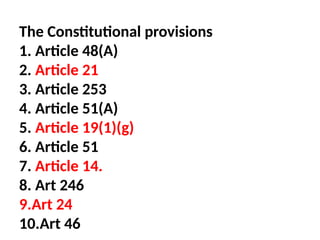
The Constitutional provisions
1. Article 48(A)
2. Article 21
3. Article 253
4. Article 51(A)
5. Article 19(1)(g)
6. Article 51
7. Article 14.
8. Art 246
9.Art 24
10.Art 46
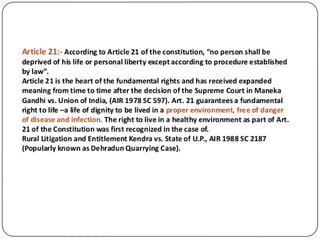
Article 21 of the constitution of India provides for the right
to life and personal liberty. It states that “no person shall
be deprived of his life or personal liberty except according
to procedure established by law.”In
“Rural Litigation and Entitlement Kendra v State of UP,”
also known as the Dehradun quarrying case, the
Supreme Court of India has held that pollution caused by
quarries adversely affects the health and safety of
people and hence, the same should be stopped as being
violative of Article 21.In this case, the Supreme Court for
the first time held that the right to wholesome
environment is a part of right to life and personal liberty
guaranteed under Article 21 of the Constitution.
In the case of Subhash Kumar v State of Bihar, again
the apex court held that the right to get pollution
free water and air is a fundamental right under
Article 21. Following this decision, the right to
pollution free environment was incorporated under
the head of right to life and all the law courts within
the Indian territory were bound to follow the same.
This laid down the foundation of environmental
litigation in India.
Similarly, public health and ecology were held to be
the priorities under Article 21 and the constitution of a
green bench was also ordered by the Supreme Court.
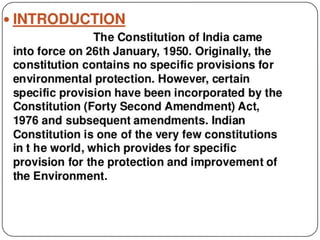
Directive Principles of State Policy
Article 48(A)
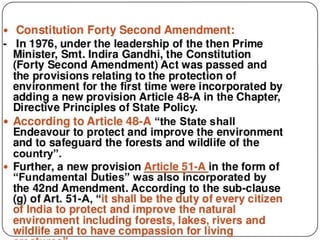
48A. Protection and improvement of environment and safeguarding
of forests and wild life The State shall endeavour to protect and
improve the environment and to safeguard the forests and wild life
of the country.
Sher Singh vs State Of Hp on 6 February, 2014
The citizens of the country have a fundamental right to a
wholesome, clean and decent environment. The Constitution of
India, in terms of Article 48A, mandates that the State is under a
Constitutional obligation to protect and improve the environment
and to safeguard the forest and wild life in the country. By 42nd
Amendment to the Constitution, the Parliament, with an object of
sensitizing the citizens of their duty, incorporated Article 51A in the
Constitution, inter alia, requiring a citizen to protect and improve
the natural environment including the forests, lakes, rivers and
wild life and to have a compassion for living creatures.
Article 51
Promotion of international peace and security The State shall endeavour to -
(a) promote international peace and security;
(b) maintain just and honourable relations between nations;
(c) foster respect for international law and treaty obligations in the dealings of
organised peoples with one another; and encourage settlement of international
disputes by arbitration PART IVA FUNDAMENTAL DUTIES.
State of Gujarat vs Mirzapur Moti Kureshi Kassab on 26 October, 2005
By enacting clause (g) in Article 51-A and giving it the status of a fundamental duty,
one of the objects sought to be achieved by the Parliament is to ensure that the
spirit and message of Articles 48 and 48A is honoured as a fundamental duty of
every citizen. The Parliament availed the opportunity provided by the Constitution
(Forty-second Amendment) Act, 1976 to improve
the manifestation of objects contained in Article 48 and 48-A. While Article 48-A
speaks of "environment", Article 51-A(g) employs the expression "the natural
environment" and includes therein "forests, lakes, rivers and wild life". While
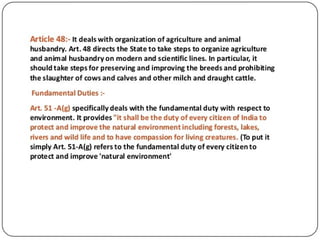
Article 48 provides for "cows and calves and other milch and draught cattle",
Article 51-A(g) enjoins it as a fundamental duty of every citizen "to have
compassion for living creatures", which in its wider fold embraces the category of
cattle spoken of specifically in Article 48.
Criminal Provisions and Environment
• Criminal remedies are in the form of-
• 1. Penal Punishment(Punishment)
• 2. Monetary Punishment
• 1. IPC (Indian Penal Code)
• 2. CrPC (Criminal Procedure Code)
INDIAN PENAL CODE-PROVISIONS
• 1. Chapter XIV- Offence of Public Nuisance
• It has 28 sections
• (Sec 268-294 A)
• Public Health ( Sec 269 -278)
• Adulteration of Food , Drinks and Drugs (Sec
272)
• Fouling of Water-Sec 277
CrPC-Provisions
• 1. Sec 133-Sec 144
• Sec 133- Provides and Independent , speedy and
summary remedy against public nuisance.
Case Laws:
• 1. Gobind Singh vs Shanti Sarup (1979)
• 2. Ratlam Municipality vs Vardhichand (1980)
• 3. P C Cherian vs State of Kerala
• 4.Krishna Gopal vs State of MP (1986)
• 5. Tata Tea Ltd vs. State of Kerala (1984)
Civil Remedies-CIVIL PROCEDURE
COURT,1908
• 1. Remedying Public Wrong- Sec 91, CPC
• 2. Remedying Breaches of Public Trust- (Sec
92)
• 3.Represenatative Suit , order 1, Rule 8, CPC
• Writs:
• Art 32 (SC) & Art 226 (HC)
• 4. Injunctions
POLLUTER PAY PRINCIPLE-
History-
The Polluter Pays Principle was first introduced in 1972 by the
Organization for Economic Cooperation and Development (OECD)
Guiding Principles concerning International Economic Aspects of
Environmental policies where under the polluter was held
responsible for the environmental damage and pollution.
Subsequently, the Rio Declaration laid down the guidelines for
sustainable development meaning thereby a strategy to cater the
needs of the present generation without compromising the needs of
the future generation. In furtherance of the aim of sustainable
development Rio Declaration Principle 16 of the Rio Declaration
enshrined the Polluter Pays principle stating that the polluter
should bear the cost of pollution.
The Concept
The Polluter Pays Principle imposes liability on a
person who pollutes the environment to compensate
for the damage caused and return the environment to
its original state regardless of the intent.
The "Polluter Pays" principle as interpreted by the
Court means that the absolute liability for harm to
the environment extends not only to compensate
the victims of pollution but also the cost of
restoring the environmental degradation.
Indian Council for Enviro-Legal Action vs. Union of India 1996(3)
SCC 212
The Court held that once the activity carried on is hazardous or
inherently dangerous, the person carrying on such activity is
liable to make good the loss caused to any other person by his
activity irrespective of the fact whether he took reasonable care
while carrying on his activity. The rule is premised upon the very
nature of the activity carried on.
Vellore Citizens' Welfare Forum vs. Union of India 1996(5) SCC
647
The Court interpreted the meaning of the Polluter Pays Principle
as the absolute liability for harm to the environment extends not
only to compensate the victims of the pollution but also the cost
of restoring the environmental degradation. Remediation of the
damaged environment is part of the process of 'Sustainable
Development' and as such the polluter is liable to pay the cost to
the individual sufferers as well as the cost of reversing the
damaged ecology."
The Oleum Gas Leak case (M.C. Mehta vs. Union of India) AIR 1987 SC 1086
The Court laid down that an enterprise engaged in a hazardous or inherently
dangerous industry which poses a potential threat to the health and safety of
persons working in the factory and to those residing in the surrounding areas,
owes an absolute and non-delegable duty to the community to ensure that no
harm results to any one on account of hazardous or inherently dangerous
nature of the activity which it has undertaken. The enterprise is absolutely
liable to compensate for such harm and irrespective of all reasonable care
taken on his account. The larger and more prosperous the enterprise, greater
must be the amount of the compensation payable for the harm caused on
account of an accident in the carrying on of the hazardous or inherently
dangerous activity by the enterprise.
M. C. Mehta vs Kamal Nath & Ors (1997)1SCC388
The Court held that pollution is a civil wrong and is a tort committed against
the community as a whole. Thus, any person guilty of causing pollution has to
pay damages (compensation) for restoration of the environment and ecology.
Under the Polluter Pays Principle, it is not the role of Government to meet the
costs involved in either prevention of such damage, or in carrying out remedial
action, because the effect of this would be to shift the financial burden of the
pollution incident to the taxpayer.
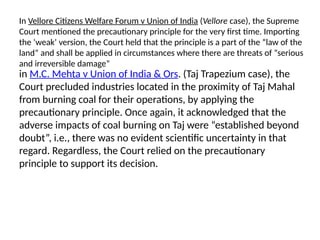
In Vellore Citizens Welfare Forum v Union of India (Vellore case), the Supreme
Court mentioned the precautionary principle for the very first time. Importing
the ‘weak’ version, the Court held that the principle is a part of the “law of the
land” and shall be applied in circumstances where there are threats of “serious
and irreversible damage”
in M.C. Mehta v Union of India & Ors. (Taj Trapezium case), the
Court precluded industries located in the proximity of Taj Mahal
from burning coal for their operations, by applying the
precautionary principle. Once again, it acknowledged that the
adverse impacts of coal burning on Taj were “established beyond
doubt”, i.e., there was no evident scientific uncertainty in that
regard. Regardless, the Court relied on the precautionary
principle to support its decision.
PUBLIC TRUST DOCTRINE
Basically, the ancient Roman Empire developed this legal
theory i.e. Doctrine of the Public Trust. The Public Trust
Doctrine primarily rests on the principle that certain
resources like air, sea, waters and the forests have such a
great importance to the people as a whole that it would
be wholly unjustified to make them a subject of private
ownership. The said resources being a gift of nature, they
should be made freely available to everyone irrespective
of the status in life. The doctrine enjoins upon the
Government to protect the resources for the enjoyment
of the general public rather than to permit their use for
private ownership or commercial purposes.
The doctrine is first mentioned in M.C. Mehta v Kamal Nath and others where the Indian
Supreme Court applied public trust with regard to the protection and preservation of
natural resources. In this case, the State Government granted lease of riparian forestland
to a private company for commercial purpose. The purpose of the lease was to build a
motel at the bank of the River Beas. A report published in a national newspaper alleged
that the motel management interfered with the natural flow of the river in order to
divert its course and to save the motel from future floods. The Supreme Court initiated
suo motu action based on the newspaper item because the facts disclosed, if true, would
be a serious act of environmental degradation.

environmental studies slide 1 pollution and its type.pptx

  • 1.
    Environmental Studies andLaw Juhi Saxena Asst Prof
  • 2.
    Section 2(a) inThe Environment (Protection) Act, 1986 (a) environment includes water, air and “ ” land and the inter-relationship which exists among and between water, air and land, and human beings, other living creatures, plants, micro-organism and property;
  • 26.
    The Constitutional provisions 1.Article 48(A) 2. Article 21 3. Article 253 4. Article 51(A) 5. Article 19(1)(g) 6. Article 51 7. Article 14. 8. Art 246 9.Art 24 10.Art 46
  • 34.
    Article 21 ofthe constitution of India provides for the right to life and personal liberty. It states that “no person shall be deprived of his life or personal liberty except according to procedure established by law.”In “Rural Litigation and Entitlement Kendra v State of UP,” also known as the Dehradun quarrying case, the Supreme Court of India has held that pollution caused by quarries adversely affects the health and safety of people and hence, the same should be stopped as being violative of Article 21.In this case, the Supreme Court for the first time held that the right to wholesome environment is a part of right to life and personal liberty guaranteed under Article 21 of the Constitution.
  • 35.
    In the caseof Subhash Kumar v State of Bihar, again the apex court held that the right to get pollution free water and air is a fundamental right under Article 21. Following this decision, the right to pollution free environment was incorporated under the head of right to life and all the law courts within the Indian territory were bound to follow the same. This laid down the foundation of environmental litigation in India. Similarly, public health and ecology were held to be the priorities under Article 21 and the constitution of a green bench was also ordered by the Supreme Court.
  • 36.
    Directive Principles ofState Policy Article 48(A) 48A. Protection and improvement of environment and safeguarding of forests and wild life The State shall endeavour to protect and improve the environment and to safeguard the forests and wild life of the country. Sher Singh vs State Of Hp on 6 February, 2014 The citizens of the country have a fundamental right to a wholesome, clean and decent environment. The Constitution of India, in terms of Article 48A, mandates that the State is under a Constitutional obligation to protect and improve the environment and to safeguard the forest and wild life in the country. By 42nd Amendment to the Constitution, the Parliament, with an object of sensitizing the citizens of their duty, incorporated Article 51A in the Constitution, inter alia, requiring a citizen to protect and improve the natural environment including the forests, lakes, rivers and wild life and to have a compassion for living creatures.
  • 37.
    Article 51 Promotion ofinternational peace and security The State shall endeavour to - (a) promote international peace and security; (b) maintain just and honourable relations between nations; (c) foster respect for international law and treaty obligations in the dealings of organised peoples with one another; and encourage settlement of international disputes by arbitration PART IVA FUNDAMENTAL DUTIES. State of Gujarat vs Mirzapur Moti Kureshi Kassab on 26 October, 2005 By enacting clause (g) in Article 51-A and giving it the status of a fundamental duty, one of the objects sought to be achieved by the Parliament is to ensure that the spirit and message of Articles 48 and 48A is honoured as a fundamental duty of every citizen. The Parliament availed the opportunity provided by the Constitution (Forty-second Amendment) Act, 1976 to improve the manifestation of objects contained in Article 48 and 48-A. While Article 48-A speaks of "environment", Article 51-A(g) employs the expression "the natural environment" and includes therein "forests, lakes, rivers and wild life". While Article 48 provides for "cows and calves and other milch and draught cattle", Article 51-A(g) enjoins it as a fundamental duty of every citizen "to have compassion for living creatures", which in its wider fold embraces the category of cattle spoken of specifically in Article 48.
  • 38.
    Criminal Provisions andEnvironment • Criminal remedies are in the form of- • 1. Penal Punishment(Punishment) • 2. Monetary Punishment • 1. IPC (Indian Penal Code) • 2. CrPC (Criminal Procedure Code)
  • 39.
    INDIAN PENAL CODE-PROVISIONS •1. Chapter XIV- Offence of Public Nuisance • It has 28 sections • (Sec 268-294 A) • Public Health ( Sec 269 -278) • Adulteration of Food , Drinks and Drugs (Sec 272) • Fouling of Water-Sec 277
  • 40.
    CrPC-Provisions • 1. Sec133-Sec 144 • Sec 133- Provides and Independent , speedy and summary remedy against public nuisance. Case Laws: • 1. Gobind Singh vs Shanti Sarup (1979) • 2. Ratlam Municipality vs Vardhichand (1980) • 3. P C Cherian vs State of Kerala • 4.Krishna Gopal vs State of MP (1986) • 5. Tata Tea Ltd vs. State of Kerala (1984)
  • 41.
    Civil Remedies-CIVIL PROCEDURE COURT,1908 •1. Remedying Public Wrong- Sec 91, CPC • 2. Remedying Breaches of Public Trust- (Sec 92) • 3.Represenatative Suit , order 1, Rule 8, CPC • Writs: • Art 32 (SC) & Art 226 (HC) • 4. Injunctions
  • 42.
    POLLUTER PAY PRINCIPLE- History- ThePolluter Pays Principle was first introduced in 1972 by the Organization for Economic Cooperation and Development (OECD) Guiding Principles concerning International Economic Aspects of Environmental policies where under the polluter was held responsible for the environmental damage and pollution. Subsequently, the Rio Declaration laid down the guidelines for sustainable development meaning thereby a strategy to cater the needs of the present generation without compromising the needs of the future generation. In furtherance of the aim of sustainable development Rio Declaration Principle 16 of the Rio Declaration enshrined the Polluter Pays principle stating that the polluter should bear the cost of pollution.
  • 43.
    The Concept The PolluterPays Principle imposes liability on a person who pollutes the environment to compensate for the damage caused and return the environment to its original state regardless of the intent. The "Polluter Pays" principle as interpreted by the Court means that the absolute liability for harm to the environment extends not only to compensate the victims of pollution but also the cost of restoring the environmental degradation.
  • 44.
    Indian Council forEnviro-Legal Action vs. Union of India 1996(3) SCC 212 The Court held that once the activity carried on is hazardous or inherently dangerous, the person carrying on such activity is liable to make good the loss caused to any other person by his activity irrespective of the fact whether he took reasonable care while carrying on his activity. The rule is premised upon the very nature of the activity carried on. Vellore Citizens' Welfare Forum vs. Union of India 1996(5) SCC 647 The Court interpreted the meaning of the Polluter Pays Principle as the absolute liability for harm to the environment extends not only to compensate the victims of the pollution but also the cost of restoring the environmental degradation. Remediation of the damaged environment is part of the process of 'Sustainable Development' and as such the polluter is liable to pay the cost to the individual sufferers as well as the cost of reversing the damaged ecology."
  • 45.
    The Oleum GasLeak case (M.C. Mehta vs. Union of India) AIR 1987 SC 1086 The Court laid down that an enterprise engaged in a hazardous or inherently dangerous industry which poses a potential threat to the health and safety of persons working in the factory and to those residing in the surrounding areas, owes an absolute and non-delegable duty to the community to ensure that no harm results to any one on account of hazardous or inherently dangerous nature of the activity which it has undertaken. The enterprise is absolutely liable to compensate for such harm and irrespective of all reasonable care taken on his account. The larger and more prosperous the enterprise, greater must be the amount of the compensation payable for the harm caused on account of an accident in the carrying on of the hazardous or inherently dangerous activity by the enterprise. M. C. Mehta vs Kamal Nath & Ors (1997)1SCC388 The Court held that pollution is a civil wrong and is a tort committed against the community as a whole. Thus, any person guilty of causing pollution has to pay damages (compensation) for restoration of the environment and ecology. Under the Polluter Pays Principle, it is not the role of Government to meet the costs involved in either prevention of such damage, or in carrying out remedial action, because the effect of this would be to shift the financial burden of the pollution incident to the taxpayer.
  • 49.
    In Vellore CitizensWelfare Forum v Union of India (Vellore case), the Supreme Court mentioned the precautionary principle for the very first time. Importing the ‘weak’ version, the Court held that the principle is a part of the “law of the land” and shall be applied in circumstances where there are threats of “serious and irreversible damage” in M.C. Mehta v Union of India & Ors. (Taj Trapezium case), the Court precluded industries located in the proximity of Taj Mahal from burning coal for their operations, by applying the precautionary principle. Once again, it acknowledged that the adverse impacts of coal burning on Taj were “established beyond doubt”, i.e., there was no evident scientific uncertainty in that regard. Regardless, the Court relied on the precautionary principle to support its decision.
  • 50.
    PUBLIC TRUST DOCTRINE Basically,the ancient Roman Empire developed this legal theory i.e. Doctrine of the Public Trust. The Public Trust Doctrine primarily rests on the principle that certain resources like air, sea, waters and the forests have such a great importance to the people as a whole that it would be wholly unjustified to make them a subject of private ownership. The said resources being a gift of nature, they should be made freely available to everyone irrespective of the status in life. The doctrine enjoins upon the Government to protect the resources for the enjoyment of the general public rather than to permit their use for private ownership or commercial purposes.
  • 51.
    The doctrine isfirst mentioned in M.C. Mehta v Kamal Nath and others where the Indian Supreme Court applied public trust with regard to the protection and preservation of natural resources. In this case, the State Government granted lease of riparian forestland to a private company for commercial purpose. The purpose of the lease was to build a motel at the bank of the River Beas. A report published in a national newspaper alleged that the motel management interfered with the natural flow of the river in order to divert its course and to save the motel from future floods. The Supreme Court initiated suo motu action based on the newspaper item because the facts disclosed, if true, would be a serious act of environmental degradation.