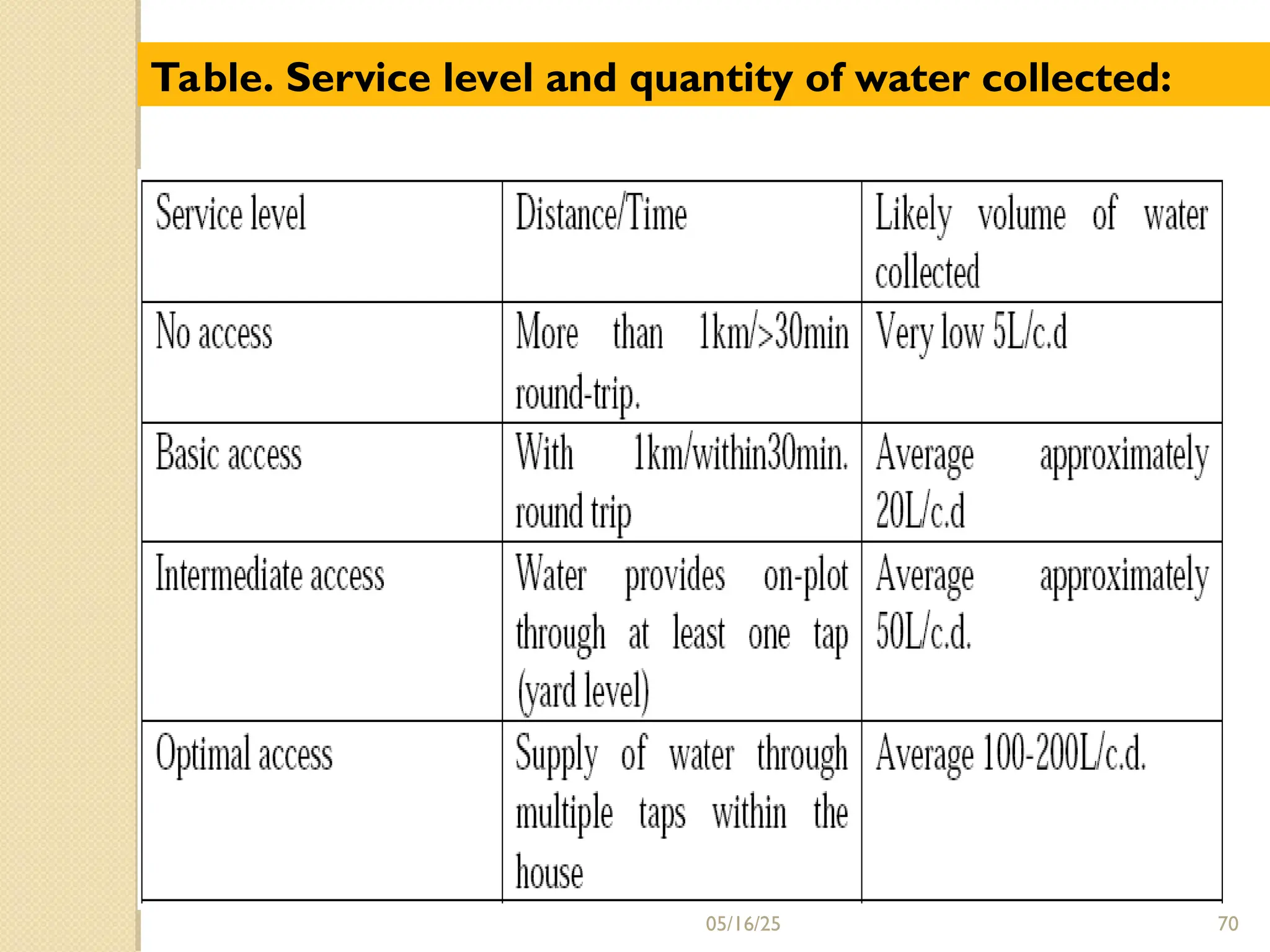
Faculty of HealthSciences, Unity
Faculty of Health Sciences, Unity
University
University
05/16/25 1
Environmental health
Environmental health
I. Introduction
I. Introduction to Environmental Health
2.
the total sumof the condition of the surroundings
within which an organism, or group, or an object
an organism, or group, or an object
exists.
Definitions : What is
Definitions : What is environment
environment?
?
05/16/25 2
Definitions:
Definitions: What isthe
What is the environment
environment?
?
“Environment” is
all that which is external to the individual
human host (Last 1995).
the sum of all
all external
external influences and conditions
influences and conditions
which affect health, life, and growth. This
includes the physical, biological, and Psycho-
social environment” (WHO);
05/16/25 4
5.
Definitions: What is
Definitions:What is health
health?
?
Health:
◦ The condition of being sound in body,
mind, or spirit.
◦ A state of complete physical, mental,
and social well-being and not merely the
absence of disease or infirmity ( WHO,1948).
Sanitation – Latin word “Santias”
Equivalent to health
Sanitation indicates the establishment of
environmental conditions favorable for health
05/16/25 5
6.
6
What makes anindividual is becoming
healthy?
Stable global
environment
Safe and peaceful
settlements
Safe & sufficient
water
Clean air
Safe and
adequate food
05/16/25
Source: Yassiet al. (2001). UNEP.
A Healthy Environment: Basic Requirements?????
7.
Definitions: Environmental Health?
Definitions:Environmental Health?
In layman's terms, it is the health impact of
◦ the air we breathe,
◦ the water we drink,
◦ the homes we live in,
◦ the soil growing the food we eat, and
◦ the many other environmental exposures in our
lives.
05/16/25 7
8.
Definitions: Environmental Health?
Definitions:Environmental Health?
It refers to the theory and practice of assessing,
correcting, controlling, and preventing those
factors in the environment that can potentially affect the
health of present and future generations (WHO).
EH is “Is the prevention of disease and promotion of
health by elimination (controlling) the environmental
factors that form links in chain of disease transmission”
(WHO).
Example: Quality of air, water, food, soil Vs quality of
Example: Quality of air, water, food, soil Vs quality of
life???
life???
05/16/25 8
9.
9
Definitions: Environmental Health?
Definitions:Environmental Health?
A hazard is anything in the environment that can hurt people
or make people sick.
Bacteria &
viruses
Harmful
chemicals
Loud noises
Tobacco
smoke
Stress
Hazards
“It is a branch of public health that protects against the
effects of environmental hazards that can
adversely effect health or the ecology of balances essential to
human health and environmental quality “ [Agency for Toxic
Substances, USA, 1998]
05/16/25
10.
Definitions: Environmental Health?
Definitions:Environmental Health?
Environmental health is
◦ Similar with: “Environmental sanitation” or
“ Environmental hygiene”
Synonyms: Sanitation, Environmental
sanitation, Environmental hygiene,
Environmental Health, now WASH
◦ Which one has broader concept? Hygiene;
Hygiene;
sanitation ; Environmental Health
sanitation ; Environmental Health
05/16/25 10
11.
The global diseaseburden, classified by risk factors,
reveals that 21%
21% are associated to environmental
environmental
health
health.
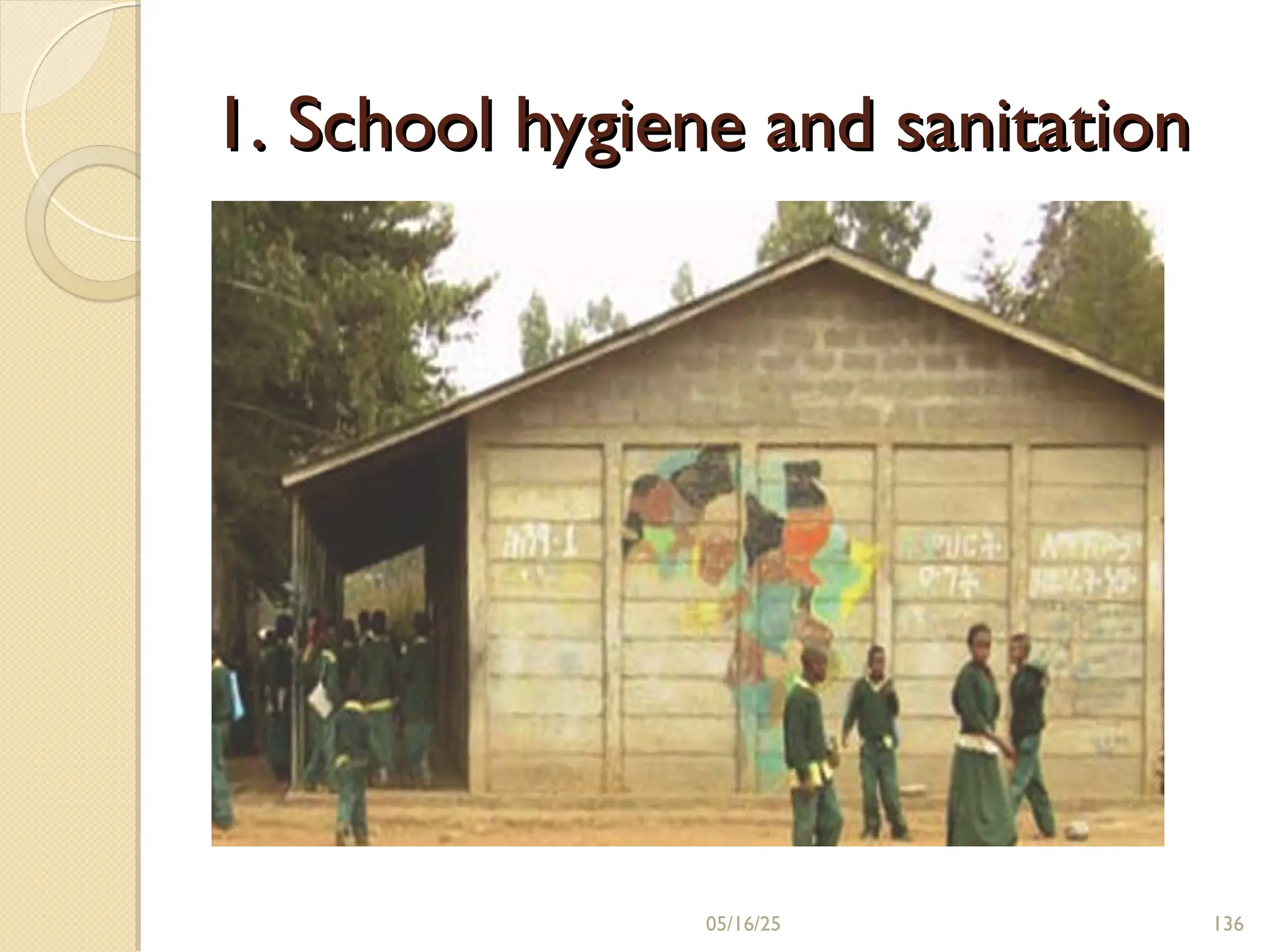
05/16/25 11
Why we concern on environment?
Why we concern on environment?
(WHO, 2002 in Cairncross et al., 2003)
13 million deaths could be prevented every year
by making our environment healthier( WHO
2008b and 2008g)
12.
Why we Concern
Whywe Concern of
of environmental?
environmental?
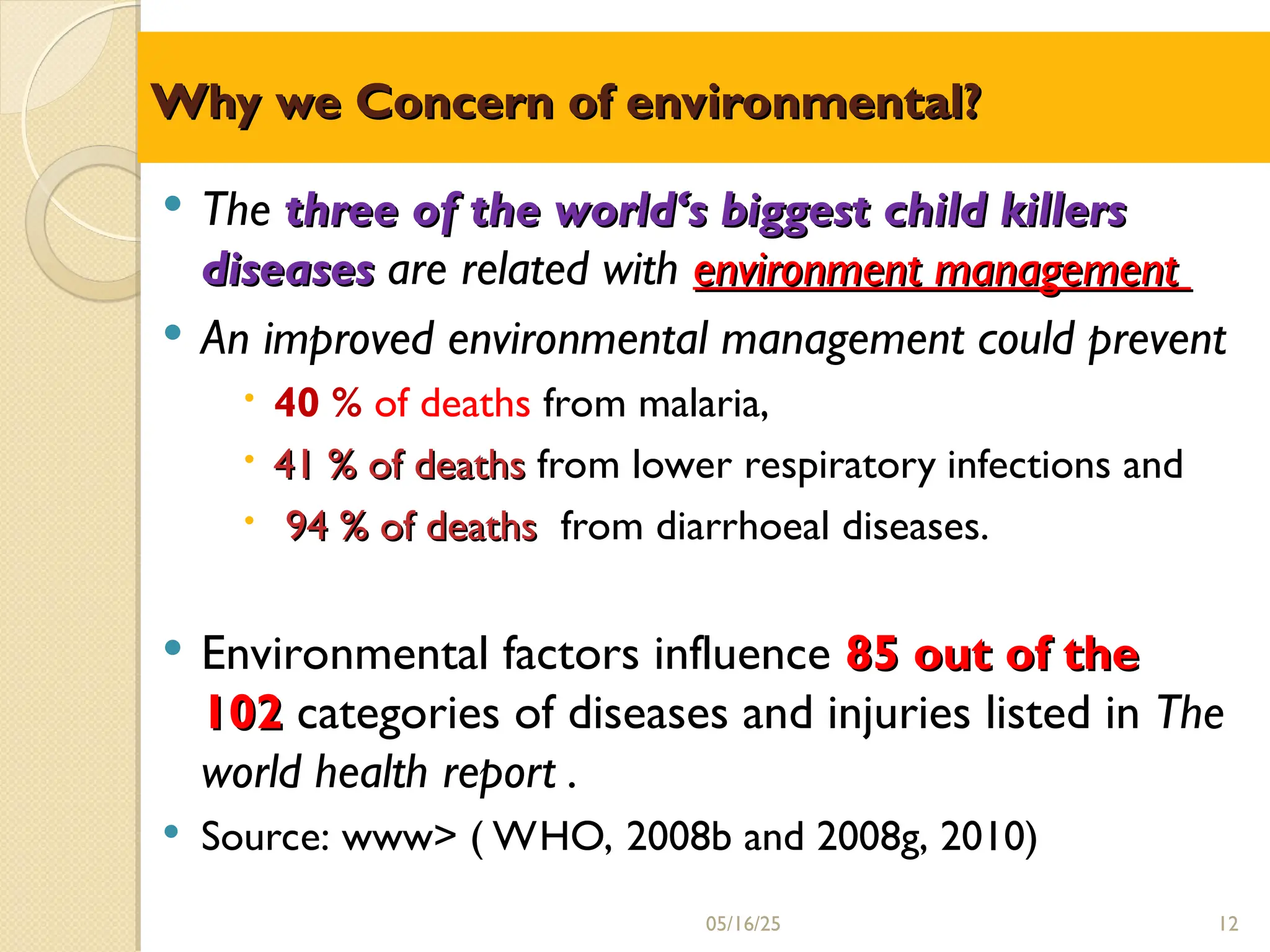
The three of the world‘s biggest child killers
three of the world‘s biggest child killers
diseases
diseases are related with environment management
environment management
An improved environmental management could prevent
40 % of deaths from malaria,
41 % of deaths
41 % of deaths from lower respiratory infections and
94 % of deaths
94 % of deaths from diarrhoeal diseases.
Environmental factors influence 85 out of the
85 out of the
102
102 categories of diseases and injuries listed in The
world health report .
Source: www> ( WHO, 2008b and 2008g, 2010)
05/16/25 12
13.
Environmental risk factors
Environmentalrisk factors
Environmental risk factors Related diseases and conditions
Contaminated water, lack of latrines,
poor hand washing, inappropriate solid
waste management, open defecation,
vector infestation
Indoor air pollution
Outdoor/ambient air pollution
General environmental hazards (climate,
mosquitoes, nutrition)
Environmental hazards in workplaces
(excess noise, heat, dust, chemicals)
Diarrhoeal diseases, trachoma,
schistosomiasis, ascariasis, trichuriasis,
hookworm, typhoid fever, relapsing
Fever
Chronic obstructive pulmonary disease,
lower respiratory infections, lung cancer
Respiratory infections, cardiovascular
diseases, lung cancer
Diarrhoeal diseases, malnutrition,
malaria and other vector-borne diseases;
heat exhaustion,
Injuries, hearing loss, cancer, asthma,
back pain, chronic obstructive
pulmonary disease
05/16/25 13
14.
Role of environmentalhealth
Role of environmental health
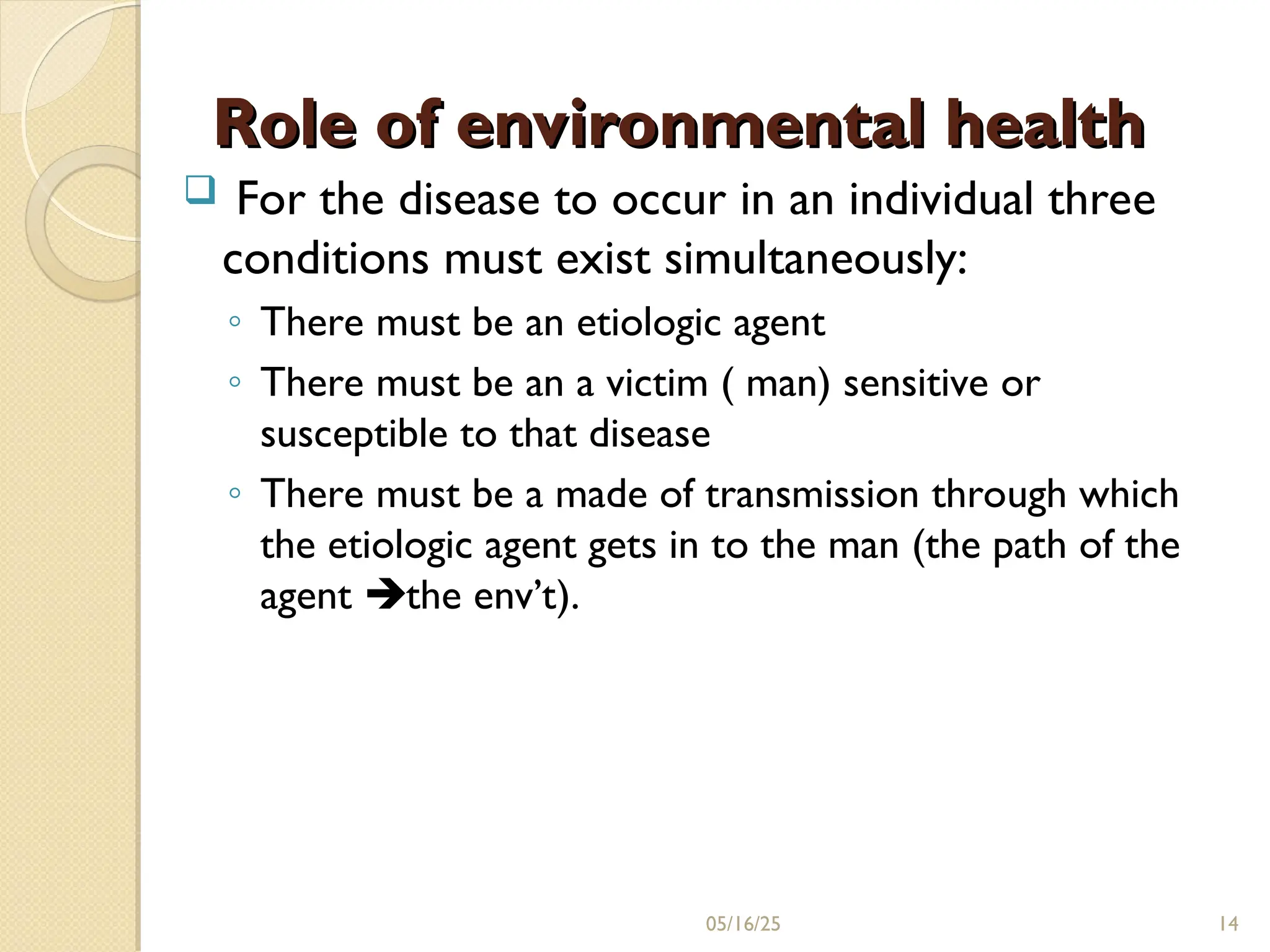
For the disease to occur in an individual three
conditions must exist simultaneously:
◦ There must be an etiologic agent
◦ There must be an a victim ( man) sensitive or
susceptible to that disease
◦ There must be a made of transmission through which
the etiologic agent gets in to the man (the path of the
agent the env’t).
05/16/25 14
15.
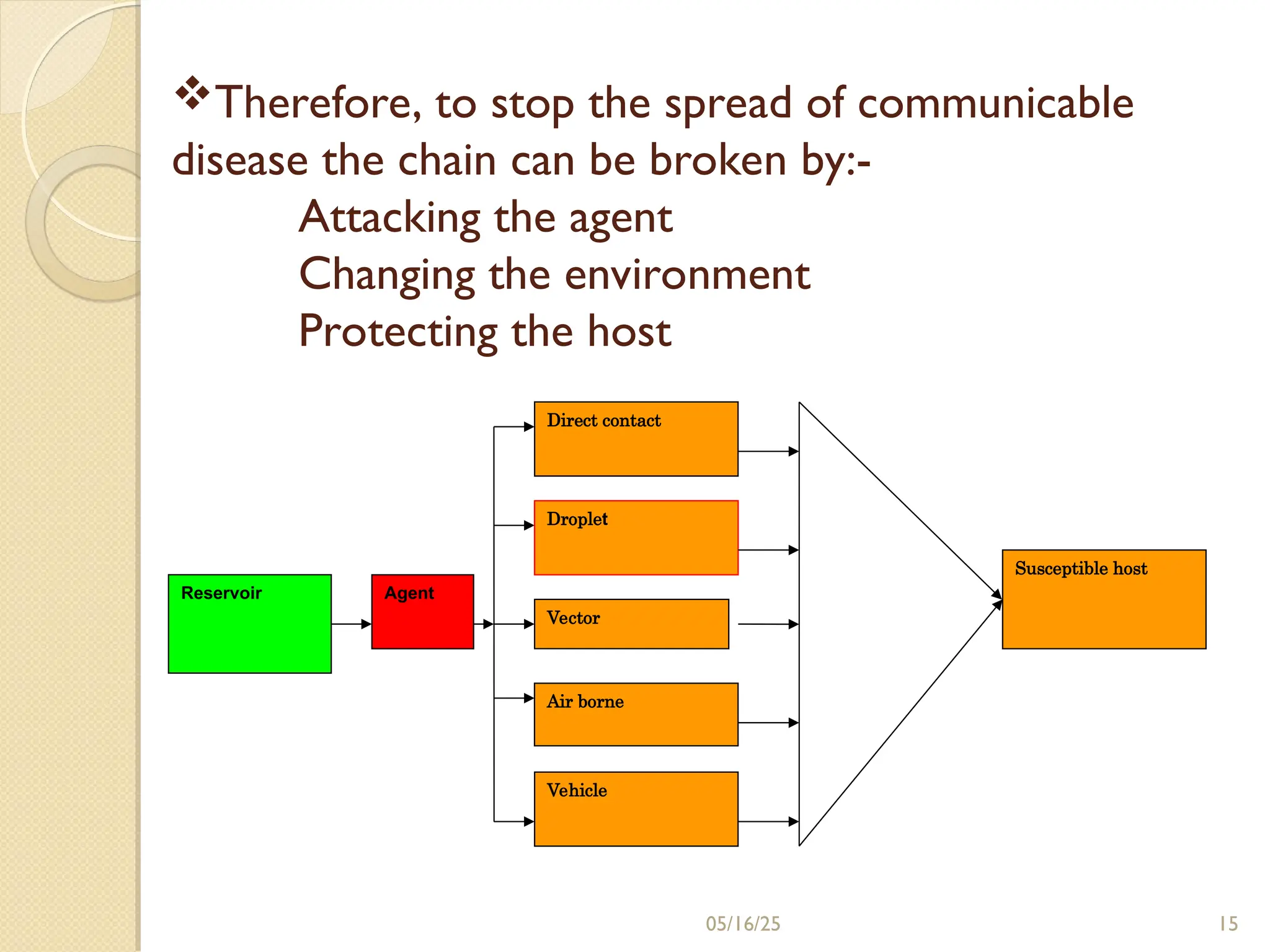
Therefore, to stopthe spread of communicable
disease the chain can be broken by:-
Attacking the agent
Changing the environment
Protecting the host
05/16/25 15
Direct contact
Vector
Vehicle
Susceptible host
Agent
Reservoir
Air borne
Droplet
16.
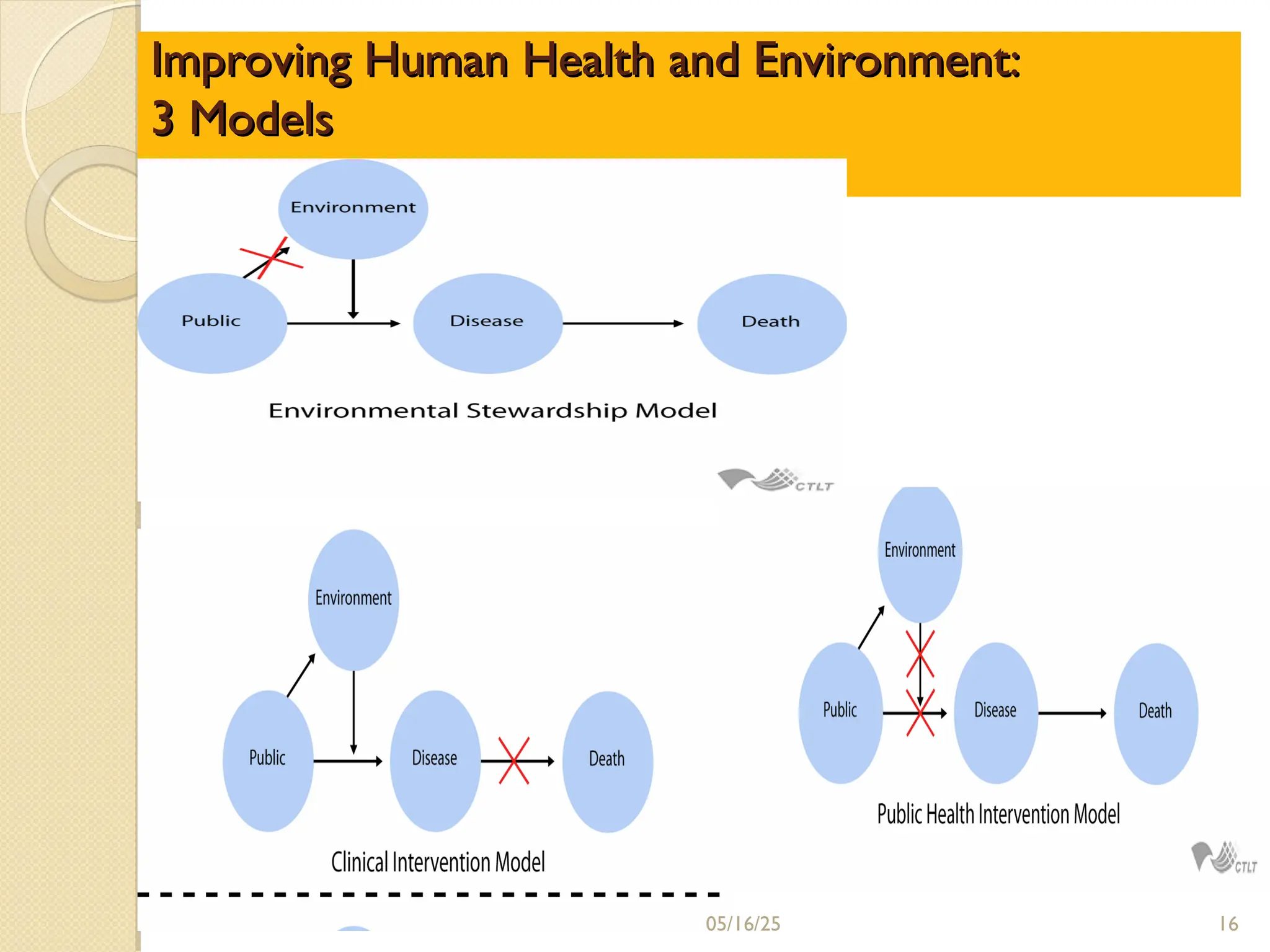
Improving Human Healthand Environment:
Improving Human Health and Environment:
3 Models
3 Models
05/16/25 16
17.
Scopes of EnvironmentalHealth
Scopes of Environmental Health
05/16/25 17
Food hygiene
Healthful housing
Institutional hygiene
Occupational hygiene
Human waste disposal
Water supply
Solid waste management
Vector control
Environmental pollution
Hygiene education
Nature VsEnvironment
Nature :
◦ the whole of the physical world; it is also what
exists outside of any human action.
Environment:
◦ the surroundings and the living conditions of man
and society, as they are or as they are
perceived’.
05/16/25 19
Man-environment Interaction
Definition of terms
Definitionof terms
Built environment:
◦ refers to constructed surroundings that provide the
setting for human activity, ranging from the large-scale
civic surroundings to the personal places.
Social environment:
◦ refers to the culture that an individual lives in, and the
people and institutions with whom they interact.
Environmental Racism:
◦ refers to when vulnerable groups
vulnerable groups are more affected by
environmental health problems
environmental health problems. Eg. Women, children,
and the poor disproportionately affected by pollution
21
05/16/25
22.
22
Atmosphere:
Space occupied byair
Hydrosphere:
Space occupied by
water
Lithosphere/Pedosphere
: Space occupied by solid/soil
Biosphere: Space
occupied by life
Components of environment
05/16/25
23.
Component of Environment
Componentof Environment
Environment Biological
Environment
Cultural
Environment
Physical
Environment
Atmosphere
Hydrosphere
Lithosphere
Plant
Animal
Microbial
Society
Economy
Politics 23
05/16/25
24.
Man environment relationship
Man environment relation ship
How do you explain man vs EN r/ship?
Two schools of thought
A. Environmental Determinism:
◦ beliefs that environment impacts on human
behaviour.
◦ humans are solely the product of their environment.
◦ Processes of determinism are:
Climate – major determinant of the state of
health and mind.
05/16/25 24
25.
B. EnvironmentPossibilism:
◦ Beliefs that man is in the first place.
◦ Nature is an advisor.
◦ There are no necessities but everywhere
possibilities and man as the master of these
possibilities is the judge of their use.
The processes of possibilism are:
◦ Technological advancement
◦ Human skills
05/16/25 25
Man environment relation ship
Man environment relation ship
26.
Man-environment interaction
Man-environment interaction
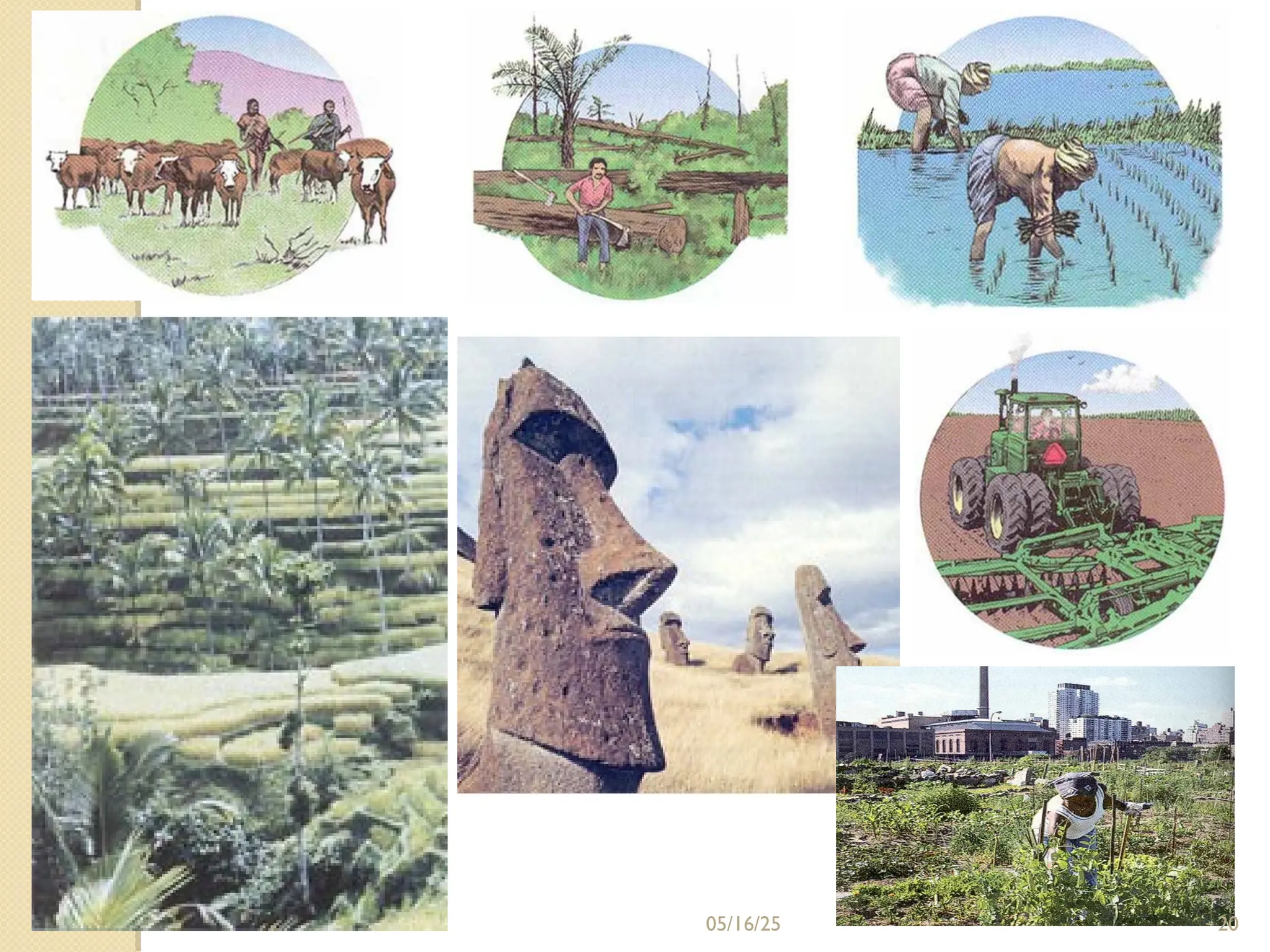
The likely interactions are three types:
◦ Environment affecting humans
Environment affecting humans: natural
natural
disasters
disasters
◦ Man affecting the environment:
Deforestation
◦ Friendly co-existence
Friendly co-existence (Sustaining both)
Environmental sustainability is a global issue
26
05/16/25
27.
Fast populationbuild up
Fast population build up
Transition from agriculture to industrial
Transition from agriculture to industrial
society
society
Development thrust:- more goods and
Development thrust:- more goods and
services per person are required.
services per person are required.
Factors that drives human and environmental
interaction severe
The World’s changing scenario
27
05/16/25
28.
Global issues ofman-environment interaction
Global issues of man-environment interaction
◦ Hazardous waste
◦ Air pollution
◦ Trans-boundary
waste movement
◦ Global warming
◦ Ozone depletion
◦ Bio-terrorism
• New global problems on the environment
28
05/16/25
29.
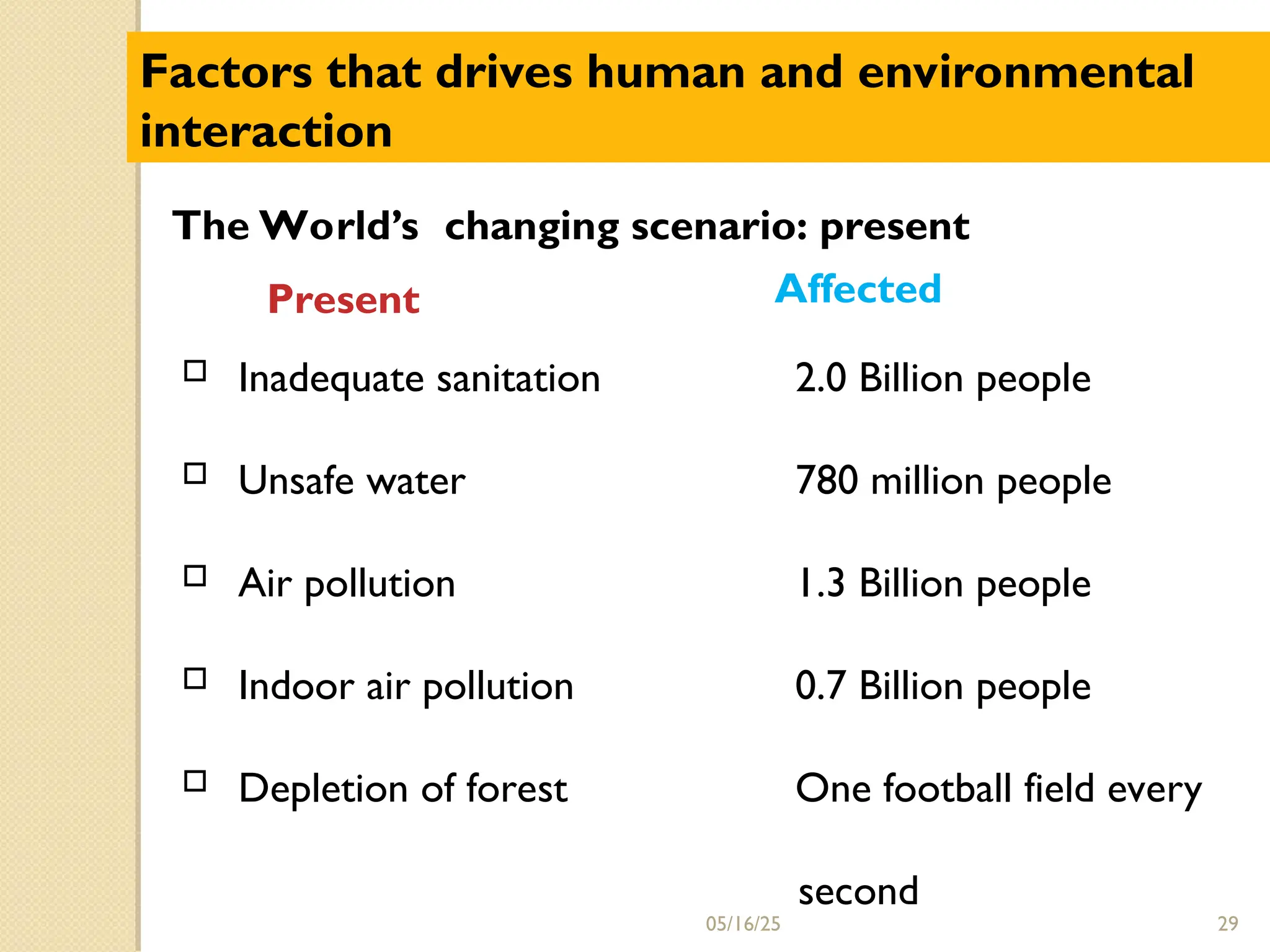
Present
Inadequate sanitation2.0 Billion people
Unsafe water 780 million people
Air pollution 1.3 Billion people
Indoor air pollution 0.7 Billion people
Depletion of forest One football field every
second
Factors that drives human and environmental
interaction
Affected
The World’s changing scenario: present
29
05/16/25
30.
Tips
Tips
“The Earth providesenough
for every man’s need, but not
enough for every man’s
greed.”
•Mahatma Gandhi
30
05/16/25
III. Provision ofSafe and Adequate Water
III. Provision of Safe and Adequate Water
Supply
Supply
Definition of terms
Importance of water
Occurrence of water
Impurities of water
Major sources of water
Treatment of water
Water quality surveillance
05/16/25 32
33.
Introduction
Introduction
Water isessential for life.
About 70% of human’s body weight is water.
It is the medium in which all living processes occur.
05/16/25 33
34.
The provisionof safe and
adequate water supply in
a community is therefore of
the greatest importance in
public health service.
05/16/25 34
Introduction con’t
Introduction con’t
water also plays a key role in
the prevention of disease.
Drinking eight glasses of
water daily can decrease the
risk of
colon cancer by 45%,
bladder cancer by 50%
35.
Definition of terms
Definitionof terms
Raw-water: natural untreated water
natural untreated water from
different sources eg. Rivers, Lakes or from unprotected
wells or springs.
Potable water (drinking water): water which is free
from harmful substances, pathogenic organisms.
Palatable water: water which is pleasant to drink.
This is not necessary potable it may actually
contaminate.
05/16/25 35
36.
Occurrences of water
Occurrencesof water
The tiny usable portion is about 0.8% of the total 2.53%,
which is neither evenly distributed nor properly used.
the distribution
distribution, quality
quality, quantity
quantity and mode of
mode of
occurrence
occurrence are highly variable from one locality to another.
05/16/25 36
37.
05/16/25 37
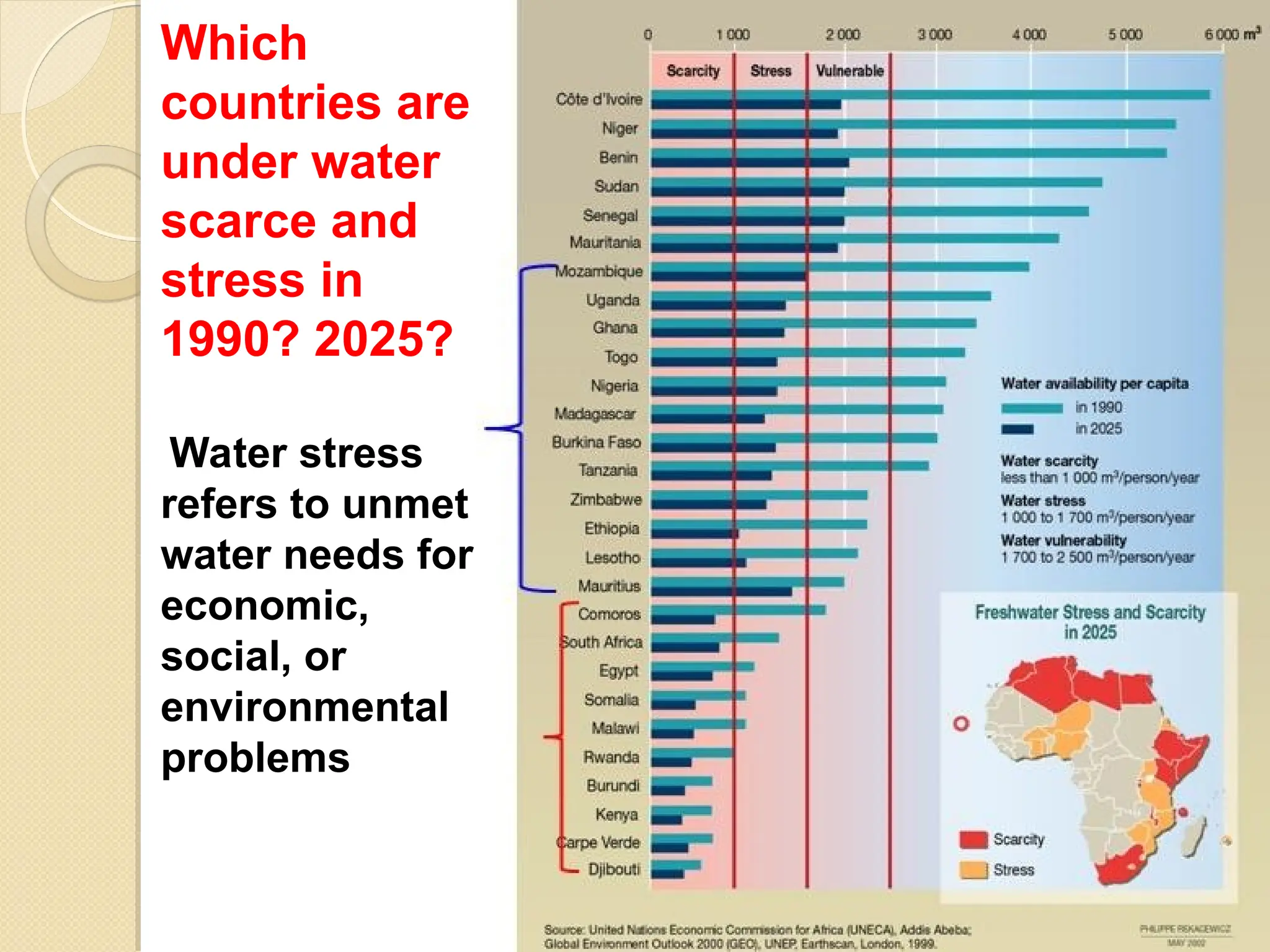
Which
countries are
underwater
scarce and
stress in
1990? 2025?
Water stress
refers to unmet
water needs for
economic,
social, or
environmental
problems
38.
Hydrologic cycle ofwater
Hydrologic cycle of water
What are the process occurring during Hydrologic
cycle?
What is its implication on quality of water?
05/16/25 38
39.
Importance of water
Importanceof water
05/16/25 39
Physiological needs: drinking/ cleaning/washing
Social use: swimming, recreational
Cultural/ Spiritual values: “Tebel”,
“Timket”
Economical: agriculture, transportation, power
production, industrial use, etc,
Q? Ethiopian case Vs disease
transmission ???
40.
Public health importanceof water
Public health importance of water
How many are at risk?
Over 780 million
Over 780 million people lack access to an “improved
improved”
drinking water supply; many more drink
drink water that is
grossly contaminated. (JMP 2012 report)
How many are getting sick?
4 billion cases of diarrhoea occur annually, of which
> 85% is attributable to unsafe water, and inadequate
sanitation and hygiene.
How many are dying?
1.8 million
1.8 million people die every year from diarrhoeal
diarrhoeal
diseases, the majority are children under 5.
(Source: WHO 2008a &b)
05/16/25 40
41.
Sources of water
Sourcesof water
Groundwater: Available at point of need with little cost
Surface water: Usually requires extensive purification
Rain water: relatively safe
Ocean water: Costly to desalinate
????? Health implication Vs source of water
In Ethiopia which source of water is abundant?
Overall: 54% improved sources. DHS 2011
05/16/25 41
Class exercise
Class exercise
How much “diarrhea diseases” could be
reduced if you will have 100% water
coverage in village “X”. Assume the
prevalence of diarrhea among under-five
children in this village is 45%.
05/16/25 43
44.
Diseases associatedwith water can be broadly
classified in to 5 epidemiological
5 epidemiological groups:-
i. Water borne disease
ii. Water washed disease
iii. Water related disease
iv. Water based /impounding disease
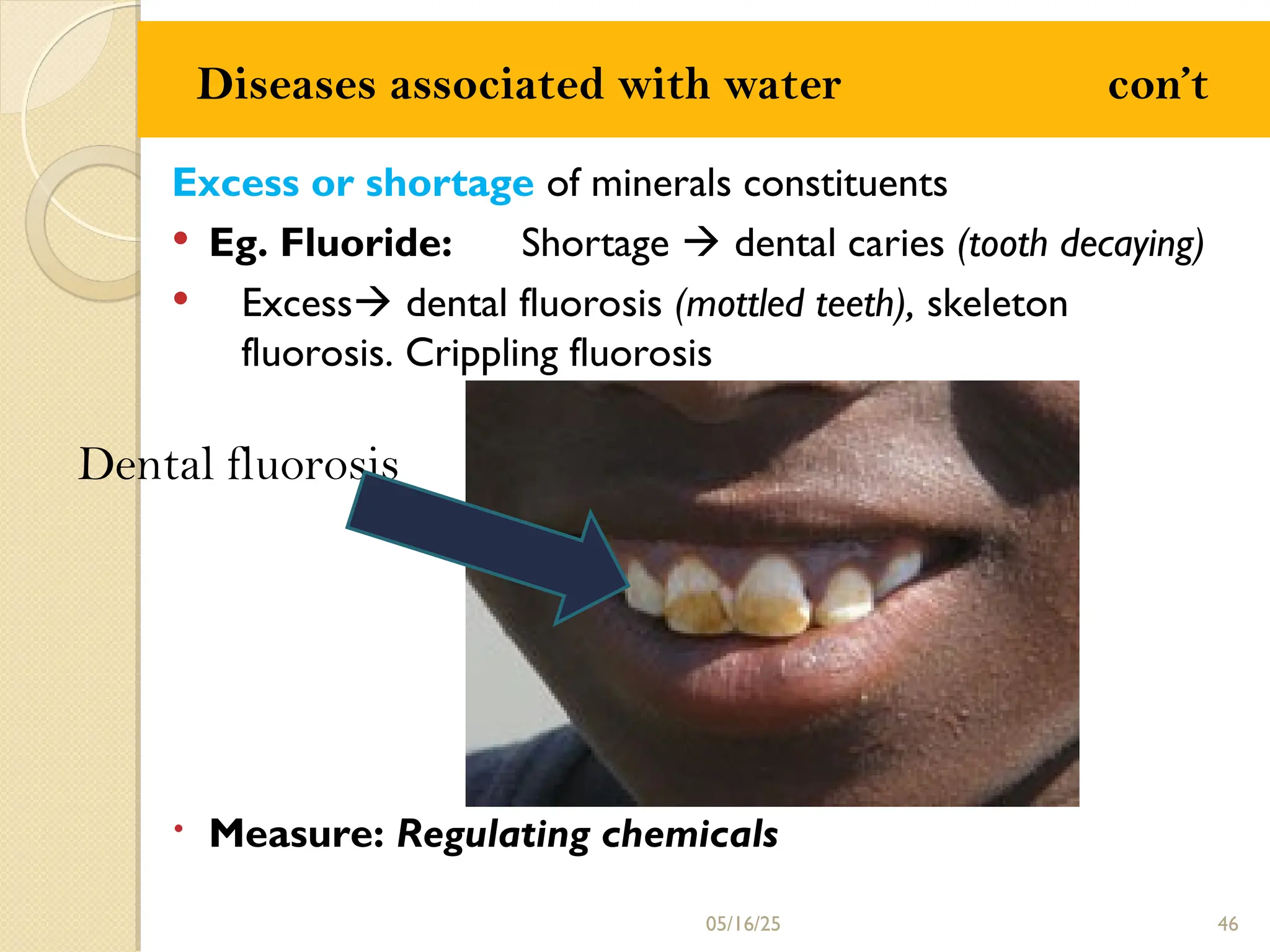
v. Excess/shortage of minerals constituents
05/16/25 44
Diseases associated with water
45.
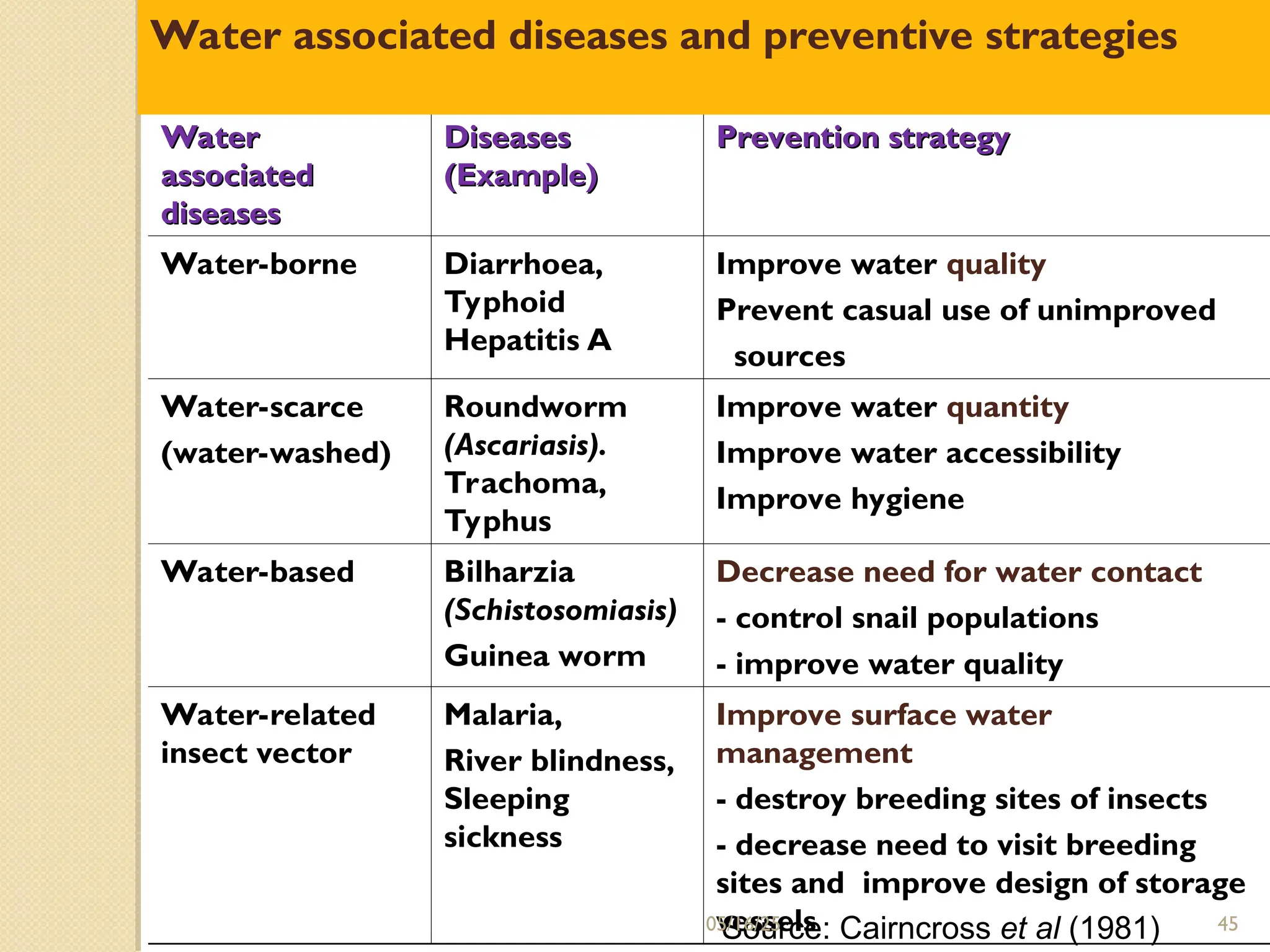
Water
Water
associated
associated
diseases
diseases
Diseases
Diseases
(Example)
(Example)
Prevention strategy
Prevention strategy
Water-borneDiarrhoea,
Typhoid
Hepatitis A
Improve water quality
Prevent casual use of unimproved
sources
Water-scarce
(water-washed)
Roundworm
(Ascariasis).
Trachoma,
Typhus
Improve water quantity
Improve water accessibility
Improve hygiene
Water-based Bilharzia
(Schistosomiasis)
Guinea worm
Decrease need for water contact
- control snail populations
- improve water quality
Water-related
insect vector
Malaria,
River blindness,
Sleeping
sickness
Improve surface water
management
- destroy breeding sites of insects
- decrease need to visit breeding
sites and improve design of storage
vessels
Water associated diseases and preventive strategies
Source: Cairncross et al (1981)
05/16/25 45
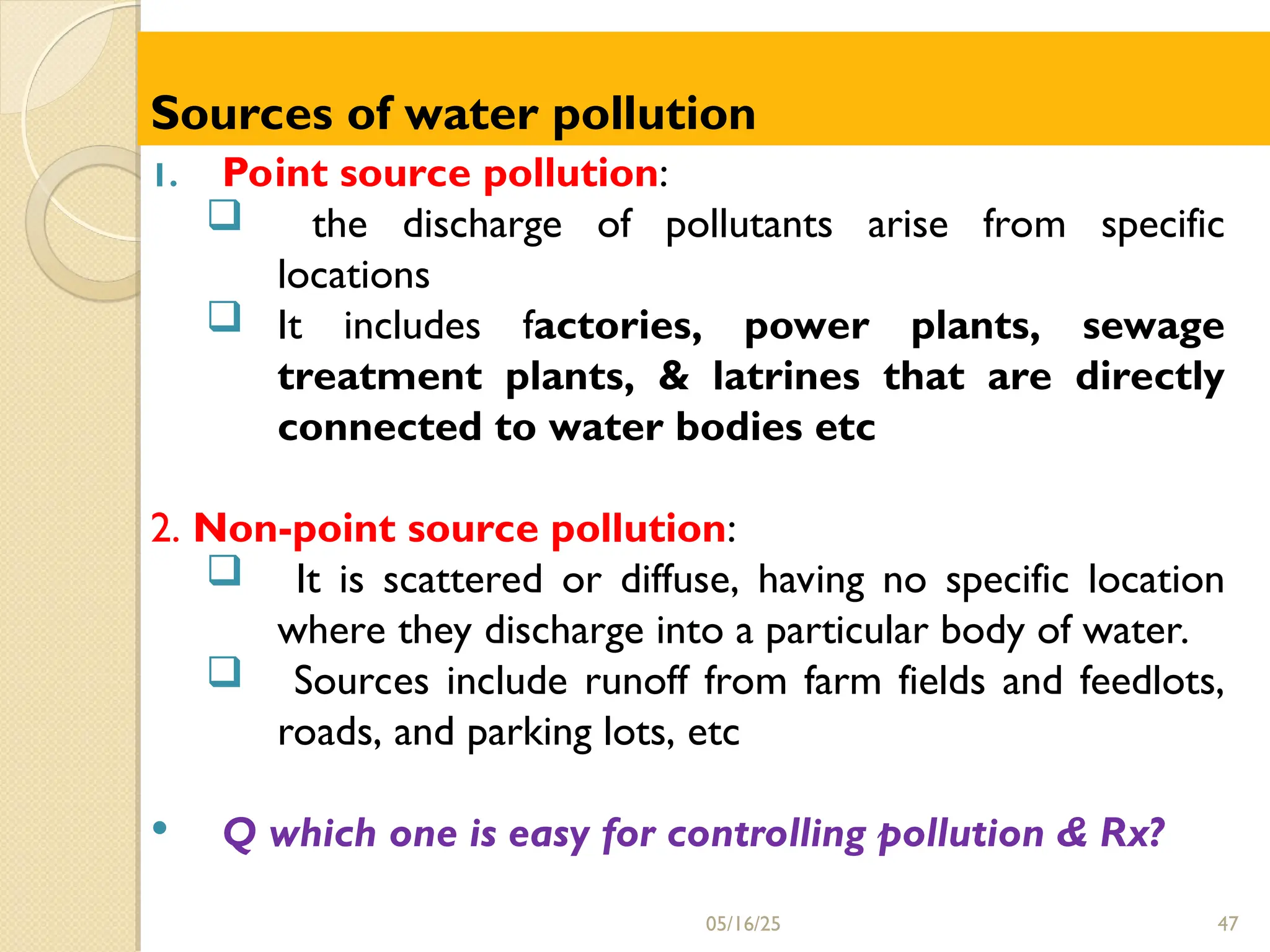
1. Point sourcepollution:
the discharge of pollutants arise from specific
locations
It includes factories, power plants, sewage
treatment plants, & latrines that are directly
connected to water bodies etc
2. Non-point source pollution:
It is scattered or diffuse, having no specific location
where they discharge into a particular body of water.
Sources include runoff from farm fields and feedlots,
roads, and parking lots, etc
Q which one is easy for controlling pollution & Rx?
Sources of water pollution
05/16/25 47
48.
Water treatment/disinfection
Water treatment/disinfection
Process of removing all those substances whether
biological, chemical or physical impurities
biological, chemical or physical impurities which are
potentially dangerous or undesirable in water supplies for
human and domestic use.
Water treatment processes can be:
Physical treatment
Physical treatment process??????
Chemical treatment
Chemical treatment process???????
What is the important factor to selection proper water
Rx process?
05/16/25 48
49.
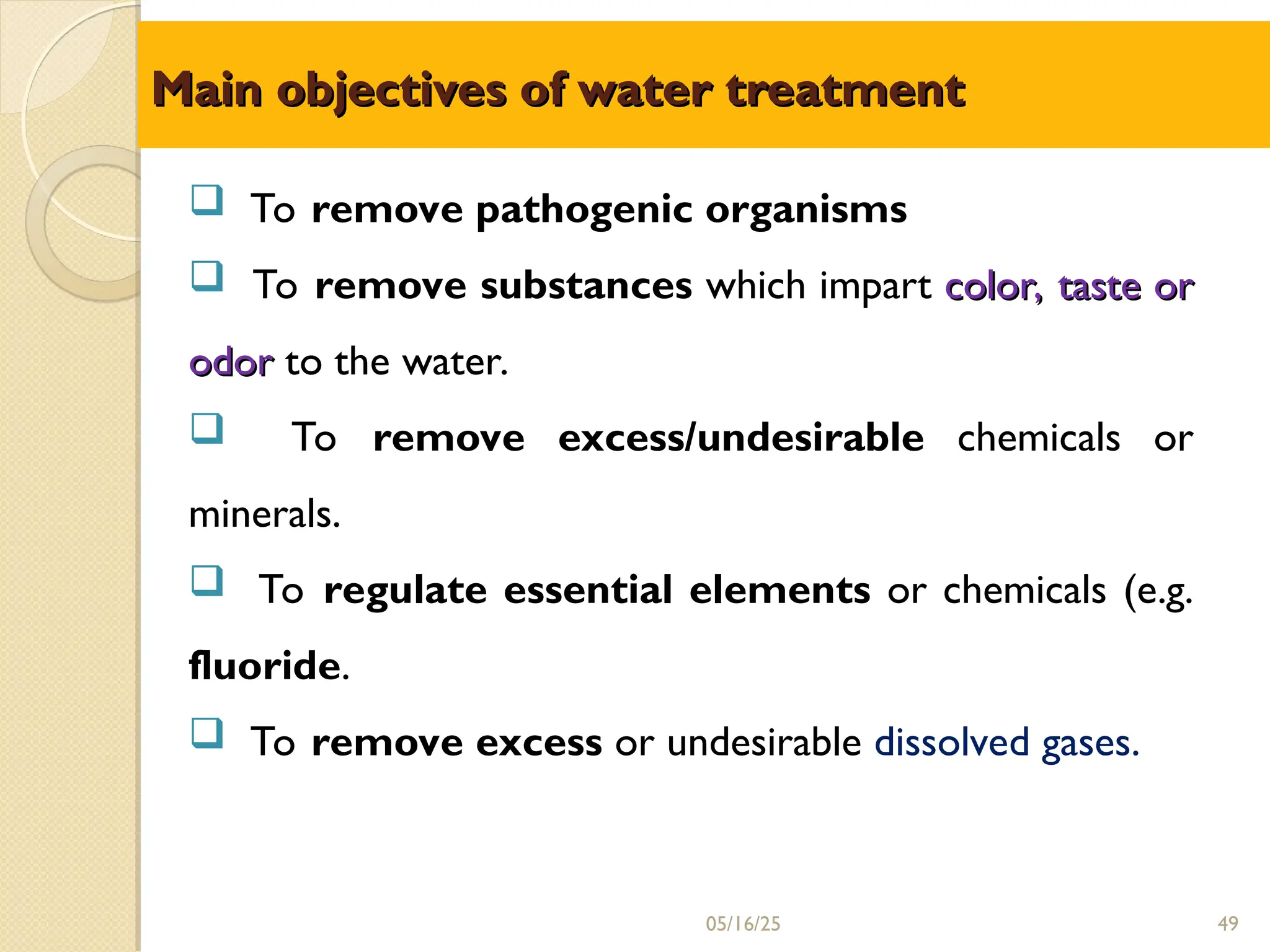
Main objectives ofwater treatment
Main objectives of water treatment
To remove pathogenic organisms
To remove substances which impart color, taste or
color, taste or
odor
odor to the water.
To remove excess/undesirable chemicals or
minerals.
To regulate essential elements or chemicals (e.g.
fluoride.
To remove excess or undesirable dissolved gases.
05/16/25 49
50.
Types of watertreatment
Types of water treatment
B. Homemade water
(small scale) treatment
Boiling
sand filter
Candle filter
chlorination
Storage ??????????????
SODIS (solar
disinfection)
A. Municipality (large
scale water) treatment
1. Ground water:
Aeration
Disinfection
2. Surface water:
Screening
Coagulation
Sedimentation
Filtration
Chlorination (Pre vs Post)
05/16/25 50
Water Disinfection
Water Disinfection
Water disinfection is the destruction, or at least the
complete inactivation of harmful micro-organisms
present in the water.
Pre-treatments of water can not assure the water is
bacteriological safe, i.e. final disinfection (post-chlorination)
will be needed.
◦ purpose: controlling algae, taste, and odor and kill
kill
pathogens.
pathogens. it may produce disinfection by-products
disinfection by-products
(DBPs)
(DBPs) If it reacts with some organic materials
post-chlorination: It is normally performed at the end of
the treatment after the filtration stage
filtration stage.
Purpose : for residual effect to protects cross
contamination
05/16/25 53
54.
Chlorine and itscompounds
Chlorine and its compounds
Why they preferred ? They are:
comparatively in-expensive.
relatively easy to handle
and transport
readily available almost
everywhere.
Effective
simple to apply
relatively easy to detect in
water.
The most popular
substances in the
chlorine family are:-
Chlorine (Cl2): 100%
High-concentration
hypochlorite(Ca(OCl)2):
70%
Sodium hypochlorite
(NaOCl): 2.5% to 17% 05/16/25 54
55.
Relation between dose/demand/residual
Relationbetween dose/demand/residual
Chlorine and its compounds
Chlorine and its compounds
05/16/25 55
Why the right residual chlorine amount is required?
Why the right residual chlorine amount is required?
56.
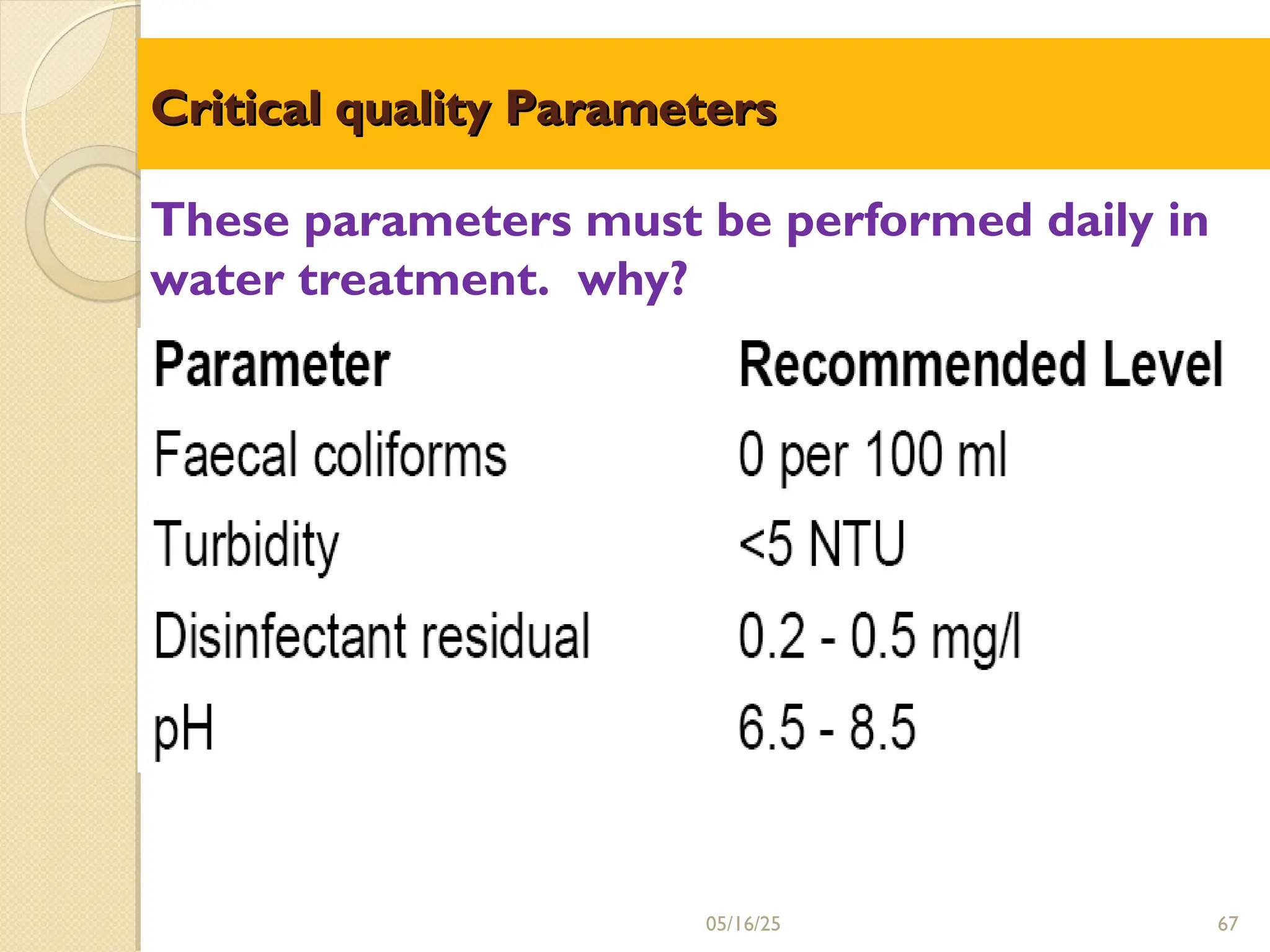
Residual chlorine :0.2- 0.5mg/L
Contact time : > 30 minutes
PH: 6.5- 8.5
Turbidity: 5 NTU
WHO recommends the following conditions for a proper
disinfection:
Chlorine and its compounds
Chlorine and its compounds
05/16/25 56
57.
Surveillance of Water
Surveillanceof Water
Surveillance
Surveillance is an investigative activity to identify and
evaluate factors associated with drinking water which could
pose a risk to health
pose a risk to health.
Surveillance is also both:
Preventive actions: detecting risks so that action may be
taken before public health problems
before public health problems occur and
Remedial actions: identifying the source of Out-breaks
of water borne disease so that corrective action
corrective action may be
taken properly.
05/16/25 57
58.
Water
Water Surveillance con’t
Surveillancecon’t
What its objective?
Is to collect and collate information for protection of public
health by providing full information
full information about water supply respect to:
Quality,
Quantity,
Coverage
Cost
Continuity
05/16/25 58
59.
Water
Water Surveillance con’t
Surveillancecon’t
Methods used in water surveillance:
1. Sanitary surveillance: system integrity to identify
source of contamination
source of contamination; sanitary check list is used a
tool. There are 10 questions related to contamination
Contamination risk score
9-10; very high risk
6-8; high risk
3-5: Intermediate risk
0-2: low risk
05/16/25 59
60.
Water
Water Surveillance con’t
Surveillancecon’t
Methods used in water surveillance:
2. Laboratory surveillance:
Membrane filtered method
Membrane filtered method or most probable
most probable
number
number are used to assess the quality of water
Escherichia coli or thermotolerant coliform bacteria
can be used as an indicator of water quality.
Bacteriophages and/or bacterial spores, should be
considered if there are resistant bacteria to
disinfection such as Enteric viruses and protozoa.
05/16/25 60
61.
Rural Water Supplyin the pastoralist
Rural Water Supply in the pastoralist
area is worse
area is worse
05/16/25 61
Water Sample,
Gashemo Wereda
62.
Water
Water Surveillance con’t
Surveillancecon’t
Methods used in water surveillance:
3. Epidemiological survey: association of disease
with drinking water: cross sectional data,
secondary data are used.
05/16/25 62
63.
Indicators of adrinking-water supply
Indicators of a drinking-water supply
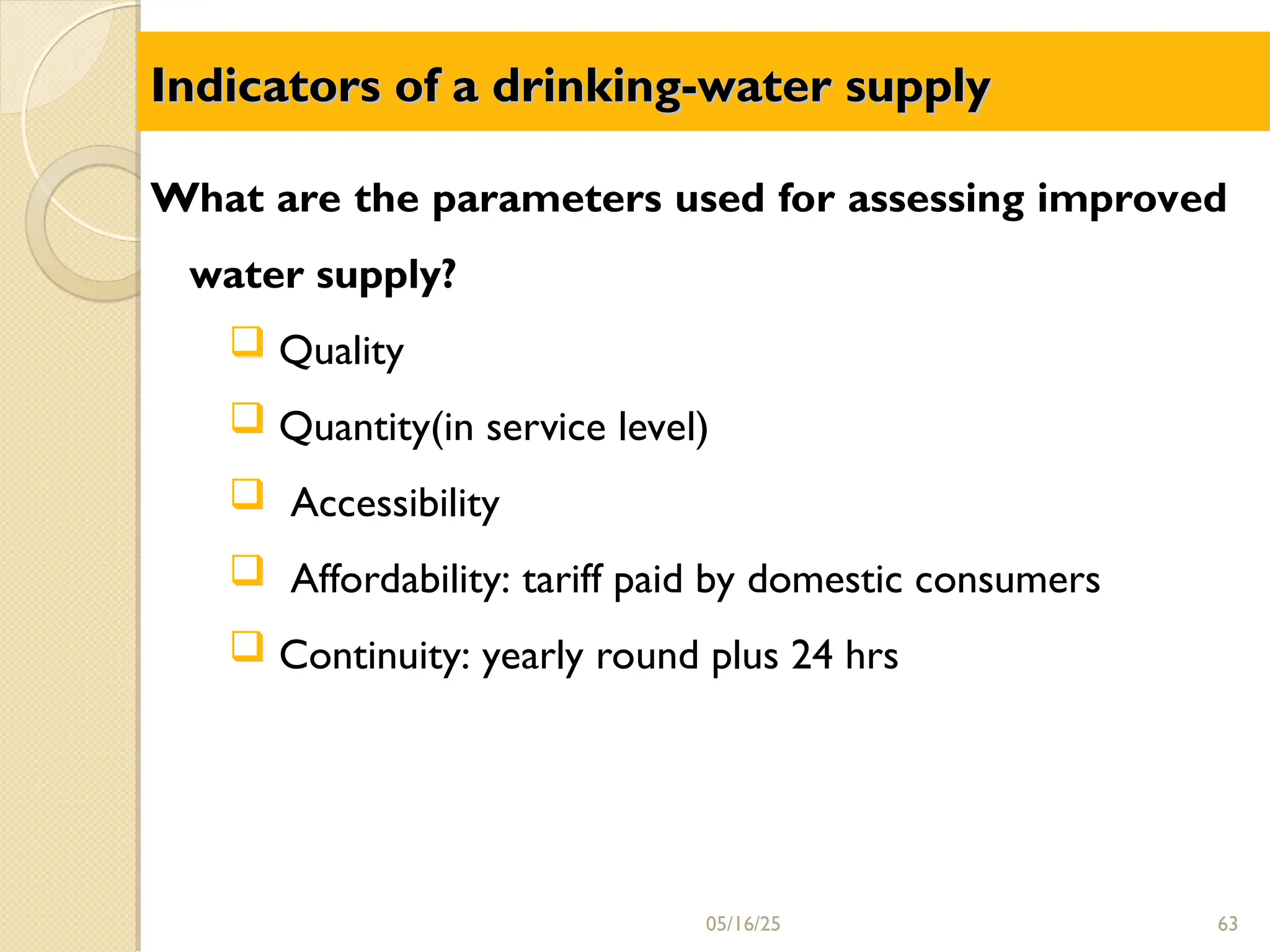
What are the parameters used for assessing improved
water supply?
Quality
Quantity(in service level)
Accessibility
Affordability: tariff paid by domestic consumers
Continuity: yearly round plus 24 hrs
05/16/25 63
64.
Quality
Quality
It iswater that does not contain harmful chemical
harmful chemical
substances, or microorganisms
substances, or microorganisms in concentration
that could cause illness in any form (WHO).
Criteria for assessing quality of water
◦ Clear, tasteless and colorless
◦ Pathogen free
◦ Low in concentrations of toxic compounds
(according to WHO drinking water
05/16/25 64
65.
Quality
Quality
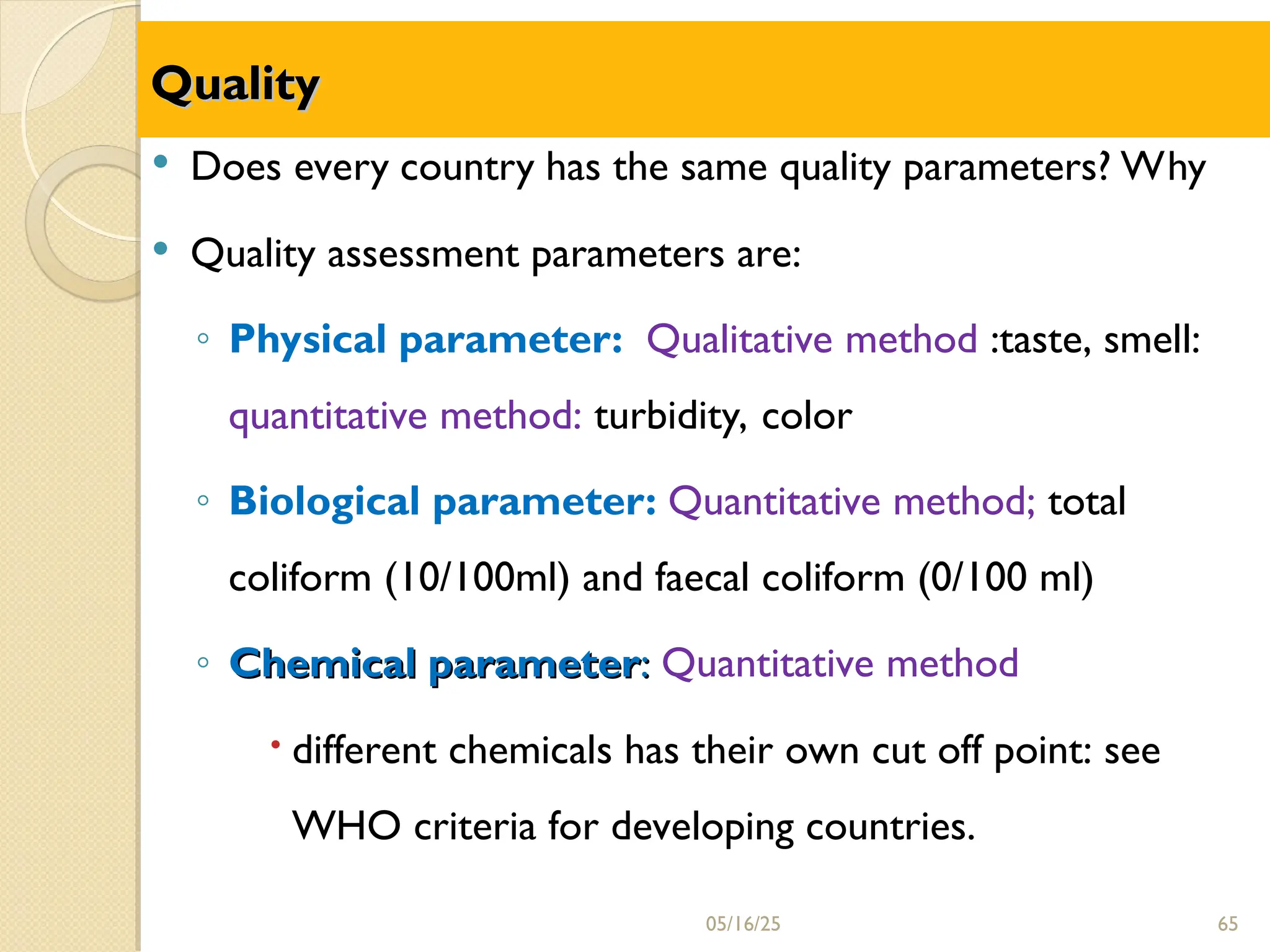
Does everycountry has the same quality parameters? Why
Quality assessment parameters are:
◦ Physical parameter: Qualitative method :taste, smell:
quantitative method: turbidity, color
◦ Biological parameter: Quantitative method; total
coliform (10/100ml) and faecal coliform (0/100 ml)
◦ Chemical parameter
Chemical parameter:
: Quantitative method
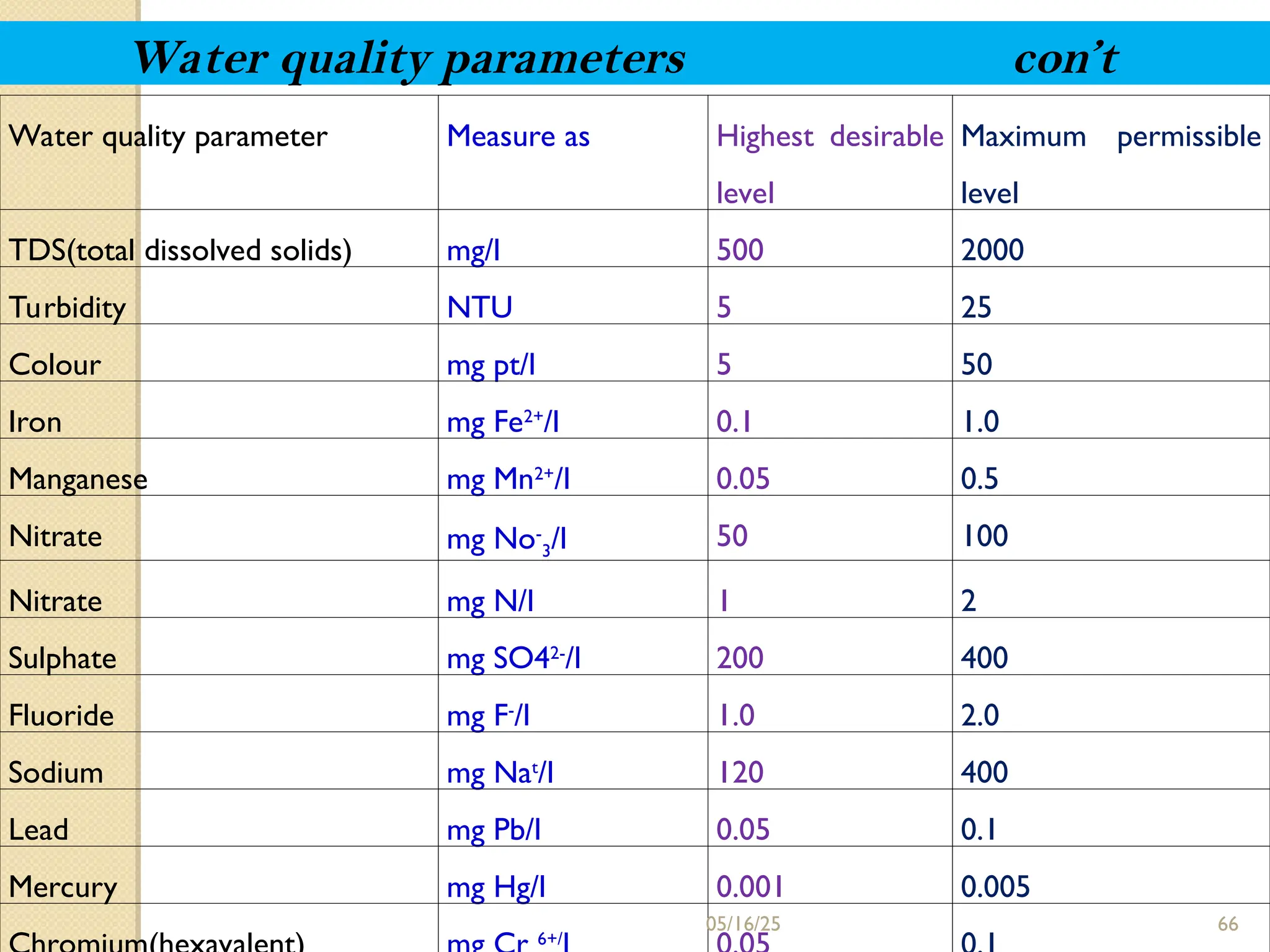
different chemicals has their own cut off point: see
WHO criteria for developing countries.
05/16/25 65
Accessibility: time/distance(<30 minutes for round trip
and if the source of water found with in 1 km radius
(WHO), 1.5 km (Ethiopia).
Coverage is the percentage
percentage of the population that has
reasonable access to an improved drinking water supply
program.
Improved
Improved water
water supply
supply includes: House hold connection,
House hold connection,
public standpipes, protected underground water sources
public standpipes, protected underground water sources
and protected springs.
and protected springs.
05/16/25 68
Accessibility and Coverage
69.
How MuchDo We Need per day?
Adequateness: availability/quantity (a minimum amount of
water required for domestic and drinking purpose.)
◦ Minimum amount of water needed to prevent
prevent
dehydration
dehydration 2 to 4.5 litres
2 to 4.5 litres person per day is required
◦ Minimum amount of water required for domestic use
(drinking, personal hygiene, cooking, laundry and cleaning)
20 litres per person per day is required
20 litres per person per day is required
◦ Access to safe water (69.0%): based on 20 lit/c/d for
urban Vs 15 l/cl/d for rural at 0.5 km radius (data taken
from MOWR)
Quantity of water
05/16/25 69
Improved water supply
◦Household connection
◦ Public standpipe
◦ Borehole
◦ Protected dug-well
◦ Protected spring
◦ Rain water collection
These joint monitoring program
joint monitoring program have been also defined in
terms of providing “reasonable access” as summarized below:
Unimproved water
supply
◦ Unprotected well
◦ Unprotected spring
◦ Tanker-truck provision
of water
◦ Bottled
water??????????????
Accessibility and Coverage
05/16/25 71
72.
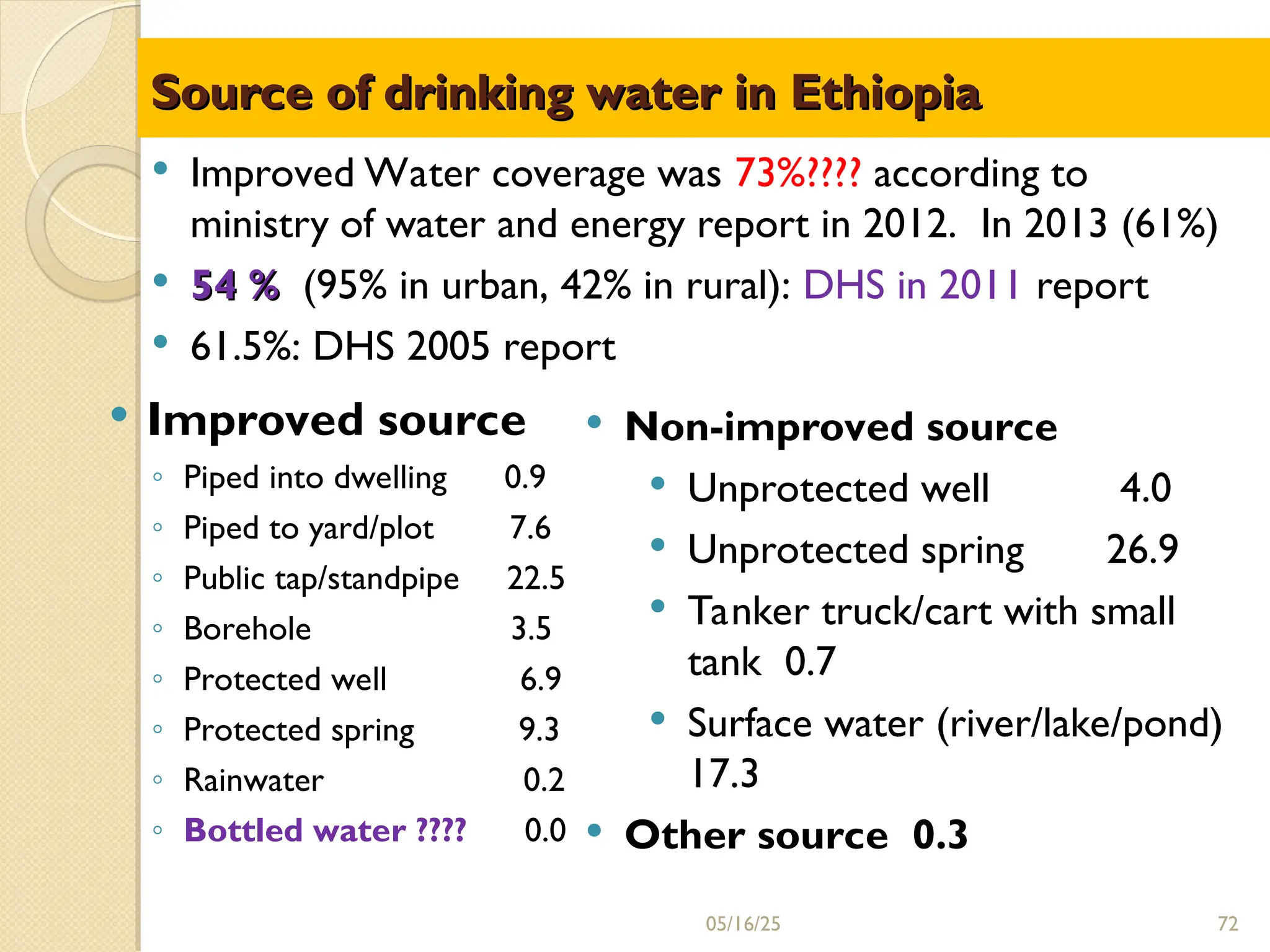
Source of drinkingwater in Ethiopia
Source of drinking water in Ethiopia
Improved source
◦ Piped into dwelling 0.9
◦ Piped to yard/plot 7.6
◦ Public tap/standpipe 22.5
◦ Borehole 3.5
◦ Protected well 6.9
◦ Protected spring 9.3
◦ Rainwater 0.2
◦ Bottled water ???? 0.0
Non-improved source
Unprotected well 4.0
Unprotected spring 26.9
Tanker truck/cart with small
tank 0.7
Surface water (river/lake/pond)
17.3
Other source 0.3
Improved Water coverage was 73%???? according to
ministry of water and energy report in 2012. In 2013 (61%)
54 %
54 % (95% in urban, 42% in rural): DHS in 2011 report
61.5%: DHS 2005 report
05/16/25 72
73.
Coverage of watersupply
Coverage ? Are countries in line with MDG goals?
Proportion of households getting improved water source
Goal 1. Eradicate extreme poverty and hunger
Goal 2. Achieve universal primary education
Goal 3. Promote gender equality and empower women
Goal 4. Reduce child mortality
Goal 5. Improve maternal health
Goal 6. Combat HIV/AIDS, malaria and other diseases
Goal 7. Ensure environmental sustainability
Target 10. Reduce by half the proportion
half the proportion of
people without sustainable access to safe drinking
water
Goal 8. Develop a global partnership for development
05/16/25 73
74.
What is therole of Public health manager
What is the role of Public health manager
in drinking water supply?
in drinking water supply?
Initiating drinking water development
(Small and large scale)
M & E: Source quality assurance
Water supply-line quality assurance
Epidemic investigation Vs Water?
Developing small scale water supply
development
Enhancing community participation:
planning, implementation, use, M & E)
Hygiene Education
05/16/25 74
Outline
Outline
Definition andconcept of food hygiene
Public Health importance
Food safety interventions
Tools to monitor and evaluate food hygiene
05/16/25 76
77.
05/16/25 77
Food
Food:is any solid or liquid, when
eaten and absorbed by the body,
produce energy, promote the growth
and repair of tissue; promotes
resistance against diseases or
maintains and regulates these
processes (WHO)
78.
Definitions
Definitions
It doesnot include substances used as a
drug or medicine (WHO definition).
Or
Food is the one which is physically, chemically,
physically, chemically,
and biologically safe
and biologically safe for human consumption.
05/16/25
Definitions
Definitions
78
79.
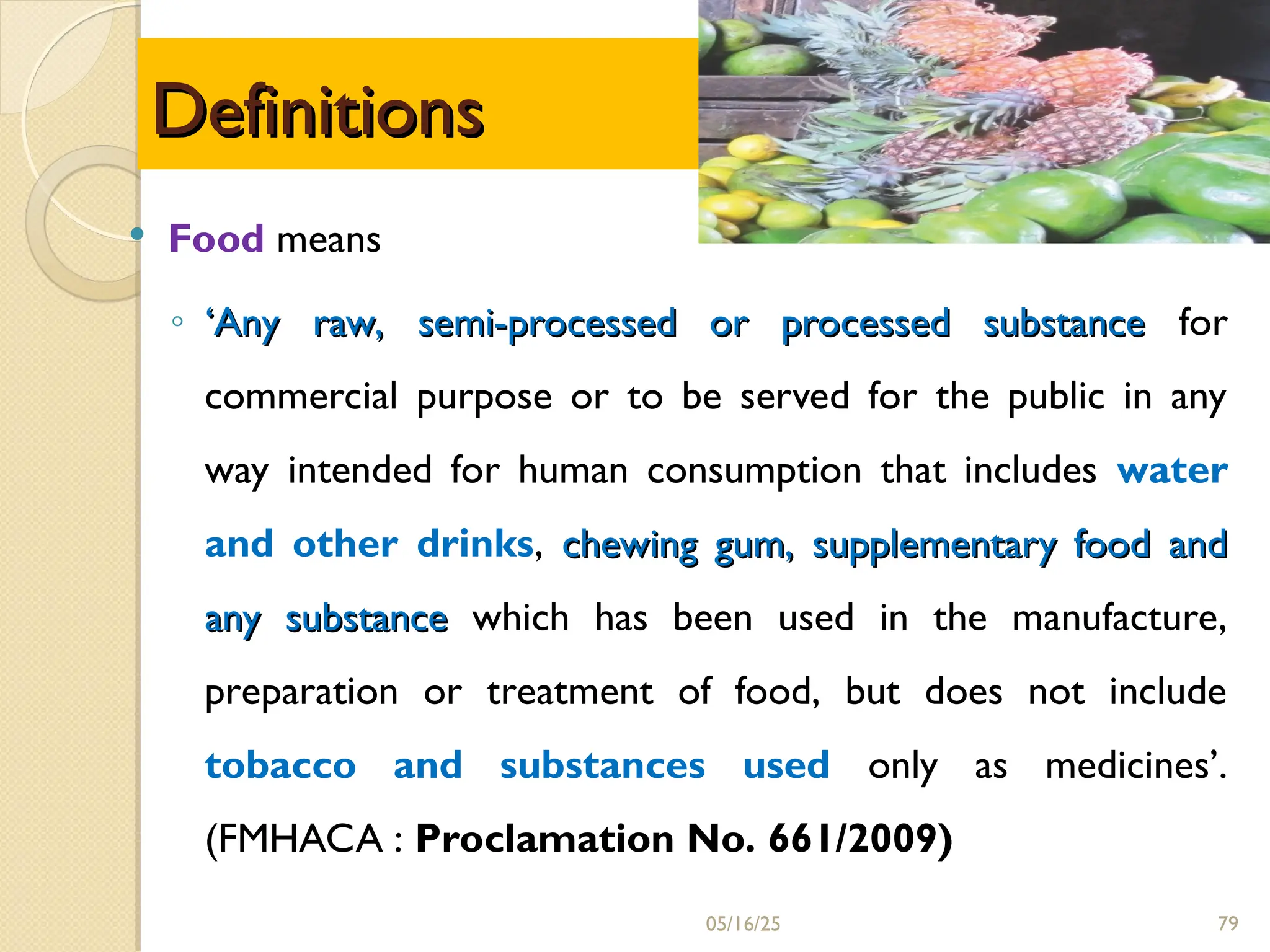
Food means
◦‘
‘Any raw, semi-processed or processed substance
Any raw, semi-processed or processed substance for
commercial purpose or to be served for the public in any
way intended for human consumption that includes water
and other drinks, chewing gum, supplementary food and
chewing gum, supplementary food and
any substance
any substance which has been used in the manufacture,
preparation or treatment of food, but does not include
tobacco and substances used only as medicines’.
(FMHACA : Proclamation No. 661/2009)
05/16/25
Definitions
Definitions
79
80.
“Food hygiene meansall conditions and measures
necessary for ensuring the safety, wholesomeness,
safety, wholesomeness,
and fitness
and fitness for consumption of food at all its stages
from its production, processing, storage, distribution,
preservation, handling, and service.(WHO/FAO);
Food safety is:
◦ All measures to ensure that food will not cause
harm to the consumer when it is prepared and/or
eaten according to its intended use(WHO).
Food spoilage Vs food adulteration
Misbranded ?? Safe temperature??
05/16/25
Definitions
Definitions
80
81.
• Total Burdenof Food-Borne diseases
– Each day millions of people become ill and
thousands die from a preventable food-borne
illness
– WHO estimate:
Food-borne illness are increasing worldwide
Worldwide 5 – 10% of the population suffer
from food-borne illnesses annually
05/16/25
Public health importance of food
Public health importance of food
81
82.
05/16/25
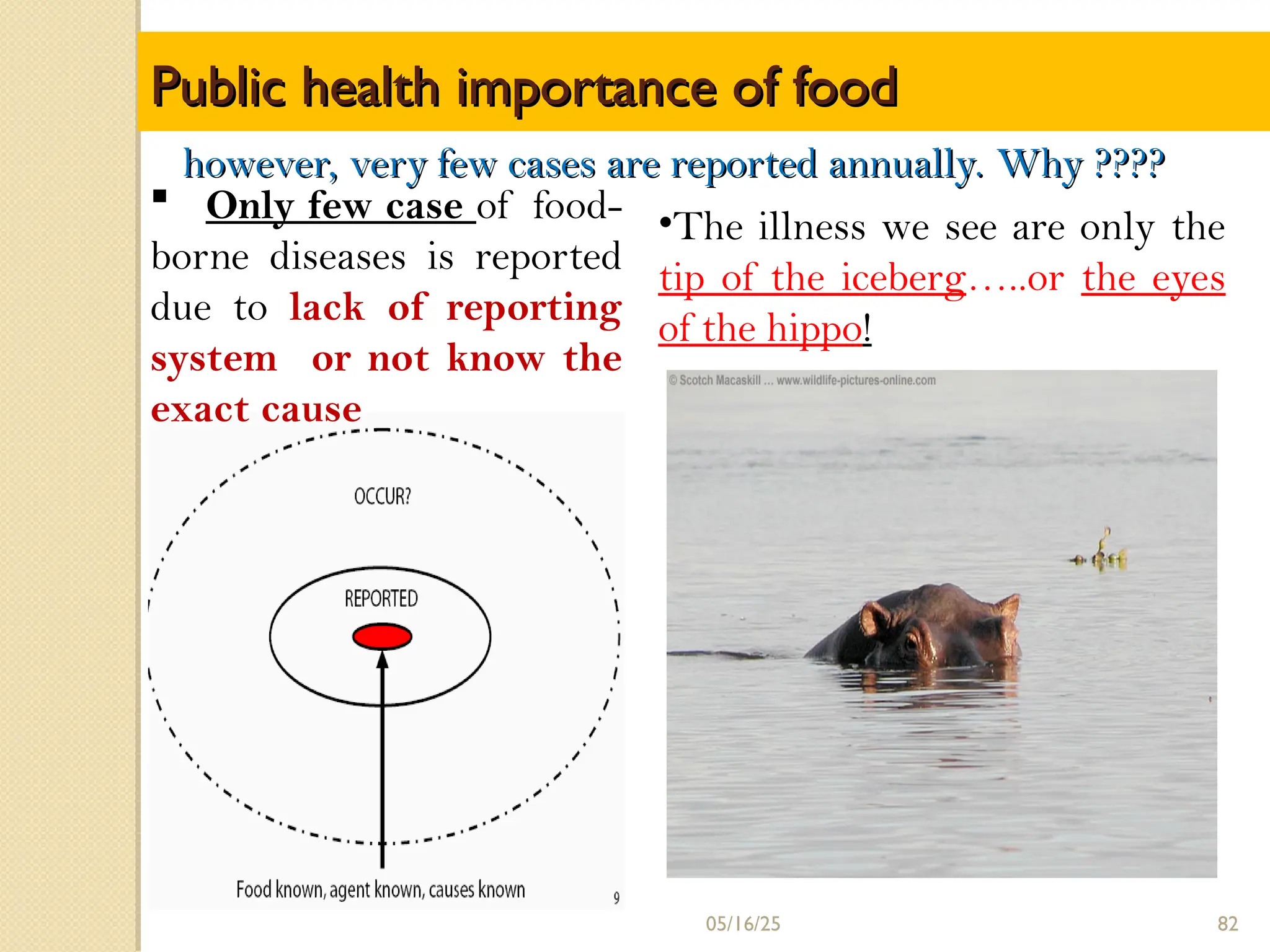
Only fewcase of food-
borne diseases is reported
due to lack of reporting
system or not know the
exact cause
•The illness we see are only the
tip of the iceberg…..or the eyes
of the hippo!
Public health importance of food
Public health importance of food
however, very few cases are reported annually. Why ????
however, very few cases are reported annually. Why ????
82
83.
Kinds of food
Kindsof food
1. Perishable foods:
Perishable foods: eggs, meat, fish, poultry, milk,
creamy cake, vegetables.
2. Semi-perishable:
Semi-perishable: bread, fruits;
3. Non perishable: dry foods; canned foods; food
oil
Q? Which one is potential hazards foods?
05/16/25 83
84.
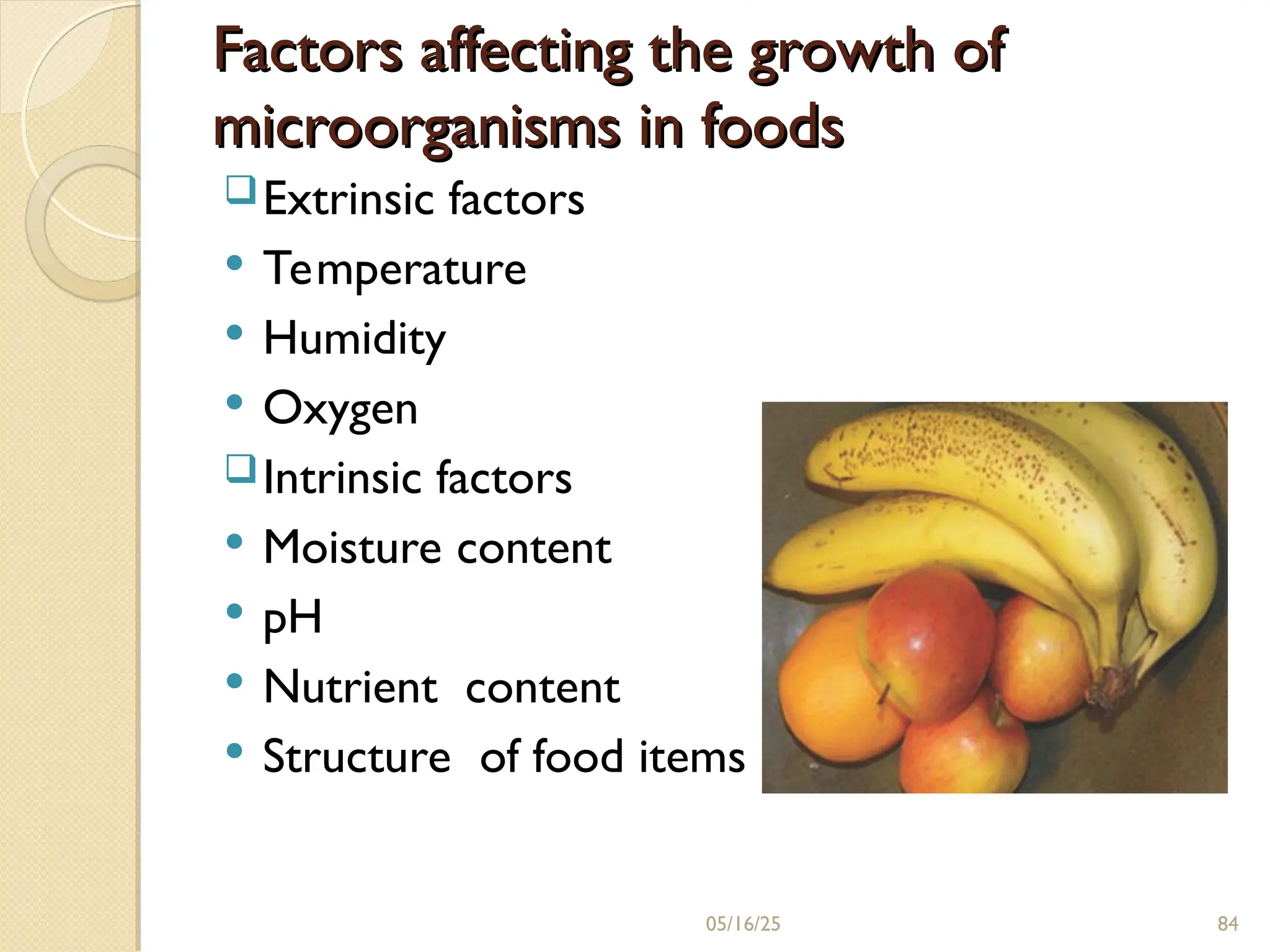
Factors affecting thegrowth of
Factors affecting the growth of
microorganisms in foods
microorganisms in foods
Extrinsic factors
Temperature
Humidity
Oxygen
Intrinsic factors
Moisture content
pH
Nutrient content
Structure of food items
05/16/25 84
85.
Food hazards
Food hazards
Types: biological , chemical Physical,
Types: biological , chemical Physical,
Hazard
Hazard
I. Biological hazard Vs health
effect
Communicable diseases; Food
borne infection, intoxication
and the outcome will be mild to
sever, disability, death
05/16/25
THE DANGER ZONE
Pathogenic bacteria double in number every 20 minutes in the DANGER
ZONE.
The longer a potentially hazardous food remains in the DANGERZONE, the
greater the risk that particular food could cause food borne diseases.
85
86.
Routes of microbialcontamination
Routes of microbial contamination
of food
of food
Air and dust
Soil, water and plants
Animals
Animal feeds
Food handlers
Cross-contamination
05/16/25 86
87.
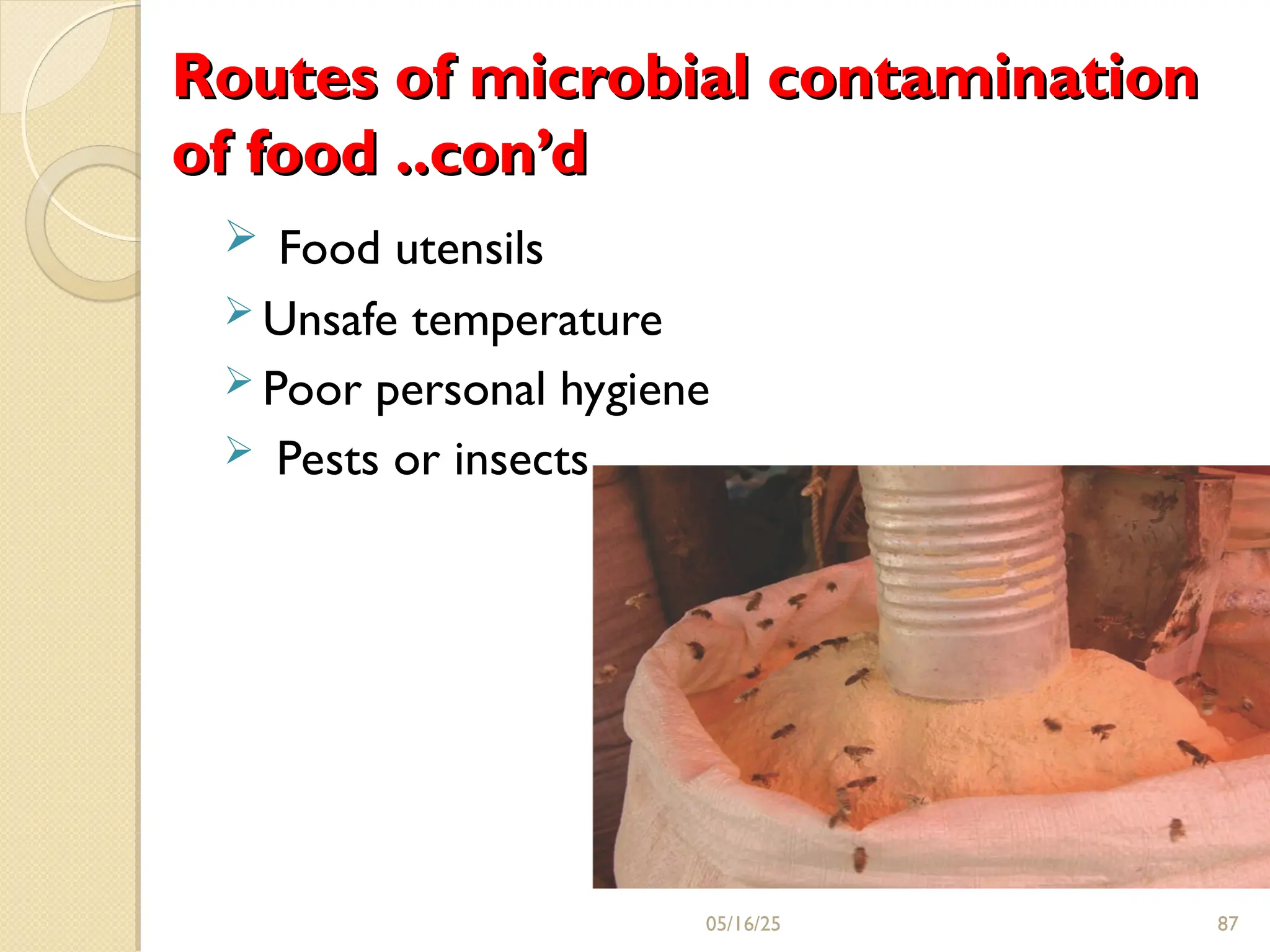
Routes of microbialcontamination
Routes of microbial contamination
of food ..con’d
of food ..con’d
Food utensils
Unsafe temperature
Poor personal hygiene
Pests or insects
05/16/25 87
88.
Hazards Vs healtheffects
Hazards Vs health effects
05/16/25
II. Chemical hazard Vs health effect
Chronic disease due to low level exposure and
Food poisoning and the out come may be acute/death.
Get
Get through
Crop production: chemical contaminants, natural
toxins
Production in industry: Food additives
88
89.
Ways of chemicalcontamination of food
Ways of chemical contamination of food
Contamination in the crop field
From cooking
cooking metal
metal containers
Unauthorized use of additives
additives
Accidental poisoning: rodentcides or insecticides
Use of un cleaned
un cleaned containers used for chemical
storage .
05/16/25 89
90.
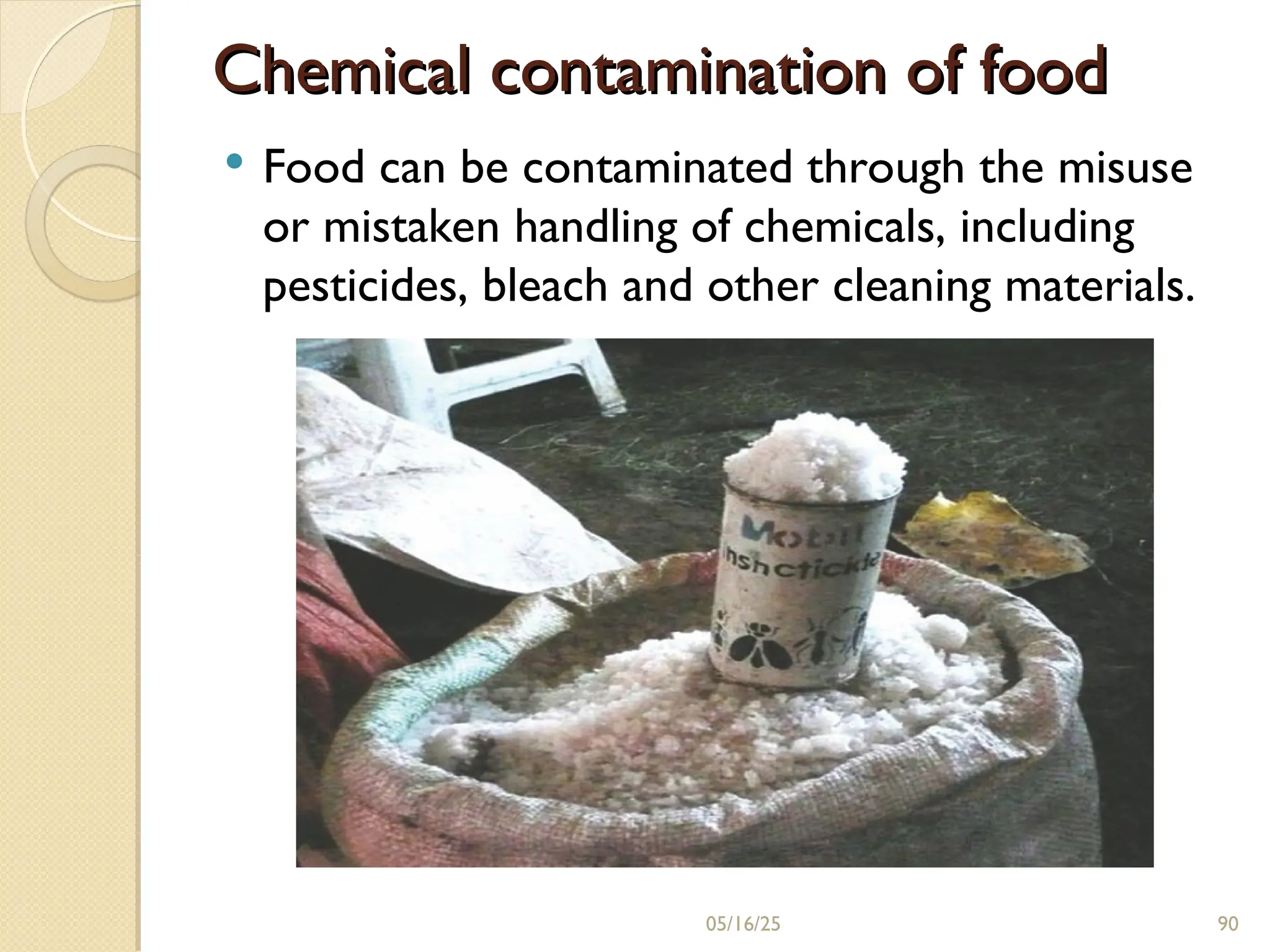
Chemical contamination offood
Chemical contamination of food
Food can be contaminated through the misuse
or mistaken handling of chemicals, including
pesticides, bleach and other cleaning materials.
05/16/25 90
91.
Who is foodhandler?
Who is food handler?
i. Food production
ii. Food Transportation
iii. Food Preparation
iv. Food Distribution
v. Handling of
equipments/utensils;
vi. Storage of food
vii. Food service
05/16/25 91
92.
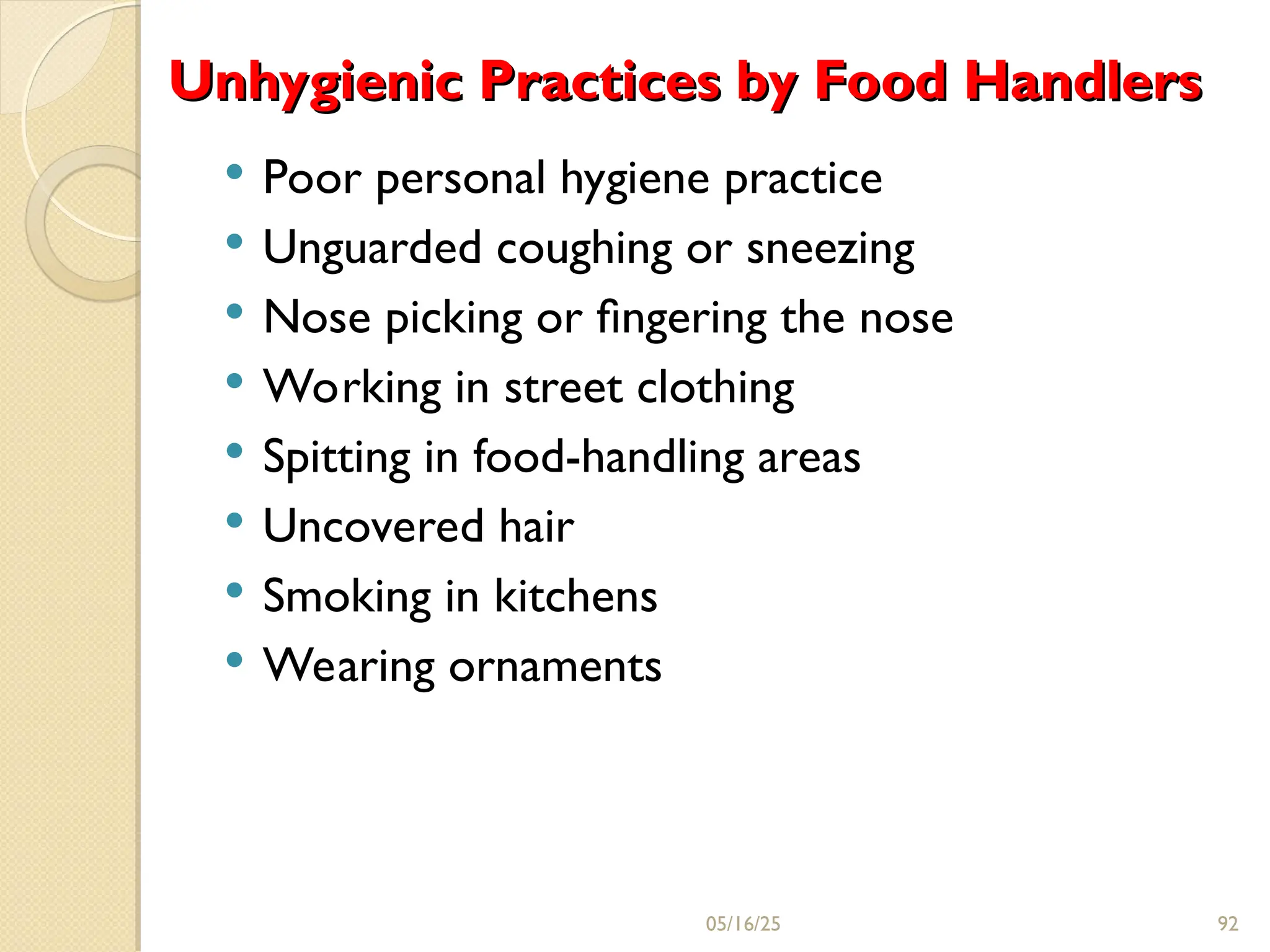
Unhygienic Practices byFood Handlers
Unhygienic Practices by Food Handlers
Poor personal hygiene practice
Unguarded coughing or sneezing
Nose picking or fingering the nose
Working in street clothing
Spitting in food-handling areas
Uncovered hair
Smoking in kitchens
Wearing ornaments
05/16/25 92
93.
Unhygienic….
Unhygienic….
Ignoring handwashing before starting
work, after handling contaminated
materials, after breaks and after using toilet
facilities.
05/16/25 93
05/16/25
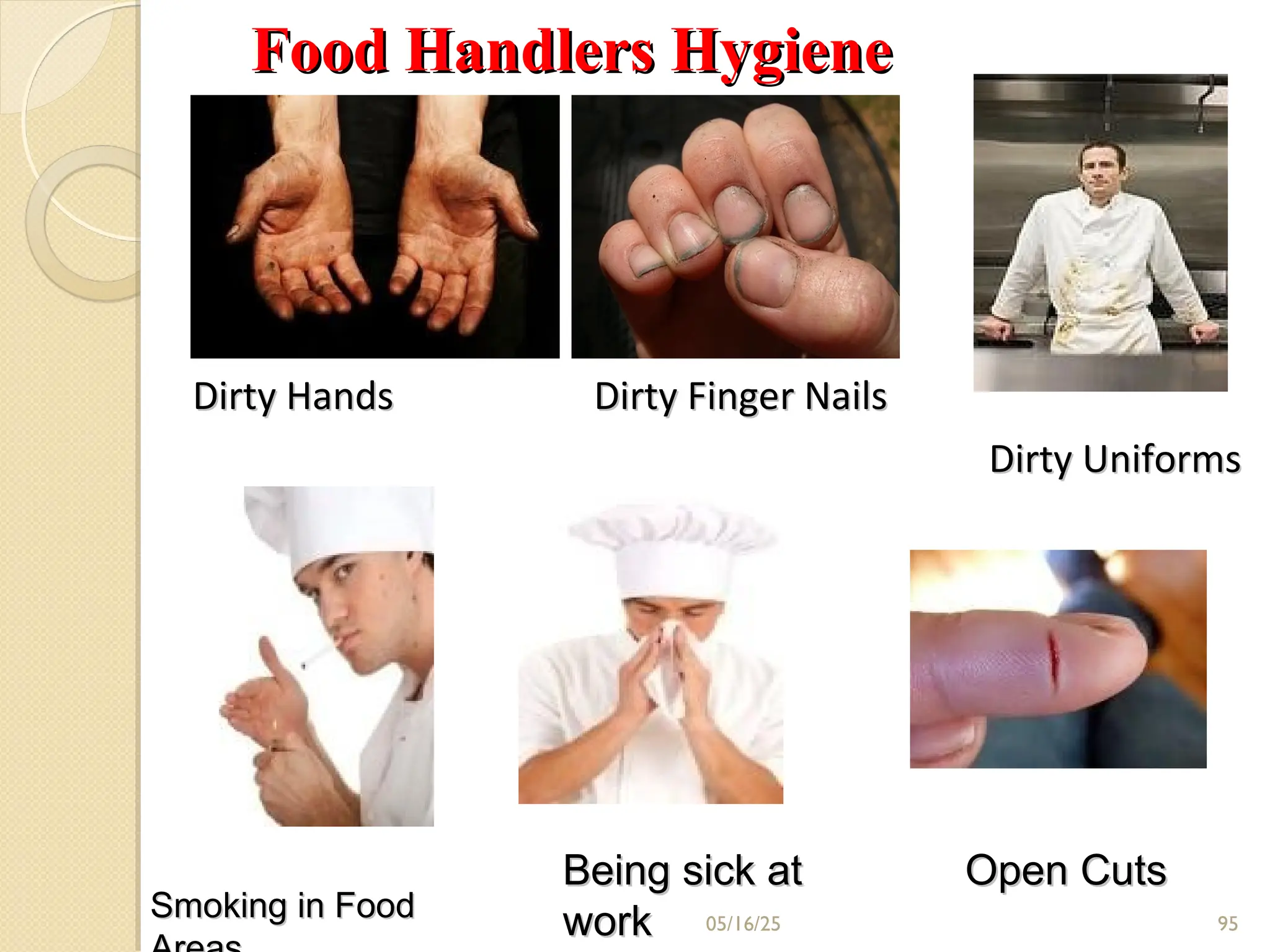
Dirty Hands DirtyFinger Nails
Dirty Hands Dirty Finger Nails
Dirty Uniforms
Dirty Uniforms
Smoking in Food
Smoking in Food
Open Cuts
Open Cuts
Being sick at
Being sick at
work
work
Food Handlers Hygiene
Food Handlers Hygiene
95
96.
Preventing Food bornediseases
Preventing Food borne diseases
1. Practice of appropriate storage Temperature:
Temperature: Potentially
hazardous foods must be kept in safe temperature
( above 140 O
F, or below 40 O
F
2. Prevent Cross Contamination: Practice good personal
hygiene and regular medical check up of food handlers
3. Practice proper cleaning and Sanitizing of utensils
proper cleaning and Sanitizing of utensils
4. Regular inspection by concerned body: quality analysis
5. Setting standards by responsible body
5. Setting standards by responsible body
05/16/25 96
97.
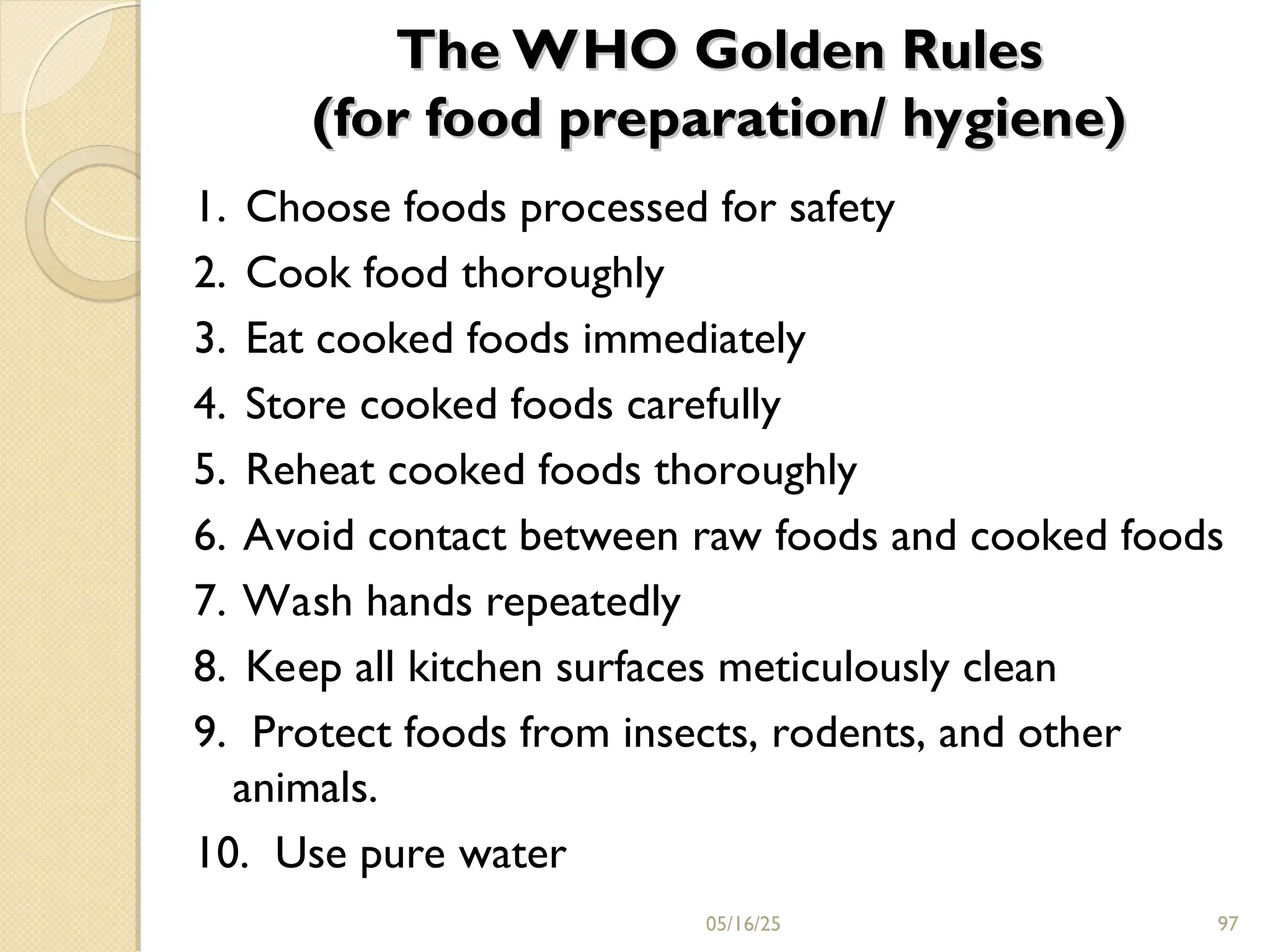
The WHO GoldenRules
The WHO Golden Rules
(for food preparation/ hygiene)
(for food preparation/ hygiene)
1. Choose foods processed for safety
2. Cook food thoroughly
3. Eat cooked foods immediately
4. Store cooked foods carefully
5. Reheat cooked foods thoroughly
6. Avoid contact between raw foods and cooked foods
7. Wash hands repeatedly
8. Keep all kitchen surfaces meticulously clean
9. Protect foods from insects, rodents, and other
animals.
10. Use pure water
05/16/25 97
Waste Management
Waste Management
A. Human waste disposal
◦ Definition of terms
◦ Health importance of excreta
◦ Proper disposal methods of excreta
B. Solid waste disposal
◦ Definition of terms
◦ Classification by source and characteristics
◦ Importance
◦ Processing of wastes
◦ Proper disposal methods
C. Hazards and infectious waste
◦ Definition of terms
◦ Characteristics of hazards and infectious wastes
◦ Control of hazards and infectious wastes
05/16/25 99
100.
A. Human wastedisposal
A. Human waste disposal
05/16/25 100
101.
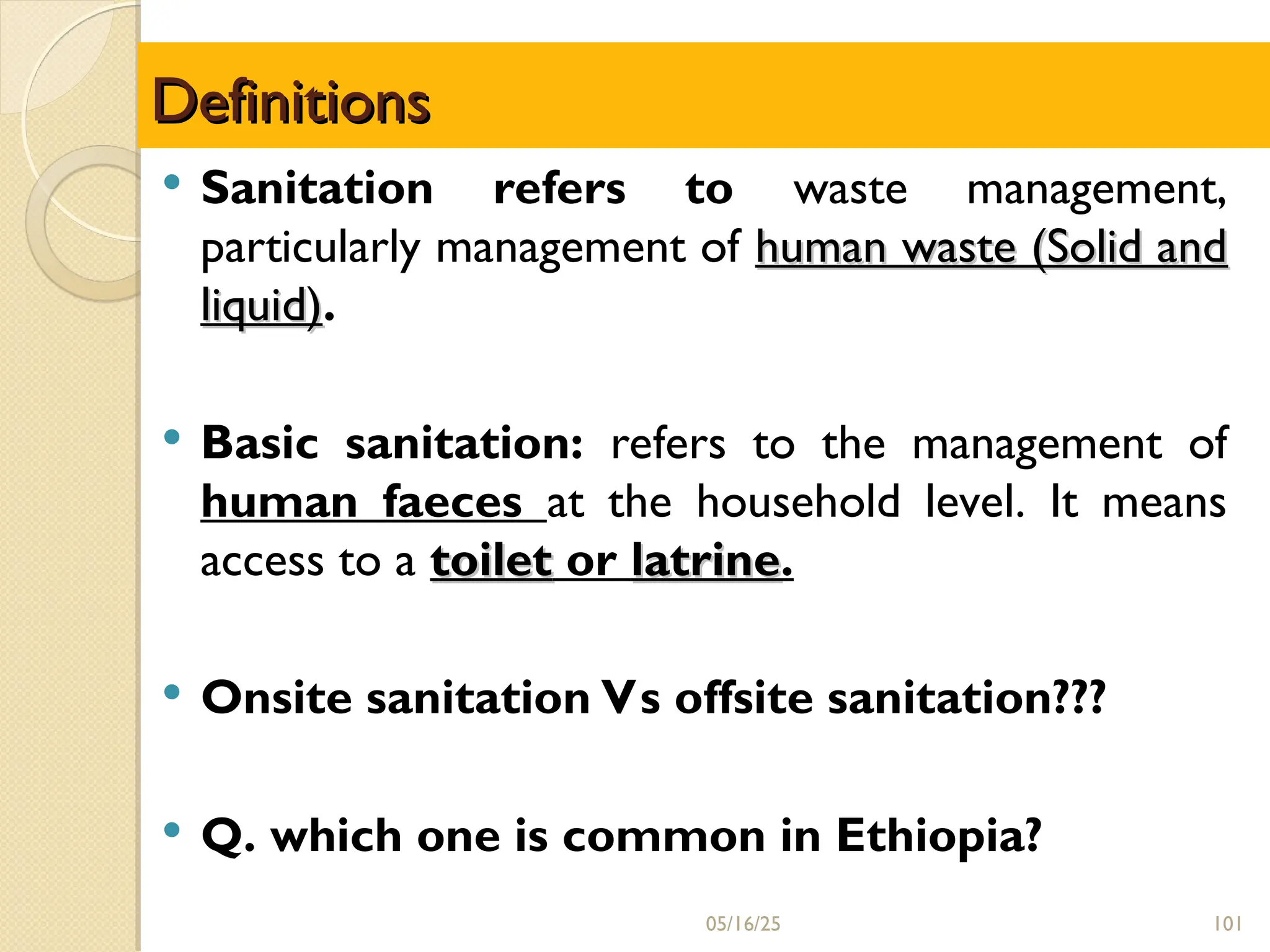
Definitions
Definitions
Sanitation refersto waste management,
particularly management of human waste (Solid and
human waste (Solid and
liquid)
liquid).
Basic sanitation: refers to the management of
human faeces at the household level. It means
access to a toilet
toilet or latrine
latrine.
Onsite sanitation Vs offsite sanitation???
Q. which one is common in Ethiopia?
05/16/25 101
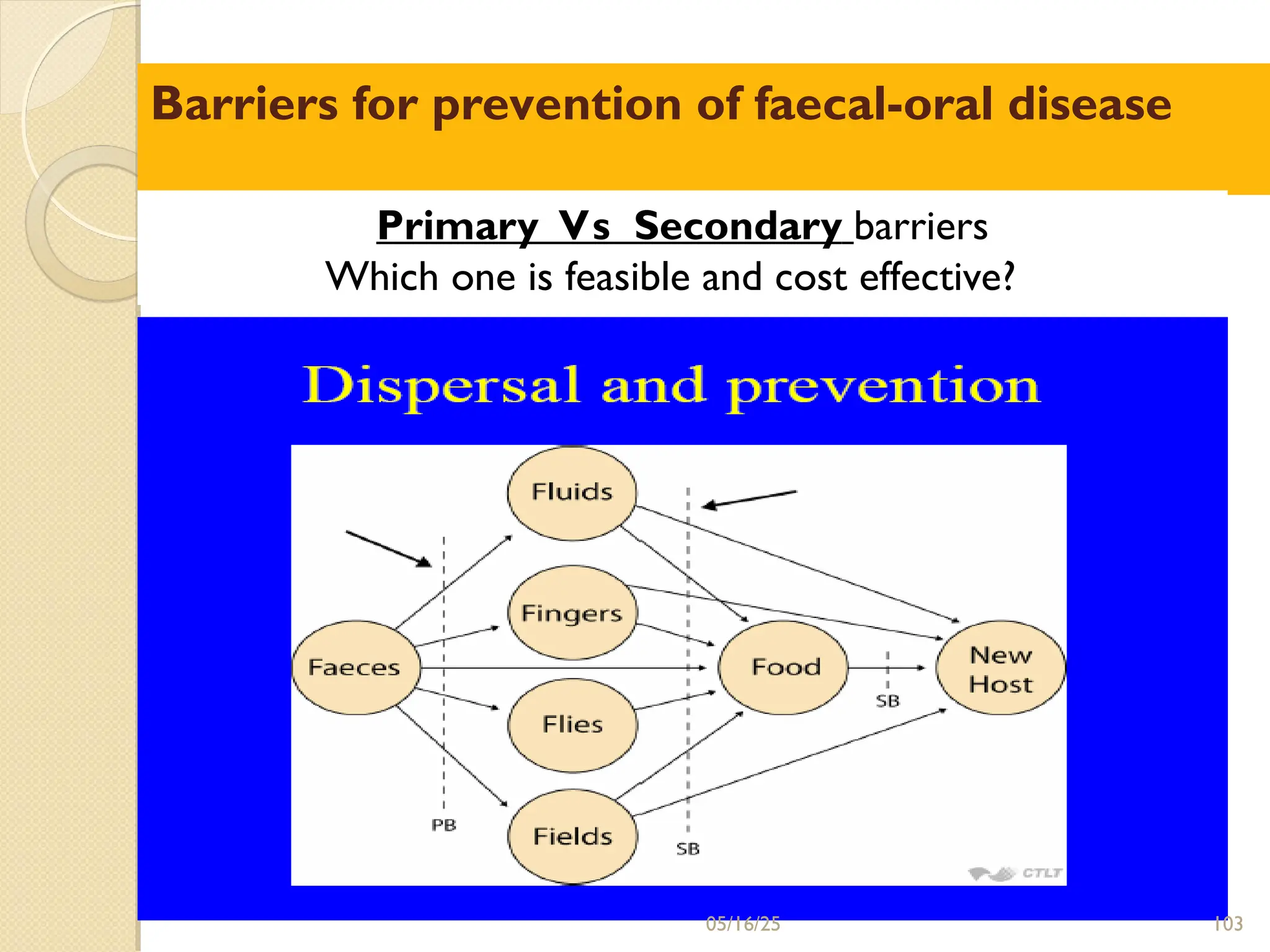
Barriers for preventionof faecal-oral disease
Primary Vs Secondary barriers
Which one is feasible and cost effective?
05/16/25 103
104.
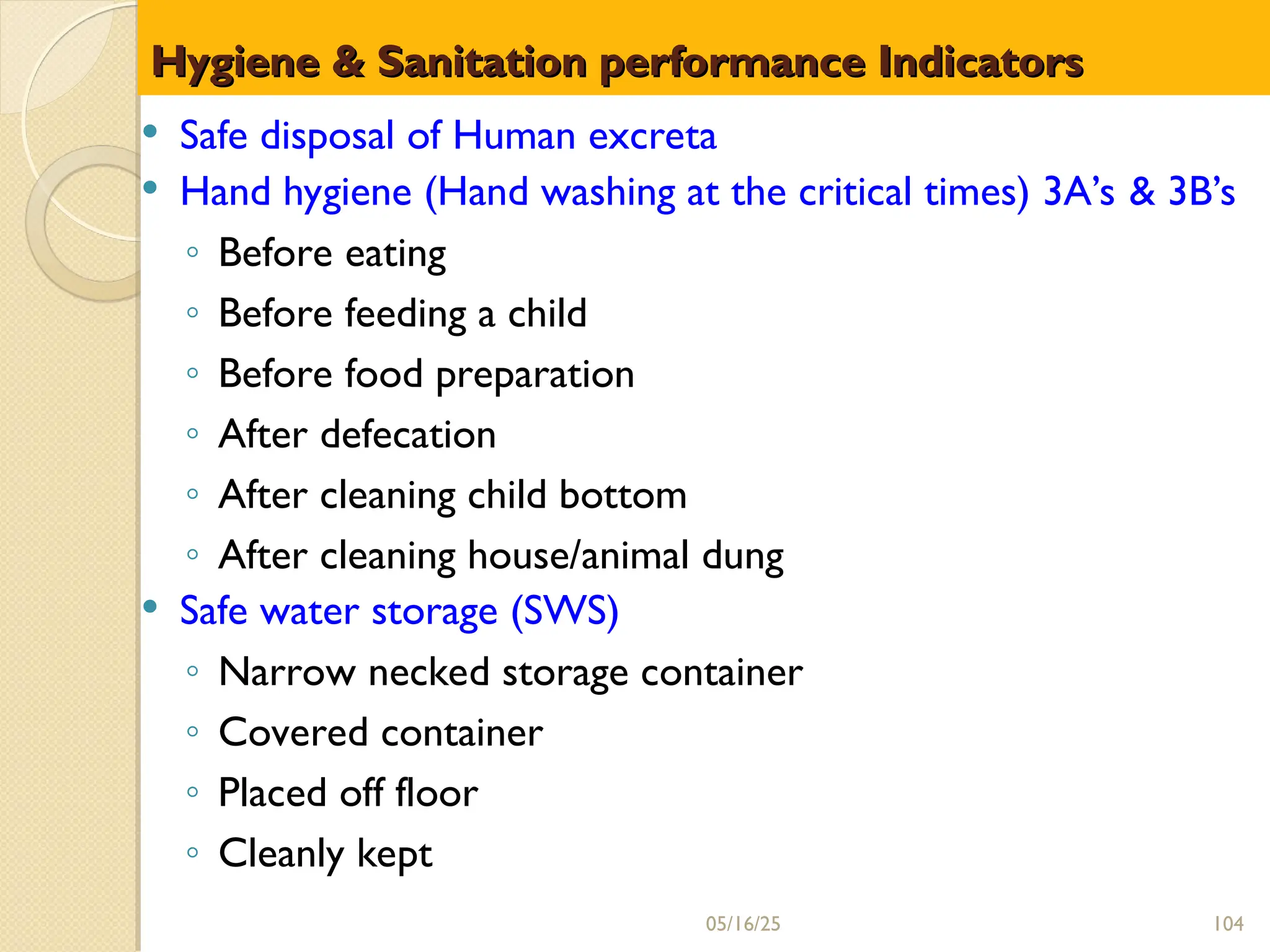
Hygiene & Sanitationperformance Indicators
Hygiene & Sanitation performance Indicators
Safe disposal of Human excreta
Hand hygiene (Hand washing at the critical times) 3A’s & 3B’s
◦ Before eating
◦ Before feeding a child
◦ Before food preparation
◦ After defecation
◦ After cleaning child bottom
◦ After cleaning house/animal dung
Safe water storage (SWS)
◦ Narrow necked storage container
◦ Covered container
◦ Placed off floor
◦ Cleanly kept
05/16/25 104
105.
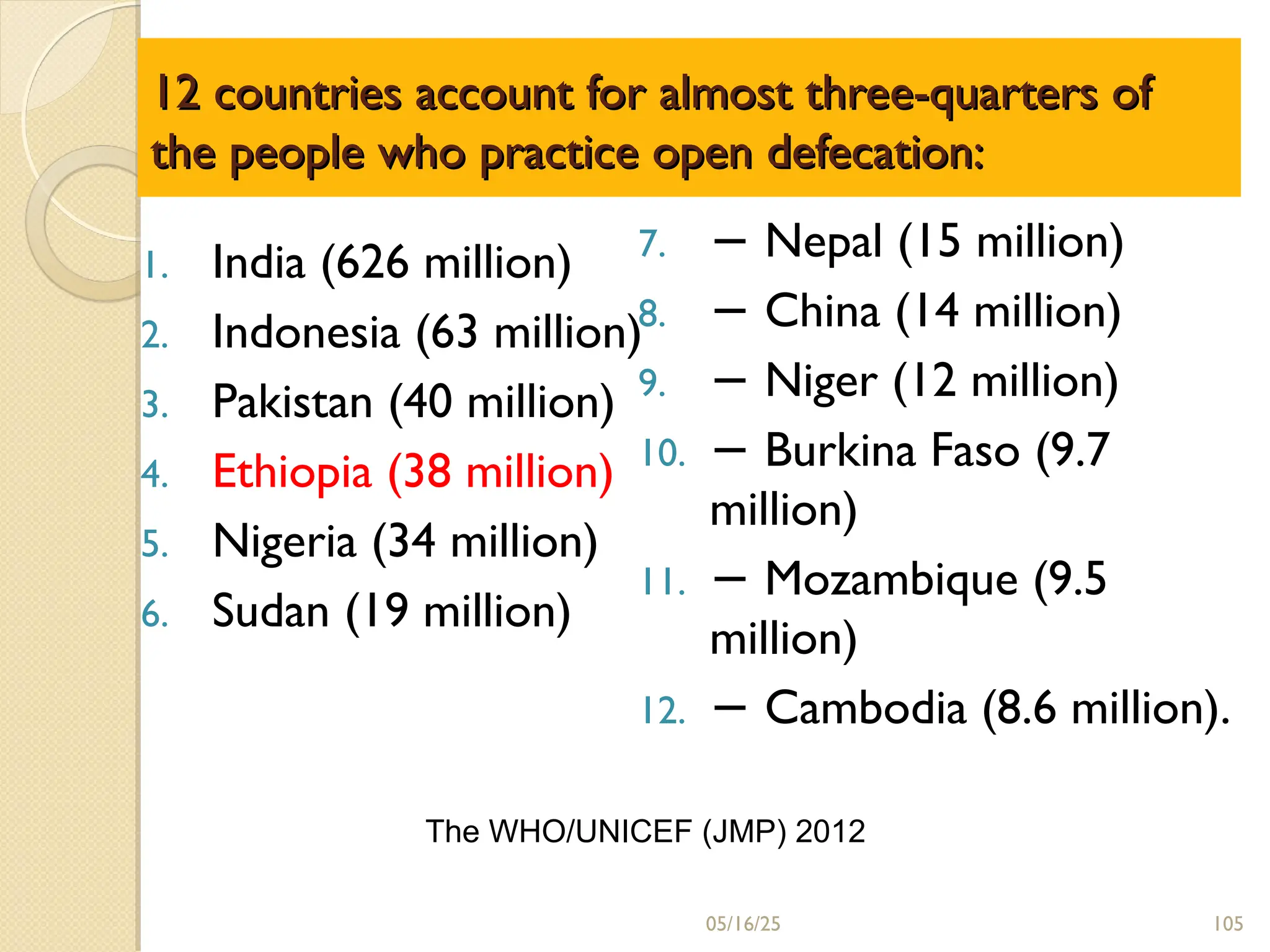
12 countries accountfor almost three-quarters of
12 countries account for almost three-quarters of
the people who practice open defecation:
the people who practice open defecation:
1. India (626 million)
2. Indonesia (63 million)
3. Pakistan (40 million)
4. Ethiopia (38 million)
5. Nigeria (34 million)
6. Sudan (19 million)
7. − Nepal (15 million)
8. − China (14 million)
9. − Niger (12 million)
10. − Burkina Faso (9.7
million)
11. − Mozambique (9.5
million)
12. − Cambodia (8.6 million).
The WHO/UNICEF (JMP) 2012
05/16/25 105
106.
Sanitation in Ethiopia
Sanitationin Ethiopia
According DHS 2011.
◦ A HH is classified as having an improved toilet if
it is used only by members of one HH (that is, it
it
is not shared
is not shared) (WHO and UNICEF, 2010).
◦ 8.8 % ?????? (18 % in urban and 7 % in rural ) of
HHs use improved toilet facilities.
improved toilet facilities.
82% of HH used
82% of HH used non-improved toilet facility such
as
◦ 44% used an open pit latrine or pit latrine without
slabs
◦ 38 % of households have no toilet facility
05/16/25 106
B. Solid wastemanagement
B. Solid waste management
05/16/25 108
109.
Definitions
Definitions
Solid wastes:
◦ Allthe wastes arising from human &
animal activities that are normally solid &
that are discarded as useless or unwanted.
◦ The term may be used like Refuse
(Garbage, Rubbish). Eg Plastics, bottles, cans,
papers, scrap iron, & other trash
05/16/25 109
110.
Definitions
Definitions
Solid waste management
A systematic administration of activities
that provide for the collection, source separation,
collection, source separation,
storage, transportation, transfer, processing,
storage, transportation, transfer, processing,
treatment and disposal of solid waste
treatment and disposal of solid waste.
It is a discipline associated with the control of
generation, storage, transfer and transport processing
generation, storage, transfer and transport processing
and disposal of solid waste
and disposal of solid waste
05/16/25 110
Solid Waste managementhierarchy
Solid Waste management hierarchy
Prevent the production of waste, or reduce the amount
generated.
Reduce the negative impacts of the waste that is
generated.
Reuse in their current forms the materials recovered from
the waste stream.
Recycle, compost, or recover materials for use as direct or
indirect inputs to new products.
Recover energy by incineration, anaerobic digestion, or
similar processes.
Reduce the volume of waste prior to disposal.
Dispose of residual solid waste in an environmentally sound
manner, generally in landfills.
Source: UNEP, 2009
05/16/25 112
113.
Main sources ofsolid waste
(waste generation)
1. Residential( domestic)
2. commercial
3. Institutional
4. Construction
Demolition
5. Municipal services
6. Treatment plant sites
7. Industrial
8. Agricultural
05/16/25
Source Reduction,
Reuse, Recycling
1. Sanitary landfill
2. Incineration
3. Composting
4. Dumping in to sea
5. Discharge to sewers
6. Open dump
Disposal Methods
113
114.
Solid waste collectionin Addis Ababa
Solid waste collection in Addis Ababa
05/16/25
What types of hazard are occurred during
handling of Solid wastes?
114
115.
Solid waste disposalsite in Addis Ababa
Solid waste disposal site in Addis Ababa
05/16/25
Aerial View of Reppi /Koshe Solid Waste Disposal Site,
Addis Ababa, Ethiopia
115
116.
Solid waste disposalsite in Addis
Solid waste disposal site in Addis
Ababa
Ababa
05/16/25
Reppi Solid Wste Disposal Site, Addis Ababa, Ethiopia
116
117.
Solid waste disposalsite in Addis
Solid waste disposal site in Addis
Ababa
Ababa
Addis Ababa land fill, Ethiopia
05/16/25 117
118.
C. Infectious wastes
C.Infectious wastes
Wastes that require special handling due to
serious threat to human health and the env’t if
mismanaged
Why Infectious Waste is Regulated?
A. To minimize the spread of disease from a
medical setting to the general public
B. To protect
protect the environment
05/16/25 118
119.
The 10 categoriesof HCW
The 10 categories of HCW
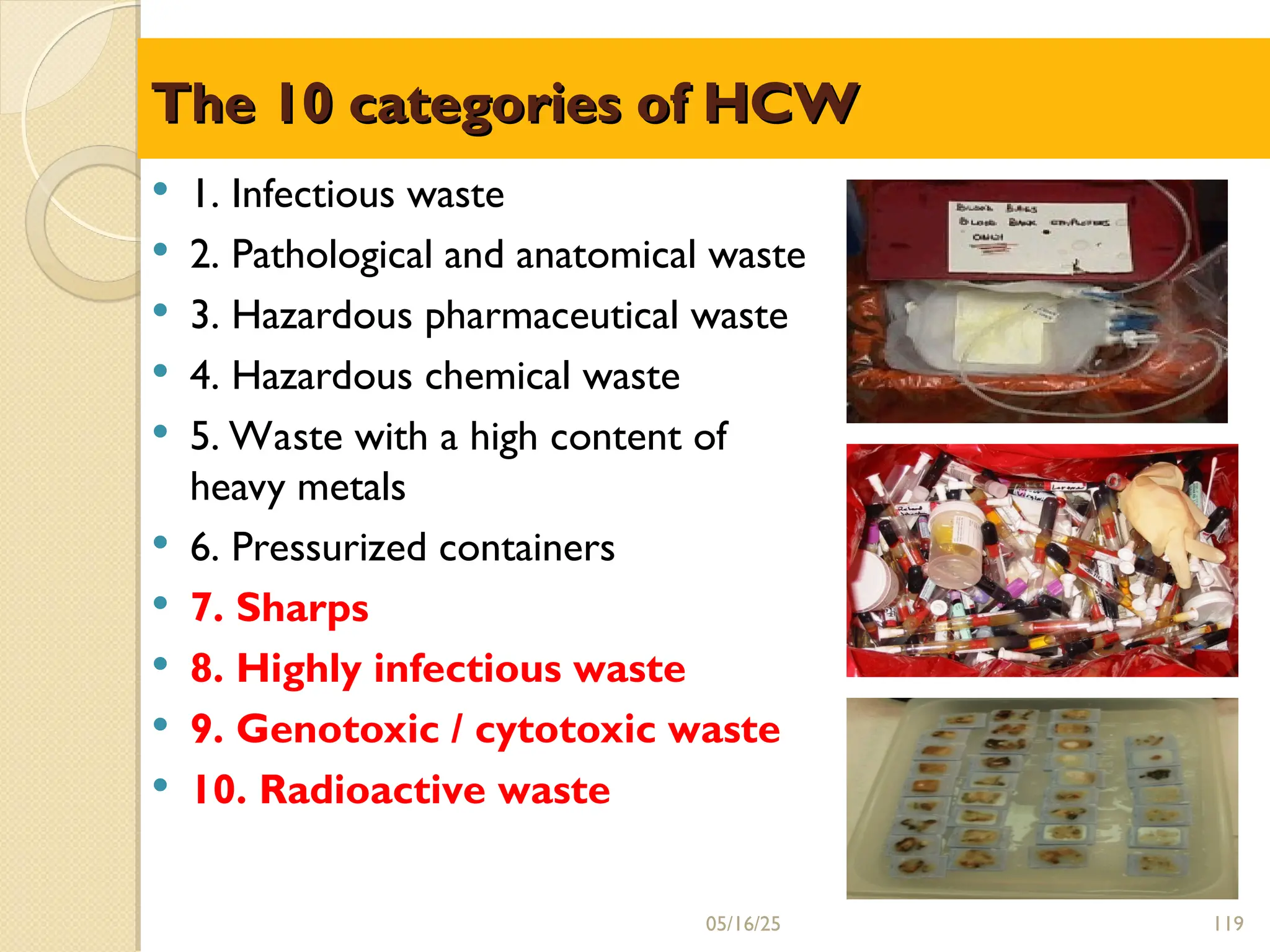
1. Infectious waste
2. Pathological and anatomical waste
3. Hazardous pharmaceutical waste
4. Hazardous chemical waste
5. Waste with a high content of
heavy metals
6. Pressurized containers
7. Sharps
8. Highly infectious waste
9. Genotoxic / cytotoxic waste
10. Radioactive waste
05/16/25 119
120.
Actors in theHCWM process
Actors in the HCWM process
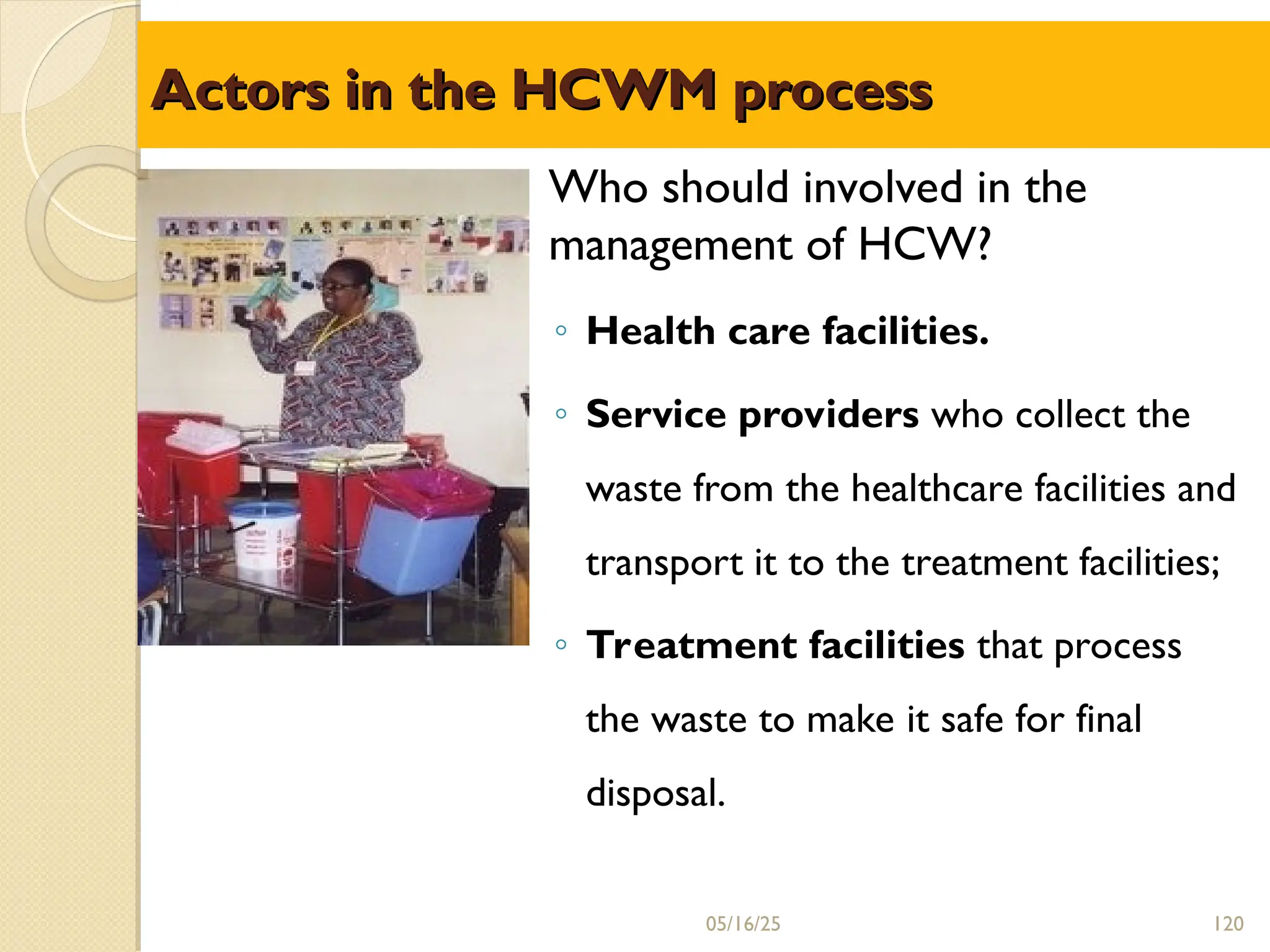
Who should involved in the
management of HCW?
◦ Health care facilities.
◦ Service providers who collect the
waste from the healthcare facilities and
transport it to the treatment facilities;
◦ Treatment facilities that process
the waste to make it safe for final
disposal.
05/16/25 120
121.
Risks associated withHCW
Risks associated with HCW
Who are at risk?
◦ Medical staff:
◦ In and out-patients
◦ Workers in support
services
◦ Workers in waste disposal
facilities,
◦ The general public and more
specifically the children.
05/16/25 121
122.
Acquiring of diseasescaused by Blood borne
Acquiring of diseases caused by Blood borne
Pathogens. Example;
Pathogens. Example;
Hepatitis C
Malaria
Rabies
Syphilis
Viral Hemorrhagic Fevers
HIV / AIDS
Hepatitis B
Brucellosis
Risks associated with HCW
Risks associated with HCW
05/16/25 122
123.
Con’t
Con’t
Poor managementof health-care waste exposes
◦ Health care workers Infections,
◦ waste handlers Toxic effects
◦ Patients Injuries
◦ the community
Studies revealed that from HCW who had HBV
and HCV, of these :-
33% of HBV Direct or indirect
42% of HCV exposure to
infectious wastes
infectious wastes.
Risks associated with HCW
Risks associated with HCW
05/16/25 123
124.
Strategies for avoidingrisks associated
Strategies for avoiding risks associated
HCW
HCW
1. Changing behavior of HC workers,
patients & community.
2. Ensuring availability of equipment &
supplies
3. Safe and appropriate management of
HCW
Strategies for avoiding risks associated
Strategies for avoiding risks associated
HCW
HCW
05/16/25 124
VI. Housing andInstitutional Health
VI. Housing and Institutional Health
Definition of terms
Good house keeping principles
Institutions related to public health
05/16/25 127
128.
Definition of terms
Definitionof terms
Housing
◦ It is a term that describes for a physical
a physical
structure
structure in which we live.
◦ It is as ‘flats and houses for people to live in
flats and houses for people to live in.’
The Oxford Dictionary.
◦ It is also considered as a
a dwelling or physical
dwelling or physical
shelter
shelter that is used for living purposes.
Many of these definition focus on the nature of
the nature of
housing
housing as a physical structure or shelter
physical structure or shelter.
05/16/25 128
129.
The WHOuses the term ‘
‘Residential
Residential
environment
environment’
’, rather than ‘Housing
Housing’, which
define as:
the physical structure
physical structure that man uses for shelter
and the environs of that
the environs of that struc
structure including all
necessary services, facilities, equipment, and
devices needed or desired for the physical, mental,
and social wellbeing of the family and individual.
Definition of terms
Definition of terms
05/16/25 129
130.
130
Definitions
Standard Housing
Isa house that is properly planned and constructed in
proper site, comfortable, safe to live in and fulfill the
basic housing necessities
◦ provided with safe and adequate water supply
safe and adequate water supply,
◦ safe and proper waste disposal ,
◦ adequate light, space
adequate light, space,
◦ well ventilated
well ventilated, etc.
05/16/25
131.
131
Substandard Housing:-
Is a house, which is poorly sited, planned and
poorly sited, planned and
constructed, inadequate floor space
constructed, inadequate floor space for the
family ( overcrowded), poorly maintained and
does not in general comply with the more
important sanitary facilities
important sanitary facilities.
Definitions
05/16/25
132.
Slum:-
◦ Itis an area in which substandard housing predominates
and frequently accompanied with overcrowding.
◦ It is ‘‘a highly congested, usually urban, residential
area characterized by deteriorated unsanitary buildings,
deteriorated unsanitary buildings,
poverty, and social disorganization
poverty, and social disorganization’’ (Webster’s Third
International Dictionary, 1966).
Blighted area:-
◦ an area, which is undesirable
undesirable for residential,
residential,
agricultural, commercial, industrial or recreational
agricultural, commercial, industrial or recreational
purpose
purpose.
◦ Examples:- Marshy and rocky areas, gorges and
mountainous areas, and plots.
Definitions
05/16/25 132
133.
Basic requirements ofhealthful housing
Basic requirements of healthful housing
WHO has adopted four basic requirements of
healthful housing :
◦ Satisfaction of physiological needs
Satisfaction of physiological needs
◦ protection against infection
protection against infection
◦ protection against accidents
protection against accidents
◦ protection against psychological and social
protection against psychological and social
stresses
stresses
◦ Protecting people at special risk
Protecting people at special risk
05/16/25 133
134.
Factors affecting healthfulhousing
Factors affecting healthful housing
Housing condition or structure can be
affected by:-
◦ Poverty
◦ Education
◦ Climate
◦ culture and
◦ population mobility
05/16/25 134
135.
Structure of housingin different areas
Structure of housing in different areas
of Ethiopia
of Ethiopia
05/16/25 135
136.
1. School hygieneand sanitation
1. School hygiene and sanitation
05/16/25 136
137.
Public healthimportance of school environment
Public health importance of school environment
◦ School children spend about one third of their time.
◦ Schools provide an ideal opportunity to detect poor
poor
hygiene practice
hygiene practice by children.
◦ School
School dropouts
dropouts are related with water supply and
sanitation conditions of schools.
◦ upper respiratory
upper respiratory infections, skin infections, abdominal
infections, skin infections, abdominal
discomfort, eye infections, gastroenteritis
discomfort, eye infections, gastroenteritis (diarrhoea) and
(diarrhoea) and
tonsillitis
tonsillitis are the commonest ailments for school clinic visits
Institutions: School environment
Institutions: School environment
05/16/25 137
138.
Institutions: School healthprogramme
Institutions: School health programme
School health programme includes:
School health programme includes:
◦ Health-related policies in schools
Health-related policies in schools
◦ Promotion of hygiene
Promotion of hygiene
◦ Provision of safe water supply
Water availability should be about five liters
five liters
per day per student and water must be
available throughout the school day.
◦ Presences of sanitation facilities
It should be proportional with number of
students
◦ Healthy school environment
Healthy school environment
05/16/25 138
139.
139
Sanitary facilities inschool
If the sanitary facility is a water flush system
In the use of latrines, the number of seat holes and
urinals as practically applied in most of developed
countries is:
a. 1 seat hole for every 15- 20 boys.
b. 1 urinal for every 30 to 45 boys.
c. 1 seat hole for every 10 to 20 girls.
05/16/25
140.
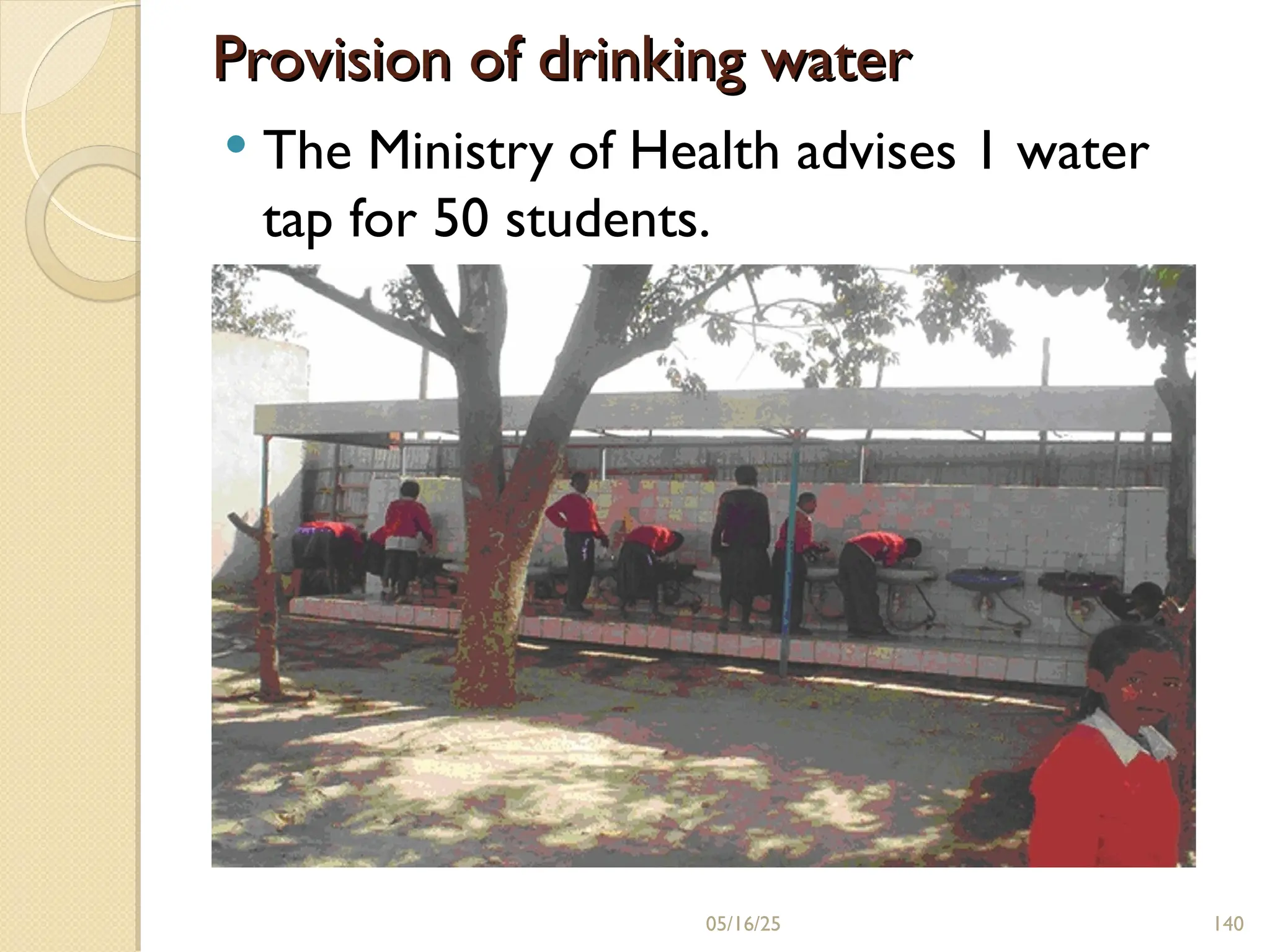
Provision of drinkingwater
Provision of drinking water
The Ministry of Health advises 1 water
tap for 50 students.
05/16/25 140
141.
141
Hospital (Health Institutions)Sanitation
less care, poor sanitation
less care, poor sanitation have become a
means of introducing contaminants and
infections to the hospital environment that
◦ delay recovery,
delay recovery,
◦ overburden the weakened patient
overburden the weakened patient.
Hospitals have therefore, many potential
hazards that can pose a threat to
◦ employees,
employees,
◦ patients and
patients and
◦ visitors
visitors
05/16/25
142.
142
Source of NosocomialInfections
Deficient infrastructures, rudimentary equipment and a poor
Deficient infrastructures, rudimentary equipment and a poor
quality of care contribute
quality of care contribute the occurrence of nosocomial
infections
in developing countries incidences of nosocomial infections
which have been estimated to be between 2-6 times higher
than those in developed nations.
Those who are working at
1. Laundry
2. Healthcare wastes
3. House keeping
4. Laboratory
5. Central supply
6. Maintenance of physical structure are at risk for biological
hazard
05/16/25
143.
143
Prison Health
Because,the prisoners usually live in an overcrowded
conditions and use a single room for living, sleeping,
reading, and etc.
Moreover, some prisoners may have an infection
before they are sentenced.
sentenced.
Communicable disease transmission is very rapid in
such crowded condition, which is apparent in
prison.
05/16/25
144.
144
Sources of Diseasesin the Prison
Infections may occur from two sources in the
prison:
1. Some prisoners may join the prison with apparent
or in apparent infection from outside & infect
healthy ones.
2. Infection that originate in the prison it self
because of poor environment
◦ (Poor housing, inadequate ventilation,
overcrowding, malnutrition, poor hygiene due to
lack of facilities, inadequate water supply, etc)
Strict follow up and environmental sanitation
should be practice in prison
05/16/25
145.
145
Aim of PrisonHealth Services
1. To solve the immediate physical and mental
physical and mental health
problems of the prisoners.
2. To teach prisoners the basic principles of healthy
healthy
living
living
3. To prevent the infections diseases
infections diseases specially the
chronic ones such as tuberculosis
4. To advise prison administration
prison administration on health and
environmental conditions of the prison.
05/16/25
146.
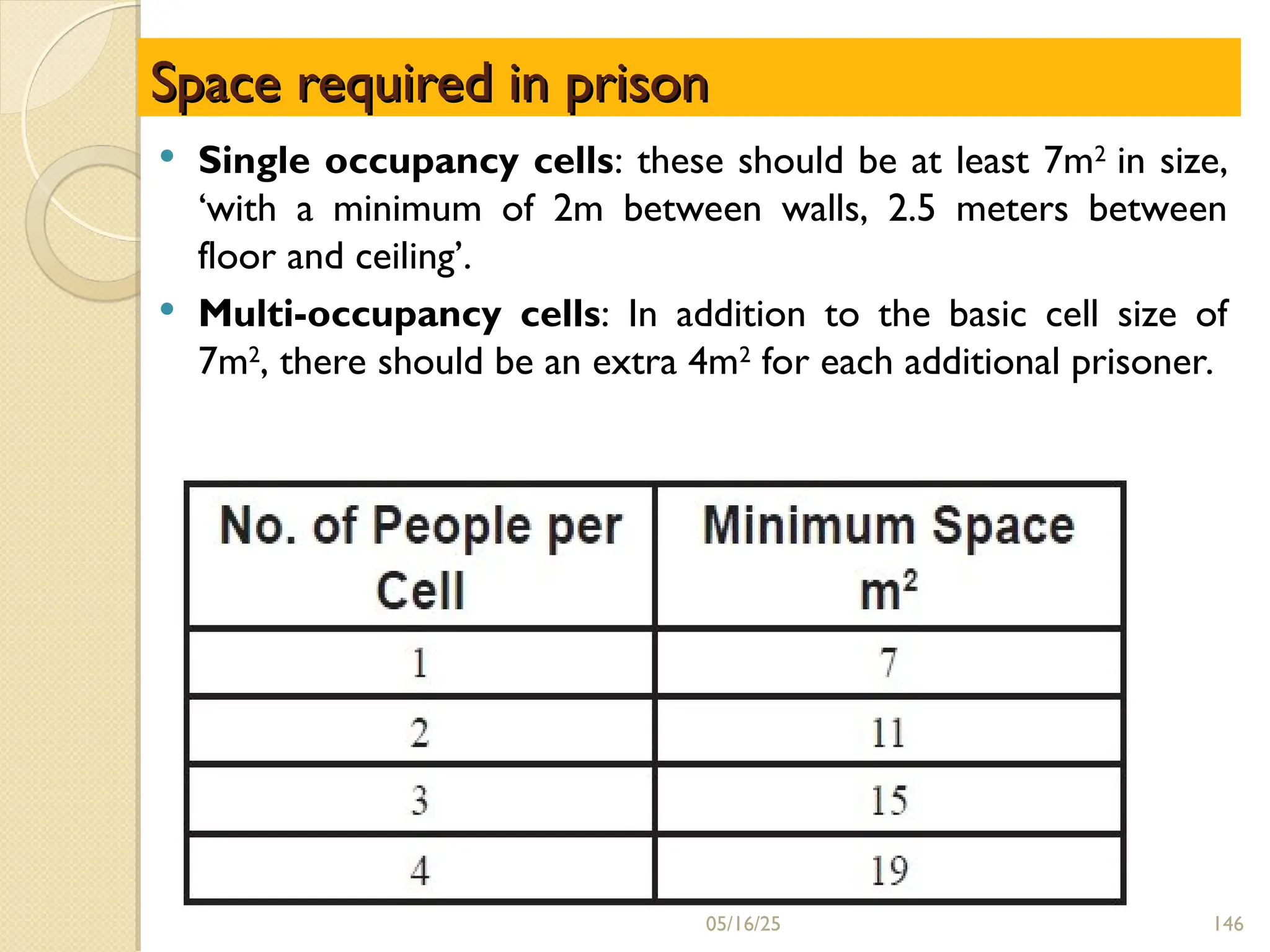
Single occupancycells: these should be at least 7m2
in size,
‘with a minimum of 2m between walls, 2.5 meters between
floor and ceiling’.
Multi-occupancy cells: In addition to the basic cell size of
7m2
, there should be an extra 4m2
for each additional prisoner.
Space required in prison
Space required in prison
05/16/25 146
147.
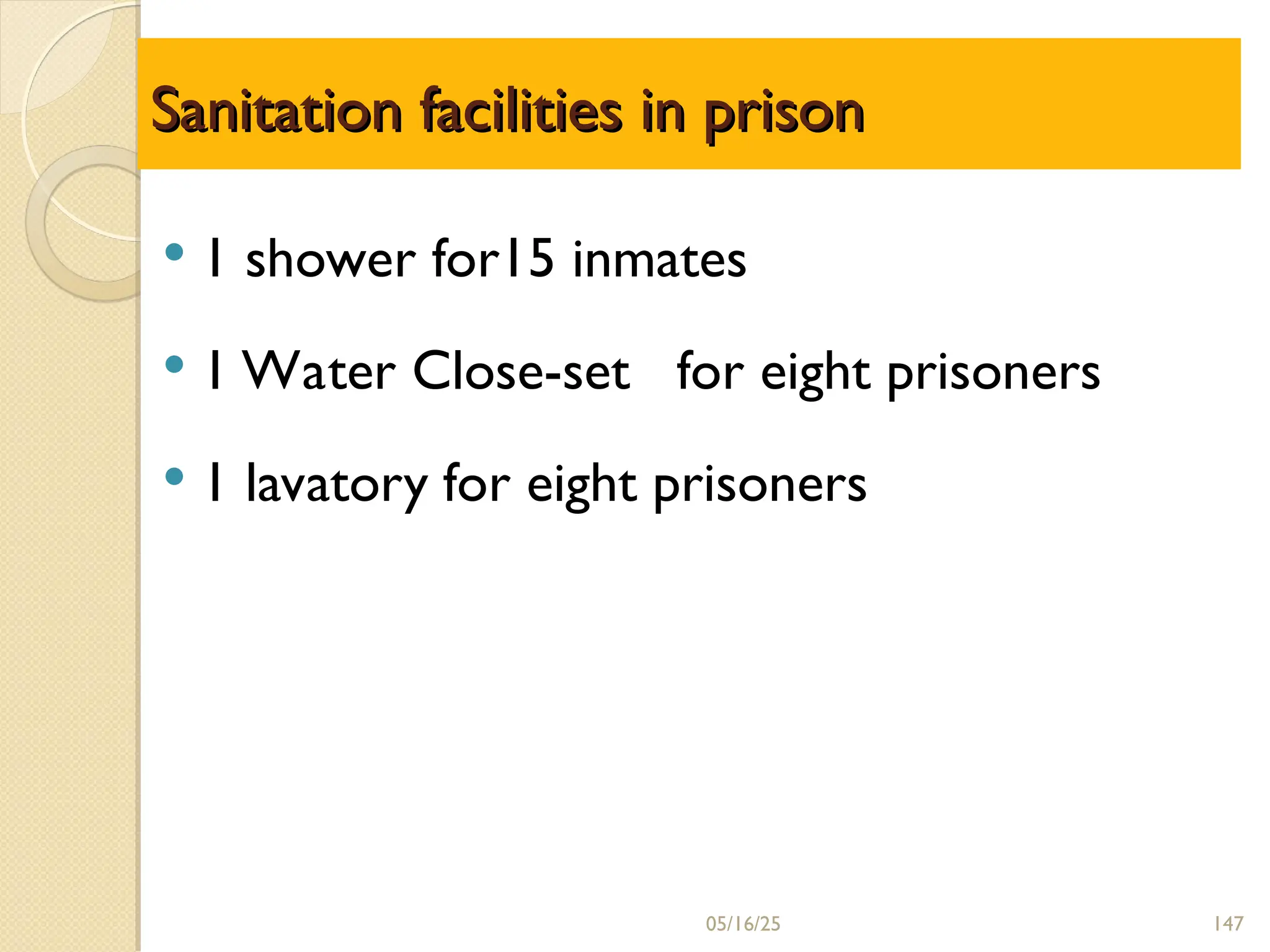
Sanitation facilities inprison
Sanitation facilities in prison
1 shower for15 inmates
1 Water Close-set for eight prisoners
1 lavatory for eight prisoners
05/16/25 147
Outline of thepresentation
Outline of the presentation
Definition of terms
Components of occupational health
Components of safe working environment
The range of health hazards encountered in the
workplace
Occupational hygiene management
05/16/25 149
150.
Definitions:
Definitions:What is OccupationalHygiene?
What is Occupational Hygiene?
Occupational Hygiene
◦'The discipline of anticipating, recognizing,
evaluating and controlling health hazards in the
working environment
working environment with the objective of
protecting worker
protecting worker health and well-being and
safeguarding the community at large
community at large.' according
International Occupational Hygiene Association (IOHA).
05/16/25 150
151.
Occupational Hygiene,also called Industrial
Hygiene, is both a profession and a science.
It is defined as a science and an art devoted to the
ANTICIPATION, RECOGNITION, EVALUATION, and
CONTROL of those environmental factors or stresses
arising in or from the work place which may cause
SICKNESS, IMPAIRED HEALTH, and WELL-BEING or
significant Discomfort
Discomfort and Inefficiency
Inefficiency among workers
or among the citizens of the community.
Definition: What is Occupational Hygiene?
Definition: What is Occupational Hygiene?
05/16/25 151
152.
Definition: What isOccupational Hygiene?
Definition: What is Occupational Hygiene?
Exposure
Work Activity
Disease
Occupational
Hygiene
Occupational
Medicine
Occupational
Health
Safe working environment is similar with occupational hygiene
Safe working environment is similar with occupational hygiene.
05/16/25 152
153.
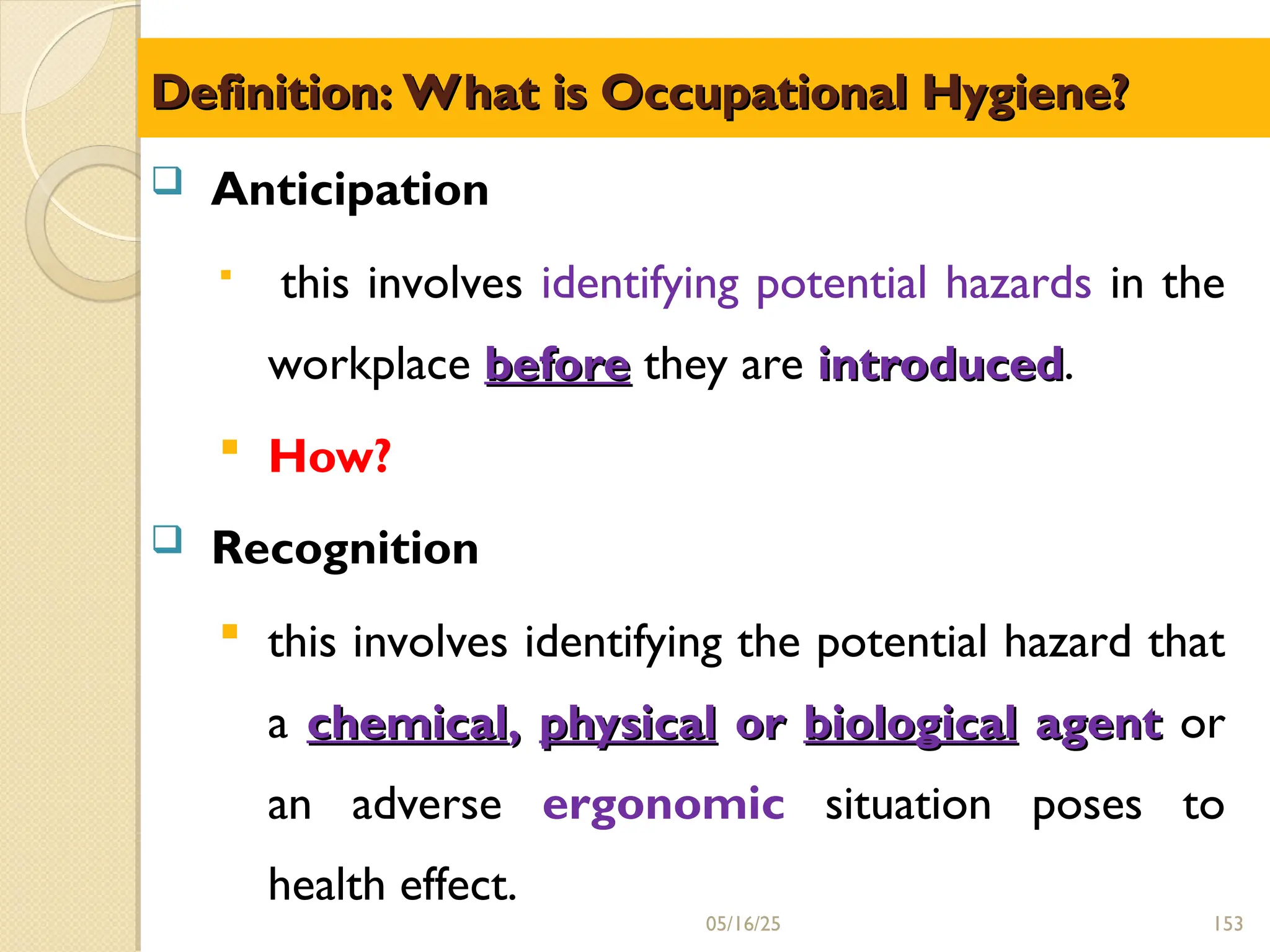
Anticipation
thisinvolves identifying potential hazards in the
workplace before
before they are introduced
introduced.
How?
Recognition
this involves identifying the potential hazard that
a chemical
chemical,
, physical
physical or
or biological
biological agent
agent or
an adverse ergonomic situation poses to
health effect.
Definition: What is Occupational Hygiene?
Definition: What is Occupational Hygiene?
05/16/25 153
154.
EVALUATION
theextent
extent of
of exposure
exposure to the chemical hazards, physical
or biological agents (or adverse ergonomic situation) in the
workplace should be evaluated
evaluated .
This often involves measurement of the personal
exposure of a worker to the hazard/agent in the workplace.
assessment of the data in terms of recommended
occupational exposure limits (OELs), where such criteria
exist.
Definition: What is Occupational Hygiene?
Definition: What is Occupational Hygiene?
05/16/25 154
155.
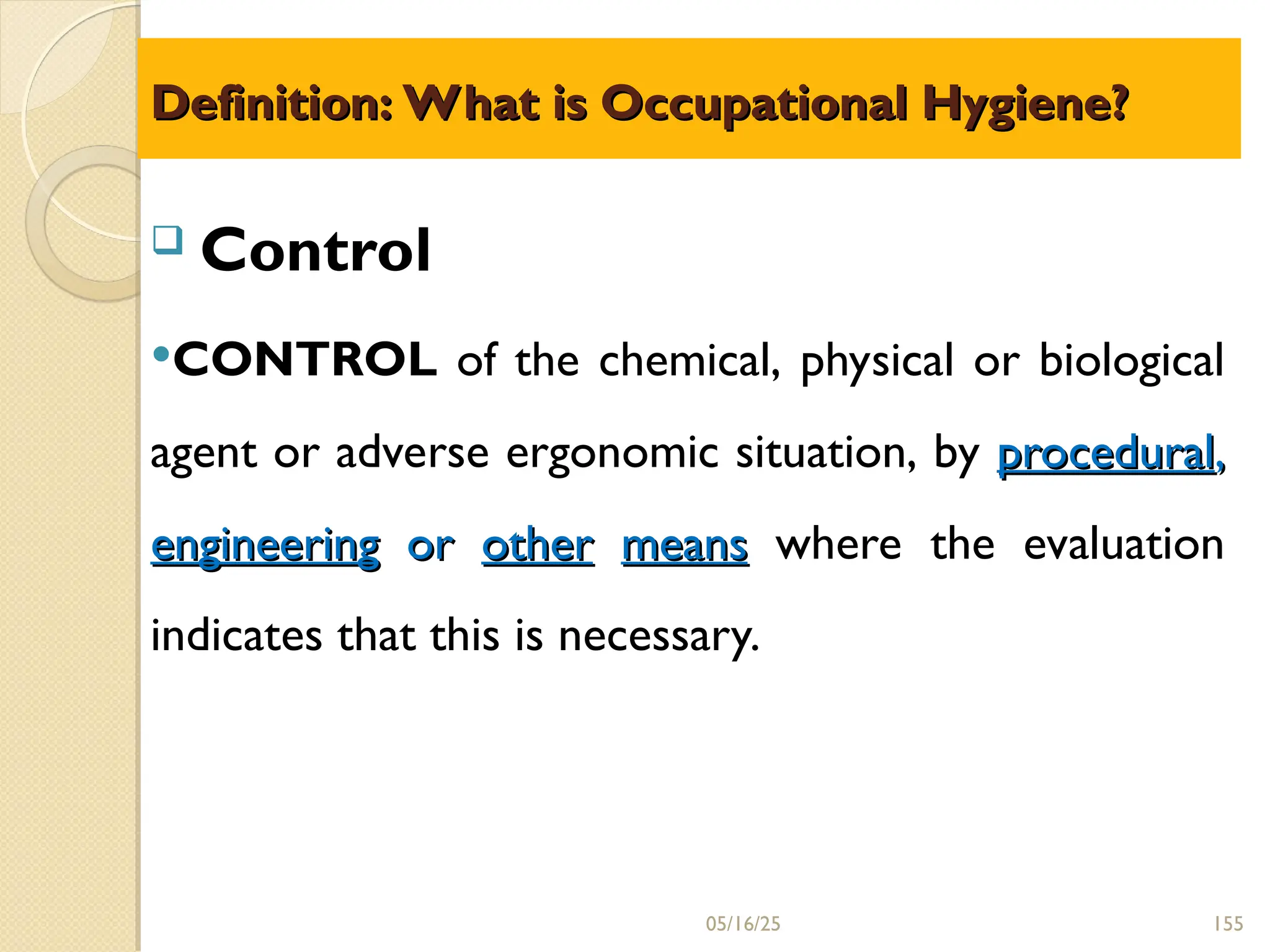
Control
Control
Control
CONTROL ofthe chemical, physical or biological
agent or adverse ergonomic situation, by procedural
procedural,
,
engineering
engineering or
or other
other means
means where the evaluation
indicates that this is necessary.
Definition: What is Occupational Hygiene?
Definition: What is Occupational Hygiene?
05/16/25 155
156.
Hazard and Risk
Hazardand Risk
A hazard
is something that can cause harm if not
controlled.
The outcome is the harm that results from
an uncontrolled hazard.
A risk
◦ is a combination of the probability that a
particular
particular outcome will occur and the
severity
severity of the harm involved.
05/16/25 156
157.
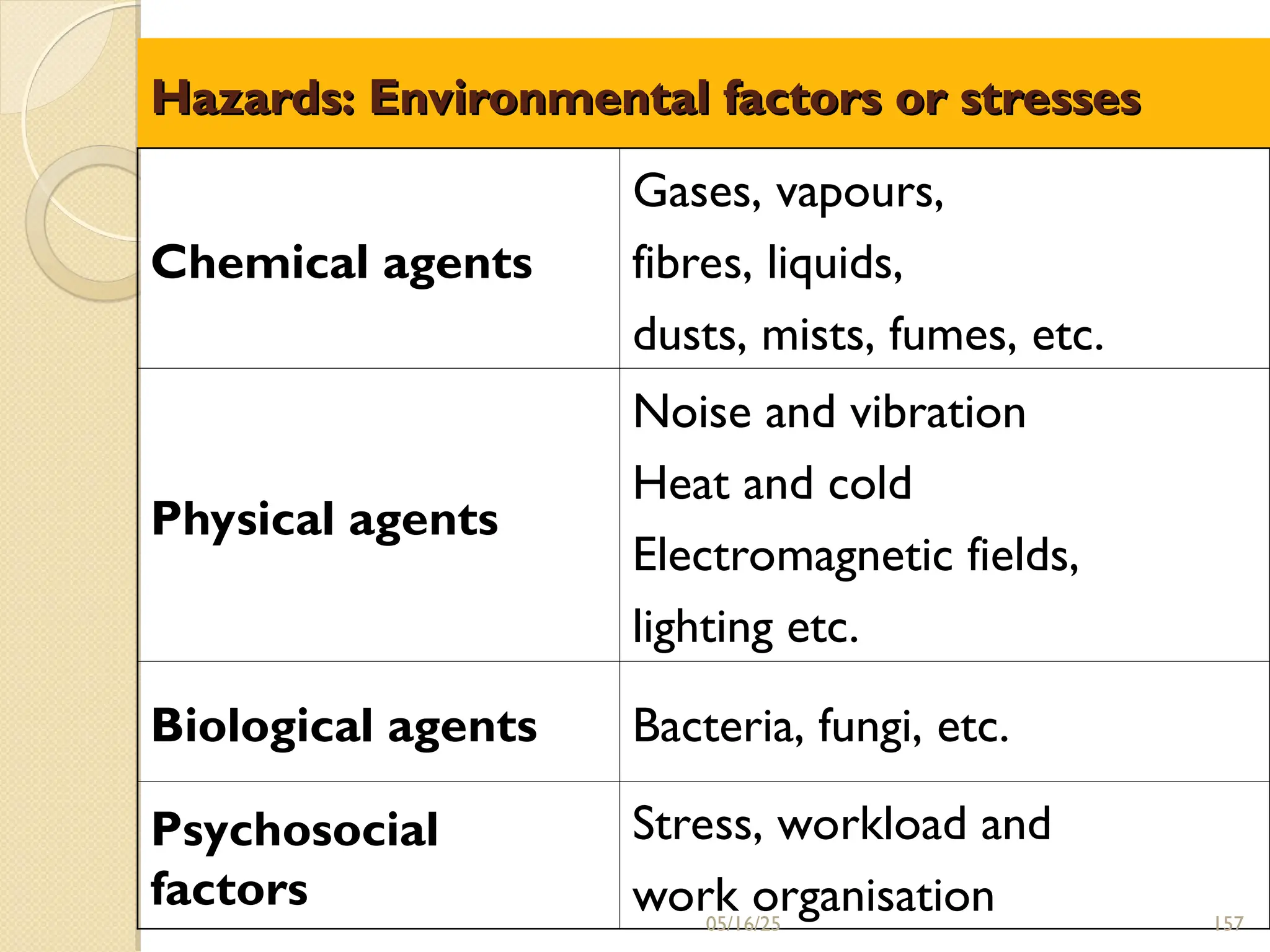
Hazards: Environmental factorsor stresses
Hazards: Environmental factors or stresses
Chemical agents
Gases, vapours,
fibres, liquids,
dusts, mists, fumes, etc.
Physical agents
Noise and vibration
Heat and cold
Electromagnetic fields,
lighting etc.
Biological agents Bacteria, fungi, etc.
Psychosocial
factors
Stress, workload and
work organisation
05/16/25 157
158.
Occupational Health Components
OccupationalHealth Components
Occupation
Safety
◦ Accident
prevention
◦ Injury prevention
Occupational
Medicine
◦ Diagnostics,
◦ medical surveillance
◦ Treatment
◦ Rehabilitation
Occupational/Industrial Hygiene
• Concern with environmental agents
and ergonomics hazard to prevention
of occupational disease
• Wide range of technical and
management to prevent the exposure
• skills needs
• Science and health
• Engineering and technology
• Management and communication
05/16/25 158
159.
Public health importanceof safe working
Public health importance of safe working
environment
environment
The World Health Organisation/ ILO estimates
that globally there are:
◦ 2.3 million
2.3 million work-related deaths per year.
◦ Economic
Economic loss
loss of 4% global GDP
◦ 386,000 deaths
386,000 deaths each year from exposure to airborne
airborne
particulates.
particulates.
◦ 152,000 deaths
152,000 deaths per year from carcinogens
carcinogens in the
workplace.
◦ 37% of Lower Back Pain is attributed to occupation.
05/16/25 159
160.
Occupational diseases formworking environment
Disease of
respiratory system
Musculoskeletal
disease
Skin disease
Eye diseases
Disease of the
nervous system
05/16/25
Reproductive disorders
Cardiovascular disease
Hematological disorders
Liver diseases (hepatic
disorders)
Hearing loss
160
161.
Prevention of occupationaldiseases
Prevention of occupational diseases
Primary prevention: exposure reduction at
source, path, and worker level eg. Safety
practices, prevention of exposure
Secondary prevention: early detection through
blood checking (lead concentration, level of
cholestarase, ..)
Tertiary prevention: occupational medicine.eg
rehabilitation.
05/16/25 161
162.
Types of preventionand Control Measures
Types of prevention and Control Measures
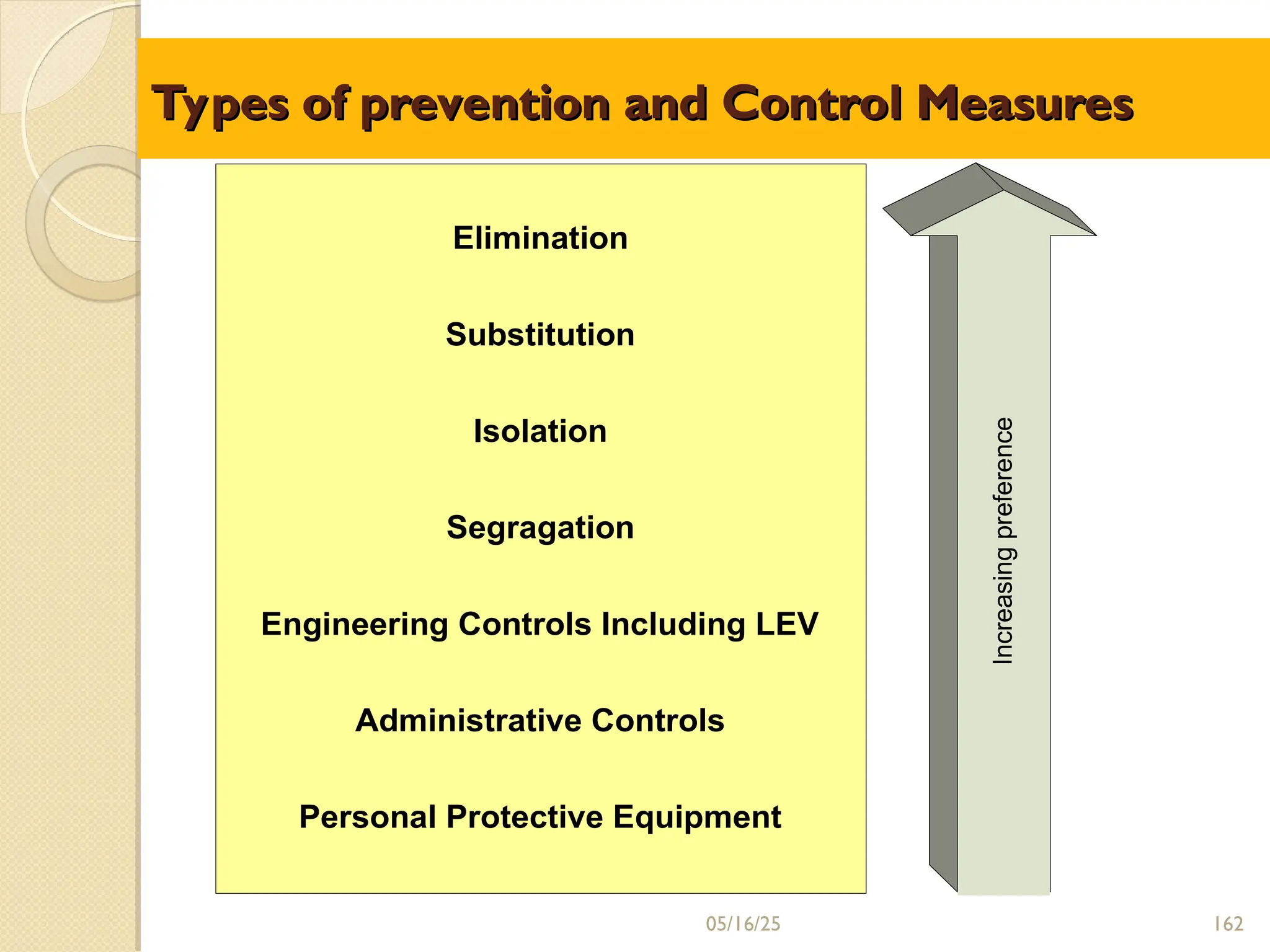
Elimination
Substitution
Isolation
Segragation
Engineering Controls Including LEV
Administrative Controls
Personal Protective Equipment
Increasing
preference
05/16/25 162
#2 Environment (Dictionary):
the circumstance, objects, or conditions by which one is surrounded.
The complex of physical, chemical and biotic factors that act upon an organism or an ecological community and ultimately determine its form and surrounding.
The environment is understood to be everything around us: the natural or unaltered environment and the human-made or built environment, our homes workplaces, schools, and our community, both outdoors and indoors, urban and rural.
#4 All that which is external to the individual host. [It] can be
divided into physical, biological, social, and cultural factors,
any or all of which can influence health status in populations.
- Last, J. M. (Ed.). (1995). A Dictionary of Epidemiology (3rd
ed.). New York: Oxford University Press.
#5 Disease:
Trouble or a condition of the living animal or plant body or one of its parts that impairs the performance of a vital function
#6 Relevant Text from Student Reading:
“Every day, you come in contact with things in your environment that can help you or hurt you. Some of these things are important for keeping you healthy, such as oxygen or medicines. However, some of these things may be harmful to your health, such as tobacco smoke or snake venom. Things in the environment that are harmful are called hazards and include things like chemicals, disease-causing bacteria, loud noises and even stress. Hazards can be natural or human-made.”
Basic Requirements for a Healthy Environment
Clean air
Safe and sufficient water
Safe and adequate food
Safe and peaceful settlements
Stable global environment
Source: Yassi et al. (2001). UNEP.
#8 It refers “those aspects of human health, including quality of life, that are determined by physical, chemical, biological, social and psychosocial factors in the environment” [WHO 2004].
“The study of those factors in the environment that affect human health”: NIEHS charter
Factors (“pollutants” or “toxicants”) in air, water, soil, or food
Transferred to humans by inhalation, ingestion, or absorption
Production of adverse health effects
Environmental health (EH) is just one aspect of public health. It is defined as, “Freedom from illness or injury related to exposure to toxic agents and other environmental conditions that are potentially detrimental to human health” (The Institute of Medicine; in Nursing, Health and the ironment, 1995).
Environmental healthfocuses on the linkages between human health and the conditions present in the environment and all of its elements, including such things as: the air that we breathe, the water that we drink and bathe and swim in, the soil we come in contact with, tfood we consume, the housing we live in , and the lk he
andscape.
#9 Procedure: Ask students to call out things around us that have the potential to hurt us or make us sick, then CLICK ONCE to make the boxed words appear. This is a good time to discuss what things we have control over, and what things we do not - i.e. smoking is a personal choice, but being exposed to air pollution is not.
Relevant Text from Student Reading:
“Every day, you come in contact with things in your environment that can help you or hurt you. Some of these things are important for keeping you healthy, such as oxygen or medicines. However, some of these things may be harmful to your health, such as tobacco smoke or snake venom. Things in the environment that are harmful are called hazards and include things like chemicals, disease-causing bacteria, loud noises and even stress. Hazards can be natural or human-made.”
#10 the study of those factors in the environment that affect human health
These factors represent chemical, biological, or physical agents contained in air, water, soil, or food, and are transported to humans via inhalation, ingestion, or skin absorption
Therefore, it is a science for identifying environmental factors which harms people health and developing possible interventions to address those problems.
Environmental health:
It is the study of how the environment affects human health.
It differs from the study of how humans affect the environment, because it focuses on people’s health.
#11 Inadequate sanitation 2.0 Billion people
Unsafe water 1.0 Billion people
Air pollution 1.3 Billion people
Indoor air pollution 0.7 Billion people
Depletion of forest One football field every second
Environmental burden of diseases is very high
Magnitude of problems: communicable diseases origin, Origin of chronic diseases: cancer
Inadequacy and inaccessibility of basic needs: resources are limited. Uncertainties in human demands.
Globalization and global demand.
#12 Therefore, Protection of the environment and preservation of ecosystems are the most fundamental steps in preventing human illness
Worldwide, 13 million deaths could be prevented every year by making our environments healthier.
In children under the age of five, one third of all disease is caused by the environmental factors such as unsafe water and air pollution
Every year, the lives of four million children under 5 years – mostly in developing countries – could be saved by preventing environmental risks such as unsafe water and polluted air.
In developing countries, the main environmentally caused diseases are diarrhoeal disease, lower respiratory infections, unintentional injuries, and malaria.
Better environmental management could prevent 40% of deaths from malaria, 41% of deaths from lower respiratory infections, and 94% of deaths from diarrhoeal disease – three of the world's biggest childhood killers.
In the least developed countries, one third of death and disease is a direct result of environmental causes.
In developed countries, healthier environments could significantly reduce the incidence of cancers, cardiovascular diseases, asthma, lower respiratory infections, musculoskeletal diseases, road traffic injuries, poisonings, and drownings
#17 Human waste disposal: Proper excreta disposal and liquid waste management
Water supply: Adequacy, safety (chemical, bacteriological, physical) of water for domestic, drinking and recreational use.
Solid waste management: Proper application of storage, collection, disposal of waste. Waste production and recycling.
Vector control: Control of mammals (such as rats) and arthropods (insects such as flies and other creatures such as mites) that transmit disease
Food hygiene: storage, preparation, distribution and sale, until consumption
Healthful housing: Physiological needs, protection against disease and accidents, psychological and social comforts in residential and recreational areas
Institutional hygiene: Communal hygiene in schools, prisons, health facilities, refugee camps, detention homes and settlement areas
Environmental pollution: Sources, characteristics, impact and mitigation
Occupational hygiene: Hygiene and safety in the workplace
#21 Environment (biophysical): refers to the physical and biological factors along with their chemical interactions that affect an organism
Environment may refer to:
Environment (biophysical), the physical and biological factors along with their chemical interactions that affect an organism
Environment (systems), the surroundings of a physical system that may interact with the system by exchanging mass, energy, or other properties
Environments (series), a series of LPs, cassettes and CDs depicting natural sounds
Built environment, constructed surroundings that provide the setting for human activity, ranging from the large-scale civic surroundings to the personal places
Knowledge environment
Social environment, the culture that an individual lives in, and the people and institutions with whom they interact
The term built environment refers to the human-made surroundings that provide the setting for human activity, ranging in scale from personal shelter and buildings to neighborhoods and cities that can often include their supporting infrastructure, such as water supply or energy networks.The built environment is a material, spatial and cultural product of human labor that combines physical elements and energy in forms n for living, working and playing.
#22
Components of environment can be listed into 4 major aspects - Lithosphere, Hydrosphere, Atmosphere and Biosphere.
Lithosphere - The earth’s outer layer consisting of the soil and rocks is the lithosphere. The soil is ended upon non-living and natural matter. There are 2 types of lithosphere namely oceanic lithosphere and continental lithosphere.
Hydrosphere - This comprise all water possessions both surface and ground water. Only less than 1% of water resources are obtainable for human exploitation. Water is considered to be a widespread compound with unusual property.
Atmosphere - It is the state of layer adjoining the earth and extends up to 500 kms above the earth’s shell. Atmosphere is also called as layer of gases. The atmosphere, which is a gaseous wrap, protects the earth as of cosmic radiations and provides life supporting Oxygen. The atmosphere plays a major role in asserting the heat balance of the earth by gripping the re-emitted radiation from the earth.
Biosphere - The biosphere is a shell encompassing the earth’s surface where all the living things subsist. This segment extends from 10000 m underneath sea level to 6000 m above sea level. Biosphere is the total computation of all ecosystems
Components of Environment
Environment is the computation of all existing factors and non living factors that compile the surroundings of man. The external factors affecting an organism are also called as Environment. These factors may be biotic Components (living organisms) and abiotic components (nonliving variables).
Biotic components are the living things that form an ecosystem. Any living component that affects another organism is known as biotic factor. Abiotic components are non – living compound and physical elements in the environment.
#24 Miss Semple a staunch follower of determinism advocated that humans
are solely the product of their environment. She elaborated that man is
not only a child of the earth, the earth has mothered him, set his tasks,
directed his thoughts, confronted him with difficulties that have
strengthened his body and sharpened his wits, given him problems and at
the same time whispered hints for their solutions. Man is the plastic form
which nature moulds. Miss Semple a staunch follower of determinism advocated that humans
are solely the product of their environment. She elaborated that man is
not only a child of the earth, the earth has mothered him, set his tasks,
directed his thoughts, confronted him with difficulties that have
strengthened his body and sharpened his wits, given him problems and at
the same time whispered hints for their solutions. Man is the plastic form
which nature moulds.
#25 Nature does not drive man along one particular road, but it offers a number of opportunities among which man is free to
select. Nature is an advisor. There are no necessities but everywhere possibilities and man as the master of these
possibilities is the judge of their use
#26 Buildings that make up the city or town e.g. cinema, hotels, schools etc
The physical environment comprises all the different factors of nature, including trees, lakes, the ocean etc.
The environment is all of physical and social conditions that surround a person and can influence that person's health. Your physical environment includes both your outdoor and indoor surroundings. The quality of air you breathe and the water you drink are important to your health. So is your exposure to deceasing- causing orgasms, to loud noise, and to radiation from the sun and other sources
Read more: http://wiki.answers.com/Q/What_is_the_definition_of_physical_environment#ixzz1zTovIA1v
In order to understand various aspects of this interaction it would be useful to understand various types of environment which we encounter. A brief description of major types of environment is given below.
Physical environment : It includes both physical reality and social-cultural phenomenon that surround us. The noise, the temperature, the quality of air and water, and various objects and things constitute the physical world around us.
The social and cultural environment: It includes the aspects of social interaction including its products such as beliefs, attitudes, stereotypes, etc. The material and non-material aspects of environment are included in it.
Psychological Environment: It includes the perceptions and experiences pertaining to any environmental setting. Some environments may be stimulating and exciting while othes may be dull and boring. Expression of psychological is often used in the organizational context.
Environment is a theme relevant to many other disciplines, such as geography
architecture, urban planning, etc. It is indeed multidisciplinary in nature. It is labeled as Environmental Science.
The human-environment interaction has five major components. These components are briefly described below:
1. Physical Environment: It includes aspect of natural environment such as climate, terrain, temperature, rainfall, flora, fauna, etc.
2. Social –Cultural Environment: It includes all aspects of cultural environment such as norms, customs, process of socialization, etc. It include all the aspects dealing with other people and their creations.
3. Environmental Orientations: It refers to the beliefs that people hold about their environment. For example, some people hold environment equivalent to God and therefore they perceive all its aspects with respect and reverence and try to maintain it in a perfect form and donot degrade it.
Environmental Behaviour: It refers to the use of environment by people in the course of social interactions. For example, considering the environment as personal space, where the individual identifies himself with it.
Products of Behaviour: These include the outcomes of people’s actions such as homes, cities, dams, schools, etc. That is, these are products or outcomes dealing with the environment.
#28 An environmental disaster is a disaster to the natural environment due to human activity,[2] which distinguishes it from the concept of a natural disaster.
#33 In order to maintain this level, a healthy man will require an average of 2 liters per day.
#34 Man can survive for weeks without food, but only a few days without water.
It is impossible to have a clean and sanitary environment without water.
The provision of safe and adequate water supply in a community is therefore of the greatest importance in public health service.
water also plays a key role in the prevention of disease.
Drinking eight glasses of water daily can decrease the risk of
colon cancer by 45%,
bladder cancer by 50%
it can potentially even reduce the risk of breast cancer.
#35 Contaminated water: water, which may contain harmful microbes, or chemicals, which makes it, unfit for use. Generally then contaminations cannot be detected by the sense of sight, smell, or taste.
Polluted water: water that has become contact with substances that alter its physical qualities so that it changes in color, turbidity, taste or smell. Polluted water can be detected by the sense organs.
Hard water: water, which contains excessive amounts of dissolved minerals, usually salts of calcium and magnesium.
#36 Water is the most widely occurring substance in the world?
The problem is that the distribution, quality, quantity and mode of occurrence are highly variable from one locality to another.
The tiny usable portion is about 0.8% of the total, which is neither evenly distributed nor properly used.
#38
the continuous movement of water on, above and below the surface of the Earth
Principal features of hydrologic cycle
Evaporation from vegetation, from exposed moist surfaces the land surface, and from water bodies.
Precipitation: The moisture forms clouds, which return the water to the land surface or lakes & streams in the form of precipitation
Runoff: When the rate of precipitation exceeds the rate of infiltration, runoff occurs.
Infiltration: the rain wets vegetation and other surfaces and then begins to infiltrate into the ground.
Lake/ocean: Water reaching streams, both by runoff and from ground water discharge, moves to the lake or ocean where it is again evaporated to perpetuate the cycle.
#39 Physiological needs: drinking/ cleaning/washing
• Social use: swimming, recreational
• Cultural/ Spiritual values: “Tebel”, “Timket”
• Economical: agriculture, transportation, power
Multiple:
production, industrial use, etc,
Satisfying promotion of health
Q? Ethiopian case Vs disease transmission ???
Q? The health importance related to the immediate drinking water needs?
#42 Suspended impurities
Microorganisms
From air, soil
Waterborne diseases
Suspended solids
Minute particles of soil, clay, silt, soot , dead leaves & other insoluble materials get into water by erosion & drainage
Taste, color & turbidity
Algae
Minute plants that grow in stagnant water
Taste, color & turbidity
ii. Dissolved impurities
Gases CO2, H2S, etc.
CO2 cause acidity
H2 S imparts bad odor & acidity
Minerals During percolation & dumping
Ca & Mg cause hardness
Na & K cause alkalinity
Pb, As, Cr toxicants
Plant dyes
Originate from plants which grow in or a round water
Causes acidity & color
#44 waterborne, in the strict sense in which the pathogen is ingested in drinking water
• water-washed—that is, favored by inadequate hygiene conditions and practices and susceptible to control by improvements in hygiene
• water-based, referring to transmission by means of an aquatic invertebrate host
• water-related insect vector routes, involving an insect vector that breeds in or near to water.
#48 Water treatment: - is defined as the processes of removing all those substances, where biological, chemical, or physical, which are potentially dangers or undesirable in water supply for human and domestic use
Water treatment processes can be broadly classified into three main types:
Physical treatment process
Chemical treatment process
Biochemical treatment process
In water treatment, contaminants present are removed by the combination of above processes
#49 To remove pathogenic organisms and consequently to prevent water borne diseases.
To remove substances which impart color, taste or odor to the water.
To remove excess or undesirable chemicals or minerals from the water.
To regulate essential elements or chemicals that may be in excess or lacking in a certain water supply (e.g. fluoridation or defluordation of water, softening of water etc).
To remove excess or undesirable dissolved gases.
#50 The CDC Safe Water System (SWS) is a water quality intervention that employs simple, robust, and inexpensive technologies appropriate for the developing world. The objective is to make water safe through disinfection and safe storage at the point of use. The intervention consists of three steps:
Point-of-use treatment of contaminated water using sodium hypochlorite solution purchased locally and produced by a local manufacturer or in the community from water and salt using an electrolytic cell;
Safe water storage in plastic containers with a narrow mouth, lid, and a spigot to prevent recontamination; and,
Behavior change techniques, including social marketing, community mobilization, motivational interviewing, communication, and education. These activities increase awareness of the link between contaminated water and disease, the benefits of safe water, and hygiene behaviors, including the purchase and proper use of the water storage vessel and disinfectant.
#53 Disinfection means the destruction, or at least the complete inactivation, of harmful micro-organisms present in the water.
Why disinfection?
Reasons:
The single most important requirement of drinking water is that it should be free from any pathogenic micro-organisms
Pre-treatments of water can not assure that the water they produce is bacteriological safe, i.e. Final disinfection will be needed.
Factors influence the disinfection of water
The nature and number of the micro-organisms to be destroyed.
The type and concentration of the disinfectants used.
The temperature of water to be disinfected
The time of contact.
The nature of water to be disinfected.
The PH of the water:
Chlorine, pH below 7, HOCl.
At higher pH the chlorine compound present is ClO-
Mixing:
Good mixing ensures proper dispersal of the disinfectant through out the water.
#55 Dose /Demand/ Residual
Dose: The amounts of chlorine added to the water are referred to as the dose, (mg/L).
Demand: The amount of chlorine destroyed in the reaction with the substances in the water is the demand.
Residual: The amount of chlorine (either free or combined) that remains after a certain contact time is the residual chlorine.
Dose = Demand + Residual
#57 It is an investigative activity under taken to identify and evaluate factors associated with drinking water which could pose a risk to health.
Surveillance is also both:
preventive = detecting risks so that action may be taken before public health problems occur and
Remedial = identifying the source of Out-breaks of water borne disease so that corrective action may be taken properly.
#58 The objectives of Surveillance is:
to collect and collate information, to contribute to the protection of public health by promoting the improvement of water supply with respect to:
quality,
quantity,
Coverage
Cost
Continuity
Methods used:
1. Sanitary surveillance: system integrity; source of contamination;
2. Laboratory surveillance: quality assurance;
3. Epidemiological: rapid method; association of disease with drinking water
#59 The objectives of Surveillance is:
to collect and collate information, to contribute to the protection of public health by promoting the improvement of water supply with respect to:
quality,
quantity,
Coverage
Cost
Continuity
Methods used:
1. Sanitary surveillance: system integrity; source of contamination;
2. Laboratory surveillance: quality assurance;
3. Epidemiological: rapid method; association of disease with drinking water
#60
Verifi cation of the microbial quality of drinking-water typically includes testing for
Escherichia coli as an indicator of faecal pollution. In practice, testing for thermotolerant
coliform bacteria can be an acceptable alternative in many circumstances.
Although E. coli is useful, it has limitations. Enteric viruses and protozoa are more
resistant to disinfection; consequently, the absence of E. coli will not necessarily indicate
freedom from these organisms. Under certain circumstances, the inclusion of
more resistant indicators, such as bacteriophages and/or bacterial spores, should be
considered
The objectives of Surveillance is:
to collect and collate information, to contribute to the protection of public health by promoting the improvement of water supply with respect to:
quality,
quantity,
Coverage
Cost
Continuity
Methods used:
1. Sanitary surveillance: system integrity; source of contamination;
2. Laboratory surveillance: quality assurance;
3. Epidemiological: rapid method; association of disease with drinking water
#62 The objectives of Surveillance is:
to collect and collate information, to contribute to the protection of public health by promoting the improvement of water supply with respect to:
quality,
quantity,
Coverage
Cost
Continuity
Methods used:
1. Sanitary surveillance: system integrity; source of contamination;
2. Laboratory surveillance: quality assurance;
3. Epidemiological: rapid method; association of disease with drinking water
#63 water-quality indicator A microbial, chemical, or physical parameter that indicates the potential risk for infectious diseases associated with using the water for drinking, bathing, or recreational purposes.
The best indicator is one with a density or concentration that correlates best with health effects associated with a type of hazard or pollution (e.g., turbidity, coliforms, fecal coliforms, Escherichia coli, enterococci, free chlorine level).
#66 Highest desirable level is a requirement whose fulfillment is desirable but whose non-fulfillment will not be sufficient cause for disqualification of the water for drinking and domestic use.
Maximum permissible level is a requirement level whose non fulfillment would disqualify the water for drinking and domestic use because of its probable hazard to health. This is the level that can be tolerated with out significant health risks.
#78 what is the difference in the definition?
abrk2011
#80 Food safety[1] is a scientific discipline describing handling, preparation, and storage of food in ways that prevent food borne illness.
Food spoilage
Alteration of food in color, odour, taste, texture due to food decomposition, decaying, rottening, & fermentation.
Food adulteration
Food that intentionally and illegally contains any substance other than its genuine component
Safe temperature:
the temperature at which potentially hazardous foods could be safely preserved to keep them for a long period of time.
These temperatures are either 4.4 OC (40OF)or below, or 60 OC(140OF) or above.
“adulteration” means adding any foreign
substance or ingredient to a food for
commercial purpose or to be served for the
public in any way or medicine other than its
content or by substituting its content in whole
or in part by such other substance or by
storing or manufacturing it under unsanitary
conditions whereby it may have been
contaminated;
#81 76 million cases each year
350,000 Hospitalizations
According to the World Health Organization (WHO) about 70% of the 2 million death per year from diarrhea in developing countries are related to contaminated food
#101 Excreta/ “night soil”: The waste matter mainly feces & urine eliminated from the body
Food sanitation: refers to the hygienic measures for ensuring food safety. Food hygiene is similar to food sanitation.
If waste is collected and treated at the place where it is deposited?.
Housing sanitation: refers to safeguarding the home environment (the dwelling and its immediate environment).
Environmental sanitation: the control of environmental factors that form links in disease transmission. This category includes solid waste management, water and wastewater treatment, industrial waste treatment and noise and pollution control.
Ecological sanitation: the concept of recycling the nutrients from human and animal wastes to the environment.
The non- water carriage system Vs
water carriage system
Onsite Vs
Offsite
Can you presume the difference??
#103 Primary barriers
1. Simple pit latrine
2. VIP Latrine, composting toilet or WC
3. Protection of fresh water sources
4. Protection of the harvest
Secondary barriers
5. Hand washing: after using bathroom, after changing diapers, before food preparation, before eating and before feeding babies and children
6. Protection storage of foods
7. Safe food preparation
8. Protect water distribution (disinfection, repair leaks) and safe water storage at home
9. Eat safe foods (wash fruits and vegetables if eaten uncooked)
#104 Comprehensive knowledge (HW with plain water and with soap)
Before eating
Before feeding a child
Before food preparation
After defecation
After cleaning child bottom
After cleaning house/animal dung
Full compliance of Safe water storage Practices
Narrow necked storage container
Covered container
Placed off floor
Cleanly kept
#106 8 percent of households in Ethiopia use improved toilet facilities that are
not shared with other households, 14 percent in urban areas and 7 percent in rural areas. One in ten
households (32 percent in urban areas and 3 percent in rural areas) use shared toilet facilities. The
large majority of households, 82 percent, use non-improved toilet facilities (91 percent in rural areas
and 54 percent in urban areas). The most common type of non-improved toilet facility is an open pit
latrine or pit latrine without slabs, used by 45 percent of households in rural areas and 37 percent of
households in urban areas. Overall, 38 percent of households have no toilet facility, 16 percent in
urban areas and 45 percent in rural areas.
#109 Waste management is the collection, transport, processing, recycling or disposal,managing and monitoring of waste materials. The term usually relates to materials produced by human activity, and is generally undertaken to reduce their effect on health, the environment oraesthetics. Waste management is also carried out to recover resources from it. Waste management can involve solid, liquid, gaseous orradioactive substances, with different methods and fields of expertise for each.
Waste management practices differ for developed and developing nations, for urban and rural areas, and for residential and industrial producers. Management for non-hazardous waste residential and institutional waste in metropolitan areas is usually the responsibility of local governmentauthorities, while management for non-hazardous commercial and industrial waste is usually the responsibility of the generator
#110 Solid waste management is a polite term for garbage management. As long as humans have been living in settled communities, solid waste, or garbage, has been an issue, and modern societies generate far more solid waste than early humans ever did. Daily life in industrialized nations can generate several pounds of solid waste per consumer, not only directly in the home, but indirectly in factories that manufacture goods purchased by consumers.
Solid waste management is a system for handling all of this garbage; municipal waste collection is solid waste management, as are recycling programs, dumps, and incinerators
Solid waste management
It is a discipline associated with the control of
generation,
storage,
transfer and transport processing and
disposal of solid waste
In a manner that is in accordance with the best principles of public health, economics, engineering, conservation, aesthetics and other environmental conditions
#111 Waste generation
Activities in which materials are identified as no longer being of value
On-site handling, storage, & processing:
Activities associated with the handling, storage, and processing at the point of generation.
Collection
Activities associated with the gathering of solid wastes and the hauling of wastes to the location where the collection vehicle is emptied.
4. Transfer & transport:
Transfer of wastes from the smaller collection vehicle to the larger transport equipment
Subsequent transport of the wastes, usually over long distance, to the disposal site.
Processing & recovery:
Techniques used to improve the efficiency of the other functional elements &
to recover useable materials or energy from solid wastes
Disposal:
Activities associated with ultimate disposal of solid wastes
#112 The purpose of the waste management hierarchy is to make waste management practices
as environmentally sound as possible (UNEP, 2009).
The hierarchy is a useful policy tool for conserving resources, for dealing with landfill
shortages, for minimizing air and water pollution, and for protecting public health and
safety (Sharholy, 1996).
#119 The 10-25% hazardous fraction of HCW are usually classified into the following waste groups. To get detailed information about each category, click on the title.
The last four categories (7-10) are considered as highly hazardous and therefore require special attention.
Information about possible treatment options for each category can be found in the ressources section under the treatment options chapter.
#120 Each of these major actors as well as administrative authorities and the public will need to receive appropriate training to ensure appropriate measures are taken at each level for the safe management of HCW.
Generators of HCW
HCW isn’t only produced in hospitals but in a number of other locations:
Major sources are hospitals, clinics, laboratories, blood banks and mortuaries;
Minor sources are physician’s office, dental clinics, pharmacies, etc.
Apart from producing different quantities of waste, these sources also produce different types of waste, that don’t all require the same kind of treatment and disposal as explained in the ressources section under the treatment options chapter.
#121 Medical staff: doctors, nurses, sanitary staff and hospital maintenance personnel;
In and out-patients receiving treatment in healthcare facilities as well as their visitors;
Workers in support services linked to healthcare facilities such as laundries, waste handling and transportation services;
Workers in waste disposal facilities, including scavengers;
The general public and more specifically the children playing with the items they can find in the waste outside the healthcare facilities when it is directly accessible to them
#128 Housing is a term that we use for a physical structure in which we live.
¦ Just stop reading for a moment and ask yourself what is housing?
□ You may say housing is a shelter where we sleep and live, or a place in
which we cook our food, or a place where a child grows, or a place
where we get clean water for drinking.
#129 The public health understanding of housing goes beyond this. The World
Health Organization uses the term ‘residential environment’, rather than
‘housing’, which they define as:
the physical structure that man uses for shelter and the environs of that
structure including all necessary services, facilities, equipment, and devices
needed or desired for the physical, mental, and social wellbeing of the
family and individual.
#131 Substandard Housing:-Is a house, which is poorly sited, planned and constructed, inadequate floor space for the family ( overcrowded), poorly maintained and does not in general comply with the more important sanitary facilities
Slum:- is an area in which substandard housing predominates and frequently accompanied with overcrowding.
Blighted area:- an area, which is undesirable for residential, agricultural, commercial, industrial or recreational purpose. Examples:- Marshy and rocky areas, gorges and mountainous areas, and plots nearer to sources of noise
#132 To blight is to ‘‘prevent the growth and fertility of; hence to ruin; frustrate’’ (Webster’s). A
blighted area is an area of no growth in which buildings are permitted to deteriorate.
#133 In order to understand further what housing is, WHO has adopted four basic requirements:
satisfaction of physiological needs
protection against infection
protection against accidents
protection against psychological and social stresses.
#137 School children spend about one third of their time either in schools or doing school assignments, during which time they may be exposed to a variety of physical, social and psychological harm.
observed among female students due to a lack of latrines with facilities for menstrual hygiene
#151 Framework for IH practice
Anticipation of potential hazards
Recognition of potential hazards
Evaluate risks from hazards
Control hazards to acceptable levels of risk in work places
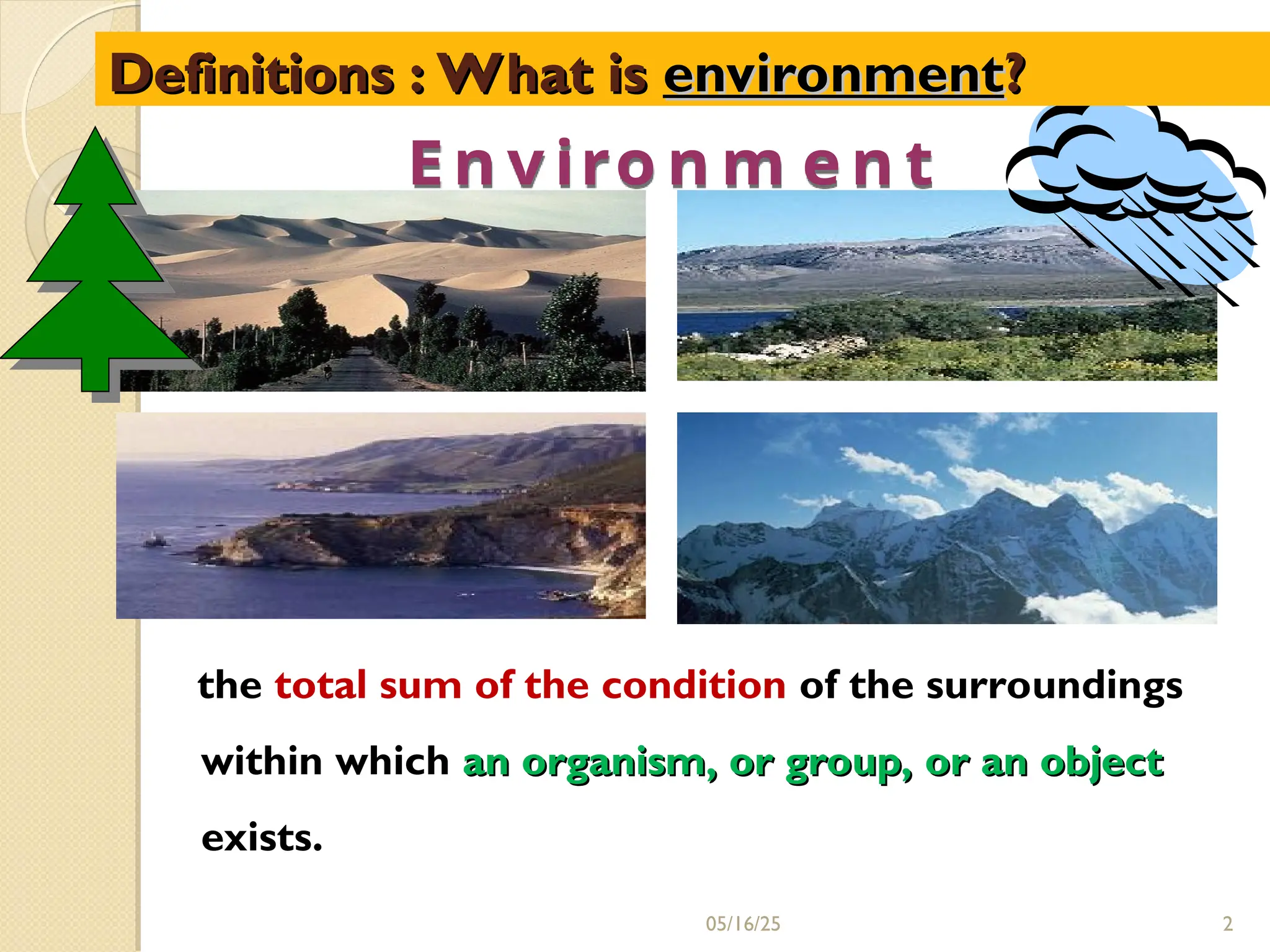


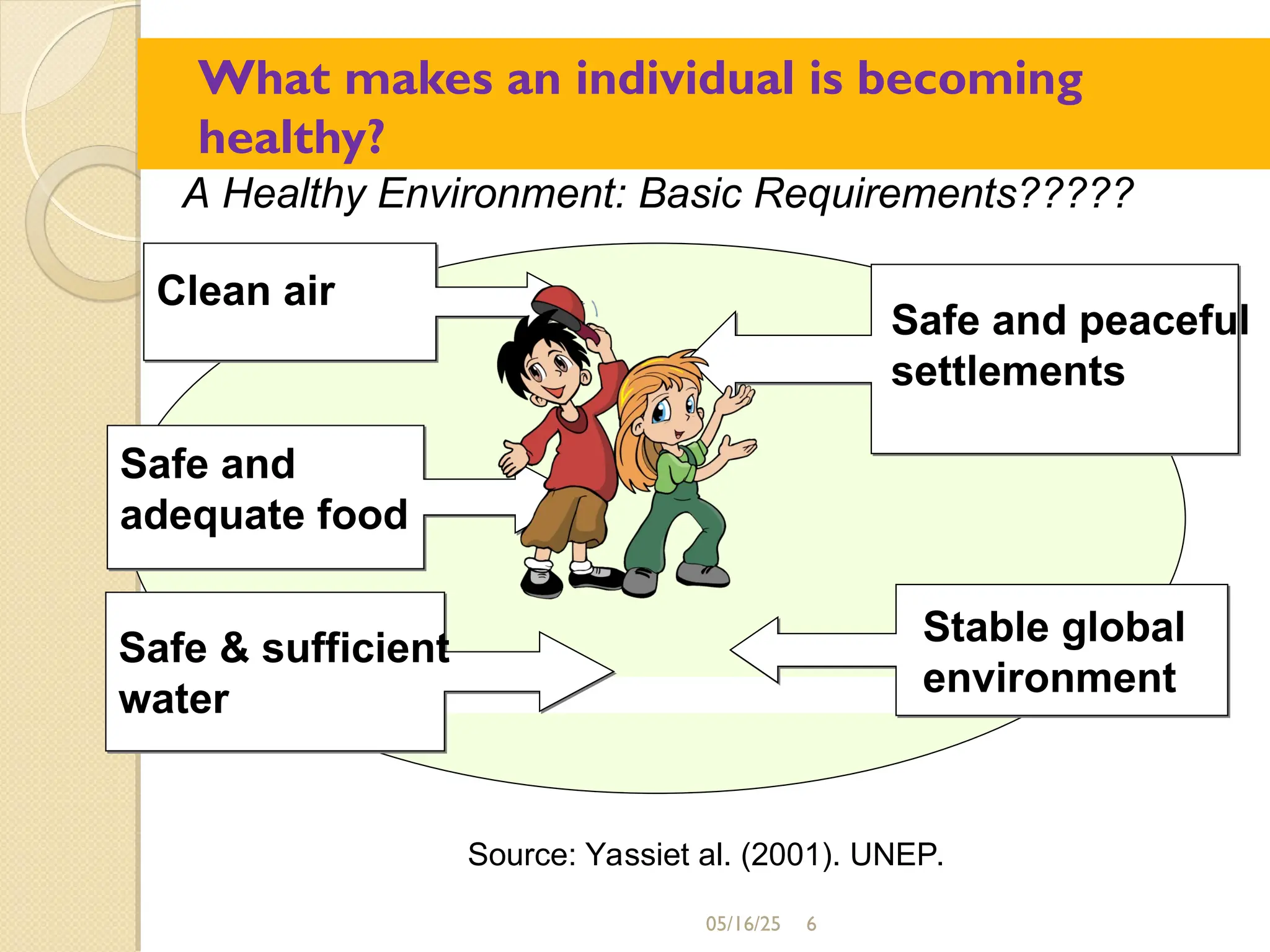

![9
Definitions: Environmental Health?
Definitions: Environmental Health?
A hazard is anything in the environment that can hurt people
or make people sick.
Bacteria &
viruses
Harmful
chemicals
Loud noises
Tobacco
smoke
Stress
Hazards
“It is a branch of public health that protects against the
effects of environmental hazards that can
adversely effect health or the ecology of balances essential to
human health and environmental quality “ [Agency for Toxic
Substances, USA, 1998]
05/16/25](https://image.slidesharecdn.com/environmentalhealth-250516230123-aee965ce/75/Environmental-Health-for-public-Health-ppt-9-2048.jpg)