Envenomation
Gladson M. Robin
Envenomation in India
• Snake bite - major environmental and occupational hazard in rural India and
South Asia
• There are estimated 50,000 deaths due to snake bite in India every year.
• 97% of affected are in rural area
• Only 23% of the total snake bite deaths occurred in hospitals
Snakes
• 3500 species – about 375 are poisonous
• Important Poisonous species –
• Elapidae (Cobras, Kraits, Mambas, Coral snakes)- not in Europe
• Viperidae (True vipers)
• Crotalidae (Pit vipers and Rattle snakes)
• Colubridae – Africa
• Hydrophiidae (Sea snakes) – found close to coastline.
Common in India
• Cobras
• Indian Cobra
• King Cobra
• Kraits (small but very poisonous)
• Common Krait - கட்டு விரியன்
• Banded Krait - yettadi viriyan
• Vipers
• Pit Viper (pit below eyes)
• Russell Viper - கண்ணாடி விரியன்
• Saw scaled Viper - சுருட்டைவிரியன்
Venom
• Injected through two fangs in upper jaw– grooved or tubular
• Secreted in specialized parotid gland – squeezed through duct to fangs
• Constituent :
• Toxic proteins and Proteolytic enzymes (Cholinesterases, Phosphatases, Nucleotidases,
Hyaluronidase, … etc.
Effects of Venom
• Neurotoxic :
• Paralysis – Voluntary muscles Muscles supplied by cr. nerves Brainstem/Medulla
• Necrotizing:
• Severe inflammation and local necrosis
• Hemolytic and Hemorrhagic:
• Intravascular hemolysis / severe haemorrhage – depletion of normal clotting factors
Effects of Venom
• Shock:
• Severe inflammation and vasodilatation at bitten extremity along with severe hemolysis
and haemorrhage
• In viperine bites – shock may occur before local features/haemolysis/haemorrhage
manifest.
Effects of Venom
• Elapids:
• Chiefly neurotoxic
• Some degree of hemolysis and local tissue necrosis
• Viperidae:
• Severe local necrosis, haemolysis
• Disturbance in coagulation mechanism
• Profuse haemorrhage and Shock
Points to Note
• A bite from poisonous snake does not necessarily cause envenomation.
• A bite by any snake P/NP may cause severe fright which may even lead to
death. Violent and agitated behaviour may be noticed in them.
• P snake bite – 2 fang marks/ NP snake bite – form of inverted ‘U’
• Envenomation serious in children than adult
• Pathogens in mouth of PS/NPS  Secondary infection
• Victim perfectly well/no local inflmtn 6-8hrs after bite Non poisonous.
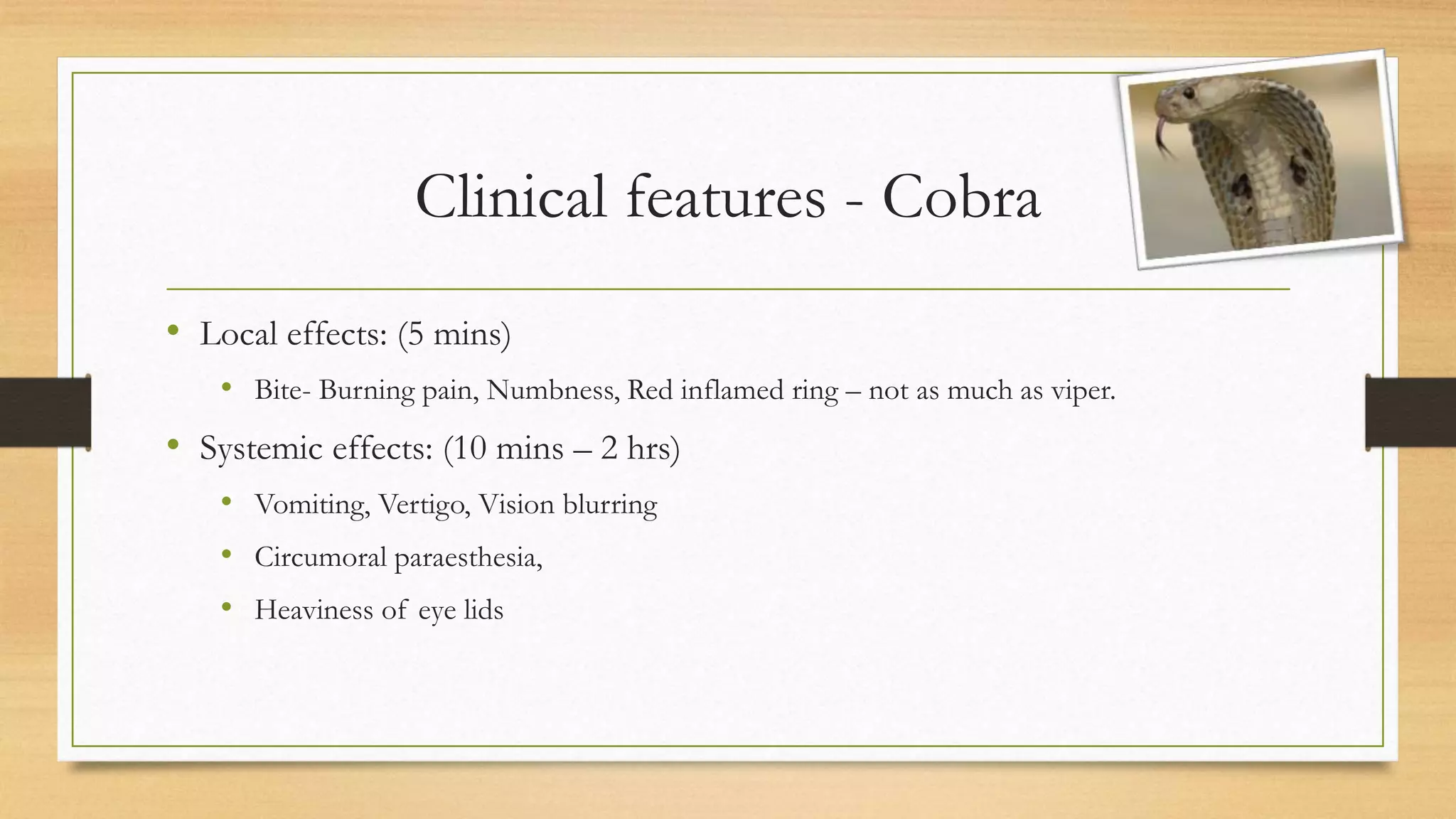
Clinical features - Cobra
• Local effects: (5 mins)
• Bite- Burning pain, Numbness, Red inflamed ring – not as much as viper.
• Systemic effects: (10 mins – 2 hrs)
• Vomiting, Vertigo, Vision blurring
• Circumoral paraesthesia,
• Heaviness of eye lids
Clinical features - Cobra
• Weakness and Ataxia – unsteady gait – paralysis of CN supplied muscles
• Ptosis – Opthalmoplegia (generally 1st paralytic sign to be observed)
• Paralysis of palate, pharynx, tongue – difficult swallowing
• Increased salivation – drooling.
• Neck weakness – unable to support head
• Respiratory muscle paralysis – hypoventilation – hypoxia/hypercapnia
• Vital centres of brainstem – hypotension and shock
Prognosis- Cobra
• Generally conscious and helpless till end till paralysis kills him
• Death – 4 to 12 hrs (may occur within 1 hour or delayed for 72 hours)
• Those surviving >24hrs – may have mild hemolysis and bleeding
• If Death doesn’t occur, Paralysis quickly recedes - Recovery
Clinical features - Krait
• Symptoms of Cobra + Severe abdominal pains and cramps.
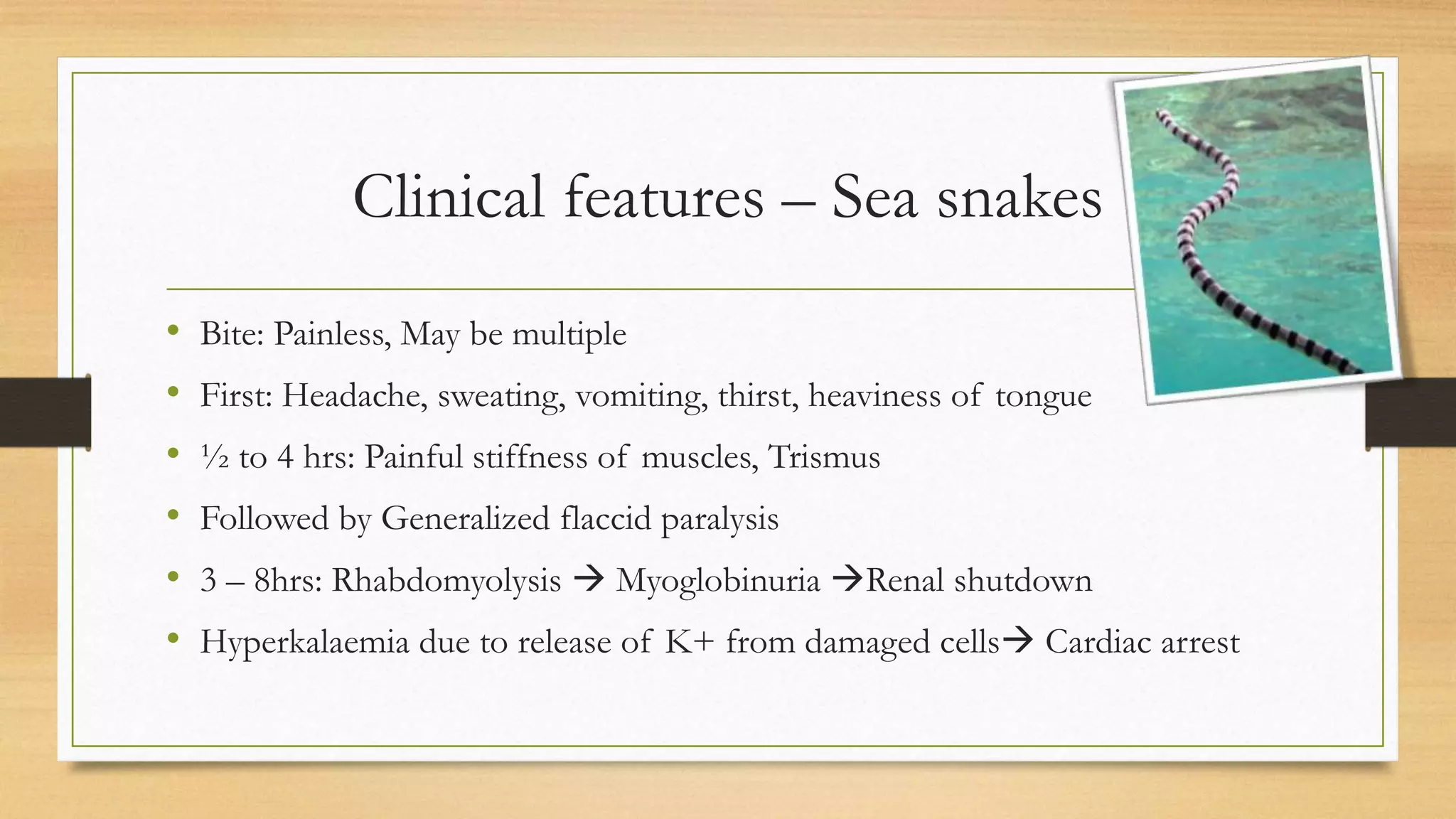
Clinical features – Sea snakes
• Bite: Painless, May be multiple
• First: Headache, sweating, vomiting, thirst, heaviness of tongue
• ½ to 4 hrs: Painful stiffness of muscles, Trismus
• Followed by Generalized flaccid paralysis
• 3 – 8hrs: Rhabdomyolysis  Myoglobinuria Renal shutdown
• Hyperkalaemia due to release of K+ from damaged cells Cardiac arrest
Clinical features – Viperine bites
• Local effects:
• Marked within few minutes of bite
• Severe pain, Increasing redness, Oedema, Bullae formation
• Necrotizing inflammation – may cause severe creeping gangrene
Clinical features – Viperine bites
Systemic effects:
• Acute Circulatory Shock: (May manifest before clinically apparent)
• Haemolysis, Pallor, Tachycardia
• Extravasation of fluid in affected limb, Sweating, Hypotension
• Generalised increase in capillary permeability Restlessness, Oliguria
• Haemorrhage
Clinical features – Viperine bites
• Severe Intravascular Haemolysis:
• Fall in Hb%
• Icterus
• Haemoglobinaemia
• Haemoglobinuria
• Acute tubular necrosis  Renal failure
• Disturbed Clotting Mechanism with
haemorrhage:
• Epistaxis, Haematuria, Haemetemesis…
• Bleeding from 1 or more sites
• Internal bleeding / DIC
• Generally in few hrs but may be late
than 24 hrs also
Clinical features – Viperine bites
• Fever:
• 100oF – 104oF
• Leucocytosis (20K – 40K/mm3)
• Vomitting/Seizure
• Acute Renal Failure: due to
• Acute Circulatory Shock
• DIC
• Acute Intravascular Hemolysis
• Acute Tubular Necrosis
• Combination
Death due to Viperine bites is generally in 12 to 24 hrs
Management
• Avoid tourniquet –
• harm>good(30 mins) – Gangrene, Bleeding, Compartment ischaemia, agg local sympts.
• Crepe bandaging for immobilization of affected limb (Cobra & Krait only)
• Incision over wound to suck poison – wrong decision – secondary infection
• Ice packs over wound – no value
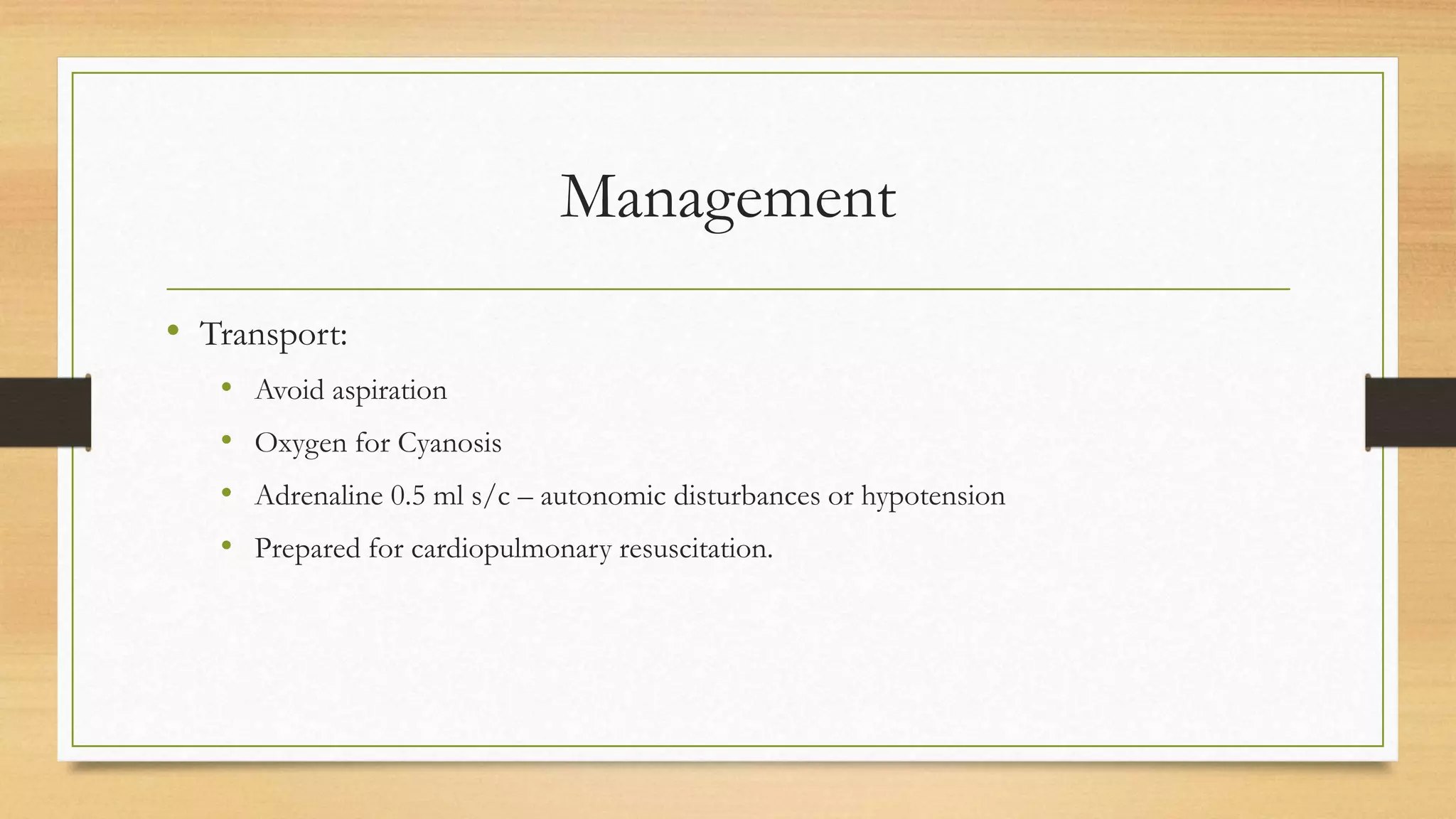
Management
• Transport:
• Avoid aspiration
• Oxygen for Cyanosis
• Adrenaline 0.5 ml s/c – autonomic disturbances or hypotension
• Prepared for cardiopulmonary resuscitation.
Management
• Immediate Priorities on Admission:
• Cardiorespiratory and other organ supports
• Neutralization of Poison with Antivenin
• A Large Peripheral Venous line – later secure a central venous line
• 20 mins clotting time test
Management
• Investigations:
• CBC, PCV, BT, CT, Coagulation profile
• U, C, Sr. Electrolytes
• Reticulocyte count,
• Tests for
hemoglobinaemia/hemoglobinuria
• Urine examination
• Continuous monitoring:
• I/O
• CVP
• ECG
Management
• Neutralizing the Poison
• Using Antivenin
• Given as soon as possible
• Systemic features (too late)
• But efficacy proved even after 24 hrs
of bite
• Prepared by hyperimmunizing horses
against venoms of Cobra, Common
Krait, Saw scaled viper and Russell’s
viper.
• Each ml concentrated serum
neutralizes:
• 0.6 mg dried venom of Cobra
• 0.6 mg dried venom of Russell’s viper
• 0.45 mg dried venom of Com. Krait
• 0.45 mg dried venom of SS viper
Management
• Using Antivenin:
• Reconstitute using distilled water as it is lyophilized.
• Sensitivity test  Not sensitive  inject 5 ml around wound (never in finger or toe)
• s/c 0.5 ml of 1:1000 adrenaline & an antihistamine 
100 ml of antivenin in 300-500 ml NS over 1-2 hrs (IV preferred)
Dose repeated twice or more freq in serious life threatening situations.
Management
• Using Antivenin Contd…
• Sensitive patients 
Under cover of adrenaline, antihistamine,
Corticosteroids
0.05ml s/c
Increasing dose till 2ml IM
Increase dose to 10 ml to 40 ml IM progressively
10 to 20 ml in 500 ml NS over 2 hrs with watch
for reactions
No reaction
Management
• Using Antivenin Contd…
• Small children –
• difficult vein – IM allowed
• 60 to 100 ml with Hyalace to help
absorption (IM)
• Or Same dose of adults as infusion
over 2 hrs (IV)
• Preference: IV>IM
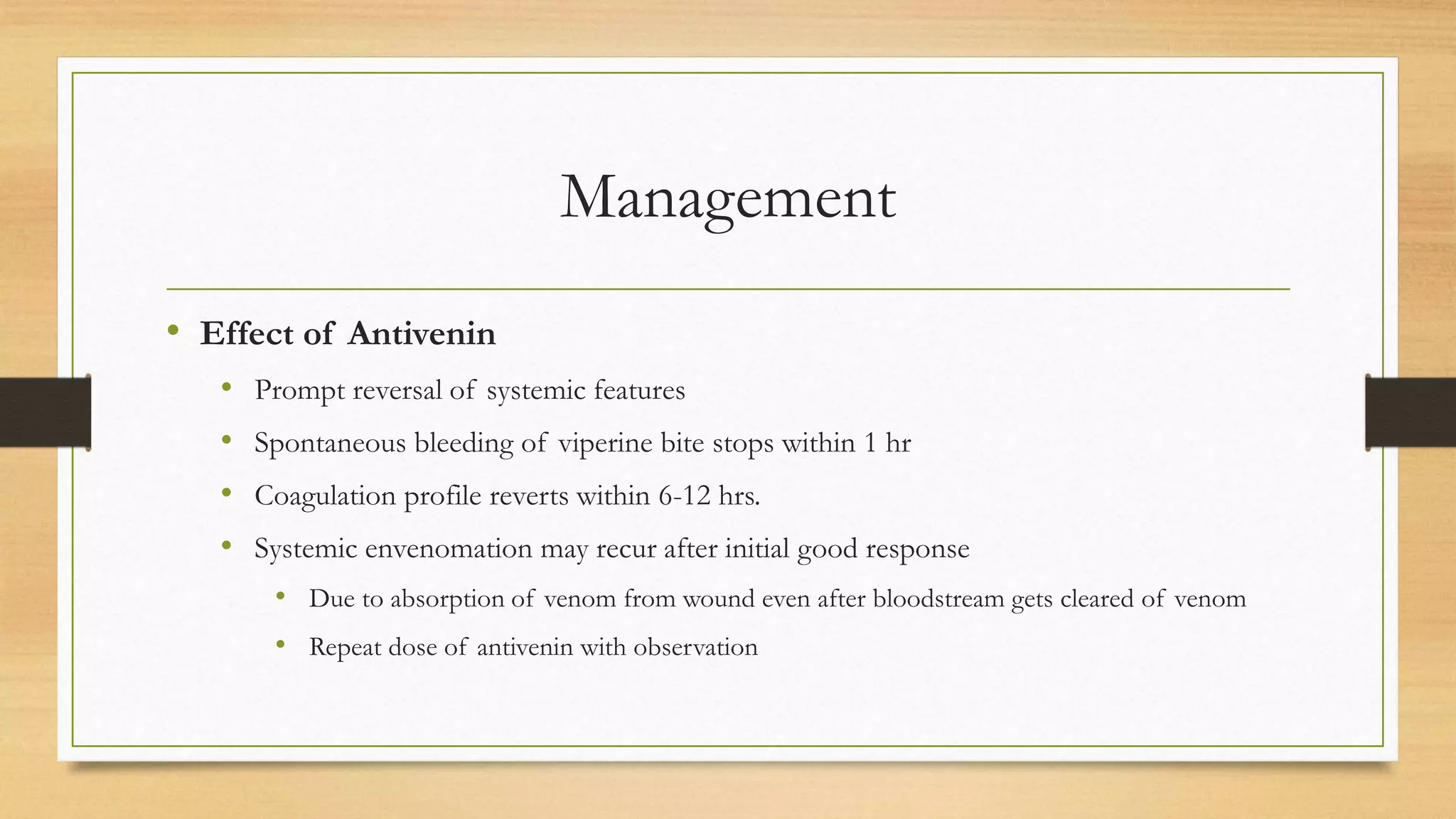
Management
• Effect of Antivenin
• Prompt reversal of systemic features
• Spontaneous bleeding of viperine bite stops within 1 hr
• Coagulation profile reverts within 6-12 hrs.
• Systemic envenomation may recur after initial good response
• Due to absorption of venom from wound even after bloodstream gets cleared of venom
• Repeat dose of antivenin with observation
Management
Adverse reaction of ASV
• Seen in 20 % patient
Early anaphylactic reaction-
• Seen with in 10 min to 3 hrs
• Urticaria, diarrhoea, tachycardia,
fever, hypotension, etc.
Late Serum Sickness
• 1-12 days
• Fever,nausea,vomiting,diarhoea,arthe
ritis,nephrits,myoglobinuria.etc.
Management
Treatment Of Early ASV reaction:
• Adrenaline -1:1000 i.m.
0.5 mg in adult
0.01 mg/kg in children
can be repeated every 5 min if necessary
H1 antihistaminic- i.v. 1 mg of CPM
I.V. Hydrocortisone
Management
Treatment Of Late ASV reaction:
• 5 days course of oral anti histaminic CPM
2mg/6hour-adult
0.25 mg/kg/day in divided dose
Patient who fail to response with in 24 hr
Predinisolone-
5mg/6h in adult
0.7 mg/kg/day in divided dose in children
Management
• Cardiorespiratory Support:
• Immediate ET Intubation – Cobra/Krait (curare-like paralysis)
• Neostigmine 2.5 - 5 mg may be of a little help. Never depend. Not proved helpful.
• Inotropes support
• Ventilator support
• Sufficient Volume load with LV filling pressure 15 mmHg (using Swan-Ganz Cath)
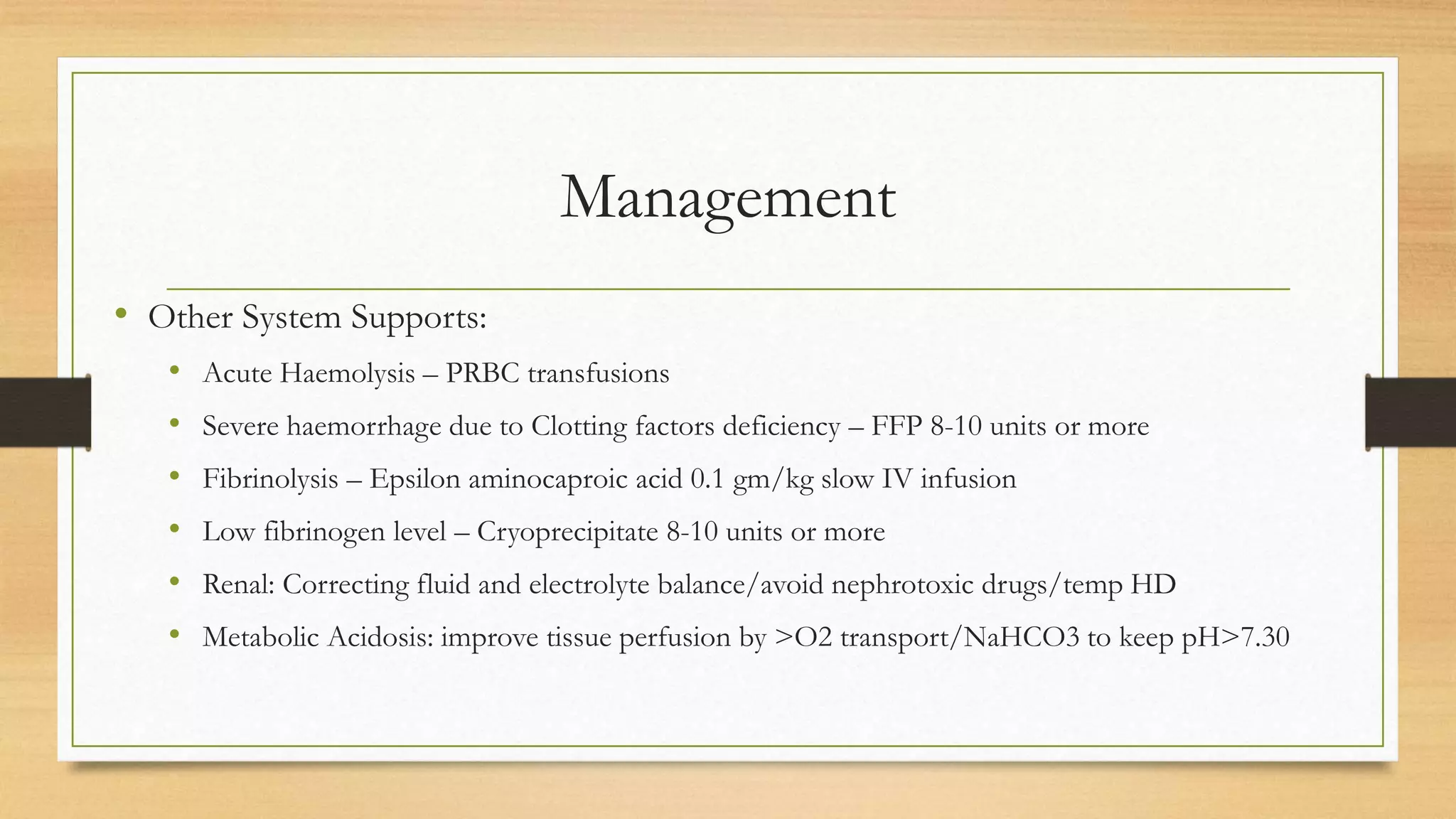
Management
• Other System Supports:
• Acute Haemolysis – PRBC transfusions
• Severe haemorrhage due to Clotting factors deficiency – FFP 8-10 units or more
• Fibrinolysis – Epsilon aminocaproic acid 0.1 gm/kg slow IV infusion
• Low fibrinogen level – Cryoprecipitate 8-10 units or more
• Renal: Correcting fluid and electrolyte balance/avoid nephrotoxic drugs/temp HD
• Metabolic Acidosis: improve tissue perfusion by >O2 transport/NaHCO3 to keep pH>7.30
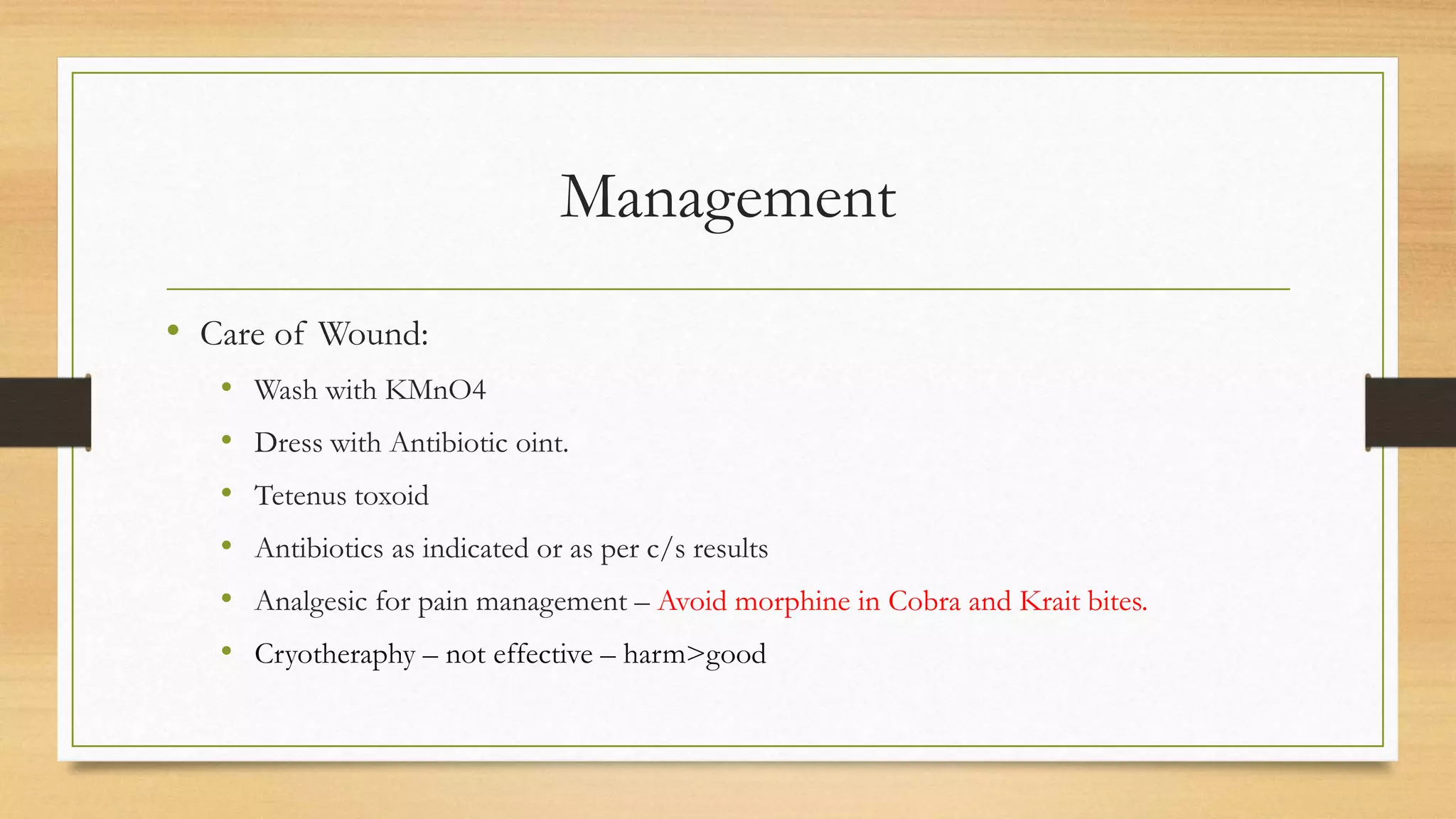
Management
• Care of Wound:
• Wash with KMnO4
• Dress with Antibiotic oint.
• Tetenus toxoid
• Antibiotics as indicated or as per c/s results
• Analgesic for pain management – Avoid morphine in Cobra and Krait bites.
• Cryotheraphy – not effective – harm>good
Management
• Use of Corticosteroids:
• Good results
• Advisable to give Hydrocortisone hemisuccinate 300 mg IV stat 300 mg slow
infusion over 24 hrs  100 mg every 8 hrs for 2-3 days
Bibliography
• Principles of Critical Care – 2nd edition – Farokh Erach Udwadia
• www.ncbi.nlm.nih.gov
• Google Search – articles and ppts

Envenomation

  • 1.
  • 2.
    Envenomation in India •Snake bite - major environmental and occupational hazard in rural India and South Asia • There are estimated 50,000 deaths due to snake bite in India every year. • 97% of affected are in rural area • Only 23% of the total snake bite deaths occurred in hospitals
  • 3.
    Snakes • 3500 species– about 375 are poisonous • Important Poisonous species – • Elapidae (Cobras, Kraits, Mambas, Coral snakes)- not in Europe • Viperidae (True vipers) • Crotalidae (Pit vipers and Rattle snakes) • Colubridae – Africa • Hydrophiidae (Sea snakes) – found close to coastline.
  • 4.
    Common in India •Cobras • Indian Cobra • King Cobra • Kraits (small but very poisonous) • Common Krait - கட்டு விரியன் • Banded Krait - yettadi viriyan • Vipers • Pit Viper (pit below eyes) • Russell Viper - கண்ணாடி விரியன் • Saw scaled Viper - சுருட்டைவிரியன்
  • 5.
    Venom • Injected throughtwo fangs in upper jaw– grooved or tubular • Secreted in specialized parotid gland – squeezed through duct to fangs • Constituent : • Toxic proteins and Proteolytic enzymes (Cholinesterases, Phosphatases, Nucleotidases, Hyaluronidase, … etc.
  • 6.
    Effects of Venom •Neurotoxic : • Paralysis – Voluntary muscles Muscles supplied by cr. nerves Brainstem/Medulla • Necrotizing: • Severe inflammation and local necrosis • Hemolytic and Hemorrhagic: • Intravascular hemolysis / severe haemorrhage – depletion of normal clotting factors
  • 7.
    Effects of Venom •Shock: • Severe inflammation and vasodilatation at bitten extremity along with severe hemolysis and haemorrhage • In viperine bites – shock may occur before local features/haemolysis/haemorrhage manifest.
  • 8.
    Effects of Venom •Elapids: • Chiefly neurotoxic • Some degree of hemolysis and local tissue necrosis • Viperidae: • Severe local necrosis, haemolysis • Disturbance in coagulation mechanism • Profuse haemorrhage and Shock
  • 9.
    Points to Note •A bite from poisonous snake does not necessarily cause envenomation. • A bite by any snake P/NP may cause severe fright which may even lead to death. Violent and agitated behaviour may be noticed in them. • P snake bite – 2 fang marks/ NP snake bite – form of inverted ‘U’ • Envenomation serious in children than adult • Pathogens in mouth of PS/NPS  Secondary infection • Victim perfectly well/no local inflmtn 6-8hrs after bite Non poisonous.
  • 10.
    Clinical features -Cobra • Local effects: (5 mins) • Bite- Burning pain, Numbness, Red inflamed ring – not as much as viper. • Systemic effects: (10 mins – 2 hrs) • Vomiting, Vertigo, Vision blurring • Circumoral paraesthesia, • Heaviness of eye lids
  • 11.
    Clinical features -Cobra • Weakness and Ataxia – unsteady gait – paralysis of CN supplied muscles • Ptosis – Opthalmoplegia (generally 1st paralytic sign to be observed) • Paralysis of palate, pharynx, tongue – difficult swallowing • Increased salivation – drooling. • Neck weakness – unable to support head • Respiratory muscle paralysis – hypoventilation – hypoxia/hypercapnia • Vital centres of brainstem – hypotension and shock
  • 12.
    Prognosis- Cobra • Generallyconscious and helpless till end till paralysis kills him • Death – 4 to 12 hrs (may occur within 1 hour or delayed for 72 hours) • Those surviving >24hrs – may have mild hemolysis and bleeding • If Death doesn’t occur, Paralysis quickly recedes - Recovery
  • 13.
    Clinical features -Krait • Symptoms of Cobra + Severe abdominal pains and cramps.
  • 14.
    Clinical features –Sea snakes • Bite: Painless, May be multiple • First: Headache, sweating, vomiting, thirst, heaviness of tongue • ½ to 4 hrs: Painful stiffness of muscles, Trismus • Followed by Generalized flaccid paralysis • 3 – 8hrs: Rhabdomyolysis  Myoglobinuria Renal shutdown • Hyperkalaemia due to release of K+ from damaged cells Cardiac arrest
  • 15.
    Clinical features –Viperine bites • Local effects: • Marked within few minutes of bite • Severe pain, Increasing redness, Oedema, Bullae formation • Necrotizing inflammation – may cause severe creeping gangrene
  • 16.
    Clinical features –Viperine bites Systemic effects: • Acute Circulatory Shock: (May manifest before clinically apparent) • Haemolysis, Pallor, Tachycardia • Extravasation of fluid in affected limb, Sweating, Hypotension • Generalised increase in capillary permeability Restlessness, Oliguria • Haemorrhage
  • 17.
    Clinical features –Viperine bites • Severe Intravascular Haemolysis: • Fall in Hb% • Icterus • Haemoglobinaemia • Haemoglobinuria • Acute tubular necrosis  Renal failure • Disturbed Clotting Mechanism with haemorrhage: • Epistaxis, Haematuria, Haemetemesis… • Bleeding from 1 or more sites • Internal bleeding / DIC • Generally in few hrs but may be late than 24 hrs also
  • 18.
    Clinical features –Viperine bites • Fever: • 100oF – 104oF • Leucocytosis (20K – 40K/mm3) • Vomitting/Seizure • Acute Renal Failure: due to • Acute Circulatory Shock • DIC • Acute Intravascular Hemolysis • Acute Tubular Necrosis • Combination Death due to Viperine bites is generally in 12 to 24 hrs
  • 19.
    Management • Avoid tourniquet– • harm>good(30 mins) – Gangrene, Bleeding, Compartment ischaemia, agg local sympts. • Crepe bandaging for immobilization of affected limb (Cobra & Krait only) • Incision over wound to suck poison – wrong decision – secondary infection • Ice packs over wound – no value
  • 20.
    Management • Transport: • Avoidaspiration • Oxygen for Cyanosis • Adrenaline 0.5 ml s/c – autonomic disturbances or hypotension • Prepared for cardiopulmonary resuscitation.
  • 21.
    Management • Immediate Prioritieson Admission: • Cardiorespiratory and other organ supports • Neutralization of Poison with Antivenin • A Large Peripheral Venous line – later secure a central venous line • 20 mins clotting time test
  • 22.
    Management • Investigations: • CBC,PCV, BT, CT, Coagulation profile • U, C, Sr. Electrolytes • Reticulocyte count, • Tests for hemoglobinaemia/hemoglobinuria • Urine examination • Continuous monitoring: • I/O • CVP • ECG
  • 23.
    Management • Neutralizing thePoison • Using Antivenin • Given as soon as possible • Systemic features (too late) • But efficacy proved even after 24 hrs of bite • Prepared by hyperimmunizing horses against venoms of Cobra, Common Krait, Saw scaled viper and Russell’s viper. • Each ml concentrated serum neutralizes: • 0.6 mg dried venom of Cobra • 0.6 mg dried venom of Russell’s viper • 0.45 mg dried venom of Com. Krait • 0.45 mg dried venom of SS viper
  • 24.
    Management • Using Antivenin: •Reconstitute using distilled water as it is lyophilized. • Sensitivity test  Not sensitive  inject 5 ml around wound (never in finger or toe) • s/c 0.5 ml of 1:1000 adrenaline & an antihistamine  100 ml of antivenin in 300-500 ml NS over 1-2 hrs (IV preferred) Dose repeated twice or more freq in serious life threatening situations.
  • 25.
    Management • Using AntiveninContd… • Sensitive patients  Under cover of adrenaline, antihistamine, Corticosteroids 0.05ml s/c Increasing dose till 2ml IM Increase dose to 10 ml to 40 ml IM progressively 10 to 20 ml in 500 ml NS over 2 hrs with watch for reactions No reaction
  • 26.
    Management • Using AntiveninContd… • Small children – • difficult vein – IM allowed • 60 to 100 ml with Hyalace to help absorption (IM) • Or Same dose of adults as infusion over 2 hrs (IV) • Preference: IV>IM
  • 27.
    Management • Effect ofAntivenin • Prompt reversal of systemic features • Spontaneous bleeding of viperine bite stops within 1 hr • Coagulation profile reverts within 6-12 hrs. • Systemic envenomation may recur after initial good response • Due to absorption of venom from wound even after bloodstream gets cleared of venom • Repeat dose of antivenin with observation
  • 28.
    Management Adverse reaction ofASV • Seen in 20 % patient Early anaphylactic reaction- • Seen with in 10 min to 3 hrs • Urticaria, diarrhoea, tachycardia, fever, hypotension, etc. Late Serum Sickness • 1-12 days • Fever,nausea,vomiting,diarhoea,arthe ritis,nephrits,myoglobinuria.etc.
  • 29.
    Management Treatment Of EarlyASV reaction: • Adrenaline -1:1000 i.m. 0.5 mg in adult 0.01 mg/kg in children can be repeated every 5 min if necessary H1 antihistaminic- i.v. 1 mg of CPM I.V. Hydrocortisone
  • 30.
    Management Treatment Of LateASV reaction: • 5 days course of oral anti histaminic CPM 2mg/6hour-adult 0.25 mg/kg/day in divided dose Patient who fail to response with in 24 hr Predinisolone- 5mg/6h in adult 0.7 mg/kg/day in divided dose in children
  • 31.
    Management • Cardiorespiratory Support: •Immediate ET Intubation – Cobra/Krait (curare-like paralysis) • Neostigmine 2.5 - 5 mg may be of a little help. Never depend. Not proved helpful. • Inotropes support • Ventilator support • Sufficient Volume load with LV filling pressure 15 mmHg (using Swan-Ganz Cath)
  • 32.
    Management • Other SystemSupports: • Acute Haemolysis – PRBC transfusions • Severe haemorrhage due to Clotting factors deficiency – FFP 8-10 units or more • Fibrinolysis – Epsilon aminocaproic acid 0.1 gm/kg slow IV infusion • Low fibrinogen level – Cryoprecipitate 8-10 units or more • Renal: Correcting fluid and electrolyte balance/avoid nephrotoxic drugs/temp HD • Metabolic Acidosis: improve tissue perfusion by >O2 transport/NaHCO3 to keep pH>7.30
  • 33.
    Management • Care ofWound: • Wash with KMnO4 • Dress with Antibiotic oint. • Tetenus toxoid • Antibiotics as indicated or as per c/s results • Analgesic for pain management – Avoid morphine in Cobra and Krait bites. • Cryotheraphy – not effective – harm>good
  • 34.
    Management • Use ofCorticosteroids: • Good results • Advisable to give Hydrocortisone hemisuccinate 300 mg IV stat 300 mg slow infusion over 24 hrs  100 mg every 8 hrs for 2-3 days
  • 35.
    Bibliography • Principles ofCritical Care – 2nd edition – Farokh Erach Udwadia • www.ncbi.nlm.nih.gov • Google Search – articles and ppts