Dr. Sarika Sawant Assistant Professor, SHPT School of Library Science, SNDT Women’s University, Churchgate, Mumbai 400 020
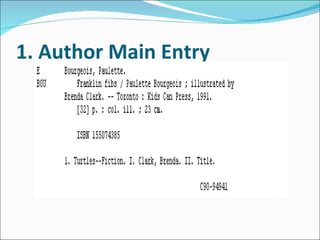
1. Author Main Entry
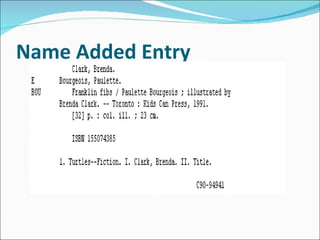
Name Added Entry
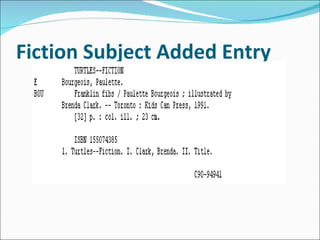
Fiction Subject Added Entry
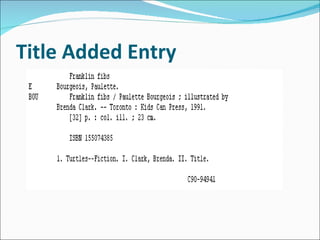
Title Added Entry
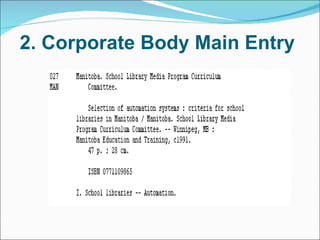
2. Corporate Body Main Entry
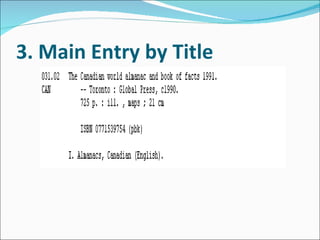
3. Main Entry by Title
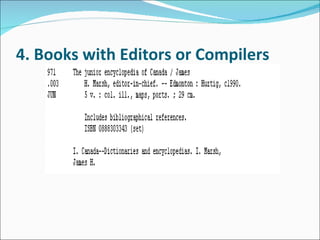
4. Books with Editors or Compilers
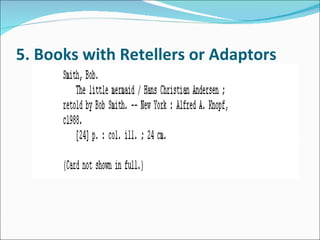
5. Books with Retellers or Adaptors
6. Maps Patawardhan , K. India: Air and road routes [Map]/  cartographer K.Patwardhan. –scale  1:2,50,000. – New Delhi: Indian Geological Survey, 1997. 1 Map;52 x 80 cm Includes 1 inset for symbols  1. Subject I Title Call No AM ANo
7. Audiovisual Materials  The cataloguing of audiovisual materials such as videorecordings, kits, computer software, and sound recordings follows the same general patterns as those for books. As with books, the cataloguer must still identify the title, the publisher, and date of production but many audiovisual items will not have identifiable authors. In cataloguing audiovisual materials the number of frames, the components of the kit, or the duration of the recording are identified rather than the number of pages.
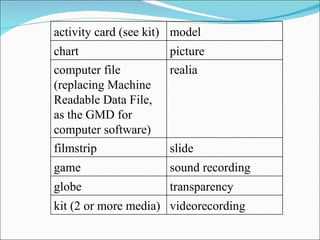
activity card (see kit)  model chart  picture  computer file (replacing Machine Readable Data File, as the GMD for computer software)  realia  filmstrip  slide  game  sound recording  globe  transparency  kit (2 or more media)  videorecording
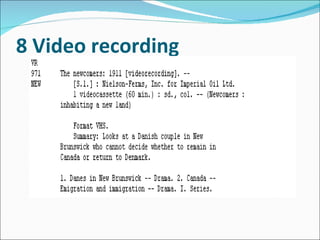
8 Video recording
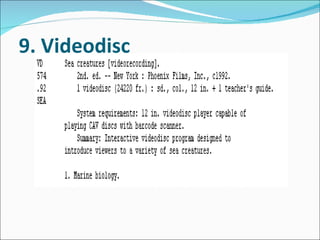
9. Videodisc
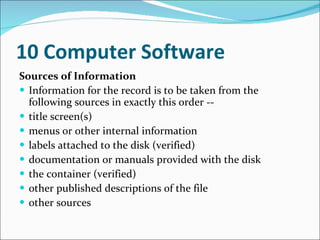
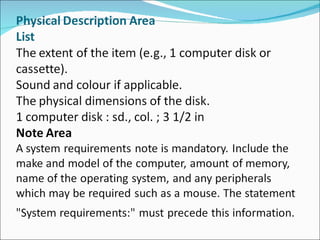
10 Computer Software   Sources of Information   Information for the record is to be taken from the following sources in exactly this order --  title screen(s)  menus or other internal information  labels attached to the disk (verified)  documentation or manuals provided with the disk  the container (verified)  other published descriptions of the file  other sources
 
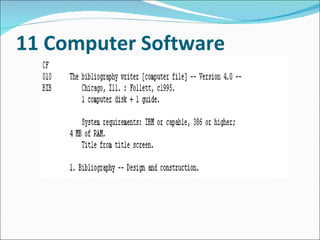
11 Computer Software
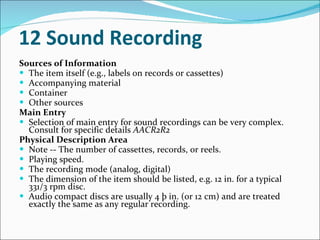
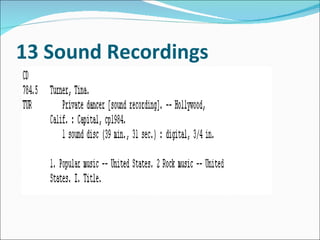
12 Sound Recording   Sources of Information   The item itself (e.g., labels on records or cassettes)  Accompanying material  Container  Other sources  Main Entry   Selection of main entry for sound recordings can be very complex. Consult for specific details  AACR2R2   Physical Description Area   Note -- The number of cassettes, records, or reels.  Playing speed.  The recording mode (analog, digital)  The dimension of the item should be listed, e.g. 12 in. for a typical 331/3 rpm disc.  Audio compact discs are usually 4 þ in. (or 12 cm) and are treated exactly the same as any regular recording.
13 Sound Recordings
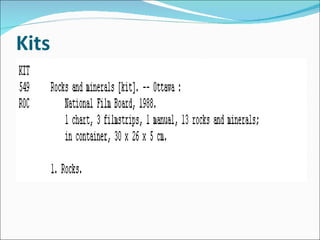
14 Kits   A kit is an item containing two or more categories of material, none of which is identifiable as the predominant constituent of the item. The GMD "kit" is applied only to those media which are to be catalogued as a unit.  Sources of Information   As the chief source of information, use the part which gives the most information (i.e., use the video, not the manual; the filmstrip, not the guide; the book, not the cassette).  Secondly, use the part that is the unifying element (e.g., the container or the manual).  Thirdly, use other sources.  Main Entry   It is often difficult to determine authorship for kits. Main entry will be by author only if an author can be established as the creator of the kit as a whole. Usually the main entry will be under title if only partial authorship or no authorship can be discerned.  Physical Description Area   List the number and name of each part of the kit in their order of importance to the kit as a whole. List the contents in alphabetical order if importance cannot be determined.  If the parts cannot be numbered use the phrase "various pieces."
Kits
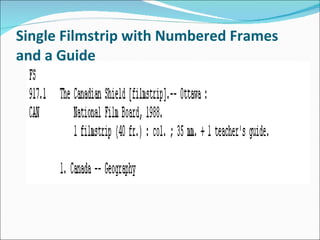
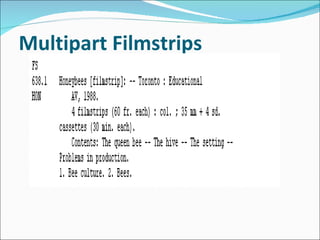
15 Filmstrips   Sources of Information   Information for the catalogue record should be taken from the following sources in this order  The item itself. Preference should be given to the title frame(s) rather than the leader frame(s).  Container.  Accompanying materials.  Other sources.  Physical Description Area   Frames in an unnumbered filmstrip are to be counted and placed in square [ ] brackets.  Other physical details such as sound (sd), colour (col), or black and white (b & w) should be noted.  The dimensions should be noted. Usually it is 35 mm.  Additional materials such as guides should be listed.
Single Filmstrip with Numbered Frames and a Guide
Multipart Filmstrips
Filing Cards   ALA (American Library Association Filing Rules)  For manual card catalogues, the ALA Filing Rules are the standard which are to be followed.
 
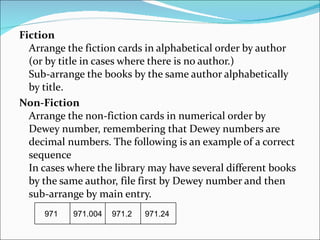
Fiction  Arrange the fiction cards in alphabetical order by author (or by title in cases where there is no author.)  Sub-arrange the books by the same author alphabetically by title.  Non-Fiction   Arrange the non-fiction cards in numerical order by Dewey number, remembering that Dewey numbers are decimal numbers. The following is an example of a correct sequence  In cases where the library may have several different books by the same author, file first by Dewey number and then sub-arrange by main entry. 971  971.004  971.2  971.24
Dictionary Catalogue   Interfile all author, subject and title cards in one alphabetical sequence.  Alphabetize by the TOP line of the card. When the top lines are identical, sub-arrange by the next line on the card.  Ignore the articles "a", "an" and "the" when they occur at the beginning of a title. These articles need only be considered in alphabetizing when they occur in the middle of the heading. In French, ignore the articles "le", "la", "les" and "l' " only. "Du", "de", "d' " and "un(e)" will be filed under those articles.  Alphabetize character  space  by character space. Blank character spaces come before character spaces with letters. Thus, shorter words come before longer words beginning with the same letters.  e.g.,  The new mathematics  New World Atlas  Newman, Joan
Acronyms are filed as single words.  Under the green umbrella  UNESCO  The Union of Canada  Numbers expressed as numerals (arabic or roman) are filed according to their numerical value; this file is before the first alphabetical file (e.g., before "A").  e.g.,  200  275  6000  Numbers that are spelled out as words are filed as spelled.  e.g.,  Six thousand  Two hundred seventy-five  Two thousand
Abbreviations are filed exactly as written, not as if spelled out.  e.g.,  Doctor  Doctor Jackson  Dr. James  Mr. Jones  Mrs. Blue  Ms Anderson  Apostrophes are disregarded and the word containing the apostrophe is filed as one word.  I saw three ships  I'm moving  Imagine
Proper names with prefixes are treated as a separate words unless joined to the rest of the name directly or by an apostrophe without a space.  De Alberti, Amelia  De la Roche, Mazo  De Marco, Clara  Defoe, Daniel  Del Mar, Eugene  Subject cards with dates as subdivisions are subarranged chronologically with the earliest date first.  CANADA - HISTORY - 1811-1821  CANADA - HISTORY - 1914-1918  A more extensive period precedes a more specific period when the first date is identical.  CANADA - HISTORY - 1867-  CANADA - HISTORY - 1867-1911
 

Catalogue Entry Format

  • 1.
    Dr. Sarika SawantAssistant Professor, SHPT School of Library Science, SNDT Women’s University, Churchgate, Mumbai 400 020
  • 2.
  • 3.
  • 4.
  • 5.
  • 6.
  • 7.
    3. Main Entryby Title
  • 8.
    4. Books withEditors or Compilers
  • 9.
    5. Books withRetellers or Adaptors
  • 10.
    6. Maps Patawardhan, K. India: Air and road routes [Map]/ cartographer K.Patwardhan. –scale 1:2,50,000. – New Delhi: Indian Geological Survey, 1997. 1 Map;52 x 80 cm Includes 1 inset for symbols 1. Subject I Title Call No AM ANo
  • 11.
    7. Audiovisual Materials The cataloguing of audiovisual materials such as videorecordings, kits, computer software, and sound recordings follows the same general patterns as those for books. As with books, the cataloguer must still identify the title, the publisher, and date of production but many audiovisual items will not have identifiable authors. In cataloguing audiovisual materials the number of frames, the components of the kit, or the duration of the recording are identified rather than the number of pages.
  • 12.
    activity card (seekit) model chart picture computer file (replacing Machine Readable Data File, as the GMD for computer software) realia filmstrip slide game sound recording globe transparency kit (2 or more media) videorecording
  • 13.
  • 14.
  • 15.
    10 Computer Software Sources of Information Information for the record is to be taken from the following sources in exactly this order -- title screen(s) menus or other internal information labels attached to the disk (verified) documentation or manuals provided with the disk the container (verified) other published descriptions of the file other sources
  • 16.
  • 17.
  • 18.
    12 Sound Recording Sources of Information The item itself (e.g., labels on records or cassettes) Accompanying material Container Other sources Main Entry Selection of main entry for sound recordings can be very complex. Consult for specific details AACR2R2 Physical Description Area Note -- The number of cassettes, records, or reels. Playing speed. The recording mode (analog, digital) The dimension of the item should be listed, e.g. 12 in. for a typical 331/3 rpm disc. Audio compact discs are usually 4 þ in. (or 12 cm) and are treated exactly the same as any regular recording.
  • 19.
  • 20.
    14 Kits A kit is an item containing two or more categories of material, none of which is identifiable as the predominant constituent of the item. The GMD "kit" is applied only to those media which are to be catalogued as a unit. Sources of Information As the chief source of information, use the part which gives the most information (i.e., use the video, not the manual; the filmstrip, not the guide; the book, not the cassette). Secondly, use the part that is the unifying element (e.g., the container or the manual). Thirdly, use other sources. Main Entry It is often difficult to determine authorship for kits. Main entry will be by author only if an author can be established as the creator of the kit as a whole. Usually the main entry will be under title if only partial authorship or no authorship can be discerned. Physical Description Area List the number and name of each part of the kit in their order of importance to the kit as a whole. List the contents in alphabetical order if importance cannot be determined. If the parts cannot be numbered use the phrase "various pieces."
  • 21.
  • 22.
    15 Filmstrips Sources of Information Information for the catalogue record should be taken from the following sources in this order The item itself. Preference should be given to the title frame(s) rather than the leader frame(s). Container. Accompanying materials. Other sources. Physical Description Area Frames in an unnumbered filmstrip are to be counted and placed in square [ ] brackets. Other physical details such as sound (sd), colour (col), or black and white (b & w) should be noted. The dimensions should be noted. Usually it is 35 mm. Additional materials such as guides should be listed.
  • 23.
    Single Filmstrip withNumbered Frames and a Guide
  • 24.
  • 25.
    Filing Cards ALA (American Library Association Filing Rules) For manual card catalogues, the ALA Filing Rules are the standard which are to be followed.
  • 26.
  • 27.
    Fiction Arrangethe fiction cards in alphabetical order by author (or by title in cases where there is no author.) Sub-arrange the books by the same author alphabetically by title. Non-Fiction Arrange the non-fiction cards in numerical order by Dewey number, remembering that Dewey numbers are decimal numbers. The following is an example of a correct sequence In cases where the library may have several different books by the same author, file first by Dewey number and then sub-arrange by main entry. 971 971.004 971.2 971.24
  • 28.
    Dictionary Catalogue Interfile all author, subject and title cards in one alphabetical sequence. Alphabetize by the TOP line of the card. When the top lines are identical, sub-arrange by the next line on the card. Ignore the articles "a", "an" and "the" when they occur at the beginning of a title. These articles need only be considered in alphabetizing when they occur in the middle of the heading. In French, ignore the articles "le", "la", "les" and "l' " only. "Du", "de", "d' " and "un(e)" will be filed under those articles. Alphabetize character space by character space. Blank character spaces come before character spaces with letters. Thus, shorter words come before longer words beginning with the same letters. e.g., The new mathematics New World Atlas Newman, Joan
  • 29.
    Acronyms are filedas single words. Under the green umbrella UNESCO The Union of Canada Numbers expressed as numerals (arabic or roman) are filed according to their numerical value; this file is before the first alphabetical file (e.g., before "A"). e.g., 200 275 6000 Numbers that are spelled out as words are filed as spelled. e.g., Six thousand Two hundred seventy-five Two thousand
  • 30.
    Abbreviations are filedexactly as written, not as if spelled out. e.g., Doctor Doctor Jackson Dr. James Mr. Jones Mrs. Blue Ms Anderson Apostrophes are disregarded and the word containing the apostrophe is filed as one word. I saw three ships I'm moving Imagine
  • 31.
    Proper names withprefixes are treated as a separate words unless joined to the rest of the name directly or by an apostrophe without a space. De Alberti, Amelia De la Roche, Mazo De Marco, Clara Defoe, Daniel Del Mar, Eugene Subject cards with dates as subdivisions are subarranged chronologically with the earliest date first. CANADA - HISTORY - 1811-1821 CANADA - HISTORY - 1914-1918 A more extensive period precedes a more specific period when the first date is identical. CANADA - HISTORY - 1867- CANADA - HISTORY - 1867-1911
  • 32.