Course In-Charge
Mr.S.Srinivasnaik
Assistant Professor
Department of Entomology
LECTURE.NO.15
PARASITOIDS AND PREDATORS
ENTO 332 (1+1):MANAGEMENT OF BENEFICIAL INSECTS
HARMFUL ASSOCIATIONS
B. Harmful associations
Those that live with the expense of other living organisms
are parasites and Predators and pathogens. Based on this
concept the biological control is originated. The sceintists viz.,
Paul Debach, Prof.Harry Scott Smith, Albert Koebele, Daniel
W. Coquillet and Charles Valentine Riley etc. are contributed to
the field of biological control
Prof. Harry Scott Smith coined the term Biological Control and
given the definition and he is considered as the Father of
Biological Control
PHYSICAL METHODS OF PEST CONTROL
Institutions are working for the biological Control
National
1.NBAIR:National Bureau of Agricultural Insect Resources
2.NCIPM:National Centre for Integrated Pest Management
3.NIPHM:National Institute for Plant Health Management
4.SAUs and state governments through establishment of biocontrol
laboratories
International
1.IOBC: International Organization for Biological Control
2. Commonwealth Institute of Biological Control (CIBC)
3.UCR: University of California, Riverside
4.WVC: World Vegetable Centre (Previously it was Asian vegetable Research
and Development Centre (AVRDC))
5.ICIPE :International Centre of Insect Physiology and Ecology
DEFINITIONS OF BIOLOGICAL CONTROL
The successful management of a pest by means of another living organism
(parasitoids, predators and pathogens) that is encouraged and disseminated by
man is called biological control.
According to Prof. Harry Scott Smith: Suppression of Insect Population
by Native of introduced natural enemies
According to Paul Debach: The action of parasitoides, predators and
pathogens in maintaining other organisms density at a lower average than
would occur in their absence
In such programme the natural enemies are introduced, encouraged,
multiplied by artificial means and disseminated by man with his own efforts
instead of leaving it to nature
COMPONENTTS OF BIOLOGICAL CONTROL
There are three components of Biological control viz.,
Parasitoids
Predators
Pathogens
Parasite is one which attaches itself in the body of the other
organism either externally or internally for nourishment and shelter
at least for a shorter period if not for the entire life cycle. The
organism which is attacked by the parasite is called host.
COMPONENTS OF BIOLOGICAL CONTROL
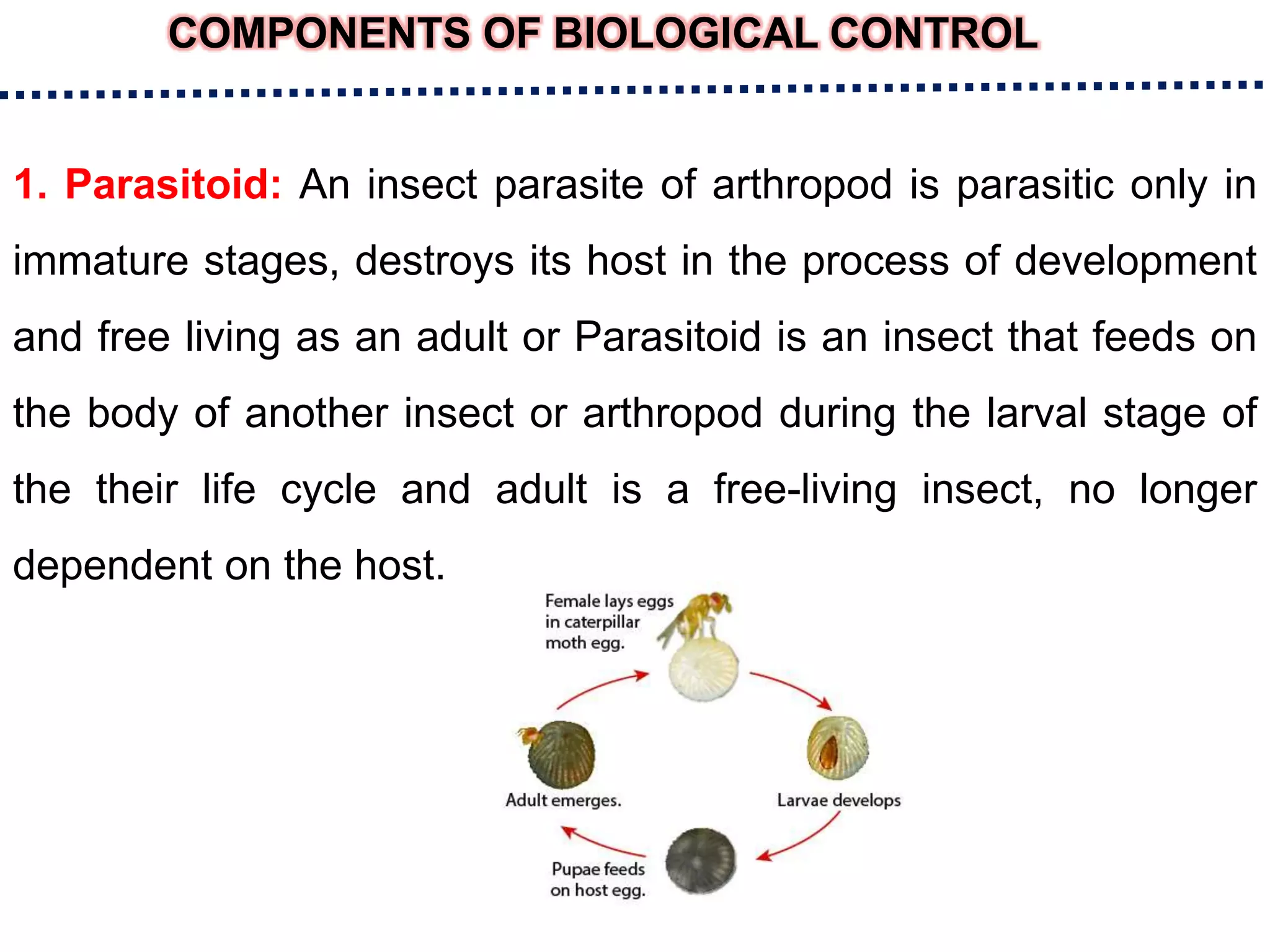
1. Parasitoid: An insect parasite of arthropod is parasitic only in
immature stages, destroys its host in the process of development
and free living as an adult or Parasitoid is an insect that feeds on
the body of another insect or arthropod during the larval stage of
the their life cycle and adult is a free-living insect, no longer
dependent on the host.
KINDS OF PARASITISM
Parasitisation: It is the phenomenon of obtaining nourishment at
the expense of the host to which the parasite is attached.
Kinds of Parasitism
1. Simple parasitism
Irrespective of number of eggs laid the parasitoid attacks the host
only once.
Eg. Apanteles taragamae and Goniozus nephantids against
larvae of Opisina arenosella,
2. Super parasitism
Phenomenon of parasitization of an individual host by more
larvae of single species that can mature in the host. Eg. Apanteles
glomeratus on Pieris brassica, Trichospilus pupivora on Opisina
arenosella.
KINDS OF PARASITISM
3.Multiple parasitism
Phenomenon of simultaneous parasitization of host individual by two or
more different species of primary parasites at the same time.
Eg: Trichogramma, Telenomous and Tetrastichus attack eggs of paddy stem
borer Scirpophaga incertulas. Super parasitism and multiple parasitisms are
generally regarded as undesirable situations since much reproductive capacity
is wasted
4. Hyper parasitism
When a parasite itself is parasitized by another parasite. Eg. Goniozus
nephantidis is parasitized by Tetrastichus israeli, Most of the Bethylids and
Braconids are hyper parasites
KINDS OF PARASITISM
Primary parasite: A parasite attacking an insect which itself is not a parasite
(Beneficial to man)
Secondary parasite: A hyperparasite attacking a primary parasite (Harmful to
man)
Tertiary parasite: A hyperparasite attacking a secondary parasite (Beneficial to
man)
Quaternary parasite: A hyperparasite attacking tertiary parasite (Harmful to
man)
A primary parasitoid becomes harmful in case of productive insects like
silkworms, Bombyx mori and lac insect Kerria lacca
CLASSIFICATION OF PARASITOIDS
ii). Based on the specialization of the site of parasitisation
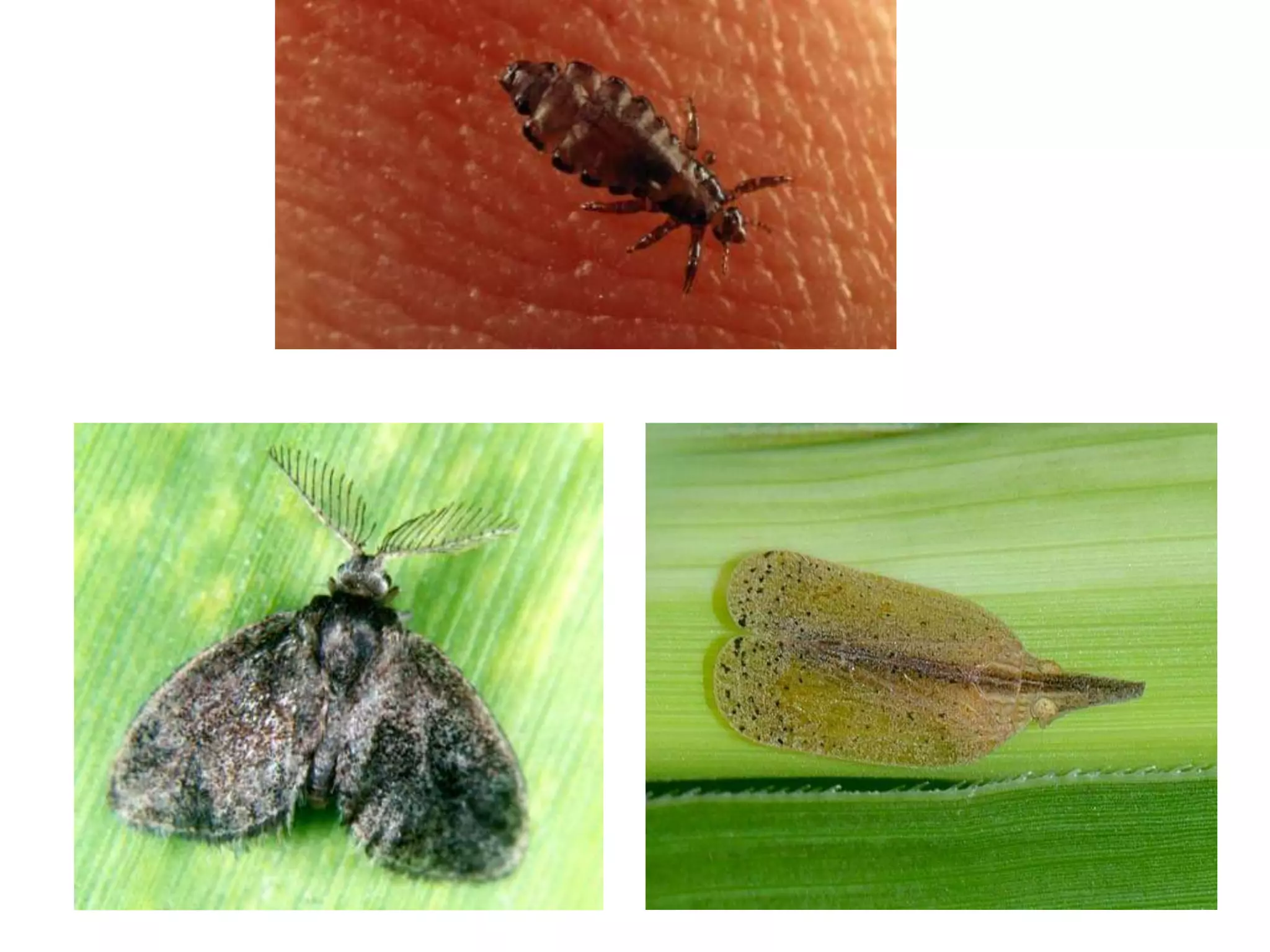
a. Ectoparasites: they attack its host from the outside of the body of the host.
The mother parasite lays its eggs on the body of the host and after the eggs are
hatched the larvae feed on the host by remaining outside only. Head louse;
Epiricania melanolenca, Epipyrops sp. Sugarcane fly.
b. Endoparasites: They enters the body of the host and feeds from inside. The
mother parasite either lays its eggs inside the tissues of the host or on the food
material of the host to gain entry inside.
Eg. Braconids & Icheneumonids, Apanteles flavipes on jowar stem borer larvae
Qualities of a Successful Parasitoid in Biological Control Programme
A parasitoid should have the following qualities for its successful
performance.
1. Should be adaptable to environmental conditions in the new locally
2. Should be able to survive in all habitats of the host
3. Should be specific to a particulars sp. of host or at least a narrowly limited
range of hosts.
4. Should be able to multiply faster than the host
5. Should be having more fecundity
6. Life cycle must be shorter than that of the host
7. Should have high sex ratio
8. Should have good searching capacity for host
9. Should be amendable for mass multiplication in the labs
10. Should bring down host population within 3 years
11. There should be quick dispersal of the parasitoid in the locality
12. It should be free from hyperparasitoids
2. Predators
A predator is one which catches and devours smaller or more helpless
creatures by killing them in getting a single meal. It is a free living organism
through out its life, normally larger than prey and requires more than one prey
to develop.
Predatism
Based on the degree of use fullness to man, the predators are
classified as on
1.Entirely predatory, Eg. Lace wings, tiger beetles lady bird beetles except
Henosepilachna genus
2.Mainly predator but occasionally harmful. Eg. Odonata and mantids
occasionally attack honey bees
3.Mainly harmful but partly predatory. Eg. Cockroach feeds on termites.
Adult blister beetles feed on flowers while the grubs predate on grass
hopper eggs.
4.Mainly scavenging and partly predatory. Eg. Earwigs feed on dead
decaying organic matter and also fly maggots. Both ways, it is helpful
5.Variable feeding habits of predator, eg: Tettigonidae: omnivorous and
carnivorous but damage crop by lying eggs.
6.Stinging predators. In this case, nests are constructed and stocked with
prey, which have been stung and paralyzed by the mother insect on which
the eggs are laid and then scaled up. Larvae emerging from the egg feed
on paralyzed but not yet died prey. Eg. Spider wasps and wasps.
Insect predator qualities
1.A predator generally feeds on many different species of prey, thus being a
generalist or polyphagous nature
2.A predator is relatively large compared to its prey , which it seizes and
devours quickly
3.Typically individual predator consumes large number of prey in its life time
Eg: A single coccinellid predator larva may consume hundreds of aphids
4. Predators kill and consume their prey quickly, usually via extra oral digestion
5. Predators are very efficient in search of their prey and capacity for swift
movements
6. Predators develop separately from their prey and may live in the same
habitat or adjacent habitats
7. Structural adaptation with well developed sense organs to locate the prey
8. Predator is carnivorous in both its immature and adult stages and feeds on
the same kind of prey in both the stages
9. May have cryptic colourations and deceptive markings
Eg. Preying mantids and Robber flies
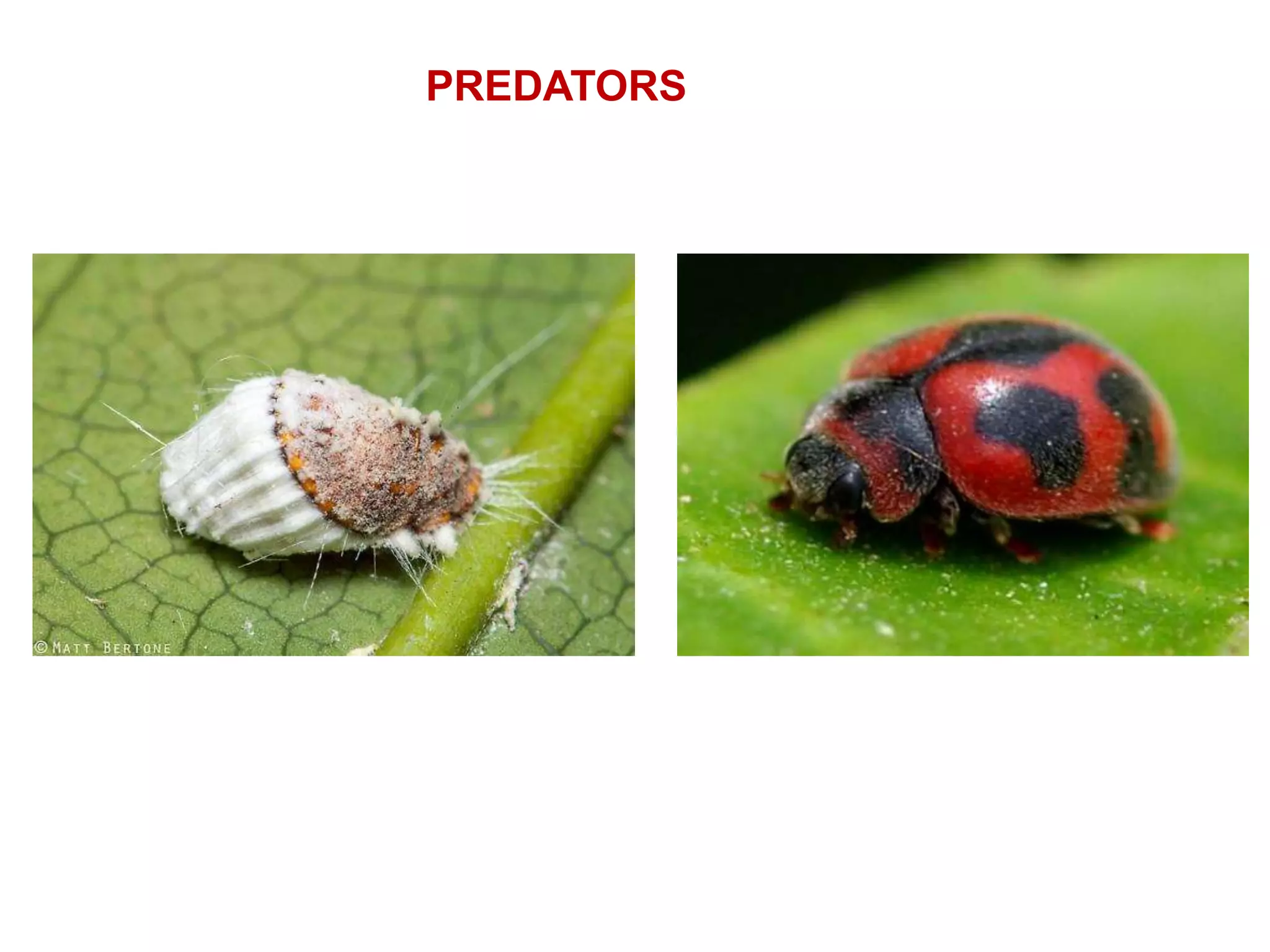
PREDATORS
WEED KILLERS
Water fern, Salvinia molesta Crytobagus singularis
WEED KILLERS
Neochetina bruchi
Neochetina eichorniae
Orthogalumna terebrantis
Water hyacinth, Eichornia crassipes
REFERENCES
ENTO 332_Lec No.15_Parasitoids and Predators.ppt

ENTO 332_Lec No.15_Parasitoids and Predators.ppt

  • 1.
    Course In-Charge Mr.S.Srinivasnaik Assistant Professor Departmentof Entomology LECTURE.NO.15 PARASITOIDS AND PREDATORS ENTO 332 (1+1):MANAGEMENT OF BENEFICIAL INSECTS
  • 2.
    HARMFUL ASSOCIATIONS B. Harmfulassociations Those that live with the expense of other living organisms are parasites and Predators and pathogens. Based on this concept the biological control is originated. The sceintists viz., Paul Debach, Prof.Harry Scott Smith, Albert Koebele, Daniel W. Coquillet and Charles Valentine Riley etc. are contributed to the field of biological control Prof. Harry Scott Smith coined the term Biological Control and given the definition and he is considered as the Father of Biological Control
  • 3.
    PHYSICAL METHODS OFPEST CONTROL Institutions are working for the biological Control National 1.NBAIR:National Bureau of Agricultural Insect Resources 2.NCIPM:National Centre for Integrated Pest Management 3.NIPHM:National Institute for Plant Health Management 4.SAUs and state governments through establishment of biocontrol laboratories International 1.IOBC: International Organization for Biological Control 2. Commonwealth Institute of Biological Control (CIBC) 3.UCR: University of California, Riverside 4.WVC: World Vegetable Centre (Previously it was Asian vegetable Research and Development Centre (AVRDC)) 5.ICIPE :International Centre of Insect Physiology and Ecology
  • 4.
    DEFINITIONS OF BIOLOGICALCONTROL The successful management of a pest by means of another living organism (parasitoids, predators and pathogens) that is encouraged and disseminated by man is called biological control. According to Prof. Harry Scott Smith: Suppression of Insect Population by Native of introduced natural enemies According to Paul Debach: The action of parasitoides, predators and pathogens in maintaining other organisms density at a lower average than would occur in their absence In such programme the natural enemies are introduced, encouraged, multiplied by artificial means and disseminated by man with his own efforts instead of leaving it to nature
  • 5.
    COMPONENTTS OF BIOLOGICALCONTROL There are three components of Biological control viz., Parasitoids Predators Pathogens Parasite is one which attaches itself in the body of the other organism either externally or internally for nourishment and shelter at least for a shorter period if not for the entire life cycle. The organism which is attacked by the parasite is called host.
  • 6.
    COMPONENTS OF BIOLOGICALCONTROL 1. Parasitoid: An insect parasite of arthropod is parasitic only in immature stages, destroys its host in the process of development and free living as an adult or Parasitoid is an insect that feeds on the body of another insect or arthropod during the larval stage of the their life cycle and adult is a free-living insect, no longer dependent on the host.
  • 7.
    KINDS OF PARASITISM Parasitisation:It is the phenomenon of obtaining nourishment at the expense of the host to which the parasite is attached. Kinds of Parasitism 1. Simple parasitism Irrespective of number of eggs laid the parasitoid attacks the host only once. Eg. Apanteles taragamae and Goniozus nephantids against larvae of Opisina arenosella,
  • 8.
    2. Super parasitism Phenomenonof parasitization of an individual host by more larvae of single species that can mature in the host. Eg. Apanteles glomeratus on Pieris brassica, Trichospilus pupivora on Opisina arenosella.
  • 10.
    KINDS OF PARASITISM 3.Multipleparasitism Phenomenon of simultaneous parasitization of host individual by two or more different species of primary parasites at the same time. Eg: Trichogramma, Telenomous and Tetrastichus attack eggs of paddy stem borer Scirpophaga incertulas. Super parasitism and multiple parasitisms are generally regarded as undesirable situations since much reproductive capacity is wasted 4. Hyper parasitism When a parasite itself is parasitized by another parasite. Eg. Goniozus nephantidis is parasitized by Tetrastichus israeli, Most of the Bethylids and Braconids are hyper parasites
  • 12.
    KINDS OF PARASITISM Primaryparasite: A parasite attacking an insect which itself is not a parasite (Beneficial to man) Secondary parasite: A hyperparasite attacking a primary parasite (Harmful to man) Tertiary parasite: A hyperparasite attacking a secondary parasite (Beneficial to man) Quaternary parasite: A hyperparasite attacking tertiary parasite (Harmful to man) A primary parasitoid becomes harmful in case of productive insects like silkworms, Bombyx mori and lac insect Kerria lacca
  • 13.
    CLASSIFICATION OF PARASITOIDS ii).Based on the specialization of the site of parasitisation a. Ectoparasites: they attack its host from the outside of the body of the host. The mother parasite lays its eggs on the body of the host and after the eggs are hatched the larvae feed on the host by remaining outside only. Head louse; Epiricania melanolenca, Epipyrops sp. Sugarcane fly. b. Endoparasites: They enters the body of the host and feeds from inside. The mother parasite either lays its eggs inside the tissues of the host or on the food material of the host to gain entry inside. Eg. Braconids & Icheneumonids, Apanteles flavipes on jowar stem borer larvae
  • 15.
    Qualities of aSuccessful Parasitoid in Biological Control Programme A parasitoid should have the following qualities for its successful performance. 1. Should be adaptable to environmental conditions in the new locally 2. Should be able to survive in all habitats of the host 3. Should be specific to a particulars sp. of host or at least a narrowly limited range of hosts. 4. Should be able to multiply faster than the host 5. Should be having more fecundity 6. Life cycle must be shorter than that of the host 7. Should have high sex ratio 8. Should have good searching capacity for host 9. Should be amendable for mass multiplication in the labs 10. Should bring down host population within 3 years 11. There should be quick dispersal of the parasitoid in the locality 12. It should be free from hyperparasitoids
  • 16.
    2. Predators A predatoris one which catches and devours smaller or more helpless creatures by killing them in getting a single meal. It is a free living organism through out its life, normally larger than prey and requires more than one prey to develop. Predatism Based on the degree of use fullness to man, the predators are classified as on 1.Entirely predatory, Eg. Lace wings, tiger beetles lady bird beetles except Henosepilachna genus 2.Mainly predator but occasionally harmful. Eg. Odonata and mantids occasionally attack honey bees 3.Mainly harmful but partly predatory. Eg. Cockroach feeds on termites. Adult blister beetles feed on flowers while the grubs predate on grass hopper eggs.
  • 17.
    4.Mainly scavenging andpartly predatory. Eg. Earwigs feed on dead decaying organic matter and also fly maggots. Both ways, it is helpful 5.Variable feeding habits of predator, eg: Tettigonidae: omnivorous and carnivorous but damage crop by lying eggs. 6.Stinging predators. In this case, nests are constructed and stocked with prey, which have been stung and paralyzed by the mother insect on which the eggs are laid and then scaled up. Larvae emerging from the egg feed on paralyzed but not yet died prey. Eg. Spider wasps and wasps.
  • 18.
    Insect predator qualities 1.Apredator generally feeds on many different species of prey, thus being a generalist or polyphagous nature 2.A predator is relatively large compared to its prey , which it seizes and devours quickly 3.Typically individual predator consumes large number of prey in its life time Eg: A single coccinellid predator larva may consume hundreds of aphids 4. Predators kill and consume their prey quickly, usually via extra oral digestion
  • 19.
    5. Predators arevery efficient in search of their prey and capacity for swift movements 6. Predators develop separately from their prey and may live in the same habitat or adjacent habitats 7. Structural adaptation with well developed sense organs to locate the prey 8. Predator is carnivorous in both its immature and adult stages and feeds on the same kind of prey in both the stages 9. May have cryptic colourations and deceptive markings Eg. Preying mantids and Robber flies
  • 21.
  • 22.
    WEED KILLERS Water fern,Salvinia molesta Crytobagus singularis
  • 23.
    WEED KILLERS Neochetina bruchi Neochetinaeichorniae Orthogalumna terebrantis Water hyacinth, Eichornia crassipes
  • 30.