LLM Agents
1
Enterprise Trends for Generative AI
Guest Speaker: Burak Gokturk
Instructors: Dawn Song & Xinyun Chen
2
Burak
Gokturk
VP, Cloud AI and AI/ML for Developers, Google
Cloud
burakg@google.com
LLM Agents
3
Instructors: Dawn Song & Xinyun Chen
Enterprise Trends for Generative AI
Key Blocks to build successful agents
What’s next?
04
Google Cloud Next ‘24
Key Trends in
Generative AI
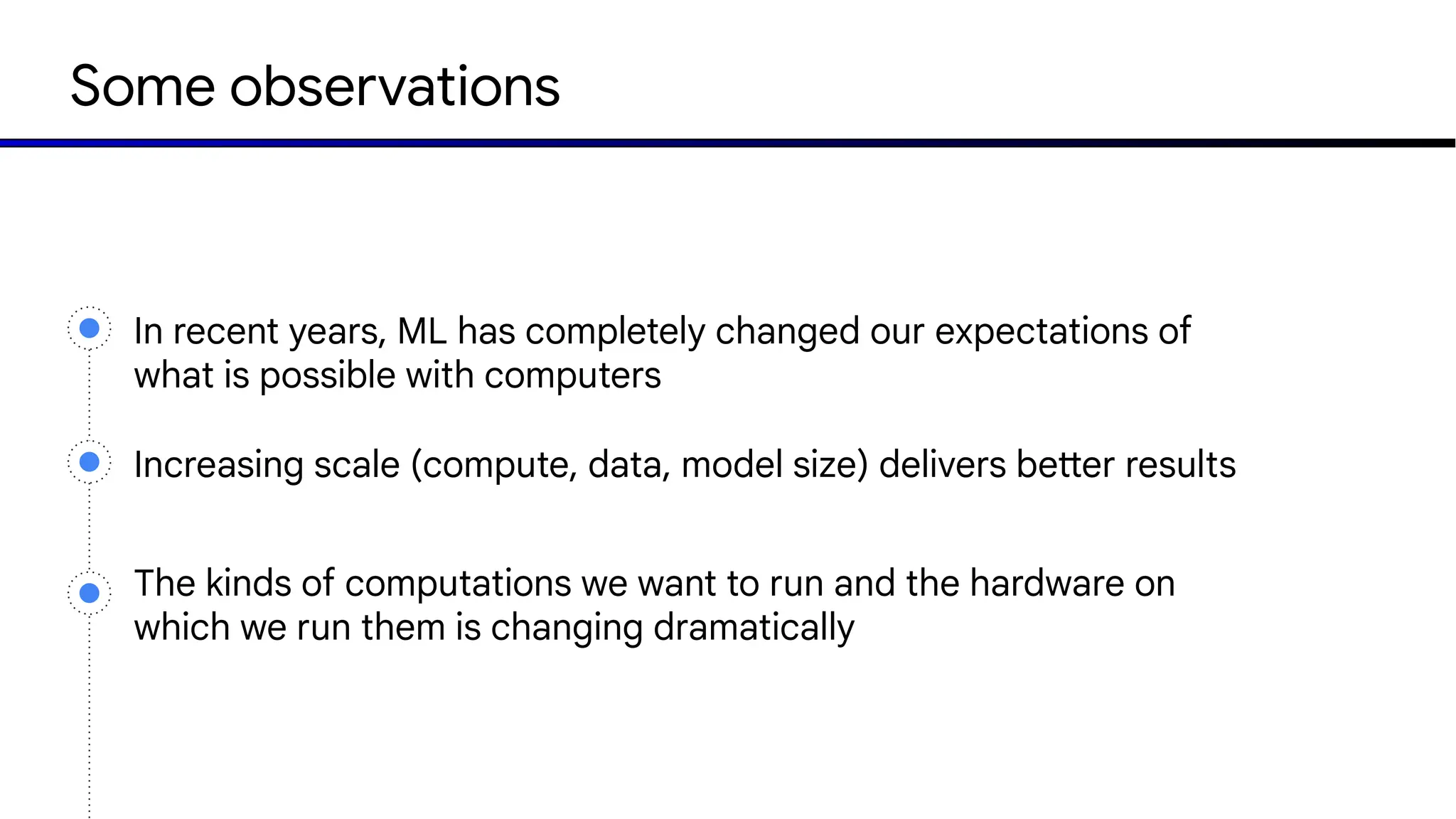
Some observations
In recent years, ML has completely changed our expectations of
what is possible with computers
The kinds of computations we want to run and the hardware on
which we run them is changing dramatically
Increasing scale (compute, data, model size) delivers better results
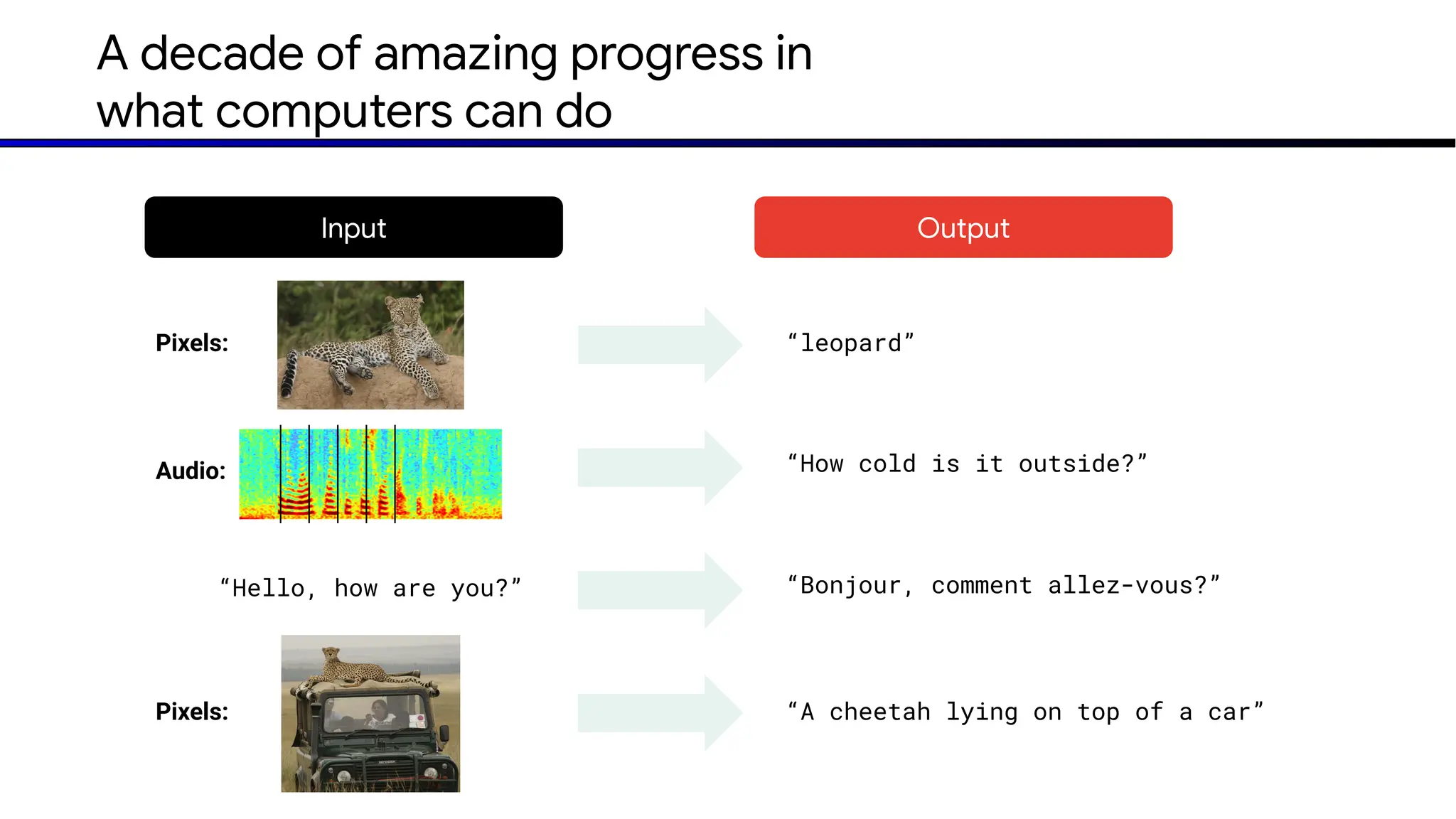
A decade of amazing progress in
what computers can do
Input Output
Pixels:
Audio:
Pixels:
“Hello, how are you?”
“leopard”
“How cold is it outside?”
“Bonjour, comment allez-vous?”
“A cheetah lying on top of a car”
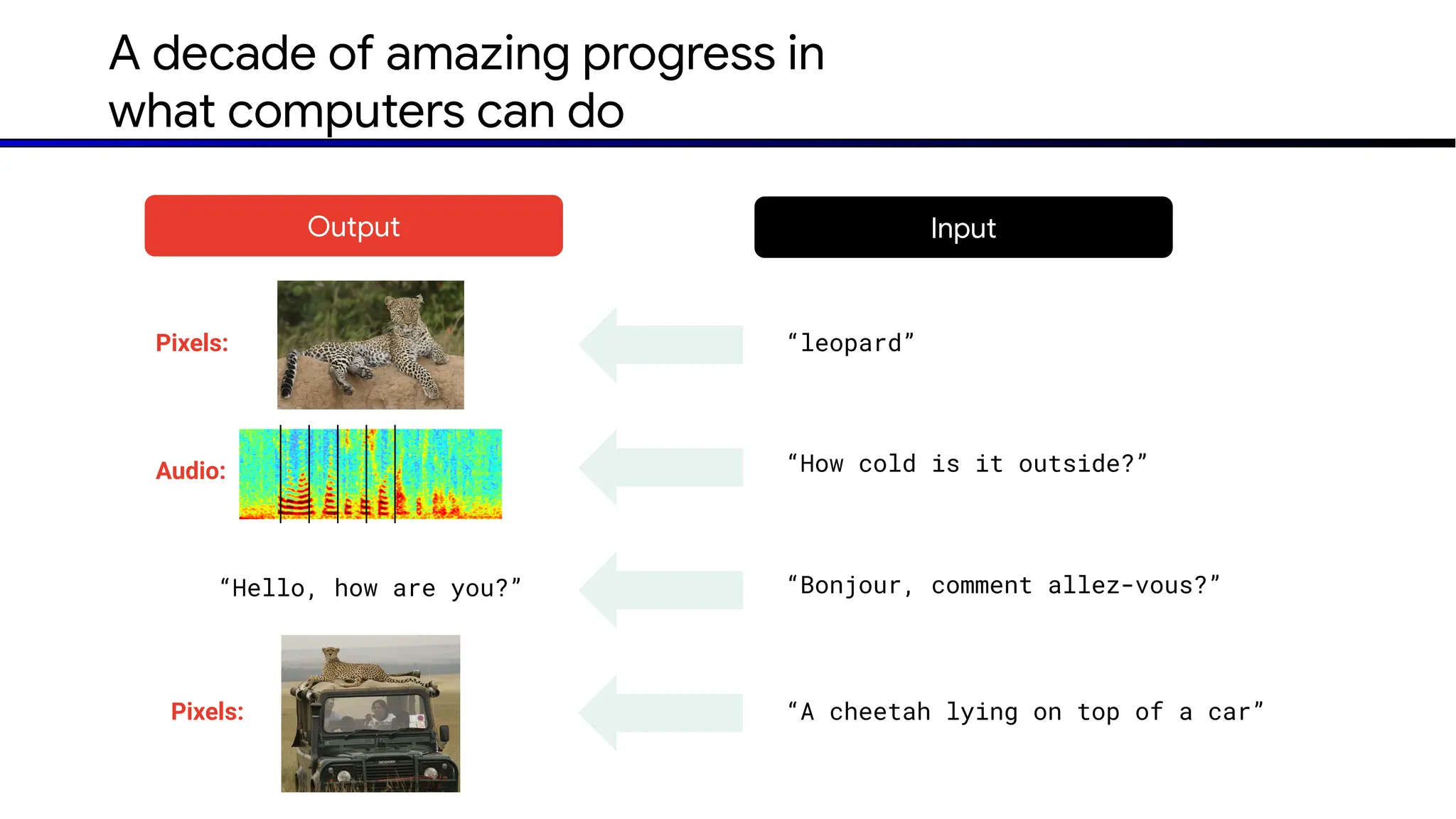
A decade of amazing progress in
what computers can do
Pixels:
Audio:
Pixels:
“Hello, how are you?”
“leopard”
“How cold is it outside?”
“Bonjour, comment allez-vous?”
“A cheetah lying on top of a car”
Input
Output
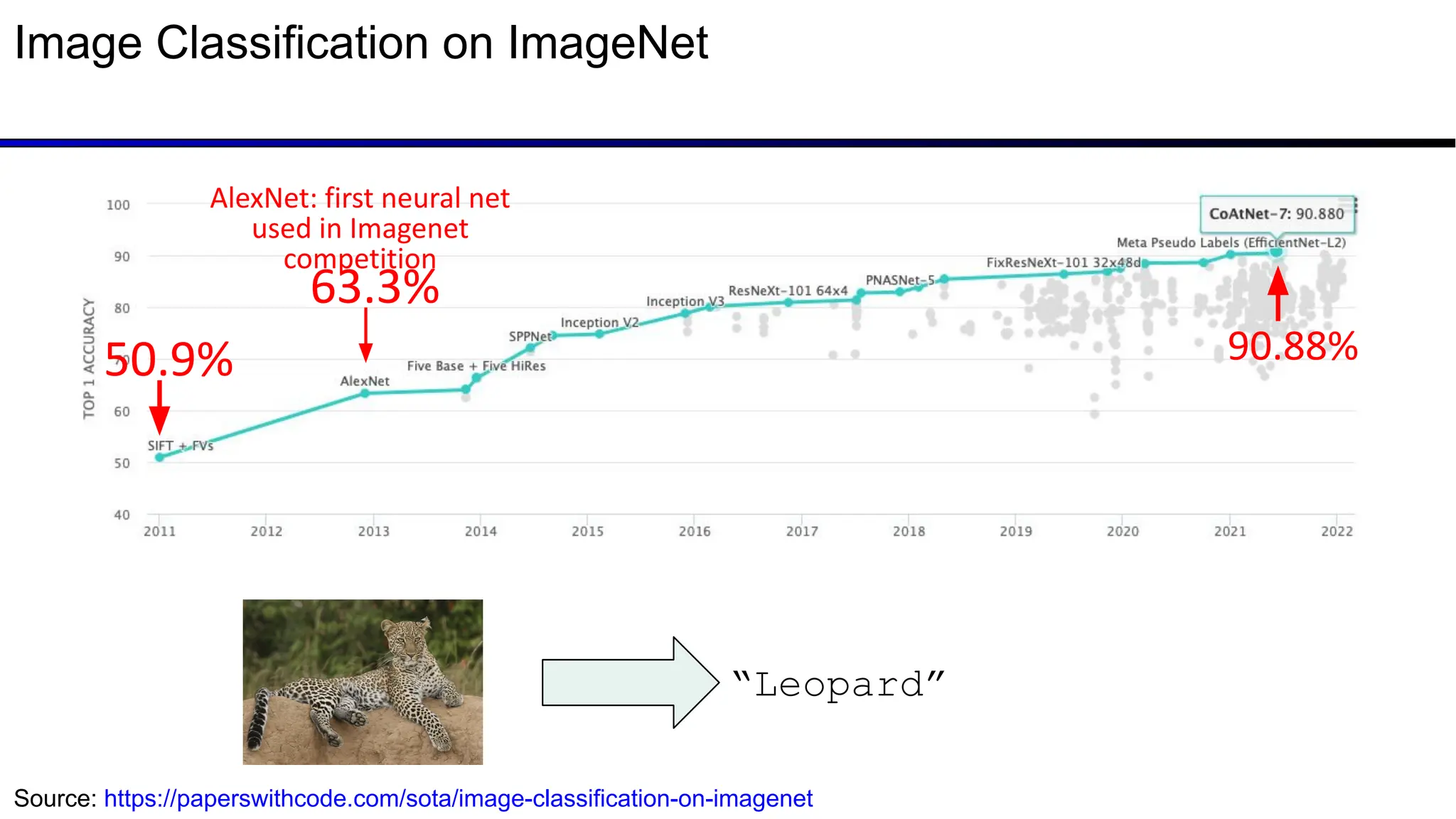
“Leopard”
90.88%
Source: https://paperswithcode.com/sota/image-classification-on-imagenet
50.9%
Image Classification on ImageNet
AlexNet: first neural net
used in Imagenet
competition
63.3%
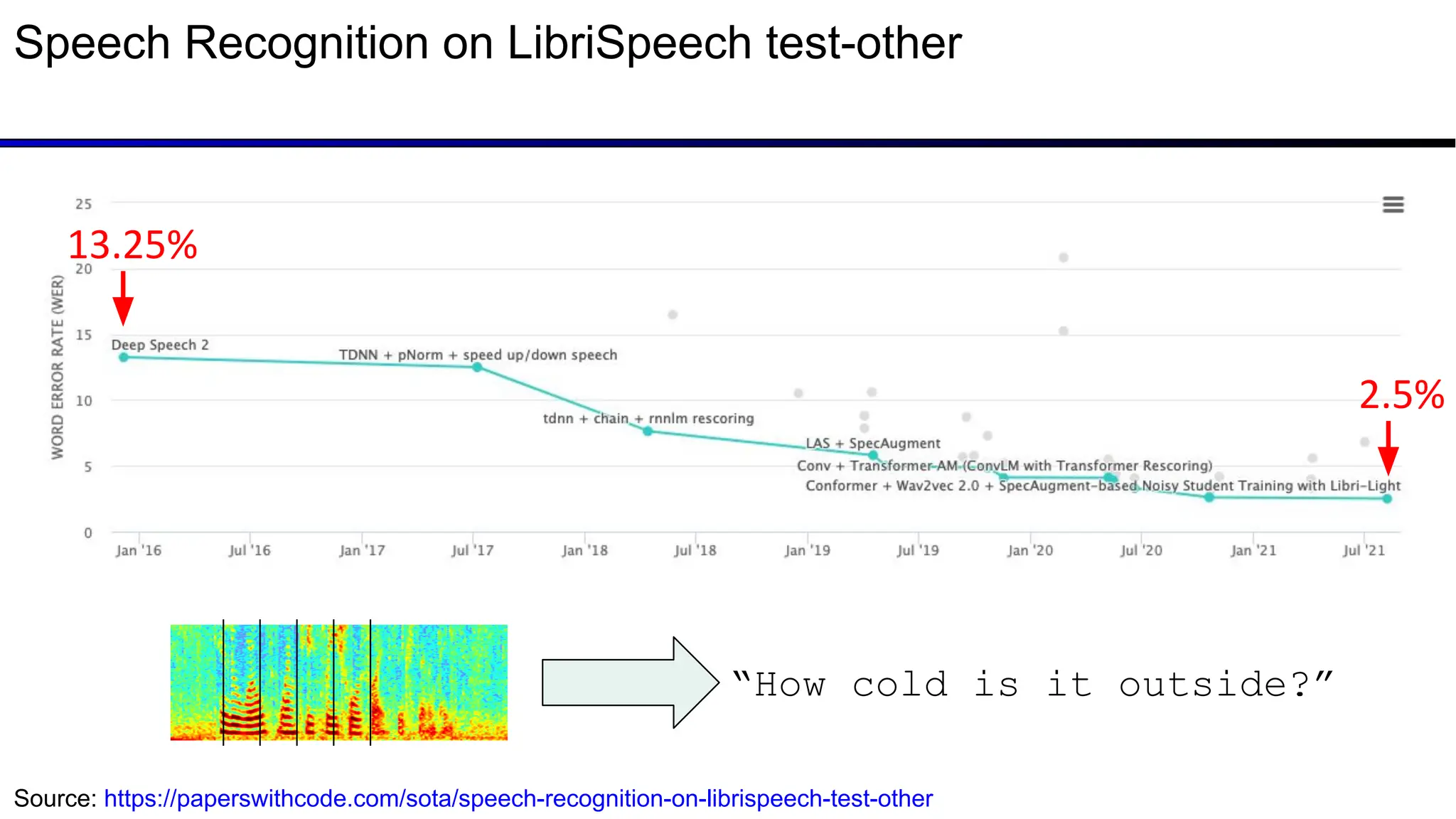
“How cold is it outside?”
2.5%
Source: https://paperswithcode.com/sota/speech-recognition-on-librispeech-test-other
13.25%
Speech Recognition on LibriSpeech test-other
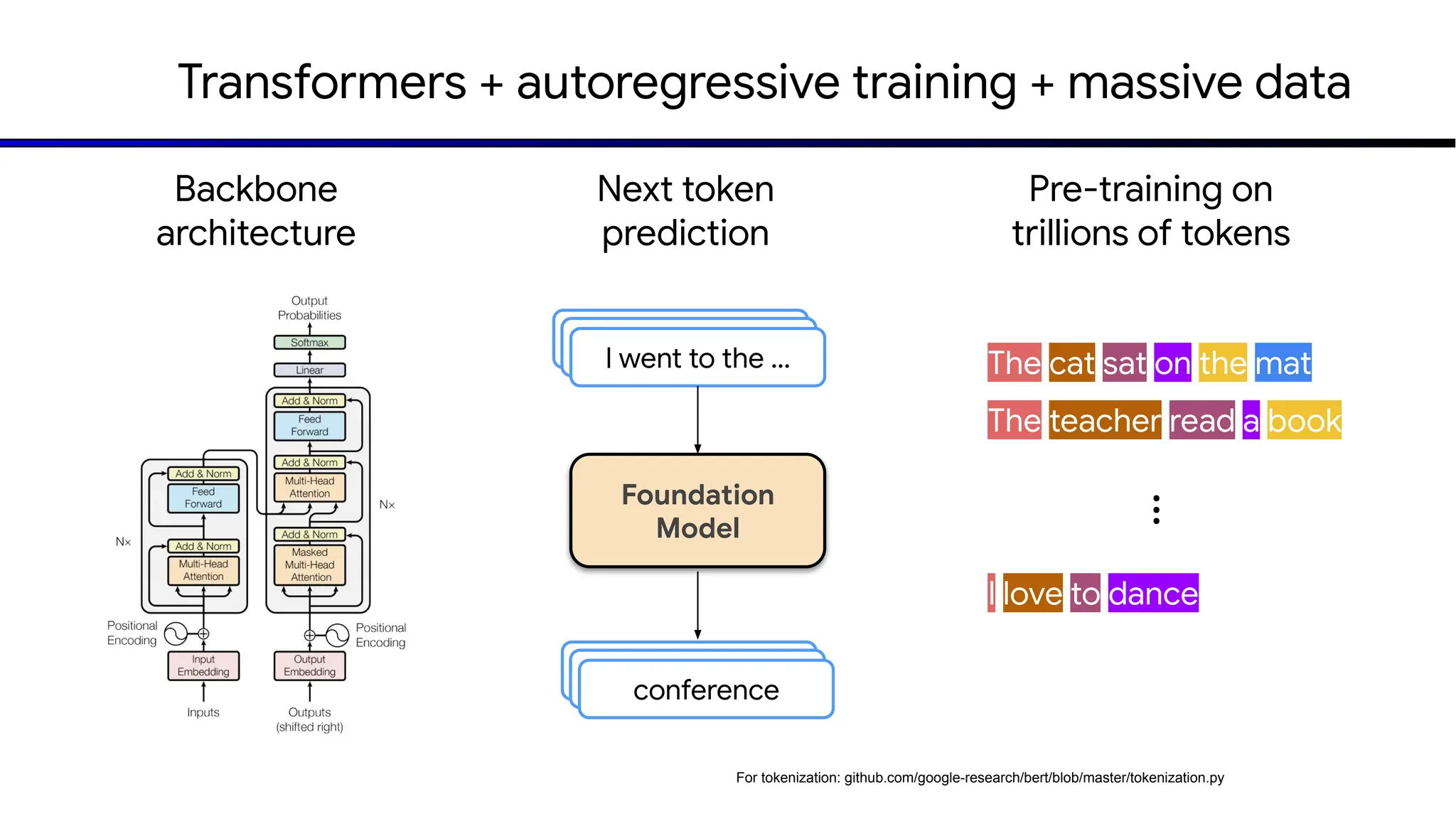
Transformers + autoregressive training + massive data
I went to the …
Foundation
Model
Pre-training on
trillions of tokens
The cat sat on the mat
The teacher read a book
I love to dance
…
conference
Next token
prediction
Backbone
architecture
For tokenization: github.com/google-research/bert/blob/master/tokenization.py
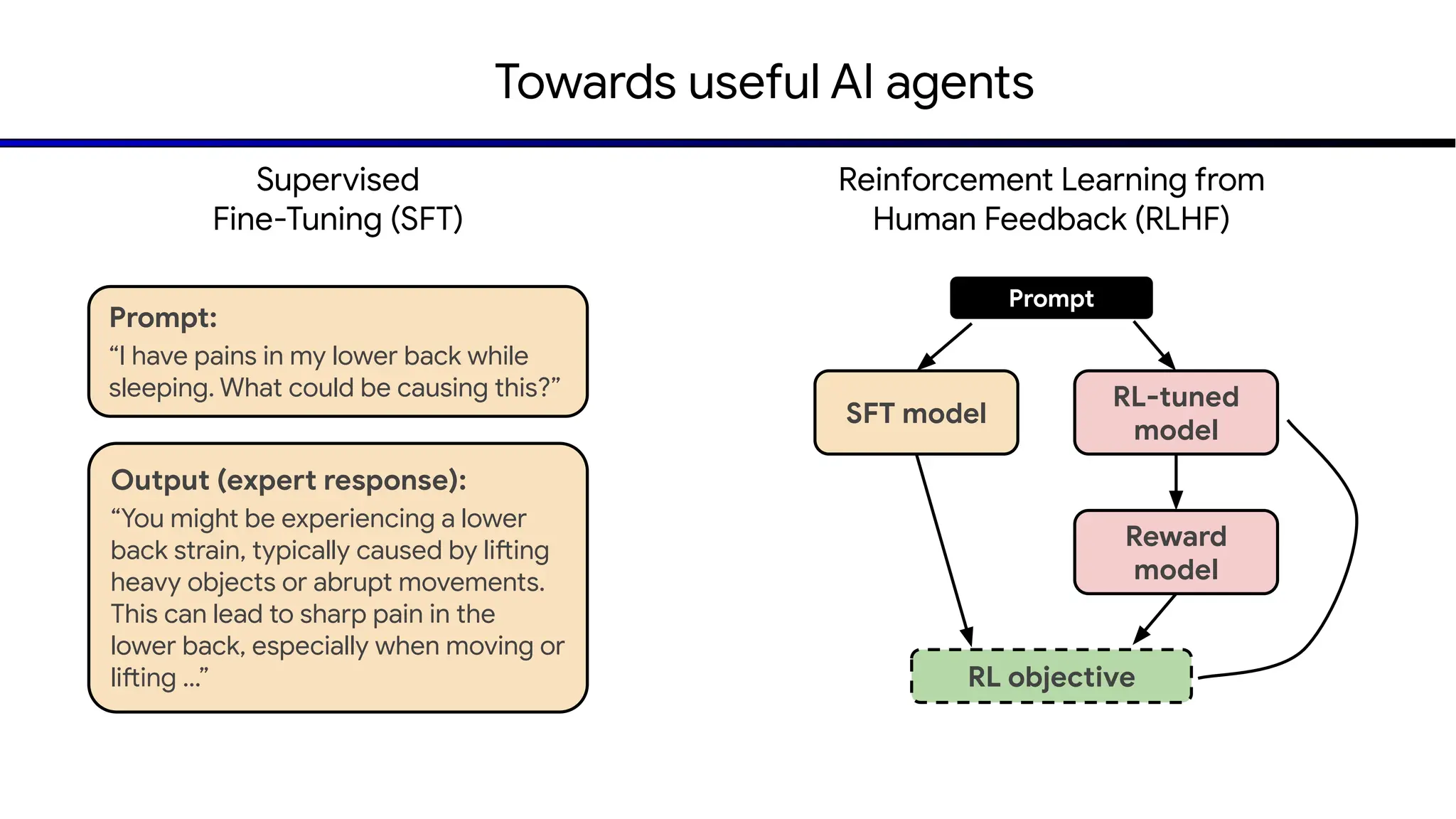
Towards useful AI agents
Supervised
Fine-Tuning (SFT)
Reinforcement Learning from
Human Feedback (RLHF)
Prompt:
“I have pains in my lower back while
sleeping. What could be causing this?”
Output (expert response):
“You might be experiencing a lower
back strain, typically caused by lifting
heavy objects or abrupt movements.
This can lead to sharp pain in the
lower back, especially when moving or
lifting …”
SFT model
Reward
model
RL objective
RL-tuned
model
Prompt
Gemini
Training High Quality Multimodal Models at
Scale
13
Project started in Feb 2023
Many collaborators from Google DeepMind, Google Research, and rest of Google
Goal: Train highly capable multimodal models and use them all across Google
Initial 1.0 public release in Dec 2023, 1.5 in Feb 2024
https://blog.google/technology/ai/google-gemini-ai https://g.co/gemini
Gemini: A Family of Highly Capable Multimodal Models, by the Gemini Team, arxiv.org/abs/2312.11805
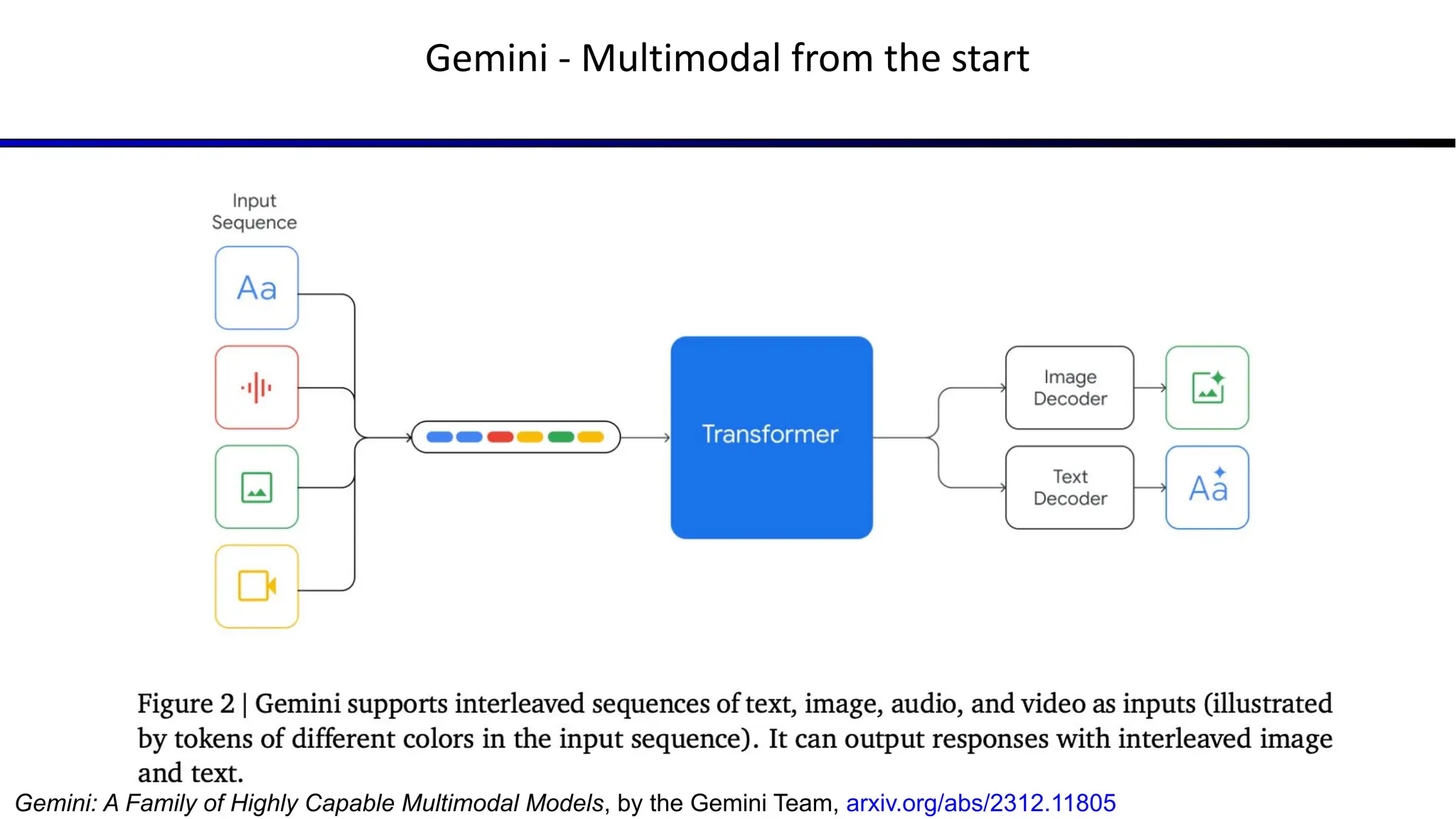
Gemini - Multimodal from the start
Gemini: A Family of Highly Capable Multimodal Models, by the Gemini Team, arxiv.org/abs/2312.11805
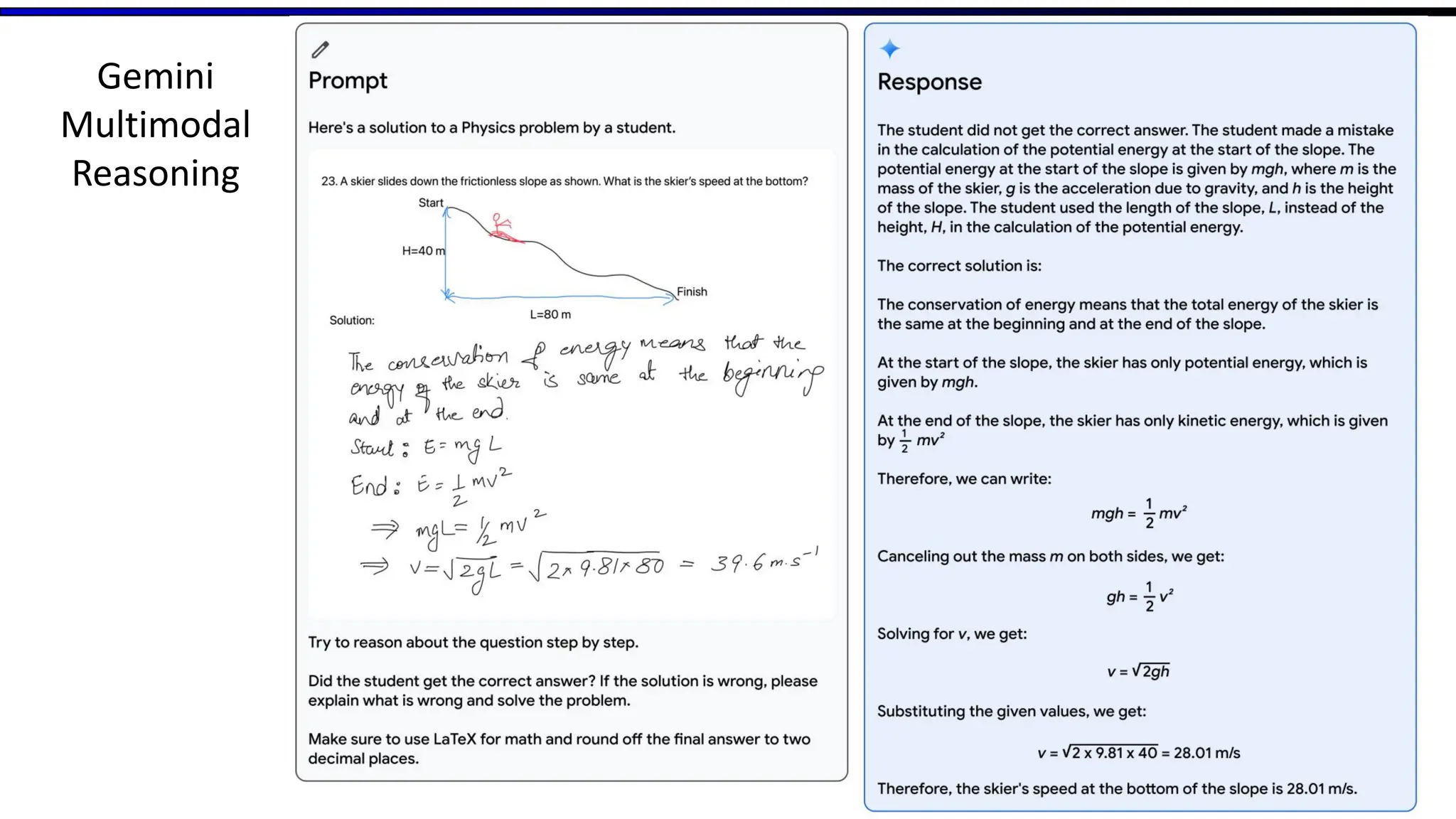
Gemini
Multimodal
Reasoning
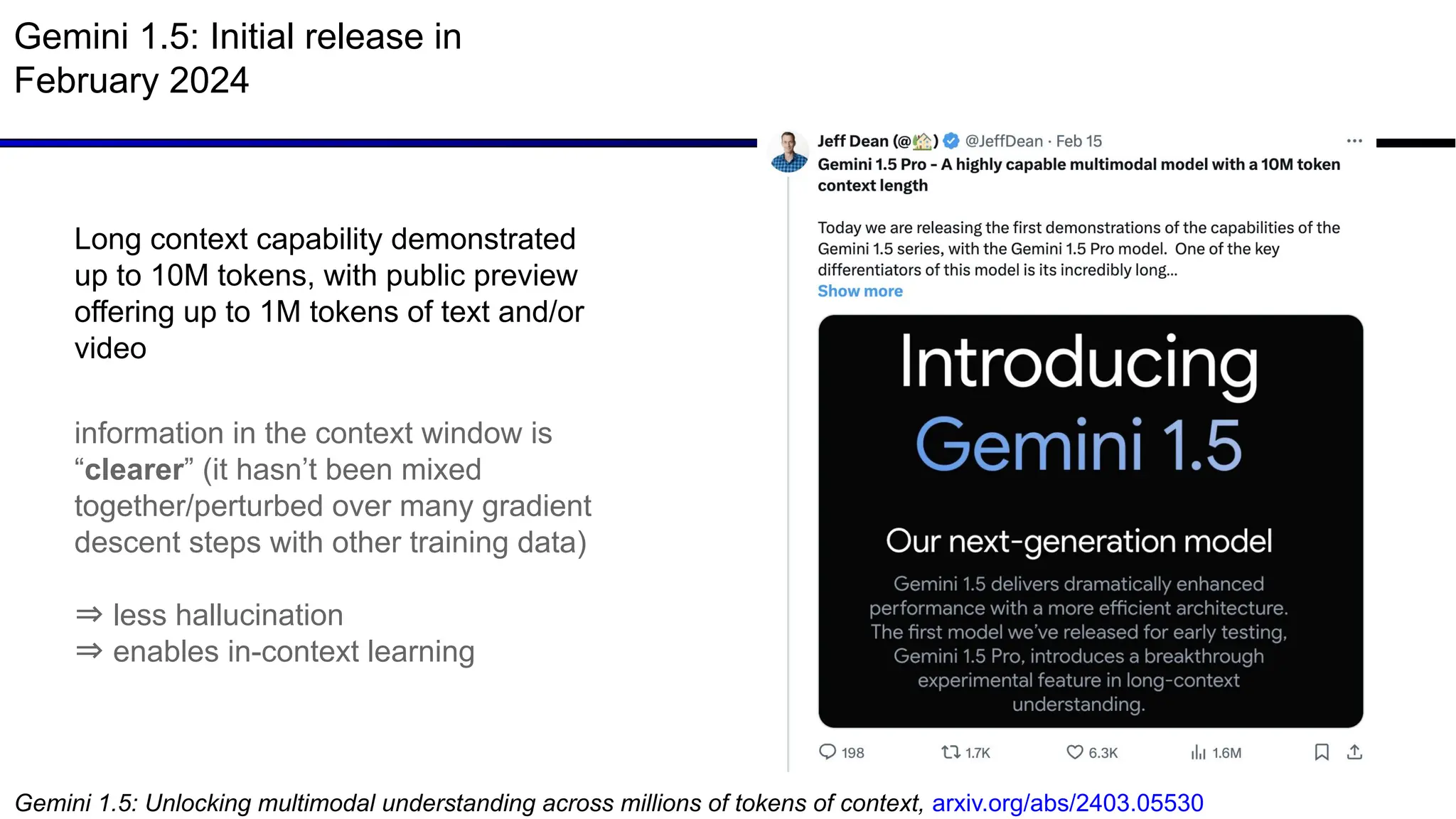
Gemini 1.5: Initial release in
February 2024
Gemini 1.5: Unlocking multimodal understanding across millions of tokens of context, arxiv.org/abs/2403.05530
Long context capability demonstrated
up to 10M tokens, with public preview
offering up to 1M tokens of text and/or
video
information in the context window is
“clearer” (it hasn’t been mixed
together/perturbed over many gradient
descent steps with other training data)
⇒ less hallucination
⇒ enables in-context learning
Try it at https://ai.google.dev/
Gemini 1.5: Unlocking multimodal understanding across millions of tokens of context, arxiv.org/abs/2403.05530
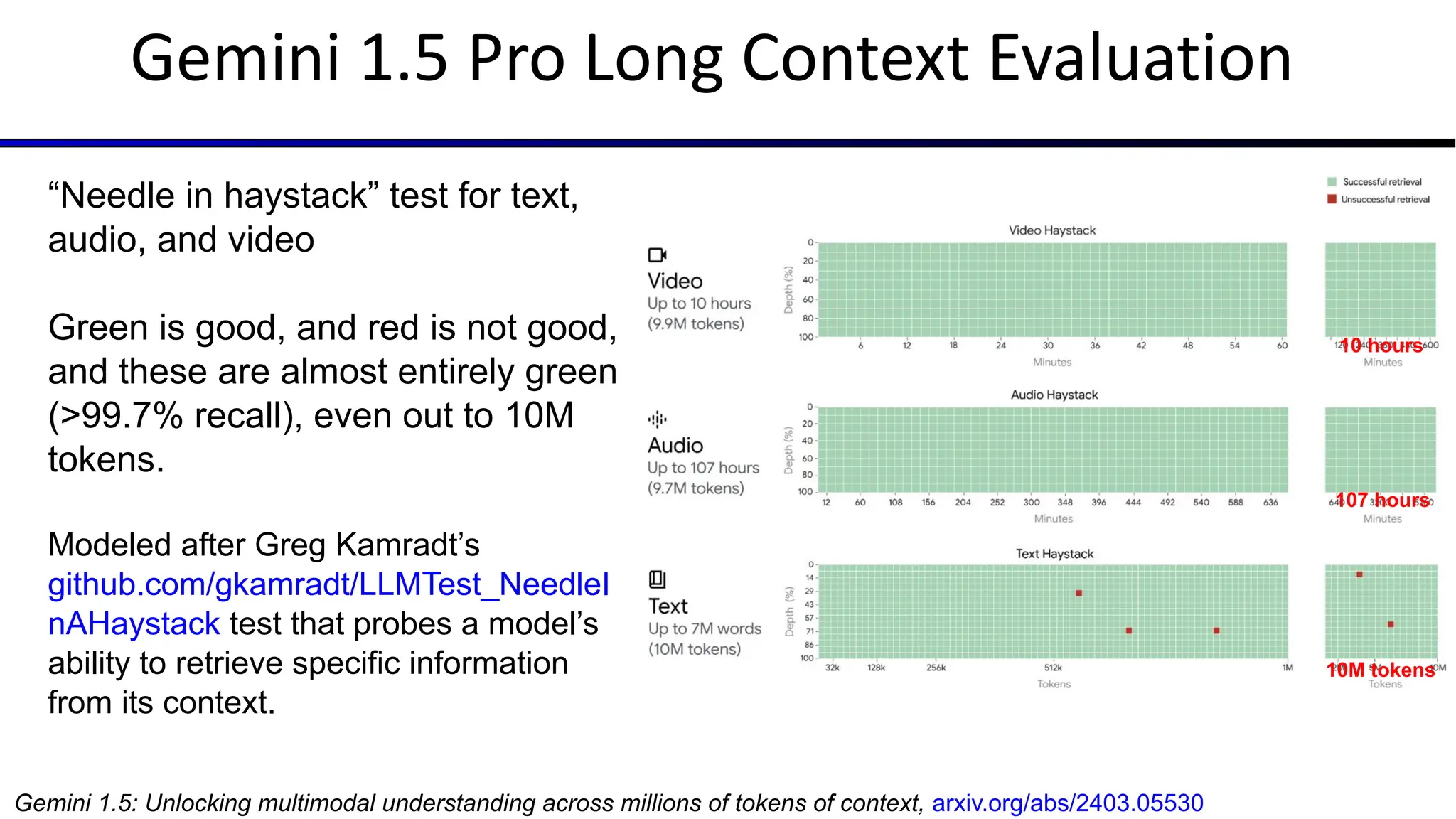
“Needle in haystack” test for text,
audio, and video
Green is good, and red is not good,
and these are almost entirely green
(>99.7% recall), even out to 10M
tokens.
Modeled after Greg Kamradt’s
github.com/gkamradt/LLMTest_NeedleI
nAHaystack test that probes a model’s
ability to retrieve specific information
from its context.
Gemini 1.5 Pro Long Context Evaluation
Gemini 1.5: Unlocking multimodal understanding across millions of tokens of context, arxiv.org/abs/2403.05530
10 hours
107 hours
10M tokens
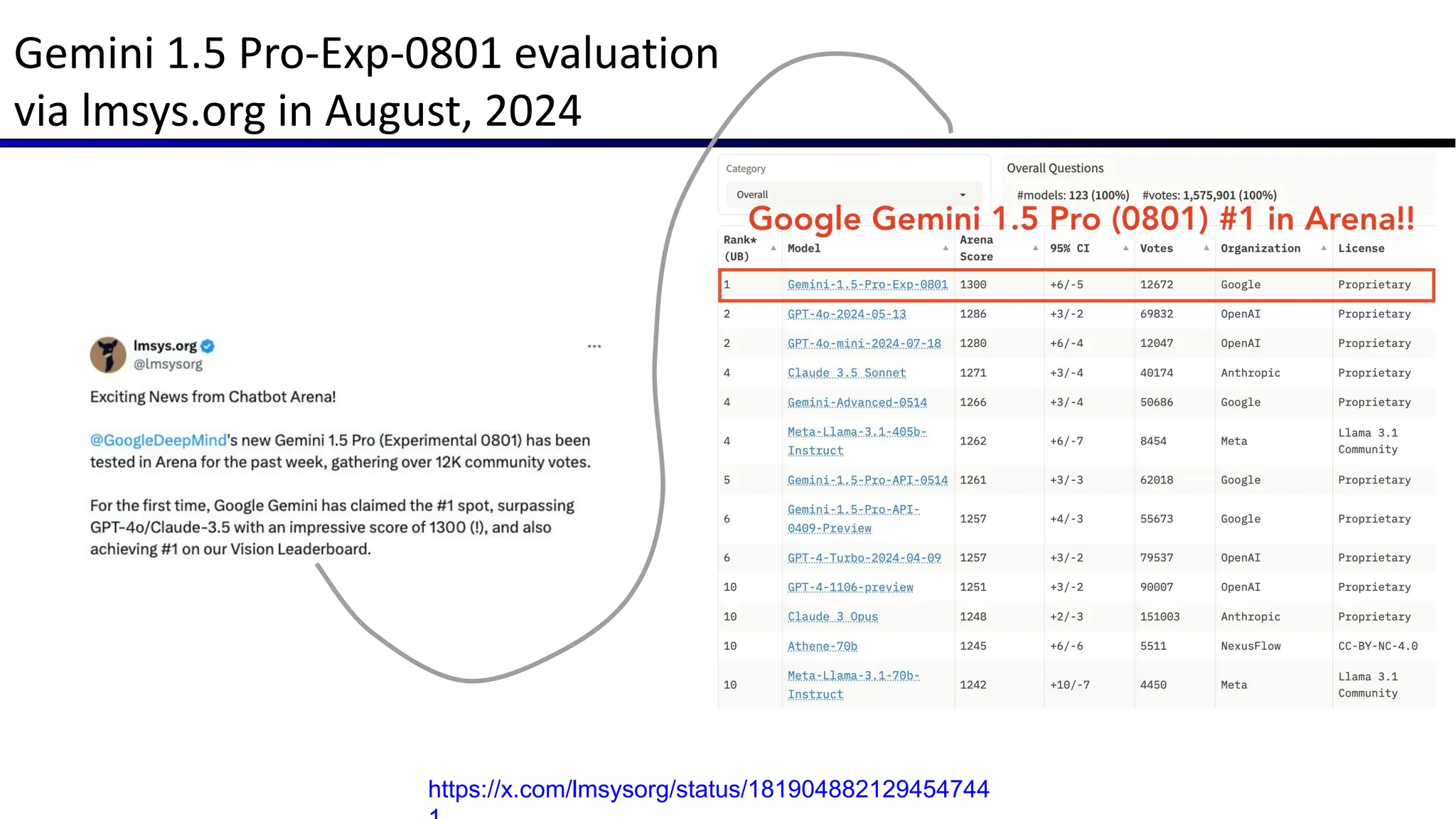
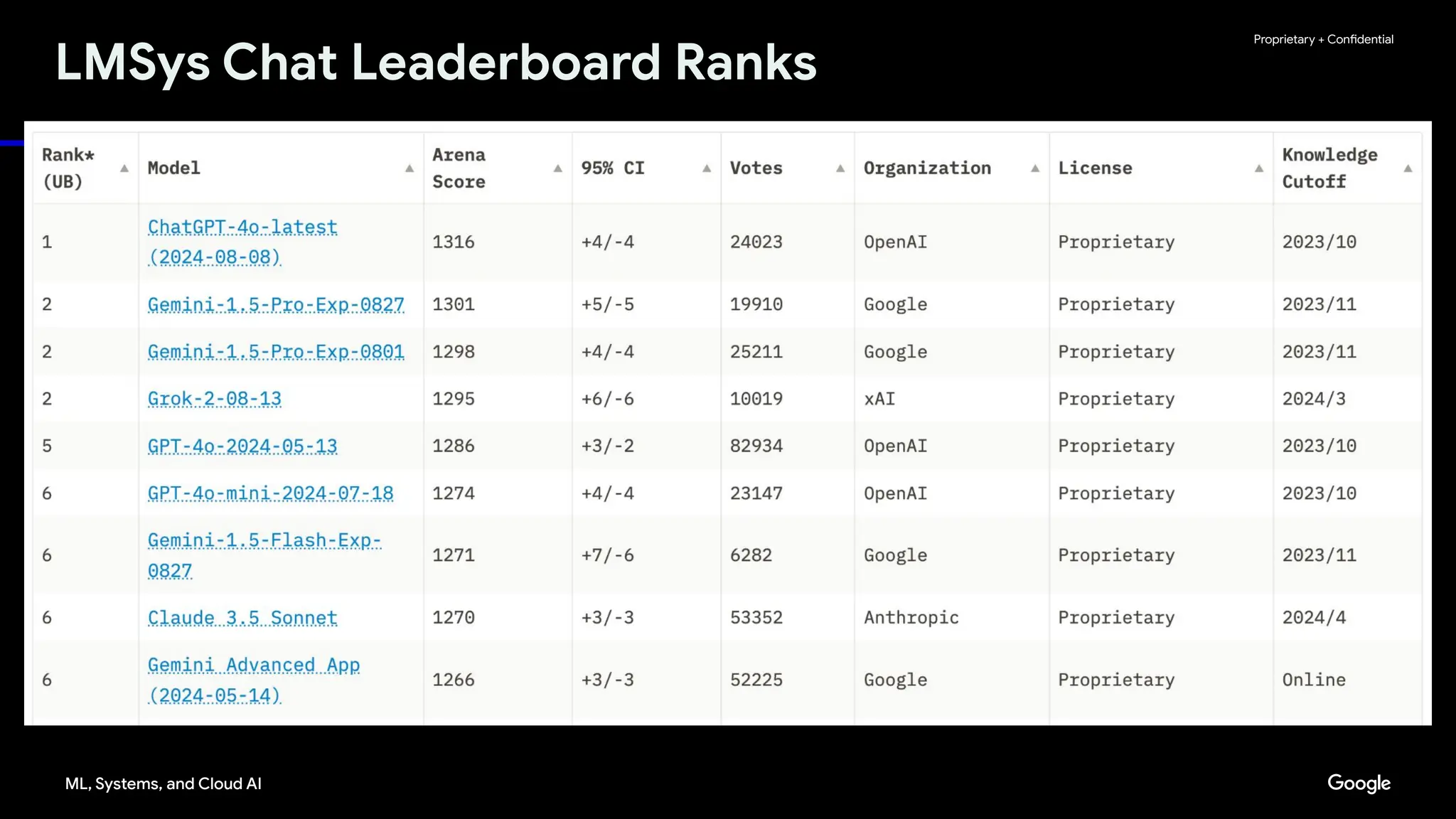
Gemini 1.5 Pro-Exp-0801 evaluation
via lmsys.org in August, 2024
https://x.com/lmsysorg/status/181904882129454744
Enterprise Trends
Trend 1- The obvious: AI is
moving so much faster
Proprietary + Confidential
ML, Systems, and Cloud AI
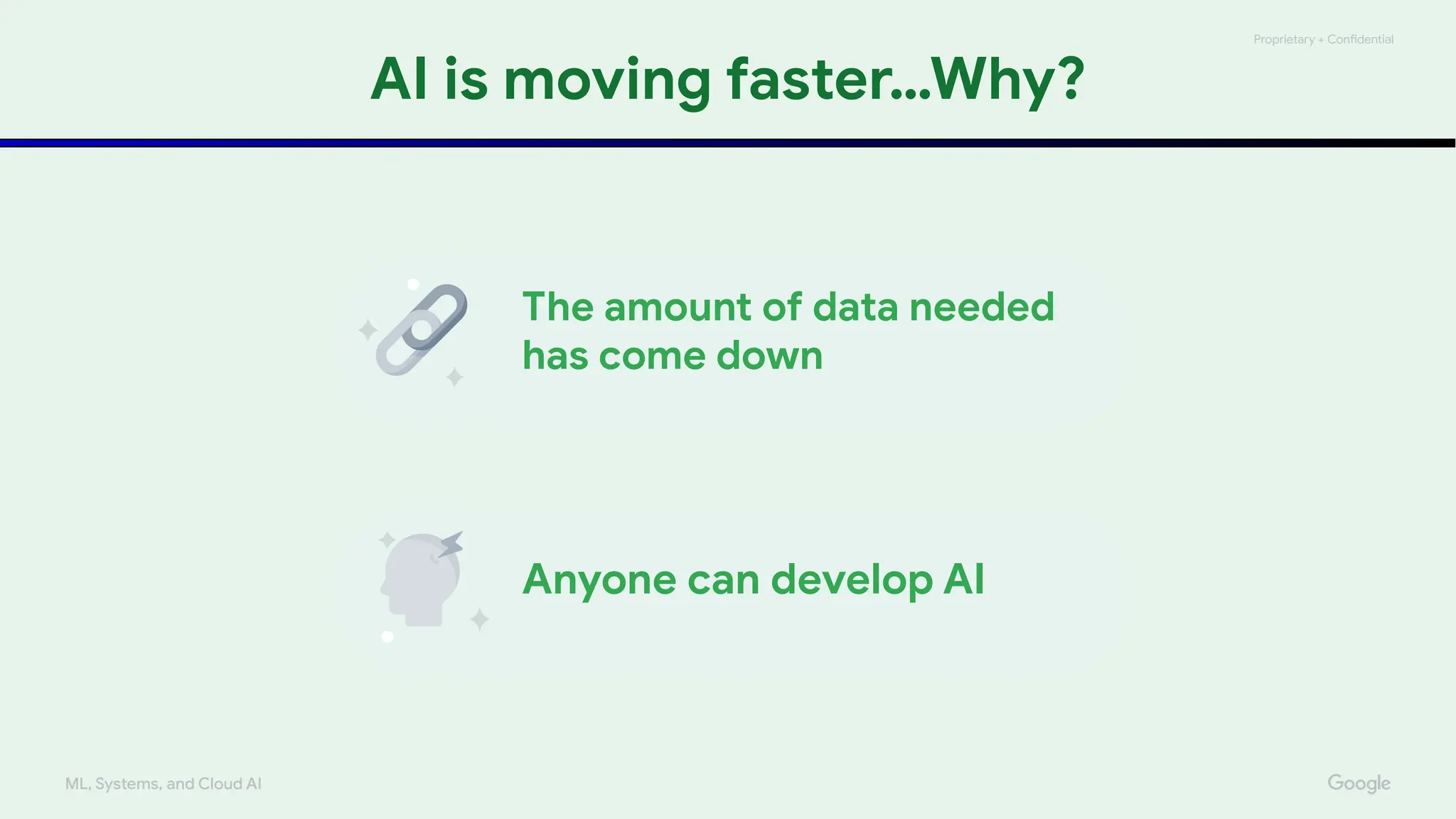
The amount of data needed
has come down
AI is moving faster…Why?
Anyone can develop AI
Trend 2- Technical Trends
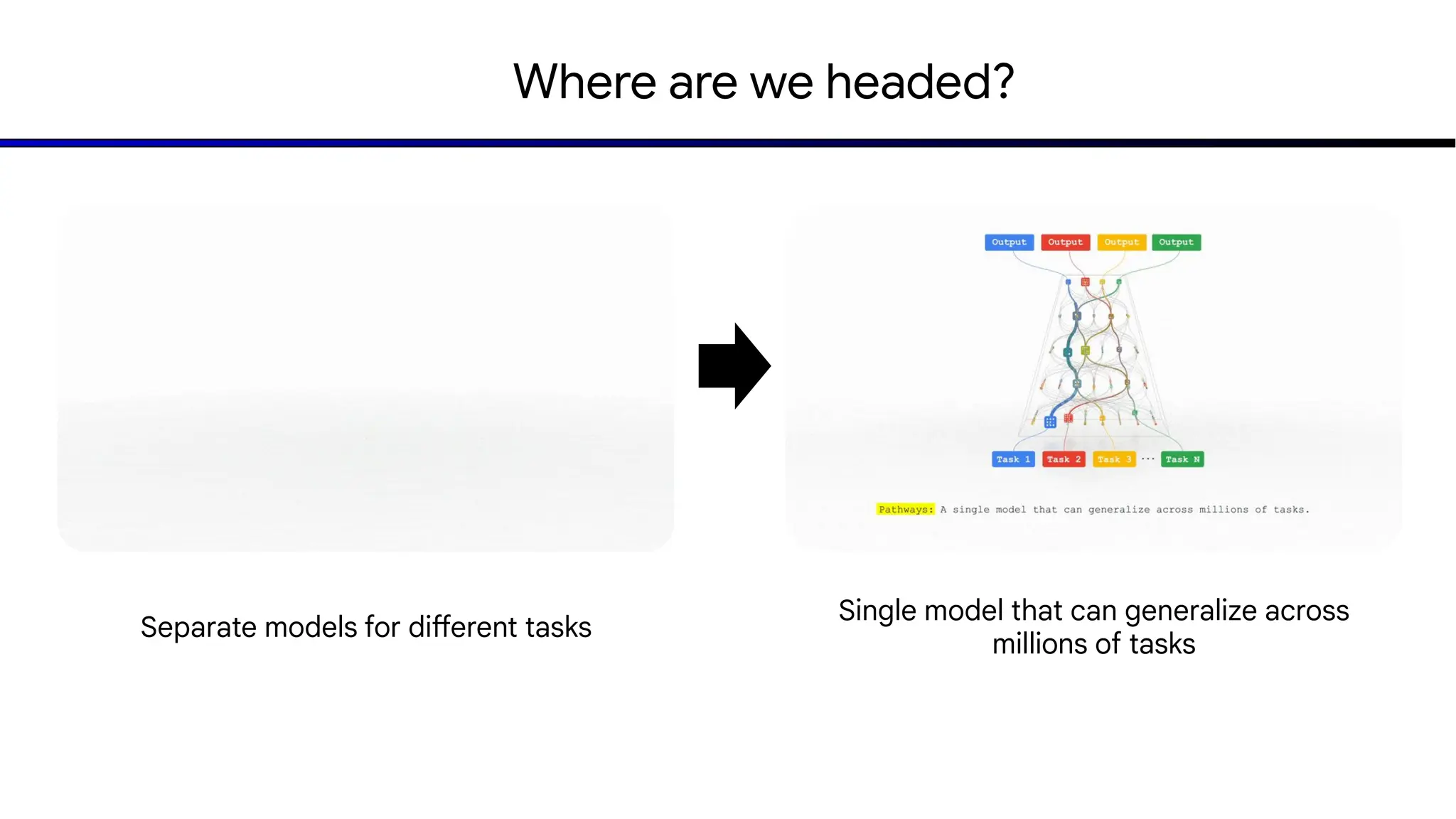
Separate models for different tasks
Single model that can generalize across
millions of tasks
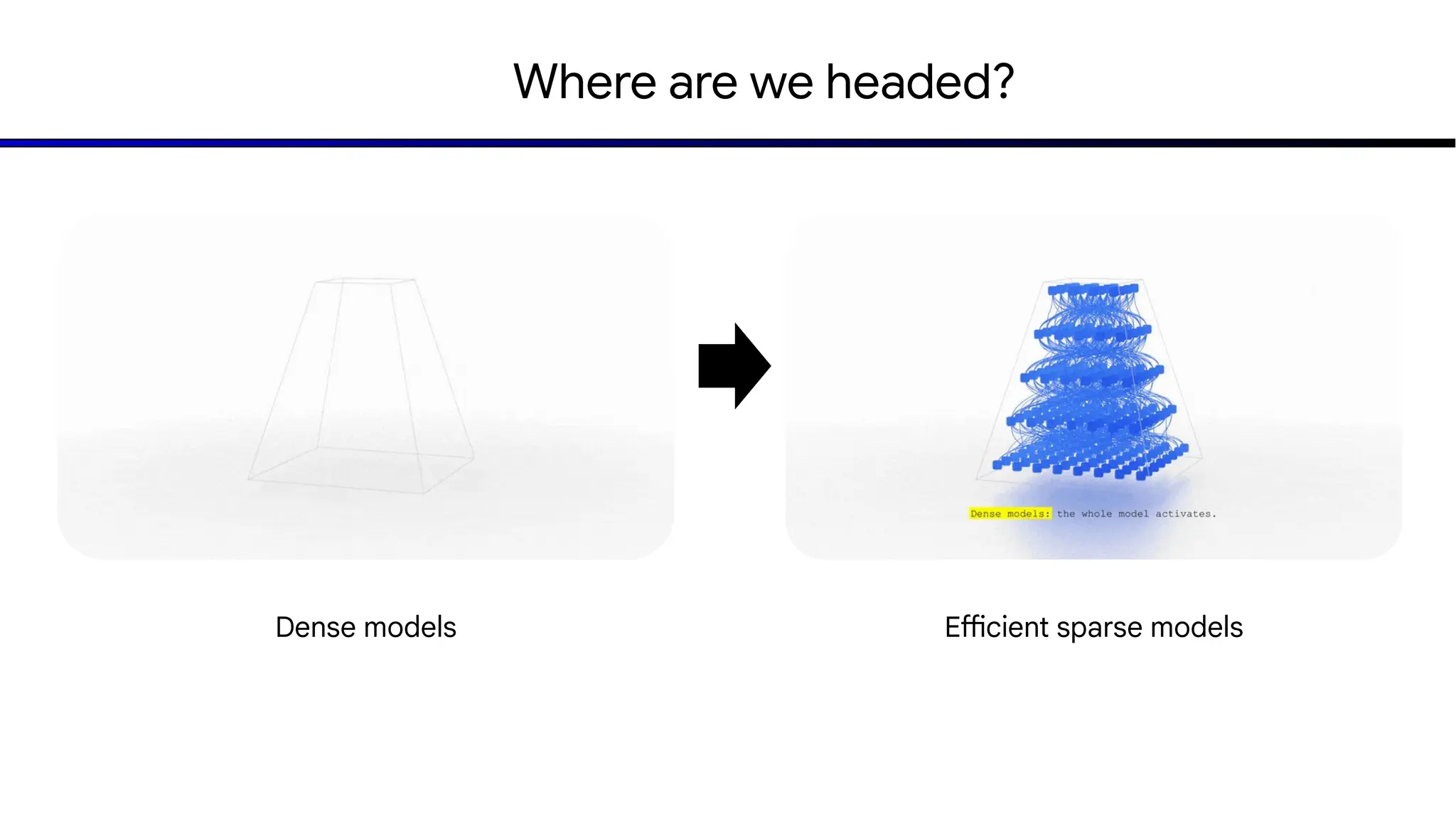
Where are we headed?
Dense models Efficient sparse models
Where are we headed?
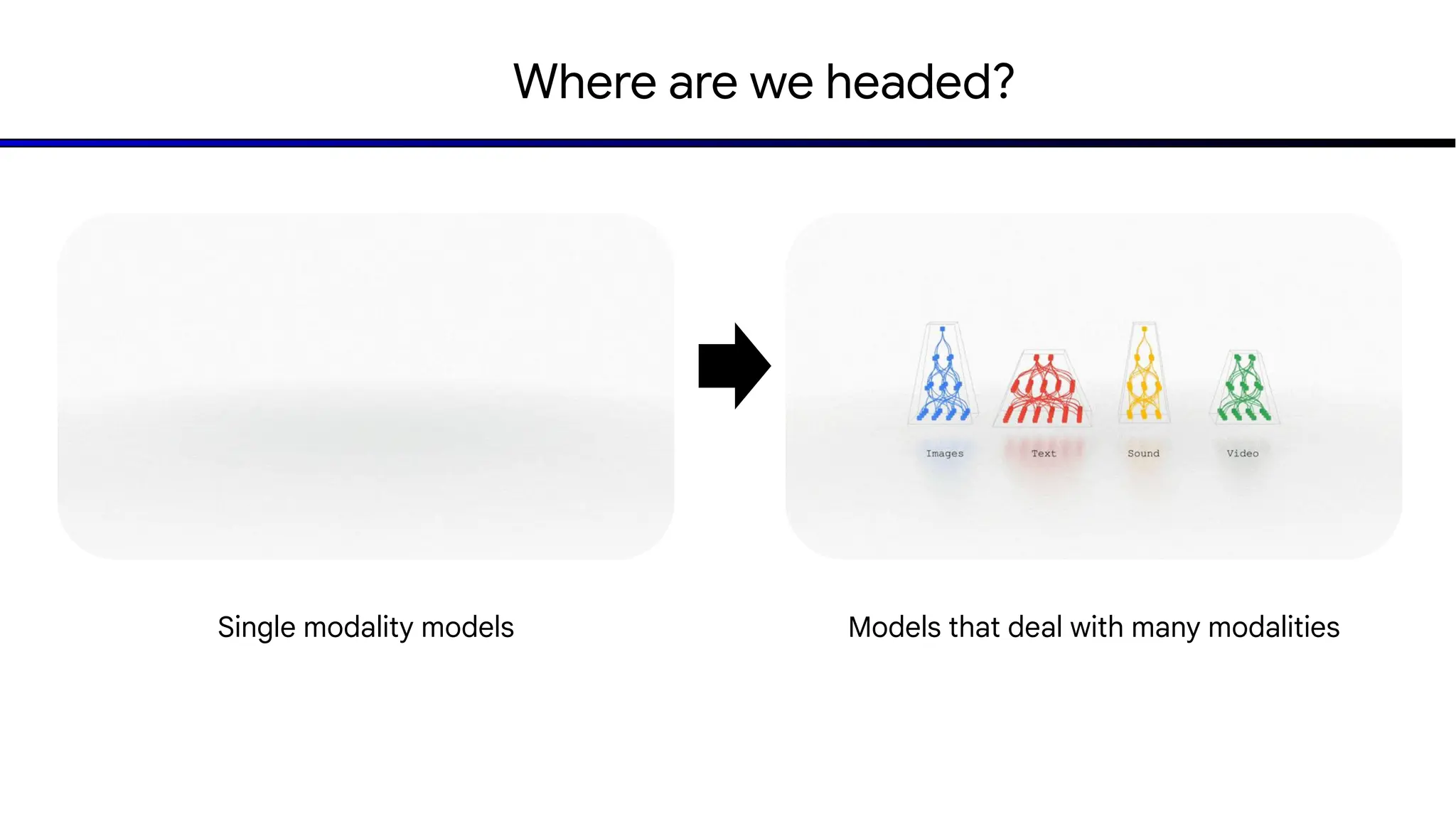
Single modality models Models that deal with many modalities
Trend 3- It is the choice of
the platform that matters
ML, Systems, and Cloud AI
Proprietary + Confidential
LMSys Chat Leaderboard Ranks
029
Google Cloud Next ‘24 Proprietary
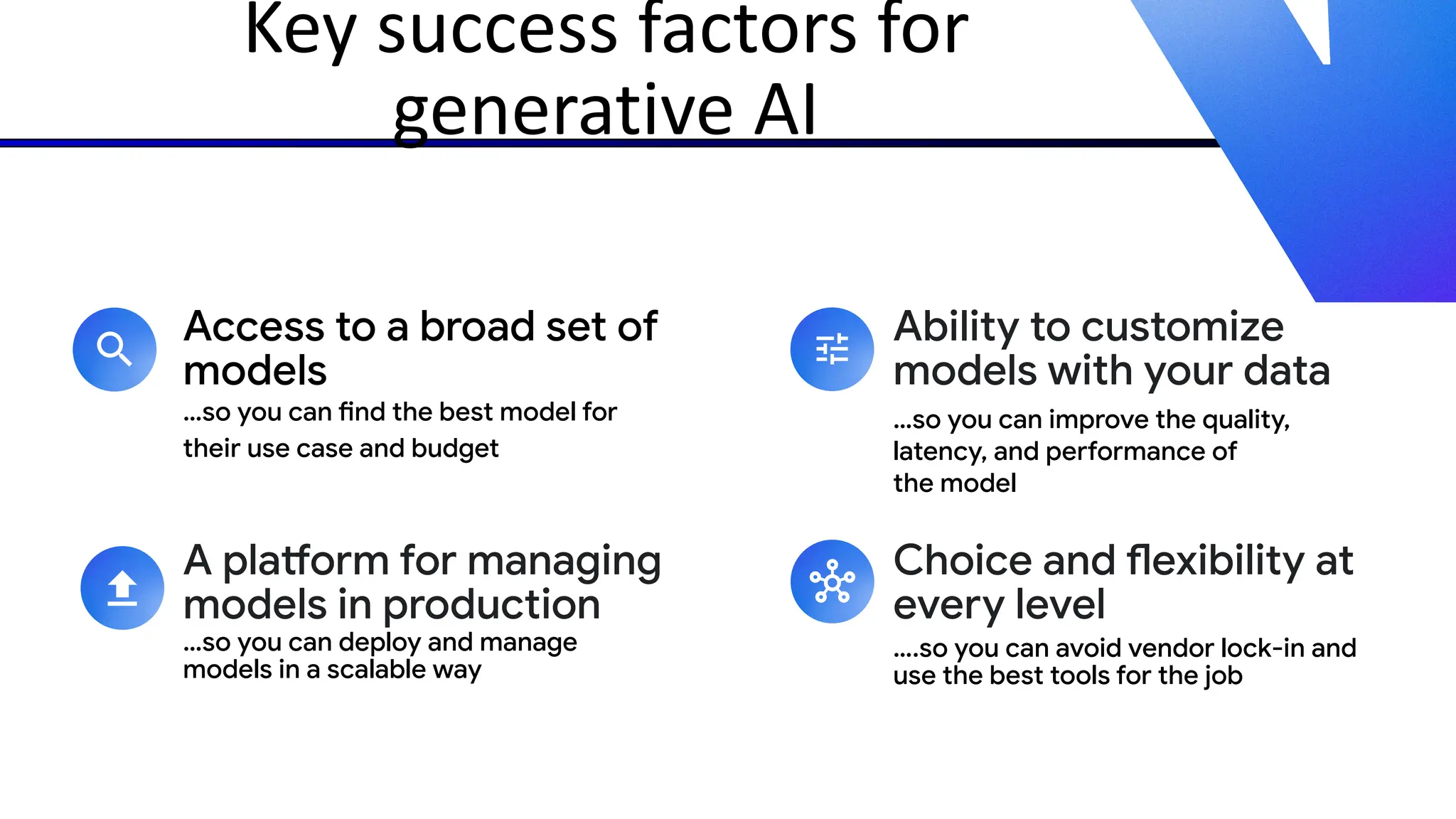
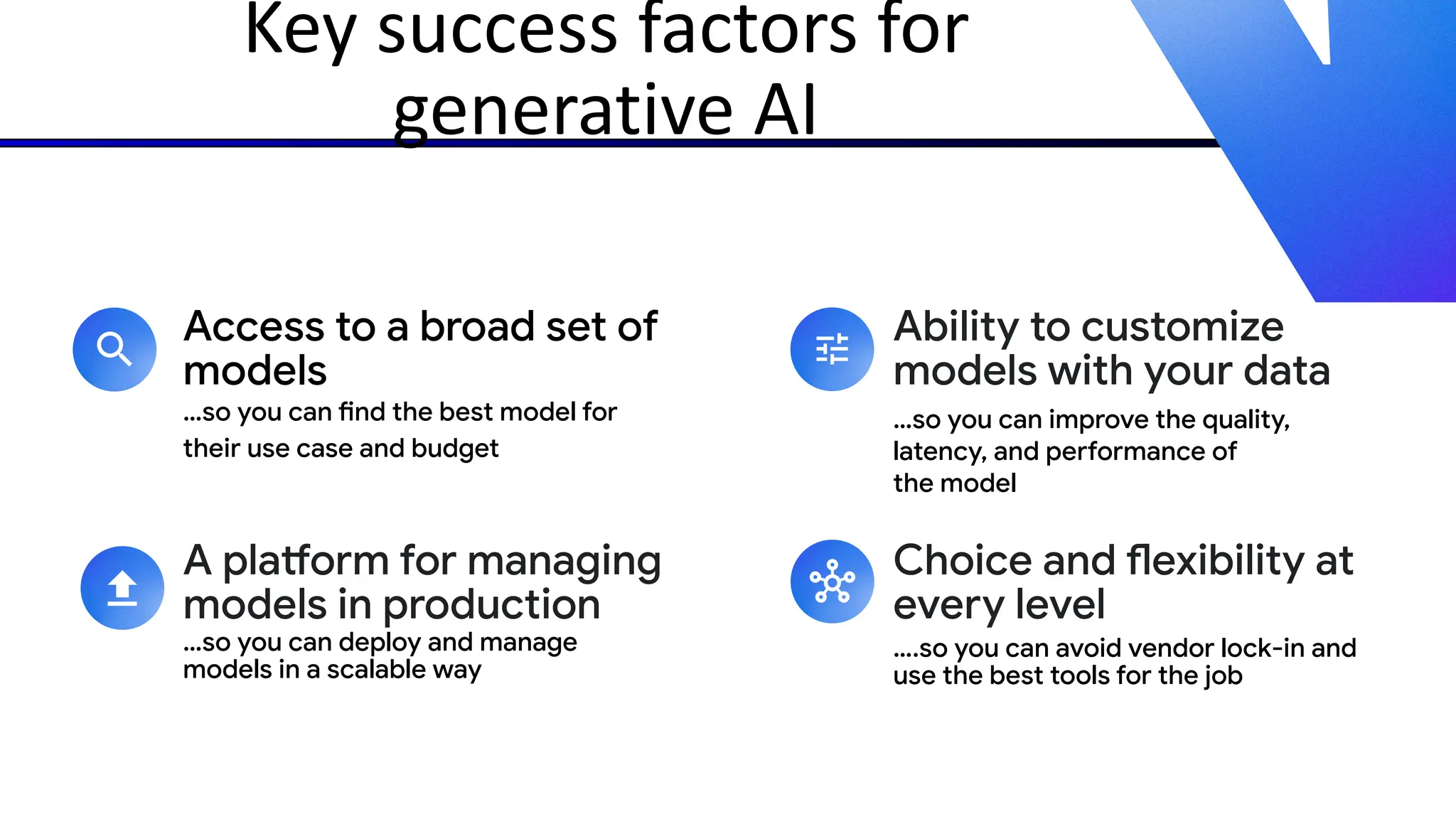
Key success factors for
generative AI
Access to a broad set of
models
…so you can find the best model for
their use case and budget
A platform for managing
models in production
…so you can deploy and manage
models in a scalable way
Ability to customize
models with your data
…so you can improve the quality,
latency, and performance of
the model
Choice and flexibility at
every level
….so you can avoid vendor lock-in and
use the best tools for the job
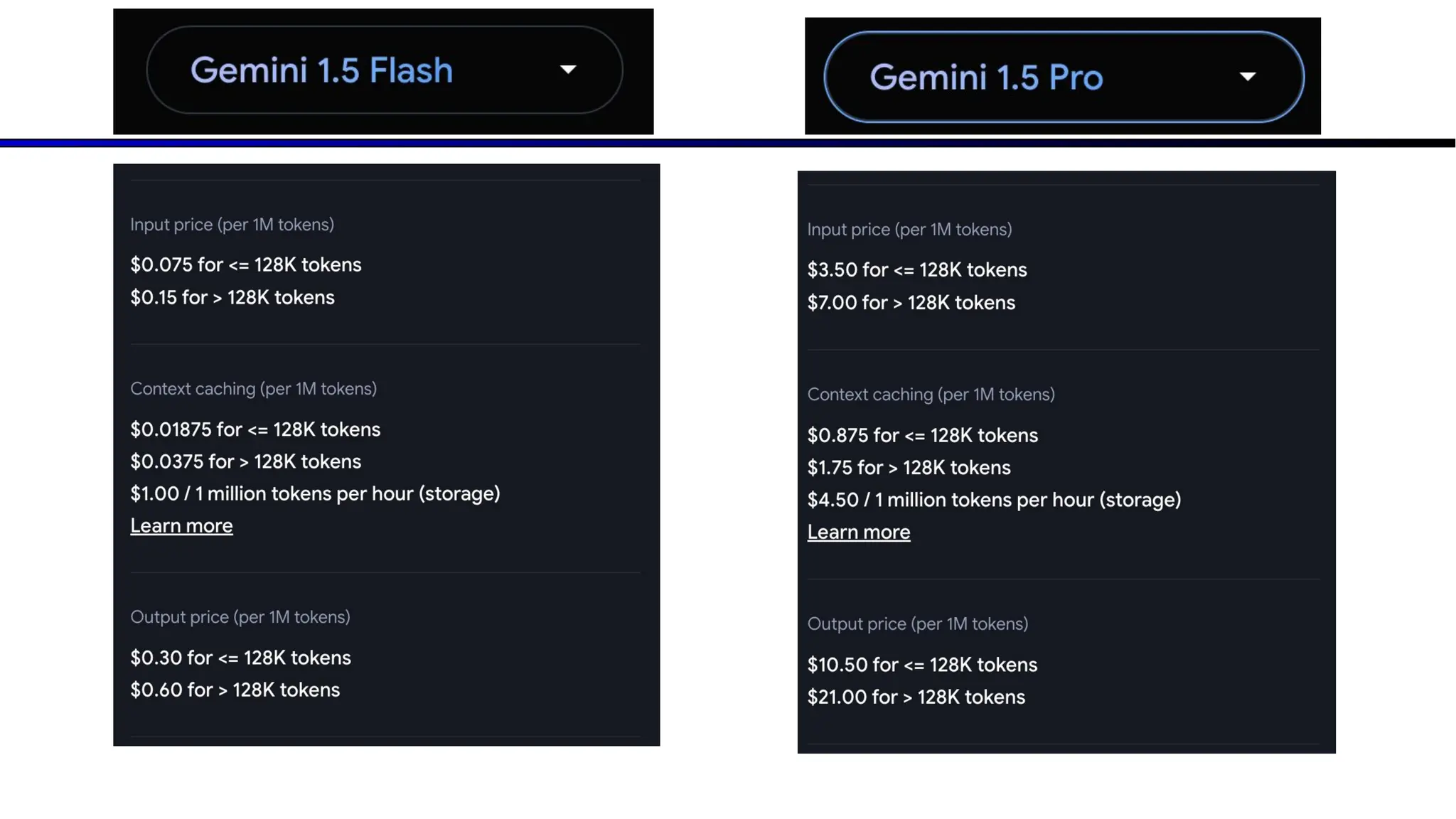
Trend 4- Cost of API calls is
approaching 0
Trend 5- Search
Another big realization
LLM and Search need
to come together.
Trend 6- Enterprise
Search/Assistant
035
Google Cloud Next ‘24
Enterprise Learnings with
their AI investments
036
Google Cloud Next ‘24 Proprietary
Key success factors for
generative AI
Access to a broad set of
models
…so you can find the best model for
their use case and budget
A platform for managing
models in production
…so you can deploy and manage
models in a scalable way
Ability to customize
models with your data
…so you can improve the quality,
latency, and performance of
the model
Choice and flexibility at
every level
….so you can avoid vendor lock-in and
use the best tools for the job
Google Cloud Next
Storyboard section 1 NEW / UPDATED SUN 8/20
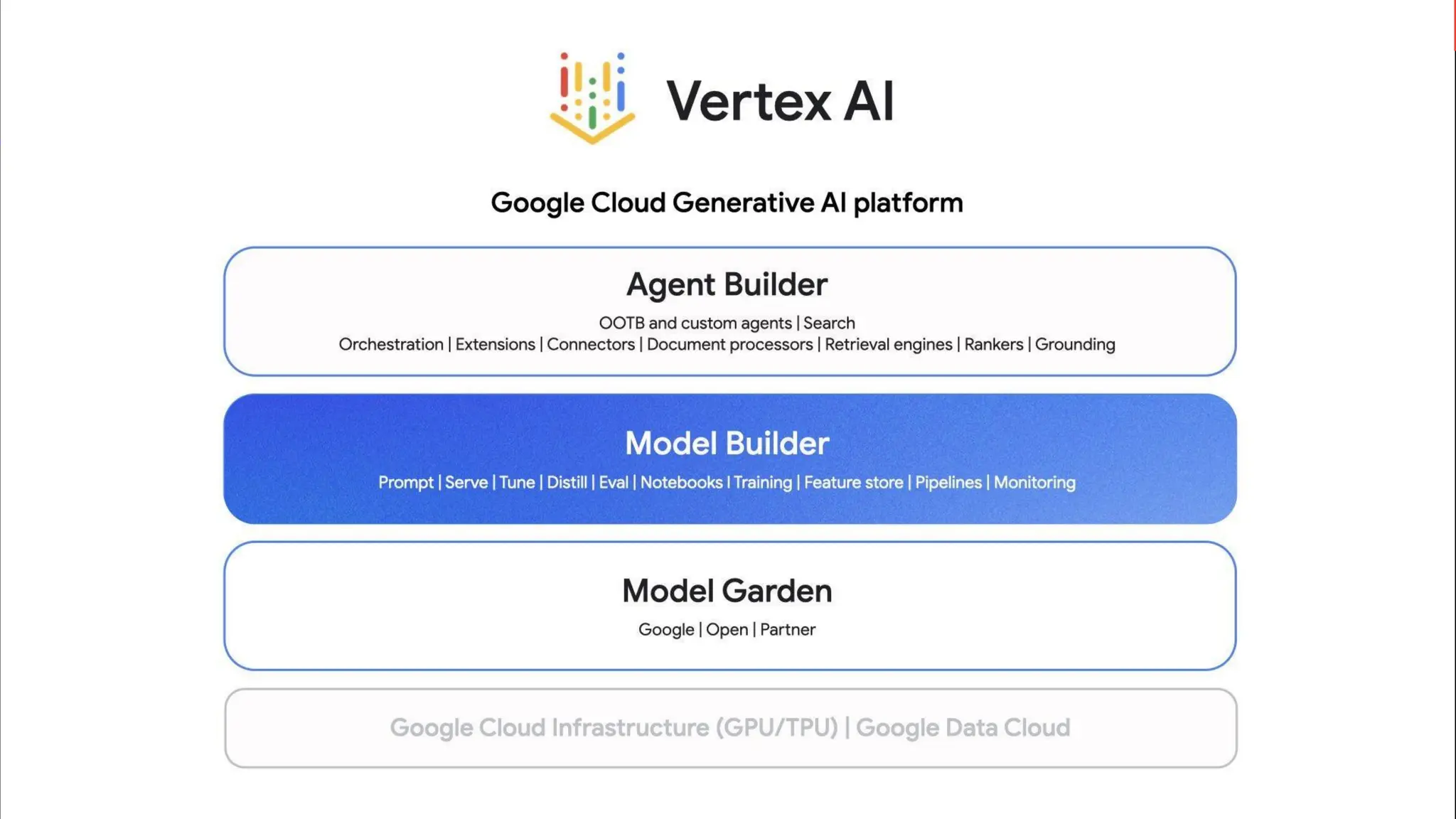
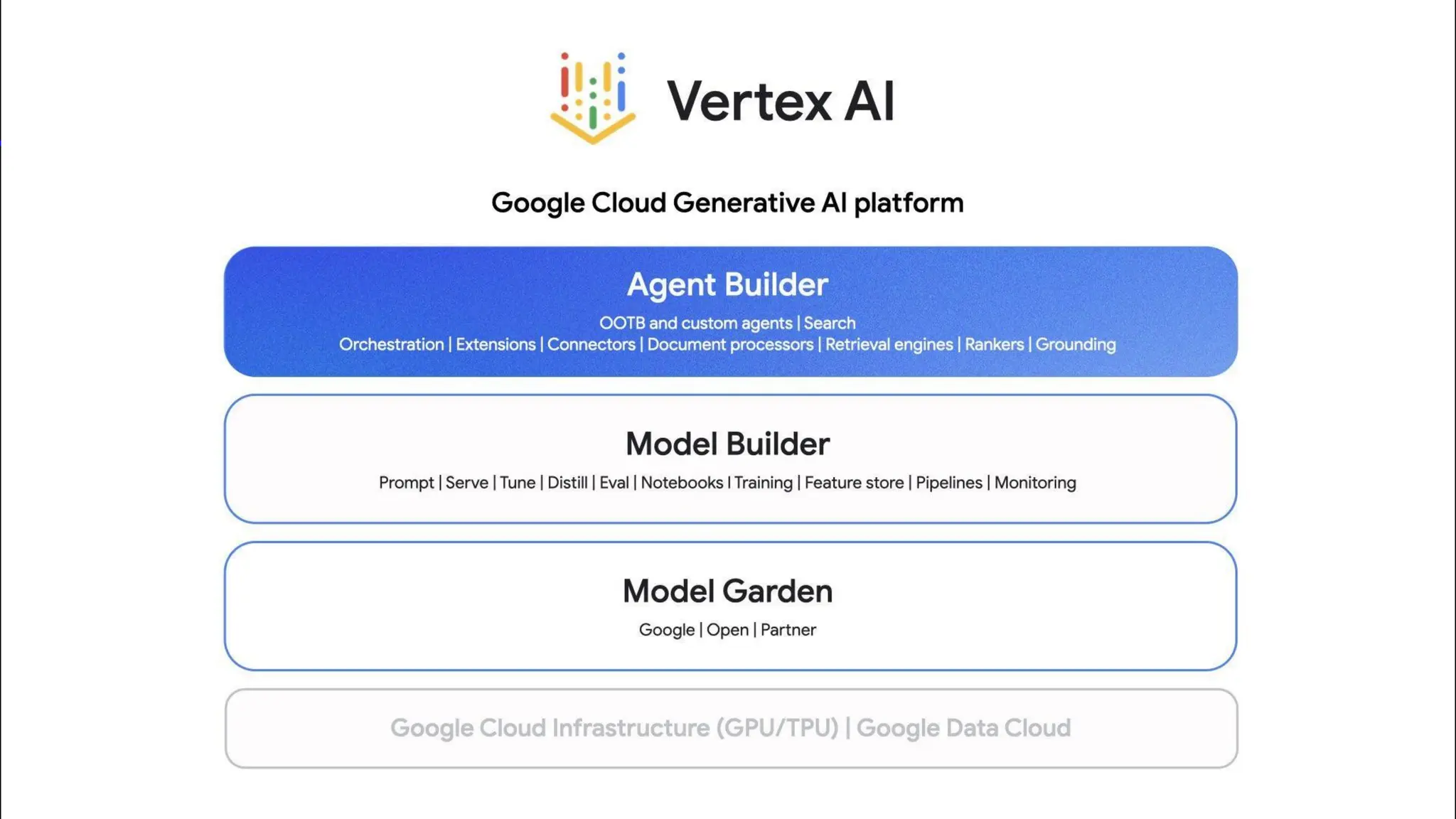
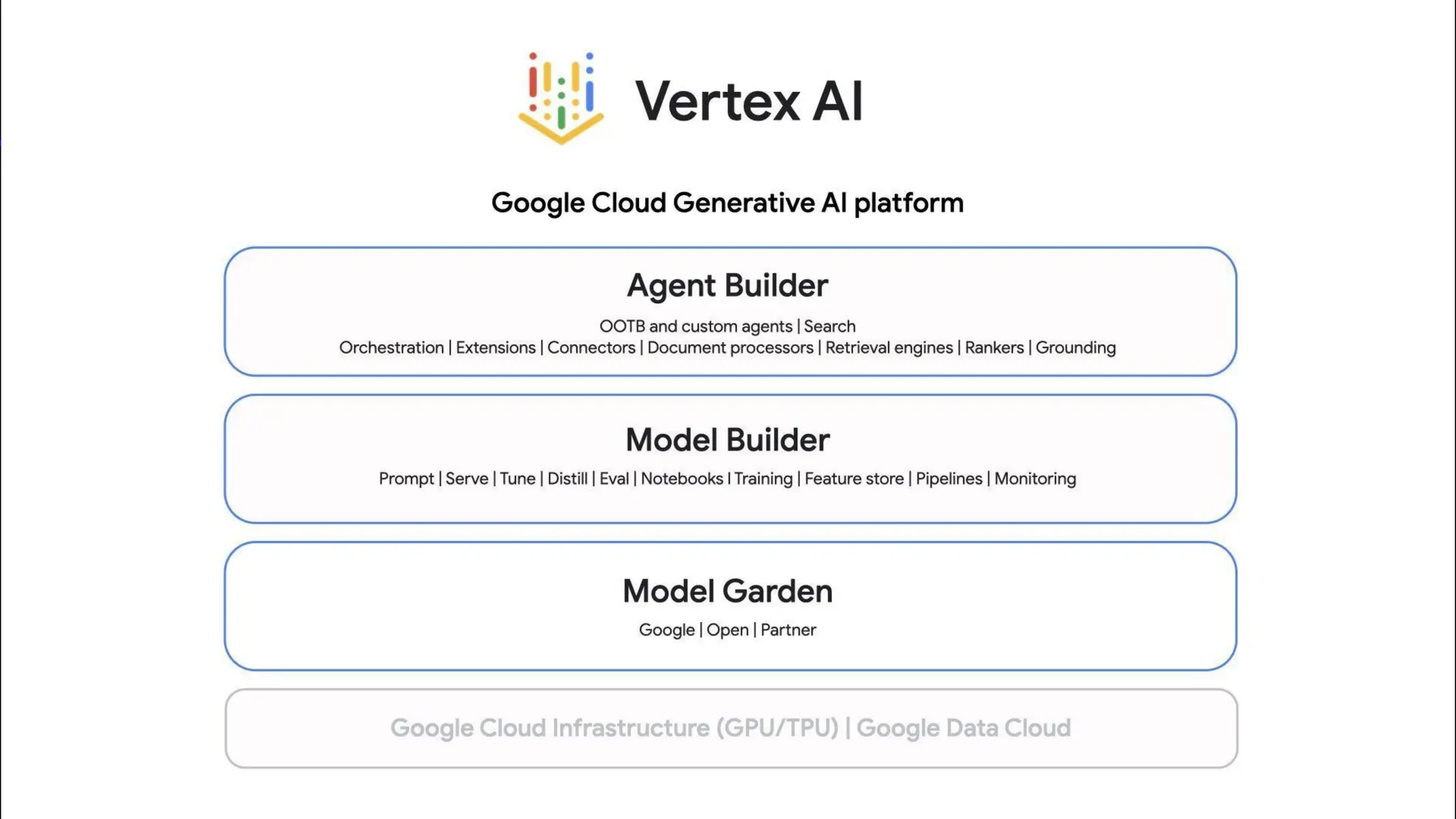
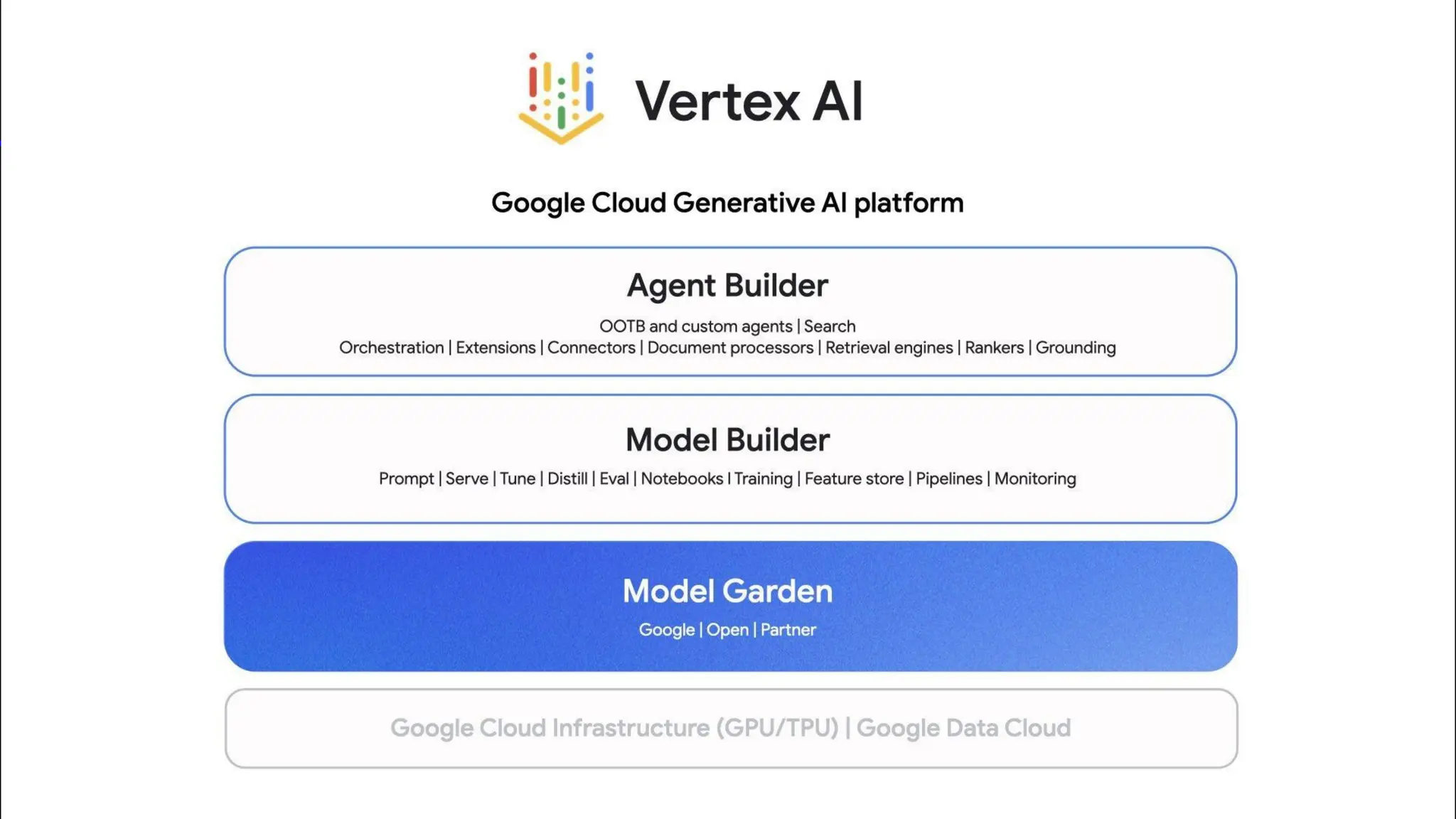
Vertex AI
Model Garden
130
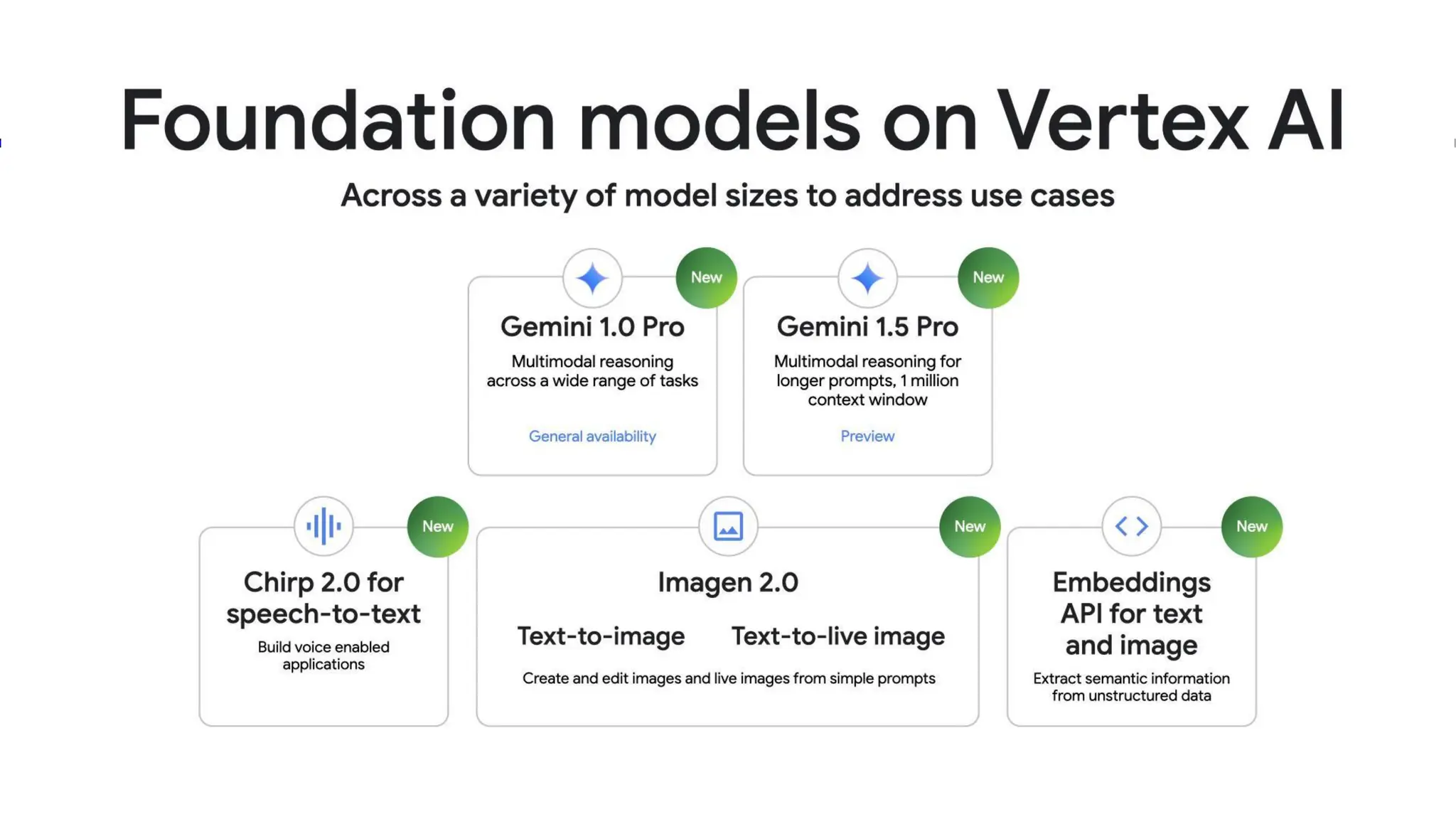
Foundation Models on Vertex AI
Across a variety of model sizes to address use cases
Embeddings API for
Text and Image
Extract semantic information
from unstructured data
Chirp for
Speech to Text
Build voice enabled applications
PaLM for Text / Chat
Custom language tasks and
multi-turn conversations
Codey for
Code Generation
Improve coding and debugging
Imagen 2.0 for Text to
Image
Create and edit images from
simple prompts
Gemini 1.0 Pro
Multimodal reasoning across a wide
range of tasks
GA
Gemini 1.0 Ultra
Largest and most capable model
for highly complex tasks
Limited
Private GA
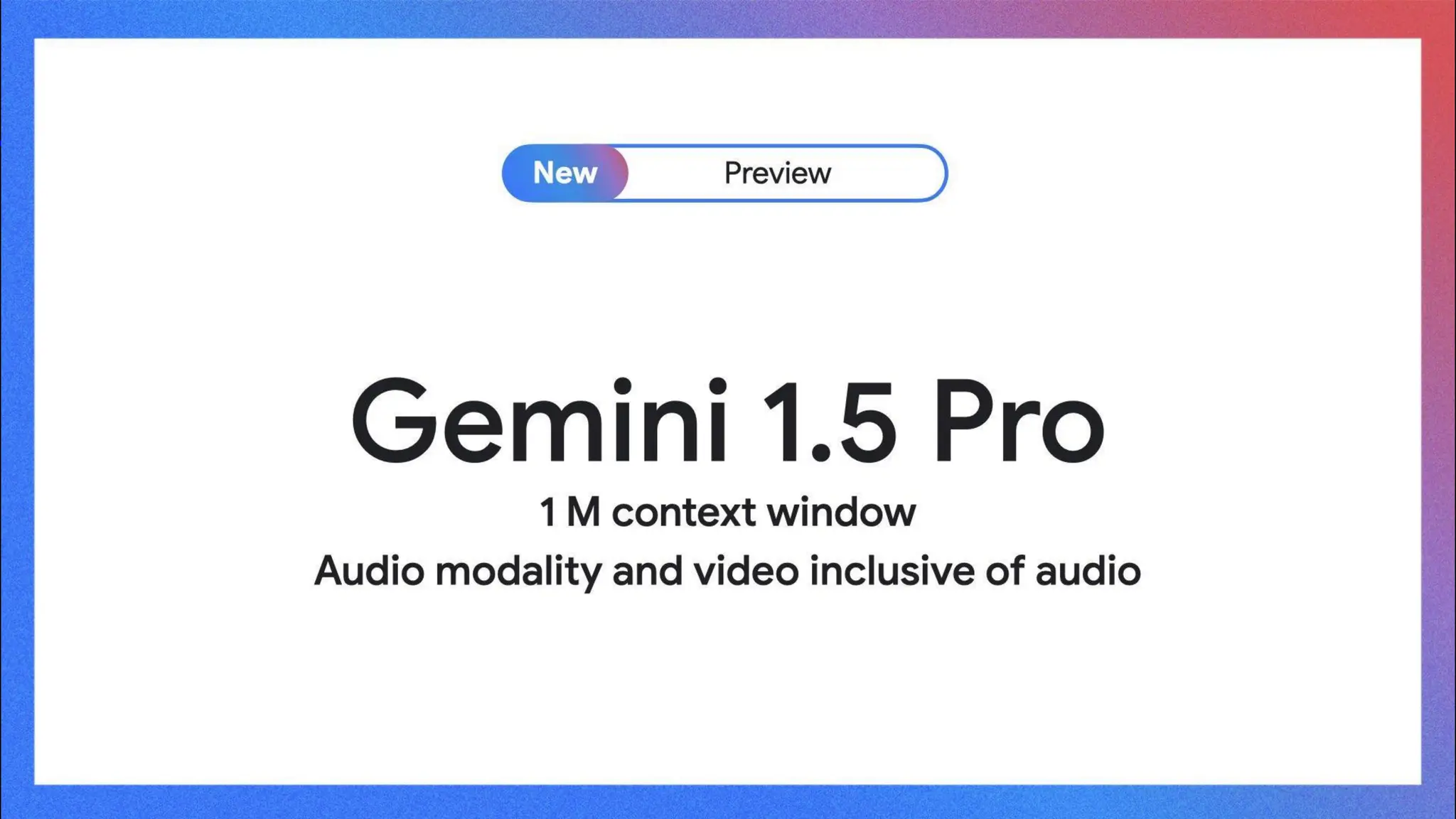
Gemini 1.5 Pro
Multimodal reasoning for longer
prompts, 1 million context window
Gemma 2B and 7B
Family of lightweight,
state-of-the-art open models
NEW
NEW
Google Cloud Next
Storyboard section 1
NEW / UPDATED SUN 8/20
NEW 3/28 - AS
*Currently in Preview
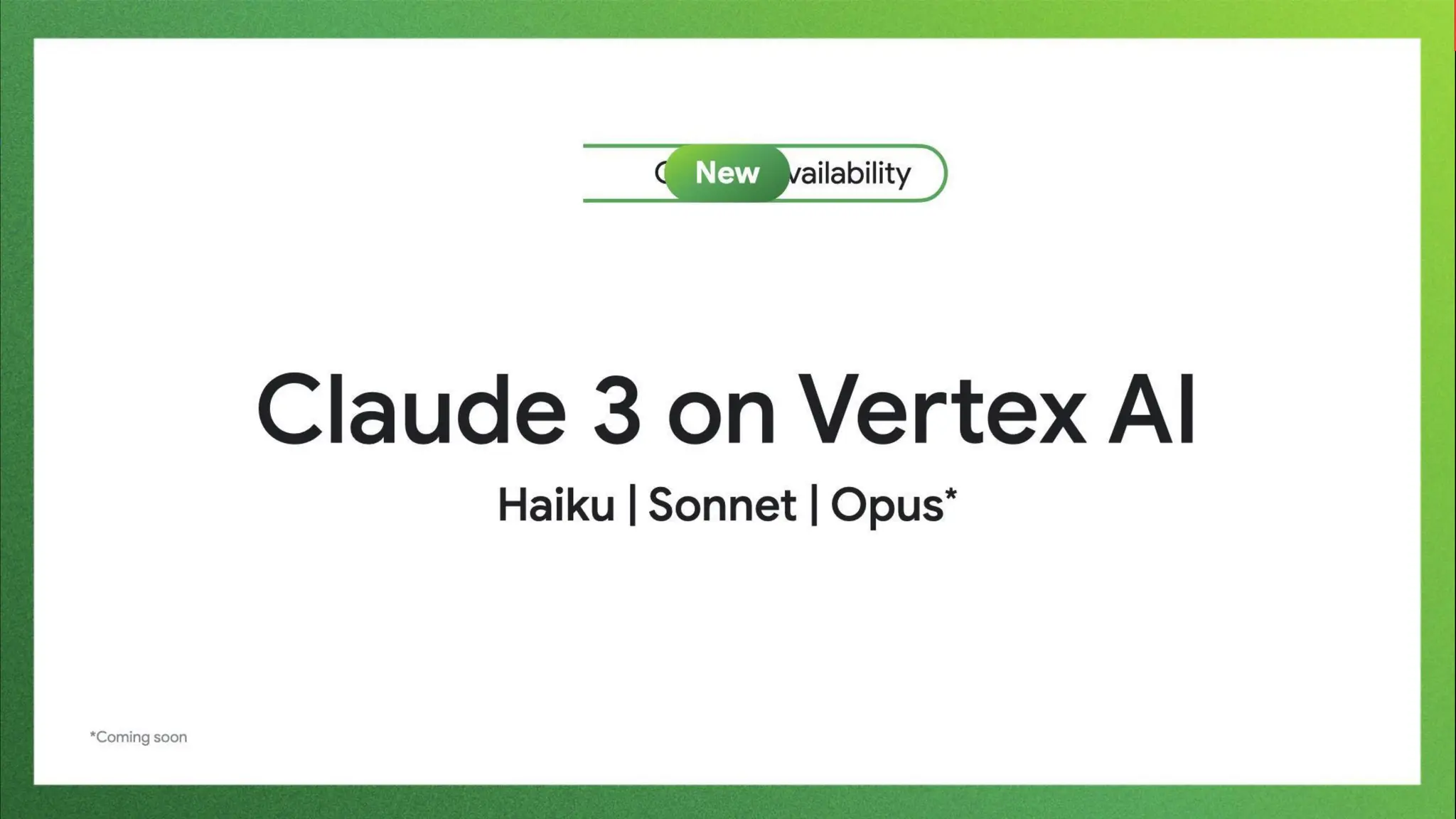
Haiku | Sonnet | Opus*
045
Google Cloud Next ‘24 Proprietary
Foundation models are powerful tools, but they are only as
valuable as your ability to use them in context of your
business use case and successfully deploy them
to production.
NEW 3/23 - AS
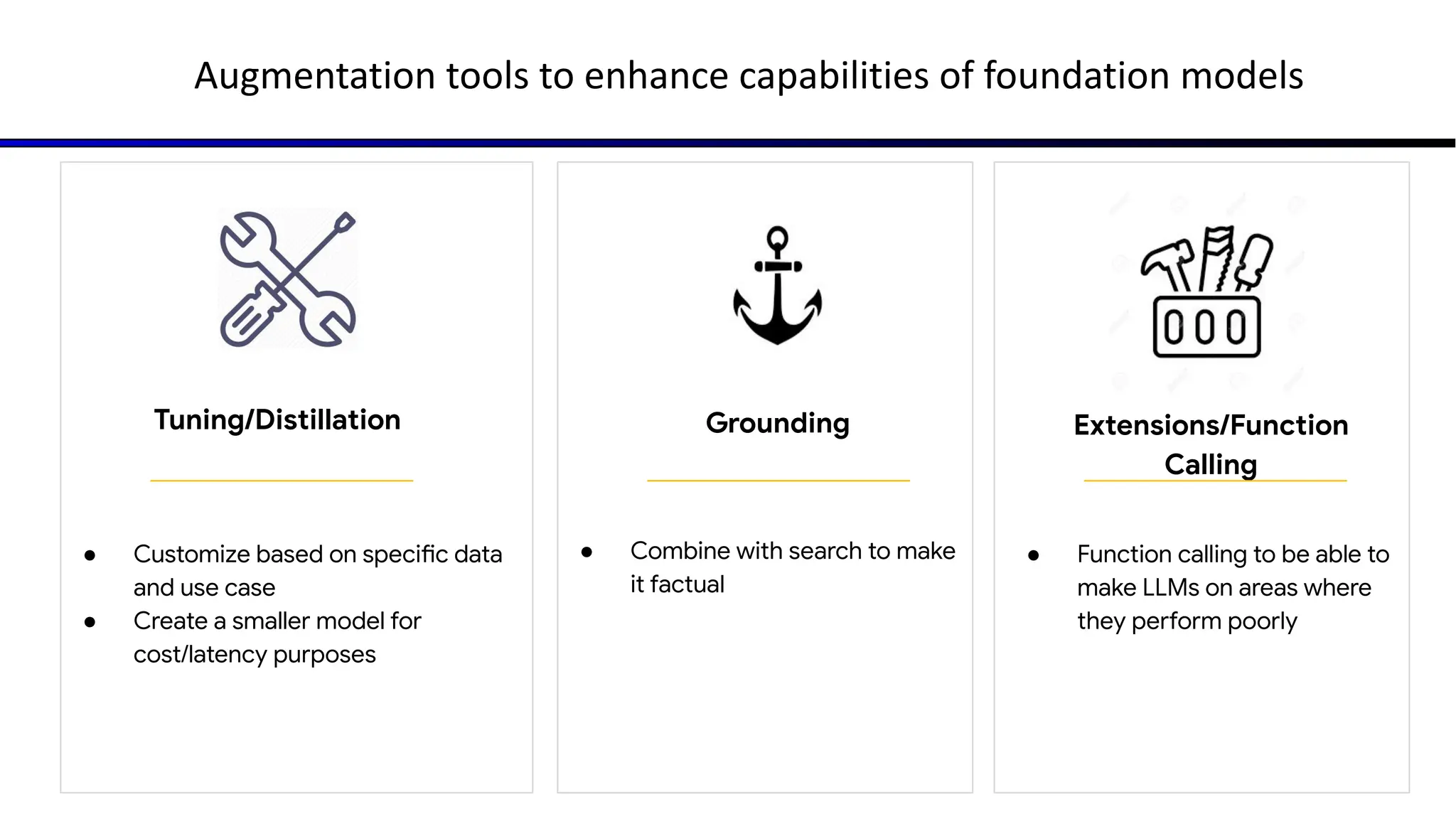
Augmentation tools to enhance capabilities of foundation models
Tuning/Distillation
● Customize based on specific data
and use case
● Create a smaller model for
cost/latency purposes
Grounding
● Combine with search to make
it factual
Extensions/Function
Calling
● Function calling to be able to
make LLMs on areas where
they perform poorly
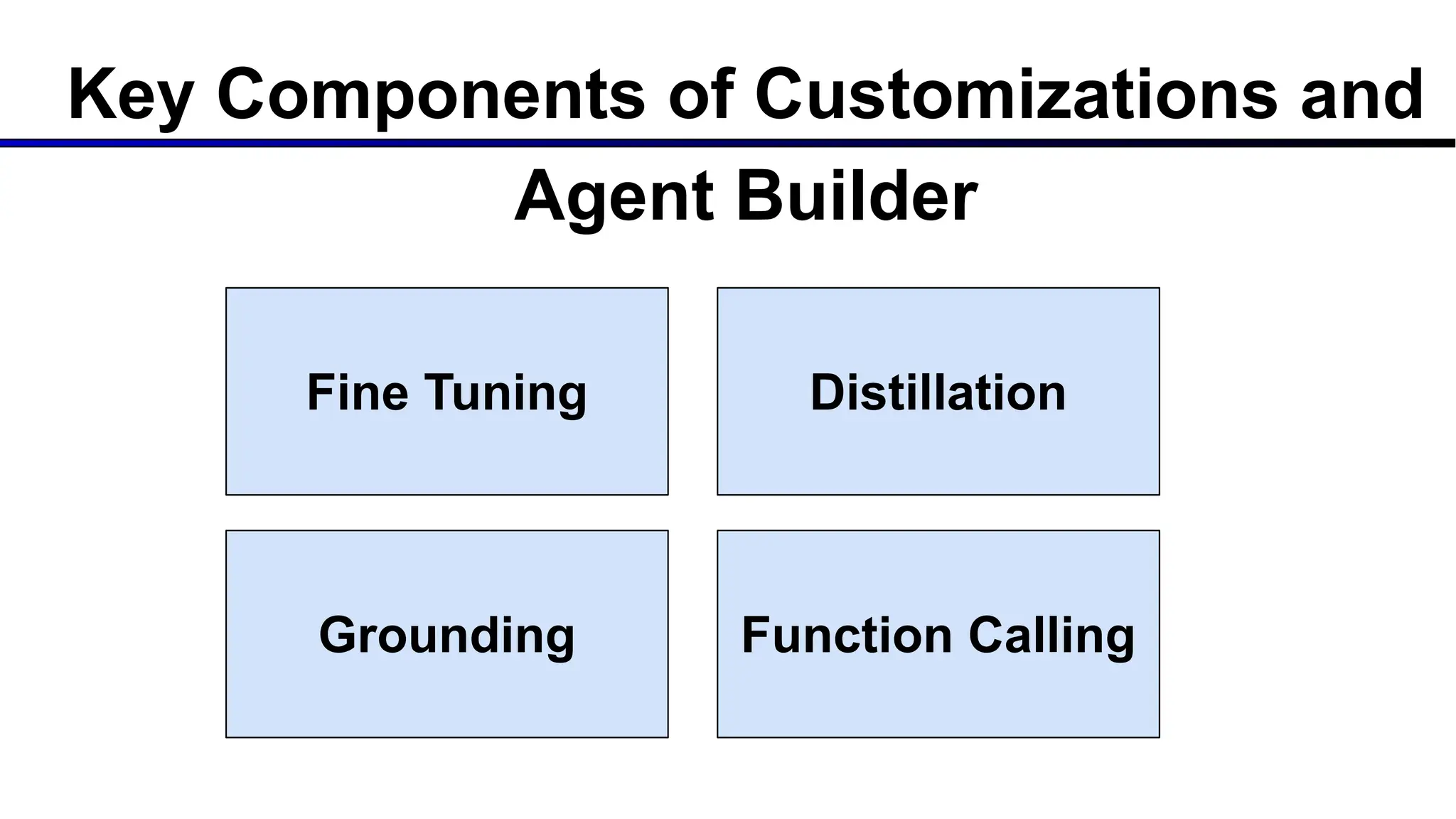
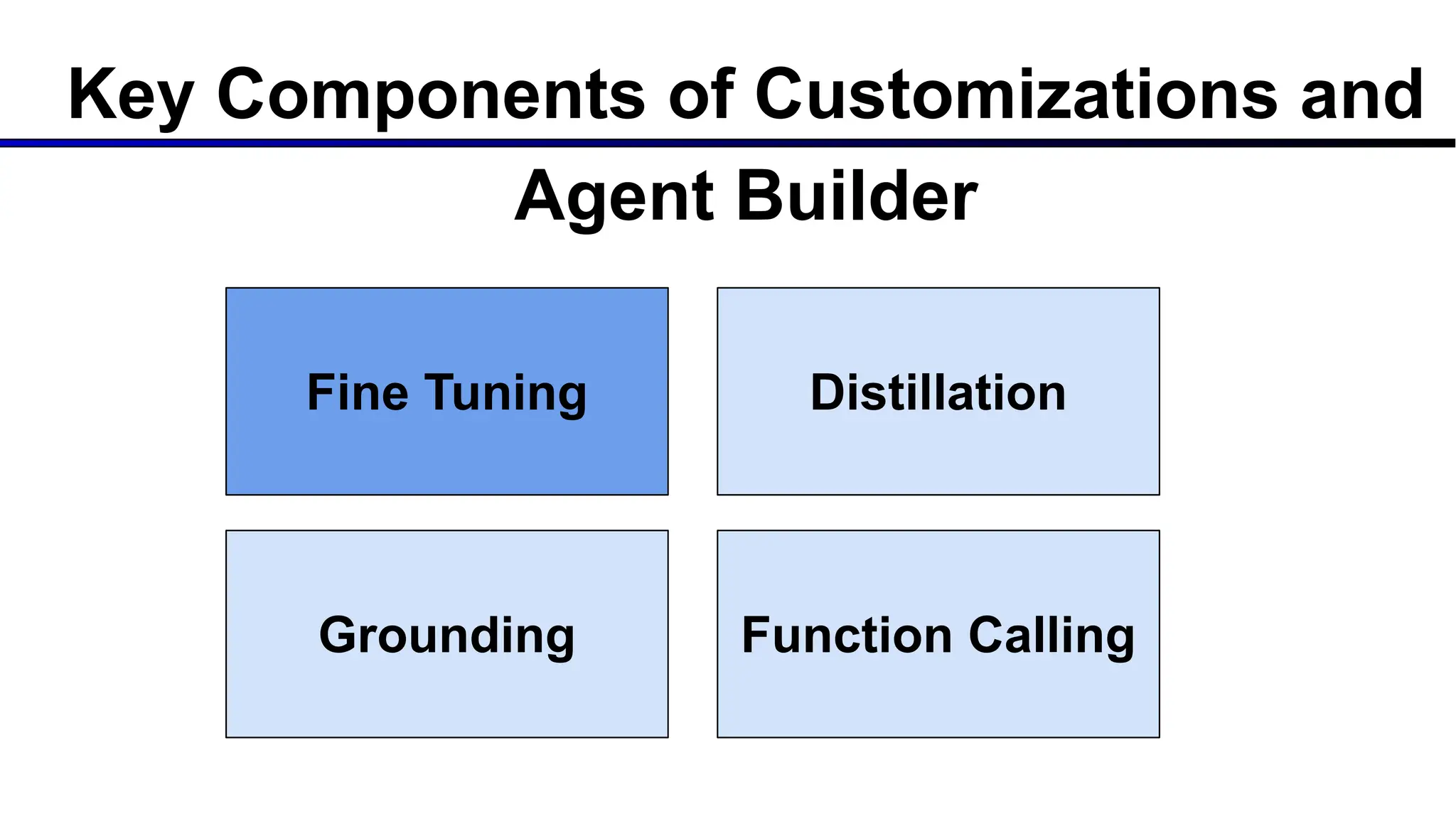
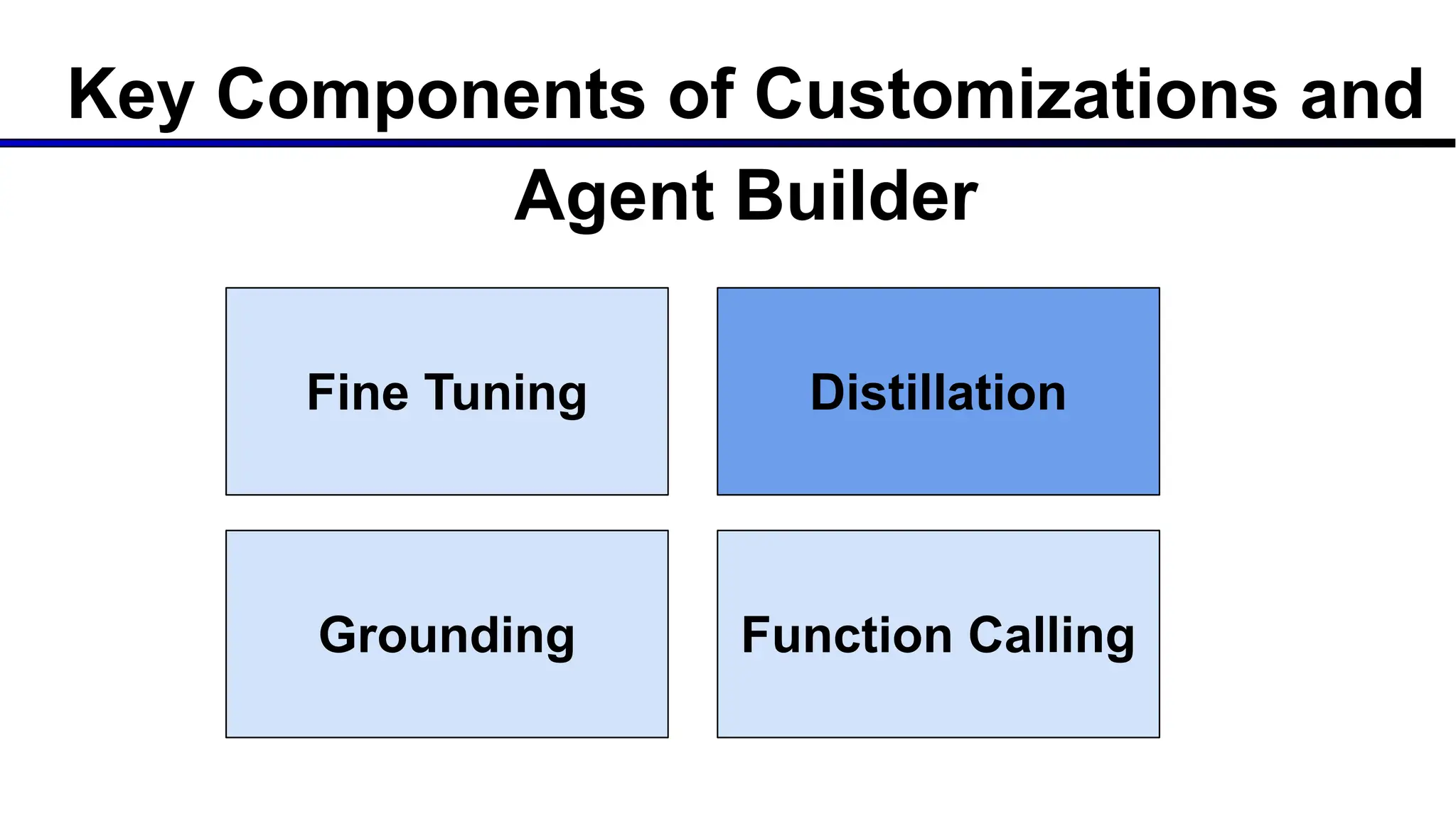
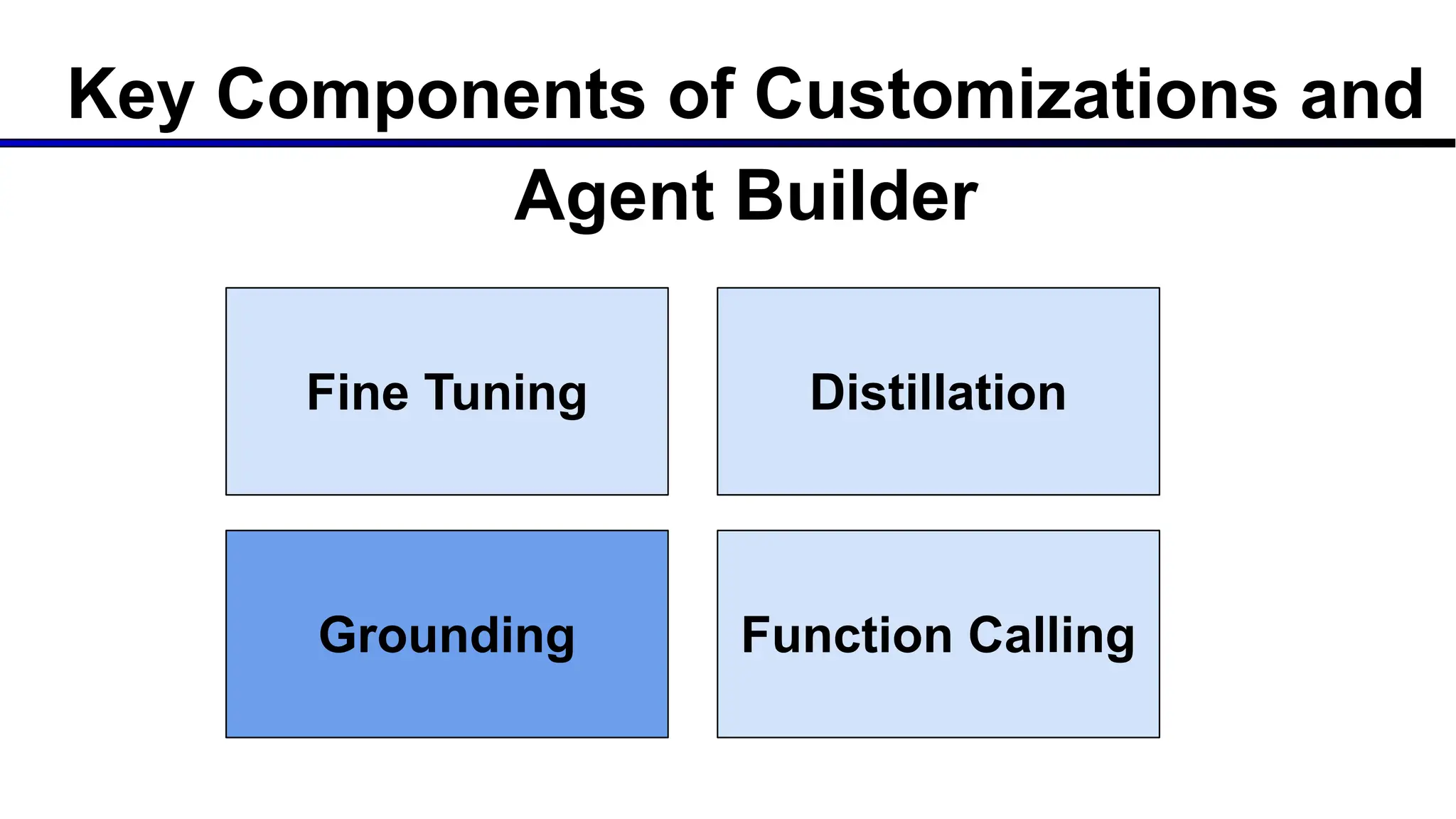
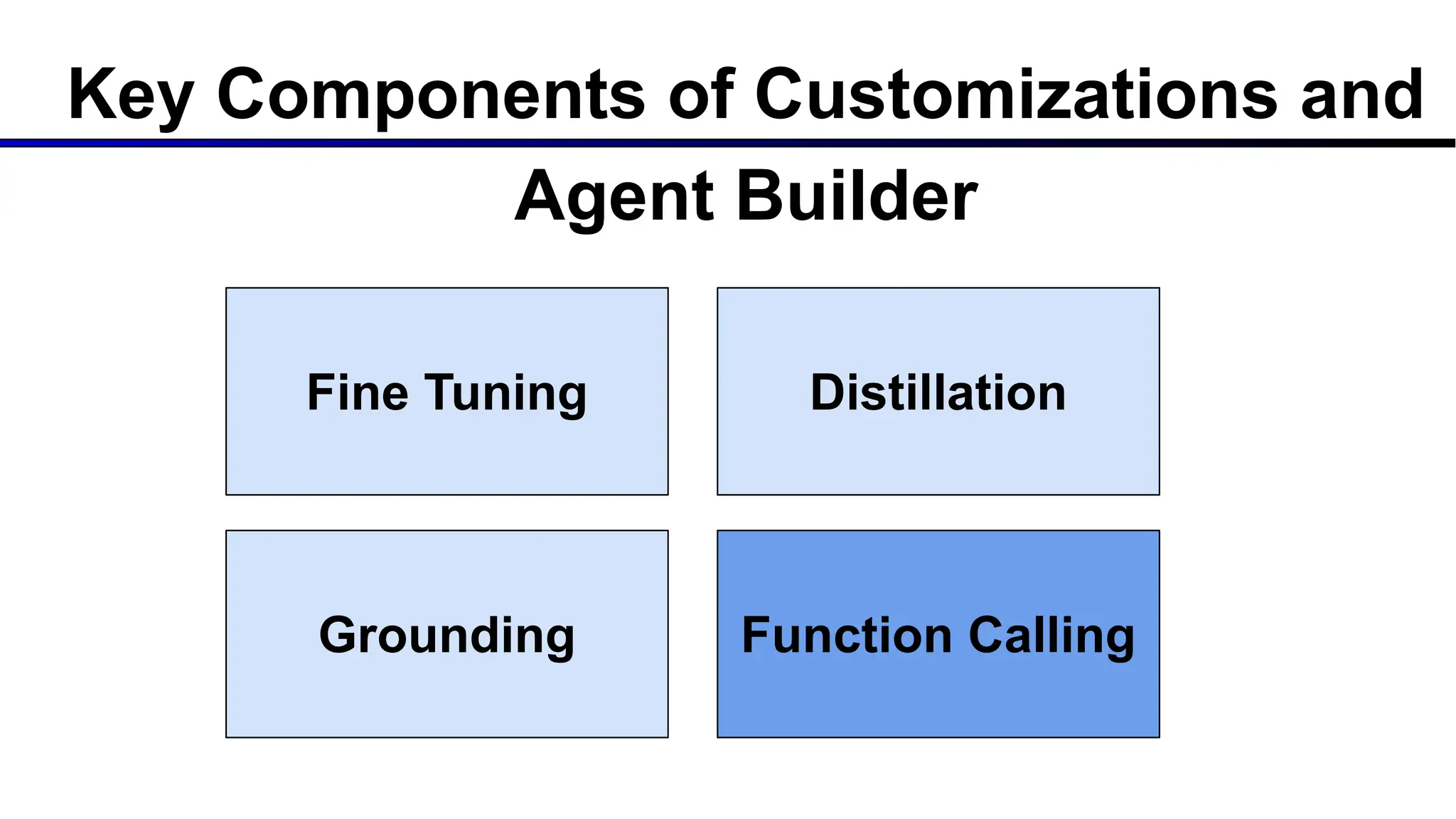
Key Components of Customizations and
Agent Builder
Fine Tuning Distillation
Grounding Function Calling
Key Components of Customizations and
Agent Builder
Fine Tuning Distillation
Grounding Function Calling
Google Cloud Next
Storyboard section 1
NEW 3/24 - AS
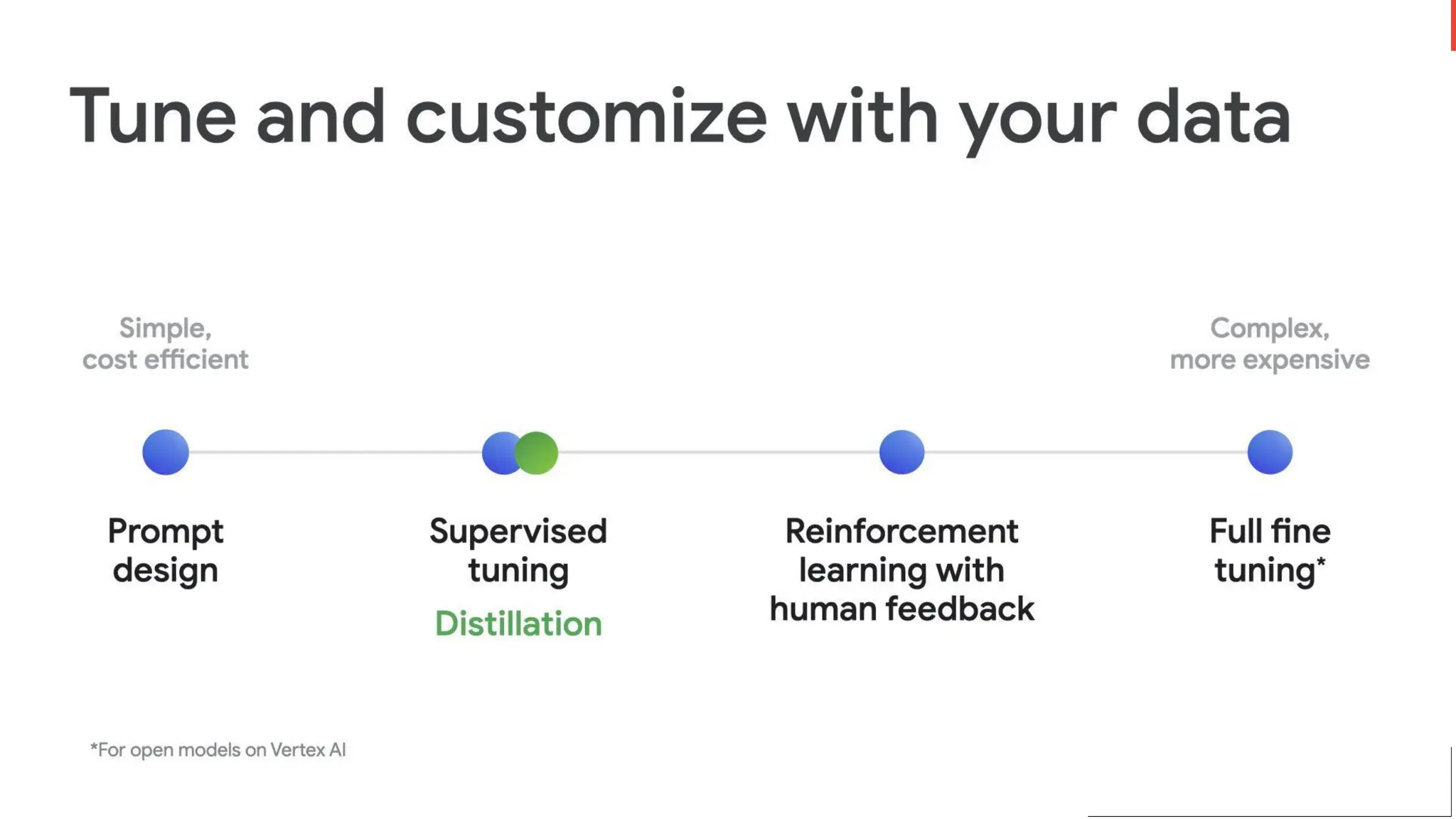
For open models
*
*For open models on Vertex AI
And optimize
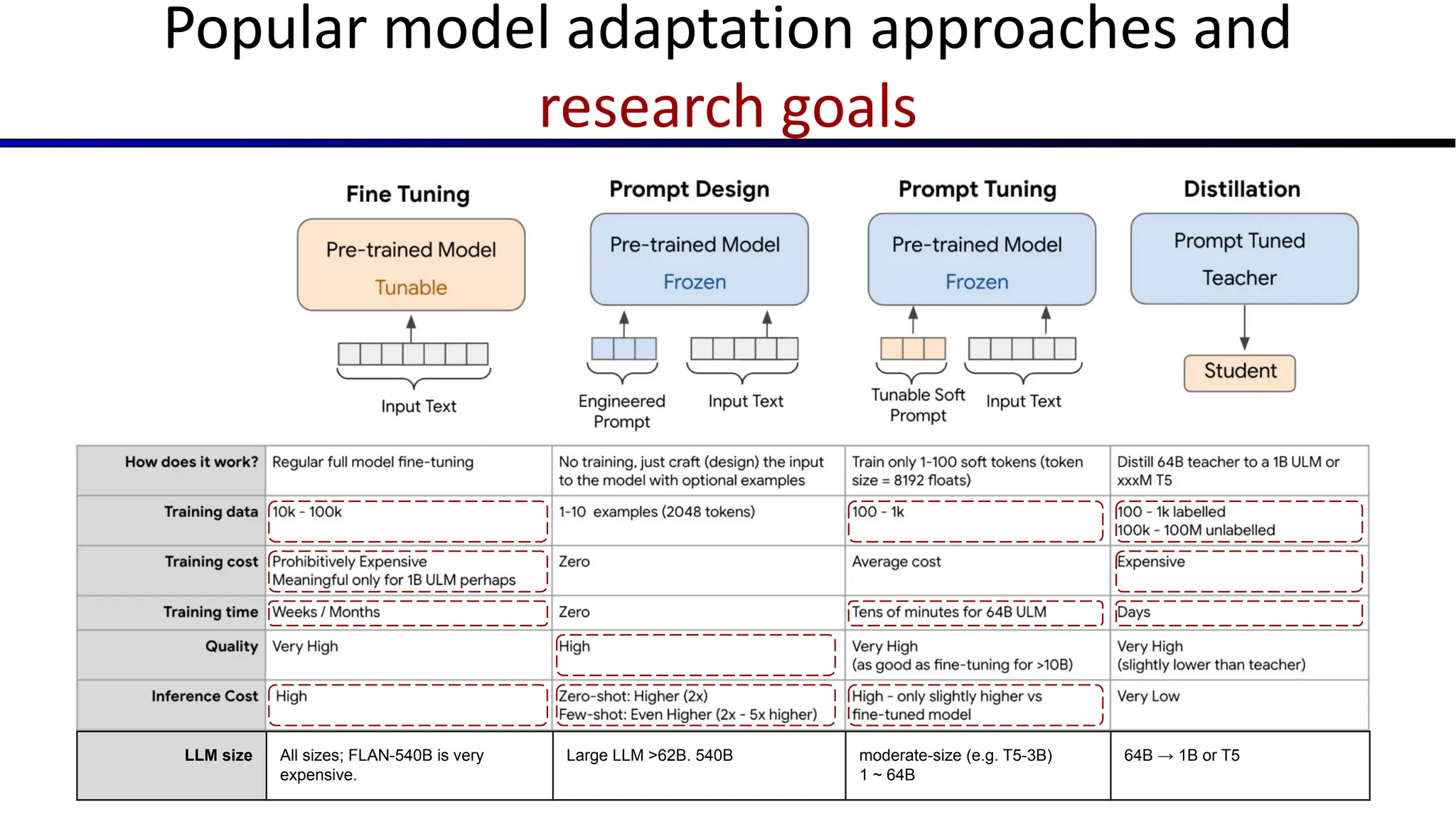
Popular model adaptation approaches and
research goals
LLM size All sizes; FLAN-540B is very
expensive.
Large LLM >62B. 540B moderate-size (e.g. T5-3B)
1 ~ 64B
64B → 1B or T5
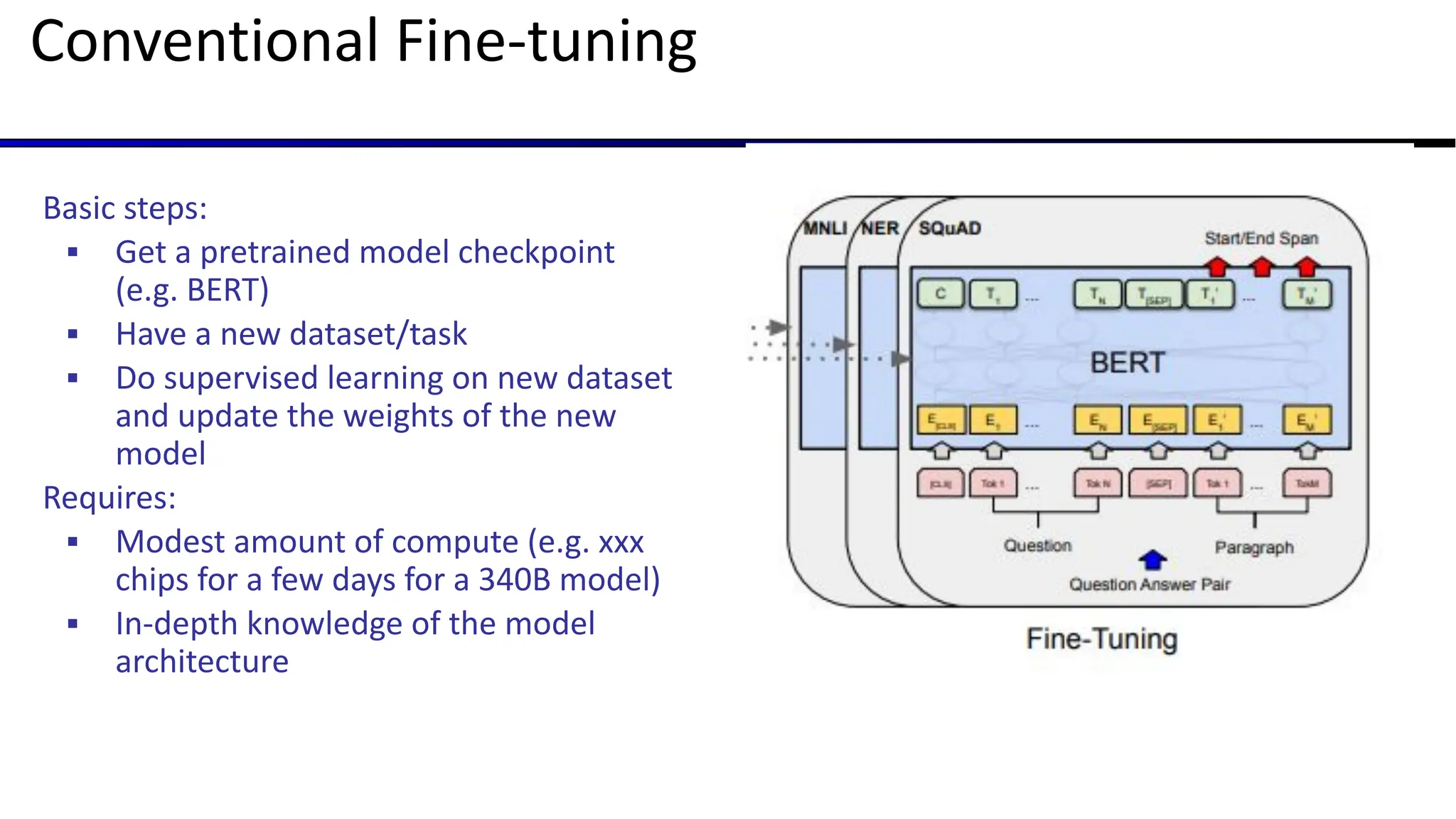
Conventional Fine-tuning
Basic steps:
▪ Get a pretrained model checkpoint
(e.g. BERT)
▪ Have a new dataset/task
▪ Do supervised learning on new dataset
and update the weights of the new
model
Requires:
▪ Modest amount of compute (e.g. xxx
chips for a few days for a 340B model)
▪ In-depth knowledge of the model
architecture
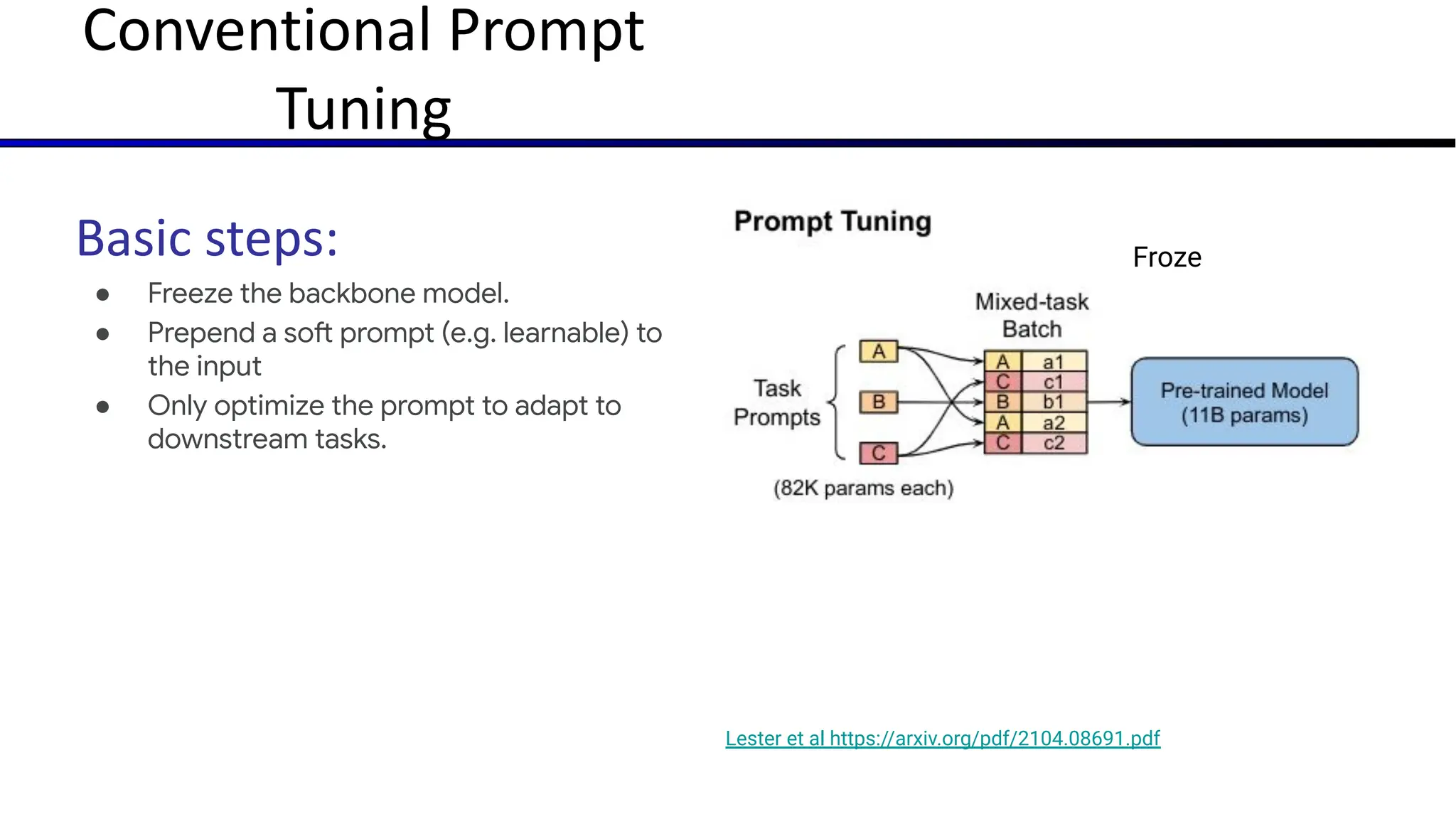
Conventional Prompt
Tuning
Basic steps:
● Freeze the backbone model.
● Prepend a soft prompt (e.g. learnable) to
the input
● Only optimize the prompt to adapt to
downstream tasks.
Lester et al https://arxiv.org/pdf/2104.08691.pdf
Froze
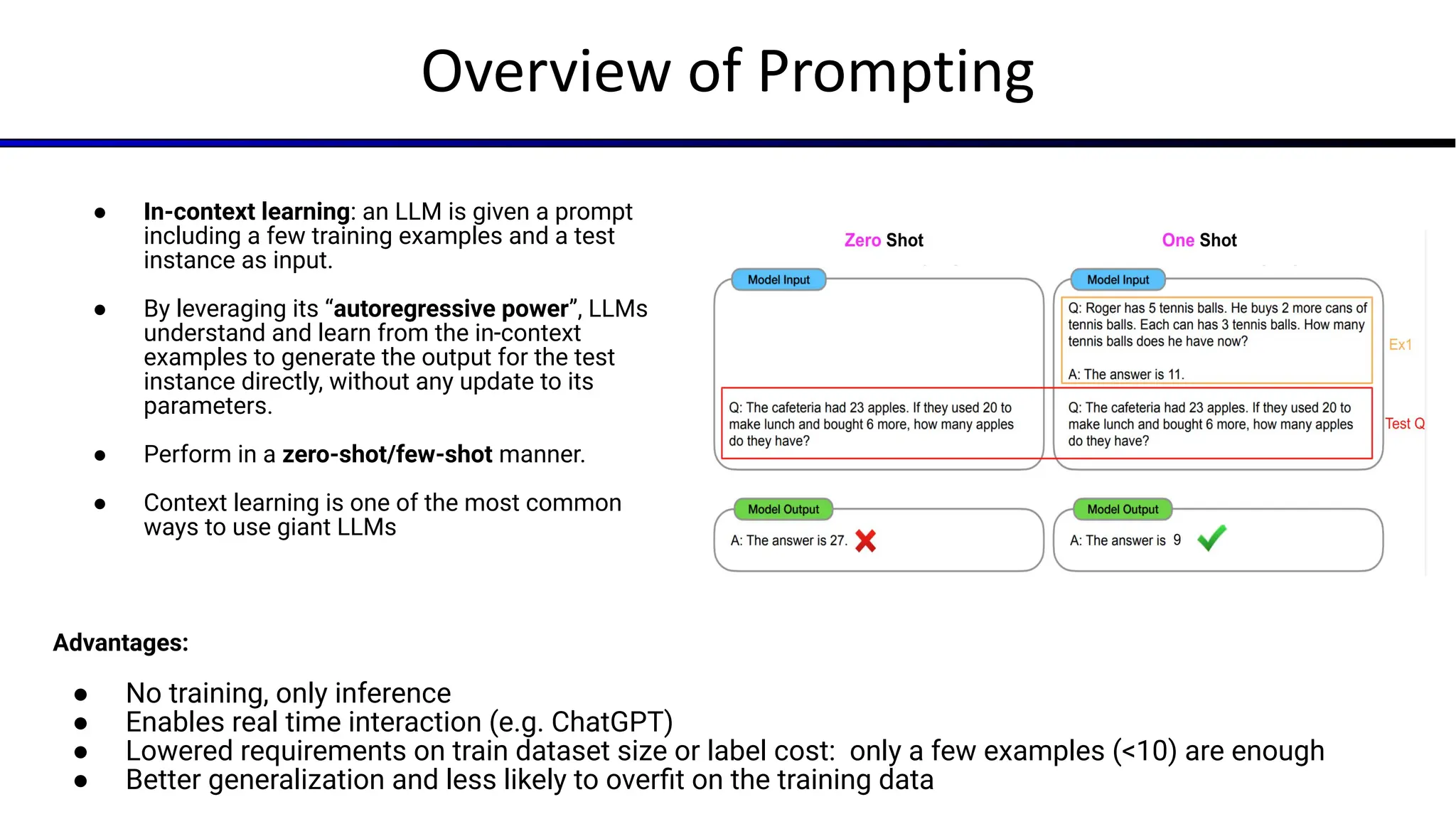
Overview of Prompting
Advantages:
● No training, only inference
● Enables real time interaction (e.g. ChatGPT)
● Lowered requirements on train dataset size or label cost: only a few examples (<10) are enough
● Better generalization and less likely to overfit on the training data
● In-context learning: an LLM is given a prompt
including a few training examples and a test
instance as input.
●
● By leveraging its “autoregressive power”, LLMs
understand and learn from the in-context
examples to generate the output for the test
instance directly, without any update to its
parameters.
●
● Perform in a zero-shot/few-shot manner.
●
● Context learning is one of the most common
ways to use giant LLMs
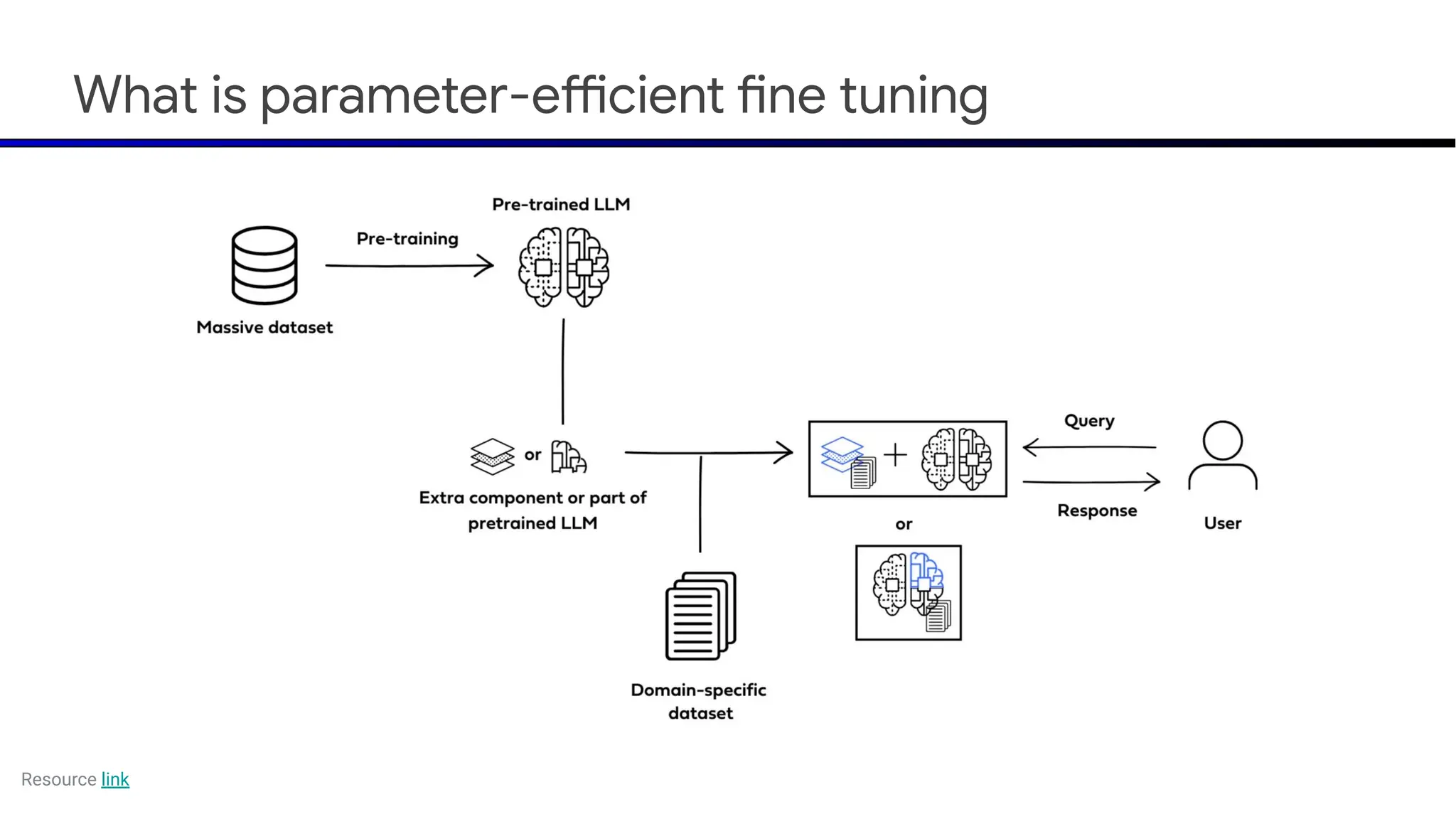
What is parameter-efficient fine tuning
Resource link
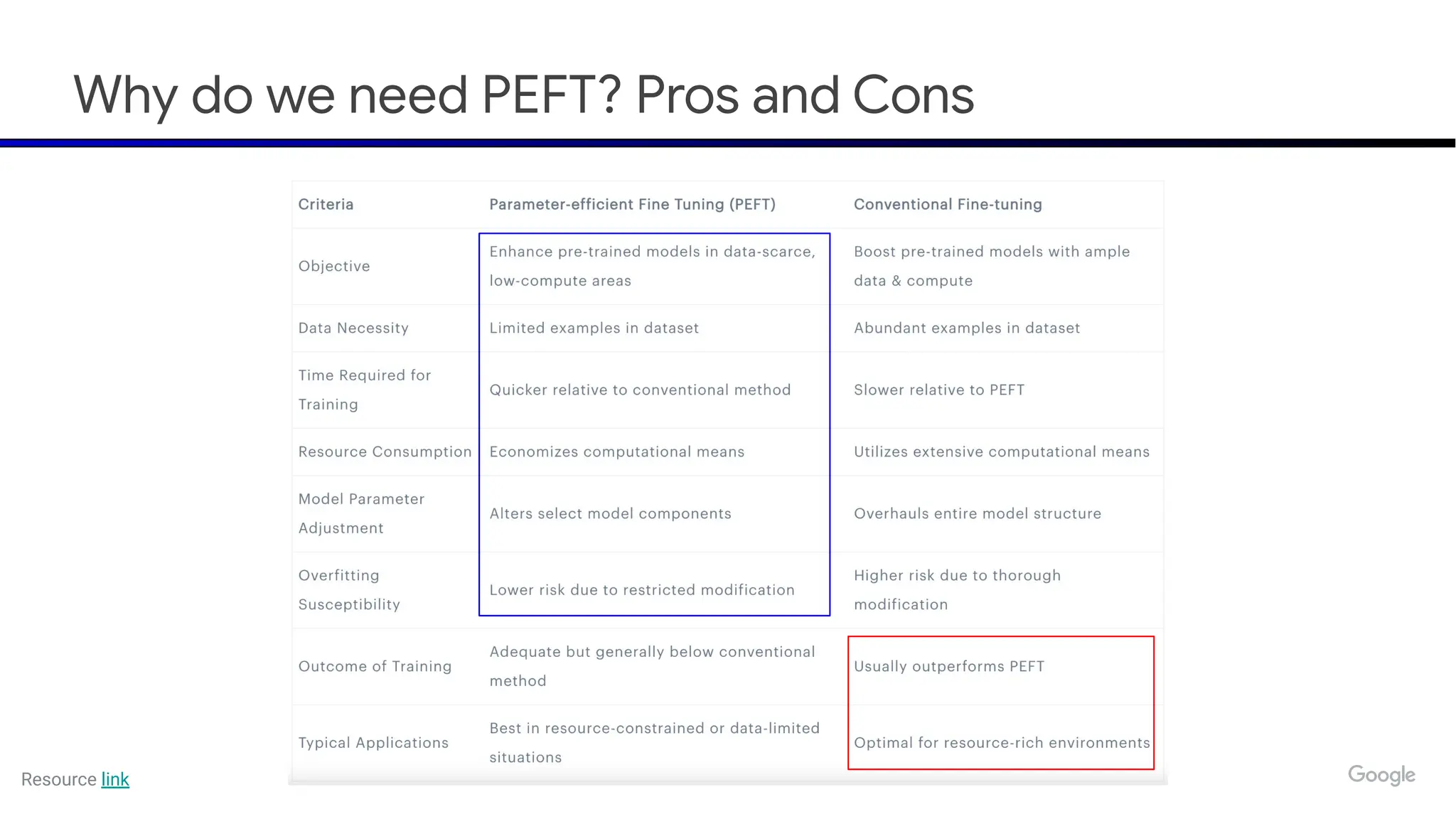
Why do we need PEFT? Pros and Cons
Resource link
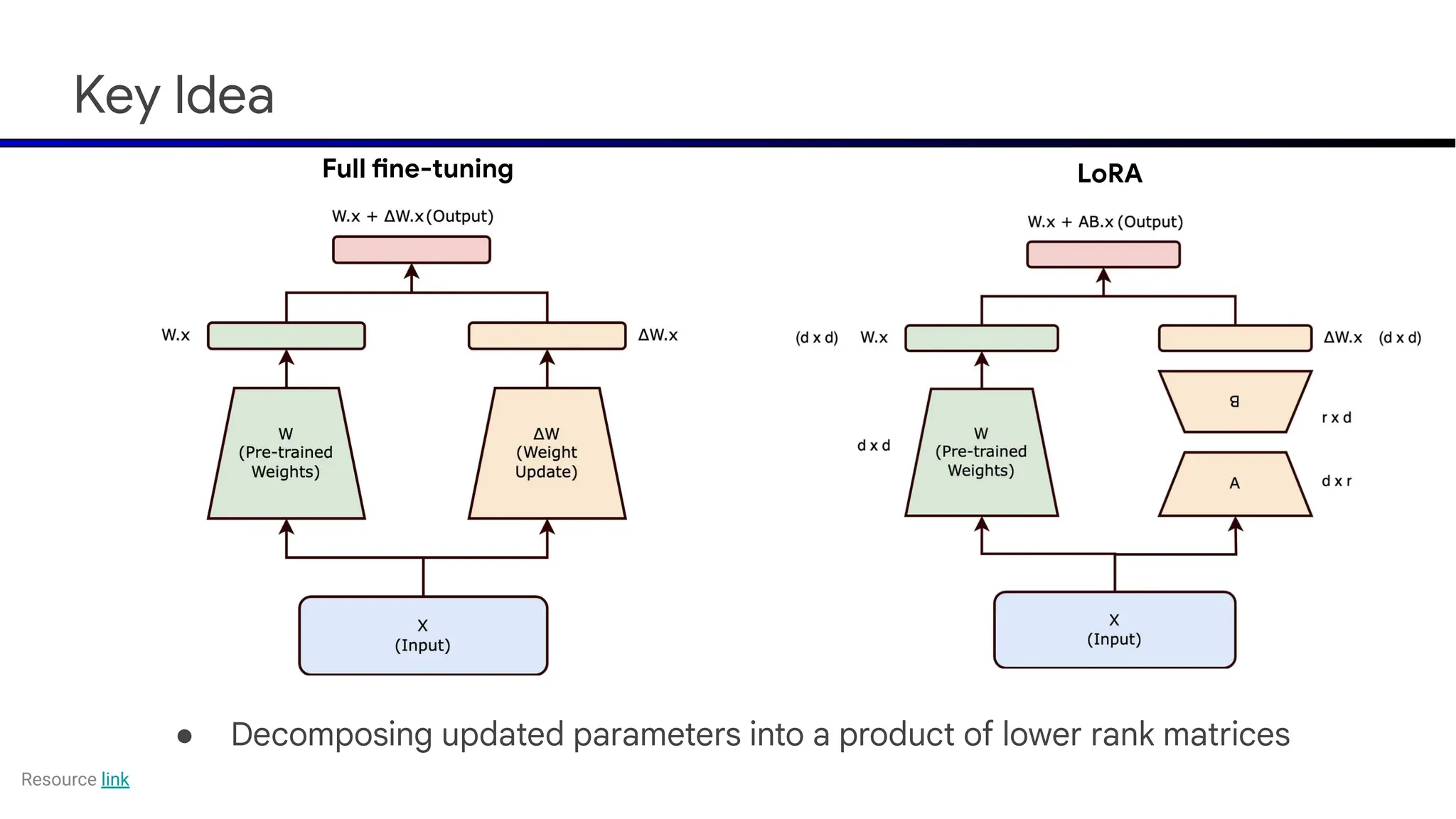
Key Idea
Full fine-tuning LoRA
● Decomposing updated parameters into a product of lower rank matrices
Resource link
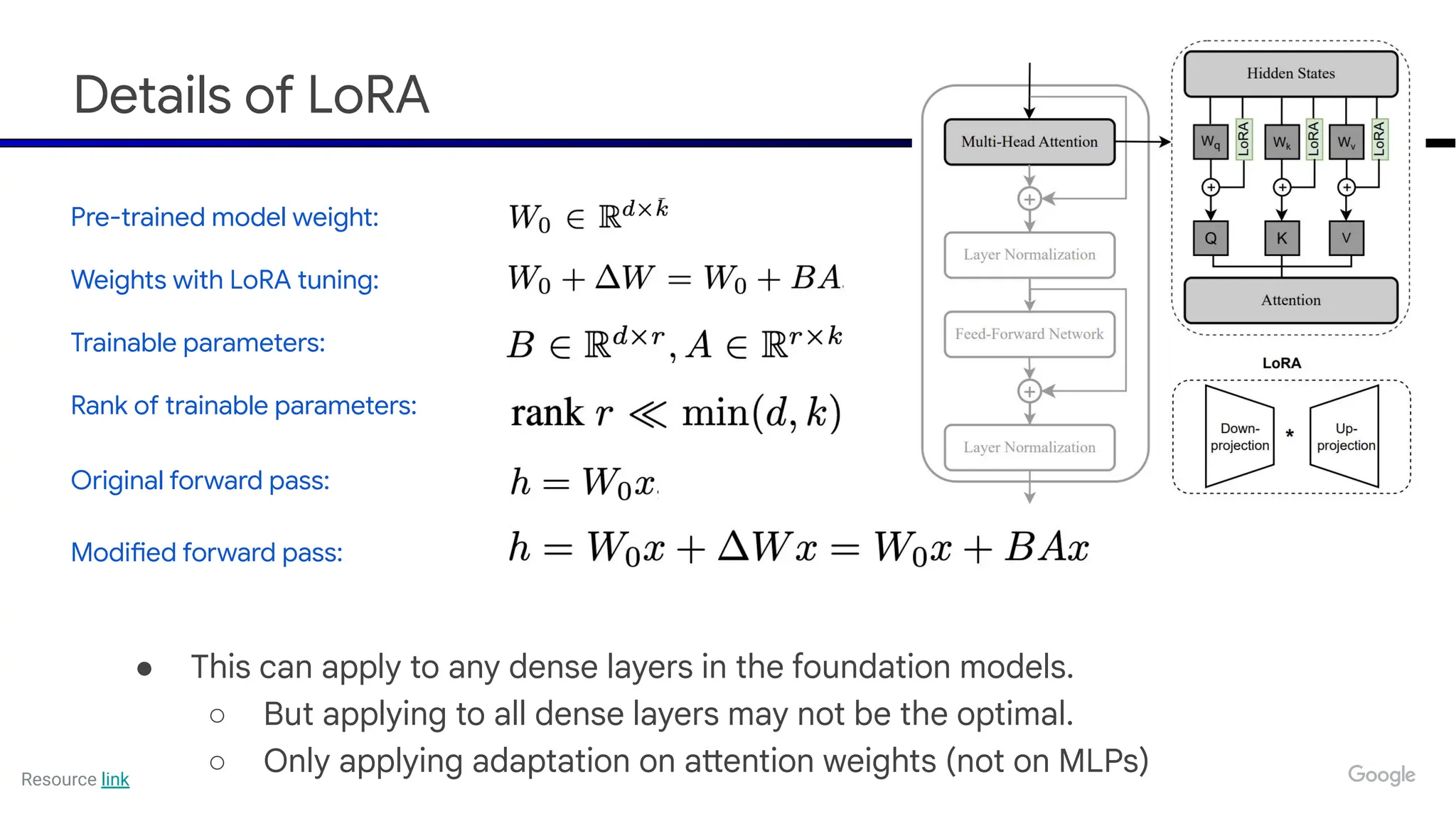
Details of LoRA
● This can apply to any dense layers in the foundation models.
○ But applying to all dense layers may not be the optimal.
○ Only applying adaptation on attention weights (not on MLPs)
Pre-trained model weight:
Weights with LoRA tuning:
Trainable parameters:
Rank of trainable parameters:
Original forward pass:
Modified forward pass:
Resource link
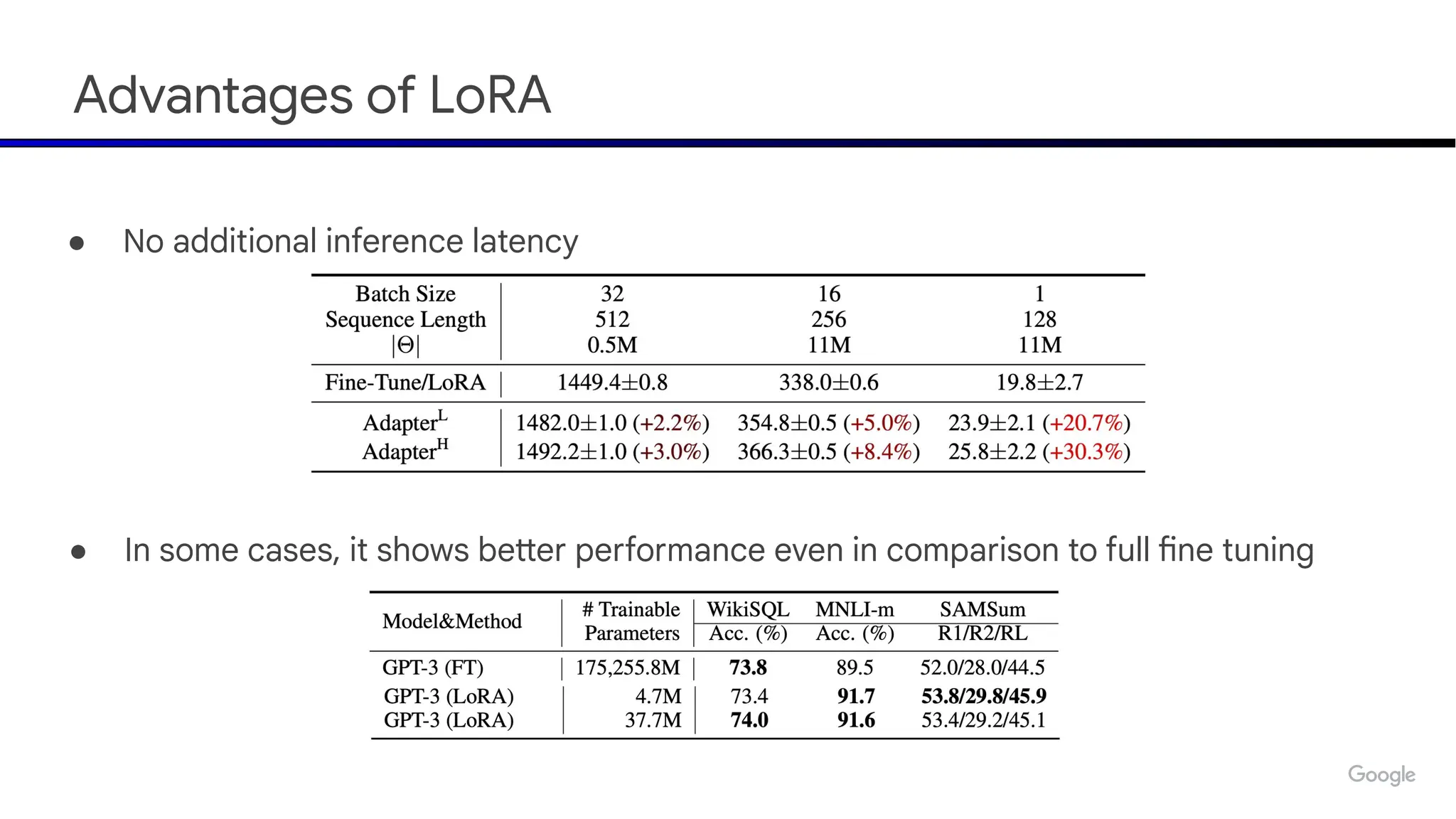
Advantages of LoRA
● No additional inference latency
● In some cases, it shows better performance even in comparison to full fine tuning
Key Components of Customizations and
Agent Builder
Fine Tuning Distillation
Grounding Function Calling
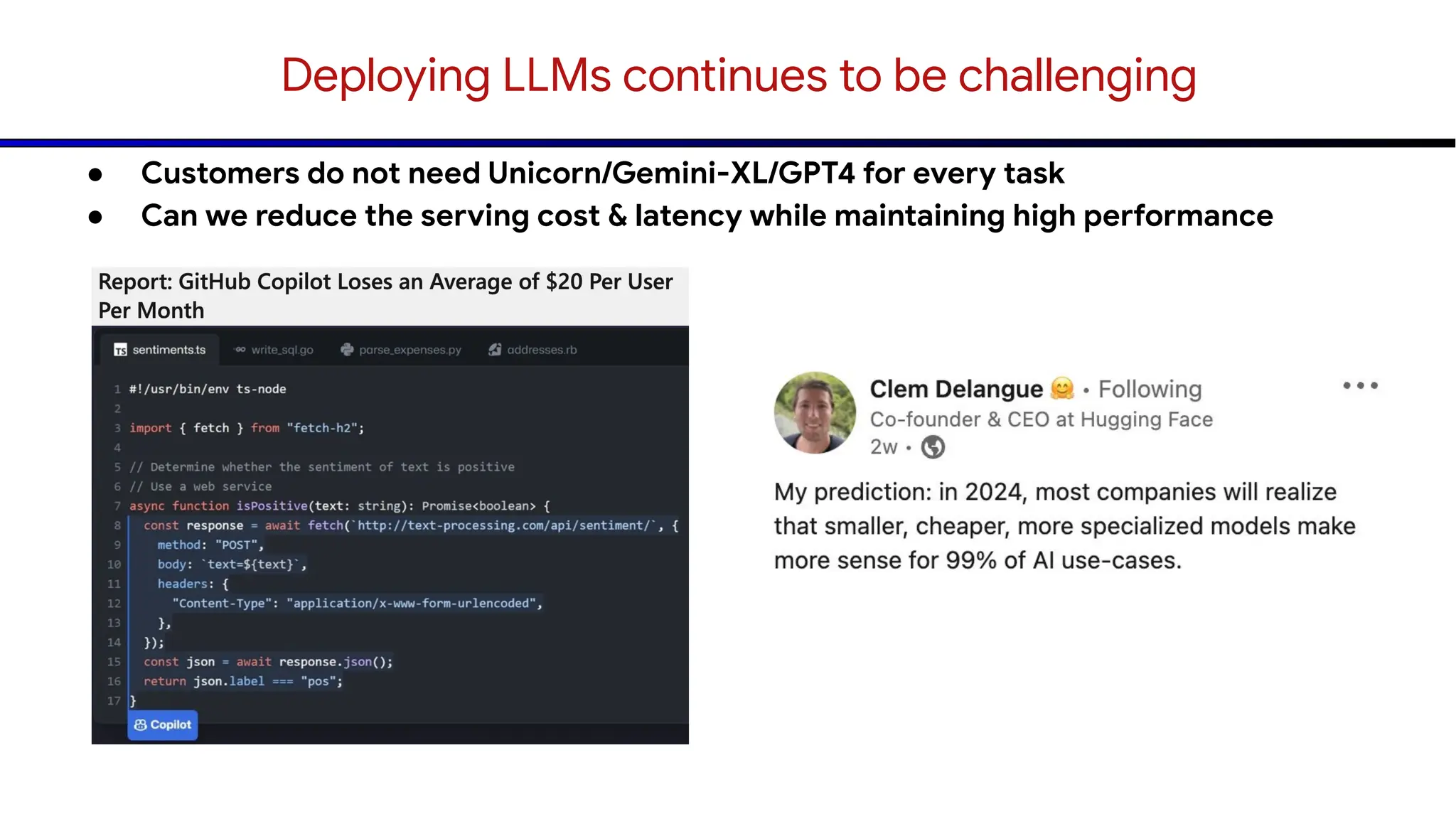
Deploying LLMs continues to be challenging
● Customers do not need Unicorn/Gemini-XL/GPT4 for every task
● Can we reduce the serving cost & latency while maintaining high performance
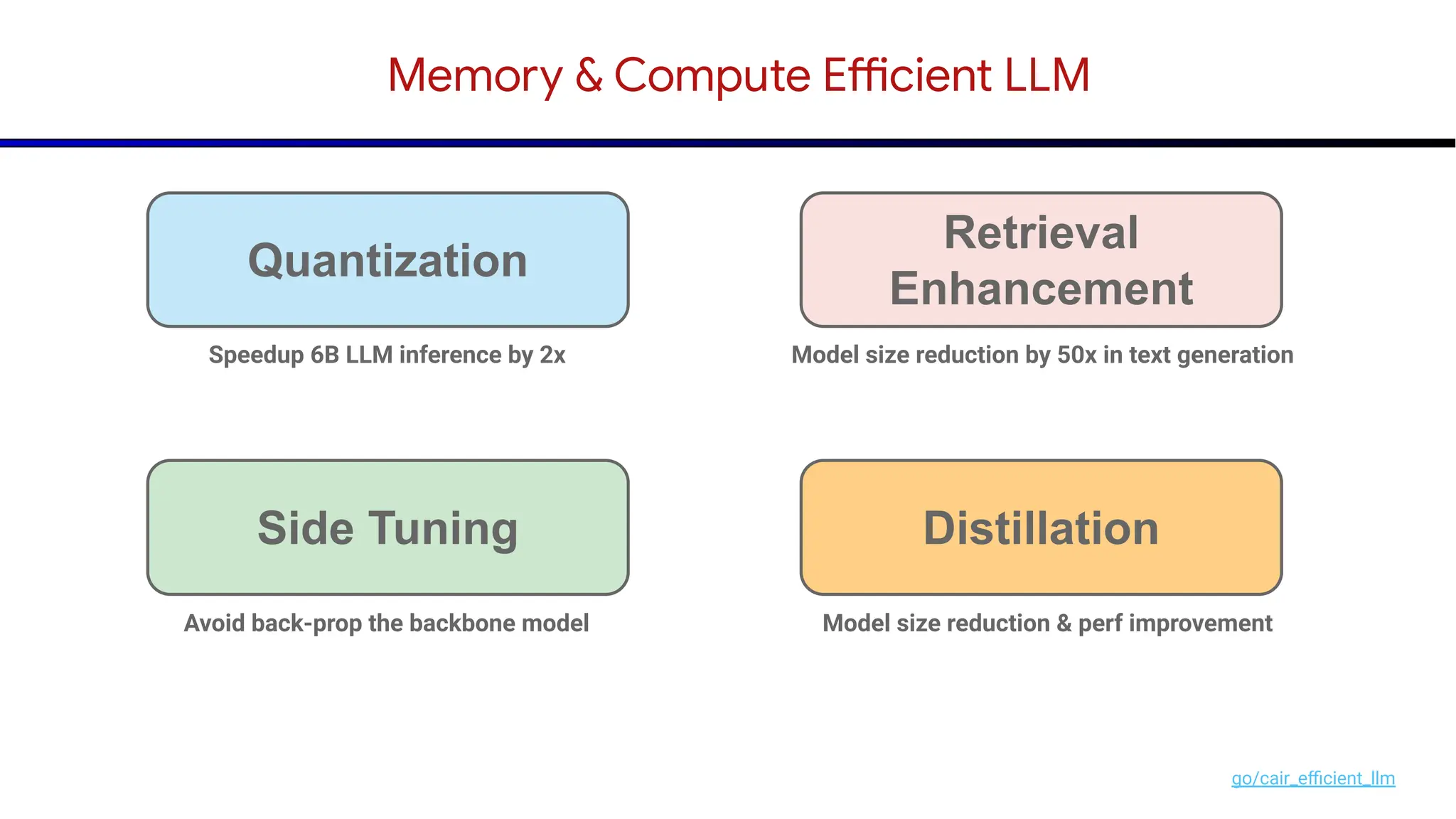
Memory & Compute Efficient LLM
go/cair_efficient_llm
Speedup 6B LLM inference by 2x
Quantization
Retrieval
Enhancement
Side Tuning Distillation
Model size reduction by 50x in text generation
Avoid back-prop the backbone model Model size reduction & perf improvement
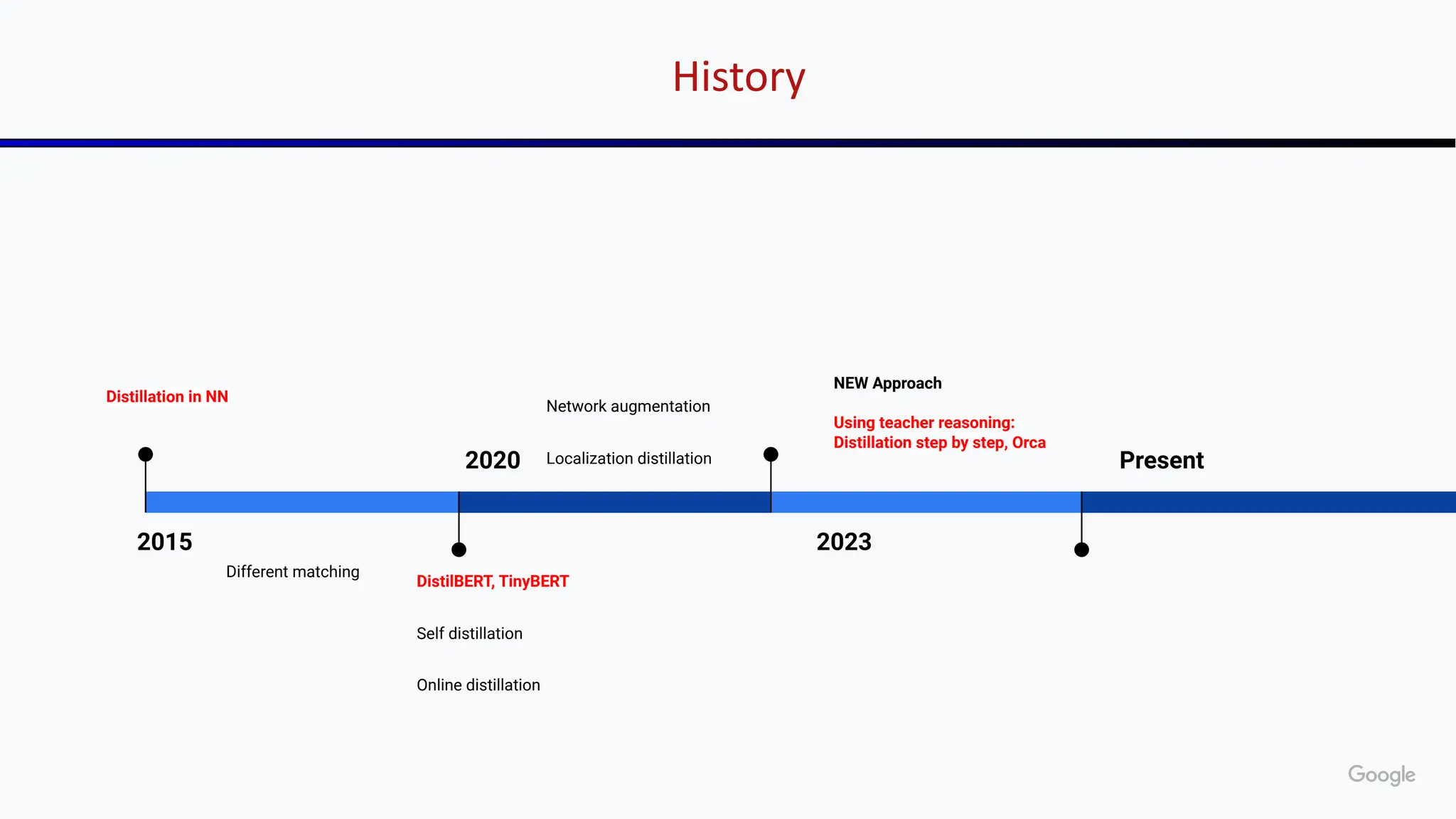
2023
NEW Approach
Using teacher reasoning:
Distillation step by step, Orca
Present
2015
Distillation in NN
2020
DistilBERT, TinyBERT
Self distillation
Online distillation
History
Different matching
Network augmentation
Localization distillation
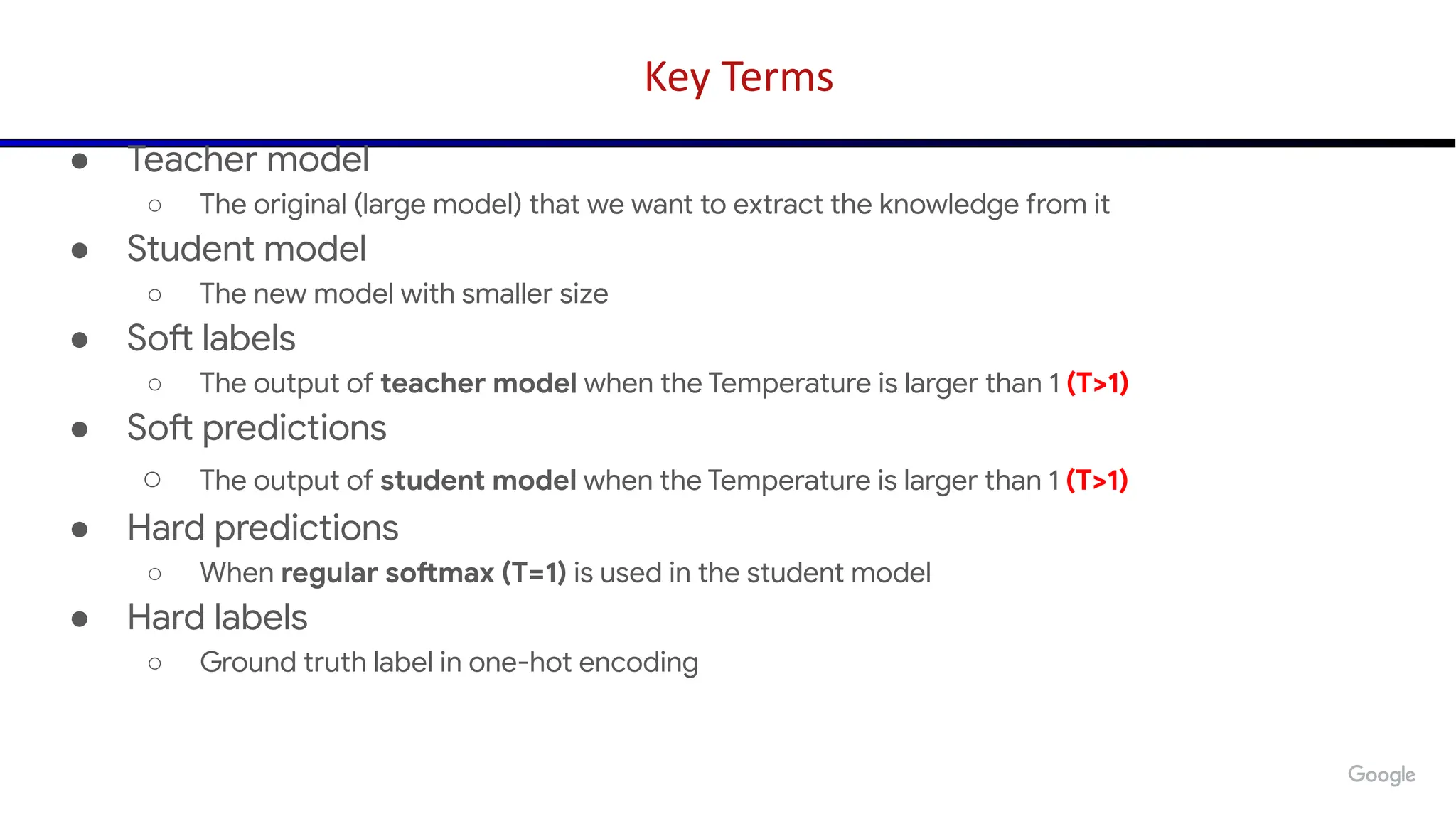
Key Terms
● Teacher model
○ The original (large model) that we want to extract the knowledge from it
● Student model
○ The new model with smaller size
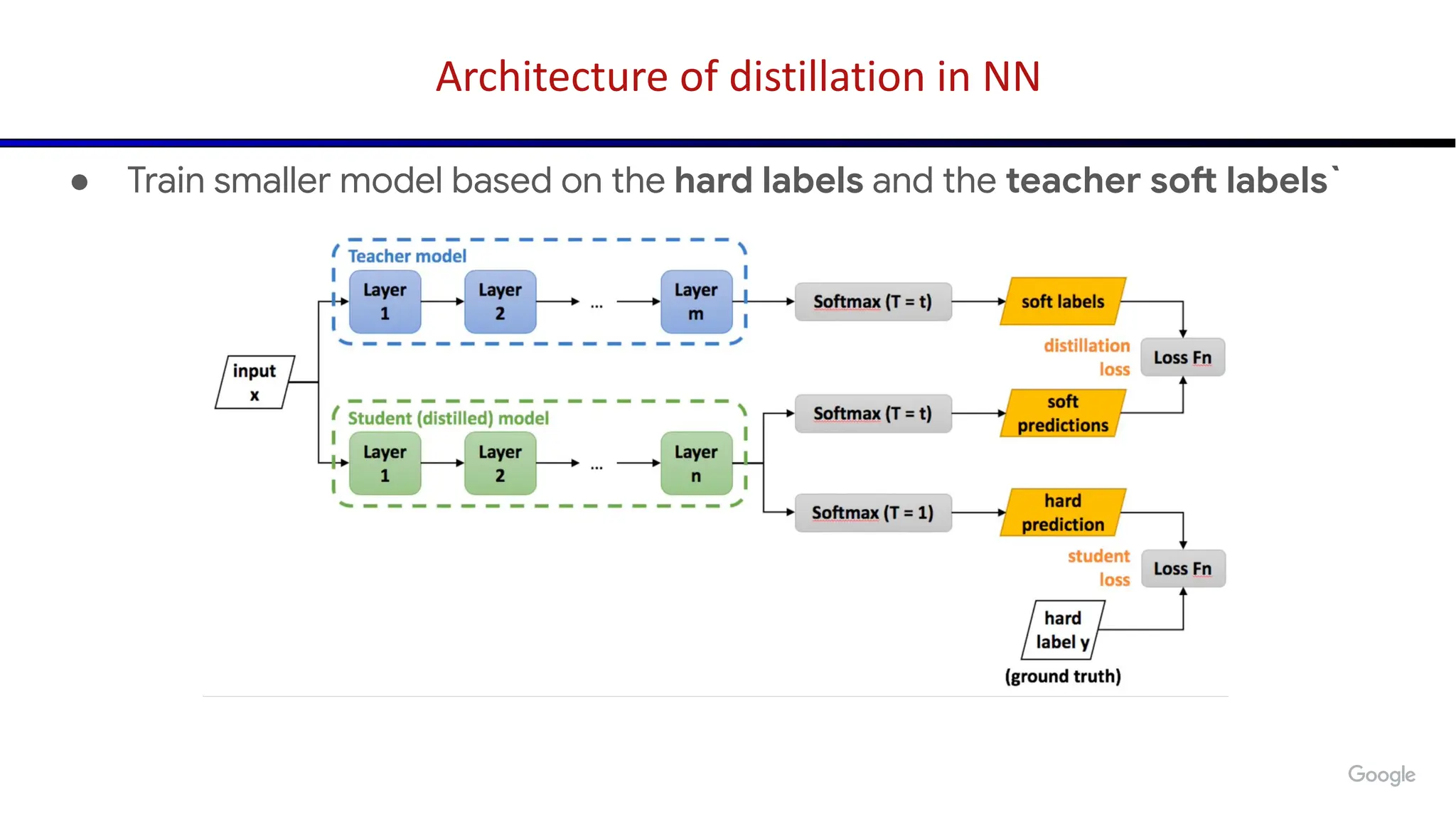
● Soft labels
○ The output of teacher model when the Temperature is larger than 1 (T>1)
● Soft predictions
○ The output of student model when the Temperature is larger than 1 (T>1)
● Hard predictions
○ When regular softmax (T=1) is used in the student model
● Hard labels
○ Ground truth label in one-hot encoding
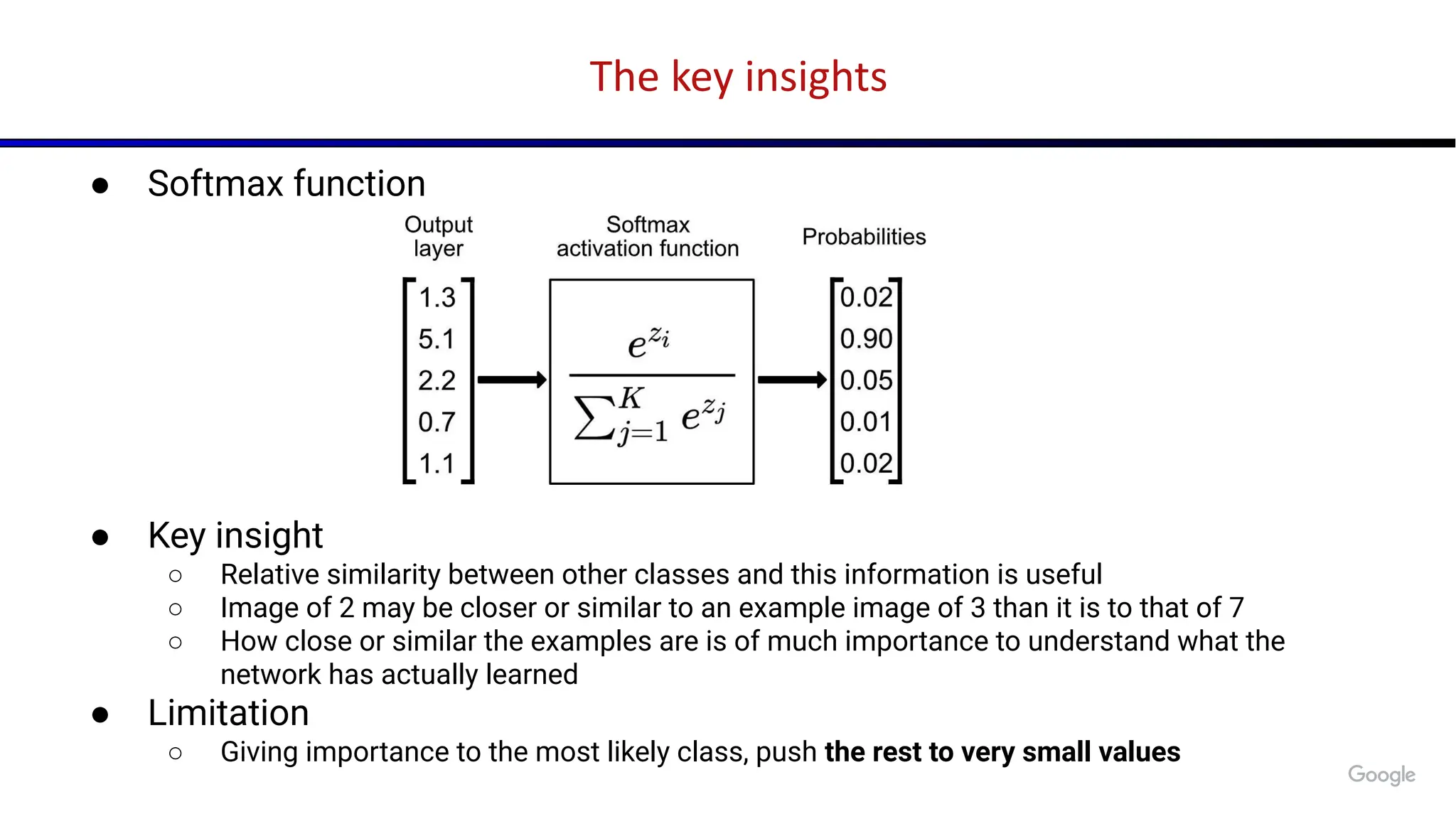
The key insights
● Softmax function
● Key insight
○ Relative similarity between other classes and this information is useful
○ Image of 2 may be closer or similar to an example image of 3 than it is to that of 7
○ How close or similar the examples are is of much importance to understand what the
network has actually learned
● Limitation
○ Giving importance to the most likely class, push the rest to very small values
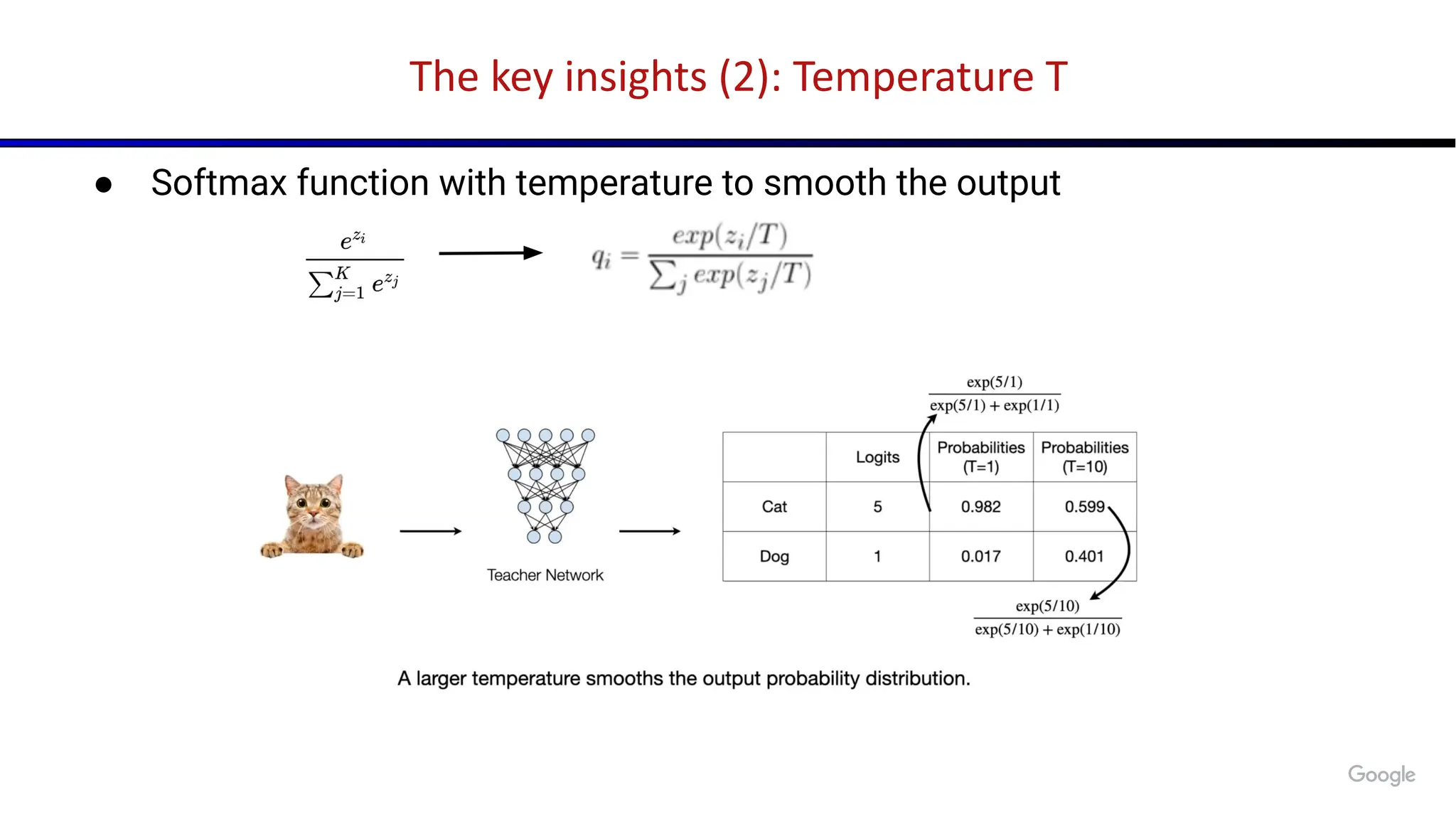
The key insights (2): Temperature T
● Softmax function with temperature to smooth the output
Architecture of distillation in NN
● Train smaller model based on the hard labels and the teacher soft labels`
Key Components of Customizations and
Agent Builder
Fine Tuning Distillation
Grounding Function Calling
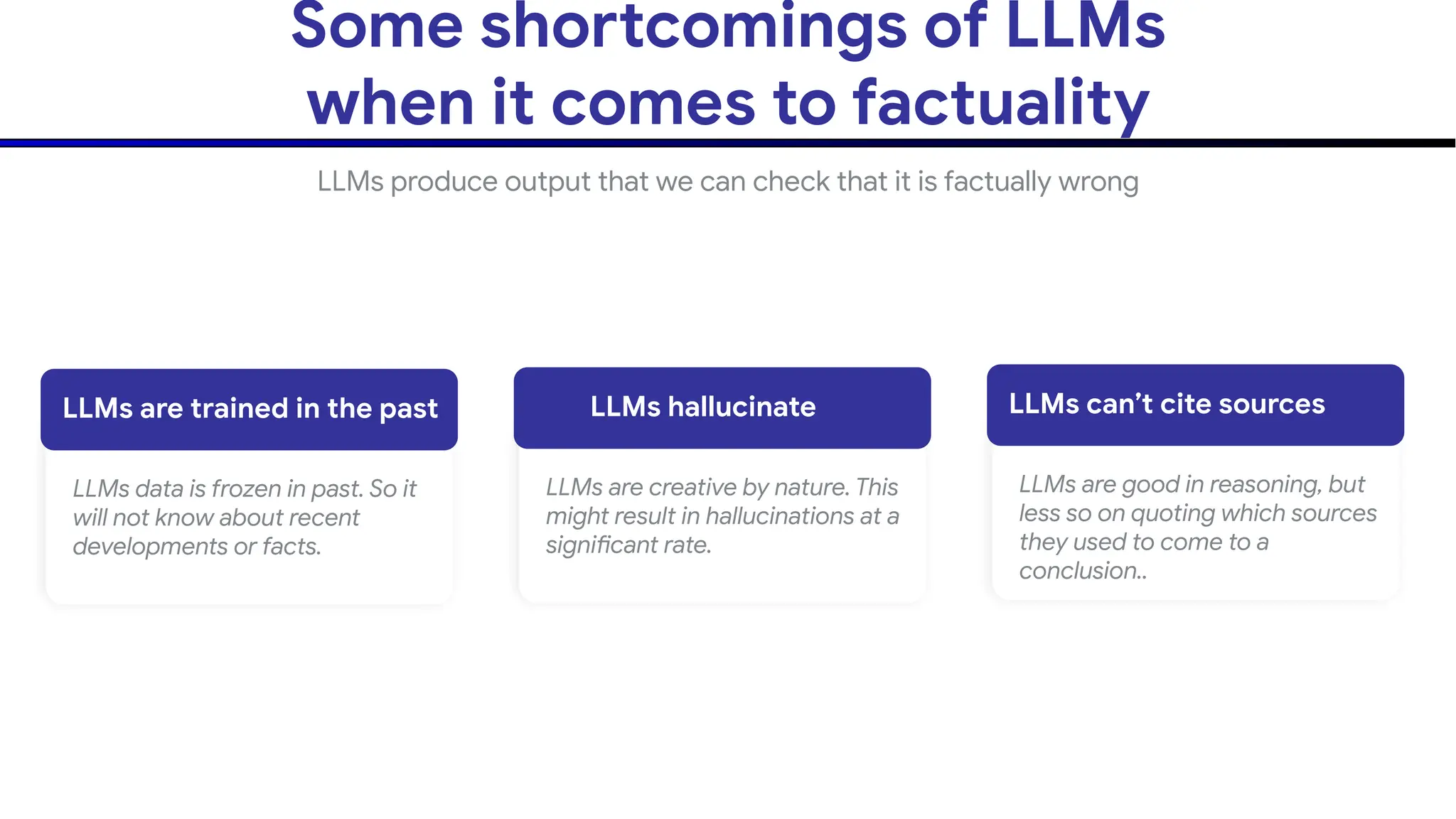
Some shortcomings of LLMs
when it comes to factuality
LLMs produce output that we can check that it is factually wrong
LLMs are trained in the past
LLMs data is frozen in past. So it
will not know about recent
developments or facts.
LLMs hallucinate
LLMs are creative by nature. This
might result in hallucinations at a
significant rate.
LLMs can’t cite sources
LLMs are good in reasoning, but
less so on quoting which sources
they used to come to a
conclusion..
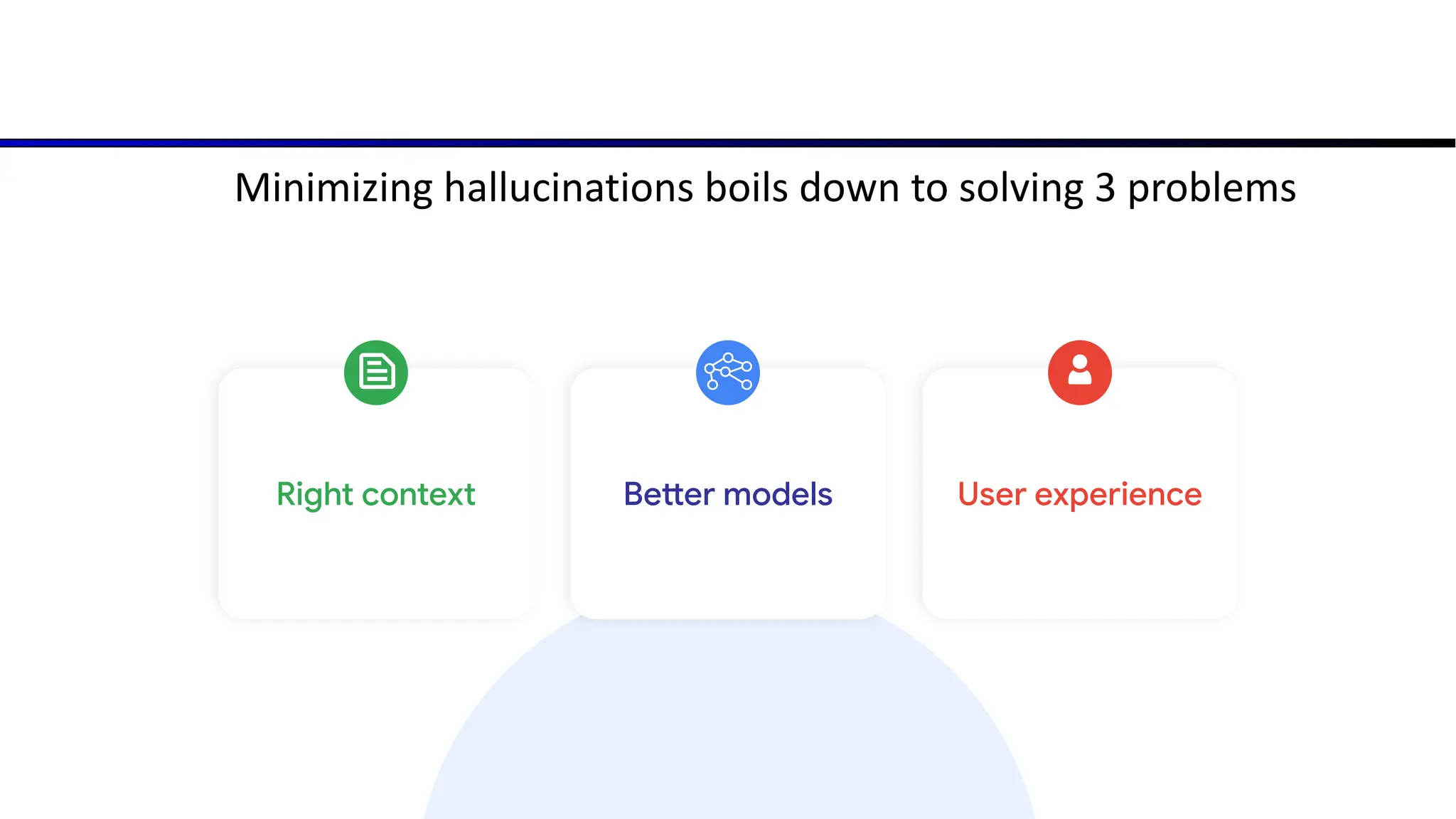
Minimizing hallucinations boils down to solving 3 problems
Right context Better models User experience
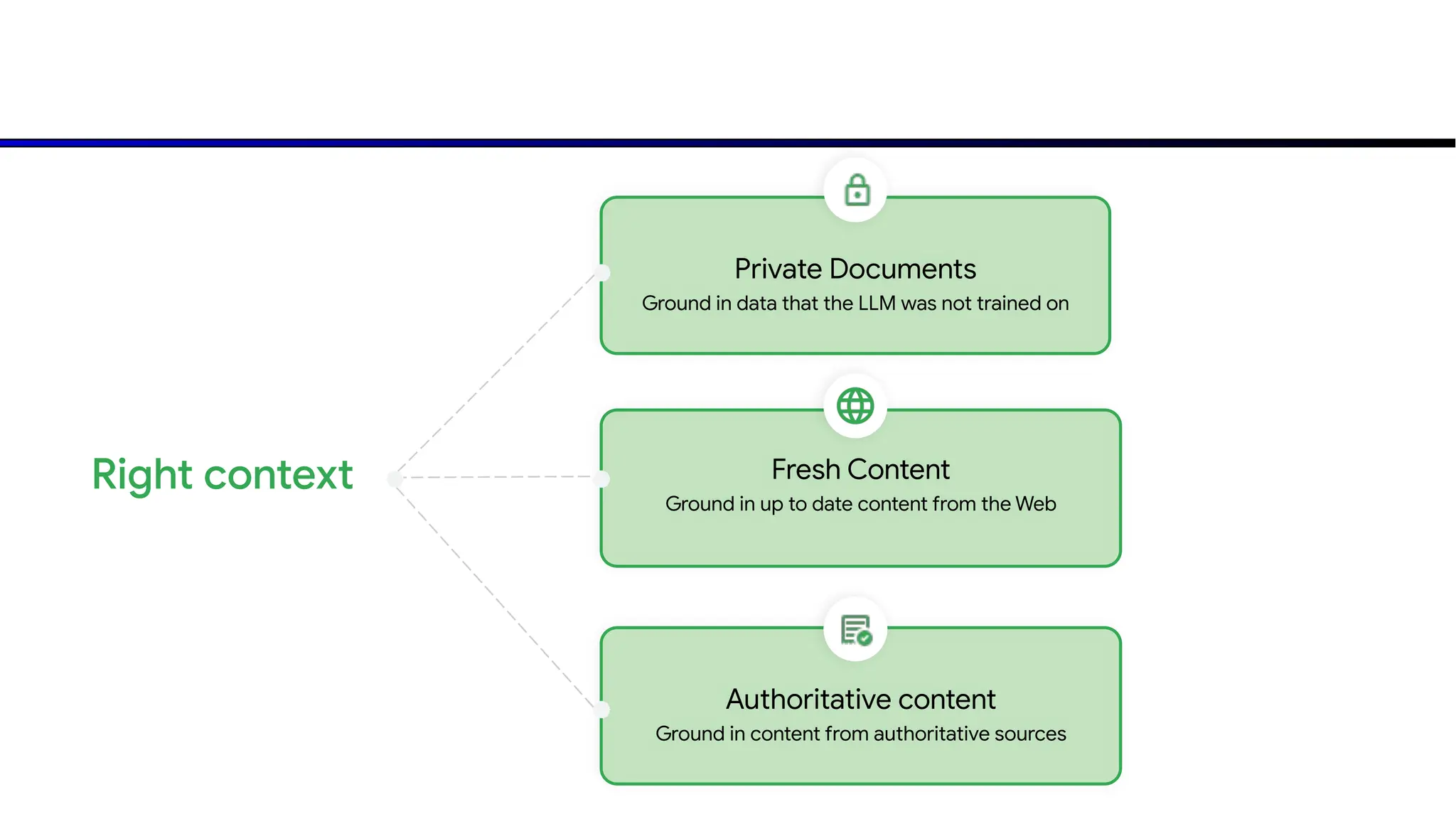
Private Documents
Ground in data that the LLM was not trained on
Fresh Content
Ground in up to date content from the Web
Authoritative content
Ground in content from authoritative sources
Right context
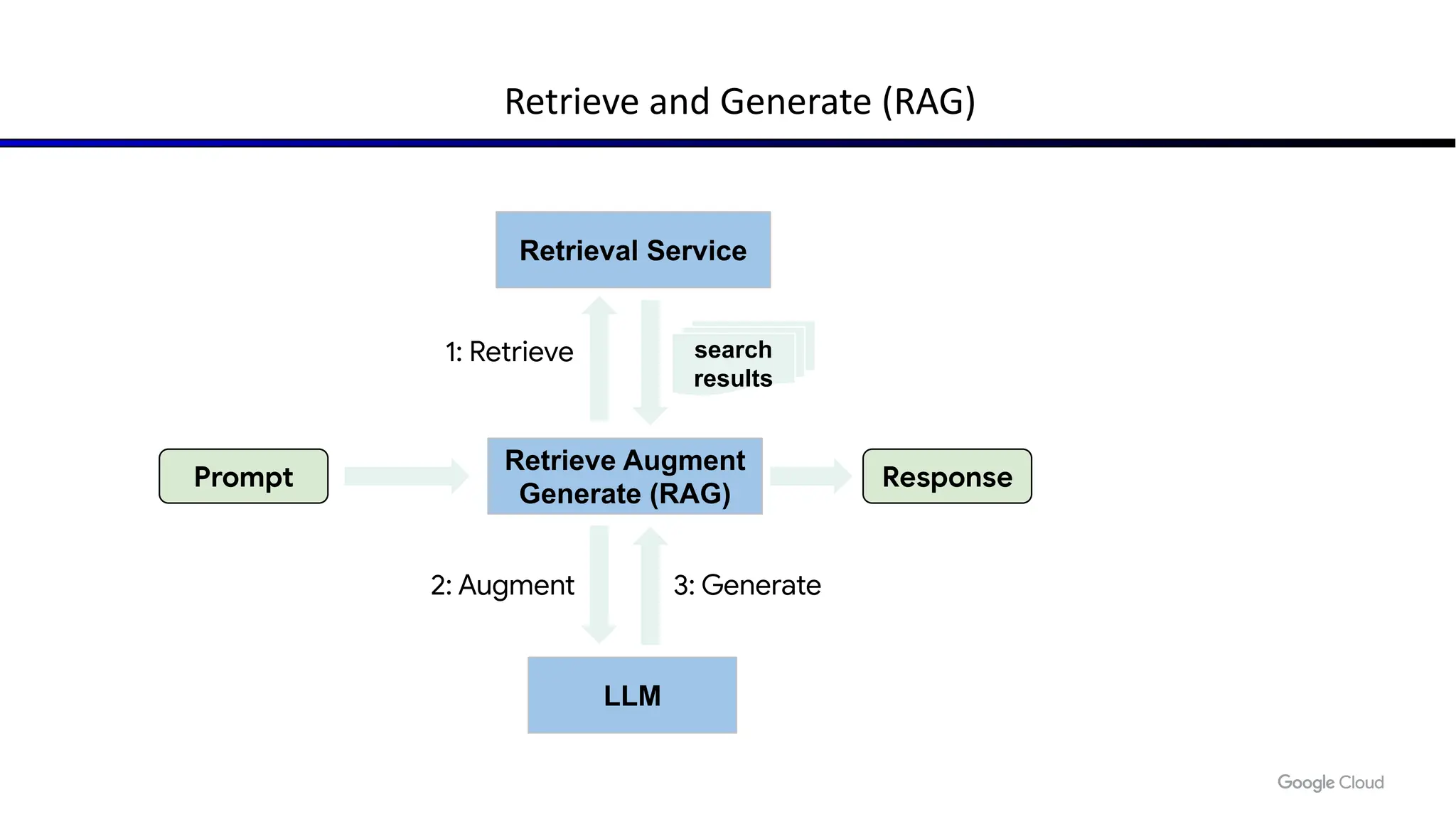
Retrieve and Generate (RAG)
LLM
search
results
Retrieve Augment
Generate (RAG)
Retrieval Service
Response
1: Retrieve
2: Augment 3: Generate
Prompt
Typical RAG/NLI based grounding architecture in a nutshell
LLM
Extractive
answer
(snippets)
Grounding
Detection using NLI
Report
sent 1, score, citations
…
sent n, score, citations
Prompt2Query ES
Prompt
[Pre-hoc] Response generation:
● Augment input with search results (“Retrieve Augment
Generate” approach)
● LORA/fine-tune model to ground in pre-hoc input and
generate citations
[Post-hoc] Response corroboration
● Use Natural Language Inference to corroborate against
corpus and generate/validate citations
Response
Pre-hoc
Post-hoc
Retrieval &
Ranking
Proprietary + Confidential
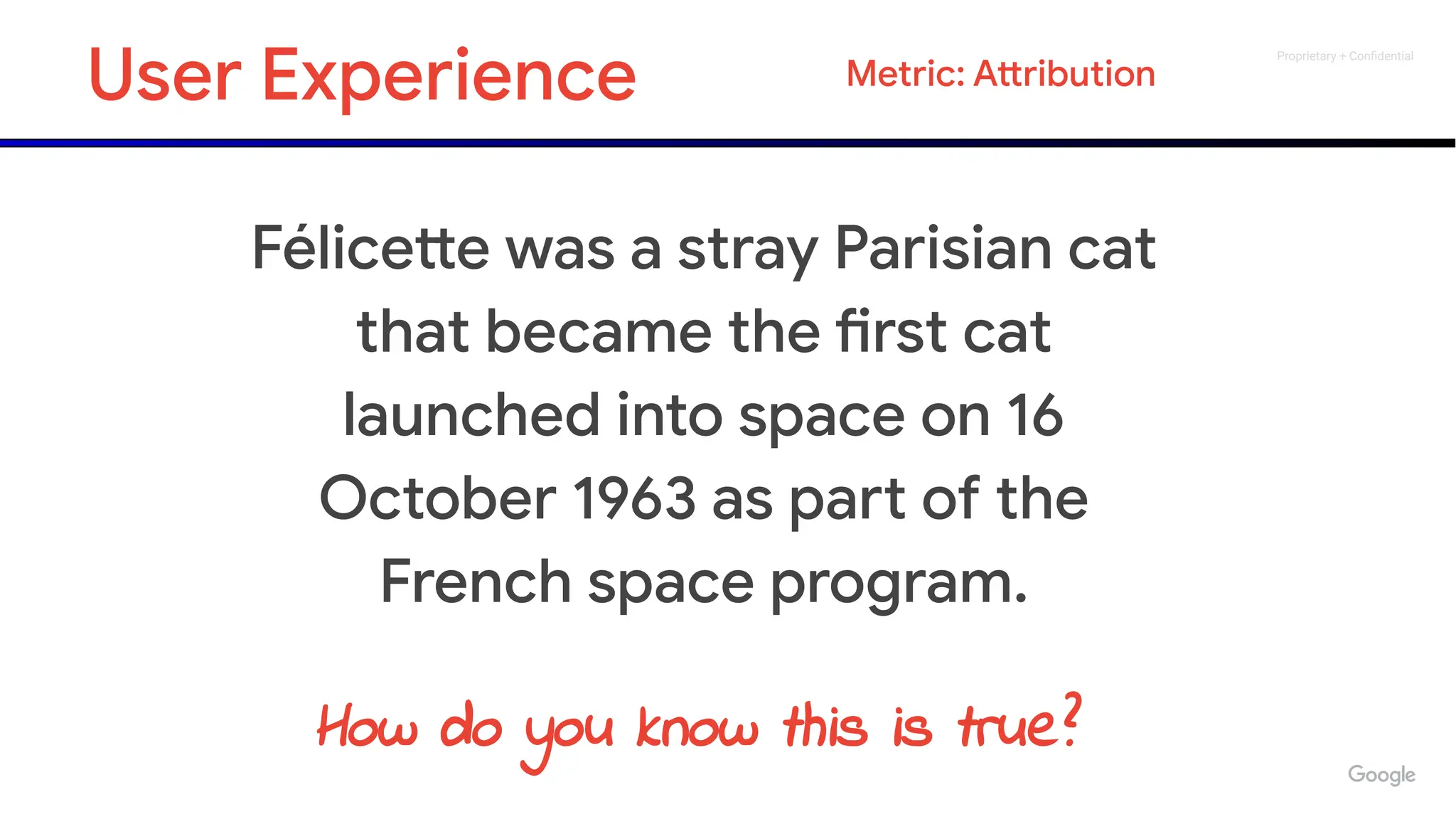
Félicette was a stray Parisian cat
that became the first cat
launched into space on 16
October 1963 as part of the
French space program.
How do you know this is true?
User Experience Metric: Attribution
Félicette was a stray Parisian cat
that became the first cat
launched into space [4,5] on 16
October 1963 [6,7] as part of the
French space program [8].
Disputed
Supporting sources: 4/7
Contradicting sources: 2/7
Sources: stuartatkinson.wordpress.com,
en.wikipedia.org, …
Supported
Supporting sources: 6/8
Contradicting sources: 0/8
Sources: en.wikipedia.org, english.elpais.com
Contradicted
Supporting sources: 0/8
Contradicting sources: 2/8
Sources: starwalk.space,
en.wikipedia.org, …
Supported
Supporting sources: 5/11
Contradicting sources: 0/11
Sources: www.reddit.com, en.wikipedia.org, …
[1,2,3]
Key Components of Customizations and
Agent Builder
Fine Tuning Distillation
Grounding Function Calling
As of my limited knowledge up to April 2023 [...] it's
always best to check the latest rates from a reliable
source, such as a currency converter or a bank.
Have you
ever received
a non-answer
about outdated
information?
```
{
"name": "alice",
"occupation": ["pets", "music"]
"address": false,
"email": "alice@example"
}
```
Have you ever
tried to get
consistent
outputs?
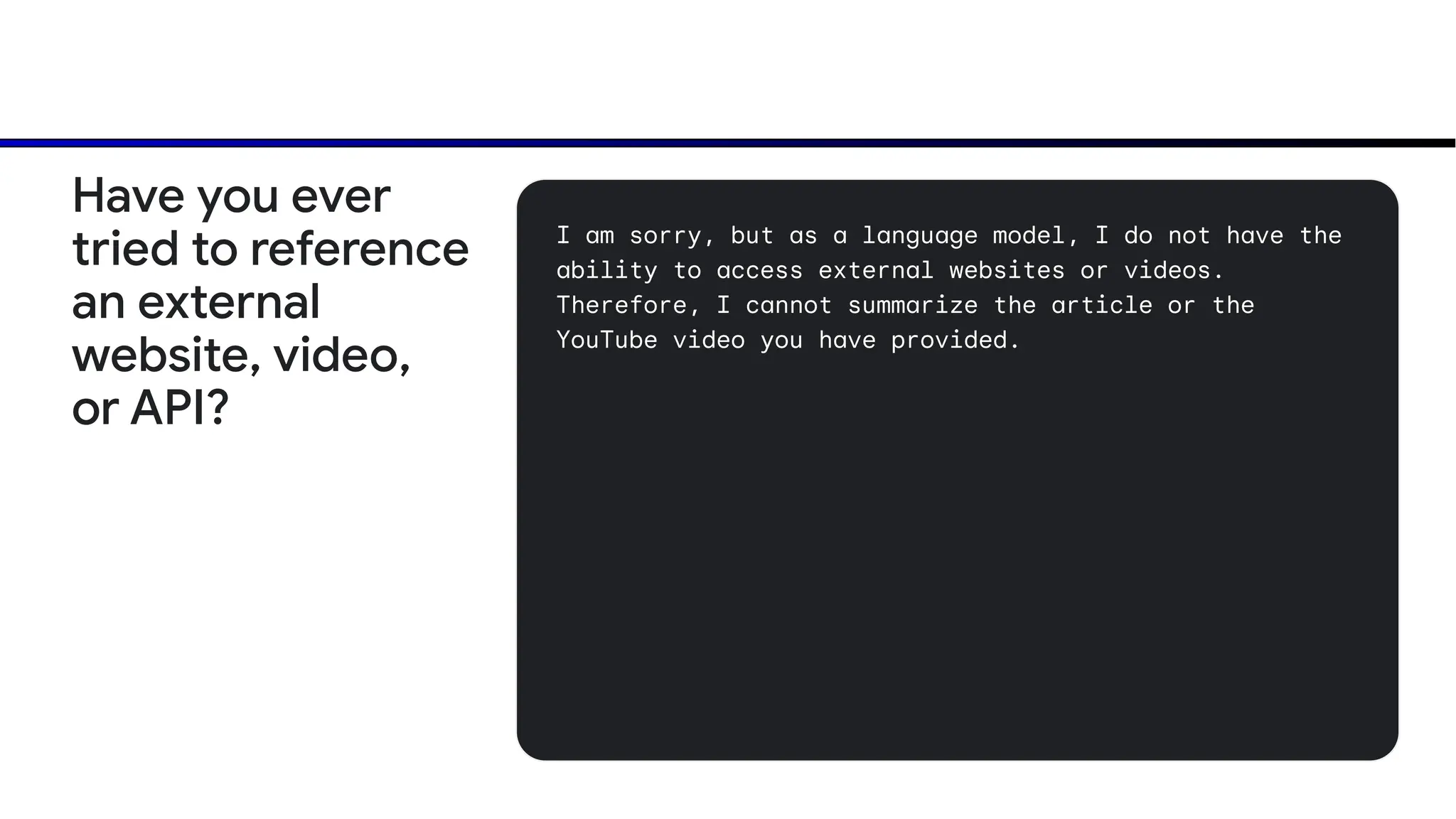
I am sorry, but as a language model, I do not have the
ability to access external websites or videos.
Therefore, I cannot summarize the article or the
YouTube video you have provided.
Have you ever
tried to reference
an external
website, video,
or API?
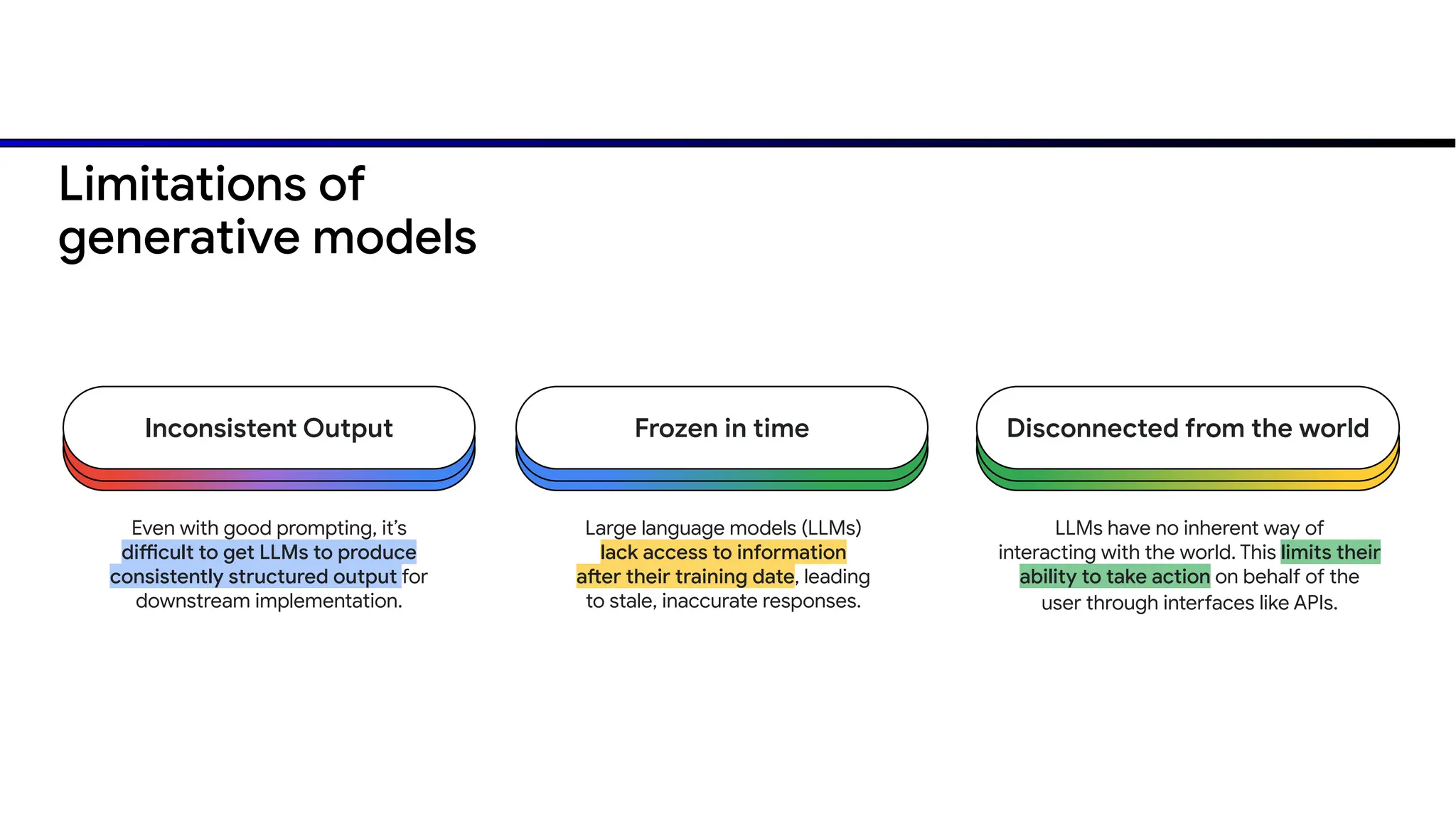
Limitations of
generative models
Inconsistent Output Frozen in time Disconnected from the world
Large language models (LLMs)
lack access to information
after their training date, leading
to stale, inaccurate responses.
LLMs have no inherent way of
interacting with the world. This limits their
ability to take action on behalf of the
user through interfaces like APIs.
Even with good prompting, it’s
difficult to get LLMs to produce
consistently structured output for
downstream implementation.
When you run
into limitations with
generative models,
what workarounds
do you try?
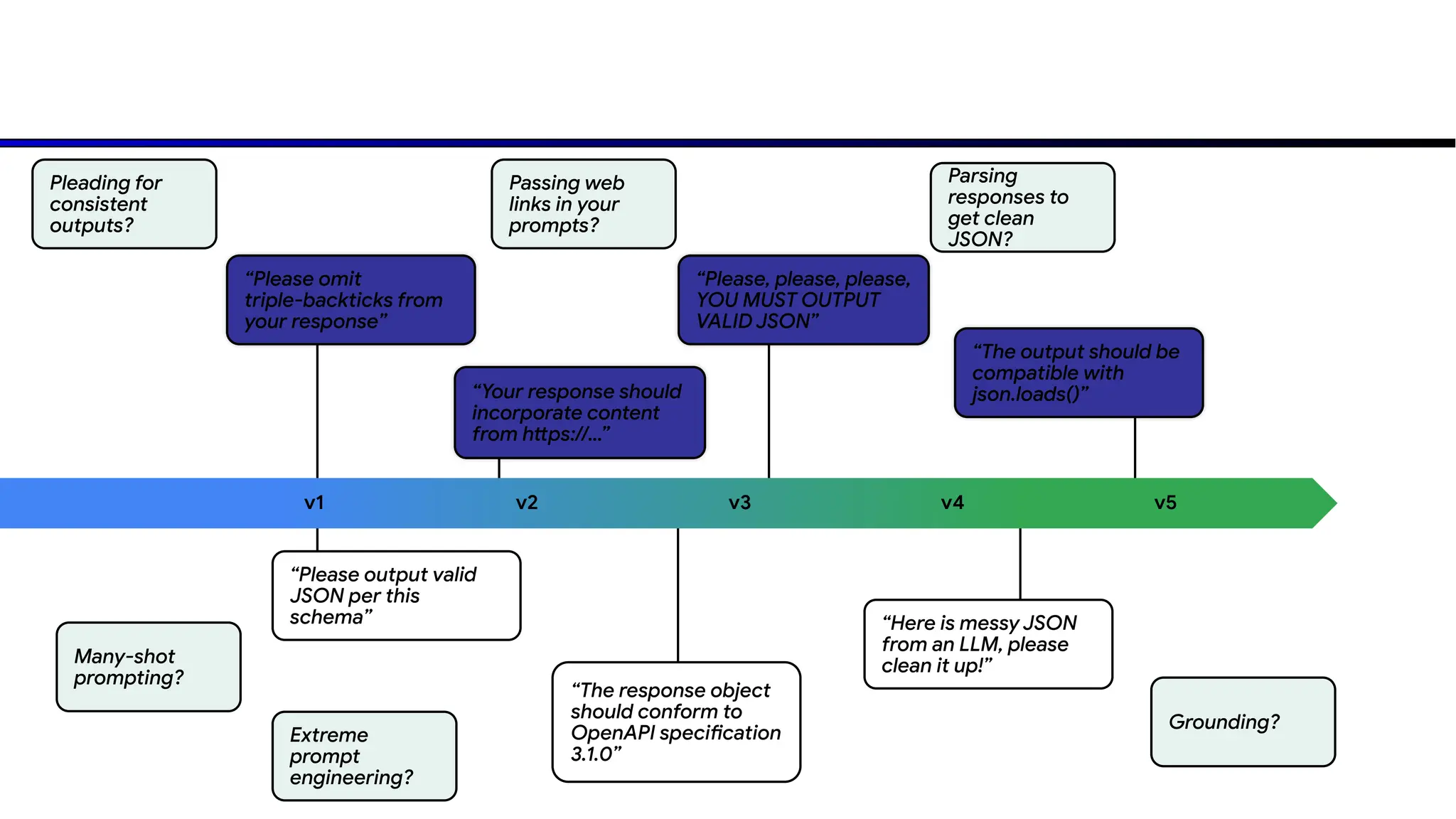
v1 v2 v3 v4 v5
“Please, please, please,
YOU MUST OUTPUT
VALID JSON”
“Please omit
triple-backticks from
your response”
“Your response should
incorporate content
from h ps://…”
“The output should be
compatible with
json.loads()”
“Please output valid
JSON per this
schema”
“The response object
should conform to
OpenAPI specification
3.1.0”
“Here is messy JSON
from an LLM, please
clean it up!”
Pleading for
consistent
outputs?
Passing web
links in your
prompts?
Parsing
responses to
get clean
JSON?
Grounding?
Extreme
prompt
engineering?
Many-shot
prompting?
But they probably didn't
work as expected.
How can we solve
this problem?
Let’s dig in…
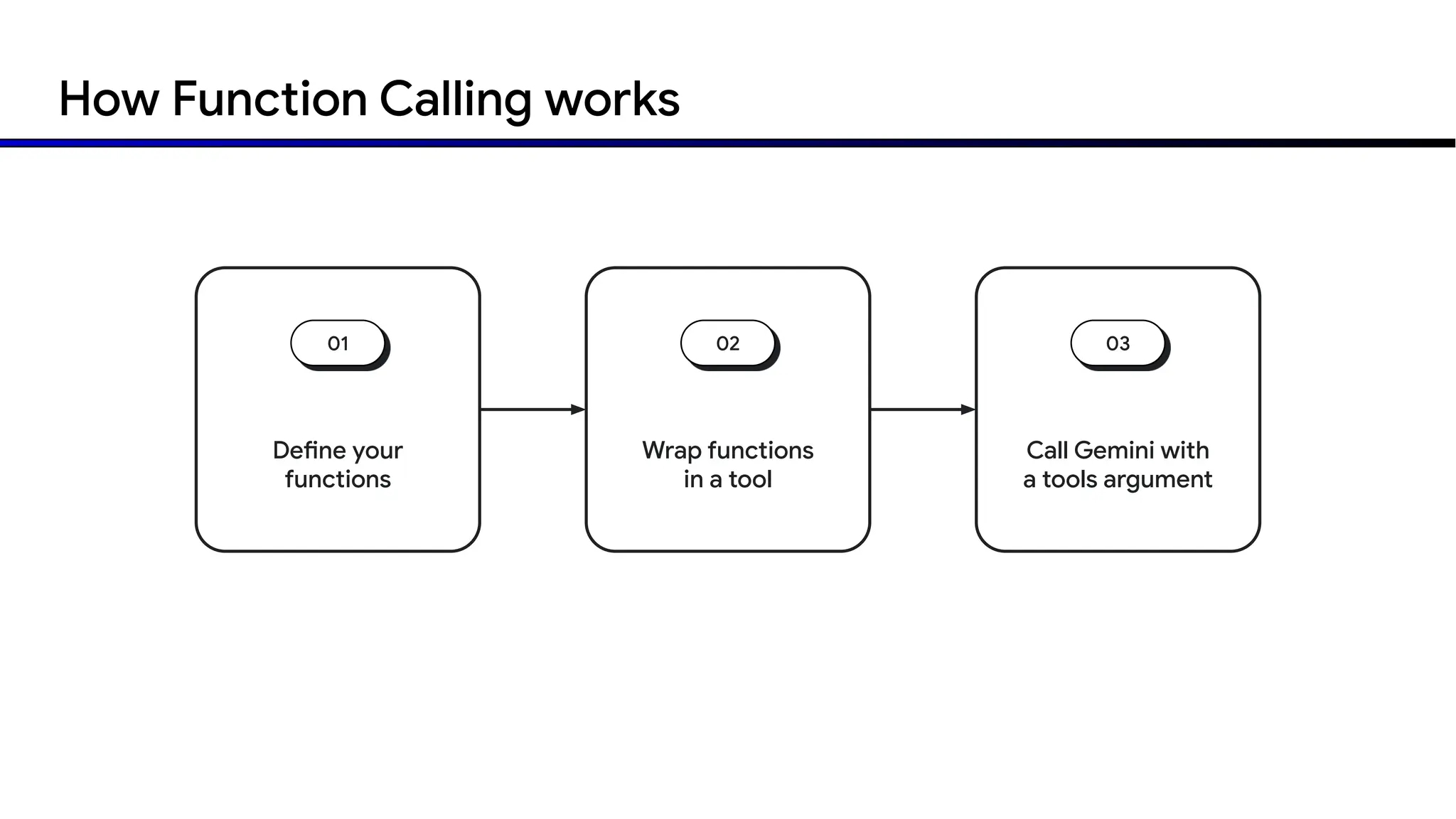
Wrap functions
in a tool
Define your
functions
01 02
Call Gemini with
a tools argument
03
How Function Calling works
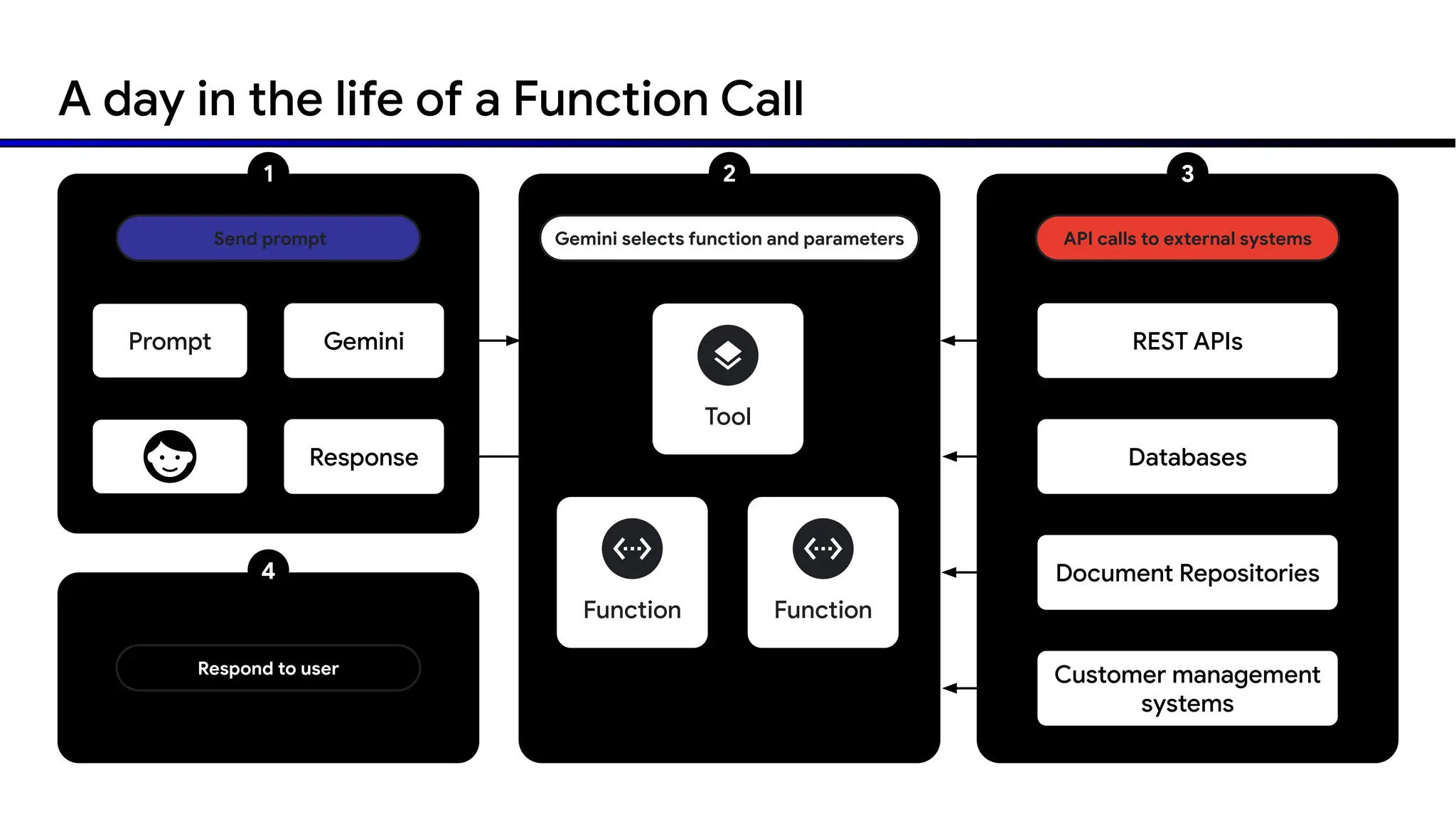
A day in the life of a Function Call
Send prompt Gemini selects function and parameters API calls to external systems
Prompt Gemini
Response
REST APIs
Databases
Document Repositories
Customer management
systems
Respond to user
Function Function
Tool
1 2 3
4
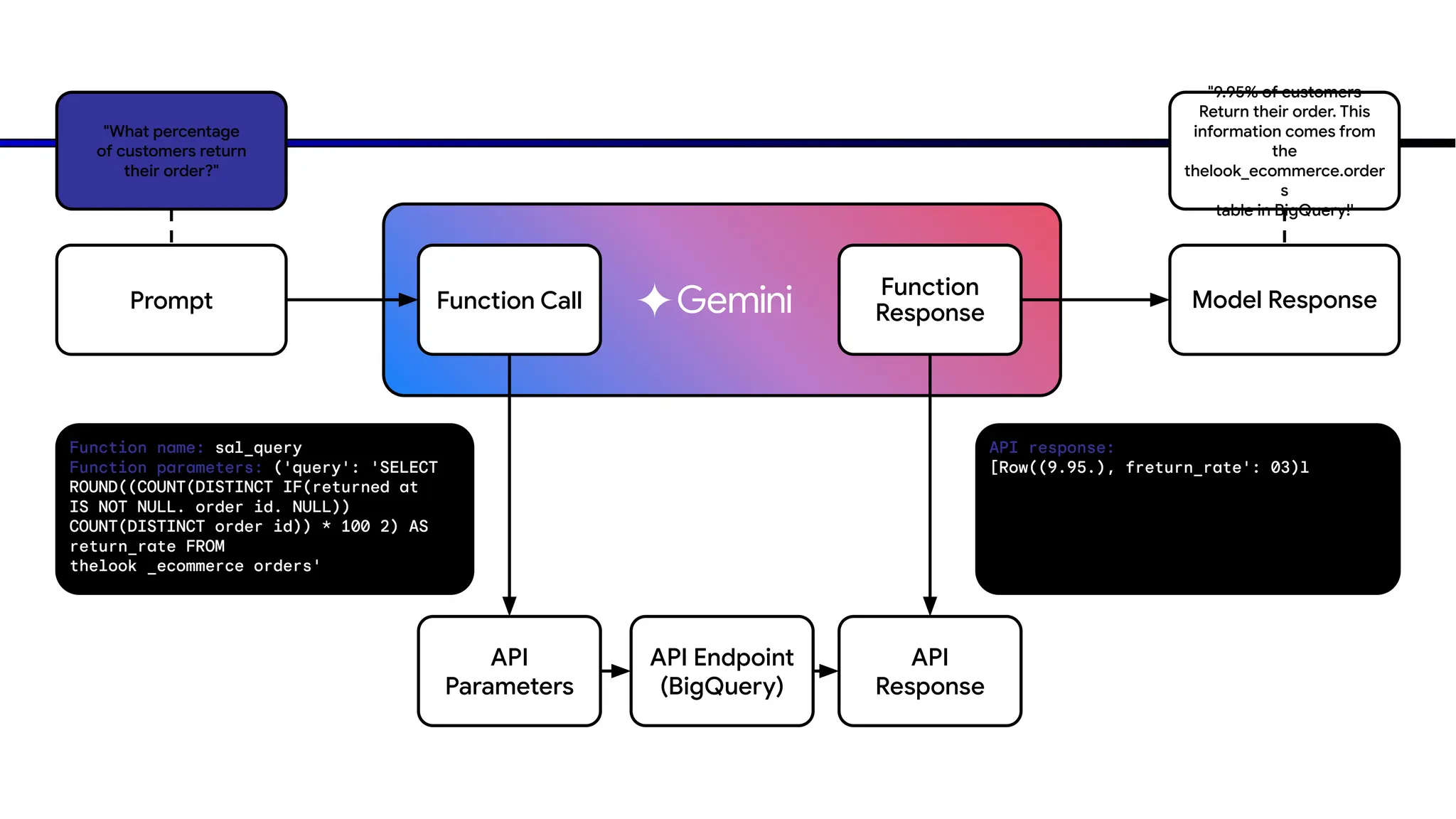
Prompt Function Call
Function
Response
Model Response
API
Parameters
API Endpoint
(BigQuery)
API
Response
Function name: sal_query
Function parameters: ('query': 'SELECT
ROUND((COUNT(DISTINCT IF(returned at
IS NOT NULL. order id. NULL))
COUNT(DISTINCT order id)) * 100 2) AS
return_rate FROM
thelook _ecommerce orders'
API response:
[Row((9.95.), freturn_rate': 03)l
"What percentage
of customers return
their order?"
"9.95% of customers
Return their order. This
information comes from
the
thelook_ecommerce.order
s
table in BigQuery!'
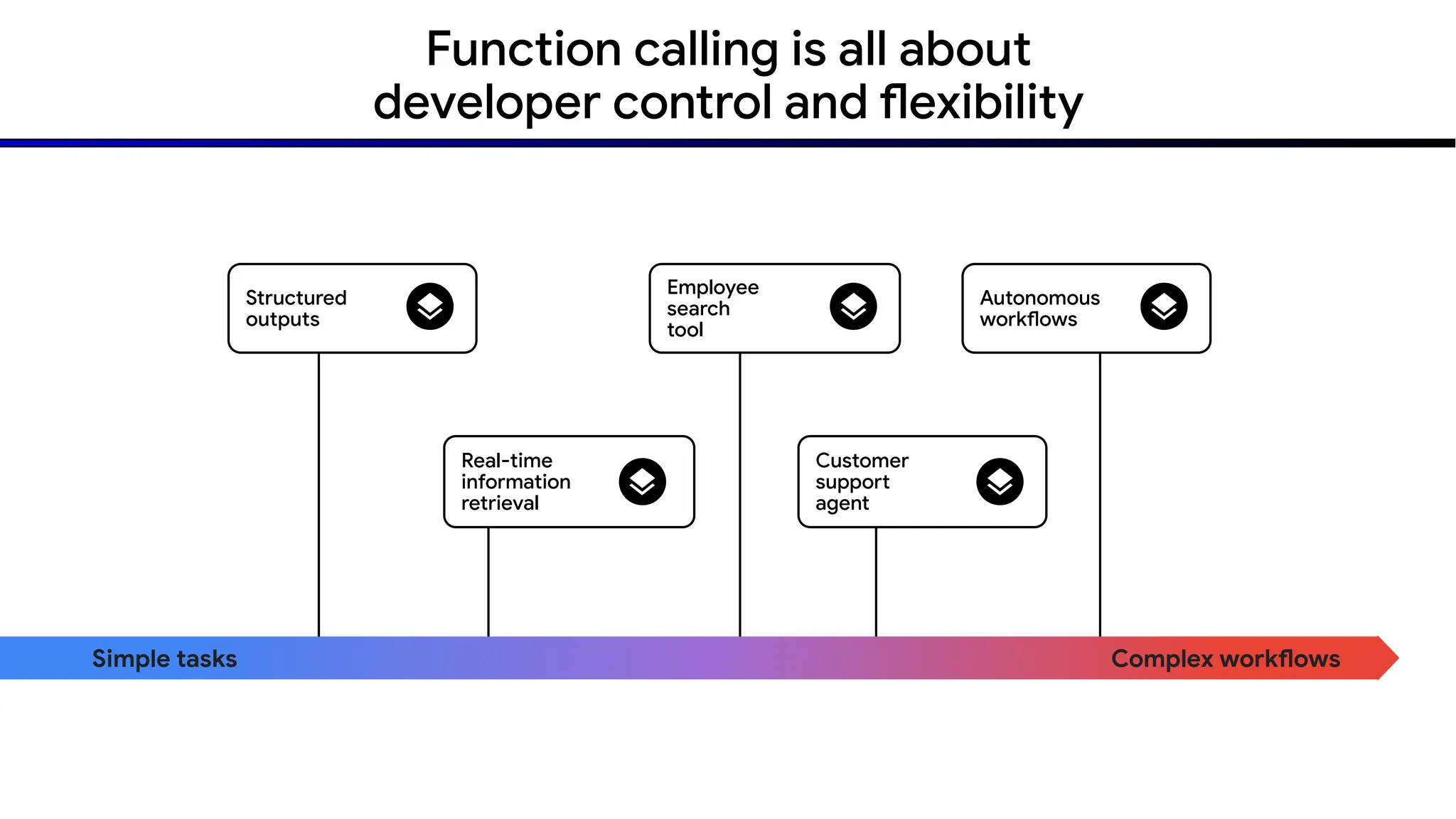
What can you build
with Function Calling?
Lots of things!
Structured
outputs
Employee
search
tool
Real-time
information
retrieval
Autonomous
workflows
Customer
support
agent
Function calling is all about
developer control and flexibility
Simple tasks Complex workflows
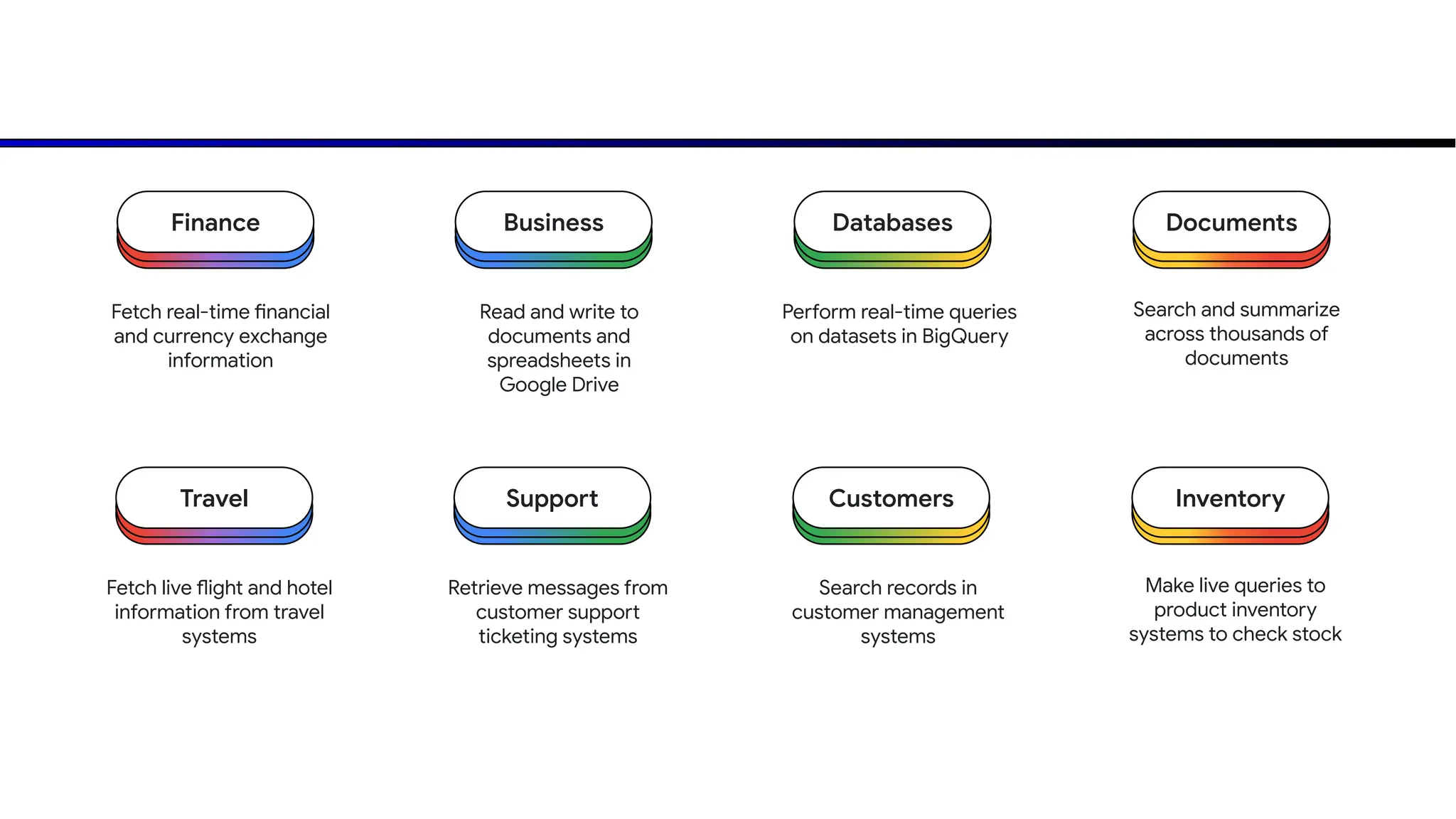
Finance Business Databases
Read and write to
documents and
spreadsheets in
Google Drive
Perform real-time queries
on datasets in BigQuery
Fetch real-time financial
and currency exchange
information
Documents
Search and summarize
across thousands of
documents
Travel Support Customers
Retrieve messages from
customer support
ticketing systems
Search records in
customer management
systems
Fetch live flight and hotel
information from travel
systems
Inventory
Make live queries to
product inventory
systems to check stock

Enterprise Trends for Gen AI - Berkeley LLM AI Agents MOOC

  • 1.
    LLM Agents 1 Enterprise Trendsfor Generative AI Guest Speaker: Burak Gokturk Instructors: Dawn Song & Xinyun Chen
  • 2.
    2 Burak Gokturk VP, Cloud AIand AI/ML for Developers, Google Cloud burakg@google.com
  • 3.
    LLM Agents 3 Instructors: DawnSong & Xinyun Chen Enterprise Trends for Generative AI Key Blocks to build successful agents What’s next?
  • 4.
    04 Google Cloud Next‘24 Key Trends in Generative AI
  • 5.
    Some observations In recentyears, ML has completely changed our expectations of what is possible with computers The kinds of computations we want to run and the hardware on which we run them is changing dramatically Increasing scale (compute, data, model size) delivers better results
  • 6.
    A decade ofamazing progress in what computers can do Input Output Pixels: Audio: Pixels: “Hello, how are you?” “leopard” “How cold is it outside?” “Bonjour, comment allez-vous?” “A cheetah lying on top of a car”
  • 7.
    A decade ofamazing progress in what computers can do Pixels: Audio: Pixels: “Hello, how are you?” “leopard” “How cold is it outside?” “Bonjour, comment allez-vous?” “A cheetah lying on top of a car” Input Output
  • 8.
  • 9.
    “How cold isit outside?” 2.5% Source: https://paperswithcode.com/sota/speech-recognition-on-librispeech-test-other 13.25% Speech Recognition on LibriSpeech test-other
  • 10.
    Transformers + autoregressivetraining + massive data I went to the … Foundation Model Pre-training on trillions of tokens The cat sat on the mat The teacher read a book I love to dance … conference Next token prediction Backbone architecture For tokenization: github.com/google-research/bert/blob/master/tokenization.py
  • 11.
    Towards useful AIagents Supervised Fine-Tuning (SFT) Reinforcement Learning from Human Feedback (RLHF) Prompt: “I have pains in my lower back while sleeping. What could be causing this?” Output (expert response): “You might be experiencing a lower back strain, typically caused by lifting heavy objects or abrupt movements. This can lead to sharp pain in the lower back, especially when moving or lifting …” SFT model Reward model RL objective RL-tuned model Prompt
  • 12.
    Gemini Training High QualityMultimodal Models at Scale
  • 13.
    13 Project started inFeb 2023 Many collaborators from Google DeepMind, Google Research, and rest of Google Goal: Train highly capable multimodal models and use them all across Google Initial 1.0 public release in Dec 2023, 1.5 in Feb 2024 https://blog.google/technology/ai/google-gemini-ai https://g.co/gemini Gemini: A Family of Highly Capable Multimodal Models, by the Gemini Team, arxiv.org/abs/2312.11805
  • 14.
    Gemini - Multimodalfrom the start Gemini: A Family of Highly Capable Multimodal Models, by the Gemini Team, arxiv.org/abs/2312.11805
  • 15.
  • 16.
    Gemini 1.5: Initialrelease in February 2024 Gemini 1.5: Unlocking multimodal understanding across millions of tokens of context, arxiv.org/abs/2403.05530 Long context capability demonstrated up to 10M tokens, with public preview offering up to 1M tokens of text and/or video information in the context window is “clearer” (it hasn’t been mixed together/perturbed over many gradient descent steps with other training data) ⇒ less hallucination ⇒ enables in-context learning
  • 17.
    Try it athttps://ai.google.dev/ Gemini 1.5: Unlocking multimodal understanding across millions of tokens of context, arxiv.org/abs/2403.05530
  • 18.
    “Needle in haystack”test for text, audio, and video Green is good, and red is not good, and these are almost entirely green (>99.7% recall), even out to 10M tokens. Modeled after Greg Kamradt’s github.com/gkamradt/LLMTest_NeedleI nAHaystack test that probes a model’s ability to retrieve specific information from its context. Gemini 1.5 Pro Long Context Evaluation Gemini 1.5: Unlocking multimodal understanding across millions of tokens of context, arxiv.org/abs/2403.05530 10 hours 107 hours 10M tokens
  • 19.
    Gemini 1.5 Pro-Exp-0801evaluation via lmsys.org in August, 2024 https://x.com/lmsysorg/status/181904882129454744
  • 20.
  • 21.
    Trend 1- Theobvious: AI is moving so much faster
  • 22.
    Proprietary + Confidential ML,Systems, and Cloud AI The amount of data needed has come down AI is moving faster…Why? Anyone can develop AI
  • 23.
  • 24.
    Separate models fordifferent tasks Single model that can generalize across millions of tasks Where are we headed?
  • 25.
    Dense models Efficientsparse models Where are we headed?
  • 26.
    Where are weheaded? Single modality models Models that deal with many modalities
  • 27.
    Trend 3- Itis the choice of the platform that matters
  • 28.
    ML, Systems, andCloud AI Proprietary + Confidential LMSys Chat Leaderboard Ranks
  • 29.
    029 Google Cloud Next‘24 Proprietary Key success factors for generative AI Access to a broad set of models …so you can find the best model for their use case and budget A platform for managing models in production …so you can deploy and manage models in a scalable way Ability to customize models with your data …so you can improve the quality, latency, and performance of the model Choice and flexibility at every level ….so you can avoid vendor lock-in and use the best tools for the job
  • 30.
    Trend 4- Costof API calls is approaching 0
  • 32.
  • 33.
    Another big realization LLMand Search need to come together.
  • 34.
  • 35.
    035 Google Cloud Next‘24 Enterprise Learnings with their AI investments
  • 36.
    036 Google Cloud Next‘24 Proprietary Key success factors for generative AI Access to a broad set of models …so you can find the best model for their use case and budget A platform for managing models in production …so you can deploy and manage models in a scalable way Ability to customize models with your data …so you can improve the quality, latency, and performance of the model Choice and flexibility at every level ….so you can avoid vendor lock-in and use the best tools for the job
  • 39.
    Google Cloud Next Storyboardsection 1 NEW / UPDATED SUN 8/20 Vertex AI Model Garden 130
  • 42.
    Foundation Models onVertex AI Across a variety of model sizes to address use cases Embeddings API for Text and Image Extract semantic information from unstructured data Chirp for Speech to Text Build voice enabled applications PaLM for Text / Chat Custom language tasks and multi-turn conversations Codey for Code Generation Improve coding and debugging Imagen 2.0 for Text to Image Create and edit images from simple prompts Gemini 1.0 Pro Multimodal reasoning across a wide range of tasks GA Gemini 1.0 Ultra Largest and most capable model for highly complex tasks Limited Private GA Gemini 1.5 Pro Multimodal reasoning for longer prompts, 1 million context window Gemma 2B and 7B Family of lightweight, state-of-the-art open models NEW NEW
  • 43.
    Google Cloud Next Storyboardsection 1 NEW / UPDATED SUN 8/20
  • 44.
    NEW 3/28 -AS *Currently in Preview Haiku | Sonnet | Opus*
  • 45.
    045 Google Cloud Next‘24 Proprietary Foundation models are powerful tools, but they are only as valuable as your ability to use them in context of your business use case and successfully deploy them to production.
  • 46.
  • 48.
    Augmentation tools toenhance capabilities of foundation models Tuning/Distillation ● Customize based on specific data and use case ● Create a smaller model for cost/latency purposes Grounding ● Combine with search to make it factual Extensions/Function Calling ● Function calling to be able to make LLMs on areas where they perform poorly
  • 49.
    Key Components ofCustomizations and Agent Builder Fine Tuning Distillation Grounding Function Calling
  • 50.
    Key Components ofCustomizations and Agent Builder Fine Tuning Distillation Grounding Function Calling
  • 51.
    Google Cloud Next Storyboardsection 1 NEW 3/24 - AS For open models * *For open models on Vertex AI And optimize
  • 52.
    Popular model adaptationapproaches and research goals LLM size All sizes; FLAN-540B is very expensive. Large LLM >62B. 540B moderate-size (e.g. T5-3B) 1 ~ 64B 64B → 1B or T5
  • 53.
    Conventional Fine-tuning Basic steps: ▪Get a pretrained model checkpoint (e.g. BERT) ▪ Have a new dataset/task ▪ Do supervised learning on new dataset and update the weights of the new model Requires: ▪ Modest amount of compute (e.g. xxx chips for a few days for a 340B model) ▪ In-depth knowledge of the model architecture
  • 54.
    Conventional Prompt Tuning Basic steps: ●Freeze the backbone model. ● Prepend a soft prompt (e.g. learnable) to the input ● Only optimize the prompt to adapt to downstream tasks. Lester et al https://arxiv.org/pdf/2104.08691.pdf Froze
  • 55.
    Overview of Prompting Advantages: ●No training, only inference ● Enables real time interaction (e.g. ChatGPT) ● Lowered requirements on train dataset size or label cost: only a few examples (<10) are enough ● Better generalization and less likely to overfit on the training data ● In-context learning: an LLM is given a prompt including a few training examples and a test instance as input. ● ● By leveraging its “autoregressive power”, LLMs understand and learn from the in-context examples to generate the output for the test instance directly, without any update to its parameters. ● ● Perform in a zero-shot/few-shot manner. ● ● Context learning is one of the most common ways to use giant LLMs
  • 56.
    What is parameter-efficientfine tuning Resource link
  • 57.
    Why do weneed PEFT? Pros and Cons Resource link
  • 58.
    Key Idea Full fine-tuningLoRA ● Decomposing updated parameters into a product of lower rank matrices Resource link
  • 59.
    Details of LoRA ●This can apply to any dense layers in the foundation models. ○ But applying to all dense layers may not be the optimal. ○ Only applying adaptation on attention weights (not on MLPs) Pre-trained model weight: Weights with LoRA tuning: Trainable parameters: Rank of trainable parameters: Original forward pass: Modified forward pass: Resource link
  • 60.
    Advantages of LoRA ●No additional inference latency ● In some cases, it shows better performance even in comparison to full fine tuning
  • 61.
    Key Components ofCustomizations and Agent Builder Fine Tuning Distillation Grounding Function Calling
  • 62.
    Deploying LLMs continuesto be challenging ● Customers do not need Unicorn/Gemini-XL/GPT4 for every task ● Can we reduce the serving cost & latency while maintaining high performance
  • 63.
    Memory & ComputeEfficient LLM go/cair_efficient_llm Speedup 6B LLM inference by 2x Quantization Retrieval Enhancement Side Tuning Distillation Model size reduction by 50x in text generation Avoid back-prop the backbone model Model size reduction & perf improvement
  • 64.
    2023 NEW Approach Using teacherreasoning: Distillation step by step, Orca Present 2015 Distillation in NN 2020 DistilBERT, TinyBERT Self distillation Online distillation History Different matching Network augmentation Localization distillation
  • 65.
    Key Terms ● Teachermodel ○ The original (large model) that we want to extract the knowledge from it ● Student model ○ The new model with smaller size ● Soft labels ○ The output of teacher model when the Temperature is larger than 1 (T>1) ● Soft predictions ○ The output of student model when the Temperature is larger than 1 (T>1) ● Hard predictions ○ When regular softmax (T=1) is used in the student model ● Hard labels ○ Ground truth label in one-hot encoding
  • 66.
    The key insights ●Softmax function ● Key insight ○ Relative similarity between other classes and this information is useful ○ Image of 2 may be closer or similar to an example image of 3 than it is to that of 7 ○ How close or similar the examples are is of much importance to understand what the network has actually learned ● Limitation ○ Giving importance to the most likely class, push the rest to very small values
  • 67.
    The key insights(2): Temperature T ● Softmax function with temperature to smooth the output
  • 68.
    Architecture of distillationin NN ● Train smaller model based on the hard labels and the teacher soft labels`
  • 69.
    Key Components ofCustomizations and Agent Builder Fine Tuning Distillation Grounding Function Calling
  • 70.
    Some shortcomings ofLLMs when it comes to factuality LLMs produce output that we can check that it is factually wrong LLMs are trained in the past LLMs data is frozen in past. So it will not know about recent developments or facts. LLMs hallucinate LLMs are creative by nature. This might result in hallucinations at a significant rate. LLMs can’t cite sources LLMs are good in reasoning, but less so on quoting which sources they used to come to a conclusion..
  • 71.
    Minimizing hallucinations boilsdown to solving 3 problems Right context Better models User experience
  • 72.
    Private Documents Ground indata that the LLM was not trained on Fresh Content Ground in up to date content from the Web Authoritative content Ground in content from authoritative sources Right context
  • 73.
    Retrieve and Generate(RAG) LLM search results Retrieve Augment Generate (RAG) Retrieval Service Response 1: Retrieve 2: Augment 3: Generate Prompt
  • 74.
    Typical RAG/NLI basedgrounding architecture in a nutshell LLM Extractive answer (snippets) Grounding Detection using NLI Report sent 1, score, citations … sent n, score, citations Prompt2Query ES Prompt [Pre-hoc] Response generation: ● Augment input with search results (“Retrieve Augment Generate” approach) ● LORA/fine-tune model to ground in pre-hoc input and generate citations [Post-hoc] Response corroboration ● Use Natural Language Inference to corroborate against corpus and generate/validate citations Response Pre-hoc Post-hoc Retrieval & Ranking
  • 75.
    Proprietary + Confidential Félicettewas a stray Parisian cat that became the first cat launched into space on 16 October 1963 as part of the French space program. How do you know this is true? User Experience Metric: Attribution
  • 76.
    Félicette was astray Parisian cat that became the first cat launched into space [4,5] on 16 October 1963 [6,7] as part of the French space program [8]. Disputed Supporting sources: 4/7 Contradicting sources: 2/7 Sources: stuartatkinson.wordpress.com, en.wikipedia.org, … Supported Supporting sources: 6/8 Contradicting sources: 0/8 Sources: en.wikipedia.org, english.elpais.com Contradicted Supporting sources: 0/8 Contradicting sources: 2/8 Sources: starwalk.space, en.wikipedia.org, … Supported Supporting sources: 5/11 Contradicting sources: 0/11 Sources: www.reddit.com, en.wikipedia.org, … [1,2,3]
  • 77.
    Key Components ofCustomizations and Agent Builder Fine Tuning Distillation Grounding Function Calling
  • 78.
    As of mylimited knowledge up to April 2023 [...] it's always best to check the latest rates from a reliable source, such as a currency converter or a bank. Have you ever received a non-answer about outdated information?
  • 79.
    ``` { "name": "alice", "occupation": ["pets","music"] "address": false, "email": "alice@example" } ``` Have you ever tried to get consistent outputs?
  • 80.
    I am sorry,but as a language model, I do not have the ability to access external websites or videos. Therefore, I cannot summarize the article or the YouTube video you have provided. Have you ever tried to reference an external website, video, or API?
  • 81.
    Limitations of generative models InconsistentOutput Frozen in time Disconnected from the world Large language models (LLMs) lack access to information after their training date, leading to stale, inaccurate responses. LLMs have no inherent way of interacting with the world. This limits their ability to take action on behalf of the user through interfaces like APIs. Even with good prompting, it’s difficult to get LLMs to produce consistently structured output for downstream implementation.
  • 82.
    When you run intolimitations with generative models, what workarounds do you try?
  • 83.
    v1 v2 v3v4 v5 “Please, please, please, YOU MUST OUTPUT VALID JSON” “Please omit triple-backticks from your response” “Your response should incorporate content from h ps://…” “The output should be compatible with json.loads()” “Please output valid JSON per this schema” “The response object should conform to OpenAPI specification 3.1.0” “Here is messy JSON from an LLM, please clean it up!” Pleading for consistent outputs? Passing web links in your prompts? Parsing responses to get clean JSON? Grounding? Extreme prompt engineering? Many-shot prompting?
  • 84.
    But they probablydidn't work as expected. How can we solve this problem?
  • 85.
  • 86.
    Wrap functions in atool Define your functions 01 02 Call Gemini with a tools argument 03 How Function Calling works
  • 87.
    A day inthe life of a Function Call Send prompt Gemini selects function and parameters API calls to external systems Prompt Gemini Response REST APIs Databases Document Repositories Customer management systems Respond to user Function Function Tool 1 2 3 4
  • 88.
    Prompt Function Call Function Response ModelResponse API Parameters API Endpoint (BigQuery) API Response Function name: sal_query Function parameters: ('query': 'SELECT ROUND((COUNT(DISTINCT IF(returned at IS NOT NULL. order id. NULL)) COUNT(DISTINCT order id)) * 100 2) AS return_rate FROM thelook _ecommerce orders' API response: [Row((9.95.), freturn_rate': 03)l "What percentage of customers return their order?" "9.95% of customers Return their order. This information comes from the thelook_ecommerce.order s table in BigQuery!'
  • 89.
    What can youbuild with Function Calling? Lots of things!
  • 90.
  • 91.
    Finance Business Databases Readand write to documents and spreadsheets in Google Drive Perform real-time queries on datasets in BigQuery Fetch real-time financial and currency exchange information Documents Search and summarize across thousands of documents Travel Support Customers Retrieve messages from customer support ticketing systems Search records in customer management systems Fetch live flight and hotel information from travel systems Inventory Make live queries to product inventory systems to check stock