ENGLISH MODULE 
Submitted to fulfill the project work of Philosophical Basic of ESP 
By: 
Akbar Fauzan 
NIM: 1210204006 
ENGLISH EDUCATION DEPARTMENT 
FACULTY OF TARBIYAH AND TEACHER TRAINING 
STATE ISLAMIC UNIVERSITY SUNAN GUNUNG DJATI 
BANDUNG 
2014
INRODUCTION 
This module is aimed at helping students in the intermediate level. English teachers promote effective speaking in their classrooms by engaging their students in communicative activities to develop oral proficiency. The module aims to develop students‟ confidence in using English in various communication situations, both formal and informal. The ability to speak English effortlessly in a variety of situations requires good pronunciation, a wide range of vocabulary, grammatical accuracy and also the knowledge of what to say to whom and when. In short, proficiency in speaking includes knowledge not only of the language but also social and cultural norms, and the ability to respond appropriately in a variety of situations. This module contains a range of activities for the teacher to use in the classrooms to encourage students to speak effectively and with confidence. The activities are mainly designed around shared experiences, to be done in pairs and groups so that students learn to respond spontaneously in any communication situation. 
A. The objectives of this module are to: 
 Enable teachers to help their students develop the ability to speak 
 English effectively and with confidence; 
 Help teachers develop activities to encourage students to express 
 Themselves fluently using appropriate grammar, vocabulary and 
 Pronunciation;
 Enable teachers to help students organize their ideas logically and to 
 Present them appropriately in various communication situations; 
 Help teachers make their students understand the importance of 
 Performing language functions in English such as requesting, greeting, 
 Clarifying, apologizing, inviting and so on; and 
 Encourage English teachers to collaborate with teachers of other 
 Subjects to develop students‟ academic skills such as oral 
 Presentations, extempore speech, debate, etc. 
B. After Completing this module, you will be able to: 
 Teach students how to express themselves effectively using appropriate grammar, vocabulary and pronunciation; 
 Show students how to describe people, events and objects appropriately in English; 
 Teach students how to perform common language functions in social situations, such as making a request, asking for clarifications, giving and accepting invitations and so on; and 
 Help students develop their oral skills for academic purposes (making presentations, participating in debates, extempore speech, group discussions and so on).
UNIT 1 
Introduction to Discourse and Intonation 
Objective: 
Introducing the concept of discourse and intonation with its aspects A. Why is Sound Discrimination Important? 
But what is this skill, and why is it so important? Listening for sounds and telling the difference between one and the other is called sound discrimination. Sound discrimination is very important to early readers and writers, because when a child wants to write the words “pig” or “bat,” it will be very important to be able to identify all of the sounds in those words. Otherwise, reading and writing small words like these will be impossible without memorizing every what every single word looks like, right down to the last letter. Imagine trying to write long words such as “encyclopedia” without being able to separate that word into syllables in your head as you write it down! You would be relying only on memory to spell these long words, and might forget a letter or two. Kids that learn to listen for and distinguish between each syllable and letter sound in the words that they read have a much better chance of reading and writing well than those that do not. In addition, rhyming is a foundational skill for language arts, and depends entirely on sound discrimination. Phonics in general is also highly dependent on sound discrimination skills as well. B. Intonation in Discourse 
The term intonation refers to the way the voice goes up and down in pitch when we are speaking. Intonation is considered a fundamental part of the way we express our own thoughts and enables us to understand the other people‟s thoughts
when they talk to us. Intonation enables us to know the speaker‟s attitude and how she/he feels about what she/he is saying. 
Discourse is any meaningful stretch of language. If we analyze intonation in discourse, it means that we analyze intonation in a wider context of conversation or monologue; we see how intonation conveys ideas and information. 
Here is the guidance related to intonation: 
1. Information questions with Who, what, where, etc.  Falling intonation (if being asked for the first time), e.g. What’s your name? What’s the time? Where do you live? 
2. Questions expecting a „yes/no‟ answer  Rising (Is it the blue one? Have you got a pen?) 
3. Statements  Falling (He lives in the house on the corner. It’s over there.) 
4. Imperatives  Falling (Sit down. Put it on the table.) 
5. Question tags expecting confirmation  Falling (You’re French, aren’t you? He’s very tall, isn’t he?) 
6. Question tags showing less certainty  Rising (You’re French, aren’t you? Your train leaves at six, doesn’t it?) 
7. Lists of items  Rising, rising and finally falling (You need a pen, a pencil and some paper. The stall sells ribbon, bead, elastic and buttons.) 
C.Tones, Tonic Syllables and Tone Units 
Tones is the main movements of pitch, within a tone unit. 
Tonic syllables are the syllables where the main pitch movement in the utterance occurs. Tonic syllable is the last stressed syllable in a tone unit.
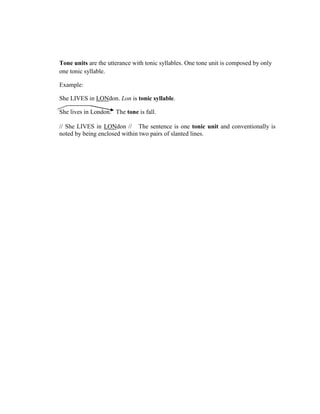
Tone units are the utterance with tonic syllables. One tone unit is composed by only one tonic syllable. 
Example: 
She LIVES in LONdon. Lon is tonic syllable. 
She lives in London. The tone is fall. 
// She LIVES in LONdon // The sentence is one tonic unit and conventionally is noted by being enclosed within two pairs of slanted lines.
UNIT 2 
BUILDING VOCABULARY 
Objective: 
Introducing the strategies of buildings vocabulary with its methods to make the students easier to learn. A. INTRODUCTION 
No English program is complete without a section on building vocabulary. Words are the building blocks of written and spoken communications. The more words you know, the easier it is to understand the messages you receive from others. A good vocabulary also means that you can say exactly what you mean when you send a message. This module presents strategies that will help you learn new words easily. Like any kind of learning, however, you will need to experiment with a variety of study techniques until you find the ones that work best for you and suit your learning style. B. WHAT IS VOCABULARY? 
The word vocabulary simply means a list of words. The vocabulary of the English language contains more than a million words, many of them scientific. About 200,000 of these are in common use. Words are being added to and dropped from the language all the time, so everyone needs to work to keep his/her vocabulary up-to- date. The invention of the computer has added many new words like byte, download, cursor, and internet. On the other hand, you never hear the word some (meaning
disgusting) although it was around for 500 years and can still be found in some unabridged dictionaries. 
Many people think that a good vocabulary means knowing lots of big, important-sounding words. Long, complicated words do have very important uses, but improving your vocabulary is much more than being able to scatter big words throughout your writing or speaking. The goal of any communication is to be understood. A good vocabulary makes it easy to write (or say) exactly what you mean and to understand what you read (or hear). A good writer or speaker communicates ideas, even complicated ones, in words that his/her particular audience will understand clearly. C. Understanding the Parts of Speech 
Parts of speech help you understand how a word should be used. The part of speech for each vocabulary word is identified using the following abbreviations: Noun = n. Verb = v. Adjective = adj. Adverb = adv. Preposition = prep. D. Definitions of the Parts of Speech 
Noun (n) 
A noun is a person, a place or a thing. 
Example: Tom ran to the store to buy chocolate.
Adjective (adj.) 
An adjective is a word used to describe a noun. 
Example: Little Tom ran to the corner store to buy white chocolate. 
Verb (v.) 
A verb is a word used to show an action. 
Example: Little Tom ran to the corner store to buy white chocolate. 
Adverb (adv.) 
An adverb is a word used to describe a verb. Example: Little Tom ran quickly to the corner store to buy white chocolate. 
Preposition (prep.) 
A preposition is a word that links nouns, pronouns and phrases to other words in a sentence. Example: Little Tom ran quickly to the corner store to buy white chocolate. 
E. Other Terms You Will Need to Know 
Synonym 
A synonym is a word that means the same as another word. 
Example: large is a synonym for big 
Example: tiny is a synonym for small
Antonym 
An antonym is a word that means the opposite of another word. 
Example: hot is an antonym for cold 
Example: on is an antonym for off 
Homonym 
A homonym is a word that sounds the same as another word but means something else and is sometimes spelled differently. 
Examples of common homonyms: 
•their (belonging to them) and there (in that place) 
•hear (to listen to something) and here (in this place) 
•to (toward), too (also), and two (the number 2) 
Anagram 
An anagram is a word or phrase that contains all the letters of another word orphrase but in a different order. 
Example: “post” is an anagram of “stop” 
Example: “astronomers” is an anagram of “no more stars” 
Analogy 
An analogy links two things that are related in some way. For example, an apple is like a ball because they are both round.
Word analogies compare two pairs of words. The second pair of words must be related in the same way that the first two words are related. For example, if the first pair of words are antonyms, the second pair of words must also be antonyms. 
Example: dark is to light as laugh is to cry (antonyms: dark and light are opposites and laugh and cry areopposites) 
Example: shoe is to foot as tire is to wheel (a shoe goes on a foot and a tire goes on a wheel) 
Example: post is to stop as drawer is to reward (anagrams: the same letters are used to spell each pair of words) F. UNDERSTANDING NEW WORD 
1. Ask Someone You Trust 
The first and easiest way to get information about new words, particularly if you hear them in conversation is to ask about the meaning. Usually, you will get a general definition or a synonym. This may be enough for you to understand the general idea, but you should probably make a point of checking it out for yourself before you add it to your list of words to learn. 
2. Use Context Clues 
When you are reading, looking up every unfamiliar word may make the task so difficult and boring that you lose interest in what you are doing. Sometimes, you can skip over a word you don‟t know because something else in the sentence (context) will give you a general idea of what it means. 
After he broke his ulna, he had to wear a sling to support his injured arm. Al’s lawyer checked the court docket to find the date of his client’s next appearance before the judge.
Paraffin, the British name for kerosene, can be extremely dangerous. At the hospital, she asked the radiologist to explain what her x-rays showed. 
What do the words in bold type in the sentences above mean? What clues did you use to make your guess? Are these words you need to add to your everyday vocabulary? 
3. Use a Good Dictionary 
A dictionary can really help you zero in on the exact meaning(s) of new words and how to use them correctly. 
1. If you have only read the word, you may need to find out how to pronounce it. Use the phonetic symbols and accent marks. 
2. Some words have multiple meanings. Each separate meaning is usually preceded by a number in bold type. Make sure you find the meaning that matches what you are reading. Be careful. Some words even have opposite meanings like bolt which can mean to fasten securely as in “He bolted the door.” or can mean to run away as in “The horse bolted from the barn when it smelled smoke.” 
3. Some dictionary entries offer a list of synonyms (words with similar meanings). Use these to help you create clearer idea about the word‟s meaning. 
4. Many dictionaries include phrases (or idioms) that show unusual uses of the word or suggest prepositions that follow it. For example, the first meaning of the verb dabble describes the action of a duck turning itself upside down in a pond to find food on the bottom. The ducks dabbled in the pond. Later, another entry shows (~ in the stock market) which means that people dabble in something if they do it irregularly or as a secondary6 interest. 
5. Good dictionaries also include brief explanations of “often confused” words.
4. Use a Thesaurus 
A thesaurus can often help you understand the meaning of a new word. Use the list of synonyms provided with each entry word to get a better idea of how and when to use the word. Thesauruses are also useful when you are needed to find the “right” word when you are writing. Never use a word found in a thesaurus without checking its meaning in a dictionary first. If you make a mistake and use it incorrectly, you will look very foolish. 
5. Ask Someone 
Everyone meets new words every day. There is nothing wrong with asking what a strange word means. This is an important strategy if you don‟t have a dictionary with you.. It‟s better to get an answer right away than risk a misunderstanding. As well, if you wait until you get home, you will probably have forgotten the word or else decided that it really wasn‟t that important anyway.
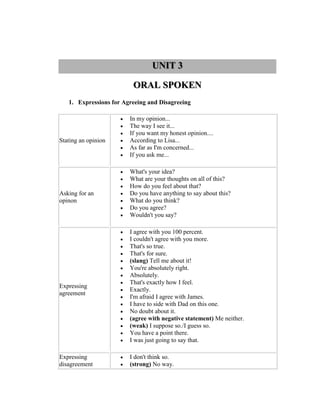
UNIT 3 ORAL SPOKEN 
1. Expressions for Agreeing and Disagreeing 
Stating an opinion 
 In my opinion... 
 The way I see it... 
 If you want my honest opinion.... 
 According to Lisa... 
 As far as I'm concerned... 
 If you ask me... 
Asking for an opinon 
 What's your idea? 
 What are your thoughts on all of this? 
 How do you feel about that? 
 Do you have anything to say about this? 
 What do you think? 
 Do you agree? 
 Wouldn't you say? 
Expressing agreement 
 I agree with you 100 percent. 
 I couldn't agree with you more. 
 That's so true. 
 That's for sure. 
 (slang) Tell me about it! 
 You're absolutely right. 
 Absolutely. 
 That's exactly how I feel. 
 Exactly. 
 I'm afraid I agree with James. 
 I have to side with Dad on this one. 
 No doubt about it. 
 (agree with negative statement) Me neither. 
 (weak) I suppose so./I guess so. 
 You have a point there. 
 I was just going to say that. 
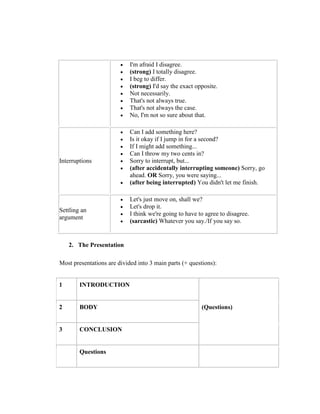
Expressing disagreement 
 I don't think so. 
 (strong) No way.
 I'm afraid I disagree. 
 (strong) I totally disagree. 
 I beg to differ. 
 (strong) I'd say the exact opposite. 
 Not necessarily. 
 That's not always true. 
 That's not always the case. 
 No, I'm not so sure about that. 
Interruptions 
 Can I add something here? 
 Is it okay if I jump in for a second? 
 If I might add something... 
 Can I throw my two cents in? 
 Sorry to interrupt, but... 
 (after accidentally interrupting someone) Sorry, go ahead. OR Sorry, you were saying... 
 (after being interrupted) You didn't let me finish. 
Settling an argument 
 Let's just move on, shall we? 
 Let's drop it. 
 I think we're going to have to agree to disagree. 
 (sarcastic) Whatever you say./If you say so. 
2. The Presentation 
Most presentations are divided into 3 main parts (+ questions): 
1 
INTRODUCTION 
(Questions) 
2 
BODY 
3 
CONCLUSION 
Questions
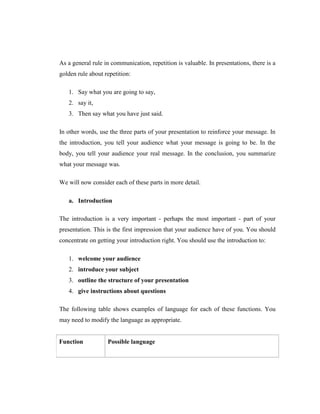
As a general rule in communication, repetition is valuable. In presentations, there is a golden rule about repetition: 
1. Say what you are going to say, 
2. say it, 
3. Then say what you have just said. 
In other words, use the three parts of your presentation to reinforce your message. In the introduction, you tell your audience what your message is going to be. In the body, you tell your audience your real message. In the conclusion, you summarize what your message was. 
We will now consider each of these parts in more detail. 
a. Introduction 
The introduction is a very important - perhaps the most important - part of your presentation. This is the first impression that your audience have of you. You should concentrate on getting your introduction right. You should use the introduction to: 
1. welcome your audience 
2. introduce your subject 
3. outline the structure of your presentation 
4. give instructions about questions 
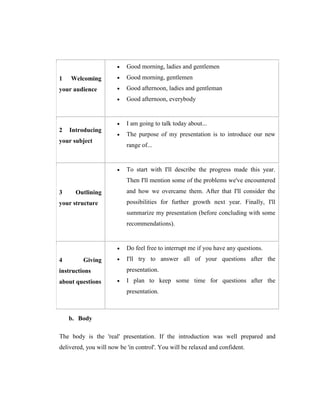
The following table shows examples of language for each of these functions. You may need to modify the language as appropriate. 
Function 
Possible language
1 Welcoming your audience 
 Good morning, ladies and gentlemen 
 Good morning, gentlemen 
 Good afternoon, ladies and gentleman 
 Good afternoon, everybody 
2 Introducing your subject 
 I am going to talk today about... 
 The purpose of my presentation is to introduce our new range of... 
3 Outlining your structure 
 To start with I'll describe the progress made this year. Then I'll mention some of the problems we've encountered and how we overcame them. After that I'll consider the possibilities for further growth next year. Finally, I'll summarize my presentation (before concluding with some recommendations). 
4 Giving instructions about questions 
 Do feel free to interrupt me if you have any questions. 
 I'll try to answer all of your questions after the presentation. 
 I plan to keep some time for questions after the presentation. 
b. Body 
The body is the 'real' presentation. If the introduction was well prepared and delivered, you will now be 'in control'. You will be relaxed and confident.
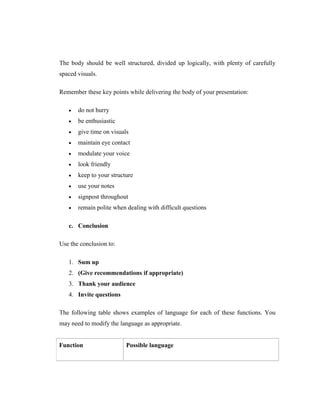
The body should be well structured, divided up logically, with plenty of carefully spaced visuals. 
Remember these key points while delivering the body of your presentation: 
 do not hurry 
 be enthusiastic 
 give time on visuals 
 maintain eye contact 
 modulate your voice 
 look friendly 
 keep to your structure 
 use your notes 
 signpost throughout 
 remain polite when dealing with difficult questions 
c. Conclusion 
Use the conclusion to: 
1. Sum up 
2. (Give recommendations if appropriate) 
3. Thank your audience 
4. Invite questions 
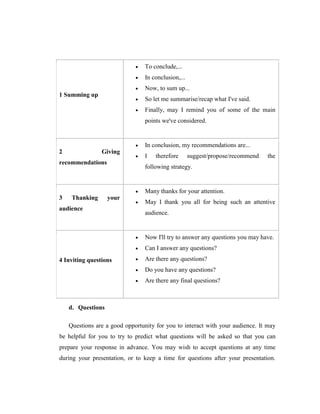
The following table shows examples of language for each of these functions. You may need to modify the language as appropriate. 
Function 
Possible language
1 Summing up 
 To conclude,... 
 In conclusion,... 
 Now, to sum up... 
 So let me summarise/recap what I've said. 
 Finally, may I remind you of some of the main points we've considered. 
2 Giving recommendations 
 In conclusion, my recommendations are... 
 I therefore suggest/propose/recommend the following strategy. 
3 Thanking your audience 
 Many thanks for your attention. 
 May I thank you all for being such an attentive audience. 
4 Inviting questions 
 Now I'll try to answer any questions you may have. 
 Can I answer any questions? 
 Are there any questions? 
 Do you have any questions? 
 Are there any final questions? 
d. Questions 
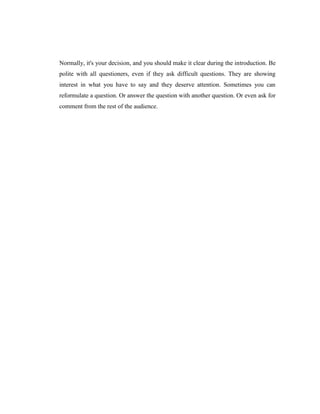
Questions are a good opportunity for you to interact with your audience. It may be helpful for you to try to predict what questions will be asked so that you can prepare your response in advance. You may wish to accept questions at any time during your presentation, or to keep a time for questions after your presentation.
Normally, it's your decision, and you should make it clear during the introduction. Be polite with all questioners, even if they ask difficult questions. They are showing interest in what you have to say and they deserve attention. Sometimes you can reformulate a question. Or answer the question with another question. Or even ask for comment from the rest of the audience.

English module for intermediate students

  • 1.
    ENGLISH MODULE Submittedto fulfill the project work of Philosophical Basic of ESP By: Akbar Fauzan NIM: 1210204006 ENGLISH EDUCATION DEPARTMENT FACULTY OF TARBIYAH AND TEACHER TRAINING STATE ISLAMIC UNIVERSITY SUNAN GUNUNG DJATI BANDUNG 2014
  • 2.
    INRODUCTION This moduleis aimed at helping students in the intermediate level. English teachers promote effective speaking in their classrooms by engaging their students in communicative activities to develop oral proficiency. The module aims to develop students‟ confidence in using English in various communication situations, both formal and informal. The ability to speak English effortlessly in a variety of situations requires good pronunciation, a wide range of vocabulary, grammatical accuracy and also the knowledge of what to say to whom and when. In short, proficiency in speaking includes knowledge not only of the language but also social and cultural norms, and the ability to respond appropriately in a variety of situations. This module contains a range of activities for the teacher to use in the classrooms to encourage students to speak effectively and with confidence. The activities are mainly designed around shared experiences, to be done in pairs and groups so that students learn to respond spontaneously in any communication situation. A. The objectives of this module are to:  Enable teachers to help their students develop the ability to speak  English effectively and with confidence;  Help teachers develop activities to encourage students to express  Themselves fluently using appropriate grammar, vocabulary and  Pronunciation;
  • 3.
     Enable teachersto help students organize their ideas logically and to  Present them appropriately in various communication situations;  Help teachers make their students understand the importance of  Performing language functions in English such as requesting, greeting,  Clarifying, apologizing, inviting and so on; and  Encourage English teachers to collaborate with teachers of other  Subjects to develop students‟ academic skills such as oral  Presentations, extempore speech, debate, etc. B. After Completing this module, you will be able to:  Teach students how to express themselves effectively using appropriate grammar, vocabulary and pronunciation;  Show students how to describe people, events and objects appropriately in English;  Teach students how to perform common language functions in social situations, such as making a request, asking for clarifications, giving and accepting invitations and so on; and  Help students develop their oral skills for academic purposes (making presentations, participating in debates, extempore speech, group discussions and so on).
  • 4.
    UNIT 1 Introductionto Discourse and Intonation Objective: Introducing the concept of discourse and intonation with its aspects A. Why is Sound Discrimination Important? But what is this skill, and why is it so important? Listening for sounds and telling the difference between one and the other is called sound discrimination. Sound discrimination is very important to early readers and writers, because when a child wants to write the words “pig” or “bat,” it will be very important to be able to identify all of the sounds in those words. Otherwise, reading and writing small words like these will be impossible without memorizing every what every single word looks like, right down to the last letter. Imagine trying to write long words such as “encyclopedia” without being able to separate that word into syllables in your head as you write it down! You would be relying only on memory to spell these long words, and might forget a letter or two. Kids that learn to listen for and distinguish between each syllable and letter sound in the words that they read have a much better chance of reading and writing well than those that do not. In addition, rhyming is a foundational skill for language arts, and depends entirely on sound discrimination. Phonics in general is also highly dependent on sound discrimination skills as well. B. Intonation in Discourse The term intonation refers to the way the voice goes up and down in pitch when we are speaking. Intonation is considered a fundamental part of the way we express our own thoughts and enables us to understand the other people‟s thoughts
  • 5.
    when they talkto us. Intonation enables us to know the speaker‟s attitude and how she/he feels about what she/he is saying. Discourse is any meaningful stretch of language. If we analyze intonation in discourse, it means that we analyze intonation in a wider context of conversation or monologue; we see how intonation conveys ideas and information. Here is the guidance related to intonation: 1. Information questions with Who, what, where, etc.  Falling intonation (if being asked for the first time), e.g. What’s your name? What’s the time? Where do you live? 2. Questions expecting a „yes/no‟ answer  Rising (Is it the blue one? Have you got a pen?) 3. Statements  Falling (He lives in the house on the corner. It’s over there.) 4. Imperatives  Falling (Sit down. Put it on the table.) 5. Question tags expecting confirmation  Falling (You’re French, aren’t you? He’s very tall, isn’t he?) 6. Question tags showing less certainty  Rising (You’re French, aren’t you? Your train leaves at six, doesn’t it?) 7. Lists of items  Rising, rising and finally falling (You need a pen, a pencil and some paper. The stall sells ribbon, bead, elastic and buttons.) C.Tones, Tonic Syllables and Tone Units Tones is the main movements of pitch, within a tone unit. Tonic syllables are the syllables where the main pitch movement in the utterance occurs. Tonic syllable is the last stressed syllable in a tone unit.
  • 6.
    Tone units arethe utterance with tonic syllables. One tone unit is composed by only one tonic syllable. Example: She LIVES in LONdon. Lon is tonic syllable. She lives in London. The tone is fall. // She LIVES in LONdon // The sentence is one tonic unit and conventionally is noted by being enclosed within two pairs of slanted lines.
  • 7.
    UNIT 2 BUILDINGVOCABULARY Objective: Introducing the strategies of buildings vocabulary with its methods to make the students easier to learn. A. INTRODUCTION No English program is complete without a section on building vocabulary. Words are the building blocks of written and spoken communications. The more words you know, the easier it is to understand the messages you receive from others. A good vocabulary also means that you can say exactly what you mean when you send a message. This module presents strategies that will help you learn new words easily. Like any kind of learning, however, you will need to experiment with a variety of study techniques until you find the ones that work best for you and suit your learning style. B. WHAT IS VOCABULARY? The word vocabulary simply means a list of words. The vocabulary of the English language contains more than a million words, many of them scientific. About 200,000 of these are in common use. Words are being added to and dropped from the language all the time, so everyone needs to work to keep his/her vocabulary up-to- date. The invention of the computer has added many new words like byte, download, cursor, and internet. On the other hand, you never hear the word some (meaning
  • 8.
    disgusting) although itwas around for 500 years and can still be found in some unabridged dictionaries. Many people think that a good vocabulary means knowing lots of big, important-sounding words. Long, complicated words do have very important uses, but improving your vocabulary is much more than being able to scatter big words throughout your writing or speaking. The goal of any communication is to be understood. A good vocabulary makes it easy to write (or say) exactly what you mean and to understand what you read (or hear). A good writer or speaker communicates ideas, even complicated ones, in words that his/her particular audience will understand clearly. C. Understanding the Parts of Speech Parts of speech help you understand how a word should be used. The part of speech for each vocabulary word is identified using the following abbreviations: Noun = n. Verb = v. Adjective = adj. Adverb = adv. Preposition = prep. D. Definitions of the Parts of Speech Noun (n) A noun is a person, a place or a thing. Example: Tom ran to the store to buy chocolate.
  • 9.
    Adjective (adj.) Anadjective is a word used to describe a noun. Example: Little Tom ran to the corner store to buy white chocolate. Verb (v.) A verb is a word used to show an action. Example: Little Tom ran to the corner store to buy white chocolate. Adverb (adv.) An adverb is a word used to describe a verb. Example: Little Tom ran quickly to the corner store to buy white chocolate. Preposition (prep.) A preposition is a word that links nouns, pronouns and phrases to other words in a sentence. Example: Little Tom ran quickly to the corner store to buy white chocolate. E. Other Terms You Will Need to Know Synonym A synonym is a word that means the same as another word. Example: large is a synonym for big Example: tiny is a synonym for small
  • 10.
    Antonym An antonymis a word that means the opposite of another word. Example: hot is an antonym for cold Example: on is an antonym for off Homonym A homonym is a word that sounds the same as another word but means something else and is sometimes spelled differently. Examples of common homonyms: •their (belonging to them) and there (in that place) •hear (to listen to something) and here (in this place) •to (toward), too (also), and two (the number 2) Anagram An anagram is a word or phrase that contains all the letters of another word orphrase but in a different order. Example: “post” is an anagram of “stop” Example: “astronomers” is an anagram of “no more stars” Analogy An analogy links two things that are related in some way. For example, an apple is like a ball because they are both round.
  • 11.
    Word analogies comparetwo pairs of words. The second pair of words must be related in the same way that the first two words are related. For example, if the first pair of words are antonyms, the second pair of words must also be antonyms. Example: dark is to light as laugh is to cry (antonyms: dark and light are opposites and laugh and cry areopposites) Example: shoe is to foot as tire is to wheel (a shoe goes on a foot and a tire goes on a wheel) Example: post is to stop as drawer is to reward (anagrams: the same letters are used to spell each pair of words) F. UNDERSTANDING NEW WORD 1. Ask Someone You Trust The first and easiest way to get information about new words, particularly if you hear them in conversation is to ask about the meaning. Usually, you will get a general definition or a synonym. This may be enough for you to understand the general idea, but you should probably make a point of checking it out for yourself before you add it to your list of words to learn. 2. Use Context Clues When you are reading, looking up every unfamiliar word may make the task so difficult and boring that you lose interest in what you are doing. Sometimes, you can skip over a word you don‟t know because something else in the sentence (context) will give you a general idea of what it means. After he broke his ulna, he had to wear a sling to support his injured arm. Al’s lawyer checked the court docket to find the date of his client’s next appearance before the judge.
  • 12.
    Paraffin, the Britishname for kerosene, can be extremely dangerous. At the hospital, she asked the radiologist to explain what her x-rays showed. What do the words in bold type in the sentences above mean? What clues did you use to make your guess? Are these words you need to add to your everyday vocabulary? 3. Use a Good Dictionary A dictionary can really help you zero in on the exact meaning(s) of new words and how to use them correctly. 1. If you have only read the word, you may need to find out how to pronounce it. Use the phonetic symbols and accent marks. 2. Some words have multiple meanings. Each separate meaning is usually preceded by a number in bold type. Make sure you find the meaning that matches what you are reading. Be careful. Some words even have opposite meanings like bolt which can mean to fasten securely as in “He bolted the door.” or can mean to run away as in “The horse bolted from the barn when it smelled smoke.” 3. Some dictionary entries offer a list of synonyms (words with similar meanings). Use these to help you create clearer idea about the word‟s meaning. 4. Many dictionaries include phrases (or idioms) that show unusual uses of the word or suggest prepositions that follow it. For example, the first meaning of the verb dabble describes the action of a duck turning itself upside down in a pond to find food on the bottom. The ducks dabbled in the pond. Later, another entry shows (~ in the stock market) which means that people dabble in something if they do it irregularly or as a secondary6 interest. 5. Good dictionaries also include brief explanations of “often confused” words.
  • 13.
    4. Use aThesaurus A thesaurus can often help you understand the meaning of a new word. Use the list of synonyms provided with each entry word to get a better idea of how and when to use the word. Thesauruses are also useful when you are needed to find the “right” word when you are writing. Never use a word found in a thesaurus without checking its meaning in a dictionary first. If you make a mistake and use it incorrectly, you will look very foolish. 5. Ask Someone Everyone meets new words every day. There is nothing wrong with asking what a strange word means. This is an important strategy if you don‟t have a dictionary with you.. It‟s better to get an answer right away than risk a misunderstanding. As well, if you wait until you get home, you will probably have forgotten the word or else decided that it really wasn‟t that important anyway.
  • 14.
    UNIT 3 ORALSPOKEN 1. Expressions for Agreeing and Disagreeing Stating an opinion  In my opinion...  The way I see it...  If you want my honest opinion....  According to Lisa...  As far as I'm concerned...  If you ask me... Asking for an opinon  What's your idea?  What are your thoughts on all of this?  How do you feel about that?  Do you have anything to say about this?  What do you think?  Do you agree?  Wouldn't you say? Expressing agreement  I agree with you 100 percent.  I couldn't agree with you more.  That's so true.  That's for sure.  (slang) Tell me about it!  You're absolutely right.  Absolutely.  That's exactly how I feel.  Exactly.  I'm afraid I agree with James.  I have to side with Dad on this one.  No doubt about it.  (agree with negative statement) Me neither.  (weak) I suppose so./I guess so.  You have a point there.  I was just going to say that. Expressing disagreement  I don't think so.  (strong) No way.
  • 15.
     I'm afraidI disagree.  (strong) I totally disagree.  I beg to differ.  (strong) I'd say the exact opposite.  Not necessarily.  That's not always true.  That's not always the case.  No, I'm not so sure about that. Interruptions  Can I add something here?  Is it okay if I jump in for a second?  If I might add something...  Can I throw my two cents in?  Sorry to interrupt, but...  (after accidentally interrupting someone) Sorry, go ahead. OR Sorry, you were saying...  (after being interrupted) You didn't let me finish. Settling an argument  Let's just move on, shall we?  Let's drop it.  I think we're going to have to agree to disagree.  (sarcastic) Whatever you say./If you say so. 2. The Presentation Most presentations are divided into 3 main parts (+ questions): 1 INTRODUCTION (Questions) 2 BODY 3 CONCLUSION Questions
  • 16.
    As a generalrule in communication, repetition is valuable. In presentations, there is a golden rule about repetition: 1. Say what you are going to say, 2. say it, 3. Then say what you have just said. In other words, use the three parts of your presentation to reinforce your message. In the introduction, you tell your audience what your message is going to be. In the body, you tell your audience your real message. In the conclusion, you summarize what your message was. We will now consider each of these parts in more detail. a. Introduction The introduction is a very important - perhaps the most important - part of your presentation. This is the first impression that your audience have of you. You should concentrate on getting your introduction right. You should use the introduction to: 1. welcome your audience 2. introduce your subject 3. outline the structure of your presentation 4. give instructions about questions The following table shows examples of language for each of these functions. You may need to modify the language as appropriate. Function Possible language
  • 17.
    1 Welcoming youraudience  Good morning, ladies and gentlemen  Good morning, gentlemen  Good afternoon, ladies and gentleman  Good afternoon, everybody 2 Introducing your subject  I am going to talk today about...  The purpose of my presentation is to introduce our new range of... 3 Outlining your structure  To start with I'll describe the progress made this year. Then I'll mention some of the problems we've encountered and how we overcame them. After that I'll consider the possibilities for further growth next year. Finally, I'll summarize my presentation (before concluding with some recommendations). 4 Giving instructions about questions  Do feel free to interrupt me if you have any questions.  I'll try to answer all of your questions after the presentation.  I plan to keep some time for questions after the presentation. b. Body The body is the 'real' presentation. If the introduction was well prepared and delivered, you will now be 'in control'. You will be relaxed and confident.
  • 18.
    The body shouldbe well structured, divided up logically, with plenty of carefully spaced visuals. Remember these key points while delivering the body of your presentation:  do not hurry  be enthusiastic  give time on visuals  maintain eye contact  modulate your voice  look friendly  keep to your structure  use your notes  signpost throughout  remain polite when dealing with difficult questions c. Conclusion Use the conclusion to: 1. Sum up 2. (Give recommendations if appropriate) 3. Thank your audience 4. Invite questions The following table shows examples of language for each of these functions. You may need to modify the language as appropriate. Function Possible language
  • 19.
    1 Summing up  To conclude,...  In conclusion,...  Now, to sum up...  So let me summarise/recap what I've said.  Finally, may I remind you of some of the main points we've considered. 2 Giving recommendations  In conclusion, my recommendations are...  I therefore suggest/propose/recommend the following strategy. 3 Thanking your audience  Many thanks for your attention.  May I thank you all for being such an attentive audience. 4 Inviting questions  Now I'll try to answer any questions you may have.  Can I answer any questions?  Are there any questions?  Do you have any questions?  Are there any final questions? d. Questions Questions are a good opportunity for you to interact with your audience. It may be helpful for you to try to predict what questions will be asked so that you can prepare your response in advance. You may wish to accept questions at any time during your presentation, or to keep a time for questions after your presentation.
  • 20.
    Normally, it's yourdecision, and you should make it clear during the introduction. Be polite with all questioners, even if they ask difficult questions. They are showing interest in what you have to say and they deserve attention. Sometimes you can reformulate a question. Or answer the question with another question. Or even ask for comment from the rest of the audience.