LENGTH
I.D.
PROJECTED AREA
BEARING
HYDRAULIC
RAM
METAL CAP
THORPLAS
BEARING
25° LEAD-IN
CHAMBER
25 mm
CHAMFER AT
LEADING EDGE OF
THE HOUSING
BEARING I.D.
R7
R3
A
A
R7(TYP)
“B” GROOVES
EQ. SPACED
R“C”(TYP) ØA
ØA + (2*C)
Thordon Elastomeric Bearings
ENGINEERING MANUAL
Version: 2022.1
SYMBOLS AND UNITS
Units
Metric Imperial
Ct = Thermal Expansion Allowance mm inches
Cs = Absorption Allowance mm inches
d = Shaft Diameter mm inches
Eo = Modulus of Elasticity MPa psi
I.D. = Inside Diameter of Bearing mm inches
O.D. = Outside Diameter of Bearing mm inches
L = Length of Bearing mm inches
N = Shaft Speed R.P.M. R.P.M.
P = Pressure MPa psi
Ta =
Machine Shop Ambient Temperature
(Nominally 21°C (70°F))
°C °F
To = Operating Temperature °C °F
W.T. = Wall Thickness of Bearing mm inches
α = Coefficient of Thermal Expansion °C-1
°F-1
µ = Coefficient of Friction - -
V = Velocity m/sec. ft./min.
𝛄 = Poisson’s Ratio
FREEZE FIT COOLANT TEMPERATURES
Dry Ice: -78°C (-109°F)
Liquid Nitrogen: -196°C (-320°F)
Note: All clearances referred to in this manual are diametrical clearances.
METRIC CONVERSION TABLE
• Length
		 1 Metre (m)	 =	 39.37 Inches (in.)
		 1 Millimetre (mm)	 =	 0.03937 Inches (in.)
• Mass
		 1 Kilogram (kg)	 =	 2.205 lbs.
• Force
		 1 Newton (N)	 =	 0.2248 lbs.
• Pressure
	 *	 1 kg/cm2
	 =	 14.223 psi (lbs./in.2
)
	 **	 1 Mega Pascal (MPa)	=	 145 psi (lbs./in.2
)
		1 N/mm2
	 =	 145 psi (lbs./in.2
) = 1MPa
		 1 MPa	 =	 10.197 kgf/cm2
		 1 Bar	 =	 1.0197 kgf/cm2
		 1 Mega Pascal (MPa)	=	 10 Bar
	 *	Kilo	 =	1,000
	 **	Mega	 =	1,000,000
OTHER THORDON TECHNICAL
INFORMATION AVAILABLE
a.	Thordon Marine Bearing Installation Manual
b.	ThorPlas®
Bearings Engineering Manual
Please contact your local Thordon Distributor or
Thordon Bearings Inc. if you require any of the above.
APPROXIMATE COMPARISON OF
VARIOUS HARDNESS SCALES
INDEX
1.	 THORDON DEFINITION . . . . . . . . . . . . . . . . . . . . . . . . . . . . . . . . . . . . . . . . . . . . . . . . . . . . . . . . . . . . . . . . . . . . . . . . . . . . . . . . . . . . 1
2.	 TRIBOLOGY
	 a)	Friction . . . . . . . . . . . . . . . . . . . . . . . . . . . . . . . . . . . . . . . . . . . . . . . . . . . . . . . . . . . . . . . . . . . . . . . . . . . . . . . . . . . . . . . . . . . . . . . . . . . . .2
	 b)	Lubrication . . . . . . . . . . . . . . . . . . . . . . . . . . . . . . . . . . . . . . . . . . . . . . . . . . . . . . . . . . . . . . . . . . . . . . . . . . . . . . . . . . . . . . . . . . . . . . . . . 2
	 c)	Wear . . . . . . . . . . . . . . . . . . . . . . . . . . . . . . . . . . . . . . . . . . . . . . . . . . . . . . . . . . . . . . . . . . . . . . . . . . . . . . . . . . . . . . . . . . . . . . . . . . . . . . 4
3.	 PHYSICAL PROPERTIES
	 a)	 Thermal Effects . . . . . . . . . . . . . . . . . . . . . . . . . . . . . . . . . . . . . . . . . . . . . . . . . . . . . . . . . . . . . . . . . . . . . . . . . . . . . . . . . . . . . . . . . . . . . . 6
	 b)	 Effect of Water or Oil  . . . . . . . . . . . . . . . . . . . . . . . . . . . . . . . . . . . . . . . . . . . . . . . . . . . . . . . . . . . . . . . . . . . . . . . . . . . . . . . . . . . . . . . . 7
	 c)	 Shape Factor . . . . . . . . . . . . . . . . . . . . . . . . . . . . . . . . . . . . . . . . . . . . . . . . . . . . . . . . . . . . . . . . . . . . . . . . . . . . . . . . . . . . . . . . . . . . . . . 7
	 d)	 Stress Strain  . . . . . . . . . . . . . . . . . . . . . . . . . . . . . . . . . . . . . . . . . . . . . . . . . . . . . . . . . . . . . . . . . . . . . . . . . . . . . . . . . . . . . . . . . . . . . . . . 8
	 e)	Stiffness . . . . . . . . . . . . . . . . . . . . . . . . . . . . . . . . . . . . . . . . . . . . . . . . . . . . . . . . . . . . . . . . . . . . . . . . . . . . . . . . . . . . . . . . . . . . . . . . . . . . 8
	 f)	 Compression Set, Creep, and Stress Relaxation . . . . . . . . . . . . . . . . . . . . . . . . . . . . . . . . . . . . . . . . . . . . . . . . . . . . . . . . . . . . . . . . . . . 9
	 g)	Shear . . . . . . . . . . . . . . . . . . . . . . . . . . . . . . . . . . . . . . . . . . . . . . . . . . . . . . . . . . . . . . . . . . . . . . . . . . . . . . . . . . . . . . . . . . . . . . . . . . . . . 10
	 h)	Impact/Resilience . . . . . . . . . . . . . . . . . . . . . . . . . . . . . . . . . . . . . . . . . . . . . . . . . . . . . . . . . . . . . . . . . . . . . . . . . . . . . . . . . . . . . . . . . . 10
	 i)	Hysteresis . . . . . . . . . . . . . . . . . . . . . . . . . . . . . . . . . . . . . . . . . . . . . . . . . . . . . . . . . . . . . . . . . . . . . . . . . . . . . . . . . . . . . . . . . . . . . . . . . 10
	 j)	 Chemical Resistance . . . . . . . . . . . . . . . . . . . . . . . . . . . . . . . . . . . . . . . . . . . . . . . . . . . . . . . . . . . . . . . . . . . . . . . . . . . . . . . . . . . . . . . . 10
	 k)	 Typical Physical Properties . . . . . . . . . . . . . . . . . . . . . . . . . . . . . . . . . . . . . . . . . . . . . . . . . . . . . . . . . . . . . . . . . . . . . . . . . . . . . . . . . . . 11
4.	 DESIGN GUIDE
	 a)	 Application Analysis . . . . . . . . . . . . . . . . . . . . . . . . . . . . . . . . . . . . . . . . . . . . . . . . . . . . . . . . . . . . . . . . . . . . . . . . . . . . . . . . . . . . . . . . 12
	 b)	 Bearing Pressure  . . . . . . . . . . . . . . . . . . . . . . . . . . . . . . . . . . . . . . . . . . . . . . . . . . . . . . . . . . . . . . . . . . . . . . . . . . . . . . . . . . . . . . . . . . . 12
	 c)	Velocity . . . . . . . . . . . . . . . . . . . . . . . . . . . . . . . . . . . . . . . . . . . . . . . . . . . . . . . . . . . . . . . . . . . . . . . . . . . . . . . . . . . . . . . . . . . . . . . . . . . 12
	 d)	 PVT Graphs . . . . . . . . . . . . . . . . . . . . . . . . . . . . . . . . . . . . . . . . . . . . . . . . . . . . . . . . . . . . . . . . . . . . . . . . . . . . . . . . . . . . . . . . . . . . . . . 13
	 e)	 Length/Diameter (L/D) Ratio . . . . . . . . . . . . . . . . . . . . . . . . . . . . . . . . . . . . . . . . . . . . . . . . . . . . . . . . . . . . . . . . . . . . . . . . . . . . . . . . . 17
	 f)	 Wall Thickness . . . . . . . . . . . . . . . . . . . . . . . . . . . . . . . . . . . . . . . . . . . . . . . . . . . . . . . . . . . . . . . . . . . . . . . . . . . . . . . . . . . . . . . . . . . . . 17
	 g)	 Lubrication Grooves  . . . . . . . . . . . . . . . . . . . . . . . . . . . . . . . . . . . . . . . . . . . . . . . . . . . . . . . . . . . . . . . . . . . . . . . . . . . . . . . . . . . . . . . . 18
	 h)	 Mating Surface  . . . . . . . . . . . . . . . . . . . . . . . . . . . . . . . . . . . . . . . . . . . . . . . . . . . . . . . . . . . . . . . . . . . . . . . . . . . . . . . . . . . . . . . . . . . . 19
	 i)	Fitting . . . . . . . . . . . . . . . . . . . . . . . . . . . . . . . . . . . . . . . . . . . . . . . . . . . . . . . . . . . . . . . . . . . . . . . . . . . . . . . . . . . . . . . . . . . . . . . . . . . . . 19
	 j)	 Minimizing Initial Installed Clearance . . . . . . . . . . . . . . . . . . . . . . . . . . . . . . . . . . . . . . . . . . . . . . . . . . . . . . . . . . . . . . . . . . . . . . . . . . 22
	 k)	 Material Selection Process . . . . . . . . . . . . . . . . . . . . . . . . . . . . . . . . . . . . . . . . . . . . . . . . . . . . . . . . . . . . . . . . . . . . . . . . . . . . . . . . . . . 23
	 l)	 Problems and Causes of Bearing Failure . . . . . . . . . . . . . . . . . . . . . . . . . . . . . . . . . . . . . . . . . . . . . . . . . . . . . . . . . . . . . . . . . . . . . . . . 26
5.	 APPLICATION DESIGN
	 a)	 Application Design  . . . . . . . . . . . . . . . . . . . . . . . . . . . . . . . . . . . . . . . . . . . . . . . . . . . . . . . . . . . . . . . . . . . . . . . . . . . . . . . . . . . . . . . . . 27
	 b)	Interference  . . . . . . . . . . . . . . . . . . . . . . . . . . . . . . . . . . . . . . . . . . . . . . . . . . . . . . . . . . . . . . . . . . . . . . . . . . . . . . . . . . . . . . . . . . . . . . . 27
	 c)	Bonding . . . . . . . . . . . . . . . . . . . . . . . . . . . . . . . . . . . . . . . . . . . . . . . . . . . . . . . . . . . . . . . . . . . . . . . . . . . . . . . . . . . . . . . . . . . . . . . . . . . 30
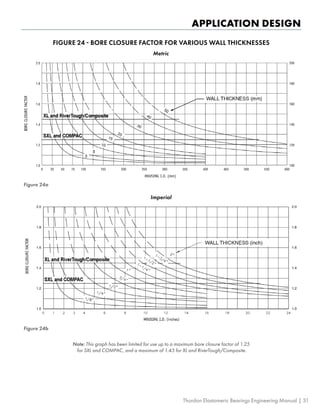
	 d)	 Bore Closure . . . . . . . . . . . . . . . . . . . . . . . . . . . . . . . . . . . . . . . . . . . . . . . . . . . . . . . . . . . . . . . . . . . . . . . . . . . . . . . . . . . . . . . . . . . . . . . 30
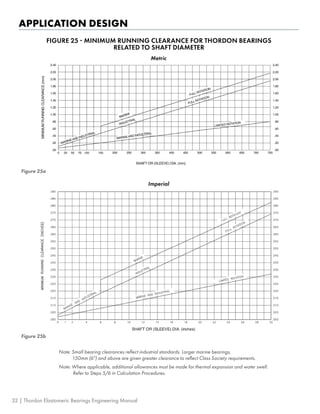
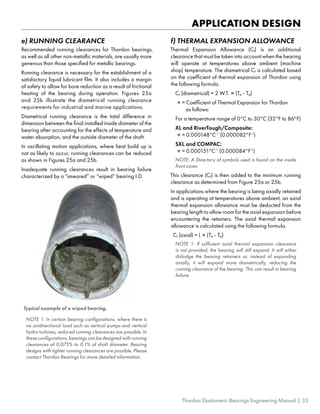
	 e)	 Running Clearance  . . . . . . . . . . . . . . . . . . . . . . . . . . . . . . . . . . . . . . . . . . . . . . . . . . . . . . . . . . . . . . . . . . . . . . . . . . . . . . . . . . . . . . . . . 33
	 f)	 Thermal Expansion Allowance . . . . . . . . . . . . . . . . . . . . . . . . . . . . . . . . . . . . . . . . . . . . . . . . . . . . . . . . . . . . . . . . . . . . . . . . . . . . . . . . 33
	 g)	 Absorption Allowance . . . . . . . . . . . . . . . . . . . . . . . . . . . . . . . . . . . . . . . . . . . . . . . . . . . . . . . . . . . . . . . . . . . . . . . . . . . . . . . . . . . . . . . 34
	 h)	 Minimum Installed Clearance . . . . . . . . . . . . . . . . . . . . . . . . . . . . . . . . . . . . . . . . . . . . . . . . . . . . . . . . . . . . . . . . . . . . . . . . . . . . . . . . . 34
	 i)	 Using the Thordon Bearing Sizing Calculation Program . . . . . . . . . . . . . . . . . . . . . . . . . . . . . . . . . . . . . . . . . . . . . . . . . . . . . . . . . . . 35
	 j)	 Keyed Tubular Bearing Calculations . . . . . . . . . . . . . . . . . . . . . . . . . . . . . . . . . . . . . . . . . . . . . . . . . . . . . . . . . . . . . . . . . . . . . . . . . . . 37
	 k)	 High Pressure Bearings . . . . . . . . . . . . . . . . . . . . . . . . . . . . . . . . . . . . . . . . . . . . . . . . . . . . . . . . . . . . . . . . . . . . . . . . . . . . . . . . . . . . . . 37
	 l)	 Vertical Pump Bearings: Dry Start-up . . . . . . . . . . . . . . . . . . . . . . . . . . . . . . . . . . . . . . . . . . . . . . . . . . . . . . . . . . . . . . . . . . . . . . . . . . . 38
6.	 MACHINING & MEASURING
	 a)	 General Machining . . . . . . . . . . . . . . . . . . . . . . . . . . . . . . . . . . . . . . . . . . . . . . . . . . . . . . . . . . . . . . . . . . . . . . . . . . . . . . . . . . . . . . . . . 39
	 b)	 Machining XL, SXL or COMPAC . . . . . . . . . . . . . . . . . . . . . . . . . . . . . . . . . . . . . . . . . . . . . . . . . . . . . . . . . . . . . . . . . . . . . . . . . . . . . . . 40
	 c)	 Machining RiverTough/Composite  . . . . . . . . . . . . . . . . . . . . . . . . . . . . . . . . . . . . . . . . . . . . . . . . . . . . . . . . . . . . . . . . . . . . . . . . . . . . 45
	 d)	 Splitting Thordon Bearings . . . . . . . . . . . . . . . . . . . . . . . . . . . . . . . . . . . . . . . . . . . . . . . . . . . . . . . . . . . . . . . . . . . . . . . . . . . . . . . . . . . 46
	 e)	 Dimensional and Surface Finish Measurements . . . . . . . . . . . . . . . . . . . . . . . . . . . . . . . . . . . . . . . . . . . . . . . . . . . . . . . . . . . . . . . . . . 49
7.	 BONDING with TG-75
	 a)	 Surface Preparation . . . . . . . . . . . . . . . . . . . . . . . . . . . . . . . . . . . . . . . . . . . . . . . . . . . . . . . . . . . . . . . . . . . . . . . . . . . . . . . . . . . . . . . . . 51
	 b)	 Mixing Adhesive Components . . . . . . . . . . . . . . . . . . . . . . . . . . . . . . . . . . . . . . . . . . . . . . . . . . . . . . . . . . . . . . . . . . . . . . . . . . . . . . . . 51
	 c)	 Adhesive Curing . . . . . . . . . . . . . . . . . . . . . . . . . . . . . . . . . . . . . . . . . . . . . . . . . . . . . . . . . . . . . . . . . . . . . . . . . . . . . . . . . . . . . . . . . . . . 53
	 d)	 Adhesive Application  . . . . . . . . . . . . . . . . . . . . . . . . . . . . . . . . . . . . . . . . . . . . . . . . . . . . . . . . . . . . . . . . . . . . . . . . . . . . . . . . . . . . . . . 53
	 e)	Troubleshooting . . . . . . . . . . . . . . . . . . . . . . . . . . . . . . . . . . . . . . . . . . . . . . . . . . . . . . . . . . . . . . . . . . . . . . . . . . . . . . . . . . . . . . . . . . . . 54
	 f)	 Clean Up  . . . . . . . . . . . . . . . . . . . . . . . . . . . . . . . . . . . . . . . . . . . . . . . . . . . . . . . . . . . . . . . . . . . . . . . . . . . . . . . . . . . . . . . . . . . . . . . . . 54
	 g)	Storage . . . . . . . . . . . . . . . . . . . . . . . . . . . . . . . . . . . . . . . . . . . . . . . . . . . . . . . . . . . . . . . . . . . . . . . . . . . . . . . . . . . . . . . . . . . . . . . . . . . 54
THORDON DEFINITION
Thordon elastomeric bearing material is made from
thermosetting resins which are three dimensional,
crosslinked condensation polymers. Thordon elastomeric
bearing materials are very hard, tough synthetic polymers
that have performance characteristics superior to those
of most other bearing materials, both metallic and
non-metallic. Thordon elastomeric bearing materials
perform particularly well, compared to other materials, in
applications where they are exposed to, or submerged in,
water, in extremely dirty environmental conditions, and
in applications where shock loading is a factor. There
are two basic reasons for this superior performance. First,
Thordon elastomeric bearing materials return to their
original shape after being compressed or deformed under
normal operating conditions. Second, due to the basic
characteristics of the material, Thordon elastomeric bearing
materials have a high natural resistance to abrasion. These
two characteristics result in exceptional performance and
long life in a number of difficult and dirty environmental
conditions in both marine and industrial applications.
Thordon Bearings produces several bearing grades that
offer specific operating advantages in different applications.
The grade and colour are noted as follows:
•	XL (black)
•	SXL (off-white)
•	SXL TRAXL (SXL bonded in a metallic shell)
•	COMPAC (orange)
•	RiverTough/Composite (yellow outer shell,
black inner shell - known as GM2401)
•	HPSXL (grey)
•	HPSXL TRAXL (HPSXL bonded in a metallic shell)
•	ThorPlas-Blue: covered in
ThorPlas Bearings Engineering Manual
•	ThorPlas-White: covered in
ThorPlas Bearings Engineering Manual
•	Thorseal: covered in separate document
This Engineering Manual has been prepared based on the
company’s many years of experience in manufacturing
and installing Thordon bearing products worldwide.
This information is offered as part of our service to customers.
It is intended for use by persons having technical
training and skill, at their discretion and risk.
Global Service & Support
The range of services offered by Thordon Bearings Inc. not
only includes advice during the planning stages but also
technical service and support after commissioning. This
is supported by a worldwide comprehensive network of
distributors.
Thordon Bearings Global Service & Support (GSS) team
can be contacted at:
Tel.:	 + 1 905 335 1440, Ext. 7
Fax:	 + 1 905 335 4033
Email:	service@thordonbearings.com
Web:	www.ThordonBearings.com
The company reserves the right to change or amend any
specification without notice. The sole, exclusive and only
responsibility of Thordon Bearings Inc. (’the Company’) to
any customer or distributor of the Company’s products for
any claims, damages, losses or liabilities arising out of, or
relating to, any products supplied by the Company, and
the Company’s sole, exclusive and only warranty shall be
in accordance with the Company’s Limited Warranty and
statements limiting its liability set out on page 60 of this
manual. In no event whatsoever shall the Company be
liable for special, indirect or consequential damages.
1)	 THORDON DEFINITION
Thordon Elastomeric Bearings Engineering Manual | 1
TRIBOLOGY
2)	TRIBOLOGY
Tribology is the scientific study of friction, lubrication and wear.
It comes from the Greek word ‘Tribos’ which means ‘to rub’.
a.	 Friction
b.	 Lubrication
c.	 Wear
a)	FRICTION
Friction is usually defined as a force that resists the motion of
an object. With a Thordon bearing, friction occurs when a
shaft applies a load to a bearing. When the shaft turns, the
friction between the shaft and bearing resists the rotation
and therefore a certain amount of torque is required to
keep it turning. This torque does not do any useful work
and is converted into heat. The magnitude of the friction
force Ff is dependent on a value called the coefficient of
friction (μ) and the ‘normal’ applied load (N). The relation
is as follows:
Ff = μN
Thus, if the load on the shaft is increased, then the friction
force will increase, along with the frictionally generated
heat. If the heat cannot be dissipated to a large heat
sink or through a lubricant, the surface temperature of
the bearing will rise. Because Thordon, like many other
synthetic bearing materials, is a poor conductor of heat, the
dissipation of frictional heat is a significant consideration in
bearing design.
b)	LUBRICATION
i) Wet Lubrication
Friction is almost always undesirable (except for
applications like brakes, clutches and tires). It often leads
to problems with overheating, high wear and high running
cost. In order to reduce friction, lubrication is employed.
Lubrication is the act of applying a substance, usually a
liquid, between two moving surfaces, with the primary aim
of reducing friction and/or wear and the secondary aim
of carrying away heat. When a bearing is ‘wet’ lubricated,
friction becomes highly dependent on speed and lubricant
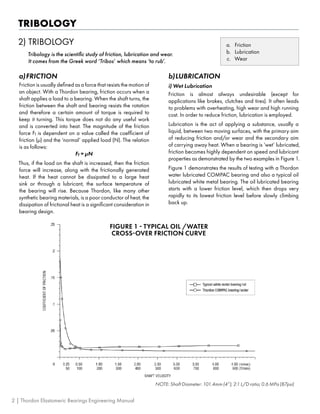
properties as demonstrated by the two examples in Figure 1.
Figure 1 demonstrates the results of testing with a Thordon
water lubricated COMPAC bearing and also a typical oil
lubricated white metal bearing. The oil lubricated bearing
starts with a lower friction level, which then drops very
rapidly to its lowest friction level before slowly climbing
back up.
NOTE: Shaft Diameter: 101.4mm (4”); 2:1 L/D ratio; 0.6 MPa (87psi)
FIGURE 1 - TYPICAL OIL /WATER
CROSS-OVER FRICTION CURVE
2 | Thordon Elastomeric Bearings Engineering Manual
TRIBOLOGY
The friction force for water lubrication starts higher because
of water’s poor lubricity and requires a higher speed to
achieve hydrodynamic operation. This is due to the low
viscosity of water.
An interesting observation is that in the high-speed range,
the water lubricated frictional force is actually lower than
with oil. Once hydrodynamic operation is achieved, friction
increases. However, the higher viscosity of oil results in
greater shearing forces and higher friction than with water.
This is illustrated by a typical “Stribeck curve” (Figure 2)
which plots the coefficient of friction against the
hydrodynamic parameter Zn/P. The curve is divided into
three main lubrication regimes.
FIGURE 2 - THE STRIBECK CURVE
The Stribeck curve, illustrating the buildup of
hydrodynamic film
In the first (Boundary) regime, direct contact exists between
the shaft and the bearing resulting in high friction values.
In this region of the curve, high bearing self-lubricity is
of significant benefit. As the shaft speed increases we
move into the second (Mixed) regime of the curve where
the hydrodynamic film starts to build and effectively “lift”
the shaft from the bearing surface. The result is less shaft
to bearing contact and friction drops rapidly. Further
increases in speed take us into the third (Hydrodynamic)
regime where the hydrodynamic film builds sufficiently to
eliminate all direct contact. As speed continues to increase,
friction begins to increase because of the increasing shear
resistance imparted by the viscosity of the lubricant.
The transition between lubrication regimes during operation
of a bearing depends primarily on lubricant properties,
velocity and load. The curve profile and definition of
transition points will depend on the bearing geometry,
clearance ratio, self-lubricity of the bearing material and
surface finish.
A higher viscosity lubricant results in the generation of a
hydrodynamic film at a lower shaft speed and effectively
moves the transition points to the left. Increasing the viscosity,
however, also increases the minimum operating coefficient
of friction. Lowering the coefficient of friction of the bearing
material results in decreased friction at shaft speeds below
the point where full hydrodynamic operation occurs. The
geometry of the bearing, and in particular, whether the
bearing is grooved also affects the curve. A continuous
bearing surface without grooves allows the hydrodynamic
film to build quicker than one with grooves. Hydrodynamic
calculations show that the necessary speed to achieve a
hydrodynamic film is double that for an ungrooved bearing.
Wet lubrication also has the added benefit of being able
to carry away frictionally generated heat, the enemy of
all bearings. This is especially significant with Thordon
because the low thermal conductivity of the material
does not allow much heat to be dissipated through the
bearing wall (metallic bearings have much higher thermal
conductivity and can dissipate more heat through the
bearing wall). Wet lubrication can be supplied by several
methods varying in complexity and performance. There
are drip feed systems (normally oil), which are appropriate
for slow to intermediate speeds where heat build up is
not a concern. Bath systems are also used - where the
bearing is fully or partially submerged in a limited quantity
of lubricant. The limiting factor with bath systems is that
the whole bath can become overheated if the assembly
generates significant heat. A third method is a continuous
flow of fresh cool lubricant from an external source, usually
force-fed. This method is essential for applications such
as marine propeller shafts, vertical pumps and turbines
where high RPM and/or significant loads lead to levels of
heat generation which cannot be dissipated by a bath of
lubricant.
NOTE: WATER FLOW REQUIREMENTS
A Thordon bearing application involving full rotation may
require water flow for lubrication and cooling. If required,
the minimum recommended flow rate is 0.15 litres per
minute per millimetre (1 U.S. gal. per minute per inch) of
shaft diameter. Higher cooling water flow rate could be
required for other applications (i.e. vertical turbine guide
bearings). Please contact Thordon Bearings for review. The
water should be as clean and cool as possible. “Cooling”
water above 40°C (104°F) should be avoided.
Thordon Elastomeric Bearings Engineering Manual | 3
TRIBOLOGY
ii) Grease
Grease is a form of lubrication that lowers friction and
allows a lubricant film to form. Grease does not have the
ability to carry away heat. Fresh grease is applied on a
periodic basis to lubricate the bearing and purge the old
grease and debris. Periodic lubrication is required to avoid
dry running conditions. Grease lubrication of Thordon
bearings should be limited to relatively clean environments
where heat generation is not a significant problem (see PVT
Graph: Figure 14F).
iii) Non-Lubricated – Dry Running
Thordon elastomeric bearing materials can be specified as
non-lubricated for relatively low speed applications where
regular lubrication is not possible or where abrasives may
be attracted to grease lubrication. Thordon SXL exhibits the
best properties for dry running due to the high lubricant
content of its formulation. This reduces friction and heat
generation. Where the pressure on the bearing is beyond
the acceptable limit for Thordon SXL, Thordon HPSXL can
be considered. It can run dry but does not have as good
abrasion resistance as SXL. For even higher pressure dry
running applications, a thin wall of HPSXL bonded in a
metallic shell or ThorPlas are available.
iv) Pressure Velocity Time (PVT) Curves
Selection of the appropriate method of lubrication can be
facilitated by referring to the various PVT (pressure, velocity,
time) curves in the Design Guide Section of this manual.
Typical example of bearing with abrasive wear. 
c)	WEAR
Wear is the destructive removal of material from contacting
surfaces moving relative to one another. Wear can take
several forms and, as a highly complex process, is difficult
to predict.
i) Adhesive Wear
Adhesive wear occurs when minute peaks of two rough
surfaces contact each other and weld or stick together,
removing a wear particle. Adhesive wear of Thordon
elastomeric bearing materials is very minimal at normal
temperatures and pressures, but becomes the dominant
wear mode as the operating temperature reaches maximum
operating limits. The maximum operating temperatures
of Thordon elastomeric bearing materials are defined to
try and avoid this mode of wear. The amount of adhesive
wear is related to the friction between the two surfaces, the
pressure on the working surface, and the type and amount
of lubrication provided.
ii) Abrasive Wear
Abrasive wear involves the wearing of a softer surface by a
hard particle. Examples are sandpaper or a grinding wheel
(two body abrasion) or sand particles between a bearing
and a shaft (three-body abrasion). Actual abrasive wear
will vary with the quantity of abrasives present and with the
size, shape and composition of the abrasive particles.
The best approach to minimizing abrasive wear is to
reduce or eliminate the quantity of abrasives by using
filters or clean water injection. If this is not possible, then
a satisfactory alternative for minimizing abrasive wear is
to have one surface very hard and the second relatively
soft and compliant. Abrasive particles are allowed to be
pushed into the softer surface and roll or slide through the
contact area with very little damage to the shaft or bearing.
The elastomeric nature of Thordon bearings facilitates
abrasive wear resistance because the material flexes when
it encounters abrasive particles. With shaft rotation the
particles are moved along the bearing surface until flushed
out through a lubrication groove. With more rigid materials
the abrasive particles tend to become embedded in the
material and may cause shaft wear.
A continuous flow of fresh lubricant (as in a propeller shaft
application), and grooves in the Thordon bearing, will help
to flush out abrasive particles and reduce the amount of
abrasive wear. Tests have shown that optimum life in an
abrasive environment for a water lubricated bearing was
obtained with a very hard shaft, a Thordon RiverTough/
Composite bearing and a continuous flow of lubricating
water.
4 | Thordon Elastomeric Bearings Engineering Manual
TRIBOLOGY
iii) Wear Comparison
An independent test lab at the University of Cincinnati (USA) has done extensive wear testing of Thordon and other bearing
materials. The comparative results are illustrated in Figure 3. All the bearing materials were compared in tests on a specially
designed machine using a circulating abrasive slurry – See Note, Figure 3.
FIGURE 3 - TYPICAL BEARING ABRASIVE WEAR RATES
NOTE:	 Wet third particle abrasion.
	 Shaft Material: carbon steel
	 Bearing I.D.: 2.5 cm (1 in.)
	 Abrasive slurry mixture: 2% bentonite, 6% sand, 6% clay, 86% water
Thordon Elastomeric Bearings Engineering Manual | 5
PHYSICAL PROPERTIES
a)	THERMAL EFFECTS
i) Temperature Limits
All bearings are subjected to the combined effects of the
ambient environmental temperature and the frictional
heat generated during operation. Thordon elastomeric
materials, like all other non-metallic materials, have a low
thermal conductivity compared to metal so allowances
must be made to limit frictional heat build up.
The upper temperature limit for Thordon elastomeric
materials operating in a non-aqueous environment is
105°C (225°F). Above 105°C (225°F), softening of the
surface occurs. As the surface softens, the coefficient of
friction increases. This in turn results in additional heat
being generated. The temperature increases further and
the process continues until the bearing fails. In some cases
(such as misalignment), this may be arrested provided a
quenching medium is supplied.
The lower operational limit of Thordon elastomeric
materials is -60°C (-80°F). It is possible, however, during
shrink fitting to use liquid nitrogen at a temperature of
-195°C (-320°F) without Thordon becoming too brittle to fit.
The upper temperature limit for Thordon elastomeric
materials operating in a wet environment is 60°C (140°F)
due to Hydrolysis. Hydrolysis is explained in more detail
in the following subsection b) Effect of Water or Oil. This
limit also applies to other liquids with a significant aqueous
content. For bearings lubricated with standard mineral
grade oil, the upper temperature limit is 75°C (170°F).
Thordon manufactures other polymer grades for higher
temperatures - please contact Thordon for details.
ii) Coefficient of Expansion/Contraction
The coefficient of thermal expansion/contraction for
Thordon elastomeric materials is non-linear, like other non-
metallics, and varies throughout its temperature range.
Figures 4 & 5 show typical results of Thordon materials
which exhibit lower coefficients of contraction than of
expansion. The coefficient of thermal expansion for HPSXL
is 12 x 10-5
°C-1
(6.7 x 10⁻⁵
°F-1
) and does not exhibit the
same non-linearity of SXL, COMPAC and XL.
FIGURE 4 - THORDON XL and GM2401
%DIMENSIONAL CHANGE vs. TEMPERATURE
COEFFICIENT OF EXPANSION FOR TEMPERATURE RANGE
<0°C (32°F ):	 10.2	x	10-5
(°C -1
)	 > 30°C (86°F):	 18.1	x	10-5
(°C -1
)
	 5.7	x	10-5
(°F -1
)		 10.1	x	10-5
(°F -1
)
0°C to 30°C:	 14.8	x	10-5
(°C -1
)
(32°F to 86°F )	 8.2	x	10-5
(°F -1
)
FIGURE 5 - THORDON SXL and COMPAC
%DIMENSIONAL CHANGE vs. TEMPERATURE
COEFFICIENT OF EXPANSION FOR TEMPERATURE RANGE
<0°C (32°F ):	 10.9	x	10-5
(°C -1
)	 > 30°C (86°F):	 21.1	x	10-5
(°C -1
)
	 6.1	x	10-5
(°F -1
)		 11.7	x	10-5
(°F -1
)
0°C to 30°C:	 15.1	x	10-5
(°C -1
)
(32°F to 86°F )	 8.4	x	10-5
(°F -1
)
3) PHYSICAL PROPERTIES
a.	 Thermal Effects
b.	 Effect of Water or Oil
c.	 Shape Factor
d.	 Stress Strain
e.	 Stiffness
f.	 Compression Set - Creep - Stress Relaxation
g.	 Shear
h.	 Impact Resilience
i.	 Hysteresis
j.	 Chemical Resistance
k.	 Typical Physical Properties
6 | Thordon Elastomeric Bearings Engineering Manual
PHYSICAL PROPERTIES
b)	EFFECT OF WATER OR OIL
i) Water Absorption
Thordon elastomers expand in water approximately 1.3%
by volume under atmospheric conditions at a temperature
of 21°C (70°F) due to the isotropic nature of the polymeric
structure. At this temperature or less, full expansion may
take 6 to 18 months depending upon geometry. Should
the temperature be increased, not only does the volumetric
absorption percentage increase, but also the rate of
absorption. In tests using water at 60°C (140°F) the
volumetric absorption increased to 2.0% within 100 hours.
In order to determine the effects of water absorption on
Thordon elastomeric materials as it relates to a bearing
press fitted in a housing, a series of tests were performed.
These tests showed the approximate average effects of
water absorption on both bore closure and axial length at
21°C (70°F). The average effect on bore closure is .011
multiplied by the wall thickness. The average effect on
axial swell is .005 multiplied by the length of the bearing.
ii) Hydrolysis
When Thordon elastomers are subjected to continuous
immersion in hot water, i.e. above 60°C (140°F), the
material chemically deteriorates over time due to a reaction
with the hot water. This deterioration or breakdown is known
as hydrolysis. The surface of the material softens initially
and then eventually cracks and breaks. Hydrolysis will also
occur with other liquids with a high aqueous content.
Typical example of bearing with hydrolysis.
iii) Absorption of Oil
Absorption by Thordon elastomers of standard mineral
grade lubricating oil is minimal, particularly at low
temperatures such as 22°C (72°F). Dimensional changes
are small and their consideration is less important than
those in water at such temperatures.
However, in high operating temperatures, volumetrical
absorption needs to be considered. For example, at 75°C
(167°F), the volumetrical expansion can be above 2.5%.
In practice, the dimensional allowances used for water
lubricated bearings are also used for oil lubricated
bearings. This is partially because of concern for the lower
thermal conductivity of oil compared to water. When a
different type of lubricating oil is used, it should be tested
for compatibility with Thordon materials before installation
of the bearing. Thordon elastomers may react differently
to non-standard lubricating oils. A significant change in
dimensions (beyond that expected for water), or softening
after immersion in the lubricant for more than 24 hours will
indicate that the lubricant is not compatible with Thordon
elastomeric materials.
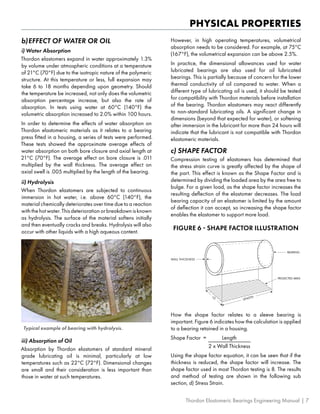
c)	SHAPE FACTOR
Compression testing of elastomers has determined that
the stress strain curve is greatly affected by the shape of
the part. This effect is known as the Shape Factor and is
determined by dividing the loaded area by the area free to
bulge. For a given load, as the shape factor increases the
resulting deflection of the elastomer decreases. The load
bearing capacity of an elastomer is limited by the amount
of deflection it can accept, so increasing the shape factor
enables the elastomer to support more load.
FIGURE 6 - SHAPE FACTOR ILLUSTRATION
LENGTH
I.D.
PROJECTED AREA
BEARING
WALL THICKNESS
L
E
N
G
T
H I
.
D
.
P
R
O
J
E
C
T
E
D
A
R
E
A
B
E
A
R
I
N
G
LENGTH
I.D.
PROJECTED AREA
BEARING
How the shape factor relates to a sleeve bearing is
important. Figure 6 indicates how the calculation is applied
to a bearing retained in a housing.
Shape Factor =	 Length
	
	 2 x Wall Thickness
Using the shape factor equation, it can be seen that if the
thickness is reduced, the shape factor will increase. The
shape factor used in most Thordon testing is 8. The results
and method of testing are shown in the following sub
section, d) Stress Strain.
Thordon Elastomeric Bearings Engineering Manual | 7
d)	STRESS STRAIN
When a load is applied to Thordon elastomeric bearings,
they move in accordance with the force exerted. In
compression, the volume will not significantly change, but
there can be a significant change to the shape.
The normal stress strain curves are determined
experimentally using a tensile test machine and a standard
test sample. However, in order to develop data more
appropriate to the loading of a Thordon bearing, it was
necessary to test the material in the compressive mode
using a typical bearing form.
FIGURE 7 - STRESS-STRAIN
TESTING APPARATUS
50mm (2”) dia.
Figure 7 shows how the bearing was loaded and how the
deflection was measured. Note that the shaft deflection
was subtracted from the housing deflection in order to
obtain net bearing deflections.
FIGURE 8 - THORDON ELASTOMERS
STRESS-STRAIN CURVES
BORE: 50mm (2”) LENGTH: 65mm (2.5”)
WALL THICKNESS: 4.0mm (0.155”) SHAPE FACTOR: 8
In compression, the Stress-Strain Curve for Thordon
elastomers in Figure 8 is dependent on the shape factor
of the material and its ability to move against both the
mating and housing material. For the same deflection, a
bonded sample will carry more load than a sample where
the bearing can expand axially. If lubrication is added to
the mating surface allowing the elastomer to freely move
during the loading process, the curve is expected to be
flatter than if the mating surface is dry.
Using a shape factor of 8, testing indicated a maximum
deflection limit of 1.25% for full rotation installations, and
4% for oscillating motion. Beyond these limits, bearing
performance may deteriorate. These limits do not take into
consideration any frictional heat generated by shaft movement.
By taking the shape factor concept to its logical conclusion,
it is possible to design Thordon sleeve bearings capable
of operating at high pressures. The Thordon HPSXL TRAXL
bearing, for example, develops very high shape factors by
bonding a thin layer of Thordon HPSXL into a metallic shell.
Depending on the operating environment, HPSXL TRAXL
bearings can accept loadings as high as 70 MPa (10,000 psi).
Thordon XL, SXL and COMPAC are true elastomers and as
such do not have an ultimate compressive strength.
Higher load bearings with a thin wall polymer bonded to a
metallic shell can also be made using XL or SXL.
e)	STIFFNESS
Bearing stiffness is dependent on both size parameters and
physical properties. The size parameters are the bearing
length, diameter and wall thickness. The physical property
to be considered is the Compressive Young’s Modulus (Eo)
of the bearing material, which is equal to compressive
stress divided by compressive strain.
Stiffness		 = (L x D x Eo)/t
where: 	 L 	 = Bearing Length: mm (in.)
	 D 	= Bearing Diameter: mm (in.)
	Eo	 = Compressive Young’s Modulus: MPa (psi)
	 t 	 = Wall Thickness (W.T.): mm (in.)
For bearings with equal size parameters the bearing
stiffness is directly proportional to the value of Compressive
Young’s Modulus of Elasticity for the material.
Figure 9 gives the value of Eo, Compressive Young’s
Modulus of Elasticity for various materials commonly used
as bearings.
PHYSICAL PROPERTIES
8 | Thordon Elastomeric Bearings Engineering Manual
PHYSICAL PROPERTIES
NOTE: The bearing shape factor was assumed to be 8 for
these calculations. For elastomeric materials, the effective
Compressive Modulus of Elasticity, Eo, increases a small
amount for correspondingly large increases in shape factor.
Therefore, the values of stiffness assumed are estimated
to be accurate to +/- 20% over a wide range of bearing
shape factors.
In engineering calculations, the stiffness of bearing support
structures is typically in a range between 0.5 to 1.0 MN/
mm (2.8 to 5.7 x 10⁶
lbs./in.). This is much less than the
typical bearing material stiffness of 5.0 to 20.0 MN/
mm (28.0 to 112.0 x 10⁶
lbs./in.). The typical stiffness of
Thordon is approximately 5 MN/mm (28 x 106
lbs./in.)
and the typical water film stiffness is approximately 50
MN/mm (280 x 106
lbs./in.). As a result, the stiffness of
the bearing material is normally not considered in shaft
whirling vibration calculations. When rubber bearings are
being specified, due to the low stiffness characteristics of
rubber (20% to 25% of that of Thordon), shaftline designers
may be accustomed to considering the bearing flexibility
when making whirling vibration calculations. However, this
is not the case with Thordon XL, SXL, COMPAC or HPSXL
where, due to a much higher stiffness, the Thordon bearing
can be assumed to be very often stiffer than the bearing
support structure.
FIGURE 9 - COMPRESSIVE YOUNG’S
MODULUS OF ELASTICITY (EO)
Material Eo (MPa) Eo (psi)
Thordon SXL/COMPAC 440 64,000
UHMWPE 480 70,000
Thordon XL 490 71,000
Thordon HPSXL 650 94,250
Laminated Phenolic 2,500 362,594
Nylon 2,750 400,000
ThorPlas Family 3,280 476,000
White Metal 33,500 4,860,000
Steel 206,900 30,000,000
f)	COMPRESSION SET, CREEP AND
STRESS RELAXATION
i) Compression Set
Compression set or permanent set is the residual
deformation remaining after the removal of the deforming
compressive stress. Under normal Thordon bearing
operating conditions, compression set is not a problem.
Please consult with Thordon Bearings if a Thordon bearing
will be exposed to constant high pressure combined with
temperatures above 50°C (122°F).
To reduce compression set, the shape factor should be
increased. This reduces the initial deflection and therefore
the amount of possible compression set. Increasing the
shape factor is especially important when the pressure is in
excess of 10 MPa (1450 psi). In such applications, Thordon
TRAXL or ThorPlas bearings should be used.
ii) Creep
When an elastomer is subjected to a load, it will deform
proportionally to that load and in inverse proportion to
the shape factor. Some deformation will also continue with
time. This effect is known as ‘creep’. In the normal operating
range of Thordon bearings, creep is not a significant factor.
As with compression set, it only becomes significant when
bearings are continuously exposed to high pressure and
high temperature. The amount of creep, like compression
set, can be reduced by increasing the shape factor as
the load increases, thereby reducing strain for any given
pressure.
iii) Stress Relaxation
Stress relaxation is the direct result of creep and varies
depending on the stress level. Stress relaxation is usually
expressed in terms of percentage stress remaining after a
specified period of time at a given temperature. This factor
is significant when calculating dimensions for interference
fit bearings. The interference must be sufficient to ensure
that adequate retention force exists over time.
It has been determined by testing that Thordon bearings
can lose their interference fit (by stress relieving) in the
housing when subjected to elevated temperatures. Thordon
SXL and COMPAC stress relieve at temperatures greater
than 60°C (140°F) while Thordon XL and RiverTough/
Composite stress relieve at temperatures greater than
80°C (175°F). Bearings exposed to temperatures above
these levels should not be fitted using an interference fit.
Bonding is the recommended alternative.
Thordon Elastomeric Bearings Engineering Manual | 9
g)	SHEAR
The shear force on a sleeve bearing is a function of the
coefficient of friction between the bearing, the shaft and
the nominal load. When bearings are installed using an
interference fit, the relative force is sufficient to prevent
rotation. If the friction force or normal load should increase
dramatically, such as an accumulation of significant
abrasives, the shear force may exceed the retention force.
If there are concerns regarding increases in the coefficient
of friction, please contact Thordon Bearings.
h)	IMPACT/RESILIENCE
Thordon elastomeric materials, which possess high impact
strength, have the ability to absorb shock loads and the
resilience to return to original shape. Resilience is defined
as the ratio of energy given up in recovery from deformation
to the energy required to produce the deformation. This
combination allows Thordon elastomeric materials to resist
pounding out of shape which frequently occurs and can
lead to failure with white metal or plastics. At almost 10
times the impact strength of nylon, Thordon elastomeric
materials are almost unbreakable. In applications where
there are significant low frequency impact loads, the
bearing should be designed with a heavier wall thickness.
i)	HYSTERESIS
Hysteresis is a type of dynamic failure due to high frequency
flexing. The failure occurs when the material absorbs an
impact load and, before the material can fully recover from
the first impact, it is subjected to a second one. The result
is an energy build up below the surface of the material
in the form of heat. This heat, if allowed to accumulate,
will eventually damage the material. Hysteresis is the
percentage energy loss per cycle of deformation and can
be measured as the difference between the percentage
resilience and 100%.
Thordon elastomeric materials, due to the nature of their
formulations, can be subject to damage by hysteresis. If
the application being considered will subject Thordon
elastomeric materials to dynamic impact loading that
could result in hysteresis, there are design considerations
that will minimize the potential for problems. Figure 10
illustrates that increasing the shape factor (reducing the
wall thickness) will reduce the deflection and increase the
rate of recovery, thus reducing heat creation and build up.
A thinner wall thickness also allows increased dissipation of
heat through the bearing wall to the housing.
FIGURE 10 - EFFECTS OF HYSTERESIS
j)	 CHEMICAL RESISTANCE
Thordon is non-corrosive and is resistant to oil, water and
most chemicals. It is not affected by lubricants normally
used with sleeve bearings. Thordon elastomeric materials
are unaffected by mild acid or caustic baths (pH range 5-10)
or other chemical environments which would be harmful to
metallic bearings. See the Thordon Elastomeric Bearings
Chemical Resistance guide in Figure 11.
Forcriticalapplicationsitisrecommendedthatanimmersion
test be performed to determine whether or not Thordon
will be safe to use. Significant softening or dimensional
changes after twenty-four hours of immersion at application
temperatures will indicate that Thordon is unsuitable for
that application. For further information, please contact
your Thordon distributor or Thordon Bearings Inc.
FIGURE 11 - THORDON ELASTOMERIC
BEARINGS CHEMICAL RESISTANCE
Chemical
Chemical/Fluid	 Resistance
Salt solutions	 A
Sodium chloride	 A
Weak acids	 B-D
Acetic acid	 D
Lactic acid	 B
Strong acids	 B-D
Sulphuric, 5%	 B-C
Sulphuric, concentrated	 D
Hydrochloric, 10%	 B
Weak bases	 A-B
Ammonia 10% Aq.	 A
Sodium carbonate	 B
Triethanolamine	B-D
Strong bases	 B
Sodium hydroxide, 10%	 B
Oxidizing agents	 B-C
Hydrogen peroxide, 1-3%	 B
Chromic acid	 C
Chemical
Chemical/Fluid	 Resistance
Hydrocarbon/fuels	A-B
Aromatic – benzene, toluene	 B
Aliphatic – gasoline, grease	 A-B
Lubricating oils (petroleum)	 B
Chlorinated solvents	 D
Alcohols	D
Ethanol	D
Methanol	D
Ketones	D
Methyl ether ketone	 D
Acetone	D
Ethers	D
Diethyl ether	 D
Esters	D
Ethyl acetate	 D
Methyl acetate	 D
Freon 12	 A-C
Vegetable Oils	 A-B
PHYSICAL PROPERTIES
A: Excellent - No Effect
C: Fair - Moderate Effect
B: Good - Little Effect
D: Unacceptable
10 | Thordon Elastomeric Bearings Engineering Manual
PHYSICAL PROPERTIES
k)	Figure 12 - Typical Physical Properties – Metric & Imperial(1)
Property(2)
XL SXL HPSXL COMPAC
RiverTough/
Composite
(GM2401)
Ultimate Tensile Strength MPa 35 37.5 40 37.5 17
ASTM D-638 psi 5,000 5,450 5,800 5,450 2,500
Nominal Hardness Value
Shore D - ASTM D-2240
73 67 76 67 92(3)
% Elongation - ASTM D-638 70 150 70 150 265
Young’s Modulus MPa 850 605 925 605 -
(tensile) psi 123,000 88,000 134,000 88,000 -
Poisson Ratio ~ 0.45 ~ 0.45 ~ 0.45 ~ 0.45 ~ 0.45
Izod Impact - notched Joules/m ~150 ~500 - ~500
{ sample not
broken
Avg. - ASTM D-256 ft-lb/in ~3 ~9 - ~9
Specific Gravity 1.21 1.16 1.28 1.16 1.10
Thermal W/m-k ~0.25 ~0.25 ~0.25 ~0.25
Conductivity Btu/hr-ft-F ~0.14 ~0.14 ~0.14 ~0.14
Thermal KJ/kg-k @ 30°C ~1.5 ~1.5 ~1.5 ~1.5 ~1.5
Capacity Btu/lbm-F @86°F ~0.36 ~0.36 ~0.36 ~0.36 ~0.36
Coefficient of Thermal Expansion (-20°C < T < 80°C)
Strain x10-5
(°C-1
) or (°F-1
) (-4°F < T < 176°F)
12 x10-5
°C-1
or 6.7 x 10⁻⁵
°F-1
T < 0°C 10.2 10.9 10.9 ~10.2
0°C < T < 30°C 14.8 15.1 15.1 ~14.8
T > 30°C 18.1 21.1 21.1 ~18.1
T < 32°F 5.7 6.1 6.1 ~5.7
32°F < T < 86°F 8.2 8.4 8.4 ~8.2
T > 86°F 10.1 11.7 11.7 ~10.1
Volumetric Swell (%) @20°C (68°F)
- Water 1.3 1.3 1.3 1.3 ~1.3
- Oil/Grease 1.3 1.3
Compression Set (%)
Ref. ASTM D395 method B
- - - - 27%
Coefficient of Friction < 200 Bar > 200 Bar
< 3000 psi > 3000 psi
Dry static 0.35 - 0.45 0.25 - 0.35 ~0.35 0.09 - 0.15 0.25 - 0.35 -
dynamic 0.30 - 0.40 0.10 - 0.20 0.28 - 0.35 0.07 - 0.12 0.10 - 0.20 -
Wet static 0.30 - 0.40 0.25 - 0.35 0.30 - 0.40 0.08 - 0.15 0.25 - 0.35 0.40
dynamic 0.20 - 0.25 0.10 - 0.20 0.25 - 0.35 0.06 - 0.12 0.10 - 0.20 0.15 - 0.20
Flammability - ASTM D-635-56T SE(4)
SE SE SE SE
Operating Temperature (Min./Max.)
Dry(5)
°C -60/107 -60/107 -60/107 -60/107
°F -76/225 -76/225 -76/225 -76/225
Wet °C -7/60 -7/60 -7/60 -7/60 -7/60
°F 20/140 20/140 20/140 20/140 20/140
Oil/Grease °C /75 /75 /75
°F /167 /167 /167
Notes:
(1)
Appearance of ‘~’ is indicative of interpolated or estimated values based on in-house testing of this or similar materials.
(2)
All tests to develop the above data were done under carefully controlled conditions in our own laboratory to ensure the most accurate relative data possible. Bear in mind that
comparison of tensile strength is less meaningful for non-metallic materials compared with metals. This is especially true of non-metallic bearings loaded in compression.
(3)
Shore A.
(4)
SE — self extinguishing
(5)
Material used at dry temperatures exceeding 60°C (140°F) must be retained by suitable positive means. Please review these applications with Thordon Engineering.
Thordon Elastomeric Bearings Engineering Manual | 11
4) DESIGN GUIDE
a.	 Application Analysis
b.	 Bearing Pressure
c.	 Velocity
d.	 PVT Graphs
e.	 Length/Diameter (L/D) Ratio
f.	 Wall Thickness
g.	 Lubrication Grooves
h.	 Mating Surface
i.	 Fitting
j.	 Minimizing Initial Installed Clearance
k.	 Material Selection Process
l.	 Problems and Causes of Bearing Failure
a) APPLICATION ANALYSIS
In order to perform any analysis of an application, all the
appropriate information must be reviewed and correctly
evaluated.
The following list covers the general subject headings
which have been discussed in previous sections or will be
covered in this section.
•	Operating Environment
i) Temperature
ii) Abrasive or Clean
•	Pressure
•	Sliding Velocity
•	Type of Lubrication
•	Size
•	Method of Retention
•	Previous material used & problems associated with it.
•	Mating Surface
•	Life Requirements
•	Duty Cycle
•	Initial Clearance Requirements
b) BEARING PRESSURE
Bearing pressure is calculated by dividing the radial load
by the projected or cross sectional area. The projected
area is determined by multiplying the inside diameter of
the bearing by the bearing length, as in Figure 13. The
use of inside diameter multiplied by bearing length is a
bearing industry norm for calculating the projected area
for bearing pressure. Dividing the load by the projected
area gives the approximate pressure. This assumes that the
pressure is uniform across the bearing area. In reality, the
pressure is greatest at the 6 o’clock position and decreases
in a parabolic curve to zero where the shaft starts to have
clearance with the bearing. It is therefore advantageous,
considering load carrying capacity, to keep running
clearances to a minimum.
FIGURE 13 - BEARING PRESSURE
LENGTH
I.D.
PROJECTED AREA
BEARING
Radial load needs to be defined as maximum design load,
normal operating load or a combination of static and
impact loads. Is the load constant or cyclic? These factors
all need to be analyzed in the grade selection process as
noted in sub-section 4 a).
Bearing		Radial Load		 Load
	=	 	=	
Pressure		 Projected Area		 Length x I.D.
c)	VELOCITY
The sliding velocity or the peripheral shaft speed is
an important design factor. Velocity is an essential
consideration when evaluating frictional heat generation.
It is calculated by the following equation for rotating shafts.
		
πdN	or	 dN
V (m/s)	
=				 (metric)	
		 		
		 60 x 1000		 19,100
		
πdN	
V (fpm)	 =	 	 or	 .262 dN	 (imperial)
		12
where:
	 V	 =	 Sliding Velocity
	 d	 =	 Shaft Diameter (mm or in.)
	 N	 =	 RPM of the shaft
	 π	 =	 pi constant 3.1416
DESIGN GUIDE
DESIGN GUIDE
12 | Thordon Elastomeric Bearings Engineering Manual
d)	PVT GRAPHS
Anyslidingbearinganalysisisalwaysbasedonthreefactors.
Pressure, Velocity and Time (PVT) are individual factors
that are impossible to separate when selecting a bearing
material because the heat generated is proportional to all
three as shown in the following relationship:
	 H	~	 PVμT
where:
	 H	 =	 Heat or Temperature Rise
	 P	=	Pressure
	 V	=	 Velocity
	μ	 =	 Coefficient of Friction
	 T	=	Time
In order to evaluate an application, it is necessary to know
the duty cycle of the equipment. How long per day does
it run, i.e. 8 hours, 24 hours or stop and start? Is there full
rotation, which is normally specified in RPM, or does it
cycle or oscillate through a limited angle? Through what
angle and how frequently does movement occur and how
many hours a day (Duty Cycle)? These factors all play a
role in determining the amount of frictional heat that will be
generated under defined pressures.
However, if the frictional heat generated is removed by
a sufficient flow of cooling lubricant such as water, oil
or process liquid, Thordon bearings will perform well at
velocities far outside the limits shown on the PVT graphs
(see page 18-20). Typical applications where this occurs
include marine propeller shaft and vertical pump or
turbine shaft bearings where a constant flow of cool
water is provided. The minimum recommended cooling
water flow rate is 0.15 litres/minute/mm (1 US Gal/
minute/inch) of shaft diameter.
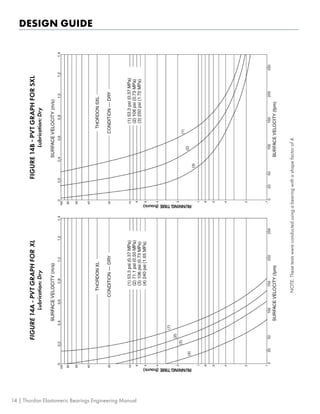
The PVT graphs - Figures 14A to F - have been developed
by Thordon Bearings Inc. as a guide for the design
engineer in the selection of the correct grade of Thordon
for specific operating pressures, sliding velocities and
times. The curves have been developed using the pressure
step technique, where the material is tested at one pressure
under various velocities with the limiting factor being
bearing temperature. The arbitrarily imposed temperature
limit for all of the Thordon grades during the tests was
82°C (180°F), measured at the outside diameter of the
bearing, except when tested in water. The limit in water
was set at 60°C (140°F) to avoid hydrolysis. When the
limiting temperature was reached during the test, the
test was stopped and the time recorded. The test sample
temperature was then allowed to return to ambient before
the test was repeated for another velocity. The tests were
conducted using bearings with a shape factor of 4.
To use the graphs, select the type of lubrication that is
closest to your application. Locate the sliding velocity value
for your application. Where the sliding velocity makes
contact with the curve closest to your pressure, read the
time required to reach the operational temperature limit. If
the time required for your application is less than this value,
then this application will likely be suitable. If not, then
either a different Thordon grade needs to be selected, or
improved lubrication or cooling provided.
The PVT graphs for oil and water were developed using
a bath of oil or water with no liquid flow or cooling. If
the system can be designed to incorporate a forced flow
of cool lubricant instead of a bath, much of the frictional
heat will be dissipated by the flow of lubricant. Once the
bearing is operating under hydrodynamic conditions, no
additional frictional heat is developed as the speed is
increased, except for a slight increase in frictional drag of
the lubricant. This increase is so low that it does not affect
the bearing operation.
Under the forced cool lubricant flow conditions, the limits
on the graphs are not applicable. The propeller shaft of
a ship using a flow of water or oil lubrication is typical of
this situation.
The PVT graphs are provided as a guide only. Thordon
elastomeric materials have been successfully specified in
manyapplicationswithPVT’sfallingoutsidetherangeonthe
graphs. For example, Thordon SXL has been incorporated
into a number of vertical pump designs where it runs dry for
periods of over a minute at velocities higher than indicated
on the curves.
NOTE 1: For guidance on potential applications that fall
outside the PVT graphs contact your Thordon distributor or
Thordon Bearings Inc.
NOTE 2: PV values are given by many non-metallic material
manufacturers and are often published with several
incorrect assumptions. The first is that the individual P and
V values have little importance, as long as they are within
the product value range. The second, and perhaps the most
dangerous assumption is the limited amount of test time used
to develop the P and V values. No formal consideration is
given to the time factor. The Thordon XL and SXL PVT graphs
illustrated in Figure 14 show that frictional heat takes time to
be generated.
NOTE 3: These graphs are based on laboratory results.
Actual results in applications may vary.
NOTE 4: These guideline values are supplied for reference
only. PV limits for any material vary with different
combinations of pressure and velocity as well as with other
test conditions.
DESIGN GUIDE
DESIGN GUIDE
Thordon Elastomeric Bearings Engineering Manual | 13
DESIGN GUIDE
NOTE:
These
tests
were
conducted
using
a
bearing
with
a
shape
factor
of
4.
FIGURE
14B
-
PVT
GRAPH
FOR
SXL
Lubrication:
Dry
FIGURE
14A
-
PVT
GRAPH
FOR
XL
Lubrication:
Dry
14 | Thordon Elastomeric Bearings Engineering Manual
DESIGN GUIDE
NOTE:
These
tests
were
conducted
using
a
bearing
with
a
shape
factor
of
4.
FIGURE
14D
-
PVT
GRAPH
FOR
SXL
Lubrication:
Water
Bath
FIGURE
14C
-
PVT
GRAPH
FOR
XL
Lubrication:
Water
Bath
Thordon Elastomeric Bearings Engineering Manual | 15
DESIGN GUIDE
DESIGN GUIDE
NOTE:
These
tests
were
conducted
using
a
bearing
with
a
shape
factor
of
4.
FIGURE
14E
-
PVT
GRAPH
FOR
XL
&
SXL
FIGURE
14F
-
PVT
GRAPH
FOR
XL
&
SXL
Lubrication:
Grease
Lubrication:
Oil
Bath
16 | Thordon Elastomeric Bearings Engineering Manual
DESIGN GUIDE
e)	LENGTH/DIAMETER (L/D) RATIO
The L/D ratio for a typical industrial sleeve bearing varies
from 1:1 to 1.5:1. This is an optimum proportion permitting
ease of alignment in the assembly.
In water lubricated propeller shaft bearing applications,
the L/D ratio has historically been 4:1 in order to keep the
bearing pressure low, i.e. 0.25 MPa (36.25 psi). However,
because of the overhung load of the propeller, the pressure
tends to be highest nearer the propeller and almost zero at
the forward end. In operation, the high L/D ratio tends to
create higher friction or drag on the shaft. This is because the
forward part of the bearing is not supporting the shaft and
creates unnecessary shearing of the water. There may even
be contact between the shaft and bearing at the top of the
bearing at the forward end. A 2:1 L/D ratio Thordon propeller
shaft bearing was tested under the same conditions as the 4:1
and was found to generate less frictional force. The results of
these tests in conjunction with encouragement from the marine
Classification Societies resulted in the development of the
Thordon COMPAC bearing system.
In most applications, where the loading of the bearing is
uniform, higher L/D ratios will reduce the pressure and
improve the life of the bearings. Alignment is more difficult,
but if the pressure is high, an increase in the L/D ratio may
be necessary. For COMPAC propeller shaft bearings, the
L/D ratio is typically 2:1 and should not be more than
3:1. This limit is established because of concerns about the
supply of adequate cooling water to very long bearings
rotating at relatively high speeds. Rubber bearings are
typically 4:1 L/D ratio.
For high pressure limited rotation applications, Thordon
HPSXL TRAXL or ThorPlas bearings should be considered.
f)	WALL THICKNESS
In an application where Thordon elastomeric materials
are being specified as a replacement bearing, the existing
configuration of the equipment usually governs the wall
thickness of the bearing.
If the wall thickness of the Thordon bearing is excessive, the
bearing can be used in conjunction with a metal sleeve in
the housing or a liner on the shaft. Either of these methods
will allow a reduction in the wall thickness of the bearing.
If a shaft liner or sleeve is used, a further benefit results
- as the effective diameter of the shaft and the I.D. of the
bearing increase, the pressure decreases.
The degree of Permissible Wear Down before a bearing
is ‘worn out’ is also a factor in determining wall thickness.
Maximumallowableclearanceandotherexternalfactorsalso
enter into this consideration. For grooved bearings, maximum
allowable wear should be less than the groove depth.
Due to the elastomeric nature of the material, a Thordon
bearing must be supported along its entire length. An
unsupported bearing will carry virtually no load. If wall
thickness can be specified in the design, it is generally
preferable to use a thinner wall. The overall clearances and
tolerances can be reduced, heat dissipation is improved
and the maximum permissible load is greater. There are
some applications, however, such as those with low
frequency impact loads where the cushioning effect of a
thicker wall bearing will improve performance. Please
contact your Thordon distributor or Thordon Bearings
for further guidance on wall thickness, if required. Given
application details, Thordon Bearings can recommend
an optimum wall thickness. The Thordon Bearing Sizing
Calculation program can also provide this information.
Minimum Recommended Wall Thickness Guide for
Interference Fitting
The minimum recommended wall thickness of a Thordon
bearing is specified in Figure 15. The values shown are
based on the interface pressure between the bearing and
the housing. Increasing either the wall thickness or the
amount of interference will increase the interface pressure. In
both grooved and ungrooved bearings, the thickness of the
bearing wall that forms a continuous layer in the housing is
the only material considered for interference fitting purposes.
With grooved bearings, the minimum wall thickness will be
greater than that of an ungrooved bearing by the amount
of the depth of the groove as only the thickness behind
the groove is considered when calculating the interface
pressure. For Thordon RiverTough/Composite bearings,
only the thickness of the yellow outer shell material should
be considered when determining the minimum wall
thickness. The bearing running surface material (GM2401)
is too soft to contribute to the interface pressure.
FIGURE 15 - WALL THICKNESS GUIDE
NOTE: For grooved bearing, wall thickness is measured from bottom of groove to the OD.
Thordon Elastomeric Bearings Engineering Manual | 17
DESIGN GUIDE
If a Thordon bearing is replacing another bearing and the
wall thickness will be below the recommended minimum
there are two options. The bearing can be bonded in, or
the interference can be increased to raise the amount of
interface pressure to an acceptable level. Please contact
your Thordon distributor or Thordon Bearings for further
guidance if the level of interference is to be increased.
NOTE 1: The above information applies to Thordon XL,
SXL and COMPAC. It does not apply to HPSXL. Thordon
HPSXL is not recommended for interference fitting.
It should be bonded.
g) LUBRICATION GROOVES
For applications involving a flow of liquid across the
bearing surface, such as vertical pump or propeller shaft
bearings, lubrication grooves are machined or moulded
into the bearing to aid in the flow of lubricant through the
bearing. The grooves also provide a channel to allow
abrasives to pass. The number of grooves as well as their
depth and width change with the size of the bearing, its
configuration and the available wall thickness. Water
grooves are typically 7mm (0.27”) deep for shaft diameters
of 400mm (16”) or larger, but should not be more than half
of the wall thickness. The width of the groove is typically the
same as the depth, but can be increased when grooves are
very shallow to ensure sufficient water flow. The Thordon
Bearing Sizing Calculation Program provides details of
depth and number of grooves for any grooved bearing
application, based on shaft and housing dimensions.
Please contact Thordon Bearings for further information
on lubrication grooves.
FIGURE 16 - HARDNESS OF COMMONLY USED MATING MATERIAL1
MATERIAL
HARDNESS
REMARKS
Rockwell C Rockwell B Brinell5
Stainless Steel2
316
(16)4
95 (205) Annealed
Stainless Steel
Duplex 2205 (S 31803)
30.5 (105) 290
Stainless Steel (1) 82 (156) Annealed
S41000 26 to 43 (103 to 113) (258 to 400) Oil quenched from 1010°C & Tempered
Stainless Steel 31 (106) (294) Annealed
S17400 33 to 44 (108 to 114) (311 to 409) Water quenched from 1038°C & Tempered
Stainless Steel
S30400
N/A 81 (153 Annealed
Gunmetal (G1)3
C90500
N/A N/A 70 to 95
Leaded Gunmetal (LG4)
C92200
N/A N/A 70 to 85
70/30 Copper – Nickel
C96600
N/A 74 (135)
Inconel®
625 (21) 98 (228) Annealed
Inconel®
600 N/A 75 (137) Annealed
Nickel-Chrome-Boron (NiCrB) > 60 N/A > 654 Surface coating
Notes:
1
The purpose of listed hardness value is for quick hand-on reference. Refer to Hardness Material textbooks for more details if necessary.
2
See “Stainless Steel, ASM Specialty Handbook” edited by J.R. Davis, 1994, ISBN:0-87170-503-6 for stainless steel details.
3
See “Standards Handbook”, Cast Copper and Copper Alloy Products, published 1996 by Copper Development Association Inc. 260 Madison Ave., New York, NY 10016 for bronze details.
4
The number in brackets was converted from the unbracketed using conversion tables and is for comparison purposes only.
5
BRINELL scale used in this table is BHN 3000kg.
18 | Thordon Elastomeric Bearings Engineering Manual
DESIGN GUIDE
h) MATING SURFACE
Most common metallic mating surfaces will perform well
when used in conjunction with Thordon bearings. Figure 16
indicates the hardness of commonly used mating materials.
If corrosion is not a problem, carbon steel is commonly used,
but if corrosion is a concern, such as a water lubricated
propeller shaft bearing, then a bronze shaft liner should be
used. Common bronzes that work well include Gunmetal
(88% Cu, 10% Sn and 2% Zn) or 70-30 Copper Nickel.
Nickel Aluminum Bronze is not recommended because
experience has shown that it can lead to high wear rates.
Aluminum and titanium are also not recommended.
Stainless steel is also widely used as a shaft liner working
with a Thordon bearing. If abrasion is present, softer
stainless grades like 304 should be avoided. Similarly, the
softer grades of Aquamet®
shafting should be avoided if
the shafts will be exposed to significant abrasion. Harder
grades of stainless steel, or Inconel®
625 are preferred.
In lieu of a liner, some manufacturers use spiral welded
stainless steel or Inconel®
625 over the whole length of the
shaft, or in way of the journals.
In a heavily abrasive journal bearing application, the
theoretical optimum mating surface is the hardest practical
surface on the shaft in conjunction with a durable compliant
bearing material. For severe abrasives, a Thordon
RiverTough/Composite bearing and a mating surface with
a hardness of at least 40 Rockwell C is recommended.
Thordon grades cause minimal shaft wear. In general, softer
bearing materials such as Thordon tend to wear the shaft
less and exhibit less combined bearing and shaft wear.
The hardest shaft and softest bearing materials are the
extremes to achieve minimum combined wear in a severe
abrasive environment. If the shaft were changed to a
softer material or if the bearing were changed to a harder
material, the combined wear would increase. Should the
environment contain fewer abrasives, then the need to have
the hardest shaft material or softest bearing material would
decrease. Other factors such as low friction requirements
may then become significant in bearing selection.
In a clean environment with a lubricant (which only occurs
in theory) any combination will do. However, the old
principle of a bearing softer than the mating shaft is always
a good guide. Running similar materials together should be
avoided. Thordon elastomeric materials should not be run
against a Thordon elastomeric material shaft liner.
The Surface Finish of the mating shaft should be as smooth
as practical to limit the initial bedding-in wear. Thordon
testing has shown that less frictional heat is generated with
a smoother shaft, increasing the PVT limit. Thordon will
perform satisfactorily with a normal machined finish on the
shaft. For optimum performance, a final machined mating
surface finish of 0.4 to 0.8 micro-metres (16 to 32 micro-
inches) Ra is recommended. Mating shaft surface finishes
up to 1.6 micro-metres (63 micro-inches) Ra will perform
satisfactorily.
i) FITTING
Thordon XL, SXL, COMPAC and RiverTough/Composite
bearings are usually fitted using an interference fit.
Installation is quick and easy, especially when freeze fitting
is used. Thordon bearings can also be bonded in place.
Bonding, using a Thordon approved adhesive, is
appropriate in the following circumstances:
•	where a thin walled bearing is used and retention force
is not sufficient for an interference fit
•	when the housing I.D. is not machined, or when it does
not provide adequate support along the full length of
the bearing.
•	when bearings are subjected to high temperatures
that may cause them to “stress relieve” and lose the
retention force of an interference fit.
•	when Thordon HPSXL is used.
•	when the housing is not round or is damaged by
corrosion, etc.
The final dimensions of a Thordon bearing will depend
on how it is to be fitted. The selection of the best method
of fitting is extremely important and is dependent on
application requirements.
An interference fit is sufficient to prevent bearing rotation
under normal operating conditions, but a forward stop
and bolted end keeper ring are required to ensure that
axial movement of the bearing does not occur. The
keeper rings must be of adequate size and have an inside
diameter approximately 3mm (1/8”) larger than the
groove diameter or 3mm (1/8”) larger than the bearing
I.D. for a non-grooved bearing. Stops and keeper rings
are not mandatory when a bearing is bonded in place
but are recommended in critical applications as a safety
precaution. In cases where the orientation of the bearing is
critical such as off-centre bored bearings or COMPAC, it is
recommended that an anti-rotation device be fitted.
Thordon Elastomeric Bearings Engineering Manual | 19
DESIGN GUIDE
(i) Interference
Most applications use an interference fit assuming all
the relevant design factors are taken into account. It is
necessary, however, that the L/D ratio of the bearing be
at least 0.5:1. Practical experience has shown that small
bearings can be easily pressed into the housing, while
larger bearings fit easier when they are shrunk using dry
ice or liquid nitrogen. The housing should never be
heated to facilitate fitting, nor should grease or oil be
used to assist when press fitting.
In cases where the bearing is being installed with an
interference fit as in Figure 17, the effect of the interference
on the bearing inside diameter must also be considered.
This effect, known as bore closure, is explained in
Section 5 - Application Design.
FIGURE 17 - INTERFERENCE FIT PARAMETERS
Note: Minimum Installed Clearance = Running Clearance
+ Thermal Expansion Allowance (if applicable)
+ Water Absorption Allowance (if applicable)
All interference fit bearings that are fully machined before
installation are subject to a build up of tolerances which
can create additional installed clearance. For example,
when a bearing is designed with minimum clearance, its
actual clearance will be dependent on the accumulated
machining tolerances of the bearing wall thickness, plus
tolerances on the shaft and housing. This tolerance build
up can be reduced by machining only the O.D. of the
bearing prior to fitting and then machining the I.D. up to a
maximum of 5% of the wall thickness after it is installed. This
will eliminate the tolerance build up associated with bore
closure, bearing wall and housing I.D.
Bore Closure is the most variable of the factors affecting
Thordon bearing installed dimensions.
There can be situations where, in practice, the bore closure
varies from that predicted by our tests, and can result in
additional clearances. If it is not possible to machine the
bearing I.D. after installation, a test bearing can be fitted
into a machined “dummy” housing to determine the exact
bore closure for that application. The finish on the I.D. of
the “dummy” housing should be the same as that on the
actual housing. Corresponding adjustments if required, can
then be made. Alternatively, bearings can be machined in
the “dummy” housing, removed and fitted into the actual
housing. This approach is sometimes used for vertical pump
or turbine bearings where there is a requirement to keep
the initial installed clearance as small as possible.
20 | Thordon Elastomeric Bearings Engineering Manual
DESIGN GUIDE
(ii) Freeze Fitting
Freeze fitting is the easiest way to install Thordon bearings
which have been designed with an interference fit. Thordon
contracts significantly when cooled, because of its high
coefficient of thermal contraction/expansion, facilitating
easy fitting without expensive jacking or other equipment.
Liquid nitrogen is the optimum cooling agent but dry ice
can also be used for most installations if liquid nitrogen is
not available. When freeze fitting Thordon RiverTough/
Composite Bearings, dry ice should be used and not
liquid nitrogen.
Liquid nitrogen should only be used in a tight container
to prevent leakage. The bearing should be completely
immersed in, or evenly coated with, liquid nitrogen. When
vapour stops boiling off the liquid nitrogen the bearing has
reached a temperature of -196°C (-320°F) and can be
easily installed (approximately 5 to 30 minutes depending
on the surface area of the bearing). For large or thick-
wall bearings, it may be necessary to check the bearing
dimensions to see if the bearing has shrunk sufficiently to
allow easy installation. If dry ice is used as the cooling
medium it should be supplied in pellets or broken into small
pieces, if supplied in block form. The dry ice must be packed
tightly around the O.D. of the bearing with some clearance
around the I.D. of the bearing, making contact with both
the inside and outside surfaces. After 3 hours packed in
dry ice the bearing dimensions can be checked to see if the
bearing has shrunk sufficiently to allow easy installation. If
not, the bearing should be re-packed for another hour.
CAUTION: Use of liquid nitrogen or significant
quantities of dry ice in closed or poorly ventilated
areas should be avoided. The boiled off gases tend to
displace existing oxygen and can be fatal.
The approximate amount of shrinkage that can be expected
can be estimated as follows:
Each 10°C decrease in temperature will result in an approx.
decrease in diameter of 0.0014mm/mm of diameter.
(Each 10°F decrease in temperature will result in an approx.
decrease in diameter of 0.0008 in./in. of diameter).
(iii) Bonding
As indicated previously, bonding is an acceptable
alternative to interference fit in selected circumstances. The
thickness of the layer of adhesive must be considered when
dimensioning the O.D. of the bearing. When bearings are
bonded into housings, there is no bore closure effect on the
bearing I.D. (see Figure 18).
To hold the accumulation of tolerances to a minimum, the
bearing should be machined on the O.D. and then bonded
into the housing. The I.D. should then be machined. This
method is used in pump applications where the impeller
clearance must be held to a minimum.
To ensure good results, the procedures for bonding using
Thordon approved adhesives must be followed, as outlined
in Section 7. Bonding should be done at a consistent
temperature throughout the adhesive curing process.
Temperature variations during curing can have a negative
effect on the bond integrity. Combining freezing and
bonding does not work well because the moisture/frost on
the frozen bearing will have a significant negative impact
on the bond strength.
FIGURE 18 - BOND FIT PARAMETERS
Note: Minimum Installed Clearance = Running Clearance
+ Thermal Expansion Allowance (if applicable)
+ Water Absorption Allowance (if applicable)
Thordon Elastomeric Bearings Engineering Manual | 21
DESIGN GUIDE
(iv) Bearing Housing
The housing into which a Thordon bearing is to be installed must be round, aligned, and not tapered or bell-mouthed. The
maximum allowable housing ovality is 1/3 the initial (normal) designed running clearance. The housing must also provide
support to the Thordon bearing along its full length. Gaps in the housing or other abnormalities must be filled or corrected by
machining, installing a sleeve, bonding the bearing [for gaps up to 3mm (0.125”)] or chocking with a Thordon approved chocking
compound.
If the housing is misaligned, or if there is a need for slope boring, then the misalignment or slope should be corrected in the
housing. Offset boring of Thordon bearings after fitting is not recommended because of the possible adverse effect this could
have on the interference hoop stresses. Alternatives are to align a machined bearing and then bond or chock it in place, or
to align a “dummy” bearing, pour chocking compound around the “dummy” bearing and then remove the “dummy” bearing
leaving a round aligned housing of chocking material into which a Thordon bearing can be installed using a press or freeze fit.
j)	 MINIMIZING INITIAL INSTALLED
CLEARANCE
Initial installed clearance for Thordon bearings is usually
larger than final running clearance, mainly because
the initial clearance includes absorption and thermal
expansion allowances. These allowances will disappear
during operation of the equipment, but this will take time.
In some applications, there is a requirement to keep the
initial installed clearance as small as possible. A typical
example would be a vertical pump bearing. Final running
clearance may be acceptable, but when absorption
allowance, thermal expansion and tolerance build-up
are considered, the accumulated initial clearance may be
beyond design requirements. In such cases it is necessary
to consider ways to reduce the initial clearance.
There are several options:
1.	Thinner bearing - Absorption and thermal expansion
both vary according to the wall thickness of the bearing.
By reducing the wall thickness, the allowances for
these factors become smaller, so the initial clearance
is reduced. Reducing the wall thickness is usually
accomplished by reducing the housing diameter. The
Thordon Bearing Sizing Calculation program can be
useful in this exercise – it calculates “Minimum Installed
Clearance”. It can be used to determine what wall
thickness will yield the required initial clearance. The
wall may become too thin for an interference fit, so
bonding may be required.
2.	Minimize bore closure variations – The bore closure
calculation (effect of interference on the I.D. of the
bearing) is the least precise aspect of the Thordon
dimension calculations. Actual bore closure will depend
on a number of factors including machined finish on
the bearing and housing. There are several ways to
minimize variations in bore closure:
a.	Reducing the length/diameter ratio of the bearing will
reduce variations in bore closure over the length.
b.	Final machining of the bearing bore after it is installed.
Machining after fitting into the housing eliminates
the effect of bore closure because it has already
happened. It also eliminates the effect of tolerance
build-up on the bearing wall. This method however
removes stressed material that is developing the “grip”
of the bearing within its housing so only minimum
material must be removed.
•	For ungrooved bearings, this machining stage must
not remove more than 5% of the wall thickness.
•	For grooved bearings, it is not as important
because the bore material is much less stressed.
However, machining should be limited to 10% of the
wall thickness or 25% of the groove depth, whichever
is less. Lubrication grooves must always be machined
before fitting the bearing into the housing.
c.	Fitting the bearing into a dummy housing before
machining the I.D. This method is a variation of “b”
above which can be used when it is not practical to
install the bearing in its final housing for I.D. machining.
The dummy housing should have the exact dimensions
and machining finish as the final housing. This
method is less precise because it does not eliminate
machining tolerance variations on the housing. The
same restrictions on the amount of material that can
be removed mentioned in “b” above still apply.
22 | Thordon Elastomeric Bearings Engineering Manual
DESIGN GUIDE
k)	MATERIAL SELECTION PROCESS
In any bearing application the primary consideration is
to ensure that the frictional heat developed in the sliding
action is either absorbed and dissipated by the surrounding
mechanism or that it is conducted away by a flow of
lubricant or coolant. There must be a balance in the system
where temperature equilibrium is reached, and this must be
below the temperature limit of the material. If not, bearing
failure will result.
The secondary consideration is the type of environment
that the bearing is operating in, e.g. very abrasive or clean,
as this will affect material selection.
NOTE: The General Material Selection Guide for Industrial
Applications (Figure 19) has been compiled to select the
correct Thordon grade for various application parameters,
and should be used in conjunction with the PVT graphs.
The Material Selection Guide does not consider any heat
generation. If the peripheral velocity is high enough to
generate frictional heat, then the maximum pressure will
be significantly less. For example, in marine propeller
shafts with Thordon COMPAC, SXL and XL shaft bearings,
maximum pressure is limited to 0.6 MPa (87 psi).
For high pressure applications where the frictional heat
generated is not a factor due to either oscillating motion or
very slow speeds, the bearing needs to be designed with a
very high shape factor, e.g. above 100, as in the Thordon
HPSXL TRAXL bearing.
THORDON GRADES
Thordon XL (Black) is used in a variety of industrial and
marine applications.
•	low coefficient of friction (typically 0.20-0.25)
•	high resistance to abrasion in dry applications
•	high resistance to shock loading and vibration
Thordon SXL (Off-White) has superior dry running
capability, a lower coefficient of friction and similar
abrasion resistance compared to XL.
•	lower coefficient of friction (typically 0.10-0.20) than XL
•	higher dry PV (Pressure Velocity) rating than XL
•	higher resistance to abrasion than XL in wet applications;
good abrasion resistance operating dry
•	dry start-up capability as a vertical pump bearing
•	high resistance to shock loading and vibration
NOTE: When SXL is used in vertical pumps where dry startup
is a consideration, consult with Thordon Bearings regarding
bearing design. Thordon will recommend a maximum dry
running time based on the peripheral velocity of the shaft
and the load on the bearing.
Thordon COMPAC (Orange) is a high performance
grade of Thordon that is used in open water lubricated
propeller shaft bearing systems. Specially formulated
with a low coefficient of friction to reduce startup friction
and reduce stick-slip, COMPAC’s unique configuration is
designed to promote early formation of a hydrodynamic
film at lower shaft rpm.
The COMPAC bearing system is Class-approved for 2:1 L/D
ratios. COMPAC’s design properties are quite similar to SXL.
Thordon RiverTough/Composite (yellow outer shell,
black inner shell - known as GM2401) is a two-component
marine and pump bearing formulated specifically for use in
very abrasive environments.
•	used in rotating applications in abrasive water
conditions such as pump and dredge bearings
•	outstanding abrasion resistance - two or more times
that of rubber
•	significantly lower coefficient of friction than rubber
•	higher resilience and stiffness than rubber
•	available with either yellow polymer or metal bearing shells
Thordon HPSXL (Grey) is designed for higher pressure
applications, either as a homogeneous material or as the
bearing component in HPSXL TRAXL bearings (HPSXL
bonded in a metallic shell).
•	maximum dynamic working pressure to 15.0 MPa
(2175 psi) in limited motion
•	HPSXL TRAXL has maximum dynamic working pressure
to 55.0 MPa (8000 psi) in limited motion
•	lowest coefficient of friction (typically 0.06-0.12)
•	moderately abrasion resistant (lower abrasion
resistance than XL or SXL)
•	high resistance to shock loading and vibration
•	TRAXL is also available with XL and SXL for extreme
pressure applications, with slightly less compressive
load capability
ThorPlas-Blue & ThorPlas-White are non-elastomeric
materials developed by Thordon specifically as a
homogeneous high pressure bearing.
•	max dynamic design pressure to 45 MPa (6527 psi)
•	low coefficient of friction (typically 0.10-0.17)
•	very low wear in non-abrasive environments
•	reasonable abrasion resistance (less than Thordon
elastomer grades) but, better than bronze, epoxy
phenolics and many other non-metallic bearing materials
ThorPlas is outside the scope of this manual.
For more information, please contact your Thordon
distributor or Thordon Bearings to obtain the ThorPlas
Bearings Engineering Manual.
Thordon Elastomeric Bearings Engineering Manual | 23
DESIGN GUIDE
FIGURE 19 - GENERAL MATERIAL SELECTION GUIDE
FOR INDUSTRIAL APPLICATIONS
THORDON GRADES
Parameter SXL 
RiverTough/
Composite
(GM2401) 
XL  ThorPlas- Blue  ThorPlas-White 
Description 
Elastomeric
Polymer Alloy 
Elastomeric
Polymer Alloy 
Elastomeric
Polymer Alloy 
Engineered Thermoplastic  Engineered Thermoplastic 
Temperature
Limit 
60°C (140°F)  60°C (140°F)  60°C (140°F)  80°C (176°F)  80°C (176°F) 
Suitable for
Dry Start-up 
YES**  NO  NO  YES**  YES** 
Resistance
to Acids 
Limited  Limited  Limited  Limited  Good 
Resistance
to Alkalies 
Limited  Limited  Limited  Limited  Fair
Suitable for
Hydrocarbons 
YES  YES  YES  YES  YES 
Abrasion
Resistance 
Very Good  Excellent  Good  Acceptable  Acceptable 
Installation
Clearance 
Medium to Low  Higher  Medium  Lowest  Lowest 
Shaft Sleeve
Material 
Bronze,
Stainless Steel 
Ni-Cr-B
Recommended 
Bronze,
Stainless Steel 
Bronze,
Stainless Steel 
Bronze,
Stainless Steel 
Lubrication 
Water, Seawater,
Most Fluids (pH 5-10) 
Water, Seawater,
Most Fluids (pH 5-10) 
Water, Seawater,
Most Fluids (pH 5-10) 
Water, Seawater,
Most Fluids (pH 3-11)
Potable Water 
Remarks
Low friction.
Suitable for
dry start-up.
Good abrasion resistance.
For use in highly
abrasive operating
environments.
Good balance between
abrasion resistance and
medium level of friction.
Lowest friction.
Good for low abrasion applications.
For use at temperatures and in
chemical solutions unsuitable for
Thordon elastomers.
NSF International Certification
for NSF/ANSI 61 Drinking Water
System Components.
Accepted Material by CFIA.
WRAS Material Approval
** For dry start-up times longer than 30 seconds, please contact Thordon Engineering for grade selection.
Note: For Nuclear use, Quality Control certificates including certified test reports can be supplied.
Thordon Bearings Inc. operates under the provision of 10 CFR21.
This is a general guide for technical reference only. Critical applications that are close to pressure or temperature limits,
or subjected to non-standard environments should be reviewed and approved by Thordon Engineering.
24 | Thordon Elastomeric Bearings Engineering Manual
DESIGN GUIDE
FIGURE 20 - LUBRICATION/OPERATING PRESSURE MATERIAL SELECTION GUIDE
FOR INDUSTRIAL APPLICATIONS
RECOMMENDED THORDON GRADES
Lubrication /
Operating Pressure

Excellent

Good

Fair
Dry (sealed or minimal abrasives)
0-10 MPa (0-1450 psi) SXL ThorPlas-Blue -
10-15 MPa (1450-2175 psi) HPSXL ThorPlas-Blue -
15-45 MPa (2175-6525 psi) ThorPlas-Blue HPSXL TRAXL -
45-55 MPa (6525-8000 psi) HPSXL TRAXL - -
Dry (abrasives present)
0-5.5 MPa (0-800 psi) XL SXL ThorPlas-Blue
5.5-10 MPa (800-1450 psi) SXL ThorPlas-Blue -
10-15 MPa (1450-2175 psi) HPSXL ThorPlas-Blue -
15-45 MPa (2175-6525 psi) ThorPlas-Blue - -
Wet (sealed or minimal abrasives)
0-10 MPa (0-1450 psi) SXL ThorPlas-Blue -
10-15 MPa (1450-2175 psi) HPSXL ThorPlas-Blue -
15-45 MPa (2175-6525 psi) ThorPlas-Blue HPSXL TRAXL -
45-55 MPa (6525-8000 psi) HPSXL TRAXL - -
Wet (abrasives present)
0-3 MPa (0-500 psi) GM2401 SXL ThorPlas-Blue
3-10 MPa (500-1450 psi) SXL ThorPlas-Blue -
10-15 MPa (1450-2175 psi) HPSXL ThorPlas-Blue -
15-45 MPa (2175-6525 psi) ThorPlas-Blue - -
Potable Water (wet or near dry)
0-3 MPa (0-500 psi) ThorPlas-White - -
3-10 MPa (500-1450 psi) ThorPlas-White - -
10-15 MPa (1450-2175 psi) ThorPlas-White - -
15-45 MPa (2175-6525 psi) ThorPlas-White - -
Note: The maximum pressures given for the various products are based on maximum dynamic working
pressures for intermittent, limited motion. For applications involving continuous rotary motion, PV limits
of the materials will significantly reduce the maximum allowable pressures stated above.
This is a general guide for technical reference only. Critical applications that are close to pressure or temperature limits,
or subjected to non-standard environments should be reviewed and approved by Thordon Engineering.
Thordon Elastomeric Bearings Engineering Manual | 25
DESIGN GUIDE
l)	 PROBLEMS & CAUSES OF BEARING FAILURE
PROBLEM CAUSE SOLUTION
A
A bearing becomes loose in the housing when
subjected to a quick reduction in temperature,
even when it is designed to operate at that
temperature.
When a bearing is installed with an
interference fit and then subjected to a quick
reduction in temperature, it contracts faster
than the material’s ability to recover its
interference fit.
When Thordon bearings are likely to be
subjected to this type of “Thermal Shock”, the
bearing should be bonded into the housing and
mechanically retained.
B
A bearing becomes loose in the housing
when subjected to long periods when the
temperature is greater than 60°C (140°F) for
XL, SXL, COMPAC and RiverTough/Composite
(GM2401).
The material has stress relieved itself and
adequate interference fit is no longer
present. When the temperature is then
reduced, the bearing will shrink and come
loose in the housing.
The bearing should be bonded into the housing
and mechanically retained.
C
A bearing ‘walks’ or moves axially out of the
housing. 
This normally occurs where the pressure
along the length of the bearing is not
uniform and cyclic, and the component of
forces produces an axial load.
Ensure that the bearing is retained axially with
a keeper ring, or step in the housing or that the
bearing is bonded into the housing.
D
A bearing seizes onto the shaft causing
interface melting. 
Either insufficient clearance was allowed or
the combined PVT value is too high.
Ensure that the correct clearance is calculated
allowing for running clearance, water
absorption and thermal expansion where
applicable. Also ensure that the correct
bore closure allowance is used for bearings
installed with an interference fit. Check the PVT
requirements to see if auxiliary lubricant or
coolant is required.
E
A water lubricated bearing wipes and takes
on a glazed appearance either covering the
whole inside diameter or only in the loaded
area. The bearing may have a crazed or
cracked appearance. 
The bearing has been operating in water
at elevated temperatures, i.e. over 60°C
(140°F) or in steam. The bearing has failed
due to hydrolysis, causing a softening or
cracking of the material.
Provide a cool water flush to the bearing and
do not use steam for cleaning or flushing the
bearing. 
F
The bearing material separates as if it has
delaminated. The separation takes place half
way through the wall thickness.
Internal heat build-up from high frequency,
high load impact has caused the material to
fail from hysteresis.
The wall thickness of the bearing must be
reduced to limit deflection and reduce the
recovery time between impacts. Review
Thordon PVT Charts.
G
A bearing shows signs of having softened.
Bulges on the ends of the bearing or material
flows into the grooves.
The bearing does not have enough
lubrication to keep it cool. Frictional heat
generation is greater than what can be
dissipated through the lubricant.
Improve lubrication flow:
•	 for water lubricated bearings ensure that the
flow is adequate and that the water is cool.
•	 for other lubrication ensure that there is
sufficient lubricant and adequate facilities
for keeping it cool.
H
An adequately lubricated bearing wears
quickly and shows signs of melting.
Bearing is overloaded. 
Check load on bearing relative to pressure limits
for Thordon Bearings as indicated in Figure 20.
I
A water lubricated bearing wears more rapidly
than expected and shaft liner is covered with a
white coating.
The white powder is cathodic chalk that can
be deposited on the shaft liner when the
ship’s cathodic protection system is stronger
than necessary.
Clean shaft liner and reduce level of cathodic
protection. If ship spends a lot of time in one
specific port, investigate cathodic protection of
the dock that may be adding to the problem.
J
A water lubricated propeller shaft bearing is
worn prematurely after few running hours.
Marine growth on the shaft. 
Where a vessel is idle for periods lasting longer
than two days, good marine practice is to
slowly rotate the shaft on turning gear for
2 revolutions every 1-2 days to dislodge marine
growth and salt deposits on journal surfaces.
When seawater temperature exceeds
25°C (77°F) it is recommended that shafts are
rotated at least daily.
26 | Thordon Elastomeric Bearings Engineering Manual
APPLICATION DESIGN
5) APPLICATION DESIGN
a.	 Application Design
b.	 Interference
c.	 Bonding
d.	 Bore Closure
e.	 Running Clearance
f.	 Thermal Expansion Allowance
g.	 Absorption Allowance
h.	 Minimum Installed Clearance
i.	 Using the Thordon Bearing Sizing Calculation Program
j.	 Keyed Tubular Bearing Calculations
k.	 High Pressure Bearings
l.	 Vertical Pump Bearings: Dry Start-up
a) APPLICATION DESIGN
The final dimensions of a Thordon bearing will depend
on how it is to be fitted. The selection of the best method
of fitting is extremely important and is dependent on
application requirements.
Thordon bearings are usually fitted either by installing
with interference or by bonding. In certain applications
mechanical keeper strips or keys are used to assist
interference fits. If a bearing is to be press fitted, then
interference and bore closure need to be considered in the
calculation along with running clearance, water absorption
and thermal allowances. However, if it is to be bonded into
a housing, then only the latter three factors need to be
considered.
Thordon Bearings has developed a software program
for calculating the dimensions of Thordon bearings. This
program greatly simplifies the dimensioning process.
Using the Thordon Bearing Sizing Calculation Program
is the preferred method of calculating dimensions for
Thordon bearings.
The explanations below are provided mainly to facilitate
understanding of the calculation parameters.
The following parameters should be considered:
•	Housing Size and Tolerance
•	Shaft Diameter and Tolerances
•	Length of Bearing
•	Operating Temperatures
•	Machine Shop Temperature
•	Type of Lubrication
•	Retention Method
b) INTERFERENCE
One of the basic and important differences between
Thordon and other bearing materials is that Thordon
requires more interference. This is due to the nature of
the material. The larger interference does not cause any
significant problems, but it must be taken into consideration
to ensure that Thordon bearings have adequate retention
in their housings.
Thordon elastomeric bearings shrink on the O.D. and I.D.
as the temperature decreases. Due to the high coefficient
of thermal expansion (or contraction), compared to metal,
it is necessary to allow for this factor when the operating
environment drops below ambient. For calculation
purposes, we assume ambient (machine shop) temperature
to be 21°C (70°F). The Thordon Bearing Sizing Program
calculates dimensions at 21°C (70°F) ambient temperature
and then provides adjustments to the dimensions to suit
actual ambient temperature in the machine shop at time of
machining.
In the Housing Interference graphs (Figures 21 and 22),
the required cold temperature interference has been
calculated for XL & SXL increments of 10°C for metric sizes
and 20°F for imperial sizes, below machine shop ambient
temperatures.
Thordon bearings installed with an interference fit can be
done with either a press fit or a freeze fit. An entry chamfer
on the bearing and/or a rounded corner on the housing
will facilitate press fitting.
The bearing press in force can be estimated as follows:
Press force (kg) =
Interference (mm) x wall thickness (mm) x length (mm) x 85
Housing bore (mm)
Press force (N) =
Interference (mm) x wall thickness (mm) x length (mm) x 850
	 Housing bore (mm)
Press force (lbs) =
Interference (inch) x wall thickness (inch) x length (inch) x 120000
Housing bore (inch)
NOTE: These are estimations, using a 0.3 friction
co-efficient and a nominal Compression Modulus to suit
all grades of Thordon elastomeric polymer bearings.
Thordon Elastomeric Bearings Engineering Manual | 27
APPLICATION DESIGN
When freeze fitting a Thordon
bearing, the selection of a suitable
cooling agent depends on the
temperature differential for which
the bearing’s interference fit is
designed. [Temperature differential
is the difference between ambient
machine shop temperature and the
coldest temperature to which the
installed bearing will be exposed
during operation.] If the differential
is 40°C (100°F) or less, then dry
ice can be used. If the differential is
greater than 40°C (100°F), the use
of Liquid Nitrogen is recommended.
The amount of shrinkage that can be
expected can be estimated using the
following information:
•	Each 10°C decrease in
temperature will result in an
approximate decrease in
diameter of 0.0014mm/mm of
diameter.
•	Each 10°F decrease in
temperature will result in an
approximate decrease in
diameter of 0.0008 inches/inch
of diameter.
•	On the removal of an
interference fit bearing from the
housing, it will recover a portion
of its total deflection almost
immediately, and then it will
slowly recover the balance of
the interference except for the
compression set portion. In tests,
recovery based on standard
interference is over 90% of
initial deflection over a period of
several weeks.
NOTE: Interference fit is not
recommended for Thordon HPSXL.
This material should be bonded in
place.
NOTE:
These
tests
were
conducted
using
a
bearing
with
a
shape
factor
of
4.
FIGURE
21
-
HOUSING
INTERFERENCE:
XL
BEARINGS
Figure
21a
Figure
21b
Imperial
Metric
28 | Thordon Elastomeric Bearings Engineering Manual
APPLICATION DESIGN
FIGURE
22
-
HOUSING
INTERFERENCE:
SXL
BEARINGS
Figure
22a
Figure
22b
Imperial
Metric
Thordon Elastomeric Bearings Engineering Manual | 29
c) BONDING
As indicated in Section 4(i)-iii, bonding is an alternative
to interference fitting. Interference fit is not used when
bearings are bonded in place. The O.D. of the bearing
should be the housing diameter less an allowance for
the thickness of the bonding agent. The Thordon Bearing
Sizing Calculation program provides detailed dimension
calculations for bond fit bearings.
To ensure good results are achieved, the procedures
for bonding using Thordon approved adhesives must be
followed, as outlined in Section 7.
d) BORE CLOSURE
When a Thordon bearing is installed with an interference fit,
the inside diameter reduces due to volumetric displacement.
The actual bore closure value varies depending on the
surface finish on the outside diameter of the bearing and
the inside diameter of the housing.
Both can influence axial compression. It also depends on
the coefficient of friction of the bearing material. Thordon
Bearings Inc. has extensively studied two bore closure
theories. Theory A does not allow for axial movement in
the calculations (constrained) and Theory B does allow
for axial movement. Figure 23 shows typical test results.
For dimensioning Thordon bearings, Theory A has been
selected as the safest way of estimating bore closure
because it offers a greater running clearance.
The field results have been mixed, with most being close
to Theory A. Figures 24a & 24b reflect Theory A with
a maximum bore closure factor of 1.45 for Thordon
XL and RiverTough/Composite and 1.25 for Thordon
SXL and COMPAC. If required, actual testing in a given
application can develop more precise figures. The Thordon
Bearing Sizing Calculation program also uses Theory
A for calculating bore closure. The bore closure factor,
determined from Figures 24a or 24b, is multiplied by the
average interference (minimum interference plus 50% of
housing tolerance and 50% of machining tolerance on
bearing O.D.) to give the bore closure allowance.
Bore closure is expressed as a factor which is applied to
the average interference. It is added to the bearing I.D.
FIGURE 23 - THORDON BORE CLOSURE TEST RESULTS
APPLICATION DESIGN
30 | Thordon Elastomeric Bearings Engineering Manual
FIGURE 24 - BORE CLOSURE FACTOR FOR VARIOUS WALL THICKNESSES
Metric
Figure 24a
Imperial
Figure 24b
Note: This graph has been limited for use up to a maximum bore closure factor of 1.25
for SXL and COMPAC, and a maximum of 1.45 for XL and RiverTough/Composite.
APPLICATION DESIGN
Thordon Elastomeric Bearings Engineering Manual | 31
APPLICATION DESIGN
FIGURE 25 - MINIMUM RUNNING CLEARANCE FOR THORDON BEARINGS
RELATED TO SHAFT DIAMETER
Metric
Figure 25a
Imperial
Figure 25b
Note: Small bearing clearances reflect industrial standards. Larger marine bearings,
150mm (6”) and above are given greater clearance to reflect Class Society requirements.
Note: Where applicable, additional allowances must be made for thermal expansion and water swell.
Refer to Steps 5/6 in Calculation Procedures.
32 | Thordon Elastomeric Bearings Engineering Manual
e) RUNNING CLEARANCE
Recommended running clearances for Thordon bearings,
as well as all other non-metallic materials, are usually more
generous than those specified for metallic bearings.
Running clearance is necessary for the establishment of a
satisfactory liquid lubricant film. It also includes a margin
of safety to allow for bore reduction as a result of frictional
heating of the bearing during operation. Figures 25a
and 25b illustrate the diametrical running clearance
requirements for industrial and marine applications.
Diametrical running clearance is the total difference in
dimension between the final installed inside diameter of the
bearing after accounting for the effects of temperature and
water absorption, and the outside diameter of the shaft.
In oscillating motion applications, where heat build up is
not as likely to occur, running clearances can be reduced
as shown in Figures 25a and 25b.
Inadequate running clearances result in bearing failure
characterized by a “smeared” or “wiped” bearing I.D.
Typical example of a wiped bearing.
NOTE 1: In certain bearing configurations, where there is
no unidirectional load such as vertical pumps and vertical
hydro turbines, reduced running clearances are possible. In
these configurations, bearings can be designed with running
clearances of 0.075% to 0.1% of shaft diameter. Bearing
designs with tighter running clearances are possible. Please
contact Thordon Bearings for more detailed information.
f) THERMAL EXPANSION ALLOWANCE
Thermal Expansion Allowance (Ct) is an additional
clearance that must be taken into account when the bearing
will operate at temperatures above ambient (machine
shop) temperature. The diametrical Ct is calculated based
on the coefficient of thermal expansion of Thordon using
the following formula.
Ct (diametrical) = 2 W.T. � (To - Ta)
� = Coefficient of Thermal Expansion for Thordon
as follows:
For a temperature range of 0°C to 30°C (32°F to 86°F)
XL and RiverTough/Composite:
� = 0.000148°C-1
(0.000082°F-1
)
SXL and COMPAC:
� = 0.000151°C-1
(0.000084°F-1
)
NOTE: A Directory of symbols used is found on the inside
front cover.
This clearance (Ct) is then added to the minimum running
clearance as determined from Figure 25a or 25b.
In applications where the bearing is being axially retained
and is operating at temperatures above ambient, an axial
thermal expansion allowance must be deducted from the
bearing length to allow room for the axial expansion before
encountering the retainers. The axial thermal expansion
allowance is calculated using the following formula.
Ct (axial) = L � (To - Ta)
NOTE 1: If sufficient axial thermal expansion clearance
is not provided, the bearing will still expand. It will either
dislodge the bearing retainers or, instead of expanding
axially, it will expand more diametrically, reducing the
running clearance of the bearing. This can result in bearing
failure.
APPLICATION DESIGN
Thordon Elastomeric Bearings Engineering Manual | 33
g) ABSORPTION ALLOWANCE
Thordon normally absorbs liquid at a rate of 1.3% by
volume, although in warmer liquids the expansion by
volume can reach a rate of 2%. Although considerably less
than most other non-metallic products, this expansion must
be taken into account because it results in bore reduction
as well as a slight increase in interference fit.
The diametrical (bore closure) effect of the Absorption
Allowance (Cs) is calculated using the following formula.
Cs (diametrical) = W.A.F. x W.T.
where W.A.F. is the Water Absorption Factor determined
from Figure 26 for the approximate maximum operating
temperature. W.T. is wall thickness.
FIGURE 26 - WATER ABSORPTION FACTOR
(W.A.F.) FOR VARIOUS WATER TEMPERATURES
XL, SXL, COMPAC and
RiverTough/Composite
Maximum Operating
Temperature in Water
GRAPH DATA BASED ON TESTS AT 21°C (70°F) and 60°C (140°F)
For example: if the highest operating temperature is 21°C
(70°F), the W.A.F. is 0.011. This clearance is then added to
the minimum running clearance obtained from Figure 25a
or 25b.
In applications where the bearing is being operated in a
liquid and axially retained, an axial absorption allowance
must be deducted from the machined bearing length to
allow room for the axial expansion before encountering
the retainers.
The axial absorption allowance for an interference fit
bearing is calculated using the following formula.
Cs (axial) = .005 x Length of Bearing
NOTE: If sufficient axial absorption clearance is not
provided, the bearing will still expand, dislodging the
bearing retainers or, instead of expanding axially, it will
expand more diametrically reducing the running clearance
of the bearing. This can result in bearing failure.
h) MINIMUM INSTALLED CLEARANCE
As indicated in the following examples, the ID of a bearing
is calculated by adding the bore closure (if applicable),
running clearance, thermal expansion allowance and
absorption allowance to the maximum shaft diameter.
When the bearing is fitted into the housing, the bore
closure (if applicable) happens, so the allowance is
not a factor. What is left is running clearance, thermal
expansion allowance and absorption allowance. The sum
of these three factors is what is called “Minimum Installed
Clearance”. This is clearly indicated in the Thordon Bearing
Sizing Calculations. When the bearing is operating, the
thermal expansion allowance will disappear when the
maximum operating temperature is reached, and the
absorption allowance will disappear as the bearing
gradually absorbs the lubricating liquid. Running clearance
will be the only clearance left.
Minimum Installed Clearance is used as an important
final check before putting the bearing into service. If the
measured clearance after fitting is less than the Minimum
Installed Clearance, then there is a high probability that the
bearing will fail. The problem should be anticipated before
the bearing enters service.
APPLICATION DESIGN
34 | Thordon Elastomeric Bearings Engineering Manual
i) USING THE THORDON BEARING SIZING CALCULATION PROGRAM
a) METRIC EXAMPLE
FIT: Interference	 MATERIAL: XL
Given Data
1.	Type of Operation	 Marine Propeller Shaft
2.	Shaft Diameter	 100 +0.00/-0.04 mm
3.	Bearing Housing	 150 +0.04/-0.00 mm
4.	Housing Length	 400mm
5.	Operating Temp.	 Min. -2°C Max. 45°C
6.	Ambient Temp.	 21°C
7.	Environment	Water
The Bearing Sizing Program Gives the Following Results:
Machined Bearing Outside Diameter:
150.96 +0.13/+0.00 mm
Machined Bearing Inside Diameter:
102.28 +0.13/+0.00 mm
Minimum Installed Diametrical Clearance: 0.89 mm
Machined Bearing Length: 396.26 +0.00/-0.50 mm
Bearing Wall Thickness: 24.34 mm
b) IMPERIAL EXAMPLE
FIT: Interference	 MATERIAL: XL
Given Data
1.	Type of Operation	 Marine Propeller Shaft
2.	Shaft Diameter	 4 +0.00/-0.002 in.
3.	Bearing Housing	 6 +0.001/-0.00 in.
4.	Housing Length	 16 in.
5.	Operating Temp.	 Min. 28°F Max. 113°F
6.	Ambient Temp.	 70°F
7.	Environment	Water
The Bearing Sizing Program Gives the Following Results:
Machined Bearing Outside Diameter:
6.038 +0.005/+0.00 in.
Machined Bearing Inside Diameter:
4.091 +0.005+0.00 in.
Minimum Installed Diametrical Clearance: 0.035 in.
Machined Bearing Length: 15.850 +0.00/-0.020 in.
Bearing Wall Thickness: 0.974 in.
The Thordon Bearing Sizing Calculation Program can be used to do the following calculations quickly and accurately.
The program will provide machining dimensions for the bearing O.D., for either interference or bond fit. For the machined
bearing I.D., run the appropriate calculation for an interference or bonded fit, and then add the “Minimum Installed
Clearance” to the shaft diameter to obtain the required bearing I.D. for machining.
Detailed help screens are available throughout the program if you have questions regarding a specific topic.
The following are examples of the Sizing Program used to calculate typical bearing dimensions:
1.	SAMPLE CALCULATION USING THORDON BEARING SIZING CALCULATION PROGRAM
(MARINE PROPELLER SHAFT APPLICATION)
A software program is available to calculate the sizing
of Thordon bearings. It takes into account all of the
factors covered in the application design section of this
manual and greatly simplifies the calculation process.
The program is available from your Thordon distributor or
Thordon Bearings Inc.
The Thordon Bearing Sizing Calculation Program is only as
reliable as the information entered. Care must be taken to
ensure that all inputs are correct. The current program is the
result of more than 30 years of work with computer-based
Thordon dimension calculations.
APPLICATION DESIGN
Thordon Elastomeric Bearings Engineering Manual | 35
2.	SAMPLE CALCULATION USING THORDON BEARING SIZING CALCULATION PROGRAM
(INDUSTRIAL VERTICAL PUMP APPLICATION)
a) METRIC EXAMPLE:
Bearing machined after fitting into housing
FIT: Interference Fit, machined after fitting in housing
MATERIAL: SXL
Given Data
1.	Type of Operation	 Ind. Vertical Pump
2.	Shaft Diameter	 100 +0.00/-0.04 mm
3.	Bearing Housing	 150 +0.03/-0.00 mm
4.	Housing Length	 200mm
5.	Operating Temp.	 Min. -2°C Max. 30°C
6.	Ambient Temp.	 21°C
7.	Environment	Water
The Bearing Sizing Program gives the following results:
Machined Bearing Outside Diameter:
151.03 +0.13/+0.00 mm
Machined Bearing Inside Diameter:
101.85 +0.13/+0.00 mm
Minimum Installed Diametrical Clearance: 0.53 mm
Machined Bearing Length: 198.62 +0.00/-0.50 mm
Bearing Wall Thickness: 24.59 mm
Step 1: Bearing O.D. is machined to 151.03 mm as
per Bearing Sizing Calculation Program
Step 2: Fit bearing into the housing
Step 3: Machine the bearing I.D. to maximum shaft
diameter plus minimum installed clearance
= 100 + 0.53 = 100.53 mm.
(The Thordon Bearing Sizing Calculation Program will
calculate minimum installed clearance. The difference
between the value in Step 3 and machined bearing is
bore closure.)
When final machining of the bearing bore is done after
it is installed in the housing, care must be taken because
this method removes stressed material that is developing
the “grip” of the bearing within its housing. Only minimum
material must be removed.
For ungrooved bearings, this machining stage must not
remove more than 5% of the wall thickness.
For grooved bearings, it is not as important because the
bore material is much less stressed, however machining
should be limited to 10% of the wall thickness or 25% of
the groove depth, whichever is less.
Lubrication grooves must always be machined prior to
fitting the bearing into the housing.
b) IMPERIAL EXAMPLE:
Bearing machined after fitting into housing
FIT: Interference Fit, machined after fitting in housing
MATERIAL: SXL
Given Data
1.	Type of Operation	 Ind. Vertical Pump
2.	Shaft Diameter	 4 +0.00/-0.002 in.
3.	Bearing Housing	 6 +0.001/-0.00 in.
4.	Housing Length	 8 in.
5.	Operating Temp.	 Min. 28°F Max. 86°F
6.	Ambient Temp.	 70°F
7.	Environment	Water
The Bearing Sizing Program gives the following results:
Machined Bearing Outside Diameter:
6.041 +0.005/+0.00 in.
Machined Bearing Inside Diameter:
4.074 +0.005+0.00 in.
Minimum Installed Diametrical Clearance: 0.021” in.
Machined Bearing Length: 7.945 +0.00/-0.020 in.
Bearing Wall Thickness: 0.983 in.
Step 1: Bearing O.D. is machined to 6.041 in. as per
Bearing Sizing Calculation Program
Step 2: Fit bearing into the housing
Step 3: Machine the bearing I.D. to maximum shaft
diameter plus minimum installed clearance
= 4 + 0.021 = 4.021 in.
(The Thordon Bearing Sizing Calculation Program will
calculate minimum installed clearance. The difference
between the value in Step 3 and machined bearing is
bore closure.)
When final machining of the bearing bore is done after
it is installed in the housing, care must be taken because
this method removes stressed material that is developing
the “grip” of the bearing within its housing. Only minimum
material must be removed.
For ungrooved bearings, this machining stage must not
remove more than 5% of the wall thickness.
For grooved bearings, it is not as important because the
bore material is much less stressed, however machining
should be limited to 10% of the wall thickness or 25% of
the groove depth, whichever is less.
Lubrication grooves must always be machined before the
bearing is fitted into the housing.
APPLICATION DESIGN
36 | Thordon Elastomeric Bearings Engineering Manual
APPLICATION DESIGN
j) KEYED TUBULAR BEARING
CALCULATIONS
Thordon bearings are often installed with both an
interference fit and one or two sets of locking keys.
To size the Thordon bearings and split gap widths to obtain
the correct interference for a keyed bearing application,
the following procedure should be used.
1.	Calculate the bearing dimensions based on a normal
tube and an interference fit. The calculations can be
done using the Thordon Bearing Sizing Calculation
Program.
2.	Machine the bearing according to the calculated
dimensions.
3.	Measure the circumferential width of the key(s) and
measure or approximate the width of the cut on the side
opposite the key in the case of a single key.
See Figure 27.
FIGURE 27 - MEASURING KEY WIDTHS
4.	Cut the slot(s) in the bearing so the total width of
material removed equals the width of the keys / keyset.
Ensure that the combined circumferential interference of
bearing and key(s) is the same as for a non-split bearing.
5.	If more than one key or keyset is fitted, then the bearing
is slotted accordingly, the slots logically positioned
to suit the keys and the material removed in each slot
equal to the width of the corresponding keys.
Note: The same approach should be taken when working
with a split bearing that will be interference fitted with no
keys. It is important to maintain the circumference after
splitting. The easiest approach is to fully machine the
bearing as a tube and then split it. Use the Thordon Bearing
Sizing Calculation Program to calculate the bearing
dimensions as if it were not split. Then add to the O.D. and
I.D. the circumferential effect of the thickness of the splitting
cuts – total thickness of cuts/π.
k)	HIGH PRESSURE BEARINGS
Thordon has two grades for high pressure bearing
applications. The first is ThorPlas, a homogeneous non-
elastomeric material. Details on ThorPlas are provided
in a separate manual. The other grade for high pressure
bearing applications is Thordon HPSXL TRAXL, which
is specified in many industrial and marine applications.
HPSXL TRAXL bearings are ideally suited to applications
where the loads are high and conventional lubrication is
not used.
Typical applications include hydro-turbine wicket gates
and linkages, lock gate supports, stern rollers, cranes and
construction equipment pivot points.
Thordon HPSXL TRAXL bearings are a composite design
consisting of a thin layer of Thordon HPSXL bonded in a
metallic shell.
As outlined in l) Material Selection Process of the Design
Guide, it is possible to achieve operating pressures up to
55.0 MPa (8,000 psi) with permissible peak static pressures
up to 70.0 MPa (10,000 psi) or higher, with HPSXL TRAXL
bearings.
These pressure ratings are achieved through the
combination of several factors. The applications are either
oscillating or very slow speed operation so that frictional
heat build up is not a consideration.
The bearing is designed with a very high shape factor
(typically over 100). This means that the wall thickness of
the bearing is very thin (usually 1.5mm (0.060”) or less).
Optimum high pressure results are obtained using Thordon
HPSXL TRAXL in which HPSXL is bonded directly into a
specially grooved metallic shell. This bearing with HPSXL
as the wear surface is then press fit into the bearing housing.
Lower pressure applications can be done by cold bonding
a thin wall Thordon tube into a shell. The pressure range for
each method is illustrated in Figure 28.
FIGURE 28 - PRESSURE RANGE FOR
DIFFERENT MANUFACTURING METHODS
Pressure
Manufacturing
Method
Normal Operation Peak Static
MPa psi MPa psi
TRAXL 27.5-55.0 4,000-8,000 70.0 10,000
Cold Bonded 13.7-20.6 2,000-3,000 27.5 4,000
NOTE: Thordon bearings can be designed to operate at
higher pressures for specific applications. Please contact
Thordon Bearings for further information.
Thordon Elastomeric Bearings Engineering Manual | 37
APPLICATION DESIGN
The cold bonding process is used when the application
requiresacombinationofrelativelyhighpressurecapability
and thicker (greater than 1.5mm or 0.060”) wall. The
pressure rating decreases, however, as the wall thickness
increases, due to the decreasing shape factor.
Much tighter running clearances can be achieved with HPSXL
TRAXL bearings compared to Thordon sleeve bearings.
There are a number of factors that contribute to this:
1.	All machining is performed after the Thordon material
is bonded into the bearing shell. Therefore, tolerance
build up is minimized.
2.	Due to the rigid metal shell, and the support that it
provides to HPSXL, both the O.D. and I.D. can be
machined to tighter tolerances.
3.	Design running clearance is reduced because rotation
is limited (frictional heat build up is not a concern).
Similarly, due to the thin wall, the thermal expansion
and absorption allowances are not significant.
The following design parameters should be considered in
the design of a Thordon high pressure bearing application:
•	Interference
•	Bore Closure
•	Running Clearance
•	Housing and Shaft Dimensions
•	Bearing Dimensioning and Tolerances
NOTE 1: Absorption Allowance and Thermal Allowance are
normally assumed to be insignificant because the Thordon
wall thickness in a HPSXL TRAXL bearing is usually 1.5mm
(0.060”) or less. If the thickness of HPSXL is greater than
this, then the Absorption Allowance and Thermal Expansion
should be considered.
NOTE 2: The calculations for HPSXL TRAXL bearings are
different from those for full form Thordon bearings because
the relatively thin HPSXL is fitted into a metallic shell.
Calculations such as interference and bore closure are
based on the properties of the metallic shell rather than on
the properties of the Thordon.
i) Interference:
The amount of interference between the Thordon HPSXL
TRAXL bearing and the housing is dependent on the
operating conditions. As the pressure increases so must
the interference. The normal recommended interference
fit ranges from 0.025% to 0.100% of the O.D. depending
upon the size of the bearing. For larger bearings, the
percent interference is decreased.
Note: HPSXL TRAXL bearings should not be freeze fitted.
There is a significant risk that freezing, with dry ice or liquid
nitrogen, could damage the bond between the Thordon
HPSXL and the metallic shell.
ii) Bore Closure:
From practical experience the bore closure from an
interference fit between two metals is normally in the range
of from 75 to 95% of the interference. To ensure that running
clearance is adequate, an assumed bore closure factor of
1 is recommended for calculation purposes.
iii) Running Clearance:
The normal recommended running clearance is 0.1%
of shaft diameter with a minimum recommendation of
0.075mm (0.003”).
In applications where tighter tolerances are required
please contact your Thordon distributor or Thordon
Bearings for guidance.
iv) Housing and Shaft Dimensions:
To obtain the optimum installed running clearance it is
necessary to control tightly the tolerances of not only the
bearing but also of the housing and the shaft. Excessive
housing bore or shaft tolerances translate directly into
additional running clearance requirements. If a project
involves a series of bearings as in a wicket gate assembly,
each position can be measured and numbered so that the
bearings can be specifically dimensioned for each position.
v) Bearing Dimensioning and Tolerances:
The O.D. and I.D. of a Thordon HPSXL TRAXL bearing
are calculated as follows:
Bearing O.D.	 =	 Housing Diameter (maximum) + Normal
		Interference
Bearing I.D.	 =	 Shaft Diameter (maximum) + Bore Closure
		 (maximum bearing O.D. - minimum housing
		 diameter) + Running Clearance
The standard machining tolerances of Thordon High
Pressure bearings are:
Bearing O.D.:	 +0.025mm/-0.000mm (+0.001”/-0.000”)
Bearing I.D.:	 +0.075mm/-0.000mm (+0.003”/-0.000”)
l)	VERTICAL PUMP BEARINGS:
DRY START-UP
Thordon SXL and ThorPlas are widely used in vertical pumps
because of its ability to run dry on start-up. The length of
time that SXL can run dry in a vertical pump configuration
usually meets the requirements of the pump designer for dry
start-up. The Thordon Bearing Sizing Calculation Program
will automatically adjust the clearances when a dry start-
up vertical pump application is selected.
For further information regarding dry start-up, please
contact Thordon Bearings.
38 | Thordon Elastomeric Bearings Engineering Manual
MACHINING
6)	MACHINING & MEASURING
a.	 General Machining
b.	 Machining XL, SXL and COMPAC
c.	 Machining RiverTough/Composite
d.	 Splitting Thordon Bearings
Thordon XL, SXL, COMPAC and RiverTough/Composite
are hard, tough elastomeric polymer products that can be
easily machined. It is necessary, however, to remember
that Thordon elastomers are non-metallic materials, and
must be machined differently than metal. Due to the
elastomeric nature of Thordon elastomeric materials they
have a tendency to “move away” from anything that exerts
pressure on it, including machine tools of all types. Thordon
elastomeric materials cannot be burnished or chipped; they
must be cut with a sharp tool. The importance of sharp
cutting tools cannot be overemphasized if Thordon
elastomeric materials are to be successfully machined.
NOTE: Machining videos are available from Thordon
Bearings Inc., or from your local distributor. This is an
excellent tool for understanding the requirements for
machining Thordon bearings.
www.youtube.com/ThordonBearings
When thin wall bearings are being machined it is important
to recognize that the exertion of excess pressure may
actually deform the bearing. In some situations it may be
necessary to use modified chuck jaws, to support the tube
using a spider, plug or a mandrel or to mount the tube using
screws to fix it to a faceplate. For large, thin-walled tubular
bearings, it is recommended to machine them on a vertical
boring mill.
Cuttingspeedsarealsoimportant.Lowfeedratescombined
with too low a turning speed tend to produce a rough cut
due to the toughness and elastomeric nature of Thordon
elastomeric materials. High speeds combined with a low
feed rate may produce excessive frictional heat, resulting
in a gummygalled finish. The most suitable speed/feed
combinations are similar to those used when machining
aluminum.
Clearances, as specified using the design information in
this manual, may seem excessive in comparison to metals.
Thordon elastomeric materials, however, expand from
temperature change and submersion in liquids. Thordon
elastomeric materials also exhibit bore closure shrinkage at
a rate greater than100% of interference. This is due to the
incompressible nature of Thordon elastomeric materials.
The minimum installed clearance takes all of these
factors into account. As well, clearance for a liquid
lubrication film if the bearing is water or oil lubricated
and safety clearance for frictional heat build up are also
accounted for. The recommended running clearance
should not be decreased without first consulting your
Thordon distributor or Thordon Bearings Inc.
NOTE: If adequate running clearance is not provided,
bearing failure is almost certain.
Virtually all operations that can be performed on metal,
including machining, drilling, tapping, shaping, routing,
sawing, milling and bonding, can be performed on Thordon
elastomeric materials. Thordon elastomeric materials can
also be worked or shaped with conventional hand tools,
keeping in mind that carbide tipped cutting blades should
be used to prevent heat build up when sawing.
a) GENERAL MACHINING
e.	 Dimensional & Surface
Finish Measurements
Thordon Elastomeric Bearings Engineering Manual | 39
MACHINING
b) MACHINING XL, SXL AND COMPAC
i) Cutting Tool
To machine Thordon elastomers, it is critical that the correct
cutting tool be used. The tool must be designed to slice the
material and project it away from the machined surface.
When machining Thordon properly, a continuous streamer
is projected from the cutting tool. The cutting tool must be
sharp. Carbide cutting tools currently available provide
excellent results machining Thordon. They are extremely
sharp initially and hold their edge very well.
Thordon Bearings recommends a tool bit manufactured by
Kennametal®
that is available worldwide. The tool bit is
Titanium Nitride PVD coated carbide and is Kennametal®
part number: CPGT3251HP-KC730 as shown below.
The tool holder is part number: SCMPN-083V. There are a
number of tool bits and holders offered in the Kennametal®
KC730 series.
The applicable ISO standards are M05 - M20, S15 - S25.
If you have trouble locating this, or a similar product, please
contact Thordon Bearings or your local Thordon Distributor.
Kennametal®
Tool Bit
It is important when machining Thordon and particularly
when boring, to ensure that the machining streamer is
removed from the work. If this is not done, it will interfere
with the cutting tool and a rough finish will result.
NOTE: Due to the very elastic nature of the Thordon material,
caution should be taken when removing cuttings from the
work area.
The drawings in Figure 30 illustrates the proper cutting
tool configuration when using conventional tool bits. High
speed steel can be used for SXL and COMPAC; tungsten
carbide tool bits are used with XL.
ii) Machining Speeds and Feeds
Suggested turning speeds for bearings of various diameters
are provided in the chart below.
FIGURE 29 - TYPICAL SPEEDS AND FEEDS
Bearing Diameter
RPM Coarse Feed Fine Feed
mm inches
75mm 3” 600 0.6mm/rev. 0.4mm/rev.
150mm 6” 450 (0.025”/rev.) (0.015”/rev.)
300mm 12” 300 for HSS tool for HSS tool
450mm 18” 150 - -
600mm 24” 120 0.3mm/rev. 0.2mm/rev.
750mm 30” 95 (0.012”/rev.) (0.007”/rev.)
900mm 36” 80 for tipped tool for HSS tool
NOTE 1: The turning and feed speeds are provided as a
guide only. The optimum speed may vary higher or lower
depending on such variables as the length of tube, the
wall thickness, and how the bearing is being supported,
i.e. simply chucked, spider at chuck or on a full length
mandrel. As is common with all machining operations, some
experimentation is required to obtain optimum results.
NOTE 2: Cutting lubricants are not required and are not
recommended.
FIGURE 30 - STEP MACHINING TOOL BIT
40 | Thordon Elastomeric Bearings Engineering Manual
MACHINING
iii) Bearing Set Up
MACHINING - PARTIAL LENGTH FROM A TUBE
A bearing that is being made from the partial length of a
tube can be chucked at one end in a normal 3 jaw chuck,
the O.D. rough machined, the I.D. finish machined, the O.D.
finish machined and then parted to length. Care must be
taken not to over tighten the chuck and distort the tube.
MACHINING (I.D.) - THIN WALL TUBE WITH SOFT JAW CHUCK
To machine the I.D. of a thin wall tube, the O.D. should be
rough machined, the tube gripped in an extended soft jaw
chuck and the I.D. finish machined. The extended chuck will
grip and support the tube without deforming.
MACHINING (I.D.) - THIN WALL TUBE WITH EXTERNAL SLEEVE
A thin wall tube I.D. can also be machined by first machining
the O.D. to size, lightly pressing the tube into a machined
metal housing, chucking the housing and then machining
the I.D. of the tube. It is possible to obtain tighter tolerances
than those obtained with external soft jaws with this method
but it is more complicated and typically not necessary.
MACHINING (O.D.) - FULL LENGTH OF A LUBRICATION
GROOVED BEARING - SUPPORTED ON CENTRES
After the I.D. of a bearing with lubrication grooves has been
finish machined, the bearing can be chucked on centres,
driven by a key in one of the grooves and the O.D. finish
machined. This method is acceptable for propeller shaft
bearings, but will not yield the tight tolerances required for
pump bearings.
Manual vs. CNC Machining
As Thordon elastomeric materials are machined using ID, OD and Length, manual machines are most often employed.
Thordon Elastomeric Bearings Engineering Manual | 41
MACHINING
MACHINING (O.D.) - MACHINED STEEL PLUG OR ADJUSTABLE SPIDER
AftertheI.D.ofatubehasbeenfinishmachined,amachined
steel plug can be slip fit into the I.D. of the bearing. On
larger tubes, a 3 or 4 arm spider can be set to the inside
diameter of the tube and located opposite the chuck jaws.
Both of these devices eliminate distortion from chuck jaw
pressure. A simply constructed 4-arm spider is illustrated
below. With either of these methods it is necessary to add
a 50mm (2”) chucking allowance to the required length of
the bearing.
FIGURE 31 - ADJUSTABLE SPIDER
MACHINING (O.D.) PREFERRED MACHINING METHOD - O.D. & I.D.
Bearings larger than 380mm (15”) O.D. are most easily
mounted for machining by lag screwing them to a faceplate.
The faceplate can then be set up on a vertical mill, or
chucked in the lathe. An additional 50mm (2”) must be
added to the required length of the bearing as a chucking
allowance. The faceplate is centered as accurately as
possible and then screwed to the tube using lag screws
into predrilled holes. After mounting, the tube can be
trued for machining, if required, by loosening the screws
and adjusting the position of the tube using the slots in the
faceplate.
The O.D. of the tube is rough machined first, then the I.D.
finish machined, the O.D. finish machined and then the
bearing is parted to length from the tube. If the bearing
is too large to safely catch as it is parted off from the
tube, the following procedure should be used. Part the
tube approximately 80-90% of the way through, remove
faceplate and tube from the lathe and knife cut the bearing
from the tube.
If the bearing is mounted in a lathe, it should be completely
machined without stopping for extended periods of time.
This prevents the bearing drooping or going out of round
under its own weight.
NOTE: Ensure that the tube is securely mounted to the
faceplate before turning. Failure to mount the tube securely
could result in the tube coming loose and causing personal
injury.
42 | Thordon Elastomeric Bearings Engineering Manual
MACHINING
iv) Parting to Length
Thordon elastomeric materials can be parted to length with a standard parting tool, however, additional rake and side
clearance are helpful to prevent heat generation resulting from the Thordon elastomeric materials contacting the side of
the parting tool. Cuttings from Thordon elastomeric materials should be constantly removed during parting off, in order to
achieve a uniform cut face.
NOTE: Due to the very elastic nature of the material, caution should be taken when removing cuttings from the work area.
v) Machining Lubrication Grooves
Lubrication grooves can be machined by hand or with
a router.
To machine lubrication grooves by hand, a formed tool bit
is mounted to the lathe boring bar and manually pushed
through the bearing (broached). Several passes may be
required to achieve the final groove depth.
NOTE: Lubrication grooves must always be machined
before the bearing is fitted into the housing. Bearing I.D.
can sometimes be machined after fitting into the housing,
but grooves cannot.
The grooves can be machined much more easily by
mounting a 90° pneumatic router to the boring bar and
then machining to the correct depth in one pass through
the bearing.
The outside diameter of the chuck can be divided and
marked to act as a guide for locating the grooves in the
bearing.
Thordon Elastomeric Bearings Engineering Manual | 43
MACHINING
vi) General Machining Tips
1.	To obtain optimum dimensional and surface finish results,
the final machining cut should be 1.5mm (0.060”) to
2.5mm (0.100”) and the cutting tool razor sharp.
2.	If machining is not done in a temperature controlled
environment, the Thordon Temperature Chart must be
used to adjust the machining dimensions to suit the
actual temperature at the time of machining. Changes in
temperaturecanresultinsignificantbearingdimensional
changes.
3.	Due to the elastomeric nature of Thordon bearings,
if a machining error is made on the I.D. and if the
wall thickness is still adequate, it may be possible
to recalculate the O.D. of the bearing and still use it.
Contact Thordon Bearings for corrected O.D. value.
4.	Before making a final machining cut, the bearing should
be checked to ensure that it has not retained any heat
from previous cuts. If the temperature of the bearing is
higher than the machine shop ambient temperature, the
resulting final cut dimensions will not be correct.
vii)	Machining Large Bearings >1000mm (>40”)
The easiest way to machine large Thordon elastomeric
bearings is on a vertical boring mill. When machining on
a vertical boring mill, the following basic steps should be
followed:
1.	Use a two stage machining procedure (see below)
to avoid significant dimensional issues after part off,
2.	Machine on a vertical boring mill,
3.	Use a Pi tape for checking O.D. dimensions,
4.	Use a ball micrometer to check wall thickness.
A large Thordon bearing will change dimensions
significantly with changes in temperature, so it is essential
to monitor the temperature of the bearing during inspection.
Use an accurate temperature gun to verify temperature of
the bearing for all inspections. Take care when measuring
temperature. Thordon streamers and the heat generated
from the chuck can be misleading.
1.	FIRST STAGE MACHINING
Rough machine O.D. and I.D. and leave overbuild on
all diameters including stepping the length (flange) with
a groove for final machining/clamping.
2.	FINAL MACHINING
Clamp on grooved flange step as described above.
Thordon recommends machining from chuck/flange up
as Thordon streamers will generate heat and will cause
difficulties determining actual bearing temperatures for
getting finish cuts. Also, material streamers around the
cutting tool will tend to push the tool and may cause a
very rough finish or issues holding tolerances.
•	Skim O.D. and I.D.
•	Finish O.D. - use temperature charts. Check O.D. at
a minimum of three positions (top, middle & bottom)
•	Finish I.D. by measuring the wall thickness - use
temperature charts. Check wall thickness. Machine
a partial part-off, and knife cut.
Recommend flipping and facing to length. Holding
method needs to be determined by the machine shop
(best method available) as part off will result in the
end collapsing and clamping stress which may lead to
gouging.
Re-check O.D. at 3 positions and wall thickness at both
ends.
44 | Thordon Elastomeric Bearings Engineering Manual
MACHINING
i) Cutting Tool
The new Kennametal®
or equivalent Titanium Nitride PVD
carbide coated tool bits described earlier in the section on
machining XL, SXL and COMPAC are highly recommended
for machining Thordon RiverTough/Composite bearings.
With these tool bits, the black GM2401 I.D. of the bearing
material can be finish machined to an acceptable surface
finish without using a grinding hog as was recommended
in the past.
When using a conventional high speed tool bit to machine
the I.D. of a Thordon RiverTough/Composite bearing some
extra steps must be taken. Due to the nature of the GM2401
(black) wear surface material, conventional tool bits wear
very quickly. In the course of one machining pass through
the I.D., the tool bit will wear enough to produce a taper
along the bearing I.D. This taper must be corrected for on
a second pass, so the first step is to ensure that two final
passes in a range of 2.0 to 3.0mm (0.080” to 0.120”)
deep are required to finish machine the I.D. of the bearing.
The first pass is used to measure the amount of taper that is
occurring (a taper of 0.15mm (0.006”) over the length of a
standard Thordon tube is common) and then this taper must
be corrected for on the second pass.
NOTE: It is very important to note that the final pass must
be made at the same depth, speeds and feed rate as
the preceding one. Otherwise the wear on the tool bit
producing the taper will change and the correction that is
being made by hand will not be correct.
Machining the I.D. results in a burr at the lubrication grooves
that can be removed using emery cloth or a deburring tool.
The surface finish of the bearing will be somewhat rough
but the bearing will bed in quickly and perform well.
Deburring tool
ii) Machining Speeds and Feeds
Suggested turning speeds for RiverTough/Composite
bearings of various diameters are given in the chart below.
FIGURE 32 - TYPICAL SPEEDS AND FEEDS FOR
MACHINING RIVERTOUGH/COMPOSITE
Bearing Diameter Feed
mm inches RPM HSS Tipped Tool
150mm 6” 250 0.5mm/rev. 0.25mm/rev.
300mm 12” 100 (0.020”/rev.) (0.010”/rev.)
450mm 18” 75 for HSS tool for HSS tool
600mm 24” 60 - -
750mm 30” 50 - -
900mm 36” 40 - -
iii) Machining Procedure - O.D. up to 250mm (10”)
The procedure for machining Thordon RiverTough/
Composite bearings up to 250mm (10”) O.D. can be
summarized in the following steps.
a.	Part the bearing oversize and face to the required
finished length.
b.	Mount the bearing on centres and rough machine the
O.D.
c.	Press the bearing (light press fit) into a housing to support
it and finish machine the I.D.
d.	Lightly press the bearing onto a mandrel and finish
machine the O.D.
iv) Machining Procedure - O.D. > 250mm (>10”)
RiverTough/Composite bearings larger than 250mm
(10”) are best machined by mounting them to a faceplate
and then machining the I.D., machining the O.D., parting
oversize and facing to length.
NOTE: Ensure that the bearing is securely mounted to the
faceplate before turning. Failure to mount the bearing
securely could result in it coming loose and causing
personal injury.
c) MACHINING RIVERTOUGH/COMPOSITE
Machining Thordon RiverTough/Composite is different from machining Thordon XL, SXL and COMPAC because of the softer
(black) bearing wear surface material, GM2401. The O.D. or yellow shell, can be machined using the same techniques as
outlined in Section 6b).
The I.D. (black), however, machines differently and is covered in this section.
Thordon Elastomeric Bearings Engineering Manual | 45
d) SPLITTING THORDON BEARINGS
There are two methods to split a Thordon elastomeric bearing, either using a saw blade or with a knife.
Both methods are explained below.
i) Splitting a Thordon Bearing Using a Saw Blade
The O.D., I.D., bearing length, lubrication grooves, and
all chamfers must be fully machined prior to initiating the
procedures to split the bearing segments. A horizontal
boring mill with an indexed rotating table is the best type of
equipment to use to ensure proper location and accurate
measurement of the splits. The pictures below illustrate the
recommended process and equipment.
Depending on the length of the bearing, create two or
three support disks that are the same diameter as the fully
machined bearing I.D. The wooden inserts should be
approximately 19.05mm or 0.75” thick. Two holes should
be cut in each insert, 180° apart, to allow for two threaded
rods to be placed through for securing purposes. Locate
the support discs at the top and bottom (and mid section
if required) of the bearing ID. These will keep the bearing
“roundness” during the splitting process.
Centre the mill table and use four blocks to raise the bearing
up from the surface of the mill table. Use the indicator so
that the blocks are set to the centre of the table and the
bearing is centered on the mill. The blocks should be
positioned at approximately 90° apart from each other to
support the bearing. The bearing is to be set on the blocks
and oriented to place the cut on the split line shown on the
Bearing Details Drawing.
NOTE: Measure the ID of the bearings at the temperature
at which they are being machined and use these numbers
to create the wooden inserts. Maintain the machine shop
temperature constant as the splits are being machined. If the
temperature changes drastically, the bearings may shrink or
expand and the woooden inserts will not fit properly.
The bearing is clamped onto the table with 2 threaded rods
secured with “T” nuts located in a groove on the table. Two
metal bars are placed on the top of the bearing located
directly over the metal support blocks on the mill table and
clamped into position using a nut threaded onto the rod.
Care is to be taken to ensure the clamps are not secured
too tight.
MACHINING
46 | Thordon Elastomeric Bearings Engineering Manual
Line the spindle of the machine to the split line indicated
on the drawing and square to the bearing surface. A high-
speed steel metal slitting saw 203.2mm x 3mm x 31.75mm
(8” x 1/8” x 1 1/4”) cutter is typically used by the Thordon
Machine Shop (saws with side chip clearance) to do
the splits. The cutting speed should be approximately
250 mm/min (10 inches/min) at 140 RPM. The blade
should be positioned with its saw teeth on the opposite
direction of the bearing so that the saw is cutting away
from the bearing.
Begin cutting the split line. Position the spindle to make the
incision from the bottom up, cutting from the O.D. towards
the I.D. of the bearing. The depth of the cut should leave a
0.794mm (1/32”) section of material at the bottom of the
cut for further cutting after opposite side is cut. See figure
below. If the bearing is cut all the way through, the material
will have a tendency to spring back losing its roundness
and making it very difficult to continue with the split on the
opposite side (180°).
FIGURE 33 – SPLITTING A THORDON BEARING
Rotate the table 180° and proceed with the second
cut, again leaving approximately 0.794mm (1/32”) of
bearing material behind as shown in Figure 33. Ensure that
both halves have the same arc length. Air should be used
constantly during slitting to remove shavings. If shavings
are not removed, the saw blade could get stuck and break.
Take the bearing off the boring mill table. Using a sharp
knife cut through the 0.794mm (1/32”) gap of material
that was left behind until the two segments are separated.
Clean off the edges.
NOTE: Use compressed air to remove the material as it
is being split away from the bearing. If the material is not
removed it will tend to melt on the blade as the splitting
process continues.
MACHINING
Thordon Elastomeric Bearings Engineering Manual | 47
ii) Splitting A Thordon Bearing Using A Knife
The O.D., I.D., bearing length and grooves of the bearing
must be fully finished before proceeding with this technique.
Mark the split before splitting.
A Hydraulic Press is used to “knife” cut bearings without a
gap. The knife or blade holder has been made in house
to fit our press. The two holders at the bottom support the
shaft used to position the bearing.
The shaft is placed inside of the bearing to be split and the
assembly is located over the two stand supports.
The first cut is made. Hold the bearing so that there is no
movement while the blade is being lowered.
Rotate bearing 180°, and support the bearing so that
there is no movement while the second cut is being made.
MACHINING
48 | Thordon Elastomeric Bearings Engineering Manual
i) Dimensional Measurements
Outside micrometer
In most cases Thordon bearings can be measured using
the same instruments and methods as any other material.
It must be remembered that Thordon elastomeric bearings
require a light touch when measuring because it is
possible to deform the bearing out of round. In addition,
Thordon elastomeric bearings have a high coefficient of
expansion compared to metals, so measurements must be
taken at machine shop temperature. If this is not possible
then the dimensions must be corrected for the thermal
expansion and contraction that has occurred because of
the difference between the machine shop and ambient
measuring temperatures.
In the case of larger diameter, relatively thin wall bearings
that have been machined and removed from the lathe, it is
typical to find that they show ovality. This deformation can
be the result of the bearing sagging under its own weight
or from being secured to a pallet for shipping. The bearing
may appear to be out of tolerance due to the fact that it has
become out of round. This is not a problem because when
the bearing is pressed into a housing, it will conform to
the shape of the housing and will be round. To accurately
measure the bearing outside the housing, use a pi tape
to measure the O.D. and then measure the wall thickness
using a ball micrometer to obtain the correct I.D. dimension.
A pi tape is a precision steel tape calibrated to measure
diameters by measuring circumference.
ii) Surface Finish and Tolerances
Thordon, due to its non-metallic elastomeric nature, cannot
be machined to as smooth a surface finish as metals. This is
not a problem because the bearing goes through a normal
break in period during which the initial surface roughness is
worn smooth. It is important, however, to strive for as good
a surface finish as possible to reduce friction and initial
break in wear. The mechanics of obtaining a good surface
finish have been covered in the machining section but it is
important to know how to measure the surface finish of a
Thordon bearing.
Due to the non-metallic nature of Thordon bearings, they
will tend to feel smoother to the touch in comparison to metal
than they really are. To measure accurately the Thordon
bearing surface finish, a stylus type of surface finish gauge
should be used. Practical experience has shown that the
use of a comparator will usually result in a value that is less
than the actual value. This is because Thordon bearings are
softer than metal and feel smoother than they actually are
when measured with a stylus.
The tolerances on surface finish are as follows:
•	XL, SXL, COMPAC, HPSXL:
3.2 micro-metres (125 micro-inches) Ra
•	RiverTough/Composite:
4.2 micro-metres (175 micro-inches) Ra
NOTE: Due to the unique characteristics of Thordon
bearings, compared to metals, optimal performance can
still be obtained at relatively high (compared to metal)
surface finishes.
e) DIMENSIONAL AND SURFACE FINISH MEASUREMENTS
MACHINING
Thordon Elastomeric Bearings Engineering Manual | 49
iii) Machining Tolerances
Thordon bearings are non-metallic and consequently cannot be machined to the same tight tolerances as bronze or other rigid
materials. Conversely tight metallic tolerances are not necessary to obtain optimum performance. The standard machining
tolerances for Thordon elastomers is shown in Figure 34.
FIGURE 34 - MACHINING TOLERANCE
XL, SXL, COMPAC & RiverTough/Composite
Bearings up to 330mm (13.00”)
O.D. +0.13mm, -0.00mm (+0.005”, -0.000”)
I.D. +0.13mm, -0.00mm (+0.005”, -0.000”)
Bearings between 330 and 530mm (13.00” and 21.00”)
O.D. +0.18mm, -0.00mm (+0.007”, -0.000”)
Wall thickness (W.T.) +0.00mm, -0.13mm (+0.000”, -0.005”)
I.D. (RiverTough/Composite only) +0.18mm, -0.00mm (+0.007”, -0.000”)
Bearings over 530mm (21.00”)
O.D. +0.25mm, -0.00mm (+0.010”, -0.000”)
W.T. +0.00mm, -0.13mm (+0.000”, -0.005”)
I.D. (RiverTough/Composite only) +0.25mm, -0.00mm (+0.010”, -0.000”)
Bearing Length Tolerance:
For bearings shorter than 500mm (20”) long +0.00mm, -0.50mm (+0.000”, -0.020”)
For bearings longer than 500mm (20”) long +0.00mm, -1.00mm (+0.000”, -0.040”)
NOTE 1:	 For Thordon XL, SXL and COMPAC bearings over 330mm (13”), machined I.D.
tolerance should be controlled by controlling the wall thickness of the bearing. For
RiverTough/Composite bearings over 330mm (13”) only, the actual I.D. of the bearing
should be controlled.
NOTE 2:	 If the wall thickness is less than 25mm (1”) then there may be restrictions as to the length
of bearing that can be properly machined. Consult Thordon Bearings for details.
NOTE 3:	 If an application requires tolerances that are tighter than those outlined in this manual
please contact your Thordon distributor or Thordon Bearings for guidance.
MACHINING
50 | Thordon Elastomeric Bearings Engineering Manual
a)	SURFACE PREPARATION
The metal substrate and the Thordon material need to be
properly prepared. Poor substrate preparation may result
in loss of bond strength and the possibility of the bearings
coming loose from their housings during operation.
i) Metal Preparation
Metal surfaces should be machined not smoother than
3.0 micrometers Ra (125 microinches). The surface should
be gritblasted to increase adhesion. For metals exhibiting
corrosion, the surface should be clean blast to obtain a
Near White Blast clean surface per Standard SSPC-SP No.
10/NACE No.2.
NOTE: Bonding should take place within 2 hours of surface
preparation and cleaning. For Aluminum and Stainless
Steel, reduce the exposure time to 30 minutes or less as an
oxidation layer form very quickly after sandblasting in these
materials.
The surface to be bonded needs to be cleaned after
sandblasting with an organic solvent/degreaser such
as Methyl Ethyl Ketone (MEK), isopropyl alcohol, or
other equivalent non-residue degreaser, to remove any
contamination prior to applying the TG-75 adhesive. Allow
the degreaser to completely evaporate without further
contamination before bonding. Do not touch the cleaned
parts – if the parts need to be handled, use NEW latex
gloves to protect the clean surface from contamination
caused by oil in skin.
ii) Thordon Bearing Preparation
The surface finish of the Thordon bearing to be bonded
should be between 3.0 to 6.0 micrometers Ra (125 to 250
microinches). Sandpaper can be used to roughen up the
area to be bonded.
It is recommended that the bearing surface be wiped
with a cloth or soft paper wetted with a small amount
of solvent – ensure that no residue from the paper is left
behind. A clean brush can also be used to clean the surface.
Allow the solvent to dry completely before applying the
adhesive. Note that the elastomeric bearing should NOT
be soaked in the solvent.
b) MIXING ADHESIVE COMPONENTS
TG-75 adhesive is a two-part system consisting of an
accelerator denoted as “TG-75A” and a resin “TG-75B”.
These two components should be mixed using the following
VOLUME ratio:
Part A to Part B = 1:2
Improper mixing ratios may result in failure of the adhesive
to cure (too little accelerator used, adhesive does not
harden) or it could cure too quickly (if too much accelerator
is used) resulting in significantly reduced curing times.
Using TG-75 cartridges not only ensures correct ratios, but
the static mixer ensures proper mixing as well.
Temperatureofthematerialsatthetimeofmixingisalsovery
important for proper performance. For cartridges stored in
at low temperatures, the cartridge should be allowed to
return to room temperature (minimum overnight) PRIOR to
mixing of Components A&B. See Storage guideline section
for more information.
Once mixed, the adhesive offers a maximum working
time of 60 minutes at 23°C (73°F) and has a viscosity of
approximately 50,000cps. Increases in temperature will
reduced the working time or pot life.
TG-75 adhesive is packaged in pre-measured tubes and
eachtubeyields450ml(0.12USgallons)ofmixedadhesive.
Typical coverage for one tube is 7000 cm2 (1085 in2)
at a thickness of 0.25mm (0.010 inches). Recommended
adhesive thickness ranges from 0.25mm to 0.38mm (0.010
in to 0.015 in). Exceeding the recommended adhesive
thickness reduces the bond strength. Consult with Thordon
Bearings if higher adhesive thickness values must be used.
a.	 Surface Preparation
b.	 Mixing Adhesive Components
c.	 Adhesive Curing
d.	 Adhesive Application
e.	 Troubleshooting
f.	 Clean Up
g.	 Storage
7)	Bonding with TG-75
BONDING
Thordon Elastomeric Bearings Engineering Manual | 51
i) Dispensing Procedure A – Pneumatic Gun
a.	Fully retract the pistons manually: The pneumatic gun
must be connected to the airline and the middle rod
pulled back until the pistons are fully retracted.
b.	Insert the cartridge assembly: remove the “D” shaped
plugs from the cartridge, keep in a safe place for
restorage. See figure 35. Place the open end of the
cartridge assembly over the piston pads. Be careful to
align the pads in the centre of the cartridge plungers.
If the pistons are not centred, the plungers may flip or
be pushed unevenly resulting in improper mixing and
leaking. Snap the front end of the cartridge assembly
into position at the front of the gun. Manually push the
piston forward until they bottom out against the inside of
the cartridge plungers. See figure 38.
Figure 35: Plugs for TG-75 cartridge
Figure 36: TG-75 cartridge properly inserted into
pneumatic gun
c.	Phase the cartridge: use a pneumatic gun with a
maximum pressure of 0.70 MPa (100 psi), turn the
regulator knob counterclockwise to the stop. Hold the
cartridge tips over a disposable surface. Depress the
gun trigger and slowly open (turn the regulator knob
clockwise) until compound extrudes evenly from the
cartridge tips. Release the trigger.
d.	Dispensing: open the pressure regulator from the low
pressure setting until the desired flow rate is obtained.
The quantity of adhesive required should be squeezed
out onto a disposable surface and thoroughly mixed
until the colour of the adhesive is completely uniform.
ii) Dispensing Procedure B – Manual Gun
a.	Fully depress the thumb release lever and then retract
the piston carriage assembly. See figure 37.
Figure 37: Thumb release lever - shown with arrow
b.	Insert the cartridge assembly: remove the “D” shaped
plugs from the cartridge, keep in a safe place for
restorage. Place the open end of the cartridge assembly
over the piston pads. Be careful to align the pads in the
centre of the cartridge plungers. See figure 38.
Figure 38: Plungers in manual gun
If the pistons are not centred, the plungers may flip or
be pushed unevenly resulting in improper mixing and
leaking. Snap the front end of the cartridge assembly
into position at the front of the gun. Manually push the
piston forward until they bottom out against the inside of
the cartridge plungers.
c.	Place the cartridge tips over a disposable surface and
squeeze the trigger handle slowly until compound
extrudes from both cartridge tips. Release the trigger
handle and depress the thumb release lever.
d.	Maintainconsistentpressureonthetriggerhandleasyou
dispense the appropriate amount of material. Depress
the thumb release lever immediately after dispensing or
built up pressure in the cartridge will result in additional
compound extruding.
BONDING
52 | Thordon Elastomeric Bearings Engineering Manual
BONDING
c)	ADHESIVE CURING
Provided the material was mixed correctly, the cure time
for TG-75 is dependent upon the temperature during the
curing period. The recommended curing temperatures for
TG-75 are:
•	Typical: 20 to 40°C (68 to 104°F)
•	Minimum: 10°C (50°F)
Contact Thordon Bearings if TG-75 is being used at
temperatures outside the range shown above.
Curing Times and Temperature
Over 60% of the bond strength is attained in 8 hours at
23°C (73°F). Approximately 80% of the bond strength is
achieved in 4 hours at 40°C (104°F). Full cure is reached
in 5 days at 23°C (73°F).
Insufficient curing time, particularly at low temperatures,
prior to water immersion will result in reduced bond strength
values. Water will stop further curing of the adhesive.
Note: For bearings with large OD [250mm (9.4843 in) and
up], it is important to machine the bearing AND perform
the bonding installation at approximately the SAME
temperature. Machining the bearing at one temperature
and installing it at a different temperature may have
significant effects on the optimal adhesive thickness – see
example.
After application of adhesive, keep bearing and carrier
assembly at a constant temperature while the adhesive
cures.
EXAMPLE
An SXL bearing is machined in the afternoon at 30°C
(86°F) to suit a housing ID of 250mm (9.843 in). Based on
optimal adhesive thickness, the bearing OD is machined to
250mm	-	 2 x 0.25mm	 =	 249.50mm
(9.843 in	-	 2 x 0.010 in	 =	 9.823 in.)
The bearing is to be installed the next day but note that the
shop temperature has increased to 35°C (95°F).
Using the thermal coefficient of expansion for SXL
[21.1 x 10⁻⁵
cm/cm/°C (11.7 x 10⁻⁵
in/in/°F)] and the
temperature difference [5°C (9°F)], the bearing OD at
35°C has increased to 249.76mm (9.833 in.)
The adhesive thickness is reduced to 0.12mm (0.005 in.)
with the temperature difference. Such thermal effects are
even greater with larger bearings.
d)	ADHESIVE APPLICATION
As mentioned previously, for best results it is recommended
toconductthebondinginstallationattheSAMEtemperature
at which the bearing was machined. In cold weather
environments, it is important to maintain the temperature
above 10°C (50°F) for proper curing of the adhesive.
i) Split Bearings or Flat Surfaces
a.	Apply the adhesive to the prepared surface of the metal
and spread evenly with a spatula or a small notched
trowel. See Figures 39 and 40.
Figure 39: Adhesive being applied to split metal housing
Figure 40: TG-75 being applied to OD of split SXL bearing
b.	Position the Thordon component and clamp so that
a small amount of the adhesive is extruded out from
the edges of the Thordon part. See Figure 41. Do not
machine or handle the bonded piece for a minimum of
8 hours at 23°C or 73°F. Avoid smearing the adhesive
during assembly.
Figure 41: Clamping with slight force SXL to metal
housing
Thordon Elastomeric Bearings Engineering Manual | 53
BONDING
ii) Cylindrical Bearings
a.	The bearing should be sized to allow for a 0.25 to
0.38mm (0.010 to 0.015 in) adhesive thickness. This
is an allowance of 0.50 to 0.76mm (0.020 to 0.030 in)
on the outside diameter. TG-75 will fill gaps up to a
thickness of 3.0mm (0.125 in) but the shear strength of the
adhesive decreases at thickness over 0.6mm (0.025 in).
b.	Apply the adhesive to both the metal and the Thordon
bearing. Spread evenly with a spatula or small notched
trowel.
c.	Slide the bearing into the housing. Slight rotation of the
bearing can help homogenize the adhesive layer, but
do not use excessive back-and-forth movements as this
could induce the creation of air bubbles within the layer.
d.	Spacers can be used in situations where the bearing
cannot be held eccentrically with the housing and
uneven adhesive thickness is an issue. Glass beads and
metal shims and wire can be used to ensure an even
thickness throughout the circumference – see Figure 42
for suggested set up.
Figure 42: Wire used to keep bearing eccentric in housing
	 (drawing not to scale)
e)	TROUBLE SHOOTING
a.	If compound bypasses the plungers and leaks from the
backside of the cartridges, check that the plungers are
seated squarely against the cartridge plungers.
b.	If the compound leaks around the retaining nut, ensure
that the nut is not cross-threaded and tighten it further.
c.	The dispensed compound must be consistent in colour.
f)	CLEAN UP
Scrape excess with a trowel then dampen a cloth with
solvent and carefully remove the remainder of the adhesive
from the bonded assembly edges. Do not contaminate the
bond line with solvent.
g)	STORAGE OF TG-75 & SHELF LIFE
TG-75 cartridges can be stored at room temperature
(~20°C or 68°F) with a shelf life of 15 months from
time of delivery. To increase the shelf life of the material,
the cartridges can be placed in a fridge or freezer. The
lower temperature increases the shelf life of the unmixed
components to 30 months from time of delivery.
Storage at lower temperatures (-10°C to -20°C or
14°F to -4°F) may cause the adhesive to crystallize or
solidify, giving the product the appearance of a hazy liquid
or waxy semi-solid. Crystallization is not an indication of
material problems and does not affect the performance of
the material. However, Components A & B should not be
mixed if it is suspected to be crystallized.
This crystallization phenomenon is reversible by bringing
the materials back to room temperature. If time permits,
allow the material to warm up naturally overnight. Gentle
warming (no direct heat or flame) of the cartridge and its
contents is acceptable. Bring the cartridge to 50°C (120°F)
for approximately 30 minutes. Allow to cool back to room
temperature prior to use.
If only a portion of a cartridge assembly is needed, it is
possible to store the remainder of the cartridge for later use
provided it is sealed properly. After completion of the initial
bonding procedure, place the “D” shaped end plugs back
into the cartridges. Store the used cartridge in a freezer to
preserve components.
NOTE: TG-75 does not contain volatile photochemical
reactive solvents. Produced CFC free.
54 | Thordon Elastomeric Bearings Engineering Manual
a.	 Basic Terms. TBI provides a limited warranty on the
Goods of its own manufacture sold by it to the Buyer
thereof, against defects of material and workmanship (the
“Limited Warranty”).
b.	 Coverage. This Limited Warranty covers the repair or
replacement or the refund of the purchase price, as TBI
may elect, of any defective products regarding which,
upon discovery of the defect, the Buyer has given
immediate written notice. TBI does NOT warrant the
merchantability of its product and does NOT make any
warranty express or implied other than the warranty
contained herein.
c.	 Third Party Products. Accessories, equipment and parts
not manufactured by TBI are warranted or otherwise
guaranteedonlytotheextentandinthemannerwarranted
or guaranteed to TBI by the actual manufacturer, and then
only to the extent TBI is able to enforce such warranty or
guarantee.
d.	 Limited Liability. TBI’s liability for any and all claims,
damages, losses and injuries arising out of or relating
to its performance or breach of any contract of sale of
goods and the manufacture, sale delivery, re-sale, repair,
or use of any goods, shall NOT exceed the agreed price
of such Goods. The Buyer’s remedy shall be at TBI’s option,
the replacement or repair of the Goods. This shall be the
Buyer’s sole, exclusive and only remedy against TBI.
IN NO EVENT SHALL TBI BE LIABLE FOR INCIDENTAL,
SPECIAL OR CONSEQUENTIAL DAMAGES,
INCLUDING BUT NOT LIMITED TO LOSS OF PROFITS,
BUSINESS, GOODWILL, INCURRING OF MACHINERY
DOWNTIME, DESTRUCTION OR LOSS OF ANY
CAPITAL GOODS, LIABILITY FOR PERSONAL INJURY,
DEATH, PROPERTY DAMAGE AND ANY OTHER TYPE
OF DAMAGES WHETHER SIMILAR TO OR DIFFERENT
FROM THIS LISTING.
e.	 Latent Defects. In cases of defects in materials or
workmanship or defects arising from the selection of
material or processes of manufacturer, such defects must
be apparent in the Goods within three (3) months, after
delivery and acceptance of the Goods to the Buyer.
f.	 Exclusions. TBI shall, as to each aforesaid defect, be
relieved of all obligations and liability under this Limited
Warranty if:
1.	 The Goods are operated with any accessory, equipment or
part not specifically approved by TBI and not manufactured
by TBI or to TBI’s design and specifications, unless the
Buyer furnishes reasonable evidence that such installation
was not a cause of the defect; provided, that this provision
shall not apply to any accessory, equipment or part, the use
of which does not affect the safety of the Goods;
2.	 The Goods shall not be operated or maintained in
accordance with TBI’s written instructions as delivered
to the Buyer, at any time or from time to time, unless the
Buyer furnishes reasonable evidence that such operation or
maintenance was not a cause of the defect;
3.	 The Goods shall not be operated or maintained under
normal industry use, unless the Buyer furnishes reasonable
evidence that such operation was not a cause of the defect;
4.	 The Goods shall have been repaired, altered or modified
without TBI’s written approval or, if the Goods shall have
been operated subsequent to its involvement in an accident
or breakdown, unless the Buyer furnishes reasonable
evidence that such repair, alteration, modification,
operation, accident or breakdown was not a cause of the
defect; provided, however, that this limitation insofar as it
relates to repairs, accidents and breakdowns, shall NOT
be applicable to routine repairs or replacements or minor
accidents or minor breakdowns which normally occur in the
operation of a machine, if such repairs or replacements are
made with suitable materials and according to standard
practice and engineering;
5.	 The Buyer does not submit reasonable proof to TBI that the
defect is due to a material embraced within TBI’s Limited
Warranty hereunder.
g.	 Warranty Term. This Limited Warranty made by TBI
contained in these Terms and Conditions, or contained in
any document given in order to carry out the transactions
contemplated hereby, shall continue in full force and
effect for the benefit of the Buyer, save and except, no
warranty claim may be made or brought by the Buyer
after the date which is twelve (12) months following
delivery and acceptance of the Goods pursuant to this
Contract.
h.	 Expiration and Release. After the expiration of this
Limited Warranty’s period of time, as aforesaid, TBI shall
be released from all obligations and liabilities in respect
of such warranty made by TBI and contained in this
Contract or in any document given in order to carry out
the transactions contemplated hereby.
LIMITED WARRANTY AND LIMITATION OF LIABILITY FOR
THORDON BEARINGS INC. (‘TBI’)
Thordon Elastomeric Bearings Engineering Manual | 55
CUSTOMER FOCUSED TO SUPPORT
YOUR IMMEDIATE AND FUTURE NEEDS
Supply and Service
Geared to provide quick response to customer needs, Thordon Bearings understands the importance of fast delivery
and reduced down time. Thordon marine and industrial bearings can be designed, produced to the exact requirements
of the customer and shipped quickly.
Distribution
With Thordon bearings specified all around the world, an extensive distribution network has been established in over
100 countries. Inventories of common bearing sizes are stocked by local Thordon Distributors and are backed up by
large regional and head office Thordon stocks.
Application Engineering
Thordon Bearings’ engineers work closely with customers to provide innovative bearing system designs that meet or
exceed the technical requirements of the application.
Manufacturing
Thordon’s modern polymer processing facility is staffed with experienced and dedicated employees. Bearings up to
2.2 m (86”) in diameter have been supplied and bearings up to 1.5 m (60”) O.D. can be machined in-house.
Quality
Thordon Bearings Inc. is a Canadian company manufacturing to ISO 9001 Quality System requirements.
With over 40 years experience in polymer bearing design, application engineering and manufacturing,
Thordon marine and industrial bearings are recognized worldwide for both quality and performance.
Research and Development
Thordon bearings are being continuously tested by our Bearing Test Facility. The facility evaluates new designs and
applications before they are put into service. Ongoing testing not only allows for design refinements, but ensures
quality and performance after installation. Our polymer laboratory evaluates new and modified polymers in a
continuing quest to improve Thordon bearing performance and searches for new polymer bearing solutions.
3225 Mainway, Burlington, Ontario L7M 1A6 Canada
Tel: +1.905.335.1440 Fax: +1.905.335.4033 Email: info@thordonbearings.com Website: www.ThordonBearings.com
TEBEM 02/22/NA
Printed in Canada
Your Authorized Thordon Distributor

engineering_manual.pdf

  • 1.
    LENGTH I.D. PROJECTED AREA BEARING HYDRAULIC RAM METAL CAP THORPLAS BEARING 25°LEAD-IN CHAMBER 25 mm CHAMFER AT LEADING EDGE OF THE HOUSING BEARING I.D. R7 R3 A A R7(TYP) “B” GROOVES EQ. SPACED R“C”(TYP) ØA ØA + (2*C) Thordon Elastomeric Bearings ENGINEERING MANUAL Version: 2022.1
  • 2.
    SYMBOLS AND UNITS Units MetricImperial Ct = Thermal Expansion Allowance mm inches Cs = Absorption Allowance mm inches d = Shaft Diameter mm inches Eo = Modulus of Elasticity MPa psi I.D. = Inside Diameter of Bearing mm inches O.D. = Outside Diameter of Bearing mm inches L = Length of Bearing mm inches N = Shaft Speed R.P.M. R.P.M. P = Pressure MPa psi Ta = Machine Shop Ambient Temperature (Nominally 21°C (70°F)) °C °F To = Operating Temperature °C °F W.T. = Wall Thickness of Bearing mm inches α = Coefficient of Thermal Expansion °C-1 °F-1 µ = Coefficient of Friction - - V = Velocity m/sec. ft./min. 𝛄 = Poisson’s Ratio FREEZE FIT COOLANT TEMPERATURES Dry Ice: -78°C (-109°F) Liquid Nitrogen: -196°C (-320°F) Note: All clearances referred to in this manual are diametrical clearances. METRIC CONVERSION TABLE • Length 1 Metre (m) = 39.37 Inches (in.) 1 Millimetre (mm) = 0.03937 Inches (in.) • Mass 1 Kilogram (kg) = 2.205 lbs. • Force 1 Newton (N) = 0.2248 lbs. • Pressure * 1 kg/cm2 = 14.223 psi (lbs./in.2 ) ** 1 Mega Pascal (MPa) = 145 psi (lbs./in.2 ) 1 N/mm2 = 145 psi (lbs./in.2 ) = 1MPa 1 MPa = 10.197 kgf/cm2 1 Bar = 1.0197 kgf/cm2 1 Mega Pascal (MPa) = 10 Bar * Kilo = 1,000 ** Mega = 1,000,000 OTHER THORDON TECHNICAL INFORMATION AVAILABLE a. Thordon Marine Bearing Installation Manual b. ThorPlas® Bearings Engineering Manual Please contact your local Thordon Distributor or Thordon Bearings Inc. if you require any of the above. APPROXIMATE COMPARISON OF VARIOUS HARDNESS SCALES
  • 3.
    INDEX 1. THORDON DEFINITION. . . . . . . . . . . . . . . . . . . . . . . . . . . . . . . . . . . . . . . . . . . . . . . . . . . . . . . . . . . . . . . . . . . . . . . . . . . . . . . . . . . . 1 2. TRIBOLOGY a) Friction . . . . . . . . . . . . . . . . . . . . . . . . . . . . . . . . . . . . . . . . . . . . . . . . . . . . . . . . . . . . . . . . . . . . . . . . . . . . . . . . . . . . . . . . . . . . . . . . . . . . .2 b) Lubrication . . . . . . . . . . . . . . . . . . . . . . . . . . . . . . . . . . . . . . . . . . . . . . . . . . . . . . . . . . . . . . . . . . . . . . . . . . . . . . . . . . . . . . . . . . . . . . . . . 2 c) Wear . . . . . . . . . . . . . . . . . . . . . . . . . . . . . . . . . . . . . . . . . . . . . . . . . . . . . . . . . . . . . . . . . . . . . . . . . . . . . . . . . . . . . . . . . . . . . . . . . . . . . . 4 3. PHYSICAL PROPERTIES a) Thermal Effects . . . . . . . . . . . . . . . . . . . . . . . . . . . . . . . . . . . . . . . . . . . . . . . . . . . . . . . . . . . . . . . . . . . . . . . . . . . . . . . . . . . . . . . . . . . . . . 6 b) Effect of Water or Oil . . . . . . . . . . . . . . . . . . . . . . . . . . . . . . . . . . . . . . . . . . . . . . . . . . . . . . . . . . . . . . . . . . . . . . . . . . . . . . . . . . . . . . . . 7 c) Shape Factor . . . . . . . . . . . . . . . . . . . . . . . . . . . . . . . . . . . . . . . . . . . . . . . . . . . . . . . . . . . . . . . . . . . . . . . . . . . . . . . . . . . . . . . . . . . . . . . 7 d) Stress Strain . . . . . . . . . . . . . . . . . . . . . . . . . . . . . . . . . . . . . . . . . . . . . . . . . . . . . . . . . . . . . . . . . . . . . . . . . . . . . . . . . . . . . . . . . . . . . . . . 8 e) Stiffness . . . . . . . . . . . . . . . . . . . . . . . . . . . . . . . . . . . . . . . . . . . . . . . . . . . . . . . . . . . . . . . . . . . . . . . . . . . . . . . . . . . . . . . . . . . . . . . . . . . . 8 f) Compression Set, Creep, and Stress Relaxation . . . . . . . . . . . . . . . . . . . . . . . . . . . . . . . . . . . . . . . . . . . . . . . . . . . . . . . . . . . . . . . . . . . 9 g) Shear . . . . . . . . . . . . . . . . . . . . . . . . . . . . . . . . . . . . . . . . . . . . . . . . . . . . . . . . . . . . . . . . . . . . . . . . . . . . . . . . . . . . . . . . . . . . . . . . . . . . . 10 h) Impact/Resilience . . . . . . . . . . . . . . . . . . . . . . . . . . . . . . . . . . . . . . . . . . . . . . . . . . . . . . . . . . . . . . . . . . . . . . . . . . . . . . . . . . . . . . . . . . 10 i) Hysteresis . . . . . . . . . . . . . . . . . . . . . . . . . . . . . . . . . . . . . . . . . . . . . . . . . . . . . . . . . . . . . . . . . . . . . . . . . . . . . . . . . . . . . . . . . . . . . . . . . 10 j) Chemical Resistance . . . . . . . . . . . . . . . . . . . . . . . . . . . . . . . . . . . . . . . . . . . . . . . . . . . . . . . . . . . . . . . . . . . . . . . . . . . . . . . . . . . . . . . . 10 k) Typical Physical Properties . . . . . . . . . . . . . . . . . . . . . . . . . . . . . . . . . . . . . . . . . . . . . . . . . . . . . . . . . . . . . . . . . . . . . . . . . . . . . . . . . . . 11 4. DESIGN GUIDE a) Application Analysis . . . . . . . . . . . . . . . . . . . . . . . . . . . . . . . . . . . . . . . . . . . . . . . . . . . . . . . . . . . . . . . . . . . . . . . . . . . . . . . . . . . . . . . . 12 b) Bearing Pressure . . . . . . . . . . . . . . . . . . . . . . . . . . . . . . . . . . . . . . . . . . . . . . . . . . . . . . . . . . . . . . . . . . . . . . . . . . . . . . . . . . . . . . . . . . . 12 c) Velocity . . . . . . . . . . . . . . . . . . . . . . . . . . . . . . . . . . . . . . . . . . . . . . . . . . . . . . . . . . . . . . . . . . . . . . . . . . . . . . . . . . . . . . . . . . . . . . . . . . . 12 d) PVT Graphs . . . . . . . . . . . . . . . . . . . . . . . . . . . . . . . . . . . . . . . . . . . . . . . . . . . . . . . . . . . . . . . . . . . . . . . . . . . . . . . . . . . . . . . . . . . . . . . 13 e) Length/Diameter (L/D) Ratio . . . . . . . . . . . . . . . . . . . . . . . . . . . . . . . . . . . . . . . . . . . . . . . . . . . . . . . . . . . . . . . . . . . . . . . . . . . . . . . . . 17 f) Wall Thickness . . . . . . . . . . . . . . . . . . . . . . . . . . . . . . . . . . . . . . . . . . . . . . . . . . . . . . . . . . . . . . . . . . . . . . . . . . . . . . . . . . . . . . . . . . . . . 17 g) Lubrication Grooves . . . . . . . . . . . . . . . . . . . . . . . . . . . . . . . . . . . . . . . . . . . . . . . . . . . . . . . . . . . . . . . . . . . . . . . . . . . . . . . . . . . . . . . . 18 h) Mating Surface . . . . . . . . . . . . . . . . . . . . . . . . . . . . . . . . . . . . . . . . . . . . . . . . . . . . . . . . . . . . . . . . . . . . . . . . . . . . . . . . . . . . . . . . . . . . 19 i) Fitting . . . . . . . . . . . . . . . . . . . . . . . . . . . . . . . . . . . . . . . . . . . . . . . . . . . . . . . . . . . . . . . . . . . . . . . . . . . . . . . . . . . . . . . . . . . . . . . . . . . . . 19 j) Minimizing Initial Installed Clearance . . . . . . . . . . . . . . . . . . . . . . . . . . . . . . . . . . . . . . . . . . . . . . . . . . . . . . . . . . . . . . . . . . . . . . . . . . 22 k) Material Selection Process . . . . . . . . . . . . . . . . . . . . . . . . . . . . . . . . . . . . . . . . . . . . . . . . . . . . . . . . . . . . . . . . . . . . . . . . . . . . . . . . . . . 23 l) Problems and Causes of Bearing Failure . . . . . . . . . . . . . . . . . . . . . . . . . . . . . . . . . . . . . . . . . . . . . . . . . . . . . . . . . . . . . . . . . . . . . . . . 26 5. APPLICATION DESIGN a) Application Design . . . . . . . . . . . . . . . . . . . . . . . . . . . . . . . . . . . . . . . . . . . . . . . . . . . . . . . . . . . . . . . . . . . . . . . . . . . . . . . . . . . . . . . . . 27 b) Interference . . . . . . . . . . . . . . . . . . . . . . . . . . . . . . . . . . . . . . . . . . . . . . . . . . . . . . . . . . . . . . . . . . . . . . . . . . . . . . . . . . . . . . . . . . . . . . . 27 c) Bonding . . . . . . . . . . . . . . . . . . . . . . . . . . . . . . . . . . . . . . . . . . . . . . . . . . . . . . . . . . . . . . . . . . . . . . . . . . . . . . . . . . . . . . . . . . . . . . . . . . . 30 d) Bore Closure . . . . . . . . . . . . . . . . . . . . . . . . . . . . . . . . . . . . . . . . . . . . . . . . . . . . . . . . . . . . . . . . . . . . . . . . . . . . . . . . . . . . . . . . . . . . . . . 30 e) Running Clearance . . . . . . . . . . . . . . . . . . . . . . . . . . . . . . . . . . . . . . . . . . . . . . . . . . . . . . . . . . . . . . . . . . . . . . . . . . . . . . . . . . . . . . . . . 33 f) Thermal Expansion Allowance . . . . . . . . . . . . . . . . . . . . . . . . . . . . . . . . . . . . . . . . . . . . . . . . . . . . . . . . . . . . . . . . . . . . . . . . . . . . . . . . 33 g) Absorption Allowance . . . . . . . . . . . . . . . . . . . . . . . . . . . . . . . . . . . . . . . . . . . . . . . . . . . . . . . . . . . . . . . . . . . . . . . . . . . . . . . . . . . . . . . 34 h) Minimum Installed Clearance . . . . . . . . . . . . . . . . . . . . . . . . . . . . . . . . . . . . . . . . . . . . . . . . . . . . . . . . . . . . . . . . . . . . . . . . . . . . . . . . . 34 i) Using the Thordon Bearing Sizing Calculation Program . . . . . . . . . . . . . . . . . . . . . . . . . . . . . . . . . . . . . . . . . . . . . . . . . . . . . . . . . . . 35 j) Keyed Tubular Bearing Calculations . . . . . . . . . . . . . . . . . . . . . . . . . . . . . . . . . . . . . . . . . . . . . . . . . . . . . . . . . . . . . . . . . . . . . . . . . . . 37 k) High Pressure Bearings . . . . . . . . . . . . . . . . . . . . . . . . . . . . . . . . . . . . . . . . . . . . . . . . . . . . . . . . . . . . . . . . . . . . . . . . . . . . . . . . . . . . . . 37 l) Vertical Pump Bearings: Dry Start-up . . . . . . . . . . . . . . . . . . . . . . . . . . . . . . . . . . . . . . . . . . . . . . . . . . . . . . . . . . . . . . . . . . . . . . . . . . . 38 6. MACHINING & MEASURING a) General Machining . . . . . . . . . . . . . . . . . . . . . . . . . . . . . . . . . . . . . . . . . . . . . . . . . . . . . . . . . . . . . . . . . . . . . . . . . . . . . . . . . . . . . . . . . 39 b) Machining XL, SXL or COMPAC . . . . . . . . . . . . . . . . . . . . . . . . . . . . . . . . . . . . . . . . . . . . . . . . . . . . . . . . . . . . . . . . . . . . . . . . . . . . . . . 40 c) Machining RiverTough/Composite . . . . . . . . . . . . . . . . . . . . . . . . . . . . . . . . . . . . . . . . . . . . . . . . . . . . . . . . . . . . . . . . . . . . . . . . . . . . 45 d) Splitting Thordon Bearings . . . . . . . . . . . . . . . . . . . . . . . . . . . . . . . . . . . . . . . . . . . . . . . . . . . . . . . . . . . . . . . . . . . . . . . . . . . . . . . . . . . 46 e) Dimensional and Surface Finish Measurements . . . . . . . . . . . . . . . . . . . . . . . . . . . . . . . . . . . . . . . . . . . . . . . . . . . . . . . . . . . . . . . . . . 49 7. BONDING with TG-75 a) Surface Preparation . . . . . . . . . . . . . . . . . . . . . . . . . . . . . . . . . . . . . . . . . . . . . . . . . . . . . . . . . . . . . . . . . . . . . . . . . . . . . . . . . . . . . . . . . 51 b) Mixing Adhesive Components . . . . . . . . . . . . . . . . . . . . . . . . . . . . . . . . . . . . . . . . . . . . . . . . . . . . . . . . . . . . . . . . . . . . . . . . . . . . . . . . 51 c) Adhesive Curing . . . . . . . . . . . . . . . . . . . . . . . . . . . . . . . . . . . . . . . . . . . . . . . . . . . . . . . . . . . . . . . . . . . . . . . . . . . . . . . . . . . . . . . . . . . . 53 d) Adhesive Application . . . . . . . . . . . . . . . . . . . . . . . . . . . . . . . . . . . . . . . . . . . . . . . . . . . . . . . . . . . . . . . . . . . . . . . . . . . . . . . . . . . . . . . 53 e) Troubleshooting . . . . . . . . . . . . . . . . . . . . . . . . . . . . . . . . . . . . . . . . . . . . . . . . . . . . . . . . . . . . . . . . . . . . . . . . . . . . . . . . . . . . . . . . . . . . 54 f) Clean Up . . . . . . . . . . . . . . . . . . . . . . . . . . . . . . . . . . . . . . . . . . . . . . . . . . . . . . . . . . . . . . . . . . . . . . . . . . . . . . . . . . . . . . . . . . . . . . . . . 54 g) Storage . . . . . . . . . . . . . . . . . . . . . . . . . . . . . . . . . . . . . . . . . . . . . . . . . . . . . . . . . . . . . . . . . . . . . . . . . . . . . . . . . . . . . . . . . . . . . . . . . . . 54
  • 4.
    THORDON DEFINITION Thordon elastomericbearing material is made from thermosetting resins which are three dimensional, crosslinked condensation polymers. Thordon elastomeric bearing materials are very hard, tough synthetic polymers that have performance characteristics superior to those of most other bearing materials, both metallic and non-metallic. Thordon elastomeric bearing materials perform particularly well, compared to other materials, in applications where they are exposed to, or submerged in, water, in extremely dirty environmental conditions, and in applications where shock loading is a factor. There are two basic reasons for this superior performance. First, Thordon elastomeric bearing materials return to their original shape after being compressed or deformed under normal operating conditions. Second, due to the basic characteristics of the material, Thordon elastomeric bearing materials have a high natural resistance to abrasion. These two characteristics result in exceptional performance and long life in a number of difficult and dirty environmental conditions in both marine and industrial applications. Thordon Bearings produces several bearing grades that offer specific operating advantages in different applications. The grade and colour are noted as follows: • XL (black) • SXL (off-white) • SXL TRAXL (SXL bonded in a metallic shell) • COMPAC (orange) • RiverTough/Composite (yellow outer shell, black inner shell - known as GM2401) • HPSXL (grey) • HPSXL TRAXL (HPSXL bonded in a metallic shell) • ThorPlas-Blue: covered in ThorPlas Bearings Engineering Manual • ThorPlas-White: covered in ThorPlas Bearings Engineering Manual • Thorseal: covered in separate document This Engineering Manual has been prepared based on the company’s many years of experience in manufacturing and installing Thordon bearing products worldwide. This information is offered as part of our service to customers. It is intended for use by persons having technical training and skill, at their discretion and risk. Global Service & Support The range of services offered by Thordon Bearings Inc. not only includes advice during the planning stages but also technical service and support after commissioning. This is supported by a worldwide comprehensive network of distributors. Thordon Bearings Global Service & Support (GSS) team can be contacted at: Tel.: + 1 905 335 1440, Ext. 7 Fax: + 1 905 335 4033 Email: service@thordonbearings.com Web: www.ThordonBearings.com The company reserves the right to change or amend any specification without notice. The sole, exclusive and only responsibility of Thordon Bearings Inc. (’the Company’) to any customer or distributor of the Company’s products for any claims, damages, losses or liabilities arising out of, or relating to, any products supplied by the Company, and the Company’s sole, exclusive and only warranty shall be in accordance with the Company’s Limited Warranty and statements limiting its liability set out on page 60 of this manual. In no event whatsoever shall the Company be liable for special, indirect or consequential damages. 1) THORDON DEFINITION Thordon Elastomeric Bearings Engineering Manual | 1
  • 5.
    TRIBOLOGY 2) TRIBOLOGY Tribology is thescientific study of friction, lubrication and wear. It comes from the Greek word ‘Tribos’ which means ‘to rub’. a. Friction b. Lubrication c. Wear a) FRICTION Friction is usually defined as a force that resists the motion of an object. With a Thordon bearing, friction occurs when a shaft applies a load to a bearing. When the shaft turns, the friction between the shaft and bearing resists the rotation and therefore a certain amount of torque is required to keep it turning. This torque does not do any useful work and is converted into heat. The magnitude of the friction force Ff is dependent on a value called the coefficient of friction (μ) and the ‘normal’ applied load (N). The relation is as follows: Ff = μN Thus, if the load on the shaft is increased, then the friction force will increase, along with the frictionally generated heat. If the heat cannot be dissipated to a large heat sink or through a lubricant, the surface temperature of the bearing will rise. Because Thordon, like many other synthetic bearing materials, is a poor conductor of heat, the dissipation of frictional heat is a significant consideration in bearing design. b) LUBRICATION i) Wet Lubrication Friction is almost always undesirable (except for applications like brakes, clutches and tires). It often leads to problems with overheating, high wear and high running cost. In order to reduce friction, lubrication is employed. Lubrication is the act of applying a substance, usually a liquid, between two moving surfaces, with the primary aim of reducing friction and/or wear and the secondary aim of carrying away heat. When a bearing is ‘wet’ lubricated, friction becomes highly dependent on speed and lubricant properties as demonstrated by the two examples in Figure 1. Figure 1 demonstrates the results of testing with a Thordon water lubricated COMPAC bearing and also a typical oil lubricated white metal bearing. The oil lubricated bearing starts with a lower friction level, which then drops very rapidly to its lowest friction level before slowly climbing back up. NOTE: Shaft Diameter: 101.4mm (4”); 2:1 L/D ratio; 0.6 MPa (87psi) FIGURE 1 - TYPICAL OIL /WATER CROSS-OVER FRICTION CURVE 2 | Thordon Elastomeric Bearings Engineering Manual
  • 6.
    TRIBOLOGY The friction forcefor water lubrication starts higher because of water’s poor lubricity and requires a higher speed to achieve hydrodynamic operation. This is due to the low viscosity of water. An interesting observation is that in the high-speed range, the water lubricated frictional force is actually lower than with oil. Once hydrodynamic operation is achieved, friction increases. However, the higher viscosity of oil results in greater shearing forces and higher friction than with water. This is illustrated by a typical “Stribeck curve” (Figure 2) which plots the coefficient of friction against the hydrodynamic parameter Zn/P. The curve is divided into three main lubrication regimes. FIGURE 2 - THE STRIBECK CURVE The Stribeck curve, illustrating the buildup of hydrodynamic film In the first (Boundary) regime, direct contact exists between the shaft and the bearing resulting in high friction values. In this region of the curve, high bearing self-lubricity is of significant benefit. As the shaft speed increases we move into the second (Mixed) regime of the curve where the hydrodynamic film starts to build and effectively “lift” the shaft from the bearing surface. The result is less shaft to bearing contact and friction drops rapidly. Further increases in speed take us into the third (Hydrodynamic) regime where the hydrodynamic film builds sufficiently to eliminate all direct contact. As speed continues to increase, friction begins to increase because of the increasing shear resistance imparted by the viscosity of the lubricant. The transition between lubrication regimes during operation of a bearing depends primarily on lubricant properties, velocity and load. The curve profile and definition of transition points will depend on the bearing geometry, clearance ratio, self-lubricity of the bearing material and surface finish. A higher viscosity lubricant results in the generation of a hydrodynamic film at a lower shaft speed and effectively moves the transition points to the left. Increasing the viscosity, however, also increases the minimum operating coefficient of friction. Lowering the coefficient of friction of the bearing material results in decreased friction at shaft speeds below the point where full hydrodynamic operation occurs. The geometry of the bearing, and in particular, whether the bearing is grooved also affects the curve. A continuous bearing surface without grooves allows the hydrodynamic film to build quicker than one with grooves. Hydrodynamic calculations show that the necessary speed to achieve a hydrodynamic film is double that for an ungrooved bearing. Wet lubrication also has the added benefit of being able to carry away frictionally generated heat, the enemy of all bearings. This is especially significant with Thordon because the low thermal conductivity of the material does not allow much heat to be dissipated through the bearing wall (metallic bearings have much higher thermal conductivity and can dissipate more heat through the bearing wall). Wet lubrication can be supplied by several methods varying in complexity and performance. There are drip feed systems (normally oil), which are appropriate for slow to intermediate speeds where heat build up is not a concern. Bath systems are also used - where the bearing is fully or partially submerged in a limited quantity of lubricant. The limiting factor with bath systems is that the whole bath can become overheated if the assembly generates significant heat. A third method is a continuous flow of fresh cool lubricant from an external source, usually force-fed. This method is essential for applications such as marine propeller shafts, vertical pumps and turbines where high RPM and/or significant loads lead to levels of heat generation which cannot be dissipated by a bath of lubricant. NOTE: WATER FLOW REQUIREMENTS A Thordon bearing application involving full rotation may require water flow for lubrication and cooling. If required, the minimum recommended flow rate is 0.15 litres per minute per millimetre (1 U.S. gal. per minute per inch) of shaft diameter. Higher cooling water flow rate could be required for other applications (i.e. vertical turbine guide bearings). Please contact Thordon Bearings for review. The water should be as clean and cool as possible. “Cooling” water above 40°C (104°F) should be avoided. Thordon Elastomeric Bearings Engineering Manual | 3
  • 7.
    TRIBOLOGY ii) Grease Grease isa form of lubrication that lowers friction and allows a lubricant film to form. Grease does not have the ability to carry away heat. Fresh grease is applied on a periodic basis to lubricate the bearing and purge the old grease and debris. Periodic lubrication is required to avoid dry running conditions. Grease lubrication of Thordon bearings should be limited to relatively clean environments where heat generation is not a significant problem (see PVT Graph: Figure 14F). iii) Non-Lubricated – Dry Running Thordon elastomeric bearing materials can be specified as non-lubricated for relatively low speed applications where regular lubrication is not possible or where abrasives may be attracted to grease lubrication. Thordon SXL exhibits the best properties for dry running due to the high lubricant content of its formulation. This reduces friction and heat generation. Where the pressure on the bearing is beyond the acceptable limit for Thordon SXL, Thordon HPSXL can be considered. It can run dry but does not have as good abrasion resistance as SXL. For even higher pressure dry running applications, a thin wall of HPSXL bonded in a metallic shell or ThorPlas are available. iv) Pressure Velocity Time (PVT) Curves Selection of the appropriate method of lubrication can be facilitated by referring to the various PVT (pressure, velocity, time) curves in the Design Guide Section of this manual. Typical example of bearing with abrasive wear.  c) WEAR Wear is the destructive removal of material from contacting surfaces moving relative to one another. Wear can take several forms and, as a highly complex process, is difficult to predict. i) Adhesive Wear Adhesive wear occurs when minute peaks of two rough surfaces contact each other and weld or stick together, removing a wear particle. Adhesive wear of Thordon elastomeric bearing materials is very minimal at normal temperatures and pressures, but becomes the dominant wear mode as the operating temperature reaches maximum operating limits. The maximum operating temperatures of Thordon elastomeric bearing materials are defined to try and avoid this mode of wear. The amount of adhesive wear is related to the friction between the two surfaces, the pressure on the working surface, and the type and amount of lubrication provided. ii) Abrasive Wear Abrasive wear involves the wearing of a softer surface by a hard particle. Examples are sandpaper or a grinding wheel (two body abrasion) or sand particles between a bearing and a shaft (three-body abrasion). Actual abrasive wear will vary with the quantity of abrasives present and with the size, shape and composition of the abrasive particles. The best approach to minimizing abrasive wear is to reduce or eliminate the quantity of abrasives by using filters or clean water injection. If this is not possible, then a satisfactory alternative for minimizing abrasive wear is to have one surface very hard and the second relatively soft and compliant. Abrasive particles are allowed to be pushed into the softer surface and roll or slide through the contact area with very little damage to the shaft or bearing. The elastomeric nature of Thordon bearings facilitates abrasive wear resistance because the material flexes when it encounters abrasive particles. With shaft rotation the particles are moved along the bearing surface until flushed out through a lubrication groove. With more rigid materials the abrasive particles tend to become embedded in the material and may cause shaft wear. A continuous flow of fresh lubricant (as in a propeller shaft application), and grooves in the Thordon bearing, will help to flush out abrasive particles and reduce the amount of abrasive wear. Tests have shown that optimum life in an abrasive environment for a water lubricated bearing was obtained with a very hard shaft, a Thordon RiverTough/ Composite bearing and a continuous flow of lubricating water. 4 | Thordon Elastomeric Bearings Engineering Manual
  • 8.
    TRIBOLOGY iii) Wear Comparison Anindependent test lab at the University of Cincinnati (USA) has done extensive wear testing of Thordon and other bearing materials. The comparative results are illustrated in Figure 3. All the bearing materials were compared in tests on a specially designed machine using a circulating abrasive slurry – See Note, Figure 3. FIGURE 3 - TYPICAL BEARING ABRASIVE WEAR RATES NOTE: Wet third particle abrasion. Shaft Material: carbon steel Bearing I.D.: 2.5 cm (1 in.) Abrasive slurry mixture: 2% bentonite, 6% sand, 6% clay, 86% water Thordon Elastomeric Bearings Engineering Manual | 5
  • 9.
    PHYSICAL PROPERTIES a) THERMAL EFFECTS i)Temperature Limits All bearings are subjected to the combined effects of the ambient environmental temperature and the frictional heat generated during operation. Thordon elastomeric materials, like all other non-metallic materials, have a low thermal conductivity compared to metal so allowances must be made to limit frictional heat build up. The upper temperature limit for Thordon elastomeric materials operating in a non-aqueous environment is 105°C (225°F). Above 105°C (225°F), softening of the surface occurs. As the surface softens, the coefficient of friction increases. This in turn results in additional heat being generated. The temperature increases further and the process continues until the bearing fails. In some cases (such as misalignment), this may be arrested provided a quenching medium is supplied. The lower operational limit of Thordon elastomeric materials is -60°C (-80°F). It is possible, however, during shrink fitting to use liquid nitrogen at a temperature of -195°C (-320°F) without Thordon becoming too brittle to fit. The upper temperature limit for Thordon elastomeric materials operating in a wet environment is 60°C (140°F) due to Hydrolysis. Hydrolysis is explained in more detail in the following subsection b) Effect of Water or Oil. This limit also applies to other liquids with a significant aqueous content. For bearings lubricated with standard mineral grade oil, the upper temperature limit is 75°C (170°F). Thordon manufactures other polymer grades for higher temperatures - please contact Thordon for details. ii) Coefficient of Expansion/Contraction The coefficient of thermal expansion/contraction for Thordon elastomeric materials is non-linear, like other non- metallics, and varies throughout its temperature range. Figures 4 & 5 show typical results of Thordon materials which exhibit lower coefficients of contraction than of expansion. The coefficient of thermal expansion for HPSXL is 12 x 10-5 °C-1 (6.7 x 10⁻⁵ °F-1 ) and does not exhibit the same non-linearity of SXL, COMPAC and XL. FIGURE 4 - THORDON XL and GM2401 %DIMENSIONAL CHANGE vs. TEMPERATURE COEFFICIENT OF EXPANSION FOR TEMPERATURE RANGE <0°C (32°F ): 10.2 x 10⁻⁵ (°C -1 ) > 30°C (86°F): 18.1 x 10⁻⁵ (°C -1 ) 5.7 x 10⁻⁵ (°F -1 ) 10.1 x 10⁻⁵ (°F -1 ) 0°C to 30°C: 14.8 x 10⁻⁵ (°C -1 ) (32°F to 86°F ) 8.2 x 10⁻⁵ (°F -1 ) FIGURE 5 - THORDON SXL and COMPAC %DIMENSIONAL CHANGE vs. TEMPERATURE COEFFICIENT OF EXPANSION FOR TEMPERATURE RANGE <0°C (32°F ): 10.9 x 10⁻⁵ (°C -1 ) > 30°C (86°F): 21.1 x 10⁻⁵ (°C -1 ) 6.1 x 10⁻⁵ (°F -1 ) 11.7 x 10⁻⁵ (°F -1 ) 0°C to 30°C: 15.1 x 10⁻⁵ (°C -1 ) (32°F to 86°F ) 8.4 x 10⁻⁵ (°F -1 ) 3) PHYSICAL PROPERTIES a. Thermal Effects b. Effect of Water or Oil c. Shape Factor d. Stress Strain e. Stiffness f. Compression Set - Creep - Stress Relaxation g. Shear h. Impact Resilience i. Hysteresis j. Chemical Resistance k. Typical Physical Properties 6 | Thordon Elastomeric Bearings Engineering Manual
  • 10.
    PHYSICAL PROPERTIES b) EFFECT OFWATER OR OIL i) Water Absorption Thordon elastomers expand in water approximately 1.3% by volume under atmospheric conditions at a temperature of 21°C (70°F) due to the isotropic nature of the polymeric structure. At this temperature or less, full expansion may take 6 to 18 months depending upon geometry. Should the temperature be increased, not only does the volumetric absorption percentage increase, but also the rate of absorption. In tests using water at 60°C (140°F) the volumetric absorption increased to 2.0% within 100 hours. In order to determine the effects of water absorption on Thordon elastomeric materials as it relates to a bearing press fitted in a housing, a series of tests were performed. These tests showed the approximate average effects of water absorption on both bore closure and axial length at 21°C (70°F). The average effect on bore closure is .011 multiplied by the wall thickness. The average effect on axial swell is .005 multiplied by the length of the bearing. ii) Hydrolysis When Thordon elastomers are subjected to continuous immersion in hot water, i.e. above 60°C (140°F), the material chemically deteriorates over time due to a reaction with the hot water. This deterioration or breakdown is known as hydrolysis. The surface of the material softens initially and then eventually cracks and breaks. Hydrolysis will also occur with other liquids with a high aqueous content. Typical example of bearing with hydrolysis. iii) Absorption of Oil Absorption by Thordon elastomers of standard mineral grade lubricating oil is minimal, particularly at low temperatures such as 22°C (72°F). Dimensional changes are small and their consideration is less important than those in water at such temperatures. However, in high operating temperatures, volumetrical absorption needs to be considered. For example, at 75°C (167°F), the volumetrical expansion can be above 2.5%. In practice, the dimensional allowances used for water lubricated bearings are also used for oil lubricated bearings. This is partially because of concern for the lower thermal conductivity of oil compared to water. When a different type of lubricating oil is used, it should be tested for compatibility with Thordon materials before installation of the bearing. Thordon elastomers may react differently to non-standard lubricating oils. A significant change in dimensions (beyond that expected for water), or softening after immersion in the lubricant for more than 24 hours will indicate that the lubricant is not compatible with Thordon elastomeric materials. c) SHAPE FACTOR Compression testing of elastomers has determined that the stress strain curve is greatly affected by the shape of the part. This effect is known as the Shape Factor and is determined by dividing the loaded area by the area free to bulge. For a given load, as the shape factor increases the resulting deflection of the elastomer decreases. The load bearing capacity of an elastomer is limited by the amount of deflection it can accept, so increasing the shape factor enables the elastomer to support more load. FIGURE 6 - SHAPE FACTOR ILLUSTRATION LENGTH I.D. PROJECTED AREA BEARING WALL THICKNESS L E N G T H I . D . P R O J E C T E D A R E A B E A R I N G LENGTH I.D. PROJECTED AREA BEARING How the shape factor relates to a sleeve bearing is important. Figure 6 indicates how the calculation is applied to a bearing retained in a housing. Shape Factor = Length 2 x Wall Thickness Using the shape factor equation, it can be seen that if the thickness is reduced, the shape factor will increase. The shape factor used in most Thordon testing is 8. The results and method of testing are shown in the following sub section, d) Stress Strain. Thordon Elastomeric Bearings Engineering Manual | 7
  • 11.
    d) STRESS STRAIN When aload is applied to Thordon elastomeric bearings, they move in accordance with the force exerted. In compression, the volume will not significantly change, but there can be a significant change to the shape. The normal stress strain curves are determined experimentally using a tensile test machine and a standard test sample. However, in order to develop data more appropriate to the loading of a Thordon bearing, it was necessary to test the material in the compressive mode using a typical bearing form. FIGURE 7 - STRESS-STRAIN TESTING APPARATUS 50mm (2”) dia. Figure 7 shows how the bearing was loaded and how the deflection was measured. Note that the shaft deflection was subtracted from the housing deflection in order to obtain net bearing deflections. FIGURE 8 - THORDON ELASTOMERS STRESS-STRAIN CURVES BORE: 50mm (2”) LENGTH: 65mm (2.5”) WALL THICKNESS: 4.0mm (0.155”) SHAPE FACTOR: 8 In compression, the Stress-Strain Curve for Thordon elastomers in Figure 8 is dependent on the shape factor of the material and its ability to move against both the mating and housing material. For the same deflection, a bonded sample will carry more load than a sample where the bearing can expand axially. If lubrication is added to the mating surface allowing the elastomer to freely move during the loading process, the curve is expected to be flatter than if the mating surface is dry. Using a shape factor of 8, testing indicated a maximum deflection limit of 1.25% for full rotation installations, and 4% for oscillating motion. Beyond these limits, bearing performance may deteriorate. These limits do not take into consideration any frictional heat generated by shaft movement. By taking the shape factor concept to its logical conclusion, it is possible to design Thordon sleeve bearings capable of operating at high pressures. The Thordon HPSXL TRAXL bearing, for example, develops very high shape factors by bonding a thin layer of Thordon HPSXL into a metallic shell. Depending on the operating environment, HPSXL TRAXL bearings can accept loadings as high as 70 MPa (10,000 psi). Thordon XL, SXL and COMPAC are true elastomers and as such do not have an ultimate compressive strength. Higher load bearings with a thin wall polymer bonded to a metallic shell can also be made using XL or SXL. e) STIFFNESS Bearing stiffness is dependent on both size parameters and physical properties. The size parameters are the bearing length, diameter and wall thickness. The physical property to be considered is the Compressive Young’s Modulus (Eo) of the bearing material, which is equal to compressive stress divided by compressive strain. Stiffness = (L x D x Eo)/t where: L = Bearing Length: mm (in.) D = Bearing Diameter: mm (in.) Eo = Compressive Young’s Modulus: MPa (psi) t = Wall Thickness (W.T.): mm (in.) For bearings with equal size parameters the bearing stiffness is directly proportional to the value of Compressive Young’s Modulus of Elasticity for the material. Figure 9 gives the value of Eo, Compressive Young’s Modulus of Elasticity for various materials commonly used as bearings. PHYSICAL PROPERTIES 8 | Thordon Elastomeric Bearings Engineering Manual
  • 12.
    PHYSICAL PROPERTIES NOTE: Thebearing shape factor was assumed to be 8 for these calculations. For elastomeric materials, the effective Compressive Modulus of Elasticity, Eo, increases a small amount for correspondingly large increases in shape factor. Therefore, the values of stiffness assumed are estimated to be accurate to +/- 20% over a wide range of bearing shape factors. In engineering calculations, the stiffness of bearing support structures is typically in a range between 0.5 to 1.0 MN/ mm (2.8 to 5.7 x 10⁶ lbs./in.). This is much less than the typical bearing material stiffness of 5.0 to 20.0 MN/ mm (28.0 to 112.0 x 10⁶ lbs./in.). The typical stiffness of Thordon is approximately 5 MN/mm (28 x 106 lbs./in.) and the typical water film stiffness is approximately 50 MN/mm (280 x 106 lbs./in.). As a result, the stiffness of the bearing material is normally not considered in shaft whirling vibration calculations. When rubber bearings are being specified, due to the low stiffness characteristics of rubber (20% to 25% of that of Thordon), shaftline designers may be accustomed to considering the bearing flexibility when making whirling vibration calculations. However, this is not the case with Thordon XL, SXL, COMPAC or HPSXL where, due to a much higher stiffness, the Thordon bearing can be assumed to be very often stiffer than the bearing support structure. FIGURE 9 - COMPRESSIVE YOUNG’S MODULUS OF ELASTICITY (EO) Material Eo (MPa) Eo (psi) Thordon SXL/COMPAC 440 64,000 UHMWPE 480 70,000 Thordon XL 490 71,000 Thordon HPSXL 650 94,250 Laminated Phenolic 2,500 362,594 Nylon 2,750 400,000 ThorPlas Family 3,280 476,000 White Metal 33,500 4,860,000 Steel 206,900 30,000,000 f) COMPRESSION SET, CREEP AND STRESS RELAXATION i) Compression Set Compression set or permanent set is the residual deformation remaining after the removal of the deforming compressive stress. Under normal Thordon bearing operating conditions, compression set is not a problem. Please consult with Thordon Bearings if a Thordon bearing will be exposed to constant high pressure combined with temperatures above 50°C (122°F). To reduce compression set, the shape factor should be increased. This reduces the initial deflection and therefore the amount of possible compression set. Increasing the shape factor is especially important when the pressure is in excess of 10 MPa (1450 psi). In such applications, Thordon TRAXL or ThorPlas bearings should be used. ii) Creep When an elastomer is subjected to a load, it will deform proportionally to that load and in inverse proportion to the shape factor. Some deformation will also continue with time. This effect is known as ‘creep’. In the normal operating range of Thordon bearings, creep is not a significant factor. As with compression set, it only becomes significant when bearings are continuously exposed to high pressure and high temperature. The amount of creep, like compression set, can be reduced by increasing the shape factor as the load increases, thereby reducing strain for any given pressure. iii) Stress Relaxation Stress relaxation is the direct result of creep and varies depending on the stress level. Stress relaxation is usually expressed in terms of percentage stress remaining after a specified period of time at a given temperature. This factor is significant when calculating dimensions for interference fit bearings. The interference must be sufficient to ensure that adequate retention force exists over time. It has been determined by testing that Thordon bearings can lose their interference fit (by stress relieving) in the housing when subjected to elevated temperatures. Thordon SXL and COMPAC stress relieve at temperatures greater than 60°C (140°F) while Thordon XL and RiverTough/ Composite stress relieve at temperatures greater than 80°C (175°F). Bearings exposed to temperatures above these levels should not be fitted using an interference fit. Bonding is the recommended alternative. Thordon Elastomeric Bearings Engineering Manual | 9
  • 13.
    g) SHEAR The shear forceon a sleeve bearing is a function of the coefficient of friction between the bearing, the shaft and the nominal load. When bearings are installed using an interference fit, the relative force is sufficient to prevent rotation. If the friction force or normal load should increase dramatically, such as an accumulation of significant abrasives, the shear force may exceed the retention force. If there are concerns regarding increases in the coefficient of friction, please contact Thordon Bearings. h) IMPACT/RESILIENCE Thordon elastomeric materials, which possess high impact strength, have the ability to absorb shock loads and the resilience to return to original shape. Resilience is defined as the ratio of energy given up in recovery from deformation to the energy required to produce the deformation. This combination allows Thordon elastomeric materials to resist pounding out of shape which frequently occurs and can lead to failure with white metal or plastics. At almost 10 times the impact strength of nylon, Thordon elastomeric materials are almost unbreakable. In applications where there are significant low frequency impact loads, the bearing should be designed with a heavier wall thickness. i) HYSTERESIS Hysteresis is a type of dynamic failure due to high frequency flexing. The failure occurs when the material absorbs an impact load and, before the material can fully recover from the first impact, it is subjected to a second one. The result is an energy build up below the surface of the material in the form of heat. This heat, if allowed to accumulate, will eventually damage the material. Hysteresis is the percentage energy loss per cycle of deformation and can be measured as the difference between the percentage resilience and 100%. Thordon elastomeric materials, due to the nature of their formulations, can be subject to damage by hysteresis. If the application being considered will subject Thordon elastomeric materials to dynamic impact loading that could result in hysteresis, there are design considerations that will minimize the potential for problems. Figure 10 illustrates that increasing the shape factor (reducing the wall thickness) will reduce the deflection and increase the rate of recovery, thus reducing heat creation and build up. A thinner wall thickness also allows increased dissipation of heat through the bearing wall to the housing. FIGURE 10 - EFFECTS OF HYSTERESIS j) CHEMICAL RESISTANCE Thordon is non-corrosive and is resistant to oil, water and most chemicals. It is not affected by lubricants normally used with sleeve bearings. Thordon elastomeric materials are unaffected by mild acid or caustic baths (pH range 5-10) or other chemical environments which would be harmful to metallic bearings. See the Thordon Elastomeric Bearings Chemical Resistance guide in Figure 11. Forcriticalapplicationsitisrecommendedthatanimmersion test be performed to determine whether or not Thordon will be safe to use. Significant softening or dimensional changes after twenty-four hours of immersion at application temperatures will indicate that Thordon is unsuitable for that application. For further information, please contact your Thordon distributor or Thordon Bearings Inc. FIGURE 11 - THORDON ELASTOMERIC BEARINGS CHEMICAL RESISTANCE Chemical Chemical/Fluid Resistance Salt solutions A Sodium chloride A Weak acids B-D Acetic acid D Lactic acid B Strong acids B-D Sulphuric, 5% B-C Sulphuric, concentrated D Hydrochloric, 10% B Weak bases A-B Ammonia 10% Aq. A Sodium carbonate B Triethanolamine B-D Strong bases B Sodium hydroxide, 10% B Oxidizing agents B-C Hydrogen peroxide, 1-3% B Chromic acid C Chemical Chemical/Fluid Resistance Hydrocarbon/fuels A-B Aromatic – benzene, toluene B Aliphatic – gasoline, grease A-B Lubricating oils (petroleum) B Chlorinated solvents D Alcohols D Ethanol D Methanol D Ketones D Methyl ether ketone D Acetone D Ethers D Diethyl ether D Esters D Ethyl acetate D Methyl acetate D Freon 12 A-C Vegetable Oils A-B PHYSICAL PROPERTIES A: Excellent - No Effect C: Fair - Moderate Effect B: Good - Little Effect D: Unacceptable 10 | Thordon Elastomeric Bearings Engineering Manual
  • 14.
    PHYSICAL PROPERTIES k) Figure 12- Typical Physical Properties – Metric & Imperial(1) Property(2) XL SXL HPSXL COMPAC RiverTough/ Composite (GM2401) Ultimate Tensile Strength MPa 35 37.5 40 37.5 17 ASTM D-638 psi 5,000 5,450 5,800 5,450 2,500 Nominal Hardness Value Shore D - ASTM D-2240 73 67 76 67 92(3) % Elongation - ASTM D-638 70 150 70 150 265 Young’s Modulus MPa 850 605 925 605 - (tensile) psi 123,000 88,000 134,000 88,000 - Poisson Ratio ~ 0.45 ~ 0.45 ~ 0.45 ~ 0.45 ~ 0.45 Izod Impact - notched Joules/m ~150 ~500 - ~500 { sample not broken Avg. - ASTM D-256 ft-lb/in ~3 ~9 - ~9 Specific Gravity 1.21 1.16 1.28 1.16 1.10 Thermal W/m-k ~0.25 ~0.25 ~0.25 ~0.25 Conductivity Btu/hr-ft-F ~0.14 ~0.14 ~0.14 ~0.14 Thermal KJ/kg-k @ 30°C ~1.5 ~1.5 ~1.5 ~1.5 ~1.5 Capacity Btu/lbm-F @86°F ~0.36 ~0.36 ~0.36 ~0.36 ~0.36 Coefficient of Thermal Expansion (-20°C < T < 80°C) Strain x10-5 (°C-1 ) or (°F-1 ) (-4°F < T < 176°F) 12 x10-5 °C-1 or 6.7 x 10⁻⁵ °F-1 T < 0°C 10.2 10.9 10.9 ~10.2 0°C < T < 30°C 14.8 15.1 15.1 ~14.8 T > 30°C 18.1 21.1 21.1 ~18.1 T < 32°F 5.7 6.1 6.1 ~5.7 32°F < T < 86°F 8.2 8.4 8.4 ~8.2 T > 86°F 10.1 11.7 11.7 ~10.1 Volumetric Swell (%) @20°C (68°F) - Water 1.3 1.3 1.3 1.3 ~1.3 - Oil/Grease 1.3 1.3 Compression Set (%) Ref. ASTM D395 method B - - - - 27% Coefficient of Friction < 200 Bar > 200 Bar < 3000 psi > 3000 psi Dry static 0.35 - 0.45 0.25 - 0.35 ~0.35 0.09 - 0.15 0.25 - 0.35 - dynamic 0.30 - 0.40 0.10 - 0.20 0.28 - 0.35 0.07 - 0.12 0.10 - 0.20 - Wet static 0.30 - 0.40 0.25 - 0.35 0.30 - 0.40 0.08 - 0.15 0.25 - 0.35 0.40 dynamic 0.20 - 0.25 0.10 - 0.20 0.25 - 0.35 0.06 - 0.12 0.10 - 0.20 0.15 - 0.20 Flammability - ASTM D-635-56T SE(4) SE SE SE SE Operating Temperature (Min./Max.) Dry(5) °C -60/107 -60/107 -60/107 -60/107 °F -76/225 -76/225 -76/225 -76/225 Wet °C -7/60 -7/60 -7/60 -7/60 -7/60 °F 20/140 20/140 20/140 20/140 20/140 Oil/Grease °C /75 /75 /75 °F /167 /167 /167 Notes: (1) Appearance of ‘~’ is indicative of interpolated or estimated values based on in-house testing of this or similar materials. (2) All tests to develop the above data were done under carefully controlled conditions in our own laboratory to ensure the most accurate relative data possible. Bear in mind that comparison of tensile strength is less meaningful for non-metallic materials compared with metals. This is especially true of non-metallic bearings loaded in compression. (3) Shore A. (4) SE — self extinguishing (5) Material used at dry temperatures exceeding 60°C (140°F) must be retained by suitable positive means. Please review these applications with Thordon Engineering. Thordon Elastomeric Bearings Engineering Manual | 11
  • 15.
    4) DESIGN GUIDE a. Application Analysis b. Bearing Pressure c. Velocity d. PVT Graphs e. Length/Diameter (L/D) Ratio f. Wall Thickness g. Lubrication Grooves h. Mating Surface i. Fitting j. Minimizing Initial Installed Clearance k. Material Selection Process l. Problems and Causes of Bearing Failure a) APPLICATION ANALYSIS In order to perform any analysis of an application, all the appropriate information must be reviewed and correctly evaluated. The following list covers the general subject headings which have been discussed in previous sections or will be covered in this section. • Operating Environment i) Temperature ii) Abrasive or Clean • Pressure • Sliding Velocity • Type of Lubrication • Size • Method of Retention • Previous material used & problems associated with it. • Mating Surface • Life Requirements • Duty Cycle • Initial Clearance Requirements b) BEARING PRESSURE Bearing pressure is calculated by dividing the radial load by the projected or cross sectional area. The projected area is determined by multiplying the inside diameter of the bearing by the bearing length, as in Figure 13. The use of inside diameter multiplied by bearing length is a bearing industry norm for calculating the projected area for bearing pressure. Dividing the load by the projected area gives the approximate pressure. This assumes that the pressure is uniform across the bearing area. In reality, the pressure is greatest at the 6 o’clock position and decreases in a parabolic curve to zero where the shaft starts to have clearance with the bearing. It is therefore advantageous, considering load carrying capacity, to keep running clearances to a minimum. FIGURE 13 - BEARING PRESSURE LENGTH I.D. PROJECTED AREA BEARING Radial load needs to be defined as maximum design load, normal operating load or a combination of static and impact loads. Is the load constant or cyclic? These factors all need to be analyzed in the grade selection process as noted in sub-section 4 a). Bearing Radial Load Load = = Pressure Projected Area Length x I.D. c) VELOCITY The sliding velocity or the peripheral shaft speed is an important design factor. Velocity is an essential consideration when evaluating frictional heat generation. It is calculated by the following equation for rotating shafts. πdN or dN V (m/s) = (metric) 60 x 1000 19,100 πdN V (fpm) = or .262 dN (imperial) 12 where: V = Sliding Velocity d = Shaft Diameter (mm or in.) N = RPM of the shaft π = pi constant 3.1416 DESIGN GUIDE DESIGN GUIDE 12 | Thordon Elastomeric Bearings Engineering Manual
  • 16.
    d) PVT GRAPHS Anyslidingbearinganalysisisalwaysbasedonthreefactors. Pressure, Velocityand Time (PVT) are individual factors that are impossible to separate when selecting a bearing material because the heat generated is proportional to all three as shown in the following relationship: H ~ PVμT where: H = Heat or Temperature Rise P = Pressure V = Velocity μ = Coefficient of Friction T = Time In order to evaluate an application, it is necessary to know the duty cycle of the equipment. How long per day does it run, i.e. 8 hours, 24 hours or stop and start? Is there full rotation, which is normally specified in RPM, or does it cycle or oscillate through a limited angle? Through what angle and how frequently does movement occur and how many hours a day (Duty Cycle)? These factors all play a role in determining the amount of frictional heat that will be generated under defined pressures. However, if the frictional heat generated is removed by a sufficient flow of cooling lubricant such as water, oil or process liquid, Thordon bearings will perform well at velocities far outside the limits shown on the PVT graphs (see page 18-20). Typical applications where this occurs include marine propeller shaft and vertical pump or turbine shaft bearings where a constant flow of cool water is provided. The minimum recommended cooling water flow rate is 0.15 litres/minute/mm (1 US Gal/ minute/inch) of shaft diameter. The PVT graphs - Figures 14A to F - have been developed by Thordon Bearings Inc. as a guide for the design engineer in the selection of the correct grade of Thordon for specific operating pressures, sliding velocities and times. The curves have been developed using the pressure step technique, where the material is tested at one pressure under various velocities with the limiting factor being bearing temperature. The arbitrarily imposed temperature limit for all of the Thordon grades during the tests was 82°C (180°F), measured at the outside diameter of the bearing, except when tested in water. The limit in water was set at 60°C (140°F) to avoid hydrolysis. When the limiting temperature was reached during the test, the test was stopped and the time recorded. The test sample temperature was then allowed to return to ambient before the test was repeated for another velocity. The tests were conducted using bearings with a shape factor of 4. To use the graphs, select the type of lubrication that is closest to your application. Locate the sliding velocity value for your application. Where the sliding velocity makes contact with the curve closest to your pressure, read the time required to reach the operational temperature limit. If the time required for your application is less than this value, then this application will likely be suitable. If not, then either a different Thordon grade needs to be selected, or improved lubrication or cooling provided. The PVT graphs for oil and water were developed using a bath of oil or water with no liquid flow or cooling. If the system can be designed to incorporate a forced flow of cool lubricant instead of a bath, much of the frictional heat will be dissipated by the flow of lubricant. Once the bearing is operating under hydrodynamic conditions, no additional frictional heat is developed as the speed is increased, except for a slight increase in frictional drag of the lubricant. This increase is so low that it does not affect the bearing operation. Under the forced cool lubricant flow conditions, the limits on the graphs are not applicable. The propeller shaft of a ship using a flow of water or oil lubrication is typical of this situation. The PVT graphs are provided as a guide only. Thordon elastomeric materials have been successfully specified in manyapplicationswithPVT’sfallingoutsidetherangeonthe graphs. For example, Thordon SXL has been incorporated into a number of vertical pump designs where it runs dry for periods of over a minute at velocities higher than indicated on the curves. NOTE 1: For guidance on potential applications that fall outside the PVT graphs contact your Thordon distributor or Thordon Bearings Inc. NOTE 2: PV values are given by many non-metallic material manufacturers and are often published with several incorrect assumptions. The first is that the individual P and V values have little importance, as long as they are within the product value range. The second, and perhaps the most dangerous assumption is the limited amount of test time used to develop the P and V values. No formal consideration is given to the time factor. The Thordon XL and SXL PVT graphs illustrated in Figure 14 show that frictional heat takes time to be generated. NOTE 3: These graphs are based on laboratory results. Actual results in applications may vary. NOTE 4: These guideline values are supplied for reference only. PV limits for any material vary with different combinations of pressure and velocity as well as with other test conditions. DESIGN GUIDE DESIGN GUIDE Thordon Elastomeric Bearings Engineering Manual | 13
  • 17.
  • 18.
  • 19.
  • 20.
    DESIGN GUIDE e) LENGTH/DIAMETER (L/D)RATIO The L/D ratio for a typical industrial sleeve bearing varies from 1:1 to 1.5:1. This is an optimum proportion permitting ease of alignment in the assembly. In water lubricated propeller shaft bearing applications, the L/D ratio has historically been 4:1 in order to keep the bearing pressure low, i.e. 0.25 MPa (36.25 psi). However, because of the overhung load of the propeller, the pressure tends to be highest nearer the propeller and almost zero at the forward end. In operation, the high L/D ratio tends to create higher friction or drag on the shaft. This is because the forward part of the bearing is not supporting the shaft and creates unnecessary shearing of the water. There may even be contact between the shaft and bearing at the top of the bearing at the forward end. A 2:1 L/D ratio Thordon propeller shaft bearing was tested under the same conditions as the 4:1 and was found to generate less frictional force. The results of these tests in conjunction with encouragement from the marine Classification Societies resulted in the development of the Thordon COMPAC bearing system. In most applications, where the loading of the bearing is uniform, higher L/D ratios will reduce the pressure and improve the life of the bearings. Alignment is more difficult, but if the pressure is high, an increase in the L/D ratio may be necessary. For COMPAC propeller shaft bearings, the L/D ratio is typically 2:1 and should not be more than 3:1. This limit is established because of concerns about the supply of adequate cooling water to very long bearings rotating at relatively high speeds. Rubber bearings are typically 4:1 L/D ratio. For high pressure limited rotation applications, Thordon HPSXL TRAXL or ThorPlas bearings should be considered. f) WALL THICKNESS In an application where Thordon elastomeric materials are being specified as a replacement bearing, the existing configuration of the equipment usually governs the wall thickness of the bearing. If the wall thickness of the Thordon bearing is excessive, the bearing can be used in conjunction with a metal sleeve in the housing or a liner on the shaft. Either of these methods will allow a reduction in the wall thickness of the bearing. If a shaft liner or sleeve is used, a further benefit results - as the effective diameter of the shaft and the I.D. of the bearing increase, the pressure decreases. The degree of Permissible Wear Down before a bearing is ‘worn out’ is also a factor in determining wall thickness. Maximumallowableclearanceandotherexternalfactorsalso enter into this consideration. For grooved bearings, maximum allowable wear should be less than the groove depth. Due to the elastomeric nature of the material, a Thordon bearing must be supported along its entire length. An unsupported bearing will carry virtually no load. If wall thickness can be specified in the design, it is generally preferable to use a thinner wall. The overall clearances and tolerances can be reduced, heat dissipation is improved and the maximum permissible load is greater. There are some applications, however, such as those with low frequency impact loads where the cushioning effect of a thicker wall bearing will improve performance. Please contact your Thordon distributor or Thordon Bearings for further guidance on wall thickness, if required. Given application details, Thordon Bearings can recommend an optimum wall thickness. The Thordon Bearing Sizing Calculation program can also provide this information. Minimum Recommended Wall Thickness Guide for Interference Fitting The minimum recommended wall thickness of a Thordon bearing is specified in Figure 15. The values shown are based on the interface pressure between the bearing and the housing. Increasing either the wall thickness or the amount of interference will increase the interface pressure. In both grooved and ungrooved bearings, the thickness of the bearing wall that forms a continuous layer in the housing is the only material considered for interference fitting purposes. With grooved bearings, the minimum wall thickness will be greater than that of an ungrooved bearing by the amount of the depth of the groove as only the thickness behind the groove is considered when calculating the interface pressure. For Thordon RiverTough/Composite bearings, only the thickness of the yellow outer shell material should be considered when determining the minimum wall thickness. The bearing running surface material (GM2401) is too soft to contribute to the interface pressure. FIGURE 15 - WALL THICKNESS GUIDE NOTE: For grooved bearing, wall thickness is measured from bottom of groove to the OD. Thordon Elastomeric Bearings Engineering Manual | 17
  • 21.
    DESIGN GUIDE If aThordon bearing is replacing another bearing and the wall thickness will be below the recommended minimum there are two options. The bearing can be bonded in, or the interference can be increased to raise the amount of interface pressure to an acceptable level. Please contact your Thordon distributor or Thordon Bearings for further guidance if the level of interference is to be increased. NOTE 1: The above information applies to Thordon XL, SXL and COMPAC. It does not apply to HPSXL. Thordon HPSXL is not recommended for interference fitting. It should be bonded. g) LUBRICATION GROOVES For applications involving a flow of liquid across the bearing surface, such as vertical pump or propeller shaft bearings, lubrication grooves are machined or moulded into the bearing to aid in the flow of lubricant through the bearing. The grooves also provide a channel to allow abrasives to pass. The number of grooves as well as their depth and width change with the size of the bearing, its configuration and the available wall thickness. Water grooves are typically 7mm (0.27”) deep for shaft diameters of 400mm (16”) or larger, but should not be more than half of the wall thickness. The width of the groove is typically the same as the depth, but can be increased when grooves are very shallow to ensure sufficient water flow. The Thordon Bearing Sizing Calculation Program provides details of depth and number of grooves for any grooved bearing application, based on shaft and housing dimensions. Please contact Thordon Bearings for further information on lubrication grooves. FIGURE 16 - HARDNESS OF COMMONLY USED MATING MATERIAL1 MATERIAL HARDNESS REMARKS Rockwell C Rockwell B Brinell5 Stainless Steel2 316 (16)4 95 (205) Annealed Stainless Steel Duplex 2205 (S 31803) 30.5 (105) 290 Stainless Steel (1) 82 (156) Annealed S41000 26 to 43 (103 to 113) (258 to 400) Oil quenched from 1010°C & Tempered Stainless Steel 31 (106) (294) Annealed S17400 33 to 44 (108 to 114) (311 to 409) Water quenched from 1038°C & Tempered Stainless Steel S30400 N/A 81 (153 Annealed Gunmetal (G1)3 C90500 N/A N/A 70 to 95 Leaded Gunmetal (LG4) C92200 N/A N/A 70 to 85 70/30 Copper – Nickel C96600 N/A 74 (135) Inconel® 625 (21) 98 (228) Annealed Inconel® 600 N/A 75 (137) Annealed Nickel-Chrome-Boron (NiCrB) > 60 N/A > 654 Surface coating Notes: 1 The purpose of listed hardness value is for quick hand-on reference. Refer to Hardness Material textbooks for more details if necessary. 2 See “Stainless Steel, ASM Specialty Handbook” edited by J.R. Davis, 1994, ISBN:0-87170-503-6 for stainless steel details. 3 See “Standards Handbook”, Cast Copper and Copper Alloy Products, published 1996 by Copper Development Association Inc. 260 Madison Ave., New York, NY 10016 for bronze details. 4 The number in brackets was converted from the unbracketed using conversion tables and is for comparison purposes only. 5 BRINELL scale used in this table is BHN 3000kg. 18 | Thordon Elastomeric Bearings Engineering Manual
  • 22.
    DESIGN GUIDE h) MATINGSURFACE Most common metallic mating surfaces will perform well when used in conjunction with Thordon bearings. Figure 16 indicates the hardness of commonly used mating materials. If corrosion is not a problem, carbon steel is commonly used, but if corrosion is a concern, such as a water lubricated propeller shaft bearing, then a bronze shaft liner should be used. Common bronzes that work well include Gunmetal (88% Cu, 10% Sn and 2% Zn) or 70-30 Copper Nickel. Nickel Aluminum Bronze is not recommended because experience has shown that it can lead to high wear rates. Aluminum and titanium are also not recommended. Stainless steel is also widely used as a shaft liner working with a Thordon bearing. If abrasion is present, softer stainless grades like 304 should be avoided. Similarly, the softer grades of Aquamet® shafting should be avoided if the shafts will be exposed to significant abrasion. Harder grades of stainless steel, or Inconel® 625 are preferred. In lieu of a liner, some manufacturers use spiral welded stainless steel or Inconel® 625 over the whole length of the shaft, or in way of the journals. In a heavily abrasive journal bearing application, the theoretical optimum mating surface is the hardest practical surface on the shaft in conjunction with a durable compliant bearing material. For severe abrasives, a Thordon RiverTough/Composite bearing and a mating surface with a hardness of at least 40 Rockwell C is recommended. Thordon grades cause minimal shaft wear. In general, softer bearing materials such as Thordon tend to wear the shaft less and exhibit less combined bearing and shaft wear. The hardest shaft and softest bearing materials are the extremes to achieve minimum combined wear in a severe abrasive environment. If the shaft were changed to a softer material or if the bearing were changed to a harder material, the combined wear would increase. Should the environment contain fewer abrasives, then the need to have the hardest shaft material or softest bearing material would decrease. Other factors such as low friction requirements may then become significant in bearing selection. In a clean environment with a lubricant (which only occurs in theory) any combination will do. However, the old principle of a bearing softer than the mating shaft is always a good guide. Running similar materials together should be avoided. Thordon elastomeric materials should not be run against a Thordon elastomeric material shaft liner. The Surface Finish of the mating shaft should be as smooth as practical to limit the initial bedding-in wear. Thordon testing has shown that less frictional heat is generated with a smoother shaft, increasing the PVT limit. Thordon will perform satisfactorily with a normal machined finish on the shaft. For optimum performance, a final machined mating surface finish of 0.4 to 0.8 micro-metres (16 to 32 micro- inches) Ra is recommended. Mating shaft surface finishes up to 1.6 micro-metres (63 micro-inches) Ra will perform satisfactorily. i) FITTING Thordon XL, SXL, COMPAC and RiverTough/Composite bearings are usually fitted using an interference fit. Installation is quick and easy, especially when freeze fitting is used. Thordon bearings can also be bonded in place. Bonding, using a Thordon approved adhesive, is appropriate in the following circumstances: • where a thin walled bearing is used and retention force is not sufficient for an interference fit • when the housing I.D. is not machined, or when it does not provide adequate support along the full length of the bearing. • when bearings are subjected to high temperatures that may cause them to “stress relieve” and lose the retention force of an interference fit. • when Thordon HPSXL is used. • when the housing is not round or is damaged by corrosion, etc. The final dimensions of a Thordon bearing will depend on how it is to be fitted. The selection of the best method of fitting is extremely important and is dependent on application requirements. An interference fit is sufficient to prevent bearing rotation under normal operating conditions, but a forward stop and bolted end keeper ring are required to ensure that axial movement of the bearing does not occur. The keeper rings must be of adequate size and have an inside diameter approximately 3mm (1/8”) larger than the groove diameter or 3mm (1/8”) larger than the bearing I.D. for a non-grooved bearing. Stops and keeper rings are not mandatory when a bearing is bonded in place but are recommended in critical applications as a safety precaution. In cases where the orientation of the bearing is critical such as off-centre bored bearings or COMPAC, it is recommended that an anti-rotation device be fitted. Thordon Elastomeric Bearings Engineering Manual | 19
  • 23.
    DESIGN GUIDE (i) Interference Mostapplications use an interference fit assuming all the relevant design factors are taken into account. It is necessary, however, that the L/D ratio of the bearing be at least 0.5:1. Practical experience has shown that small bearings can be easily pressed into the housing, while larger bearings fit easier when they are shrunk using dry ice or liquid nitrogen. The housing should never be heated to facilitate fitting, nor should grease or oil be used to assist when press fitting. In cases where the bearing is being installed with an interference fit as in Figure 17, the effect of the interference on the bearing inside diameter must also be considered. This effect, known as bore closure, is explained in Section 5 - Application Design. FIGURE 17 - INTERFERENCE FIT PARAMETERS Note: Minimum Installed Clearance = Running Clearance + Thermal Expansion Allowance (if applicable) + Water Absorption Allowance (if applicable) All interference fit bearings that are fully machined before installation are subject to a build up of tolerances which can create additional installed clearance. For example, when a bearing is designed with minimum clearance, its actual clearance will be dependent on the accumulated machining tolerances of the bearing wall thickness, plus tolerances on the shaft and housing. This tolerance build up can be reduced by machining only the O.D. of the bearing prior to fitting and then machining the I.D. up to a maximum of 5% of the wall thickness after it is installed. This will eliminate the tolerance build up associated with bore closure, bearing wall and housing I.D. Bore Closure is the most variable of the factors affecting Thordon bearing installed dimensions. There can be situations where, in practice, the bore closure varies from that predicted by our tests, and can result in additional clearances. If it is not possible to machine the bearing I.D. after installation, a test bearing can be fitted into a machined “dummy” housing to determine the exact bore closure for that application. The finish on the I.D. of the “dummy” housing should be the same as that on the actual housing. Corresponding adjustments if required, can then be made. Alternatively, bearings can be machined in the “dummy” housing, removed and fitted into the actual housing. This approach is sometimes used for vertical pump or turbine bearings where there is a requirement to keep the initial installed clearance as small as possible. 20 | Thordon Elastomeric Bearings Engineering Manual
  • 24.
    DESIGN GUIDE (ii) FreezeFitting Freeze fitting is the easiest way to install Thordon bearings which have been designed with an interference fit. Thordon contracts significantly when cooled, because of its high coefficient of thermal contraction/expansion, facilitating easy fitting without expensive jacking or other equipment. Liquid nitrogen is the optimum cooling agent but dry ice can also be used for most installations if liquid nitrogen is not available. When freeze fitting Thordon RiverTough/ Composite Bearings, dry ice should be used and not liquid nitrogen. Liquid nitrogen should only be used in a tight container to prevent leakage. The bearing should be completely immersed in, or evenly coated with, liquid nitrogen. When vapour stops boiling off the liquid nitrogen the bearing has reached a temperature of -196°C (-320°F) and can be easily installed (approximately 5 to 30 minutes depending on the surface area of the bearing). For large or thick- wall bearings, it may be necessary to check the bearing dimensions to see if the bearing has shrunk sufficiently to allow easy installation. If dry ice is used as the cooling medium it should be supplied in pellets or broken into small pieces, if supplied in block form. The dry ice must be packed tightly around the O.D. of the bearing with some clearance around the I.D. of the bearing, making contact with both the inside and outside surfaces. After 3 hours packed in dry ice the bearing dimensions can be checked to see if the bearing has shrunk sufficiently to allow easy installation. If not, the bearing should be re-packed for another hour. CAUTION: Use of liquid nitrogen or significant quantities of dry ice in closed or poorly ventilated areas should be avoided. The boiled off gases tend to displace existing oxygen and can be fatal. The approximate amount of shrinkage that can be expected can be estimated as follows: Each 10°C decrease in temperature will result in an approx. decrease in diameter of 0.0014mm/mm of diameter. (Each 10°F decrease in temperature will result in an approx. decrease in diameter of 0.0008 in./in. of diameter). (iii) Bonding As indicated previously, bonding is an acceptable alternative to interference fit in selected circumstances. The thickness of the layer of adhesive must be considered when dimensioning the O.D. of the bearing. When bearings are bonded into housings, there is no bore closure effect on the bearing I.D. (see Figure 18). To hold the accumulation of tolerances to a minimum, the bearing should be machined on the O.D. and then bonded into the housing. The I.D. should then be machined. This method is used in pump applications where the impeller clearance must be held to a minimum. To ensure good results, the procedures for bonding using Thordon approved adhesives must be followed, as outlined in Section 7. Bonding should be done at a consistent temperature throughout the adhesive curing process. Temperature variations during curing can have a negative effect on the bond integrity. Combining freezing and bonding does not work well because the moisture/frost on the frozen bearing will have a significant negative impact on the bond strength. FIGURE 18 - BOND FIT PARAMETERS Note: Minimum Installed Clearance = Running Clearance + Thermal Expansion Allowance (if applicable) + Water Absorption Allowance (if applicable) Thordon Elastomeric Bearings Engineering Manual | 21
  • 25.
    DESIGN GUIDE (iv) BearingHousing The housing into which a Thordon bearing is to be installed must be round, aligned, and not tapered or bell-mouthed. The maximum allowable housing ovality is 1/3 the initial (normal) designed running clearance. The housing must also provide support to the Thordon bearing along its full length. Gaps in the housing or other abnormalities must be filled or corrected by machining, installing a sleeve, bonding the bearing [for gaps up to 3mm (0.125”)] or chocking with a Thordon approved chocking compound. If the housing is misaligned, or if there is a need for slope boring, then the misalignment or slope should be corrected in the housing. Offset boring of Thordon bearings after fitting is not recommended because of the possible adverse effect this could have on the interference hoop stresses. Alternatives are to align a machined bearing and then bond or chock it in place, or to align a “dummy” bearing, pour chocking compound around the “dummy” bearing and then remove the “dummy” bearing leaving a round aligned housing of chocking material into which a Thordon bearing can be installed using a press or freeze fit. j) MINIMIZING INITIAL INSTALLED CLEARANCE Initial installed clearance for Thordon bearings is usually larger than final running clearance, mainly because the initial clearance includes absorption and thermal expansion allowances. These allowances will disappear during operation of the equipment, but this will take time. In some applications, there is a requirement to keep the initial installed clearance as small as possible. A typical example would be a vertical pump bearing. Final running clearance may be acceptable, but when absorption allowance, thermal expansion and tolerance build-up are considered, the accumulated initial clearance may be beyond design requirements. In such cases it is necessary to consider ways to reduce the initial clearance. There are several options: 1. Thinner bearing - Absorption and thermal expansion both vary according to the wall thickness of the bearing. By reducing the wall thickness, the allowances for these factors become smaller, so the initial clearance is reduced. Reducing the wall thickness is usually accomplished by reducing the housing diameter. The Thordon Bearing Sizing Calculation program can be useful in this exercise – it calculates “Minimum Installed Clearance”. It can be used to determine what wall thickness will yield the required initial clearance. The wall may become too thin for an interference fit, so bonding may be required. 2. Minimize bore closure variations – The bore closure calculation (effect of interference on the I.D. of the bearing) is the least precise aspect of the Thordon dimension calculations. Actual bore closure will depend on a number of factors including machined finish on the bearing and housing. There are several ways to minimize variations in bore closure: a. Reducing the length/diameter ratio of the bearing will reduce variations in bore closure over the length. b. Final machining of the bearing bore after it is installed. Machining after fitting into the housing eliminates the effect of bore closure because it has already happened. It also eliminates the effect of tolerance build-up on the bearing wall. This method however removes stressed material that is developing the “grip” of the bearing within its housing so only minimum material must be removed. • For ungrooved bearings, this machining stage must not remove more than 5% of the wall thickness. • For grooved bearings, it is not as important because the bore material is much less stressed. However, machining should be limited to 10% of the wall thickness or 25% of the groove depth, whichever is less. Lubrication grooves must always be machined before fitting the bearing into the housing. c. Fitting the bearing into a dummy housing before machining the I.D. This method is a variation of “b” above which can be used when it is not practical to install the bearing in its final housing for I.D. machining. The dummy housing should have the exact dimensions and machining finish as the final housing. This method is less precise because it does not eliminate machining tolerance variations on the housing. The same restrictions on the amount of material that can be removed mentioned in “b” above still apply. 22 | Thordon Elastomeric Bearings Engineering Manual
  • 26.
    DESIGN GUIDE k) MATERIAL SELECTIONPROCESS In any bearing application the primary consideration is to ensure that the frictional heat developed in the sliding action is either absorbed and dissipated by the surrounding mechanism or that it is conducted away by a flow of lubricant or coolant. There must be a balance in the system where temperature equilibrium is reached, and this must be below the temperature limit of the material. If not, bearing failure will result. The secondary consideration is the type of environment that the bearing is operating in, e.g. very abrasive or clean, as this will affect material selection. NOTE: The General Material Selection Guide for Industrial Applications (Figure 19) has been compiled to select the correct Thordon grade for various application parameters, and should be used in conjunction with the PVT graphs. The Material Selection Guide does not consider any heat generation. If the peripheral velocity is high enough to generate frictional heat, then the maximum pressure will be significantly less. For example, in marine propeller shafts with Thordon COMPAC, SXL and XL shaft bearings, maximum pressure is limited to 0.6 MPa (87 psi). For high pressure applications where the frictional heat generated is not a factor due to either oscillating motion or very slow speeds, the bearing needs to be designed with a very high shape factor, e.g. above 100, as in the Thordon HPSXL TRAXL bearing. THORDON GRADES Thordon XL (Black) is used in a variety of industrial and marine applications. • low coefficient of friction (typically 0.20-0.25) • high resistance to abrasion in dry applications • high resistance to shock loading and vibration Thordon SXL (Off-White) has superior dry running capability, a lower coefficient of friction and similar abrasion resistance compared to XL. • lower coefficient of friction (typically 0.10-0.20) than XL • higher dry PV (Pressure Velocity) rating than XL • higher resistance to abrasion than XL in wet applications; good abrasion resistance operating dry • dry start-up capability as a vertical pump bearing • high resistance to shock loading and vibration NOTE: When SXL is used in vertical pumps where dry startup is a consideration, consult with Thordon Bearings regarding bearing design. Thordon will recommend a maximum dry running time based on the peripheral velocity of the shaft and the load on the bearing. Thordon COMPAC (Orange) is a high performance grade of Thordon that is used in open water lubricated propeller shaft bearing systems. Specially formulated with a low coefficient of friction to reduce startup friction and reduce stick-slip, COMPAC’s unique configuration is designed to promote early formation of a hydrodynamic film at lower shaft rpm. The COMPAC bearing system is Class-approved for 2:1 L/D ratios. COMPAC’s design properties are quite similar to SXL. Thordon RiverTough/Composite (yellow outer shell, black inner shell - known as GM2401) is a two-component marine and pump bearing formulated specifically for use in very abrasive environments. • used in rotating applications in abrasive water conditions such as pump and dredge bearings • outstanding abrasion resistance - two or more times that of rubber • significantly lower coefficient of friction than rubber • higher resilience and stiffness than rubber • available with either yellow polymer or metal bearing shells Thordon HPSXL (Grey) is designed for higher pressure applications, either as a homogeneous material or as the bearing component in HPSXL TRAXL bearings (HPSXL bonded in a metallic shell). • maximum dynamic working pressure to 15.0 MPa (2175 psi) in limited motion • HPSXL TRAXL has maximum dynamic working pressure to 55.0 MPa (8000 psi) in limited motion • lowest coefficient of friction (typically 0.06-0.12) • moderately abrasion resistant (lower abrasion resistance than XL or SXL) • high resistance to shock loading and vibration • TRAXL is also available with XL and SXL for extreme pressure applications, with slightly less compressive load capability ThorPlas-Blue & ThorPlas-White are non-elastomeric materials developed by Thordon specifically as a homogeneous high pressure bearing. • max dynamic design pressure to 45 MPa (6527 psi) • low coefficient of friction (typically 0.10-0.17) • very low wear in non-abrasive environments • reasonable abrasion resistance (less than Thordon elastomer grades) but, better than bronze, epoxy phenolics and many other non-metallic bearing materials ThorPlas is outside the scope of this manual. For more information, please contact your Thordon distributor or Thordon Bearings to obtain the ThorPlas Bearings Engineering Manual. Thordon Elastomeric Bearings Engineering Manual | 23
  • 27.
    DESIGN GUIDE FIGURE 19- GENERAL MATERIAL SELECTION GUIDE FOR INDUSTRIAL APPLICATIONS THORDON GRADES Parameter SXL  RiverTough/ Composite (GM2401)  XL  ThorPlas- Blue  ThorPlas-White  Description  Elastomeric Polymer Alloy  Elastomeric Polymer Alloy  Elastomeric Polymer Alloy  Engineered Thermoplastic  Engineered Thermoplastic  Temperature Limit  60°C (140°F)  60°C (140°F)  60°C (140°F)  80°C (176°F)  80°C (176°F)  Suitable for Dry Start-up  YES**  NO  NO  YES**  YES**  Resistance to Acids  Limited  Limited  Limited  Limited  Good  Resistance to Alkalies  Limited  Limited  Limited  Limited  Fair Suitable for Hydrocarbons  YES  YES  YES  YES  YES  Abrasion Resistance  Very Good  Excellent  Good  Acceptable  Acceptable  Installation Clearance  Medium to Low  Higher  Medium  Lowest  Lowest  Shaft Sleeve Material  Bronze, Stainless Steel  Ni-Cr-B Recommended  Bronze, Stainless Steel  Bronze, Stainless Steel  Bronze, Stainless Steel  Lubrication  Water, Seawater, Most Fluids (pH 5-10)  Water, Seawater, Most Fluids (pH 5-10)  Water, Seawater, Most Fluids (pH 5-10)  Water, Seawater, Most Fluids (pH 3-11) Potable Water  Remarks Low friction. Suitable for dry start-up. Good abrasion resistance. For use in highly abrasive operating environments. Good balance between abrasion resistance and medium level of friction. Lowest friction. Good for low abrasion applications. For use at temperatures and in chemical solutions unsuitable for Thordon elastomers. NSF International Certification for NSF/ANSI 61 Drinking Water System Components. Accepted Material by CFIA. WRAS Material Approval ** For dry start-up times longer than 30 seconds, please contact Thordon Engineering for grade selection. Note: For Nuclear use, Quality Control certificates including certified test reports can be supplied. Thordon Bearings Inc. operates under the provision of 10 CFR21. This is a general guide for technical reference only. Critical applications that are close to pressure or temperature limits, or subjected to non-standard environments should be reviewed and approved by Thordon Engineering. 24 | Thordon Elastomeric Bearings Engineering Manual
  • 28.
    DESIGN GUIDE FIGURE 20- LUBRICATION/OPERATING PRESSURE MATERIAL SELECTION GUIDE FOR INDUSTRIAL APPLICATIONS RECOMMENDED THORDON GRADES Lubrication / Operating Pressure  Excellent  Good  Fair Dry (sealed or minimal abrasives) 0-10 MPa (0-1450 psi) SXL ThorPlas-Blue - 10-15 MPa (1450-2175 psi) HPSXL ThorPlas-Blue - 15-45 MPa (2175-6525 psi) ThorPlas-Blue HPSXL TRAXL - 45-55 MPa (6525-8000 psi) HPSXL TRAXL - - Dry (abrasives present) 0-5.5 MPa (0-800 psi) XL SXL ThorPlas-Blue 5.5-10 MPa (800-1450 psi) SXL ThorPlas-Blue - 10-15 MPa (1450-2175 psi) HPSXL ThorPlas-Blue - 15-45 MPa (2175-6525 psi) ThorPlas-Blue - - Wet (sealed or minimal abrasives) 0-10 MPa (0-1450 psi) SXL ThorPlas-Blue - 10-15 MPa (1450-2175 psi) HPSXL ThorPlas-Blue - 15-45 MPa (2175-6525 psi) ThorPlas-Blue HPSXL TRAXL - 45-55 MPa (6525-8000 psi) HPSXL TRAXL - - Wet (abrasives present) 0-3 MPa (0-500 psi) GM2401 SXL ThorPlas-Blue 3-10 MPa (500-1450 psi) SXL ThorPlas-Blue - 10-15 MPa (1450-2175 psi) HPSXL ThorPlas-Blue - 15-45 MPa (2175-6525 psi) ThorPlas-Blue - - Potable Water (wet or near dry) 0-3 MPa (0-500 psi) ThorPlas-White - - 3-10 MPa (500-1450 psi) ThorPlas-White - - 10-15 MPa (1450-2175 psi) ThorPlas-White - - 15-45 MPa (2175-6525 psi) ThorPlas-White - - Note: The maximum pressures given for the various products are based on maximum dynamic working pressures for intermittent, limited motion. For applications involving continuous rotary motion, PV limits of the materials will significantly reduce the maximum allowable pressures stated above. This is a general guide for technical reference only. Critical applications that are close to pressure or temperature limits, or subjected to non-standard environments should be reviewed and approved by Thordon Engineering. Thordon Elastomeric Bearings Engineering Manual | 25
  • 29.
    DESIGN GUIDE l) PROBLEMS& CAUSES OF BEARING FAILURE PROBLEM CAUSE SOLUTION A A bearing becomes loose in the housing when subjected to a quick reduction in temperature, even when it is designed to operate at that temperature. When a bearing is installed with an interference fit and then subjected to a quick reduction in temperature, it contracts faster than the material’s ability to recover its interference fit. When Thordon bearings are likely to be subjected to this type of “Thermal Shock”, the bearing should be bonded into the housing and mechanically retained. B A bearing becomes loose in the housing when subjected to long periods when the temperature is greater than 60°C (140°F) for XL, SXL, COMPAC and RiverTough/Composite (GM2401). The material has stress relieved itself and adequate interference fit is no longer present. When the temperature is then reduced, the bearing will shrink and come loose in the housing. The bearing should be bonded into the housing and mechanically retained. C A bearing ‘walks’ or moves axially out of the housing.  This normally occurs where the pressure along the length of the bearing is not uniform and cyclic, and the component of forces produces an axial load. Ensure that the bearing is retained axially with a keeper ring, or step in the housing or that the bearing is bonded into the housing. D A bearing seizes onto the shaft causing interface melting.  Either insufficient clearance was allowed or the combined PVT value is too high. Ensure that the correct clearance is calculated allowing for running clearance, water absorption and thermal expansion where applicable. Also ensure that the correct bore closure allowance is used for bearings installed with an interference fit. Check the PVT requirements to see if auxiliary lubricant or coolant is required. E A water lubricated bearing wipes and takes on a glazed appearance either covering the whole inside diameter or only in the loaded area. The bearing may have a crazed or cracked appearance.  The bearing has been operating in water at elevated temperatures, i.e. over 60°C (140°F) or in steam. The bearing has failed due to hydrolysis, causing a softening or cracking of the material. Provide a cool water flush to the bearing and do not use steam for cleaning or flushing the bearing.  F The bearing material separates as if it has delaminated. The separation takes place half way through the wall thickness. Internal heat build-up from high frequency, high load impact has caused the material to fail from hysteresis. The wall thickness of the bearing must be reduced to limit deflection and reduce the recovery time between impacts. Review Thordon PVT Charts. G A bearing shows signs of having softened. Bulges on the ends of the bearing or material flows into the grooves. The bearing does not have enough lubrication to keep it cool. Frictional heat generation is greater than what can be dissipated through the lubricant. Improve lubrication flow: • for water lubricated bearings ensure that the flow is adequate and that the water is cool. • for other lubrication ensure that there is sufficient lubricant and adequate facilities for keeping it cool. H An adequately lubricated bearing wears quickly and shows signs of melting. Bearing is overloaded.  Check load on bearing relative to pressure limits for Thordon Bearings as indicated in Figure 20. I A water lubricated bearing wears more rapidly than expected and shaft liner is covered with a white coating. The white powder is cathodic chalk that can be deposited on the shaft liner when the ship’s cathodic protection system is stronger than necessary. Clean shaft liner and reduce level of cathodic protection. If ship spends a lot of time in one specific port, investigate cathodic protection of the dock that may be adding to the problem. J A water lubricated propeller shaft bearing is worn prematurely after few running hours. Marine growth on the shaft.  Where a vessel is idle for periods lasting longer than two days, good marine practice is to slowly rotate the shaft on turning gear for 2 revolutions every 1-2 days to dislodge marine growth and salt deposits on journal surfaces. When seawater temperature exceeds 25°C (77°F) it is recommended that shafts are rotated at least daily. 26 | Thordon Elastomeric Bearings Engineering Manual
  • 30.
    APPLICATION DESIGN 5) APPLICATIONDESIGN a. Application Design b. Interference c. Bonding d. Bore Closure e. Running Clearance f. Thermal Expansion Allowance g. Absorption Allowance h. Minimum Installed Clearance i. Using the Thordon Bearing Sizing Calculation Program j. Keyed Tubular Bearing Calculations k. High Pressure Bearings l. Vertical Pump Bearings: Dry Start-up a) APPLICATION DESIGN The final dimensions of a Thordon bearing will depend on how it is to be fitted. The selection of the best method of fitting is extremely important and is dependent on application requirements. Thordon bearings are usually fitted either by installing with interference or by bonding. In certain applications mechanical keeper strips or keys are used to assist interference fits. If a bearing is to be press fitted, then interference and bore closure need to be considered in the calculation along with running clearance, water absorption and thermal allowances. However, if it is to be bonded into a housing, then only the latter three factors need to be considered. Thordon Bearings has developed a software program for calculating the dimensions of Thordon bearings. This program greatly simplifies the dimensioning process. Using the Thordon Bearing Sizing Calculation Program is the preferred method of calculating dimensions for Thordon bearings. The explanations below are provided mainly to facilitate understanding of the calculation parameters. The following parameters should be considered: • Housing Size and Tolerance • Shaft Diameter and Tolerances • Length of Bearing • Operating Temperatures • Machine Shop Temperature • Type of Lubrication • Retention Method b) INTERFERENCE One of the basic and important differences between Thordon and other bearing materials is that Thordon requires more interference. This is due to the nature of the material. The larger interference does not cause any significant problems, but it must be taken into consideration to ensure that Thordon bearings have adequate retention in their housings. Thordon elastomeric bearings shrink on the O.D. and I.D. as the temperature decreases. Due to the high coefficient of thermal expansion (or contraction), compared to metal, it is necessary to allow for this factor when the operating environment drops below ambient. For calculation purposes, we assume ambient (machine shop) temperature to be 21°C (70°F). The Thordon Bearing Sizing Program calculates dimensions at 21°C (70°F) ambient temperature and then provides adjustments to the dimensions to suit actual ambient temperature in the machine shop at time of machining. In the Housing Interference graphs (Figures 21 and 22), the required cold temperature interference has been calculated for XL & SXL increments of 10°C for metric sizes and 20°F for imperial sizes, below machine shop ambient temperatures. Thordon bearings installed with an interference fit can be done with either a press fit or a freeze fit. An entry chamfer on the bearing and/or a rounded corner on the housing will facilitate press fitting. The bearing press in force can be estimated as follows: Press force (kg) = Interference (mm) x wall thickness (mm) x length (mm) x 85 Housing bore (mm) Press force (N) = Interference (mm) x wall thickness (mm) x length (mm) x 850 Housing bore (mm) Press force (lbs) = Interference (inch) x wall thickness (inch) x length (inch) x 120000 Housing bore (inch) NOTE: These are estimations, using a 0.3 friction co-efficient and a nominal Compression Modulus to suit all grades of Thordon elastomeric polymer bearings. Thordon Elastomeric Bearings Engineering Manual | 27
  • 31.
    APPLICATION DESIGN When freezefitting a Thordon bearing, the selection of a suitable cooling agent depends on the temperature differential for which the bearing’s interference fit is designed. [Temperature differential is the difference between ambient machine shop temperature and the coldest temperature to which the installed bearing will be exposed during operation.] If the differential is 40°C (100°F) or less, then dry ice can be used. If the differential is greater than 40°C (100°F), the use of Liquid Nitrogen is recommended. The amount of shrinkage that can be expected can be estimated using the following information: • Each 10°C decrease in temperature will result in an approximate decrease in diameter of 0.0014mm/mm of diameter. • Each 10°F decrease in temperature will result in an approximate decrease in diameter of 0.0008 inches/inch of diameter. • On the removal of an interference fit bearing from the housing, it will recover a portion of its total deflection almost immediately, and then it will slowly recover the balance of the interference except for the compression set portion. In tests, recovery based on standard interference is over 90% of initial deflection over a period of several weeks. NOTE: Interference fit is not recommended for Thordon HPSXL. This material should be bonded in place. NOTE: These tests were conducted using a bearing with a shape factor of 4. FIGURE 21 - HOUSING INTERFERENCE: XL BEARINGS Figure 21a Figure 21b Imperial Metric 28 | Thordon Elastomeric Bearings Engineering Manual
  • 32.
  • 33.
    c) BONDING As indicatedin Section 4(i)-iii, bonding is an alternative to interference fitting. Interference fit is not used when bearings are bonded in place. The O.D. of the bearing should be the housing diameter less an allowance for the thickness of the bonding agent. The Thordon Bearing Sizing Calculation program provides detailed dimension calculations for bond fit bearings. To ensure good results are achieved, the procedures for bonding using Thordon approved adhesives must be followed, as outlined in Section 7. d) BORE CLOSURE When a Thordon bearing is installed with an interference fit, the inside diameter reduces due to volumetric displacement. The actual bore closure value varies depending on the surface finish on the outside diameter of the bearing and the inside diameter of the housing. Both can influence axial compression. It also depends on the coefficient of friction of the bearing material. Thordon Bearings Inc. has extensively studied two bore closure theories. Theory A does not allow for axial movement in the calculations (constrained) and Theory B does allow for axial movement. Figure 23 shows typical test results. For dimensioning Thordon bearings, Theory A has been selected as the safest way of estimating bore closure because it offers a greater running clearance. The field results have been mixed, with most being close to Theory A. Figures 24a & 24b reflect Theory A with a maximum bore closure factor of 1.45 for Thordon XL and RiverTough/Composite and 1.25 for Thordon SXL and COMPAC. If required, actual testing in a given application can develop more precise figures. The Thordon Bearing Sizing Calculation program also uses Theory A for calculating bore closure. The bore closure factor, determined from Figures 24a or 24b, is multiplied by the average interference (minimum interference plus 50% of housing tolerance and 50% of machining tolerance on bearing O.D.) to give the bore closure allowance. Bore closure is expressed as a factor which is applied to the average interference. It is added to the bearing I.D. FIGURE 23 - THORDON BORE CLOSURE TEST RESULTS APPLICATION DESIGN 30 | Thordon Elastomeric Bearings Engineering Manual
  • 34.
    FIGURE 24 -BORE CLOSURE FACTOR FOR VARIOUS WALL THICKNESSES Metric Figure 24a Imperial Figure 24b Note: This graph has been limited for use up to a maximum bore closure factor of 1.25 for SXL and COMPAC, and a maximum of 1.45 for XL and RiverTough/Composite. APPLICATION DESIGN Thordon Elastomeric Bearings Engineering Manual | 31
  • 35.
    APPLICATION DESIGN FIGURE 25- MINIMUM RUNNING CLEARANCE FOR THORDON BEARINGS RELATED TO SHAFT DIAMETER Metric Figure 25a Imperial Figure 25b Note: Small bearing clearances reflect industrial standards. Larger marine bearings, 150mm (6”) and above are given greater clearance to reflect Class Society requirements. Note: Where applicable, additional allowances must be made for thermal expansion and water swell. Refer to Steps 5/6 in Calculation Procedures. 32 | Thordon Elastomeric Bearings Engineering Manual
  • 36.
    e) RUNNING CLEARANCE Recommendedrunning clearances for Thordon bearings, as well as all other non-metallic materials, are usually more generous than those specified for metallic bearings. Running clearance is necessary for the establishment of a satisfactory liquid lubricant film. It also includes a margin of safety to allow for bore reduction as a result of frictional heating of the bearing during operation. Figures 25a and 25b illustrate the diametrical running clearance requirements for industrial and marine applications. Diametrical running clearance is the total difference in dimension between the final installed inside diameter of the bearing after accounting for the effects of temperature and water absorption, and the outside diameter of the shaft. In oscillating motion applications, where heat build up is not as likely to occur, running clearances can be reduced as shown in Figures 25a and 25b. Inadequate running clearances result in bearing failure characterized by a “smeared” or “wiped” bearing I.D. Typical example of a wiped bearing. NOTE 1: In certain bearing configurations, where there is no unidirectional load such as vertical pumps and vertical hydro turbines, reduced running clearances are possible. In these configurations, bearings can be designed with running clearances of 0.075% to 0.1% of shaft diameter. Bearing designs with tighter running clearances are possible. Please contact Thordon Bearings for more detailed information. f) THERMAL EXPANSION ALLOWANCE Thermal Expansion Allowance (Ct) is an additional clearance that must be taken into account when the bearing will operate at temperatures above ambient (machine shop) temperature. The diametrical Ct is calculated based on the coefficient of thermal expansion of Thordon using the following formula. Ct (diametrical) = 2 W.T. � (To - Ta) � = Coefficient of Thermal Expansion for Thordon as follows: For a temperature range of 0°C to 30°C (32°F to 86°F) XL and RiverTough/Composite: � = 0.000148°C-1 (0.000082°F-1 ) SXL and COMPAC: � = 0.000151°C-1 (0.000084°F-1 ) NOTE: A Directory of symbols used is found on the inside front cover. This clearance (Ct) is then added to the minimum running clearance as determined from Figure 25a or 25b. In applications where the bearing is being axially retained and is operating at temperatures above ambient, an axial thermal expansion allowance must be deducted from the bearing length to allow room for the axial expansion before encountering the retainers. The axial thermal expansion allowance is calculated using the following formula. Ct (axial) = L � (To - Ta) NOTE 1: If sufficient axial thermal expansion clearance is not provided, the bearing will still expand. It will either dislodge the bearing retainers or, instead of expanding axially, it will expand more diametrically, reducing the running clearance of the bearing. This can result in bearing failure. APPLICATION DESIGN Thordon Elastomeric Bearings Engineering Manual | 33
  • 37.
    g) ABSORPTION ALLOWANCE Thordonnormally absorbs liquid at a rate of 1.3% by volume, although in warmer liquids the expansion by volume can reach a rate of 2%. Although considerably less than most other non-metallic products, this expansion must be taken into account because it results in bore reduction as well as a slight increase in interference fit. The diametrical (bore closure) effect of the Absorption Allowance (Cs) is calculated using the following formula. Cs (diametrical) = W.A.F. x W.T. where W.A.F. is the Water Absorption Factor determined from Figure 26 for the approximate maximum operating temperature. W.T. is wall thickness. FIGURE 26 - WATER ABSORPTION FACTOR (W.A.F.) FOR VARIOUS WATER TEMPERATURES XL, SXL, COMPAC and RiverTough/Composite Maximum Operating Temperature in Water GRAPH DATA BASED ON TESTS AT 21°C (70°F) and 60°C (140°F) For example: if the highest operating temperature is 21°C (70°F), the W.A.F. is 0.011. This clearance is then added to the minimum running clearance obtained from Figure 25a or 25b. In applications where the bearing is being operated in a liquid and axially retained, an axial absorption allowance must be deducted from the machined bearing length to allow room for the axial expansion before encountering the retainers. The axial absorption allowance for an interference fit bearing is calculated using the following formula. Cs (axial) = .005 x Length of Bearing NOTE: If sufficient axial absorption clearance is not provided, the bearing will still expand, dislodging the bearing retainers or, instead of expanding axially, it will expand more diametrically reducing the running clearance of the bearing. This can result in bearing failure. h) MINIMUM INSTALLED CLEARANCE As indicated in the following examples, the ID of a bearing is calculated by adding the bore closure (if applicable), running clearance, thermal expansion allowance and absorption allowance to the maximum shaft diameter. When the bearing is fitted into the housing, the bore closure (if applicable) happens, so the allowance is not a factor. What is left is running clearance, thermal expansion allowance and absorption allowance. The sum of these three factors is what is called “Minimum Installed Clearance”. This is clearly indicated in the Thordon Bearing Sizing Calculations. When the bearing is operating, the thermal expansion allowance will disappear when the maximum operating temperature is reached, and the absorption allowance will disappear as the bearing gradually absorbs the lubricating liquid. Running clearance will be the only clearance left. Minimum Installed Clearance is used as an important final check before putting the bearing into service. If the measured clearance after fitting is less than the Minimum Installed Clearance, then there is a high probability that the bearing will fail. The problem should be anticipated before the bearing enters service. APPLICATION DESIGN 34 | Thordon Elastomeric Bearings Engineering Manual
  • 38.
    i) USING THETHORDON BEARING SIZING CALCULATION PROGRAM a) METRIC EXAMPLE FIT: Interference MATERIAL: XL Given Data 1. Type of Operation Marine Propeller Shaft 2. Shaft Diameter 100 +0.00/-0.04 mm 3. Bearing Housing 150 +0.04/-0.00 mm 4. Housing Length 400mm 5. Operating Temp. Min. -2°C Max. 45°C 6. Ambient Temp. 21°C 7. Environment Water The Bearing Sizing Program Gives the Following Results: Machined Bearing Outside Diameter: 150.96 +0.13/+0.00 mm Machined Bearing Inside Diameter: 102.28 +0.13/+0.00 mm Minimum Installed Diametrical Clearance: 0.89 mm Machined Bearing Length: 396.26 +0.00/-0.50 mm Bearing Wall Thickness: 24.34 mm b) IMPERIAL EXAMPLE FIT: Interference MATERIAL: XL Given Data 1. Type of Operation Marine Propeller Shaft 2. Shaft Diameter 4 +0.00/-0.002 in. 3. Bearing Housing 6 +0.001/-0.00 in. 4. Housing Length 16 in. 5. Operating Temp. Min. 28°F Max. 113°F 6. Ambient Temp. 70°F 7. Environment Water The Bearing Sizing Program Gives the Following Results: Machined Bearing Outside Diameter: 6.038 +0.005/+0.00 in. Machined Bearing Inside Diameter: 4.091 +0.005+0.00 in. Minimum Installed Diametrical Clearance: 0.035 in. Machined Bearing Length: 15.850 +0.00/-0.020 in. Bearing Wall Thickness: 0.974 in. The Thordon Bearing Sizing Calculation Program can be used to do the following calculations quickly and accurately. The program will provide machining dimensions for the bearing O.D., for either interference or bond fit. For the machined bearing I.D., run the appropriate calculation for an interference or bonded fit, and then add the “Minimum Installed Clearance” to the shaft diameter to obtain the required bearing I.D. for machining. Detailed help screens are available throughout the program if you have questions regarding a specific topic. The following are examples of the Sizing Program used to calculate typical bearing dimensions: 1. SAMPLE CALCULATION USING THORDON BEARING SIZING CALCULATION PROGRAM (MARINE PROPELLER SHAFT APPLICATION) A software program is available to calculate the sizing of Thordon bearings. It takes into account all of the factors covered in the application design section of this manual and greatly simplifies the calculation process. The program is available from your Thordon distributor or Thordon Bearings Inc. The Thordon Bearing Sizing Calculation Program is only as reliable as the information entered. Care must be taken to ensure that all inputs are correct. The current program is the result of more than 30 years of work with computer-based Thordon dimension calculations. APPLICATION DESIGN Thordon Elastomeric Bearings Engineering Manual | 35
  • 39.
    2. SAMPLE CALCULATION USINGTHORDON BEARING SIZING CALCULATION PROGRAM (INDUSTRIAL VERTICAL PUMP APPLICATION) a) METRIC EXAMPLE: Bearing machined after fitting into housing FIT: Interference Fit, machined after fitting in housing MATERIAL: SXL Given Data 1. Type of Operation Ind. Vertical Pump 2. Shaft Diameter 100 +0.00/-0.04 mm 3. Bearing Housing 150 +0.03/-0.00 mm 4. Housing Length 200mm 5. Operating Temp. Min. -2°C Max. 30°C 6. Ambient Temp. 21°C 7. Environment Water The Bearing Sizing Program gives the following results: Machined Bearing Outside Diameter: 151.03 +0.13/+0.00 mm Machined Bearing Inside Diameter: 101.85 +0.13/+0.00 mm Minimum Installed Diametrical Clearance: 0.53 mm Machined Bearing Length: 198.62 +0.00/-0.50 mm Bearing Wall Thickness: 24.59 mm Step 1: Bearing O.D. is machined to 151.03 mm as per Bearing Sizing Calculation Program Step 2: Fit bearing into the housing Step 3: Machine the bearing I.D. to maximum shaft diameter plus minimum installed clearance = 100 + 0.53 = 100.53 mm. (The Thordon Bearing Sizing Calculation Program will calculate minimum installed clearance. The difference between the value in Step 3 and machined bearing is bore closure.) When final machining of the bearing bore is done after it is installed in the housing, care must be taken because this method removes stressed material that is developing the “grip” of the bearing within its housing. Only minimum material must be removed. For ungrooved bearings, this machining stage must not remove more than 5% of the wall thickness. For grooved bearings, it is not as important because the bore material is much less stressed, however machining should be limited to 10% of the wall thickness or 25% of the groove depth, whichever is less. Lubrication grooves must always be machined prior to fitting the bearing into the housing. b) IMPERIAL EXAMPLE: Bearing machined after fitting into housing FIT: Interference Fit, machined after fitting in housing MATERIAL: SXL Given Data 1. Type of Operation Ind. Vertical Pump 2. Shaft Diameter 4 +0.00/-0.002 in. 3. Bearing Housing 6 +0.001/-0.00 in. 4. Housing Length 8 in. 5. Operating Temp. Min. 28°F Max. 86°F 6. Ambient Temp. 70°F 7. Environment Water The Bearing Sizing Program gives the following results: Machined Bearing Outside Diameter: 6.041 +0.005/+0.00 in. Machined Bearing Inside Diameter: 4.074 +0.005+0.00 in. Minimum Installed Diametrical Clearance: 0.021” in. Machined Bearing Length: 7.945 +0.00/-0.020 in. Bearing Wall Thickness: 0.983 in. Step 1: Bearing O.D. is machined to 6.041 in. as per Bearing Sizing Calculation Program Step 2: Fit bearing into the housing Step 3: Machine the bearing I.D. to maximum shaft diameter plus minimum installed clearance = 4 + 0.021 = 4.021 in. (The Thordon Bearing Sizing Calculation Program will calculate minimum installed clearance. The difference between the value in Step 3 and machined bearing is bore closure.) When final machining of the bearing bore is done after it is installed in the housing, care must be taken because this method removes stressed material that is developing the “grip” of the bearing within its housing. Only minimum material must be removed. For ungrooved bearings, this machining stage must not remove more than 5% of the wall thickness. For grooved bearings, it is not as important because the bore material is much less stressed, however machining should be limited to 10% of the wall thickness or 25% of the groove depth, whichever is less. Lubrication grooves must always be machined before the bearing is fitted into the housing. APPLICATION DESIGN 36 | Thordon Elastomeric Bearings Engineering Manual
  • 40.
    APPLICATION DESIGN j) KEYEDTUBULAR BEARING CALCULATIONS Thordon bearings are often installed with both an interference fit and one or two sets of locking keys. To size the Thordon bearings and split gap widths to obtain the correct interference for a keyed bearing application, the following procedure should be used. 1. Calculate the bearing dimensions based on a normal tube and an interference fit. The calculations can be done using the Thordon Bearing Sizing Calculation Program. 2. Machine the bearing according to the calculated dimensions. 3. Measure the circumferential width of the key(s) and measure or approximate the width of the cut on the side opposite the key in the case of a single key. See Figure 27. FIGURE 27 - MEASURING KEY WIDTHS 4. Cut the slot(s) in the bearing so the total width of material removed equals the width of the keys / keyset. Ensure that the combined circumferential interference of bearing and key(s) is the same as for a non-split bearing. 5. If more than one key or keyset is fitted, then the bearing is slotted accordingly, the slots logically positioned to suit the keys and the material removed in each slot equal to the width of the corresponding keys. Note: The same approach should be taken when working with a split bearing that will be interference fitted with no keys. It is important to maintain the circumference after splitting. The easiest approach is to fully machine the bearing as a tube and then split it. Use the Thordon Bearing Sizing Calculation Program to calculate the bearing dimensions as if it were not split. Then add to the O.D. and I.D. the circumferential effect of the thickness of the splitting cuts – total thickness of cuts/π. k) HIGH PRESSURE BEARINGS Thordon has two grades for high pressure bearing applications. The first is ThorPlas, a homogeneous non- elastomeric material. Details on ThorPlas are provided in a separate manual. The other grade for high pressure bearing applications is Thordon HPSXL TRAXL, which is specified in many industrial and marine applications. HPSXL TRAXL bearings are ideally suited to applications where the loads are high and conventional lubrication is not used. Typical applications include hydro-turbine wicket gates and linkages, lock gate supports, stern rollers, cranes and construction equipment pivot points. Thordon HPSXL TRAXL bearings are a composite design consisting of a thin layer of Thordon HPSXL bonded in a metallic shell. As outlined in l) Material Selection Process of the Design Guide, it is possible to achieve operating pressures up to 55.0 MPa (8,000 psi) with permissible peak static pressures up to 70.0 MPa (10,000 psi) or higher, with HPSXL TRAXL bearings. These pressure ratings are achieved through the combination of several factors. The applications are either oscillating or very slow speed operation so that frictional heat build up is not a consideration. The bearing is designed with a very high shape factor (typically over 100). This means that the wall thickness of the bearing is very thin (usually 1.5mm (0.060”) or less). Optimum high pressure results are obtained using Thordon HPSXL TRAXL in which HPSXL is bonded directly into a specially grooved metallic shell. This bearing with HPSXL as the wear surface is then press fit into the bearing housing. Lower pressure applications can be done by cold bonding a thin wall Thordon tube into a shell. The pressure range for each method is illustrated in Figure 28. FIGURE 28 - PRESSURE RANGE FOR DIFFERENT MANUFACTURING METHODS Pressure Manufacturing Method Normal Operation Peak Static MPa psi MPa psi TRAXL 27.5-55.0 4,000-8,000 70.0 10,000 Cold Bonded 13.7-20.6 2,000-3,000 27.5 4,000 NOTE: Thordon bearings can be designed to operate at higher pressures for specific applications. Please contact Thordon Bearings for further information. Thordon Elastomeric Bearings Engineering Manual | 37
  • 41.
    APPLICATION DESIGN The coldbonding process is used when the application requiresacombinationofrelativelyhighpressurecapability and thicker (greater than 1.5mm or 0.060”) wall. The pressure rating decreases, however, as the wall thickness increases, due to the decreasing shape factor. Much tighter running clearances can be achieved with HPSXL TRAXL bearings compared to Thordon sleeve bearings. There are a number of factors that contribute to this: 1. All machining is performed after the Thordon material is bonded into the bearing shell. Therefore, tolerance build up is minimized. 2. Due to the rigid metal shell, and the support that it provides to HPSXL, both the O.D. and I.D. can be machined to tighter tolerances. 3. Design running clearance is reduced because rotation is limited (frictional heat build up is not a concern). Similarly, due to the thin wall, the thermal expansion and absorption allowances are not significant. The following design parameters should be considered in the design of a Thordon high pressure bearing application: • Interference • Bore Closure • Running Clearance • Housing and Shaft Dimensions • Bearing Dimensioning and Tolerances NOTE 1: Absorption Allowance and Thermal Allowance are normally assumed to be insignificant because the Thordon wall thickness in a HPSXL TRAXL bearing is usually 1.5mm (0.060”) or less. If the thickness of HPSXL is greater than this, then the Absorption Allowance and Thermal Expansion should be considered. NOTE 2: The calculations for HPSXL TRAXL bearings are different from those for full form Thordon bearings because the relatively thin HPSXL is fitted into a metallic shell. Calculations such as interference and bore closure are based on the properties of the metallic shell rather than on the properties of the Thordon. i) Interference: The amount of interference between the Thordon HPSXL TRAXL bearing and the housing is dependent on the operating conditions. As the pressure increases so must the interference. The normal recommended interference fit ranges from 0.025% to 0.100% of the O.D. depending upon the size of the bearing. For larger bearings, the percent interference is decreased. Note: HPSXL TRAXL bearings should not be freeze fitted. There is a significant risk that freezing, with dry ice or liquid nitrogen, could damage the bond between the Thordon HPSXL and the metallic shell. ii) Bore Closure: From practical experience the bore closure from an interference fit between two metals is normally in the range of from 75 to 95% of the interference. To ensure that running clearance is adequate, an assumed bore closure factor of 1 is recommended for calculation purposes. iii) Running Clearance: The normal recommended running clearance is 0.1% of shaft diameter with a minimum recommendation of 0.075mm (0.003”). In applications where tighter tolerances are required please contact your Thordon distributor or Thordon Bearings for guidance. iv) Housing and Shaft Dimensions: To obtain the optimum installed running clearance it is necessary to control tightly the tolerances of not only the bearing but also of the housing and the shaft. Excessive housing bore or shaft tolerances translate directly into additional running clearance requirements. If a project involves a series of bearings as in a wicket gate assembly, each position can be measured and numbered so that the bearings can be specifically dimensioned for each position. v) Bearing Dimensioning and Tolerances: The O.D. and I.D. of a Thordon HPSXL TRAXL bearing are calculated as follows: Bearing O.D. = Housing Diameter (maximum) + Normal Interference Bearing I.D. = Shaft Diameter (maximum) + Bore Closure (maximum bearing O.D. - minimum housing diameter) + Running Clearance The standard machining tolerances of Thordon High Pressure bearings are: Bearing O.D.: +0.025mm/-0.000mm (+0.001”/-0.000”) Bearing I.D.: +0.075mm/-0.000mm (+0.003”/-0.000”) l) VERTICAL PUMP BEARINGS: DRY START-UP Thordon SXL and ThorPlas are widely used in vertical pumps because of its ability to run dry on start-up. The length of time that SXL can run dry in a vertical pump configuration usually meets the requirements of the pump designer for dry start-up. The Thordon Bearing Sizing Calculation Program will automatically adjust the clearances when a dry start- up vertical pump application is selected. For further information regarding dry start-up, please contact Thordon Bearings. 38 | Thordon Elastomeric Bearings Engineering Manual
  • 42.
    MACHINING 6) MACHINING & MEASURING a. General Machining b. Machining XL, SXL and COMPAC c. Machining RiverTough/Composite d. Splitting Thordon Bearings Thordon XL, SXL, COMPAC and RiverTough/Composite are hard, tough elastomeric polymer products that can be easily machined. It is necessary, however, to remember that Thordon elastomers are non-metallic materials, and must be machined differently than metal. Due to the elastomeric nature of Thordon elastomeric materials they have a tendency to “move away” from anything that exerts pressure on it, including machine tools of all types. Thordon elastomeric materials cannot be burnished or chipped; they must be cut with a sharp tool. The importance of sharp cutting tools cannot be overemphasized if Thordon elastomeric materials are to be successfully machined. NOTE: Machining videos are available from Thordon Bearings Inc., or from your local distributor. This is an excellent tool for understanding the requirements for machining Thordon bearings. www.youtube.com/ThordonBearings When thin wall bearings are being machined it is important to recognize that the exertion of excess pressure may actually deform the bearing. In some situations it may be necessary to use modified chuck jaws, to support the tube using a spider, plug or a mandrel or to mount the tube using screws to fix it to a faceplate. For large, thin-walled tubular bearings, it is recommended to machine them on a vertical boring mill. Cuttingspeedsarealsoimportant.Lowfeedratescombined with too low a turning speed tend to produce a rough cut due to the toughness and elastomeric nature of Thordon elastomeric materials. High speeds combined with a low feed rate may produce excessive frictional heat, resulting in a gummygalled finish. The most suitable speed/feed combinations are similar to those used when machining aluminum. Clearances, as specified using the design information in this manual, may seem excessive in comparison to metals. Thordon elastomeric materials, however, expand from temperature change and submersion in liquids. Thordon elastomeric materials also exhibit bore closure shrinkage at a rate greater than100% of interference. This is due to the incompressible nature of Thordon elastomeric materials. The minimum installed clearance takes all of these factors into account. As well, clearance for a liquid lubrication film if the bearing is water or oil lubricated and safety clearance for frictional heat build up are also accounted for. The recommended running clearance should not be decreased without first consulting your Thordon distributor or Thordon Bearings Inc. NOTE: If adequate running clearance is not provided, bearing failure is almost certain. Virtually all operations that can be performed on metal, including machining, drilling, tapping, shaping, routing, sawing, milling and bonding, can be performed on Thordon elastomeric materials. Thordon elastomeric materials can also be worked or shaped with conventional hand tools, keeping in mind that carbide tipped cutting blades should be used to prevent heat build up when sawing. a) GENERAL MACHINING e. Dimensional & Surface Finish Measurements Thordon Elastomeric Bearings Engineering Manual | 39
  • 43.
    MACHINING b) MACHINING XL,SXL AND COMPAC i) Cutting Tool To machine Thordon elastomers, it is critical that the correct cutting tool be used. The tool must be designed to slice the material and project it away from the machined surface. When machining Thordon properly, a continuous streamer is projected from the cutting tool. The cutting tool must be sharp. Carbide cutting tools currently available provide excellent results machining Thordon. They are extremely sharp initially and hold their edge very well. Thordon Bearings recommends a tool bit manufactured by Kennametal® that is available worldwide. The tool bit is Titanium Nitride PVD coated carbide and is Kennametal® part number: CPGT3251HP-KC730 as shown below. The tool holder is part number: SCMPN-083V. There are a number of tool bits and holders offered in the Kennametal® KC730 series. The applicable ISO standards are M05 - M20, S15 - S25. If you have trouble locating this, or a similar product, please contact Thordon Bearings or your local Thordon Distributor. Kennametal® Tool Bit It is important when machining Thordon and particularly when boring, to ensure that the machining streamer is removed from the work. If this is not done, it will interfere with the cutting tool and a rough finish will result. NOTE: Due to the very elastic nature of the Thordon material, caution should be taken when removing cuttings from the work area. The drawings in Figure 30 illustrates the proper cutting tool configuration when using conventional tool bits. High speed steel can be used for SXL and COMPAC; tungsten carbide tool bits are used with XL. ii) Machining Speeds and Feeds Suggested turning speeds for bearings of various diameters are provided in the chart below. FIGURE 29 - TYPICAL SPEEDS AND FEEDS Bearing Diameter RPM Coarse Feed Fine Feed mm inches 75mm 3” 600 0.6mm/rev. 0.4mm/rev. 150mm 6” 450 (0.025”/rev.) (0.015”/rev.) 300mm 12” 300 for HSS tool for HSS tool 450mm 18” 150 - - 600mm 24” 120 0.3mm/rev. 0.2mm/rev. 750mm 30” 95 (0.012”/rev.) (0.007”/rev.) 900mm 36” 80 for tipped tool for HSS tool NOTE 1: The turning and feed speeds are provided as a guide only. The optimum speed may vary higher or lower depending on such variables as the length of tube, the wall thickness, and how the bearing is being supported, i.e. simply chucked, spider at chuck or on a full length mandrel. As is common with all machining operations, some experimentation is required to obtain optimum results. NOTE 2: Cutting lubricants are not required and are not recommended. FIGURE 30 - STEP MACHINING TOOL BIT 40 | Thordon Elastomeric Bearings Engineering Manual
  • 44.
    MACHINING iii) Bearing SetUp MACHINING - PARTIAL LENGTH FROM A TUBE A bearing that is being made from the partial length of a tube can be chucked at one end in a normal 3 jaw chuck, the O.D. rough machined, the I.D. finish machined, the O.D. finish machined and then parted to length. Care must be taken not to over tighten the chuck and distort the tube. MACHINING (I.D.) - THIN WALL TUBE WITH SOFT JAW CHUCK To machine the I.D. of a thin wall tube, the O.D. should be rough machined, the tube gripped in an extended soft jaw chuck and the I.D. finish machined. The extended chuck will grip and support the tube without deforming. MACHINING (I.D.) - THIN WALL TUBE WITH EXTERNAL SLEEVE A thin wall tube I.D. can also be machined by first machining the O.D. to size, lightly pressing the tube into a machined metal housing, chucking the housing and then machining the I.D. of the tube. It is possible to obtain tighter tolerances than those obtained with external soft jaws with this method but it is more complicated and typically not necessary. MACHINING (O.D.) - FULL LENGTH OF A LUBRICATION GROOVED BEARING - SUPPORTED ON CENTRES After the I.D. of a bearing with lubrication grooves has been finish machined, the bearing can be chucked on centres, driven by a key in one of the grooves and the O.D. finish machined. This method is acceptable for propeller shaft bearings, but will not yield the tight tolerances required for pump bearings. Manual vs. CNC Machining As Thordon elastomeric materials are machined using ID, OD and Length, manual machines are most often employed. Thordon Elastomeric Bearings Engineering Manual | 41
  • 45.
    MACHINING MACHINING (O.D.) -MACHINED STEEL PLUG OR ADJUSTABLE SPIDER AftertheI.D.ofatubehasbeenfinishmachined,amachined steel plug can be slip fit into the I.D. of the bearing. On larger tubes, a 3 or 4 arm spider can be set to the inside diameter of the tube and located opposite the chuck jaws. Both of these devices eliminate distortion from chuck jaw pressure. A simply constructed 4-arm spider is illustrated below. With either of these methods it is necessary to add a 50mm (2”) chucking allowance to the required length of the bearing. FIGURE 31 - ADJUSTABLE SPIDER MACHINING (O.D.) PREFERRED MACHINING METHOD - O.D. & I.D. Bearings larger than 380mm (15”) O.D. are most easily mounted for machining by lag screwing them to a faceplate. The faceplate can then be set up on a vertical mill, or chucked in the lathe. An additional 50mm (2”) must be added to the required length of the bearing as a chucking allowance. The faceplate is centered as accurately as possible and then screwed to the tube using lag screws into predrilled holes. After mounting, the tube can be trued for machining, if required, by loosening the screws and adjusting the position of the tube using the slots in the faceplate. The O.D. of the tube is rough machined first, then the I.D. finish machined, the O.D. finish machined and then the bearing is parted to length from the tube. If the bearing is too large to safely catch as it is parted off from the tube, the following procedure should be used. Part the tube approximately 80-90% of the way through, remove faceplate and tube from the lathe and knife cut the bearing from the tube. If the bearing is mounted in a lathe, it should be completely machined without stopping for extended periods of time. This prevents the bearing drooping or going out of round under its own weight. NOTE: Ensure that the tube is securely mounted to the faceplate before turning. Failure to mount the tube securely could result in the tube coming loose and causing personal injury. 42 | Thordon Elastomeric Bearings Engineering Manual
  • 46.
    MACHINING iv) Parting toLength Thordon elastomeric materials can be parted to length with a standard parting tool, however, additional rake and side clearance are helpful to prevent heat generation resulting from the Thordon elastomeric materials contacting the side of the parting tool. Cuttings from Thordon elastomeric materials should be constantly removed during parting off, in order to achieve a uniform cut face. NOTE: Due to the very elastic nature of the material, caution should be taken when removing cuttings from the work area. v) Machining Lubrication Grooves Lubrication grooves can be machined by hand or with a router. To machine lubrication grooves by hand, a formed tool bit is mounted to the lathe boring bar and manually pushed through the bearing (broached). Several passes may be required to achieve the final groove depth. NOTE: Lubrication grooves must always be machined before the bearing is fitted into the housing. Bearing I.D. can sometimes be machined after fitting into the housing, but grooves cannot. The grooves can be machined much more easily by mounting a 90° pneumatic router to the boring bar and then machining to the correct depth in one pass through the bearing. The outside diameter of the chuck can be divided and marked to act as a guide for locating the grooves in the bearing. Thordon Elastomeric Bearings Engineering Manual | 43
  • 47.
    MACHINING vi) General MachiningTips 1. To obtain optimum dimensional and surface finish results, the final machining cut should be 1.5mm (0.060”) to 2.5mm (0.100”) and the cutting tool razor sharp. 2. If machining is not done in a temperature controlled environment, the Thordon Temperature Chart must be used to adjust the machining dimensions to suit the actual temperature at the time of machining. Changes in temperaturecanresultinsignificantbearingdimensional changes. 3. Due to the elastomeric nature of Thordon bearings, if a machining error is made on the I.D. and if the wall thickness is still adequate, it may be possible to recalculate the O.D. of the bearing and still use it. Contact Thordon Bearings for corrected O.D. value. 4. Before making a final machining cut, the bearing should be checked to ensure that it has not retained any heat from previous cuts. If the temperature of the bearing is higher than the machine shop ambient temperature, the resulting final cut dimensions will not be correct. vii) Machining Large Bearings >1000mm (>40”) The easiest way to machine large Thordon elastomeric bearings is on a vertical boring mill. When machining on a vertical boring mill, the following basic steps should be followed: 1. Use a two stage machining procedure (see below) to avoid significant dimensional issues after part off, 2. Machine on a vertical boring mill, 3. Use a Pi tape for checking O.D. dimensions, 4. Use a ball micrometer to check wall thickness. A large Thordon bearing will change dimensions significantly with changes in temperature, so it is essential to monitor the temperature of the bearing during inspection. Use an accurate temperature gun to verify temperature of the bearing for all inspections. Take care when measuring temperature. Thordon streamers and the heat generated from the chuck can be misleading. 1. FIRST STAGE MACHINING Rough machine O.D. and I.D. and leave overbuild on all diameters including stepping the length (flange) with a groove for final machining/clamping. 2. FINAL MACHINING Clamp on grooved flange step as described above. Thordon recommends machining from chuck/flange up as Thordon streamers will generate heat and will cause difficulties determining actual bearing temperatures for getting finish cuts. Also, material streamers around the cutting tool will tend to push the tool and may cause a very rough finish or issues holding tolerances. • Skim O.D. and I.D. • Finish O.D. - use temperature charts. Check O.D. at a minimum of three positions (top, middle & bottom) • Finish I.D. by measuring the wall thickness - use temperature charts. Check wall thickness. Machine a partial part-off, and knife cut. Recommend flipping and facing to length. Holding method needs to be determined by the machine shop (best method available) as part off will result in the end collapsing and clamping stress which may lead to gouging. Re-check O.D. at 3 positions and wall thickness at both ends. 44 | Thordon Elastomeric Bearings Engineering Manual
  • 48.
    MACHINING i) Cutting Tool Thenew Kennametal® or equivalent Titanium Nitride PVD carbide coated tool bits described earlier in the section on machining XL, SXL and COMPAC are highly recommended for machining Thordon RiverTough/Composite bearings. With these tool bits, the black GM2401 I.D. of the bearing material can be finish machined to an acceptable surface finish without using a grinding hog as was recommended in the past. When using a conventional high speed tool bit to machine the I.D. of a Thordon RiverTough/Composite bearing some extra steps must be taken. Due to the nature of the GM2401 (black) wear surface material, conventional tool bits wear very quickly. In the course of one machining pass through the I.D., the tool bit will wear enough to produce a taper along the bearing I.D. This taper must be corrected for on a second pass, so the first step is to ensure that two final passes in a range of 2.0 to 3.0mm (0.080” to 0.120”) deep are required to finish machine the I.D. of the bearing. The first pass is used to measure the amount of taper that is occurring (a taper of 0.15mm (0.006”) over the length of a standard Thordon tube is common) and then this taper must be corrected for on the second pass. NOTE: It is very important to note that the final pass must be made at the same depth, speeds and feed rate as the preceding one. Otherwise the wear on the tool bit producing the taper will change and the correction that is being made by hand will not be correct. Machining the I.D. results in a burr at the lubrication grooves that can be removed using emery cloth or a deburring tool. The surface finish of the bearing will be somewhat rough but the bearing will bed in quickly and perform well. Deburring tool ii) Machining Speeds and Feeds Suggested turning speeds for RiverTough/Composite bearings of various diameters are given in the chart below. FIGURE 32 - TYPICAL SPEEDS AND FEEDS FOR MACHINING RIVERTOUGH/COMPOSITE Bearing Diameter Feed mm inches RPM HSS Tipped Tool 150mm 6” 250 0.5mm/rev. 0.25mm/rev. 300mm 12” 100 (0.020”/rev.) (0.010”/rev.) 450mm 18” 75 for HSS tool for HSS tool 600mm 24” 60 - - 750mm 30” 50 - - 900mm 36” 40 - - iii) Machining Procedure - O.D. up to 250mm (10”) The procedure for machining Thordon RiverTough/ Composite bearings up to 250mm (10”) O.D. can be summarized in the following steps. a. Part the bearing oversize and face to the required finished length. b. Mount the bearing on centres and rough machine the O.D. c. Press the bearing (light press fit) into a housing to support it and finish machine the I.D. d. Lightly press the bearing onto a mandrel and finish machine the O.D. iv) Machining Procedure - O.D. > 250mm (>10”) RiverTough/Composite bearings larger than 250mm (10”) are best machined by mounting them to a faceplate and then machining the I.D., machining the O.D., parting oversize and facing to length. NOTE: Ensure that the bearing is securely mounted to the faceplate before turning. Failure to mount the bearing securely could result in it coming loose and causing personal injury. c) MACHINING RIVERTOUGH/COMPOSITE Machining Thordon RiverTough/Composite is different from machining Thordon XL, SXL and COMPAC because of the softer (black) bearing wear surface material, GM2401. The O.D. or yellow shell, can be machined using the same techniques as outlined in Section 6b). The I.D. (black), however, machines differently and is covered in this section. Thordon Elastomeric Bearings Engineering Manual | 45
  • 49.
    d) SPLITTING THORDONBEARINGS There are two methods to split a Thordon elastomeric bearing, either using a saw blade or with a knife. Both methods are explained below. i) Splitting a Thordon Bearing Using a Saw Blade The O.D., I.D., bearing length, lubrication grooves, and all chamfers must be fully machined prior to initiating the procedures to split the bearing segments. A horizontal boring mill with an indexed rotating table is the best type of equipment to use to ensure proper location and accurate measurement of the splits. The pictures below illustrate the recommended process and equipment. Depending on the length of the bearing, create two or three support disks that are the same diameter as the fully machined bearing I.D. The wooden inserts should be approximately 19.05mm or 0.75” thick. Two holes should be cut in each insert, 180° apart, to allow for two threaded rods to be placed through for securing purposes. Locate the support discs at the top and bottom (and mid section if required) of the bearing ID. These will keep the bearing “roundness” during the splitting process. Centre the mill table and use four blocks to raise the bearing up from the surface of the mill table. Use the indicator so that the blocks are set to the centre of the table and the bearing is centered on the mill. The blocks should be positioned at approximately 90° apart from each other to support the bearing. The bearing is to be set on the blocks and oriented to place the cut on the split line shown on the Bearing Details Drawing. NOTE: Measure the ID of the bearings at the temperature at which they are being machined and use these numbers to create the wooden inserts. Maintain the machine shop temperature constant as the splits are being machined. If the temperature changes drastically, the bearings may shrink or expand and the woooden inserts will not fit properly. The bearing is clamped onto the table with 2 threaded rods secured with “T” nuts located in a groove on the table. Two metal bars are placed on the top of the bearing located directly over the metal support blocks on the mill table and clamped into position using a nut threaded onto the rod. Care is to be taken to ensure the clamps are not secured too tight. MACHINING 46 | Thordon Elastomeric Bearings Engineering Manual
  • 50.
    Line the spindleof the machine to the split line indicated on the drawing and square to the bearing surface. A high- speed steel metal slitting saw 203.2mm x 3mm x 31.75mm (8” x 1/8” x 1 1/4”) cutter is typically used by the Thordon Machine Shop (saws with side chip clearance) to do the splits. The cutting speed should be approximately 250 mm/min (10 inches/min) at 140 RPM. The blade should be positioned with its saw teeth on the opposite direction of the bearing so that the saw is cutting away from the bearing. Begin cutting the split line. Position the spindle to make the incision from the bottom up, cutting from the O.D. towards the I.D. of the bearing. The depth of the cut should leave a 0.794mm (1/32”) section of material at the bottom of the cut for further cutting after opposite side is cut. See figure below. If the bearing is cut all the way through, the material will have a tendency to spring back losing its roundness and making it very difficult to continue with the split on the opposite side (180°). FIGURE 33 – SPLITTING A THORDON BEARING Rotate the table 180° and proceed with the second cut, again leaving approximately 0.794mm (1/32”) of bearing material behind as shown in Figure 33. Ensure that both halves have the same arc length. Air should be used constantly during slitting to remove shavings. If shavings are not removed, the saw blade could get stuck and break. Take the bearing off the boring mill table. Using a sharp knife cut through the 0.794mm (1/32”) gap of material that was left behind until the two segments are separated. Clean off the edges. NOTE: Use compressed air to remove the material as it is being split away from the bearing. If the material is not removed it will tend to melt on the blade as the splitting process continues. MACHINING Thordon Elastomeric Bearings Engineering Manual | 47
  • 51.
    ii) Splitting AThordon Bearing Using A Knife The O.D., I.D., bearing length and grooves of the bearing must be fully finished before proceeding with this technique. Mark the split before splitting. A Hydraulic Press is used to “knife” cut bearings without a gap. The knife or blade holder has been made in house to fit our press. The two holders at the bottom support the shaft used to position the bearing. The shaft is placed inside of the bearing to be split and the assembly is located over the two stand supports. The first cut is made. Hold the bearing so that there is no movement while the blade is being lowered. Rotate bearing 180°, and support the bearing so that there is no movement while the second cut is being made. MACHINING 48 | Thordon Elastomeric Bearings Engineering Manual
  • 52.
    i) Dimensional Measurements Outsidemicrometer In most cases Thordon bearings can be measured using the same instruments and methods as any other material. It must be remembered that Thordon elastomeric bearings require a light touch when measuring because it is possible to deform the bearing out of round. In addition, Thordon elastomeric bearings have a high coefficient of expansion compared to metals, so measurements must be taken at machine shop temperature. If this is not possible then the dimensions must be corrected for the thermal expansion and contraction that has occurred because of the difference between the machine shop and ambient measuring temperatures. In the case of larger diameter, relatively thin wall bearings that have been machined and removed from the lathe, it is typical to find that they show ovality. This deformation can be the result of the bearing sagging under its own weight or from being secured to a pallet for shipping. The bearing may appear to be out of tolerance due to the fact that it has become out of round. This is not a problem because when the bearing is pressed into a housing, it will conform to the shape of the housing and will be round. To accurately measure the bearing outside the housing, use a pi tape to measure the O.D. and then measure the wall thickness using a ball micrometer to obtain the correct I.D. dimension. A pi tape is a precision steel tape calibrated to measure diameters by measuring circumference. ii) Surface Finish and Tolerances Thordon, due to its non-metallic elastomeric nature, cannot be machined to as smooth a surface finish as metals. This is not a problem because the bearing goes through a normal break in period during which the initial surface roughness is worn smooth. It is important, however, to strive for as good a surface finish as possible to reduce friction and initial break in wear. The mechanics of obtaining a good surface finish have been covered in the machining section but it is important to know how to measure the surface finish of a Thordon bearing. Due to the non-metallic nature of Thordon bearings, they will tend to feel smoother to the touch in comparison to metal than they really are. To measure accurately the Thordon bearing surface finish, a stylus type of surface finish gauge should be used. Practical experience has shown that the use of a comparator will usually result in a value that is less than the actual value. This is because Thordon bearings are softer than metal and feel smoother than they actually are when measured with a stylus. The tolerances on surface finish are as follows: • XL, SXL, COMPAC, HPSXL: 3.2 micro-metres (125 micro-inches) Ra • RiverTough/Composite: 4.2 micro-metres (175 micro-inches) Ra NOTE: Due to the unique characteristics of Thordon bearings, compared to metals, optimal performance can still be obtained at relatively high (compared to metal) surface finishes. e) DIMENSIONAL AND SURFACE FINISH MEASUREMENTS MACHINING Thordon Elastomeric Bearings Engineering Manual | 49
  • 53.
    iii) Machining Tolerances Thordonbearings are non-metallic and consequently cannot be machined to the same tight tolerances as bronze or other rigid materials. Conversely tight metallic tolerances are not necessary to obtain optimum performance. The standard machining tolerances for Thordon elastomers is shown in Figure 34. FIGURE 34 - MACHINING TOLERANCE XL, SXL, COMPAC & RiverTough/Composite Bearings up to 330mm (13.00”) O.D. +0.13mm, -0.00mm (+0.005”, -0.000”) I.D. +0.13mm, -0.00mm (+0.005”, -0.000”) Bearings between 330 and 530mm (13.00” and 21.00”) O.D. +0.18mm, -0.00mm (+0.007”, -0.000”) Wall thickness (W.T.) +0.00mm, -0.13mm (+0.000”, -0.005”) I.D. (RiverTough/Composite only) +0.18mm, -0.00mm (+0.007”, -0.000”) Bearings over 530mm (21.00”) O.D. +0.25mm, -0.00mm (+0.010”, -0.000”) W.T. +0.00mm, -0.13mm (+0.000”, -0.005”) I.D. (RiverTough/Composite only) +0.25mm, -0.00mm (+0.010”, -0.000”) Bearing Length Tolerance: For bearings shorter than 500mm (20”) long +0.00mm, -0.50mm (+0.000”, -0.020”) For bearings longer than 500mm (20”) long +0.00mm, -1.00mm (+0.000”, -0.040”) NOTE 1: For Thordon XL, SXL and COMPAC bearings over 330mm (13”), machined I.D. tolerance should be controlled by controlling the wall thickness of the bearing. For RiverTough/Composite bearings over 330mm (13”) only, the actual I.D. of the bearing should be controlled. NOTE 2: If the wall thickness is less than 25mm (1”) then there may be restrictions as to the length of bearing that can be properly machined. Consult Thordon Bearings for details. NOTE 3: If an application requires tolerances that are tighter than those outlined in this manual please contact your Thordon distributor or Thordon Bearings for guidance. MACHINING 50 | Thordon Elastomeric Bearings Engineering Manual
  • 54.
    a) SURFACE PREPARATION The metalsubstrate and the Thordon material need to be properly prepared. Poor substrate preparation may result in loss of bond strength and the possibility of the bearings coming loose from their housings during operation. i) Metal Preparation Metal surfaces should be machined not smoother than 3.0 micrometers Ra (125 microinches). The surface should be gritblasted to increase adhesion. For metals exhibiting corrosion, the surface should be clean blast to obtain a Near White Blast clean surface per Standard SSPC-SP No. 10/NACE No.2. NOTE: Bonding should take place within 2 hours of surface preparation and cleaning. For Aluminum and Stainless Steel, reduce the exposure time to 30 minutes or less as an oxidation layer form very quickly after sandblasting in these materials. The surface to be bonded needs to be cleaned after sandblasting with an organic solvent/degreaser such as Methyl Ethyl Ketone (MEK), isopropyl alcohol, or other equivalent non-residue degreaser, to remove any contamination prior to applying the TG-75 adhesive. Allow the degreaser to completely evaporate without further contamination before bonding. Do not touch the cleaned parts – if the parts need to be handled, use NEW latex gloves to protect the clean surface from contamination caused by oil in skin. ii) Thordon Bearing Preparation The surface finish of the Thordon bearing to be bonded should be between 3.0 to 6.0 micrometers Ra (125 to 250 microinches). Sandpaper can be used to roughen up the area to be bonded. It is recommended that the bearing surface be wiped with a cloth or soft paper wetted with a small amount of solvent – ensure that no residue from the paper is left behind. A clean brush can also be used to clean the surface. Allow the solvent to dry completely before applying the adhesive. Note that the elastomeric bearing should NOT be soaked in the solvent. b) MIXING ADHESIVE COMPONENTS TG-75 adhesive is a two-part system consisting of an accelerator denoted as “TG-75A” and a resin “TG-75B”. These two components should be mixed using the following VOLUME ratio: Part A to Part B = 1:2 Improper mixing ratios may result in failure of the adhesive to cure (too little accelerator used, adhesive does not harden) or it could cure too quickly (if too much accelerator is used) resulting in significantly reduced curing times. Using TG-75 cartridges not only ensures correct ratios, but the static mixer ensures proper mixing as well. Temperatureofthematerialsatthetimeofmixingisalsovery important for proper performance. For cartridges stored in at low temperatures, the cartridge should be allowed to return to room temperature (minimum overnight) PRIOR to mixing of Components A&B. See Storage guideline section for more information. Once mixed, the adhesive offers a maximum working time of 60 minutes at 23°C (73°F) and has a viscosity of approximately 50,000cps. Increases in temperature will reduced the working time or pot life. TG-75 adhesive is packaged in pre-measured tubes and eachtubeyields450ml(0.12USgallons)ofmixedadhesive. Typical coverage for one tube is 7000 cm2 (1085 in2) at a thickness of 0.25mm (0.010 inches). Recommended adhesive thickness ranges from 0.25mm to 0.38mm (0.010 in to 0.015 in). Exceeding the recommended adhesive thickness reduces the bond strength. Consult with Thordon Bearings if higher adhesive thickness values must be used. a. Surface Preparation b. Mixing Adhesive Components c. Adhesive Curing d. Adhesive Application e. Troubleshooting f. Clean Up g. Storage 7) Bonding with TG-75 BONDING Thordon Elastomeric Bearings Engineering Manual | 51
  • 55.
    i) Dispensing ProcedureA – Pneumatic Gun a. Fully retract the pistons manually: The pneumatic gun must be connected to the airline and the middle rod pulled back until the pistons are fully retracted. b. Insert the cartridge assembly: remove the “D” shaped plugs from the cartridge, keep in a safe place for restorage. See figure 35. Place the open end of the cartridge assembly over the piston pads. Be careful to align the pads in the centre of the cartridge plungers. If the pistons are not centred, the plungers may flip or be pushed unevenly resulting in improper mixing and leaking. Snap the front end of the cartridge assembly into position at the front of the gun. Manually push the piston forward until they bottom out against the inside of the cartridge plungers. See figure 38. Figure 35: Plugs for TG-75 cartridge Figure 36: TG-75 cartridge properly inserted into pneumatic gun c. Phase the cartridge: use a pneumatic gun with a maximum pressure of 0.70 MPa (100 psi), turn the regulator knob counterclockwise to the stop. Hold the cartridge tips over a disposable surface. Depress the gun trigger and slowly open (turn the regulator knob clockwise) until compound extrudes evenly from the cartridge tips. Release the trigger. d. Dispensing: open the pressure regulator from the low pressure setting until the desired flow rate is obtained. The quantity of adhesive required should be squeezed out onto a disposable surface and thoroughly mixed until the colour of the adhesive is completely uniform. ii) Dispensing Procedure B – Manual Gun a. Fully depress the thumb release lever and then retract the piston carriage assembly. See figure 37. Figure 37: Thumb release lever - shown with arrow b. Insert the cartridge assembly: remove the “D” shaped plugs from the cartridge, keep in a safe place for restorage. Place the open end of the cartridge assembly over the piston pads. Be careful to align the pads in the centre of the cartridge plungers. See figure 38. Figure 38: Plungers in manual gun If the pistons are not centred, the plungers may flip or be pushed unevenly resulting in improper mixing and leaking. Snap the front end of the cartridge assembly into position at the front of the gun. Manually push the piston forward until they bottom out against the inside of the cartridge plungers. c. Place the cartridge tips over a disposable surface and squeeze the trigger handle slowly until compound extrudes from both cartridge tips. Release the trigger handle and depress the thumb release lever. d. Maintainconsistentpressureonthetriggerhandleasyou dispense the appropriate amount of material. Depress the thumb release lever immediately after dispensing or built up pressure in the cartridge will result in additional compound extruding. BONDING 52 | Thordon Elastomeric Bearings Engineering Manual
  • 56.
    BONDING c) ADHESIVE CURING Provided thematerial was mixed correctly, the cure time for TG-75 is dependent upon the temperature during the curing period. The recommended curing temperatures for TG-75 are: • Typical: 20 to 40°C (68 to 104°F) • Minimum: 10°C (50°F) Contact Thordon Bearings if TG-75 is being used at temperatures outside the range shown above. Curing Times and Temperature Over 60% of the bond strength is attained in 8 hours at 23°C (73°F). Approximately 80% of the bond strength is achieved in 4 hours at 40°C (104°F). Full cure is reached in 5 days at 23°C (73°F). Insufficient curing time, particularly at low temperatures, prior to water immersion will result in reduced bond strength values. Water will stop further curing of the adhesive. Note: For bearings with large OD [250mm (9.4843 in) and up], it is important to machine the bearing AND perform the bonding installation at approximately the SAME temperature. Machining the bearing at one temperature and installing it at a different temperature may have significant effects on the optimal adhesive thickness – see example. After application of adhesive, keep bearing and carrier assembly at a constant temperature while the adhesive cures. EXAMPLE An SXL bearing is machined in the afternoon at 30°C (86°F) to suit a housing ID of 250mm (9.843 in). Based on optimal adhesive thickness, the bearing OD is machined to 250mm - 2 x 0.25mm = 249.50mm (9.843 in - 2 x 0.010 in = 9.823 in.) The bearing is to be installed the next day but note that the shop temperature has increased to 35°C (95°F). Using the thermal coefficient of expansion for SXL [21.1 x 10⁻⁵ cm/cm/°C (11.7 x 10⁻⁵ in/in/°F)] and the temperature difference [5°C (9°F)], the bearing OD at 35°C has increased to 249.76mm (9.833 in.) The adhesive thickness is reduced to 0.12mm (0.005 in.) with the temperature difference. Such thermal effects are even greater with larger bearings. d) ADHESIVE APPLICATION As mentioned previously, for best results it is recommended toconductthebondinginstallationattheSAMEtemperature at which the bearing was machined. In cold weather environments, it is important to maintain the temperature above 10°C (50°F) for proper curing of the adhesive. i) Split Bearings or Flat Surfaces a. Apply the adhesive to the prepared surface of the metal and spread evenly with a spatula or a small notched trowel. See Figures 39 and 40. Figure 39: Adhesive being applied to split metal housing Figure 40: TG-75 being applied to OD of split SXL bearing b. Position the Thordon component and clamp so that a small amount of the adhesive is extruded out from the edges of the Thordon part. See Figure 41. Do not machine or handle the bonded piece for a minimum of 8 hours at 23°C or 73°F. Avoid smearing the adhesive during assembly. Figure 41: Clamping with slight force SXL to metal housing Thordon Elastomeric Bearings Engineering Manual | 53
  • 57.
    BONDING ii) Cylindrical Bearings a. Thebearing should be sized to allow for a 0.25 to 0.38mm (0.010 to 0.015 in) adhesive thickness. This is an allowance of 0.50 to 0.76mm (0.020 to 0.030 in) on the outside diameter. TG-75 will fill gaps up to a thickness of 3.0mm (0.125 in) but the shear strength of the adhesive decreases at thickness over 0.6mm (0.025 in). b. Apply the adhesive to both the metal and the Thordon bearing. Spread evenly with a spatula or small notched trowel. c. Slide the bearing into the housing. Slight rotation of the bearing can help homogenize the adhesive layer, but do not use excessive back-and-forth movements as this could induce the creation of air bubbles within the layer. d. Spacers can be used in situations where the bearing cannot be held eccentrically with the housing and uneven adhesive thickness is an issue. Glass beads and metal shims and wire can be used to ensure an even thickness throughout the circumference – see Figure 42 for suggested set up. Figure 42: Wire used to keep bearing eccentric in housing (drawing not to scale) e) TROUBLE SHOOTING a. If compound bypasses the plungers and leaks from the backside of the cartridges, check that the plungers are seated squarely against the cartridge plungers. b. If the compound leaks around the retaining nut, ensure that the nut is not cross-threaded and tighten it further. c. The dispensed compound must be consistent in colour. f) CLEAN UP Scrape excess with a trowel then dampen a cloth with solvent and carefully remove the remainder of the adhesive from the bonded assembly edges. Do not contaminate the bond line with solvent. g) STORAGE OF TG-75 & SHELF LIFE TG-75 cartridges can be stored at room temperature (~20°C or 68°F) with a shelf life of 15 months from time of delivery. To increase the shelf life of the material, the cartridges can be placed in a fridge or freezer. The lower temperature increases the shelf life of the unmixed components to 30 months from time of delivery. Storage at lower temperatures (-10°C to -20°C or 14°F to -4°F) may cause the adhesive to crystallize or solidify, giving the product the appearance of a hazy liquid or waxy semi-solid. Crystallization is not an indication of material problems and does not affect the performance of the material. However, Components A & B should not be mixed if it is suspected to be crystallized. This crystallization phenomenon is reversible by bringing the materials back to room temperature. If time permits, allow the material to warm up naturally overnight. Gentle warming (no direct heat or flame) of the cartridge and its contents is acceptable. Bring the cartridge to 50°C (120°F) for approximately 30 minutes. Allow to cool back to room temperature prior to use. If only a portion of a cartridge assembly is needed, it is possible to store the remainder of the cartridge for later use provided it is sealed properly. After completion of the initial bonding procedure, place the “D” shaped end plugs back into the cartridges. Store the used cartridge in a freezer to preserve components. NOTE: TG-75 does not contain volatile photochemical reactive solvents. Produced CFC free. 54 | Thordon Elastomeric Bearings Engineering Manual
  • 58.
    a. Basic Terms.TBI provides a limited warranty on the Goods of its own manufacture sold by it to the Buyer thereof, against defects of material and workmanship (the “Limited Warranty”). b. Coverage. This Limited Warranty covers the repair or replacement or the refund of the purchase price, as TBI may elect, of any defective products regarding which, upon discovery of the defect, the Buyer has given immediate written notice. TBI does NOT warrant the merchantability of its product and does NOT make any warranty express or implied other than the warranty contained herein. c. Third Party Products. Accessories, equipment and parts not manufactured by TBI are warranted or otherwise guaranteedonlytotheextentandinthemannerwarranted or guaranteed to TBI by the actual manufacturer, and then only to the extent TBI is able to enforce such warranty or guarantee. d. Limited Liability. TBI’s liability for any and all claims, damages, losses and injuries arising out of or relating to its performance or breach of any contract of sale of goods and the manufacture, sale delivery, re-sale, repair, or use of any goods, shall NOT exceed the agreed price of such Goods. The Buyer’s remedy shall be at TBI’s option, the replacement or repair of the Goods. This shall be the Buyer’s sole, exclusive and only remedy against TBI. IN NO EVENT SHALL TBI BE LIABLE FOR INCIDENTAL, SPECIAL OR CONSEQUENTIAL DAMAGES, INCLUDING BUT NOT LIMITED TO LOSS OF PROFITS, BUSINESS, GOODWILL, INCURRING OF MACHINERY DOWNTIME, DESTRUCTION OR LOSS OF ANY CAPITAL GOODS, LIABILITY FOR PERSONAL INJURY, DEATH, PROPERTY DAMAGE AND ANY OTHER TYPE OF DAMAGES WHETHER SIMILAR TO OR DIFFERENT FROM THIS LISTING. e. Latent Defects. In cases of defects in materials or workmanship or defects arising from the selection of material or processes of manufacturer, such defects must be apparent in the Goods within three (3) months, after delivery and acceptance of the Goods to the Buyer. f. Exclusions. TBI shall, as to each aforesaid defect, be relieved of all obligations and liability under this Limited Warranty if: 1. The Goods are operated with any accessory, equipment or part not specifically approved by TBI and not manufactured by TBI or to TBI’s design and specifications, unless the Buyer furnishes reasonable evidence that such installation was not a cause of the defect; provided, that this provision shall not apply to any accessory, equipment or part, the use of which does not affect the safety of the Goods; 2. The Goods shall not be operated or maintained in accordance with TBI’s written instructions as delivered to the Buyer, at any time or from time to time, unless the Buyer furnishes reasonable evidence that such operation or maintenance was not a cause of the defect; 3. The Goods shall not be operated or maintained under normal industry use, unless the Buyer furnishes reasonable evidence that such operation was not a cause of the defect; 4. The Goods shall have been repaired, altered or modified without TBI’s written approval or, if the Goods shall have been operated subsequent to its involvement in an accident or breakdown, unless the Buyer furnishes reasonable evidence that such repair, alteration, modification, operation, accident or breakdown was not a cause of the defect; provided, however, that this limitation insofar as it relates to repairs, accidents and breakdowns, shall NOT be applicable to routine repairs or replacements or minor accidents or minor breakdowns which normally occur in the operation of a machine, if such repairs or replacements are made with suitable materials and according to standard practice and engineering; 5. The Buyer does not submit reasonable proof to TBI that the defect is due to a material embraced within TBI’s Limited Warranty hereunder. g. Warranty Term. This Limited Warranty made by TBI contained in these Terms and Conditions, or contained in any document given in order to carry out the transactions contemplated hereby, shall continue in full force and effect for the benefit of the Buyer, save and except, no warranty claim may be made or brought by the Buyer after the date which is twelve (12) months following delivery and acceptance of the Goods pursuant to this Contract. h. Expiration and Release. After the expiration of this Limited Warranty’s period of time, as aforesaid, TBI shall be released from all obligations and liabilities in respect of such warranty made by TBI and contained in this Contract or in any document given in order to carry out the transactions contemplated hereby. LIMITED WARRANTY AND LIMITATION OF LIABILITY FOR THORDON BEARINGS INC. (‘TBI’) Thordon Elastomeric Bearings Engineering Manual | 55
  • 59.
    CUSTOMER FOCUSED TOSUPPORT YOUR IMMEDIATE AND FUTURE NEEDS Supply and Service Geared to provide quick response to customer needs, Thordon Bearings understands the importance of fast delivery and reduced down time. Thordon marine and industrial bearings can be designed, produced to the exact requirements of the customer and shipped quickly. Distribution With Thordon bearings specified all around the world, an extensive distribution network has been established in over 100 countries. Inventories of common bearing sizes are stocked by local Thordon Distributors and are backed up by large regional and head office Thordon stocks. Application Engineering Thordon Bearings’ engineers work closely with customers to provide innovative bearing system designs that meet or exceed the technical requirements of the application. Manufacturing Thordon’s modern polymer processing facility is staffed with experienced and dedicated employees. Bearings up to 2.2 m (86”) in diameter have been supplied and bearings up to 1.5 m (60”) O.D. can be machined in-house. Quality Thordon Bearings Inc. is a Canadian company manufacturing to ISO 9001 Quality System requirements. With over 40 years experience in polymer bearing design, application engineering and manufacturing, Thordon marine and industrial bearings are recognized worldwide for both quality and performance. Research and Development Thordon bearings are being continuously tested by our Bearing Test Facility. The facility evaluates new designs and applications before they are put into service. Ongoing testing not only allows for design refinements, but ensures quality and performance after installation. Our polymer laboratory evaluates new and modified polymers in a continuing quest to improve Thordon bearing performance and searches for new polymer bearing solutions. 3225 Mainway, Burlington, Ontario L7M 1A6 Canada Tel: +1.905.335.1440 Fax: +1.905.335.4033 Email: info@thordonbearings.com Website: www.ThordonBearings.com TEBEM 02/22/NA Printed in Canada Your Authorized Thordon Distributor