Scilab Textbook Companion for
Engineering Physics
by M. R. Srinivasan1
Created by
Lakshmi Tharun Ponnam
B.TECH
Computer Engineering
V R SIDDHARTHA ENGINEERING COLLEGE
College Teacher
None
Cross-Checked by
None
September 23, 2015
1Funded by a grant from the National Mission on Education through ICT,
http://spoken-tutorial.org/NMEICT-Intro. This Textbook Companion and Scilab
codes written in it can be downloaded from the ”Textbook Companion Project”
section at the website http://scilab.in
Book Description
Title: Engineering Physics
Author: M. R. Srinivasan
Publisher: New Age International, New Delhi
Edition: 1
Year: 2011
ISBN: 978-81-224-3004-2
1
Scilab numbering policy used in this document and the relation to the
above book.
Exa Example (Solved example)
Eqn Equation (Particular equation of the above book)
AP Appendix to Example(Scilab Code that is an Appednix to a particular
Example of the above book)
For example, Exa 3.51 means solved example 3.51 of this book. Sec 2.3 means
a scilab code whose theory is explained in Section 2.3 of the book.
2
Contents
List of Scilab Codes 4
1 INTERFERENCE 5
2 DIFFRACTION 13
3 POLARIZATION OF LIGHT 20
5 X RAY DIFFRACTION 23
6 LASER 43
7 FIBER OPTICS 48
9 QUANTUM MECHANICS AND QUANTUM COMPUT-
ING 53
10 ELECTRON THEORY OF METALS 56
13 SUPERCONDUCTIVITY 64
14 DIELECTRIC PROPERTIES 67
15 SEMICONDUCTORS 69
3
List of Scilab Codes
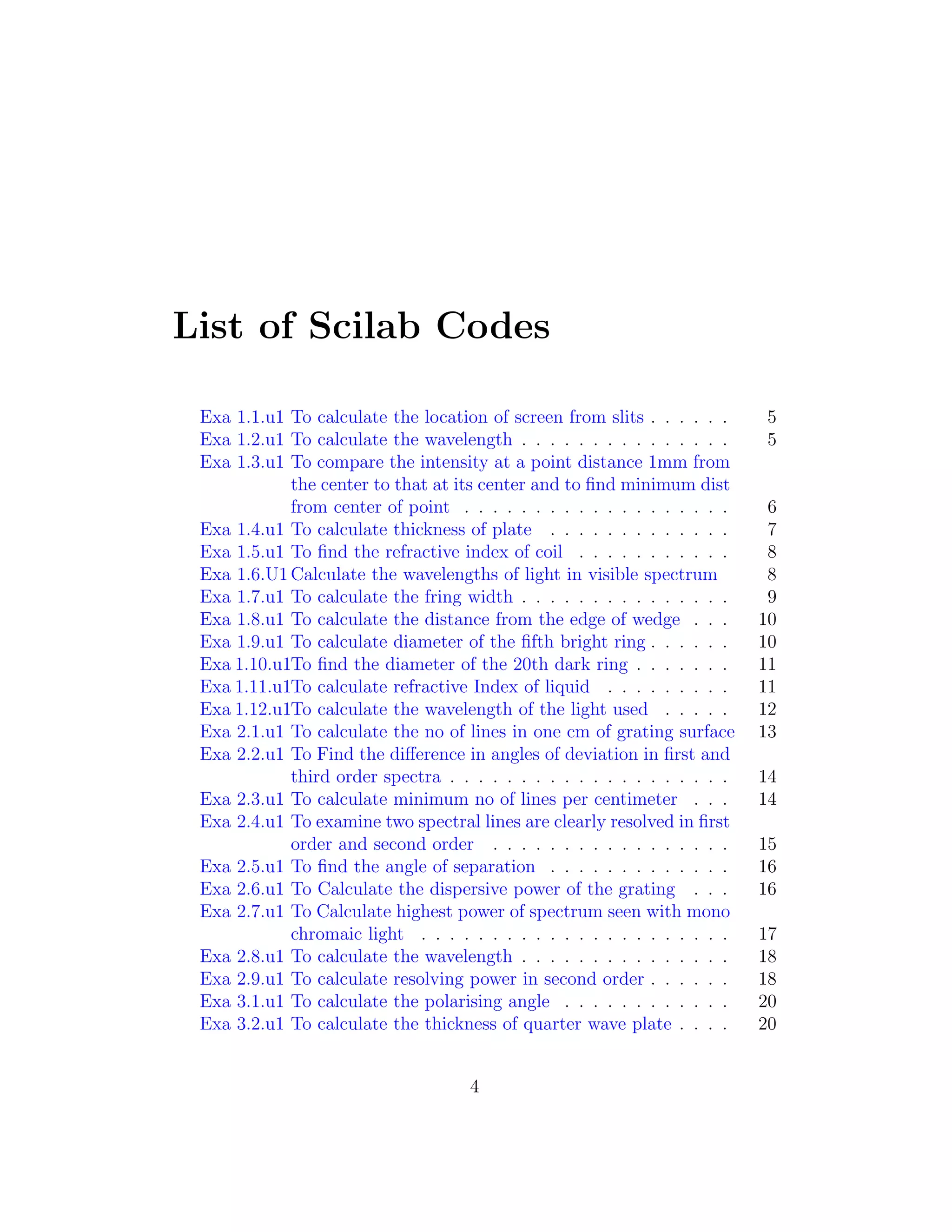
Exa 1.1.u1 To calculate the location of screen from slits . . . . . . 5
Exa 1.2.u1 To calculate the wavelength . . . . . . . . . . . . . . . 5
Exa 1.3.u1 To compare the intensity at a point distance 1mm from
the center to that at its center and to find minimum dist
from center of point . . . . . . . . . . . . . . . . . . . 6
Exa 1.4.u1 To calculate thickness of plate . . . . . . . . . . . . . 7
Exa 1.5.u1 To find the refractive index of coil . . . . . . . . . . . 8
Exa 1.6.U1Calculate the wavelengths of light in visible spectrum 8
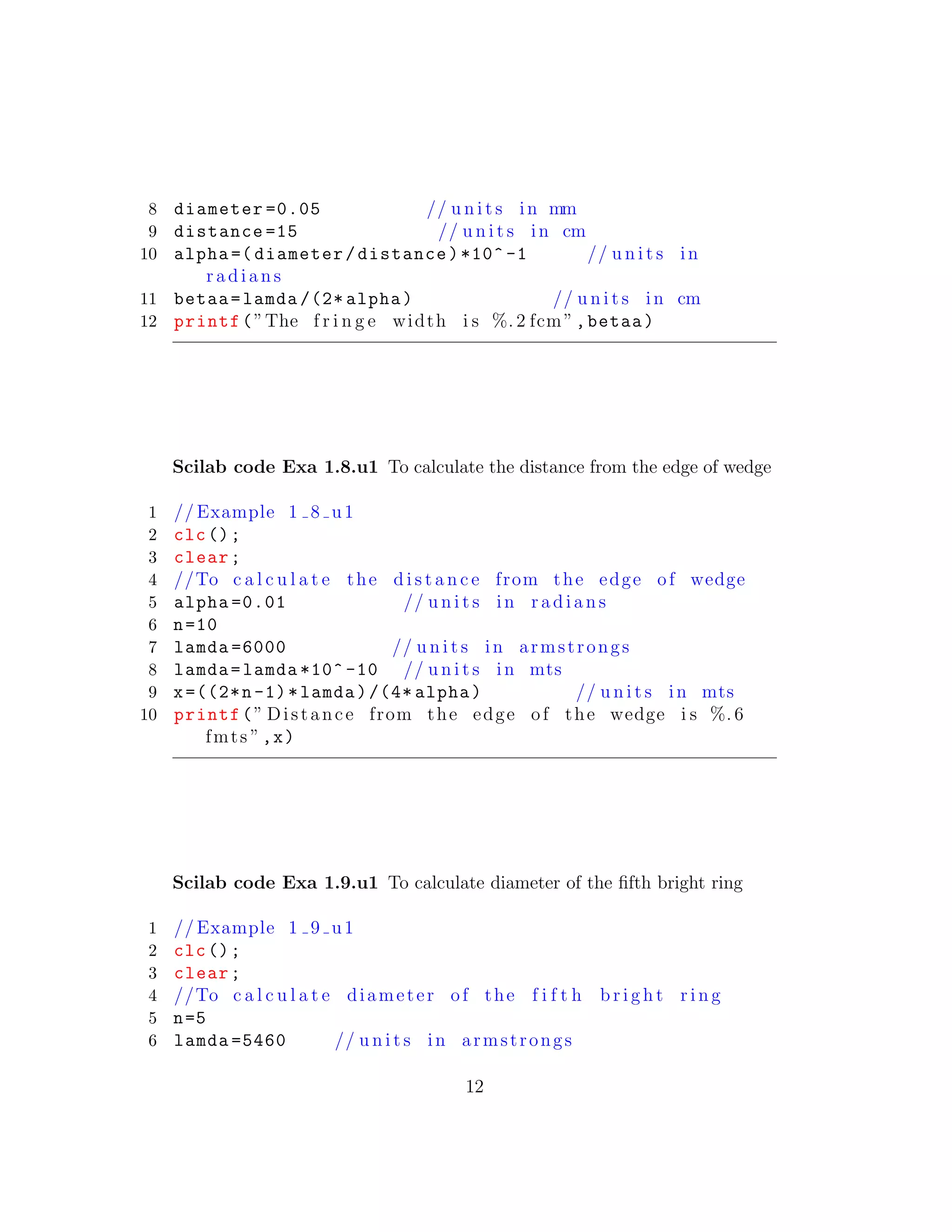
Exa 1.7.u1 To calculate the fring width . . . . . . . . . . . . . . . 9
Exa 1.8.u1 To calculate the distance from the edge of wedge . . . 10
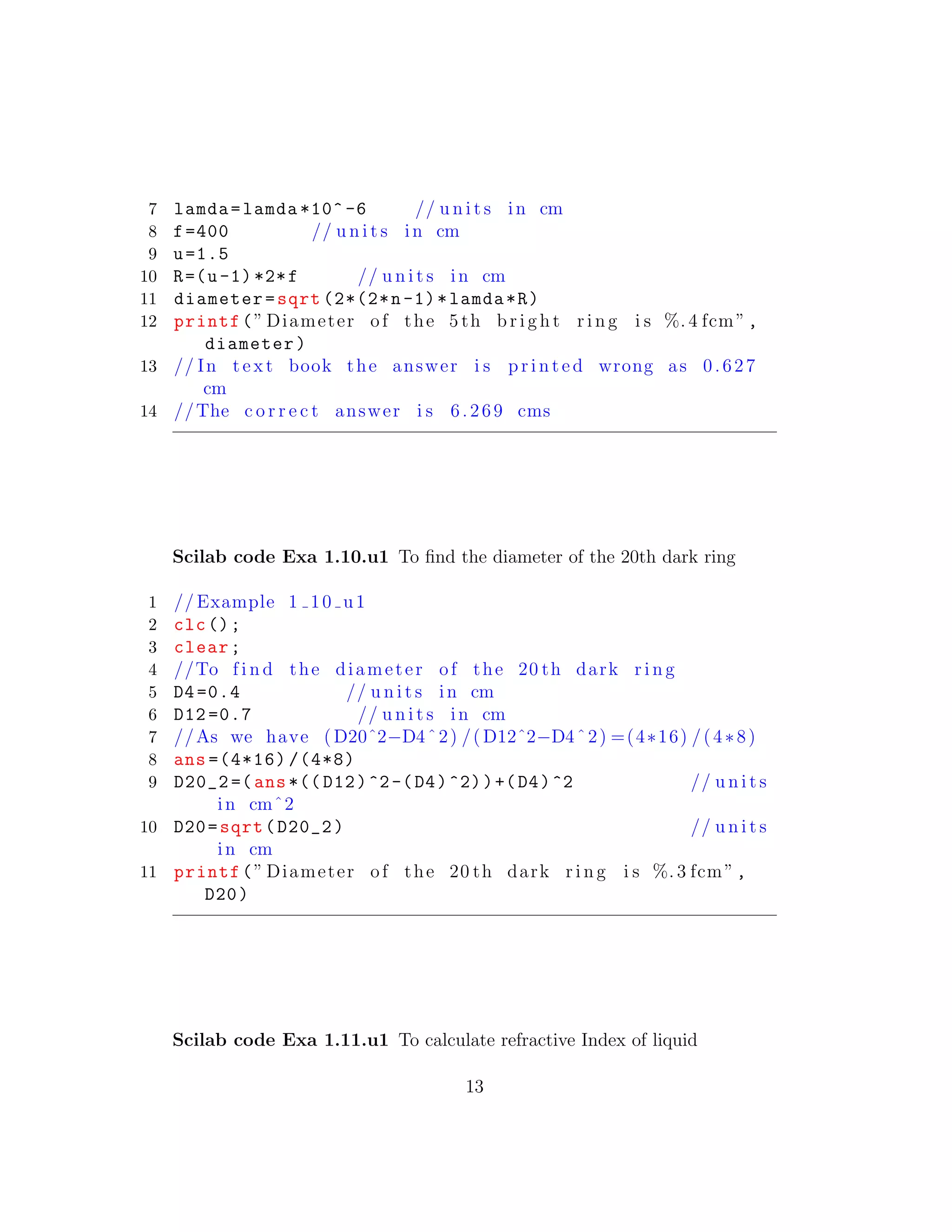
Exa 1.9.u1 To calculate diameter of the fifth bright ring . . . . . . 10
Exa 1.10.u1To find the diameter of the 20th dark ring . . . . . . . 11
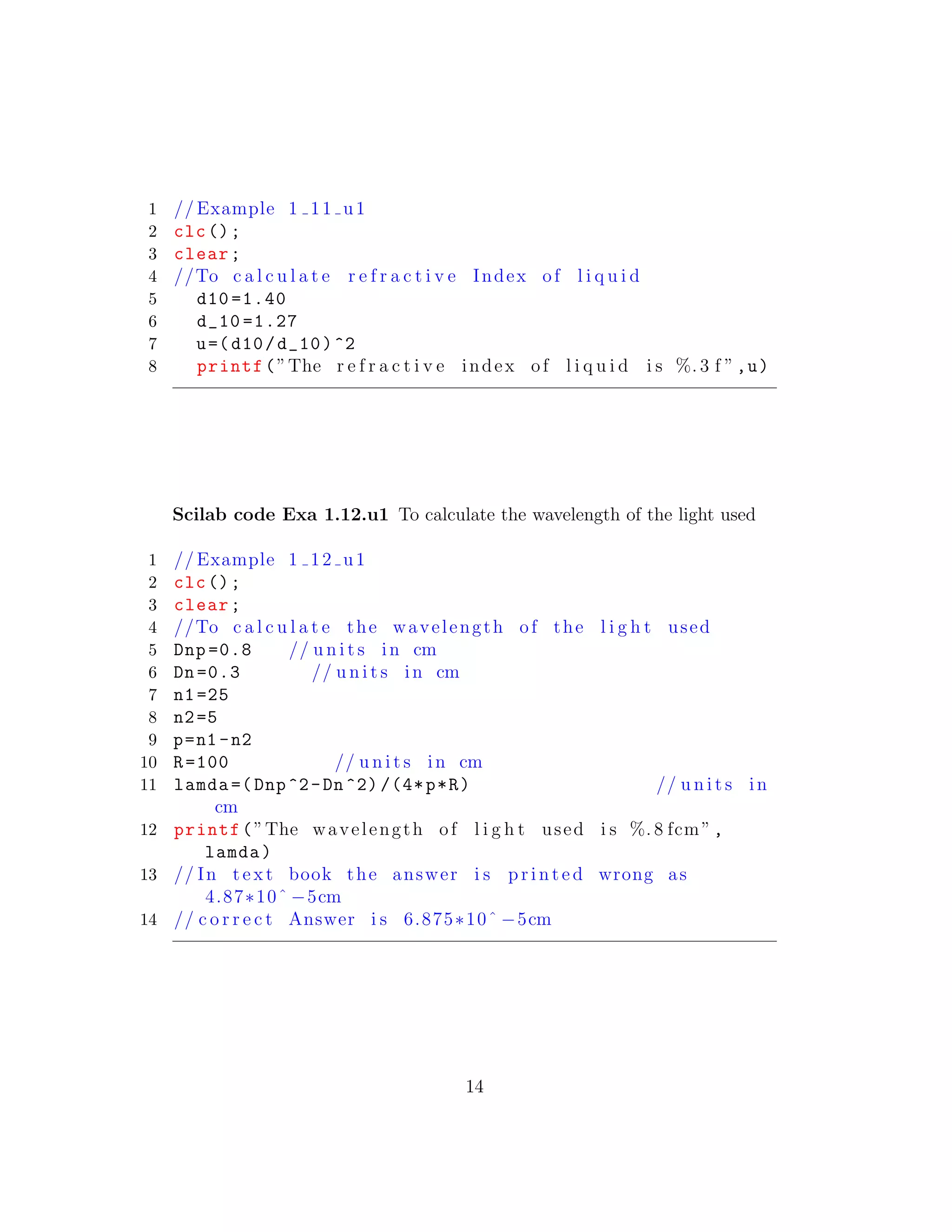
Exa 1.11.u1To calculate refractive Index of liquid . . . . . . . . . 11
Exa 1.12.u1To calculate the wavelength of the light used . . . . . 12
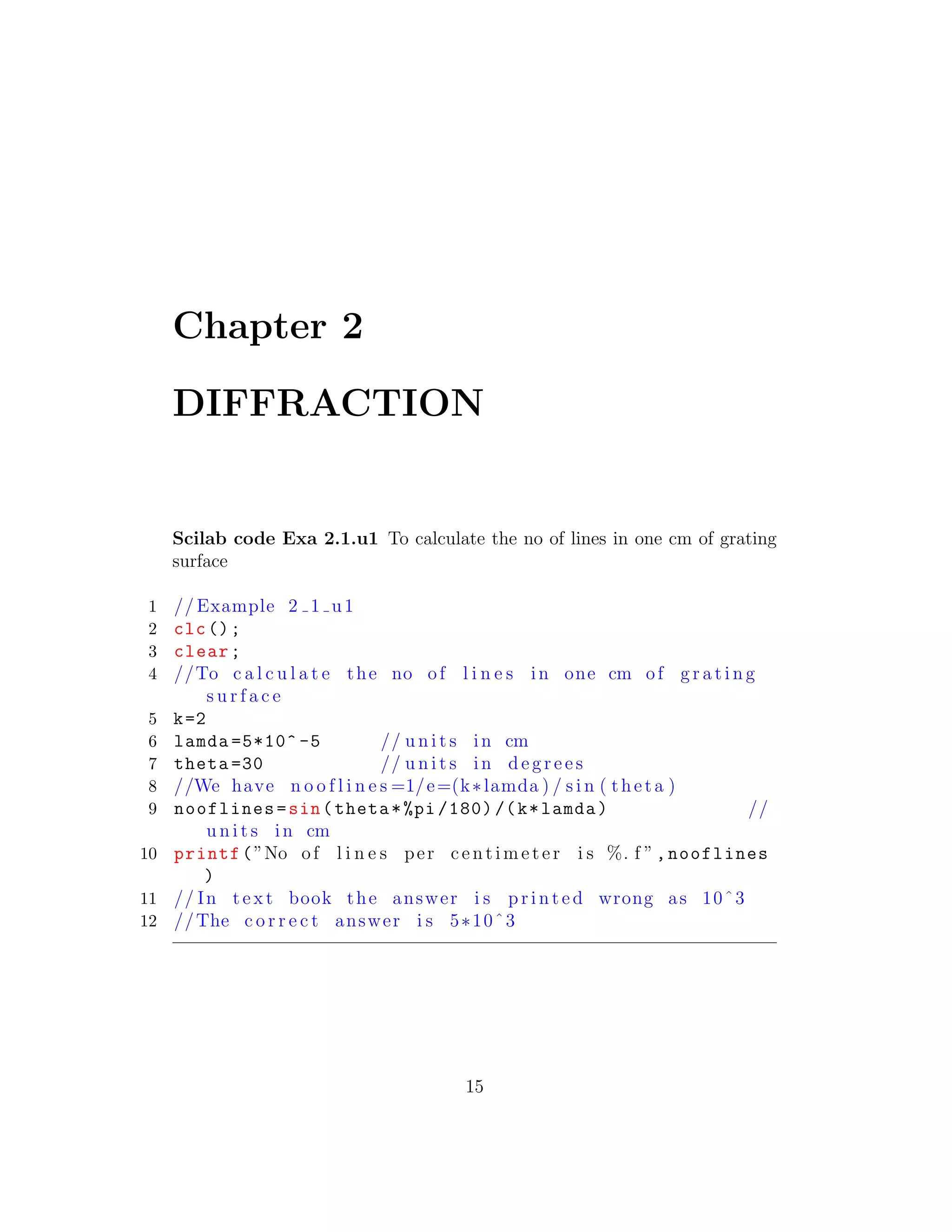
Exa 2.1.u1 To calculate the no of lines in one cm of grating surface 13
Exa 2.2.u1 To Find the difference in angles of deviation in first and
third order spectra . . . . . . . . . . . . . . . . . . . . 14
Exa 2.3.u1 To calculate minimum no of lines per centimeter . . . 14
Exa 2.4.u1 To examine two spectral lines are clearly resolved in first
order and second order . . . . . . . . . . . . . . . . . 15
Exa 2.5.u1 To find the angle of separation . . . . . . . . . . . . . 16
Exa 2.6.u1 To Calculate the dispersive power of the grating . . . 16
Exa 2.7.u1 To Calculate highest power of spectrum seen with mono
chromaic light . . . . . . . . . . . . . . . . . . . . . . 17
Exa 2.8.u1 To calculate the wavelength . . . . . . . . . . . . . . . 18
Exa 2.9.u1 To calculate resolving power in second order . . . . . . 18
Exa 3.1.u1 To calculate the polarising angle . . . . . . . . . . . . 20
Exa 3.2.u1 To calculate the thickness of quarter wave plate . . . . 20
4
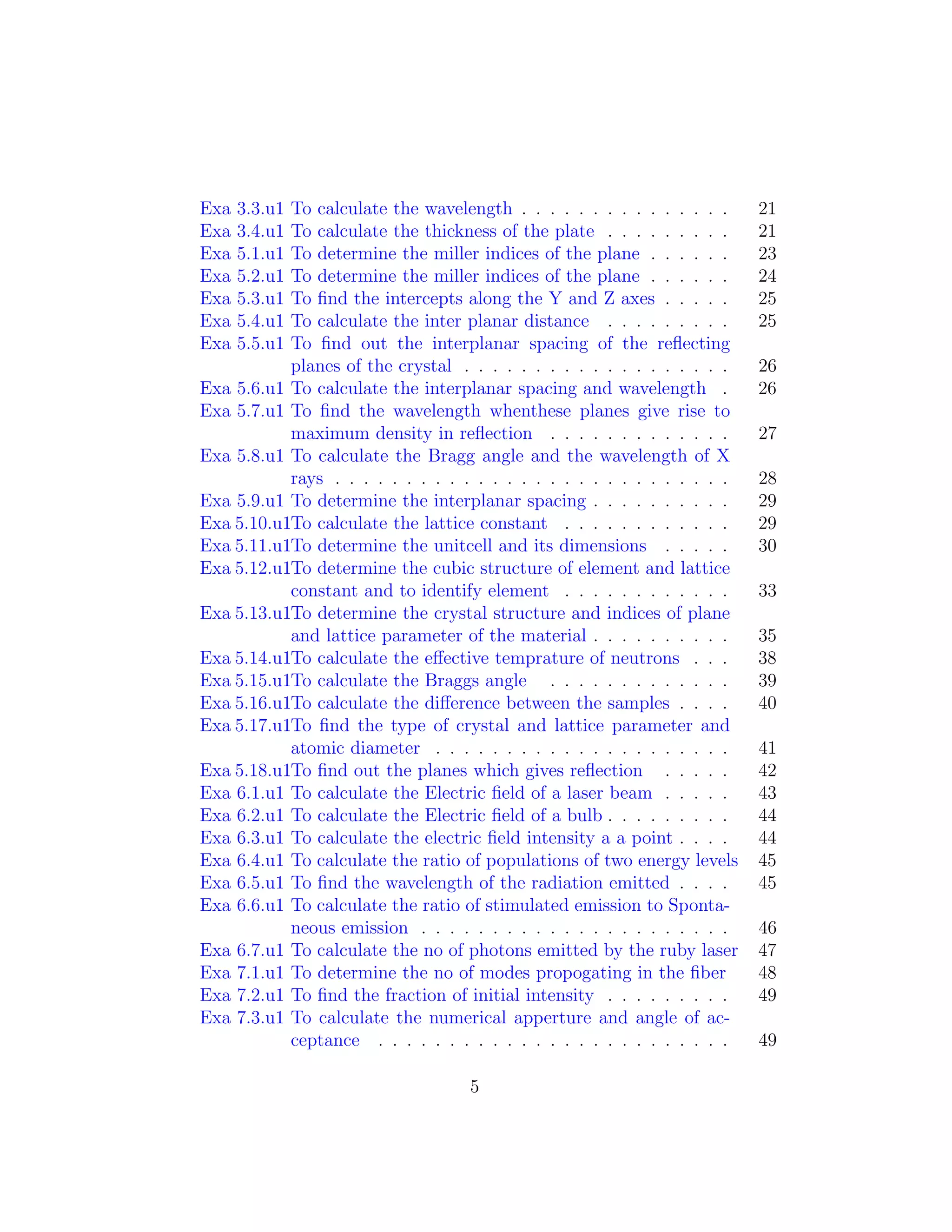
Exa 3.3.u1 To calculate the wavelength . . . . . . . . . . . . . . . 21
Exa 3.4.u1 To calculate the thickness of the plate . . . . . . . . . 21
Exa 5.1.u1 To determine the miller indices of the plane . . . . . . 23
Exa 5.2.u1 To determine the miller indices of the plane . . . . . . 24
Exa 5.3.u1 To find the intercepts along the Y and Z axes . . . . . 25
Exa 5.4.u1 To calculate the inter planar distance . . . . . . . . . 25
Exa 5.5.u1 To find out the interplanar spacing of the reflecting
planes of the crystal . . . . . . . . . . . . . . . . . . . 26
Exa 5.6.u1 To calculate the interplanar spacing and wavelength . 26
Exa 5.7.u1 To find the wavelength whenthese planes give rise to
maximum density in reflection . . . . . . . . . . . . . 27
Exa 5.8.u1 To calculate the Bragg angle and the wavelength of X
rays . . . . . . . . . . . . . . . . . . . . . . . . . . . . 28
Exa 5.9.u1 To determine the interplanar spacing . . . . . . . . . . 29
Exa 5.10.u1To calculate the lattice constant . . . . . . . . . . . . 29
Exa 5.11.u1To determine the unitcell and its dimensions . . . . . 30
Exa 5.12.u1To determine the cubic structure of element and lattice
constant and to identify element . . . . . . . . . . . . 33
Exa 5.13.u1To determine the crystal structure and indices of plane
and lattice parameter of the material . . . . . . . . . . 35
Exa 5.14.u1To calculate the effective temprature of neutrons . . . 38
Exa 5.15.u1To calculate the Braggs angle . . . . . . . . . . . . . 39
Exa 5.16.u1To calculate the difference between the samples . . . . 40
Exa 5.17.u1To find the type of crystal and lattice parameter and
atomic diameter . . . . . . . . . . . . . . . . . . . . . 41
Exa 5.18.u1To find out the planes which gives reflection . . . . . 42
Exa 6.1.u1 To calculate the Electric field of a laser beam . . . . . 43
Exa 6.2.u1 To calculate the Electric field of a bulb . . . . . . . . . 44
Exa 6.3.u1 To calculate the electric field intensity a a point . . . . 44
Exa 6.4.u1 To calculate the ratio of populations of two energy levels 45
Exa 6.5.u1 To find the wavelength of the radiation emitted . . . . 45
Exa 6.6.u1 To calculate the ratio of stimulated emission to Sponta-
neous emission . . . . . . . . . . . . . . . . . . . . . . 46
Exa 6.7.u1 To calculate the no of photons emitted by the ruby laser 47
Exa 7.1.u1 To determine the no of modes propogating in the fiber 48
Exa 7.2.u1 To find the fraction of initial intensity . . . . . . . . . 49
Exa 7.3.u1 To calculate the numerical apperture and angle of ac-
ceptance . . . . . . . . . . . . . . . . . . . . . . . . . 49
5
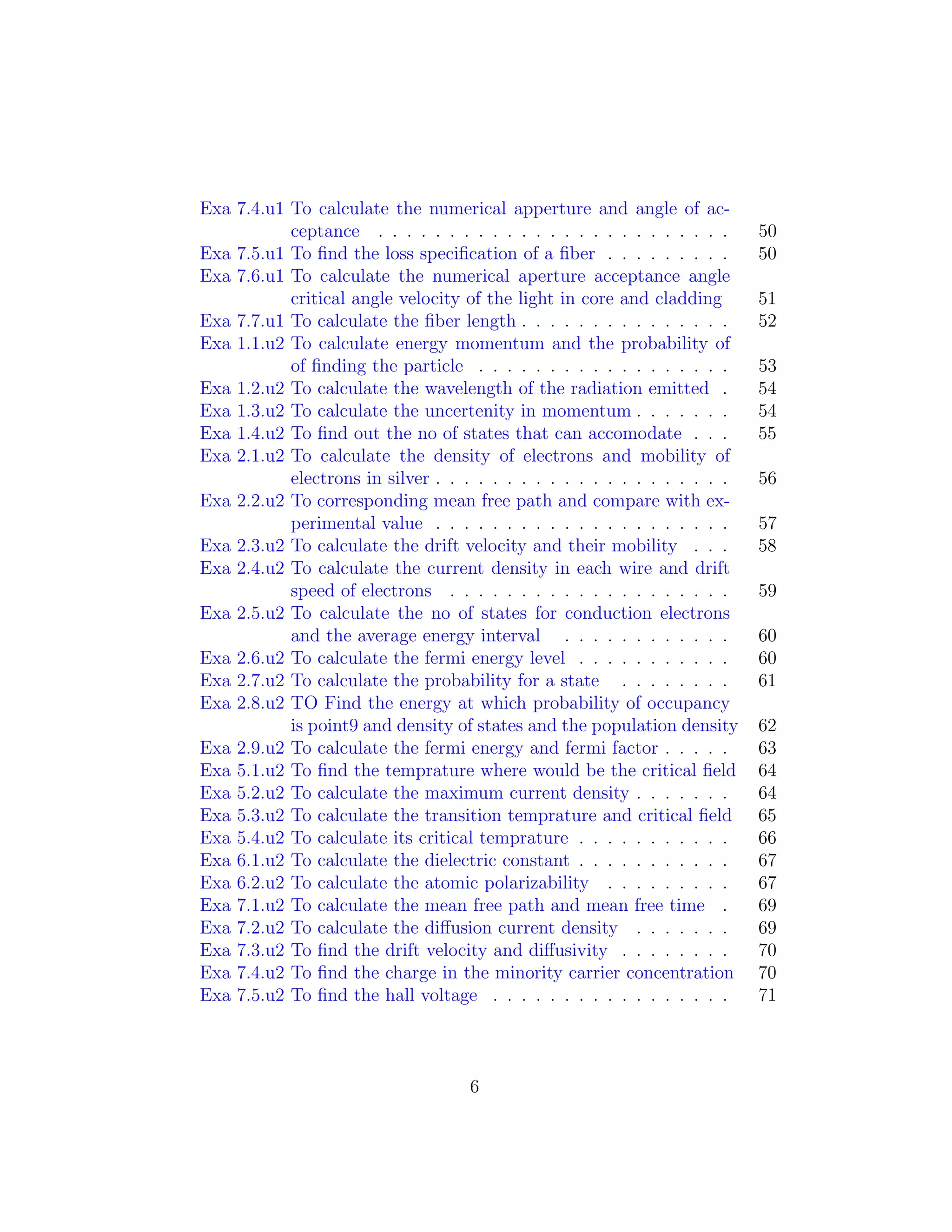
Exa 7.4.u1 To calculate the numerical apperture and angle of ac-
ceptance . . . . . . . . . . . . . . . . . . . . . . . . . 50
Exa 7.5.u1 To find the loss specification of a fiber . . . . . . . . . 50
Exa 7.6.u1 To calculate the numerical aperture acceptance angle
critical angle velocity of the light in core and cladding 51
Exa 7.7.u1 To calculate the fiber length . . . . . . . . . . . . . . . 52
Exa 1.1.u2 To calculate energy momentum and the probability of
of finding the particle . . . . . . . . . . . . . . . . . . 53
Exa 1.2.u2 To calculate the wavelength of the radiation emitted . 54
Exa 1.3.u2 To calculate the uncertenity in momentum . . . . . . . 54
Exa 1.4.u2 To find out the no of states that can accomodate . . . 55
Exa 2.1.u2 To calculate the density of electrons and mobility of
electrons in silver . . . . . . . . . . . . . . . . . . . . . 56
Exa 2.2.u2 To corresponding mean free path and compare with ex-
perimental value . . . . . . . . . . . . . . . . . . . . . 57
Exa 2.3.u2 To calculate the drift velocity and their mobility . . . 58
Exa 2.4.u2 To calculate the current density in each wire and drift
speed of electrons . . . . . . . . . . . . . . . . . . . . 59
Exa 2.5.u2 To calculate the no of states for conduction electrons
and the average energy interval . . . . . . . . . . . . 60
Exa 2.6.u2 To calculate the fermi energy level . . . . . . . . . . . 60
Exa 2.7.u2 To calculate the probability for a state . . . . . . . . 61
Exa 2.8.u2 TO Find the energy at which probability of occupancy
is point9 and density of states and the population density 62
Exa 2.9.u2 To calculate the fermi energy and fermi factor . . . . . 63
Exa 5.1.u2 To find the temprature where would be the critical field 64
Exa 5.2.u2 To calculate the maximum current density . . . . . . . 64
Exa 5.3.u2 To calculate the transition temprature and critical field 65
Exa 5.4.u2 To calculate its critical temprature . . . . . . . . . . . 66
Exa 6.1.u2 To calculate the dielectric constant . . . . . . . . . . . 67
Exa 6.2.u2 To calculate the atomic polarizability . . . . . . . . . 67
Exa 7.1.u2 To calculate the mean free path and mean free time . 69
Exa 7.2.u2 To calculate the diffusion current density . . . . . . . 69
Exa 7.3.u2 To find the drift velocity and diffusivity . . . . . . . . 70
Exa 7.4.u2 To find the charge in the minority carrier concentration 70
Exa 7.5.u2 To find the hall voltage . . . . . . . . . . . . . . . . . 71
6
Chapter 1
INTERFERENCE
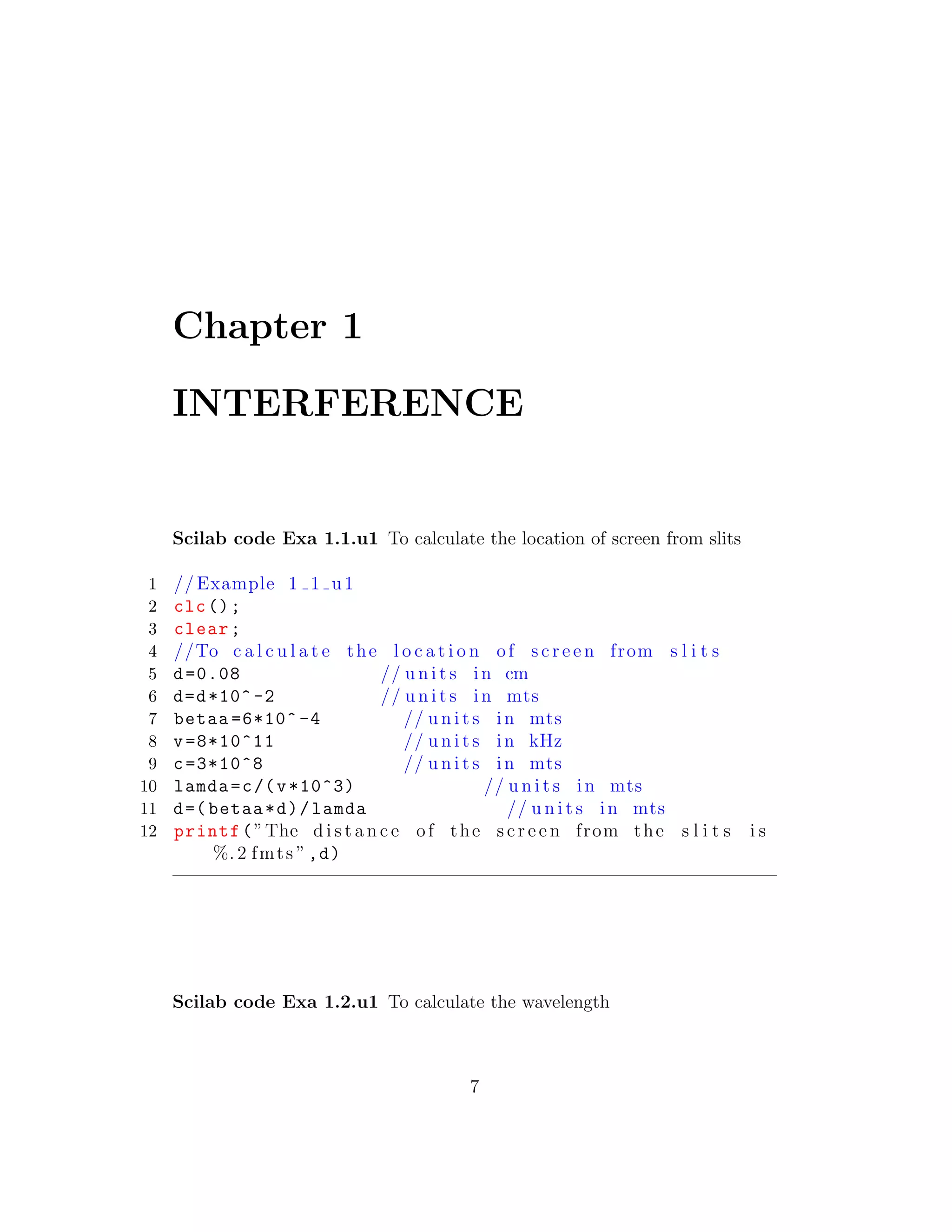
Scilab code Exa 1.1.u1 To calculate the location of screen from slits
1 // Example 1 1 u1
2 clc();
3 clear;
4 //To c a l c u l a t e the l o c a t i o n of s c r e e n from s l i t s
5 d=0.08 // u n i t s in cm
6 d=d*10^ -2 // u n i t s in mts
7 betaa =6*10^ -4 // u n i t s in mts
8 v=8*10^11 // u n i t s in kHz
9 c=3*10^8 // u n i t s in mts
10 lamda=c/(v*10^3) // u n i t s in mts
11 d=( betaa*d)/lamda // u n i t s in mts
12 printf(”The d i s t a n c e of the s c r e e n from the s l i t s i s
%. 2 fmts ”,d)
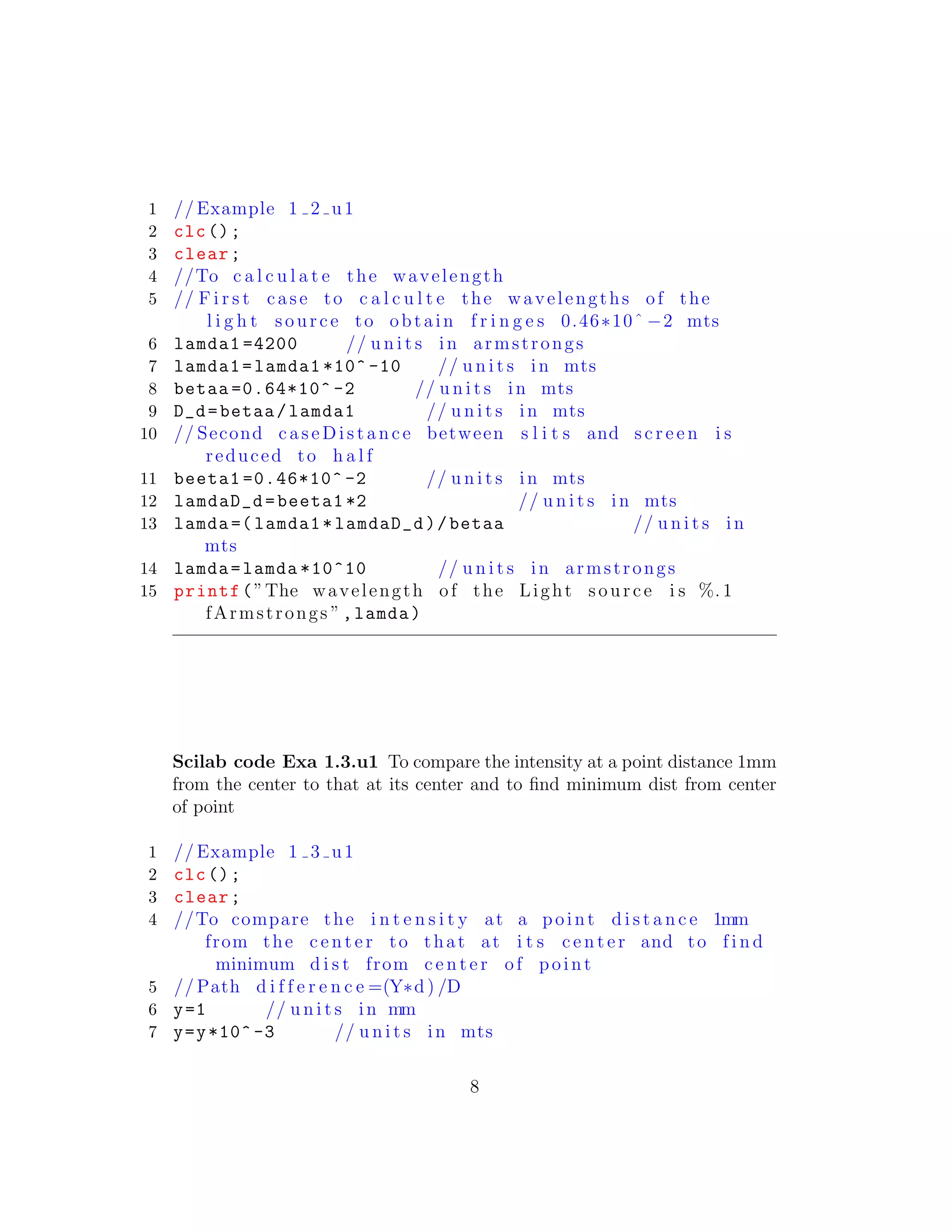
Scilab code Exa 1.2.u1 To calculate the wavelength
7
1 // Example 1 2 u1
2 clc();
3 clear;
4 //To c a l c u l a t e the wavelength
5 // F i r s t case to c a l c u l t e the wavelengths of the
l i g h t source to obtain f r i n g e s 0.46∗10ˆ −2 mts
6 lamda1 =4200 // u n i t s in armstrongs
7 lamda1=lamda1 *10^ -10 // u n i t s in mts
8 betaa =0.64*10^ -2 // u n i t s in mts
9 D_d=betaa/lamda1 // u n i t s in mts
10 // Second c a s e D i s t a n c e between s l i t s and s c r e e n i s
reduced to h a l f
11 beeta1 =0.46*10^ -2 // u n i t s in mts
12 lamdaD_d=beeta1 *2 // u n i t s in mts
13 lamda =( lamda1*lamdaD_d)/betaa // u n i t s in
mts
14 lamda=lamda *10^10 // u n i t s in armstrongs
15 printf(”The wavelength of the Light source i s %. 1
fArmstrongs ”,lamda)
Scilab code Exa 1.3.u1 To compare the intensity at a point distance 1mm
from the center to that at its center and to find minimum dist from center
of point
1 // Example 1 3 u1
2 clc();
3 clear;
4 //To compare the i n t e n s i t y at a point d i s t a n c e 1mm
from the c e n t e r to that at i t s c e n t e r and to f i n d
minimum d i s t from c e n t e r of point
5 // Path d i f f e r e n c e =(Y∗d ) /D
6 y=1 // u n i t s in mm
7 y=y*10^ -3 // u n i t s in mts
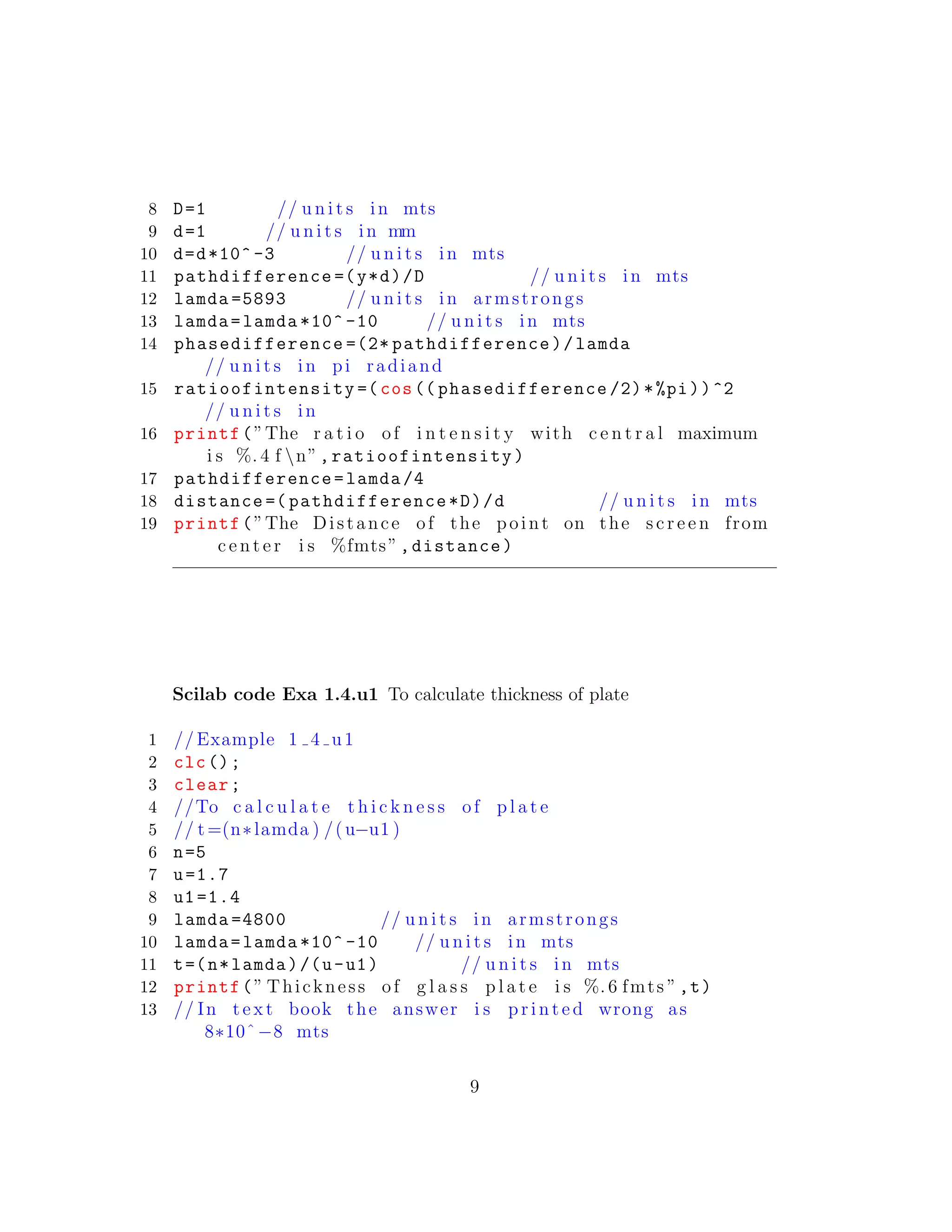
8
8 D=1 // u n i t s in mts
9 d=1 // u n i t s in mm
10 d=d*10^ -3 // u n i t s in mts
11 pathdifference =(y*d)/D // u n i t s in mts
12 lamda =5893 // u n i t s in armstrongs
13 lamda=lamda *10^ -10 // u n i t s in mts
14 phasedifference =(2* pathdifference)/lamda
// u n i t s in pi radiand
15 ratioofintensity =(cos(( phasedifference /2)*%pi))^2
// u n i t s in
16 printf(”The r a t i o of i n t e n s i t y with c e n t r a l maximum
i s %. 4 f n”,ratioofintensity)
17 pathdifference=lamda /4
18 distance =( pathdifference*D)/d // u n i t s in mts
19 printf(”The Distance of the point on the s c r e e n from
c e n t e r i s %fmts”,distance)
Scilab code Exa 1.4.u1 To calculate thickness of plate
1 // Example 1 4 u1
2 clc();
3 clear;
4 //To c a l c u l a t e t h i c k n e s s of p l a t e
5 // t=(n∗lamda ) /(u−u1 )
6 n=5
7 u=1.7
8 u1=1.4
9 lamda =4800 // u n i t s in armstrongs
10 lamda=lamda *10^ -10 // u n i t s in mts
11 t=(n*lamda)/(u-u1) // u n i t s in mts
12 printf(” Thickness of g l a s s p l a t e i s %. 6 fmts ”,t)
13 // In t e x t book the answer i s p r i n t e d wrong as
8∗10ˆ−8 mts
9
14 // the c o r r e c t answer i s 8∗10ˆ−6 mts
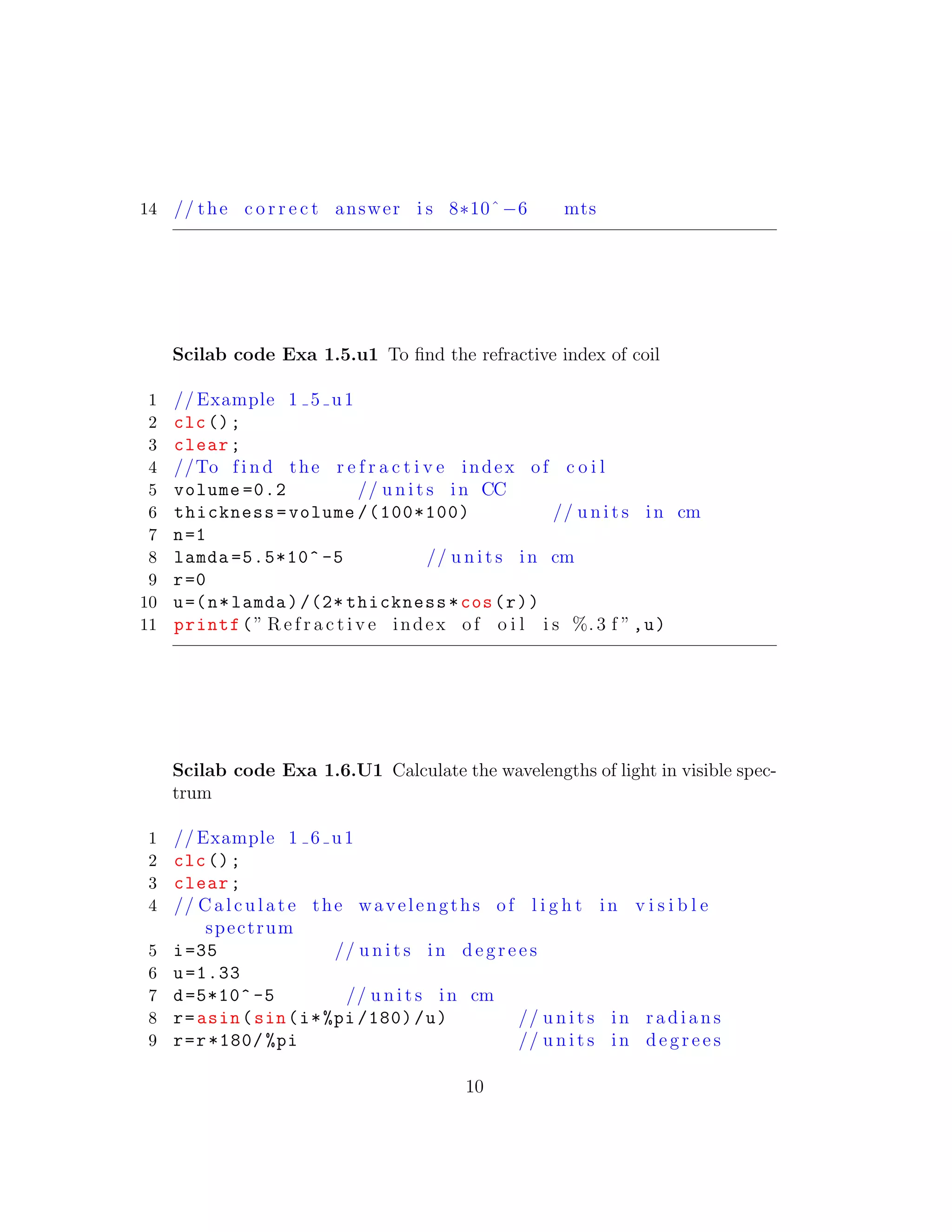
Scilab code Exa 1.5.u1 To find the refractive index of coil
1 // Example 1 5 u1
2 clc();
3 clear;
4 //To f i n d the r e f r a c t i v e index of c o i l
5 volume =0.2 // u n i t s in CC
6 thickness=volume /(100*100) // u n i t s in cm
7 n=1
8 lamda =5.5*10^ -5 // u n i t s in cm
9 r=0
10 u=(n*lamda)/(2* thickness*cos(r))
11 printf(” R e f r a c t i v e index of o i l i s %. 3 f ”,u)
Scilab code Exa 1.6.U1 Calculate the wavelengths of light in visible spec-
trum
1 // Example 1 6 u1
2 clc();
3 clear;
4 // C a l c u l a t e the wavelengths of l i g h t in v i s i b l e
spectrum
5 i=35 // u n i t s in d e g r e e s
6 u=1.33
7 d=5*10^ -5 // u n i t s in cm
8 r=asin(sin(i*%pi /180)/u) // u n i t s in r a d i a n s
9 r=r*180/ %pi // u n i t s in d e g r e e s
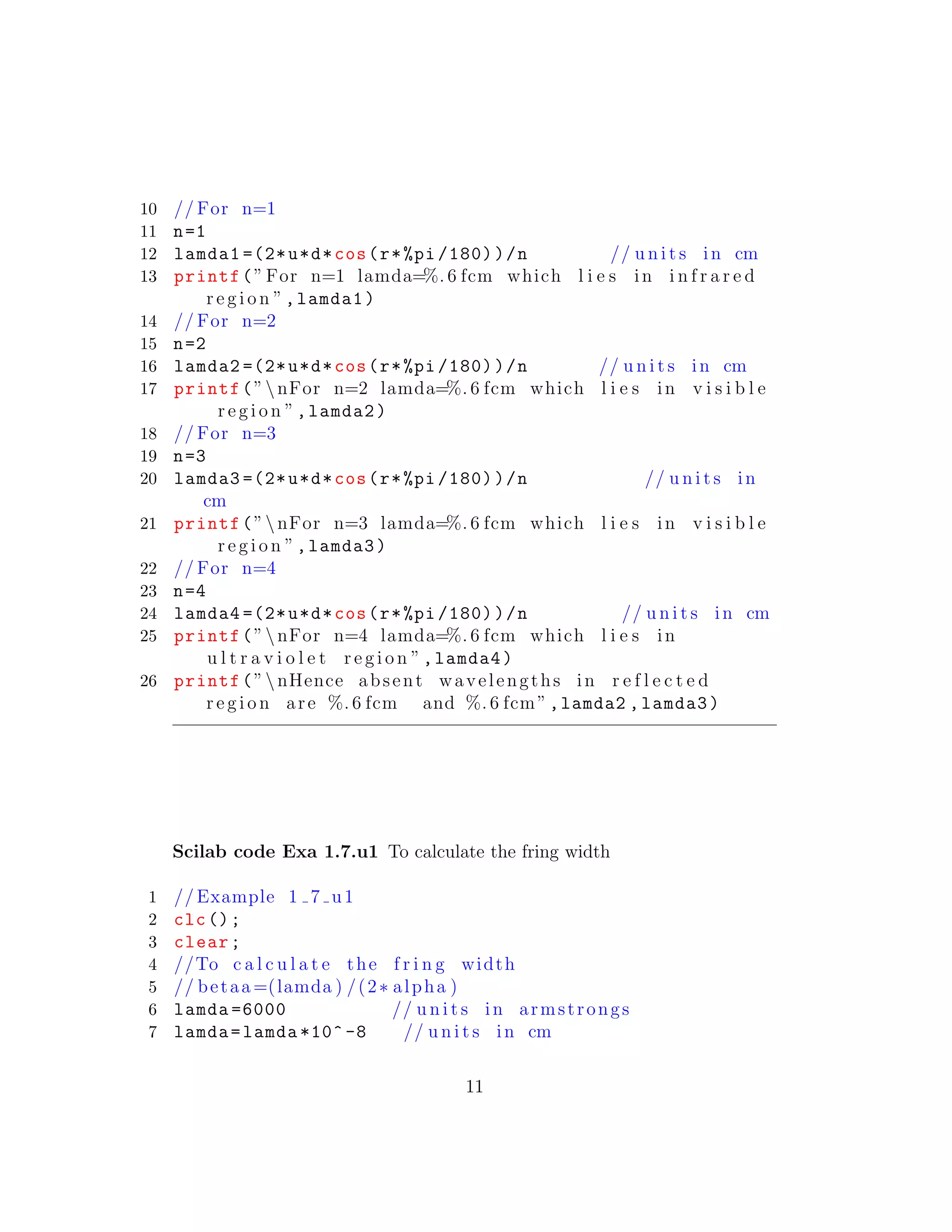
10
10 // For n=1
11 n=1
12 lamda1 =(2*u*d*cos(r*%pi /180))/n // u n i t s in cm
13 printf(”For n=1 lamda=%. 6 fcm which l i e s in i n f r a r e d
r e g i o n ”,lamda1)
14 // For n=2
15 n=2
16 lamda2 =(2*u*d*cos(r*%pi /180))/n // u n i t s in cm
17 printf(”nFor n=2 lamda=%. 6 fcm which l i e s in v i s i b l e
r e g i o n ”,lamda2)
18 // For n=3
19 n=3
20 lamda3 =(2*u*d*cos(r*%pi /180))/n // u n i t s in
cm
21 printf(”nFor n=3 lamda=%. 6 fcm which l i e s in v i s i b l e
r e g i o n ”,lamda3)
22 // For n=4
23 n=4
24 lamda4 =(2*u*d*cos(r*%pi /180))/n // u n i t s in cm
25 printf(”nFor n=4 lamda=%. 6 fcm which l i e s in
u l t r a v i o l e t r e g i o n ”,lamda4)
26 printf(”nHence absent wavelengths in r e f l e c t e d
r e g i o n are %. 6 fcm and %. 6 fcm”,lamda2 ,lamda3)
Scilab code Exa 1.7.u1 To calculate the fring width
1 // Example 1 7 u1
2 clc();
3 clear;
4 //To c a l c u l a t e the f r i n g width
5 // betaa =(lamda ) /(2∗ alpha )
6 lamda =6000 // u n i t s in armstrongs
7 lamda=lamda *10^ -8 // u n i t s in cm
11
8 diameter =0.05 // u n i t s in mm
9 distance =15 // u n i t s in cm
10 alpha =( diameter/distance)*10^ -1 // u n i t s in
r a d i a n s
11 betaa=lamda /(2* alpha) // u n i t s in cm
12 printf(”The f r i n g e width i s %. 2 fcm”,betaa)
Scilab code Exa 1.8.u1 To calculate the distance from the edge of wedge
1 // Example 1 8 u1
2 clc();
3 clear;
4 //To c a l c u l a t e the d i s t a n c e from the edge of wedge
5 alpha =0.01 // u n i t s in r a d i a n s
6 n=10
7 lamda =6000 // u n i t s in armstrongs
8 lamda=lamda *10^ -10 // u n i t s in mts
9 x=((2*n-1)*lamda)/(4* alpha) // u n i t s in mts
10 printf(” Distance from the edge of the wedge i s %. 6
fmts ”,x)
Scilab code Exa 1.9.u1 To calculate diameter of the fifth bright ring
1 // Example 1 9 u1
2 clc();
3 clear;
4 //To c a l c u l a t e diameter of the f i f t h b r i g h t r i n g
5 n=5
6 lamda =5460 // u n i t s in armstrongs
12
7 lamda=lamda *10^ -6 // u n i t s in cm
8 f=400 // u n i t s in cm
9 u=1.5
10 R=(u-1) *2*f // u n i t s in cm
11 diameter=sqrt (2*(2*n-1)*lamda*R)
12 printf(” Diameter of the 5 th b r i g h t r i n g i s %. 4 fcm”,
diameter)
13 // In t e x t book the answer i s p r i n t e d wrong as 0.627
cm
14 //The c o r r e c t answer i s 6.269 cms
Scilab code Exa 1.10.u1 To find the diameter of the 20th dark ring
1 // Example 1 10 u1
2 clc();
3 clear;
4 //To f i n d the diameter of the 20 th dark r i n g
5 D4=0.4 // u n i t s in cm
6 D12 =0.7 // u n i t s in cm
7 //As we have (D20ˆ2−D4ˆ2) /( D12ˆ2−D4ˆ2) =(4∗16) /(4∗8)
8 ans =(4*16) /(4*8)
9 D20_2 =(ans *(( D12)^2-(D4)^2))+(D4)^2 // u n i t s
in cmˆ2
10 D20=sqrt(D20_2) // u n i t s
in cm
11 printf(” Diameter of the 20 th dark r i n g i s %. 3 fcm”,
D20)
Scilab code Exa 1.11.u1 To calculate refractive Index of liquid
13
1 // Example 1 11 u1
2 clc();
3 clear;
4 //To c a l c u l a t e r e f r a c t i v e Index of l i q u i d
5 d10 =1.40
6 d_10 =1.27
7 u=(d10/d_10)^2
8 printf(”The r e f r a c t i v e index of l i q u i d i s %. 3 f ”,u)
Scilab code Exa 1.12.u1 To calculate the wavelength of the light used
1 // Example 1 12 u1
2 clc();
3 clear;
4 //To c a l c u l a t e the wavelength of the l i g h t used
5 Dnp =0.8 // u n i t s in cm
6 Dn=0.3 // u n i t s in cm
7 n1=25
8 n2=5
9 p=n1 -n2
10 R=100 // u n i t s in cm
11 lamda =(Dnp^2-Dn^2) /(4*p*R) // u n i t s in
cm
12 printf(”The wavelength of l i g h t used i s %. 8 fcm”,
lamda)
13 // In t e x t book the answer i s p r i n t e d wrong as
4.87∗10ˆ −5cm
14 // c o r r e c t Answer i s 6.875∗10ˆ −5cm
14
Chapter 2
DIFFRACTION
Scilab code Exa 2.1.u1 To calculate the no of lines in one cm of grating
surface
1 // Example 2 1 u1
2 clc();
3 clear;
4 //To c a l c u l a t e the no of l i n e s in one cm of g r a t i n g
s u r f a c e
5 k=2
6 lamda =5*10^ -5 // u n i t s in cm
7 theta =30 // u n i t s in d e g r e e s
8 //We have n o o f l i n e s =1/e=(k∗lamda ) / s i n ( theta )
9 nooflines=sin(theta*%pi /180) /(k*lamda) //
u n i t s in cm
10 printf(”No of l i n e s per c e n t i me t e r i s %. f ”,nooflines
)
11 // In t e x t book the answer i s p r i n t e d wrong as 10ˆ3
12 //The c o r r e c t answer i s 5∗10ˆ3
15
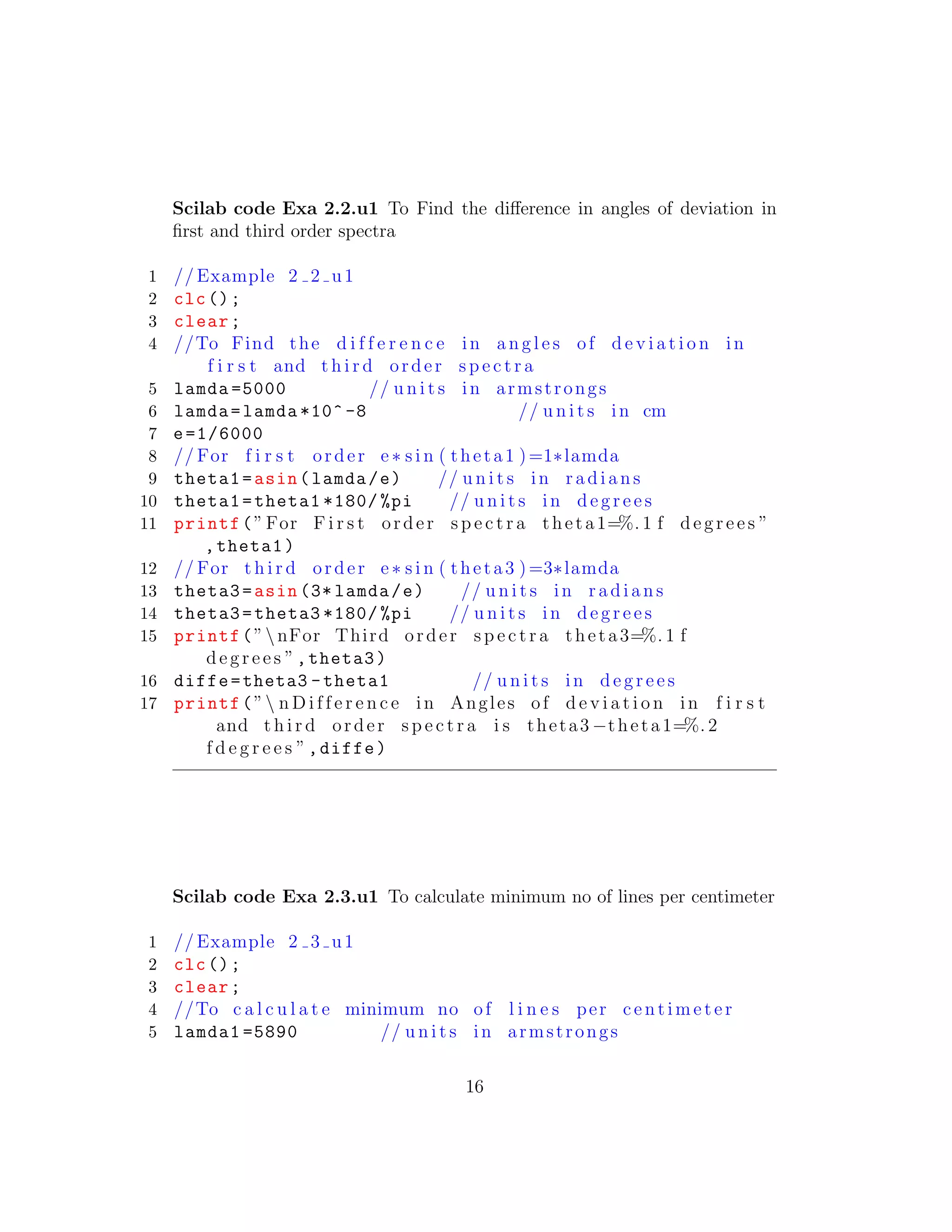
Scilab code Exa 2.2.u1 To Find the difference in angles of deviation in
first and third order spectra
1 // Example 2 2 u1
2 clc();
3 clear;
4 //To Find the d i f f e r e n c e in a n g l e s of d e v i a t i o n in
f i r s t and t h i r d order s p e c t r a
5 lamda =5000 // u n i t s in armstrongs
6 lamda=lamda *10^ -8 // u n i t s in cm
7 e=1/6000
8 // For f i r s t order e∗ s i n ( theta1 )=1∗lamda
9 theta1=asin(lamda/e) // u n i t s in r a d i a n s
10 theta1=theta1 *180/ %pi // u n i t s in d e g r e e s
11 printf(”For F i r s t order s p e c t r a theta1=%. 1 f d e g r e e s ”
,theta1)
12 // For t h i r d order e ∗ s i n ( theta3 )=3∗lamda
13 theta3=asin (3* lamda/e) // u n i t s in r a d i a n s
14 theta3=theta3 *180/ %pi // u n i t s in d e g r e e s
15 printf(”nFor Third order s p e c t r a theta3=%. 1 f
d e g r e e s ”,theta3)
16 diffe=theta3 -theta1 // u n i t s in d e g r e e s
17 printf(” n D i f f e r e n c e in Angles of d e v i a t i o n in f i r s t
and t h i r d order s p e c t r a i s theta3 −theta1=%. 2
f d e g r e e s ”,diffe)
Scilab code Exa 2.3.u1 To calculate minimum no of lines per centimeter
1 // Example 2 3 u1
2 clc();
3 clear;
4 //To c a l c u l a t e minimum no of l i n e s per c e n ti m e t e r
5 lamda1 =5890 // u n i t s in armstrongs
16
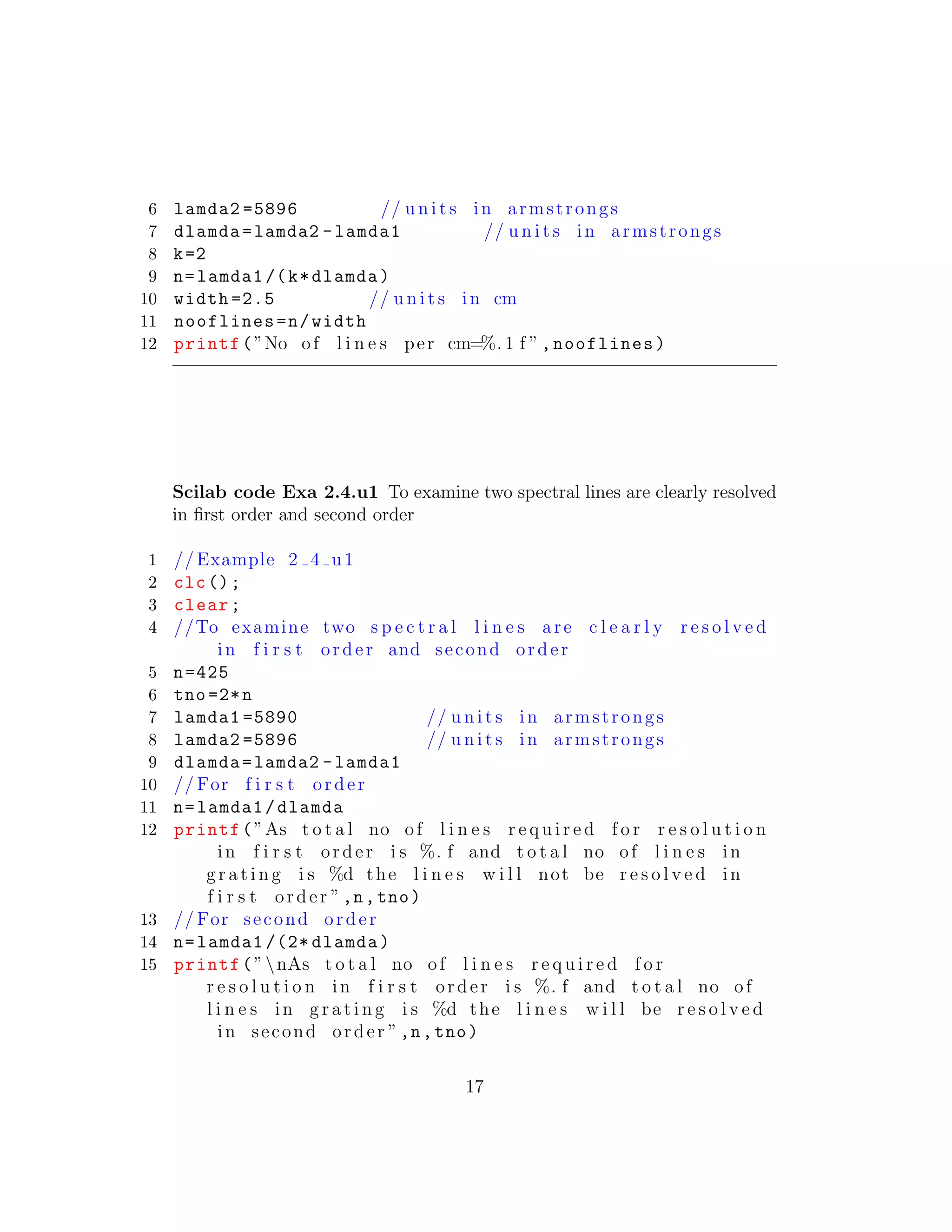
6 lamda2 =5896 // u n i t s in armstrongs
7 dlamda=lamda2 -lamda1 // u n i t s in armstrongs
8 k=2
9 n=lamda1 /(k*dlamda)
10 width =2.5 // u n i t s in cm
11 nooflines=n/width
12 printf(”No of l i n e s per cm=%. 1 f ”,nooflines)
Scilab code Exa 2.4.u1 To examine two spectral lines are clearly resolved
in first order and second order
1 // Example 2 4 u1
2 clc();
3 clear;
4 //To examine two s p e c t r a l l i n e s are c l e a r l y r e s o l v e d
in f i r s t order and second order
5 n=425
6 tno =2*n
7 lamda1 =5890 // u n i t s in armstrongs
8 lamda2 =5896 // u n i t s in armstrongs
9 dlamda=lamda2 -lamda1
10 // For f i r s t order
11 n=lamda1/dlamda
12 printf(”As t o t a l no of l i n e s r e q u i r e d f o r r e s o l u t i o n
in f i r s t order i s %. f and t o t a l no of l i n e s in
g r a t i n g i s %d the l i n e s w i l l not be r e s o l v e d in
f i r s t order ”,n,tno)
13 // For second order
14 n=lamda1 /(2* dlamda)
15 printf(”nAs t o t a l no of l i n e s r e q u i r e d f o r
r e s o l u t i o n in f i r s t order i s %. f and t o t a l no of
l i n e s in g r a t i n g i s %d the l i n e s w i l l be r e s o l v e d
in second order ”,n,tno)
17
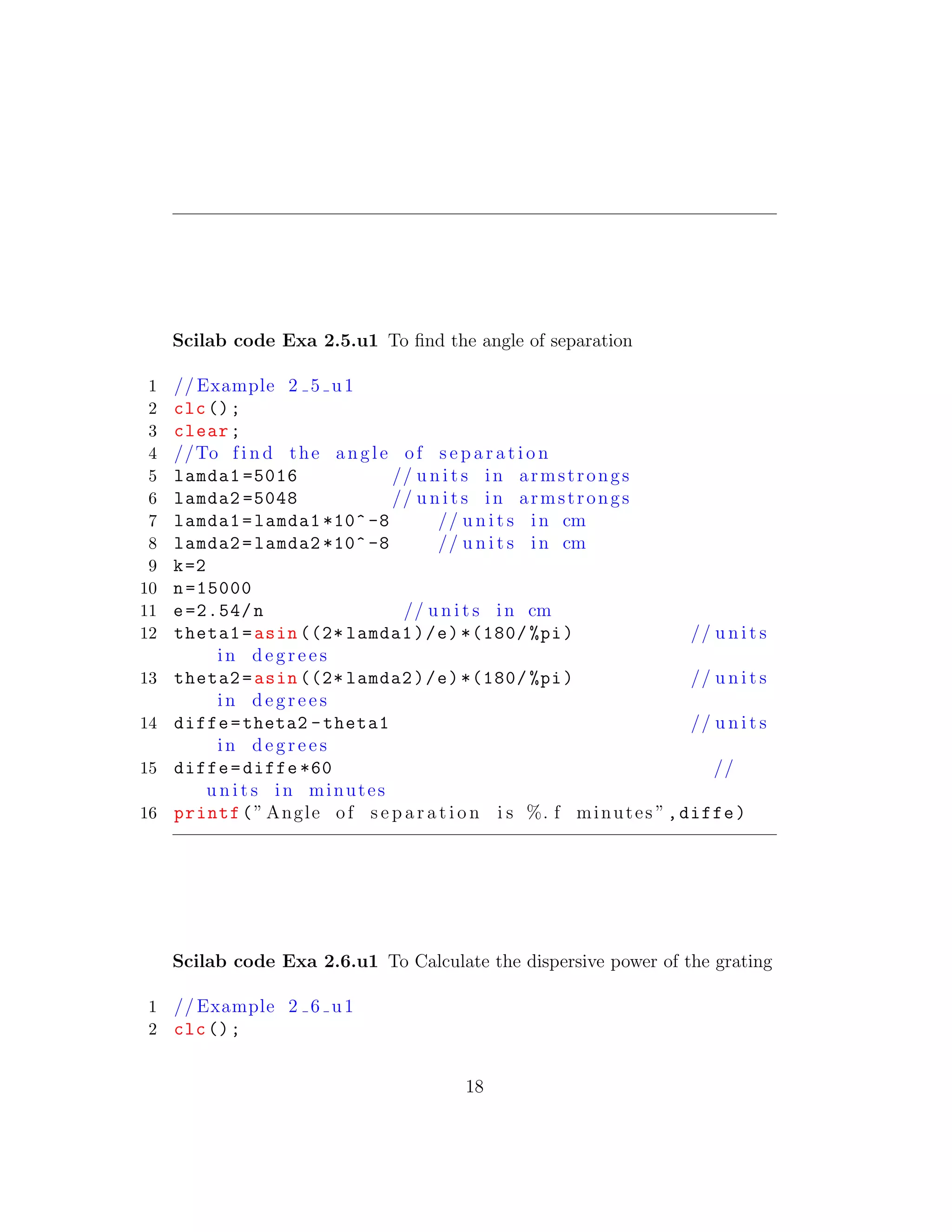
Scilab code Exa 2.5.u1 To find the angle of separation
1 // Example 2 5 u1
2 clc();
3 clear;
4 //To f i n d the angle of s e p a r a t i o n
5 lamda1 =5016 // u n i t s in armstrongs
6 lamda2 =5048 // u n i t s in armstrongs
7 lamda1=lamda1 *10^ -8 // u n i t s in cm
8 lamda2=lamda2 *10^ -8 // u n i t s in cm
9 k=2
10 n=15000
11 e=2.54/n // u n i t s in cm
12 theta1=asin ((2* lamda1)/e)*(180/ %pi) // u n i t s
in d e g r e e s
13 theta2=asin ((2* lamda2)/e)*(180/ %pi) // u n i t s
in d e g r e e s
14 diffe=theta2 -theta1 // u n i t s
in d e g r e e s
15 diffe=diffe *60 //
u n i t s in minutes
16 printf(” Angle of s e p a r a t i o n i s %. f minutes ”,diffe)
Scilab code Exa 2.6.u1 To Calculate the dispersive power of the grating
1 // Example 2 6 u1
2 clc();
18
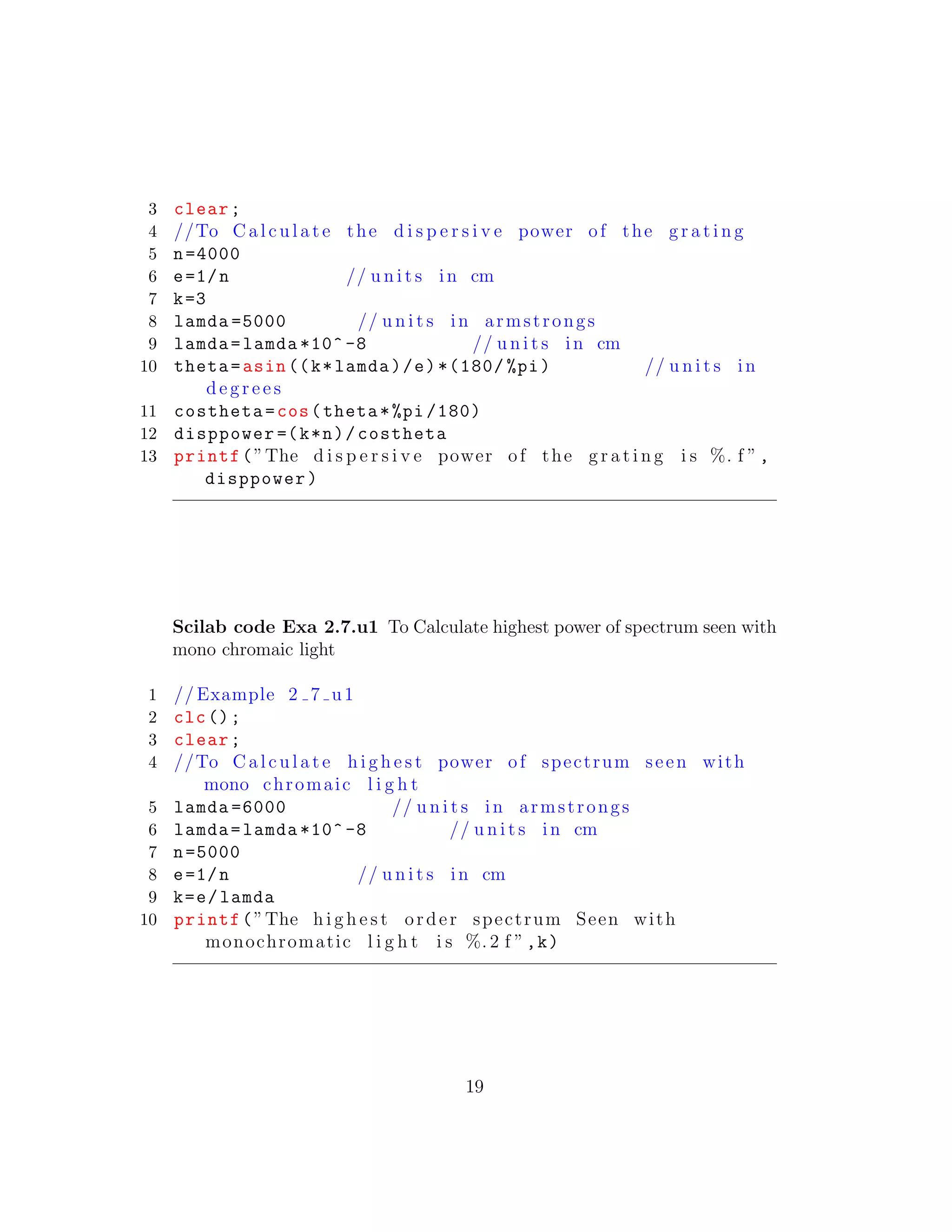
3 clear;
4 //To C a l c u l a t e the d i s p e r s i v e power of the g r a t i n g
5 n=4000
6 e=1/n // u n i t s in cm
7 k=3
8 lamda =5000 // u n i t s in armstrongs
9 lamda=lamda *10^ -8 // u n i t s in cm
10 theta=asin ((k*lamda)/e)*(180/ %pi) // u n i t s in
d e g r e e s
11 costheta=cos(theta*%pi /180)
12 disppower =(k*n)/costheta
13 printf(”The d i s p e r s i v e power of the g r a t i n g i s %. f ”,
disppower)
Scilab code Exa 2.7.u1 To Calculate highest power of spectrum seen with
mono chromaic light
1 // Example 2 7 u1
2 clc();
3 clear;
4 //To C a l c u l a t e h i g h e s t power of spectrum seen with
mono chromaic l i g h t
5 lamda =6000 // u n i t s in armstrongs
6 lamda=lamda *10^ -8 // u n i t s in cm
7 n=5000
8 e=1/n // u n i t s in cm
9 k=e/lamda
10 printf(”The h i g h e s t order spectrum Seen with
monochromatic l i g h t i s %. 2 f ”,k)
19
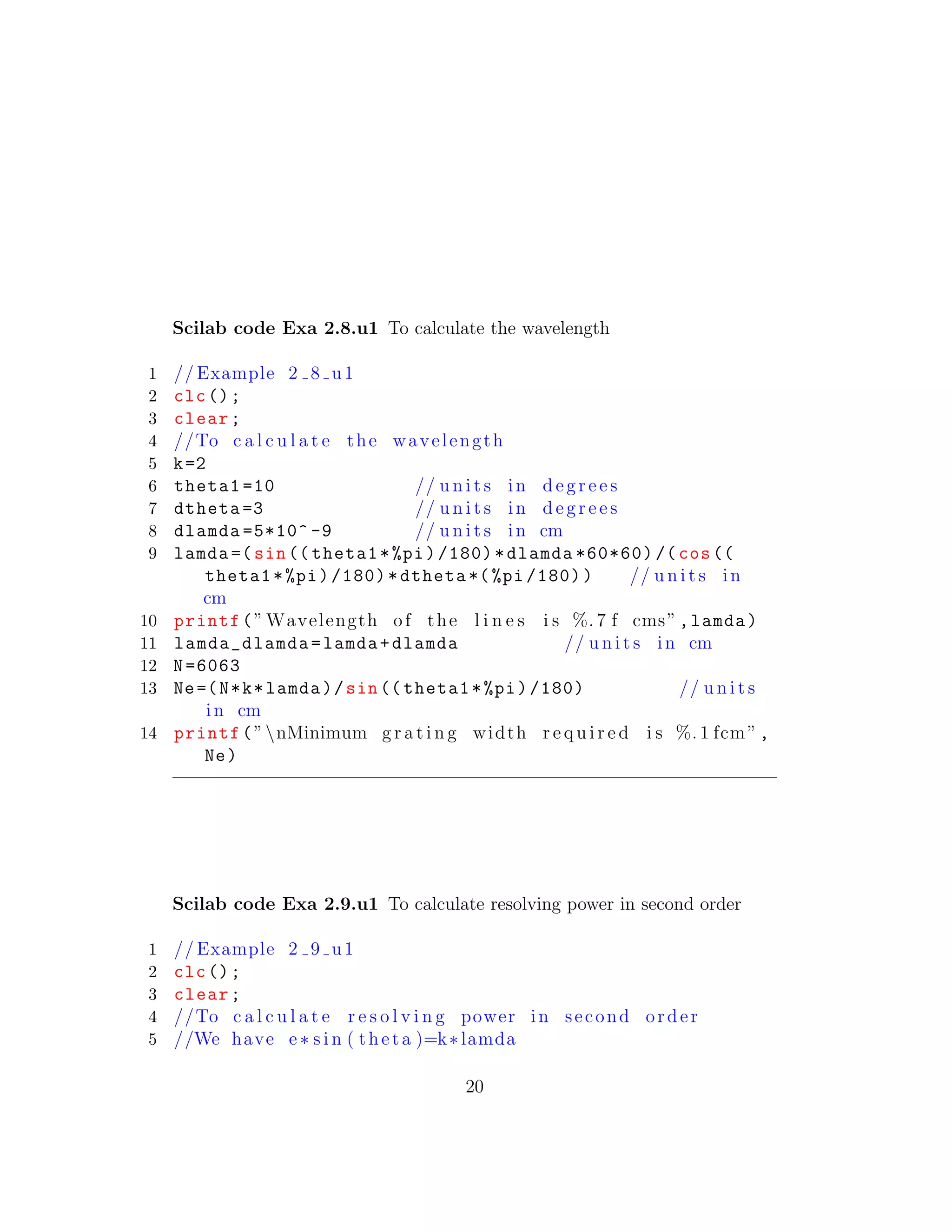
Scilab code Exa 2.8.u1 To calculate the wavelength
1 // Example 2 8 u1
2 clc();
3 clear;
4 //To c a l c u l a t e the wavelength
5 k=2
6 theta1 =10 // u n i t s in d e g r e e s
7 dtheta =3 // u n i t s in d e g r e e s
8 dlamda =5*10^ -9 // u n i t s in cm
9 lamda =(sin(( theta1*%pi)/180)*dlamda *60*60) /(cos((
theta1*%pi)/180)*dtheta *(%pi /180)) // u n i t s in
cm
10 printf(” Wavelength of the l i n e s i s %. 7 f cms”,lamda)
11 lamda_dlamda=lamda+dlamda // u n i t s in cm
12 N=6063
13 Ne=(N*k*lamda)/sin(( theta1*%pi)/180) // u n i t s
in cm
14 printf(”nMinimum g r a t i n g width r e q u i r e d i s %. 1 fcm”,
Ne)
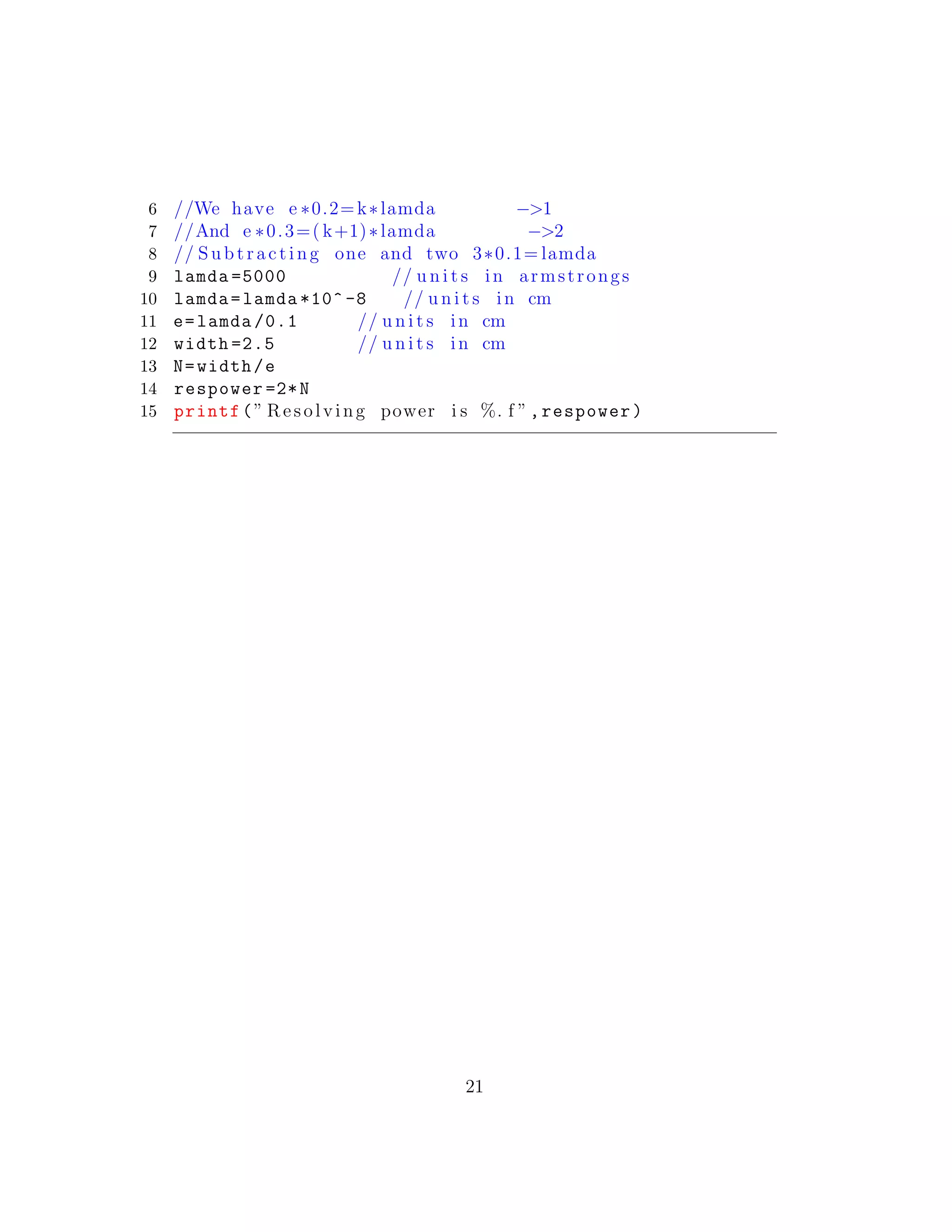
Scilab code Exa 2.9.u1 To calculate resolving power in second order
1 // Example 2 9 u1
2 clc();
3 clear;
4 //To c a l c u l a t e r e s o l v i n g power in second order
5 //We have e∗ s i n ( theta )=k∗lamda
20
6 //We have e ∗0.2=k∗lamda −>1
7 //And e ∗0.3=( k+1)∗lamda −>2
8 // Subtracting one and two 3∗0.1= lamda
9 lamda =5000 // u n i t s in armstrongs
10 lamda=lamda *10^ -8 // u n i t s in cm
11 e=lamda /0.1 // u n i t s in cm
12 width =2.5 // u n i t s in cm
13 N=width/e
14 respower =2*N
15 printf(” Resolving power i s %. f ”,respower)
21
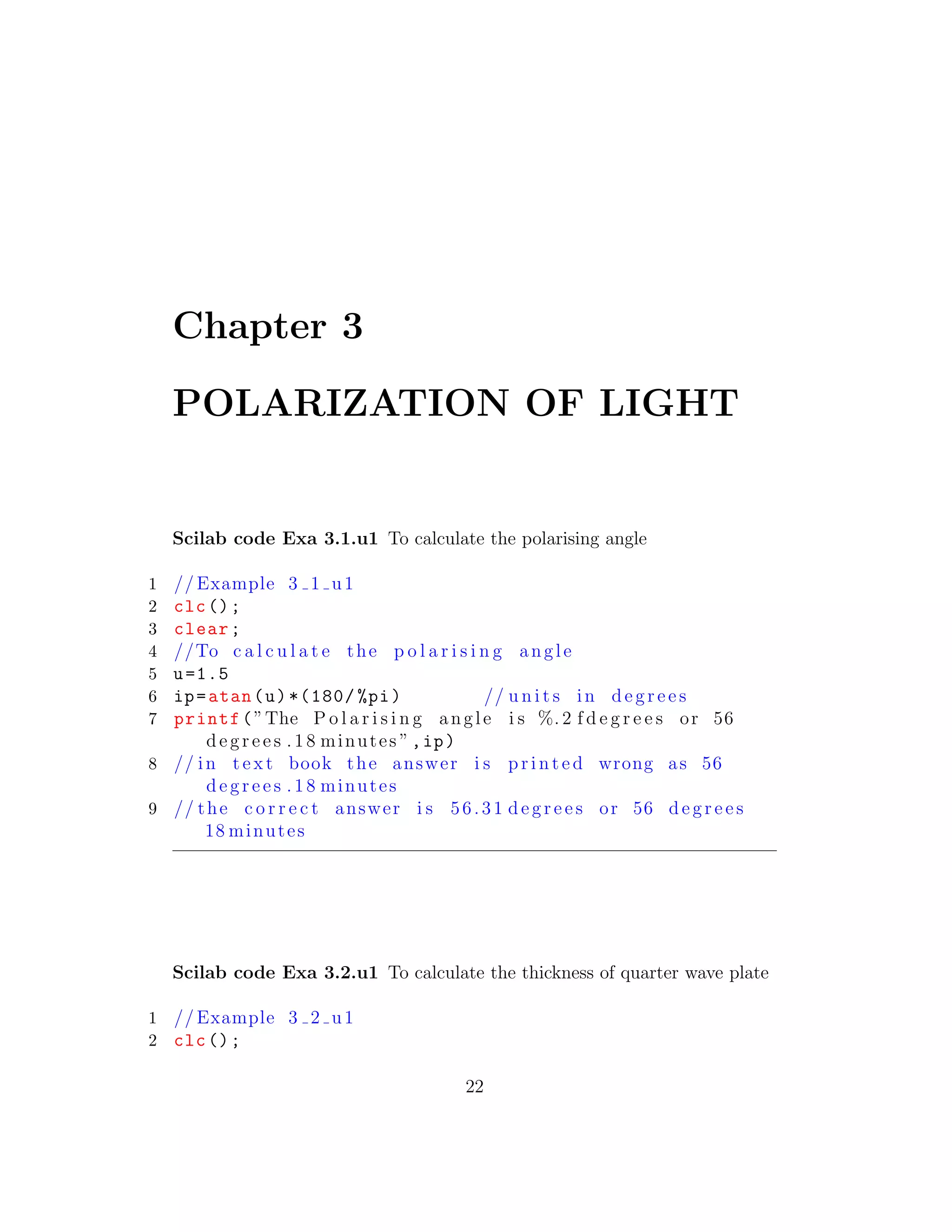
Chapter 3
POLARIZATION OF LIGHT
Scilab code Exa 3.1.u1 To calculate the polarising angle
1 // Example 3 1 u1
2 clc();
3 clear;
4 //To c a l c u l a t e the p o l a r i s i n g angle
5 u=1.5
6 ip=atan(u)*(180/ %pi) // u n i t s in d e g r e e s
7 printf(”The P o l a r i s i n g angle i s %. 2 f d e g r e e s or 56
d e g r e e s .18 minutes ”,ip)
8 // in t e x t book the answer i s p r i n t e d wrong as 56
d e g r e e s .18 minutes
9 // the c o r r e c t answer i s 56.31 d e g r e e s or 56 d e g r e e s
18 minutes
Scilab code Exa 3.2.u1 To calculate the thickness of quarter wave plate
1 // Example 3 2 u1
2 clc();
22
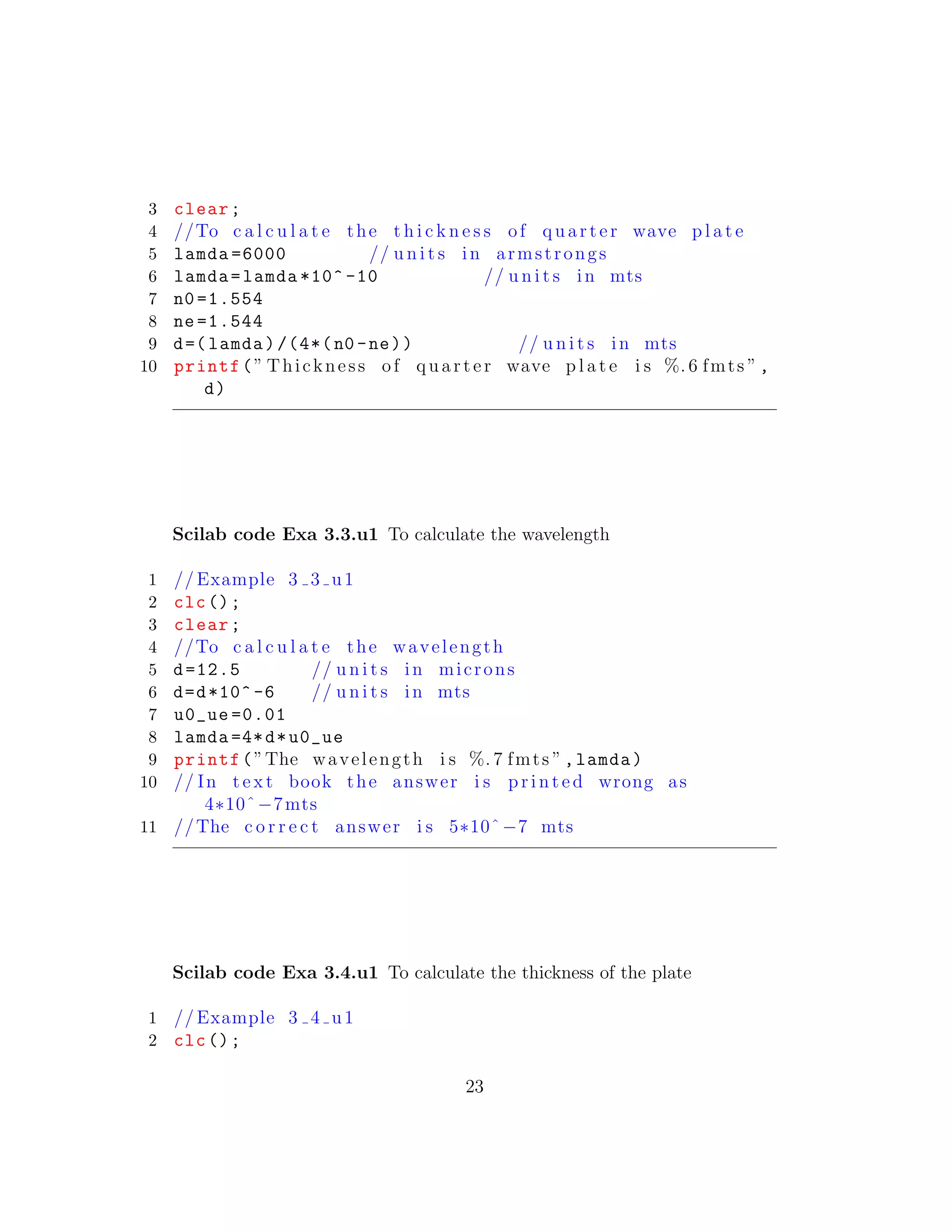
3 clear;
4 //To c a l c u l a t e the t h i c k n e s s of quarter wave p l a t e
5 lamda =6000 // u n i t s in armstrongs
6 lamda=lamda *10^ -10 // u n i t s in mts
7 n0 =1.554
8 ne =1.544
9 d=( lamda)/(4*(n0 -ne)) // u n i t s in mts
10 printf(” Thickness of quarter wave p l a t e i s %. 6 fmts ”,
d)
Scilab code Exa 3.3.u1 To calculate the wavelength
1 // Example 3 3 u1
2 clc();
3 clear;
4 //To c a l c u l a t e the wavelength
5 d=12.5 // u n i t s in microns
6 d=d*10^ -6 // u n i t s in mts
7 u0_ue =0.01
8 lamda =4*d*u0_ue
9 printf(”The wavelength i s %. 7 fmts ”,lamda)
10 // In t e x t book the answer i s p r i n t e d wrong as
4∗10ˆ−7mts
11 //The c o r r e c t answer i s 5∗10ˆ−7 mts
Scilab code Exa 3.4.u1 To calculate the thickness of the plate
1 // Example 3 4 u1
2 clc();
23
3 clear;
4 //To c a l c u l a t e the t h i c k n e s s of the p l a t e
5 lamda =5.5*10^ -5 // u n i t s in cm
6 u0 =1.553
7 ue =1.542
8 d=lamda /(2*(u0 -ue)) // u n i t s in cm
9 d=d*10^ -2 // u n i t s in mts
10 printf(”The t h i c k n e s s of the p l a t e i s %. 7 fmts ”,d)
24
Chapter 5
X RAY DIFFRACTION
Scilab code Exa 5.1.u1 To determine the miller indices of the plane
1 // Example 5 1 u1
2 clc();
3 clear;
4 //To determine the m i l l e r i n d i c e s of the plane
5 // Given I n t e r c e p t s are 2a,−3b , 6 c
6 a=1
7 b=1
8 c=1
9 intercepts1 =2*a
10 intercepts2 =-3*b
11 intercepts3 =6*c
12 unitcell1=intercepts1/a
13 unitcell2=intercepts2/b
14 unitcell3=intercepts3/c
15 resiprocal1 =1/ unitcell1
16 resiprocal2 =1/ unitcell2
17 resiprocal3 =1/ unitcell3
18 lcms=int32 ([ unitcell1 unitcell2 unitcell3 ]);
19 v=lcm(lcms)
20 lcm1 =3
21 lcm2=-2
25
22 lcm3 =1
23 printf(”Co−o r d i n a t e s of A,B,C are (%. 2 f , 0 , 0 ) , (0 ,%. 1 f
, 0 ) (0 ,0 ,%d) ” ,1/lcm1 ,1/lcm2 ,lcm3)
24 printf(”n M i l l e r i n d i c e s of the plane are (%d,%d,
%d) ”,lcm1 ,lcm2 ,lcm3)
Scilab code Exa 5.2.u1 To determine the miller indices of the plane
1 // Example 5 2 u1
2 clc();
3 clear;
4 //To determine the m i l l e r i n d i c e s of the plane
5 // Given I n t e r c e p t s are I n f i n i t y ,OY,OZ
6 intercepts1=” I n f i n i t y ”
7 intercepts2=”OY”
8 intercepts3=”OZ”
9 unitcell1=” I n f i n i t y ”
10 unitcell2 =1
11 unitcell3 =(2/3)
12 resiprocal1 =0
13 resiprocal2 =1/ unitcell2
14 resiprocal3 =1/ unitcell3
15 lcms=int32 ([ unitcell2 unitcell3 ]);
16 v=lcm(lcms)
17 lcm1 =0
18 lcm2 =2
19 lcm3 =3
20 printf(”Co−o r d i n a t e s of A,B,C are ( I n f i n i t y , 0 , 0 ) ,( 0 ,
%d, 0 ) (0 ,0 , %f ) ”,unitcell2 ,unitcell3)
21 printf(”n M i l l e r i n d i c e s of the plane are (%d,%d,
%d) ”,lcm1 ,lcm2 ,lcm3)
26
Scilab code Exa 5.3.u1 To find the intercepts along the Y and Z axes
1 // Example 5 3 u1
2 clc();
3 clear;
4 //To f i n d the i n t e r c e p t s along the Y and Z axes
5 a=0.121 // u n i t s in nm
6 b=0.184 // u n i t s in nm
7 c=0.197 // u n i t s in nm
8 // Given m i l l e r i n d i c e s are ( 2 , 3 , 1 )
9 OA_OB =3/2
10 OA_OC =1/2
11 OB =(2/3)*b // u n i t s in nm
12 OC=2*c // u n i t s in nm
13 printf(”The I n t e r c e p t s along the Y and Z axes are OB
=%. 3 fnm and OC=%. 3 fnm”,OB ,OC)
Scilab code Exa 5.4.u1 To calculate the inter planar distance
1 // Example 5 4 u1
2 clc();
3 clear;
4 //To c a l c u l a t e the i n t e r planar d i s t a n c e
5 a=0.82 // u n i t s in nm
6 b=0.94 // u n i t s in nm
7 c=0.75 // u n i t s in nm
8 h=1
9 k=2
27
10 l=3
11 d=1/ sqrt ((((h/a)^2) +((k/b)^2) +((l/c)^2)))
// u n i t s in nm
12 printf(”The Distance between ( 1 , 2 , 3 ) planes and
( 2 , 4 , 6 ) planes i s d123=%. 2 fnm and d246=%. 2 fnm”,d,
d/2)
13 // In textbook the answer i s p r i n t e d wrong as d123
=0.11nm and d246 =0.055nm but the c o r r e c t answers
are d123 =0.21nm and d246 =0.11nm
Scilab code Exa 5.5.u1 To find out the interplanar spacing of the reflect-
ing planes of the crystal
1 // Example 5 5 u1
2 clc();
3 clear;
4 //To f i n d out the i n t e r p l a n a r spacing of the
r e f l e c t i n g planes of the c r y s t a l
5 theta =28 // u n i t s in d e g r e e s
6 lamda =0.12 // u n i t s in nm
7 n=2
8 d=(n*lamda)/(2* sin(theta *(%pi /180)))
9 printf(”The i n t e r p l a n a r spacing of the r e f l e c t i n g
planes of the c r y s t a l i s d=%. 2 fnm”,d)
Scilab code Exa 5.6.u1 To calculate the interplanar spacing and wave-
length
1 // Example 5 6 u1
28
2 clc();
3 clear;
4 //To c a l c u l a t e the i n t e r p l a n a r spacing and
wavelength
5 n1=1
6 theta1 =23 // u n i t s in d e g r e e s
7 n2=3
8 theta2 =60 // u n i t s in d e g r e e s
9 lamda1 =97 // u n i t s in pm
10 lamda2 =(n2*lamda1*sin(theta1 *(%pi /180)))/(sin(theta2
*(%pi /180))) // u n i t s in pm
11 d=(n2*lamda1)/(2* sin(theta2 *(%pi /180))) //
u n i t s in pm
12 printf(” Wavelength lamda=%dpm n I n t e r p l a n a r spacing
d=%dpm”,lamda2 ,d)
Scilab code Exa 5.7.u1 To find the wavelength whenthese planes give rise
to maximum density in reflection
1 // Example 5 7 u1
2 clc();
3 clear;
4 //To f i n d the wavelength whenthese planes g i v e r i s e
to maximum d e n s i t y in r e f l e c t i o n
5 d=275 // u n i t s in pm
6 theta =45 // u n i t s in d e g r e e s
7 // For n=1
8 n=1
9 lamda =(2*d*sin(theta *(%pi /180)))/n // u n i t s in
pm
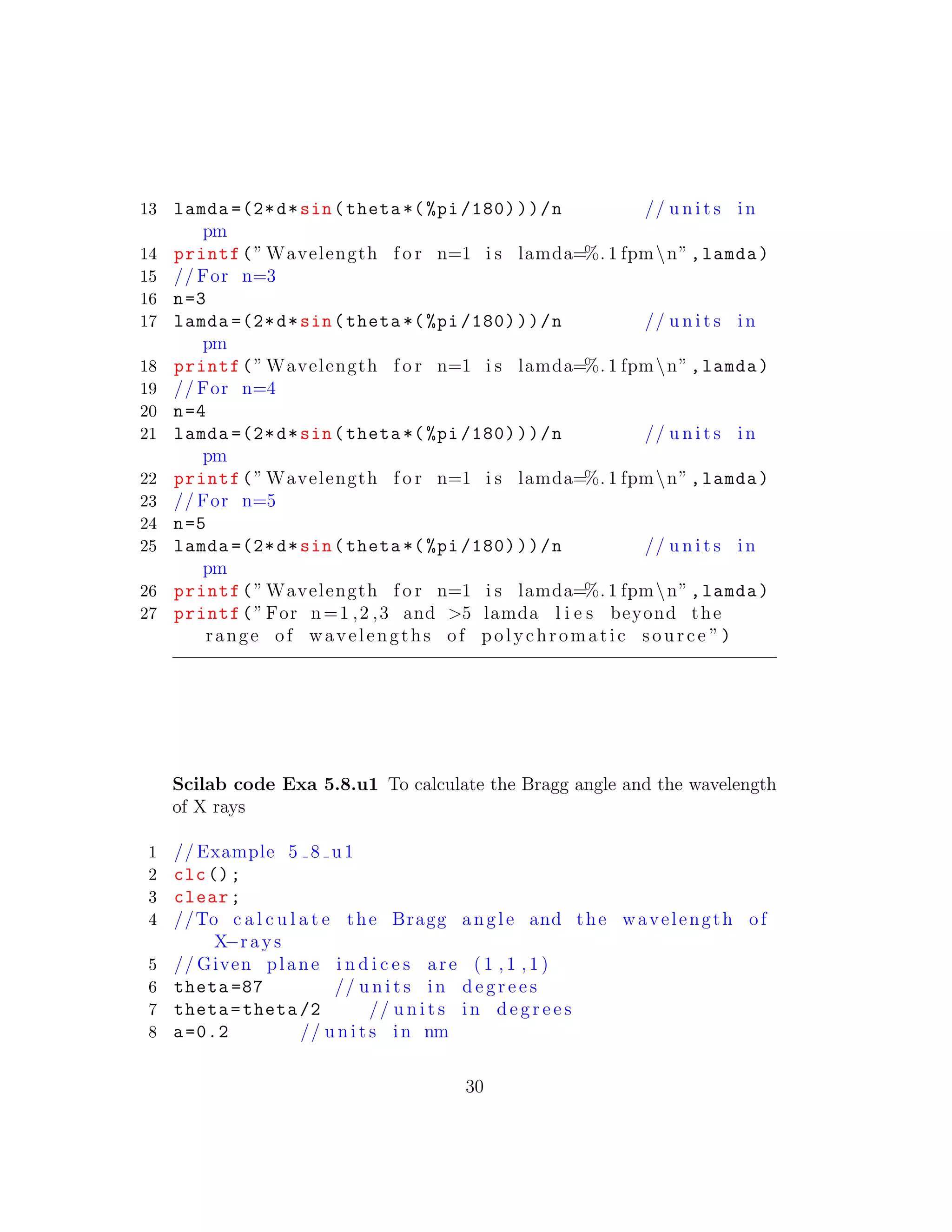
10 printf(” Wavelength f o r n=1 i s lamda=%. 1 fpmn”,lamda)
11 // For n=2
12 n=2
29
13 lamda =(2*d*sin(theta *(%pi /180)))/n // u n i t s in
pm
14 printf(” Wavelength f o r n=1 i s lamda=%. 1 fpmn”,lamda)
15 // For n=3
16 n=3
17 lamda =(2*d*sin(theta *(%pi /180)))/n // u n i t s in
pm
18 printf(” Wavelength f o r n=1 i s lamda=%. 1 fpmn”,lamda)
19 // For n=4
20 n=4
21 lamda =(2*d*sin(theta *(%pi /180)))/n // u n i t s in
pm
22 printf(” Wavelength f o r n=1 i s lamda=%. 1 fpmn”,lamda)
23 // For n=5
24 n=5
25 lamda =(2*d*sin(theta *(%pi /180)))/n // u n i t s in
pm
26 printf(” Wavelength f o r n=1 i s lamda=%. 1 fpmn”,lamda)
27 printf(”For n=1 ,2 ,3 and >5 lamda l i e s beyond the
range of wavelengths of polychromatic source ”)
Scilab code Exa 5.8.u1 To calculate the Bragg angle and the wavelength
of X rays
1 // Example 5 8 u1
2 clc();
3 clear;
4 //To c a l c u l a t e the Bragg angle and the wavelength of
X−rays
5 // Given plane i n d i c e s are ( 1 , 1 , 1 )
6 theta =87 // u n i t s in d e g r e e s
7 theta=theta /2 // u n i t s in d e g r e e s
8 a=0.2 // u n i t s in nm
30
9 h=1
10 k=1
11 l=1
12 d=a/sqrt(h^2+k^2+l^2) // u n i t s in nm
13 lamda =2*d*sin(theta *(%pi /180)) // u n i t s in
nm
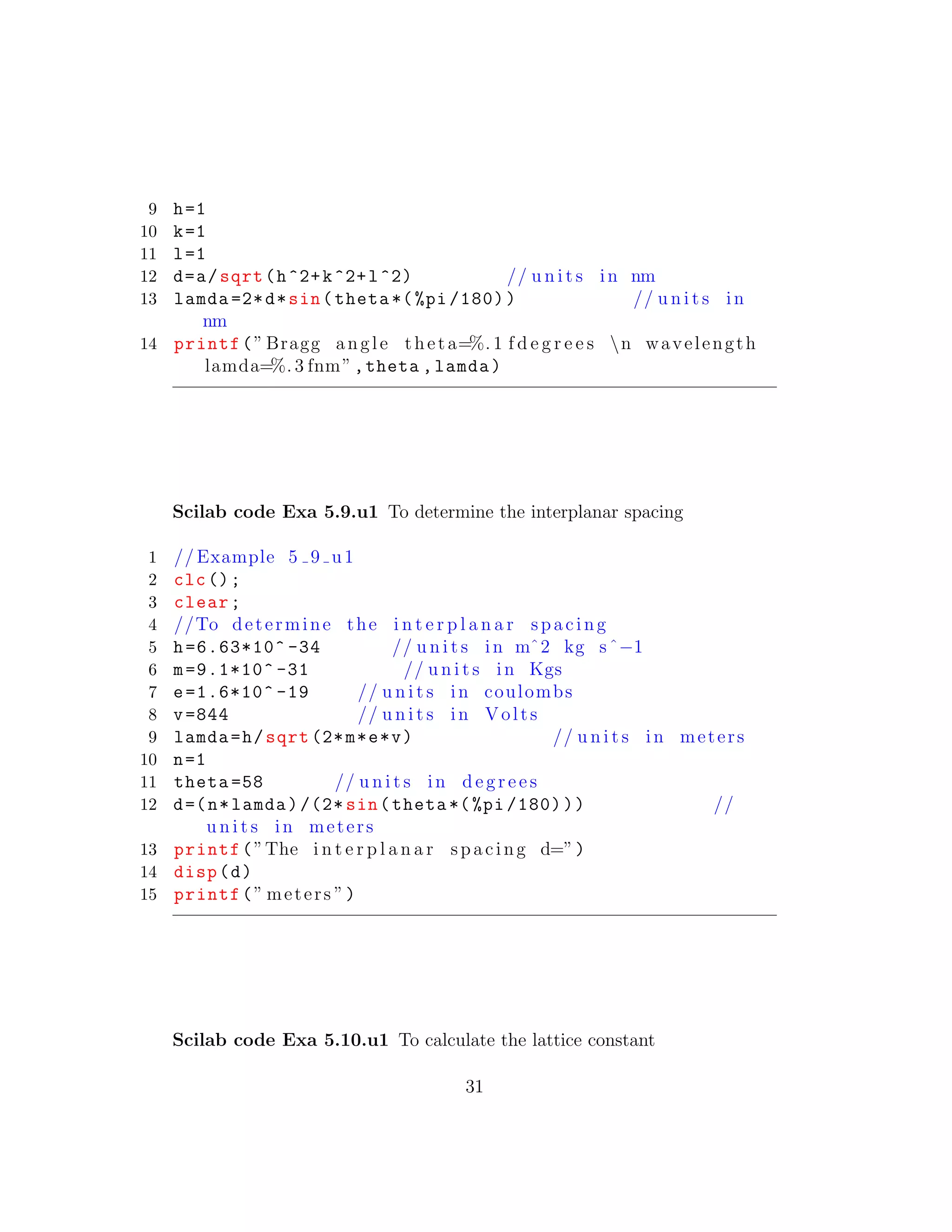
14 printf(” Bragg angle theta=%. 1 f d e g r e e s n wavelength
lamda=%. 3 fnm”,theta ,lamda)
Scilab code Exa 5.9.u1 To determine the interplanar spacing
1 // Example 5 9 u1
2 clc();
3 clear;
4 //To determine the i n t e r p l a n a r spacing
5 h=6.63*10^ -34 // u n i t s in mˆ2 kg sˆ−1
6 m=9.1*10^ -31 // u n i t s in Kgs
7 e=1.6*10^ -19 // u n i t s in coulombs
8 v=844 // u n i t s in Volts
9 lamda=h/sqrt (2*m*e*v) // u n i t s in meters
10 n=1
11 theta =58 // u n i t s in d e g r e e s
12 d=(n*lamda)/(2* sin(theta *(%pi /180))) //
u n i t s in meters
13 printf(”The i n t e r p l a n a r spacing d=”)
14 disp(d)
15 printf(” meters ”)
Scilab code Exa 5.10.u1 To calculate the lattice constant
31
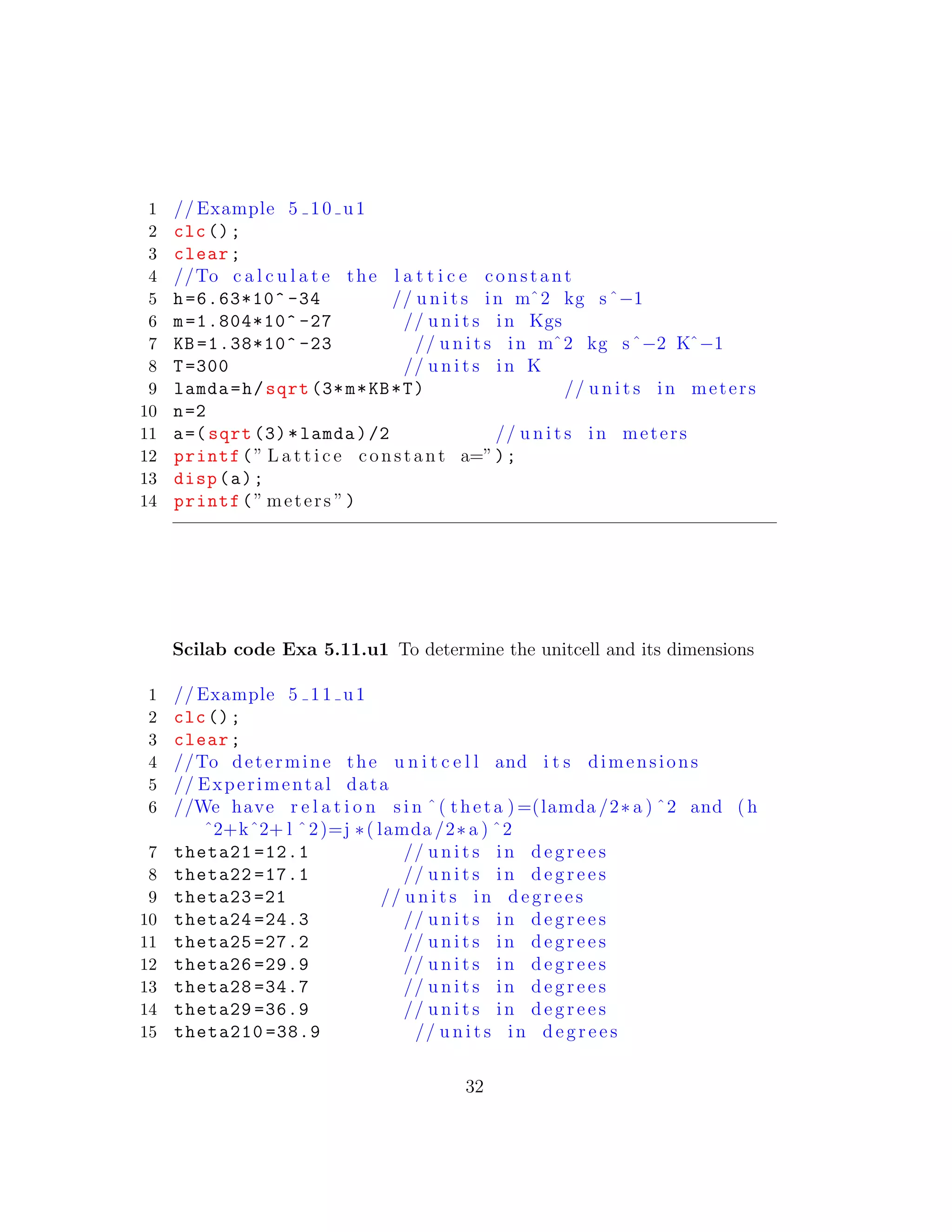
1 // Example 5 10 u1
2 clc();
3 clear;
4 //To c a l c u l a t e the l a t t i c e constant
5 h=6.63*10^ -34 // u n i t s in mˆ2 kg sˆ−1
6 m=1.804*10^ -27 // u n i t s in Kgs
7 KB =1.38*10^ -23 // u n i t s in mˆ2 kg sˆ−2 Kˆ−1
8 T=300 // u n i t s in K
9 lamda=h/sqrt (3*m*KB*T) // u n i t s in meters
10 n=2
11 a=( sqrt (3)*lamda)/2 // u n i t s in meters
12 printf(” L a t t i c e constant a=”);
13 disp(a);
14 printf(” meters ”)
Scilab code Exa 5.11.u1 To determine the unitcell and its dimensions
1 // Example 5 11 u1
2 clc();
3 clear;
4 //To determine the u n i t c e l l and i t s dimensions
5 // Experimental data
6 //We have r e l a t i o n s i n ˆ( theta )=(lamda /2∗ a ) ˆ2 and ( h
ˆ2+kˆ2+ l ˆ2)=j ∗( lamda /2∗ a ) ˆ2
7 theta21 =12.1 // u n i t s in d e g r e e s
8 theta22 =17.1 // u n i t s in d e g r e e s
9 theta23 =21 // u n i t s in d e g r e e s
10 theta24 =24.3 // u n i t s in d e g r e e s
11 theta25 =27.2 // u n i t s in d e g r e e s
12 theta26 =29.9 // u n i t s in d e g r e e s
13 theta28 =34.7 // u n i t s in d e g r e e s
14 theta29 =36.9 // u n i t s in d e g r e e s
15 theta210 =38.9 // u n i t s in d e g r e e s
32
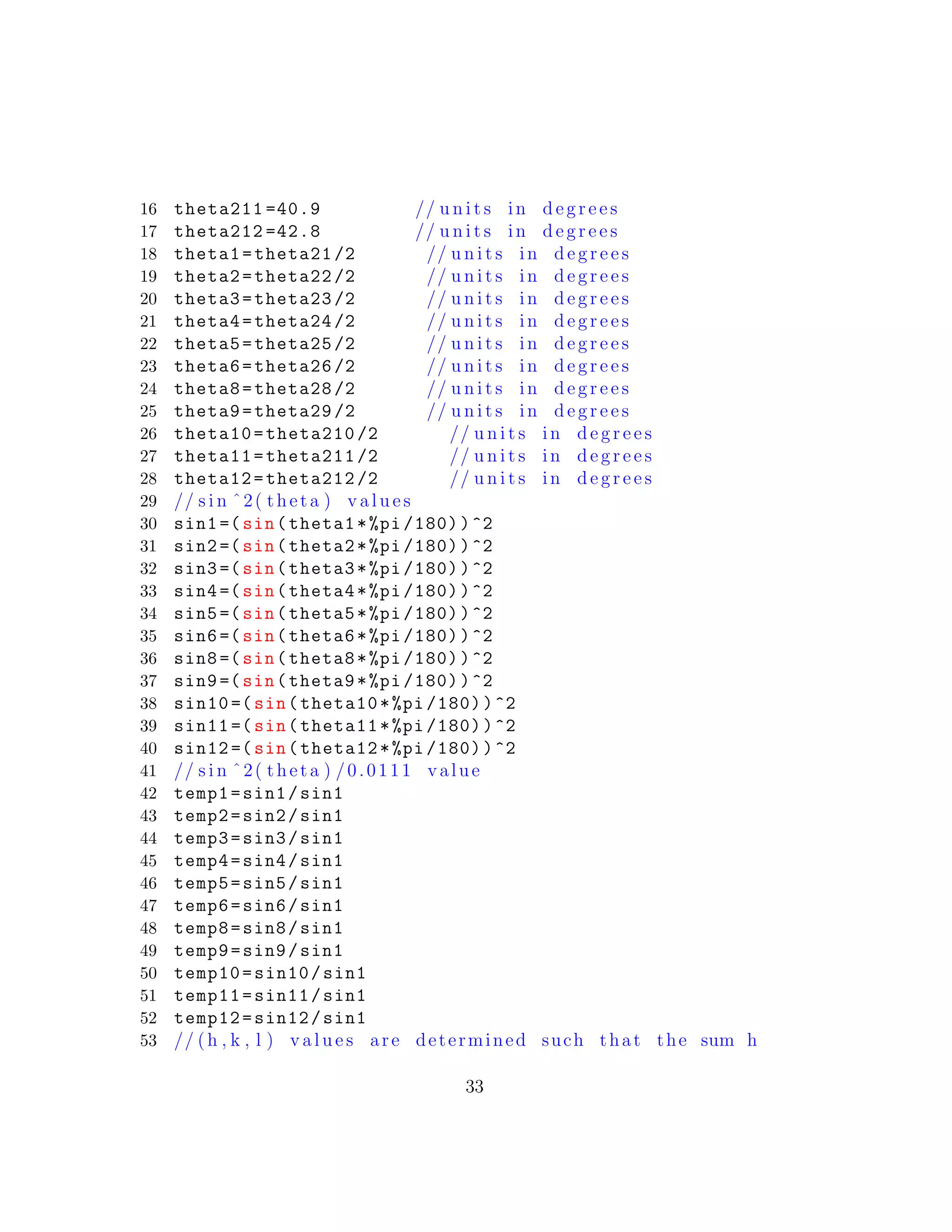
16 theta211 =40.9 // u n i t s in d e g r e e s
17 theta212 =42.8 // u n i t s in d e g r e e s
18 theta1=theta21 /2 // u n i t s in d e g r e e s
19 theta2=theta22 /2 // u n i t s in d e g r e e s
20 theta3=theta23 /2 // u n i t s in d e g r e e s
21 theta4=theta24 /2 // u n i t s in d e g r e e s
22 theta5=theta25 /2 // u n i t s in d e g r e e s
23 theta6=theta26 /2 // u n i t s in d e g r e e s
24 theta8=theta28 /2 // u n i t s in d e g r e e s
25 theta9=theta29 /2 // u n i t s in d e g r e e s
26 theta10=theta210 /2 // u n i t s in d e g r e e s
27 theta11=theta211 /2 // u n i t s in d e g r e e s
28 theta12=theta212 /2 // u n i t s in d e g r e e s
29 // s i n ˆ2( theta ) v a l u e s
30 sin1 =(sin(theta1*%pi /180))^2
31 sin2 =(sin(theta2*%pi /180))^2
32 sin3 =(sin(theta3*%pi /180))^2
33 sin4 =(sin(theta4*%pi /180))^2
34 sin5 =(sin(theta5*%pi /180))^2
35 sin6 =(sin(theta6*%pi /180))^2
36 sin8 =(sin(theta8*%pi /180))^2
37 sin9 =(sin(theta9*%pi /180))^2
38 sin10 =(sin(theta10*%pi /180))^2
39 sin11 =(sin(theta11*%pi /180))^2
40 sin12 =(sin(theta12*%pi /180))^2
41 // s i n ˆ2( theta ) /0.0111 value
42 temp1=sin1/sin1
43 temp2=sin2/sin1
44 temp3=sin3/sin1
45 temp4=sin4/sin1
46 temp5=sin5/sin1
47 temp6=sin6/sin1
48 temp8=sin8/sin1
49 temp9=sin9/sin1
50 temp10=sin10/sin1
51 temp11=sin11/sin1
52 temp12=sin12/sin1
53 // (h , k , l ) v a l u e s are determined such that the sum h
33
ˆ2+kˆ2+ l ˆ2=temp value in that manner hence we
have to s e l e c t the (h , k , l ) v a l u e s
54 // (h , k , l ) v a l u e s
55 hkl1 =100 //As hˆ2+kˆ2+ l ˆ2=1
56 hkl2 =110 //As hˆ2+kˆ2+ l ˆ2=2
57 hkl3 =111 //As hˆ2+kˆ2+ l ˆ2=3
58 hkl4 =200 //As hˆ2+kˆ2+ l ˆ2=4
59 hkl5 =210 //As hˆ2+kˆ2+ l ˆ2=5
60 hkl6 =211 //As hˆ2+kˆ2+ l ˆ2=6
61 hkl8 =220 //As hˆ2+kˆ2+ l ˆ2=8
62 hkl9 =300 //As hˆ2+kˆ2+ l ˆ2=9
63 hkl10 =310 //As hˆ2+kˆ2+ l ˆ2=10
64 hkl11 =311 //As hˆ2+kˆ2+ l ˆ2=11
65 hkl12 =222 //As hˆ2+kˆ2+ l ˆ2=12
66 printf(” unit c e l l Dimensions when 2∗ theta=%. 1 f i s (
%d) where s i n ˆ2( theta ) /0.0111 i s %dn”,theta21 ,
hkl1 ,temp1 )
67 printf(” unit c e l l Dimensions when 2∗ theta=%. 1 f i s (
%d) where s i n ˆ2( theta ) /0.0111 i s %. 1 f n”,theta22 ,
hkl2 ,temp2 )
68 printf(” unit c e l l Dimensions when 2∗ theta=%. 1 f i s (
%d) where s i n ˆ2( theta ) /0.0111 i s %. 1 f n”,theta23 ,
hkl3 ,temp3 )
69 printf(” unit c e l l Dimensions when 2∗ theta=%. 1 f i s (
%d) where s i n ˆ2( theta ) /0.0111 i s %. 1 f n”,theta24 ,
hkl4 ,temp4 )
70 printf(” unit c e l l Dimensions when 2∗ theta=%. 1 f i s (
%d) where s i n ˆ2( theta ) /0.0111 is% . 1 f n”,theta25 ,
hkl5 ,temp5 )
71 printf(” unit c e l l Dimensions when 2∗ theta=%. 1 f i s (
%d) where s i n ˆ2( theta ) /0.0111 i s %. 1 f n”,theta26 ,
hkl6 ,temp6 )
72 printf(” unit c e l l Dimensions when 2∗ theta=%. 1 f i s (
%d) where s i n ˆ2( theta ) /0.0111 i s %. 1 f n”,theta28 ,
hkl8 ,temp8 )
73 printf(” unit c e l l Dimensions when 2∗ theta=%. 1 f i s (
%d) where s i n ˆ2( theta ) /0.0111 i s %. 1 f n”,theta29 ,
hkl9 ,temp9 )
34
74 printf(” unit c e l l Dimensions when 2∗ theta=%. 1 f i s (
%d) where s i n ˆ2( theta ) /0.0111 i s %. 1 f n”,theta210
,hkl10 ,temp10 )
75 printf(” unit c e l l Dimensions when 2∗ theta=%. 1 f i s (
%d) where s i n ˆ2( theta ) /0.0111 i s %. 1 f n”,theta211
,hkl11 ,temp11 )
76 printf(” unit c e l l Dimensions when 2∗ theta=%. 1 f i s (
%d) where s i n ˆ2( theta ) /0.0111 i s %. 1 f n”,theta212
,hkl12 ,temp12 )
77 lamda =71 // u n i t s in pm
78 a=lamda /(2* sqrt(sin1)) // u n i t s in pm
79 printf(”The u n i t c e l l and i t s dimensions are %dpm”,a)
Scilab code Exa 5.12.u1 To determine the cubic structure of element and
lattice constant and to identify element
1 // Example 5 12 u1
2 clc();
3 clear;
4 //To determine the cubic s t r u c t u r e of element and
l a t t i c e constant and to i d e n t i f y element
5 // D i f f r a c t i o n data
6 theta21 =40 // u n i t s in d e g r e e s
7 theta22 =58 // u n i t s in d e g r e e s
8 theta23 =73 // u n i t s in d e g r e e s
9 theta24 =86.8 // u n i t s in d e g r e e s
10 theta25 =100.4 // u n i t s in d e g r e e s
11 theta26 =114.7 // u n i t s in d e g r e e s
12 theta1=theta21 /2 // u n i t s in d e g r e e s
13 theta2=theta22 /2 // u n i t s in d e g r e e s
14 theta3=theta23 /2 // u n i t s in d e g r e e s
15 theta4=theta24 /2 // u n i t s in d e g r e e s
16 theta5=theta25 /2 // u n i t s in d e g r e e s
35
17 theta6=theta26 /2 // u n i t s in d e g r e e s
18 // s i n ˆ2( theta ) v a l u e s
19 sin1 =(sin(theta1*%pi /180))^2
20 sin2 =(sin(theta2*%pi /180))^2
21 sin3 =(sin(theta3*%pi /180))^2
22 sin4 =(sin(theta4*%pi /180))^2
23 sin5 =(sin(theta5*%pi /180))^2
24 sin6 =(sin(theta6*%pi /180))^2
25 // s i n ˆ2( theta ) /0.111 value
26 temp1=sin1/sin1
27 temp2=sin2/sin1
28 temp3=sin3/sin1
29 temp4=sin4/sin1
30 temp5=sin5/sin1
31 temp6=sin6/sin1
32 // (h , k , l ) v a l u e s are determined such that the sum h
ˆ2+kˆ2+ l ˆ2=temp value in that manner hence we
have to s e l e c t the (h , k , l ) v a l u e s
33 // (h , k , l ) v a l u e s
34 hkl1 =100 //As hˆ2+kˆ2+ l ˆ2=1
35 hkl2 =110 //As hˆ2+kˆ2+ l ˆ2=2
36 hkl3 =111 //As hˆ2+kˆ2+ l ˆ2=3
37 hkl4 =200 //As hˆ2+kˆ2+ l ˆ2=4
38 hkl5 =210 //As hˆ2+kˆ2+ l ˆ2=5
39 hkl6 =211 //As hˆ2+kˆ2+ l ˆ2=6
40 printf(” unit c e l l Dimensions when 2∗ theta=%. 1 f i s (
%d) where s i n ˆ2( theta ) /0.0111 i s %dn”,theta21 ,
hkl1 ,temp1 )
41 printf(” unit c e l l Dimensions when 2∗ theta=%. 1 f i s (
%d) where s i n ˆ2( theta ) /0.0111 i s %dn”,theta22 ,
hkl2 ,temp2 )
42 printf(” unit c e l l Dimensions when 2∗ theta=%. 1 f i s (
%d) where s i n ˆ2( theta ) /0.0111 i s %dn”,theta23 ,
hkl3 ,temp3 )
43 printf(” unit c e l l Dimensions when 2∗ theta=%. 1 f i s (
%d) where s i n ˆ2( theta ) /0.0111 i s %dn”,theta24 ,
hkl4 ,temp4 )
44 printf(” unit c e l l Dimensions when 2∗ theta=%. 1 f i s (
36
%d) where s i n ˆ2( theta ) /0.0111 is%dn”,theta25 ,
hkl5 ,temp5 )
45 printf(” unit c e l l Dimensions when 2∗ theta=%. 1 f i s (
%d) where s i n ˆ2( theta ) /0.0111 i s %dn”,theta26 ,
hkl6 ,temp6 )
46
47 ratio=sin1/sin2
48 printf(”The r a t i o of s i n ( theta ) ˆ2 v a l u e s f o r f i r s t
and second a n g l e s i s %. 2 f n Hence the c r y s t a l
s t r u c t u r e i s bcc n”,ratio)
49 lamda =0.154 // u n i t s in nm
50 //As we have used r a t i o of a n g l e s of 2∗ theta =40
d e g r e e s and 58 d e g r e e s above we use h=1,k=1, l =0
and aˆ2=(lamda /2) ∗ s q r t ( s q r t ( hˆ2+kˆ2+ l ˆ2) / s i n ˆ2(
theta ) )
51 h=2
52 k=0
53 l=0
54 theta =20 // u n i t s in d e g r e e s
55 a=( lamda /2)*( sqrt(sqrt(h^2+k^2+l^2)/sin(theta *(%pi
/180))^2)) // u n i t s in nm
56 printf(” L a t t i c e constant a=%. 3 fnm n And the element
i s tungsten Since Tungsten has l a t t i c e constant
of %. 3 fnm and c r y s t a l l i z e s in bcc s t r u c t u r e ”,a,a)
57 // Given in textbook to f i n d l a t t i c e constant h=1,k
=1, l =1 but the c o r r e c t answer i s h=2,k=0, l =0
Scilab code Exa 5.13.u1 To determine the crystal structure and indices
of plane and lattice parameter of the material
1 // Example 5 13 u1
2 clc();
3 clear;
37
4 //To determine the c r y s t a l s t r u c t u r e and i n d i c e s of
plane and l a t t i c e parameter of the m a t e r i a l
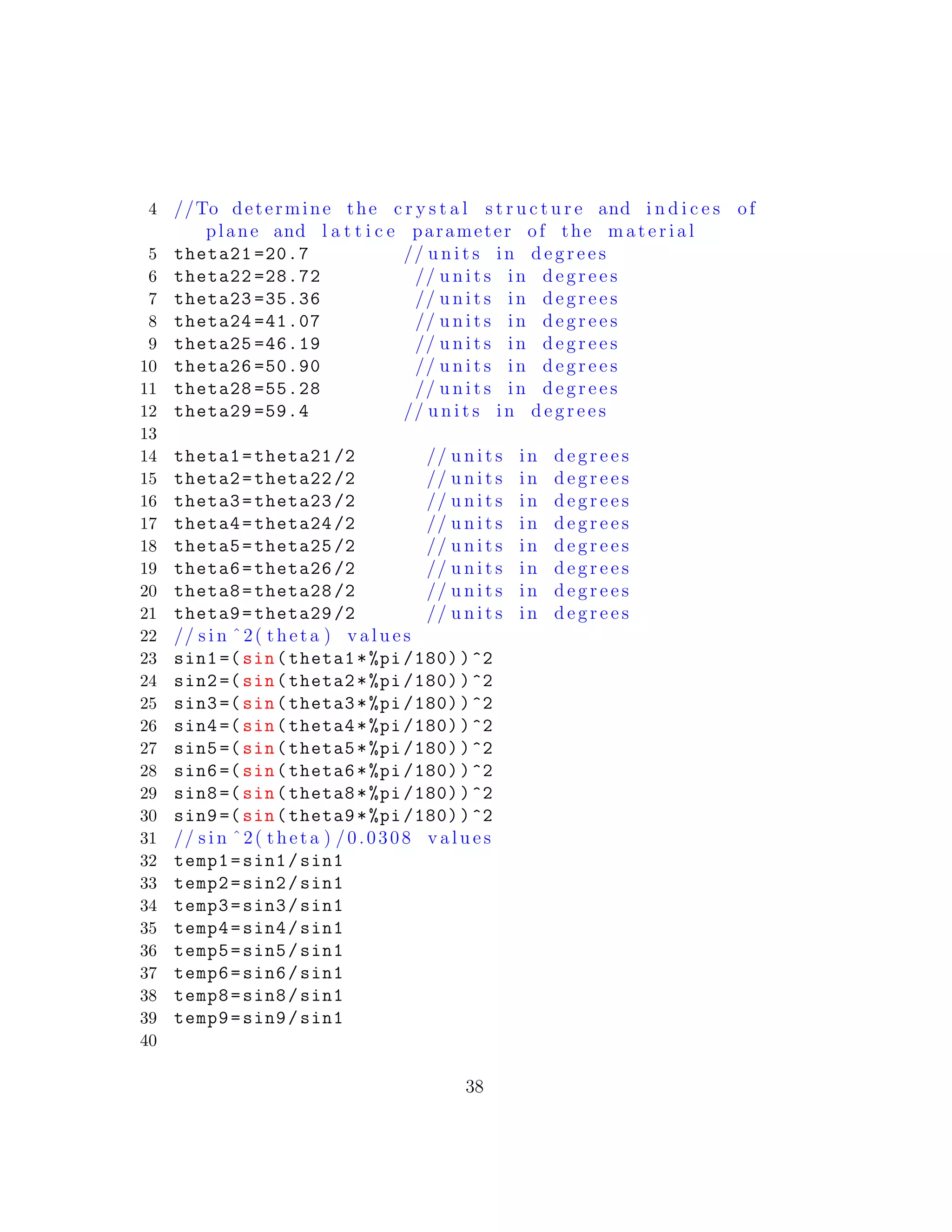
5 theta21 =20.7 // u n i t s in d e g r e e s
6 theta22 =28.72 // u n i t s in d e g r e e s
7 theta23 =35.36 // u n i t s in d e g r e e s
8 theta24 =41.07 // u n i t s in d e g r e e s
9 theta25 =46.19 // u n i t s in d e g r e e s
10 theta26 =50.90 // u n i t s in d e g r e e s
11 theta28 =55.28 // u n i t s in d e g r e e s
12 theta29 =59.4 // u n i t s in d e g r e e s
13
14 theta1=theta21 /2 // u n i t s in d e g r e e s
15 theta2=theta22 /2 // u n i t s in d e g r e e s
16 theta3=theta23 /2 // u n i t s in d e g r e e s
17 theta4=theta24 /2 // u n i t s in d e g r e e s
18 theta5=theta25 /2 // u n i t s in d e g r e e s
19 theta6=theta26 /2 // u n i t s in d e g r e e s
20 theta8=theta28 /2 // u n i t s in d e g r e e s
21 theta9=theta29 /2 // u n i t s in d e g r e e s
22 // s i n ˆ2( theta ) v a l u e s
23 sin1 =(sin(theta1*%pi /180))^2
24 sin2 =(sin(theta2*%pi /180))^2
25 sin3 =(sin(theta3*%pi /180))^2
26 sin4 =(sin(theta4*%pi /180))^2
27 sin5 =(sin(theta5*%pi /180))^2
28 sin6 =(sin(theta6*%pi /180))^2
29 sin8 =(sin(theta8*%pi /180))^2
30 sin9 =(sin(theta9*%pi /180))^2
31 // s i n ˆ2( theta ) /0.0308 v a l u e s
32 temp1=sin1/sin1
33 temp2=sin2/sin1
34 temp3=sin3/sin1
35 temp4=sin4/sin1
36 temp5=sin5/sin1
37 temp6=sin6/sin1
38 temp8=sin8/sin1
39 temp9=sin9/sin1
40
38
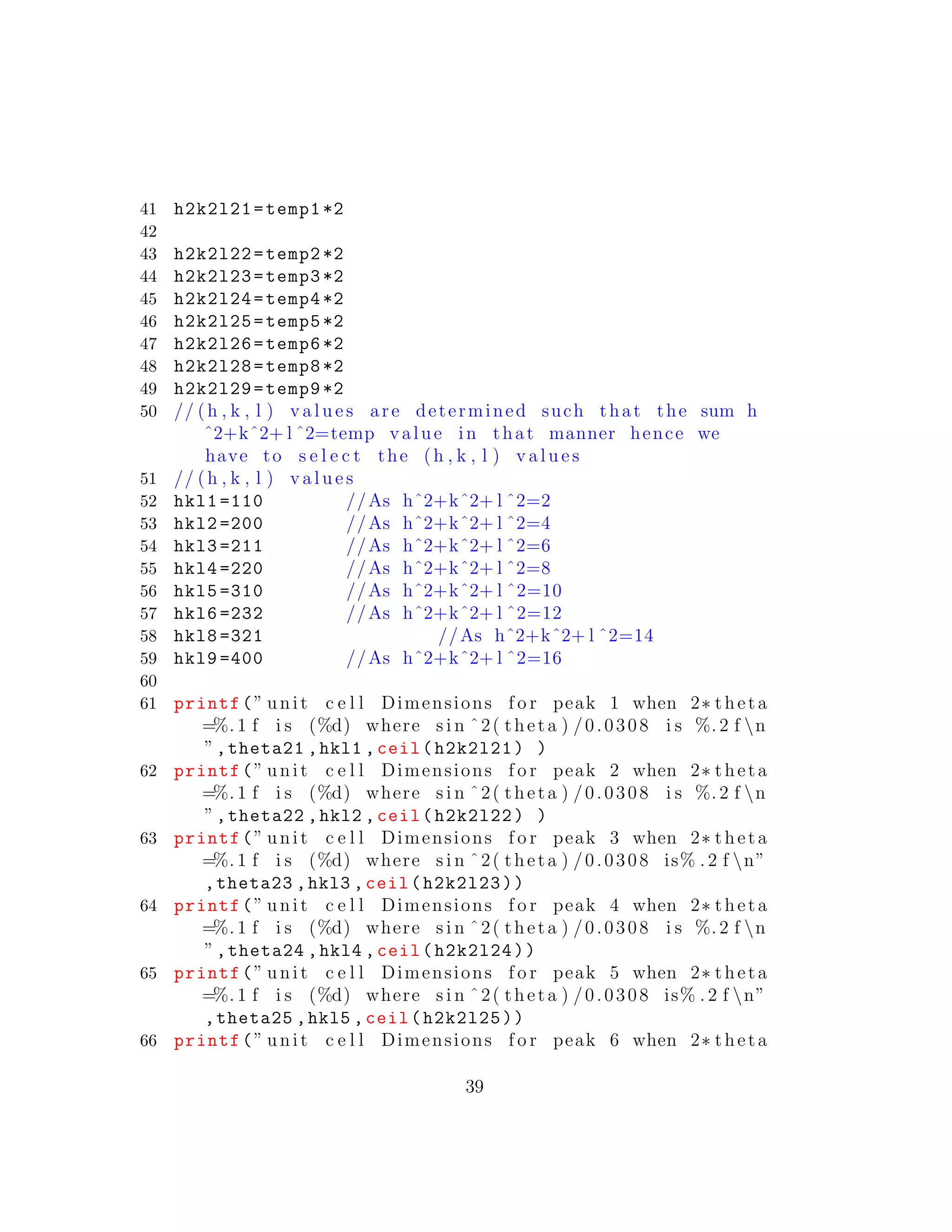
41 h2k2l21=temp1 *2
42
43 h2k2l22=temp2 *2
44 h2k2l23=temp3 *2
45 h2k2l24=temp4 *2
46 h2k2l25=temp5 *2
47 h2k2l26=temp6 *2
48 h2k2l28=temp8 *2
49 h2k2l29=temp9 *2
50 // (h , k , l ) v a l u e s are determined such that the sum h
ˆ2+kˆ2+ l ˆ2=temp value in that manner hence we
have to s e l e c t the (h , k , l ) v a l u e s
51 // (h , k , l ) v a l u e s
52 hkl1 =110 //As hˆ2+kˆ2+ l ˆ2=2
53 hkl2 =200 //As hˆ2+kˆ2+ l ˆ2=4
54 hkl3 =211 //As hˆ2+kˆ2+ l ˆ2=6
55 hkl4 =220 //As hˆ2+kˆ2+ l ˆ2=8
56 hkl5 =310 //As hˆ2+kˆ2+ l ˆ2=10
57 hkl6 =232 //As hˆ2+kˆ2+ l ˆ2=12
58 hkl8 =321 //As hˆ2+kˆ2+ l ˆ2=14
59 hkl9 =400 //As hˆ2+kˆ2+ l ˆ2=16
60
61 printf(” unit c e l l Dimensions f o r peak 1 when 2∗ theta
=%. 1 f i s (%d) where s i n ˆ2( theta ) /0.0308 i s %. 2 f n
”,theta21 ,hkl1 ,ceil(h2k2l21) )
62 printf(” unit c e l l Dimensions f o r peak 2 when 2∗ theta
=%. 1 f i s (%d) where s i n ˆ2( theta ) /0.0308 i s %. 2 f n
”,theta22 ,hkl2 ,ceil(h2k2l22) )
63 printf(” unit c e l l Dimensions f o r peak 3 when 2∗ theta
=%. 1 f i s (%d) where s i n ˆ2( theta ) /0.0308 is% . 2 f n”
,theta23 ,hkl3 ,ceil(h2k2l23))
64 printf(” unit c e l l Dimensions f o r peak 4 when 2∗ theta
=%. 1 f i s (%d) where s i n ˆ2( theta ) /0.0308 i s %. 2 f n
”,theta24 ,hkl4 ,ceil(h2k2l24))
65 printf(” unit c e l l Dimensions f o r peak 5 when 2∗ theta
=%. 1 f i s (%d) where s i n ˆ2( theta ) /0.0308 is% . 2 f n”
,theta25 ,hkl5 ,ceil(h2k2l25))
66 printf(” unit c e l l Dimensions f o r peak 6 when 2∗ theta
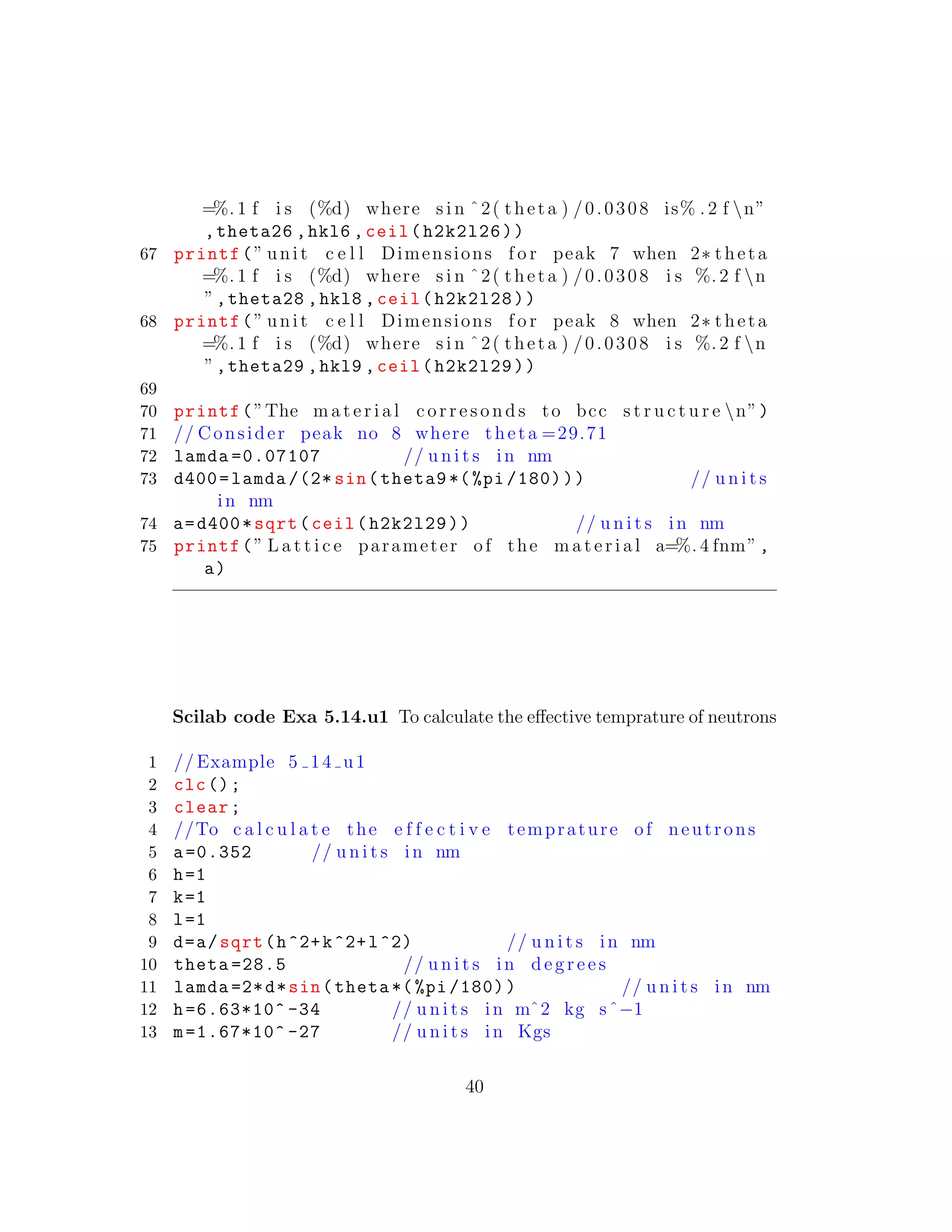
39
=%. 1 f i s (%d) where s i n ˆ2( theta ) /0.0308 is% . 2 f n”
,theta26 ,hkl6 ,ceil(h2k2l26))
67 printf(” unit c e l l Dimensions f o r peak 7 when 2∗ theta
=%. 1 f i s (%d) where s i n ˆ2( theta ) /0.0308 i s %. 2 f n
”,theta28 ,hkl8 ,ceil(h2k2l28))
68 printf(” unit c e l l Dimensions f o r peak 8 when 2∗ theta
=%. 1 f i s (%d) where s i n ˆ2( theta ) /0.0308 i s %. 2 f n
”,theta29 ,hkl9 ,ceil(h2k2l29))
69
70 printf(”The m a t e r i a l c o r r e s o n d s to bcc s t r u c t u r e n”)
71 // Consider peak no 8 where theta =29.71
72 lamda =0.07107 // u n i t s in nm
73 d400=lamda /(2* sin(theta9 *(%pi /180))) // u n i t s
in nm
74 a=d400*sqrt(ceil(h2k2l29)) // u n i t s in nm
75 printf(” L a t t i c e parameter of the m a t e r i a l a=%. 4 fnm”,
a)
Scilab code Exa 5.14.u1 To calculate the effective temprature of neutrons
1 // Example 5 14 u1
2 clc();
3 clear;
4 //To c a l c u l a t e the e f f e c t i v e temprature of neutrons
5 a=0.352 // u n i t s in nm
6 h=1
7 k=1
8 l=1
9 d=a/sqrt(h^2+k^2+l^2) // u n i t s in nm
10 theta =28.5 // u n i t s in d e g r e e s
11 lamda =2*d*sin(theta *(%pi /180)) // u n i t s in nm
12 h=6.63*10^ -34 // u n i t s in mˆ2 kg sˆ−1
13 m=1.67*10^ -27 // u n i t s in Kgs
40
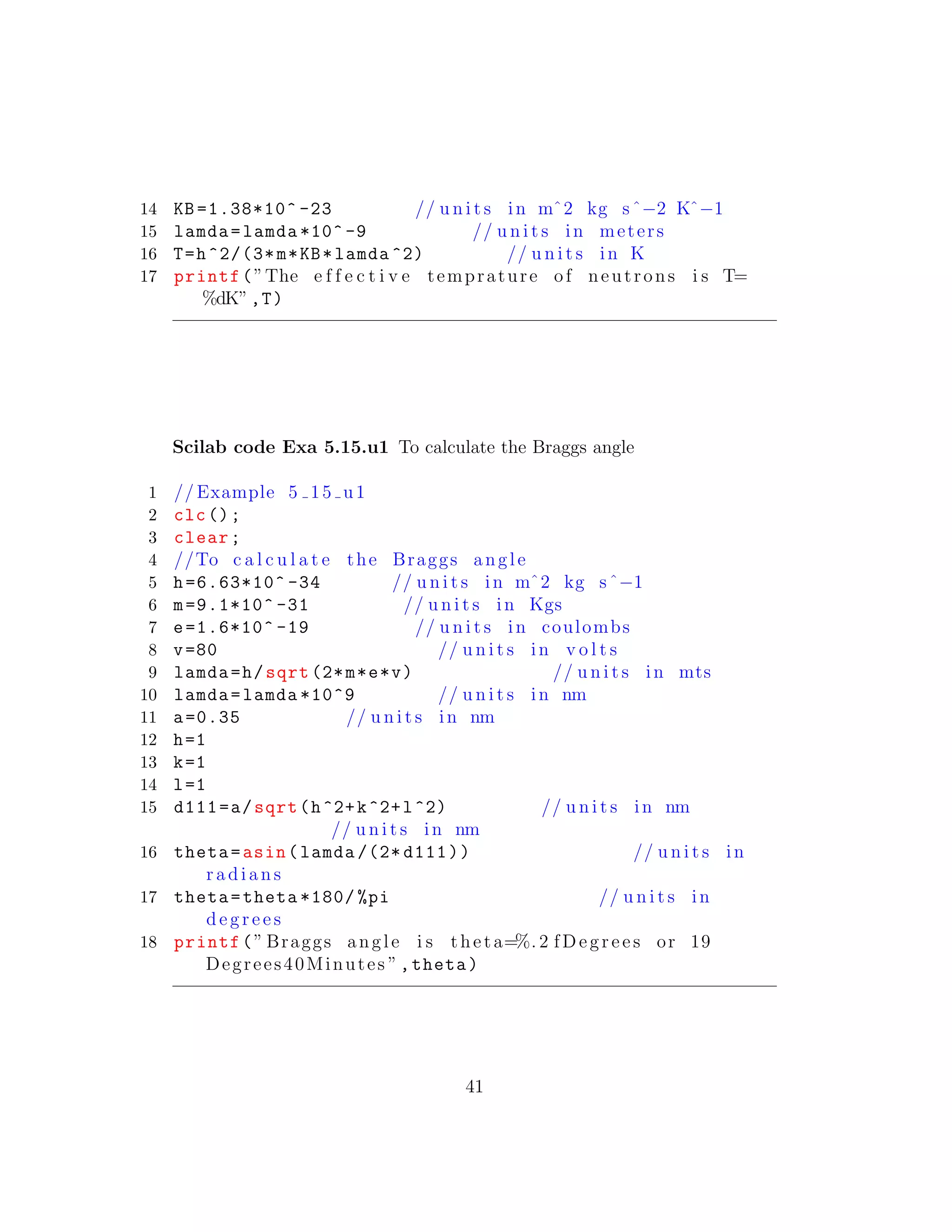
14 KB =1.38*10^ -23 // u n i t s in mˆ2 kg sˆ−2 Kˆ−1
15 lamda=lamda *10^ -9 // u n i t s in meters
16 T=h^2/(3*m*KB*lamda ^2) // u n i t s in K
17 printf(”The e f f e c t i v e temprature of neutrons i s T=
%dK”,T)
Scilab code Exa 5.15.u1 To calculate the Braggs angle
1 // Example 5 15 u1
2 clc();
3 clear;
4 //To c a l c u l a t e the Braggs angle
5 h=6.63*10^ -34 // u n i t s in mˆ2 kg sˆ−1
6 m=9.1*10^ -31 // u n i t s in Kgs
7 e=1.6*10^ -19 // u n i t s in coulombs
8 v=80 // u n i t s in v o l t s
9 lamda=h/sqrt (2*m*e*v) // u n i t s in mts
10 lamda=lamda *10^9 // u n i t s in nm
11 a=0.35 // u n i t s in nm
12 h=1
13 k=1
14 l=1
15 d111=a/sqrt(h^2+k^2+l^2) // u n i t s in nm
// u n i t s in nm
16 theta=asin(lamda /(2* d111)) // u n i t s in
r a d i a n s
17 theta=theta *180/ %pi // u n i t s in
d e g r e e s
18 printf(” Braggs angle i s theta=%. 2 fDegrees or 19
Degrees40Minutes ”,theta)
41
Scilab code Exa 5.16.u1 To calculate the difference between the samples
1 // Example 5 16 u1
2 clc();
3 clear;
4 //To c a l c u l a t e the d i f f e r e n c e between the samples
5 d=0.2552 // u n i t s in nm
6 a=d*sqrt (2) // u n i t s in nm
7 lamda =0.152 // u n i t s in nm
8 theta =21 // u n i t s in d e g r e e s
9 // For sample A
10 d111=lamda /(2* sin(theta*%pi /180)) // u n i t s in nm
11 h=1
12 k=1
13 l=1
14 a1=d111*sqrt(h^2+k^2+l^2) // u n i t s in nm
15 printf(”For sample A a=%. 4 f nm”,a1)
16 // For sample B
17 theta =21.38 // u n i t s in d e g r e e s
18 d111=lamda /(2* sin(theta*%pi /180)) // u n i t s in nm
19 h=1
20 k=1
21 l=1
22 a2=d111*sqrt(h^2+k^2+l^2) // u n i t s in nm
23 change =((a1 -a2)/a2)*100
24 printf(”nFor sample B a=%. 4 f nm”,a2)
25 printf(”n Sample B i s pure high p u r i t y copper as
l a t t i c e parameter of A i s %. 2 f percent g r e a t e r
than that of pure copper ”,change)
26 // Given in t e x t book change in l a t t i c e parameter i s
1.75% g r e a t e r but i t i s 1.73%
42
Scilab code Exa 5.17.u1 To find the type of crystal and lattice parameter
and atomic diameter
1 // Example 5 17 u1
2 clc();
3 clear;
4 //To f i n d the type of c r y s t a l and l a t t i c e parameter
and atomic diameter
5 lamda =0.171 // u n i t s in nm
6 theta =30 // u n i t s in d e g r e e s
7 // Assuming the metal i s BCC
8 d110=lamda /(2* sin(theta*%pi /180)) // u n i t s in nm
9 h=1
10 k=1
11 l=0
12 a1=d110*sqrt(h^2+k^2+l^2) // u n i t s in nm
13 a2 =0.148* sqrt (4)
14 printf(”The l a t t i c e parameter i s a=%. 3 fnm but a=%. 3
fnm i f we c o n s i d e r i t as bcc hence i t i s not bcc ”
,a1 ,a2)
15 // Assuming the metal i s FCC
16 a1 =0.171* sqrt (3) // u n i t s in nm
17 a2 =0.148* sqrt (4) // u n i t s in nm
18 ad=a1/sqrt (2) // u n i t s in nm
19 printf(” n I f we c o n s i d e r i t as FCC a=%. 3 fnm hence i t
i s FCC”,a1)
20 printf(”n Atomic diameter i s %. 4 fnm”,ad)
43
Scilab code Exa 5.18.u1 To find out the planes which gives reflection
1 // Example 5 18 u1
2 clc();
3 clear;
4 //To f i n d out the planes which g i v e s r e f l e c t i o n
5 lamda =0.154 // u n i t s in nm
6 theta =90 // u n i t s in d e g r e e s as s i n (
theta ) i s maximum at 90 d e g r e e s
7 d=lamda /(2* sin(theta*%pi /180)) // u n i t s in nm
8 D=0.228 // u n i t s in nm
9 hkl =(2*D)/(d*sqrt (3))
10 hkl2=hkl^2
11 printf(”As hˆ2+kˆ2+ l ˆ2=%. 2 f n The h i g h e s t p o s s i b l e
v a l u e s of (h , k , l ) are ( 2 , 2 , 2 ) Hence ( 2 , 2 , 2 )
planes g i v e r e f l e c t i o n ”,hkl2)
12 // Given in t e x t book hˆ2+kˆ2+ l ˆ2=13.98 but the
answer i s hˆ2+kˆ2+ l ˆ2=11.69
44
Chapter 6
LASER
Scilab code Exa 6.1.u1 To calculate the Electric field of a laser beam
1 // Example 6 1 u1
2 clc();
3 clear;
4 //To c a l c u l a t e the E l e c t r i c f i e l d of a l a s e r beam
5 power =1 // u n i t s in m i l l i Watts
6 power=power *10^ -3 // u n i t s in Watts
7 area =3 // u n i t s in m i l l i meter ˆ2
8 area=area *10^ -6 // u n i t s in meter ˆ2
9 i=power/area // u n i t s in Watts/ meter ˆ2
10 c=3*10^8 // u n i t s in meter / sec
11 u=4*10^ -7 // u n i t s in SI
12 n=1
13 E0=sqrt ((i*2*c*u)/n) // u n i t s in V/ meters
14 printf(”The e l e c t r i c f i e l d i s E0=%. 2 f V/m”,E0)
15 // In t e x t book answer i s given E0=501 V/m but the
c o r r e c t answer i s E0=282.84 V/m
45
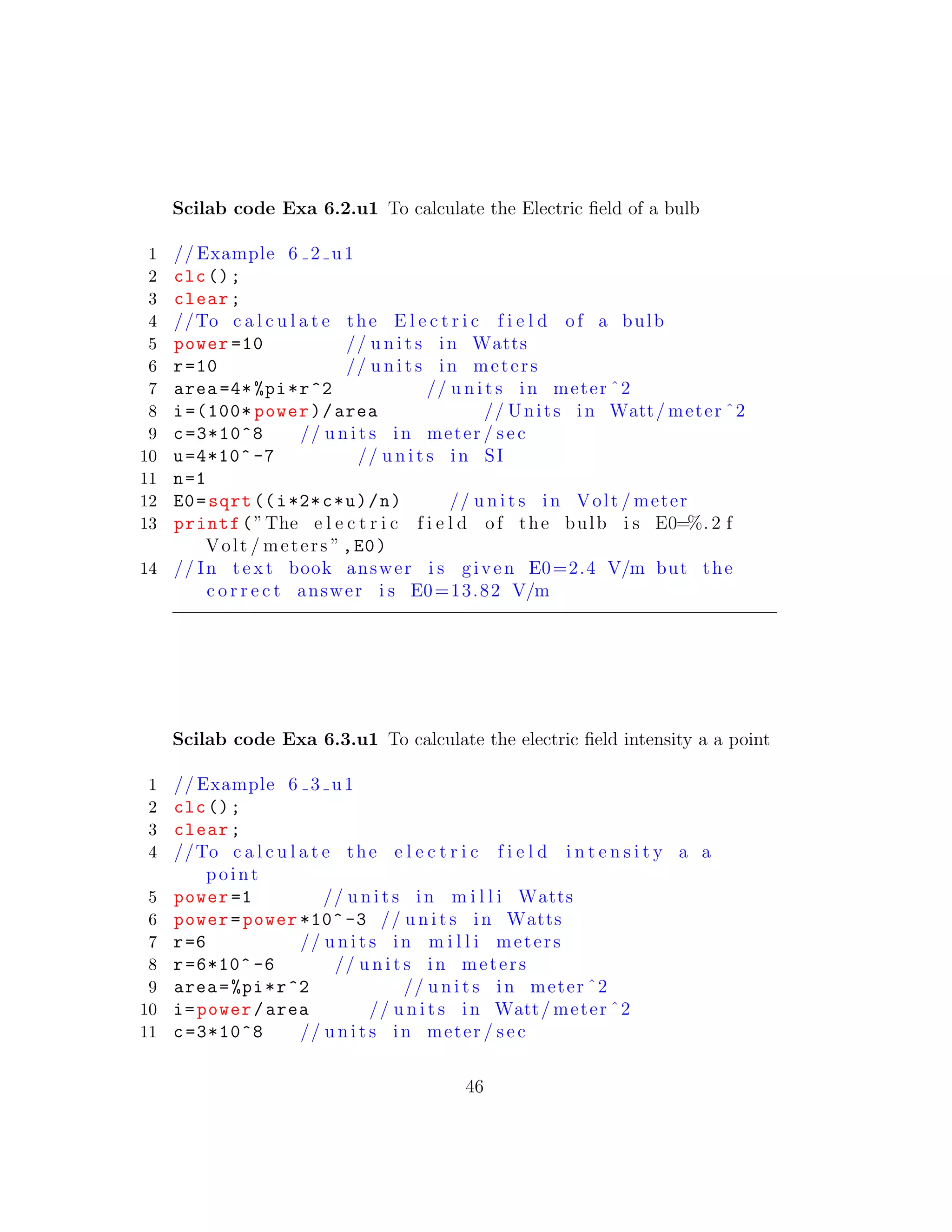
Scilab code Exa 6.2.u1 To calculate the Electric field of a bulb
1 // Example 6 2 u1
2 clc();
3 clear;
4 //To c a l c u l a t e the E l e c t r i c f i e l d of a bulb
5 power =10 // u n i t s in Watts
6 r=10 // u n i t s in meters
7 area =4* %pi*r^2 // u n i t s in meter ˆ2
8 i=(100* power)/area // Units in Watt/ meter ˆ2
9 c=3*10^8 // u n i t s in meter / sec
10 u=4*10^ -7 // u n i t s in SI
11 n=1
12 E0=sqrt ((i*2*c*u)/n) // u n i t s in Volt / meter
13 printf(”The e l e c t r i c f i e l d of the bulb i s E0=%. 2 f
Volt / meters ”,E0)
14 // In t e x t book answer i s given E0=2.4 V/m but the
c o r r e c t answer i s E0=13.82 V/m
Scilab code Exa 6.3.u1 To calculate the electric field intensity a a point
1 // Example 6 3 u1
2 clc();
3 clear;
4 //To c a l c u l a t e the e l e c t r i c f i e l d i n t e n s i t y a a
point
5 power =1 // u n i t s in m i l l i Watts
6 power=power *10^ -3 // u n i t s in Watts
7 r=6 // u n i t s in m i l l i meters
8 r=6*10^ -6 // u n i t s in meters
9 area=%pi*r^2 // u n i t s in meter ˆ2
10 i=power/area // u n i t s in Watt/ meter ˆ2
11 c=3*10^8 // u n i t s in meter / sec
46
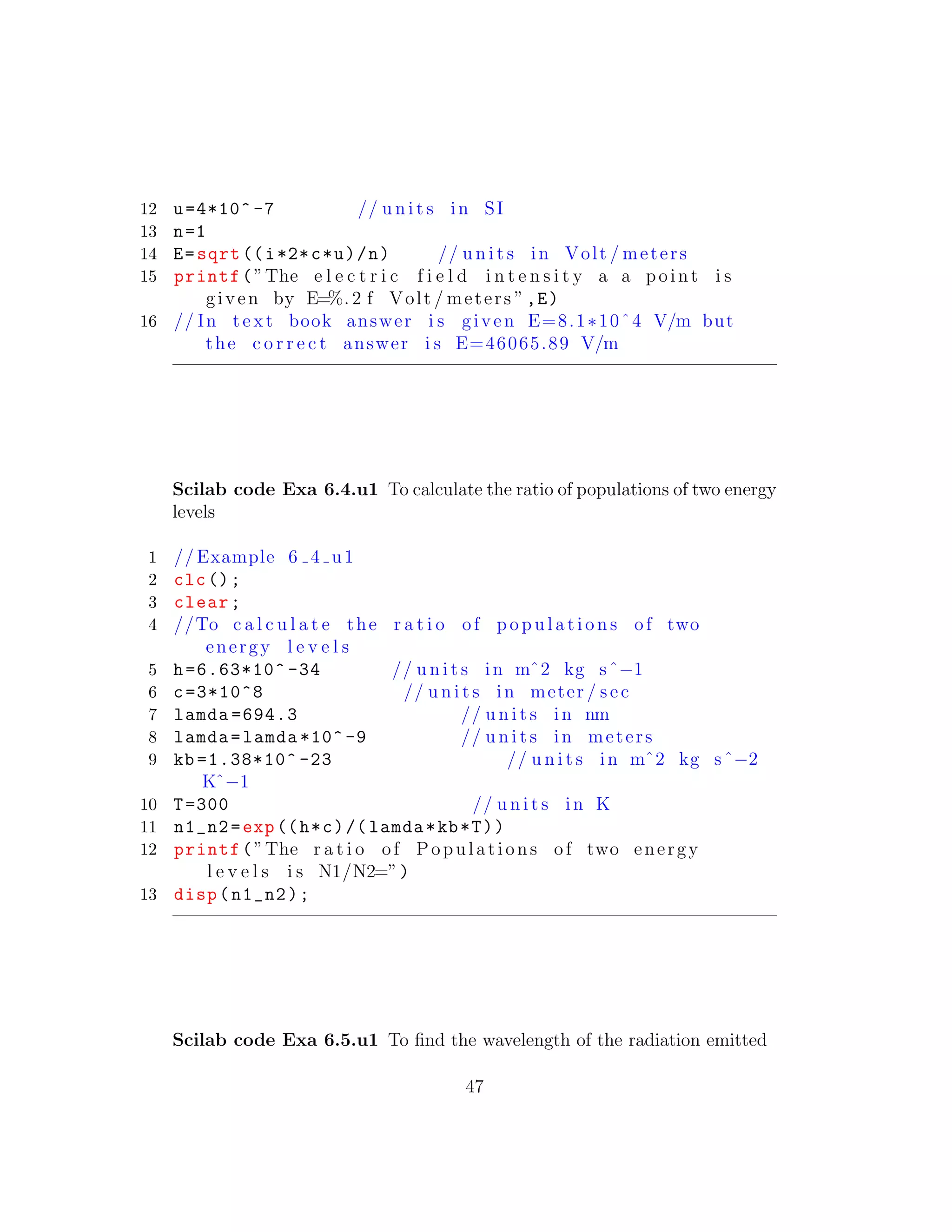
12 u=4*10^ -7 // u n i t s in SI
13 n=1
14 E=sqrt ((i*2*c*u)/n) // u n i t s in Volt / meters
15 printf(”The e l e c t r i c f i e l d i n t e n s i t y a a point i s
given by E=%. 2 f Volt / meters ”,E)
16 // In t e x t book answer i s given E=8.1∗10ˆ4 V/m but
the c o r r e c t answer i s E=46065.89 V/m
Scilab code Exa 6.4.u1 To calculate the ratio of populations of two energy
levels
1 // Example 6 4 u1
2 clc();
3 clear;
4 //To c a l c u l a t e the r a t i o of p o p u l a t i o n s of two
energy l e v e l s
5 h=6.63*10^ -34 // u n i t s in mˆ2 kg sˆ−1
6 c=3*10^8 // u n i t s in meter / sec
7 lamda =694.3 // u n i t s in nm
8 lamda=lamda *10^ -9 // u n i t s in meters
9 kb =1.38*10^ -23 // u n i t s in mˆ2 kg sˆ−2
Kˆ−1
10 T=300 // u n i t s in K
11 n1_n2=exp((h*c)/( lamda*kb*T))
12 printf(”The r a t i o of Populations of two energy
l e v e l s i s N1/N2=”)
13 disp(n1_n2);
Scilab code Exa 6.5.u1 To find the wavelength of the radiation emitted
47
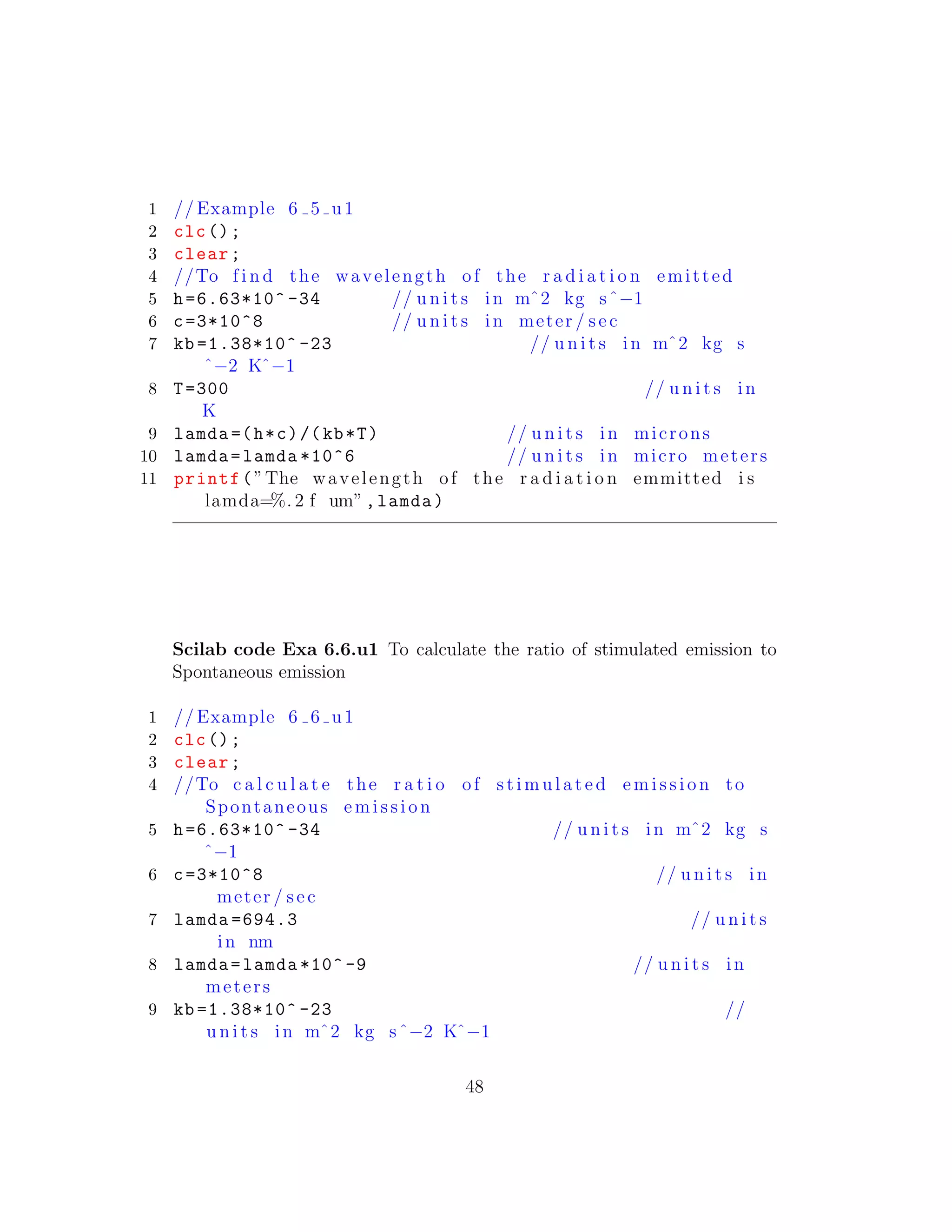
1 // Example 6 5 u1
2 clc();
3 clear;
4 //To f i n d the wavelength of the r a d i a t i o n emitted
5 h=6.63*10^ -34 // u n i t s in mˆ2 kg sˆ−1
6 c=3*10^8 // u n i t s in meter / sec
7 kb =1.38*10^ -23 // u n i t s in mˆ2 kg s
ˆ−2 Kˆ−1
8 T=300 // u n i t s in
K
9 lamda =(h*c)/(kb*T) // u n i t s in microns
10 lamda=lamda *10^6 // u n i t s in micro meters
11 printf(”The wavelength of the r a d i a t i o n emmitted i s
lamda=%. 2 f um”,lamda)
Scilab code Exa 6.6.u1 To calculate the ratio of stimulated emission to
Spontaneous emission
1 // Example 6 6 u1
2 clc();
3 clear;
4 //To c a l c u l a t e the r a t i o of st im ula te d emission to
Spontaneous emission
5 h=6.63*10^ -34 // u n i t s in mˆ2 kg s
ˆ−1
6 c=3*10^8 // u n i t s in
meter / sec
7 lamda =694.3 // u n i t s
in nm
8 lamda=lamda *10^ -9 // u n i t s in
meters
9 kb =1.38*10^ -23 //
u n i t s in mˆ2 kg sˆ−2 Kˆ−1
48
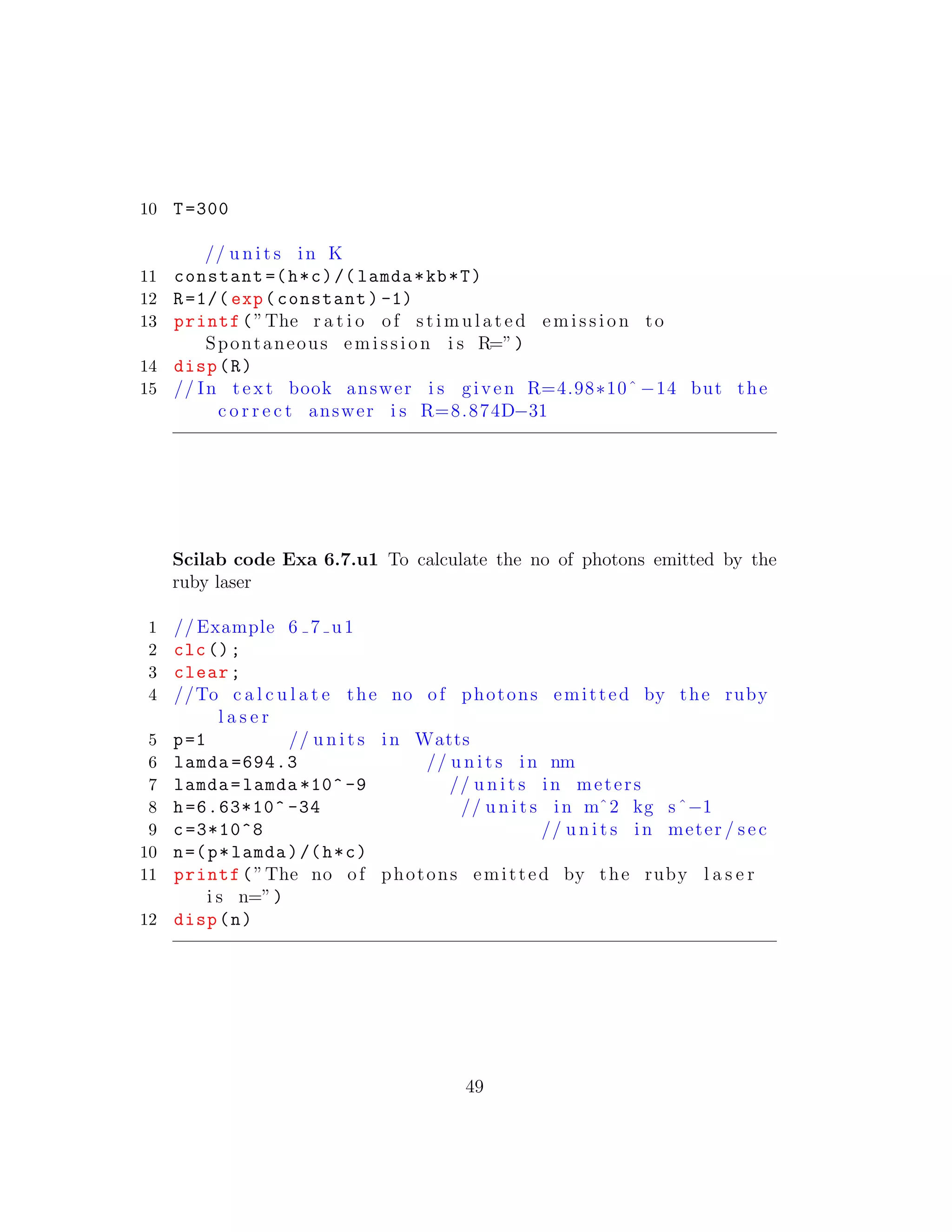
10 T=300
// u n i t s in K
11 constant =(h*c)/( lamda*kb*T)
12 R=1/( exp(constant) -1)
13 printf(”The r a t i o of st im ula te d emission to
Spontaneous emission i s R=”)
14 disp(R)
15 // In t e x t book answer i s given R=4.98∗10ˆ −14 but the
c o r r e c t answer i s R=8.874D−31
Scilab code Exa 6.7.u1 To calculate the no of photons emitted by the
ruby laser
1 // Example 6 7 u1
2 clc();
3 clear;
4 //To c a l c u l a t e the no of photons emitted by the ruby
l a s e r
5 p=1 // u n i t s in Watts
6 lamda =694.3 // u n i t s in nm
7 lamda=lamda *10^ -9 // u n i t s in meters
8 h=6.63*10^ -34 // u n i t s in mˆ2 kg sˆ−1
9 c=3*10^8 // u n i t s in meter / sec
10 n=(p*lamda)/(h*c)
11 printf(”The no of photons emitted by the ruby l a s e r
i s n=”)
12 disp(n)
49
Chapter 7
FIBER OPTICS
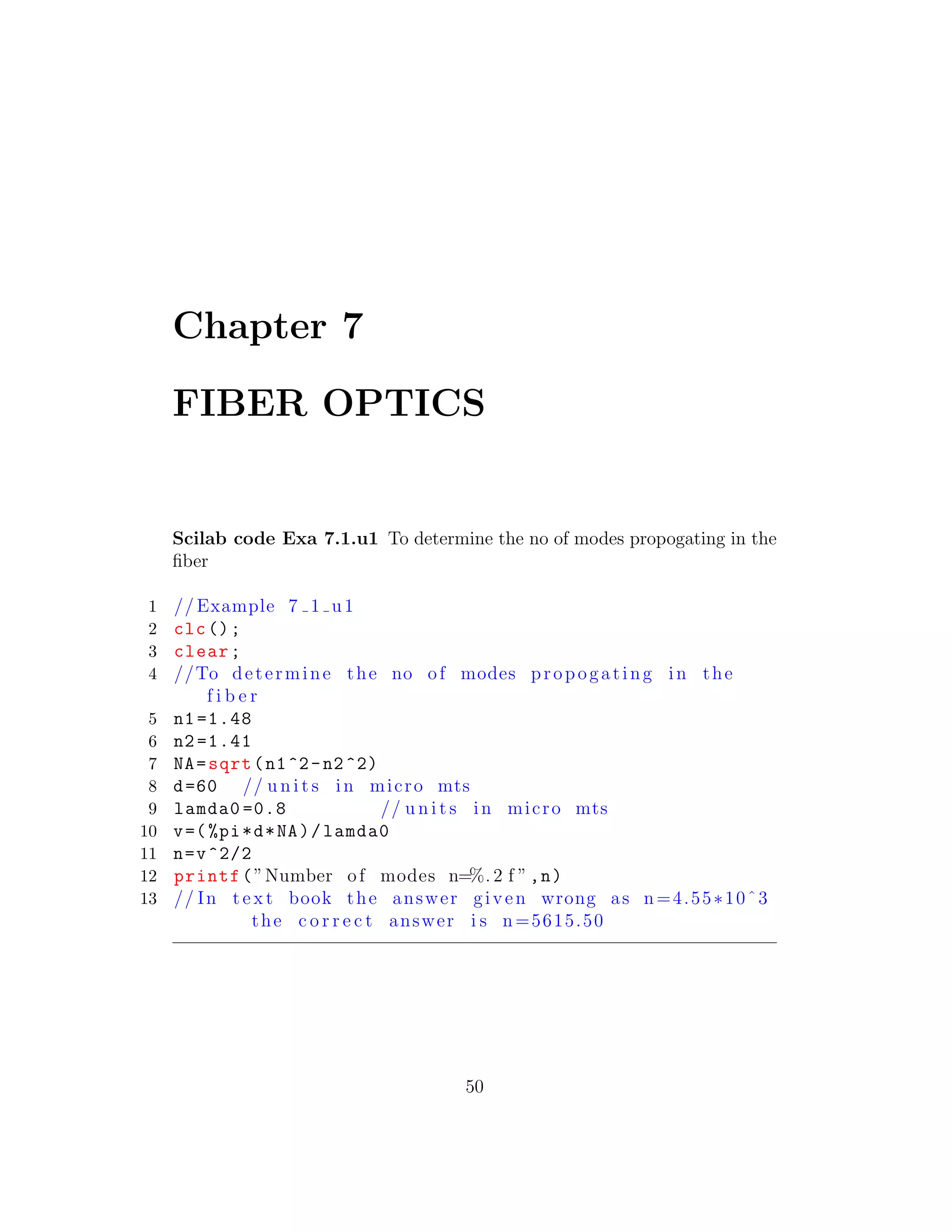
Scilab code Exa 7.1.u1 To determine the no of modes propogating in the
fiber
1 // Example 7 1 u1
2 clc();
3 clear;
4 //To determine the no of modes propogating in the
f i b e r
5 n1 =1.48
6 n2 =1.41
7 NA=sqrt(n1^2-n2^2)
8 d=60 // u n i t s in micro mts
9 lamda0 =0.8 // u n i t s in micro mts
10 v=(%pi*d*NA)/lamda0
11 n=v^2/2
12 printf(”Number of modes n=%. 2 f ”,n)
13 // In t e x t book the answer given wrong as n=4.55∗10ˆ3
the c o r r e c t answer i s n=5615.50
50
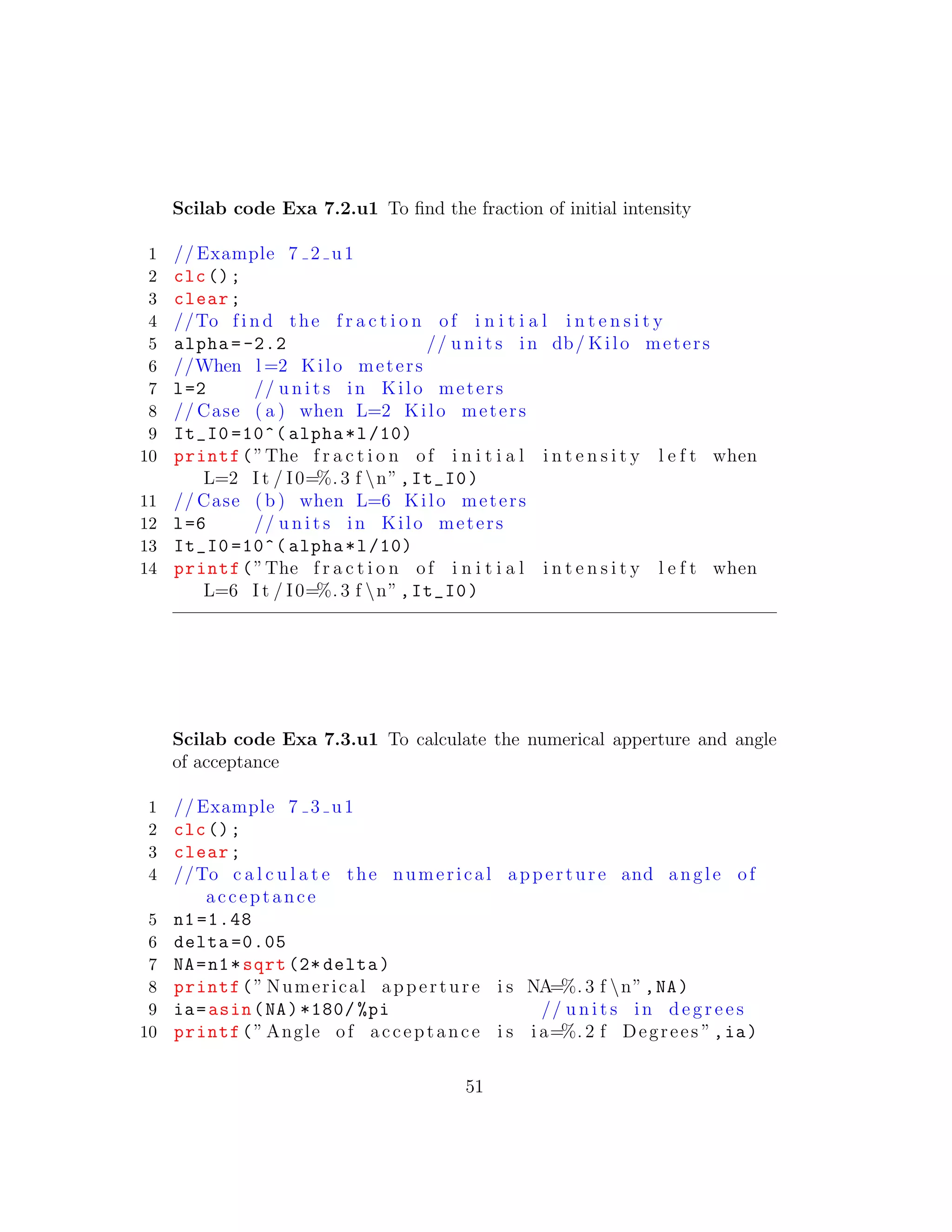
Scilab code Exa 7.2.u1 To find the fraction of initial intensity
1 // Example 7 2 u1
2 clc();
3 clear;
4 //To f i n d the f r a c t i o n of i n i t i a l i n t e n s i t y
5 alpha =-2.2 // u n i t s in db/ Kilo meters
6 //When l =2 Kilo meters
7 l=2 // u n i t s in Kilo meters
8 // Case ( a ) when L=2 Kilo meters
9 It_I0 =10^( alpha*l/10)
10 printf(”The f r a c t i o n of i n i t i a l i n t e n s i t y l e f t when
L=2 I t / I0=%. 3 f n”,It_I0)
11 // Case ( b ) when L=6 Kilo meters
12 l=6 // u n i t s in Kilo meters
13 It_I0 =10^( alpha*l/10)
14 printf(”The f r a c t i o n of i n i t i a l i n t e n s i t y l e f t when
L=6 I t / I0=%. 3 f n”,It_I0)
Scilab code Exa 7.3.u1 To calculate the numerical apperture and angle
of acceptance
1 // Example 7 3 u1
2 clc();
3 clear;
4 //To c a l c u l a t e the numerical apperture and angle of
acceptance
5 n1 =1.48
6 delta =0.05
7 NA=n1*sqrt (2* delta)
8 printf(” Numerical apperture i s NA=%. 3 f n”,NA)
9 ia=asin(NA)*180/ %pi // u n i t s in d e g r e e s
10 printf(” Angle of acceptance i s i a=%. 2 f Degrees ”,ia)
51
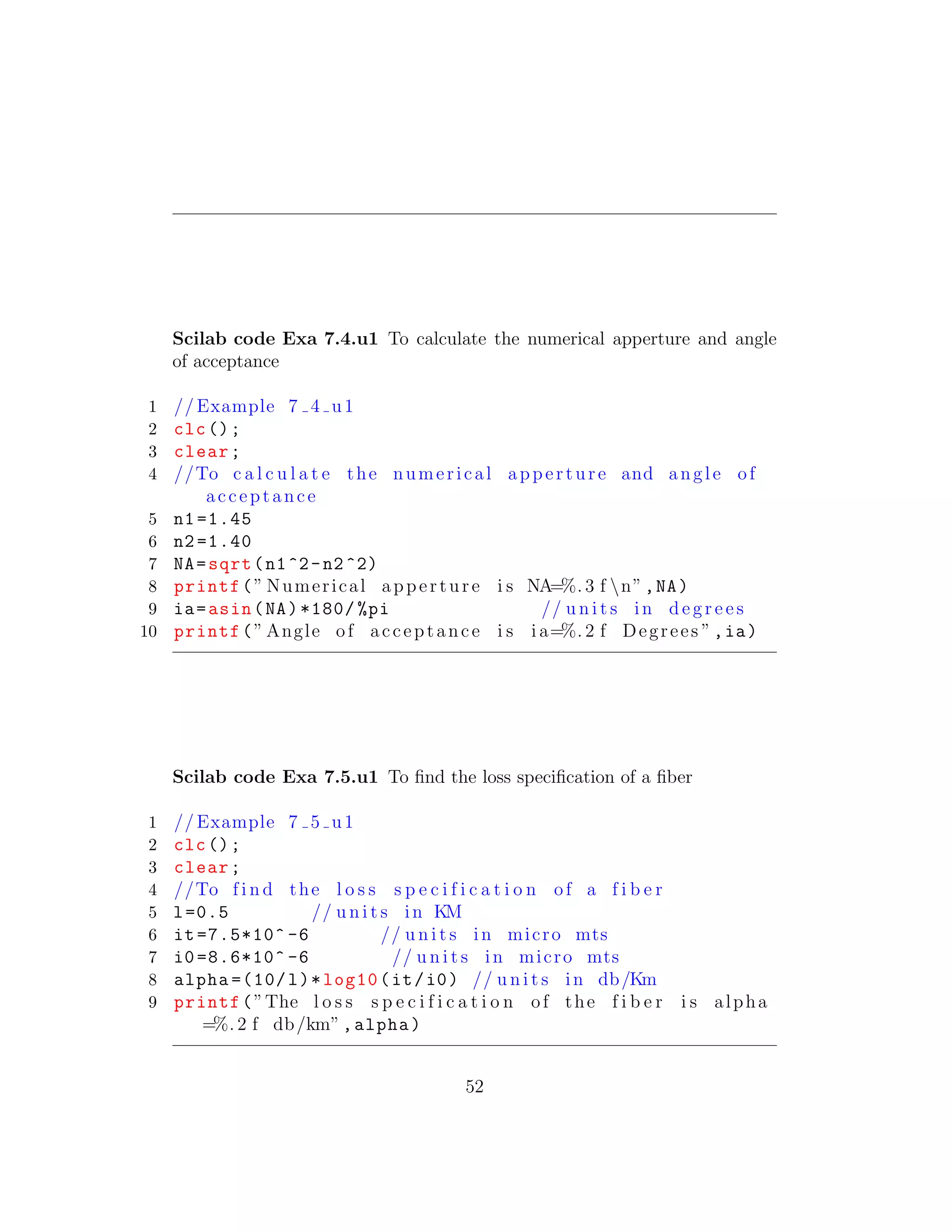
Scilab code Exa 7.4.u1 To calculate the numerical apperture and angle
of acceptance
1 // Example 7 4 u1
2 clc();
3 clear;
4 //To c a l c u l a t e the numerical apperture and angle of
acceptance
5 n1 =1.45
6 n2 =1.40
7 NA=sqrt(n1^2-n2^2)
8 printf(” Numerical apperture i s NA=%. 3 f n”,NA)
9 ia=asin(NA)*180/ %pi // u n i t s in d e g r e e s
10 printf(” Angle of acceptance i s i a=%. 2 f Degrees ”,ia)
Scilab code Exa 7.5.u1 To find the loss specification of a fiber
1 // Example 7 5 u1
2 clc();
3 clear;
4 //To f i n d the l o s s s p e c i f i c a t i o n of a f i b e r
5 l=0.5 // u n i t s in KM
6 it =7.5*10^ -6 // u n i t s in micro mts
7 i0 =8.6*10^ -6 // u n i t s in micro mts
8 alpha =(10/l)*log10(it/i0) // u n i t s in db/Km
9 printf(”The l o s s s p e c i f i c a t i o n of the f i b e r i s alpha
=%. 2 f db/km”,alpha)
52
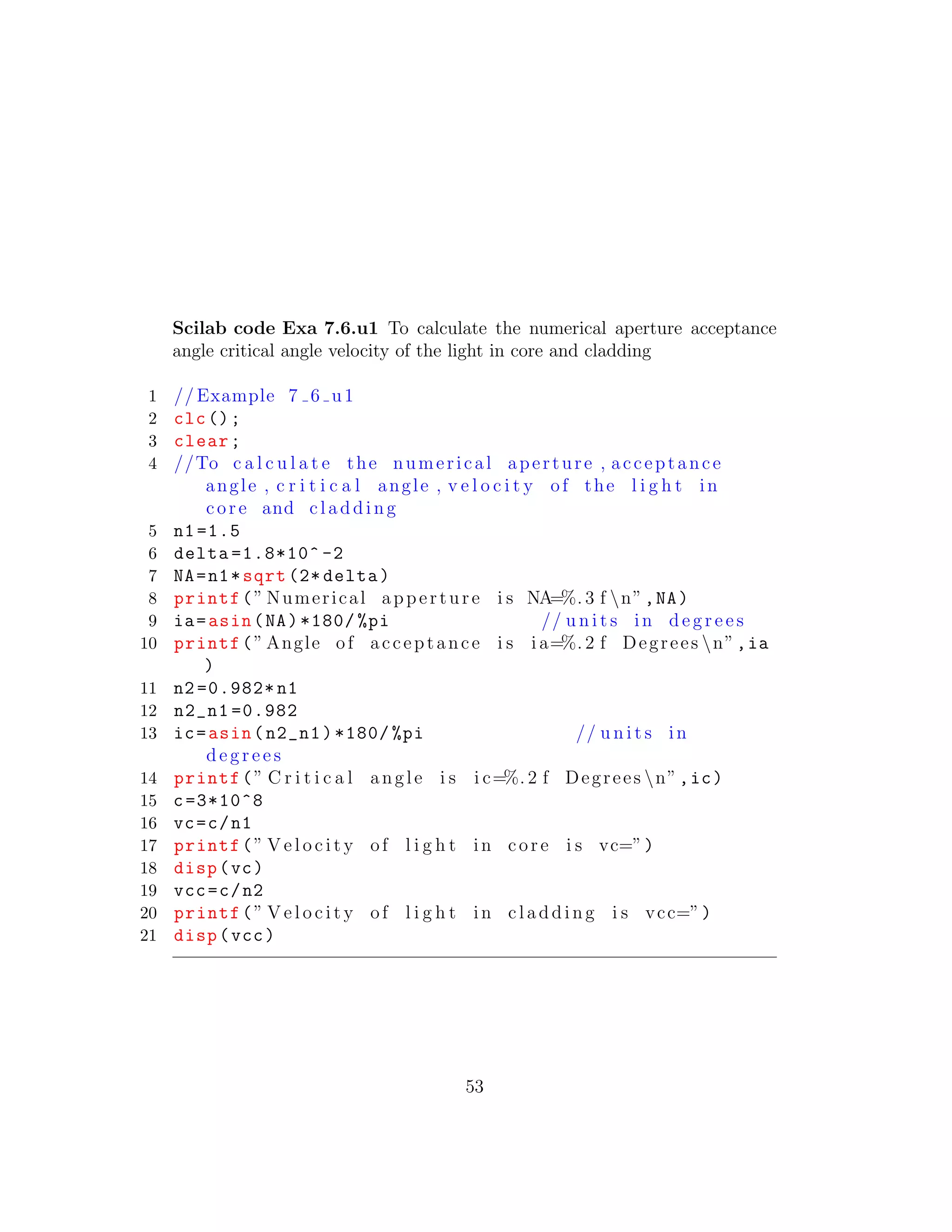
Scilab code Exa 7.6.u1 To calculate the numerical aperture acceptance
angle critical angle velocity of the light in core and cladding
1 // Example 7 6 u1
2 clc();
3 clear;
4 //To c a l c u l a t e the numerical aperture , acceptance
angle , c r i t i c a l angle , v e l o c i t y of the l i g h t in
core and cladding
5 n1=1.5
6 delta =1.8*10^ -2
7 NA=n1*sqrt (2* delta)
8 printf(” Numerical apperture i s NA=%. 3 f n”,NA)
9 ia=asin(NA)*180/ %pi // u n i t s in d e g r e e s
10 printf(” Angle of acceptance i s i a=%. 2 f Degrees n”,ia
)
11 n2 =0.982* n1
12 n2_n1 =0.982
13 ic=asin(n2_n1)*180/ %pi // u n i t s in
d e g r e e s
14 printf(” C r i t i c a l angle i s i c=%. 2 f Degrees n”,ic)
15 c=3*10^8
16 vc=c/n1
17 printf(” V e l o c i t y of l i g h t in core i s vc=”)
18 disp(vc)
19 vcc=c/n2
20 printf(” V e l o c i t y of l i g h t in cladding i s vcc=”)
21 disp(vcc)
53
Scilab code Exa 7.7.u1 To calculate the fiber length
1 // Example 7 7 u1
2 clc();
3 clear;
4 //To c a l c u l a t e the f i b e r length
5 alpha =0.5 // u n i t s in db/KM
6 it=2*10^ -6 // u n i t s in W
7 i0 =1.5*10^ -3 // u n i t s in W
8 l= -1*(10/ alpha)*log10(it/i0) // u n i t s in KM
9 printf(”The length of the f i b e r i s L=%. 1 f KM”,l)
54
Chapter 9
QUANTUM MECHANICS
AND QUANTUM
COMPUTING
Scilab code Exa 1.1.u2 To calculate energy momentum and the probabil-
ity of of finding the particle
1 // Example 1 1 u2
2 clc();
3 clear;
4 //To c a l c u l a t e energy momentum and the p r o b a b i l i t y
of of f i n d i n g the p a r t i c l e
5 n=3
6 h=6.63*10^ -34 // u n i t s in mˆ2 kg sˆ−1
7 m=1.67*10^ -27 // u n i t s in Kgs
8 l=0.1 // u n i t s in nm
9 l=l*10^ -9 // u n i t s in meters
10 e=(n^2*h^2) /(8*m*l^2) // u n i t s in j o u l e s
11 printf(”The energy of the p a r t i c l e i s E=”)
12 disp(e)
13 printf(” J o u l e s ”)
14 lamda =(2*l)/n // u n i t s in meters
15 lamda =6.6*10^ -11 // u n i t s in meters
55
16 p=h/lamda // u n i t s in Kg meter sˆ−1
17 printf(”nMomentum i s p=”)
18 disp(p)
19 printf(”Kg meter sˆ−1”)
20 prob =((1/3) -0)
21 printf(”nThe p r o b a b i l i t y of f i n d i n g the p a r t i c l e i s
=%. 2 f ”,prob)
Scilab code Exa 1.2.u2 To calculate the wavelength of the radiation emit-
ted
1 // Example 1 2 u2
2 clc();
3 clear;
4 //To c a l c u l a t e the wavelength of the r a d i a t i o n
emitted
5 h=6.63*10^ -34 // u n i t s in mˆ2 kg sˆ−1
6 m=9.1*10^ -31 // u n i t s in Kgs
7 l=1 // u n i t s in nm
8 l=l*10^ -9 // u n i t s in meters
9 c=3*10^8 // u n i t s in meters / sec
10 lamda =(8*m*c*l^2) /(27*h) // u n i t s in meters
11 lamda=lamda *10^9 // u n i t s in nm
12 printf(”The wavelength of the r a d i a t i o n i s lamda=%. 1
fnm”,lamda)
Scilab code Exa 1.3.u2 To calculate the uncertenity in momentum
1 // Example 1 3 u2
56
2 clc();
3 clear;
4 //To c a l c u l a t e the u n c e r t e n i t y in momentum
5 h=6.63e-34 // u n i t s in mˆ2 kg sˆ−1
6 deltax =1 // u n i t s in nm
7 deltax=deltax *10^ -9 // u n i t s in meters
8 deltap=h/(4* %pi*deltax) // u n i t s in Kg meter
sˆ−1
9 printf(”The u n c e r t e n i t y in momentum i s d e l t a p=”)
10 disp(deltap)
11 printf(”Kg msˆ−1”)
12 // In t e x t book the answer i s p r i n t e d wrong as
0.53∗10ˆ −15 Kg msˆ−1 the c o r r e c t answer i s 5.276
D−26 Kg msˆ−1
Scilab code Exa 1.4.u2 To find out the no of states that can accomodate
1 // Example 1 4 u2
2 clc();
3 clear;
4 //To f i n d out the no of s t a t e s that can accomodate
5 h=6.63*10^ -34 // u n i t s in mˆ2 kg sˆ−1
6 m=9.1*10^ -31 // u n i t s in Kgs
7 l=0.5 // u n i t s in nm
8 l=l*10^ -9 // u n i t s in meters
9 v=15 // u n i t s in eV
10 v=v*1.6*10^ -19 // u n i t s in Volts
11 nmax =(4*l*sqrt(m*v))/h
12 printf(”The maximum quantum number p o s s i b l e i s n=%d”
,nmax)
57
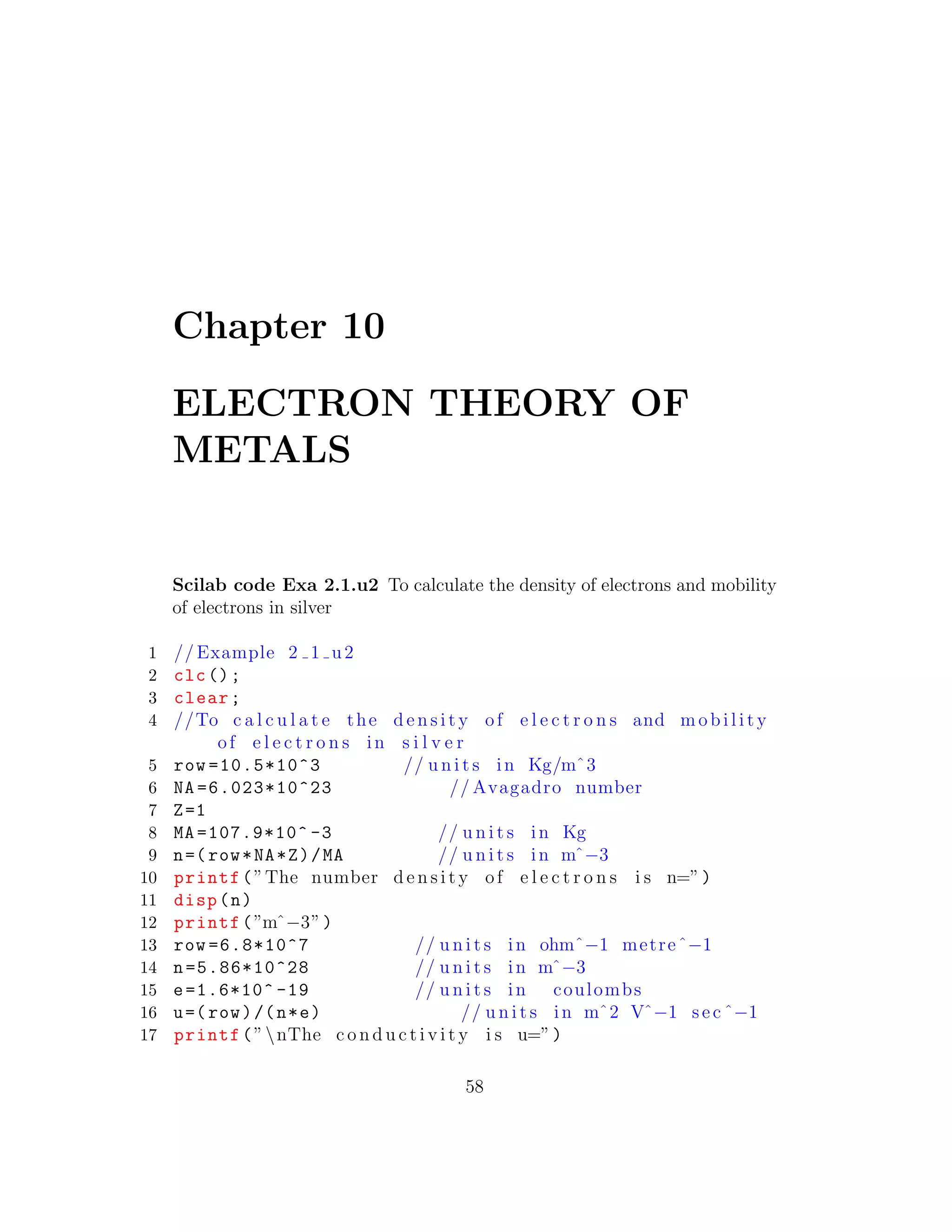
Chapter 10
ELECTRON THEORY OF
METALS
Scilab code Exa 2.1.u2 To calculate the density of electrons and mobility
of electrons in silver
1 // Example 2 1 u2
2 clc();
3 clear;
4 //To c a l c u l a t e the d e n s i t y of e l e c t r o n s and m o b i l i t y
of e l e c t r o n s in s i l v e r
5 row =10.5*10^3 // u n i t s in Kg/mˆ3
6 NA =6.023*10^23 // Avagadro number
7 Z=1
8 MA =107.9*10^ -3 // u n i t s in Kg
9 n=(row*NA*Z)/MA // u n i t s in mˆ−3
10 printf(”The number d e n s i t y of e l e c t r o n s i s n=”)
11 disp(n)
12 printf(”mˆ−3”)
13 row =6.8*10^7 // u n i t s in ohmˆ−1 metreˆ−1
14 n=5.86*10^28 // u n i t s in mˆ−3
15 e=1.6*10^ -19 // u n i t s in coulombs
16 u=(row)/(n*e) // u n i t s in mˆ2 Vˆ−1 sec ˆ−1
17 printf(”nThe c o n d u c t i v i t y i s u=”)
58
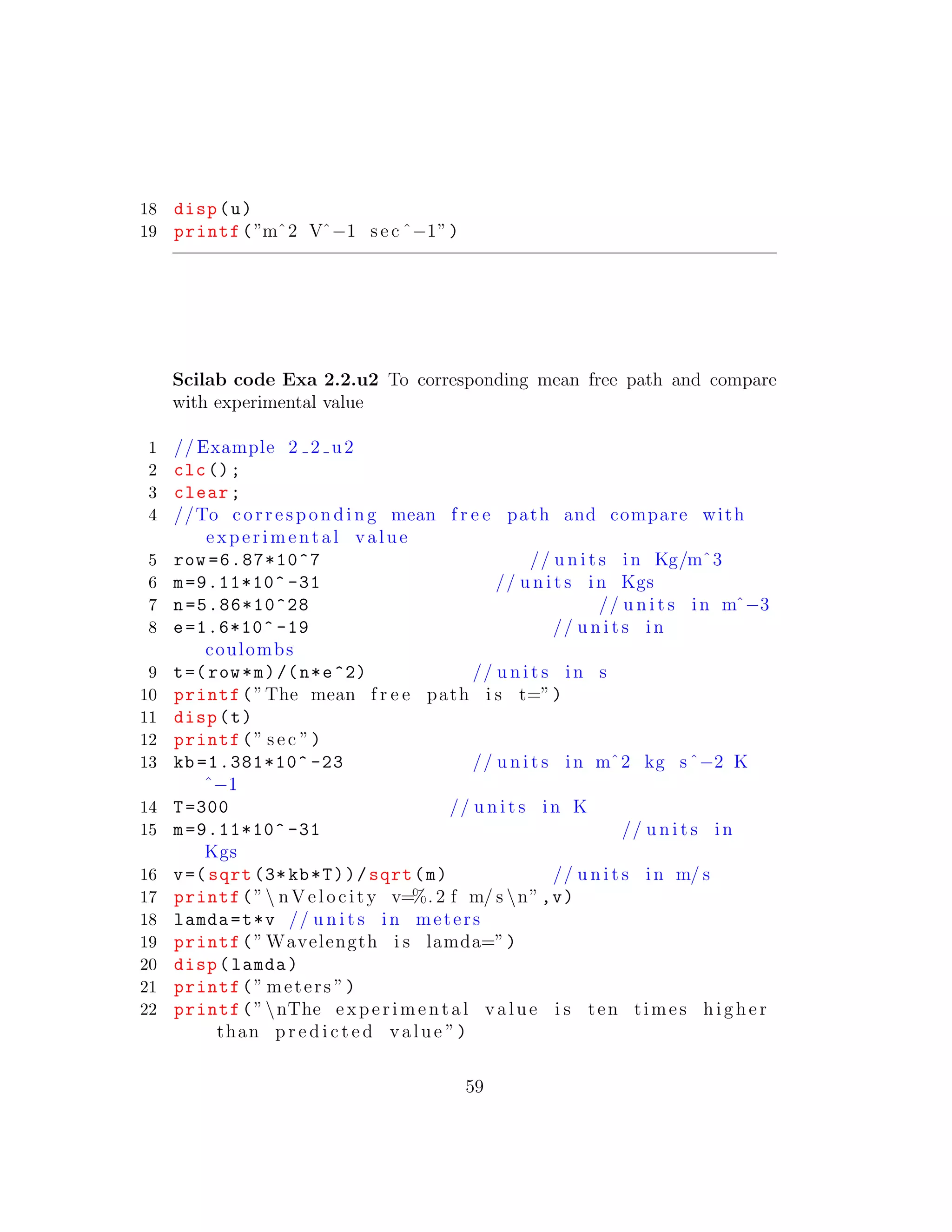
18 disp(u)
19 printf(”mˆ2 Vˆ−1 sec ˆ−1”)
Scilab code Exa 2.2.u2 To corresponding mean free path and compare
with experimental value
1 // Example 2 2 u2
2 clc();
3 clear;
4 //To corresponding mean f r e e path and compare with
experimental value
5 row =6.87*10^7 // u n i t s in Kg/mˆ3
6 m=9.11*10^ -31 // u n i t s in Kgs
7 n=5.86*10^28 // u n i t s in mˆ−3
8 e=1.6*10^ -19 // u n i t s in
coulombs
9 t=(row*m)/(n*e^2) // u n i t s in s
10 printf(”The mean f r e e path i s t=”)
11 disp(t)
12 printf(” sec ”)
13 kb =1.381*10^ -23 // u n i t s in mˆ2 kg sˆ−2 K
ˆ−1
14 T=300 // u n i t s in K
15 m=9.11*10^ -31 // u n i t s in
Kgs
16 v=( sqrt (3*kb*T))/sqrt(m) // u n i t s in m/ s
17 printf(” nVelocity v=%. 2 f m/ s n”,v)
18 lamda=t*v // u n i t s in meters
19 printf(” Wavelength i s lamda=”)
20 disp(lamda)
21 printf(” meters ”)
22 printf(”nThe experimental value i s ten times higher
than p r e d i c t e d value ”)
59
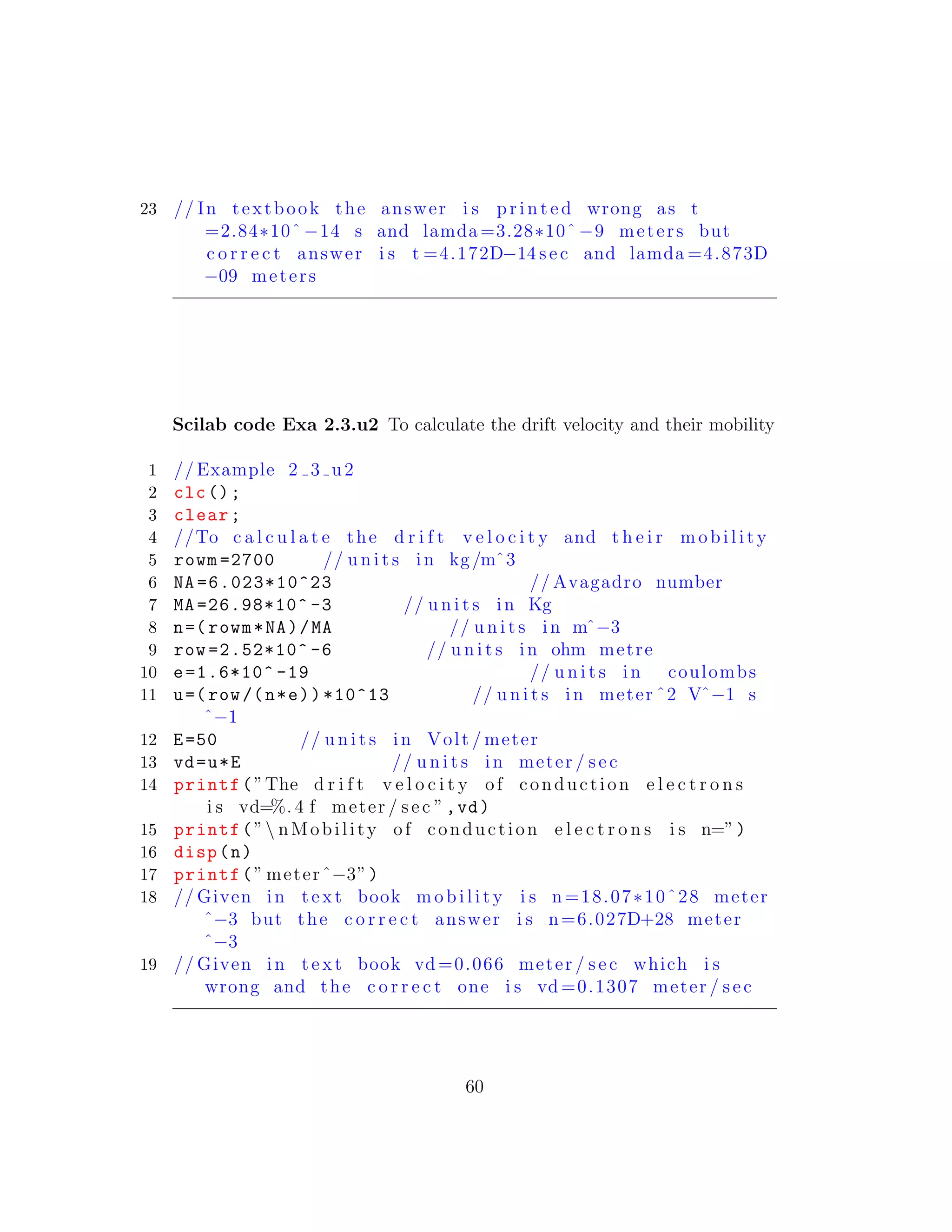
23 // In textbook the answer i s p r i n t e d wrong as t
=2.84∗10ˆ −14 s and lamda =3.28∗10ˆ −9 meters but
c o r r e c t answer i s t =4.172D−14 sec and lamda =4.873D
−09 meters
Scilab code Exa 2.3.u2 To calculate the drift velocity and their mobility
1 // Example 2 3 u2
2 clc();
3 clear;
4 //To c a l c u l a t e the d r i f t v e l o c i t y and t h e i r m o b i l i t y
5 rowm =2700 // u n i t s in kg/mˆ3
6 NA =6.023*10^23 // Avagadro number
7 MA =26.98*10^ -3 // u n i t s in Kg
8 n=( rowm*NA)/MA // u n i t s in mˆ−3
9 row =2.52*10^ -6 // u n i t s in ohm metre
10 e=1.6*10^ -19 // u n i t s in coulombs
11 u=(row/(n*e))*10^13 // u n i t s in meter ˆ2 Vˆ−1 s
ˆ−1
12 E=50 // u n i t s in Volt / meter
13 vd=u*E // u n i t s in meter / sec
14 printf(”The d r i f t v e l o c i t y of conduction e l e c t r o n s
i s vd=%. 4 f meter / sec ”,vd)
15 printf(” nMobility of conduction e l e c t r o n s i s n=”)
16 disp(n)
17 printf(” meterˆ−3”)
18 // Given in t e x t book m o b i l i t y i s n=18.07∗10ˆ28 meter
ˆ−3 but the c o r r e c t answer i s n=6.027D+28 meter
ˆ−3
19 // Given in t e x t book vd =0.066 meter / sec which i s
wrong and the c o r r e c t one i s vd =0.1307 meter / sec
60
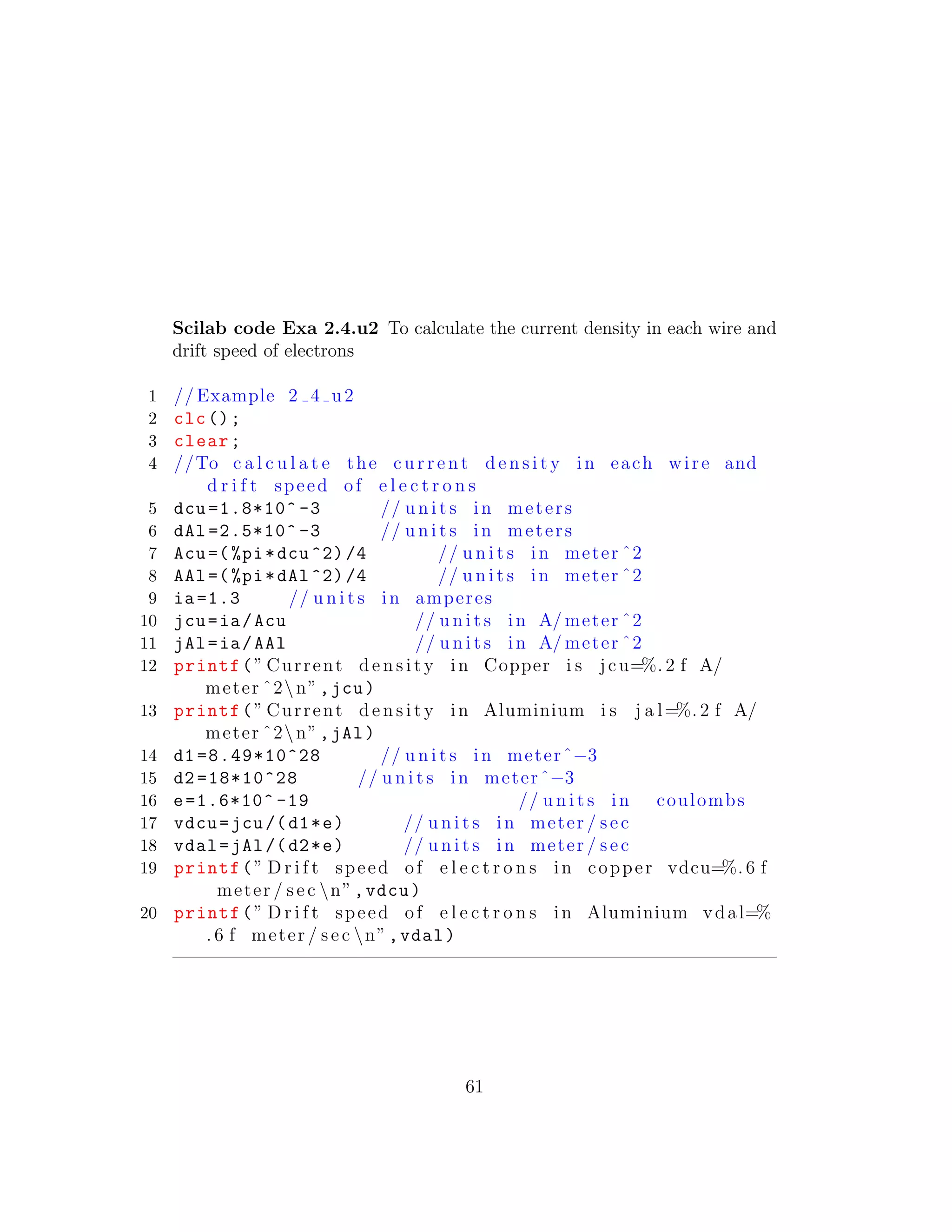
Scilab code Exa 2.4.u2 To calculate the current density in each wire and
drift speed of electrons
1 // Example 2 4 u2
2 clc();
3 clear;
4 //To c a l c u l a t e the c u r r e n t d e n s i t y in each wire and
d r i f t speed of e l e c t r o n s
5 dcu =1.8*10^ -3 // u n i t s in meters
6 dAl =2.5*10^ -3 // u n i t s in meters
7 Acu=(%pi*dcu ^2)/4 // u n i t s in meter ˆ2
8 AAl=(%pi*dAl ^2)/4 // u n i t s in meter ˆ2
9 ia=1.3 // u n i t s in amperes
10 jcu=ia/Acu // u n i t s in A/ meter ˆ2
11 jAl=ia/AAl // u n i t s in A/ meter ˆ2
12 printf(” Current d e n s i t y in Copper i s jcu=%. 2 f A/
meter ˆ2n”,jcu)
13 printf(” Current d e n s i t y in Aluminium i s j a l=%. 2 f A/
meter ˆ2n”,jAl)
14 d1 =8.49*10^28 // u n i t s in meterˆ−3
15 d2 =18*10^28 // u n i t s in meterˆ−3
16 e=1.6*10^ -19 // u n i t s in coulombs
17 vdcu=jcu/(d1*e) // u n i t s in meter / sec
18 vdal=jAl/(d2*e) // u n i t s in meter / sec
19 printf(” D r i f t speed of e l e c t r o n s in copper vdcu=%. 6 f
meter / sec n”,vdcu)
20 printf(” D r i f t speed of e l e c t r o n s in Aluminium vdal=%
. 6 f meter / sec n”,vdal)
61
Scilab code Exa 2.5.u2 To calculate the no of states for conduction elec-
trons and the average energy interval
1 // Example 2 5 u2
2 clc();
3 clear;
4 //To c a l c u l a t e the no of s t a t e s f o r conduction
e l e c t r o n s and the average energy i n t e r v a l
5 n=9.11*10^ -31 // u n i t s in Kg
6 E=5*1.6*10^ -19 // u n i t s in J
7 v=10^ -6 // u n i t s in meter ˆ3
8 h=6.67*10^ -34 // u n i t s in mˆ2 kg sˆ−1
9 NE =(8* sqrt (2)*%pi*n^1.5*E^0.5*v)/h^3 // u n i t s
in Jˆ−1
10 no=NE *0.01*1.6*10^ -19 // u n i t s in J
11 printf(” A v a i l a b l e number of energy s t a t e s i s ”)
12 disp(no)
13 interval =0.01/ no // u n i t s in eV
14 printf(” Average energy i n t e r v a l i s ”)
15 disp(interval)
16 printf(”eV”)
17 // Given in t e x t book a v a i l a b l e no of energy s t a t e s
i s 1.52∗10ˆ20 but c o r r e c t answer i s 1.490D+20
and f o r average energy i n t e r v a l i s 7∗10ˆ−23 eV
but c o r r e c t answer i s 6.709D−23 eV
Scilab code Exa 2.6.u2 To calculate the fermi energy level
62
1 // Example 2 6 u2
2 clc();
3 clear;
4 //To c a l c u l a t e the fermi energy l e v e l
5 h=4.14*10^ -15 // u n i t s in mˆ2 kg sˆ−1
6 n=8.49*10^28 // u n i t s in mˆ−3
7 m=9.1*10^ -31 // u n i t s in Kgs
8 Ef=(h^2*(3*n)^0.666) /(8*m*(%pi)^0.666) //
u n i t s in J
9 Ef=Ef *1.67*10^ -19 // u n i t s in eV
10 printf(” Fermi energy f o r copper i s Ef=%. 2 f eV”,Ef)
Scilab code Exa 2.7.u2 To calculate the probability for a state
1 // Example 2 7 u2
2 clc();
3 clear;
4 //To c a l c u l a t e the p r o b a b i l i t y f o r a s t a t e
5 //When 0. 1 eV above the fermi energy
6 e_ef =0.1 // u n i t s in eV
7 kb =8.62*10^ -5 // u n i t s in eV/K
8 t=800 // u n i t s in k e l v i n
9 fE =1/(1+ exp((e_ef)/(kb*t)))
10 printf(”The p r o b a b i l i t y of occupancy f o r a s t a t e
whose energy i s 0. 1 eV above the fermi energy i s
f (E)=%. 3 f ”,fE)
11 // 0. 1 eV below the fermi energy l e v e l
12 e_ef =-0.1 // u n i t s in eV
13 fE =1/(1+ exp((e_ef)/(kb*t)))
14 printf(”nThe p r o b a b i l i t y of occupancy f o r a s t a t e
whose energy i s 0. 1 eV below the fermi energy i s
f (E)=%. 3 f ”,fE)
15 // Equal to the fermi energy l e v e l
63
16 e_ef =0 // u n i t s in eV
17 fE =1/(1+ exp((e_ef)/(kb*t)))
18 printf(”nThe p r o b a b i l i t y of occupancy f o r a s t a t e
whose energy i s 0. 1 eV and equal to the fermi
energy i s f (E)=%. 3 f ”,fE)
Scilab code Exa 2.8.u2 TO Find the energy at which probability of occu-
pancy is point9 and density of states and the population density
1 // Example 2 8 u2
2 clc();
3 clear;
4 //TO Find the energy at which p r o b a b i l i t y of
occupancy i s 0.9 and d e n s i t y of s t a t e s and the
population d e n s i t y
5 fe=0.9
6 k=(1/ fe) -1
7 logk=log(k)
8 kb =8.62*10^ -5 // u n i t s in eV/K
9 t=1000 // u n i t s in K
10 E=logk*kb*t // u n i t s in eV
11 ef =7.06 // u n i t s in eV
12 energy=E+ef // u n i t s in eV
13 printf(”The energy of t h i s s t a t e i s E=%. 2 f eV”,
energy)
14 n=9.1*10^ -31 // u n i t s in Kgs
15 EE=energy // u n i t s in eV
16 h=4.14*10^ -15 // u n i t s in eV sec
17 ZE =(8* sqrt (2)*%pi*n^1.5* sqrt(EE))/h^3 // u n i t s
in meterˆ−3 (eV)ˆ−1
18 ZE=ZE *1.56*10^28 // u n i t s
meterˆ−3 (eV)ˆ−1
19 printf(”nThe d e n s i t y of the s t a t e s f o r t h i s energy
64
i s Z(E)=”)
20 disp(ZE)
21 printf(” meterˆ−3 (eV)ˆ−1”)
22 ne=ZE*fe // u n i t s in meterˆ−3 (eV)ˆ−1
23 printf(”nThe population d e n s i t y f o r t h i s energy i s
N(E)=”)
24 disp(ne)
25 printf(” meterˆ−3 (eV)ˆ−1”)
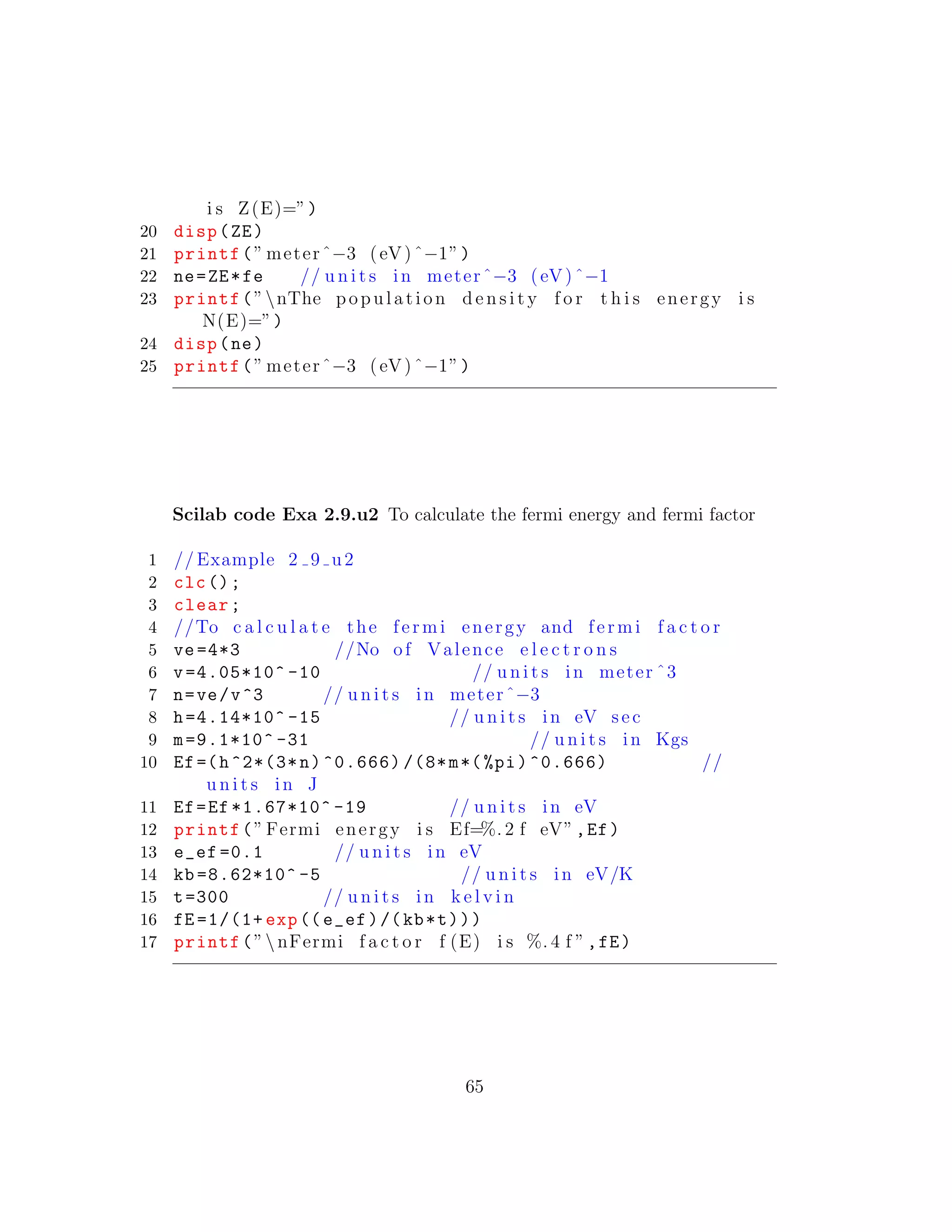
Scilab code Exa 2.9.u2 To calculate the fermi energy and fermi factor
1 // Example 2 9 u2
2 clc();
3 clear;
4 //To c a l c u l a t e the fermi energy and fermi f a c t o r
5 ve=4*3 //No of Valence e l e c t r o n s
6 v=4.05*10^ -10 // u n i t s in meter ˆ3
7 n=ve/v^3 // u n i t s in meterˆ−3
8 h=4.14*10^ -15 // u n i t s in eV sec
9 m=9.1*10^ -31 // u n i t s in Kgs
10 Ef=(h^2*(3*n)^0.666) /(8*m*(%pi)^0.666) //
u n i t s in J
11 Ef=Ef *1.67*10^ -19 // u n i t s in eV
12 printf(” Fermi energy i s Ef=%. 2 f eV”,Ef)
13 e_ef =0.1 // u n i t s in eV
14 kb =8.62*10^ -5 // u n i t s in eV/K
15 t=300 // u n i t s in k e l v i n
16 fE =1/(1+ exp((e_ef)/(kb*t)))
17 printf(”nFermi f a c t o r f (E) i s %. 4 f ”,fE)
65
Chapter 13
SUPERCONDUCTIVITY
Scilab code Exa 5.1.u2 To find the temprature where would be the criti-
cal field
1 // Example 5 1 u2
2 clc();
3 clear;
4 //To f i n d the temprature where would be the c r i t i c a l
f i e l d
5 hc =0.070 // u n i t s in K
6 ho =0.0803 // u n i t s in K
7 tc =7.22 // u n i t s in K
8 T=tc*sqrt (1-(hc/ho)) // u n i t s in K
9 printf(” Temprature T=%. 2 f K”,T)
10 // Given in textbook T=2.94K But the c o r r e c t answer
i s T=2.59K
Scilab code Exa 5.2.u2 To calculate the maximum current density
66
1 // Example 5 2 u2
2 clc();
3 clear;
4 //To c a l c u l a t e the maximum c u r r e n t d e n s i t y
5 hc =7.9*10^3 // u n i t s in amp/ meter
6 d=10^ -3 // u n i t s in meter
7 ic=hc*%pi*d // u n i t s in amp
8 critcurrentden =(ic*4)/(%pi*d^2) // u n i t s in amp/ meter
ˆ2
9 printf(”The c r i t i c a l c u r r e n t d e n s i t y i s %d amp/ meter
ˆ2”,critcurrentden)
Scilab code Exa 5.3.u2 To calculate the transition temprature and criti-
cal field
1 // Example 5 3 u2
2 clc();
3 clear;
4 //To c a l c u l a t e the t r a n s i t i o n temprature and
c r i t i c a l f i e l d
5 hc1 =1.4*10^5 // u n i t s in amp/ meter
6 hc2 =4.2*10^5 // u n i t s in amp/ meter
7 t1=14 // u n i t s in K
8 t2=13 // u n i t s in K
9 tc=sqrt ((hc1*t2^2-hc2*t1^2)/(hc1 -hc2)) // u n i t s
in K
10 printf(” T r a n s i t i o n temprature i s Tc=%. 2 f K”,tc)
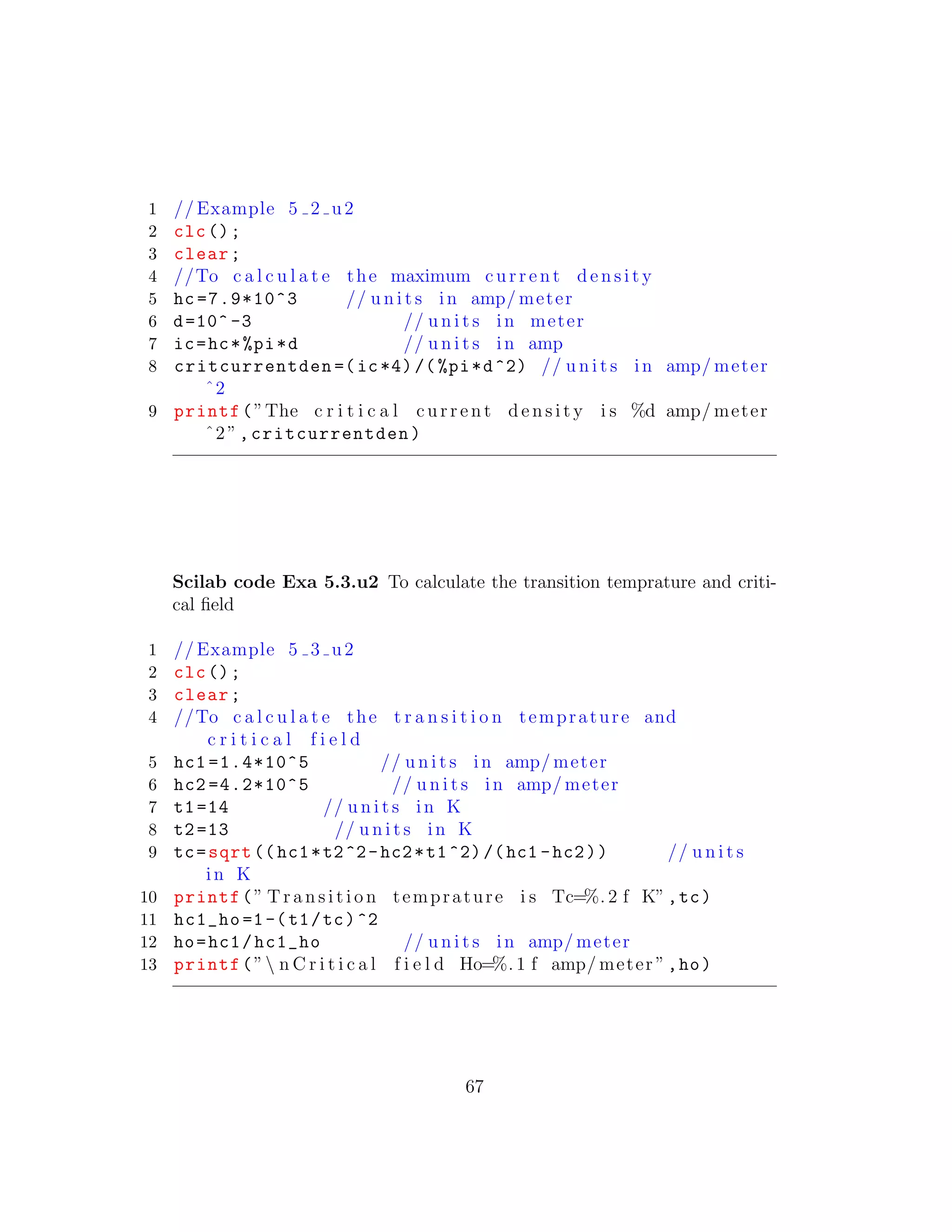
11 hc1_ho =1-(t1/tc)^2
12 ho=hc1/hc1_ho // u n i t s in amp/ meter
13 printf(” n C r i t i c a l f i e l d Ho=%. 1 f amp/ meter ”,ho)
67
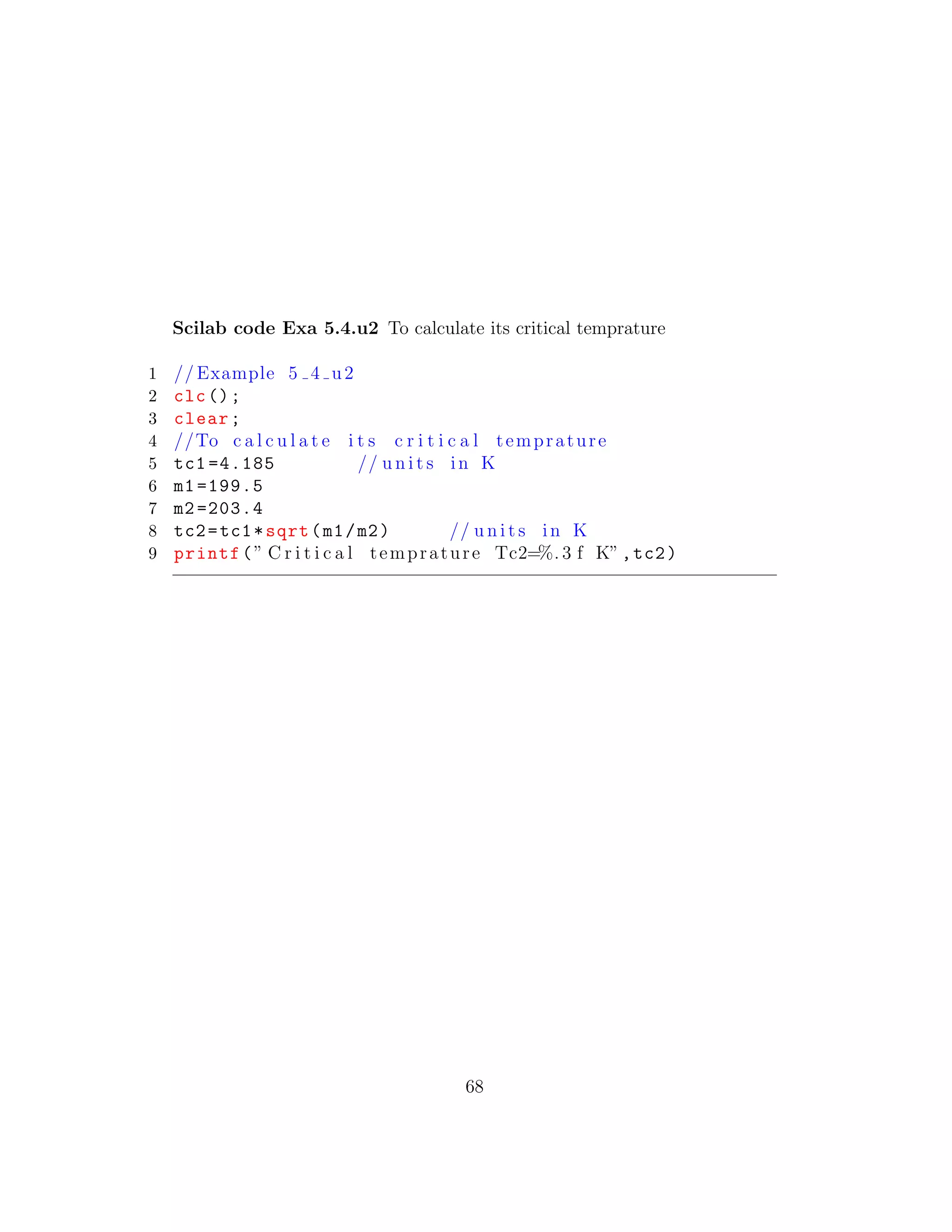
Scilab code Exa 5.4.u2 To calculate its critical temprature
1 // Example 5 4 u2
2 clc();
3 clear;
4 //To c a l c u l a t e i t s c r i t i c a l temprature
5 tc1 =4.185 // u n i t s in K
6 m1 =199.5
7 m2 =203.4
8 tc2=tc1*sqrt(m1/m2) // u n i t s in K
9 printf(” C r i t i c a l temprature Tc2=%. 3 f K”,tc2)
68
Chapter 14
DIELECTRIC PROPERTIES
Scilab code Exa 6.1.u2 To calculate the dielectric constant
1 // Example 6 1 u2
2 clc();
3 clear;
4 //To c a l c u l a t e the di−e l e c t r i c constant
5 eo =8.85*10^ -12 // u n i t s in F/ meter
6 alphae =36*10^ -40 // u n i t s in meter ˆ3
7 n=5*10^28 // u n i t s in meterˆ−3
8 er =((30* eo)+(2*n*alphae))/((30* eo) -(n*alphae))
9 printf(”The di−e l e c t r i c constant i s er=%. 2 f ”,er)
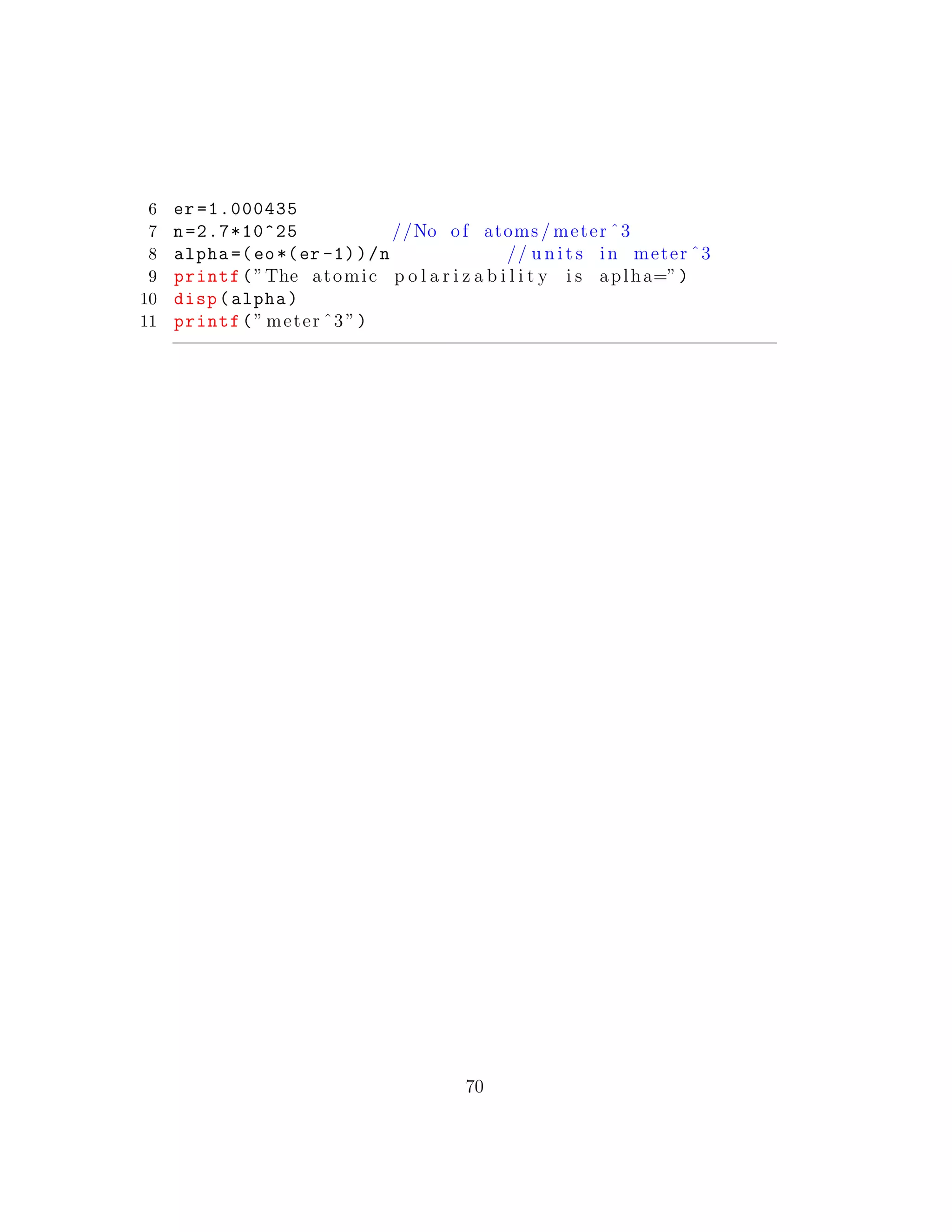
Scilab code Exa 6.2.u2 To calculate the atomic polarizability
1 // Example 6 2 u2
2 clc();
3 clear;
4 //To c a l c u l a t e the atomic p o l a r i z a b i l i t y
5 eo =8.85*10^ -12 // u n i t s in F/ meter
69
6 er =1.000435
7 n=2.7*10^25 //No of atoms / meter ˆ3
8 alpha =(eo*(er -1))/n // u n i t s in meter ˆ3
9 printf(”The atomic p o l a r i z a b i l i t y i s aplha=”)
10 disp(alpha)
11 printf(” meter ˆ3”)
70
Chapter 15
SEMICONDUCTORS
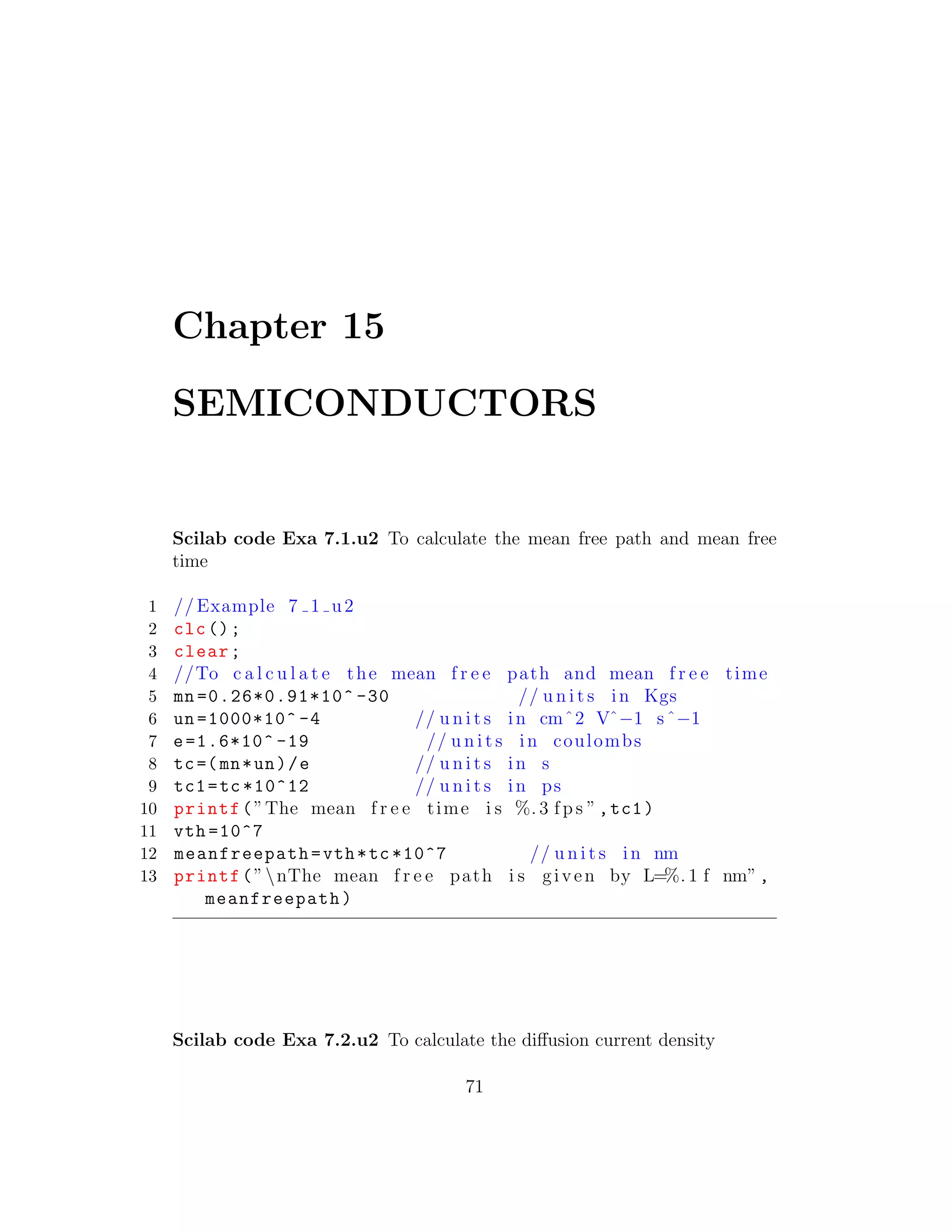
Scilab code Exa 7.1.u2 To calculate the mean free path and mean free
time
1 // Example 7 1 u2
2 clc();
3 clear;
4 //To c a l c u l a t e the mean f r e e path and mean f r e e time
5 mn =0.26*0.91*10^ -30 // u n i t s in Kgs
6 un =1000*10^ -4 // u n i t s in cmˆ2 Vˆ−1 sˆ−1
7 e=1.6*10^ -19 // u n i t s in coulombs
8 tc=(mn*un)/e // u n i t s in s
9 tc1=tc *10^12 // u n i t s in ps
10 printf(”The mean f r e e time i s %. 3 f p s ”,tc1)
11 vth =10^7
12 meanfreepath=vth*tc *10^7 // u n i t s in nm
13 printf(”nThe mean f r e e path i s given by L=%. 1 f nm”,
meanfreepath)
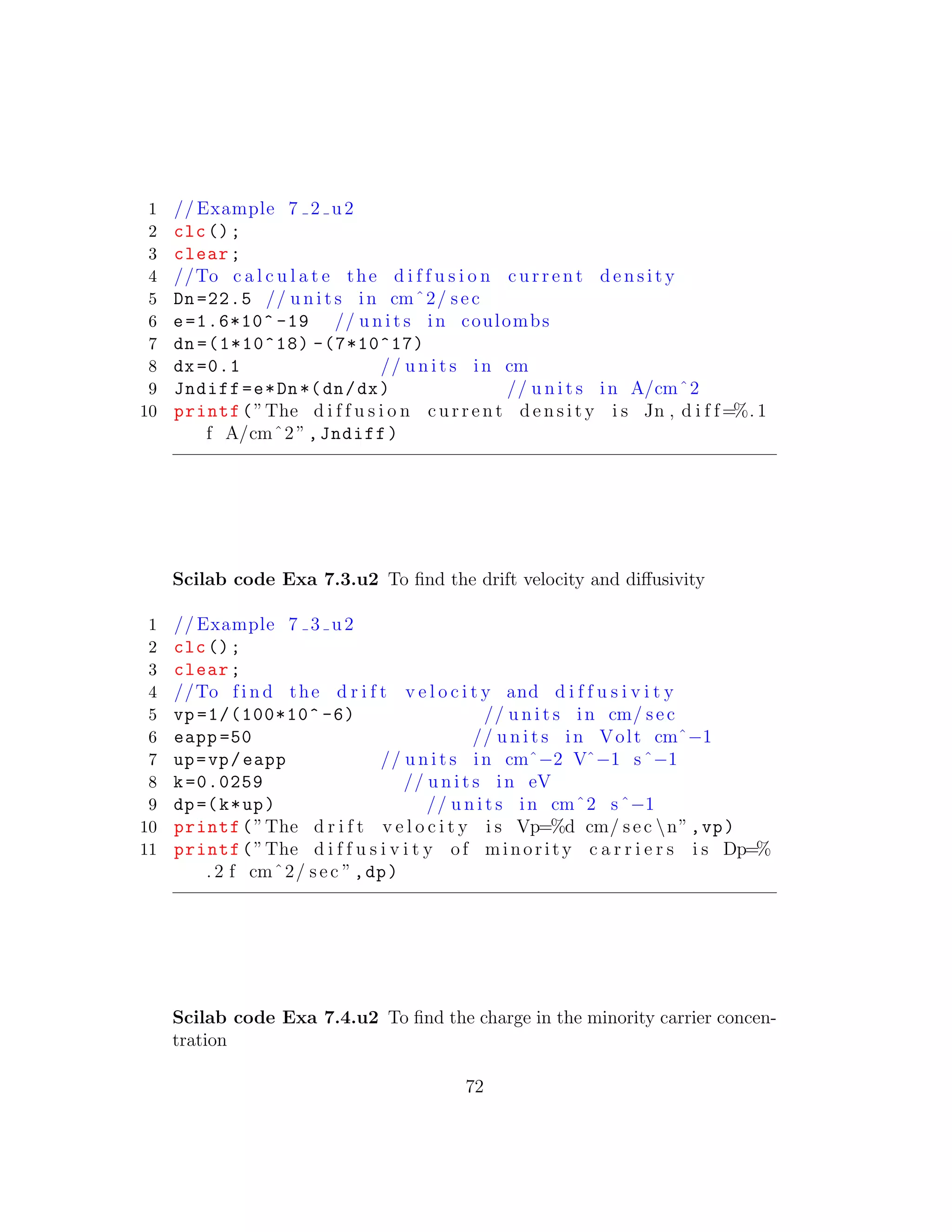
Scilab code Exa 7.2.u2 To calculate the diffusion current density
71
1 // Example 7 2 u2
2 clc();
3 clear;
4 //To c a l c u l a t e the d i f f u s i o n c u r r e n t d e n s i t y
5 Dn =22.5 // u n i t s in cmˆ2/ sec
6 e=1.6*10^ -19 // u n i t s in coulombs
7 dn =(1*10^18) -(7*10^17)
8 dx=0.1 // u n i t s in cm
9 Jndiff=e*Dn*(dn/dx) // u n i t s in A/cmˆ2
10 printf(”The d i f f u s i o n c u r r e n t d e n s i t y i s Jn , d i f f=%. 1
f A/cmˆ2”,Jndiff)
Scilab code Exa 7.3.u2 To find the drift velocity and diffusivity
1 // Example 7 3 u2
2 clc();
3 clear;
4 //To f i n d the d r i f t v e l o c i t y and d i f f u s i v i t y
5 vp =1/(100*10^ -6) // u n i t s in cm/ sec
6 eapp =50 // u n i t s in Volt cmˆ−1
7 up=vp/eapp // u n i t s in cmˆ−2 Vˆ−1 sˆ−1
8 k=0.0259 // u n i t s in eV
9 dp=(k*up) // u n i t s in cmˆ2 sˆ−1
10 printf(”The d r i f t v e l o c i t y i s Vp=%d cm/ sec n”,vp)
11 printf(”The d i f f u s i v i t y of minority c a r r i e r s i s Dp=%
. 2 f cmˆ2/ sec ”,dp)
Scilab code Exa 7.4.u2 To find the charge in the minority carrier concen-
tration
72
1 // Example 7 4 u2
2 clc();
3 clear;
4 //To f i n d the charge in the minority c a r r i e r
c o n c e n t r a t i o n
5 ni =9.65*10^9 // u n i t s in cmˆ−3
6 nno =10^14 // u n i t s in cmˆ−3
7 // Before i l l u m i n a t i o n
8 pno=ni^2/ nno // u n i t s in cmˆ−3
9 // After i l l u m i n a t i o n
10 tp=2 // u n i t s in us
11 tp=tp*10^ -6 // u n i t s in sec
12 gl =(10^13/10^ -6) // u n i t s in No of e l e c t r o n
hole p a i r f o r cmˆ−3
13 pn=pno+(tp*gl) // u n i t s in cmˆ−3
14 printf(”Change in the minority c a r r i e r c o n c e n t r a t i o n
i s Pn=”)
15 disp(pn)
16 printf(”cmˆ−3”)
Scilab code Exa 7.5.u2 To find the hall voltage
1 // Example 7 5 u2
2 clc();
3 clear;
4 //To f i n d the h a l l v o l t a g e
5 e=1.6*10^ -19 // u n i t s in coulombs
6 n=10^16 // u n i t s in no of atoms f o r cmˆ−3
7 Rh=-1/(e*n) // u n i t s in cmˆ3/C
8 i=1 // u n i t s in m i l l i amperes
9 i=i*10^ -3 // u n i t s in amperes
10 Bz=10^ -4 // u n i t s in wb/cmˆ2
11 a=2.5*10^ -3 // u n i t s in cmˆ2
73
12 w=500*10^ -4 // u n i t s in micro cm
13 Vh=((Rh*i*Bz)/a)*w // u n i t s in V
14 Vh=Vh *10^3 // u n i t s in mV
15 printf(”The h a l l v o l t a g e i s Vh=%. 5 f mV”,Vh)
74

Engineering Physics_M. R. Srinivasan

  • 1.
    Scilab Textbook Companionfor Engineering Physics by M. R. Srinivasan1 Created by Lakshmi Tharun Ponnam B.TECH Computer Engineering V R SIDDHARTHA ENGINEERING COLLEGE College Teacher None Cross-Checked by None September 23, 2015 1Funded by a grant from the National Mission on Education through ICT, http://spoken-tutorial.org/NMEICT-Intro. This Textbook Companion and Scilab codes written in it can be downloaded from the ”Textbook Companion Project” section at the website http://scilab.in
  • 2.
    Book Description Title: EngineeringPhysics Author: M. R. Srinivasan Publisher: New Age International, New Delhi Edition: 1 Year: 2011 ISBN: 978-81-224-3004-2 1
  • 3.
    Scilab numbering policyused in this document and the relation to the above book. Exa Example (Solved example) Eqn Equation (Particular equation of the above book) AP Appendix to Example(Scilab Code that is an Appednix to a particular Example of the above book) For example, Exa 3.51 means solved example 3.51 of this book. Sec 2.3 means a scilab code whose theory is explained in Section 2.3 of the book. 2
  • 4.
    Contents List of ScilabCodes 4 1 INTERFERENCE 5 2 DIFFRACTION 13 3 POLARIZATION OF LIGHT 20 5 X RAY DIFFRACTION 23 6 LASER 43 7 FIBER OPTICS 48 9 QUANTUM MECHANICS AND QUANTUM COMPUT- ING 53 10 ELECTRON THEORY OF METALS 56 13 SUPERCONDUCTIVITY 64 14 DIELECTRIC PROPERTIES 67 15 SEMICONDUCTORS 69 3
  • 5.
    List of ScilabCodes Exa 1.1.u1 To calculate the location of screen from slits . . . . . . 5 Exa 1.2.u1 To calculate the wavelength . . . . . . . . . . . . . . . 5 Exa 1.3.u1 To compare the intensity at a point distance 1mm from the center to that at its center and to find minimum dist from center of point . . . . . . . . . . . . . . . . . . . 6 Exa 1.4.u1 To calculate thickness of plate . . . . . . . . . . . . . 7 Exa 1.5.u1 To find the refractive index of coil . . . . . . . . . . . 8 Exa 1.6.U1Calculate the wavelengths of light in visible spectrum 8 Exa 1.7.u1 To calculate the fring width . . . . . . . . . . . . . . . 9 Exa 1.8.u1 To calculate the distance from the edge of wedge . . . 10 Exa 1.9.u1 To calculate diameter of the fifth bright ring . . . . . . 10 Exa 1.10.u1To find the diameter of the 20th dark ring . . . . . . . 11 Exa 1.11.u1To calculate refractive Index of liquid . . . . . . . . . 11 Exa 1.12.u1To calculate the wavelength of the light used . . . . . 12 Exa 2.1.u1 To calculate the no of lines in one cm of grating surface 13 Exa 2.2.u1 To Find the difference in angles of deviation in first and third order spectra . . . . . . . . . . . . . . . . . . . . 14 Exa 2.3.u1 To calculate minimum no of lines per centimeter . . . 14 Exa 2.4.u1 To examine two spectral lines are clearly resolved in first order and second order . . . . . . . . . . . . . . . . . 15 Exa 2.5.u1 To find the angle of separation . . . . . . . . . . . . . 16 Exa 2.6.u1 To Calculate the dispersive power of the grating . . . 16 Exa 2.7.u1 To Calculate highest power of spectrum seen with mono chromaic light . . . . . . . . . . . . . . . . . . . . . . 17 Exa 2.8.u1 To calculate the wavelength . . . . . . . . . . . . . . . 18 Exa 2.9.u1 To calculate resolving power in second order . . . . . . 18 Exa 3.1.u1 To calculate the polarising angle . . . . . . . . . . . . 20 Exa 3.2.u1 To calculate the thickness of quarter wave plate . . . . 20 4
  • 6.
    Exa 3.3.u1 Tocalculate the wavelength . . . . . . . . . . . . . . . 21 Exa 3.4.u1 To calculate the thickness of the plate . . . . . . . . . 21 Exa 5.1.u1 To determine the miller indices of the plane . . . . . . 23 Exa 5.2.u1 To determine the miller indices of the plane . . . . . . 24 Exa 5.3.u1 To find the intercepts along the Y and Z axes . . . . . 25 Exa 5.4.u1 To calculate the inter planar distance . . . . . . . . . 25 Exa 5.5.u1 To find out the interplanar spacing of the reflecting planes of the crystal . . . . . . . . . . . . . . . . . . . 26 Exa 5.6.u1 To calculate the interplanar spacing and wavelength . 26 Exa 5.7.u1 To find the wavelength whenthese planes give rise to maximum density in reflection . . . . . . . . . . . . . 27 Exa 5.8.u1 To calculate the Bragg angle and the wavelength of X rays . . . . . . . . . . . . . . . . . . . . . . . . . . . . 28 Exa 5.9.u1 To determine the interplanar spacing . . . . . . . . . . 29 Exa 5.10.u1To calculate the lattice constant . . . . . . . . . . . . 29 Exa 5.11.u1To determine the unitcell and its dimensions . . . . . 30 Exa 5.12.u1To determine the cubic structure of element and lattice constant and to identify element . . . . . . . . . . . . 33 Exa 5.13.u1To determine the crystal structure and indices of plane and lattice parameter of the material . . . . . . . . . . 35 Exa 5.14.u1To calculate the effective temprature of neutrons . . . 38 Exa 5.15.u1To calculate the Braggs angle . . . . . . . . . . . . . 39 Exa 5.16.u1To calculate the difference between the samples . . . . 40 Exa 5.17.u1To find the type of crystal and lattice parameter and atomic diameter . . . . . . . . . . . . . . . . . . . . . 41 Exa 5.18.u1To find out the planes which gives reflection . . . . . 42 Exa 6.1.u1 To calculate the Electric field of a laser beam . . . . . 43 Exa 6.2.u1 To calculate the Electric field of a bulb . . . . . . . . . 44 Exa 6.3.u1 To calculate the electric field intensity a a point . . . . 44 Exa 6.4.u1 To calculate the ratio of populations of two energy levels 45 Exa 6.5.u1 To find the wavelength of the radiation emitted . . . . 45 Exa 6.6.u1 To calculate the ratio of stimulated emission to Sponta- neous emission . . . . . . . . . . . . . . . . . . . . . . 46 Exa 6.7.u1 To calculate the no of photons emitted by the ruby laser 47 Exa 7.1.u1 To determine the no of modes propogating in the fiber 48 Exa 7.2.u1 To find the fraction of initial intensity . . . . . . . . . 49 Exa 7.3.u1 To calculate the numerical apperture and angle of ac- ceptance . . . . . . . . . . . . . . . . . . . . . . . . . 49 5
  • 7.
    Exa 7.4.u1 Tocalculate the numerical apperture and angle of ac- ceptance . . . . . . . . . . . . . . . . . . . . . . . . . 50 Exa 7.5.u1 To find the loss specification of a fiber . . . . . . . . . 50 Exa 7.6.u1 To calculate the numerical aperture acceptance angle critical angle velocity of the light in core and cladding 51 Exa 7.7.u1 To calculate the fiber length . . . . . . . . . . . . . . . 52 Exa 1.1.u2 To calculate energy momentum and the probability of of finding the particle . . . . . . . . . . . . . . . . . . 53 Exa 1.2.u2 To calculate the wavelength of the radiation emitted . 54 Exa 1.3.u2 To calculate the uncertenity in momentum . . . . . . . 54 Exa 1.4.u2 To find out the no of states that can accomodate . . . 55 Exa 2.1.u2 To calculate the density of electrons and mobility of electrons in silver . . . . . . . . . . . . . . . . . . . . . 56 Exa 2.2.u2 To corresponding mean free path and compare with ex- perimental value . . . . . . . . . . . . . . . . . . . . . 57 Exa 2.3.u2 To calculate the drift velocity and their mobility . . . 58 Exa 2.4.u2 To calculate the current density in each wire and drift speed of electrons . . . . . . . . . . . . . . . . . . . . 59 Exa 2.5.u2 To calculate the no of states for conduction electrons and the average energy interval . . . . . . . . . . . . 60 Exa 2.6.u2 To calculate the fermi energy level . . . . . . . . . . . 60 Exa 2.7.u2 To calculate the probability for a state . . . . . . . . 61 Exa 2.8.u2 TO Find the energy at which probability of occupancy is point9 and density of states and the population density 62 Exa 2.9.u2 To calculate the fermi energy and fermi factor . . . . . 63 Exa 5.1.u2 To find the temprature where would be the critical field 64 Exa 5.2.u2 To calculate the maximum current density . . . . . . . 64 Exa 5.3.u2 To calculate the transition temprature and critical field 65 Exa 5.4.u2 To calculate its critical temprature . . . . . . . . . . . 66 Exa 6.1.u2 To calculate the dielectric constant . . . . . . . . . . . 67 Exa 6.2.u2 To calculate the atomic polarizability . . . . . . . . . 67 Exa 7.1.u2 To calculate the mean free path and mean free time . 69 Exa 7.2.u2 To calculate the diffusion current density . . . . . . . 69 Exa 7.3.u2 To find the drift velocity and diffusivity . . . . . . . . 70 Exa 7.4.u2 To find the charge in the minority carrier concentration 70 Exa 7.5.u2 To find the hall voltage . . . . . . . . . . . . . . . . . 71 6
  • 8.
    Chapter 1 INTERFERENCE Scilab codeExa 1.1.u1 To calculate the location of screen from slits 1 // Example 1 1 u1 2 clc(); 3 clear; 4 //To c a l c u l a t e the l o c a t i o n of s c r e e n from s l i t s 5 d=0.08 // u n i t s in cm 6 d=d*10^ -2 // u n i t s in mts 7 betaa =6*10^ -4 // u n i t s in mts 8 v=8*10^11 // u n i t s in kHz 9 c=3*10^8 // u n i t s in mts 10 lamda=c/(v*10^3) // u n i t s in mts 11 d=( betaa*d)/lamda // u n i t s in mts 12 printf(”The d i s t a n c e of the s c r e e n from the s l i t s i s %. 2 fmts ”,d) Scilab code Exa 1.2.u1 To calculate the wavelength 7
  • 9.
    1 // Example1 2 u1 2 clc(); 3 clear; 4 //To c a l c u l a t e the wavelength 5 // F i r s t case to c a l c u l t e the wavelengths of the l i g h t source to obtain f r i n g e s 0.46∗10ˆ −2 mts 6 lamda1 =4200 // u n i t s in armstrongs 7 lamda1=lamda1 *10^ -10 // u n i t s in mts 8 betaa =0.64*10^ -2 // u n i t s in mts 9 D_d=betaa/lamda1 // u n i t s in mts 10 // Second c a s e D i s t a n c e between s l i t s and s c r e e n i s reduced to h a l f 11 beeta1 =0.46*10^ -2 // u n i t s in mts 12 lamdaD_d=beeta1 *2 // u n i t s in mts 13 lamda =( lamda1*lamdaD_d)/betaa // u n i t s in mts 14 lamda=lamda *10^10 // u n i t s in armstrongs 15 printf(”The wavelength of the Light source i s %. 1 fArmstrongs ”,lamda) Scilab code Exa 1.3.u1 To compare the intensity at a point distance 1mm from the center to that at its center and to find minimum dist from center of point 1 // Example 1 3 u1 2 clc(); 3 clear; 4 //To compare the i n t e n s i t y at a point d i s t a n c e 1mm from the c e n t e r to that at i t s c e n t e r and to f i n d minimum d i s t from c e n t e r of point 5 // Path d i f f e r e n c e =(Y∗d ) /D 6 y=1 // u n i t s in mm 7 y=y*10^ -3 // u n i t s in mts 8
  • 10.
    8 D=1 //u n i t s in mts 9 d=1 // u n i t s in mm 10 d=d*10^ -3 // u n i t s in mts 11 pathdifference =(y*d)/D // u n i t s in mts 12 lamda =5893 // u n i t s in armstrongs 13 lamda=lamda *10^ -10 // u n i t s in mts 14 phasedifference =(2* pathdifference)/lamda // u n i t s in pi radiand 15 ratioofintensity =(cos(( phasedifference /2)*%pi))^2 // u n i t s in 16 printf(”The r a t i o of i n t e n s i t y with c e n t r a l maximum i s %. 4 f n”,ratioofintensity) 17 pathdifference=lamda /4 18 distance =( pathdifference*D)/d // u n i t s in mts 19 printf(”The Distance of the point on the s c r e e n from c e n t e r i s %fmts”,distance) Scilab code Exa 1.4.u1 To calculate thickness of plate 1 // Example 1 4 u1 2 clc(); 3 clear; 4 //To c a l c u l a t e t h i c k n e s s of p l a t e 5 // t=(n∗lamda ) /(u−u1 ) 6 n=5 7 u=1.7 8 u1=1.4 9 lamda =4800 // u n i t s in armstrongs 10 lamda=lamda *10^ -10 // u n i t s in mts 11 t=(n*lamda)/(u-u1) // u n i t s in mts 12 printf(” Thickness of g l a s s p l a t e i s %. 6 fmts ”,t) 13 // In t e x t book the answer i s p r i n t e d wrong as 8∗10ˆ−8 mts 9
  • 11.
    14 // thec o r r e c t answer i s 8∗10ˆ−6 mts Scilab code Exa 1.5.u1 To find the refractive index of coil 1 // Example 1 5 u1 2 clc(); 3 clear; 4 //To f i n d the r e f r a c t i v e index of c o i l 5 volume =0.2 // u n i t s in CC 6 thickness=volume /(100*100) // u n i t s in cm 7 n=1 8 lamda =5.5*10^ -5 // u n i t s in cm 9 r=0 10 u=(n*lamda)/(2* thickness*cos(r)) 11 printf(” R e f r a c t i v e index of o i l i s %. 3 f ”,u) Scilab code Exa 1.6.U1 Calculate the wavelengths of light in visible spec- trum 1 // Example 1 6 u1 2 clc(); 3 clear; 4 // C a l c u l a t e the wavelengths of l i g h t in v i s i b l e spectrum 5 i=35 // u n i t s in d e g r e e s 6 u=1.33 7 d=5*10^ -5 // u n i t s in cm 8 r=asin(sin(i*%pi /180)/u) // u n i t s in r a d i a n s 9 r=r*180/ %pi // u n i t s in d e g r e e s 10
  • 12.
    10 // Forn=1 11 n=1 12 lamda1 =(2*u*d*cos(r*%pi /180))/n // u n i t s in cm 13 printf(”For n=1 lamda=%. 6 fcm which l i e s in i n f r a r e d r e g i o n ”,lamda1) 14 // For n=2 15 n=2 16 lamda2 =(2*u*d*cos(r*%pi /180))/n // u n i t s in cm 17 printf(”nFor n=2 lamda=%. 6 fcm which l i e s in v i s i b l e r e g i o n ”,lamda2) 18 // For n=3 19 n=3 20 lamda3 =(2*u*d*cos(r*%pi /180))/n // u n i t s in cm 21 printf(”nFor n=3 lamda=%. 6 fcm which l i e s in v i s i b l e r e g i o n ”,lamda3) 22 // For n=4 23 n=4 24 lamda4 =(2*u*d*cos(r*%pi /180))/n // u n i t s in cm 25 printf(”nFor n=4 lamda=%. 6 fcm which l i e s in u l t r a v i o l e t r e g i o n ”,lamda4) 26 printf(”nHence absent wavelengths in r e f l e c t e d r e g i o n are %. 6 fcm and %. 6 fcm”,lamda2 ,lamda3) Scilab code Exa 1.7.u1 To calculate the fring width 1 // Example 1 7 u1 2 clc(); 3 clear; 4 //To c a l c u l a t e the f r i n g width 5 // betaa =(lamda ) /(2∗ alpha ) 6 lamda =6000 // u n i t s in armstrongs 7 lamda=lamda *10^ -8 // u n i t s in cm 11
  • 13.
    8 diameter =0.05// u n i t s in mm 9 distance =15 // u n i t s in cm 10 alpha =( diameter/distance)*10^ -1 // u n i t s in r a d i a n s 11 betaa=lamda /(2* alpha) // u n i t s in cm 12 printf(”The f r i n g e width i s %. 2 fcm”,betaa) Scilab code Exa 1.8.u1 To calculate the distance from the edge of wedge 1 // Example 1 8 u1 2 clc(); 3 clear; 4 //To c a l c u l a t e the d i s t a n c e from the edge of wedge 5 alpha =0.01 // u n i t s in r a d i a n s 6 n=10 7 lamda =6000 // u n i t s in armstrongs 8 lamda=lamda *10^ -10 // u n i t s in mts 9 x=((2*n-1)*lamda)/(4* alpha) // u n i t s in mts 10 printf(” Distance from the edge of the wedge i s %. 6 fmts ”,x) Scilab code Exa 1.9.u1 To calculate diameter of the fifth bright ring 1 // Example 1 9 u1 2 clc(); 3 clear; 4 //To c a l c u l a t e diameter of the f i f t h b r i g h t r i n g 5 n=5 6 lamda =5460 // u n i t s in armstrongs 12
  • 14.
    7 lamda=lamda *10^-6 // u n i t s in cm 8 f=400 // u n i t s in cm 9 u=1.5 10 R=(u-1) *2*f // u n i t s in cm 11 diameter=sqrt (2*(2*n-1)*lamda*R) 12 printf(” Diameter of the 5 th b r i g h t r i n g i s %. 4 fcm”, diameter) 13 // In t e x t book the answer i s p r i n t e d wrong as 0.627 cm 14 //The c o r r e c t answer i s 6.269 cms Scilab code Exa 1.10.u1 To find the diameter of the 20th dark ring 1 // Example 1 10 u1 2 clc(); 3 clear; 4 //To f i n d the diameter of the 20 th dark r i n g 5 D4=0.4 // u n i t s in cm 6 D12 =0.7 // u n i t s in cm 7 //As we have (D20ˆ2−D4ˆ2) /( D12ˆ2−D4ˆ2) =(4∗16) /(4∗8) 8 ans =(4*16) /(4*8) 9 D20_2 =(ans *(( D12)^2-(D4)^2))+(D4)^2 // u n i t s in cmˆ2 10 D20=sqrt(D20_2) // u n i t s in cm 11 printf(” Diameter of the 20 th dark r i n g i s %. 3 fcm”, D20) Scilab code Exa 1.11.u1 To calculate refractive Index of liquid 13
  • 15.
    1 // Example1 11 u1 2 clc(); 3 clear; 4 //To c a l c u l a t e r e f r a c t i v e Index of l i q u i d 5 d10 =1.40 6 d_10 =1.27 7 u=(d10/d_10)^2 8 printf(”The r e f r a c t i v e index of l i q u i d i s %. 3 f ”,u) Scilab code Exa 1.12.u1 To calculate the wavelength of the light used 1 // Example 1 12 u1 2 clc(); 3 clear; 4 //To c a l c u l a t e the wavelength of the l i g h t used 5 Dnp =0.8 // u n i t s in cm 6 Dn=0.3 // u n i t s in cm 7 n1=25 8 n2=5 9 p=n1 -n2 10 R=100 // u n i t s in cm 11 lamda =(Dnp^2-Dn^2) /(4*p*R) // u n i t s in cm 12 printf(”The wavelength of l i g h t used i s %. 8 fcm”, lamda) 13 // In t e x t book the answer i s p r i n t e d wrong as 4.87∗10ˆ −5cm 14 // c o r r e c t Answer i s 6.875∗10ˆ −5cm 14
  • 16.
    Chapter 2 DIFFRACTION Scilab codeExa 2.1.u1 To calculate the no of lines in one cm of grating surface 1 // Example 2 1 u1 2 clc(); 3 clear; 4 //To c a l c u l a t e the no of l i n e s in one cm of g r a t i n g s u r f a c e 5 k=2 6 lamda =5*10^ -5 // u n i t s in cm 7 theta =30 // u n i t s in d e g r e e s 8 //We have n o o f l i n e s =1/e=(k∗lamda ) / s i n ( theta ) 9 nooflines=sin(theta*%pi /180) /(k*lamda) // u n i t s in cm 10 printf(”No of l i n e s per c e n t i me t e r i s %. f ”,nooflines ) 11 // In t e x t book the answer i s p r i n t e d wrong as 10ˆ3 12 //The c o r r e c t answer i s 5∗10ˆ3 15
  • 17.
    Scilab code Exa2.2.u1 To Find the difference in angles of deviation in first and third order spectra 1 // Example 2 2 u1 2 clc(); 3 clear; 4 //To Find the d i f f e r e n c e in a n g l e s of d e v i a t i o n in f i r s t and t h i r d order s p e c t r a 5 lamda =5000 // u n i t s in armstrongs 6 lamda=lamda *10^ -8 // u n i t s in cm 7 e=1/6000 8 // For f i r s t order e∗ s i n ( theta1 )=1∗lamda 9 theta1=asin(lamda/e) // u n i t s in r a d i a n s 10 theta1=theta1 *180/ %pi // u n i t s in d e g r e e s 11 printf(”For F i r s t order s p e c t r a theta1=%. 1 f d e g r e e s ” ,theta1) 12 // For t h i r d order e ∗ s i n ( theta3 )=3∗lamda 13 theta3=asin (3* lamda/e) // u n i t s in r a d i a n s 14 theta3=theta3 *180/ %pi // u n i t s in d e g r e e s 15 printf(”nFor Third order s p e c t r a theta3=%. 1 f d e g r e e s ”,theta3) 16 diffe=theta3 -theta1 // u n i t s in d e g r e e s 17 printf(” n D i f f e r e n c e in Angles of d e v i a t i o n in f i r s t and t h i r d order s p e c t r a i s theta3 −theta1=%. 2 f d e g r e e s ”,diffe) Scilab code Exa 2.3.u1 To calculate minimum no of lines per centimeter 1 // Example 2 3 u1 2 clc(); 3 clear; 4 //To c a l c u l a t e minimum no of l i n e s per c e n ti m e t e r 5 lamda1 =5890 // u n i t s in armstrongs 16
  • 18.
    6 lamda2 =5896// u n i t s in armstrongs 7 dlamda=lamda2 -lamda1 // u n i t s in armstrongs 8 k=2 9 n=lamda1 /(k*dlamda) 10 width =2.5 // u n i t s in cm 11 nooflines=n/width 12 printf(”No of l i n e s per cm=%. 1 f ”,nooflines) Scilab code Exa 2.4.u1 To examine two spectral lines are clearly resolved in first order and second order 1 // Example 2 4 u1 2 clc(); 3 clear; 4 //To examine two s p e c t r a l l i n e s are c l e a r l y r e s o l v e d in f i r s t order and second order 5 n=425 6 tno =2*n 7 lamda1 =5890 // u n i t s in armstrongs 8 lamda2 =5896 // u n i t s in armstrongs 9 dlamda=lamda2 -lamda1 10 // For f i r s t order 11 n=lamda1/dlamda 12 printf(”As t o t a l no of l i n e s r e q u i r e d f o r r e s o l u t i o n in f i r s t order i s %. f and t o t a l no of l i n e s in g r a t i n g i s %d the l i n e s w i l l not be r e s o l v e d in f i r s t order ”,n,tno) 13 // For second order 14 n=lamda1 /(2* dlamda) 15 printf(”nAs t o t a l no of l i n e s r e q u i r e d f o r r e s o l u t i o n in f i r s t order i s %. f and t o t a l no of l i n e s in g r a t i n g i s %d the l i n e s w i l l be r e s o l v e d in second order ”,n,tno) 17
  • 19.
    Scilab code Exa2.5.u1 To find the angle of separation 1 // Example 2 5 u1 2 clc(); 3 clear; 4 //To f i n d the angle of s e p a r a t i o n 5 lamda1 =5016 // u n i t s in armstrongs 6 lamda2 =5048 // u n i t s in armstrongs 7 lamda1=lamda1 *10^ -8 // u n i t s in cm 8 lamda2=lamda2 *10^ -8 // u n i t s in cm 9 k=2 10 n=15000 11 e=2.54/n // u n i t s in cm 12 theta1=asin ((2* lamda1)/e)*(180/ %pi) // u n i t s in d e g r e e s 13 theta2=asin ((2* lamda2)/e)*(180/ %pi) // u n i t s in d e g r e e s 14 diffe=theta2 -theta1 // u n i t s in d e g r e e s 15 diffe=diffe *60 // u n i t s in minutes 16 printf(” Angle of s e p a r a t i o n i s %. f minutes ”,diffe) Scilab code Exa 2.6.u1 To Calculate the dispersive power of the grating 1 // Example 2 6 u1 2 clc(); 18
  • 20.
    3 clear; 4 //ToC a l c u l a t e the d i s p e r s i v e power of the g r a t i n g 5 n=4000 6 e=1/n // u n i t s in cm 7 k=3 8 lamda =5000 // u n i t s in armstrongs 9 lamda=lamda *10^ -8 // u n i t s in cm 10 theta=asin ((k*lamda)/e)*(180/ %pi) // u n i t s in d e g r e e s 11 costheta=cos(theta*%pi /180) 12 disppower =(k*n)/costheta 13 printf(”The d i s p e r s i v e power of the g r a t i n g i s %. f ”, disppower) Scilab code Exa 2.7.u1 To Calculate highest power of spectrum seen with mono chromaic light 1 // Example 2 7 u1 2 clc(); 3 clear; 4 //To C a l c u l a t e h i g h e s t power of spectrum seen with mono chromaic l i g h t 5 lamda =6000 // u n i t s in armstrongs 6 lamda=lamda *10^ -8 // u n i t s in cm 7 n=5000 8 e=1/n // u n i t s in cm 9 k=e/lamda 10 printf(”The h i g h e s t order spectrum Seen with monochromatic l i g h t i s %. 2 f ”,k) 19
  • 21.
    Scilab code Exa2.8.u1 To calculate the wavelength 1 // Example 2 8 u1 2 clc(); 3 clear; 4 //To c a l c u l a t e the wavelength 5 k=2 6 theta1 =10 // u n i t s in d e g r e e s 7 dtheta =3 // u n i t s in d e g r e e s 8 dlamda =5*10^ -9 // u n i t s in cm 9 lamda =(sin(( theta1*%pi)/180)*dlamda *60*60) /(cos(( theta1*%pi)/180)*dtheta *(%pi /180)) // u n i t s in cm 10 printf(” Wavelength of the l i n e s i s %. 7 f cms”,lamda) 11 lamda_dlamda=lamda+dlamda // u n i t s in cm 12 N=6063 13 Ne=(N*k*lamda)/sin(( theta1*%pi)/180) // u n i t s in cm 14 printf(”nMinimum g r a t i n g width r e q u i r e d i s %. 1 fcm”, Ne) Scilab code Exa 2.9.u1 To calculate resolving power in second order 1 // Example 2 9 u1 2 clc(); 3 clear; 4 //To c a l c u l a t e r e s o l v i n g power in second order 5 //We have e∗ s i n ( theta )=k∗lamda 20
  • 22.
    6 //We havee ∗0.2=k∗lamda −>1 7 //And e ∗0.3=( k+1)∗lamda −>2 8 // Subtracting one and two 3∗0.1= lamda 9 lamda =5000 // u n i t s in armstrongs 10 lamda=lamda *10^ -8 // u n i t s in cm 11 e=lamda /0.1 // u n i t s in cm 12 width =2.5 // u n i t s in cm 13 N=width/e 14 respower =2*N 15 printf(” Resolving power i s %. f ”,respower) 21
  • 23.
    Chapter 3 POLARIZATION OFLIGHT Scilab code Exa 3.1.u1 To calculate the polarising angle 1 // Example 3 1 u1 2 clc(); 3 clear; 4 //To c a l c u l a t e the p o l a r i s i n g angle 5 u=1.5 6 ip=atan(u)*(180/ %pi) // u n i t s in d e g r e e s 7 printf(”The P o l a r i s i n g angle i s %. 2 f d e g r e e s or 56 d e g r e e s .18 minutes ”,ip) 8 // in t e x t book the answer i s p r i n t e d wrong as 56 d e g r e e s .18 minutes 9 // the c o r r e c t answer i s 56.31 d e g r e e s or 56 d e g r e e s 18 minutes Scilab code Exa 3.2.u1 To calculate the thickness of quarter wave plate 1 // Example 3 2 u1 2 clc(); 22
  • 24.
    3 clear; 4 //Toc a l c u l a t e the t h i c k n e s s of quarter wave p l a t e 5 lamda =6000 // u n i t s in armstrongs 6 lamda=lamda *10^ -10 // u n i t s in mts 7 n0 =1.554 8 ne =1.544 9 d=( lamda)/(4*(n0 -ne)) // u n i t s in mts 10 printf(” Thickness of quarter wave p l a t e i s %. 6 fmts ”, d) Scilab code Exa 3.3.u1 To calculate the wavelength 1 // Example 3 3 u1 2 clc(); 3 clear; 4 //To c a l c u l a t e the wavelength 5 d=12.5 // u n i t s in microns 6 d=d*10^ -6 // u n i t s in mts 7 u0_ue =0.01 8 lamda =4*d*u0_ue 9 printf(”The wavelength i s %. 7 fmts ”,lamda) 10 // In t e x t book the answer i s p r i n t e d wrong as 4∗10ˆ−7mts 11 //The c o r r e c t answer i s 5∗10ˆ−7 mts Scilab code Exa 3.4.u1 To calculate the thickness of the plate 1 // Example 3 4 u1 2 clc(); 23
  • 25.
    3 clear; 4 //Toc a l c u l a t e the t h i c k n e s s of the p l a t e 5 lamda =5.5*10^ -5 // u n i t s in cm 6 u0 =1.553 7 ue =1.542 8 d=lamda /(2*(u0 -ue)) // u n i t s in cm 9 d=d*10^ -2 // u n i t s in mts 10 printf(”The t h i c k n e s s of the p l a t e i s %. 7 fmts ”,d) 24
  • 26.
    Chapter 5 X RAYDIFFRACTION Scilab code Exa 5.1.u1 To determine the miller indices of the plane 1 // Example 5 1 u1 2 clc(); 3 clear; 4 //To determine the m i l l e r i n d i c e s of the plane 5 // Given I n t e r c e p t s are 2a,−3b , 6 c 6 a=1 7 b=1 8 c=1 9 intercepts1 =2*a 10 intercepts2 =-3*b 11 intercepts3 =6*c 12 unitcell1=intercepts1/a 13 unitcell2=intercepts2/b 14 unitcell3=intercepts3/c 15 resiprocal1 =1/ unitcell1 16 resiprocal2 =1/ unitcell2 17 resiprocal3 =1/ unitcell3 18 lcms=int32 ([ unitcell1 unitcell2 unitcell3 ]); 19 v=lcm(lcms) 20 lcm1 =3 21 lcm2=-2 25
  • 27.
    22 lcm3 =1 23printf(”Co−o r d i n a t e s of A,B,C are (%. 2 f , 0 , 0 ) , (0 ,%. 1 f , 0 ) (0 ,0 ,%d) ” ,1/lcm1 ,1/lcm2 ,lcm3) 24 printf(”n M i l l e r i n d i c e s of the plane are (%d,%d, %d) ”,lcm1 ,lcm2 ,lcm3) Scilab code Exa 5.2.u1 To determine the miller indices of the plane 1 // Example 5 2 u1 2 clc(); 3 clear; 4 //To determine the m i l l e r i n d i c e s of the plane 5 // Given I n t e r c e p t s are I n f i n i t y ,OY,OZ 6 intercepts1=” I n f i n i t y ” 7 intercepts2=”OY” 8 intercepts3=”OZ” 9 unitcell1=” I n f i n i t y ” 10 unitcell2 =1 11 unitcell3 =(2/3) 12 resiprocal1 =0 13 resiprocal2 =1/ unitcell2 14 resiprocal3 =1/ unitcell3 15 lcms=int32 ([ unitcell2 unitcell3 ]); 16 v=lcm(lcms) 17 lcm1 =0 18 lcm2 =2 19 lcm3 =3 20 printf(”Co−o r d i n a t e s of A,B,C are ( I n f i n i t y , 0 , 0 ) ,( 0 , %d, 0 ) (0 ,0 , %f ) ”,unitcell2 ,unitcell3) 21 printf(”n M i l l e r i n d i c e s of the plane are (%d,%d, %d) ”,lcm1 ,lcm2 ,lcm3) 26
  • 28.
    Scilab code Exa5.3.u1 To find the intercepts along the Y and Z axes 1 // Example 5 3 u1 2 clc(); 3 clear; 4 //To f i n d the i n t e r c e p t s along the Y and Z axes 5 a=0.121 // u n i t s in nm 6 b=0.184 // u n i t s in nm 7 c=0.197 // u n i t s in nm 8 // Given m i l l e r i n d i c e s are ( 2 , 3 , 1 ) 9 OA_OB =3/2 10 OA_OC =1/2 11 OB =(2/3)*b // u n i t s in nm 12 OC=2*c // u n i t s in nm 13 printf(”The I n t e r c e p t s along the Y and Z axes are OB =%. 3 fnm and OC=%. 3 fnm”,OB ,OC) Scilab code Exa 5.4.u1 To calculate the inter planar distance 1 // Example 5 4 u1 2 clc(); 3 clear; 4 //To c a l c u l a t e the i n t e r planar d i s t a n c e 5 a=0.82 // u n i t s in nm 6 b=0.94 // u n i t s in nm 7 c=0.75 // u n i t s in nm 8 h=1 9 k=2 27
  • 29.
    10 l=3 11 d=1/sqrt ((((h/a)^2) +((k/b)^2) +((l/c)^2))) // u n i t s in nm 12 printf(”The Distance between ( 1 , 2 , 3 ) planes and ( 2 , 4 , 6 ) planes i s d123=%. 2 fnm and d246=%. 2 fnm”,d, d/2) 13 // In textbook the answer i s p r i n t e d wrong as d123 =0.11nm and d246 =0.055nm but the c o r r e c t answers are d123 =0.21nm and d246 =0.11nm Scilab code Exa 5.5.u1 To find out the interplanar spacing of the reflect- ing planes of the crystal 1 // Example 5 5 u1 2 clc(); 3 clear; 4 //To f i n d out the i n t e r p l a n a r spacing of the r e f l e c t i n g planes of the c r y s t a l 5 theta =28 // u n i t s in d e g r e e s 6 lamda =0.12 // u n i t s in nm 7 n=2 8 d=(n*lamda)/(2* sin(theta *(%pi /180))) 9 printf(”The i n t e r p l a n a r spacing of the r e f l e c t i n g planes of the c r y s t a l i s d=%. 2 fnm”,d) Scilab code Exa 5.6.u1 To calculate the interplanar spacing and wave- length 1 // Example 5 6 u1 28
  • 30.
    2 clc(); 3 clear; 4//To c a l c u l a t e the i n t e r p l a n a r spacing and wavelength 5 n1=1 6 theta1 =23 // u n i t s in d e g r e e s 7 n2=3 8 theta2 =60 // u n i t s in d e g r e e s 9 lamda1 =97 // u n i t s in pm 10 lamda2 =(n2*lamda1*sin(theta1 *(%pi /180)))/(sin(theta2 *(%pi /180))) // u n i t s in pm 11 d=(n2*lamda1)/(2* sin(theta2 *(%pi /180))) // u n i t s in pm 12 printf(” Wavelength lamda=%dpm n I n t e r p l a n a r spacing d=%dpm”,lamda2 ,d) Scilab code Exa 5.7.u1 To find the wavelength whenthese planes give rise to maximum density in reflection 1 // Example 5 7 u1 2 clc(); 3 clear; 4 //To f i n d the wavelength whenthese planes g i v e r i s e to maximum d e n s i t y in r e f l e c t i o n 5 d=275 // u n i t s in pm 6 theta =45 // u n i t s in d e g r e e s 7 // For n=1 8 n=1 9 lamda =(2*d*sin(theta *(%pi /180)))/n // u n i t s in pm 10 printf(” Wavelength f o r n=1 i s lamda=%. 1 fpmn”,lamda) 11 // For n=2 12 n=2 29
  • 31.
    13 lamda =(2*d*sin(theta*(%pi /180)))/n // u n i t s in pm 14 printf(” Wavelength f o r n=1 i s lamda=%. 1 fpmn”,lamda) 15 // For n=3 16 n=3 17 lamda =(2*d*sin(theta *(%pi /180)))/n // u n i t s in pm 18 printf(” Wavelength f o r n=1 i s lamda=%. 1 fpmn”,lamda) 19 // For n=4 20 n=4 21 lamda =(2*d*sin(theta *(%pi /180)))/n // u n i t s in pm 22 printf(” Wavelength f o r n=1 i s lamda=%. 1 fpmn”,lamda) 23 // For n=5 24 n=5 25 lamda =(2*d*sin(theta *(%pi /180)))/n // u n i t s in pm 26 printf(” Wavelength f o r n=1 i s lamda=%. 1 fpmn”,lamda) 27 printf(”For n=1 ,2 ,3 and >5 lamda l i e s beyond the range of wavelengths of polychromatic source ”) Scilab code Exa 5.8.u1 To calculate the Bragg angle and the wavelength of X rays 1 // Example 5 8 u1 2 clc(); 3 clear; 4 //To c a l c u l a t e the Bragg angle and the wavelength of X−rays 5 // Given plane i n d i c e s are ( 1 , 1 , 1 ) 6 theta =87 // u n i t s in d e g r e e s 7 theta=theta /2 // u n i t s in d e g r e e s 8 a=0.2 // u n i t s in nm 30
  • 32.
    9 h=1 10 k=1 11l=1 12 d=a/sqrt(h^2+k^2+l^2) // u n i t s in nm 13 lamda =2*d*sin(theta *(%pi /180)) // u n i t s in nm 14 printf(” Bragg angle theta=%. 1 f d e g r e e s n wavelength lamda=%. 3 fnm”,theta ,lamda) Scilab code Exa 5.9.u1 To determine the interplanar spacing 1 // Example 5 9 u1 2 clc(); 3 clear; 4 //To determine the i n t e r p l a n a r spacing 5 h=6.63*10^ -34 // u n i t s in mˆ2 kg sˆ−1 6 m=9.1*10^ -31 // u n i t s in Kgs 7 e=1.6*10^ -19 // u n i t s in coulombs 8 v=844 // u n i t s in Volts 9 lamda=h/sqrt (2*m*e*v) // u n i t s in meters 10 n=1 11 theta =58 // u n i t s in d e g r e e s 12 d=(n*lamda)/(2* sin(theta *(%pi /180))) // u n i t s in meters 13 printf(”The i n t e r p l a n a r spacing d=”) 14 disp(d) 15 printf(” meters ”) Scilab code Exa 5.10.u1 To calculate the lattice constant 31
  • 33.
    1 // Example5 10 u1 2 clc(); 3 clear; 4 //To c a l c u l a t e the l a t t i c e constant 5 h=6.63*10^ -34 // u n i t s in mˆ2 kg sˆ−1 6 m=1.804*10^ -27 // u n i t s in Kgs 7 KB =1.38*10^ -23 // u n i t s in mˆ2 kg sˆ−2 Kˆ−1 8 T=300 // u n i t s in K 9 lamda=h/sqrt (3*m*KB*T) // u n i t s in meters 10 n=2 11 a=( sqrt (3)*lamda)/2 // u n i t s in meters 12 printf(” L a t t i c e constant a=”); 13 disp(a); 14 printf(” meters ”) Scilab code Exa 5.11.u1 To determine the unitcell and its dimensions 1 // Example 5 11 u1 2 clc(); 3 clear; 4 //To determine the u n i t c e l l and i t s dimensions 5 // Experimental data 6 //We have r e l a t i o n s i n ˆ( theta )=(lamda /2∗ a ) ˆ2 and ( h ˆ2+kˆ2+ l ˆ2)=j ∗( lamda /2∗ a ) ˆ2 7 theta21 =12.1 // u n i t s in d e g r e e s 8 theta22 =17.1 // u n i t s in d e g r e e s 9 theta23 =21 // u n i t s in d e g r e e s 10 theta24 =24.3 // u n i t s in d e g r e e s 11 theta25 =27.2 // u n i t s in d e g r e e s 12 theta26 =29.9 // u n i t s in d e g r e e s 13 theta28 =34.7 // u n i t s in d e g r e e s 14 theta29 =36.9 // u n i t s in d e g r e e s 15 theta210 =38.9 // u n i t s in d e g r e e s 32
  • 34.
    16 theta211 =40.9// u n i t s in d e g r e e s 17 theta212 =42.8 // u n i t s in d e g r e e s 18 theta1=theta21 /2 // u n i t s in d e g r e e s 19 theta2=theta22 /2 // u n i t s in d e g r e e s 20 theta3=theta23 /2 // u n i t s in d e g r e e s 21 theta4=theta24 /2 // u n i t s in d e g r e e s 22 theta5=theta25 /2 // u n i t s in d e g r e e s 23 theta6=theta26 /2 // u n i t s in d e g r e e s 24 theta8=theta28 /2 // u n i t s in d e g r e e s 25 theta9=theta29 /2 // u n i t s in d e g r e e s 26 theta10=theta210 /2 // u n i t s in d e g r e e s 27 theta11=theta211 /2 // u n i t s in d e g r e e s 28 theta12=theta212 /2 // u n i t s in d e g r e e s 29 // s i n ˆ2( theta ) v a l u e s 30 sin1 =(sin(theta1*%pi /180))^2 31 sin2 =(sin(theta2*%pi /180))^2 32 sin3 =(sin(theta3*%pi /180))^2 33 sin4 =(sin(theta4*%pi /180))^2 34 sin5 =(sin(theta5*%pi /180))^2 35 sin6 =(sin(theta6*%pi /180))^2 36 sin8 =(sin(theta8*%pi /180))^2 37 sin9 =(sin(theta9*%pi /180))^2 38 sin10 =(sin(theta10*%pi /180))^2 39 sin11 =(sin(theta11*%pi /180))^2 40 sin12 =(sin(theta12*%pi /180))^2 41 // s i n ˆ2( theta ) /0.0111 value 42 temp1=sin1/sin1 43 temp2=sin2/sin1 44 temp3=sin3/sin1 45 temp4=sin4/sin1 46 temp5=sin5/sin1 47 temp6=sin6/sin1 48 temp8=sin8/sin1 49 temp9=sin9/sin1 50 temp10=sin10/sin1 51 temp11=sin11/sin1 52 temp12=sin12/sin1 53 // (h , k , l ) v a l u e s are determined such that the sum h 33
  • 35.
    ˆ2+kˆ2+ l ˆ2=tempvalue in that manner hence we have to s e l e c t the (h , k , l ) v a l u e s 54 // (h , k , l ) v a l u e s 55 hkl1 =100 //As hˆ2+kˆ2+ l ˆ2=1 56 hkl2 =110 //As hˆ2+kˆ2+ l ˆ2=2 57 hkl3 =111 //As hˆ2+kˆ2+ l ˆ2=3 58 hkl4 =200 //As hˆ2+kˆ2+ l ˆ2=4 59 hkl5 =210 //As hˆ2+kˆ2+ l ˆ2=5 60 hkl6 =211 //As hˆ2+kˆ2+ l ˆ2=6 61 hkl8 =220 //As hˆ2+kˆ2+ l ˆ2=8 62 hkl9 =300 //As hˆ2+kˆ2+ l ˆ2=9 63 hkl10 =310 //As hˆ2+kˆ2+ l ˆ2=10 64 hkl11 =311 //As hˆ2+kˆ2+ l ˆ2=11 65 hkl12 =222 //As hˆ2+kˆ2+ l ˆ2=12 66 printf(” unit c e l l Dimensions when 2∗ theta=%. 1 f i s ( %d) where s i n ˆ2( theta ) /0.0111 i s %dn”,theta21 , hkl1 ,temp1 ) 67 printf(” unit c e l l Dimensions when 2∗ theta=%. 1 f i s ( %d) where s i n ˆ2( theta ) /0.0111 i s %. 1 f n”,theta22 , hkl2 ,temp2 ) 68 printf(” unit c e l l Dimensions when 2∗ theta=%. 1 f i s ( %d) where s i n ˆ2( theta ) /0.0111 i s %. 1 f n”,theta23 , hkl3 ,temp3 ) 69 printf(” unit c e l l Dimensions when 2∗ theta=%. 1 f i s ( %d) where s i n ˆ2( theta ) /0.0111 i s %. 1 f n”,theta24 , hkl4 ,temp4 ) 70 printf(” unit c e l l Dimensions when 2∗ theta=%. 1 f i s ( %d) where s i n ˆ2( theta ) /0.0111 is% . 1 f n”,theta25 , hkl5 ,temp5 ) 71 printf(” unit c e l l Dimensions when 2∗ theta=%. 1 f i s ( %d) where s i n ˆ2( theta ) /0.0111 i s %. 1 f n”,theta26 , hkl6 ,temp6 ) 72 printf(” unit c e l l Dimensions when 2∗ theta=%. 1 f i s ( %d) where s i n ˆ2( theta ) /0.0111 i s %. 1 f n”,theta28 , hkl8 ,temp8 ) 73 printf(” unit c e l l Dimensions when 2∗ theta=%. 1 f i s ( %d) where s i n ˆ2( theta ) /0.0111 i s %. 1 f n”,theta29 , hkl9 ,temp9 ) 34
  • 36.
    74 printf(” unitc e l l Dimensions when 2∗ theta=%. 1 f i s ( %d) where s i n ˆ2( theta ) /0.0111 i s %. 1 f n”,theta210 ,hkl10 ,temp10 ) 75 printf(” unit c e l l Dimensions when 2∗ theta=%. 1 f i s ( %d) where s i n ˆ2( theta ) /0.0111 i s %. 1 f n”,theta211 ,hkl11 ,temp11 ) 76 printf(” unit c e l l Dimensions when 2∗ theta=%. 1 f i s ( %d) where s i n ˆ2( theta ) /0.0111 i s %. 1 f n”,theta212 ,hkl12 ,temp12 ) 77 lamda =71 // u n i t s in pm 78 a=lamda /(2* sqrt(sin1)) // u n i t s in pm 79 printf(”The u n i t c e l l and i t s dimensions are %dpm”,a) Scilab code Exa 5.12.u1 To determine the cubic structure of element and lattice constant and to identify element 1 // Example 5 12 u1 2 clc(); 3 clear; 4 //To determine the cubic s t r u c t u r e of element and l a t t i c e constant and to i d e n t i f y element 5 // D i f f r a c t i o n data 6 theta21 =40 // u n i t s in d e g r e e s 7 theta22 =58 // u n i t s in d e g r e e s 8 theta23 =73 // u n i t s in d e g r e e s 9 theta24 =86.8 // u n i t s in d e g r e e s 10 theta25 =100.4 // u n i t s in d e g r e e s 11 theta26 =114.7 // u n i t s in d e g r e e s 12 theta1=theta21 /2 // u n i t s in d e g r e e s 13 theta2=theta22 /2 // u n i t s in d e g r e e s 14 theta3=theta23 /2 // u n i t s in d e g r e e s 15 theta4=theta24 /2 // u n i t s in d e g r e e s 16 theta5=theta25 /2 // u n i t s in d e g r e e s 35
  • 37.
    17 theta6=theta26 /2// u n i t s in d e g r e e s 18 // s i n ˆ2( theta ) v a l u e s 19 sin1 =(sin(theta1*%pi /180))^2 20 sin2 =(sin(theta2*%pi /180))^2 21 sin3 =(sin(theta3*%pi /180))^2 22 sin4 =(sin(theta4*%pi /180))^2 23 sin5 =(sin(theta5*%pi /180))^2 24 sin6 =(sin(theta6*%pi /180))^2 25 // s i n ˆ2( theta ) /0.111 value 26 temp1=sin1/sin1 27 temp2=sin2/sin1 28 temp3=sin3/sin1 29 temp4=sin4/sin1 30 temp5=sin5/sin1 31 temp6=sin6/sin1 32 // (h , k , l ) v a l u e s are determined such that the sum h ˆ2+kˆ2+ l ˆ2=temp value in that manner hence we have to s e l e c t the (h , k , l ) v a l u e s 33 // (h , k , l ) v a l u e s 34 hkl1 =100 //As hˆ2+kˆ2+ l ˆ2=1 35 hkl2 =110 //As hˆ2+kˆ2+ l ˆ2=2 36 hkl3 =111 //As hˆ2+kˆ2+ l ˆ2=3 37 hkl4 =200 //As hˆ2+kˆ2+ l ˆ2=4 38 hkl5 =210 //As hˆ2+kˆ2+ l ˆ2=5 39 hkl6 =211 //As hˆ2+kˆ2+ l ˆ2=6 40 printf(” unit c e l l Dimensions when 2∗ theta=%. 1 f i s ( %d) where s i n ˆ2( theta ) /0.0111 i s %dn”,theta21 , hkl1 ,temp1 ) 41 printf(” unit c e l l Dimensions when 2∗ theta=%. 1 f i s ( %d) where s i n ˆ2( theta ) /0.0111 i s %dn”,theta22 , hkl2 ,temp2 ) 42 printf(” unit c e l l Dimensions when 2∗ theta=%. 1 f i s ( %d) where s i n ˆ2( theta ) /0.0111 i s %dn”,theta23 , hkl3 ,temp3 ) 43 printf(” unit c e l l Dimensions when 2∗ theta=%. 1 f i s ( %d) where s i n ˆ2( theta ) /0.0111 i s %dn”,theta24 , hkl4 ,temp4 ) 44 printf(” unit c e l l Dimensions when 2∗ theta=%. 1 f i s ( 36
  • 38.
    %d) where si n ˆ2( theta ) /0.0111 is%dn”,theta25 , hkl5 ,temp5 ) 45 printf(” unit c e l l Dimensions when 2∗ theta=%. 1 f i s ( %d) where s i n ˆ2( theta ) /0.0111 i s %dn”,theta26 , hkl6 ,temp6 ) 46 47 ratio=sin1/sin2 48 printf(”The r a t i o of s i n ( theta ) ˆ2 v a l u e s f o r f i r s t and second a n g l e s i s %. 2 f n Hence the c r y s t a l s t r u c t u r e i s bcc n”,ratio) 49 lamda =0.154 // u n i t s in nm 50 //As we have used r a t i o of a n g l e s of 2∗ theta =40 d e g r e e s and 58 d e g r e e s above we use h=1,k=1, l =0 and aˆ2=(lamda /2) ∗ s q r t ( s q r t ( hˆ2+kˆ2+ l ˆ2) / s i n ˆ2( theta ) ) 51 h=2 52 k=0 53 l=0 54 theta =20 // u n i t s in d e g r e e s 55 a=( lamda /2)*( sqrt(sqrt(h^2+k^2+l^2)/sin(theta *(%pi /180))^2)) // u n i t s in nm 56 printf(” L a t t i c e constant a=%. 3 fnm n And the element i s tungsten Since Tungsten has l a t t i c e constant of %. 3 fnm and c r y s t a l l i z e s in bcc s t r u c t u r e ”,a,a) 57 // Given in textbook to f i n d l a t t i c e constant h=1,k =1, l =1 but the c o r r e c t answer i s h=2,k=0, l =0 Scilab code Exa 5.13.u1 To determine the crystal structure and indices of plane and lattice parameter of the material 1 // Example 5 13 u1 2 clc(); 3 clear; 37
  • 39.
    4 //To determinethe c r y s t a l s t r u c t u r e and i n d i c e s of plane and l a t t i c e parameter of the m a t e r i a l 5 theta21 =20.7 // u n i t s in d e g r e e s 6 theta22 =28.72 // u n i t s in d e g r e e s 7 theta23 =35.36 // u n i t s in d e g r e e s 8 theta24 =41.07 // u n i t s in d e g r e e s 9 theta25 =46.19 // u n i t s in d e g r e e s 10 theta26 =50.90 // u n i t s in d e g r e e s 11 theta28 =55.28 // u n i t s in d e g r e e s 12 theta29 =59.4 // u n i t s in d e g r e e s 13 14 theta1=theta21 /2 // u n i t s in d e g r e e s 15 theta2=theta22 /2 // u n i t s in d e g r e e s 16 theta3=theta23 /2 // u n i t s in d e g r e e s 17 theta4=theta24 /2 // u n i t s in d e g r e e s 18 theta5=theta25 /2 // u n i t s in d e g r e e s 19 theta6=theta26 /2 // u n i t s in d e g r e e s 20 theta8=theta28 /2 // u n i t s in d e g r e e s 21 theta9=theta29 /2 // u n i t s in d e g r e e s 22 // s i n ˆ2( theta ) v a l u e s 23 sin1 =(sin(theta1*%pi /180))^2 24 sin2 =(sin(theta2*%pi /180))^2 25 sin3 =(sin(theta3*%pi /180))^2 26 sin4 =(sin(theta4*%pi /180))^2 27 sin5 =(sin(theta5*%pi /180))^2 28 sin6 =(sin(theta6*%pi /180))^2 29 sin8 =(sin(theta8*%pi /180))^2 30 sin9 =(sin(theta9*%pi /180))^2 31 // s i n ˆ2( theta ) /0.0308 v a l u e s 32 temp1=sin1/sin1 33 temp2=sin2/sin1 34 temp3=sin3/sin1 35 temp4=sin4/sin1 36 temp5=sin5/sin1 37 temp6=sin6/sin1 38 temp8=sin8/sin1 39 temp9=sin9/sin1 40 38
  • 40.
    41 h2k2l21=temp1 *2 42 43h2k2l22=temp2 *2 44 h2k2l23=temp3 *2 45 h2k2l24=temp4 *2 46 h2k2l25=temp5 *2 47 h2k2l26=temp6 *2 48 h2k2l28=temp8 *2 49 h2k2l29=temp9 *2 50 // (h , k , l ) v a l u e s are determined such that the sum h ˆ2+kˆ2+ l ˆ2=temp value in that manner hence we have to s e l e c t the (h , k , l ) v a l u e s 51 // (h , k , l ) v a l u e s 52 hkl1 =110 //As hˆ2+kˆ2+ l ˆ2=2 53 hkl2 =200 //As hˆ2+kˆ2+ l ˆ2=4 54 hkl3 =211 //As hˆ2+kˆ2+ l ˆ2=6 55 hkl4 =220 //As hˆ2+kˆ2+ l ˆ2=8 56 hkl5 =310 //As hˆ2+kˆ2+ l ˆ2=10 57 hkl6 =232 //As hˆ2+kˆ2+ l ˆ2=12 58 hkl8 =321 //As hˆ2+kˆ2+ l ˆ2=14 59 hkl9 =400 //As hˆ2+kˆ2+ l ˆ2=16 60 61 printf(” unit c e l l Dimensions f o r peak 1 when 2∗ theta =%. 1 f i s (%d) where s i n ˆ2( theta ) /0.0308 i s %. 2 f n ”,theta21 ,hkl1 ,ceil(h2k2l21) ) 62 printf(” unit c e l l Dimensions f o r peak 2 when 2∗ theta =%. 1 f i s (%d) where s i n ˆ2( theta ) /0.0308 i s %. 2 f n ”,theta22 ,hkl2 ,ceil(h2k2l22) ) 63 printf(” unit c e l l Dimensions f o r peak 3 when 2∗ theta =%. 1 f i s (%d) where s i n ˆ2( theta ) /0.0308 is% . 2 f n” ,theta23 ,hkl3 ,ceil(h2k2l23)) 64 printf(” unit c e l l Dimensions f o r peak 4 when 2∗ theta =%. 1 f i s (%d) where s i n ˆ2( theta ) /0.0308 i s %. 2 f n ”,theta24 ,hkl4 ,ceil(h2k2l24)) 65 printf(” unit c e l l Dimensions f o r peak 5 when 2∗ theta =%. 1 f i s (%d) where s i n ˆ2( theta ) /0.0308 is% . 2 f n” ,theta25 ,hkl5 ,ceil(h2k2l25)) 66 printf(” unit c e l l Dimensions f o r peak 6 when 2∗ theta 39
  • 41.
    =%. 1 fi s (%d) where s i n ˆ2( theta ) /0.0308 is% . 2 f n” ,theta26 ,hkl6 ,ceil(h2k2l26)) 67 printf(” unit c e l l Dimensions f o r peak 7 when 2∗ theta =%. 1 f i s (%d) where s i n ˆ2( theta ) /0.0308 i s %. 2 f n ”,theta28 ,hkl8 ,ceil(h2k2l28)) 68 printf(” unit c e l l Dimensions f o r peak 8 when 2∗ theta =%. 1 f i s (%d) where s i n ˆ2( theta ) /0.0308 i s %. 2 f n ”,theta29 ,hkl9 ,ceil(h2k2l29)) 69 70 printf(”The m a t e r i a l c o r r e s o n d s to bcc s t r u c t u r e n”) 71 // Consider peak no 8 where theta =29.71 72 lamda =0.07107 // u n i t s in nm 73 d400=lamda /(2* sin(theta9 *(%pi /180))) // u n i t s in nm 74 a=d400*sqrt(ceil(h2k2l29)) // u n i t s in nm 75 printf(” L a t t i c e parameter of the m a t e r i a l a=%. 4 fnm”, a) Scilab code Exa 5.14.u1 To calculate the effective temprature of neutrons 1 // Example 5 14 u1 2 clc(); 3 clear; 4 //To c a l c u l a t e the e f f e c t i v e temprature of neutrons 5 a=0.352 // u n i t s in nm 6 h=1 7 k=1 8 l=1 9 d=a/sqrt(h^2+k^2+l^2) // u n i t s in nm 10 theta =28.5 // u n i t s in d e g r e e s 11 lamda =2*d*sin(theta *(%pi /180)) // u n i t s in nm 12 h=6.63*10^ -34 // u n i t s in mˆ2 kg sˆ−1 13 m=1.67*10^ -27 // u n i t s in Kgs 40
  • 42.
    14 KB =1.38*10^-23 // u n i t s in mˆ2 kg sˆ−2 Kˆ−1 15 lamda=lamda *10^ -9 // u n i t s in meters 16 T=h^2/(3*m*KB*lamda ^2) // u n i t s in K 17 printf(”The e f f e c t i v e temprature of neutrons i s T= %dK”,T) Scilab code Exa 5.15.u1 To calculate the Braggs angle 1 // Example 5 15 u1 2 clc(); 3 clear; 4 //To c a l c u l a t e the Braggs angle 5 h=6.63*10^ -34 // u n i t s in mˆ2 kg sˆ−1 6 m=9.1*10^ -31 // u n i t s in Kgs 7 e=1.6*10^ -19 // u n i t s in coulombs 8 v=80 // u n i t s in v o l t s 9 lamda=h/sqrt (2*m*e*v) // u n i t s in mts 10 lamda=lamda *10^9 // u n i t s in nm 11 a=0.35 // u n i t s in nm 12 h=1 13 k=1 14 l=1 15 d111=a/sqrt(h^2+k^2+l^2) // u n i t s in nm // u n i t s in nm 16 theta=asin(lamda /(2* d111)) // u n i t s in r a d i a n s 17 theta=theta *180/ %pi // u n i t s in d e g r e e s 18 printf(” Braggs angle i s theta=%. 2 fDegrees or 19 Degrees40Minutes ”,theta) 41
  • 43.
    Scilab code Exa5.16.u1 To calculate the difference between the samples 1 // Example 5 16 u1 2 clc(); 3 clear; 4 //To c a l c u l a t e the d i f f e r e n c e between the samples 5 d=0.2552 // u n i t s in nm 6 a=d*sqrt (2) // u n i t s in nm 7 lamda =0.152 // u n i t s in nm 8 theta =21 // u n i t s in d e g r e e s 9 // For sample A 10 d111=lamda /(2* sin(theta*%pi /180)) // u n i t s in nm 11 h=1 12 k=1 13 l=1 14 a1=d111*sqrt(h^2+k^2+l^2) // u n i t s in nm 15 printf(”For sample A a=%. 4 f nm”,a1) 16 // For sample B 17 theta =21.38 // u n i t s in d e g r e e s 18 d111=lamda /(2* sin(theta*%pi /180)) // u n i t s in nm 19 h=1 20 k=1 21 l=1 22 a2=d111*sqrt(h^2+k^2+l^2) // u n i t s in nm 23 change =((a1 -a2)/a2)*100 24 printf(”nFor sample B a=%. 4 f nm”,a2) 25 printf(”n Sample B i s pure high p u r i t y copper as l a t t i c e parameter of A i s %. 2 f percent g r e a t e r than that of pure copper ”,change) 26 // Given in t e x t book change in l a t t i c e parameter i s 1.75% g r e a t e r but i t i s 1.73% 42
  • 44.
    Scilab code Exa5.17.u1 To find the type of crystal and lattice parameter and atomic diameter 1 // Example 5 17 u1 2 clc(); 3 clear; 4 //To f i n d the type of c r y s t a l and l a t t i c e parameter and atomic diameter 5 lamda =0.171 // u n i t s in nm 6 theta =30 // u n i t s in d e g r e e s 7 // Assuming the metal i s BCC 8 d110=lamda /(2* sin(theta*%pi /180)) // u n i t s in nm 9 h=1 10 k=1 11 l=0 12 a1=d110*sqrt(h^2+k^2+l^2) // u n i t s in nm 13 a2 =0.148* sqrt (4) 14 printf(”The l a t t i c e parameter i s a=%. 3 fnm but a=%. 3 fnm i f we c o n s i d e r i t as bcc hence i t i s not bcc ” ,a1 ,a2) 15 // Assuming the metal i s FCC 16 a1 =0.171* sqrt (3) // u n i t s in nm 17 a2 =0.148* sqrt (4) // u n i t s in nm 18 ad=a1/sqrt (2) // u n i t s in nm 19 printf(” n I f we c o n s i d e r i t as FCC a=%. 3 fnm hence i t i s FCC”,a1) 20 printf(”n Atomic diameter i s %. 4 fnm”,ad) 43
  • 45.
    Scilab code Exa5.18.u1 To find out the planes which gives reflection 1 // Example 5 18 u1 2 clc(); 3 clear; 4 //To f i n d out the planes which g i v e s r e f l e c t i o n 5 lamda =0.154 // u n i t s in nm 6 theta =90 // u n i t s in d e g r e e s as s i n ( theta ) i s maximum at 90 d e g r e e s 7 d=lamda /(2* sin(theta*%pi /180)) // u n i t s in nm 8 D=0.228 // u n i t s in nm 9 hkl =(2*D)/(d*sqrt (3)) 10 hkl2=hkl^2 11 printf(”As hˆ2+kˆ2+ l ˆ2=%. 2 f n The h i g h e s t p o s s i b l e v a l u e s of (h , k , l ) are ( 2 , 2 , 2 ) Hence ( 2 , 2 , 2 ) planes g i v e r e f l e c t i o n ”,hkl2) 12 // Given in t e x t book hˆ2+kˆ2+ l ˆ2=13.98 but the answer i s hˆ2+kˆ2+ l ˆ2=11.69 44
  • 46.
    Chapter 6 LASER Scilab codeExa 6.1.u1 To calculate the Electric field of a laser beam 1 // Example 6 1 u1 2 clc(); 3 clear; 4 //To c a l c u l a t e the E l e c t r i c f i e l d of a l a s e r beam 5 power =1 // u n i t s in m i l l i Watts 6 power=power *10^ -3 // u n i t s in Watts 7 area =3 // u n i t s in m i l l i meter ˆ2 8 area=area *10^ -6 // u n i t s in meter ˆ2 9 i=power/area // u n i t s in Watts/ meter ˆ2 10 c=3*10^8 // u n i t s in meter / sec 11 u=4*10^ -7 // u n i t s in SI 12 n=1 13 E0=sqrt ((i*2*c*u)/n) // u n i t s in V/ meters 14 printf(”The e l e c t r i c f i e l d i s E0=%. 2 f V/m”,E0) 15 // In t e x t book answer i s given E0=501 V/m but the c o r r e c t answer i s E0=282.84 V/m 45
  • 47.
    Scilab code Exa6.2.u1 To calculate the Electric field of a bulb 1 // Example 6 2 u1 2 clc(); 3 clear; 4 //To c a l c u l a t e the E l e c t r i c f i e l d of a bulb 5 power =10 // u n i t s in Watts 6 r=10 // u n i t s in meters 7 area =4* %pi*r^2 // u n i t s in meter ˆ2 8 i=(100* power)/area // Units in Watt/ meter ˆ2 9 c=3*10^8 // u n i t s in meter / sec 10 u=4*10^ -7 // u n i t s in SI 11 n=1 12 E0=sqrt ((i*2*c*u)/n) // u n i t s in Volt / meter 13 printf(”The e l e c t r i c f i e l d of the bulb i s E0=%. 2 f Volt / meters ”,E0) 14 // In t e x t book answer i s given E0=2.4 V/m but the c o r r e c t answer i s E0=13.82 V/m Scilab code Exa 6.3.u1 To calculate the electric field intensity a a point 1 // Example 6 3 u1 2 clc(); 3 clear; 4 //To c a l c u l a t e the e l e c t r i c f i e l d i n t e n s i t y a a point 5 power =1 // u n i t s in m i l l i Watts 6 power=power *10^ -3 // u n i t s in Watts 7 r=6 // u n i t s in m i l l i meters 8 r=6*10^ -6 // u n i t s in meters 9 area=%pi*r^2 // u n i t s in meter ˆ2 10 i=power/area // u n i t s in Watt/ meter ˆ2 11 c=3*10^8 // u n i t s in meter / sec 46
  • 48.
    12 u=4*10^ -7// u n i t s in SI 13 n=1 14 E=sqrt ((i*2*c*u)/n) // u n i t s in Volt / meters 15 printf(”The e l e c t r i c f i e l d i n t e n s i t y a a point i s given by E=%. 2 f Volt / meters ”,E) 16 // In t e x t book answer i s given E=8.1∗10ˆ4 V/m but the c o r r e c t answer i s E=46065.89 V/m Scilab code Exa 6.4.u1 To calculate the ratio of populations of two energy levels 1 // Example 6 4 u1 2 clc(); 3 clear; 4 //To c a l c u l a t e the r a t i o of p o p u l a t i o n s of two energy l e v e l s 5 h=6.63*10^ -34 // u n i t s in mˆ2 kg sˆ−1 6 c=3*10^8 // u n i t s in meter / sec 7 lamda =694.3 // u n i t s in nm 8 lamda=lamda *10^ -9 // u n i t s in meters 9 kb =1.38*10^ -23 // u n i t s in mˆ2 kg sˆ−2 Kˆ−1 10 T=300 // u n i t s in K 11 n1_n2=exp((h*c)/( lamda*kb*T)) 12 printf(”The r a t i o of Populations of two energy l e v e l s i s N1/N2=”) 13 disp(n1_n2); Scilab code Exa 6.5.u1 To find the wavelength of the radiation emitted 47
  • 49.
    1 // Example6 5 u1 2 clc(); 3 clear; 4 //To f i n d the wavelength of the r a d i a t i o n emitted 5 h=6.63*10^ -34 // u n i t s in mˆ2 kg sˆ−1 6 c=3*10^8 // u n i t s in meter / sec 7 kb =1.38*10^ -23 // u n i t s in mˆ2 kg s ˆ−2 Kˆ−1 8 T=300 // u n i t s in K 9 lamda =(h*c)/(kb*T) // u n i t s in microns 10 lamda=lamda *10^6 // u n i t s in micro meters 11 printf(”The wavelength of the r a d i a t i o n emmitted i s lamda=%. 2 f um”,lamda) Scilab code Exa 6.6.u1 To calculate the ratio of stimulated emission to Spontaneous emission 1 // Example 6 6 u1 2 clc(); 3 clear; 4 //To c a l c u l a t e the r a t i o of st im ula te d emission to Spontaneous emission 5 h=6.63*10^ -34 // u n i t s in mˆ2 kg s ˆ−1 6 c=3*10^8 // u n i t s in meter / sec 7 lamda =694.3 // u n i t s in nm 8 lamda=lamda *10^ -9 // u n i t s in meters 9 kb =1.38*10^ -23 // u n i t s in mˆ2 kg sˆ−2 Kˆ−1 48
  • 50.
    10 T=300 // un i t s in K 11 constant =(h*c)/( lamda*kb*T) 12 R=1/( exp(constant) -1) 13 printf(”The r a t i o of st im ula te d emission to Spontaneous emission i s R=”) 14 disp(R) 15 // In t e x t book answer i s given R=4.98∗10ˆ −14 but the c o r r e c t answer i s R=8.874D−31 Scilab code Exa 6.7.u1 To calculate the no of photons emitted by the ruby laser 1 // Example 6 7 u1 2 clc(); 3 clear; 4 //To c a l c u l a t e the no of photons emitted by the ruby l a s e r 5 p=1 // u n i t s in Watts 6 lamda =694.3 // u n i t s in nm 7 lamda=lamda *10^ -9 // u n i t s in meters 8 h=6.63*10^ -34 // u n i t s in mˆ2 kg sˆ−1 9 c=3*10^8 // u n i t s in meter / sec 10 n=(p*lamda)/(h*c) 11 printf(”The no of photons emitted by the ruby l a s e r i s n=”) 12 disp(n) 49
  • 51.
    Chapter 7 FIBER OPTICS Scilabcode Exa 7.1.u1 To determine the no of modes propogating in the fiber 1 // Example 7 1 u1 2 clc(); 3 clear; 4 //To determine the no of modes propogating in the f i b e r 5 n1 =1.48 6 n2 =1.41 7 NA=sqrt(n1^2-n2^2) 8 d=60 // u n i t s in micro mts 9 lamda0 =0.8 // u n i t s in micro mts 10 v=(%pi*d*NA)/lamda0 11 n=v^2/2 12 printf(”Number of modes n=%. 2 f ”,n) 13 // In t e x t book the answer given wrong as n=4.55∗10ˆ3 the c o r r e c t answer i s n=5615.50 50
  • 52.
    Scilab code Exa7.2.u1 To find the fraction of initial intensity 1 // Example 7 2 u1 2 clc(); 3 clear; 4 //To f i n d the f r a c t i o n of i n i t i a l i n t e n s i t y 5 alpha =-2.2 // u n i t s in db/ Kilo meters 6 //When l =2 Kilo meters 7 l=2 // u n i t s in Kilo meters 8 // Case ( a ) when L=2 Kilo meters 9 It_I0 =10^( alpha*l/10) 10 printf(”The f r a c t i o n of i n i t i a l i n t e n s i t y l e f t when L=2 I t / I0=%. 3 f n”,It_I0) 11 // Case ( b ) when L=6 Kilo meters 12 l=6 // u n i t s in Kilo meters 13 It_I0 =10^( alpha*l/10) 14 printf(”The f r a c t i o n of i n i t i a l i n t e n s i t y l e f t when L=6 I t / I0=%. 3 f n”,It_I0) Scilab code Exa 7.3.u1 To calculate the numerical apperture and angle of acceptance 1 // Example 7 3 u1 2 clc(); 3 clear; 4 //To c a l c u l a t e the numerical apperture and angle of acceptance 5 n1 =1.48 6 delta =0.05 7 NA=n1*sqrt (2* delta) 8 printf(” Numerical apperture i s NA=%. 3 f n”,NA) 9 ia=asin(NA)*180/ %pi // u n i t s in d e g r e e s 10 printf(” Angle of acceptance i s i a=%. 2 f Degrees ”,ia) 51
  • 53.
    Scilab code Exa7.4.u1 To calculate the numerical apperture and angle of acceptance 1 // Example 7 4 u1 2 clc(); 3 clear; 4 //To c a l c u l a t e the numerical apperture and angle of acceptance 5 n1 =1.45 6 n2 =1.40 7 NA=sqrt(n1^2-n2^2) 8 printf(” Numerical apperture i s NA=%. 3 f n”,NA) 9 ia=asin(NA)*180/ %pi // u n i t s in d e g r e e s 10 printf(” Angle of acceptance i s i a=%. 2 f Degrees ”,ia) Scilab code Exa 7.5.u1 To find the loss specification of a fiber 1 // Example 7 5 u1 2 clc(); 3 clear; 4 //To f i n d the l o s s s p e c i f i c a t i o n of a f i b e r 5 l=0.5 // u n i t s in KM 6 it =7.5*10^ -6 // u n i t s in micro mts 7 i0 =8.6*10^ -6 // u n i t s in micro mts 8 alpha =(10/l)*log10(it/i0) // u n i t s in db/Km 9 printf(”The l o s s s p e c i f i c a t i o n of the f i b e r i s alpha =%. 2 f db/km”,alpha) 52
  • 54.
    Scilab code Exa7.6.u1 To calculate the numerical aperture acceptance angle critical angle velocity of the light in core and cladding 1 // Example 7 6 u1 2 clc(); 3 clear; 4 //To c a l c u l a t e the numerical aperture , acceptance angle , c r i t i c a l angle , v e l o c i t y of the l i g h t in core and cladding 5 n1=1.5 6 delta =1.8*10^ -2 7 NA=n1*sqrt (2* delta) 8 printf(” Numerical apperture i s NA=%. 3 f n”,NA) 9 ia=asin(NA)*180/ %pi // u n i t s in d e g r e e s 10 printf(” Angle of acceptance i s i a=%. 2 f Degrees n”,ia ) 11 n2 =0.982* n1 12 n2_n1 =0.982 13 ic=asin(n2_n1)*180/ %pi // u n i t s in d e g r e e s 14 printf(” C r i t i c a l angle i s i c=%. 2 f Degrees n”,ic) 15 c=3*10^8 16 vc=c/n1 17 printf(” V e l o c i t y of l i g h t in core i s vc=”) 18 disp(vc) 19 vcc=c/n2 20 printf(” V e l o c i t y of l i g h t in cladding i s vcc=”) 21 disp(vcc) 53
  • 55.
    Scilab code Exa7.7.u1 To calculate the fiber length 1 // Example 7 7 u1 2 clc(); 3 clear; 4 //To c a l c u l a t e the f i b e r length 5 alpha =0.5 // u n i t s in db/KM 6 it=2*10^ -6 // u n i t s in W 7 i0 =1.5*10^ -3 // u n i t s in W 8 l= -1*(10/ alpha)*log10(it/i0) // u n i t s in KM 9 printf(”The length of the f i b e r i s L=%. 1 f KM”,l) 54
  • 56.
    Chapter 9 QUANTUM MECHANICS ANDQUANTUM COMPUTING Scilab code Exa 1.1.u2 To calculate energy momentum and the probabil- ity of of finding the particle 1 // Example 1 1 u2 2 clc(); 3 clear; 4 //To c a l c u l a t e energy momentum and the p r o b a b i l i t y of of f i n d i n g the p a r t i c l e 5 n=3 6 h=6.63*10^ -34 // u n i t s in mˆ2 kg sˆ−1 7 m=1.67*10^ -27 // u n i t s in Kgs 8 l=0.1 // u n i t s in nm 9 l=l*10^ -9 // u n i t s in meters 10 e=(n^2*h^2) /(8*m*l^2) // u n i t s in j o u l e s 11 printf(”The energy of the p a r t i c l e i s E=”) 12 disp(e) 13 printf(” J o u l e s ”) 14 lamda =(2*l)/n // u n i t s in meters 15 lamda =6.6*10^ -11 // u n i t s in meters 55
  • 57.
    16 p=h/lamda //u n i t s in Kg meter sˆ−1 17 printf(”nMomentum i s p=”) 18 disp(p) 19 printf(”Kg meter sˆ−1”) 20 prob =((1/3) -0) 21 printf(”nThe p r o b a b i l i t y of f i n d i n g the p a r t i c l e i s =%. 2 f ”,prob) Scilab code Exa 1.2.u2 To calculate the wavelength of the radiation emit- ted 1 // Example 1 2 u2 2 clc(); 3 clear; 4 //To c a l c u l a t e the wavelength of the r a d i a t i o n emitted 5 h=6.63*10^ -34 // u n i t s in mˆ2 kg sˆ−1 6 m=9.1*10^ -31 // u n i t s in Kgs 7 l=1 // u n i t s in nm 8 l=l*10^ -9 // u n i t s in meters 9 c=3*10^8 // u n i t s in meters / sec 10 lamda =(8*m*c*l^2) /(27*h) // u n i t s in meters 11 lamda=lamda *10^9 // u n i t s in nm 12 printf(”The wavelength of the r a d i a t i o n i s lamda=%. 1 fnm”,lamda) Scilab code Exa 1.3.u2 To calculate the uncertenity in momentum 1 // Example 1 3 u2 56
  • 58.
    2 clc(); 3 clear; 4//To c a l c u l a t e the u n c e r t e n i t y in momentum 5 h=6.63e-34 // u n i t s in mˆ2 kg sˆ−1 6 deltax =1 // u n i t s in nm 7 deltax=deltax *10^ -9 // u n i t s in meters 8 deltap=h/(4* %pi*deltax) // u n i t s in Kg meter sˆ−1 9 printf(”The u n c e r t e n i t y in momentum i s d e l t a p=”) 10 disp(deltap) 11 printf(”Kg msˆ−1”) 12 // In t e x t book the answer i s p r i n t e d wrong as 0.53∗10ˆ −15 Kg msˆ−1 the c o r r e c t answer i s 5.276 D−26 Kg msˆ−1 Scilab code Exa 1.4.u2 To find out the no of states that can accomodate 1 // Example 1 4 u2 2 clc(); 3 clear; 4 //To f i n d out the no of s t a t e s that can accomodate 5 h=6.63*10^ -34 // u n i t s in mˆ2 kg sˆ−1 6 m=9.1*10^ -31 // u n i t s in Kgs 7 l=0.5 // u n i t s in nm 8 l=l*10^ -9 // u n i t s in meters 9 v=15 // u n i t s in eV 10 v=v*1.6*10^ -19 // u n i t s in Volts 11 nmax =(4*l*sqrt(m*v))/h 12 printf(”The maximum quantum number p o s s i b l e i s n=%d” ,nmax) 57
  • 59.
    Chapter 10 ELECTRON THEORYOF METALS Scilab code Exa 2.1.u2 To calculate the density of electrons and mobility of electrons in silver 1 // Example 2 1 u2 2 clc(); 3 clear; 4 //To c a l c u l a t e the d e n s i t y of e l e c t r o n s and m o b i l i t y of e l e c t r o n s in s i l v e r 5 row =10.5*10^3 // u n i t s in Kg/mˆ3 6 NA =6.023*10^23 // Avagadro number 7 Z=1 8 MA =107.9*10^ -3 // u n i t s in Kg 9 n=(row*NA*Z)/MA // u n i t s in mˆ−3 10 printf(”The number d e n s i t y of e l e c t r o n s i s n=”) 11 disp(n) 12 printf(”mˆ−3”) 13 row =6.8*10^7 // u n i t s in ohmˆ−1 metreˆ−1 14 n=5.86*10^28 // u n i t s in mˆ−3 15 e=1.6*10^ -19 // u n i t s in coulombs 16 u=(row)/(n*e) // u n i t s in mˆ2 Vˆ−1 sec ˆ−1 17 printf(”nThe c o n d u c t i v i t y i s u=”) 58
  • 60.
    18 disp(u) 19 printf(”mˆ2Vˆ−1 sec ˆ−1”) Scilab code Exa 2.2.u2 To corresponding mean free path and compare with experimental value 1 // Example 2 2 u2 2 clc(); 3 clear; 4 //To corresponding mean f r e e path and compare with experimental value 5 row =6.87*10^7 // u n i t s in Kg/mˆ3 6 m=9.11*10^ -31 // u n i t s in Kgs 7 n=5.86*10^28 // u n i t s in mˆ−3 8 e=1.6*10^ -19 // u n i t s in coulombs 9 t=(row*m)/(n*e^2) // u n i t s in s 10 printf(”The mean f r e e path i s t=”) 11 disp(t) 12 printf(” sec ”) 13 kb =1.381*10^ -23 // u n i t s in mˆ2 kg sˆ−2 K ˆ−1 14 T=300 // u n i t s in K 15 m=9.11*10^ -31 // u n i t s in Kgs 16 v=( sqrt (3*kb*T))/sqrt(m) // u n i t s in m/ s 17 printf(” nVelocity v=%. 2 f m/ s n”,v) 18 lamda=t*v // u n i t s in meters 19 printf(” Wavelength i s lamda=”) 20 disp(lamda) 21 printf(” meters ”) 22 printf(”nThe experimental value i s ten times higher than p r e d i c t e d value ”) 59
  • 61.
    23 // Intextbook the answer i s p r i n t e d wrong as t =2.84∗10ˆ −14 s and lamda =3.28∗10ˆ −9 meters but c o r r e c t answer i s t =4.172D−14 sec and lamda =4.873D −09 meters Scilab code Exa 2.3.u2 To calculate the drift velocity and their mobility 1 // Example 2 3 u2 2 clc(); 3 clear; 4 //To c a l c u l a t e the d r i f t v e l o c i t y and t h e i r m o b i l i t y 5 rowm =2700 // u n i t s in kg/mˆ3 6 NA =6.023*10^23 // Avagadro number 7 MA =26.98*10^ -3 // u n i t s in Kg 8 n=( rowm*NA)/MA // u n i t s in mˆ−3 9 row =2.52*10^ -6 // u n i t s in ohm metre 10 e=1.6*10^ -19 // u n i t s in coulombs 11 u=(row/(n*e))*10^13 // u n i t s in meter ˆ2 Vˆ−1 s ˆ−1 12 E=50 // u n i t s in Volt / meter 13 vd=u*E // u n i t s in meter / sec 14 printf(”The d r i f t v e l o c i t y of conduction e l e c t r o n s i s vd=%. 4 f meter / sec ”,vd) 15 printf(” nMobility of conduction e l e c t r o n s i s n=”) 16 disp(n) 17 printf(” meterˆ−3”) 18 // Given in t e x t book m o b i l i t y i s n=18.07∗10ˆ28 meter ˆ−3 but the c o r r e c t answer i s n=6.027D+28 meter ˆ−3 19 // Given in t e x t book vd =0.066 meter / sec which i s wrong and the c o r r e c t one i s vd =0.1307 meter / sec 60
  • 62.
    Scilab code Exa2.4.u2 To calculate the current density in each wire and drift speed of electrons 1 // Example 2 4 u2 2 clc(); 3 clear; 4 //To c a l c u l a t e the c u r r e n t d e n s i t y in each wire and d r i f t speed of e l e c t r o n s 5 dcu =1.8*10^ -3 // u n i t s in meters 6 dAl =2.5*10^ -3 // u n i t s in meters 7 Acu=(%pi*dcu ^2)/4 // u n i t s in meter ˆ2 8 AAl=(%pi*dAl ^2)/4 // u n i t s in meter ˆ2 9 ia=1.3 // u n i t s in amperes 10 jcu=ia/Acu // u n i t s in A/ meter ˆ2 11 jAl=ia/AAl // u n i t s in A/ meter ˆ2 12 printf(” Current d e n s i t y in Copper i s jcu=%. 2 f A/ meter ˆ2n”,jcu) 13 printf(” Current d e n s i t y in Aluminium i s j a l=%. 2 f A/ meter ˆ2n”,jAl) 14 d1 =8.49*10^28 // u n i t s in meterˆ−3 15 d2 =18*10^28 // u n i t s in meterˆ−3 16 e=1.6*10^ -19 // u n i t s in coulombs 17 vdcu=jcu/(d1*e) // u n i t s in meter / sec 18 vdal=jAl/(d2*e) // u n i t s in meter / sec 19 printf(” D r i f t speed of e l e c t r o n s in copper vdcu=%. 6 f meter / sec n”,vdcu) 20 printf(” D r i f t speed of e l e c t r o n s in Aluminium vdal=% . 6 f meter / sec n”,vdal) 61
  • 63.
    Scilab code Exa2.5.u2 To calculate the no of states for conduction elec- trons and the average energy interval 1 // Example 2 5 u2 2 clc(); 3 clear; 4 //To c a l c u l a t e the no of s t a t e s f o r conduction e l e c t r o n s and the average energy i n t e r v a l 5 n=9.11*10^ -31 // u n i t s in Kg 6 E=5*1.6*10^ -19 // u n i t s in J 7 v=10^ -6 // u n i t s in meter ˆ3 8 h=6.67*10^ -34 // u n i t s in mˆ2 kg sˆ−1 9 NE =(8* sqrt (2)*%pi*n^1.5*E^0.5*v)/h^3 // u n i t s in Jˆ−1 10 no=NE *0.01*1.6*10^ -19 // u n i t s in J 11 printf(” A v a i l a b l e number of energy s t a t e s i s ”) 12 disp(no) 13 interval =0.01/ no // u n i t s in eV 14 printf(” Average energy i n t e r v a l i s ”) 15 disp(interval) 16 printf(”eV”) 17 // Given in t e x t book a v a i l a b l e no of energy s t a t e s i s 1.52∗10ˆ20 but c o r r e c t answer i s 1.490D+20 and f o r average energy i n t e r v a l i s 7∗10ˆ−23 eV but c o r r e c t answer i s 6.709D−23 eV Scilab code Exa 2.6.u2 To calculate the fermi energy level 62
  • 64.
    1 // Example2 6 u2 2 clc(); 3 clear; 4 //To c a l c u l a t e the fermi energy l e v e l 5 h=4.14*10^ -15 // u n i t s in mˆ2 kg sˆ−1 6 n=8.49*10^28 // u n i t s in mˆ−3 7 m=9.1*10^ -31 // u n i t s in Kgs 8 Ef=(h^2*(3*n)^0.666) /(8*m*(%pi)^0.666) // u n i t s in J 9 Ef=Ef *1.67*10^ -19 // u n i t s in eV 10 printf(” Fermi energy f o r copper i s Ef=%. 2 f eV”,Ef) Scilab code Exa 2.7.u2 To calculate the probability for a state 1 // Example 2 7 u2 2 clc(); 3 clear; 4 //To c a l c u l a t e the p r o b a b i l i t y f o r a s t a t e 5 //When 0. 1 eV above the fermi energy 6 e_ef =0.1 // u n i t s in eV 7 kb =8.62*10^ -5 // u n i t s in eV/K 8 t=800 // u n i t s in k e l v i n 9 fE =1/(1+ exp((e_ef)/(kb*t))) 10 printf(”The p r o b a b i l i t y of occupancy f o r a s t a t e whose energy i s 0. 1 eV above the fermi energy i s f (E)=%. 3 f ”,fE) 11 // 0. 1 eV below the fermi energy l e v e l 12 e_ef =-0.1 // u n i t s in eV 13 fE =1/(1+ exp((e_ef)/(kb*t))) 14 printf(”nThe p r o b a b i l i t y of occupancy f o r a s t a t e whose energy i s 0. 1 eV below the fermi energy i s f (E)=%. 3 f ”,fE) 15 // Equal to the fermi energy l e v e l 63
  • 65.
    16 e_ef =0// u n i t s in eV 17 fE =1/(1+ exp((e_ef)/(kb*t))) 18 printf(”nThe p r o b a b i l i t y of occupancy f o r a s t a t e whose energy i s 0. 1 eV and equal to the fermi energy i s f (E)=%. 3 f ”,fE) Scilab code Exa 2.8.u2 TO Find the energy at which probability of occu- pancy is point9 and density of states and the population density 1 // Example 2 8 u2 2 clc(); 3 clear; 4 //TO Find the energy at which p r o b a b i l i t y of occupancy i s 0.9 and d e n s i t y of s t a t e s and the population d e n s i t y 5 fe=0.9 6 k=(1/ fe) -1 7 logk=log(k) 8 kb =8.62*10^ -5 // u n i t s in eV/K 9 t=1000 // u n i t s in K 10 E=logk*kb*t // u n i t s in eV 11 ef =7.06 // u n i t s in eV 12 energy=E+ef // u n i t s in eV 13 printf(”The energy of t h i s s t a t e i s E=%. 2 f eV”, energy) 14 n=9.1*10^ -31 // u n i t s in Kgs 15 EE=energy // u n i t s in eV 16 h=4.14*10^ -15 // u n i t s in eV sec 17 ZE =(8* sqrt (2)*%pi*n^1.5* sqrt(EE))/h^3 // u n i t s in meterˆ−3 (eV)ˆ−1 18 ZE=ZE *1.56*10^28 // u n i t s meterˆ−3 (eV)ˆ−1 19 printf(”nThe d e n s i t y of the s t a t e s f o r t h i s energy 64
  • 66.
    i s Z(E)=”) 20disp(ZE) 21 printf(” meterˆ−3 (eV)ˆ−1”) 22 ne=ZE*fe // u n i t s in meterˆ−3 (eV)ˆ−1 23 printf(”nThe population d e n s i t y f o r t h i s energy i s N(E)=”) 24 disp(ne) 25 printf(” meterˆ−3 (eV)ˆ−1”) Scilab code Exa 2.9.u2 To calculate the fermi energy and fermi factor 1 // Example 2 9 u2 2 clc(); 3 clear; 4 //To c a l c u l a t e the fermi energy and fermi f a c t o r 5 ve=4*3 //No of Valence e l e c t r o n s 6 v=4.05*10^ -10 // u n i t s in meter ˆ3 7 n=ve/v^3 // u n i t s in meterˆ−3 8 h=4.14*10^ -15 // u n i t s in eV sec 9 m=9.1*10^ -31 // u n i t s in Kgs 10 Ef=(h^2*(3*n)^0.666) /(8*m*(%pi)^0.666) // u n i t s in J 11 Ef=Ef *1.67*10^ -19 // u n i t s in eV 12 printf(” Fermi energy i s Ef=%. 2 f eV”,Ef) 13 e_ef =0.1 // u n i t s in eV 14 kb =8.62*10^ -5 // u n i t s in eV/K 15 t=300 // u n i t s in k e l v i n 16 fE =1/(1+ exp((e_ef)/(kb*t))) 17 printf(”nFermi f a c t o r f (E) i s %. 4 f ”,fE) 65
  • 67.
    Chapter 13 SUPERCONDUCTIVITY Scilab codeExa 5.1.u2 To find the temprature where would be the criti- cal field 1 // Example 5 1 u2 2 clc(); 3 clear; 4 //To f i n d the temprature where would be the c r i t i c a l f i e l d 5 hc =0.070 // u n i t s in K 6 ho =0.0803 // u n i t s in K 7 tc =7.22 // u n i t s in K 8 T=tc*sqrt (1-(hc/ho)) // u n i t s in K 9 printf(” Temprature T=%. 2 f K”,T) 10 // Given in textbook T=2.94K But the c o r r e c t answer i s T=2.59K Scilab code Exa 5.2.u2 To calculate the maximum current density 66
  • 68.
    1 // Example5 2 u2 2 clc(); 3 clear; 4 //To c a l c u l a t e the maximum c u r r e n t d e n s i t y 5 hc =7.9*10^3 // u n i t s in amp/ meter 6 d=10^ -3 // u n i t s in meter 7 ic=hc*%pi*d // u n i t s in amp 8 critcurrentden =(ic*4)/(%pi*d^2) // u n i t s in amp/ meter ˆ2 9 printf(”The c r i t i c a l c u r r e n t d e n s i t y i s %d amp/ meter ˆ2”,critcurrentden) Scilab code Exa 5.3.u2 To calculate the transition temprature and criti- cal field 1 // Example 5 3 u2 2 clc(); 3 clear; 4 //To c a l c u l a t e the t r a n s i t i o n temprature and c r i t i c a l f i e l d 5 hc1 =1.4*10^5 // u n i t s in amp/ meter 6 hc2 =4.2*10^5 // u n i t s in amp/ meter 7 t1=14 // u n i t s in K 8 t2=13 // u n i t s in K 9 tc=sqrt ((hc1*t2^2-hc2*t1^2)/(hc1 -hc2)) // u n i t s in K 10 printf(” T r a n s i t i o n temprature i s Tc=%. 2 f K”,tc) 11 hc1_ho =1-(t1/tc)^2 12 ho=hc1/hc1_ho // u n i t s in amp/ meter 13 printf(” n C r i t i c a l f i e l d Ho=%. 1 f amp/ meter ”,ho) 67
  • 69.
    Scilab code Exa5.4.u2 To calculate its critical temprature 1 // Example 5 4 u2 2 clc(); 3 clear; 4 //To c a l c u l a t e i t s c r i t i c a l temprature 5 tc1 =4.185 // u n i t s in K 6 m1 =199.5 7 m2 =203.4 8 tc2=tc1*sqrt(m1/m2) // u n i t s in K 9 printf(” C r i t i c a l temprature Tc2=%. 3 f K”,tc2) 68
  • 70.
    Chapter 14 DIELECTRIC PROPERTIES Scilabcode Exa 6.1.u2 To calculate the dielectric constant 1 // Example 6 1 u2 2 clc(); 3 clear; 4 //To c a l c u l a t e the di−e l e c t r i c constant 5 eo =8.85*10^ -12 // u n i t s in F/ meter 6 alphae =36*10^ -40 // u n i t s in meter ˆ3 7 n=5*10^28 // u n i t s in meterˆ−3 8 er =((30* eo)+(2*n*alphae))/((30* eo) -(n*alphae)) 9 printf(”The di−e l e c t r i c constant i s er=%. 2 f ”,er) Scilab code Exa 6.2.u2 To calculate the atomic polarizability 1 // Example 6 2 u2 2 clc(); 3 clear; 4 //To c a l c u l a t e the atomic p o l a r i z a b i l i t y 5 eo =8.85*10^ -12 // u n i t s in F/ meter 69
  • 71.
    6 er =1.000435 7n=2.7*10^25 //No of atoms / meter ˆ3 8 alpha =(eo*(er -1))/n // u n i t s in meter ˆ3 9 printf(”The atomic p o l a r i z a b i l i t y i s aplha=”) 10 disp(alpha) 11 printf(” meter ˆ3”) 70
  • 72.
    Chapter 15 SEMICONDUCTORS Scilab codeExa 7.1.u2 To calculate the mean free path and mean free time 1 // Example 7 1 u2 2 clc(); 3 clear; 4 //To c a l c u l a t e the mean f r e e path and mean f r e e time 5 mn =0.26*0.91*10^ -30 // u n i t s in Kgs 6 un =1000*10^ -4 // u n i t s in cmˆ2 Vˆ−1 sˆ−1 7 e=1.6*10^ -19 // u n i t s in coulombs 8 tc=(mn*un)/e // u n i t s in s 9 tc1=tc *10^12 // u n i t s in ps 10 printf(”The mean f r e e time i s %. 3 f p s ”,tc1) 11 vth =10^7 12 meanfreepath=vth*tc *10^7 // u n i t s in nm 13 printf(”nThe mean f r e e path i s given by L=%. 1 f nm”, meanfreepath) Scilab code Exa 7.2.u2 To calculate the diffusion current density 71
  • 73.
    1 // Example7 2 u2 2 clc(); 3 clear; 4 //To c a l c u l a t e the d i f f u s i o n c u r r e n t d e n s i t y 5 Dn =22.5 // u n i t s in cmˆ2/ sec 6 e=1.6*10^ -19 // u n i t s in coulombs 7 dn =(1*10^18) -(7*10^17) 8 dx=0.1 // u n i t s in cm 9 Jndiff=e*Dn*(dn/dx) // u n i t s in A/cmˆ2 10 printf(”The d i f f u s i o n c u r r e n t d e n s i t y i s Jn , d i f f=%. 1 f A/cmˆ2”,Jndiff) Scilab code Exa 7.3.u2 To find the drift velocity and diffusivity 1 // Example 7 3 u2 2 clc(); 3 clear; 4 //To f i n d the d r i f t v e l o c i t y and d i f f u s i v i t y 5 vp =1/(100*10^ -6) // u n i t s in cm/ sec 6 eapp =50 // u n i t s in Volt cmˆ−1 7 up=vp/eapp // u n i t s in cmˆ−2 Vˆ−1 sˆ−1 8 k=0.0259 // u n i t s in eV 9 dp=(k*up) // u n i t s in cmˆ2 sˆ−1 10 printf(”The d r i f t v e l o c i t y i s Vp=%d cm/ sec n”,vp) 11 printf(”The d i f f u s i v i t y of minority c a r r i e r s i s Dp=% . 2 f cmˆ2/ sec ”,dp) Scilab code Exa 7.4.u2 To find the charge in the minority carrier concen- tration 72
  • 74.
    1 // Example7 4 u2 2 clc(); 3 clear; 4 //To f i n d the charge in the minority c a r r i e r c o n c e n t r a t i o n 5 ni =9.65*10^9 // u n i t s in cmˆ−3 6 nno =10^14 // u n i t s in cmˆ−3 7 // Before i l l u m i n a t i o n 8 pno=ni^2/ nno // u n i t s in cmˆ−3 9 // After i l l u m i n a t i o n 10 tp=2 // u n i t s in us 11 tp=tp*10^ -6 // u n i t s in sec 12 gl =(10^13/10^ -6) // u n i t s in No of e l e c t r o n hole p a i r f o r cmˆ−3 13 pn=pno+(tp*gl) // u n i t s in cmˆ−3 14 printf(”Change in the minority c a r r i e r c o n c e n t r a t i o n i s Pn=”) 15 disp(pn) 16 printf(”cmˆ−3”) Scilab code Exa 7.5.u2 To find the hall voltage 1 // Example 7 5 u2 2 clc(); 3 clear; 4 //To f i n d the h a l l v o l t a g e 5 e=1.6*10^ -19 // u n i t s in coulombs 6 n=10^16 // u n i t s in no of atoms f o r cmˆ−3 7 Rh=-1/(e*n) // u n i t s in cmˆ3/C 8 i=1 // u n i t s in m i l l i amperes 9 i=i*10^ -3 // u n i t s in amperes 10 Bz=10^ -4 // u n i t s in wb/cmˆ2 11 a=2.5*10^ -3 // u n i t s in cmˆ2 73
  • 75.
    12 w=500*10^ -4// u n i t s in micro cm 13 Vh=((Rh*i*Bz)/a)*w // u n i t s in V 14 Vh=Vh *10^3 // u n i t s in mV 15 printf(”The h a l l v o l t a g e i s Vh=%. 5 f mV”,Vh) 74