Engal, S.Coop.
Rules of association
 ​Article 1.­ Objective. 
This co­operative has been set up within the framework of the Empresa Joven Europea 
educational project with an eminently didactical purpose that will enable its members to: 
●​     ​Learn and implement co­operation values: fairness, democracy, equality, solidarity. 
●​     ​Make decisions democratically 
●​     ​Manage a co­operative project 
Share tasks and resources 
Positive interdependence 
  Group results 
●​     ​Set up and manage a company for the first time 
Marketing 
Coordination ­ Human Resources 
Accounting 
Production 
This co­operative has not been legally established. However, it will be managed in 
accordance 
with the rules governing a real co­operative. 
●​     ​Encourage the participation of working members 
●​     ​It will be managed by the working members 
●​     ​It will belong to the working members 
●​     ​It will contribute to the training of the working members 
 ​Article 2.­ Joining. 
The members of the co­operative are the students and teachers who have promoted 
the creation of the co­operative. 
Each one of the members must contribute to the share capital. The said contribution 
will commit the members to achieving the objectives and respect the rules set out 
by the co­operative. 
Article 3.­ Share capital. 
The co­operative’s share capital comprises all the contributions made by the members. 
In order to become a member, each person must contribute ​10,00 € 
Once members have paid their fees, they will receive a document certifying they are 
members. The ownership of the share cannot be transferred. 
Paying the initial contribution is a necessary condition but not sufficient to be entitled to any 
reimbursement or to the distribution of any surplus. 
●​     ​Reimbursement of the share capital 
 
The reimbursement of the share capital will take place at the end of the course, 
once all the co­operative’s debts have been paid. 
 ​Article 4.­ Members’ rights. 
Members are entitled to the following rights: 
1.​    ​Take part in the co­operative’s corporate objective. 
2.​    ​Take part in elections, and be eligible for company positions. 
3.​    ​Participate, with voice and vote, in any agreements reached at the General Assembly 
and other company bodies to which members may belong. 
4.​    ​Obtain information on any aspect concerning the progress of the co­operative. 
5.​    ​Be entitled to part of the surplus, in proportion with the work developed in the 
co­operative (and never exclusively to the share capital contributed). 
6.​    ​Other. 
Article 5.­ Members’ obligations 
Members have the following obligations: 
1.​    ​Attend General Assembly meetings. 
2.​    ​Comply with decisions made democratically in the co­operative. 
3.​    ​Participate in the co­operative’s corporate objective. 
4.​    ​Accept company positions for which one is elected and assume the relevant 
responsibilities. 
5.​    ​Participate in company training and co­operation activities. 
Article 6.­ Organisation and 
responsibilities. 
Co­operative members are responsible for management tasks. Members form the General 
Assembly. The members present at the assembly constitute the quorum. 
The members present at the General Assembly elect the representatives who will form the 
co­operative’s board of directors. 
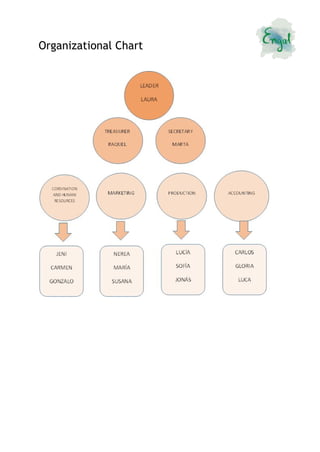
Chairperson: Laura 
Secretary: Marta 
Treasurer: Raquel 
Members have also decided the election of the following co­ordinators: 
Co­ordination: Jennifer 
Production: Lucía 
Accounting: Carlos 
Marketing: Nerea 
These people will implement the decisions made by the co­operative members and they will 
be accountable to all members at subsequent meetings. 
 
The chairperson, the secretary and the treasurer have the authority to sign 
documents on behalf of the co­operative. 
At the end of the course, an annual activity report will be submitted to the 
assembly. 
Article 7.­ General Assembly. 
Apart from the Assembly where the co­operative is established, another general assembly 
will be called at the end of the course (the date will be decided by the co­operative). A letter 
calling the meeting will be sent to all members at least one week in advance. The said letter 
will include the agenda for the meeting. 
At this Final Assembly, the co­operative will submit a final report to the General Assembly, 
which will include a financial statement. The assembly will approve the distribution of any 
surplus after discounting: 
●​     ​The amount dedicated to the Reserve Fund to allow, if relevant, the consolidation and 
expansion of the company. 
●​     ​The amount dedicated to reimbursing members. 
 ​Article 8.­ Meetings. 
Ordinary meetings will be held ​every month​. Extraordinary meetings can be called 
whenever co­operative members consider they are necessary. 
A meeting will be valid if 50% of the members + 1 are present. 
●​     ​Length of the activity 
The co­operative will be considered active from the moment it applies for 
registration in the EJE CENTRAL CO­OPERATIVE REGISTER and will cancel 
its activities when the course finishes. 
Article 9.­ Cooperative name and 
commercial name. 
The cooperative name is “​Engal, S.Coop​”. but it will be using the commercial name of 
“​Engal​” in all the commercial transactions it develops. 
Article 10.­ Surplus distribution. 
At least 50% of the final surplus of the cooperative will be assigned to a NGO donation. The 
beneficiary NGO will be chosen in a General Assembly. 
Every partner will receive a maximum of five euros as part of the profits once. Otherwise it 
will be paid back in proportion to the marks achieved in the subject of OIE. 


Organizational Chart


Engals.coop. articlesofassociation