The Tools of Online Learning: engaging students onlineSteven Smith, Ed.D.�Anything one man can imagine, other men can make real.�  Jules Verne�2010 TDC All rights reserved.
Web 1.0 was about commerce (c.1994)Web 2.0 is about people (c. 2004)(Singel, 2005)The current version of the Webďż˝
is centered on communication�the ability to interconnect with content, ideas, and with those who create them.
sets the stage for a student-centered collaborative learning environment.
influences how online courses are conceptualized, developed, and taught.New technologies will not replace traditional learning but complement it.The history of technology shows us that few technologies replace previous technologies; instead they emerge to coexist and complement them. Television did not kill radio or movies. The Internet has not replaced books.
These are a few of the many terms used to describe learning in environments in which students and instructors are not physically present in the same location.Emerging technologies can have a fear-reaching effect on how teachers teach and learners learn.Faculty ability to harness these technologies in the design of online classrooms can
impact the engagement of teaching and learning by creating more options for
learners to connect with course content as well as to other learners.
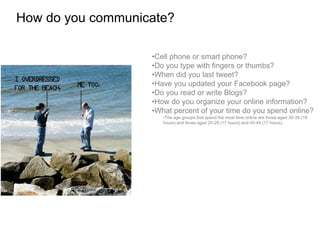
When a student's work is seen, and commented on, and collaboratively enhanced by a larger participative audience, those students are drawn into extended educational "conversations."How do you communicate?Cell phone or smart phone?
Do you type with fingers or thumbs?
When did you last tweet?
Have you updated your Facebook page?
Do you read or write Blogs?

Engaging students

  • 1.
    The Tools ofOnline Learning: engaging students onlineSteven Smith, Ed.D.�Anything one man can imagine, other men can make real.� Jules Verne�2010 TDC All rights reserved.
  • 2.
    Web 1.0 wasabout commerce (c.1994)Web 2.0 is about people (c. 2004)(Singel, 2005)The current version of the Webďż˝
  • 3.
    is centered oncommunication�the ability to interconnect with content, ideas, and with those who create them.
  • 4.
    sets the stagefor a student-centered collaborative learning environment.
  • 5.
    influences how onlinecourses are conceptualized, developed, and taught.New technologies will not replace traditional learning but complement it.The history of technology shows us that few technologies replace previous technologies; instead they emerge to coexist and complement them. Television did not kill radio or movies. The Internet has not replaced books.
  • 6.
    These are afew of the many terms used to describe learning in environments in which students and instructors are not physically present in the same location.Emerging technologies can have a fear-reaching effect on how teachers teach and learners learn.Faculty ability to harness these technologies in the design of online classrooms can
  • 7.
    impact the engagementof teaching and learning by creating more options for
  • 8.
    learners to connectwith course content as well as to other learners.
  • 9.
    When a student'swork is seen, and commented on, and collaboratively enhanced by a larger participative audience, those students are drawn into extended educational "conversations."How do you communicate?Cell phone or smart phone?
  • 10.
    Do you typewith fingers or thumbs?
  • 11.
    When did youlast tweet?
  • 12.
    Have you updatedyour Facebook page?
  • 13.
    Do you reador write Blogs?