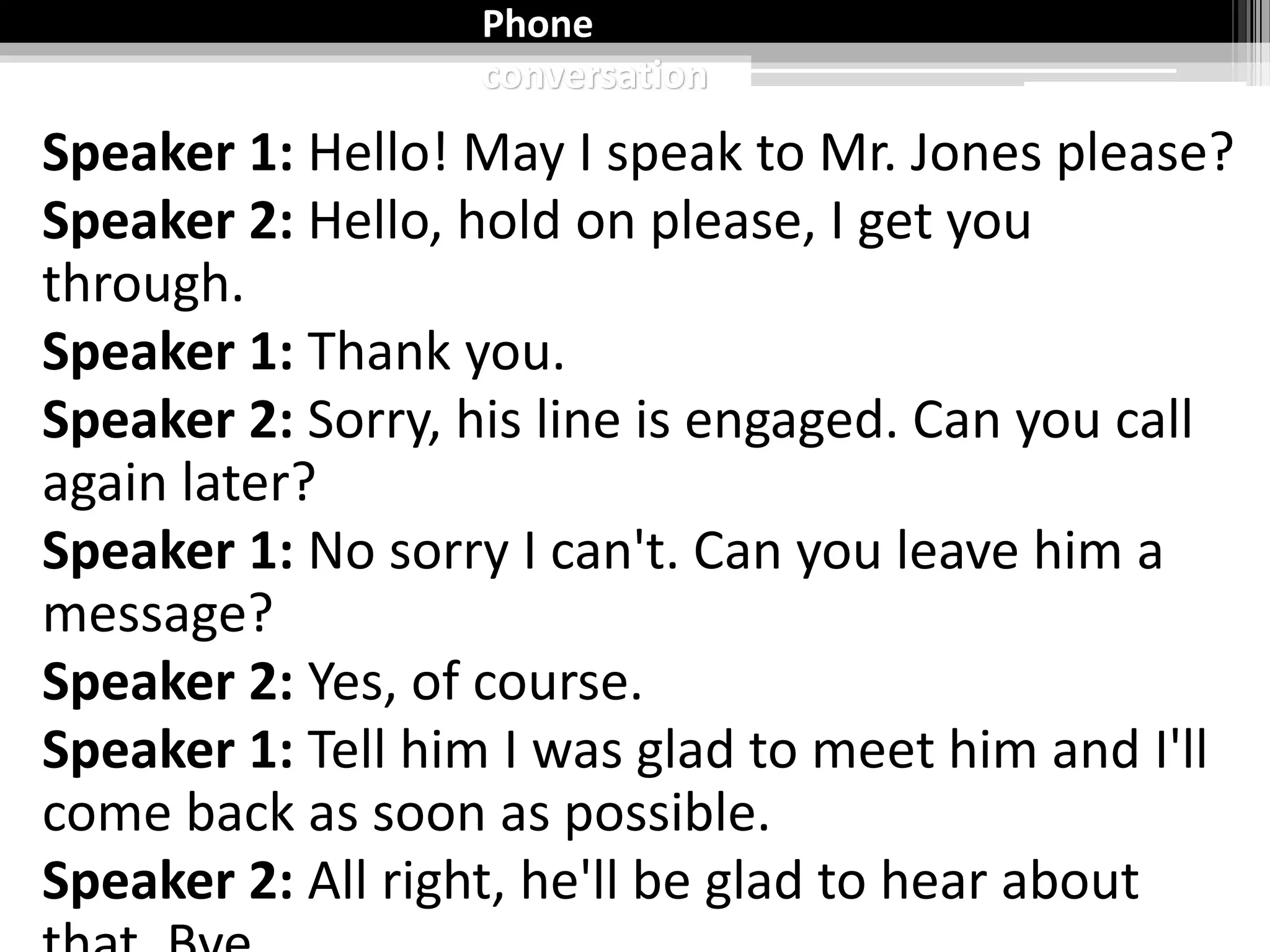
Speaker 1: Hello! May I speak to Mr. Jones please?
Speaker 2: Hello, hold on please, I get you
through.
Speaker 1: Thank you.
Speaker 2: Sorry, his line is engaged. Can you call
again later?
Speaker 1: No sorry I can't. Can you leave him a
message?
Speaker 2: Yes, of course.
Speaker 1: Tell him I was glad to meet him and I'll
come back as soon as possible.
Speaker 2: All right, he'll be glad to hear about
Phone
conversation
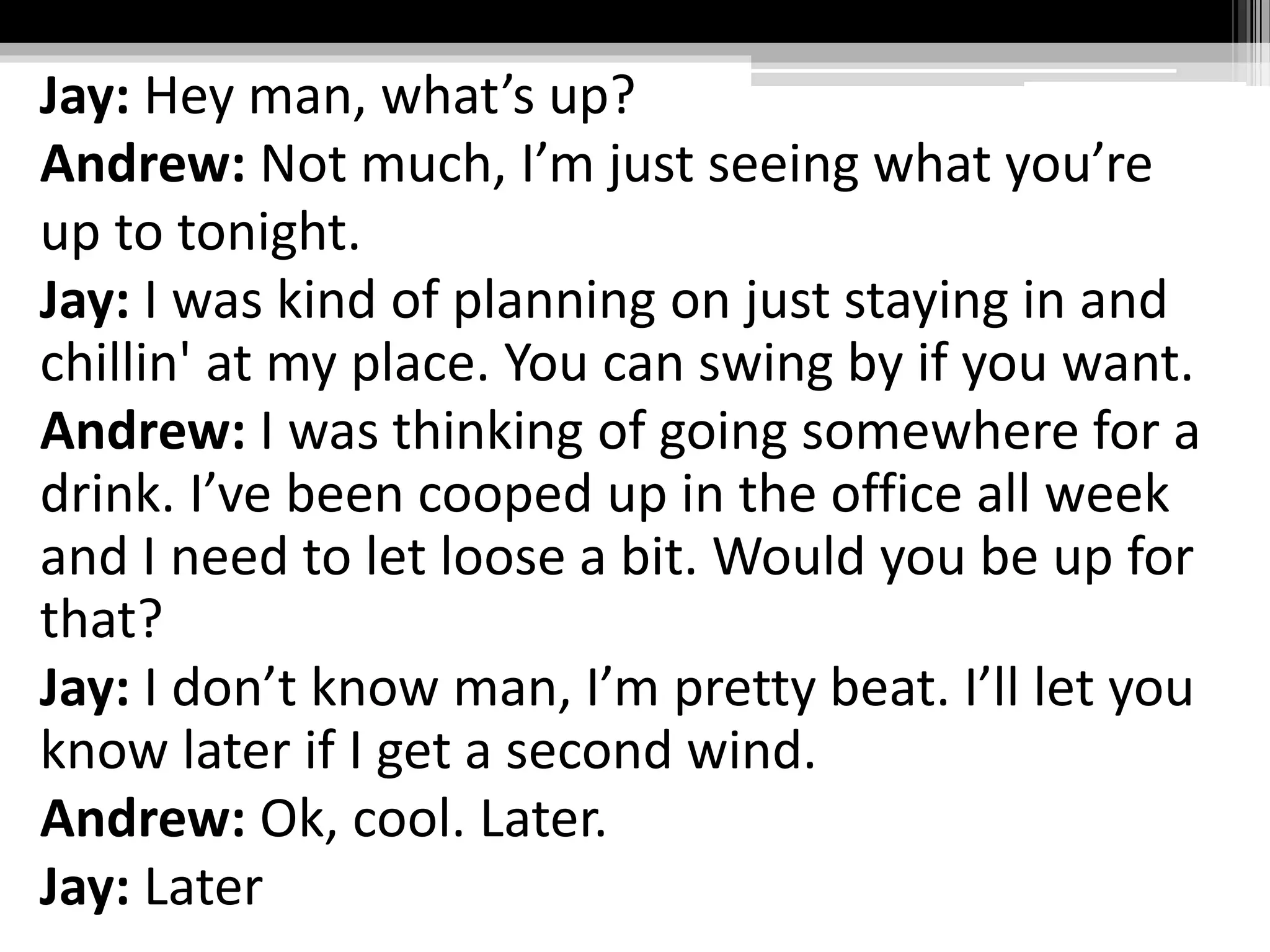
Jay: Hey man, what’s up?
Andrew: Not much, I’m just seeing what you’re
up to tonight.
Jay: I was kind of planning on just staying in and
chillin' at my place. You can swing by if you want.
Andrew: I was thinking of going somewhere for a
drink. I’ve been cooped up in the office all week
and I need to let loose a bit. Would you be up for
that?
Jay: I don’t know man, I’m pretty beat. I’ll let you
know later if I get a second wind.
Andrew: Ok, cool. Later.
Jay: Later
Colloquial Language
and Slang
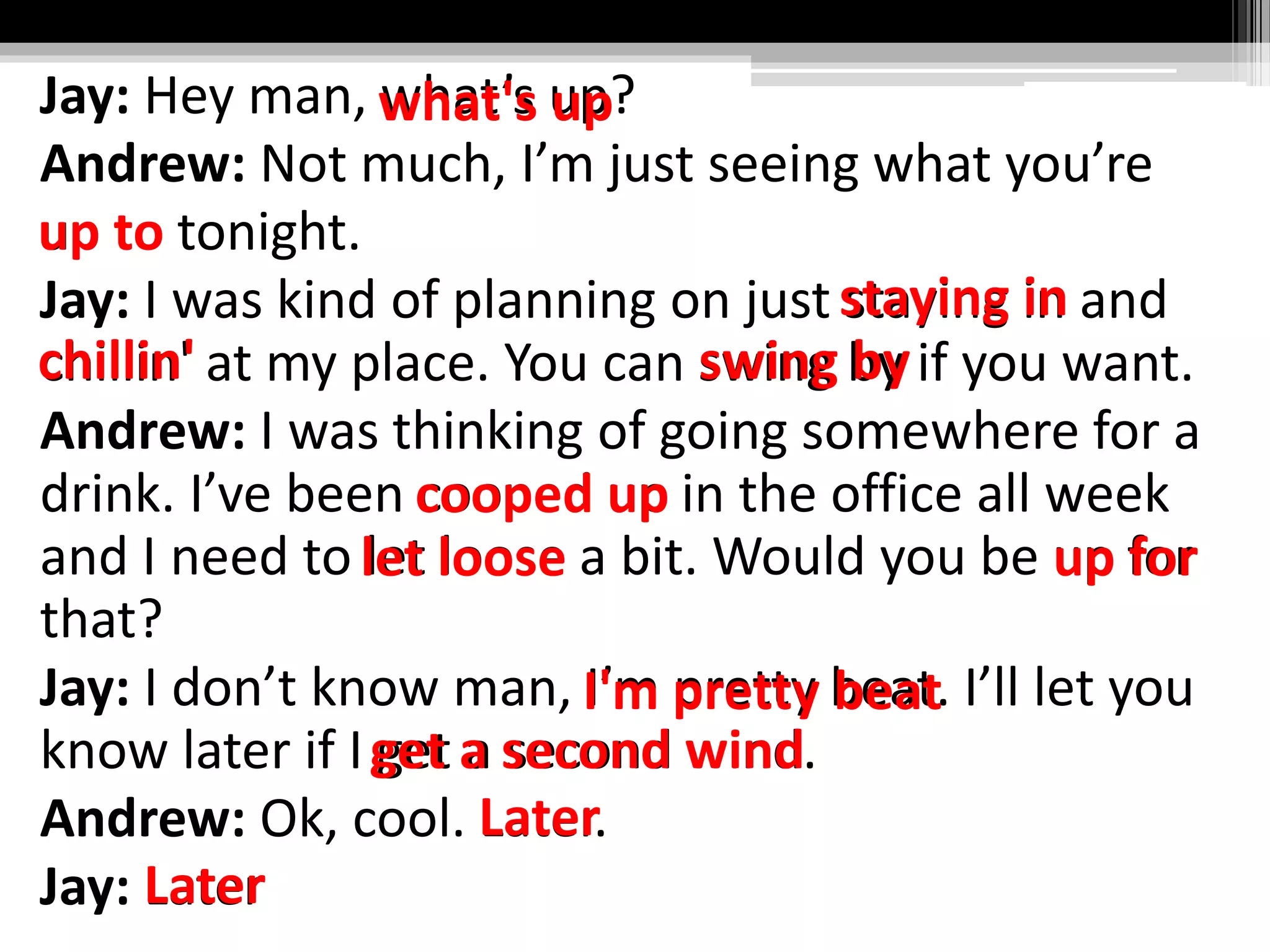
Jay: Hey man, what’s up?
Andrew: Not much, I’m just seeing what you’re
up to tonight.
Jay: I was kind of planning on just staying in and
chillin' at my place. You can swing by if you want.
Andrew: I was thinking of going somewhere for a
drink. I’ve been cooped up in the office all week
and I need to let loose a bit. Would you be up for
that?
Jay: I don’t know man, I’m pretty beat. I’ll let you
know later if I get a second wind.
Andrew: Ok, cool. Later.
Jay: Later
what's up
up to
staying in
chillin' swing by
cooped up
let loose up for
I'm pretty beat
get a second wind
Later
Later
Colloquial Language
- is commonly used in
conversation and informal
situations
Examples of Colloquial Language
cuz - because
gonna - going to
What's up? - How are you doing?
fam - family
Yea/Yeah - Yes
I dunno - I don't know
Nah/Naw - No
Whatever - You can decide. / I don't
have a preference
Slang
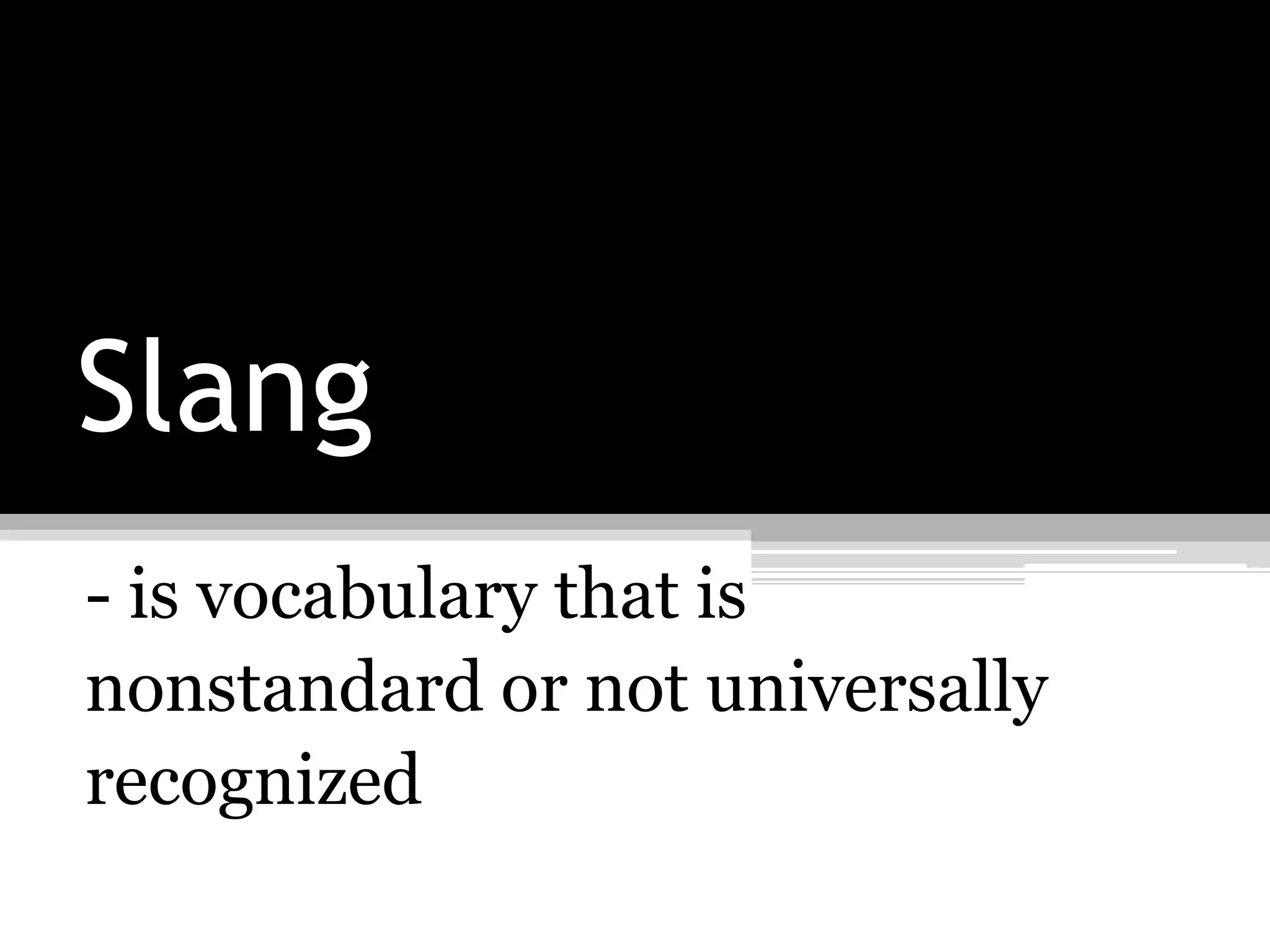
- is vocabulary that is
nonstandard or not universally
recognized
Slang
- used among members of a
particular social or age group
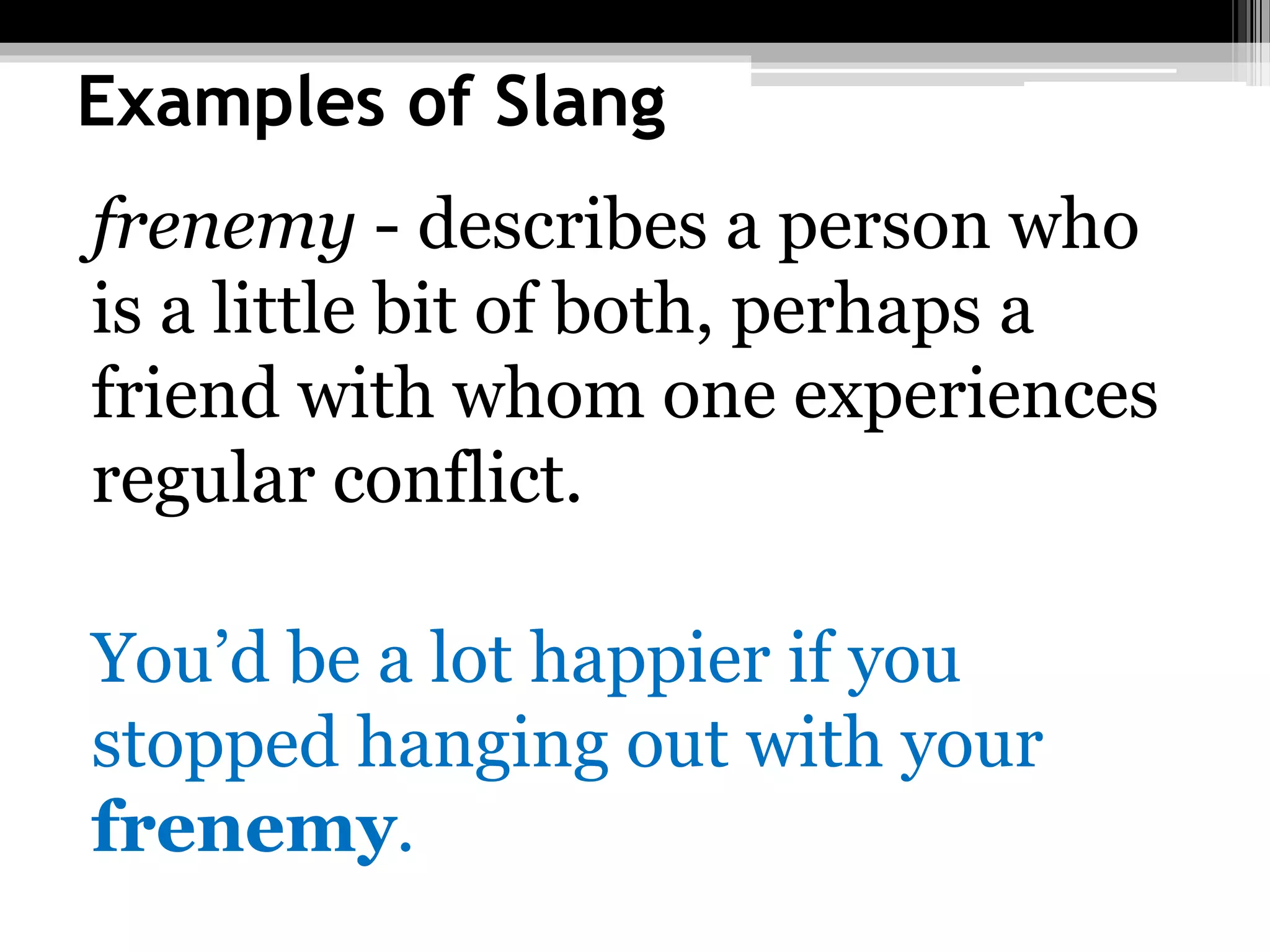
Examples of Slang
frenemy - describes a person who
is a little bit of both, perhaps a
friend with whom one experiences
regular conflict.
You’d be a lot happier if you
stopped hanging out with your
frenemy.
Examples of Slang
bromance - describes an
intense friendship between two
straight men
I haven’t seen Michael since he
started hanging out with
Jeremy. Their bromance is
epic.
Examples of Slang
ginormous - means something
very large
You could find a parking space
more easily if your car wasn’t
so ginormous.
Examples of Slang
bae - A term of endearment,
usually for romantic partners,
but possibly for close friends as
well
Bae, you’re the best.
Examples of Slang
goat - an acronym that stands
for “greatest of all time.”
I don’t care what you say,
because Tom Brady is the
goat.
Examples of Slang
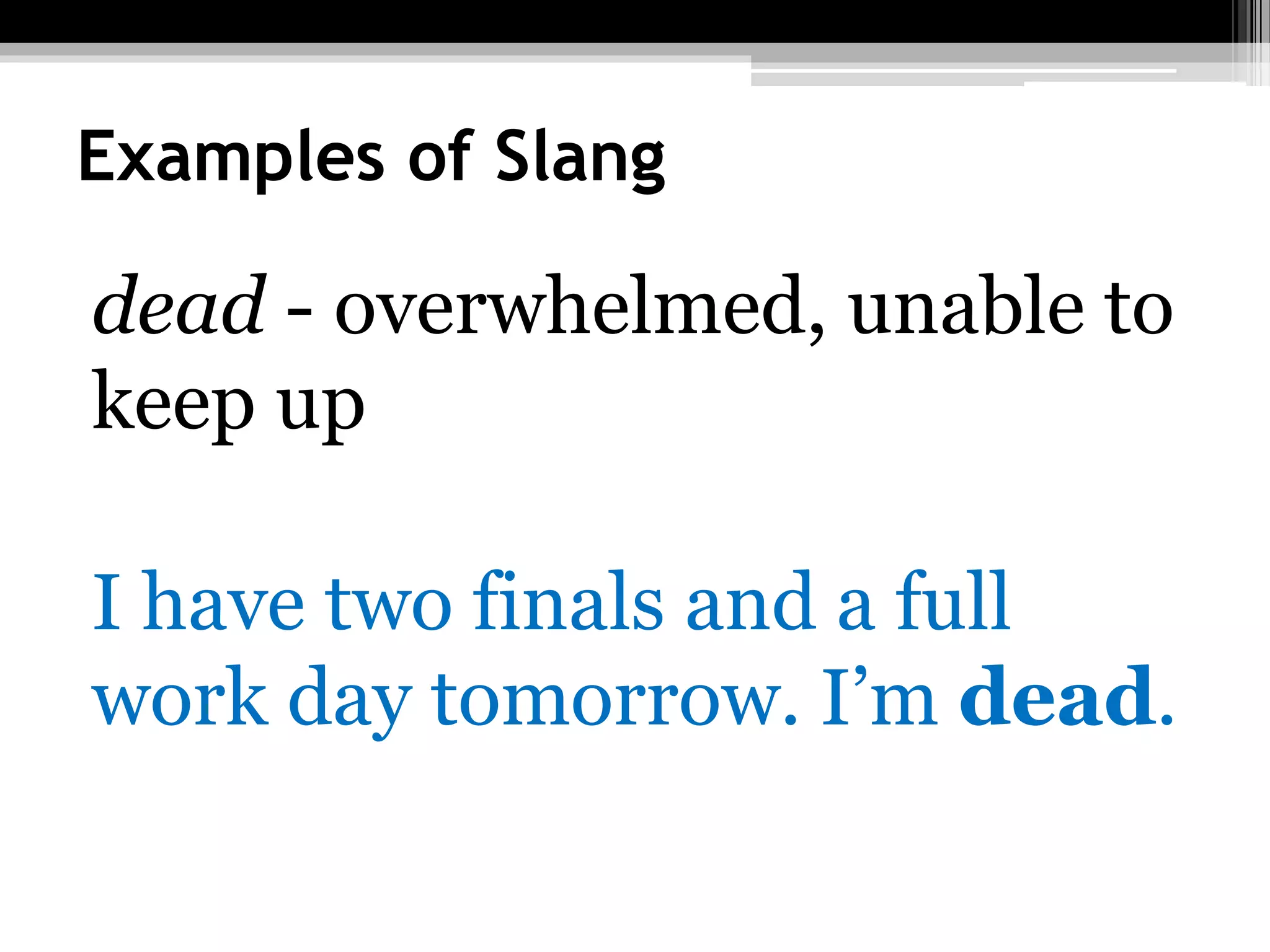
dead - overwhelmed, unable to
keep up
I have two finals and a full
work day tomorrow. I’m dead.
Examples of Slang
LOL - laughing out loud
I have two finals and a full
work day tomorrow. I’m dead.
Examples of Slang
veg - vegetables
I have two finals and a full
work day tomorrow. I’m dead.
Ready for the
quiz?
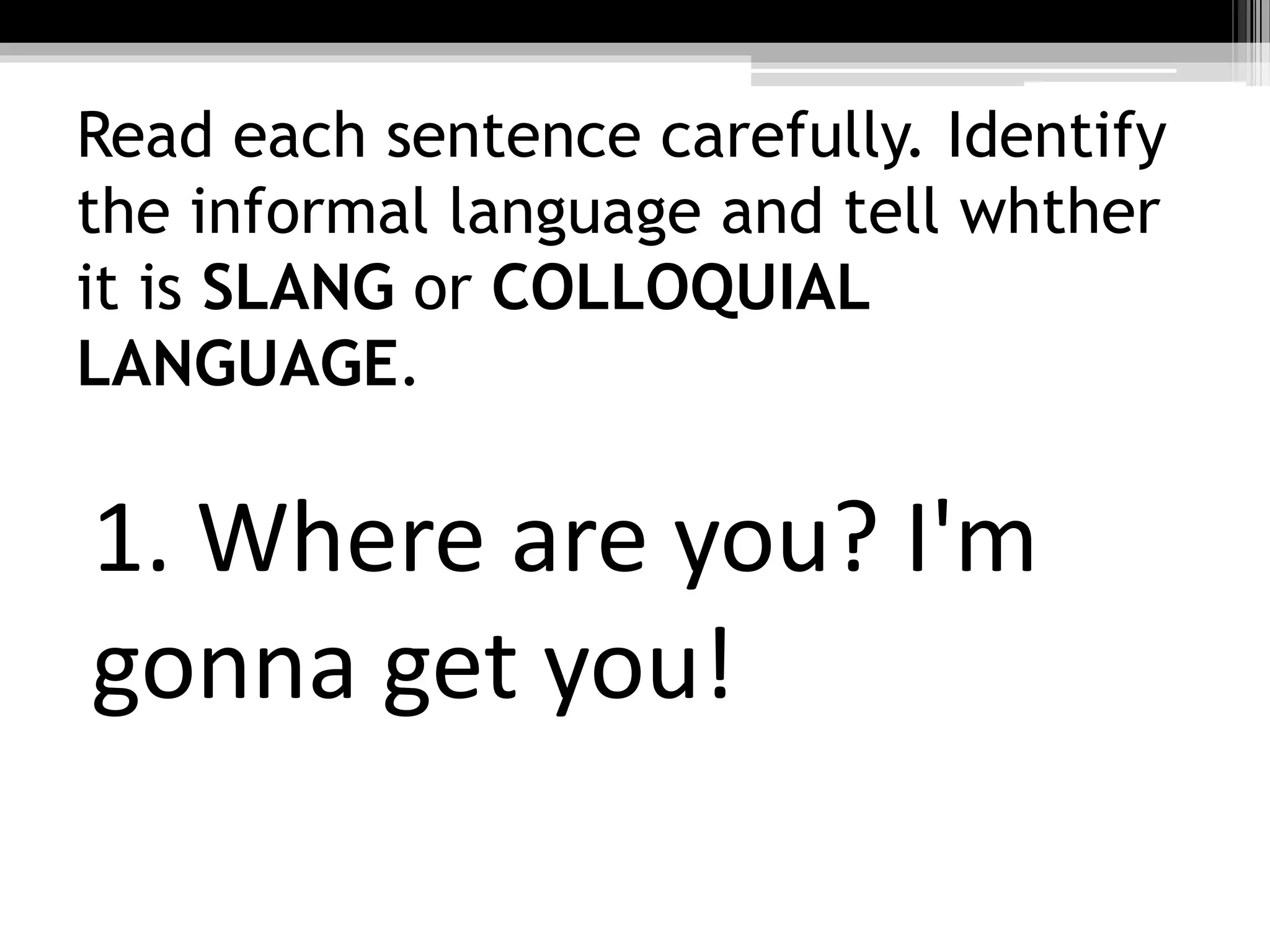
Read each sentence carefully. Identify
the informal language and tell whther
it is SLANG or COLLOQUIAL
LANGUAGE.
1. Where are you? I'm
gonna get you!
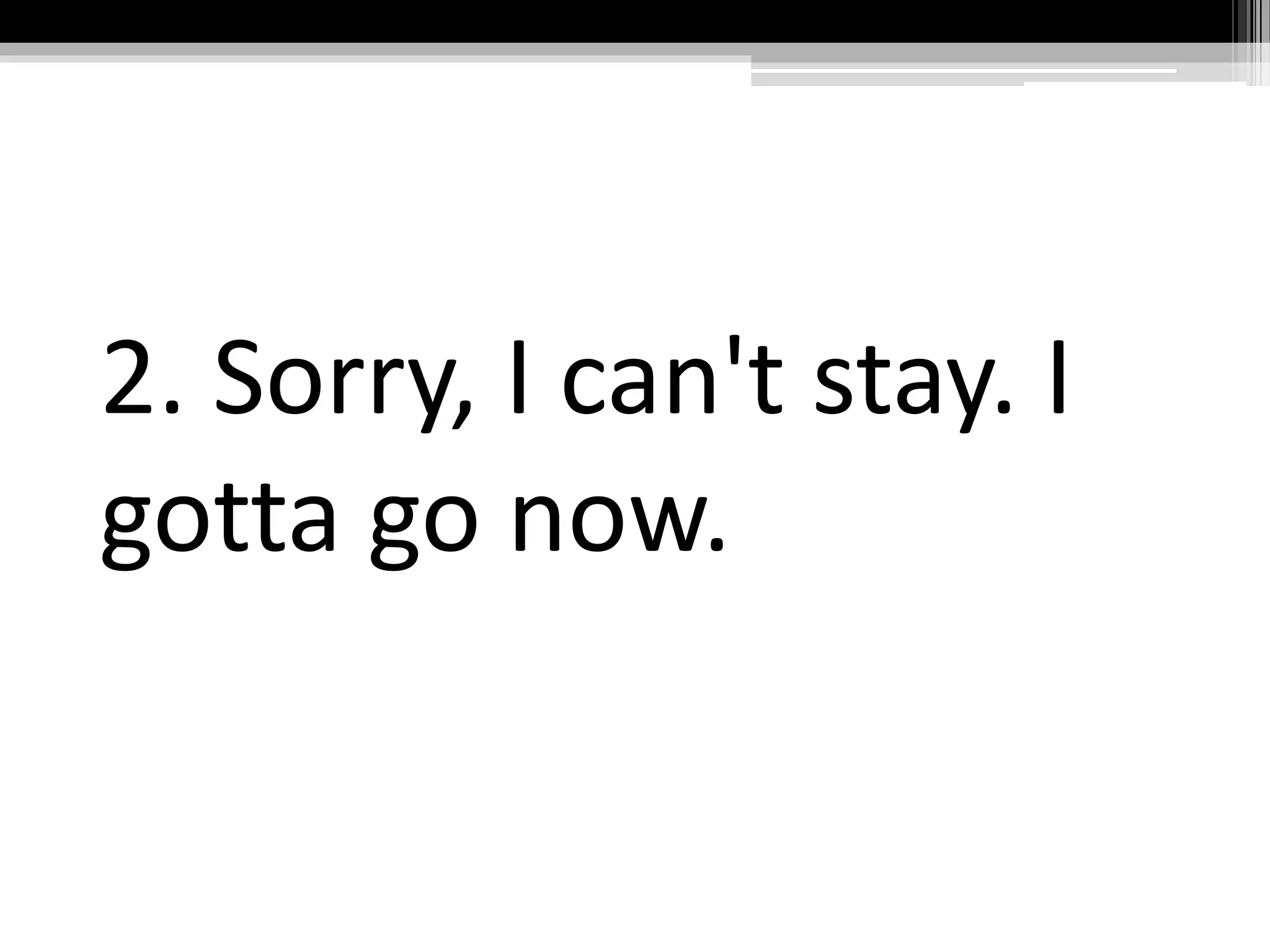
2. Sorry, I can't stay. I
gotta go now.
3. You’ll have more fun at
the dance if you aren’t
such a wallflower.
4. This is going to cost
you a whole, lotta
money.
5. There is a bunch of
numpties playing soccer.
6. Yes, it really is possible
to go bananas with your
music!
7. The thief: 'Just shut up
and gimme the money!'
8. Then he grabbed hold
of me and said 'gotcha!'
9. Her uncle is a big shot
in local politics.
10. She won the Miss
World crown in 2000.
She is a very pretty and
foxy woman, isn't she?
Colloquial
• Slang is almost always spoken
oWhen it is written, it is used to convey the flavor of
spoken language
oFor example, dialogues in novels
Not standard
• Informal
• Often not acceptable in formal situations
Restricted
• Small groups of people, e.g., college students
• Subcultures, e.g., drug culture
• People in one profession, e.g., police
Imaginative
• Language that is alive!
oColorful
oCreative
Variable in 3 ways: By region
• American vs. Australian slang
oBreeder in San Francisco
oBouncing beef in Sydney
Variable: Gender
• In Australia
• Males use mate, dude or bro to describe other
male friends
• Females use babe or bud to describe other female
friends
• Swearing
• For males using the F word is acceptable in more
situations than for females
Variable: Time
• Most slang disappears quickly
oGroovy (1960s)
oMain squeeze (1950s)
Variable: Time
• One generation’s slang becomes the next
generation’s standard language
oBus from omnibus
oZoo from zoological garden
oPiano from pianoforte
oJazz
Variable: Time
• Some exceptions to slang that quickly disappears
oPig (policeman) is from 1885 and is still slang
oBeat it was used by Shakespeare and is still
considered slang
Where does slang come from?
• Originates from subcultures in societies
oFor example, occupational groups, teenagers,
racial minorities, drug addicts, criminals
Slang from subcultures
• Pre-stiff = a patient who is close to dying
▫ (from U.S. hospital slang)
• Homey = friend or buddy
▫ (American black slang)
• Pot = marijuana
▫ (1960s drug culture)
• C-note = $100
▫ (criminal slang)
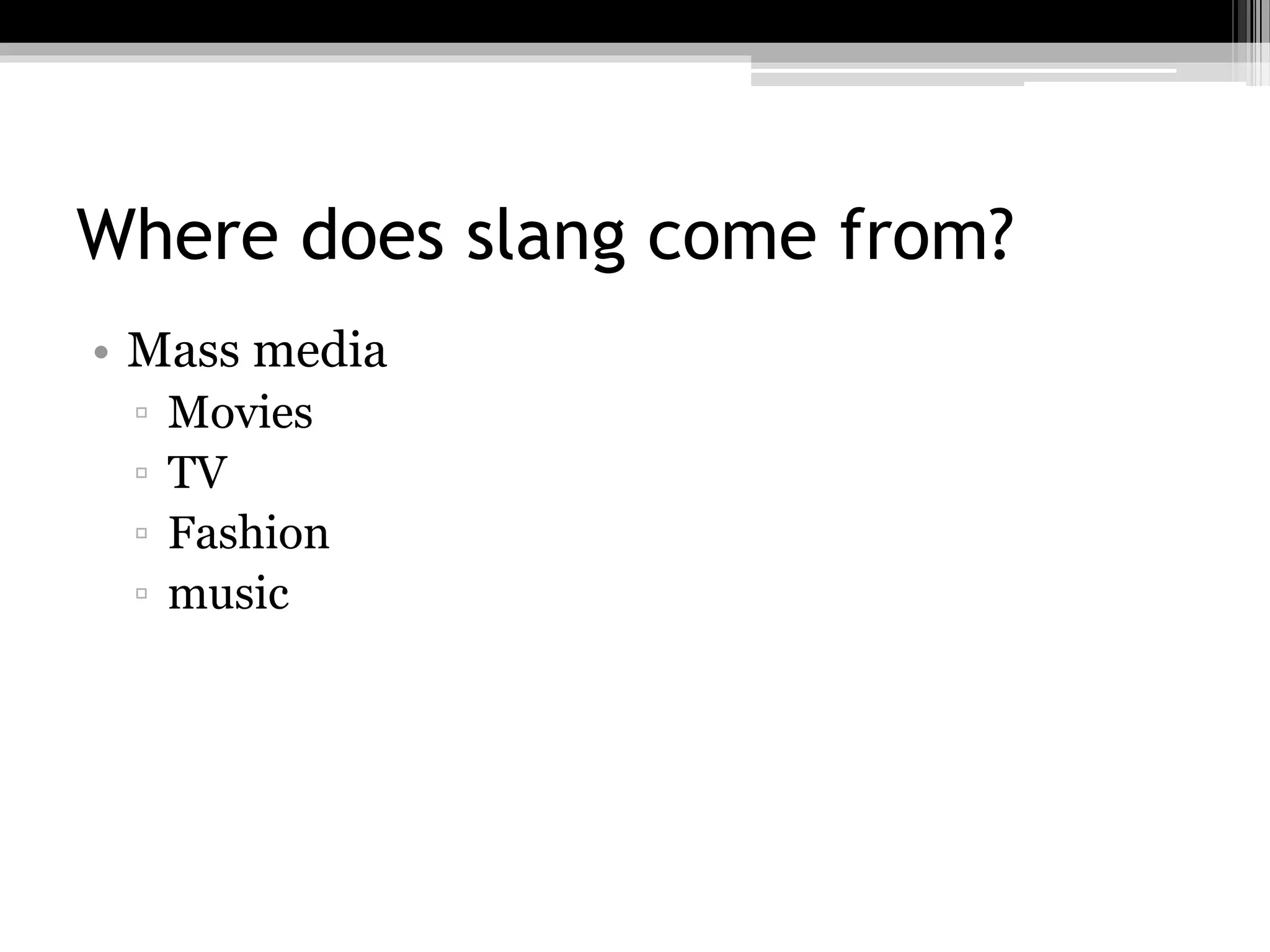
Where does slang come from?
• Mass media
▫ Movies
▫ TV
▫ Fashion
▫ music
Slang from the media
• A bomb = a really bad movie
• Bucket list = things you want to do before you
die
▫ (from The Bucket List with Jack Nicholson)
• 5 – 0 = police
▫ (American TV show Hawaii 5-0 in the 1970s)
• Top = the ultimate or best
▫ (French slang from the term top models, e.g.,
Claudia Schiffer, Cindy Crawford, etc.
• Cabbage = money
▫ (San Francisco hip-hop slang)
Slang is created by playing with words
• Rhyming
oTrouble and strife = wife
o(Cockney rhyming slang)
• Making words shorter
oBrill = brilliant
o(Glasgow, Scotland and parts of the U.S.)
oFab = fabulous
o(American 60’s slang; the Fab 4 = the Beatles)
Slang is created by playing with words
• Borrowing words from other languages
oCushy = comfortable
o(From the Hindi Khush; no longer slang)
oYadda yadda = and so on
o(from Yiddish and made popular by the sitcom
Seinfeld)
• Giving words the opposite meaning
oBad = good
o(U.S. college slang in the 1990s)
oSick = good
o(skateboarding slang)
Slang is created by playing with words
(3)
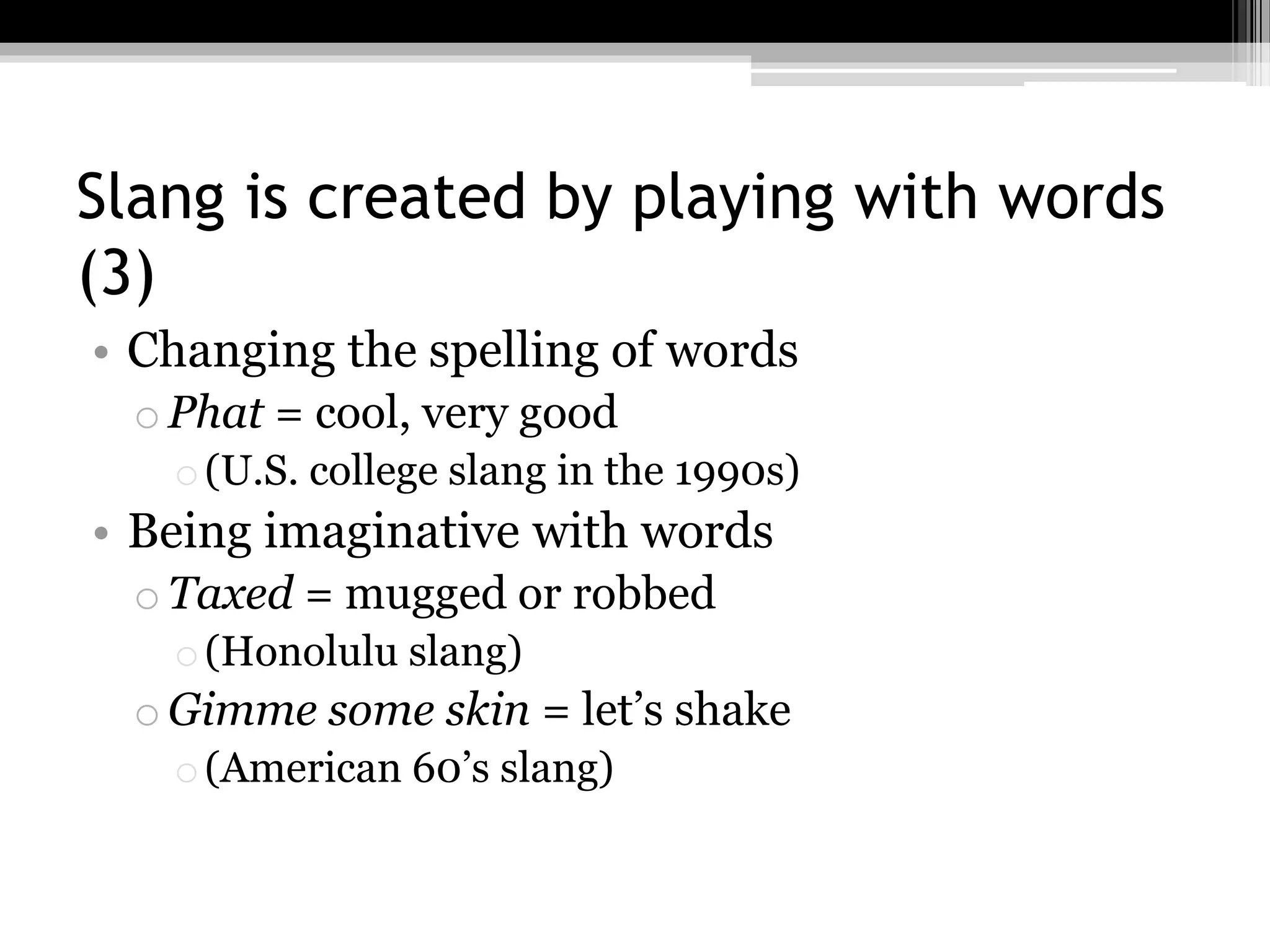
• Changing the spelling of words
oPhat = cool, very good
o(U.S. college slang in the 1990s)
• Being imaginative with words
oTaxed = mugged or robbed
o(Honolulu slang)
oGimme some skin = let’s shake
o(American 60’s slang)
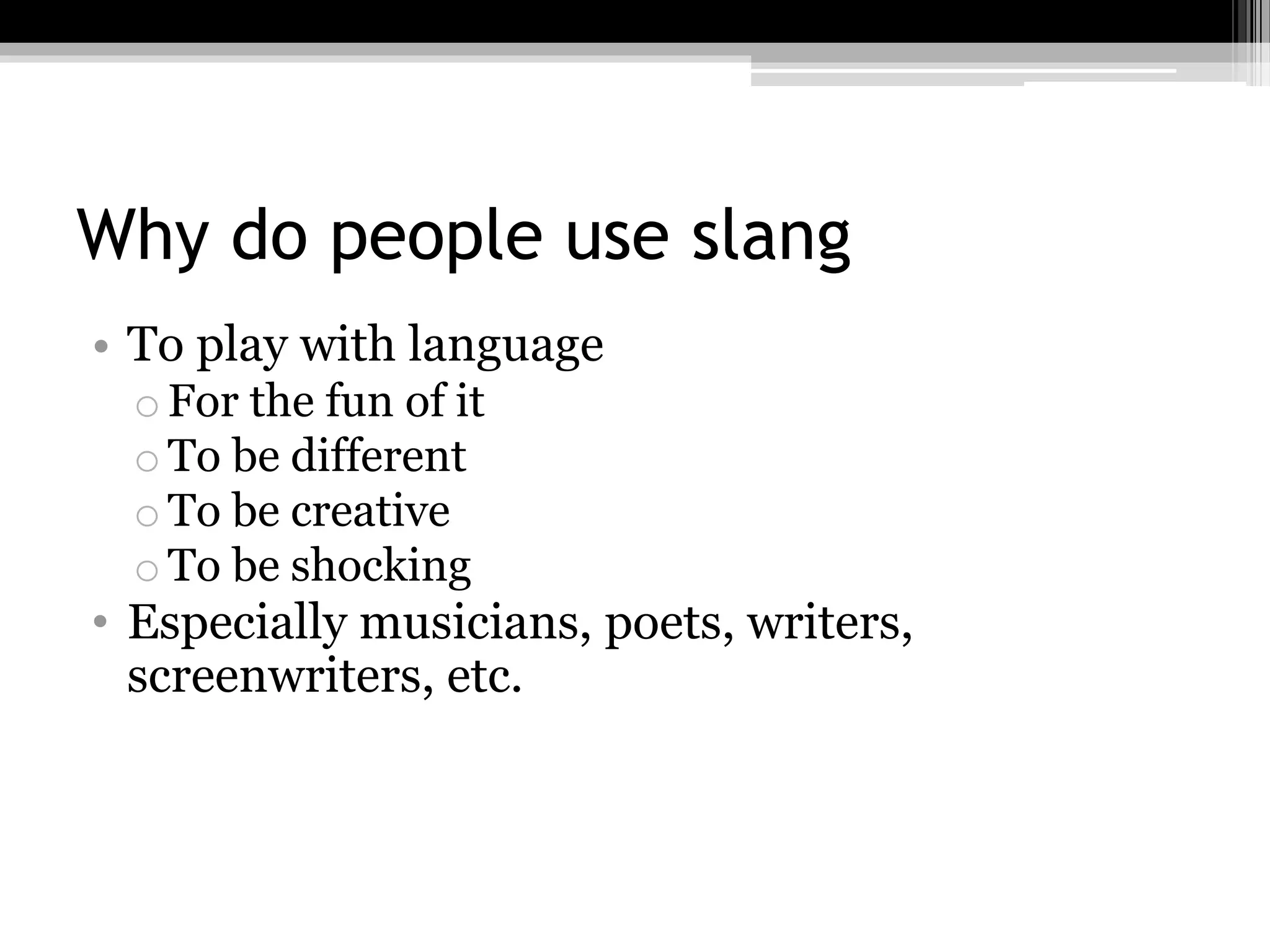
Why do people use slang
• To play with language
oFor the fun of it
oTo be different
oTo be creative
oTo be shocking
• Especially musicians, poets, writers,
screenwriters, etc.
Why do people use slang (2)
• To identify with a group
oTo exclude others
oTo be secretive
• Especially lower classes, groups that are outside
the main society, subcultures, etc.
Resource for Slang
• Urban Dictionary
ohttp://www.urbandictionary.com/

Eng7_Colloquial Language and Slang

  • 1.
    Speaker 1: Hello!May I speak to Mr. Jones please? Speaker 2: Hello, hold on please, I get you through. Speaker 1: Thank you. Speaker 2: Sorry, his line is engaged. Can you call again later? Speaker 1: No sorry I can't. Can you leave him a message? Speaker 2: Yes, of course. Speaker 1: Tell him I was glad to meet him and I'll come back as soon as possible. Speaker 2: All right, he'll be glad to hear about Phone conversation
  • 2.
    Jay: Hey man,what’s up? Andrew: Not much, I’m just seeing what you’re up to tonight. Jay: I was kind of planning on just staying in and chillin' at my place. You can swing by if you want. Andrew: I was thinking of going somewhere for a drink. I’ve been cooped up in the office all week and I need to let loose a bit. Would you be up for that? Jay: I don’t know man, I’m pretty beat. I’ll let you know later if I get a second wind. Andrew: Ok, cool. Later. Jay: Later
  • 3.
  • 4.
    Jay: Hey man,what’s up? Andrew: Not much, I’m just seeing what you’re up to tonight. Jay: I was kind of planning on just staying in and chillin' at my place. You can swing by if you want. Andrew: I was thinking of going somewhere for a drink. I’ve been cooped up in the office all week and I need to let loose a bit. Would you be up for that? Jay: I don’t know man, I’m pretty beat. I’ll let you know later if I get a second wind. Andrew: Ok, cool. Later. Jay: Later what's up up to staying in chillin' swing by cooped up let loose up for I'm pretty beat get a second wind Later Later
  • 5.
    Colloquial Language - iscommonly used in conversation and informal situations
  • 6.
    Examples of ColloquialLanguage cuz - because gonna - going to What's up? - How are you doing? fam - family Yea/Yeah - Yes I dunno - I don't know Nah/Naw - No Whatever - You can decide. / I don't have a preference
  • 7.
    Slang - is vocabularythat is nonstandard or not universally recognized
  • 8.
    Slang - used amongmembers of a particular social or age group
  • 9.
    Examples of Slang frenemy- describes a person who is a little bit of both, perhaps a friend with whom one experiences regular conflict. You’d be a lot happier if you stopped hanging out with your frenemy.
  • 10.
    Examples of Slang bromance- describes an intense friendship between two straight men I haven’t seen Michael since he started hanging out with Jeremy. Their bromance is epic.
  • 11.
    Examples of Slang ginormous- means something very large You could find a parking space more easily if your car wasn’t so ginormous.
  • 12.
    Examples of Slang bae- A term of endearment, usually for romantic partners, but possibly for close friends as well Bae, you’re the best.
  • 13.
    Examples of Slang goat- an acronym that stands for “greatest of all time.” I don’t care what you say, because Tom Brady is the goat.
  • 14.
    Examples of Slang dead- overwhelmed, unable to keep up I have two finals and a full work day tomorrow. I’m dead.
  • 15.
    Examples of Slang LOL- laughing out loud I have two finals and a full work day tomorrow. I’m dead.
  • 16.
    Examples of Slang veg- vegetables I have two finals and a full work day tomorrow. I’m dead.
  • 17.
  • 18.
    Read each sentencecarefully. Identify the informal language and tell whther it is SLANG or COLLOQUIAL LANGUAGE. 1. Where are you? I'm gonna get you!
  • 19.
    2. Sorry, Ican't stay. I gotta go now.
  • 20.
    3. You’ll havemore fun at the dance if you aren’t such a wallflower.
  • 21.
    4. This isgoing to cost you a whole, lotta money.
  • 22.
    5. There isa bunch of numpties playing soccer.
  • 23.
    6. Yes, itreally is possible to go bananas with your music!
  • 24.
    7. The thief:'Just shut up and gimme the money!'
  • 25.
    8. Then hegrabbed hold of me and said 'gotcha!'
  • 26.
    9. Her uncleis a big shot in local politics.
  • 27.
    10. She wonthe Miss World crown in 2000. She is a very pretty and foxy woman, isn't she?
  • 28.
    Colloquial • Slang isalmost always spoken oWhen it is written, it is used to convey the flavor of spoken language oFor example, dialogues in novels
  • 29.
    Not standard • Informal •Often not acceptable in formal situations
  • 30.
    Restricted • Small groupsof people, e.g., college students • Subcultures, e.g., drug culture • People in one profession, e.g., police
  • 31.
    Imaginative • Language thatis alive! oColorful oCreative
  • 32.
    Variable in 3ways: By region • American vs. Australian slang oBreeder in San Francisco oBouncing beef in Sydney
  • 33.
    Variable: Gender • InAustralia • Males use mate, dude or bro to describe other male friends • Females use babe or bud to describe other female friends • Swearing • For males using the F word is acceptable in more situations than for females
  • 34.
    Variable: Time • Mostslang disappears quickly oGroovy (1960s) oMain squeeze (1950s)
  • 35.
    Variable: Time • Onegeneration’s slang becomes the next generation’s standard language oBus from omnibus oZoo from zoological garden oPiano from pianoforte oJazz
  • 36.
    Variable: Time • Someexceptions to slang that quickly disappears oPig (policeman) is from 1885 and is still slang oBeat it was used by Shakespeare and is still considered slang
  • 37.
    Where does slangcome from? • Originates from subcultures in societies oFor example, occupational groups, teenagers, racial minorities, drug addicts, criminals
  • 38.
    Slang from subcultures •Pre-stiff = a patient who is close to dying ▫ (from U.S. hospital slang) • Homey = friend or buddy ▫ (American black slang) • Pot = marijuana ▫ (1960s drug culture) • C-note = $100 ▫ (criminal slang)
  • 39.
    Where does slangcome from? • Mass media ▫ Movies ▫ TV ▫ Fashion ▫ music
  • 40.
    Slang from themedia • A bomb = a really bad movie • Bucket list = things you want to do before you die ▫ (from The Bucket List with Jack Nicholson) • 5 – 0 = police ▫ (American TV show Hawaii 5-0 in the 1970s) • Top = the ultimate or best ▫ (French slang from the term top models, e.g., Claudia Schiffer, Cindy Crawford, etc. • Cabbage = money ▫ (San Francisco hip-hop slang)
  • 41.
    Slang is createdby playing with words • Rhyming oTrouble and strife = wife o(Cockney rhyming slang) • Making words shorter oBrill = brilliant o(Glasgow, Scotland and parts of the U.S.) oFab = fabulous o(American 60’s slang; the Fab 4 = the Beatles)
  • 42.
    Slang is createdby playing with words • Borrowing words from other languages oCushy = comfortable o(From the Hindi Khush; no longer slang) oYadda yadda = and so on o(from Yiddish and made popular by the sitcom Seinfeld) • Giving words the opposite meaning oBad = good o(U.S. college slang in the 1990s) oSick = good o(skateboarding slang)
  • 43.
    Slang is createdby playing with words (3) • Changing the spelling of words oPhat = cool, very good o(U.S. college slang in the 1990s) • Being imaginative with words oTaxed = mugged or robbed o(Honolulu slang) oGimme some skin = let’s shake o(American 60’s slang)
  • 44.
    Why do peopleuse slang • To play with language oFor the fun of it oTo be different oTo be creative oTo be shocking • Especially musicians, poets, writers, screenwriters, etc.
  • 45.
    Why do peopleuse slang (2) • To identify with a group oTo exclude others oTo be secretive • Especially lower classes, groups that are outside the main society, subcultures, etc.
  • 46.
    Resource for Slang •Urban Dictionary ohttp://www.urbandictionary.com/