


Energy Efficient  Wireless Internet Access Marco Ajmone Marsan, Michela Meo Politecnico di Torino
WIA & MtCO 2 e Marco Ajmone Marsan, Michela Meo Politecnico di Torino
What’s all this “green networking” about?
Energy is becoming  the issue   of our future We depend on energy which is becoming  scarce  Energy consumption is causing dramatic  climate changes We must cope with this and reduce energy consumption in all sectors,  ICT and networking included The problem
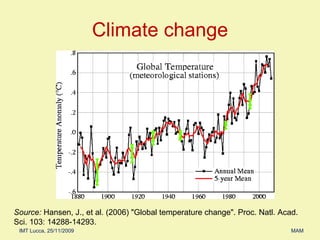
Climate change Source:  Hansen, J., et al. (2006) "Global temperature change". Proc. Natl. Acad. Sci. 103: 14288-14293.
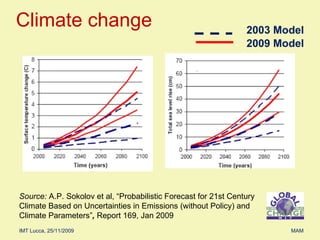
Climate change Source:  A.P. Sokolov et al, “Probabilistic Forecast for 21st Century Climate Based on Uncertainties in Emissions (without Policy) and Climate Parameters” ,  Report 169, Jan 2009 2003 Model 2009 Model
The main global warming culprit is carbon dioxide,  CO 2 Gases that react to form smog  Fine particles such as black carbon 80% of the increase of CO 2  in the air in the last century is due to  fossil fuel burning  (20% deforestation) Who is the culprit?
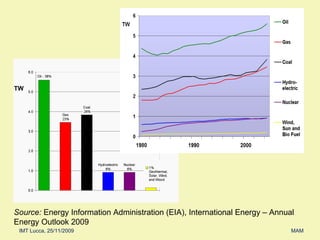
Source:  Energy Information Administration (EIA), International Energy – Annual Energy Outlook 2009 TW
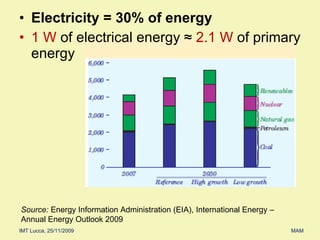
Electricity = 30% of energy 1 W  of electrical energy ≈  2.1 W  of primary energy Source:  Energy Information Administration (EIA), International Energy – Annual Energy Outlook 2009
Information and Communication Technologies play a  positive role  for energy saving: moving bits instead of atoms teleworking and telecommuting e-commerce intelligent transport systems electronic billing sensors to monitor and manage environment What about ICT?
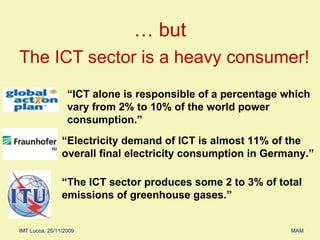
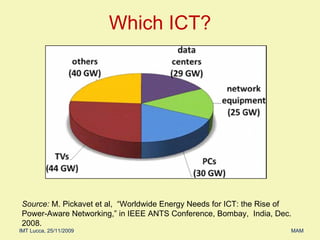
The ICT sector is a heavy consumer! …  but “ ICT alone is responsible of a percentage which vary from 2% to 10% of the world power consumption.” “ Electricity demand of ICT is almost 11% of the overall final electricity consumption in Germany.” “ The ICT sector produces some 2 to 3% of total emissions of greenhouse gases.”
Which ICT? Source:  M. Pickavet et al,  “Worldwide Energy Needs for ICT: the Rise of  Power-Aware Networking,” in IEEE ANTS Conference, Bombay,  India, Dec. 2008.
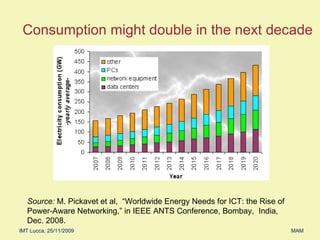
Consumption might double in the next decade Source:  M. Pickavet et al,  “Worldwide Energy Needs for ICT: the Rise of  Power-Aware Networking,” in IEEE ANTS Conference, Bombay,  India, Dec. 2008.
Life Cycle Assessment  (LCA) refers to the quantitative characterization of the environmental impacts of products and services and includes Manufacture Operation  Disposal A life cycle perspective can lead to a better understanding of environmental management This is particularly true for IT products Life cycle matters
Example:  2-gram memory chip requires  at least 1,200 grams of fossil fuels  72 grams of chemicals  Fossil fuels for production are some 600 times the weight of the chip (the total fossil fuel to produce a car is 1-2 times its weight) Purification to semiconductor grade materials is energy intensive Due to its extremely low-entropy, organized structure, the materials intensity of a microchip is orders of magnitude higher than that of “traditional” goods. Electronics
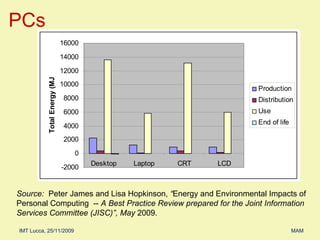
PCs Source:  Peter James and Lisa Hopkinson,  “ Energy and Environmental Impacts of Personal Computing  --  A Best Practice Review prepared for the Joint Information Services Committee (JISC)” , May  2009.
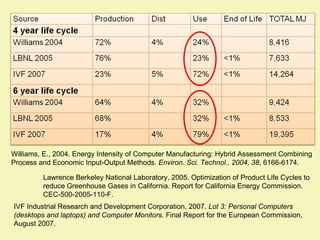
Williams, E., 2004. Energy Intensity of Computer Manufacturing: Hybrid Assessment Combining Process and Economic Input-Output Methods.  Environ. Sci. Technol., 2004, 38 , 6166-6174. Lawrence Berkeley National Laboratory, 2005. Optimization of Product Life Cycles to reduce Greenhouse Gases in California. Report for California Energy Commission. CEC-500-2005-110-F.  IVF Industrial Research and Development Corporation, 2007.  Lot 3: Personal Computers (desktops and laptops) and Computer Monitors.  Final Report for the European Commission, August 2007.
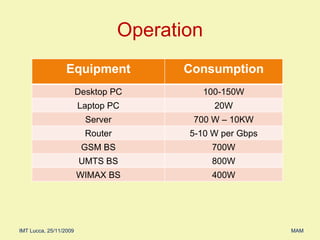
Operation Equipment Consumption Desktop PC 100-150W Laptop PC 20W Server 700 W – 10KW Router 5-10 W per Gbps GSM BS 700W UMTS BS 800W WIMAX BS 400W
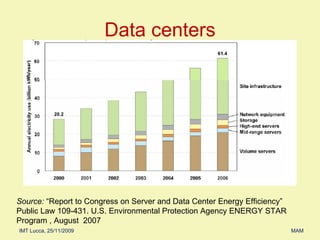
Data centers Source:  “Report to Congress on Server and Data Center Energy Efficiency” Public Law 109-431. U.S. Environmental Protection Agency ENERGY STAR Program , August  2007
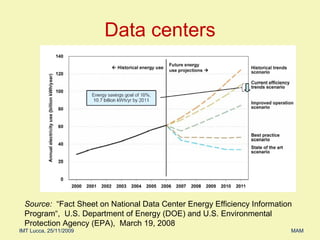
In 2006, U.S. data centers used 61 TWh of electricity, corresponding to 1.5% of national consumption Double the amount consumed in 2000 Based on current trends, energy consumption will continue to grow 12% per year, due to increasing demand for the  services they provide Data centers
Algorithms to free up servers and put them into sleep mode or to manage load on the servers in a more energy-efficient way Sensors identify which servers would be best to shut down, based on environmental conditions Use more efficient components Reduce cooling needs (cooling consumes as much as 40% of the operating costs) through specific physical layouts Current solutions
Data centers Source:   “Fact Sheet on National Data Center Energy Efficiency Information Program“,  U.S. Department of Energy (DOE) and U.S. Environmental Protection Agency (EPA),  March 19, 2008
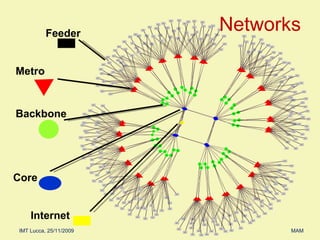
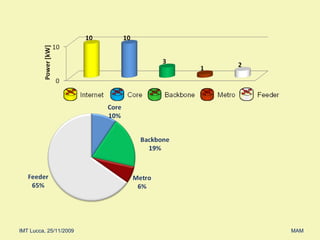
Networks Internet Core Backbone Metro Feeder
 
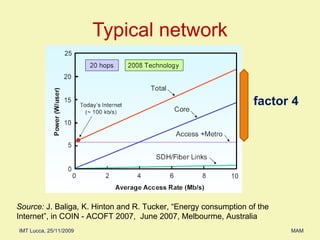
Typical network Source:   J. Baliga, K. Hinton and R. Tucker,  “Energy consumption of the Internet”, in  COIN - ACOFT 2007,  June 2007, Melbourme, Australia factor 4
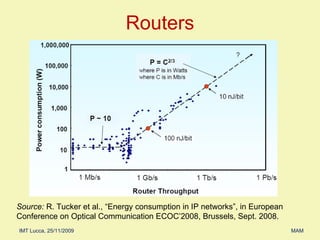
Routers Source:  R. Tucker et al., “Energy consumption in IP networks”, in European  Conference on Optical Communication ECOC’2008, Brussels, Sept. 2008.
 
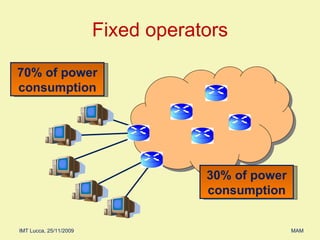
Fixed operators 70% of power consumption 30% of power consumption
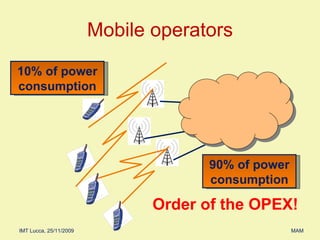
Mobile operators 10% of power consumption 90% of power consumption Order of the OPEX!
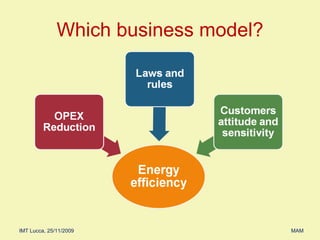
Which business model?
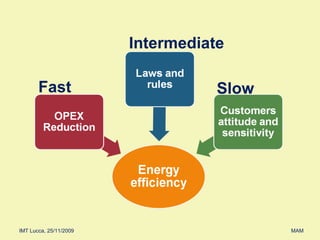
Fast Slow Intermediate
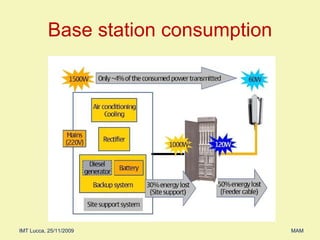
Cellular networks Base stations are responsible for about 80% of energy consumed by a cellular network A typical BS  consumes from 500W to 3KW, with an average consumption per year of   35 MWh (as much as 10 families) In Italy 60,000 BSs, leading to 2.1 TWh/year,  about 0.7 % of total Italian consumption of electricity  300 M€ electricity bill for the operators About 1,2 Mton of emitted CO 2  equivalent per year
Base station consumption
An immediate solution  for mobile operators Start by reducing consumption at the access  network with  current  technologies
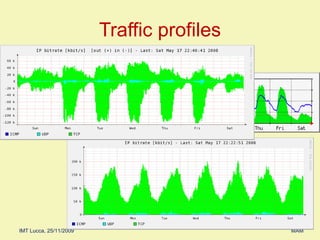
Dynamic network planning Networks are planned based on the peak hour traffic Due to natural traffic variability (i.e., typical day/night traffic profile) the network results over-dimensioned during long periods of time Switch off portions of the network  when traffic is low
Traffic profiles
Assume that  a fraction  x  of the base stations (cells) are switched off The BSs that remain on are in charge of  the traffic of the cells that are off (the desired QoS must still be guaranteed) the radio coverage (transmission power might be increased to guarantee coverage) Switch-off scheme
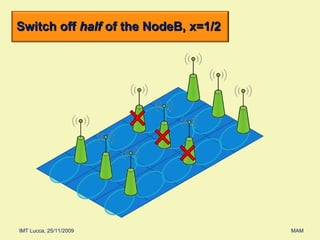
A NodeB controls 2 microcells
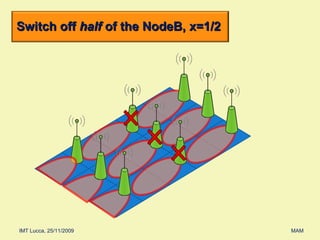
Switch off  half  of the NodeB, x=1/2
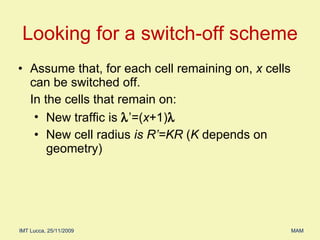
Assume that, for each cell remaining on,  x  cells can be switched off. In the cells that remain on: New traffic is   ’=( x +1)  New cell radius  is R’=KR  ( K  depends on geometry) Looking for a switch-off scheme
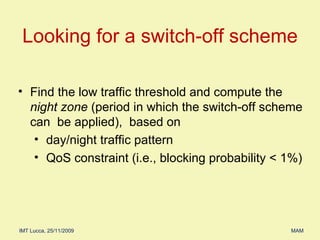
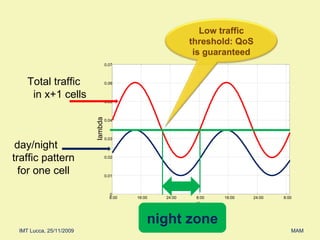
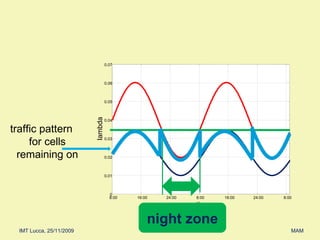
Find the low traffic threshold and compute the  night zone  (period in which the switch-off scheme can  be applied),  based on  day/night traffic pattern  QoS constraint (i.e., blocking probability < 1%) Looking for a switch-off scheme
8:00 16:00 24:00 8:00 16:00 24:00 8:00 0 0.01 0.02 0.03 0.04 0.05 0.06 0.07 time lambda day/night  traffic pattern for one cell Total traffic  in x+1 cells  night zone Low traffic threshold: QoS is guaranteed
8:00 16:00 24:00 8:00 16:00 24:00 8:00 0 0.01 0.02 0.03 0.04 0.05 0.06 0.07 time lambda night zone traffic pattern for cells remaining on
Check the maximum cell radius, R MAX If  R’< R MAX     DONE else  increase transmission power during night zone OR reduce the night zone  Looking for a switch-off scheme
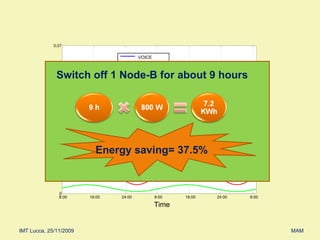
8:00 16:00 24:00 8:00 16:00 24:00 8:00 0 0.01 0.02 0.03 0.04 0.05 0.06 0.07 Time lambda VOICE VIDEOCALL DATA Switch off 1 Node-B for about 9 hours Energy saving= 37.5%
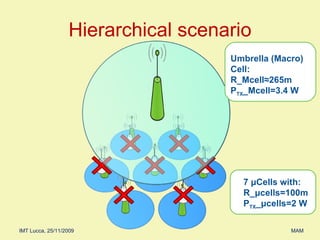
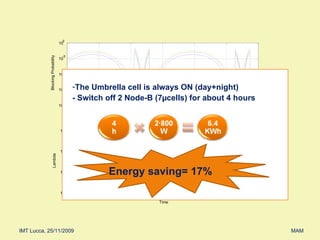
Hierarchical scenario 7  μ Cells with: R_ μ cells=100m P TX _ μ cells=2 W Umbrella (Macro) Cell: R_Mcell≈265m P TX _Mcell=3.4 W
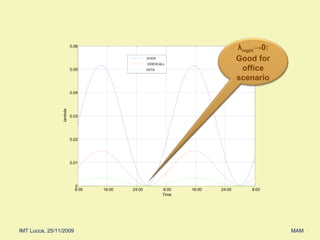
8:00 16:00 24:00 8:00 16:00 24:00 8:00 0 0.01 0.02 0.03 0.04 0.05 0.06 Time lambda VOICE VIDEOCALL DATA λ night ->0: Good for office scenario
-1 Time Lambda µ M M µ µ The Umbrella cell is always ON (day+night) - Switch off 2 Node-B (7µcells) for about 4 hours Energy saving= 17% 8:00 16:00 24:00 8:00 16:00 24:00 8:00 10 -20 10 -15 10 -10 10 -5 10 0 Time Blocking Probability VOICE VIDEOCALL DATA 8:00 16:00 24:00 8:00 16:00 24:00 8:00 10 -4 10 -3 10 -2 10
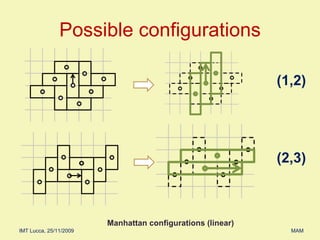
Possible configurations Manhattan   configurations (linear) (1,2) (2,3)
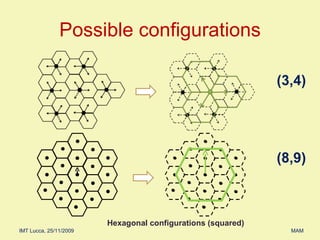
Possible configurations Hexagonal   configurations (squared) (3,4) (8,9)
Switching off more does not always mean saving more! Switch off scheme geometry (1,2) linear (2,3) linear (3,4) squared (8,9) squared Load ratio 2 3 4 9 Cell radius 2x 3x 2x 3x PB[W] 5 18 5 18 Night zone 16h30m 14h40m 12h20m 7h NodeB saving [%] 68.7 61.1 50.4 29.1 Network saving 34.3 40.7 37.8 25.9
But, we have multiple operators Several  competing  mobile operators cover the same area with their equipment Networks are dimensioned over the peak hour traffic  During low traffic periods the resources of one operator are sufficient to carry all the traffic Make operators  cooperate  to  reduce energy consumption
In turn, Switch off  the network  of one operator, when traffic is low and the active operators can carry all the traffic Let users roam to other operators Balance costs Cooperation
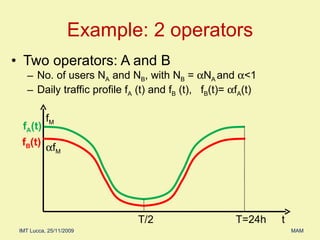
Two operators: A and B No. of users N A  and N B , with N B  =   N A  and   <1 Daily traffic profile f A  (t) and f B  (t),  f B (t)=   f A (t) Example: 2 operators f M T/2 T=24h t f A (t) f B (t)  f M
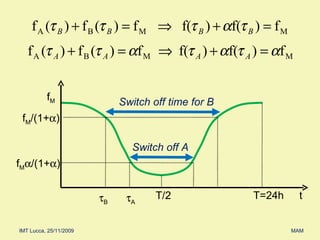
f M T/2 T=24h t f M /(1+  ) f M  /(1+  ) Switch off time for B Switch off A  B  A
Let p A  and p B  be the frequency with which A and B switch off Different strategies can be adopted for choosing the switching frequency Switch-off policies
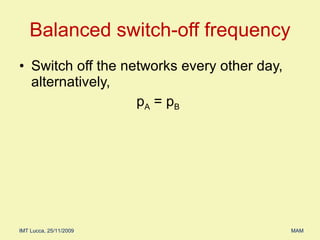
Switch off the networks every other day, alternatively, p A  = p B   Balanced switch-off frequency
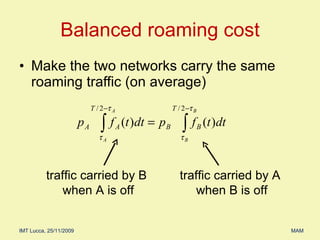
Make the two networks carry the same roaming traffic (on average) Balanced roaming cost traffic carried by B  when A is off traffic carried by A  when B is off
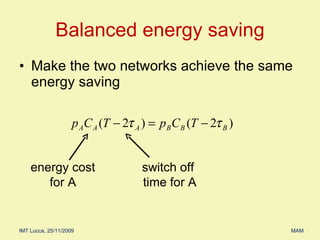
Make the two networks achieve the same energy saving Balanced energy saving switch off  time for A energy cost for A
Two cost models Constant : the fixed costs dominate, the networks have the same energy cost regardless the number of subscribers C B =C A Variable : the network energy cost is proportional to the number of subscribers C B  =   C A Balanced energy saving
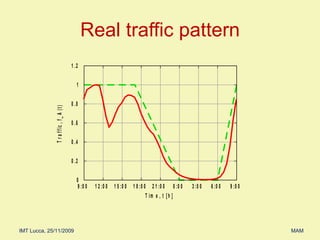
Real traffic pattern
Constant cost model: Total saving Saving can be huge! 0 5 10 15 20 0 0.1 0.2 0.3 0.4 0.5 0.6 0.7 0.8 0.9 1 0 10 20 30 40 Energy saving [cost/day] Energy saving [%] Traffic ratio,   Roaming Saving Switching Max
Constant cost model: Roaming balance 0 5 10 15 20 0 0.1 0.2 0.3 0.4 0.5 0.6 0.7 0.8 0.9 1 0 10 20 30 40 Energy saving [cost/day] Energy saving [%] Traffic ratio,   Total A B
Constant cost model: Switching balance 0 5 10 15 20 0 0.1 0.2 0.3 0.4 0.5 0.6 0.7 0.8 0.9 1 0 10 20 30 40 Energy saving [cost/day] Energy saving [%] Traffic ratio,   Total A B
Variable cost model: Total saving Different cost models lead to different policies 0 5 10 15 20 0 0.1 0.2 0.3 0.4 0.5 0.6 0.7 0.8 0.9 1 Energy saving [cost/day] Traffic ratio,   Roaming Saving Switching Max
Variable cost model: Total saving Different cost models lead to different policies 5 10 15 20 25 30 0 0.1 0.2 0.3 0.4 0.5 0.6 0.7 0.8 0.9 1 Energy saving [%] Traffic ratio,   Roaming Saving Switching Max
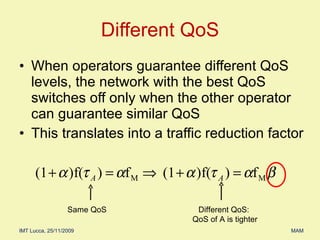
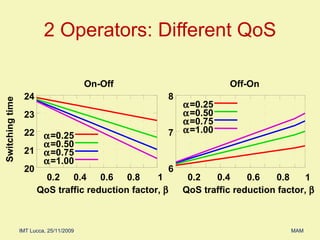
Different QoS When operators guarantee different QoS levels, the network with the best QoS switches off only when the other operator can guarantee similar QoS This translates into a traffic reduction factor Same QoS Different QoS:  QoS of A is tighter
2 Operators: Different QoS 0.4 0.5 0.6 0.7 0.8 0.9 1  =0.25  =0.50  =0.75  =1.00 0 5 10 15 20 25 0.1 0.2 0.3 Saving [%] QoS traffic reduction factor,  
2 Operators: Different QoS  =0.25  =0.50  =0.75  =1.00 6 7 8 0.2 0.4 0.6 0.8 QoS traffic reduction factor,   Off-On  =0.25  =0.50  =0.75  =1.00 1 20 21 22 23 24 0.2 0.4 0.6 0.8 1 Switching time QoS traffic reduction factor,   On-Off
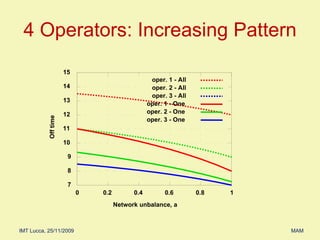
Multiple Operators With more than 2 operators, the space of possible switch-off patterns explodes Different roaming schemes are possible, during the switch-off phase: Roaming-to-One : Roaming traffic goes to the operator which remains on all the time Roaming-to-All : Roaming traffic is distributed to active operators
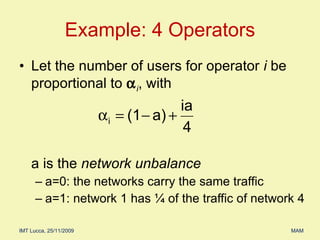
Example: 4 Operators Let the number of users for operator  i  be proportional to   i , with a is the  network unbalance a=0: the networks carry the same traffic a=1: network 1 has ¼ of the traffic of network 4
4 Operators: Increasing Pattern Under same cost, increasing pattern is optimal 20 25 30 35 40 0 0.2 0.4 0.6 0.8 1 Saving [%] Network unbalance, a same cost - All var cost - All same cost - One var cost -  One Roaming to all is more effective
4 Operators: Decreasing Pattern 20 25 30 35 40 0 0.2 0.4 0.6 0.8 1 Saving [%] Network unbalance, a same cost - All var cost - All same cost - One var cost -  One
4 Operators: Increasing Pattern 7 8 9 10 11 12 13 14 15 0 0.2 0.4 0.6 0.8 1 Off time Network unbalance, a oper. 1 - All oper. 2 - All oper. 3 - All oper. 1 - One oper. 2 - One oper. 3 - One
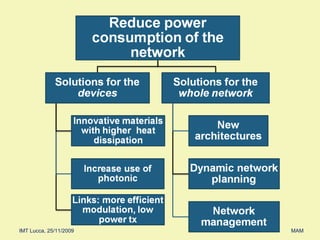
Energy issues are crucial, even for networking Design criteria must be changed  Energy consumption/wastage is a variable to be taken into account in design and performance evaluation Future Internet design will have to cope with it Virtual operators appear to be an interesting option Lessons
A new attitude is needed Consumers: awareness of the cost of  Turn over of devices  Uncontrolled use of energy  Manifacturers Life cycle assessment  Operators Careful management of resources  Architectures  Lessons
Governments and institutions will have to play a role in  Inducing new attitudes (e.g., education to an aware use of resources) Forcing new production models based on products life cycle  (e.g., responsibility for disposal, incentives to long lasting devices) Providing incentives for cooperation  Lessons
M.Ajmone Marsan, L.Chiaraviglio, D.Ciullo, M.Meo,  “Energy-Aware UMTS Access Networks” , W-GREEN 2008 - First International Workshop on Green Wireless, Lapland, Finland, September 2008 M.Ajmone Marsan, L.Chiaraviglio. D. Ciullo, M.Meo,  “Optimal Energy Savings in Cellular Access Networks” , GreenComm'09 - First International Workshop on Green Communications, Dresden, Germany, June 2009 M.Ajmone Marsan, L.Chiaraviglio, D.Ciullo, M.Meo,  “Energy-Efficient Management of UMTS Access Networks” , 21st International Teletraffic Congress (ITC 21), Paris, France, September 2009 M. Ajmone Marsan, M. Meo,  ”Energy Efficient Management of two Cellular Access Networks” , GreenMetrics 2009 Workshop, Seattle, WA, USA, June 2009 References
Thank you!
Questions?

Energy Efficient Wireless Internet Access

  • 1.
    Energy Efficient Wireless Internet Access Marco Ajmone Marsan, Michela Meo Politecnico di Torino
  • 2.
    WIA & MtCO2 e Marco Ajmone Marsan, Michela Meo Politecnico di Torino
  • 3.
    What’s all this“green networking” about?
  • 4.
    Energy is becoming the issue of our future We depend on energy which is becoming scarce Energy consumption is causing dramatic climate changes We must cope with this and reduce energy consumption in all sectors, ICT and networking included The problem
  • 5.
    Climate change Source: Hansen, J., et al. (2006) &quot;Global temperature change&quot;. Proc. Natl. Acad. Sci. 103: 14288-14293.
  • 6.
    Climate change Source: A.P. Sokolov et al, “Probabilistic Forecast for 21st Century Climate Based on Uncertainties in Emissions (without Policy) and Climate Parameters” , Report 169, Jan 2009 2003 Model 2009 Model
  • 7.
    The main globalwarming culprit is carbon dioxide, CO 2 Gases that react to form smog Fine particles such as black carbon 80% of the increase of CO 2 in the air in the last century is due to fossil fuel burning (20% deforestation) Who is the culprit?
  • 8.
    Source: EnergyInformation Administration (EIA), International Energy – Annual Energy Outlook 2009 TW
  • 9.
    Electricity = 30%of energy 1 W of electrical energy ≈ 2.1 W of primary energy Source: Energy Information Administration (EIA), International Energy – Annual Energy Outlook 2009
  • 10.
    Information and CommunicationTechnologies play a positive role for energy saving: moving bits instead of atoms teleworking and telecommuting e-commerce intelligent transport systems electronic billing sensors to monitor and manage environment What about ICT?
  • 11.
    The ICT sectoris a heavy consumer! … but “ ICT alone is responsible of a percentage which vary from 2% to 10% of the world power consumption.” “ Electricity demand of ICT is almost 11% of the overall final electricity consumption in Germany.” “ The ICT sector produces some 2 to 3% of total emissions of greenhouse gases.”
  • 12.
    Which ICT? Source: M. Pickavet et al, “Worldwide Energy Needs for ICT: the Rise of Power-Aware Networking,” in IEEE ANTS Conference, Bombay, India, Dec. 2008.
  • 13.
    Consumption might doublein the next decade Source: M. Pickavet et al, “Worldwide Energy Needs for ICT: the Rise of Power-Aware Networking,” in IEEE ANTS Conference, Bombay, India, Dec. 2008.
  • 14.
    Life Cycle Assessment (LCA) refers to the quantitative characterization of the environmental impacts of products and services and includes Manufacture Operation Disposal A life cycle perspective can lead to a better understanding of environmental management This is particularly true for IT products Life cycle matters
  • 15.
    Example: 2-grammemory chip requires at least 1,200 grams of fossil fuels 72 grams of chemicals Fossil fuels for production are some 600 times the weight of the chip (the total fossil fuel to produce a car is 1-2 times its weight) Purification to semiconductor grade materials is energy intensive Due to its extremely low-entropy, organized structure, the materials intensity of a microchip is orders of magnitude higher than that of “traditional” goods. Electronics
  • 16.
    PCs Source: Peter James and Lisa Hopkinson, “ Energy and Environmental Impacts of Personal Computing -- A Best Practice Review prepared for the Joint Information Services Committee (JISC)” , May 2009.
  • 17.
    Williams, E., 2004.Energy Intensity of Computer Manufacturing: Hybrid Assessment Combining Process and Economic Input-Output Methods. Environ. Sci. Technol., 2004, 38 , 6166-6174. Lawrence Berkeley National Laboratory, 2005. Optimization of Product Life Cycles to reduce Greenhouse Gases in California. Report for California Energy Commission. CEC-500-2005-110-F. IVF Industrial Research and Development Corporation, 2007. Lot 3: Personal Computers (desktops and laptops) and Computer Monitors. Final Report for the European Commission, August 2007.
  • 18.
    Operation Equipment ConsumptionDesktop PC 100-150W Laptop PC 20W Server 700 W – 10KW Router 5-10 W per Gbps GSM BS 700W UMTS BS 800W WIMAX BS 400W
  • 19.
    Data centers Source: “Report to Congress on Server and Data Center Energy Efficiency” Public Law 109-431. U.S. Environmental Protection Agency ENERGY STAR Program , August 2007
  • 20.
    In 2006, U.S.data centers used 61 TWh of electricity, corresponding to 1.5% of national consumption Double the amount consumed in 2000 Based on current trends, energy consumption will continue to grow 12% per year, due to increasing demand for the services they provide Data centers
  • 21.
    Algorithms to freeup servers and put them into sleep mode or to manage load on the servers in a more energy-efficient way Sensors identify which servers would be best to shut down, based on environmental conditions Use more efficient components Reduce cooling needs (cooling consumes as much as 40% of the operating costs) through specific physical layouts Current solutions
  • 22.
    Data centers Source: “Fact Sheet on National Data Center Energy Efficiency Information Program“, U.S. Department of Energy (DOE) and U.S. Environmental Protection Agency (EPA), March 19, 2008
  • 23.
    Networks Internet CoreBackbone Metro Feeder
  • 24.
  • 25.
    Typical network Source: J. Baliga, K. Hinton and R. Tucker, “Energy consumption of the Internet”, in COIN - ACOFT 2007, June 2007, Melbourme, Australia factor 4
  • 26.
    Routers Source: R. Tucker et al., “Energy consumption in IP networks”, in European Conference on Optical Communication ECOC’2008, Brussels, Sept. 2008.
  • 27.
  • 28.
    Fixed operators 70%of power consumption 30% of power consumption
  • 29.
    Mobile operators 10%of power consumption 90% of power consumption Order of the OPEX!
  • 30.
  • 31.
  • 32.
    Cellular networks Basestations are responsible for about 80% of energy consumed by a cellular network A typical BS consumes from 500W to 3KW, with an average consumption per year of 35 MWh (as much as 10 families) In Italy 60,000 BSs, leading to 2.1 TWh/year, about 0.7 % of total Italian consumption of electricity 300 M€ electricity bill for the operators About 1,2 Mton of emitted CO 2 equivalent per year
  • 33.
  • 34.
    An immediate solution for mobile operators Start by reducing consumption at the access network with current technologies
  • 35.
    Dynamic network planningNetworks are planned based on the peak hour traffic Due to natural traffic variability (i.e., typical day/night traffic profile) the network results over-dimensioned during long periods of time Switch off portions of the network when traffic is low
  • 36.
  • 37.
    Assume that a fraction x of the base stations (cells) are switched off The BSs that remain on are in charge of the traffic of the cells that are off (the desired QoS must still be guaranteed) the radio coverage (transmission power might be increased to guarantee coverage) Switch-off scheme
  • 38.
    A NodeB controls2 microcells
  • 39.
    Switch off half of the NodeB, x=1/2
  • 40.
    Switch off half of the NodeB, x=1/2
  • 41.
    Assume that, foreach cell remaining on, x cells can be switched off. In the cells that remain on: New traffic is  ’=( x +1)  New cell radius is R’=KR ( K depends on geometry) Looking for a switch-off scheme
  • 42.
    Find the lowtraffic threshold and compute the night zone (period in which the switch-off scheme can be applied), based on day/night traffic pattern QoS constraint (i.e., blocking probability < 1%) Looking for a switch-off scheme
  • 43.
    8:00 16:00 24:008:00 16:00 24:00 8:00 0 0.01 0.02 0.03 0.04 0.05 0.06 0.07 time lambda day/night traffic pattern for one cell Total traffic in x+1 cells night zone Low traffic threshold: QoS is guaranteed
  • 44.
    8:00 16:00 24:008:00 16:00 24:00 8:00 0 0.01 0.02 0.03 0.04 0.05 0.06 0.07 time lambda night zone traffic pattern for cells remaining on
  • 45.
    Check the maximumcell radius, R MAX If R’< R MAX  DONE else increase transmission power during night zone OR reduce the night zone Looking for a switch-off scheme
  • 46.
    8:00 16:00 24:008:00 16:00 24:00 8:00 0 0.01 0.02 0.03 0.04 0.05 0.06 0.07 Time lambda VOICE VIDEOCALL DATA Switch off 1 Node-B for about 9 hours Energy saving= 37.5%
  • 47.
    Hierarchical scenario 7 μ Cells with: R_ μ cells=100m P TX _ μ cells=2 W Umbrella (Macro) Cell: R_Mcell≈265m P TX _Mcell=3.4 W
  • 48.
    8:00 16:00 24:008:00 16:00 24:00 8:00 0 0.01 0.02 0.03 0.04 0.05 0.06 Time lambda VOICE VIDEOCALL DATA λ night ->0: Good for office scenario
  • 49.
    -1 Time Lambdaµ M M µ µ The Umbrella cell is always ON (day+night) - Switch off 2 Node-B (7µcells) for about 4 hours Energy saving= 17% 8:00 16:00 24:00 8:00 16:00 24:00 8:00 10 -20 10 -15 10 -10 10 -5 10 0 Time Blocking Probability VOICE VIDEOCALL DATA 8:00 16:00 24:00 8:00 16:00 24:00 8:00 10 -4 10 -3 10 -2 10
  • 50.
    Possible configurations Manhattan configurations (linear) (1,2) (2,3)
  • 51.
    Possible configurations Hexagonal configurations (squared) (3,4) (8,9)
  • 52.
    Switching off moredoes not always mean saving more! Switch off scheme geometry (1,2) linear (2,3) linear (3,4) squared (8,9) squared Load ratio 2 3 4 9 Cell radius 2x 3x 2x 3x PB[W] 5 18 5 18 Night zone 16h30m 14h40m 12h20m 7h NodeB saving [%] 68.7 61.1 50.4 29.1 Network saving 34.3 40.7 37.8 25.9
  • 53.
    But, we havemultiple operators Several competing mobile operators cover the same area with their equipment Networks are dimensioned over the peak hour traffic During low traffic periods the resources of one operator are sufficient to carry all the traffic Make operators cooperate to reduce energy consumption
  • 54.
    In turn, Switchoff the network of one operator, when traffic is low and the active operators can carry all the traffic Let users roam to other operators Balance costs Cooperation
  • 55.
    Two operators: Aand B No. of users N A and N B , with N B =  N A and  <1 Daily traffic profile f A (t) and f B (t), f B (t)=  f A (t) Example: 2 operators f M T/2 T=24h t f A (t) f B (t)  f M
  • 56.
    f M T/2T=24h t f M /(1+  ) f M  /(1+  ) Switch off time for B Switch off A  B  A
  • 57.
    Let p A and p B be the frequency with which A and B switch off Different strategies can be adopted for choosing the switching frequency Switch-off policies
  • 58.
    Switch off thenetworks every other day, alternatively, p A = p B Balanced switch-off frequency
  • 59.
    Make the twonetworks carry the same roaming traffic (on average) Balanced roaming cost traffic carried by B when A is off traffic carried by A when B is off
  • 60.
    Make the twonetworks achieve the same energy saving Balanced energy saving switch off time for A energy cost for A
  • 61.
    Two cost modelsConstant : the fixed costs dominate, the networks have the same energy cost regardless the number of subscribers C B =C A Variable : the network energy cost is proportional to the number of subscribers C B =  C A Balanced energy saving
  • 62.
  • 63.
    Constant cost model:Total saving Saving can be huge! 0 5 10 15 20 0 0.1 0.2 0.3 0.4 0.5 0.6 0.7 0.8 0.9 1 0 10 20 30 40 Energy saving [cost/day] Energy saving [%] Traffic ratio,  Roaming Saving Switching Max
  • 64.
    Constant cost model:Roaming balance 0 5 10 15 20 0 0.1 0.2 0.3 0.4 0.5 0.6 0.7 0.8 0.9 1 0 10 20 30 40 Energy saving [cost/day] Energy saving [%] Traffic ratio,  Total A B
  • 65.
    Constant cost model:Switching balance 0 5 10 15 20 0 0.1 0.2 0.3 0.4 0.5 0.6 0.7 0.8 0.9 1 0 10 20 30 40 Energy saving [cost/day] Energy saving [%] Traffic ratio,  Total A B
  • 66.
    Variable cost model:Total saving Different cost models lead to different policies 0 5 10 15 20 0 0.1 0.2 0.3 0.4 0.5 0.6 0.7 0.8 0.9 1 Energy saving [cost/day] Traffic ratio,  Roaming Saving Switching Max
  • 67.
    Variable cost model:Total saving Different cost models lead to different policies 5 10 15 20 25 30 0 0.1 0.2 0.3 0.4 0.5 0.6 0.7 0.8 0.9 1 Energy saving [%] Traffic ratio,  Roaming Saving Switching Max
  • 68.
    Different QoS Whenoperators guarantee different QoS levels, the network with the best QoS switches off only when the other operator can guarantee similar QoS This translates into a traffic reduction factor Same QoS Different QoS: QoS of A is tighter
  • 69.
    2 Operators: DifferentQoS 0.4 0.5 0.6 0.7 0.8 0.9 1  =0.25  =0.50  =0.75  =1.00 0 5 10 15 20 25 0.1 0.2 0.3 Saving [%] QoS traffic reduction factor, 
  • 70.
    2 Operators: DifferentQoS  =0.25  =0.50  =0.75  =1.00 6 7 8 0.2 0.4 0.6 0.8 QoS traffic reduction factor,  Off-On  =0.25  =0.50  =0.75  =1.00 1 20 21 22 23 24 0.2 0.4 0.6 0.8 1 Switching time QoS traffic reduction factor,  On-Off
  • 71.
    Multiple Operators Withmore than 2 operators, the space of possible switch-off patterns explodes Different roaming schemes are possible, during the switch-off phase: Roaming-to-One : Roaming traffic goes to the operator which remains on all the time Roaming-to-All : Roaming traffic is distributed to active operators
  • 72.
    Example: 4 OperatorsLet the number of users for operator i be proportional to  i , with a is the network unbalance a=0: the networks carry the same traffic a=1: network 1 has ¼ of the traffic of network 4
  • 73.
    4 Operators: IncreasingPattern Under same cost, increasing pattern is optimal 20 25 30 35 40 0 0.2 0.4 0.6 0.8 1 Saving [%] Network unbalance, a same cost - All var cost - All same cost - One var cost - One Roaming to all is more effective
  • 74.
    4 Operators: DecreasingPattern 20 25 30 35 40 0 0.2 0.4 0.6 0.8 1 Saving [%] Network unbalance, a same cost - All var cost - All same cost - One var cost - One
  • 75.
    4 Operators: IncreasingPattern 7 8 9 10 11 12 13 14 15 0 0.2 0.4 0.6 0.8 1 Off time Network unbalance, a oper. 1 - All oper. 2 - All oper. 3 - All oper. 1 - One oper. 2 - One oper. 3 - One
  • 76.
    Energy issues arecrucial, even for networking Design criteria must be changed Energy consumption/wastage is a variable to be taken into account in design and performance evaluation Future Internet design will have to cope with it Virtual operators appear to be an interesting option Lessons
  • 77.
    A new attitudeis needed Consumers: awareness of the cost of Turn over of devices Uncontrolled use of energy Manifacturers Life cycle assessment Operators Careful management of resources Architectures Lessons
  • 78.
    Governments and institutionswill have to play a role in Inducing new attitudes (e.g., education to an aware use of resources) Forcing new production models based on products life cycle (e.g., responsibility for disposal, incentives to long lasting devices) Providing incentives for cooperation Lessons
  • 79.
    M.Ajmone Marsan, L.Chiaraviglio,D.Ciullo, M.Meo, “Energy-Aware UMTS Access Networks” , W-GREEN 2008 - First International Workshop on Green Wireless, Lapland, Finland, September 2008 M.Ajmone Marsan, L.Chiaraviglio. D. Ciullo, M.Meo, “Optimal Energy Savings in Cellular Access Networks” , GreenComm'09 - First International Workshop on Green Communications, Dresden, Germany, June 2009 M.Ajmone Marsan, L.Chiaraviglio, D.Ciullo, M.Meo, “Energy-Efficient Management of UMTS Access Networks” , 21st International Teletraffic Congress (ITC 21), Paris, France, September 2009 M. Ajmone Marsan, M. Meo, ”Energy Efficient Management of two Cellular Access Networks” , GreenMetrics 2009 Workshop, Seattle, WA, USA, June 2009 References
  • 80.
  • 81.

Editor's Notes

  • #6 Model based on A model of human activities and emissions (the Emissions Prediction and Policy Analysis Model), An atmospheric dynamics, physics and chemistry model, which includes a sub-model of urban chemistry, A mixed layer/ anomaly diffusing ocean model (ADOM) with carbon cycle and sea ice submodels, A land system model that combines the Terrestrial Ecosystem Model (TEM), a Natural Emissions Model (NEM), and the Community Land Model (CLM), that together describe the global, terrestrial water and energy budgets and terrestrial ecosystem processes.
  • #13 In use phase
  • #15 http://www.it-environment.org/about%20project%20-%20LCA%20of%20IT%20hardware.html
  • #16 http://www.it-environment.org/about%20project%20-%20LCA%20of%20IT%20hardware.html
  • #33 Italian project http://www.key4biz.it/News/2009/07/16/Tecnologie/Sistemi_Tlc_Stazioni_Radio_Base_GSM_UMTS_DCS_fonti_rinnovabili.html?utm_source=infomail&amp;utm_medium=email&amp;utm_campaign=Dailyletter+n.1453+del+16+luglio+2009
  • #35 Italian project http://www.key4biz.it/News/2009/07/16/Tecnologie/Sistemi_Tlc_Stazioni_Radio_Base_GSM_UMTS_DCS_fonti_rinnovabili.html?utm_source=infomail&amp;utm_medium=email&amp;utm_campaign=Dailyletter+n.1453+del+16+luglio+2009
  • #36 Italian project http://www.key4biz.it/News/2009/07/16/Tecnologie/Sistemi_Tlc_Stazioni_Radio_Base_GSM_UMTS_DCS_fonti_rinnovabili.html?utm_source=infomail&amp;utm_medium=email&amp;utm_campaign=Dailyletter+n.1453+del+16+luglio+2009
  • #37 Aggiungere il grafico di Tilab