Paul Ashall, 2008
Module 9001
Energy Balance
Paul Ashall, 2008
Paul Ashall, 2008
 Concerned with energy changes and
energy flow in a chemical process.
 Conservation of energy – first law of
thermodynamics i.e. accumulation of
energy in a system = energy input –
energy output
Paul Ashall, 2008
Forms of energy
 Potential energy (mgh)
 Kinetic energy (1/2 mv2)
 Thermal energy – heat (Q) supplied to or removed
from a process
 Work energy – e.g. work done by a pump (W) to
transport fluids
 Internal energy (U) of molecules
m – mass (kg)
g – gravitational constant, 9.81 ms-2
v – velocity, ms-1
Paul Ashall, 2008
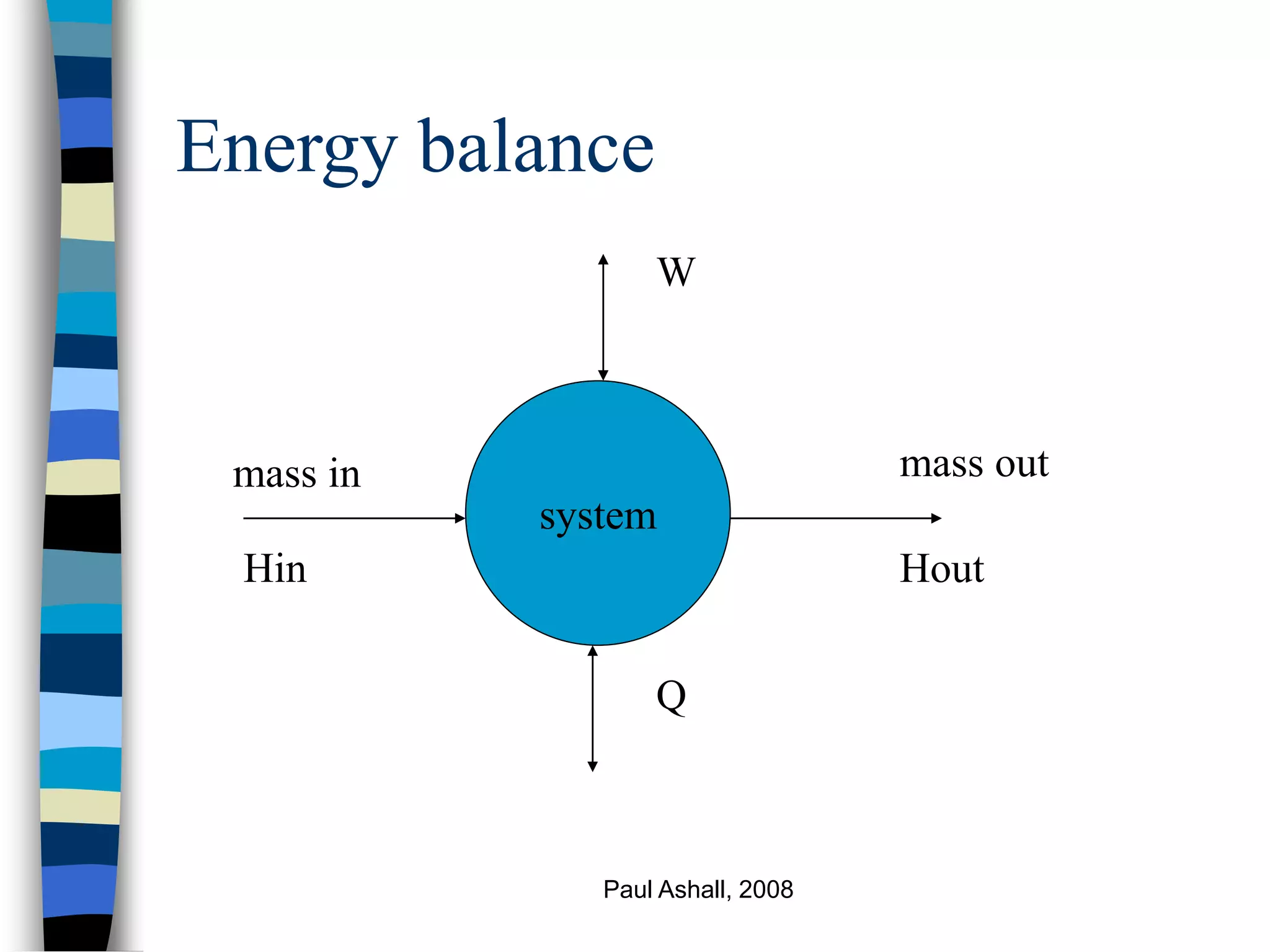
Energy balance
system
mass in
Hin
mass out
Hout
W
Q
Paul Ashall, 2008
IUPAC convention
- heat transferred to a system is +ve and
heat transferred from a system is –ve
- work done on a system is+ve and work
done by a system is -ve
Paul Ashall, 2008
Steady state/non-steady state
 Non steady state -
accumulation/depletion of energy in
system
Paul Ashall, 2008
Uses
 Heat required for a process
 Rate of heat removal from a process
 Heat transfer/design of heat exchangers
 Process design to determine energy
requirements of a process
 Pump power requirements (mechanical
energy balance)
 Pattern of energy usage in operation
 Process control
 Process design & development
 etc
Paul Ashall, 2008
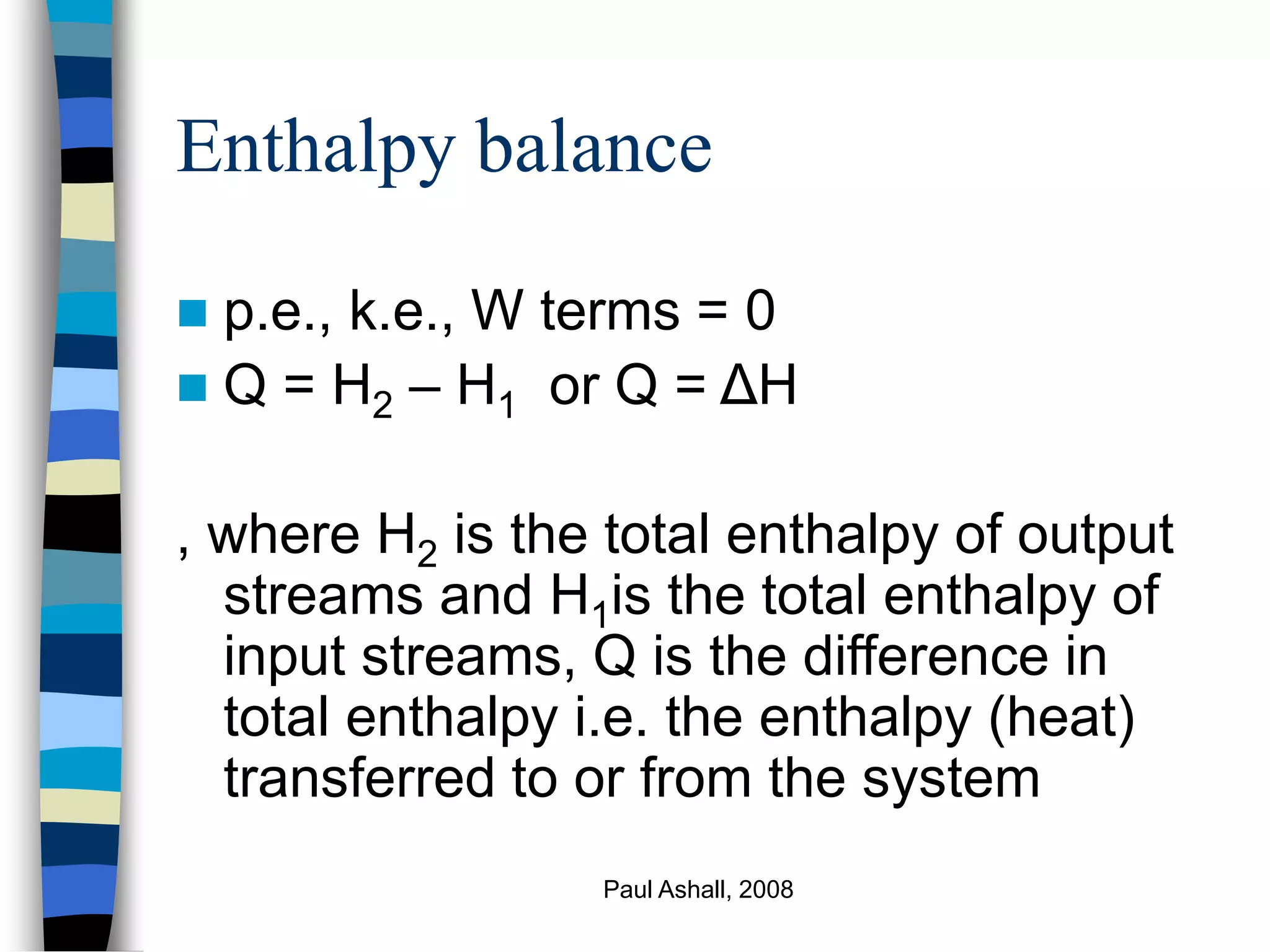
Enthalpy balance
 p.e., k.e., W terms = 0
 Q = H2 – H1 or Q = ΔH
, where H2 is the total enthalpy of output
streams and H1is the total enthalpy of
input streams, Q is the difference in
total enthalpy i.e. the enthalpy (heat)
transferred to or from the system
Paul Ashall, 2008
continued
 Q –ve (H1>H2), heat removed from
system
 Q +ve (H2>H1), heat supplied to
system.
Paul Ashall, 2008
Example – steam boiler
Two input streams: stream 1- 120 kg/min.
water, 30 deg cent., H = 125.7 kJ/kg;
stream 2 – 175 kg/min, 65 deg cent, H=
272 kJ/kg
One output stream: 295 kg/min. saturated
steam(17 atm., 204 deg cent.), H =
2793.4 kJ/kg
Paul Ashall, 2008
continued
Ignore k.e. and p.e. terms relative to enthalpy
changes for processes involving phase
changes, chemical reactions, large
temperature changes etc
Q = ΔH (enthalpy balance)
Basis for calculation 1 min.
Steady state
Q = Hout – Hin
Q = [295 x 2793.4] – [(120 x 125.7) + (175 x 272)]
Q = + 7.67 x 10⁵ kJ/min
Paul Ashall, 2008
Steam tables
 Enthalpy values (H kJ/kg) at various P,
T
Paul Ashall, 2008
Enthalpy changes
 Change of T at constant P
 Change of P at constant T
 Change of phase
 Solution
 Mixing
 Chemical reaction
 crystallisation
Paul Ashall, 2008
Latent heats (phase changes)
 Vapourisation (L to V)
 Melting (S to L)
 Sublimation (S to V)
Paul Ashall, 2008
Mechanical energy balance
 Consider mechanical energy terms only
 Application to flow of liquids
ΔP + Δ v2 + g Δh +F = W
ρ 2
where W is work done on system by a pump
and F is frictional energy loss in system (J/kg)
ΔP = P2 – P1; Δ v2 = v2
2 –v1
2; Δh = h2 –h1
 Bernoulli equation (F=0, W=0)
Paul Ashall, 2008
Example - Bernoulli eqtn.
Water flows between two points 1,2. The
volumetric flow rate is 20 litres/min.
Point 2 is 50 m higher than point 1. The
pipe internal diameters are 0.5 cm at
point 1 and 1 cm at point 2. The
pressure at point 2 is 1 atm..
Calculate the pressure at point 2.
Paul Ashall, 2008
continued
ΔP/ρ + Δv2/2 + gΔh +F = W
ΔP = P2 – P1 (Pa)
Δv2 = v2
2 – v1
2
Δh = h2 - h1 (m)
F= frictional energy loss (mechanical energy
loss to system) (J/kg)
W = work done on system by pump (J/kg)
ρ = 1000 kg/m3
Paul Ashall, 2008
continued
Volumetric flow is 20/(1000.60) m3/s
= 0.000333 m3/s
v1 = 0.000333/(π(0.0025)2) = 16.97 m/s
v2 = 0.000333/ (π(0.005)2) = 4.24 m/s
(101325 - P1)/1000 + [(4.24)2 – (16.97)2]/2 + 9.81.50 = 0
P1 = 456825 Pa (4.6 bar)
Paul Ashall, 2008
Sensible heat/enthalpy
calculations
 ‘Sensible’ heat – heat/enthalpy that must be
transferred to raise or lower the temperature of a
substance or mixture of substances.
 Heat capacities/specific heats (solids, liquids,
gases,vapours)
 Heat capacity/specific heat at constant P, Cp(T) =
dH/dT or ΔH = integral Cp(T)dT between limits T2 and
T1
 Use of mean heat capacities/specific heats over a
temperature range
 Use of simple empirical equations to describe the
variation of Cp with T
Paul Ashall, 2008
continued
e.g. Cp = a + bT + cT2 + dT3
,where a, b, c, d are coefficients
ΔH = integralCpdT between limits T2, T1
ΔH = [aT + bT2 + cT3 + dT4]
2 3 4
Calculate values for T = T2, T1 and subtract
Note: T may be in deg cent or K - check units for Cp!
Paul Ashall, 2008
Example
Calculate the enthalpy required to heat a
stream of nitrogen gas flowing at 100
mole/min., through a gas heater from 20
to 100 deg. cent.
(use mean Cp value 29.1J mol-1 K-1 or Cp
= 29 + 0.22 x 10⁻²T + 0.572 x 10⁻⁵T2 –
2.87 x 10⁻⁹ T3, where T is in deg cent)
Paul Ashall, 2008
Heat capacity/specific heat data
 Felder & Rousseau pp372/373 and Table B10
 Perry’s Chemical Engineers Handbook
 The properties of gases and liquids, R. Reid et al, 4th
edition, McGraw Hill, 1987
 Estimating thermochemical properties of liquids part
7- heat capacity, P. Gold & G.Ogle, Chem. Eng.,
1969, p130
 Coulson & Richardson Chem. Eng., Vol. 6, 3rd
edition, ch. 8, pp321-324
 ‘PhysProps’
Paul Ashall, 2008
Example – change of phase
A feed stream to a distillation unit contains an equimolar
mixture of benzene and toluene at 10 deg cent.The
vapour stream from the top of the column contains
68.4 mol % benzene at 50 deg cent. and the liquid
stream from the bottom of the column contains 40
mol% benzene at 50 deg cent.
[Need Cp (benzene, liquid), Cp (toluene, liquid), Cp
(benzene, vapour), Cp (toluene, vapour), latent heat
of vapourisation benzene, latent heat of vapourisation
toluene.]
Paul Ashall, 2008
Energy balances on systems
involving chemical reaction
 Standard heat of formation (ΔHo
f) – heat of
reaction when product is formed from its
elements in their standard states at 298 K, 1
atm. (kJ/mol)
aA + bB cC + dD
-a -b +c +d (stoichiometric
coefficients, νi)
ΔHo
fA, ΔHo
fB, ΔHo
fC, ΔHo
fD (heats of formation)
ΔHo
R = c ΔHo
fC + d ΔHo
fD - a ΔHo
fA - bΔHo
fB
Paul Ashall, 2008
Heat (enthalpy) of reaction
 ΔHo
R –ve (exothermic reaction)
 ΔHo
R +ve (endothermic reaction)
Paul Ashall, 2008
Enthalpy balance equation -
reactor
Qp = Hproducts – Hreactants + Qr
Qp – heat transferred to or from process
Qr – reaction heat (ζ ΔHo
R), where ζ is
extent of reaction and is equal to [moles
component,i, out – moles component i,
in]/ νi
Paul Ashall, 2008
system
Qr
Hreactants
Hproducts
Qp
+ve
-ve
Note: enthalpy values must be calculated with reference to a
temperature of 25 deg cent
Paul Ashall, 2008
Energy balance techniques
 Complete mass balance/molar balance
 Calculate all enthalpy changes between
process conditions and standard/reference
conditions for all components at start (input)
and finish (output).
 Consider any additional enthalpy changes
 Solve enthalpy balance equation
Paul Ashall, 2008
Energy balance techniques
 Adiabatic temperature: Qp = 0
Paul Ashall, 2008
Examples
 Reactor
 Crystalliser
 Drier
 Distillation
Paul Ashall, 2008
References
 The Properties of Gases and Liquids, R.
Reid
 Elementary Principles of Chemical
Processes, R.M.Felder and
R.W.Rousseau

Energy Balance (1).ppt

  • 1.
    Paul Ashall, 2008 Module9001 Energy Balance Paul Ashall, 2008
  • 2.
    Paul Ashall, 2008 Concerned with energy changes and energy flow in a chemical process.  Conservation of energy – first law of thermodynamics i.e. accumulation of energy in a system = energy input – energy output
  • 3.
    Paul Ashall, 2008 Formsof energy  Potential energy (mgh)  Kinetic energy (1/2 mv2)  Thermal energy – heat (Q) supplied to or removed from a process  Work energy – e.g. work done by a pump (W) to transport fluids  Internal energy (U) of molecules m – mass (kg) g – gravitational constant, 9.81 ms-2 v – velocity, ms-1
  • 4.
    Paul Ashall, 2008 Energybalance system mass in Hin mass out Hout W Q
  • 5.
    Paul Ashall, 2008 IUPACconvention - heat transferred to a system is +ve and heat transferred from a system is –ve - work done on a system is+ve and work done by a system is -ve
  • 6.
    Paul Ashall, 2008 Steadystate/non-steady state  Non steady state - accumulation/depletion of energy in system
  • 7.
    Paul Ashall, 2008 Uses Heat required for a process  Rate of heat removal from a process  Heat transfer/design of heat exchangers  Process design to determine energy requirements of a process  Pump power requirements (mechanical energy balance)  Pattern of energy usage in operation  Process control  Process design & development  etc
  • 8.
    Paul Ashall, 2008 Enthalpybalance  p.e., k.e., W terms = 0  Q = H2 – H1 or Q = ΔH , where H2 is the total enthalpy of output streams and H1is the total enthalpy of input streams, Q is the difference in total enthalpy i.e. the enthalpy (heat) transferred to or from the system
  • 9.
    Paul Ashall, 2008 continued Q –ve (H1>H2), heat removed from system  Q +ve (H2>H1), heat supplied to system.
  • 10.
    Paul Ashall, 2008 Example– steam boiler Two input streams: stream 1- 120 kg/min. water, 30 deg cent., H = 125.7 kJ/kg; stream 2 – 175 kg/min, 65 deg cent, H= 272 kJ/kg One output stream: 295 kg/min. saturated steam(17 atm., 204 deg cent.), H = 2793.4 kJ/kg
  • 11.
    Paul Ashall, 2008 continued Ignorek.e. and p.e. terms relative to enthalpy changes for processes involving phase changes, chemical reactions, large temperature changes etc Q = ΔH (enthalpy balance) Basis for calculation 1 min. Steady state Q = Hout – Hin Q = [295 x 2793.4] – [(120 x 125.7) + (175 x 272)] Q = + 7.67 x 10⁵ kJ/min
  • 12.
    Paul Ashall, 2008 Steamtables  Enthalpy values (H kJ/kg) at various P, T
  • 13.
    Paul Ashall, 2008 Enthalpychanges  Change of T at constant P  Change of P at constant T  Change of phase  Solution  Mixing  Chemical reaction  crystallisation
  • 14.
    Paul Ashall, 2008 Latentheats (phase changes)  Vapourisation (L to V)  Melting (S to L)  Sublimation (S to V)
  • 15.
    Paul Ashall, 2008 Mechanicalenergy balance  Consider mechanical energy terms only  Application to flow of liquids ΔP + Δ v2 + g Δh +F = W ρ 2 where W is work done on system by a pump and F is frictional energy loss in system (J/kg) ΔP = P2 – P1; Δ v2 = v2 2 –v1 2; Δh = h2 –h1  Bernoulli equation (F=0, W=0)
  • 16.
    Paul Ashall, 2008 Example- Bernoulli eqtn. Water flows between two points 1,2. The volumetric flow rate is 20 litres/min. Point 2 is 50 m higher than point 1. The pipe internal diameters are 0.5 cm at point 1 and 1 cm at point 2. The pressure at point 2 is 1 atm.. Calculate the pressure at point 2.
  • 17.
    Paul Ashall, 2008 continued ΔP/ρ+ Δv2/2 + gΔh +F = W ΔP = P2 – P1 (Pa) Δv2 = v2 2 – v1 2 Δh = h2 - h1 (m) F= frictional energy loss (mechanical energy loss to system) (J/kg) W = work done on system by pump (J/kg) ρ = 1000 kg/m3
  • 18.
    Paul Ashall, 2008 continued Volumetricflow is 20/(1000.60) m3/s = 0.000333 m3/s v1 = 0.000333/(π(0.0025)2) = 16.97 m/s v2 = 0.000333/ (π(0.005)2) = 4.24 m/s (101325 - P1)/1000 + [(4.24)2 – (16.97)2]/2 + 9.81.50 = 0 P1 = 456825 Pa (4.6 bar)
  • 19.
    Paul Ashall, 2008 Sensibleheat/enthalpy calculations  ‘Sensible’ heat – heat/enthalpy that must be transferred to raise or lower the temperature of a substance or mixture of substances.  Heat capacities/specific heats (solids, liquids, gases,vapours)  Heat capacity/specific heat at constant P, Cp(T) = dH/dT or ΔH = integral Cp(T)dT between limits T2 and T1  Use of mean heat capacities/specific heats over a temperature range  Use of simple empirical equations to describe the variation of Cp with T
  • 20.
    Paul Ashall, 2008 continued e.g.Cp = a + bT + cT2 + dT3 ,where a, b, c, d are coefficients ΔH = integralCpdT between limits T2, T1 ΔH = [aT + bT2 + cT3 + dT4] 2 3 4 Calculate values for T = T2, T1 and subtract Note: T may be in deg cent or K - check units for Cp!
  • 21.
    Paul Ashall, 2008 Example Calculatethe enthalpy required to heat a stream of nitrogen gas flowing at 100 mole/min., through a gas heater from 20 to 100 deg. cent. (use mean Cp value 29.1J mol-1 K-1 or Cp = 29 + 0.22 x 10⁻²T + 0.572 x 10⁻⁵T2 – 2.87 x 10⁻⁹ T3, where T is in deg cent)
  • 22.
    Paul Ashall, 2008 Heatcapacity/specific heat data  Felder & Rousseau pp372/373 and Table B10  Perry’s Chemical Engineers Handbook  The properties of gases and liquids, R. Reid et al, 4th edition, McGraw Hill, 1987  Estimating thermochemical properties of liquids part 7- heat capacity, P. Gold & G.Ogle, Chem. Eng., 1969, p130  Coulson & Richardson Chem. Eng., Vol. 6, 3rd edition, ch. 8, pp321-324  ‘PhysProps’
  • 23.
    Paul Ashall, 2008 Example– change of phase A feed stream to a distillation unit contains an equimolar mixture of benzene and toluene at 10 deg cent.The vapour stream from the top of the column contains 68.4 mol % benzene at 50 deg cent. and the liquid stream from the bottom of the column contains 40 mol% benzene at 50 deg cent. [Need Cp (benzene, liquid), Cp (toluene, liquid), Cp (benzene, vapour), Cp (toluene, vapour), latent heat of vapourisation benzene, latent heat of vapourisation toluene.]
  • 24.
    Paul Ashall, 2008 Energybalances on systems involving chemical reaction  Standard heat of formation (ΔHo f) – heat of reaction when product is formed from its elements in their standard states at 298 K, 1 atm. (kJ/mol) aA + bB cC + dD -a -b +c +d (stoichiometric coefficients, νi) ΔHo fA, ΔHo fB, ΔHo fC, ΔHo fD (heats of formation) ΔHo R = c ΔHo fC + d ΔHo fD - a ΔHo fA - bΔHo fB
  • 25.
    Paul Ashall, 2008 Heat(enthalpy) of reaction  ΔHo R –ve (exothermic reaction)  ΔHo R +ve (endothermic reaction)
  • 26.
    Paul Ashall, 2008 Enthalpybalance equation - reactor Qp = Hproducts – Hreactants + Qr Qp – heat transferred to or from process Qr – reaction heat (ζ ΔHo R), where ζ is extent of reaction and is equal to [moles component,i, out – moles component i, in]/ νi
  • 27.
    Paul Ashall, 2008 system Qr Hreactants Hproducts Qp +ve -ve Note:enthalpy values must be calculated with reference to a temperature of 25 deg cent
  • 28.
    Paul Ashall, 2008 Energybalance techniques  Complete mass balance/molar balance  Calculate all enthalpy changes between process conditions and standard/reference conditions for all components at start (input) and finish (output).  Consider any additional enthalpy changes  Solve enthalpy balance equation
  • 29.
    Paul Ashall, 2008 Energybalance techniques  Adiabatic temperature: Qp = 0
  • 30.
    Paul Ashall, 2008 Examples Reactor  Crystalliser  Drier  Distillation
  • 31.
    Paul Ashall, 2008 References The Properties of Gases and Liquids, R. Reid  Elementary Principles of Chemical Processes, R.M.Felder and R.W.Rousseau