End-to-end deep
learning deployment
with ONNX
—
Nick Pentreath
Principal Engineer
@MLnick
About
IBM Developer / © 2020 IBM Corporation
–@MLnick on Twitter & Github
–Principal Engineer, IBM CODAIT (Center
for Open-Source Data & AI Technologies)
–Machine Learning & AI
–Apache Spark committer & PMC
–Author of Machine Learning with Spark
–Various conferences & meetups
2
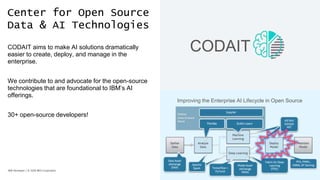
CODAIT
Improving the Enterprise AI Lifecycle in Open Source
Center for Open Source
Data & AI Technologies
IBM Developer / © 2020 IBM Corporation 3
CODAIT aims to make AI solutions dramatically
easier to create, deploy, and manage in the
enterprise.
We contribute to and advocate for the open-source
technologies that are foundational to IBM’s AI
offerings.
30+ open-source developers!
The Machine Learning
Workflow
IBM Developer / © 2020 IBM Corporation 4
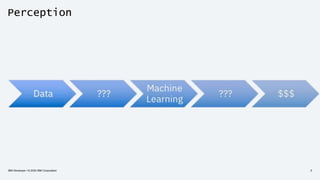
Perception
IBM Developer / © 2020 IBM Corporation 5
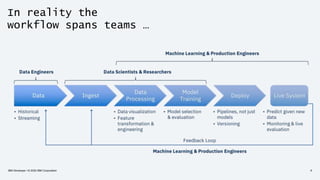
In reality the
workflow spans teams …
IBM Developer / © 2020 IBM Corporation 6
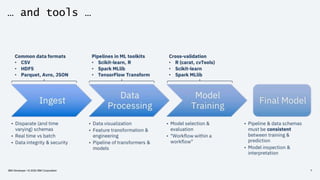
… and tools …
IBM Developer / © 2020 IBM Corporation 7
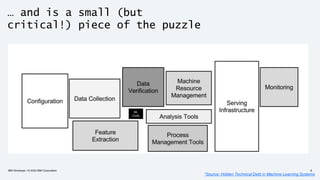
… and is a small (but
critical!) piece of the puzzle
*Source: Hidden Technical Debt in Machine Learning Systems
IBM Developer / © 2020 IBM Corporation 8
Machine Learning
Deployment
IBM Developer / © 2020 IBM Corporation 9
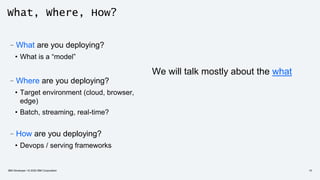
What, Where, How?
–What are you deploying?
• What is a “model”
–Where are you deploying?
• Target environment (cloud, browser,
edge)
• Batch, streaming, real-time?
–How are you deploying?
• Devops / serving frameworks
We will talk mostly about the what
IBM Developer / © 2020 IBM Corporation 10
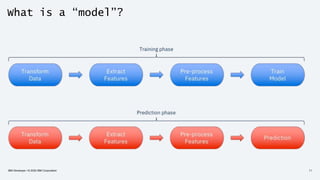
What is a “model”?
IBM Developer / © 2020 IBM Corporation 11
Deep Learning doesn’t need
feature engineering or data
processing …
IBM Developer / © 2020 IBM Corporation 12
right?
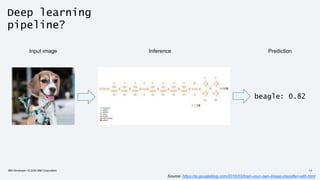
Deep learning
pipeline?
IBM Developer / © 2020 IBM Corporation 13
Source: https://ai.googleblog.com/2016/03/train-your-own-image-classifier-with.html
beagle: 0.82
Input image Inference Prediction
Deep learning
pipeline!
IBM Developer / © 2020 IBM Corporation 14
beagle: 0.82
basset: 0.09
bluetick: 0.07
...
Input image Image pre-processing Prediction
Decode image
Resize
Normalization
Convert types / format
Inference Post-processing
[0.2, 0.3, … ]
(label, prob)
Sort
Label map
PIL, OpenCV, tf.image,
…
Custom
Python
* Logos trademarks of their respective projects
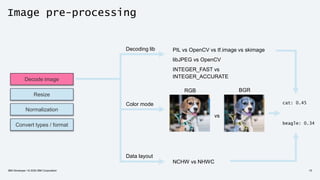
Image pre-processing
IBM Developer / © 2020 IBM Corporation 15
Decode image
Resize
Normalization
Convert types / format
vs
Color mode cat: 0.45
beagle: 0.34
Decoding lib
RGB BGR
PIL vs OpenCV vs tf.image vs skimage
libJPEG vs OpenCV
INTEGER_FAST vs
INTEGER_ACCURATE
Data layout
NCHW vs NHWC
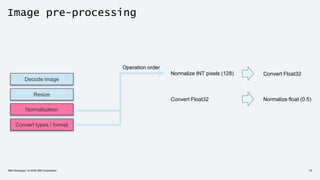
Image pre-processing
IBM Developer / © 2020 IBM Corporation 16
Decode image
Resize
Normalization
Convert types / format
Operation order
Normalize INT pixels (128) Convert Float32
Convert Float32 Normalize float (0.5)
Inference post-
processing
IBM Developer / © 2020 IBM Corporation 17
Convert to numpy array
[0.2, 0.3, … ]
(label, prob)
Sort
Label map
Custom loading label mapping / vocab / …
TF SavedModel (assets)
Keras decode_predictions
Custom code
Custom code
Pipelines, not Models
–Deploying just the model is not
enough
–Entire pipeline must be deployed
• Data transforms
• Feature extraction & pre-processing
• DL / ML model
• Prediction transformation
–Even ETL is part of the pipeline!
–Pipelines in frameworks
• scikit-learn
• Spark ML pipelines
• TensorFlow Transform
• pipeliner (R)
IBM Developer / © 2020 IBM Corporation 18
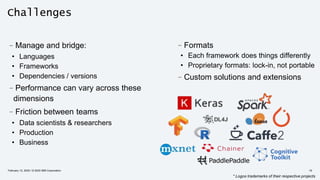
Challenges
February 12, 2020 / © 2020 IBM Corporation
–Formats
• Each framework does things differently
• Proprietary formats: lock-in, not portable
–Custom solutions and extensions
–Manage and bridge:
• Languages
• Frameworks
• Dependencies / versions
–Performance can vary across these
dimensions
–Friction between teams
• Data scientists & researchers
• Production
• Business
* Logos trademarks of their respective projects
19
Containers for ML
Deployment
IBM Developer / © 2020 IBM Corporation 20
Containers are “The Solution”
… right?
–But …
• What goes in the container is still the
most important factor
• Performance can be highly variable
across language, framework, version
• Requires devops knowledge, CI /
deployment pipelines, good practices
• Does not solve the issue of
standardization
• Formats
• APIs exposed
• A serving framework is still required on
top
–Container-based deployment has
significant benefits
• Repeatability
• Ease of configuration
• Separation of concerns – focus on what,
not how
• Allow data scientists & researchers to use
their language / framework of choice
• Container frameworks take care of
(certain) monitoring, fault tolerance, HA,
etc.
IBM Developer / © 2020 IBM Corporation 21
Open Standards for
Model Serialization &
Deployment
IBM Developer / © 2020 IBM Corporation 22
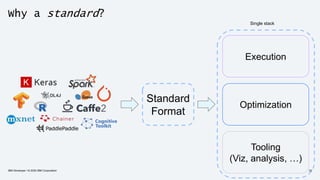
Why a standard?
Standard
Format
Execution
Optimization
Tooling
(Viz, analysis, …)
Single stack
IBM Developer / © 2020 IBM Corporation 23
Why an Open Standard?
–Open-source vs open standard
–Open source (license) is only one
aspect
• OSS licensing allows free use,
modification
• Inspect the code etc
• … but may not have any control
–Open governance is critical
• Avoid concentration of control (typically
by large companies, vendors)
• Visibility of development processes,
strategic planning, roadmaps
–However there are downsides
• Standard needs wide adoption and critical
mass to succeed
• A standard can move slowly in terms of
new features, fixes and enhancements
• Design by committee
• Keeping up with pace of framework
development
IBM Developer / © 2020 IBM Corporation 24
Open Neural Network Exchange (ONNX)
–Established 2017 by Facebook &
Microsoft
–Protobuf for serialization format and
type specification
–Describes
• computation graph (inputs, outputs,
operators) - DAG
• values (weights)
–Serialized graph is self-contained
IBM Developer / © 2020 IBM Corporation 25
–Focused on Deep Learning / tensor
operations
–Baked into PyTorch from 1.0.0 /
Caffe2 as the serialization &
interchange format
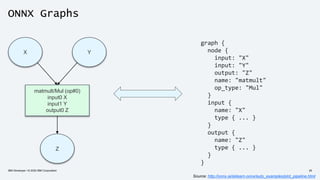
ONNX Graphs
IBM Developer / © 2020 IBM Corporation 26
matmult/Mul (op#0)
input0 X
input1 Y
output0 Z
X
Z
Y
Source: http://onnx.ai/sklearn-onnx/auto_examples/plot_pipeline.html
graph {
node {
input: "X"
input: "Y"
output: "Z"
name: "matmult"
op_type: "Mul"
}
input {
name: "X"
type { ... }
}
output {
name: "Z"
type { ... }
}
}
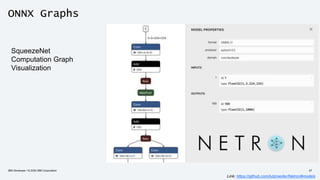
ONNX Graphs
Link: https://github.com/lutzroeder/Netron#models
SqueezeNet
Computation Graph
Visualization
IBM Developer / © 2020 IBM Corporation 27
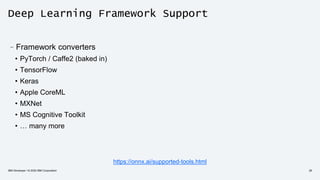
Deep Learning Framework Support
–Framework converters
• PyTorch / Caffe2 (baked in)
• TensorFlow
• Keras
• Apple CoreML
• MXNet
• MS Cognitive Toolkit
• … many more
IBM Developer / © 2020 IBM Corporation 28
https://onnx.ai/supported-tools.html
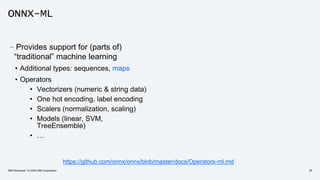
ONNX-ML
–Provides support for (parts of)
“traditional” machine learning
• Additional types: sequences, maps
• Operators
• Vectorizers (numeric & string data)
• One hot encoding, label encoding
• Scalers (normalization, scaling)
• Models (linear, SVM,
TreeEnsemble)
• …
https://github.com/onnx/onnx/blob/master/docs/Operators-ml.md
IBM Developer / © 2020 IBM Corporation 29
ONNX-ML
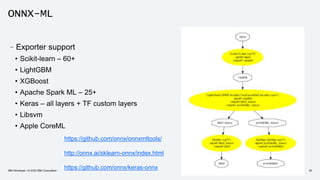
–Exporter support
• Scikit-learn – 60+
• LightGBM
• XGBoost
• Apache Spark ML – 25+
• Keras – all layers + TF custom layers
• Libsvm
• Apple CoreML
https://github.com/onnx/onnxmltools/
http://onnx.ai/sklearn-onnx/index.html
https://github.com/onnx/keras-onnxIBM Developer / © 2020 IBM Corporation 30
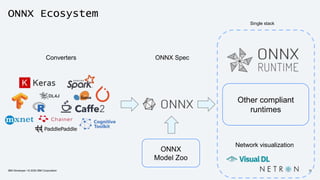
ONNX Ecosystem
Other compliant
runtimes
Single stack
IBM Developer / © 2020 IBM Corporation 31
Network visualization
Converters ONNX Spec
ONNX
Model Zoo
ONNX Open Governance
–ONNX Standard joined Linux
Foundation AI, Nov 2019
• Multiple vendors
• High level steering committee
• Special Interest Groups (SIGs)
–Architecture & Infra
–Converters
–Operators
–Models & Tutorials
• Working groups – e.g. training, pipelines
https://lfai.foundation/press-release/2019/11/14/lf-ai-welcomes-onnx/
IBM Developer / © 2020 IBM Corporation 32
–Other ecosystem components not part
of LFAI (as yet)
• Converter projects
• ONNX Runtime
• Other runtimes
ONNX Missing Pieces
–ONNX
• Operator / converter coverage
– e.g. TensorFlow coverage
• Image processing
– Support for basic resize, crop
– No support for reading image directly (like
tf.image.decode_jpeg)
• String processing
• Comprehensive benchmarks
IBM Developer / © 2020 IBM Corporation 33
–ONNX-ML
• Types
– datetime
• Operators
– String processing / NLP – e.g. tokenization
– Hashing
– Clustering models
• Specific exporters
– Apache Spark ML – python only
– Very basic tokenization in sklearn
– No support for Keras tokenizer
• Combining frameworks
– Still ad-hoc, requires custom code
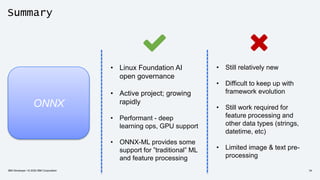
Summary
ONNX
• Linux Foundation AI
open governance
• Active project; growing
rapidly
• Performant - deep
learning ops, GPU support
• ONNX-ML provides some
support for ”traditional” ML
and feature processing
• Still relatively new
• Difficult to keep up with
framework evolution
• Still work required for
feature processing and
other data types (strings,
datetime, etc)
• Limited image & text pre-
processing
IBM Developer / © 2020 IBM Corporation 34
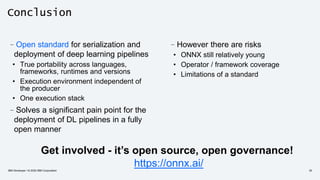
Conclusion
–However there are risks
• ONNX still relatively young
• Operator / framework coverage
• Limitations of a standard
–Open standard for serialization and
deployment of deep learning pipelines
• True portability across languages,
frameworks, runtimes and versions
• Execution environment independent of
the producer
• One execution stack
–Solves a significant pain point for the
deployment of DL pipelines in a fully
open manner
Get involved - it’s open source, open governance!
https://onnx.ai/IBM Developer / © 2020 IBM Corporation 35
Thank you
IBM Developer / © 2020 IBM Corporation
codait.org
twitter.com/MLnick
github.com/MLnick
developer.ibm.com
36
IBM Developer / © 2020 IBM Corporation 37

End-to-End Deep Learning Deployment with ONNX

  • 1.
    End-to-end deep learning deployment withONNX — Nick Pentreath Principal Engineer @MLnick
  • 2.
    About IBM Developer /© 2020 IBM Corporation –@MLnick on Twitter & Github –Principal Engineer, IBM CODAIT (Center for Open-Source Data & AI Technologies) –Machine Learning & AI –Apache Spark committer & PMC –Author of Machine Learning with Spark –Various conferences & meetups 2
  • 3.
    CODAIT Improving the EnterpriseAI Lifecycle in Open Source Center for Open Source Data & AI Technologies IBM Developer / © 2020 IBM Corporation 3 CODAIT aims to make AI solutions dramatically easier to create, deploy, and manage in the enterprise. We contribute to and advocate for the open-source technologies that are foundational to IBM’s AI offerings. 30+ open-source developers!
  • 4.
    The Machine Learning Workflow IBMDeveloper / © 2020 IBM Corporation 4
  • 5.
    Perception IBM Developer /© 2020 IBM Corporation 5
  • 6.
    In reality the workflowspans teams … IBM Developer / © 2020 IBM Corporation 6
  • 7.
    … and tools… IBM Developer / © 2020 IBM Corporation 7
  • 8.
    … and isa small (but critical!) piece of the puzzle *Source: Hidden Technical Debt in Machine Learning Systems IBM Developer / © 2020 IBM Corporation 8
  • 9.
    Machine Learning Deployment IBM Developer/ © 2020 IBM Corporation 9
  • 10.
    What, Where, How? –Whatare you deploying? • What is a “model” –Where are you deploying? • Target environment (cloud, browser, edge) • Batch, streaming, real-time? –How are you deploying? • Devops / serving frameworks We will talk mostly about the what IBM Developer / © 2020 IBM Corporation 10
  • 11.
    What is a“model”? IBM Developer / © 2020 IBM Corporation 11
  • 12.
    Deep Learning doesn’tneed feature engineering or data processing … IBM Developer / © 2020 IBM Corporation 12 right?
  • 13.
    Deep learning pipeline? IBM Developer/ © 2020 IBM Corporation 13 Source: https://ai.googleblog.com/2016/03/train-your-own-image-classifier-with.html beagle: 0.82 Input image Inference Prediction
  • 14.
    Deep learning pipeline! IBM Developer/ © 2020 IBM Corporation 14 beagle: 0.82 basset: 0.09 bluetick: 0.07 ... Input image Image pre-processing Prediction Decode image Resize Normalization Convert types / format Inference Post-processing [0.2, 0.3, … ] (label, prob) Sort Label map PIL, OpenCV, tf.image, … Custom Python * Logos trademarks of their respective projects
  • 15.
    Image pre-processing IBM Developer/ © 2020 IBM Corporation 15 Decode image Resize Normalization Convert types / format vs Color mode cat: 0.45 beagle: 0.34 Decoding lib RGB BGR PIL vs OpenCV vs tf.image vs skimage libJPEG vs OpenCV INTEGER_FAST vs INTEGER_ACCURATE Data layout NCHW vs NHWC
  • 16.
    Image pre-processing IBM Developer/ © 2020 IBM Corporation 16 Decode image Resize Normalization Convert types / format Operation order Normalize INT pixels (128) Convert Float32 Convert Float32 Normalize float (0.5)
  • 17.
    Inference post- processing IBM Developer/ © 2020 IBM Corporation 17 Convert to numpy array [0.2, 0.3, … ] (label, prob) Sort Label map Custom loading label mapping / vocab / … TF SavedModel (assets) Keras decode_predictions Custom code Custom code
  • 18.
    Pipelines, not Models –Deployingjust the model is not enough –Entire pipeline must be deployed • Data transforms • Feature extraction & pre-processing • DL / ML model • Prediction transformation –Even ETL is part of the pipeline! –Pipelines in frameworks • scikit-learn • Spark ML pipelines • TensorFlow Transform • pipeliner (R) IBM Developer / © 2020 IBM Corporation 18
  • 19.
    Challenges February 12, 2020/ © 2020 IBM Corporation –Formats • Each framework does things differently • Proprietary formats: lock-in, not portable –Custom solutions and extensions –Manage and bridge: • Languages • Frameworks • Dependencies / versions –Performance can vary across these dimensions –Friction between teams • Data scientists & researchers • Production • Business * Logos trademarks of their respective projects 19
  • 20.
    Containers for ML Deployment IBMDeveloper / © 2020 IBM Corporation 20
  • 21.
    Containers are “TheSolution” … right? –But … • What goes in the container is still the most important factor • Performance can be highly variable across language, framework, version • Requires devops knowledge, CI / deployment pipelines, good practices • Does not solve the issue of standardization • Formats • APIs exposed • A serving framework is still required on top –Container-based deployment has significant benefits • Repeatability • Ease of configuration • Separation of concerns – focus on what, not how • Allow data scientists & researchers to use their language / framework of choice • Container frameworks take care of (certain) monitoring, fault tolerance, HA, etc. IBM Developer / © 2020 IBM Corporation 21
  • 22.
    Open Standards for ModelSerialization & Deployment IBM Developer / © 2020 IBM Corporation 22
  • 23.
    Why a standard? Standard Format Execution Optimization Tooling (Viz,analysis, …) Single stack IBM Developer / © 2020 IBM Corporation 23
  • 24.
    Why an OpenStandard? –Open-source vs open standard –Open source (license) is only one aspect • OSS licensing allows free use, modification • Inspect the code etc • … but may not have any control –Open governance is critical • Avoid concentration of control (typically by large companies, vendors) • Visibility of development processes, strategic planning, roadmaps –However there are downsides • Standard needs wide adoption and critical mass to succeed • A standard can move slowly in terms of new features, fixes and enhancements • Design by committee • Keeping up with pace of framework development IBM Developer / © 2020 IBM Corporation 24
  • 25.
    Open Neural NetworkExchange (ONNX) –Established 2017 by Facebook & Microsoft –Protobuf for serialization format and type specification –Describes • computation graph (inputs, outputs, operators) - DAG • values (weights) –Serialized graph is self-contained IBM Developer / © 2020 IBM Corporation 25 –Focused on Deep Learning / tensor operations –Baked into PyTorch from 1.0.0 / Caffe2 as the serialization & interchange format
  • 26.
    ONNX Graphs IBM Developer/ © 2020 IBM Corporation 26 matmult/Mul (op#0) input0 X input1 Y output0 Z X Z Y Source: http://onnx.ai/sklearn-onnx/auto_examples/plot_pipeline.html graph { node { input: "X" input: "Y" output: "Z" name: "matmult" op_type: "Mul" } input { name: "X" type { ... } } output { name: "Z" type { ... } } }
  • 27.
    ONNX Graphs Link: https://github.com/lutzroeder/Netron#models SqueezeNet ComputationGraph Visualization IBM Developer / © 2020 IBM Corporation 27
  • 28.
    Deep Learning FrameworkSupport –Framework converters • PyTorch / Caffe2 (baked in) • TensorFlow • Keras • Apple CoreML • MXNet • MS Cognitive Toolkit • … many more IBM Developer / © 2020 IBM Corporation 28 https://onnx.ai/supported-tools.html
  • 29.
    ONNX-ML –Provides support for(parts of) “traditional” machine learning • Additional types: sequences, maps • Operators • Vectorizers (numeric & string data) • One hot encoding, label encoding • Scalers (normalization, scaling) • Models (linear, SVM, TreeEnsemble) • … https://github.com/onnx/onnx/blob/master/docs/Operators-ml.md IBM Developer / © 2020 IBM Corporation 29
  • 30.
    ONNX-ML –Exporter support • Scikit-learn– 60+ • LightGBM • XGBoost • Apache Spark ML – 25+ • Keras – all layers + TF custom layers • Libsvm • Apple CoreML https://github.com/onnx/onnxmltools/ http://onnx.ai/sklearn-onnx/index.html https://github.com/onnx/keras-onnxIBM Developer / © 2020 IBM Corporation 30
  • 31.
    ONNX Ecosystem Other compliant runtimes Singlestack IBM Developer / © 2020 IBM Corporation 31 Network visualization Converters ONNX Spec ONNX Model Zoo
  • 32.
    ONNX Open Governance –ONNXStandard joined Linux Foundation AI, Nov 2019 • Multiple vendors • High level steering committee • Special Interest Groups (SIGs) –Architecture & Infra –Converters –Operators –Models & Tutorials • Working groups – e.g. training, pipelines https://lfai.foundation/press-release/2019/11/14/lf-ai-welcomes-onnx/ IBM Developer / © 2020 IBM Corporation 32 –Other ecosystem components not part of LFAI (as yet) • Converter projects • ONNX Runtime • Other runtimes
  • 33.
    ONNX Missing Pieces –ONNX •Operator / converter coverage – e.g. TensorFlow coverage • Image processing – Support for basic resize, crop – No support for reading image directly (like tf.image.decode_jpeg) • String processing • Comprehensive benchmarks IBM Developer / © 2020 IBM Corporation 33 –ONNX-ML • Types – datetime • Operators – String processing / NLP – e.g. tokenization – Hashing – Clustering models • Specific exporters – Apache Spark ML – python only – Very basic tokenization in sklearn – No support for Keras tokenizer • Combining frameworks – Still ad-hoc, requires custom code
  • 34.
    Summary ONNX • Linux FoundationAI open governance • Active project; growing rapidly • Performant - deep learning ops, GPU support • ONNX-ML provides some support for ”traditional” ML and feature processing • Still relatively new • Difficult to keep up with framework evolution • Still work required for feature processing and other data types (strings, datetime, etc) • Limited image & text pre- processing IBM Developer / © 2020 IBM Corporation 34
  • 35.
    Conclusion –However there arerisks • ONNX still relatively young • Operator / framework coverage • Limitations of a standard –Open standard for serialization and deployment of deep learning pipelines • True portability across languages, frameworks, runtimes and versions • Execution environment independent of the producer • One execution stack –Solves a significant pain point for the deployment of DL pipelines in a fully open manner Get involved - it’s open source, open governance! https://onnx.ai/IBM Developer / © 2020 IBM Corporation 35
  • 36.
    Thank you IBM Developer/ © 2020 IBM Corporation codait.org twitter.com/MLnick github.com/MLnick developer.ibm.com 36
  • 37.
    IBM Developer /© 2020 IBM Corporation 37

Editor's Notes

  • #20 Data scientists & researchers – latest & greatest Production – stability, control, minimize changes, performance Business – metrics, business impact, product must always work!
  • #24 Separation of concerns Portability of models Ability to build a single, optimized stack of components for: Model execution Model analysis, visualization Monitoring