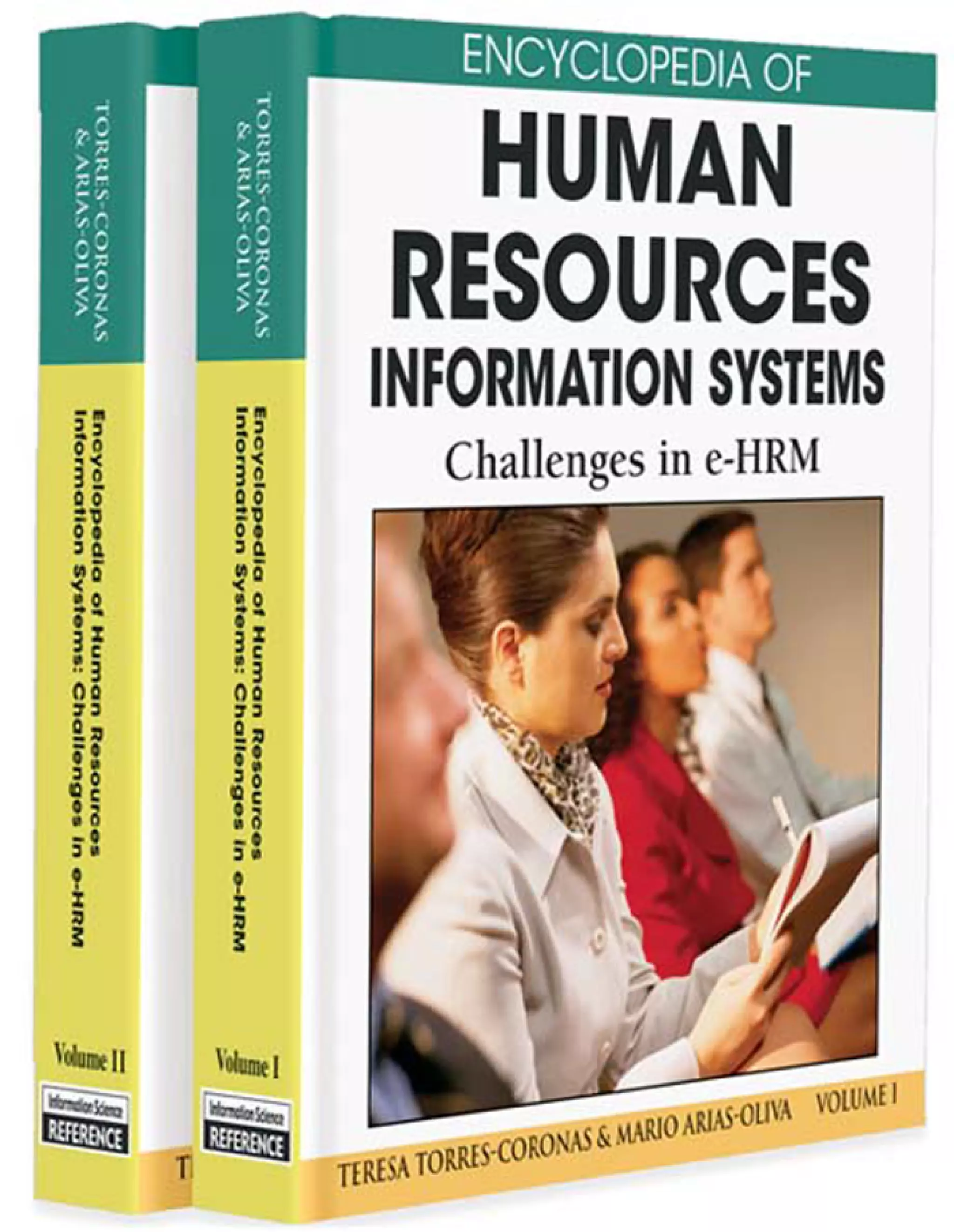




Encyclopedia of
Human Resources
Information Systems:
Challenges in e-HRM
Teresa Torres-Coronas
Universitat Rovira i Virgili, Spain
Mario Arias-Oliva
Universitat Rovira i Virgili, Spain
Hershey • New York
InformatIon ScIence reference
Volume I
A-H
Director of Editorial Content: Kristin Klinger
Development Editor: Kristin Roth
Senior Managing Editor: Jennifer Neidig
Managing Editor: Jamie Snavely
Assistant Managing Editor: Carole Coulson
Copy Editor: Ashlee Kunkel, Joy Langel, Larissa Vinci
Typesetter: Mike Brehm, Larissa Vinci
Cover Design: Lisa Tosheff
Printed at: Yurchak Printing Inc.
Published in the United States of America by
Information Science Reference (an imprint of IGI Global)
701 E. Chocolate Avenue, Suite 200
Hershey PA 17033
Tel: 717-533-8845
Fax: 717-533-8661
E-mail: cust@igi-global.com
Web site: http://www.igi-global.com/reference
and in the United Kingdom by
Information Science Reference (an imprint of IGI Global)
3 Henrietta Street
Covent Garden
London WC2E 8LU
Tel: 44 20 7240 0856
Fax: 44 20 7379 0609
Web site: http://www.eurospanbookstore.com
Copyright © 2009 by IGI Global. All rights reserved. No part of this publication may be reproduced, stored or distributed in any form or by any
means, electronic or mechanical, including photocopying, without written permission from the publisher.
Product or company names used in this set are for identification purposes only. Inclusion of the names of the products or companies does not indicate
a claim of ownership by IGI Global of the trademark or registered trademark.
Library of Congress Cataloging-in-Publication Data
Encyclopedia of human resources information systems : challenges in e-HRM / Teresa Torres-Coronas and Mario Arias-Oliva, editors.
p. cm.
Includes bibliographical references and index.
Summary: "This work rigorously analyzes key critical HR variables and defines previously undiscovered issues in the HR field"--Provided by
publisher.
ISBN 978-1-59904-883-3 (hardcover) -- ISBN 978-1-59904-884-0 (ebook)
1. Personnel management--Data processing--Encyclopedias. 2. Information storage and retrieval systems--Personnel management--Encyclopedias. 3.
Management information systems--Encyclopedias.. 4. Knowledge workers--Management--Encyclopedias. I. Torres-Coronas, Teresa, 1966- II. Arias-
Oliva, Mario, 1968-
HF5549.5.D37E53 2008
658.3--dc22
2008007630
British Cataloguing in Publication Data
A Cataloguing in Publication record for this book is available from the British Library.
All work contributed to this encyclopedia set is new, previously-unpublished material. The views expressed in this encyclopedia set are those of the
authors, but not necessarily of the publisher.
If a library purchased a print copy of this publication, please go to http://www.igi-global.com/agreement for information on activating
the library's complimentary electronic access to this publication.
Editorial Advisory Board
Joan R. Alabart
Universitat Rovira i Virgili, Spain
Ignacio Arellano Salafranca
Member of the Board of Cegos Partners, France & Consultant Director of Tea-Cegos, S.A., Spain
T.V. (Tanya) Bondarouk
University of Twente, The Netherlands
José R. Córdoba-Pachón
Centre for Systems Studies, UK
Mila Gascó-Hernández
Open University of Catalonia, Spain
Kiyoshi Murata
Meiji University, Japan
Miguel R. Olivas-Lujan
Clarion University of Pennsylvania, USA
Simon Rogerson
De Montfort University, UK
Raymond Saner
Centre for Socio-Eco-Nomic Development (CSEND), Switzerland
List of Contributors
Abiodun Bello, Joseph / Covenant University, Ota, Nigeria..................................................................178, 803
Adenike, Adeniji Anthonia / Covenant University, Ota, Nigeria...........................................................178, 842
Ahituv, Niv / Tel Aviv University, Israel..........................................................................................................510
Alves Silva, José Antonio / Independent Consultant, Brazil.............................................................................70
Aneas, Maria Assumpta / Universitat de Barcelona, Spain...........................................................................563
Araujo, Andre L. / The College of William & Mary, USA..............................................................................495
Arora, Punit / Syracuse University, USA........................................................................................................327
Benito Osorio, Diana / Universidad Rey Juan Carlos-Madrid, Spain............................................................102
Berio, Giuseppe / Università di Torino, Italy..................................................................................................538
Blanco Callejo, Miguel / Rey Juan Carlos University, Spain.........................................................................434
Bocatto, Evandro / Universitat Rovira i Virgili, Spain...................................................................................733
Bondarouk, Tanya / University of Twente, The Netherlands..........................................................................197
Burakova-Lorgnier, Marina / ECE-INSEEC Research Laboratory, University of Montesquieu
Bordeaux 4, France...........................................................................................................................................203
Burbach, Ralf / Institute of Technology Carlow, Ireland..................................................................................56
Burgard, Martin / Saarland University, Germany..........................................................................................223
Cadagan García, Mariangélica / University of La Laguna, Spain................................................................632
Cameron, Brian H. / The Pennsylvania State University, USA......................................................................350
Campderrich, Benet / Universitat Rovira i Virgili, Spain..............................................................................488
Canós-Darós, Lourdes / Polytechnic University of Valencia, Spain................................................................77
Caporarello, Leonardo / Bocconi University, Italy........................................................................................420
Capriotti, Paul / Universitat Rovira i Virgili, Spain........................................................................................248
Carretero-Gómez, José M. / University of the Balearic Islands, Spain.........................................................898
Carroll, Wendy R. / Acadia University, Canada.............................................................................................191
Casado-Lumbreras, Cristina / Universidad Complutense, Madrid, Spain...................................................166
Case, Thomas L. / Georgia Southern University, USA...........................................................................307, 378
Castilla-Polo, Francisca / University of Jaén, Spain......................................................................................547
Cegielski, Casey G. / Auburn University, USA................................................................................................386
Chung, Chen H. / University of Kentucky, USA..............................................................................................301
Colomo-Palacios, Ricardo / Universidad de Carlos III, Madrid, Spain........................................................166
Córdoba, José-Rodrigo / University of Hull, UK...................................................................................855, 891
Costa, Gonçalo / De Montfort University, UK.................................................................................................142
Cox, Sharon / Birmingham City University, UK.......................................................................................63, 598
Crawford-Mathis, Krista J. / Capella University, USA.........................................................................161, 836
Crisóstomo-Acevedo, María José / Jerez Hospital, Spain.............................................................................830
de Juana-Espinosa, Susana / University of Alicante, Spain.....................................................................77, 399
Deakins, Eric / University of Waikato, New Zealand......................................................................................525
del Carmen Triana, María / Texas A&M University, USA.............................................................................693
Dick, Geoffrey N. / Australian School of Business, Australia.........................................................................378
Diederichsen, Anke / Saarland University, Germany.....................................................................................154
Dologite, Dorothy G. / City University of New York, USA..............................................................................649
Dundon, Tony / National University of Ireland-Galway, Ireland......................................................................56
Ebner, Noam / Tachlit Mediation and Negotiation Training, Israel...............................................................668
Edelstein Henry, Lauren / The Pennsylvania State University, USA.............................................................862
Efendioglu, Alev M. / University of San Francisco, USA.................................................................................12
Etzion, Dalia / Tel Aviv University, Israel........................................................................................................510
Evans, Monica / University of Mississippi, USA.............................................................................................471
Ezzedeen, Souha R. / York University, Canada...............................................................................................272
Fedorovich, Shirley / Embry-Riddle University, USA.....................................................................................451
Fernández-Sánchez, José Antonio / University of Alicante, Spain................................................................399
Florkowski, Gary W. / Katz Graduate School of Business, USA....................................................................242
Fritsch, Kerstin / Johann Wolfgang Goethe University, Germany.................................................................406
Galanaki, Eleanna / Athens University of Economics and Business, Greece...................................................24
Galla, Donna / Nova Southeastern University, USA........................................................................................373
Gallardo-Vázquez, Dolores / University of Extremadura, Spain...................................................................547
Garcia-Cresco, Angel / Universidad de Carlos III, Madrid, Spain................................................................166
Gibney, Ray / The Pennsylvania State University at Harrisburg, USA...........................................................797
Gilbert, Jacqueline A. / Middle Tennessee State University, USA..................................................................131
Gómez-Berbers, Juan Miguel / Universidad de Carlos III, Madrid, Spain...................................................166
González-Benito, Óscar / University of Salamanca, Spain............................................................................185
Guilloux, Veronique / Université Paris 12, France............................................................................7, 477, 746
Guzman, Indira R. / TUI University, USA......................................................................................................661
Hall, Bettie C. / HI Consulting, USA...............................................................................................216, 321, 725
Hall, Dianne / Auburn University, USA...........................................................................................................386
Harold, Crystal M. / Indiana University-Purdue University Indianapolis, USA............................................334
Härtel, Charmine E. J. / Monash University, Australia.................................................................................457
Harzallah, Mounira / Laboratoire d’informatique de Nantes Atlantique, France.........................................538
Hoell, Robert / Georgia Southern University, USA.........................................................................................307
Hooper, Val / Victoria University of Wellington, New Zealand.........................................................................31
Hsu, Jeffrey / Fairleigh Dickinson University, USA.......................................................................................557
Hurley-Hanson, Amy E. / Chapman University, USA....................................................................................764
Inskeep, Nancy A. / HI Consulting, USA........................................................................................216, 321, 725
Javier Forcadell, Francisco / Universidad Rey Juan Carlos, Spain..............................................................682
Jeffries, Michael / The University of Tampa, USA..........................................................................................230
Jiménez-Zarco, Ana Isabel / Open University of Catalonia, Spain...............................................................185
Joia, Luiz Antonio / Brazilian School of Public and Business Administration-Getulio Vargas
Foundation, Brazil & Rio de Janeiro State University, Brazil...........................................................................70
Joseph, Rhoda C. / The Pennsylvania State University Harrisburg, USA......................................................272
Kalika, Michel / Université Paris, France..........................................................................................7, 477, 746
Katou, Anastasia A. / University of Macedonia, Greece................................................................................363
Keim, Tobias / Johann Wolfgang Goethe University, Germany................................................................18, 406
Kesti, Marko / University of Lapland, Finland...............................................................................................293
Kettunen, Juha / Turku University of Applied Sciences, Finland...................................................................464
King, James J. / University of Georgia, USA..................................................................................................236
King, Kathleen P. / Fordham University, USA................................................................................236, 705, 871
Knight, Shaun C. / The Pennsylvania State University, USA.........................................................................350
Kratzer, J. / University of Groningen, The Netherlands..................................................................................676
Lang, Rainhart / Chemnitz University of Technology, Germany......................................................................48
Lastres Segret, José A. / University of La Laguna, Spain.......................................................................532, 632
Lau, Gloria / Victoria University of Wellington, New Zealand.........................................................................31
Laval, Florence / IAE Poitiers, France...........................................................................................................746
Lee, Doris / The Pennsylvania State University, USA......................................................................................862
Leenders, Roger Th. A. J. / University of Groningen, The Netherlands................................................210, 676
Leray, Yvan / Université de Bretagne Occidentale, France............................................................................739
Liang, Xiaoya / Fudan University, China........................................................................................................877
Looise, Jan Kees / University of Twente, The Netherlands.............................................................................197
Lunce, Stephen / Midwestern State University, USA......................................................................................518
Mackenzie, Kenneth D. / University of Kansas, USA.....................................................................................256
Mainiero, Lisa A. / Charles F. Dolan School of Business, USA......................................................................584
Manley, Gregory G. / University of Texas at San Antonio, USA....................................................................482
Maria Sacco, Giovanni / Università di Torino, Italy......................................................................................538
Marie Dixon, Pamela / Wayne State College, USA.........................................................................................770
Márquez-García, Alfonso Miguel / University of Jaén, Spain.......................................................................883
Martínez-Ruiz, María Pilar / University of Castilla-La Mancha, Spain.......................................................185
Masters, Marick F. / University of Pittsburgh, USA.......................................................................................797
Mayfield, Jacqueline / Texas A&M International University, USA................................................................518
Mayfield, Milton / Texas A&M International University, USA.......................................................................518
Medina-Garrido, José Aurelio / Cadiz University, Spain..............................................................................830
Meroño-Cerdán, Ángel L. / Universidad de Murcia, Spain...........................................................................611
Mesquita, Anabela / ISCAP / IPP, Portugal & Universidade do Minho, Portugal........................................775
Mishra, Alok / Atilim University, Turkey.........................................................................................................286
Mockler, Robert J. / St. John’s University, USA.............................................................................................649
Murray, L. W. / University of San Francisco, USA...........................................................................................12
Nilson, Todd / Talent Acquisition Partners, USA................................................................................................1
Nolan, Kevin P. / Bowling Green State University, USA.................................................................................334
Novicevic, Milorad / University of Mississippi, USA......................................................................................471
Nthogo Lekoko, Rebecca / University of Botswana, Gaborne, Botswana.....................................................817
Núñez-Gorrín, José M. / University of La Laguna, Tenerife, Spain...............................................................532
O’Neill, Bonnie S. / Marquette University, USA.................................................................................................1
Oiry, Ewan / Université de la Méditerranée, France......................................................................................136
Olivas-Luján, Miguel R. / Clarion University of Pennsylvania, USA & Techológico de Monterrey,
México...............................................................................................................................................................242
Ostermann, Herwig / University for Health Sciences, Medical Informatics, and Technology,
Austria......................................................................................................................................... 92, 117, 340, 711
Othman, Siti Zubaidah / The University of Western Australia, Australia......................................................699
Oyegoke Akinyemi, Benjamin / Commonwealth Open University, British Virgin Island, UK..............441, 640
Özbek, Ahmet / Iremis Consultancy, Turkey...................................................................................................278
Panayotopoulou, Leda / Athens University of Economics and Business, Greece............................................24
Panina, Daria / Mays Business School, USA...................................................................................................314
Papp, Raymond / The University of Tampa, USA...........................................................................................230
Parry, Emma / Cranfield School of Management, UK....................................................................................110
Pate, Larry E. / Loyola Marymount University, USA.....................................................................................256
Paul, Anda / University of Erlangen-Nuremberg, Germany............................................................................267
Pennarola, Ferdinando / Bocconi University, Italy........................................................................................420
Pérez-de-Toledo, Eloísa / Universitat Rovira i Virgili, Spain.........................................................................733
Pérez-Montoro, Mario / University of Barcelona, Spain...............................................................................605
Perkins, John / Newman University College, UK...........................................................................................598
Piazza, Franca / Saarland University, Germany.............................................................................................223
Pollack, Jeffrey M. / Virginia Commonwealth University, USA.....................................................................504
Povalej, Roman / University of Karlsruhe (TH), Germany...............................................................................84
Provitera, Michael J. / Barry University, USA...............................................................................................719
Puck, Jonas F. / University of Erlangen-Nuremberg, Germany......................................................................267
Ramalho Correia, Ana Maria / Instituto Nacional de Engenharia, Tecnologia e Inovação (INETI),
Portugal & Universidade Nova de Lisboa, Portugal.......................................................................................775
Rao, Pramila / Marymount University, USA...................................................................................................357
Ready, Kathryn J. / Winona State University, USA........................................................................................471
Revilla, Elena / Instituto de Empresa, Spain...........................................................................................577, 791
Reynolds, Rosemarie / Embry-Riddle University, USA..................................................................................451
Rimbau-Gilabert, Eva / Open University of Catalonia (UOC), Spain...........................................................392
Ritter, Barbara A. / Coastal Carolina University, USA..................................................................................655
Ruta, Dino / Bocconi University, Italy.....................................................................................................428, 687
Sanchez-Alarcos, José / Quasar Aviation, Spain....................................................................................577, 791
Saner, Raymond / Centre for Socio-Eco-Nomic Development (CSEND), Switzerland..........................623, 810
Sasovova, Zuzana / Vrije Universiteit Amsterdam, The Netherlands..............................................................210
Shelton, Paul M. / University of Central Oklahoma, USA..............................................................................770
Shwarts-Asher, Daphna / Tel Aviv University, Israel.....................................................................................510
Staudinger, Bettina / University for Health Sciences, Medical Informatics, and Technology,
Austria......................................................................................................................................... 92, 117, 340, 711
Staudinger, Roland / University for Health Sciences, Medical Informatics, and Technology,
Austria......................................................................................................................................... 92, 117, 340, 711
Stenvall, Jari / University of Lapland, Finland...............................................................................................293
Stokes, Peter / University of Central Lancashire, UK.....................................................................................124
Strohmeier, Stefan / Saarland University, Germany.......................................................................................823
Sullivan, Sherry E. / Bowling Green State University, USA...........................................................................584
Syväjärvi, Antti / University of Lapland, Finland...........................................................................................293
Terjesen, Siri / Queensland University of Technology, Australia....................................................................584
Thoeni, Magdalena / University for Health Sciences, Medical Informatics, and Technology, Austria..........340
Urquiza, Alfonso / Universidad Francisco de Vitoria, Spain..........................................................................149
Valdés-Conca, Jorge / University of Alicante, Spain................................................................................77, 399
van Engelen, J.M.L. / University of Groningen, The Netherlands.................................................................676
Van Slyke, Craig / Saint Louis University, USA..............................................................................................378
Vilette, Marc-André / EUDICA, France & University of Savoie, France.....................................................784
Wald, Peter M. / University of Applied Sciences Dresden, Germany...............................................................48
Wang, John / Montclair State University, USA...............................................................................413, 557, 758
Wang, Victor C. X. / California State University, Long Beach, USA...............................42, 592, 617, 752, 849
Weiß, Peter / University of Karlsruhe (TH), Germany......................................................................................84
Weitzel, Tim / Otto Friedrich University Bamberg, Germany..........................................................................18
Wielki, Janusz / Opole University of Technology, Poland..............................................................................570
Williams, Michael / Embry-Riddle University, USA.......................................................................................451
Yamamoto, Gonca Telli / Okan University, Turkey.........................................................................................278
Yan, Ruiliang / Virginia State University, USA...............................................................................................758
Yang, Baiyin / Tsinghua University, China......................................................................................................172
Yao, James / Montclair State University, USA.........................................................................................413, 557
Yiu, Lichia / Centre for Socio-Eco-Nomic Development (CSEND), Switzerland...................................623, 810
Zagenczyk, Thomas / Clemson University, USA............................................................................................797
Zhang, Yanli / Montclair State University, USA..............................................................................................758
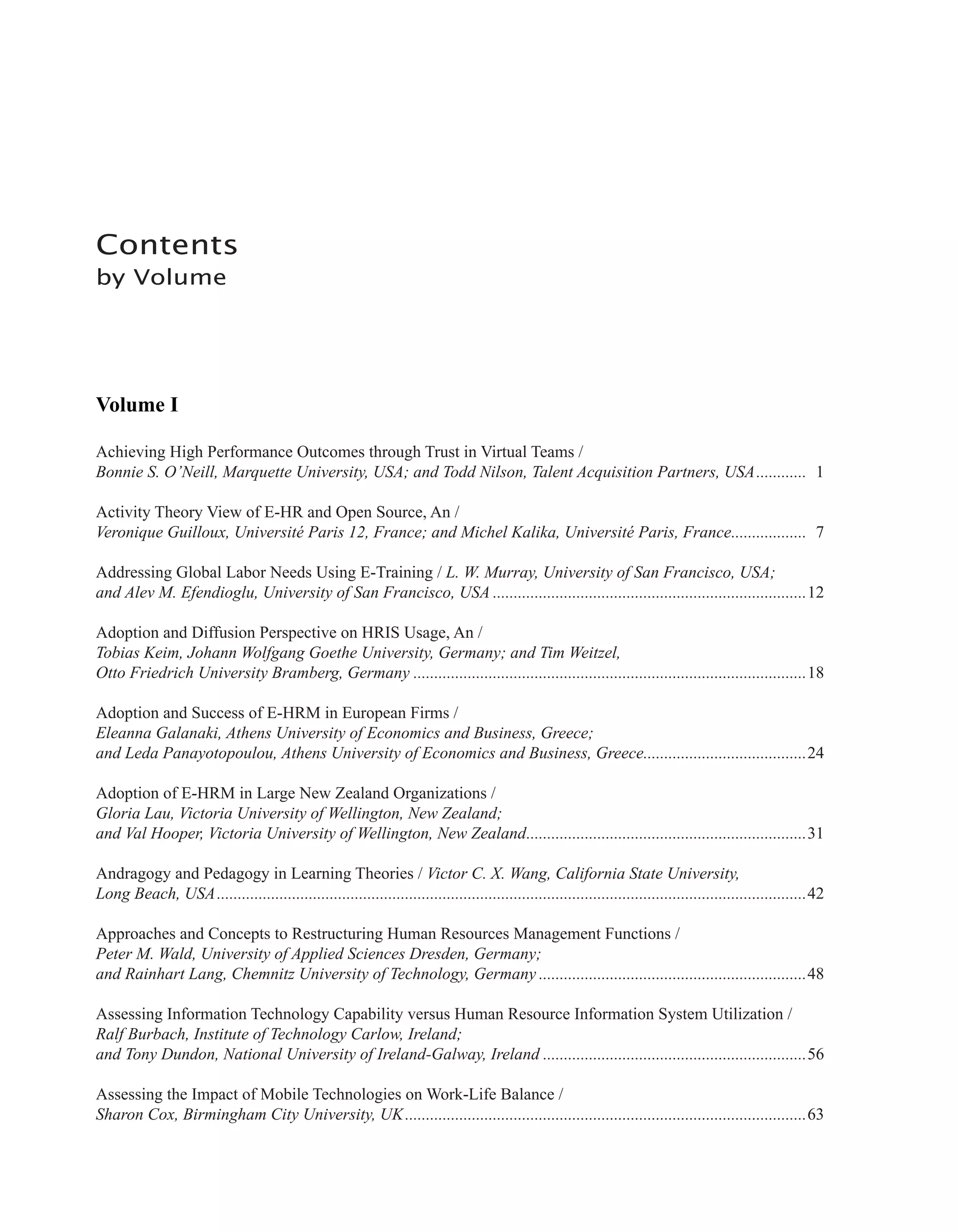
Contents
by Volume
Volume I
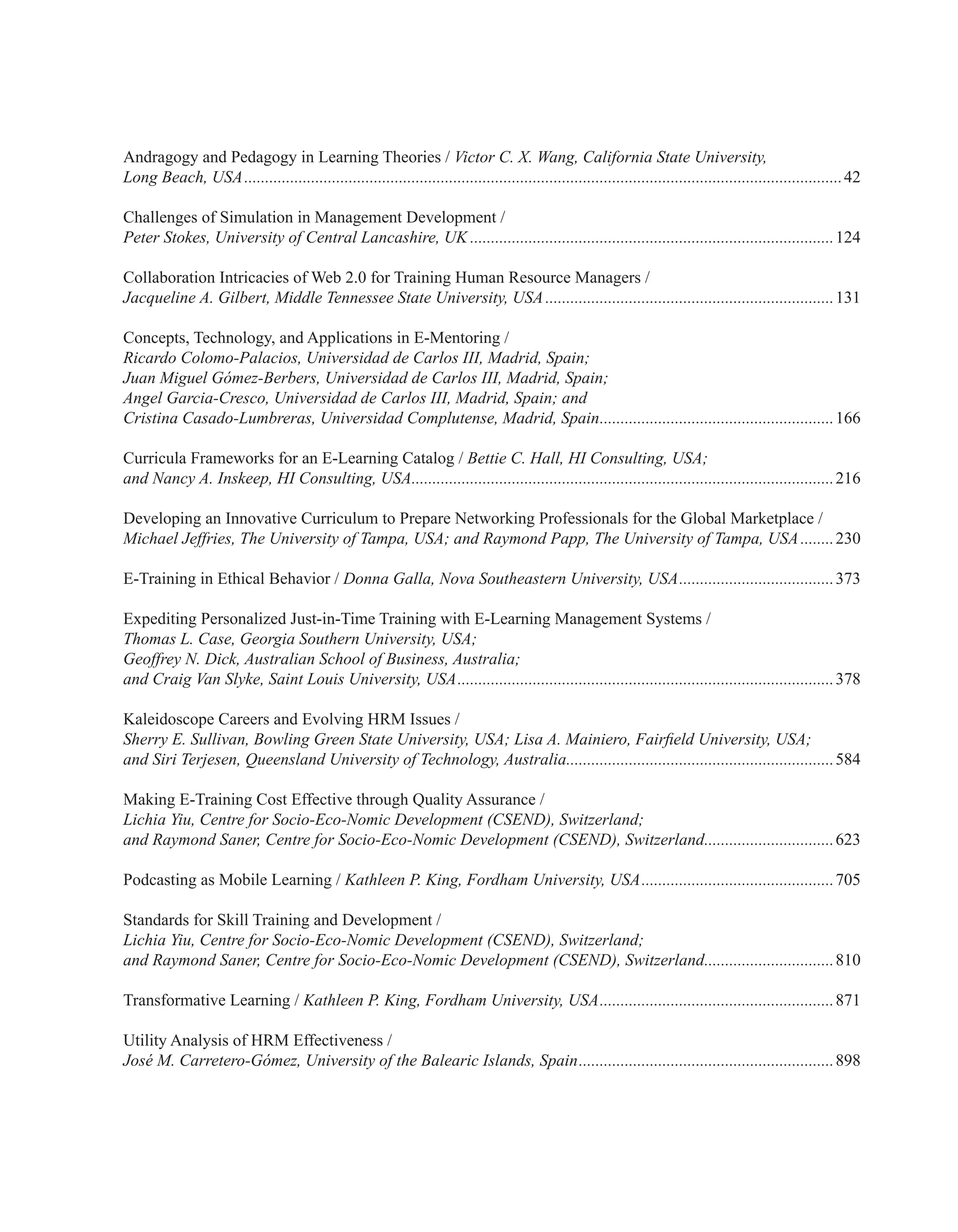
Achieving High Performance Outcomes through Trust in Virtual Teams /
Bonnie S. O’Neill, Marquette University, USA; and Todd Nilson, Talent Acquisition Partners, USA............. 1
Activity Theory View of E-HR and Open Source, An /
Veronique Guilloux, Université Paris 12, France; and Michel Kalika, Université Paris, France................... 7
Addressing Global Labor Needs Using E-Training / L. W. Murray, University of San Francisco, USA;
and Alev M. Efendioglu, University of San Francisco, USA............................................................................12
Adoption and Diffusion Perspective on HRIS Usage, An /
Tobias Keim, Johann Wolfgang Goethe University, Germany; and Tim Weitzel,
Otto Friedrich University Bramberg, Germany...............................................................................................18
Adoption and Success of E-HRM in European Firms /
Eleanna Galanaki, Athens University of Economics and Business, Greece;
and Leda Panayotopoulou, Athens University of Economics and Business, Greece........................................24
Adoption of E-HRM in Large New Zealand Organizations /
Gloria Lau, Victoria University of Wellington, New Zealand;
and Val Hooper, Victoria University of Wellington, New Zealand....................................................................31
Andragogy and Pedagogy in Learning Theories / Victor C. X. Wang, California State University,
Long Beach, USA..............................................................................................................................................42
Approaches and Concepts to Restructuring Human Resources Management Functions /
Peter M. Wald, University of Applied Sciences Dresden, Germany;
and Rainhart Lang, Chemnitz University of Technology, Germany.................................................................48
Assessing Information Technology Capability versus Human Resource Information System Utilization /
Ralf Burbach, Institute of Technology Carlow, Ireland;
and Tony Dundon, National University of Ireland-Galway, Ireland................................................................56
Assessing the Impact of Mobile Technologies on Work-Life Balance /
Sharon Cox, Birmingham City University, UK.................................................................................................63
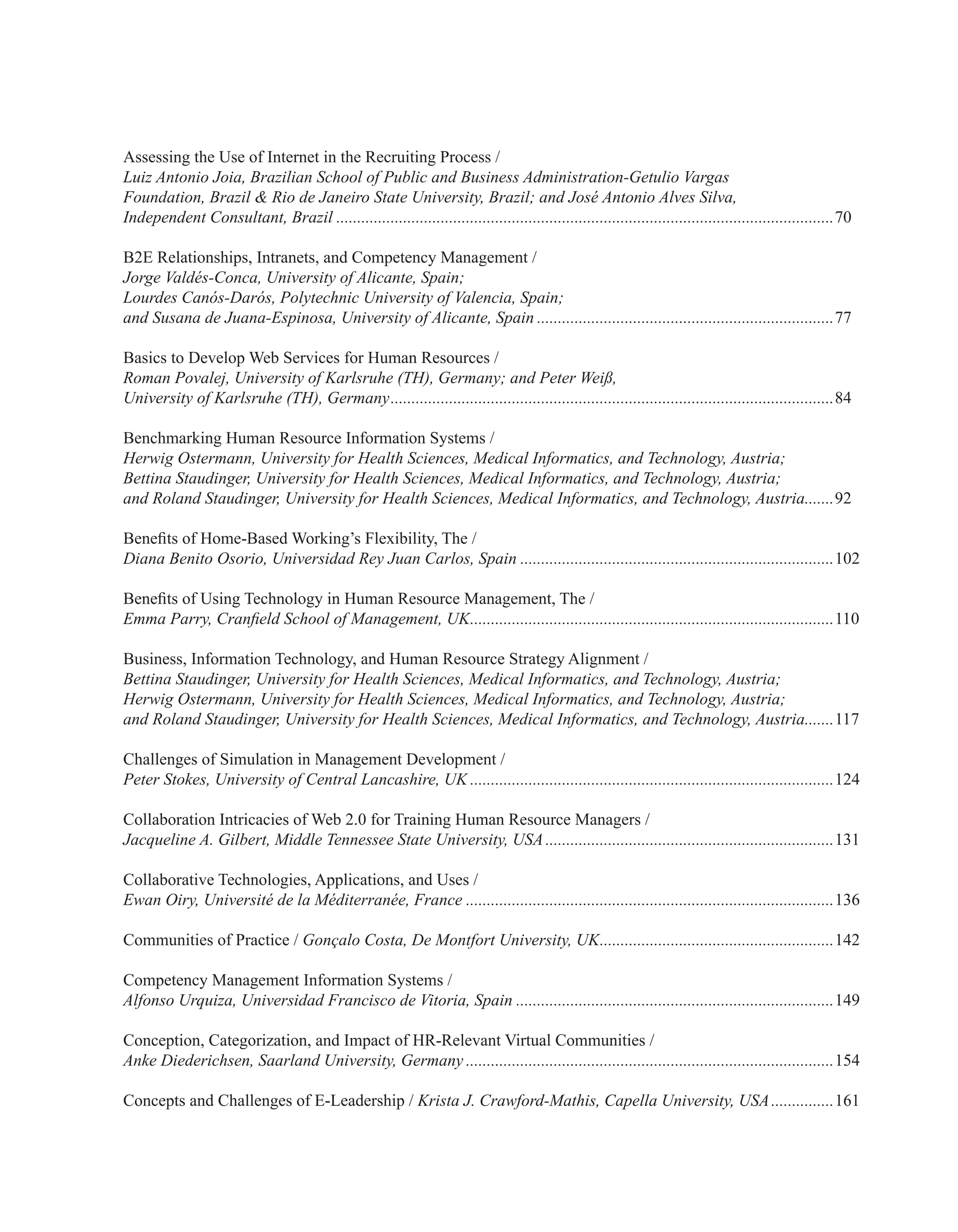
Assessing the Use of Internet in the Recruiting Process /
Luiz Antonio Joia, Brazilian School of Public and Business Administration-Getulio Vargas
Foundation, Brazil & Rio de Janeiro State University, Brazil; and José Antonio Alves Silva,
Independent Consultant, Brazil........................................................................................................................70
B2E Relationships, Intranets, and Competency Management /
Jorge Valdés-Conca, University of Alicante, Spain;
Lourdes Canós-Darós, Polytechnic University of Valencia, Spain;
and Susana de Juana-Espinosa, University of Alicante, Spain........................................................................77
Basics to Develop Web Services for Human Resources /
Roman Povalej, University of Karlsruhe (TH), Germany; and Peter Weiß,
University of Karlsruhe (TH), Germany...........................................................................................................84
Benchmarking Human Resource Information Systems /
Herwig Ostermann, University for Health Sciences, Medical Informatics, and Technology, Austria;
Bettina Staudinger, University for Health Sciences, Medical Informatics, and Technology, Austria;
and Roland Staudinger, University for Health Sciences, Medical Informatics, and Technology, Austria........92
Benefits of Home-Based Working’s Flexibility, The /
Diana Benito Osorio, Universidad Rey Juan Carlos, Spain............................................................................102
Benefits of Using Technology in Human Resource Management, The /
Emma Parry, Cranfield School of Management, UK........................................................................................110
Business, Information Technology, and Human Resource Strategy Alignment /
Bettina Staudinger, University for Health Sciences, Medical Informatics, and Technology, Austria;
Herwig Ostermann, University for Health Sciences, Medical Informatics, and Technology, Austria;
and Roland Staudinger, University for Health Sciences, Medical Informatics, and Technology, Austria........117
Challenges of Simulation in Management Development /
Peter Stokes, University of Central Lancashire, UK........................................................................................124
Collaboration Intricacies of Web 2.0 for Training Human Resource Managers /
Jacqueline A. Gilbert, Middle Tennessee State University, USA......................................................................131
Collaborative Technologies, Applications, and Uses /
Ewan Oiry, Université de la Méditerranée, France.........................................................................................136
Communities of Practice / Gonçalo Costa, De Montfort University, UK.........................................................142
Competency Management Information Systems /
Alfonso Urquiza, Universidad Francisco de Vitoria, Spain.............................................................................149
Conception, Categorization, and Impact of HR-Relevant Virtual Communities /
Anke Diederichsen, Saarland University, Germany.........................................................................................154
Concepts and Challenges of E-Leadership / Krista J. Crawford-Mathis, Capella University, USA................161
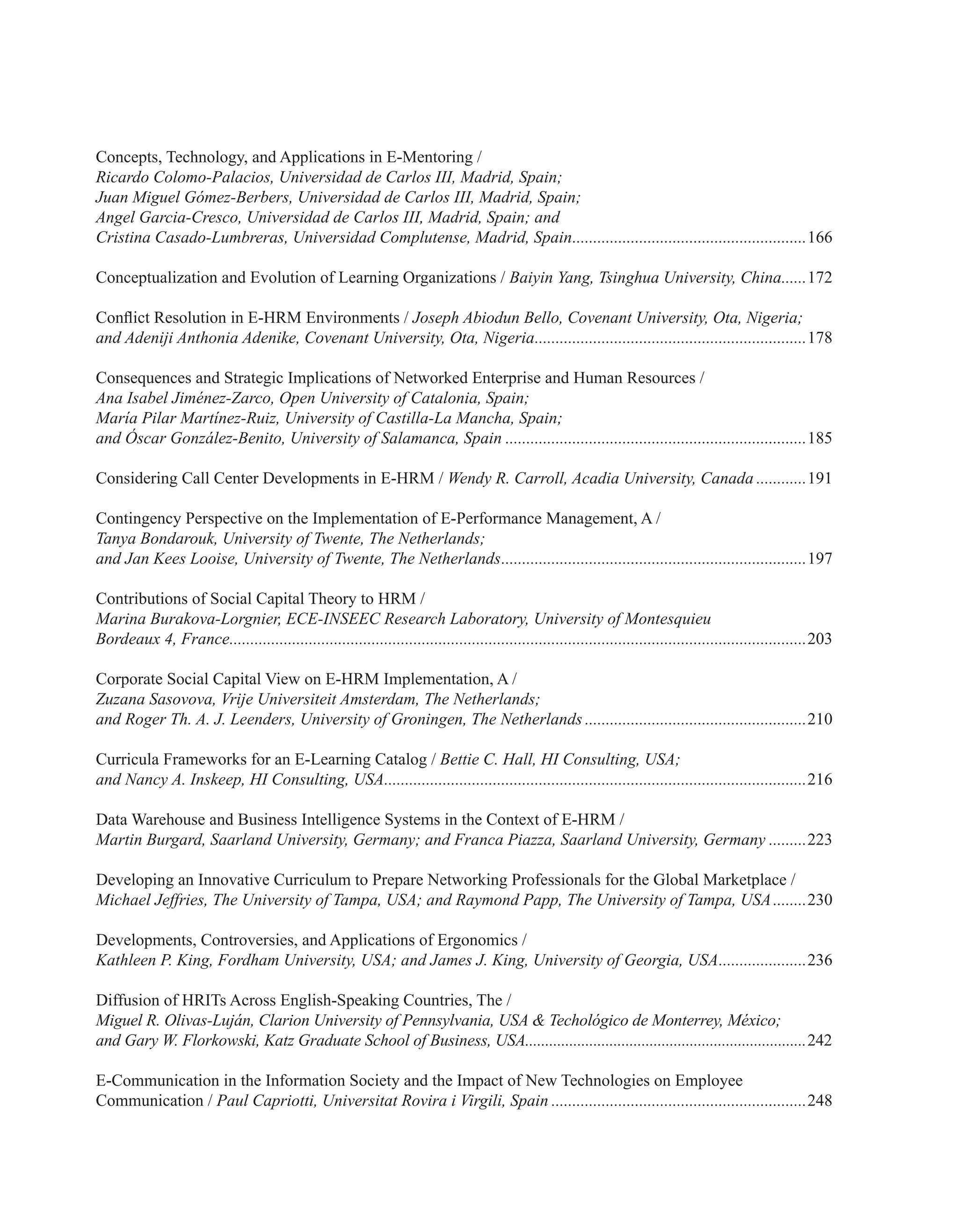
Concepts, Technology, and Applications in E-Mentoring /
Ricardo Colomo-Palacios, Universidad de Carlos III, Madrid, Spain;
Juan Miguel Gómez-Berbers, Universidad de Carlos III, Madrid, Spain;
Angel Garcia-Cresco, Universidad de Carlos III, Madrid, Spain; and
Cristina Casado-Lumbreras, Universidad Complutense, Madrid, Spain.........................................................166
Conceptualization and Evolution of Learning Organizations / Baiyin Yang, Tsinghua University, China.......172
Conflict Resolution in E-HRM Environments / Joseph Abiodun Bello, Covenant University, Ota, Nigeria;
and Adeniji Anthonia Adenike, Covenant University, Ota, Nigeria..................................................................178
Consequences and Strategic Implications of Networked Enterprise and Human Resources /
Ana Isabel Jiménez-Zarco, Open University of Catalonia, Spain;
María Pilar Martínez-Ruiz, University of Castilla-La Mancha, Spain;
and Óscar González-Benito, University of Salamanca, Spain.........................................................................185
Considering Call Center Developments in E-HRM / Wendy R. Carroll, Acadia University, Canada.............191
Contingency Perspective on the Implementation of E-Performance Management, A /
Tanya Bondarouk, University of Twente, The Netherlands;
and Jan Kees Looise, University of Twente, The Netherlands..........................................................................197
Contributions of Social Capital Theory to HRM /
Marina Burakova-Lorgnier, ECE-INSEEC Research Laboratory, University of Montesquieu
Bordeaux 4, France...........................................................................................................................................203
Corporate Social Capital View on E-HRM Implementation, A /
Zuzana Sasovova, Vrije Universiteit Amsterdam, The Netherlands;
and Roger Th. A. J. Leenders, University of Groningen, The Netherlands......................................................210
Curricula Frameworks for an E-Learning Catalog / Bettie C. Hall, HI Consulting, USA;
and Nancy A. Inskeep, HI Consulting, USA......................................................................................................216
Data Warehouse and Business Intelligence Systems in the Context of E-HRM /
Martin Burgard, Saarland University, Germany; and Franca Piazza, Saarland University, Germany..........223
Developing an Innovative Curriculum to Prepare Networking Professionals for the Global Marketplace /
Michael Jeffries, The University of Tampa, USA; and Raymond Papp, The University of Tampa, USA.........230
Developments, Controversies, and Applications of Ergonomics /
Kathleen P. King, Fordham University, USA; and James J. King, University of Georgia, USA......................236
Diffusion of HRITs Across English-Speaking Countries, The /
Miguel R. Olivas-Luján, Clarion University of Pennsylvania, USA & Techológico de Monterrey, México;
and Gary W. Florkowski, Katz Graduate School of Business, USA.......................................................................242
E-Communication in the Information Society and the Impact of New Technologies on Employee
Communication / Paul Capriotti, Universitat Rovira i Virgili, Spain..............................................................248
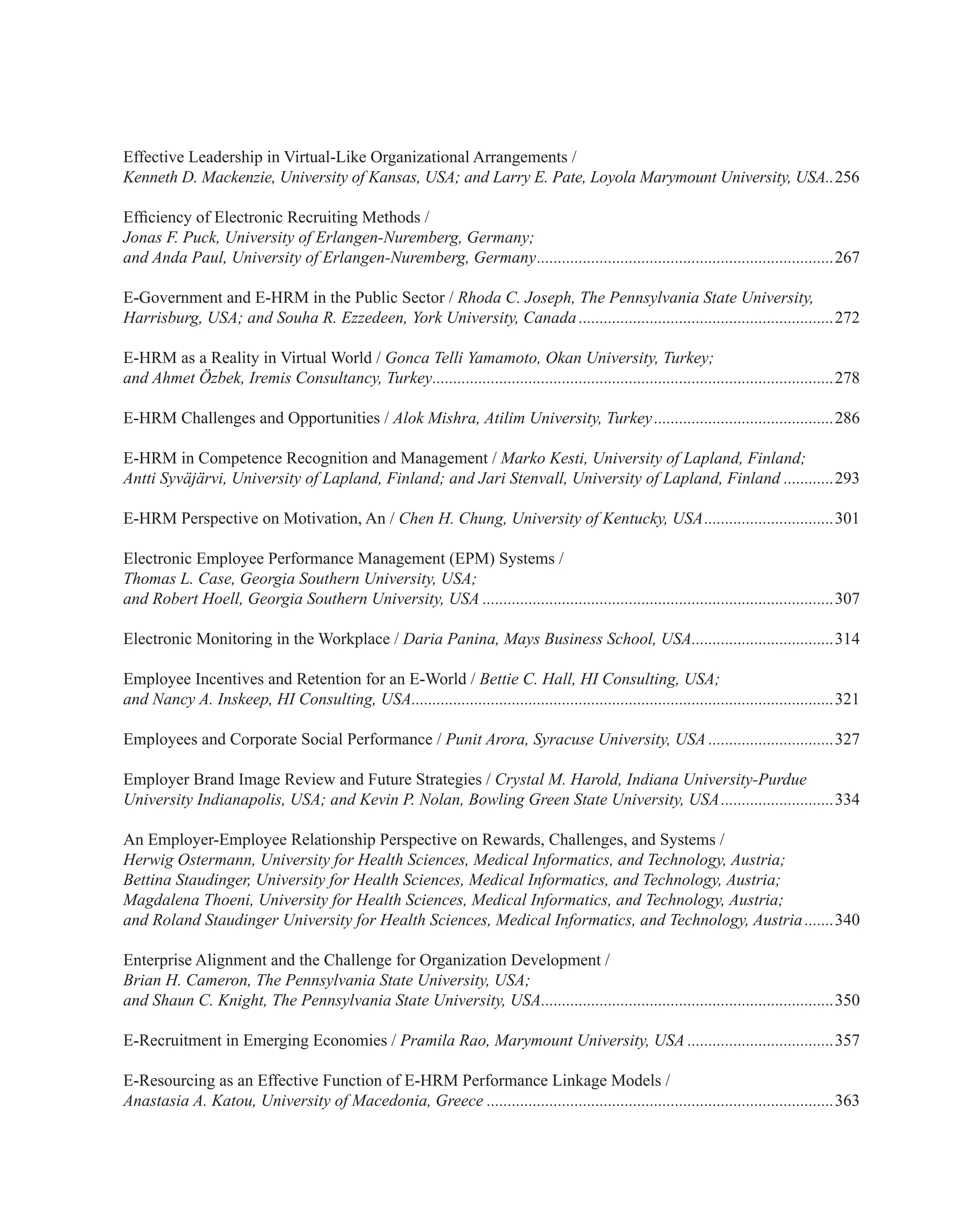
Effective Leadership in Virtual-Like Organizational Arrangements /
Kenneth D. Mackenzie, University of Kansas, USA; and Larry E. Pate, Loyola Marymount University, USA...256
Efficiency of Electronic Recruiting Methods /
Jonas F. Puck, University of Erlangen-Nuremberg, Germany;
and Anda Paul, University of Erlangen-Nuremberg, Germany........................................................................267
E-Government and E-HRM in the Public Sector / Rhoda C. Joseph, The Pennsylvania State University,
Harrisburg, USA; and Souha R. Ezzedeen, York University, Canada..............................................................272
E-HRM as a Reality in Virtual World / Gonca Telli Yamamoto, Okan University, Turkey;
and Ahmet Özbek, Iremis Consultancy, Turkey.................................................................................................278
E-HRM Challenges and Opportunities / Alok Mishra, Atilim University, Turkey............................................286
E-HRM in Competence Recognition and Management / Marko Kesti, University of Lapland, Finland;
Antti Syväjärvi, University of Lapland, Finland; and Jari Stenvall, University of Lapland, Finland.............293
E-HRM Perspective on Motivation, An / Chen H. Chung, University of Kentucky, USA................................301
Electronic Employee Performance Management (EPM) Systems /
Thomas L. Case, Georgia Southern University, USA;
and Robert Hoell, Georgia Southern University, USA.....................................................................................307
Electronic Monitoring in the Workplace / Daria Panina, Mays Business School, USA...................................314
Employee Incentives and Retention for an E-World / Bettie C. Hall, HI Consulting, USA;
and Nancy A. Inskeep, HI Consulting, USA......................................................................................................321
Employees and Corporate Social Performance / Punit Arora, Syracuse University, USA...............................327
Employer Brand Image Review and Future Strategies / Crystal M. Harold, Indiana University-Purdue
University Indianapolis, USA; and Kevin P. Nolan, Bowling Green State University, USA............................334
An Employer-Employee Relationship Perspective on Rewards, Challenges, and Systems /
Herwig Ostermann, University for Health Sciences, Medical Informatics, and Technology, Austria;
Bettina Staudinger, University for Health Sciences, Medical Informatics, and Technology, Austria;
Magdalena Thoeni, University for Health Sciences, Medical Informatics, and Technology, Austria;
and Roland Staudinger University for Health Sciences, Medical Informatics, and Technology, Austria........340
Enterprise Alignment and the Challenge for Organization Development /
Brian H. Cameron, The Pennsylvania State University, USA;
and Shaun C. Knight, The Pennsylvania State University, USA.......................................................................350
E-Recruitment in Emerging Economies / Pramila Rao, Marymount University, USA....................................357
E-Resourcing as an Effective Function of E-HRM Performance Linkage Models /
Anastasia A. Katou, University of Macedonia, Greece....................................................................................363
E-Training in Ethical Behavior / Donna Galla, Nova Southeastern University, USA......................................373
Expediting Personalized Just-in-Time Training with E-Learning Management Systems /
Thomas L. Case, Georgia Southern University, USA;
Geoffrey N. Dick, Australian School of Business, Australia;
and Craig Van Slyke, Saint Louis University, USA...........................................................................................378
Exploration of the Perceived Value of Information Technology Certification between Information Technology
and Human Resources Professionals, An / Casey G. Cegielski, Auburn University, USA;
and Dianne Hall, Auburn University, USA.......................................................................................................386
Exploring the Link between Flexible Work and Organizational Performance /
Eva Rimbau-Gilabert, Open University of Catalonia (UOC), Spain...............................................................392
Exploring the Relation between the Use of HRIS and their Implementation in Spanish Firms /
José Antonio Fernández-Sánchez, University of Alicante, Spain;
Susana de Juana-Espinosa, University of Alicante, Spain;
and Jorge Valdés-Conca, University of Alicante, Spain...................................................................................399
Extending Relationship Marketing to Human Resources Management Using
the CaRM Approach to Personnel Recruitment /
Tobias Keim, Johann Wolfgang Goethe University, Germany;
and Kerstin Fritsch, Johann Wolfgang Goethe University, Germany..............................................................406
Group Support Systems as Tools for HR Decision Making /
James Yao, Montclair State University, USA; and John Wang, Montclair State University, USA...................413
High Performance IT as Strategic Partner for HR Management /
Ferdinando Pennarola, Bocconi University, Italy; and Leonardo Caporarello, Bocconi University, Italy.........420
HR Portals as Tools for Relational Resources Management / Dino Ruta, Bocconi University, Italy...............428
HRIS as Drivers to Introduce Total Quality in HRM /
Miguel Blanco Callejo, Rey Juan Carlos University, Spain.............................................................................434
Human Capital Management for Sustainable Competitive Advantage in the New Economy /
Benjamin Oyegoke Akinyemi, Commonwealth Open University, UK...............................................................441
Human Resource Implications of Computers, The / Rosemarie Reynolds, Embry-Riddle University, USA;
Shirley Fedorovich, Embry-Riddle University, USA;
and Michael Williams, Embry-Riddle University, USA....................................................................................451
Human Resources as Manager of the Human Imprint /
Charmine E. J. Härtel, Monash University, Australia......................................................................................457
Human Resources in the Balanced Scorecard System /
Juha Kettunen, Turku University of Applied Sciences, Finland.......................................................................464
Human Resources Information Systems Role in Sarbanes-Oxley (SOX) Compliance /
Kathryn J. Ready, Winona State University, USA; Milorad Novicevic, University of Mississippi, USA;
and Monica Evans, University of Mississippi, USA.........................................................................................471
Human Resources Outsourcing Strategies /
Veronique Guilloux, Université Paris 12, France;
and Michel Kalika, Université Paris, France...................................................................................................477
Human Resources Strategies for Fair and Legal Employee Selection /
Gregory G. Manley, University of Texas at San Antonio, USA.........................................................................482
Human-Computer Interaction: A Human Resources Perspective /
Benet Campderrich, Universitat Rovira i Virgili, Spain...................................................................................488
Volume II
Importance of Task Type in Virtual Teams, The / Andre L. Araujo, The College of William & Mary, USA........495
Improving Employee Selection with Online Testing /
Jeffrey M. Pollack, Virginia Commonwealth University, USA..........................................................................504
Improving Virtual Teams through Swift Structure /
Daphna Shwarts-Asher, Tel Aviv University, Israel; Niv Ahituv, Tel Aviv University, Israel;
and Dalia Etzion, Tel Aviv University, Israel....................................................................................................510
Increasing Tacit Knowledge Sharing with an HRIS /
Milton Mayfield, Texas A&M International University, USA;
Jacqueline Mayfield, Texas A&M International University, USA;
and Stephen Lunce, Midwestern State University, USA...................................................................................518
Influence of Job Relevance, Output Quality, Task Technology Fit, and Privacy Concerns on Human
Resources Information Systems Usage / Eric Deakins, University of Waikato, New Zealand.........................525
Information Technologies as a Vital Channel for an Internal E-Communication Strategy /
José A. Lastres Segret, University of La Laguna, Spain;
and José M. Núñez-Gorrín, University of La Laguna, Tenerife, Spain............................................................532
Integrating Architecture for Competence Management, An / Giuseppe Berio, Università di Torino, Italy;
Mounira Harzallah, Laboratoire d’informatique de Nantes Atlantique, France;
and Giovanni Maria Sacco, Università di Torino, Italy...................................................................................538
Intellectual Capital Models and their Role within Information Systems /
Francisca Castilla-Polo, University of Jaén, Spain;
and Dolores Gallardo-Vázquez, University of Extremadura, Spain.................................................................547
Interactive, Flexible, and Adaptable Decision Support Systems /
John Wang, Montclair State University, USA; James Yao, Montclair State University, USA;
and Jeffrey Hsu, Fairleigh Dickinson University, USA....................................................................................557
Intercultural Competences as a Trust Factor in Virtual Team Work /
Maria Assumpta Aneas, Universitat de Barcelona, Spain................................................................................563
Internet Technology-Based Tools Utilization in the Workplace of Contemporary Organizations /
Janusz Wielki, Opole University of Technology, Poland..................................................................................570
IT and the Social Construction of Knowledge / Elena Revilla, Instituto de Empresa-Madrid-Spain, Spain;
and José Sánchez-Alarcos, Quasar Aviation, Spain.........................................................................................577
Kaleidoscope Careers and Evolving HRM Issues /
Sherry E. Sullivan, Bowling Green State University, USA; Lisa A. Mainiero, Fairfield University, USA;
and Siri Terjesen, Queensland University of Technology, Australia.................................................................584
Knowledge Facilitator vs. Knowledge Dictator in Today’s Organizations /
Victor C. X. Wang, California State University, Long Beach, USA..................................................................592
Knowledge Management Approach to Improving E-Business Collaboration, A /
Sharon Cox, Birmingham City University, UK;
and John Perkins, Newman University College, UK........................................................................................598
Knowledge Management in Organizations / Mario Pérez-Montoro, University of Barcelona, Spain.............605
Knowledge Management Systems as a Framework for IT in Knowledge Management /
Ángel L. Meroño-Cerdán, Universidad de Murcia, Spain................................................................................611
Learning Organizations vs. Static Organizations in the Context of E-HRM /
Victor C. X. Wang, California State University, Long Beach, USA..................................................................617
Making E-Training Cost Effective through Quality Assurance /
Lichia Yiu, Centre for Socio-Eco-Nomic Development (CSEND), Switzerland;
and Raymond Saner, Centre for Socio-Eco-Nomic Development (CSEND), Switzerland................................623
Management of the Human Resources and the Quality of the Services, The /
José Antonio Lastres Segret, University of La Laguna, Spain;
and Mariangélica Cadagan García, University of La Laguna, Spain..............................................................632
Managing the New Psychological Contract /
Benjamin Oyegoke Akinyemi, Commonwealth Open University, British Virgin Island, UK............................640
Medical IT Systems and Their Effect on Human Resources /
Robert J. Mockler, St. John’s University, USA; and Dorothy G. Dologite, City University of
New York, USA..................................................................................................................................................649
New Face of Sexual Harassment, The / Barbara A. Ritter, Coastal Carolina University, USA.......................655
Occupational Culture and Socialization in IS / Indira R. Guzman, TUI University, USA................................661
Online Dispute Resolution / Noam Ebner, Tachlit Mediation and Negotiation Training, Israel.....................668
Orchestrating the Multi-Channel Character of Formal and Informal Communication in “Virtual Teams” /
J. Kratzer, University of Groningen, The Netherlands;
Roger Th. A. J. Leenders, University of Groningen, The Netherlands;
and J.M.L. van Engelen, University of Groningen, The Netherlands...............................................................676
Organizational Factors for Implementing E-Democracy in Organizations /
Francisco Javier Forcadell, Universidad Rey Juan Carlos, Spain..................................................................682
Organizational Implications of Managing the HRIS Employee Experience /
Dino Ruta, Bocconi University, Italy................................................................................................................687
Organizational Justice in Virtual Team Settings / María del Carmen Triana, Texas A&M University, USA.......693
Planning Fallacy and Utilization of Human Resources Information Systems, The /
Siti Zubaidah Othman, The University of Western Australia, Australia...........................................................699
Podcasting as Mobile Learning / Kathleen P. King, Fordham University, USA...............................................705
Process Standardization and Integration for Human Resource Administration /
Bettina Staudinger, University for Health Sciences, Medical Informatics, and Technology, Austria;
Herwig Ostermann, University for Health Sciences, Medical Informatics, and Technology, Austria;
Roland Staudinger, University for Health Sciences, Medical Informatics, and Technology, Austria...............711
Processes, Prospects, and Promises of Electronic Leadership /
Michael J. Provitera, Barry University, USA...................................................................................................719
Project Management Concepts for E-HRM / Bettie C. Hall, HI Consulting, USA;
and Nancy A. Inskeep, HI Consulting, USA......................................................................................................725
Redefining the Concept of HRIS / Evandro Bocatto, Universitat Rovira i Virgili, Spain;
and Eloísa Pérez-de-Toledo, Universitat Rovira i Virgili, Spain......................................................................733
Relations between Knowledge Acquisition Forms and Sources of Power in Organization /
Yvan Leray, Université de Bretagne Occidentale, France................................................................................739
Research Classification for HR Intranets, A /
Veronique Guilloux, Université Paris 12, France;
Michel Kalika, Université Paris, France; and Florence Laval, IAE Poitiers, France.....................................746
Right Work Ethic for Human Resource Managers, The / Victor C. X. Wang, California State University,
Long Beach, USA............................................................................................................................................................752
Risks, Gaps, and Global Issues of Project Management / John Wang, Montclair State University, USA;
Ruiliang Yan, Virginia State University, USA; Yanli Zhang, Montclair State University, USA........................758
Role of HRIS in Crisis Response Planning, The / Amy E. Hurley-Hanson, Chapman University, USA..........764
Role of ICT in Support of Adaptable Work Arrangements, The /
Pamela Marie Dixon, Wayne State College, USA; and Paul M. Shelton, University of Central
Oklahoma, USA.......................................................................................................................................................770
Role of Lifelong Learning in the Creation of a European Knowledge-Based Society, The /
Ana Maria Ramalho Correia, Instituto Nacional de Engenharia Tecnologia e Inovação (INETI), Portugal
& Univerversidade Nova de Lisboa, Portugal; and Anabela Mesquita, ISCAP / IPP, Portugal &
Universidade do Minho, Portugal....................................................................................................................775
Shared-Time Work and E-HRM in Small and Medium Sized Enterprises /
Marc-André Vilette, University of Savoie, France............................................................................................784
The Sign-Meaning Chain and its Implications for the Organization /
José Sanchez-Alarcos, Quasar Aviation, Spain; and Elena Revilla, Instituto de Empresa, Spain...................791
Social Capital and the Practice Lens Approach / Ray Gibney, The Pennsylvania State University at
Harrisburg, USA; Thomas J. Zagenczyk, Clemson University, USA; and Marick F. Masters,
University of Pittsburgh, USA...........................................................................................................................797
Social Cognitive Trust Model / Joseph Abiodun Bello, Covenant University, Ota, Nigeria............................803
Standards for Skill Training and Development /
Lichia Yiu, Centre for Socio-Eco-Nomic Development (CSEND), Switzerland;
and Raymond Saner, Centre for Socio-Eco-Nomic Development (CSEND), Switzerland................................810
Supporting Work-Family Amalgamation through E-HRM /
Rebecca Nthogo Lekoko, University of Botswana, Gaborne, Botswana..........................................................817
Technology, Functionality, and Applicability of Portals in E-HRM /
Stefan Strohmeier, Saarland University, Germany...........................................................................................823
Telemedicine Barriers / María José Crisóstomo-Acevedo, Jerez Hospital, Spain;
and José Aurelio Medina-Garrido, Cadiz University, Spain............................................................................830
Theory and Application of Leadership / Krista J. Crawford-Mathis, Capella University, USA......................836
Tools and Techniques for Designing Effective Compensation Systems /
Adeniji Anthonia Adenike, Covenant University, Ota, Nigeria.........................................................................842
Traditional Leadership in Light of E-HRMS / Victor C. X. Wang, California State University,
Long Beach, USA..............................................................................................................................................849
Trans-Disciplinary Collaboration and Information Systems / José-Rodrigo Córdoba, University of Hull, UK.......855
Transferring Knowledge in a Knowledge-Based Economy /
Lauren Edelstein Henry, The Pennsylvania State University, USA;
and Doris Lee, The Pennsylvania State University, USA.................................................................................862
Transformative Learning / Kathleen P. King, Fordham University, USA.........................................................871
Transforming Compensation Management Practices through Web-Based Enterprise Technologies /
Xiaoya Liang, Fudan University, China...........................................................................................................877
Trust Multidimensionality / Alfonso Miguel Márquez-García, University of Jaén, Spain...............................883
Using Collaborative Technology in Group Facilitation / José-Rodrigo Córdoba, University of Hull, UK......891
Utility Analysis of HRM Effectiveness /
José M. Carretero-Gómez, University of the Balearic Islands, Spain..............................................................898
Contents
by Topic
Present Concepts and Emerging Trends in HRIS and E-HRM
Assessing Information Technology Capability versus Human Resource Information System Utilization /
Ralf Burbach, Institute of Technology Carlow, Ireland;
and Tony Dundon, National University of Ireland-Galway, Ireland..................................................................56
Benchmarking Human Resource Information Systems /
Herwig Ostermann, University for Health Sciences, Medical Informatics, and Technology, Austria;
Bettina Staudinger, University for Health Sciences, Medical Informatics, and Technology, Austria;
and Roland Staudinger, University for Health Sciences, Medical Informatics, and Technology, Austria..........92
Business, Information Technology, and Human Resource Strategy Alignment /
Bettina Staudinger, University for Health Sciences, Medical Informatics, and Technology, Austria;
Herwig Ostermann, University for Health Sciences, Medical Informatics, and Technology, Austria;
and Roland Staudinger, University for Health Sciences, Medical Informatics, and Technology, Austria........117
Consequences and Strategic Implications of Networked Enterprise and Human Resources /
Ana Isabel Jiménez-Zarco, Open University of Catalonia, Spain;
María Pilar Martínez-Ruiz, University of Castilla-La Mancha, Spain;
and Óscar González-Benito, University of Salamanca, Spain.........................................................................185
E-HRM Challenges and Opportunities / Alok Mishra, Atilim University, Turkey............................................286
Enterprise Alignment and the Challenge for Organization Development /
Brian H. Cameron, The Pennsylvania State University, USA;
and Shaun C. Knight, The Pennsylvania State University, USA.......................................................................350
High Performance IT as Strategic Partner for HR Management /
Ferdinando Pennarola, Bocconi University, Italy; and Leonardo Caporarello, Bocconi University, Italy.........420
Human Capital Management for Sustainable Competitive Advantage in the New Economy /
Benjamin Oyegoke Akinyemi, Commonwealth Open University, UK...............................................................441
Redefining the Concept of HRIS / Evandro Bocatto, Universitat Rovira i Virgili, Spain;
and Eloísa Pérez-de-Toledo, Universitat Rovira i Virgili, Spain......................................................................733
Setting New Directions to HRM Functions
Approaches and Concepts to Restructuring Human Resources Management Functions /
Peter M. Wald, University of Applied Sciences Dresden, Germany;
and Rainhart Lang, Chemnitz University of Technology, Germany...................................................................48
Benefits of Using Technology in Human Resource Management, The /
Emma Parry, Cranfield School of Management, UK........................................................................................110
Corporate Social Capital View on E-HRM Implementation, A /
Zuzana Sasovova, Vrije Universiteit Amsterdam, The Netherlands;
and Roger Th. A. J. Leenders, University of Groningen, The Netherlands......................................................210
E-HRM as a Reality in Virtual World / Gonca Telli Yamamoto, Okan University, Turkey;
and Ahmet Özbek, Iremis Consultancy, Turkey.................................................................................................278
E-Resourcing as an Effective Function of E-HRM Performance Linkage Models /
Anastasia A. Katou, University of Macedonia, Greece....................................................................................363
Human Resources as Manager of the Human Imprint /
Charmine E. J. Härtel, Monash University, Australia......................................................................................457
Human Resources in the Balanced Scorecard System /
Juha Kettunen, Turku University of Applied Sciences, Finland.......................................................................464
Planning Fallacy and Utilization of Human Resources Information Systems, The /
Siti Zubaidah Othman, The University of Western Australia, Australia...........................................................699
Process Standardization and Integration for Human Resource Administration /
Bettina Staudinger, University for Health Sciences, Medical Informatics, and Technology, Austria;
Herwig Ostermann, University for Health Sciences, Medical Informatics, and Technology, Austria;
Roland Staudinger, University for Health Sciences, Medical Informatics, and Technology, Austria...............711
Research Classification for HR Intranets, A /
Veronique Guilloux, Université Paris 12, France;
Michel Kalika, Université Paris, France; and Florence Laval, IAE Poitiers, France.....................................746
Role of HRIS in Crisis Response Planning, The / Amy E. Hurley-Hanson, Chapman University, USA..........764
Staffing the Organization: E-Recruitment and Selection Processes
Adoption and Diffusion Perspective on HRIS Usage, An /
Tobias Keim, Johann Wolfgang Goethe University, Germany; and Tim Weitzel,
Otto Friedrich University Bramberg, Germany.................................................................................................18
Assessing the Use of Internet in the Recruiting Process /
Luiz Antonio Joia, Brazilian School of Public and Business Administration-Getulio Vargas
Foundation, Brazil & Rio de Janeiro State University, Brazil; and José Antonio Alves Silva,
Independent Consultant, Brazil..........................................................................................................................70
Efficiency of Electronic Recruiting Methods /
Jonas F. Puck, University of Erlangen-Nuremberg, Germany;
and Anda Paul, University of Erlangen-Nuremberg, Germany........................................................................267
Employer Brand Image Review and Future Strategies / Crystal M. Harold, Indiana University-Purdue
University Indianapolis, USA; and Kevin P. Nolan, Bowling Green State University, USA............................334
E-Recruitment in Emerging Economies / Pramila Rao, Marymount University, USA....................................357
Exploration of the Perceived Value of Information Technology Certification between Information
Technology and Human Resources Professionals, An / Casey G. Cegielski, Auburn University, USA;
and Dianne Hall, Auburn University, USA.......................................................................................................386
Exploring the Relation between the Use of HRIS and their Implementation in Spanish Firms /
José Antonio Fernández-Sánchez, University of Alicante, Spain;
Susana de Juana-Espinosa, University of Alicante, Spain;
and Jorge Valdés-Conca, University of Alicante, Spain...................................................................................399
Extending Relationship Marketing to Human Resources Management Using
the CaRM Approach to Personnel Recruitment /
Tobias Keim, Johann Wolfgang Goethe University, Germany;
and Kerstin Fritsch, Johann Wolfgang Goethe University, Germany..............................................................406
Human Resources Information Systems Role in Sarbanes-Oxley (SOX) Compliance /
Kathryn J. Ready, Winona State University, USA; Milorad Novicevic, University of Mississippi, USA;
and Monica Evans, University of Mississippi, USA.........................................................................................471
Human Resources Outsourcing Strategies /
Veronique Guilloux, Université Paris 12, France;
and Michel Kalika, Université Paris, France...................................................................................................477
Human Resources Strategies for Fair and Legal Employee Selection /
Gregory G. Manley, University of Texas at San Antonio, USA.........................................................................482
Improving Employee Selection with Online Testing /
Jeffrey M. Pollack, Virginia Commonwealth University, USA..........................................................................504
Building Human Capital: Training and Development
Addressing Global Labor Needs Using E-Training / L. W. Murray, University of San Francisco, USA;
and Alev M. Efendioglu, University of San Francisco, USA..............................................................................12
Andragogy and Pedagogy in Learning Theories / Victor C. X. Wang, California State University,
Long Beach, USA................................................................................................................................................42
Challenges of Simulation in Management Development /
Peter Stokes, University of Central Lancashire, UK........................................................................................124
Collaboration Intricacies of Web 2.0 for Training Human Resource Managers /
Jacqueline A. Gilbert, Middle Tennessee State University, USA......................................................................131
Concepts, Technology, and Applications in E-Mentoring /
Ricardo Colomo-Palacios, Universidad de Carlos III, Madrid, Spain;
Juan Miguel Gómez-Berbers, Universidad de Carlos III, Madrid, Spain;
Angel Garcia-Cresco, Universidad de Carlos III, Madrid, Spain; and
Cristina Casado-Lumbreras, Universidad Complutense, Madrid, Spain.........................................................166
Curricula Frameworks for an E-Learning Catalog / Bettie C. Hall, HI Consulting, USA;
and Nancy A. Inskeep, HI Consulting, USA......................................................................................................216
Developing an Innovative Curriculum to Prepare Networking Professionals for the Global Marketplace /
Michael Jeffries, The University of Tampa, USA; and Raymond Papp, The University of Tampa, USA.........230
E-Training in Ethical Behavior / Donna Galla, Nova Southeastern University, USA......................................373
Expediting Personalized Just-in-Time Training with E-Learning Management Systems /
Thomas L. Case, Georgia Southern University, USA;
Geoffrey N. Dick, Australian School of Business, Australia;
and Craig Van Slyke, Saint Louis University, USA...........................................................................................378
Kaleidoscope Careers and Evolving HRM Issues /
Sherry E. Sullivan, Bowling Green State University, USA; Lisa A. Mainiero, Fairfield University, USA;
and Siri Terjesen, Queensland University of Technology, Australia.................................................................584
Making E-Training Cost Effective through Quality Assurance /
Lichia Yiu, Centre for Socio-Eco-Nomic Development (CSEND), Switzerland;
and Raymond Saner, Centre for Socio-Eco-Nomic Development (CSEND), Switzerland................................623
Podcasting as Mobile Learning / Kathleen P. King, Fordham University, USA...............................................705
Standards for Skill Training and Development /
Lichia Yiu, Centre for Socio-Eco-Nomic Development (CSEND), Switzerland;
and Raymond Saner, Centre for Socio-Eco-Nomic Development (CSEND), Switzerland................................810
Transformative Learning / Kathleen P. King, Fordham University, USA.........................................................871
Utility Analysis of HRM Effectiveness /
José M. Carretero-Gómez, University of the Balearic Islands, Spain..............................................................898
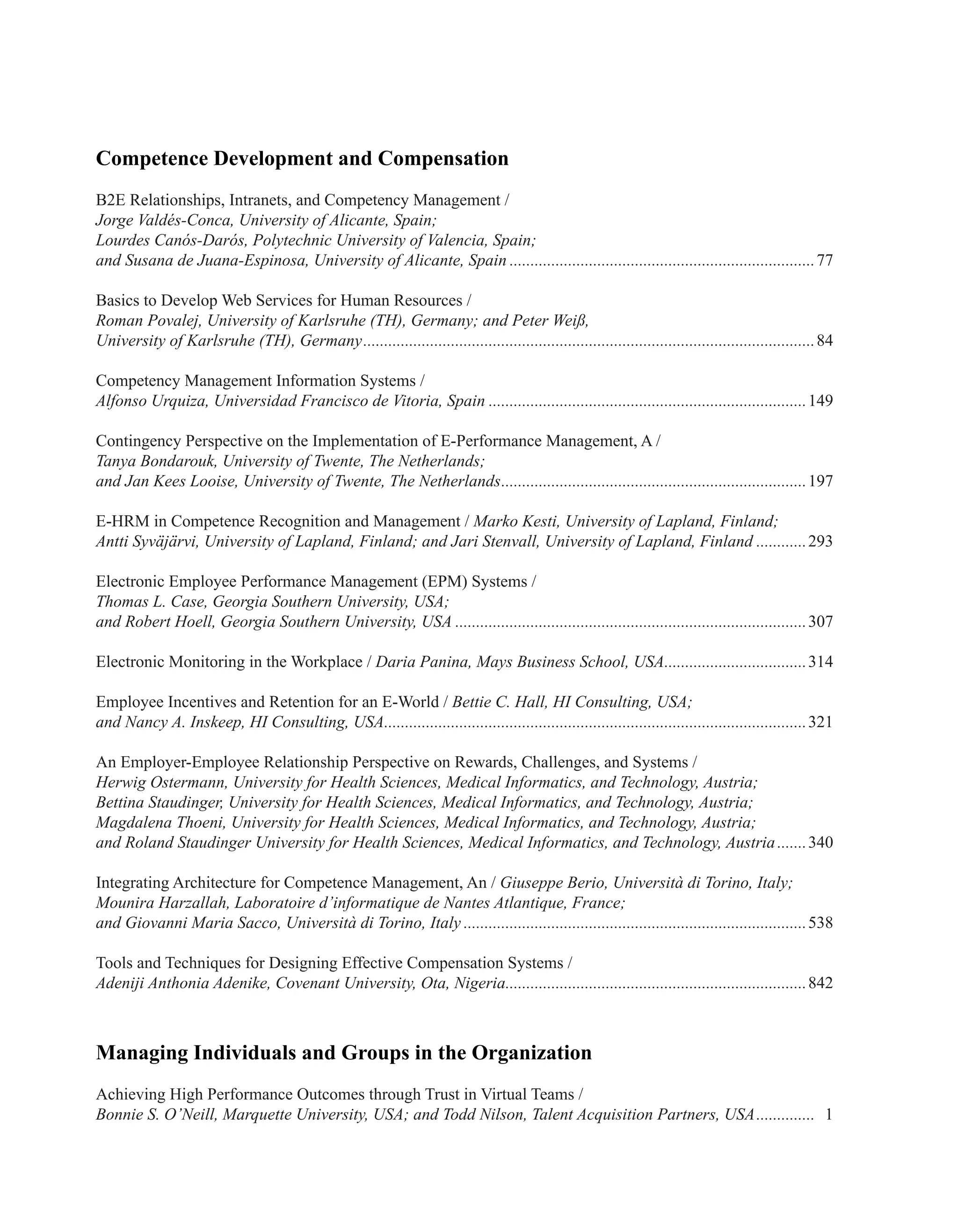
Competence Development and Compensation
B2E Relationships, Intranets, and Competency Management /
Jorge Valdés-Conca, University of Alicante, Spain;
Lourdes Canós-Darós, Polytechnic University of Valencia, Spain;
and Susana de Juana-Espinosa, University of Alicante, Spain..........................................................................77
Basics to Develop Web Services for Human Resources /
Roman Povalej, University of Karlsruhe (TH), Germany; and Peter Weiß,
University of Karlsruhe (TH), Germany.............................................................................................................84
Competency Management Information Systems /
Alfonso Urquiza, Universidad Francisco de Vitoria, Spain.............................................................................149
Contingency Perspective on the Implementation of E-Performance Management, A /
Tanya Bondarouk, University of Twente, The Netherlands;
and Jan Kees Looise, University of Twente, The Netherlands..........................................................................197
E-HRM in Competence Recognition and Management / Marko Kesti, University of Lapland, Finland;
Antti Syväjärvi, University of Lapland, Finland; and Jari Stenvall, University of Lapland, Finland.............293
Electronic Employee Performance Management (EPM) Systems /
Thomas L. Case, Georgia Southern University, USA;
and Robert Hoell, Georgia Southern University, USA.....................................................................................307
Electronic Monitoring in the Workplace / Daria Panina, Mays Business School, USA...................................314
Employee Incentives and Retention for an E-World / Bettie C. Hall, HI Consulting, USA;
and Nancy A. Inskeep, HI Consulting, USA......................................................................................................321
An Employer-Employee Relationship Perspective on Rewards, Challenges, and Systems /
Herwig Ostermann, University for Health Sciences, Medical Informatics, and Technology, Austria;
Bettina Staudinger, University for Health Sciences, Medical Informatics, and Technology, Austria;
Magdalena Thoeni, University for Health Sciences, Medical Informatics, and Technology, Austria;
and Roland Staudinger University for Health Sciences, Medical Informatics, and Technology, Austria........340
Integrating Architecture for Competence Management, An / Giuseppe Berio, Università di Torino, Italy;
Mounira Harzallah, Laboratoire d’informatique de Nantes Atlantique, France;
and Giovanni Maria Sacco, Università di Torino, Italy...................................................................................538
Tools and Techniques for Designing Effective Compensation Systems /
Adeniji Anthonia Adenike, Covenant University, Ota, Nigeria.........................................................................842
Managing Individuals and Groups in the Organization
Achieving High Performance Outcomes through Trust in Virtual Teams /
Bonnie S. O’Neill, Marquette University, USA; and Todd Nilson, Talent Acquisition Partners, USA............... 1
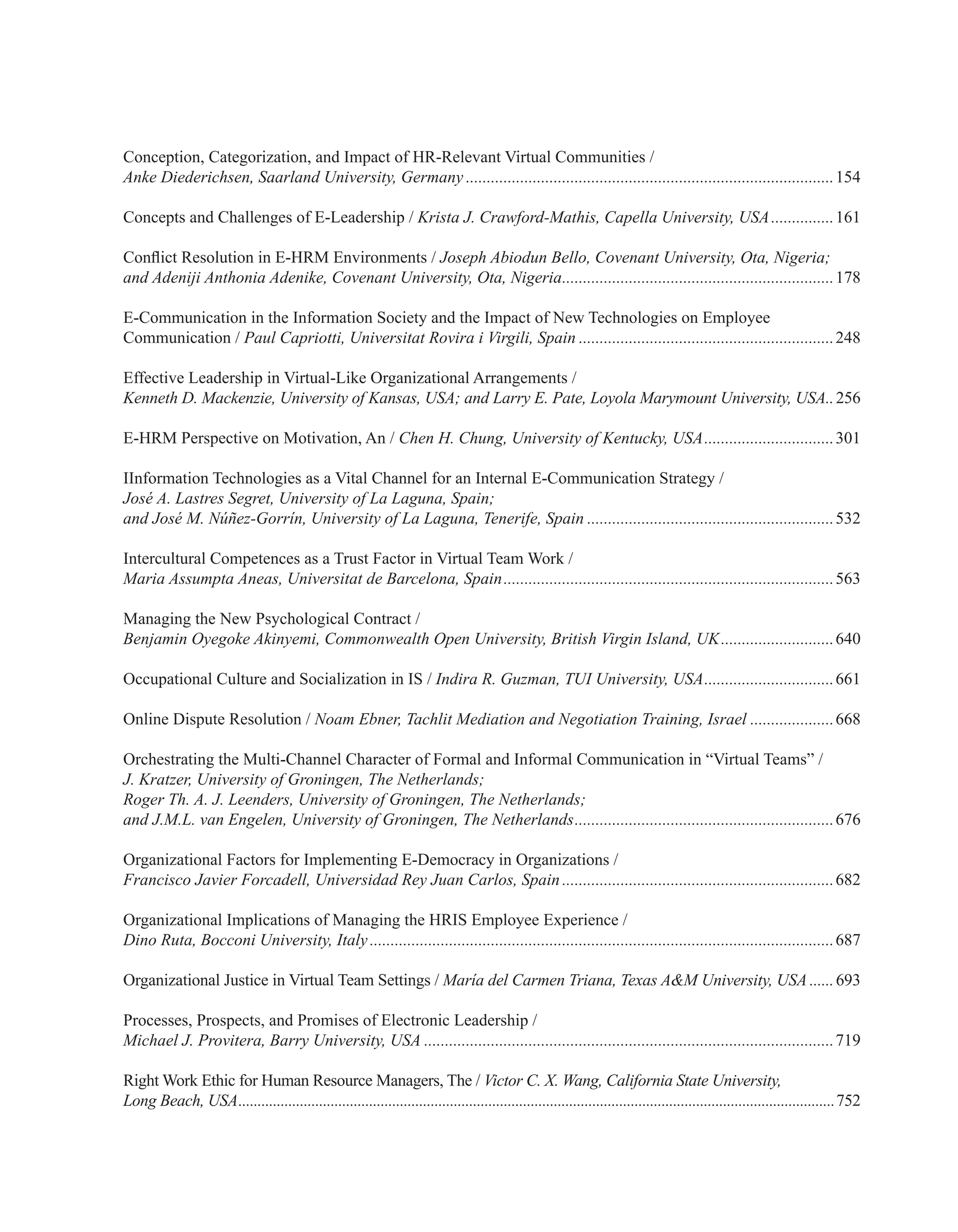
Conception, Categorization, and Impact of HR-Relevant Virtual Communities /
Anke Diederichsen, Saarland University, Germany.........................................................................................154
Concepts and Challenges of E-Leadership / Krista J. Crawford-Mathis, Capella University, USA................161
Conflict Resolution in E-HRM Environments / Joseph Abiodun Bello, Covenant University, Ota, Nigeria;
and Adeniji Anthonia Adenike, Covenant University, Ota, Nigeria..................................................................178
E-Communication in the Information Society and the Impact of New Technologies on Employee
Communication / Paul Capriotti, Universitat Rovira i Virgili, Spain..............................................................248
Effective Leadership in Virtual-Like Organizational Arrangements /
Kenneth D. Mackenzie, University of Kansas, USA; and Larry E. Pate, Loyola Marymount University, USA...256
E-HRM Perspective on Motivation, An / Chen H. Chung, University of Kentucky, USA................................301
IInformation Technologies as a Vital Channel for an Internal E-Communication Strategy /
José A. Lastres Segret, University of La Laguna, Spain;
and José M. Núñez-Gorrín, University of La Laguna, Tenerife, Spain............................................................532
Intercultural Competences as a Trust Factor in Virtual Team Work /
Maria Assumpta Aneas, Universitat de Barcelona, Spain................................................................................563
Managing the New Psychological Contract /
Benjamin Oyegoke Akinyemi, Commonwealth Open University, British Virgin Island, UK............................640
Occupational Culture and Socialization in IS / Indira R. Guzman, TUI University, USA................................661
Online Dispute Resolution / Noam Ebner, Tachlit Mediation and Negotiation Training, Israel.....................668
Orchestrating the Multi-Channel Character of Formal and Informal Communication in “Virtual Teams” /
J. Kratzer, University of Groningen, The Netherlands;
Roger Th. A. J. Leenders, University of Groningen, The Netherlands;
and J.M.L. van Engelen, University of Groningen, The Netherlands...............................................................676
Organizational Factors for Implementing E-Democracy in Organizations /
Francisco Javier Forcadell, Universidad Rey Juan Carlos, Spain..................................................................682
Organizational Implications of Managing the HRIS Employee Experience /
Dino Ruta, Bocconi University, Italy................................................................................................................687
Organizational Justice in Virtual Team Settings / María del Carmen Triana, Texas A&M University, USA.......693
Processes, Prospects, and Promises of Electronic Leadership /
Michael J. Provitera, Barry University, USA...................................................................................................719
Right Work Ethic for Human Resource Managers, The / Victor C. X. Wang, California State University,
Long Beach, USA............................................................................................................................................................752
Social Cognitive Trust Model / Joseph Abiodun Bello, Covenant University, Ota, Nigeria............................803
Theory and Application of Leadership / Krista J. Crawford-Mathis, Capella University, USA......................836
Traditional Leadership in Light of E-HRMS / Victor C. X. Wang, California State University,
Long Beach, USA..............................................................................................................................................849
Transforming Compensation Management Practices through Web-Based Enterprise Technologies /
Xiaoya Liang, Fudan University, China...........................................................................................................877
Trust Multidimensionality / Alfonso Miguel Márquez-García, University of Jaén, Spain...............................883
Managing People and Technology in New Work Environments
Assessing the Impact of Mobile Technologies on Work-Life Balance /
Sharon Cox, Birmingham City University, UK...................................................................................................63
Benefits of Home-Based Working’s Flexibility, The /
Diana Benito Osorio, Universidad Rey Juan Carlos, Spain............................................................................102
Collaborative Technologies, Applications, and Uses /
Ewan Oiry, Université de la Méditerranée, France.........................................................................................136
Data Warehouse and Business Intelligence Systems in the Context of E-HRM /
Martin Burgard, Saarland University, Germany; and Franca Piazza, Saarland University, Germany..........223
Developments, Controversies, and Applications of Ergonomics /
Kathleen P. King, Fordham University, USA; and James J. King, University of Georgia, USA......................236
Exploring the Link between Flexible Work and Organizational Performance /
Eva Rimbau-Gilabert, Open University of Catalonia (UOC), Spain...............................................................392
Group Support Systems as Tools for HR Decision Making /
James Yao, Montclair State University, USA; and John Wang, Montclair State University, USA...................413
HR Portals as Tools for Relational Resources Management / Dino Ruta, Bocconi University, Italy...............428
Human Resource Implications of Computers, The / Rosemarie Reynolds, Embry-Riddle University, USA;
Shirley Fedorovich, Embry-Riddle University, USA;
and Michael Williams, Embry-Riddle University, USA....................................................................................451
Human-Computer Interaction: A Human Resources Perspective /
Benet Campderrich, Universitat Rovira i Virgili, Spain...................................................................................488
Importance of Task Type in Virtual Teams, The / Andre L. Araujo, The College of William & Mary, USA........495
Improving Virtual Teams through Swift Structure /
Daphna Shwarts-Asher, Tel Aviv University, Israel; Niv Ahituv, Tel Aviv University, Israel;
and Dalia Etzion, Tel Aviv University, Israel....................................................................................................510
Influence of Job Relevance, Output Quality, Task Technology Fit, and Privacy Concerns on Human
Resources Information Systems Usage / Eric Deakins, University of Waikato, New Zealand.........................525
Interactive, Flexible, and Adaptable Decision Support Systems /
John Wang, Montclair State University, USA; James Yao, Montclair State University, USA;
and Jeffrey Hsu, Fairleigh Dickinson University, USA....................................................................................557
Internet Technology-Based Tools Utilization in the Workplace of Contemporary Organizations /
Janusz Wielki, Opole University of Technology, Poland..................................................................................570
Project Management Concepts for E-HRM / Bettie C. Hall, HI Consulting, USA;
and Nancy A. Inskeep, HI Consulting, USA......................................................................................................725
Risks, Gaps, and Global Issues of Project Management / John Wang, Montclair State University, USA;
Ruiliang Yan, Virginia State University, USA; Yanli Zhang, Montclair State University, USA........................758
Role of ICT in Support of Adaptable Work Arrangements, The /
Pamela Marie Dixon, Wayne State College, USA; and Paul M. Shelton, University of Central
Oklahoma, USA.......................................................................................................................................................770
Shared-Time Work and E-HRM in Small and Medium Sized Enterprises /
Marc-André Vilette, University of Savoie, France............................................................................................784
The Sign-Meaning Chain and its Implications for the Organization /
José Sanchez-Alarcos, Quasar Aviation, Spain; and Elena Revilla, Instituto de Empresa, Spain...................791
Supporting Work-Family Amalgamation through E-HRM /
Rebecca Nthogo Lekoko, University of Botswana, Gaborne, Botswana..........................................................817
Technology, Functionality, and Applicability of Portals in E-HRM /
Stefan Strohmeier, Saarland University, Germany...........................................................................................823
Using Collaborative Technology in Group Facilitation / José-Rodrigo Córdoba, University of Hull, UK......891
Trans-Disciplinary Collaboration and Information Systems / José-Rodrigo Córdoba, University of Hull, UK.......855
Knowledge and Organizational Learning
Activity Theory View of E-HR and Open Source, An /
Veronique Guilloux, Université Paris 12, France; and Michel Kalika, Université Paris, France..................... 7
Communities of Practice / Gonçalo Costa, De Montfort University, UK.........................................................142
Conceptualization and Evolution of Learning Organizations / Baiyin Yang, Tsinghua University, China.......172
Contributions of Social Capital Theory to HRM /
Marina Burakova-Lorgnier, ECE-INSEEC Research Laboratory, University of Montesquieu
Bordeaux 4, France...........................................................................................................................................203
Increasing Tacit Knowledge Sharing with an HRIS /
Milton Mayfield, Texas A&M International University, USA;
Jacqueline Mayfield, Texas A&M International University, USA;
and Stephen Lunce, Midwestern State University, USA...................................................................................518
Intellectual Capital Models and their Role within Information Systems /
Francisca Castilla-Polo, University of Jaén, Spain;
and Dolores Gallardo-Vázquez, University of Extremadura, Spain.................................................................547
IT and the Social Construction of Knowledge / Elena Revilla, Instituto de Empresa-Madrid-Spain, Spain;
and José Sánchez-Alarcos, Quasar Aviation, Spain.........................................................................................577
Knowledge Facilitator vs. Knowledge Dictator in Today’s Organizations /
Victor C. X. Wang, California State University, Long Beach, USA..................................................................592
Knowledge Management Approach to Improving E-Business Collaboration, A /
Sharon Cox, Birmingham City University, UK;
and John Perkins, Newman University College, UK........................................................................................598
Knowledge Management in Organizations / Mario Pérez-Montoro, University of Barcelona, Spain.............605
Knowledge Management Systems as a Framework for IT in Knowledge Management /
Ángel L. Meroño-Cerdán, Universidad de Murcia, Spain................................................................................611
Learning Organizations vs. Static Organizations in the Context of E-HRM /
Victor C. X. Wang, California State University, Long Beach, USA..................................................................617
Relations between Knowledge Acquisition Forms and Sources of Power in Organization /
Yvan Leray, Université de Bretagne Occidentale, France................................................................................739
Role of Lifelong Learning in the Creation of a European Knowledge-Based Society, The /
Ana Maria Ramalho Correia, Instituto Nacional de Engenharia Tecnologia e Inovação (INETI), Portugal
& Univerversidade Nova de Lisboa, Portugal; and Anabela Mesquita, ISCAP / IPP, Portugal &
Universidade do Minho, Portugal....................................................................................................................775
Social Capital and the Practice Lens Approach / Ray Gibney, The Pennsylvania State University at
Harrisburg, USA; Thomas J. Zagenczyk, Clemson University, USA; and Marick F. Masters,
University of Pittsburgh, USA...........................................................................................................................797
Transferring Knowledge in a Knowledge-Based Economy /
Lauren Edelstein Henry, The Pennsylvania State University, USA;
and Doris Lee, The Pennsylvania State University, USA.................................................................................862
Other Trends and Issues in E-HRM
Adoption and Success of E-HRM in European Firms /
Eleanna Galanaki, Athens University of Economics and Business, Greece;
and Leda Panayotopoulou, Athens University of Economics and Business, Greece..........................................24
Adoption of E-HRM in Large New Zealand Organizations /
Gloria Lau, Victoria University of Wellington, New Zealand;
and Val Hooper, Victoria University of Wellington, New Zealand......................................................................31
Considering Call Center Developments in E-HRM / Wendy R. Carroll, Acadia University, Canada.............191
Diffusion of HRITs Across English-Speaking Countries, The /
Miguel R. Olivas-Luján, Clarion University of Pennsylvania, USA & Techológico de Monterrey, México;
and Gary W. Florkowski, Katz Graduate School of Business, USA.......................................................................242
E-Government and E-HRM in the Public Sector / Rhoda C. Joseph, The Pennsylvania State University,
Harrisburg, USA; and Souha R. Ezzedeen, York University, Canada..............................................................272
Employees and Corporate Social Performance / Punit Arora, Syracuse University, USA...............................327
HRIS as Drivers to Introduce Total Quality in HRM /
Miguel Blanco Callejo, Rey Juan Carlos University, Spain.............................................................................434
Management of the Human Resources and the Quality of the Services, The /
José Antonio Lastres Segret, University of La Laguna, Spain;
and Mariangélica Cadagan García, University of La Laguna, Spain..............................................................632
Medical IT Systems and Their Effect on Human Resources /
Robert J. Mockler, St. John’s University, USA; and Dorothy G. Dologite, City University of
New York, USA..................................................................................................................................................649
New Face of Sexual Harassment, The / Barbara A. Ritter, Coastal Carolina University, USA.......................655
Telemedicine Barriers / María José Crisóstomo-Acevedo, Jerez Hospital, Spain;
and José Aurelio Medina-Garrido, Cadiz University, Spain............................................................................830
xxviii
Foreword
Technology and the ability to innovate are increasingly becoming critical requirements in our workplace. The
benefits of information technology extend far beyond productivity as it is usually understood and measured. Not
only can the application of IT provide better ratios of value created to effort expended in established processes
for producing goods and delivering services, but it can also reframe and redirect the expenditure of human effort,
generating unanticipated payoffs of exceptionally high value.
The emergence of tools based on the new information and communication technologies (ICT) is also affecting
businesses’ working methods. As a consequence, numerous changes are taking place within the organizational
context. For example, the number of knowledge workers is increasing, divisions between companies and depart-
ments are disappearing, networks are being created between countries, minority workers are being included, and
workers’ needs are being recognized.
Beyond doubt, organizations are rapidly and progressively adopting ICT in several and varied ways. In this
sense, a lot has been written about how companies manage virtual teams, implement electronic commerce prac-
tices, automate work flows, purchase raw material online, or use Web sites to advertise their services. However,
not much has been said about how IT is also changing traditional human resources management (HRM) func-
tions and practices. This is, precisely, the gap that the Encyclopedia of Human Resources Information Systems:
Challenges in e-HRM aims to fill.
Over its more than 100 articles, the Encyclopedia brilliantly presents the state of the art of the adoption of IT
by human resources managers as well as describes some of the most outstanding practices that have already been
implemented. In this respect, Dr. Torres-Coronas and Dr. Arias-Oliva have put together an impressive collection
of texts that will be valuable to professionals in the field, to consultants, to graduate students, and to thoughtful
managers, for this will become a reference text for both academicians and practitioners.
Definitely, the readers of the Encyclopedia of Human Resources Information Systems: Challenges in e-HRM
will gain deep knowledge about different types of human resources issues that have been challenged by the
adoption of technology during, at least, the last decade. Employee self-service, e-learning, strategies for imple-
menting e-HRM, virtual work arrangements and their impact on human resources management, human resources
information systems, or e-communication are only some of the topics that are approached by the wide group
of international authors who have already contributed to a successful set of books on how to manage people in
the new and digital environment.
Enjoy the reading!
Dr. Mila Gascó
Open University of Catalonia & Pompeu Fabra University, Spain
Barcelona (Spain), April 2008
xxix
Mila Gascó holds a MBA and a PhD in public policy evaluation (Award Enric Prat de la Riba granted to the best PhD
thesis on public management and administration, given by the Escola d’Administració Pública de Catalunya in Barcelona,
Spain). She is an associate professor at both the Open University of Catalonia and the Pompeu Fabra University, both
in Spain. For 7 years, she was a senior analyst at the International Institute on Governance of Catalonia. She has a wide
teaching experience (she worked as a full professor in the Rovira i Virgili University in Tarragona, Spain) as well as a broad
researching experience. She has taken part in numerous national and international seminars, and she has published both
in Spanish and English and has supervised some PhD thesis. She has collaborated with several institutions such as both
the provincial and city government of Barcelona, the World Bank Development Gateway, the United Nations Program for
Development, the University of Hull in United Kingdom, the Mayor’s Office in Valencia (Venezuela), and the Governments
of Brazil and Dominican Republic. Her main interests are related to public policies that allow the transition of a society
to the so-called knowledge era (in particular she is interested in e-government and e-governance), to the use of ICTs for
human development and to public policy evaluation.
xxx
Preface
Rationale foR this Book
The belief that the people working for a firm are one of its main assets and one of the decisive factors in deter-
mining its results is one that leaves little room for argument. There is no question regarding the fact that work-
ers’ qualities, attitudes, and behavior in the workplace go a long way to accounting for a company’s success
or lack of it. While this type of resource is one over which companies do not have complete control, there do
exist certain instruments to enable them to exert their influence on the quality and performance of the human
capital on which they rely. The human resource management (HRM) practices that they adopt will have a vital
influence in this area and thereby on the results obtained by the firm. Driven by significant internal and external
forces, HRM has evolved from largely a maintenance function to a source of sustainable competitive advantage
and organizational effectiveness.
Intheinformationera,organizationsareprogressivelyincorporatinginformationcommunicationtechnologies
(ICT) into their processes, using different tools and solutions. These tools are applied in a wide variety of ways
(i.e.,manufacturingresourceplanning,officeautomation,computer-supportedcooperativework,distributedteams,
supply-chain, enterprise-wide resource planning, or virtual integration). ICT is transforming organizations and
the way that people work, interact, and feel in knowledge-based organizations. To cope with these new human
resources challenges, it is necessary to review and to transform HRM into electronic-HRM (e-HRM).
Recognizing the need for substantive revision on the HRM field, this encyclopedia is a start to analyze the
management of people in the IT society. That is why it aims at describing the current state of HRM in the ICT
era and to provide new knowledge on effective e-HRM and human resource information management systems
(HRIS).
Since e-HRM does not mean to reinvent the wheel, the term HRM is used within this preface. It is already
time to begin giving the “e” for granted. Erasing the “e” is part of our digital evolution to the e-world.
Content highlights
This encyclopedia contains 132 articles organized in nine topics. In presenting the content we are aware that
important topics are missing and some relevant ones are included. But, that is the way books are. Next, a brief
description of the main issues discussed is presented to help the readers find their topic of interest and to ac-
knowledge each of the contributors to this virtual and collaborative project.
Topic I
Topic I, “Present Concepts and Emerging Trends in HRIS and HRM,” is an overview of the human capital
management concept and its role as key differentiator for sustainable competitive advantage (Akinyemi). Chang-
ing the HR function in a more HR technological environment is a must, but to do it, organizations need first
xxxi
to consider how human capital can be a source for a successful business strategy implementation. To achieve
this goal, a human resources policy needs to be perfectly aligned with business strategy. This match demands
functional integration with HRIS (as presented by Staudinger, Ostermann, and Staudinger). This integration is
required to achieve higher degrees of business process efficiency. Well-aligned systems and processes provide
an organization with competitive advantages. With this need in mind, both IT and organizational development
(OD) efforts have to be also aligned with business strategy. The lack of business/IT alignment and business/OD
alignment and its consequences are discussed by Cameron and Knight.
The use of ICT induces the development of new organizational, productive, strategic, and managerial models
(Jiménez, Martínez, and González). And, at the same time, the level of use of ICT determines the HRM and the
labor structures increasing the capabilities of the organization (as presented by Mishra). HRIS allow self-service
HR administrative activities and facilitate the collection of strategic information that contributes to the business
strategy formulation (Pennarola and Caporarello). Therefore, HR managers must understand their organization’s
strategy to sustain competitive advantage by adopting HRIS and e-HRM. Nevertheless, in this new organizational
word, HRIS need to be redefined not only as technology evolves but also as the perception of its impact changes.
Bocatto and Pérez’s article aims to deepen the comprehension of how information systems (IS) are used as a
tool of organizational change and development.
As information technology (IT) becomes a strategic partner for HRM, the factors that determine the utiliza-
tion of HR information for strategic decision-making purposes must be better understood. This is what Burbach
and Dundon do by ranging HRIT application through a continuum, from an administrative use to a strategic one.
The development of more flexible organizational structures and the development of IT are some of the drivers
of the necessity for HRIS. Benchmarking activities show the potential to generate valuable information for the
management of HRIS. Ostermann, Staudinger, and Staudinger provide an overview of different approaches to
benchmark the potential benefits and impacts of HRIS. As they point out, “future trends to benchmarking HRIS
should focus in the value-adding contribution of HR and HRIS to overall business performance.”
Topic II
Topic II, “Setting New Directions to HRM Functions,” provides a description of some of the key ways in which
HRM can enhance the development, implementation, and success of new technologies. It also focuses on how
HRM can enhance its own value through the use of new technologies (Härtel). One of the consequences of apply-
ing IT to the HRM is the modification of HR-related practices (as examined by Wang and Lang, and Yamamoto
and Özbek). On the other hand, in our today’s competitive world the need for a personnel management with
standardized and integrated processes is crucial. The development of this idea and its implications are presented
by Staudinger, Ostermann, and Staudinger.
As organizations are increasingly using HRIS, it is important to talk about the potential impacts of technol-
ogy on HRM in terms of the rationale behind the introduction of a HRIS (Parry). A better business and HRM
performance are some of the HRIS benefits. Stepping forward, Katou presents an integrative framework for
understanding the link between HRM and business performance and the integration of e-resourcing. Most of
the time, the success of the implementation of such new technological systems depends upon the mindsets of
the people involved. Sasovova and Leenders state how such mindsets emerge and evolve through the social
relationships of the users of the HRIS. Others relevant factors affecting HRIS planning projects are described
by Othman.
Topic II also deals with how the balanced scorecard approach can be applied in the management information
system (MIS) (Kettunen). Hurley-Hanson analyzes the role of HRIS in crisis response planning, and Guilloux,
Kalika, and Laval examine how Web-based technology permits new online HR services to employees and
management.
xxxii
Topic III
Topic III, “Staffing the Organization,” is devoted to specific HR functions such as recruitment and selection.
How can we transfer the concept of relationship marketing to personnel recruitment and why? This is Keim
and Fritsch’s main question, which they answer by presenting an approach for the IS-supported management
of employer-candidate relationships. Keim and Weitzel illustrate that HRIS adoption increases over time and
decreases as the phases of the recruitment process progress. The use of technology in personnel recruiting is also
the main worry of Puck and Paul’s work.An international perspective of e-recruitment is presented in articles by
Fernández-Sánchez, de Juana-Espinosa, and Valdés-Conca, Rao, and Joia andAlves. In the recruitment process,
it is also important to understand the value of the employer brand image (Harold and Nolan) as well as why and
how some organizations externalize work activities and use employment intermediaries (Guilloux and Kalika).
To improve person-job fit, Pollack addresses issues related to online employment testing software, and Cegielski
and Hall examine the perceived value of information technology certification.
Finally, there is still room for organizational ethical responsibility. Manley, from a U.S.-perspective, presents
possiblesolutionstoensureHRmanagersarecomplyingwithfairselection.Inasimilarway,Ready,Novicevic,and
Evans invite the reader to think about HRIS and the need to consider how HRIS affect employment practices.
Topic IV
Topic IV, “Building Human Capital: Training and Development,” includes Hall and Inskeep’s work. These
authors discuss the importance of developing a curricula framework that meets the organization’s business and
learning objectives. In an organization that has e-HRM systems, these curricula frameworks fall within its online
e-learning application. As the new curricula demands new skills, integrating networking skills to have better
professionals becomes a key factor in HR development (Jeffries and Papp).
But, can we rely on e-training to address a forecasted worldwide shortage of skilled workers? To answer
this question, Murray and Efendioglu examine the key supply and demand determinants of the global worker
shortage and analyze the systematic requirements that favor the use of asymmetric and interactive e-training
technologies. Other worthy ideas to be explored are learning theories (Wang), transformative learning (King),
and simulations in management development through ICT (Stokes).
Case, Dick, and Van Slyke focus on corporate learning management systems (LMS) and the role reusable
learning objects are playing in corporate LMS. Gilbert connects the collaborative theory with the current inno-
vations occurring on the World Wide Web that are enabling users to experience a sense of community (such as
Second Life®). King pays attention to mobile learning, including podcasting. Galla discusses the use of online or
electronic e-training in ethical behavior and why this training is maybe more important today than in the past.
To evaluate the effectiveness of e-training programs Carretero-Gómez studies two particular techniques:
utility analysis and multiattribute utility analysis. Yiu and Saner examine the need to invest in training and to
adopt technology-based learning modality for up-scaling of training coverage. They also highlight the benefits
of implementing the International Standard ISO 10015. Yiu and Saner deeply discuss two training related stan-
dards.
Finally, Sullivan, Mainiero, and Terjesen review the concept of the kaleidoscope career, discussing the impli-
cations of the model for HRIS. Mentoring, as a tool for human capital development, has been impacted by the
use of Internet technologies giving rise to the so-called “e-mentoring,” a concept discussed by Colomo-Palacios,
Gómez-Berbers, García-Cresco, and Casado- Lumbreras.
Topic V
With Topic V, “Competence Development and Compensation,” Berio, Harzallah, and Sacco describe an integrat-
ing architecture for competence management. Kesti, Syväjärvi, and Stenvall search for a new e-HRM system
to measure and analyze tacit human signals and human competence recognition, and Urquiza’s article is de-
xxxiii
voted to competence management automation practices. Finally, based in the competency management theory,
Valdés-Conca, Canós-Darós, and de Juana-Espinosa present the foundations for the design of an Intranet for
the development of business-to-employee relationships. A conceptual model which allows expanding existing
barriers of HR systems can be found by Povalej and Weiß.
Problems that arise from performance evaluation are presented in the next articles. In that sense, performance
management systems as an important part of HRIS are discussed by Case and Hoell. Bondarouk and Looise also
contribute to the performance discussion by developing a contingency framework of how the organizational
conditions are likely to support the process of adoption of e-performance management. And Panina presents a
model of electronic monitoring effectiveness.
Following the performance evaluation discussion, Hall and Inskeep explore innovative alternatives for at-
tracting, retaining, and managing talent in our e-world. As employee commitment depends upon well designed
rewards systems, Ostermann, Staudinger, Thoeni, and Staudinger sketch the functionalities of a complex and
strategically fit reward system, and Adenike looks into effective systems. Finally, Liang provides a comparison
of major compensation software products and services developed using Internet technology.
Topic VI
Topic VI, “Managing Individuals and Groups in the Organization,” is devoted to issues related to individual
and group behavior. Akinyemi explores the concept and changing nature of the psychological contract. Chung
points out that in coping with today’s business environment and work settings, a process-oriented motivation
theory is more effective than the traditional theories. The organizational implications for managing the HRIS
employee experience are discussed by Ruta, and Guzman presents a cultural approach to the study of the people
who work in IS through the concept of “occupational culture.”
The goal of Diederichsen’s article is to depict applications—ranging from company internal employee
communities to company external applicant communities—of virtual communities in HR relevant processes.
Capriotti presents the main impacts that new technologies (and, principally, the Internet) are having on employee
communication, which can help us to understand the changes that have been produced in organizations by the
evolution from traditional employee communication to e-communication. Lastres-Segret and Núñez-Gorrín talk
about the challenges and possibilities that IT offer as an internal marketing support, mainly, being an important
channel for internal e-communication, since e-communication organizations can “offer jobs, environments, work
places, incentives programs more suitable to every employee.” Kratzer, Leenders, and Van Engelen attempt to
shed some light at the determination of media ensembles by formal and informal communication.
The study of trust and trusting relationships is presented in articles by Bello and Márquez-García who claim
that IT play a key role in rising or diminishing trust within the organization. O’Neill and Nilson also examine
the role of relationship building and the development of trust among workers who rarely meet face-to-face.
Aneas focuses on virtual team work and the managing of virtual intercultural communication. In the following
studies, Forcadell focuses on the organizational factors that enable effective implementation of organizational
democracy; these factors work along with ICT in this kind of transformation into more democratic organizations.
Triana talks about organizational justice and the study of fairness in virtual team setting.
Rethinking leadership and leadership styles are discussed by Victor C. Wang. Crawford-Mathis describes the
leadership theory, the competencies of effective leaders, and the implications for the future. Provitera and Esendal
review the concept of e-leadership and illustrate how it has impacted human resource management. In a similar
way, Crawford-Mathis presents the changes in work force dynamics as the reason for e-leadership. What do the
more traditional leadership approaches have to offer those involved in virtual organizational settings? This ques-
tion is answered by Mackenzie and Pate. Trust and good leadership are needed to build a “healthy work ethic”
which is discussed by Victor C. Wang. In the last two articles included in Topic VI, Ebner talks about conflict
resolution and management and alternative dispute resolution (ADR). As HRM makes the transition to e-HRM,
traditional ADR is adopting new methods for coping with conflict through e-methods, for example, online me-
diation. Bello and Adenike also focus on conflict resolution mechanisms and the three major models of conflict
resolutions, namely, distributive bargaining, integrated bargaining, and interactive problem solving.
xxxiv
Topic VII
Topic VII, “Managing People and Technology in New Work Environments,” begins with a reflection on how
organizations have generated a language of electronic signs (Sanchez-Alarcos and Revilla) and the challenges
of organizational semiotics.
Are HRIS accepted by employees? Deakins offers insights that will help system developers and human re-
sources managers to design and introduce user-accepted e-HRM systems.
How are ICT impacting the internal work environment of organizations? Some ideas can be found in Dixon
and Shelton’s study. These authors refer to the concept of adaptable work arrangements as “non-traditional job
designs that utilize ICT in order to enable individuals to work from different locations, and at any time during
day or night.” Wielki also deals with the challenges connected with the utilization of Internet technology-
based tools in the workplace. The home-based working (Benito-Osorio) and its flexibility are strictly related to
improve the conciliation between labor and family life (also discussed in Lekoko’s). Many firms are adapting
their human resources policies and their technology to create more flexible workplaces. The results of empirical
research regarding the implications for organizational performance of a number of flexible practices—such as
telework—are commented by Rimbau-Gilabert.
The above articles are complemented by Cox’s and Vilette’s articles. Cox proposes a multidimensional model
for assessing the impact of mobile technologies on work-life balance considering social, organizational, legal,
technological, and ethical issues to inform the development of human resource strategies.
John Wang, Yao, and Hsu and Yao and John Wang approach the world of decision support systems (DSS)
and group support systems (GSS) that facilitate HR groups collaborative work. Córdoba presents a tool of col-
laborative technology for group facilitation, and the uses of collaborative technologies are discussed by Oiry.
Córdoba explores the meaning of trans-disciplinary collaboration in organizations and the role of information
systems and technologies to support it.
Strohmeier examines whether portal technology is feasible in e-HRM and hence can serve as a measure of
integration of heterogeneous HR systems. Ruta presents the coevolution of technology and HRM, considering
the enabler role that IT plays in the reconfiguration of the HR function. Ruta shifts from the concept of HRM to
the concept of relational resource management. The increased use of IT leads to the generation of huge amounts
of data which have to be stored and analyzed by data warehouse systems. The application of these systems to
e-HRM is illustrated by Burgard and Piazza. Reynolds, Fedorovich, and Williams consider that there is a gap
between research focusing on the technological aspects of computer technologies, and the human resource
impacts. This article focuses on emerging trends in computer technologies, and the HRM implications of these
technologies.
Human computer interaction (HCI) is another issue to be taken into account. Campderrich refers to the in-
terdisciplinary field of human computer interaction (HCI) and Kathleen P. King and James J. King talk about
ergonomics and the problems that result from using increasingly ubiquitous office/computer technologies.
In a different level, Araujo conducts a literature review and examines the longitudinal effects of computer-
mediated work on team processes and performance, while Shwarts-Asher, Ahituv, and Etzion explore the influ-
ence of virtuallity and structural levels on processes that affect team output. These research articles contribute
to better understanding of virtual teams.
John Wang, Yan, and Zhang take a closer look to project management by reviewing the types of methodolo-
gies and tools that exist in business today. Hall and Inskeep present an overview of project management and
introduce concepts for gaining control of any undertaking, especially e-HRM projects, based on the generally
accepted principles of project management.
Topic VIII
TopicVIII,“KnowledgeandOrganizationalLearning,”presentsoneofthemajorchallengesfortoday’sorganiza-
tions, that is, to understand the role of knowledge and learning for business success. In the process of knowledge
xxxv
management (KM) some companies emphasize the use of technology to capture, handle, and locate knowledge
while others focus on knowledge sharing among workers and the rest of the firm’s stakeholders. But the most
important things have to do with the transformation of individual knowledge into organizational knowledge
and with the building of knowledge management systems (KMS). To achieve this goal one has to be aware of
the historical context and the fundamental concepts of the knowledge management discipline (Pérez-Montoro’s
article). To suit the role of technology in KM initiatives, Meroño-Cerdán adopts a KMS approach based on
knowledge processes and Cox and Perkins adopt a KM to view the dyad between human ability, organizational
need, and the extent to which electronic IS can mediate between them.
Following this discussion, Edelstein and Lee focus on the creation of a successful knowledge transfer process,
Costa and Revilla and Sánchez-Alarcos refer to networks of expertise (or communities of practice), and Mayfield,
Mayfield, and Lunce provide a model to explicate a blueprint for tacit knowledge enhancement through HRIS
techniques. Victor Wang opens a discussion about the relationship of knowledge facilitator and knowledge dic-
tator in order to determine effective management for HR development (HRD) and HRM. Later, Leray focuses
on new practices of knowledge’s acquisition, introducing a different view between knowledge and power. In
the following articles, Burakova-Lorgnier outlines theoretical discussions around the social capital theory, as
well as its quantifiability and contribution to the further improvement of e-HRM, and Gibney, Zagenczyk, and
Masters argue about self-service technology and its relation with social capital.
Castilla and Gallardo, considering HRIS like an intersection between HRM and IT, propose an intellectual
capital model taking into consideration that a correct definition of intangible assets will determine an appropriate
HRIS and viceversa. In the following articles, Yang discusses issues related to the learning organization, and
Victor Wang points out that “without in-depth knowledge of learning organizations vs. static organizations, e-
HRM would become an empty term.” In the era of knowledge economy intellectual capital and learning become
major sources of competitiveness. Consequently, HRIS need to embrace these concepts. Open source projects
and the development of organizational learning are presented by Guilloux and Kalika. And finally in this part,
Ramalho Correia and Mesquita invite the reader to think about lifelong learning in the context of a knowledge
based society as a tool to update the knowledge that organizations will need to remain in the market in competi-
tive positions. People are the most important asset in a “knowledge based/learning economy” and this requires
that every citizen be equipped with the right knowledge, skills, and attitudes to achieve.
Topic IX
Topic IX, “Other Trends and Issues in E-HRM,” begins with a research on the relationship between corporate
social responsibility and financial performance (Arora). In the e-HRM world investing in building better employ-
ment relations has also both direct and indirect benefits for the organizations. Searching for similar conclusions,
Blanco reviews the application of the total quality management (TQM) philosophy to e-HRM. As Blanco states
“TQM affects all employee-related issues from productivity, loyalty, and work ethic to overall well-being” as
social responsibility does. When deploying the human capital of an organization service quality can be influ-
enced. Lastres-Segret and Cadagan-García present an empirical study which identifies different factors that
influence the quality of service taking into account how different organizations from the service sector manage
their human resources.
Needless to say that technological advances and HRIS technology are affecting operational structures within
organizations. A direct consequence of that is the growing up of call centers which have been tightly integrated
into e-HRM practices, as presented in Carroll’s work. This article ends by drawing out the balance between
HRM practices and operational structural design.
But how are these changes affecting other organizations and sectors? Mockler and Dologite, and Crisós-
tomo-Acevedo and Medina-Garrido present the new technological work environment in the healthcare sector.
IT systems have been incorporated to services at hospitals so a new type of worker, the healthcare teleworker,
is needed. Different sources of the resistance to incorporate telemedicine are briefly discussed. In the next ar-
ticle, Joseph and Ezzedeen discuss governments’ use of e-HRM as a means of improving overall public sector
performance.
xxxvi
The level of e-HRM adoption among European firms is presented by Galanaki and Panayotopoulou. These
authors consider three important elements: the extent of e-HRM deployment, the characteristics of the companies
that adopt e-HRM, and the level of satisfaction with the system.Acontrast, from anAnglosaxon perspective, can
be found in Olivas-Luján and Florkowski’s work where an empirical study of the diffusion of HRIT is presented.
Finally, Val Hooper and Lau investigate the adoption of e-HRM in large organizations in New Zealand. These
three articles are essential to understand how organizations are adopting and accepting technological changes
with regard to HRM functions. Without no doubt, top management commitment is not a trivial factor influencing
the adoption of technological centered HRM.
Technology and computer-mediated relationships, in both public and private organizations, are not free of
worries. In that sense Ritter’s work brings good final reflections about old problems, such as sexual harassment,
which are still alive in our more technological work environments. Building more friendly working environments
does not depend on technology. It is up to our values and behaviors.
The Spanish anthropologists Eudald Carbonell and Robert Sala wrote a book entitled Encara no som humans
(We are not Human Beings Yet, Editorial Empúries, Barcelona. 2002). They state that we will only be able to
progress as human beings if we really use the technology and apply critical knowledge to evolve. In doing so,
we must never forget that we all are much more than workers and/or e-workers.
For more information on the Topics discussed, please see the Contents by Topic section.
xxxvii
With gratitude and respect we thank the following people without whom the book would not have come to frui-
tion. To our publisher, IGI Global, who supported this project and, particularly Kristin M. Roth, who provided
constant support during a challenging process.Aspecial note of thanks also to our contributors who were so kind
as to share their expertise in a reviewing role, showing their commitment to producing a high quality book. To
all those working to expand and enhance scientific knowledge in the field of HRIS and e-HRM, and who have
contributed—and continue to do so—to the development of guidelines to achieve more efficient and effective
management. And last but not least, (from Teresa) to my creative sons, Arnau and Jordi, who have made my life
a fascinating journey. And (from Mario) to my wife, Mar, who has always supported me.
Teresa Torres-Coronas, Tarragona, Spain
Mario Arias-Oliva, Tarragona, Spain
April 2008
Acknowledgment
xxxviii
The editors of the Encyclopedia would like to thank the below named internal and external reviewers for their valuable
contribution and their great effort in improving the quality of manuscripts.
Thank you for your time and commitment to this common project!
Alex Avramenko, University of Salford, UK
Alfonso Urquiza, Francisco de Vitoria University, Spain
Álvaro Fuentes, Autónoma University of Chile, Chile.
Amy Hanson, One University Drive, USA
Ana Isabel Jiménez-Zarco, Open University of Catalonia, Spain
Ana M. Ramalho Correia, University Nova de Lisboa, Portugal
Anabela Mesquita, University do Minho, Portugal
Anastasia A. Katou, University of Macedonia, Greece
André Araujo, University of Canterbury, New Zeland
Ángel L. Meroño-Cerdán, Murcia University, Spain
Anke Diederichsen, Saarland University, Germany
Antonio Pérez-Portabella, Rovira i Virgili University, Spain.
Antti Syväjärvi, University of Lapland, Finland
Araceli Rodríguez Merayo, Rovira i Virgili University, Spain
Assumpta Aneas, University of Barcelona, Spain
Benet Campderrich, Rovira i Virgili University, Spain
Benjamin O. Akinyemi, Commonwealth Open University, British Virgin Islands, UK
Bonnie S. O’Neill, Marquette University, USA
Brian H. Cameron, The Pennsylvania State University, USA
Casey G. Cegielski, Auburn University, USA
Charmine E. J. Härtel, Monash University, Australia
Chen H. Chung, University of Kentucky, USA
Craig van Slyke, Saint Louis University, USA
Cristina Casado Lumbreras, Complutense University, Spain
Crystal M. Harold, Indiana University-Purdue University Indianapolis, USA
Daria Panina, Mays Business School, USA
Diana Benito Osorio, Rey Juan Carlos University, Spain
Dianne Hall, Auburn University, USA
Dino Ruta, Bocconi University, Italy
Dolores Gallardo Polo, University of Extremadura, Spain
Donna Galla, Nova Southeastern University, USA
Doris Lee, Pennsylvania State University, USA
Eduardo Herrasti-Navarro, Observalia Consulting, Spain.
Elena Revilla, Instituto de Empresa, Spain
Eloísa Pérez de Toledo, Rovira i Virgili University, Spain
Acknowledgment of Reviewers
xxxix
Emma Parry, Cranfield School of Management, UK
Enrique Serrano-Montes, MatchMind Consulting, Spain.
Eva Aladro-Vico, Complutense University of Madrid, Spain.
Eva Rimbau Gilabert, Open University of Catalonia, Spain
Evandro Bocatto, Rovira i Virgili University, Spain
Felicísimo Valbuena de la Fuente, Complutense University of Madrid, Spain.
Ferdinando Pennarola, Bocconi University, Italy
Fernando Rodríguez-López, Equipo Siete Consulting, Spain.
Francisca Castilla Polo, University of Jaén, Spain
Gary W. Florkowski, Katz Graduate School of Business, USA
Geoffrey Dick, Australian School of Business, Australia
Graciela Padilla-Castillo, Complutense University of Madrid, Spain.
Gregory G. Manley, University of Texas at San Antonio, USA
Gustavo Matías Clavero, Autónoma University of Madrid, Spain.
Indira R. Guzman, Touro University International University, USA
Ivan Leray, Université de Bretagne Occidentale, France
Jacqueline Gilbert, Middle Tennessee State University, USA
Jacqueline R. Mayfield, Texas A&M International University, USA
Jan Kees Looise, University of Tweente, The Netherlands
Jan Kratzer, University of Groningen, The Netherlands
Janusz Wielki, Opole University of Technology, Poland
Jari Stenvall, University of Lapland, Finland
Jo M.L van Engelen, University of Groningen, The Netherlands
John S. Perkins, Newman College of Higher Education, UK
John Wang, Montclair State University, USA
Jonas F. Puck, University of Erlangen-Nuremberg, Germany
Jordi Salvadó Vallvè, Grupo Reside, Spain
Jorge Valdés Conca, University of Alicante, Spain
José Carretero-Gómez, University of the Balearic Islands, Spain
José A. Lastres-Segret, University of La Laguna, Spain
Jose A. Medina-Garrido, Cadiz University, Spain
José Fernández Sánchez, University of Alicante, Spain
José M. Núñez Gorrín, University of La Laguna, Spain
José R. Córdoba Pachón, University of Hull, UK
Juan Luis López-Galiacho, Rey Juan Carlos University, Spain.
Juha Kettunen, Turku University of Applied Sciences, Finland
Kathyrn J. Ready, Winona State University, USA
Kent Rondeau, University of Alberta, Canada
Lauren Edelstein Henry, Pennsylvania State University, USA
Leda Panayotopoulou, Athens University of Economics and Business, Greece
Leonardo Caporarello, Bocconi University, Italy
Lichia Yiu, Centre for Socio-Eco-Nomic Development, Switzerland
Lisa A. Mainiero, Charles F. Dolan School of Business, USA
Lourdes Canós-Darós, Polytechnic University of Valencia, Spain,
Luiz Antonio Joia, Rio de Janeiro State University, Brazil
M. Ángeles Sandoval, University of Vigo, Spain
M. Pilar Martínez-Ruiz, University of Castilla-La Mancha, Spain
Manuel Ollé Sesé, Antonio de Lebrija University, Spain.
Mar Souto-Romero, Rovira i Virgili University, Spain
Maria Arántzazu Vidal Blasco, Rovira i Virgili University, Spain
Maria del Carmen Triana, Texas A&M University, USA
Mariangélica Cadagán-García, University of La Laguna, Spain
xl
Marina Burakova-Lorgnier, University of Montesquieu Bordeaux 4, France
Mario Pérez-Montoro, University of Barcelona, Spain
Martin Burgard, Saarland University, Germany
Matthias Dressler, Kiel University of Applied Sciences, Germany
Michael J. Provitera, Barry University, USA
Miguel Olivas-Luján, Clarion University of Pennsylvania, USA
Milton R. Mayfield, Texas A&M International University, USA
Nancy A. Inskeep, HI Consulting, USA
Noam Ebner, Tachlit Mediation and Negotiation Training, Israel
Pamela M.Dixon-Krausse, Wayne State College, USA
Paul Capriotti, Rovira i Virgili University, Spain
Peter M. Wald, University of Applied Sciences, Germany
Peter Weiß, University of Karlsruhe, Germany
Rafael Sáez-Alonso, Complutense University of Madrid, Spain.
Ralf Burbach, National University of Ireland, Ireland
Ray Gibney, The Pennsylvania State University, USA
Raymon Saner, Centre for Socio-Eco-Nomic Development, Switzerland
Rebecca Nthogo Lekoko, University of Botswana, Botswana
Rhoda C. Joseph, The Pennsylvania State University, USA
Ricard Monclús Guitart, Rovira i Virgili University, Spain
Ricardo Colomo Palacios, Carlos III University, Spain
Robert J. Mockler, St. John’s University, USA
Robert M. Verburg, Delft University of Technology, The Netherlands
Rocío Martínez-Torres, University of Sevilla, Spain.
Rogher Th.A.J. Leenders, University of Groningen, The Netherlands
Roman Povalej, University of Karlsruhe, Germany
Rosemarie Reynolds, Embry-Riddle University, USA
Sergio Total-Marín, University of Sevilla, Spain.
Sharon A. Cox, Birmingham City University, USA
Sherry E. Sullivan, Bowling Green State University, USA
Siti Zubaidah Othman, The University of Western Australia, Australia
Souha R. Ezzedeen, York University, Canada
Stefan Strohmeier, Saarland University, Germany
Stephen Lunce, Texas A&M International University, USA
Susana de Juana Espinosa, University of Alicante, Spain
Tanya Bondarouk, University of Tweente, The Netherlands
Thomas Case, Georgia Southern University, USA
Tobias Keim, Johann Wolfgang Goethe University, Germany
Victor C. X. Wang, California State University, USA
Victòria Fabregat Rodríguez, Rovira i Virgili University, Spain
Wendy R. Carroll, Acadia University, USA
Zane L. Berge, University of Maryland, USA
xli
About the Editors
Teresa Torres-Coronas has a bachelor’s degree in economics (Barcelona University) and a PhD in manage-
ment (Rovira i Virgili University). She won first prize in the 2000 edition of EADArelated management research.
She is the author of the book Valuing Brands (Ediciones Gestión 2000, Spain), coauthor of the book Retrieve
Your Creativity (Septem Ediciones, Spain), and coeditor of the books Changing the Way You Teach: Creative
Tools for Management Education (Septem Ediciones, Spain) and e-HRM: Managing Knowledge People (Idea
Group, USA). She is author of many articles and conference papers about intangible management, manage-
ment education, and applied creativity and IT. She is management professor at the Universitat Rovira i Virgili.
She is one of the researchers of the E-government for Local Integration with Sustainability (ELIS) group (Hull
University). She is an active member of the Management Education and Development Division (Academy of
Management) and the Information Resources Management Association (IRMA).
Mario Arias has a PhD in management from the university Rovira i Virgili and an information science di-
ploma from the Complutense University of Madrid. His PhD research was about virtual organizations; he took
doctoral courses at Erasmus Universiteit Rotterdam, Holland. He is a professor at Rovira Virgili University in the
information management area. Dr. Arias also collaborates with the Center for Computing and Social Responsi-
bility, De Montfort University (UK) as an international research associate since 2003. He has conducted several
research projects such as, “Self-employment analysis in Spain” (Edited by the Spanish Economic Ministry),
“The relationship between training consultancy organizational design and strategy: The effects on quality and
performance of training services” (Edited by the Spanish Union “Unión General de Trabajadores, UGT”), and
Portable Electronic Ticket Systems funding by Technological Tourism Park of Rovira Virgili Universty. Dr.
Arias has been invited as a speaker to several MBA programs, seminars, courses, and international conferences
such as Autónoma University of Madrid (Spain), Complutense University of Madrid, De Montfort University
(UK), Unisinos (Brazil)Autónoma Universty of Chile (Chile),Atacama University (Chile), St. Johns University
(USA), Meiji University (Japan), and Paris 5 (France). He was awarded by the Spanish ministry of education in
2002 with the “Award to Quality and Innovation Projects in Spanish Universities” and the “Award in Research
in Management and Business Economics–Soldevilla” by the European Academy of Management and Business
Economy in 2002. He works as a consultant for some of the most important consulting firms in Spain in focusing
especially on the public administration sector. Dr. Arias has participated in more than 30 international confer-
ences, presenting papers in the human resources-information technology and e-business areas.
A
Topic: Managing Individuals and Groups in the Organization
Achieving High Performance Outcomes
through Trust in Virtual Teams
Bonnie S. O’Neill
Marquette University, USA
Todd Nilson
Talent Acquisition Partners, USA
Copyright © 2009, IGI Global, distributing in print or electronic forms without written permission of IGI Global is prohibited.
INTRODUCTION
Developing trust among team members is critical
for achieving high performance outcomes. Recently,
global business operations necessitated working in a
team environment with colleagues outside traditional
organizationalboundaries,acrossdistances,andacross
time zones. In this article, we discuss how human re-
source practices can support organizational initiatives
when business operations mandate increased virtual
teamwork. We examine the role of HR in enhancing
relationship building and the development of trust
among workers who may rarely, if ever, meet face-to-
face. Using research from teamwork, social exchange
theory, and knowledge sharing, we discuss how four
areas of human resources management—recruitment,
training, performance appraisal, and compensation/re-
ward—mightcombinewithtechnologytofacilitatethe
development of trust among virtual team members.
BACKGROUND
Trustisakeyelementinsuccessfulcollaborativework.
LipnakandStamps(2000)calltrust“theelixirofgroup
life,thebelieforconfidenceinapersonororganization’s
integrity,fairness,andreliability.”(p.70)Trustincludes
the willingness to be vulnerable to another party, ex-
pecting that he/she will perform actions important to
the trustor without controlling or monitoring him/her
(Mayer, Davis,  Schoorman, 1995). The challenge
in virtual teams is how to develop such confidence in
another person and the organization in the absence of
shared physical work spaces. Teams are more than just
agroupofindividualsworkingtogether.Teammembers
arechargedwithdeliveringextraperformanceoutcomes
thatresultfromcommittingtoacommonpurpose,aset
ofperformancegoals,andacommonworkingapproach,
while holding eachother individuallyand mutuallyac-
countable (Katzenbach  Smith, 1993). Commitment
is the glue that holds team members together. Without
the benefit of face-to-face interactions in traditional
teams, however, virtual team members must find other
ways to develop the level of commitment necessary to
produce similar high performance outcomes. Capital-
izing on recent advancements in technology can be an
effective alternative. In fact, a recent study on global
virtual teams found that e-mail improved language
accuracy and helped overcome differences in verbal
and nonverbal styles of intercultural communication.
This was primarily due to members not incorrectly in-
terpretingdifferencesinbodylanguageandapproaches
to public/private spaces, no need to interpret silences
and greater ability to balance personal-contextual dif-
ferences (see Shachaf, 2005).
TheInternetandahostofcommunicationssoftware
allow employees and teams to work in unprecedented
ways, saving organizations millions of dollars in time
and materials (Majchrzak, Malhotra, Stamps,  Lip-
nack, 2004). Communication devices have become so
portable that it is nearly impossible to go anywhere in
the world and not see someone accessing technology
to maintain relationships. The proliferation of Internet
cafés has made international travel an opportunity to
experience new places while remaining connected to
those at home (both personally and professionally).
Students in business schools world-wide are learning
to work in virtual teams as part of their IT curriculum.
Recruitersarebecomingkeenlyawareofthechallenges
techno-savvy workers present when demands for posi-
tionsofferingstate-of-the-arttechnologyeclipseinterest
in and a focus on the “soft skills” required for virtual
teams and project work. As a result, a clear challenge
facing HR is how to successfully balance technology
and traditional teamwork issues while creating high
performance teams in a virtual environment.
Achieving High Performance Outcomes through Trust in Virtual Teams
Ulrich (1998) delivered a clear mandate for HR
professionals: convince managers and employees that
“the soft stuff matters.” (p. 133) When team members
lack the opportunity to interact face-to-face, HRM
must credibly demonstrate to their customers (i.e.,
executives, managers, staff) that trust and relationship
building are just as critical as accessing sophisticated
softwareapplications.Technologywasinitiallyviewed
as the cure-all for encouraging collaborative behavior
(Davenport  Prusak, 2000). Less than stellar produc-
tivityandemployeesfindingalternativestolearningthe
new technology were surprising, yet understandable.
Althoughtechnologyisoneimportantelement,themost
successfulorganizationaloutcomesareachievedwhen
people,collaboration,rewardsystems,andtechnology
all intersect (Lewison, 2002).
Fromarecruitmentperspective,asthewarfortalent
heats up, virtual teams are becoming a vehicle for not
only meeting project goals faster and more efficiently,
but for enhancing the recruitment and retention of
talented individuals seeking non-traditional working
arrangements. Early research on teams posited that as
new members were added to an existing team, team
dynamics drastically changed (Tuckman  Jensen,
1977). Anecdotal evidence from one author of the
present article suggests that the introduction of a new
team member to a virtual team provided a fresh start
andopportunitiestochangeoldhabits,therebyrecharg-
ing group dynamics. Not all teams are this fortunate.
Virtualteamsarelikelytohaveevengreaterchallenges
thantraditionalteamswhennewmembersarriveunless
special efforts are provided for virtual social interac-
tions to re-establish relationships.
From a training perspective, employees working
in virtual teams are likely to have a range of comfort
levelswithtechnology,andsomeindividualsmayhave
never worked in virtual project teams. Both situations
necessitate coaching and skill enhancement for em-
ployees to be successful in a virtual team environment.
Such training strategies can enhance virtual teaming,
as demonstrated in a recent study that found moderate
correlationsbetweentrainingandsuccessfulknowledge
management practices (Yahya  Goh, 2002). The
success of these strategies can be applied to similarly
collaborative ventures such as virtual teaming, which
also requires a high degree of trust among individuals.
For example, computer-based training (CBT) can be
one development opportunity promoted and managed
by HR to meet performance standards and enhance
career goals.
The performance appraisal process must establish
criteria for successful collaboration and provide a
mechanism for accurately documenting contributions
to team goals. West (2004) suggests that too many
managers assume that employees understand the
organization’s core values, to their detriment. The old
adage that what gets measured is what frequently gets
doneappliestodevelopingtrustinvirtualteams.Along
withmeasuringtask-relatedoutcomesofvirtualteams,
HR needs to develop performance criteria related to
the soft skills of virtual teams. Firms are increasing
paying attention to emotional intelligence (EI) dimen-
sions within groups, including group efficacy, group
identity, and trust between group members (Druskat
 Wolff, 2001). Although challenging to measure,
virtual teaming must be linked to group EI attitudes
and behaviors for maximum effectiveness (see Jordan,
Ashkanasy, Hartel,  Hooper, 2002).
Finally, compensation and reward systems must be
designed to include group incentives and provide ad-
ditional rewards for collaborative knowledge sharing
andinnovativethinking.YahyaandGoh(2002)describe
a consulting firm in which team members used Lotus
Notes technology for collaborative work. Despite ac-
cesstoadvancedtechnology,theprojectfailedbecause
employees had not learned to work collaboratively.
Past experience in an individualistic environment
taughtthemthatcompetitionwasmoreacceptablethan
teamwork.Untilrewardsystemsfocusoncollaboration
and cooperation, individuals will not be motivated to
change their behaviors. It is the responsibility of HRM
to ensure that “the reward systems reward teamwork
as well as individual performance” and to periodically
check whether team members believe such systems
are equitable and motivating (West, 2004, p. 191).
Organizations with reward structures that encourage
collaboration and propagate a culture of sharing and
trust possess a strong competitive advantage (O’Dell
 Grayson, 1998).
ENHANCING TRUST AT THE
INTERSECTION OF TECHNOLOGY AND
HRM
Creatingtheproperculturetofacilitatetheflowofboth
tacitandexplicitknowledgeamongteammemberswith
Achieving High Performance Outcomes through Trust in Virtual Teams
A
fewornoface-to-facemeetingsrequiresgoingwellbe-
yondsecuringsophisticatedtechnologicalcomponents
(RuppelHarrington,2001).Inadditiontoeffectively
using technology, employees must be willing to col-
laboratewithindividualswithwhomtheyareunfamiliar,
and those located in other countries. Unfortunately,
virtual team experiences can be unsatisfying, yielding
less than optimal results. Some teams experience a
complete lack of trust among team members. This can
result from the fear of a loss of personal power, misuse
of knowledge, or lack of appropriate acknowledgment
oftheircontributions(Levin,Cross,Abrams,Lesser,
2002). Knowledge management research has found
that when employees view knowledge as power, they
may withhold valuable information to enhance their
individual value in the organization. Personal power
motives are damaging to the development of mutual
trust within groups. Furthermore, in environments
that are unstable and constantly changing, mistrust
can become an even more powerful force for hoard-
ing behaviors. Knowledge management literature has
examined situations referred to as the “not invented
heresyndrome”(DavenportPrusak,2000).Behaviors
associated with this attitude are frequently observed
in knowledge-intensive firms where employees are
unenthusiastic about incorporating knowledge from
external sources. The lack of trust about the validity
or reliability of external information sources can be
devastating to goal accomplishment.
In effective teams, individual and mutual account-
ability leads to increased trust among group members
(Katzenbach  Smith, 1993). And especially in
virtual teams, trust must be mutual and reciprocal to
compensate for the lack of interpersonal interactions.
Team members must be encouraged by a caring envi-
ronment, or a “context that encourages cooperation,
sharing, loyalty, and creativity” (Van Krogh, Ichijo, 
Nonaka, 2000, p. 49). Mayer and his colleagues found
that employees were able to work together much more
effectively when they perceived an environment of
mutual trust (1995). Social exchange theory suggests
that a high level of mutual trust must exist among
employees,andHRactivitiesshouldfocusondevelop-
ing such trust to improve organizational effectiveness
(Whitener,1999)andbuildthefoundationforsuccessful
virtual collaborations.
In addition to mutuality concerns, virtual team
members must be motivated to collaborate voluntarily.
Amongteammemberswhovoluntarilycollaborateand
share knowledge, there are expectations of receipt of
future benefits (Jarvenpaa  Staples, 2001). Organiza-
tionsalsoestablishtrustwithemployeesbydeveloping
performance management systems that reward team
membersappropriatelyforcollaborativeperformance.
Outdated measures that fail to include explicit criteria
for teamwork, collaboration, and accomplishment of
team goals run the risk of indirectly encouraging mis-
trust.Inadditiontoperformancecriteria,compensation
systems and incentive plans need to consistently and
fairly reward individuals who demonstrate ongoing
collaborative behavior. In the recruitment process,
establishing expectations and perceptual obligations
amongapplicantsforcollaborativebehaviorandclearly
articulating reciprocal incentives encourages this be-
havior upfront (Cohen  Prusak, 2001). Recruitment
effortscanalsounderscorethenon-monetaryincentives
for virtual teaming, including not having to travel dis-
tances to meet, less disruption in personal lives due to
technology use, opportunities to broaden one’s career,
and acquiring diverse perspectives by working across
organizations and cultures on a variety of projects and
tasks (Duarte  Snyder, 2001).
It is not sufficient for HR professionals to leave
technology issues to the IT department. In order to
maintain credibility, HR professionals must keep
abreast of technological developments and investigate
opportunities for successful virtual teaming through-
out their organizations. Understanding how to enter
payroll changes into the HRIS system or knowing
how to change life insurance beneficiaries are insuf-
ficient to establish credibility with a technologically
astute workforce. There are several challenges facing
organizations that utilize virtual teams. We discuss
several examples, highlighting opportunities and/or
challenges for HR.
First,thereisanunderlyingassumptionthatdistance
makes trust more difficult for virtual teams than for
regular, co-located teams. In addition to e-mail, which
isnowwidelyavailable,sharewareornominally-priced
software easily accessible via the Internet can help
organizations break down the distance barriers. The
challengeforHRistoensurethatvirtualteammembers
are flexible enough to adapt to new, unfamiliar tools,
and that they will find them useful. Effective recruit-
ment strategies can ensure that applicants are screened
for adaptability and flexibility. Existing employees,
however, may require coaching or additional training
to reduce inhibitions associated with using unfamiliar
Achieving High Performance Outcomes through Trust in Virtual Teams
software. A challenge inherent in virtual teams that
might not be found in other teams is the inability of
one team member to mandate use of a new software
tool. Disparate levels of technology acceptance may
cause some team members to push for more and bet-
ter technology while others may be intimidated by
the technology, or may simply not see the value in
switching. Developing and maintaining trust in virtual
teams will hinge on whether members can openly and
honestly discuss such issues, using richer forms of
communication (e.g., telephone, videoconferencing),
rather than online discussions. HR can assist in sched-
uling telephone conference calls and/or investigating
videoconference services for team members.
Next, many virtual teams come together for a finite
period of time, which is frequently of a short duration.
In such cases, team members have been found to rely
upon “swift trust” to build esprit de corps among group
members. Swift trust involves less focus on interper-
sonal and social aspects of relationship in the initial
stages, relying instead on the professional reputations
and the integrity of team members (Hoefling, 2003).
There is little or no guarantee of ongoing trust until
such time as it is appropriately earned (or discredited).
Mechanismsfordevelopingongoingtrustwouldbeoc-
casionaldiscussionsofpersonalissues(e.g.,vacations,
hobbies,families)sothatindividualsbeginestablishing
relationships.Insomevirtualteams,itiscommonplace
to exchange amusing Web links that may be related
to the activities in which individuals are engaged.
In other cases, individuals may begin private off-list
discussions with some or all of the group members,
which can also enhance relationships and build trust.
Such virtual interactions are the equivalent of office
banter around the water cooler.
The role of HR here may be less tangible, but
important nonetheless. In their role as communica-
tors, HR must with become “a vehicle for creating
capabilities and capitalizing on the human factor,”
particularly among employees with expertise (Leng-
nick-Hall  Lengnick-Hall, 2003, p. 96). Using exist-
ing HRIS systems, HR professionals can enhance the
organization’s competitive advantage by facilitating
thedevelopmentofcommunities-of-practicethatallow
virtual team members to demonstrate their knowledge
across a variety of areas not be directly related to the
project at hand. When employees participate in such
activities,trustandcamaraderieisfosteredandfeelings
of legitimization are developed (Hildreth  Kimble,
2000).As members of these communities increasingly
interact, confidence and personal relationships are also
enriched, thereby enhancing trust.
Finally, the difficulties of identifying and selecting
team members to work on a virtual team can be chal-
lenging, particularly if membership is defined solely
by expertise or knowledge. Regardless of whether
face-to-faceortelephonescreeninginterviewsareused,
moretimemustbespentgettingtoknowpotentialteam
members, checking references for criteria inherent in
virtual teaming, and thinking about team dynamics. In
an ideal situation, a team leader may have the luxury
of knowing how potential team members previously
performed, and can make determinations based on
first-hand knowledge and by accessing performance
reviews. When an individual is a new hire to a virtual
team, access to sufficient information to determine
person-job fit may be difficult to secure from anyone
other than the applicant. Here, reference checking
becomes more critical and should extend beyond
references supplied solely by the applicant. Many
HR recruiters are accessing the Internet, conducting
a Google search (inserting an applicant’s name in the
search window to see what the Internet might find on
the individual), or accessing personal weblogs (online
diariespostedonaWebpagethatarechronologicallogs
of one’s thoughts). Snowball reference checking may
also be useful here. This involves asking an existing
reference at the end of a call for other individuals who
might speak to the applicant’s ability to be flexible and
adaptable. Securing behavioral examples that support
reference information can then be directly linked to
virtual teaming success factors. In addition, applicants
should be given a realistic preview of the nature of
virtual teaming required, including both positive and
negative aspects. Turnover can be reduced if a realistic
job preview (RJP) is done right before a job offer is
made,andinformationgivendirectlyafterhire(termed
“realisticsocialization”)enhancesoverallperformance
(Phillips,1998).AlthoughRJPresearchhasyettofocus
specifically on virtual teams, specific types of RJPs are
thought to be important in addressing virtual teaming
outcomes (Phillips, 1998).
FUTURE TRENDS
There is no doubt that virtual teams are here to stay. It
is estimated that by 2010, 70% of the U.S. will spend
Achieving High Performance Outcomes through Trust in Virtual Teams
A
10 times longer per day interacting virtually (Emelo
 Francis, 2002). Such proliferation suggests that
organizations are becoming more global in nature and
thatmoreemployeeswillberequiredtowork virtually.
Trends in virtual work behavior that are starting to
emerge include moving discussions of task-technol-
ogy fit outside the IT department. Task-technology fit
involves determining if the technology being utilized
has features that support the needs of the task. If so,
then performance of those tasks will be enhanced with
the utilization of these support technologies (Shirani,
Tafti, Afisco, 1999). Increasingly, HR is beginning
to leverage information located in extranets, intranets,
and Web portals to access extensive search and learn-
ing mechanisms that allow employees to work more
collaboratively and to identify individuals’ training
needs.Recruitmenthasincreasinglymovedawayfrom
manualpaper-handlingtowardsmoreWeb-basedfunc-
tions, allowing for greater access to more employees.
Alongwithincreasedinformationaccessandenhanced
technologyareissuesofprivacyandonlinemisbehavior.
Provingwrongdoingordocumentingpoorperformance
become more challenging for managers who must
complete performance evaluations for employees they
may never have met. It is important for HR to build
strong relationships and develop trust themselves with
managerschargedwithsuchactivities.Theymustoffer
managers opportunities to learn the best practices for
meeting standards of due diligence in handling and
investigating delicate employee issues, regardless of
workers’ virtual locations. Employees who were dif-
ficult to manage in face-to-face teams will become
even more difficult in a virtual work environment.
Managers and HR must become strategic partners and
assist each other in developing trust between virtual
team members and those charged with administrative
functions. Although technology may seem an easy
alternative to in-person discussions, it is important
for both HR professionals and managers to remember
the importance of relationship building in establishing
trust throughout the organization.
CONCLUSION
The global expansion of the work context has opened
the door to increased use of virtual teams. Although
many team processes have changed, particularly as
theyrelatetotechnology,somethingsremainconstant.
Trust, cooperation, and collaboration are issues that
remain critical success factors for high performing
teams regardless of team member location. Effective
HRprofessionalsmustkeepcurrentwithtechnological
changestobeviewedascredibleresources.Traditional
functions of recruitment, training, performance ap-
praisals, and compensation management must begin to
address issues peculiar to virtual teams. By developing
mutual trust between managers and HR profession-
als, both become better equipped to understand the
strengths and limitations of teams working in a virtual
environment.
REFERENCES
Cohen, D.,  Prusak, L. (2001). In good company:
Howsocialcapitalmakesorganizationswork.Boston:
Harvard Business School Press.
Davenport,T. H.,  Prusak, L. (2000). Working knowl-
edge: How organizations manage what they know.
Boston: Harvard Business School Press.
Druskat, V. U.,  Wolff, S. B. (2001). Building the
emotional intelligence of groups. Harvard Business
Review, 79(3), 80-90.
Duarte,D.L.,Snyder,N.T.(2001).Masteringvirtual
teams. San Francisco: Jossey Bass.
Emelo, R.,  Francis, L. M. (2002).Virtual team inter-
action. Training  Development, 56(10), 17-20.
Hildreth, P.,  Kimble, C. (2000). Communities of
practice in the distributed international environment.
Journal of Knowledge Management, 4(1), 27-38.
Hoefling, T. (2003). Expanding emotional bandwidth:
Building trust in the virtual team. In T. Hoeflin (Ed.),
Working virtually: Managing people for successful
virtual teams and organizations (pp. 33-45). Sterling,
VA: Stylus Publishing, LLC.
Jarvenpaa, S. L.,  Staples, D. S. (2001). Exploring
perceptionsoforganizationalownershipofinformation
and expertise. Journal of Management Information
Systems, 18(1), 151-183.
Jordan, P. J., Ashanasy, N. M., Hartel, C. E. J., 
Hooper, G. S. (2002). Workgroup emotional intel-
ligence: Scale development and relationship to team
Achieving High Performance Outcomes through Trust in Virtual Teams
processeffectivenessandgoalfocus.HumanResource
Management Review, 12(2), 195-214.
Katzenbach,J.R.,Smith,D.S.(1993).Thediscipline
of teams. Harvard Business Review, 71(2), 111-120.
Lengnick-Hall, M. L.,  Lengnick-Hall, C.A. (2003).
Humanresourcemanagementintheknowledgeecono-
my: New challenges, new roles, new capabilities. San
Francisco: Berrett-Koehler Publishers, Inc.
Levin, D. Z., Cross, R., Abrams, L. C.,  Lesser, E.
L. (2002). Trust and knowledge sharing: A critical
combination.White paper, IBM Institute for Knowl-
edge-Based Organizations.
Lewison, J. (2002). Knowledge management. White
Paper, Society for Human Resources Management.
Retrieved October 15, 2007, from http://www.shrm.
org
Lipnack,J.,Stamps,J.(2000).Virtualteams:People
working across boundaries with technology. New
York: Wiley.
Majchrzak, A., Malhotra, A., Stamps, J.,  Lipnack,
J. (2004). Can absence make a team grow stronger?
Harvard Business Review, 82(5), 131-137.
Mayer, R. C., Davis, J. H.,  Schoorman, F. D. (1995).
An integrative model of organizational trust. Academy
of Management Review, 20(3), 709-734.
O’Dell, C.,  Grayson, C. J. (1998). If only we knew
what we know: The transfer of internal knowledge and
best practice. New York: The Free Press.
Phillips, J. M. (1998). The effects of realistic job pre-
views on multiple organizational outcomes: A meta-
analysis. Academy of Management Journal, 41(6),
673-690.
Ruppel, C. P.,  Harrington, S. J. (2001). Sharing
knowledgethroughintranets:Astudyoforganizational
cultureandintranetimplementation.IEEETransactions
on Professional Communication, 44(1), 37-52.
Shachaf, P. (2005). Bridging cultural diversity through
e-mail. Journal of Global Information Technology
Management, 8(2), 46-60.
ShiraniA.I.,Tafti,M.H.A.,Afisco,J.F.(1999).Task
andtechnologyfit:Acomparisonoftwotechnologiesfor
synchronousandasynchronousgroupcommunication.
Information  Management, 36(3), 139-150.
Tuckman, B. W.,  Jensen, M. C. (1977). Stages of
small-group development revisited. Group and Orga-
nizational Studies, 12, 419-427.
Ulrich,D.(1998).Anewmandateforhumanresources.
Harvard Business Review, 76(1), 125-134.
Van Krogh, G., Ichijo, K.,  Nonaka, I. (2000). En-
abling knowledge creation. New York: Oxford Uni-
versity Press.
West, M. A. (2004). Effective teamwork: Practical
lessons from organizational research. Malden, MA:
BPS Blackwell Publishing.
Whitener, E. M. (1997).The impact of human resource
activitiesonemployeetrust.HumanResourceManage-
ment Review, 7(4), 389-404.
Yahya, S.,  Goh, W. (2002). Managing human re-
sources towards achieving knowledge management.
Journal of Knowledge Management, 6(5), 457-468.
A
Topic: Knowledge and Organizational Learning
INTRODUCTION
The free licenses specify the principles of use and dif-
fusion of the free software while supporting the open
and collective innovation (Chesbrough, 2003). Often,
the successes of the open-source community seem like
an implausible form of magic (see the magic cauldron
from Raymond [1999]). As Demazière, Horn, and
Zune (2006) recall it, if open source projects can be
regarded as virtual teams (Lipnack  Stamps, 2000),
it should also be stressed that they seem like a true
“enigma” in sociologists eyes. Open source rests on
voluntary developers (Muffato) and does not function
on modes of production framed by wage. Moreover
these communities are not subjected to a strong plan-
ning of work but rather to a flexible calendar. What is
the human resources (HR) secret management of open
source project? In this article two main elements will
be discussed: firstly the activity theory and HR and
secondlytheopensourceprojectandtheorganizational
learning development.
BACKGROUND
Several theoretical fields propose practice, action,
and experiment to understand the field of computer
supported cooperative work. The theory of distributed
cognition makes the assumption that knowledge is not
only in the human brain but also in cognitive systems
including/understanding of the interactions between
users and the artifacts which they use (Hutchins). The
theory of situated action is centered on human activity
which emerges from a situation of work. The unit of
analysis is not the individual but the actor in the actor’s
environment (Suchmann). The activity theory concen-
trates on the mediation towards the tool and offers a
body of concepts making it possible to make bridges
with other approaches coming from social sciences. It
locatestheconscienceinthedailypracticalexperiment
and affirms that the actions are always integrated in a
social group composed of individuals and artifacts. It
integrates analysis of individual knowledge, processes
of distributed cognition, artifacts, social contexts, and
interrelationships between these elements.
Elementsofthemodelincludeobject,subjects,tool,
community, rules, and division of labor.
The next schema shows mediation by the tool at the
individual and collective level (Engeström, 2001)
Themodelintegratesobjectoftheactivity,theopen
source project usually accessible in a forge.
Communityisassociatedwithsubjectswhoadhere
to the same object of activity. They can be associated
with an “epistemic community” as a producer of the
open source project knowing (Cohendet, Creplet, 
Dupouët 2003) and with hybridization, because they
can bring different points of view since the innova-
tion can be simultaneously worked by heterogeneous
rationalities. The community can be described as
hybrid since it mixes heterogeneous profiles driven
by divergent interests, but they are carrying changes
since they are relying on different intentionnalities
(Engeström, 2001).
Tool represents material tools (data processing)
or intellectual tools (language) used in the process of
transformation.
Rules are more or less explicit and represent stan-
dards, conventions, and accepted practices of work.
Rules carry in them cultural heritage. Concept of rule
mediates the relation between subject and commu-
nity. Within the framework of collaborative systems,
awareness is an element necessary to the activity of
a group (De Araujo  Borges, 2007). The objective
is to give to users of collaborative platform dynamic
information on the activity of others. There is visibility
ofeverybodyactions.Carroll,Neale,Isenhour,Rosson,
An Activity Theory View of E-HR and Open
Source
Veronique Guilloux
Université Paris XII, France
Michel Kalika
Ecole de Management de Strasbourg, France
Copyright © 2009, IGI Global, distributing in print or electronic forms without written permission of IGI Global is prohibited.
An Activity Theory View of E-HR and Open Source
and McCrickard (2003) distinguish three mechanisms
of awareness for remote collaboration. “Social aware-
ness” is a question of knowing the actors, of detecting
presence of the users and their availability. Action
awareness (contribution of the various members of
the platform) must be visible. “Situation awareness”
is where the tasks to be carried out are noted.
Concerningthe“socialawareness,”opensourcecan
integratemanytoolstocommunicatewiththemembers
of the community (e.g., mall, mailing list, addresses
institutional, and telephone). It can integrate a system
of mutual evaluation (teamwork/attitude, design/ar-
chitecture, follow-through/reliability, and leadership
/management) representing the members’ credibility.
Concerning the “action awareness” we can note the
importance “of the documents for the action” in open
source projects. Visible elements via the interface can
be CVS tree, forum, follow-up, and articles.
Concerning the “situation awareness,” a window
tab “follow-up” can make it possible to see the list of
the actions to be undertaken and lists their evolutions
to be realized (i.e., date of beginning, completion date,
and rate of advance).
Division of labor reflects responsibilities, that is,
roles of the individuals in the community. Division of
labor mediates mainly the relationship of object-com-
munity. The model is not fixed; it is systemic and the
various elements are likely interevolved during the
activity. In an open source model, various modules
are developed in a separate way without it being nec-
essary to coordinate the activity of the programmers
intervening on different parts. That makes it possible
for the team to work in all autonomy. We can also find
this subdivision in a CVS tree which gives an overall
pictureofthecodeofthisproject.Itmakesitpossibleto
see the complete history of each file of the deposit.The
files are stored thanks to a manager of configurations
(CVS) who authorizes work in parallel on the same
source file, with load for the developers to amalgamate
later on the parallel versions thus created.
How Structuring an Open Source Project
and Developing Organizational Learning?
The activity comprises certain properties. An activity
has an object towards which it is directed, and which
justifies the existence (intentionality) of it.An activity
has at least an active subject (actor) who understands
and is in agreement with the object. All participants
of an activity do not completely understand the object
of the activity (passive subjects). An activity is a col-
lective phenomenon. An activity is carried out by its
participantsthroughactionsdirectedtowardsconscious
goals.Anactivityexistsinamaterialenvironmentwhich
ittransforms.Anactivityisahistoricalphenomenonof
development. Contradictions which appear are force
of development. The existing relations between the
elements of an activity are culturally mediated. The
artifact incarnates the collective experiment of the
community. The artifact is not fixed; it is in constant
evolution to meet the community’s needs.
Structuring an Open Source Project
In an open community source, there is often only
one person (project leader) who is the most active
developer. There is also a group of “core members”
coordinating the project, which is integrated for a long
time and which contributed much to the source code.
Active developers frequently contribute to the project
while peripheral developers contribute to it only oc-
casionally. Passive users belong to the broadest group.
These roles are not static and can evolve in the course
of time (Figure 2).
Firstrank(core)isrepresentedbytheprojectadmin-
istrator equipped with leadership (Fleming Wagues-
Figure 1. Mediation at the individual and collective level (adapted from Engeström)
Instruments
forge
individuals Subjects Objects project OUTCOME code
Rules
awareness
Community
open source
Division of Labour
responsibilities
An Activity Theory View of E-HR and Open Source
A
pack 2007; Kasper, 2006: O’Mahony  Ferraro, 2007;
Zigurs, 2003). The leader of an open project source
must assume four roles: a) promote a vision, b) divide
the project into small well defined modules, c) attract
the programmers, and d) take care of the coherence of
the project. Administrator must attract new firms.
Activities of the leader of the project can be broken
up according to the items of social MIX (employment,
indirect remuneration, valorization, participation)
(Table 1). Developers can be motivated with extrinsic
motivations(e.g.,reputationamongthepeers,technical
training, indirect earnings, or benefit of future career)
or intrinsic (e.g., pleasure, freedom, or fight against the
systems owners) (Rossi  Bonarccorsi, 2006).
How Developing Organizational Learning?
According to Engeström (2001), contradictions of a
system of activity are driving its evolution. The au-
thor suggests giving a very detailed attention to the
tensions, paradoxes as a source of change and devel-
opment. The system of activity authorizes expansive
transformations since the object and the reason for
the activity are reconceptualized. Taking again the
formulaofEngeström,theopensourceprojectanalysis
highlighted paradoxes and thus a strong potential of
expansive transformation.
Kuutti(1991)recallsthattheparticipationinvarious
interconnected activities, having very different aims,
cancausetensionsanddistortions.Kuutti(1991)identi-
fies three families of roles and extent of their potential
ofaction.Passiverolesdonotleaveanyinitiativetothe
actors; the use of artifacts is done in a predetermined
way.Activerolesmakeitpossibletotheactorstodecide
where, when, and how to use artifacts placed at their
disposal. Expansive roles able actors to develop new
artifacts within the activity. This role makes it possible
to act on the course of the activity while adapting or
by proposing new artifacts (Table 3).
Ifanopensourceprojectcoordinatorwantstheopen
source to evolve, the corrdinator must capitalize on
the ambiguities of the open source project and follow
dynamically the activity of cross-level relationships
(Niederman, Davis, Martina, Greiner, Wynn,  York,
2006).
Figure2.Opensourceprojectteamstructure(Crowston
 Howiston, 2004)
Initiateur
C ore-developers
Active users
R elease coordinator
C o-developers Passive users
EMPLOYMENT: recruitment, selection, attract the institutional ones
REMUNERATION: indirect opportunities (reputation)
VALORIZATION: evangelize the open source project, training,
careers management (level of the meritocracy)
PARTICIPATION: communication, dynamization of collective work
Table 1. Role of the leader of the project and HRM
Support
Mediated Ar-
tifact
Rules Division Of
The Labor
Subject Object Community
Role of a
Person
In an Activity
Passive Automation of
Routine
Control Fixed Cause Predeter-
mined Actions
Data Invisible
Active Open Source
Tool
Share
management
Coordination Search for Infor-
mation
Shared Mate-
rial
Visible Network
Expansive Construction of
the Open Source
Tool
Construction Organization Training Construction
of the Object
Construction of
the New Open
Source Com-
munity
Table 3. Typology of support of work (Kuutti, 1991) adapted to open source project
0
An Activity Theory View of E-HR and Open Source
FUTURE TRENDS
In open source software, human beings mediate their
activity by an artifact.Activity theory proposes a mul-
tilevel analysis to better understand evolving FOSS
projects. Perspectives concerning artifact, individual,
and community can be deepened: How is the cognition
memorized in the artifact and how does knowledge
creation evolve? As open source includes lots of pro-
grammers, engineers, and computer scientists, what
are their conceptions of organizing skills and human
resource management (HRM)? How does one build
social capital in an open source project? How does
one maintain team’s motivations, trust, and creativity?
How does one link heterogeneous members (develop-
ers, users)? What are the role of bridging and bonding
ties? What kind of leadership is necessary in this kind
of structure? What are the leaders’ individual differ-
ences, professional histories, and behaviors critical to
the open source success?Are there suitable situations?
What kind of level of action exists? How are leaders
disseminated in the project? How is meritocracy mea-
suredbythesystem(O’MahonyFerraro,2007)?Are
there classical processes which could optimize open
source community or is it a question of reinventing
governance?
Thecommonobjectofopensourceactivityevolves
all the time and is part of its inventiveness. What are
the specificities of organizational learning? How is
creativity maintained? Who remains? What are the
personaltrajectorieswhenopensourceprojectsevolve
from a community to a foundation, a start up, or a
consortium?
CONCLUSION
Opensourcesoftwarecommunitiesareamongthemost
fruitful and strangely the least understood examples of
successfulonlinecollaboration.Onlyafewresearchers
have focused on how human resource management
supports open source management. This article has
dealt with the link between activity theory and HR at
an individual and collective level. It has led to under-
stand the potential process of transformation of the HR
function. With greater emphasis being placed on the
links between open source and expansive learningnew
governance structures will be developed; new skills
will be imagined to manage the activity of cross level
relationships (Niederman et al., 2006).
REFERENCES
Carroll, J., Neale, D., Isenhour, P., Rosson, M., 
McCrickard, D. (2003). Notification and awareness:
Synchronizing task-oriented collaborative activity.
International Journal of Human-Computer Studies,
58, 605-632.
Chesbrough, H. (2003). The era of open innovation.
MIT Sloan Management Review, 44(3), 35-41.
Cohendet, P., Créplet, F.,  Dupouët, O. (2003). In-
novation organisationnelle, communauté de pratique
et communauté épistémiques, le cas de Linux. Revue
Française de Gestion, 5(3), 99-121.
Crowston, K.,  Howiston, J. (2004). The social struc-
ture of free and open Source software development
(Syracuse FLOSS research working paper). Retrieved
October 15, 2007, from http://floss.syr.edu/
De Araujo, R.,  Borges, M. (2007). The role of col-
laborativesupporttopromoteparticipationandcommit-
mentinsoftwaredevelopmentteams.SoftwareProcess
Improvement and Practice, 12, 229-246.
Demazière, D., Horn, F.,  Zune, M. (2006). La
contribution aux logiciels libre: Engagements per-
sonnels et mobilisation organisée. Paper presented
at the Congrès de l’ACFAS: Le logiciel libre en tant
que modèle d’innovation sociotechnique: Pratiques de
développement et de coopération dans les communau-
tés, Université McGill, Montréal.
Engeström, Y. (2001). Expansive learning at work:
Toward an activity theoretical reconceptualization.
Journal of Education and Work, 14(1), 133-156.
Fleming, L.,  Waguespack, D. (2007). Brokerage,
boundary spanning and leadership in open innovation
communities. Organization Science, 18, 165-180.
Kasper, E. (2006). Perceptions of good leadership in
opensourcesoftware.RetrievedOctober15,2007,from
http://www.ipl.dtu.dk/English/Research/IPL2005.aspx
?lg=showcommonid=5852type=publications
Kuutti,K.(1991).Theconceptofactivityasabasicunit
of analysis for CSCW research. In Proceedings of the
An Activity Theory View of E-HR and Open Source
A
Second Conference on European Conference on Com-
puter-Supported Cooperative Work (pp. 249-264).
Lipnack,J.,Stamps,J.(2000).Virtualteams:People
working across boundaries with technology. New
York: Wiley.
Niederman, F., Davis, A., Martina, E., Greiner, D.,
Wynn,P.,York(2006).Aresearchagendaforstudying
opensource:Amulti-levelframework.Communications
of the AIS, 18, 129-149.
O’Mahony, S.,  Ferraro, F. (2007). The emergence of
governanceinanopensourcecommunity.TheAcademy
of Management Journal, 50(5), 1079-1106.
Raymond, E. (1999). The magic cauldron. In E. S.
Raymond (Ed.), The cathedral  the bazaar (pp. 115-
166). San Francisco: O’Reilly.
Robles, G. (2006). Empirical software engineering
research on libre software: Data sources, methodolo-
gies and results. Unpublished doctoral dissertation,
Universidad Rey Juan Carlos, Madrid, Spain.
Rossi, C.,  Bonaccorsi, A. (2006). Intrinsic motiva-
tionsandprofit-orientedfirmsinopensourcesoftware.
In J. Bitzer  P. Schröder (Ed.), The economics of open
sourcesoftwaredevelopment(pp.83-107).Amsterdam:
Elsevier.
Zigurs, I. (2003). Leadership in virtual teams: Oxymo-
ron or opportunity? Organizational dynamics, 31(4),
339-351
KEY TERMS
Awareness: Defined as being conscious of the
presence of the other users and their actions while
interacting through the application.
Epistemic Community: Anetwork of knowledge-
based experts.
Extrinsic Motivation: A construct that pertains
whenever an activity is done in order to attain some
separable outcome.
Forge:Theelectronicplatformwhererepositoryof
open source code can be downloaded, where support
request can be written, where patches can be added,
and where public forums can be reached.
Intrinsic Motivation: Defined as the doing of an
activity for its inherent satisfactions rather than for
some separable consequence.
Meritocracy:Meansthatpeopleascendtopositions
of authority based on accomplishment, achievement,
and expertise rather than hierarchical level.
Organizational Learning: An area of knowledge
within organizational theory that studies models and
theories about the way an organization learns.
Virtual Team: A group of people who interact
through interdependent tasks guided by a “common
purpose” and work “across space, time, and organi-
zational boundaries with links strengthened by webs
of communication technologies (Lipnack  Stamps,
2000)
Topic: Setting New Directions to HRM Functions
INTRODUCTION
Given the increased globalization and 24/7 business
operations, can we reasonably expect to rely on e-
training to address a forecasted worldwide shortage
of skilled workers? To answer this question, we will
examine the key supply and demand determinants of
the global worker shortage and analyze the critical
systematic requirements that tend to favor the use of
asymmetric, interactive, e-training technologies. Re-
cent meta-studies of distance education conclude that
distance education delivery is both cost-effective and
issuperiortoface-to-faceinstruction,whencontrolling
for several important intervening variables. Further,
such studies conclude that when organized, system-
atic student discussions are employed the benefits are
substantially enhanced.
Give some of these identified benefits, can Internet
technologiesbeusedtosomehowenablelearning/train-
ingtotakeplace,acrossdifferentculturesandlanguages,
as opposed to traditional training/educational systems
which use “live” trainers/teachers in this process? To
address this proposition, we will expand the discus-
sion of tutored video instruction (TVI) by reviewing
the recent research on some alternatives, regardless of
whether the students taking the course are discussing
the course materials at the same time.
BACKGROUND
Aworldwideshortageofskilledworkershasbeenfore-
casted for most of the 21st
Century. The reputed causes
of this shortage include demographic shifts, the failure
of most developed countries to pass comprehensive
immigrationlegislation,technologicalinnovation,and
globalization.TheWorldHealthOrganizationestimates
that there is already a growing shortage with skilled
workersworldwide,especiallyindevelopingcountries.
(WTO, 2006). Skilled manufacturing workers are in
highdemandintheU.S.,especiallyworkersthatcan“fix
robots and other equipment in a 21st
Century factory”
but are not available (Tumulty, 2005). The National
Association of Business Economist polled 103 corpo-
rate planners and discovered that over a third of them
were experiencing difficulties hiring skilled workers,
a conclusion that was in agreement with labor surveys
conducted recently by the U.S. Federal Reserve Sys-
tem. Regional shortages of skilled workers that were
identified by the Federal Reserve surveys included
manufacturing workers in the Cleveland area, energy
workers in the Dallas region, and financial services,
nursing and constructionworkers by theSan Francisco
region (USA Today, 2005).
EvenChinaandIndia,whoserapideconomicgrowth
supposedly created jobs at a rate sufficient to absorb
the local unemployed, are reporting skilled worker
shortages. Multinational firms have tended to regard
India as a country with an abundant supply of English-
speaking technicians. “Not true,” says T. V. Mohandes
Pai,InsosysTechnologies’humanresourcesdirector.He
concludesthatIndiahasa“cripplingshortageofskilled
employees that threatens Indian’s economic growth.”
Pai reports that his firm, India’s second largest infor-
mation technology firm, is currently having difficulty
finding an additional 26,000 engineers, accountants
and programmers, as are other multinational firms
like Citigroup, Google, and General Electric (Singh
 Sharma, 2007).
After surveying 83 human resources professionals,
Farrell and Grant (2005) concluded that only 10% of
Chinese job candidates were suitable for filling mana-
gerial jobs in foreign firms in nine occupational areas:
engineers,quantitativeanalysts,generalists,lifescience
researchers, finance workers, accountants, doctors,
nurses, and support staff. Further, they observed that
Addressing Global Labor Needs
Using E-Training
L. W. Murray
University of San Francisco, USA
Alev M. Efendioglu
University of San Francisco, USA
Copyright © 2009, IGI Global, distributing in print or electronic forms without written permission of IGI Global is prohibited.
Addressing Global Labor Needs Using E-Training
A
given the global aspirations of most of the Chinese
firms surveyed of the 75,000 additional leaders that
these firms will need there were fewer than 5,000 that
they could identify to fill those positions.
Manpower Inc., an employment services company
with 4,400 offices worldwide, recently released the
results of their labor survey of 52,000 employers in 27
countries, reporting that over 40% of those employers
were experiencing difficulties finding skilled workers.
The10mostdifficultjobstofill,theirsurveyconcludes,
aresalesrepresentatives,skilledmanualtradeworkers,
technicians, engineers, accounting and finance staff
workers, laborers, production workers, drivers, execu-
tives, and machinists (Manpower Inc., 2007).
One of the major causes of this shortage is the
increasing use of outsourcing services by large, multi-
national employers. In 2004, it was estimated that 20%
of all U.S. companies were expanding their outsourc-
ing efforts (Campoy, 2004). The Forrester Research
organization has estimated that 315,000 service jobs
were moved abroad by U.S. firms in 2003, but by 2015
about 3.3 million business processing (BP) and infor-
mation technology (IT) jobs of U.S.-based firms will
be relocated abroad (Brainard  Litan, 2004).
EquaTerra’s Outsourcing Pulse Surveys report in-
creases in both BPand ITjob outsourcing for 2006 and
2007. The demand by firms globally was estimated to
be increasing by 37%, but increases above 50% were
expectedinEurope,theMiddleEast,andAfrica(Cripps
Sears, 2007; EquaTerra, 2007). The outsourcing of IT
service jobs are expected to generate $56 billion in
revenues and create 4 million jobs by 2015 in China
alone (Xu, 2007).
Expertus, acknowledged as one of the Top 20 Com-
panies in Training Outsourcing, recently conducted a
surveyof268multinationalfirms,eachwithanaverage
number of employees in excess of 5,000. Eighty-two
percent of the firms surveyed were providing training
to their employees and employees of their partners
and/or customers outside their headquarters country.
Because of their multinational locations, and given a
greater reliance on outsourcing, these firms reported
thatover72%ofthetotalvalueoftheirtrainingbudgets
was consumed by training efforts in foreign locations
(Expertus, 2007).
MAIN FOCUS OF THE ARTICLE
Facing a worldwide shortage of skilled workers, how
are firms’ training programs going to be altered? To
maximize the effectiveness of those programs it would
appear that the following issues will dominate such
decisions:
• Firms will have to train larger numbers of workers.
• Firms will have to train for a larger number of
occupations.
• Training will be given to workers of firms and
their partners, suppliers, and customers.
• Many of those workers requiring training will be
locatedinforeigncountriesandtheywilltherefore
require training that is, at least in part, delivered
in a foreign language.
• The ideal times for such training will be strongly
impacted by where the trainee is located.
What do we know about distance education tech-
nologies that will help trainers make better decisions
abouthowtheytraintheirtwenty-firstcenturyworkers?
We know that:
1. Mostdistanceeducationtechnologiescanbeused
for training;
2. Almost all distance education technologies are
cheaper for the firm to use (as compared to the
use of a live instructor/trainer); and
3. Trainees that are trained using most distance
education technologies perform better (i.e., score
better on follow-up examinations of understand-
ing what they are being trained to do) than those
trained via live trainer.
But from our research on such technologies we also
know that the average trainee prefers a live trainer to
almost any form of distance education technology,
unless that technology can somehow be adjusted to
improve collaboration amongst trainees during the
learning process.
No Significant Difference? Recent meta-analyses
of distance education conclude that at the very least
distance education delivers as good an educational
“product” and/or “experience” as that provided by
live classroom instruction (i.e., when the teacher and
students meet together) (Allen, Bourhis, Budrrell, 
Mabry, 2002; Bernard et al., 2004; Zhao, Lei, Lai,
Addressing Global Labor Needs Using E-Training
Tan, 2005). Generally, distance education students
perform better; i.e., their classroom performance, as
evidenced by their grades on examinations, quizzes,
assignments, projects, research papers and student
retention rates (i.e., the ratio of the number of students
who continue their education to the number that began
their studies) are also higher.
The meta-study of Zhao et al. (2005) is perhaps the
most comprehensive and robust. The results of their
study also identify an additional critical variable to
the overall success of distance education: the degree
of collaboration. As the instructor direct involvement
in the students’ learning is increased (e.g., telephone
calls, audio-conferencing, live discussions, Q-and-
A) the effectiveness of distance education improves
Johnson and Johnson (1996) found that collaboration
has a significant impact on learning, regardless of the
method of delivery chosen for that education. Students
engagedincollaborativelearningdobetterthanthosein
non-collaborative situations and enjoy it more, too.
Isonedistanceeducationtechnologymoreeffective?
Yes,manystudieshavecomparedvariousdistanceedu-
cationtechnologiesandoneofthem--TVI--performsthe
best.TVIdeliversinstruction/trainingbyrequiringthat
students/trainees gather in groups to watch videotapes
of students that are working in a classroom with a live
instructor and then undergo a structured discussion of
that experience. Discussions are led by a tutor that has
been trained to lead such discussions, charged with
stopping the videotape when student questions arise
or when students wanted to interject their thoughts.
Gibbons,Kincheloe,andDown(1977)provideareport
of the initial development of this technology.
TVI is especially effective when used in the teach-
ing of conceptual and applied-knowledge topics.
Subsequent studies of the use of TVI include those by
Anderson, Dickey, and Perkins (2001), Lowell and
Clelland-Dunham (2000), Murray and Efendioglu
(2004), and Sipusic et al. (1999). In the last example
we report on the use of TVI to deliver an entire MBA
curriculum, in English, to students in China. Generally
the students enrolled liked their experiences with this
program, and there was no significant cultural prefer-
ence for or against TVI demonstrated by the students
(as compared to those students taking their MBA
education live on campus).
Enhancing TVI’s Effectiveness: Almost all studies
of the effectiveness of TVI conclude that the tutor is
the most important element in this distance education
technology. Subsequent studies have been directed
an enhancing the role of the tutor (i.e., improving the
tutor’seffectiveness).VanDeGriffandAnderson(2002)
reported on one study that focused on designing better
waystobetterguidediscussions.Theydiscoveredwhen
specific tools were designed to guide each discussion
theywerefoundtobehighlycorrelatedwithoverallstu-
dent satisfaction and performance. Further, an analysis
of instructor/tutor responses suggested that these tools
provided “a catalyst for questions” as well “helping”
[to assess] the students’levels of understanding” of the
materials included in the videotaped materials.
A second attempt at tutor enhancement, called
supplemental instruction, focused on the quality and
quantity of tutor-student interactions. Working in
groups, the students are directed by the discussion
leadertodevelopanswerstoquestionsthatdevelopfrom
the discussions and to predict exam questions. There
is also a video version of this technique: video-based
supplemental instruction (VSI). Studies of effective-
ness of VSI conclude that these students using this
technique generally earn higher grades, have higher
course completion rates, and higher graduation rates
(Martin, Arendale,  Blanch, 1997).
Since the success of TVI is a direct function of the
quality and quantity of discussions, can technology
somehow “create” a replacement for the discussions?
One comprehensive model, DistributedTutoredVideo
Instruction(DVTI),wasdesignedbySunMicrosystems
to simulate face-to-face TVI sessions.
The [DVTI] system uses an open microphone archi-
tecture in which anyone can speak and be heard at
the same time. Students wear stereo headphones with
a built-in microphone attached . . . Real-time video of
each participant’s face and upper body is delivered
from a camera positioned beside the monitor. These
images are arrayed in individual cells of a 3x3 “Brady
Bunch”matrix.Videotapeofthecourselectureplaysin
the lower right cell . . . The tutor controls the VCR that
plays the course video. Students can verbally request
thatthetutorpausethetapeorcansendapauserequest
message to the tutor by pressing a button on the user
interface (Sipusic et al., 1999, p. 6-7)
A comparison study of DTVI against TVI showed
that there was no statistical difference between the stu-
dentsatisfactions,althoughtheTVIstudents“enjoyed”
theircoursemorethanthosethatweretakingthecourse
Addressing Global Labor Needs Using E-Training
A
via a DTVI system and received higher grades.
ThreeotheralterationsofTVIhavebeendeveloped
to substitute digital technology for the group discus-
sant (i.e., tutor) should also be noted. First, Fortino and
Nigro (2004) report on the use of an online (Internet)
learningparadigm,CollaborativeLearningon-Demand
(CLoD), for the purpose of supporting synchronous
(i.e., where geographically diverse viewers watch the
videotaped lecture and participate in a group discus-
sion) DTVI.
CLoD protocols are of four types: (i) media, for the
transmission of archived lectures (or playback); (ii)
control, for the description, initiation and shared con-
trol of the playback session; (iii) collaboration, for the
exchange of information among the group members;
(iv) coordination, for coordinating users’ control ac-
tions. (Fortino et al., 2004, p. 2)
Tiernan and Grudin (2000) report on an experi-
ment of a prototype system to support asynchronous
(“anytime, anywhere) DTVI (i.e., where geographi-
cally dispersed viewers watch the videotaped lecture
at different times and participate in a discussion of
that lecture via annotation systems). These systems
are thought to provide an alternative for the DTVI
students’ discussion and collaboration by permitting
each student to pause the lecture at any time and add
theircommentorquestioneitherbytypingorspeaking.
The student’s interjection is linked to the videotape;
subsequentviewersarethereforeabletowatchthevideo
and learn from other students’contributions. Research
on the use of this method of supporting DVTI found
that students found the experience to be equal to, or
betterthan,workingalone.Whencomparedtoacontrol
group taking the course live, these students reported
that it was easier to generate arguments in this manner,
that they learned more, and that they were more “able
to think and analyze” the course materials.
The third variation is that of distributed collab-
orative video viewing (DCVV). Cadiz et al. (2000)
reports on an experiment to compare four means of
conducting discussions: text chat, audio-conferenc-
ing, video-conferencing, and face-to-face discussion.
The major conclusions of this experiment was that the
DCVV-audio student groups were more satisfied with
the discussion (than DCVV-video groups) and that the
four groups had almost identical quiz scores on the
lecturematerial.Additionally,theauthorsrecommended
that the use of a designated “discussion leader” would
improve the effectiveness of the DCVV-audio, -video,
and -text chat alternatives.
FUTURE TRENDS
To train more employees from more cultures in more
locations will require trainers to employ technologies
developed to deliver education at a distance. There is
strong evidence that firms can employ effective and
cost-efficient distance education technologies to meet
the expanded demand for training.
However, research on the effectiveness of distance
education also suggests that one delivery technology,
Tutored-Video Instruction, is superior to others. TVI
enhances student performances, providing a learning
experience that is superior to that of live instruction
at a much lower cost. Further, this technology can be
used to deliver training at a distance either on a syn-
chronistic (i.e., all trainees being trained at the same
time) or asynchronistic basis. Firms should therefore
welcome its use to train their culturally-diverse, geo-
graphically-diverse workforces.
CONCLUSION
Tutored video instruction has been shown to be a
cost-effective and pedagogically supportive means of
delivering education that is superior to other forms of
distance education in delivering training at a distance.
It has been employed successfully to deliver training
and there appear to be no cultural impediments to its
use for this purpose.
Variousalternativesfordigitallysubstitutingforthe
role played by the tutor are available. When TVI was
used for geographically dispersed students its cost-ef-
fectiveness increased without having any impact on
student performance.
REFERENCES
Allen,M.,Bourhis,J.,Budrrell,N.,Mabry,E.(2002).
Comparingstudentsatisfactionwithdistanceeducation
to traditional classrooms in higher education: A meta-
analysis.” American Journal of Distance Education,
16(2), 83-97.
Addressing Global Labor Needs Using E-Training
Anderson,R.,Dickey,M.,Perkins,H.(2001).Expe-
riences with tutored video instruction for introductory
programming courses. ACM SIGCSE Bulletin, 33(1),
347-351.
Bernard, R., Abrami, P., Lou, Y., Borokhovski, Y.,
Wozney, A., Wallet, P., Fiset, M., Huang, B. (2004).
How does distance education compare to classroom
instruction?Ameta-analysisoftheempiricalliterature.
Montreal, Canada: Centre for the Study of Learning
and Performance, Concordia University.
Brainard, L.,  Litan, R. (2004). Offshoring service
jobs: Bane or boon and what to do? The Brookings
Institution, Policy Brief #132.
Cadiz, J. J., Balachandran, A., Sanocki, E., Gupta,
A., Grudin, J.,  Jancke, G. (2000). Distance learn-
ing through distributed collaborative video viewing.
Technical Report MSR-TR-2000-42, Microsoft Cor-
poration.
Campoy,A. (2004, September 27). Think locally. Wall
Street Journal, pp. R8.
CrippsSears.(2007,September).Outsourcingdemand
high. Retrieved September 4, 2007, from http://www.
crippssears.com/Outsourcing-demand-high-663d117
EquaTerra. (2007). Slowing outsourcing demand
growth,positivesofcontractrenegotiations,expansion
in non-traditional BPO areas among key findings. In
EquaTerr’a4Q06PulseSurveys.RetrievedSeptember
4, 2007, from http://findarticles.com/p/articles/mi_
n0EIN/is_2007?Jan/16?n17
Expertus. (2007, July). Training challenges survey
report. 2006-2007 Training Challenges Report.
Farrell, D.,  Grant,A. (2005). China’s looming talent
shortage. The McKinsey Quarterly, 4, 70-79.
Fortino, G.,  Nigro, L. (2004, August). Collabora-
tive learning on-demand on the Internet MBone. Paper
presented at International Association of Science and
Technology for Development (ASTED)  Comput-
ers and Advanced Technology in Education (CATE),
Kauai, Hawaii.
Gibbons, J. F., Kincheloe, W.,  Down, K. (1977).
Tutoredvideotapeinstruction:Anewuseofelectronics
media in education. Science, 195(3), 1139-1146.
Johnson,D.,Johnson,R.(1996).Cooperationandthe
use of technology. In D. Jonassen (Ed.), Handbook for
researchforeducationalcommunicationsandtechnol-
ogy (pp. 1017-1044). New York: MacMillan.
Lowell, N.,  Clelland-Dunham, Z. (2000). Student
course evaluations and grades in CSE 142 and 143:
Winter and spring 2000. University of Washington
Office of Educational Assessment, PETIT Working
Document.
Manpower Inc. (2007, March 29). 41% of employers
worldwide struggling to find qualified job applicants.
Retrieved September 5, 2007, from http://www.man-
power.com/researchCenter
Martin, D., Arendale, D.,  Blanc, R. (1997). Main-
streaming of developmental education: Supplemental
instruction and video-based supplemental instruction.
University of Missouri-Kansas City, National Center
for Supplemental Instruction.
Murray, L.,  Efendioglu,A. M. (2002). Using tutored
video instruction to deliver management education in
China at a distance. In R. Discenza, C. Howard,  K.
D. Schenk, The design and management of effective
distance learning programs. Hershey, PA: Idea Group
Publishing.
Singh, A.,  Sharma, S. (2007, August 22). Shortage
of skilled works confronts India. Houston Chronicle.
Sipusic, J., Pannon, R., Smith, R.,  Dutra, J., Gib-
bons,J.,Sutherland,W.(1999).Virtualcollaborative
learning: A comparison between face-to-face tutored
video instruction (TVI) and distributed tutored video
instruction (DTVI). Sun Microsystems.
Tiernan, S. L.,  Grudin, J. (2000). Fostering engage-
ment in asynchronouis learning through collaborative
multimedia annotation. Technical Report MSR-TR-
2000-91, Microsoft Corporation.
Tumulty, B. (2005). Skilled manufacturing workers
in high demand. USA Today. Retrieved September
5, 2007, from http://usatoday.printthis.clickability.
com/pt/cpt?action=cpttitle=
USA Today. (2005, July 18). Poll: More companies
see skilled labor shortage. Retrieved September 5,
2007, from http://usatoday.printhis.clickability.com/
pt/cpt?action=apttitle=...
Addressing Global Labor Needs Using E-Training
A
World Health Organization. (2006, April). The global
shortage of health workers and its impact. Fact Sheet,
302. Retrieved September 5, 2007, from, http://www.
who/int/mediacentre/facsheets/fs302/en/print.html
Xu, W. (2007, June 22). China aims to bump India as
outsourcing services. China Daily.
Zhao, Y., Lei, J., Lai, B. Y. C.,  Tan, H. (2005). What
makes the difference? A practical analysis of research
on the effectiveness of distance education. Teachers
College Record, 107(8), 1836-1884.
KEY TERMS
Asynchronistic Distance Education: Students
studying at a distance that are not learning as a group
(i.e., are engaged in studying at different times).
Collaborative Learning on Demand (CLoD):
Substitutingdigitaltechnologyforthegroupdiscussant
(i.e., tutor). This substitution, which can result from
many different alternatives, must be used to support
synchronous learning or training.
Distance Education Technology: A method of
delivering instruction or training to students that are
located geographically in a different location than that
of the teacher/trainer.
Distributed Tutored Video Instruction: This
method of delivering education or training via TVI
digitally replaces the tutor by substituting information
and technology for the live tutor.
Supplemental Instruction: A method of instruc-
tion that is based on enhancing both the quality and
quantity of tutor-student interactions. Students are
directed by the discussion leader to develop answers
to questions that develop from the discussions and to
predict exam questions.
Tutored Video Instruction: A distance education
technology in which a group of students watch a vid-
eotape of students engaged in a prior learning exercise
and then participate in a discussion of that experience
that is led by a tutor.
Topic: Staffing the Organization: E-Recruitment and Selection Processes
INTRODUCTION
Information technology in the past decade has drasti-
callychangedthehumanresourcesfunction.Providing
support for mainly administrative activities such as
payroll and attendance management in the beginning,
information technology today enhances many of the
recruitment function’s subprocesses such as long-
and short-term candidate attraction, the generation,
pre-screening, and processing of applications or the
contracting and onboarding of new hires. Online job
advertisements on corporate Web sites and Internet
job boards, online CV databases, different forms of
electronicapplications,applicantmanagementsystems,
corporate skill databases, and IS supported workflows
for the contracting phase are only few examples of the
variouswaysbywhichinformationsystemstodaysup-
portrecruitmentprocesses.However,littleattentionso
far has been paid to the question of how these different
forms of software support are effectively adopted by
employers and how the interplay between HR depart-
ments, specialized departments, shared service centers
and external service providers can be understood on an
organizational level.Therefore, our research questions
within this article are how do human resources infor-
mation systems (HRIS) diffuse along the recruitment
process? How can we explain the phenomena empiri-
cally observed? In order to answer these questions, we
outline the literature on IS adoption and diffusion.
Then, building on own longitudinal qualitative and
quantitative research, we present a theoretically and
empirically grounded framework of HRIS adoption
and diffusion for the recruitment function.
BACKGROUND
The adoption and diffusion of information technology
is among the most researched fields within the IS disci-
pline.Whilethisresearchinthebeginningemergedfrom
more general approaches to the adoption of innovation
such as Rogers (1983) modeling individuals’adoption
of different forms of innovation, these models on the
level of the individual later were complemented by
research on the organizational process of IT adoption
and diffusion. Today, hybrid models such as Gallivan
(2001) can be found that combine individual and orga-
nizational adoption decisions and processes.
As the former models tried to identify those factors
that account for an individuals’ adoption or non-adop-
tion of a certain technology, models explaining these
individualdecisionsarealsoreferredtoasfactormodels.
Among the most important work in this field are Rog-
ers’ (1983) diffusion of innovation (DOI) theory and
the technology acceptance model (TAM) by Davis,
Bagozzi,andWarshaw(1989).DOItheory,forexample,
identifiedthecharacteristicsoftheinnovation,thesocial
system and the communication channels used as fac-
tors influencing adoption decisions. These factors were
considered to interact over time (Prescott  Conger,
1995). Several extensions to DOI theory recognized
additional influential factors such as managerial sup-
port(Leonard-BartonDeschamps,1988),knowledge
burdens (Attewell, 1992), and social contacts (Katz 
Shapiro, 1986). Compared to DOI, Davis in this TAM
framework shifted the focus from the external factors
explaining individual adoption to the explanation of in-
dividuals’internalbeliefs,attitudes,andintentions.With
An Adoption and Diffusion Perspective on
HRIS Usage
Tobias Keim
Johann Wolfgang Goethe University, Germany
Tim Weitzel
Otto Friedrich University Bamberg, Germany
Copyright © 2009, IGI Global, distributing in print or electronic forms without written permission of IGI Global is prohibited.
An Adoption and Diffusion Perspective on HRIS Usage
A
perceived usefulness and perceived ease of use Davis
identifiedtwofactorsimpactingindividuals’acceptance
of IT (1989). While Fichman (1992) argued that these
two factors were “essentially the same” as the relative
advantageandcomplexityidentifiedbyDOItheory,other
researchers such as Mathieson et al., (2001), Taylor and
Todd (1995), and Venkatesh and Davis (2000) further
extended TAM proving the explanative power of ad-
ditional factors on technology acceptance.
Similar to these models on the individual adoption
decision,modelsontheorganizationaladoptionprocess
also go back to Rogers (1983) who in his work identi-
fied five stages of organizational adoption. These are
the identification of the problem and the search for a
suited innovation resolving it for the first two stages
andtheadaptation,clarificationandroutinizationofthe
technology as well as of the organizational processes
for the later three stages. Further important research
in the context of organizational adoption was carried
out by Kwon and Zmud (1987), Leonard-Barton et al.
(1988), Argawal, Tanniru, and Wilemon (1997), and
Fichman and Kernerer (1999).
THE ADOPTION OF HRIS FOR
RECRUITMENT
In order to further investigate the adoption of HRIS,
we conducted quantitative and qualitative research
with large and medium-sized employers in Germany.
Since2002,wequestionedtheTop1,000-companiesin
Germany (with response rates ranging from 14.4% to
19.6%) on their recruitment practices and the adoption
of information systems for the recruitment function.
One year later, we started a complementary survey
with small and medium-sized employers. Over the
years, a total of 21 case studies were conducted with
17differentcompanies.Theresultsfromthisempirical
research can be found in Keim, König, von Westarp,
and Weitzel (2006).
Buildingontheprevioustheoreticalconsiderations,
we established a framework for HRIS adoption.As the
majordimensionsofthisframeworkweusedFichman’s
(1992) suggestion that the locus of adoption was a
suitable categorization instrument for IS adoption and
Prescott et al.’s (1995) classification criterion of the
locus of impact. Our model separates five different
stages (Keim, Malinowski,  Weitzel, 2005):
• Stage 0: The HR department makes the decision
to post job ads online. Also, these ways of can-
didate attraction are complemented by the active
approaching of candidates identified in the CV
databases of Internet job portals. For both ways,
the adoption and diffusion of IT is limited to the
HR department as the single organizational unit
involved in this process.
• Stage1:Adatabaseisbuiltupinwhichallincom-
ingstructureddigitalapplicationsarestoredsuch
as the applications received via the application
formsonthecorporateWebsiteandinInternetjob
boards. Only the HR department is given access
to this database.
• Stage 2: In order to implement a company-wide
internalcandidatepoolforexternalcandidates,all
incoming applications are stored in this central-
ized database. This implies that incoming paper-
based and e-mail applications are digitalized and
then at least partly indexed. As now all external
candidates are stored in the same system, access
to the database is also granted to managers from
specialized departments thus enabling an IS sup-
ported internal workflow.
• Stage 3: The database is extended to also rep-
resent current employees or internal candidates
that wish to change their position within the
company.While this might look like a minor step
at first, consequences are substantial as the locus
of impact by migrating to this phase passes from
the HR and specialized departments to the entire
workforce.
• Stage 4: In this final scenario not only all internal
members of the company do have different rights
to access the system, but also external partners
are granted such rights thus allowing for inter-
organizational collaboration. The system now
integrates personnel marketing agencies, execu-
tive searchers and others into the process thus
extending the locus of impact from the entire
workforce to external recruitment partners.
Figure1illustratesthedifferentstagesoftheframe-
work.Also,foreachstagethepercentageofcompanies
form the quantitative research and the number of com-
panies from the qualitative research that are positioned
at each of the stages are indicated. It becomes apparent
that the adoption of HRIS decreases with the progress
of the recruitment process; a phenomenon to which we
0
An Adoption and Diffusion Perspective on HRIS Usage
based on prior research such as Fichman et al. (1999)
alsorefertoasthe“assimilationgap”ofHRISadoption
(Keim et al., 2005). In order to overcome this gap, HR
managers need to promote the adoption of form-based
orstructureddigitalapplicationsamongtheircandidates
so that the potential for process optimization through
the adoption of internal profile databases can be fully
leveraged and thus administrative burden within the
recruitment function can be reduced.
FUTURE TRENDS
While the core of this article has already outlined sev-
eral current and future trends of HRIS usage for the
recruitment function, we anticipate further long-term
developments.
First, we see internal profile databases or skill pools
as a core module of any future recruitment solution.
These databases will capture all potential candidates
available to a specific employer independently of the
application channel chosen by the job seeker and in-
dependently of the origin of the profile (e.g., the direct
entry of the profile by the candidate, the employer’s
internal shared service center or external service pro-
vider, or the exchange of profiles through interfaces
with databases of executive search agencies, Internet
job portals or public job centers).
Second,thedatastoredinthisintegratedinformation
system will be more comprehensive than today (e.g.,
by capturing data from employer-candidate interac-
tions),bycomplementingcandidatedatawithdatafrom
external sources or publicly available sources such as
Internet Websites and especially social networking
platforms. This extended data basis will then lay the
foundations(i)forrelationshipmanagementapproaches
to personnel attraction such as presented in Keim and
Fritsch (within this Encyclopedia) and (ii) for an ana-
lytical IS support for recruitment such as the decision
support presented in Färber, Keim, and Weitzel (2003)
or Malinowski et al. (2006).
Third, as the previous considerations indicate, the
interorganizational optimization of the recruitment
function might represent a next stage of improved
recruitmentprocesses.WhileISsupportfortherecruit-
ment function in a first stage was limited to isolated
process phases such as the posting of online job ads
only, the second stage with applicant management
systems covered all internal phases of the recruitment
process from the posting of job ads over the gen-
Figure 1. HRIS diffusion according to locus of impact (extending Keim et al., 2005)
no. of case study
partners per phase
market tendency
% of large emplo-
yers per phase
17/17
96%
3/177/1710/1713/17
5%14%22%56%
no. of case study
partners per phase
market tendency
% of large emplo-
yers per phase
17/17
96%
3/177/1710/1713/17
5%14%22%56%
number of loci
of impact
stage
and
process
models
factor
models
degree
of diffusion
stage 1 stage 2 stage 3 stage 4stage 0
passive
search
(Internet
Job Ads)
active
search
(Online
Resume
DBs)
only digital applications
(external candidates)
only
HRD
all applications
(external candidates)
all applications
(all candidates)
all applications
(all candidates)
HRD/SPD
and
external
Organisations
HRD/
SPD
HRD/
SPD
HRD: human resource departement
SPD: specialized departement
interorg.
diffusion
models
number of loci
of impact
stage
and
process
models
factor
models
degree
of diffusion
stage 1 stage 2 stage 3 stage 4stage 0
passive
search
(Internet
Job Ads)
active
search
(Online
Resume
DBs)
only digital applications
(external candidates)
only
HRD
all applications
(external candidates)
all applications
(all candidates)
all applications
(all candidates)
HRD/SPD
and
external
Organisations
HRD/
SPD
HRD/
SPD
HRD: human resource departement
SPD: specialized departement
interorg.
diffusion
models
number of loci
of impact
stage
and
process
models
factor
models
degree
of diffusion
stage 1 stage 2 stage 3 stage 4stage 0
passive
search
(Internet
Job Ads)
active
search
(Online
Resume
DBs)
only digital applications
(external candidates)
only
HRD
all applications
(external candidates)
all applications
(all candidates)
all applications
(all candidates)
HRD/SPD
and
external
Organisations
HRD/
SPD
HRD/
SPD
HRD: human resource departement
SPD: specialized departement
degree
of diffusion
stage 1 stage 2 stage 3 stage 4stage 0
passive
search
(Internet
Job Ads)
active
search
(Online
Resume
DBs)
only digital applications
(external candidates)
only
HRD
all applications
(external candidates)
all applications
(all candidates)
all applications
(all candidates)
HRD/SPD
and
external
Organisations
HRD/
SPD
HRD/
SPD
HRD: human resource departement
SPD: specialized departement
interorg.
diffusion
models
An Adoption and Diffusion Perspective on HRIS Usage
A
eration to the processing of applications. The better
integration of external organizations such as service
providers, executive search and personnel marketing
agencies, Internet job boards and even universities in
a third stage in our eyes promises to leverage further
optimization potential.
Finally,asmanyemployerstendtoincreasinglycap-
turestructureddigitalinformationfromtheirapplicants
and employees, recruitment systems in the long-term
might merge with personnel development tools into
unified HR software solutions. Such integrated HRIS
support could allow for a higher transparency of the
skill sets internally or externally available to a specific
employerataspecificpointoftime.Onthisbasis,HRIS
could provide means to anticipate emerging skill gaps
andtoreachhigherefficiencywithregardtotheoverall
allocation of the human resources available.
CONCLUSION
In this article, we showed that while IS adoption and
diffusion represents one of the most researched areas
within the IS discipline, little understanding exists so
far of the adoption and diffusion of IS in the HR field.
Basedonownlongitudinalqualitativeandquantitative
research with large and medium-sized employers we
illustrated (1) that HRIS adoption increases over time
and (2) that it decreases with the phases of the recruit-
ment process progressing. In line with prior research
we referred to this phenomenon as the assimilation
gap. We showed that this gap can be explained based
on existing frameworks of IS adoption and diffusion
and outlined paths for HR responsibles on how to
overcome this gap. We concluded with an outlook of
what potential future directions of IS support for the
recruitment function might be. By this means, we hope
to advance HRIS research in the field of personnel
recruitment and to assist practitioners in successfully
implementingHRISinordertocontributetoamodern,
efficient organization of the recruitment process.
REFERENCES
Argawal, R., Tanniru, M.,  Wilemon, D. (1997). As-
similatinginformationtechnologyinnovations:Strate-
gies and moderating influences. IEEE Transactions on
Engineering Management, 44(4), 347-358.
Attewell, P. (1992). Technology diffusion and orga-
nizational learning: The case of business computing.
Organization Science, 3(1), 1-19.
Davis, F. D. (1989). Perceived usefulness, perceived
ease of use, and user acceptance of information tech-
nology. MIS Quarterly, 13(3), 319-340.
Davis, F. D., Bagozzi, R. P.,  Warshaw, P. R. (1989).
Useracceptanceofinformationtechnology:acompari-
son of two theoretical models. Management Science,
35(8), 982-1003.
Färber, F., Keim, T.,  Weitzel, T. (2003). An auto-
mated recommendation approach to personnel selec-
tion. Proceedings of the 2003Americas Conference on
Information Systems, Tampa, USA.
Fichman, R. G. (1992). Information technology dif-
fusion: A review of empirical research. Proceedings
International Conference on Information Systems (pp.
195-206). Dallas, USA.
Fichman, R. G.,  Kernerer, C. F. (1999). The illusory
diffusion of innovations: An analysis of assimilation
gaps. Information Systems Research, 10(3), 255-275.
Gallivan, M. J. (2001). Organizational adoption and
assimilation of complex technological innovations:
Development and application of a new framework.
The DATABASE forAdvances in Information Systems,
32(3), 51-85.
Katz, M. L.,  Shapiro, C. (1986). Technology adop-
tion in the presence of network externalities. Journal
of Political Economy, 94(4), 822-41.
Keim, T., Malinowski, J.,  Weitzel, T. (2005). Bridg-
ing the assimilation gap: A user-centered approach to
IT-adoption in corporate HR Processes. Proceedings
of the 2005 Americas Conference on Information
Systems, Omaha, Nebraska.
Keim, T., König, W., von Westarp, F.,  Weitzel, T.
(2006). Recruiting trends 2006 - Eine empirische Un-
tersuchungderTop-1.000-UnternehmeninDeutschland
und von 1.000 Unternehmen aus dem Mittelstand,
Zusatzbefragungen mit den Branchen Automobil, IT
und Kreditwirtschaft, Working Paper, Frankfurt am
Main.
Kwon, T. H.,  Zmud, R. W. (1987). Unifying the
fragmentedmodelsofinformationsystemsimplementa-
tion. In J. R. Boland,  R. Hirschheim (Eds.), Critical
An Adoption and Diffusion Perspective on HRIS Usage
issues in information systems research (pp. 227-251).
New York: John Wiley.
Leonard-Barton,D.,Deschamps,I.(1988).Manage-
rialinfluenceintheimplementationofnewtechnology.
Management Science, 34(10), 1252-1265.
Malinowski, J., Keim, T., Wendt, O.,  Weitzel, T.
(2006). Matching people and jobs: A bilateral recom-
mendation approach. Proceedings of the 39th
Hawaii
International Conference on System Sciences, Kauai,
USA.
Mathieson, K., Peacock, E.,  Chin, W. W. (2001).
Extendingthetechnologyacceptancemodel:Theinflu-
ence of perceived user resources. The DATA BASE for
Advances in Information Systems, 32(3), 86-112.
Prescott, M. B.,  Conger, S. A. (1995). Information
technology innovations:Aclassification by IT locus of
impact and research. The Data Base, 26(2-3).
Rogers,E.M.(1983).Diffusionofinnovations(3rd
ed.),
New York: The Free Press.
Taylor, S.,  Todd, P. A. (1995). Understanding infor-
mation technology usage:Atest of competing models.
Information Systems Research, 6(2), 144-176.
Venkatesh, V.,  Davis, F. D. (2000). A theoretical
extension of the technology acceptance model: Four
longitudinalfieldstudies.ManagementScience,46(2),
186-204.
KEY TERMS
Application, Digital /Electronic/Online: Typi-
cally opposed to paper-based applications. Terms used
as synonyms to describe those applications that enter
companies via e-mail or via the application forms
on Internet job boards or on the corporate Web site.
E-mail applications are also denoted as unstructured
digital applications, form-based applications are also
referred to as structured digital applications. While
this difference might appear as being of minor im-
portance at first glance, it has major implications for
the possibilities to store, retrieve, and rank incoming
applications (e.g., in an internal profile database), and
thus, to optimize the overall recruitment process. Basi-
cally, an applicant’s personalWeb site containing a CV
could be considered as a third (and also unstructured)
type of online applications that in practice, however,
is only rarely used.
Application Service Providing (ASP): An ap-
proach in which the provision of an IT infrastructure
and even more importantly of a software application
includingitsmaintenanceandupdatesisrentedfroman
external service provider. Thus, the software applica-
tionisnolongerphysicallylocatedwithinthecompany
but at the external service provider. In the recruitment
context, some applicant tracking systems are offered
as ASP-solutions (e.g., by Internet job portals or other
specialized software vendors). Applicant profiles then
can only be accessed and managed over the Internet.
While this approach is supposed to reduce total cost
of ownership as the software is hosted, maintained and
updated for several customers at once, possibilities
for adapting the software to customers’ requirements
are limited.
ApplicantTrackingSystem(ATS):Aninformation
system that supports the internal phases or activities of
the recruitment process and that--opposed to person-
nel marketing channels such as Internet job boards or
corporate Web sites--in most cases is invisible to the
applicant. For example, an ATS supports recruiters in
the posting of job ads and especially in the pre-screen-
ingandmanagementofincomingapplications(e.g.,by
activelytrackingthestatusoftheseapplicationsandby
supporting the annotation and forwarding of applica-
tions as well as the real-time interaction between HR
and specialized departments). While some employers
keep the status information of an application for inter-
nal purposes only, others make it externally available
so that the ATS in this case is partly transparent to the
applicant. The important point, however, is that the
status management is embedded in a larger workflow
and thatthe status informationis automaticallytracked
by the system instead of human control.
Corporate Web Site, Career Section: One of the
twomajoronlinepersonnelmarketingchannelswiththe
external Internet job boards representing the other one.
The career section of the corporate Web site typically
offers functionalities and contents such as general as
well as target group specific information of a company
as an employer, information on recruiting events in
which the employer is taking part, contact data of
peopledealingwithcandidates’inquiries,anelectronic
job market in which all vacancies of the company can
An Adoption and Diffusion Perspective on HRIS Usage
A
be browsed or searched for as well as a functionality
supporting the application process e.g. a Web-based
application form. More elaborated versions provide
the candidate with means to personalize the career
section to his or her needs (e.g., by storing relevant
data and job ads in a personal account) by specifying
job search agents or by supporting the management of
an application profile.
Database, (External) CV/(Online) Resume: A
database on the Internet in which candidates post their
resumes that then can be searched by multiple employ-
ers at the same time. For employers, these databases
provide the possibility to instantly identify and contact
candidates without posting job ads. CV databases are
often offered by Internet job portals and licenses for
searching these databases account for considerable
parts of the portals’ turnovers.
Database, Internal Profile (also: Corporate
Skill Pool): A database that in opposition to external
CV databases is run by a single employer and whose
profiles can only be accessed by this employer. The
profiles stored in internal profile databases can have
various sources, e.g. (i) the manual entry by candidates
via the company’s application forms, (ii) the entry of
the applicant’s data by an external service provider or
internalsharedservicecentreincasetheemployeraims
at digitizing and structuring incoming paper-based and
e-mailapplicationsor(iii)thedownloadofprofilesfrom
an external CV database into the internal system. In
some cases the internal profile database also captures
(iv) the profiles of a company’s current employees in
case an electronic internal labor market is used. Thus,
as an internal profile database might store profiles of
internal as well as external candidates, the word “inter-
nal” does not refer to the nature of the profiles stored,
but to the purpose of the database.
Internet Job Board/Online Career Portal: One
of the two major online personnel marketing channels,
thecareersectionofthecorporateWebsiterepresenting
theotherone.Typicalservicesofjobboardsincludethe
posting of job ads and the searching of CV databases
for employers as well as the searching for job ads and
thepostingofone’sresumeforjobseekers.Internetjob
boards play a vital role as intermediaries on the labor
market bringing employers and job seekers together.
While sometimes used as a synonym, we employ the
term online career portals for those Internet job portals
thatofferabroaderrangeoffunctionalitiesandservices
to their customers (e.g., target group specific contents
and others). A well-known example is Monster.com.
Outsourcing, HR Process: The external procure-
ment of an entire business process or of selected
subprocesses. The external service provider typically
operates these processes for several customers at once
so that effects of specialization and cost reduction can
be achieved. In the recruitment context, subprocesses
relevantforoutsourcingareresponsemanagementand
others.Insomecases,theexternalpartneralsoprovides
a shared IT platform so that the outsourcing of the
business process is combined with an outsourcing of
ITinfrastructure and applications, e.g. of the applicant
tracking system that then is provided as an application
serviceprovidingsolution.Analternativetotheexternal
provision of such services is their internal bundling in
a shared service centre (SSC).
SocialNetworkingPlatform(SNP):Averyrecent
category of Internet Web sites or portals that support
users in representing their professional or personal
contact networks by inviting other people to link their
profile to the user’s own profile. In case SNPs capture
professional contact networks they can be considered
as competing with external CV databases even though
usersofsocialnetworkingplatforms(SNPs)notneces-
sarily indicate their availability for a job change and
profile data are not necessarily structured the same
way as a CV or resume would be. However, browsing
contact networks in literature has been identified as a
typical and efficient way of searching for candidates or
jobs respectively and companies start to increasingly
use such tools for recruitment purposes.
Topic: Other Trends and Issues in E-HRM
INTRODUCTION
Fairly recently numerous technological applications
have emerged, claiming to cover nearly every “tradi-
tional”humanresourcesmanagement(HRM)activity;
not only complementing it, but often even substituting
it (Martin, Alexander, Reddington,  Pate, 2006). In
ordertomeetthedemandsoftoday’sknowledge-based
economy, companies must maximize the potential and
productivity of their employees, a goal towards which
HRM information systems in general and e-HRM in
particular could help. Some of these applications even
claim that they can achieve synergies that were not
possible before, by integrating all the HRM functions
under one software suite, and combining results and
feedback from all their different applications. In this
article, we study the adoption of e-HRM in Europe,
looking at three mail elements: the extent of e-HRM
deployment, the characteristics of the companies that
adopt e-HRM, and the level of satisfaction from the
system.
BACKGROUND
The term e-HRM was first used in the 1990s and refers
to conducting HRM activities using the Internet or the
Intranet (Lengnick-Hall  Moritz, 2003). As the term
was inspired by the popular term of e-commerce, it
wrongfully adopted the “e-” prefix, signifying “elec-
tronic.” Since e-HRM is very specific to the use of the
Net, a more accurate term would be “online HRM.”
Although e-HRM is particularly Web-oriented, a total
e-HRM system may include enterprise resource plan-
ning software (ERP), HRM shared service centers,
interactive voice response systems, manager and em-
ployee portals, and Web applications
Strohmeier (2007) defines e-HRM as the applica-
tion of information technology for networking and
supporting at least two individual or collective actors
in their shared performing of HRM activities. He notes
that in e-HRM, technology serves both as a medium,
connecting spatially segregated actors, and as a tool
for task fulfillment, as it supports actors by substitut-
ing for them in executing HRM activities. E-HRM is
consideredtohavethepotentialtoloweradministrative
costs, increase productivity, speed response times, im-
prove decision making, and enhance customer service,
thus helping HRM to become more strategic, flexible,
cost-efficient, and customer-oriented (Shrivastava 
Shaw, 2003).
According to its primary focus, three functions of
e-HRMhavebeenidentified(Lengnick-HallMoritz,
2003; Walker, 2001):
• Publishing of information. It involves one-way
communication from the company to the em-
ployees or managers. In this form of e-HRM,
the company uses the Intranet as the primary
information delivery medium
• Automation of transactions, with integration of
workflow. In this form of e-HRM, paperwork is
replaced by electronic input. Intranets and Ex-
tranets are used, frequently combining several
different application programs.
• Transformation of the HRΜ function. In this
form, e-HRM liberates the human resources
function from its operational focus and redirects
it toward a strategic one. Under this form, HRM
takes up the following tasks: partnering with the
line, creating centers of expertise, and service
center administration. This form of e-HRM is
rare even in countries like the USA, which are
veryadvancedinHRM(Lengnick-HallMoritz,
2003; Walker, 2001).
Adoption and Success of E-HRM in European
Firms
Eleanna Galanaki
Athens University of Economics and Business, Greece
Leda Panayotopoulou
Athens University of Economics and Business, Greece
Copyright © 2009, IGI Global, distributing in print or electronic forms without written permission of IGI Global is prohibited.
Adoption and Success of E-HRM in European Firms
A
Table 1. Suggested typology of e-HRM systems
Three Generations of e-HRM
1st
Generation of e-HRM: speed-
ing up
2nd
Generation of e-HRM: quali-
tative changes and improvements
3rd
Generation of e-HRM: things that
could not be done before
Functionofe-HRM
Publishing of infor-
mation
e-HRM’s major function is the
publishing of information and it
speeds up this process compared
to traditional HR
e-HRM major function is the
publishing of information and it
brings upon qualitative changes
in the way information is pub-
lished (content of information
communicated)
e-HRM major function is the pub-
lishing of information and it allows
HRM to do things in the communica-
tion of info that were not possible
before (public reached)
Automation of trans-
actions
e-HRM’s major function is the
automation of transactions,
which are sped up, compared to
prior traditional HRM (more time
effective)
e-HRM’s major function is the
automation of transactions, to
which it has brought upon quali-
tative changes (fewer mistakes
and better handling of data)
e-HRM’s major function is the
automation of transactions. It allows
doing things that could not be done
before. (e.g., allows the employee to
choose from several benefit schemes)
Transformation of
HRM
e-HRM allows HRM to take up
a more strategic role, through
the substantial savings in time it
achieves
e-HRM allows HRM to take up
a more strategic role, through
better quality
e-HRM allows HRM to use tools it
did not have before, in order to sup-
port its strategic function.
Another classification of e-HRM is based on the
advancement of the tools it uses, in comparison with
traditional HR. This distinction has been expressed in
threegenerationsofe-HRM(Evans,Pucik,Barsoux,
2002), namely:
• 1st
Generation of e-HRM: It involves initial
attempts to exploit e-HRM. Those are predomi-
nantly transactional, using Intranet or electronic
means to speed up service delivery or to reduce
costs.Examplesofthisarepayrollprocessingand
providing of training information so that people
cansatisfytheirskilldevelopmentneedsonareal
time basis.
• 2nd
Generation of e-HRM: It involves qualitative
changes and improvements in the way HRM
services are offered. For example, when 360o
feedback is performed online, new possibilities
formultipleappraisalsopenup.Anotherexample
is e-recruitment and the potential for Intranet-as-
sisted open job markets. Such tools allow one to
undertakethingsthatwerenotfeasiblepreviously,
such as benchmarking the functional competen-
cies of the firm.
• 3rd
Generationofe-HRM:Itmeansusingtechnol-
ogy to do things that could not be done before.
An example would be the possibility to measure,
on a regular basis, the energy that people put into
their work.
The above categorizations can be presented using
two dimensions: generation of e-HRM, signifying the
extent of change/improvement it brings upon HRM
in general, and the level of automation it allows to
transactions.Table 1 presents the above categorization
of e-HRM.
From the literature we can summarize several fac-
tors facilitating the adoption of e-HRM. First, comes
the organizational culture.The effect of organizational
culture on the successful adoption of e-HRM has been
discussed in relation to the emphasis that companies
put on intense, face-to-face services (Legnick-Hall 
Moritz, 2003). Another related issue is the effect of
culture on the change management that the transition
to e-tools entails, as performance-oriented cultures are
morelikelytoacceptchange,andconsequentlytoadopt
electronic tools (Jackson  Harris, 2003).
Employee’s IT skills and their familiarization with
theelectronictoolsbenefite-HRMadoption.Thiscanbe
affectedbypastexperience,sincepastusagedetermines
perceived ease of use of an information system (Shriv-
astava  Shaw, 2003). Moreover, the crucial role of
communicationtoemployeesasafacilitatorine-HRM
implementation is underlined in many studies (Ruta,
2005). This is why the HRM function needs to invest
inITtrainingandcommunicatethebenefitsofemploy-
ees’participation and involvement in e-HRM services
(Panayotopoulou, Vakola,  Galanaki, 2007).
CollaborationofHRMandIThasalsobeenidentified
Adoption and Success of E-HRM in European Firms
as a crucial success factor in e-HRM adoption and use.
This collaboration can ensure successful integration of
technology into HRM processes, aiming at responding
to the need for quality HRM services (Panayotopoulou
et al., 2007).
Finally, the industry/sector, in which the company
operates, plays an important role in e-HRM adoption.
For example, companies in high-technology sectors,
suchastelecommunications,usemoreelaboratee-HRM
systems. Previous research has shown that image is a
reason for earlier adoption of e-HRM in technology-
intensive sectors (Galanaki, 2002). Companies in IT
want to show early adoption of IT tools from fear of
stayingbehind,asthisdoesnotmatchtheirimage.Also,
having already introduced technology for customers
(e.g., e-banking) positively affects internal customers’
attitude toward technology.
As e-HRM enables HR departments to supply their
services to their internal customers with a capability
and degree of interaction not previously possible (Al-
leyne, Kakabadse,  Kakabadse, 2007), it is important
to consider their views on the system’s success. One
of the most widely used measures of the success of
information systems in general is considered to be user
computing satisfaction. Huang, Yang, Jin, and Chiu
(2004)arguethattheemployees’needsandpreferences
are important considerations in designing and manag-
ing a business-to-employee system. Moreover, both
the internal marketing and IT literature on satisfaction
regard customer involvement as an important part of
the satisfaction outcome (Alleyne et al., 2007).
E-HRM in European Firms
In the e-HRM literature there are only a limited num-
ber of international studies (e.g., Harris, van Hoye, 
Lievens, 2003; Ruta, 2005). Here, we attempt to give
a comparative picture of e-HRM adoption in 16 Eu-
ropean countries, using data from the last round of the
CRANETsurvey(2004).Thelevelofe-HRMadoption
is determined by a question indicating the stage ofWeb
deployment,fromone-waytotwo-waycommunication.
The extent to which the system meets the needs of the
HRM department is also examined.
The questionnaire of the survey is the same for
all participating countries and it is completed by HR
managers. The sample used in this case comprises of
5,016 companies employing at least 200 employees,
fromalleconomicsectorsin16Europeancountries.The
countries included in our sample areAustria, Belgium,
Cyprus (Greek part), Denmark, Estonia, Finland, Ger-
many,Greece,Iceland,Netherlands,Norway,Slovakia,
Slovenia, Sweden, Switzerland, and UK.
The level of e-HRM adoption in those 16 countries
is presented in Figure 1. It shows the percentage of
organizationsusingone-wayandtwo-waycommunica-
tion e-HRM. Not surprisingly, in all but four countries
(namely Austria, Denmark, Iceland, and Sweden), the
percentage of companies adopting e-HRM for one-
way communication is higher than that for two-way
communication. This indicates the importance of the
national setting in successfully adopting e-HRM tools,
since countries such as Denmark, Sweden, Iceland,
and Austria are characterized by very high Internet
penetration in the population (Denmark=69.2%,
Sweden=75.6%, Iceland=86.3%, Austria=56.6%), in
comparison to the European average (39.8%) (Internet
World Statistics, 2007).
Data analysis reveals the characteristics of the
companies that adopt e-HRM. Bigger companies are
more likely to use e-HRM systems not solely for one-
way communication and publishing of information,
butratherfortwo-waycommunicationandsubmission
of data from the end user. This could be, because for
larger companies, implementing an e-HRM system
with higher capabilitiesmay prove more cost-effective
thanputtinginplaceabasicinformation-announcement
system, due to the economies of scale effects that al-
low for quicker redemption on the initial investment
on the system. Similarly, larger companies are more
likely to use more elaborate e-HRM systems that al-
low for more complex transactions. Previous studies
have shown organizational size as a determinant of
whether an organization has an HRIS at all, and for
which HRM activities it will adopt HRIS (Ball, 2001;
Hendrickson, 2003).
Moreover, there is a relationship between the stra-
tegic role of HRM and the deployment of e-HRM.
For example, companies with more elaborate e-HRM
systems are more prone to place the head of the HRM
department at the main board of directors. Moreover,
the majority of the organizations having a written
HRM strategy seem to use e-HRM tools that allow for
interaction and submission of information by the end
user.Thisexpressesperhapstheyearningofcompanies
withwrittenHRMstrategyformoreopennessandtwo-
way communication with their employees. The same
holds for the existence of a written business strategy
Adoption and Success of E-HRM in European Firms
A
andcorporatevaluesstatement.Finally,companiesthat
spend a higher amount on training as a percentage of
their overall payroll costs are more likely to introduce
e-HRMsystemsofhigherpotential.Theabovefindings
suggest that companies valuing HRM are more likely
to invest in complex e-HRM systems. It also supports
the argument that e-HRM can upgrade the role of the
HRM department to a more strategic one. As Brock-
bankandUlrich(2005)note,toalignHRstrategiesand
practices with their key constituents, HR professionals
need to understand and adopt technological trends,
since technology influences business processes, ser-
vices, products, and information on three dimensions,
that is, speed, efficiency, and connectivity. Apart from
substantialreductionsincostandtimeandtransitionof
administrative activities from the HRM department to
the employees themselves, e-HRM can bring about an
“increased emphasis on HRM as a strategic business
partner, whose primary challenge is to recruit, develop
and retain talented employees for the organizations”
(Ensher, Nielson,  Grant-Vallone, 2002, pp. 238). It
is a commonplace that the strategic direction of the
HRMfunctionresultsinincreasedresponsibilityofline
managementforactivitiespreviouslycarriedoutbythe
HRM function. Such development highlights the need
for HRM professionals to support the line managers in
carrying out traditional HRM activities. E-HRM can
be proven as a key tool in achieving this goal.
In addition to the above, it seems that a company’s
personnel structure is also related to the adoption of
e-HRM. In our sample, a high proportion of manual
staff is negatively related, while a higher proportion of
professional/technical staff is positively related to the
adoptionofe-HRMsystemsthatallowformorecomplex
transactions. Similarly, the educational background of
the employees is also related to the adoption of e-HRM
systems. The higher the proportion of graduates and
post-graduates in the overall company’s workforce,
the more complex transactions the e-HRM system
allows for the end user. This could be attributed to a
higher level of IT skills and familiarization that better
educated employees possess.
The company’s performance is also related with
the use of composite e-HRM systems. Specifically,
sample companies with higher service quality per-
formance and rate of innovation are more prone to
adopt complex e-HRM systems. This is in line with
the view that HRIS and e-HRM are seen as innovative
(Hendrickson, 2003).
Finally, regarding user satisfaction from e-HRM,
the findings from the CRANET sample (summarized
in Table 2) show that, although the majority of com-
panies still use e-HRM for one-way communication,
the subsample of these users are less satisfied from
their system (57.1%) than the ones using e-HRM for
0%
10%
20%
30%
40%
50%
60%
70%
80%
90%
AustriaBelgium
C
ypriotG
reek
D
enm
arkEstoniaFinland
G
erm
anyG
reeceIceland
N
etherlandsN
orw
aySlovakiaSloveniaSw
eden
Sw
itzerland
U
K
One-way
Two-way
Figure 1. CRANET 2004 findings (16 European countries) showing the level of deployment of e-HRM
Adoption and Success of E-HRM in European Firms
two-way communication (75%). It seems that more
interaction from the part of the end user corresponds to
higher satisfaction of the users, that is, employees and
theHRMstaff.Thisisconsistentwithpreviousstudies,
showing customer involvement as an important part of
the satisfaction outcome (Alleyne et al., 2007).
FUTURE TRENDS
In this article we examined the level of e-HRM adop-
tion, the characteristics of the companies that adopt
e-HRM, and the level of user satisfaction from the
system, based on a sample of 16 European countries
from the CRANET data. The inclusion of the remain-
ing countries in the sample would clearly give a better
picture of the level of e-HRM adoption in Europe.
Based on our findings, there are issues that require
further research. First, it would be useful to shed more
light on user satisfaction, by investigating various
components of the concept, like convenience, assort-
ment, delivery, information, interface, accuracy, price,
and security. Collecting data from multiple internal
and external customers of the e-HRM system would
also contribute to this direction. Second, it would be
interesting to further explore the effects of e-HRM
deployment on the role of the HRM department, and
vice versa. Since it has been repeatedly sustained that
the role of the HRM function can be upgraded by
e-HRM adoption, examining e-HRM applications in
terms of their sophistication and value to the internal
customers would help the HRM specialists to develop
higher quality electronic tools and increase the value
added. Third, since our research could not reveal ex-
tended adoption of 3rd
generation e-HRM systems, it
would be particularly valuable to adopt a qualitative
approach in order to identify, understand, and clarify
the specific alternative ways of using e-HRM to do
things that could not be done before in HRM.
CONCLUSION
Summarizing our findings, we could say that organiza-
tions adopting more elaborate e-HRM systems have
similar pivotal characteristics. First, they are larger
companies, often multinationals. Second, they have a
more strategic direction for their HRM function. This
can be inferred from the fact that the head of the func-
tion has a place on the main board of directors, they
haveaverballyarticulatedbusinessandHRMstrategy,
as well as corporate values, and they heavily invest in
training. Third, they have a high proportion of profes-
sional/technical staff and well-educated employees.
Fourth, we found that companies with high innovation
and service quality, in general, are likely to use more
innovative e-HRM modules and electronic tools.
Moreover, our findings support that higher user sat-
isfactionisaresultoftwo-waycommunicatione-HRM
and therefore, of higher Web deployment of e-HRM.
HRMdepartmentswishingtoincreasethevalueoftheir
e-HRMservicesfortheirinternalcustomersshouldtake
this into consideration, as they should work towards
increasingtheelaborationoftheire-HRMsystems,not
only by improving the quality of information and the
level of interaction, but also by trying to extend their
application to things that could not be done before.
REFERENCES
Alleyne, C., Kakabadse, A.,  Kakabadse, N. (2007).
Using the HR Intranet: An exploratory analysis of its
impact on managerial satisfaction with the HR func-
tion. Personnel Review, 36(2), 277-294.
Table 2. CRANET 2004 findings (16 European countries) for the relation between e-HRM deployment and sat-
isfaction with e-HRM
Satisfaction with e- HRM
Low High TOTAL USE
e-HRM deployment
e-HRM for One-Way Communica-
tion:
25.2% of total
sample
42.9% of users
33.6% of total
sample
57.1% of users
58.80%
e-HRM for Two-Way Communica-
tion:
10.3% of total
sample
25% of users
30.9% of total
sample
75% of users
41.20%
Adoption and Success of E-HRM in European Firms
A
Ball, K. S. (2001). The use of human resource infor-
mation systems: A survey. Personnel Review, 30(6),
677-693.
Brockbank,W.,Ulrich,D.(2005).Higherknowledge
for higher aspirations. Human Resource Management,
44, 489-504.
Ensher,E.A.,Nielson,T.R.,Grant-Vallone,E.(2002).
Tales from the hiring line: Effects of the Internet and
technology on HR processes. Organizational Dynam-
ics, 31(3), 224-44.
Evans,P.,Pucik,V.,Barsoux,J.-P.(2002).Theglobal
challenge. New York: McGraw-Hill.
Galanaki, E. (2002). The decision to recruit online: A
descriptive study. Career Development International,
7(4), 243-251.
Harris, M. M., van Hoye, G.,  Lievens, F. (2003).
Privacy and attitudes towards Internet-based selection
systems: A cross-cultural comparison. International
Journal of Selection and Assessment, 11(2/3), 230-
236.
Hendrickson, A. R. (2003). Human resource informa-
tion systems: Backbone technology of contemporary
human resources. Journal of Labor Research, 24(3),
381-394.
Huang, J.-H., Yang, C., Jin B.-H.,  Chiu, H. (2004).
Measuring satisfaction with business-to-employee
systems. Computers in Human Behavior, 20, 17-35.
Internet World Statistics. (2007). Internet usage in
Europe. Retrieved July 19, 2007, from www.internet-
worldstatistics.com/stats4.htm
Jackson,P.,Harris,L.(2003).E-businessandorgani-
zationalchange:Reconciliatingtraditionalvalueswith
business transformation. Journal of Organizational
Change, 16(5), 497-511.
Lengnick-Hall, M. L.,  Moritz, S. (2003). The im-
pact of e-HR on the HRM function. Journal of Labor
Research, 24(3), 365-379.
Martin, G., Alexander, H., Reddington, M.,  Pate,
J. M. (2006, August). Using technology to transform
the future of HR: An illustrated model of e-HR. Paper
presented to the Academy of Management Annual
Conference, Atlanta.
Panayotopoulou,L.,Vakola,M.,Galanaki,E.(2007).
E-HR adoption and the role of HRM: Evidence from
Greece. Personnel Review, 36(2), 277-294.
Ruta, C. D. (2005).The application of change manage-
ment theory to HR portal implementation in subsidiar-
ies of multinational corporations. Human Resource
Management, 44(1), 35-53.
Shrivastava, S.,  Shaw, J. (2003). Liberating HR
through technology. Human Resource Management,
42(3), 201-222.
Strohmeier,S.(2007).Researchine-HRM:Reviewand
implications. Human Resource Management Review,
17, 19-37.
Walker,A.J.(2001).HowtheWebandotherkeytrends
are changing human resources. In J. Alfred  Walker
(Eds.), Web-based human resources (pp. xiii-xxviii).
New York: McGraw-Hill.
KEY TERMS
CRANET Survey: One of the largest and most
representative independent surveys on comparative
HRM. The CRANET network, established in 1989, is
coordinated by the Centre for European HRM at the
Cranfield School of Management, UK. Since its incep-
tion, five rounds of the survey have been completed. In
recentyearsthenetworkhasexpandedtonon-European
countries,with34universitiesparticipatinginthe2003-
04 round. The questionnaire focuses on HRM issues at
organizational level, such as, HRM function, manage-
ment strategy, recruitment and selection, training and
development,performanceappraisal,compensationand
benefits, employee relations, and communication.
E-HRM:TheapplicationoftheInternetandIntranet
along with other technologies for networking and sup-
porting at least two individual or collective actors in
their shared performing of HRM activities.
E-HRMDeployment:Thelevelofcommunication
that the e-HRM system allows for. One-way commu-
nication includes information publishing with none
or limited participation (e.g., can allow employees to
access some personal information).Two-way commu-
nicationhasvariouslevels,fromallowingemployeesto
updatesimplepersonalinformationtoallowingthemto
0
Adoption and Success of E-HRM in European Firms
perform complex transactions and select items which
can be calculated by the system, approved/declined,
and confirmed to the employee. Finally a system may
allow for more complex transactions.
Functions of e-HRM: According to the primary
focus of e-HRM, three distinct functions have been
identified: publishing of information, automation of
transactions, and transformation of the HRΜ func-
tion.
Generations of e-HRM: According to the tech-
nological advancement of the tools used, e-HRM is
classified in three generations: 1st
, 2nd
and 3rd
. The 1st
means speeding up and reducing costs of traditional
HRM functions, the 2nd
involves qualitative changes
and improvements, whereas the 3rd
allows one to do
things that could not be done before.
StrategicHRM:Highlightsanincreasedemphasis
on HRM as a strategic business partner. It is charac-
terized by a shift in the responsibilities of the HRM
department, from everyday administrative tasks to
more strategic ones, aiming at aligning corporate and
HRM strategy. This development implies an increased
involvement of the HRM professionals to strategy
formulation and implementation, together with the
devolvement of traditional HRM activities to the line
managers.Itisgenerallyacceptedthatthemorealigned
HRM strategies are with the business, the greater the
contribution of HRM to organizational performance.
User Computing Satisfaction: One of the most
widely used measures of the success of information
systems. Many elements have been linked to user
satisfaction, like convenience, assortment, delivery,
information, interface, accuracy, price, and security.
A
Topic: Other Trends and Issues in E-HRM
INTRODUCTION
Human resources are usually the most expensive
resource in any organization. They thus need careful
management. The aim of human resources manage-
ment (HRM) is to
Ensure that a firm has the right number of people with
the required knowledge, skills, abilities and competen-
cies,intherightplace,attherighttime,atanaffordable
cost and who are motivated and committed to achiev-
ing the current and strategic need of a firm. (Macky
 Johnson, 2000, p. 3)
Information communication technologies (ICT)
have changed the way organizations conduct their
business. The use of ICT in HRM is often referred
to as e-HRM, Web-based HR, or virtual HR, which
Lepak and Snell (1998) define as “a network-based
structurebuiltonpartnershipandtypicallymediatedby
information technology to help organizations acquire,
develop and deploy intellectual capital” (p. 216). ICT
has made e-HRM applications not only possible, but
also economically viable (Watson Wyatt, 2002).
However, the adoption of e-HRM in New Zealand
does not appear to have progressed as speedily as the
adoption of technology in many other functional ar-
eas of the organization. Although most organizations
utilized basic ICT applications such as e-mail and the
Internet in the HR department, the majority do not
appear to have moved far enough into actual e-HRM
development, such as e-recruitment and e-benefits
(Watson Wyatt, 2002).
This study thus sets out to examine the adoption of
e-HRM in New Zealand and to identify a comprehen-
sive set of potential factors influencing the adoption of
e-HRM. The objectives of the research were:
1. To identify the e-HRM applications that have
been deployed.
2. To determine the HR business functionalities
supported by those e-HRM applications.
3. Todeterminewhichfactorsinfluencetheadoption
of e-HRM applications.
4. Todeterminewhatthechallengesareintheadop-
tion of e-HRM applications.
5. To explore the organization’s future plans in
adopting e-HRM applications.
The study focused on large organizations because
smaller ones had not moved far enough into e-HRM
development to provide useful responses (Watson
Wyatt, 2002).
BACKGROUND
Functions within the HR department have historically
been both transaction- and information-intensive with
approximately 60 to 80% of the department’s time be-
ing spent on “adminstrivia”or “blockingand tracking”
procedures (Rodriguez, 2003).
However, greater globalization and outsourcing
pressures (Rodriguez, 2003), decentralization of HR
functions (Wyatt Watson 2002), and the need for mul-
tiplepointapplicationssupportingmarketrequirements
(Ashbaugh  Miranda, 2002) have changed demands
made on the HR department. In addition, while HR
processes become increasingly IT-dependent, at the
same time the technology is changing rapidly. Con-
sequently, a skills shortage of technically competent
employees develops and companies are thus required
to invest to upgrade employee skills (Ashbaugh 
Miranda, 2002).
The emphasis on attracting and retaining the right
people and skills has increased pressure on HR depart-
Adoption of E-HRM in Large New Zealand
Organizations
Gloria Lau
Victoria University of Wellington, New Zealand
Val Hooper
Victoria University of Wellington, New Zealand
Copyright © 2009, IGI Global, distributing in print or electronic forms without written permission of IGI Global is prohibited.
Adoption of E-HRM in Large New Zealand Organizations
mentstofocusonstrategicHRfunctions(i.e.,recruiting
and retention) to drive organizational success (Rose 
Kumar, 2006; Wild, 2001) rather than administration.
In New Zealand, as is in the rest of the world, orga-
nizations’ HR functions are expected to adopt a more
advisory,efficient,flexible,andcustomer-orientedrole
(Johnson, 2002; Lepak  Snell, 2002).
Despite this, the traditional HR model (Figure 1 -
left) dominates in most HR departments. It is intensely
bureaucratic, and features a large-scale hierarchy and
standardized operations, with HR planning and ad-
ministration being the one standard function in a HR
department (Macky  Johnson, 2000). It has a one-
size-fits-allapproachanddemonstrateslackofcapacity
for innovation (Carnevale, 1992).
Thedesirablemodel(Figure1-right)demonstrates
a shift of the HR department from a business unit to
a service center with three core functions: strategic
planning, consultation and learning, and procedures,
administration, and transaction processing (Bussler
 Davis, 2001/2002). This provides the opportunity
for e-HRM.
AN OvERvIEw OF E-HRM
The two models (Figure 2) below illustrate the differ-
ence between an organization that has adopted e-HRM
and one that has not.
An organization that has not adopted e-HRM is
referred to as manifesting the “old model.” HR only
has minimal involvement in strategic planning, is only
reactive to employees’needs, and is slow to adopt new
channels of communication; it is very involved in data
maintenance but constrained by technology. Admin-
istration involves cumbersome, manually intensive
data collection, lots of redundant data, and inadequate
information quality (Macky  Johnson, 2000).
Anorganizationthathasadoptede-HRMisreferred
toasmanifestingthe“newmodel.”TheHRdepartment
acts as a business partner in the organization (Gephart,
1995;Jossi,2001;NguyenWoll,2006)byenhancing
strategic planning, aiding redesign processes, and by
acting as a customer service to employees, with high
accountability and the provision of rich, integrated
information to managers and employees (Bussler 
Davis, 2001/2002).
Thecomponentsofe-HRM(Figure3)andtraditional
HRM are relatively similar. They include e-career
management, e-training and e-development, e-recruit-
ment,e-performancemanagement,ande-compensation
(Bussler  Davis, 2001/2002). According to Walker
(2001), the most common e-HRM applications for
employees are HR communication, benefits services,
personnel data updates, and job postings; for manag-
ers they are personnel changes, salary actions, and job
requisitions.
Figure 1. Traditional and desirable models of HR functions
HR Planning

Administration
Traditional Model
Procedures, Administration  Transaction Processing
Consultation  Learning
Strategic Planning
Business
Consultancy
Learning 
Development
Service Center
Automation Outsourcing
Desirable Model
Adoption of E-HRM in Large New Zealand Organizations
A
E-HRM provides tangible benefits such as transac-
tion load reduction, and hence reduction of the total
cost of HR, elimination of redundant and/or inefficient
systems, and consequently enhancement of decision-
making capability, and access to a single source of
informationthroughself-serviceforemployees,thereby
improvingefficiency,andreducingwaittimeanderrors
on changes (Bussler  Davis, 2001/2002).
Intangible benefits of e-HRM stem from HR data
transparency and visibility. This then promotes em-
ployeeempowerment,improvesemployeesatisfaction,
“employability,” and retention, along with supporting
employee work/life balances. The employer thus be-
comes an “employer of choice” and attracts the best
people (Bussler  Davis, 2001/2002). Furthermore,
as firms endeavor to compete through human capital,
their competitive advantage is increased (Lepak 
Snell, 2002).
One of the major challenges in successfully adopt-
ing e-HRM is to gain executive support (Keebler 
Rhodes, 2002). Staff, especially HR staff, needs to
acquiresubstantiallyalteredskillssets(LepakSnell,
1998). The HR department also needs to understand
howtheorganizationalchangeprocessescanbeusedto
implement e-HRM (Walker, 2001); however, bureau-
cratic inertia within organizations can be difficult to
overcome(LepakSnell,1998).Managerialresistance
might develop because the increased reliance on IT
might be seen as a threat to disband HR positions or
even the whole department (Stewart, 1996). In addi-
tion, line managers may solve their own HR problems,
thus diminishing the traditional role of HR (Beatty 
Schneier, 1997).
THEORETICAL PERSPECTIvE OF
E-HRM ADOPTION
According to Rogers (1983), an innovation is “an
idea, practice, or object that is perceived as new by
an individual or other unit of adoption” (p. 11). Rüel,
Bondarouk, and Looise (2004) argue that e-HRM is
an innovation in that it provides the opportunities for
the HR department to operate more efficiency and
effectively.
Rosner’s (1968) efficiency-choice perspective
views an organization’s decision to adopt an innova-
tion as being based on the economic incentives and
technical efficiency of the innovation. The factors that
would influence an organization to adopt e-HRM are
based on its potential to be an idiosyncratic, scarce,
and inimitable resource to the organization (Amit 
Schoemarker, 1993; Barney, 1991). The greater the
perceived potential benefits, the greater the likelihood
of adoption (Saloner  Shepard, 1995).
However, Rogers’ diffusion of innovation theory
(Rogers, 1983, 1995) provides a more comprehensive
basis for understanding the successful adoption of e-
Figure 2. Old and new models of e-HRM adoption
Administration
Consultation  Learning
Strategic
Planning
Administration
Customer Service
Strategic
Planning
Role of transformation
Process re-design
Integrated
Systems
Old Model New Model
Reduced Cost
Adoption of E-HRM in Large New Zealand Organizations
HRM.Thetheoryiscomprisedoffivestages:awareness,
persuasion, decision, implementation, and conforma-
tion(Rogers,1995)(Figure3).Persuasionisinfluenced
by the five categories of critical characteristics, that is,
relative advantage, compatibility, complexity, trial-
ability, and observability (Rogers, 1995).
The“persuasion”and“decisiontoadopt”stagesare
especially relevant for the adoption of e-HRM because
theyrepresentthemostcriticalstagesincorporatedeci-
sion making in this regard. The persuasion stage forms
potential adopter attitudes towards the innovation.The
decision stage occurs when an individual or organiza-
tion engages in activities that lead to the adoption or
rejectionofe-HRM.Thispartofthemodelthusformed
the basis for the empirical research.
Research Methodology
The research was conducted using a mixed methods
approach, that is, first qualitative in-depth interviews
and then a quantitative survey. Biases inherent in any
single method could neutralize the biases of other
methods (Creswell, 2003).
The sampling frame for both phases consisted of
the top large (300+ employees) New Zealand compa-
nies from a wide range of industries and government
departments. Stratified sampling, based on industry
classification, was used in the selection of 45 com-
mercial organizations, and a random sample of five
government departments was selected.
The key informant approach (Seidler, 1974) was
adopted on the assumption of them being the most
knowledgeable about the issue being explored. HR
directors/managers were thus the target participants.
Phase 
The purpose of this phase was to explore current uses
and applications of e-HRM, the factors and expected
benefits that influence its adoption, and the challenges
faced in doing so.
Conveniencesamplingbasedongeographiclocation
was employed to identify the sample for the qualitative
phase.This comprised of five organizations (four com-
mercial and one government) and was selected from
the 50 already identified. Semistructured interviews
which lasted between 45 minutes and one hour were
conducted with each of the key informants; they inter-
views were recorded, transcribed, and then submitted
to the interviewees for verification.
Analysis of the transcripts proceeded according to
the pattern matching technique advocated by Miles
and Huberman (1998). This comprised of coding and
an iterative process of grouping into themes and con-
ceptual categories.
Figure 3. Model of stages in the adoption of the innovation (e-HRM) (Source: Adapted from Rogers 1995, p. 163)
Awareness
Persuasion
Implementation
Conformation
E-HRM characteristics
Relative advantages
Compatibility
Complexity
Trialability
Observability
REJECT
ADOPTION
Decision
Adoption of E-HRM in Large New Zealand Organizations
A
Findings of the Qualitative Phase
All five participating organizations had embraced the
e-HRM concept with four having implemented some
form of e-HRM application and the remaining orga-
nization due to do so within 6 months.
Table 1 reflects the deployment of applications.
Overall, the use of Intranet and e-mail as a communi-
cation function was well established. Three organiza-
tions had implemented an employee and manager HR
portal/kiosk,whichallowedanytimeaccesstoretrieve,
update, and maintain HR records, such as personal
information and leave balances.
The business functionality of the adopted applica-
tions included e-payroll, e-performance management,
e-recruitment, e-procurement, e-training, and Intranet
for communicating company policies. Employee
productivity applications, such as updating personnel
records and job postings, dominated the rest. All five
organizations reported planned budgets to deliver
additional applications to enhance both managerial
productivity, such as online reporting and approval,
and strategic applications, such as talent management
and HR reporting and analysis.
Allorganizationsindicatedsimilarobjectivesinthe
adoption of e-HRM (Table 2). The top five objectives
included improvement of the HR function’s efficiency
and effectiveness, improvement of the quality and
timeliness of service to employee, transfer of HR from
administrative to a more strategic, enhanced ability to
recruit, retain, and develop top talent, and reduced HR
operating cost.
The organizations had generally been successful in
achievingtheirplannedobjectivesalthoughtherewere
some barriers, such as cost of ownership, acquiring
adequate funding, other HR initiatives taking prece-
dence, lack of technical skills during implementation,
and difficulties in gaining executive support because
of an inability to show a return on investment.
In order to overcome the challenges, respondents
highlighted the need for adequate funding before
implementation, the need to gain high level executive
commitment, collaboration between the HR and IT
departments, and the promotion of strong marketing
and employee communication.
The insights obtained from the interviews helped
to identify gaps in the information base, which helped
focus the second phase of the research.
Phase 
The second phase, a quantitative survey, was used to
further address the identification of e-HRM applica-
tionsdeployed,functionalitiesofe-HRMapplications,
influentialfactors,andchallengesofe-HRMandfuture
adoption of e-HRM.
A survey instrument, a questionnaire, based on
the literature review and findings of the first phase,
was developed and pretested. It was precoded and a
Web-based questionnaire was dispatched via e-mail
to the potential respondents. Twenty-nine completed
questionnaires were returned, which was a response
rate of 64%.
The responses were recorded as received, and
analyzed.
Findings of the Quantitative Phase
The data revealed that the large majority, 93%, of or-
ganizations had adopted some form of e-HRM, while
the remainder was planning to do so within the next
12 months.
Therankingofthestrategicobjectivesandperceived
benefits in adopting e-HRM applications go hand in
hand. Most prevalent among the top objectives and
perceived benefits was the need to improve the HR
department’s efficiency and effectiveness in terms of
the quality and timeliness of service to employees.
Applications
Case One Case Two Case Three Case Four Case Five
IT
Organization
Financial
Organization
Government
Organization
Consulting
Organization
Utility
Organization
A Internet  Intranet     
B HRIS     
C Kiosk/Portal (Web self service)     
D Outsource     
Table 1. E-HRM applications deployed
Adoption of E-HRM in Large New Zealand Organizations
Respondent’s Profile Case One Case Two Case Three Case Four Case Five
Objectives
IT
Organization
Financial
Organization
Government
Organization
Consulting
Organization
Utility
Organization
Global/Nonglobal Operations     
A
Improve overall organizational
efficiency and effectiveness
High
↑
High
↑
High
↑
High
↑
High
↑
B
Improve the human resource
functions efficiency and ef-
fectiveness
High
↑
High
↑
Very High
↑↑
High
↑
Very High
↑↑
C
Improve the quality and timeli-
ness of service to employees
Very High
↑↑
High
↑
Very High
↑↑
High
↑
High
↑
D
Provide self-service for employ-
ees and managers
High
↑
High
↑
Very High
↑↑
High
↑
High
↑
E
Improve employees awareness,
appreciation, and HR policies
within the company
Average
↔
Average
↔
Average
↔
Average
↔
Average
↔
F
Improve managers ability to
meet HR responsibilities
Very High
↑↑
High
↑
Average
↔
High
↑
High
↑
G
Lower human resource operat-
ing cost
High
↑
High
↑
High
↑
High
↑
High
↑
H
Transfer HR from administra-
tive to a more strategic role in
the organization
Very High
↑↑
High
↑
Very High
↑↑
Average
↔
Very High
↑↑
I
Enhance ability to recruit,
retain, and develop top talent
Very High
↑↑
Average
↔
Average
↔
High
↑
Very High
↑↑
J
It is a trend of IT that is essential in
today’s commercial environment
Very High
↑↑
Low
↓
N/A
×
Average
↔
Low
↓
Table 2. Summary of e-HRM adoption objectives, indicating ratings
Transforming HR from being administrative to a more
strategic role in the organization and lowering HR op-
erating cost were also important (Figures 4 and 5).
Ofthecompaniesthathadadoptede-HRMapplica-
tions,allrespondentsusedHRIS,Internet,andthecom-
pany Intranet. Seventy-six percent of the respondents
also had a Web portal/kiosk providing employee and
manager self-service applications, leave management,
and online pay slips.
This indicates an increase in information access for
employeesandmanagersrepresentingashiftawayfrom
the traditionally centralized and hierarchical approach
to information sharing.
With regard to the business functionalities of those
e-HRM applications, the most frequently named func-
tions included e-payroll, e-personal employee data
management (employee self-service), and the Intranet
for communicating company policies. Other popular
functions included e-recruitment and e-management
tools (Figure 6). These business functionalities create
an overall level of automation for the HR department
to increase their operational efficiency and effective-
ness.
Figure 7 shows that limited budget was the main
challenge in e-HRM adoption, followed by the cost
of technological ownership and the inability to show
return on investment (ROI). This indicates that orga-
nizations were finding it hard to convey and quantify
the value of e-HRM and were thus not securing the
necessary funding required for their preferred levels
of e-HRM adoption.
In ranking the success factors of e-HRM adoption
(Figure 8), over 81% of participants pointed toward
gaining executive level support as being crucial for
adequate budget and resources to be allocated. For
that reason, the education and involvement of senior
managers could significantly influence the form, size,
andcommitmenttotheentireadoptionprocess.Another
highly ranked success factor was the marketing, and
levels of employee education and communication, of
the e-HRM application initiatives.
Almost 83% of the respondents indicated they had
investment plans with resources already budgeted and
allocated to adopt additional e-HRM applications in
the future.
Adoption of E-HRM in Large New Zealand Organizations
A
Figure 4. Main objectives in adopting e-HRM
Figure 5. Perceived benefits of e-HRM
Figure 6. Business functionalities of e-HRM applications
.%
.0%
.0%
0.%
.%.%
.%
.%
.%
.%
Improve overall organizational efficiency and
effectiveness
Improve the human resource functions efficiency and
effectiveness
Improve the quality and timeliness of service to
employees
Provide self service for employees and managers
Improve employees’ awareness, appreciation and HR
policies within the company
Improve managers’ ability to meet HR responsibilities
Lower human resource operating cost
Transfer HR from administrative to a more strategic role
in the organization
Enhance ability to recruit, retain and develop top talent
It is a trend of IT that is essential in today’s commercial
environment
.%
.%
.%
0.%
.%.%
0.%
.%
0.%
.%
Improve overall organizational efficiency and
effectiveness
Improve the human resource functions efficiency and
effectiveness
Improve the quality and timeliness of service to
employees
Provide self service for employees and managers
Improve employees’ awareness, appreciation and HR
policies within the company
Improve managers’ ability to meet HR responsibilities
Lower human resource operating cost
Transfer HR from administrative to a more strategic role
in the organization
Enhance ability to recruit, retain and develop top talent
It is a trend of IT that is essential in today’s commercial
Environment
.%
.0%
.%
.%
.%
.%
.%
.%
Payroll
Management Tools
Recruitment and Hiring
Personal employee data
Performance and career management
Induction and orientation
Company Policies  health and safety
Training
Adoption of E-HRM in Large New Zealand Organizations
Figure 7. Main challenges encountered in the adoption of e-HRM
Figure 8. The success factors in the e-HRM adoption
.%
.%
.%
.%
0.%
.%
.%
.%
Cost of ownership of technology
Limited budget
Security fears, concern over privacy
Other HR initiatives taking precedence
Technical infrastructure not yet in place
Lack of technical skills to implement
Unable to show business benefit
Unable to show return on investment (ROI)
.%
.%
.0%
.%0.%
0.%
.%
.%
.%
.% .%
Adequate budget/funding
High level executive commitment
Collaboration between HR and IT
Availability of technical skills to implement self
service
Process design and processes improvement
reengineering
A strategy and plan that includes prioritization of
applications
Business case (proving need, showing potential
payback)
Marketing and employee communication
Access by all employees any time and any place
Corporate standards for technology solutions
Consistent look and feel of web applications 
interface across media
Future e-HRM adoption seemed to be linked to
productivity applications for employees and manag-
ers (e-recruitment and e-performance management)
and strategic applications (talent management and
strategic reporting tools) that enabled HR, employees,
and managers to concentrate on providing strategic
HR management.
Discussion
The overall findings showed that e-HRM is a growing
phenomenon among large companies in New Zealand
and that companies are embracing e-HRM seriously
by formulating future investment plans to adopt more
strategic e-HRM applications.
The findings also appear to reinforce studies by
Cedar (2001), Rüel et al. (2004), Towers Perrin (2001)
andWatsonWyatt(2002),indicatingthatNewZealand
organizations are moving in tandem with the global
trend towards e-HRM adoption.
In exploring the persuasion and decision stages of
e-HRM adoption according to Roger’s (1983) model,
this study found that the persuasion stage is mostly
influenced by relative advantages, compatibility, and
complexity of e-HRM, although aspects of triability
and observability are also evident.
Relative Advantage
The advantages which organizations envisaged or ex-
perienced from e-HRM were prominently noted.
Providingemployeesandmanagerswithself-service
which would improve the quality and timeliness of HR
information emerged as one of the key objectives of
mostrespondentcompany’se-HRMstrategies(Wright
 Snell, 1998). Furthermore, besides lowering HR
operating cost, companies emphasized the advantage
of moving to a more strategic HR environment to
increase the overall organizational efficiency and ef-
fectiveness (Lepak  Snell, 1998). The majority of
Adoption of E-HRM in Large New Zealand Organizations
A
organizations also indicated that e-HRM could play
a highly significant role in a company’s performance
(Bussler  Davis, 2001/2002).
Compatibility and Complexity
To a certain extent the challenges experienced by or-
ganizations in the introduction of e-HRM reflected its
incompatibility with some segments of the organiza-
tion.Themostwidelyreportedchallengesweregaining
executive commitment, the cost of technology and
limitedbudget,theproblemsofdemonstratingROI,and
the inadequate or nonexistent technical infrastructure.
While the general attitude towards the use of e-HRM
was positive, competing, higher priority HR initiatives
hampered its adoption. Despite the increasing recogni-
tion and importance of e-HRM as a strategic function,
it has not yet reached the critical importance that it
warrants for success. This is understandable given that
e-HRM is still developing and changing rapidly.
Otherimportantchallengesincludedhavingstream-
lined leave approval and workflow, clear accountabil-
ity of managerial responsibilities, and organizational
structure change.This reflects Lepak and Snell (1998),
who notes that the changing focus of HR was likely
to require substantially modified skill sets and busi-
ness processes. It also suggests that the complexity of
what needs to be learned, done, or changed might be
contributing to the resistance to adoption.
Triability and Observability
To a large extent, in this case, triability and observ-
ability go hand in hand. The preparedness of most
organizations to commit funding to the acquisition
of (further) functionality and applications of e-HRM
indicates that they have both tried what is currently
available and found it advantageous or that they have
observed the benefits, as in the case of organizations
that have not yet implemented e-HRM, and been im-
pressed by them.
On the other hand, the indirect influence of the
difficulty in demonstrating ROI in e-HRM could be
construed as a lack of observability.
Thestudyhasthusdemonstratedtheappropriateness
of Rogers’(1983) model in the adoption of the innova-
tion of e-HRM, particularly with regard to the impact
of the persuasion stage on the adoption decision.
FUTURE TRENDS
Although the sample was relatively small, this explor-
atory study has demonstrated a general trend towards
the adoption of e-HRM. Organizations’e-HRM strate-
gies are driven mostly by a desire to improve their HR
functions’efficiency and effectiveness, to transfer HR
from an administrative to a more strategic role in the
organization,andtoimprovethequalityandtimeliness
of services to employees. In their adoption of e-HRM,
the companies have displayed an inclination towards
Web-based systems. Challenges tend to focus on lack
of top management support but the budgetary commit-
ments that all organizations have made to e-HRM indi-
cate their appreciation of the benefits of it. Indications
are thus that the HR role is moving to a more strategic
one.Consequently,theHRdepartmentswilleventually
become composed predominantly of managers, HR
consultants, and system integrators/helpdesk support,
and less of administrative support staff.
CONCLUSION
The intention of this study was to explore the adoption
of e-HRM in New Zealand and to identify a compre-
hensivesetofpotentialfactorsinfluencingtheadoption
of e-HRM. In doing so, the study identified the various
e-HRM applications deployed, the HR functions sup-
portedbythoseapplications,thefactorsinfluencingthe
adoption of e-HRM, and the challenges experienced.
These manifested the five criteria of persuasion of
Roger’s (1983) theory of the diffusion of innovation:
relativeadvantage,compatibility,complexity,triability,
andobservability.Inaddition,theorganizations’future
plans regarding e-HRM were explored.
Overall,thestudydeliveredfindingswhichaccorded
with the literature and which indicated the same trends
with regard to future developments. With the greater
focus on the advantages to be gained from e-HRM,
HR departments are on a course to becoming much
more strategically oriented, and e-HRM is seen as the
means of achieving this.
0
Adoption of E-HRM in Large New Zealand Organizations
REFERENCES
Amit,R.,Schoemaker,P.(1993).Strategicassetsand
organizational rents. Strategic Management Journal,
14(1), 33-46.
Ashbaugh, S.,  Miranda, R. (2002). Technology for
humanresourcesmanagement:Sevenquestionsandan-
swers. Public Personnel Management, 31(1), 7-20.
Barney, J. (1991). Firm resources and sustained com-
petitive advantage. Journal of Management, (17),
99-120.
Beatty, R. W.,  Schneier, C. E. (1997). New HR
roles to impact organizational performance: Progress
and prospects. Human Resource Management, 36(1),
29-37.
Bussler, L.,  Davis, E. (2001/2002). Information
systems: The quiet revolution in human resource
management. The Journal of Computer Information
Systems, 42(2), 17-20.
Carnevale,D.(1992).Thelearningsupportmodel:Per-
sonnel policy beyond the traditional model. American
Review of Public Administration, 22(1), 19-38.
Cedar. (2001). Human resources self service/portal
survey: Cedar’s fourth annual survey.
Creswell, C. (2003). Research design (2nd
ed.). Cali-
fornia: Sage Publication Inc.
Gephart, M. (1995). The road to high performance.
Training  Development, 49(6), 29-36.
Johnson, E. (2002). The human resource function in
New Zealand organizations: The Cranfield survey.
DepartmentofManagementandEmploymentRelations
University ofAuckland. RetrievedApril 2, 2003, from
http://www.humanresources.co.nz/articles/default.
asp
Jossi,F.(2001).Takingthee-HRplunge.HRMagazine,
46(9), 96-103.
Keebler, T.,  Rhodes, D. (2002). E-HR: Becoming
the “path of least resistance.” Employment Relations
Today, 29(2), 57-66.
Lepak, D.,  Davis, E. (2002). Virtual HR: Strategic
humanresourcemanagementinthe21stcentury.Human
Resource Management Review, 8(3), 215-234.
Macky,K.,Johnson,E.K.(2000).Thestrategicman-
agementofhumanresourcesinNewZealand.Auckland,
New Zealand: McGraw-Hill Book Company.
Miles, M.,  Huberman,M. (1998). Datamanagement
and analysis methods. In A. L. Denzin  S. Lincon
(Eds.),Collectingandinterpretingqualitativematerials
(pp. 179-210). Sage Publications Inc.
Nguyen,F.,Woll,C.(2006)Apractitioner’sguidefor
designing performance support systems. Performance
Improvement, 45(9), 37-46.
Rodriguez, C. (2003). CPAs outsource HR paperwork
to free up time. 22(3), 5-23.
Rogers, E. (1983). Innovation diffusion (2nd
ed.). New
York: The Free Press.
Rogers, E. (1995). Diffusion of innovation (4th
ed.).
New York: The Free Press.
Rose, R.,  Kumar, N. (2006). The influence of orga-
nizational and human resource management strategies
on performance. Performance Improvement, 45(4),
18-25.
Rosner, M. (1968). Economic determinants of organi-
zationalinnovation.AdministrativeScienceQuarterly,
(12), 614-625.
Rüel, H., Bondarouk, T.,  Looise, J. (2004). E-HRM
innovationorirritation:Anexplorativeempiricalstudy
in five large companies on Web-based HRM. Manage-
ment Revue, 15, 364-380.
Saloner,G.,Shepard,A.(1995).Adoptionoftechnol-
ogies with network effects: An empirical examination
of the adoption of automated teller machines. RAND
Journal of Economics, 26(3), 479-501.
Seidler, J. (1974). On using informants: A technique
for collecting quantitative data and controlling for
measurementerrorinorganizationalanalysis.American
Sociological Review, 39, 816-831.
Stewart, T. (1996). Taking on the last bureaucracy.
Fortune, 133(1), 105-107.
Towers Perrin. (2001, December). Web-based self-ser-
vice: The current state of the art. Towers Perrin.
Walker, A. (2001). Web-based human resources: The
technologiesandtrendsthataretransformingHR.New
York: McGraw-Hill.
Adoption of E-HRM in Large New Zealand Organizations
A
Watson Wyatt. (2002). B2E/eHR. Watson Wy-
att Worldwide. Retrieved April 1, 2003, from
http://www.watsonwyatt.com/us/research/resrender.
asp?id=2000861page=1
Wild, J. (2001, October). Why staff really are a
company’sgreatestasset:Humanresources. Financial
Times, Survey Edition.
Wright, P.,  Snell, S. (1998). Toward a unifying
framework for exploring fit and flexibility in strategic
humanresourcemanagement.AcademyofManagement
Review, 23, 756-772.
KEY TERMS
Adoption: Understanding and acceptance of a
concept, and its acquisition and use with an implied
eventual positive outcome in mind.
Application: The type of usage—defined by pur-
pose—often used to describe software packages.
Benefit: The positive outcome of a decision or
activity; an improvement attributable to some deci-
sion or activity.
Challenge: An issue that arises that can provide
potential obstacle to achieving an objective but which
can act as a spur to achieving an objective not previ-
ously considered or not considered achievable.
E-HRM:Anetwork-basedstructurebuiltonpartner-
shipandtypicallymediatedbyinformationtechnology
to help organizations acquire, develop, and deploy
intellectual capital (Lepak  Snell, 1998, p. 216).
Objective: The target, goal, or purpose, which
drives and guides decisions and activities.
Organization:Agroup of two or more people who
work together towards a common goal.
Success: The achievement of an objective.
Topic: Building Human Capital: Training and Development
INTRODUCTION
Agoodquestionhumanresourcesdevelopment(HRD)
and human resources management (HRM) practitio-
ners ask is “why do we explore learning theories?”
The simple answer is we want quality learning in our
organizations. HRD, HRM interventions, and man-
agement policies are congruent with the assumptions
about human nature and organizational life. Naturally,
learning theories about human behavior carry with
them assumptions about human nature, the purpose of
training, and desirable values. Understandably then, a
betterunderstandingofthevariouslearningtheorieswill
resultinbetterdecisionsregardinglearningexperiences
and more desirable outcomes (Knowles, Holton III, 
Swanson,2005).Withoutadoubt,learningtheorieswill
contributetolong-termgainsinourhumancapital.The
purpose of this article is neither to solely outline exist-
ing learning theories in contemporary human resource
management settings nor to present an analysis of the
theory of helping adults (andragogy) vs. the theory of
teaching children (pedagogy). It is rather an attempt
to incorporate andragogy and pedagogy into effec-
tive teaching/facilitating methods of human resource
development and human resource management in
contemporary organizations. The collaborative use of
andragogy and pedagogy is believed to lead to better
learning outcomes in any organization (Knowles et al.,
1998, 2005). In e-HRM, it does not necessarily require
that andragogical approach be used. The collaborative
or single use of andragogy and pedagogy depends
on a plethora of factors: organizational differences,
individual differences, and subject matter differences
(Knowles et al., 1998, 2005). To address the above
pertinent issues associated with HRD, HRM and e-
HRM, it is necessary and important to look into two
important terms, namely, andragogy and pedagogy
and how these two different approaches affect effec-
tive teaching/facilitating methods of HRD, HRM, and
e-HRM in today’s learning organizations.
BACKGROUND
The concept of helping adults learn had been evolving
in Europe for quite some time before it was introduced
to North America by adult education leaders. It was a
German grammar school teacher by the name of Al-
exander Kapp who coined the term andragogy in 1833
to differentiate it from the theory of youth learning,
which is widely called pedagogy, the art, and science
of teaching children. Andragogy is defined as the art
and science of helping adults learn (Knowles et al.,
1998, 2005). Art here refers to “style,” and science
here refers to “method.” A number of scholars in the
fields of adult education, HRD, and HRM including e-
HRM helped popularize the principles of andragogy. It
must be noted that andragogy has been applied to more
than the previously mentioned fields. First, Lindeman
(1926) identified several key assumptions about adult
learners. Table 1 shows a summary of Lindeman’s key
assumptions about adult learners.
In the late 1960s and early 1970s, Knowles added
one more assumption related to motivation to learn.
At present, the andragogical model has emerged as
the theoretical framework to guide adult teaching and
adult learning. It is adult learning that is addressed in
today’s HRD, HRM, and e-HRM. Knowles popular-
ized this model and devoted his life to adult education
and training in North America (Bash, 2003). Table 2
provides a summary of the andragogical model.
The debate regarding andragogy vs. pedagogy has
been going on in the field of adult education, training
(HRD), HRM, and e-HRM and learning organiza-
tions for years. In the 1960s and 1970s, Knowles et
al. (1998, 2005) distinguished between pedagogy
and andragogy. They suggested that children should
be taught pedagogically and adults should be taught
andragogically (Jarvis, 2002). The pedagogical model
assignsthetrainer/teacherfullresponsibilityformaking
all decisions about what will be learned, how it will
be learned, when it will be learned, and if it has been
Andragogy and Pedagogy in Learning Theories
Victor C. X. Wang
California State University, Long Beach, USA
Copyright © 2009, IGI Global, distributing in print or electronic forms without written permission of IGI Global is prohibited.
Andragogy and Pedagogy in Learning Theories
A
learned (Knowles et al., 1998, p. 62). This is what we
call teacher-directed education. Based on today’s adult
learners’needsintoday’sorganizations,thepedagogical
model does not work effectively. This is not to say it
does not work at all. It may prove to be highly effective
insomesituations.Forexample,ine-HRM,employees
maynothavethenecessarytechnologicalskillsneeded
toimprovehumanperformance.Whensuchisthecase,
they may require that their leaders, trainers, or teachers
employ the pedagogical model because of employees’
preference for speed, convenience, and even learning
styles (Knowles et al., 1998, 2005). In some organiza-
tions, leaders enjoy coaching and directing leadership
styles. When such is the case, employees may not
have a choice but to follow the pedagogical model in
terms of increasing human performance. But overall,
a learner-centered model should be used to help adult
learners learn according to andragogical assumptions
because today’s organizations hire adult employees
at all levels. Worthy of note is the fact that adult em-
ployees may be self-directed in learning in some cases.
Therefore, they may prefer the andragogical model in
general. The next section will discuss andragogical
theory in more detail and how it can be incorporated
into effective teaching/facilitating methods of HRD,
HRM, and e-HRM.
LEARNING THEORIES: ANDRAGOGY
OR PEDAGOGY
Good learning theories specify what instructors do to
help learners learn and what learners do in order to
maximize learning. This is the case with andragogy.
Because andragogy flows directly from humanism
(Nuckles, 2000), which postulates that humans have
unlimited potential for learning and that their learning
will eventually become self-directed and because an-
dragogical leaders, such as Rogers (1951, 1961, 1969)
and Knowles (1970, 1973, 1975, 1979, 1984, 1986,
1998,2005),firmlybelievethatinstructorscannotteach
another individual directly, the role of an instructor
of adults has been defined as that of a helper. In other
words, an instructor of adults in learning organizations
has to be that of a facilitator. This is why andragogy
has been defined as the art and science of helping
adults learn. The word “helping” is used here instead
of “teaching” to differentiate it from youth learning.
1. Adults are motivated to learn as they experience needs and interests that learning will satisfy.
2. Adults’ orientation to learning is life-centered.
3. Experience is the richest source for adults’ learning.
4. Adults have a deep need to be self-directing.
5. Individual differences among people increase with age.
Table 1. Lindeman’s key assumptions about adult learners
Table 2. The andragogical model
1. The need to know. Adults need to know why they need to learn something before undertaking
to learn it.
2. The learners’ self-concept. Adults have a self-concept of being responsible for their own
decisions, for their own lives. Once they have arrived at that self-concept they develop a deep
psychological need to be seen by others and treated by others as being capable of self-direction.
3. The role of the learners’ experiences. Adults come into educational activity with both a greater
volume and a different quality of experience from youths. By virtue of simply having lived
longer, they have accumulated more experience than they had as youths.
4. Readiness to learn. Adults become ready to learn those things they need to know and be able
to do in order to cope effectively with their real-life situations.
5. Orientation to learning. In contrast to children’s and youths’ subject-centered orientation to
learning, adults are life-centered in their orientation to learning.
6. Motivation. While adults are responsive to some external motivators, the most potent motiva-
tors are internal pressures.
Andragogy and Pedagogy in Learning Theories
According to Knowles et al. (1998, 2005), a helper is
also a facilitator. A facilitator is required to perform a
different set of functions that require a different set of
skills. A facilitator should not be a knowledge trans-
mitter or information presenter. A facilitator can be a
processdesignerandmanagerwhorequiresrelationship
building,needsassessment,involvementofstudentsin
planning, linking students to learning resources, and
encouraging student initiative (Knowles et al., 1998,
2005). According to these roles of instructors, learn-
ers are expected to negotiate curricular priorities with
their instructors because if learners do this, they will
know exactly what to learn, how to learn and when to
learn. This strategy of instruction falls in line with the
first principle of the theory of andragogy, “the need
to know.” Further, learners are encouraged to involve
themselvesintheplanningprocesswiththeirinstructors.
Because adult learners have a rich reservoir of prior
experience, prior experience is expected to be used
as a learning resource. This is the second principle of
the theory of andragogy. In view of other principles of
the theory of andragogy such as self-directed learning,
readiness to learn, orientation to learning and motiva-
tion to learn, adult learners often enter into learning
contracts negotiated with their instructors. A learning
contract can specify what learners should learn. And
because adult learners are capable of teaching them-
selves, a learning contract makes sense with adult
learners.Further,adultlearnersareencouragedtosolve
real life problems because their learning tends to be
task-oriented instead of subject-centered. Because of
their orientation to learning, adult learning can also be
considered “contextual.”
However, if andragogical leaders or adult learning
in today’s learning organizations fail to do what they
areexpectedtodoaccordingtotheandragogicalmodel,
theysometimesreverttothepedagogicalmodel.Thisis
not to say that andragogy is good and that pedagogy is
bad. Certain learning situations predetermine whether
the andragogical model or the pedagogical model is
realistic even for adult learners. For example, if adult
learners have high need for direction and structure and
high need for support, andragogical instructors have
to become coaches or knowledge presenters and adult
learners have to assume a submissive role of simply
followingtheir“pedagogical”instructors,becauseadult
learners at this time are dependent learners (Grow,
1991; Wang, 2006). However, if adult learners always
remain pedagogical learners and andragogical instruc-
tors always control learning, this runs contrary to the
principles of the theory of andragogy. This situation
may be determined by HRD, HRM and e-HRM initia-
tives or practices in some organizations. Some leaders
may not be aware of the benefits that andragogy may
bring HRD, HRM, and e-HRM.
Over the years, even andragogical leaders do not
agree with one another regarding how adult learners
in today’s organizations should be taught. Some Euro-
pean andragogical leaders even claim that andragogy
isdead(J.Henschke,PersonalCommunication,March
24, 2006). However, up to now, no other theorist has
formulated a better learning theory than the theory of
andragogy that can really help adult learners learn.
Disappointment occurs when adult learners and adult
educators do not conform to the andragogical model.
However, the father of adult education, Knowles et al.
(1998, p. 183) made it clear that an essential feature
of the theory of andragogy is flexibility. It can be
translated into the collaborative use of andragogy and
pedagogyintoday’sHRD,HRMande-HRM.Tobetter
illustrate this point of Knowles et al., Wang’s (2006, p.
125)researchpresentsavividgraphthathelpsscholars
and researchers discern the multilateral relationships
between andragogical instructors and adult learners:
To achieve Knowles’flexibility, both andragogical
instructors and adult learners can stay in any of the
quadrantsinWang’sgraph,dependingonlearners’need
for direction and need for support. In fact, the peda-
Figure1.Wang’sandragogicalandpedagogicalmodel
of training
Andragogy and Pedagogy in Learning Theories
A
gogical model is included in this andragogical model
because of adult learners’ high need for direction and
high need for support. Only when adult learners have
low need for direction and low need for support, can
andragogical model be implemented. As to when to
use the andragogical model or the pedagogical model,
of course factors other than learners’ need for support
and learners’ need for direction need to be taken into
consideration. For example, learners’ learning styles
can be a huge factor in determining the use of the
theory of andragogy or pedagogy. Although scholars
and practitioners can not agree on the use of either
andragogy or pedagogy, at least, we know under both
the andragogical model and the pedagogical model the
role of the instructor and the nature of the learner is to
maximize learning.
FUTURE TRENDS
The issue of andragogy and pedagogy will continue
to spark subsequent research in today’s organizations.
Some instructors tend to align themselves with the
andragogical model while others tend to align them-
selves with the pedagogical model. When it comes
to HRD, HRM and e-HRM initiatives and practices,
they may not have a choice but to follow their lead-
ers’ instructions. In some cultures, the pedagogical
model seems to work well with both instructors and
adult learners in their organizations. For example, in
Confucius-Heritage societies, the pedagogical model,
which features teachers as the unchallengeable author-
ity figures and students as absolute followers, is dearly
welcomed (Wang  Bott, 2003-2004, p. 47). And the
andragogical model may be vehemently rejected be-
cause it gives learners too much control over learning.
Hence, further research lies in whether certain cultures
welcome certain learning theories and certain cultures
reject certain learning theories. This is not uncommon
in that external societal forces may predetermine the
use of learning theories.
Another trend in the future will be that scholars and
researchers will continue to test the validity and reli-
ability of the theory of andragogy in different learning
situationsintoday’sorganizations.Althoughandragogy
has been beautifully well reasoned (Brookfield, 1995),
and, although andragogy has been considered the
single most popular idea in the education and training
of adults (Brookfield, 1986), resistance to the use of
this theory may stem from andragogical instructors’
priortrainingandbackground.Toomanyandragogical
instructors are hired by today’s organizations without
proper andragogical training (King, 2005). One area
of future research will be what today’s organizations
can do to make their andragogical instructors buy into
this andragogical model.
CONCLUSION
This article has pointed out that the collaborative or
single use of andragogy and pedagogy is determined
bycontextualfactorssuchasorganizationaldifference,
individualdifferenceandsubjectmatterdifference.Key
stakeholders of HRD, HRM including e-HRM should
be equipped with knowledge and skills regarding the
successful use of the theories andragogy vs. pedagogy
in today’s organizations. After all, it is better learning
outcomes that are needed in today’s HRD, HRM, and
e-HRM.
Pedagogy evolved first between the seventh and
twelfth centuries in the monastic and cathedral schools
of Europe out of their experience in teaching basic
skills to young boys (Knowles et al., 1998, 2005).
Then, the pedagogical model even became the existing
educational model for higher education and corporate
training in the West. In some organizations, the andra-
gogical model characterized by negotiating curricular
priorities, giving out learning contracts, and informal
evaluation of learning is never heard of. Andragogy
was first coined in 1833 and then emerged as a theory
in the 1960s and 1970s as more and more adult learn-
ers returned to campuses to further their education
and as more and more well-educated adult learners
are employed by today’s learning organizations. The
pedagogical model puts a strain on adult learners’
learning simply because the pedagogical model does
notreleasetheenergyofadultlearners.Instead,itgives
instructors much control over learning. The theory of
andragogy has the potential to encourage adult learn-
ers to become self-directed learners, to inspire them to
realizeactualization.Likewise,thetheoryofandragogy
hasthepotentialtoencourageinstructorstoperformthe
functionofalearningfacilitatorinsteadofaknowledge
dictator.Inthisknowledgeeconomy,inthisinformation
agewhenknowledgeincreasesexponentially,itishigh
time that we turned to a learning theory that can truly
maximize learning. Whichever learning theory helps
Andragogy and Pedagogy in Learning Theories
us learn better, that theory is the one that we should
use to guide our action in learning. Finally, a quote
from Knowles (1979, p. 53) may help us view learn-
ing theories from a practical perspective, “So I am not
saying that pedagogy is for children and andragogy for
adults,sincesomepedagogicalassumptionsarerealistic
for adults in some situations and some andragogical
assumptions are realistic for children in some situa-
tions. And I am certainly not saying that pedagogy is
bad and andragogy is good; each is appropriate given
the relevant assumptions.” “These principles must be
viewed as a “system of elements that can be adopted
in whole or in part.”
REFERENCES
Bash,L.(2003).Adultlearnersintheacademy.Bolton,
MA: Anker Publishing Company, Inc.
Brookfield, S. D. (1995). Becoming a critically reflec-
tive teacher. San Francisco: Jossey-Bass.
Grow, G. O. (1991). Teaching learners to be self-di-
rected. Adult Education Quarterly, 41(3), 125-149.
Jarvis, P. (2002). The theory  practice of teaching.
London: Kogan Page.
King, K. P. (2005). Bringing transformative learning
to life. Malabar FL: Krieger.
Knowles, M. S. (1986). Using learning contracts. San
Francisco: Jossey-Bass.
Knowles, M. S. (1984). Andragogy in action. San
Francisco: Jossey-Bass.
Knowles, M. S. (1979). Andragogy revisited part II.
Adult Education Quarterly, 30(1), 52-53.
Knowles, M. S. (1975). Self-directed learning: A
guide for learners and teachers. New York: Associa-
tion Press.
Knowles, M. S. (1970). The modern practice of adult
education: Andragogy versus pedagogy. New York:
Association Press.
Knowles,M.S.,Holton,E.,Swanson,A.(2005).The
adult learner (6th
ed.). Boston: Elsevier Butterworth
Heinemann.
Knowles,M.S.,Holton,E.,Swanson,A.(1998).The
adult learner. Houston: Gulf Publishing Company.
Knowles, M. S.,  Hulda, F. (1973). Introduction to
group dynamics. Chicago: Follett.
Lindeman, E. C. (1926). The meaning of adult educa-
tion. New York: New Republic.
Nuckles, C. R. (2000). Student-centered teaching:
Making it work. Adult Learning, 11(4), 5-6.
Rogers, C. R. (1969). Freedom to learn. Columbus,
OH: Merrill.
Rogers, C. R. (1961). On become a person. Boston:
Houghton-Mifflin.
Rogers,C.R.(1951).Client-centeredtherapy.Boston:
Houghton-Mifflin.
Wang, V. (2006). Essential elements for andragogical
stylesandmethods:Howtocreateandragogicalmodes
in adult education. Boston: PEARSON Education.
Wang,V.,Bott,P.A.(2003-2004).Modesofteaching
of Chinese adult educators. The New York Journal of
Adult Learning, 2(2), 32-51.
KEY TERMS
Andragogy: The art and science of helping adults
learn. The word “helping” is heavily emphasized to
differentiate the theory of andragogy from the theory
of youth learning. Some scholars refer andragogy a set
of assumptions; others refer it to a set of guidelines.
Still others refer it to a philosophy. However, Knowles
refers it to a theory, which has been widely accepted
in the field of adult education and training. According
to andragogical leaders in North America, the theory
of andragogy sparked a revolution in adult education
and training simply because previously every learner
was taught pedagogically.
Confucius-HeritageSociety:Confuciussawgrow-
ing disorder in his lifetime. In response, he developed
a philosophy to maintain the status quo in societies.
His philosophy has been translated into teaching, “let
a teacher be a teacher and let a student be a student.”
What this means is that teachers are leaders and stu-
dents are followers. Their roles are well defined. In
Andragogy and Pedagogy in Learning Theories
A
otherwords,inConfucius-Heritagesocietiessuchasin
Japan, China, South Korea, and Singapore, pedagogy
is deeply rooted in their cultures. Probably andragogy
has only a small place in these societies.
Flexibility:Flexibilityisusedfiguratively,meaning
tochangeeasilyinresponsetosituations.Inthisarticle,
itrefersbeingabletomovefreelyfromthepedagogical
model to the andragogical model and vice versa.
Humanism: Humanism originated in China. It
literally means teacher of the humanities. It is further
believed that humanism would develop autonomous
and responsible individuals. Humanistic instructors
see themselves as facilitators, helpers, and partners in
thelearningprocess.Theyestablishacontextforlearn-
ing and serve as a flexible resource for adult learners.
Humanistic teachers must trust students to assume
responsibility for their learning. (as cited in Wang and
Sarbo, 2004, p. 209-210)
Learning Contract: A document spelling out
learner expectations within an organizational context.
Learning that has as its purpose improving one’s com-
petence to perform in a job or in a profession must take
into consideration the needs and expectations of orga-
nizations, professions, and society. Learning contracts
provideameansfornegotiatingreconciliationbetween
these external needs and expectations and the learner’s
internal needs and interests.
Pedagogy:Theartandscienceofteachingchildren.
The word “teaching” is emphasized because the role of
an instructor is defined as that of a knowledge dictator.
Aknowledgedictatorissupposedtolectureheavilyand
children are supposed to assume the role of following
their instructors submissively.
Principle: Astandard, such as a guide to behavior,
rule.
Societal Forces: Political culture, social culture,
and economical development of a given society.These
forcesmaydetermineeducationaltheoriesthatonemay
use to educate and train the workforce.
Topic: Setting New Directions to HRM Functions
Approaches and Concepts to Restructuring
Human Resources Management Functions
Peter M. Wald
University of Applied Sciences Dresden, Germany
Rainhart Lang
Chemnitz University of Technology, Germany
Copyright © 2009, IGI Global, distributing in print or electronic forms without written permission of IGI Global is prohibited.
INTRODUCTION
Nowadays, most human resources (HR) managers are
confronted with cost pressure, the demand for offer-
ing “high-quality-HR services” and the necessity for
strategiccontributions(Hewitt,2004).Humanresource
management (HRM) with its current structures and
tools is often unable to completely fulfill these require-
ments. Therefore, a strong need for reorganization of
HR as a function is obvious. In the last few years, many
efforts have been undertaken by HRM practitioners
to re-structure HRM at the level of organizations as
reflected in surveys or case studies from leading firms.
Examples can be found in Som (2003) and Fairbain
(2005). Moreover, the restructuring of the HR func-
tion has been the subject of a broad discussion among
scientists and researchers in the field of management
(BeckerHuselid,1999;Caldwell,2003,2004;Truss,
Gratton, Hope-Hailey, Stiles,  Zaleska, 2002). It is
remarkable that this discussion has mainly focused
on the strategic role of HRM (Lawler III, 2005), and
consultantsinthepracticalfieldhaveparticularlygiven
advice to improve the quality of HR services (Hewitt,
2004; Towers Perrin, 2005). A more complex view on
the restructuring of HRM is rarely to be found.
BACKGROUND
Organizationsoftenpreferaneasywayofreorganization
by simply cutting HRM costs. As Capelli (2005) has
stated when companies were downsizing, human re-
source functions capabilities were the first thing cut.
But, what does Restructuring of HRM functions
imply?
Restructuring of HRM functions describes a more or
less radical modification of roles, tasks and structures
in all HR-related practices, like recruitment, place-
ment, payment, development of human resources, and
in structures and processes of the HR departments,
and their co-operation with the top management, line
managers, HR consultants, HR service providers, and
employee representatives.
Starting from this broad view, it can be stated, that
restructuring of the HRM function have to be seen as a
normal part of its development. A view on the history
of HRM reveals that at every developmental stage,
specificroles,andtasks,and,moreover,aspecificfocus
on restructuring of HR functions within each stage can
be found (see Table 1).
Thefurthertextwillfocusespeciallyontheongoing
development (i.e., the stage in which HRM acts as a
“strategicbusinesspartner”).Thisstagecanbeidentified
intheextenttowhichnewlystructuredHRdepartments
and a new division of labor between HR-departments,
linemanagers,andinternalorexternalprovidersofHR
services have been implemented.
ThecurrentreputationofHRMhasbeenbuiltgener-
allyuponexcellentservicesandconsultingprocessesas
representedinstage3.NowHRMisbeingincreasingly
askedforstrategiccontributions(Cascio,2005;Lawler
III, 2005; Ulrich  Brockbank, 2005). This article
focuses on the “link” between the current reputations
while focusing on the future role of HR.
Here, a framework will be introduced to enable an
interdisciplinary and more complex approach on HR
restructuring(seeTable3).Itincludesdrivers,barriers,
objects,pathways,andresultsaswellassuccessfactors
and perspectives of restructuring of HRM function.
Approaches and Concepts to Restructuring Human Resources Management Functions
A
FRAMEwORK FOR RESTRUCTURING
OF HRM FUNCTIONS
All activities of HRM restructuring must be aligned
on the realization of the organizational strategy1
. To
differentiate activities, the framework is based on the
different possibilities of HR to contribute to organiza-
tional success. It is proposed to use the widely known
role set by Ulrich (as shown in 1997, 1998, and 2001)
and to apply the concept of corporate value chain
(Porter, 1985) to HRM (Becker, 2001). Taking this
into account, three relevant groups of HR functions
can be identified.
1. Strategic functions: Main objective is better
strategy orientation of HR with the focus on stra-
tegiccontributions.Fromthispoint,thecorporate
strategy should be defined collaboratively with
HRM as a strategic partner (Broadly discussed
by Ulrich  Brockbank (2001), Robinson 
Robinson(2005)andLawlerIII,Ulrich,Fitz-Enz,
and Malden (2004)).
2. Consultingfunctions:Mainobjectiveisastronger
value orientation with the focus on value creation
throughHRactivities.Therelevantfunctionscan
berealizedthroughprofessionalconsultingofline
managers and employees by HRM and through
facilitating and coaching line managers. These
tasks were described by Ulrich (1997, 1998) as
tasks of HR as a business partner.
3. Service functions: HRM contributes to cost
reduction and proves its own efficiency. Main
objective is here an improvement of service ori-
entationwiththefocusontransactionalprocesses
oroperationalexcellence.Thepotentialtorealize
theses processes technically is very high. Actual
examplesareESSandMSS,whichallowemploy-
ees/managers to do parts of HRM by themselves.
These could be realized technically by human
resources information systems (HRIS).
The potential for value creation is much higher by
means of strategic functions as by means of adminis-
trative functions. The three groups of HR functions
correspond with the three future HR product lines as
defined by Lawler III et al. (2003). Moreover, different
target groups could be addressed.
The drivers and barriers, objects, pathways and
results of the ongoing HRM restructuring have to be
seen as having a specific impact on these groups of
HRM functions in order to achieve the planned service
level, to create the planned value or to reach a specific
strategic contribution.
Stages of the development
of HRM
Time period Relevant tasks Role
Focus of restructuring within
the stage
(1) HR-Partial/File-Adminis-
tration (“File-maintance”)
until mid of 1960s
Fulfillment of management
information needs
Personnel Office
Focus on restructuring of HR
data base
(2) HR-Full-Administration
“Government account-
ability”
from the mid of
1960s until
mid of 1980s
Compliance with legal  tax
rules, fulfillment of adminis-
trative and legally mandated
tasks
Personnel Administra-
tion
Focus on optimal, legal handling
of a full range of administrative
tasks, development of HR depart-
mental structures
(3) HR Professionalization
(“Organizational account-
ability”
in the 1980s and
1990s
Accountability for success (in
single business units), effec-
tive use of HR-Tools (recruit-
ment, development, etc.) for
business success
Personnel
Management
Focus on increasing profession-
alization of the HR departments,
development of services and
tools, optimizing the cooperation
with other HR partners
(4) HR Strategic Integra-
tion (“Strategic business
partner”)
start in the late
1990s, ongoing
development
“Add value to the business”
(Cascio, 2005).Contribu-
tions with strategic impact,
participative developed orga-
nizational strategy (strategic
partnership)
Business partner and
role sets, for example
Ulrich (1997, 1998)
and Lawler III 
Mohrman (2003)
Focus on outsourcing, enabling
of line managers to do HRM,
inclusion of new fields (e.g.,
knowledge management, cultural
development, creation of a new
model of cooperation between
HR partners)
Table 1. Historical development of HRM (on the basis of Cascio, 2005)
0
Approaches and Concepts to Restructuring Human Resources Management Functions
Table 2. HRM functions and target groups
Groups of HRM functions Target Groups
Strategic functions
Top-Management, Specific
groups (high potentials, young
managers)
Consulting functions Line Managers and Employees
Service functions All Employees
Table 3. Framework: Restructuring of HRM functions
Drivers
Globalization
Need for Flexibility
Intangibles
Stakeholder demands
IT-Technologies
Groups of HR
functions
Objects of change Pathways of change Results (with sources)
Strategic Functions Contributions to organi-
zational success,
Abilities, Skills, Values
of HRM,
Structures,
Tasks,
Activities,
Tools,
Quality,
Costs
Change Management,
Assignment of consultants,
Improvement of service
quality and delivery,
Division of tasks, central-
ization,
Cooperation
(internal/external),
Outsourcing,
Cost cutting,
Measurement of progress,
Use of own concepts
Self led/organized,
Line manager responsibil-
ity,
IT based services
Strategic contributions and takeover of strategic role (Cascio
2005; Lawler III et al., 2003; Ulrich. 1997, 1998) or role as stra-
tegic player (Ulrich  Beatty, 2001), support of organizational
effectiveness (Lawler III, 2005), cultural change (Fairbain, 2005)
or the change of mental methods (Pfeffer, 2005), “HR as key
contributor to strategy planning” (Lawler III et al., 2004, p. 33)
Consulting
(Consultancy
Services)
Support of managers by realization of their business plans
(Lawler III et al., 2003), new division of tasks--line-manager op-
erate HRM tasks (Larsen  Brewster, 2003), the improvement of
internal consultancy processes partly by means of modern HRIS,
creating of HR policies (Lawler et al., 2004) or better consulting
quality (Towers Perrin, 2005)
Services
(Transactional
services)
Centralization of transactional tasks/processes, implementa-
tion of Shared Services Centers (Bergeron, 2002; Lawler et al.,
2004), specialized HR Shared Service Center, Outsourcing of
transactional and consulting processes (Lawler  Mohrmann,
2003, Lawler et al., 2004) to new employee services companies
(single HR service providers, consultants, employment services,
and firms offering a full service in HRM), cost savings long/
medium term (Towers Perrin, 2005), new vendor/ relationship
management (Graddick-Weir, 2005)
Barriers
No sufficient abilities
and skills for restructur-
ing, Lack of available
resources and tools,
Divergent stake-holder
interests,
Quality externally
provided solutions in HR
consultancy and service
conflicting interests in
top management
Approaches and Concepts to Restructuring Human Resources Management Functions
A
Drivers of HRM Restructuring
Drivers of HRM restructuring are closely connected
with the development in the corporate environment.
Thesefactorsincludecurrenttrendsintheenvironment
with more or less influence on the enterprises as
• Implications of globalization. Globalization
leads to the development of supranational rela-
tionbetweenpeople,fallingrelevanceofphysical
locations,complexinternationalsupplylinkswith
deepeffectsonorganizationalcultureandworking
practices as well as mergers, acquisitions, dives-
tures change traditional structures dramatically.
• Increasing requirements on flexibility and
mobilityofHumanResources.Lifetimeemploy-
ment and seniority-based systems are no longer
in use; due to rapidly changing market conditions
actual topics are contingent work, independent
contracting, and more free-market arrangements
(Capelli, 2005).
• Arisingroleofstakeholderissues.Stakeholders
like investors, customers, employees and their
respective expectations play an increasing role
for the success of restructuring processes. HRM
must increasingly align its practices with the
requirements of stakeholders (Lawler III et al.,
2004, Ulrich et al., 2005).
• Importance of highly committed employees
and the knowledge of employees as intangible
assets. HRM must meet the relevant business
demands (IBM, 2005) and the expectations of
employees according to the specific business
situation. Role of leadership and personal in-
volvement as well as coaching and facilitating
for the long-time commitment and retention of
employees is evident.
• Information and communication technology
enable the permanent use and deployment of
actualworkforceinformationforHRM.In2001
Walkerpresenttechnologies,whichhadbeenused
for restructured HRM (elements of HRIS like
work flow, manager and employee self services,
interactive voice response, HR Service Center,
HRIS and databases, stand-alone HR-systems
such as data-marts and data-warehouses).
Barriers of HRM Restructuring
Barriers can be divided into personal, organizational,
and resource related barriers. Personal barriers can be
seen in lacking abilities and skills for restructuring of
the concerned persons, e.g. HR manager, or respon-
sible management staff. Organizational barriers are
closely connected with interests and support of the top
management teams, and other stakeholders; divergent
interests may have a negative influence on the restruc-
turingprocess.Moreover,lackofresourcesandchange
management tools can be seen as barriers. Last but not
least, a minor quality of externally provided solutions
of HR consultancy and services will have a limitation
effect on an outsourcing oriented restructuring.
Objects and Pathways of Changes in
HRM Functions
The changes in HR functions are targeted at the vari-
ous contributions of HRM activities to organizational
value creation and success, but include the skills of
HRM, the structures, the tasks and activities, the used
tools, but also the quality of the offered contributions,
and the respective costs. They are objects of changes
following different pathways.
The significant failure rate of corporate restructur-
ing underlines the need of concept-based restructuring
(amongst others Beer  Nohria, 2000). The following
deficiencies are known: No clearly defined roles, no
ongoing measurement of success, and no systematic
application of modern tools. Noticeable is the absence
of complex practical concepts (see recommendations
in Hewitt (2004) and Towers Perrin (2005)).
Pathways of HRM restructuring mainly com-
prises:
• Use of concepts and experiences/measure-
ment: The usage of new management concepts
like process management, or blue prints with
role and process models is often recommended.
Experiencesshowthatrestructuringsstartregular
with the centralization of transactional tasks.
Design of the HR department is often process
oriented and follows the groups of functions
(transactional,consultancyandstrategicprocesses
=sharedservices,consultancyservicesandcenters
of expertise) and includes outsourcing of tasks.
Approaches and Concepts to Restructuring Human Resources Management Functions
Objectives of restructuring (e.g., improvement
of service quality and delivery or simple cost
cutting,arepermanentlymeasured).Performance
measurementforHRMseemstobeoneimportant
way for restructuring HRM.
• ChangeManagement:RestructuringofHRMis
often planned and organized as specific change
process and is based on IT based remodeling
of HR-processes. Roles and responsibilities are
more or less clearly defined. The shift of tasks to
line management leads to a new shape of HRM.
Asaresultoftaskcentralization,outsourcingand
line manager responsibility, the re-arrangement
of internal and external cooperation marks
another pathway or restructuring.
• Self organized or self-led: Restructuring of
HRM is managed by HRM themselves (Som,
2003). By their opinions and their behavior, HR
executives can effectively promote or impede
restructuring. If the HR executives are not being
gained as change agents, restructuring starts with
a change of management. Often companies use
assignment of consultants for the preparation
of restructuring of HRM.
Actual Status and Success Factors
At the moment, it must be considered that most
companies are at the beginning of restructuring the
HR function (Towers Perrin, 2005). The previously
mentioned pathways can be mainly found in large
organizations.
A precondition for successful restructuring is the
definitionofthefutureroleofHRM.Theadvancedrole
set(seeLawlerIIIetal.,2004,p.23;Ulrich,2001/2005)
should be considered. These new roles include on the
one hand new roles for HR professionals as business
strategist, coach, designer and deliverer, facilitator,
and on the other hand, three roles as manager, busi-
ness and strategic partner (Lawler III et al., 2004, p.
23-42). That means upcoming different contributions
to organizational value creation.
First experiences of HRM restructurings show the
following groups of success factors:
• Cost handling and expectancies: It seems that
costsavingsintransactionalprocessesthroughHR
outsourcing are possible, but only in a medium
andlong-termperspective(TowersPerrin,2005).
Costs are not the only reason for outsourcing
of HR services; other considerations as service
quality and accessibility to the latest technology
are important too - a single focus on cost can
sub-optimize the efforts (Lawler et al., 2004).
• Quality of services: The quality of transactional
and consultancy HR services--often internally or
externally realized by means of HRIS--must se-
cured permanently, because success of HRIS and
HRMinthefieldofadministrationandconsulting
arecloselyconnected(Beckeretal.,1999,p.295;
Lawler et al., 2004, p. 32).
• Cooperation with external providers: If HR
processesareoutsourcedHRMhavetomanagethe
cooperation with external providers effectively.
Only HRM could define and assess the service
deliverylevelof HR services.Thelong-termsuc-
cessdependsonthecompany-vendorrelationship
(Towers Perrin, 2005).
• Importance of strong management: A strong
management of HR restructuring is necessary to
meet the expectancies of stakeholders (Ulrich
et al., 2005) as well as to reach the own objec-
tives. Ongoing strategic contributions by HRM
are expected. That means that companies have
to design and retain expertise in relevant HRM
fields. If they lose expertise, they will be unable
to take strategic tasks (Som, 2003, p. 286).
• Measurement of own restructuring: Specific
metrics can be seen as a fundamental basis for
a successful restructuring. A professionalized
HRM is able to do this task effectively. Without
an accurate measurement, it may impossible to
determine how successful the restructuring of
HRM will be (Hewitt, 2004), which will conse-
quently lead to problems with the legitimacy of
HRM activities.
FUTURE TRENDS
Restructured HRM increasingly and systematically
influencesleadershipprocesses,organizationalculture,
and organizational effectiveness, especially by means
of new management tools - which are developed, in-
troduced, and controlled by HRM.
The ongoing outsourcing of transactional HR-pro-
cesses will cover other HR-processes like recruitment
and consulting processes, as shown for recruitment
Approaches and Concepts to Restructuring Human Resources Management Functions
A
processes (Sommer, Brauner,  Simon, 2005). HRM
mustfurthermoredevelopitsownstrategiccompetence
to be able to give performance related contributions to
realization of the corporate strategy with main fields
in change management, intangibles, and new organi-
zational capabilities.
Furthermore HRM measures and developments
have to be based definitely on a HRM own operational
model (“Value chain”) as well as an own value base.
That means the overall “Values” of HRM: Visibility,
credibility, responsibility, and accountability will be
moreimportant.FutureHRMmustbebased,developed,
and measured increasingly on these basic values.
CONCLUSION
The linkage between HRM systems and company
performance is evident (for further descriptions see
Bowen  Ostroff, 2004, Pfeffer, 2005) characterizes
thetasksofHRMmorecomprehensivelyas“important
keepers and analysts of an organization’s culture.”
Furthermore HRM has proved to be a key source of
organizational effectiveness - organizational design,
changemanagementetc.(Lawleretal.,2004,p.39-40;
Lawler, 2005). In order to effectively manage the HR
function,HRmanagementneedstomeasureandreport
a broad range of indicators (Hewitt, 2004; Saratoga
Institute, 2006).
AsuccessfulrestructuringoftheHRMfunctionwill
support a fundamental change from service oriented
personnel administration to strategy focused HRM.
The quality of restructuring of HRM function builds
therefore the basis for the future role of HRM.
REFERENCES
Becker,B.B.,Huselid,M.A.(1999).Overview:Stra-
tegichumanresourcemanagementinfiveleadingfirms.
Human Resource Management, 38(4), 287-301.
Becker, L. (2001). Personalabteilung im unternehm-
ungswandel. Wiesbaden: Gabler.
Beer,M.,Nohria,N.(2000,May/June).Crackingthe
code of change. Harvard Business Review, 133-141.
Bergeron, B. P. (2002). Essentials of shared services.
Hoboken, NJ: Wiley.
Bowen, D. E.,  Ostroff, C. (2004). Understanding
HRM-Firm performance linkages: The role of the
“strengths” oft the HRM system. Academy of Manage-
ment Review, 2(29), 203-221.
Caldwell, R. (2004). Rhetoric, facts, and self-fulfill-
ing prophecies: Exploring practitioners` perception of
progress in implementing HRM. Industrial Relations
Journal, 35(3), 196-215.
Caldwell, R. (2003). The changing roles of personnel
managers:Oldambiguities,newuncertainties.Journal
of Management Studies, 40(4), 983-1004.
Capelli,P.(2005).Willtherereallybealaborshortage?
Human Resource Management, 44(2), 143-149.
Cascio, W. F. (2005). From business partner to driv-
ing business success: The next step in the evolution
of HR management. Human Resource Management,
44(2), 159-163.
Fairbain, U. (2005). HR as a strategic partner: Culture
change as an American express case study. Human
Resource Management, 44(1), 79-84.
Graddick-Weir, M. M. (2005). Life after outsourcing:
Lessons learned and the role of human resources as a
strategic business partner. In M. Losey, S. Meisinger,
D.Ulrich(Eds.),Futureofhumanresourcemanage-
ment. Hoboken, NJ: Wiley.
Hewitt. (2004). Strategies for improving your HR Bot-
tom Line. Research Highlights Europe, Study, Hewitt
Associates.
IBM.(2005).Thecapabilitywithin.TheGlobalHuman
Capital Study. IBM Business Consulting Services.
Larsen,H.H.,Brewster,C.(2003).Linemanagement
responsibility for HRM: What’s happening in Europe?
Employee Relations, 25(3), 228-244.
LawlerIII,E.E.(2005).Fromhumanresourcemanage-
menttoorganizationaleffectiveness.HumanResource
Management, 44(2), 165-169.
Lawler III, E. E.,  Mohrman, S. A. (2003). Creat-
ing a strategic human resources organization - An
assessment of trends and new directions. Stanford:
University Press.
Lawler III, E. E.,  Ulrich, D., Fitz-Enz, J.,  Malden
V. J. C. (2004). Human resources business process
Approaches and Concepts to Restructuring Human Resources Management Functions
outsourcing, San Francisco: Jossey-Bass.
Pfeffer, J. (2005). Changing mental models: HR’s
most important task. Human Resource Management,
44(2), 123-128.
Porter, M. E. (1985). Competitive advantage. New
York: The Free Press.
Robinson, D. G.,  Robinson, J. C. (2005). Strategic
business partner: Aligning people strategies with
business goals. San Francisco: Berrett-Koehler Pub-
lishers.
Som, A. (2003). Redesigning the human resources
function at Lafarge. Human Resource Management,
42(3), 271-288.
Saratoga Institute. (2006). Key trends in human capi-
tal--Aglobal perspective. Retrieved October 15, 2007,
from http://www.pwc.com/uk/eng/ins-sol/publ/hrs/
pwc_keytrends_mar06.pdf
Sommer, C. P., Brauner, C.,  Simon, S. (2005). Erfol-
greiches recruitment outsourcing. In P. M. Wald (Ed.),
Neue Herausforderungen im Personalmanagement,
Wiesbaden: Gabler.
Towers Perrin. (2005). HR outsourcing: New reali-
ties, new expectations. Study of HRO Effectiveness.
Towers Perrin.
Truss, C., Gratton, L., Hope-Hailey, V., Stiles, P., 
Zaleska, J. (2002). Paying the piper: Choice and con-
straintinchangingHRfunctionalrole.HumanResource
Management Journal, 12(2), 39-63.
Ulrich,D.(1998).Anewmandateforhumanresources.
Harvard Business Review, 76(1), 124-134.
Ulrich, D. (1997). Human resource champions, the
next agenda for adding value and delivering results.
Boston: University Press.
Ulrich, D.,  Beatty, D. (2001). From partners to play-
ers: Extending the HR playing field. Human Resource
Management, 40(4), 293-307.
Ulrich, D.,  Brockbank, W. (2005). The HR value
proposition. Boston: Harvard Business Press.
Walker,A. J. (2001). Best practices in HR technology.
In A. J. Walker (Ed.), Web based Human Resources.
New York: McGraw Hill.
KEY TERMS
ConsultingFunctions/HRConsultancyServices:
HRM is accepted as business partner and key part of
the management team. It provides services and tools
that enable line managers to do HRM by themselves.
HRM also provides coaching and knowledge support
in the area of people development and other HRM
subjects.
Delivery Models: Approach for restructuring of
HRM. Applying of business principles to HRM, HR
can be organized along lines of business principle,
focusing on different activities and deliverables like
servicedelivery,policyexpertiseconsultingprocesses
ownership, business partnership.
EmployeeSelfServices(ESS)/ManagerSelfSer-
vice (MSS): Employees are able to view company and
personal information. They could change individual
information, put in employment related enquiries,
apply for new jobs internally, or book measures of
HR development. Managers have access to specific
applications, which enable them to retrieve informa-
tion on HR issues (policies, manuals, plans, strategies
etc). Managers are allowed to run scenarios to salary
increases, personnel costs, skill development etc.
HR BPO (Human Resources Business Process
Outsourcing): HR BPO occurs when an organization
outsourcespecificHRMtasks,orprocessestoavendor.
One actual example is recruitment process outsourc-
ing (RPO), which means outsourcing of all recruiting
relevant processes to a (specialized) provider.
HR Center of Expertise: Provides high-quality
services with strategic impact, like competency 
knowledgedevelopment.ThisCenterprovidesstrategic
valuebyexperts,whocanredesignHRrelatedprocesses
and are able to develop and implement new HR poli-
cies. The Center also ensures that all HR practices are
strictly aligned with corporate strategy.
HR Shared Service Center: Centralization of HR
processes in one entity. Enables companies to achieve
economies of scale by establishing a separate entity
within the company to perform HR services (payroll,
payments of benefits, and other transactional services
like travel and expense processing).
Approaches and Concepts to Restructuring Human Resources Management Functions
A
HumanResourceManagement(HRM):Involves
allmanagementdecisionsandactionsthataimatgaining
competitive advantage by using its human resources
effectively. These include providing of capable, flex-
ible, and committed people, managing and rewarding
their performance and developing relevant competen-
cies. HRM runs HR practices like recruiting, retention,
development, and use of human resources. HRM is
often realized by specific HR-departments.
Service Functions of HRM: HRM has to deliver
HR services efficiently. It could be measured on cus-
tomer/employee satisfaction and costs. These services
aremainlytransactionalservices(likepayroll/benefits).
At present many large companies have centralized
(HR shared service center) or outsourced transactional
services.
Strategic Functions of HRM: HRM is an impor-
tant strategic partner of the top management and key
contributor to strategic planning and implementation
as well as change management. HRM must give im-
pulsesforvaluecreation(strategicHRprograms,talent
development).
ENDNOTE
1
We are aware of the fact that this claim is norma-
tive, as a lot of stage models of HRM growth.
Topic: Present Concepts and Emerging Trends in HRIS and E-HRM
Assessing Information Technology Capability
versus Human Resource Information System
Utilization
Ralf Burbach
Institute of Technology Carlow, Ireland
Tony Dundon
National University of Ireland-Galway, Ireland
Copyright © 2009, IGI Global, distributing in print or electronic forms without written permission of IGI Global is prohibited.
INTRODUCTION
The ever-increasing capabilities of human resource
information technology (HRIT) and human resource
informationsystems(HRIS)havepresentedHRdepart-
ments with an opportunity to generate and analyze vast
amountsofemployeeinformationthatcouldpotentially
be used for strategic decision-making purposes and
to add value to the HR department and ultimately the
entireorganization.Researchinthisareahasfrequently
highlightedthatmostorganizationsmerelydeployHRIT
to automate routine administrative tasks. In general,
these studies assume the existence of IT capabilities
and sophistication without further investigating what
these consist of and how or whether existing IT ca-
pabilities could be related to the different uses of HR
information, that is, strategic decision-making as op-
posed to automation. In this article, we introduce and
discuss a model that aids the categorization of firms
regarding their HRIT capabilities vs. their use of HR
information. Furthermore, we will explore the factors
that determine the utilization of HR information for
strategic decision-making purposes.
BACKGROUND
As organizations continuously thrive to become more
competitive and to reduce operating costs, the pressure
on the human resource (HR) function to add value to
the organization is mounting. A growing number of
organizations are introducing a variety of information
and communication technologies (ICT), including
interactive voice response (IVR), intranet, self-service
HRkiosks,e-HRM(electronichumanresourcemanage-
ment), and HRIS to achieve just that. The consultation
ofanypractitionerbasedjournalorconsultancyreports
on that topic will illustrate the range of technologies
available, the array of applications, and the plethora
of providers of these technologies. We will refer to
these HR related ICTs as HRIT throughout the article
to simplify matters. Some authors have suggested that
the introduction of these types of technologies have
presented HR departments with an opportunity to
evolve from cost centers into profit centers (Bussler 
Davis, 2001; Groe, Pyle,  Jamrong, 1996; Hannon,
Jelf,  Brandes, 1996). Others have advocated that IT
has the ability to revolutionize the HR function and to
transform it into a strategic business unit (Broderick 
Boudreau, 1992; Lepak  Snell, 1998). Yet, research
has shown that most organizations appear to actuate
technology merely to automate routine administrative
tasks (Ball, 2001; Groe et al., 1996; Kinnie Arthurs,
1996; Yeung  Brockbank, 1995).
A host of authors from different disciplines, for in-
stance HR management, strategic management and IT
management,haveattemptedtoclassifyHRITapplica-
tions by their purpose, that is, automation vs. strategic
decision-making.Anumber of these classifications are
presented in Table 1. Upon observation, it becomes
evident that most of these categorizations derive from
Anthony’s(1965)threelevelsofmanagement—opera-
tional, managerial, and strategic. On a timescale of de-
cision-making, the functional dimension is considered
to be short-term, the managerial to be intermediate and
the strategic to be long-term, respectively.
Zuboff(1988),forinstance,referstothreeincreasing
levels of ITutilization—“automating,” “informating,”
and“transformating”—whereby“informating”entails
generating information and using this information to
support strategic decision-making, while “transfor-
mating” refers to the complete transformation of the
Assessing Information Technology Capability versus Human Resource Information System Utilization
A
organizationutilizingIT.Kavanagh,Gueutal,andTan-
nenbaum(1990)placeHRITutilizationonacontinuum
from file storage to decision making (Table 1). These
categories are mirrored in Broderick and Boudreau’s
(1992)classification.BeckersandBsat(2002)propose
afive-stepdecisionsupportsystem(DSS)classification
modeltoassesswhetheranHRIScanprovideanorgani-
zationwithacompetitiveadvantage,whileMartinsons
(1994) simply divides HRIT usage into sophisticated
and unsophisticated applications. Hendrickson (2003)
asserts that HRIS utilization could potentially lead to
increases in efficiency and effectiveness, while also
enabling activities that would not have been feasible
prior to the introduction of IT.
These varying but by no means dissimilar categori-
zations of HRIT applications can be converged into a
singleframework.Thisframeworkessentiallyconsists
ofacontinuum(assuggestedbyKavanaghetal.,1990)
with administrative use at one extreme and strategic
use at the other (see Figure 1).
For the purposes of this article, therefore, adminis-
trative use refers to routine data storage and process-
ing, whereas strategic use denotes strategic planning
(recruitment and selection, training and development
or HR planning) and decision-making activities. The
literaturesuggeststhatfirmscanbelocatedsomewhere
along this continuum consistent with the manner in
which they employ HRIT. Having identified what we
refer to as strategic use of HRIT, we will now proceed
to impart what can be understood by the term HRIT
capability. To achieve this we will draw on the infor-
mation systems literature.
Anorganization’stangibleITinfrastructureismade
up of hardware, software, networks, and databases.
Porter and Millar (1985), however, claim that the term
“information technology” reaches beyond computers
to comprise all information generated within an orga-
nization as well as the totality of technologies used
to acquire, manage and distribute this information.
Organizations diverge considerably in their level of IT
capabilities depending on a host of factors including
company size and industry sector. In terms of HRIT,
it is the level to which and the tasks for which firms
employ technology that determine the category of user
an organization falls under.
Information technology has frequently been im-
plicated as the catalyst, facilitator, and even basis for
sustained competitive advantage (Barney, Wright, 
Ketchen, 2001; Parsons, 1984; Porter  Millar, 1985).
Other authors have emphasized the strategic impor-
tance of IT in leveraging human resources (Ulrich,
2000;Yeung  Brockbank, 1995), which itself is often
considered one of the main sources of competitive
advantage (Grant, 1991, 1996; Prahalad  Hamel,
1990). Subsequently, Tansley, Newell, and Williams
(2001) feel that HR professionals need to accumulate
and have access to key information about employees
to capitalize on their skills and competencies. This
short discourse serves to underline the need for an
adequate IT infrastructure and relevant IT skills and
knowledge to capitalize on IT and available informa-
tion (Bharadwaj, 2000).
While the purpose of and manner in which IT is
employedcanbeassessedwiththehorizontalHRITap-
plicationcontinuumdepictedinFigure1,anadditional
measure is required with which to evaluate existing
IT capabilities. The vertical continuum in Figure 2 is
instrumental in determining these capabilities. Similar
to the horizontal continuum, firms could be located
somewhere along the vertical axis. Firms with low IT
capability could be grouped at the lower end, and those
with high IT capability at the upper end of the scale.
Table 1. HRIT classification summary
Three Levels of Management
(Anthony, 1965)
Operational Managerial Strategic
Classifications of HRIT Applications in the Literature
Zuboff (1988) “automating” “informating” “transformating”
Kavanagh et al. (1990) electronic data pro-
cessing
management information systems
decision support
systems
Broderick et al. (1992) transaction processing expert advice decision support
Beckers et al. (2002)
MIS DSS Group DSS Expert Systems (ES)
Artificial
Intelli-
gence
Martinsons (1994) Unsophisticated sophisticated
Assessing Information Technology Capability versus Human Resource Information System Utilization
The continua in Figure 1 and Figure 2 combined
form a two-by-two matrix, which we have termed hu-
manresourceinformationtechnologyutilizationmatrix
(seeFigure3).Thematrixisdividedintofourquadrants
aimed to assess both dimensions simultaneously. It is
suggestedherethatcompaniescouldbeplacedineither
of these quadrants depending on their IT capability,
on the one hand, and the extent to which they employ
thistechnologyforadministrativeorstrategicpurposes
on the other. The major limitations of this model are
that numerous factors exist that affect either or both
dimensions and that it cannot prescribe individual
solutions to organizations that underperform on either
scale. However, the model does highlight on which
continuum a firm ought to improve in order to make
most of available technology with regard to analyzing
HRinformationforstrategic-decisionmakingpurposes.
In order to apply the matrix we need to establish how
organizations in the quadrants can be categorized.
FACTORS THAT DETERMINE THE
UTILIzATION OF HR INFORMATION
Firms with no or few computers that merely hold basic
personnel data—in other words an “electronic filing
cabinet,” could be grouped in the bottom left quadrant
labeled “AL” (Administrative application and Low IT
capability, see Figure 3). Kovach and Cathcart (1999)
argue that HRIS need not be computerized to serve
strategic purposes. Thus, the bottom right quadrant
tagged“SL”(StrategicapplicationandLowITcapabil-
ity) categorizes businesses with little or no IT capacity
that indulge in information management with the aim
of utilizing this information for planning and decision
making purposes, which are aligned with and support
the overall business strategy. One would expect only a
small number of firms in this category, in view of rapid
diffusionofITinorganizations.Enterprisesintheupper
leftquadrant,labeled“AH”(Administrativeapplication
and High IT capability), possess state of the art ICT,
but merely avail of its automating and cost reduction
capabilities without following any explicit cost reduc-
tion strategy. Finally the upper right hand quadrant,
“SH”(StrategicapplicationandHighITcapability),is
reservedforthoseorganizationsthatcapitalizefullyon
the strategic abilities of an innovative fully integrated
enterprise wide system where all stakeholders would
have access to and make use of its decision support,
knowledgemanagementandexpertsystemcapabilities.
Althoughthesearesomewhatidealnotionsofhowfirms
could be categorized, most enterprises are expected to
reside somewhere near the centre, with few companies
at the extremes, but still within distinct quadrants and
with scope for improvement in either or both of the
dimensions, that is, in terms of their IT capability and
their strategic inclination.
Researchintheareahasrepeatedlycriticizedthecon-
tinuing administrative use and underutilization of HR
technologyforstrategicpurposes(Ball,2001;Kinnie
Arthurs, 1996). Some authors have suggested reasons
for HRIS underutilization (Burbach  Dundon, 2005;
Kavanagh et al., 1990; Kinnie  Arthurs, 1996). Re-
search evidence suggests that larger organizations and
thosewithanestablishedHRDepartmentaremorelikely
to use their system strategically. Inner-organizational
power and politics and a desire to preserve the status
quo are additional factors that might mitigate HRIS
utilization.Otherreasonsforthecontinuedstrategicuse
of HRIS include HR practitioners’lack of IT skills and
lack of senior management commitment to capitalize
on system capabilities. Burbach and Dundon (2005)
have also identified the lack of employee involvement
in the HRIS implementation process as a barrier to
Figure 1. HRIT application continuum
Administrative Use Strategic Use
(e.g., Electronic Filing Cabi-
net, EDP, Payroll, Benefits,
Basic Employee Data)
(e.g., ES, DSS, Human Re-
source Planning, Training 
Development, Recruitment 
Selection)
High IT Capability (e.g., Web-enabled ERP, Interactive Voice
Response, Intranet, Internet, E-Com-
merce capability, HRIS, DSS, Knowl-
edge Base (KB), ES, company network,
Wide Area Network (WAN) etc.)
Low IT Capability (e.g., single desktop PC, telephone, fax etc.)
Figure 2. IT Capability
Assessing Information Technology Capability versus Human Resource Information System Utilization
A
full HRIS utilization and satisfaction with the existing
HRIS. This seems to suggest that high IT capability
does not inadvertently lead to strategic applications of
that technology, which is a point made extensively in
theliterature.Anumberofauthorsadvocatethatcapital
investments in IT alone cannot guarantee its strategic
application (Davenport, 1994, Miller  Cardy, 2000;
Porter  Millar, 1985). One could still argue, however,
that at least moderate IT capabilities are required to
capitalize on the managerial and executive decision
makingpotentialoftechnology,giventheimpliedneed
for sufficient processing power to achieve these aims.
Thus, the literature seems to suggest that the majority
of organizations could in fact be located in the AH
quadrant of our model, that is, organizations possess
the necessary IT infrastructure but fail to capitalize on
its strategic decision making potential.
FUTURE TRENDS
It can reasonably be expected that the general level of
ITcapabilities in firms continues to rise steadily just as
availability and sophistication of HRIT will increase.
However, as the matrix suggests this fact alone does
not guarantee the strategic use of technology. There-
fore, it can be assumed that the number of organiza-
tions in the AH quadrant will increase at the expense
of numbers in the AL quadrant. Nevertheless, there is
ample scope for organizations to progress into the SH
quadrant, if they, inter alia, keep abreast of develop-
ments in HRIT, for instance self-service technology,
and educate HRITusers in the usage of this technology
(Burbach  Dundon, 2005). In addition, organizations
should reinforce the importance of using HR informa-
tion strategically among their stakeholders in order to
become a strategic-business unit, strive to add value
to the organization and ensure sure that existing and
new technology is used to its full potential.
CONCLUSION
Research on the use of IT and HRIS in HRM has re-
peatedlyreaffirmedthatexistingtechnologiescontinue
to be employed for “automating” activities rather than
“informating”(Ball,2001;Zuboff,1988).Nevertheless,
transactionprocessingorautomationisnotnecessarily
negative.KinnieandArthurs(1996)feelthatthesekinds
of applications could be beneficial to an organization
contingent on its circumstances, while Zuboff (1988)
asserts that organizations need to automate processes
before they can commence “informating.” As more
and more organization realize the importance of their
human resources and subsequently the strategic value
of analyzing HR information, many of these firms will
move beyond the operational decision making level
towards managerial decision-making, especially if
above average IT capability is in place.
High IT Capability
Administrative Use
AH
(e.g., state of the art ICT
used to automate routine
tasks)
SH
(e.g., fully integrated
system, linking all parts
of the organization, deci-
sion support systems,
expert systems)
Strategic Use
AL
(e.g., filing cabinet
consulted only when
updating records)
SL
(e.g., paper based files
employed for decision
support, strategic plan-
ning, aligned with HR
and corporate strategy)
Low IT Capability
Figure 3. HRIT utilization matrix
0
Assessing Information Technology Capability versus Human Resource Information System Utilization
Ball (2001) ascertained in her study that those
organizations that have the necessary capabilities to
exploit the analytical potential of their HRIS, given
their organizational context, would do so. We propose
that the level of existing IT capabilities is one of the
determinantsofstrategicor“sophisticated”applications
of technology (Martinsons, 1994). Nevertheless, IT
capabilities and the use of HRIS in particular, are not
an essential condition for, but could be considered a
key catalyst for, analytical decision support. Authors
such as Davenport (1994) and Soliman and Spooner
(2000),however,emphasizethatdesiredimprovements
in information management cannot be attained by
capitalinvestmentsinITalone.Asresearchhasshown,
appropriate IT knowledge and skills is an essential
ingredient in the strategic application of HRIT (Bur-
bach  Dundon, 2005). Thus, our discussion endorses
suggestions that IT could, in theory, be instrumental to
transformingHRintoastrategicbusinessunit(Hannon
etal.,1996;StrohCaligiuri,1998;TansleyWatson,
2000; Twomey  Harris, 2000; Yeung, Brockbank, 
Ulrich, 1994).
REFERENCES
Anthony, R. (1965). Planning and control systems: A
frameworkforanalysis.DivisionofResearch.Graduate
SchoolofBusinessAdministration.HarvardUniversity:
Boston, MA.
Ball, K. S. (2001). The use of human resource infor-
mation systems: A survey. Personnel Review, 30(6),
677-693.
Barney, J. (1991). Firm resources and sustained com-
petitive advantage. Journal of Management, 17(1),
99-120.
Barney, J. B., Wright, M.,  Ketchen, D., J. Jr. (2001).
The resource-based view of the firm: Ten years after
1991. Journal of Management, 27, 625-641.
Bharadwaj,A.S.(2000).Aresource-basedperspective
on information technology capability and firm perfor-
mance: An empirical investigation. MIS Quarterly,
24, 169-196.
Broderick, R.,  Boudreau, J. W. (1992). HRM, IT
and the competitive edge. Academy of Management
Executive, 6(2), 7-17.
Burbach,R.,Dundon,T.(2005).Thestrategicpoten-
tial of human resource information systems: Evidence
fromtheRepublicofIreland.InternationalEmployment
Relations Review, 11(1/2) 97-118.
Bussler, L.,  Davis, E. (2001). Information systems:
The quiet revolution in human resource management.
Journal of Computer Information Systems, 42(2),
17-20.
Davenport, T. H. (1994). Saving IT’s soul: Human-
centered information management. Harvard Business
Review, 72(2), 119-121.
DeSanctis, G. (1986). Human resource information
systems: A current assessment. MIS Quarterly, 10(1),
15-27.
Grant,R.M.(1996).Towardaknowledge-basedtheory
of the firm. Strategic Management Journal, 17(10),
109-122.
Grant, R. M. (1991). The resource-based theory of
competitive advantage: Implications for strategy
formulation. California Management Review, 33(3),
114-135.
Groe, G. M., Pyle, W.,  Jamrong, J. (1996). Informa-
tion technology and HR. Human Resource Planning,
19(1), 56-60.
Hannon, J., Jelf, G.,  Brandes, D. (1996). Human
resource information systems: Operational issues and
strategic considerations in a global environment. In-
ternational Journal of Human Resource Management,
7(1), 245-269.
Hendrickson, A. R. (2003). Human resource informa-
tion systems: Backbone technology of contemporary
human resources. Journal of Labor Research, 24(3),
381-394.
Hendry, C.,  Pettigrew, A. M. (1986). The practice
of strategic human resource management. Personnel
Review, 15(3), 3-8.
Kavanagh, M. J., Gueutal, H.,  Tannenbaum, S.
(1990).Humanresourceinformationsystems:Develop-
ment and application. Boston: PWS Kent Publishing
Company.
Kinnie,N.J.,Arthurs,A.J.(1996).Personnelspecial-
ists’advanceduseofinformationtechnology—evidence
and explanations. Personnel Review, 25(3), 3-19.
Assessing Information Technology Capability versus Human Resource Information System Utilization
A
Kovach, K. A.,  Cathcart, C. E. (1999). Human
resource information systems (HRIS): Providing busi-
ness with rapid data access. Information Exchange and
Strategic Advantage. Public Personnel Management,
28(2), 275-282.
Lepak,D.P.,Snell,S.A.,(1998).VirtualHR:Strategic
human resource management in the 21st Century. Hu-
man Resource Management Review, 8(3), 215-234.
Martinsons, M. G. (1994). Benchmarking human re-
sourceinformationsystemsinCanadaandHongKong.
Information and Management, 26(6), 305-316.
Miller, J. S.,  Cardy, R. L. (2000). Technology and
managing people: Keeping the “Human” in human re-
sources. Journal of Labor Research, 21(3), 447-461.
Parsons, G. L. (1984). Information technology: A
new competitive weapon. McKinsey Quarterly, 84(2),
45-60.
Porter, M. E.,  Millar, V. E. (1980). Competitive
strategy. New York: Free Press.
Prahalad, C. K.,  Hamel, G. (1990, May/June). The
core competencies of the corporation. Harvard Busi-
ness Review, 79-91.
Soliman, F.,  Spooner K. (2000). Strategies for
implementing knowledge management: Role of hu-
man resources management. Journal of Knowledge
Management, 4(4), 337-345.
Stroh,L.K.,Caligiuri,P.M.(1998).Increasingglobal
competitivenessthrougheffectivepeoplemanagement.
Journal of World Business, 33(1), 1-15.
Tansley, C.,  Watson, T. (2000). Strategic exchange
in the development of human resource information
systems (HRIS). New Technology, Work and Employ-
ment, 15(2), 108-122.
Tansley, C., Newell, S., Williams, H. (2001). Effect-
ing HRM-style practices through an integrated human
resource information system: An e-Greenfield site?
Personnel Review, 30(3), 351-370.
Tichy, N., Fombrun, C.,  Devanna, M. A. (1981).
Humanresourcesmanagement:Astrategicperspective.
Organizational Dynamics, 9(3), 51-67.
Twomey, D. F.,  Harris, D. L. (2000). From strat-
egy to corporate outcomes: Aligning human resource
management systems with entrepreneurial intent.
International Journal of Commerce  Management,
10(3/4), 43-55.
Ulrich, D. (2000). From e-Business to e-HR. Human
Resource Planning, 23(2), 12-21.
Yeung, A.,  Brockbank, W. (1995). Reengineering
HR through information technology. Human Resource
Planning, 18(2), 24-37.
Yeung,A., Brockbank,W.,  Ulrich, D. (1994). Lower
cost, higher value: Human resource function in trans-
formation. Human Resource Planning, 17(3), 1-15.
Zuboff, S. (1988). In the age of the smart machine.
Heinemann: London.
KEY TERMS
Administrative Use of Human Resource Infor-
mation Technology: Use of HRIT for high-volume,
transaction processing, non-value adding activities.
Decision Support Systems (DSS): Systems de-
signedtofacilitateseniormanagementdecisionmaking
in the long-term and relate to the overall mission and
objectives of an organization and are based on ‘what
if’ scenarios.
E-Human Resource Management (e-HRM):
Provision of HR related services via the internet, usu-
ally a company intranet.
Electronic Data Processing (EDP): Processing
of routine information purely at an operational level
dedicated to processing payroll and basic employee
data.
Enterprise Resource Planning (ERP) System:
An ERP system is defined as an enterprise wide sys-
tem, which fully integrates all functional areas in a
business, for example finance, production, marketing,
and HRM.
Human Resource Information System (HRIS):
Specialized HR software applications used to collect,
store, analyze, and disseminate HR related informa-
tion.
Human Resource Information Technology
(HRIT): Any type of information and communication
technology used to facilitate human resource service
Assessing Information Technology Capability versus Human Resource Information System Utilization
provision (interactive voice response, telephone dial-
ing options, facsimile, video conferencing, personal
computers, computer kiosks, intranet/internet, and
human resource information systems).
Human Resource (HR) Self-Service: To share
HR specific information with employees or to enable
employeestoupdatetheirpersonnelrecords,commonly
through a company intranet.
Information and Communication Technology
(ICT): Umbrella term describing the composite of
informationtechnologiesandcommunicationtechnolo-
gies.Frequentlyusedinterchangeablywithinformation
technology.
ManagementInformationSystem(MIS):System
aimed at decision making at the middle management
level, for instance budgetary information, time and at-
tendance analysis, ad hoc reports, and projections.
Self-Service Kiosk: A booth or terminal that acts
as an access point to computer related human resource
services. These may also be used to communicate with
and collect information from employees from remote
locationsorwhereitisunfeasibletoprovideindividual
workstations for every employee.
Strategic Use of Human Resource Information
Technology: Use of HRIT to assist strategic decision-
making processes based on the systematic analysis of
human resources data.
A
Topic: Managing People and Technology in New Work Environments
INTRODUCTION
Mobile technologies such as laptops and mobile
phones enable work to be conducted remotely, away
from the normal working environment. Removing
the geographical boundaries between work life and
home life poses new challenges within the context of
maintaining a healthy work-life balance. This article
proposes a multidimensional model for assessing the
impact of mobile technologies on work-life balance
consideringsocial,organizational,legal,technological,
and ethical issues to inform the development of human
resource strategies.
BACKGROUND
‘Work’ and ‘life’ are traditionally viewed as separate
spheres which need to balance such that one does not
adversely affect the other (MacInnes, 2005). Stress
occurs when the spheres are out of balance (Rotondo,
Carlson,  Kincaid, 2003). Improving work-life bal-
ance can help:
• Organizations to work effectively and efficient-
ly; and
• Individuals manage their time and reduce pres-
sures that encroach on their life outside the
workplace.
The notion of balance implies the need to establish
clear boundaries between work and home lives. This
is expressed as “being able to come to work and not
worry about my life outside of work and going home
without having to worry about work.” Work-family
interference (WFI) occurs when work issues adversely
impactfamilylifeandfamily-workinterference(FWI)
occurs when the pressures from non-work issues ad-
versely impact the work sphere (Greenhaus  Beutell,
1985). The employers for work-life balance (EfWLB)
define work-life balance as being about giving people
control of when, where, and how they work such that
they can be fulfilled and enjoy an optimum quality of
life,whilstbeingrespectedintheworkplace(McIntosh,
2003). It should not be assumed that work-life balance
policiesareonlyofinteresttoemployeeswithchildren;
having time for taking part in learning, the community,
and social activities are important factors for a healthy
lifestyle (MacInnes, 2005).
Traditionally,studiesfocusonthetensionofneeding
to be in two places at the same time: the workplace and
the home. This has led to a central theme in work-life
balancebeingthatofcontrol;controlisoftenexpressed
in terms of ‘flexibility,’the ability to make choices and
having the freedom to prioritize in accordance with
personal values and maintain an equilibrium between
multiple roles.
Mobile technologies, such as wireless Internet
access, laptop computers, mobile telephones, PDAs
(personaldataassistants),andotherhand-helddevices,
increasinglyenableeaseofaccesstodata,applications,
and people that was previously restricted to the work-
place. This provides the opportunity for employees
to work away from a regular workplace and changes
the significance of the location factor in the work-life
dyad.However,easingtheabilityto‘bringworkhome’
also introduces tension by enabling work to (further)
encroach on family life.
Work-lifeisnowrecognizedasbeingbi-directional
and multidimensional (Rotondo et al., 2003). This is
supported by Warren (2004) who suggests that discus-
sion should be repositioned as work-life integration.
It includes time-based conflict where time in one role
affects participation in the other; strain-based conflict
wherethedemandsofoneroleaffectparticipationinthe
other and behavior-based conflict where behavior ap-
propriateinoneroleisusedintheotherrole(Greenhaus
 Beutell, 1985). The following sections discuss the
impact of mobile technologies on work-life balance.
Assessing the Impact of Mobile Technologies
on Work-Life Balance
Sharon Cox
Birmingham City University, UK
Copyright © 2009, IGI Global, distributing in print or electronic forms without written permission of IGI Global is prohibited.
Assessing the Impact of Mobile Technologies on Work-Life Balance
ASSESSING THE IMPACT OF
TECHNOLOGY ON wORK-LIFE
BALANCE
The impact of technology can be seen both as posi-
tive and negative (Berg, Mörtberg,  Jansson, 2005).
Technology facilitates working arrangements such
as teleworking (Tietze, 2005) and mobile working
(Prasopoulou, Pouloudi,  Panteli, 2006) which can
benefit both employers and employees. These benefits
aresummarizedinTable1. Technologycanmakecom-
munication easier but it can also be an intrusion.
Addressing location issues resolves some prob-
lems in work-life balance, for example, being able to
work at home to be with a poorly child, but blurs the
boundary between work and home (Prasopoulou et al.,
2006) making it harder to balance work and home life.
Flexible working can become abused when the normal
expectationisthatsomeonecanbecontactedanywhere
anytimeaboutworkrelatedissues.Thework-lifebattle
moves from location-based issues to demands for at-
tention; reflected in the need to be available to respond
to work issues at home.
Organizational Culture and Individual
Empowerment
The work-home culture is a key element of the work-
placethatimpactswork-homeinterference(Beauregard,
2006).Mobiletechnologiesimpactthetemporalbound-
aries between work and social activities (Prasopoulou
et al., 2006) as information sharing and communica-
tion activities can be performed irrespective of time
and location. Mobile phones are at the interface of
the private and public spheres of life (Prasopoulou et
al., 2006). They provide a fixed point of reference for
connectivity and communication enabling a person to
remain accessible (Srivastava, 2005). However, the
ease with which a person can be contacted via a mo-
bile phone can be a double-edged sword (Townsend
 Batchelor, 2005).
Prasopoulou et al. (2006) report examples of orga-
nizations where standard working hours are in place
and it is not acceptable to call colleagues on their
home landline (as this is perceived as intrusion into
personal life), yet it has become acceptable to contact
colleagues at home on their mobile phone after hours.
Institutionalization of ‘anytime anywhere’availability
is exasperated as mobile phone numbers tend to be
more widely distributed to colleagues who would not
have access to home phone numbers (Prasopoulou
et al., 2006). Some employees are unwilling to turn
off their mobile phones at home as the organizational
culture favors the prioritization of work over family
and employees perceive that failing to respond to work
requests ‘after hours’ would result in negative career
repercussions (Beauregard, 2006). Other employees
are aware of the risks of increasing stress caused by
mobile telephones and switch them off at the end of
the day (Berg et al., 2005). The growing acceptability
of this work-family interference establishes new orga-
nizational norms and raises social issues.
Table 1. Benefits and issues of mobile and teleworking
Employees Organization
Benefits Flexible scheduling to work around family situations.
Reduced commuting time and travel expenses.
Greater geographic flexibility.
Remote working is practical and cost-effective.
Enables people with illness, disability, or lack of access to trans-
portation to join the workforce.
Reduced overheads.
Improved staff retention as employees can live remotely.
Improved productivity as employees are more productive at home
and work longer hours.
Reduced impact of traffic delays and bad weather.
Increased market of potential employees to recruit.
Benefits local economies by helping people to stay/return to
remote rural areas.
Issues Costs incurred (e.g., heating, lighting, electricity).
Discipline needed as the structure of ‘going to work’ is removed.
Create a workspace and develop strategies for working effectively
at home.
How to separate work from home life and control the number of
hours worked.
Avoiding becoming isolated and disconnected from the company’s
culture.
More difficult for managers to understand the skills of people
reporting to them which affects performance reviews.
Lack of organizational learning if performance is focused on deliv-
erables rather than the processes used.
Some managers feel that they have little control over staff working
at a distance and that employees will abuse this privilege.
Ensuring that remote workers do not become disconnected from
the company’s culture and ensure effective communication.
Changing processes to ensure that remote workers are appropri-
ately supported.
Assessing the Impact of Mobile Technologies on Work-Life Balance
A
Context-sensitive computing technology incorpo-
rates features to help moderate the ‘anytime anywhere
availability’ situation. Devices can be programmed
according to organizational policies and individual
preferences. For example, a mobile phone can be set
not to ring if the electronic schedule indicates that a
personisinameeting(ColbertLivingstone,2006)or
has finished work for the day. Hill, Miller, Weiner, and
Colihan(1998)emphasizethattrainingshouldnotonly
includeinstructiononhowtousethemobiletechnology
but also include the social and psychological changes
that are required in teleworking and mobile working.
Thisrequirestherepositioningoforganizationalculture
and personal empowerment.
Social Issues of Community and
Occupational Identity
Workingawayfromtheworkplacerequiresemployees
todevelopself-efficacyandrecognizetheirresponsibil-
ity to adhere to organizational codes of conduct and
procedures.Beauregard(2006)proposesthatpersonal,
as well as organizational factors may influence the
work-home interface. For example, personality may
influence the amount of work taken home and the
strategies for dealing with the interference. The work
sphere contributes to how an individual forms their
occupational identity (Tietze, 2005) and social contact
requires a community setting with established norms.
Working in one or more locations at a distance from
colleagues challenges occupational identity and the
manner in which communities evolve. When the work
andlifespheresaregeographicallyseparated,rolesand
behaviors are easier to define and separate, reducing
behavior-based conflict.
Ethical Issues
Teleworking blurs the boundaries between the work
and home-life spheres and the cultural boundaries
around them need to be redrawn (Tietze, 2005). This
may involve designating spaces in the home for work
tasks and developing rituals to disengage and separate
work from home life (Hill et al., 1998).
Strain-basedwork-familyinterferenceisofparticu-
larconcerninprofessionssuchashealthcare,involving
surface acting and emotional labor. Schulz, Cowan,
Pape Cowan, and Brennan (2004) define emotional
labor as the emotional suppression needed in order to
accomplish tasks or protect relationship boundaries
and the emotional regulation, such as surface acting
(exhibiting emotions that are not felt), required for
social interaction. The commute between work and
home facilitates the transition between the two spheres
of life, providing the time, space, and routine to re-ad-
just.Montgomery,Panagopolou,andBenos(2005)use
the metaphor of scuba-diving decompression to reflect
the transition from work to home. People working in
emotional environments need to “decompress” before
returning into their home life. This may take the form
ofstructuredorinformaldebriefingprocedures.Where
‘work’ is conducted in the ‘home’ environment, this
decompression is more difficult to facilitate and can
increase work-family interference. Montgomery et
al. (2005) suggest that emotional management train-
ing and opportunities for emotional decompression
for health-care professionals should be explored. The
strain of the work undertaken is increased by the isola-
tion and separation from colleagues who can provide
an informal support network. Debriefing and support
mechanisms therefore need to be established to assist
mobile and teleworkers in managing the strains of
emotional labor.
Technology and Organizational Processes
Technology enables remote working but the produc-
tivity gains from such practices can be limited by not
havingtherighttechnologyandbusinessprocesses.The
design of the technology also needs to be considered.
Lee (2006) identifies the following device issues that
can affect the ease with which tasks can be conducted
remotely: design of menu structures, accessibility fac-
tors, battery duration, screen size, and weight. Remote
working can reduce costs, increase staff motivation,
and improve operational flexibility (Tietze, 2005),
but requires the redesign of business processes and
working practices (Clear  Dickson, 2005). This is
particularly relevant to support processes requiring
physical signatures or physical attendance at regular
meetings (Pearlson  Saunders, 2004). Attention also
needs to be given to the manner in which other central
services, such as IT support, are delivered (Hill et al.,
1998).
Mobile technology poses security risks to the
organization, including the physical security of the
device and the person using it, the security of data
held and transmitted and the risk of data corruption
Assessing the Impact of Mobile Technologies on Work-Life Balance
and virus infection when the device is returned to the
workplace.Organizationsneedtorevisetheirtechnical
security policies to include for example, the standard
use of data encryption and the disabling of infrared
ports. Guidelines are needed to advise staff on how
to transport and use the devices safely, for example,
not to send data via infrared in public places. Pearlson
and Saunders (2004) point to a ‘flexibility paradox;’
organizations need procedures in place to ensure that
the organization continues to work effectively there-
fore flexible working requires structured approaches
to business processes.
Legal Issues
Legislation requires that organizations investigate the
provision of flexible working policies. The impact of
such policies on other areas of legislation such as soft-
ware licensing (Lee, 2006), data protection, and health
and safety policies needs to be considered. Guidelines
exist surrounding, for example, the acceptable length
of time spent using a computer without taking a break
and the organization of workstations to reduce the risk
of back problems and conditions such as repetitive
strain injury. These guidelines need to be extended to
include for example, the safe and appropriate use of
laptop computers and the organization of workstations
in the home.
MEASURING THE IMPACT OF MOBILE
TECHNOLOGY
Technology changes the way work is conducted in-
cluding the skills required, communication patterns,
collaboration patterns (how people work together and
the degree to which they need to), the way people are
managed, and the manner in which their performance
is assessed (Pearlson  Saunders, 2004). Figure 1
presents a model of the factors to be considered within
work-life balance.
Hyman, Baldry, Scholarios, and Bunzel (2003)
define a number of measures of work-family interfer-
ence;tangiblemeasuresincludethefrequencyof:work
at weekends, paid and unpaid overtime, and the extent
to which work is taken home; intangible measures
include the degrees to which employees perceive that
work has adversely affected health, they think about
work in ‘family time,’ they feel exhausted after work,
theyarekeptawakeatnightbyproblemsatwork,work
prevents them spending time with family/friends and
thefrequencyoffeelingstressed.Previousmeasuresof
family-workinterferenceandwork-familyinterference
are extended in Table 2 which proposes parameters
for measuring the issues identified in Figure 1. This
provides a tool for assessing the impact of mobile
technology on work-life balance in an organization
which can be used to inform the development of hu-
man resource strategies.
WORK LIFE
Organizational Social
EthicalLegal
Time / strain / behavior
based conflict
Technology
Figure 1. Model of impact of mobile technologies on work-life balance
Assessing the Impact of Mobile Technologies on Work-Life Balance
A
Table 2. Parameters for assessing the impact of mobile technologies on work-life balance
Factors Affecting
Work-Life Balance
Parameters for Measuring the Impact of Technology on
Work-Life Balance
Areas to Inform the Development of Human Resource
Strategy
Social Frequency of interruptions during social time.
Duration of interruptions.
Significance/importance of the interruption.
Additional work generated by the interruption.
Agreement on normal hours of availability.
Prepare ‘etiquette’ guidelines for contacting staff out of
hours and for managing the expectations of availability.
Develop training programme to raise awareness of impact
on work-life balance.
Organizational Percentage of time spent working off site.
Number of trips to main company site.
Number of calls out of hours.
Number of calls to mobile phone.
Opportunities for flexible working.
Clarity and equality of policies about opportunities for, and
availability of, flexible working and procedures for flexible
working.
Cultural acceptance of flexible working.
Availability of processes for working outside the office.
Ease with which equipment can be removed.
Accessibility of systems outside the workplace.
Processes to manage remote staff.
Processes for evaluating performance.
Processes for career development.
Availability of support services for remote workers.
Develop policies for facilitating and supporting flexible
working.
Prepare policies to support the management, performance
evaluation, and career development of remote staff.
Establish broad training programme encompassing social
and technical issues.
Emphasize greater importance of communication and par-
ticipation opportunities.
Legal Total number of hours worked.
Number of hours worked outside ‘normal’ office hours.
Number of hours worked at evenings/weekends.
Number of holiday days taken.
Time spent ‘working’whilst on holiday (e.g., checking e-mail).
Time spent using technology between breaks.
Length of breaks.
Policies on staff conduct.
Fair procedures for monitoring staff so that evidence can be
attained on those that abuse the system.
Procedures for holiday and sickness.
Security of data.
Number of software licenses for off-site working.
Clear guidelines and monitoring procedures for staff
performance.
Software licensing.
Data protection.
Technological Availability of required technology (and system access).
Percentage of time spent on data access and transmission.
Accessibility of technology.
Availability of technical support.
Ease of use of systems.
Security of data and equipment.
Availability of safe working conditions (e.g., appropriate
furniture).
Health and safety of mobile working.
Ethical use of technology.
Data security.
Technical support.
Training in safe use of technology.
Risk assessment procedures.
Ethical Opportunities and support for emotional labor decompression.
Opportunities for mobile and flexible working.
Perceptions that 24x7 availability of staff is expected.
Degree of involvement in decision making and organiza-
tional culture.
Openness of availability of flexible working opportunities.
Develop policies for facilitating flexible working.
Establish clear policies for communication and participation
opportunities.
Guidelines on expectations of staff conduct.
Support mechanisms for mobile staff.
Incorporate mobile working policy in vacancy adverts.
Advertise vacancies widely.
Assessing the Impact of Mobile Technologies on Work-Life Balance
FUTURE TRENDS
Mobile technology has improved the communica-
tion processes within the work sphere, facilitating
flexible working patterns enabling organizations to
meet the demands of the 24x7 digital economy whilst
empowering staff with the flexibility to control their
work-life integration. The previous discussion high-
lights how expected availability adversely affects the
home sphere by increasing work-family interference.
Emergingtechnologicaltrendswillcontinuetoblurthe
work-life boundary, paradoxically perhaps, improving
aspects of the home sphere at the expense of the work
sphere. It is claimed that ubiquitous technologies, such
as processors and Internet connections embedded in
domestic appliances will improve the home sphere.
For example, a refrigerator connected to the Internet
can reorder produce consumed. However, this may
adversely affect the work sphere by increasing the
demands placed upon staff to be available 24x7 and
increasing the demand for electronic communication
whilst reducing social interaction.
Astechnologydriveselectronicbusinessandmobile
working, organizations need to take responsibility for
managingthesocialaspectsofworkpractices.Drucker’s
(1988) prediction of organizations of orchestrated
knowledge-workerscanbereducedtoorganizationsof
disparate remote automatons unless actions are taken
to protect and enhance the lives of teleworkers. Drew
and Murtagh (2005) propose that trends in the over,
and often inappropriate, use of technology need to
be countered by guidelines to reduce the intrusion of
technology by, for example, restricting contact to staff
outside office hours. However, such guidelines need to
consider the communication needs of mobile workers
who choose to work outside office hours.
CONCLUSION
Mobiletechnologiesincreasinglyenableeaseofaccess
to data, applications, and people that was previously
restricted to the workplace and empower individuals
with greater freedom to choose when, where, and how
to balance the demands of their work and home lives.
Althoughemployeescanworkathome,theyshouldnot
be expected to do so. Human resource strategy needs to
address the impact of mobile technology on employ-
ees and adopt appropriate guidelines to maximize the
benefitsofferedbythetechnologywhilstprotectingthe
employee from inappropriate demands being made on
them;protectingthecustomerfromlackofserviceavail-
ability and protecting the organization from risks such
as misappropriation of resources and data protection
issues. This article presented a model and parameters
with which to assess the impact of mobile technology
on work-life balance and assist the development of
human resource strategies to address the opportunities
and challenges offered by mobile technology.
REFERENCES
Beauregard, T. A. (2006). Predicting interference
between work and home. Journal of Managerial Psy-
chology, 21(3), 244-264.
Berg, E., Mörtberg, C.,  Jansson, M. (2005). Em-
phasizing technology: socio-technical implications.
Information Technology and People, 18(4), 343-358.
Clear, F.,  Dickson, K. (2005). Teleworking practice
in small and medium-sized firms: Management style
and worker autonomy. New Technology, Work and
Employment, 20(3), 218-233.
Colbert, M.,  Livingstone, D. (2006). Important
context changes for talking and text messaging dur-
ing homeward commutes. Behavior  Information
Technology, 25(5), 433-441.
Drew, E.,  Murtagh, E. M. (2005).Work/life balance:
Senior management champions or laggards? Women
in Management Review, 20(4), 262-278.
Drucker, P. F. (1988). The coming of the new organi-
zation. In Havard Business School. Havard Business
ReviewonKnowledgeManagement(pp.1-19),Harvard
Business School Press.
Greenhaus, J. H.,  Beutell, N. J. (1985). Sources of
conflict between work and family roles. Academy of
Management Review, 10(1), 76-88.
Hill,E.,Miller,B.,Weiner,S.,Colihan,J.(1998).Influ-
encesofthevirtualofficeonaspectsofworkandwork/life
balance. Personnel Psychology, 51(3), 667-84.
Hyman, J., Baldry, C., Scholarios, D.,  Bunzel, D.
(2003).Work-lifeimbalanceincallcentersandsoftware
development. British Journal of Industrial Relations,
41(2), 215-239.
Assessing the Impact of Mobile Technologies on Work-Life Balance
A
Lee, T-T. (2006). Adopting a personal digital assistant
system:ApplicationofLewin’schangetheory.Journal
of Advanced Nursing, 55(4), 487-496.
MacInnes,J.(2005).Work-lifebalanceandthedemand
for reduction in working hours: Evidence from the
British social attitudes survey 2002. British Journal
of Industrial Relations, 43(2), 273-295.
McIntosh, S. (2003). Work-life balance: How life
coaching can help. Business Information Review,
20(4), 181-189.
Montgomery, A. J., Panagopolou, E.,  Benos, A.
(2005). Emotional labor at work and at home among
Greek health-care professionals. Journal of Health
Organization and Management, 19(4/5), 395-408.
Pearlson, K. E.,  Saunders, C. S. (2004). Managing
and using information systems: A strategic approach.
Chichester: Wiley.
Prasopoulou, E., Pouloudi, A.,  Panteli, N. (2006).
Enacting new temporal boundaries:The role of mobile
phones. European Journal of Information Systems,
15(3), 277-284.
Rotondo,D.M.,Carlson,D.S.,Kincaid,J.F.(2003).
Coping with multiple dimensions of work-family con-
flict. Personnel Review, 32(3), 275-296.
Schulz, M. S., Cowan, P. A., Pape Cowan, C., 
Brennan, R. T. (2004). Coming home upset: Gender,
marital satisfaction and the daily spillover of workday
experience into couple interactions. Journal of Family
Psychology, 18(1), 250-263.
Srivastava,L.(2005).Mobilephonesandtheevolution
of social behavior. Behavior  Information Technol-
ogy, 24(2), 111-129.
Tietze, S. (2005). Discourse as strategic coping re-
source: Managing the interface between “home” and
“work.” Journal of Organizational Change Manage-
ment, 18(1), 48-62.
Townsend, K.,  Batchelor, L. (2005). Managing
mobile phones: a work/non-work collision in small
business. New Technology, Work and Employment,
20(3), 259-267.
Warren, T. (2004). Working part-time: Achieving a
successful ‘work-life’ balance. The British Journal
of Sociology, 55(1), 99-122.
KEY TERMS
Emotional Labor: The suppression or regulation
of emotions needed in order to accomplish tasks or
protect relationship boundaries.
Family-Work Interference: The inability to carry
out work activities due to the pressures and responsi-
bilities arising from home or family life.
FlexibleWorking:Policiestoallowworkactivities
to be carried out in different ways, including practices
suchaspart-timeworking,flexi-time,annualizedhours,
compressed hours, staggered hours, job sharing, home
working, teleworking, and mobile working.
Mobile Technology: Electronic devices and the
underlying infrastructure (e.g., wireless Internet ac-
cess) that enable communication and remote access
to data and information. It includes devices such as
mobile telephones, laptop computers, and hand-held
equipment (such as personal data assistants).
Mobile Working: Work arrangements that allow
employeestofreelyconductworkatanylocationaway
fromthemainemployer’sworkplace,withfullaccessto
theinformation,people,andsystemstheyneedinorder
to complete their work (e.g., community nurse).
OccupationalIdentity:Theorganizationalcontext
andtherole(s)anindividualadoptsintheworkenviron-
ment contribute to an individual’s perception of who
they are, what they do, and where they come from.
SurfaceActing:Pretendingtofeelemotionsthatare
not felt in order to conform to social expectations.
Teleworking: Work arrangements that allow em-
ployees to work at one location, away from the main
employer’s workplace (literally ‘at a distance’ from
the workplace, e.g., homeworking).
Work-Life Balance: The empowerment and re-
sponsibility of a person to control activities in work
andfamily/socialspheresaccordingtotheirownvalues
and priorities such that one aspect does not adversely
affect their contribution in the other sphere.
Work-Family Interference: The inability to carry
out family/social activities freely due to the pressures
and responsibilities arising from work situations.
0 Topic: Staffing the Organization: E-Recruitment and Selection Processes
INTRODUCTION
The scope of this article is to conduct research into
the influence of the Internet on processes of personnel
recruitment, in light of the growing number of compa-
nies seeking to attract candidates for employment onto
their staff and the enormous number of professionals
who currently use this technology in their search for
employment or professional placement.
The exponential growth of the Internet in the world
is a direct result of the technological facilities inherent
to its usage and the fascination exerted by the richness
and reach of information available on the Web (Evans
 Wurster, 2000).
Evans et al. (2000) refer to a basic law of the in-
formation economy: “There is a universal trade-off
between richness and reach.” (p. 23) To the authors,
“richness” signifies the quality of the information de-
fined by the user: accuracy, bandwidth, currentness,
personalization, interactivity, relevance, security, and
so forth, while “reach” signifies the number of people
who share and have access to this information. In the
formerindustrialeconomy,itwasonlypossibletoshare
extremely detailed information with a mere handful
of people. The old technology did not allow the same
desired degree of richness and reach to be attained
simultaneously.
In the labor market, the concepts propounded by
these authors may be used to good advantage, adding
to what they refer to as “asymmetry of information.”
By applying this concept to recruiting and taking the
companyastheinterestedparty,onecanseehowInternet
technology may harmonize the ability of companies in
generalintheirsearchforprofessionals,withtheimpe-
tus of qualified professionals seeking a new position or
change in profession (Zambos  Salazar, 2001).
Moreover, Shapiro and Varian (1999) stress that,
with the advent of the Internet, transaction costs have
an important influence on the value to the consumer.
According to Shapiro et al. (1999), prospecting for
opportunities through the Internet is less costly and
timeconsumingthanthetraditionalmethod,especially
when the physical displacement of the candidates and
the cost of postage for mailing to a large number of
companies are considered.
In line with this, the main objective of this paper is
to study and present the transformations that occurred
at a Brazilian company, during its transition from a
traditional recruiting process to a new one, based on
the intensive use of the Internet.
Therefore, this paper seeks to find answers to the
following question (Q1), concerning the company
under analysis:
Q1: What were the results obtained with the use of
the Internet in recruiting processes in terms of
cost, speed, and accurate matching candidates
to job positions, compared to the results using
traditional methods?
BACKGROUND
Traditional Recruiting
Due to modernization and globalization, employment
nowbearsanewanddifferentprofile.Recruitmentsec-
torsneedtoattractagroupofqualifiedcandidatestothe
organization. The success of recruitment is measured
by the suitability and adjustment of the new employee
to the job position in terms of satisfactory performance
(Chiavenato, 1999).
Assessing the Use of Internet
in the Recruiting Process
Luiz Antonio Joia
Brazilian School of Public and Business Administration–Getulio Vargas Foundation, Brazil
Rio de Janeiro State University, Brazil
José Antonio Alves Silva
Independent Consultant, Brazil
Copyright © 2009, IGI Global, distributing in print or electronic forms without written permission of IGI Global is prohibited.
Assessing the Use of Internet in the Recruiting Process
A
Individual performance can be expressed by the
following equation:
Performance = f (a, e, s); where “a” represents indi-
vidual attributes, “e” represents on the job effort, and
“s” represents organizational support (Schermerhorn,
Hunt,  Osborn, 1982).
Thisequationsuggeststhatperformanceistheresult
ofindividualattributes,theeffortthattheprofessionals
put into practice and the backing they receive from the
organization.
The individual attributes should correspond to the
job requirements to make performance of the work
easier. One of the leading managerial abilities is se-
lecting people capable of meeting the demands of the
position.
Itisworthmentioningthemainrecruitingtechniques
that make it possible to attract a reasonable number
of candidates for any selection process. According to
Chiavenato (1999), these techniques are:
1. Advertisements in newspapers and specialized
magazines;
2. Recruitment agencies;
3. Partnerships with schools, universities, and as-
sociations;
4. Posters or advertisements in visible public loca-
tions;
5. Inclusion of candidates by recommendation of
existing employees;
6. Consultation of candidate files;
7. Candidate database.
Traditional recruitment is still widely used to fill
technical,administrativeandmanagerialjobpositions.
The well-known employment supplements in large
national newspapers continue to publish advertise-
ments and job opportunities, demonstrating the health
of traditional methods.
Recruiting via the Internet
Recruiting in the Internet era has provoked a reformu-
lation of information flows and methods in relation
to the traditional process (Graham, 2000; Lievens 
Harris, 2003).
A survey conducted by the International Data
Corporation (IDC) reveals that the growth attained by
the ten leading recruitment sites was in the order of
232% between 1999 and 2000. By decreasing order of
importance, these are Monster.com, Futurestep.com,
HotJobs.com, Headhunter.net, and Dice.com. (IDG
NOW, 2001)
Nakache (1997) mentions the advantageous use of
the Internet for two specific types of candidates: uni-
versity students for positions as interns (trainees) and
seasonallaborandtechnicalpersonnel,especiallythose
with uncommon skills. The author further indicates
some criteria in order to help those companies that do
not conduct recruiting via the Internet:
•	 Prepare a Web site of the company in terms of
excellence. Simply advertising positions that are
currently open is not sufficient to achieve this.
They must also attract candidates by promoting a
company that is attractive in terms of opportuni-
ties and prospects;
•	 Check the services of companies that have candi-
dates on file, such as Career Mosaic and Monster
Board;
•	 Exploit unconventional methods of recruitment
via the Internet, taking advantage, for example,
of advertisements for specialized events, which
may bring together specialists who might be po-
tential candidates or who may provide important
leads.
Judging from the date of the article, 1997, Nakache
assembles impressions in an interesting and pioneer-
ing manner that suggests that the Internet is not the
ideal solution for all types of recruitment. He quotes
a partner of Egon Zehnder International who lists the
reasons why traditional recruitment will persist, with
the Internet as a subsidiary option, rather than the most
important part of the process, namely:
•	 Frequently,companiesareunwillingtobroadcast
their need to fill an executive post;
•	 The professionals who are sought for executive
positionsarenormallysuccessfulintheircareers,
and are not actively seeking work;
•	 Executivesprefertoberecruitedinapersonalized
manner, not via the computer.
Thepanoramapresentedindicatesthegrowingnum-
ber of companies and institutions seeking employees,
namely headhunters, human resources consultants,
Assessing the Use of Internet in the Recruiting Process
employmentandoutplacementagencies,andinterested
candidates and professionals, among others, that are
migrating toward the expanding virtual job market
(Jansen,Jansen,Spink,2005).Thus,anemergingjob
markethasbecomeincreasinglyimportantontheInter-
net, bringing together professionals seeking positions,
companies and institutions searching for talent, and
intermediaries offering services to assist in the search
for professionals (Braddy, Wuensch,  Grossnickle,
2003;FeldmanKlass,2002).Internetadvertisements
have had a good response, according to Schreyer and
McCarter (1998), for the following reasons:
•	 They replace newspaper ads with digital ads;
•	 They reach a national talent market and a society
in transition;
•	 They use technology that provides broad access
to the job market;
•	 They enable companies and employees to have
greater awareness of their mutual needs;
•	 They set standards for intermediation.
THE CASE STUDY
Asinglecaseresearchmethodologywaschosenforthis
article,duetotheexploratoryfacetsassociatedwiththe
subject.Inparticular,thisworkpresentsoneaspectthat
was previously inaccessible to scientific investigation,
namely the recruiting of professionals by a Brazilian
company via the Internet, namely Companhia Distri-
buidora de Gás do Rio de Janeiro (CEG).
Brief Overview of CEG
Pipeline gas service in Rio de Janeiro was initiated
in 1854 with the creation of the then Companhia de
Iluminação a Gás. In 1865, the Rio de Janeiro Gas
Company Limited assumed command of the company
and, in 1886, the SociétéAnonyme du Gaz (SAG) was
created.ShareholdercontrolofSAGwastransferredin
1910 to the British-owned Tramway Light and Power
Company Limited. The State of Rio de Janeiro took
over the service in 1969, creating the Cia. Estadual de
Gás (CEG). CEG was privatized in 1997 and renamed
Companhia Distribuidora de Gás do Rio de Janeiro
(CEG) in 1998.
Protected by a private monopoly, CEG is a sound
company engaged in the distribution of three types of
gas: Natural, Manufactured and Liquid Petroleum Gas
(LPG) throughout the metropolitan region of Rio de
Janeiro. It is Brazil’s largest pipeline gas company in
number of customers.
The Traditional Recruiting Model at CEG
In its traditional recruiting model, CEG basically fol-
lows the following stages to identify the need to fill a
position or create a new position:
1. The position is advertised, normally on Sundays,
in a leading circulation city newspaper, giving a
succinct description of the main characteristics
of the position vacant.
2. Résumésarereceived,normallyontheWednesday
after the Sunday following that of the ad, as there
are candidates who send their résumés as late as
the Friday following the ad;
3. The résumés are opened and sorted, selecting
those that, a priori, fall within the profile of the
position open;
4. A second more detailed sorting of the résumés
initially selected is undertaken;
5. The candidates chosen to participate in the selec-
tion process are contacted by telephone;
6. The participation of the candidates in the selec-
tion process is confirmed, since many candidates
were not personally contacted and the company
awaits a return call to messages left;
7. The phases of the selection process are deter-
mined, often involving group dynamics studies,
psycho-technical tests, an evaluation of general
and specific knowledge, and culminating in an
interview with the person responsible for the
area in which the potential candidate will work
if selected;
8. The company checks the professional’s career
background;
9. Medical admission exams are conducted, which,
in many cases, are also eliminatory;
10. The candidate chosen presents appropriate docu-
ments, diplomas and certificates;
11. The professional chosen receives company ori-
entation so that he/she can then start working in
the organization.
As can be seen, this is a long, time-consuming pro-
cess that requires investment, since it requires Human
Assessing the Use of Internet in the Recruiting Process
A
Resourcesprofessionalwhoisdedicatedexclusivelyto
following and monitoring all of these stages.
CEG’s Recruiting Model via the Internet
In the case of CEG, the decision to place ads regard-
ing positions available within the company on its own
Web site—www.ceg.com.br—comes from the human
resources management team.
The standard CEG recruiting operational process
via the Internet involves two main channels, as set
forth below:
a. Process backed by a newspaper ad: In this
process—thelongest—traditionalnewspaperads
are used to attract candidates either because the
database does not have sufficient names on file
or there is an urgent need to fill many openings
for the same position—a frequent occurrence
for jobs in the commercial area. In such cases,
the company announces a vacancy in an open or
closed ad published in the newspaper’s classified
section. Interested candidates access the site in-
dicated in the ad and complete the form provided
on the computer.
Oncetheformiscompleted,thiscandidatewillnow
become part of the selection process. On the day the ad
is published, the person responsible for selection can
also check the response to the ad and begin sorting the
résumés using key words or areas of knowledge.
The résumés sent by mail or through the e-mail
address listed in the ad are not excluded from the pro-
cess, since it is possible to insert them in the database
through individual input or digital transfer.
b. The process without the aid of a newspaper
ad: In this case, the database is used directly,
indicating that there are sufficient résumés in
terms of quality and quantity to begin the re-
cruiting process. In general, these résumés have
been spontaneously submitted by candidates and
stored in the database for up to six months. The
candidates are selected through database queries
using a suitable combination of key-words and
attributes.
CEG’s technological solution for online recruit-
ment was to hire an external supplier in the Human
Resources area, namely a company with extensive
candidate database experience and a strong presence
in the temporary labor market.
Inthebiddingprocess,sometechnologycompanies
offered CEG services to model a proprietary database
to assist in the recruiting process. Nevertheless, CEG
selected a company that manages 6,000 temps, since it
clearly showed that it had the expertise to receive résu-
mésinanagilemannerandofferadatabasestreamlined
to meet its own needs as an added service to clients
wishing to migrate from the traditional to the virtual
method. This permitted the elimination of voluminous
paper files, migrating to an electronic system known
by the acronym ASKME.
DATA ANALYSIS AND FINDINGS
Quantitative Analysis
Tocheckefficiencyintermsofthetotalreductionintime
using Internet recruiting versus the traditional method,
the average times for the entire process for hiring 68
professionals over the Internet (34 of them backed by
an ad) and those for another 33 using the traditional
method were calculated based on data provided by
CEG’s human resources management. To analyze the
total time taken in the process, the difference between
the date of the personnel requisition—the CEG form
that initiates the process—and the candidate’s first
effective day of work at the company was calculated.
The costs were calculated for the traditional process
and the Internet-based procedure either backed by an
ad or not.
ToevaluatethepermanenceatCEGofthecandidates
recruited by both the traditional and Internet-based
recruiting processes, research designed to evaluate
improvements due to the change in process was con-
ducted on candidates remaining with the company
within90days—thenormalprobationperiodregulated
by law in Brazil.
Table 1 was prepared in order to analyze, on a con-
solidated basis, the principal indicators, namely time,
cost, and fitness, associated with the CEG recruiting
processes that involved both the Internet and the tra-
ditional methods.
As can be seen from the results presented in Table
1, there is sufficient evidence to prove that the Inter-
net is a more agile and cost-effective mechanism that
Assessing the Use of Internet in the Recruiting Process
speeds up CEG’s recruiting process in terms of time
and cost variables.
HavingrecoursetotheInternetusinganad(41days)
andwithoutuseofanad(39days)showedareductionof
closeto30%intimeconsumedcomparedtotraditional
means(57days).Furthermore,thevariationcoefficient
of the Internet recruiting in both cases (39%) can be
seen to be substantially lower than that obtained by
the traditional method (72%). This indicates a greater
dispersionofresultsusingthelattermethodthanbythe
use of the Internet - where the results tend to be more
concentrated around the sample average.
When the Internet was used with the assistance of
a newspaper ad, the cost (US$ 1,412/candidate) was
reduced by 36% compared to the traditional method
(US$ 2,216/candidate), and an impressive 88% when
the Internet was used directly (US$ 260/candidate). It
canalsobeseenthatthevariationcoefficientassociated
to the cost is smaller in online recruiting (35% using
an ad and 9% without using an ad) than in traditional
recruiting (61%).
In addition to the two variables, namely time and
cost,theresearchquestion(Q1)formulatedabovebring
a third variable into play. This concerns the fitness of
the candidates who appear through the Internet for the
position,basedontheassumptionthattheyhaveabetter
profile than those who appeared by traditional means
because they have a higher level of formal education.
The results found do not allow for confirmation of this
hypothesis. Data gathered indicates that there is no
significant difference between the time of permanence
in the position, of a professional selected by either of
the two mechanisms within the 90-day probation pe-
riod. However, the overall turnover of the candidates
recruited by the Internet was a little lower (15%) than
that for candidates selected by the traditional method
(18%).
FUTURE TRENDS
One aspect that cannot be fully quantified concerns the
question of the fitness of a candidate generated by the
Internet. This question was defined by the limits that
can be more closely influenced by the recruiting area,
namely the 90-day probation period.After this period,
the recruiting role is considered finished and thereafter
how long the employee remains in the job depends on
a performance management system, which is currently
lacking in the company.
Systematicperformanceevaluationisaninstrument
thatfacilitatestheemployee’scareeraftertheprobation
period has ended, as other variables not controlled by
the recruiting area may interfere in the management
of the professionals selected and their continuation in
the company (Bergamini  Beraldo, 1988).
PROCESS/Variable TIME (Calendar
days/candidate)
COST (In US$/
candidate)
FITNESS (Permanence in
company less than 3 months)
TRADITIONAL
Average 57 2,216
Standard Deviation 41 1,352
Variation Coefficient 72% 61%
N. Left/Selected 18%
INTERNET WITH AD
Average 41 1,412
Standard Deviation 16 494.2
Variation Coefficient 39% 35%
N. Left/Selected 15%
INTERNET WITHOUT AD
Average 39 260
Standard Deviation 15 23.4
Variation Coefficient 39% 9%
N. Left/Selected 15 %
Table 1. Summary chart
Assessing the Use of Internet in the Recruiting Process
A
For this reason, when used constructively, perfor-
mance evaluation is a tool that improves personnel
quality and, by extension, the company itself, even
when its goals and proposals only focus on quantita-
tive aspects (Feldman et al., 2003). Without a quali-
fied evaluator, any evaluation runs the risk of being a
mere bureaucratic formality, since it will not diagnose
performance objectively (Steers, 1988). Thus, the use
of systematic performance evaluations to track the
careers of the professionals recruited via the Internet
could ascertain whether or not there is any difference
between them and their peers recruited by the tradi-
tional process.
CONCLUSION
The objective of this research was achieved as the ex-
tent to which Internet resources facilitatethe recruiting
process in terms of time and cost was duly established.
However, evidence was not found to assert that the
fitness of the candidates selected with the help of the
Internet is greater than that for the traditional process,
thereby reducing turnover.
Thus, as said in the previous section, for CEG to
determine if the Internet provides better suitable par-
ticipants in the selective process that translates into
lower turnover and a greater contribution, it would
first have to implant a performance evaluation system
that could measure permanence within formal criteria
for periods greater than three months.
At last, the results of this research can assist or-
ganizations in seeking to use the Web as part of their
recruiting efforts, in designing corporate recruiting
Web sites and in developing Web systems to support
processes of personnel recruiting.
REFERENCES
Bergamini, C. W.,  Beraldo, D. G. R. (1988). Avalia-
ção de desempenho humano na empresa (4th
ed.). São
Paulo: Ed. Atlas.
Braddy, P. W., Wuensch, K. L.,  Grossnickle, W. F.
(2003). Internet recruiting. Social Science Computer
Review, 21(3), 374-385.
Chiavenato, I. (1999). Gestão de pessoas (3rd
reprint).
Rio de Janeiro: Ed. Campus.
Evans, P.,  Wurster, T. S (2000). Blown to bits. Har-
vard: Harvard Business School Press.
Feldman, D. C.,  Klass, B. S. (2002). Internet job
hunting: A field study of applicant experiences with
on-line recruiting. Human Resources Management,
41(2), 175-192.
Graham,D.(2000).Onlinerecruiting.FinancialTimes
Prentice Hall.
IDG NOW. (2001). Monster.com lidera mercado
mundial de recrutamento online. Retrieved March 22,
2007, from http://idgnow.uol.com.br
Jansen, B. J., Jansen, K. J.,  Spink, A. (2005). Us-
ing the Web to look for work: Implications for online
job seeking and recruiting. Internet Research, 15(1),
49-66.
Lievens, F.,  Harris, M. M. (2003). Research on in-
ternet recruiting and testing: Current status and future
directions. In C. L. Cooper  I. T. Robertson (Eds.),
International review of industrial and organizational
psychology (Vol. 16, pp. 131-165). Chicester: John
Wiley  Sons Ltd.
Nakache, P. (1997). Finding talent on the Internet.
Harvard Management Update, Boston, MA. Number
U9704D.
Schermerhorn, J. R., Hunt, J.,  Osborn, R. (1982).
Managing organizational behavior. New York: John
Wiley  Sons.
Schreyer, R.,  McCarter, J. (1998). The employer’s
guide to recruiting on the Internet, Impact, Manassas
Park, VA, pp. 6-14.
Shapiro, C.,  Varian, H. R (1999). A Economia da
Informação, ed. Campus, Rio de Janeiro, pp. 18-122.
Steers, R. M. (1988). Introduction to organizational
behavior (3rd
ed., pp. 249-250). Glenview, IL: Scott,
Foresman, and Company.
Zambos, G.,  Salazar, K. (2001). Internet recruiting.
Pearson Higher Education Prentice Hall.
Assessing the Use of Internet in the Recruiting Process
KEY TERMS
CEG: Brazil’s largest pipeline gas company in
number of customers, engaged in the distribution of
three types of gas: Natural, Manufactured and Liquid
Petroleum Gas (LPG) throughout the metropolitan
region of Rio de Janeiro.
Egon Zehnder International: Large international
executive search firm covering areas including con-
sumer, life sciences and financial services.
Employee Turnover: The ratio of the number of
workers that had to be replaced in a given time period
to the average number of workers.
Individual Performance: The result of individual
attributes, the effort that the professionals put into
practice, and the backing they receive from the orga-
nization.
Information Asimmetry: Condition in which at
least some relevant information is known to some but
not all parties involved.
Internet Recruiting: Is the act of scouring the
Internet to locate both actively-searching job seekers
and also individuals who are content in their current
job position.
Reach: The number of people who share and have
access to this information.
Richness: The quality of the information defined
by the user.
B
Topic: Competence Development and Compensation
INTRODUCTION
Achieving success in today’s uncertain environment
is a complex and dynamic task. Companies are forced
to make keen decisions for survival, anticipating and
evenprovokingthechangesoftheenvironment.Inthis
context, the role played by the employees is the key to
achieve such a goal. They are required to develop the
adequate skills, attitudes, and behaviors for reaching
excellent results in their daily tasks, in order to comply
with the adaptation needs of the firm.
For an efficient management of the staff, human
resources (HR) managers may use several means.Two
of most outstanding are the development of compe-
tency management practices and the implementation
ofinformationandcommunicationtechnologies(ICT)
to support business to employee (B2E) relationships.
Regarding the former, current and trendy HR manage-
ment approaches such as knowledge management or
coaching are based in competency models (Fernández,
2005). As for the latter, the use of Web technologies
has changed the way in which data and computational
resources are brought to the desktop of the employees.
SinceWeb based solutions are easy to establish (Power
Kaparthi,2002),aplentyandquicklyincreasingnum-
ber of resources can be made available in the intranet
(Güntzer, Müller, Müller,  Schinmkat, 2007).
The intranet’s main advantages are the increase
in decision making efficiency and the decrease in the
requiredtimeforinternalandexternalcommunication.
Both of these result in cutting down on coordination
and communication costs, removing bottlenecks in the
decision making system, and eliminating duplicated
androutineadministrativetasks.Thesepositiveeffects
could also be transferred onto human resource man-
agement (HRM) policies to lessen their subjectivity,
with the help of a rigorous competency management
system.
This article presents a review and foundation for
the design of an intranet for the development of B2E
relationships,basedincompetencymanagementtheory
as a means for transforming the firm’s HR into sources
of competitive success. This proposal is the result of
the authors’research in competency-based HRM, after
the HR models used in Spanish, American, or Brit-
ish companies. A stepwise methodology is outlined
consisting of six stages: definition of objectives, data
collection, intranet implementation, competency map
analysis, competencies and job inventory preparation,
and control of performance. Suggestions are provided
for each stage on ways to leverage the strengths of the
intranet application for enhancing the performance of
human resources.
BACKGROUND
TheubiquitouspresenceofICThasforcedatransforma-
tionofeveryaspectofhumansociety.Thisphenomenon
is almost comparable to a paradigm shift, to the extent
ofdramaticallymodifyingthebasicparametersoftime
and space (Castells, 2001). Consequently, a successful
firm will be the one compelled to both adapt and an-
ticipatetothecurrentenvironmentalchanges,evolving
from a solid, hierarchical, and mechanical entity to a
fluid, organic organization built on information flows
(Zimmermann  Koerner, 1999).
The new economy means new competitive strate-
gies based on interrelated intangible sources. Among
these, ICT render a necessary service to strategy, since
B2E Relationships, Intranets, and Competency
Management
Jorge Valdés-Conca
University of Alicante, Spain
Lourdes Canós-Darós
Polytechnic University of Valencia, Spain
Susana de Juana-Espinosa
University of Alicante, Spain
Copyright © 2009, IGI Global, distributing in print or electronic forms without written permission of IGI Global is prohibited.
B2E Relationships, Intranets, and Competency Management
they give rise to strategic changes and lead the firm to
strategic adaptation, by developing a proactive role in
the firm’s prospect (Benson, Bugnitz, Walton, 2004;
Tapscott  Agnew, 1999).
However,Internetisnopanacea,andthereforestrat-
egy cannot be subjugated to technology. Researchers
like Powell and Dent-Micaleff (1997) or Davenport
(1994) show that, even for technology intensive com-
panies, ICT do not deliver that differencing value by
themselves. Mata, Fuerst, and Barney (1995) concur
on the basis that ICT management skills and ICT man-
agers’ contact grids are more important to firms than
technologyendowments.Thisway,ICTareanecessary
but not sufficient resource, because of its tangibility,
due to technological assets’ easiness of imitation and
mobility (this is, firms can buy technology easily). As
a result, every firm must treat its technological endow-
ment as a required and pervasive commodity (Carr,
2003; Venkatraman, 1994).
The integration of ICT in the organization of work
has brought certain e-benefits which lead to new con-
ceptionsaboutworkrelations,butnotaboutworkitself
(delAguila, 2000). This is the principle underlying the
notionofstrategicB2Erelationships:ICTcanonlysup-
port true competitive advantages in combination with
softHRMpractices,knowledgemanagement,andtrust
relationships(KearnsLederer,2000).Thismeansthat
firms must enhance their employees´ skills, behaviors,
and attitudes towards creating and sharing knowledge
in technology-based work environments.
In order to endow HR with these outstanding, com-
pulsory characteristics, new HRM models need to be
put into practice; most of which agree on the relevance
conferred to the compromise and integration of HR
practices with the firm’s strategy, which will allow for
employees’ higher performance levels. For instance,
while Beer, Spector, Lawrence, Mills, and Walton
(1985)considerthatthedistinctivebehaviorofemploy-
eesrelatestotheircompetenciesandcost-effectiveness,
Guest (1987) discusses internal factors, that is, quality
and flexibility or adaptation of employees.
One of the models that best comply with these HR
exigencies is the one based on competency manage-
ment, launched by the work of McClelland in 1961.
The earliest concept provided by McClelland (1973)
referred to competency as a set of observable perfor-
mance dimensions, including individual knowledge,
skills, attitudes, and behaviors, as well as collective
team, process, and organizational capabilities that are
linkedtohighperformanceandprovidetheorganization
with a sustainable competitive advantage. A compe-
tency is an individual, non-transferable nor imitable
feature, to be developed over the working life of the
employee. As such, it can be considered as a strategic
resource capable of providing the firm with flexibility
and adaptability (Levy-Leboyer, 1996). Therefore,
competency–based HR management comprises sev-
eral objective and subjective meanings under just one
concept, surpassing the notions of knowledge and ex-
perience (Whiddett  Hollyforde, 2005). In addition,
from an organizational and strategic point of view, the
competitiveness of an organization would be related to
the competencies required to the employees in order
to achieve the established aims. Therefore, we might
saythattheapplicationofthecompetency-basedHRM
approach has both a strategic and an operative slope
(Blanco, 2007).
DESIGNING A COMPETENCY-BASED
HUMAN RESOURCE INFORMATION
SYSTEM
Given the current nature of the business environment,
intranetsappeartobeareasonableandhelpingapplica-
tion to manage a firm’s human competencies. Without
goingintotechnologicaldescriptionofthearchitecture
of an intranet, it can be defined as a human resource
information system (HRIS) based on Internet technol-
ogy (O´Brien, 1999).
Intranets have inherited from Web parenting the
low cost, inexpensive fees, scalability, and excellent
support advantages, but these will only come out if it
is properly designed and managed (Chen, Hsu, Chang,
Yeh,2005).ThismeansthattheInternet’sinteractivity
andreal-timeinteractioncolludewiththeadvantagesof
having the information on HR systematized, allowing
for most efficient decision making.
Figure 1 shows the proposed steps for developing a
successful intranet for competency-based HRM.
Definition of Objectives for
the HR Information System (HRIS)
Noteveryorganizationneedsthesamekindofinforma-
tionsystems(IS).Itsfunctionsandappearancedepend,
among other factors, on the organizational size, the
expectations of users and managers, and whether there
B2E Relationships, Intranets, and Competency Management
B
is an in-staff IS department. To enumerate and assess
the requisites of the IS, the first step is to identify its
functions,appliances,andusers,inordertowritedown
a list of objectives.This list has to take into account the
point of view of all stakeholders: computer analysts,
technicians,andusers;regardlessofthecommunication
and vocabulary issues that may arise. In addition, the
company managers should appoint a project leader to
ensure success, as well as a crisis team to intervene if
needed (González, 2001).
An adequate budgeting and a detailed schedule are
also needed to define the IS size and work capacity.
Managers should thus ensure the provision of enough
human, financial, and material resources to set up a
control system for the thorough implementation of
the project.
Data Collection
The contents of the HRIS are of two natures: HR data
(e.g., seniority, training courses, demographics, quali-
fications, etc.) and HRM policies. Information can be
gathered from both principal sources (i.e., interviews
and queries, analysis of the operating IS) and second-
ary sources (financial and HR indicators, qualitative
contributions from the managers).
Nevertheless, it is a common mistake to reach for
largeamountsofdatathatmanagersarenotabletodeal
with (the so called “paralysis by analysis”) and that are
not useful in decision making processes.
Once there is a sufficient amount of information,
the next step will be to carry out the configuration of
the technology support of the HRIS: the intranet.
Intranet Implementation
Every employee should be able to use this intranet
easily and efficiently. Rigid, hierarchal designs should
be avoided, because its formalisms may hinder the
newness of the information to upload, rendering it
obsolescent and, hence, useless from a technological
point of view, it should be easy to install and appli-
cable in every operative system. Likewise, the main
logical characteristics to consider are those related to
friendliness and accessibility: the application design
should be easy to grasp, simple, intuitive, and visual
(O’Brien, 1999).
In sum, the intranet’s applications require efficient
retrieval functionality. However, when the targets of
search are intranet-based competency manager appli-
cations, the simple technology designed for document
retrieval (like Google®) is likely to be of limited use.
Therefore, the retrieval system should provide the user
with an interface by which one can create queries as
per service needed (Güntzer et al., 2005).
Besides, the intranet must support knowledge
management practices. Applications like forums en-
courage the socialization and divulgation of knowl-
edge, subsequently allowing for the development of
new competencies among the staff and its continuous
improvement.
Finally, managers should prevent any physical or
logical security problems, while bearing in mind per-
sonal data protection laws and the need for privacy of
theemployees.Thesecuritymechanismofintranetscan
beobtainedwiththefollowingtechnologies(Chenetal.,
2005): firewalls (security barriers located between the
Figure 1. Computerized model of competency human resource management
0
B2E Relationships, Intranets, and Competency Management
intranet and the extranet), encryption o cryptography,
authentication or digital signatures to ensure access to
those users without a fixed IP address, and tunneling
to transmit information form a private data network
throughout the Internet through a “secret channel.”
Competency Map Analysis
In this step, the goal is to identify the competencies
that tally with the definition of strategy, mission, and
vision of the firm. The sources for comparison would
be the job descriptions and the strategic orientation of
each post from the strategic apex to the management
core.Then,eachcompetencyprofileistobecoordinated
with the already determined profiles from the same
level or higher. With this information, a competency
map is drawn.
A competency map is a tool used for the definition
of competency contents, the establishment of the num-
ber of levels of performance, and the specification of
requiredcompetenciesforeachpost.Consequently,the
job posts are represented graphically so that the height
in the figure indicates the minimum and maximum
levels that a certain competency can be developed at
a certain job post.
Afterwards, arrows are drawn to establish the rela-
tionshipsbetweenjobposts,illustratingthechancesfor
promotionwithintheorganizationbasedonthedevelop-
ment of one competency, vertically and transversally.
The possession of common competencies for several
jobs allows for the transit from one figure to another
by competency affinity (de Ansonera, 1996).
Logically,tobeconsideredforapromotion,itwillbe
necessary that the candidate had previously developed
all the required competencies for the desired post.This
means that all the competency maps that include that
post should be studied altogether. For these reasons,
it is quite convenient to give maximum distribution to
those competency maps, and the intranet seems to be
the most appropriate place to upload them.
Competencies and Jobs Inventory
Preparation
Eachmanagerwithatleastonepersoninhis/hercharge
mustcarryoutaclassificationofhis/herpersonnelwithin
thedefinedcompetencylimits.Thisisthestartingpoint
for a series of assessments that will lead to a picture
of the evolution of each person’s competencies, which
will help not only the promotion policies, but also the
definition of career plans for those having an excellent
behavior regarding certain competencies.
Also, managers should take into account the effects
of the interaction between HR competencies and the
structural elements of the organization, such as hier-
archical relations, the coordinating mechanisms, the
degree of formalization of the tasks, and so forth. This
information will constitute the competencies and jobs
inventory.Thegoaloftheintranetis,therefore,togaina
clearerunderstandingofthepresentcompetenciesofthe
company and identify its potential (Jansen, 2006).
The inventory should support any decisions on the
implementationoftrainingorpromotionpolicies.Those
employeesthatmaylackinoneorseveralcompetencies
would be put through specialized training programs to
overcomethishandicapandsubsequentlypostulatefor
the desired promotion. On the contrary, those employ-
ees that have outstanding levels in many competencies
would be subjected to ad-hoc promotion planning; so
that his/her full potential can be achieved.
This inventory should be always kept updated, so
thatHRmanagersareabletoidentifyanylackorexcess
in any competency of any employee at any given time.
It is necessary to have the utmost care regarding the
correct introduction of data in the system, because it
allowsefficientsearchesandavoidsinformationlosses.
A key aspect for a good inventory management is to
validate data; this is, to secure a manner for avoiding
involuntaryomissions(AtheyOrth,1999).Addition-
ally, there must be a continuous information revising
and updating protocol to ensure its validity for B2E
decision making.
Once the competency maps have been published
and a profile to each worker has been pre-assigned, a
balancesheetisdrawntocomparethestandardcompe-
tencies for each profile and the actual situation of each
jobpost.Thatinformation,whenlookedatcollectively,
willpresenttheexistingdiscrepanciesbetweenrequired
and actual levels of competency by excess or default
for the whole organization.
Control of Performance
Setting up a control system for the intranet supporting
B2Erelationshipswillsupplythefirmwithinformation
regardingwhetherthisapproachachievestheexpected
results,whichinturnwillgiveitachanceforcontinuous
improvement. Notes may be provided by instruments
B2E Relationships, Intranets, and Competency Management
B
linked to the intranet applications (i.e., page ranks or
counters, suggestion/complaint e-boxes, etc.) or by
managers’ direct observation of the employees. This
control and assessment should be carried out from the
very start of the HRIS in order to be successful.
It is also recommendable to do a follow-up of the
contents subscribed by the employees themselves.
This way, the organization is able to detect, albeit
indirectly, their preferences and needs, and modify its
B2Epoliciesaccordingly.Additionally,theinformation
uploadedmustcomplywithasetofcharacteristics,such
as being new and current, cost-effective, appropriate,
truthful, and useful.Away to ensure this is to carry out
a pilot test so that any errors or omissions are detected
beforehand (González, 2001).
For this reason, the intranet will have available an
updated database showing every current and potential
competency of the organization’s personnel, to be
consulted at any point in time. To create this database,
formal tests and deep interviews will be carried out in
the recruiting stage, as well as over the employee’s
working life in order to see whether this endowment
of human capital has somehow changed or evolved.As
a result, training, retribution, and job descriptions can
be accordingly suited to each employee’s needs and
characteristics. It is advisable to have these tests per-
formed within the working schedule so that employees
may not consider them as a nuisance rather than a tool
for performance improvement.
FUTURE TRENDS
Literature has shown that intranet will play the star-
ring role as the organizational vehicle for knowledge
management because of its intrinsic features inherited
fromitsWebparenting.Likewise,itsupportsmanagerial
andoperationalapplicationsregardingHRMdecisions
on the basis of competency management as source of
competitive advantage.
Those firms that plan on their HR becoming a
proper strategic asset must address the relationship
between the definition of competency, the inventory
of competencies present and lacking, and the strategic
plans and vision of the firm, under the firm guidance of
the top management. Otherwise, many ICT tools and
HRM practices could be developed and implemented,
but with no relationship between them whatsoever,
thus jeopardizing potential gains from synergy and
coordination.
Therefore, future research trends in this field relate
to the study of generation of internal coherence at
every organizational level between the applications
of the intranet as the basis of the HRIS and the HR
themselves as suppliers and builders of competencies.
Trust, collaboration, and leadership are the main chal-
lenges for success.
CONCLUSION
The main contribution of this article is the proposal
of an integral model of competency management; this
is, the model not only combines the different HRM
policies (recruitment, retribution, promotion, train-
ing, etc.), but also allows for the creation of synergies
amongthemand,aboveall,fortakingadvantageofone
of the main benefits of the competency management
model: coherence as competitive advantage. Also,
competency maps are shown as a facilitating tool for
competency-based HRM.
Considering the technological side of the model,
the intranet is presented as a vehicle for informing
stakeholders and connecting ideas and experiences of
all the employees; this is, to create, disseminate, and
retain knowledge throughout the firm. It can be used
as a censor or as an instrument for openness to trust
and sharing of knowledge.
A well-designed intranet reflects the firm’s trans-
parency and adaptability values on its capability for
scalability, personalized skins, and flexible structure.
Consequently, an intranet is considered an adequate
means for the definition and transmission of the orga-
nizational culture, since it assists in building a learning
organization by facilitating the communication, coor-
dination, and collaboration of the workgroups.
REFERENCES
Athey, T. R.,  Orth, M. S. (1999). Emerging com-
petency methods for the future. Human Resource
Management, 38(3), 215-226.
Beer, M., Spector, B., Lawrence, P. R., Mills, D. Q.,
 Walton, R. E. (1985). Managing human assets. Part
1- A general manager’s perspective. The Personnel
Administrator, 30, 60-68.
B2E Relationships, Intranets, and Competency Management
Benson, R .J., Bugnitz, T. L.,  Walton, W. B. (2004).
From business strategy to IT action. New Jersey: John
Wiley  Sons.
Blanco,A.(2007).Trabajadorescompetentes.Introduc-
ciónyreflexionessobrelagestiónderecursoshumanos
por competencias. Madrid: ESIC.
Carr, N. (2003). IT doesn’t matter. Harvard Business
Review, 81(5), 41-50.
Castells, H. (2001). The Internet Galaxy: Reflection on
the Internet, Business and Society. New York: Oxford
University Press.
Chen, R. S., Hsu, C. J., Chang, C. C.,  Yeh, S. W.
(2005).Aweb-based monitor and management system
architecture for enterprise virtual private network.
Computers and Electrical Engineering, 31, 503-524.
Davenport,T.(1994).SavingIT’ssoul:Human-centered
information management. Harvard Business Review,
72(2), 119-131.
de Ansonera, A. (1996). 15 pasos para la selección de
personal con éxito. Barcelona: Ed. Paidós.
del Águila, A. R. (2000). Comercio electrónico y
estrategia empresarial. Hacia la economía digital.
Madrid: Ra-Ma.
Fernández, J. (2005). Gestión por competencias. Un
modelo estratégico para la dirección de recursos hu-
manos. Madrid: Prentice Hall.
González,M. R.(2001). Sistemasdeinformaciónpara
la empresa. Publicaciones Universidad de Alicante,
Alicante.
Guest, D. E. (1987). Human resource management
and industrial relation. The Journal of Management
Studies, 24, 503-521.
Güntzer, U., Müller, R., Müller, S.,  Schinmkat, R.
D. (2007). Retrieval for decision support resources by
structured models. Decision Support Systems, 43(4),
1117-1132.
Jansen, B. J. (2006). Search log analysis: What it is,
what’s been done, how to do it. Library and Informa-
tion Science Research, 28, 407-432.
Kearns, G. S.,  Lederer, A. L. (2000). The effect of
strategic alignment on the use of IS resources for com-
petitiveadvantage.TheJournalofStrategicInformation
Systems, 9(4), 265-293.
Levy-Leboyer,C.(1996).Gestióndelascompetencias.
Cómo analizarlas. Cómo evaluarlas. Cómo desarrol-
larlas. Madrid: Ed. Gestión 2000.
Mata, F. J., Fuerst, W. L.,  Barney, J. B. (1995).
Information technology and sustained competitive
advantage: A resource based analysis. MIS Quarterly,
19(4), 487-506.
McClelland, D. C. (1973). Testing for competence
ratherthanintelligence.AmericanPsychologist,28(1),
1-14.
O’Brien, J. A. (1999). Management information sys-
tems:managinginformationtechnologyintheInternet
enterprise. Boston: Irwin/McGraw-Hill.
Powell, T.,  Dent-Micaleff, A. (1997). Information
technology as competitive advantage: the role of hu-
man, business and technology resources. Strategic
Management Journal, 18(5), 375-405.
Power, D. J.,  Kaparthi, S. (2002). Building web-
based decision support systems. Studies in Informatics
and Control, 11(4), 291-302.
Tapscott, D.,  Agnew, D. (1999). Governance in
the digital economy. Finance  Development, 36(4),
34-37.
Venkatraman, N. (1994, Winter). IT-enabled business
transformation: From automation to business scope
redefinition. Sloan Management Review, 73-87.
Whiddett, S.,  Hollyforde, S. (2005). A practical
guidetocompetencies:Howtoenhanceindividualand
organisational performance. London: CIPD.
Zimmermann,H.D.,Koerner,V.(1999).Newemerg-
ing industrial structures in the digital economy—the
case of the finance industry. Paper presented at the
1999 America’s Conference on Information Systems,
Milwaukee, WI.
KEY TERMS
Business to Employee (B2E): An intra-business
network which allows companies to provide products
and/or services to their employees. Typically, compa-
nies use B2E networks to automate employee-related
corporateprocesses.Inabroadsense,B2Eencompasses
everything that businesses do to attract and retain
B2E Relationships, Intranets, and Competency Management
B
well-qualified staff in a competitive market, such as
aggressive recruiting tactics, benefits, education op-
portunities, flexible hours, bonuses, and employee
empowerment strategies.
Competency: The underlying characteristics of an
individual (a motive, trait, skill, aspect of one’s self
image or social role, or a body of knowledge) which
underlie performance or behavior at work.
Competency Map: A competency map is a list of
an individual’s competencies that represent the factors
most critical to success in given jobs, departments, or-
ganizations,orindustriesthatarepartoftheindividual’s
current career plan.
Competency Model: Set of integrated human
resourcepractices(recruitment,assessment,compensa-
tion, etc.) which takes the “competency” term as the
basic analysis unit.
Human Resources Information System: System
deployed to compile, record, store, analyze, and recu-
perate information related to an organization’s human
resources.
Information System: Set of procedures designed
for managing the information of an organization. Its
functions are: the retrieval of relevant data, the process
of the data and transformation into information, the
storage of useful information, and the provision of
that information to the decision makers in adequate
time and shape.
Intranet: A private computer network that uses
Internet protocols, network connectivity, and possibly
thepublictelecommunicationsystemtosecurelyshare
partofanorganization’sinformationoroperationswith
its employees. Sometimes the term refers only to the
most visible service, the internal Web site, generally
restricted to employees of the organization.
Topic: Competence Development and Compensation
INTRODUCTION
Inthisarticlecertainpillarsasbasicsarepresentedbeing
necessary to develop Web services (W3C, 2007) sup-
porting human resource (HR) processes like assessing,
hiring, modeling information systems, staffing, and so
forth; by the help of these Web services. Current HR
information systems in general do not adequately sup-
porttasksrelatedtocross-organizationalorglobalskills
and competence management. In the following, the
topic is presented which relates to knowledge manage-
ment especially to “communities of practice,” as well
as related topics such as e-skills and ICT (information
andcommunicationtechnologies)professionalism;the
latter currently being broadly discussed by experts in
Europe.
HR managers of a company or an organization
are challenged through the need to formalize skills
requirements and to continuously monitor the skills
demand inside the company. Obtaining ICT skills are
not a one-time event. Technological change advances
at a high speed and requires that skills need continu-
ally to be kept up-to-date and relevant (The European
e-Skills Forum [ESF], 2005).
During the last years, new concepts have emerged
which intend to empower learners and individuals to
steer learning processes to a large extent on their own.
Learning objectives tend to be increasingly individual
in character (ESF, 2005).
In this context, providing an appropriate infra-
structure which supports the continuing professional
development (CPD) of employees is today a key is-
sue. CPD processes require a respective infrastructure
encompassesbesidesqualifications,skills/competence
frameworks and body of knowledge, as well required
standards for competence, skills, and appropriate ca-
reer and development services. Standards encompass
educational and industry-oriented performance stan-
dards which in turn are expressed preferably through a
common language as competence and skills standards.
ThegovernanceandadministrationoftheCPDprocess
require the availability of flexible and personalized
certification services which offer the formal validation
of individuals’ learning achievements independent of
where and how they were acquired.
Recruitment and internal mobility are typical use
cases to identify the right people wanted, by matching
theirassessmentoutcomeswithjobpositionsrequested.
In case a company needs new ICT competence, the
HR manager in charge has to draw up a job advertise-
ment, which describes the required knowledge, skills,
competences (KSC), and qualifications for the specific
job role. The information is generally structured in a
job profile, which mirrors ideally the companies core
competences; but how can this be efficiently done or
supported by a concept method and/or tool, how can
be potential employees be addressed independently of
their national origin? Further scenarios can be derived
from Figure 1.
Noticeably, information about requirements is ex-
changedamongstvariousplayersalongthevaluechain.
Hence, looking at ICT skills requirements necessitates
looking at the belonging processes as a whole. This
relates to a common language which allows exchang-
ing information amongst the various players involved
and exchange of data stored in respective HR-systems.
The latter, in particular, motivates data services which
facilitate sharing of data required for the execution of
tasks along the HR processes (such as recruitment of
ICT professionals). Typically, systems do not have
the required interoperability because the applied data
models differ in structure and semantics. In the follow-
ing, we look at how to achieve better interoperability
of systems and an enhanced sharing of information
about ICT skills requirements typically stored in job
or ICT worker profiles.
Basics to Develop Web Services for Human
Resources
Roman Povalej
University of Karlsruhe (TH), Germany
Peter Weiß
University of Karlsruhe (TH), Germany
Copyright © 2009, IGI Global, distributing in print or electronic forms without written permission of IGI Global is prohibited.
Basics to Develop Web Services for Human Resources
B
Competence-based professional profiles are a
referred concept to define and exchange information
about respective professional standards. The profile
is the description of competence required to oper-
ate on a process, on a service, or for a definite role,
inside a direction or a function, a working team, or a
project. It shows as much explicit as possible which
type of know-how needs an organization has in terms
of competence. In a most diffused configuration, the
competence based profile is defined with reference to
an organizational position or role. The competence
based profile of a role has to be built up without any
reference to single persons that occupied this role or
are candidates to cover the role in the future.
In the following, the article looks at a common
language and ICT worker profiles as a constituent part
and central element of an adequate management of HR
processes in general and CPD processes specifically.
The article presents a conceptual model which allows
expanding existing barriers of HR systems. Web ser-
vices are seen as an appropriate concept to implement
required functionality and processes.
BACKGROUND
The competitiveness of European industry depends on
boththeeffectiveuseofICTforindustrialandbusiness
processes and the KSC and qualifications of existing
and new employees (ESF, 2005).
Today, nearly every area of economic activity is
affected by ICT and the pace of technological change
and short technology life cycles makes these the most
dynamicofoccupations(Cedefop,2005);scilicetcom-
panies as well as ICTemployees (and also others) have
an ongoing need to keep their KSC and qualifications
up-to-date to prevail against competitors. In respect
thereof, ICT certifications are useful to validate ICT
employees’marketvalueand oftentheyrank akeyrole
in the hiring process.
In the first place, ICT companies, but actually all
companies, employ people with ICT skills as well as
people with a range of other relevant skills. Often the
number of ICT practitioners in such ICT user organi-
zations (e.g., banks, manufacturing companies, and
airlines) is greater than the number employed in ICT
companies.
New competency-based systems of certification
of individual employees and/or others were, are, and
further on, will be established within the information
technology field and offered on the market; this is
mainly driven by ICT vendors, the expected profit is
highly valued.
Competence encompasses “[…] the demonstration
of relevant, up-to-date skills and capabilities appropri-
ate to a particular task or role with practical experience
to complement theoretical knowledge” (Hughes 
Thompson,2007).Thisincludesaswell,necessarysoft
skills such as inter-personal and communication skills
aswellasanunderstandingofthebusinessdomain.We
argue that performance components are an adequate
means to develop necessary skills and to avoid that
qualification measures coincide. Figure 1 shows the
supply and demand of e-skills.
E-skills present a mainly political driven joint
initiative of stakeholders in Europe such as the Euro-
peanCommission,ICTprofessionalsassociations,and
international ICTvendor industry associations. Subse-
quently, we argue why e-skills require joint activities
and concerted actions.
Each stakeholder determines their own needed and
relevant e-skills requirements (profile A). Education
institutions determine their curricula (profile B) which
consistofe-skillswhichshouldbetaughttothestudents.
Industryandemployersdeterminetheire-skillsrequire-
ments (profileA) to manage their tasks and challenges
in the economy. Sometimes the requirements of these
two groups do not exactly match, for example, parts
of the curricula are in general concepts, methods, and
tools about databases; however, the industry demands
product-related knowledge about a specific database,
often they do not notice that the parts of the curricula
will be actual on the long run, whereas product-related
knowledgeaboutonespecificdatabasecouldbeshortly
unusable,becausethebelongingsoftwareproductisno
longer offered and used.After education, every person
becomes part of the e-skills stock (profile C) with their
ownportfolio(profileD),andwiththeirparticipationat
the labor market they build the e-skills supply (profile
C+D). The relevant job profiles are managed within
companies’skills framework (profileA’) and are influ-
enced by the e-skills requirements (profile A), e-skills
stocks (profile C and profile D), and e-skills supply
(profile C+D). It is a big challenge to compare and/or
to match these (job) profiles (profile A, B, C, D, C+D,
A’) among themselves because of lack of a common
language. The degree of difficulty is much higher on
the European level.
Basics to Develop Web Services for Human Resources
Web service adoption in the industry has allowed
organizations to share information with their partners,
providers, and customers in a standardized manner.
Webservicesprovideasuccessfulwaytocommunicate
distributed applications in a platform-independent and
loosely coupled manner. The integration of applica-
tions is one of the main challenges when building ICT
solutions. Integration is often achieved using costly
customized solutions for every pair of applications.
Web service technologies are a set of standards that
allow software interfaces to be defined using XML
(extensible markup language) as the message format
and the Internet infrastructure for message transport.
While lowering costs, Web service technologies by
themselves do not ensure that two businesses use the
same data structures or business protocols; neither do
they provide the means to resolve potential conflicts
(Lausen, Brujin, Keller,  Lara, 2006). In order to deal
with existing interoperability issues, ontology-based
models for describing Web services are proposed.
Hence,Webservicesareinthewidercontextofanalysis,
we will look at issues of common semantics to enable
communication of and automated data exchange be-
tween various applications in HR systems.
Wesee thatelectronicdatainterchangeand integra-
tion has potential to make internal HR management
processes more flexible and faster, as well as more
efficient and effective.
CONCEPTUAL DATA MODEL
During schooling and education, for (the first) letter of
application,forasuccessfulprofessionaladvancement,
andmore:thewholeworkinglifebelongstothecrucial
points KSC and qualifications. There are standardized
datamodelsdescribingcompetencesinare-usableway:
IEEE Reusable Competency Definition (RCD, 2007)
and HR-XML (2004) (further information in Povalej
and Weiß, 2007). When certain competences are once
definedtheycanbere-usedagainandagain,forexample,
in different job advertisements or describing several
job profiles. Further on, employees can use the already
defined competences to describe their own ones.
Herearesomecluesbasedontheresultsoftheanaly-
ses of these two standardized data models which could
be extracted for our conceptual data model (Povalej
 Weiß, 2007): the re-usability and the flexibility are
Figure 1. Supply and demand of e-skills
Basics to Develop Web Services for Human Resources
B
strengthened through an object oriented approach; one
competencyconsistsofthecomponentsskills,context,
and proficiency level; context and proficiency level
has to be clearly definable which is a precondition for
profile matching and domain-wide re-usability; free
description area out of RCD is needed and it represents
thesmallestskillsunit;additional,thecomponentgrade
is introduced. Figure 2 displays the connections and
dependencies between relevant objects or classes of a
job profile model.
A job profile describes among others, KSC and
qualifications which employees have or should have to
copewithworktaskssuccessfullywithintheirworking
areas. Hence, there are two kinds of profiles: (1) the
requiredprofilecontainsallinformationaboutKSCand
qualification which employees should have to manage
their tasks in a company and (2) the acquired profile
contains all information about KSC and qualification
whichemployeesgainedintheirlife.Every(job)profile
belongstoatleastoneworkingarea.Further,onthe(job)
profileexistsofoneormoreprofilecomponents—each
profile component represents experience, proficiency,
talent, or qualification. Every profile component exists
of none, one, or many KSC objects, whereby every
component contains none or one level.
The code in Figure 3 is an extract from a HR-XML
schema describing competence and level belonging to
a job profile.
Figure4displaysexemplarilythecomponentprofile
of our conceptual model (Povalej  Weiß, 2007).
CONCEPTUAL META-FRAMEwORK
However, in order to achieve transparency and compa-
rability of ICT worker profiles, data structures need to
be analyzed and their semantics or meta data needs to
bedescribed.Subsequently,welookatthemodelingof
profilestructureandsemantics.Metadataispreferably
describedandstoredintheformofontologies.Prepara-
tory work to create ontologies requires analyzing the
underlying data structure in a formal way, which then
determines our structure of data sets stored in profiles.
We present the results of our analysis of meta data ap-
plied in major ICT skills/competence frameworks.
Figure 2. Example of a job profile model
88
Basics to Develop Web Services for Human Resources
Figure 3. Exemplary extract from a HR-XML schema
Figure 4. Exemplary component profile (Source: Povalej  Weiß, 2007)
Figure 5. Overview of applied notation (Source: Weiß, Povalej,  Stucky, 2005)
Thesmallestbuildingblockorunitofqualifications
has to be defined (CEN/ISSS, 2005; Weiß, Povalej,
 Stucky, 2005; Weiß, Stucky, Dolan,  Bumann,
2005).
Inthefollowingsection,thedevelopedmatrixofpro-
filesPisdescribed(furtherinformation:Weiß,Povalej,
Stucky,2005;PovalejWeiß,2007).Inourapproach,
a profile constitutes on three sub-systems to be defined
andspecifiedbyarespectivemodeler/developer:1)the
general description of qualification component (QC)
(e.g., constructs described as learning outcome (LOC)
by KSC), 2) the specific description of the working
area (WA), job role, function, business process, and
so forth, and 3) the performance level required. These
three elements combined, define the qualification unit
(QU) as the smallest describable and measurable unit
withinaqualificationorprofileP.Theseresultsaresum-
marized in the definition of ICT worker sector profile
P. An ICT worker profile is defined as the selection of
the tupel (WA, QC, L) and can be described as matrix
P with the job role q as follows (notation: Figure 5)
(our approach corresponds to the central concepts or
terms suggested by Cedefop, 2003):
( )
1...
1...
, ,
i m
q i j qij j n
P wa qc l
=
=
= 				 (1)
Basics to Develop Web Services for Human Resources
B
FUTURE TRENDS
CEN/ISSS (2007) is working on a European e-compe-
tenceframework.Ateamofexpertshasbeenappointed
and will produce guidelines for the developments of
a European e-competence framework for consensus
building.The team involves experts from stakeholders
of leading frameworks such as SFIA in UK, AITTS in
Germany, CIGREF in France, and ECCO in Italy. The
European e-competence framework is addressed to
HR managers, ICT managers, and ICT practitioners/
professionals as well as training institutions and edu-
cational bodies. The framework intends to contribute
to the daily work of HR managers as an international
planning and development tool.
The results will be a basic structure for the develop-
ment of vocabularies and skills/competence dictionar-
ies. Building vocabularies and dictionaries requires
in depth domain knowledge of ICT competences in
industry. Hence, the European e-competence frame-
work delivers the content which populates profiles and
instantiates described meta data structure.
KSC described in coherence with the framework
structure allows exchanging and reusing this informa-
tion in various HR and CPD processes.The framework
builds a grid which is spanned mainly by the dimen-
sions competence areas and respective descriptors to
specify attitudes, skills, and knowledge. Furthermore,
levels and the orientation towards ICT processes are
considered. The next steps require to populate the grid
and to build dictionariesand cataloguesof competence
descriptions. The reuse of data and the exchange of
information between various systems can be seen as
particular challenges.
Portfolios as well as e-portfolios are closely linked
to (job) profiles. Hence, consistently, there should be
a more detailed review about the connection between
these areas. Butler (2006) made the following recom-
mendation for the success of e-portfolios: “Institu-
tions need to be aware of the impact that an electronic
portfolio development will have. Electronic portfolios
need to be an integral part of a programme of study,
not an ‘added-on’ assessment, which may necessitate
the review and restructuring of courses. The type of
portfolio required, its purpose and its audience need
to be clearly articulated.”
CONCLUSION
A detailed consideration of the supply and demand of
e-skills (or further knowledge, skills, competences,
and qualifications) on the labor market is crucial for
the development of a common European framework.
It has been pointed out that a common language and a
shared common framework are needed.
Further, this article accentuated the formal de-
scription of the smallest unit as a building block of
qualifications and for analyzing ICT worker profiles.
Qualification units are the smallest element to be scru-
tinized in respective competence assessments and in
the certification process. By the help of our developed
and presented conceptual data model (derived from
standardized data models) as well as our conceptual
framework (derived from existing frameworks using
themeta-level),ICTcompetenceprofiles,oringeneral,
profiles can be modeled at the meta-, reference, and
application level (Weiß, Povalej,  Stucky, 2005).
Hence,therearenowthenecessarybasicstodevelop
furtherWebservicesforhumanresources.Centralaims
are to create the “right” conditions to attract talented
people by respective career guidance, information ser-
vices, and by highlighting flexible entry points to the
ICT profession—these all offered as Web services.
The next steps are to develop further the meta-
framework for KSC and qualifications. Further on,
our up to now work is also the basic for further de-
velopment of KSC and qualification catalogues and
repositories. At the same time the conceptual models
willbeimplementedtorealworldsystems,considering
thesecataloguesandrepositories,andalsointhefuture,
Web services for a higher transparency, comparability,
transferability, and interchangeability.
REFERENCES
Anderson,J.E.,Barret,K.S.,Schwager,P.H.(2005).
Informing the HR hiring decision of IT personnel: The
HRprofessional’sviewofITcertification,education,
experience. Informing Science Journal, 8, 281-302.
Butler, P. (2006, October).Areview of the literature on
portfoliosandelectronicportfolios.CreativeCommons
Attribution-NonCommercial-ShareAlike 2.5 License.
Cedefop (The European Centre for the Development
of Vocational Training). (2003). Credit Transfer In
0
Basics to Develop Web Services for Human Resources
Vet NOVEMBER 2002-OCTOBER 2003. Author:
Isabelle le Mouillour, University of Kassel, Germany.
Retrieved October 15, 2007, from http://communities.
trainingvillage.gr/credittransfer-eqf
Cedefop (The European Centre for the Development
of Vocational Training). (2005). European reference
levels for education and training promoting credit
transfer and mutual trust. Study commissioned to the
Qualifications and Curriculum Authority, England.
Authors: Mike Coles, Tim Oates. Cedefop Panorama
series; 109, Luxembourg: Office for Official Publica-
tions of the European Communities, 2005.
CEN/ISSS ICT-Skills Workshop Phase 2. (2005).
CEN Workshop Agreement (CWA). Retrieved October
15, 2007, from http://www.uninfo.polito.it/WS_ICT-
Skills
CEN/ISSS ICT-Skills Workshop Phase 3. (2007).
Retrieved October 15, 2007, from http://www.cen.
eu/CENORM/BusinessDomains/businessdomains/
isss/activity/wsict-skills.asp
ESF (The European E-skills Forum). (2005). E-skills
for Europe: Towards 2010 and Beyond. Luxembourg:
Office for Official Publications of the European Com-
munities, Synthesis Report. 2005.
HARMONISE.(2007).Surveyofcertificationschemes
forICTprofessionalsacrossEuropetowardsharmonisa-
tion.ProjectofCEPISCouncilofEuropeanProfessional
Informatics Societies, technical report, confidential.
Retrieved October 15, 2007, from http://www.cepis-
harmonise.org
HR-XML Consortium. (2004). Competencies. Re-
trieved October 15, 2007, from http://www.hr-xml.
org
Hughes, C., , Thompson, C. (2007, June). The in-
ternational IT professional practice programme: ICT
certificationsforinformaticsprofessionals.UPGRADE,
VII(3).
Lausen, H., de Bruijn, J., Keller, U.,  Lara, R. (2006,
October). Semantic web services with WSMO. UP-
GRADE, VII(5), 34-37.
Povalej, R.,  Weiß, P. (2007, September). Concep-
tual data model and meta framework: Modeling ICT
competence profiles. I-KNOW 2007. Retrieved from
http://www.i-know.at/
RCD:IEEELearningTechnologyStandardsCommittee
RCD. (2007). Draft standard for reusable competency
definitions(RCD).RetrievedMay12,2007,fromhttp://
ieeeltsc.org/wg20Comp/Public/IEEE_1484.20.1.D3.
pdf
Weiß, P., Povalej, R.,  Stucky, W. (2005, December).
Learning across boundaries: Developments towards a
European framework for ICT skills. Paper presented at
theInternationalConferenceonInternetInformation
Technology in Modern Organizations.
Weiß, P., Stucky, W., Dolan, D.,  Bumann, P. (2005):
E-skillscertificationinEuropetowardsharmonisation.
In P. Cunningham  M. (Eds), Innovation and the
knowledgeeconomy,issues,applications,casestudies.
Amsterdam: IOS Press.
World Wide Web Consortium (W3C). (2007). Web
servicesactivitystatement.RetrievedOctober15,2007,
from http://www.w3.org/2002/ws/Activity
KEY TERMS
Certification: One process that formally validates
the knowledge, skills, and competences (and/or know-
how,know-what,know-why)acquiredbyanindividual,
following a standard assessment procedure.
Data Modeling: The process of analyzing and
identifyingdataobjectsandtheirrelationshipsamongst
eachotherwithincertaincontextslikebusinessorothers
wheretheyareused.Itisafirststepintoobject-oriented
programming,
E-Portfolio:AWeb-basedinformationmanagement
system that uses electronic media and services. In the
first line, it is used for self-expression, for example,
trying to establish contacts for private or professional
matters.
Framework: Set of assumptions, concepts, con-
ditions, methods, preconditions, values, practices,
and so forth, that constitutes a way of viewing reality
respectively, that supports through making available
blueprints within certain contexts, like ICT develop-
ment or building projects.
Basics to Develop Web Services for Human Resources
B
Human Resources: A modern conceptuality in
the economy, it describes persons as manpower and/or
resources. Through this, the importance of employees
should be emphasized.
Information and Communication Technologies
(ICT): Technologies which provides for the electronic
input, storage, retrieval, processing, transmission, and
dissemination of information. Often, ICT are linked
with a particular context, for example, ICT in educa-
tion, health care, or libraries.
Job Profiles: Written definitions of primary job
duties, key responsibilities, necessary KSC, and quali-
fication, education, experiences, proficiencies, talent,
personal characteristics sought in a candidate, and so
forth. They belong to certain working areas and are
subdividedintocomponentswhichexistofobjectslike
KSC,includingthebelonginglevel.Therearerequired
and acquired ones.
Meta Modeling: The analysis, building up, and
developmentofconstraints,concepts,frames,methods
models, rules, theories, and so forth, practicable and
useful for modeling within certain domains to cope
with predefined challenges. In general, a model is an
abstraction of objects in the real world; a meta-model
is an abstraction of model itself.
Qualification:Officialrecord(certificate,diploma)
ofachievementwhichrecognizessuccessfulcompletion
of education or training, or satisfactory performance
in a test or examination.
Web Services: Enterprise applications that ex-
change data, share tasks, and automate processes over
the Internet.
Topic: Present Concepts and Emerging Trends in HRIS and E-HRM
Benchmarking Human Resource Information
Systems
Herwig Ostermann
University for Health Sciences, Medical Informatics, and Technology, Austria
Bettina Staudinger
University for Health Sciences, Medical Informatics, and Technology, Austria
Roland Staudinger
University for Health Sciences, Medical Informatics, and Technology, Austria
Copyright © 2009, IGI Global, distributing in print or electronic forms without written permission of IGI Global is prohibited.
INTRODUCTION
In its most general term a benchmark represents a
point of reference from which measurements can be
conducted. Translated into a business context, bench-
marks may thus serve as “measurements to gauge the
performance of a function, operation, or business rela-
tive to others” (Bogan  English, 1994, p. 4). Based on
that understanding of performance measurement, the
essentialbusinessconceptoftheactivityofbenchmark-
ing can be defined as the continuous and systematic
process of improving strategies, functions, operations,
systems,productsorservicesbymeasuring,comparing
andanalyzingrelevantbenchmarksinordertoproduce
superiorbusinessperformanceandoutperformcompeti-
tors (Böhnert, 1999; Ellis  Moore, 2006; Guo, Abir,
Thengxiang,  Gelfin, 2007; Haverty  Gorton, 2006;
Purdum, 2007; Schmitz, 1998; Spendolini, 1992).
As human resource information systems (HRIS)
are generally regarded as a key facilitator in promot-
ing and securing the efficiency and effectiveness of
the human resource (HR) function and are therefore
also thought to represent a performance-critical key
elementofcontemporaryhumanresourcemanagement
(HRM) (Cummings  Marcus, 1994; Hendrickson,
2003; James, 1997), benchmarking activities show
the potential to generate valuable information for the
management of HRIS. This information derived from
theprocessofcomparisontootherbusinessinformation
systems or functions may support the buying decision
for a new HRIS and represent an essential stimulus
for implementation, design, or maintenance activities
in order to ensure superior HR and overall business
performance.
Inthefollowingarticle,theauthorswillfirstprovide
an overview of different approaches to benchmark the
potential benefits and impacts of HRIS in a business
contextingeneralandanHRenvironmentinparticular.
Special regard will be given to the difficulty of identi-
fying appropriate strategic measures and performance
indicators as well as to the challenge of integrating
different stakeholders’ views and claims.
BACKGROUND
Along with the upsurge of computerized management
information systems (MIS) in industrialized countries’
(at this time mostly large) enterprises in the 1980s,
HR functions increasingly started to deploy human
resource information systems in their daily work (Chu,
1990; DeSanctis, 1986; Groe, Pyle,  Jamrog, 1996;
Hendrickson,2003).HRISwereprimarilyseenasMIS
subfunctions within HR areas intended to support the
“planning,administration,decision-making,andcontrol
activitiesofhumanresourcemanagement”(DeSanctis,
1986, p. 15).
During the 1990s, along with the adoption of
more complex HR practices focused on a company’s
overall performance goal (Hilb, 2001; Scholz, 2000),
HRIS correspondingly evolved into more sophisti-
cated information expert systems featuring analytical
tools to support decision-making in managing human
capital (Chu, 1990; Greenlaw  Valonis, 1994). The
dissemination of decentralized personal computers on
most HR workplaces (also) in small and medium-size
firms at that time represented a driving force for the
widescaleapplicationofHRIS,asthesesystemsbecame
Benchmarking Human Resource Information Systems
B
affordable and also available to most HR practitioners
(Hendrickson, 2003).
However,asthesemorematureHRISevolvedbythe
end of the last decade, increasing emphasis was given
to the evaluation of specific applications as well as on
the performance measurement of the functionality of
the whole system (Beckers  Bsat, 2002; Hagood 
Friedman,2002;Hendrickson,2003).Whereasthetask
of identifying measures indicating an HR information
system’simpactonplanninganddecisionsinpersonnel
selection, development and promotion is challenging
but feasible, evaluating the usage of the information
generated by HRIS for the benefit of the organization
and hence benchmarking HRIS represents a complex
and non-trivial task requiring systems-level thinking
and consideration of multiple stakeholders’needs and
claims (Groe et al. 1996, James, 1997).
Currently, measurements of HRIS are conducted
from three different perspectives, each of them rely-
ing on different models of HR value generation and
different subsets of performance indicators: (1) the
(potential) buyer’s perspective, (2) the (isolated) HR
functionalperspectiveand(3)the(integrated)strategic
HRM perspective.
Buyer’s perspective--As with other IT solutions
HRIS benchmarking is applied for comparing differ-
ent vendors’ HRIS software in order to support the
potentialbuyer’sdecision-making.Thebasicmeasures
deployed range from the presence or absence of HRIS
keycapabilities(Kanthawongs,2004)toratingschemes
including functionality, technology, user-friendliness
or market strength (The best HR, 2001) and environ-
ment-sensitive approaches, taking into consideration
a company’s complementary ITsystems and resources
(An HRIS “shopping, 2004; 20 questions to” 2000).
Examples for evaluation criteria suggested to assess
HRIS software from the buyer’s perspective include
system compatibility, value, ease of access, support,
as well as reporting and compatibility (Grensing-Po-
phal, 2000)
HR functional perspective--Regarded from an HR
functional perspective HRIS benchmarking focuses
on the benefits of retrieved data and information sup-
porting standard HR activities and applications (e.g.,
employee recruiting and development or internal and
externalreporting).Indicatorsappliedinthefunctional
benchmarking of HRIS most commonly include the
range of HR performance indicators that can be run
on HRIS such as human value added, return on hu-
man capital invested, time to fill jobs or turnover costs
(Benchmarking for functional, 2006; Howes  Foley,
1993; Morrish, 1994; Top 10 calculations, 1998; ) as
well as the HRIS’s aptitude to generate (sets of) data
requiredforspecificHRpurposesandapplications(e.g.,
demographicdata,workforcedata,time,andattendance
data, etc.) (DeSanctis, 1986; Rampton, Turnbull, 
Doran, 1999; Thomas, Skitmore,  Sharma, 2001).
Strategic HRM perspective--Along with the de-
velopment of more complex HR practices and the
upsurge of company-wide HR portals based on Web
technologies in the new millennium (The truth about,
2000), HRIS are today increasingly regarded as a key
factor for providing “a competitive advantage for an
organizationintoday’sever-changing,fastpaced,global
business environment” (Beckers et al., 2002, p. 41).
In order to measure and compare the HR information
system’s functionality corresponding to HRIS perfor-
mance, measurements are most commonly based on
modelsofprocesscomponents(input,datamaintenance,
output), cause-and-effect assumptions (as put forward
by the balanced scorecard) or frameworks of different
levels of HRIS sophistication, from which specific
indicators are derived (Beckers et al., 2002; Hagood et
al., 2002; Hannon, Jelf,  Brandes. 1996; Kovach 
Cathart,1999).SuchstrategicsetsofHRmeasuresmay
encompass indicators such as payroll processing time,
HR(IS) help desk performance or percent of technical
training goals met as well as percent of leaders’ time
devoted to monitoring.
The following passages of this article will focus
on the issue of benchmarking HRIS in the pursuit of
this holistic and integrative strategic perspective for
two reasons: First, benchmarking the whole HRIS in
terms of its organizations-wide functionality accounts
forcurrentHRchallengesanditsexpectedvalue-added
contribution to accomplishing the organization’s mis-
sion as HRIS enable the integrative coordination of
the individual processes, decisions and subordinated
business areas (Hagood et al., 2002; Lengnick-Hall 
Lengnick-Hall, 2006; Shih  Chiang, 2005). Second,
benchmarking HRIS in terms of its overall function-
ality in a business context appears to correspond to
the ultimate objectives of any benchmarking activ-
ity--producing superior business performance and
outperforming competitors.
Benchmarking Human Resource Information Systems
BENCHMARKING HRIS
Functions and Functionalities of HRIS
Having presented a rough classification of HRIS
benchmarking activities based on different focuses of
decisionimpact,aswellashavingglancedatthediffer-
ent(methodical)fundamentalsforgeneratingadequate
indicators for measurements, it appears worthwhile
to provide an in-depth discussion of the basics of
HRIS benchmarking with the purpose of identifying
potential shortcomings of current measures as well as
future trends.As (strategic) HRIS benchmarking aims
to analyze the functionality of the HRIS deployed in
terms of its overall business impact, its main purposes
as well as functions first have to be defined in order
to offer an evaluation framework for the subsequent
measurements.1
According to Hendrickson (2003, p. 381) a HRIS
can briefly be defined as an “integrated system used
to gather, store, and analyze information regarding
an organization’s human resources” comprising of
computer hardware and applications as well as “the
people, policies, procedures, and data required to
manage the human resources function.” Regarded in
termsofthefunctionalityofthissocio-technicalsystem
(Haux, Winter, Ammenwerth,  Brigl, 2004), a HRIS
consequently involves the assimilation of policies and
procedures used to manage an organization’s human
capital in line with the business strategy and serves as
a decision support system for HR and general manage-
mentinordertoobtainacompetitiveadvantage(Beckers
et al., 2002; Hagood et al., 2002; Hendrickson, 2003;
Roehling et al., 2005).
In contrast to the overall functionality of the social-
technical system a HRIS’s generic functions support
specificHRprocessesandactivitiesandcomprisetasks
suchaspayroll,salarysurvey,jobevaluation,executive
compensation, equal employment opportunity, ap-
plicant tracking, succession management, employee
history, pension planning, benefits administration, and
health and safety (Greenlaw et al., 1994; Hannon et al.,
1996; Thomas et al., 2001; Scholz, 2000;).
The Shortcomings of Benchmarking
HRIS via HR Metrics
As outlined in the previous section of this article, the
contribution of HRIS to single generic HR applica-
tions is most commonly measured by HR process
performance measures (e.g., percentage of incorrect
payments for payroll function, proportion of EEO
grievancesreceivedaspercentagesofallgrievancesfor
equal employment opportunity) (Morrish, 1994; Top
10 calculations, 1998). Based on the rationale of these
functional performance measures, academics as well
as practitioners put forward overall HR performance
indicators, which again are (at least partly) based on
data organized by HRIS and claim to measure the con-
tribution of HRIS in support or proof of HR strategic
decision making and hence promote superior business
performance. These measures are based on the notion
of “human capital” and comprise calculations such as
“return on human capital invested” and “human value
added”(Greatexpectations:is,1998;Groeetal.,1996;
Top 10 calculations, 1998).
However, referring back to the strategic component of
an HRIS’ overall functionality, this functional bench-
marking of HRIS applications as well as its equivalent
application on overall HR measures appears to feature
two major shortcomings, potentially causing inconsis-
tent and also misleading information for HR decision-
makers as well senior management.
First,thefunctionalmeasuressuggestedmostlyrelyon
simplistic and one-dimensional cause-and-effect rela-
tionships with the highest calculated ratio ranking first
(e.g., HRM expense factor = HRM operating expense /
operatingexpenses,HRheadcountinvestmentfactor=
direct HR costs / regular headcount). These metrics do
notconsequentlyallowforanysensitivenesstospecific
business needs as well as different strategies and hence
appear to have limited use for inter-industry as well as
intra-industry, as different strategies or business may
involve different metric goals and different priorities
for certain ratios.
Second, even so-called overall “human-value” func-
tional metrics appear to lack reference and also rel-
evancetooverallbusinessperformanceanditsadequate
indicators (Preparing to measure, 2002). Adopting a
company’s senior management perspective to HR(IS)
benchmarkingactivitiesitthusseemstobeworthwhile
to discuss whether the benchmarks measured show the
generic aptitude to represent an appropriate founda-
tion for the sustainable design and implementation
of HRIS in terms of its functionality (Ostermann 
Staudinger, 2005).
AsafirststeptoscrutinizingthefunctionalitiesofHRIS
benchmarking via functional HR metrics, the concept
Benchmarking Human Resource Information Systems
B
of benchmarking has to be discussed with reference to
its goals from a theoretical perspective. Applied in a
social and also business context, goals signify aspired
situations, from which criteria for the measurement
of behavior patterns as well as of its consequences
can be derived (Kappler, 1975). This identification of
measures for behavior patterns again represents a pre-
condition to any benchmarking activity, as observable
indicators (i.e., benchmarks) must be derived in order
to compare the performance of the surveyed entity and
to elaborate on directives for new actions to be taken.
Moreover, this operationalization of goals implies the
identification of indicators for measurement, which
can be influenced by the individual or the organization
(Böhnert, 1999).
This again raises the question of whether benchmark-
ing HRIS via HR metrics can in principle feature an
appropriate process of operationalization in the sense
thatthebenchmarksindicatewhattheyclaimtoindicate
(Haux et al., 1998; Kappler, 1995). Regarding HRIS as
a central component to ensuring company success by
the provision of “value added information for decision
makingandautomation”(Kovachetal..,1999,p.281),
the focus of HR metrics appears to narrow and more
comprehensive approaches to benchmarking HRIS’
functionalities seem to be promising.
TOwARD A COMPREHENSIvE
APPROACH TO EvALUATING HRIS
In order to measure any (integrated) information
system’s functionality in terms of its contribution to
generating sustainable superior performance, a more
in-depth analysis of the preconditions of the informa-
tionsystemsvalue-addingmomentumandaswellasits
fundamental tasks has to be conducted first in order to
provide a comprehensive framework for identifying a
performance-critical set of specific measures based on
the nature of the retrieved information (Ammenwerth,
2004; Kunstlj  Vintar, 2004). Essentially, HRIS are
thought to contribute to overall business performance
by fulfilling or at least supporting the tasks of data stor-
age and retrieval, of serving as primary administrative
support tools, of reporting and statistics as well as of
program monitoring (Rampton et al., 1999).
Asputforwardbyseveralresearchersandpractitio-
ners(DeSanctis,1986;HainesPetit,1997;Hendrick-
son, 2003; 20 questions to, 2000), HRIS can only be
implementedandrunsuccessfullyinsufficientlymature
ITenvironmentsinboththeHRdepartmentaswellasthe
generalbusinesscontext.Additionally,inordertoensure
the efficient and consistent use of HRIS and enterprise
resource planning (ERP) systems relevant personnel
has to be capable of operating relevant software or to
be offered adequate training (Haines et al., 1997). As
far as a HR back office organization is concerned, the
implementation of successful and strategically aligned
HRIS requires value added HR process reviews and if
necessary standardization in order to realize a HRIS’
whole range of potential benefits (Haines et al., 1997).
Moreover, the existence and definition of general busi-
ness functions’ needs and requirements regarding HR
information may represent a strong driving force for
realizing an HRIS’ whole set of benefits.
Regarded from a front-office perspective in terms
of the information generated, the measurement of a
HRIS functionality has to integrate the assessment and
subsequent matching of the information provided by
the HR function as well as the information demanded
by senior management. Finally, measures have to be
identified in order to demonstrate an HRIS overall
impact on the performance of the HR function as well
as on business performance in general (Hagood et al.,
2002; Beckers et al., 2002).
Figure 1 finally integrates the HRIS’ performance
drivers identified above (environment maturity, back-
office/requirements, front-office, impact) as well as
its fundamental tasks into a systematic model (Puxty,
1993) representing a holistic approach to monitor an
HRIS’ functionality. As shown in the next section,
this approach based on the concept of systems think-
ing features the ability to serve as framework for an
elaborated approach to HRIS benchmarking based on
the integrity of generated HR information in terms of
its support to specific business functions.
Moreover, such a comprehensive approach to the
identification of performance-critical elements to
overall HRIS success shows the ability to give credit
to different stakeholders’ issues and claims (Guba 
Lincoln, 1989). As pointed out above with reference
to Hendrickson (2003) a company’s HRIS not only
involves computer hardware and software applica-
tions but also includes people, policies, procedures
and HR relevant data. By the means of integrating the
HR function’s as well as business’perspective into the
holistic evaluation framework the approach suggested
inFigure1includesthetwomajorgroupsofstakehold-
ers of HRIS. Furthermore, additional or more detailed
Benchmarking Human Resource Information Systems
perspectives (e.g., differentiating between employees
and senior management) may be added in order to
enhance the sensitivity, validity and reliability of the
information generated by the devised benchmarks
(Kovach et al., 1999).
HOw TO BENCHMARK HRIS IN TERMS
OF FUNCTIONALITIES
As suggested by contemporary research, the method-
ological challenge involved with any benchmarking
activity generally consists of the identification and
subsequent combination and weighting of relevant
measures and performance indicators. Those, on the
one hand, allow comparisons and on the other feature
sufficientsignificanceinordertoenabletheassessment
of a system’s functionality with reference to function-
alities of other systems (Böhnert, 1999; Kunstlj et al.,
2004; Ostermann et al., 2005; Schmitz, 1998).
TransferredtothetaskofbenchmarkingHRIS(often
based upon customized HR software solutions), HR
practitioners as well as academics face the challenge
of devising general evaluation frameworks and perfor-
mance measurements, which (1) have to be sensitive
to the most commonly individualized and historically
grownnatureofHRinformationsystemsand--inmany
cases--include this individualization as an indicator to
be assessed in order to determine the system’s func-
tionality, and which (2) are sensitive to the fact that an
HRIS’efficiency can only by measured with reference
to its causality on overall business performance.
This causality, again, manifests itself in decision
as well as activity supportive processes, which are by
definition information-laden and hence implicate the
requirement of methodological coherence between the
quality of specific information and the quality of the
subsequent decision (Becker  Bsat, 2002; Kovach et
al., 1999). The promotion and securing of this coher-
ence represents the main purpose of any information
system applied in a business (process) context and
shows exceptional relevance for HRIS, as information
retrieved by these systems is closely linked to other
business information systems (Hannon et al., 1996).
In line with these considerations, it appears to be
rational to benchmark an individualized HRIS’contri-
bution to superior business performance on the basis
of information efficiency indicators, measuring the
Requirements
HR information
Business performance
Impact
HR department performance
Environment Maturity
HR department Business
Back-Office
HR process standardization
Front-Office
HR information demand
Business functions
and needs
HRIS Taks
Data storage and
retrieval
Primary administrative
support
Reporting and statistics
programm monitoring
HR information supply
Figure 1. Sketch of holistic approach to benchmark HRIS
Benchmarking Human Resource Information Systems
B
completeness as well as quality of the retrieved infor-
mation’s supportiveness to certain business processes
(with no regard given to the degree of standardization
of relevant processes). A model of such a systematic,
information-basedmodeltobenchmarkthefunctional-
ity of a HRIS is illustrated in Figure 2.
Within the sequence of any business process, avail-
ablespecificinformationisretrievedfromseverallevels
of the business environment (see also Figure 1) and
may also filter through several levels before directly
supporting the business process. Consequently, the
suggested information-based model to benchmarking
HRIS functionality has to encompass the business and
HRenvironmentasdifferentfundamentalinfrastructure
parameters (e.g., IT knowledge, IT environment, net-
works, …) have to be available in a certain quality in
ordertobeabletoestablishachainofrelevantinforma-
tion. The next level that has to be focused upon is HR
back-officeorganizationasitisherethatgenericprocess
elements are generated from the abstract function of
the infrastructure. These elements are then ultimately
bridged to the front office and translated into the es-
tablished form of the HR information supply. It is this
multi-level procedure, from which finally the causality
association of HRIS, which underlies the framework
of business processes, can be derived.
Based on these keynotes, the functionality of an
HRIS or any other information system is determined
by the actual and immediate quantity as well as quality
of information and subsets of information provided by
the system in comparison to the specific quantity and
quality required by the performing of certain business
processes.Takingreferencetothemulti-levelprocedure
described above, the overall functionality of an HRIS
can hence be measured by identifying the amount and
target level of recourse necessities, which arise for
Figure 2. Sketch of systematic, information-based model to benchmark the functionality of a HRIS
Requirements
Environment Maturity
HR department Business
Back-Office
HR process standardization
Business functions
and needs
HR information HR information HR information
Front-Office
HR information demand
Inf 5
non
available
Inf 4
HR information supply
Level 1
Level 2
Feedback/Recourse
Level 3
Inf 1 Inf 2 Inf 3
incomplete
(20%)
Impact on (business) process
(80%)
complete
(100%)
Level 4
Benchmarking Human Resource Information Systems
the user with certain business as well as HR processes
(Kämpf  Köchel, 2004):
This operationalization of functionality is based
on the assumption that the lower the necessity for
recourse to certain levels of performance criteria (i.e.,
environment maturity, back office/requirements, front
office)is,thehigherthecorporate-specificperformance
of the HR information system is. Hence, where there
is no necessity for recourse, it can be presumed that
the required information is (1) available at the right
time, in the right quantity, quality, and typology and
(2) features the ability to be integrated into the entire
business process in a supportive manner.
As far as the specific development of quantitative
benchmarks measuring a particular HRIS is concerned
from a technical point of view, the generation of cor-
responding values involves first the documentation
of recourses about particular business processes and
second the clustering of recourses accordingly to the
preliminary level the queries refer to. If these queries
are then put in relation to the total number of supported
business processes, one can derive a clustered rate of
queries(usuallypresentedaspercentages)whichserves
as an overall benchmark for an HRIS functionality.
AsconsiderationistakenoftheHRIS’individualiza-
tion with this approach (as shown), specific business
requirements to an HRIS also represent an essential as
well integral part of this observation.At the same time,
the overall abstraction level of this holistic approach
enables benchmarking of various HRIS, as the com-
parison of clustered values in context with the entire
businessprocessesyieldsinthisrespectanopportunity
of comparison between individual systems based on
average and/or best practice values several companies
and branches are able to achieve and not geared to the
maximal value 0% recourse rate.
FUTURE TRENDS
In line with the shortcomings of functional approaches
to measure the performance HRIS by the use of HR
metrics, which have been previously outlined, alter-
native approaches to benchmarking HR information
systems striving for a more theoretically-founded and
comprehensive approach to measuring its contribution
tobusinessperformancearecurrentlybeingputforward
in academic literature.
Haines et al. (1997) observe with regard to HRIS,
that“previousresearchhasnotidentifiedtheconditions
that support successful systems” (p. 261) and suggest a
setofthreeindependentvariables(i.e.,individual/task,
organizational, system) influencing HRIS success.
Hagood et al. (2002) discuss the methodological
approachandresultsoftheCentralIntelligenceAgency
(CIA) having developed and implemented a balanced
scorecard-based performance measurement system
for its HRIS. The article demonstrates that the bal-
anced scorecard can be used “to identify and align the
organization’sgoals;togatherbaselinedatatomeasure
againstestablishedmeasurementtargets;andtomeasure
and demonstrate the value-added contribution of the
HRIS” (Hagood et al., 2002, p. 543).
A different approach is adopted by Beckers et al.
(2002), who propose a decision support classifica-
tion model in order to classify research first and then
evaluate,“whetheranHRISdoesprovideacompetitive
advantageforanorganizationintoday’sever-changing,
fast-paced, global business environment” (p. 41). The
authorssuggesta5-stepframeworkforclassifyingHRIS
including a series of obstacles that must be overcome
to demonstrate an HRIS’ contribution to a company’s
competitive advantage.
Overall, as such comprehensive approaches to
benchmark an HRIS value-added contribution diffuse
among researchers, practitioners and decision makers,
these approaches may well be expected to be increas-
ingly put into practice.However, future research is still
needed on the relationship between the performance
indicatorsandmeasuresalsosuggestedbycomprehen-
sive approaches as well as on the question of how to
accountfor innovativepractices(e.g., service-oriented
architecture, self-service features) in benchmarking
activities (Roberts 2006; Totty, 2003).
CONCLUSION
Along with the diffusion of specialized HRIS in most
companies over the last two decades, benchmarking
HRIS received increasing attention for mainly three
purposes:(1)supportingabuyer’sdecision,(2)measur-
ing the HR functions performance, and (3) assessing
the value added contribution of HR as well as HRIS in
accomplishingtheorganizationsmission.Distinguish-
ing between HRIS functionality in contrast to its single
functions, it was shown that the approach to bench-
Benchmarking Human Resource Information Systems
B
marking a HRIS’performance by the use of functional
HR metrics is associated with severe shortcomings in
terms of cause-and-effect assumptions as well as its
sensitiveness to overall business requirements.
However, by adopting a holistic and integrative
perspective, current empirical evidence as well as
guiding principles of process management and strat-
egy implementation can be integrated into an overall
information-based model of benchmarking HRIS’
functionalities. In line with other comprehensive ap-
proaches such as evaluation models based on decision
support system classification or on balanced scorecard
measurements, future trends to benchmarking HRIS
will focus in the value-adding contribution of HR and
HRIS to overall business performance and hence will
reflect the current understanding of HRIS having “the
potential to be the mechanism by which (…) entities
monitor and deploy their personnel in order to attain
and sustain a competitive advantage” (Hannon et al.,
1996 p. 245).
REFERENCES
Ammenwerth, E. (2004). Die Bewertung von Infor-
mationssystemen des Gesundheitswesen: Beiträge für
ein umfassendes Informationsmanagement. Aachen:
Shaker-Verlag.
An HRIS ‘Shopping List’ for the New Year. (2004).
HRfocus, 81(1), 4-6.
Benchmarking for functional HR metrics. (2006).
HRfocus, 83(11), 1 and 13-15.
Beckers, A. M.,  Bsat, M. Z. (2002). A DSS classi-
fication model for research in human resource infor-
mation systems. Information Systems Management,
19(3), 41-51.
Bogan, C. E.,  English, M. J. (1994). Benchmarking
forbestpractices:Winningthroughinnovativeadapta-
tion. New York: McGraw-Hill.
Böhnert, A. A. (1999). Benchmarking: Charakteristik
eines aktuellen Managementinstruments. Hamburg:
Kovač.
Chu,P.C.(1990).Developingexpertsystemsforhuman
resource planning and management. Human Resource
Planning, 13(3), 159-178.
Cummings, T. F.,  Marcus, S. (1994): Human re-
sources: Key to competitive advantage. Ithaca, NY:
CenterforAdvancedHumanResourceStudies/Cornell
University.
DeSanctis, G. (1986). Human resource information
systems: A current assessment. MIS Quarterly, 10(1),
14-27.
Ellis, R. A. (2006). Learning through benchmarking:
Developing a relational, prospective approach to
benchmarking ICT in learning and teaching. Higher
Education, 51, 351-371.
Greatexpectations:IsyourHRISmeetingthem?(1998).
HRfocus, 75 (4), pp. S1-S2.
Greenlaw, P. S.,  Valonis, W. R. (1994).Applications
of expert systems in human resource management.
Human Resource Planning, 17(1), 27-42.
Grensing-Pophal, L. (2000). Wise selection. Credit
Union Management, 23(4), 32-35.
Groe, G. M., Pyle,W.,  Jamrog, J. J. (1996). Informa-
tion technology and HR. Human Resource Planning,
19(1), 56-60.
Guba,E.G.,Lincoln,Y.S.(1989).Fourthgeneration
evaluation. Newbury Park: Sage Publications.
Guo, Y., Abir, Q., Thengxiang, P.,  Gelfin, J. (2007).
A requirements driven framework for benchmark-
ing semantic Web knowledge base systems. IEEE
Transactions on Knowledge  Data Engineering, 19,
297-309.
Hagood, W. O.,  Friedman, L. (2002). Using the bal-
anced scorecard to measure the performance of your
HR information system. Public Personnel Manage-
ment, 31, 543-557.
Haines, V. Y.,  Petit, A. (1997). Conditions for suc-
cessful human resource information systems. Human
Resource Management, 36, 261-275.
Hannon, J., Jelf, G.,  Brandes, D. (1996). Human
resource information systems: operational issues and
strategic considerations in a global environment. The
International Journal of Human Resource Manage-
ment, 7, 245-269.
Haux, R., Lagemann, A., Knaup, P., Schmücker, P.,
 Winter, A. (1998). Management von Informations-
systemen. Stuttgart: Teubner.
00
Benchmarking Human Resource Information Systems
Haux, R., Winter, A., Ammenwerth, E.,  Brigl, B.
(2004).Strategicinformationmanagementinhospitals:
An introduction to hospital information systems. New
York: Springer.
Haverty, M.,  Gorton, M. (2006). Integrating market
orientation and competitive benchmarking: A meth-
odological framework and application. Total Quality
Management  Business Excellence, 17, 1077-1091.
Hendrickson, A. R. (2003). Human resource informa-
tion systems: Backbone technology of contemporary
human resources. Journal of Labor Research, 24(3),
381-394.
Hilb, M. (2001). Integriertes Personal-Management
(9th
ed.). Neuwied: Luchterhand.
Howes, P.,  Foley, P. (1993). Strategic human re-
source management:AnAustralian case study. Human
Resource Planning, 16(3), 53-64.
James, R. (1997). HR megatrends. Human Resource
Management, 36, 453-463.
Kämpf,M.,Köchel,P.(2004).EinOptimierungsmo-
delfürProduktions-undLagerhaltungsnetze.Retrieved
November 15, 2006, from http://www.tu-chemnitz.
de/informatik/HomePages/ModSim/Publikationen/
pko_mkae_04_2.pdf.
Kanthawongs, P. (2004). Does HRIS matter for HRM
today? Retrieved October 15, 2006, from http://www.
bu.ac.th/knowledgecenter/epaper/jan_june2004/pen-
jira.pdf.
Kappler, E. (1995). Was kostet eine Tasse? Oder:
Rechnungswesen und Evolution. In E. Kappler  T.
Scheytt (Eds.), Unternehmensführung—Wirtschafts-
ethik--Gesellschaftliche Evolution (pp. 297-330).
Gütersloh: Bertelsmann.
Kappler, E. (1975). Zielsetzung und Zieldurchset-
zungsplanung in Betriebswirtschaften. Wiesbaden:
Gabler.
Kovach, K. A.,  Cathcart, C. E. (1999). Human
resource information systems (HRIS): Providing busi-
ness with rapid data access, informationexchange, and
strategic advantage. Public Personnel Management,
28, 275-282.
Kunstelj,M.,Vintar,M.(2004).Evaluatingtheprog-
ress of e-government development: A critical analysis
[Electronic version]. Information Polity, 9, 131-148.
Lengnick-Hall, C.A.,  Lengnick-Hall, M. L. (2006).
HR, ERP, and knowledge for competitive advantage.
Human Resource Management, 45, 179-194.
Morrish,K.(1994).Navigatinghumanresourcebench-
marking: A guide for human resource managers. Re-
trievedOctober15,2006,fromhttp://www.dpc.wa.gov.
au/psmd/pubs/wac/navbench/benchmk.pdf
Ostermann,H.,Staudinger,R.(2005).Benchmarking
E-Government: Formale Aspekte der Anwendbarkeit
unter Berücksichtigung differenzierter Zielsetzungen.
Wirtschaftsinformatik, 47, 367-377.
Preparing to measure HR success. (2002). HRfocus,
79(12), 1 and 11-14.
Purdum, T. (2007). Benchmarking outside the box.
Industry Week, 256(3), 36-38.
Puxty, A. G. (1993). The social and organizational
context of managerial accounting. London:Academic
Press.
Rampton, G. M., Turnbull, I. J.,  Doran, J.A. (1999).
Human resource management systems:Apractical ap-
proach (2nd
ed.). Scarborough, Ontario: Carswell.
Roberts, B. (2006). New HR systems on the horizon.
HR Magazine, 51(5), 103-111.
Roehling,M.V.etal.(2005).ThefutureofHRmanage-
ment:Researchneedsanddirections.HumanResource
Management, 44, 207-216.
Schmitz, J. (1998). Prozessbenchmarking: Methodik
zur Verbesserung von Geschäftsprozessen. Controller
Magazin, 22, 407-415.
Scholz, C. (2000). Personalmanagement (5th
ed.).
München: Vahlen.
Shih, H. A.,  Chiang, Y. H. (2005). Strategy align-
ment between HRM, KM, and corporate development.
International Journal of Manpower, 26, 582-603.
Spendolini,M.J.(1992).Thebenchmarkingbook.New
York: American Management Association.
The best HR software now. (2001). HRfocus, 78(3),
11-13.
Thomas, S., Skitmore, M. A.,  Sharma, T. (2001).
TowardsahumanresourceinformationsystemforAus-
tralianconstructioncompanies.Engineering,Construc-
tion and Architectural Management, 8, 238-249.
0
Benchmarking Human Resource Information Systems
B
Top 10 calculations for your HRIS. (1998). HRfocus,
75(4), p. S3.
Totty, P. (2003). Do-it-yourself HRIS: Self-service
features help CUs manage people costs. Credit Union
Magazine, 69(7). 30-33.
20 questions to help you judge your readiness for new
HRIS software. (2000). HRfocus, 77(11), 13.
KEY TERMS
Benchmark: A point of reference from which
measurements can be made. Applied in a business
context benchmarks serve as reference measurements
to determine a function, system, product or service
relative to others.
Benchmarking: A continuous and systematic
process of improving strategies, functions, operations,
systems,productsorservicesbymeasuring,comparing
andanalyzingrelevantbenchmarksinordertoproduce
superior performance.
Causality: Refers to the interrelationship of cause
and effect indicating a causal relation between two
events. In social sciences, the term causality often in-
dicates a causality association or causality assumption
as (mono-)causal and quantifiable relations between
two events can hardly be identified.
Functionality: The sum of an entity’s functions
and their specified properties that satisfy stated or
implied needs. It refers to the usefulness or capability
of the total entity, hence regarding its function from a
systems-theoretic perspective.
HR Metrics: HR metrics represents a set of param-
eters or ways of quantitative and periodic assessment
oftheHRfunction,oftenalsoencompassingtheproce-
durestocarryoutsuchmeasurementandtheprocedures
for the interpretation of the assessment.
Operationalization: The process of converting
concepts into specific observable indicatorsthat can be
measured. Operationalization is a key component of
the scientific method as it ensures the reproducibility
of (results of) experiments.
Systems Thinking: An approach to analysis,
based on the insight that components of a system or
(sub)systems may act differently when isolated from
theinteractingenvironmentandhencethebasicconcept
for studying systems in a holistic way as a supplement
to traditional reductionistic techniques.
Socio-TechnicalSystem:A(man-made)organized
set of interconnected elements comprising of technical
components such as machines and computer hardware
as well as of human components such as people, poli-
cies and procedures.
ENDNOTE
1
It has to be noted, though, that benchmarking--as
well as (scientific) research in general--can only
be conducted within an explicitly or implicitly
defined and consequently limited area under
investigation. Hence, the validity of findings and
outcomesderivedfromanybenchmarkingactivity
remainsrestrictedtothisareaobserved.Regarded
methodologically, it is therefore impossible for
HRIS benchmarking activities to measure all
aspects or impacts of the socio-technical system
observed (Ostermann  Staudinger, 2005).
0 Topic: Managing People and Technology in New Work Environments
INTRODUCTION
The history of home working in Western economies
can only be understood by means of changes in the
systems of production in Europe and North America
and through changes in the general sphere of women’s
responsibilities, which typically include family work
as well as paid work (Johnson, 2003). Both new situ-
ations produce the most important change: the change
in work venue.
The development in industrial production has
been an uneven and changing pattern, beginning with
artisanal guilds of the middle ages and continuing
through to industrial production in the 19th and 20th
centuries (Boris, 1996). Mistakenly, the process of
industrialization has often been characterized as a
unidirectionalshiftofproductionfromhometofactory
(Johnson,2003),buttherealityhasbeenverydifferent.
The earliest forms of industrialization first appeared
within the home setting (Albrecht, 1982). One of the
initial impetuses for the use of home-based working
arrangements among such employees was provided by
the oil crisis of the 1970s which, in conjunction with
advances in computer technology, led to a surge of in-
terest in “telecommuting” among white collar workers
(Niles, Carlson, Gray,  Hanneman, 1976). However,
it was not until the development of personal computers
and networked systems in the 1980s that home-based
workingarrangementsexperiencedsignificantgrowth,
growth that has been particularly pronounced among
executives,managers,scientists,andengineersinlarge
corporations (Bureau of National Affairs, 1991). This
home-based working’s revival, on the early 1980s,
was linked to the shift in the structure of employment
and production in post-industrial economies of North
America andWestern Europe (Lipsig-Mummé, 1983).
Years later, in the 1990s, this subject was treated again
but with a new vision. While adoption of telework
was slow during the 1980´s, the subsequent decade’s
informationrevolutionresultedinconsiderablegrowth
in new work forms (Moss, Whitfield, Johnson,  An-
drey, 2006; Robertson, 2005) The “renaissance” was
interpreted as a symptom of economic restructuring
thatputincreasedpressureondomesticindustriesfrom
off-shore producers (Leach, 1998).
The 1990s and now, in the 21st century, have seen
a significant increase in work that is conducted entirely
online (Gurstein, 2002). Since 1990s business condi-
tionshavechanged,workershavebecomemoremobile
and the guilds of the future may also come from new
organizations (Malone, 2004). It is well-known that
workischangingbecomingincreasingly“personbased”
rather than “place based” (Couclelis, 1998). For these
reasons,thewayinwhichtheworkingarrangementsin
firms adapt in response to these changes is of crucial
importance for conciliation between labor and family
life (Evans, 2001).
In this article I study how technology and flexible
location working, in concrete, home-based working,
can be combined to achieve the conciliation between
labor and family life. Certainly, the new telecommuni-
cationstechnologysupportssuchworkplaceflexibility
(Johnson, 2003).
BACKGROUND
Wehaveseenintheprevioussectionthathomeworking
has an extensive history related to patterns of change
in industrial production, settlement, gender roles, and
family life (it has generally performed by married
women who are usually mothers of young children).
Home-based working includes a variety of types of
work, done in various occupations, and by workers of
varioussocialclasseswhatproducesveryimportantdif-
ferencesandsimilaritiesamongtheworkingconditions
ofvariouscategoriesofhomeworkers(Johnson,2003).
Intheearly1980s,Lipsig-Mummé(1983)usedabroad
definition of home-based working to include service,
white-collar and professional, as well as industrial
homeworkers. Home-based work is typified as work
performed with help of information and communica-
The Benefits of Home-Based Working’s
Flexibility
Diana Benito Osorio
Universidad Rey Juan Carlos–Madrid, Spain
Copyright © 2009, IGI Global, distributing in print or electronic forms without written permission of IGI Global is prohibited.
0
The Benefits of Home-Based Working’s Flexibility
B
tion technologies where employees are connected to
corporate networks while working from their homes1
(Gurstein, 2002). Phizacklea and Wolkowitz (1995)
conductedanextensivereviewofresearchontheimpact
of gender, race, and class on home-based work. In this
research, the findings showed that women (who used
the ICT’s) were more likely than men to consider the
ability to look after children as an important advantage
of working at home. Nowadays, home-based workers
represent a relatively small but growing proportion
of the workforce (Johnson, 2003), in the case of the
North America, an estimated one-quarter of the work-
ing population does some or all of its paid labor from
home or close to home.This implies that the number of
people who combine work and family responsibilities
has increased over the past two decades, especially as
more women are participating in the labor force.
The societal, demographic, economic, and cultural
changes that characterize developed societies, as well
as the growing rates of woman incorporation to paid
work, have situated the conciliation between labor and
family life on the top of the human resources manage-
ment (HRM) research. Specifically, the demographic
variable is an essential factor in analyzing problems
and developing appropriate policy responses—and
a key factor behind social and economic cohesion.2
Demography is assuming increasing significance in
all European countries as reduced population growth
combined with increased aging continue to transform
the age pyramid at an accelerating rate, therefore,
the effects of this marked transition towards an older
population. Many of the European countries have low
birthratesandthisimplieslackoffuturemanpowerand
incomes. It is believed that one of the reasons is that
many couples find it difficult to combine or conciliate
family life and working life. In some countries, this
is partly linked to the working hours, the long lunch
break, and late working hours.
The conciliation between labor and family life has
become an important issue for more families, busi-
nesses, and government, because conciliation should
not be seen as an individual issue, it is a national chal-
lenge, and it involves men as well as women, also we
have to understand that conciliation is not only linked
to family life, but to private life in general; conciliation
between professional and private life is an issue for all,
not only for those with children. The European Com-
missionisawareofthisfactandithasannounced(early
2006) an initiative particularly targeting conciliation
of work and family life. The Social Partners at Euro-
pean level (CEEP, UNICE,  ETUC) have recognized
the importance of the topic and adopted to this end,
in 2005, a framework of actions on gender equality.
This framework supports the work-life balance as one
of four main actions. The European Council of Euro-
pean Municipalities and Regions (CEMR) adopted at
the General Assembly in mid-May 2006 a “European
charter for equality of women and men in local life,”
supported by the European Commission. The charter
recommendsthatlocalauthoritieselaboratelocalaction
plans to achieve equality for men and women at local
level. The debate over the conciliation between labor
andfamilylifehascometoprominencequitesuddenly.
For this reason, the discussion has often been plagued
by ideas that are ill thought out or even misleading.
The literature addresses various aspects of work-life
balance but it is unfortunate that so few studies deal
with home-based working. Over the last two decades,
sociologist, human resources specialists, and political
observers around the world have spilled a great deal
of ink on this question (Lavoie, 2004).
HOME-BASED wORKING’S
FLEXIBILITY AND CONCILIATION
BETwEEN LABOR AND FAMILY LIFE
The information age is transforming the idea that
working involves making a journey and that it needs
to take place at a fixed location. Ictus are enabling to
changethewaythatworkisorganized(Malone,2004).
Whereoncetherewereonlyflexiblecontractsandflex-
ible working hours, there is now flexibility in location
as well. Malone (2004) argues that a convergence of
technicalandeconomicfactors(e.g.,therapidlyfalling
cost of communication) is making possible a change.
The result is that new forms of flexible working, that
enable workers to conciliate labor and family life, are
emerging as technology gets better and cheaper.3
The broad term, flexible working covers flexibility
in terms of time and location, and it is used to describe
two different concepts of change:
1. Change in the nature of employment: in other
words, the “non traditional” working practices
that offer the varieties of flexible working: flex-
ible contracts, flexible hours, flexible location,
and flexible task.
0
The Benefits of Home-Based Working’s Flexibility
2. Changes in technology: which refers to develop-
mentsininformationandcommunicationtechnolo-
giesthatareenablingthenewmethodsofworking.
Ictus can have a powerful impact on introducing
flexibilityoflocation,inparticularonhome-based
working.Usingnewtechnologiesismakingeasier
to adjust the work requirements towards the needs
of employees, wherever they are.
The analysts in both the U.K. and U.S. think that
increases in productivity depend on adopting new
models of work organization that involve the use
of “innovative work practices” (Michie  Sheehan,
1999). This combination of technology and flexible
location working, particularly home-based working,
can be the way to conciliate labor and family life and
increase the productivity. Furthermore, home-based
working, combined with flexi-time,4
can ensure that
an employee is always equipped to get with his/her
work at the same time that he/she can cover his/her
domestic responsibilities the moment that this is nec-
essary. It is very difficult to implement flexible work
arrangements in organizations where the focus is on
hours rather than output and on presence rather than
performance. This means that organizations that want
to increase employees labor-family balance need to
introduce new performance measures that focus on
objectives, results, and output (i.e., move away from
a focus on hours to a focus on output). To do this they
need to reward output, not hours, and what is done,
not where it is done.
Inthefirstmoment,theobjectivesofbothemployers
andemployeescanseemdifferentbecauseworkershave
specific needs for balancing professional and personal
responsibilities,andemployers,fortheirpart,mustface
certain production constrains (Lavoie, 2004), but the
joint use of technology and home-based working can
be arranged to meet these objectives. For this reason,
an increasing number of organizations, in both the
privateandpublicsectors,areintroducinghome-based
work as a flexible working option (e.g., sales person-
nel, social services practitioners, financial advisers,
mobilemaintenanceengineers,andcall-centreagents).
Therefore, beneficiaries of this new way of working
include both employers and employees:
• Employers can boost staff morale and introduce
practices that are more efficient and effective.
When workers make their own decisions about
how to do their work and allocate their time, they
often put more effort, energy, and creativity into
their labor life (Amabile, Conti, Coon, Lazenby,
 Herron, 1996). To increase the utilization and
effectiveness of their own policies and contrib-
ute to a more collaborative, systemic effort, we
believe employers need to adopt new approaches
to dealing with labor-family issues. Firms should
continue to act in their self-interest by expanding
thearrayandreachoffamily-friendlybenefitsand
practices to better enable workers to contribute
to their business objectives and meet their family
andpersonalresponsibilities.Therefore,toreduce
laborvsfamilyconflictandimproveoverallqual-
ity of life, employers need to focus their efforts
on three sets of initiatives:
 Providing flexibility around time and place
of work;
 Increasing employees’ sense of control;
and
 Focusing on creating a more supportive
work environment.
• Employees can reduce stress and become more
productive and more motivated as they achieve a
betterwork-lifebalance(Johnson,2003).Control
over the use of time is one of the most obvious
advantages of home-based working compared to
the daily schedule of an office worker (Gurstein,
2002). Some studies have found that home-based
work introduces flexibilityfor employed parents,
can reduce role overload and thereby support-
ing family life (Duxbury, Higgings,  Neufeld,
1998; Higgins, Duxbbury,  Lee, 1992; Huws,
Korte,  Robinson, 1990; Pratt, 1999; van Sell 
Jacobs, 1994). The main gain for the employees
from home-based working arrangements is the
increased opportunity to fit other commitments
and activities in with work, and make better use
of their free time. Higgins et al. (1992) observed
that “work time and work location flexibility
have the potential to balance work and family
by increasing an employee’s ability to control,
predict, and absorb change in work and family
roles.” For these reasons, employees feel more
in control of their workloads and manage a bet-
ter balance between life and work. Home-based
working has many advantages for people with
heavy domestic responsibilities and it can be
particularlyhelpfulforpeoplecaringforchildren
or other dependants.
0
The Benefits of Home-Based Working’s Flexibility
B
The home-based worker of this information society
should possess the ability of being flexible, working in
network and have a rapid access to information, using
for this today’s technologies which are available to
him/her. Employees must be brought into the process
of designing and implementing flexible schedules and
practices. Not all who try working at home have the
required self-discipline or all infrastructure required
to work effectively in a home workspace (Johnson,
2003); for these reasons more highly-skilled workers,
and those with longer tenures, tend to be offered more
family-friendly benefits (Evans, 2001). Working at
home is based on the use of communication technolo-
gies using for that the various tools made available by
technology (modem, fax, telephone, etc.) and in the
management of human resources by objectives. This
fact favors an increase in the flexibility of workers,
who thus are able to manage their time better, adapt-
ing it to their needs. This increase in flexibility has
as first result the promotion of a greater conciliation
between family and professional life.This is an impor-
tant fact, particularly when workers have to play the
role of mother/father, wife/husband, and professional.
Therefore,home-basedworkandflexibilityarestrictly
related to improve the conciliation between labor and
family life. In this article we have managed the three
most important areas: facilities for work, technology,
and human factor. The idea is that when these areas are
combined it is possible the conciliation between labor
and family life, as we can see in the Figure 1.
In conclusion, given the right ICT’s infrastructure,
it should make no difference where employees are
located. The result is that a great number of employees
are able to work at home, or use their home as a base,
achieving benefits that can be measured in terms of the
conciliation between their labor and their family life.
Following Duxbury, Higgings, and Coghill (2003), we
propose that society begin working together to achieve
four high-priority objectives:
• Work design: Employers, employees, and em-
ployee representatives should work together to
adapt work systems, processes, and schedules
to meet the dual agenda (labor and family) of
improving work and organization performance
and personal and family life. This means seeing
potential members both as employees and as citi-
zens, parents, and members of households with
varying needs. Doing so would mean expanding
the organizing model from a narrow one aimed at
achievingmajoritystatusforcollectivebargaining
to one that provided a full array of representative
services to members and their families and to one
that pooled resources to reduce the costs of child
care, education, job market information, career
counseling, and so forth.
• Technology: We have to bear in mind the chal-
lengesfacedbypeoplealongwiththeirresponses
and organizing strategies, as they adjust to new
technologies, and also, the roles that family, ide-
ology, state policies, and trade union structures
can play in distributing information technology-
relatedemployment.Particularly,wehavetoknow
thedifferencesintheinterestsandneedsofdiffer-
entgroups,specificallytheirvisionoftechnology
and science. “Technology makes many changes
possible, but only those that fulfill people’s needs
and desires actually happen” (Malone, 2004).
• Place and hours flexibility: These options are
needed to allow employers and employees to ne-
Figure 1. The conciliation between labor and family life (Source: Benito Osorio)
CONCILIATION BETWEEN
LABOUR AND FAMILY LIFE
FACILITIES FOR WORK
Home facilities
Time-based flexibility
TECHNOLOGY
Infrastructure and
applications
THE HUMAN FACTOR
Developing a strategy for
employees working from
home requires a clear
understanding of working
practices and location
requirements
0
The Benefits of Home-Based Working’s Flexibility
gotiate arrangements that better suit their varying
needsandtoadministerthemtogetherinwaysthat
aremutuallybeneficial.Employersneedtoprovide
employees with more flexibility around when
and where they work. The criteria under which
these flexible arrangements can be used should
be mutually agreed upon and transparent. There
should also be mutual accountability around their
use—employees need to meet job demands but
organizationsshouldbeflexiblewithrespecttohow
work is arranged. The process for changing hours
or location of work should, wherever possible, be
flexible. Most of American employees spend part
of the week at home and part in the office, thereby
avoiding such problems as isolation, loneliness,
and invisibility (Gurstein, 2002).
• Community empowerment: We need to rec-
ognize the importance of community based
institutions by fostering greater investment in
their services and by facilitating volunteerism in
their programs. These groups are diverse and all
must be taken into account when work-family
problems are defined and work-family solutions
are created.
FUTURE TRENDS
This article recognizes the increasingly complex in-
terplay between people’s work and personal lives and
the challenges involved in managing work, family, and
lifestyle responsibilities. It is committed to helping
employersandemployeesestablishworkplacepractices
that improve work-life balance, and have introduced a
variety of initiatives on work and family. We have to
look for new solutions, apart from introducing policies
that may help both mother and fathers balance their
work, family, and lifestyle responsibilities because
the creation of a father-friendly workplace requires
intervention that goes beyond the introduction of these
policies. There should be an emphasis on education
andcommunicationregardingtheimportanceofwork-
family balance for men and women. In addition, it is
importanttoensurethattheworkplaceculturesupports
all employees to use these policies. In fact, we need to
map out a radical approach that begins to recognize the
importance of wider and fundamental questions about
theconciliationbetweenlaborandfamilylife.Thiswill
require much more research into the nature of modern
paidemployment,tothecharacteroflocallabormarkets
and the recruitment strategies of employers.
CONCLUSION
The traditional family model with one parent working
full-time and the other parent staying at home full-time
is now less widespread, with an increasing number
of single parent families and dual income families.
Nowadays, one of the most striking long-term trends
in the labor market has been the increase in the pro-
portions of couple families where both parents are in
paid employment, and lone-parent families where the
parent is working. Many firms have begun to find ways
of adapting their human resources policies to these
changes (Evans, 2001), in the context of new technolo-
gies that allow new workplaces. The key point in this
articleisthattechnologyandflexiblelocationworking,
in concrete, home-based working, can be combined
to achieve the conciliation between labor and family
life. If the employees have the use of the right ICT´s
infrastructure, it should make no difference where
they are located. Certainly, the new telecommunica-
tions technology supports such workplace flexibility
(Johnson, 2003). For this reason, a great number of
employees are able to work at home, or use their home
as a base, as they can reduce stress due to achieve a
better work-life balance, and become more productive
and more motivated.
Most people struggle to balance their work and
home lives, and a little more flexibility in location and
timecouldbenefitmanypeople,whilstatthesametime
increasing efficiency. In the majority of instances, this
isnotfull-time,butappropriatetaskscanbeundertaken
from home with productivity benefits. It is almost im-
possible to work effectively and care for children “at
the same time,” but home-based working can make the
organizationandmanagementofchildcaremucheasier
and less stressful. It also enables contact with children
at crucial times of their day, rather than dashing out of
the houses as they do, and not being there when they
return.Aworker free of parental guilt may be a happier
and more motivated worker. In addition, home-based
working combined with flexi-time can ensure that an
employeeisalwaysequippedtogetonwithsomework.
In other words, employees will avoid the stress of
commuting at peak times if their start and finish times
are staggered or if they work from home, and many
0
The Benefits of Home-Based Working’s Flexibility
B
employers find that introducing home-based working
arrangements reduces their sickness levels.
REFERENCES
Albrecht, S. L. (1982). Industrial homework in the
UnitedStates:Historicaldimensionsandcontemporary
perspectives. Economic and Industrial Democracy, 3,
413-430.
Amabile, T., Conti, R., Coon, H., Lazenby, J.,  Her-
ron, M. (1996). Assessing the work environment for
creativity. Academy of Management Journal, 39(5),
1154-1184.
Brannen, J., Meszaros, G., Moss, P.,  Poland, G.
(1994). Employment and family life UK Employment
Department Research Series, 41(N).
Boris,E.(1996).Sexualdivisions,genderconstructions.
In E. Boris  L. Prugl (Eds.), Homeworkers in global
perspective (pp. 19-37). New York: Routledge.
Check, C. J. (1996). Technology will strengthen the
traditionalfamily.InC.P.Cozic(Ed.),Americabeyond
2001: Opposing viewpoints (pp. 17-24). San Diego:
Greenhaven Press.
Couclelis, H. (1998). The new field workers. envi-
ronment and planning B. Planning and Design, 25,
321-323.
Duxbury, L., Higgings, C.,  Coghill, D. (2003).
Voices of Canadians: Seeking work-life balance. Hu-
manResourcesDevelopmentCanada.LaborProgram,
1-96.
Duxbury, L., Higgings, C.,  Neufeld, D. (1998).
Telework and BALANCE between work and family:
Is telework a part of the problem or part of the solu-
tion? In M. Igbaria and M. Tan (Eds.), The virtual
workplace (pp. 218-55). Hershey, PA  London: Idea
Group Publishing.
Evans, J. M. (2001). Firms’contribution to the recon-
ciliation between work and family life (OECD Labor
Market and Social Policy Occasional Papers. 48).
OECD Publishing.
Gurstein, P. (2002). Wired to the world, chained to the
home. Vancouver, BC, Canada: UBC Press.
Haddon, L.,  Bryning, M. (2005). The character of
telework and the characteristics of teleworkers. New
Technology, Work and Employment, 20(1), 34-46.
Helling,A.,  Mokhtarian, P. (2001).Worker telecom-
munication and mobility in transition: consequences
for planning. Journal of Planning Literature, 15(4),
511-525.
Higgins, C., Duxbury, L.,  Lee, C. (1992, Decem-
ber). Balancing work and family: A study of private
sector employees. London, ON: National Centre for
Management Research and Development, University
of Western Ontario.
Huws, U., Korte, W. B.,  Robinson, S. (1990).
Telework: Toward the elusive office. Chincester, UK:
Wiley.
Johnson, L. C. (2003). The co-workplace. Vancouver,
BC, Canada: UBC Press.
Lavoie, A. (2004, July). Work-life balance and SMEs:
Avoiding the “one-size-fits-all” trap. A literature re-
view of experiences in Canada and around the world.
CFIB Research.
Leach, B. (1998). Industrial homework, economic re-
structuringandthemeaningofwork.Labor/LeTravail,
41(Spring), 97-115.
Lipsig-Mummé, C. (1983). The renaissance of home-
working in developed economies. Relations Industri-
elles/Industrial Relations, 38(3), 545-567.
Malone, T. W. (2004). The future of work: How the
new order of business will shape your organization,
yourmanagementstyle,andyourlife.Boston:Harvard
Business School Press.
Michie, J.,  Sheehan, M. (1999). HRM practices,
RDexpenditureandinnovativeinvestment:Evidence
from the UK´s 1990 workplace industrial relations
survey (WIRS). Industrial and Corporate Change,
8(2), 211-234.
Moss, M., Andrey, J.,  Johnson, L. C. (2006). The
sustainability of telework: an ecological-footprinting
approach. Sustainalibilty: Science, Practice  Policy,
2(1), 3-14.
Moss, M., Whitfield, J., Johnson, L.,  Andrey, J.
(2006). Does design matter? The ecological footprint
as a planning tool at the local level. Journal of Urban
Design, 11(2), 195-225.
0
The Benefits of Home-Based Working’s Flexibility
Niles, J. M., Carlson, F. R., Gray, P.,  Hanneman, G.
G. (1976). The telecommunications-transportation
tradeoff. New York: Wiley  Sons.
Phizacklea,A.,Wolkowitz,C.(1995).Homeworking
women: Gender, racism and class at work. London:
Sage.
Pratt, J. H. (1999). Telework America national survey:
Cost/benefitofteleworkingtomanagework/liferespon-
sibilities.ReportpreparedfortheInternationalTelework
Association and Council. Washington, D.C.
Robertson, K. (2005). How telework is changing the
traditional corporate office. Retrieved March 3, 2007,
from http:/klr.com/articles/how_telework_chang-
ing_office.pdf.
Van Sell, M.,  Jacobs, S. M. (1994). Telecommuting
and quality of life: A review of the literature and a
model of research. Telematics and Informatics, 11(2),
81-95.
Wallis, C. (1996). The traditional family will be less
prevalent. In C.P. Cozic (Ed.), America beyond 2001:
Opposing viewpoints (pp. 25-30). San Diego: Green-
haven Press.
KEY TERMS
Electronic Commerce and Telework Trends
(ECATT):AcontinuingprojectfundedbytheEuropean
Commissiontomonitorthedevelopmentofinformation
age working and business practices.
Home-Based Worker: Someone who works at
home, away from an employer´s office or production
facility, part-time or full-time, communicating via
telecommunications technologies as an employee for
a public institution or private corporation. Typology
of home-based workers reformatted from Gurstein
(2002):
• Independent Contractor: Someone who works
fromhome,partofulltime,asacontractemployee
or piece worker on contract to one company.
• Home-Based Entrepreneur/Business Opera-
tor: Someone who works from home, part or full
time, providing a service or product to a variety
of clients or customers.
• Moonlighter: Someone who works from home
on a part-time basis as a supplemental job in ad-
dition to a primary job.
• OccasionalHomeworker:Someonewhobrings
work home after work hours from the workplace
on a frequent to occasional basis.
• Full-TimeHome-BasedWorker:Someonewho
works all of his or her time at home.
• Part-Time Hhome-Based Worker: Someone
who works four days or less at home and the rest
of the time at another work location.
InformationandCommunicationsTechnologies
(ICT):Akey phrase to indicate the dynamism that can
be achieved with the convergence of computing and
telecommunications. Putting the “C” in the middle
of IT is important to emphasize that is not just about
“techie’s matters” but is relevant to everyone whose
job involves communications.
Small Office-Home Office (SOHO): Describing
a real market in North America and a putative market
elsewhere, for cheap consumer electronics used by in-
dividuals and small companies, of small (home-based)
offices for location-independent teleworkers.
Telecommuting: Despite some academic distinc-
tions, this term is used pretty much interchangeably
with teleworking, and is the more common term in the
United States. The conceptual emphasis is on replac-
ing the commute journey through electronic access to
the workplace, in this manner, the person can work
from home, communicating with the workplace by,
for example, telephone, fax, and/or e-mail:
Teleworking:Acatch-all term describing any way
ofworkingatadistanceusingacombinationofcomput-
ers and telecommunications. It is often associated with
home-basedworkingbutincludessite-tositeelectronic
working, mobile working, so forth.
ENDNOTES
1
Telework (or telecommuting as it also called in
theUnitedStates),asdistinctfromothersformsof
workbasedinthehome,isdefinedaswork-related
substitutions of telecommunications and related
informationtechnologiesfortravel(Huws,Korte,
0
The Benefits of Home-Based Working’s Flexibility
B
 Robinson, 1990). See Helling and Mokhtarian
(2001) and Haddon and Brynin (2005) for classi-
ficationsofdifferenttypesofteleworkdepending
on extent, employment arrangements, and use of
technology.
2
TheLisbonStrategy,launchedinMarch2000,paid
particularattentiontothedemographicchallenge
in setting up the EU medium term policy ap-
proach for economic growth and social cohesion.
The Lisbon Strategy underlines the importance
of balance between work, family, and gender
equality in an aging society and the demographic
challenge raised by low birth rates. In the other
hand, The European Commission issued a green
paper on “Confronting Demographic Change: A
New Solidarity Between Generations” in March
2005, and the issue was discussed at a conference
in Brussels July 11-12, 2005. The debate focused
on the policy responses that are needed (in areas
suchas,e.g.,familypolicyandworklifebalance)
to allow our societies to cope with demographic
change in a successful way. The European Com-
mission is currently preparing a white paper on
the demographic future in Europe, planned for
2006, as a follow-up to the conciliation of paid
work and family life is expected to be a central
element in the forthcoming white paper.
3
Brannen, Meszaros, Moss, and Poland (1994)
provide a review of studies of the question for the
United Kingdom. An instructive comparison of
views is to be found in Check (1996) and Wallis
(1996).
4
The term flexi-time is refers to workers´ freedom
to work in any way they choose outside a set core
of hours determined by the employer.
0 Topic: Setting New Directions to HRM Functions
The Benefits of Using Technology in Human
Resource Management
Emma Parry
Cranfield School of Management, UK
Copyright © 2009, IGI Global, distributing in print or electronic forms without written permission of IGI Global is prohibited.
INTRODUCTION
Theuseoftechnologywithinhumanresourcemanage-
ment has grown considerably over the last decade with
the majority of organizations now using some form
of HR information system (HRIS). For instance, in
Europe, Watson-Wyatt (2002) found that 70% of the
organizations surveyed used the Internet or Intranet to
deliver HR services to employees with most respon-
dents planning to enhance substantially their e-HR
capabilities over the two years after the survey. In the
UKalone,surveyresearchbytheCharteredInstituteof
Personnel and Development in 2005 showed that 77%
oforganizationsusedanHRIS.ResearchfromCranfield
School of Management in 2003 found an even higher
proportion of companies using HRIS at 82%.
An HRIS can perform a number of functions from
the simple storage and communication of information,
tomorecomplextransactions.Astechnologyadvances,
the range of functions that an HRIS can undertake
increases. The use of HRIS can provide a number of
benefitstotheHRfunction,linemanagers,andthewider
organization. On one level, the use of technology has
been shown to lead to faster, more accurate and more
efficient processes, and reduced HR costs.Technology
can also be used to provide HR information and to en-
able managers and employees to perform simple HR
tasks themselves. On another level, the use of HRIS to
reduce the administrative and transactional burden on
the HR function can lead to a change in the structure
of HR and allow the function to play a more strategic
role in the organization.
The reasons behind an organization’s introduction
of an HRIS may vary considerably from the need to
facilitate efficient processes or cut costs, to improve
communication and customer service, or the desire to
create a shift in the role of the HR function from one
that is mainly administrative to one that is more strate-
gic. This chapter will discuss the potential impacts of
technology on HRM in terms of the possible rationale
behind the introduction of an HRIS. The chapter will
draw on the past literature on HRIS as well as on case
study research conducted by the author in conjunction
with the Chartered Institute of Personnel and Devel-
opment (Parry, Tyson, Selbie,  Leighton, 2006) to
examinethepossiblecomponentsofabusinesscasefor
HRISandthebenefitsthatsuchsystemscanpotentially
offer to an organization.
BACKGROUND
Forthepurposeofthisarticle,wewilluseTannenbaum’s
(1990) definition of an HRIS as a system that is used
to “acquire, store, manipulate, analyze, retrieve, and
distribute information about an organization’s hu-
man resources” (p. 27). Kovach and Cathcart (1999)
have used a similar definition of HRIS as any system
for “collecting, storing, maintaining, retrieving and
validating data needed by an organization about its
human resources” (p. 275). An HRIS can have a wide
range of uses and can range in complexity from simple
spreadsheets, enabling complex calculations to be per-
formed easily, to comprehensive HRIS solutions (see
Kovach et al. for a discussion of the uses of HRIS).
Technology may be used for different purposes within
particularHRfunctions—forrecruitmentandselection,
performance evaluation, compensation and benefits,
training and development, health and safety, employee
relations and legal issues, and retention and work-life
balance (Enshur, Nielson,  Grant-Vallone, 2002); or
to manage HR and employee information across the
entire employment cycle. Martinsons (1994) distin-
guished between “unsophisticated” use of technology
in HR such as payroll and benefits administration and
“sophisticated” use such as recruitment and selection,
training and development and performance appraisal.
Organizations can also extend services directly to
The Benefits of Using Technology in Human Resource Management
B
managers and employees via the Internet or Intranet
using self-service systems.
As an HRIS can be used in such a wide variety
of ways, it stands to reason that the reasons behind
an organization’s introduction of technology and the
benefits that a company may realize as a result of an
HRISwillalsovary.NgaiandWat(2006)observedthat
organizations need to be convinced of the benefits of
HRIS for their company before they implement such a
system. Therefore, an analysis of the potential benefits
of technology in HRM is important both for HR prac-
titioners and academics in this area. An examination
of the literature suggests that the impact of technology
in HRM falls into two main areas—the impact on the
efficiency of the delivery of HR processes and the
impact on the role of the HR function itself.
A number of authors have suggested that an HRIS
can have positive benefits in terms of the efficiency of
HR processes. Enshur et al. (op cit) discuss in some
detail the impact of technology on the processes of
acquiring,rewarding,developing,protectingandretain-
ing human resources and conclude that the shift from
traditional HR to e-HR can lead to “substantial reduc-
tions in cost and time for many HR activities” (p. 238).
Snell, Stuber, and Lepak (2002) have also noted that
IT may potentially enable HR to lower administrative
costs,increaseproductivityandreduceresponsetimes.
Likewise,Lengnick-HallandMoritz(2003)suggested
that e-HR, not only reduces process and administrative
costs, but can speed up transaction processing, reduce
informationerrorsandimprovethetrackingandcontrol
of human resource actions. Lengnick-Hall et al. go on
to note that many of these effects are likely to be real-
ized early in the implementation of an e-HR system
so can provide compelling evidence of the benefits of
such a system to stakeholders.
A significant proportion of the literature on the
benefitsofHRIShasfocusedonthepotentialimpactof
technologyontheroleoftheHRfunction.Forinstance,
Snell et al. (2002) observed that HR could meet the
challenge of becoming more strategic as well as more
customer focused and cost efficient by using informa-
tion technology. Enshur et al. (op cit) reported a trend
of increased emphasis on HR as a strategic business
partner whose primary role is to recruit, develop, and
retain talented employees for the organization.
TheuseofanHRISmeansthatmuchadministration
can be accomplished using automated or self-service
systems, meaning that the amount of time that HR
practitioners need to spend on administration tasks is
greatly reduced. This allows the HR function time to
manage human resources strategically and to become
a full partner in the business (Groe, Pyle,  Jamrog,
1996; Lawler  Mohrman, 2003). Indeed, research
by Watson-Wyatt (2002) demonstrated that the most
commonly recognized business benefit of e-HR was
“allowing HR to re-focus on becoming a business part-
ner” (p. 11). Shrivastava and Shaw (2004) suggested
that technology could have a transformational impact
by redefining the scope of the HR function by enabling
it to focus on more strategic activities.
The shift to a more strategic focus for the HR func-
tion has led to an increase in the demand for accurate
and detailed information about a company’s human
resources (Ball, 2001). The use of an HRIS means
that such information can be produced at the touch of
a button. Kovach et al. (1999) noted that this informa-
tion can be used both for efficiency purposes, to reduce
costs and time, and also for more analytical decision
support, while Wilcox (1997) proposed that the HR
function can use such information to drive strategic
organizational decisions. The use of an HRIS may
thereforeallowtheHRfunctiontodevelopdata-driven
HR strategies and to play a greater part in strategic
business decision-making.
The Business Case for HR Information
Systems
In order to obtain the agreement and financial backing
of the CEO and executive team, the HR function will
need to develop a convincing business case to justify
the introduction of technology within HRM. However,
putting together a business case for the introduction of
anHRISmaybeproblematiccomparedtotheintroduc-
tion of technology in other parts of the organization,
as the use of an HRIS may not have the same direct
financial implications as, for example, the automation
of a production line. Organizations therefore need to
examine both the hard and soft benefits of an HRIS
in order to establish what they are trying to achieve
through its implementation.
We have suggested that the literature proposes
that technology may have a hard impact on HRM by
improving the speed, accuracy, and efficiency of HR
processes, as well as reducing HR costs, and a softer
benefit in its impact on the role of the HR function by
removing administrative workload and providing ac-
The Benefits of Using Technology in Human Resource Management
curate HR data so that the function can move towards
becoming a strategic business partner. This chapter
willdiscussthebenefitsofHRISfurtherwithreference
to the actual business case and impact of HRIS in a
number of UK organizations.
The business case for any technological system
should not only fit with the company’HR strategy, but
also with the IT strategy and overall business strategy.
This way the company can be sure that the system will
satisfy not only HR’s needs but also the needs of the
organization as a whole. If the business case can be
linked to a wider business driver then it may be easier
to obtain the support (and financial backing) of senior
management. For example, British Sky Broadcasting,
in the justification of their plans for manager and em-
ployee self-service, connected the business case for
the system with the need for more effective absence
management within the organization. By facilitating
the effective recording and management of absence
acrossthecompany,theHRIS satisfiedabusinessneed
as well as the needs of the HR function and therefore
could be more easily justified to senior management.
Similarly,thebusiness strategyoftheUK publicsector
organization, Transport for London, focuses on mak-
ing the organization more efficient and reducing costs.
This need was supported in the business case for the
introduction of a single SAP database.
No two business-cases should ever be the same,
therefore, as the business needs and strategy of a com-
pany will be specific to that organization. However,
there are likely to be some common themes across
organizations that may provide a useful basis for our
discussion of the business case for an HRIS In addi-
tion, an analysis of the actual impact of HRIS within
organizations may provide a further insight into the
potential benefits of technology for the HR function.
The Impact of Technology on the Efficiency
of HR Processes and Service Delivery
As the literature has suggested, the business case for
technology within HR is likely to focus, at least in part,
on the potential benefits of technology in improving
the efficient delivery of HR processes. For instance, a
major driver for the introduction of an e-recruitment
systeminthecharityCancerResearchUKwastheneed
for a faster and more efficient recruitment system. The
Head of Resourcing described how:
Previously, short-listing was often delayed due to the
unreliability of surface mail. In addition, the need to
inputdataslowedtheprocessdownandcreatedahuge
task for the resourcing team...
The e-recruitment system was therefore designed
to automate much of the recruitment process so that
applicants entered their own details, making the pro-
cess more efficient, and to respond automatically to
applications therefore speeding up the communication
process. The efficiency and also effectiveness of the
HR function were also key components of the business
case for British Sky Broadcasting’s HRIS, as it was
felt that the service being provided to managers and
employees was unsatisfactory. Therefore the prospect
ofsavingprocessingtimeandimprovingtheefficiency
of this service through process automation was an
important driver.
There is some evidence from actual organizations
that the introduction of technology can successfully
improve the efficiency of HR processes. The e-re-
cruitment system used by manufacturing firm BOC
Gases operates in ‘real time’ allowing managers to
review forms directly thus making the process more
efficient. Similarly, BOC Gases’use of technology for
salary reviews, bonus ratings, and absence recording
has led to efficiency savings as managers now enter
this information directly into the system rather than
submitting paper-based forms to the HR department.
This is also true of IBM with their use of an HRIS for
appraisals and compensation planning.
The use of an HRIS can also improve the accuracy
of HR information. Indeed, Norwich Union’s business
case included “improving the integrity of HR data” as
a driver to the implementation of technology. Cancer
Research UK has also included accuracy as part of the
business case for the introduction of its e-recruitment
system, in that the accuracy of candidates’details have
increased as applicants now enter their own details
when they apply for a job. Increased accuracy is also
often associated with the introduction of self-service
functionality as information is entered at the source by
the manager or employee owning it and is regularly
viewed by managers and employees so that mistakes
are noticed more promptly. It should be noted that
improvements in both accuracy and efficiency might
notberealizedunlessHRprocesseshavebeenproperly
examined during the development of the system and
areas for potential improvement identified.
The Benefits of Using Technology in Human Resource Management
B
There can be no doubt that cost is also commonly a
consideration when putting together the business case
for an HRIS, but, perhaps more surprisingly, this is
often not the main driver for the introduction of tech-
nology in HR. Indeed, the financial services company
Norwich Union did not mention cost savings at all in
the business case for the development of their HRIS.
This is not true of all firms however with just over a
thirdofrespondentstotheCIPDsurveyonTechnology
and People Management (2005) stating that reducing
operational costs was a driver for the introduction of
an HRIS. An HRIS can have a number of effects on
processes that may lead to a reduction in HR costs.
Indeed, a survey by CedarCrestone (2006) found that
77% of U.S. respondents and 59% of respondents from
the rest of the world said that their HRIS had been suc-
cessful in meeting administrative cost savings goals.
For instance, the reduction of paper-based systems or
duplicate keying of information may lead to cost sav-
ings.Alternativelytheautomationofprocessesmaylead
toreductionsinheadcount.TransportforLondonsaved
about £7 million in employee costs as a result of their
reorganization and introduction of SAP HR. Norwich
Union realized £120,000 savings in headcount in the
first year after their system was introduced and saved
a further £100,000 through the move to online rather
than paper payslips. In three years, BOC Gases saved
approximately £half a million in agency fees through
the move to online recruitment methods. It should
be noted however, that it is often difficult to attribute
cost savings to the introduction of technology alone.
Cost savings often result from other changes to the HR
functionthatmaybeassociatedwiththeintroductionof
technology such as re-structuring or reorganization.
Organizationsmayalsojustifytheintroductionofan
HRIS through the need for consistent and transparent
HR processes. Consistency was a key component of
the business case for the introduction of the Electronic
Staff Record (ESR) in the UK National Health Service
(NHS). Prior to the introduction of the HRIS, each of
the 600 NHS Trusts were using different systems for
HR management and payroll meaning that reporting
and benchmarking across the system was difficult if
not impossible. The introduction of ESR will lead to
a consistency in processes and the ability to provide
benchmarking information across the whole of the
NHS. By forcing HR practitioners and line managers
to conduct operations in the same way, technology can
ensurethattheHRprocesseswithinanorganizationare
performed in a consistent manner. In addition, the use
of technology can also lead to increased transparency
of operations as processes can be tracked through the
system and followed up easily.
There can be no doubt then, according to our case
study organizations as well as the past literature in
this area, that the use of an HRIS can have benefits
in terms of the efficiency of HR processes, providing
the system is designed and developed in such a way to
satisfy such needs. It should also be noted that greater
efficiency savings might be achieved when an HRIS
is fully integrated with other technological systems,
both within HR and within the wider organization. It is
important that information should flow easily between
systems in order to maximize speed and efficiency. For
instance, in Marks and Spencer, a number of different
systems areused throughouttheemploymentcyclebut
information cannot be transferred between these eas-
ily. This means that the management of these systems
administratively is labor-intensive and inefficient and
has led to the development of the business case for a
new single technological platform to overcome these
difficulties.
The Impact of HRIS on the Role of the HR
Function
We have seen that, in addition to benefits in terms of
efficiency, the introduction of an HRIS may lead to a
shift in the actual role of the HR function. The idea of
HR as a strategic business partner has become preva-
lent in the literature over recent years. Authors such
as Ulrich (1997) have argued that HR should move
into this role in addition to performing an administra-
tive or transactional role, being a “change agent” and
an “employee champion.” A number of authors have
suggested that the use of technology within HRM may
facilitatethemovetoamorestrategic roleforHR prac-
titioners through the removal of administrative burden
and the capability for data-driven decision-making.
This change in role is far more difficult to assess than
efficiency or cost savings, and as such may be seen as a
“softer” benefit of an HRIS. Nevertheless, it may be an
important part of the business case for the introduction
of such technology if such a shift in role is in-keeping
with the HR (and organizational) strategy.
The business case produced by Norwich Union for
theuseofanHRISandmanagerself-servicecontaineda
number of elements that may suggest the facilitation of
The Benefits of Using Technology in Human Resource Management
suchashiftintheroleoftheHRfunction.Forexample,
Norwich Union’s business case included the need for
“allowing HR resource to move from transactional to
performance management activity” and “building the
platformfortomorrow,today,toprovideaprogressive,
transactional HR system.” One of the drivers behind
BOC Gases’ introduction of SAP was to enable the
move to a shared service structure, while British Sky
Broadcasting wanted to develop a more customer-
centric HR function.
We can also see through an examination of the
impact of the HRIS within Norwich Union, that the
introduction of this system has significantly reduced
the transactional work of the HR administration teams.
This allows them time to work on more complex tasks
and has also freed up resources to be involved in more
performance-enhancing or strategic projects within
the company. In a similar fashion, the introduction of
an e-recruitment system within Cancer Research UK
has meant that the resourcing team now have time to
focus on more value added activities and have moved
into a consultancy role whereby they work closely
with managers on issues such as the development of
competency frameworks and selection techniques
rather than focusing on the administration of recruit-
ment. Companies can also take a more proactive ap-
proach to altering the role of HR by introducing an
HRIS in conjunction with a change in the structure
(and therefore role) of the HR function. For instance,
British Sky Broadcasting has used the introduction of
manager self-service to facilitate the change of the HR
structure to one that includes a shared-services centre
and HR business partners.
The literature has also focused on the availability
of accurate and detailed information as a significant
outcome of the use of an HRIS, as this allows the
HR function to make data-led strategic decisions and
to become the providers of information for senior
management. We can also find evidence of this within
organizations. For instance, Transport for London has
set up a group information management team who
run regular reports and help provide data identifying
trends and areas that the business needs to investigate
toimproveitsefficiency.CancerResearchUKhasseen
an improvement in the perceived credibility of the HR
team as a result of the data produced by their HRIS
and this has led HR into an advisory role.
The above evidence in addition to the literature
suggests that the use of an HRIS may indeed have an
impact on the role of the HR function and that such a
system may therefore be used to help HR achieve the
goalofbecomingastrategicbusinesspartner.Giventhat
this is an important transition for many HR functions
today,itmayformavaluablecomponentofthebusiness
case for the introduction of technology in HR.
FUTURE TRENDS
It seems likely that the use of technology in HRM will
continue to grow as it has over the last ten years. Those
organizations that do not yet use an HRIS will adopt
such a system, and, as the technology advances, those
companies that already use a basic HRIS will seek to
develop and replace their systems with more complex
functionality. If this proves to be the case, then it is
vital that research into the benefits and more general
impactofHRISshouldcontinueandbeexpanded.Much
of the research to date is anecdotal and subjective in
nature and lacks quantitative analysis of the relation-
ship between technology and the resulting efficiency
of HR processes or the nature of the HR role. The use
of case study research such as that discussed in this
chapter is useful as an exploration of the potential
benefits of technology but this may not satisfy either
the positivist or an organization’s senior management
team. While organizations may attempt to establish
metrics of the ROI of technology including cycle time,
cost savings, and customer satisfaction, there remains
a need for empirical research to establish the results of
the introduction on an HRIS. Research of this kind will
enable HR practitioners to put together business cases
based on hard evidence of the benefits of technology
within HR.
CONCLUSION
This chapter has examined evidence both from the
literature and from a number of UK organizations in
order to investigate the possible benefits of an HRIS
andtoestablishsomepotentialcomponentsofthebusi-
ness case for the introduction of such a system. Both
past authors and the findings from case study research
suggest that the benefits of using technology in HRM
can be categorized into two main areas. Firstly, the
introduction of an HRIS may improve the efficiency
of HR processes in terms of speed, cost, accuracy,
The Benefits of Using Technology in Human Resource Management
B
consistency and transparency. Secondly, technology
may be used to facilitate a change in the role of the
HR function to one that is more strategic or advisory
in nature. These two areas may form the backbone of
any business case for the introduction of an HRIS.
However, it should be noted that the business case for
the introduction of any technology should be specific
to an individual organization and be developed in ac-
cordancewithbusinessneedsandthebusinessstrategy
of that organization.
REFERENCES
Ball,K.(2001).Theuseofhumanresourceinformation
systems. Personnel Review, 30(5/6), 677-693.
CedarCrestone. (2006). Workforce technologies and
service delivery approaches survey. Retrieved from
www.cedarcrestone.com
Cranfield School of Management. (2003). Cranet
survey of international comparative HRM. Retrieved
from www.cranet.org.
CIPD. (2005). People management and technology:
Progress and potential. London: CIPD.
Enshur, E., Nielson, T.,  Grant-Vallone, E. (2002).
Tales from the hiring line: Effects of the Internet tech-
nology on HR processes. Organizational Dynamics,
31(3), 224-244.
Groe, G., Pyle, W.,  Jamrog, J. (1996). Information
technologyandHR.HumanResourcePlanning,19(1),
56-61.
Kovach, K.,  Cathcart, C. (1999). Human resource
information systems (HRIS). Providing business with
rapid data access, information exchange, and strate-
gic advantage. Public personnel management, 28(2),
275-282.
Lawler, E.,  Mohrman, S. (2003). HR as a strategic
partner: What does it take to make it happen? Human
Resource Planning, 26(3), 15-29.
Lengnick-Hall M.,  Moritz S. (2003). The impact of
e-HR on the human resource management function.
Journal of Labor Research, 24(3), 365-379.
Martinsons,M.(1994).Benchmarkinghumanresource
information systems in Canada and Hong Kong. Infor-
mation and management, 26, 305-316.
Ngai,E.,WatF.(2006).Humanresourceinformation
systems: A review and empirical analysis. Personnel
Review, 35(3), 297-314.
Parry, E., Tyson, S., Selbie, D.,  Leighton, R. (2006).
HR and technology: Impact and advantages. London:
CIPD
Shrivastava, S.,  Shaw, J. (2003). Liberating HR
through technology. Human Resource Management,
42(3), 201-222.
Snell, S., Stueber, D.,  Lepak, D. (2992). Virtual
HR departments: Getting out of the middle. In R. L.
HenemanD.B.Greenberger(Eds.),Humanresource
management in virtual organizations (pp. 81-101).
Greenwich, CT: Information Age Publishing.
Tannenbaum,S.(1990).HRIS:Usergroupimplications.
Journal of Systems Management, 41(1), 27-32.
Ulrich,D.(1997).Humanresourceschampion.Boston:
Harvard Business School Press.
Watson-Wyatt (2002). B2E/EHR: Survey results 2002.
Retrieved from www.watsonwyatt.com
Wilcox, J. (1997, June). The evolution of human re-
sources technology. Management Accounting, 3-5.
KEY TERMS
Business Case: A proposal addressing, at a high
level, the business need that a project seeks to meet. It
includes the reasons for the project, the expected busi-
nessbenefits,theoptionsconsidered,theexpectedcosts
of a project, a GAP analysis and the expected risks.
Business Partner: An HR professional who works
with a specific client usually at the senior management
level, who contributes to the design of the business
strategy from a people perspective, and who helps
advise or finds advice or key strategic issues.
E-HRM: Any HR system that is enabled electroni-
cally; see HRIS.
Employee Self-Service: HR tools that enable
employees to be responsible for the maintenance and
updating of their personal data and to apply online for
manager approval of certain requests (e.g. holidays).
The Benefits of Using Technology in Human Resource Management
Human Resources Information System (HRIS):
Anysystemthathelpsanorganizationto‘acquire,store,
manipulate,analyze,retrieve,anddistributeinformation
about their human resources.
HR Shared Services: A centralized HR function
whosestaffmostoftenactbothtoprovidemanagersand
employees with HR advice and as specialist advisers
able to take on a case that cannot be handled at the first
port of call. In most cases this is supported by various
technologies to manage the calls, record and manage
the cases and administer the records of employees.
ManagerSelf-Service:HRtoolsthatenablemanag-
erstoinitiateandcompleteHRprocessesonlinewithout
the intervention of HR managers or administrators
(e.g. posting of job advertisements or the changing of
employee salaries).
B
Topic: Present Concepts and Emerging Trends in HRIS and E-HRM
Business, Information Technology,
and Human Resource Strategy Alignment
Bettina Staudinger
University for Health Sciences, Medical Informatics, and Technology, Austria
Herwig Ostermann
University for Health Sciences, Medical Informatics, and Technology, Austria
Roland Staudinger
University for Health Sciences, Medical Informatics, and Technology, Austria
Copyright © 2009, IGI Global, distributing in print or electronic forms without written permission of IGI Global is prohibited.
INTRODUCTION
Businesses are subject to a constant process of change
irrespective of whether this change is intended or not.
Along with incorporating basic strategic management
ideas into overall business thinking in the 1980s, com-
panies worldwide have tried to influence these change
processes as well as determine their corresponding
objectives and underlying decisions on a time-axis
andhavehencetakeneffortstomethodicallyanticipate
organization evolution (Hamel  Prahalad, 1994; Por-
ter, 1980). Depending on the size and industry of the
company, this strategic approach to corporate manage-
ment may be highly complex as the intended anticipa-
tion of the company’s future development demands
considering periods of time instead of single dates and
furthermoreinvolvesintegratingvariants,prospectsand
threats in order to increase the company’s capability
of action (Chakravarthy, 1986; Kappler, 1995; Perrow,
1984; Steinmann  Schreyögg, 2000).
The complexity arises from focusing on overall
strategy as well as from distinguishing business areas
and sub-strategies and from the necessity to design the
different systems integratively and incorporate numer-
ous internal and external interactions into the entire
business process (Thompson  Strickland, 1998).
Human resources policy (HRP) may represent a
component of particular importance in this complex
and strategically orientated business framework (Pe-
ters  Waterman, 1982). Regarded from a conceptual
perspective HRP shows the potential to consolidate
and integrate different sub-objectives so that the entire
strategic orientation of the organization can be sup-
ported adequately and make the company generally
fit (Armstrong, 2003).
ThisHRP-basedbusinessstrategyalignment,again,
demands functional integration with passable human
resource information systems (HRIS) as it involves
processing and storing various information on process
interaction and innovation. Hence, it can be ensured
that the value of the generated data can actually be
realized within the process of strategic business plan-
ning and management.
By consequently pursuing this strategic approach,
the way of viewing the overall business may change
as it shifts the focus from corporate financial measures
(e.g., earnings after taxes—EAT, earnings before in-
terest and taxes—EBIT) and other functional (HR)
metrics and ratios to the strategic value-generating
contribution of individual sections of the company as
well as of business areas and innovations. Adopting a
system’s theory perspective to the overall organiza-
tion, it becomes evident that the more integrative the
individual elements and components of the company
act, the higher the efficiency of the business process is
(Krieger,1998;Puxty,1993;Rüegg-Stürm,2003).The
authors will focus on this intended interaction when
outlining the major building blocks of strategically
aligned HRIS.
BACKGROUND
The question of the interdependency between HRM
strategy,businessstrategy,andoverallcorporateperfor-
mancehasbeenwidelydiscussedbyacademicsaswell
as practitioners with special regard given to technical
support functions of ERP and other business informa-
tion systems (Florkowski  Olivas-Luján, 2006). As
far as a HR context is concerned, challenges involved
Business, Information Technology, and Human Resource Strategy Alignment
with the process of business re-engineering appear to
be of particular interest (Lai  Mahapatra, 2004), as
drivenbyglobalization,notonlyinternationaldemands
on corporate strategic planning have to be regarded,
but also HR policy and therefore technical HR support
functions and decision-supportive expert systems are
recognized and discussed as relevant key success fac-
tors (Wang, 2005).
By this higher level of required differentiation and
new strategic demands throughout the whole strategic
planning process more complex business strategies
become necessary. Implementing these complex sets
of (sub-)strategies can be carried out efficiently, if an
integrative coordination of the individual processes,
decisions and business areas accounts for the organi-
zation’s functionality in context with (sub-)strategies
and supportive information systems (Shih  Chiang,
2005).
Most research in this area is characterized by its
rather international orientation mainly focusing on
global and mature enterprises with clearly defined
business areas and sub-strategies (Florkowski et al.,
2006). Indeed, conclusions of these studies may also
be of interest for companies of a national scale.
Anessentialfocusofcurrentresearchisthequestion
ofthehandlingandimportanceofinnovationincontext
with the strategic adjustment of the company or single
business areas. The management of information and
information systems appears to be of particular impor-
tance in this respect because the strategic relevance of
information has increased through more sophisticated
informationandcommunicationtechnologies(ICT)and
thesubsequentestablishmentof expertsystems as well
asthroughincreasedpressureforthestandardizationof
core processes (Cabrera  Bonache, 1999; Lengnick-
Hall  Lengnick-Hall, 2006; Mitchell, 2006; Ngai 
Wat, 2006).
Vital research is also placed on product and com-
pany lifecycles because they are thought to be the
true challenge in context with the strategical aligned
change process.
THE INTERDEPENDENCY OF
BUSINESS STRATEGY, HUMAN
RESOURCE POLICY, AND HRIS
Business Strategy and Life Cycle
Typology
In the course of their existence, businesses are subject
to a constant change regardless of whether this change
isdesiredandactivelymanagedorwhetherthischange
process is externally determined (Nefiodov, 1999).
Companies experience different stages of develop-
ment,whicharedescribedbyproductcyclesorproduct
lifecycles.
As shown in Figure 1, the concept of business
lifecycles essentially consists of four distinct stages
of company development. During the first stage, the
pioneering phase, businesses usually feature few stan-
dardizedprocessesandthequalityofbusinessplanning
concerning prognoses is still relatively imprecise for
lack of experience and that structure specifications
(e.g., job profiles and competence catalogues are not
particularlydistinct).Ontheotherhand,suchpioneering
phasesaredistinguishedbyahighlyinnovativeelement
inthesensethatcompaniesactivelyseekstrategictech-
nologicalandmarketopportunities.Employeesinsuch
pioneering business areas usually appear to be highly
motivated by personal commitment and freedom and
bythecollectivecommunicationofindividualsuccess,
bureaucracy,andthestandardizationofprocesseshardly
play a role (Thompson et al., 1998).
If a company or section of a company overcomes
this first phase and stabilizes its market share, it moves
into the second stage of the business life cycle, the con-
solidationphase.Inthisstageofcompanydevelopment,
processesareusuallystandardized,areasofcompetence
and employee functions are optimized. If the market
perspective was the dominating first stage, then the
consolidation phase is more inward-focused and the
creation of order and standardization is desired.
market
time
pioneer consolidation threat new pioneer
Figure1.Stagesofproductlifecycle(Source:Stauding-
er, 1990, p. 60)
Business, Information Technology, and Human Resource Strategy Alignment
B
Duetohyper-consolidation,acompanymayloseits
market contact (e.g., by little product development or
bureaucracy) and a possible consequence is the entry
into a new stage—a declining phase (Sage, 2006).
Duringthisstage,frequentlycharacterizedbybusiness
reengineeringactivities,themarketperspectiveregains
importance and overall external market impacts come
stronger to the fore. Administration processes, autho-
rization models, competence catalogs, and decision
processesarenowcriticallyanalyzedandevenchanged,
andtheroleoftheindividualemployeeisdefinedusing
new objectives derived by the very process of business
re-engineering.Withconsistentimplementationofsuch
businessre-engineeringprojects,particularlyinthearea
ofemployeefunctionsandbehavior,mechanismsbased
on the principle “Every Man for Himself” may evolve
andde-collectivizationtakesplacewherebyemployees
have to reposition themselves within the newly shaped
organization (Staudinger, 1990).
If the company manages the declining phase, then
a new type of pioneering stage occurs, whereby pro-
cesses are already standardized, business planning is
moreexperiencedresultinginhigherachievements,and
there is a high and better defined degree of freedom for
individual employees (Staudinger, 1990).
Companiestypicallydisposeofmorethanonesingle
business area so that different products in different
lifecycle stages subsist beside each other.
Considering Figure 2 and the displacements of dif-
fering business area lifecycle stages on the timeline,
one notices that change of a company evidently is a
determined process. Hence, the management of this
change process represents an essential component of
strategicmanagementand must observe more than just
the strategic overall objective of the company. Ques-
tions of different external impact, information stock
andtransfer,managementofinformationinassociation
with effectiveness, capability of action and reaction all
have to be included (Staudinger, 1990).
Human Resource Policy in a Changing
Business
Even a highly sophisticated technical and largely au-
tomated business cannot disregard its employees. This
basic understanding applies even more to companies,
which are deeply reliant on the mindset and values of
employees and which depend on employee innovation
and communication (Ruta, 2005).
In this context, human resource policy (HRP) is
of essential strategic importance, especially in con-
nection with strategically managed change processes
(Armstrong, 2003). As shown above, employees of
individual business areas may find themselves in a
different setting of conditions according to the status
of the business area’s lifecycle.
AHRP evaluating activities and results of employ-
ees solely on financial success (Chakravarthy, 1986;
Kappler, 1995) contradicts the approach of strategic
management (Brockbank, 1999; Chang  Huang,
2005). Staff members employed in business areas
regarded as “cash cows” are thought to be of current
higher economic importance than the contribution of
employees in a pioneering or declining unit.
Beside the proper evaluation of business areas stra-
tegic HRPmust assure that cultural and organizational
differences coexist within one company. If a new busi-
ness area has to be built up, then the basic conditions
of the employees are essentially different and appear
to be principally incompatible with those exercised in
Figure 2. Different life cycles in one single enterprise (Source: Staudinger, 1990, p. 61)
business area 1
business area 2
market
time
business area 3
0
Business, Information Technology, and Human Resource Strategy Alignment
the mature “Cash Cow.” If the new business unit were
to play the rules of the established, profit-generating
standard business area, it would be unlikely to achieve
business success in the sense of moving into the con-
solidation phase (Shih et al., 2005).
Figure 3 illustrates the effect of a dominant busi-
ness area transferring its own structures and operation
maxims onto newly established business units.
The prominent management challenge roots in the
migration of business areas into another phase and in
assuring the organizational capacity to develop phase
shifted business units, simultaneously considering the
entire strategy as well as change processes and thus
acquiring long-term stability and capital gain (Grat-
ton, 2005).
HRP therefore has to allow different strategy-con-
form behavioral criteria and maxims in one corporate
organization(Scholz,2000)byestablishing“protective
zones” for new business units, which enable construc-
tive pioneering phases on the one hand, but which do
not run into danger of decoupling the entire enterprise
on the other.
Strategic Dimensions of HRIS in
Accordance with Business Strategy
Essentially, HRIS feature a triple strategically relevant
function. The first dimension of potential effects of
HRIS is geared towards process management, where
the interaction of business units connected by business
processes must be supported. The second functional
dimension manifests itself in the area of change man-
agement as HRIS feature vital support by uncovering
changeprocessesandhencecontributetotheorganiza-
tions’capability to action. The third functional dimen-
sion relates to HRP; in this regard HRIS may exercise
its support function by chronologically recording the
complexity of various processes and hence providing
fundamental information for decision support.
If one puts these three strategic dimensions on an
X-axis and defines the Y-axis as the elements of data
management, information and decision support, a
matrix arises combining the individual elements with
specificrequirementsandobjectives.Figure4isshown
as a basic example; in a concrete implementation the
strategic linkages are expandable for each company.
In process management associated with data stor-
age it seems to be important that the available data
can be clustered throughout the whole data-stock as
it has to be ensured that—similar to a data warehouse
structure—data records, depending on necessity, can
be retrieved according to definable prioritization rules.
On an information level, it is essential for these records
to be systematically connected to other information so
that the overall information in the sense of process-
orientated management can also be attached. On the
levelofdecisionsupport,itmustbepossibletointegrate
relevant data and information into standardized deci-
sion frameworks (e.g., in order to be able to support
SOPs). Moreover, this process of data integration also
has to feature feedback loops for evaluation, quality
assurance, and process control.
The second dimension encompasses the notion of
change management. Here, the question of strategic
evaluation, and consequently, of strategic relevance
cash business
new businesses
market
time
Figure3.Newbusinessesprohibitedbydominantbusi-
ness (Source: Staudinger, 1990, p. 73)
Decision
support
Information
Data storage
Process
Management
Change
Management
Human
Resource
Policy
analysability

com pleteness
standardisation
potential 
benchm arking
potential
analysability

strategic
qualification
system atical
processability
allocation

com bination
concurrency 
cultural suitability
strategic
evaluation 
strategic
relevance
clustering

priorities
tim e orientation
 resource
alignm ent
Figure 4. Dimensions of HRIS mapped with strategic
management functions
Business, Information Technology, and Human Resource Strategy Alignment
B
has to be addressed with reference to data storage. In
thisway,theturnoverofaparticularseller,forinstance,
in an established business area may well be of high
operative relevance; the distinctly lower turnover of
another seller in a new business area can however have
a higher relevance regarding to corporate strategy. On
the level of information, requirements of systematic
processability appear to be important as information
within change management may be interpreted and
processed differently concerning its strategic meaning
than one would do for example by adopting a financial
andoperativeconsiderationoftheenterprise.Theimage
of the company is essentially shaped by chronological
changes; current evaluations of business assets and
potentials have to be modified substantially when
adopting a systemic framework. For this reason, on a
decision support level, the completeness and therefore
abilitytoanalyzegainedinformationmustbesecuredin
the sense of clear and methodically acceptable defined
area under investigation.
In HRP focus must be put on time orientation in
context with data storage in the sense that the most
current data is not necessarily of strategic importance,
but rather data, which shows the highest relevance in
contextwithchangeprocessesandthesettingofstrategic
objectives. Using employee data as an example, one
can show the consequences of a particular employee
currently carrying out a function that demands ability
X, who had earlier performed a task demanding abil-
ity Y. Adopting a (human) resource-based strategic
perspective, it may be conceivable that a corporate
change process could be initiated which re-requires
ability Y of the employee, or even the combination of
X andY. On the information level, the HRPdimension
requires data to show generic aptitude to form the basis
for further simulations. Hence, it is insufficient to have
accesstocertaindataandinformation;incontrastthese
data must also be suitable to be strategically laden in
different variations. These data also have to feature
distinctconformitytocorporatecultureinthesensethat
thegeneratedinformationcannotostensiblycontradict
the general consensus and understanding about the
self-conceptionandeffectofthecompanyinastrategic
respect. On the decision support level, the strategic
relocatability of possible simulation processes comes
to the fore, which again assures the ability to make
complex processes coherent. The effects of decision
support measures should be made understandable in
simulationprocessesaswellasanalyticallyrelocatable
in terms of its strategic orientation.
The pictured matrix represents a systemic sketch
of the basic strategic leverages of HRIS and should
provide, with the above fundamental considerations
of business strategy and HR policy in a changing
business, a framework for classifying requirements,
which can be placed on a HRIS on different levels with
strategic respect. It must be emphasized that the given
methods can only partially show the evolutionary and
real element of the development of companies and that
regardless of the HRIS support function, individual as
wellasorganizationalstrategicmanagementcapabilities
cannot be replaced by any information system.
FUTURE TRENDS
Through the opening of the markets and globalization
as well as the associated internationalization, the range
of opportunities for business organizations generally
can be assumed to be increasing. However, it must
also be expected that the overall strategic positioning
of companies in differentiated and scattered business
areas and markets will gain further importance.
This means that the pace of change in enterprise
structure and the relevance of strategic positioning—
through human resource policy—may be decisive in
business competition (Cabrera et al., 1999).
In this context, corporate support functions are
thought to be more important as they play a vital role
in the development, implementation, and coordination
of corporate strategies. HRIS as one example of such
a corporate support system represents, for instance, an
essentialcomponentinstrategicbusinessmanagement
alongsideoperativeandfunctionaltasks.Consequently,
in future, the functionality of HRIS can be expected to
be evaluated with growing emphasis according to its
strategic component. Moreover, a distinctly stronger
integration of HRIS into the entire strategy process is
likely to occur and expert systems and more complex
simulation models will become integrative parts of
HRIS (Groe, Pyle,  Jamrog, 1996; Hendrickson,
2003).
CONCLUSION
Just as organic bodies, organizations or products expe-
rience different lifecycle-stages. Actually, companies
are subject to a change process on the timeline, which
Business, Information Technology, and Human Resource Strategy Alignment
arisesfromthe“natureofthings.”Strategicallymanaged
businesses are in the position to shape this change to
a substantial degree as they show a high capability to
proactivelyinteractwiththeirenvironment.Moreover,
this capability may manifest itself in an ability to adapt
and evolve.
The degree of this ability to adapt depends on
two essential characteristics. Firstly it is based on the
efficiency of the internal structure in the sense that
organizational sections, systems and processes are
geared towards overall functionality and interact in
rational way, and secondly it has to be supported by the
“question of meaning” of the company in the sense of
corporate objectives and strategic positioning.
Single business units experience different stages
of the business lifecycle and therefore show different
strategic characteristics. The stages of single business
units’lifecyclesmayevolveinsynchronic,asynchronic,
shifted, or delayed ways and it is the task of strategic
business processes to understand the change processes
of the different phases, manage them accordingly and
ultimately form a strategically integrated whole from
an overall viewpoint.
HRP as a comprehensive and integrating element
as well as an element enabling the differentiation of
variousbusinessunitspotentiallyplaysanessentialrole
in the context of strategy alignment, as it allows for the
consideration of both general strategy and orientation
as well as sub-strategies and differentiated behaviors
and cultures of business units.
Such a defined and complex HRP, however, needs
strategicallyalignedsupport,informationanddecision
functions (and in particular: HRIS) which not only
support the operative processes and standards, but also
allow strategic observation of the company according
to various criteria regarding business planning, chance
and risk management including mutable simulations
for business planning support. A HRIS based on the
above criteria and portrayed in Figure 4 in terms of its
requirementsshowsthepotentialtointegratesoftfactors
such as skills and competencies, corporate culture and
operation motives and place them at the disposal of the
strategically orientated business-planning process.
REFERENCES
Armstrong, M. (2003). Ahandbook of human resource
management practice (9th ed.). London: Kogan
Page.
Bertalanffy, L. (1950). The theory of open systems in
physics and biology. Science, 111, 23-29.
Brockbank, W. (1999). If HR were really strategically
proactive: Present and future directions in HR’s con-
tribution to competitive advantage. Human Resource
Management, 38, 337-352.
Cabrera, E. F.,  Bonache, J. (1999). An expert HR
systemforaligningorganizationalcultureandstrategy.
Human Resource Planning, 22(1), 51-60.
Chakravarthy,B.S.(1986).Measuringstrategicperfor-
mance. Strategic Management Journal, 7, 437-458.
Chang, W. J. A.,  Huang, T. C. (2005). Relationship
betweenstrategichumanresourcemanagementandfirm
performance:Acontingencyperspective.International
Journal of Manpower, 26, 434-449.
Florkowski, G.W.,  Olivas-Luján, M. R. (2006).The
diffusion of human-resource information-technology
innovationsinUSandnon-USfirms.PersonnelReview,
35, 684-710.
Gratton,L.(2005).Managingintegrationthroughcoop-
eration. Human Resource Management, 44, 151-158.
Groe, G. M., Pyle,W.,  Jamrog, J. J. (1996). Informa-
tion technology and HR. Human Resource Planning,
19(1), 56-60.
Hamel, G.,  Prahalad, C. K. (1994). Competing for
the future. Boston: Harvard Business School Press.
Hendrickson, A. R. (2003). Human resource informa-
tion systems: Backbone technology of contemporary
human resources. Journal of Labor Research, 24(3),
381-394.
Kappler, E. (1995). Was kostet eine Tasse? Oder:
Rechnungswesen und Evolution. In E. Kappler  T.
Scheytt (Eds.), Unternehmensführung—Wirtschafts-
ethik—Gesellschaftliche Evolution (pp. 297-330).
Gütersloh: Bertelsmann.
Krieger, D. J. (1998). Einführung in die allgemeine
Systemtheorie (2nd
ed.) München: Fink.
Lai, V. S.,  Mahapatra, R. K. (2004). Correlating
business process re-engineering with the information
system department. International Journal of Produc-
tion Research, 42, 2357-2382.
Business, Information Technology, and Human Resource Strategy Alignment
B
Lengnick-Hall, C.A.,  Lengnick-Hall, M. L. (2006).
HR, ERP, and knowledge for competitive advantage.
Human Resource Management, 45, 179-194.
Mitchell, V. L. (2006). Knowledge integration and
information technology project performance. MIS
Quarterly, 30, 919-939.
Nefiodov, L.A. (1999). Der sechste Kondratieff: Wege
zurProduktivitätundVollbeschäftigungimZeitalterder
Information; 3. überarbeiteteAuflage SanktAugustin:
Rhein-Sieg-Verlag, 1999.
Ngai, E.W.T., Wat, F. K.T. (2006). Human resource
information systems:Areview and empirical analysis.
Personnel review, 35, 297-314.
Perrow,C.(1984).Normalaccidents:Livingwithhigh-
risk technologies. New York: Basic Books.
Peters, T.,  Waterman, R. H. (1982). In search of ex-
cellence: Lessons fromAmerica’s best-run companies.
London: HarperCollinsBusiness.
Porter,M.E.(1980).Competitivestrategy:Techniques
for analyzing industries and competitors. New York:
Free Press.
Puxty, A. G. (1993). The social and organizational
context of managerial accounting. London:Academic
Press.
Rüegg-Stürm, J. (2003). Das neue St. Galler Man-
agement-Modell: Grundkategorien einer integrierten
Managementlehre: Der HSG-Ansatz (2nd
ed.). Bern:
Haupt.
Ruta, C. D. (2005).The application of change manage-
ment theory to HR portal implementation in subsidiar-
ies of multinational corporations. Human Resource
Management, 44, 35-53.
Sage(2006).Businesslifecycle:Survivalofthefittest:A
Sage CRM white paper. Dublin: Sage Hibernia Ltd.
Scholz, C. (2000). Personalmanagement (5th
ed.).
München: Vahlen.
Shih, H. A.,  Chiang, Y. H. (2005). Strategy align-
ment between HRM, KM, and corporate development.
International Journal of Manpower, 26, 582-603.
Staudinger,R.(1990).ManagementdesWandels,Linz.
Austria: Universitätsverlag Rudolf Trauner.
Steinmann,H.,Schreyögg,G.(2000).Management:
Grundlagen der Unternehmensführung (5th
ed.). Wi-
esbaden: Gabler.
Thompson,A.A.,  Strickland,A. J. (1998). Strategic
management: Concepts and cases (10th
ed.). Boston:
McGraw-Hill.
Wang,Z.(2005).Organizationaleffectivenessthrough
technology innovation and HRM strategies. Interna-
tional Journal of Manpower, 26, 481-487.
KEY TERMS
Human Resource Management: Includes all
companyactivitiestoprovideitselfwithstaffinneeded
quantity and quality including administration.
Human Resource Policy: Additionally comprises
activities in motivation and corporate culture in order
to support and enforce the company’s effectiveness.
DualOrganization:Describesthenecessityofdif-
ferent management and organization styles dependent
from the stage of product-market-position.
Strategic Management: Deals with business
development and the future realization of business
chances.
Product (Life) Cycle: Describes the different
stages of a product or business concerning its internal
company importance.
Strategy-Alignment: Means that all managerial
areas of responsibility have to develop sub-strategies
following the overall company strategy.
Topic: Building Human Capital: Training and Development
INTRODUCTION
Within the broad context of human resource manage-
ment(HRM),theprofessionalgrowthandimprovement
of employees, particularly managers, through human
resource development (HRD) persists as a widely
recognized means of enhancing an organization’s
competitive advantage (Olivas-Luján, Ramírez, 
Zapata-Cantu, 2007; Taylor  Furnham, 2005). It
is clear that the exponential growth of information
technology and communication (ITC) applications
enhances possibilities to transform how management
development may be approached and this falls clearly
within the responsibility remit of HRM departments
and emergent e-HRM capabilities.
In the face of the relentless global technological in-
novativecontextBenson,Johnson,andKuchinke(2002,
p.395) have stressed that workplace related ITC can
be grouped, grosso modo, into three strands: “learning
mediated by technology, performance enhancement,
and organizational development and change” and
these capture and portray well spheres of interest that
embrace and interrelate with the HRM-HRD spectrum
especially with regard to the emergence and develop-
ment of e-HRM.
Such fresh horizons bring novel challenges. For
example, questions arise regarding the role, limits,
potential and even the ethics of e-HRM and ITC in
relation to management development. These embrace
a consideration of the extent to which simulations in
management development through ITC can, or even
should, replace more conventional and experiential
forms of training such as more traditional classroom
or seminar based workshops or, for example, the use of
outdoorexperientialactivities(buildingrafts,adventure
teamactivitiesandsoonandsoforth).Theseissuescan
be approached through the perspectives of competing
managerialist and critical management paradigms and
theirabilitytocommentonthepossibilitiesandrisksof
simulation within an HRD context (Ennew  Fernan-
dez-Young, 2006; Voermans  Veldhoven, 2007).
BACKGROUND
Since its emergence as a label and term of reference in
the late 1970s and 1980s, management development
has remained a key part of the lingua franca in HRM
communities (Mumford, 1994; Tyson, 2007; Wilson,
2005).The term management development, which can
be seated within the broader church of human resource
development, has produced many disparate commen-
taries and definitions. We can define it by analyzing
its composite terms. If, taking Clegg, Kornberger, and
Pitsis’ (2005) definition of “management”:
The process of communicating, coordinating and ac-
complishing action in the pursuit of organizational
objectives while managing relationships with stake-
holders, technologies and other artefacts, both within
as well as between organizations. (Clegg et al., 2005,
p. 500)
Then the development of management involves a
rich and complex set of processes through which such
competences, skills and acumen may be discovered
and enriched. The literature on these processes is
extensive and covers a wide range of period-related
evolutions and perspectives (Burgoyne  Reynolds,
1997; Handy, 1976; Jones  O’Doherty, 2005; Mabey
 Iles, 1994; Mumford, 1994; Pedler, Burgoyne 
Boydell, 1988; Ramsey, 2005; Stokes 2007). A key
tension within these perspectives has been the largely
juxtaposed positions of critical management studies
as opposed to mainstream managerialist commentar-
ies. The former tend to draw on a broad sociological,
philosophical and critical theoretical set of influences
and its analyses highlight issues of the (re-)production
andeffectsofissuesconcerningautonomy,oppression,
sexuality, identity, and emancipation in management
lives(KnightsWillmott,1999,2007;Linstead,2004;
Watkins,2006).On theotherhand,managerialistcom-
mentaries have a tendency to consider these aspects of
HRM issues as less problematic and, as such, norma-
Challenges of Simulation in Management
Development
Peter Stokes
University of Central Lancashire, UK
Copyright © 2009, IGI Global, distributing in print or electronic forms without written permission of IGI Global is prohibited.
Challenges of Simulation in Management Development
C
tive managerialist perspectives are prone to adopting
more representationalist, realist and positivistic posi-
tions (Bratton, Callinan, Forshaw,  Sawchuk, 2007;
Rees  McBain, 2004). Therein, the foci of concern
are likely to be on, for example, concepts and issues
of performance, competencies, efficiency, effective-
ness and best practice. Stemming from the presence
of such stances in human resource development and
particularly management development writings it can
be envisaged that the fusing of ITC/e-HRM technolo-
gies will have important implications with regard to,
not only their possibilities, but also boundaries and
ethics of such approaches.
In relation to the design and creation of e-HRM it
is possible to see the objectivity, linearity and positiv-
isticstancesofmainstreammanagerialistmanagement
development and HRD commentaries reflected in the
objectivist (a focusing on performance objectives),
pedagogical (focused on the subject and the learner’s
experience is built on mechanistically) and fixed (to a
particular time and place) perspective. This is kindred
to a technological deterministic perspective wherein
employee roles and organizational structures are
shaped around and pre-conditioned by technological
innovations (McLoughlin, 1999; Leonardi  Jack-
son, 2004; Somerville, Wood,  Gillham, 2007). By
contrast, the critical management studies approach in
HRD/management development writing is more kin-
dred with the constructivism (focusing on the learner’s
voice, identity and sensemaking of their experiences),
andragogical (where learning is problem based and
learner needs driven) and flexible (learning is available
anywhere at any time) type perspective (Gibbons 
Wentworth, 2001; Gold, 2001; Merriam  Caffarella,
1999).Epitomizedbyitsnetworkednatureandongoing
evolution, the emergence of an e-HRM environment
marries well and more readily with the contemporary
fragmented and emergent characteristics of the criti-
cal management paradigm. In this vein it is therefore
important to discuss the role for boundaries and ethical
considerations invoked by e-HRM/ITC applications
that have simultaneous potential to liberate employees
in one way but oppress and alienate them in another.
Indeed, Maguire and Redman (2007, p. 252-264) go
as far to suggest that given the high rate of informa-
tionsysteminstallationfailuresinorganizations,HRM
functions have a major role to play in ensuring that
these “softer” human and critical-type issues are taken
into account.
E-HRM, MANAGEMENT DEvELOPMENT,
BOUNDARIES OF SIMULATION, AND
THE EXPERIENTIAL
The potent role and value of experiential learning (and
its simulation) for managers has long been recognized
from both academic and practitioner perspectives
(Kolb, 1984; Pye, 2005; Ramsey, 2005; Valkanos 
Fragoulis,2007).Inthepost-SecondWorldWarperiod
conventional approaches to preparing and training
managers saw the extensive use of on-the job training
(“sitting with auntie” (i.e., job shadowing)) and the
gradual emergence of classroom based workshops,
seminars and programmes. From this latter tradition
came the United States inspired Master of Business
Administration (MBA)-type courses. While on-the
job-training and apprenticeship type systems were
predominantly experiential, the move towards formal
education orientated programmes was patently less
so (Locke, 1998, p. 145-154). In this largely pre- or at
least dawning epoch of ITC, early MBA approaches
relied heavily on the case-study approach to simulate
experiences in managing and changing organizations.
Mintzberg (1973, 2004) and Mintzberg, Ahlstrand
and Lampel (1998) have been important critics of the
limitations of this form of simulation suggesting that a
risk in overusing the case method was that it induced a
mentality of paralysis by analysis (rather than a focus
on action). Nevertheless, in the absence of computer-
based technologies during that period approaches such
as case studies offered simulation possibilities.
The advent of e-HRM invokes questions over ways
toengageITCinrelationtoexperientiallearningwithin
learning in management development. In the contem-
porary era, applications of ITC to the reproduction of
experience in training and development sessions can
be readily identified. Clear examples include plane
flight-deck simulators replicating the multifarious
characteristics of airports worldwide. Also, further il-
lustrations encompass simulators which allow coastal
navigators to practice entry into different ports, and,
of course perhaps at the most leading edge, a host of
high-securitymilitaryapplicationsexist(Fallon,2005;
Unneberg, 2007).
These exemplars of application are valuable, even
essential perhaps, but what of the role of ITC-based
simulations in a range of more “everyday” manage-
rial and e-HRM settings for example in relation to
interviewing,teamworkscenarios, and, organizational
Challenges of Simulation in Management Development
change initiatives?Also, when an eye is cast across the
suiteofgamingsimulationsavailableinthevastleisure
market (i.e., PlayStation®, X-Box 360®,Wii-Sport®)
it seems surprising that a more extensive expansion
of managerial and organizational simulations has not
taken place. Evidently, “management games” are in-
deed available in a number of disciplinary areas, most
typically in the marketing and strategy fields. Such
simulationsusuallycallforsmallgroupsofparticipants
(typically 3-8 persons) to compete with each other in
a series of decision-making points or rounds (Strauss,
2006). By changing the configuration of key resource
factors, product and organization facets the computer
algorithm underpinning the simulation will generate a
fresh representation of the situation and resources they
aremanaging.Suchsimulationsseeminglycreate“labo-
ratories”whereinmanagerscanmakemistakeswithout
real damage or consequences. While such simulations
and games constitute valuable tools, their usage tends
to be limited to higher education settings used for stu-
dents with aspirations to be managers or for managers
on degree type programmes. Essentially, the point to
recognize is that such games or wider simulations are
generally not part of the wider manager development
experience with HRM (Ford, 2006).
Asnewphasesoftraininganddevelopmentpossibili-
ties emerge it is important to review and consider the
widerimplications.InthecaseoftheapplicationsofITC
manycautionarynoteshavebeensignaledregardingthe
social impacts of technology. For the critical manage-
ment community, concerns exist showing the extent to
which ITC—whether in the context of e-HRM related
managementdevelopmentorevenwiderorganizational
contexts—raisesimportantissuesforincreasedsurveil-
lanceandmonitoringinworksettings.Clearly,thiscan
be construed as having potential impacts on behavior
and liberty and perceived as a form of oppression. For
normative management managerialist commentators,
this threat to the transgression of ethical boundaries
is represented as less crucial and e-HRM approaches
are first and foremost identified as offering fresh op-
portunities to enhance performance and monitor work
situations more closely (Ireland, 2004) Examples here
include the electronic monitoring of employee usage
of telephone, e-mail and internet by managers or the
Tayloristic structuring of work processes in areas such
as call centers (Wray-Bliss, 2007, p. 508-509).
For management development in particular within
a context of e-HRM these questions encompass both
physical and psychological aspects of employee well-
being.Thisisanenduringproblemand,forexample,the
traditional experiential training using the outdoors has
often attracted much criticism for the mental hardships
it may inflict on participants (Burke  Collins, 2004;
Ibbetson  Newell, 1999). In a similar vein, as well as
benefits what trauma might management development
within e-HRM bring? These ethical dilemmas tend to
preoccupy the juxtaposed management paradigms in
differing manners. For managerialistic commentaries
ethical concerns are generally discussed only in so
muchastheymightcontributetowardsbuildinggreater
competitiveadvantagefortheorganization—employee
well-being is viewed as an important element of the
corporation’s well-being (Rüel, Bondarouk, Van der
Velde,2007).Ethicswithinacriticalperspectiveismore
likely to examine the issues from the perspective of
the morale conscience of the individual in interaction
with other individuals. Therein, organizations and the
corporate objectives they promote, are viewed with
caution and even suspicion.
Thereisnodoubtthatmanydifficultethicalquestions
and dilemmas lie ahead for management development
in an e-HRM context and its rich but complex potential
for simulated managerial experiences. Simulation not
only represents reality but can also potentially distort
realities—sanitizing and rendering clinical disturbing
events. This is most obviously and starkly illustrated,
forexample,inmilitaryHRcontextsinvolvingcombat
simulations (to prepare soldiers for urban combat or
hostage situations) where simulations “cleanse” the
sheerhorrorofdestruction(Stokes,2007;Yden,2005).
In a non-military e-HRM organizational settings some
simulationsmayglossovertheeffectsoforganizational
plans—the effects of modeling shifts of capital, plant
closures and shedding human resources that lead to
unemploymentorsocialimpactsofensuingunemploy-
ment and poverty and lost careers (Mathieson, 2006).
Equally, simulations may infuse employee minds with
questionable constructs and ideas that can be charged
as tantamount to interference in a domain (the private
mind space of an individual) where HR processes can
be contested as having no real right to enter on the
grounds of private/professional boundaries (Clegg et
al., 2005, p. 366-367).
Challenges of Simulation in Management Development
C
FUTURE TRENDS
Thecontemporarystateofengagementofmanagement
development with ITC leaves great scope for further
mutual exploration and exploitation. For example, the
advent of the use of holograms and more vivid simula-
tions means that managers will be able to engage in
practice and experiential learning in a wide range of
virtual settings. To envisage this in a more prescient
manner we need only to invoke the clichéd maxim that
sciencefictionimaginesourtomorrowandpopularcul-
tural representations of the future (Brown  Lightfoot,
2002; Hassard  Holliday, 1998; Lilley, Lightfoot, 
Amaral, 2004). The trajectories of key technological
indicatorspointtowardsenhancedportabilitycombined
with reducing size and cost of applications and it is
easy to envisage in the medium to long-term range
the notion, for example, of hand held units providing
virtual and holographic development suites which al-
low managers to “join,” in a virtual manner, seminars
at leading universities or with key commentators and
business gurus. We have only to turn our gaze to Hol-
lywood films such as Star Wars, Minority Report, and
The Matrix to see how these portrayals of projected
complex environments might be carried over into
corporate settings and, more specifically, virtual-ex-
periential e-HRM applications.
Moreover, in its contemporary form seminar based
management development is primarily audio-visual.
However, were this to be linked to a wider series of
synesthesia effects and sensory capabilities, such as
smell, touch and so on and so forth, the possibilities for
thecreationoftotalimmersioninnew“real”simulations
becomes plain to see. Again, it is not business appli-
cations in the fore but rather the exploitation of such
“Disney-ized” effects for leisure purposes (Bryman,
2004). Given such possible developments it will not
be necessary at all to engage experiential approaches
such as outdoor management development. It will
be possible to “feel” and “sense” the experience and
conditions of such experiential approaches virtually
without moving from the desk.
Nevertheless, as a study by Ford (2006) has
underlined (in spite of recent developments in ITC
options), while there is frequently no evidence of ap-
parent organizational or cultural barriers to the use of
technology in training and development situations,
there is all too often still a lack of full recognition of
the benefits of applications. Furthermore, it is equally
evident that adoption rates and challenges will vary
across differing geographic situations indicating that
technological changes will occur at differential rates in
diverse areas of the global context (Panayotopoulou,
Vakola,Galanaki,2007;Yuan,Yongbin,Yi,2006)
Unavoidablywithinallofthesedevelopments,debates
over boundaries and ethics will inevitably grow com-
mensurately with e-HRM technological possibilities
and their progressive realization.
CONCLUSION
Within the broad umbrella of HRM, management
development remains a central concern. In the post-
WWII era there have been many developments and
evolutions in thinking and approaches in management
development (Zamagni  Engwall, 1998). As HRM
embracesthepotentialandpossibilitiesoftheoft-called
“e-revolution” so too, attention must turn to human re-
source development and in particular the development
of managers as key agents of change within organiza-
tions. While there exists signs of laudable progress in
this direction there nevertheless remains considerable
work to be done in order to maximize the potential
and measure the risks of a nexus between manager
development and e-HRM.
REFERENCES
Benson, A., Johnson, S.,  Kuchinke, P. (2002). The
use of technology in the digital workplace: A frame-
work for human resource development. Advances in
DevelopingHumanResources—InformationTechnolo-
gies in Human Resource Development (Special Issue),
4(4), 392-404.
Bratton, J. Callinan, M., Forshaw, C.,  Sawchuk, P.
(2007). Work and organizational behavior. Basing-
stoke: Palgrave Macmillan.
Brown, S.,  Lightfoot, G. (2002). Presence, absence,
and accountability: E-mail and the mediation of orga-
nizational memory. In S. Woolgar (Ed.), Virtual soci-
ety? Technology, cyberbole, reality. Oxford: Oxford
University Press.
Bryman, A. (2004). The disneyization of society. Lon-
don: Sage Publications.
Challenges of Simulation in Management Development
Burgoyne, J.,  Reynolds, M. (1997). Management
learning: Integrating perspectives in theory and prac-
tice. London: Sage Publications.
Burke, V.,  Collins, D. (2004). Optimizing skills
transfer via outdoor management development part
I—The provider perspective. The Journal of Manage-
ment Development, 23(8), 715-728.
Clegg, S., Kornberger, M.,  Pitsis,T. (2005). Manag-
ing and organizations: An introduction to theory and
practice. London: Sage Publications.
Engwall,L.,Zamagni,V.(1998).Managementeduca-
tioninhistoricalperspective.Manchester:Manchester
University Press.
Ennew, C.,  Fernandez-Young, A. (2006). Weapons
of mass instruction? The rhetoric and reality of online
learning. Marketing Intelligence and Planning, 24(2),
148-157.
Fallon, J. (2005). BAE systems virtual university:
E-learning in action. Development and Learning in
Organizations, 19(4), 11-13.
Ford, N. (2006). The development and evaluation of
an information technology support system to facilitate
inter-organizational collaboration in HRD. Journal of
European Industrial Training, 30(7), 569-588.
Gibbons,H.,Wentworth,G.(2001).Andragogicaland
pedagogical training differences for online instructors.
Online Journal of Distance Learning Administration,
4(3), 71-83.
Gold, S. (2001). A constructivist approach to online
training for online teachers. Journal of Asynchronous
Learning Networks, 5(1), 35-57.
Handy, C. (1976). Understanding organizations. Lon-
don: Penguin Books.
Hassard, J.,  Holliday, R. (1998). Popular cultural
representations of organizations. London: Sage Pub-
lications.
Ibbetson, A.,  Newell, S. (1999). A comparison of
a competitive and non-competitive outdoor manage-
ment development programme. Personnel Review,
28(1/2), 58-76.
Ireland, S. (2004). Managing virtual teams. In D. Rees
McBain(Eds.),Peoplemanagement:Challengesand
opportunities. Basingstoke: Palgrave Macmillan.
Jones, C.,  O’Doherty (2005). Manifestos for the
business school of tomorrow. Oslo: Dvalin.
Knights, D.,  Willmott, H. (2007). Introducing
organizational behavior and management. London:
Thomson Learning.
Knights,D.,Willmott,H.(1999).Managementlives:
Power and identity in work organizations. London:
Sage Publications.
Kolb, D. (1984). Experiential learning. Englewood
Cliffs, NJ: Prentice-Hall.
Leonardi, P.,  Jackson, M. (2004). Technological
determinism and discursive closure in organizational
mergers. Journal of Organizational Change Manage-
ment, 17(6), 615-631.
Lilley, S., Lightfoot, G.,  Amaral, I. (2004). Repre-
sentingorganization:Knowledge,managementandthe
information age. Oxford: Oxford University Press.
Linstead,S.(2004).Organizationtheoryandpostmod-
ern thought. London: Sage Publications.
Locke, R. (1998). Mistaking a historical phenomenon
for a functional one: Postwar management education
reconsidered, management education in historical per-
spective. In L. Engwall V. Zamagni (Eds.), Manage-
ment education in historical perspective. Manchester:
Manchester University Press.
Mabey, C.,  Iles, P. (1994). Managing learning.
London: Routledge.
Maguire, S.,  Redman, T. (2007). The role of human
resourcemanagementininformationsystems.Manage-
ment Decision, 45(2), 252-264.
Mathieson, M. (2006). Improving organizational per-
formance through developing our People. Industrial
and Commercial Training, 38(2), 70-77.
McLoughlin,I.(1999).Creativetechnologicalchange:
Theshapingoftechnologyandorganizations.London:
Routledge.
Merriam, S.,  Caffarella, R. (1999). Learning in
adulthood: A comprehensive guide. San Francisco:
Jossey-Bass.
Mintzberg, H. (1973). The nature of managerial work.
London: HarperCollins.
Challenges of Simulation in Management Development
C
Mintzbeg, H. (2004). Managers not MBAs. London:
Financial Times/Prentice Hall.
Mintzberg, H., Ahlstrand, B.,  Lampel, J. (1998)
Strategy safari. London: Prentice Hall.
Mumford, A. (1994). Handbook of management de-
velopment. Aldershot: Gower.
Olivas-Luján, M., Ramírez, J.,  Zapata-Cantu, L.
(2007). E-HRM in Mexico: Adapting innovations
for global competitiveness. International Journal of
Manpower, 28(5), 418-434.
Panayotopoulou, L. Vakola, M.,  Galanki, E. (2007).
E-HR adoption and the role of HRM: Evidence from
Greece. Personnel Review, 36(2), 277-294.
Pedler, M., Burgoyne, J.,  Boydell, T. (1988). Ap-
plying self-development in organizations. London:
Prentice Hall.
Pye,A.(2005).Leadershipandorganizing:Sensemak-
ing in action. Leadership, 1(1), 31-49.
Ramsey, C. (2005). Narrative: From learning in reflec-
tiontolearninginperformance.ManagementLearning,
36(2), 219-235.
Rees, D.,  McBain (2004). People management:
Challenges and opportunities. Basingstoke: Palgrave
Macmillan.
Rüel, H., Bondarouk, T.,  Van der Velde (2007).
The contribution of e-HRM to HRM effectiveness.
Employee Relations, 29(3), 280-291.
Somerville, I., Wood, E.,  Gillham, M. (2007). Pub-
lic relations and the free organizational publication:
Practitioner perspectives on the brave new (media)
world.JournalofCommunicationManagement,11(3),
198-211.
Stokes, P. (2007). The “militarizing” of organization
and management studies. Critical Perspectives on
International Business, 3(1), 11-26.
Strauss, U. (2006). Using a business simulation to de-
velop key skills—The ERKIS Experience. Industrial
and Commercial Training, 38(4), 213-216.
Taylor, J.,  Furnham, A. (2005). Learning at work:
Excellent practice from best theory. Basingstoke:
Palgrave Macmillan.
Tyson, S. (2007). Human resource management: A
critical text. London, Thomson Learning.
Unneberg, L. (2007). Grand designs for e-learn-
ing—Can e-learning make the grade for our biggest
corporates? Industrial and Commercial Training,
39(4), 201-207.
Valkanos, E.,  Fragoulis, L. (2007). Experiential
learning—Its place in in-house education and train-
ing, Development and Learning in Organizations,
21(5) 21-23.
Voermans, M.,  Veldhoven, M. van (2007). Attitude
towardse-HRM:AnempiricalstudyatPhilips.Person-
nel Review, 36(6), 887-902.
Watkins, C. (2006). Boundaries, boundary work, and
the art of management and Conferences: New lines of
knowing. Culture and Organization, 12(1), 3-11.
Wilson, P. (2005). Human resource development.
London: Kogan Page
Wray-Bliss, E. (2007). Ethics at work. In D. Knights 
H.Willmott(Eds.),Introducingorganizationalbehavior
and management. London: Thomson.
Yden, K. (2005) Directions in military organizing.
Stockholm: Forsvarshogskolan.
Yuan,L.,Yongbin,Z.,Yi,L.(2006).Therelationship
betweenHRM,technologyinnovationandperformance
in China. International Journal of Manpower, 27(7),
679-697.
KEY TERMS
Andragogical: Here the design of ITC/e-HRM
system processes is conducted in an objective, linear
and dispassionate, manner. Systems may well not take
due account of peoples opinions and the system may
appear to fit poorly to employees’ needs.
Constructivism: Here processes of ITC/e-HRM
design are non-linear and tend to be driven by the way
people see or make (“construct”) their view and make
sense of the work setting.
Critical Management Studies (CMS): CMS em-
braces a wide umbrella of writings, which share con-
cerns on the inter alia alienating, oppressive effects of
0
Challenges of Simulation in Management Development
workandresponsesorposturesthatmightalleviateand
emancipate these situations. It has a powerful interest
in factors such as identity, voice, gaze, and discourse
and the ways in which these operate in organizational
settings.Thecommentariestendtocritiquemainstream,
normative, managerialistic type writings.
Experiential (Learning): Experiential learning is
theactofdevelopingknowledgeandawarenessthrough
action using a wide range of sensory capabilities.Typi-
cally, thismayinvolvearangeof environmentsinclud-
ingtheuseoftheoutdoors.Alternatively,role-playand
other forms of simulation may be engaged.
Mainstream Managerialism: These writings
tend not to see issues of power and control at work
as problematic. Rather they tend to be preoccupied
with questions of efficiency, effectiveness, organiza-
tional structures and organizing for optimum profits
and results. The side-effects so dear to the heart of
critical management are not allocated much time or
attention.
Management Development: This involves pro-
cesses and activities, which facilitate and support the
productionandenhancementofmanagerialcapabilities
and skills in individuals and groups. The use of com-
munication information technology can be engaged
to achieve an enhancement in managerial skills and
competencies. This will almost inevitably seek to
emulate some experiential aspects of management life
and activities.
Simulation: Simulation involves the reproduction
or emulation of a given type of situation or experience.
Asimulationusuallyofferssomeformof‘“safetynet’”
for the experience rather then being subjected to the
full consequences of a ‘“live’” or real situation.
C
Topic: Building Human Capital: Training and Development
INTRODUCTION
The World Wide Web (WWW) was initially written
as a “point and click hypertext editor” (Berners-Lee,
1998, para. 2). Used as a search device by academia
and industry, it has over the years experienced both
rapid and explosive growth. Earlier incarnations of the
World Wide Web were known as “Web 1.0.” Since its
inception however the internet has undergone a rapid
transformation into what is now considered a sense of
community, a reciprocal sharing among users, and a
sense of “cognitive presence” (Garrison,Anderson, 
Archer, 2000), which has been facilitated by a plethora
ofsoftwaretoolsthatalloweduserstowidelysharetheir
work, in thought (e.g., blogs), in creative endeavors,
and in collaborative projects. Siemens’ (2005) theory
of “connectivism” encompasses the feeling that shar-
ing promotes and encourages a sense of community
that is continually being recreated by its audience. The
newest forms of interaction are in the form of virtual
worlds, in which avatars can attend class, build their
own edifices, sell objects, and meet with other indi-
viduals in a global virtual exchange. What was once
considered static computing has been transformed into
a rich, dynamic environment that is defined by the
people who peruse it, as evidenced in the following
quotation: “The breaking down of barriers has led to
many of the movements and issues we see on today’s
internet. File-sharing, for example, evolves not of a
sudden criminality among today’s youth, but rather
in their pervasive belief that information is something
meant to be shared” (Downes, 2006, para. 15). As of
2006,theWebhadabillionusersworldwide(Williams,
2007). Today’s Web users for the most part are not
simply information seekers, but co-creators who wish
to collaborate and share information in an electronic
environment.
The purpose of this article is to connect collab-
orative theory with the current innovations occurring
on the WWW, and to describe specific technological
products that are enabling users to experience a sense
of ownership and community in a medium which
they have claimed as their own. In addition, implica-
tions for training and human resources managers are
discussed.
BACKGROUND
IndescribingtheWorldWideWeb,Berners-Lee(1998,
para. 3) refers to “…a common information space in
whichwecommunicatebysharinginformation.”Ithas
actually taken several years, a multitude of software
incarnations, and an exponential growth in users to
achieve the original vision intended for the internet.
Forthisreason,Downes(2006)referstoWeb2.0asnot
a technological, but rather a social revolution, which
has created a community of proactive participants who
areconstantlyrecreatingtheirelectronicdomain.Some
tools that have facilitated true connective practice are
blogs(chronologicaldiariesofinformationonacertain
topic);wikis(editableWebpages);slideshowandvideo
sharing; list sharing of event plans (with programs
like Backpack®
); sites devoted to communal picture
uploads (e.g., Flickr™
); social bookmarking; virtual
worlds, and social networking sites (e.g., MySpace®
and Facebook®
, in which individuals can both post in-
formationandsearchforotherpeople).RSS,alsoknown
as “really simple syndication,” “rich site summary”
or “RDF site summary” software permits dynamic
feeds of either new material from a site (such as Web
pages, blogs, or news organizations) or downloads of
new contributions (such as tagged social bookmarking
topics) in an aggregated end product to the destination
of one’s choice. Technologies that lend themselves to
team work (like Wikipedia®
, an online encyclopedia),
involve the contribution and collaboration of many
geographicallydispersedindividuals.Intheirresearch,
Beck and Wade (2004) found for example that when
presentedwiththestatement“Thebestwaytogetthings
done is to connect with the right people” the highest
percentage in both younger and older categories were
Collaboration Intricacies of Web 2.0
for Training Human Resource Managers
Jacqueline A. Gilbert
Middle Tennessee State University, USA
Copyright © 2009, IGI Global, distributing in print or electronic forms without written permission of IGI Global is prohibited.
Collaboration Intricacies of Web 2.0 for Training Human Resource Managers
frequent gamers. This study was conducted with 2,500
individuals in corporate America (Van Eck, 2007).
Consequently,farfromsolitary,isolated,hermittype
individuals who keep to themselves, avid net users are
concernedwithalargercollectivepresence.Thefollow-
ingstatementisinfactfromapresentationinSlideshare
(slide #8, “Web 2.0 tools”): “Hutchings (2002) credits
Shulmanwiththenotionofpubliclysharingone’swork
for critical review that became accepted as an integral
element of the scholarship of teaching and learning”
(“Web 2.0 Tools”). When everything can be accessed
by everyone, a certain democratization and ownership
of knowledge takes place that empowers the individu-
als who are both recipients and co-creators in this new
participative forum. Everyone in this medium is thus
transformed at once into both teacher and student.
For human resource managers, the implica-
tion is that the very nature of training must change
in order to accommodate the Web 2.0 generation,
and those who are immersed in this technology on
a daily basis. Davis (2006) suggests the following
traits of teachers in a Web 2.0 classroom. They are
(1) connected; (2) open-minded; (3) vigilant; (4) have
the ability to hold students accountable for themselves
(5) have character; and (6) are passionate about their
topic. She also argues that the best Web 2.0 teachers
practicewhattheypreach,inthattheythemselvesmake
an effort to connect electronically and to “share their
best practices with others.” She shared the following
comments (Davis, 2006, p. 4):
“We will educate by any means necessary!
We will leave behind our preconceived notions!
We will go into territory where we do not feel comfort-
able!
We will go where our students congregate and inter-
act!
We will do what it takes to reach the most disconnected
and connected generation in history.”
O’Reilly (2005) explains the Web 2.0 meme with
some of the following descriptors: (1) rich user expe-
rience; (2) Web as platform; (3) harnessing collective
intelligence; (4) an attitude, not a technology; (5)
emergent-user behavior not predicted; (6) trust your
users; (7) user as contributor, and (8) the perpetual
beta.Therefore both the trainer and the medium within
organizations must undergo a profound shift, respec-
tively, in both demeanor and delivery. As opposed
to the sage on the stage, organizational training may
actually occur in some cases in a virtual world, such
as Second Life®
(a product of Linden Lab), in which
seminars, courses, and demonstrations are offered on
a continual basis and in some cases on demand. At the
very least, effective teachers in a world populated with
Web 2.0 users must be descriptive and participatory,
as opposed to prescriptive and sermonizing, as Davis
(2006, ¶2) argues: “In essence, we go from surfing
the wave to BEING the wave itself as we contribute
and share information on the Internet ocean.” Passive
point and click slideshows with little to no user input
or means for providing feedback may be supplanted by
technologies used to facilitate learner empowerment,
such as Web-quests, blogs, e-portfolios, and interac-
tive discussions. These e-pedagogies may supplement
traditional in class cooperative learning activities such
as teamwork, partner sharing, and student peer cri-
tiqued presentations.Avenues for a wide range of user
creativity, in which online groups are responsible for
an end product, might thus best channel the emergent
and developing skills of Web 2.0 users.
Making the Case for “Connectivity”
Group oriented, team based types of training are ac-
tually precursors of the skills expected in a flattened,
delayered workspace. At Ideo, a consultancy based
design firm, hierarchical organization and formal job
titles are nonexistent (Bridges, 1994). Bridges (1994)
notes that one of the primary characteristics of the post
job organization is that it attempts to hire individuals
who are congruent with its culture, and those who are
able to work well without formalized job descriptions
andpre-determinedjobinstructions.Employeeswithin
“non-traditionalcompanies,”thosewithmoreorganic,
open, or flexible organizational structures “work for
each other” on tasks that are continually evolving
(Bridges,1994).“Leaderful”organizationsthusrequire
thateachmembermakeacontributiontothesuccessful
maintenance of the enterprise (Raelin, 2003). In places
in which work groups rapidly form, interdependently
work, democratically contribute, and quickly disband
to form yet other groups, employees will need to know
the very skills that are transmitted through Web 2.0
training, activities, and collaborative searches. Web
2.0 is thus a form of cooperative learning, in which
Collaboration Intricacies of Web 2.0 for Training Human Resource Managers
C
reciprocity and mutual goal attainment motivate the
followingoutcomes:(1)gainfromeachother’sefforts,
(2) recognition that all group members share a com-
mon fate, (3) knowledge that one’s performance is
mutually caused by oneself and one’s team members,
(4) pride when a group member is recognized for
achievement,(5)socialandoralcommunicationskills,
and (6) positive race relations (adapted and modified
from Cooperative Learning). Further, Johnson and
Johnson (1998) describe community learning as social
interdependence, in which individuals have common
goals and a joint stake in the success or failure of the
group. The dynamic of Web 2.0, through its empha-
sis on sharing, collaborative creation, and collective
presence, promotes the outcomes of positive social
interdependence, in which there exist (1) high effort to
achieve,(2)positiverelationships,and(3)psychological
health (Johnson and Johnson, 1998). At the opposite
end of the spectrum, Johnson and Johnson (1998)
describe oppositional interaction, where gains by one
member are viewed as a blow to the esteem of those
who have failed to achieve a particular outcome. No
interaction,and/orthetypeofbullying,confrontational
combativeness that one may see in a traditional group
do not induce promotive interaction, or the reciprocal
encouragement of fellow members to achieve mutual
goal attainment (Johnson  Johnson, 1989).
Johnson and Johnson (1998) note a plethora of
benefits from the positive relationships developed
through cooperation. These include increased perfor-
mance, greater retention within groups, persistence on
different tasks, creative thinking, critical reasoning,
learningtransference,highepistemiccuriosity,positive
attitudes toward tasks, liking among group members,
opencommunication,pro-socialattitudes,psychologi-
calhealth,emotionalmaturity,strongpersonalidentity,
ego strength, and higher self-esteem. By contrast, they
argue that the dysfunction of individualistic attitudes
is associated with such indicators of mental illness as
alienation, self rejection, and maladjustment.
In commenting on a study conducted by Right
Management Consultants, Fisher (2005) reports that
teamwork and the ability to build strong alliances and
networksareparamounttobothkeepingandadvancing
in one’s job. The psychological stability that is created
within cooperative settings is therefore a precursor of
social competencies that are necessary to the healthy
maintenance of work life, family, and social embe-
deddness (Johnson and Johnson, 1998). The elimina-
tion of rigid hierarchies in an organic structure and the
resulting closeness of workers in a delayered environ-
ment mandate a high degree of trust, and an unfettered
flow of information. The inception and continuance of
trainingprogramsthatemployWeb2.0technologywill
providepreciselythetoolsthatbusinessesneedtoensure
amatchbetweentheirstructuraltransformationandtheir
workers’social acumen.Anew, less competitive, more
positively intertwined system of interaction will pave
the way for a fabric of human interconnection in which
individuals readily share and build upon one another’s
ideas. The resulting confluence of information should
help human resource managers to more easily pinpoint
areas for organizational improvement, as information
can flow to these professionals more freely.
FUTURE
More recently, three dimensional or “3D” environ-
mentshavebeencreatedtocapitalizeontheubiquitous
phenomena of electronic interaction. Second Life is
for example a 3D environment in which participants
are represented by an avatar. The sophistication of
Second Life has resulted in many types of educational
applications,suchascollaborationanddiscussionwith
students of different cultures (Wong, 2006) through
extension of engagement privileges in a Second Life
classroom. 3D virtual worlds can also be used for
experiential learning, simulation and role play, mod-
eling of complex scenarios, and data visualization
(EducationalUsesofSecondLife).Slideshows,library
resources, and studio class rooms on a variety of top-
ics and conferences can all be accessed “in-world.”
Several colleges have a presence in Second Life, with
Harvard’s extension campus even holding mock trials.
An innovative approach to add-on learning is Ohio
University, which provides learning kiosks in-world
on a variety of different topics. Podcasts, streamed
audio, and video presentations can all be used to cre-
ate a virtual immersion for students in their respective
training disciplines.
Second Life events (many of which are available
to all in-world residents), provide free and open idea
sharing and a synergy that is impossible to achieve
through purely individualistic endeavor. In addition,
virtual worlds provide a type of electronic “water
cooler” for individuals to casually share and ex-
change information about much more than the topic
at hand—creating a dense layer of information that is
easily accessed through the recording of “chat” among
Collaboration Intricacies of Web 2.0 for Training Human Resource Managers
characters. Educational Uses of Second Life describes
severaloftheinnovationsthatareoccurring“in-world.”
One notable event was the presentation by actress Mia
Farrow and John Heffernan, Director of the Genocide
prevention Initiative for the U.S. Holocaust Memorial
Museum’s Committee on Conscience, who both spoke
atanin-worldbriefingongenocide.In-worldeventsare
sometimes videotaped and shared to an even broader
audience on services like Google and YouTube™
.
Some companies, such as Thompson NetG, actually
conductMicrosoftcertification,businessdevelopment,
and sales training in a virtual classroom (“educational
uses”). There are also virtual campuses in Second Life
devoted to demonstrations and exhibitions, such as
Cybrary City and New Media Consortium Campus.
Other features of Second Life include the International
Spaceflight Museum,Alzheimer’exhibit, a virtual hal-
lucination room, the S  P 500 graphical depiction, a
virtual Morocco, as well as recreations of other cities
both ancient and present (“educational uses”). Virtual
worldslikeSecondLifemaybecomeevenmoreimpor-
tant as the Web itself engages in a 3D metamorphosis.
On a related note, Palmisano of IBM has announced
a project to construct a 3D internet premised on the
interactivity within Second Life (Kirkpatrick, 2007),
an initiative which may bringWeb 2.0 by force into the
hands of a large number of personal computer users.
One cautionary note regarding virtual environments
(particularlyonesthatorganizationsrequireindividuals
to join), is the potential harm that can result to one’s
avatar through violence, harassment, or assault (for a
full description, see Bugeja (2007)).
CONCLUSION
Web 2.0 is not just about technology, for the very basis
of its applications is driven by a sense of community.
AJAXWorld (2005, para. 5) states that it is people cen-
tered: “Web 2.0 fundamentally revolves around us and
seekstoensurethatweengageourselves,participateand
collaboratetogether,andmutuallytrustandenricheach
other, even though we could be separated by the entire
worldgeographically.”Withpeopleasitscentralfocus,
Web 2.0 tools and virtual worlds in particular serve a
verybasichumanneed-thatofconnection,acceptance,
and social outlet. Human resource managers who take
notice of and incorporate these tools into their training
sessions may reap the benefits of a more united and
more cohesive work unit. With 65 and 62.5 percent of
higher educational institutions offering graduate and
undergraduate online as well as face to face courses
respectively (Allen  Seaman, 2005) the potential to
incorporate a plethora of tools that create community
early in students’ careers is immense. Their degree of
exposure may ultimately determine their receptivity
and later eagerness to embrace these technologies in
the working environment.
REFERENCES
AjaxWorld News Desk. (2005). Five reasons why
Web 2.0 matters. Retrieved June 18, 2007, from SOA
WorldMagazineWebsitehttp:///webservices.sys-con.
com/read/161874.htm
Allen, I. E.,  Seaman, J. (2005). Growing by degrees:
Online education in the United States. Retrieved No-
vember15,2007,fromhttp://www.sloan-c.org/publica-
tions/survey/pdf/growing_by_degrees.pdf
Beck, J. C.,  Wade, M. (2004). Got game: How the
gamergenerationisreshapingbusinessforever.Boston:
Harvard Business School Press.
Berners-Lee, T. (1998). The world wide Web: A very
short personal history. Retrieved June 21, 2007, from
http://www.w3.org/People/Berners-Lee/ShortHistory.
html
Bridges, W. (1994, September 19). The end of the job.
Fortune, 130, 62-74.
Bugeja, M. J. (2007, September 14). Second thoughts
about Second Life [Electronic version]. The Chronicle
of Higher Education, 54, C1-C4.
CooperativeLearning.(n.d.).RetrievedJune18,2007,
from http://edtech.kennesaw.edu/intech/cooperative-
learning.htm
Davis, V.A. (2006). The web 2.0 classroom. Retrieved
June 18, 2007, from http://k12online.wm.edu/Web-
20classroom.pdf
Downes, S. (2006). E-learning 2.0. Retrieved June
18, 2007, from http:///www.elearnmag.org/subpage.
cfm?section=articlesarticle=29-1
Educational uses of Second life. (n.d.). Retrieved June
20,2007,fromhttp://sleducation.wikispaces.com/edu-
cationaluses
Collaboration Intricacies of Web 2.0 for Training Human Resource Managers
C
Fisher, A. (2005, March 7). Starting a new job? Don’t
blow it [Electronic version]. Fortune, 151, 48.
Garrison, D. R., Anderson, T.,  Archer, W. (2000).
Criticalinquiryinatext-basedenvironment:Computer
conferencing in higher education. The Internet and
Higher Education, 2, 87-105.
Johnson, D. W.,  Johnson, R. T. (1998). Cooperative
learningandsocialinterdependencetheory.Retrieved
November 15, 2007, from http://www.co-operation.
org/pages/SIT.html
Johnson, D. W.,  Johnson, R. T. (1989). Cooperation
and competition: Theory and research. Edina, MN:
Interaction Book Company.
Kirkpatrick, D. L. (2007). Fortune on Second Life. Re-
trievedApril17,2007,fromhttp://bgnonline.blogspot.
com/2007/01/fortune-on-second-life.html
O’Reilly, T. (2005). What is web 2.0: Design pat-
terns and business models for the next generation of
software. Retrieved June 18, 2007, from http://www.
oreilly.com/pub/a/oreilly/tim/news/2005/09/30/what-
is-web-20.html
Raelin, J.A. (2003). Creating leaderful organizations:
Howtobringoutleadershipineveryone.SanFrancisco:
Berrett-Kohler Publishers, Inc.
Siemens, G. (2005). Connectivism: A learning theory
for the digital age. Retrieved November 15, 2007,
from http://www.elearnspace.org/Articles/connectiv-
ism.htm
Van Eck, R. (2007, April). Generation G and the 21st
century:Howgamesarepreparingtoday’sstudentsfor
tomorrow’s workplace. Paper presented at the Middle
Tennessee State University Instructional Technology
Conference, Murfreesboro, TN.
Web 2.0 tools in your classroom. (n.d.). Retrieved June
20, 2007, from http://www.slideshare.net/markwool-
ley/web-20-tools-in-your-classroom/
Williams, A. J. (2007, February). Using web 2.0 in
your classroom (online or not). Paper presented at
the Tennessee Board of Regents Distance Learning
Conference, Nashville, TN.
Wong, G. (2006). Educators explore ‘Second Life’
online.RetrievedApril16,2007,fromhttp://www.cnn.
com/2006/TECH/11/13/second.life.university/
TERMS AND DEFINITIONS
Collaboration:Aunitive effort among individuals
with the intent to share, create, and display informa-
tion.
Connectivity: With regard to human participants
in an “e-world,” this term refers to the linkages cre-
ated by access and usage of Web 2.0 tools, in which an
electronic community of participants is formed.
Cooperative Learning: A teaching strategy in
which students work together (either in pairs or in
groups) to master a particular lesson.
“G-Generation”: Individuals born in the 1980s
and 1990s (Van Eck, 2007), who use Web 2.0 tools
and digital gaming with ease and on a routine basis.
They are suggested as a group to be highly adaptable
to new situations, good problem solvers, and effective
team players (Van Eck, 2007).
SecondLife:Athreedimensionaluniverseinwhich
avatars can transact business, meet one another, and
purchase user created electronic objects (along with
pieces of virtual land) using Linden dollars.
Virtual Worlds: Three dimensional electronic
recreations of physical spaces, in which users can
interact via an “avatar” with other users, and engage
in a wide range of activities that are user orchestrated
and maintained.
Web 1.0: The first incarnation of the internet, used
forgatheringinformationonvarioustopics.Thisversion
was used by the government and educational institu-
tions,wheretheemphasiswasonindividualsearching,
as opposed to dynamic and interactive contribution
capabilities.
Web 2.0: The conception of the Web as a large,
everchangingrepositoryofusercontributedandedited
content. This version of the Web is “living,” in that it
continually changes in response to user input, such as
wikis, blogs, and social networking.
Web 2.0 Community: an electronic collection of
individuals who proactively participate in the creation
and editing of their resources.
Topic: Managing People and Technology in New Work Environments
INTRODUCTION
Is it still possible to draw up a state of arts about col-
laborative technologies? For 20 years now, reflections
on these technologies have become the subject of a
scientificdisciplineinitsownright:computersupported
cooperativework(CSCW).Sincethistermwasfashioned
in 1984 by Irene Greif and Paul M. Cashman, research
scientists of extremely diverse disciplinary origins (i.e.,
ergonomics, psychology, linguistics, sociology, etc.)
have invested in research which has been presented in
a large number of conferences (the main one being the
biannual“CSCW”conferencewhichspawneda“sister”
conference in Europe called “ECSCW”), in a specialist
magazine (CSCW), in dozens of books, and hundreds
of articles. CSCW covers a wide range of works whose
state of arts begins to be a bit difficult to draw.
In spite of all those works, uses of collaborative
technologies continue to be a major issue in develop-
ing electronic human resource management (e-HRM).
In fact, developing cooperation among employees is
often an objective of e-HRM, but, as in other domains
of firms, those technologies are generally under-used in
comparisonwithwhatiswaitingbeforetheirimplemen-
tation. In this article, we develop the idea that a better
understandingofhowwecanpreciselydefine“uses”and
how they appear—or not—is necessary to understand
this phenomenon of under-use.
Inthefirstpartofthisarticle,wewillprecisethemain
dimensions of the collaborative technologies field. In a
secondpart,wewillpresentthemostrecentdevelopment
of this reflection, which can be considered as one major
basis for future works in this discipline.
COLLABORATIvE TECHNOLOGIES
BACKGROUND
Collaborativetechnologieshavealwaysbeendeveloped
through a wide association with social science which
impacts deeply the way to conceive those technologies
and distinguishes this discipline from other disciplines
dedicated to computers and conducts to a (too much)
wide diversity of technologies and scientific papers.
A Specific Way to Conceive
Technologies
Since their inception, collaborative technologies have
been considered as being one of the technological in-
novationswhichhasbestmanagedtoassociatethesocial
sciences in its development. While in the majority of
domains a watertight boundary may be observed be-
tween a sociology of the techniques which analyze how
a technology is produced and a sociology of uses which
studies the social effects of these same technologies, in
the collaborative technologies, there is to be found a
specificconfigurationwherethesociologyoftechniques
and sociology of uses dialogue one with the other to
propose rapid and iterative improvements to software
design (Kies, Williges,  Rosson, 1998).
This proximity between the social sciences and
the conception of collaborative technologies has had
consequences on the way in which these technologies
are conceived. Indeed, for all those who work in this
field, it would very clearly seem that design and uses
are not two instants which succeed each other in the life
of a technological innovation but two activities which
shouldinterpenetratesoastoproduceinnovationswhich
respond in the most effective way possible to the real
needs of the users (Akrich, 1998). The CSCW has thus
moreparticularlydevelopedtheprocessesof“user-cen-
tered design,” a “co-design,” or a “participative design”
where the users are incorporated in the different phases
of the design process through the medium of statistical
surveys, descriptions of work situations, videos of users
inactivity,locationsinexperimentalsites,orevenofthe
deployment in a natural situation (Boullier, 2002). Very
numerousmethodologieshavethereforebeenmobilized
in an attempt to design technologies which incorporate
as heavily as possible the real preoccupations of users
in the design process.
Collaborative Technologies, Applications, and
Uses
Ewan Oiry
Université de la Méditerranée, France
Copyright © 2009, IGI Global, distributing in print or electronic forms without written permission of IGI Global is prohibited.
Collaborative Technologies, Applications, and Uses
C
A Common Attachment to Cooperation…
Besidesthispermanentconcerntoputtheuserintheheart
of the design process, the multitude of articles attached
to CSCW share a common attachment to the notion of
cooperation. It is this which has enabled them to differ-
entiatethemselvesfromthetwopre-existing disciplines:
the study of information systems on the one hand (office
automation,managementinformationsystemorIS)and
on the other hand the design applications intended for
individual computers (human computer interaction or
HCI). While the discipline of information systems is
working on the design of the “large” systems for firms
(company servers, electronic data interchanges [EDI],
reservation, command, or transaction software between
customerandsupplier),theHCIdisciplineisinvolvedin
thedesignofcomputertoolswhichareusedtoconstructa
dialoguebetweenanindividualandanisolatedmachine.
Compared with these two disciplinary “monsters,” the
CSCWhasmadeanefforttooccupyadomainwhichboth
ofthemperceivedbadly:theorganizationofcooperation
of small (and medium) groups of people who work in
networks or in project groups (Cardon, 1997).
…But a (Too Much) wide Spectrum of
works
Beyond this common attachment for the instrumenta-
tion of cooperation in groups, the growing inflation of
articles in this discipline leads to a very wide diversity
in the scientific work, the machines, and the software.
Thus,itisdelicatetoproposeatypologywhichputsorder
into this diversity. However, Cardon (1997) proposes to
organize all collaborative technologies by using three
complementary variables:
• time (synchronous/asynchronous),
• space (in presence/remote; room/office),
• and the different representation and visualization
techniques (i.e., audio/photo/video, board/com-
puter screen/video monitor/virtual reality).
Using these variables, he distinguishes seven sets of
different technologies:
1. Shared design spaces: for example, Videodraw,
TeamWorkStation.
2. Mediaspaces:Collab,Videowindow,Thunderwire
(audiospace).
3. Asynchronous cooperative tools: Lotus Notes,
LinkWork, Coordinator
4. Cooperative PC: Cruiser, Piazza, Forum.
5. Electronic tables: LiveBoards, Smart.
6. Electronicmeetingsystems:Colab,Groupsystems,
Dolphin.
7. Virtual environments: Dive, Massive, Freewalk.
As with all kinds of typologies, the latter is open
to discussion. It would, however, seem that it may be
used to come to terms with the diversity of the techni-
cal innovations produced in the domain. Its usefulness
does, however, derive more from the examples that it
gives which may be used to illustrate the field of this
discipline than its comprehensive character. Indeed, it
seemed unprofitable to us—and perhaps even impos-
sible—to propose a typology which might attempt to
organize artificially a production which is from the ori-
gin marked by the multitude of specific uncoordinated
developments. The point was made above that what
really unites the works associated with the CSCW are
the common principles of the “user-centered” approach
and the support for activities of cooperation.
A RECENT ATTENTION TO
“REAL USES”
But, even if it has placed the uses at the very center of
its reflection, the CSCW talks little of “real” uses for
theirtechnologies.Indeed,theusesmentionedaboveare
moreoftenthoseofthedesignersthemselves—whotest
their tools in an attempt to improve them—or those of
specific users, often placed outside their classical work
conditions, put in the specific position of “testers” of a
technology. Indeed, if scientific works and prototypes
proliferate in the CSCW community, the successful
implantations of software remain rarer (Bowers, 1995;
Grudin, 1988; Markus  Connolly, 1990; Olson Tea-
sley, 1996). This fact makes the analysis of uses more
delicate since it is known that the users positioned in a
roleof“codesigners”donothavethesamebehaviorasthe
“real”usersandthesetestsituations(evenreconstructed
or within the context of an experiment) are rather dif-
ferent to real-use situations (Bardini  Horvath, 1995;
Woolgar, 1991).
On the basis of works of DeSanctis and Poole
(1994), Giddens (1984) and Orlikowski (2000) propose
a “structurational perspective on technology” which is
considered as a key point in the reflection on collabora-
Collaborative Technologies, Applications, and Uses
tive technologies uses. In fact, she addresses the role of
emergence and improvisation in technology real uses
and shows how people, as they interact with a technol-
ogy in their ongoing practices, enact structures which
shapetheiremergentandsituateduseofthattechnology.
Taking the same technology (the software Lotus Notes)
she demonstrates that a number of user groups enacted
this technology in very different ways which are linked
to other structures enacted in the situation that users
live as nature of hierarchy, values, and common beliefs,
individual incentive structure, and so forth.
In-depth work therefore remains necessary to evalu-
ate and analyze the “real” uses of these collaborative
technologies. Some have set themselves the objective
of analyzing these real uses. Certain of these studies are
even relatively old (Bowers, 1995). Thus, from 1997
onwards,whereasthecollaborativetoolswerestillquite
rarely really deployed in firms, d’Iribarne, Lemoncini,
and Tchobanian (1999) carried out case studies on the
real use of different technologies in a large telecom-
munication firm. Other works analyzing real uses have
been carried out (e.g., Haddon, 2003; Grimand, 2006;
Guiderdoni, 2006; Pascal  Thomas, 2007; Pérocheau,
2007;Oiry,2006).Theseworksinformusabouttheway
in which these uses take their place in the organizational
configurations. However, it would seem that a specific
framework to take into account the diversity of these
real uses is still missing. One line of future researches
may therefore be the development of such a theoretical
framework.
FUTURE TRENDS
Inthosefutureresearches,itappearsnecessarytoclearly
define the notion of uses, to finalize a strong analysis
framework of those technologies, and a rigorous vision
of the interaction between those technologies and orga-
nizations where they are implemented.
Toward a Clear Definition of the Notion of
Use…
As was mentioned above, sociology—and particularly
thesociologyofuses—hasalreadylargelycontributedto
building the initial foundation stones of this theoretical
framework. In this way, it seems possible to mobilize
the definition of “social uses” they propose as:
Modes of use demonstrating with sufficient recurrence
and in the form of uses which are sufficiently integrated
in daily life to be able to insert and impose themselves
intherangeofpre-existingculturalpractices,tobeable
toreproducethemselvesandeventuallyresistasspecific
practices against competing or connected practices.
(Lacroix, 1994, p. 147)
It may even be very useful to mobilize the notion of
the “genealogy of use” which proposes replacing each
useinatrajectoryoftheusesofoneusersoastoproduce
a dynamic analysis of it (Jouët, 2000).
…Completed by a Strong
Analysis Framework of Collaborative
Technologies
But, from our point of view, to be able to explain the
diversity of uses, sociology lacks a specific framework
for the analysis of collaborative technologies. Hatchuel
and Weil (1992) propose a framework that has been
testedonseveraloccasions(David,1998;Gilbert,1997;
Oiry, 2004). For this reason, it appears extremely solid.
This grid demonstrates that tools are not homogeneous
objects but the articulation of three very heterogeneous
elements (Hatchuel  Weil, 1992):
• Aformal substrate (the set of concrete supports in
which the tool is embodied),
• A managing philosophy (the set of arguments
which, in describing its expected effects, attempts
to convince the various playersin the organization
that it is in their interest to use it), and
• Asimplified representation of the role of the play-
ers(thesetofhypothesis(attimesimplicit)which,
in designing the technology, the designers made
on how the users should behave in order that the
technology functions well).
Itisthenpossibletorepresentacollaborativetechnol-
ogy in the form of a triangle, as seen in Figure 1.
In a further work, David (1998) shows that real uses
(when they exist) correspond in fact to an articulation
between the characteristics of the technology and the
characteristics of the organization which may also be
described thanks to the conceptual triptych: formal
substrate, management philosophy, and simplified rep-
resentation of the players. An analysis of this eventual
articulation between the organization and a technol-
ogy is nevertheless made complex by the fact that the
Collaborative Technologies, Applications, and Uses
C
individuals, groups, and organizations mobilize a very
large number of formal substrates (e.g., the different
management tools), different elements of management
philosophy, and so forth. An inserted representation of
thesedifferentfacetsoforganizationmaybeusedatleast
visually to take account of this complexity.
Finally, despite the risk of making the analysis still
more complex, it appears to us necessary to take into
account the fact that a new collaborative technology
should not merely articulate with the pre-existing forms
oftheorganizationbutalsowiththealreadyexistingcol-
laborativetechnologies.FollowingtheworkofRabardel
(2005), to understand the uses, it seems necessary to
take in account of the addition of a new collaborative
tool in a portfolio of collaborative tools where it is put
under much more competition than was immediately
considered relevant. Therefore, it is a new triangle of
cooperative tool (organization) portfolio of collabora-
tive tools which would seem to be the better theoretical
framework to take in account of the diversity of the uses
really observed in organizations.
Thediversityofusesbroughtaboutbysuchacomplex
theoretical framework reinforces the conviction which
is emerging increasingly strongly in the CSCW com-
munity: if it is indispensable to integrate users in the
design of tools, it is illusory to envisage a design which
might succeed in anticipating all these uses. It would
therefore appear more relevant to turn towards an initial
subspecificationofthetoolswhichmightenabletheusers
to master them according to the logic which is their own
and later undertake a detailed analysis of these real uses
so as to favor them and develop them in an improved
version of the tool (Bentley  Dourish, 1995; Mallard,
2003; Schmidt  Simone, 1996).
CONCLUSION
The field of CSCW is very rich in analysis of different
kinds of technologies that we can find under the term
of “collaborative technologies.” This taxonomy is very
useful but we underline that the interest for “real uses”
is quite new. Initially, works on uses were only based on
uses of designers themselves or uses of specific users,
often placed outside their classical work conditions and
put in the specific position of “testers” of a technology.
It is only since the work of Orlikowski (2000) that real
uses in real contexts of work appear as a real object of
research. To push this reflection further, we proposed
in this article a synthetic definition of use and proposed
to analyze the processes of development of uses as an
interaction—noteffectiveeverytime—betweenthenew
toolimplemented,othertoolsalreadyimplemented,and
previous mode of cooperation pre-existing in the firm
where the new tool is implemented.
ACKNOwLEDGMENT
This summary article was able to be written thanks to
the close collaboration with the team from the LEST
« Uses of ICT» (Robert Tchobanian, Bertrand Fribourg
and Karine Guiderdoni) and Maria-Laura Draetta from
the ENST Sophia-Antipolis.
Formal
substrate
Management
philosophy
Simplified
representation of the role
of the players
TOOL
Figure 1. Summary representation of a collaborative
technology
Figure 2. Summary representation of uses as an articulation between an organization and a collaborative tech-
nology
TOOL
ORGANISATION
0
Collaborative Technologies, Applications, and Uses
REFERENCES
Akrich, M. (1998). Les utilisateurs et les acteurs de
l’innovation. Education permanente, 134, 79-89.
Bardini,T.,Horvath,A.T.(1995).Thesocialconstruc-
tion of personal computer use. Journal of communica-
tion, 45(3), 40-65.
Bentley,R.,Dourish,P.(1995).Mediumversusmecha-
nism.Supportingcollaborationthroughcustomization.In
Proceedings of the ECSCW’95. Dordrecht: Kluwers.
Boullier, D. (2002). Les études d’usages: Entre nor-
malisation et rhétorique. Annales des communications,
57(3/4), 190-210.
Bowers, J. (1995). Making it work. A field study of a
CSCW Network. The Information Society, 11, 189-207.
Cardon,D.(1997).Lessciencessocialesetlesmachines
à coopérer. Réseaux, 85, 11-52.
David, A. (1998). Outils de gestion et dynamique du
change. Revue Française de Gestion, 120, 44-59.
DeSanctis, G.,  Poole, S. (1994). Capturing the com-
plexityinadvancedtechnologyuse:Adaptivestructura-
tion theory. Organization Science, 5(2), 121-147.
Giddens,A.(1984).Theconstitutionofsociety.Berkeley,
CA: University of Canada Press.
Gilbert, P. (1997). L’instrumentation de gestion [Man-
agement tooling]. Paris: Economica.
Grimand, A. (2006). Introduction: L’appropriation des
outils de gestion, entre rationalité instrumentale et con-
struction du sens. InA. Grimand (Ed.), L’appropriation
des outils de gestion. Vers de nouvelles perspectives
théoriques? (pp. 13-27). Publications de l’Université
de Saint-Etienne: Saint-Etienne.
Grudin, J. (1988). Why CSCW applications fail. Prob-
lems in the design and evaluation of organizational
interfaces. In Proceedings of the CSCW’88 (pp. 85-93).
New York: ACM/Sigchi and Sigois.
Guiderdoni,K.(2006,October).AssessmentofanHRIn-
tranetthroughmiddlemanagers’positionsanduses:How
tomanagethepluralityofthisgroupinthebeginningofan
e-HRconception.Presentedatthe1stEuropeanAcademic
Workshop on E-HRM, Twente, The Netherlands.
Haddon,L.(2003).Domesticationandmobiletelephony.
In J. Katz (Ed.), Machines that become us: The social
context of personal communication technology (pp. 43-
56). New Jersey: Transaction Publishers.
Hatchuel,A.,  Weil, B. (1992). L’expert et le système.
Paris: Economica.
Iribarne (d’),A., Lemoncini, S.,  Tchobanian, R. (1999,
June). Les outils multimédia en réseau comme supports à
lacoopérationdansl’entreprise:Lesenseignementsd’une
étude de case. In Proc. of the 2nd
Int. Conference on Uses
and Services in Telecommunications (ICUST),Arcachon.
Jouët, J. (2000). Retour critique sur la sociologie des
usages. Réseaux, 100, 486-521.
Kies, J. K., Williges, R. C.,  Rosson, M. B. (1998).
Coordinating computer-supported cooperative work:A
reviewofresearchissuesandstrategies.J.oftheAmerican
society for information science, 49(9), 776–791.
Lacroix,J.G.(1994).Entrezdansl’universmerveilleux
deVideoway.InJ.G.LacroixG.Tremblay(Eds.),De
la télématique aux autoroutes électroniques. Le grand
projetreconduit[Fromtelematicstoelectronichighways.
The great project revisited] (pp. 137-162). Sainte-Foy:
Presses de l’université du Québec et Grenoble/Presses
Universitaires de Grenoble.
Mallard,A.(2003,September).Followingtheemergence
of unpredictable uses? New stakes and tasks for the so-
cialsciencesunderstandingofICTuses.InProceedings
of “Good, Bad, Irrelevant – Conference on the user of
ICTs, Helsinki (Cost 269, pp. 10-20).
Figure3.Summaryrepresentationofusesasanarticula-
tion between an organization, a portfolio of collabora-
tive technologies and a collaborative technology
COLLABORATIVE TOOLS
NEW TOOLORGANISATION
Collaborative Technologies, Applications, and Uses
C
Markus, M. L.,  Connoly, T. (1990, October). Why
CSCW applications fail. Problems in the adoption of in-
terdependent work tools. In Proc. of the CSCW’90, LA.
Oiry, E. (2004). De la qualification a la competence:
Rupture ou continuité? [From qualification to compe-
tence: rupture or continuity?] Paris: L’harmattan.
Oiry, E. (2006, October). E-learning effectiveness:
Should we not take its effects on socialization into
account? In Proceedings of 1st European Academic
Workshop on E-HRM, Twente, The Netherlands.
Olson,T.K.,Teasley,S.(1996).Groupwareinthewild.
Lessonslearnedfromayearofvirtualcollocation.InProc.
of the CSCW’96 (pp. 362-369). Boston: ACM Press.
Orlikowski,W.(2000).Usingtechnologyandconstitut-
ingstructures:Apracticelensforstudyingtechnologyin
organizations. Organization Science, 11(4), 404-428.
Pascal, A.,  Thomas, C. (2007, July). Role of bound-
ary objects in the co-evolution of design and use: the
KMP experimentation. In Proceedings of 23rd EGOS
Colloquium, Vienna, Austria.
Pérocheau, G. (2007, June). Comment piloter un projet
collaboratif d’innovation? In Proceedings of the 16th
Conference AIMS, Montréal, Canada.
Rabardel, P. (2005). Instrument, activité et développe-
ment du pouvoir d’agir. In R.Teulier  P. Lorino (Eds.),
Entreconnaissanceetorganization:l’activitécollective
(pp. 251-265). La Découverte: Paris.
Schmidt, K.,  Simone, C. (1996). Coordination
mechanism.TowardsaconceptualfoundationofCSCW
systemsdesign.ComputerSupportedCooperativeWork,
5(2/3), 155-200.
Woolgar, S. (1991). Configuring the user: The case of
usability trials. In J. Law (Ed.), Asociology of monsters.
Essays on power, technology and domination (pp. 58-
99). London: Routledge.
KEY TERMS
Collaborative Technologies: Computer-based sys-
temsthatsupportgroupsofpeopleengagedinacommon
task (or goal) and that provide an interface to a shared
environment (Clarence, Ellis, Gibbs,  Rein, 1991).
ComputerSupportedCooperativeWork(CSCW):
Generic term, which combines the understanding of the
way people work in groups with the enabling technolo-
gies of computer networking, and associated hardware,
software, services and techniques” (Wilson, 1991).
Social Uses: Modes of use demonstrating with suf-
ficient recurrence and in the form of uses which are
sufficiently integrated in daily life to be able to insert
and impose themselves in the range of pre-existing cul-
tural practices, to be able to reproduce themselves, and
eventually resist as specific practices against competing
orconnectedpractices(Lacroix,1994)toanticipatehow
real users interact with the technology they propose.
Structurational Perspective on Technology:
Wanda Orlikowski (2000) proposes to mobilize the
structurational theory (Giddens, 1984) to explain why
users develop different uses of a common technology.
She distinguishes two aspects in a technology:
• technologyasatechnicalartifact,“whichhasbeen
constructedwithparticularmaterialsandinscribed
withdevelopers’assumptionsandknowledgeabout
the world at a point in time” (Thomas  Pascal,
2007), and
• technology as a technology-in-practice, “which
refers to the specific structure routinely enacted
by individuals as they use the artifact in recurrent
waysintheireverydaysituatedactivities”(Thomas
 Pascal, 2007).
Those recurrent interactions and those “situated ac-
tivities” are different by themselves but, more than that,
they are “situated in the structural properties of social
systems. Thus, in interacting with a technology, users
mobilize many structurals, those borne by the technol-
ogy itself, and those deriving from different contexts
(group, community, organization, company, etc.) in
which their uses are developed” (Thomas  Pascal,
2007). In this perspective, those different interactions
and those different structurals explain the diversity of
uses of a common technology.
User-Centered Design (UCD): User-centered de-
sign is a project approach that puts the needs, wants,
and limitations of intended users of a technology at the
center of each stage of its design and development. It
does this by talking directly to the user at key points
in the project to make sure the technology will deliver
upon their requirements. In this project approach, such
testingsarenecessarybecauseitisconsideredasimpos-
sible for the designers
Topic: Knowledge and Organizational Learning
Communities of Practice
Gonçalo Costa
De Montfort University, UK
Copyright © 2009, IGI Global, distributing in print or electronic forms without written permission of IGI Global is prohibited.
INTRODUCTION
A dynamic and constant change, characteristic of the
existentparadigm,imposesthatorganizationsassume,as
animperative,theneedtobeadaptableandevolutionary
and flexible in their operations, all without losing their
technologicalandhumanstructure(DavenportPrusak,
1998). In that sense, the need to capture, to apprehend,
andtodevelopideasandknow-howhavebeendiscussed
thoroughly by academics and managers worldwide.
With such scenario, the need for organizational in-
novations increases dramatically, with communities of
practices as one of the possible answers. Their purpose
is then to complement the existing structures and to
galvanize in a radical way the creation and sharing
of knowledge, generating learning and change inside
the organization. However, in spite of appearing as an
answer to the organizational environment, the truth is
that throughout mankind history the expression “com-
munities of practices” can be apply; that is an unques-
tionable reality.
For that, it is enough to recall the first men com-
munities, the first sedentary communities, the great
classic civilizations, the feudalism of the MediumAge,
the renascent communities, the industrial communities
(post-Industrial Revolution), and finally, the communi-
ties of practices. However, these communities present
diverse analytical dimensions, that is, creation aim,
leadership/hierarchical structures, and knowledge shar-
ing processes.
BACKGROUND
The characteristics of the business environment clearly
demonstratethatworkersneedtobeabletoadapttonew
skills and processes and to update their knowledge on
a regular basis. In fact, the idea pointed out in the book
Empresas,caosecomplexidade-gerindoàbeiradeuma
ataque de nervos (Pina e Cunha, Fonseca  Gonçalves,
2001),suppliesgenericelementsthat,somehow,wecan
take as references about the origin and real vocation of
the communities of practices.
Organizationsareincreasinglydealingwiththeprob-
lem of creating, sharing, and managing knowledge in
order to adapt themselves to the changing environment;
they are also transforming into learning organizations
and expect their workers to become lifelong learners. In
a learning organization, workers are stimulated to share
and develop knowledge together.
The learning potential of expertise networks has be-
come a matter of interest and social and cultural aspects
of learning have become important to understand and
fostertheirlearning(BrownDuguid,1996;Davenport
Prusak,1998;FontaineMillen,2004;Qureshi,2000;
WengerSnyder,2000).Inorganizations,workerstend
to form networks of expertise to facilitate individual
learning, collaboration, and to discuss work-related
problems together. However, in some specific situa-
tions these networks become communities of practices
(see below).
Ontheotherhand,weshouldnotforgettheformidable
increase of all types of human organizations, existing
evidencethathumanorganizationsarecomplexsystems.
Kaufman (1995) defines a complex adaptable system
as an organizational unit that it intends to preserve his
identity and integrity, which means for guaranteed sur-
vival,itis“forced”tointerpretanamountofinformation
superior to his processing capacity, given the variety
and the amount of present information in the involving
environment.
However, if we consider communities of practices
features(seeCommunitiesofPracticesDimension),itis
possible to acknowledge an organization as a conversa-
tional network, which is extremely useful regarding the
existent business environment. But, how can we define
communitiesofpractices?Initially,itwillbeveryuseful
to understand the concept “community,” because some
authorsagreeontheuncertaintyofitsmeaning(Paccag-
nella,2001).AccordingtoCardoso(1998),acommunity
arises when individuals are organized in groups due to
the physical, social, and cultural environment. And we
must not forget the technological element.
These definitions transmit to us that human beings
constitute communities with a survival sense. It is the
interaction in the communities that makes knowledge
Communities of Practice
C
appears. Over time, this collective learning results in
practices that reflect both the pursuit of our enterprises
andtheattendantsocialrelations.Thesepracticesarethus
the property of a kind of community created over time
by the sustained pursuit of a share enterprise. It makes
sense, therefore, to call these kinds of communities
communities of practices (Wenger, 1999).
In fact, early research on communities of practice
has its roots in situated learning theory in ethnographic
studies of work practices (Lave  Wenger, 1991; Orr,
1996). Definitely known is the research done by Julian
Orr in relation to the Xerox service technicians. Orr
(1996) observed that there was a variance between the
organization’s formal description of work and the way
in which the actual work was performed. When these
technicians were faced with problems for which the
formal structure often did not provide solutions, they
relied on the organization’s informal systems for help,
such as story-telling, conversation, mentoring, and ex-
periential learning.
In so doing, these individuals formed communities
of practice, a term introduced by Lave and Wenger in
1991 and given the definition of:
A community of practice is a set of relations among
persons, activity, and world, over time and in relation
with other tangential and overlapping communities of
practice. A community of practice is an intrinsic condi-
tion for the existence of knowledge, not least because
it provides the intrinsic support necessary for making
sense of its heritage. Thus participation in the cultural
practice in which any knowledge exists is an epistemo-
logical principle of learning. The social structure of
this practice, its power relations, and its conditions for
legitimacy define possibilities for learning. (p. 98)
As a final remark, it is possible to introduce other
definitionsforcommunitiesofpractices,suchastheone
of Gherardi (1995), which advocates that communities
of practice are defined as the grouping of people who
belongtothesameoccupationalgroupandwhothrough
their common experience of work create a culture, a
language, and rites, as well as practical routines, techni-
cal knowledge, and coping strategies, all aspects which
can be summed up as “practices.”
COMMUNITIES OF PRACTICES
DIMENSIONS
According to Wenger and Snyder (2000), a community
of practice is defined along three dimensions: What it
is about? How it functions? What capability it has pro-
duced? So, two types of communities of practices exist:
the self-organized and the sponsored ones.
Self-organizedcommunitiesofpracticesareself-gov-
erning as well. They pursue the shared interests of the
group’s members. These communities of practices add
value to a company by sharing lessons learned, acting
as distribution points for best and emerging practices,
providing forums in which issues and problems can be
raised and resolved, and, in general, by learning from
each other. Owing to their voluntary, in-formal nature,
self-organizing communities of practices are fragile yet
extremely resilient. They are fragile in their attempts to
manageorcontrolthegroupmembersdisbandingorgo-
ing“under-ground”insteadofsharingtheirexpertiseand
knowledge more broadly. They are extremely resilient,
which means that members come and go as interests
and issues shift and evolve. Over time, they adapt or
may even evolve into a formal or sponsored community
of practices. Or, they might disband if enough of the
members decide they are no longer deriving any benefit
from their membership.
Sponsored communities of practices are initiated,
chartered,andsupportedbymanagement.Thesekindsof
communitiesareexpectedtoproducemeasurableresults
thatbenefitthecompany.Theygetneededresourcesand
they have more formal roles and responsibilities. Even
so,theyaremuchmoreself-governingandwide-ranging
than the typical cross-functional project team.
However, the proliferation of similar concepts of
teams sometimes leads to confusion; in that sense, to
distinguish such concepts is important. Storck and Hill
(2000) suggest that the differences between the two
constructs can be characterized through the following
analytical points: relationship through the members,
authority relationships, goals, processes, and legitimi-
zation process.
Regarding the relationship of its members on teams,
these are established when the organization assigns
people;butoncommunitiesofpractices,theseareformed
aroundpractice.Withinteamstheauthorityrelationships
are organizationally determined, and in a community of
practices they naturally emerge through the interaction
aroundexpertise.Relativelytoaimstobeachievedthese
Communities of Practice
are imposed to teams, because are often established by
people not on the team due to their sponsoring, however
communitiesareonlyresponsiblebytheirmembersdue
to their self-organizing.
On the other hand, if we analyze their processes we
concludethatteamsrelyonworkandreportingprocesses
organizationallydefined,andcommunitiesdeveloptheir
ownprocesses.Andfinally,thelegitimizationprocessof
teams is legitimized principally through the assignment
offormalrolesandrelationships(teammembershipand
structure are defined externally to the team), but com-
munities of practices establish their legitimacy through
interaction about their practice.
ANALYTICAL TIME COMPARISON
Afteranalyzingtheconceptofcommunitiesofpractices
and its dimensions, the natural step is to compare the
evolutionofsuchorganizationalstructuresthroughtime.
For that, we will distinguish the following items: their
aim and their hierarchical structure/leadership.We will,
obviously, also investigate their behavior concerning
knowledge sharing.
The first men communities (considering the evolu-
tion of the human species from the Homo erectus to the
Homo sapiens sapiens), undoubtedly presented a single
objective, that is, to guarantee survival, which is easily
demonstrated through the relationship of humanity vs.
nature. At this time the influence of men on nature was
practically null, and a strong indicator that survival was
the only purpose of the communities’life is the natural
division of work, in that hunting and fishing activities
were attributed to men and collecting fruit belonged to
women. Beside those, other activities are not known.
Inthisperiod,thebehaviorruleswereclearlyimposed
byaleader,whichwasthestrongestandthewisesthuman.
Considering the aggregation of the preceding factors,
knowledge sharing was mainly practical.
With the coming of sedentary life style, the relation-
ship between nature and mankind was deeply changed.
What started as a one way relationship was transformed
intocause/consequencerelationship,duemen’sactions.
In spite of this radical change the primary objective
stayedintact,aswellasthecharacteristicsofknowledge
sharing.
But, why analyze such communities? Sedentary
life determined once again that knowledge sharing was
mainly practical, which means that no differences arise.
However, during this historical period the hierarchical
structure changed, motivated by the land ownership,
giving origin to the first social division of work.
Later on, in the classic civilizations, the continuous
economicalspecializationpromotedthebirthofassocia-
tions, what engaged the need for a “code of practices”
inside such organizations. An example of such a situ-
ation was the specific norms drawn out for each craft,
such as the admission process and the characteristics of
the craft and its raw materials. On the other hand, the
authority relationships were related to the domain of
microsociological analyses, which means that in spite
of a leader’s existence (usually the ‘artisan’ with most
prestige or influence), it implicates the adhesion to a
norm or common norms.
The knowledge sharing process is still based on
practice, because usually the profession passed through
several generations. But, if someone tries to learn a spe-
cificcraft,thatpersonisinitiallyconsideredadependent
apprentice of the profession. In fact, only after a long
learningperiod,thatpersonbecomesamaster.Regarding
the aim of such communities, it is once again related to
survival, because associations try to guarantee stability,
to defend their members, to struggle against the lack or
excessiveabundanceinthemarket,andtoregulatework,
which means guaranteeing the survival of the activity
implicates the whole community’s survival.
Similar to the previous communities we have the
feudalcommunities.However,suchclaimwilldefinitely
createadebate,becausehowitispossiblethattwocom-
pletelydifferentsocialstructuresmayhavesimilarities?
The feudal communities incorporate in themselves the
whole type of economical activities and the process of
knowledge sharing is exactly the same; however, it is
in the hierarchical structure that the differences appear.
The leader stops being the most influential “artisan” or
the one with bigger prestige to become the lord of the
feud, because it defines and regulates the whole life of
thecommunity.Ontheotherhand,thesurvivalintention
istheprimordialreasonoftheexistenceofthefeudalistic
regime. The enunciated reality is demonstrated in the
following point.
In the relationships of feudal type, the content and
the functions are far more complex. The “customer”
seeks economical, physical, or other form of safety, be-
ing ready to obtain it, and to resign independence. The
customer’s acceptance allows for a kind of affectivity
intothesocialinteraction.Ontheotherhand,thelordhas
aconsiderablepower,andthroughthelord’sdominance
economical advantages arise.
Communities of Practice
C
Later, during the period of the Renaissance the
bourgeoisie rose as a consequence of the increasingly
commercial exchanges. It was also during this period
that corporations were “born.” Such organizational
structures are based on an authority relationship, which
means that the traditional microsociological domain of
analysisisexploredagain.Freeconsentengagesthebasis
of such organizational structure; at least it supposes a
partial agreement given the bond to a norm or common
norms. If we adopt a sociological analysis, it is pos-
sible to understand the complexity of its relationships,
given the fact that it allows exercising power effects.
Per times it is specified that one of the participants will
make the decisions for the group and the agreement is
obtained given a certain principle. In the prosecution
of the common principles, it is frequent to conjugate
economical efforts.
Regarding the industrial communities (post-Indus-
trial Revolution), it invigorates the capitalists as the
community’s generic leaders. In this kind of organiza-
tional structure, education supported an essential role,
namelyinthesecondhalfoftheXXcentury.Giventhat,
thefirstdifferenceisverifiedregardingknowledgeshar-
ing, that is, the practical learning is replaced by purely
theoretical learning.
Relative to the communities of practices the leader
appears in certain contexts and is not always the same.
In terms of knowledge sharing, communities of prac-
tices present characteristics similar to eastern societies
regarding the importance of wisdom and knowledge
accumulated during life experience. On the other hand,
while an answer to organizational evolution, these can
be decisive for the survival of the organization, for that,
once again it is demonstrated that the initial objective
of survival stays.
Finally, and having in consideration the social net-
worksanalysis,wecanconcludethatinagenericwaythe
several types of communities present the following:
•	 Thecommunities’existentialobjectivestayed,that
is, to assure the individuals’ survival, although in
the practical communities it is mainly in organi-
zational contexts.
•	 The hierarchical structure/leadership verified
an incredible amount of changes, that is, started
though biological reasons (the oldest possessed
larger experience and wisdom), similar to what
happensintheanimalkingdom.Thenextstepwas
landownership.Later,besideslandownership,the
social condition emerged (feudalism); during the
industrial revolution leadership occurs through
capital.
•	 Theknowledgesharingprocessemphasiswasprac-
ticaluntiltheIndustrialRevolution,namelyuntilthe
XX century. From that moment on, namely in the
Western society, theoretical knowledge was privi-
leged.However,communitiesofpracticesseemto
represent a return to practical knowledge.
COMMUNITIES OF PRACTICES
DILEMMAS
In spite of being a successful methodology in several
domains, such as the fast resolution of problems, shar-
ing best practices, and the development of professional
competences(Martin,HatzakisLycett,2004),thecom-
munities of practices can present low levels of success
orevenparadoxesinthefollowingareas(Hislop,2004):
definition of strategies, definition of new businesses,
recruitment and maintenance of talents, and knowledge
sharing. Such paradox arises because communities of
practices need to claim a different formulation, which
appeals to the contributors in a wider spectrum.
In fact, the risk of excessive specialization, particu-
larlyintheareasofdefinitionofstrategiesanddefinition
of new businesses can narrow the field of hypothesis to
consider, is harming the intended aim. Contributors of
several areas, even outsiders, will be able to be sensi-
tive to a different group of signs that could always be
there and that are announcers of whatAndrew S. Grove
(1998)designatesasanstrategicinflectionpoint,thatis,
“the risky transition between the old and the new way
of doing business.”
Thepaperoftheoutsiderscanbeseenhasanextentof
new visions “suppliers,” given that usually the commu-
nities of practices members are so absorbed (“addicts”)
into the same logical approach, that they are distracted
fromotherpointsofviewthatcanbethekeyforsuccess.
How many times, the experience demonstrates us, in so
obvious ways that if you are out you see all: the “Eggs
of Columbus” of the organizations.
It adds to the referred risk of success of the com-
munities of practices, the recruitment possibility, and
maintenance of talents, on the part of these informal
structures, at least potential, corporate tendency which
means more affirmation will probably reinforce their
contributionsinthisdomain.Behavinginthatnormaliza-
tion process, the denial of these communities’ virtues,
Communities of Practice
while reading instruments and alternative analysis to
the formal structures of the companies, in last analysis,
may transform these communities into lobbies in the
organizational context. In the limit, those lobbies could
adopt an information conditioning behavior in such
a way that their strategic position it will be defended
(defensive mechanism).
At last, for a rich cross community knowledge ex-
change it is essential that virtually no effective mecha-
nisms for exchanging cross-community knowledge
appear(BrownDuguid,1998);italsorequiresbuilding
a culture of trust (Ackerman, Pipek  Wulf, 2003). The
consequences are that knowledge becomes as divided
as the functional silos that produce it (Denison, Hart, 
Kahn,1996).Forexample,Ford’sknowledgeinitiatives,
based upon functional communities, delivered cost sav-
ings but did not prevent the Firestone Tire debacle.
Knowledge within each community of practice be-
comes “sticky.”According to Szulanski (2003), knowl-
edge stickiness falls into two categories: motivational
barriers and knowledge barriers. However, Ackerman,
Pipek,andWulf(2003)pleadadifferentsetofcategories:
motivational and cognitive barriers.
Cognitive limitations are related to the way experts
store and process information, forcing them to share
that expertise with others regardless of whether or not
they are motivated to do so. The cognitive limitations
faced by experts come partly from the way that they
mentallyrepresentthetask;asexpertiseincreases,mental
representations become more abstract and simplified.
Motivational limitations are related to the appraisal and
reward systems of most companies, as well the internal
competition between individuals, teams, and units.
Moreover, Davenport and Prusak (1998) point out
cultural factors also as a barrier. However, it seems
that the right “framework” must join all these analysis,
similartothefourmajorbarriersofHildrethandKimble
(2004):
•	 Awareness: making seekers and sources aware of
their respective knowledge;
•	 Access: providing the time and space for seekers
and sources to connect with one another;
•	 Application: ensuring that the knowledge seeker
andsourcehaveacommoncontentandunderstand-
ing necessary to share their insights; and
•	 Perception: creating an atmosphere where knowl-
edge sharing behaviors between seekers and
sources are respected and valued.
Ofcourse,theevidencedfearsconsideringthedeterio-
rationofcommunitiesofpractices,inoppositesense,have
to be appraised also in a historical and national culture
framework where such strategies are being developed.
After such conceptual framework, the arising question
is: Are these problems just related to communities of
practices or did they also exist in history?
FUTURE TRENDS
Future work in this field of research should concentrate
onstrategiesinordertominimizethereferreddilemmas,
becausealackoftheoreticalbackgroundisconsiderable.
Such work is urgent, given the multiple applications
of communities of practices at an organizational and
society level.
Ontheotherhand,thislackoftheoreticalbackground
affects also the aim of this contribution, because it does
not allow a comparison work. In that sense, academics,
researchers, and managers involved in communities of
practices projects should try to engage an analytical
perspective regarding their aim: hierarchical/leadership
structure and knowledge sharing process.
CONCLUSION
Considering the analytical background, it is possible
to acknowledge enormous similarities between other
types of communities and communities of practices.
Such similarities could emerge in the reader’s mind as
some interrogations concerning communities of prac-
tices nature and their assumptions. Moreover, while as a
solution for organizational innovation and its results, is
it possible to acknowledge an affirmative answer to the
“research” question, which means that they represent a
return to the past.
However, it is a fact that differences are recognized,
and for that, we have to consider that is not a return to a
“genuine” past.Those differences should be considered
important, as for instance, the one that results from the
propertyrelationshipwiththeorganizations,andtheone
that concerns the knowledge sharing process.
In conclusion, the competitive improvements in the
future will come from learning and from a better use of
theavailableresources,aswellknowinghowtobegin,to
support, and to sustain processes that promote learning.
In fact, all those that can be partners in the construction
Communities of Practice
C
of systems and necessary structures for organizational
learning will play a decisive role in substantiating com-
petitive advantages.
However,otherauthorsdefendthatsuchapointisnot
necessarily true, because sometimes this process could
beengagedthroughoutmergersandacquisitions,which
embrace tremendous cultural problems.
REFERENCES
Ackerman, M., Pipek,V. Wulf,V. (2003) Sharing Ex-
pertise: Beyond Knowledge Management. Cambridge:
MIT Press.
Brown, J. S. and Duguid, P. (1996). Organisational
learningandcommunitiesofpractice:towardanunified
view of working, learning, and innovation. In Cohen
and Sproull (Eds.). Organisational learning, Thousand
Oaks: Sage.
Cardoso,G.(1998).Paraumasociologiadociberespaço.
Oeiras: Celta Editora.
Davenport,T.andPrusak,L.(1998).Workingknowledge:
how organisations manage what they know. Boston:
Harvard Business School Press.
Denison,D.,Hart,S.andKahn,J.(1996).FromChimneys
to Cross-Functional Teams: Developing and Validating
a Diagnostic Model,Academy of Management Journal,
39, 4, 1005-1023.
Fontaine, M. and Millen, D. (2004). Understanding
the benefits and impact of communities of practices.
In Hildreth and Kimble (Eds.). Knowledge networks:
innovation through communities of practices, Hershey,
London: Idea Group Inc, 1-13.
Gherardi, S. et al. (1995). Gender, symbolism and or-
ganizational cultures. London: Sage.
Grove,A.(1998).Onlytheparanoidsurvive.NewYork:
Gardners Books.
Hildreth, P. and Kimble, C. (2004). Knowledge Net-
works: Innovation through Communities of Practice.
Hershey, London: Idea Group Publishing.
Hislop, D. (2004). The paradox of communities of
practice: knowledge sharing between communities.
In Hildreth and Kimble (Eds.). Knowledge networks:
innovation through communities of practices, Hershey,
London: Idea Group Inc, 36-45.
Kaufman, P. (1995). New trading systems and methods.
4th ed. London: Wiley.
Lave, J. and Wenger, E. (1991). Situated learning: le-
gitimateperipheralparticipation.Cambridge:University
of Cambridge Press.
Martin,V., Hatzakis,T. and Lycett, M. (2004). Cultivat-
ing a community of practice between business and IT.
In Hildreth and Kimble (Eds.). Knowledge networks:
innovation through communities of practices, Hershey,
London: Idea Group Inc, 24-35.
Orr, J. (1996). Talking about machines: an ethnography
of a modern job. [S.l.]: Cornell University.
Paccagnella, L. (2001). Online Community Action:
Perils and Possibilities. In Werry and Mowbray (Eds.).
Online Communities: Commerce, Community Action,
andtheVirtualUniversity,UpperSaddleRiver:Prentice
Hall, 365-404.
Pina e Cunha, M., Fonseca, J. and Gonçalves, F. (2001).
Empresas, caos e complexidade- gerindo à beira de um
ataque de nervos. Lisboa: Editora RH.
Qureshi, S. (2000). Organisational change through col-
laborative learning in a network, Group Decision and
Negotiation, 9, 129-147.
Szulanski, G. (2003). Sticky Knowledge: Barriers to
Knowing in the Firm Sage. Thousand Oaks: CA.
Wenger, E. and Snyder, W. (2000). Communities of
practice: the organizational frontier, Harvard Business
Review, January-February, 139-145.
Wenger, E. (1999) Communities of practice: learning,
meaning and identity. Cambridge: Cambridge Univer-
sity Press.
KEY TERMS
Community: Individuals’ group that is organized
around a physical, social, cultural, and technological
atmosphere.
Communities of Practices: Community of people
belongingtothesameprofessionalgroup,whichcreates
a culture, language, and rituals.
Communities of Practice
Knowledge Transmission: Process for which ex-
perience is transmitted. This process can present the
following characteristics: mainly practical, theoretical,
or a mix of both.
Leadership: Acertain individual’s capacity in lead-
ing a group or community.
Organizational Innovations: Organizational inno-
vationreflectstherecognitionthatnewwaysoforganizing
work in areas such as work-force management, knowl-
edge management, value chain management, customer
partnership, distribution, finance, or manufacturing,
which can improve competitiveness.
Outsiders: External elements that plead new ideas,
which do not appear to the group due to the daily ap-
proach of the subjects in analysis.
Survival: Inherent characteristic of all animals and
that, relative to mankind, is associated to a community
concept.
C
Topic: Competence Development and Compensation
INTRODUCTION
One of the greatest surprises of the Internet economy
is that far from replacing people, the use of advanced
technology is confirming that talent is the most valu-
able asset in today’s organizations. In this context,
competency management (CM) automation practices
are becoming the most valuable approach within the
e-HRM domain to manage this new business scenario,
in which a very high percentage of the total workforce
is comprised of knowledge workers (Nordstrom 
Ridderstrale, 2000). The ability to effectively manage
humancapitalinvestmentsbecomesessentialtoensure
businesssuccess.Organizationsgainrealadvantageby
applying Internet technology to the measurement and
management of its talent needs: the human capital of
the organization.
Theevolutionintroducedbythee-businesstransfor-
mation (Hartman  Sifonis, 2000) in human resources
management(HRM)practices,hasmeantachangefrom
a pure functional, to a process-oriented approach in
which all those activities associated with the manage-
ment of employment and work relations are included
(Boxal  Purcel, 2003). And technology innovation
andnewe-HRMstrategiesareaffectingorganizational
effectiveness (Wang, 2005).
Traditionally, organizations of any size or activity,
used to focus primary attention in automating payroll
and basic administrative functions. Other administra-
tive-requiredfunctions(recruiting,training,etc.)where
largely assumed and performed, in a non-automated
way, thus creating large staff departmental units in
theseareas,oftendisconnectedfromtheorganization’s
primarygoals.ITimplementationswerenotdesignedto
manageknowledgeassets;interestwasdriventomanage
physicalassets.Individualemployeestypicallyrequired
functions such as tracking and processing personal
information, as compensation, benefits, and so forth.
ManagersrequiredHRtoprovideadequateinformation
on topics as recruitment or training services.
It is during the last 6-9 years that competency
management has became a valuable new strategy for
HR management, largely due to the new e-business
context ability to transform and automate most HR
operations, generating additional efficiency: process
flows are handled like ‘automated transactions,’
self-service functions appear, simplifying individual
employee/manager relations within the organization,
automating administrative tasks, and enhancing task-
drivenroutinesformerlyperformedbyHRdepartments.
Newmanagersandemployeesrelationsareestablished
and performance management (PM) is established in a
way that business objectives became drivers to assess
a person’s job labor results. Employee competencies
development—usually trough e-learning corporate
sponsoredinitiatives—ensuresbusinessimprovements,
although comprehensive competency management
software based practices are still slow and expensive
toimplementinlargesizeorganizations.Corebusiness
related competency frameworks need to be defined
(Yang, Bu,  Shu, 2006), but as some investigations
shows, this is due to the fact that conceptual ambiguity
still remains in practical competence framework defi-
nitions and organizational implementations (Grzeda,
2005). In the NorthAmerican context, competence has
been usually understood as a combination of skills,
knowledge,andindividualattitudesthataffectsresults.
In the UK, competence is addressed as the basis for
professional credentials.
In the new ‘human capital’ (HC) paradigm frame-
works, most HR operations become efficiently au-
tomated, process flows are handled like ‘automated
transactions,’self-servicefunctionsappear,simplifying
individual employee and managerial administrative
tasks and enhancing task-driven routines formerly per-
formed by HR departments. Three different functional
domains (and associated applications) are considered:
First, the employee transactional domain, which in-
cludes payroll and basic employee’s administration
services, although not a specific management role, it
hasbeentraditionallyconsideredbymany,theprimary
HR organization’s service. Second, the employee life
Competency Management Information
Systems
Alfonso Urquiza
Universidad Francisco de Vitoria, Spain
Copyright © 2009, IGI Global, distributing in print or electronic forms without written permission of IGI Global is prohibited.
0
Competency Management Information Systems
cycle management domain, which represents the core
domain in CM deployment strategies. Competencies
are created to manage organization’s required talent,
acrosstheemployeelifecycle:attracttalent(e-recruit-
ing),assigntalent(workforceplanning),influencetalent
(performance/compensationmanagement),developing
talent (e-learning), and retaining talent (career and
potential development). Finally, the employee rela-
tions management domain, viewed as a set of com-
munication integrated tools, driven to ‘automate’most
(if not all) HC processes, similar to other e-business
environments. Typical applications in this domain are
the employee self service (ESS), manager self service
(MSS), workflow, and expert finders.
CM practices within e-HRM are very much linked
to the new ‘human capital’ paradigm (Blain  Dodd,
1999): it is not just about modeling and automating
‘tactical’ HR functions. Two new dimensions are in-
troduced. The first is that HR has a new role, that of
strategic, knowledge asset (talent) management. The
second is that HR becomes another component within
the organization, similarly to financial management,
supply chain management, customer relations man-
agement, or for this purpose, IT, all of them driven to
produce a product or service that generates value to the
customer. HR now has to continuously measure and
asses the value of human capital investment (Cantrel,
Laudal,  Thomas, 2006).
Itisinthisnew,comprehensivemanagementcontext,
where competency management fully develops itself,
becoming the integrating ‘glue’ element in HC man-
agement systems (Sagi-Vela, 2004) reshaping today’s
and future E-HRM implementation strategies. A CM
strategy usually pursues the following goals:
• Support business objectives, providing informa-
tion to acquire, maintain, influence, develop, and
retain the right employees.
• Align people, processes, and technology around
shared values.
• Measure the strategic value of human capital
investments.
• Anticipate human capital changes.
• Learn from industry best practices, leveraging
benchmark data.
According to recent research (Draganidis  Men-
tzas, 2006) comprehensive competency management
softwareproductsincorporatesfunctionalitytoaddress
four macro phases: First, competency mapping, aimed
atdefiningrequiredcompetenciestosatisfyobjectives.
Secondly, competency diagnosis, to obtain current
status and asses gap analysis between status and re-
quired level of competencies, then comes competency
development, usually through e-learning initiatives,
and finally, continuous monitoring of competencies.
Thus, the typical components in a competency based
management system are:
• Identification/assessment of results: defines re-
quired levels of performance to identify desired
competencies.
• Competencymodels:identificationofcompeten-
cies that truly affect results.
• Employee competency assessment: measure
employee status to compare the situation with
the required business competency model.
• Employee development strategies and resources,
toaddressthegapduringemployeeorganizational
lifecycle.Typically,e-learningisthemostwidely
adopted strategy to fill the required gaps during
employee life cycle (Murray, 2003).
Experience shows that independently of the chosen
organization’s deployment approach (comprehensive,
limited to specific employee levels, etc.), effective CM
strategies reshape most HR processes in operation (ca-
reerdevelopment,performancemanagement,learning,
etc.), through the alignment to the talent  business
management vision, thus accomplishing a real e-HRM
transformation in the organization’s processes.
COMPETENCY MANAGEMENT
PROCESS SCOPE
Managingknowledgeassets,likemanagerialbehaviors,
problem solving skills, and so forth, is somehow dif-
ferentthanmanagingphysicalassets(Lindgren,2005).
The ultimate CM process goal is to provide the means
to ensure continuous development of employees and
organization’s competencies (Curtis  Hefley, 2001;
Hardless, 2005). It implies observing them through
behavior,assesthemaccordingtoorganization’sdefined
values, and permanently improve them. Competencies
are usually linked to career planning, so employees
permanently have a view of the potential career paths
they are offered by the organization.
Competency Management Information Systems
C
Typically, the CM process starts with a catalogue
definition,wherecoreandotherrequiredorganizational
competencies are established, including a required
proficiency level for each job profile within organiza-
tion.Oncecompetenciesareassumedbymanagement,
an assessment process defines procedures and level-
assignment rules. Competencies are then matched to
employees. This is often a time and cost consuming,
non-automatedsetofactivities.Afteremployeeleverage
its competency status, periodic gap analysis between
competency level definition and employee status is
performed. This information is the basis for employee
continuouscompetencyimprovementprocess,usually
throughe-learninginitiatives(usingLMS’s).Theinfor-
mation created is typically used in career development
and in e-recruiting processes within the organization.
Finally, performance evaluation matches employee-
assigned business objectives with actual performance
basedupontheCMmodel,whichusuallytriggerssome
kind of individual salary and benefits compensation.
CM MARKET PRODUCT FAMILIES:
EvOLUTION AND TRENDS
IT industry considers today that e-HRMS has become
a fairly mature market. Although the administrative,
transactionbasedtypeofapplicationshaveverylimited
growth potential (probably outsourcing, hosted type
of services in small  medium size business is the
exceptionto the rule), the strategic,talentmanagement
type of applications, driven primarily by competency
management, is on the high. Prior to the e-business
transformation, HR businesses evolution created a sort
ofITindustryfragmentedmarket.Thereexistshundreds
(if not thousands) of different HR administration and
managementsolutions(payroll,learning,performance
management, work force planning and analytics, CM,
etc.) in organizations around the globe. Some are
global market-oriented, others vertical cross-industry
oriented, most are local and country driven solutions,
aimed to satisfy specific, single market demands. CM
is no a exception and early implementations where
usually stand-alone or associated to other related HR
type of solution, typically learning and performance
management,incorporatingnewtechnologyparadigms
as the semantic learning organizations (Sicilia  Ly-
tras, 2005).
But the scenario is now changing very fast, and
the e-business evolution is driving industry from
the previous IT fragmented scenario to an extremely
concentrated one. The vast majority of today’s large
organizations (those in which CM has the largest de-
ployment potential) are automating HR (or planning
to do so) within the scope of one out of three global,
integratedERPsuits—SAP,PeopleSoft,orOracle—and
twocompanies,becauseOraclefinallyacquiredPeople-
Soft during 2005.
Current market research (Draganidis  Mentzas,
2006) shows that CM is becoming a most important
practice in HMS processes, particularly in large size
organizations.Asignificantindicatorforthistrendisthe
publicationofthepeople-capabilitymaturitymodel,or
People-CMM by the Software Engineering Institute at
Carnegie Mellon (USA). People-CMM (Curtis, 2001)
is a best practice reference to implement state of the
art HRM strategies, and CM practices are essential in
this process, particularly in most advanced maturity
levels. Most market CM strategy deployment demand
comes from large size organizations, to an extent that
in the next years, CM may then be considered as the
most relevant business driver that will boost e-HRMS
market growth during the coming years.
In this evolutionary context, information system’s
solutions vendors that automate CM processes, typi-
cally fall in one of the four product families indicated
hereafter:
largeintegratedERPsuites:Thesevendorsdominate
the high end e-HRMS market, also competitive in the
SME markets. Organizations select these solutions to
usually automate more than one corporate business
processes (in the areas of financials, CRM, HC man-
agement, e-procurement, etc.). Even accepting that
these vendors do not always deliver the best solution
for any given particular function, their value proposi-
tion is founded on process integration and, proven,
reliable comprehensive process automation. Products
in this category are: SAP, Oracle, PeopleSoft, and
Lawson Software.
SMEintegratedERPsuites:similarfunctionalscope
to previous, high end ERP’s with simpler parametriza-
tion options, much faster to deploy, tailored to SME
type of organizations. Products in this category are:
Northgate Information Solutions and Microsoft Busi-
ness Solutions (Axapta, Navision).
Standalone e-HRMS: Large and SME driven solu-
tions from vendors exclusively dedicated to payroll
Competency Management Information Systems
and HRMS, not providing support for other corporate
businessprocesses(assupplychainmanagement,CRM,
financials, etc.). Products in this category are: Kronos,
Meta4, and Ultimate Software.
Standalone CM solutions: They just automate CM
processes,sometimesincombinationwithperformance
management,andeventuallyprovidingsupportforsome
other related CM process, in a non-comprehensive, in-
tegrated way. Products in this category are: Mindsolve
and GeoLearning.
CONCLUSION
Worldwide e-HRMS information systems market is
clearly on the rise, largely due to demand of automated
CM applications. Organizations have to adapt fast to
changing, unstable business conditions, in a way that
CM paper and spreadsheet, manual based processes,
willhavetoevolvetoamuchmoreflexible,automated,
employee management type practice.
Market preference for ERP integrated competency
managementsoftwaresolutionsinsteadofbestofbreed
standalone products, will continue in the future. ERP
integration ensures that HR and business managers
canefficientlyalign,measure,andautomateindividual
employee competencies and organizational goals and
objectives. In this context, IT managers estimate that
the integration value provided by global ERPsuites far
exceeds the benefit of using best of breed solutions for
each HR business function.
Large,multinationalcompaniesrequirecomprehen-
sive,multiregion,oftencentralizede-HRMSsolutions.
Global processes and local country localizations make
the large ERP product family the strongest CM option
in the future for this type of organization, thus displac-
ing fragmented solutions.
Small and mid-size organizations (less than 4000
employees) and large, single country types of installa-
tions have many more options. According to required
functionality, together with associated license and
engineering costs, may select in the high end or mid-
market type of products, thus accessing to a wider
menu of options.
Hosting and outsourcing e-HRMS services keep
growing at a fast pace, particularly in small to medium
size market companies. This trend represents an ad-
equatebusinessoptionforsmall,bestofbreedvendors,
havingexperiencedcompetencyassessmentexpertsand
staff (other possible business option is to be acquired
or just disappear). Some product vendors, apart from
traditionallargesizeHRMSandpayrollserviceprovid-
ers (i.e., ADP) are successfully adopting this delivery
model (i.e., ultimate software, Ceridian, etc.).
REFERENCES
Blain, J.,  Dodd, B. (1999). Administering SAP R/3:
The HR- human resources module. QUE Indiana,
USA.
Boxall, P.,  Purcell, J. (2003). Strategy and human
resource management. New York: Palgrave Macmil-
lan.
Cantrel,S.,Benton,J.,Laudal,T.,Thomas,R.(2006).
Measuring the value of human capital investment: the
Sap case. Strategy  Leadership, 34(2), 43-52.
Curtis,B.,Hefley,W.E.,Miller,S.A.(2001).People
capabilitymaturitymodel(P-CMM)Version2.0(CMU/
SEI-2001-MM-01).Pittsburg,USA:CarnegieMellon,
The Software Engineering Institute.
Draganidis, F.,  Mentzas, G. (2006). Competency
based management: A review of systems and ap-
proaches. Information Management  Computer
Security, 14(1), 51-64.
Grzeda, M. (2005). In competence we trust? Address-
ing conceptual ambiguity. Journal of Management
Development, 24(6), 530-545.
Hardless, C. (2005). Designing competence develop-
ment systems. Doctoral Dissertation, University of
Goteborg, Sweden.
Hartman,A.,Sifonis,J.(2000).Netready.Strategies
for success in the e-economy. New York: McGraw-
Hill.
Lindgren, R. (2005). Adopting competence systems
in fast growing knowledge intensive organizations.
Journal of Information  Knowledge Management,
4, 1-13.
Murray, P. (2003). Organizational learning, competen-
ciesandfirmperformance:empiricalobservations.The
Learning Organization, 10(5), 305-316.
Competency Management Information Systems
C
Nordstrom, A. K.,  Ridderstrale, J. (2000). Funky
business. Talent makes capital dance. Stockholm,
Sweden: Book House Publishing AB 11438.
Sagi-Vela, L. (2004). Gestión por competencias. El
reto compartido del crecimiento personal y de la or-
ganización. Madrid: ESIC Editorial.
Sicilia, M. A.,  Lytras, M. D. (2005). The semantic
learning organization. The Learning Organization,
12(5), 402-410.
Wang,C.(2005).Organizationaleffectivenessthrough
technologyinnovationandHRstrategies.International
Journal of Manpower, 26(6), 481-487.
Yang,B.C.,Bu,B.E.,Shu,P.G.(2006).Onestablish-
ing the core competency identifying model. Industrial
Management and Data Systems, 106(1), 60-80.
KEY TERMS
Competency: A specific, identifiable, definable,
and measurable knowledge, skill, ability, and/or other
deployment-related characteristic (e.g., attitude, be-
havior, physical ability) which a human resource may
possess and which is necessary for, or material to,
the performance of an activity within a specific busi-
ness context. (HR-XML consortium, http://ns.hr-xml.
org/2_0/hr-xml-2_0/cpo/competencies.pdf)
Competency Management (CM): A comprehen-
sive HR management process that starts by defining
therequiredorganizationalcompetencies,assignsthem
to employees, observes them through behavior, asses
them according to organization’s defined values, and
permanently improves them. Application of a set of
competenciestomanageHR,inawaythatperformance
contributeseffectivelyandefficientlytoorganizational
results.
CompetencyModel:Adescriptionofthecompeten-
cies required for a targeted job category, occupational
group, or unit of analysis in a given organization.
HRM: Processes directed from organization’s
dedicatedstaff,focusingondevisingpractical,effective
ways to manage employer-employee relations. Func-
tions directed but not limited to recruiting, selection,
hiring, training, and compensating employees.
E-HRMS: Human resources management system
operating in an e-business environment.
Learning Management System (LMS):Asystem
thattotallyorpartiallyautomatesthecreation,manage-
ment, and execution of learning activities and their re-
lated processes of design, auditing, and assessment.
Performance Management (PM): The process
of establishing objective criteria against which unit
and individual performance can be measured, provid-
ing performance feedback, managing performance
problems, rewarding and recognizing outstanding
performance,andenhancingperformancecontinuously
(People-CMM, SEI, Carnegie-Mellon).
Topic: Managing Individuals and Groups in the Organization
Conception, Categorization, and Impact of
HR-Relevant Virtual Communities
Anke Diederichsen
Saarland University, Germany
Copyright © 2009, IGI Global, distributing in print or electronic forms without written permission of IGI Global is prohibited.
INTRODUCTION
Virtual community (VC), in its most general sense, is
an increasingly popular and apparently omnipresent
tool to communicate and interact on the Web. People
from diverse backgrounds meet in VCs for likewise
diverse purposes: social gatherings, information shar-
ing, entertainment, social, and professional support.
The phenomenon of virtual—or online—commu-
nities dates back to the late 1960s, when ARPANET,
a network for U.S.-military research purposes was
established (Licklider  Taylor, 1968). The initially
provided e-mail service was later supplemented by a
chat functionality. In 1979, virtual social interaction
was enabled by USENET use-groups. Here, asynchro-
nous communication is enabled by e-mail and bulletin
boards.Inthesameyear,multiuserdungeons(MUDs),
a new form of text-based virtual reality games were
created. In 1985, The WELL was started. This mainly
bulletin board-based VC received public attention at
least by the publication of the community experiences
of one of its most active members, Howard Rheingold.
His book also marks the starting point of the virtual
community literature (Rheingold, 1993). In the late
1990s, the focus on VCs as Web-based enablers of
social interaction (e.g., Wellman, Salaff, Dimitrova,
Garton, Gulia,  Haythornthwaite, 1996) shifted to
the perception of its potential economic value (e.g.,
Hagel  Armstrong, 1997).
The aim of this article is to depict applications of
VCs in human resources (HR)-relevant processes.
Applications range from company internal employee
communitiestocompanyexternalapplicantcommuni-
ties. HR-relevant VCs reflect the increasing utilization
of modern information and communication technol-
ogy (ICT) in human resource management (HRM).
The application of VCs in HRM might be beneficial
but also may cause negative effects if current trends
are not observed or if the technology is not incorpo-
rated strategically. In the following, a definition, a
framework, and a categorization of HR-relevant VCs
is given. Examples outline potential applications and
implications for HRM.
BACKGROUND
Sincethe1990s,VCshavebecomeanomnipresentterm
andtool.InnumerableVCsontheWebandamultiplicity
of heterogeneous research confirm the importance and
impact of the VC development in private and business
life in the Internet era.
There are diverse definitions of the VC term, and
no consensus has been attained yet. Though, the tenor
of all definitions might be regarded as equal compris-
ing the main criteria: group of people, shared interest,
and technologically mediated. Rather generally, “[…]
a virtual community is defined as an aggregation of
individuals or business partners who interact around a
sharedinterest,wheretheinteractionisatleastpartially
supported and/or mediated by technology and guided
by some protocols or norms” (Porter, 2004). Then
again, a specification in regard to the field of HRM
is needed, so that VCs with an impact on HRM are in
the broadest sense defined as groups of people, who
join primarily in Web-based places to deliberately,
moderated or independent, communicate and interact
on HR-relevant aspects.
Research literature on VCs is abundant, yet rather
diverse and fragmented due to different perspectives,
for example, sociological and cultural, economical,
technological, experiential, scholarly and method-
ological, evolutionary and design-related, and finally
the application perspective. An inclusive research
framework, which integrates different perspectives,
is worthwhile, yet still missing. The predominant part
of VC research is presented in exploratory case stud-
ies and conceptual works. Recent scholarly studies
prevalentlyfocusondevelopmentanddesignissues,as
well as on VC dynamics. Research on VC application
Conception, Categorization, and Impact of HR-Relevant Virtual Communities
C
is a rather unexplored field (Gupta  Kim, 2004; Li,
2004; Preece, 2002). Thus, also literature on VC ap-
plicationsinHRMisratherscarce,thoughHR-relevant
VCs are actually existent but still little researched and
systematized.As ICT in general becomes increasingly
importantinsupportingHRM(e.g.,Strohmeier,2006),
it is worthwhile to analyze the typology and impact of
the VC phenomenon on HR relevant aspects.
vIRTUAL COMMUNITY PHENOMENON
IN HR
In the following, an introductory framework of HR-
relevant VCs (hereafter termed as VCHR
) is given (see
Figure 1). The framework consists of five components
(actors, technology, action, level, and context) which
basically constitute a VCHR
. The existence of VCHR
leads to positive or negative, expected or unexpected
implications on the HRM function. The components
are discussed. Afterwards, within a categorization of
VCHR
-types, a selection of potential applications and
implications are described in more detail.
In regard to the HR-relevance of VCs, actors are
(real)people,specifiedascompanyrepresentatives(B),
employees (E), and applicants (A). Software agents
and other automated IT-applications and -systems are
not considered to be actors in this sense. B is a rather
general term, which needs to be further elaborated.
The indication B is employed in the case of actions
between the company and its employees (business-to-
employee, termed B2E) or the company and external
actors,respectivelyapplicants(B2A).Inthesecases,B
represents executives in general, that is, line managers
fulfilling HR-specific tasks, and HR representatives in
particular. Herewith, a distinction is made although
company representatives could also be classified as
employees, for example, in case they exchange HR
expertisewithcompanyinternalorexternalcolleagues
(i.e., E2E).
The technology component represents the means
that enable VCs. Two technological categories can be
specified: a system and a tool category. The former,
more general category, aims at characterizing the
broader technological system. Internet, intranet, and
extranet are IT-based networks with different scopes.
The Internet has the widest scope. It is a public domain
offering access to a great variety of services, especially
via the World Wide Web (www). The intranet has the
narrowest scope. It is a company internal network.The
access is restricted to employees of the company. The
extranet enables efficient workflows by authorizing
business partners to interact in a common network.
The second technological category contains the tools
which facilitate the VC actions. Synchronous (e.g.,
chat,instantmessaging)andasynchronous(e.g.,e-mail,
newsletter, bulletin boards, Web logs) communication
tools enable the exchange between the VC members
and are supposed to facilitate a feeling of community
and commitment.
Figure 1. Framework
Conception, Categorization, and Impact of HR-Relevant Virtual Communities
The actions component reflects the fundamental
VC criterion of common purpose. The communica-
tion and interaction possibilities in regard to a specific
topic or task are a necessary requirement to specify a
VC. The actions which are performed in VCHR
can be
distinguished into two categories: a general and a HR
function-specific category. First, VCs enable a) the
give and take of information, b) computer-mediated
multilateral communication, and c) transactions. The
characterization of these three elements can be made
by time and by the degree of activity. While informa-
tion can be provided once and information retrieval
can be rather passive (i.e., reading), communication
can be asynchronous as well as synchronous and
needs repetitive activity. Transaction, in addition,
needs timely decisions and commitment to perform
specific agreements and tasks. Second, HR-specific
tasks which might be supported by VCHR
are found
predominantly in the HR-functions recruitment and
development. In HR management and leadership, any
communication tool (thus also VC) is of interest as it
potentiallystrengthenstheemployee-employerrelation,
by transmitting support and appreciation.
Threelevels—companyinternal,companyexternal,
and company border crossing—specify the VCHR
. A
distinction is made in regard to the exclusivity of the
community. First, company internal VCHR
are those
amongst the employees of a company (internal E2E,
internalB2E).Theirmainfocusisonknowledgetransfer
and support of social relationships in order to improve
motivation of the employees. Company internal VCHR
might be initiated by executives with a rather strategic
purpose,orbyemployeeswitharathersocialintention.
Second, company external VCHR
(external E2E, A2A)
are virtually accessible by everyone with access to the
Internet. Employees of different companies commu-
nicate on topics spanning from complaining about the
boss to exchanging the latest HR expertise. Company
external VCHR
are often initiated by external actors
such as HR associations or job board providers. Also,
employees intend to discuss their concerns with like-
minded people from outside the company and set up a
personal VC themselves. Applicant VCs are the only
mere external VCHR
. Third, company border crossing
VCHR
linkinternalandexternalactors.VCsofcompany
representativesandapplicants(B2A)aremerecompany
border crossing communities.The distinction between
externalorcompanybordercrossingE2Edependsonthe
perspective. E2E are external VCHR
(see above) from a
moregeneralperspective,astheyareaccessibleforHR
executives and employees from various companies via
the Internet. They are company border crossing VCHR
from a company perspective, as the company´s own
employees are members in the community.
The contextual component serves as a collection
of factors which influence the VC but cannot be
clearly classified into one of the other components.
Here, factors such as business function, interceders,
providers, strategic purpose, and company culture are
subsumed. Business functions indicate the context in
whichspecificactionsareperformed,forexample,HR,
sales and distribution, or support and maintenance.
Interceders who initiate and promote the application
ofVCs are needed. Providers then deliver the technical
facilities, and design and operate the VC. Interceders
and providers can be basically any of the actors men-
tioned, as well as external providers. A VCHR
can be
initiated with or without an explicit strategic purpose.
Given a strategic purpose, a major challenge will be
the recruitment and retaining of VC members. In this
case, intense and audience-specific moderation and
incentives are needed. A VCHR
without a strategic
purpose has developed naturally and is not intention-
ally established. For example, a lasting employee VC
can be the spin-off of a (real or virtual) temporary task
force or project team, or the effect or institutionaliza-
tion of a community of practice (CoP). In any case,
the VCHR
has to be attended and adapted over time to
the requirements of the members (e.g., Kim, 2000).
Finally, the company culture might be influential to
the establishment of a VCHR
. Thus, a collaborative,
IT-affine culture is presumably more beneficial than
an individualistic and IT-averse company culture.
Figure 2 portrays the aforementioned VCHR
cat-
egories in the context of other more commonly known
business-related VCs.
Customer-relatedVCs(B2C)representthepredomi-
nant application of VCs for marketing, sales, and sup-
portpurposeswithinthescopeofcustomerrelationship
management (CRM). Partner-related VCs (B2B) refer
to the increasing integration of business partners and
workflows into “business Webs” (Tapscott, Ticoll, 
Lowy, 2000), which incorporate the VC concept into
the supply chain management (SCM). Government,
consultants, and intermediaries are potential external
communication and cooperation partners. In the HR
context, governmental actors are relevant for example
in regard to pension plans and income tax. VCs in this
Conception, Categorization, and Impact of HR-Relevant Virtual Communities
C
area might be beneficial to discuss news on those fast
changingtopics.ConsultantsmightbeprovidersofVC
platforms for HR experts. Intermediaries act as agents
between two actors in order to support specific tasks.
For example, online job board and job fair providers
are intermediaries whose appearance changed accus-
tomed (off-line) practices and—consequently—serve
to affiliate lately emerging e-recruiting and selection
trends by offering various services for employers.
Applicant-related VCs (B2A, A2A) serve the pur-
poseofemployerbranding,recruitment,and(pre-)selec-
tion.Employerbrandingisdefinedasacomprehensive
concepttodesigninternalandexternalemployerimage
with the intention to ameliorate the perception of the
companyasapreferredemployerbyexistentandfuture
employees (Ambler  Barrow, 1996; Ewing, Pitt, de
Bussy,  Berthon, 2002). This involves all means to
effectivelyandcost-efficientlyhire,develop,motivate,
and retain able employees (Kotler, 1994; Berthon, Ew-
ing,Hah,2005).Applicants,especiallyyounggradu-
ates, are supposed to be highly Internet-affine. Thus,
the utilization of VCs as means of communication and
interactionissupposedtobefruitfultoattract,find,and
(pre-)select potential future employees. Target group-
specific discussion boards on the career Web site can
inform about job requirements and company culture.
In the (pre-)selection process, virtual games (MUDs)
can test the qualification of the applicants. Personal
interviews can take place in chat rooms to support the
(pre-)selection process. Applicant-specific log on and
personalization tools are able to create a commitment
to the company, even before a employment relation is
confirmed. Furthermore, employees who have expe-
rienced the benefits of a virtual applicant community
might take part willingly in those and other company
internal and border crossing communities as company
representatives. Also the communication between ap-
plicants, which is neither initiated nor controllable by
the company, can affect the company image. Positive
aswellasnegativestatementsinregardtothecompany
as an employer, especially approvals and criticism on
recruitment habits and employment conditions could
increase or decrease the amount of applications of
adequately qualified candidates. Even rating systems
might be established which increase the reputation of
some employers, while disgracing others.
The employee-relevant VCs (B2E, E2E) predomi-
nantly relate to the HR functions administration, man-
agement, leadership, and development. They serve the
purpose to support tasks, processes, and knowledge
transfer, to motivate employees, to increase employee
retention (cf. internal employer branding), and to offer
and support personnel development measures (i.e., e-
learning). A particularity of this section is the variety
of E2E community types. Internal E2E communities
serve internal communication, such as in private chats
orintechnologicallymediatedCoPstosolveHRtasks.
Company border crossing E2E communities are often
expert communities to exchange news on HR topics
with other HR professionals. External E2E communi-
ties should be considered in detail as they not only
offer to exchange objective information but also are
Figure 2. (HR-relevant) virtual community categorization
Conception, Categorization, and Impact of HR-Relevant Virtual Communities
widely used to utter complaints on (former) employers
(Lopez, 2000; Bailey, 2004) or discuss experiences on
employer characteristics and compensation and thus
potentially influence the industrial relations (Taras
 Gesser, 2003). E-unionism and bulletin boards
for job-related complaints may benefit from Internet
characteristicsingeneralandVCcharacteristicsinpar-
ticular.Widespread,timely,andpotentiallyanonymous
communication paired with a feeling of commitment
has potential to strengthen effective common action
and to increase employee self-confidence. On the part
of the companies, possible legal actions and other
strategies such as monitoring and reaction on critical
VC comments need to be considered.
FUTURE TRENDS
Companies strive to be (internal and external) cus-
tomer-oriented, innovative, and try to benefit from
current technological trends. The Internet in general
and VCs in particular, offer fast and cheap access to
an unlimited amount of widespread information, mul-
tilateralcommunication,andampleanonymity.VCsin
particulararecharacterizedbymultilateralpeer-to-peer
architectures which offer new design options for com-
munity contributions, social atmosphere, and business
models (Lechner  Hummel, 2002). Although VCHR
are not business models in the sense of changing the
general way HRM is done, they nevertheless reveal
new ways to exert HR-specific communication and
interaction.
VCHR
show intertwined relationships and impli-
cations which certainly need a further developed,
systematic analysis and empirical investigation, last
but not least in the face of the existence of numerous
practical examples. Although empirical evidence is
still missing, it seems recommendable that awareness
should be increased. Thus, potential threats could be
opposed by early action. Potential benefits can be uti-
lized by strategic means. Furthermore and especially
relevant in the context of HRM is the fact that after
thesociologicalandeconomichypeofVCs,theimpor-
tance of face-to-face communities receives increased
attention, leading to the concept of hybrid or blended
communities. Thus, VCHR
are only—but by no means
unimportant—an addition to existing community
practices in and beyond a company. Especially in the
case of integrating or addressing external actors, VCs
are a useful tool to inspect and influence employee and
applicant perceptions and actions.
CONCLUSION
As VCs are nowadays omnipresent in private and
business life, a closer investigation of existing and po-
tentialapplicationsinHRMisworthwhile.Applicants,
employees, and HR representatives are members of a
varietyofcompanyinternalandexternalVCcategories,
that is, B2A, B2E, A2A, and E2E. VCs which enable
and support information, communication, and transac-
tions especially in the HR functions recruitment, de-
velopment, and management are existent while further
application areas need to be analyzed and developed.
Although being a strategic challenge to companies,
HR-relevantVCs already proved to be a beneficial tool
to change and improve HRM.
REFERENCES
Ambler, T.,  Barrow, S. (1996). The employer brand.
Journal of Brand Management, 4(3), 185-206.
Bailey, A. A. (2004). Thiscompanysucks.com: The
use of the Internet in negative consumer-to-consumer
articulations. Journal of Marketing Communications,
10, 169-182.
Berthon, P., Ewing, M.,  Hah, L. L. (2005). Captivat-
ingcompany:Dimensionsofattractivenessinemployer
branding. International Journal of Advertising, 24(2),
151-172.
Ewing, M. T., Pitt, L. F., de Bussy, N. M.,  Berthon,
P. (2002). Employment branding in the knowledge
economy. International Journal of Advertising, 21(1),
3-22.
Gupta, S., , Kim, H.-W. (2004,August).Virtual com-
munity: Concepts, implications, and future research
directions. In Proceedings of the Tenth Americas
Conference on Information Systems, New York, (pp.
2679-2687).
Hagel, J.,  Armstrong, A. (1997). Net gain: Expand-
ing markets through VCs. Boston: Harvard Business
School Press.
Conception, Categorization, and Impact of HR-Relevant Virtual Communities
C
Kim, A. J. (2000). Community building on the Web.
Amsterdam: Addison-Wesley Longman.
Kotler, P. (1994). Marketing management: Analysis,
planning, implementation and control (8th
ed.). Engle-
wood Cliffs: Prentice-Hall.
Lechner,U.,Hummel,J.(2002).Businessmodelsand
system architectures of VCs: From a sociological phe-
nomenon to peer-to-peer architectures. International
Journal of Electronic Commerce, 6(3), 41-53.
Li, H. (2004, August). Virtual community studies: A
literature review, synthesis and research agenda. In
Proceedings of the Tenth Americas Conference on
Information Systems, New York, (pp. 2708-2715).
Licklider, J. C. R.,  Taylor, W. (1968, April). The
computerasacommunicationdevice.ScienceandTech-
nology, 21-41. Reprinted in Digital Research Center
(1990): In memoriam: J.C.R. Licklider (1915-1990).
Lopez, R. F. (2000). Corporate strategies for address-
ing internet “complaint” sites. Retrieved July 6, 2005,
fromhttp://www.thelenreid.com/index.cfm?section=a
rticlesfunction=ViewArticlearticleID=252
Porter, C. E. (2004).Atypology of VCs:Amulti-disci-
plinaryfoundationforfutureresearch.JournalofCom-
puter-Mediated Communication, 10(1), Article 3.
Preece, J. (2000). Online communities—designing
usability, supporting sociability. Chichester: John
Wiley.
Rheingold, H. (1993). The virtual community. Home-
steading on the electronic frontier. Cambridge and
London: MIT Press.
Strohmeier, S. (2006). Research in e-HRM: Review
and implications. Paper submitted to review.
Tapscott, D., Ticoll, D.,  Lowy, A. (2000). Digital
capital:Harnessingthepowerofbusinesswebs.Boston:
Harvard Business School Press.
Taras, D.,  Gesser, A. (2003). How new lawyers
use e-voice to drive firm compensation: The “greedy
associates” phenomenon. Journal of Labor Research,
14(1), 9-29.
Wellman, B., Salaff, J., Dimitrova, D., Garton, L.,
Gulia, M.,  Haythornthwaite, C. (1996). Computer
networks as social networks: Collaborative work,
telework, and virtual community. Annual Review of
Sociology, 22, 213-238.
Wenger, E. C.,  Snyder, W. M. (2000, January/Feb-
ruary). Communities of practice: The organizational
frontier. Harvard Business Review, 139-145.
KEY TERMS
Bulletin Board (System): Also discussion board,
message board, or discussion group. This type of com-
munication tool offers asynchronous communication.
The participants can post comments which relate to
each other and thus form so-called threads in regard
to a certain topic.
Chat: The Internet relay chat (IRC) was developed
in the 1980s and is a (mainly) text-based, synchronous
formofcommunication.Thecommunicationtakesplace
in so-called chat rooms or channels, the participants
often use nicknames.
Communities of Practice (CoP): CoPs are “[…]
groups of people informally bound together by shared
expertise and passion for a joint enterprise […]”
(Wenger  Snyder, 2000). CoPs can but do not have
to be supported by ICT.
Complaint Sites: Also gripe boards. (Former)
employees and applicants share their experiences and
vent their frustrations.
MultiUserDungeon/Domain/Dimension(MUD):
MUDs are text-based, multi-player, online computer
games. The related MOOs (MUD object oriented) are
network-accessible, interactive systems which are
often used—besides the construction of virtual reality
games—for conferencing or distance education.
Online Job Board: An exchange place which of-
fers the opportunity to present vacancies and features
to apply for a job, often accompanied by matching and
entertainmentfeatures,aswellastools(predominantly
BBS and chat) to communicate on job- and applica-
tion-relevant topics.
Online Job Fair: Regularly held job fairs on the
Internet, which offer the possibility to get job-relevant
informationon virtualcompanystands andtointensify
contacts, or even apply for a job in personal chat ses-
sions with company representatives.
0
Conception, Categorization, and Impact of HR-Relevant Virtual Communities
Virtual Community: A group of people who join
primarily in Web-based places to deliberately, mod-
erated or independent, communicate and interact on
HR-relevant aspects.
Weblogs (Blogs): A regularly updated Web site
with contributions on a specific topic by one single
author. The contributions are presented in a reverse
chronological manner and are periodically stored in an
archive.Interactivityispossiblebyusingacommentary
function. Linkages between different
C
Topic: Managing Individuals and Groups in the Organization
INTRODUCTION
Technology increasingly allows one to work from any-
where, altering the mode and style of communication.
Videoconferencing,onlinecollaborationsoftware,cell
phones,e-mail,Wi-Fi,andothertechnologicaltoolsare
contributingto a growing numberof virtualcompanies
andteams.Somelargercompanieshavemadeportions
oftheirworkforcevirtual,allowingemployeestosimply
work out of their homes. These changes in work force
dynamicsrequireadditionalskillsetsforleaders.What
follows is a description of e-leadership and the unique
leadership challenges associated with this field.
BACKGROUND
E-leadership has been defined as a social influence
process mediated by technology to produce a change
inattitudes,feelings,thinking,behavior,and/orperfor-
mance with individuals, groups, and/or organizations
(Avolio, Kahai,  Dodge, 2001). A more anecdotal
definition is provided by Chan (2002), where e-leader-
shipmeanschallengingtheacceptedbeliefthatrunning
abusinessmeansbringingthestaffunderonerooffrom
9-to-5 every day; measuring success differently than
in the past; and finding new ways to be a leader, new
ways to motivate when you do not see every employee
everyday.
E-leadership can include one-on-one, to one-on-
many interactions within and across large units and
organizations. It has been suggested that technology
will become so ingrained in business practice that soon
it will not occur to anyone to add an “e” in front of the
word leadership. However, organizations are currently
strugglingwithintegratingtechnologyintothemanage-
ment process. This is further complicated by the steep
technology learning curve that many employees face
(Avolio et al., 2001).
E-LEADERSHIP
Often, e-leaders have two employee populations they
serve. E-leaders have to balance relationships with
“online” versus face-to-face followers. A simple “I’ll
get back to you” to an e-employee’s idea without ac-
companying verbal cues may be alienating. Frequent
communication may offset the lack of non-verbal cues
(AvolioKahai,2003).Severalfactorsimpactthequal-
ity of e-leadership including the degree of face-to-face
interaction, media richness, and team composition.
Face-to-Face
Examining the level of face-to-face interaction as-
sociated with e-leadership, Hart and McLeod (2003)
categorized the content of communication exchanges
between 126 pairs of teammates.The communications
were divided into task oriented and social-emotional
categories. Summarizing the findings, the study indi-
cated that leaders should encourage a variety of task-
related communication to foster closer relationships in
geographically dispersed teams. Leaders must provide
virtual team members with a reason to work together,
by promoting interdependence and reliance on one
another, by taking such steps as dividing members by
tasks or assigning mentoring duties. Hart and McLeod
(2003) conclude that the results are consistent with a
growing body of research that close personal relation-
ships are possible in virtual settings. Leaders can aid
in fostering these relationships.
Media Richness
In addition to the level of face-to-face interaction, me-
dia richness plays a role in the quality of e-leadership
and subordinate relationships. Media richness refers to
the capacity of the technology to provide immediate
feedback, the number of cues and channels used for the
personalization of messages, and the language variety.
In the context of e-leadership, media richness becomes
a key factor of interaction (Avolio et al., 2001).
Concepts and Challenges of E-Leadership
Krista J. Crawford-Mathis
Capella University, USA
Copyright © 2009, IGI Global, distributing in print or electronic forms without written permission of IGI Global is prohibited.
Concepts and Challenges of E-Leadership
E-leadershavemanyopportunities,orchannels,tobe
intouchwithstakeholders.Forexample,anonymously
clicking into either an employee or a customer related
chat room may provide information needed for a same
day global teleconference. Leaders need to learn the
vividnessandinteractivityofmediatomaketheirpres-
ence felt in a positive way (Avolio et al., 2001).
In a study involving online youth and language
style, emergent leaders demonstrated collaboration,
sociability, and persuasiveness in the absence of face-
to-face interaction (Huffaker, Tversky,  Ferriman,
2006). The adolescent talk may be an index of what is
to come in the future.Aquick look at a text messaging
session between teenagers shows that communication
takes place in a very truncated style. Given that the
frequency of messages, not length, was found to be
important for establishing closer relationships, the
leader of the future may be better able to form virtual
bonds.
virtual Teams
Alargeportionofresearchone-leadershiphasinvolved
virtual teams (Combe, 2006; Kerber  Buono, 2004;
Kikrman, Rosen, Tesluk,  Gibson, 2004;Asurvey of
e-commerce, 2004). A virtual team uses information
technology and telecommunications to facilitate col-
laborationbetweengeographicallydispersedmembers
who work on the same project. A virtual team can
consist of other workers outside of an organization
but is usually made up of employees working for the
samecompany(Combe,2006).E-teamsandtraditional
teams share many characteristics; what distinguishes
e-teams is their frequent geographic dispersion and
their time-limited mission or task. E-leaders need to
act as liaisons, set and convey team directions, and co-
ordinate team operations in an environment of limited
and mediated communication.The strain of dispersion
requires e-team leaders to devote attention to develop-
ingeffectiveinteractiondynamics,includingcohesion,
trust, and motivation (Zaccaro  Bader, 2003).
Virtualteamspresentuniqueleadershipchallenges.
Virtualteamleadershavetobalanceallofthetraditional
leadership challenges plus barriers associated with
working across distance and time, cross cultural and
language barriers, and limited opportunities to identify
common values. In spite of these additional hurdles,
few firms currently provide training sessions targeted
to virtual team leaders and members (Rosen, Furst, 
Blackburn, 2006).
Malhotra, Majchrzak, and Rosen (2007) identified
six leadership practices of effective e-teams: (1) the
establishment and maintenance of trust through the
use of communication technology; (2) ensuring that
diversity in the team is understood, appreciated, and
leveraged; (3) managing virtual work-cycle and meet-
ings;(4)monitoringteamprogressusingtechnology;(5)
enhancingexternalvisibilityoftheteamandmembers;
and (6) ensuring individuals benefit from participating
in virtual teams.
Perhapsthemostimportantofthesedynamicsisthat
of trust. Recognizing this, Lewicki and Bunker (1996)
developed a three stage model of trust development.
Stage one is calculus-based trust. It is first found when
members come together and recognize the gain from
working with one another. They learn how each other
approaches a problem and what skill set they offer the
team,leadingtostagetwoorknowledgebasedtrust.The
deepest form of trust is found in stage three, identifica-
tion based trust. This occurs when members recognize
that they share similar goals, values, and intentions
with other team members. Identification based trust
is assumed to be more important for e-teams because
members are so dispersed. Recent research has shown
strong support for a new multidimensional measure of
trustsuitablefortestingthetheoryoftrustdevelopment
(McAllister, Lewicki,  Chaturvedi, 2006).
E-leaders should stay on top of both task and af-
fective communications to ensure that team members
understandwhattheyarerequiredtoaccomplish,while
alsobeingattentivetorelationalproblems.Theyshould
identify the team liaison, the team direction setter, and
the team operational coordinator roles of the e-leader,
creating what the authors call the social capital of the
team (Zaccaro  Bader, 2003).
Virtual teams can have a tendency to share less
information about themselves, possibly due to the ar-
tificial nature of the electronic channels. It is therefore
essential for e-team leaders to foster programs of team
trust. Leaders of newly formed teams should require
“online”andfrequentinteractionasquicklyaspossible.
The use of an electronic archive that records actions,
decisions, and roles will aid the participants in deter-
mininghowmembersmakedecisionsandperformtheir
roles. Situations where there is a loss of trust require
e-leader intervention. If face-to-face interaction is not
possible then video and audio conferencing should be
Concepts and Challenges of E-Leadership
C
explored (Zaccaro  Bader, 2003).
Field studies of e-leadership have found that virtual
environments are often not significantly different than
traditionalones.Forexample,whathappensearlyonin
theformationoftheleadershipofvirtualteamspredicts
subsequentlevelsoftrust,satisfaction,andperformance.
In addition, virtual teams who spent the first few oc-
casions of interaction identifying who is participating
in their team, clarifying their expectations, and how
they wanted to work together had higher performance
several months later. An additional finding is existing
norms are imported into new virtual groups (Avolio
 Kahai, 2003).
Controlledexperimentsone-leadershiphavefound
that participative leadership may be more suitable for
generating solutions for a semi-structured or unstruc-
tured problem, whereas, directive leadership may be
more suitable for generating solutions for a structured
problem. A groupware’s system of anonymity feature
may substitute for transformational leadership’s effect
on promoting flexibility in thinking. In addition, the
motivational effect of transformational leadership is
enhanced by anonymity, for example, by getting all
members to work for the good of the group (Avolio
 Kahai, 2003).
It can be difficult to establish close bonds when
separated by time and space. The leader can play a
significant role in the development of relationships in
virtual teams. In a virtual relationship, everyday mes-
sages, from the mundane to the important, represent
the essence of the relationships between team mem-
bers. One study cites several findings. First, teams that
exchange task oriented messages, as opposed to more
personal oriented messages, exhibited closer personal
relationships. Next, team members with stronger re-
lationships communicate more often, but with short
messages. And finally, virtual teammates develop and
strengthen relationships by focusing on work related
challenges (Hart  McLeod, 2003).
Virtual teams can be classified by four catego-
ries: teleworkers, remote, matrixed teleworkers, and
matrixed remote teams. Each of these types of teams
have leadership challenges, including: the difficulty of
keeping tight and loose controls on goal progression,
promoting close cooperation among teams to integrate
deliverables, encouraging and recognizing emergent
leaders in virtual teams, establishing and maintaining
norms in the team’s development, and establishing
proper boundaries between home and work. E-lead-
ers should think carefully about three key behaviors
within these categories: virtual collaborative skills,
virtualsocializationsskills,andvirtualcommunication
(Avolio et al., 2001).
Aunique aspect of e-leadership is that the software
employedbyteamscantakeonarole,includingtherole
of the leader. Leaders in virtual teams need to project
someleveloftele-presencetobefelt,andultimatelytobe
effective.Leadersneedtolearnhowtousethevividness
andinteractivityofmediatomaketheirpresencefeltin
a positive way and to exercise appropriate influence to
movetheteamforward.Leadershipinvirtualteamshas
to strike the right balance between process flexibility
and enforcement. Finally, leadership in virtual teams
is expressed through technology, therefore leaders and
team members have to make sense of technology in
order to make the most of it (Zigurs, 2003).
FUTURE TRENDS
Organizations face many challenges associated with
the growth of virtual work environments, including
security, employee feelings of belongingness, and or-
ganizational culture. Between January and December
2005, the FTC received over 685,000 consumer fraud
and identity theft complaints. Consumers reported
losses from fraud of more than $680 million, a small
but growing percentage of those complaints were re-
lated to information stored by their employer (Federal
TradeCommission,2006).Employeeswanttofeelthat
they and their personal information are secure while
enjoying personal time and performing work duties.
The threat of cyber terrorism is another security factor
that leaders should attend (Hoving, 2007).
Leaders of organizations will have to continue to
explore new ways of personalizing employees work
experiences, overcoming issues of space and time.
The resulting isolation associated with working from
home can result in increased conflict and an absence
of a feeling of belongingness. Conflict arises in all
work settings, however, the hurdle of not being in the
same room to address conflict requires that companies
provided increasing venues for conflict resolution.
Hoving (2007) summarizes the leadership chal-
lenges associatedwith the rateof technologyinvention
byfourcategories:harnessingthetechnology;providing
business value, managing the resources, and executing
thework.Toproperlyexecutethework,attentionshould
Concepts and Challenges of E-Leadership
be paid to factors supporting the corporate culture.The
expansion of the use of technology to lead people and
organizations is spotlighting a change in corporate
culture, a factor that is difficult to measure (Leidner 
Kayworth, 2006). Edgar Schein posits that leadership
in the future should think like an anthropologist by:
(1) acknowledging that to change culture you must
thoroughly understand the culture that created you;
(2) being aware that there is large variation among
countries,companies,andsubgroupswithincompanies;
(3) being culturally humble; and (4) cultures can not
be implemented, instead behaviors can be imposed
based on new values.
CONCLUSION
Presented here has been a very brief overview of some
of the unique challenges associated with e-leadership.
E-leaders have to master traditional leadership skills
under complex environments. As organizations move
through the next generation of technological advance-
ments, leaders will need to both embrace and incorpo-
rate new techniques to serve and manage stakeholders.
Those involved in the execution of the human resource
function will need to ensure that employees, no matter
their location, are connected to the corporate culture,
and have the training and tools needed to perform in
the ever changing e-environment.
REFERENCES
Avolio, B.,  Kahai, S. (2003). Adding the “e” to
e-leadership: How it may impact your leadership.
Organizational Dynamics, 31(4), 325-338.
Avolio, B., Kahai, S.,  Dodge, G. (2001). E-leader-
ship: Implications for theory, research, and practice.
Leadership Quarterly, 11(4), 615-668.
Chan, P. (2002). E-leadership: Proven techniques for
creating an environment of speed and flexibility in
the digital economy. Personnel Psychology, 55(1),
247-251.
Combe,C.(2006).Introductiontoe-businessmanage-
ment and strategy. Burlington, MA: Elsevier Ltd.
Federal Trade Commission. (2006). Consumer fraud
and identity theft complaint data. Retrieved October
15, 2007, from http://www.consumer.gov/sentinel/
pubs/Top10Fraud2005.pdf
Hart, R.,  McLeod, P. (2003). Rethinking team build-
ing in geographically dispersed teams: One message at
a time. Organizational Dynamics, 31(4), 352-361.
Hoving, R. (2007). Information technology leadership
challenges—past, present, and future. Information
Systems Management, 24, 147-153.
Huffaker, J., Tversky, D.,  Ferriman, K. (2006). The
language of online leadership: Gender and youth en-
gagement on the Internet. Developmental Psychology,
42(3), 436-449.
Kerber,K.,Buono,A.(2004).Leadershipchallenges
in global virtual teams: Lessons from the field. SAM
Advanced Management Journal (1984), 69(4), 4-10.
Kikrman, B., Rosen, B., Tesluk, P.,  Gibson, C. B.
(2004). The impact of team empowerment on virtual
teamperformance:Themoderatingroleofface-to-face
interaction. Academy of Management Journal, 47(2),
175-192.
Leidner,D.,Kayworth,T.(2006).Areviewofculture
in information systems research: Toward a theory of
informationtechnologycultureconflict.MISQuarterly,
30(2), 357-59.
Lewicki, R.,  Bunker, B. (Eds.). (1996). Develop-
ing and maintaining trust in working relationships.
Thousand Oaks, CA: Sage Publications.
Malhotra, A., Majchrzak, A.,  Rosen, B. (2007).
Leading virtual teams. Academy of Management Per-
spectives, 21(1), 60-70.
McAllister, D., Lewicki, R.,  Chaturvedi, S. (2006).
Trust in developing relationships: From theory to
measurement.Academy of Management Proceedings,
G1-G6,RetrievedOctober16,2007,fromtheBusiness
Source Premier database.
Rosen, B., Furst, S.,  Blackburn, R. (2006). Training
for virtual teams:An investigation of current practices
and future needs. Human Resource Management,
45(2), 229-247.
Schein, E. (2006). Leadership competencies a pro-
vocative new look. In F. Hesselbein  M. Goldstein
(Eds.), The leader of the future (vol. 2, pp. 253-264).
San Francisco: Jossey-Bass.
Concepts and Challenges of E-Leadership
C
Zaccaro, S.,  Bader, P. (2003). E-leadership and the
challenges of leading e-teams: Minimizing the bad
and maximizing the good. Organizational Dynamics,
31(4), 377-387.
Zigurs, I. (2003). Leadership in virtual teams: Oxymo-
ron or opportunity? Organizational Dynamics, 31(4),
339-351.
KEY TERMS
E-Business: Defined broadly as any business pro-
cess that relies on an automated information system.
E-Commerce: Consists of the buying and selling
of products or services over electronic systems such
as the Internet and other computer networks.
E-Leadership: A social influence process medi-
ated by technology to produce a change in attitudes,
feelings, thinking, behavior, and/or performance with
individuals, groups, and/or organizations.
Groupware: Software that integrates work on a
single project by several concurrent users at separated
workstations.
Media Richness: Refers to the capacity of the
technologytoprovideimmediatefeedback,thenumber
of cues and channels used for the personalization of
messages, and the language variety.
VirtualTeam: Geographically dispersed members
who work on the same project through the use of
information technology and telecommunications to
facilitate collaboration between them.
Topic: Building Human Capital: Training and Development
INTRODUCTION
The so-called “Internet revolution” has dramatically
changedthewaypeoplecommunicateandworknowa-
days. Attending to The Word Factbook developed by
the U.S. Central Intelligence Agency (CIA), there are
1,018,057,389 Internet users in the world by 2005
(CIA, 2006). Fostering of the Internet revolution from
a business perspective is out of question and the ever-
growing number of Web functionalities has implied a
significant and dramatic change in all business man-
agement areas. Within these areas, this revolution has
not gone unnoticed, particularly for human resources
management.Mentoring,whichhasbeenusedasatool
for human capital development leverage in organiza-
tions has also been deeply impacted by the emergence
and generalized use of Internet technologies giving
birth to the so-called “e-mentoring.”
TheoriginsofthetermmustbelookedforinAncient
Greece.IntheHomermasterwork“Odyssey,”Ulysses,
kingofIthaca,recommendsmentorAlcímidahishouse,
properties,andhisson,Telemachus,educationonleav-
ing for the Troy War (traditionally dated from 1193
BC-1183BC).Apartfromthewordethimology,several
modern disciplines literature (such as management,
social psychology, sociology, or knowledge manage-
ment) have provided with mentoring studies from the
late seventies of the XX century, particularly, from the
mid-nineties. As a consequence of the growing inter-
est of the topic and its broad application in business
ecosystems, thousands of definitions have popped up,
trying to cover the semantics of the concept. Due to
the aforementioned popularity of the concept, Friday
and Green (2004) accomplish a re-conceptualization
of the term stemming from a deep and detailed study
about existing literature definitions. Subsequently, a
definitionforthementoringconceptisprovided,aiming
at being universal, following the authors goal: Mentor-
ing is a guidance process that takes place between a
mentor and a protégé (also known as mentee).Authors
define similarly the mentor term as “wise and trusted
counselor or teacher.”
Hence, mentoring is an improvement process in a
numberofaspectsrelatedtotheprofessionalcareer,but
it is also the improvement of the individual integrating
two sides: a senior advisor and a junior protégé. The
established relationship is a win-win situation, hav-
ing mutual benefits for both sides. On the one hand,
the protégé, following the empirical studies about the
topic, benefits from improvements in his professional
career mainly related to promotions (Dreher  Ash,
1990; Scandura, 1992), a higher income (Dreher 
Ash,1990;Whitely,Dougherty,Dreher,1991),more
satisfactionsintheworkenvironment,andsocialization
in the workplace (Chao, Walz,  Gardner, 1992). On
theotherhand,mentorsbenefitfromfasterpromotions,
reputation,andpersonalsatisfaction(Scandura,Tejeda,
Werther,  Lankau, 1996). Finally, organizations also
benefit, given a highest motivation of the employees,
lower working mobility rates, and the improvement of
leadershipanddevelopmentskills(Levesque,O’Neill,
Nelson,  Dumas, 2005), relying on more adaptable
employees, willing to share knowledge and ready to
face a decision making process with more trust and
confidence (Ragins  Scandura, 1999).
Concepts, Technology, and Applications
in E-Mentoring
Ricardo Colomo-Palacios
Universidad de Carlos III, Madrid, Spain
Juan Miguel Gómez-Berbís
Universidad de Carlos III, Madrid, Spain
Angel Garcia-Crespo
Universidad de Carlos III, Madrid, Spain
Cristina Casado-Lumbreras
Universidad Complutense, Madrid, Spain
Copyright © 2009, IGI Global, distributing in print or electronic forms without written permission of IGI Global is prohibited.
Concepts, Technology, and Applications in E-Mentoring
C
BACKGROUND
Due to technology capability of setting up new com-
munication means and paradigm among people, the
envisagement of electronic communication as a means
for mentoring relationships was immediate. E-mentor-
ingreferstotheprocessofusingelectronicmeansasthe
primary channel of communication between mentors
and protégés (Hamilton  Scandura, 2003). The key
distinctionbetweenelectronicmentoringandtraditional
mentoring (t-mentoring) is reflected in the face-time
between mentors and protégés. The communication
means used by both sides is absolutely different in
the two mentoring types. While traditional mentoring
uses face-to-face relationships, e-mentoring, which
also harness face to face relationships, particularly
at the beginning of the relationship, is mostly based
on e-mail, chat, instant messaging, and several other
Internet applications.
As it was previously outlined, e-mentoring is a
kind of mentoring, based total or partially on elec-
tronic communication. Due to the great amount of
electronic communication instruments, a remarkable
number of different names for the concept e-mentor-
ing have been provided. According to Perren (2003),
e-mentoringcanbeseentoencompassarangeofterms:
computer-mediated mentoring, tele-mentoring, e-mail
mentoring, Internet mentoring, online mentoring, and
virtual mentoring. In this section, we will describe the
most relevant e-mentoring features through a review
of advantages and disadvantages of e-mentoring faced
to t-mentoring, the phases in the mentoring cycle, and
thedescriptionofe-Mentoringmentoringstyles,toend
up with the main and most widely used e-mentoring
implementations.
Advantages and Disadvantages of
E-Mentoring Face to T-Mentoring
AlthoughEvansandVolery(2001)suggestedfromtheir
surveyofexpertsthate-mentoringis“second-best”and
should only be seen as a supplement to face-to-face
mentoring, there are many other studies in which e-
mentoringispointedoutasavalidvehicletoovercome
someofthet-mentoringbarriers.E-mentoringprovides
flexibility and easy access which is highly beneficial to
thosewhomayfacebarrierstobeingmentored,because
of their gender, ethnicity, disability, or geographical
location (Bierema  Hill, 2005).
Hamilton and Scandura (2003) also analyze the
advantages of e-mentoring in comparison with t-
mentoring. These advantages are classified in mainly
three groups:
• Organizational structure
• Individual and interpersonal factors
• Flexible/alternative work arrangements
Firstly, regarding the organizational structure, e-
mentoring takes out geographical barriers carried by
face-to-face interactions, smoothes status differences
withintheorganization,andincreasesthepoolofavail-
able mentors. Secondly, in what concerns individual
and interpersonal factors, the absence of face-to-face
interactionsdecreasesandminimizesgenderorethnical
issuesimpactbyincreasingtheeffectivenessofmentors
with a lack of social skills. Finally and to sum up, in
what concerns flexible or alternative work arrange-
ments, the ability and actual capability of performing
asynchronous communications implies clearing out
temporal barriers or caveats. In addition, communica-
tion is not geographically bounded.
Somestudiesprovidefurtherargumentstothestate-
ments from Hamilton and Scandura (2003). Hence,
followingthistrend,WarrenandHeadlam-Wells(2002)
observed that t-mentoring, typically operating in large
organizations tends to cast the mentee as a passive
recipient of structured formal provision. On the other
hand, the use of the Web as a communication means
betweenthementorandthementeeimprovesaccessand
creates a larger pool of potential mentors and mentees
(Packard, 2003). In addition, as with other e-learning
programmes,amajoradvantageofane-mentoringsys-
tem is its cost effectiveness (Headlam-Wells, Gosland,
 Craig, 2005). There are high start-up costs, but once
established, the operational costs are relatively low.
Costs related to travel or time away from the job and
costsofupdatinglearningresourcescanbereduced.At
last,arecordofthe‘‘discussion’’usuallyexistsforlater
reflection and learning (Hunt, 2005). To summarize, it
ispossibletostate,asitisdiscussedbyClutterbuckand
Cox (2005), that e-mentoring will be able to overcome
many of the problems involved in t-mentoring.
Nevertheless, not all e-mentoring features are win-
win for the mentor-mentee relationship. Eby, McMa-
nus, Simon, and Russell (2000) conducted empirical
work in this area that further examined the dark side
of mentoring and developed a useful taxonomy of
Concepts, Technology, and Applications in E-Mentoring
negative experiences from the mentee perspective
using qualitative data. These authors make important
distinctions between what is considered negative and
howthatmightbedifferentfromthementeeandmentor
perspective.Alatter study conducted by Ensher, Heun,
and Blanchard (2003) uses Eby et al.’s (2000) findings
to identify five major challenges in e-mentoring: (1)
likelihood of miscommunication, (2) slower develop-
ment of relationship online than in face to face, (3)
requires competency in written communication and
technical skills, (4) computer malfunctions, and (5)
issues of privacy and confidentiality.
Phases in the Mentoring Cycle
Salmon(2004)suggestsafive-stagemodeltoprovidea
valuable guide for e-mentoring programme designers.
Central to this model is the role of the e-moderator,
who acts as a mentoring resource to both mentors and
mentees. Purcell (2004) suggests that “even mentors
need mentors at times,” or at least someone with whom
they can talk about mentoring issues.
Salmon’s first stage is “access and motivation”
where both mentor and mentee access the system, and
are welcomed, encouraged, and motivated by their
e-moderator. In the second stage, “online socializa-
tion,” participants establish their online identities and
build bridges with their partner, the e-moderator, and
the wider group. “Information exchange” is the stage
in which participants explore the site and are encour-
aged to carry out learning tasks using online learning
materials. At stage four, “knowledge construction”
discussions on career development take place between
the pair and among the group. This fourth stage can
be considered as the core of the learning process. At
stagefive,“development,”participantsfocusingreater
depth on achieving their personal goals and reflect on
the learning process.
Notwithstanding, as it was previously stressed, the
general approach of the model for e-learning activities
avoids relying on one of the fundamental aspects of
e-mentoring relationships: pair matching criteria. This
concept is based on the assignment of a mentor to a
mentee depending of a number of parameters defined
with the purpose of harnessing the mentorship. Such
parametersmightincludevalues,gendercoincidences,
related professional experience, and so on. Despite it
being a key issue of concern for mentoring, crucial in
words of Hunt (2005), there is little research concern-
ing the matching of pairs (Headlam-Wells et al., 2005).
Cohen and Light (2000) argue that matching solely on
the basis of mentees needs and mentors’skills may not
be enough to ensure successful matches, and suggest
thatpersonalityfactorsmayalsobesignificant.Indeed,
successful mentoring relationships are often reported
as those where mentees felt they shared their mentors’
personal values (Headlam-Wells et al., 2005).
With the exception of a small number of mentor-
ing programmes which use a formal matching system,
most tend to use a ‘hand-sift’ method, whereby men-
tees are matched with a mentor who suits their needs
(Headlam-Wells, Gosland  Craig, 2006). However,
if a number of people of remarkable size is faced,
that kind of features can unfortunately not be applied.
Therefore,Headlam-Wellsetal.(2006)suggestasetof
elevencriteriathatallowtheautomationoftheprocess,
together with application criteria:
E-Mentoring Styles
According to Ensher et al. (2003) there are three e-
mentoring styles. The first type is computer mediated
communication(CMC)-onlyinwhichmentoringisdone
only by electronic means. The second type is CMC-
primary,inwhichthemajorityofmentoringinteractions
are conducted online but may also be supplemented by
telephone calls and face-to-face interactions. Usually
the first contact is made face to face.
The third type is CMC-supplemental in which
the majority of mentoring is done in person, yet the
relationship is supplemented via e-mails, instant mes-
saging, chat-rooms, Web sites, and so forth. This can
be the case of a mentor and mentee who work for the
same organization, yet because of different schedules
or difficulty in scheduling meetings, may use e-mail
in place of face-to-face meetings and to communicate
information.
E-Mentoring Implementations
There are a number ofWeb sites that allow the creation
of relationships among mentors and mentees. As a
mere example, we can point at: Electronic Emissary®
(http://emissary.wm.edu/), Professional Mentoring®
(http://www.pro-mentoring.com/), Mighty Mentors®
(http://www.mightymentors.com/),Academos®(http://
www.academos.qc.ca/),AdvancedMentoring®(http://
www.advancementoring.com),iMentor®(http://www.
Concepts, Technology, and Applications in E-Mentoring
C
imentor.org ), and the one which has undergone prob-
ably most impact and acceptance:MentorNet® (http://
www.mentornet.net/). MentorNet® offers one-on-one
e-mentoring programs for students of engineering and
relatedsciences(freshmenthroughpostdocs)withpro-
fessionalsinindustry,government,andhighereducation
for 8 month-long, structured mentoring relationships
conducted via e-mail. According to the company,
since its birth in 1998, MentorNet® has matched over
25,000 individuals and created a community of more
than 15,000 members.
FUTURE TRENDS
The ever-growing social adoption of IT is fostering an
unstoppable “virtualization” process of most of our
daily experiences. Virtual world overlaps the physical
world and fits its constraints. Thus, most e-mentoring
relationships have attained significant progress in the
CMC-supplemental in a remarkable percentage. In ad-
dition, the boom of the so-called Web 2.0 brings into
the arena an interesting innovation and research field
where e-mentoring is a perfect guinea pig. This new
social Web is a further evolution of the Web, whereby
a number of social software tools are hoarding com-
munication, sharing, and cooperation among Web
users. This new upcoming communication paradigm
is depicting a challenging scenario featured by infinite
learning relationships and informal mentoring. These
willbebasedontheconceptof“collectiveintelligence”
implementedbyanumberofcrowd-orientedsitessuch
asDigg®(www.digg.com)ortheever-increasingblogs
being born each and every day. The blogosphere, an
abstraction to name this new phenomenon, allows
bi-directional interaction by means of comments and
have subsequently subverted the consumer-producer
equation on the Web.
Nonetheless, e-mentoring, despite its obvious ad-
vantages, presents some caveats such as those related
tocommunication(Ensheretal.,2003).Presently,most
of the mentor-mentee interactions happen in a textual
form, using e-mail, instant messaging (IM), or discus-
sion forums. An increasing number of functionalities,
networks bandwidth capabilities, and server storage
outperform previous technologies and present a great
chance for the application of visual technologies re-
ducing the disadvantages of writing communication,
namely miscommunication or slowness, by allowing
communication storage for its further review.
One of the technological applications that can be
envisaged as highly recommendable for e-mentoring
processes is the so-called “virtual worlds.” These
are computer-generated graphical representations of
environments (imagined or reality-driven). The most
well-known and widely visited is Second Life®. It
is inhabited by 13,874,040 people (June 2008) from
around the globe that perform 19,060,161 economic
transactions per month (April 2008). Second Life®
offers its users to show evolving behaviors related to
the changes undergone in its environment via their
avatar-shape representation. Currently, virtual worlds
are used in a variety of domains, particularly those
relatedwithsimulation,entertainment,orevenpolitics
(U.S. politician Mark Warned showed up in Second
Life® on August 31, 2006 to discuss several points
Criterion Explanation
Age Mentee matched with older mentor
Number of years work experience Mentee matched with mentor with more work experience
Level of qualification Mentee matched with mentor with higher qualification level
Marital status Mentee matched with mentor with same marital status
Children Mentee matched with mentor in a similar situation to themselves (having/had children)
Dependant care Mentee matched with mentor in a similar situation
Life/career history Identify similarities in life/career experiences, fro example, having experienced barriers to progression
Personal skills Mentee matched with mentor who could help them develop the personal skills they need to improve
Professional skills Mentee matched with mentor who could help them develop the professional skills they need to improve
Vocational sector Mentee matched with mentor who worked/had worked in a similar occupational area
Personal values Mentee matched with mentor who shared similar core values
Table 1. Matching criteria proposed by Headlam-Wells et al. (2006) for automatic pair matching
0
Concepts, Technology, and Applications in E-Mentoring
of his campaign). Thanks to the digital features of
virtual reality, this kind of environments benefit from
the possibility of integrating human perception in the
system and emulate behaviors in the avatars, even add-
ing non-verbal communication.This circumstance can
drop down some of the CMC barriers and leverage the
potential of e-mentoring sessions.
CONCLUSION
The e-mentoring domain offers an open field both for
research and for business environments application in
thehumanresourcesarea.Nowadays,ifcomparedwith
the t-mentoring research field, studies related to the
concept and its applications are quite rare or scarce.
On the other hand, e-mentoring spreading capa-
bilities seem only limited by the possibilities offered
by the technology to the users. Inherent features of
e-mentoring may break down a number of barriers for
the application of t-mentoring, broadening its impact
significantly.Thedownsideofe-mentoringapplication
is focused on technological limitations and technology
access.Theevolutionoftechnologyandtheemergence
of new Web-based communication paradigms will
foster their enrichment and harnessing of mentoring
communities, avoiding these to become a simple
set of peers, creating synergies for the bi-directional
learning of mentor and mentees. Furthermore, outside
the technological scope, negative aspects of online
relationships can be greatly reduced with training and
education (Wallace, 1999).
In what concerns to barriers for technology adop-
tion, on the one hand, platforms ease of use and, on
theotherhand,ever-growingacceptanceoftechnology
by world wide population might attain critical changes
in the situation, fostering virtual and physical world
integration.
To sum up, despite the knowledge gap in e-men-
toring research, the growing acceptance of CMC in
significant everyday life aspects opens a challenging
application field which academia and organizations
must harness.
REFERENCES
Bierema, L.,  Hill, J. (2005). Virtual mentoring and
HRD. Advances in Developing Human Resources,
7(4), 556-568.
Chao, G. T., Walz, P. M.,  Gardner, P. D. (1992).
Formal and informal mentorships: A comparison on
mentoring functions and contrast with non-mentored
counterparts. Personnel Psychology, 45, 619-636.
CIA, Central Intelligence Agency (2006). The World
FactBook. Rank order Internet users. Retrieved Sep-
tember 19, 2006, from https://www.cia.gov/cia/pub-
lications/factbook/rankorder/2153rank.html
Clutterbuck,D.,Cox,T.(2005,November).Mentor-
ing by wire. Training Journal, 35-39.
Cohen, K. J.,  Light, J. C. (2000). Use of electronic
communication to develop mentor-protégé relation-
ships between adolescent and adult AAC users: Pilot
study. Augmentative and Alternative Communication,
16, 227-38.
Dreher,G.F.,Ash,R.A.(1990).Acomparativestudy
of mentoring among men and women in managerial,
professional, and technological positions. Journal of
Applied Psychology, 75, 539-546.
Eby, L. T., McManus, S. E., Simon, S.A.,  Russell, J.
E.(2000).TheProtégésperspectiveregardingnegative
mentoringexperiences:thedevelopmentofataxonomy.
Journal of Vocational Behavior, 57, 1-21.
Ensher, E.A., Heun C.,  BlanchardA. (2003). Online
mentoring and computer-mediated communication:
New directions in research. Journal of Vocational
Behavior, 63(2), 264-288.
Evans, D.,  Volery, T. (2001). Online business de-
velopment services for entrepreneurs: An exploratory
study. Entrepreneurship and Regional Development,
13(4), 333-50.
Friday, E., Friday, S. S.,  Green, A. L. (2004). A
reconceptualization of mentoring and sponsoring.
Management Decision, 42(5), 628-644.
Hamilton,B.A.,Scandura,T.A.(2003).E-mentoring:
Implications for organizational learning and develop-
ment in a wired world. Organizational Dynamics, 31,
388-402.
Headlam-Wells, J., Gosland, J.,  Craig, L. (2005).
There’s magic in the Web: E-mentoring for women’s
career development. Career Development Interna-
tional, 10(6/7), 444-459.
Concepts, Technology, and Applications in E-Mentoring
C
Headlam-Wells, J., Gosland, J.,  Craig, L. (2006).
Beyond the organization: The design and manage-
ment of e-mentoring systems. International Journal
of Information Management, 26, 372-385.
Hunt, K. (2005). E-mentoring: Solving the issue of
mentoringacrossdistances.Developmentandlearning
in organization, 19(5), 7-10.
Levesque, L. L, O’Neill, R. M., Nelson, T.,  Dumas,
C. (2005). Sex differences in the perceived importance
of mentoring functions. Career Development Interna-
tional, 10(6), 429-443.
Packard, B. W. (2003). Web-based mentoring: Chal-
lenges traditional models to increase women’s access.
Mentoring and Tutoring, 11(1), 53-65.
Perren, L. (2003). The role of e-mentoring in entrepre-
neurialeducationsupport:Ameta-reviewofacademic
literature. Education  Training, 45(8/9), 517-525.
Purcell, K. (2004). Making e-mentoring more effec-
tive.AmericanJournalofHealth-SystemPharmacists,
61, 284-286.
Ragins,B.,Scandura,T.(1999).Burdenorblessing?
Expected costs and benefits of being a mentor. Journal
of Organizational Behavior, 20(4), 493-510.
Salmon, G. (2004). E-moderating: The key to teach-
ing and learning online (2nd
ed.). London: Routledge-
Falmer.
Scandura,T.A.(1992).Mentorshipandcareermobility:
An empirical investigation. Journal of Organizational
Behavior, 13, 169-174.
Scandura, T., Tejeda, M., Werther, W.,  Lankau, M.
(1996), Perspectives on mentoring. Leadership  Or-
ganization Development Journal, 17(3), 50-8.
Wallace, P. (1999). The psychology of the Internet.
Cambridge, UK: Cambridge University Press.
Warren, L.,  Headlam-Wells, J. (2002). Mentoring
womenentrepreneurs:Abetterapproach.Organizations
and People, 9(2), 11-17.
Whitely, W. T., Dougherty, T. W.,  Dreher, G. F.
(1991). Relationship of career mentoring and socio-
economic origin to managers’and professionals’early
career progress. Academy of Management Journal,
34, 331-351.
KEY TERMS
T-Mentoring/Mentoring: Relationship between a
moreexperiencedperson,mentor,andalessexperienced
partner referred to as a mentee or protégé.
E-Mentoring: The process of using electronic
means as the primary channel of communication be-
tween mentors and protégés.
Mentor:Trustedfriend,counselor,orteacher.Usu-
ally a more experienced person.
Protégé/Mentee: More junior individual who is
paired with a mentor based on shared interests in order
to provide him/her career and psychosocial develop-
mental support.
Pair Matching: Process in which a mentor is
assigned to a mentee regarding upfront pre-defined
parameters with the aim of attaining a higher benefit
from the mentoring process.
Peer Mentoring: Form of mentoring that takes
place in learning environments such schools, usually
between an older more experienced student and a new
student(s).
Topic: Knowledge and Organizational Learning
Conceptualization and Evolution of Learning
Organizations
Baiyin Yang
Tsinghua University, China
Copyright © 2009, IGI Global, distributing in print or electronic forms without written permission of IGI Global is prohibited.
INTRODUCTION
Learningorganizationhasreceivedanincreasingatten-
tion in the literature of organization and management
studies, but only few empirical studies have been con-
ductedtoexamineitsnature,antecedents,andoutcomes.
Facilitating continuous human resource development
throughout all levels of the organization is becoming
a primary challenge for many HR professionals. In the
era of knowledge economy where intellectual capital
andlearningbecomemajorsourcesofcompetitiveness,
managers of all functions have to develop and nurture
a learning culture. Consequently, human resources
information systems need to embrace the concept of
learning organization. A robust information system
should enable organizational learning, knowledge
creation, sharing, and application.
This article discusses the definitions of learning
organization,reasonsforthepopularityofthisconcept,
emergingstudiesonthistopicincludingitsrelationship
with organizational performance, practical measures
used to build learning organization, and future trends
of this topic.
CONCEPTUALIzATION OF THE
LEARNING ORGANIzATION
Anumber of approaches to defining the construct have
emerged in the literature; they are system thinking,
learningperspective,strategicperspective,andcultural
perspective.
Senge (1990) applies the system thinking approach
anddefinesthelearningorganizationasanorganization
that possesses not only an adaptive capacity but also
a generativity, that is, the ability to create alternative
futures. Senge (1990) identifies the five disciplines
that a learning organization should possess: (1) team
learning with the emphasis on the learning activities of
groupprocessesratherthanonthedevelopmentofteam
process; (2) share visions, that is, the skills of unearth-
ing shared “pictures of the future” that foster genuine
commitment and enrollment rather than compliance;
(3) mental models and the deeply held internal images
of how the world works; (4) personal mastery, which is
the discipline of continually clarifying and deepening
personalvision,offocusingenergies,ofdevelopingpa-
tience,andofseeingrealityobjectively;and(5)system
thinking, that is, the ability of seeing interrelationships
rather than linear cause-effect chains.
Pedler, Burgoyne, and Boydell (1991) take a learn-
ing perspective and define the learning organization
as “an organization that facilitates the learning of all
of its members and continuously transforms itself in
order to meet its strategic goals” (p. 1). They identi-
fied eleven areas, that of, using learning approach to
strategy, participative policy making, informating,
formative accounting and control, internal exchange,
reward flexibility, enabling structures, using boundary
workers as environmental scanners, intercompany
learning, learning climate, and self-development for
everyone.
The strategic approach to the learning organization
maintainsthatbeingalearningorganizationrequiresan
understandingofthestrategicinternaldriversnecessary
for building learning capability. Garvin (1993) defines
“[a] learning organization is an organization skilled at
creating,acquiring,andtransferringknowledge,andat
modifying its behavior to reflect new knowledge and
insights” (p. 80). Having synthesized the description
of management practices and policies related to this
construct in the literature, Goh (1998) contends that
learningorganizationshavefivecorestrategicbuilding
blocks: (1) clarity and support for mission and vision,
(2)sharedleadershipandinvolvement,(3)aculturethat
encourages experimentation, (4) the ability to transfer
knowledge across organizational boundaries, and (5)
team work and cooperation.
The cultural perspective of a learning organization
views such organizations intentionally nurture and
Conceptualization and Evolution of Learning Organizations
C
develop learning culture at the individual, group, and
systems levels so as to continuously transform and
grow. A learning organization can create cultures that
are specifically and intentionally focused on learning
and development. Watkins and Marsick (1993, 1996)
provide an integrative model of a learning organiza-
tion. They define the concept of the learning organiza-
tion as “one that learns continuously and transforms
itself… Learning is a continuous, strategically used
process—integratedwithandrunningparalleltowork”
(1996, p. 4). Confessore and Kops (1998) define a
learning organization as an organizational environ-
ment in which organizational learning is structured
so that individual learning, teamwork, collaboration,
creativity,andknowledgedistributionhaveacollective
meaning and value. Mintzberg,Ahlstrand, and Lampel
(1998) also view learning organizations are reflected
in the following cultural practices: celebrate success,
avoid complacency, tolerate mistakes, believe in hu-
man potential, recognize and value tacit knowledge
and respect work based competence, open to diverse
and flexible ways of sharing knowledge, and engender
trust horizontally and vertically in the organization.
Finally, learning cultures should be outward-looking,
notblinkered.MarsickandWatkins(2003)maintainthat
learning organizations should have a learning climate
and culture “built by leaders and other key people who
learn from their experience, influence that learning
of others, and create an environment of expectations
that shapes and supports desired results that in turn
get measured and rewarded” (p. 134). Organizational
learning culture or learning organization culture refers
to such culture.
In sum, a learning organization is a concept de-
scribing those organizations where learning and work
are integrated in an ongoing and systematic fashion to
sustain continuous improvement of the organization at
three levels, that is, individuals, work groups or teams,
and the organization. A learning organization has the
capacity to continuously learn and develop toward a
collectivevision.Learningisviewedasacontinuousand
strategicprocess,andisembeddedintheorganization’s
system. The literature review conducted by Örtenblad
(2002) highlights four different ideas of the learning
organization. The first type is “old organizational
learning perspective,” which focuses on the storage
of knowledge in the organizational mind. The second
typeisaperspectiveof“learningatwork,”whichviews
the idea of a learning organization as an organization
where individuals learn at the workplace. The third
type is a “learning climate” perspective, which sees
a learning organization as an organization that facili-
tates the learning of its employees. The fourth type is
a perspective of “learning structure,” which regards a
learning organization as a flexible entity.
Closelyrelatedtotheconceptofalearningorganiza-
tion is the notion of organizational learning. Although
both of these concepts share the same semantic mean-
ings (i.e., learning and organization), they are used for
differentpurposesandthushavedifferentimplications.
Learning organization normally refers to specific
characteristics for an ideal organization, while organi-
zational learning describes the processes or activities
that are part of organizational change. Organizational
learningoccursinallorganizations,anditindicateshow
individuals, teams, and organizational learn and trans-
form. In a learning organization, there is an enhanced
capacity to adapt, learn, and develop. A learning orga-
nizationiscapableinmanaging,analyzing,developing,
andstrategicallyaligningwiththegoalsofimprovement
andinnovation.Inaddition,thesetwoconceptscanalso
bedifferentiatedontheirperspectivesoforganizations.
A learning organization tends to be prescriptive as it
focuses on building an ideal organization with certain
characteristics, whereas organizational learning tends
to be descriptive. While organizational learning may
merely require individuals in an organization engage
in continuous learning activities, a learning organiza-
tion demands a conscious effort of the organization to
facilitate learning activities and build the capabilities
of adaptation and development.
REASONS TO BUILDING LEARNING
ORGANIzATION
The concept of a learning organization has gained an
increasing popularity since the early 1990s. Many
organizations are developing strategies to become
learning organizations. There are many reasons why
this concept has attracted so much attention by both
organizational scholars and practitioners. The first
reason is the ever changing environment faced by most
organizations.Modernorganizationsoperateinaworld
of ever growing technology, increased knowledge and
skills,andglobalcompetition.Theymustcontinuously
learn in order to survive and grow in this dynamic and
competitiveenvironment.Alearningorganizationthus
Conceptualization and Evolution of Learning Organizations
describes an organization that has the capability to
develop and renew itself based on learning.
Thesecondreasonmakingtheconceptofalearning
organization a popular one comes from a changing of
economy. It has been widely recognized that society
has entered into a knowledge economy where the most
sustainable competitive advantage for organizations
comes from those learning-related assets such as in-
novation and intellectual capital. Organizations previ-
ously relied on tangible assets such as land, machinery,
and financial capital to compete in the marketplace.
While these tangible assets still remain as necessary
resources in a knowledge economy, intangible assets
such as innovations and new technologies become
increasingly valuable. Organizations must effectively
utilize and develop human resources and make them
more valuable than the traditionally valued physical
and financial resources. Organizations have realized
that acquiring and generating knowledge, which are
essential to the learning process, are a major means to
enhance competitive capability, and are as important
to organizational performance as acquiring physical
and financial resources. Meanwhile, many societies
have embraced the concept of the learning organiza-
tion, seeing it as essential in the transformation from
a traditional labor-intensive economy to one that is
based more on knowledge-based work.
The third reason that learning organization has
gainedpopularityisthechangingviewoforganizations.
At one time, organizations were viewed as machine-
like entities, with few tangible and fixed goals. For
example, it was once thought that the ultimate goal for
a manufacturer was to maximize profit for the owners
by producing quality commodities, with little attention
paid to the interests of other stakeholders including
consumers, the local community, and the broader
society. In today’s environment, organizations have
multiple and even competing goals and interests, and
are properly viewed as organisms that have different
life cycles. Those organizations with a strong learning
capability are more likely to survive in a fierce com-
petitive environment and to fully develop themselves
to meet their missions. Consequently, the concepts
of learning and development become a key to better
understanding organizations.
EvOLUTION OF LEARNING
ORGANIzATION
The concept of learning organization evolved from
the tradition of organizational learning. The later con-
cept can be traced back to early 1900s when modern
management theory started to establish its foundation.
Frederick Taylor’s (1911) theory of scientific man-
agement suggested that learning can be transferred to
employees and subsequently improve the efficiency of
theorganization.Systematicresearchonorganizational
learning started as early as 1936 when Wright studied
organizational learning curves.The concept of a learn-
ing curve has demonstrated the value of learning for
organizations.
In 1978, Chris Argyris of Harvard University and
Donald Schön of MIT published the seminal Organi-
zational Learning that marked a new era in this field
of study. These authors argued that organizations are
not simple collections of individuals. Organizations
are best viewed as systems of collective agents. They
suggested that learning involves the detection and cor-
rection of errors. When people face a situation where
somethinggoeswrong,theircommoninitialreactionis
to look for another strategy that can solve the problem.
They tend to identify the solution within the govern-
ing framework. The problem-solving process can be
characterizedasdiscoveringtheerrorsource,inventing
new strategies and problem-solving method, and then
generalizing the new approach to other situations.This
problem-solvingprocessiscalledsingle-looplearning
where people work within given goals, values, plans,
and rules, and their task is to operationalize within a
given governing framework rather than challenge or
change it. An alternative approach is to question the
governing framework, to subject it to critical scrutiny.
This approach is described as double-loop learning.
Suchlearningmaythenchangetheorganization’sexist-
ing culture, values, and norms and normally involves a
transformative change of employees’ reference frame
for their daily work.
During the early 1980s, studies on organizational
learning focused on the types of learning and the be-
havioral changes resulting from the learning (Manz
 Sims, 1981). Various studies were conducted and
models were proposed to explain the outcomes of
learning. It was recognized that the outcomes of learn-
ing are highly associated with both the content and
level of learning. In the mid 1980s, a new concept of
Conceptualization and Evolution of Learning Organizations
C
lower- and higher-level learning was proposed, simi-
lar to the concept of single- and double-loop learning
(Fiol  Lyles, 1985). It was recognized that behavioral
change might occur without any cognitive influence.
Similarly, employees might be able to gain knowledge
without any behavioral changes. Higher-level learning
involves the changes of cultures, values, and social
normswithintheorganization.Ithasbeenrevealedthat
long-term changes can only be brought by higher-level
or double-loop learning.
The concept of a learning organization really be-
gan to flourish in the late 1980s. Peter Senge (1990)
added to the momentum with a widely-read book, The
Fifth Discipline: The Art and Practice of the Learning
Organization. Senge defined the learning organization
as the one where individuals continually expand their
capacitytocreatedesiredresults,wherenewpatternsof
thinking are nurtured, and where people learn together.
By applying systems theory to the learning process in
organizations,Senge(1990)formulatedthefamousfive
coredisciplinesofbuildingalearningorganization:(1)
team learning, (2) share visions, (3) mental models, (4)
personal mastery, and (5) system thinking. The study
of learning organizations has since received escalat-
ing attention in both business and academic fields.
Meanwhile, the field has been further fueled by the
concepts of exploration and exploitation in organiza-
tional learning (March, 1991). Numerous models and
empirical studies have been proposed to examine the
impacts of exploratory learning on key organizational
outcomes such as innovative capability.
Thedawnofthe21st
centuryhasmarkedanewerain
thestudyofthelearningorganizationconcept.Anumber
of scientific studies have been conducted to operation-
alize, measure, and validate the concept, to examine
its associations with other important organizational
variables, and to incorporate this idea systematically
into organizational change and development (Ellinger,
Ellinger, Yang,  Howton, 2002; Yang, 2003). Early
on, many practitioners in organizations immediately
grasped the idea of a learning organization and applied
the concept in a pragmatic way. Such applications
by and large tend to rely on intuitive approaches that
lacked empirical evidence supporting their effective-
ness (Marsick  Watkins, 2003). Later on, a handful
of empirical studies have suggested positive relation-
ships between the learning organization and desirable
outcomes,includingfinancialperformance(Ellingeret
al.,2002;Škerlavaj,Štemberger,Škrinjar,Dimovski,
2007), innovation (Hurley  Hult, 1998; Liao, 2006),
employees’ job satisfaction (Egan, Yang,  Bartlett,
2004), motivation to transfer learning (Egan et al.,
2004), and less likelihood of employee turnover (Egan
et al., 2004).
Thenewcenturyalsowitnessedasignificantconcep-
tualadvancementinunderstandinglearninginorganiza-
tions (Illeris, 2004;Yang, 2003). Learning is no longer
to be viewed as some simple behavioral or cognitive
change taking place in isolated domains.The literature
on organizational learning and a learning organization
traditionally covered two distinct streams—cognitive
learning and behavioral learning—but paid little at-
tention to the role of affect and emotion in learning.
More recent research has given attention to affect and
spiritual aspects of learning. Yang (2003)’s holistic
theory posits that learning involves three interrelated
knowledge domains (i.e., affect, cognitive, and be-
havior) that are driven by three distinctive forces (i.e.,
liberty, rationality, and reality). Learning as one kind
of human action serves as a function of maintaining
equilibrium among these driving forces. A learning
organizationisadynamicsystemthatinvolvesdifferent
domains of learning and diverse types of knowledge.
This perspective views organizations not only as infor-
mation processing and decision making systems, but
also as social and political entities. Organizations are
established on certain values and they strive for spe-
cific visions and aspirations. Holistic theory identifies
three key dimensions for organizational knowledge:
the critical dimension (as reflected in value and vi-
sion), the technical dimension (as indicated by formal
system and strategy), and the practical dimension (as
embedded in practice and process). It points out that it
is more importantto facilitatethe dynamicinteractions
amongthemthanfosterachangeinisolateddomains.A
learningorganizationiscapableofintegratingdifferent
domains of knowledge across the multiple of levels of
individual, team, and the organization.
FUTURE TRENDS
There are numerous writings on the process and strat-
egies to build a learning organization. Nevertheless,
most writings in this area tend to be prescriptive and
lack systematic and solid empirical research (Tsang,
1997). This article reviews major conceptualizations
of the concept, emerging studies on this topic, and the
Conceptualization and Evolution of Learning Organizations
impacts of the learning organization on organizational
outcome variables. However, research on learning
organizations is still in a premature stage and several
questions still remain unanswered. Therefore, further
researchisrequiredtoaddressseveralimportantissues.
First of all, although there are growing studies on the
impacts of the learning organization on organizational
outcomes, antecedents of a learning organization need
to be identified and academically explored. Future
studies are needed to examine the relationships be-
tween the features of a learning organization and
its key antecedent variables such as organizational
structure, leadership, and external environment. For
instance, it can be reasoned that the features of learn-
ing organizations are likely to be positively correlated
with the structural organicity. Secondly, the impact of
a learning organization on finance performance needs
to be thoroughly explored. More studies are needed
to examine whether the features of a learning organi-
zation, or organizational learning culture, has direct
or indirect impacts on organizational performance.
While it has been demonstrated that the concept of a
learning organization has a positive impact on firms’
financial performance, such impact may be mediated
by other important organizational variables (Škerlavaj
et al., 2007). Finally, it is also important to consider
the relationships of a learning organization and other
important human resource variables such as career
development and managerial coaching.
CONCLUSION
To summarize, a learning organization has a strong
capacity to integrate people and structures in order to
move toward continuous learning and development
for a shared vision. While this concept has received
increasingattentioninbothacademicandmanagement
fields, only few empirical studies have been conducted
to thoroughly examine the nature of the construct and
its relationships with other important organizational
variables. More studies are needed to enhance the
theoretical and empirical foundations of a learning
organization.
REFERENCES
Argyris,C.,Schön,D.(1978).Organizationallearn-
ing: A theory of action perspective. Reading, MA:
Addison Wesley.
Argyris,C.,Schön,D.(1996).Organizationallearn-
ing II: Theory, method and practice. Reading, MA:
Addison Wesley.
Easterby-Smith, M. (1997). Disciplines of organiza-
tional learning: Contributions and critiques. Human
Relations, 50, 1085-1113.
Egan,T.M.,Yang,B.,Bartlett,K.(2004).Theeffects
of learning culture and job satisfaction on motivation
to transfer learning and intention to turnover. Human
Resource Development Quarterly, 15, 279-301.
Ellinger, A. D., Ellinger, A. E., Yang, B.,  Howton,
S. W. (2002). The relationship between the leaning
organizationconceptandfirms’financialperformance:
An empirical assessment. Human Resource Develop-
ment Quarterly, 13, 5-21.
Fiol,M.C.,Lyles,M.A.(1985).Organizationallearn-
ing. Academy of Management Review, 10, 803-813.
Garvin, D. (1993). Building learning organizations.
Harvard Business Review, 71(4), 78-91.
Goh,S.C.(1998).Towardalearningorganization:The
strategic building blocks. S.A.M. Advanced Manage-
ment Journal, 63(2), 15-20.
Hurley, R. F.,  Hult,T. M. (1998). Innovation, market
orientation, and organizational learning: An integra-
tion and empirical examination. Journal of Marketing,
62(3), 42-54.
Illeris, K. (2004).Amodel for learning in working life.
The Journal of Workplace Learning, 16, 431-441.
Liao, L. (2006). A learning organization perspective
on knowledge-sharing behavior and firm innovation.
Human Systems Management, 25(4), 227-236.
Manz, C. C.,  Sims, H. P., Jr. (1981). Vicarious learn-
ing:Theinfluenceofmodelingonorganizationalbehav-
ior. Academy of Management Review, 6, 105-113.
March, J. G. (1991). Exploration and exploitation in
organizational learning. Organization Science, 2(1),
71-87.
Conceptualization and Evolution of Learning Organizations
C
Marsick, V. J.,  Watkins, K. E. (2003). The value of
a learning culture. Advances in Developing Human
Resources, 5, 132-151.
McHargue, S. (2003). Learning for performance in
nonprofit organizations. Advances in Developing Hu-
man Resources, 5, 196-204.
Mintzberg, H.,Ahlstrand, B.,  Lampel,J. (1998). The
strategy safari. New York: Free Press.
Örtenblad,A.(2002).Atypologyoftheideaoflearning
organization. Management Learning, 33, 213-230.
Senge, P. M. (1990). The fifth discipline: The art and
practice of the learning organization. New York:
Doubleday.
Škerlavaj, M., Štemberger, M. I., Škrinjar, R.,  Di-
movski, V. (2007). Organizational learning culture:
Themissing linkbetweenbusiness process changeand
organizational performance. International Journal of
Production Economics, 106, 346-367.
Slater, S. F.,  Narver, J. C. (1995). Market orientation
and the learning organization. Journal of Marketing,
59(3), 63-74.
Taylor, F. W. (1911). The principles of scientific man-
agement. New York: Harper  Brothers.
Tsang, E. W. K. (1997). Organizational learning and
the learning organization: A dichotomy between de-
scriptive and prescriptive research. Human Relations,
50, 73-89.
Watkins, K. E.,  Marsick, V. J. (1993). Sculpting the
learning organization: Lessons in the art and science
of systemic change. San Francisco: Jossey-Bass.
Watkins, K. E.,  Marsick, V. J. (1999). Facilitat-
ing learning organizations: Making learning count.
Brookfield, VT: Gower.
Wright, T. P. (1936). Factors affecting the cost of air-
planes. Journal of Aeronautical Science, 3, 122-128.
Yang,B.(2003).Towardaholistictheoryofknowledge
and adult learning. Human Resource Development
Review, 2, 106-129.
Yang, B., Watkins, K. E.,  Marsick, V. J. (2004).
The construct of learning organization: Dimensions,
measurement,andvalidation.HumanResourceDevel-
opment Quarterly, 15, 31-55.
KEY TERMS
Double-Loop Learning: The process in which
individuals,groups,ororganizationsquestionthefoun-
dationofexistingknowledge(i.e.,values,assumptions
and policies) that led to the actions in the first place.
Second-order or double-loop learning has taken place
then they are able to recognize the gap and modify
the existing knowledge. Double loop learning is the
learning about single-loop learning.
Learning Organization: Those organizations
where learning and work are integrated in an ongoing
and systematic fashion to sustain continuous improve-
ment of the organization at three levels: individuals,
work groups or teams, and the organization.
OrganizationalLearning:Theprocessesoractivi-
ties that an organization involves to develop insights,
knowledge, and lessons from past experiences so as to
improvecurrentandfutureperformance.Organizational
learning means the process of improve actions through
better knowledge and understanding. It occurs in all
organizations, and it indicates how individuals, teams,
and organizational learn and transform.
OrganizationalLearningCulture:Asetofnorms
and values about the functioning of an organization
that support systematic organizational learning so that
individuallearning,teamwork,collaboration,creativity,
and knowledge distribution have a collective meaning
and value. Organizational learning culture reflects the
features of a learning organization.
Single-Loop Learning: The process in which
individuals, groups, or organizations modify their
actions according to the difference between expected
and obtained outcomes or consequences.
Topic: Managing Individuals and Groups in the Organization
INTRODUCTION
There have been studies on conflict resolutions but
many focused on regional inter-tribe and international
conflicts between or among nations of the world. Only
veryfewhavewrittenaboutindustrialconflictrecently,
even these few did not touch the mechanism of resolv-
ing conflicts in the organization in depth. Therefore,
this article will focus on various conflict resolution
mechanisms and the three major models of conflict
resolutions—namelydistributivebargaining,integrated
bargaining,andinteractiveproblemsolvingasgivenby
Cross, Susan, Rosenthal, and Robert (1999).To do this
effectively, we will explore the available literature on
theantecedentsofconflictsinhumanresourcesystems.
Varieties of views and notions held by individuals and
groups in respect of the role and the consequences of
conflicts in the functioning of humans in our modern
complex organizations will be considered. The con-
sequences of conflicts on interpersonal, inter-group,
and inter-organizational processes, when conflict may
empower, distress, or lubricate the wheels of human
interaction in the context of human resource manage-
mentwillbetraced.Theviewsofexperts,professionals
and academicians on how and why conflicts should be
handled to ensure a healthier and conducive environ-
ment to work will be traced.
BACKGROUND
All aspects of human resource management, includ-
ing how companies interact with the environment,
acquire, prepare, develop, compensate, evaluate, and
resolve conflict within the organization can help meet
their competitive challenges and create value. Meeting
challenges is necessary to create value and to gain a
competitiveadvantage.Thisemphasizeshowelectronic
human resource management (e-HRM) practices can
andshouldcontributetobusinessgoalsandhelpachieve
effectiveness.
E-HRM is a new and intriguing field of research
at the intersection of human resource management
and information systems. It is an innovative lasting
and substantial development in HRM that results in
new phenomena and major changes. E-HRM focuses
on human resource management practices including
labor-management relations such as union structure
and membership, the organizing process, contract
negotiations, new union agenda, and less adversarial
approaches to labor-management relations. It utilizes
information technology in a two-fold way:
• Technology is necessary to connect usually par-
tially segregated actors and enable interactions
between them irrespective of their working in the
same room or in different positions within and
between organizations—meaning, technology
serves as a medium with the aim of connection
and integration.
• Information technology serves as a tool for task-
fulfillment. This implies technology supports
actors by partially helping and substituting for
them in executing HR activities.
It is a fact that e-HRM is a multilevel phenomenon
by its nature. Individual actors are interacting
in groups within organizations that interact with
other organizations. Actors of e-HRM are those who
plan, implement, and perform e-HRM. These include
managers, HR professionals, employees, consultants,
and line managers, and are therefore different actors
that constitute a configurational component.
E-HRM activities encompass the single HR func-
tionslikerecruitingandselection,traininganddevelop-
ment, compensation, and conflict resolution which are
performed in order to provide and maintain the needed
human resources.
Conflict Resolution in E-HRM Environments
Joseph Abiodun Bello
Covenant University, Ota, Nigeria
Adeniji Anthonia Adenike
Covenant University, Ota, Nigeria
Copyright © 2009, IGI Global, distributing in print or electronic forms without written permission of IGI Global is prohibited.
Conflict Resolution in E-HRM Environments
C
Conflict resolution is about industrial relations and
collective bargaining.
Industrialrelationsareallaspectoftheemployment
relationshipbetweenemployersandemployees.Itdeals
with everything that affects the relationship between
workers and employers from the time the employee
joins the organization till he leaves the job. Industrial
relations are borne out of employment relationship in
an industrial setting. They are characterized by both
conflict and co-operation. It also involves the study of
conditionsthatareconducivetothelabor,management
co-operation, and policy framework laid down by the
government.
Industrial relations cover: promotion and develop-
menthealthylabormanagementrelations,maintenance
of industrial peace and avoidance of industrial strife,
and development of industrial democracy.
However, Fajana (2004) identified that there are
three parties to industrial relations:
• The workers, sometimes represented by the trade
unions;
• The management (employers organization);
and
• The government and its agencies.
The interaction of these actors would produce both
agreementsorconsensusanddisagreementsorconflicts.
This is because the parties have partly congruent and
partly divergent interests. The objectives of the actors
may be economical but methods of achieving these
various objectives may involve the deployment of
economical, political, or they may use administrative
weapons for example, the unions may use strike to en-
hanceitsbargainingposition,managementmayemploy
theadministrativecontroltomanageindustrialconflict
and the state may evoke the powers derived from its
sovereigntytomakelawsandregulationsthatwillguide
the actors in the conduct of their relationship with one
another. The whole idea of industrial relation emerged
as a result of conflict involving the inability of the
employers and the employee to have a proper dialogue
concerning the terms and conditions of employment
differencesinvaluesorphilosophy,differencesingoals
or objectives, differences in opinion, role pressures,
limited resources, power struggles, change, and lack
of communication. The ensuing conflict is inevitable
butmustbechanneledandaccommodatedusingproper
machinery. This mechanism involves 1) individual
resolution supported by freedom of contact and by the
lackofanysubstantialrestrictiontotheoperationofthe
labormarket,2)unilateraldeterminationbyemployers,
managers, the state, or the trade union, and 3) joint or
plural models of regulation by the actions of the parties
involved. The role of collective bargaining in resolv-
ing industrial conflict has caused industrial relation to
be viewed by many authors as simply the process of
conflict resolution (Thompson , 1990).
wHAT IS INDUSTRIAL CONFLICT?
Many discussions of industrial conflict refers to strike
(Fashoyin, 1981). Strike is the most significant aspect
of industrial conflict though (Rosenthal, 1998) a part
of the phenomenon of conflict. Kornhauser, Dubin,
and Rass (1994) argued that the examination of con-
flict should be enlarged to include the total range of
behaviorandattitudethatexpressoppositionanddivert
orientation between individual owners and managers
on one hand and working people and their organiza-
tion on the other hand. Industrial conflict is defined
as a situation of disagreement between two parties,
characterized by the inability of those concerned to
iron out their differences, which does not necessarily
have to result in strikes or lockouts or other forms of
protestations (Fox, 1971), classified industrial conflict
into different categories. The first category is between
individuals in industry; the second category is the one
involving a non-union member and management; the
third category is the conflict between a labor union or
one of its members and the management group; the
fourth is the conflict between collectivities. Jackson
(1985) commented that the Fox’s first and fourth cat-
egories could involve conflict that does not involve
labor and management.
Webne-Behrman (1998) defines conflict as “dis-
agreements through which, the parties involved, per-
ceiveathreattotheirneeds,interestorconcerns.”Cross
and Rosenthal(1999) asserted thatconflictoccur when
people(orotherparties)perceivethatasaconsequence
of a disagreement there will be threat to their interest
needs and concerns. Though, conflict is a normal part
of organization life, providing numerous opportunities
for growth through improved understanding, there is
a tendency to view conflict as a negative experience
causedbyabnormallydifficultcircumstances.Conflicts
are normal experience within the work environment
0
Conflict Resolution in E-HRM Environments
(Mauro, 1982). They are, to a large degree, predictable
and expectable situations that naturally arise as we go
aboutmanagingcomplexandstressfulproject(Kochan,
McKersie,  Cappelli, 1984). Conflict is more than a
mere disagreement—it is a situation in which people
perceivethreat(physical,emotional,power,andstatus)
to their well-being.
Moreover, Boulding (1959) identified three differ-
ent kinds of conflict situations. He distinguished three
different situations each of which he believed will go
by the name of conflict.
The first is the economic conflict—this is the situa-
tioninwhichamovementofchangeinasituationmakes
at least one party, in its own eyes, worse off and the
other party better off.An important dynamic principle,
which emerges from the theory, is the “principle of the
widening of the agenda” (Miller, 1956). As long as
the two parties are not in the conflict set, negotiation
of a “trading” nature is possible whereby two parties
become better off. “Trading” inevitably moves the
parties toward the conflict set and eventually lands
them there. Posner (1994) reiterated that once there,
the only possibility is agreement or non-agreement,
and if there is management, various rituals must be
performedsuchasstrike,wars,andsoforth,whichwill
change the willingness to agree of one or both parties
so that agreement becomes possible, assuming that the
relationship can not be avoided.
Thesecondconflictsituationidentifiedistheinterac-
tion conflict as implied in the arms race in any process
of mutually heightening hostility through the reaction
of each party to the behavior of the other. The pioneer-
ing analysis of these processes by Lewis F. Richardson
(1939) perhaps merits entitling them “Richardson
processes.” In the Richardson model, some measure
of hostility-friendliness was postulated (the model
apply just as well to the process of falling in love as
they do to the arm race). The increase in the hostility
of each party is a function, first of some constant term
which represents the underlying grievance and second
of the absolute level of hostility of the other party.
These may have an equilibrium solution (“a balance
of power”) or they may be indefinitely explosive up to
some boundary out which the system breaks down in
war, strike or divorce—depending on the nature of the
parameters. The less “sensitive” the parties—the less
the hostility of one increases at each level of hostility
of the other—the more likely is a balance of power
solution to be found.
The third type of conflict situation is that described
by Kurt Lewin (1948) and Neal Miller (1956). It is
also called “quandary.” This is a situation in which the
individual is incapable of making a decision because it
is pushed in two opposite directions at the same time. It
doesnotinvolvetwopartiesbutthemotivationalforces
operating on a single party. Here, Miller makes the
extremelyinterestingsuggestionthatquandarieswhich
result from opposing pull or attractions are unstable; if
the individual users go slightly towards one side or the
other,thesidetowardwhichheveersexertastrongpull
on him and he soon gets over to it. Quandaries, which
result from opposing repulsions, are stable; as we veer
to one side, the push becomes stronger and pushes us
back into the quandary. This proposition may be ven-
tured that those who are motivated mainly by hatred
(fleeing away from what they do not like rather than
toward what they like) are likely to get into quandaries
and to be racked with stable internal conflicts, conflicts
destructive to their internal organization. Those who
are motivated by love, who move toward what they
like rather than away from what they do not like, will
be able to resolve quandaries easily, will be unlikely
to get into processes of mutually increasing hostility,
andcanaffordtohaveflexiblevalueimageswhichwill
help them in getting out of issue conflicts (liking what
they get, instead of getting what they like).
CONFLICT RESOLUTION-MECHANISM
In order to maintain and promote a fair and productive
workenvironment,actorsintheindustrialrelationsen-
courage the active resolution of work place conflict.
Effective conflict resolution is a combination of
complex social skills. Boulding (1959), Joyce (1983),
and Opffer (1997) affirmed that the most important
avenue of conflict resolution is simple avoidance.
If avoidance is impossible, the resolution of conflict
depends on two factors: the reduction in the intensity
of the conflict on one hand and the development of
overriding organizations, which include both parties,
on the other.
Overridingorganizationscandevelopthroughsheer
conquest in which one party is eliminated (making a
desert and calling it peace) or through the development
of images in both parties in which there is acceptance
of the role of a larger organization.
Industrialconflictsexpressedinwhateverformpose
Conflict Resolution in E-HRM Environments
C
costs to all the actors (Fajana, 2000). To these actors,
thesecostsincludeamongothersvictimization,promo-
tion of the union leaders to a higher hierarchy in the
organizationbythemanagementtherebyblockingtheir
mouthonwhatevergrievances,politicalinstability,and
inflation even they get respect from the government.
Over time, certain mechanisms have emerged and new
approachesworkedouttoreducetheeffectsofconflicts
inindustry.Someofthesetermedconflictmanagement
programmes according to Zartman (2000) include:
• Promote the development of sound and stable
labor-management relations;
• Prevent or minimize work stoppages by assist-
ing in parties settling their disputes through an
empowering process;
• Advocate intervention, mediation, and voluntary
arbitration as the preferred process for settling
issues;
• Offer a practical way to resolve disputes and
preserve relationship; and
• Fostertheestablishmentandmaintenanceofcon-
structive joint processes to create organizational
effectiveness.
Noteonlythatmostemployeessupportvalue-driven
partnershipswiththeiremployersthroughmaintenance
of industrial intranet connectivity. This will enable the
firms to concentrate on their core activities (Schien-
stock, 2002).
Moreover, collective bargaining appears to be the
main machinery that employers and trade unions use
to consider demands and resolve conflicts internally.
Other two ways are deputation and joint consultation.
The differences in these three ways can be found in
the type of subjects discussed, the manner of reaching
agreements,theauthorityofthemeeting,theperiodicity
of the meeting, the style of management, and the level
of responsibility of the parties for decisions reached
(Thompson, 1990).
Deputation is a process used where management
appear autocratic. The workers may be called to ex-
press their views on a given subject but this may not
have a bearing on what is finally decided. Decision in
most of the time has already been made, workers are
merelyinformed.Theemployeroccupiesadeterminant
role position.
Joint consultations is a two-way communication
where the workers and their employers meet not in
terms of bargaining strength but in terms of their worth
and ability to contribute to the subject being discussed
(Opffer, 1997). These subjects include things like
welfare,canteen,andsafetyproductivity.Management
seeks the view of workers and workers contributions
are taken and used in the decision. It is a bi-partite
relationship.
Other methods include mediation, conciliation,
and arbitration.
As organizations move further into e–HRM, the
human resource information systems designed by
managers must continue to take the dynamics of these
mechanisms into account (Strohmeir, 2007).
MODELS OF CONFLICT RESOLUTION
There are three models of conflict resolution, namely,
distributive bargaining, integrative bargaining, and
interactive problem solving.
Distributive Bargaining
The distributive bargaining model originated with
the field of labor negotiations (Stevens, 1963; Walton
 Mckersie, 1965). It can be described as a set of
behaviors for dividing a fixed pool of resources. This
model has been extended to a wide range of conflict
situations including international negotiations (Tracy
 Paterson, 1986; Walton  Mckersie, 1965). In fact,
almost all negotiations have a distributive component
(Thompson, 1990). It is also referred to as “hard
bargaining.” Distributive bargaining is competitive,
position-based; agreement-oriented approaches to
dealing with conflicts that are perceived as “win/lose”
or zero-sum gain disputes. The negotiators are viewed
as adversaries who reach agreement through a series
of concessions (Bartos, 1995).
Integrative Bargaining
The integrative bargaining model was first conceptu-
alized by Pruit and Carnevale (1993) and is currently
one of the most frequently used models of conflict
resolution (Fisher, 1983; Pruitt  Rubin, 1986; Raiffa,
1982; Thompson, 1990).
Integrative bargaining is a co-operative, interest
based, agreement-oriented approach to dealing with
conflicts that are intended to be viewed as “win-win”
Conflict Resolution in E-HRM Environments
or mutual-gain disputes. The integrative bargaining
process involves both concessions making and search-
ing for mutually profitable alternatives. It facilitates
useful search for better proposals than those explicitly
before it. This implies that negotiators are viewed as
partners who co-operate in searching for a fair agree-
ment that meets the interests of both parties (Bartos,
1995).Somecommonintegrativebargainingtechniques
include clear definition of the problem, open sharing
of information, and exploration of possible solutions.
Interactive Problem Solving
This is a form of third-party consultation or informal
mediation.Itisatransformation-oriented,needs-based
approach to resolving conflict that originated within
the field of conflict resolution (Kelman, 1990), and has
been applied to a wide range of protracted inter-group
conflicts.Themodelbeginswithananalysisoftheneeds
and fears of each of the parties and a discussion of the
constraints faced by each side that makes it difficult
to reach a mutually beneficial solution to the conflict.
Some of the goals is to help the parties perceive the
conflict as a problem to be jointly solved rather than a
fight to be won, improving the openness and accuracy
ofcommunication,improvinginter-groupexpectancies
andattitudes,inducingmutualpositivemotivationsfor
creative problem solving, and building a sustainable
working relationship between the parties.
Many large city governments are now embracing
virtual models of interactive online conflict resolution.
For instance, New York City Cyber Settle—an online
dispute-resolution system, facilitating all manner of
bodily injury and other insurance claims was reported
so effective that it was renewed for another 3 years
(GCN, 2007).
FUTURE TRENDS
Conflict is a part of organizational life and may oc-
cur within the individual, between the individuals,
between the individual and the group, and between
the groups.
Industrial conflicts expressed in whatever form,
pose costs to all industrial relations actors. As such,
they must be resolved in time to reduce the effects of
conflict and to prevent the deployment of all forms of
costlyexpressionsofindustrialdiscontents.Approaches
and mechanisms as well as attempts at industrial de-
mocracywerediscussedintheaticle.However,certain
areas still remain untouched, and which need further
research. First, there is need to find out the conditions
under which working relationships produce conflict
in the organization. Further studies will bring out the
different working relationships, the effect conflict will
have on them, and how to resolve such conflict.
Secondly, possible outcomes of conflict in enhanc-
ing organizational performance need to be researched.
Thoughitisalreadyestablishedthatconflictisanormal
thingintheorganization,butthereremainstheneedfor
HRmanagerstocontinuetoexploremodalitiesofman-
aging it constructively. Finally, there is need to find out
the effects of the formation of joint labor-management
committees such as quality circles, quality of work life
improvement programmes, and work and production
committees in achieving greater labor-management
co-operations.
CONCLUSION
Conflict situations in organizations cannot be avoided.
It would remain a part of the organization due to the
congruent and divergent interest in both the employers
and the employees. The development of HR technolo-
gies and workforce analysis helping to transform HR
into a decision science with a measurable impact on
business results. The expanded use of the intranet/In-
ternet for the delivery of HR applications, especially in
resolvingconflicts,isalsoemphasizingtheimportance
of HRIS for organizations of all sizes. The ongoing
developmentoftechnologycomplementedbymoreuse
of the Web has enabled smaller organizations, non-HR
managers, and even practicing HR managers to have
access to tools such as networks and intranets, various
conflict resolution mechanisms that ease communica-
tionandavoidconflictthatfacilitategoodrelationships
among members of the organization and save costs
while reducing time and resources dedicated to other
HR administrative tasks.
Therefore, an emphasis on the role of technology in
bringingdownHRcostsandfacilitatingahealthierand
conducive environment to work in through the latest
technology, could have a significant impact on the HR
profession in the years ahead and help professionals
improve their knowledge and skills in HR technology
that will assist them to speak the language of business
Conflict Resolution in E-HRM Environments
C
in an environment that is increasingly technology-
driven. Most importantly, the art, science, and practice
of conflict resolution need to be developed.
REFERENCES
Bartos,O.J.(1995).Modelingdistributiveandintegra-
tive negotiations. The Annuals, 542, 48-60.
Boulding,K.E.(1959).Approachestothestudyofsocial
conflict:Acolloquium. Journal of conflict Resolution,
1(2), 122-134.
Cross, S.,  Rosenthal, R. (1999). Three models of
conflicts resolution: Effects on intergroup expecta-
tions and attitudes. Journal of Social Issues, 55(3),
561-580.
Fajana, S. (2000). Industrial relations in Nigeria:
Theory and features. Lagos: Labofin and Company.
Fashoyin,T.(1981).Industrialrelationsandthepoliti-
cal process. Geneva: IL.
Fisher,R.J.(1983).Thirdpartyconsultationasamethod
of intergroup conflict resolution: A review of studies.
Journal of Conflict Resolution, 3(27), 301-314.
Fox, A. (1971). The sociology of industry. London:
Heinemann.
GCN. (2007). NY likes on–line dispute resolution.
Retrieved August 13, from http://www.gcn.com/cgl-
bin/udt/
Joyce,B.R.(1983).Powerinstaffdevelopmentthrough
research on training. Alexandria, VA: Association for
Supervision and Curriculum Development.
Kelman, H. C. (1990). Applying a human needs
perspective to the practice of conflict resolution. The
Israeli Palestinian case. In J. Burton (Ed.), Conflict:
Human needs theory (pp. 283-284). New York: St.
Martins Press.
Kochan, T. A, McKersie, R. B.,  Cappelli, P. (1984).
Strategic choice and industrial relations theory. Indus-
trial Relations, 23, 16-39.
Kornhanser,A,Dubin,R.,Ross,A.(1994).Industrial
conflicts. New York: McGraw-Hill.
Kuhn, J. (1983). On the contribution of Neil Cham-
berlain to industrial relations theory. British Journal
of Industrial Relations, 21(2), 570-573.
Lewin, K. (1948). Resolving social conflicts. New
York: Harpes  Bros.
Mauro, M. (1982). Strikes as a result of imperfect
information. Industrial and Labor Relations Review,
35(1), 521-528.
Miller, N. E. (1956). Comments on theoretical models,
illustrated by the development of a theory of conflict
behavior. Journal of Psychology (monograph supple-
ments), XXIII, 82-100.
Oloko, O. (1983). Managing industrial relations in a
recessionary economy. Nigeria Journal of Personnel,
10(1), 86-96.
Opffer, E. (1997). Toward cultural transformation:
Comprehensive approaches to conflict resolution.
Theory into Practice, 36(1), 46-52.
Pruit, D. G., Carnevale, P. J. (1993). Negotiation in
social conflict. Pacific Grove, CA: Brooks/Cole.
Posner,M.(1994).Researchraisestroublingquestions
about violence prevention programmer. Harvard Edu-
cational Letter, 10(3), 1-4.
Raiffa, H. (1982). The art and science of negotiation.
Cambridge, MA: Harvard University Press.
Richardson, L. F. (1939). Generalized foreign politics.
British Journal of Psychology. (monograph supple-
ments), XXIIII, 122-134.
Rosenthal, R. (1998). Interpersonal expectances, non-
verbal communication and research on negotiation.
Negotiation Journal, 7, 267-279.
Sayles, L. (1968). Behavior of industrial work groups.
New York: John Wiley.
Schienstock, G. (2002). Towards a theory of indus-
trial relations. British Journal of Industrial Relations,
19(2).
Strohmeir,S.(2007).Researchine–HRM:Reviewand
implications. Human Resource Management Review,
17(1), 19-37.
Thompson, L. (1990). Negotiation behaviors and
outcomes: Empirical evidence and theoretical issues.
Psychological Bulletin, 108, 515-532.
Conflict Resolution in E-HRM Environments
Tracy, L.,  Peterson, R. (1986). A behavioral theory
labor negotiation: How has it aged? Negotiation Jour-
nal, 2, 93-108.
Walton, R. E.,  Mckersie, R. B. (1965). A behavioral
theory of labor negotiations. New York: McGraw-
Hill.
Webne-Behrman, H. (1998). The practice of facilita-
tion: Managing group process and solving problems.
London: Greenwood Publishing.
Zartman,E.S.(2000).Conflictresolutionmanagement.
Journal of Conflict Resolution, 1(3), 26-30.
KEY TERMS
Arbitration: A method of settling a dispute le-
gally.
Collective Bargaining: A negotiation of working
conditions and terms of employment between employ-
ers, a group of employers, or one or more employers’
organizationandoneormorerepresentativeofworker’s
organization with a view to reaching agreement.
Conciliation: A method of affecting a settlement
of a dispute.
Conflict: A perceived difference between two or
more parties that results in mutual opposition.
E-HRM: Also known as virtual HRM; refers to
technological mediated networks of actors providing
thefirmwiththeHRservicesneededwithoutthefurther
existence of a conventional HR department.
Grievance: An alleged violation of the rights of
an employee.
Industrial Relations: A study of all aspects of
the employment relationship between workers and
employers.
Joint Consultation:Ameeting between the work-
ers and their employers to discuss on issues of mutual
interests to both sides.
Mediation: A dispute resolution process in which
a neutral third party known as a mediator helps the
negotiators resolves an impasse by reaching an agree-
ment.
Strikes: The collection of individual rights to
withdraw service.
C
Topic: Present Concepts and Emerging Trends in HRIS and E-HRM
Consequences and Strategic Implications of
Networked Enterprise and Human Resources
Ana Isabel Jiménez-Zarco
Open University of Catalonia, Spain
María Pilar Martínez-Ruiz
University of Castilla-La Mancha, Spain
Óscar González-Benito
University of Salamanca, Spain
Copyright © 2009, IGI Global, distributing in print or electronic forms without written permission of IGI Global is prohibited.
INTRODUCTION
In the current environment, knowledge constitutes
the starting point for the development of all economic
and social agents’ activities and behaviors (Castells,
2000).Knowledge,asaninternalresource,canbeused
intensively, which makes it possible to consider it as
a productive factor as well as an important strategic
element for obtaining a key source of competitive
advantages (Vilaseca, Torrent-Sellens,  Jiménez
Zarco, 2007).
Certainworks,suchastheonesdevelopedbyVilas-
eca et al. (2007) and others, consider the process of
economic globalization, the demand changes, and the
intensive use of ICT responsible for the emergence of
an economy based on knowledge. Nevertheless, from
a business point of view, the intensive use of ICT can
be regarded as the most important factor. Thus, the
globalization of markets together with the changes
in demand are challenges, although the intensive use
of ICT provides strength for responding to the new
environmental changes and even transforming them
into opportunities. Depending on the ability of firms
totransformchallengesintoopportunities—whichcan
be sometimes achieved through a systematic use of
ICT—good results can be achieved.
In order to face the growing complexity and com-
petitiveness of the environment as well as give quick
and suitable responses, the firm must consider ICT as
an internal strategic factor (Bond  Houston. 2003).
Hence,byfavoringtheaccumulationanduseofknowl-
edge in all organizational activities and encouraging
the organization’s flexibility, the use of ICT permits a
quickadaptationoftheorganizationtothisnewcontext
as well as the development of customized competitive
strategies.
Incontrast,theintensiveuseofICTinorganizations
will not only influence the marketing, post-sales, and
human resources departments (Vilaseca  Torrent,
2003), but also induce the development of new organi-
zational, productive, strategic and managerial models.
Thus, the intensive use of ICT facilitates both in the
medium-and-long run the generation of more flexible
schemes, more efficient and economical productive
processes as well as strategic models based on the
generation, processing, and use of information and
knowledge (Johnson, Sohi,  Grewal, 2004).
BACKGROUND
Changes in the environment lead the firm to be aware
not only of its situation as a social agent but also of the
importance of every environmental issue. As a result,
organizational culture undergoes a key change, and
theeorganizationalvalues,themissionandthestrategic
goals are modified (Dyer  Nebeoka, 2000). From a
strategy based on production (the product itself) the
firm evolves toward a market and learning orientation
(WeiMorgan,2004);organizationalgoalsbegintobe
established in terms of survival and long-term growth;
and the consumer is considered as the central point of
the organizational strategy (Grönroos, 2000).
Understanding the environment and all its relevant
elements becomes a priority for the organization, but
anticipating and responding to changes requires the
acquisition of a perfect knowledge of every agent
integrated in the environment (De Luca  Atuahene-
Gima,2007).Thus,inordertoforeseethemostsuitable
potential actions, strategies and behaviors regarding
the new scenario, the organization begins to develop
processes and systems based on the direct and indirect
use of ICTs orientated to:
Consequences and Strategic Implications of Networked Enterprise and Human Resources
• Obtain, generate, and disseminate knowledge
(Tzokas  Saren, 2004).
• Increasecommunicationandcooperationbehavior
insideandoutsidecompanies(Chua,2001;Kahn,
2001; Sorensen  Lundh-Snis, 2001).
ICT Use Oriented to Knowledge Creation
The use of certain ICT in market research permits the
quick and efficient acquisition, analysis and storage of
a great deal of information regarding the environment.
Besides this, the development of internal communica-
tion systems facilitates the quick retrieval, diffusion
and use of this kind of information (Dyer et al., 2000,
Leenders  Wierenga, 2002).
However, the availability of information does not
guaranteeknowledgecreation.AsDeLucaetal.(2007)
show,knowledgeistheend-resultofacomplexprocess
of acquisition, interpretation (analysis and evaluation)
and integration of that information, in which ICT play
a key role.Thus, encouraging the generation of market
knowledge,ICTputatthecompany’sdisposaltheneces-
sarytoolsforthetreatment,management,analysis,and
storing of information (Von Hipel, 2001). Finally, as
Sorensen et al. (2001) suggest, ICT also facilitate and
encourage the process of transmission and diffusion of
knowledge throughout the entire organization, and its
later use in the decision-making process.
An important part of the decisions to be taken cor-
respond to the marketing function, as they affect the
designanddevelopmentofactionsdirectlyundertaken
in the markets. In this kind of decision, ICT provide
ready access to a vast array of global information
resources,andfacilitatethegatheringofvaluablecom-
petitive knowledge and consumer-related information
that simplify the decision process. In addition, ICT
endow marketing with an extraordinary capability to
targetspecificgroupsofindividualswithprecision,and
enable mass customization and one-to-one strategies
by adapting communications and other elements of the
marketing mix to consumer segments.
ICT Use Orientated to Communication
and Cooperation Behavior
Sometimes,thedecision-makingprocesshasastrategic
profile and affects the organizational structure of the
company, given the importance that communication
and cooperation relationships achieve both inside and
outside the firm.
Nowadays,businessactivityisdevelopedalongthe
complete value chain, involving different functional
areas as well as relevant stakeholders. However, the
efficiency and efficacy of this process depend on the
development of a behavior that enables the exchange
of information and knowledge as well as coordinated
and cooperative team work (Kahn, 2001). Authors
such as Chua (2001) or Sorensen et al., (2001), high-
light the essential role of ICT in the development and
strengthening of these types of processes. Thus, aside
from transmitting and diffusing knowledge, ICT are
also a powerful social element.
As a channel of communication, ICT provide the
means through which the company can establish syn-
chronousandasynchronouscommunicationwithother
agents that is fluid and speedy, and operates in both
directions (Daneshgar  Van der Kwast, 2005). Thus,
time, space, and economic barriers can be eliminated
(Leenders et al., 2002; Sammut-Bonnici et al., 2002),
allowing for effective and efficient transmission of
tacit and explicit knowledge (Argyres, 1999; Grön-
roos, 2000).
Moreover, ICT use in the establishment of com-
munications directly affects the degree of cooperation
(Leenders et al., 2002). In close-knit relationships,
membersusuallysharethesameprinciples,cultureand
values, and are willing to commit significant resources
and efforts to achieve the common strategic goal. And
ICT support can be vital for the clear and consented
establishment of: the norms of governance, the rights
and obligations of each party, working methods, the
resources each is to contribute and the objectives that
the relationship was set up to reach.
In the same vein, Bond et al. (2003) and Grönroos
(2000)pointoutthatICTsupportfavorscorrectleader-
ship of the relationship, reducing management costs,
and with it, agents start to form social links that lead
to a deepening of the relationship. Finally, Argyres
(1999) shows that ICT support enables the creation of
anatmosphereoftrustandcommitmentbetweenagents
that enables behavioral cooperation and participation
even at the expense of losing some independence.
Consequences and Strategic Implications of Networked Enterprise and Human Resources
C
THE EMERGENCE OF THE
NETwORKED ENTERPRISE AND ITS
EFECTS ON HUMAN RESOURCES:
THE EMERGENCE OF NEw FLEXIBLE
LABOUR STRUCTURES AND JOB
CONTRACTS
The characteristic flexibility and interconnection of
firms has favored the development of a new organiza-
tionaldesignmodelknownasthenetworkedenterprise.
Planned as a strategic and organizational model based
onthedecentralizationofallbusinesslinesinanetwork,
whose management is orientated towards system of
cooperationandcompetence,thenetworkedenterprise
is derived from: (1) large decentralized companies, (2)
networkconnectionbetweencompaniesofallsizesand
(3) the changing interconnection of different business
lines within a certain firm (Dyer et al., 2000; Roberts,
2000).
The characteristics of these new organizations (see
Table 1) have both a direct and an indirect impact on
human capital (Roberts, 2000). Thus, the extent to
which the firm has adopted this organizational design
model (Malone, 2004), and consequently, the level use
of ICT (Johnson et al., 2004) determines:
• The type of activities and the mode in which they
are performed.
• Thecompetences,attitudes,andabilitiesrequired
of employees.
• The human resources policy and, in general, the
labor structures developed by the companies.
The networked enterprise has its starting point in
firms that only perform activities at which they can
excel, outsourcing the rest of activities (Dyer et al.,
2000). Every networked enterprise performs certain
activities while one firm in particular takes on the role
of integrator as its predominant function in the process
of creating value, common and mutual interests and
generating trust (Grönroos, 2000). More specifically,
organizationsevolvefromfunctionalformulastoflatter
and more generalist formulas, with supra-functional
unitsresultingfromstrategicinitiativesoftotalcustomer
service,totalqualityorjustintimemanagement,among
others. This has facilitated the intensive use of ICT as
wellasthemultidisciplinaryandmultifunctionalrolein
organizations (Tzokas et al., 2004; Volverda, 1998).
On the other hand, as Sorensen et al. (2001) show,
work in the network is taken on and carried out by
a new type of human resources, a new type that is
extremely reduced in number in comparison to work-
ers in non-networked companies. These new types
of workers are the most qualified workers in I+D in-
novation processes, advanced engineering, financial
management, advanced bank services and leisure, and
are able to move among the different centers within
networked companies (Castells, 2000). Moreover, the
type of job carried out requires certain skills—high
education levels, talent, initiative orientation, orga-
nizational flexibility—so that the development of the
networked company depends more than ever on the
workers that work in the network, use the Internet as
an indispensable tool and use their intellectual capital
inordertotransformtheinformationobtainedfromthe
continuous learning process into specific knowledge
(Sammut-Bonnici et al., 2002).
Characteristic Description
Flexibility
Firms are flatter and less hierarchical; they also have higher levels of independence and higher decision capability for
employees.
Cooperation
The generation of team work is facilitated in order to achieve internal and external integration as a formula for motivating
employees, giving decision capabilities to low hierarchical levels and deleting organizational levels.
Firms are multidisciplinary teams that integrate employees with specialized knowledge or that break down functional
barriers, thus facilitating mutual learning.
Outsourcing
Firms specialize in their core competencies, this is, the competencies that provide a competitive market advantage as
regards competitors. The outsourcing of activities presents the possibility of establishing models of cooperation with other
economic agents (both suppliers and clients).
Human Capital
The high level of involvement, the higher level of responsibility and the higher participation of employees is possible due
to their high decision-making independence, which aims to solve problems from the lower levels of the organization. The
integration of employees is achieved not only through the culture, strategy, value and behavior code, but also through the
information systems that facilitate the transmission of rules and processes.
Table 1. Main characteristics of the networked enterprise (Source: Jiménez-Zarco, Martínez-Ruíz  González-
Benito)
Consequences and Strategic Implications of Networked Enterprise and Human Resources
Nevertheless, despite the high degree qualifica-
tions of employees, their stability is reduced. The new
society model is based mainly on the technology and
software sectors, financial services, and consultancy
services or even on leisure services, where most em-
ployees do not have a long-term job. Therefore, there
is a consequent transformation of work: outsourcing,
work by project, part-time jobs, and jobs by the hour
or freelancing, all of which have emerged in order to
provide the required flexibility for the new economy
(Bond et al., 2003). Neumark and Reed (1999) observe
the resulting disappearance of long-term contractual
relationships along with the reduction in the number
of workers having stable jobs over the last decade, all
these phenomena being orientated to making the labor
market more flexible.
The new job structures differ substantially from
the traditional definition of social contract between
the entrepreneur and the worker in terms of reciprocal
rights regulation, social benefits, or minimum wages
(Carnoy, 2000).There are new challenges arising from
thelegalpositionofthesejobsinrelationtofutureunion
representation. The networked enterprise, the result of
a strategic and organizational change, alters the role
of the traditional worker. Hence, the hierarchical and
pyramidal structures have evolved into horizontal and
flatter structures, new multidisciplinary work teams
are emerging, the integration of information manage-
ment and knowledge as the core business or intangible
managementitselfaresomeofthetransformationsthat
have a direct and indirect impact on the configuration
and regulation of jobs (Kahn, 2001; Roberts, 2000).
Finally,theuseofnewtechnologies(suchascellular
phones,personalcomputers,theInternet,amongothers)
permits employees to work in new way (Tzokas et al.,
2004). Castells (2000) highlights as labor flexibility,
amongotherthings,variablework,diversityinjobcon-
ditionsandtheindividualizationoflaborrelationships,
all of which have brought into being a new scenario
in the labor market in the knowledge economy. New,
diverse jobs are appearing in the business world: free-
lancing, part-time jobs, temporary jobs, outsourcing,
teleworking, work by projects, and work by objectives
or new remuneration models, among others.
Globalization, along with the spread of ICT, has
favored increasing competition among firms. Hence,
firms have been forced to improve their efficiency and
productivityinordertopreservetheircompetitiveposi-
tionsinaglobalmarket,facilitatingthedevelopmentof
neworganizationalmodelsbasedonthedecentralization
offunctionsandcoordinationbetweendepartmentsand
firms.Thenetworkedenterprise,asaneworganizational
structure, and networking, as a new way of organizing
work, are key elements in understanding the impact of
the knowledge economy (Tzokas et al., 2004).
FUTURE TRENDS AND CONCLUSION
The new competitive environment has forced the re-
design and formulation of new organizational models
in order to confront the new competitive pressures that
are emerging from globalization, new technologies,
and new consumer habits. Hence, organizations have
toadaptthemselvestothemarketrequirementsthrough
neworganizationalformulasderivedfromtheirruption
of new technologies.
The development of new systems and processes
based on the intensive use of ICThas provided the firm
with certain characteristics, favoring the development
of a new business model: the networked enterprise.
Networked enterprises are emerging as a strategic and
organizationalmodelbasedonthedecentralizationinto
a network of all business units, where every business
unit specializes in its core competencies. This is an
organizational scheme built upon a business project
resultingfromthecooperationofdifferentcomponents
from diverse firms, operating in a network for the
duration of the business project and reconfigurating
the network for each project. Consequently, this is an
organizational model based on networks of enterprises
aiming at competing in cooperation and competitive
conditions.Thismodelhasevolvedfromthedecentral-
ization process of large firms and the interconnection
in a network of firms of different sizes.
AlongwiththeintensiveuseofICTandknowledge,
the networked enterprise can be characterized by its
important impact on human capital. Thus, flexible la-
bor, diverse working conditions, the individualization
of labor relationships, and the configuration of new
employment models are characteristics of the work
in networked companies, and they have caused and
accelerated its transformation.
The emergence of new concepts in labor organiza-
tion such as outsourcing, part-time jobs or telework-
ing, among others, are some of the new forms of
the knowledge economy which have brought about
profound transformations in the design, development,
and implementation of organizations. In this scenario,
it is important to note the importance of the Internet as
Consequences and Strategic Implications of Networked Enterprise and Human Resources
C
a strategic technology. Its effects are present not only
in the design and establishment of strategies and poli-
cies in certain value business areas (e.g., the marketing
and the human resources departments) but also, in the
investigationofnewmanagementresearchlines.These
management research lines are related to the study of
the Internet as a new competitive environment that
requires: (a) the definition and comprehension of new
concepts such as e-marketing, e-communications, and
e-HRM theoretically and (b) the design of new strate-
gies adapted to the environment characteristics aimed
at enhancing the competitive ability of firms.
The impact of ICT on traditional work patterns
has made it necessary to introduce and increase the
capabilities required for using ICT, not only at the
higher company levels but also at the lowest levels.
At the same time, there is an increasing demand for
intelligent access to information at the executive level
aswellasanincreasedproportionofworkersthatwork
in front of a computer screen; the need for continuing
educationandrecycling;theconsequentincreaseinthe
number of workers carrying out their daily tasks online
at home or the fact that ICT appear to be fundamental
instead of mere support tools.
REFERENCES
Argyres, N. S. (1999).The impact of information tech-
nologyoncoordination:EvidencefromtheB-“Stealth”
Bomber. Organization Science, 10(2), 162-180.
Bond, III. E. U.,  Houston, M. B. (2003). Barriers to
matching new technologies and market opportunities
in established firms. Journal of Product Innovation
Management, 20, 20-135.
Carnoy,M.(2000).Sustainingtheneweconomy:Work,
family and the community in the InformationAge. Rus-
sell Sage Foundation.
Castells, M. (2000). The rise of the network society.
Malden: Backwell Publishers.
Chua, A. (2001). Relationship between the types of
knowledge shared and types of communications chan-
nelsused.JournalofKnowledgeManagementPractice.
Retrieved October 15, 2007, from http://www.tlainc.
com/articl17.htm
Daneshgar, F.,  Van der Kwast, E. (2005).An aware-
ness provisioning methodology for asynchronous
virtual global forums. Journal of Knowledge Manage-
ment Practice, 6. Retrieved October 15, 2007, from
http://www.tlainc.com/jkmpv6.htm
DeLuca,L.M.,Atuahene-Gima,K.(2007,January).
Market knowledge dimensions and cross-functional
collaboration: Examining the different routes to prod-
uct innovation performance. Journal of Marketing, 7,
95-112.
Dyer, J. H.,  Nebeoka, K. (2000). Creating and
managing a high performance knowledge-sharing
network: The Toyota case. Strategic Management
Journal, 21(3), 345-368.
Grönroos, C. (2000). Relationship marketing: Interac-
tion,dialogue,andvalue.RevistaEuropeadeDirección
y Economía de la Empresa, 9(3), 13-24.
Johnson, J. L., Sohi, R. S.,  Grewal, R. (2004, July).
The role of relational knowledge stores in interfirm
partnering. Journal of Marketing, 68, 21-36.
Kahn, K. B. (2001). Market orientation, interdepart-
mental integration, and product development perfor-
mance. Journal of Product Innovation Management,
18, 314-323.
Leenders, M. A. A. M.,  Wierenga, B. (2002). The
effectiveness of different mechanisms for integrating
marketing and RD. Journal of Product Innovation
Management, 19(4), 305-317.
Malone,T.(2004).Thefutureofwork.Boston:Harvard
Business School Press
Neumark, D.,  Reed, D. (2002). Employment rela-
tionships in the new economy. NBER Working Paper
No. W8910.
Roberts, J. (2000). From know-how to show-how?
Questioning the role of information and communica-
tion technologies in knowledge transfer. Technology
Analysis  Strategic Management, 12(4), 429-443.
Sammut-Bonnici, T.,  Mcgee, J. (2002). Network
strategies for new economy. European Business Jour-
nal, 14, 174-185.
Santoro, M. D. (2000). Success breeds success: The
linkage between relationship intensive and tangible
outcomesinindustry-universitycollaborativeventures.
Journal of High Technology Management Research,
11(2), 255-273.
0
Consequences and Strategic Implications of Networked Enterprise and Human Resources
Sorensen, C.,  Lundh-Snis, U. (2001). Innovation
through knowledge codification. Journal of Informa-
tion Technology, 16, 83-97.
Tzokas,N.,Saren,M.(2004).Competitiveadvantage,
knowledge,  relationship marketing:Where, what, 
how? Journal of Business and Industrial Marketing,
19(2), 124-35.
Vilaseca, J.,  Torrent, J. (2003) Las TIC y las trans-
formaciones de la empresa catalana. Barcelona:
UOC/Generalitat de Catalunya.
Vilaseca-Requena, J., Torrent-Sellens, J.,  Jiménez-
Zarco,A. I. (2007). ICTuse in marketing as innovating
success factor: Enhancing cooperation in new product
development processes. European Journal of Innova-
tion Management, 10(2). (in press).
Von Hipel, E. (2001). User toolkits for innovation.
Journal of Product Innovation Management, 18(4),
247-257.
Volverda, H. (1998). Building the flexible firm: How
to remain competitive. New York: Oxford University
Press.
Wei, Y. S.,  Morgan, N. A. (2004). Supportiveness
of organizational climate, market orientation, and new
product performance in Chinese firms. Journal of
Product Innovation Management, 21, 375-388.
KEY TERMS
Cooperation: A non-structured process, volatile
and affective in nature, which establishes itself among
members of a relationship. Within the process, various
agents with values, visions, or culture agree to work
together and share resources with the aim of reaching a
common objective. These types of activities are intan-
gible,noteasytoregulateanddifficulttoachievewithout
ajointeffortthatrequiresahighdegreeofinterrelation.
Collaborativebehavioroffersflexibilitywhenproblem
solving, improves communication between members
of the relationship, foments understanding between
differentcultures,andenablesthedevelopmentofgood
will when faced with problem-solving.
Flatter Structure: Is the route to freedom from
bureaucracy,speediercommunication,andthedevelop-
mentofacustomer-focusedcultureinwhichteamwork
and high involvement working practices will thrive.
ICT(InformationandCommunicationTechnol-
ogy): A broad term to encompass the information that
businesses create and use, as well as the wide spectrum
of increasingly convergent and linked technologies
that process that information. Therefore, ICT can be
viewed as a collective term for a wide range of soft-
ware, hardware, telecommunications, and information
management techniques, applications, and devices.
Innovation (within the firm): The creation, intro-
duction,oradoptionofsomethingnew.Thissomething
new can be a product, a production method, a way of
organization, a supply source, a market, or simply, a
wayofdoingthings.Inthisworktheconceptofinnova-
tion is considered from a more restrictive perspective,
referringonlytotheprocessofcreationormodification
of products or services by the firm.
Market Orientation: Business philosophy that
opts for upgrading the interaction of the firm with the
environmentinordertoimprovethefirm’sprofitability,
productivity and competitively in the markets.
Networked Enterprise: Organizational structure
characterized by a high level of decentralization, in-
terrelation, use of ICT, use of information, flexibility
and ability to confront changes. It consists of different
units—or independent legal businesses—that inter-
relate and cooperate in a network in order to develop
a common process or project. The collaboration of an
agent in the net is determined by his or her ability and
expertise—know how—to carry out a certain activity
or process more effectively and efficiently.
Organizational Culture: This identifies the char-
acter of the firm. The organizational culture is mani-
fested in the operational ways the firm uses to confront
problems and management opportunities, as well as
in the way the firm adapts to changes and external
and internal requirements. The culture is interiorized
in beliefs, collective manners and so forth, which are
transmitted and learned by new members as a new way
of thinking, living and operating.
Work Team: Set of people that work together in a
coordinated way on the development of a project or an
activity. People can either belong to different depart-
ments or areas within the same firm, or can be agents
external to the organization who at a certain time can
be incorporated to the team given their experience or
knowledge, adding value to the process.
C
Topic: Other Trends and Issues in E-HRM
INTRODUCTION
Technology advances have dramatically affected the
ways in which we manage and organize work. With
new evolutions of technologically mediated systems,
the development of electronic human resource man-
agement (e-HRM) practices becomes more accepted
for many organizations. For example, on the one hand,
organizations have been able to extend job searches
to attract new employees from around the globe us-
ing the World Wide Web. This recruitment feature
has provided matches of special skilled workers with
employers and has lessened recruitment costs for other
searchesfor lessskilledpositionsby bringingpotential
candidates directly to the organization. On the other
hand, HRIS technologies within operation structures
such as call centers have been tightly integrated into
e-HRMpracticescreatingheavilydefinedperformance
management systems. The developments in the call
center area specifically have resulted in an interesting
convergence of HRIS and HR architectures to explore
lessons learned and future directions in e-HRM.
The purpose of this article is to first provide a back-
ground of the call center developments over the past
15 years in light of e-HRM. Specifically, a focus on
the technological advancements in call center opera-
tionswillbeoverlaidwiththedevelopmentsofe-HRM
practicestorevealthewaysinwhichbothareintegrated
and implemented to create an end-to-end process. The
second focus of this article is on the development of
performance management HR practices such as elec-
tronic performance monitoring (EPM), e-coaching,
and e-learning using HRIS integrations. Although in
manywaysthisintegratede-HRMmodelhasimproved
organizationperformanceandeffectiveness,therehave
also been other implications resulting in negative af-
fects on performance outcomes such as turnover, job
satisfaction, and customer satisfaction. So finally, this
article will draw out the lessons learned from the call
center model and e-HRM with a focus on the balance
between human resource management practices and
operational structural design.
BACKGROUND
Call centers make an ideal environment to draw out
critical insights about e-HRM due to the wide reach
these models have across various industries. Over the
past 15 years, this model has dramatically transformed
thenatureofworkfromoneofanautonomousrolewith
complexitytoamorestructuredonewithdefinedrules.
The technologies introduced in these environments
have provided a direct linkage to HRM practices and
have been integrated as a standard of call center op-
erating practices in many cases. Thus, examining this
case of e-HRM assists us to understand the impact on
performance outcomes.
Over the past several decades, the introduction of
technological advancements in telecommunications
and information technology (IT) has vastly enhanced
the ability for organizations to transform the ways in
which business is done. These advancements have en-
abledthere-engineeringand/orexportingofcallcenter
operations around the globe, increasing employment
growth in many regions such as the United States, Brit-
ain, Canada, and India (Aberdeen, 2003; Datamonitor,
2004; Metagroup, 2005). This growth of call center
operationsandtheaccompanyingemploymentsurgehas
been closely linked to the development of a call center
managementmodelwhichhassignificantlychangedthe
nature of work in such environments (Bain  Taylor,
2000, 2004; Batt, 1999). From an HR perspective, the
adoptionandintegrationofsuchtechnologicaladvance-
ments within the call center environment have enabled
organizations to develop processes for performance
management, create succinct job analysis and design,
incorporate dynamic training modules, and establish
targeted recruitment practices. From an operational
perspective,thisadoptionhasallowedfortheintegration
of practices, such as industrial engineering and mass
production principles, to simplify the service delivery
process and streamline work to create more routine job
designs (Batt, 2002; Ellis  Taylor, 2006).
Considering Call Center Developments
in E-HRM
Wendy R. Carroll
Acadia University, Canada
Copyright © 2009, IGI Global, distributing in print or electronic forms without written permission of IGI Global is prohibited.
Considering Call Center Developments in E-HRM
Although the advantages of the call center service
delivery model are perceived to be most obvious from
a financial performance perspective, there are mixed
results from an employee perspective (Glucksmann,
2004; Houlihan, 2000). Research has indicated that
human resource practices (Batt, 2002), management
control mechanisms (Deery, Iverson,  Walsh, 2002;
Holman, 2002b, 2003), job design strategies (Batt,
1999), and performance monitoring (Aiello  Kolb,
1995; Stanton, 2000) have varying effects on overall
performanceoutcomes.Simplicityandrepetitivenessof
the work and loss of personal control have contributed
to negative employee outcomes such as job satisfac-
tion and turnover. Further, recent research suggests
that the call center model and the customer-employee
interaction are at the root of decreasing customer sat-
isfaction (Vencat, 2006). In fact, a recent study shows
evidence that customers who are having or have had
a poor experience are negatively impacted in current
and future buying decisions. In short, an examination
of the integration of call center technologies with HR
practiceswillprovidegreaterinsightintofuturee-HRM
developments.
E-HRM IN CALL CENTER
MANAGEMENT
Developments in e-HRM are relatively new and
prospects for the future are considered to be many.
Optimism about the extent to which HRM practices
can be integrated into the workplace through the use
of Web-enabled technologies have fuelled academic
researchandpractitionerapplications.Yetthereremains
some confusion as to what exactly e-HRM represents.
In the context of this article, I will rely on the follow-
ing description of e-HRM to guide the discussion of
practices in call center environments:
E-HRM is a way of implementing HR strategies, poli-
cies,andpracticesinorganizationsthroughaconscious
and directed support of and/or with the full use of
web-technology-basedchannels.E-HRM,therefore,is
a concept – a way of doing HRM. (Ruël, Bondarouk,
 Looise, 2004, p. 365)
The systems identified in this definition of e-HRM
rely on advances enabled by HRIS. Early human re-
source information approaches in many organizations
were relegated to basic functions of communication
and static information retrieval (Kovach, Hughes,
Fagan,  Maggitti, 2002). With the advent of HRIS,
organizations have moved the integration of such in-
formationintotransactionalandmanagementinforma-
tion decision-making processes. Using Kovach et al.’s
(2002) model of HRM approaches, an examination of
call center e-HRM practices will be discussed. The
highly technologically mediated call center environ-
ment ties neatly into HRIS applications providing for
both transactional and decision-making advantages.
These developments can best be explored through an
examination of applications relating to performance
monitoring and training and coaching, which are both
represented by a relational HRM approach. A closer
look at the integration of these areas will reveal the
impact and challenges related to the application of
e-HRM in the workplace. Further, these insights will
provideabasisforfutureconsiderationofmanagement
informationdecisionmakingwhichfocusesholistically
on firm performance.
Performance Management
Performance appraisals (PA) have become an integral
part of many organizations’ human resource manage-
ment approaches and have developed into what has
becomeknownasperformancemanagement(Fletcher,
2001).Thisapproachprovidesmanagerswithaprocess
forevaluating,motivating,andmanagingperformance
outcomes at one or multiple levels of the organization
including the individual, group, and organization.
The evolution of this approach has been driven by
developmentswithinorganizationstouseperformance
management to accomplish goals and the adoption of
new technologies which provide additional capability
to monitor and track performance at all levels.This has
lead to an e-HRM development within the call center
context which can best be explored through practices
of EPM and e-coaching.
Electronic Performance Monitoring
(EPM)
Monitoring performance is not a new phenomenon
in the workplace. However, with the development of
Web-enabled technologies many organizations have
expandedperformancemanagementpracticestoinclude
EPM (Moorman  Wells, 2003). The introduction of
Considering Call Center Developments in E-HRM
C
electronicperformancemonitoringhasmovedemploy-
ees from occasional to constant monitoring (Alder 
Ambrose,2005).PriortoEPM,employeeswereusually
monitoredthroughdocumentreviewandobservations.
These methods provided employees with some type
of control over the monitoring process. EPM enables
organizationstohaveanalways-onapproachtomonitor-
ing with access to information in real-time or through
electronic retrieval. These electronic sources provide
vast amounts of information to review employees in
areas such as attendance, work time, accuracy, quality,
and interactions with customers.
EPM has been extensively applied in many call
center organizations and research shows evidence of
mixed results about the overall effectiveness of such
practices. Benefits of such EPM practices suggest that
thereisanimprovedcapabilityforsupervisorstoprovide
performance feedback to employees (Anton, 2001).
However, it has also been noted that such practices are
consideredintrusiveandcounterproductive(Chalykoff
 Kochan, 1989; Holman, 2002b). For example, in
fieldstudieswherecallcenteremployeesaremonitored
closely, higher levels of stress and dissatisfaction have
beenfound(Holman,2002a).Inarecentmetaanalysis,
the results show that the presence of EPM alone does
increaseperformance(Carroll,inpress).However,this
studyalsoshowsthatcentraltotheoveralleffectiveness
of the integrated e-HRM practice is the employee’s
perceptions of fairness and control. In other words, it
isimportantthatoperationalefficiencygoalsareguided
bystrongHRMstrategiesandpracticeswhichconsider
employee implications when developing such e-HRM
systemintegrations.HRIScapabilityinthesesituations
could be strengthened by shifting the HR strategy to
provideemployeeswithamoretransactionalapproach
to managing the process.
E-Coaching
AsEPMhaschangedthewayinwhichemployeeswork,
these same systems have equally changed the way in
which supervisors evaluate and work with employees.
The Web-enabled systems which make employee in-
formation easily accessible have made it possible for
supervisors to provide instant feedback to employees.
This ability to provide feedback more closely to the
time of the action or behavior enhances the develop-
ment of employees within the role. For the most part,
e-coachingisfocusedontheperformancemanagement
metrics for individual, group, and organizational lev-
els. For example, a supervisor in an environment with
such technology can use various types ofWeb-enabled
applications to set thresholds and triggers to highlight
employee performance abnormalities. The supervisor
can create automatic responses to employees signal-
ing the required change or congratulatory messages or
engage in online chat to more fully explore the issue
and work with the employee. Similarly, employees in
some operations may have the ability to click a button
to connect with a supervisor directly to work through
an issue or emergency.
A recent study examining managers within call
center environments revealed interesting insights
from a supervisor’s perspective about the effects of
such e-HRM practices. While for some supervisors e-
coachingwasanefficientwaytoworkwithemployees,
others viewed such techniques as “policing” and less
employee-centric(Carroll,Mills,Helm-Mills,2006).
Previously, traditional performance monitoring was
predominantly manual and provided for supervisory
discretion to interpret employee performance results.
However, withtheintroductionof these“surveillance”
liketechnologiesemployeeresultsareproducedinreal
time and disseminated to all levels of management
within the organization without intervention. Thus,
managers have less control over the process of perfor-
mance evaluation and employee outcomes. In short,
this evolution in transactional HRIS has transformed
feedback intervention to an always-on experience not
only for employees but for supervisors as well.
Training and Development
Thereisanemergingbodyoftrainingliteraturefocused
ontheeffectivenessofe-learningontrainingoutcomes
(Alstete, 2001; Hayashi, Chen, Ryan,  Wu, 2004).
Technological advancements have enabled many or-
ganizations to reduce costs by taking advantage of the
virtualconnectednesswithemployeesanddevelopnew
methods for delivering training differently from past
traditional in-class programs (Kathawala  Wilgen,
2004). The call center industry has utilized various
systems to integrate an e-learning approach as an im-
portant element of training program design.
Considering Call Center Developments in E-HRM
E-Learning
Trainingwithincallcenterenvironmentsplaysasignifi-
cant role in the development and growth of employees.
Recent studies in call center environments have shown
a linkage between investment in training employees
and performance (Rosenberg, 2005). A combination
of various training approaches for technical, product,
and competency development are recommended in
order to improve organizational performance in terms
of customer satisfaction and operational performance.
E-learning has been a valuable tool for many call
centers. With the effective use of skills-based routing,
whichcandirectcallsofvaryingdegreesofcomplexity
to certain employees, call center organizations have
been able to create manageable learning programs to
introduce new employees into the environment and
augmentlearningbasedontheemployee’sperformance.
In some environments, an employee’s performance
information is electronically synthesized to identify
andisolatetrainingneeds.E-learningmodulesarethen
automatically forwarded to the employee to receive
additional training in the area to assist with on-the-job
performance development.
E-learningisoftensoughtasacosteffectiveapproach
to fulfilling training requirements.Although it does ac-
complish this goal, organizations must be cognizant of
the need for a holistic approach to a training program
(Rosenberg, 2005). Applied in the right circumstance,
such as on-the-job development opportunities and self
paced competency growth, e-learning is an effective
element of a training program. However, the over use
of this approach in an effort to reduce costs may lead
to negative employee outcomes such as turnover and
jobdissatisfactionwhichmayinfactresultinincreased
costs for recruitment and training.
FUTURE TRENDS
The introductions of technologies with e-HRM ca-
pability have been heavily implemented in many call
centers.Specifically,thismodelhasdevelopedunderthe
guidanceof manyindustry associationsand user forms
which have expanded the reach of such practices being
adopted within various businesses. Benchmarking and
bestpracticesarecommonlysharedandintegratedinto
technologysoftwareforusewithincallcenters(Anton,
2000,2007).Althoughtheseindicatorshavecontributed
tosuccessinareassuchasoperationalproductivityand
cost effectiveness, the failure to fully incorporate these
Web-enabled capabilities with a strategic HRM focus
has in some cases resulted in negative employee and
customerimpacts.Moredirectly,callcenterssufferfrom
highlevelsofturnoverandjobstressbyemployeeswith
increased tensions on the customer-employee interac-
tion. Thus, a balance between cost effectiveness and
HRM strategies must be considered when converging
HRIS and HR practices for e-HRM.
There are several lessons about e-HRM that can
direct efforts for the future. In the implementation of
relationale-HRM,organizationsmustreachbeyondthe
technical capability and create a well developed HRM
practicelinkedtostrategythatconsidersconsequences
relating to both employees and supervisors. Much has
been written by academics and practitioners about the
“panopticon” effect or “policing” state (Bain, Bunzel,
Mulvey,Hyman,Taylor,2000;BainTaylor,2000)
thathasbeencreatedincallcenters.Recentstudiessug-
gest that employees seek some element of control and
understanding of fairness about the procedures within
this type of workplace. Organizations must consider
all aspects of firm performance when using HRIS
in transactional ways for performance management.
The supervisor plays a central role in the successful
implementation and maintenance of e-HRM practices
within the organization. Thus, organizations should
consider engaging employees in a meaningful way to
develop e-HRM practices and focus on supervisory
development to implement HR strategies.
CONCLUSION
Call centers offer a rich site to examine e-HRM in ac-
tion. Much has been learned over the past decade about
boththepositiveandnegativeimpactsonorganizational
performance as a result of such rigid applications of
e-HRMpractices.Emergingresearchfocusesonissues
of employee dissatisfaction and stress within these
environments and the impact of such tensions on cus-
tomer-employee relations. Although call centers have
anenormousdepthoftechnologiesfromwhichtodraw
on from an e-HRM perspective, we are reminded that
technologies are but an enabler and that our approach
must be more holistic from an HRM perspective.
Considering Call Center Developments in E-HRM
C
REFERENCES
Aberdeen,G.(2003).Theoutsourcedcustomercontact
center: Key findings in global contact centre outsourc-
ing services, 2003-2004. Boston.
Aiello, J. R.,  Kolb, K. J. (1995). Electronic per-
formance monitoring and social context: Impact on
productivityandstress.JournalofAppliedPsychology,
80(3), 339-353.
Alder,G.S.,Ambrose,M.L.(2005).Towardsunder-
standing fairness judgments associated with computer
performance monitoring: An integration of feedback,
justice and monitoring research. Human Resource
Management Review, 15, 43-67.
Alstete, J. W. (2001). Alternative uses of electronic
learning systems enhancing team performance. Team
Performance Management, 7(3/4), 48-52.
Anton, J. (2000). The past, present and future of cus-
tomer access centers. International Journal of Service
Industry Management, 11(2), 120-130.
Anton, J. (2001). E-Business best practices for all
industries. West Lafayette.
Anton, J. (2007). Benchmarking portal. Accessed
January 4, 2007, from
Bain, P., Bunzel, D., Mulvey, G., Hyman, J.,  Taylor,
P. (2000). Work organization, control and the experi-
ence of work in call centers. Management Research
News, 23(9-11), 12-14.
Bain, P.,  Taylor, P. (2000). Entrapped by the ‘elec-
tronic panopticon’? Worker resistance in the call cen-
tre. New Technology, Work, and Employment, 15(1),
2-18.
Bain, P.,  Taylor, P. (2004). Call centers and human
resource management: A cross-national perspective.
Employee Relations, 26(5), 569.
Batt, R. (1999). Work organization, technology, and
performance in customer service and sales. Industrial
 Labor Relations Review, 52(4), 539-564.
Batt, R. (2002). Managing customer services: Human
resourcepractices,quitrates,andsalesgrowth.Academy
of Management Journal, 45(3), 587-597.
Carroll, W. R. (in press). The effects of electronic
performance monitoring on performance outcomes:
A review and meta-analysis. Employee Rights and
Employment Policy Journal.
Carroll, W. R., Mills, A. J.,  Helm-Mills, J. (2006).
Managing power and resistance: Making critical
sense of call centre management. Paper presented at
the Academy of Management, Atlanta.
Chalykoff,J.,Kochan,T.A.(1989).Computer-aided
monitoring: Its influence on employee job satisfaction.
Personnel Psychology, 42(4), 807-834.
Datamonitor. (2004). The vertical guide to contact
centers in North America.
Deery, S., Iverson, R.,  Walsh, J. (2002). Work
relationships in telephone call centers: Understand-
ing emotional exhaustion and employee withdrawal.
Journal of Management Studies, 39(4), 471-496.
Ellis, V.,  Taylor, P. (2006). “You don’t know what
you’ve got till it’s gone”: Re-contextualizing the ori-
gins, developments and impact of the call centre. New
technology, Work and Employment, 21(2), 107-122.
Fletcher, C. (2001). Performance appraisal and man-
agement: The developing research agenda. Journal
of Occupational and Organizational Psychology, 74,
473-487.
Glucksmann, M. A. (2004). Call configurations:
Varieties of call centre and division of labour. Work,
Employment and Society, 18(4), 795-811.
Hayashi, A., Chen, C., Ryan, T.,  Wu, J. (2004). The
role of social presence and moderating role of com-
puter self efficacy in predicting continuance of usage
ofe-learningsystems.JournalofInformationSystems,
15(2), 139-154.
Holman, D. (2002a). The effects of performance
monitoring on emotional labour and well being in call
centers. Motivation and Emotion, 26(1), 57-81.
Holman, D. (2002b). Employee wellbeing in call cen-
ters. Human Resource Management Journal, 12(4),
35-50.
Holman, D. (2003). Phoning in sick? An overview of
employee stress in call centers. Leadership  Organi-
zation Development Journal, 24(3), 123-130.
Considering Call Center Developments in E-HRM
Houlihan, M. (2000). Eyes wide shut? Querying the
depth of call centre learning. Journal of European
Industrial Training, 24(2/3/4), 228-240.
Kathawala,Y.,Wilgen,A.(2004).E-learning:Evalu-
ation from an organization’s perspective. Training and
Management Development Methods, 18(4), 501-513.
Kovach, K. A., Hughes, A. A., Fagan, P.,  Maggitti,
P. G. (2002). Administrative and strategic advantages
of HRIS. Employment Relations Today, 29(2), 43-48.
Metagroup. (2005). Business process and transforma-
tional outsourcing: Current state, future directions.
Stamford: Author.
Moorman, R. H., Wells, D. L. (2003). Can electronic
performance monitoring be fair? Exploring relation-
ships among monitoring characteristics, perceived
fairness, and job performance. Journal of Leadership
 Organizational Studies, 10(2), 2-16.
Rosenberg, A. (2005). Call centre playbook: A game
plan for training. Call Center Magazine, 18, 58-66.
Ruël, H., Bondarouk, T.,  Looise, J. K. (2004). E-
HRM:Innovationorirritation.Anexplorativeempirical
study in five large companies on Web-based HRM.
Management Revue, 15(3), 364-380.
Stanton, J. M. (2000). Traditional and electronic
monitoring from an organizational justice perspective.
Journal of Business and Psychology, 15(1), 129-147.
Vencat, E. F. (2006). Call centers: A friendly touch.
Newsweek.
KEY TERMS
E-Coaching: The mentoring and supervision of
employeesbysupervisorswiththeuseofWeb-enabled
programs and devices.
E-Learning: The use of Web-enabled programs
and devices to deliver training programs and packages
to employees.
Electronic Performance Monitoring (EPM):
EPM refers to the monitoring of employees in the
workplace using technologically mediated systems
and/or devices. The application of EPM differs from
TPM in that it includes the tracking of many aspects of
the employees job through telephone calls, key strok-
ing, performance metric, screen sharing capability and
navigation, video camera observation, and data entry
components (Aiello  Kolb, 1995; Moorman Wells,
2003; Stanton, 2000).
Operational e-HRM: Ruël et al. (2004) offer three
types of e-HRM. The first type is referred to as opera-
tional and represents an emphasis by HR organizations
on administrative applications (see relational e-HRM
and transformational e-HRM).
Relational e-HRM: Ruël et al. (2004) offer three
types of e-HRM. The second type is referred to as rela-
tional and represents an emphasis by HR organizations
touseelectronictoolstosupportbusinessprocesses(see
operational e-HRM and transformational e-HRM).
Technologically Mediated Systems: Technology
applications within the workplace that provide the
capability to monitor and track employee actions and
behaviors.
Transformational e-HRM: Ruël et al. (2004) of-
fer three types of e-HRM. The third type is referred
to as transformational and represents an emphasis by
HR organizations on strategic implications within the
organization (see operational e-HRM and relational
e-HRM).
C
Topic: Competence Development and Compensation
INTRODUCTION
A lot has been done in the research into information
technologies for HR purposes. Beginning in the 1960-
s, personnel management was an early candidate for
office automation in payroll, benefits administration,
and employee records holding (Ball, 2001). Typically,
this information was stored in flat databases being in-
terrogated via simple searching of key words. Growth
in strategically focused HRM produced demands for
information and communication developments in hu-
man resource information systems (HRIS).
Growth in strategically focused HRM produced
demandsforinformationandcommunicationdevelop-
ments in e-HRM. Empirical reports since then have
indicated that the use of e-HRM has become more
confident although still mainly for administrative
purposes, and that e-HRM projects mainly remained
technology-driven events, with the focus on the
growing sophistication of information technology.
As a result, in the first years in this field, e-HRM was
subject to high failure rates and, today, the situation
is little better (Bondarouk  Ruël, 2007; Keebler 
Rhodes, 2002):
Whiletherehavebeenperiodsduringthelastthirtyyears
when human resource information systems have been
more successful in the industry eye, there is no reason
to think that it has become less serious. (Bondarouk
 Rüel, 2007)
The purpose of this article is to contribute to the
discussion on the implementation of e-HRM in orga-
nizations by developing a contingency framework of
whattheorganizationalconditionsarelikelytosupport
theprocessofadoptionofonespecifice-HRMapplica-
tion, e-performance management.
BACKGROUND
Integration of IT and Performance
Management
Webuildadefinitionofelectronicperformancemanage-
ment on the concept of e-HRM of Ruël, Bondarouk,
and Looise (2004), and understand it as a way of
implementing PM-processes in organizations through
conscious and directed support of and/or with the full
use of Web-technology-based channels.
In accordance to Cardy and Miller (2005), IT can
provide support for performance management at two
levels.At the macro level, IT is used for allocating hu-
manresourceswithinthecompanyaspartofenterprise
resource planning (ERP). It gives the management of a
company the overview of the status of each resource.
The use of these applications is restricted to manage-
ment and HR-professionals.
At the micro level, technology supports PM in the
measurement and development of the performance
of individuals and teams in two ways. At the content
side, quadrant 3, companies use IT to generate data for
performancemeasurement,usuallyofroutinejobs(jobs
withsimpletasksinwhichlittlepersonaljudgmentand
low discretion is needed). Cardy and Miller (2005) call
thisform‘computerizedperformancemanagement,’and
isestimatedthat40millionworkersaremonitoredwith
this process (Stone, Stone-Romero,  Lukaszewski,
2006). At the process side, quadrant 4, IT aids in the
delivery of performance feedback and appraisal and
development possibilities. Regularly, it is used for jobs
with personal judgment, high discretion, and open-
endedtasks.WhensupportedwithWeb-technology,the
information about PM is accessible to others within a
company as well (Cardy  Miller, 2005). Employees
cantracktheirownprogressoveraseriesofevaluations
A Contingency Perspective on the
Implementation of E-Performance
Management
Tanya Bondarouk
University of Twente, The Netherlands
Jan Kees Looise
University of Twente, The Netherlands
Copyright © 2009, IGI Global, distributing in print or electronic forms without written permission of IGI Global is prohibited.
A Contingency Perspective on the Implementation of E-Performance Management
and are able to select and attend trainings themselves.
Managers receive help to compose appraisals and are
therefore better able to focus on the content of the
evaluation rather than on the forms, resulting in bet-
ter and more frequent employee evaluations (Cardy
 Miller, 2005).
Types of Electronic Performance
Management
The operational e-PM type supports the formal or the
procedural/administrative process between managers,
employees,andorganizations.Forexample,operational
e-PM supports the writing of performance plans and
offersonlinePMforms,whichemployeesandmanagers
fill out after the performance planning and appraisal.
This results in a digital, historical document which
is stored in the online PM dossier of the employee.
Technology does no more than supporting the admin-
istrative process of PM.
Relational e-PM supports the informal, relational/
day-to-day(communicative)processesbetweenmanag-
ers and employees. One could use the e-PM system for
providing feedback between employees or between a
manager and a subordinate. Relational e-PM supports
and changes the complete process of PM, with the
full use of Web-technology for the administrative and
communication process.
Transformational e-PM facilitates a strategic ap-
proach to PM, meaning that the HR practitioner can
concentrate on developing an organization’s unique
human component, while the employees remain fully
engaged in their work. E-PM systems are often part
of an ERP package, which permits organizations to
explore the enterprise data and analyze performance
and competencies of individuals, groups of workers,
departments, and project teams. Personnel planning
andorganizationalchangeprogramsmightbebasedon
thisinformation.Technicallyspeaking,theinformation
exchangebetweene-PMandmanagementinformation
systemsistwo-wayande-PMisintegratedwithinother
information systems.
CHOICE OF THE E-PM
IMPLEMENTATION STRATEGY
At the centre of our article, attention is given to the
technology implementation process. Given the numer-
ous works on ITimplementation,we should clarify our
understandingofit—onwhichaspectsofITimplemen-
tation do we concentrate. The term implementation
is given a variety of meanings in the literature, and
in many studies implementation is seen rather as an
implicitly clear word (Bondarouk, 2004).
We limit our view by looking at the implementa-
tion of e-PM from the “moment” when the technology
is introduced to the targeted users; we do not look at
the processes that occur before the introduction such
as the design, prototyping, or preparation phases.
Regarding the final stage of the IT implementation
process,variousauthorsemphasizethehumanbehavior
towards an introduced IT as the crucial indicator of the
implementation success. For example, as indicators of
the IT implementation success, researchers consider
its acceptance by the users (Venkatesh, 2000); its ap-
propriation (Orlikowski  Barley, 2001); satisfaction
with the system (Schuring  Spil, 2002).
Having accepted that human interactions with the
technology do play the important role in its successful
implementation, we view that implementation is com-
plete when users contentedly work with an IT, having
acquiredthenecessaryskillstomastertheprogram,fully
understand the IT, and are ready to enact the discussed
rulesandnorms.Thismeansthatalthoughatechnology
may still require changes after some time in use, the
implementation is complete because employees feel
comfortableworkingwithit,arefearlessofanytechno-
logical modifications, and appreciate performing their
job tasks through the system. This means that we are
looking at the stable use of e-PM technology, by users,
rather than looking for the stabilization of technology.
Ourmainindicatorofsuccessfule-PMimplementation
will be skillful and task-consistent operating with the
technology by the targeted employees. We define the
implementation of e-PM as its adoption during the
transitionperiodbetweenthetechnicalinstallationand
its skilful and task-consistent use by HR-professionals,
line managers, and employees.
FollowingVenkatesh(2000),wesuggestthatpeople
tendtouse(ornot)ane-PMapplicationtotheextentthat
they believe it will help them perform their PM better
(perceived usefulness). Further, even if people believe
that a given application is useful, they may believe that
the technology is too hard to work with and that the
performance benefits of usage are outweighed by the
efforts required using the application (ease-of-use).
A Contingency Perspective on the Implementation of E-Performance Management
C
Incorporation of these ideas has resulted in notions
that the use of e-HRM by the targeted employees is
highly determined by the level of usefulness of the HR
information technology and easiness of its use (Ruta,
2005; Stone et al., 2006; Voermans  Van Veldhoven,
2005). A recent example is the study into the imple-
mentation of an HR employee portal in the Italian sub-
sidiary of Hewlett-Packard (Ruta, 2005). The research
has demonstrated that the usage of IT increased when
useracceptanceprincipleswereintegratedwithchange
management principles when the IT user acceptance
modelfocusedon“what”predictedintentionstousethe
HR portal, while change management theory focused
on “how” intentions to use the HR portal could be
influenced. It was shown that by analyzing the context
(at both industry and company levels), change agents
managed to adopt the most appropriate actions to sup-
port the HR portal implementation.
Proposition 1. As organizations introduce electronic
applicationsforperformancemanagement,stableuseof
e-PM will rely on its usefulness and easiness of use.
The influence of managerial commitment and sup-
port on the success of technology implementations
may be shown by prior research. According to Lewis,
Agarwal, and Sambamurthy (2003), management’s
attitudes are likely to influence the perceptions and
attitudes of employees with respect to a technology.
They note three reasons for this influence. Firstly,
individuals may use information from management to
understand how they should form their beliefs about a
technology. Secondly, management may confirm the
legitimacy of an individual’s beliefs and actions and
thirdly, regulate beliefs of individuals with respect to
the technology. In addition, the research of Lewis et
al. (2003) into adoption and use of Internet technol-
ogy by knowledge workers in a public university in
the U.S. found perceived management support for
the use of a technology to be significantly influenc-
ing an individual’s belief about the usefulness of the
technology. Management commitment and support
for a technology shapes an employee’s beliefs that the
technology is useful for work activities and that the
technology use in important work activities is valued
and rewarded by management.
The top-management involvement and support of
e-PM thereforemay positivelyinfluencethe success of
e-PMimplementations.Managementmayneedtofocus
careful attention on showing commitment to e-PM by
communicating their positive attitudes toward e-PM
and openly providing resources to the e-PM system.
Unless employees perceive management as strongly
behind the use of e-PM, users are unlikely to develop
positive beliefs about the usefulness and ease of use of
that technology and in return accept and use e-PM.
Proposition 2. As organizations introduce electronic
applications for performance management, its useful-
ness and easiness of use will be influenced by the top
management support and commitment.
We expect that there will be a direct relationship
betweentheusefulnessandeasinessofthetechnological
propertiesofe-PM,asreinforcedbyusers’participation
and top-management commitment, with the success
of the e-PM implementation. Lepak, Hui, Chung, and
Harden (2005) considered the importance of strategic
orientation of a company for the decision whether to
internalize or externalize the HR activities.
Strategic Choices
In organizational research, the contingency concept
is often referred to as congruence, match, agreement,
or fit between distinct constructs (Oh  Pinsonneault,
2007). In certain contexts, the notion of fit is extended
to reflect, for example, a person-organization fit (Van
Vianen, 2000), or person-job fit (Brown, 2000).
In the IT research, the contingency concept is
viewed as the strategic alignment of IT and its effects
on organizational performance. A number of studies
indicate that IT alignment is positively associated with
general performance measures like perceived firm
performance (Kearns  Lederer, 2001), and financial
performance (Oh  Pinsonneault, 2007).The strategic
alignment of IT is understood as the extent to which
the goals and priorities of the IS strategy are aligned
with the business strategy and firm’s priorities (Oh
 Pinsonneault, 2007). As Chan (2002) notices, the
strategic alignment of IT includes: IT development
strategy, envisioning of the role of IT in organization,
and managerial decisions and actions (e.g., centraliza-
tion vs. decentralization).
The research of Oh and Pinsonneault (2007) has
shown that focus should be made on the strategic
alignment as an on-going process rather than an end-
result:
00
A Contingency Perspective on the Implementation of E-Performance Management
…A sustainable “perfect” alignment may be an il-
lusionary concept, given the speed and magnitude
of change in business and technology environments
(ibid, p. 259).
It means that a strategic IT alignment is a situated
process, enacted by different players involved in IT
development and implementation processes. On the
other hand, even small changes in organizational goals
might lead to changes in the IT-alignment and thus, in
the IT implementation process.
Asnoted,themannerofITimplementationislikely
to be influenced by the strategic orientation of the firm.
Wetakethewell-knowncategorizationofcost-effective
and differentiation strategies.
Cost-effective organizations tend to have rigid
structures, operate in stable environments, and focus
onthoseHRactivitiesthatfosterincreasedproductivity
and efficiency, place importance on standardizing and
coordinatingbehavior(Lepaketal,2005).Theprimary
focus of these measures is to increase productivity that
is output cost per person, resulting in either reduction
of the number of employees, and/or wage levels. Cost
reduction can be also pursued through active use of
part-timeworkers,sub-contractors,worksimplification
and measurement procedures, increased automation,
and job assignment flexibility (Schuler  Jackson,
1987). Such firms are shown to view the electronic
HRMprocessesasmeanstoincreasetheefficiencyand
therefore are likely to give priorities to the administra-
tiveelectronicperformancemanagement.(Lepaketal.,
2005; Ruël et al., 2004).
Given these characteristics, implementations of
information technologies for the HRM processes, and
particularly for electronic performance management,
withinthesecompaniesarelikelytobeorientedtowards
cost efficiency, and are expectedto have a well-defined
plan. The implementation trajectories probable will
have a top-down approach, with limited employees’
participation.Atthesametime,thesefirmsmightmake
emphasis on the easiness of use of the electronic tools
for performance management, while the usefulness of
the tools is to be considered as well-embedded in the
technology by the designers. Based on the research of
Oh and Pinsonneault (2007) we assume that the align-
ment of electronic performance management with cost
reduction strategy is likely to generate immediate and
tangible results.
Proposition3.Cost-effectiveorganizationswillpractice
administrative electronic performance management,
where the implementation process will rely on the in-
crease of the easiness of use and symbolic employee’s
participation in the implementation process.
Innovativeorganizationsoperateinadifferentway,
instead of striving for efficiency, they focus more on
creatingchanges(Lepaketal.,2005).Theprimaryfocus
oftheseorganizationsformanagingpeopleisselecting
highlyskilledemployees,usingminimalcontrol,giving
employees more discretion, making great investments
in human resources, and appraising performance for
its long-run implications. Innovative firms tend to
pursue employees profile that include a high degree
of creative behavior, a longer-term focus, a high level
of interdependent, cooperative behavior, moderate
concerns for quality and quantity, but equal concern
for process and results, high degree of risk taking, high
flexibility to change, and high firm involvement. As a
result, the HRM function in such firms facilitates im-
mediate exchange of information and responsiveness
throughout the organization (Lepak et al., 2005).
Given these objectives, it seems logical that firms
would tend to pursue relational e-HRM and e-per-
formance management. They need to ensure the im-
portance of flexibility of performance management,
its creativity, and growth of communications rather
than its administration. At the same time, usefulness
of e-performance management is expected to develop
over time as embodied by all the key-players in the
performance management process. In the extreme, it
may require firms to constantly recreate short term job
relevance issues that become outdated by the introduc-
tion of the changes in the performance management
activities.
Proposition 4. Innovative organizations will practice
relationalelectronicperformancemanagement,where
the implementation process will rely on the increase
of the usefulness of the e-tools and active employee’s
participation in the implementation process.
FUTURE TRENDS
In this article, we have outlined the contingency
framework regarding the implementation process of
electronic performance management. Building on
0
A Contingency Perspective on the Implementation of E-Performance Management
C
existing theories of IT implementations, we have dis-
tinguishedfourimportantsuccessfactors—easinessof
use,usefulness,userparticipation,andtopmanagement
commitment—for the implementation of electronic
performance management. We have disputed that the
strategicorientationofthefirmandthetypeofelectronic
performance management influences the choices for
the implementation trajectories. Several implications
seem to be logical from this artricle.
While the basic four factors are widely acknowl-
edged as crucial, they are not the only to influence
the IT implementation. Psychological, technical, and
cultural aspects do play important roles in the process
ofgettingusedtothetechnology.Researchisneededto
better understand the extent to which relying on other
IT-success factors impacts the quality of the stable
use of e-performance management by the targeted
employees.
In addition, the influence of characteristics of the
performance management should be studied in more
detail in order to incorporate in e-tools implementa-
tion. Congruence between traditional and electronic
performance management is another field of inquiry.
The extent to which performance management is
likely to be used online, and integrated into existing
PM-related systems may bring extra insights in the
implementation trajectories.
Inconclusion,carefulmanagementoftheimplemen-
tation process, oriented towards strategic choices and
types of performance management have, we believe, a
great potential to maximally deploy benefits promised
from e-performance management.
REFERENCES
Ball, K. S. (2001). The use of human resource infor-
mation systems: a survey. Personnel Review, 30(6),
677-693.
Bondarouk. T. V. (2004). Using group learning to
enhance the implementations of information technolo-
gies. Doctoral dissertation, University of Twente, The
Netherlands.
Bondarouk,T.,Ruël,H.J.M.(2007,March).Human
resource management via the web: Opportunities and
threats. In J. Filipe, J. Cordeiro, B. Encarnacao,  V.
Pedrosa (Eds.), Proceedings of the Third International
ConferenceonWEBInformationSystemsandTechnolo-
gies (WEBIST) (pp. 179-187). Barcelona, Spain.
Cardy, R. L.,  Miller, J. S. (2005). E-HR and per-
formance management: A consideration of positive
potential and the dark side. In H.G. Gueutal  D.L.
Stone (Eds.), The brave new world of eHR. Human
resourcesmanagementinthedigitalage(pp.138-166).
San Francisco: Jossey-Bass.
Chan,Y. (2002).Why haven’t we mastered alignment?
The importance of the informal organization structure.
MIS Quarterly Executive, 1(2), 97-112.
Kearns, G. S.,  Lederer, A. L. (2001). Strategic IT
alignment: A model of competitive advantage. In L.
Applegate,R.Galliers,J.I.DeGross(Eds.),Proceed-
ingsofthe22nd
InternationalConferenceonInformation
Systems (pp. 1–22), Barcelona, Spain.
Keebler,T.J.,Rhodes,D.W.(2002,Summer).E-HR:
Becoming the “path of least resistance.” Employment
Relations Today, 57–66.
Lepak, D. P., Bartol, K. M.,  Erhardt, N. L. (2005).
A contingency framework for the delivery of the HR
practices, Human Resource Management Review, 15,
139-159.
Lepak, D. P., Hui, L., Chung, Y.,  Harden, E. (2006).
A conceptual review of human resource management
systems in strategic human resource management re-
search. Research in Personnel and Human Resource
Management, 25, 217-271.
Lewis, W., Agarwal, R.,  Sambamurthy, V. (2003).
Sourcesofinfluenceonbeliefsaboutinformationtech-
nology use:An empirical study of knowledge workers.
MIS Quarterly, 27(94), 657-678.
Oh, W.,  Pinsonneault,A. (2007). On the assessment
of the strategic value of information technologies:
Conceptual and analytical approaches. MIS Quarterly,
31(2), 239-265.
Orlikowski, W.,  Barley, S. R. (2001). Technology
and institutions: What can research on information
technology and research on organizations learn from
each other? MIS Quarterly, 25(2), 145-165.
Ruël,H.J.M.,Bondarouk,T.V.,Looise,J.C.(2004).
E-HRM: innovation or irritation. An exploration of
web-basedhumanresourcemanagementinlargecom-
panies. Utrecht: Lemma Publishers.
0
A Contingency Perspective on the Implementation of E-Performance Management
Ruta, C. D. (2005). The application of change man-
agement theory to the HR portal implementation in
subsidiaries of multinational corporations. Human
Resource Management, 44(1), 35-53.
Schuring, R. W.,  Spil, T. A. M. (2002). Explaining
plateaued diffusion by combining the user-IT-success
factors(USIT)andadoptercategories:thecaseofelec-
tronic prescription systems for general practitioners.
International Journal of Healthcare Technology and
Management, 4(3), 303-318.
Stone, D. L., Stone-Romero, E. F.,  Lukaszewski, K.
(2006). Factors affecting the acceptance and effective-
ness of electronic human resource systems. Human
Resource Management Review, 16, 229-244.
Van Vianen, A. E. M. (2000). Person-organization
fit: The match between newcomers’ and recruiters’
preferences for organizational cultures. Personnel
Psychology, 53, 113-149.
Venkatesh, V. (2000, December). Determinants of
perceived ease of use: Integrating control, intrinsic
motivation, and emotion into the technology accep-
tance model. Information Systems Research, 11(4),
342-366.
Voerman,M.,vanVeldhoven,M.(2004).Deattitude
van werknemers ten aanzien van E-HRM verklaard.
Een empirische studie bij Philips. Tijdschrift voor
HRM, forthcoming.
KEY TERMS
Contingency: Congruence, match, agreement, or
fit between distinct constructs.
Electronic Performance Management:Away of
implementing PM-processes in organizations through
conscious and directed support of and/or with the full
use of Web-technology-based channels.
Implementation of e-PM: Adoption during the
transitionperiodbetweenthetechnicalinstallationand
itsskilfulandtask-consistentusebyHR-professionals,
line managers, and employees.
Operational e-PM: It supports the formal or the
procedural/administrative process between managers,
employees, and organizations.
Relational e-PM: It supports the informal, rela-
tional/day-to-day(communicative)processesbetween
managers and employees.
StrategicAlignmentofIT:Theextenttowhichthe
goals and priorities of the IS strategy are aligned with
the business strategy and firm’s priorities.
Transformational e-PM: It facilitates a strategic
approach to PM, meaning that the HR practitioner can
concentrate on developing an organization’s unique
human component, while the employees remain fully
engaged in their work.
0
C
Topic: Knowledge and Organizational Learning
Contributions of Social Capital Theory to HRM
Marina Burakova-Lorgnier
ECE-INSEEC Research Laboratory, University of Montesquieu Bordeaux 4, France
Copyright © 2009, IGI Global, distributing in print or electronic forms without written permission of IGI Global is prohibited.
INTRODUCTION
The philosophic premises of the social capital theory
(SCT) number centuries of years. However, the term
itself became explicit only in the second half of the 20th
century. Emerged as a theoretical framework in sociol-
ogy, it was soon adopted by community studies and
managementsciences.Theconceptofsocialcapital(SC)
hasbeencriticizedforrecyclingwell-knownfundamen-
tal theories and propounding a common sense truth.At
the same time, more and more numerous testimonies
stand for its recognition as a persuasive explanatory
framework for various human resources (HR)-related
issues. The present article outlines theoretical discus-
sions around the SCT, as well as its quantifiability
and contribution to the further improvement of human
resources management (HRM).
BACKGROUND
The first reproach to the SCT concerns the absence of
homogeneity in the definition of the principal term,
which varies depending on the focus on its nature,
mechanisms, or scopes and includes the wide range of
phenomena from civic involvement and cooperation
to institutional environment and economical networks
(Adler  Kwon, 2002; Nahapiet  Ghoshal, 1998).
Although embracing such complexity may look like
a medley of different methodologies and levels of
analysis, they all refer to the idea of the investment
into social relations (Lin, 2001). This is the principal
point of distinction between SC and human capital,
whichrepresentstheinvestmentineducation,training,
and healthcare (Becker, 2002). Understanding of the
investment into social relations either as family-like
ties or as situational flexibility diverges the approaches
that define SC in terms of either closure or structural
holes.
The first commonly recognized articulation of the
SCTbelongs to the French sociologist Pierre Bourdieu
(1986), who singled out SC along with cultural and
symbolicones.Forhim,SCrepresentsresourcesgained
from more or less reciprocal and institutionalized ties
drivenbysocialstructureandsocioeconomicconditions
(idem).Thesocialcohesivenessperspectivewasfurther
developed by Coleman (1990) and Putnam, Leonardi,
and Nanetti (1993), who employed the term “social
capital”inthecontextofcommunity-buildingprocesses.
Thus, Coleman (1990) stresses the role of family and
socialorganizationinthedevelopmentofthechild’sSC.
Putnam et al.’s social-capital-as-membership concep-
tion identifies individual engagement in civil society
as a principal mechanism of the SC development. The
shared vision on SC in this approach is such that trust
andreciprocityconstituteitscore,andthus,alignswith
the idea of strong ties as a source of SC.
Henceforth, the flow of studies in the fields of
democracy building and economic development pro-
cesses(BullenOnyx,2000;KrishnaUphoff,1999;
Narayan  Cassidy, 2001; Stone  Hughes, 2002;
Stone, Gray,  Hughes, 2003) aims at strengthening
the reputation of SC as a full-scale solution for soci-
etal and organizational dysfunctions, although, such
a picture is quite idealistic. The inquiry of negative
manifestations of SC extends the knowledge about its
nature and types. Depending on cultural context, high
trust in close environment may neighbor with distrust
in state authorities (Schrader, 2004), which results in
such forms of SC as Chinese guanxi and Russian blat
(e.g., Michailova  Worm, 2003), corrupted networks
customary for the occidental principles of business.
The alternative conception, introduced by Burt
(2005), translates SC into a sparse network, which pro-
vides connecting opportunities in terms of knowledge
exchanges.As such, SC depends on the entrepreneur’s
capacitytobridgeisolatedunitsofanetworkandadjust
thelevelofknowledgeexchangebetweenthem(idem).
In contrast to the SC-as-closure approach, here the ac-
0
Contributions of Social Capital Theory to HRM
centisshiftedfromtrust-andcommunity-relatedissues
to the tie’s strength and network configuration. The
structural holes’ theory offers a new interpretation of
SCinthebusinesscontext.Firstofall,theidentification
of SC with a social network is a great break-through in
terms of the assessment of SC effects, which become
easily quantifiable. Second, the research in this area
gains a longitudinal perspective. Third, diagnosis and
prognosis of the SC’s output are no more sophisticated
terms, but rather accessible instruments. Thus, weak
ties and structural holes are eulogized as the best
friends of individual and organizational performance
(Bian, 2000; Nahapiet  Ghoshal, 1998), knowledge
sharing (Hansen, 1999; McLure  Faraj, 2005), and
entrepreneurial success (Seibert, Kraimer,  Linden,
2001; Walker, Kogut,  Shan, 1997).
DIMENSIONS AND MEASURES OF SC
A comprehensive summary of the perspectives ex-
amined would present SC as the structure of social
connections and the psychological processes making
them possible. The attempts to bring together and to
envisagetheinteractionbetweenthesetwoapproaches
have resulted in imagining more complex models of
SC: two-, three-, and even multidimensional, with the
distinctionbetweenstructural,relational,andcognitive
scopes as well as individual, group, and institutional
levels of analysis (Adler  Kwon, 2002; Grootaert 
Bastelaer, 2002; Nahapiet  Ghoshal, 1998; Narayan
 Cassidy, 2001; Stone  Hughes, 2002). Now as
never before the concept’s completeness seems to be
approachable thanks to the efforts linking together in-
dividual and collective actions in an integrated model
(Oh, Labianca,  Chung, 2006).
Three levels of analysis of SC refer to the figura-
tive distinction between institutional, collective, and
individual SC, although each form depends on and
contributes to the development of two others. For a
while, the HR perspective seemed far-away from the
institutional level of analysis, which was considered as
more typical to the macroeconomic research. Indeed,
the aura of SC as a facilitator of social security, fair
distribution, and access to economic goods goes back
tocommunalsolidarity,cooperation,andvoluntaryac-
tions. However, in the light of the Fukuyama’s (2007)
definition of SC as the “instantiated informal norm that
promotes co-operation between two or more individu-
als” (p. 7), the institutional level may be extrapolated
to such domains as, for example, IHRM.
Group SC addresses the resources available to a
group through group members’ social relationships
within and outside the social structure of the group (Oh
et al., 2006, p. 569). From the conceptual standpoint,
the way such resources are employed corresponds to
one of the social network types: hierarchical, dense, or
entrepreneurial (Burt, 2005). The smart distribution of
linking efforts aimed at different scopes of the group’s
habitus results in the optimal degree of group effec-
tiveness. The research on group SC delivers valuable
knowledgeabouttriggeringmechanismsandfactorsof
effective teamwork, distinguished organizational citi-
zenship, and high group performance (Adler  Kwon,
2002;Bian,2000;Bolino,TurnleyBloodgood,2002;
Nahapiet  Ghoshal, 1998).
At the individual level, SC determines, on the one
hand, individual career success and, on the other one,
psychological adaptability in changing work environ-
ment (Seibert et al., 2001). By contrast with group SC,
it is more about sociopsychological individual ability
to create, maintain, and use personal ties in a beneficial
way. Individual SC is a key focus of people develop-
ment, whether it concerns individual progress or HR
prospecting strategies. Both tendencies, employees’
personal needs and HR training schemes (and even
competency management), encounter in the point
of networking strategies. Both formal and informal
ways of the personal network formation appear to be
profitable, although not having similar effects. Thus,
participation at formal networks has greater contribu-
tion to the skill-based SC as compared to informal
networking, which fosters in-group trust, reciprocity,
and social support (Green  Brock, 2005; Hodson,
2005; Stone et al., 2003).
The empirical application of two scopes of SC
derives from the two theoretical models of SC exam-
ined here. Each of them has an indisputable value.
The relational SC framework has permitted to deepen
the knowledge in the areas of social entrepreneur-
ship (Stone et al., 2003), career development (Siebert
et al., 2001), and quality of employment (Sone et
0
Contributions of Social Capital Theory to HRM
C
al., 2003). The studies in the structural perspective
have demonstrated the dependency of organizational
outcomes on a network structure such as promotion
and individual career success (Burt, 2005; Seibert et
al., 2001), influence (Brass  Burkhardt, 1992), and
turnover (Krackhardt  Porter, 1996).
Generally,thestructuralholesapproachstressesthe
beneficialcharacterofweakties.Alongsidethisregular-
ity, strong ties appear advantageous in some particular
context like tacit knowledge transfer (Hansen, 1999),
and for some particular categories of employees like
protégés (Kilduff  Krackhardt, 1994), women, and
newly hired (Burt, 2005).
The necessity to prove its either positive or nega-
tive effects led to the elaboration of the SC scales. The
major problem encountered in the beginning of this
“quantification” was the use of one type of measure
(most commonly, trust) to assess the overall level of
SC. Later, meta-analytical and comparative method-
ologies attested the fact that only multidimensional
techniques could be recognized as legitimate and valid
(Stone  Hughes, 2002).As a consequence, a number
of multiscaled SC questionnaires were developed in
community studies (Grootaert  van Bastelaer, 2002;
Krishna  Uphoff, 2000; Narayan  Cassidy, 2001;
StoneHughes,2002;Uphoff,2000).Theelaboration
Table 1. Examples of relational and structural SC measures
continued on following page
SC measure Context Source
Membership Membership in informal organizations and networks as a source
of collective SC
Krishna  Uphoff (1999);
Hjollund  Svendsen (2003);
Grootaert  Bastelaer (2002)
Schmoozer vs. marcher strategy as a source of individual SC Green  Brock (2005)
Trust Cognitive generalized trust in community and trust in family and
neighbors as a source of collective SC
Hjollund  Svendsen (2003)
Narayan  Cassidy (2001);
Stone  Hughes (2002); Grootaert
 Bastelaer (2002)
Trust in institutions and in kin and friends as a source of indi-
vidual SC
Stone  Hughes (2002)
Reciprocity
solidarity/cooperation
Generalized reciprocity among community, reciprocity among
kin and friends as a source of individual SC
Krishna  Uphoff (1999)
Stone  Hughes (2002)
Degree of assistance to a household in the situation of force-
major and individuals’ civic actions as a source of sustainable
collective SC
Krishna  Uphoff (1999)
Hjollund  Svendsen (2003)
Grootaert  Bastelaer (2002)
Psychological sense of community as a source of generalized SC Lochner et al. (1999)
Norms  sanctions Norms of altruistic behavior; rules of shared participation as a
source of collective SC
Krishna  Uphoff (1999)
Informal, institutional,  generalized norms as a source of
individual SC
Stone  Hughes (2002)
Community competence as a source of collective SC Lochner et al. (1999)
Network size Network size as a source of individual SC Burt (2005)
Ties with business, bureaucratic-based services and at the com-
munity level, associations as a source of individual SC
Reimer (2002)
Ties with institutions and contacts at the informal level as a
source of individual SC
Stone  Hughes (2002)
Network diversity Educational and linguistic diversity for individual SC not sup-
ported
Stone  Hughes (2002)
Ethnic and religious diversity as a source of collective SC Grootaert  Bastelaer (2002)
Structural holes Correlation between structural holes and individual SC Burt (2005); Siebert et al. (2001)
0
Contributions of Social Capital Theory to HRM
of the SC measures takes into account two theoretical
perspectives as well as three levels of analysis. First, it
refers to the ideas of Coleman (1990) and Putnam et al.
(1993) (the famous case of Italian local governments).
Apart from the debatable demographic parameters
(i.e., sex, ethnicity, religious identity, education, etc.)
(Grootaert  Bastelaer, 2002), relational SC is princi-
pally evaluated via trust, reciprocity, and membership
(illustrated in the Table 1). Each of these scales applies
either to the individual, or to the collective, or to the
institutional/generalized level of SC. In the light of
the structural approach, SC is identified with a social
network and, thus, is assessed via various traditional
network measures, like centrality, density, and so forth
(Everett,Borgatti,2005)(illustratedintheTable1).At
the individual level, such measures as network density
and size are frequently applied to assess structural SC.
The research on organizational SC, and especially that
addressing virtual settings, takes into account network
diversity (e.g., geographic, linguistic, etc.), ties’ mo-
dality, and strength important for knowledge transfer,
alliance formation, and sustainable communities of
practice(CoPs)(McLureFaraj,2005;Hansen,1999;
Kilduff  Krackhardt, 1994). On the whole, measures
of structural scope of SC appear more developed and
less doubtable.
FUTURE TRENDS
Thanks to its extended applicability and transverse
character, the SCT fills many existing gaps in the HR
area.Creatinganicebouquetfromodddata,thisconcept
embraces different organizational aspects beginning
from a single employee to an interorganizational net-
work and, what is more valuable, explains the transi-
tion from the purely human relations to the quality of
technological innovation and economic performance.
In this sense, the challenge for the empirical research
is to prove or disprove the conceptual thesis about
the transferability of SC into intellectual, human, and
even pecuniary capitals and to detect its factors and
conditions.
On the one hand, the positive effect of SC needs
more exact interpretations. Moving beyond the mere
statement of the SC’s beneficial impact and discerning
factors of the SC formation is the next step in this area.
On the other hand, an accurate analysis of the cases of
negative SC would help to understand the roots of this
phenomenon. One of the explanations of the negative
effect of SC comes from the higher propensity to crime
of the highly cohesive homogenous community as
compared to the bridging SC, which guarantees better
diversificationand,hence,betterriskmanagementofthe
free-riding behavior (Beyerlein  Hipp, 2005). In the
Table 1. continued
SC measure Context Source
Ties, their quality 
modality
CEO’s horizontal, vertical, and informal ties as a source of the
firm’s SC
Bian (2000)
Weak ties within a network and contacts at higher levels and in
other functions as a source of individual social capital and career
success
Burt (2005)
Siebert et al. (2001)
Green  Brock (2005)
Strong ties as a source of individual SC for protégés, women and
newly hired
Kilduff  Krackhardt (1994)
Burt (2005)
Network density Density of networks in the workplace as a source of individual
SC
Burt (2005)
Density of a friends  family network as a source of individual
SC
Stone  Hughes (2002)
Density of institutions as a source of collective SC Grootaert  Bastelaer (2002)
Network closure --
cohesion
Internal network closure as a source of group SC Burt (2005)
Neighborhood cohesion and collective efficacy as a source of
collective SC
Lochner et al. (1999)
Collective action as a source of collective SC Grootaert  Bastelaer (2002)
0
Contributions of Social Capital Theory to HRM
C
organizationalcontext,itmaytakeformofsupervisory
abuse and coworker infighting (Hodson, 2005).
For HRIS, especially fascinating is the theme of
personal SC. The idea of mapping employees’ ties
across(andwhynotoutside?)anorganizationpromises
toadvancethequalityofhumanresourcemanagement.
Notfardistantisthetimewhensocialnetworkanalysis
software mostly employed for the research needs will
be a routine of the employee’s databases.
CONCLUSION
TheSCTisacomplexandmultilevelconcept.Whether
itisappliedtoestimatetheimpactoftheorganizational
network structure on organizational performance, the
level of trust and reciprocity on knowledge sharing, or
the strength of one’s personal ties to the access to a top
managementposition,HRresearchersandpractitioners
are to be aware of the fact that it addresses many other
conceptsandphenomenainsocialsciences.Duetothis
peculiarity, one should be particularly cautious while
measuring SC and its effects. As regards the variety
of interpretations the SCT offers, they permit not only
to discuss the matters of power and ties’ benefits, but
furthermore to move to the level of political discourses
in the world of business.
REFERENCES
Adler, P. S.,  Kwon, S.-W. (2002). Social capital:
Prospects for a new concept. Academy of Management
Review, 27(1), 17-40.
Becker, G. S. (2002). Human capital. The concise en-
cyclopedia of economics. Retrieved October 15, 2007,
from http://www.econlib.org/
Beyerlein, K.,  Hipp, J. R. (2005). Social capital,
too much of a good thing? Social Forces, 84(2), 995-
1013.
Bian, Y. (2000). Social capital of the firm and its
impact on performance: A social network analysis
(research paper). Hong Kong University of Science
and Technology.
Bolino, M. C., Turnley, W. H.,  Bloodgood, J. M.
(2002). Citizenship behavior and the creation of so-
cial capital in organization. Academy of Management
Review, 27(4), 505-522.
Bourdieu, P. (1986). The (three) forms of capital. In J.
G.Richardson(Ed.),Handbookoftheoryandresearch
in the sociology of education (pp. 241-258). New
York/London: Greenwood Press.
Brass, D. J.,  Burkhardt, M. E. (1992). Centrality
and power in organizations. In N. Nohria  R. Eccles
(Eds.), Networks and organizations: Structure, form,
and action (pp. 191-215). Boston: Harvard Business
School Press.
Bullen, P.,  Onyx, J. (2000). Measuring social capi-
tal in five communities in NSW. Journal of Applied
Behavior Science, 36(1), 23-42.
Burt,R.S.(2005).Brokerageandclosure:Anintroduc-
tion to social capital. Oxford University Press.
Coleman, J. S. (1990). Foundations of social theory.
Cambridge, MA: Harvard University Press.
Fukuyama, F. (2001). Social capital, civil society and
development. Third World Quarterly, 22(1), 7-20.
Green, M. C.,  Brock, T. C. (2005). Organizational
membership versus informal interaction: Contribu-
tions to skills and perceptions that build social capital.
Political Psychology, 26(1), 1-24.
Grootaert, K.,  van Bastelaer, T. (2002). Under-
standing and measuring social capital: A synthesis of
findings and recommendations from the social capital
initiative (World Bank research paper). Washington,
D.C.: World Bank.
Hansen, M. T. (1999). The search-transfer problem:
The role of weak ties in sharing knowledge across
organization subunits. Administrative Science Quar-
terly, 44, 82-111.
Hjøllund, L.,  Svendsen, G. T. (2003) Social capital:
A standard method of measurement. In H. Flap  B.
Völker (Eds.), Creation and returns of social capital.
London: Routledge.
Hodson, R. (2005). Management behavior as social
capital: A systematic analysis of organizational eth-
0
Contributions of Social Capital Theory to HRM
nographies. British Journal of Industrial Relations,
43(1), 41-65.
Kilduff, M.,  Krackhardt, D. (1994). Bringing the
individual back in:Astructural analysis of the internal
market for reputation in organizations. Academy of
Management Journal, 37, 87-108.
Krishna, A.,  Uphoff, N. (1999). Mapping and mea-
suringsocialcapital:Aconceptualandempiricalstudy
of collective action for conserving and developing wa-
tersheds in Rajasthan, India (Social Capital Initiative
Paper No. 13). Washington, D.C.: The World Bank.
Lin, N. (2001). Social capital: A theory of social
structure and action. New York: Cambridge Univer-
sity Press.
Lochner, K., Kawachi, I.,  Kennedy, B. P. (1999).
Social capital:Aguide to its measurement. Health and
Place, 5(4), 259-270.
McLure Wasko, M.,  Faraj, S. (2005). Why should I
share?Examiningsocialcapitalandknowledgecontri-
butioninelectronicnetworksofpractice.Management
of Information Systems Quarterly, 29(1), 35-57.
Michailova, S.,  Worm, V. (2003). Personal net-
working in Russia and China. European Management
Journal, 21(4), 509-519.
Nahapiet, J.,  Ghoshal, S. (1998). Social Capital,
intellectual capital, and the organizational advantage.
Academy of Management Review, 23(2), 242-266.
Narayan, D.,  Cassidy, M. F. (2001). A dimensional
approach to measuring social capital: Development
and validation of a social capital inventory. Current
Sociology, 49(2), 59-102.
Oh, H., Labianca, G.,  Chung, M.-H. (2006). A
multi-level model of group social capital. Academy of
Management Review, 31(3), 569-582.
Putnam, R., Leonardi, R.,  Nanetti, R. (1993). Mak-
ing democracy work: Civic traditions in modern Italy.
Princeton University Press.
Schrader, H. (2004). Social capital and social transfor-
mation in Russia. Journal for East European Manage-
ment Studies, 4, 391-410.
Seibert, S. E., Kraimer, M. L.,  Linden, R. C. (2001).
A social capital theory of individual career success.
Academy of Management Journal, 44(2), 219-237.
Stone, W., Gray, M.,  Hughes, J. (2003). Social capi-
tal at work: How family, friends and civic ties relate
to labor market outcomes (Research Paper No. 31).
Australian Institute of Family Studies.
Stone,W.,Hughes,J.(2002).Socialcapital:Empiri-
calmeaningandmeasurementvalidity(ResearchPaper
No. 27). Australian Institute of Family Studies.
Walker, G., Kogut, B.,  Shan, W. (1997). Social capi-
tal, structural holes and the formation of an industry
network. Organization Science, 8(2), 109-125.
KEY TERMS
Network (Social): Unity of human entities (indi-
viduals or groups of individuals) that is characterized
by certain structure, modality, and strength of ties. As
a representation of collective/group SC it provides
opportunities for SC modeling.
Network Constraint: Degree of network concen-
tration in redundant contacts that varies within three
dimensions: size, density, and hierarchy. For example,
highconstraintischaracteristictodenseorhierarchical
networks. According to the relational approach, high
network constraint is a source of SC.
NetworkTie:Relationbetweentwonetworkentities
that varies in modality (positive vs. negative), strength
(strong vs. weak), and frequency (frequent vs. rare).
Reciprocity: Willingness and readiness for an af-
fective and/or behavioral response to the purposeful
action of a partner. May be positive and negative, and
sometimes is defined as a behavioral manifestation
of trust.
SocialCapital:Structure,content,andmechanisms
ofsocialrelations;mayhavepositiveandnegativeout-
comes.Itexplainsthenatureofsocialentrepreneurship
and nonpecuniary mechanisms of performance, career
development, and organizational sustainability.
0
Contributions of Social Capital Theory to HRM
C
StructuralHoles:Disconnectionsbetweennetwork
entitiesleaveapositivemeaningintermsofknowledge
diversity and a negative one in terms of knowledge
exchange. According to the structural approach, they
are a source of SC.
Trust: Willingness to rely on another party, an
accepted vulnerability under risk conditions. As a
component of SC, it plays the crucial role in fostering
knowledge and resource sharing. It compensates risk
and its perception in the situation of mediated com-
munication.
0 Topic: Setting New Directions to HRM Functions
A Corporate Social Capital View on E-HRM
Implementation
Zuzana Sasovova
Vrije Universiteit Amsterdam, The Netherlands
Roger Th. A. J. Leenders
University of Groningen, The Netherlands
Copyright © 2009, IGI Global, distributing in print or electronic forms without written permission of IGI Global is prohibited.
INTRODUCTION
Humanresourcemanagement(HRM)caninfluencean
organization’shumanandorganizationalresourcesand
provideorganizationalcompetitiveadvantage.E-HRM,
defined as a “way of implementing HR strategies, poli-
cies,andpracticesinorganizationsthroughaconscious
and directed support of and/or with the full use of
Web-technology-based channels” (Ruël, Bondarouk,
 Looise, 2004, p. 365) offers great possibilities for
more successful HRM work. The group of stakehold-
ers affected by e-HRM initiatives is frequently broader
than the HR staff itself: it includes anyone who can
receiveupdatesoforganizationaldynamics,participate
in online discussions, or choose career paths. Research
shows that the most important challenge in e-HRM
implementation is the required change in the mindsets
of the involved HR personnel, line managers, and em-
ployees that makes such projects successful (Ruël et
al., 2004). In this chapter we study how such mindsets
emerge and evolve through the social relationships of
the prospective users of the HRIS.
BACKGROUND
No information system (IS) can produce positive
outcomes unless it is effectively adopted and used. IS
research has addressed factors that affect the adop-
tion and infusion of new IS, building on models such
as the theory of planned behavior (TPB), technology
acceptance model (TAM/TAM2), and innovation dif-
fusion models (see Venkatesh, Morris, Davis,  Davis
(2003) for a review). BothTPB andTAM2 incorporate
constructs of the social influence that affect individual
perception. Central to this line of research is that user
adoption of IS innovation is ultimately determined
by the user’s beliefs and attitudes toward the new IS
(Venkatesh  Davis, 2000) and that these are, to an
extent, socially determined.
The formation of attitudes, perceptions, intentions,
and actual behavioral patterns have been shown to de-
pendonthesocialrelationshipsindividualsareembed-
ded in; social interactions and interactions of humans
with the technology are vehicles for the emergence of
meaningsandsituateduseoftechnology.Socialnetwork
researchers have shown that (changes in) behavior and
beliefs of individuals may rely on the behaviors and
beliefs of others in one’s social network. For example,
studiessuggestthatemployeeswhointeractintensively,
work in dense groups, or occupy similar positions in a
network develop similar attitudes and behavioral pat-
terns(Burkhardt,1994;Leenders,1995;RiceAydin,
1991; Sasovova, 2006). The relational patterns within
an organization affect how attitudes toward a new IS
are formed. Social networks often provide access to
(privileged) information and other resources—often at
higherspeedthanwhentheyhavetobeacquiredthrough
other sources such as formal documentation, training,
or sessions with management. Since the successful
implementation of an e-HRM system depends on the
support for the innovation by a critical mass and on
the proficiency with which individuals can learn how
to operate it—factors that frequently affect each other
reciprocally—network processes may have an impor-
tant effect on the success of HRIS implementations.
In this chapter we discuss ways in which social
networks are tied to IS implementation success, build-
A Corporate Social Capital View on E-HRM Implementation
C
ing on the framework of ‘corporate social capital.’We
will consider how social networks of individuals in an
organization affect attitudes toward the new system.
As a caveat, this chapter is not meant to be encom-
passing, it only provides a cursory overview of the
core literature.
CORPORATE SOCIAL CAPITAL
Considering social structure as a vehicle for the un-
folding and evolution of attitudes toward a new IS,
it is important to make the distinction between social
networks and their outcomes. Network outcomes are
captured by the concept of “corporate social capital,”
defined as the set of resources, tangible or virtual, that
accrue to an organizational actor through the actor’s
socialrelationships,facilitatingtheattainmentofgoals
(Leenders  Gabbay, 1999). The definition highlights
thatsocialcapitalisgoal-specific.Asocialnetworkonly
yields social capital if it assists the actor in attaining
particular goals. Goals at the organizational level may
include the extent to which prospective users develop
positive attitudes toward the IS, use it, and can do so
proficiently. Goals at the individual level may include
the extent to which individuals are able to quickly
learn how to use the system and the social support
they receive from their colleagues. Note that network
ties may benefit or impede the attainment of a goal;
when the outcomes of social interaction are helpful in
attainingspecificgoals,itconveyssocialcapital.When
socialstructureprohibitsandobstructsgoalattainment,
it produces social liability.
Thedistinctionbetweensocialstructureanditsout-
comes calls for an explicit focus on levels of analysis
as outcomes manifest themselves at various levels.
For example, an employee who wants to learn how
to use a new IS can solicit help from other members
in a team, thus drawing social capital from his own
relationships. Likewise, the organization draws social
capital from the individual’s support network when he
advances his proficiency at working with the system.
However,ifsocialnetworksofemployeesleadtoshared
negative attitudes toward the system and to increased
opposition against it, these employee networks render
social liability to the organization. Social capital and
liability thus trickle up and down these various levels
of aggregation.
SOCIAL CAPITAL AT THE
ORGANIzATIONAL LEvEL
User attitudes toward the IS are crucial to the success
of the implementation (Rice et al., 1991; Venkatesh 
Davis, 2000). Social structure is a vehicle for social
influence and may either foster positive sentiment
or nurture sentiment against the new system. Social
influence is the process in which an individual adapts
his/her behavior, attitude, or belief (intentionally or
unintentionally) to the behaviors, attitudes, or beliefs
of others in one’s network (Leenders, 2002). Percep-
tions of ambiguous phenomena such as a new IS are
likely to be influenced by the opinions, information,
and behaviors of salient others. Highly knowledgeable
or experienced people also use social information to
verify or compare their perceptions and attitudes with
those of others (Zalesny  Ford, 1994).
Two generic processes underlie social influence:
communicationandcomparison(Leenders,1995).The
“communication” process reflects the influence actors
exert on each other through their direct interaction
patterns. For example, actors who work together on a
project are likely to share thoughts about the new IS,
exchange experiences, and develop their perspective
through exchanging ideas, opinions, and behavioral
cues. The more frequent and vivid the direct contact
between ego and alter, the more likely it is that ego
will be influenced by alter’s ideas and beliefs.Through
discussing matters with alter, ego comes to an under-
standing of an issue and adds new information and
insight to his own. For example, Rice et al. (1991)
showed that the attitudes of one’s close communica-
tion partners clearly influenced respondent’s attitude
toward a new IS.
Implication1:Frequentdirectemployeeinteraction
increases similarity of attitudes toward the IS.
If this creates shared positive sentiment toward the
IS, then the organization draws social capital from the
employee networks. However, the organization also
runs the risk of social liability when negative attitudes
become predominant.
Social influence not only shapes attitudes, it also
sustains and reinforces those that conform to the pre-
dominant opinion. Individuals develop their attitudes
toward a situation in terms of both the prevailing
social norm and the extent to which significant others
deviate from this norm (Leenders, 1995, 2002). Social
norms are often generated most quickly when workers
A Corporate Social Capital View on E-HRM Implementation
are divided into subgroups (such as cohesive teams);
prevailingnormsmaybeestablishedrelativelyquickly
within such subgroups, the establishment of agreeable
attitudes between subgroups often occurs at a much
slowerpaceormaynotbeestablishedatall.Subgroups
often have dense communication structures with mul-
tiple internal communication channels, increasing the
accuracy of members’ perceptions of the attitudes of
other members. In addition, groups exercise pressures
toward conformity through persuasion and rejection,
especially in informal groups. In line with these argu-
ments, Sasovova (2006) found that co-membership of
friendship cliques was a strong predictor of attitude
similarity after system implementation.
Implication 2: If workers are divided into sub-
groups social influence regarding the new system is
often larger within subgroups than between them.As a
result, positive sentiment may prevail in one subgroup
and negative sentiment in another. In such cases, the
social capitaloutcomes of employeeinteractionfor the
organization are mixed.
The second generic process underlying social
influence is that of “comparison.” In searching for
a social identity, a person ascribes to himself those
characteristics that others would ascribe to him if they
would have the same information at their disposal or if
they were in the same position. Putting it differently,
an individual compares himself with others whom he
considers similar in relevant respects, asking himself
“what would a person-in-a-position-like-mine do in
this situation?” (Leenders, 2002). By comparison an
actor evaluates his relative adequacy.
Implication 3: Similarity of attitudes and behavior
regarding the system will increase over time across
pairs of individuals occupying similar positions in the
organization.
Direct communication and comparison have dif-
ferent effects. Communication allows individuals to
exchange information, thoughts, and beliefs and al-
lows them to arrive at shared opinions, attitudes, and
beliefs toward the IS, but not necessarily to conformity
in behavior. Comparison, on the other hand, which
may take place between individuals with no or only
little direct communication between them, is based
on role playing and copying of behavior. Comparison
encourages similarity in behavior, but not necessarily
in attitudes/beliefs. Behavior is not solely determined
by a set of attitudes and beliefs, but also by restrictions
withwhichtheactorisconfronted.Achangeinattitudes
does not automatically lead to changes in behavior.
Similarity in attitudes, therefore, does not necessarily
lead to similarity in behavior. Moreover, actors with
different attitudes might well behave similarly.
Organizations draw maximal social capital when
positive attitudes regarding the new system are dif-
fusedbycommunicationandsupportiveusagebehavior
spreads through comparison. Alternatively, if such
processes disperse disavowing attitudes (communica-
tion) and negative usage behavior (comparison), the
social structure renders social liability to the organiza-
tion, making successful IS implementation difficult or
impossible.
SOCIAL CAPITAL AT THE INDIvIDUAL
LEvEL
While organizational goals are often primarily instru-
mental(theaspirationforspeedyandproficientadoption
of the IS), the goals of individuals are more social and
individually oriented. We will now turn our attention
to social capital at the individual level.
One of the most important social network effects
is the creation of trust (Nooteboom, 1999). Past in-
teractions with a colleague may increase one’s trust
in the colleague’s judgment of the new system or the
colleague’s proficiency with technology. The more
unfamiliar the new IS, or the more the new system
will affect work processes, the more important trust
becomes; it provides individuals with a source of in-
formation they feel comfortable with.
Implication 4: The more uncertain an individual
is regarding the IS, the more important the attitudes
of trusted significant others become in creating one’s
own attitude. The individual then derives more benefit
from his trust network regarding the IS.
In addition, social relationships also provide in-
dividuals with social approval when one expresses
attitudes toward the IS that conform to those held by
one’sreferencegroup.Conversely,socialrelationships
limit one’s attitudinal freedom by restricting the set of
socially acceptable attitudes. If important members of
one’s social group believe that he should perform a
particular behavior (e.g., using the IS) or propagate a
particular attitude (e.g., against the IS), then perform-
ing it will tend to elevate his standing within the group
(Venkatesh  Davis, 2000).
A Corporate Social Capital View on E-HRM Implementation
C
Implication 5: The more a person’s attitudes and
behavior regarding the IS agree with those held by his
reference group, the more social capital he will receive
intheformofsocialapprovalbythegroup.Conversely,
if one’s attitudes conflict with those of the reference
group, he experiences social liability in the form of
decreased social approval or in having to express at-
titudes that differ from the ones really held.
Besides the creation of shared attitudes, networks
canalsoprovideanindividualwithcontinuousfeedback
on his proficiency with the technology. Beliefs regard-
ing one’s ability to successfully master the technology
develop by doing and receiving positive feedback on
the behavior (Bandura, 1997). Social interaction plays
an important role through the feedback individuals
receive from their network partners. For example, in
her study of the introduction of a computer technology
in a federal agency, Burkhardt (1994) found that direct
communicationtiesindeedprovidedsocialsupportand
influenced self-efficacy beliefs.
Implication 6: Social networks, especially those
rich in affective ties, provide network members with
feedback on their actions. These both increase the
individual’scompetencewiththesystemandhisself-ef-
ficacybeliefsregardingthetechnology(socialcapital).
On the other hand, a network produces social liability
to the individual if feedback is negative and decreases
self-efficacy beliefs.
In their classic longitudinal study of the effects of
computer technology implementation, Burkhardt and
Brass (1990) found the implementation to lead to clear
shifts in power and influence. Since early adopters
gained the most knowledge of and expertise with the
technology, they became powerful and influential in
the organization. As more and more others seek out
knowledgeableactors,theknowledge-holdersincreas-
ingly become the heart of star-like network structures.
Such positions are considerably powerful and signify
high status (Han  Breiger, 1999).
Implication 7: Following IS implementation,
network interaction tends to move actors who are
knowledgeable about the system toward central posi-
tionsinthenetwork.Thisbringsthemthesocialcapital
of increased status and influence. In addition, these
changes provide others with easily identifiable sources
of knowledge of the new system.
FUTURE TRENDS
Much of the current research in IS implementation
emphasizes the importance of the individual’s context,
but has not clearly stated how it affects the success
of system implementation. This chapter builds on the
findings from previous research, while extending it to
include social network processes and goals at both the
level of the individual and the organization. The end
result of such an endeavor can be a theory with more
explanatory and predictive power which considers the
social and instrumental goals of both the organization
and the individuals comprising it. We therefore expect
that future research on IS and in particular e-HRM
implementation could gain from incorporating a social
capital perspective into the research framework. The
seven implications we present in this chapter may be
used as starting points for future research. Along with
social network effects, it may be useful to consider at-
titudinal structure (especially the role of affect), other
refined characteristics of attitudes (such as attitudinal
ambivalence vs. indifference), and personality traits in
anevenricherstudytoexplaindifferentialindividualat-
titudes and behavioral reactions towards the system.
CONCLUSION
In managing IS implementation, our findings suggest
that (HR) managers could benefit from realizing the
importance of social network processes in establishing
support for the system. By understanding how social
networks may either support or hinder the successful
implementation of new system, they can harness the
structure to their advantage or, at least, prepare them-
selves for network effects. In their discussion of the
future of social capital research, Leenders et al. (1999)
challenge social network researchers to supplement
researchfindingsonhownetworkstructureaffectsorga-
nizationalperformancewithstudiesthatallowmanagers
to build and alter networks purposefully. Information
technologysuchase-HRMmaybeespeciallypowerful
in this respect.Almost any new IS affects social struc-
ture in an organization and thus affects the production
of social capital and social liability. Bondarouk and
Looise (2005) conclude that theoretical and empirical
investigation of IS implementation reveals a lack of
conceptual and practical support from HRM profes-
sionals.TheysuggestthatHRdepartmentsshouldplay
A Corporate Social Capital View on E-HRM Implementation
a more active role in system implementation projects
in general (and e-HRM in particular)—knowledge of
how social networks affect employee attitudes appears
to be a vital component for this.
In their case study of the failure of an interorgani-
zationalIS,Kumar,VanDissel,andBielli(1998)argue
thatthestudyofsystemimplementationrequiresathird
rationality: the rationality of social relationships.They
suggest that social capital is an important element to
successful IS implementation and that lack of consid-
eration may result in implementation failure. To their
suggestion we have added the argument that a social
capital framework is also essential when considering
theeffectsofsystemimplementationontheindividuals
in the organization. In the final analysis, the success
of a new system should be measured in terms of both
organizational and individual success.
REFERENCES
Bandura, A. (1997). Self-efficacy: The exercise of
control. New York: Freeman.
Bondarouk, T.,  Looise, J. K. (2005). HR contribu-
tion to IT innovation implementation: Results of three
case studies. Creativity and Innovation Management,
14(2), 160-168.
Boselie,P.,Paauwe,J.(2004).Humanresourcefunc-
tion competencies in European companies. Personnel
Review, 34(5), 550-566.
Burkhardt, M. E. (1994). Social interaction effects
following a technological change: A longitudinal in-
vestigation. Academy of Management Journal, 37(4),
869-898.
Burkhardt, M. E.,  Brass, D. J. (1990). Changing
patterns or patterns of change: The effects of a change
in technology on social network structure and power.
Administrative Science Quarterly, 35(1), 104-127.
Gabbay, S. M.,  Leenders, R. T. A. J. (2001). Social
capital of organizations: From social structure to the
management of corporate social capital. Research in
the Sociology of Organizations, 18, 1-20.
Han, S. K.,  Breiger, R. L. (1999). Dimensions of
corporatesocialcapital:Towardmodelsandmeasures.
In R. T.A. J. Leenders  S. M. Gabbay (Eds.), Corpo-
rate social capital and liability (pp. 118-133). Boston:
Kluwer Academic Press.
Kumar, K., Van Dissel, H. G.,  Bielli, P. (1998).
The merchant of Prato—Revisited: Toward a third
rationality of information systems. MIS Quarterly,
22, 199-226.
Leenders, R.T.A. J. (2002). Modeling social influence
through network autocorrelation: Constructing the
weight matrix. Social Networks, 24, 21-47.
Leenders, R. T. A. J. (1995). Structure and influence:
Statistical models for the dynamics of actor attributes,
network structure, and their interdependence.Amster-
dam: Thela Thesis Publishers.
Leenders, R. T. A. J.,  Gabbay, S. M. (1999). Cor-
porate social capital and liability. Boston: Kluwer
Academic Press.
Nooteboom, B. (1999). The triangle: Roles of the go-
between.InR.T.A.J.LeendersS.M.Gabbay(Eds.),
Corporate social capital and liability (pp. 341-355).
Boston: Kluwer Academic Press.
Rice, R. E.,  Aydin, C. (1991). Attitudes toward new
organizational technology: Network proximity as a
mechanism for social information processing. Admin-
istrative Science Quarterly, 36(2), 219-244.
Ruël, H., Bondarouk, T.,  Looise, J. K. (2004). E-
HRM:Innovationorirritation.Anexplorativeempirical
study in five large companies on Web-based HRM.
Management Review, 15(3), 364-380.
Sasovova, Z. (2006). Liking and disliking: The dy-
namic effects of social networks during a large-scale
information system implementation. Amsterdam:
Tinbergen Institute / Thela Thesis.
Venkatesh, V., Morris, M. G., Davis, G. B.,  Davis,
F. D. (2003). User acceptance of information technol-
ogy: Toward a unified view. MIS Quarterly, 27(3),
425-478.
Zalesny, M. D.,  Ford, J. K. (1990). Extending the
social information processing perspective: New links
to attitudes, behaviors, and perceptions. Organiza-
tional Behavior and Human Decision Processes, 47,
205-246.
A Corporate Social Capital View on E-HRM Implementation
C
KEY TERMS
Attitude: A summary evaluation of an object
captured in such attribute dimension as good-bad,
harmful-beneficial, pleasant-unpleasant, and likable-
dislikable.
Social Influence: The process in which an indi-
vidual adapts his/her behavior, attitude, or belief (both
intentionally and unintentionally) to the behaviors, at-
titudes,orbeliefsofotherindividualsintheindividual’s
social network.
Social Network: A social structure consisting of
nodes—generallyindividualsororganizations—andthe
relations among the nodes. Relations can range from
casual acquaintance, advice relations to friendship or
close familial bonds.
Social Capital: The set of resources, tangible or
virtual, that accrue to an actor through the actor’s so-
cial relationships, facilitating the attainment of goals.
In other words, social capital is the positive outcome
of a social network.
Social Liability: The negative outcome of a social
network. A social network is said to produce social li-
ability to an actor if it impedes the actor’s attainment
of a particular goal.
TheoryofPlannedBehavior(TPB):Apsychologi-
caltheoryaboutthelinkbetweenattitudesandbehavior.
It holds that human action is guided by three kinds of
considerations: own attitudes, normative expectations
of others, and perceived control over the behavior.
TechnologyAcceptance Model (TAM): An infor-
mationsystemstheorythatmodelsuseracceptance.The
modelincludestwomainfactorsinfluencingindividual
IS use: perceived usefulness (will the system enhance
my job performance?) and perceived ease-of-use (how
difficult will it be to use the system?). TAM has been
extended to include social influence and normative
beliefs of others (TAM2).
Topic: Building Human Capital: Training and Development
INTRODUCTION
Viable organizations use learning concepts to obtain
competitive advantage and to leverage the organiza-
tion’s knowledge. To remain viable, a learning orga-
nization embraces electronic communication and the
World Wide Web to address increasing competitive
forces and changing consumer wants. To focus these
efforts, we discuss the importance of developing a
curricula framework that meets the organization’s
business and learning objectives and present examples
of an e-learning system’s online catalog’s features and
functionality.
BACKGROUND
An organization achieves and maintains competitive
advantage by being able to respond to, adapt to, and
manage its internal and external environments. The
world has been “flattened” by broadband access and
the World Wide Web, enabling individuals around the
globe to compete as if they were just across the street
(Bhagwati,2005;Friedman,2005;Porter,1998;Steger,
2003). This onslaught of competition and technology
requires an organization to continuously monitor,
assess, and enhance its knowledge and capabilities
(Christensen,2001;Drucker,2001,2003;Senge,1994).
Above all, an organization needs to attract and retain
employees who are knowledge workers (Davenport,
2005; Drucker, 1996; Horibe, 1999). To be successful,
an organization must embrace learning, specifically
e-learning programs utilizing electronic methods that
enable large-scale deployment of training when and
where people need it.
E-learning options abound with thousands of pro-
viders that offer continuing education, professional
development, or custom-made courses that may or
may not meet the organization’s needs (Horton, 2001;
KaplanNorton,1996).Toefficientlyutilizeitslimited
resources and achieve its business and learning objec-
tives, an organization must take the time to complete
a needs assessment that compares the organization’s
actual learning state with its desired learning state,
specifically identifying and analyzing gaps (Gupta,
1998; Tobey, 2005; Witkin  Altschuld, 1995). At
this point, the needs are prioritized by analyzing and
determining which gaps should be addressed within
immediate, short-term, and long-term timeframes.
Then, business and learning objectives are modified,
and an e-learning plan is developed to strategically
define how these objectives will be achieved.
A curricula framework is the mechanism that de-
fines the training that will address the identified gaps
and yield the results desired by the organization. In an
organization having electronic human resources man-
agement(e-HRM)systems,thesecurriculaframeworks
will reside within its online e-learning application,
categorized in a logical and accessible manner for easy
delivery to clients.
Thecurriculaframeworkshouldbecarefullydevel-
oped, for it carries at its heart the values of the organi-
zation, the individuals that comprise it, and the larger
communityinwhichitoperates.Theframeworkshould
bepresentedtoandmaybesubjecttomodificationbya
largercommunityofstakeholders,includingeducators,
administrators, clients, vendors, interested members
of the public, or shareholders. Such consultation from
thesegroupscanresultinvaluablefeedbackandgreatly
reduces the chance of implementing ill-conceived or
inappropriate plans. This involvement also provides
early commitment to the training initiatives and confi-
dence that the organization’s training efforts will result
in significant and readily identifiable outcomes.
Curricula Frameworks for an E-Learning
Catalog
Bettie C. Hall
HI Consulting, USA
Nancy A. Inskeep
HI Consulting, USA
Copyright © 2009, IGI Global, distributing in print or electronic forms without written permission of IGI Global is prohibited.
Curricula Frameworks for an E-Learning Catalog
C
CREATING CURRICULA FRAMEwORKS
Once the needs assessment is complete and leadership
has identified the learning and business objectives
founding the training initiatives, then the curricula
frameworks can be created using this ten-step pro-
cess:
1. Write the statement of perspective: specify how
employees will learn, and how that learning will
be demonstrated as having been achieved.
2. Listthelearningoutcomesthattheemployeeshave
been established as needing to achieve: describe
howthoseoutcomesshouldbeachieved,andhow
they will be assessed.
3. List the venues through and media by which the
learningwillbedelivered:e-learning,classroom,
on-the-job,apprenticeships,workshops,seminars,
customizedcourseware,CD-ROM,videos/DVDs,
books, etc.
4. Determine the number of courses or educational
units,aswellastheirrespectivedurations,needed
to achieve the learning objectives.
5. Sequence the courses in a logical, escalating
manner of difficulty or skill.
6. Publishthecurriculadrafttothestakeholdersthat
will review the material.
7. Obtain and apply the stakeholders’ feedback.
8. Publish the final curricula: establish the curricula
in the e-HRM’s training and education applica-
tions, such as an e-learning system and catalog.
9. Assess whether the learning and business objec-
tives are achieved as planned.
10. Continuouslygatherfeedbacktoevaluatelessons
learned and revise accordingly.
Curricula frameworks can follow the same pattern
of development, yet be very flexible in terms of their
content, their presentation to attract specific learners,
and their ability to describe which problems they are
tryingtoaddressandwhichobjectivestheyaretryingto
achieve.Asimple baseline of information can provide
the curricula framework’s foundation:
1. Describe the organization, its products and ser-
vices, and its environment;
2. Describethechallengesthattheorganizationfaces:
identify the gaps from the needs assessment that
arepreventingtheorganizationfrombeingwhere
it wants to be;
3. Definethelearningandbusinessobjectivesthatthe
organizationwantstoachieveinordertoeliminate
or mitigate the gaps: describe the framework’s
learning focus; and
4. Identify the specific learning activities that will
comprise the curricula and support the organiza-
tion’s efforts to resolve the gaps and to achieve
the objectives.
With this foundation, a clear direction has been
formed. The curricula framework becomes a living,
flexible structure that can adapt as progress is made to-
wardsachievingtheobjectivesandastheorganization’s
needs change in response to the learning results.
Figure1presentsacurriculaframeworkdesignedto
address specific needs of a large size, nonprofit health
careproviderofferingspecialtyserviceswithinanurban
community.Thisframeworkfocusesonresolvingprob-
lems that not only apply to this specific organization,
but also the health care industry in general.
Minor adjustments to the format allow the organi-
zation to structure specific information targeted at a
specific audience. For example, a curricula framework
canbedevelopedtoshowthecareerladderforaspecific
occupational path, as illustrated in Figure 2’s example
of a career ladder for non-technical project managers
withinasoftwaredevelopmentandconsultingservices
company.
Awell-definedanddesignedcurriculaframeworkis
a powerful planning and management tool that can be
used to achieve an organization’s business and learn-
ing objectives. The next step is to put the curricula
frameworkintoaction.Communicatingthecurriculato
its intended or potentially interested audience, as well
as having a mechanism that enables that audience to
act and apply for the curricula’s courses, is essential
to any educational program. In an online world, cur-
ricula frameworks need to reside in and be supported
by e-learning applications.
STRUCTURING ONLINE E-LEARNING
APPLICATIONS
Online e-learning applications, or e-learning systems,
are a specific type of e-HRM application that focuses
on offering, registering, and tracking educational op-
portunities. An e-learning application can be either a
unique, stand-alone system, or it can be an integrated
Curricula Frameworks for an E-Learning Catalog
Figure 1. Curricula framework for a health care organization
Organization A 10,000-employee, nonprofit, specialty health care organization in a large, urban environment.
Gaps or Issues to Address • Competition from other specialty health care organizations.
• Increasing enforcement of federal, state, local, and industry laws and standards from legal and other
compliance organizations.
• Increasing loss of control over delivery and management of patient care to insurance, health man-
agement, and non-medical related organizations.
• Health care professional shortages.
• Increasing reliance for health-care delivery on nonprofessional, blue-collar, hourly, and temporary
employees who comprise the majority of the staff.
Business or Learning
Objectives: Framework
Focus
• Strengthen general management and organization skills.
• Address required compliance training needs.
• Reinforce and update health care management concepts.
• Enhance communication skills.
• Develop leadership and professionalism skills.
Curricula
• Change Management
• Compliance (Federal, State, Local, Industry)
 Compliance for Employees
 Compliance for Managers
• Conflict Resolution
 Handling Emotions
 Problem-Solving
• Health Care Management
• Interpersonal Communication
 Facilitation
 Oral Presentations
 Listening Skills
 Negotiation
 Persuasion
• Leadership
 Critical Thinking Skills
 Decision-Making
• Meeting Management
• Organizational Behavior
 Group Dynamics
 Organizational Culture
• Performance Management
 Delegation
 Employee Development
 Employee Discipline
 Employee Recognition
 Employee Retention
 Empowerment
 Performance Planning
 Prioritizing
• Project Management
 Project Sponsorship
• Resource Management
• Strategic Planning
• Team Management
 Team Dynamics
 Team Diversity
 Team Conflict Resolution
 Team Building
 Team Decision-Making
• Trust-building
• Visioning
module within a larger e-HRM application. In general,
ane-learningapplicationshouldbephysicallyattractive
to invite usage, must actually be easy to understand,
and must be reliable.
E-Learning applications generally have similar
featuresandfunctionality,althoughtheiractuallayouts
and formats can vary. The application is accessible
over the Internet for independent vendors or via an
Intranet within a corporate or educational setting.
Once accessed, the application presents some type of
“welcome” page, laying out various topics and access
points within the application.
Personal Information
Everye-learningapplicationwillhaveapersonalinfor-
mationareatoidentifyandtrackitsclients.Information
requested usually includes the client’s name, organiza-
tion, job title or area, business location or residential
address, contact telephone numbers, and possibly user
identification information for online training courses.
In corporate settings, accounting information may be
requested for charge-back purposes, as well as one’s
supervisor’s name for automated notification and ap-
proval processing of the employee’s training request.
In non-corporate settings, the e-learning provider will
havesometypeofpaymentsectionthatrequestsbilling
information to cover fees for services to be rendered.
Development Plan
In corporate environments, the e-learning application
may be linked to one’s performance appraisal and
improvement plans. Specific learning activities may
appear in the form of a “to do” list. The plan may also
Curricula Frameworks for an E-Learning Catalog
C
Figure 2. Curricula framework for the project manager career ladder
Organization A software development and consulting company offering customized rewards-based programs to
national and international clientele. The organization has 400 employees located in three offices
across the country.
Gaps or Issues to Address • Project managers lack general core business knowledge and technical understanding since most of
the current managers came from customer services or relationship management.
• Project managers who want careers in project management are generally interested in one of these
career paths: Remain a project manager (tactical), or move on to enterprise project manager or the
program management office manager (strategic).
• The company wants to reinforce existing project management skills and expertise, but currently has
no coursework or mechanism to do so.
Business or Learning
Objectives: Framework Focus
• Establish a career ladder sequence of increasing knowledge and skill levels where a project manag-
er is expected to take and master the course offerings as he/she progresses through the career steps.
• Establish core coursework in general business concepts and applicable technologies.
• Establish a monthly project management course or workshop to retain skills.
Career Path • Tactical ladder begins with senior project manager (PM), then lead, then principal.
• Strategic ladder is for individuals wanting to move to a management position, from principal (or
equivalent skills/experience) to enterprise PM or project management office (PMO) manager.
Curricula: Tactical PM Career Ladder Curricula: Strategic PM Career Ladder
Band 1: SENIOR PM
• Core Business Courses
 Working in Teams
• Core Technical Courses
 Desktop Applications – Introduction
 GroupWare Net
 Overview: Data Center and Communication Networks
Band 2: LEAD PM
• Core Business Courses
 Accounting  Financial Concepts
 Building a Business Case
 Interpersonal Skills Needed to Lead Teams
Band 3: PRINCIPAL PM
• Core Business Courses
 Negotiating to WIN
 Partnering, Acquiring, and Outsourcing
 Managing Virtual and Remote Teams
• PLUS – for all bands – Quarterly PM Workshop
Band 4A: ENTERPRISE PM
• Core Business Courses
 Enhancing Your Influencing Skills
 International Cultures and Business Practices
 Leadership Academy 101
 Leadership Academy 102
 Managing Complex Projects
 Strategic Planning and Financial Assessments
Band 4B: PMO MANAGER
• Core Business Courses
 Communicating Data: Qualitative  Quantitative
 Enhancing Your Influencing Skills
 Establishing Benchmarks and Metrics
 Financial Analysis: Capital versus Expense Structures
 Leadership Academy 101
 Leadership Academy 102
 Strategic Planning and Financial Assessments
• PLUS – for all bands – Quarterly PM Workshop
be more proactive in nature, where one creates and
manages his or her career path and training recommen-
dations.Similarfunctionalityappearsinnon-corporate
e-learning applications, specifically outlining a path
of study or professional certification curricula for a
client to follow.
Registration
A registration section will display one’s current en-
rollments for upcoming learning opportunities. This
area may also show pending orders and “wait-list”
requests. For each course where registration has been
confirmed, there should be accessible information for
that activity in terms of its description, date, start and
end times, location, dress code, meal expectations,
course credit, prerequisite coursework, and required
tools or equipment.
Transcripts
An e-learning application often has a transcript section
that tracks what courses the client has taken, when the
learning occurred, at what location, whether there was
a successful completion, and if educational credits or
points were earned.
E-Learning Catalog
An e-learning application also requires a catalog that
housesthespecifictopics,underwhichcurriculaframe-
works and specific learning activities will reside. It is
common to see a search function, with specific options
to search by:
0
Curricula Frameworks for an E-Learning Catalog
• Title: search for a specific item or activity by
name;
• Group: search within a specific curricula frame-
work or subject matter area; and
• Media:searchforeducationalopportunitiesbased
on delivery methods of assessments or testing,
audiocassettes, books, CDs, courses, videos, or
Web-based training.
Figure 3 illustrates an e-learning catalog’s group
layout for a national financial services corporation.
When a specific group is selected, a listing of learning
opportunities would appear, such as specific course of-
feringsorcurriculaframeworksofferingsub-groupings
of learning opportunities.
If Figure 3 were a screen displaying an e-learning
catalog’s groups, selecting “Leadership: Executive
Development”would generate a list of executivetrain-
ing courses. When a specific course from that list is
selected, information about that specific course would
appear, such as its description, prerequisites, target
audience, professional credit information, cost, and
planned delivery schedule denoting dates, start and
end times, locations, class size, or capacity, number
of current enrollees, and number of wait-list requests.
In a fully integrated e-learning system, one would also
expect to see some type of registration or ordering
function for that specific course, usually offered as a
“shopping cart” icon. Selecting this type of ordering
featurewouldregistertheclientforthatspecificcourse,
confirm enrollment, process any payment with the
necessary accounting information, and communicate
the client’s relevant personal information to the trainer
scheduled to deliver the learning activity. This online
communication would also create a class list for the
trainer and provide some introduction to the newly
Figure 3. Searchable groups within an e-learning catalog
Organization A national financial services corporation offering both consumer and profes-
sional investment products and services.
Groups • Accounting
• Audit
• Banking: Commercial
• Banking: Consumer
• Banking: Investment
• Call Center Operations: Consumer
• Call Center Operations: Professional
• Cash Management
• Collections
• Compliance and Regulatory
• Computer and Desktop Skills
• Customer Services
• Finance
• Financial Accounting Systems
• Financial Securities Systems – Equities and Securities Processing
• Foreign Exchange Operations
• Human Resources
• Information Technologies
• Investment Advisors – Portfolio Management, Financial Advisory Services
• Investment Operations – Trading, Settlement, and Reconciliation Processing
• Investments
• Leadership: Executive Development
• Legal
• Lending: Direct and Indirect
• Management and Employee Development
• Marketing
• Mortgage and Home Equity Lending
• Quality
• Risk
• Sales and Relationship Management: Consumer Client
• Sales and Relationship Management: Individual Wealth Client
• Sales and Relationship Management: Professional Partnerships
• Treasury
• Trusts
Curricula Frameworks for an E-Learning Catalog
C
registered client. An integrated e-learning application
not only provides an excellent audit and tracking tool
for management of one’s own or one’s subordinates’
training activities, but it also provides a self-paced,
non-threatening mechanism for exploring available
learning opportunities.
FUTURE TRENDS
In the business world, learning opportunities will keep
evolving—expanding and contracting—in terms of
in-house versus outsourced providers, in class vs. on-
line delivery methods, instructor led vs. self-directed
coursework, and general skills curricula vs. narrowly
focused curricula for a specific skill set. Training and
development initiatives will always be one of the first
areas to be impacted by cost-control measures. In con-
trast, an employee’s ability to identify and manage his
or her self-development will become more critical in
terms of financial rewards and life balance. Learners
wanttobeactivelyinvolvedindesigningtheirlearning
toensuremeaningfulandrelevantexperiences(Gagne,
1985).Thebestprepared,educated,andskilledworkers
will be able to find emotionally satisfying and gener-
ally interesting employment opportunities within any
of these formal or informal business structures.
CONCLUSION
By taking the time to assess the training needs of
the organization and to identify the objectives of the
organization’s leadership, one is in a far stronger posi-
tion to develop e-learning curricula that not only meets
the organization’s needs but also gains the interest and
support of the learners. Little research has been done in
terms of which combination of curricula and e-HRM
applications actually yield the most efficient and ef-
fective training mechanisms, such as which courses
are best offered online? Which features and functions
of an e-learning application are actually valued by the
organization and its clientele? The authors believe that
e-learning curricula and applications are rich areas for
further investigation. Organizations would glean valu-
able information that they could leverage to establish
theirreputationsaslearningorganizationsandtoattract
and retain a motivated and engaged employee base.
REFERENCES
Bhagwati, J. (2005). In defense of globalization. New
York: Oxford University Press.
Christensen, C. M. (2003). The innovator’s dilemma:
Therevolutionarybookthatwillchangethewayyoudo
business (Reprint ed.). New York: Harpers Collins.
Christensen, C. M. (2001, Summer). Assessing your
organization’s innovation capabilities. Leader to
Leader,21,27-37.RetrievedJuly14,2006,fromhttp://
leadertoleader.org/leaderbooks/L2L/summer2001/
christensen.html
Davenport, T. H. (2005). Thinking for a living: How
to get better performances and results from knowledge
workers. Boston: Harvard Business School Press.
Drucker, P. F. (1996, Summer). The shape of things to
come. Leader to Leader, 1, 12-18. Retrieved July 14,
2006,fromhttp://leadertoleader.org/leaderbooks/L2L/
summer96/drucker.html
Drucker, P. F. (2003). The essential Drucker: The best
of sixty years of Peter Drucker’s essential writings
on management (Reprint ed.). New York: Harpers
Collins.
Drucker, P.F. (2001). Management challenges for the
21st
century. New York: Harpers Collins.
Friedman,T.L.(2005).Theworldisflat:Abriefhistory
of the twenty-first century (1st
ed.). New York: Farrar,
Straus, and Giroux.
Gagne, R. M. (1985). The conditions of learning (4th
ed.). New York: Holt, Rinehart  Winston.
Gupta, K. (1998). A practical guide to needs assess-
ments (Book  Disk ed.). San Francisco: Jossey-
Bass/Pfeiffer.
Horibe,F.(1999).Managingknowledgeworkers:New
skills and attitudes to unlock the intellectual capital
in your organization. Etobicoke, Ontario: John Wiley
 Sons.
Horton,W.(2001).Leadinge-learning.Alexandria,VA:
American Society for Training and Development.
Kaplan, R. S.,  Norton, D. P. (1996). The balanced
scorecard. Boston: Harvard Business School Press.
Curricula Frameworks for an E-Learning Catalog
Porter,M.E.(1998).MichaelE.Porteroncompetition.
Boston: Harvard Business School Press.
Senge, P. M. (1994). The fifth discipline. New York:
Currency Doubleday.
Steger, M. B. (2003). Globalization: A very short in-
troduction. New York: Oxford University Press.
Tobey,D.(2005).Needsassessmentbasics.Alexandria,
VA: ASTD Press.
Witkin, B. R.,  Altschuld, J. W. (1995). Planning
and conducting needs assessments: A practical guide.
Thousand Oaks, CA: Sage Publications.
KEY TERMS
Career Ladder: A hierarchy of jobs within an oc-
cupational area consisting of parallel and overlapping
positions where the duties and responsibilities vary in
complexity among the hierarchal levels.
Continuing Education: Programs, seminars,
courses, and other learning activities designed to en-
hance one’s personal and professional development,
andwhichareoftenrelatedtoprofessionalcertification
or licensing designations that verify a specific level of
expertise.
Curricula:Aprogramofstudyconsistingofrelated
or sequential courses or educational activities that ad-
dress specific learning objectives.
E-Learning: Learning activities that are supported
by and facilitated through electronic communications
delivery methods and technologies, such as the Inter-
net,computernetworks,interactivetelevision,satellite
broadcast, Web-based conferencing, remote access,
virtual classrooms, group, and collaborative software,
CD-ROM, DVD, and audio and videotape.
LearningOrganization:Anorganizationhavinga
culturethatsystematicallyvaluescontinuousindividual
learning and shared knowledge and that consciously
applies these elements to improve its quality and op-
erating performance.
Knowledge Worker: A term developed by Peter
Drucker in 1959 to identify workers that process infor-
mation to develop knowledge and to generate theories
and concepts in the workplace.
NeedsAssessment: The process by which the cur-
rentstateofoperationsandthedesiredstateofoperations
are analyzed against each other to identify operating
gaps that need to be addressed before the organization
can attain the desired state of operations.
D
Topic: Managing People and Technology in New Work Environments
INTRODUCTION
The increased use of information technology leads to
the generation of huge amounts of data which have to
be stored and analyzed by appropriate systems. Data
warehouse systems allow the storage of these data in
a special multidimensional data base. Based on a data
warehouse, business intelligence systems provide dif-
ferent analysis methods such as online analytical pro-
cessing (OLAP) and data mining to analyze these data.
Although these systems are already widely used and
the usage is still growing, their application in the area
of electronic human resource management (e-HRM)
is rather scarce. Therefore, the objective of this article
is to depict the components and functionality of these
systems and to illustrate the application possibilities
and benefits of these systems by selected application
examples in the context of e-HRM.
BACKGROUND
In the past the importance of data warehouse and busi-
ness intelligence systems has continuously increased
and the rate of companies using a data warehouse
and/or a business intelligence system is rather high
(e.g., Watson, Annino, Wixom, Avery,  Rutherford,
2001). An increasing number of case study publica-
tions (e.g., Marks  Frolick, 2001; Watson, Wixom,
Hoffer, Anderson-Lehman  Reynolds, 2006) and
general literature for practitioners (e.g., Humphries,
Hawkins,  Dy, 1999) are further indicators showing
the ever-growing importance of these systems. On
the other hand, publications concerning these system
categories in the context of e-HRM, except for short
discussions to some isolated topics as online recruiting
(LinStasinskaya,2002),enterpriseresourceplanning
(Ashbaugh  Miranda, 2002), or human resource in-
formationsystems(Kovach,Hughes,Fagan,Magitti,
2002) are rather scarce. Data warehouse and business
intelligence systems are commonly used in sales or
marketing departments. In contrast, their use in HR
departments is relatively low (Watson et al., 2001).
However, the adoption of these systems in the context
of e-HRM offers new potentials to the management of
human resources. In the following their technical and
functional aspects are depicted.
Adata warehouse is defined as a “subject-oriented,
integrated, non-volatile and time-variant collection of
data in support of management’s decisions” (Inmon,
2005, p. 29). So the main task of the data warehouse
is to integrate the data from a variety of different
source systems existing inside and outside a company
in a single data base and to store the data in a multi-
dimensional structure which is optimized to support
the management’s analysis activities. In doing so the
operative systems are no longer charged with the re-
porting requests of the management which resulted in
poor system performance.
The data warehouse is the core component of
the data warehouse system which further consists of
several components (see Figure 1): the extraction,
transformation, and loading system (ETL-system), the
administration system, the archiving system, and the
metadata repository.
To integrate the data in the data warehouse the
ETL-system enables the extraction of data from dif-
ferent source systems. Furthermore the ETL-system
transforms the data to eliminatesyntacticand semantic
defects and harmonizes the structure and value of the
data.Afterthetransformationtherelevantdataisloaded
into the data warehouse. The data warehouse stores
the data in multidimensional data structures, so-called
cubes, in order to provide optimized analysis possi-
bilities (e.g., Inmon, 2005).The administration system
supports the data modeling, the ETL-scheduling, the
Data Warehouse and Business Intelligence
Systems in the Context of E-HRM
Martin Burgard
Saarland University, Germany
Franca Piazza
Saarland University, Germany
Copyright © 2009, IGI Global, distributing in print or electronic forms without written permission of IGI Global is prohibited.
Data Warehouse and Business Intelligence Systems in the Context of E-HRM
user administration, and the monitoring.As some data
become obsolete and do not have to be accessible for
the ongoing management analysis they can be stored
in the archiving system. Furthermore the archiving
system allows backup of the data. To manage the huge
amountofdatastoredinadatawarehouse,information
about the data, so-called metadata, such as calculation
rules, content description, or usage documentation,
is necessary. The depicted components constitute the
data warehouse system which is the basis for analysis
activities performed by using a business intelligence
system.
Business intelligence systems subsume different
technologies and methods to access and analyze the
data stored in a data warehouse (Turban, Aronson, 
Liang, 2005). The core components of business intel-
ligence systems are OLAP and data mining.
Although there is no explicit definition of OLAP in
literature the common understanding of OLAP refers
to the possibilities to consolidate, view, and analyze
data according to multiple dimensions (Codd, Codd,
 Salley, 1993). The fast analysis of shared multidi-
mensionalinformation(FASMI)conceptcharacterizes
OLAPbymeansoffiveattributes:fast,analysis,shared,
multidimensional, and information (Pendse  Creeth,
1995). The attribute fast refers to the requirement that
the data request has to be fulfilled quickly and the user
performing the analysis does not have to wait long
for a system response. Following the FASMI concept
an average timeframe of five seconds characterizes
the response time of OLAP-requests. Analysis, as a
further attribute of OLAP, denotes the ability to cope
with business logic and to facilitate the user’s analysis
activities.Thedatacanbeanalyzedinteractivelybythe
userwithoutanyprogrammingknowledge.Theattribute
shared refers to the need to implement the necessary
security and integrity requirements to be fulfilled by
OLAP. Customarily several users try to analyze the
samedataatthesametime.Henceanappropriateupdate
locking and authorization concept has to be assured.
Furthermore,multidimensionalityconstitutesacharac-
teristic of OLAP. OLAP provides a multidimensional
conceptual view of the data which means that relevant
measures can be analyzed by multiple different dimen-
sions. In addition, OLAP provides the possibilities to
analyze the data on different hierarchical levels. Mea-
sures such as headcount, for instance, can be analyzed
on a detailed disaggregated level (e.g., headcount of a
Figure 1. Reference architecture of data warehouse and business intelligence systems
Data Warehouse and Business Intelligence Systems in the Context of E-HRM
D
certain department) and on an aggregated level (e.g.,
headcount of the whole company). The operations for
such an interactive hierarchical analysis are called
drill-down and roll-up. Finally information as the fifth
attribute refers to the allocation of the requested data
in a transparent way. The FASMI-concept integrates
especially the user requirements and delivers an ap-
propriate characterization of OLAP.
Besides OLAP, data mining constitutes another
core component of business intelligence systems.
Data mining aims at revealing unknown patterns from
large databases (Fayyad, Piatetsky-Shapiro,  Smyth,
1996). A variety of methods from different areas such
asstatistics,machinelearning,andartificialintelligence
are subsumed under the concept of data mining.All of
these methods aim at generating hypotheses out of the
datawithoutanyprecedentassumptionofcoherencesin
the data.This constitutes the main difference to OLAP.
OLAPisbasedontheuser’sabilitytooverlookthedata
which describe a specific situation. But especially, in
verycomplexdecisionsituations,wherethecoherences
of data are unknown and hence can not be analyzed by
userdriveninteractivequeries,dataminingcanprovide
further information. The most important functions of
data mining are classification, segmentation, and as-
sociation analysis.
Classification consists of examining the stored
data and assigning them to one of a predefined set of
classes. Based on preclassified data, a model is auto-
matically generated. This model allows assigning of
unclassified data to a certain class. Applied methods
are, for example, rule induction, discriminant analysis,
or multilayer perception (Berry  Linoff, 2004; Cho
 Ngai, 2003).
Segmentationisthetaskofgroupingheterogeneous
data into more homogenous subgroups, so-called clus-
ters.Incontrasttoclassification,segmentationdoesnot
rely on predefined classes but rather generates clusters
during the segmentation process. It is up to the user to
determinethemeaningoftheresultingclusters.Applied
segmentationmethodsare,forexample,clusteranalysis
or self-organizing maps (Berry  Linoff, 2004).
The association analysis aims at finding frequently
appearingcombinationsofdata.Itcanbedistinguished
into two types. While the static association analysis
identifies simultaneously existent combinations, the
sequential association analysis includes the temporal
aspect and discovers the successive appearance of
data (Agrawal, Imelienski,  Swami, 1993; Agrawal
 Srikant, 1995).
THE ADOPTION OF DATA wAREHOUSE
AND BUSINESS INTELLIGENCE SYSTEMS
IN THE CONTEXT OF E-HRM
Although the use of data warehouse and business in-
telligence systems in the context of e-HRM is rather
scarce, usage offers a high potential to support and
improve HRM. These systems can be adopted in all
business areas where comprehensive, sophisticated,
and data intensive analyses are required to support
decisions. Therefore, their adoption is appropriate for
all HR tasks such as recruitment, appraisal, develop-
ment, and compensation.
Following Figure 1, a data warehouse containing
only personnel relevant data can be referred to as HR
data warehouse. Thereby, the main reason to adopt a
data warehouse system in the context of e-HRM is the
lack of consistency of HR information available in ex-
isting separate HR information systems and hence the
impossibilityofappropriateanalysisandreporting(Van
Wessel, Riebers,  deVries, 2006).This inconsistency
is caused by a fragmented system-landscape support-
ing the HR tasks. HR applications often have been
developed in different functional areas (e.g., payroll,
benefits, staffing, time and attendance) or geographic
regions(e.g.,NorthAmerica,Europe,AsiaPacific).An
HR data warehouse allows the integration of relevant
personnel data from the internal and external HR data
sources and enables comprehensive analysis oppor-
tunities by employing business intelligence systems.
In consideration of the proceeding outsourcing of HR
activitiesandthelossofpersonalrelationshipsbetween
the employee and the HR department (Lepak  Snell,
1998), the ability to generate information about the
employees out of HR data will gain more importance
for the HR management (e.g., Srinivasa  Saurabh,
2001). In the following an exemplary application of an
HR relevant analysis using OLAP is depicted.
For the HR management a detailed report on the
numberofsickpersonsforinstancemightbeimportant.
The relevant personnel data are stored in a cube (see
Figure 2) containing the dimensions division, region,
and time, and the measure number of sick persons.
As OLAP is not limited to three dimensions, further
dimensions, such as line manager, qualification, and
so forth, are conceivable. According to the depicted
characteristics of OLAP an HR manager can navigate
by using different operations; for instance, with the
operation slicing it is possible to filter the number of
Data Warehouse and Business Intelligence Systems in the Context of E-HRM
sick persons in 2006 for all divisions in all regions.The
operation dicing enables one to see the number of sick
personsfor2004and2005forthefinanceandproduction
divisions for America and Europe, for example.
Furthermore, OLAP supports a hierarchical analy-
sis. In this context it might be of interest to analyze
the number of sick persons of the finance division in
America in 2006 in more detail. Using drill-down,
a detailed report on the number of sick persons for
every quarter in 2006 can be generated (see Figure 3).
Furthermore drill-down is not restricted to one level
so HR managers can also navigate to months, weeks,
anddaystoreceivemorespecificinformation.Inreturn
the roll-up operation allows for the analyzing of data
on a more aggregated level.
These examples illustrate the analysis possibilities
of OLAP which can be employed in any HR task such
as recruitment, appraisal, compensation, and develop-
ment. OLAPis based on the user’s ability to survey the
data and to navigate correspondently. While a HR data
warehouse stores HR data and the actual coherences of
the data are not always obvious, data mining extends
the analysis possibilities to the context of complex,
data-rich situations. Data mining reveals unknown
patterns out of the data which can be used to support
HR relevant decisions. In the following exemplary
applications of data mining in selected HR contexts
are depicted.
The data mining function classification can be
used to support and accelerate the applicant selection
process for example. Using the classification methods
applicants can be allocated to predefined classes indi-
cating the productivity of an employee. The classes’
high, medium, and low sales premiums might serve as
indicators showing the productivity of an employee,
for example (Cho  Ngai, 2003). The allocation is
performedautomaticallybytheclassificationalgorithm
and is based on the stored attributes describing an ap-
plicant. The unknown pattern revealed by data mining
consists on the relationship between application data
and productivity. This will enable an automatic prese-
lection of potential employees and hence support the
HR manager to select employees with assumable high
productivity. A lot of further application possibilities
are conceivable such as the analysis of the termination
behavior of employees. It might be of interest to iden-
tify the employees, who tend to sign off, and develop
corresponding retention measures. Based on historical
Figure 2. Illustration of an OLAP cube and examples for slicing and dicing
Data Warehouse and Business Intelligence Systems in the Context of E-HRM
D
data concerning terminations, classification methods
provide the possibility to automatically classify all
employees into the classes of potentially terminating
and nonresigning employees. This information can be
used by the HR department to develop target-oriented
retention measures (Min  Emam, 2003).
Segmentation, as a further function of data min-
ing, generates homogeneous clusters of employees
which can be used, for example, to create a personnel
portfolio. Hence, the segmentation reveals additional
information about the employees concerning their af-
filiation to a certain cluster. So it might be conceivable
togenerateclustersbasedontheattributesqualification,
gender, age, and position of an employee which leads
to homogeneous clusters of employees concerning the
named attributes such as the cluster of the old, high
qualified managers and the cluster of the young, high
qualified specialists. Based on this information the
development of cluster-specific training measures, for
instance, is possible.
Finally, the association function can deliver useful
information for the HR department. The association
analysis reveals frequently appearing combinations
of data. Based on the personnel data stored in a HR
data warehouse the association analysis might reveal,
for example, frequently appearing combinations of
a particular merit-appraisal and a certain supervisor.
This information can be used for further examinations
concerning the bias of this supervisor. Furthermore,
the integration of the temporal aspect into the analysis
can be reached by applying the sequential association
analysis. So it might be of interest to the HR manager
to reveal which successive steps are actually necessary
to reach a certain position in the company. The result
of the sequential analysis is a frequently used career
path to reach this position (e.g., the employee attends
a management seminar then receives a high merit-rat-
ing, then works in a foreign country, and finally gets
the promotion). These revealed existing career paths
can be compared to the career planning and lead to
adjustments if significant differences appear.
The depiction of the selected possibilities to adopt
data mining in the context of e-HRM could reveal that
themainpotentialsandbenefitsdependonthedecision
support in complex and data-rich decision situations to
enable the creation of more target-oriented personnel
measures.
FUTURE TRENDS
Considering the growing amount of HR data and the
correspondingnecessitytostoreandanalyzethesedata,
the application of data warehouse and business intel-
ligence systems enable the HR management to handle
these data and perform comprehensive HR planning
and controlling. These systems will develop standard
analytical systems in all business areas, as well in the
HR area. In this article some application possibilities
andtheirbenefitswereintroduced,neverthelessresearch
is necessary to systematically evaluate the application
of these systems in the context of e-HRM. Research
should cover recruitment, compensation, appraisal,
and development as core tasks of HRM and develop
Figure 3. Example for the OLAP operations drill-down and roll-up
Data Warehouse and Business Intelligence Systems in the Context of E-HRM
reference data models and application scenarios to
improvethedecision-makingprocessofHRmanagers.
These systems are very complex and cost-intensive,
hence their implementation and employment do not
automatically lead to benefits for the HRM. Reference
data models and application scenarios facilitate the
use of these systems and enable the exhaustion of the
potential benefits introduced in this article.
CONCLUSION
Newtechnologiessuchasdatawarehouseandbusiness
intelligence systems enable consolidated storage and
innovativeanalysisofpersonneldata.Inthisarticlethe
technicaland functionalaspects of data warehouse and
business intelligence systems were introduced. Based
on the general functionalities of these systems their ap-
plicationandpossiblebenefitsinthecontextofe-HRM
were depicted. It could be shown that both systems are
applicable in e-HRM. The HR data warehouse system
serves as an integrated data storage which contains
relevant personnel data from multiple widespread
HR-applications existing in a company. The analysis
methods provided by the business intelligence system
extendthecustomarilyappliedmethodsofHRplanning
and controlling. Thereby OLAP allows the interactive
multidimensional analysis of personnel data and data
mining reveals hidden coherences in the data which
can be used to optimize decision-making processes of
HR managers.
REFERENCES
Agrawal, R., Imelienski,T.,  Swami,A. (1993). Min-
ingassociationrulesbetweensetsofitemsinlargedata-
bases. In P. Buneman  S. Jajodia (Eds.), Proceedings
of the ACM SIGMOD Conference on Management of
Data (pp. 207-216). Washington, D.C.: ACM Press.
Agrawal, R.,  Srikant, R. (1995). Mining sequential
patterns. In P. S. Yu  A. Chen (Eds.), Proceedings of
theInternationalConferenceonVeryLargeDataBases
(VLDB) (pp. 3-14). Taipei, Taiwan: IEEE Computer
Society.
Ashbaugh, S.,  Miranda, R. (2002). Technology for
humanresourcesmanagement:Sevenquestionsandan-
swers. Public Personnel Management, 31(1), 7-20.
Berry, M.,  Linoff, G. S. (2004). Data mining tech-
niques for marketing, sales and customer relationship.
Indianapolis: Wiley.
Cho, V.,  Ngai, E. (2003). Data mining for selec-
tion of insurance sales agents. Expert Systems, 20(3),
123-132.
Codd, E.-F., Codd, S.-B.,  Salley, C.-T. (1993). Pro-
viding OLAP to user analysts: An IT-mandate. White
paper Codd associates. Retrieved September 6, 2006,
from http://www.dev.hyperion.com/resource_library/
white_papers/providing_olap_to_user_ analysts.pdf
Fayyad, U. M., Piatetsky-Shapiro, G.,  Smyth, P.
(1996). From data mining to knowledge discovery:
an overview. In U. Fayyad, G. Piatetsky-Shapiro, P.
Smyth,  R. Uthurusamy (Eds.), Advances in knowl-
edgediscoveryanddatamining(pp.1-34).Camebridge
MA: The MIT Press.
Humphries, M., Hawkins, M.,  Dy, M. (1999). Data
warehousing:Architectureandimplementation.Upper
Saddle River, NJ: Prentice Hall.
Inmon, W.-H. (2005). Building the data warehouse.
Indianapolis: Wiley Publishing.
Kovach, K., Hughes, A., Fagan, P.,  Maggitti, P.
(2002). Administrative and strategic advantages of
HRIS. Employment Relations Today, 29(2), 43-48.
Lepak, D.,  Snell, S.A. (1998). Virtual HR: Strategic
humanresourcemanagementinthe21stcentury.Human
Resource Management Review, 8(3), 215-234.
Lin, B.,  Stasinskaya, V. (2002). Data warehousing
managementissuesinonlinerecruiting.HumanSystems
Management, 21(1), 1-8.
Marks, W.,  Frolick, M. (2001). Building customer
data warehouses for a marketing and service environ-
ment:Acase-study.InformationSystemsManagement,
18(3), 51-56.
Min, H.,  Emam, A. (2003). Developing the profiles
of truck drivers for their successful recruitment and
retention:Adata mining approach. International Jour-
nal of Physical Distribution  Logistics Management,
33(2), 149-162.
Pendse, N.,  Creeth, R. (1995). The OLAP report.
Retrieved September 6, 2006, from http://www.ola-
preport.com
Data Warehouse and Business Intelligence Systems in the Context of E-HRM
D
Srinivasa, R.,  Saurabh, S. (2001). Business intelli-
genceandlogistics(whitepaper).RetrievedSeptember
18, 2006, from http://www.dmreview.com/whitepa-
per/wid328.pdf
Turban, E., Aronson, J.  Liang, P. (2005). Decision
supportsystemsandintelligentsystems(7th
ed.).Saddle
River, NJ: Prentice Hall.
Van Wessel, R., Ribbers, P.,  de Vries, H. (2006).
Effects on IS standardization on business process
performance: A case in HR IS company standardiza-
tion. In R. H. Spraque (Ed.), Proceedings on the 39th
Hawaii International Conference on System Sciences.
Los Alamitos, CA: IEEE Computer Society Press.
Watson, H. J., Annino, D. A., Wixom, B. H., Avery,
K. L.,  Rutherford, M. (2001). Current practices in
data warehousing. Information Systems Management,
18(1), 47-56.
Watson, H.-J., Wixom, B. H., Hoffer, J. A., Anderson-
Lehman,R.,Reynolds,A.M.(2006).Real-timebusi-
ness intelligence: Best practices at continental airlines.
Information Systems Management, 23(1), 7-18.
KEY TERMS
BusinessIntelligenceSystem:Subsumesdifferent
technologiesandmethodssuchasOLAPanddatamin-
ing to analyze the data stored in a data warehouse.
Data Mining: Subsumes a variety of methods to
extract unknown patterns out of a large amount of data.
Dataminingmethodsoriginatefromtheareaofmachine
learning,statistics,andartificialintelligence.Themain
tasks of data mining are classification, segmentation,
and association analysis.
Data Warehouse: A subject-oriented, integrated,
time-variant, and nonvolatile collection of data. The
data are usually stored in multidimensional cubes, an
optimized way to provide data for analyze purposes.
Data Warehouse System: Consists of several
components. The core component is a data warehouse
as a database and further components are ETL-system,
administrationsystem,archivingsystem,andmetadata
repository.
HR Data Warehouse: A specific data warehouse
for HR data. The company’s HR relevant data is col-
lected,integrated,andstoredwiththeaimofproducing
accurate and timely HR management information and
supporting data analysis.
OLAP Operations: To analyze the data in OLAP
cubes navigation and hierarchical analysis are dif-
ferentiated. Navigation operations are, for instance,
slicing and dicing. Roll-up and drill-down support the
hierarchical analysis. Thereby, the roll-up operation
allows for analyzing data on a more aggregated level
and drill-down is the reverse operation.
Online Analytical Processing (OLAP): Refers to
the possibilities to consolidate, view, and analyze data
according to multiple dimensions. The fast analysis of
sharedmultidimensionalinformation(FASMI)concept
characterizes OLAP by means of five attributes.
0 Topic: Building Human Capital: Training and Development
INTRODUCTION
The need for business managers with strong infor-
mation technology (IT) skills in general, and data
communication and networking skills in particular,
is now high and will be even greater in the years to
come.AccordingtotheU.S.BureauofLaborStatistics
(2007), occupations in the area of network systems
and data communications analysis are projected to
increase 55% by 2014. Given the trend in business to
leverage information technology to decrease costs and
increase efficiency in all functional areas, this demand
is understandable.What is more difficult to understand
is the lack of response to this demand by university IT
departments as reflected in their curriculums (Hawk,
2005.) In this article we describe how one information
andtechnologymanagementdepartmenthasattempted
to meet the challenge of integrating networking skills
in a coordinated fashion over a wide variety of courses
to, at least in part, better prepare their students for the
demands they are certain to face when they graduate.
BACKGROUND
During the 1990s, dot.com companies, spawned by
the meteoric rise of the Internet, spearheaded a period
of frantic growth in IT throughout the economy. No
functional area of business was unaffected. E-com-
merce was predicted to replace traditional methods of
merchandizing, entire companies underwent radical
business process reengineering, and functional areas
such as accounting, sales, and human relations were
all affected by new technology-driven processes. As a
consequence, the enrollment of students across com-
puting disciplines grew rapidly with computer science
departments reaching an all-time high of over 22,000
undergraduates nationwide in 2001, compared to only
10,000 in 1995 (Zweben, 2007). The growth in infor-
mation systems programs paralleled that of computer
science (Shah, Martain  Mehta, 2006).
Thedot.combubbleburstin2000,whichcombined
with the impact of a recession, led to a drop in demand
for IT professionals nationwide. Many companies
turned to outsourcing in an effort to meet IT demands
while reducing costs. Outsourcing, and in particular,
offshore outsourcing, has its greatest impact in the
areas of technology support, application development
and IT related financial, marketing, and e-HR business
processes. It has relatively little impact on basic IT
infrastructure services, such as network management,
server maintenance, and PC support (Gartner Group,
2003).
The decline in demand for IT professionals na-
tionwide, coupled with the effects of off-shoring, are
reflected in a drop in enrollment of IT undergraduates
of over 40% over the last 5 years (Zweben, 2007), with
enrollments in some information systems programs
declining as much as 70% (Shah et al., 2006). As the
economy began to pull itself out of the recession, the
number of IT jobs started increasing, especially in the
areas of networking and e-commerce (Minch  Tabor,
2003). During this same period, the nature of IT within
corporationsandorganizationshasundergonerapidand
profound changes to the point that “today it is hard to
distinguish between business and technology at all,
given that nearly all business transactions are enabled
by technology” (Andriole, 2006, p. 3).
Unfortunately, business college curriculums have
beenslowtorespondtothesechanges(Andriole,2006;
MehicAl-Soufi,1999).Ina2003surveyof244CIOs
and IT managers, Hoffman (2003) found that 75% of
Developing an Innovative Curriculum
to Prepare Networking Professionals
for the Global Marketplace
Michael Jeffries
The University of Tampa, USA
Raymond Papp
The University of Tampa, USA
Copyright © 2009, IGI Global, distributing in print or electronic forms without written permission of IGI Global is prohibited.
Developing an Innovative Curriculum to Prepare Networking Professionals for the Global Marketplace
D
these professionals felt that colleges and universities
were not preparing students for the IT jobs of tomor-
row. A similar study reported by Andriole (2006) also
found a disjoint between what was being taught and
what industry needed. Accordingly, a number of re-
searchers have endeavored to create new curriculum
models more in tune with the demands of business
(Ehie, 2002; Noll  Wilkins, 2002). Today, most IT
programs adhere in some form to the IS 2002 Model
Curriculum and Guidelines for Undergraduate Degree
ProgramsinInformationSystems(Gorgoneetal.,2002),
whichhasanapplicationsdevelopmentorientationand
less of an emphasis on managing and implementingIT.
Other researchers have proposed integrating IT within
other areas of the business curriculum such as market-
ing, finance, and human resources. Hempel (2004), for
example, argues that the HR curriculum needs to be
redesignedtoincludehands-onHRIS(humanresource
information systems) and e-HRM (electronic human
resource management) applications such as Internet-
based systems, online self-service systems, and the
basics of data communications.
Curriculum however, is not only the only aspect
of IT education that requires changes, but the method
of teaching these courses also needs to evolve to meet
the expectations and abilities of a new generation of
technology-savvy students (Laurillard, 2002), what
Hoffman (2003) refers to as Generation Z or the Mil-
lennials. Students today are more comfortable with
IT applications than earlier generations and seem
to perform better in situations that offer a blend of
theory and “hands-on” experience (Baker, Matulich,
 Papp, 2007; Minch et al., 2003). Accordingly, the
IT curriculum needs to adapt itself both to the needs
of its new users and to the requirements of a changing
workplace.
In discussing the gap between what IT curriculums
offer and what industry currently requires, Andriole
(2006) points out that “business technology optimiza-
tionisanareaforeducators.Moreandmorecompanies
are struggling to optimize the performance of their
software applications, networks, data base manage-
ment platforms, and infrastructure.” (p. 5). One means
of optimizing business technology in IT is by offering
a major or specialization in data communications or
networkingsincemostITprogramsincludeonlyoneor
twocoursesindatacommunicationsand/ornetworking.
TheIS-2002ModelCurriculum,forexample,includes
one course specifically geared toward data communi-
cations, IS-2002.6 Networks and Telecommunications
and one other course related to telecommunications,
IS 2002.2 – Electronic Business Strategy, Architecture
and Design (Gorgone et al., 2002).
There are relatively few universities that offer a
major in the area of networking and data communica-
tions, and even within this small group the variety of
offerings differs widely. Perhaps the most ambitious
is the program at Boise State University where IT
students actually create, manage, and maintain their
own business using a departmental network (Minch et
al., 2003). Such programs, however, are rare. A recent
study by Steven Hawk (2005) found only 14 programs
housed within colleges of business that allowed stu-
dents to specializein some way in telecommunications
or a highly related field, such as networking. What is
missing from this study are efforts by IT departments
toprovideopportunitiesforstudentstogainexperience
in the area of networking and data communications by
embedding these concepts more deeply in the existing
IT curriculum (Hawk, 2005). This was the approach
taken by the information technology management
(ITM) department at the University of Tampa as it
attempted to provide a means of providing students
with the skill sets necessary for networking jobs in
the new economy.
EMBEDDING NETwORKING
EXPERIENCES IN THE CURRICULUM
The information and technology management depart-
ment (ITM) in the John H. Sykes College of Business
at The University of Tampa has approximately 100
studentsinitsmanagementinformationsystems(MIS)
major. The College isAACSB accredited and the ITM
departmentisseekingtojointhe28informationsystems
programs accredited by ABET in the United States in
2006 (Accreditation statistics, 2006). The MIS major
consists of seven required courses and two elective
courses in the major as well as 40 hours of core busi-
ness courses. Business students are also required to
complete approximately 62 hours in the liberal arts.
The goal of the major is to graduate students with a
strong liberal arts background, a breadth of business
knowledge and specific skills in information and tech-
nology services.
Supportingthedepartmentistheuniversitycomputer
network, which provides services and support for all
Developing an Innovative Curriculum to Prepare Networking Professionals for the Global Marketplace
membersoftheuniversitycommunity:students,faculty,
and staff. From a student’s perspective, the network
is used primarily as means of accessing the Internet.
For security reasons, students do not have access to
the internal university intranet. While this limitation
serves its purpose from a security standpoint, it makes
it extremely difficult for the ITM department to use
the university server as a live laboratory for student
experimentation and hands on training.
In 2006, the ITM department began to explore
alternatives to the existing networking situation. The
goalwastoembednetworkingandtelecommunications
theory and hands-on experiences into existing courses,
where appropriate, rather than to develop a new major
or specialization in that area. The approach was to
create a laboratory to allow students to experiment
with all aspects of networking within the context of
an established course. The rationale for this approach
was based on the concept of the net-enabled organiza-
tion (Straub  Watson, 2001), in which networking
permeates all areas of modern business. Accordingly,
the department received a grant to purchase its own
server. The server would be completely independent
of the university infrastructure but could co-exist with
it. It would have Internet access and be supportable
by the ITM faculty and students. The required server
needed to be fast enough and have sufficient storage
and memory to be able to handle a large number of
applications running simultaneously and to allow for
future growth.
In the summer of 2006, the grant was approved and
the server was purchased and installed in the college
of business by ITM faculty and graduate students. The
operating system selected was Windows 2003 Server
Enterprise edition, which was obtained at no charge
via the department’s membership in the Microsoft
Developer Network Academic Alliance (MSDN AA).
This operating system has the capability to host a net-
work of virtual servers off one physical platform. A
router was also installed and connected to the server
to provide for Internet access. Internet security was set
up by creating a firewall at both the router and using
the Windows operating system. Although the mir-
rored drives and the RAID technology on the server
provide a level of fault-tolerance, the department also
purchased backup software and hardware as well. ITM
faculty were given Administrative rights on the server
and were granted the ability to log on remotely so that
theycouldcreatestudentaccountsfortheircoursesand
assist in administering the server from their offices or
from home. Quotas were also established so that users,
particularly students, would not consume inordinate
amounts of disk space. Finally, the system was tested
and a user manual was created to assist faculty in using
the new server.
In the fall 2006 semester the department began to
use the new server in a few selected classes. Despite
a few initial problems, the potential of the new server
began to be realized. Students were able to create
their Web sites and develop server – side applications
using ASP and other Web based tools to work with
these Web sites. In the spring of 2007, the number of
courses using the new server was expanded as were
the applications running on the server. Several courses
utilize the server for client-side applications such as
Websitedevelopmentande-commercewhileadvanced
courses utilize the server for server-side applications
such as PHP, ASP.NET and AJAX. Many courses all
have a hands-on component allowing the students to
gain practical experience with the server and apply the
theoretical concepts using real-world applications and
software.Thedepartmentalserverisusedasaplatform
forstudentteamstouseduringtestingandimplementa-
tionoftheirprojects.Byhavingcontrolovertheserver,
studentteamsareprovidedaccountandaccessprivileges
requiredtosupporttheirprojects.Finally,studentsalso
used the server as part of a local area network where
they learn how to set policies, manage user accounts
and the basics of network security. The server is also
used to demonstrate the role TCP/IP plays in both an
intranet and on the Internet.
Over the course of the next two years the ITM de-
partment plans to explore options for expanding use of
the server to include the following alternatives:
• InstallingMicrosoft®VirtualServer2005toallow
for the installation of a database server, applica-
tionsserver,Webserver,anddomainserverusing
a single physical server.
• Including graduate courses and advanced Micro-
soft® business applications.
• Installing enterprise resource planning (ERP) to
support a graduate course in supply chain man-
agement and possibly a course in accounting
information systems.
• InstallingMicrosoft®SQLservertosupportboth
graduate and undergraduate database and data
mining courses.
Developing an Innovative Curriculum to Prepare Networking Professionals for the Global Marketplace
D
• Installing customer relationship management
(CRM)softwaretosupportcoursesine-commerce
and marketing.
• Usingtheservertohousestudente-portfoliosthat
can be used by students to demonstrate the skills
they acquired as undergraduates as they pursue
employment opportunities.
As businesses continue to evolve, the role of the
server will undoubtedly evolve as well. However, the
ITM faculty is convinced that by providing students
with access to the same networking tools that are
used in many major companies will add substantially
to their experience and make them more desirable as
future employees.
FUTURE TRENDS
The field of information technology is a dynamic, rap-
idlychangingenvironmentwithchangingskillsetsand
shiftingemploymentopportunities.Preparingstudents
tosurviveandexcelinthisenvironmentischallenging.
Additionalresearchisneededtoidentifythetechniques
and approaches that will meet this challenge. Specifi-
cally, additional research is needed to identify which
approach is the most effective in providing students
withnetworkinganddatacommunicationsskills.Three
approachescanbeidentified.Thefirstinvolvesoffering
networkingasaseparatemajororareaofspecialization
within the IT major. This approach has the advantage
of providingstudents withan easilyidentifiabledegree
andastronglyfocusedskillsetinspecifictechnologies.
Thesecondapproachinvolvesoutsourcingnetworking
education to the other college of business departments,
providing support for accounting information courses,
financial services operations, marketing e-commerce
and e-HRM courses. This approach has the advantage
ofprovidingstudentstheopportunitytolearnnetwork-
ing skills within the context of their chosen discipline.
The final approach embeds networking skills in exist-
ing information technology courses. The advantage
of this approach is that students will acquire a strong
skill set in networking technologies within the context
of an integrated IT curriculum. While some research
has been done in the first area by Hawk (2005), similar
researchneedstobeconductedtodetermineiftheother
approaches are used and how they are implemented.
CONCLUSION
The importance of networking and communication in
today’s business world cannot be understated. It pro-
vides the technical foundation for every function of the
business community. Basic market research, strategic
planning, teamwork activities, finance, human rela-
tions and even environmental issues are all enabled by
networking technologies (Klawe, 2005). This has led
to an increase in the demand for students who under-
stand and can apply networking theory and practices
in real world settings. This paper has described how
one IT department has attempted to meet this demand.
The success of this program can be easily transferred
to other universities and programs to provide students
with the skills they will need in tomorrow’s global
business world.
REFERENCES
Accreditation statistics. (2006). Accreditation board
for engineering and technology. Retrieved June 10,
2006, from http://www.abet.org/Linked Documents-
UPDATE/Stats/06-AR Stats.pdf
Andriole, S. (2006). Business technology education
in the early 21st
century: The ongoing quest for rel-
evance.JournalofInformationTechnologyEducation,
5, 1-12.
Baker, R., Matulich, E.,  Papp, R. (2007). Teach me
in the way I learn: Education and the Internet genera-
tion. Journal of College Teaching and Learning, 4(4),
27-32.
Ehie, I. (2002). Developing a management informa-
tion systems (MIS) curriculum: Perspectives from
MIS practitioners. Journal of Education for Business,
77(3), 151-158.
Hawk, S. (2005). Specializing in telecommunications:
Networking curricula of IS programs in the United
States. Journal of Information Technology Education,
4, 373-388.
Hempel, P. (2004). Preparing the HR profession for
technology and information work. Human Resource
Management, 43(2/3), 163-177.
Hoffman, T. (2003, August 25). Job skills: Preparing
generationZ.Computerworld.RetrievedJune4,,
2007,
Developing an Innovative Curriculum to Prepare Networking Professionals for the Global Marketplace
fromhttp://www.computerworld.com/careertopics/ca-
reers/story/0,10801,84295,00.html
Gartner Group. (2003). Organizational implications
of offshore outsourcing. Gartner, Inc. Retrieved June
13, 2007, from http://www.gartner.com/resourc-
es/118100/118136/118136.pdf.
Gorgone,J.,Davis,G.,Valacich,J.,Topi,H.,Feinstein,
D.,Longnecker,H.(2002).IS-2002modelcurriculum
and guidelines for undergraduate degree programs in
information systems. Retrieved April 12, 2007, from
http://www.acm.org/education/is2002.pdf
Klawe, M. (2005). Blue skies ahead for IT jobs. CIO
Magazine. Retrieved December 8, 2005, from http://
www.cio.com/article/14765/Bright_Outlook_for_IT_
Jobs
Kung,M.,Yang,S.(2006).Thechanginginformation
systems (IS) curriculum: A survey of undergraduate
programs in the United States. Journal of Education
for Business, 81(6), 291-300.
Laurillard, D. (2002). Rethinking teaching for the
knowledge society. Educause Review, 37(1), 16-25.
Mehic, N.,  Al-Soufi A. (1999). Updating the CS
curriculum:Traditional vs. market-driven approaches.
Informing Science, 1(4), 69-73.
Minch, R.,  Tabor, S. (2003). Networking education
for the new economy. Journal of Information Technol-
ogy Education, 2, 51-59.
Noll, C.,  Wilkins, M. (2002). Critical skills of IS
professionals: A model for curriculum development.
Journal of Information Technology Education, 1(3),
143-154.
Shah,V.,Martain,R.,Mehta,M.(2006).Undergradu-
ate information systems programs: Time for a change.
Retrieved on December 28, 2006, from http://www.
westga.edu/~bquest/2006/undergraduate06.pdf
Straub,D.,Watson,R.(2001).Researchcommentary:
Transformational issues in researching IS and net-en-
abled organizations. Information Systems Research,
12(4), 337-345.
Strohmeier, S. (2007). Research in e-HRM: Reviews
and implications. Human Resource Management Re-
view, 17(1), 19-37.
U.S. Bureau of Labor Statistics. (2007). The 10 fast-
est growing occupations, 2004-14. Retrieved June 9,
2007, from http://www.bls.gov/news.release/ecopro.
t05.htm
Zweben,S.(2007).RecordPh.D.productioncontinues;
undergraduateenrollmentsturningthecorner.Comput-
ing Research News, 19(3). Retrieved May 29, 2007,
fromhttp://www.cra.org/CRN/articles/may07/taulbee.
html
KEY TERMS
ABET: The Accreditation Board for Engineering
and Technology (ABET). This organization has been
accrediting engineering programs for over 75 years
and began accrediting IT programs in 2002. (see
www.ABET.org).
AJAX (Asynchronous JavaScript and XML): A
technique incorporating XHTML and CSS to create
interactive Web applications. Small amounts of data
are exchanged with the server behind the scenes. This
permits increased responsiveness and interactivity of
Web pages.
ASP(Active Server Pages): Microsoft’s® server-
sidescriptenginefordynamically-generatedWebpages.
While most applications are written inVBScript, other
scripting languages can be implemented to create dy-
namic Web pages. There have been several iterations
of ASP and the most recent, ASP.NET, introduced the
ability to replace in-HTML scripting with support for
.NET languages such as Visual Basic .NET and C#.
Client-Server: A computing architecture imple-
mented over a network that separates the client (ap-
plication or computer requesting service or data) from
the server (application or computer which delivers the
data from a remote location). Typically, clients request
information from one or more servers who return the
information. Web browsers function in this way as
they communicate with e-mail, database, and Web
servers.
CSS (Cascading Style Sheets): The use of defined
styles in Web pages to define layout, colors, fonts, and
other aspects of the Web page. It enhances HTMLand
separates document content from presentation. It also
permits different renderings for application types such
as the screen, printer, and mobile devices.
Developing an Innovative Curriculum to Prepare Networking Professionals for the Global Marketplace
D
Customer Relationship Management (CRM): A
broad term for software designed to manage all aspects
of customer management. CRM are often described
as front-office applications that support such areas as
sales and marketing. CRM is often a module in a more
encompassing ERM system.
E-HRM (Electronic Human Resource Manage-
ment):Theplanning,implementation,andapplication
of information technology for both networking and
supporting HR activities (Strohmeir, 2007). E-HRM
systems often combine the functional aspects of HRIS
with intranet and Internet based employee self-service
systems.
E-Portfolio: An electronic portfolio is a collection
of user materials assembled on the Web. Material typi-
cally includes text, images multimedia, blog entries,
and hyperlinks. The e-portfolio showcases the user’s
accomplishmentsandabilitiesandtheelectronicformat
allows dynamic maintenance and reorganization. The
concept is similar to an artist’s portfolio, which high-
lights their works. An e-portfolio is a type of learning
record that provides actual evidence of achievement.
Enterprise Resource Planning (ERP): An in-
tegrated software system that integrates many or all
company functions into one package. ERP systems
may include modules for manufacturing, supply-chain
management, back-office operations, customer rela-
tionship management, human resource management
and others.
HRIS (Human Resource Information Systems):
This term is in many ways synonymous with e-HRM
however it differs in that HRIS is more focused on the
applications themselves and less on the technology
involved. HRIS are typically developed around four
principal areas: payroll, labor and time management,
benefits and HR database management. HRIS is also
referred to in the literature as human resource manage-
ment systems (HRMS), HR technology, HR modules,
or B2E systems (business to employees) (Strohmeir,
2007).
Virtual Server: A method of partitioning the disk
space on a computer so that it can host multiple servers
ononephysicalmachine.Virtualserversarecommonly
used to provide a platform for testing and experiment-
ing with new applications without disrupting other
processes running on the same computer.
Topic: Managing People and Technology in New Work Environments
Developments, Controversies,
and Applications of Ergonomics
Kathleen P. King
Fordham University, USA
James J. King
University of Georgia, USA
Copyright © 2009, IGI Global, distributing in print or electronic forms without written permission of IGI Global is prohibited.
INTRODUCTION
Acommonmisconceptionisthathealthconcernsinthe
workplace are only relevant in manual-labor fields or
work zones that deal with hazardous materials or tools.
In modern society, however, nearly every workplace
can benefit from studying and applying techniques
and understanding that regard the human body and its
proper alignment or use.While damage to a secretary’s
wrists from day after day of typing on a carelessly-de-
signed keyboard might be as dramatic or immediate as
a laborer’s foot being crushed by a dropped concrete
slab, such subtle injuries can be just as debilitating and
dangerous over time.
Ergonomics, as a field, addresses the appropriate
alignment and use of the body in all sorts of activities.
Thecurrentschoolofthinkingfocusesonproactivehu-
man action; however, the scant notice that ergonomics
has gleaned has only been brought on because of the
injuriesincurredwhentheproactiveapproachhasbeen
ignored. So, ironically enough, the proactive-themed
field has only gained any notice or recognition due to
reactive action.
Due to the efforts of the US Department of Labor
(or, more specifically, the Occupational Safety and
Health Association [OSHA]), the field of ergonomics
has received increased press and familiarity with the
general public in recent years. However, this identity
has still largely been focused on workplace safety in
factories or manual labor, certainly not seemingly
benign and harmless office environments. The general
public is rarely made aware of the long-term effects of
improper posture from using increasingly ubiquitous
office/computer technologies because it is not associ-
ated with such heavy labor (Bright, 2006). Nagourney
(2002)hasdoneoneofmanystudieswhichdemonstrate
that even simple corrections to posture and equipment
positioning can result in improved physical health for
computer users (Also see ECCE, 2006).
Also of note is that numerous studies have docu-
mented that leaving small repetitive injuries uncor-
rected (e.g., injuries that result from improper posture
while using computers and other office equipment)
has been found to culminate in health problems over
time (Ullrich  Ullrich Burke, 2006). Because of these
findingsandthedirectbenefitsofchangingpositionand
movement, public, workplace, and formal education
needs to be improved.
Ratherthanisolatedortemporaryinjuries,individu-
alsintheseconditionsexperiencecompoundingeffects
ofimproperposturesresultingincontinuing,repetitive
(oftentimes unnoticeable) injuries. Therefore OSHA
and a broad base of professionals need to continue to
educate the general public so that they understand that
ergonomics is more than health and safety codes for
manual labor or what may be generally perceived as
physically harmful workplace situations. At the same
time, both personal and public responsibility for health
and safety needs to be exercised in communicating
information and solutions, and then implementing
them in daily practice.
Ergonomics Example
What does ergonomics mean on a day to day basis for
people in 2008 and onward? In a word: responsibility.
Bringing ergonomics into a very practical example
for most readers, Kay’s article (2001), discusses the
dilemma we face with the opposing merits and draw-
backs of using laptop computers. Kay describes the
merits of the laptop computer, presents the drawbacks
in its improper use, and then identifies the ergonomic
solutions:
Developments, Controversies, and Applications of Ergonomics
D
Thelaptopcomputerisavaluabletoolwhenportability
isamuchneededfunction.Itmaynotbethebestchoice
when considering the ergonomics of the workstation. .
. It is always advisable to use add-on devices such as
an external keyboard, mouse and monitor. These items
are considered essential equipment for users wanting
to achieve ergonomically correct positioning their
laptop computer. (p. 1)
Rather than an oversimplified solution, this model
providesseveralillustrationsofhowtopositiononeself
to use a laptop computer. The document also provides
explanations as to why these positions are ergonomi-
cally effective.
Contrary to what we may assume, we cannot not
just take a computer out of a box, sit it on any table or
our “lap” and continue to type for 6 hours. We have to
consider ergonomic issues or else our health and ulti-
mately our ability to work and to enjoy our recreation
time will suffer.
BACKGROUND
Ergonomics, as defined by The American Heritage’s
Stedman’s Medical Dictionary (2002) is “the applied
science of equipment design, as for the workplace, in-
tended to maximize productivity by reducing operator
fatigue and discomfort.”
Kroemer(2002)explainsthatthestudyofergonom-
ics is not confined merely to simple solutions, such as
safety education courses at the workplace. Instead, the
research supports complex technical systems or work
tasks, equipment, and workstations, in addition to the
more commonplace tools and utensils used everyday
in the workplace, home, and during recreation.
Ergonomics Perspectives Mature
Providinganinsightfulcurrentperspectiveontheneeds
andissuesofergonomics,Kroemer(2002)summarizes
the field as being “human-centered, transdisciplinary,
and application-oriented.” This characterization ac-
curately describes the research, development, and
educational/intervention work of the field of ergonom-
ics circa 2006.
Rather than being solely focused on the issues of
machinesandpositionsandperhapsthoseofkinesiology
and mechanics, ergonomics has matured into a field
that necessitates the sharing of understanding across
severaldisciplines.Thefocusofthosewhoworkinthis
field is very much “human centered,” contrasting what
may appear in the early literature publications. Ergo-
nomics is not so much concerned about equipment and
conditions as it is concerned about human interaction,
human needs, and human responses to those and other
environmental surroundings and interactions.
Human Factors specialists are united by a singular
perspective on the system design process: that design
begins with an understanding of the user’s role in
overall system performance and that systems exist to
serve their users, whether they are consumers, system
operators, production workers, or maintenance crews.
This user-oriented design philosophy acknowledges
human variability as a design parameter. (National
Research Council, quoted in Kroemer, 2002, p. 3)
Thetransdisciplinarynatureofergonomicsiseasily
tracedthroughouteachstudyandtheeducationalmateri-
als that have been reviewed. For instance, we reviewed
Web-based educational material that is designed to be
usedintheworkplacematerialfromtheUSDepartment
of Labor’s OSHA Web site. The OSHA homepage
(http://www.osha.gov/SLTC/etools/computerworksta-
tions/index.html) and OSHA’s “e-Tool” site which
describes how users should evaluate their position and
use of desktop computers and keyboards (http://www.
osha.gov/SLTC/etools/computerworkstations/posi-
tions.html) readily demonstrate how ergonomics in-
corporates expertise from many disciplines.
Examining these diagrams and information reveals
concernsderivedfromthedisciplinesofbiology,anato-
my,andphysiology.Morespecifically,concernsdealing
with the issues of spinal alignment, disc compression,
visual acuity, eyestrain, and nerve damage become
apparent as one reviews the details of positioning one-
self or others at a computer workstation. In this way,
the medical specialties of orthopedics, chiropractry,
neurosurgery, optometry, ophthalmology, neurology,
andoccupationaltherapywouldallberelevantindeter-
mining the accuracy of the information to be presented
to the public in ergonomics informational materials,
educational publications, or presentations.
Inaddition,onceoneconsiderstheproblemsthatcan
arisewhenpeopleengageinactivitieswhenthebester-
gonomicsconditionsarenotfollowed,transdisciplinary
Developments, Controversies, and Applications of Ergonomics
specialists and expertise are again indispensable. For
instance, in the case of spinal disc compression which
might be aggravated by spending long periods of time
sitting at a desktop computer, specialists in physical
therapy, orthopedics, and pain management could be
involved in treating the immediate difficulties and
trying to alleviate the pain and discomfort. Once this
treatmentisestablished,occupationaltherapybecomes
involvedinordertoworkwiththeuser.Theoccupational
therapist and client can plan and develop new ways to
approach work that will not cause, or at least reduce
the risk of, continued physical problems.
OSHAhasaddressedtheneedtopublicize,educate,
and guide workers to correctly position their desktop
computer workstations. Through the use of an inter-
active Web site with “eTools” and guiding questions
that lead to menus of choices, users are better able to
understand how they might consider their workspace
and physical needs. The following quote from the US
Department of Labor Web site (2006) regarding the
“computer workstation” illustrates the general phi-
losophy and guidance provided:
To understand the best way to set up a computer
workstation, it is helpful to understand the concept of
neutral body positioning. This is a comfortable work-
ing posture in which your joints are naturally aligned.
Working with the body in a neutral position reduces
stress and strain on the muscles, tendons, and skeletal
system and reduces your risk of developing a muscu-
loskeletal disorder (MSD).
FUTURE TRENDS
Definition Needed
Future developments in ergonomics are expected to
emerge in many areas. Special attention is being paid
to legislative matters in order that employers, medical
professions, and private individuals will have better
definitionsofthemedicalconditionsthatmayarisefrom
physical alignment in activity or use of equipment. For
examplethestandarddefinitionofmusculoskeletaldis-
order was repealed by the U.S. government in 2001.
Reasons for the action depend on the constituency
that is answering the question. For instance,
InanofficialceremonyonMarch20,PresidentGeorge
W. Bush squashed ten years of OSHA rulemaking with
the swipe of his pen, signing Congress’s repeal of the
ergonomics standard. It was the first time ever Con-
gress and the White House teamed up to strike down
a finalized workplace safety and health rule.
“In exchange for uncertain benefits, the ergonomics
rule would have cost both large and small employ-
ers billions of dollars and presented employers with
overwhelming compliance challenges,” Bush said in
a statement.
White House spokesman Ari Fleischer said recent
economic woes made Bush’s action more timely: “In
this time of fragile economic circumstances, he does
not want to take any action that would hurt economic
growth and cost small businesses and other businesses
billions of dollars” (Bell, 2001, p. 1-4).
An opposing perspective indicates that this lack of
definition leaves individuals without support that they
need; this statement was released by the Department
of Labor at the same time:
The safety and health of America’s workers is vital to
our nation’s overall well being and is my first priority.
AsSecretaryofLabor,Iamencouragedbytheprogress
employers and workers alike are making in reducing
workplace injuries and illnesses.
The new data released today by the Bureau of Labor
Statisticscovering1999showsuswhereoureffortsare
succeedingandwhereweneedtodirectourfocusaswe
move toward developing a 21st
Century Workforce.
One interesting point in the study is that as more
Americans were in the workforce than ever before, the
number of ergonomics-related injuries continued to
decline.However,musculoskeletalinjuriesaccounted
for nearly one-third of all the injuries. This finding
demonstrates the need for a solid, comprehensive
approach to ergonomics. It also points to a need to
address injuries before they occur, through prevention
and compliance assistance, rather than just rely on
reactionary methods. I am committed to joining with
unions, employers, safety professionals and Congress
to develop an effective strategy to further reduce
these injuries. This is a serious problem. We are ad-
dressing it head-on, and we intend to find a solution
that works. (US Department of Labor, 2001, p. 1-3,
emphasis added.)
The directive of the action and subsequent reports
Developments, Controversies, and Applications of Ergonomics
D
of the National Advisory Committee on Ergonomics
(US Department of Labor, OSHA, 2004) is that we
need to solve the problem. However, the impact of
the action by the U.S. government is to leave medi-
cal professionals, medical insurance companies, and
private individuals with an unresolved definition and
minimal guidance in how to link physical conditions
with experience or conditions.
Research and Data
Ergonomics, in the very concept of the word, has an
emphasisontheworkplace.Inthisdocument,thefocus
isspecificallylargelyonhowproperuseofergonomics
canprotectbusinessandworkersandsavingcompanies
money and increasing productivity at the same time.
The examples of how people need to be aware of their
workspace,bodyposition,andworkprocessarecritical
in identifying appropriate positions for working with
technology.
Several studies have shown that when attention is
paid to ergonomic conditions in the workplace, defi-
nite improvements can be made on key costs such as
worker-compensation. In a study involving an Ohio-
based fiberglass company, in the two years following
ergonomic alterations of workstations and training
workers in safer postures, workers’compensation pay-
ments fell 13.4%. In addition, the company received a
hefty refund on workers’compensation resulting from
far fewer injuries then expected (Fields, 2001).
In another study, this one from Norway, a company
showed a decrease from 30 to 7.6% in worker turnover
after altering workstations, improving ventilation, and
providing classes on proper posture (Fields, 2001).
As one can see, there is definite benefit for companies
when attention is paid to worker comfort and safety.
The National Academy of Sciences indicates that in-
juries related to poor ergonomics (e.g., carpal-tunnel
syndrome), may cost the nation as much as $54 bil-
lion a year in lost wages, workers compensation, and
lowered productivity, while very small investments by
companies in the health and safety of their employees
could avert this high expense.
Public Awareness and Education
Some of the issues that need to be address in the field
of ergonomics in general include:
•	 Effectiveness: Studying various ergonomic
devices and the health benefits in their use in
educational settings (ECCE, 2006).
•	 Motivation: Identifying issues of ergonomics
that will attract people to become interested in
thehealthbenefitsofcontrollingtheirworkplace,
learning,orrecreationalenvironments(Eissinger,
Hicks, Bright,  King, 2006).
•	 Communication:Identifyingeffectivestrategies
and content to communicate the benefits and
processes that are included in ergonomics.
•	 Materials: Creating and evaluating training
materials that will be effective in increasing the
awareness of ergonomic needs, safety issues,
and training across specific sectors of the general
public (ECCE, 2006; Eissinger et al., 2006).
CONCLUSION
As we consider the field of ergonomics and its place in
the modern workplace our responses could be several,
and the opportunity is great. Based on this research,
weasresearcher/technologistandhistorianrecommend
seek, know, and communicate.
•	 As technology users and lifelong learners we
need to continue to seek out the newest informa-
tion on this topic, as new technologies continue
to develop, so will our physical risks. And as
researchcontinueswewillbetterunderstandrisks
and solutions.
•	 As technology users we need to know how to
use technology in ways that we can preserve our
health.
•	 Finally, as responsible employers we need to
understand the issues and communicate proper
practice to the employers we work with.
Theconsequencesareclear:ifwedonottakeaction
on our behalf and on behalf of the other workers, our
technology-powered societies will end up paying for
the long term effects of our actions.
In2006,manyadultswereonlybearing15-20years
of constant daily misuse of computer technology in
their bodies. The questions are yet to be answered as
to the severity of conditions when the vast majority of
the global workforce has been subject to such physical
strain and injury for 30-50 years of their lives.
Here lies the opportunity to convert potentially
0
Developments, Controversies, and Applications of Ergonomics
drastic consequences into a new ergonomic paradigm
of seek, know, and communicate. The general public,
all workers, HRIS as a field, human resource depart-
ments, and organizations at large can be empowered
throughergonomicstooptimizethehumanbodyrather
than tearing down that frame.
ACKNOwLEDGMENT
Dr. Kathy King and James King, coauthors of this ar-
ticle,expressappreciationtoGregBrightforsubstantial
literary research which he provided in the research of
this publication.
REFERENCES
Bell, T. (2001). President, congress kills OSHA er-
gonomics standards. Risky News, 11(4), 1. Retrieved
June 7, 2006, from http://www.colorado.gov/dpa/dhr/
pubs/docs/Risky11-4.pdf
Bright, G. (2006). Laptop stand designed for business
travelers. Retrieved June 7, 2006, from http://www.
keynamics.com/
ECEE.(2006).Ergonomicsforchildrenineducational
environments.RetrievedJune7,2006,fromhttp://edu-
cation.umn.edu/kls/ecee/default.html
Eissinger, P., Hicks, K., Bright, G.,  King, K. P.
(2006, June 9). Podcast interview with Greg Bright
on views from the coop. Retrieved June 7, 2006, from
http://www.2smartchix.com/Blog/index.html
Ergoweb. (2006). Glossary of ergonomic terms. Park
City, UT: Ergoweb, Inc. Retrieved June 7, 2006, from
http://www.ergobuyer.com/resources/faq/glossary.
cfm
Fields, J. (2001). After the cheers, maladies linger on.
Business Week Online. Retrieved on August 9, 2006,
fromhttp://www.businessweek.com/smallbiz/content/
mar2001/sb20010314_755.htm?chan=search
Gilgert, A. (2005, May 31). Is your laptop a pain in
the neck? CNET News.com. Retrieved June 5, 2006,
from http://news.com.com/Is+your+laptop+a+pain+i
n+the+neck/2100-1022_3-5723559.html
Kay, G. (2001). Ergonomics for the laptop. Ergosense,
19.
Kroemer, K. H. E. (2002). Definition of ergonomics.
National safety council. Retrieved June 7, 2006, from
http://www.nsc.org/issues/ergo/define.htm
Nagourney, E. (2002, March 12) Vital signs: Preven-
tion. Benefits of being ergonomically correct. New
York Times. Retrieved June 7, 2006, from http://select.
nytimes.com/search/restricted/article?res=FA0A1FFB
34540C718DDDAA0894DA404482#
National Research Council. (2002). K. H. E. Kroemer
definition of ergonomics. National safety council.
Retrieved June 7, 2006, from http://www.nsc.org/is-
sues/ergo/define.htm
The American Heritage® Stedman's medical diction-
ary. (2002). Definition. Chicago: Houghton Mifflin
Company.
Ullrich, P. F.,  Ullrich Burke, S. (Eds.). (2006). Ergo-
nomics and back pain in the workplace. Spinehealth.
com. Retrieved June 7, 2006, from http://www.spine-
health.com/topics/cd/ergo/ergo01.html
US Department of Labor OSHA. (2001). OPA press
release: Secretary of Labor Chao. Retrieved June 5,
2006, from http://www.dol.gov/opa/media/press/opa/
opa2001074.htm
USDepartmentofLaborOSHA.(2004,November19).
NationalAdvisoryCommitteeoffersrecommendations
to OSHA. Retrieved June 7, 2006, from http://www.
osha.gov/pls/oshaweb/owadisp.show_document?p_
table=NEWS_RELEASESp_id=11128
US Department of Labor OSHA. (2006a). OSHA
ergonomic solutions: Computer workstations eTool.
Retreived June 5, 2006, from http://www.osha.gov/
SLTC/etools/computerworkstations/index.html
US Department of Labor OSHA. (2006b). Safety and
healthtopics:Ergonomics.RetrievedJune5,2006,from
http://www.osha.gov/SLTC/ergonomics/index.html
KEY TERMS
Ergonomics:Thecommonlyaccepteddefinitionof
ergonomics is the science of designing working envi-
ronments and the tools in them for maximum worker
health and safety and maximum work efficiency.
Developments, Controversies, and Applications of Ergonomics
D
Musculoskeletal Disorder (MSD): Still not com-
pletely defined by OSHA. The following definition
was repealed in 2001:
A disorder of the muscles, nerves, tendons, liga-
ments,joints,cartilage,bloodvessels,orspinaldiscs….
thisdefinitiononlyincludesMSDsinthefollowingareas
of the body that have been associated with exposure
to risks factors: neck, shoulder, elbow, forearm, wrist,
hand, abdomen (hernia only), back, knee, ankle, and
foot. MSDs may include muscle strains and tears, liga-
ment sprains, joint and tendon inflammation, pinched
nerves, and spinal disc degeneration. (http://www.
osha.gov)
NIOSH: National Institute of Occupational Safety
and Health. NIOSH is the institution that provides
scientific data upon which OSHA makes recommen-
dations.
• RSI: Repetitive strain injury
• RMI: Repetitive motion injury
• UECTD: Upper extremity cumulative trauma
disorders
• WRULD: Work related upper limb disorder
(Ergoweb, 2006)
Occupational Injury: Any injury which results
from a work-related event or from a single work envi-
ronmentincident.Examplesofinjuriesordisordersthat
can be work related include: carpal tunnel syndrome
(CTS), rotator cuff syndrome,Tarsal tunnel syndrome,
sciatica,tendonitis,Raynaud’sphenomenon,carpetlay-
ers knee, herniated spinal disc, and low back pain.
OSHA: Department of Occupational Safety and
Health Administration, a branch of the United States
Department of Labor which oversees workers issues.
(http://www.osha.gov)
Repetition: Repetition in the field of ergonomics
refers to the number of a similar exertions conducted
during an activity. For example an office worker may
insert 40 letters in envelopes during 10 minutes. User
and worker discomfort of an injury that has been as-
sociated with repetitive motion.
Topic: Other Trends and Issues in E-HRM
INTRODUCTION
From an historical perspective, human resource (HR)
activities rarely captured the respect of line executives
who often view this area as “staff chores” rather than
highvalue-addedbusiness.This,coupledwiththelarge
amountofcomplexinformationrequiredtoexecuteper-
sonneltasks,partiallyexplainswhyHRdepartmentsdid
nottendtobeearlyadoptersofinformationtechnologies
(ITs). The situation has changed radically over the last
decade, as personnel departments increasingly seek to
offloadpaper-intensive,compliance-orientedprocesses
to technology-supported flows so that they are better
able to support and evolve the company’s strategy to
achieve competitive advantage in an era of increased
global competition. Little is known, though, about the
process by which HR-related software applications
and services spread from firm to firm, and ultimately
country to country. In response, we draw upon a set of
geographically diverse practitioner surveys and early
findingsofourongoingresearchprogram(Florkowski
Olivas-Luján,2006)toexaminethediffusionofHRITs
across nations. We also include suggestions for future
researchanddefinitionsoftermsthataidinunderstand-
ing this increasingly important phenomenon.
BACKGROUND
Thereislittledoubtthatinformationandcommunication
technologies (ICTs) continue to transform our society
at a blistering pace, and particularly our workplace.
Even back in 1965, Intel co-founder and former chair-
man Gordon Moore famously said that he expected the
complexity of integrated circuits to double every year
(Intel Corp., 2005). Debates have followed arguing
whether this so-called “Moore’s Law” is applicable to
other ITcomponents, but the fact remains that ICTs are
renovating our society and our organizations in ways
we never imagined. HR functions certainly have been
sweptupinthistide.Companiesworldwideinvestedan
estimated$5.5billion(U.S.)onHR-linkedtechnologies
in 2005, with annual expenditures projected to grow
in NorthAmerica, Europe, and theAsia-Pacific region
by 7, 20, and 22%, respectively, over the next 5 years
(Frauenheim, 2006). In many developed economies,
HR intranets have become cornerstones of the service-
delivery model in larger firms (Mercer HR Consulting,
2002a,2003a,2003b;WatsonWyattWorldwide,2002).
These and other sources (Cedar, 2002, 2004; SHRM,
2005;Towers Perrin, 2003) document that self-service
applicationsforemployees(ESS)andmanagers(MSS)
are becoming increasingly widespread, bordering at
times on majority practice in bigger organizations. Not
surprisingly, HRITs tend to be less prevalent, but very
much on the rise, in emerging markets with greater
emphasis placed on the deployment of fully integrated
HR information systems (e.g., Deloitte, 2005; Zuo 
Zheng, 2003). That being said, countries like Mexico,
Brazil, and China are not strangers to HR intranets and
other Web-based technologies (Mercer HR Consult-
ing, 2002b; Olivas-Luján, Ramírez  Zapata Cantú,
2007; Watson Wyatt Worldwide, 2000, 2004). It is in
this environment that the need to use solid theories to
better understand how these ICTs are spreading seems
warranted.
Martin (2006) notes that the diffusion of innova-
tions (DOI) paradigm is a promising, yet neglected
perspectiveinthestudyofHRITusage,agapredressed
here by drawing upon such works by Kwon and Zmud
(1987), Gurbaxani (1990), Mahajan, Mullerm, and
Wind(2000),Rai,Ravichandran,andSamaddar(1998),
Rogers (2003), and Teng, Grover, and Guttler (2002).
We define an innovation as any new idea (i.e., prod-
The Diffusion of HRITs Across English-
Speaking Countries
Miguel R. Olivas-Luján
Clarion University of Pennsylvania, USA
Tecnológico de Monterrey, México
Gary W. Florkowski
Katz Graduate School of Business, USA
Copyright © 2009, IGI Global, distributing in print or electronic forms without written permission of IGI Global is prohibited.
The Diffusion of HRITs Across English-Speaking Countries
D
uct, procedure, etc.) previously unknown to potential
adopters. Diffusion, in turn, refers to the process by
which innovations spread among organizations that
seektobenefitfromtheirimplementation.Adoption,the
process by which potentialimplementersof an innova-
tion become actual users, is theorized to be influenced
by numerous factors, including characteristics of the
adopter, innovation, and environment surrounding the
system of potential adopters.
Adoptioneventshavebeenconceptualizedasbeing
normally distributed with respect to the speed of an
innovation’s acceptance. The placement of adopters
alongthiscontinuumdetermineswhethertheyshouldbe
classified as innovators, early adopters, early majority,
latemajority,orlaggards(Rogers,2003).Innovatorsare
the initial pioneers in a social system embracing inno-
vation, defined by Rogers as the first 2.5% of eventual
adopters.The ensuing 13.5% to internalize the innova-
tion are labeled early adopters with distinct subgroup
characteristics.Theearlymajorityencompassesthenext
34% to join the innovation bandwagon; ahead of the
average adopter by no more than one standard devia-
tion time-wise. Entities that acquire the innovation up
to one standard deviation after the average adopter are
described as the late majority (approximately 34% of
the distribution as well). Rounding out this classifica-
tion scheme are laggards, constituting the remaining
16% of actual adopters in the system.
Although this taxonomy is not symmetrical around
themean,ithasbeenusedacrossavarietyofdisciplines
as the entities within each subgroup are fairly homo-
geneous in a variety of important ways, and different
from entities in the other groups. It is also prudent to
remember that these entities are actual adop
Encyclopedia of human resources information systems challenges in e hrm

Encyclopedia of human resources information systems challenges in e hrm

  • 2.
    Encyclopedia of Human Resources InformationSystems: Challenges in e-HRM Teresa Torres-Coronas Universitat Rovira i Virgili, Spain Mario Arias-Oliva Universitat Rovira i Virgili, Spain Hershey • New York InformatIon ScIence reference Volume I A-H
  • 3.
    Director of EditorialContent: Kristin Klinger Development Editor: Kristin Roth Senior Managing Editor: Jennifer Neidig Managing Editor: Jamie Snavely Assistant Managing Editor: Carole Coulson Copy Editor: Ashlee Kunkel, Joy Langel, Larissa Vinci Typesetter: Mike Brehm, Larissa Vinci Cover Design: Lisa Tosheff Printed at: Yurchak Printing Inc. Published in the United States of America by Information Science Reference (an imprint of IGI Global) 701 E. Chocolate Avenue, Suite 200 Hershey PA 17033 Tel: 717-533-8845 Fax: 717-533-8661 E-mail: cust@igi-global.com Web site: http://www.igi-global.com/reference and in the United Kingdom by Information Science Reference (an imprint of IGI Global) 3 Henrietta Street Covent Garden London WC2E 8LU Tel: 44 20 7240 0856 Fax: 44 20 7379 0609 Web site: http://www.eurospanbookstore.com Copyright © 2009 by IGI Global. All rights reserved. No part of this publication may be reproduced, stored or distributed in any form or by any means, electronic or mechanical, including photocopying, without written permission from the publisher. Product or company names used in this set are for identification purposes only. Inclusion of the names of the products or companies does not indicate a claim of ownership by IGI Global of the trademark or registered trademark. Library of Congress Cataloging-in-Publication Data Encyclopedia of human resources information systems : challenges in e-HRM / Teresa Torres-Coronas and Mario Arias-Oliva, editors. p. cm. Includes bibliographical references and index. Summary: "This work rigorously analyzes key critical HR variables and defines previously undiscovered issues in the HR field"--Provided by publisher. ISBN 978-1-59904-883-3 (hardcover) -- ISBN 978-1-59904-884-0 (ebook) 1. Personnel management--Data processing--Encyclopedias. 2. Information storage and retrieval systems--Personnel management--Encyclopedias. 3. Management information systems--Encyclopedias.. 4. Knowledge workers--Management--Encyclopedias. I. Torres-Coronas, Teresa, 1966- II. Arias- Oliva, Mario, 1968- HF5549.5.D37E53 2008 658.3--dc22 2008007630 British Cataloguing in Publication Data A Cataloguing in Publication record for this book is available from the British Library. All work contributed to this encyclopedia set is new, previously-unpublished material. The views expressed in this encyclopedia set are those of the authors, but not necessarily of the publisher. If a library purchased a print copy of this publication, please go to http://www.igi-global.com/agreement for information on activating the library's complimentary electronic access to this publication.
  • 4.
    Editorial Advisory Board JoanR. Alabart Universitat Rovira i Virgili, Spain Ignacio Arellano Salafranca Member of the Board of Cegos Partners, France & Consultant Director of Tea-Cegos, S.A., Spain T.V. (Tanya) Bondarouk University of Twente, The Netherlands José R. Córdoba-Pachón Centre for Systems Studies, UK Mila Gascó-Hernández Open University of Catalonia, Spain Kiyoshi Murata Meiji University, Japan Miguel R. Olivas-Lujan Clarion University of Pennsylvania, USA Simon Rogerson De Montfort University, UK Raymond Saner Centre for Socio-Eco-Nomic Development (CSEND), Switzerland
  • 5.
    List of Contributors AbiodunBello, Joseph / Covenant University, Ota, Nigeria..................................................................178, 803 Adenike, Adeniji Anthonia / Covenant University, Ota, Nigeria...........................................................178, 842 Ahituv, Niv / Tel Aviv University, Israel..........................................................................................................510 Alves Silva, José Antonio / Independent Consultant, Brazil.............................................................................70 Aneas, Maria Assumpta / Universitat de Barcelona, Spain...........................................................................563 Araujo, Andre L. / The College of William & Mary, USA..............................................................................495 Arora, Punit / Syracuse University, USA........................................................................................................327 Benito Osorio, Diana / Universidad Rey Juan Carlos-Madrid, Spain............................................................102 Berio, Giuseppe / Università di Torino, Italy..................................................................................................538 Blanco Callejo, Miguel / Rey Juan Carlos University, Spain.........................................................................434 Bocatto, Evandro / Universitat Rovira i Virgili, Spain...................................................................................733 Bondarouk, Tanya / University of Twente, The Netherlands..........................................................................197 Burakova-Lorgnier, Marina / ECE-INSEEC Research Laboratory, University of Montesquieu Bordeaux 4, France...........................................................................................................................................203 Burbach, Ralf / Institute of Technology Carlow, Ireland..................................................................................56 Burgard, Martin / Saarland University, Germany..........................................................................................223 Cadagan García, Mariangélica / University of La Laguna, Spain................................................................632 Cameron, Brian H. / The Pennsylvania State University, USA......................................................................350 Campderrich, Benet / Universitat Rovira i Virgili, Spain..............................................................................488 Canós-Darós, Lourdes / Polytechnic University of Valencia, Spain................................................................77 Caporarello, Leonardo / Bocconi University, Italy........................................................................................420 Capriotti, Paul / Universitat Rovira i Virgili, Spain........................................................................................248 Carretero-Gómez, José M. / University of the Balearic Islands, Spain.........................................................898 Carroll, Wendy R. / Acadia University, Canada.............................................................................................191 Casado-Lumbreras, Cristina / Universidad Complutense, Madrid, Spain...................................................166 Case, Thomas L. / Georgia Southern University, USA...........................................................................307, 378 Castilla-Polo, Francisca / University of Jaén, Spain......................................................................................547 Cegielski, Casey G. / Auburn University, USA................................................................................................386 Chung, Chen H. / University of Kentucky, USA..............................................................................................301 Colomo-Palacios, Ricardo / Universidad de Carlos III, Madrid, Spain........................................................166 Córdoba, José-Rodrigo / University of Hull, UK...................................................................................855, 891 Costa, Gonçalo / De Montfort University, UK.................................................................................................142 Cox, Sharon / Birmingham City University, UK.......................................................................................63, 598 Crawford-Mathis, Krista J. / Capella University, USA.........................................................................161, 836 Crisóstomo-Acevedo, María José / Jerez Hospital, Spain.............................................................................830 de Juana-Espinosa, Susana / University of Alicante, Spain.....................................................................77, 399 Deakins, Eric / University of Waikato, New Zealand......................................................................................525
  • 6.
    del Carmen Triana,María / Texas A&M University, USA.............................................................................693 Dick, Geoffrey N. / Australian School of Business, Australia.........................................................................378 Diederichsen, Anke / Saarland University, Germany.....................................................................................154 Dologite, Dorothy G. / City University of New York, USA..............................................................................649 Dundon, Tony / National University of Ireland-Galway, Ireland......................................................................56 Ebner, Noam / Tachlit Mediation and Negotiation Training, Israel...............................................................668 Edelstein Henry, Lauren / The Pennsylvania State University, USA.............................................................862 Efendioglu, Alev M. / University of San Francisco, USA.................................................................................12 Etzion, Dalia / Tel Aviv University, Israel........................................................................................................510 Evans, Monica / University of Mississippi, USA.............................................................................................471 Ezzedeen, Souha R. / York University, Canada...............................................................................................272 Fedorovich, Shirley / Embry-Riddle University, USA.....................................................................................451 Fernández-Sánchez, José Antonio / University of Alicante, Spain................................................................399 Florkowski, Gary W. / Katz Graduate School of Business, USA....................................................................242 Fritsch, Kerstin / Johann Wolfgang Goethe University, Germany.................................................................406 Galanaki, Eleanna / Athens University of Economics and Business, Greece...................................................24 Galla, Donna / Nova Southeastern University, USA........................................................................................373 Gallardo-Vázquez, Dolores / University of Extremadura, Spain...................................................................547 Garcia-Cresco, Angel / Universidad de Carlos III, Madrid, Spain................................................................166 Gibney, Ray / The Pennsylvania State University at Harrisburg, USA...........................................................797 Gilbert, Jacqueline A. / Middle Tennessee State University, USA..................................................................131 Gómez-Berbers, Juan Miguel / Universidad de Carlos III, Madrid, Spain...................................................166 González-Benito, Óscar / University of Salamanca, Spain............................................................................185 Guilloux, Veronique / Université Paris 12, France............................................................................7, 477, 746 Guzman, Indira R. / TUI University, USA......................................................................................................661 Hall, Bettie C. / HI Consulting, USA...............................................................................................216, 321, 725 Hall, Dianne / Auburn University, USA...........................................................................................................386 Harold, Crystal M. / Indiana University-Purdue University Indianapolis, USA............................................334 Härtel, Charmine E. J. / Monash University, Australia.................................................................................457 Harzallah, Mounira / Laboratoire d’informatique de Nantes Atlantique, France.........................................538 Hoell, Robert / Georgia Southern University, USA.........................................................................................307 Hooper, Val / Victoria University of Wellington, New Zealand.........................................................................31 Hsu, Jeffrey / Fairleigh Dickinson University, USA.......................................................................................557 Hurley-Hanson, Amy E. / Chapman University, USA....................................................................................764 Inskeep, Nancy A. / HI Consulting, USA........................................................................................216, 321, 725 Javier Forcadell, Francisco / Universidad Rey Juan Carlos, Spain..............................................................682 Jeffries, Michael / The University of Tampa, USA..........................................................................................230 Jiménez-Zarco, Ana Isabel / Open University of Catalonia, Spain...............................................................185 Joia, Luiz Antonio / Brazilian School of Public and Business Administration-Getulio Vargas Foundation, Brazil & Rio de Janeiro State University, Brazil...........................................................................70 Joseph, Rhoda C. / The Pennsylvania State University Harrisburg, USA......................................................272 Kalika, Michel / Université Paris, France..........................................................................................7, 477, 746 Katou, Anastasia A. / University of Macedonia, Greece................................................................................363 Keim, Tobias / Johann Wolfgang Goethe University, Germany................................................................18, 406 Kesti, Marko / University of Lapland, Finland...............................................................................................293 Kettunen, Juha / Turku University of Applied Sciences, Finland...................................................................464 King, James J. / University of Georgia, USA..................................................................................................236 King, Kathleen P. / Fordham University, USA................................................................................236, 705, 871 Knight, Shaun C. / The Pennsylvania State University, USA.........................................................................350
  • 7.
    Kratzer, J. /University of Groningen, The Netherlands..................................................................................676 Lang, Rainhart / Chemnitz University of Technology, Germany......................................................................48 Lastres Segret, José A. / University of La Laguna, Spain.......................................................................532, 632 Lau, Gloria / Victoria University of Wellington, New Zealand.........................................................................31 Laval, Florence / IAE Poitiers, France...........................................................................................................746 Lee, Doris / The Pennsylvania State University, USA......................................................................................862 Leenders, Roger Th. A. J. / University of Groningen, The Netherlands................................................210, 676 Leray, Yvan / Université de Bretagne Occidentale, France............................................................................739 Liang, Xiaoya / Fudan University, China........................................................................................................877 Looise, Jan Kees / University of Twente, The Netherlands.............................................................................197 Lunce, Stephen / Midwestern State University, USA......................................................................................518 Mackenzie, Kenneth D. / University of Kansas, USA.....................................................................................256 Mainiero, Lisa A. / Charles F. Dolan School of Business, USA......................................................................584 Manley, Gregory G. / University of Texas at San Antonio, USA....................................................................482 Maria Sacco, Giovanni / Università di Torino, Italy......................................................................................538 Marie Dixon, Pamela / Wayne State College, USA.........................................................................................770 Márquez-García, Alfonso Miguel / University of Jaén, Spain.......................................................................883 Martínez-Ruiz, María Pilar / University of Castilla-La Mancha, Spain.......................................................185 Masters, Marick F. / University of Pittsburgh, USA.......................................................................................797 Mayfield, Jacqueline / Texas A&M International University, USA................................................................518 Mayfield, Milton / Texas A&M International University, USA.......................................................................518 Medina-Garrido, José Aurelio / Cadiz University, Spain..............................................................................830 Meroño-Cerdán, Ángel L. / Universidad de Murcia, Spain...........................................................................611 Mesquita, Anabela / ISCAP / IPP, Portugal & Universidade do Minho, Portugal........................................775 Mishra, Alok / Atilim University, Turkey.........................................................................................................286 Mockler, Robert J. / St. John’s University, USA.............................................................................................649 Murray, L. W. / University of San Francisco, USA...........................................................................................12 Nilson, Todd / Talent Acquisition Partners, USA................................................................................................1 Nolan, Kevin P. / Bowling Green State University, USA.................................................................................334 Novicevic, Milorad / University of Mississippi, USA......................................................................................471 Nthogo Lekoko, Rebecca / University of Botswana, Gaborne, Botswana.....................................................817 Núñez-Gorrín, José M. / University of La Laguna, Tenerife, Spain...............................................................532 O’Neill, Bonnie S. / Marquette University, USA.................................................................................................1 Oiry, Ewan / Université de la Méditerranée, France......................................................................................136 Olivas-Luján, Miguel R. / Clarion University of Pennsylvania, USA & Techológico de Monterrey, México...............................................................................................................................................................242 Ostermann, Herwig / University for Health Sciences, Medical Informatics, and Technology, Austria......................................................................................................................................... 92, 117, 340, 711 Othman, Siti Zubaidah / The University of Western Australia, Australia......................................................699 Oyegoke Akinyemi, Benjamin / Commonwealth Open University, British Virgin Island, UK..............441, 640 Özbek, Ahmet / Iremis Consultancy, Turkey...................................................................................................278 Panayotopoulou, Leda / Athens University of Economics and Business, Greece............................................24 Panina, Daria / Mays Business School, USA...................................................................................................314 Papp, Raymond / The University of Tampa, USA...........................................................................................230 Parry, Emma / Cranfield School of Management, UK....................................................................................110 Pate, Larry E. / Loyola Marymount University, USA.....................................................................................256 Paul, Anda / University of Erlangen-Nuremberg, Germany............................................................................267 Pennarola, Ferdinando / Bocconi University, Italy........................................................................................420 Pérez-de-Toledo, Eloísa / Universitat Rovira i Virgili, Spain.........................................................................733 Pérez-Montoro, Mario / University of Barcelona, Spain...............................................................................605
  • 8.
    Perkins, John /Newman University College, UK...........................................................................................598 Piazza, Franca / Saarland University, Germany.............................................................................................223 Pollack, Jeffrey M. / Virginia Commonwealth University, USA.....................................................................504 Povalej, Roman / University of Karlsruhe (TH), Germany...............................................................................84 Provitera, Michael J. / Barry University, USA...............................................................................................719 Puck, Jonas F. / University of Erlangen-Nuremberg, Germany......................................................................267 Ramalho Correia, Ana Maria / Instituto Nacional de Engenharia, Tecnologia e Inovação (INETI), Portugal & Universidade Nova de Lisboa, Portugal.......................................................................................775 Rao, Pramila / Marymount University, USA...................................................................................................357 Ready, Kathryn J. / Winona State University, USA........................................................................................471 Revilla, Elena / Instituto de Empresa, Spain...........................................................................................577, 791 Reynolds, Rosemarie / Embry-Riddle University, USA..................................................................................451 Rimbau-Gilabert, Eva / Open University of Catalonia (UOC), Spain...........................................................392 Ritter, Barbara A. / Coastal Carolina University, USA..................................................................................655 Ruta, Dino / Bocconi University, Italy.....................................................................................................428, 687 Sanchez-Alarcos, José / Quasar Aviation, Spain....................................................................................577, 791 Saner, Raymond / Centre for Socio-Eco-Nomic Development (CSEND), Switzerland..........................623, 810 Sasovova, Zuzana / Vrije Universiteit Amsterdam, The Netherlands..............................................................210 Shelton, Paul M. / University of Central Oklahoma, USA..............................................................................770 Shwarts-Asher, Daphna / Tel Aviv University, Israel.....................................................................................510 Staudinger, Bettina / University for Health Sciences, Medical Informatics, and Technology, Austria......................................................................................................................................... 92, 117, 340, 711 Staudinger, Roland / University for Health Sciences, Medical Informatics, and Technology, Austria......................................................................................................................................... 92, 117, 340, 711 Stenvall, Jari / University of Lapland, Finland...............................................................................................293 Stokes, Peter / University of Central Lancashire, UK.....................................................................................124 Strohmeier, Stefan / Saarland University, Germany.......................................................................................823 Sullivan, Sherry E. / Bowling Green State University, USA...........................................................................584 Syväjärvi, Antti / University of Lapland, Finland...........................................................................................293 Terjesen, Siri / Queensland University of Technology, Australia....................................................................584 Thoeni, Magdalena / University for Health Sciences, Medical Informatics, and Technology, Austria..........340 Urquiza, Alfonso / Universidad Francisco de Vitoria, Spain..........................................................................149 Valdés-Conca, Jorge / University of Alicante, Spain................................................................................77, 399 van Engelen, J.M.L. / University of Groningen, The Netherlands.................................................................676 Van Slyke, Craig / Saint Louis University, USA..............................................................................................378 Vilette, Marc-André / EUDICA, France & University of Savoie, France.....................................................784 Wald, Peter M. / University of Applied Sciences Dresden, Germany...............................................................48 Wang, John / Montclair State University, USA...............................................................................413, 557, 758 Wang, Victor C. X. / California State University, Long Beach, USA...............................42, 592, 617, 752, 849 Weiß, Peter / University of Karlsruhe (TH), Germany......................................................................................84 Weitzel, Tim / Otto Friedrich University Bamberg, Germany..........................................................................18 Wielki, Janusz / Opole University of Technology, Poland..............................................................................570 Williams, Michael / Embry-Riddle University, USA.......................................................................................451 Yamamoto, Gonca Telli / Okan University, Turkey.........................................................................................278 Yan, Ruiliang / Virginia State University, USA...............................................................................................758 Yang, Baiyin / Tsinghua University, China......................................................................................................172 Yao, James / Montclair State University, USA.........................................................................................413, 557 Yiu, Lichia / Centre for Socio-Eco-Nomic Development (CSEND), Switzerland...................................623, 810 Zagenczyk, Thomas / Clemson University, USA............................................................................................797 Zhang, Yanli / Montclair State University, USA..............................................................................................758
  • 9.
    Contents by Volume Volume I AchievingHigh Performance Outcomes through Trust in Virtual Teams / Bonnie S. O’Neill, Marquette University, USA; and Todd Nilson, Talent Acquisition Partners, USA............. 1 Activity Theory View of E-HR and Open Source, An / Veronique Guilloux, Université Paris 12, France; and Michel Kalika, Université Paris, France................... 7 Addressing Global Labor Needs Using E-Training / L. W. Murray, University of San Francisco, USA; and Alev M. Efendioglu, University of San Francisco, USA............................................................................12 Adoption and Diffusion Perspective on HRIS Usage, An / Tobias Keim, Johann Wolfgang Goethe University, Germany; and Tim Weitzel, Otto Friedrich University Bramberg, Germany...............................................................................................18 Adoption and Success of E-HRM in European Firms / Eleanna Galanaki, Athens University of Economics and Business, Greece; and Leda Panayotopoulou, Athens University of Economics and Business, Greece........................................24 Adoption of E-HRM in Large New Zealand Organizations / Gloria Lau, Victoria University of Wellington, New Zealand; and Val Hooper, Victoria University of Wellington, New Zealand....................................................................31 Andragogy and Pedagogy in Learning Theories / Victor C. X. Wang, California State University, Long Beach, USA..............................................................................................................................................42 Approaches and Concepts to Restructuring Human Resources Management Functions / Peter M. Wald, University of Applied Sciences Dresden, Germany; and Rainhart Lang, Chemnitz University of Technology, Germany.................................................................48 Assessing Information Technology Capability versus Human Resource Information System Utilization / Ralf Burbach, Institute of Technology Carlow, Ireland; and Tony Dundon, National University of Ireland-Galway, Ireland................................................................56 Assessing the Impact of Mobile Technologies on Work-Life Balance / Sharon Cox, Birmingham City University, UK.................................................................................................63
  • 10.
    Assessing the Useof Internet in the Recruiting Process / Luiz Antonio Joia, Brazilian School of Public and Business Administration-Getulio Vargas Foundation, Brazil & Rio de Janeiro State University, Brazil; and José Antonio Alves Silva, Independent Consultant, Brazil........................................................................................................................70 B2E Relationships, Intranets, and Competency Management / Jorge Valdés-Conca, University of Alicante, Spain; Lourdes Canós-Darós, Polytechnic University of Valencia, Spain; and Susana de Juana-Espinosa, University of Alicante, Spain........................................................................77 Basics to Develop Web Services for Human Resources / Roman Povalej, University of Karlsruhe (TH), Germany; and Peter Weiß, University of Karlsruhe (TH), Germany...........................................................................................................84 Benchmarking Human Resource Information Systems / Herwig Ostermann, University for Health Sciences, Medical Informatics, and Technology, Austria; Bettina Staudinger, University for Health Sciences, Medical Informatics, and Technology, Austria; and Roland Staudinger, University for Health Sciences, Medical Informatics, and Technology, Austria........92 Benefits of Home-Based Working’s Flexibility, The / Diana Benito Osorio, Universidad Rey Juan Carlos, Spain............................................................................102 Benefits of Using Technology in Human Resource Management, The / Emma Parry, Cranfield School of Management, UK........................................................................................110 Business, Information Technology, and Human Resource Strategy Alignment / Bettina Staudinger, University for Health Sciences, Medical Informatics, and Technology, Austria; Herwig Ostermann, University for Health Sciences, Medical Informatics, and Technology, Austria; and Roland Staudinger, University for Health Sciences, Medical Informatics, and Technology, Austria........117 Challenges of Simulation in Management Development / Peter Stokes, University of Central Lancashire, UK........................................................................................124 Collaboration Intricacies of Web 2.0 for Training Human Resource Managers / Jacqueline A. Gilbert, Middle Tennessee State University, USA......................................................................131 Collaborative Technologies, Applications, and Uses / Ewan Oiry, Université de la Méditerranée, France.........................................................................................136 Communities of Practice / Gonçalo Costa, De Montfort University, UK.........................................................142 Competency Management Information Systems / Alfonso Urquiza, Universidad Francisco de Vitoria, Spain.............................................................................149 Conception, Categorization, and Impact of HR-Relevant Virtual Communities / Anke Diederichsen, Saarland University, Germany.........................................................................................154 Concepts and Challenges of E-Leadership / Krista J. Crawford-Mathis, Capella University, USA................161
  • 11.
    Concepts, Technology, andApplications in E-Mentoring / Ricardo Colomo-Palacios, Universidad de Carlos III, Madrid, Spain; Juan Miguel Gómez-Berbers, Universidad de Carlos III, Madrid, Spain; Angel Garcia-Cresco, Universidad de Carlos III, Madrid, Spain; and Cristina Casado-Lumbreras, Universidad Complutense, Madrid, Spain.........................................................166 Conceptualization and Evolution of Learning Organizations / Baiyin Yang, Tsinghua University, China.......172 Conflict Resolution in E-HRM Environments / Joseph Abiodun Bello, Covenant University, Ota, Nigeria; and Adeniji Anthonia Adenike, Covenant University, Ota, Nigeria..................................................................178 Consequences and Strategic Implications of Networked Enterprise and Human Resources / Ana Isabel Jiménez-Zarco, Open University of Catalonia, Spain; María Pilar Martínez-Ruiz, University of Castilla-La Mancha, Spain; and Óscar González-Benito, University of Salamanca, Spain.........................................................................185 Considering Call Center Developments in E-HRM / Wendy R. Carroll, Acadia University, Canada.............191 Contingency Perspective on the Implementation of E-Performance Management, A / Tanya Bondarouk, University of Twente, The Netherlands; and Jan Kees Looise, University of Twente, The Netherlands..........................................................................197 Contributions of Social Capital Theory to HRM / Marina Burakova-Lorgnier, ECE-INSEEC Research Laboratory, University of Montesquieu Bordeaux 4, France...........................................................................................................................................203 Corporate Social Capital View on E-HRM Implementation, A / Zuzana Sasovova, Vrije Universiteit Amsterdam, The Netherlands; and Roger Th. A. J. Leenders, University of Groningen, The Netherlands......................................................210 Curricula Frameworks for an E-Learning Catalog / Bettie C. Hall, HI Consulting, USA; and Nancy A. Inskeep, HI Consulting, USA......................................................................................................216 Data Warehouse and Business Intelligence Systems in the Context of E-HRM / Martin Burgard, Saarland University, Germany; and Franca Piazza, Saarland University, Germany..........223 Developing an Innovative Curriculum to Prepare Networking Professionals for the Global Marketplace / Michael Jeffries, The University of Tampa, USA; and Raymond Papp, The University of Tampa, USA.........230 Developments, Controversies, and Applications of Ergonomics / Kathleen P. King, Fordham University, USA; and James J. King, University of Georgia, USA......................236 Diffusion of HRITs Across English-Speaking Countries, The / Miguel R. Olivas-Luján, Clarion University of Pennsylvania, USA & Techológico de Monterrey, México; and Gary W. Florkowski, Katz Graduate School of Business, USA.......................................................................242 E-Communication in the Information Society and the Impact of New Technologies on Employee Communication / Paul Capriotti, Universitat Rovira i Virgili, Spain..............................................................248
  • 12.
    Effective Leadership inVirtual-Like Organizational Arrangements / Kenneth D. Mackenzie, University of Kansas, USA; and Larry E. Pate, Loyola Marymount University, USA...256 Efficiency of Electronic Recruiting Methods / Jonas F. Puck, University of Erlangen-Nuremberg, Germany; and Anda Paul, University of Erlangen-Nuremberg, Germany........................................................................267 E-Government and E-HRM in the Public Sector / Rhoda C. Joseph, The Pennsylvania State University, Harrisburg, USA; and Souha R. Ezzedeen, York University, Canada..............................................................272 E-HRM as a Reality in Virtual World / Gonca Telli Yamamoto, Okan University, Turkey; and Ahmet Özbek, Iremis Consultancy, Turkey.................................................................................................278 E-HRM Challenges and Opportunities / Alok Mishra, Atilim University, Turkey............................................286 E-HRM in Competence Recognition and Management / Marko Kesti, University of Lapland, Finland; Antti Syväjärvi, University of Lapland, Finland; and Jari Stenvall, University of Lapland, Finland.............293 E-HRM Perspective on Motivation, An / Chen H. Chung, University of Kentucky, USA................................301 Electronic Employee Performance Management (EPM) Systems / Thomas L. Case, Georgia Southern University, USA; and Robert Hoell, Georgia Southern University, USA.....................................................................................307 Electronic Monitoring in the Workplace / Daria Panina, Mays Business School, USA...................................314 Employee Incentives and Retention for an E-World / Bettie C. Hall, HI Consulting, USA; and Nancy A. Inskeep, HI Consulting, USA......................................................................................................321 Employees and Corporate Social Performance / Punit Arora, Syracuse University, USA...............................327 Employer Brand Image Review and Future Strategies / Crystal M. Harold, Indiana University-Purdue University Indianapolis, USA; and Kevin P. Nolan, Bowling Green State University, USA............................334 An Employer-Employee Relationship Perspective on Rewards, Challenges, and Systems / Herwig Ostermann, University for Health Sciences, Medical Informatics, and Technology, Austria; Bettina Staudinger, University for Health Sciences, Medical Informatics, and Technology, Austria; Magdalena Thoeni, University for Health Sciences, Medical Informatics, and Technology, Austria; and Roland Staudinger University for Health Sciences, Medical Informatics, and Technology, Austria........340 Enterprise Alignment and the Challenge for Organization Development / Brian H. Cameron, The Pennsylvania State University, USA; and Shaun C. Knight, The Pennsylvania State University, USA.......................................................................350 E-Recruitment in Emerging Economies / Pramila Rao, Marymount University, USA....................................357 E-Resourcing as an Effective Function of E-HRM Performance Linkage Models / Anastasia A. Katou, University of Macedonia, Greece....................................................................................363
  • 13.
    E-Training in EthicalBehavior / Donna Galla, Nova Southeastern University, USA......................................373 Expediting Personalized Just-in-Time Training with E-Learning Management Systems / Thomas L. Case, Georgia Southern University, USA; Geoffrey N. Dick, Australian School of Business, Australia; and Craig Van Slyke, Saint Louis University, USA...........................................................................................378 Exploration of the Perceived Value of Information Technology Certification between Information Technology and Human Resources Professionals, An / Casey G. Cegielski, Auburn University, USA; and Dianne Hall, Auburn University, USA.......................................................................................................386 Exploring the Link between Flexible Work and Organizational Performance / Eva Rimbau-Gilabert, Open University of Catalonia (UOC), Spain...............................................................392 Exploring the Relation between the Use of HRIS and their Implementation in Spanish Firms / José Antonio Fernández-Sánchez, University of Alicante, Spain; Susana de Juana-Espinosa, University of Alicante, Spain; and Jorge Valdés-Conca, University of Alicante, Spain...................................................................................399 Extending Relationship Marketing to Human Resources Management Using the CaRM Approach to Personnel Recruitment / Tobias Keim, Johann Wolfgang Goethe University, Germany; and Kerstin Fritsch, Johann Wolfgang Goethe University, Germany..............................................................406 Group Support Systems as Tools for HR Decision Making / James Yao, Montclair State University, USA; and John Wang, Montclair State University, USA...................413 High Performance IT as Strategic Partner for HR Management / Ferdinando Pennarola, Bocconi University, Italy; and Leonardo Caporarello, Bocconi University, Italy.........420 HR Portals as Tools for Relational Resources Management / Dino Ruta, Bocconi University, Italy...............428 HRIS as Drivers to Introduce Total Quality in HRM / Miguel Blanco Callejo, Rey Juan Carlos University, Spain.............................................................................434 Human Capital Management for Sustainable Competitive Advantage in the New Economy / Benjamin Oyegoke Akinyemi, Commonwealth Open University, UK...............................................................441 Human Resource Implications of Computers, The / Rosemarie Reynolds, Embry-Riddle University, USA; Shirley Fedorovich, Embry-Riddle University, USA; and Michael Williams, Embry-Riddle University, USA....................................................................................451 Human Resources as Manager of the Human Imprint / Charmine E. J. Härtel, Monash University, Australia......................................................................................457 Human Resources in the Balanced Scorecard System / Juha Kettunen, Turku University of Applied Sciences, Finland.......................................................................464
  • 14.
    Human Resources InformationSystems Role in Sarbanes-Oxley (SOX) Compliance / Kathryn J. Ready, Winona State University, USA; Milorad Novicevic, University of Mississippi, USA; and Monica Evans, University of Mississippi, USA.........................................................................................471 Human Resources Outsourcing Strategies / Veronique Guilloux, Université Paris 12, France; and Michel Kalika, Université Paris, France...................................................................................................477 Human Resources Strategies for Fair and Legal Employee Selection / Gregory G. Manley, University of Texas at San Antonio, USA.........................................................................482 Human-Computer Interaction: A Human Resources Perspective / Benet Campderrich, Universitat Rovira i Virgili, Spain...................................................................................488 Volume II Importance of Task Type in Virtual Teams, The / Andre L. Araujo, The College of William & Mary, USA........495 Improving Employee Selection with Online Testing / Jeffrey M. Pollack, Virginia Commonwealth University, USA..........................................................................504 Improving Virtual Teams through Swift Structure / Daphna Shwarts-Asher, Tel Aviv University, Israel; Niv Ahituv, Tel Aviv University, Israel; and Dalia Etzion, Tel Aviv University, Israel....................................................................................................510 Increasing Tacit Knowledge Sharing with an HRIS / Milton Mayfield, Texas A&M International University, USA; Jacqueline Mayfield, Texas A&M International University, USA; and Stephen Lunce, Midwestern State University, USA...................................................................................518 Influence of Job Relevance, Output Quality, Task Technology Fit, and Privacy Concerns on Human Resources Information Systems Usage / Eric Deakins, University of Waikato, New Zealand.........................525 Information Technologies as a Vital Channel for an Internal E-Communication Strategy / José A. Lastres Segret, University of La Laguna, Spain; and José M. Núñez-Gorrín, University of La Laguna, Tenerife, Spain............................................................532 Integrating Architecture for Competence Management, An / Giuseppe Berio, Università di Torino, Italy; Mounira Harzallah, Laboratoire d’informatique de Nantes Atlantique, France; and Giovanni Maria Sacco, Università di Torino, Italy...................................................................................538 Intellectual Capital Models and their Role within Information Systems / Francisca Castilla-Polo, University of Jaén, Spain; and Dolores Gallardo-Vázquez, University of Extremadura, Spain.................................................................547 Interactive, Flexible, and Adaptable Decision Support Systems / John Wang, Montclair State University, USA; James Yao, Montclair State University, USA; and Jeffrey Hsu, Fairleigh Dickinson University, USA....................................................................................557
  • 15.
    Intercultural Competences asa Trust Factor in Virtual Team Work / Maria Assumpta Aneas, Universitat de Barcelona, Spain................................................................................563 Internet Technology-Based Tools Utilization in the Workplace of Contemporary Organizations / Janusz Wielki, Opole University of Technology, Poland..................................................................................570 IT and the Social Construction of Knowledge / Elena Revilla, Instituto de Empresa-Madrid-Spain, Spain; and José Sánchez-Alarcos, Quasar Aviation, Spain.........................................................................................577 Kaleidoscope Careers and Evolving HRM Issues / Sherry E. Sullivan, Bowling Green State University, USA; Lisa A. Mainiero, Fairfield University, USA; and Siri Terjesen, Queensland University of Technology, Australia.................................................................584 Knowledge Facilitator vs. Knowledge Dictator in Today’s Organizations / Victor C. X. Wang, California State University, Long Beach, USA..................................................................592 Knowledge Management Approach to Improving E-Business Collaboration, A / Sharon Cox, Birmingham City University, UK; and John Perkins, Newman University College, UK........................................................................................598 Knowledge Management in Organizations / Mario Pérez-Montoro, University of Barcelona, Spain.............605 Knowledge Management Systems as a Framework for IT in Knowledge Management / Ángel L. Meroño-Cerdán, Universidad de Murcia, Spain................................................................................611 Learning Organizations vs. Static Organizations in the Context of E-HRM / Victor C. X. Wang, California State University, Long Beach, USA..................................................................617 Making E-Training Cost Effective through Quality Assurance / Lichia Yiu, Centre for Socio-Eco-Nomic Development (CSEND), Switzerland; and Raymond Saner, Centre for Socio-Eco-Nomic Development (CSEND), Switzerland................................623 Management of the Human Resources and the Quality of the Services, The / José Antonio Lastres Segret, University of La Laguna, Spain; and Mariangélica Cadagan García, University of La Laguna, Spain..............................................................632 Managing the New Psychological Contract / Benjamin Oyegoke Akinyemi, Commonwealth Open University, British Virgin Island, UK............................640 Medical IT Systems and Their Effect on Human Resources / Robert J. Mockler, St. John’s University, USA; and Dorothy G. Dologite, City University of New York, USA..................................................................................................................................................649 New Face of Sexual Harassment, The / Barbara A. Ritter, Coastal Carolina University, USA.......................655 Occupational Culture and Socialization in IS / Indira R. Guzman, TUI University, USA................................661 Online Dispute Resolution / Noam Ebner, Tachlit Mediation and Negotiation Training, Israel.....................668
  • 16.
    Orchestrating the Multi-ChannelCharacter of Formal and Informal Communication in “Virtual Teams” / J. Kratzer, University of Groningen, The Netherlands; Roger Th. A. J. Leenders, University of Groningen, The Netherlands; and J.M.L. van Engelen, University of Groningen, The Netherlands...............................................................676 Organizational Factors for Implementing E-Democracy in Organizations / Francisco Javier Forcadell, Universidad Rey Juan Carlos, Spain..................................................................682 Organizational Implications of Managing the HRIS Employee Experience / Dino Ruta, Bocconi University, Italy................................................................................................................687 Organizational Justice in Virtual Team Settings / María del Carmen Triana, Texas A&M University, USA.......693 Planning Fallacy and Utilization of Human Resources Information Systems, The / Siti Zubaidah Othman, The University of Western Australia, Australia...........................................................699 Podcasting as Mobile Learning / Kathleen P. King, Fordham University, USA...............................................705 Process Standardization and Integration for Human Resource Administration / Bettina Staudinger, University for Health Sciences, Medical Informatics, and Technology, Austria; Herwig Ostermann, University for Health Sciences, Medical Informatics, and Technology, Austria; Roland Staudinger, University for Health Sciences, Medical Informatics, and Technology, Austria...............711 Processes, Prospects, and Promises of Electronic Leadership / Michael J. Provitera, Barry University, USA...................................................................................................719 Project Management Concepts for E-HRM / Bettie C. Hall, HI Consulting, USA; and Nancy A. Inskeep, HI Consulting, USA......................................................................................................725 Redefining the Concept of HRIS / Evandro Bocatto, Universitat Rovira i Virgili, Spain; and Eloísa Pérez-de-Toledo, Universitat Rovira i Virgili, Spain......................................................................733 Relations between Knowledge Acquisition Forms and Sources of Power in Organization / Yvan Leray, Université de Bretagne Occidentale, France................................................................................739 Research Classification for HR Intranets, A / Veronique Guilloux, Université Paris 12, France; Michel Kalika, Université Paris, France; and Florence Laval, IAE Poitiers, France.....................................746 Right Work Ethic for Human Resource Managers, The / Victor C. X. Wang, California State University, Long Beach, USA............................................................................................................................................................752 Risks, Gaps, and Global Issues of Project Management / John Wang, Montclair State University, USA; Ruiliang Yan, Virginia State University, USA; Yanli Zhang, Montclair State University, USA........................758 Role of HRIS in Crisis Response Planning, The / Amy E. Hurley-Hanson, Chapman University, USA..........764 Role of ICT in Support of Adaptable Work Arrangements, The / Pamela Marie Dixon, Wayne State College, USA; and Paul M. Shelton, University of Central Oklahoma, USA.......................................................................................................................................................770
  • 17.
    Role of LifelongLearning in the Creation of a European Knowledge-Based Society, The / Ana Maria Ramalho Correia, Instituto Nacional de Engenharia Tecnologia e Inovação (INETI), Portugal & Univerversidade Nova de Lisboa, Portugal; and Anabela Mesquita, ISCAP / IPP, Portugal & Universidade do Minho, Portugal....................................................................................................................775 Shared-Time Work and E-HRM in Small and Medium Sized Enterprises / Marc-André Vilette, University of Savoie, France............................................................................................784 The Sign-Meaning Chain and its Implications for the Organization / José Sanchez-Alarcos, Quasar Aviation, Spain; and Elena Revilla, Instituto de Empresa, Spain...................791 Social Capital and the Practice Lens Approach / Ray Gibney, The Pennsylvania State University at Harrisburg, USA; Thomas J. Zagenczyk, Clemson University, USA; and Marick F. Masters, University of Pittsburgh, USA...........................................................................................................................797 Social Cognitive Trust Model / Joseph Abiodun Bello, Covenant University, Ota, Nigeria............................803 Standards for Skill Training and Development / Lichia Yiu, Centre for Socio-Eco-Nomic Development (CSEND), Switzerland; and Raymond Saner, Centre for Socio-Eco-Nomic Development (CSEND), Switzerland................................810 Supporting Work-Family Amalgamation through E-HRM / Rebecca Nthogo Lekoko, University of Botswana, Gaborne, Botswana..........................................................817 Technology, Functionality, and Applicability of Portals in E-HRM / Stefan Strohmeier, Saarland University, Germany...........................................................................................823 Telemedicine Barriers / María José Crisóstomo-Acevedo, Jerez Hospital, Spain; and José Aurelio Medina-Garrido, Cadiz University, Spain............................................................................830 Theory and Application of Leadership / Krista J. Crawford-Mathis, Capella University, USA......................836 Tools and Techniques for Designing Effective Compensation Systems / Adeniji Anthonia Adenike, Covenant University, Ota, Nigeria.........................................................................842 Traditional Leadership in Light of E-HRMS / Victor C. X. Wang, California State University, Long Beach, USA..............................................................................................................................................849 Trans-Disciplinary Collaboration and Information Systems / José-Rodrigo Córdoba, University of Hull, UK.......855 Transferring Knowledge in a Knowledge-Based Economy / Lauren Edelstein Henry, The Pennsylvania State University, USA; and Doris Lee, The Pennsylvania State University, USA.................................................................................862 Transformative Learning / Kathleen P. King, Fordham University, USA.........................................................871 Transforming Compensation Management Practices through Web-Based Enterprise Technologies / Xiaoya Liang, Fudan University, China...........................................................................................................877
  • 18.
    Trust Multidimensionality /Alfonso Miguel Márquez-García, University of Jaén, Spain...............................883 Using Collaborative Technology in Group Facilitation / José-Rodrigo Córdoba, University of Hull, UK......891 Utility Analysis of HRM Effectiveness / José M. Carretero-Gómez, University of the Balearic Islands, Spain..............................................................898
  • 19.
    Contents by Topic Present Conceptsand Emerging Trends in HRIS and E-HRM Assessing Information Technology Capability versus Human Resource Information System Utilization / Ralf Burbach, Institute of Technology Carlow, Ireland; and Tony Dundon, National University of Ireland-Galway, Ireland..................................................................56 Benchmarking Human Resource Information Systems / Herwig Ostermann, University for Health Sciences, Medical Informatics, and Technology, Austria; Bettina Staudinger, University for Health Sciences, Medical Informatics, and Technology, Austria; and Roland Staudinger, University for Health Sciences, Medical Informatics, and Technology, Austria..........92 Business, Information Technology, and Human Resource Strategy Alignment / Bettina Staudinger, University for Health Sciences, Medical Informatics, and Technology, Austria; Herwig Ostermann, University for Health Sciences, Medical Informatics, and Technology, Austria; and Roland Staudinger, University for Health Sciences, Medical Informatics, and Technology, Austria........117 Consequences and Strategic Implications of Networked Enterprise and Human Resources / Ana Isabel Jiménez-Zarco, Open University of Catalonia, Spain; María Pilar Martínez-Ruiz, University of Castilla-La Mancha, Spain; and Óscar González-Benito, University of Salamanca, Spain.........................................................................185 E-HRM Challenges and Opportunities / Alok Mishra, Atilim University, Turkey............................................286 Enterprise Alignment and the Challenge for Organization Development / Brian H. Cameron, The Pennsylvania State University, USA; and Shaun C. Knight, The Pennsylvania State University, USA.......................................................................350 High Performance IT as Strategic Partner for HR Management / Ferdinando Pennarola, Bocconi University, Italy; and Leonardo Caporarello, Bocconi University, Italy.........420 Human Capital Management for Sustainable Competitive Advantage in the New Economy / Benjamin Oyegoke Akinyemi, Commonwealth Open University, UK...............................................................441 Redefining the Concept of HRIS / Evandro Bocatto, Universitat Rovira i Virgili, Spain; and Eloísa Pérez-de-Toledo, Universitat Rovira i Virgili, Spain......................................................................733
  • 20.
    Setting New Directionsto HRM Functions Approaches and Concepts to Restructuring Human Resources Management Functions / Peter M. Wald, University of Applied Sciences Dresden, Germany; and Rainhart Lang, Chemnitz University of Technology, Germany...................................................................48 Benefits of Using Technology in Human Resource Management, The / Emma Parry, Cranfield School of Management, UK........................................................................................110 Corporate Social Capital View on E-HRM Implementation, A / Zuzana Sasovova, Vrije Universiteit Amsterdam, The Netherlands; and Roger Th. A. J. Leenders, University of Groningen, The Netherlands......................................................210 E-HRM as a Reality in Virtual World / Gonca Telli Yamamoto, Okan University, Turkey; and Ahmet Özbek, Iremis Consultancy, Turkey.................................................................................................278 E-Resourcing as an Effective Function of E-HRM Performance Linkage Models / Anastasia A. Katou, University of Macedonia, Greece....................................................................................363 Human Resources as Manager of the Human Imprint / Charmine E. J. Härtel, Monash University, Australia......................................................................................457 Human Resources in the Balanced Scorecard System / Juha Kettunen, Turku University of Applied Sciences, Finland.......................................................................464 Planning Fallacy and Utilization of Human Resources Information Systems, The / Siti Zubaidah Othman, The University of Western Australia, Australia...........................................................699 Process Standardization and Integration for Human Resource Administration / Bettina Staudinger, University for Health Sciences, Medical Informatics, and Technology, Austria; Herwig Ostermann, University for Health Sciences, Medical Informatics, and Technology, Austria; Roland Staudinger, University for Health Sciences, Medical Informatics, and Technology, Austria...............711 Research Classification for HR Intranets, A / Veronique Guilloux, Université Paris 12, France; Michel Kalika, Université Paris, France; and Florence Laval, IAE Poitiers, France.....................................746 Role of HRIS in Crisis Response Planning, The / Amy E. Hurley-Hanson, Chapman University, USA..........764 Staffing the Organization: E-Recruitment and Selection Processes Adoption and Diffusion Perspective on HRIS Usage, An / Tobias Keim, Johann Wolfgang Goethe University, Germany; and Tim Weitzel, Otto Friedrich University Bramberg, Germany.................................................................................................18
  • 21.
    Assessing the Useof Internet in the Recruiting Process / Luiz Antonio Joia, Brazilian School of Public and Business Administration-Getulio Vargas Foundation, Brazil & Rio de Janeiro State University, Brazil; and José Antonio Alves Silva, Independent Consultant, Brazil..........................................................................................................................70 Efficiency of Electronic Recruiting Methods / Jonas F. Puck, University of Erlangen-Nuremberg, Germany; and Anda Paul, University of Erlangen-Nuremberg, Germany........................................................................267 Employer Brand Image Review and Future Strategies / Crystal M. Harold, Indiana University-Purdue University Indianapolis, USA; and Kevin P. Nolan, Bowling Green State University, USA............................334 E-Recruitment in Emerging Economies / Pramila Rao, Marymount University, USA....................................357 Exploration of the Perceived Value of Information Technology Certification between Information Technology and Human Resources Professionals, An / Casey G. Cegielski, Auburn University, USA; and Dianne Hall, Auburn University, USA.......................................................................................................386 Exploring the Relation between the Use of HRIS and their Implementation in Spanish Firms / José Antonio Fernández-Sánchez, University of Alicante, Spain; Susana de Juana-Espinosa, University of Alicante, Spain; and Jorge Valdés-Conca, University of Alicante, Spain...................................................................................399 Extending Relationship Marketing to Human Resources Management Using the CaRM Approach to Personnel Recruitment / Tobias Keim, Johann Wolfgang Goethe University, Germany; and Kerstin Fritsch, Johann Wolfgang Goethe University, Germany..............................................................406 Human Resources Information Systems Role in Sarbanes-Oxley (SOX) Compliance / Kathryn J. Ready, Winona State University, USA; Milorad Novicevic, University of Mississippi, USA; and Monica Evans, University of Mississippi, USA.........................................................................................471 Human Resources Outsourcing Strategies / Veronique Guilloux, Université Paris 12, France; and Michel Kalika, Université Paris, France...................................................................................................477 Human Resources Strategies for Fair and Legal Employee Selection / Gregory G. Manley, University of Texas at San Antonio, USA.........................................................................482 Improving Employee Selection with Online Testing / Jeffrey M. Pollack, Virginia Commonwealth University, USA..........................................................................504 Building Human Capital: Training and Development Addressing Global Labor Needs Using E-Training / L. W. Murray, University of San Francisco, USA; and Alev M. Efendioglu, University of San Francisco, USA..............................................................................12
  • 22.
    Andragogy and Pedagogyin Learning Theories / Victor C. X. Wang, California State University, Long Beach, USA................................................................................................................................................42 Challenges of Simulation in Management Development / Peter Stokes, University of Central Lancashire, UK........................................................................................124 Collaboration Intricacies of Web 2.0 for Training Human Resource Managers / Jacqueline A. Gilbert, Middle Tennessee State University, USA......................................................................131 Concepts, Technology, and Applications in E-Mentoring / Ricardo Colomo-Palacios, Universidad de Carlos III, Madrid, Spain; Juan Miguel Gómez-Berbers, Universidad de Carlos III, Madrid, Spain; Angel Garcia-Cresco, Universidad de Carlos III, Madrid, Spain; and Cristina Casado-Lumbreras, Universidad Complutense, Madrid, Spain.........................................................166 Curricula Frameworks for an E-Learning Catalog / Bettie C. Hall, HI Consulting, USA; and Nancy A. Inskeep, HI Consulting, USA......................................................................................................216 Developing an Innovative Curriculum to Prepare Networking Professionals for the Global Marketplace / Michael Jeffries, The University of Tampa, USA; and Raymond Papp, The University of Tampa, USA.........230 E-Training in Ethical Behavior / Donna Galla, Nova Southeastern University, USA......................................373 Expediting Personalized Just-in-Time Training with E-Learning Management Systems / Thomas L. Case, Georgia Southern University, USA; Geoffrey N. Dick, Australian School of Business, Australia; and Craig Van Slyke, Saint Louis University, USA...........................................................................................378 Kaleidoscope Careers and Evolving HRM Issues / Sherry E. Sullivan, Bowling Green State University, USA; Lisa A. Mainiero, Fairfield University, USA; and Siri Terjesen, Queensland University of Technology, Australia.................................................................584 Making E-Training Cost Effective through Quality Assurance / Lichia Yiu, Centre for Socio-Eco-Nomic Development (CSEND), Switzerland; and Raymond Saner, Centre for Socio-Eco-Nomic Development (CSEND), Switzerland................................623 Podcasting as Mobile Learning / Kathleen P. King, Fordham University, USA...............................................705 Standards for Skill Training and Development / Lichia Yiu, Centre for Socio-Eco-Nomic Development (CSEND), Switzerland; and Raymond Saner, Centre for Socio-Eco-Nomic Development (CSEND), Switzerland................................810 Transformative Learning / Kathleen P. King, Fordham University, USA.........................................................871 Utility Analysis of HRM Effectiveness / José M. Carretero-Gómez, University of the Balearic Islands, Spain..............................................................898
  • 23.
    Competence Development andCompensation B2E Relationships, Intranets, and Competency Management / Jorge Valdés-Conca, University of Alicante, Spain; Lourdes Canós-Darós, Polytechnic University of Valencia, Spain; and Susana de Juana-Espinosa, University of Alicante, Spain..........................................................................77 Basics to Develop Web Services for Human Resources / Roman Povalej, University of Karlsruhe (TH), Germany; and Peter Weiß, University of Karlsruhe (TH), Germany.............................................................................................................84 Competency Management Information Systems / Alfonso Urquiza, Universidad Francisco de Vitoria, Spain.............................................................................149 Contingency Perspective on the Implementation of E-Performance Management, A / Tanya Bondarouk, University of Twente, The Netherlands; and Jan Kees Looise, University of Twente, The Netherlands..........................................................................197 E-HRM in Competence Recognition and Management / Marko Kesti, University of Lapland, Finland; Antti Syväjärvi, University of Lapland, Finland; and Jari Stenvall, University of Lapland, Finland.............293 Electronic Employee Performance Management (EPM) Systems / Thomas L. Case, Georgia Southern University, USA; and Robert Hoell, Georgia Southern University, USA.....................................................................................307 Electronic Monitoring in the Workplace / Daria Panina, Mays Business School, USA...................................314 Employee Incentives and Retention for an E-World / Bettie C. Hall, HI Consulting, USA; and Nancy A. Inskeep, HI Consulting, USA......................................................................................................321 An Employer-Employee Relationship Perspective on Rewards, Challenges, and Systems / Herwig Ostermann, University for Health Sciences, Medical Informatics, and Technology, Austria; Bettina Staudinger, University for Health Sciences, Medical Informatics, and Technology, Austria; Magdalena Thoeni, University for Health Sciences, Medical Informatics, and Technology, Austria; and Roland Staudinger University for Health Sciences, Medical Informatics, and Technology, Austria........340 Integrating Architecture for Competence Management, An / Giuseppe Berio, Università di Torino, Italy; Mounira Harzallah, Laboratoire d’informatique de Nantes Atlantique, France; and Giovanni Maria Sacco, Università di Torino, Italy...................................................................................538 Tools and Techniques for Designing Effective Compensation Systems / Adeniji Anthonia Adenike, Covenant University, Ota, Nigeria.........................................................................842 Managing Individuals and Groups in the Organization Achieving High Performance Outcomes through Trust in Virtual Teams / Bonnie S. O’Neill, Marquette University, USA; and Todd Nilson, Talent Acquisition Partners, USA............... 1
  • 24.
    Conception, Categorization, andImpact of HR-Relevant Virtual Communities / Anke Diederichsen, Saarland University, Germany.........................................................................................154 Concepts and Challenges of E-Leadership / Krista J. Crawford-Mathis, Capella University, USA................161 Conflict Resolution in E-HRM Environments / Joseph Abiodun Bello, Covenant University, Ota, Nigeria; and Adeniji Anthonia Adenike, Covenant University, Ota, Nigeria..................................................................178 E-Communication in the Information Society and the Impact of New Technologies on Employee Communication / Paul Capriotti, Universitat Rovira i Virgili, Spain..............................................................248 Effective Leadership in Virtual-Like Organizational Arrangements / Kenneth D. Mackenzie, University of Kansas, USA; and Larry E. Pate, Loyola Marymount University, USA...256 E-HRM Perspective on Motivation, An / Chen H. Chung, University of Kentucky, USA................................301 IInformation Technologies as a Vital Channel for an Internal E-Communication Strategy / José A. Lastres Segret, University of La Laguna, Spain; and José M. Núñez-Gorrín, University of La Laguna, Tenerife, Spain............................................................532 Intercultural Competences as a Trust Factor in Virtual Team Work / Maria Assumpta Aneas, Universitat de Barcelona, Spain................................................................................563 Managing the New Psychological Contract / Benjamin Oyegoke Akinyemi, Commonwealth Open University, British Virgin Island, UK............................640 Occupational Culture and Socialization in IS / Indira R. Guzman, TUI University, USA................................661 Online Dispute Resolution / Noam Ebner, Tachlit Mediation and Negotiation Training, Israel.....................668 Orchestrating the Multi-Channel Character of Formal and Informal Communication in “Virtual Teams” / J. Kratzer, University of Groningen, The Netherlands; Roger Th. A. J. Leenders, University of Groningen, The Netherlands; and J.M.L. van Engelen, University of Groningen, The Netherlands...............................................................676 Organizational Factors for Implementing E-Democracy in Organizations / Francisco Javier Forcadell, Universidad Rey Juan Carlos, Spain..................................................................682 Organizational Implications of Managing the HRIS Employee Experience / Dino Ruta, Bocconi University, Italy................................................................................................................687 Organizational Justice in Virtual Team Settings / María del Carmen Triana, Texas A&M University, USA.......693 Processes, Prospects, and Promises of Electronic Leadership / Michael J. Provitera, Barry University, USA...................................................................................................719 Right Work Ethic for Human Resource Managers, The / Victor C. X. Wang, California State University, Long Beach, USA............................................................................................................................................................752
  • 25.
    Social Cognitive TrustModel / Joseph Abiodun Bello, Covenant University, Ota, Nigeria............................803 Theory and Application of Leadership / Krista J. Crawford-Mathis, Capella University, USA......................836 Traditional Leadership in Light of E-HRMS / Victor C. X. Wang, California State University, Long Beach, USA..............................................................................................................................................849 Transforming Compensation Management Practices through Web-Based Enterprise Technologies / Xiaoya Liang, Fudan University, China...........................................................................................................877 Trust Multidimensionality / Alfonso Miguel Márquez-García, University of Jaén, Spain...............................883 Managing People and Technology in New Work Environments Assessing the Impact of Mobile Technologies on Work-Life Balance / Sharon Cox, Birmingham City University, UK...................................................................................................63 Benefits of Home-Based Working’s Flexibility, The / Diana Benito Osorio, Universidad Rey Juan Carlos, Spain............................................................................102 Collaborative Technologies, Applications, and Uses / Ewan Oiry, Université de la Méditerranée, France.........................................................................................136 Data Warehouse and Business Intelligence Systems in the Context of E-HRM / Martin Burgard, Saarland University, Germany; and Franca Piazza, Saarland University, Germany..........223 Developments, Controversies, and Applications of Ergonomics / Kathleen P. King, Fordham University, USA; and James J. King, University of Georgia, USA......................236 Exploring the Link between Flexible Work and Organizational Performance / Eva Rimbau-Gilabert, Open University of Catalonia (UOC), Spain...............................................................392 Group Support Systems as Tools for HR Decision Making / James Yao, Montclair State University, USA; and John Wang, Montclair State University, USA...................413 HR Portals as Tools for Relational Resources Management / Dino Ruta, Bocconi University, Italy...............428 Human Resource Implications of Computers, The / Rosemarie Reynolds, Embry-Riddle University, USA; Shirley Fedorovich, Embry-Riddle University, USA; and Michael Williams, Embry-Riddle University, USA....................................................................................451 Human-Computer Interaction: A Human Resources Perspective / Benet Campderrich, Universitat Rovira i Virgili, Spain...................................................................................488 Importance of Task Type in Virtual Teams, The / Andre L. Araujo, The College of William & Mary, USA........495
  • 26.
    Improving Virtual Teamsthrough Swift Structure / Daphna Shwarts-Asher, Tel Aviv University, Israel; Niv Ahituv, Tel Aviv University, Israel; and Dalia Etzion, Tel Aviv University, Israel....................................................................................................510 Influence of Job Relevance, Output Quality, Task Technology Fit, and Privacy Concerns on Human Resources Information Systems Usage / Eric Deakins, University of Waikato, New Zealand.........................525 Interactive, Flexible, and Adaptable Decision Support Systems / John Wang, Montclair State University, USA; James Yao, Montclair State University, USA; and Jeffrey Hsu, Fairleigh Dickinson University, USA....................................................................................557 Internet Technology-Based Tools Utilization in the Workplace of Contemporary Organizations / Janusz Wielki, Opole University of Technology, Poland..................................................................................570 Project Management Concepts for E-HRM / Bettie C. Hall, HI Consulting, USA; and Nancy A. Inskeep, HI Consulting, USA......................................................................................................725 Risks, Gaps, and Global Issues of Project Management / John Wang, Montclair State University, USA; Ruiliang Yan, Virginia State University, USA; Yanli Zhang, Montclair State University, USA........................758 Role of ICT in Support of Adaptable Work Arrangements, The / Pamela Marie Dixon, Wayne State College, USA; and Paul M. Shelton, University of Central Oklahoma, USA.......................................................................................................................................................770 Shared-Time Work and E-HRM in Small and Medium Sized Enterprises / Marc-André Vilette, University of Savoie, France............................................................................................784 The Sign-Meaning Chain and its Implications for the Organization / José Sanchez-Alarcos, Quasar Aviation, Spain; and Elena Revilla, Instituto de Empresa, Spain...................791 Supporting Work-Family Amalgamation through E-HRM / Rebecca Nthogo Lekoko, University of Botswana, Gaborne, Botswana..........................................................817 Technology, Functionality, and Applicability of Portals in E-HRM / Stefan Strohmeier, Saarland University, Germany...........................................................................................823 Using Collaborative Technology in Group Facilitation / José-Rodrigo Córdoba, University of Hull, UK......891 Trans-Disciplinary Collaboration and Information Systems / José-Rodrigo Córdoba, University of Hull, UK.......855 Knowledge and Organizational Learning Activity Theory View of E-HR and Open Source, An / Veronique Guilloux, Université Paris 12, France; and Michel Kalika, Université Paris, France..................... 7 Communities of Practice / Gonçalo Costa, De Montfort University, UK.........................................................142 Conceptualization and Evolution of Learning Organizations / Baiyin Yang, Tsinghua University, China.......172
  • 27.
    Contributions of SocialCapital Theory to HRM / Marina Burakova-Lorgnier, ECE-INSEEC Research Laboratory, University of Montesquieu Bordeaux 4, France...........................................................................................................................................203 Increasing Tacit Knowledge Sharing with an HRIS / Milton Mayfield, Texas A&M International University, USA; Jacqueline Mayfield, Texas A&M International University, USA; and Stephen Lunce, Midwestern State University, USA...................................................................................518 Intellectual Capital Models and their Role within Information Systems / Francisca Castilla-Polo, University of Jaén, Spain; and Dolores Gallardo-Vázquez, University of Extremadura, Spain.................................................................547 IT and the Social Construction of Knowledge / Elena Revilla, Instituto de Empresa-Madrid-Spain, Spain; and José Sánchez-Alarcos, Quasar Aviation, Spain.........................................................................................577 Knowledge Facilitator vs. Knowledge Dictator in Today’s Organizations / Victor C. X. Wang, California State University, Long Beach, USA..................................................................592 Knowledge Management Approach to Improving E-Business Collaboration, A / Sharon Cox, Birmingham City University, UK; and John Perkins, Newman University College, UK........................................................................................598 Knowledge Management in Organizations / Mario Pérez-Montoro, University of Barcelona, Spain.............605 Knowledge Management Systems as a Framework for IT in Knowledge Management / Ángel L. Meroño-Cerdán, Universidad de Murcia, Spain................................................................................611 Learning Organizations vs. Static Organizations in the Context of E-HRM / Victor C. X. Wang, California State University, Long Beach, USA..................................................................617 Relations between Knowledge Acquisition Forms and Sources of Power in Organization / Yvan Leray, Université de Bretagne Occidentale, France................................................................................739 Role of Lifelong Learning in the Creation of a European Knowledge-Based Society, The / Ana Maria Ramalho Correia, Instituto Nacional de Engenharia Tecnologia e Inovação (INETI), Portugal & Univerversidade Nova de Lisboa, Portugal; and Anabela Mesquita, ISCAP / IPP, Portugal & Universidade do Minho, Portugal....................................................................................................................775 Social Capital and the Practice Lens Approach / Ray Gibney, The Pennsylvania State University at Harrisburg, USA; Thomas J. Zagenczyk, Clemson University, USA; and Marick F. Masters, University of Pittsburgh, USA...........................................................................................................................797 Transferring Knowledge in a Knowledge-Based Economy / Lauren Edelstein Henry, The Pennsylvania State University, USA; and Doris Lee, The Pennsylvania State University, USA.................................................................................862
  • 28.
    Other Trends andIssues in E-HRM Adoption and Success of E-HRM in European Firms / Eleanna Galanaki, Athens University of Economics and Business, Greece; and Leda Panayotopoulou, Athens University of Economics and Business, Greece..........................................24 Adoption of E-HRM in Large New Zealand Organizations / Gloria Lau, Victoria University of Wellington, New Zealand; and Val Hooper, Victoria University of Wellington, New Zealand......................................................................31 Considering Call Center Developments in E-HRM / Wendy R. Carroll, Acadia University, Canada.............191 Diffusion of HRITs Across English-Speaking Countries, The / Miguel R. Olivas-Luján, Clarion University of Pennsylvania, USA & Techológico de Monterrey, México; and Gary W. Florkowski, Katz Graduate School of Business, USA.......................................................................242 E-Government and E-HRM in the Public Sector / Rhoda C. Joseph, The Pennsylvania State University, Harrisburg, USA; and Souha R. Ezzedeen, York University, Canada..............................................................272 Employees and Corporate Social Performance / Punit Arora, Syracuse University, USA...............................327 HRIS as Drivers to Introduce Total Quality in HRM / Miguel Blanco Callejo, Rey Juan Carlos University, Spain.............................................................................434 Management of the Human Resources and the Quality of the Services, The / José Antonio Lastres Segret, University of La Laguna, Spain; and Mariangélica Cadagan García, University of La Laguna, Spain..............................................................632 Medical IT Systems and Their Effect on Human Resources / Robert J. Mockler, St. John’s University, USA; and Dorothy G. Dologite, City University of New York, USA..................................................................................................................................................649 New Face of Sexual Harassment, The / Barbara A. Ritter, Coastal Carolina University, USA.......................655 Telemedicine Barriers / María José Crisóstomo-Acevedo, Jerez Hospital, Spain; and José Aurelio Medina-Garrido, Cadiz University, Spain............................................................................830
  • 29.
    xxviii Foreword Technology and theability to innovate are increasingly becoming critical requirements in our workplace. The benefits of information technology extend far beyond productivity as it is usually understood and measured. Not only can the application of IT provide better ratios of value created to effort expended in established processes for producing goods and delivering services, but it can also reframe and redirect the expenditure of human effort, generating unanticipated payoffs of exceptionally high value. The emergence of tools based on the new information and communication technologies (ICT) is also affecting businesses’ working methods. As a consequence, numerous changes are taking place within the organizational context. For example, the number of knowledge workers is increasing, divisions between companies and depart- ments are disappearing, networks are being created between countries, minority workers are being included, and workers’ needs are being recognized. Beyond doubt, organizations are rapidly and progressively adopting ICT in several and varied ways. In this sense, a lot has been written about how companies manage virtual teams, implement electronic commerce prac- tices, automate work flows, purchase raw material online, or use Web sites to advertise their services. However, not much has been said about how IT is also changing traditional human resources management (HRM) func- tions and practices. This is, precisely, the gap that the Encyclopedia of Human Resources Information Systems: Challenges in e-HRM aims to fill. Over its more than 100 articles, the Encyclopedia brilliantly presents the state of the art of the adoption of IT by human resources managers as well as describes some of the most outstanding practices that have already been implemented. In this respect, Dr. Torres-Coronas and Dr. Arias-Oliva have put together an impressive collection of texts that will be valuable to professionals in the field, to consultants, to graduate students, and to thoughtful managers, for this will become a reference text for both academicians and practitioners. Definitely, the readers of the Encyclopedia of Human Resources Information Systems: Challenges in e-HRM will gain deep knowledge about different types of human resources issues that have been challenged by the adoption of technology during, at least, the last decade. Employee self-service, e-learning, strategies for imple- menting e-HRM, virtual work arrangements and their impact on human resources management, human resources information systems, or e-communication are only some of the topics that are approached by the wide group of international authors who have already contributed to a successful set of books on how to manage people in the new and digital environment. Enjoy the reading! Dr. Mila Gascó Open University of Catalonia & Pompeu Fabra University, Spain Barcelona (Spain), April 2008
  • 30.
    xxix Mila Gascó holdsa MBA and a PhD in public policy evaluation (Award Enric Prat de la Riba granted to the best PhD thesis on public management and administration, given by the Escola d’Administració Pública de Catalunya in Barcelona, Spain). She is an associate professor at both the Open University of Catalonia and the Pompeu Fabra University, both in Spain. For 7 years, she was a senior analyst at the International Institute on Governance of Catalonia. She has a wide teaching experience (she worked as a full professor in the Rovira i Virgili University in Tarragona, Spain) as well as a broad researching experience. She has taken part in numerous national and international seminars, and she has published both in Spanish and English and has supervised some PhD thesis. She has collaborated with several institutions such as both the provincial and city government of Barcelona, the World Bank Development Gateway, the United Nations Program for Development, the University of Hull in United Kingdom, the Mayor’s Office in Valencia (Venezuela), and the Governments of Brazil and Dominican Republic. Her main interests are related to public policies that allow the transition of a society to the so-called knowledge era (in particular she is interested in e-government and e-governance), to the use of ICTs for human development and to public policy evaluation.
  • 31.
    xxx Preface Rationale foR thisBook The belief that the people working for a firm are one of its main assets and one of the decisive factors in deter- mining its results is one that leaves little room for argument. There is no question regarding the fact that work- ers’ qualities, attitudes, and behavior in the workplace go a long way to accounting for a company’s success or lack of it. While this type of resource is one over which companies do not have complete control, there do exist certain instruments to enable them to exert their influence on the quality and performance of the human capital on which they rely. The human resource management (HRM) practices that they adopt will have a vital influence in this area and thereby on the results obtained by the firm. Driven by significant internal and external forces, HRM has evolved from largely a maintenance function to a source of sustainable competitive advantage and organizational effectiveness. Intheinformationera,organizationsareprogressivelyincorporatinginformationcommunicationtechnologies (ICT) into their processes, using different tools and solutions. These tools are applied in a wide variety of ways (i.e.,manufacturingresourceplanning,officeautomation,computer-supportedcooperativework,distributedteams, supply-chain, enterprise-wide resource planning, or virtual integration). ICT is transforming organizations and the way that people work, interact, and feel in knowledge-based organizations. To cope with these new human resources challenges, it is necessary to review and to transform HRM into electronic-HRM (e-HRM). Recognizing the need for substantive revision on the HRM field, this encyclopedia is a start to analyze the management of people in the IT society. That is why it aims at describing the current state of HRM in the ICT era and to provide new knowledge on effective e-HRM and human resource information management systems (HRIS). Since e-HRM does not mean to reinvent the wheel, the term HRM is used within this preface. It is already time to begin giving the “e” for granted. Erasing the “e” is part of our digital evolution to the e-world. Content highlights This encyclopedia contains 132 articles organized in nine topics. In presenting the content we are aware that important topics are missing and some relevant ones are included. But, that is the way books are. Next, a brief description of the main issues discussed is presented to help the readers find their topic of interest and to ac- knowledge each of the contributors to this virtual and collaborative project. Topic I Topic I, “Present Concepts and Emerging Trends in HRIS and HRM,” is an overview of the human capital management concept and its role as key differentiator for sustainable competitive advantage (Akinyemi). Chang- ing the HR function in a more HR technological environment is a must, but to do it, organizations need first
  • 32.
    xxxi to consider howhuman capital can be a source for a successful business strategy implementation. To achieve this goal, a human resources policy needs to be perfectly aligned with business strategy. This match demands functional integration with HRIS (as presented by Staudinger, Ostermann, and Staudinger). This integration is required to achieve higher degrees of business process efficiency. Well-aligned systems and processes provide an organization with competitive advantages. With this need in mind, both IT and organizational development (OD) efforts have to be also aligned with business strategy. The lack of business/IT alignment and business/OD alignment and its consequences are discussed by Cameron and Knight. The use of ICT induces the development of new organizational, productive, strategic, and managerial models (Jiménez, Martínez, and González). And, at the same time, the level of use of ICT determines the HRM and the labor structures increasing the capabilities of the organization (as presented by Mishra). HRIS allow self-service HR administrative activities and facilitate the collection of strategic information that contributes to the business strategy formulation (Pennarola and Caporarello). Therefore, HR managers must understand their organization’s strategy to sustain competitive advantage by adopting HRIS and e-HRM. Nevertheless, in this new organizational word, HRIS need to be redefined not only as technology evolves but also as the perception of its impact changes. Bocatto and Pérez’s article aims to deepen the comprehension of how information systems (IS) are used as a tool of organizational change and development. As information technology (IT) becomes a strategic partner for HRM, the factors that determine the utiliza- tion of HR information for strategic decision-making purposes must be better understood. This is what Burbach and Dundon do by ranging HRIT application through a continuum, from an administrative use to a strategic one. The development of more flexible organizational structures and the development of IT are some of the drivers of the necessity for HRIS. Benchmarking activities show the potential to generate valuable information for the management of HRIS. Ostermann, Staudinger, and Staudinger provide an overview of different approaches to benchmark the potential benefits and impacts of HRIS. As they point out, “future trends to benchmarking HRIS should focus in the value-adding contribution of HR and HRIS to overall business performance.” Topic II Topic II, “Setting New Directions to HRM Functions,” provides a description of some of the key ways in which HRM can enhance the development, implementation, and success of new technologies. It also focuses on how HRM can enhance its own value through the use of new technologies (Härtel). One of the consequences of apply- ing IT to the HRM is the modification of HR-related practices (as examined by Wang and Lang, and Yamamoto and Özbek). On the other hand, in our today’s competitive world the need for a personnel management with standardized and integrated processes is crucial. The development of this idea and its implications are presented by Staudinger, Ostermann, and Staudinger. As organizations are increasingly using HRIS, it is important to talk about the potential impacts of technol- ogy on HRM in terms of the rationale behind the introduction of a HRIS (Parry). A better business and HRM performance are some of the HRIS benefits. Stepping forward, Katou presents an integrative framework for understanding the link between HRM and business performance and the integration of e-resourcing. Most of the time, the success of the implementation of such new technological systems depends upon the mindsets of the people involved. Sasovova and Leenders state how such mindsets emerge and evolve through the social relationships of the users of the HRIS. Others relevant factors affecting HRIS planning projects are described by Othman. Topic II also deals with how the balanced scorecard approach can be applied in the management information system (MIS) (Kettunen). Hurley-Hanson analyzes the role of HRIS in crisis response planning, and Guilloux, Kalika, and Laval examine how Web-based technology permits new online HR services to employees and management.
  • 33.
    xxxii Topic III Topic III,“Staffing the Organization,” is devoted to specific HR functions such as recruitment and selection. How can we transfer the concept of relationship marketing to personnel recruitment and why? This is Keim and Fritsch’s main question, which they answer by presenting an approach for the IS-supported management of employer-candidate relationships. Keim and Weitzel illustrate that HRIS adoption increases over time and decreases as the phases of the recruitment process progress. The use of technology in personnel recruiting is also the main worry of Puck and Paul’s work.An international perspective of e-recruitment is presented in articles by Fernández-Sánchez, de Juana-Espinosa, and Valdés-Conca, Rao, and Joia andAlves. In the recruitment process, it is also important to understand the value of the employer brand image (Harold and Nolan) as well as why and how some organizations externalize work activities and use employment intermediaries (Guilloux and Kalika). To improve person-job fit, Pollack addresses issues related to online employment testing software, and Cegielski and Hall examine the perceived value of information technology certification. Finally, there is still room for organizational ethical responsibility. Manley, from a U.S.-perspective, presents possiblesolutionstoensureHRmanagersarecomplyingwithfairselection.Inasimilarway,Ready,Novicevic,and Evans invite the reader to think about HRIS and the need to consider how HRIS affect employment practices. Topic IV Topic IV, “Building Human Capital: Training and Development,” includes Hall and Inskeep’s work. These authors discuss the importance of developing a curricula framework that meets the organization’s business and learning objectives. In an organization that has e-HRM systems, these curricula frameworks fall within its online e-learning application. As the new curricula demands new skills, integrating networking skills to have better professionals becomes a key factor in HR development (Jeffries and Papp). But, can we rely on e-training to address a forecasted worldwide shortage of skilled workers? To answer this question, Murray and Efendioglu examine the key supply and demand determinants of the global worker shortage and analyze the systematic requirements that favor the use of asymmetric and interactive e-training technologies. Other worthy ideas to be explored are learning theories (Wang), transformative learning (King), and simulations in management development through ICT (Stokes). Case, Dick, and Van Slyke focus on corporate learning management systems (LMS) and the role reusable learning objects are playing in corporate LMS. Gilbert connects the collaborative theory with the current inno- vations occurring on the World Wide Web that are enabling users to experience a sense of community (such as Second Life®). King pays attention to mobile learning, including podcasting. Galla discusses the use of online or electronic e-training in ethical behavior and why this training is maybe more important today than in the past. To evaluate the effectiveness of e-training programs Carretero-Gómez studies two particular techniques: utility analysis and multiattribute utility analysis. Yiu and Saner examine the need to invest in training and to adopt technology-based learning modality for up-scaling of training coverage. They also highlight the benefits of implementing the International Standard ISO 10015. Yiu and Saner deeply discuss two training related stan- dards. Finally, Sullivan, Mainiero, and Terjesen review the concept of the kaleidoscope career, discussing the impli- cations of the model for HRIS. Mentoring, as a tool for human capital development, has been impacted by the use of Internet technologies giving rise to the so-called “e-mentoring,” a concept discussed by Colomo-Palacios, Gómez-Berbers, García-Cresco, and Casado- Lumbreras. Topic V With Topic V, “Competence Development and Compensation,” Berio, Harzallah, and Sacco describe an integrat- ing architecture for competence management. Kesti, Syväjärvi, and Stenvall search for a new e-HRM system to measure and analyze tacit human signals and human competence recognition, and Urquiza’s article is de-
  • 34.
    xxxiii voted to competencemanagement automation practices. Finally, based in the competency management theory, Valdés-Conca, Canós-Darós, and de Juana-Espinosa present the foundations for the design of an Intranet for the development of business-to-employee relationships. A conceptual model which allows expanding existing barriers of HR systems can be found by Povalej and Weiß. Problems that arise from performance evaluation are presented in the next articles. In that sense, performance management systems as an important part of HRIS are discussed by Case and Hoell. Bondarouk and Looise also contribute to the performance discussion by developing a contingency framework of how the organizational conditions are likely to support the process of adoption of e-performance management. And Panina presents a model of electronic monitoring effectiveness. Following the performance evaluation discussion, Hall and Inskeep explore innovative alternatives for at- tracting, retaining, and managing talent in our e-world. As employee commitment depends upon well designed rewards systems, Ostermann, Staudinger, Thoeni, and Staudinger sketch the functionalities of a complex and strategically fit reward system, and Adenike looks into effective systems. Finally, Liang provides a comparison of major compensation software products and services developed using Internet technology. Topic VI Topic VI, “Managing Individuals and Groups in the Organization,” is devoted to issues related to individual and group behavior. Akinyemi explores the concept and changing nature of the psychological contract. Chung points out that in coping with today’s business environment and work settings, a process-oriented motivation theory is more effective than the traditional theories. The organizational implications for managing the HRIS employee experience are discussed by Ruta, and Guzman presents a cultural approach to the study of the people who work in IS through the concept of “occupational culture.” The goal of Diederichsen’s article is to depict applications—ranging from company internal employee communities to company external applicant communities—of virtual communities in HR relevant processes. Capriotti presents the main impacts that new technologies (and, principally, the Internet) are having on employee communication, which can help us to understand the changes that have been produced in organizations by the evolution from traditional employee communication to e-communication. Lastres-Segret and Núñez-Gorrín talk about the challenges and possibilities that IT offer as an internal marketing support, mainly, being an important channel for internal e-communication, since e-communication organizations can “offer jobs, environments, work places, incentives programs more suitable to every employee.” Kratzer, Leenders, and Van Engelen attempt to shed some light at the determination of media ensembles by formal and informal communication. The study of trust and trusting relationships is presented in articles by Bello and Márquez-García who claim that IT play a key role in rising or diminishing trust within the organization. O’Neill and Nilson also examine the role of relationship building and the development of trust among workers who rarely meet face-to-face. Aneas focuses on virtual team work and the managing of virtual intercultural communication. In the following studies, Forcadell focuses on the organizational factors that enable effective implementation of organizational democracy; these factors work along with ICT in this kind of transformation into more democratic organizations. Triana talks about organizational justice and the study of fairness in virtual team setting. Rethinking leadership and leadership styles are discussed by Victor C. Wang. Crawford-Mathis describes the leadership theory, the competencies of effective leaders, and the implications for the future. Provitera and Esendal review the concept of e-leadership and illustrate how it has impacted human resource management. In a similar way, Crawford-Mathis presents the changes in work force dynamics as the reason for e-leadership. What do the more traditional leadership approaches have to offer those involved in virtual organizational settings? This ques- tion is answered by Mackenzie and Pate. Trust and good leadership are needed to build a “healthy work ethic” which is discussed by Victor C. Wang. In the last two articles included in Topic VI, Ebner talks about conflict resolution and management and alternative dispute resolution (ADR). As HRM makes the transition to e-HRM, traditional ADR is adopting new methods for coping with conflict through e-methods, for example, online me- diation. Bello and Adenike also focus on conflict resolution mechanisms and the three major models of conflict resolutions, namely, distributive bargaining, integrated bargaining, and interactive problem solving.
  • 35.
    xxxiv Topic VII Topic VII,“Managing People and Technology in New Work Environments,” begins with a reflection on how organizations have generated a language of electronic signs (Sanchez-Alarcos and Revilla) and the challenges of organizational semiotics. Are HRIS accepted by employees? Deakins offers insights that will help system developers and human re- sources managers to design and introduce user-accepted e-HRM systems. How are ICT impacting the internal work environment of organizations? Some ideas can be found in Dixon and Shelton’s study. These authors refer to the concept of adaptable work arrangements as “non-traditional job designs that utilize ICT in order to enable individuals to work from different locations, and at any time during day or night.” Wielki also deals with the challenges connected with the utilization of Internet technology- based tools in the workplace. The home-based working (Benito-Osorio) and its flexibility are strictly related to improve the conciliation between labor and family life (also discussed in Lekoko’s). Many firms are adapting their human resources policies and their technology to create more flexible workplaces. The results of empirical research regarding the implications for organizational performance of a number of flexible practices—such as telework—are commented by Rimbau-Gilabert. The above articles are complemented by Cox’s and Vilette’s articles. Cox proposes a multidimensional model for assessing the impact of mobile technologies on work-life balance considering social, organizational, legal, technological, and ethical issues to inform the development of human resource strategies. John Wang, Yao, and Hsu and Yao and John Wang approach the world of decision support systems (DSS) and group support systems (GSS) that facilitate HR groups collaborative work. Córdoba presents a tool of col- laborative technology for group facilitation, and the uses of collaborative technologies are discussed by Oiry. Córdoba explores the meaning of trans-disciplinary collaboration in organizations and the role of information systems and technologies to support it. Strohmeier examines whether portal technology is feasible in e-HRM and hence can serve as a measure of integration of heterogeneous HR systems. Ruta presents the coevolution of technology and HRM, considering the enabler role that IT plays in the reconfiguration of the HR function. Ruta shifts from the concept of HRM to the concept of relational resource management. The increased use of IT leads to the generation of huge amounts of data which have to be stored and analyzed by data warehouse systems. The application of these systems to e-HRM is illustrated by Burgard and Piazza. Reynolds, Fedorovich, and Williams consider that there is a gap between research focusing on the technological aspects of computer technologies, and the human resource impacts. This article focuses on emerging trends in computer technologies, and the HRM implications of these technologies. Human computer interaction (HCI) is another issue to be taken into account. Campderrich refers to the in- terdisciplinary field of human computer interaction (HCI) and Kathleen P. King and James J. King talk about ergonomics and the problems that result from using increasingly ubiquitous office/computer technologies. In a different level, Araujo conducts a literature review and examines the longitudinal effects of computer- mediated work on team processes and performance, while Shwarts-Asher, Ahituv, and Etzion explore the influ- ence of virtuallity and structural levels on processes that affect team output. These research articles contribute to better understanding of virtual teams. John Wang, Yan, and Zhang take a closer look to project management by reviewing the types of methodolo- gies and tools that exist in business today. Hall and Inskeep present an overview of project management and introduce concepts for gaining control of any undertaking, especially e-HRM projects, based on the generally accepted principles of project management. Topic VIII TopicVIII,“KnowledgeandOrganizationalLearning,”presentsoneofthemajorchallengesfortoday’sorganiza- tions, that is, to understand the role of knowledge and learning for business success. In the process of knowledge
  • 36.
    xxxv management (KM) somecompanies emphasize the use of technology to capture, handle, and locate knowledge while others focus on knowledge sharing among workers and the rest of the firm’s stakeholders. But the most important things have to do with the transformation of individual knowledge into organizational knowledge and with the building of knowledge management systems (KMS). To achieve this goal one has to be aware of the historical context and the fundamental concepts of the knowledge management discipline (Pérez-Montoro’s article). To suit the role of technology in KM initiatives, Meroño-Cerdán adopts a KMS approach based on knowledge processes and Cox and Perkins adopt a KM to view the dyad between human ability, organizational need, and the extent to which electronic IS can mediate between them. Following this discussion, Edelstein and Lee focus on the creation of a successful knowledge transfer process, Costa and Revilla and Sánchez-Alarcos refer to networks of expertise (or communities of practice), and Mayfield, Mayfield, and Lunce provide a model to explicate a blueprint for tacit knowledge enhancement through HRIS techniques. Victor Wang opens a discussion about the relationship of knowledge facilitator and knowledge dic- tator in order to determine effective management for HR development (HRD) and HRM. Later, Leray focuses on new practices of knowledge’s acquisition, introducing a different view between knowledge and power. In the following articles, Burakova-Lorgnier outlines theoretical discussions around the social capital theory, as well as its quantifiability and contribution to the further improvement of e-HRM, and Gibney, Zagenczyk, and Masters argue about self-service technology and its relation with social capital. Castilla and Gallardo, considering HRIS like an intersection between HRM and IT, propose an intellectual capital model taking into consideration that a correct definition of intangible assets will determine an appropriate HRIS and viceversa. In the following articles, Yang discusses issues related to the learning organization, and Victor Wang points out that “without in-depth knowledge of learning organizations vs. static organizations, e- HRM would become an empty term.” In the era of knowledge economy intellectual capital and learning become major sources of competitiveness. Consequently, HRIS need to embrace these concepts. Open source projects and the development of organizational learning are presented by Guilloux and Kalika. And finally in this part, Ramalho Correia and Mesquita invite the reader to think about lifelong learning in the context of a knowledge based society as a tool to update the knowledge that organizations will need to remain in the market in competi- tive positions. People are the most important asset in a “knowledge based/learning economy” and this requires that every citizen be equipped with the right knowledge, skills, and attitudes to achieve. Topic IX Topic IX, “Other Trends and Issues in E-HRM,” begins with a research on the relationship between corporate social responsibility and financial performance (Arora). In the e-HRM world investing in building better employ- ment relations has also both direct and indirect benefits for the organizations. Searching for similar conclusions, Blanco reviews the application of the total quality management (TQM) philosophy to e-HRM. As Blanco states “TQM affects all employee-related issues from productivity, loyalty, and work ethic to overall well-being” as social responsibility does. When deploying the human capital of an organization service quality can be influ- enced. Lastres-Segret and Cadagan-García present an empirical study which identifies different factors that influence the quality of service taking into account how different organizations from the service sector manage their human resources. Needless to say that technological advances and HRIS technology are affecting operational structures within organizations. A direct consequence of that is the growing up of call centers which have been tightly integrated into e-HRM practices, as presented in Carroll’s work. This article ends by drawing out the balance between HRM practices and operational structural design. But how are these changes affecting other organizations and sectors? Mockler and Dologite, and Crisós- tomo-Acevedo and Medina-Garrido present the new technological work environment in the healthcare sector. IT systems have been incorporated to services at hospitals so a new type of worker, the healthcare teleworker, is needed. Different sources of the resistance to incorporate telemedicine are briefly discussed. In the next ar- ticle, Joseph and Ezzedeen discuss governments’ use of e-HRM as a means of improving overall public sector performance.
  • 37.
    xxxvi The level ofe-HRM adoption among European firms is presented by Galanaki and Panayotopoulou. These authors consider three important elements: the extent of e-HRM deployment, the characteristics of the companies that adopt e-HRM, and the level of satisfaction with the system.Acontrast, from anAnglosaxon perspective, can be found in Olivas-Luján and Florkowski’s work where an empirical study of the diffusion of HRIT is presented. Finally, Val Hooper and Lau investigate the adoption of e-HRM in large organizations in New Zealand. These three articles are essential to understand how organizations are adopting and accepting technological changes with regard to HRM functions. Without no doubt, top management commitment is not a trivial factor influencing the adoption of technological centered HRM. Technology and computer-mediated relationships, in both public and private organizations, are not free of worries. In that sense Ritter’s work brings good final reflections about old problems, such as sexual harassment, which are still alive in our more technological work environments. Building more friendly working environments does not depend on technology. It is up to our values and behaviors. The Spanish anthropologists Eudald Carbonell and Robert Sala wrote a book entitled Encara no som humans (We are not Human Beings Yet, Editorial Empúries, Barcelona. 2002). They state that we will only be able to progress as human beings if we really use the technology and apply critical knowledge to evolve. In doing so, we must never forget that we all are much more than workers and/or e-workers. For more information on the Topics discussed, please see the Contents by Topic section.
  • 38.
    xxxvii With gratitude andrespect we thank the following people without whom the book would not have come to frui- tion. To our publisher, IGI Global, who supported this project and, particularly Kristin M. Roth, who provided constant support during a challenging process.Aspecial note of thanks also to our contributors who were so kind as to share their expertise in a reviewing role, showing their commitment to producing a high quality book. To all those working to expand and enhance scientific knowledge in the field of HRIS and e-HRM, and who have contributed—and continue to do so—to the development of guidelines to achieve more efficient and effective management. And last but not least, (from Teresa) to my creative sons, Arnau and Jordi, who have made my life a fascinating journey. And (from Mario) to my wife, Mar, who has always supported me. Teresa Torres-Coronas, Tarragona, Spain Mario Arias-Oliva, Tarragona, Spain April 2008 Acknowledgment
  • 39.
    xxxviii The editors ofthe Encyclopedia would like to thank the below named internal and external reviewers for their valuable contribution and their great effort in improving the quality of manuscripts. Thank you for your time and commitment to this common project! Alex Avramenko, University of Salford, UK Alfonso Urquiza, Francisco de Vitoria University, Spain Álvaro Fuentes, Autónoma University of Chile, Chile. Amy Hanson, One University Drive, USA Ana Isabel Jiménez-Zarco, Open University of Catalonia, Spain Ana M. Ramalho Correia, University Nova de Lisboa, Portugal Anabela Mesquita, University do Minho, Portugal Anastasia A. Katou, University of Macedonia, Greece André Araujo, University of Canterbury, New Zeland Ángel L. Meroño-Cerdán, Murcia University, Spain Anke Diederichsen, Saarland University, Germany Antonio Pérez-Portabella, Rovira i Virgili University, Spain. Antti Syväjärvi, University of Lapland, Finland Araceli Rodríguez Merayo, Rovira i Virgili University, Spain Assumpta Aneas, University of Barcelona, Spain Benet Campderrich, Rovira i Virgili University, Spain Benjamin O. Akinyemi, Commonwealth Open University, British Virgin Islands, UK Bonnie S. O’Neill, Marquette University, USA Brian H. Cameron, The Pennsylvania State University, USA Casey G. Cegielski, Auburn University, USA Charmine E. J. Härtel, Monash University, Australia Chen H. Chung, University of Kentucky, USA Craig van Slyke, Saint Louis University, USA Cristina Casado Lumbreras, Complutense University, Spain Crystal M. Harold, Indiana University-Purdue University Indianapolis, USA Daria Panina, Mays Business School, USA Diana Benito Osorio, Rey Juan Carlos University, Spain Dianne Hall, Auburn University, USA Dino Ruta, Bocconi University, Italy Dolores Gallardo Polo, University of Extremadura, Spain Donna Galla, Nova Southeastern University, USA Doris Lee, Pennsylvania State University, USA Eduardo Herrasti-Navarro, Observalia Consulting, Spain. Elena Revilla, Instituto de Empresa, Spain Eloísa Pérez de Toledo, Rovira i Virgili University, Spain Acknowledgment of Reviewers
  • 40.
    xxxix Emma Parry, CranfieldSchool of Management, UK Enrique Serrano-Montes, MatchMind Consulting, Spain. Eva Aladro-Vico, Complutense University of Madrid, Spain. Eva Rimbau Gilabert, Open University of Catalonia, Spain Evandro Bocatto, Rovira i Virgili University, Spain Felicísimo Valbuena de la Fuente, Complutense University of Madrid, Spain. Ferdinando Pennarola, Bocconi University, Italy Ferdinando Pennarola, Bocconi University, Italy Fernando Rodríguez-López, Equipo Siete Consulting, Spain. Francisca Castilla Polo, University of Jaén, Spain Gary W. Florkowski, Katz Graduate School of Business, USA Geoffrey Dick, Australian School of Business, Australia Graciela Padilla-Castillo, Complutense University of Madrid, Spain. Gregory G. Manley, University of Texas at San Antonio, USA Gustavo Matías Clavero, Autónoma University of Madrid, Spain. Indira R. Guzman, Touro University International University, USA Ivan Leray, Université de Bretagne Occidentale, France Jacqueline Gilbert, Middle Tennessee State University, USA Jacqueline R. Mayfield, Texas A&M International University, USA Jan Kees Looise, University of Tweente, The Netherlands Jan Kratzer, University of Groningen, The Netherlands Janusz Wielki, Opole University of Technology, Poland Jari Stenvall, University of Lapland, Finland Jo M.L van Engelen, University of Groningen, The Netherlands John S. Perkins, Newman College of Higher Education, UK John Wang, Montclair State University, USA Jonas F. Puck, University of Erlangen-Nuremberg, Germany Jordi Salvadó Vallvè, Grupo Reside, Spain Jorge Valdés Conca, University of Alicante, Spain Jorge Valdés Conca, University of Alicante, Spain José Carretero-Gómez, University of the Balearic Islands, Spain José A. Lastres-Segret, University of La Laguna, Spain Jose A. Medina-Garrido, Cadiz University, Spain José Fernández Sánchez, University of Alicante, Spain José M. Núñez Gorrín, University of La Laguna, Spain José R. Córdoba Pachón, University of Hull, UK Juan Luis López-Galiacho, Rey Juan Carlos University, Spain. Juha Kettunen, Turku University of Applied Sciences, Finland Kathyrn J. Ready, Winona State University, USA Kent Rondeau, University of Alberta, Canada Lauren Edelstein Henry, Pennsylvania State University, USA Leda Panayotopoulou, Athens University of Economics and Business, Greece Leonardo Caporarello, Bocconi University, Italy Lichia Yiu, Centre for Socio-Eco-Nomic Development, Switzerland Lisa A. Mainiero, Charles F. Dolan School of Business, USA Lourdes Canós-Darós, Polytechnic University of Valencia, Spain, Luiz Antonio Joia, Rio de Janeiro State University, Brazil M. Ángeles Sandoval, University of Vigo, Spain M. Pilar Martínez-Ruiz, University of Castilla-La Mancha, Spain Manuel Ollé Sesé, Antonio de Lebrija University, Spain. Mar Souto-Romero, Rovira i Virgili University, Spain Maria Arántzazu Vidal Blasco, Rovira i Virgili University, Spain Maria del Carmen Triana, Texas A&M University, USA Mariangélica Cadagán-García, University of La Laguna, Spain
  • 41.
    xl Marina Burakova-Lorgnier, Universityof Montesquieu Bordeaux 4, France Mario Pérez-Montoro, University of Barcelona, Spain Martin Burgard, Saarland University, Germany Matthias Dressler, Kiel University of Applied Sciences, Germany Michael J. Provitera, Barry University, USA Miguel Olivas-Luján, Clarion University of Pennsylvania, USA Milton R. Mayfield, Texas A&M International University, USA Nancy A. Inskeep, HI Consulting, USA Noam Ebner, Tachlit Mediation and Negotiation Training, Israel Pamela M.Dixon-Krausse, Wayne State College, USA Paul Capriotti, Rovira i Virgili University, Spain Peter M. Wald, University of Applied Sciences, Germany Peter Weiß, University of Karlsruhe, Germany Rafael Sáez-Alonso, Complutense University of Madrid, Spain. Ralf Burbach, National University of Ireland, Ireland Ray Gibney, The Pennsylvania State University, USA Raymon Saner, Centre for Socio-Eco-Nomic Development, Switzerland Rebecca Nthogo Lekoko, University of Botswana, Botswana Rhoda C. Joseph, The Pennsylvania State University, USA Ricard Monclús Guitart, Rovira i Virgili University, Spain Ricardo Colomo Palacios, Carlos III University, Spain Robert J. Mockler, St. John’s University, USA Robert M. Verburg, Delft University of Technology, The Netherlands Rocío Martínez-Torres, University of Sevilla, Spain. Rogher Th.A.J. Leenders, University of Groningen, The Netherlands Roman Povalej, University of Karlsruhe, Germany Rosemarie Reynolds, Embry-Riddle University, USA Sergio Total-Marín, University of Sevilla, Spain. Sharon A. Cox, Birmingham City University, USA Sherry E. Sullivan, Bowling Green State University, USA Siti Zubaidah Othman, The University of Western Australia, Australia Souha R. Ezzedeen, York University, Canada Stefan Strohmeier, Saarland University, Germany Stephen Lunce, Texas A&M International University, USA Susana de Juana Espinosa, University of Alicante, Spain Tanya Bondarouk, University of Tweente, The Netherlands Thomas Case, Georgia Southern University, USA Tobias Keim, Johann Wolfgang Goethe University, Germany Victor C. X. Wang, California State University, USA Victòria Fabregat Rodríguez, Rovira i Virgili University, Spain Wendy R. Carroll, Acadia University, USA Zane L. Berge, University of Maryland, USA
  • 42.
    xli About the Editors TeresaTorres-Coronas has a bachelor’s degree in economics (Barcelona University) and a PhD in manage- ment (Rovira i Virgili University). She won first prize in the 2000 edition of EADArelated management research. She is the author of the book Valuing Brands (Ediciones Gestión 2000, Spain), coauthor of the book Retrieve Your Creativity (Septem Ediciones, Spain), and coeditor of the books Changing the Way You Teach: Creative Tools for Management Education (Septem Ediciones, Spain) and e-HRM: Managing Knowledge People (Idea Group, USA). She is author of many articles and conference papers about intangible management, manage- ment education, and applied creativity and IT. She is management professor at the Universitat Rovira i Virgili. She is one of the researchers of the E-government for Local Integration with Sustainability (ELIS) group (Hull University). She is an active member of the Management Education and Development Division (Academy of Management) and the Information Resources Management Association (IRMA). Mario Arias has a PhD in management from the university Rovira i Virgili and an information science di- ploma from the Complutense University of Madrid. His PhD research was about virtual organizations; he took doctoral courses at Erasmus Universiteit Rotterdam, Holland. He is a professor at Rovira Virgili University in the information management area. Dr. Arias also collaborates with the Center for Computing and Social Responsi- bility, De Montfort University (UK) as an international research associate since 2003. He has conducted several research projects such as, “Self-employment analysis in Spain” (Edited by the Spanish Economic Ministry), “The relationship between training consultancy organizational design and strategy: The effects on quality and performance of training services” (Edited by the Spanish Union “Unión General de Trabajadores, UGT”), and Portable Electronic Ticket Systems funding by Technological Tourism Park of Rovira Virgili Universty. Dr. Arias has been invited as a speaker to several MBA programs, seminars, courses, and international conferences such as Autónoma University of Madrid (Spain), Complutense University of Madrid, De Montfort University (UK), Unisinos (Brazil)Autónoma Universty of Chile (Chile),Atacama University (Chile), St. Johns University (USA), Meiji University (Japan), and Paris 5 (France). He was awarded by the Spanish ministry of education in 2002 with the “Award to Quality and Innovation Projects in Spanish Universities” and the “Award in Research in Management and Business Economics–Soldevilla” by the European Academy of Management and Business Economy in 2002. He works as a consultant for some of the most important consulting firms in Spain in focusing especially on the public administration sector. Dr. Arias has participated in more than 30 international confer- ences, presenting papers in the human resources-information technology and e-business areas.
  • 44.
    A Topic: Managing Individualsand Groups in the Organization Achieving High Performance Outcomes through Trust in Virtual Teams Bonnie S. O’Neill Marquette University, USA Todd Nilson Talent Acquisition Partners, USA Copyright © 2009, IGI Global, distributing in print or electronic forms without written permission of IGI Global is prohibited. INTRODUCTION Developing trust among team members is critical for achieving high performance outcomes. Recently, global business operations necessitated working in a team environment with colleagues outside traditional organizationalboundaries,acrossdistances,andacross time zones. In this article, we discuss how human re- source practices can support organizational initiatives when business operations mandate increased virtual teamwork. We examine the role of HR in enhancing relationship building and the development of trust among workers who may rarely, if ever, meet face-to- face. Using research from teamwork, social exchange theory, and knowledge sharing, we discuss how four areas of human resources management—recruitment, training, performance appraisal, and compensation/re- ward—mightcombinewithtechnologytofacilitatethe development of trust among virtual team members. BACKGROUND Trustisakeyelementinsuccessfulcollaborativework. LipnakandStamps(2000)calltrust“theelixirofgroup life,thebelieforconfidenceinapersonororganization’s integrity,fairness,andreliability.”(p.70)Trustincludes the willingness to be vulnerable to another party, ex- pecting that he/she will perform actions important to the trustor without controlling or monitoring him/her (Mayer, Davis, Schoorman, 1995). The challenge in virtual teams is how to develop such confidence in another person and the organization in the absence of shared physical work spaces. Teams are more than just agroupofindividualsworkingtogether.Teammembers arechargedwithdeliveringextraperformanceoutcomes thatresultfromcommittingtoacommonpurpose,aset ofperformancegoals,andacommonworkingapproach, while holding eachother individuallyand mutuallyac- countable (Katzenbach Smith, 1993). Commitment is the glue that holds team members together. Without the benefit of face-to-face interactions in traditional teams, however, virtual team members must find other ways to develop the level of commitment necessary to produce similar high performance outcomes. Capital- izing on recent advancements in technology can be an effective alternative. In fact, a recent study on global virtual teams found that e-mail improved language accuracy and helped overcome differences in verbal and nonverbal styles of intercultural communication. This was primarily due to members not incorrectly in- terpretingdifferencesinbodylanguageandapproaches to public/private spaces, no need to interpret silences and greater ability to balance personal-contextual dif- ferences (see Shachaf, 2005). TheInternetandahostofcommunicationssoftware allow employees and teams to work in unprecedented ways, saving organizations millions of dollars in time and materials (Majchrzak, Malhotra, Stamps, Lip- nack, 2004). Communication devices have become so portable that it is nearly impossible to go anywhere in the world and not see someone accessing technology to maintain relationships. The proliferation of Internet cafés has made international travel an opportunity to experience new places while remaining connected to those at home (both personally and professionally). Students in business schools world-wide are learning to work in virtual teams as part of their IT curriculum. Recruitersarebecomingkeenlyawareofthechallenges techno-savvy workers present when demands for posi- tionsofferingstate-of-the-arttechnologyeclipseinterest in and a focus on the “soft skills” required for virtual teams and project work. As a result, a clear challenge facing HR is how to successfully balance technology and traditional teamwork issues while creating high performance teams in a virtual environment.
  • 45.
    Achieving High PerformanceOutcomes through Trust in Virtual Teams Ulrich (1998) delivered a clear mandate for HR professionals: convince managers and employees that “the soft stuff matters.” (p. 133) When team members lack the opportunity to interact face-to-face, HRM must credibly demonstrate to their customers (i.e., executives, managers, staff) that trust and relationship building are just as critical as accessing sophisticated softwareapplications.Technologywasinitiallyviewed as the cure-all for encouraging collaborative behavior (Davenport Prusak, 2000). Less than stellar produc- tivityandemployeesfindingalternativestolearningthe new technology were surprising, yet understandable. Althoughtechnologyisoneimportantelement,themost successfulorganizationaloutcomesareachievedwhen people,collaboration,rewardsystems,andtechnology all intersect (Lewison, 2002). Fromarecruitmentperspective,asthewarfortalent heats up, virtual teams are becoming a vehicle for not only meeting project goals faster and more efficiently, but for enhancing the recruitment and retention of talented individuals seeking non-traditional working arrangements. Early research on teams posited that as new members were added to an existing team, team dynamics drastically changed (Tuckman Jensen, 1977). Anecdotal evidence from one author of the present article suggests that the introduction of a new team member to a virtual team provided a fresh start andopportunitiestochangeoldhabits,therebyrecharg- ing group dynamics. Not all teams are this fortunate. Virtualteamsarelikelytohaveevengreaterchallenges thantraditionalteamswhennewmembersarriveunless special efforts are provided for virtual social interac- tions to re-establish relationships. From a training perspective, employees working in virtual teams are likely to have a range of comfort levelswithtechnology,andsomeindividualsmayhave never worked in virtual project teams. Both situations necessitate coaching and skill enhancement for em- ployees to be successful in a virtual team environment. Such training strategies can enhance virtual teaming, as demonstrated in a recent study that found moderate correlationsbetweentrainingandsuccessfulknowledge management practices (Yahya Goh, 2002). The success of these strategies can be applied to similarly collaborative ventures such as virtual teaming, which also requires a high degree of trust among individuals. For example, computer-based training (CBT) can be one development opportunity promoted and managed by HR to meet performance standards and enhance career goals. The performance appraisal process must establish criteria for successful collaboration and provide a mechanism for accurately documenting contributions to team goals. West (2004) suggests that too many managers assume that employees understand the organization’s core values, to their detriment. The old adage that what gets measured is what frequently gets doneappliestodevelopingtrustinvirtualteams.Along withmeasuringtask-relatedoutcomesofvirtualteams, HR needs to develop performance criteria related to the soft skills of virtual teams. Firms are increasing paying attention to emotional intelligence (EI) dimen- sions within groups, including group efficacy, group identity, and trust between group members (Druskat Wolff, 2001). Although challenging to measure, virtual teaming must be linked to group EI attitudes and behaviors for maximum effectiveness (see Jordan, Ashkanasy, Hartel, Hooper, 2002). Finally, compensation and reward systems must be designed to include group incentives and provide ad- ditional rewards for collaborative knowledge sharing andinnovativethinking.YahyaandGoh(2002)describe a consulting firm in which team members used Lotus Notes technology for collaborative work. Despite ac- cesstoadvancedtechnology,theprojectfailedbecause employees had not learned to work collaboratively. Past experience in an individualistic environment taughtthemthatcompetitionwasmoreacceptablethan teamwork.Untilrewardsystemsfocusoncollaboration and cooperation, individuals will not be motivated to change their behaviors. It is the responsibility of HRM to ensure that “the reward systems reward teamwork as well as individual performance” and to periodically check whether team members believe such systems are equitable and motivating (West, 2004, p. 191). Organizations with reward structures that encourage collaboration and propagate a culture of sharing and trust possess a strong competitive advantage (O’Dell Grayson, 1998). ENHANCING TRUST AT THE INTERSECTION OF TECHNOLOGY AND HRM Creatingtheproperculturetofacilitatetheflowofboth tacitandexplicitknowledgeamongteammemberswith
  • 46.
    Achieving High PerformanceOutcomes through Trust in Virtual Teams A fewornoface-to-facemeetingsrequiresgoingwellbe- yondsecuringsophisticatedtechnologicalcomponents (RuppelHarrington,2001).Inadditiontoeffectively using technology, employees must be willing to col- laboratewithindividualswithwhomtheyareunfamiliar, and those located in other countries. Unfortunately, virtual team experiences can be unsatisfying, yielding less than optimal results. Some teams experience a complete lack of trust among team members. This can result from the fear of a loss of personal power, misuse of knowledge, or lack of appropriate acknowledgment oftheircontributions(Levin,Cross,Abrams,Lesser, 2002). Knowledge management research has found that when employees view knowledge as power, they may withhold valuable information to enhance their individual value in the organization. Personal power motives are damaging to the development of mutual trust within groups. Furthermore, in environments that are unstable and constantly changing, mistrust can become an even more powerful force for hoard- ing behaviors. Knowledge management literature has examined situations referred to as the “not invented heresyndrome”(DavenportPrusak,2000).Behaviors associated with this attitude are frequently observed in knowledge-intensive firms where employees are unenthusiastic about incorporating knowledge from external sources. The lack of trust about the validity or reliability of external information sources can be devastating to goal accomplishment. In effective teams, individual and mutual account- ability leads to increased trust among group members (Katzenbach Smith, 1993). And especially in virtual teams, trust must be mutual and reciprocal to compensate for the lack of interpersonal interactions. Team members must be encouraged by a caring envi- ronment, or a “context that encourages cooperation, sharing, loyalty, and creativity” (Van Krogh, Ichijo, Nonaka, 2000, p. 49). Mayer and his colleagues found that employees were able to work together much more effectively when they perceived an environment of mutual trust (1995). Social exchange theory suggests that a high level of mutual trust must exist among employees,andHRactivitiesshouldfocusondevelop- ing such trust to improve organizational effectiveness (Whitener,1999)andbuildthefoundationforsuccessful virtual collaborations. In addition to mutuality concerns, virtual team members must be motivated to collaborate voluntarily. Amongteammemberswhovoluntarilycollaborateand share knowledge, there are expectations of receipt of future benefits (Jarvenpaa Staples, 2001). Organiza- tionsalsoestablishtrustwithemployeesbydeveloping performance management systems that reward team membersappropriatelyforcollaborativeperformance. Outdated measures that fail to include explicit criteria for teamwork, collaboration, and accomplishment of team goals run the risk of indirectly encouraging mis- trust.Inadditiontoperformancecriteria,compensation systems and incentive plans need to consistently and fairly reward individuals who demonstrate ongoing collaborative behavior. In the recruitment process, establishing expectations and perceptual obligations amongapplicantsforcollaborativebehaviorandclearly articulating reciprocal incentives encourages this be- havior upfront (Cohen Prusak, 2001). Recruitment effortscanalsounderscorethenon-monetaryincentives for virtual teaming, including not having to travel dis- tances to meet, less disruption in personal lives due to technology use, opportunities to broaden one’s career, and acquiring diverse perspectives by working across organizations and cultures on a variety of projects and tasks (Duarte Snyder, 2001). It is not sufficient for HR professionals to leave technology issues to the IT department. In order to maintain credibility, HR professionals must keep abreast of technological developments and investigate opportunities for successful virtual teaming through- out their organizations. Understanding how to enter payroll changes into the HRIS system or knowing how to change life insurance beneficiaries are insuf- ficient to establish credibility with a technologically astute workforce. There are several challenges facing organizations that utilize virtual teams. We discuss several examples, highlighting opportunities and/or challenges for HR. First,thereisanunderlyingassumptionthatdistance makes trust more difficult for virtual teams than for regular, co-located teams. In addition to e-mail, which isnowwidelyavailable,sharewareornominally-priced software easily accessible via the Internet can help organizations break down the distance barriers. The challengeforHRistoensurethatvirtualteammembers are flexible enough to adapt to new, unfamiliar tools, and that they will find them useful. Effective recruit- ment strategies can ensure that applicants are screened for adaptability and flexibility. Existing employees, however, may require coaching or additional training to reduce inhibitions associated with using unfamiliar
  • 47.
    Achieving High PerformanceOutcomes through Trust in Virtual Teams software. A challenge inherent in virtual teams that might not be found in other teams is the inability of one team member to mandate use of a new software tool. Disparate levels of technology acceptance may cause some team members to push for more and bet- ter technology while others may be intimidated by the technology, or may simply not see the value in switching. Developing and maintaining trust in virtual teams will hinge on whether members can openly and honestly discuss such issues, using richer forms of communication (e.g., telephone, videoconferencing), rather than online discussions. HR can assist in sched- uling telephone conference calls and/or investigating videoconference services for team members. Next, many virtual teams come together for a finite period of time, which is frequently of a short duration. In such cases, team members have been found to rely upon “swift trust” to build esprit de corps among group members. Swift trust involves less focus on interper- sonal and social aspects of relationship in the initial stages, relying instead on the professional reputations and the integrity of team members (Hoefling, 2003). There is little or no guarantee of ongoing trust until such time as it is appropriately earned (or discredited). Mechanismsfordevelopingongoingtrustwouldbeoc- casionaldiscussionsofpersonalissues(e.g.,vacations, hobbies,families)sothatindividualsbeginestablishing relationships.Insomevirtualteams,itiscommonplace to exchange amusing Web links that may be related to the activities in which individuals are engaged. In other cases, individuals may begin private off-list discussions with some or all of the group members, which can also enhance relationships and build trust. Such virtual interactions are the equivalent of office banter around the water cooler. The role of HR here may be less tangible, but important nonetheless. In their role as communica- tors, HR must with become “a vehicle for creating capabilities and capitalizing on the human factor,” particularly among employees with expertise (Leng- nick-Hall Lengnick-Hall, 2003, p. 96). Using exist- ing HRIS systems, HR professionals can enhance the organization’s competitive advantage by facilitating thedevelopmentofcommunities-of-practicethatallow virtual team members to demonstrate their knowledge across a variety of areas not be directly related to the project at hand. When employees participate in such activities,trustandcamaraderieisfosteredandfeelings of legitimization are developed (Hildreth Kimble, 2000).As members of these communities increasingly interact, confidence and personal relationships are also enriched, thereby enhancing trust. Finally, the difficulties of identifying and selecting team members to work on a virtual team can be chal- lenging, particularly if membership is defined solely by expertise or knowledge. Regardless of whether face-to-faceortelephonescreeninginterviewsareused, moretimemustbespentgettingtoknowpotentialteam members, checking references for criteria inherent in virtual teaming, and thinking about team dynamics. In an ideal situation, a team leader may have the luxury of knowing how potential team members previously performed, and can make determinations based on first-hand knowledge and by accessing performance reviews. When an individual is a new hire to a virtual team, access to sufficient information to determine person-job fit may be difficult to secure from anyone other than the applicant. Here, reference checking becomes more critical and should extend beyond references supplied solely by the applicant. Many HR recruiters are accessing the Internet, conducting a Google search (inserting an applicant’s name in the search window to see what the Internet might find on the individual), or accessing personal weblogs (online diariespostedonaWebpagethatarechronologicallogs of one’s thoughts). Snowball reference checking may also be useful here. This involves asking an existing reference at the end of a call for other individuals who might speak to the applicant’s ability to be flexible and adaptable. Securing behavioral examples that support reference information can then be directly linked to virtual teaming success factors. In addition, applicants should be given a realistic preview of the nature of virtual teaming required, including both positive and negative aspects. Turnover can be reduced if a realistic job preview (RJP) is done right before a job offer is made,andinformationgivendirectlyafterhire(termed “realisticsocialization”)enhancesoverallperformance (Phillips,1998).AlthoughRJPresearchhasyettofocus specifically on virtual teams, specific types of RJPs are thought to be important in addressing virtual teaming outcomes (Phillips, 1998). FUTURE TRENDS There is no doubt that virtual teams are here to stay. It is estimated that by 2010, 70% of the U.S. will spend
  • 48.
    Achieving High PerformanceOutcomes through Trust in Virtual Teams A 10 times longer per day interacting virtually (Emelo Francis, 2002). Such proliferation suggests that organizations are becoming more global in nature and thatmoreemployeeswillberequiredtowork virtually. Trends in virtual work behavior that are starting to emerge include moving discussions of task-technol- ogy fit outside the IT department. Task-technology fit involves determining if the technology being utilized has features that support the needs of the task. If so, then performance of those tasks will be enhanced with the utilization of these support technologies (Shirani, Tafti, Afisco, 1999). Increasingly, HR is beginning to leverage information located in extranets, intranets, and Web portals to access extensive search and learn- ing mechanisms that allow employees to work more collaboratively and to identify individuals’ training needs.Recruitmenthasincreasinglymovedawayfrom manualpaper-handlingtowardsmoreWeb-basedfunc- tions, allowing for greater access to more employees. Alongwithincreasedinformationaccessandenhanced technologyareissuesofprivacyandonlinemisbehavior. Provingwrongdoingordocumentingpoorperformance become more challenging for managers who must complete performance evaluations for employees they may never have met. It is important for HR to build strong relationships and develop trust themselves with managerschargedwithsuchactivities.Theymustoffer managers opportunities to learn the best practices for meeting standards of due diligence in handling and investigating delicate employee issues, regardless of workers’ virtual locations. Employees who were dif- ficult to manage in face-to-face teams will become even more difficult in a virtual work environment. Managers and HR must become strategic partners and assist each other in developing trust between virtual team members and those charged with administrative functions. Although technology may seem an easy alternative to in-person discussions, it is important for both HR professionals and managers to remember the importance of relationship building in establishing trust throughout the organization. CONCLUSION The global expansion of the work context has opened the door to increased use of virtual teams. Although many team processes have changed, particularly as theyrelatetotechnology,somethingsremainconstant. Trust, cooperation, and collaboration are issues that remain critical success factors for high performing teams regardless of team member location. Effective HRprofessionalsmustkeepcurrentwithtechnological changestobeviewedascredibleresources.Traditional functions of recruitment, training, performance ap- praisals, and compensation management must begin to address issues peculiar to virtual teams. By developing mutual trust between managers and HR profession- als, both become better equipped to understand the strengths and limitations of teams working in a virtual environment. REFERENCES Cohen, D., Prusak, L. (2001). In good company: Howsocialcapitalmakesorganizationswork.Boston: Harvard Business School Press. Davenport,T. H., Prusak, L. (2000). Working knowl- edge: How organizations manage what they know. Boston: Harvard Business School Press. Druskat, V. U., Wolff, S. B. (2001). Building the emotional intelligence of groups. Harvard Business Review, 79(3), 80-90. Duarte,D.L.,Snyder,N.T.(2001).Masteringvirtual teams. San Francisco: Jossey Bass. Emelo, R., Francis, L. M. (2002).Virtual team inter- action. Training Development, 56(10), 17-20. Hildreth, P., Kimble, C. (2000). Communities of practice in the distributed international environment. Journal of Knowledge Management, 4(1), 27-38. Hoefling, T. (2003). Expanding emotional bandwidth: Building trust in the virtual team. In T. Hoeflin (Ed.), Working virtually: Managing people for successful virtual teams and organizations (pp. 33-45). Sterling, VA: Stylus Publishing, LLC. Jarvenpaa, S. L., Staples, D. S. (2001). Exploring perceptionsoforganizationalownershipofinformation and expertise. Journal of Management Information Systems, 18(1), 151-183. Jordan, P. J., Ashanasy, N. M., Hartel, C. E. J., Hooper, G. S. (2002). Workgroup emotional intel- ligence: Scale development and relationship to team
  • 49.
    Achieving High PerformanceOutcomes through Trust in Virtual Teams processeffectivenessandgoalfocus.HumanResource Management Review, 12(2), 195-214. Katzenbach,J.R.,Smith,D.S.(1993).Thediscipline of teams. Harvard Business Review, 71(2), 111-120. Lengnick-Hall, M. L., Lengnick-Hall, C.A. (2003). Humanresourcemanagementintheknowledgeecono- my: New challenges, new roles, new capabilities. San Francisco: Berrett-Koehler Publishers, Inc. Levin, D. Z., Cross, R., Abrams, L. C., Lesser, E. L. (2002). Trust and knowledge sharing: A critical combination.White paper, IBM Institute for Knowl- edge-Based Organizations. Lewison, J. (2002). Knowledge management. White Paper, Society for Human Resources Management. Retrieved October 15, 2007, from http://www.shrm. org Lipnack,J.,Stamps,J.(2000).Virtualteams:People working across boundaries with technology. New York: Wiley. Majchrzak, A., Malhotra, A., Stamps, J., Lipnack, J. (2004). Can absence make a team grow stronger? Harvard Business Review, 82(5), 131-137. Mayer, R. C., Davis, J. H., Schoorman, F. D. (1995). An integrative model of organizational trust. Academy of Management Review, 20(3), 709-734. O’Dell, C., Grayson, C. J. (1998). If only we knew what we know: The transfer of internal knowledge and best practice. New York: The Free Press. Phillips, J. M. (1998). The effects of realistic job pre- views on multiple organizational outcomes: A meta- analysis. Academy of Management Journal, 41(6), 673-690. Ruppel, C. P., Harrington, S. J. (2001). Sharing knowledgethroughintranets:Astudyoforganizational cultureandintranetimplementation.IEEETransactions on Professional Communication, 44(1), 37-52. Shachaf, P. (2005). Bridging cultural diversity through e-mail. Journal of Global Information Technology Management, 8(2), 46-60. ShiraniA.I.,Tafti,M.H.A.,Afisco,J.F.(1999).Task andtechnologyfit:Acomparisonoftwotechnologiesfor synchronousandasynchronousgroupcommunication. Information Management, 36(3), 139-150. Tuckman, B. W., Jensen, M. C. (1977). Stages of small-group development revisited. Group and Orga- nizational Studies, 12, 419-427. Ulrich,D.(1998).Anewmandateforhumanresources. Harvard Business Review, 76(1), 125-134. Van Krogh, G., Ichijo, K., Nonaka, I. (2000). En- abling knowledge creation. New York: Oxford Uni- versity Press. West, M. A. (2004). Effective teamwork: Practical lessons from organizational research. Malden, MA: BPS Blackwell Publishing. Whitener, E. M. (1997).The impact of human resource activitiesonemployeetrust.HumanResourceManage- ment Review, 7(4), 389-404. Yahya, S., Goh, W. (2002). Managing human re- sources towards achieving knowledge management. Journal of Knowledge Management, 6(5), 457-468.
  • 50.
    A Topic: Knowledge andOrganizational Learning INTRODUCTION The free licenses specify the principles of use and dif- fusion of the free software while supporting the open and collective innovation (Chesbrough, 2003). Often, the successes of the open-source community seem like an implausible form of magic (see the magic cauldron from Raymond [1999]). As Demazière, Horn, and Zune (2006) recall it, if open source projects can be regarded as virtual teams (Lipnack Stamps, 2000), it should also be stressed that they seem like a true “enigma” in sociologists eyes. Open source rests on voluntary developers (Muffato) and does not function on modes of production framed by wage. Moreover these communities are not subjected to a strong plan- ning of work but rather to a flexible calendar. What is the human resources (HR) secret management of open source project? In this article two main elements will be discussed: firstly the activity theory and HR and secondlytheopensourceprojectandtheorganizational learning development. BACKGROUND Several theoretical fields propose practice, action, and experiment to understand the field of computer supported cooperative work. The theory of distributed cognition makes the assumption that knowledge is not only in the human brain but also in cognitive systems including/understanding of the interactions between users and the artifacts which they use (Hutchins). The theory of situated action is centered on human activity which emerges from a situation of work. The unit of analysis is not the individual but the actor in the actor’s environment (Suchmann). The activity theory concen- trates on the mediation towards the tool and offers a body of concepts making it possible to make bridges with other approaches coming from social sciences. It locatestheconscienceinthedailypracticalexperiment and affirms that the actions are always integrated in a social group composed of individuals and artifacts. It integrates analysis of individual knowledge, processes of distributed cognition, artifacts, social contexts, and interrelationships between these elements. Elementsofthemodelincludeobject,subjects,tool, community, rules, and division of labor. The next schema shows mediation by the tool at the individual and collective level (Engeström, 2001) Themodelintegratesobjectoftheactivity,theopen source project usually accessible in a forge. Communityisassociatedwithsubjectswhoadhere to the same object of activity. They can be associated with an “epistemic community” as a producer of the open source project knowing (Cohendet, Creplet, Dupouët 2003) and with hybridization, because they can bring different points of view since the innova- tion can be simultaneously worked by heterogeneous rationalities. The community can be described as hybrid since it mixes heterogeneous profiles driven by divergent interests, but they are carrying changes since they are relying on different intentionnalities (Engeström, 2001). Tool represents material tools (data processing) or intellectual tools (language) used in the process of transformation. Rules are more or less explicit and represent stan- dards, conventions, and accepted practices of work. Rules carry in them cultural heritage. Concept of rule mediates the relation between subject and commu- nity. Within the framework of collaborative systems, awareness is an element necessary to the activity of a group (De Araujo Borges, 2007). The objective is to give to users of collaborative platform dynamic information on the activity of others. There is visibility ofeverybodyactions.Carroll,Neale,Isenhour,Rosson, An Activity Theory View of E-HR and Open Source Veronique Guilloux Université Paris XII, France Michel Kalika Ecole de Management de Strasbourg, France Copyright © 2009, IGI Global, distributing in print or electronic forms without written permission of IGI Global is prohibited.
  • 51.
    An Activity TheoryView of E-HR and Open Source and McCrickard (2003) distinguish three mechanisms of awareness for remote collaboration. “Social aware- ness” is a question of knowing the actors, of detecting presence of the users and their availability. Action awareness (contribution of the various members of the platform) must be visible. “Situation awareness” is where the tasks to be carried out are noted. Concerningthe“socialawareness,”opensourcecan integratemanytoolstocommunicatewiththemembers of the community (e.g., mall, mailing list, addresses institutional, and telephone). It can integrate a system of mutual evaluation (teamwork/attitude, design/ar- chitecture, follow-through/reliability, and leadership /management) representing the members’ credibility. Concerning the “action awareness” we can note the importance “of the documents for the action” in open source projects. Visible elements via the interface can be CVS tree, forum, follow-up, and articles. Concerning the “situation awareness,” a window tab “follow-up” can make it possible to see the list of the actions to be undertaken and lists their evolutions to be realized (i.e., date of beginning, completion date, and rate of advance). Division of labor reflects responsibilities, that is, roles of the individuals in the community. Division of labor mediates mainly the relationship of object-com- munity. The model is not fixed; it is systemic and the various elements are likely interevolved during the activity. In an open source model, various modules are developed in a separate way without it being nec- essary to coordinate the activity of the programmers intervening on different parts. That makes it possible for the team to work in all autonomy. We can also find this subdivision in a CVS tree which gives an overall pictureofthecodeofthisproject.Itmakesitpossibleto see the complete history of each file of the deposit.The files are stored thanks to a manager of configurations (CVS) who authorizes work in parallel on the same source file, with load for the developers to amalgamate later on the parallel versions thus created. How Structuring an Open Source Project and Developing Organizational Learning? The activity comprises certain properties. An activity has an object towards which it is directed, and which justifies the existence (intentionality) of it.An activity has at least an active subject (actor) who understands and is in agreement with the object. All participants of an activity do not completely understand the object of the activity (passive subjects). An activity is a col- lective phenomenon. An activity is carried out by its participantsthroughactionsdirectedtowardsconscious goals.Anactivityexistsinamaterialenvironmentwhich ittransforms.Anactivityisahistoricalphenomenonof development. Contradictions which appear are force of development. The existing relations between the elements of an activity are culturally mediated. The artifact incarnates the collective experiment of the community. The artifact is not fixed; it is in constant evolution to meet the community’s needs. Structuring an Open Source Project In an open community source, there is often only one person (project leader) who is the most active developer. There is also a group of “core members” coordinating the project, which is integrated for a long time and which contributed much to the source code. Active developers frequently contribute to the project while peripheral developers contribute to it only oc- casionally. Passive users belong to the broadest group. These roles are not static and can evolve in the course of time (Figure 2). Firstrank(core)isrepresentedbytheprojectadmin- istrator equipped with leadership (Fleming Wagues- Figure 1. Mediation at the individual and collective level (adapted from Engeström) Instruments forge individuals Subjects Objects project OUTCOME code Rules awareness Community open source Division of Labour responsibilities
  • 52.
    An Activity TheoryView of E-HR and Open Source A pack 2007; Kasper, 2006: O’Mahony Ferraro, 2007; Zigurs, 2003). The leader of an open project source must assume four roles: a) promote a vision, b) divide the project into small well defined modules, c) attract the programmers, and d) take care of the coherence of the project. Administrator must attract new firms. Activities of the leader of the project can be broken up according to the items of social MIX (employment, indirect remuneration, valorization, participation) (Table 1). Developers can be motivated with extrinsic motivations(e.g.,reputationamongthepeers,technical training, indirect earnings, or benefit of future career) or intrinsic (e.g., pleasure, freedom, or fight against the systems owners) (Rossi Bonarccorsi, 2006). How Developing Organizational Learning? According to Engeström (2001), contradictions of a system of activity are driving its evolution. The au- thor suggests giving a very detailed attention to the tensions, paradoxes as a source of change and devel- opment. The system of activity authorizes expansive transformations since the object and the reason for the activity are reconceptualized. Taking again the formulaofEngeström,theopensourceprojectanalysis highlighted paradoxes and thus a strong potential of expansive transformation. Kuutti(1991)recallsthattheparticipationinvarious interconnected activities, having very different aims, cancausetensionsanddistortions.Kuutti(1991)identi- fies three families of roles and extent of their potential ofaction.Passiverolesdonotleaveanyinitiativetothe actors; the use of artifacts is done in a predetermined way.Activerolesmakeitpossibletotheactorstodecide where, when, and how to use artifacts placed at their disposal. Expansive roles able actors to develop new artifacts within the activity. This role makes it possible to act on the course of the activity while adapting or by proposing new artifacts (Table 3). Ifanopensourceprojectcoordinatorwantstheopen source to evolve, the corrdinator must capitalize on the ambiguities of the open source project and follow dynamically the activity of cross-level relationships (Niederman, Davis, Martina, Greiner, Wynn, York, 2006). Figure2.Opensourceprojectteamstructure(Crowston Howiston, 2004) Initiateur C ore-developers Active users R elease coordinator C o-developers Passive users EMPLOYMENT: recruitment, selection, attract the institutional ones REMUNERATION: indirect opportunities (reputation) VALORIZATION: evangelize the open source project, training, careers management (level of the meritocracy) PARTICIPATION: communication, dynamization of collective work Table 1. Role of the leader of the project and HRM Support Mediated Ar- tifact Rules Division Of The Labor Subject Object Community Role of a Person In an Activity Passive Automation of Routine Control Fixed Cause Predeter- mined Actions Data Invisible Active Open Source Tool Share management Coordination Search for Infor- mation Shared Mate- rial Visible Network Expansive Construction of the Open Source Tool Construction Organization Training Construction of the Object Construction of the New Open Source Com- munity Table 3. Typology of support of work (Kuutti, 1991) adapted to open source project
  • 53.
    0 An Activity TheoryView of E-HR and Open Source FUTURE TRENDS In open source software, human beings mediate their activity by an artifact.Activity theory proposes a mul- tilevel analysis to better understand evolving FOSS projects. Perspectives concerning artifact, individual, and community can be deepened: How is the cognition memorized in the artifact and how does knowledge creation evolve? As open source includes lots of pro- grammers, engineers, and computer scientists, what are their conceptions of organizing skills and human resource management (HRM)? How does one build social capital in an open source project? How does one maintain team’s motivations, trust, and creativity? How does one link heterogeneous members (develop- ers, users)? What are the role of bridging and bonding ties? What kind of leadership is necessary in this kind of structure? What are the leaders’ individual differ- ences, professional histories, and behaviors critical to the open source success?Are there suitable situations? What kind of level of action exists? How are leaders disseminated in the project? How is meritocracy mea- suredbythesystem(O’MahonyFerraro,2007)?Are there classical processes which could optimize open source community or is it a question of reinventing governance? Thecommonobjectofopensourceactivityevolves all the time and is part of its inventiveness. What are the specificities of organizational learning? How is creativity maintained? Who remains? What are the personaltrajectorieswhenopensourceprojectsevolve from a community to a foundation, a start up, or a consortium? CONCLUSION Opensourcesoftwarecommunitiesareamongthemost fruitful and strangely the least understood examples of successfulonlinecollaboration.Onlyafewresearchers have focused on how human resource management supports open source management. This article has dealt with the link between activity theory and HR at an individual and collective level. It has led to under- stand the potential process of transformation of the HR function. With greater emphasis being placed on the links between open source and expansive learningnew governance structures will be developed; new skills will be imagined to manage the activity of cross level relationships (Niederman et al., 2006). REFERENCES Carroll, J., Neale, D., Isenhour, P., Rosson, M., McCrickard, D. (2003). Notification and awareness: Synchronizing task-oriented collaborative activity. International Journal of Human-Computer Studies, 58, 605-632. Chesbrough, H. (2003). The era of open innovation. MIT Sloan Management Review, 44(3), 35-41. Cohendet, P., Créplet, F., Dupouët, O. (2003). In- novation organisationnelle, communauté de pratique et communauté épistémiques, le cas de Linux. Revue Française de Gestion, 5(3), 99-121. Crowston, K., Howiston, J. (2004). The social struc- ture of free and open Source software development (Syracuse FLOSS research working paper). Retrieved October 15, 2007, from http://floss.syr.edu/ De Araujo, R., Borges, M. (2007). The role of col- laborativesupporttopromoteparticipationandcommit- mentinsoftwaredevelopmentteams.SoftwareProcess Improvement and Practice, 12, 229-246. Demazière, D., Horn, F., Zune, M. (2006). La contribution aux logiciels libre: Engagements per- sonnels et mobilisation organisée. Paper presented at the Congrès de l’ACFAS: Le logiciel libre en tant que modèle d’innovation sociotechnique: Pratiques de développement et de coopération dans les communau- tés, Université McGill, Montréal. Engeström, Y. (2001). Expansive learning at work: Toward an activity theoretical reconceptualization. Journal of Education and Work, 14(1), 133-156. Fleming, L., Waguespack, D. (2007). Brokerage, boundary spanning and leadership in open innovation communities. Organization Science, 18, 165-180. Kasper, E. (2006). Perceptions of good leadership in opensourcesoftware.RetrievedOctober15,2007,from http://www.ipl.dtu.dk/English/Research/IPL2005.aspx ?lg=showcommonid=5852type=publications Kuutti,K.(1991).Theconceptofactivityasabasicunit of analysis for CSCW research. In Proceedings of the
  • 54.
    An Activity TheoryView of E-HR and Open Source A Second Conference on European Conference on Com- puter-Supported Cooperative Work (pp. 249-264). Lipnack,J.,Stamps,J.(2000).Virtualteams:People working across boundaries with technology. New York: Wiley. Niederman, F., Davis, A., Martina, E., Greiner, D., Wynn,P.,York(2006).Aresearchagendaforstudying opensource:Amulti-levelframework.Communications of the AIS, 18, 129-149. O’Mahony, S., Ferraro, F. (2007). The emergence of governanceinanopensourcecommunity.TheAcademy of Management Journal, 50(5), 1079-1106. Raymond, E. (1999). The magic cauldron. In E. S. Raymond (Ed.), The cathedral the bazaar (pp. 115- 166). San Francisco: O’Reilly. Robles, G. (2006). Empirical software engineering research on libre software: Data sources, methodolo- gies and results. Unpublished doctoral dissertation, Universidad Rey Juan Carlos, Madrid, Spain. Rossi, C., Bonaccorsi, A. (2006). Intrinsic motiva- tionsandprofit-orientedfirmsinopensourcesoftware. In J. Bitzer P. Schröder (Ed.), The economics of open sourcesoftwaredevelopment(pp.83-107).Amsterdam: Elsevier. Zigurs, I. (2003). Leadership in virtual teams: Oxymo- ron or opportunity? Organizational dynamics, 31(4), 339-351 KEY TERMS Awareness: Defined as being conscious of the presence of the other users and their actions while interacting through the application. Epistemic Community: Anetwork of knowledge- based experts. Extrinsic Motivation: A construct that pertains whenever an activity is done in order to attain some separable outcome. Forge:Theelectronicplatformwhererepositoryof open source code can be downloaded, where support request can be written, where patches can be added, and where public forums can be reached. Intrinsic Motivation: Defined as the doing of an activity for its inherent satisfactions rather than for some separable consequence. Meritocracy:Meansthatpeopleascendtopositions of authority based on accomplishment, achievement, and expertise rather than hierarchical level. Organizational Learning: An area of knowledge within organizational theory that studies models and theories about the way an organization learns. Virtual Team: A group of people who interact through interdependent tasks guided by a “common purpose” and work “across space, time, and organi- zational boundaries with links strengthened by webs of communication technologies (Lipnack Stamps, 2000)
  • 55.
    Topic: Setting NewDirections to HRM Functions INTRODUCTION Given the increased globalization and 24/7 business operations, can we reasonably expect to rely on e- training to address a forecasted worldwide shortage of skilled workers? To answer this question, we will examine the key supply and demand determinants of the global worker shortage and analyze the critical systematic requirements that tend to favor the use of asymmetric, interactive, e-training technologies. Re- cent meta-studies of distance education conclude that distance education delivery is both cost-effective and issuperiortoface-to-faceinstruction,whencontrolling for several important intervening variables. Further, such studies conclude that when organized, system- atic student discussions are employed the benefits are substantially enhanced. Give some of these identified benefits, can Internet technologiesbeusedtosomehowenablelearning/train- ingtotakeplace,acrossdifferentculturesandlanguages, as opposed to traditional training/educational systems which use “live” trainers/teachers in this process? To address this proposition, we will expand the discus- sion of tutored video instruction (TVI) by reviewing the recent research on some alternatives, regardless of whether the students taking the course are discussing the course materials at the same time. BACKGROUND Aworldwideshortageofskilledworkershasbeenfore- casted for most of the 21st Century. The reputed causes of this shortage include demographic shifts, the failure of most developed countries to pass comprehensive immigrationlegislation,technologicalinnovation,and globalization.TheWorldHealthOrganizationestimates that there is already a growing shortage with skilled workersworldwide,especiallyindevelopingcountries. (WTO, 2006). Skilled manufacturing workers are in highdemandintheU.S.,especiallyworkersthatcan“fix robots and other equipment in a 21st Century factory” but are not available (Tumulty, 2005). The National Association of Business Economist polled 103 corpo- rate planners and discovered that over a third of them were experiencing difficulties hiring skilled workers, a conclusion that was in agreement with labor surveys conducted recently by the U.S. Federal Reserve Sys- tem. Regional shortages of skilled workers that were identified by the Federal Reserve surveys included manufacturing workers in the Cleveland area, energy workers in the Dallas region, and financial services, nursing and constructionworkers by theSan Francisco region (USA Today, 2005). EvenChinaandIndia,whoserapideconomicgrowth supposedly created jobs at a rate sufficient to absorb the local unemployed, are reporting skilled worker shortages. Multinational firms have tended to regard India as a country with an abundant supply of English- speaking technicians. “Not true,” says T. V. Mohandes Pai,InsosysTechnologies’humanresourcesdirector.He concludesthatIndiahasa“cripplingshortageofskilled employees that threatens Indian’s economic growth.” Pai reports that his firm, India’s second largest infor- mation technology firm, is currently having difficulty finding an additional 26,000 engineers, accountants and programmers, as are other multinational firms like Citigroup, Google, and General Electric (Singh Sharma, 2007). After surveying 83 human resources professionals, Farrell and Grant (2005) concluded that only 10% of Chinese job candidates were suitable for filling mana- gerial jobs in foreign firms in nine occupational areas: engineers,quantitativeanalysts,generalists,lifescience researchers, finance workers, accountants, doctors, nurses, and support staff. Further, they observed that Addressing Global Labor Needs Using E-Training L. W. Murray University of San Francisco, USA Alev M. Efendioglu University of San Francisco, USA Copyright © 2009, IGI Global, distributing in print or electronic forms without written permission of IGI Global is prohibited.
  • 56.
    Addressing Global LaborNeeds Using E-Training A given the global aspirations of most of the Chinese firms surveyed of the 75,000 additional leaders that these firms will need there were fewer than 5,000 that they could identify to fill those positions. Manpower Inc., an employment services company with 4,400 offices worldwide, recently released the results of their labor survey of 52,000 employers in 27 countries, reporting that over 40% of those employers were experiencing difficulties finding skilled workers. The10mostdifficultjobstofill,theirsurveyconcludes, aresalesrepresentatives,skilledmanualtradeworkers, technicians, engineers, accounting and finance staff workers, laborers, production workers, drivers, execu- tives, and machinists (Manpower Inc., 2007). One of the major causes of this shortage is the increasing use of outsourcing services by large, multi- national employers. In 2004, it was estimated that 20% of all U.S. companies were expanding their outsourc- ing efforts (Campoy, 2004). The Forrester Research organization has estimated that 315,000 service jobs were moved abroad by U.S. firms in 2003, but by 2015 about 3.3 million business processing (BP) and infor- mation technology (IT) jobs of U.S.-based firms will be relocated abroad (Brainard Litan, 2004). EquaTerra’s Outsourcing Pulse Surveys report in- creases in both BPand ITjob outsourcing for 2006 and 2007. The demand by firms globally was estimated to be increasing by 37%, but increases above 50% were expectedinEurope,theMiddleEast,andAfrica(Cripps Sears, 2007; EquaTerra, 2007). The outsourcing of IT service jobs are expected to generate $56 billion in revenues and create 4 million jobs by 2015 in China alone (Xu, 2007). Expertus, acknowledged as one of the Top 20 Com- panies in Training Outsourcing, recently conducted a surveyof268multinationalfirms,eachwithanaverage number of employees in excess of 5,000. Eighty-two percent of the firms surveyed were providing training to their employees and employees of their partners and/or customers outside their headquarters country. Because of their multinational locations, and given a greater reliance on outsourcing, these firms reported thatover72%ofthetotalvalueoftheirtrainingbudgets was consumed by training efforts in foreign locations (Expertus, 2007). MAIN FOCUS OF THE ARTICLE Facing a worldwide shortage of skilled workers, how are firms’ training programs going to be altered? To maximize the effectiveness of those programs it would appear that the following issues will dominate such decisions: • Firms will have to train larger numbers of workers. • Firms will have to train for a larger number of occupations. • Training will be given to workers of firms and their partners, suppliers, and customers. • Many of those workers requiring training will be locatedinforeigncountriesandtheywilltherefore require training that is, at least in part, delivered in a foreign language. • The ideal times for such training will be strongly impacted by where the trainee is located. What do we know about distance education tech- nologies that will help trainers make better decisions abouthowtheytraintheirtwenty-firstcenturyworkers? We know that: 1. Mostdistanceeducationtechnologiescanbeused for training; 2. Almost all distance education technologies are cheaper for the firm to use (as compared to the use of a live instructor/trainer); and 3. Trainees that are trained using most distance education technologies perform better (i.e., score better on follow-up examinations of understand- ing what they are being trained to do) than those trained via live trainer. But from our research on such technologies we also know that the average trainee prefers a live trainer to almost any form of distance education technology, unless that technology can somehow be adjusted to improve collaboration amongst trainees during the learning process. No Significant Difference? Recent meta-analyses of distance education conclude that at the very least distance education delivers as good an educational “product” and/or “experience” as that provided by live classroom instruction (i.e., when the teacher and students meet together) (Allen, Bourhis, Budrrell, Mabry, 2002; Bernard et al., 2004; Zhao, Lei, Lai,
  • 57.
    Addressing Global LaborNeeds Using E-Training Tan, 2005). Generally, distance education students perform better; i.e., their classroom performance, as evidenced by their grades on examinations, quizzes, assignments, projects, research papers and student retention rates (i.e., the ratio of the number of students who continue their education to the number that began their studies) are also higher. The meta-study of Zhao et al. (2005) is perhaps the most comprehensive and robust. The results of their study also identify an additional critical variable to the overall success of distance education: the degree of collaboration. As the instructor direct involvement in the students’ learning is increased (e.g., telephone calls, audio-conferencing, live discussions, Q-and- A) the effectiveness of distance education improves Johnson and Johnson (1996) found that collaboration has a significant impact on learning, regardless of the method of delivery chosen for that education. Students engagedincollaborativelearningdobetterthanthosein non-collaborative situations and enjoy it more, too. Isonedistanceeducationtechnologymoreeffective? Yes,manystudieshavecomparedvariousdistanceedu- cationtechnologiesandoneofthem--TVI--performsthe best.TVIdeliversinstruction/trainingbyrequiringthat students/trainees gather in groups to watch videotapes of students that are working in a classroom with a live instructor and then undergo a structured discussion of that experience. Discussions are led by a tutor that has been trained to lead such discussions, charged with stopping the videotape when student questions arise or when students wanted to interject their thoughts. Gibbons,Kincheloe,andDown(1977)provideareport of the initial development of this technology. TVI is especially effective when used in the teach- ing of conceptual and applied-knowledge topics. Subsequent studies of the use of TVI include those by Anderson, Dickey, and Perkins (2001), Lowell and Clelland-Dunham (2000), Murray and Efendioglu (2004), and Sipusic et al. (1999). In the last example we report on the use of TVI to deliver an entire MBA curriculum, in English, to students in China. Generally the students enrolled liked their experiences with this program, and there was no significant cultural prefer- ence for or against TVI demonstrated by the students (as compared to those students taking their MBA education live on campus). Enhancing TVI’s Effectiveness: Almost all studies of the effectiveness of TVI conclude that the tutor is the most important element in this distance education technology. Subsequent studies have been directed an enhancing the role of the tutor (i.e., improving the tutor’seffectiveness).VanDeGriffandAnderson(2002) reported on one study that focused on designing better waystobetterguidediscussions.Theydiscoveredwhen specific tools were designed to guide each discussion theywerefoundtobehighlycorrelatedwithoverallstu- dent satisfaction and performance. Further, an analysis of instructor/tutor responses suggested that these tools provided “a catalyst for questions” as well “helping” [to assess] the students’levels of understanding” of the materials included in the videotaped materials. A second attempt at tutor enhancement, called supplemental instruction, focused on the quality and quantity of tutor-student interactions. Working in groups, the students are directed by the discussion leadertodevelopanswerstoquestionsthatdevelopfrom the discussions and to predict exam questions. There is also a video version of this technique: video-based supplemental instruction (VSI). Studies of effective- ness of VSI conclude that these students using this technique generally earn higher grades, have higher course completion rates, and higher graduation rates (Martin, Arendale, Blanch, 1997). Since the success of TVI is a direct function of the quality and quantity of discussions, can technology somehow “create” a replacement for the discussions? One comprehensive model, DistributedTutoredVideo Instruction(DVTI),wasdesignedbySunMicrosystems to simulate face-to-face TVI sessions. The [DVTI] system uses an open microphone archi- tecture in which anyone can speak and be heard at the same time. Students wear stereo headphones with a built-in microphone attached . . . Real-time video of each participant’s face and upper body is delivered from a camera positioned beside the monitor. These images are arrayed in individual cells of a 3x3 “Brady Bunch”matrix.Videotapeofthecourselectureplaysin the lower right cell . . . The tutor controls the VCR that plays the course video. Students can verbally request thatthetutorpausethetapeorcansendapauserequest message to the tutor by pressing a button on the user interface (Sipusic et al., 1999, p. 6-7) A comparison study of DTVI against TVI showed that there was no statistical difference between the stu- dentsatisfactions,althoughtheTVIstudents“enjoyed” theircoursemorethanthosethatweretakingthecourse
  • 58.
    Addressing Global LaborNeeds Using E-Training A via a DTVI system and received higher grades. ThreeotheralterationsofTVIhavebeendeveloped to substitute digital technology for the group discus- sant (i.e., tutor) should also be noted. First, Fortino and Nigro (2004) report on the use of an online (Internet) learningparadigm,CollaborativeLearningon-Demand (CLoD), for the purpose of supporting synchronous (i.e., where geographically diverse viewers watch the videotaped lecture and participate in a group discus- sion) DTVI. CLoD protocols are of four types: (i) media, for the transmission of archived lectures (or playback); (ii) control, for the description, initiation and shared con- trol of the playback session; (iii) collaboration, for the exchange of information among the group members; (iv) coordination, for coordinating users’ control ac- tions. (Fortino et al., 2004, p. 2) Tiernan and Grudin (2000) report on an experi- ment of a prototype system to support asynchronous (“anytime, anywhere) DTVI (i.e., where geographi- cally dispersed viewers watch the videotaped lecture at different times and participate in a discussion of that lecture via annotation systems). These systems are thought to provide an alternative for the DTVI students’ discussion and collaboration by permitting each student to pause the lecture at any time and add theircommentorquestioneitherbytypingorspeaking. The student’s interjection is linked to the videotape; subsequentviewersarethereforeabletowatchthevideo and learn from other students’contributions. Research on the use of this method of supporting DVTI found that students found the experience to be equal to, or betterthan,workingalone.Whencomparedtoacontrol group taking the course live, these students reported that it was easier to generate arguments in this manner, that they learned more, and that they were more “able to think and analyze” the course materials. The third variation is that of distributed collab- orative video viewing (DCVV). Cadiz et al. (2000) reports on an experiment to compare four means of conducting discussions: text chat, audio-conferenc- ing, video-conferencing, and face-to-face discussion. The major conclusions of this experiment was that the DCVV-audio student groups were more satisfied with the discussion (than DCVV-video groups) and that the four groups had almost identical quiz scores on the lecturematerial.Additionally,theauthorsrecommended that the use of a designated “discussion leader” would improve the effectiveness of the DCVV-audio, -video, and -text chat alternatives. FUTURE TRENDS To train more employees from more cultures in more locations will require trainers to employ technologies developed to deliver education at a distance. There is strong evidence that firms can employ effective and cost-efficient distance education technologies to meet the expanded demand for training. However, research on the effectiveness of distance education also suggests that one delivery technology, Tutored-Video Instruction, is superior to others. TVI enhances student performances, providing a learning experience that is superior to that of live instruction at a much lower cost. Further, this technology can be used to deliver training at a distance either on a syn- chronistic (i.e., all trainees being trained at the same time) or asynchronistic basis. Firms should therefore welcome its use to train their culturally-diverse, geo- graphically-diverse workforces. CONCLUSION Tutored video instruction has been shown to be a cost-effective and pedagogically supportive means of delivering education that is superior to other forms of distance education in delivering training at a distance. It has been employed successfully to deliver training and there appear to be no cultural impediments to its use for this purpose. Variousalternativesfordigitallysubstitutingforthe role played by the tutor are available. When TVI was used for geographically dispersed students its cost-ef- fectiveness increased without having any impact on student performance. REFERENCES Allen,M.,Bourhis,J.,Budrrell,N.,Mabry,E.(2002). Comparingstudentsatisfactionwithdistanceeducation to traditional classrooms in higher education: A meta- analysis.” American Journal of Distance Education, 16(2), 83-97.
  • 59.
    Addressing Global LaborNeeds Using E-Training Anderson,R.,Dickey,M.,Perkins,H.(2001).Expe- riences with tutored video instruction for introductory programming courses. ACM SIGCSE Bulletin, 33(1), 347-351. Bernard, R., Abrami, P., Lou, Y., Borokhovski, Y., Wozney, A., Wallet, P., Fiset, M., Huang, B. (2004). How does distance education compare to classroom instruction?Ameta-analysisoftheempiricalliterature. Montreal, Canada: Centre for the Study of Learning and Performance, Concordia University. Brainard, L., Litan, R. (2004). Offshoring service jobs: Bane or boon and what to do? The Brookings Institution, Policy Brief #132. Cadiz, J. J., Balachandran, A., Sanocki, E., Gupta, A., Grudin, J., Jancke, G. (2000). Distance learn- ing through distributed collaborative video viewing. Technical Report MSR-TR-2000-42, Microsoft Cor- poration. Campoy,A. (2004, September 27). Think locally. Wall Street Journal, pp. R8. CrippsSears.(2007,September).Outsourcingdemand high. Retrieved September 4, 2007, from http://www. crippssears.com/Outsourcing-demand-high-663d117 EquaTerra. (2007). Slowing outsourcing demand growth,positivesofcontractrenegotiations,expansion in non-traditional BPO areas among key findings. In EquaTerr’a4Q06PulseSurveys.RetrievedSeptember 4, 2007, from http://findarticles.com/p/articles/mi_ n0EIN/is_2007?Jan/16?n17 Expertus. (2007, July). Training challenges survey report. 2006-2007 Training Challenges Report. Farrell, D., Grant,A. (2005). China’s looming talent shortage. The McKinsey Quarterly, 4, 70-79. Fortino, G., Nigro, L. (2004, August). Collabora- tive learning on-demand on the Internet MBone. Paper presented at International Association of Science and Technology for Development (ASTED) Comput- ers and Advanced Technology in Education (CATE), Kauai, Hawaii. Gibbons, J. F., Kincheloe, W., Down, K. (1977). Tutoredvideotapeinstruction:Anewuseofelectronics media in education. Science, 195(3), 1139-1146. Johnson,D.,Johnson,R.(1996).Cooperationandthe use of technology. In D. Jonassen (Ed.), Handbook for researchforeducationalcommunicationsandtechnol- ogy (pp. 1017-1044). New York: MacMillan. Lowell, N., Clelland-Dunham, Z. (2000). Student course evaluations and grades in CSE 142 and 143: Winter and spring 2000. University of Washington Office of Educational Assessment, PETIT Working Document. Manpower Inc. (2007, March 29). 41% of employers worldwide struggling to find qualified job applicants. Retrieved September 5, 2007, from http://www.man- power.com/researchCenter Martin, D., Arendale, D., Blanc, R. (1997). Main- streaming of developmental education: Supplemental instruction and video-based supplemental instruction. University of Missouri-Kansas City, National Center for Supplemental Instruction. Murray, L., Efendioglu,A. M. (2002). Using tutored video instruction to deliver management education in China at a distance. In R. Discenza, C. Howard, K. D. Schenk, The design and management of effective distance learning programs. Hershey, PA: Idea Group Publishing. Singh, A., Sharma, S. (2007, August 22). Shortage of skilled works confronts India. Houston Chronicle. Sipusic, J., Pannon, R., Smith, R., Dutra, J., Gib- bons,J.,Sutherland,W.(1999).Virtualcollaborative learning: A comparison between face-to-face tutored video instruction (TVI) and distributed tutored video instruction (DTVI). Sun Microsystems. Tiernan, S. L., Grudin, J. (2000). Fostering engage- ment in asynchronouis learning through collaborative multimedia annotation. Technical Report MSR-TR- 2000-91, Microsoft Corporation. Tumulty, B. (2005). Skilled manufacturing workers in high demand. USA Today. Retrieved September 5, 2007, from http://usatoday.printthis.clickability. com/pt/cpt?action=cpttitle= USA Today. (2005, July 18). Poll: More companies see skilled labor shortage. Retrieved September 5, 2007, from http://usatoday.printhis.clickability.com/ pt/cpt?action=apttitle=...
  • 60.
    Addressing Global LaborNeeds Using E-Training A World Health Organization. (2006, April). The global shortage of health workers and its impact. Fact Sheet, 302. Retrieved September 5, 2007, from, http://www. who/int/mediacentre/facsheets/fs302/en/print.html Xu, W. (2007, June 22). China aims to bump India as outsourcing services. China Daily. Zhao, Y., Lei, J., Lai, B. Y. C., Tan, H. (2005). What makes the difference? A practical analysis of research on the effectiveness of distance education. Teachers College Record, 107(8), 1836-1884. KEY TERMS Asynchronistic Distance Education: Students studying at a distance that are not learning as a group (i.e., are engaged in studying at different times). Collaborative Learning on Demand (CLoD): Substitutingdigitaltechnologyforthegroupdiscussant (i.e., tutor). This substitution, which can result from many different alternatives, must be used to support synchronous learning or training. Distance Education Technology: A method of delivering instruction or training to students that are located geographically in a different location than that of the teacher/trainer. Distributed Tutored Video Instruction: This method of delivering education or training via TVI digitally replaces the tutor by substituting information and technology for the live tutor. Supplemental Instruction: A method of instruc- tion that is based on enhancing both the quality and quantity of tutor-student interactions. Students are directed by the discussion leader to develop answers to questions that develop from the discussions and to predict exam questions. Tutored Video Instruction: A distance education technology in which a group of students watch a vid- eotape of students engaged in a prior learning exercise and then participate in a discussion of that experience that is led by a tutor.
  • 61.
    Topic: Staffing theOrganization: E-Recruitment and Selection Processes INTRODUCTION Information technology in the past decade has drasti- callychangedthehumanresourcesfunction.Providing support for mainly administrative activities such as payroll and attendance management in the beginning, information technology today enhances many of the recruitment function’s subprocesses such as long- and short-term candidate attraction, the generation, pre-screening, and processing of applications or the contracting and onboarding of new hires. Online job advertisements on corporate Web sites and Internet job boards, online CV databases, different forms of electronicapplications,applicantmanagementsystems, corporate skill databases, and IS supported workflows for the contracting phase are only few examples of the variouswaysbywhichinformationsystemstodaysup- portrecruitmentprocesses.However,littleattentionso far has been paid to the question of how these different forms of software support are effectively adopted by employers and how the interplay between HR depart- ments, specialized departments, shared service centers and external service providers can be understood on an organizational level.Therefore, our research questions within this article are how do human resources infor- mation systems (HRIS) diffuse along the recruitment process? How can we explain the phenomena empiri- cally observed? In order to answer these questions, we outline the literature on IS adoption and diffusion. Then, building on own longitudinal qualitative and quantitative research, we present a theoretically and empirically grounded framework of HRIS adoption and diffusion for the recruitment function. BACKGROUND The adoption and diffusion of information technology is among the most researched fields within the IS disci- pline.Whilethisresearchinthebeginningemergedfrom more general approaches to the adoption of innovation such as Rogers (1983) modeling individuals’adoption of different forms of innovation, these models on the level of the individual later were complemented by research on the organizational process of IT adoption and diffusion. Today, hybrid models such as Gallivan (2001) can be found that combine individual and orga- nizational adoption decisions and processes. As the former models tried to identify those factors that account for an individuals’ adoption or non-adop- tion of a certain technology, models explaining these individualdecisionsarealsoreferredtoasfactormodels. Among the most important work in this field are Rog- ers’ (1983) diffusion of innovation (DOI) theory and the technology acceptance model (TAM) by Davis, Bagozzi,andWarshaw(1989).DOItheory,forexample, identifiedthecharacteristicsoftheinnovation,thesocial system and the communication channels used as fac- tors influencing adoption decisions. These factors were considered to interact over time (Prescott Conger, 1995). Several extensions to DOI theory recognized additional influential factors such as managerial sup- port(Leonard-BartonDeschamps,1988),knowledge burdens (Attewell, 1992), and social contacts (Katz Shapiro, 1986). Compared to DOI, Davis in this TAM framework shifted the focus from the external factors explaining individual adoption to the explanation of in- dividuals’internalbeliefs,attitudes,andintentions.With An Adoption and Diffusion Perspective on HRIS Usage Tobias Keim Johann Wolfgang Goethe University, Germany Tim Weitzel Otto Friedrich University Bamberg, Germany Copyright © 2009, IGI Global, distributing in print or electronic forms without written permission of IGI Global is prohibited.
  • 62.
    An Adoption andDiffusion Perspective on HRIS Usage A perceived usefulness and perceived ease of use Davis identifiedtwofactorsimpactingindividuals’acceptance of IT (1989). While Fichman (1992) argued that these two factors were “essentially the same” as the relative advantageandcomplexityidentifiedbyDOItheory,other researchers such as Mathieson et al., (2001), Taylor and Todd (1995), and Venkatesh and Davis (2000) further extended TAM proving the explanative power of ad- ditional factors on technology acceptance. Similar to these models on the individual adoption decision,modelsontheorganizationaladoptionprocess also go back to Rogers (1983) who in his work identi- fied five stages of organizational adoption. These are the identification of the problem and the search for a suited innovation resolving it for the first two stages andtheadaptation,clarificationandroutinizationofthe technology as well as of the organizational processes for the later three stages. Further important research in the context of organizational adoption was carried out by Kwon and Zmud (1987), Leonard-Barton et al. (1988), Argawal, Tanniru, and Wilemon (1997), and Fichman and Kernerer (1999). THE ADOPTION OF HRIS FOR RECRUITMENT In order to further investigate the adoption of HRIS, we conducted quantitative and qualitative research with large and medium-sized employers in Germany. Since2002,wequestionedtheTop1,000-companiesin Germany (with response rates ranging from 14.4% to 19.6%) on their recruitment practices and the adoption of information systems for the recruitment function. One year later, we started a complementary survey with small and medium-sized employers. Over the years, a total of 21 case studies were conducted with 17differentcompanies.Theresultsfromthisempirical research can be found in Keim, König, von Westarp, and Weitzel (2006). Buildingontheprevioustheoreticalconsiderations, we established a framework for HRIS adoption.As the majordimensionsofthisframeworkweusedFichman’s (1992) suggestion that the locus of adoption was a suitable categorization instrument for IS adoption and Prescott et al.’s (1995) classification criterion of the locus of impact. Our model separates five different stages (Keim, Malinowski, Weitzel, 2005): • Stage 0: The HR department makes the decision to post job ads online. Also, these ways of can- didate attraction are complemented by the active approaching of candidates identified in the CV databases of Internet job portals. For both ways, the adoption and diffusion of IT is limited to the HR department as the single organizational unit involved in this process. • Stage1:Adatabaseisbuiltupinwhichallincom- ingstructureddigitalapplicationsarestoredsuch as the applications received via the application formsonthecorporateWebsiteandinInternetjob boards. Only the HR department is given access to this database. • Stage 2: In order to implement a company-wide internalcandidatepoolforexternalcandidates,all incoming applications are stored in this central- ized database. This implies that incoming paper- based and e-mail applications are digitalized and then at least partly indexed. As now all external candidates are stored in the same system, access to the database is also granted to managers from specialized departments thus enabling an IS sup- ported internal workflow. • Stage 3: The database is extended to also rep- resent current employees or internal candidates that wish to change their position within the company.While this might look like a minor step at first, consequences are substantial as the locus of impact by migrating to this phase passes from the HR and specialized departments to the entire workforce. • Stage 4: In this final scenario not only all internal members of the company do have different rights to access the system, but also external partners are granted such rights thus allowing for inter- organizational collaboration. The system now integrates personnel marketing agencies, execu- tive searchers and others into the process thus extending the locus of impact from the entire workforce to external recruitment partners. Figure1illustratesthedifferentstagesoftheframe- work.Also,foreachstagethepercentageofcompanies form the quantitative research and the number of com- panies from the qualitative research that are positioned at each of the stages are indicated. It becomes apparent that the adoption of HRIS decreases with the progress of the recruitment process; a phenomenon to which we
  • 63.
    0 An Adoption andDiffusion Perspective on HRIS Usage based on prior research such as Fichman et al. (1999) alsorefertoasthe“assimilationgap”ofHRISadoption (Keim et al., 2005). In order to overcome this gap, HR managers need to promote the adoption of form-based orstructureddigitalapplicationsamongtheircandidates so that the potential for process optimization through the adoption of internal profile databases can be fully leveraged and thus administrative burden within the recruitment function can be reduced. FUTURE TRENDS While the core of this article has already outlined sev- eral current and future trends of HRIS usage for the recruitment function, we anticipate further long-term developments. First, we see internal profile databases or skill pools as a core module of any future recruitment solution. These databases will capture all potential candidates available to a specific employer independently of the application channel chosen by the job seeker and in- dependently of the origin of the profile (e.g., the direct entry of the profile by the candidate, the employer’s internal shared service center or external service pro- vider, or the exchange of profiles through interfaces with databases of executive search agencies, Internet job portals or public job centers). Second,thedatastoredinthisintegratedinformation system will be more comprehensive than today (e.g., by capturing data from employer-candidate interac- tions),bycomplementingcandidatedatawithdatafrom external sources or publicly available sources such as Internet Websites and especially social networking platforms. This extended data basis will then lay the foundations(i)forrelationshipmanagementapproaches to personnel attraction such as presented in Keim and Fritsch (within this Encyclopedia) and (ii) for an ana- lytical IS support for recruitment such as the decision support presented in Färber, Keim, and Weitzel (2003) or Malinowski et al. (2006). Third, as the previous considerations indicate, the interorganizational optimization of the recruitment function might represent a next stage of improved recruitmentprocesses.WhileISsupportfortherecruit- ment function in a first stage was limited to isolated process phases such as the posting of online job ads only, the second stage with applicant management systems covered all internal phases of the recruitment process from the posting of job ads over the gen- Figure 1. HRIS diffusion according to locus of impact (extending Keim et al., 2005) no. of case study partners per phase market tendency % of large emplo- yers per phase 17/17 96% 3/177/1710/1713/17 5%14%22%56% no. of case study partners per phase market tendency % of large emplo- yers per phase 17/17 96% 3/177/1710/1713/17 5%14%22%56% number of loci of impact stage and process models factor models degree of diffusion stage 1 stage 2 stage 3 stage 4stage 0 passive search (Internet Job Ads) active search (Online Resume DBs) only digital applications (external candidates) only HRD all applications (external candidates) all applications (all candidates) all applications (all candidates) HRD/SPD and external Organisations HRD/ SPD HRD/ SPD HRD: human resource departement SPD: specialized departement interorg. diffusion models number of loci of impact stage and process models factor models degree of diffusion stage 1 stage 2 stage 3 stage 4stage 0 passive search (Internet Job Ads) active search (Online Resume DBs) only digital applications (external candidates) only HRD all applications (external candidates) all applications (all candidates) all applications (all candidates) HRD/SPD and external Organisations HRD/ SPD HRD/ SPD HRD: human resource departement SPD: specialized departement interorg. diffusion models number of loci of impact stage and process models factor models degree of diffusion stage 1 stage 2 stage 3 stage 4stage 0 passive search (Internet Job Ads) active search (Online Resume DBs) only digital applications (external candidates) only HRD all applications (external candidates) all applications (all candidates) all applications (all candidates) HRD/SPD and external Organisations HRD/ SPD HRD/ SPD HRD: human resource departement SPD: specialized departement degree of diffusion stage 1 stage 2 stage 3 stage 4stage 0 passive search (Internet Job Ads) active search (Online Resume DBs) only digital applications (external candidates) only HRD all applications (external candidates) all applications (all candidates) all applications (all candidates) HRD/SPD and external Organisations HRD/ SPD HRD/ SPD HRD: human resource departement SPD: specialized departement interorg. diffusion models
  • 64.
    An Adoption andDiffusion Perspective on HRIS Usage A eration to the processing of applications. The better integration of external organizations such as service providers, executive search and personnel marketing agencies, Internet job boards and even universities in a third stage in our eyes promises to leverage further optimization potential. Finally,asmanyemployerstendtoincreasinglycap- turestructureddigitalinformationfromtheirapplicants and employees, recruitment systems in the long-term might merge with personnel development tools into unified HR software solutions. Such integrated HRIS support could allow for a higher transparency of the skill sets internally or externally available to a specific employerataspecificpointoftime.Onthisbasis,HRIS could provide means to anticipate emerging skill gaps andtoreachhigherefficiencywithregardtotheoverall allocation of the human resources available. CONCLUSION In this article, we showed that while IS adoption and diffusion represents one of the most researched areas within the IS discipline, little understanding exists so far of the adoption and diffusion of IS in the HR field. Basedonownlongitudinalqualitativeandquantitative research with large and medium-sized employers we illustrated (1) that HRIS adoption increases over time and (2) that it decreases with the phases of the recruit- ment process progressing. In line with prior research we referred to this phenomenon as the assimilation gap. We showed that this gap can be explained based on existing frameworks of IS adoption and diffusion and outlined paths for HR responsibles on how to overcome this gap. We concluded with an outlook of what potential future directions of IS support for the recruitment function might be. By this means, we hope to advance HRIS research in the field of personnel recruitment and to assist practitioners in successfully implementingHRISinordertocontributetoamodern, efficient organization of the recruitment process. REFERENCES Argawal, R., Tanniru, M., Wilemon, D. (1997). As- similatinginformationtechnologyinnovations:Strate- gies and moderating influences. IEEE Transactions on Engineering Management, 44(4), 347-358. Attewell, P. (1992). Technology diffusion and orga- nizational learning: The case of business computing. Organization Science, 3(1), 1-19. Davis, F. D. (1989). Perceived usefulness, perceived ease of use, and user acceptance of information tech- nology. MIS Quarterly, 13(3), 319-340. Davis, F. D., Bagozzi, R. P., Warshaw, P. R. (1989). Useracceptanceofinformationtechnology:acompari- son of two theoretical models. Management Science, 35(8), 982-1003. Färber, F., Keim, T., Weitzel, T. (2003). An auto- mated recommendation approach to personnel selec- tion. Proceedings of the 2003Americas Conference on Information Systems, Tampa, USA. Fichman, R. G. (1992). Information technology dif- fusion: A review of empirical research. Proceedings International Conference on Information Systems (pp. 195-206). Dallas, USA. Fichman, R. G., Kernerer, C. F. (1999). The illusory diffusion of innovations: An analysis of assimilation gaps. Information Systems Research, 10(3), 255-275. Gallivan, M. J. (2001). Organizational adoption and assimilation of complex technological innovations: Development and application of a new framework. The DATABASE forAdvances in Information Systems, 32(3), 51-85. Katz, M. L., Shapiro, C. (1986). Technology adop- tion in the presence of network externalities. Journal of Political Economy, 94(4), 822-41. Keim, T., Malinowski, J., Weitzel, T. (2005). Bridg- ing the assimilation gap: A user-centered approach to IT-adoption in corporate HR Processes. Proceedings of the 2005 Americas Conference on Information Systems, Omaha, Nebraska. Keim, T., König, W., von Westarp, F., Weitzel, T. (2006). Recruiting trends 2006 - Eine empirische Un- tersuchungderTop-1.000-UnternehmeninDeutschland und von 1.000 Unternehmen aus dem Mittelstand, Zusatzbefragungen mit den Branchen Automobil, IT und Kreditwirtschaft, Working Paper, Frankfurt am Main. Kwon, T. H., Zmud, R. W. (1987). Unifying the fragmentedmodelsofinformationsystemsimplementa- tion. In J. R. Boland, R. Hirschheim (Eds.), Critical
  • 65.
    An Adoption andDiffusion Perspective on HRIS Usage issues in information systems research (pp. 227-251). New York: John Wiley. Leonard-Barton,D.,Deschamps,I.(1988).Manage- rialinfluenceintheimplementationofnewtechnology. Management Science, 34(10), 1252-1265. Malinowski, J., Keim, T., Wendt, O., Weitzel, T. (2006). Matching people and jobs: A bilateral recom- mendation approach. Proceedings of the 39th Hawaii International Conference on System Sciences, Kauai, USA. Mathieson, K., Peacock, E., Chin, W. W. (2001). Extendingthetechnologyacceptancemodel:Theinflu- ence of perceived user resources. The DATA BASE for Advances in Information Systems, 32(3), 86-112. Prescott, M. B., Conger, S. A. (1995). Information technology innovations:Aclassification by IT locus of impact and research. The Data Base, 26(2-3). Rogers,E.M.(1983).Diffusionofinnovations(3rd ed.), New York: The Free Press. Taylor, S., Todd, P. A. (1995). Understanding infor- mation technology usage:Atest of competing models. Information Systems Research, 6(2), 144-176. Venkatesh, V., Davis, F. D. (2000). A theoretical extension of the technology acceptance model: Four longitudinalfieldstudies.ManagementScience,46(2), 186-204. KEY TERMS Application, Digital /Electronic/Online: Typi- cally opposed to paper-based applications. Terms used as synonyms to describe those applications that enter companies via e-mail or via the application forms on Internet job boards or on the corporate Web site. E-mail applications are also denoted as unstructured digital applications, form-based applications are also referred to as structured digital applications. While this difference might appear as being of minor im- portance at first glance, it has major implications for the possibilities to store, retrieve, and rank incoming applications (e.g., in an internal profile database), and thus, to optimize the overall recruitment process. Basi- cally, an applicant’s personalWeb site containing a CV could be considered as a third (and also unstructured) type of online applications that in practice, however, is only rarely used. Application Service Providing (ASP): An ap- proach in which the provision of an IT infrastructure and even more importantly of a software application includingitsmaintenanceandupdatesisrentedfroman external service provider. Thus, the software applica- tionisnolongerphysicallylocatedwithinthecompany but at the external service provider. In the recruitment context, some applicant tracking systems are offered as ASP-solutions (e.g., by Internet job portals or other specialized software vendors). Applicant profiles then can only be accessed and managed over the Internet. While this approach is supposed to reduce total cost of ownership as the software is hosted, maintained and updated for several customers at once, possibilities for adapting the software to customers’ requirements are limited. ApplicantTrackingSystem(ATS):Aninformation system that supports the internal phases or activities of the recruitment process and that--opposed to person- nel marketing channels such as Internet job boards or corporate Web sites--in most cases is invisible to the applicant. For example, an ATS supports recruiters in the posting of job ads and especially in the pre-screen- ingandmanagementofincomingapplications(e.g.,by activelytrackingthestatusoftheseapplicationsandby supporting the annotation and forwarding of applica- tions as well as the real-time interaction between HR and specialized departments). While some employers keep the status information of an application for inter- nal purposes only, others make it externally available so that the ATS in this case is partly transparent to the applicant. The important point, however, is that the status management is embedded in a larger workflow and thatthe status informationis automaticallytracked by the system instead of human control. Corporate Web Site, Career Section: One of the twomajoronlinepersonnelmarketingchannelswiththe external Internet job boards representing the other one. The career section of the corporate Web site typically offers functionalities and contents such as general as well as target group specific information of a company as an employer, information on recruiting events in which the employer is taking part, contact data of peopledealingwithcandidates’inquiries,anelectronic job market in which all vacancies of the company can
  • 66.
    An Adoption andDiffusion Perspective on HRIS Usage A be browsed or searched for as well as a functionality supporting the application process e.g. a Web-based application form. More elaborated versions provide the candidate with means to personalize the career section to his or her needs (e.g., by storing relevant data and job ads in a personal account) by specifying job search agents or by supporting the management of an application profile. Database, (External) CV/(Online) Resume: A database on the Internet in which candidates post their resumes that then can be searched by multiple employ- ers at the same time. For employers, these databases provide the possibility to instantly identify and contact candidates without posting job ads. CV databases are often offered by Internet job portals and licenses for searching these databases account for considerable parts of the portals’ turnovers. Database, Internal Profile (also: Corporate Skill Pool): A database that in opposition to external CV databases is run by a single employer and whose profiles can only be accessed by this employer. The profiles stored in internal profile databases can have various sources, e.g. (i) the manual entry by candidates via the company’s application forms, (ii) the entry of the applicant’s data by an external service provider or internalsharedservicecentreincasetheemployeraims at digitizing and structuring incoming paper-based and e-mailapplicationsor(iii)thedownloadofprofilesfrom an external CV database into the internal system. In some cases the internal profile database also captures (iv) the profiles of a company’s current employees in case an electronic internal labor market is used. Thus, as an internal profile database might store profiles of internal as well as external candidates, the word “inter- nal” does not refer to the nature of the profiles stored, but to the purpose of the database. Internet Job Board/Online Career Portal: One of the two major online personnel marketing channels, thecareersectionofthecorporateWebsiterepresenting theotherone.Typicalservicesofjobboardsincludethe posting of job ads and the searching of CV databases for employers as well as the searching for job ads and thepostingofone’sresumeforjobseekers.Internetjob boards play a vital role as intermediaries on the labor market bringing employers and job seekers together. While sometimes used as a synonym, we employ the term online career portals for those Internet job portals thatofferabroaderrangeoffunctionalitiesandservices to their customers (e.g., target group specific contents and others). A well-known example is Monster.com. Outsourcing, HR Process: The external procure- ment of an entire business process or of selected subprocesses. The external service provider typically operates these processes for several customers at once so that effects of specialization and cost reduction can be achieved. In the recruitment context, subprocesses relevantforoutsourcingareresponsemanagementand others.Insomecases,theexternalpartneralsoprovides a shared IT platform so that the outsourcing of the business process is combined with an outsourcing of ITinfrastructure and applications, e.g. of the applicant tracking system that then is provided as an application serviceprovidingsolution.Analternativetotheexternal provision of such services is their internal bundling in a shared service centre (SSC). SocialNetworkingPlatform(SNP):Averyrecent category of Internet Web sites or portals that support users in representing their professional or personal contact networks by inviting other people to link their profile to the user’s own profile. In case SNPs capture professional contact networks they can be considered as competing with external CV databases even though usersofsocialnetworkingplatforms(SNPs)notneces- sarily indicate their availability for a job change and profile data are not necessarily structured the same way as a CV or resume would be. However, browsing contact networks in literature has been identified as a typical and efficient way of searching for candidates or jobs respectively and companies start to increasingly use such tools for recruitment purposes.
  • 67.
    Topic: Other Trendsand Issues in E-HRM INTRODUCTION Fairly recently numerous technological applications have emerged, claiming to cover nearly every “tradi- tional”humanresourcesmanagement(HRM)activity; not only complementing it, but often even substituting it (Martin, Alexander, Reddington, Pate, 2006). In ordertomeetthedemandsoftoday’sknowledge-based economy, companies must maximize the potential and productivity of their employees, a goal towards which HRM information systems in general and e-HRM in particular could help. Some of these applications even claim that they can achieve synergies that were not possible before, by integrating all the HRM functions under one software suite, and combining results and feedback from all their different applications. In this article, we study the adoption of e-HRM in Europe, looking at three mail elements: the extent of e-HRM deployment, the characteristics of the companies that adopt e-HRM, and the level of satisfaction from the system. BACKGROUND The term e-HRM was first used in the 1990s and refers to conducting HRM activities using the Internet or the Intranet (Lengnick-Hall Moritz, 2003). As the term was inspired by the popular term of e-commerce, it wrongfully adopted the “e-” prefix, signifying “elec- tronic.” Since e-HRM is very specific to the use of the Net, a more accurate term would be “online HRM.” Although e-HRM is particularly Web-oriented, a total e-HRM system may include enterprise resource plan- ning software (ERP), HRM shared service centers, interactive voice response systems, manager and em- ployee portals, and Web applications Strohmeier (2007) defines e-HRM as the applica- tion of information technology for networking and supporting at least two individual or collective actors in their shared performing of HRM activities. He notes that in e-HRM, technology serves both as a medium, connecting spatially segregated actors, and as a tool for task fulfillment, as it supports actors by substitut- ing for them in executing HRM activities. E-HRM is consideredtohavethepotentialtoloweradministrative costs, increase productivity, speed response times, im- prove decision making, and enhance customer service, thus helping HRM to become more strategic, flexible, cost-efficient, and customer-oriented (Shrivastava Shaw, 2003). According to its primary focus, three functions of e-HRMhavebeenidentified(Lengnick-HallMoritz, 2003; Walker, 2001): • Publishing of information. It involves one-way communication from the company to the em- ployees or managers. In this form of e-HRM, the company uses the Intranet as the primary information delivery medium • Automation of transactions, with integration of workflow. In this form of e-HRM, paperwork is replaced by electronic input. Intranets and Ex- tranets are used, frequently combining several different application programs. • Transformation of the HRΜ function. In this form, e-HRM liberates the human resources function from its operational focus and redirects it toward a strategic one. Under this form, HRM takes up the following tasks: partnering with the line, creating centers of expertise, and service center administration. This form of e-HRM is rare even in countries like the USA, which are veryadvancedinHRM(Lengnick-HallMoritz, 2003; Walker, 2001). Adoption and Success of E-HRM in European Firms Eleanna Galanaki Athens University of Economics and Business, Greece Leda Panayotopoulou Athens University of Economics and Business, Greece Copyright © 2009, IGI Global, distributing in print or electronic forms without written permission of IGI Global is prohibited.
  • 68.
    Adoption and Successof E-HRM in European Firms A Table 1. Suggested typology of e-HRM systems Three Generations of e-HRM 1st Generation of e-HRM: speed- ing up 2nd Generation of e-HRM: quali- tative changes and improvements 3rd Generation of e-HRM: things that could not be done before Functionofe-HRM Publishing of infor- mation e-HRM’s major function is the publishing of information and it speeds up this process compared to traditional HR e-HRM major function is the publishing of information and it brings upon qualitative changes in the way information is pub- lished (content of information communicated) e-HRM major function is the pub- lishing of information and it allows HRM to do things in the communica- tion of info that were not possible before (public reached) Automation of trans- actions e-HRM’s major function is the automation of transactions, which are sped up, compared to prior traditional HRM (more time effective) e-HRM’s major function is the automation of transactions, to which it has brought upon quali- tative changes (fewer mistakes and better handling of data) e-HRM’s major function is the automation of transactions. It allows doing things that could not be done before. (e.g., allows the employee to choose from several benefit schemes) Transformation of HRM e-HRM allows HRM to take up a more strategic role, through the substantial savings in time it achieves e-HRM allows HRM to take up a more strategic role, through better quality e-HRM allows HRM to use tools it did not have before, in order to sup- port its strategic function. Another classification of e-HRM is based on the advancement of the tools it uses, in comparison with traditional HR. This distinction has been expressed in threegenerationsofe-HRM(Evans,Pucik,Barsoux, 2002), namely: • 1st Generation of e-HRM: It involves initial attempts to exploit e-HRM. Those are predomi- nantly transactional, using Intranet or electronic means to speed up service delivery or to reduce costs.Examplesofthisarepayrollprocessingand providing of training information so that people cansatisfytheirskilldevelopmentneedsonareal time basis. • 2nd Generation of e-HRM: It involves qualitative changes and improvements in the way HRM services are offered. For example, when 360o feedback is performed online, new possibilities formultipleappraisalsopenup.Anotherexample is e-recruitment and the potential for Intranet-as- sisted open job markets. Such tools allow one to undertakethingsthatwerenotfeasiblepreviously, such as benchmarking the functional competen- cies of the firm. • 3rd Generationofe-HRM:Itmeansusingtechnol- ogy to do things that could not be done before. An example would be the possibility to measure, on a regular basis, the energy that people put into their work. The above categorizations can be presented using two dimensions: generation of e-HRM, signifying the extent of change/improvement it brings upon HRM in general, and the level of automation it allows to transactions.Table 1 presents the above categorization of e-HRM. From the literature we can summarize several fac- tors facilitating the adoption of e-HRM. First, comes the organizational culture.The effect of organizational culture on the successful adoption of e-HRM has been discussed in relation to the emphasis that companies put on intense, face-to-face services (Legnick-Hall Moritz, 2003). Another related issue is the effect of culture on the change management that the transition to e-tools entails, as performance-oriented cultures are morelikelytoacceptchange,andconsequentlytoadopt electronic tools (Jackson Harris, 2003). Employee’s IT skills and their familiarization with theelectronictoolsbenefite-HRMadoption.Thiscanbe affectedbypastexperience,sincepastusagedetermines perceived ease of use of an information system (Shriv- astava Shaw, 2003). Moreover, the crucial role of communicationtoemployeesasafacilitatorine-HRM implementation is underlined in many studies (Ruta, 2005). This is why the HRM function needs to invest inITtrainingandcommunicatethebenefitsofemploy- ees’participation and involvement in e-HRM services (Panayotopoulou, Vakola, Galanaki, 2007). CollaborationofHRMandIThasalsobeenidentified
  • 69.
    Adoption and Successof E-HRM in European Firms as a crucial success factor in e-HRM adoption and use. This collaboration can ensure successful integration of technology into HRM processes, aiming at responding to the need for quality HRM services (Panayotopoulou et al., 2007). Finally, the industry/sector, in which the company operates, plays an important role in e-HRM adoption. For example, companies in high-technology sectors, suchastelecommunications,usemoreelaboratee-HRM systems. Previous research has shown that image is a reason for earlier adoption of e-HRM in technology- intensive sectors (Galanaki, 2002). Companies in IT want to show early adoption of IT tools from fear of stayingbehind,asthisdoesnotmatchtheirimage.Also, having already introduced technology for customers (e.g., e-banking) positively affects internal customers’ attitude toward technology. As e-HRM enables HR departments to supply their services to their internal customers with a capability and degree of interaction not previously possible (Al- leyne, Kakabadse, Kakabadse, 2007), it is important to consider their views on the system’s success. One of the most widely used measures of the success of information systems in general is considered to be user computing satisfaction. Huang, Yang, Jin, and Chiu (2004)arguethattheemployees’needsandpreferences are important considerations in designing and manag- ing a business-to-employee system. Moreover, both the internal marketing and IT literature on satisfaction regard customer involvement as an important part of the satisfaction outcome (Alleyne et al., 2007). E-HRM in European Firms In the e-HRM literature there are only a limited num- ber of international studies (e.g., Harris, van Hoye, Lievens, 2003; Ruta, 2005). Here, we attempt to give a comparative picture of e-HRM adoption in 16 Eu- ropean countries, using data from the last round of the CRANETsurvey(2004).Thelevelofe-HRMadoption is determined by a question indicating the stage ofWeb deployment,fromone-waytotwo-waycommunication. The extent to which the system meets the needs of the HRM department is also examined. The questionnaire of the survey is the same for all participating countries and it is completed by HR managers. The sample used in this case comprises of 5,016 companies employing at least 200 employees, fromalleconomicsectorsin16Europeancountries.The countries included in our sample areAustria, Belgium, Cyprus (Greek part), Denmark, Estonia, Finland, Ger- many,Greece,Iceland,Netherlands,Norway,Slovakia, Slovenia, Sweden, Switzerland, and UK. The level of e-HRM adoption in those 16 countries is presented in Figure 1. It shows the percentage of organizationsusingone-wayandtwo-waycommunica- tion e-HRM. Not surprisingly, in all but four countries (namely Austria, Denmark, Iceland, and Sweden), the percentage of companies adopting e-HRM for one- way communication is higher than that for two-way communication. This indicates the importance of the national setting in successfully adopting e-HRM tools, since countries such as Denmark, Sweden, Iceland, and Austria are characterized by very high Internet penetration in the population (Denmark=69.2%, Sweden=75.6%, Iceland=86.3%, Austria=56.6%), in comparison to the European average (39.8%) (Internet World Statistics, 2007). Data analysis reveals the characteristics of the companies that adopt e-HRM. Bigger companies are more likely to use e-HRM systems not solely for one- way communication and publishing of information, butratherfortwo-waycommunicationandsubmission of data from the end user. This could be, because for larger companies, implementing an e-HRM system with higher capabilitiesmay prove more cost-effective thanputtinginplaceabasicinformation-announcement system, due to the economies of scale effects that al- low for quicker redemption on the initial investment on the system. Similarly, larger companies are more likely to use more elaborate e-HRM systems that al- low for more complex transactions. Previous studies have shown organizational size as a determinant of whether an organization has an HRIS at all, and for which HRM activities it will adopt HRIS (Ball, 2001; Hendrickson, 2003). Moreover, there is a relationship between the stra- tegic role of HRM and the deployment of e-HRM. For example, companies with more elaborate e-HRM systems are more prone to place the head of the HRM department at the main board of directors. Moreover, the majority of the organizations having a written HRM strategy seem to use e-HRM tools that allow for interaction and submission of information by the end user.Thisexpressesperhapstheyearningofcompanies withwrittenHRMstrategyformoreopennessandtwo- way communication with their employees. The same holds for the existence of a written business strategy
  • 70.
    Adoption and Successof E-HRM in European Firms A andcorporatevaluesstatement.Finally,companiesthat spend a higher amount on training as a percentage of their overall payroll costs are more likely to introduce e-HRMsystemsofhigherpotential.Theabovefindings suggest that companies valuing HRM are more likely to invest in complex e-HRM systems. It also supports the argument that e-HRM can upgrade the role of the HRM department to a more strategic one. As Brock- bankandUlrich(2005)note,toalignHRstrategiesand practices with their key constituents, HR professionals need to understand and adopt technological trends, since technology influences business processes, ser- vices, products, and information on three dimensions, that is, speed, efficiency, and connectivity. Apart from substantialreductionsincostandtimeandtransitionof administrative activities from the HRM department to the employees themselves, e-HRM can bring about an “increased emphasis on HRM as a strategic business partner, whose primary challenge is to recruit, develop and retain talented employees for the organizations” (Ensher, Nielson, Grant-Vallone, 2002, pp. 238). It is a commonplace that the strategic direction of the HRMfunctionresultsinincreasedresponsibilityofline managementforactivitiespreviouslycarriedoutbythe HRM function. Such development highlights the need for HRM professionals to support the line managers in carrying out traditional HRM activities. E-HRM can be proven as a key tool in achieving this goal. In addition to the above, it seems that a company’s personnel structure is also related to the adoption of e-HRM. In our sample, a high proportion of manual staff is negatively related, while a higher proportion of professional/technical staff is positively related to the adoptionofe-HRMsystemsthatallowformorecomplex transactions. Similarly, the educational background of the employees is also related to the adoption of e-HRM systems. The higher the proportion of graduates and post-graduates in the overall company’s workforce, the more complex transactions the e-HRM system allows for the end user. This could be attributed to a higher level of IT skills and familiarization that better educated employees possess. The company’s performance is also related with the use of composite e-HRM systems. Specifically, sample companies with higher service quality per- formance and rate of innovation are more prone to adopt complex e-HRM systems. This is in line with the view that HRIS and e-HRM are seen as innovative (Hendrickson, 2003). Finally, regarding user satisfaction from e-HRM, the findings from the CRANET sample (summarized in Table 2) show that, although the majority of com- panies still use e-HRM for one-way communication, the subsample of these users are less satisfied from their system (57.1%) than the ones using e-HRM for 0% 10% 20% 30% 40% 50% 60% 70% 80% 90% AustriaBelgium C ypriotG reek D enm arkEstoniaFinland G erm anyG reeceIceland N etherlandsN orw aySlovakiaSloveniaSw eden Sw itzerland U K One-way Two-way Figure 1. CRANET 2004 findings (16 European countries) showing the level of deployment of e-HRM
  • 71.
    Adoption and Successof E-HRM in European Firms two-way communication (75%). It seems that more interaction from the part of the end user corresponds to higher satisfaction of the users, that is, employees and theHRMstaff.Thisisconsistentwithpreviousstudies, showing customer involvement as an important part of the satisfaction outcome (Alleyne et al., 2007). FUTURE TRENDS In this article we examined the level of e-HRM adop- tion, the characteristics of the companies that adopt e-HRM, and the level of user satisfaction from the system, based on a sample of 16 European countries from the CRANET data. The inclusion of the remain- ing countries in the sample would clearly give a better picture of the level of e-HRM adoption in Europe. Based on our findings, there are issues that require further research. First, it would be useful to shed more light on user satisfaction, by investigating various components of the concept, like convenience, assort- ment, delivery, information, interface, accuracy, price, and security. Collecting data from multiple internal and external customers of the e-HRM system would also contribute to this direction. Second, it would be interesting to further explore the effects of e-HRM deployment on the role of the HRM department, and vice versa. Since it has been repeatedly sustained that the role of the HRM function can be upgraded by e-HRM adoption, examining e-HRM applications in terms of their sophistication and value to the internal customers would help the HRM specialists to develop higher quality electronic tools and increase the value added. Third, since our research could not reveal ex- tended adoption of 3rd generation e-HRM systems, it would be particularly valuable to adopt a qualitative approach in order to identify, understand, and clarify the specific alternative ways of using e-HRM to do things that could not be done before in HRM. CONCLUSION Summarizing our findings, we could say that organiza- tions adopting more elaborate e-HRM systems have similar pivotal characteristics. First, they are larger companies, often multinationals. Second, they have a more strategic direction for their HRM function. This can be inferred from the fact that the head of the func- tion has a place on the main board of directors, they haveaverballyarticulatedbusinessandHRMstrategy, as well as corporate values, and they heavily invest in training. Third, they have a high proportion of profes- sional/technical staff and well-educated employees. Fourth, we found that companies with high innovation and service quality, in general, are likely to use more innovative e-HRM modules and electronic tools. Moreover, our findings support that higher user sat- isfactionisaresultoftwo-waycommunicatione-HRM and therefore, of higher Web deployment of e-HRM. HRMdepartmentswishingtoincreasethevalueoftheir e-HRMservicesfortheirinternalcustomersshouldtake this into consideration, as they should work towards increasingtheelaborationoftheire-HRMsystems,not only by improving the quality of information and the level of interaction, but also by trying to extend their application to things that could not be done before. REFERENCES Alleyne, C., Kakabadse, A., Kakabadse, N. (2007). Using the HR Intranet: An exploratory analysis of its impact on managerial satisfaction with the HR func- tion. Personnel Review, 36(2), 277-294. Table 2. CRANET 2004 findings (16 European countries) for the relation between e-HRM deployment and sat- isfaction with e-HRM Satisfaction with e- HRM Low High TOTAL USE e-HRM deployment e-HRM for One-Way Communica- tion: 25.2% of total sample 42.9% of users 33.6% of total sample 57.1% of users 58.80% e-HRM for Two-Way Communica- tion: 10.3% of total sample 25% of users 30.9% of total sample 75% of users 41.20%
  • 72.
    Adoption and Successof E-HRM in European Firms A Ball, K. S. (2001). The use of human resource infor- mation systems: A survey. Personnel Review, 30(6), 677-693. Brockbank,W.,Ulrich,D.(2005).Higherknowledge for higher aspirations. Human Resource Management, 44, 489-504. Ensher,E.A.,Nielson,T.R.,Grant-Vallone,E.(2002). Tales from the hiring line: Effects of the Internet and technology on HR processes. Organizational Dynam- ics, 31(3), 224-44. Evans,P.,Pucik,V.,Barsoux,J.-P.(2002).Theglobal challenge. New York: McGraw-Hill. Galanaki, E. (2002). The decision to recruit online: A descriptive study. Career Development International, 7(4), 243-251. Harris, M. M., van Hoye, G., Lievens, F. (2003). Privacy and attitudes towards Internet-based selection systems: A cross-cultural comparison. International Journal of Selection and Assessment, 11(2/3), 230- 236. Hendrickson, A. R. (2003). Human resource informa- tion systems: Backbone technology of contemporary human resources. Journal of Labor Research, 24(3), 381-394. Huang, J.-H., Yang, C., Jin B.-H., Chiu, H. (2004). Measuring satisfaction with business-to-employee systems. Computers in Human Behavior, 20, 17-35. Internet World Statistics. (2007). Internet usage in Europe. Retrieved July 19, 2007, from www.internet- worldstatistics.com/stats4.htm Jackson,P.,Harris,L.(2003).E-businessandorgani- zationalchange:Reconciliatingtraditionalvalueswith business transformation. Journal of Organizational Change, 16(5), 497-511. Lengnick-Hall, M. L., Moritz, S. (2003). The im- pact of e-HR on the HRM function. Journal of Labor Research, 24(3), 365-379. Martin, G., Alexander, H., Reddington, M., Pate, J. M. (2006, August). Using technology to transform the future of HR: An illustrated model of e-HR. Paper presented to the Academy of Management Annual Conference, Atlanta. Panayotopoulou,L.,Vakola,M.,Galanaki,E.(2007). E-HR adoption and the role of HRM: Evidence from Greece. Personnel Review, 36(2), 277-294. Ruta, C. D. (2005).The application of change manage- ment theory to HR portal implementation in subsidiar- ies of multinational corporations. Human Resource Management, 44(1), 35-53. Shrivastava, S., Shaw, J. (2003). Liberating HR through technology. Human Resource Management, 42(3), 201-222. Strohmeier,S.(2007).Researchine-HRM:Reviewand implications. Human Resource Management Review, 17, 19-37. Walker,A.J.(2001).HowtheWebandotherkeytrends are changing human resources. In J. Alfred Walker (Eds.), Web-based human resources (pp. xiii-xxviii). New York: McGraw-Hill. KEY TERMS CRANET Survey: One of the largest and most representative independent surveys on comparative HRM. The CRANET network, established in 1989, is coordinated by the Centre for European HRM at the Cranfield School of Management, UK. Since its incep- tion, five rounds of the survey have been completed. In recentyearsthenetworkhasexpandedtonon-European countries,with34universitiesparticipatinginthe2003- 04 round. The questionnaire focuses on HRM issues at organizational level, such as, HRM function, manage- ment strategy, recruitment and selection, training and development,performanceappraisal,compensationand benefits, employee relations, and communication. E-HRM:TheapplicationoftheInternetandIntranet along with other technologies for networking and sup- porting at least two individual or collective actors in their shared performing of HRM activities. E-HRMDeployment:Thelevelofcommunication that the e-HRM system allows for. One-way commu- nication includes information publishing with none or limited participation (e.g., can allow employees to access some personal information).Two-way commu- nicationhasvariouslevels,fromallowingemployeesto updatesimplepersonalinformationtoallowingthemto
  • 73.
    0 Adoption and Successof E-HRM in European Firms perform complex transactions and select items which can be calculated by the system, approved/declined, and confirmed to the employee. Finally a system may allow for more complex transactions. Functions of e-HRM: According to the primary focus of e-HRM, three distinct functions have been identified: publishing of information, automation of transactions, and transformation of the HRΜ func- tion. Generations of e-HRM: According to the tech- nological advancement of the tools used, e-HRM is classified in three generations: 1st , 2nd and 3rd . The 1st means speeding up and reducing costs of traditional HRM functions, the 2nd involves qualitative changes and improvements, whereas the 3rd allows one to do things that could not be done before. StrategicHRM:Highlightsanincreasedemphasis on HRM as a strategic business partner. It is charac- terized by a shift in the responsibilities of the HRM department, from everyday administrative tasks to more strategic ones, aiming at aligning corporate and HRM strategy. This development implies an increased involvement of the HRM professionals to strategy formulation and implementation, together with the devolvement of traditional HRM activities to the line managers.Itisgenerallyacceptedthatthemorealigned HRM strategies are with the business, the greater the contribution of HRM to organizational performance. User Computing Satisfaction: One of the most widely used measures of the success of information systems. Many elements have been linked to user satisfaction, like convenience, assortment, delivery, information, interface, accuracy, price, and security.
  • 74.
    A Topic: Other Trendsand Issues in E-HRM INTRODUCTION Human resources are usually the most expensive resource in any organization. They thus need careful management. The aim of human resources manage- ment (HRM) is to Ensure that a firm has the right number of people with the required knowledge, skills, abilities and competen- cies,intherightplace,attherighttime,atanaffordable cost and who are motivated and committed to achiev- ing the current and strategic need of a firm. (Macky Johnson, 2000, p. 3) Information communication technologies (ICT) have changed the way organizations conduct their business. The use of ICT in HRM is often referred to as e-HRM, Web-based HR, or virtual HR, which Lepak and Snell (1998) define as “a network-based structurebuiltonpartnershipandtypicallymediatedby information technology to help organizations acquire, develop and deploy intellectual capital” (p. 216). ICT has made e-HRM applications not only possible, but also economically viable (Watson Wyatt, 2002). However, the adoption of e-HRM in New Zealand does not appear to have progressed as speedily as the adoption of technology in many other functional ar- eas of the organization. Although most organizations utilized basic ICT applications such as e-mail and the Internet in the HR department, the majority do not appear to have moved far enough into actual e-HRM development, such as e-recruitment and e-benefits (Watson Wyatt, 2002). This study thus sets out to examine the adoption of e-HRM in New Zealand and to identify a comprehen- sive set of potential factors influencing the adoption of e-HRM. The objectives of the research were: 1. To identify the e-HRM applications that have been deployed. 2. To determine the HR business functionalities supported by those e-HRM applications. 3. Todeterminewhichfactorsinfluencetheadoption of e-HRM applications. 4. Todeterminewhatthechallengesareintheadop- tion of e-HRM applications. 5. To explore the organization’s future plans in adopting e-HRM applications. The study focused on large organizations because smaller ones had not moved far enough into e-HRM development to provide useful responses (Watson Wyatt, 2002). BACKGROUND Functions within the HR department have historically been both transaction- and information-intensive with approximately 60 to 80% of the department’s time be- ing spent on “adminstrivia”or “blockingand tracking” procedures (Rodriguez, 2003). However, greater globalization and outsourcing pressures (Rodriguez, 2003), decentralization of HR functions (Wyatt Watson 2002), and the need for mul- tiplepointapplicationssupportingmarketrequirements (Ashbaugh Miranda, 2002) have changed demands made on the HR department. In addition, while HR processes become increasingly IT-dependent, at the same time the technology is changing rapidly. Con- sequently, a skills shortage of technically competent employees develops and companies are thus required to invest to upgrade employee skills (Ashbaugh Miranda, 2002). The emphasis on attracting and retaining the right people and skills has increased pressure on HR depart- Adoption of E-HRM in Large New Zealand Organizations Gloria Lau Victoria University of Wellington, New Zealand Val Hooper Victoria University of Wellington, New Zealand Copyright © 2009, IGI Global, distributing in print or electronic forms without written permission of IGI Global is prohibited.
  • 75.
    Adoption of E-HRMin Large New Zealand Organizations mentstofocusonstrategicHRfunctions(i.e.,recruiting and retention) to drive organizational success (Rose Kumar, 2006; Wild, 2001) rather than administration. In New Zealand, as is in the rest of the world, orga- nizations’ HR functions are expected to adopt a more advisory,efficient,flexible,andcustomer-orientedrole (Johnson, 2002; Lepak Snell, 2002). Despite this, the traditional HR model (Figure 1 - left) dominates in most HR departments. It is intensely bureaucratic, and features a large-scale hierarchy and standardized operations, with HR planning and ad- ministration being the one standard function in a HR department (Macky Johnson, 2000). It has a one- size-fits-allapproachanddemonstrateslackofcapacity for innovation (Carnevale, 1992). Thedesirablemodel(Figure1-right)demonstrates a shift of the HR department from a business unit to a service center with three core functions: strategic planning, consultation and learning, and procedures, administration, and transaction processing (Bussler Davis, 2001/2002). This provides the opportunity for e-HRM. AN OvERvIEw OF E-HRM The two models (Figure 2) below illustrate the differ- ence between an organization that has adopted e-HRM and one that has not. An organization that has not adopted e-HRM is referred to as manifesting the “old model.” HR only has minimal involvement in strategic planning, is only reactive to employees’needs, and is slow to adopt new channels of communication; it is very involved in data maintenance but constrained by technology. Admin- istration involves cumbersome, manually intensive data collection, lots of redundant data, and inadequate information quality (Macky Johnson, 2000). Anorganizationthathasadoptede-HRMisreferred toasmanifestingthe“newmodel.”TheHRdepartment acts as a business partner in the organization (Gephart, 1995;Jossi,2001;NguyenWoll,2006)byenhancing strategic planning, aiding redesign processes, and by acting as a customer service to employees, with high accountability and the provision of rich, integrated information to managers and employees (Bussler Davis, 2001/2002). Thecomponentsofe-HRM(Figure3)andtraditional HRM are relatively similar. They include e-career management, e-training and e-development, e-recruit- ment,e-performancemanagement,ande-compensation (Bussler Davis, 2001/2002). According to Walker (2001), the most common e-HRM applications for employees are HR communication, benefits services, personnel data updates, and job postings; for manag- ers they are personnel changes, salary actions, and job requisitions. Figure 1. Traditional and desirable models of HR functions HR Planning Administration Traditional Model Procedures, Administration Transaction Processing Consultation Learning Strategic Planning Business Consultancy Learning Development Service Center Automation Outsourcing Desirable Model
  • 76.
    Adoption of E-HRMin Large New Zealand Organizations A E-HRM provides tangible benefits such as transac- tion load reduction, and hence reduction of the total cost of HR, elimination of redundant and/or inefficient systems, and consequently enhancement of decision- making capability, and access to a single source of informationthroughself-serviceforemployees,thereby improvingefficiency,andreducingwaittimeanderrors on changes (Bussler Davis, 2001/2002). Intangible benefits of e-HRM stem from HR data transparency and visibility. This then promotes em- ployeeempowerment,improvesemployeesatisfaction, “employability,” and retention, along with supporting employee work/life balances. The employer thus be- comes an “employer of choice” and attracts the best people (Bussler Davis, 2001/2002). Furthermore, as firms endeavor to compete through human capital, their competitive advantage is increased (Lepak Snell, 2002). One of the major challenges in successfully adopt- ing e-HRM is to gain executive support (Keebler Rhodes, 2002). Staff, especially HR staff, needs to acquiresubstantiallyalteredskillssets(LepakSnell, 1998). The HR department also needs to understand howtheorganizationalchangeprocessescanbeusedto implement e-HRM (Walker, 2001); however, bureau- cratic inertia within organizations can be difficult to overcome(LepakSnell,1998).Managerialresistance might develop because the increased reliance on IT might be seen as a threat to disband HR positions or even the whole department (Stewart, 1996). In addi- tion, line managers may solve their own HR problems, thus diminishing the traditional role of HR (Beatty Schneier, 1997). THEORETICAL PERSPECTIvE OF E-HRM ADOPTION According to Rogers (1983), an innovation is “an idea, practice, or object that is perceived as new by an individual or other unit of adoption” (p. 11). Rüel, Bondarouk, and Looise (2004) argue that e-HRM is an innovation in that it provides the opportunities for the HR department to operate more efficiency and effectively. Rosner’s (1968) efficiency-choice perspective views an organization’s decision to adopt an innova- tion as being based on the economic incentives and technical efficiency of the innovation. The factors that would influence an organization to adopt e-HRM are based on its potential to be an idiosyncratic, scarce, and inimitable resource to the organization (Amit Schoemarker, 1993; Barney, 1991). The greater the perceived potential benefits, the greater the likelihood of adoption (Saloner Shepard, 1995). However, Rogers’ diffusion of innovation theory (Rogers, 1983, 1995) provides a more comprehensive basis for understanding the successful adoption of e- Figure 2. Old and new models of e-HRM adoption Administration Consultation Learning Strategic Planning Administration Customer Service Strategic Planning Role of transformation Process re-design Integrated Systems Old Model New Model Reduced Cost
  • 77.
    Adoption of E-HRMin Large New Zealand Organizations HRM.Thetheoryiscomprisedoffivestages:awareness, persuasion, decision, implementation, and conforma- tion(Rogers,1995)(Figure3).Persuasionisinfluenced by the five categories of critical characteristics, that is, relative advantage, compatibility, complexity, trial- ability, and observability (Rogers, 1995). The“persuasion”and“decisiontoadopt”stagesare especially relevant for the adoption of e-HRM because theyrepresentthemostcriticalstagesincorporatedeci- sion making in this regard. The persuasion stage forms potential adopter attitudes towards the innovation.The decision stage occurs when an individual or organiza- tion engages in activities that lead to the adoption or rejectionofe-HRM.Thispartofthemodelthusformed the basis for the empirical research. Research Methodology The research was conducted using a mixed methods approach, that is, first qualitative in-depth interviews and then a quantitative survey. Biases inherent in any single method could neutralize the biases of other methods (Creswell, 2003). The sampling frame for both phases consisted of the top large (300+ employees) New Zealand compa- nies from a wide range of industries and government departments. Stratified sampling, based on industry classification, was used in the selection of 45 com- mercial organizations, and a random sample of five government departments was selected. The key informant approach (Seidler, 1974) was adopted on the assumption of them being the most knowledgeable about the issue being explored. HR directors/managers were thus the target participants. Phase The purpose of this phase was to explore current uses and applications of e-HRM, the factors and expected benefits that influence its adoption, and the challenges faced in doing so. Conveniencesamplingbasedongeographiclocation was employed to identify the sample for the qualitative phase.This comprised of five organizations (four com- mercial and one government) and was selected from the 50 already identified. Semistructured interviews which lasted between 45 minutes and one hour were conducted with each of the key informants; they inter- views were recorded, transcribed, and then submitted to the interviewees for verification. Analysis of the transcripts proceeded according to the pattern matching technique advocated by Miles and Huberman (1998). This comprised of coding and an iterative process of grouping into themes and con- ceptual categories. Figure 3. Model of stages in the adoption of the innovation (e-HRM) (Source: Adapted from Rogers 1995, p. 163) Awareness Persuasion Implementation Conformation E-HRM characteristics Relative advantages Compatibility Complexity Trialability Observability REJECT ADOPTION Decision
  • 78.
    Adoption of E-HRMin Large New Zealand Organizations A Findings of the Qualitative Phase All five participating organizations had embraced the e-HRM concept with four having implemented some form of e-HRM application and the remaining orga- nization due to do so within 6 months. Table 1 reflects the deployment of applications. Overall, the use of Intranet and e-mail as a communi- cation function was well established. Three organiza- tions had implemented an employee and manager HR portal/kiosk,whichallowedanytimeaccesstoretrieve, update, and maintain HR records, such as personal information and leave balances. The business functionality of the adopted applica- tions included e-payroll, e-performance management, e-recruitment, e-procurement, e-training, and Intranet for communicating company policies. Employee productivity applications, such as updating personnel records and job postings, dominated the rest. All five organizations reported planned budgets to deliver additional applications to enhance both managerial productivity, such as online reporting and approval, and strategic applications, such as talent management and HR reporting and analysis. Allorganizationsindicatedsimilarobjectivesinthe adoption of e-HRM (Table 2). The top five objectives included improvement of the HR function’s efficiency and effectiveness, improvement of the quality and timeliness of service to employee, transfer of HR from administrative to a more strategic, enhanced ability to recruit, retain, and develop top talent, and reduced HR operating cost. The organizations had generally been successful in achievingtheirplannedobjectivesalthoughtherewere some barriers, such as cost of ownership, acquiring adequate funding, other HR initiatives taking prece- dence, lack of technical skills during implementation, and difficulties in gaining executive support because of an inability to show a return on investment. In order to overcome the challenges, respondents highlighted the need for adequate funding before implementation, the need to gain high level executive commitment, collaboration between the HR and IT departments, and the promotion of strong marketing and employee communication. The insights obtained from the interviews helped to identify gaps in the information base, which helped focus the second phase of the research. Phase The second phase, a quantitative survey, was used to further address the identification of e-HRM applica- tionsdeployed,functionalitiesofe-HRMapplications, influentialfactors,andchallengesofe-HRMandfuture adoption of e-HRM. A survey instrument, a questionnaire, based on the literature review and findings of the first phase, was developed and pretested. It was precoded and a Web-based questionnaire was dispatched via e-mail to the potential respondents. Twenty-nine completed questionnaires were returned, which was a response rate of 64%. The responses were recorded as received, and analyzed. Findings of the Quantitative Phase The data revealed that the large majority, 93%, of or- ganizations had adopted some form of e-HRM, while the remainder was planning to do so within the next 12 months. Therankingofthestrategicobjectivesandperceived benefits in adopting e-HRM applications go hand in hand. Most prevalent among the top objectives and perceived benefits was the need to improve the HR department’s efficiency and effectiveness in terms of the quality and timeliness of service to employees. Applications Case One Case Two Case Three Case Four Case Five IT Organization Financial Organization Government Organization Consulting Organization Utility Organization A Internet Intranet      B HRIS      C Kiosk/Portal (Web self service)      D Outsource      Table 1. E-HRM applications deployed
  • 79.
    Adoption of E-HRMin Large New Zealand Organizations Respondent’s Profile Case One Case Two Case Three Case Four Case Five Objectives IT Organization Financial Organization Government Organization Consulting Organization Utility Organization Global/Nonglobal Operations      A Improve overall organizational efficiency and effectiveness High ↑ High ↑ High ↑ High ↑ High ↑ B Improve the human resource functions efficiency and ef- fectiveness High ↑ High ↑ Very High ↑↑ High ↑ Very High ↑↑ C Improve the quality and timeli- ness of service to employees Very High ↑↑ High ↑ Very High ↑↑ High ↑ High ↑ D Provide self-service for employ- ees and managers High ↑ High ↑ Very High ↑↑ High ↑ High ↑ E Improve employees awareness, appreciation, and HR policies within the company Average ↔ Average ↔ Average ↔ Average ↔ Average ↔ F Improve managers ability to meet HR responsibilities Very High ↑↑ High ↑ Average ↔ High ↑ High ↑ G Lower human resource operat- ing cost High ↑ High ↑ High ↑ High ↑ High ↑ H Transfer HR from administra- tive to a more strategic role in the organization Very High ↑↑ High ↑ Very High ↑↑ Average ↔ Very High ↑↑ I Enhance ability to recruit, retain, and develop top talent Very High ↑↑ Average ↔ Average ↔ High ↑ Very High ↑↑ J It is a trend of IT that is essential in today’s commercial environment Very High ↑↑ Low ↓ N/A × Average ↔ Low ↓ Table 2. Summary of e-HRM adoption objectives, indicating ratings Transforming HR from being administrative to a more strategic role in the organization and lowering HR op- erating cost were also important (Figures 4 and 5). Ofthecompaniesthathadadoptede-HRMapplica- tions,allrespondentsusedHRIS,Internet,andthecom- pany Intranet. Seventy-six percent of the respondents also had a Web portal/kiosk providing employee and manager self-service applications, leave management, and online pay slips. This indicates an increase in information access for employeesandmanagersrepresentingashiftawayfrom the traditionally centralized and hierarchical approach to information sharing. With regard to the business functionalities of those e-HRM applications, the most frequently named func- tions included e-payroll, e-personal employee data management (employee self-service), and the Intranet for communicating company policies. Other popular functions included e-recruitment and e-management tools (Figure 6). These business functionalities create an overall level of automation for the HR department to increase their operational efficiency and effective- ness. Figure 7 shows that limited budget was the main challenge in e-HRM adoption, followed by the cost of technological ownership and the inability to show return on investment (ROI). This indicates that orga- nizations were finding it hard to convey and quantify the value of e-HRM and were thus not securing the necessary funding required for their preferred levels of e-HRM adoption. In ranking the success factors of e-HRM adoption (Figure 8), over 81% of participants pointed toward gaining executive level support as being crucial for adequate budget and resources to be allocated. For that reason, the education and involvement of senior managers could significantly influence the form, size, andcommitmenttotheentireadoptionprocess.Another highly ranked success factor was the marketing, and levels of employee education and communication, of the e-HRM application initiatives. Almost 83% of the respondents indicated they had investment plans with resources already budgeted and allocated to adopt additional e-HRM applications in the future.
  • 80.
    Adoption of E-HRMin Large New Zealand Organizations A Figure 4. Main objectives in adopting e-HRM Figure 5. Perceived benefits of e-HRM Figure 6. Business functionalities of e-HRM applications .% .0% .0% 0.% .%.% .% .% .% .% Improve overall organizational efficiency and effectiveness Improve the human resource functions efficiency and effectiveness Improve the quality and timeliness of service to employees Provide self service for employees and managers Improve employees’ awareness, appreciation and HR policies within the company Improve managers’ ability to meet HR responsibilities Lower human resource operating cost Transfer HR from administrative to a more strategic role in the organization Enhance ability to recruit, retain and develop top talent It is a trend of IT that is essential in today’s commercial environment .% .% .% 0.% .%.% 0.% .% 0.% .% Improve overall organizational efficiency and effectiveness Improve the human resource functions efficiency and effectiveness Improve the quality and timeliness of service to employees Provide self service for employees and managers Improve employees’ awareness, appreciation and HR policies within the company Improve managers’ ability to meet HR responsibilities Lower human resource operating cost Transfer HR from administrative to a more strategic role in the organization Enhance ability to recruit, retain and develop top talent It is a trend of IT that is essential in today’s commercial Environment .% .0% .% .% .% .% .% .% Payroll Management Tools Recruitment and Hiring Personal employee data Performance and career management Induction and orientation Company Policies health and safety Training
  • 81.
    Adoption of E-HRMin Large New Zealand Organizations Figure 7. Main challenges encountered in the adoption of e-HRM Figure 8. The success factors in the e-HRM adoption .% .% .% .% 0.% .% .% .% Cost of ownership of technology Limited budget Security fears, concern over privacy Other HR initiatives taking precedence Technical infrastructure not yet in place Lack of technical skills to implement Unable to show business benefit Unable to show return on investment (ROI) .% .% .0% .%0.% 0.% .% .% .% .% .% Adequate budget/funding High level executive commitment Collaboration between HR and IT Availability of technical skills to implement self service Process design and processes improvement reengineering A strategy and plan that includes prioritization of applications Business case (proving need, showing potential payback) Marketing and employee communication Access by all employees any time and any place Corporate standards for technology solutions Consistent look and feel of web applications interface across media Future e-HRM adoption seemed to be linked to productivity applications for employees and manag- ers (e-recruitment and e-performance management) and strategic applications (talent management and strategic reporting tools) that enabled HR, employees, and managers to concentrate on providing strategic HR management. Discussion The overall findings showed that e-HRM is a growing phenomenon among large companies in New Zealand and that companies are embracing e-HRM seriously by formulating future investment plans to adopt more strategic e-HRM applications. The findings also appear to reinforce studies by Cedar (2001), Rüel et al. (2004), Towers Perrin (2001) andWatsonWyatt(2002),indicatingthatNewZealand organizations are moving in tandem with the global trend towards e-HRM adoption. In exploring the persuasion and decision stages of e-HRM adoption according to Roger’s (1983) model, this study found that the persuasion stage is mostly influenced by relative advantages, compatibility, and complexity of e-HRM, although aspects of triability and observability are also evident. Relative Advantage The advantages which organizations envisaged or ex- perienced from e-HRM were prominently noted. Providingemployeesandmanagerswithself-service which would improve the quality and timeliness of HR information emerged as one of the key objectives of mostrespondentcompany’se-HRMstrategies(Wright Snell, 1998). Furthermore, besides lowering HR operating cost, companies emphasized the advantage of moving to a more strategic HR environment to increase the overall organizational efficiency and ef- fectiveness (Lepak Snell, 1998). The majority of
  • 82.
    Adoption of E-HRMin Large New Zealand Organizations A organizations also indicated that e-HRM could play a highly significant role in a company’s performance (Bussler Davis, 2001/2002). Compatibility and Complexity To a certain extent the challenges experienced by or- ganizations in the introduction of e-HRM reflected its incompatibility with some segments of the organiza- tion.Themostwidelyreportedchallengesweregaining executive commitment, the cost of technology and limitedbudget,theproblemsofdemonstratingROI,and the inadequate or nonexistent technical infrastructure. While the general attitude towards the use of e-HRM was positive, competing, higher priority HR initiatives hampered its adoption. Despite the increasing recogni- tion and importance of e-HRM as a strategic function, it has not yet reached the critical importance that it warrants for success. This is understandable given that e-HRM is still developing and changing rapidly. Otherimportantchallengesincludedhavingstream- lined leave approval and workflow, clear accountabil- ity of managerial responsibilities, and organizational structure change.This reflects Lepak and Snell (1998), who notes that the changing focus of HR was likely to require substantially modified skill sets and busi- ness processes. It also suggests that the complexity of what needs to be learned, done, or changed might be contributing to the resistance to adoption. Triability and Observability To a large extent, in this case, triability and observ- ability go hand in hand. The preparedness of most organizations to commit funding to the acquisition of (further) functionality and applications of e-HRM indicates that they have both tried what is currently available and found it advantageous or that they have observed the benefits, as in the case of organizations that have not yet implemented e-HRM, and been im- pressed by them. On the other hand, the indirect influence of the difficulty in demonstrating ROI in e-HRM could be construed as a lack of observability. Thestudyhasthusdemonstratedtheappropriateness of Rogers’(1983) model in the adoption of the innova- tion of e-HRM, particularly with regard to the impact of the persuasion stage on the adoption decision. FUTURE TRENDS Although the sample was relatively small, this explor- atory study has demonstrated a general trend towards the adoption of e-HRM. Organizations’e-HRM strate- gies are driven mostly by a desire to improve their HR functions’efficiency and effectiveness, to transfer HR from an administrative to a more strategic role in the organization,andtoimprovethequalityandtimeliness of services to employees. In their adoption of e-HRM, the companies have displayed an inclination towards Web-based systems. Challenges tend to focus on lack of top management support but the budgetary commit- ments that all organizations have made to e-HRM indi- cate their appreciation of the benefits of it. Indications are thus that the HR role is moving to a more strategic one.Consequently,theHRdepartmentswilleventually become composed predominantly of managers, HR consultants, and system integrators/helpdesk support, and less of administrative support staff. CONCLUSION The intention of this study was to explore the adoption of e-HRM in New Zealand and to identify a compre- hensivesetofpotentialfactorsinfluencingtheadoption of e-HRM. In doing so, the study identified the various e-HRM applications deployed, the HR functions sup- portedbythoseapplications,thefactorsinfluencingthe adoption of e-HRM, and the challenges experienced. These manifested the five criteria of persuasion of Roger’s (1983) theory of the diffusion of innovation: relativeadvantage,compatibility,complexity,triability, andobservability.Inaddition,theorganizations’future plans regarding e-HRM were explored. Overall,thestudydeliveredfindingswhichaccorded with the literature and which indicated the same trends with regard to future developments. With the greater focus on the advantages to be gained from e-HRM, HR departments are on a course to becoming much more strategically oriented, and e-HRM is seen as the means of achieving this.
  • 83.
    0 Adoption of E-HRMin Large New Zealand Organizations REFERENCES Amit,R.,Schoemaker,P.(1993).Strategicassetsand organizational rents. Strategic Management Journal, 14(1), 33-46. Ashbaugh, S., Miranda, R. (2002). Technology for humanresourcesmanagement:Sevenquestionsandan- swers. Public Personnel Management, 31(1), 7-20. Barney, J. (1991). Firm resources and sustained com- petitive advantage. Journal of Management, (17), 99-120. Beatty, R. W., Schneier, C. E. (1997). New HR roles to impact organizational performance: Progress and prospects. Human Resource Management, 36(1), 29-37. Bussler, L., Davis, E. (2001/2002). Information systems: The quiet revolution in human resource management. The Journal of Computer Information Systems, 42(2), 17-20. Carnevale,D.(1992).Thelearningsupportmodel:Per- sonnel policy beyond the traditional model. American Review of Public Administration, 22(1), 19-38. Cedar. (2001). Human resources self service/portal survey: Cedar’s fourth annual survey. Creswell, C. (2003). Research design (2nd ed.). Cali- fornia: Sage Publication Inc. Gephart, M. (1995). The road to high performance. Training Development, 49(6), 29-36. Johnson, E. (2002). The human resource function in New Zealand organizations: The Cranfield survey. DepartmentofManagementandEmploymentRelations University ofAuckland. RetrievedApril 2, 2003, from http://www.humanresources.co.nz/articles/default. asp Jossi,F.(2001).Takingthee-HRplunge.HRMagazine, 46(9), 96-103. Keebler, T., Rhodes, D. (2002). E-HR: Becoming the “path of least resistance.” Employment Relations Today, 29(2), 57-66. Lepak, D., Davis, E. (2002). Virtual HR: Strategic humanresourcemanagementinthe21stcentury.Human Resource Management Review, 8(3), 215-234. Macky,K.,Johnson,E.K.(2000).Thestrategicman- agementofhumanresourcesinNewZealand.Auckland, New Zealand: McGraw-Hill Book Company. Miles, M., Huberman,M. (1998). Datamanagement and analysis methods. In A. L. Denzin S. Lincon (Eds.),Collectingandinterpretingqualitativematerials (pp. 179-210). Sage Publications Inc. Nguyen,F.,Woll,C.(2006)Apractitioner’sguidefor designing performance support systems. Performance Improvement, 45(9), 37-46. Rodriguez, C. (2003). CPAs outsource HR paperwork to free up time. 22(3), 5-23. Rogers, E. (1983). Innovation diffusion (2nd ed.). New York: The Free Press. Rogers, E. (1995). Diffusion of innovation (4th ed.). New York: The Free Press. Rose, R., Kumar, N. (2006). The influence of orga- nizational and human resource management strategies on performance. Performance Improvement, 45(4), 18-25. Rosner, M. (1968). Economic determinants of organi- zationalinnovation.AdministrativeScienceQuarterly, (12), 614-625. Rüel, H., Bondarouk, T., Looise, J. (2004). E-HRM innovationorirritation:Anexplorativeempiricalstudy in five large companies on Web-based HRM. Manage- ment Revue, 15, 364-380. Saloner,G.,Shepard,A.(1995).Adoptionoftechnol- ogies with network effects: An empirical examination of the adoption of automated teller machines. RAND Journal of Economics, 26(3), 479-501. Seidler, J. (1974). On using informants: A technique for collecting quantitative data and controlling for measurementerrorinorganizationalanalysis.American Sociological Review, 39, 816-831. Stewart, T. (1996). Taking on the last bureaucracy. Fortune, 133(1), 105-107. Towers Perrin. (2001, December). Web-based self-ser- vice: The current state of the art. Towers Perrin. Walker, A. (2001). Web-based human resources: The technologiesandtrendsthataretransformingHR.New York: McGraw-Hill.
  • 84.
    Adoption of E-HRMin Large New Zealand Organizations A Watson Wyatt. (2002). B2E/eHR. Watson Wy- att Worldwide. Retrieved April 1, 2003, from http://www.watsonwyatt.com/us/research/resrender. asp?id=2000861page=1 Wild, J. (2001, October). Why staff really are a company’sgreatestasset:Humanresources. Financial Times, Survey Edition. Wright, P., Snell, S. (1998). Toward a unifying framework for exploring fit and flexibility in strategic humanresourcemanagement.AcademyofManagement Review, 23, 756-772. KEY TERMS Adoption: Understanding and acceptance of a concept, and its acquisition and use with an implied eventual positive outcome in mind. Application: The type of usage—defined by pur- pose—often used to describe software packages. Benefit: The positive outcome of a decision or activity; an improvement attributable to some deci- sion or activity. Challenge: An issue that arises that can provide potential obstacle to achieving an objective but which can act as a spur to achieving an objective not previ- ously considered or not considered achievable. E-HRM:Anetwork-basedstructurebuiltonpartner- shipandtypicallymediatedbyinformationtechnology to help organizations acquire, develop, and deploy intellectual capital (Lepak Snell, 1998, p. 216). Objective: The target, goal, or purpose, which drives and guides decisions and activities. Organization:Agroup of two or more people who work together towards a common goal. Success: The achievement of an objective.
  • 85.
    Topic: Building HumanCapital: Training and Development INTRODUCTION Agoodquestionhumanresourcesdevelopment(HRD) and human resources management (HRM) practitio- ners ask is “why do we explore learning theories?” The simple answer is we want quality learning in our organizations. HRD, HRM interventions, and man- agement policies are congruent with the assumptions about human nature and organizational life. Naturally, learning theories about human behavior carry with them assumptions about human nature, the purpose of training, and desirable values. Understandably then, a betterunderstandingofthevariouslearningtheorieswill resultinbetterdecisionsregardinglearningexperiences and more desirable outcomes (Knowles, Holton III, Swanson,2005).Withoutadoubt,learningtheorieswill contributetolong-termgainsinourhumancapital.The purpose of this article is neither to solely outline exist- ing learning theories in contemporary human resource management settings nor to present an analysis of the theory of helping adults (andragogy) vs. the theory of teaching children (pedagogy). It is rather an attempt to incorporate andragogy and pedagogy into effec- tive teaching/facilitating methods of human resource development and human resource management in contemporary organizations. The collaborative use of andragogy and pedagogy is believed to lead to better learning outcomes in any organization (Knowles et al., 1998, 2005). In e-HRM, it does not necessarily require that andragogical approach be used. The collaborative or single use of andragogy and pedagogy depends on a plethora of factors: organizational differences, individual differences, and subject matter differences (Knowles et al., 1998, 2005). To address the above pertinent issues associated with HRD, HRM and e- HRM, it is necessary and important to look into two important terms, namely, andragogy and pedagogy and how these two different approaches affect effec- tive teaching/facilitating methods of HRD, HRM, and e-HRM in today’s learning organizations. BACKGROUND The concept of helping adults learn had been evolving in Europe for quite some time before it was introduced to North America by adult education leaders. It was a German grammar school teacher by the name of Al- exander Kapp who coined the term andragogy in 1833 to differentiate it from the theory of youth learning, which is widely called pedagogy, the art, and science of teaching children. Andragogy is defined as the art and science of helping adults learn (Knowles et al., 1998, 2005). Art here refers to “style,” and science here refers to “method.” A number of scholars in the fields of adult education, HRD, and HRM including e- HRM helped popularize the principles of andragogy. It must be noted that andragogy has been applied to more than the previously mentioned fields. First, Lindeman (1926) identified several key assumptions about adult learners. Table 1 shows a summary of Lindeman’s key assumptions about adult learners. In the late 1960s and early 1970s, Knowles added one more assumption related to motivation to learn. At present, the andragogical model has emerged as the theoretical framework to guide adult teaching and adult learning. It is adult learning that is addressed in today’s HRD, HRM, and e-HRM. Knowles popular- ized this model and devoted his life to adult education and training in North America (Bash, 2003). Table 2 provides a summary of the andragogical model. The debate regarding andragogy vs. pedagogy has been going on in the field of adult education, training (HRD), HRM, and e-HRM and learning organiza- tions for years. In the 1960s and 1970s, Knowles et al. (1998, 2005) distinguished between pedagogy and andragogy. They suggested that children should be taught pedagogically and adults should be taught andragogically (Jarvis, 2002). The pedagogical model assignsthetrainer/teacherfullresponsibilityformaking all decisions about what will be learned, how it will be learned, when it will be learned, and if it has been Andragogy and Pedagogy in Learning Theories Victor C. X. Wang California State University, Long Beach, USA Copyright © 2009, IGI Global, distributing in print or electronic forms without written permission of IGI Global is prohibited.
  • 86.
    Andragogy and Pedagogyin Learning Theories A learned (Knowles et al., 1998, p. 62). This is what we call teacher-directed education. Based on today’s adult learners’needsintoday’sorganizations,thepedagogical model does not work effectively. This is not to say it does not work at all. It may prove to be highly effective insomesituations.Forexample,ine-HRM,employees maynothavethenecessarytechnologicalskillsneeded toimprovehumanperformance.Whensuchisthecase, they may require that their leaders, trainers, or teachers employ the pedagogical model because of employees’ preference for speed, convenience, and even learning styles (Knowles et al., 1998, 2005). In some organiza- tions, leaders enjoy coaching and directing leadership styles. When such is the case, employees may not have a choice but to follow the pedagogical model in terms of increasing human performance. But overall, a learner-centered model should be used to help adult learners learn according to andragogical assumptions because today’s organizations hire adult employees at all levels. Worthy of note is the fact that adult em- ployees may be self-directed in learning in some cases. Therefore, they may prefer the andragogical model in general. The next section will discuss andragogical theory in more detail and how it can be incorporated into effective teaching/facilitating methods of HRD, HRM, and e-HRM. LEARNING THEORIES: ANDRAGOGY OR PEDAGOGY Good learning theories specify what instructors do to help learners learn and what learners do in order to maximize learning. This is the case with andragogy. Because andragogy flows directly from humanism (Nuckles, 2000), which postulates that humans have unlimited potential for learning and that their learning will eventually become self-directed and because an- dragogical leaders, such as Rogers (1951, 1961, 1969) and Knowles (1970, 1973, 1975, 1979, 1984, 1986, 1998,2005),firmlybelievethatinstructorscannotteach another individual directly, the role of an instructor of adults has been defined as that of a helper. In other words, an instructor of adults in learning organizations has to be that of a facilitator. This is why andragogy has been defined as the art and science of helping adults learn. The word “helping” is used here instead of “teaching” to differentiate it from youth learning. 1. Adults are motivated to learn as they experience needs and interests that learning will satisfy. 2. Adults’ orientation to learning is life-centered. 3. Experience is the richest source for adults’ learning. 4. Adults have a deep need to be self-directing. 5. Individual differences among people increase with age. Table 1. Lindeman’s key assumptions about adult learners Table 2. The andragogical model 1. The need to know. Adults need to know why they need to learn something before undertaking to learn it. 2. The learners’ self-concept. Adults have a self-concept of being responsible for their own decisions, for their own lives. Once they have arrived at that self-concept they develop a deep psychological need to be seen by others and treated by others as being capable of self-direction. 3. The role of the learners’ experiences. Adults come into educational activity with both a greater volume and a different quality of experience from youths. By virtue of simply having lived longer, they have accumulated more experience than they had as youths. 4. Readiness to learn. Adults become ready to learn those things they need to know and be able to do in order to cope effectively with their real-life situations. 5. Orientation to learning. In contrast to children’s and youths’ subject-centered orientation to learning, adults are life-centered in their orientation to learning. 6. Motivation. While adults are responsive to some external motivators, the most potent motiva- tors are internal pressures.
  • 87.
    Andragogy and Pedagogyin Learning Theories According to Knowles et al. (1998, 2005), a helper is also a facilitator. A facilitator is required to perform a different set of functions that require a different set of skills. A facilitator should not be a knowledge trans- mitter or information presenter. A facilitator can be a processdesignerandmanagerwhorequiresrelationship building,needsassessment,involvementofstudentsin planning, linking students to learning resources, and encouraging student initiative (Knowles et al., 1998, 2005). According to these roles of instructors, learn- ers are expected to negotiate curricular priorities with their instructors because if learners do this, they will know exactly what to learn, how to learn and when to learn. This strategy of instruction falls in line with the first principle of the theory of andragogy, “the need to know.” Further, learners are encouraged to involve themselvesintheplanningprocesswiththeirinstructors. Because adult learners have a rich reservoir of prior experience, prior experience is expected to be used as a learning resource. This is the second principle of the theory of andragogy. In view of other principles of the theory of andragogy such as self-directed learning, readiness to learn, orientation to learning and motiva- tion to learn, adult learners often enter into learning contracts negotiated with their instructors. A learning contract can specify what learners should learn. And because adult learners are capable of teaching them- selves, a learning contract makes sense with adult learners.Further,adultlearnersareencouragedtosolve real life problems because their learning tends to be task-oriented instead of subject-centered. Because of their orientation to learning, adult learning can also be considered “contextual.” However, if andragogical leaders or adult learning in today’s learning organizations fail to do what they areexpectedtodoaccordingtotheandragogicalmodel, theysometimesreverttothepedagogicalmodel.Thisis not to say that andragogy is good and that pedagogy is bad. Certain learning situations predetermine whether the andragogical model or the pedagogical model is realistic even for adult learners. For example, if adult learners have high need for direction and structure and high need for support, andragogical instructors have to become coaches or knowledge presenters and adult learners have to assume a submissive role of simply followingtheir“pedagogical”instructors,becauseadult learners at this time are dependent learners (Grow, 1991; Wang, 2006). However, if adult learners always remain pedagogical learners and andragogical instruc- tors always control learning, this runs contrary to the principles of the theory of andragogy. This situation may be determined by HRD, HRM and e-HRM initia- tives or practices in some organizations. Some leaders may not be aware of the benefits that andragogy may bring HRD, HRM, and e-HRM. Over the years, even andragogical leaders do not agree with one another regarding how adult learners in today’s organizations should be taught. Some Euro- pean andragogical leaders even claim that andragogy isdead(J.Henschke,PersonalCommunication,March 24, 2006). However, up to now, no other theorist has formulated a better learning theory than the theory of andragogy that can really help adult learners learn. Disappointment occurs when adult learners and adult educators do not conform to the andragogical model. However, the father of adult education, Knowles et al. (1998, p. 183) made it clear that an essential feature of the theory of andragogy is flexibility. It can be translated into the collaborative use of andragogy and pedagogyintoday’sHRD,HRMande-HRM.Tobetter illustrate this point of Knowles et al., Wang’s (2006, p. 125)researchpresentsavividgraphthathelpsscholars and researchers discern the multilateral relationships between andragogical instructors and adult learners: To achieve Knowles’flexibility, both andragogical instructors and adult learners can stay in any of the quadrantsinWang’sgraph,dependingonlearners’need for direction and need for support. In fact, the peda- Figure1.Wang’sandragogicalandpedagogicalmodel of training
  • 88.
    Andragogy and Pedagogyin Learning Theories A gogical model is included in this andragogical model because of adult learners’ high need for direction and high need for support. Only when adult learners have low need for direction and low need for support, can andragogical model be implemented. As to when to use the andragogical model or the pedagogical model, of course factors other than learners’ need for support and learners’ need for direction need to be taken into consideration. For example, learners’ learning styles can be a huge factor in determining the use of the theory of andragogy or pedagogy. Although scholars and practitioners can not agree on the use of either andragogy or pedagogy, at least, we know under both the andragogical model and the pedagogical model the role of the instructor and the nature of the learner is to maximize learning. FUTURE TRENDS The issue of andragogy and pedagogy will continue to spark subsequent research in today’s organizations. Some instructors tend to align themselves with the andragogical model while others tend to align them- selves with the pedagogical model. When it comes to HRD, HRM and e-HRM initiatives and practices, they may not have a choice but to follow their lead- ers’ instructions. In some cultures, the pedagogical model seems to work well with both instructors and adult learners in their organizations. For example, in Confucius-Heritage societies, the pedagogical model, which features teachers as the unchallengeable author- ity figures and students as absolute followers, is dearly welcomed (Wang Bott, 2003-2004, p. 47). And the andragogical model may be vehemently rejected be- cause it gives learners too much control over learning. Hence, further research lies in whether certain cultures welcome certain learning theories and certain cultures reject certain learning theories. This is not uncommon in that external societal forces may predetermine the use of learning theories. Another trend in the future will be that scholars and researchers will continue to test the validity and reli- ability of the theory of andragogy in different learning situationsintoday’sorganizations.Althoughandragogy has been beautifully well reasoned (Brookfield, 1995), and, although andragogy has been considered the single most popular idea in the education and training of adults (Brookfield, 1986), resistance to the use of this theory may stem from andragogical instructors’ priortrainingandbackground.Toomanyandragogical instructors are hired by today’s organizations without proper andragogical training (King, 2005). One area of future research will be what today’s organizations can do to make their andragogical instructors buy into this andragogical model. CONCLUSION This article has pointed out that the collaborative or single use of andragogy and pedagogy is determined bycontextualfactorssuchasorganizationaldifference, individualdifferenceandsubjectmatterdifference.Key stakeholders of HRD, HRM including e-HRM should be equipped with knowledge and skills regarding the successful use of the theories andragogy vs. pedagogy in today’s organizations. After all, it is better learning outcomes that are needed in today’s HRD, HRM, and e-HRM. Pedagogy evolved first between the seventh and twelfth centuries in the monastic and cathedral schools of Europe out of their experience in teaching basic skills to young boys (Knowles et al., 1998, 2005). Then, the pedagogical model even became the existing educational model for higher education and corporate training in the West. In some organizations, the andra- gogical model characterized by negotiating curricular priorities, giving out learning contracts, and informal evaluation of learning is never heard of. Andragogy was first coined in 1833 and then emerged as a theory in the 1960s and 1970s as more and more adult learn- ers returned to campuses to further their education and as more and more well-educated adult learners are employed by today’s learning organizations. The pedagogical model puts a strain on adult learners’ learning simply because the pedagogical model does notreleasetheenergyofadultlearners.Instead,itgives instructors much control over learning. The theory of andragogy has the potential to encourage adult learn- ers to become self-directed learners, to inspire them to realizeactualization.Likewise,thetheoryofandragogy hasthepotentialtoencourageinstructorstoperformthe functionofalearningfacilitatorinsteadofaknowledge dictator.Inthisknowledgeeconomy,inthisinformation agewhenknowledgeincreasesexponentially,itishigh time that we turned to a learning theory that can truly maximize learning. Whichever learning theory helps
  • 89.
    Andragogy and Pedagogyin Learning Theories us learn better, that theory is the one that we should use to guide our action in learning. Finally, a quote from Knowles (1979, p. 53) may help us view learn- ing theories from a practical perspective, “So I am not saying that pedagogy is for children and andragogy for adults,sincesomepedagogicalassumptionsarerealistic for adults in some situations and some andragogical assumptions are realistic for children in some situa- tions. And I am certainly not saying that pedagogy is bad and andragogy is good; each is appropriate given the relevant assumptions.” “These principles must be viewed as a “system of elements that can be adopted in whole or in part.” REFERENCES Bash,L.(2003).Adultlearnersintheacademy.Bolton, MA: Anker Publishing Company, Inc. Brookfield, S. D. (1995). Becoming a critically reflec- tive teacher. San Francisco: Jossey-Bass. Grow, G. O. (1991). Teaching learners to be self-di- rected. Adult Education Quarterly, 41(3), 125-149. Jarvis, P. (2002). The theory practice of teaching. London: Kogan Page. King, K. P. (2005). Bringing transformative learning to life. Malabar FL: Krieger. Knowles, M. S. (1986). Using learning contracts. San Francisco: Jossey-Bass. Knowles, M. S. (1984). Andragogy in action. San Francisco: Jossey-Bass. Knowles, M. S. (1979). Andragogy revisited part II. Adult Education Quarterly, 30(1), 52-53. Knowles, M. S. (1975). Self-directed learning: A guide for learners and teachers. New York: Associa- tion Press. Knowles, M. S. (1970). The modern practice of adult education: Andragogy versus pedagogy. New York: Association Press. Knowles,M.S.,Holton,E.,Swanson,A.(2005).The adult learner (6th ed.). Boston: Elsevier Butterworth Heinemann. Knowles,M.S.,Holton,E.,Swanson,A.(1998).The adult learner. Houston: Gulf Publishing Company. Knowles, M. S., Hulda, F. (1973). Introduction to group dynamics. Chicago: Follett. Lindeman, E. C. (1926). The meaning of adult educa- tion. New York: New Republic. Nuckles, C. R. (2000). Student-centered teaching: Making it work. Adult Learning, 11(4), 5-6. Rogers, C. R. (1969). Freedom to learn. Columbus, OH: Merrill. Rogers, C. R. (1961). On become a person. Boston: Houghton-Mifflin. Rogers,C.R.(1951).Client-centeredtherapy.Boston: Houghton-Mifflin. Wang, V. (2006). Essential elements for andragogical stylesandmethods:Howtocreateandragogicalmodes in adult education. Boston: PEARSON Education. Wang,V.,Bott,P.A.(2003-2004).Modesofteaching of Chinese adult educators. The New York Journal of Adult Learning, 2(2), 32-51. KEY TERMS Andragogy: The art and science of helping adults learn. The word “helping” is heavily emphasized to differentiate the theory of andragogy from the theory of youth learning. Some scholars refer andragogy a set of assumptions; others refer it to a set of guidelines. Still others refer it to a philosophy. However, Knowles refers it to a theory, which has been widely accepted in the field of adult education and training. According to andragogical leaders in North America, the theory of andragogy sparked a revolution in adult education and training simply because previously every learner was taught pedagogically. Confucius-HeritageSociety:Confuciussawgrow- ing disorder in his lifetime. In response, he developed a philosophy to maintain the status quo in societies. His philosophy has been translated into teaching, “let a teacher be a teacher and let a student be a student.” What this means is that teachers are leaders and stu- dents are followers. Their roles are well defined. In
  • 90.
    Andragogy and Pedagogyin Learning Theories A otherwords,inConfucius-Heritagesocietiessuchasin Japan, China, South Korea, and Singapore, pedagogy is deeply rooted in their cultures. Probably andragogy has only a small place in these societies. Flexibility:Flexibilityisusedfiguratively,meaning tochangeeasilyinresponsetosituations.Inthisarticle, itrefersbeingabletomovefreelyfromthepedagogical model to the andragogical model and vice versa. Humanism: Humanism originated in China. It literally means teacher of the humanities. It is further believed that humanism would develop autonomous and responsible individuals. Humanistic instructors see themselves as facilitators, helpers, and partners in thelearningprocess.Theyestablishacontextforlearn- ing and serve as a flexible resource for adult learners. Humanistic teachers must trust students to assume responsibility for their learning. (as cited in Wang and Sarbo, 2004, p. 209-210) Learning Contract: A document spelling out learner expectations within an organizational context. Learning that has as its purpose improving one’s com- petence to perform in a job or in a profession must take into consideration the needs and expectations of orga- nizations, professions, and society. Learning contracts provideameansfornegotiatingreconciliationbetween these external needs and expectations and the learner’s internal needs and interests. Pedagogy:Theartandscienceofteachingchildren. The word “teaching” is emphasized because the role of an instructor is defined as that of a knowledge dictator. Aknowledgedictatorissupposedtolectureheavilyand children are supposed to assume the role of following their instructors submissively. Principle: Astandard, such as a guide to behavior, rule. Societal Forces: Political culture, social culture, and economical development of a given society.These forcesmaydetermineeducationaltheoriesthatonemay use to educate and train the workforce.
  • 91.
    Topic: Setting NewDirections to HRM Functions Approaches and Concepts to Restructuring Human Resources Management Functions Peter M. Wald University of Applied Sciences Dresden, Germany Rainhart Lang Chemnitz University of Technology, Germany Copyright © 2009, IGI Global, distributing in print or electronic forms without written permission of IGI Global is prohibited. INTRODUCTION Nowadays, most human resources (HR) managers are confronted with cost pressure, the demand for offer- ing “high-quality-HR services” and the necessity for strategiccontributions(Hewitt,2004).Humanresource management (HRM) with its current structures and tools is often unable to completely fulfill these require- ments. Therefore, a strong need for reorganization of HR as a function is obvious. In the last few years, many efforts have been undertaken by HRM practitioners to re-structure HRM at the level of organizations as reflected in surveys or case studies from leading firms. Examples can be found in Som (2003) and Fairbain (2005). Moreover, the restructuring of the HR func- tion has been the subject of a broad discussion among scientists and researchers in the field of management (BeckerHuselid,1999;Caldwell,2003,2004;Truss, Gratton, Hope-Hailey, Stiles, Zaleska, 2002). It is remarkable that this discussion has mainly focused on the strategic role of HRM (Lawler III, 2005), and consultantsinthepracticalfieldhaveparticularlygiven advice to improve the quality of HR services (Hewitt, 2004; Towers Perrin, 2005). A more complex view on the restructuring of HRM is rarely to be found. BACKGROUND Organizationsoftenpreferaneasywayofreorganization by simply cutting HRM costs. As Capelli (2005) has stated when companies were downsizing, human re- source functions capabilities were the first thing cut. But, what does Restructuring of HRM functions imply? Restructuring of HRM functions describes a more or less radical modification of roles, tasks and structures in all HR-related practices, like recruitment, place- ment, payment, development of human resources, and in structures and processes of the HR departments, and their co-operation with the top management, line managers, HR consultants, HR service providers, and employee representatives. Starting from this broad view, it can be stated, that restructuring of the HRM function have to be seen as a normal part of its development. A view on the history of HRM reveals that at every developmental stage, specificroles,andtasks,and,moreover,aspecificfocus on restructuring of HR functions within each stage can be found (see Table 1). Thefurthertextwillfocusespeciallyontheongoing development (i.e., the stage in which HRM acts as a “strategicbusinesspartner”).Thisstagecanbeidentified intheextenttowhichnewlystructuredHRdepartments and a new division of labor between HR-departments, linemanagers,andinternalorexternalprovidersofHR services have been implemented. ThecurrentreputationofHRMhasbeenbuiltgener- allyuponexcellentservicesandconsultingprocessesas representedinstage3.NowHRMisbeingincreasingly askedforstrategiccontributions(Cascio,2005;Lawler III, 2005; Ulrich Brockbank, 2005). This article focuses on the “link” between the current reputations while focusing on the future role of HR. Here, a framework will be introduced to enable an interdisciplinary and more complex approach on HR restructuring(seeTable3).Itincludesdrivers,barriers, objects,pathways,andresultsaswellassuccessfactors and perspectives of restructuring of HRM function.
  • 92.
    Approaches and Conceptsto Restructuring Human Resources Management Functions A FRAMEwORK FOR RESTRUCTURING OF HRM FUNCTIONS All activities of HRM restructuring must be aligned on the realization of the organizational strategy1 . To differentiate activities, the framework is based on the different possibilities of HR to contribute to organiza- tional success. It is proposed to use the widely known role set by Ulrich (as shown in 1997, 1998, and 2001) and to apply the concept of corporate value chain (Porter, 1985) to HRM (Becker, 2001). Taking this into account, three relevant groups of HR functions can be identified. 1. Strategic functions: Main objective is better strategy orientation of HR with the focus on stra- tegiccontributions.Fromthispoint,thecorporate strategy should be defined collaboratively with HRM as a strategic partner (Broadly discussed by Ulrich Brockbank (2001), Robinson Robinson(2005)andLawlerIII,Ulrich,Fitz-Enz, and Malden (2004)). 2. Consultingfunctions:Mainobjectiveisastronger value orientation with the focus on value creation throughHRactivities.Therelevantfunctionscan berealizedthroughprofessionalconsultingofline managers and employees by HRM and through facilitating and coaching line managers. These tasks were described by Ulrich (1997, 1998) as tasks of HR as a business partner. 3. Service functions: HRM contributes to cost reduction and proves its own efficiency. Main objective is here an improvement of service ori- entationwiththefocusontransactionalprocesses oroperationalexcellence.Thepotentialtorealize theses processes technically is very high. Actual examplesareESSandMSS,whichallowemploy- ees/managers to do parts of HRM by themselves. These could be realized technically by human resources information systems (HRIS). The potential for value creation is much higher by means of strategic functions as by means of adminis- trative functions. The three groups of HR functions correspond with the three future HR product lines as defined by Lawler III et al. (2003). Moreover, different target groups could be addressed. The drivers and barriers, objects, pathways and results of the ongoing HRM restructuring have to be seen as having a specific impact on these groups of HRM functions in order to achieve the planned service level, to create the planned value or to reach a specific strategic contribution. Stages of the development of HRM Time period Relevant tasks Role Focus of restructuring within the stage (1) HR-Partial/File-Adminis- tration (“File-maintance”) until mid of 1960s Fulfillment of management information needs Personnel Office Focus on restructuring of HR data base (2) HR-Full-Administration “Government account- ability” from the mid of 1960s until mid of 1980s Compliance with legal tax rules, fulfillment of adminis- trative and legally mandated tasks Personnel Administra- tion Focus on optimal, legal handling of a full range of administrative tasks, development of HR depart- mental structures (3) HR Professionalization (“Organizational account- ability” in the 1980s and 1990s Accountability for success (in single business units), effec- tive use of HR-Tools (recruit- ment, development, etc.) for business success Personnel Management Focus on increasing profession- alization of the HR departments, development of services and tools, optimizing the cooperation with other HR partners (4) HR Strategic Integra- tion (“Strategic business partner”) start in the late 1990s, ongoing development “Add value to the business” (Cascio, 2005).Contribu- tions with strategic impact, participative developed orga- nizational strategy (strategic partnership) Business partner and role sets, for example Ulrich (1997, 1998) and Lawler III Mohrman (2003) Focus on outsourcing, enabling of line managers to do HRM, inclusion of new fields (e.g., knowledge management, cultural development, creation of a new model of cooperation between HR partners) Table 1. Historical development of HRM (on the basis of Cascio, 2005)
  • 93.
    0 Approaches and Conceptsto Restructuring Human Resources Management Functions Table 2. HRM functions and target groups Groups of HRM functions Target Groups Strategic functions Top-Management, Specific groups (high potentials, young managers) Consulting functions Line Managers and Employees Service functions All Employees Table 3. Framework: Restructuring of HRM functions Drivers Globalization Need for Flexibility Intangibles Stakeholder demands IT-Technologies Groups of HR functions Objects of change Pathways of change Results (with sources) Strategic Functions Contributions to organi- zational success, Abilities, Skills, Values of HRM, Structures, Tasks, Activities, Tools, Quality, Costs Change Management, Assignment of consultants, Improvement of service quality and delivery, Division of tasks, central- ization, Cooperation (internal/external), Outsourcing, Cost cutting, Measurement of progress, Use of own concepts Self led/organized, Line manager responsibil- ity, IT based services Strategic contributions and takeover of strategic role (Cascio 2005; Lawler III et al., 2003; Ulrich. 1997, 1998) or role as stra- tegic player (Ulrich Beatty, 2001), support of organizational effectiveness (Lawler III, 2005), cultural change (Fairbain, 2005) or the change of mental methods (Pfeffer, 2005), “HR as key contributor to strategy planning” (Lawler III et al., 2004, p. 33) Consulting (Consultancy Services) Support of managers by realization of their business plans (Lawler III et al., 2003), new division of tasks--line-manager op- erate HRM tasks (Larsen Brewster, 2003), the improvement of internal consultancy processes partly by means of modern HRIS, creating of HR policies (Lawler et al., 2004) or better consulting quality (Towers Perrin, 2005) Services (Transactional services) Centralization of transactional tasks/processes, implementa- tion of Shared Services Centers (Bergeron, 2002; Lawler et al., 2004), specialized HR Shared Service Center, Outsourcing of transactional and consulting processes (Lawler Mohrmann, 2003, Lawler et al., 2004) to new employee services companies (single HR service providers, consultants, employment services, and firms offering a full service in HRM), cost savings long/ medium term (Towers Perrin, 2005), new vendor/ relationship management (Graddick-Weir, 2005) Barriers No sufficient abilities and skills for restructur- ing, Lack of available resources and tools, Divergent stake-holder interests, Quality externally provided solutions in HR consultancy and service conflicting interests in top management
  • 94.
    Approaches and Conceptsto Restructuring Human Resources Management Functions A Drivers of HRM Restructuring Drivers of HRM restructuring are closely connected with the development in the corporate environment. Thesefactorsincludecurrenttrendsintheenvironment with more or less influence on the enterprises as • Implications of globalization. Globalization leads to the development of supranational rela- tionbetweenpeople,fallingrelevanceofphysical locations,complexinternationalsupplylinkswith deepeffectsonorganizationalcultureandworking practices as well as mergers, acquisitions, dives- tures change traditional structures dramatically. • Increasing requirements on flexibility and mobilityofHumanResources.Lifetimeemploy- ment and seniority-based systems are no longer in use; due to rapidly changing market conditions actual topics are contingent work, independent contracting, and more free-market arrangements (Capelli, 2005). • Arisingroleofstakeholderissues.Stakeholders like investors, customers, employees and their respective expectations play an increasing role for the success of restructuring processes. HRM must increasingly align its practices with the requirements of stakeholders (Lawler III et al., 2004, Ulrich et al., 2005). • Importance of highly committed employees and the knowledge of employees as intangible assets. HRM must meet the relevant business demands (IBM, 2005) and the expectations of employees according to the specific business situation. Role of leadership and personal in- volvement as well as coaching and facilitating for the long-time commitment and retention of employees is evident. • Information and communication technology enable the permanent use and deployment of actualworkforceinformationforHRM.In2001 Walkerpresenttechnologies,whichhadbeenused for restructured HRM (elements of HRIS like work flow, manager and employee self services, interactive voice response, HR Service Center, HRIS and databases, stand-alone HR-systems such as data-marts and data-warehouses). Barriers of HRM Restructuring Barriers can be divided into personal, organizational, and resource related barriers. Personal barriers can be seen in lacking abilities and skills for restructuring of the concerned persons, e.g. HR manager, or respon- sible management staff. Organizational barriers are closely connected with interests and support of the top management teams, and other stakeholders; divergent interests may have a negative influence on the restruc- turingprocess.Moreover,lackofresourcesandchange management tools can be seen as barriers. Last but not least, a minor quality of externally provided solutions of HR consultancy and services will have a limitation effect on an outsourcing oriented restructuring. Objects and Pathways of Changes in HRM Functions The changes in HR functions are targeted at the vari- ous contributions of HRM activities to organizational value creation and success, but include the skills of HRM, the structures, the tasks and activities, the used tools, but also the quality of the offered contributions, and the respective costs. They are objects of changes following different pathways. The significant failure rate of corporate restructur- ing underlines the need of concept-based restructuring (amongst others Beer Nohria, 2000). The following deficiencies are known: No clearly defined roles, no ongoing measurement of success, and no systematic application of modern tools. Noticeable is the absence of complex practical concepts (see recommendations in Hewitt (2004) and Towers Perrin (2005)). Pathways of HRM restructuring mainly com- prises: • Use of concepts and experiences/measure- ment: The usage of new management concepts like process management, or blue prints with role and process models is often recommended. Experiencesshowthatrestructuringsstartregular with the centralization of transactional tasks. Design of the HR department is often process oriented and follows the groups of functions (transactional,consultancyandstrategicprocesses =sharedservices,consultancyservicesandcenters of expertise) and includes outsourcing of tasks.
  • 95.
    Approaches and Conceptsto Restructuring Human Resources Management Functions Objectives of restructuring (e.g., improvement of service quality and delivery or simple cost cutting,arepermanentlymeasured).Performance measurementforHRMseemstobeoneimportant way for restructuring HRM. • ChangeManagement:RestructuringofHRMis often planned and organized as specific change process and is based on IT based remodeling of HR-processes. Roles and responsibilities are more or less clearly defined. The shift of tasks to line management leads to a new shape of HRM. Asaresultoftaskcentralization,outsourcingand line manager responsibility, the re-arrangement of internal and external cooperation marks another pathway or restructuring. • Self organized or self-led: Restructuring of HRM is managed by HRM themselves (Som, 2003). By their opinions and their behavior, HR executives can effectively promote or impede restructuring. If the HR executives are not being gained as change agents, restructuring starts with a change of management. Often companies use assignment of consultants for the preparation of restructuring of HRM. Actual Status and Success Factors At the moment, it must be considered that most companies are at the beginning of restructuring the HR function (Towers Perrin, 2005). The previously mentioned pathways can be mainly found in large organizations. A precondition for successful restructuring is the definitionofthefutureroleofHRM.Theadvancedrole set(seeLawlerIIIetal.,2004,p.23;Ulrich,2001/2005) should be considered. These new roles include on the one hand new roles for HR professionals as business strategist, coach, designer and deliverer, facilitator, and on the other hand, three roles as manager, busi- ness and strategic partner (Lawler III et al., 2004, p. 23-42). That means upcoming different contributions to organizational value creation. First experiences of HRM restructurings show the following groups of success factors: • Cost handling and expectancies: It seems that costsavingsintransactionalprocessesthroughHR outsourcing are possible, but only in a medium andlong-termperspective(TowersPerrin,2005). Costs are not the only reason for outsourcing of HR services; other considerations as service quality and accessibility to the latest technology are important too - a single focus on cost can sub-optimize the efforts (Lawler et al., 2004). • Quality of services: The quality of transactional and consultancy HR services--often internally or externally realized by means of HRIS--must se- cured permanently, because success of HRIS and HRMinthefieldofadministrationandconsulting arecloselyconnected(Beckeretal.,1999,p.295; Lawler et al., 2004, p. 32). • Cooperation with external providers: If HR processesareoutsourcedHRMhavetomanagethe cooperation with external providers effectively. Only HRM could define and assess the service deliverylevelof HR services.Thelong-termsuc- cessdependsonthecompany-vendorrelationship (Towers Perrin, 2005). • Importance of strong management: A strong management of HR restructuring is necessary to meet the expectancies of stakeholders (Ulrich et al., 2005) as well as to reach the own objec- tives. Ongoing strategic contributions by HRM are expected. That means that companies have to design and retain expertise in relevant HRM fields. If they lose expertise, they will be unable to take strategic tasks (Som, 2003, p. 286). • Measurement of own restructuring: Specific metrics can be seen as a fundamental basis for a successful restructuring. A professionalized HRM is able to do this task effectively. Without an accurate measurement, it may impossible to determine how successful the restructuring of HRM will be (Hewitt, 2004), which will conse- quently lead to problems with the legitimacy of HRM activities. FUTURE TRENDS Restructured HRM increasingly and systematically influencesleadershipprocesses,organizationalculture, and organizational effectiveness, especially by means of new management tools - which are developed, in- troduced, and controlled by HRM. The ongoing outsourcing of transactional HR-pro- cesses will cover other HR-processes like recruitment and consulting processes, as shown for recruitment
  • 96.
    Approaches and Conceptsto Restructuring Human Resources Management Functions A processes (Sommer, Brauner, Simon, 2005). HRM mustfurthermoredevelopitsownstrategiccompetence to be able to give performance related contributions to realization of the corporate strategy with main fields in change management, intangibles, and new organi- zational capabilities. Furthermore HRM measures and developments have to be based definitely on a HRM own operational model (“Value chain”) as well as an own value base. That means the overall “Values” of HRM: Visibility, credibility, responsibility, and accountability will be moreimportant.FutureHRMmustbebased,developed, and measured increasingly on these basic values. CONCLUSION The linkage between HRM systems and company performance is evident (for further descriptions see Bowen Ostroff, 2004, Pfeffer, 2005) characterizes thetasksofHRMmorecomprehensivelyas“important keepers and analysts of an organization’s culture.” Furthermore HRM has proved to be a key source of organizational effectiveness - organizational design, changemanagementetc.(Lawleretal.,2004,p.39-40; Lawler, 2005). In order to effectively manage the HR function,HRmanagementneedstomeasureandreport a broad range of indicators (Hewitt, 2004; Saratoga Institute, 2006). AsuccessfulrestructuringoftheHRMfunctionwill support a fundamental change from service oriented personnel administration to strategy focused HRM. The quality of restructuring of HRM function builds therefore the basis for the future role of HRM. REFERENCES Becker,B.B.,Huselid,M.A.(1999).Overview:Stra- tegichumanresourcemanagementinfiveleadingfirms. Human Resource Management, 38(4), 287-301. Becker, L. (2001). Personalabteilung im unternehm- ungswandel. Wiesbaden: Gabler. Beer,M.,Nohria,N.(2000,May/June).Crackingthe code of change. Harvard Business Review, 133-141. Bergeron, B. P. (2002). Essentials of shared services. Hoboken, NJ: Wiley. Bowen, D. E., Ostroff, C. (2004). Understanding HRM-Firm performance linkages: The role of the “strengths” oft the HRM system. Academy of Manage- ment Review, 2(29), 203-221. Caldwell, R. (2004). Rhetoric, facts, and self-fulfill- ing prophecies: Exploring practitioners` perception of progress in implementing HRM. Industrial Relations Journal, 35(3), 196-215. Caldwell, R. (2003). The changing roles of personnel managers:Oldambiguities,newuncertainties.Journal of Management Studies, 40(4), 983-1004. Capelli,P.(2005).Willtherereallybealaborshortage? Human Resource Management, 44(2), 143-149. Cascio, W. F. (2005). From business partner to driv- ing business success: The next step in the evolution of HR management. Human Resource Management, 44(2), 159-163. Fairbain, U. (2005). HR as a strategic partner: Culture change as an American express case study. Human Resource Management, 44(1), 79-84. Graddick-Weir, M. M. (2005). Life after outsourcing: Lessons learned and the role of human resources as a strategic business partner. In M. Losey, S. Meisinger, D.Ulrich(Eds.),Futureofhumanresourcemanage- ment. Hoboken, NJ: Wiley. Hewitt. (2004). Strategies for improving your HR Bot- tom Line. Research Highlights Europe, Study, Hewitt Associates. IBM.(2005).Thecapabilitywithin.TheGlobalHuman Capital Study. IBM Business Consulting Services. Larsen,H.H.,Brewster,C.(2003).Linemanagement responsibility for HRM: What’s happening in Europe? Employee Relations, 25(3), 228-244. LawlerIII,E.E.(2005).Fromhumanresourcemanage- menttoorganizationaleffectiveness.HumanResource Management, 44(2), 165-169. Lawler III, E. E., Mohrman, S. A. (2003). Creat- ing a strategic human resources organization - An assessment of trends and new directions. Stanford: University Press. Lawler III, E. E., Ulrich, D., Fitz-Enz, J., Malden V. J. C. (2004). Human resources business process
  • 97.
    Approaches and Conceptsto Restructuring Human Resources Management Functions outsourcing, San Francisco: Jossey-Bass. Pfeffer, J. (2005). Changing mental models: HR’s most important task. Human Resource Management, 44(2), 123-128. Porter, M. E. (1985). Competitive advantage. New York: The Free Press. Robinson, D. G., Robinson, J. C. (2005). Strategic business partner: Aligning people strategies with business goals. San Francisco: Berrett-Koehler Pub- lishers. Som, A. (2003). Redesigning the human resources function at Lafarge. Human Resource Management, 42(3), 271-288. Saratoga Institute. (2006). Key trends in human capi- tal--Aglobal perspective. Retrieved October 15, 2007, from http://www.pwc.com/uk/eng/ins-sol/publ/hrs/ pwc_keytrends_mar06.pdf Sommer, C. P., Brauner, C., Simon, S. (2005). Erfol- greiches recruitment outsourcing. In P. M. Wald (Ed.), Neue Herausforderungen im Personalmanagement, Wiesbaden: Gabler. Towers Perrin. (2005). HR outsourcing: New reali- ties, new expectations. Study of HRO Effectiveness. Towers Perrin. Truss, C., Gratton, L., Hope-Hailey, V., Stiles, P., Zaleska, J. (2002). Paying the piper: Choice and con- straintinchangingHRfunctionalrole.HumanResource Management Journal, 12(2), 39-63. Ulrich,D.(1998).Anewmandateforhumanresources. Harvard Business Review, 76(1), 124-134. Ulrich, D. (1997). Human resource champions, the next agenda for adding value and delivering results. Boston: University Press. Ulrich, D., Beatty, D. (2001). From partners to play- ers: Extending the HR playing field. Human Resource Management, 40(4), 293-307. Ulrich, D., Brockbank, W. (2005). The HR value proposition. Boston: Harvard Business Press. Walker,A. J. (2001). Best practices in HR technology. In A. J. Walker (Ed.), Web based Human Resources. New York: McGraw Hill. KEY TERMS ConsultingFunctions/HRConsultancyServices: HRM is accepted as business partner and key part of the management team. It provides services and tools that enable line managers to do HRM by themselves. HRM also provides coaching and knowledge support in the area of people development and other HRM subjects. Delivery Models: Approach for restructuring of HRM. Applying of business principles to HRM, HR can be organized along lines of business principle, focusing on different activities and deliverables like servicedelivery,policyexpertiseconsultingprocesses ownership, business partnership. EmployeeSelfServices(ESS)/ManagerSelfSer- vice (MSS): Employees are able to view company and personal information. They could change individual information, put in employment related enquiries, apply for new jobs internally, or book measures of HR development. Managers have access to specific applications, which enable them to retrieve informa- tion on HR issues (policies, manuals, plans, strategies etc). Managers are allowed to run scenarios to salary increases, personnel costs, skill development etc. HR BPO (Human Resources Business Process Outsourcing): HR BPO occurs when an organization outsourcespecificHRMtasks,orprocessestoavendor. One actual example is recruitment process outsourc- ing (RPO), which means outsourcing of all recruiting relevant processes to a (specialized) provider. HR Center of Expertise: Provides high-quality services with strategic impact, like competency knowledgedevelopment.ThisCenterprovidesstrategic valuebyexperts,whocanredesignHRrelatedprocesses and are able to develop and implement new HR poli- cies. The Center also ensures that all HR practices are strictly aligned with corporate strategy. HR Shared Service Center: Centralization of HR processes in one entity. Enables companies to achieve economies of scale by establishing a separate entity within the company to perform HR services (payroll, payments of benefits, and other transactional services like travel and expense processing).
  • 98.
    Approaches and Conceptsto Restructuring Human Resources Management Functions A HumanResourceManagement(HRM):Involves allmanagementdecisionsandactionsthataimatgaining competitive advantage by using its human resources effectively. These include providing of capable, flex- ible, and committed people, managing and rewarding their performance and developing relevant competen- cies. HRM runs HR practices like recruiting, retention, development, and use of human resources. HRM is often realized by specific HR-departments. Service Functions of HRM: HRM has to deliver HR services efficiently. It could be measured on cus- tomer/employee satisfaction and costs. These services aremainlytransactionalservices(likepayroll/benefits). At present many large companies have centralized (HR shared service center) or outsourced transactional services. Strategic Functions of HRM: HRM is an impor- tant strategic partner of the top management and key contributor to strategic planning and implementation as well as change management. HRM must give im- pulsesforvaluecreation(strategicHRprograms,talent development). ENDNOTE 1 We are aware of the fact that this claim is norma- tive, as a lot of stage models of HRM growth.
  • 99.
    Topic: Present Conceptsand Emerging Trends in HRIS and E-HRM Assessing Information Technology Capability versus Human Resource Information System Utilization Ralf Burbach Institute of Technology Carlow, Ireland Tony Dundon National University of Ireland-Galway, Ireland Copyright © 2009, IGI Global, distributing in print or electronic forms without written permission of IGI Global is prohibited. INTRODUCTION The ever-increasing capabilities of human resource information technology (HRIT) and human resource informationsystems(HRIS)havepresentedHRdepart- ments with an opportunity to generate and analyze vast amountsofemployeeinformationthatcouldpotentially be used for strategic decision-making purposes and to add value to the HR department and ultimately the entireorganization.Researchinthisareahasfrequently highlightedthatmostorganizationsmerelydeployHRIT to automate routine administrative tasks. In general, these studies assume the existence of IT capabilities and sophistication without further investigating what these consist of and how or whether existing IT ca- pabilities could be related to the different uses of HR information, that is, strategic decision-making as op- posed to automation. In this article, we introduce and discuss a model that aids the categorization of firms regarding their HRIT capabilities vs. their use of HR information. Furthermore, we will explore the factors that determine the utilization of HR information for strategic decision-making purposes. BACKGROUND As organizations continuously thrive to become more competitive and to reduce operating costs, the pressure on the human resource (HR) function to add value to the organization is mounting. A growing number of organizations are introducing a variety of information and communication technologies (ICT), including interactive voice response (IVR), intranet, self-service HRkiosks,e-HRM(electronichumanresourcemanage- ment), and HRIS to achieve just that. The consultation ofanypractitionerbasedjournalorconsultancyreports on that topic will illustrate the range of technologies available, the array of applications, and the plethora of providers of these technologies. We will refer to these HR related ICTs as HRIT throughout the article to simplify matters. Some authors have suggested that the introduction of these types of technologies have presented HR departments with an opportunity to evolve from cost centers into profit centers (Bussler Davis, 2001; Groe, Pyle, Jamrong, 1996; Hannon, Jelf, Brandes, 1996). Others have advocated that IT has the ability to revolutionize the HR function and to transform it into a strategic business unit (Broderick Boudreau, 1992; Lepak Snell, 1998). Yet, research has shown that most organizations appear to actuate technology merely to automate routine administrative tasks (Ball, 2001; Groe et al., 1996; Kinnie Arthurs, 1996; Yeung Brockbank, 1995). A host of authors from different disciplines, for in- stance HR management, strategic management and IT management,haveattemptedtoclassifyHRITapplica- tions by their purpose, that is, automation vs. strategic decision-making.Anumber of these classifications are presented in Table 1. Upon observation, it becomes evident that most of these categorizations derive from Anthony’s(1965)threelevelsofmanagement—opera- tional, managerial, and strategic. On a timescale of de- cision-making, the functional dimension is considered to be short-term, the managerial to be intermediate and the strategic to be long-term, respectively. Zuboff(1988),forinstance,referstothreeincreasing levels of ITutilization—“automating,” “informating,” and“transformating”—whereby“informating”entails generating information and using this information to support strategic decision-making, while “transfor- mating” refers to the complete transformation of the
  • 100.
    Assessing Information TechnologyCapability versus Human Resource Information System Utilization A organizationutilizingIT.Kavanagh,Gueutal,andTan- nenbaum(1990)placeHRITutilizationonacontinuum from file storage to decision making (Table 1). These categories are mirrored in Broderick and Boudreau’s (1992)classification.BeckersandBsat(2002)propose afive-stepdecisionsupportsystem(DSS)classification modeltoassesswhetheranHRIScanprovideanorgani- zationwithacompetitiveadvantage,whileMartinsons (1994) simply divides HRIT usage into sophisticated and unsophisticated applications. Hendrickson (2003) asserts that HRIS utilization could potentially lead to increases in efficiency and effectiveness, while also enabling activities that would not have been feasible prior to the introduction of IT. These varying but by no means dissimilar categori- zations of HRIT applications can be converged into a singleframework.Thisframeworkessentiallyconsists ofacontinuum(assuggestedbyKavanaghetal.,1990) with administrative use at one extreme and strategic use at the other (see Figure 1). For the purposes of this article, therefore, adminis- trative use refers to routine data storage and process- ing, whereas strategic use denotes strategic planning (recruitment and selection, training and development or HR planning) and decision-making activities. The literaturesuggeststhatfirmscanbelocatedsomewhere along this continuum consistent with the manner in which they employ HRIT. Having identified what we refer to as strategic use of HRIT, we will now proceed to impart what can be understood by the term HRIT capability. To achieve this we will draw on the infor- mation systems literature. Anorganization’stangibleITinfrastructureismade up of hardware, software, networks, and databases. Porter and Millar (1985), however, claim that the term “information technology” reaches beyond computers to comprise all information generated within an orga- nization as well as the totality of technologies used to acquire, manage and distribute this information. Organizations diverge considerably in their level of IT capabilities depending on a host of factors including company size and industry sector. In terms of HRIT, it is the level to which and the tasks for which firms employ technology that determine the category of user an organization falls under. Information technology has frequently been im- plicated as the catalyst, facilitator, and even basis for sustained competitive advantage (Barney, Wright, Ketchen, 2001; Parsons, 1984; Porter Millar, 1985). Other authors have emphasized the strategic impor- tance of IT in leveraging human resources (Ulrich, 2000;Yeung Brockbank, 1995), which itself is often considered one of the main sources of competitive advantage (Grant, 1991, 1996; Prahalad Hamel, 1990). Subsequently, Tansley, Newell, and Williams (2001) feel that HR professionals need to accumulate and have access to key information about employees to capitalize on their skills and competencies. This short discourse serves to underline the need for an adequate IT infrastructure and relevant IT skills and knowledge to capitalize on IT and available informa- tion (Bharadwaj, 2000). While the purpose of and manner in which IT is employedcanbeassessedwiththehorizontalHRITap- plicationcontinuumdepictedinFigure1,anadditional measure is required with which to evaluate existing IT capabilities. The vertical continuum in Figure 2 is instrumental in determining these capabilities. Similar to the horizontal continuum, firms could be located somewhere along the vertical axis. Firms with low IT capability could be grouped at the lower end, and those with high IT capability at the upper end of the scale. Table 1. HRIT classification summary Three Levels of Management (Anthony, 1965) Operational Managerial Strategic Classifications of HRIT Applications in the Literature Zuboff (1988) “automating” “informating” “transformating” Kavanagh et al. (1990) electronic data pro- cessing management information systems decision support systems Broderick et al. (1992) transaction processing expert advice decision support Beckers et al. (2002) MIS DSS Group DSS Expert Systems (ES) Artificial Intelli- gence Martinsons (1994) Unsophisticated sophisticated
  • 101.
    Assessing Information TechnologyCapability versus Human Resource Information System Utilization The continua in Figure 1 and Figure 2 combined form a two-by-two matrix, which we have termed hu- manresourceinformationtechnologyutilizationmatrix (seeFigure3).Thematrixisdividedintofourquadrants aimed to assess both dimensions simultaneously. It is suggestedherethatcompaniescouldbeplacedineither of these quadrants depending on their IT capability, on the one hand, and the extent to which they employ thistechnologyforadministrativeorstrategicpurposes on the other. The major limitations of this model are that numerous factors exist that affect either or both dimensions and that it cannot prescribe individual solutions to organizations that underperform on either scale. However, the model does highlight on which continuum a firm ought to improve in order to make most of available technology with regard to analyzing HRinformationforstrategic-decisionmakingpurposes. In order to apply the matrix we need to establish how organizations in the quadrants can be categorized. FACTORS THAT DETERMINE THE UTILIzATION OF HR INFORMATION Firms with no or few computers that merely hold basic personnel data—in other words an “electronic filing cabinet,” could be grouped in the bottom left quadrant labeled “AL” (Administrative application and Low IT capability, see Figure 3). Kovach and Cathcart (1999) argue that HRIS need not be computerized to serve strategic purposes. Thus, the bottom right quadrant tagged“SL”(StrategicapplicationandLowITcapabil- ity) categorizes businesses with little or no IT capacity that indulge in information management with the aim of utilizing this information for planning and decision making purposes, which are aligned with and support the overall business strategy. One would expect only a small number of firms in this category, in view of rapid diffusionofITinorganizations.Enterprisesintheupper leftquadrant,labeled“AH”(Administrativeapplication and High IT capability), possess state of the art ICT, but merely avail of its automating and cost reduction capabilities without following any explicit cost reduc- tion strategy. Finally the upper right hand quadrant, “SH”(StrategicapplicationandHighITcapability),is reservedforthoseorganizationsthatcapitalizefullyon the strategic abilities of an innovative fully integrated enterprise wide system where all stakeholders would have access to and make use of its decision support, knowledgemanagementandexpertsystemcapabilities. Althoughthesearesomewhatidealnotionsofhowfirms could be categorized, most enterprises are expected to reside somewhere near the centre, with few companies at the extremes, but still within distinct quadrants and with scope for improvement in either or both of the dimensions, that is, in terms of their IT capability and their strategic inclination. Researchintheareahasrepeatedlycriticizedthecon- tinuing administrative use and underutilization of HR technologyforstrategicpurposes(Ball,2001;Kinnie Arthurs, 1996). Some authors have suggested reasons for HRIS underutilization (Burbach Dundon, 2005; Kavanagh et al., 1990; Kinnie Arthurs, 1996). Re- search evidence suggests that larger organizations and thosewithanestablishedHRDepartmentaremorelikely to use their system strategically. Inner-organizational power and politics and a desire to preserve the status quo are additional factors that might mitigate HRIS utilization.Otherreasonsforthecontinuedstrategicuse of HRIS include HR practitioners’lack of IT skills and lack of senior management commitment to capitalize on system capabilities. Burbach and Dundon (2005) have also identified the lack of employee involvement in the HRIS implementation process as a barrier to Figure 1. HRIT application continuum Administrative Use Strategic Use (e.g., Electronic Filing Cabi- net, EDP, Payroll, Benefits, Basic Employee Data) (e.g., ES, DSS, Human Re- source Planning, Training Development, Recruitment Selection) High IT Capability (e.g., Web-enabled ERP, Interactive Voice Response, Intranet, Internet, E-Com- merce capability, HRIS, DSS, Knowl- edge Base (KB), ES, company network, Wide Area Network (WAN) etc.) Low IT Capability (e.g., single desktop PC, telephone, fax etc.) Figure 2. IT Capability
  • 102.
    Assessing Information TechnologyCapability versus Human Resource Information System Utilization A full HRIS utilization and satisfaction with the existing HRIS. This seems to suggest that high IT capability does not inadvertently lead to strategic applications of that technology, which is a point made extensively in theliterature.Anumberofauthorsadvocatethatcapital investments in IT alone cannot guarantee its strategic application (Davenport, 1994, Miller Cardy, 2000; Porter Millar, 1985). One could still argue, however, that at least moderate IT capabilities are required to capitalize on the managerial and executive decision makingpotentialoftechnology,giventheimpliedneed for sufficient processing power to achieve these aims. Thus, the literature seems to suggest that the majority of organizations could in fact be located in the AH quadrant of our model, that is, organizations possess the necessary IT infrastructure but fail to capitalize on its strategic decision making potential. FUTURE TRENDS It can reasonably be expected that the general level of ITcapabilities in firms continues to rise steadily just as availability and sophistication of HRIT will increase. However, as the matrix suggests this fact alone does not guarantee the strategic use of technology. There- fore, it can be assumed that the number of organiza- tions in the AH quadrant will increase at the expense of numbers in the AL quadrant. Nevertheless, there is ample scope for organizations to progress into the SH quadrant, if they, inter alia, keep abreast of develop- ments in HRIT, for instance self-service technology, and educate HRITusers in the usage of this technology (Burbach Dundon, 2005). In addition, organizations should reinforce the importance of using HR informa- tion strategically among their stakeholders in order to become a strategic-business unit, strive to add value to the organization and ensure sure that existing and new technology is used to its full potential. CONCLUSION Research on the use of IT and HRIS in HRM has re- peatedlyreaffirmedthatexistingtechnologiescontinue to be employed for “automating” activities rather than “informating”(Ball,2001;Zuboff,1988).Nevertheless, transactionprocessingorautomationisnotnecessarily negative.KinnieandArthurs(1996)feelthatthesekinds of applications could be beneficial to an organization contingent on its circumstances, while Zuboff (1988) asserts that organizations need to automate processes before they can commence “informating.” As more and more organization realize the importance of their human resources and subsequently the strategic value of analyzing HR information, many of these firms will move beyond the operational decision making level towards managerial decision-making, especially if above average IT capability is in place. High IT Capability Administrative Use AH (e.g., state of the art ICT used to automate routine tasks) SH (e.g., fully integrated system, linking all parts of the organization, deci- sion support systems, expert systems) Strategic Use AL (e.g., filing cabinet consulted only when updating records) SL (e.g., paper based files employed for decision support, strategic plan- ning, aligned with HR and corporate strategy) Low IT Capability Figure 3. HRIT utilization matrix
  • 103.
    0 Assessing Information TechnologyCapability versus Human Resource Information System Utilization Ball (2001) ascertained in her study that those organizations that have the necessary capabilities to exploit the analytical potential of their HRIS, given their organizational context, would do so. We propose that the level of existing IT capabilities is one of the determinantsofstrategicor“sophisticated”applications of technology (Martinsons, 1994). Nevertheless, IT capabilities and the use of HRIS in particular, are not an essential condition for, but could be considered a key catalyst for, analytical decision support. Authors such as Davenport (1994) and Soliman and Spooner (2000),however,emphasizethatdesiredimprovements in information management cannot be attained by capitalinvestmentsinITalone.Asresearchhasshown, appropriate IT knowledge and skills is an essential ingredient in the strategic application of HRIT (Bur- bach Dundon, 2005). Thus, our discussion endorses suggestions that IT could, in theory, be instrumental to transformingHRintoastrategicbusinessunit(Hannon etal.,1996;StrohCaligiuri,1998;TansleyWatson, 2000; Twomey Harris, 2000; Yeung, Brockbank, Ulrich, 1994). REFERENCES Anthony, R. (1965). Planning and control systems: A frameworkforanalysis.DivisionofResearch.Graduate SchoolofBusinessAdministration.HarvardUniversity: Boston, MA. Ball, K. S. (2001). The use of human resource infor- mation systems: A survey. Personnel Review, 30(6), 677-693. Barney, J. (1991). Firm resources and sustained com- petitive advantage. Journal of Management, 17(1), 99-120. Barney, J. B., Wright, M., Ketchen, D., J. Jr. (2001). The resource-based view of the firm: Ten years after 1991. Journal of Management, 27, 625-641. Bharadwaj,A.S.(2000).Aresource-basedperspective on information technology capability and firm perfor- mance: An empirical investigation. MIS Quarterly, 24, 169-196. Broderick, R., Boudreau, J. W. (1992). HRM, IT and the competitive edge. Academy of Management Executive, 6(2), 7-17. Burbach,R.,Dundon,T.(2005).Thestrategicpoten- tial of human resource information systems: Evidence fromtheRepublicofIreland.InternationalEmployment Relations Review, 11(1/2) 97-118. Bussler, L., Davis, E. (2001). Information systems: The quiet revolution in human resource management. Journal of Computer Information Systems, 42(2), 17-20. Davenport, T. H. (1994). Saving IT’s soul: Human- centered information management. Harvard Business Review, 72(2), 119-121. DeSanctis, G. (1986). Human resource information systems: A current assessment. MIS Quarterly, 10(1), 15-27. Grant,R.M.(1996).Towardaknowledge-basedtheory of the firm. Strategic Management Journal, 17(10), 109-122. Grant, R. M. (1991). The resource-based theory of competitive advantage: Implications for strategy formulation. California Management Review, 33(3), 114-135. Groe, G. M., Pyle, W., Jamrong, J. (1996). Informa- tion technology and HR. Human Resource Planning, 19(1), 56-60. Hannon, J., Jelf, G., Brandes, D. (1996). Human resource information systems: Operational issues and strategic considerations in a global environment. In- ternational Journal of Human Resource Management, 7(1), 245-269. Hendrickson, A. R. (2003). Human resource informa- tion systems: Backbone technology of contemporary human resources. Journal of Labor Research, 24(3), 381-394. Hendry, C., Pettigrew, A. M. (1986). The practice of strategic human resource management. Personnel Review, 15(3), 3-8. Kavanagh, M. J., Gueutal, H., Tannenbaum, S. (1990).Humanresourceinformationsystems:Develop- ment and application. Boston: PWS Kent Publishing Company. Kinnie,N.J.,Arthurs,A.J.(1996).Personnelspecial- ists’advanceduseofinformationtechnology—evidence and explanations. Personnel Review, 25(3), 3-19.
  • 104.
    Assessing Information TechnologyCapability versus Human Resource Information System Utilization A Kovach, K. A., Cathcart, C. E. (1999). Human resource information systems (HRIS): Providing busi- ness with rapid data access. Information Exchange and Strategic Advantage. Public Personnel Management, 28(2), 275-282. Lepak,D.P.,Snell,S.A.,(1998).VirtualHR:Strategic human resource management in the 21st Century. Hu- man Resource Management Review, 8(3), 215-234. Martinsons, M. G. (1994). Benchmarking human re- sourceinformationsystemsinCanadaandHongKong. Information and Management, 26(6), 305-316. Miller, J. S., Cardy, R. L. (2000). Technology and managing people: Keeping the “Human” in human re- sources. Journal of Labor Research, 21(3), 447-461. Parsons, G. L. (1984). Information technology: A new competitive weapon. McKinsey Quarterly, 84(2), 45-60. Porter, M. E., Millar, V. E. (1980). Competitive strategy. New York: Free Press. Prahalad, C. K., Hamel, G. (1990, May/June). The core competencies of the corporation. Harvard Busi- ness Review, 79-91. Soliman, F., Spooner K. (2000). Strategies for implementing knowledge management: Role of hu- man resources management. Journal of Knowledge Management, 4(4), 337-345. Stroh,L.K.,Caligiuri,P.M.(1998).Increasingglobal competitivenessthrougheffectivepeoplemanagement. Journal of World Business, 33(1), 1-15. Tansley, C., Watson, T. (2000). Strategic exchange in the development of human resource information systems (HRIS). New Technology, Work and Employ- ment, 15(2), 108-122. Tansley, C., Newell, S., Williams, H. (2001). Effect- ing HRM-style practices through an integrated human resource information system: An e-Greenfield site? Personnel Review, 30(3), 351-370. Tichy, N., Fombrun, C., Devanna, M. A. (1981). Humanresourcesmanagement:Astrategicperspective. Organizational Dynamics, 9(3), 51-67. Twomey, D. F., Harris, D. L. (2000). From strat- egy to corporate outcomes: Aligning human resource management systems with entrepreneurial intent. International Journal of Commerce Management, 10(3/4), 43-55. Ulrich, D. (2000). From e-Business to e-HR. Human Resource Planning, 23(2), 12-21. Yeung, A., Brockbank, W. (1995). Reengineering HR through information technology. Human Resource Planning, 18(2), 24-37. Yeung,A., Brockbank,W., Ulrich, D. (1994). Lower cost, higher value: Human resource function in trans- formation. Human Resource Planning, 17(3), 1-15. Zuboff, S. (1988). In the age of the smart machine. Heinemann: London. KEY TERMS Administrative Use of Human Resource Infor- mation Technology: Use of HRIT for high-volume, transaction processing, non-value adding activities. Decision Support Systems (DSS): Systems de- signedtofacilitateseniormanagementdecisionmaking in the long-term and relate to the overall mission and objectives of an organization and are based on ‘what if’ scenarios. E-Human Resource Management (e-HRM): Provision of HR related services via the internet, usu- ally a company intranet. Electronic Data Processing (EDP): Processing of routine information purely at an operational level dedicated to processing payroll and basic employee data. Enterprise Resource Planning (ERP) System: An ERP system is defined as an enterprise wide sys- tem, which fully integrates all functional areas in a business, for example finance, production, marketing, and HRM. Human Resource Information System (HRIS): Specialized HR software applications used to collect, store, analyze, and disseminate HR related informa- tion. Human Resource Information Technology (HRIT): Any type of information and communication technology used to facilitate human resource service
  • 105.
    Assessing Information TechnologyCapability versus Human Resource Information System Utilization provision (interactive voice response, telephone dial- ing options, facsimile, video conferencing, personal computers, computer kiosks, intranet/internet, and human resource information systems). Human Resource (HR) Self-Service: To share HR specific information with employees or to enable employeestoupdatetheirpersonnelrecords,commonly through a company intranet. Information and Communication Technology (ICT): Umbrella term describing the composite of informationtechnologiesandcommunicationtechnolo- gies.Frequentlyusedinterchangeablywithinformation technology. ManagementInformationSystem(MIS):System aimed at decision making at the middle management level, for instance budgetary information, time and at- tendance analysis, ad hoc reports, and projections. Self-Service Kiosk: A booth or terminal that acts as an access point to computer related human resource services. These may also be used to communicate with and collect information from employees from remote locationsorwhereitisunfeasibletoprovideindividual workstations for every employee. Strategic Use of Human Resource Information Technology: Use of HRIT to assist strategic decision- making processes based on the systematic analysis of human resources data.
  • 106.
    A Topic: Managing Peopleand Technology in New Work Environments INTRODUCTION Mobile technologies such as laptops and mobile phones enable work to be conducted remotely, away from the normal working environment. Removing the geographical boundaries between work life and home life poses new challenges within the context of maintaining a healthy work-life balance. This article proposes a multidimensional model for assessing the impact of mobile technologies on work-life balance consideringsocial,organizational,legal,technological, and ethical issues to inform the development of human resource strategies. BACKGROUND ‘Work’ and ‘life’ are traditionally viewed as separate spheres which need to balance such that one does not adversely affect the other (MacInnes, 2005). Stress occurs when the spheres are out of balance (Rotondo, Carlson, Kincaid, 2003). Improving work-life bal- ance can help: • Organizations to work effectively and efficient- ly; and • Individuals manage their time and reduce pres- sures that encroach on their life outside the workplace. The notion of balance implies the need to establish clear boundaries between work and home lives. This is expressed as “being able to come to work and not worry about my life outside of work and going home without having to worry about work.” Work-family interference (WFI) occurs when work issues adversely impactfamilylifeandfamily-workinterference(FWI) occurs when the pressures from non-work issues ad- versely impact the work sphere (Greenhaus Beutell, 1985). The employers for work-life balance (EfWLB) define work-life balance as being about giving people control of when, where, and how they work such that they can be fulfilled and enjoy an optimum quality of life,whilstbeingrespectedintheworkplace(McIntosh, 2003). It should not be assumed that work-life balance policiesareonlyofinteresttoemployeeswithchildren; having time for taking part in learning, the community, and social activities are important factors for a healthy lifestyle (MacInnes, 2005). Traditionally,studiesfocusonthetensionofneeding to be in two places at the same time: the workplace and the home. This has led to a central theme in work-life balancebeingthatofcontrol;controlisoftenexpressed in terms of ‘flexibility,’the ability to make choices and having the freedom to prioritize in accordance with personal values and maintain an equilibrium between multiple roles. Mobile technologies, such as wireless Internet access, laptop computers, mobile telephones, PDAs (personaldataassistants),andotherhand-helddevices, increasinglyenableeaseofaccesstodata,applications, and people that was previously restricted to the work- place. This provides the opportunity for employees to work away from a regular workplace and changes the significance of the location factor in the work-life dyad.However,easingtheabilityto‘bringworkhome’ also introduces tension by enabling work to (further) encroach on family life. Work-lifeisnowrecognizedasbeingbi-directional and multidimensional (Rotondo et al., 2003). This is supported by Warren (2004) who suggests that discus- sion should be repositioned as work-life integration. It includes time-based conflict where time in one role affects participation in the other; strain-based conflict wherethedemandsofoneroleaffectparticipationinthe other and behavior-based conflict where behavior ap- propriateinoneroleisusedintheotherrole(Greenhaus Beutell, 1985). The following sections discuss the impact of mobile technologies on work-life balance. Assessing the Impact of Mobile Technologies on Work-Life Balance Sharon Cox Birmingham City University, UK Copyright © 2009, IGI Global, distributing in print or electronic forms without written permission of IGI Global is prohibited.
  • 107.
    Assessing the Impactof Mobile Technologies on Work-Life Balance ASSESSING THE IMPACT OF TECHNOLOGY ON wORK-LIFE BALANCE The impact of technology can be seen both as posi- tive and negative (Berg, Mörtberg, Jansson, 2005). Technology facilitates working arrangements such as teleworking (Tietze, 2005) and mobile working (Prasopoulou, Pouloudi, Panteli, 2006) which can benefit both employers and employees. These benefits aresummarizedinTable1. Technologycanmakecom- munication easier but it can also be an intrusion. Addressing location issues resolves some prob- lems in work-life balance, for example, being able to work at home to be with a poorly child, but blurs the boundary between work and home (Prasopoulou et al., 2006) making it harder to balance work and home life. Flexible working can become abused when the normal expectationisthatsomeonecanbecontactedanywhere anytimeaboutworkrelatedissues.Thework-lifebattle moves from location-based issues to demands for at- tention; reflected in the need to be available to respond to work issues at home. Organizational Culture and Individual Empowerment The work-home culture is a key element of the work- placethatimpactswork-homeinterference(Beauregard, 2006).Mobiletechnologiesimpactthetemporalbound- aries between work and social activities (Prasopoulou et al., 2006) as information sharing and communica- tion activities can be performed irrespective of time and location. Mobile phones are at the interface of the private and public spheres of life (Prasopoulou et al., 2006). They provide a fixed point of reference for connectivity and communication enabling a person to remain accessible (Srivastava, 2005). However, the ease with which a person can be contacted via a mo- bile phone can be a double-edged sword (Townsend Batchelor, 2005). Prasopoulou et al. (2006) report examples of orga- nizations where standard working hours are in place and it is not acceptable to call colleagues on their home landline (as this is perceived as intrusion into personal life), yet it has become acceptable to contact colleagues at home on their mobile phone after hours. Institutionalization of ‘anytime anywhere’availability is exasperated as mobile phone numbers tend to be more widely distributed to colleagues who would not have access to home phone numbers (Prasopoulou et al., 2006). Some employees are unwilling to turn off their mobile phones at home as the organizational culture favors the prioritization of work over family and employees perceive that failing to respond to work requests ‘after hours’ would result in negative career repercussions (Beauregard, 2006). Other employees are aware of the risks of increasing stress caused by mobile telephones and switch them off at the end of the day (Berg et al., 2005). The growing acceptability of this work-family interference establishes new orga- nizational norms and raises social issues. Table 1. Benefits and issues of mobile and teleworking Employees Organization Benefits Flexible scheduling to work around family situations. Reduced commuting time and travel expenses. Greater geographic flexibility. Remote working is practical and cost-effective. Enables people with illness, disability, or lack of access to trans- portation to join the workforce. Reduced overheads. Improved staff retention as employees can live remotely. Improved productivity as employees are more productive at home and work longer hours. Reduced impact of traffic delays and bad weather. Increased market of potential employees to recruit. Benefits local economies by helping people to stay/return to remote rural areas. Issues Costs incurred (e.g., heating, lighting, electricity). Discipline needed as the structure of ‘going to work’ is removed. Create a workspace and develop strategies for working effectively at home. How to separate work from home life and control the number of hours worked. Avoiding becoming isolated and disconnected from the company’s culture. More difficult for managers to understand the skills of people reporting to them which affects performance reviews. Lack of organizational learning if performance is focused on deliv- erables rather than the processes used. Some managers feel that they have little control over staff working at a distance and that employees will abuse this privilege. Ensuring that remote workers do not become disconnected from the company’s culture and ensure effective communication. Changing processes to ensure that remote workers are appropri- ately supported.
  • 108.
    Assessing the Impactof Mobile Technologies on Work-Life Balance A Context-sensitive computing technology incorpo- rates features to help moderate the ‘anytime anywhere availability’ situation. Devices can be programmed according to organizational policies and individual preferences. For example, a mobile phone can be set not to ring if the electronic schedule indicates that a personisinameeting(ColbertLivingstone,2006)or has finished work for the day. Hill, Miller, Weiner, and Colihan(1998)emphasizethattrainingshouldnotonly includeinstructiononhowtousethemobiletechnology but also include the social and psychological changes that are required in teleworking and mobile working. Thisrequirestherepositioningoforganizationalculture and personal empowerment. Social Issues of Community and Occupational Identity Workingawayfromtheworkplacerequiresemployees todevelopself-efficacyandrecognizetheirresponsibil- ity to adhere to organizational codes of conduct and procedures.Beauregard(2006)proposesthatpersonal, as well as organizational factors may influence the work-home interface. For example, personality may influence the amount of work taken home and the strategies for dealing with the interference. The work sphere contributes to how an individual forms their occupational identity (Tietze, 2005) and social contact requires a community setting with established norms. Working in one or more locations at a distance from colleagues challenges occupational identity and the manner in which communities evolve. When the work andlifespheresaregeographicallyseparated,rolesand behaviors are easier to define and separate, reducing behavior-based conflict. Ethical Issues Teleworking blurs the boundaries between the work and home-life spheres and the cultural boundaries around them need to be redrawn (Tietze, 2005). This may involve designating spaces in the home for work tasks and developing rituals to disengage and separate work from home life (Hill et al., 1998). Strain-basedwork-familyinterferenceisofparticu- larconcerninprofessionssuchashealthcare,involving surface acting and emotional labor. Schulz, Cowan, Pape Cowan, and Brennan (2004) define emotional labor as the emotional suppression needed in order to accomplish tasks or protect relationship boundaries and the emotional regulation, such as surface acting (exhibiting emotions that are not felt), required for social interaction. The commute between work and home facilitates the transition between the two spheres of life, providing the time, space, and routine to re-ad- just.Montgomery,Panagopolou,andBenos(2005)use the metaphor of scuba-diving decompression to reflect the transition from work to home. People working in emotional environments need to “decompress” before returning into their home life. This may take the form ofstructuredorinformaldebriefingprocedures.Where ‘work’ is conducted in the ‘home’ environment, this decompression is more difficult to facilitate and can increase work-family interference. Montgomery et al. (2005) suggest that emotional management train- ing and opportunities for emotional decompression for health-care professionals should be explored. The strain of the work undertaken is increased by the isola- tion and separation from colleagues who can provide an informal support network. Debriefing and support mechanisms therefore need to be established to assist mobile and teleworkers in managing the strains of emotional labor. Technology and Organizational Processes Technology enables remote working but the produc- tivity gains from such practices can be limited by not havingtherighttechnologyandbusinessprocesses.The design of the technology also needs to be considered. Lee (2006) identifies the following device issues that can affect the ease with which tasks can be conducted remotely: design of menu structures, accessibility fac- tors, battery duration, screen size, and weight. Remote working can reduce costs, increase staff motivation, and improve operational flexibility (Tietze, 2005), but requires the redesign of business processes and working practices (Clear Dickson, 2005). This is particularly relevant to support processes requiring physical signatures or physical attendance at regular meetings (Pearlson Saunders, 2004). Attention also needs to be given to the manner in which other central services, such as IT support, are delivered (Hill et al., 1998). Mobile technology poses security risks to the organization, including the physical security of the device and the person using it, the security of data held and transmitted and the risk of data corruption
  • 109.
    Assessing the Impactof Mobile Technologies on Work-Life Balance and virus infection when the device is returned to the workplace.Organizationsneedtorevisetheirtechnical security policies to include for example, the standard use of data encryption and the disabling of infrared ports. Guidelines are needed to advise staff on how to transport and use the devices safely, for example, not to send data via infrared in public places. Pearlson and Saunders (2004) point to a ‘flexibility paradox;’ organizations need procedures in place to ensure that the organization continues to work effectively there- fore flexible working requires structured approaches to business processes. Legal Issues Legislation requires that organizations investigate the provision of flexible working policies. The impact of such policies on other areas of legislation such as soft- ware licensing (Lee, 2006), data protection, and health and safety policies needs to be considered. Guidelines exist surrounding, for example, the acceptable length of time spent using a computer without taking a break and the organization of workstations to reduce the risk of back problems and conditions such as repetitive strain injury. These guidelines need to be extended to include for example, the safe and appropriate use of laptop computers and the organization of workstations in the home. MEASURING THE IMPACT OF MOBILE TECHNOLOGY Technology changes the way work is conducted in- cluding the skills required, communication patterns, collaboration patterns (how people work together and the degree to which they need to), the way people are managed, and the manner in which their performance is assessed (Pearlson Saunders, 2004). Figure 1 presents a model of the factors to be considered within work-life balance. Hyman, Baldry, Scholarios, and Bunzel (2003) define a number of measures of work-family interfer- ence;tangiblemeasuresincludethefrequencyof:work at weekends, paid and unpaid overtime, and the extent to which work is taken home; intangible measures include the degrees to which employees perceive that work has adversely affected health, they think about work in ‘family time,’ they feel exhausted after work, theyarekeptawakeatnightbyproblemsatwork,work prevents them spending time with family/friends and thefrequencyoffeelingstressed.Previousmeasuresof family-workinterferenceandwork-familyinterference are extended in Table 2 which proposes parameters for measuring the issues identified in Figure 1. This provides a tool for assessing the impact of mobile technology on work-life balance in an organization which can be used to inform the development of hu- man resource strategies. WORK LIFE Organizational Social EthicalLegal Time / strain / behavior based conflict Technology Figure 1. Model of impact of mobile technologies on work-life balance
  • 110.
    Assessing the Impactof Mobile Technologies on Work-Life Balance A Table 2. Parameters for assessing the impact of mobile technologies on work-life balance Factors Affecting Work-Life Balance Parameters for Measuring the Impact of Technology on Work-Life Balance Areas to Inform the Development of Human Resource Strategy Social Frequency of interruptions during social time. Duration of interruptions. Significance/importance of the interruption. Additional work generated by the interruption. Agreement on normal hours of availability. Prepare ‘etiquette’ guidelines for contacting staff out of hours and for managing the expectations of availability. Develop training programme to raise awareness of impact on work-life balance. Organizational Percentage of time spent working off site. Number of trips to main company site. Number of calls out of hours. Number of calls to mobile phone. Opportunities for flexible working. Clarity and equality of policies about opportunities for, and availability of, flexible working and procedures for flexible working. Cultural acceptance of flexible working. Availability of processes for working outside the office. Ease with which equipment can be removed. Accessibility of systems outside the workplace. Processes to manage remote staff. Processes for evaluating performance. Processes for career development. Availability of support services for remote workers. Develop policies for facilitating and supporting flexible working. Prepare policies to support the management, performance evaluation, and career development of remote staff. Establish broad training programme encompassing social and technical issues. Emphasize greater importance of communication and par- ticipation opportunities. Legal Total number of hours worked. Number of hours worked outside ‘normal’ office hours. Number of hours worked at evenings/weekends. Number of holiday days taken. Time spent ‘working’whilst on holiday (e.g., checking e-mail). Time spent using technology between breaks. Length of breaks. Policies on staff conduct. Fair procedures for monitoring staff so that evidence can be attained on those that abuse the system. Procedures for holiday and sickness. Security of data. Number of software licenses for off-site working. Clear guidelines and monitoring procedures for staff performance. Software licensing. Data protection. Technological Availability of required technology (and system access). Percentage of time spent on data access and transmission. Accessibility of technology. Availability of technical support. Ease of use of systems. Security of data and equipment. Availability of safe working conditions (e.g., appropriate furniture). Health and safety of mobile working. Ethical use of technology. Data security. Technical support. Training in safe use of technology. Risk assessment procedures. Ethical Opportunities and support for emotional labor decompression. Opportunities for mobile and flexible working. Perceptions that 24x7 availability of staff is expected. Degree of involvement in decision making and organiza- tional culture. Openness of availability of flexible working opportunities. Develop policies for facilitating flexible working. Establish clear policies for communication and participation opportunities. Guidelines on expectations of staff conduct. Support mechanisms for mobile staff. Incorporate mobile working policy in vacancy adverts. Advertise vacancies widely.
  • 111.
    Assessing the Impactof Mobile Technologies on Work-Life Balance FUTURE TRENDS Mobile technology has improved the communica- tion processes within the work sphere, facilitating flexible working patterns enabling organizations to meet the demands of the 24x7 digital economy whilst empowering staff with the flexibility to control their work-life integration. The previous discussion high- lights how expected availability adversely affects the home sphere by increasing work-family interference. Emergingtechnologicaltrendswillcontinuetoblurthe work-life boundary, paradoxically perhaps, improving aspects of the home sphere at the expense of the work sphere. It is claimed that ubiquitous technologies, such as processors and Internet connections embedded in domestic appliances will improve the home sphere. For example, a refrigerator connected to the Internet can reorder produce consumed. However, this may adversely affect the work sphere by increasing the demands placed upon staff to be available 24x7 and increasing the demand for electronic communication whilst reducing social interaction. Astechnologydriveselectronicbusinessandmobile working, organizations need to take responsibility for managingthesocialaspectsofworkpractices.Drucker’s (1988) prediction of organizations of orchestrated knowledge-workerscanbereducedtoorganizationsof disparate remote automatons unless actions are taken to protect and enhance the lives of teleworkers. Drew and Murtagh (2005) propose that trends in the over, and often inappropriate, use of technology need to be countered by guidelines to reduce the intrusion of technology by, for example, restricting contact to staff outside office hours. However, such guidelines need to consider the communication needs of mobile workers who choose to work outside office hours. CONCLUSION Mobiletechnologiesincreasinglyenableeaseofaccess to data, applications, and people that was previously restricted to the workplace and empower individuals with greater freedom to choose when, where, and how to balance the demands of their work and home lives. Althoughemployeescanworkathome,theyshouldnot be expected to do so. Human resource strategy needs to address the impact of mobile technology on employ- ees and adopt appropriate guidelines to maximize the benefitsofferedbythetechnologywhilstprotectingthe employee from inappropriate demands being made on them;protectingthecustomerfromlackofserviceavail- ability and protecting the organization from risks such as misappropriation of resources and data protection issues. This article presented a model and parameters with which to assess the impact of mobile technology on work-life balance and assist the development of human resource strategies to address the opportunities and challenges offered by mobile technology. REFERENCES Beauregard, T. A. (2006). Predicting interference between work and home. Journal of Managerial Psy- chology, 21(3), 244-264. Berg, E., Mörtberg, C., Jansson, M. (2005). Em- phasizing technology: socio-technical implications. Information Technology and People, 18(4), 343-358. Clear, F., Dickson, K. (2005). Teleworking practice in small and medium-sized firms: Management style and worker autonomy. New Technology, Work and Employment, 20(3), 218-233. Colbert, M., Livingstone, D. (2006). Important context changes for talking and text messaging dur- ing homeward commutes. Behavior Information Technology, 25(5), 433-441. Drew, E., Murtagh, E. M. (2005).Work/life balance: Senior management champions or laggards? Women in Management Review, 20(4), 262-278. Drucker, P. F. (1988). The coming of the new organi- zation. In Havard Business School. Havard Business ReviewonKnowledgeManagement(pp.1-19),Harvard Business School Press. Greenhaus, J. H., Beutell, N. J. (1985). Sources of conflict between work and family roles. Academy of Management Review, 10(1), 76-88. Hill,E.,Miller,B.,Weiner,S.,Colihan,J.(1998).Influ- encesofthevirtualofficeonaspectsofworkandwork/life balance. Personnel Psychology, 51(3), 667-84. Hyman, J., Baldry, C., Scholarios, D., Bunzel, D. (2003).Work-lifeimbalanceincallcentersandsoftware development. British Journal of Industrial Relations, 41(2), 215-239.
  • 112.
    Assessing the Impactof Mobile Technologies on Work-Life Balance A Lee, T-T. (2006). Adopting a personal digital assistant system:ApplicationofLewin’schangetheory.Journal of Advanced Nursing, 55(4), 487-496. MacInnes,J.(2005).Work-lifebalanceandthedemand for reduction in working hours: Evidence from the British social attitudes survey 2002. British Journal of Industrial Relations, 43(2), 273-295. McIntosh, S. (2003). Work-life balance: How life coaching can help. Business Information Review, 20(4), 181-189. Montgomery, A. J., Panagopolou, E., Benos, A. (2005). Emotional labor at work and at home among Greek health-care professionals. Journal of Health Organization and Management, 19(4/5), 395-408. Pearlson, K. E., Saunders, C. S. (2004). Managing and using information systems: A strategic approach. Chichester: Wiley. Prasopoulou, E., Pouloudi, A., Panteli, N. (2006). Enacting new temporal boundaries:The role of mobile phones. European Journal of Information Systems, 15(3), 277-284. Rotondo,D.M.,Carlson,D.S.,Kincaid,J.F.(2003). Coping with multiple dimensions of work-family con- flict. Personnel Review, 32(3), 275-296. Schulz, M. S., Cowan, P. A., Pape Cowan, C., Brennan, R. T. (2004). Coming home upset: Gender, marital satisfaction and the daily spillover of workday experience into couple interactions. Journal of Family Psychology, 18(1), 250-263. Srivastava,L.(2005).Mobilephonesandtheevolution of social behavior. Behavior Information Technol- ogy, 24(2), 111-129. Tietze, S. (2005). Discourse as strategic coping re- source: Managing the interface between “home” and “work.” Journal of Organizational Change Manage- ment, 18(1), 48-62. Townsend, K., Batchelor, L. (2005). Managing mobile phones: a work/non-work collision in small business. New Technology, Work and Employment, 20(3), 259-267. Warren, T. (2004). Working part-time: Achieving a successful ‘work-life’ balance. The British Journal of Sociology, 55(1), 99-122. KEY TERMS Emotional Labor: The suppression or regulation of emotions needed in order to accomplish tasks or protect relationship boundaries. Family-Work Interference: The inability to carry out work activities due to the pressures and responsi- bilities arising from home or family life. FlexibleWorking:Policiestoallowworkactivities to be carried out in different ways, including practices suchaspart-timeworking,flexi-time,annualizedhours, compressed hours, staggered hours, job sharing, home working, teleworking, and mobile working. Mobile Technology: Electronic devices and the underlying infrastructure (e.g., wireless Internet ac- cess) that enable communication and remote access to data and information. It includes devices such as mobile telephones, laptop computers, and hand-held equipment (such as personal data assistants). Mobile Working: Work arrangements that allow employeestofreelyconductworkatanylocationaway fromthemainemployer’sworkplace,withfullaccessto theinformation,people,andsystemstheyneedinorder to complete their work (e.g., community nurse). OccupationalIdentity:Theorganizationalcontext andtherole(s)anindividualadoptsintheworkenviron- ment contribute to an individual’s perception of who they are, what they do, and where they come from. SurfaceActing:Pretendingtofeelemotionsthatare not felt in order to conform to social expectations. Teleworking: Work arrangements that allow em- ployees to work at one location, away from the main employer’s workplace (literally ‘at a distance’ from the workplace, e.g., homeworking). Work-Life Balance: The empowerment and re- sponsibility of a person to control activities in work andfamily/socialspheresaccordingtotheirownvalues and priorities such that one aspect does not adversely affect their contribution in the other sphere. Work-Family Interference: The inability to carry out family/social activities freely due to the pressures and responsibilities arising from work situations.
  • 113.
    0 Topic: Staffingthe Organization: E-Recruitment and Selection Processes INTRODUCTION The scope of this article is to conduct research into the influence of the Internet on processes of personnel recruitment, in light of the growing number of compa- nies seeking to attract candidates for employment onto their staff and the enormous number of professionals who currently use this technology in their search for employment or professional placement. The exponential growth of the Internet in the world is a direct result of the technological facilities inherent to its usage and the fascination exerted by the richness and reach of information available on the Web (Evans Wurster, 2000). Evans et al. (2000) refer to a basic law of the in- formation economy: “There is a universal trade-off between richness and reach.” (p. 23) To the authors, “richness” signifies the quality of the information de- fined by the user: accuracy, bandwidth, currentness, personalization, interactivity, relevance, security, and so forth, while “reach” signifies the number of people who share and have access to this information. In the formerindustrialeconomy,itwasonlypossibletoshare extremely detailed information with a mere handful of people. The old technology did not allow the same desired degree of richness and reach to be attained simultaneously. In the labor market, the concepts propounded by these authors may be used to good advantage, adding to what they refer to as “asymmetry of information.” By applying this concept to recruiting and taking the companyastheinterestedparty,onecanseehowInternet technology may harmonize the ability of companies in generalintheirsearchforprofessionals,withtheimpe- tus of qualified professionals seeking a new position or change in profession (Zambos Salazar, 2001). Moreover, Shapiro and Varian (1999) stress that, with the advent of the Internet, transaction costs have an important influence on the value to the consumer. According to Shapiro et al. (1999), prospecting for opportunities through the Internet is less costly and timeconsumingthanthetraditionalmethod,especially when the physical displacement of the candidates and the cost of postage for mailing to a large number of companies are considered. In line with this, the main objective of this paper is to study and present the transformations that occurred at a Brazilian company, during its transition from a traditional recruiting process to a new one, based on the intensive use of the Internet. Therefore, this paper seeks to find answers to the following question (Q1), concerning the company under analysis: Q1: What were the results obtained with the use of the Internet in recruiting processes in terms of cost, speed, and accurate matching candidates to job positions, compared to the results using traditional methods? BACKGROUND Traditional Recruiting Due to modernization and globalization, employment nowbearsanewanddifferentprofile.Recruitmentsec- torsneedtoattractagroupofqualifiedcandidatestothe organization. The success of recruitment is measured by the suitability and adjustment of the new employee to the job position in terms of satisfactory performance (Chiavenato, 1999). Assessing the Use of Internet in the Recruiting Process Luiz Antonio Joia Brazilian School of Public and Business Administration–Getulio Vargas Foundation, Brazil Rio de Janeiro State University, Brazil José Antonio Alves Silva Independent Consultant, Brazil Copyright © 2009, IGI Global, distributing in print or electronic forms without written permission of IGI Global is prohibited.
  • 114.
    Assessing the Useof Internet in the Recruiting Process A Individual performance can be expressed by the following equation: Performance = f (a, e, s); where “a” represents indi- vidual attributes, “e” represents on the job effort, and “s” represents organizational support (Schermerhorn, Hunt, Osborn, 1982). Thisequationsuggeststhatperformanceistheresult ofindividualattributes,theeffortthattheprofessionals put into practice and the backing they receive from the organization. The individual attributes should correspond to the job requirements to make performance of the work easier. One of the leading managerial abilities is se- lecting people capable of meeting the demands of the position. Itisworthmentioningthemainrecruitingtechniques that make it possible to attract a reasonable number of candidates for any selection process. According to Chiavenato (1999), these techniques are: 1. Advertisements in newspapers and specialized magazines; 2. Recruitment agencies; 3. Partnerships with schools, universities, and as- sociations; 4. Posters or advertisements in visible public loca- tions; 5. Inclusion of candidates by recommendation of existing employees; 6. Consultation of candidate files; 7. Candidate database. Traditional recruitment is still widely used to fill technical,administrativeandmanagerialjobpositions. The well-known employment supplements in large national newspapers continue to publish advertise- ments and job opportunities, demonstrating the health of traditional methods. Recruiting via the Internet Recruiting in the Internet era has provoked a reformu- lation of information flows and methods in relation to the traditional process (Graham, 2000; Lievens Harris, 2003). A survey conducted by the International Data Corporation (IDC) reveals that the growth attained by the ten leading recruitment sites was in the order of 232% between 1999 and 2000. By decreasing order of importance, these are Monster.com, Futurestep.com, HotJobs.com, Headhunter.net, and Dice.com. (IDG NOW, 2001) Nakache (1997) mentions the advantageous use of the Internet for two specific types of candidates: uni- versity students for positions as interns (trainees) and seasonallaborandtechnicalpersonnel,especiallythose with uncommon skills. The author further indicates some criteria in order to help those companies that do not conduct recruiting via the Internet: • Prepare a Web site of the company in terms of excellence. Simply advertising positions that are currently open is not sufficient to achieve this. They must also attract candidates by promoting a company that is attractive in terms of opportuni- ties and prospects; • Check the services of companies that have candi- dates on file, such as Career Mosaic and Monster Board; • Exploit unconventional methods of recruitment via the Internet, taking advantage, for example, of advertisements for specialized events, which may bring together specialists who might be po- tential candidates or who may provide important leads. Judging from the date of the article, 1997, Nakache assembles impressions in an interesting and pioneer- ing manner that suggests that the Internet is not the ideal solution for all types of recruitment. He quotes a partner of Egon Zehnder International who lists the reasons why traditional recruitment will persist, with the Internet as a subsidiary option, rather than the most important part of the process, namely: • Frequently,companiesareunwillingtobroadcast their need to fill an executive post; • The professionals who are sought for executive positionsarenormallysuccessfulintheircareers, and are not actively seeking work; • Executivesprefertoberecruitedinapersonalized manner, not via the computer. Thepanoramapresentedindicatesthegrowingnum- ber of companies and institutions seeking employees, namely headhunters, human resources consultants,
  • 115.
    Assessing the Useof Internet in the Recruiting Process employmentandoutplacementagencies,andinterested candidates and professionals, among others, that are migrating toward the expanding virtual job market (Jansen,Jansen,Spink,2005).Thus,anemergingjob markethasbecomeincreasinglyimportantontheInter- net, bringing together professionals seeking positions, companies and institutions searching for talent, and intermediaries offering services to assist in the search for professionals (Braddy, Wuensch, Grossnickle, 2003;FeldmanKlass,2002).Internetadvertisements have had a good response, according to Schreyer and McCarter (1998), for the following reasons: • They replace newspaper ads with digital ads; • They reach a national talent market and a society in transition; • They use technology that provides broad access to the job market; • They enable companies and employees to have greater awareness of their mutual needs; • They set standards for intermediation. THE CASE STUDY Asinglecaseresearchmethodologywaschosenforthis article,duetotheexploratoryfacetsassociatedwiththe subject.Inparticular,thisworkpresentsoneaspectthat was previously inaccessible to scientific investigation, namely the recruiting of professionals by a Brazilian company via the Internet, namely Companhia Distri- buidora de Gás do Rio de Janeiro (CEG). Brief Overview of CEG Pipeline gas service in Rio de Janeiro was initiated in 1854 with the creation of the then Companhia de Iluminação a Gás. In 1865, the Rio de Janeiro Gas Company Limited assumed command of the company and, in 1886, the SociétéAnonyme du Gaz (SAG) was created.ShareholdercontrolofSAGwastransferredin 1910 to the British-owned Tramway Light and Power Company Limited. The State of Rio de Janeiro took over the service in 1969, creating the Cia. Estadual de Gás (CEG). CEG was privatized in 1997 and renamed Companhia Distribuidora de Gás do Rio de Janeiro (CEG) in 1998. Protected by a private monopoly, CEG is a sound company engaged in the distribution of three types of gas: Natural, Manufactured and Liquid Petroleum Gas (LPG) throughout the metropolitan region of Rio de Janeiro. It is Brazil’s largest pipeline gas company in number of customers. The Traditional Recruiting Model at CEG In its traditional recruiting model, CEG basically fol- lows the following stages to identify the need to fill a position or create a new position: 1. The position is advertised, normally on Sundays, in a leading circulation city newspaper, giving a succinct description of the main characteristics of the position vacant. 2. Résumésarereceived,normallyontheWednesday after the Sunday following that of the ad, as there are candidates who send their résumés as late as the Friday following the ad; 3. The résumés are opened and sorted, selecting those that, a priori, fall within the profile of the position open; 4. A second more detailed sorting of the résumés initially selected is undertaken; 5. The candidates chosen to participate in the selec- tion process are contacted by telephone; 6. The participation of the candidates in the selec- tion process is confirmed, since many candidates were not personally contacted and the company awaits a return call to messages left; 7. The phases of the selection process are deter- mined, often involving group dynamics studies, psycho-technical tests, an evaluation of general and specific knowledge, and culminating in an interview with the person responsible for the area in which the potential candidate will work if selected; 8. The company checks the professional’s career background; 9. Medical admission exams are conducted, which, in many cases, are also eliminatory; 10. The candidate chosen presents appropriate docu- ments, diplomas and certificates; 11. The professional chosen receives company ori- entation so that he/she can then start working in the organization. As can be seen, this is a long, time-consuming pro- cess that requires investment, since it requires Human
  • 116.
    Assessing the Useof Internet in the Recruiting Process A Resourcesprofessionalwhoisdedicatedexclusivelyto following and monitoring all of these stages. CEG’s Recruiting Model via the Internet In the case of CEG, the decision to place ads regard- ing positions available within the company on its own Web site—www.ceg.com.br—comes from the human resources management team. The standard CEG recruiting operational process via the Internet involves two main channels, as set forth below: a. Process backed by a newspaper ad: In this process—thelongest—traditionalnewspaperads are used to attract candidates either because the database does not have sufficient names on file or there is an urgent need to fill many openings for the same position—a frequent occurrence for jobs in the commercial area. In such cases, the company announces a vacancy in an open or closed ad published in the newspaper’s classified section. Interested candidates access the site in- dicated in the ad and complete the form provided on the computer. Oncetheformiscompleted,thiscandidatewillnow become part of the selection process. On the day the ad is published, the person responsible for selection can also check the response to the ad and begin sorting the résumés using key words or areas of knowledge. The résumés sent by mail or through the e-mail address listed in the ad are not excluded from the pro- cess, since it is possible to insert them in the database through individual input or digital transfer. b. The process without the aid of a newspaper ad: In this case, the database is used directly, indicating that there are sufficient résumés in terms of quality and quantity to begin the re- cruiting process. In general, these résumés have been spontaneously submitted by candidates and stored in the database for up to six months. The candidates are selected through database queries using a suitable combination of key-words and attributes. CEG’s technological solution for online recruit- ment was to hire an external supplier in the Human Resources area, namely a company with extensive candidate database experience and a strong presence in the temporary labor market. Inthebiddingprocess,sometechnologycompanies offered CEG services to model a proprietary database to assist in the recruiting process. Nevertheless, CEG selected a company that manages 6,000 temps, since it clearly showed that it had the expertise to receive résu- mésinanagilemannerandofferadatabasestreamlined to meet its own needs as an added service to clients wishing to migrate from the traditional to the virtual method. This permitted the elimination of voluminous paper files, migrating to an electronic system known by the acronym ASKME. DATA ANALYSIS AND FINDINGS Quantitative Analysis Tocheckefficiencyintermsofthetotalreductionintime using Internet recruiting versus the traditional method, the average times for the entire process for hiring 68 professionals over the Internet (34 of them backed by an ad) and those for another 33 using the traditional method were calculated based on data provided by CEG’s human resources management. To analyze the total time taken in the process, the difference between the date of the personnel requisition—the CEG form that initiates the process—and the candidate’s first effective day of work at the company was calculated. The costs were calculated for the traditional process and the Internet-based procedure either backed by an ad or not. ToevaluatethepermanenceatCEGofthecandidates recruited by both the traditional and Internet-based recruiting processes, research designed to evaluate improvements due to the change in process was con- ducted on candidates remaining with the company within90days—thenormalprobationperiodregulated by law in Brazil. Table 1 was prepared in order to analyze, on a con- solidated basis, the principal indicators, namely time, cost, and fitness, associated with the CEG recruiting processes that involved both the Internet and the tra- ditional methods. As can be seen from the results presented in Table 1, there is sufficient evidence to prove that the Inter- net is a more agile and cost-effective mechanism that
  • 117.
    Assessing the Useof Internet in the Recruiting Process speeds up CEG’s recruiting process in terms of time and cost variables. HavingrecoursetotheInternetusinganad(41days) andwithoutuseofanad(39days)showedareductionof closeto30%intimeconsumedcomparedtotraditional means(57days).Furthermore,thevariationcoefficient of the Internet recruiting in both cases (39%) can be seen to be substantially lower than that obtained by the traditional method (72%). This indicates a greater dispersionofresultsusingthelattermethodthanbythe use of the Internet - where the results tend to be more concentrated around the sample average. When the Internet was used with the assistance of a newspaper ad, the cost (US$ 1,412/candidate) was reduced by 36% compared to the traditional method (US$ 2,216/candidate), and an impressive 88% when the Internet was used directly (US$ 260/candidate). It canalsobeseenthatthevariationcoefficientassociated to the cost is smaller in online recruiting (35% using an ad and 9% without using an ad) than in traditional recruiting (61%). In addition to the two variables, namely time and cost,theresearchquestion(Q1)formulatedabovebring a third variable into play. This concerns the fitness of the candidates who appear through the Internet for the position,basedontheassumptionthattheyhaveabetter profile than those who appeared by traditional means because they have a higher level of formal education. The results found do not allow for confirmation of this hypothesis. Data gathered indicates that there is no significant difference between the time of permanence in the position, of a professional selected by either of the two mechanisms within the 90-day probation pe- riod. However, the overall turnover of the candidates recruited by the Internet was a little lower (15%) than that for candidates selected by the traditional method (18%). FUTURE TRENDS One aspect that cannot be fully quantified concerns the question of the fitness of a candidate generated by the Internet. This question was defined by the limits that can be more closely influenced by the recruiting area, namely the 90-day probation period.After this period, the recruiting role is considered finished and thereafter how long the employee remains in the job depends on a performance management system, which is currently lacking in the company. Systematicperformanceevaluationisaninstrument thatfacilitatestheemployee’scareeraftertheprobation period has ended, as other variables not controlled by the recruiting area may interfere in the management of the professionals selected and their continuation in the company (Bergamini Beraldo, 1988). PROCESS/Variable TIME (Calendar days/candidate) COST (In US$/ candidate) FITNESS (Permanence in company less than 3 months) TRADITIONAL Average 57 2,216 Standard Deviation 41 1,352 Variation Coefficient 72% 61% N. Left/Selected 18% INTERNET WITH AD Average 41 1,412 Standard Deviation 16 494.2 Variation Coefficient 39% 35% N. Left/Selected 15% INTERNET WITHOUT AD Average 39 260 Standard Deviation 15 23.4 Variation Coefficient 39% 9% N. Left/Selected 15 % Table 1. Summary chart
  • 118.
    Assessing the Useof Internet in the Recruiting Process A For this reason, when used constructively, perfor- mance evaluation is a tool that improves personnel quality and, by extension, the company itself, even when its goals and proposals only focus on quantita- tive aspects (Feldman et al., 2003). Without a quali- fied evaluator, any evaluation runs the risk of being a mere bureaucratic formality, since it will not diagnose performance objectively (Steers, 1988). Thus, the use of systematic performance evaluations to track the careers of the professionals recruited via the Internet could ascertain whether or not there is any difference between them and their peers recruited by the tradi- tional process. CONCLUSION The objective of this research was achieved as the ex- tent to which Internet resources facilitatethe recruiting process in terms of time and cost was duly established. However, evidence was not found to assert that the fitness of the candidates selected with the help of the Internet is greater than that for the traditional process, thereby reducing turnover. Thus, as said in the previous section, for CEG to determine if the Internet provides better suitable par- ticipants in the selective process that translates into lower turnover and a greater contribution, it would first have to implant a performance evaluation system that could measure permanence within formal criteria for periods greater than three months. At last, the results of this research can assist or- ganizations in seeking to use the Web as part of their recruiting efforts, in designing corporate recruiting Web sites and in developing Web systems to support processes of personnel recruiting. REFERENCES Bergamini, C. W., Beraldo, D. G. R. (1988). Avalia- ção de desempenho humano na empresa (4th ed.). São Paulo: Ed. Atlas. Braddy, P. W., Wuensch, K. L., Grossnickle, W. F. (2003). Internet recruiting. Social Science Computer Review, 21(3), 374-385. Chiavenato, I. (1999). Gestão de pessoas (3rd reprint). Rio de Janeiro: Ed. Campus. Evans, P., Wurster, T. S (2000). Blown to bits. Har- vard: Harvard Business School Press. Feldman, D. C., Klass, B. S. (2002). Internet job hunting: A field study of applicant experiences with on-line recruiting. Human Resources Management, 41(2), 175-192. Graham,D.(2000).Onlinerecruiting.FinancialTimes Prentice Hall. IDG NOW. (2001). Monster.com lidera mercado mundial de recrutamento online. Retrieved March 22, 2007, from http://idgnow.uol.com.br Jansen, B. J., Jansen, K. J., Spink, A. (2005). Us- ing the Web to look for work: Implications for online job seeking and recruiting. Internet Research, 15(1), 49-66. Lievens, F., Harris, M. M. (2003). Research on in- ternet recruiting and testing: Current status and future directions. In C. L. Cooper I. T. Robertson (Eds.), International review of industrial and organizational psychology (Vol. 16, pp. 131-165). Chicester: John Wiley Sons Ltd. Nakache, P. (1997). Finding talent on the Internet. Harvard Management Update, Boston, MA. Number U9704D. Schermerhorn, J. R., Hunt, J., Osborn, R. (1982). Managing organizational behavior. New York: John Wiley Sons. Schreyer, R., McCarter, J. (1998). The employer’s guide to recruiting on the Internet, Impact, Manassas Park, VA, pp. 6-14. Shapiro, C., Varian, H. R (1999). A Economia da Informação, ed. Campus, Rio de Janeiro, pp. 18-122. Steers, R. M. (1988). Introduction to organizational behavior (3rd ed., pp. 249-250). Glenview, IL: Scott, Foresman, and Company. Zambos, G., Salazar, K. (2001). Internet recruiting. Pearson Higher Education Prentice Hall.
  • 119.
    Assessing the Useof Internet in the Recruiting Process KEY TERMS CEG: Brazil’s largest pipeline gas company in number of customers, engaged in the distribution of three types of gas: Natural, Manufactured and Liquid Petroleum Gas (LPG) throughout the metropolitan region of Rio de Janeiro. Egon Zehnder International: Large international executive search firm covering areas including con- sumer, life sciences and financial services. Employee Turnover: The ratio of the number of workers that had to be replaced in a given time period to the average number of workers. Individual Performance: The result of individual attributes, the effort that the professionals put into practice, and the backing they receive from the orga- nization. Information Asimmetry: Condition in which at least some relevant information is known to some but not all parties involved. Internet Recruiting: Is the act of scouring the Internet to locate both actively-searching job seekers and also individuals who are content in their current job position. Reach: The number of people who share and have access to this information. Richness: The quality of the information defined by the user.
  • 120.
    B Topic: Competence Developmentand Compensation INTRODUCTION Achieving success in today’s uncertain environment is a complex and dynamic task. Companies are forced to make keen decisions for survival, anticipating and evenprovokingthechangesoftheenvironment.Inthis context, the role played by the employees is the key to achieve such a goal. They are required to develop the adequate skills, attitudes, and behaviors for reaching excellent results in their daily tasks, in order to comply with the adaptation needs of the firm. For an efficient management of the staff, human resources (HR) managers may use several means.Two of most outstanding are the development of compe- tency management practices and the implementation ofinformationandcommunicationtechnologies(ICT) to support business to employee (B2E) relationships. Regarding the former, current and trendy HR manage- ment approaches such as knowledge management or coaching are based in competency models (Fernández, 2005). As for the latter, the use of Web technologies has changed the way in which data and computational resources are brought to the desktop of the employees. SinceWeb based solutions are easy to establish (Power Kaparthi,2002),aplentyandquicklyincreasingnum- ber of resources can be made available in the intranet (Güntzer, Müller, Müller, Schinmkat, 2007). The intranet’s main advantages are the increase in decision making efficiency and the decrease in the requiredtimeforinternalandexternalcommunication. Both of these result in cutting down on coordination and communication costs, removing bottlenecks in the decision making system, and eliminating duplicated androutineadministrativetasks.Thesepositiveeffects could also be transferred onto human resource man- agement (HRM) policies to lessen their subjectivity, with the help of a rigorous competency management system. This article presents a review and foundation for the design of an intranet for the development of B2E relationships,basedincompetencymanagementtheory as a means for transforming the firm’s HR into sources of competitive success. This proposal is the result of the authors’research in competency-based HRM, after the HR models used in Spanish, American, or Brit- ish companies. A stepwise methodology is outlined consisting of six stages: definition of objectives, data collection, intranet implementation, competency map analysis, competencies and job inventory preparation, and control of performance. Suggestions are provided for each stage on ways to leverage the strengths of the intranet application for enhancing the performance of human resources. BACKGROUND TheubiquitouspresenceofICThasforcedatransforma- tionofeveryaspectofhumansociety.Thisphenomenon is almost comparable to a paradigm shift, to the extent ofdramaticallymodifyingthebasicparametersoftime and space (Castells, 2001). Consequently, a successful firm will be the one compelled to both adapt and an- ticipatetothecurrentenvironmentalchanges,evolving from a solid, hierarchical, and mechanical entity to a fluid, organic organization built on information flows (Zimmermann Koerner, 1999). The new economy means new competitive strate- gies based on interrelated intangible sources. Among these, ICT render a necessary service to strategy, since B2E Relationships, Intranets, and Competency Management Jorge Valdés-Conca University of Alicante, Spain Lourdes Canós-Darós Polytechnic University of Valencia, Spain Susana de Juana-Espinosa University of Alicante, Spain Copyright © 2009, IGI Global, distributing in print or electronic forms without written permission of IGI Global is prohibited.
  • 121.
    B2E Relationships, Intranets,and Competency Management they give rise to strategic changes and lead the firm to strategic adaptation, by developing a proactive role in the firm’s prospect (Benson, Bugnitz, Walton, 2004; Tapscott Agnew, 1999). However,Internetisnopanacea,andthereforestrat- egy cannot be subjugated to technology. Researchers like Powell and Dent-Micaleff (1997) or Davenport (1994) show that, even for technology intensive com- panies, ICT do not deliver that differencing value by themselves. Mata, Fuerst, and Barney (1995) concur on the basis that ICT management skills and ICT man- agers’ contact grids are more important to firms than technologyendowments.Thisway,ICTareanecessary but not sufficient resource, because of its tangibility, due to technological assets’ easiness of imitation and mobility (this is, firms can buy technology easily). As a result, every firm must treat its technological endow- ment as a required and pervasive commodity (Carr, 2003; Venkatraman, 1994). The integration of ICT in the organization of work has brought certain e-benefits which lead to new con- ceptionsaboutworkrelations,butnotaboutworkitself (delAguila, 2000). This is the principle underlying the notionofstrategicB2Erelationships:ICTcanonlysup- port true competitive advantages in combination with softHRMpractices,knowledgemanagement,andtrust relationships(KearnsLederer,2000).Thismeansthat firms must enhance their employees´ skills, behaviors, and attitudes towards creating and sharing knowledge in technology-based work environments. In order to endow HR with these outstanding, com- pulsory characteristics, new HRM models need to be put into practice; most of which agree on the relevance conferred to the compromise and integration of HR practices with the firm’s strategy, which will allow for employees’ higher performance levels. For instance, while Beer, Spector, Lawrence, Mills, and Walton (1985)considerthatthedistinctivebehaviorofemploy- eesrelatestotheircompetenciesandcost-effectiveness, Guest (1987) discusses internal factors, that is, quality and flexibility or adaptation of employees. One of the models that best comply with these HR exigencies is the one based on competency manage- ment, launched by the work of McClelland in 1961. The earliest concept provided by McClelland (1973) referred to competency as a set of observable perfor- mance dimensions, including individual knowledge, skills, attitudes, and behaviors, as well as collective team, process, and organizational capabilities that are linkedtohighperformanceandprovidetheorganization with a sustainable competitive advantage. A compe- tency is an individual, non-transferable nor imitable feature, to be developed over the working life of the employee. As such, it can be considered as a strategic resource capable of providing the firm with flexibility and adaptability (Levy-Leboyer, 1996). Therefore, competency–based HR management comprises sev- eral objective and subjective meanings under just one concept, surpassing the notions of knowledge and ex- perience (Whiddett Hollyforde, 2005). In addition, from an organizational and strategic point of view, the competitiveness of an organization would be related to the competencies required to the employees in order to achieve the established aims. Therefore, we might saythattheapplicationofthecompetency-basedHRM approach has both a strategic and an operative slope (Blanco, 2007). DESIGNING A COMPETENCY-BASED HUMAN RESOURCE INFORMATION SYSTEM Given the current nature of the business environment, intranetsappeartobeareasonableandhelpingapplica- tion to manage a firm’s human competencies. Without goingintotechnologicaldescriptionofthearchitecture of an intranet, it can be defined as a human resource information system (HRIS) based on Internet technol- ogy (O´Brien, 1999). Intranets have inherited from Web parenting the low cost, inexpensive fees, scalability, and excellent support advantages, but these will only come out if it is properly designed and managed (Chen, Hsu, Chang, Yeh,2005).ThismeansthattheInternet’sinteractivity andreal-timeinteractioncolludewiththeadvantagesof having the information on HR systematized, allowing for most efficient decision making. Figure 1 shows the proposed steps for developing a successful intranet for competency-based HRM. Definition of Objectives for the HR Information System (HRIS) Noteveryorganizationneedsthesamekindofinforma- tionsystems(IS).Itsfunctionsandappearancedepend, among other factors, on the organizational size, the expectations of users and managers, and whether there
  • 122.
    B2E Relationships, Intranets,and Competency Management B is an in-staff IS department. To enumerate and assess the requisites of the IS, the first step is to identify its functions,appliances,andusers,inordertowritedown a list of objectives.This list has to take into account the point of view of all stakeholders: computer analysts, technicians,andusers;regardlessofthecommunication and vocabulary issues that may arise. In addition, the company managers should appoint a project leader to ensure success, as well as a crisis team to intervene if needed (González, 2001). An adequate budgeting and a detailed schedule are also needed to define the IS size and work capacity. Managers should thus ensure the provision of enough human, financial, and material resources to set up a control system for the thorough implementation of the project. Data Collection The contents of the HRIS are of two natures: HR data (e.g., seniority, training courses, demographics, quali- fications, etc.) and HRM policies. Information can be gathered from both principal sources (i.e., interviews and queries, analysis of the operating IS) and second- ary sources (financial and HR indicators, qualitative contributions from the managers). Nevertheless, it is a common mistake to reach for largeamountsofdatathatmanagersarenotabletodeal with (the so called “paralysis by analysis”) and that are not useful in decision making processes. Once there is a sufficient amount of information, the next step will be to carry out the configuration of the technology support of the HRIS: the intranet. Intranet Implementation Every employee should be able to use this intranet easily and efficiently. Rigid, hierarchal designs should be avoided, because its formalisms may hinder the newness of the information to upload, rendering it obsolescent and, hence, useless from a technological point of view, it should be easy to install and appli- cable in every operative system. Likewise, the main logical characteristics to consider are those related to friendliness and accessibility: the application design should be easy to grasp, simple, intuitive, and visual (O’Brien, 1999). In sum, the intranet’s applications require efficient retrieval functionality. However, when the targets of search are intranet-based competency manager appli- cations, the simple technology designed for document retrieval (like Google®) is likely to be of limited use. Therefore, the retrieval system should provide the user with an interface by which one can create queries as per service needed (Güntzer et al., 2005). Besides, the intranet must support knowledge management practices. Applications like forums en- courage the socialization and divulgation of knowl- edge, subsequently allowing for the development of new competencies among the staff and its continuous improvement. Finally, managers should prevent any physical or logical security problems, while bearing in mind per- sonal data protection laws and the need for privacy of theemployees.Thesecuritymechanismofintranetscan beobtainedwiththefollowingtechnologies(Chenetal., 2005): firewalls (security barriers located between the Figure 1. Computerized model of competency human resource management
  • 123.
    0 B2E Relationships, Intranets,and Competency Management intranet and the extranet), encryption o cryptography, authentication or digital signatures to ensure access to those users without a fixed IP address, and tunneling to transmit information form a private data network throughout the Internet through a “secret channel.” Competency Map Analysis In this step, the goal is to identify the competencies that tally with the definition of strategy, mission, and vision of the firm. The sources for comparison would be the job descriptions and the strategic orientation of each post from the strategic apex to the management core.Then,eachcompetencyprofileistobecoordinated with the already determined profiles from the same level or higher. With this information, a competency map is drawn. A competency map is a tool used for the definition of competency contents, the establishment of the num- ber of levels of performance, and the specification of requiredcompetenciesforeachpost.Consequently,the job posts are represented graphically so that the height in the figure indicates the minimum and maximum levels that a certain competency can be developed at a certain job post. Afterwards, arrows are drawn to establish the rela- tionshipsbetweenjobposts,illustratingthechancesfor promotionwithintheorganizationbasedonthedevelop- ment of one competency, vertically and transversally. The possession of common competencies for several jobs allows for the transit from one figure to another by competency affinity (de Ansonera, 1996). Logically,tobeconsideredforapromotion,itwillbe necessary that the candidate had previously developed all the required competencies for the desired post.This means that all the competency maps that include that post should be studied altogether. For these reasons, it is quite convenient to give maximum distribution to those competency maps, and the intranet seems to be the most appropriate place to upload them. Competencies and Jobs Inventory Preparation Eachmanagerwithatleastonepersoninhis/hercharge mustcarryoutaclassificationofhis/herpersonnelwithin thedefinedcompetencylimits.Thisisthestartingpoint for a series of assessments that will lead to a picture of the evolution of each person’s competencies, which will help not only the promotion policies, but also the definition of career plans for those having an excellent behavior regarding certain competencies. Also, managers should take into account the effects of the interaction between HR competencies and the structural elements of the organization, such as hier- archical relations, the coordinating mechanisms, the degree of formalization of the tasks, and so forth. This information will constitute the competencies and jobs inventory.Thegoaloftheintranetis,therefore,togaina clearerunderstandingofthepresentcompetenciesofthe company and identify its potential (Jansen, 2006). The inventory should support any decisions on the implementationoftrainingorpromotionpolicies.Those employeesthatmaylackinoneorseveralcompetencies would be put through specialized training programs to overcomethishandicapandsubsequentlypostulatefor the desired promotion. On the contrary, those employ- ees that have outstanding levels in many competencies would be subjected to ad-hoc promotion planning; so that his/her full potential can be achieved. This inventory should be always kept updated, so thatHRmanagersareabletoidentifyanylackorexcess in any competency of any employee at any given time. It is necessary to have the utmost care regarding the correct introduction of data in the system, because it allowsefficientsearchesandavoidsinformationlosses. A key aspect for a good inventory management is to validate data; this is, to secure a manner for avoiding involuntaryomissions(AtheyOrth,1999).Addition- ally, there must be a continuous information revising and updating protocol to ensure its validity for B2E decision making. Once the competency maps have been published and a profile to each worker has been pre-assigned, a balancesheetisdrawntocomparethestandardcompe- tencies for each profile and the actual situation of each jobpost.Thatinformation,whenlookedatcollectively, willpresenttheexistingdiscrepanciesbetweenrequired and actual levels of competency by excess or default for the whole organization. Control of Performance Setting up a control system for the intranet supporting B2Erelationshipswillsupplythefirmwithinformation regardingwhetherthisapproachachievestheexpected results,whichinturnwillgiveitachanceforcontinuous improvement. Notes may be provided by instruments
  • 124.
    B2E Relationships, Intranets,and Competency Management B linked to the intranet applications (i.e., page ranks or counters, suggestion/complaint e-boxes, etc.) or by managers’ direct observation of the employees. This control and assessment should be carried out from the very start of the HRIS in order to be successful. It is also recommendable to do a follow-up of the contents subscribed by the employees themselves. This way, the organization is able to detect, albeit indirectly, their preferences and needs, and modify its B2Epoliciesaccordingly.Additionally,theinformation uploadedmustcomplywithasetofcharacteristics,such as being new and current, cost-effective, appropriate, truthful, and useful.Away to ensure this is to carry out a pilot test so that any errors or omissions are detected beforehand (González, 2001). For this reason, the intranet will have available an updated database showing every current and potential competency of the organization’s personnel, to be consulted at any point in time. To create this database, formal tests and deep interviews will be carried out in the recruiting stage, as well as over the employee’s working life in order to see whether this endowment of human capital has somehow changed or evolved.As a result, training, retribution, and job descriptions can be accordingly suited to each employee’s needs and characteristics. It is advisable to have these tests per- formed within the working schedule so that employees may not consider them as a nuisance rather than a tool for performance improvement. FUTURE TRENDS Literature has shown that intranet will play the star- ring role as the organizational vehicle for knowledge management because of its intrinsic features inherited fromitsWebparenting.Likewise,itsupportsmanagerial andoperationalapplicationsregardingHRMdecisions on the basis of competency management as source of competitive advantage. Those firms that plan on their HR becoming a proper strategic asset must address the relationship between the definition of competency, the inventory of competencies present and lacking, and the strategic plans and vision of the firm, under the firm guidance of the top management. Otherwise, many ICT tools and HRM practices could be developed and implemented, but with no relationship between them whatsoever, thus jeopardizing potential gains from synergy and coordination. Therefore, future research trends in this field relate to the study of generation of internal coherence at every organizational level between the applications of the intranet as the basis of the HRIS and the HR themselves as suppliers and builders of competencies. Trust, collaboration, and leadership are the main chal- lenges for success. CONCLUSION The main contribution of this article is the proposal of an integral model of competency management; this is, the model not only combines the different HRM policies (recruitment, retribution, promotion, train- ing, etc.), but also allows for the creation of synergies amongthemand,aboveall,fortakingadvantageofone of the main benefits of the competency management model: coherence as competitive advantage. Also, competency maps are shown as a facilitating tool for competency-based HRM. Considering the technological side of the model, the intranet is presented as a vehicle for informing stakeholders and connecting ideas and experiences of all the employees; this is, to create, disseminate, and retain knowledge throughout the firm. It can be used as a censor or as an instrument for openness to trust and sharing of knowledge. A well-designed intranet reflects the firm’s trans- parency and adaptability values on its capability for scalability, personalized skins, and flexible structure. Consequently, an intranet is considered an adequate means for the definition and transmission of the orga- nizational culture, since it assists in building a learning organization by facilitating the communication, coor- dination, and collaboration of the workgroups. REFERENCES Athey, T. R., Orth, M. S. (1999). Emerging com- petency methods for the future. Human Resource Management, 38(3), 215-226. Beer, M., Spector, B., Lawrence, P. R., Mills, D. Q., Walton, R. E. (1985). Managing human assets. Part 1- A general manager’s perspective. The Personnel Administrator, 30, 60-68.
  • 125.
    B2E Relationships, Intranets,and Competency Management Benson, R .J., Bugnitz, T. L., Walton, W. B. (2004). From business strategy to IT action. New Jersey: John Wiley Sons. Blanco,A.(2007).Trabajadorescompetentes.Introduc- ciónyreflexionessobrelagestiónderecursoshumanos por competencias. Madrid: ESIC. Carr, N. (2003). IT doesn’t matter. Harvard Business Review, 81(5), 41-50. Castells, H. (2001). The Internet Galaxy: Reflection on the Internet, Business and Society. New York: Oxford University Press. Chen, R. S., Hsu, C. J., Chang, C. C., Yeh, S. W. (2005).Aweb-based monitor and management system architecture for enterprise virtual private network. Computers and Electrical Engineering, 31, 503-524. Davenport,T.(1994).SavingIT’ssoul:Human-centered information management. Harvard Business Review, 72(2), 119-131. de Ansonera, A. (1996). 15 pasos para la selección de personal con éxito. Barcelona: Ed. Paidós. del Águila, A. R. (2000). Comercio electrónico y estrategia empresarial. Hacia la economía digital. Madrid: Ra-Ma. Fernández, J. (2005). Gestión por competencias. Un modelo estratégico para la dirección de recursos hu- manos. Madrid: Prentice Hall. González,M. R.(2001). Sistemasdeinformaciónpara la empresa. Publicaciones Universidad de Alicante, Alicante. Guest, D. E. (1987). Human resource management and industrial relation. The Journal of Management Studies, 24, 503-521. Güntzer, U., Müller, R., Müller, S., Schinmkat, R. D. (2007). Retrieval for decision support resources by structured models. Decision Support Systems, 43(4), 1117-1132. Jansen, B. J. (2006). Search log analysis: What it is, what’s been done, how to do it. Library and Informa- tion Science Research, 28, 407-432. Kearns, G. S., Lederer, A. L. (2000). The effect of strategic alignment on the use of IS resources for com- petitiveadvantage.TheJournalofStrategicInformation Systems, 9(4), 265-293. Levy-Leboyer,C.(1996).Gestióndelascompetencias. Cómo analizarlas. Cómo evaluarlas. Cómo desarrol- larlas. Madrid: Ed. Gestión 2000. Mata, F. J., Fuerst, W. L., Barney, J. B. (1995). Information technology and sustained competitive advantage: A resource based analysis. MIS Quarterly, 19(4), 487-506. McClelland, D. C. (1973). Testing for competence ratherthanintelligence.AmericanPsychologist,28(1), 1-14. O’Brien, J. A. (1999). Management information sys- tems:managinginformationtechnologyintheInternet enterprise. Boston: Irwin/McGraw-Hill. Powell, T., Dent-Micaleff, A. (1997). Information technology as competitive advantage: the role of hu- man, business and technology resources. Strategic Management Journal, 18(5), 375-405. Power, D. J., Kaparthi, S. (2002). Building web- based decision support systems. Studies in Informatics and Control, 11(4), 291-302. Tapscott, D., Agnew, D. (1999). Governance in the digital economy. Finance Development, 36(4), 34-37. Venkatraman, N. (1994, Winter). IT-enabled business transformation: From automation to business scope redefinition. Sloan Management Review, 73-87. Whiddett, S., Hollyforde, S. (2005). A practical guidetocompetencies:Howtoenhanceindividualand organisational performance. London: CIPD. Zimmermann,H.D.,Koerner,V.(1999).Newemerg- ing industrial structures in the digital economy—the case of the finance industry. Paper presented at the 1999 America’s Conference on Information Systems, Milwaukee, WI. KEY TERMS Business to Employee (B2E): An intra-business network which allows companies to provide products and/or services to their employees. Typically, compa- nies use B2E networks to automate employee-related corporateprocesses.Inabroadsense,B2Eencompasses everything that businesses do to attract and retain
  • 126.
    B2E Relationships, Intranets,and Competency Management B well-qualified staff in a competitive market, such as aggressive recruiting tactics, benefits, education op- portunities, flexible hours, bonuses, and employee empowerment strategies. Competency: The underlying characteristics of an individual (a motive, trait, skill, aspect of one’s self image or social role, or a body of knowledge) which underlie performance or behavior at work. Competency Map: A competency map is a list of an individual’s competencies that represent the factors most critical to success in given jobs, departments, or- ganizations,orindustriesthatarepartoftheindividual’s current career plan. Competency Model: Set of integrated human resourcepractices(recruitment,assessment,compensa- tion, etc.) which takes the “competency” term as the basic analysis unit. Human Resources Information System: System deployed to compile, record, store, analyze, and recu- perate information related to an organization’s human resources. Information System: Set of procedures designed for managing the information of an organization. Its functions are: the retrieval of relevant data, the process of the data and transformation into information, the storage of useful information, and the provision of that information to the decision makers in adequate time and shape. Intranet: A private computer network that uses Internet protocols, network connectivity, and possibly thepublictelecommunicationsystemtosecurelyshare partofanorganization’sinformationoroperationswith its employees. Sometimes the term refers only to the most visible service, the internal Web site, generally restricted to employees of the organization.
  • 127.
    Topic: Competence Developmentand Compensation INTRODUCTION Inthisarticlecertainpillarsasbasicsarepresentedbeing necessary to develop Web services (W3C, 2007) sup- porting human resource (HR) processes like assessing, hiring, modeling information systems, staffing, and so forth; by the help of these Web services. Current HR information systems in general do not adequately sup- porttasksrelatedtocross-organizationalorglobalskills and competence management. In the following, the topic is presented which relates to knowledge manage- ment especially to “communities of practice,” as well as related topics such as e-skills and ICT (information andcommunicationtechnologies)professionalism;the latter currently being broadly discussed by experts in Europe. HR managers of a company or an organization are challenged through the need to formalize skills requirements and to continuously monitor the skills demand inside the company. Obtaining ICT skills are not a one-time event. Technological change advances at a high speed and requires that skills need continu- ally to be kept up-to-date and relevant (The European e-Skills Forum [ESF], 2005). During the last years, new concepts have emerged which intend to empower learners and individuals to steer learning processes to a large extent on their own. Learning objectives tend to be increasingly individual in character (ESF, 2005). In this context, providing an appropriate infra- structure which supports the continuing professional development (CPD) of employees is today a key is- sue. CPD processes require a respective infrastructure encompassesbesidesqualifications,skills/competence frameworks and body of knowledge, as well required standards for competence, skills, and appropriate ca- reer and development services. Standards encompass educational and industry-oriented performance stan- dards which in turn are expressed preferably through a common language as competence and skills standards. ThegovernanceandadministrationoftheCPDprocess require the availability of flexible and personalized certification services which offer the formal validation of individuals’ learning achievements independent of where and how they were acquired. Recruitment and internal mobility are typical use cases to identify the right people wanted, by matching theirassessmentoutcomeswithjobpositionsrequested. In case a company needs new ICT competence, the HR manager in charge has to draw up a job advertise- ment, which describes the required knowledge, skills, competences (KSC), and qualifications for the specific job role. The information is generally structured in a job profile, which mirrors ideally the companies core competences; but how can this be efficiently done or supported by a concept method and/or tool, how can be potential employees be addressed independently of their national origin? Further scenarios can be derived from Figure 1. Noticeably, information about requirements is ex- changedamongstvariousplayersalongthevaluechain. Hence, looking at ICT skills requirements necessitates looking at the belonging processes as a whole. This relates to a common language which allows exchang- ing information amongst the various players involved and exchange of data stored in respective HR-systems. The latter, in particular, motivates data services which facilitate sharing of data required for the execution of tasks along the HR processes (such as recruitment of ICT professionals). Typically, systems do not have the required interoperability because the applied data models differ in structure and semantics. In the follow- ing, we look at how to achieve better interoperability of systems and an enhanced sharing of information about ICT skills requirements typically stored in job or ICT worker profiles. Basics to Develop Web Services for Human Resources Roman Povalej University of Karlsruhe (TH), Germany Peter Weiß University of Karlsruhe (TH), Germany Copyright © 2009, IGI Global, distributing in print or electronic forms without written permission of IGI Global is prohibited.
  • 128.
    Basics to DevelopWeb Services for Human Resources B Competence-based professional profiles are a referred concept to define and exchange information about respective professional standards. The profile is the description of competence required to oper- ate on a process, on a service, or for a definite role, inside a direction or a function, a working team, or a project. It shows as much explicit as possible which type of know-how needs an organization has in terms of competence. In a most diffused configuration, the competence based profile is defined with reference to an organizational position or role. The competence based profile of a role has to be built up without any reference to single persons that occupied this role or are candidates to cover the role in the future. In the following, the article looks at a common language and ICT worker profiles as a constituent part and central element of an adequate management of HR processes in general and CPD processes specifically. The article presents a conceptual model which allows expanding existing barriers of HR systems. Web ser- vices are seen as an appropriate concept to implement required functionality and processes. BACKGROUND The competitiveness of European industry depends on boththeeffectiveuseofICTforindustrialandbusiness processes and the KSC and qualifications of existing and new employees (ESF, 2005). Today, nearly every area of economic activity is affected by ICT and the pace of technological change and short technology life cycles makes these the most dynamicofoccupations(Cedefop,2005);scilicetcom- panies as well as ICTemployees (and also others) have an ongoing need to keep their KSC and qualifications up-to-date to prevail against competitors. In respect thereof, ICT certifications are useful to validate ICT employees’marketvalueand oftentheyrank akeyrole in the hiring process. In the first place, ICT companies, but actually all companies, employ people with ICT skills as well as people with a range of other relevant skills. Often the number of ICT practitioners in such ICT user organi- zations (e.g., banks, manufacturing companies, and airlines) is greater than the number employed in ICT companies. New competency-based systems of certification of individual employees and/or others were, are, and further on, will be established within the information technology field and offered on the market; this is mainly driven by ICT vendors, the expected profit is highly valued. Competence encompasses “[…] the demonstration of relevant, up-to-date skills and capabilities appropri- ate to a particular task or role with practical experience to complement theoretical knowledge” (Hughes Thompson,2007).Thisincludesaswell,necessarysoft skills such as inter-personal and communication skills aswellasanunderstandingofthebusinessdomain.We argue that performance components are an adequate means to develop necessary skills and to avoid that qualification measures coincide. Figure 1 shows the supply and demand of e-skills. E-skills present a mainly political driven joint initiative of stakeholders in Europe such as the Euro- peanCommission,ICTprofessionalsassociations,and international ICTvendor industry associations. Subse- quently, we argue why e-skills require joint activities and concerted actions. Each stakeholder determines their own needed and relevant e-skills requirements (profile A). Education institutions determine their curricula (profile B) which consistofe-skillswhichshouldbetaughttothestudents. Industryandemployersdeterminetheire-skillsrequire- ments (profileA) to manage their tasks and challenges in the economy. Sometimes the requirements of these two groups do not exactly match, for example, parts of the curricula are in general concepts, methods, and tools about databases; however, the industry demands product-related knowledge about a specific database, often they do not notice that the parts of the curricula will be actual on the long run, whereas product-related knowledgeaboutonespecificdatabasecouldbeshortly unusable,becausethebelongingsoftwareproductisno longer offered and used.After education, every person becomes part of the e-skills stock (profile C) with their ownportfolio(profileD),andwiththeirparticipationat the labor market they build the e-skills supply (profile C+D). The relevant job profiles are managed within companies’skills framework (profileA’) and are influ- enced by the e-skills requirements (profile A), e-skills stocks (profile C and profile D), and e-skills supply (profile C+D). It is a big challenge to compare and/or to match these (job) profiles (profile A, B, C, D, C+D, A’) among themselves because of lack of a common language. The degree of difficulty is much higher on the European level.
  • 129.
    Basics to DevelopWeb Services for Human Resources Web service adoption in the industry has allowed organizations to share information with their partners, providers, and customers in a standardized manner. Webservicesprovideasuccessfulwaytocommunicate distributed applications in a platform-independent and loosely coupled manner. The integration of applica- tions is one of the main challenges when building ICT solutions. Integration is often achieved using costly customized solutions for every pair of applications. Web service technologies are a set of standards that allow software interfaces to be defined using XML (extensible markup language) as the message format and the Internet infrastructure for message transport. While lowering costs, Web service technologies by themselves do not ensure that two businesses use the same data structures or business protocols; neither do they provide the means to resolve potential conflicts (Lausen, Brujin, Keller, Lara, 2006). In order to deal with existing interoperability issues, ontology-based models for describing Web services are proposed. Hence,Webservicesareinthewidercontextofanalysis, we will look at issues of common semantics to enable communication of and automated data exchange be- tween various applications in HR systems. Wesee thatelectronicdatainterchangeand integra- tion has potential to make internal HR management processes more flexible and faster, as well as more efficient and effective. CONCEPTUAL DATA MODEL During schooling and education, for (the first) letter of application,forasuccessfulprofessionaladvancement, andmore:thewholeworkinglifebelongstothecrucial points KSC and qualifications. There are standardized datamodelsdescribingcompetencesinare-usableway: IEEE Reusable Competency Definition (RCD, 2007) and HR-XML (2004) (further information in Povalej and Weiß, 2007). When certain competences are once definedtheycanbere-usedagainandagain,forexample, in different job advertisements or describing several job profiles. Further on, employees can use the already defined competences to describe their own ones. Herearesomecluesbasedontheresultsoftheanaly- ses of these two standardized data models which could be extracted for our conceptual data model (Povalej Weiß, 2007): the re-usability and the flexibility are Figure 1. Supply and demand of e-skills
  • 130.
    Basics to DevelopWeb Services for Human Resources B strengthened through an object oriented approach; one competencyconsistsofthecomponentsskills,context, and proficiency level; context and proficiency level has to be clearly definable which is a precondition for profile matching and domain-wide re-usability; free description area out of RCD is needed and it represents thesmallestskillsunit;additional,thecomponentgrade is introduced. Figure 2 displays the connections and dependencies between relevant objects or classes of a job profile model. A job profile describes among others, KSC and qualifications which employees have or should have to copewithworktaskssuccessfullywithintheirworking areas. Hence, there are two kinds of profiles: (1) the requiredprofilecontainsallinformationaboutKSCand qualification which employees should have to manage their tasks in a company and (2) the acquired profile contains all information about KSC and qualification whichemployeesgainedintheirlife.Every(job)profile belongstoatleastoneworkingarea.Further,onthe(job) profileexistsofoneormoreprofilecomponents—each profile component represents experience, proficiency, talent, or qualification. Every profile component exists of none, one, or many KSC objects, whereby every component contains none or one level. The code in Figure 3 is an extract from a HR-XML schema describing competence and level belonging to a job profile. Figure4displaysexemplarilythecomponentprofile of our conceptual model (Povalej Weiß, 2007). CONCEPTUAL META-FRAMEwORK However, in order to achieve transparency and compa- rability of ICT worker profiles, data structures need to be analyzed and their semantics or meta data needs to bedescribed.Subsequently,welookatthemodelingof profilestructureandsemantics.Metadataispreferably describedandstoredintheformofontologies.Prepara- tory work to create ontologies requires analyzing the underlying data structure in a formal way, which then determines our structure of data sets stored in profiles. We present the results of our analysis of meta data ap- plied in major ICT skills/competence frameworks. Figure 2. Example of a job profile model
  • 131.
    88 Basics to DevelopWeb Services for Human Resources Figure 3. Exemplary extract from a HR-XML schema Figure 4. Exemplary component profile (Source: Povalej Weiß, 2007) Figure 5. Overview of applied notation (Source: Weiß, Povalej, Stucky, 2005) Thesmallestbuildingblockorunitofqualifications has to be defined (CEN/ISSS, 2005; Weiß, Povalej, Stucky, 2005; Weiß, Stucky, Dolan, Bumann, 2005). Inthefollowingsection,thedevelopedmatrixofpro- filesPisdescribed(furtherinformation:Weiß,Povalej, Stucky,2005;PovalejWeiß,2007).Inourapproach, a profile constitutes on three sub-systems to be defined andspecifiedbyarespectivemodeler/developer:1)the general description of qualification component (QC) (e.g., constructs described as learning outcome (LOC) by KSC), 2) the specific description of the working area (WA), job role, function, business process, and so forth, and 3) the performance level required. These three elements combined, define the qualification unit (QU) as the smallest describable and measurable unit withinaqualificationorprofileP.Theseresultsaresum- marized in the definition of ICT worker sector profile P. An ICT worker profile is defined as the selection of the tupel (WA, QC, L) and can be described as matrix P with the job role q as follows (notation: Figure 5) (our approach corresponds to the central concepts or terms suggested by Cedefop, 2003): ( ) 1... 1... , , i m q i j qij j n P wa qc l = = = (1)
  • 132.
    Basics to DevelopWeb Services for Human Resources B FUTURE TRENDS CEN/ISSS (2007) is working on a European e-compe- tenceframework.Ateamofexpertshasbeenappointed and will produce guidelines for the developments of a European e-competence framework for consensus building.The team involves experts from stakeholders of leading frameworks such as SFIA in UK, AITTS in Germany, CIGREF in France, and ECCO in Italy. The European e-competence framework is addressed to HR managers, ICT managers, and ICT practitioners/ professionals as well as training institutions and edu- cational bodies. The framework intends to contribute to the daily work of HR managers as an international planning and development tool. The results will be a basic structure for the develop- ment of vocabularies and skills/competence dictionar- ies. Building vocabularies and dictionaries requires in depth domain knowledge of ICT competences in industry. Hence, the European e-competence frame- work delivers the content which populates profiles and instantiates described meta data structure. KSC described in coherence with the framework structure allows exchanging and reusing this informa- tion in various HR and CPD processes.The framework builds a grid which is spanned mainly by the dimen- sions competence areas and respective descriptors to specify attitudes, skills, and knowledge. Furthermore, levels and the orientation towards ICT processes are considered. The next steps require to populate the grid and to build dictionariesand cataloguesof competence descriptions. The reuse of data and the exchange of information between various systems can be seen as particular challenges. Portfolios as well as e-portfolios are closely linked to (job) profiles. Hence, consistently, there should be a more detailed review about the connection between these areas. Butler (2006) made the following recom- mendation for the success of e-portfolios: “Institu- tions need to be aware of the impact that an electronic portfolio development will have. Electronic portfolios need to be an integral part of a programme of study, not an ‘added-on’ assessment, which may necessitate the review and restructuring of courses. The type of portfolio required, its purpose and its audience need to be clearly articulated.” CONCLUSION A detailed consideration of the supply and demand of e-skills (or further knowledge, skills, competences, and qualifications) on the labor market is crucial for the development of a common European framework. It has been pointed out that a common language and a shared common framework are needed. Further, this article accentuated the formal de- scription of the smallest unit as a building block of qualifications and for analyzing ICT worker profiles. Qualification units are the smallest element to be scru- tinized in respective competence assessments and in the certification process. By the help of our developed and presented conceptual data model (derived from standardized data models) as well as our conceptual framework (derived from existing frameworks using themeta-level),ICTcompetenceprofiles,oringeneral, profiles can be modeled at the meta-, reference, and application level (Weiß, Povalej, Stucky, 2005). Hence,therearenowthenecessarybasicstodevelop furtherWebservicesforhumanresources.Centralaims are to create the “right” conditions to attract talented people by respective career guidance, information ser- vices, and by highlighting flexible entry points to the ICT profession—these all offered as Web services. The next steps are to develop further the meta- framework for KSC and qualifications. Further on, our up to now work is also the basic for further de- velopment of KSC and qualification catalogues and repositories. At the same time the conceptual models willbeimplementedtorealworldsystems,considering thesecataloguesandrepositories,andalsointhefuture, Web services for a higher transparency, comparability, transferability, and interchangeability. REFERENCES Anderson,J.E.,Barret,K.S.,Schwager,P.H.(2005). Informing the HR hiring decision of IT personnel: The HRprofessional’sviewofITcertification,education, experience. Informing Science Journal, 8, 281-302. Butler, P. (2006, October).Areview of the literature on portfoliosandelectronicportfolios.CreativeCommons Attribution-NonCommercial-ShareAlike 2.5 License. Cedefop (The European Centre for the Development of Vocational Training). (2003). Credit Transfer In
  • 133.
    0 Basics to DevelopWeb Services for Human Resources Vet NOVEMBER 2002-OCTOBER 2003. Author: Isabelle le Mouillour, University of Kassel, Germany. Retrieved October 15, 2007, from http://communities. trainingvillage.gr/credittransfer-eqf Cedefop (The European Centre for the Development of Vocational Training). (2005). European reference levels for education and training promoting credit transfer and mutual trust. Study commissioned to the Qualifications and Curriculum Authority, England. Authors: Mike Coles, Tim Oates. Cedefop Panorama series; 109, Luxembourg: Office for Official Publica- tions of the European Communities, 2005. CEN/ISSS ICT-Skills Workshop Phase 2. (2005). CEN Workshop Agreement (CWA). Retrieved October 15, 2007, from http://www.uninfo.polito.it/WS_ICT- Skills CEN/ISSS ICT-Skills Workshop Phase 3. (2007). Retrieved October 15, 2007, from http://www.cen. eu/CENORM/BusinessDomains/businessdomains/ isss/activity/wsict-skills.asp ESF (The European E-skills Forum). (2005). E-skills for Europe: Towards 2010 and Beyond. Luxembourg: Office for Official Publications of the European Com- munities, Synthesis Report. 2005. HARMONISE.(2007).Surveyofcertificationschemes forICTprofessionalsacrossEuropetowardsharmonisa- tion.ProjectofCEPISCouncilofEuropeanProfessional Informatics Societies, technical report, confidential. Retrieved October 15, 2007, from http://www.cepis- harmonise.org HR-XML Consortium. (2004). Competencies. Re- trieved October 15, 2007, from http://www.hr-xml. org Hughes, C., , Thompson, C. (2007, June). The in- ternational IT professional practice programme: ICT certificationsforinformaticsprofessionals.UPGRADE, VII(3). Lausen, H., de Bruijn, J., Keller, U., Lara, R. (2006, October). Semantic web services with WSMO. UP- GRADE, VII(5), 34-37. Povalej, R., Weiß, P. (2007, September). Concep- tual data model and meta framework: Modeling ICT competence profiles. I-KNOW 2007. Retrieved from http://www.i-know.at/ RCD:IEEELearningTechnologyStandardsCommittee RCD. (2007). Draft standard for reusable competency definitions(RCD).RetrievedMay12,2007,fromhttp:// ieeeltsc.org/wg20Comp/Public/IEEE_1484.20.1.D3. pdf Weiß, P., Povalej, R., Stucky, W. (2005, December). Learning across boundaries: Developments towards a European framework for ICT skills. Paper presented at theInternationalConferenceonInternetInformation Technology in Modern Organizations. Weiß, P., Stucky, W., Dolan, D., Bumann, P. (2005): E-skillscertificationinEuropetowardsharmonisation. In P. Cunningham M. (Eds), Innovation and the knowledgeeconomy,issues,applications,casestudies. Amsterdam: IOS Press. World Wide Web Consortium (W3C). (2007). Web servicesactivitystatement.RetrievedOctober15,2007, from http://www.w3.org/2002/ws/Activity KEY TERMS Certification: One process that formally validates the knowledge, skills, and competences (and/or know- how,know-what,know-why)acquiredbyanindividual, following a standard assessment procedure. Data Modeling: The process of analyzing and identifyingdataobjectsandtheirrelationshipsamongst eachotherwithincertaincontextslikebusinessorothers wheretheyareused.Itisafirststepintoobject-oriented programming, E-Portfolio:AWeb-basedinformationmanagement system that uses electronic media and services. In the first line, it is used for self-expression, for example, trying to establish contacts for private or professional matters. Framework: Set of assumptions, concepts, con- ditions, methods, preconditions, values, practices, and so forth, that constitutes a way of viewing reality respectively, that supports through making available blueprints within certain contexts, like ICT develop- ment or building projects.
  • 134.
    Basics to DevelopWeb Services for Human Resources B Human Resources: A modern conceptuality in the economy, it describes persons as manpower and/or resources. Through this, the importance of employees should be emphasized. Information and Communication Technologies (ICT): Technologies which provides for the electronic input, storage, retrieval, processing, transmission, and dissemination of information. Often, ICT are linked with a particular context, for example, ICT in educa- tion, health care, or libraries. Job Profiles: Written definitions of primary job duties, key responsibilities, necessary KSC, and quali- fication, education, experiences, proficiencies, talent, personal characteristics sought in a candidate, and so forth. They belong to certain working areas and are subdividedintocomponentswhichexistofobjectslike KSC,includingthebelonginglevel.Therearerequired and acquired ones. Meta Modeling: The analysis, building up, and developmentofconstraints,concepts,frames,methods models, rules, theories, and so forth, practicable and useful for modeling within certain domains to cope with predefined challenges. In general, a model is an abstraction of objects in the real world; a meta-model is an abstraction of model itself. Qualification:Officialrecord(certificate,diploma) ofachievementwhichrecognizessuccessfulcompletion of education or training, or satisfactory performance in a test or examination. Web Services: Enterprise applications that ex- change data, share tasks, and automate processes over the Internet.
  • 135.
    Topic: Present Conceptsand Emerging Trends in HRIS and E-HRM Benchmarking Human Resource Information Systems Herwig Ostermann University for Health Sciences, Medical Informatics, and Technology, Austria Bettina Staudinger University for Health Sciences, Medical Informatics, and Technology, Austria Roland Staudinger University for Health Sciences, Medical Informatics, and Technology, Austria Copyright © 2009, IGI Global, distributing in print or electronic forms without written permission of IGI Global is prohibited. INTRODUCTION In its most general term a benchmark represents a point of reference from which measurements can be conducted. Translated into a business context, bench- marks may thus serve as “measurements to gauge the performance of a function, operation, or business rela- tive to others” (Bogan English, 1994, p. 4). Based on that understanding of performance measurement, the essentialbusinessconceptoftheactivityofbenchmark- ing can be defined as the continuous and systematic process of improving strategies, functions, operations, systems,productsorservicesbymeasuring,comparing andanalyzingrelevantbenchmarksinordertoproduce superiorbusinessperformanceandoutperformcompeti- tors (Böhnert, 1999; Ellis Moore, 2006; Guo, Abir, Thengxiang, Gelfin, 2007; Haverty Gorton, 2006; Purdum, 2007; Schmitz, 1998; Spendolini, 1992). As human resource information systems (HRIS) are generally regarded as a key facilitator in promot- ing and securing the efficiency and effectiveness of the human resource (HR) function and are therefore also thought to represent a performance-critical key elementofcontemporaryhumanresourcemanagement (HRM) (Cummings Marcus, 1994; Hendrickson, 2003; James, 1997), benchmarking activities show the potential to generate valuable information for the management of HRIS. This information derived from theprocessofcomparisontootherbusinessinformation systems or functions may support the buying decision for a new HRIS and represent an essential stimulus for implementation, design, or maintenance activities in order to ensure superior HR and overall business performance. Inthefollowingarticle,theauthorswillfirstprovide an overview of different approaches to benchmark the potential benefits and impacts of HRIS in a business contextingeneralandanHRenvironmentinparticular. Special regard will be given to the difficulty of identi- fying appropriate strategic measures and performance indicators as well as to the challenge of integrating different stakeholders’ views and claims. BACKGROUND Along with the upsurge of computerized management information systems (MIS) in industrialized countries’ (at this time mostly large) enterprises in the 1980s, HR functions increasingly started to deploy human resource information systems in their daily work (Chu, 1990; DeSanctis, 1986; Groe, Pyle, Jamrog, 1996; Hendrickson,2003).HRISwereprimarilyseenasMIS subfunctions within HR areas intended to support the “planning,administration,decision-making,andcontrol activitiesofhumanresourcemanagement”(DeSanctis, 1986, p. 15). During the 1990s, along with the adoption of more complex HR practices focused on a company’s overall performance goal (Hilb, 2001; Scholz, 2000), HRIS correspondingly evolved into more sophisti- cated information expert systems featuring analytical tools to support decision-making in managing human capital (Chu, 1990; Greenlaw Valonis, 1994). The dissemination of decentralized personal computers on most HR workplaces (also) in small and medium-size firms at that time represented a driving force for the widescaleapplicationofHRIS,asthesesystemsbecame
  • 136.
    Benchmarking Human ResourceInformation Systems B affordable and also available to most HR practitioners (Hendrickson, 2003). However,asthesemorematureHRISevolvedbythe end of the last decade, increasing emphasis was given to the evaluation of specific applications as well as on the performance measurement of the functionality of the whole system (Beckers Bsat, 2002; Hagood Friedman,2002;Hendrickson,2003).Whereasthetask of identifying measures indicating an HR information system’simpactonplanninganddecisionsinpersonnel selection, development and promotion is challenging but feasible, evaluating the usage of the information generated by HRIS for the benefit of the organization and hence benchmarking HRIS represents a complex and non-trivial task requiring systems-level thinking and consideration of multiple stakeholders’needs and claims (Groe et al. 1996, James, 1997). Currently, measurements of HRIS are conducted from three different perspectives, each of them rely- ing on different models of HR value generation and different subsets of performance indicators: (1) the (potential) buyer’s perspective, (2) the (isolated) HR functionalperspectiveand(3)the(integrated)strategic HRM perspective. Buyer’s perspective--As with other IT solutions HRIS benchmarking is applied for comparing differ- ent vendors’ HRIS software in order to support the potentialbuyer’sdecision-making.Thebasicmeasures deployed range from the presence or absence of HRIS keycapabilities(Kanthawongs,2004)toratingschemes including functionality, technology, user-friendliness or market strength (The best HR, 2001) and environ- ment-sensitive approaches, taking into consideration a company’s complementary ITsystems and resources (An HRIS “shopping, 2004; 20 questions to” 2000). Examples for evaluation criteria suggested to assess HRIS software from the buyer’s perspective include system compatibility, value, ease of access, support, as well as reporting and compatibility (Grensing-Po- phal, 2000) HR functional perspective--Regarded from an HR functional perspective HRIS benchmarking focuses on the benefits of retrieved data and information sup- porting standard HR activities and applications (e.g., employee recruiting and development or internal and externalreporting).Indicatorsappliedinthefunctional benchmarking of HRIS most commonly include the range of HR performance indicators that can be run on HRIS such as human value added, return on hu- man capital invested, time to fill jobs or turnover costs (Benchmarking for functional, 2006; Howes Foley, 1993; Morrish, 1994; Top 10 calculations, 1998; ) as well as the HRIS’s aptitude to generate (sets of) data requiredforspecificHRpurposesandapplications(e.g., demographicdata,workforcedata,time,andattendance data, etc.) (DeSanctis, 1986; Rampton, Turnbull, Doran, 1999; Thomas, Skitmore, Sharma, 2001). Strategic HRM perspective--Along with the de- velopment of more complex HR practices and the upsurge of company-wide HR portals based on Web technologies in the new millennium (The truth about, 2000), HRIS are today increasingly regarded as a key factor for providing “a competitive advantage for an organizationintoday’sever-changing,fastpaced,global business environment” (Beckers et al., 2002, p. 41). In order to measure and compare the HR information system’s functionality corresponding to HRIS perfor- mance, measurements are most commonly based on modelsofprocesscomponents(input,datamaintenance, output), cause-and-effect assumptions (as put forward by the balanced scorecard) or frameworks of different levels of HRIS sophistication, from which specific indicators are derived (Beckers et al., 2002; Hagood et al., 2002; Hannon, Jelf, Brandes. 1996; Kovach Cathart,1999).SuchstrategicsetsofHRmeasuresmay encompass indicators such as payroll processing time, HR(IS) help desk performance or percent of technical training goals met as well as percent of leaders’ time devoted to monitoring. The following passages of this article will focus on the issue of benchmarking HRIS in the pursuit of this holistic and integrative strategic perspective for two reasons: First, benchmarking the whole HRIS in terms of its organizations-wide functionality accounts forcurrentHRchallengesanditsexpectedvalue-added contribution to accomplishing the organization’s mis- sion as HRIS enable the integrative coordination of the individual processes, decisions and subordinated business areas (Hagood et al., 2002; Lengnick-Hall Lengnick-Hall, 2006; Shih Chiang, 2005). Second, benchmarking HRIS in terms of its overall function- ality in a business context appears to correspond to the ultimate objectives of any benchmarking activ- ity--producing superior business performance and outperforming competitors.
  • 137.
    Benchmarking Human ResourceInformation Systems BENCHMARKING HRIS Functions and Functionalities of HRIS Having presented a rough classification of HRIS benchmarking activities based on different focuses of decisionimpact,aswellashavingglancedatthediffer- ent(methodical)fundamentalsforgeneratingadequate indicators for measurements, it appears worthwhile to provide an in-depth discussion of the basics of HRIS benchmarking with the purpose of identifying potential shortcomings of current measures as well as future trends.As (strategic) HRIS benchmarking aims to analyze the functionality of the HRIS deployed in terms of its overall business impact, its main purposes as well as functions first have to be defined in order to offer an evaluation framework for the subsequent measurements.1 According to Hendrickson (2003, p. 381) a HRIS can briefly be defined as an “integrated system used to gather, store, and analyze information regarding an organization’s human resources” comprising of computer hardware and applications as well as “the people, policies, procedures, and data required to manage the human resources function.” Regarded in termsofthefunctionalityofthissocio-technicalsystem (Haux, Winter, Ammenwerth, Brigl, 2004), a HRIS consequently involves the assimilation of policies and procedures used to manage an organization’s human capital in line with the business strategy and serves as a decision support system for HR and general manage- mentinordertoobtainacompetitiveadvantage(Beckers et al., 2002; Hagood et al., 2002; Hendrickson, 2003; Roehling et al., 2005). In contrast to the overall functionality of the social- technical system a HRIS’s generic functions support specificHRprocessesandactivitiesandcomprisetasks suchaspayroll,salarysurvey,jobevaluation,executive compensation, equal employment opportunity, ap- plicant tracking, succession management, employee history, pension planning, benefits administration, and health and safety (Greenlaw et al., 1994; Hannon et al., 1996; Thomas et al., 2001; Scholz, 2000;). The Shortcomings of Benchmarking HRIS via HR Metrics As outlined in the previous section of this article, the contribution of HRIS to single generic HR applica- tions is most commonly measured by HR process performance measures (e.g., percentage of incorrect payments for payroll function, proportion of EEO grievancesreceivedaspercentagesofallgrievancesfor equal employment opportunity) (Morrish, 1994; Top 10 calculations, 1998). Based on the rationale of these functional performance measures, academics as well as practitioners put forward overall HR performance indicators, which again are (at least partly) based on data organized by HRIS and claim to measure the con- tribution of HRIS in support or proof of HR strategic decision making and hence promote superior business performance. These measures are based on the notion of “human capital” and comprise calculations such as “return on human capital invested” and “human value added”(Greatexpectations:is,1998;Groeetal.,1996; Top 10 calculations, 1998). However, referring back to the strategic component of an HRIS’ overall functionality, this functional bench- marking of HRIS applications as well as its equivalent application on overall HR measures appears to feature two major shortcomings, potentially causing inconsis- tent and also misleading information for HR decision- makers as well senior management. First,thefunctionalmeasuressuggestedmostlyrelyon simplistic and one-dimensional cause-and-effect rela- tionships with the highest calculated ratio ranking first (e.g., HRM expense factor = HRM operating expense / operatingexpenses,HRheadcountinvestmentfactor= direct HR costs / regular headcount). These metrics do notconsequentlyallowforanysensitivenesstospecific business needs as well as different strategies and hence appear to have limited use for inter-industry as well as intra-industry, as different strategies or business may involve different metric goals and different priorities for certain ratios. Second, even so-called overall “human-value” func- tional metrics appear to lack reference and also rel- evancetooverallbusinessperformanceanditsadequate indicators (Preparing to measure, 2002). Adopting a company’s senior management perspective to HR(IS) benchmarkingactivitiesitthusseemstobeworthwhile to discuss whether the benchmarks measured show the generic aptitude to represent an appropriate founda- tion for the sustainable design and implementation of HRIS in terms of its functionality (Ostermann Staudinger, 2005). AsafirststeptoscrutinizingthefunctionalitiesofHRIS benchmarking via functional HR metrics, the concept
  • 138.
    Benchmarking Human ResourceInformation Systems B of benchmarking has to be discussed with reference to its goals from a theoretical perspective. Applied in a social and also business context, goals signify aspired situations, from which criteria for the measurement of behavior patterns as well as of its consequences can be derived (Kappler, 1975). This identification of measures for behavior patterns again represents a pre- condition to any benchmarking activity, as observable indicators (i.e., benchmarks) must be derived in order to compare the performance of the surveyed entity and to elaborate on directives for new actions to be taken. Moreover, this operationalization of goals implies the identification of indicators for measurement, which can be influenced by the individual or the organization (Böhnert, 1999). This again raises the question of whether benchmark- ing HRIS via HR metrics can in principle feature an appropriate process of operationalization in the sense thatthebenchmarksindicatewhattheyclaimtoindicate (Haux et al., 1998; Kappler, 1995). Regarding HRIS as a central component to ensuring company success by the provision of “value added information for decision makingandautomation”(Kovachetal..,1999,p.281), the focus of HR metrics appears to narrow and more comprehensive approaches to benchmarking HRIS’ functionalities seem to be promising. TOwARD A COMPREHENSIvE APPROACH TO EvALUATING HRIS In order to measure any (integrated) information system’s functionality in terms of its contribution to generating sustainable superior performance, a more in-depth analysis of the preconditions of the informa- tionsystemsvalue-addingmomentumandaswellasits fundamental tasks has to be conducted first in order to provide a comprehensive framework for identifying a performance-critical set of specific measures based on the nature of the retrieved information (Ammenwerth, 2004; Kunstlj Vintar, 2004). Essentially, HRIS are thought to contribute to overall business performance by fulfilling or at least supporting the tasks of data stor- age and retrieval, of serving as primary administrative support tools, of reporting and statistics as well as of program monitoring (Rampton et al., 1999). Asputforwardbyseveralresearchersandpractitio- ners(DeSanctis,1986;HainesPetit,1997;Hendrick- son, 2003; 20 questions to, 2000), HRIS can only be implementedandrunsuccessfullyinsufficientlymature ITenvironmentsinboththeHRdepartmentaswellasthe generalbusinesscontext.Additionally,inordertoensure the efficient and consistent use of HRIS and enterprise resource planning (ERP) systems relevant personnel has to be capable of operating relevant software or to be offered adequate training (Haines et al., 1997). As far as a HR back office organization is concerned, the implementation of successful and strategically aligned HRIS requires value added HR process reviews and if necessary standardization in order to realize a HRIS’ whole range of potential benefits (Haines et al., 1997). Moreover, the existence and definition of general busi- ness functions’ needs and requirements regarding HR information may represent a strong driving force for realizing an HRIS’ whole set of benefits. Regarded from a front-office perspective in terms of the information generated, the measurement of a HRIS functionality has to integrate the assessment and subsequent matching of the information provided by the HR function as well as the information demanded by senior management. Finally, measures have to be identified in order to demonstrate an HRIS overall impact on the performance of the HR function as well as on business performance in general (Hagood et al., 2002; Beckers et al., 2002). Figure 1 finally integrates the HRIS’ performance drivers identified above (environment maturity, back- office/requirements, front-office, impact) as well as its fundamental tasks into a systematic model (Puxty, 1993) representing a holistic approach to monitor an HRIS’ functionality. As shown in the next section, this approach based on the concept of systems think- ing features the ability to serve as framework for an elaborated approach to HRIS benchmarking based on the integrity of generated HR information in terms of its support to specific business functions. Moreover, such a comprehensive approach to the identification of performance-critical elements to overall HRIS success shows the ability to give credit to different stakeholders’ issues and claims (Guba Lincoln, 1989). As pointed out above with reference to Hendrickson (2003) a company’s HRIS not only involves computer hardware and software applica- tions but also includes people, policies, procedures and HR relevant data. By the means of integrating the HR function’s as well as business’perspective into the holistic evaluation framework the approach suggested inFigure1includesthetwomajorgroupsofstakehold- ers of HRIS. Furthermore, additional or more detailed
  • 139.
    Benchmarking Human ResourceInformation Systems perspectives (e.g., differentiating between employees and senior management) may be added in order to enhance the sensitivity, validity and reliability of the information generated by the devised benchmarks (Kovach et al., 1999). HOw TO BENCHMARK HRIS IN TERMS OF FUNCTIONALITIES As suggested by contemporary research, the method- ological challenge involved with any benchmarking activity generally consists of the identification and subsequent combination and weighting of relevant measures and performance indicators. Those, on the one hand, allow comparisons and on the other feature sufficientsignificanceinordertoenabletheassessment of a system’s functionality with reference to function- alities of other systems (Böhnert, 1999; Kunstlj et al., 2004; Ostermann et al., 2005; Schmitz, 1998). TransferredtothetaskofbenchmarkingHRIS(often based upon customized HR software solutions), HR practitioners as well as academics face the challenge of devising general evaluation frameworks and perfor- mance measurements, which (1) have to be sensitive to the most commonly individualized and historically grownnatureofHRinformationsystemsand--inmany cases--include this individualization as an indicator to be assessed in order to determine the system’s func- tionality, and which (2) are sensitive to the fact that an HRIS’efficiency can only by measured with reference to its causality on overall business performance. This causality, again, manifests itself in decision as well as activity supportive processes, which are by definition information-laden and hence implicate the requirement of methodological coherence between the quality of specific information and the quality of the subsequent decision (Becker Bsat, 2002; Kovach et al., 1999). The promotion and securing of this coher- ence represents the main purpose of any information system applied in a business (process) context and shows exceptional relevance for HRIS, as information retrieved by these systems is closely linked to other business information systems (Hannon et al., 1996). In line with these considerations, it appears to be rational to benchmark an individualized HRIS’contri- bution to superior business performance on the basis of information efficiency indicators, measuring the Requirements HR information Business performance Impact HR department performance Environment Maturity HR department Business Back-Office HR process standardization Front-Office HR information demand Business functions and needs HRIS Taks Data storage and retrieval Primary administrative support Reporting and statistics programm monitoring HR information supply Figure 1. Sketch of holistic approach to benchmark HRIS
  • 140.
    Benchmarking Human ResourceInformation Systems B completeness as well as quality of the retrieved infor- mation’s supportiveness to certain business processes (with no regard given to the degree of standardization of relevant processes). A model of such a systematic, information-basedmodeltobenchmarkthefunctional- ity of a HRIS is illustrated in Figure 2. Within the sequence of any business process, avail- ablespecificinformationisretrievedfromseverallevels of the business environment (see also Figure 1) and may also filter through several levels before directly supporting the business process. Consequently, the suggested information-based model to benchmarking HRIS functionality has to encompass the business and HRenvironmentasdifferentfundamentalinfrastructure parameters (e.g., IT knowledge, IT environment, net- works, …) have to be available in a certain quality in ordertobeabletoestablishachainofrelevantinforma- tion. The next level that has to be focused upon is HR back-officeorganizationasitisherethatgenericprocess elements are generated from the abstract function of the infrastructure. These elements are then ultimately bridged to the front office and translated into the es- tablished form of the HR information supply. It is this multi-level procedure, from which finally the causality association of HRIS, which underlies the framework of business processes, can be derived. Based on these keynotes, the functionality of an HRIS or any other information system is determined by the actual and immediate quantity as well as quality of information and subsets of information provided by the system in comparison to the specific quantity and quality required by the performing of certain business processes.Takingreferencetothemulti-levelprocedure described above, the overall functionality of an HRIS can hence be measured by identifying the amount and target level of recourse necessities, which arise for Figure 2. Sketch of systematic, information-based model to benchmark the functionality of a HRIS Requirements Environment Maturity HR department Business Back-Office HR process standardization Business functions and needs HR information HR information HR information Front-Office HR information demand Inf 5 non available Inf 4 HR information supply Level 1 Level 2 Feedback/Recourse Level 3 Inf 1 Inf 2 Inf 3 incomplete (20%) Impact on (business) process (80%) complete (100%) Level 4
  • 141.
    Benchmarking Human ResourceInformation Systems the user with certain business as well as HR processes (Kämpf Köchel, 2004): This operationalization of functionality is based on the assumption that the lower the necessity for recourse to certain levels of performance criteria (i.e., environment maturity, back office/requirements, front office)is,thehigherthecorporate-specificperformance of the HR information system is. Hence, where there is no necessity for recourse, it can be presumed that the required information is (1) available at the right time, in the right quantity, quality, and typology and (2) features the ability to be integrated into the entire business process in a supportive manner. As far as the specific development of quantitative benchmarks measuring a particular HRIS is concerned from a technical point of view, the generation of cor- responding values involves first the documentation of recourses about particular business processes and second the clustering of recourses accordingly to the preliminary level the queries refer to. If these queries are then put in relation to the total number of supported business processes, one can derive a clustered rate of queries(usuallypresentedaspercentages)whichserves as an overall benchmark for an HRIS functionality. AsconsiderationistakenoftheHRIS’individualiza- tion with this approach (as shown), specific business requirements to an HRIS also represent an essential as well integral part of this observation.At the same time, the overall abstraction level of this holistic approach enables benchmarking of various HRIS, as the com- parison of clustered values in context with the entire businessprocessesyieldsinthisrespectanopportunity of comparison between individual systems based on average and/or best practice values several companies and branches are able to achieve and not geared to the maximal value 0% recourse rate. FUTURE TRENDS In line with the shortcomings of functional approaches to measure the performance HRIS by the use of HR metrics, which have been previously outlined, alter- native approaches to benchmarking HR information systems striving for a more theoretically-founded and comprehensive approach to measuring its contribution tobusinessperformancearecurrentlybeingputforward in academic literature. Haines et al. (1997) observe with regard to HRIS, that“previousresearchhasnotidentifiedtheconditions that support successful systems” (p. 261) and suggest a setofthreeindependentvariables(i.e.,individual/task, organizational, system) influencing HRIS success. Hagood et al. (2002) discuss the methodological approachandresultsoftheCentralIntelligenceAgency (CIA) having developed and implemented a balanced scorecard-based performance measurement system for its HRIS. The article demonstrates that the bal- anced scorecard can be used “to identify and align the organization’sgoals;togatherbaselinedatatomeasure againstestablishedmeasurementtargets;andtomeasure and demonstrate the value-added contribution of the HRIS” (Hagood et al., 2002, p. 543). A different approach is adopted by Beckers et al. (2002), who propose a decision support classifica- tion model in order to classify research first and then evaluate,“whetheranHRISdoesprovideacompetitive advantageforanorganizationintoday’sever-changing, fast-paced, global business environment” (p. 41). The authorssuggesta5-stepframeworkforclassifyingHRIS including a series of obstacles that must be overcome to demonstrate an HRIS’ contribution to a company’s competitive advantage. Overall, as such comprehensive approaches to benchmark an HRIS value-added contribution diffuse among researchers, practitioners and decision makers, these approaches may well be expected to be increas- ingly put into practice.However, future research is still needed on the relationship between the performance indicatorsandmeasuresalsosuggestedbycomprehen- sive approaches as well as on the question of how to accountfor innovativepractices(e.g., service-oriented architecture, self-service features) in benchmarking activities (Roberts 2006; Totty, 2003). CONCLUSION Along with the diffusion of specialized HRIS in most companies over the last two decades, benchmarking HRIS received increasing attention for mainly three purposes:(1)supportingabuyer’sdecision,(2)measur- ing the HR functions performance, and (3) assessing the value added contribution of HR as well as HRIS in accomplishingtheorganizationsmission.Distinguish- ing between HRIS functionality in contrast to its single functions, it was shown that the approach to bench-
  • 142.
    Benchmarking Human ResourceInformation Systems B marking a HRIS’performance by the use of functional HR metrics is associated with severe shortcomings in terms of cause-and-effect assumptions as well as its sensitiveness to overall business requirements. However, by adopting a holistic and integrative perspective, current empirical evidence as well as guiding principles of process management and strat- egy implementation can be integrated into an overall information-based model of benchmarking HRIS’ functionalities. In line with other comprehensive ap- proaches such as evaluation models based on decision support system classification or on balanced scorecard measurements, future trends to benchmarking HRIS will focus in the value-adding contribution of HR and HRIS to overall business performance and hence will reflect the current understanding of HRIS having “the potential to be the mechanism by which (…) entities monitor and deploy their personnel in order to attain and sustain a competitive advantage” (Hannon et al., 1996 p. 245). REFERENCES Ammenwerth, E. (2004). Die Bewertung von Infor- mationssystemen des Gesundheitswesen: Beiträge für ein umfassendes Informationsmanagement. Aachen: Shaker-Verlag. An HRIS ‘Shopping List’ for the New Year. (2004). HRfocus, 81(1), 4-6. Benchmarking for functional HR metrics. (2006). HRfocus, 83(11), 1 and 13-15. Beckers, A. M., Bsat, M. Z. (2002). A DSS classi- fication model for research in human resource infor- mation systems. Information Systems Management, 19(3), 41-51. Bogan, C. E., English, M. J. (1994). Benchmarking forbestpractices:Winningthroughinnovativeadapta- tion. New York: McGraw-Hill. Böhnert, A. A. (1999). Benchmarking: Charakteristik eines aktuellen Managementinstruments. Hamburg: Kovač. Chu,P.C.(1990).Developingexpertsystemsforhuman resource planning and management. Human Resource Planning, 13(3), 159-178. Cummings, T. F., Marcus, S. (1994): Human re- sources: Key to competitive advantage. Ithaca, NY: CenterforAdvancedHumanResourceStudies/Cornell University. DeSanctis, G. (1986). Human resource information systems: A current assessment. MIS Quarterly, 10(1), 14-27. Ellis, R. A. (2006). Learning through benchmarking: Developing a relational, prospective approach to benchmarking ICT in learning and teaching. Higher Education, 51, 351-371. Greatexpectations:IsyourHRISmeetingthem?(1998). HRfocus, 75 (4), pp. S1-S2. Greenlaw, P. S., Valonis, W. R. (1994).Applications of expert systems in human resource management. Human Resource Planning, 17(1), 27-42. Grensing-Pophal, L. (2000). Wise selection. Credit Union Management, 23(4), 32-35. Groe, G. M., Pyle,W., Jamrog, J. J. (1996). Informa- tion technology and HR. Human Resource Planning, 19(1), 56-60. Guba,E.G.,Lincoln,Y.S.(1989).Fourthgeneration evaluation. Newbury Park: Sage Publications. Guo, Y., Abir, Q., Thengxiang, P., Gelfin, J. (2007). A requirements driven framework for benchmark- ing semantic Web knowledge base systems. IEEE Transactions on Knowledge Data Engineering, 19, 297-309. Hagood, W. O., Friedman, L. (2002). Using the bal- anced scorecard to measure the performance of your HR information system. Public Personnel Manage- ment, 31, 543-557. Haines, V. Y., Petit, A. (1997). Conditions for suc- cessful human resource information systems. Human Resource Management, 36, 261-275. Hannon, J., Jelf, G., Brandes, D. (1996). Human resource information systems: operational issues and strategic considerations in a global environment. The International Journal of Human Resource Manage- ment, 7, 245-269. Haux, R., Lagemann, A., Knaup, P., Schmücker, P., Winter, A. (1998). Management von Informations- systemen. Stuttgart: Teubner.
  • 143.
    00 Benchmarking Human ResourceInformation Systems Haux, R., Winter, A., Ammenwerth, E., Brigl, B. (2004).Strategicinformationmanagementinhospitals: An introduction to hospital information systems. New York: Springer. Haverty, M., Gorton, M. (2006). Integrating market orientation and competitive benchmarking: A meth- odological framework and application. Total Quality Management Business Excellence, 17, 1077-1091. Hendrickson, A. R. (2003). Human resource informa- tion systems: Backbone technology of contemporary human resources. Journal of Labor Research, 24(3), 381-394. Hilb, M. (2001). Integriertes Personal-Management (9th ed.). Neuwied: Luchterhand. Howes, P., Foley, P. (1993). Strategic human re- source management:AnAustralian case study. Human Resource Planning, 16(3), 53-64. James, R. (1997). HR megatrends. Human Resource Management, 36, 453-463. Kämpf,M.,Köchel,P.(2004).EinOptimierungsmo- delfürProduktions-undLagerhaltungsnetze.Retrieved November 15, 2006, from http://www.tu-chemnitz. de/informatik/HomePages/ModSim/Publikationen/ pko_mkae_04_2.pdf. Kanthawongs, P. (2004). Does HRIS matter for HRM today? Retrieved October 15, 2006, from http://www. bu.ac.th/knowledgecenter/epaper/jan_june2004/pen- jira.pdf. Kappler, E. (1995). Was kostet eine Tasse? Oder: Rechnungswesen und Evolution. In E. Kappler T. Scheytt (Eds.), Unternehmensführung—Wirtschafts- ethik--Gesellschaftliche Evolution (pp. 297-330). Gütersloh: Bertelsmann. Kappler, E. (1975). Zielsetzung und Zieldurchset- zungsplanung in Betriebswirtschaften. Wiesbaden: Gabler. Kovach, K. A., Cathcart, C. E. (1999). Human resource information systems (HRIS): Providing busi- ness with rapid data access, informationexchange, and strategic advantage. Public Personnel Management, 28, 275-282. Kunstelj,M.,Vintar,M.(2004).Evaluatingtheprog- ress of e-government development: A critical analysis [Electronic version]. Information Polity, 9, 131-148. Lengnick-Hall, C.A., Lengnick-Hall, M. L. (2006). HR, ERP, and knowledge for competitive advantage. Human Resource Management, 45, 179-194. Morrish,K.(1994).Navigatinghumanresourcebench- marking: A guide for human resource managers. Re- trievedOctober15,2006,fromhttp://www.dpc.wa.gov. au/psmd/pubs/wac/navbench/benchmk.pdf Ostermann,H.,Staudinger,R.(2005).Benchmarking E-Government: Formale Aspekte der Anwendbarkeit unter Berücksichtigung differenzierter Zielsetzungen. Wirtschaftsinformatik, 47, 367-377. Preparing to measure HR success. (2002). HRfocus, 79(12), 1 and 11-14. Purdum, T. (2007). Benchmarking outside the box. Industry Week, 256(3), 36-38. Puxty, A. G. (1993). The social and organizational context of managerial accounting. London:Academic Press. Rampton, G. M., Turnbull, I. J., Doran, J.A. (1999). Human resource management systems:Apractical ap- proach (2nd ed.). Scarborough, Ontario: Carswell. Roberts, B. (2006). New HR systems on the horizon. HR Magazine, 51(5), 103-111. Roehling,M.V.etal.(2005).ThefutureofHRmanage- ment:Researchneedsanddirections.HumanResource Management, 44, 207-216. Schmitz, J. (1998). Prozessbenchmarking: Methodik zur Verbesserung von Geschäftsprozessen. Controller Magazin, 22, 407-415. Scholz, C. (2000). Personalmanagement (5th ed.). München: Vahlen. Shih, H. A., Chiang, Y. H. (2005). Strategy align- ment between HRM, KM, and corporate development. International Journal of Manpower, 26, 582-603. Spendolini,M.J.(1992).Thebenchmarkingbook.New York: American Management Association. The best HR software now. (2001). HRfocus, 78(3), 11-13. Thomas, S., Skitmore, M. A., Sharma, T. (2001). TowardsahumanresourceinformationsystemforAus- tralianconstructioncompanies.Engineering,Construc- tion and Architectural Management, 8, 238-249.
  • 144.
    0 Benchmarking Human ResourceInformation Systems B Top 10 calculations for your HRIS. (1998). HRfocus, 75(4), p. S3. Totty, P. (2003). Do-it-yourself HRIS: Self-service features help CUs manage people costs. Credit Union Magazine, 69(7). 30-33. 20 questions to help you judge your readiness for new HRIS software. (2000). HRfocus, 77(11), 13. KEY TERMS Benchmark: A point of reference from which measurements can be made. Applied in a business context benchmarks serve as reference measurements to determine a function, system, product or service relative to others. Benchmarking: A continuous and systematic process of improving strategies, functions, operations, systems,productsorservicesbymeasuring,comparing andanalyzingrelevantbenchmarksinordertoproduce superior performance. Causality: Refers to the interrelationship of cause and effect indicating a causal relation between two events. In social sciences, the term causality often in- dicates a causality association or causality assumption as (mono-)causal and quantifiable relations between two events can hardly be identified. Functionality: The sum of an entity’s functions and their specified properties that satisfy stated or implied needs. It refers to the usefulness or capability of the total entity, hence regarding its function from a systems-theoretic perspective. HR Metrics: HR metrics represents a set of param- eters or ways of quantitative and periodic assessment oftheHRfunction,oftenalsoencompassingtheproce- durestocarryoutsuchmeasurementandtheprocedures for the interpretation of the assessment. Operationalization: The process of converting concepts into specific observable indicatorsthat can be measured. Operationalization is a key component of the scientific method as it ensures the reproducibility of (results of) experiments. Systems Thinking: An approach to analysis, based on the insight that components of a system or (sub)systems may act differently when isolated from theinteractingenvironmentandhencethebasicconcept for studying systems in a holistic way as a supplement to traditional reductionistic techniques. Socio-TechnicalSystem:A(man-made)organized set of interconnected elements comprising of technical components such as machines and computer hardware as well as of human components such as people, poli- cies and procedures. ENDNOTE 1 It has to be noted, though, that benchmarking--as well as (scientific) research in general--can only be conducted within an explicitly or implicitly defined and consequently limited area under investigation. Hence, the validity of findings and outcomesderivedfromanybenchmarkingactivity remainsrestrictedtothisareaobserved.Regarded methodologically, it is therefore impossible for HRIS benchmarking activities to measure all aspects or impacts of the socio-technical system observed (Ostermann Staudinger, 2005).
  • 145.
    0 Topic: ManagingPeople and Technology in New Work Environments INTRODUCTION The history of home working in Western economies can only be understood by means of changes in the systems of production in Europe and North America and through changes in the general sphere of women’s responsibilities, which typically include family work as well as paid work (Johnson, 2003). Both new situ- ations produce the most important change: the change in work venue. The development in industrial production has been an uneven and changing pattern, beginning with artisanal guilds of the middle ages and continuing through to industrial production in the 19th and 20th centuries (Boris, 1996). Mistakenly, the process of industrialization has often been characterized as a unidirectionalshiftofproductionfromhometofactory (Johnson,2003),buttherealityhasbeenverydifferent. The earliest forms of industrialization first appeared within the home setting (Albrecht, 1982). One of the initial impetuses for the use of home-based working arrangements among such employees was provided by the oil crisis of the 1970s which, in conjunction with advances in computer technology, led to a surge of in- terest in “telecommuting” among white collar workers (Niles, Carlson, Gray, Hanneman, 1976). However, it was not until the development of personal computers and networked systems in the 1980s that home-based workingarrangementsexperiencedsignificantgrowth, growth that has been particularly pronounced among executives,managers,scientists,andengineersinlarge corporations (Bureau of National Affairs, 1991). This home-based working’s revival, on the early 1980s, was linked to the shift in the structure of employment and production in post-industrial economies of North America andWestern Europe (Lipsig-Mummé, 1983). Years later, in the 1990s, this subject was treated again but with a new vision. While adoption of telework was slow during the 1980´s, the subsequent decade’s informationrevolutionresultedinconsiderablegrowth in new work forms (Moss, Whitfield, Johnson, An- drey, 2006; Robertson, 2005) The “renaissance” was interpreted as a symptom of economic restructuring thatputincreasedpressureondomesticindustriesfrom off-shore producers (Leach, 1998). The 1990s and now, in the 21st century, have seen a significant increase in work that is conducted entirely online (Gurstein, 2002). Since 1990s business condi- tionshavechanged,workershavebecomemoremobile and the guilds of the future may also come from new organizations (Malone, 2004). It is well-known that workischangingbecomingincreasingly“personbased” rather than “place based” (Couclelis, 1998). For these reasons,thewayinwhichtheworkingarrangementsin firms adapt in response to these changes is of crucial importance for conciliation between labor and family life (Evans, 2001). In this article I study how technology and flexible location working, in concrete, home-based working, can be combined to achieve the conciliation between labor and family life. Certainly, the new telecommuni- cationstechnologysupportssuchworkplaceflexibility (Johnson, 2003). BACKGROUND Wehaveseenintheprevioussectionthathomeworking has an extensive history related to patterns of change in industrial production, settlement, gender roles, and family life (it has generally performed by married women who are usually mothers of young children). Home-based working includes a variety of types of work, done in various occupations, and by workers of varioussocialclasseswhatproducesveryimportantdif- ferencesandsimilaritiesamongtheworkingconditions ofvariouscategoriesofhomeworkers(Johnson,2003). Intheearly1980s,Lipsig-Mummé(1983)usedabroad definition of home-based working to include service, white-collar and professional, as well as industrial homeworkers. Home-based work is typified as work performed with help of information and communica- The Benefits of Home-Based Working’s Flexibility Diana Benito Osorio Universidad Rey Juan Carlos–Madrid, Spain Copyright © 2009, IGI Global, distributing in print or electronic forms without written permission of IGI Global is prohibited.
  • 146.
    0 The Benefits ofHome-Based Working’s Flexibility B tion technologies where employees are connected to corporate networks while working from their homes1 (Gurstein, 2002). Phizacklea and Wolkowitz (1995) conductedanextensivereviewofresearchontheimpact of gender, race, and class on home-based work. In this research, the findings showed that women (who used the ICT’s) were more likely than men to consider the ability to look after children as an important advantage of working at home. Nowadays, home-based workers represent a relatively small but growing proportion of the workforce (Johnson, 2003), in the case of the North America, an estimated one-quarter of the work- ing population does some or all of its paid labor from home or close to home.This implies that the number of people who combine work and family responsibilities has increased over the past two decades, especially as more women are participating in the labor force. The societal, demographic, economic, and cultural changes that characterize developed societies, as well as the growing rates of woman incorporation to paid work, have situated the conciliation between labor and family life on the top of the human resources manage- ment (HRM) research. Specifically, the demographic variable is an essential factor in analyzing problems and developing appropriate policy responses—and a key factor behind social and economic cohesion.2 Demography is assuming increasing significance in all European countries as reduced population growth combined with increased aging continue to transform the age pyramid at an accelerating rate, therefore, the effects of this marked transition towards an older population. Many of the European countries have low birthratesandthisimplieslackoffuturemanpowerand incomes. It is believed that one of the reasons is that many couples find it difficult to combine or conciliate family life and working life. In some countries, this is partly linked to the working hours, the long lunch break, and late working hours. The conciliation between labor and family life has become an important issue for more families, busi- nesses, and government, because conciliation should not be seen as an individual issue, it is a national chal- lenge, and it involves men as well as women, also we have to understand that conciliation is not only linked to family life, but to private life in general; conciliation between professional and private life is an issue for all, not only for those with children. The European Com- missionisawareofthisfactandithasannounced(early 2006) an initiative particularly targeting conciliation of work and family life. The Social Partners at Euro- pean level (CEEP, UNICE, ETUC) have recognized the importance of the topic and adopted to this end, in 2005, a framework of actions on gender equality. This framework supports the work-life balance as one of four main actions. The European Council of Euro- pean Municipalities and Regions (CEMR) adopted at the General Assembly in mid-May 2006 a “European charter for equality of women and men in local life,” supported by the European Commission. The charter recommendsthatlocalauthoritieselaboratelocalaction plans to achieve equality for men and women at local level. The debate over the conciliation between labor andfamilylifehascometoprominencequitesuddenly. For this reason, the discussion has often been plagued by ideas that are ill thought out or even misleading. The literature addresses various aspects of work-life balance but it is unfortunate that so few studies deal with home-based working. Over the last two decades, sociologist, human resources specialists, and political observers around the world have spilled a great deal of ink on this question (Lavoie, 2004). HOME-BASED wORKING’S FLEXIBILITY AND CONCILIATION BETwEEN LABOR AND FAMILY LIFE The information age is transforming the idea that working involves making a journey and that it needs to take place at a fixed location. Ictus are enabling to changethewaythatworkisorganized(Malone,2004). Whereoncetherewereonlyflexiblecontractsandflex- ible working hours, there is now flexibility in location as well. Malone (2004) argues that a convergence of technicalandeconomicfactors(e.g.,therapidlyfalling cost of communication) is making possible a change. The result is that new forms of flexible working, that enable workers to conciliate labor and family life, are emerging as technology gets better and cheaper.3 The broad term, flexible working covers flexibility in terms of time and location, and it is used to describe two different concepts of change: 1. Change in the nature of employment: in other words, the “non traditional” working practices that offer the varieties of flexible working: flex- ible contracts, flexible hours, flexible location, and flexible task.
  • 147.
    0 The Benefits ofHome-Based Working’s Flexibility 2. Changes in technology: which refers to develop- mentsininformationandcommunicationtechnolo- giesthatareenablingthenewmethodsofworking. Ictus can have a powerful impact on introducing flexibilityoflocation,inparticularonhome-based working.Usingnewtechnologiesismakingeasier to adjust the work requirements towards the needs of employees, wherever they are. The analysts in both the U.K. and U.S. think that increases in productivity depend on adopting new models of work organization that involve the use of “innovative work practices” (Michie Sheehan, 1999). This combination of technology and flexible location working, particularly home-based working, can be the way to conciliate labor and family life and increase the productivity. Furthermore, home-based working, combined with flexi-time,4 can ensure that an employee is always equipped to get with his/her work at the same time that he/she can cover his/her domestic responsibilities the moment that this is nec- essary. It is very difficult to implement flexible work arrangements in organizations where the focus is on hours rather than output and on presence rather than performance. This means that organizations that want to increase employees labor-family balance need to introduce new performance measures that focus on objectives, results, and output (i.e., move away from a focus on hours to a focus on output). To do this they need to reward output, not hours, and what is done, not where it is done. Inthefirstmoment,theobjectivesofbothemployers andemployeescanseemdifferentbecauseworkershave specific needs for balancing professional and personal responsibilities,andemployers,fortheirpart,mustface certain production constrains (Lavoie, 2004), but the joint use of technology and home-based working can be arranged to meet these objectives. For this reason, an increasing number of organizations, in both the privateandpublicsectors,areintroducinghome-based work as a flexible working option (e.g., sales person- nel, social services practitioners, financial advisers, mobilemaintenanceengineers,andcall-centreagents). Therefore, beneficiaries of this new way of working include both employers and employees: • Employers can boost staff morale and introduce practices that are more efficient and effective. When workers make their own decisions about how to do their work and allocate their time, they often put more effort, energy, and creativity into their labor life (Amabile, Conti, Coon, Lazenby, Herron, 1996). To increase the utilization and effectiveness of their own policies and contrib- ute to a more collaborative, systemic effort, we believe employers need to adopt new approaches to dealing with labor-family issues. Firms should continue to act in their self-interest by expanding thearrayandreachoffamily-friendlybenefitsand practices to better enable workers to contribute to their business objectives and meet their family andpersonalresponsibilities.Therefore,toreduce laborvsfamilyconflictandimproveoverallqual- ity of life, employers need to focus their efforts on three sets of initiatives:  Providing flexibility around time and place of work;  Increasing employees’ sense of control; and  Focusing on creating a more supportive work environment. • Employees can reduce stress and become more productive and more motivated as they achieve a betterwork-lifebalance(Johnson,2003).Control over the use of time is one of the most obvious advantages of home-based working compared to the daily schedule of an office worker (Gurstein, 2002). Some studies have found that home-based work introduces flexibilityfor employed parents, can reduce role overload and thereby support- ing family life (Duxbury, Higgings, Neufeld, 1998; Higgins, Duxbbury, Lee, 1992; Huws, Korte, Robinson, 1990; Pratt, 1999; van Sell Jacobs, 1994). The main gain for the employees from home-based working arrangements is the increased opportunity to fit other commitments and activities in with work, and make better use of their free time. Higgins et al. (1992) observed that “work time and work location flexibility have the potential to balance work and family by increasing an employee’s ability to control, predict, and absorb change in work and family roles.” For these reasons, employees feel more in control of their workloads and manage a bet- ter balance between life and work. Home-based working has many advantages for people with heavy domestic responsibilities and it can be particularlyhelpfulforpeoplecaringforchildren or other dependants.
  • 148.
    0 The Benefits ofHome-Based Working’s Flexibility B The home-based worker of this information society should possess the ability of being flexible, working in network and have a rapid access to information, using for this today’s technologies which are available to him/her. Employees must be brought into the process of designing and implementing flexible schedules and practices. Not all who try working at home have the required self-discipline or all infrastructure required to work effectively in a home workspace (Johnson, 2003); for these reasons more highly-skilled workers, and those with longer tenures, tend to be offered more family-friendly benefits (Evans, 2001). Working at home is based on the use of communication technolo- gies using for that the various tools made available by technology (modem, fax, telephone, etc.) and in the management of human resources by objectives. This fact favors an increase in the flexibility of workers, who thus are able to manage their time better, adapt- ing it to their needs. This increase in flexibility has as first result the promotion of a greater conciliation between family and professional life.This is an impor- tant fact, particularly when workers have to play the role of mother/father, wife/husband, and professional. Therefore,home-basedworkandflexibilityarestrictly related to improve the conciliation between labor and family life. In this article we have managed the three most important areas: facilities for work, technology, and human factor. The idea is that when these areas are combined it is possible the conciliation between labor and family life, as we can see in the Figure 1. In conclusion, given the right ICT’s infrastructure, it should make no difference where employees are located. The result is that a great number of employees are able to work at home, or use their home as a base, achieving benefits that can be measured in terms of the conciliation between their labor and their family life. Following Duxbury, Higgings, and Coghill (2003), we propose that society begin working together to achieve four high-priority objectives: • Work design: Employers, employees, and em- ployee representatives should work together to adapt work systems, processes, and schedules to meet the dual agenda (labor and family) of improving work and organization performance and personal and family life. This means seeing potential members both as employees and as citi- zens, parents, and members of households with varying needs. Doing so would mean expanding the organizing model from a narrow one aimed at achievingmajoritystatusforcollectivebargaining to one that provided a full array of representative services to members and their families and to one that pooled resources to reduce the costs of child care, education, job market information, career counseling, and so forth. • Technology: We have to bear in mind the chal- lengesfacedbypeoplealongwiththeirresponses and organizing strategies, as they adjust to new technologies, and also, the roles that family, ide- ology, state policies, and trade union structures can play in distributing information technology- relatedemployment.Particularly,wehavetoknow thedifferencesintheinterestsandneedsofdiffer- entgroups,specificallytheirvisionoftechnology and science. “Technology makes many changes possible, but only those that fulfill people’s needs and desires actually happen” (Malone, 2004). • Place and hours flexibility: These options are needed to allow employers and employees to ne- Figure 1. The conciliation between labor and family life (Source: Benito Osorio) CONCILIATION BETWEEN LABOUR AND FAMILY LIFE FACILITIES FOR WORK Home facilities Time-based flexibility TECHNOLOGY Infrastructure and applications THE HUMAN FACTOR Developing a strategy for employees working from home requires a clear understanding of working practices and location requirements
  • 149.
    0 The Benefits ofHome-Based Working’s Flexibility gotiate arrangements that better suit their varying needsandtoadministerthemtogetherinwaysthat aremutuallybeneficial.Employersneedtoprovide employees with more flexibility around when and where they work. The criteria under which these flexible arrangements can be used should be mutually agreed upon and transparent. There should also be mutual accountability around their use—employees need to meet job demands but organizationsshouldbeflexiblewithrespecttohow work is arranged. The process for changing hours or location of work should, wherever possible, be flexible. Most of American employees spend part of the week at home and part in the office, thereby avoiding such problems as isolation, loneliness, and invisibility (Gurstein, 2002). • Community empowerment: We need to rec- ognize the importance of community based institutions by fostering greater investment in their services and by facilitating volunteerism in their programs. These groups are diverse and all must be taken into account when work-family problems are defined and work-family solutions are created. FUTURE TRENDS This article recognizes the increasingly complex in- terplay between people’s work and personal lives and the challenges involved in managing work, family, and lifestyle responsibilities. It is committed to helping employersandemployeesestablishworkplacepractices that improve work-life balance, and have introduced a variety of initiatives on work and family. We have to look for new solutions, apart from introducing policies that may help both mother and fathers balance their work, family, and lifestyle responsibilities because the creation of a father-friendly workplace requires intervention that goes beyond the introduction of these policies. There should be an emphasis on education andcommunicationregardingtheimportanceofwork- family balance for men and women. In addition, it is importanttoensurethattheworkplaceculturesupports all employees to use these policies. In fact, we need to map out a radical approach that begins to recognize the importance of wider and fundamental questions about theconciliationbetweenlaborandfamilylife.Thiswill require much more research into the nature of modern paidemployment,tothecharacteroflocallabormarkets and the recruitment strategies of employers. CONCLUSION The traditional family model with one parent working full-time and the other parent staying at home full-time is now less widespread, with an increasing number of single parent families and dual income families. Nowadays, one of the most striking long-term trends in the labor market has been the increase in the pro- portions of couple families where both parents are in paid employment, and lone-parent families where the parent is working. Many firms have begun to find ways of adapting their human resources policies to these changes (Evans, 2001), in the context of new technolo- gies that allow new workplaces. The key point in this articleisthattechnologyandflexiblelocationworking, in concrete, home-based working, can be combined to achieve the conciliation between labor and family life. If the employees have the use of the right ICT´s infrastructure, it should make no difference where they are located. Certainly, the new telecommunica- tions technology supports such workplace flexibility (Johnson, 2003). For this reason, a great number of employees are able to work at home, or use their home as a base, as they can reduce stress due to achieve a better work-life balance, and become more productive and more motivated. Most people struggle to balance their work and home lives, and a little more flexibility in location and timecouldbenefitmanypeople,whilstatthesametime increasing efficiency. In the majority of instances, this isnotfull-time,butappropriatetaskscanbeundertaken from home with productivity benefits. It is almost im- possible to work effectively and care for children “at the same time,” but home-based working can make the organizationandmanagementofchildcaremucheasier and less stressful. It also enables contact with children at crucial times of their day, rather than dashing out of the houses as they do, and not being there when they return.Aworker free of parental guilt may be a happier and more motivated worker. In addition, home-based working combined with flexi-time can ensure that an employeeisalwaysequippedtogetonwithsomework. In other words, employees will avoid the stress of commuting at peak times if their start and finish times are staggered or if they work from home, and many
  • 150.
    0 The Benefits ofHome-Based Working’s Flexibility B employers find that introducing home-based working arrangements reduces their sickness levels. REFERENCES Albrecht, S. L. (1982). Industrial homework in the UnitedStates:Historicaldimensionsandcontemporary perspectives. Economic and Industrial Democracy, 3, 413-430. Amabile, T., Conti, R., Coon, H., Lazenby, J., Her- ron, M. (1996). Assessing the work environment for creativity. Academy of Management Journal, 39(5), 1154-1184. Brannen, J., Meszaros, G., Moss, P., Poland, G. (1994). Employment and family life UK Employment Department Research Series, 41(N). Boris,E.(1996).Sexualdivisions,genderconstructions. In E. Boris L. Prugl (Eds.), Homeworkers in global perspective (pp. 19-37). New York: Routledge. Check, C. J. (1996). Technology will strengthen the traditionalfamily.InC.P.Cozic(Ed.),Americabeyond 2001: Opposing viewpoints (pp. 17-24). San Diego: Greenhaven Press. Couclelis, H. (1998). The new field workers. envi- ronment and planning B. Planning and Design, 25, 321-323. Duxbury, L., Higgings, C., Coghill, D. (2003). Voices of Canadians: Seeking work-life balance. Hu- manResourcesDevelopmentCanada.LaborProgram, 1-96. Duxbury, L., Higgings, C., Neufeld, D. (1998). Telework and BALANCE between work and family: Is telework a part of the problem or part of the solu- tion? In M. Igbaria and M. Tan (Eds.), The virtual workplace (pp. 218-55). Hershey, PA London: Idea Group Publishing. Evans, J. M. (2001). Firms’contribution to the recon- ciliation between work and family life (OECD Labor Market and Social Policy Occasional Papers. 48). OECD Publishing. Gurstein, P. (2002). Wired to the world, chained to the home. Vancouver, BC, Canada: UBC Press. Haddon, L., Bryning, M. (2005). The character of telework and the characteristics of teleworkers. New Technology, Work and Employment, 20(1), 34-46. Helling,A., Mokhtarian, P. (2001).Worker telecom- munication and mobility in transition: consequences for planning. Journal of Planning Literature, 15(4), 511-525. Higgins, C., Duxbury, L., Lee, C. (1992, Decem- ber). Balancing work and family: A study of private sector employees. London, ON: National Centre for Management Research and Development, University of Western Ontario. Huws, U., Korte, W. B., Robinson, S. (1990). Telework: Toward the elusive office. Chincester, UK: Wiley. Johnson, L. C. (2003). The co-workplace. Vancouver, BC, Canada: UBC Press. Lavoie, A. (2004, July). Work-life balance and SMEs: Avoiding the “one-size-fits-all” trap. A literature re- view of experiences in Canada and around the world. CFIB Research. Leach, B. (1998). Industrial homework, economic re- structuringandthemeaningofwork.Labor/LeTravail, 41(Spring), 97-115. Lipsig-Mummé, C. (1983). The renaissance of home- working in developed economies. Relations Industri- elles/Industrial Relations, 38(3), 545-567. Malone, T. W. (2004). The future of work: How the new order of business will shape your organization, yourmanagementstyle,andyourlife.Boston:Harvard Business School Press. Michie, J., Sheehan, M. (1999). HRM practices, RDexpenditureandinnovativeinvestment:Evidence from the UK´s 1990 workplace industrial relations survey (WIRS). Industrial and Corporate Change, 8(2), 211-234. Moss, M., Andrey, J., Johnson, L. C. (2006). The sustainability of telework: an ecological-footprinting approach. Sustainalibilty: Science, Practice Policy, 2(1), 3-14. Moss, M., Whitfield, J., Johnson, L., Andrey, J. (2006). Does design matter? The ecological footprint as a planning tool at the local level. Journal of Urban Design, 11(2), 195-225.
  • 151.
    0 The Benefits ofHome-Based Working’s Flexibility Niles, J. M., Carlson, F. R., Gray, P., Hanneman, G. G. (1976). The telecommunications-transportation tradeoff. New York: Wiley Sons. Phizacklea,A.,Wolkowitz,C.(1995).Homeworking women: Gender, racism and class at work. London: Sage. Pratt, J. H. (1999). Telework America national survey: Cost/benefitofteleworkingtomanagework/liferespon- sibilities.ReportpreparedfortheInternationalTelework Association and Council. Washington, D.C. Robertson, K. (2005). How telework is changing the traditional corporate office. Retrieved March 3, 2007, from http:/klr.com/articles/how_telework_chang- ing_office.pdf. Van Sell, M., Jacobs, S. M. (1994). Telecommuting and quality of life: A review of the literature and a model of research. Telematics and Informatics, 11(2), 81-95. Wallis, C. (1996). The traditional family will be less prevalent. In C.P. Cozic (Ed.), America beyond 2001: Opposing viewpoints (pp. 25-30). San Diego: Green- haven Press. KEY TERMS Electronic Commerce and Telework Trends (ECATT):AcontinuingprojectfundedbytheEuropean Commissiontomonitorthedevelopmentofinformation age working and business practices. Home-Based Worker: Someone who works at home, away from an employer´s office or production facility, part-time or full-time, communicating via telecommunications technologies as an employee for a public institution or private corporation. Typology of home-based workers reformatted from Gurstein (2002): • Independent Contractor: Someone who works fromhome,partofulltime,asacontractemployee or piece worker on contract to one company. • Home-Based Entrepreneur/Business Opera- tor: Someone who works from home, part or full time, providing a service or product to a variety of clients or customers. • Moonlighter: Someone who works from home on a part-time basis as a supplemental job in ad- dition to a primary job. • OccasionalHomeworker:Someonewhobrings work home after work hours from the workplace on a frequent to occasional basis. • Full-TimeHome-BasedWorker:Someonewho works all of his or her time at home. • Part-Time Hhome-Based Worker: Someone who works four days or less at home and the rest of the time at another work location. InformationandCommunicationsTechnologies (ICT):Akey phrase to indicate the dynamism that can be achieved with the convergence of computing and telecommunications. Putting the “C” in the middle of IT is important to emphasize that is not just about “techie’s matters” but is relevant to everyone whose job involves communications. Small Office-Home Office (SOHO): Describing a real market in North America and a putative market elsewhere, for cheap consumer electronics used by in- dividuals and small companies, of small (home-based) offices for location-independent teleworkers. Telecommuting: Despite some academic distinc- tions, this term is used pretty much interchangeably with teleworking, and is the more common term in the United States. The conceptual emphasis is on replac- ing the commute journey through electronic access to the workplace, in this manner, the person can work from home, communicating with the workplace by, for example, telephone, fax, and/or e-mail: Teleworking:Acatch-all term describing any way ofworkingatadistanceusingacombinationofcomput- ers and telecommunications. It is often associated with home-basedworkingbutincludessite-tositeelectronic working, mobile working, so forth. ENDNOTES 1 Telework (or telecommuting as it also called in theUnitedStates),asdistinctfromothersformsof workbasedinthehome,isdefinedaswork-related substitutions of telecommunications and related informationtechnologiesfortravel(Huws,Korte,
  • 152.
    0 The Benefits ofHome-Based Working’s Flexibility B Robinson, 1990). See Helling and Mokhtarian (2001) and Haddon and Brynin (2005) for classi- ficationsofdifferenttypesofteleworkdepending on extent, employment arrangements, and use of technology. 2 TheLisbonStrategy,launchedinMarch2000,paid particularattentiontothedemographicchallenge in setting up the EU medium term policy ap- proach for economic growth and social cohesion. The Lisbon Strategy underlines the importance of balance between work, family, and gender equality in an aging society and the demographic challenge raised by low birth rates. In the other hand, The European Commission issued a green paper on “Confronting Demographic Change: A New Solidarity Between Generations” in March 2005, and the issue was discussed at a conference in Brussels July 11-12, 2005. The debate focused on the policy responses that are needed (in areas suchas,e.g.,familypolicyandworklifebalance) to allow our societies to cope with demographic change in a successful way. The European Com- mission is currently preparing a white paper on the demographic future in Europe, planned for 2006, as a follow-up to the conciliation of paid work and family life is expected to be a central element in the forthcoming white paper. 3 Brannen, Meszaros, Moss, and Poland (1994) provide a review of studies of the question for the United Kingdom. An instructive comparison of views is to be found in Check (1996) and Wallis (1996). 4 The term flexi-time is refers to workers´ freedom to work in any way they choose outside a set core of hours determined by the employer.
  • 153.
    0 Topic: SettingNew Directions to HRM Functions The Benefits of Using Technology in Human Resource Management Emma Parry Cranfield School of Management, UK Copyright © 2009, IGI Global, distributing in print or electronic forms without written permission of IGI Global is prohibited. INTRODUCTION Theuseoftechnologywithinhumanresourcemanage- ment has grown considerably over the last decade with the majority of organizations now using some form of HR information system (HRIS). For instance, in Europe, Watson-Wyatt (2002) found that 70% of the organizations surveyed used the Internet or Intranet to deliver HR services to employees with most respon- dents planning to enhance substantially their e-HR capabilities over the two years after the survey. In the UKalone,surveyresearchbytheCharteredInstituteof Personnel and Development in 2005 showed that 77% oforganizationsusedanHRIS.ResearchfromCranfield School of Management in 2003 found an even higher proportion of companies using HRIS at 82%. An HRIS can perform a number of functions from the simple storage and communication of information, tomorecomplextransactions.Astechnologyadvances, the range of functions that an HRIS can undertake increases. The use of HRIS can provide a number of benefitstotheHRfunction,linemanagers,andthewider organization. On one level, the use of technology has been shown to lead to faster, more accurate and more efficient processes, and reduced HR costs.Technology can also be used to provide HR information and to en- able managers and employees to perform simple HR tasks themselves. On another level, the use of HRIS to reduce the administrative and transactional burden on the HR function can lead to a change in the structure of HR and allow the function to play a more strategic role in the organization. The reasons behind an organization’s introduction of an HRIS may vary considerably from the need to facilitate efficient processes or cut costs, to improve communication and customer service, or the desire to create a shift in the role of the HR function from one that is mainly administrative to one that is more strate- gic. This chapter will discuss the potential impacts of technology on HRM in terms of the possible rationale behind the introduction of an HRIS. The chapter will draw on the past literature on HRIS as well as on case study research conducted by the author in conjunction with the Chartered Institute of Personnel and Devel- opment (Parry, Tyson, Selbie, Leighton, 2006) to examinethepossiblecomponentsofabusinesscasefor HRISandthebenefitsthatsuchsystemscanpotentially offer to an organization. BACKGROUND Forthepurposeofthisarticle,wewilluseTannenbaum’s (1990) definition of an HRIS as a system that is used to “acquire, store, manipulate, analyze, retrieve, and distribute information about an organization’s hu- man resources” (p. 27). Kovach and Cathcart (1999) have used a similar definition of HRIS as any system for “collecting, storing, maintaining, retrieving and validating data needed by an organization about its human resources” (p. 275). An HRIS can have a wide range of uses and can range in complexity from simple spreadsheets, enabling complex calculations to be per- formed easily, to comprehensive HRIS solutions (see Kovach et al. for a discussion of the uses of HRIS). Technology may be used for different purposes within particularHRfunctions—forrecruitmentandselection, performance evaluation, compensation and benefits, training and development, health and safety, employee relations and legal issues, and retention and work-life balance (Enshur, Nielson, Grant-Vallone, 2002); or to manage HR and employee information across the entire employment cycle. Martinsons (1994) distin- guished between “unsophisticated” use of technology in HR such as payroll and benefits administration and “sophisticated” use such as recruitment and selection, training and development and performance appraisal. Organizations can also extend services directly to
  • 154.
    The Benefits ofUsing Technology in Human Resource Management B managers and employees via the Internet or Intranet using self-service systems. As an HRIS can be used in such a wide variety of ways, it stands to reason that the reasons behind an organization’s introduction of technology and the benefits that a company may realize as a result of an HRISwillalsovary.NgaiandWat(2006)observedthat organizations need to be convinced of the benefits of HRIS for their company before they implement such a system. Therefore, an analysis of the potential benefits of technology in HRM is important both for HR prac- titioners and academics in this area. An examination of the literature suggests that the impact of technology in HRM falls into two main areas—the impact on the efficiency of the delivery of HR processes and the impact on the role of the HR function itself. A number of authors have suggested that an HRIS can have positive benefits in terms of the efficiency of HR processes. Enshur et al. (op cit) discuss in some detail the impact of technology on the processes of acquiring,rewarding,developing,protectingandretain- ing human resources and conclude that the shift from traditional HR to e-HR can lead to “substantial reduc- tions in cost and time for many HR activities” (p. 238). Snell, Stuber, and Lepak (2002) have also noted that IT may potentially enable HR to lower administrative costs,increaseproductivityandreduceresponsetimes. Likewise,Lengnick-HallandMoritz(2003)suggested that e-HR, not only reduces process and administrative costs, but can speed up transaction processing, reduce informationerrorsandimprovethetrackingandcontrol of human resource actions. Lengnick-Hall et al. go on to note that many of these effects are likely to be real- ized early in the implementation of an e-HR system so can provide compelling evidence of the benefits of such a system to stakeholders. A significant proportion of the literature on the benefitsofHRIShasfocusedonthepotentialimpactof technologyontheroleoftheHRfunction.Forinstance, Snell et al. (2002) observed that HR could meet the challenge of becoming more strategic as well as more customer focused and cost efficient by using informa- tion technology. Enshur et al. (op cit) reported a trend of increased emphasis on HR as a strategic business partner whose primary role is to recruit, develop, and retain talented employees for the organization. TheuseofanHRISmeansthatmuchadministration can be accomplished using automated or self-service systems, meaning that the amount of time that HR practitioners need to spend on administration tasks is greatly reduced. This allows the HR function time to manage human resources strategically and to become a full partner in the business (Groe, Pyle, Jamrog, 1996; Lawler Mohrman, 2003). Indeed, research by Watson-Wyatt (2002) demonstrated that the most commonly recognized business benefit of e-HR was “allowing HR to re-focus on becoming a business part- ner” (p. 11). Shrivastava and Shaw (2004) suggested that technology could have a transformational impact by redefining the scope of the HR function by enabling it to focus on more strategic activities. The shift to a more strategic focus for the HR func- tion has led to an increase in the demand for accurate and detailed information about a company’s human resources (Ball, 2001). The use of an HRIS means that such information can be produced at the touch of a button. Kovach et al. (1999) noted that this informa- tion can be used both for efficiency purposes, to reduce costs and time, and also for more analytical decision support, while Wilcox (1997) proposed that the HR function can use such information to drive strategic organizational decisions. The use of an HRIS may thereforeallowtheHRfunctiontodevelopdata-driven HR strategies and to play a greater part in strategic business decision-making. The Business Case for HR Information Systems In order to obtain the agreement and financial backing of the CEO and executive team, the HR function will need to develop a convincing business case to justify the introduction of technology within HRM. However, putting together a business case for the introduction of anHRISmaybeproblematiccomparedtotheintroduc- tion of technology in other parts of the organization, as the use of an HRIS may not have the same direct financial implications as, for example, the automation of a production line. Organizations therefore need to examine both the hard and soft benefits of an HRIS in order to establish what they are trying to achieve through its implementation. We have suggested that the literature proposes that technology may have a hard impact on HRM by improving the speed, accuracy, and efficiency of HR processes, as well as reducing HR costs, and a softer benefit in its impact on the role of the HR function by removing administrative workload and providing ac-
  • 155.
    The Benefits ofUsing Technology in Human Resource Management curate HR data so that the function can move towards becoming a strategic business partner. This chapter willdiscussthebenefitsofHRISfurtherwithreference to the actual business case and impact of HRIS in a number of UK organizations. The business case for any technological system should not only fit with the company’HR strategy, but also with the IT strategy and overall business strategy. This way the company can be sure that the system will satisfy not only HR’s needs but also the needs of the organization as a whole. If the business case can be linked to a wider business driver then it may be easier to obtain the support (and financial backing) of senior management. For example, British Sky Broadcasting, in the justification of their plans for manager and em- ployee self-service, connected the business case for the system with the need for more effective absence management within the organization. By facilitating the effective recording and management of absence acrossthecompany,theHRIS satisfiedabusinessneed as well as the needs of the HR function and therefore could be more easily justified to senior management. Similarly,thebusiness strategyoftheUK publicsector organization, Transport for London, focuses on mak- ing the organization more efficient and reducing costs. This need was supported in the business case for the introduction of a single SAP database. No two business-cases should ever be the same, therefore, as the business needs and strategy of a com- pany will be specific to that organization. However, there are likely to be some common themes across organizations that may provide a useful basis for our discussion of the business case for an HRIS In addi- tion, an analysis of the actual impact of HRIS within organizations may provide a further insight into the potential benefits of technology for the HR function. The Impact of Technology on the Efficiency of HR Processes and Service Delivery As the literature has suggested, the business case for technology within HR is likely to focus, at least in part, on the potential benefits of technology in improving the efficient delivery of HR processes. For instance, a major driver for the introduction of an e-recruitment systeminthecharityCancerResearchUKwastheneed for a faster and more efficient recruitment system. The Head of Resourcing described how: Previously, short-listing was often delayed due to the unreliability of surface mail. In addition, the need to inputdataslowedtheprocessdownandcreatedahuge task for the resourcing team... The e-recruitment system was therefore designed to automate much of the recruitment process so that applicants entered their own details, making the pro- cess more efficient, and to respond automatically to applications therefore speeding up the communication process. The efficiency and also effectiveness of the HR function were also key components of the business case for British Sky Broadcasting’s HRIS, as it was felt that the service being provided to managers and employees was unsatisfactory. Therefore the prospect ofsavingprocessingtimeandimprovingtheefficiency of this service through process automation was an important driver. There is some evidence from actual organizations that the introduction of technology can successfully improve the efficiency of HR processes. The e-re- cruitment system used by manufacturing firm BOC Gases operates in ‘real time’ allowing managers to review forms directly thus making the process more efficient. Similarly, BOC Gases’use of technology for salary reviews, bonus ratings, and absence recording has led to efficiency savings as managers now enter this information directly into the system rather than submitting paper-based forms to the HR department. This is also true of IBM with their use of an HRIS for appraisals and compensation planning. The use of an HRIS can also improve the accuracy of HR information. Indeed, Norwich Union’s business case included “improving the integrity of HR data” as a driver to the implementation of technology. Cancer Research UK has also included accuracy as part of the business case for the introduction of its e-recruitment system, in that the accuracy of candidates’details have increased as applicants now enter their own details when they apply for a job. Increased accuracy is also often associated with the introduction of self-service functionality as information is entered at the source by the manager or employee owning it and is regularly viewed by managers and employees so that mistakes are noticed more promptly. It should be noted that improvements in both accuracy and efficiency might notberealizedunlessHRprocesseshavebeenproperly examined during the development of the system and areas for potential improvement identified.
  • 156.
    The Benefits ofUsing Technology in Human Resource Management B There can be no doubt that cost is also commonly a consideration when putting together the business case for an HRIS, but, perhaps more surprisingly, this is often not the main driver for the introduction of tech- nology in HR. Indeed, the financial services company Norwich Union did not mention cost savings at all in the business case for the development of their HRIS. This is not true of all firms however with just over a thirdofrespondentstotheCIPDsurveyonTechnology and People Management (2005) stating that reducing operational costs was a driver for the introduction of an HRIS. An HRIS can have a number of effects on processes that may lead to a reduction in HR costs. Indeed, a survey by CedarCrestone (2006) found that 77% of U.S. respondents and 59% of respondents from the rest of the world said that their HRIS had been suc- cessful in meeting administrative cost savings goals. For instance, the reduction of paper-based systems or duplicate keying of information may lead to cost sav- ings.Alternativelytheautomationofprocessesmaylead toreductionsinheadcount.TransportforLondonsaved about £7 million in employee costs as a result of their reorganization and introduction of SAP HR. Norwich Union realized £120,000 savings in headcount in the first year after their system was introduced and saved a further £100,000 through the move to online rather than paper payslips. In three years, BOC Gases saved approximately £half a million in agency fees through the move to online recruitment methods. It should be noted however, that it is often difficult to attribute cost savings to the introduction of technology alone. Cost savings often result from other changes to the HR functionthatmaybeassociatedwiththeintroductionof technology such as re-structuring or reorganization. Organizationsmayalsojustifytheintroductionofan HRIS through the need for consistent and transparent HR processes. Consistency was a key component of the business case for the introduction of the Electronic Staff Record (ESR) in the UK National Health Service (NHS). Prior to the introduction of the HRIS, each of the 600 NHS Trusts were using different systems for HR management and payroll meaning that reporting and benchmarking across the system was difficult if not impossible. The introduction of ESR will lead to a consistency in processes and the ability to provide benchmarking information across the whole of the NHS. By forcing HR practitioners and line managers to conduct operations in the same way, technology can ensurethattheHRprocesseswithinanorganizationare performed in a consistent manner. In addition, the use of technology can also lead to increased transparency of operations as processes can be tracked through the system and followed up easily. There can be no doubt then, according to our case study organizations as well as the past literature in this area, that the use of an HRIS can have benefits in terms of the efficiency of HR processes, providing the system is designed and developed in such a way to satisfy such needs. It should also be noted that greater efficiency savings might be achieved when an HRIS is fully integrated with other technological systems, both within HR and within the wider organization. It is important that information should flow easily between systems in order to maximize speed and efficiency. For instance, in Marks and Spencer, a number of different systems areused throughouttheemploymentcyclebut information cannot be transferred between these eas- ily. This means that the management of these systems administratively is labor-intensive and inefficient and has led to the development of the business case for a new single technological platform to overcome these difficulties. The Impact of HRIS on the Role of the HR Function We have seen that, in addition to benefits in terms of efficiency, the introduction of an HRIS may lead to a shift in the actual role of the HR function. The idea of HR as a strategic business partner has become preva- lent in the literature over recent years. Authors such as Ulrich (1997) have argued that HR should move into this role in addition to performing an administra- tive or transactional role, being a “change agent” and an “employee champion.” A number of authors have suggested that the use of technology within HRM may facilitatethemovetoamorestrategic roleforHR prac- titioners through the removal of administrative burden and the capability for data-driven decision-making. This change in role is far more difficult to assess than efficiency or cost savings, and as such may be seen as a “softer” benefit of an HRIS. Nevertheless, it may be an important part of the business case for the introduction of such technology if such a shift in role is in-keeping with the HR (and organizational) strategy. The business case produced by Norwich Union for theuseofanHRISandmanagerself-servicecontaineda number of elements that may suggest the facilitation of
  • 157.
    The Benefits ofUsing Technology in Human Resource Management suchashiftintheroleoftheHRfunction.Forexample, Norwich Union’s business case included the need for “allowing HR resource to move from transactional to performance management activity” and “building the platformfortomorrow,today,toprovideaprogressive, transactional HR system.” One of the drivers behind BOC Gases’ introduction of SAP was to enable the move to a shared service structure, while British Sky Broadcasting wanted to develop a more customer- centric HR function. We can also see through an examination of the impact of the HRIS within Norwich Union, that the introduction of this system has significantly reduced the transactional work of the HR administration teams. This allows them time to work on more complex tasks and has also freed up resources to be involved in more performance-enhancing or strategic projects within the company. In a similar fashion, the introduction of an e-recruitment system within Cancer Research UK has meant that the resourcing team now have time to focus on more value added activities and have moved into a consultancy role whereby they work closely with managers on issues such as the development of competency frameworks and selection techniques rather than focusing on the administration of recruit- ment. Companies can also take a more proactive ap- proach to altering the role of HR by introducing an HRIS in conjunction with a change in the structure (and therefore role) of the HR function. For instance, British Sky Broadcasting has used the introduction of manager self-service to facilitate the change of the HR structure to one that includes a shared-services centre and HR business partners. The literature has also focused on the availability of accurate and detailed information as a significant outcome of the use of an HRIS, as this allows the HR function to make data-led strategic decisions and to become the providers of information for senior management. We can also find evidence of this within organizations. For instance, Transport for London has set up a group information management team who run regular reports and help provide data identifying trends and areas that the business needs to investigate toimproveitsefficiency.CancerResearchUKhasseen an improvement in the perceived credibility of the HR team as a result of the data produced by their HRIS and this has led HR into an advisory role. The above evidence in addition to the literature suggests that the use of an HRIS may indeed have an impact on the role of the HR function and that such a system may therefore be used to help HR achieve the goalofbecomingastrategicbusinesspartner.Giventhat this is an important transition for many HR functions today,itmayformavaluablecomponentofthebusiness case for the introduction of technology in HR. FUTURE TRENDS It seems likely that the use of technology in HRM will continue to grow as it has over the last ten years. Those organizations that do not yet use an HRIS will adopt such a system, and, as the technology advances, those companies that already use a basic HRIS will seek to develop and replace their systems with more complex functionality. If this proves to be the case, then it is vital that research into the benefits and more general impactofHRISshouldcontinueandbeexpanded.Much of the research to date is anecdotal and subjective in nature and lacks quantitative analysis of the relation- ship between technology and the resulting efficiency of HR processes or the nature of the HR role. The use of case study research such as that discussed in this chapter is useful as an exploration of the potential benefits of technology but this may not satisfy either the positivist or an organization’s senior management team. While organizations may attempt to establish metrics of the ROI of technology including cycle time, cost savings, and customer satisfaction, there remains a need for empirical research to establish the results of the introduction on an HRIS. Research of this kind will enable HR practitioners to put together business cases based on hard evidence of the benefits of technology within HR. CONCLUSION This chapter has examined evidence both from the literature and from a number of UK organizations in order to investigate the possible benefits of an HRIS andtoestablishsomepotentialcomponentsofthebusi- ness case for the introduction of such a system. Both past authors and the findings from case study research suggest that the benefits of using technology in HRM can be categorized into two main areas. Firstly, the introduction of an HRIS may improve the efficiency of HR processes in terms of speed, cost, accuracy,
  • 158.
    The Benefits ofUsing Technology in Human Resource Management B consistency and transparency. Secondly, technology may be used to facilitate a change in the role of the HR function to one that is more strategic or advisory in nature. These two areas may form the backbone of any business case for the introduction of an HRIS. However, it should be noted that the business case for the introduction of any technology should be specific to an individual organization and be developed in ac- cordancewithbusinessneedsandthebusinessstrategy of that organization. REFERENCES Ball,K.(2001).Theuseofhumanresourceinformation systems. Personnel Review, 30(5/6), 677-693. CedarCrestone. (2006). Workforce technologies and service delivery approaches survey. Retrieved from www.cedarcrestone.com Cranfield School of Management. (2003). Cranet survey of international comparative HRM. Retrieved from www.cranet.org. CIPD. (2005). People management and technology: Progress and potential. London: CIPD. Enshur, E., Nielson, T., Grant-Vallone, E. (2002). Tales from the hiring line: Effects of the Internet tech- nology on HR processes. Organizational Dynamics, 31(3), 224-244. Groe, G., Pyle, W., Jamrog, J. (1996). Information technologyandHR.HumanResourcePlanning,19(1), 56-61. Kovach, K., Cathcart, C. (1999). Human resource information systems (HRIS). Providing business with rapid data access, information exchange, and strate- gic advantage. Public personnel management, 28(2), 275-282. Lawler, E., Mohrman, S. (2003). HR as a strategic partner: What does it take to make it happen? Human Resource Planning, 26(3), 15-29. Lengnick-Hall M., Moritz S. (2003). The impact of e-HR on the human resource management function. Journal of Labor Research, 24(3), 365-379. Martinsons,M.(1994).Benchmarkinghumanresource information systems in Canada and Hong Kong. Infor- mation and management, 26, 305-316. Ngai,E.,WatF.(2006).Humanresourceinformation systems: A review and empirical analysis. Personnel Review, 35(3), 297-314. Parry, E., Tyson, S., Selbie, D., Leighton, R. (2006). HR and technology: Impact and advantages. London: CIPD Shrivastava, S., Shaw, J. (2003). Liberating HR through technology. Human Resource Management, 42(3), 201-222. Snell, S., Stueber, D., Lepak, D. (2992). Virtual HR departments: Getting out of the middle. In R. L. HenemanD.B.Greenberger(Eds.),Humanresource management in virtual organizations (pp. 81-101). Greenwich, CT: Information Age Publishing. Tannenbaum,S.(1990).HRIS:Usergroupimplications. Journal of Systems Management, 41(1), 27-32. Ulrich,D.(1997).Humanresourceschampion.Boston: Harvard Business School Press. Watson-Wyatt (2002). B2E/EHR: Survey results 2002. Retrieved from www.watsonwyatt.com Wilcox, J. (1997, June). The evolution of human re- sources technology. Management Accounting, 3-5. KEY TERMS Business Case: A proposal addressing, at a high level, the business need that a project seeks to meet. It includes the reasons for the project, the expected busi- nessbenefits,theoptionsconsidered,theexpectedcosts of a project, a GAP analysis and the expected risks. Business Partner: An HR professional who works with a specific client usually at the senior management level, who contributes to the design of the business strategy from a people perspective, and who helps advise or finds advice or key strategic issues. E-HRM: Any HR system that is enabled electroni- cally; see HRIS. Employee Self-Service: HR tools that enable employees to be responsible for the maintenance and updating of their personal data and to apply online for manager approval of certain requests (e.g. holidays).
  • 159.
    The Benefits ofUsing Technology in Human Resource Management Human Resources Information System (HRIS): Anysystemthathelpsanorganizationto‘acquire,store, manipulate,analyze,retrieve,anddistributeinformation about their human resources. HR Shared Services: A centralized HR function whosestaffmostoftenactbothtoprovidemanagersand employees with HR advice and as specialist advisers able to take on a case that cannot be handled at the first port of call. In most cases this is supported by various technologies to manage the calls, record and manage the cases and administer the records of employees. ManagerSelf-Service:HRtoolsthatenablemanag- erstoinitiateandcompleteHRprocessesonlinewithout the intervention of HR managers or administrators (e.g. posting of job advertisements or the changing of employee salaries).
  • 160.
    B Topic: Present Conceptsand Emerging Trends in HRIS and E-HRM Business, Information Technology, and Human Resource Strategy Alignment Bettina Staudinger University for Health Sciences, Medical Informatics, and Technology, Austria Herwig Ostermann University for Health Sciences, Medical Informatics, and Technology, Austria Roland Staudinger University for Health Sciences, Medical Informatics, and Technology, Austria Copyright © 2009, IGI Global, distributing in print or electronic forms without written permission of IGI Global is prohibited. INTRODUCTION Businesses are subject to a constant process of change irrespective of whether this change is intended or not. Along with incorporating basic strategic management ideas into overall business thinking in the 1980s, com- panies worldwide have tried to influence these change processes as well as determine their corresponding objectives and underlying decisions on a time-axis andhavehencetakeneffortstomethodicallyanticipate organization evolution (Hamel Prahalad, 1994; Por- ter, 1980). Depending on the size and industry of the company, this strategic approach to corporate manage- ment may be highly complex as the intended anticipa- tion of the company’s future development demands considering periods of time instead of single dates and furthermoreinvolvesintegratingvariants,prospectsand threats in order to increase the company’s capability of action (Chakravarthy, 1986; Kappler, 1995; Perrow, 1984; Steinmann Schreyögg, 2000). The complexity arises from focusing on overall strategy as well as from distinguishing business areas and sub-strategies and from the necessity to design the different systems integratively and incorporate numer- ous internal and external interactions into the entire business process (Thompson Strickland, 1998). Human resources policy (HRP) may represent a component of particular importance in this complex and strategically orientated business framework (Pe- ters Waterman, 1982). Regarded from a conceptual perspective HRP shows the potential to consolidate and integrate different sub-objectives so that the entire strategic orientation of the organization can be sup- ported adequately and make the company generally fit (Armstrong, 2003). ThisHRP-basedbusinessstrategyalignment,again, demands functional integration with passable human resource information systems (HRIS) as it involves processing and storing various information on process interaction and innovation. Hence, it can be ensured that the value of the generated data can actually be realized within the process of strategic business plan- ning and management. By consequently pursuing this strategic approach, the way of viewing the overall business may change as it shifts the focus from corporate financial measures (e.g., earnings after taxes—EAT, earnings before in- terest and taxes—EBIT) and other functional (HR) metrics and ratios to the strategic value-generating contribution of individual sections of the company as well as of business areas and innovations. Adopting a system’s theory perspective to the overall organiza- tion, it becomes evident that the more integrative the individual elements and components of the company act, the higher the efficiency of the business process is (Krieger,1998;Puxty,1993;Rüegg-Stürm,2003).The authors will focus on this intended interaction when outlining the major building blocks of strategically aligned HRIS. BACKGROUND The question of the interdependency between HRM strategy,businessstrategy,andoverallcorporateperfor- mancehasbeenwidelydiscussedbyacademicsaswell as practitioners with special regard given to technical support functions of ERP and other business informa- tion systems (Florkowski Olivas-Luján, 2006). As far as a HR context is concerned, challenges involved
  • 161.
    Business, Information Technology,and Human Resource Strategy Alignment with the process of business re-engineering appear to be of particular interest (Lai Mahapatra, 2004), as drivenbyglobalization,notonlyinternationaldemands on corporate strategic planning have to be regarded, but also HR policy and therefore technical HR support functions and decision-supportive expert systems are recognized and discussed as relevant key success fac- tors (Wang, 2005). By this higher level of required differentiation and new strategic demands throughout the whole strategic planning process more complex business strategies become necessary. Implementing these complex sets of (sub-)strategies can be carried out efficiently, if an integrative coordination of the individual processes, decisions and business areas accounts for the organi- zation’s functionality in context with (sub-)strategies and supportive information systems (Shih Chiang, 2005). Most research in this area is characterized by its rather international orientation mainly focusing on global and mature enterprises with clearly defined business areas and sub-strategies (Florkowski et al., 2006). Indeed, conclusions of these studies may also be of interest for companies of a national scale. Anessentialfocusofcurrentresearchisthequestion ofthehandlingandimportanceofinnovationincontext with the strategic adjustment of the company or single business areas. The management of information and information systems appears to be of particular impor- tance in this respect because the strategic relevance of information has increased through more sophisticated informationandcommunicationtechnologies(ICT)and thesubsequentestablishmentof expertsystems as well asthroughincreasedpressureforthestandardizationof core processes (Cabrera Bonache, 1999; Lengnick- Hall Lengnick-Hall, 2006; Mitchell, 2006; Ngai Wat, 2006). Vital research is also placed on product and com- pany lifecycles because they are thought to be the true challenge in context with the strategical aligned change process. THE INTERDEPENDENCY OF BUSINESS STRATEGY, HUMAN RESOURCE POLICY, AND HRIS Business Strategy and Life Cycle Typology In the course of their existence, businesses are subject to a constant change regardless of whether this change isdesiredandactivelymanagedorwhetherthischange process is externally determined (Nefiodov, 1999). Companies experience different stages of develop- ment,whicharedescribedbyproductcyclesorproduct lifecycles. As shown in Figure 1, the concept of business lifecycles essentially consists of four distinct stages of company development. During the first stage, the pioneering phase, businesses usually feature few stan- dardizedprocessesandthequalityofbusinessplanning concerning prognoses is still relatively imprecise for lack of experience and that structure specifications (e.g., job profiles and competence catalogues are not particularlydistinct).Ontheotherhand,suchpioneering phasesaredistinguishedbyahighlyinnovativeelement inthesensethatcompaniesactivelyseekstrategictech- nologicalandmarketopportunities.Employeesinsuch pioneering business areas usually appear to be highly motivated by personal commitment and freedom and bythecollectivecommunicationofindividualsuccess, bureaucracy,andthestandardizationofprocesseshardly play a role (Thompson et al., 1998). If a company or section of a company overcomes this first phase and stabilizes its market share, it moves into the second stage of the business life cycle, the con- solidationphase.Inthisstageofcompanydevelopment, processesareusuallystandardized,areasofcompetence and employee functions are optimized. If the market perspective was the dominating first stage, then the consolidation phase is more inward-focused and the creation of order and standardization is desired. market time pioneer consolidation threat new pioneer Figure1.Stagesofproductlifecycle(Source:Stauding- er, 1990, p. 60)
  • 162.
    Business, Information Technology,and Human Resource Strategy Alignment B Duetohyper-consolidation,acompanymayloseits market contact (e.g., by little product development or bureaucracy) and a possible consequence is the entry into a new stage—a declining phase (Sage, 2006). Duringthisstage,frequentlycharacterizedbybusiness reengineeringactivities,themarketperspectiveregains importance and overall external market impacts come stronger to the fore. Administration processes, autho- rization models, competence catalogs, and decision processesarenowcriticallyanalyzedandevenchanged, andtheroleoftheindividualemployeeisdefinedusing new objectives derived by the very process of business re-engineering.Withconsistentimplementationofsuch businessre-engineeringprojects,particularlyinthearea ofemployeefunctionsandbehavior,mechanismsbased on the principle “Every Man for Himself” may evolve andde-collectivizationtakesplacewherebyemployees have to reposition themselves within the newly shaped organization (Staudinger, 1990). If the company manages the declining phase, then a new type of pioneering stage occurs, whereby pro- cesses are already standardized, business planning is moreexperiencedresultinginhigherachievements,and there is a high and better defined degree of freedom for individual employees (Staudinger, 1990). Companiestypicallydisposeofmorethanonesingle business area so that different products in different lifecycle stages subsist beside each other. Considering Figure 2 and the displacements of dif- fering business area lifecycle stages on the timeline, one notices that change of a company evidently is a determined process. Hence, the management of this change process represents an essential component of strategicmanagementand must observe more than just the strategic overall objective of the company. Ques- tions of different external impact, information stock andtransfer,managementofinformationinassociation with effectiveness, capability of action and reaction all have to be included (Staudinger, 1990). Human Resource Policy in a Changing Business Even a highly sophisticated technical and largely au- tomated business cannot disregard its employees. This basic understanding applies even more to companies, which are deeply reliant on the mindset and values of employees and which depend on employee innovation and communication (Ruta, 2005). In this context, human resource policy (HRP) is of essential strategic importance, especially in con- nection with strategically managed change processes (Armstrong, 2003). As shown above, employees of individual business areas may find themselves in a different setting of conditions according to the status of the business area’s lifecycle. AHRP evaluating activities and results of employ- ees solely on financial success (Chakravarthy, 1986; Kappler, 1995) contradicts the approach of strategic management (Brockbank, 1999; Chang Huang, 2005). Staff members employed in business areas regarded as “cash cows” are thought to be of current higher economic importance than the contribution of employees in a pioneering or declining unit. Beside the proper evaluation of business areas stra- tegic HRPmust assure that cultural and organizational differences coexist within one company. If a new busi- ness area has to be built up, then the basic conditions of the employees are essentially different and appear to be principally incompatible with those exercised in Figure 2. Different life cycles in one single enterprise (Source: Staudinger, 1990, p. 61) business area 1 business area 2 market time business area 3
  • 163.
    0 Business, Information Technology,and Human Resource Strategy Alignment the mature “Cash Cow.” If the new business unit were to play the rules of the established, profit-generating standard business area, it would be unlikely to achieve business success in the sense of moving into the con- solidation phase (Shih et al., 2005). Figure 3 illustrates the effect of a dominant busi- ness area transferring its own structures and operation maxims onto newly established business units. The prominent management challenge roots in the migration of business areas into another phase and in assuring the organizational capacity to develop phase shifted business units, simultaneously considering the entire strategy as well as change processes and thus acquiring long-term stability and capital gain (Grat- ton, 2005). HRP therefore has to allow different strategy-con- form behavioral criteria and maxims in one corporate organization(Scholz,2000)byestablishing“protective zones” for new business units, which enable construc- tive pioneering phases on the one hand, but which do not run into danger of decoupling the entire enterprise on the other. Strategic Dimensions of HRIS in Accordance with Business Strategy Essentially, HRIS feature a triple strategically relevant function. The first dimension of potential effects of HRIS is geared towards process management, where the interaction of business units connected by business processes must be supported. The second functional dimension manifests itself in the area of change man- agement as HRIS feature vital support by uncovering changeprocessesandhencecontributetotheorganiza- tions’capability to action. The third functional dimen- sion relates to HRP; in this regard HRIS may exercise its support function by chronologically recording the complexity of various processes and hence providing fundamental information for decision support. If one puts these three strategic dimensions on an X-axis and defines the Y-axis as the elements of data management, information and decision support, a matrix arises combining the individual elements with specificrequirementsandobjectives.Figure4isshown as a basic example; in a concrete implementation the strategic linkages are expandable for each company. In process management associated with data stor- age it seems to be important that the available data can be clustered throughout the whole data-stock as it has to be ensured that—similar to a data warehouse structure—data records, depending on necessity, can be retrieved according to definable prioritization rules. On an information level, it is essential for these records to be systematically connected to other information so that the overall information in the sense of process- orientated management can also be attached. On the levelofdecisionsupport,itmustbepossibletointegrate relevant data and information into standardized deci- sion frameworks (e.g., in order to be able to support SOPs). Moreover, this process of data integration also has to feature feedback loops for evaluation, quality assurance, and process control. The second dimension encompasses the notion of change management. Here, the question of strategic evaluation, and consequently, of strategic relevance cash business new businesses market time Figure3.Newbusinessesprohibitedbydominantbusi- ness (Source: Staudinger, 1990, p. 73) Decision support Information Data storage Process Management Change Management Human Resource Policy analysability com pleteness standardisation potential benchm arking potential analysability strategic qualification system atical processability allocation com bination concurrency cultural suitability strategic evaluation strategic relevance clustering priorities tim e orientation resource alignm ent Figure 4. Dimensions of HRIS mapped with strategic management functions
  • 164.
    Business, Information Technology,and Human Resource Strategy Alignment B has to be addressed with reference to data storage. In thisway,theturnoverofaparticularseller,forinstance, in an established business area may well be of high operative relevance; the distinctly lower turnover of another seller in a new business area can however have a higher relevance regarding to corporate strategy. On the level of information, requirements of systematic processability appear to be important as information within change management may be interpreted and processed differently concerning its strategic meaning than one would do for example by adopting a financial andoperativeconsiderationoftheenterprise.Theimage of the company is essentially shaped by chronological changes; current evaluations of business assets and potentials have to be modified substantially when adopting a systemic framework. For this reason, on a decision support level, the completeness and therefore abilitytoanalyzegainedinformationmustbesecuredin the sense of clear and methodically acceptable defined area under investigation. In HRP focus must be put on time orientation in context with data storage in the sense that the most current data is not necessarily of strategic importance, but rather data, which shows the highest relevance in contextwithchangeprocessesandthesettingofstrategic objectives. Using employee data as an example, one can show the consequences of a particular employee currently carrying out a function that demands ability X, who had earlier performed a task demanding abil- ity Y. Adopting a (human) resource-based strategic perspective, it may be conceivable that a corporate change process could be initiated which re-requires ability Y of the employee, or even the combination of X andY. On the information level, the HRPdimension requires data to show generic aptitude to form the basis for further simulations. Hence, it is insufficient to have accesstocertaindataandinformation;incontrastthese data must also be suitable to be strategically laden in different variations. These data also have to feature distinctconformitytocorporatecultureinthesensethat thegeneratedinformationcannotostensiblycontradict the general consensus and understanding about the self-conceptionandeffectofthecompanyinastrategic respect. On the decision support level, the strategic relocatability of possible simulation processes comes to the fore, which again assures the ability to make complex processes coherent. The effects of decision support measures should be made understandable in simulationprocessesaswellasanalyticallyrelocatable in terms of its strategic orientation. The pictured matrix represents a systemic sketch of the basic strategic leverages of HRIS and should provide, with the above fundamental considerations of business strategy and HR policy in a changing business, a framework for classifying requirements, which can be placed on a HRIS on different levels with strategic respect. It must be emphasized that the given methods can only partially show the evolutionary and real element of the development of companies and that regardless of the HRIS support function, individual as wellasorganizationalstrategicmanagementcapabilities cannot be replaced by any information system. FUTURE TRENDS Through the opening of the markets and globalization as well as the associated internationalization, the range of opportunities for business organizations generally can be assumed to be increasing. However, it must also be expected that the overall strategic positioning of companies in differentiated and scattered business areas and markets will gain further importance. This means that the pace of change in enterprise structure and the relevance of strategic positioning— through human resource policy—may be decisive in business competition (Cabrera et al., 1999). In this context, corporate support functions are thought to be more important as they play a vital role in the development, implementation, and coordination of corporate strategies. HRIS as one example of such a corporate support system represents, for instance, an essentialcomponentinstrategicbusinessmanagement alongsideoperativeandfunctionaltasks.Consequently, in future, the functionality of HRIS can be expected to be evaluated with growing emphasis according to its strategic component. Moreover, a distinctly stronger integration of HRIS into the entire strategy process is likely to occur and expert systems and more complex simulation models will become integrative parts of HRIS (Groe, Pyle, Jamrog, 1996; Hendrickson, 2003). CONCLUSION Just as organic bodies, organizations or products expe- rience different lifecycle-stages. Actually, companies are subject to a change process on the timeline, which
  • 165.
    Business, Information Technology,and Human Resource Strategy Alignment arisesfromthe“natureofthings.”Strategicallymanaged businesses are in the position to shape this change to a substantial degree as they show a high capability to proactivelyinteractwiththeirenvironment.Moreover, this capability may manifest itself in an ability to adapt and evolve. The degree of this ability to adapt depends on two essential characteristics. Firstly it is based on the efficiency of the internal structure in the sense that organizational sections, systems and processes are geared towards overall functionality and interact in rational way, and secondly it has to be supported by the “question of meaning” of the company in the sense of corporate objectives and strategic positioning. Single business units experience different stages of the business lifecycle and therefore show different strategic characteristics. The stages of single business units’lifecyclesmayevolveinsynchronic,asynchronic, shifted, or delayed ways and it is the task of strategic business processes to understand the change processes of the different phases, manage them accordingly and ultimately form a strategically integrated whole from an overall viewpoint. HRP as a comprehensive and integrating element as well as an element enabling the differentiation of variousbusinessunitspotentiallyplaysanessentialrole in the context of strategy alignment, as it allows for the consideration of both general strategy and orientation as well as sub-strategies and differentiated behaviors and cultures of business units. Such a defined and complex HRP, however, needs strategicallyalignedsupport,informationanddecision functions (and in particular: HRIS) which not only support the operative processes and standards, but also allow strategic observation of the company according to various criteria regarding business planning, chance and risk management including mutable simulations for business planning support. A HRIS based on the above criteria and portrayed in Figure 4 in terms of its requirementsshowsthepotentialtointegratesoftfactors such as skills and competencies, corporate culture and operation motives and place them at the disposal of the strategically orientated business-planning process. REFERENCES Armstrong, M. (2003). Ahandbook of human resource management practice (9th ed.). London: Kogan Page. Bertalanffy, L. (1950). The theory of open systems in physics and biology. Science, 111, 23-29. Brockbank, W. (1999). If HR were really strategically proactive: Present and future directions in HR’s con- tribution to competitive advantage. Human Resource Management, 38, 337-352. Cabrera, E. F., Bonache, J. (1999). An expert HR systemforaligningorganizationalcultureandstrategy. Human Resource Planning, 22(1), 51-60. Chakravarthy,B.S.(1986).Measuringstrategicperfor- mance. Strategic Management Journal, 7, 437-458. Chang, W. J. A., Huang, T. C. (2005). Relationship betweenstrategichumanresourcemanagementandfirm performance:Acontingencyperspective.International Journal of Manpower, 26, 434-449. Florkowski, G.W., Olivas-Luján, M. R. (2006).The diffusion of human-resource information-technology innovationsinUSandnon-USfirms.PersonnelReview, 35, 684-710. Gratton,L.(2005).Managingintegrationthroughcoop- eration. Human Resource Management, 44, 151-158. Groe, G. M., Pyle,W., Jamrog, J. J. (1996). Informa- tion technology and HR. Human Resource Planning, 19(1), 56-60. Hamel, G., Prahalad, C. K. (1994). Competing for the future. Boston: Harvard Business School Press. Hendrickson, A. R. (2003). Human resource informa- tion systems: Backbone technology of contemporary human resources. Journal of Labor Research, 24(3), 381-394. Kappler, E. (1995). Was kostet eine Tasse? Oder: Rechnungswesen und Evolution. In E. Kappler T. Scheytt (Eds.), Unternehmensführung—Wirtschafts- ethik—Gesellschaftliche Evolution (pp. 297-330). Gütersloh: Bertelsmann. Krieger, D. J. (1998). Einführung in die allgemeine Systemtheorie (2nd ed.) München: Fink. Lai, V. S., Mahapatra, R. K. (2004). Correlating business process re-engineering with the information system department. International Journal of Produc- tion Research, 42, 2357-2382.
  • 166.
    Business, Information Technology,and Human Resource Strategy Alignment B Lengnick-Hall, C.A., Lengnick-Hall, M. L. (2006). HR, ERP, and knowledge for competitive advantage. Human Resource Management, 45, 179-194. Mitchell, V. L. (2006). Knowledge integration and information technology project performance. MIS Quarterly, 30, 919-939. Nefiodov, L.A. (1999). Der sechste Kondratieff: Wege zurProduktivitätundVollbeschäftigungimZeitalterder Information; 3. überarbeiteteAuflage SanktAugustin: Rhein-Sieg-Verlag, 1999. Ngai, E.W.T., Wat, F. K.T. (2006). Human resource information systems:Areview and empirical analysis. Personnel review, 35, 297-314. Perrow,C.(1984).Normalaccidents:Livingwithhigh- risk technologies. New York: Basic Books. Peters, T., Waterman, R. H. (1982). In search of ex- cellence: Lessons fromAmerica’s best-run companies. London: HarperCollinsBusiness. Porter,M.E.(1980).Competitivestrategy:Techniques for analyzing industries and competitors. New York: Free Press. Puxty, A. G. (1993). The social and organizational context of managerial accounting. London:Academic Press. Rüegg-Stürm, J. (2003). Das neue St. Galler Man- agement-Modell: Grundkategorien einer integrierten Managementlehre: Der HSG-Ansatz (2nd ed.). Bern: Haupt. Ruta, C. D. (2005).The application of change manage- ment theory to HR portal implementation in subsidiar- ies of multinational corporations. Human Resource Management, 44, 35-53. Sage(2006).Businesslifecycle:Survivalofthefittest:A Sage CRM white paper. Dublin: Sage Hibernia Ltd. Scholz, C. (2000). Personalmanagement (5th ed.). München: Vahlen. Shih, H. A., Chiang, Y. H. (2005). Strategy align- ment between HRM, KM, and corporate development. International Journal of Manpower, 26, 582-603. Staudinger,R.(1990).ManagementdesWandels,Linz. Austria: Universitätsverlag Rudolf Trauner. Steinmann,H.,Schreyögg,G.(2000).Management: Grundlagen der Unternehmensführung (5th ed.). Wi- esbaden: Gabler. Thompson,A.A., Strickland,A. J. (1998). Strategic management: Concepts and cases (10th ed.). Boston: McGraw-Hill. Wang,Z.(2005).Organizationaleffectivenessthrough technology innovation and HRM strategies. Interna- tional Journal of Manpower, 26, 481-487. KEY TERMS Human Resource Management: Includes all companyactivitiestoprovideitselfwithstaffinneeded quantity and quality including administration. Human Resource Policy: Additionally comprises activities in motivation and corporate culture in order to support and enforce the company’s effectiveness. DualOrganization:Describesthenecessityofdif- ferent management and organization styles dependent from the stage of product-market-position. Strategic Management: Deals with business development and the future realization of business chances. Product (Life) Cycle: Describes the different stages of a product or business concerning its internal company importance. Strategy-Alignment: Means that all managerial areas of responsibility have to develop sub-strategies following the overall company strategy.
  • 167.
    Topic: Building HumanCapital: Training and Development INTRODUCTION Within the broad context of human resource manage- ment(HRM),theprofessionalgrowthandimprovement of employees, particularly managers, through human resource development (HRD) persists as a widely recognized means of enhancing an organization’s competitive advantage (Olivas-Luján, Ramírez, Zapata-Cantu, 2007; Taylor Furnham, 2005). It is clear that the exponential growth of information technology and communication (ITC) applications enhances possibilities to transform how management development may be approached and this falls clearly within the responsibility remit of HRM departments and emergent e-HRM capabilities. In the face of the relentless global technological in- novativecontextBenson,Johnson,andKuchinke(2002, p.395) have stressed that workplace related ITC can be grouped, grosso modo, into three strands: “learning mediated by technology, performance enhancement, and organizational development and change” and these capture and portray well spheres of interest that embrace and interrelate with the HRM-HRD spectrum especially with regard to the emergence and develop- ment of e-HRM. Such fresh horizons bring novel challenges. For example, questions arise regarding the role, limits, potential and even the ethics of e-HRM and ITC in relation to management development. These embrace a consideration of the extent to which simulations in management development through ITC can, or even should, replace more conventional and experiential forms of training such as more traditional classroom or seminar based workshops or, for example, the use of outdoorexperientialactivities(buildingrafts,adventure teamactivitiesandsoonandsoforth).Theseissuescan be approached through the perspectives of competing managerialist and critical management paradigms and theirabilitytocommentonthepossibilitiesandrisksof simulation within an HRD context (Ennew Fernan- dez-Young, 2006; Voermans Veldhoven, 2007). BACKGROUND Since its emergence as a label and term of reference in the late 1970s and 1980s, management development has remained a key part of the lingua franca in HRM communities (Mumford, 1994; Tyson, 2007; Wilson, 2005).The term management development, which can be seated within the broader church of human resource development, has produced many disparate commen- taries and definitions. We can define it by analyzing its composite terms. If, taking Clegg, Kornberger, and Pitsis’ (2005) definition of “management”: The process of communicating, coordinating and ac- complishing action in the pursuit of organizational objectives while managing relationships with stake- holders, technologies and other artefacts, both within as well as between organizations. (Clegg et al., 2005, p. 500) Then the development of management involves a rich and complex set of processes through which such competences, skills and acumen may be discovered and enriched. The literature on these processes is extensive and covers a wide range of period-related evolutions and perspectives (Burgoyne Reynolds, 1997; Handy, 1976; Jones O’Doherty, 2005; Mabey Iles, 1994; Mumford, 1994; Pedler, Burgoyne Boydell, 1988; Ramsey, 2005; Stokes 2007). A key tension within these perspectives has been the largely juxtaposed positions of critical management studies as opposed to mainstream managerialist commentar- ies. The former tend to draw on a broad sociological, philosophical and critical theoretical set of influences and its analyses highlight issues of the (re-)production andeffectsofissuesconcerningautonomy,oppression, sexuality, identity, and emancipation in management lives(KnightsWillmott,1999,2007;Linstead,2004; Watkins,2006).On theotherhand,managerialistcom- mentaries have a tendency to consider these aspects of HRM issues as less problematic and, as such, norma- Challenges of Simulation in Management Development Peter Stokes University of Central Lancashire, UK Copyright © 2009, IGI Global, distributing in print or electronic forms without written permission of IGI Global is prohibited.
  • 168.
    Challenges of Simulationin Management Development C tive managerialist perspectives are prone to adopting more representationalist, realist and positivistic posi- tions (Bratton, Callinan, Forshaw, Sawchuk, 2007; Rees McBain, 2004). Therein, the foci of concern are likely to be on, for example, concepts and issues of performance, competencies, efficiency, effective- ness and best practice. Stemming from the presence of such stances in human resource development and particularly management development writings it can be envisaged that the fusing of ITC/e-HRM technolo- gies will have important implications with regard to, not only their possibilities, but also boundaries and ethics of such approaches. In relation to the design and creation of e-HRM it is possible to see the objectivity, linearity and positiv- isticstancesofmainstreammanagerialistmanagement development and HRD commentaries reflected in the objectivist (a focusing on performance objectives), pedagogical (focused on the subject and the learner’s experience is built on mechanistically) and fixed (to a particular time and place) perspective. This is kindred to a technological deterministic perspective wherein employee roles and organizational structures are shaped around and pre-conditioned by technological innovations (McLoughlin, 1999; Leonardi Jack- son, 2004; Somerville, Wood, Gillham, 2007). By contrast, the critical management studies approach in HRD/management development writing is more kin- dred with the constructivism (focusing on the learner’s voice, identity and sensemaking of their experiences), andragogical (where learning is problem based and learner needs driven) and flexible (learning is available anywhere at any time) type perspective (Gibbons Wentworth, 2001; Gold, 2001; Merriam Caffarella, 1999).Epitomizedbyitsnetworkednatureandongoing evolution, the emergence of an e-HRM environment marries well and more readily with the contemporary fragmented and emergent characteristics of the criti- cal management paradigm. In this vein it is therefore important to discuss the role for boundaries and ethical considerations invoked by e-HRM/ITC applications that have simultaneous potential to liberate employees in one way but oppress and alienate them in another. Indeed, Maguire and Redman (2007, p. 252-264) go as far to suggest that given the high rate of informa- tionsysteminstallationfailuresinorganizations,HRM functions have a major role to play in ensuring that these “softer” human and critical-type issues are taken into account. E-HRM, MANAGEMENT DEvELOPMENT, BOUNDARIES OF SIMULATION, AND THE EXPERIENTIAL The potent role and value of experiential learning (and its simulation) for managers has long been recognized from both academic and practitioner perspectives (Kolb, 1984; Pye, 2005; Ramsey, 2005; Valkanos Fragoulis,2007).Inthepost-SecondWorldWarperiod conventional approaches to preparing and training managers saw the extensive use of on-the job training (“sitting with auntie” (i.e., job shadowing)) and the gradual emergence of classroom based workshops, seminars and programmes. From this latter tradition came the United States inspired Master of Business Administration (MBA)-type courses. While on-the job-training and apprenticeship type systems were predominantly experiential, the move towards formal education orientated programmes was patently less so (Locke, 1998, p. 145-154). In this largely pre- or at least dawning epoch of ITC, early MBA approaches relied heavily on the case-study approach to simulate experiences in managing and changing organizations. Mintzberg (1973, 2004) and Mintzberg, Ahlstrand and Lampel (1998) have been important critics of the limitations of this form of simulation suggesting that a risk in overusing the case method was that it induced a mentality of paralysis by analysis (rather than a focus on action). Nevertheless, in the absence of computer- based technologies during that period approaches such as case studies offered simulation possibilities. The advent of e-HRM invokes questions over ways toengageITCinrelationtoexperientiallearningwithin learning in management development. In the contem- porary era, applications of ITC to the reproduction of experience in training and development sessions can be readily identified. Clear examples include plane flight-deck simulators replicating the multifarious characteristics of airports worldwide. Also, further il- lustrations encompass simulators which allow coastal navigators to practice entry into different ports, and, of course perhaps at the most leading edge, a host of high-securitymilitaryapplicationsexist(Fallon,2005; Unneberg, 2007). These exemplars of application are valuable, even essential perhaps, but what of the role of ITC-based simulations in a range of more “everyday” manage- rial and e-HRM settings for example in relation to interviewing,teamworkscenarios, and, organizational
  • 169.
    Challenges of Simulationin Management Development change initiatives?Also, when an eye is cast across the suiteofgamingsimulationsavailableinthevastleisure market (i.e., PlayStation®, X-Box 360®,Wii-Sport®) it seems surprising that a more extensive expansion of managerial and organizational simulations has not taken place. Evidently, “management games” are in- deed available in a number of disciplinary areas, most typically in the marketing and strategy fields. Such simulationsusuallycallforsmallgroupsofparticipants (typically 3-8 persons) to compete with each other in a series of decision-making points or rounds (Strauss, 2006). By changing the configuration of key resource factors, product and organization facets the computer algorithm underpinning the simulation will generate a fresh representation of the situation and resources they aremanaging.Suchsimulationsseeminglycreate“labo- ratories”whereinmanagerscanmakemistakeswithout real damage or consequences. While such simulations and games constitute valuable tools, their usage tends to be limited to higher education settings used for stu- dents with aspirations to be managers or for managers on degree type programmes. Essentially, the point to recognize is that such games or wider simulations are generally not part of the wider manager development experience with HRM (Ford, 2006). Asnewphasesoftraininganddevelopmentpossibili- ties emerge it is important to review and consider the widerimplications.InthecaseoftheapplicationsofITC manycautionarynoteshavebeensignaledregardingthe social impacts of technology. For the critical manage- ment community, concerns exist showing the extent to which ITC—whether in the context of e-HRM related managementdevelopmentorevenwiderorganizational contexts—raisesimportantissuesforincreasedsurveil- lanceandmonitoringinworksettings.Clearly,thiscan be construed as having potential impacts on behavior and liberty and perceived as a form of oppression. For normative management managerialist commentators, this threat to the transgression of ethical boundaries is represented as less crucial and e-HRM approaches are first and foremost identified as offering fresh op- portunities to enhance performance and monitor work situations more closely (Ireland, 2004) Examples here include the electronic monitoring of employee usage of telephone, e-mail and internet by managers or the Tayloristic structuring of work processes in areas such as call centers (Wray-Bliss, 2007, p. 508-509). For management development in particular within a context of e-HRM these questions encompass both physical and psychological aspects of employee well- being.Thisisanenduringproblemand,forexample,the traditional experiential training using the outdoors has often attracted much criticism for the mental hardships it may inflict on participants (Burke Collins, 2004; Ibbetson Newell, 1999). In a similar vein, as well as benefits what trauma might management development within e-HRM bring? These ethical dilemmas tend to preoccupy the juxtaposed management paradigms in differing manners. For managerialistic commentaries ethical concerns are generally discussed only in so muchastheymightcontributetowardsbuildinggreater competitiveadvantagefortheorganization—employee well-being is viewed as an important element of the corporation’s well-being (Rüel, Bondarouk, Van der Velde,2007).Ethicswithinacriticalperspectiveismore likely to examine the issues from the perspective of the morale conscience of the individual in interaction with other individuals. Therein, organizations and the corporate objectives they promote, are viewed with caution and even suspicion. Thereisnodoubtthatmanydifficultethicalquestions and dilemmas lie ahead for management development in an e-HRM context and its rich but complex potential for simulated managerial experiences. Simulation not only represents reality but can also potentially distort realities—sanitizing and rendering clinical disturbing events. This is most obviously and starkly illustrated, forexample,inmilitaryHRcontextsinvolvingcombat simulations (to prepare soldiers for urban combat or hostage situations) where simulations “cleanse” the sheerhorrorofdestruction(Stokes,2007;Yden,2005). In a non-military e-HRM organizational settings some simulationsmayglossovertheeffectsoforganizational plans—the effects of modeling shifts of capital, plant closures and shedding human resources that lead to unemploymentorsocialimpactsofensuingunemploy- ment and poverty and lost careers (Mathieson, 2006). Equally, simulations may infuse employee minds with questionable constructs and ideas that can be charged as tantamount to interference in a domain (the private mind space of an individual) where HR processes can be contested as having no real right to enter on the grounds of private/professional boundaries (Clegg et al., 2005, p. 366-367).
  • 170.
    Challenges of Simulationin Management Development C FUTURE TRENDS Thecontemporarystateofengagementofmanagement development with ITC leaves great scope for further mutual exploration and exploitation. For example, the advent of the use of holograms and more vivid simula- tions means that managers will be able to engage in practice and experiential learning in a wide range of virtual settings. To envisage this in a more prescient manner we need only to invoke the clichéd maxim that sciencefictionimaginesourtomorrowandpopularcul- tural representations of the future (Brown Lightfoot, 2002; Hassard Holliday, 1998; Lilley, Lightfoot, Amaral, 2004). The trajectories of key technological indicatorspointtowardsenhancedportabilitycombined with reducing size and cost of applications and it is easy to envisage in the medium to long-term range the notion, for example, of hand held units providing virtual and holographic development suites which al- low managers to “join,” in a virtual manner, seminars at leading universities or with key commentators and business gurus. We have only to turn our gaze to Hol- lywood films such as Star Wars, Minority Report, and The Matrix to see how these portrayals of projected complex environments might be carried over into corporate settings and, more specifically, virtual-ex- periential e-HRM applications. Moreover, in its contemporary form seminar based management development is primarily audio-visual. However, were this to be linked to a wider series of synesthesia effects and sensory capabilities, such as smell, touch and so on and so forth, the possibilities for thecreationoftotalimmersioninnew“real”simulations becomes plain to see. Again, it is not business appli- cations in the fore but rather the exploitation of such “Disney-ized” effects for leisure purposes (Bryman, 2004). Given such possible developments it will not be necessary at all to engage experiential approaches such as outdoor management development. It will be possible to “feel” and “sense” the experience and conditions of such experiential approaches virtually without moving from the desk. Nevertheless, as a study by Ford (2006) has underlined (in spite of recent developments in ITC options), while there is frequently no evidence of ap- parent organizational or cultural barriers to the use of technology in training and development situations, there is all too often still a lack of full recognition of the benefits of applications. Furthermore, it is equally evident that adoption rates and challenges will vary across differing geographic situations indicating that technological changes will occur at differential rates in diverse areas of the global context (Panayotopoulou, Vakola,Galanaki,2007;Yuan,Yongbin,Yi,2006) Unavoidablywithinallofthesedevelopments,debates over boundaries and ethics will inevitably grow com- mensurately with e-HRM technological possibilities and their progressive realization. CONCLUSION Within the broad umbrella of HRM, management development remains a central concern. In the post- WWII era there have been many developments and evolutions in thinking and approaches in management development (Zamagni Engwall, 1998). As HRM embracesthepotentialandpossibilitiesoftheoft-called “e-revolution” so too, attention must turn to human re- source development and in particular the development of managers as key agents of change within organiza- tions. While there exists signs of laudable progress in this direction there nevertheless remains considerable work to be done in order to maximize the potential and measure the risks of a nexus between manager development and e-HRM. REFERENCES Benson, A., Johnson, S., Kuchinke, P. (2002). The use of technology in the digital workplace: A frame- work for human resource development. Advances in DevelopingHumanResources—InformationTechnolo- gies in Human Resource Development (Special Issue), 4(4), 392-404. Bratton, J. Callinan, M., Forshaw, C., Sawchuk, P. (2007). Work and organizational behavior. Basing- stoke: Palgrave Macmillan. Brown, S., Lightfoot, G. (2002). Presence, absence, and accountability: E-mail and the mediation of orga- nizational memory. In S. Woolgar (Ed.), Virtual soci- ety? Technology, cyberbole, reality. Oxford: Oxford University Press. Bryman, A. (2004). The disneyization of society. Lon- don: Sage Publications.
  • 171.
    Challenges of Simulationin Management Development Burgoyne, J., Reynolds, M. (1997). Management learning: Integrating perspectives in theory and prac- tice. London: Sage Publications. Burke, V., Collins, D. (2004). Optimizing skills transfer via outdoor management development part I—The provider perspective. The Journal of Manage- ment Development, 23(8), 715-728. Clegg, S., Kornberger, M., Pitsis,T. (2005). Manag- ing and organizations: An introduction to theory and practice. London: Sage Publications. Engwall,L.,Zamagni,V.(1998).Managementeduca- tioninhistoricalperspective.Manchester:Manchester University Press. Ennew, C., Fernandez-Young, A. (2006). Weapons of mass instruction? The rhetoric and reality of online learning. Marketing Intelligence and Planning, 24(2), 148-157. Fallon, J. (2005). BAE systems virtual university: E-learning in action. Development and Learning in Organizations, 19(4), 11-13. Ford, N. (2006). The development and evaluation of an information technology support system to facilitate inter-organizational collaboration in HRD. Journal of European Industrial Training, 30(7), 569-588. Gibbons,H.,Wentworth,G.(2001).Andragogicaland pedagogical training differences for online instructors. Online Journal of Distance Learning Administration, 4(3), 71-83. Gold, S. (2001). A constructivist approach to online training for online teachers. Journal of Asynchronous Learning Networks, 5(1), 35-57. Handy, C. (1976). Understanding organizations. Lon- don: Penguin Books. Hassard, J., Holliday, R. (1998). Popular cultural representations of organizations. London: Sage Pub- lications. Ibbetson, A., Newell, S. (1999). A comparison of a competitive and non-competitive outdoor manage- ment development programme. Personnel Review, 28(1/2), 58-76. Ireland, S. (2004). Managing virtual teams. In D. Rees McBain(Eds.),Peoplemanagement:Challengesand opportunities. Basingstoke: Palgrave Macmillan. Jones, C., O’Doherty (2005). Manifestos for the business school of tomorrow. Oslo: Dvalin. Knights, D., Willmott, H. (2007). Introducing organizational behavior and management. London: Thomson Learning. Knights,D.,Willmott,H.(1999).Managementlives: Power and identity in work organizations. London: Sage Publications. Kolb, D. (1984). Experiential learning. Englewood Cliffs, NJ: Prentice-Hall. Leonardi, P., Jackson, M. (2004). Technological determinism and discursive closure in organizational mergers. Journal of Organizational Change Manage- ment, 17(6), 615-631. Lilley, S., Lightfoot, G., Amaral, I. (2004). Repre- sentingorganization:Knowledge,managementandthe information age. Oxford: Oxford University Press. Linstead,S.(2004).Organizationtheoryandpostmod- ern thought. London: Sage Publications. Locke, R. (1998). Mistaking a historical phenomenon for a functional one: Postwar management education reconsidered, management education in historical per- spective. In L. Engwall V. Zamagni (Eds.), Manage- ment education in historical perspective. Manchester: Manchester University Press. Mabey, C., Iles, P. (1994). Managing learning. London: Routledge. Maguire, S., Redman, T. (2007). The role of human resourcemanagementininformationsystems.Manage- ment Decision, 45(2), 252-264. Mathieson, M. (2006). Improving organizational per- formance through developing our People. Industrial and Commercial Training, 38(2), 70-77. McLoughlin,I.(1999).Creativetechnologicalchange: Theshapingoftechnologyandorganizations.London: Routledge. Merriam, S., Caffarella, R. (1999). Learning in adulthood: A comprehensive guide. San Francisco: Jossey-Bass. Mintzberg, H. (1973). The nature of managerial work. London: HarperCollins.
  • 172.
    Challenges of Simulationin Management Development C Mintzbeg, H. (2004). Managers not MBAs. London: Financial Times/Prentice Hall. Mintzberg, H., Ahlstrand, B., Lampel, J. (1998) Strategy safari. London: Prentice Hall. Mumford, A. (1994). Handbook of management de- velopment. Aldershot: Gower. Olivas-Luján, M., Ramírez, J., Zapata-Cantu, L. (2007). E-HRM in Mexico: Adapting innovations for global competitiveness. International Journal of Manpower, 28(5), 418-434. Panayotopoulou, L. Vakola, M., Galanki, E. (2007). E-HR adoption and the role of HRM: Evidence from Greece. Personnel Review, 36(2), 277-294. Pedler, M., Burgoyne, J., Boydell, T. (1988). Ap- plying self-development in organizations. London: Prentice Hall. Pye,A.(2005).Leadershipandorganizing:Sensemak- ing in action. Leadership, 1(1), 31-49. Ramsey, C. (2005). Narrative: From learning in reflec- tiontolearninginperformance.ManagementLearning, 36(2), 219-235. Rees, D., McBain (2004). People management: Challenges and opportunities. Basingstoke: Palgrave Macmillan. Rüel, H., Bondarouk, T., Van der Velde (2007). The contribution of e-HRM to HRM effectiveness. Employee Relations, 29(3), 280-291. Somerville, I., Wood, E., Gillham, M. (2007). Pub- lic relations and the free organizational publication: Practitioner perspectives on the brave new (media) world.JournalofCommunicationManagement,11(3), 198-211. Stokes, P. (2007). The “militarizing” of organization and management studies. Critical Perspectives on International Business, 3(1), 11-26. Strauss, U. (2006). Using a business simulation to de- velop key skills—The ERKIS Experience. Industrial and Commercial Training, 38(4), 213-216. Taylor, J., Furnham, A. (2005). Learning at work: Excellent practice from best theory. Basingstoke: Palgrave Macmillan. Tyson, S. (2007). Human resource management: A critical text. London, Thomson Learning. Unneberg, L. (2007). Grand designs for e-learn- ing—Can e-learning make the grade for our biggest corporates? Industrial and Commercial Training, 39(4), 201-207. Valkanos, E., Fragoulis, L. (2007). Experiential learning—Its place in in-house education and train- ing, Development and Learning in Organizations, 21(5) 21-23. Voermans, M., Veldhoven, M. van (2007). Attitude towardse-HRM:AnempiricalstudyatPhilips.Person- nel Review, 36(6), 887-902. Watkins, C. (2006). Boundaries, boundary work, and the art of management and Conferences: New lines of knowing. Culture and Organization, 12(1), 3-11. Wilson, P. (2005). Human resource development. London: Kogan Page Wray-Bliss, E. (2007). Ethics at work. In D. Knights H.Willmott(Eds.),Introducingorganizationalbehavior and management. London: Thomson. Yden, K. (2005) Directions in military organizing. Stockholm: Forsvarshogskolan. Yuan,L.,Yongbin,Z.,Yi,L.(2006).Therelationship betweenHRM,technologyinnovationandperformance in China. International Journal of Manpower, 27(7), 679-697. KEY TERMS Andragogical: Here the design of ITC/e-HRM system processes is conducted in an objective, linear and dispassionate, manner. Systems may well not take due account of peoples opinions and the system may appear to fit poorly to employees’ needs. Constructivism: Here processes of ITC/e-HRM design are non-linear and tend to be driven by the way people see or make (“construct”) their view and make sense of the work setting. Critical Management Studies (CMS): CMS em- braces a wide umbrella of writings, which share con- cerns on the inter alia alienating, oppressive effects of
  • 173.
    0 Challenges of Simulationin Management Development workandresponsesorposturesthatmightalleviateand emancipate these situations. It has a powerful interest in factors such as identity, voice, gaze, and discourse and the ways in which these operate in organizational settings.Thecommentariestendtocritiquemainstream, normative, managerialistic type writings. Experiential (Learning): Experiential learning is theactofdevelopingknowledgeandawarenessthrough action using a wide range of sensory capabilities.Typi- cally, thismayinvolvearangeof environmentsinclud- ingtheuseoftheoutdoors.Alternatively,role-playand other forms of simulation may be engaged. Mainstream Managerialism: These writings tend not to see issues of power and control at work as problematic. Rather they tend to be preoccupied with questions of efficiency, effectiveness, organiza- tional structures and organizing for optimum profits and results. The side-effects so dear to the heart of critical management are not allocated much time or attention. Management Development: This involves pro- cesses and activities, which facilitate and support the productionandenhancementofmanagerialcapabilities and skills in individuals and groups. The use of com- munication information technology can be engaged to achieve an enhancement in managerial skills and competencies. This will almost inevitably seek to emulate some experiential aspects of management life and activities. Simulation: Simulation involves the reproduction or emulation of a given type of situation or experience. Asimulationusuallyofferssomeformof‘“safetynet’” for the experience rather then being subjected to the full consequences of a ‘“live’” or real situation.
  • 174.
    C Topic: Building HumanCapital: Training and Development INTRODUCTION The World Wide Web (WWW) was initially written as a “point and click hypertext editor” (Berners-Lee, 1998, para. 2). Used as a search device by academia and industry, it has over the years experienced both rapid and explosive growth. Earlier incarnations of the World Wide Web were known as “Web 1.0.” Since its inception however the internet has undergone a rapid transformation into what is now considered a sense of community, a reciprocal sharing among users, and a sense of “cognitive presence” (Garrison,Anderson, Archer, 2000), which has been facilitated by a plethora ofsoftwaretoolsthatalloweduserstowidelysharetheir work, in thought (e.g., blogs), in creative endeavors, and in collaborative projects. Siemens’ (2005) theory of “connectivism” encompasses the feeling that shar- ing promotes and encourages a sense of community that is continually being recreated by its audience. The newest forms of interaction are in the form of virtual worlds, in which avatars can attend class, build their own edifices, sell objects, and meet with other indi- viduals in a global virtual exchange. What was once considered static computing has been transformed into a rich, dynamic environment that is defined by the people who peruse it, as evidenced in the following quotation: “The breaking down of barriers has led to many of the movements and issues we see on today’s internet. File-sharing, for example, evolves not of a sudden criminality among today’s youth, but rather in their pervasive belief that information is something meant to be shared” (Downes, 2006, para. 15). As of 2006,theWebhadabillionusersworldwide(Williams, 2007). Today’s Web users for the most part are not simply information seekers, but co-creators who wish to collaborate and share information in an electronic environment. The purpose of this article is to connect collab- orative theory with the current innovations occurring on the WWW, and to describe specific technological products that are enabling users to experience a sense of ownership and community in a medium which they have claimed as their own. In addition, implica- tions for training and human resources managers are discussed. BACKGROUND IndescribingtheWorldWideWeb,Berners-Lee(1998, para. 3) refers to “…a common information space in whichwecommunicatebysharinginformation.”Ithas actually taken several years, a multitude of software incarnations, and an exponential growth in users to achieve the original vision intended for the internet. Forthisreason,Downes(2006)referstoWeb2.0asnot a technological, but rather a social revolution, which has created a community of proactive participants who areconstantlyrecreatingtheirelectronicdomain.Some tools that have facilitated true connective practice are blogs(chronologicaldiariesofinformationonacertain topic);wikis(editableWebpages);slideshowandvideo sharing; list sharing of event plans (with programs like Backpack® ); sites devoted to communal picture uploads (e.g., Flickr™ ); social bookmarking; virtual worlds, and social networking sites (e.g., MySpace® and Facebook® , in which individuals can both post in- formationandsearchforotherpeople).RSS,alsoknown as “really simple syndication,” “rich site summary” or “RDF site summary” software permits dynamic feeds of either new material from a site (such as Web pages, blogs, or news organizations) or downloads of new contributions (such as tagged social bookmarking topics) in an aggregated end product to the destination of one’s choice. Technologies that lend themselves to team work (like Wikipedia® , an online encyclopedia), involve the contribution and collaboration of many geographicallydispersedindividuals.Intheirresearch, Beck and Wade (2004) found for example that when presentedwiththestatement“Thebestwaytogetthings done is to connect with the right people” the highest percentage in both younger and older categories were Collaboration Intricacies of Web 2.0 for Training Human Resource Managers Jacqueline A. Gilbert Middle Tennessee State University, USA Copyright © 2009, IGI Global, distributing in print or electronic forms without written permission of IGI Global is prohibited.
  • 175.
    Collaboration Intricacies ofWeb 2.0 for Training Human Resource Managers frequent gamers. This study was conducted with 2,500 individuals in corporate America (Van Eck, 2007). Consequently,farfromsolitary,isolated,hermittype individuals who keep to themselves, avid net users are concernedwithalargercollectivepresence.Thefollow- ingstatementisinfactfromapresentationinSlideshare (slide #8, “Web 2.0 tools”): “Hutchings (2002) credits Shulmanwiththenotionofpubliclysharingone’swork for critical review that became accepted as an integral element of the scholarship of teaching and learning” (“Web 2.0 Tools”). When everything can be accessed by everyone, a certain democratization and ownership of knowledge takes place that empowers the individu- als who are both recipients and co-creators in this new participative forum. Everyone in this medium is thus transformed at once into both teacher and student. For human resource managers, the implica- tion is that the very nature of training must change in order to accommodate the Web 2.0 generation, and those who are immersed in this technology on a daily basis. Davis (2006) suggests the following traits of teachers in a Web 2.0 classroom. They are (1) connected; (2) open-minded; (3) vigilant; (4) have the ability to hold students accountable for themselves (5) have character; and (6) are passionate about their topic. She also argues that the best Web 2.0 teachers practicewhattheypreach,inthattheythemselvesmake an effort to connect electronically and to “share their best practices with others.” She shared the following comments (Davis, 2006, p. 4): “We will educate by any means necessary! We will leave behind our preconceived notions! We will go into territory where we do not feel comfort- able! We will go where our students congregate and inter- act! We will do what it takes to reach the most disconnected and connected generation in history.” O’Reilly (2005) explains the Web 2.0 meme with some of the following descriptors: (1) rich user expe- rience; (2) Web as platform; (3) harnessing collective intelligence; (4) an attitude, not a technology; (5) emergent-user behavior not predicted; (6) trust your users; (7) user as contributor, and (8) the perpetual beta.Therefore both the trainer and the medium within organizations must undergo a profound shift, respec- tively, in both demeanor and delivery. As opposed to the sage on the stage, organizational training may actually occur in some cases in a virtual world, such as Second Life® (a product of Linden Lab), in which seminars, courses, and demonstrations are offered on a continual basis and in some cases on demand. At the very least, effective teachers in a world populated with Web 2.0 users must be descriptive and participatory, as opposed to prescriptive and sermonizing, as Davis (2006, ¶2) argues: “In essence, we go from surfing the wave to BEING the wave itself as we contribute and share information on the Internet ocean.” Passive point and click slideshows with little to no user input or means for providing feedback may be supplanted by technologies used to facilitate learner empowerment, such as Web-quests, blogs, e-portfolios, and interac- tive discussions. These e-pedagogies may supplement traditional in class cooperative learning activities such as teamwork, partner sharing, and student peer cri- tiqued presentations.Avenues for a wide range of user creativity, in which online groups are responsible for an end product, might thus best channel the emergent and developing skills of Web 2.0 users. Making the Case for “Connectivity” Group oriented, team based types of training are ac- tually precursors of the skills expected in a flattened, delayered workspace. At Ideo, a consultancy based design firm, hierarchical organization and formal job titles are nonexistent (Bridges, 1994). Bridges (1994) notes that one of the primary characteristics of the post job organization is that it attempts to hire individuals who are congruent with its culture, and those who are able to work well without formalized job descriptions andpre-determinedjobinstructions.Employeeswithin “non-traditionalcompanies,”thosewithmoreorganic, open, or flexible organizational structures “work for each other” on tasks that are continually evolving (Bridges,1994).“Leaderful”organizationsthusrequire thateachmembermakeacontributiontothesuccessful maintenance of the enterprise (Raelin, 2003). In places in which work groups rapidly form, interdependently work, democratically contribute, and quickly disband to form yet other groups, employees will need to know the very skills that are transmitted through Web 2.0 training, activities, and collaborative searches. Web 2.0 is thus a form of cooperative learning, in which
  • 176.
    Collaboration Intricacies ofWeb 2.0 for Training Human Resource Managers C reciprocity and mutual goal attainment motivate the followingoutcomes:(1)gainfromeachother’sefforts, (2) recognition that all group members share a com- mon fate, (3) knowledge that one’s performance is mutually caused by oneself and one’s team members, (4) pride when a group member is recognized for achievement,(5)socialandoralcommunicationskills, and (6) positive race relations (adapted and modified from Cooperative Learning). Further, Johnson and Johnson (1998) describe community learning as social interdependence, in which individuals have common goals and a joint stake in the success or failure of the group. The dynamic of Web 2.0, through its empha- sis on sharing, collaborative creation, and collective presence, promotes the outcomes of positive social interdependence, in which there exist (1) high effort to achieve,(2)positiverelationships,and(3)psychological health (Johnson and Johnson, 1998). At the opposite end of the spectrum, Johnson and Johnson (1998) describe oppositional interaction, where gains by one member are viewed as a blow to the esteem of those who have failed to achieve a particular outcome. No interaction,and/orthetypeofbullying,confrontational combativeness that one may see in a traditional group do not induce promotive interaction, or the reciprocal encouragement of fellow members to achieve mutual goal attainment (Johnson Johnson, 1989). Johnson and Johnson (1998) note a plethora of benefits from the positive relationships developed through cooperation. These include increased perfor- mance, greater retention within groups, persistence on different tasks, creative thinking, critical reasoning, learningtransference,highepistemiccuriosity,positive attitudes toward tasks, liking among group members, opencommunication,pro-socialattitudes,psychologi- calhealth,emotionalmaturity,strongpersonalidentity, ego strength, and higher self-esteem. By contrast, they argue that the dysfunction of individualistic attitudes is associated with such indicators of mental illness as alienation, self rejection, and maladjustment. In commenting on a study conducted by Right Management Consultants, Fisher (2005) reports that teamwork and the ability to build strong alliances and networksareparamounttobothkeepingandadvancing in one’s job. The psychological stability that is created within cooperative settings is therefore a precursor of social competencies that are necessary to the healthy maintenance of work life, family, and social embe- deddness (Johnson and Johnson, 1998). The elimina- tion of rigid hierarchies in an organic structure and the resulting closeness of workers in a delayered environ- ment mandate a high degree of trust, and an unfettered flow of information. The inception and continuance of trainingprogramsthatemployWeb2.0technologywill providepreciselythetoolsthatbusinessesneedtoensure amatchbetweentheirstructuraltransformationandtheir workers’social acumen.Anew, less competitive, more positively intertwined system of interaction will pave the way for a fabric of human interconnection in which individuals readily share and build upon one another’s ideas. The resulting confluence of information should help human resource managers to more easily pinpoint areas for organizational improvement, as information can flow to these professionals more freely. FUTURE More recently, three dimensional or “3D” environ- mentshavebeencreatedtocapitalizeontheubiquitous phenomena of electronic interaction. Second Life is for example a 3D environment in which participants are represented by an avatar. The sophistication of Second Life has resulted in many types of educational applications,suchascollaborationanddiscussionwith students of different cultures (Wong, 2006) through extension of engagement privileges in a Second Life classroom. 3D virtual worlds can also be used for experiential learning, simulation and role play, mod- eling of complex scenarios, and data visualization (EducationalUsesofSecondLife).Slideshows,library resources, and studio class rooms on a variety of top- ics and conferences can all be accessed “in-world.” Several colleges have a presence in Second Life, with Harvard’s extension campus even holding mock trials. An innovative approach to add-on learning is Ohio University, which provides learning kiosks in-world on a variety of different topics. Podcasts, streamed audio, and video presentations can all be used to cre- ate a virtual immersion for students in their respective training disciplines. Second Life events (many of which are available to all in-world residents), provide free and open idea sharing and a synergy that is impossible to achieve through purely individualistic endeavor. In addition, virtual worlds provide a type of electronic “water cooler” for individuals to casually share and ex- change information about much more than the topic at hand—creating a dense layer of information that is easily accessed through the recording of “chat” among
  • 177.
    Collaboration Intricacies ofWeb 2.0 for Training Human Resource Managers characters. Educational Uses of Second Life describes severaloftheinnovationsthatareoccurring“in-world.” One notable event was the presentation by actress Mia Farrow and John Heffernan, Director of the Genocide prevention Initiative for the U.S. Holocaust Memorial Museum’s Committee on Conscience, who both spoke atanin-worldbriefingongenocide.In-worldeventsare sometimes videotaped and shared to an even broader audience on services like Google and YouTube™ . Some companies, such as Thompson NetG, actually conductMicrosoftcertification,businessdevelopment, and sales training in a virtual classroom (“educational uses”). There are also virtual campuses in Second Life devoted to demonstrations and exhibitions, such as Cybrary City and New Media Consortium Campus. Other features of Second Life include the International Spaceflight Museum,Alzheimer’exhibit, a virtual hal- lucination room, the S P 500 graphical depiction, a virtual Morocco, as well as recreations of other cities both ancient and present (“educational uses”). Virtual worldslikeSecondLifemaybecomeevenmoreimpor- tant as the Web itself engages in a 3D metamorphosis. On a related note, Palmisano of IBM has announced a project to construct a 3D internet premised on the interactivity within Second Life (Kirkpatrick, 2007), an initiative which may bringWeb 2.0 by force into the hands of a large number of personal computer users. One cautionary note regarding virtual environments (particularlyonesthatorganizationsrequireindividuals to join), is the potential harm that can result to one’s avatar through violence, harassment, or assault (for a full description, see Bugeja (2007)). CONCLUSION Web 2.0 is not just about technology, for the very basis of its applications is driven by a sense of community. AJAXWorld (2005, para. 5) states that it is people cen- tered: “Web 2.0 fundamentally revolves around us and seekstoensurethatweengageourselves,participateand collaboratetogether,andmutuallytrustandenricheach other, even though we could be separated by the entire worldgeographically.”Withpeopleasitscentralfocus, Web 2.0 tools and virtual worlds in particular serve a verybasichumanneed-thatofconnection,acceptance, and social outlet. Human resource managers who take notice of and incorporate these tools into their training sessions may reap the benefits of a more united and more cohesive work unit. With 65 and 62.5 percent of higher educational institutions offering graduate and undergraduate online as well as face to face courses respectively (Allen Seaman, 2005) the potential to incorporate a plethora of tools that create community early in students’ careers is immense. Their degree of exposure may ultimately determine their receptivity and later eagerness to embrace these technologies in the working environment. REFERENCES AjaxWorld News Desk. (2005). Five reasons why Web 2.0 matters. Retrieved June 18, 2007, from SOA WorldMagazineWebsitehttp:///webservices.sys-con. com/read/161874.htm Allen, I. E., Seaman, J. (2005). Growing by degrees: Online education in the United States. Retrieved No- vember15,2007,fromhttp://www.sloan-c.org/publica- tions/survey/pdf/growing_by_degrees.pdf Beck, J. C., Wade, M. (2004). Got game: How the gamergenerationisreshapingbusinessforever.Boston: Harvard Business School Press. Berners-Lee, T. (1998). The world wide Web: A very short personal history. Retrieved June 21, 2007, from http://www.w3.org/People/Berners-Lee/ShortHistory. html Bridges, W. (1994, September 19). The end of the job. Fortune, 130, 62-74. Bugeja, M. J. (2007, September 14). Second thoughts about Second Life [Electronic version]. The Chronicle of Higher Education, 54, C1-C4. CooperativeLearning.(n.d.).RetrievedJune18,2007, from http://edtech.kennesaw.edu/intech/cooperative- learning.htm Davis, V.A. (2006). The web 2.0 classroom. Retrieved June 18, 2007, from http://k12online.wm.edu/Web- 20classroom.pdf Downes, S. (2006). E-learning 2.0. Retrieved June 18, 2007, from http:///www.elearnmag.org/subpage. cfm?section=articlesarticle=29-1 Educational uses of Second life. (n.d.). Retrieved June 20,2007,fromhttp://sleducation.wikispaces.com/edu- cationaluses
  • 178.
    Collaboration Intricacies ofWeb 2.0 for Training Human Resource Managers C Fisher, A. (2005, March 7). Starting a new job? Don’t blow it [Electronic version]. Fortune, 151, 48. Garrison, D. R., Anderson, T., Archer, W. (2000). Criticalinquiryinatext-basedenvironment:Computer conferencing in higher education. The Internet and Higher Education, 2, 87-105. Johnson, D. W., Johnson, R. T. (1998). Cooperative learningandsocialinterdependencetheory.Retrieved November 15, 2007, from http://www.co-operation. org/pages/SIT.html Johnson, D. W., Johnson, R. T. (1989). Cooperation and competition: Theory and research. Edina, MN: Interaction Book Company. Kirkpatrick, D. L. (2007). Fortune on Second Life. Re- trievedApril17,2007,fromhttp://bgnonline.blogspot. com/2007/01/fortune-on-second-life.html O’Reilly, T. (2005). What is web 2.0: Design pat- terns and business models for the next generation of software. Retrieved June 18, 2007, from http://www. oreilly.com/pub/a/oreilly/tim/news/2005/09/30/what- is-web-20.html Raelin, J.A. (2003). Creating leaderful organizations: Howtobringoutleadershipineveryone.SanFrancisco: Berrett-Kohler Publishers, Inc. Siemens, G. (2005). Connectivism: A learning theory for the digital age. Retrieved November 15, 2007, from http://www.elearnspace.org/Articles/connectiv- ism.htm Van Eck, R. (2007, April). Generation G and the 21st century:Howgamesarepreparingtoday’sstudentsfor tomorrow’s workplace. Paper presented at the Middle Tennessee State University Instructional Technology Conference, Murfreesboro, TN. Web 2.0 tools in your classroom. (n.d.). Retrieved June 20, 2007, from http://www.slideshare.net/markwool- ley/web-20-tools-in-your-classroom/ Williams, A. J. (2007, February). Using web 2.0 in your classroom (online or not). Paper presented at the Tennessee Board of Regents Distance Learning Conference, Nashville, TN. Wong, G. (2006). Educators explore ‘Second Life’ online.RetrievedApril16,2007,fromhttp://www.cnn. com/2006/TECH/11/13/second.life.university/ TERMS AND DEFINITIONS Collaboration:Aunitive effort among individuals with the intent to share, create, and display informa- tion. Connectivity: With regard to human participants in an “e-world,” this term refers to the linkages cre- ated by access and usage of Web 2.0 tools, in which an electronic community of participants is formed. Cooperative Learning: A teaching strategy in which students work together (either in pairs or in groups) to master a particular lesson. “G-Generation”: Individuals born in the 1980s and 1990s (Van Eck, 2007), who use Web 2.0 tools and digital gaming with ease and on a routine basis. They are suggested as a group to be highly adaptable to new situations, good problem solvers, and effective team players (Van Eck, 2007). SecondLife:Athreedimensionaluniverseinwhich avatars can transact business, meet one another, and purchase user created electronic objects (along with pieces of virtual land) using Linden dollars. Virtual Worlds: Three dimensional electronic recreations of physical spaces, in which users can interact via an “avatar” with other users, and engage in a wide range of activities that are user orchestrated and maintained. Web 1.0: The first incarnation of the internet, used forgatheringinformationonvarioustopics.Thisversion was used by the government and educational institu- tions,wheretheemphasiswasonindividualsearching, as opposed to dynamic and interactive contribution capabilities. Web 2.0: The conception of the Web as a large, everchangingrepositoryofusercontributedandedited content. This version of the Web is “living,” in that it continually changes in response to user input, such as wikis, blogs, and social networking. Web 2.0 Community: an electronic collection of individuals who proactively participate in the creation and editing of their resources.
  • 179.
    Topic: Managing Peopleand Technology in New Work Environments INTRODUCTION Is it still possible to draw up a state of arts about col- laborative technologies? For 20 years now, reflections on these technologies have become the subject of a scientificdisciplineinitsownright:computersupported cooperativework(CSCW).Sincethistermwasfashioned in 1984 by Irene Greif and Paul M. Cashman, research scientists of extremely diverse disciplinary origins (i.e., ergonomics, psychology, linguistics, sociology, etc.) have invested in research which has been presented in a large number of conferences (the main one being the biannual“CSCW”conferencewhichspawneda“sister” conference in Europe called “ECSCW”), in a specialist magazine (CSCW), in dozens of books, and hundreds of articles. CSCW covers a wide range of works whose state of arts begins to be a bit difficult to draw. In spite of all those works, uses of collaborative technologies continue to be a major issue in develop- ing electronic human resource management (e-HRM). In fact, developing cooperation among employees is often an objective of e-HRM, but, as in other domains of firms, those technologies are generally under-used in comparisonwithwhatiswaitingbeforetheirimplemen- tation. In this article, we develop the idea that a better understandingofhowwecanpreciselydefine“uses”and how they appear—or not—is necessary to understand this phenomenon of under-use. Inthefirstpartofthisarticle,wewillprecisethemain dimensions of the collaborative technologies field. In a secondpart,wewillpresentthemostrecentdevelopment of this reflection, which can be considered as one major basis for future works in this discipline. COLLABORATIvE TECHNOLOGIES BACKGROUND Collaborativetechnologieshavealwaysbeendeveloped through a wide association with social science which impacts deeply the way to conceive those technologies and distinguishes this discipline from other disciplines dedicated to computers and conducts to a (too much) wide diversity of technologies and scientific papers. A Specific Way to Conceive Technologies Since their inception, collaborative technologies have been considered as being one of the technological in- novationswhichhasbestmanagedtoassociatethesocial sciences in its development. While in the majority of domains a watertight boundary may be observed be- tween a sociology of the techniques which analyze how a technology is produced and a sociology of uses which studies the social effects of these same technologies, in the collaborative technologies, there is to be found a specificconfigurationwherethesociologyoftechniques and sociology of uses dialogue one with the other to propose rapid and iterative improvements to software design (Kies, Williges, Rosson, 1998). This proximity between the social sciences and the conception of collaborative technologies has had consequences on the way in which these technologies are conceived. Indeed, for all those who work in this field, it would very clearly seem that design and uses are not two instants which succeed each other in the life of a technological innovation but two activities which shouldinterpenetratesoastoproduceinnovationswhich respond in the most effective way possible to the real needs of the users (Akrich, 1998). The CSCW has thus moreparticularlydevelopedtheprocessesof“user-cen- tered design,” a “co-design,” or a “participative design” where the users are incorporated in the different phases of the design process through the medium of statistical surveys, descriptions of work situations, videos of users inactivity,locationsinexperimentalsites,orevenofthe deployment in a natural situation (Boullier, 2002). Very numerousmethodologieshavethereforebeenmobilized in an attempt to design technologies which incorporate as heavily as possible the real preoccupations of users in the design process. Collaborative Technologies, Applications, and Uses Ewan Oiry Université de la Méditerranée, France Copyright © 2009, IGI Global, distributing in print or electronic forms without written permission of IGI Global is prohibited.
  • 180.
    Collaborative Technologies, Applications,and Uses C A Common Attachment to Cooperation… Besidesthispermanentconcerntoputtheuserintheheart of the design process, the multitude of articles attached to CSCW share a common attachment to the notion of cooperation. It is this which has enabled them to differ- entiatethemselvesfromthetwopre-existing disciplines: the study of information systems on the one hand (office automation,managementinformationsystemorIS)and on the other hand the design applications intended for individual computers (human computer interaction or HCI). While the discipline of information systems is working on the design of the “large” systems for firms (company servers, electronic data interchanges [EDI], reservation, command, or transaction software between customerandsupplier),theHCIdisciplineisinvolvedin thedesignofcomputertoolswhichareusedtoconstructa dialoguebetweenanindividualandanisolatedmachine. Compared with these two disciplinary “monsters,” the CSCWhasmadeanefforttooccupyadomainwhichboth ofthemperceivedbadly:theorganizationofcooperation of small (and medium) groups of people who work in networks or in project groups (Cardon, 1997). …But a (Too Much) wide Spectrum of works Beyond this common attachment for the instrumenta- tion of cooperation in groups, the growing inflation of articles in this discipline leads to a very wide diversity in the scientific work, the machines, and the software. Thus,itisdelicatetoproposeatypologywhichputsorder into this diversity. However, Cardon (1997) proposes to organize all collaborative technologies by using three complementary variables: • time (synchronous/asynchronous), • space (in presence/remote; room/office), • and the different representation and visualization techniques (i.e., audio/photo/video, board/com- puter screen/video monitor/virtual reality). Using these variables, he distinguishes seven sets of different technologies: 1. Shared design spaces: for example, Videodraw, TeamWorkStation. 2. Mediaspaces:Collab,Videowindow,Thunderwire (audiospace). 3. Asynchronous cooperative tools: Lotus Notes, LinkWork, Coordinator 4. Cooperative PC: Cruiser, Piazza, Forum. 5. Electronic tables: LiveBoards, Smart. 6. Electronicmeetingsystems:Colab,Groupsystems, Dolphin. 7. Virtual environments: Dive, Massive, Freewalk. As with all kinds of typologies, the latter is open to discussion. It would, however, seem that it may be used to come to terms with the diversity of the techni- cal innovations produced in the domain. Its usefulness does, however, derive more from the examples that it gives which may be used to illustrate the field of this discipline than its comprehensive character. Indeed, it seemed unprofitable to us—and perhaps even impos- sible—to propose a typology which might attempt to organize artificially a production which is from the ori- gin marked by the multitude of specific uncoordinated developments. The point was made above that what really unites the works associated with the CSCW are the common principles of the “user-centered” approach and the support for activities of cooperation. A RECENT ATTENTION TO “REAL USES” But, even if it has placed the uses at the very center of its reflection, the CSCW talks little of “real” uses for theirtechnologies.Indeed,theusesmentionedaboveare moreoftenthoseofthedesignersthemselves—whotest their tools in an attempt to improve them—or those of specific users, often placed outside their classical work conditions, put in the specific position of “testers” of a technology. Indeed, if scientific works and prototypes proliferate in the CSCW community, the successful implantations of software remain rarer (Bowers, 1995; Grudin, 1988; Markus Connolly, 1990; Olson Tea- sley, 1996). This fact makes the analysis of uses more delicate since it is known that the users positioned in a roleof“codesigners”donothavethesamebehaviorasthe “real”usersandthesetestsituations(evenreconstructed or within the context of an experiment) are rather dif- ferent to real-use situations (Bardini Horvath, 1995; Woolgar, 1991). On the basis of works of DeSanctis and Poole (1994), Giddens (1984) and Orlikowski (2000) propose a “structurational perspective on technology” which is considered as a key point in the reflection on collabora-
  • 181.
    Collaborative Technologies, Applications,and Uses tive technologies uses. In fact, she addresses the role of emergence and improvisation in technology real uses and shows how people, as they interact with a technol- ogy in their ongoing practices, enact structures which shapetheiremergentandsituateduseofthattechnology. Taking the same technology (the software Lotus Notes) she demonstrates that a number of user groups enacted this technology in very different ways which are linked to other structures enacted in the situation that users live as nature of hierarchy, values, and common beliefs, individual incentive structure, and so forth. In-depth work therefore remains necessary to evalu- ate and analyze the “real” uses of these collaborative technologies. Some have set themselves the objective of analyzing these real uses. Certain of these studies are even relatively old (Bowers, 1995). Thus, from 1997 onwards,whereasthecollaborativetoolswerestillquite rarely really deployed in firms, d’Iribarne, Lemoncini, and Tchobanian (1999) carried out case studies on the real use of different technologies in a large telecom- munication firm. Other works analyzing real uses have been carried out (e.g., Haddon, 2003; Grimand, 2006; Guiderdoni, 2006; Pascal Thomas, 2007; Pérocheau, 2007;Oiry,2006).Theseworksinformusabouttheway in which these uses take their place in the organizational configurations. However, it would seem that a specific framework to take into account the diversity of these real uses is still missing. One line of future researches may therefore be the development of such a theoretical framework. FUTURE TRENDS Inthosefutureresearches,itappearsnecessarytoclearly define the notion of uses, to finalize a strong analysis framework of those technologies, and a rigorous vision of the interaction between those technologies and orga- nizations where they are implemented. Toward a Clear Definition of the Notion of Use… As was mentioned above, sociology—and particularly thesociologyofuses—hasalreadylargelycontributedto building the initial foundation stones of this theoretical framework. In this way, it seems possible to mobilize the definition of “social uses” they propose as: Modes of use demonstrating with sufficient recurrence and in the form of uses which are sufficiently integrated in daily life to be able to insert and impose themselves intherangeofpre-existingculturalpractices,tobeable toreproducethemselvesandeventuallyresistasspecific practices against competing or connected practices. (Lacroix, 1994, p. 147) It may even be very useful to mobilize the notion of the “genealogy of use” which proposes replacing each useinatrajectoryoftheusesofoneusersoastoproduce a dynamic analysis of it (Jouët, 2000). …Completed by a Strong Analysis Framework of Collaborative Technologies But, from our point of view, to be able to explain the diversity of uses, sociology lacks a specific framework for the analysis of collaborative technologies. Hatchuel and Weil (1992) propose a framework that has been testedonseveraloccasions(David,1998;Gilbert,1997; Oiry, 2004). For this reason, it appears extremely solid. This grid demonstrates that tools are not homogeneous objects but the articulation of three very heterogeneous elements (Hatchuel Weil, 1992): • Aformal substrate (the set of concrete supports in which the tool is embodied), • A managing philosophy (the set of arguments which, in describing its expected effects, attempts to convince the various playersin the organization that it is in their interest to use it), and • Asimplified representation of the role of the play- ers(thesetofhypothesis(attimesimplicit)which, in designing the technology, the designers made on how the users should behave in order that the technology functions well). Itisthenpossibletorepresentacollaborativetechnol- ogy in the form of a triangle, as seen in Figure 1. In a further work, David (1998) shows that real uses (when they exist) correspond in fact to an articulation between the characteristics of the technology and the characteristics of the organization which may also be described thanks to the conceptual triptych: formal substrate, management philosophy, and simplified rep- resentation of the players. An analysis of this eventual articulation between the organization and a technol- ogy is nevertheless made complex by the fact that the
  • 182.
    Collaborative Technologies, Applications,and Uses C individuals, groups, and organizations mobilize a very large number of formal substrates (e.g., the different management tools), different elements of management philosophy, and so forth. An inserted representation of thesedifferentfacetsoforganizationmaybeusedatleast visually to take account of this complexity. Finally, despite the risk of making the analysis still more complex, it appears to us necessary to take into account the fact that a new collaborative technology should not merely articulate with the pre-existing forms oftheorganizationbutalsowiththealreadyexistingcol- laborativetechnologies.FollowingtheworkofRabardel (2005), to understand the uses, it seems necessary to take in account of the addition of a new collaborative tool in a portfolio of collaborative tools where it is put under much more competition than was immediately considered relevant. Therefore, it is a new triangle of cooperative tool (organization) portfolio of collabora- tive tools which would seem to be the better theoretical framework to take in account of the diversity of the uses really observed in organizations. Thediversityofusesbroughtaboutbysuchacomplex theoretical framework reinforces the conviction which is emerging increasingly strongly in the CSCW com- munity: if it is indispensable to integrate users in the design of tools, it is illusory to envisage a design which might succeed in anticipating all these uses. It would therefore appear more relevant to turn towards an initial subspecificationofthetoolswhichmightenabletheusers to master them according to the logic which is their own and later undertake a detailed analysis of these real uses so as to favor them and develop them in an improved version of the tool (Bentley Dourish, 1995; Mallard, 2003; Schmidt Simone, 1996). CONCLUSION The field of CSCW is very rich in analysis of different kinds of technologies that we can find under the term of “collaborative technologies.” This taxonomy is very useful but we underline that the interest for “real uses” is quite new. Initially, works on uses were only based on uses of designers themselves or uses of specific users, often placed outside their classical work conditions and put in the specific position of “testers” of a technology. It is only since the work of Orlikowski (2000) that real uses in real contexts of work appear as a real object of research. To push this reflection further, we proposed in this article a synthetic definition of use and proposed to analyze the processes of development of uses as an interaction—noteffectiveeverytime—betweenthenew toolimplemented,othertoolsalreadyimplemented,and previous mode of cooperation pre-existing in the firm where the new tool is implemented. ACKNOwLEDGMENT This summary article was able to be written thanks to the close collaboration with the team from the LEST « Uses of ICT» (Robert Tchobanian, Bertrand Fribourg and Karine Guiderdoni) and Maria-Laura Draetta from the ENST Sophia-Antipolis. Formal substrate Management philosophy Simplified representation of the role of the players TOOL Figure 1. Summary representation of a collaborative technology Figure 2. Summary representation of uses as an articulation between an organization and a collaborative tech- nology TOOL ORGANISATION
  • 183.
    0 Collaborative Technologies, Applications,and Uses REFERENCES Akrich, M. (1998). Les utilisateurs et les acteurs de l’innovation. Education permanente, 134, 79-89. Bardini,T.,Horvath,A.T.(1995).Thesocialconstruc- tion of personal computer use. Journal of communica- tion, 45(3), 40-65. Bentley,R.,Dourish,P.(1995).Mediumversusmecha- nism.Supportingcollaborationthroughcustomization.In Proceedings of the ECSCW’95. Dordrecht: Kluwers. Boullier, D. (2002). Les études d’usages: Entre nor- malisation et rhétorique. Annales des communications, 57(3/4), 190-210. Bowers, J. (1995). Making it work. A field study of a CSCW Network. The Information Society, 11, 189-207. Cardon,D.(1997).Lessciencessocialesetlesmachines à coopérer. Réseaux, 85, 11-52. David, A. (1998). Outils de gestion et dynamique du change. Revue Française de Gestion, 120, 44-59. DeSanctis, G., Poole, S. (1994). Capturing the com- plexityinadvancedtechnologyuse:Adaptivestructura- tion theory. Organization Science, 5(2), 121-147. Giddens,A.(1984).Theconstitutionofsociety.Berkeley, CA: University of Canada Press. Gilbert, P. (1997). L’instrumentation de gestion [Man- agement tooling]. Paris: Economica. Grimand, A. (2006). Introduction: L’appropriation des outils de gestion, entre rationalité instrumentale et con- struction du sens. InA. Grimand (Ed.), L’appropriation des outils de gestion. Vers de nouvelles perspectives théoriques? (pp. 13-27). Publications de l’Université de Saint-Etienne: Saint-Etienne. Grudin, J. (1988). Why CSCW applications fail. Prob- lems in the design and evaluation of organizational interfaces. In Proceedings of the CSCW’88 (pp. 85-93). New York: ACM/Sigchi and Sigois. Guiderdoni,K.(2006,October).AssessmentofanHRIn- tranetthroughmiddlemanagers’positionsanduses:How tomanagethepluralityofthisgroupinthebeginningofan e-HRconception.Presentedatthe1stEuropeanAcademic Workshop on E-HRM, Twente, The Netherlands. Haddon,L.(2003).Domesticationandmobiletelephony. In J. Katz (Ed.), Machines that become us: The social context of personal communication technology (pp. 43- 56). New Jersey: Transaction Publishers. Hatchuel,A., Weil, B. (1992). L’expert et le système. Paris: Economica. Iribarne (d’),A., Lemoncini, S., Tchobanian, R. (1999, June). Les outils multimédia en réseau comme supports à lacoopérationdansl’entreprise:Lesenseignementsd’une étude de case. In Proc. of the 2nd Int. Conference on Uses and Services in Telecommunications (ICUST),Arcachon. Jouët, J. (2000). Retour critique sur la sociologie des usages. Réseaux, 100, 486-521. Kies, J. K., Williges, R. C., Rosson, M. B. (1998). Coordinating computer-supported cooperative work:A reviewofresearchissuesandstrategies.J.oftheAmerican society for information science, 49(9), 776–791. Lacroix,J.G.(1994).Entrezdansl’universmerveilleux deVideoway.InJ.G.LacroixG.Tremblay(Eds.),De la télématique aux autoroutes électroniques. Le grand projetreconduit[Fromtelematicstoelectronichighways. The great project revisited] (pp. 137-162). Sainte-Foy: Presses de l’université du Québec et Grenoble/Presses Universitaires de Grenoble. Mallard,A.(2003,September).Followingtheemergence of unpredictable uses? New stakes and tasks for the so- cialsciencesunderstandingofICTuses.InProceedings of “Good, Bad, Irrelevant – Conference on the user of ICTs, Helsinki (Cost 269, pp. 10-20). Figure3.Summaryrepresentationofusesasanarticula- tion between an organization, a portfolio of collabora- tive technologies and a collaborative technology COLLABORATIVE TOOLS NEW TOOLORGANISATION
  • 184.
    Collaborative Technologies, Applications,and Uses C Markus, M. L., Connoly, T. (1990, October). Why CSCW applications fail. Problems in the adoption of in- terdependent work tools. In Proc. of the CSCW’90, LA. Oiry, E. (2004). De la qualification a la competence: Rupture ou continuité? [From qualification to compe- tence: rupture or continuity?] Paris: L’harmattan. Oiry, E. (2006, October). E-learning effectiveness: Should we not take its effects on socialization into account? In Proceedings of 1st European Academic Workshop on E-HRM, Twente, The Netherlands. Olson,T.K.,Teasley,S.(1996).Groupwareinthewild. Lessonslearnedfromayearofvirtualcollocation.InProc. of the CSCW’96 (pp. 362-369). Boston: ACM Press. Orlikowski,W.(2000).Usingtechnologyandconstitut- ingstructures:Apracticelensforstudyingtechnologyin organizations. Organization Science, 11(4), 404-428. Pascal, A., Thomas, C. (2007, July). Role of bound- ary objects in the co-evolution of design and use: the KMP experimentation. In Proceedings of 23rd EGOS Colloquium, Vienna, Austria. Pérocheau, G. (2007, June). Comment piloter un projet collaboratif d’innovation? In Proceedings of the 16th Conference AIMS, Montréal, Canada. Rabardel, P. (2005). Instrument, activité et développe- ment du pouvoir d’agir. In R.Teulier P. Lorino (Eds.), Entreconnaissanceetorganization:l’activitécollective (pp. 251-265). La Découverte: Paris. Schmidt, K., Simone, C. (1996). Coordination mechanism.TowardsaconceptualfoundationofCSCW systemsdesign.ComputerSupportedCooperativeWork, 5(2/3), 155-200. Woolgar, S. (1991). Configuring the user: The case of usability trials. In J. Law (Ed.), Asociology of monsters. Essays on power, technology and domination (pp. 58- 99). London: Routledge. KEY TERMS Collaborative Technologies: Computer-based sys- temsthatsupportgroupsofpeopleengagedinacommon task (or goal) and that provide an interface to a shared environment (Clarence, Ellis, Gibbs, Rein, 1991). ComputerSupportedCooperativeWork(CSCW): Generic term, which combines the understanding of the way people work in groups with the enabling technolo- gies of computer networking, and associated hardware, software, services and techniques” (Wilson, 1991). Social Uses: Modes of use demonstrating with suf- ficient recurrence and in the form of uses which are sufficiently integrated in daily life to be able to insert and impose themselves in the range of pre-existing cul- tural practices, to be able to reproduce themselves, and eventually resist as specific practices against competing orconnectedpractices(Lacroix,1994)toanticipatehow real users interact with the technology they propose. Structurational Perspective on Technology: Wanda Orlikowski (2000) proposes to mobilize the structurational theory (Giddens, 1984) to explain why users develop different uses of a common technology. She distinguishes two aspects in a technology: • technologyasatechnicalartifact,“whichhasbeen constructedwithparticularmaterialsandinscribed withdevelopers’assumptionsandknowledgeabout the world at a point in time” (Thomas Pascal, 2007), and • technology as a technology-in-practice, “which refers to the specific structure routinely enacted by individuals as they use the artifact in recurrent waysintheireverydaysituatedactivities”(Thomas Pascal, 2007). Those recurrent interactions and those “situated ac- tivities” are different by themselves but, more than that, they are “situated in the structural properties of social systems. Thus, in interacting with a technology, users mobilize many structurals, those borne by the technol- ogy itself, and those deriving from different contexts (group, community, organization, company, etc.) in which their uses are developed” (Thomas Pascal, 2007). In this perspective, those different interactions and those different structurals explain the diversity of uses of a common technology. User-Centered Design (UCD): User-centered de- sign is a project approach that puts the needs, wants, and limitations of intended users of a technology at the center of each stage of its design and development. It does this by talking directly to the user at key points in the project to make sure the technology will deliver upon their requirements. In this project approach, such testingsarenecessarybecauseitisconsideredasimpos- sible for the designers
  • 185.
    Topic: Knowledge andOrganizational Learning Communities of Practice Gonçalo Costa De Montfort University, UK Copyright © 2009, IGI Global, distributing in print or electronic forms without written permission of IGI Global is prohibited. INTRODUCTION A dynamic and constant change, characteristic of the existentparadigm,imposesthatorganizationsassume,as animperative,theneedtobeadaptableandevolutionary and flexible in their operations, all without losing their technologicalandhumanstructure(DavenportPrusak, 1998). In that sense, the need to capture, to apprehend, andtodevelopideasandknow-howhavebeendiscussed thoroughly by academics and managers worldwide. With such scenario, the need for organizational in- novations increases dramatically, with communities of practices as one of the possible answers. Their purpose is then to complement the existing structures and to galvanize in a radical way the creation and sharing of knowledge, generating learning and change inside the organization. However, in spite of appearing as an answer to the organizational environment, the truth is that throughout mankind history the expression “com- munities of practices” can be apply; that is an unques- tionable reality. For that, it is enough to recall the first men com- munities, the first sedentary communities, the great classic civilizations, the feudalism of the MediumAge, the renascent communities, the industrial communities (post-Industrial Revolution), and finally, the communi- ties of practices. However, these communities present diverse analytical dimensions, that is, creation aim, leadership/hierarchical structures, and knowledge shar- ing processes. BACKGROUND The characteristics of the business environment clearly demonstratethatworkersneedtobeabletoadapttonew skills and processes and to update their knowledge on a regular basis. In fact, the idea pointed out in the book Empresas,caosecomplexidade-gerindoàbeiradeuma ataque de nervos (Pina e Cunha, Fonseca Gonçalves, 2001),suppliesgenericelementsthat,somehow,wecan take as references about the origin and real vocation of the communities of practices. Organizationsareincreasinglydealingwiththeprob- lem of creating, sharing, and managing knowledge in order to adapt themselves to the changing environment; they are also transforming into learning organizations and expect their workers to become lifelong learners. In a learning organization, workers are stimulated to share and develop knowledge together. The learning potential of expertise networks has be- come a matter of interest and social and cultural aspects of learning have become important to understand and fostertheirlearning(BrownDuguid,1996;Davenport Prusak,1998;FontaineMillen,2004;Qureshi,2000; WengerSnyder,2000).Inorganizations,workerstend to form networks of expertise to facilitate individual learning, collaboration, and to discuss work-related problems together. However, in some specific situa- tions these networks become communities of practices (see below). Ontheotherhand,weshouldnotforgettheformidable increase of all types of human organizations, existing evidencethathumanorganizationsarecomplexsystems. Kaufman (1995) defines a complex adaptable system as an organizational unit that it intends to preserve his identity and integrity, which means for guaranteed sur- vival,itis“forced”tointerpretanamountofinformation superior to his processing capacity, given the variety and the amount of present information in the involving environment. However, if we consider communities of practices features(seeCommunitiesofPracticesDimension),itis possible to acknowledge an organization as a conversa- tional network, which is extremely useful regarding the existent business environment. But, how can we define communitiesofpractices?Initially,itwillbeveryuseful to understand the concept “community,” because some authorsagreeontheuncertaintyofitsmeaning(Paccag- nella,2001).AccordingtoCardoso(1998),acommunity arises when individuals are organized in groups due to the physical, social, and cultural environment. And we must not forget the technological element. These definitions transmit to us that human beings constitute communities with a survival sense. It is the interaction in the communities that makes knowledge
  • 186.
    Communities of Practice C appears.Over time, this collective learning results in practices that reflect both the pursuit of our enterprises andtheattendantsocialrelations.Thesepracticesarethus the property of a kind of community created over time by the sustained pursuit of a share enterprise. It makes sense, therefore, to call these kinds of communities communities of practices (Wenger, 1999). In fact, early research on communities of practice has its roots in situated learning theory in ethnographic studies of work practices (Lave Wenger, 1991; Orr, 1996). Definitely known is the research done by Julian Orr in relation to the Xerox service technicians. Orr (1996) observed that there was a variance between the organization’s formal description of work and the way in which the actual work was performed. When these technicians were faced with problems for which the formal structure often did not provide solutions, they relied on the organization’s informal systems for help, such as story-telling, conversation, mentoring, and ex- periential learning. In so doing, these individuals formed communities of practice, a term introduced by Lave and Wenger in 1991 and given the definition of: A community of practice is a set of relations among persons, activity, and world, over time and in relation with other tangential and overlapping communities of practice. A community of practice is an intrinsic condi- tion for the existence of knowledge, not least because it provides the intrinsic support necessary for making sense of its heritage. Thus participation in the cultural practice in which any knowledge exists is an epistemo- logical principle of learning. The social structure of this practice, its power relations, and its conditions for legitimacy define possibilities for learning. (p. 98) As a final remark, it is possible to introduce other definitionsforcommunitiesofpractices,suchastheone of Gherardi (1995), which advocates that communities of practice are defined as the grouping of people who belongtothesameoccupationalgroupandwhothrough their common experience of work create a culture, a language, and rites, as well as practical routines, techni- cal knowledge, and coping strategies, all aspects which can be summed up as “practices.” COMMUNITIES OF PRACTICES DIMENSIONS According to Wenger and Snyder (2000), a community of practice is defined along three dimensions: What it is about? How it functions? What capability it has pro- duced? So, two types of communities of practices exist: the self-organized and the sponsored ones. Self-organizedcommunitiesofpracticesareself-gov- erning as well. They pursue the shared interests of the group’s members. These communities of practices add value to a company by sharing lessons learned, acting as distribution points for best and emerging practices, providing forums in which issues and problems can be raised and resolved, and, in general, by learning from each other. Owing to their voluntary, in-formal nature, self-organizing communities of practices are fragile yet extremely resilient. They are fragile in their attempts to manageorcontrolthegroupmembersdisbandingorgo- ing“under-ground”insteadofsharingtheirexpertiseand knowledge more broadly. They are extremely resilient, which means that members come and go as interests and issues shift and evolve. Over time, they adapt or may even evolve into a formal or sponsored community of practices. Or, they might disband if enough of the members decide they are no longer deriving any benefit from their membership. Sponsored communities of practices are initiated, chartered,andsupportedbymanagement.Thesekindsof communitiesareexpectedtoproducemeasurableresults thatbenefitthecompany.Theygetneededresourcesand they have more formal roles and responsibilities. Even so,theyaremuchmoreself-governingandwide-ranging than the typical cross-functional project team. However, the proliferation of similar concepts of teams sometimes leads to confusion; in that sense, to distinguish such concepts is important. Storck and Hill (2000) suggest that the differences between the two constructs can be characterized through the following analytical points: relationship through the members, authority relationships, goals, processes, and legitimi- zation process. Regarding the relationship of its members on teams, these are established when the organization assigns people;butoncommunitiesofpractices,theseareformed aroundpractice.Withinteamstheauthorityrelationships are organizationally determined, and in a community of practices they naturally emerge through the interaction aroundexpertise.Relativelytoaimstobeachievedthese
  • 187.
    Communities of Practice areimposed to teams, because are often established by people not on the team due to their sponsoring, however communitiesareonlyresponsiblebytheirmembersdue to their self-organizing. On the other hand, if we analyze their processes we concludethatteamsrelyonworkandreportingprocesses organizationallydefined,andcommunitiesdeveloptheir ownprocesses.Andfinally,thelegitimizationprocessof teams is legitimized principally through the assignment offormalrolesandrelationships(teammembershipand structure are defined externally to the team), but com- munities of practices establish their legitimacy through interaction about their practice. ANALYTICAL TIME COMPARISON Afteranalyzingtheconceptofcommunitiesofpractices and its dimensions, the natural step is to compare the evolutionofsuchorganizationalstructuresthroughtime. For that, we will distinguish the following items: their aim and their hierarchical structure/leadership.We will, obviously, also investigate their behavior concerning knowledge sharing. The first men communities (considering the evolu- tion of the human species from the Homo erectus to the Homo sapiens sapiens), undoubtedly presented a single objective, that is, to guarantee survival, which is easily demonstrated through the relationship of humanity vs. nature. At this time the influence of men on nature was practically null, and a strong indicator that survival was the only purpose of the communities’life is the natural division of work, in that hunting and fishing activities were attributed to men and collecting fruit belonged to women. Beside those, other activities are not known. Inthisperiod,thebehaviorruleswereclearlyimposed byaleader,whichwasthestrongestandthewisesthuman. Considering the aggregation of the preceding factors, knowledge sharing was mainly practical. With the coming of sedentary life style, the relation- ship between nature and mankind was deeply changed. What started as a one way relationship was transformed intocause/consequencerelationship,duemen’sactions. In spite of this radical change the primary objective stayedintact,aswellasthecharacteristicsofknowledge sharing. But, why analyze such communities? Sedentary life determined once again that knowledge sharing was mainly practical, which means that no differences arise. However, during this historical period the hierarchical structure changed, motivated by the land ownership, giving origin to the first social division of work. Later on, in the classic civilizations, the continuous economicalspecializationpromotedthebirthofassocia- tions, what engaged the need for a “code of practices” inside such organizations. An example of such a situ- ation was the specific norms drawn out for each craft, such as the admission process and the characteristics of the craft and its raw materials. On the other hand, the authority relationships were related to the domain of microsociological analyses, which means that in spite of a leader’s existence (usually the ‘artisan’ with most prestige or influence), it implicates the adhesion to a norm or common norms. The knowledge sharing process is still based on practice, because usually the profession passed through several generations. But, if someone tries to learn a spe- cificcraft,thatpersonisinitiallyconsideredadependent apprentice of the profession. In fact, only after a long learningperiod,thatpersonbecomesamaster.Regarding the aim of such communities, it is once again related to survival, because associations try to guarantee stability, to defend their members, to struggle against the lack or excessiveabundanceinthemarket,andtoregulatework, which means guaranteeing the survival of the activity implicates the whole community’s survival. Similar to the previous communities we have the feudalcommunities.However,suchclaimwilldefinitely createadebate,becausehowitispossiblethattwocom- pletelydifferentsocialstructuresmayhavesimilarities? The feudal communities incorporate in themselves the whole type of economical activities and the process of knowledge sharing is exactly the same; however, it is in the hierarchical structure that the differences appear. The leader stops being the most influential “artisan” or the one with bigger prestige to become the lord of the feud, because it defines and regulates the whole life of thecommunity.Ontheotherhand,thesurvivalintention istheprimordialreasonoftheexistenceofthefeudalistic regime. The enunciated reality is demonstrated in the following point. In the relationships of feudal type, the content and the functions are far more complex. The “customer” seeks economical, physical, or other form of safety, be- ing ready to obtain it, and to resign independence. The customer’s acceptance allows for a kind of affectivity intothesocialinteraction.Ontheotherhand,thelordhas aconsiderablepower,andthroughthelord’sdominance economical advantages arise.
  • 188.
    Communities of Practice C Later,during the period of the Renaissance the bourgeoisie rose as a consequence of the increasingly commercial exchanges. It was also during this period that corporations were “born.” Such organizational structures are based on an authority relationship, which means that the traditional microsociological domain of analysisisexploredagain.Freeconsentengagesthebasis of such organizational structure; at least it supposes a partial agreement given the bond to a norm or common norms. If we adopt a sociological analysis, it is pos- sible to understand the complexity of its relationships, given the fact that it allows exercising power effects. Per times it is specified that one of the participants will make the decisions for the group and the agreement is obtained given a certain principle. In the prosecution of the common principles, it is frequent to conjugate economical efforts. Regarding the industrial communities (post-Indus- trial Revolution), it invigorates the capitalists as the community’s generic leaders. In this kind of organiza- tional structure, education supported an essential role, namelyinthesecondhalfoftheXXcentury.Giventhat, thefirstdifferenceisverifiedregardingknowledgeshar- ing, that is, the practical learning is replaced by purely theoretical learning. Relative to the communities of practices the leader appears in certain contexts and is not always the same. In terms of knowledge sharing, communities of prac- tices present characteristics similar to eastern societies regarding the importance of wisdom and knowledge accumulated during life experience. On the other hand, while an answer to organizational evolution, these can be decisive for the survival of the organization, for that, once again it is demonstrated that the initial objective of survival stays. Finally, and having in consideration the social net- worksanalysis,wecanconcludethatinagenericwaythe several types of communities present the following: • Thecommunities’existentialobjectivestayed,that is, to assure the individuals’ survival, although in the practical communities it is mainly in organi- zational contexts. • The hierarchical structure/leadership verified an incredible amount of changes, that is, started though biological reasons (the oldest possessed larger experience and wisdom), similar to what happensintheanimalkingdom.Thenextstepwas landownership.Later,besideslandownership,the social condition emerged (feudalism); during the industrial revolution leadership occurs through capital. • Theknowledgesharingprocessemphasiswasprac- ticaluntiltheIndustrialRevolution,namelyuntilthe XX century. From that moment on, namely in the Western society, theoretical knowledge was privi- leged.However,communitiesofpracticesseemto represent a return to practical knowledge. COMMUNITIES OF PRACTICES DILEMMAS In spite of being a successful methodology in several domains, such as the fast resolution of problems, shar- ing best practices, and the development of professional competences(Martin,HatzakisLycett,2004),thecom- munities of practices can present low levels of success orevenparadoxesinthefollowingareas(Hislop,2004): definition of strategies, definition of new businesses, recruitment and maintenance of talents, and knowledge sharing. Such paradox arises because communities of practices need to claim a different formulation, which appeals to the contributors in a wider spectrum. In fact, the risk of excessive specialization, particu- larlyintheareasofdefinitionofstrategiesanddefinition of new businesses can narrow the field of hypothesis to consider, is harming the intended aim. Contributors of several areas, even outsiders, will be able to be sensi- tive to a different group of signs that could always be there and that are announcers of whatAndrew S. Grove (1998)designatesasanstrategicinflectionpoint,thatis, “the risky transition between the old and the new way of doing business.” Thepaperoftheoutsiderscanbeseenhasanextentof new visions “suppliers,” given that usually the commu- nities of practices members are so absorbed (“addicts”) into the same logical approach, that they are distracted fromotherpointsofviewthatcanbethekeyforsuccess. How many times, the experience demonstrates us, in so obvious ways that if you are out you see all: the “Eggs of Columbus” of the organizations. It adds to the referred risk of success of the com- munities of practices, the recruitment possibility, and maintenance of talents, on the part of these informal structures, at least potential, corporate tendency which means more affirmation will probably reinforce their contributionsinthisdomain.Behavinginthatnormaliza- tion process, the denial of these communities’ virtues,
  • 189.
    Communities of Practice whilereading instruments and alternative analysis to the formal structures of the companies, in last analysis, may transform these communities into lobbies in the organizational context. In the limit, those lobbies could adopt an information conditioning behavior in such a way that their strategic position it will be defended (defensive mechanism). At last, for a rich cross community knowledge ex- change it is essential that virtually no effective mecha- nisms for exchanging cross-community knowledge appear(BrownDuguid,1998);italsorequiresbuilding a culture of trust (Ackerman, Pipek Wulf, 2003). The consequences are that knowledge becomes as divided as the functional silos that produce it (Denison, Hart, Kahn,1996).Forexample,Ford’sknowledgeinitiatives, based upon functional communities, delivered cost sav- ings but did not prevent the Firestone Tire debacle. Knowledge within each community of practice be- comes “sticky.”According to Szulanski (2003), knowl- edge stickiness falls into two categories: motivational barriers and knowledge barriers. However, Ackerman, Pipek,andWulf(2003)pleadadifferentsetofcategories: motivational and cognitive barriers. Cognitive limitations are related to the way experts store and process information, forcing them to share that expertise with others regardless of whether or not they are motivated to do so. The cognitive limitations faced by experts come partly from the way that they mentallyrepresentthetask;asexpertiseincreases,mental representations become more abstract and simplified. Motivational limitations are related to the appraisal and reward systems of most companies, as well the internal competition between individuals, teams, and units. Moreover, Davenport and Prusak (1998) point out cultural factors also as a barrier. However, it seems that the right “framework” must join all these analysis, similartothefourmajorbarriersofHildrethandKimble (2004): • Awareness: making seekers and sources aware of their respective knowledge; • Access: providing the time and space for seekers and sources to connect with one another; • Application: ensuring that the knowledge seeker andsourcehaveacommoncontentandunderstand- ing necessary to share their insights; and • Perception: creating an atmosphere where knowl- edge sharing behaviors between seekers and sources are respected and valued. Ofcourse,theevidencedfearsconsideringthedeterio- rationofcommunitiesofpractices,inoppositesense,have to be appraised also in a historical and national culture framework where such strategies are being developed. After such conceptual framework, the arising question is: Are these problems just related to communities of practices or did they also exist in history? FUTURE TRENDS Future work in this field of research should concentrate onstrategiesinordertominimizethereferreddilemmas, becausealackoftheoreticalbackgroundisconsiderable. Such work is urgent, given the multiple applications of communities of practices at an organizational and society level. Ontheotherhand,thislackoftheoreticalbackground affects also the aim of this contribution, because it does not allow a comparison work. In that sense, academics, researchers, and managers involved in communities of practices projects should try to engage an analytical perspective regarding their aim: hierarchical/leadership structure and knowledge sharing process. CONCLUSION Considering the analytical background, it is possible to acknowledge enormous similarities between other types of communities and communities of practices. Such similarities could emerge in the reader’s mind as some interrogations concerning communities of prac- tices nature and their assumptions. Moreover, while as a solution for organizational innovation and its results, is it possible to acknowledge an affirmative answer to the “research” question, which means that they represent a return to the past. However, it is a fact that differences are recognized, and for that, we have to consider that is not a return to a “genuine” past.Those differences should be considered important, as for instance, the one that results from the propertyrelationshipwiththeorganizations,andtheone that concerns the knowledge sharing process. In conclusion, the competitive improvements in the future will come from learning and from a better use of theavailableresources,aswellknowinghowtobegin,to support, and to sustain processes that promote learning. In fact, all those that can be partners in the construction
  • 190.
    Communities of Practice C ofsystems and necessary structures for organizational learning will play a decisive role in substantiating com- petitive advantages. However,otherauthorsdefendthatsuchapointisnot necessarily true, because sometimes this process could beengagedthroughoutmergersandacquisitions,which embrace tremendous cultural problems. REFERENCES Ackerman, M., Pipek,V. Wulf,V. (2003) Sharing Ex- pertise: Beyond Knowledge Management. Cambridge: MIT Press. Brown, J. S. and Duguid, P. (1996). Organisational learningandcommunitiesofpractice:towardanunified view of working, learning, and innovation. In Cohen and Sproull (Eds.). Organisational learning, Thousand Oaks: Sage. Cardoso,G.(1998).Paraumasociologiadociberespaço. Oeiras: Celta Editora. Davenport,T.andPrusak,L.(1998).Workingknowledge: how organisations manage what they know. Boston: Harvard Business School Press. Denison,D.,Hart,S.andKahn,J.(1996).FromChimneys to Cross-Functional Teams: Developing and Validating a Diagnostic Model,Academy of Management Journal, 39, 4, 1005-1023. Fontaine, M. and Millen, D. (2004). Understanding the benefits and impact of communities of practices. In Hildreth and Kimble (Eds.). Knowledge networks: innovation through communities of practices, Hershey, London: Idea Group Inc, 1-13. Gherardi, S. et al. (1995). Gender, symbolism and or- ganizational cultures. London: Sage. Grove,A.(1998).Onlytheparanoidsurvive.NewYork: Gardners Books. Hildreth, P. and Kimble, C. (2004). Knowledge Net- works: Innovation through Communities of Practice. Hershey, London: Idea Group Publishing. Hislop, D. (2004). The paradox of communities of practice: knowledge sharing between communities. In Hildreth and Kimble (Eds.). Knowledge networks: innovation through communities of practices, Hershey, London: Idea Group Inc, 36-45. Kaufman, P. (1995). New trading systems and methods. 4th ed. London: Wiley. Lave, J. and Wenger, E. (1991). Situated learning: le- gitimateperipheralparticipation.Cambridge:University of Cambridge Press. Martin,V., Hatzakis,T. and Lycett, M. (2004). Cultivat- ing a community of practice between business and IT. In Hildreth and Kimble (Eds.). Knowledge networks: innovation through communities of practices, Hershey, London: Idea Group Inc, 24-35. Orr, J. (1996). Talking about machines: an ethnography of a modern job. [S.l.]: Cornell University. Paccagnella, L. (2001). Online Community Action: Perils and Possibilities. In Werry and Mowbray (Eds.). Online Communities: Commerce, Community Action, andtheVirtualUniversity,UpperSaddleRiver:Prentice Hall, 365-404. Pina e Cunha, M., Fonseca, J. and Gonçalves, F. (2001). Empresas, caos e complexidade- gerindo à beira de um ataque de nervos. Lisboa: Editora RH. Qureshi, S. (2000). Organisational change through col- laborative learning in a network, Group Decision and Negotiation, 9, 129-147. Szulanski, G. (2003). Sticky Knowledge: Barriers to Knowing in the Firm Sage. Thousand Oaks: CA. Wenger, E. and Snyder, W. (2000). Communities of practice: the organizational frontier, Harvard Business Review, January-February, 139-145. Wenger, E. (1999) Communities of practice: learning, meaning and identity. Cambridge: Cambridge Univer- sity Press. KEY TERMS Community: Individuals’ group that is organized around a physical, social, cultural, and technological atmosphere. Communities of Practices: Community of people belongingtothesameprofessionalgroup,whichcreates a culture, language, and rituals.
  • 191.
    Communities of Practice KnowledgeTransmission: Process for which ex- perience is transmitted. This process can present the following characteristics: mainly practical, theoretical, or a mix of both. Leadership: Acertain individual’s capacity in lead- ing a group or community. Organizational Innovations: Organizational inno- vationreflectstherecognitionthatnewwaysoforganizing work in areas such as work-force management, knowl- edge management, value chain management, customer partnership, distribution, finance, or manufacturing, which can improve competitiveness. Outsiders: External elements that plead new ideas, which do not appear to the group due to the daily ap- proach of the subjects in analysis. Survival: Inherent characteristic of all animals and that, relative to mankind, is associated to a community concept.
  • 192.
    C Topic: Competence Developmentand Compensation INTRODUCTION One of the greatest surprises of the Internet economy is that far from replacing people, the use of advanced technology is confirming that talent is the most valu- able asset in today’s organizations. In this context, competency management (CM) automation practices are becoming the most valuable approach within the e-HRM domain to manage this new business scenario, in which a very high percentage of the total workforce is comprised of knowledge workers (Nordstrom Ridderstrale, 2000). The ability to effectively manage humancapitalinvestmentsbecomesessentialtoensure businesssuccess.Organizationsgainrealadvantageby applying Internet technology to the measurement and management of its talent needs: the human capital of the organization. Theevolutionintroducedbythee-businesstransfor- mation (Hartman Sifonis, 2000) in human resources management(HRM)practices,hasmeantachangefrom a pure functional, to a process-oriented approach in which all those activities associated with the manage- ment of employment and work relations are included (Boxal Purcel, 2003). And technology innovation andnewe-HRMstrategiesareaffectingorganizational effectiveness (Wang, 2005). Traditionally, organizations of any size or activity, used to focus primary attention in automating payroll and basic administrative functions. Other administra- tive-requiredfunctions(recruiting,training,etc.)where largely assumed and performed, in a non-automated way, thus creating large staff departmental units in theseareas,oftendisconnectedfromtheorganization’s primarygoals.ITimplementationswerenotdesignedto manageknowledgeassets;interestwasdriventomanage physicalassets.Individualemployeestypicallyrequired functions such as tracking and processing personal information, as compensation, benefits, and so forth. ManagersrequiredHRtoprovideadequateinformation on topics as recruitment or training services. It is during the last 6-9 years that competency management has became a valuable new strategy for HR management, largely due to the new e-business context ability to transform and automate most HR operations, generating additional efficiency: process flows are handled like ‘automated transactions,’ self-service functions appear, simplifying individual employee/manager relations within the organization, automating administrative tasks, and enhancing task- drivenroutinesformerlyperformedbyHRdepartments. Newmanagersandemployeesrelationsareestablished and performance management (PM) is established in a way that business objectives became drivers to assess a person’s job labor results. Employee competencies development—usually trough e-learning corporate sponsoredinitiatives—ensuresbusinessimprovements, although comprehensive competency management software based practices are still slow and expensive toimplementinlargesizeorganizations.Corebusiness related competency frameworks need to be defined (Yang, Bu, Shu, 2006), but as some investigations shows, this is due to the fact that conceptual ambiguity still remains in practical competence framework defi- nitions and organizational implementations (Grzeda, 2005). In the NorthAmerican context, competence has been usually understood as a combination of skills, knowledge,andindividualattitudesthataffectsresults. In the UK, competence is addressed as the basis for professional credentials. In the new ‘human capital’ (HC) paradigm frame- works, most HR operations become efficiently au- tomated, process flows are handled like ‘automated transactions,’self-servicefunctionsappear,simplifying individual employee and managerial administrative tasks and enhancing task-driven routines formerly per- formed by HR departments. Three different functional domains (and associated applications) are considered: First, the employee transactional domain, which in- cludes payroll and basic employee’s administration services, although not a specific management role, it hasbeentraditionallyconsideredbymany,theprimary HR organization’s service. Second, the employee life Competency Management Information Systems Alfonso Urquiza Universidad Francisco de Vitoria, Spain Copyright © 2009, IGI Global, distributing in print or electronic forms without written permission of IGI Global is prohibited.
  • 193.
    0 Competency Management InformationSystems cycle management domain, which represents the core domain in CM deployment strategies. Competencies are created to manage organization’s required talent, acrosstheemployeelifecycle:attracttalent(e-recruit- ing),assigntalent(workforceplanning),influencetalent (performance/compensationmanagement),developing talent (e-learning), and retaining talent (career and potential development). Finally, the employee rela- tions management domain, viewed as a set of com- munication integrated tools, driven to ‘automate’most (if not all) HC processes, similar to other e-business environments. Typical applications in this domain are the employee self service (ESS), manager self service (MSS), workflow, and expert finders. CM practices within e-HRM are very much linked to the new ‘human capital’ paradigm (Blain Dodd, 1999): it is not just about modeling and automating ‘tactical’ HR functions. Two new dimensions are in- troduced. The first is that HR has a new role, that of strategic, knowledge asset (talent) management. The second is that HR becomes another component within the organization, similarly to financial management, supply chain management, customer relations man- agement, or for this purpose, IT, all of them driven to produce a product or service that generates value to the customer. HR now has to continuously measure and asses the value of human capital investment (Cantrel, Laudal, Thomas, 2006). Itisinthisnew,comprehensivemanagementcontext, where competency management fully develops itself, becoming the integrating ‘glue’ element in HC man- agement systems (Sagi-Vela, 2004) reshaping today’s and future E-HRM implementation strategies. A CM strategy usually pursues the following goals: • Support business objectives, providing informa- tion to acquire, maintain, influence, develop, and retain the right employees. • Align people, processes, and technology around shared values. • Measure the strategic value of human capital investments. • Anticipate human capital changes. • Learn from industry best practices, leveraging benchmark data. According to recent research (Draganidis Men- tzas, 2006) comprehensive competency management softwareproductsincorporatesfunctionalitytoaddress four macro phases: First, competency mapping, aimed atdefiningrequiredcompetenciestosatisfyobjectives. Secondly, competency diagnosis, to obtain current status and asses gap analysis between status and re- quired level of competencies, then comes competency development, usually through e-learning initiatives, and finally, continuous monitoring of competencies. Thus, the typical components in a competency based management system are: • Identification/assessment of results: defines re- quired levels of performance to identify desired competencies. • Competencymodels:identificationofcompeten- cies that truly affect results. • Employee competency assessment: measure employee status to compare the situation with the required business competency model. • Employee development strategies and resources, toaddressthegapduringemployeeorganizational lifecycle.Typically,e-learningisthemostwidely adopted strategy to fill the required gaps during employee life cycle (Murray, 2003). Experience shows that independently of the chosen organization’s deployment approach (comprehensive, limited to specific employee levels, etc.), effective CM strategies reshape most HR processes in operation (ca- reerdevelopment,performancemanagement,learning, etc.), through the alignment to the talent business management vision, thus accomplishing a real e-HRM transformation in the organization’s processes. COMPETENCY MANAGEMENT PROCESS SCOPE Managingknowledgeassets,likemanagerialbehaviors, problem solving skills, and so forth, is somehow dif- ferentthanmanagingphysicalassets(Lindgren,2005). The ultimate CM process goal is to provide the means to ensure continuous development of employees and organization’s competencies (Curtis Hefley, 2001; Hardless, 2005). It implies observing them through behavior,assesthemaccordingtoorganization’sdefined values, and permanently improve them. Competencies are usually linked to career planning, so employees permanently have a view of the potential career paths they are offered by the organization.
  • 194.
    Competency Management InformationSystems C Typically, the CM process starts with a catalogue definition,wherecoreandotherrequiredorganizational competencies are established, including a required proficiency level for each job profile within organiza- tion.Oncecompetenciesareassumedbymanagement, an assessment process defines procedures and level- assignment rules. Competencies are then matched to employees. This is often a time and cost consuming, non-automatedsetofactivities.Afteremployeeleverage its competency status, periodic gap analysis between competency level definition and employee status is performed. This information is the basis for employee continuouscompetencyimprovementprocess,usually throughe-learninginitiatives(usingLMS’s).Theinfor- mation created is typically used in career development and in e-recruiting processes within the organization. Finally, performance evaluation matches employee- assigned business objectives with actual performance basedupontheCMmodel,whichusuallytriggerssome kind of individual salary and benefits compensation. CM MARKET PRODUCT FAMILIES: EvOLUTION AND TRENDS IT industry considers today that e-HRMS has become a fairly mature market. Although the administrative, transactionbasedtypeofapplicationshaveverylimited growth potential (probably outsourcing, hosted type of services in small medium size business is the exceptionto the rule), the strategic,talentmanagement type of applications, driven primarily by competency management, is on the high. Prior to the e-business transformation, HR businesses evolution created a sort ofITindustryfragmentedmarket.Thereexistshundreds (if not thousands) of different HR administration and managementsolutions(payroll,learning,performance management, work force planning and analytics, CM, etc.) in organizations around the globe. Some are global market-oriented, others vertical cross-industry oriented, most are local and country driven solutions, aimed to satisfy specific, single market demands. CM is no a exception and early implementations where usually stand-alone or associated to other related HR type of solution, typically learning and performance management,incorporatingnewtechnologyparadigms as the semantic learning organizations (Sicilia Ly- tras, 2005). But the scenario is now changing very fast, and the e-business evolution is driving industry from the previous IT fragmented scenario to an extremely concentrated one. The vast majority of today’s large organizations (those in which CM has the largest de- ployment potential) are automating HR (or planning to do so) within the scope of one out of three global, integratedERPsuits—SAP,PeopleSoft,orOracle—and twocompanies,becauseOraclefinallyacquiredPeople- Soft during 2005. Current market research (Draganidis Mentzas, 2006) shows that CM is becoming a most important practice in HMS processes, particularly in large size organizations.Asignificantindicatorforthistrendisthe publicationofthepeople-capabilitymaturitymodel,or People-CMM by the Software Engineering Institute at Carnegie Mellon (USA). People-CMM (Curtis, 2001) is a best practice reference to implement state of the art HRM strategies, and CM practices are essential in this process, particularly in most advanced maturity levels. Most market CM strategy deployment demand comes from large size organizations, to an extent that in the next years, CM may then be considered as the most relevant business driver that will boost e-HRMS market growth during the coming years. In this evolutionary context, information system’s solutions vendors that automate CM processes, typi- cally fall in one of the four product families indicated hereafter: largeintegratedERPsuites:Thesevendorsdominate the high end e-HRMS market, also competitive in the SME markets. Organizations select these solutions to usually automate more than one corporate business processes (in the areas of financials, CRM, HC man- agement, e-procurement, etc.). Even accepting that these vendors do not always deliver the best solution for any given particular function, their value proposi- tion is founded on process integration and, proven, reliable comprehensive process automation. Products in this category are: SAP, Oracle, PeopleSoft, and Lawson Software. SMEintegratedERPsuites:similarfunctionalscope to previous, high end ERP’s with simpler parametriza- tion options, much faster to deploy, tailored to SME type of organizations. Products in this category are: Northgate Information Solutions and Microsoft Busi- ness Solutions (Axapta, Navision). Standalone e-HRMS: Large and SME driven solu- tions from vendors exclusively dedicated to payroll
  • 195.
    Competency Management InformationSystems and HRMS, not providing support for other corporate businessprocesses(assupplychainmanagement,CRM, financials, etc.). Products in this category are: Kronos, Meta4, and Ultimate Software. Standalone CM solutions: They just automate CM processes,sometimesincombinationwithperformance management,andeventuallyprovidingsupportforsome other related CM process, in a non-comprehensive, in- tegrated way. Products in this category are: Mindsolve and GeoLearning. CONCLUSION Worldwide e-HRMS information systems market is clearly on the rise, largely due to demand of automated CM applications. Organizations have to adapt fast to changing, unstable business conditions, in a way that CM paper and spreadsheet, manual based processes, willhavetoevolvetoamuchmoreflexible,automated, employee management type practice. Market preference for ERP integrated competency managementsoftwaresolutionsinsteadofbestofbreed standalone products, will continue in the future. ERP integration ensures that HR and business managers canefficientlyalign,measure,andautomateindividual employee competencies and organizational goals and objectives. In this context, IT managers estimate that the integration value provided by global ERPsuites far exceeds the benefit of using best of breed solutions for each HR business function. Large,multinationalcompaniesrequirecomprehen- sive,multiregion,oftencentralizede-HRMSsolutions. Global processes and local country localizations make the large ERP product family the strongest CM option in the future for this type of organization, thus displac- ing fragmented solutions. Small and mid-size organizations (less than 4000 employees) and large, single country types of installa- tions have many more options. According to required functionality, together with associated license and engineering costs, may select in the high end or mid- market type of products, thus accessing to a wider menu of options. Hosting and outsourcing e-HRMS services keep growing at a fast pace, particularly in small to medium size market companies. This trend represents an ad- equatebusinessoptionforsmall,bestofbreedvendors, havingexperiencedcompetencyassessmentexpertsand staff (other possible business option is to be acquired or just disappear). Some product vendors, apart from traditionallargesizeHRMSandpayrollserviceprovid- ers (i.e., ADP) are successfully adopting this delivery model (i.e., ultimate software, Ceridian, etc.). REFERENCES Blain, J., Dodd, B. (1999). Administering SAP R/3: The HR- human resources module. QUE Indiana, USA. Boxall, P., Purcell, J. (2003). Strategy and human resource management. New York: Palgrave Macmil- lan. Cantrel,S.,Benton,J.,Laudal,T.,Thomas,R.(2006). Measuring the value of human capital investment: the Sap case. Strategy Leadership, 34(2), 43-52. Curtis,B.,Hefley,W.E.,Miller,S.A.(2001).People capabilitymaturitymodel(P-CMM)Version2.0(CMU/ SEI-2001-MM-01).Pittsburg,USA:CarnegieMellon, The Software Engineering Institute. Draganidis, F., Mentzas, G. (2006). Competency based management: A review of systems and ap- proaches. Information Management Computer Security, 14(1), 51-64. Grzeda, M. (2005). In competence we trust? Address- ing conceptual ambiguity. Journal of Management Development, 24(6), 530-545. Hardless, C. (2005). Designing competence develop- ment systems. Doctoral Dissertation, University of Goteborg, Sweden. Hartman,A.,Sifonis,J.(2000).Netready.Strategies for success in the e-economy. New York: McGraw- Hill. Lindgren, R. (2005). Adopting competence systems in fast growing knowledge intensive organizations. Journal of Information Knowledge Management, 4, 1-13. Murray, P. (2003). Organizational learning, competen- ciesandfirmperformance:empiricalobservations.The Learning Organization, 10(5), 305-316.
  • 196.
    Competency Management InformationSystems C Nordstrom, A. K., Ridderstrale, J. (2000). Funky business. Talent makes capital dance. Stockholm, Sweden: Book House Publishing AB 11438. Sagi-Vela, L. (2004). Gestión por competencias. El reto compartido del crecimiento personal y de la or- ganización. Madrid: ESIC Editorial. Sicilia, M. A., Lytras, M. D. (2005). The semantic learning organization. The Learning Organization, 12(5), 402-410. Wang,C.(2005).Organizationaleffectivenessthrough technologyinnovationandHRstrategies.International Journal of Manpower, 26(6), 481-487. Yang,B.C.,Bu,B.E.,Shu,P.G.(2006).Onestablish- ing the core competency identifying model. Industrial Management and Data Systems, 106(1), 60-80. KEY TERMS Competency: A specific, identifiable, definable, and measurable knowledge, skill, ability, and/or other deployment-related characteristic (e.g., attitude, be- havior, physical ability) which a human resource may possess and which is necessary for, or material to, the performance of an activity within a specific busi- ness context. (HR-XML consortium, http://ns.hr-xml. org/2_0/hr-xml-2_0/cpo/competencies.pdf) Competency Management (CM): A comprehen- sive HR management process that starts by defining therequiredorganizationalcompetencies,assignsthem to employees, observes them through behavior, asses them according to organization’s defined values, and permanently improves them. Application of a set of competenciestomanageHR,inawaythatperformance contributeseffectivelyandefficientlytoorganizational results. CompetencyModel:Adescriptionofthecompeten- cies required for a targeted job category, occupational group, or unit of analysis in a given organization. HRM: Processes directed from organization’s dedicatedstaff,focusingondevisingpractical,effective ways to manage employer-employee relations. Func- tions directed but not limited to recruiting, selection, hiring, training, and compensating employees. E-HRMS: Human resources management system operating in an e-business environment. Learning Management System (LMS):Asystem thattotallyorpartiallyautomatesthecreation,manage- ment, and execution of learning activities and their re- lated processes of design, auditing, and assessment. Performance Management (PM): The process of establishing objective criteria against which unit and individual performance can be measured, provid- ing performance feedback, managing performance problems, rewarding and recognizing outstanding performance,andenhancingperformancecontinuously (People-CMM, SEI, Carnegie-Mellon).
  • 197.
    Topic: Managing Individualsand Groups in the Organization Conception, Categorization, and Impact of HR-Relevant Virtual Communities Anke Diederichsen Saarland University, Germany Copyright © 2009, IGI Global, distributing in print or electronic forms without written permission of IGI Global is prohibited. INTRODUCTION Virtual community (VC), in its most general sense, is an increasingly popular and apparently omnipresent tool to communicate and interact on the Web. People from diverse backgrounds meet in VCs for likewise diverse purposes: social gatherings, information shar- ing, entertainment, social, and professional support. The phenomenon of virtual—or online—commu- nities dates back to the late 1960s, when ARPANET, a network for U.S.-military research purposes was established (Licklider Taylor, 1968). The initially provided e-mail service was later supplemented by a chat functionality. In 1979, virtual social interaction was enabled by USENET use-groups. Here, asynchro- nous communication is enabled by e-mail and bulletin boards.Inthesameyear,multiuserdungeons(MUDs), a new form of text-based virtual reality games were created. In 1985, The WELL was started. This mainly bulletin board-based VC received public attention at least by the publication of the community experiences of one of its most active members, Howard Rheingold. His book also marks the starting point of the virtual community literature (Rheingold, 1993). In the late 1990s, the focus on VCs as Web-based enablers of social interaction (e.g., Wellman, Salaff, Dimitrova, Garton, Gulia, Haythornthwaite, 1996) shifted to the perception of its potential economic value (e.g., Hagel Armstrong, 1997). The aim of this article is to depict applications of VCs in human resources (HR)-relevant processes. Applications range from company internal employee communitiestocompanyexternalapplicantcommuni- ties. HR-relevant VCs reflect the increasing utilization of modern information and communication technol- ogy (ICT) in human resource management (HRM). The application of VCs in HRM might be beneficial but also may cause negative effects if current trends are not observed or if the technology is not incorpo- rated strategically. In the following, a definition, a framework, and a categorization of HR-relevant VCs is given. Examples outline potential applications and implications for HRM. BACKGROUND Sincethe1990s,VCshavebecomeanomnipresentterm andtool.InnumerableVCsontheWebandamultiplicity of heterogeneous research confirm the importance and impact of the VC development in private and business life in the Internet era. There are diverse definitions of the VC term, and no consensus has been attained yet. Though, the tenor of all definitions might be regarded as equal compris- ing the main criteria: group of people, shared interest, and technologically mediated. Rather generally, “[…] a virtual community is defined as an aggregation of individuals or business partners who interact around a sharedinterest,wheretheinteractionisatleastpartially supported and/or mediated by technology and guided by some protocols or norms” (Porter, 2004). Then again, a specification in regard to the field of HRM is needed, so that VCs with an impact on HRM are in the broadest sense defined as groups of people, who join primarily in Web-based places to deliberately, moderated or independent, communicate and interact on HR-relevant aspects. Research literature on VCs is abundant, yet rather diverse and fragmented due to different perspectives, for example, sociological and cultural, economical, technological, experiential, scholarly and method- ological, evolutionary and design-related, and finally the application perspective. An inclusive research framework, which integrates different perspectives, is worthwhile, yet still missing. The predominant part of VC research is presented in exploratory case stud- ies and conceptual works. Recent scholarly studies prevalentlyfocusondevelopmentanddesignissues,as well as on VC dynamics. Research on VC application
  • 198.
    Conception, Categorization, andImpact of HR-Relevant Virtual Communities C is a rather unexplored field (Gupta Kim, 2004; Li, 2004; Preece, 2002). Thus, also literature on VC ap- plicationsinHRMisratherscarce,thoughHR-relevant VCs are actually existent but still little researched and systematized.As ICT in general becomes increasingly importantinsupportingHRM(e.g.,Strohmeier,2006), it is worthwhile to analyze the typology and impact of the VC phenomenon on HR relevant aspects. vIRTUAL COMMUNITY PHENOMENON IN HR In the following, an introductory framework of HR- relevant VCs (hereafter termed as VCHR ) is given (see Figure 1). The framework consists of five components (actors, technology, action, level, and context) which basically constitute a VCHR . The existence of VCHR leads to positive or negative, expected or unexpected implications on the HRM function. The components are discussed. Afterwards, within a categorization of VCHR -types, a selection of potential applications and implications are described in more detail. In regard to the HR-relevance of VCs, actors are (real)people,specifiedascompanyrepresentatives(B), employees (E), and applicants (A). Software agents and other automated IT-applications and -systems are not considered to be actors in this sense. B is a rather general term, which needs to be further elaborated. The indication B is employed in the case of actions between the company and its employees (business-to- employee, termed B2E) or the company and external actors,respectivelyapplicants(B2A).Inthesecases,B represents executives in general, that is, line managers fulfilling HR-specific tasks, and HR representatives in particular. Herewith, a distinction is made although company representatives could also be classified as employees, for example, in case they exchange HR expertisewithcompanyinternalorexternalcolleagues (i.e., E2E). The technology component represents the means that enable VCs. Two technological categories can be specified: a system and a tool category. The former, more general category, aims at characterizing the broader technological system. Internet, intranet, and extranet are IT-based networks with different scopes. The Internet has the widest scope. It is a public domain offering access to a great variety of services, especially via the World Wide Web (www). The intranet has the narrowest scope. It is a company internal network.The access is restricted to employees of the company. The extranet enables efficient workflows by authorizing business partners to interact in a common network. The second technological category contains the tools which facilitate the VC actions. Synchronous (e.g., chat,instantmessaging)andasynchronous(e.g.,e-mail, newsletter, bulletin boards, Web logs) communication tools enable the exchange between the VC members and are supposed to facilitate a feeling of community and commitment. Figure 1. Framework
  • 199.
    Conception, Categorization, andImpact of HR-Relevant Virtual Communities The actions component reflects the fundamental VC criterion of common purpose. The communica- tion and interaction possibilities in regard to a specific topic or task are a necessary requirement to specify a VC. The actions which are performed in VCHR can be distinguished into two categories: a general and a HR function-specific category. First, VCs enable a) the give and take of information, b) computer-mediated multilateral communication, and c) transactions. The characterization of these three elements can be made by time and by the degree of activity. While informa- tion can be provided once and information retrieval can be rather passive (i.e., reading), communication can be asynchronous as well as synchronous and needs repetitive activity. Transaction, in addition, needs timely decisions and commitment to perform specific agreements and tasks. Second, HR-specific tasks which might be supported by VCHR are found predominantly in the HR-functions recruitment and development. In HR management and leadership, any communication tool (thus also VC) is of interest as it potentiallystrengthenstheemployee-employerrelation, by transmitting support and appreciation. Threelevels—companyinternal,companyexternal, and company border crossing—specify the VCHR . A distinction is made in regard to the exclusivity of the community. First, company internal VCHR are those amongst the employees of a company (internal E2E, internalB2E).Theirmainfocusisonknowledgetransfer and support of social relationships in order to improve motivation of the employees. Company internal VCHR might be initiated by executives with a rather strategic purpose,orbyemployeeswitharathersocialintention. Second, company external VCHR (external E2E, A2A) are virtually accessible by everyone with access to the Internet. Employees of different companies commu- nicate on topics spanning from complaining about the boss to exchanging the latest HR expertise. Company external VCHR are often initiated by external actors such as HR associations or job board providers. Also, employees intend to discuss their concerns with like- minded people from outside the company and set up a personal VC themselves. Applicant VCs are the only mere external VCHR . Third, company border crossing VCHR linkinternalandexternalactors.VCsofcompany representativesandapplicants(B2A)aremerecompany border crossing communities.The distinction between externalorcompanybordercrossingE2Edependsonthe perspective. E2E are external VCHR (see above) from a moregeneralperspective,astheyareaccessibleforHR executives and employees from various companies via the Internet. They are company border crossing VCHR from a company perspective, as the company´s own employees are members in the community. The contextual component serves as a collection of factors which influence the VC but cannot be clearly classified into one of the other components. Here, factors such as business function, interceders, providers, strategic purpose, and company culture are subsumed. Business functions indicate the context in whichspecificactionsareperformed,forexample,HR, sales and distribution, or support and maintenance. Interceders who initiate and promote the application ofVCs are needed. Providers then deliver the technical facilities, and design and operate the VC. Interceders and providers can be basically any of the actors men- tioned, as well as external providers. A VCHR can be initiated with or without an explicit strategic purpose. Given a strategic purpose, a major challenge will be the recruitment and retaining of VC members. In this case, intense and audience-specific moderation and incentives are needed. A VCHR without a strategic purpose has developed naturally and is not intention- ally established. For example, a lasting employee VC can be the spin-off of a (real or virtual) temporary task force or project team, or the effect or institutionaliza- tion of a community of practice (CoP). In any case, the VCHR has to be attended and adapted over time to the requirements of the members (e.g., Kim, 2000). Finally, the company culture might be influential to the establishment of a VCHR . Thus, a collaborative, IT-affine culture is presumably more beneficial than an individualistic and IT-averse company culture. Figure 2 portrays the aforementioned VCHR cat- egories in the context of other more commonly known business-related VCs. Customer-relatedVCs(B2C)representthepredomi- nant application of VCs for marketing, sales, and sup- portpurposeswithinthescopeofcustomerrelationship management (CRM). Partner-related VCs (B2B) refer to the increasing integration of business partners and workflows into “business Webs” (Tapscott, Ticoll, Lowy, 2000), which incorporate the VC concept into the supply chain management (SCM). Government, consultants, and intermediaries are potential external communication and cooperation partners. In the HR context, governmental actors are relevant for example in regard to pension plans and income tax. VCs in this
  • 200.
    Conception, Categorization, andImpact of HR-Relevant Virtual Communities C area might be beneficial to discuss news on those fast changingtopics.ConsultantsmightbeprovidersofVC platforms for HR experts. Intermediaries act as agents between two actors in order to support specific tasks. For example, online job board and job fair providers are intermediaries whose appearance changed accus- tomed (off-line) practices and—consequently—serve to affiliate lately emerging e-recruiting and selection trends by offering various services for employers. Applicant-related VCs (B2A, A2A) serve the pur- poseofemployerbranding,recruitment,and(pre-)selec- tion.Employerbrandingisdefinedasacomprehensive concepttodesigninternalandexternalemployerimage with the intention to ameliorate the perception of the companyasapreferredemployerbyexistentandfuture employees (Ambler Barrow, 1996; Ewing, Pitt, de Bussy, Berthon, 2002). This involves all means to effectivelyandcost-efficientlyhire,develop,motivate, and retain able employees (Kotler, 1994; Berthon, Ew- ing,Hah,2005).Applicants,especiallyyounggradu- ates, are supposed to be highly Internet-affine. Thus, the utilization of VCs as means of communication and interactionissupposedtobefruitfultoattract,find,and (pre-)select potential future employees. Target group- specific discussion boards on the career Web site can inform about job requirements and company culture. In the (pre-)selection process, virtual games (MUDs) can test the qualification of the applicants. Personal interviews can take place in chat rooms to support the (pre-)selection process. Applicant-specific log on and personalization tools are able to create a commitment to the company, even before a employment relation is confirmed. Furthermore, employees who have expe- rienced the benefits of a virtual applicant community might take part willingly in those and other company internal and border crossing communities as company representatives. Also the communication between ap- plicants, which is neither initiated nor controllable by the company, can affect the company image. Positive aswellasnegativestatementsinregardtothecompany as an employer, especially approvals and criticism on recruitment habits and employment conditions could increase or decrease the amount of applications of adequately qualified candidates. Even rating systems might be established which increase the reputation of some employers, while disgracing others. The employee-relevant VCs (B2E, E2E) predomi- nantly relate to the HR functions administration, man- agement, leadership, and development. They serve the purpose to support tasks, processes, and knowledge transfer, to motivate employees, to increase employee retention (cf. internal employer branding), and to offer and support personnel development measures (i.e., e- learning). A particularity of this section is the variety of E2E community types. Internal E2E communities serve internal communication, such as in private chats orintechnologicallymediatedCoPstosolveHRtasks. Company border crossing E2E communities are often expert communities to exchange news on HR topics with other HR professionals. External E2E communi- ties should be considered in detail as they not only offer to exchange objective information but also are Figure 2. (HR-relevant) virtual community categorization
  • 201.
    Conception, Categorization, andImpact of HR-Relevant Virtual Communities widely used to utter complaints on (former) employers (Lopez, 2000; Bailey, 2004) or discuss experiences on employer characteristics and compensation and thus potentially influence the industrial relations (Taras Gesser, 2003). E-unionism and bulletin boards for job-related complaints may benefit from Internet characteristicsingeneralandVCcharacteristicsinpar- ticular.Widespread,timely,andpotentiallyanonymous communication paired with a feeling of commitment has potential to strengthen effective common action and to increase employee self-confidence. On the part of the companies, possible legal actions and other strategies such as monitoring and reaction on critical VC comments need to be considered. FUTURE TRENDS Companies strive to be (internal and external) cus- tomer-oriented, innovative, and try to benefit from current technological trends. The Internet in general and VCs in particular, offer fast and cheap access to an unlimited amount of widespread information, mul- tilateralcommunication,andampleanonymity.VCsin particulararecharacterizedbymultilateralpeer-to-peer architectures which offer new design options for com- munity contributions, social atmosphere, and business models (Lechner Hummel, 2002). Although VCHR are not business models in the sense of changing the general way HRM is done, they nevertheless reveal new ways to exert HR-specific communication and interaction. VCHR show intertwined relationships and impli- cations which certainly need a further developed, systematic analysis and empirical investigation, last but not least in the face of the existence of numerous practical examples. Although empirical evidence is still missing, it seems recommendable that awareness should be increased. Thus, potential threats could be opposed by early action. Potential benefits can be uti- lized by strategic means. Furthermore and especially relevant in the context of HRM is the fact that after thesociologicalandeconomichypeofVCs,theimpor- tance of face-to-face communities receives increased attention, leading to the concept of hybrid or blended communities. Thus, VCHR are only—but by no means unimportant—an addition to existing community practices in and beyond a company. Especially in the case of integrating or addressing external actors, VCs are a useful tool to inspect and influence employee and applicant perceptions and actions. CONCLUSION As VCs are nowadays omnipresent in private and business life, a closer investigation of existing and po- tentialapplicationsinHRMisworthwhile.Applicants, employees, and HR representatives are members of a varietyofcompanyinternalandexternalVCcategories, that is, B2A, B2E, A2A, and E2E. VCs which enable and support information, communication, and transac- tions especially in the HR functions recruitment, de- velopment, and management are existent while further application areas need to be analyzed and developed. Although being a strategic challenge to companies, HR-relevantVCs already proved to be a beneficial tool to change and improve HRM. REFERENCES Ambler, T., Barrow, S. (1996). The employer brand. Journal of Brand Management, 4(3), 185-206. Bailey, A. A. (2004). Thiscompanysucks.com: The use of the Internet in negative consumer-to-consumer articulations. Journal of Marketing Communications, 10, 169-182. Berthon, P., Ewing, M., Hah, L. L. (2005). Captivat- ingcompany:Dimensionsofattractivenessinemployer branding. International Journal of Advertising, 24(2), 151-172. Ewing, M. T., Pitt, L. F., de Bussy, N. M., Berthon, P. (2002). Employment branding in the knowledge economy. International Journal of Advertising, 21(1), 3-22. Gupta, S., , Kim, H.-W. (2004,August).Virtual com- munity: Concepts, implications, and future research directions. In Proceedings of the Tenth Americas Conference on Information Systems, New York, (pp. 2679-2687). Hagel, J., Armstrong, A. (1997). Net gain: Expand- ing markets through VCs. Boston: Harvard Business School Press.
  • 202.
    Conception, Categorization, andImpact of HR-Relevant Virtual Communities C Kim, A. J. (2000). Community building on the Web. Amsterdam: Addison-Wesley Longman. Kotler, P. (1994). Marketing management: Analysis, planning, implementation and control (8th ed.). Engle- wood Cliffs: Prentice-Hall. Lechner,U.,Hummel,J.(2002).Businessmodelsand system architectures of VCs: From a sociological phe- nomenon to peer-to-peer architectures. International Journal of Electronic Commerce, 6(3), 41-53. Li, H. (2004, August). Virtual community studies: A literature review, synthesis and research agenda. In Proceedings of the Tenth Americas Conference on Information Systems, New York, (pp. 2708-2715). Licklider, J. C. R., Taylor, W. (1968, April). The computerasacommunicationdevice.ScienceandTech- nology, 21-41. Reprinted in Digital Research Center (1990): In memoriam: J.C.R. Licklider (1915-1990). Lopez, R. F. (2000). Corporate strategies for address- ing internet “complaint” sites. Retrieved July 6, 2005, fromhttp://www.thelenreid.com/index.cfm?section=a rticlesfunction=ViewArticlearticleID=252 Porter, C. E. (2004).Atypology of VCs:Amulti-disci- plinaryfoundationforfutureresearch.JournalofCom- puter-Mediated Communication, 10(1), Article 3. Preece, J. (2000). Online communities—designing usability, supporting sociability. Chichester: John Wiley. Rheingold, H. (1993). The virtual community. Home- steading on the electronic frontier. Cambridge and London: MIT Press. Strohmeier, S. (2006). Research in e-HRM: Review and implications. Paper submitted to review. Tapscott, D., Ticoll, D., Lowy, A. (2000). Digital capital:Harnessingthepowerofbusinesswebs.Boston: Harvard Business School Press. Taras, D., Gesser, A. (2003). How new lawyers use e-voice to drive firm compensation: The “greedy associates” phenomenon. Journal of Labor Research, 14(1), 9-29. Wellman, B., Salaff, J., Dimitrova, D., Garton, L., Gulia, M., Haythornthwaite, C. (1996). Computer networks as social networks: Collaborative work, telework, and virtual community. Annual Review of Sociology, 22, 213-238. Wenger, E. C., Snyder, W. M. (2000, January/Feb- ruary). Communities of practice: The organizational frontier. Harvard Business Review, 139-145. KEY TERMS Bulletin Board (System): Also discussion board, message board, or discussion group. This type of com- munication tool offers asynchronous communication. The participants can post comments which relate to each other and thus form so-called threads in regard to a certain topic. Chat: The Internet relay chat (IRC) was developed in the 1980s and is a (mainly) text-based, synchronous formofcommunication.Thecommunicationtakesplace in so-called chat rooms or channels, the participants often use nicknames. Communities of Practice (CoP): CoPs are “[…] groups of people informally bound together by shared expertise and passion for a joint enterprise […]” (Wenger Snyder, 2000). CoPs can but do not have to be supported by ICT. Complaint Sites: Also gripe boards. (Former) employees and applicants share their experiences and vent their frustrations. MultiUserDungeon/Domain/Dimension(MUD): MUDs are text-based, multi-player, online computer games. The related MOOs (MUD object oriented) are network-accessible, interactive systems which are often used—besides the construction of virtual reality games—for conferencing or distance education. Online Job Board: An exchange place which of- fers the opportunity to present vacancies and features to apply for a job, often accompanied by matching and entertainmentfeatures,aswellastools(predominantly BBS and chat) to communicate on job- and applica- tion-relevant topics. Online Job Fair: Regularly held job fairs on the Internet, which offer the possibility to get job-relevant informationon virtualcompanystands andtointensify contacts, or even apply for a job in personal chat ses- sions with company representatives.
  • 203.
    0 Conception, Categorization, andImpact of HR-Relevant Virtual Communities Virtual Community: A group of people who join primarily in Web-based places to deliberately, mod- erated or independent, communicate and interact on HR-relevant aspects. Weblogs (Blogs): A regularly updated Web site with contributions on a specific topic by one single author. The contributions are presented in a reverse chronological manner and are periodically stored in an archive.Interactivityispossiblebyusingacommentary function. Linkages between different
  • 204.
    C Topic: Managing Individualsand Groups in the Organization INTRODUCTION Technology increasingly allows one to work from any- where, altering the mode and style of communication. Videoconferencing,onlinecollaborationsoftware,cell phones,e-mail,Wi-Fi,andothertechnologicaltoolsare contributingto a growing numberof virtualcompanies andteams.Somelargercompanieshavemadeportions oftheirworkforcevirtual,allowingemployeestosimply work out of their homes. These changes in work force dynamicsrequireadditionalskillsetsforleaders.What follows is a description of e-leadership and the unique leadership challenges associated with this field. BACKGROUND E-leadership has been defined as a social influence process mediated by technology to produce a change inattitudes,feelings,thinking,behavior,and/orperfor- mance with individuals, groups, and/or organizations (Avolio, Kahai, Dodge, 2001). A more anecdotal definition is provided by Chan (2002), where e-leader- shipmeanschallengingtheacceptedbeliefthatrunning abusinessmeansbringingthestaffunderonerooffrom 9-to-5 every day; measuring success differently than in the past; and finding new ways to be a leader, new ways to motivate when you do not see every employee everyday. E-leadership can include one-on-one, to one-on- many interactions within and across large units and organizations. It has been suggested that technology will become so ingrained in business practice that soon it will not occur to anyone to add an “e” in front of the word leadership. However, organizations are currently strugglingwithintegratingtechnologyintothemanage- ment process. This is further complicated by the steep technology learning curve that many employees face (Avolio et al., 2001). E-LEADERSHIP Often, e-leaders have two employee populations they serve. E-leaders have to balance relationships with “online” versus face-to-face followers. A simple “I’ll get back to you” to an e-employee’s idea without ac- companying verbal cues may be alienating. Frequent communication may offset the lack of non-verbal cues (AvolioKahai,2003).Severalfactorsimpactthequal- ity of e-leadership including the degree of face-to-face interaction, media richness, and team composition. Face-to-Face Examining the level of face-to-face interaction as- sociated with e-leadership, Hart and McLeod (2003) categorized the content of communication exchanges between 126 pairs of teammates.The communications were divided into task oriented and social-emotional categories. Summarizing the findings, the study indi- cated that leaders should encourage a variety of task- related communication to foster closer relationships in geographically dispersed teams. Leaders must provide virtual team members with a reason to work together, by promoting interdependence and reliance on one another, by taking such steps as dividing members by tasks or assigning mentoring duties. Hart and McLeod (2003) conclude that the results are consistent with a growing body of research that close personal relation- ships are possible in virtual settings. Leaders can aid in fostering these relationships. Media Richness In addition to the level of face-to-face interaction, me- dia richness plays a role in the quality of e-leadership and subordinate relationships. Media richness refers to the capacity of the technology to provide immediate feedback, the number of cues and channels used for the personalization of messages, and the language variety. In the context of e-leadership, media richness becomes a key factor of interaction (Avolio et al., 2001). Concepts and Challenges of E-Leadership Krista J. Crawford-Mathis Capella University, USA Copyright © 2009, IGI Global, distributing in print or electronic forms without written permission of IGI Global is prohibited.
  • 205.
    Concepts and Challengesof E-Leadership E-leadershavemanyopportunities,orchannels,tobe intouchwithstakeholders.Forexample,anonymously clicking into either an employee or a customer related chat room may provide information needed for a same day global teleconference. Leaders need to learn the vividnessandinteractivityofmediatomaketheirpres- ence felt in a positive way (Avolio et al., 2001). In a study involving online youth and language style, emergent leaders demonstrated collaboration, sociability, and persuasiveness in the absence of face- to-face interaction (Huffaker, Tversky, Ferriman, 2006). The adolescent talk may be an index of what is to come in the future.Aquick look at a text messaging session between teenagers shows that communication takes place in a very truncated style. Given that the frequency of messages, not length, was found to be important for establishing closer relationships, the leader of the future may be better able to form virtual bonds. virtual Teams Alargeportionofresearchone-leadershiphasinvolved virtual teams (Combe, 2006; Kerber Buono, 2004; Kikrman, Rosen, Tesluk, Gibson, 2004;Asurvey of e-commerce, 2004). A virtual team uses information technology and telecommunications to facilitate col- laborationbetweengeographicallydispersedmembers who work on the same project. A virtual team can consist of other workers outside of an organization but is usually made up of employees working for the samecompany(Combe,2006).E-teamsandtraditional teams share many characteristics; what distinguishes e-teams is their frequent geographic dispersion and their time-limited mission or task. E-leaders need to act as liaisons, set and convey team directions, and co- ordinate team operations in an environment of limited and mediated communication.The strain of dispersion requires e-team leaders to devote attention to develop- ingeffectiveinteractiondynamics,includingcohesion, trust, and motivation (Zaccaro Bader, 2003). Virtualteamspresentuniqueleadershipchallenges. Virtualteamleadershavetobalanceallofthetraditional leadership challenges plus barriers associated with working across distance and time, cross cultural and language barriers, and limited opportunities to identify common values. In spite of these additional hurdles, few firms currently provide training sessions targeted to virtual team leaders and members (Rosen, Furst, Blackburn, 2006). Malhotra, Majchrzak, and Rosen (2007) identified six leadership practices of effective e-teams: (1) the establishment and maintenance of trust through the use of communication technology; (2) ensuring that diversity in the team is understood, appreciated, and leveraged; (3) managing virtual work-cycle and meet- ings;(4)monitoringteamprogressusingtechnology;(5) enhancingexternalvisibilityoftheteamandmembers; and (6) ensuring individuals benefit from participating in virtual teams. Perhapsthemostimportantofthesedynamicsisthat of trust. Recognizing this, Lewicki and Bunker (1996) developed a three stage model of trust development. Stage one is calculus-based trust. It is first found when members come together and recognize the gain from working with one another. They learn how each other approaches a problem and what skill set they offer the team,leadingtostagetwoorknowledgebasedtrust.The deepest form of trust is found in stage three, identifica- tion based trust. This occurs when members recognize that they share similar goals, values, and intentions with other team members. Identification based trust is assumed to be more important for e-teams because members are so dispersed. Recent research has shown strong support for a new multidimensional measure of trustsuitablefortestingthetheoryoftrustdevelopment (McAllister, Lewicki, Chaturvedi, 2006). E-leaders should stay on top of both task and af- fective communications to ensure that team members understandwhattheyarerequiredtoaccomplish,while alsobeingattentivetorelationalproblems.Theyshould identify the team liaison, the team direction setter, and the team operational coordinator roles of the e-leader, creating what the authors call the social capital of the team (Zaccaro Bader, 2003). Virtual teams can have a tendency to share less information about themselves, possibly due to the ar- tificial nature of the electronic channels. It is therefore essential for e-team leaders to foster programs of team trust. Leaders of newly formed teams should require “online”andfrequentinteractionasquicklyaspossible. The use of an electronic archive that records actions, decisions, and roles will aid the participants in deter- mininghowmembersmakedecisionsandperformtheir roles. Situations where there is a loss of trust require e-leader intervention. If face-to-face interaction is not possible then video and audio conferencing should be
  • 206.
    Concepts and Challengesof E-Leadership C explored (Zaccaro Bader, 2003). Field studies of e-leadership have found that virtual environments are often not significantly different than traditionalones.Forexample,whathappensearlyonin theformationoftheleadershipofvirtualteamspredicts subsequentlevelsoftrust,satisfaction,andperformance. In addition, virtual teams who spent the first few oc- casions of interaction identifying who is participating in their team, clarifying their expectations, and how they wanted to work together had higher performance several months later. An additional finding is existing norms are imported into new virtual groups (Avolio Kahai, 2003). Controlledexperimentsone-leadershiphavefound that participative leadership may be more suitable for generating solutions for a semi-structured or unstruc- tured problem, whereas, directive leadership may be more suitable for generating solutions for a structured problem. A groupware’s system of anonymity feature may substitute for transformational leadership’s effect on promoting flexibility in thinking. In addition, the motivational effect of transformational leadership is enhanced by anonymity, for example, by getting all members to work for the good of the group (Avolio Kahai, 2003). It can be difficult to establish close bonds when separated by time and space. The leader can play a significant role in the development of relationships in virtual teams. In a virtual relationship, everyday mes- sages, from the mundane to the important, represent the essence of the relationships between team mem- bers. One study cites several findings. First, teams that exchange task oriented messages, as opposed to more personal oriented messages, exhibited closer personal relationships. Next, team members with stronger re- lationships communicate more often, but with short messages. And finally, virtual teammates develop and strengthen relationships by focusing on work related challenges (Hart McLeod, 2003). Virtual teams can be classified by four catego- ries: teleworkers, remote, matrixed teleworkers, and matrixed remote teams. Each of these types of teams have leadership challenges, including: the difficulty of keeping tight and loose controls on goal progression, promoting close cooperation among teams to integrate deliverables, encouraging and recognizing emergent leaders in virtual teams, establishing and maintaining norms in the team’s development, and establishing proper boundaries between home and work. E-lead- ers should think carefully about three key behaviors within these categories: virtual collaborative skills, virtualsocializationsskills,andvirtualcommunication (Avolio et al., 2001). Aunique aspect of e-leadership is that the software employedbyteamscantakeonarole,includingtherole of the leader. Leaders in virtual teams need to project someleveloftele-presencetobefelt,andultimatelytobe effective.Leadersneedtolearnhowtousethevividness andinteractivityofmediatomaketheirpresencefeltin a positive way and to exercise appropriate influence to movetheteamforward.Leadershipinvirtualteamshas to strike the right balance between process flexibility and enforcement. Finally, leadership in virtual teams is expressed through technology, therefore leaders and team members have to make sense of technology in order to make the most of it (Zigurs, 2003). FUTURE TRENDS Organizations face many challenges associated with the growth of virtual work environments, including security, employee feelings of belongingness, and or- ganizational culture. Between January and December 2005, the FTC received over 685,000 consumer fraud and identity theft complaints. Consumers reported losses from fraud of more than $680 million, a small but growing percentage of those complaints were re- lated to information stored by their employer (Federal TradeCommission,2006).Employeeswanttofeelthat they and their personal information are secure while enjoying personal time and performing work duties. The threat of cyber terrorism is another security factor that leaders should attend (Hoving, 2007). Leaders of organizations will have to continue to explore new ways of personalizing employees work experiences, overcoming issues of space and time. The resulting isolation associated with working from home can result in increased conflict and an absence of a feeling of belongingness. Conflict arises in all work settings, however, the hurdle of not being in the same room to address conflict requires that companies provided increasing venues for conflict resolution. Hoving (2007) summarizes the leadership chal- lenges associatedwith the rateof technologyinvention byfourcategories:harnessingthetechnology;providing business value, managing the resources, and executing thework.Toproperlyexecutethework,attentionshould
  • 207.
    Concepts and Challengesof E-Leadership be paid to factors supporting the corporate culture.The expansion of the use of technology to lead people and organizations is spotlighting a change in corporate culture, a factor that is difficult to measure (Leidner Kayworth, 2006). Edgar Schein posits that leadership in the future should think like an anthropologist by: (1) acknowledging that to change culture you must thoroughly understand the culture that created you; (2) being aware that there is large variation among countries,companies,andsubgroupswithincompanies; (3) being culturally humble; and (4) cultures can not be implemented, instead behaviors can be imposed based on new values. CONCLUSION Presented here has been a very brief overview of some of the unique challenges associated with e-leadership. E-leaders have to master traditional leadership skills under complex environments. As organizations move through the next generation of technological advance- ments, leaders will need to both embrace and incorpo- rate new techniques to serve and manage stakeholders. Those involved in the execution of the human resource function will need to ensure that employees, no matter their location, are connected to the corporate culture, and have the training and tools needed to perform in the ever changing e-environment. REFERENCES Avolio, B., Kahai, S. (2003). Adding the “e” to e-leadership: How it may impact your leadership. Organizational Dynamics, 31(4), 325-338. Avolio, B., Kahai, S., Dodge, G. (2001). E-leader- ship: Implications for theory, research, and practice. Leadership Quarterly, 11(4), 615-668. Chan, P. (2002). E-leadership: Proven techniques for creating an environment of speed and flexibility in the digital economy. Personnel Psychology, 55(1), 247-251. Combe,C.(2006).Introductiontoe-businessmanage- ment and strategy. Burlington, MA: Elsevier Ltd. Federal Trade Commission. (2006). Consumer fraud and identity theft complaint data. Retrieved October 15, 2007, from http://www.consumer.gov/sentinel/ pubs/Top10Fraud2005.pdf Hart, R., McLeod, P. (2003). Rethinking team build- ing in geographically dispersed teams: One message at a time. Organizational Dynamics, 31(4), 352-361. Hoving, R. (2007). Information technology leadership challenges—past, present, and future. Information Systems Management, 24, 147-153. Huffaker, J., Tversky, D., Ferriman, K. (2006). The language of online leadership: Gender and youth en- gagement on the Internet. Developmental Psychology, 42(3), 436-449. Kerber,K.,Buono,A.(2004).Leadershipchallenges in global virtual teams: Lessons from the field. SAM Advanced Management Journal (1984), 69(4), 4-10. Kikrman, B., Rosen, B., Tesluk, P., Gibson, C. B. (2004). The impact of team empowerment on virtual teamperformance:Themoderatingroleofface-to-face interaction. Academy of Management Journal, 47(2), 175-192. Leidner,D.,Kayworth,T.(2006).Areviewofculture in information systems research: Toward a theory of informationtechnologycultureconflict.MISQuarterly, 30(2), 357-59. Lewicki, R., Bunker, B. (Eds.). (1996). Develop- ing and maintaining trust in working relationships. Thousand Oaks, CA: Sage Publications. Malhotra, A., Majchrzak, A., Rosen, B. (2007). Leading virtual teams. Academy of Management Per- spectives, 21(1), 60-70. McAllister, D., Lewicki, R., Chaturvedi, S. (2006). Trust in developing relationships: From theory to measurement.Academy of Management Proceedings, G1-G6,RetrievedOctober16,2007,fromtheBusiness Source Premier database. Rosen, B., Furst, S., Blackburn, R. (2006). Training for virtual teams:An investigation of current practices and future needs. Human Resource Management, 45(2), 229-247. Schein, E. (2006). Leadership competencies a pro- vocative new look. In F. Hesselbein M. Goldstein (Eds.), The leader of the future (vol. 2, pp. 253-264). San Francisco: Jossey-Bass.
  • 208.
    Concepts and Challengesof E-Leadership C Zaccaro, S., Bader, P. (2003). E-leadership and the challenges of leading e-teams: Minimizing the bad and maximizing the good. Organizational Dynamics, 31(4), 377-387. Zigurs, I. (2003). Leadership in virtual teams: Oxymo- ron or opportunity? Organizational Dynamics, 31(4), 339-351. KEY TERMS E-Business: Defined broadly as any business pro- cess that relies on an automated information system. E-Commerce: Consists of the buying and selling of products or services over electronic systems such as the Internet and other computer networks. E-Leadership: A social influence process medi- ated by technology to produce a change in attitudes, feelings, thinking, behavior, and/or performance with individuals, groups, and/or organizations. Groupware: Software that integrates work on a single project by several concurrent users at separated workstations. Media Richness: Refers to the capacity of the technologytoprovideimmediatefeedback,thenumber of cues and channels used for the personalization of messages, and the language variety. VirtualTeam: Geographically dispersed members who work on the same project through the use of information technology and telecommunications to facilitate collaboration between them.
  • 209.
    Topic: Building HumanCapital: Training and Development INTRODUCTION The so-called “Internet revolution” has dramatically changedthewaypeoplecommunicateandworknowa- days. Attending to The Word Factbook developed by the U.S. Central Intelligence Agency (CIA), there are 1,018,057,389 Internet users in the world by 2005 (CIA, 2006). Fostering of the Internet revolution from a business perspective is out of question and the ever- growing number of Web functionalities has implied a significant and dramatic change in all business man- agement areas. Within these areas, this revolution has not gone unnoticed, particularly for human resources management.Mentoring,whichhasbeenusedasatool for human capital development leverage in organiza- tions has also been deeply impacted by the emergence and generalized use of Internet technologies giving birth to the so-called “e-mentoring.” TheoriginsofthetermmustbelookedforinAncient Greece.IntheHomermasterwork“Odyssey,”Ulysses, kingofIthaca,recommendsmentorAlcímidahishouse, properties,andhisson,Telemachus,educationonleav- ing for the Troy War (traditionally dated from 1193 BC-1183BC).Apartfromthewordethimology,several modern disciplines literature (such as management, social psychology, sociology, or knowledge manage- ment) have provided with mentoring studies from the late seventies of the XX century, particularly, from the mid-nineties. As a consequence of the growing inter- est of the topic and its broad application in business ecosystems, thousands of definitions have popped up, trying to cover the semantics of the concept. Due to the aforementioned popularity of the concept, Friday and Green (2004) accomplish a re-conceptualization of the term stemming from a deep and detailed study about existing literature definitions. Subsequently, a definitionforthementoringconceptisprovided,aiming at being universal, following the authors goal: Mentor- ing is a guidance process that takes place between a mentor and a protégé (also known as mentee).Authors define similarly the mentor term as “wise and trusted counselor or teacher.” Hence, mentoring is an improvement process in a numberofaspectsrelatedtotheprofessionalcareer,but it is also the improvement of the individual integrating two sides: a senior advisor and a junior protégé. The established relationship is a win-win situation, hav- ing mutual benefits for both sides. On the one hand, the protégé, following the empirical studies about the topic, benefits from improvements in his professional career mainly related to promotions (Dreher Ash, 1990; Scandura, 1992), a higher income (Dreher Ash,1990;Whitely,Dougherty,Dreher,1991),more satisfactionsintheworkenvironment,andsocialization in the workplace (Chao, Walz, Gardner, 1992). On theotherhand,mentorsbenefitfromfasterpromotions, reputation,andpersonalsatisfaction(Scandura,Tejeda, Werther, Lankau, 1996). Finally, organizations also benefit, given a highest motivation of the employees, lower working mobility rates, and the improvement of leadershipanddevelopmentskills(Levesque,O’Neill, Nelson, Dumas, 2005), relying on more adaptable employees, willing to share knowledge and ready to face a decision making process with more trust and confidence (Ragins Scandura, 1999). Concepts, Technology, and Applications in E-Mentoring Ricardo Colomo-Palacios Universidad de Carlos III, Madrid, Spain Juan Miguel Gómez-Berbís Universidad de Carlos III, Madrid, Spain Angel Garcia-Crespo Universidad de Carlos III, Madrid, Spain Cristina Casado-Lumbreras Universidad Complutense, Madrid, Spain Copyright © 2009, IGI Global, distributing in print or electronic forms without written permission of IGI Global is prohibited.
  • 210.
    Concepts, Technology, andApplications in E-Mentoring C BACKGROUND Due to technology capability of setting up new com- munication means and paradigm among people, the envisagement of electronic communication as a means for mentoring relationships was immediate. E-mentor- ingreferstotheprocessofusingelectronicmeansasthe primary channel of communication between mentors and protégés (Hamilton Scandura, 2003). The key distinctionbetweenelectronicmentoringandtraditional mentoring (t-mentoring) is reflected in the face-time between mentors and protégés. The communication means used by both sides is absolutely different in the two mentoring types. While traditional mentoring uses face-to-face relationships, e-mentoring, which also harness face to face relationships, particularly at the beginning of the relationship, is mostly based on e-mail, chat, instant messaging, and several other Internet applications. As it was previously outlined, e-mentoring is a kind of mentoring, based total or partially on elec- tronic communication. Due to the great amount of electronic communication instruments, a remarkable number of different names for the concept e-mentor- ing have been provided. According to Perren (2003), e-mentoringcanbeseentoencompassarangeofterms: computer-mediated mentoring, tele-mentoring, e-mail mentoring, Internet mentoring, online mentoring, and virtual mentoring. In this section, we will describe the most relevant e-mentoring features through a review of advantages and disadvantages of e-mentoring faced to t-mentoring, the phases in the mentoring cycle, and thedescriptionofe-Mentoringmentoringstyles,toend up with the main and most widely used e-mentoring implementations. Advantages and Disadvantages of E-Mentoring Face to T-Mentoring AlthoughEvansandVolery(2001)suggestedfromtheir surveyofexpertsthate-mentoringis“second-best”and should only be seen as a supplement to face-to-face mentoring, there are many other studies in which e- mentoringispointedoutasavalidvehicletoovercome someofthet-mentoringbarriers.E-mentoringprovides flexibility and easy access which is highly beneficial to thosewhomayfacebarrierstobeingmentored,because of their gender, ethnicity, disability, or geographical location (Bierema Hill, 2005). Hamilton and Scandura (2003) also analyze the advantages of e-mentoring in comparison with t- mentoring. These advantages are classified in mainly three groups: • Organizational structure • Individual and interpersonal factors • Flexible/alternative work arrangements Firstly, regarding the organizational structure, e- mentoring takes out geographical barriers carried by face-to-face interactions, smoothes status differences withintheorganization,andincreasesthepoolofavail- able mentors. Secondly, in what concerns individual and interpersonal factors, the absence of face-to-face interactionsdecreasesandminimizesgenderorethnical issuesimpactbyincreasingtheeffectivenessofmentors with a lack of social skills. Finally and to sum up, in what concerns flexible or alternative work arrange- ments, the ability and actual capability of performing asynchronous communications implies clearing out temporal barriers or caveats. In addition, communica- tion is not geographically bounded. Somestudiesprovidefurtherargumentstothestate- ments from Hamilton and Scandura (2003). Hence, followingthistrend,WarrenandHeadlam-Wells(2002) observed that t-mentoring, typically operating in large organizations tends to cast the mentee as a passive recipient of structured formal provision. On the other hand, the use of the Web as a communication means betweenthementorandthementeeimprovesaccessand creates a larger pool of potential mentors and mentees (Packard, 2003). In addition, as with other e-learning programmes,amajoradvantageofane-mentoringsys- tem is its cost effectiveness (Headlam-Wells, Gosland, Craig, 2005). There are high start-up costs, but once established, the operational costs are relatively low. Costs related to travel or time away from the job and costsofupdatinglearningresourcescanbereduced.At last,arecordofthe‘‘discussion’’usuallyexistsforlater reflection and learning (Hunt, 2005). To summarize, it ispossibletostate,asitisdiscussedbyClutterbuckand Cox (2005), that e-mentoring will be able to overcome many of the problems involved in t-mentoring. Nevertheless, not all e-mentoring features are win- win for the mentor-mentee relationship. Eby, McMa- nus, Simon, and Russell (2000) conducted empirical work in this area that further examined the dark side of mentoring and developed a useful taxonomy of
  • 211.
    Concepts, Technology, andApplications in E-Mentoring negative experiences from the mentee perspective using qualitative data. These authors make important distinctions between what is considered negative and howthatmightbedifferentfromthementeeandmentor perspective.Alatter study conducted by Ensher, Heun, and Blanchard (2003) uses Eby et al.’s (2000) findings to identify five major challenges in e-mentoring: (1) likelihood of miscommunication, (2) slower develop- ment of relationship online than in face to face, (3) requires competency in written communication and technical skills, (4) computer malfunctions, and (5) issues of privacy and confidentiality. Phases in the Mentoring Cycle Salmon(2004)suggestsafive-stagemodeltoprovidea valuable guide for e-mentoring programme designers. Central to this model is the role of the e-moderator, who acts as a mentoring resource to both mentors and mentees. Purcell (2004) suggests that “even mentors need mentors at times,” or at least someone with whom they can talk about mentoring issues. Salmon’s first stage is “access and motivation” where both mentor and mentee access the system, and are welcomed, encouraged, and motivated by their e-moderator. In the second stage, “online socializa- tion,” participants establish their online identities and build bridges with their partner, the e-moderator, and the wider group. “Information exchange” is the stage in which participants explore the site and are encour- aged to carry out learning tasks using online learning materials. At stage four, “knowledge construction” discussions on career development take place between the pair and among the group. This fourth stage can be considered as the core of the learning process. At stagefive,“development,”participantsfocusingreater depth on achieving their personal goals and reflect on the learning process. Notwithstanding, as it was previously stressed, the general approach of the model for e-learning activities avoids relying on one of the fundamental aspects of e-mentoring relationships: pair matching criteria. This concept is based on the assignment of a mentor to a mentee depending of a number of parameters defined with the purpose of harnessing the mentorship. Such parametersmightincludevalues,gendercoincidences, related professional experience, and so on. Despite it being a key issue of concern for mentoring, crucial in words of Hunt (2005), there is little research concern- ing the matching of pairs (Headlam-Wells et al., 2005). Cohen and Light (2000) argue that matching solely on the basis of mentees needs and mentors’skills may not be enough to ensure successful matches, and suggest thatpersonalityfactorsmayalsobesignificant.Indeed, successful mentoring relationships are often reported as those where mentees felt they shared their mentors’ personal values (Headlam-Wells et al., 2005). With the exception of a small number of mentor- ing programmes which use a formal matching system, most tend to use a ‘hand-sift’ method, whereby men- tees are matched with a mentor who suits their needs (Headlam-Wells, Gosland Craig, 2006). However, if a number of people of remarkable size is faced, that kind of features can unfortunately not be applied. Therefore,Headlam-Wellsetal.(2006)suggestasetof elevencriteriathatallowtheautomationoftheprocess, together with application criteria: E-Mentoring Styles According to Ensher et al. (2003) there are three e- mentoring styles. The first type is computer mediated communication(CMC)-onlyinwhichmentoringisdone only by electronic means. The second type is CMC- primary,inwhichthemajorityofmentoringinteractions are conducted online but may also be supplemented by telephone calls and face-to-face interactions. Usually the first contact is made face to face. The third type is CMC-supplemental in which the majority of mentoring is done in person, yet the relationship is supplemented via e-mails, instant mes- saging, chat-rooms, Web sites, and so forth. This can be the case of a mentor and mentee who work for the same organization, yet because of different schedules or difficulty in scheduling meetings, may use e-mail in place of face-to-face meetings and to communicate information. E-Mentoring Implementations There are a number ofWeb sites that allow the creation of relationships among mentors and mentees. As a mere example, we can point at: Electronic Emissary® (http://emissary.wm.edu/), Professional Mentoring® (http://www.pro-mentoring.com/), Mighty Mentors® (http://www.mightymentors.com/),Academos®(http:// www.academos.qc.ca/),AdvancedMentoring®(http:// www.advancementoring.com),iMentor®(http://www.
  • 212.
    Concepts, Technology, andApplications in E-Mentoring C imentor.org ), and the one which has undergone prob- ably most impact and acceptance:MentorNet® (http:// www.mentornet.net/). MentorNet® offers one-on-one e-mentoring programs for students of engineering and relatedsciences(freshmenthroughpostdocs)withpro- fessionalsinindustry,government,andhighereducation for 8 month-long, structured mentoring relationships conducted via e-mail. According to the company, since its birth in 1998, MentorNet® has matched over 25,000 individuals and created a community of more than 15,000 members. FUTURE TRENDS The ever-growing social adoption of IT is fostering an unstoppable “virtualization” process of most of our daily experiences. Virtual world overlaps the physical world and fits its constraints. Thus, most e-mentoring relationships have attained significant progress in the CMC-supplemental in a remarkable percentage. In ad- dition, the boom of the so-called Web 2.0 brings into the arena an interesting innovation and research field where e-mentoring is a perfect guinea pig. This new social Web is a further evolution of the Web, whereby a number of social software tools are hoarding com- munication, sharing, and cooperation among Web users. This new upcoming communication paradigm is depicting a challenging scenario featured by infinite learning relationships and informal mentoring. These willbebasedontheconceptof“collectiveintelligence” implementedbyanumberofcrowd-orientedsitessuch asDigg®(www.digg.com)ortheever-increasingblogs being born each and every day. The blogosphere, an abstraction to name this new phenomenon, allows bi-directional interaction by means of comments and have subsequently subverted the consumer-producer equation on the Web. Nonetheless, e-mentoring, despite its obvious ad- vantages, presents some caveats such as those related tocommunication(Ensheretal.,2003).Presently,most of the mentor-mentee interactions happen in a textual form, using e-mail, instant messaging (IM), or discus- sion forums. An increasing number of functionalities, networks bandwidth capabilities, and server storage outperform previous technologies and present a great chance for the application of visual technologies re- ducing the disadvantages of writing communication, namely miscommunication or slowness, by allowing communication storage for its further review. One of the technological applications that can be envisaged as highly recommendable for e-mentoring processes is the so-called “virtual worlds.” These are computer-generated graphical representations of environments (imagined or reality-driven). The most well-known and widely visited is Second Life®. It is inhabited by 13,874,040 people (June 2008) from around the globe that perform 19,060,161 economic transactions per month (April 2008). Second Life® offers its users to show evolving behaviors related to the changes undergone in its environment via their avatar-shape representation. Currently, virtual worlds are used in a variety of domains, particularly those relatedwithsimulation,entertainment,orevenpolitics (U.S. politician Mark Warned showed up in Second Life® on August 31, 2006 to discuss several points Criterion Explanation Age Mentee matched with older mentor Number of years work experience Mentee matched with mentor with more work experience Level of qualification Mentee matched with mentor with higher qualification level Marital status Mentee matched with mentor with same marital status Children Mentee matched with mentor in a similar situation to themselves (having/had children) Dependant care Mentee matched with mentor in a similar situation Life/career history Identify similarities in life/career experiences, fro example, having experienced barriers to progression Personal skills Mentee matched with mentor who could help them develop the personal skills they need to improve Professional skills Mentee matched with mentor who could help them develop the professional skills they need to improve Vocational sector Mentee matched with mentor who worked/had worked in a similar occupational area Personal values Mentee matched with mentor who shared similar core values Table 1. Matching criteria proposed by Headlam-Wells et al. (2006) for automatic pair matching
  • 213.
    0 Concepts, Technology, andApplications in E-Mentoring of his campaign). Thanks to the digital features of virtual reality, this kind of environments benefit from the possibility of integrating human perception in the system and emulate behaviors in the avatars, even add- ing non-verbal communication.This circumstance can drop down some of the CMC barriers and leverage the potential of e-mentoring sessions. CONCLUSION The e-mentoring domain offers an open field both for research and for business environments application in thehumanresourcesarea.Nowadays,ifcomparedwith the t-mentoring research field, studies related to the concept and its applications are quite rare or scarce. On the other hand, e-mentoring spreading capa- bilities seem only limited by the possibilities offered by the technology to the users. Inherent features of e-mentoring may break down a number of barriers for the application of t-mentoring, broadening its impact significantly.Thedownsideofe-mentoringapplication is focused on technological limitations and technology access.Theevolutionoftechnologyandtheemergence of new Web-based communication paradigms will foster their enrichment and harnessing of mentoring communities, avoiding these to become a simple set of peers, creating synergies for the bi-directional learning of mentor and mentees. Furthermore, outside the technological scope, negative aspects of online relationships can be greatly reduced with training and education (Wallace, 1999). In what concerns to barriers for technology adop- tion, on the one hand, platforms ease of use and, on theotherhand,ever-growingacceptanceoftechnology by world wide population might attain critical changes in the situation, fostering virtual and physical world integration. To sum up, despite the knowledge gap in e-men- toring research, the growing acceptance of CMC in significant everyday life aspects opens a challenging application field which academia and organizations must harness. REFERENCES Bierema, L., Hill, J. (2005). Virtual mentoring and HRD. Advances in Developing Human Resources, 7(4), 556-568. Chao, G. T., Walz, P. M., Gardner, P. D. (1992). Formal and informal mentorships: A comparison on mentoring functions and contrast with non-mentored counterparts. Personnel Psychology, 45, 619-636. CIA, Central Intelligence Agency (2006). The World FactBook. Rank order Internet users. Retrieved Sep- tember 19, 2006, from https://www.cia.gov/cia/pub- lications/factbook/rankorder/2153rank.html Clutterbuck,D.,Cox,T.(2005,November).Mentor- ing by wire. Training Journal, 35-39. Cohen, K. J., Light, J. C. (2000). Use of electronic communication to develop mentor-protégé relation- ships between adolescent and adult AAC users: Pilot study. Augmentative and Alternative Communication, 16, 227-38. Dreher,G.F.,Ash,R.A.(1990).Acomparativestudy of mentoring among men and women in managerial, professional, and technological positions. Journal of Applied Psychology, 75, 539-546. Eby, L. T., McManus, S. E., Simon, S.A., Russell, J. E.(2000).TheProtégésperspectiveregardingnegative mentoringexperiences:thedevelopmentofataxonomy. Journal of Vocational Behavior, 57, 1-21. Ensher, E.A., Heun C., BlanchardA. (2003). Online mentoring and computer-mediated communication: New directions in research. Journal of Vocational Behavior, 63(2), 264-288. Evans, D., Volery, T. (2001). Online business de- velopment services for entrepreneurs: An exploratory study. Entrepreneurship and Regional Development, 13(4), 333-50. Friday, E., Friday, S. S., Green, A. L. (2004). A reconceptualization of mentoring and sponsoring. Management Decision, 42(5), 628-644. Hamilton,B.A.,Scandura,T.A.(2003).E-mentoring: Implications for organizational learning and develop- ment in a wired world. Organizational Dynamics, 31, 388-402. Headlam-Wells, J., Gosland, J., Craig, L. (2005). There’s magic in the Web: E-mentoring for women’s career development. Career Development Interna- tional, 10(6/7), 444-459.
  • 214.
    Concepts, Technology, andApplications in E-Mentoring C Headlam-Wells, J., Gosland, J., Craig, L. (2006). Beyond the organization: The design and manage- ment of e-mentoring systems. International Journal of Information Management, 26, 372-385. Hunt, K. (2005). E-mentoring: Solving the issue of mentoringacrossdistances.Developmentandlearning in organization, 19(5), 7-10. Levesque, L. L, O’Neill, R. M., Nelson, T., Dumas, C. (2005). Sex differences in the perceived importance of mentoring functions. Career Development Interna- tional, 10(6), 429-443. Packard, B. W. (2003). Web-based mentoring: Chal- lenges traditional models to increase women’s access. Mentoring and Tutoring, 11(1), 53-65. Perren, L. (2003). The role of e-mentoring in entrepre- neurialeducationsupport:Ameta-reviewofacademic literature. Education Training, 45(8/9), 517-525. Purcell, K. (2004). Making e-mentoring more effec- tive.AmericanJournalofHealth-SystemPharmacists, 61, 284-286. Ragins,B.,Scandura,T.(1999).Burdenorblessing? Expected costs and benefits of being a mentor. Journal of Organizational Behavior, 20(4), 493-510. Salmon, G. (2004). E-moderating: The key to teach- ing and learning online (2nd ed.). London: Routledge- Falmer. Scandura,T.A.(1992).Mentorshipandcareermobility: An empirical investigation. Journal of Organizational Behavior, 13, 169-174. Scandura, T., Tejeda, M., Werther, W., Lankau, M. (1996), Perspectives on mentoring. Leadership Or- ganization Development Journal, 17(3), 50-8. Wallace, P. (1999). The psychology of the Internet. Cambridge, UK: Cambridge University Press. Warren, L., Headlam-Wells, J. (2002). Mentoring womenentrepreneurs:Abetterapproach.Organizations and People, 9(2), 11-17. Whitely, W. T., Dougherty, T. W., Dreher, G. F. (1991). Relationship of career mentoring and socio- economic origin to managers’and professionals’early career progress. Academy of Management Journal, 34, 331-351. KEY TERMS T-Mentoring/Mentoring: Relationship between a moreexperiencedperson,mentor,andalessexperienced partner referred to as a mentee or protégé. E-Mentoring: The process of using electronic means as the primary channel of communication be- tween mentors and protégés. Mentor:Trustedfriend,counselor,orteacher.Usu- ally a more experienced person. Protégé/Mentee: More junior individual who is paired with a mentor based on shared interests in order to provide him/her career and psychosocial develop- mental support. Pair Matching: Process in which a mentor is assigned to a mentee regarding upfront pre-defined parameters with the aim of attaining a higher benefit from the mentoring process. Peer Mentoring: Form of mentoring that takes place in learning environments such schools, usually between an older more experienced student and a new student(s).
  • 215.
    Topic: Knowledge andOrganizational Learning Conceptualization and Evolution of Learning Organizations Baiyin Yang Tsinghua University, China Copyright © 2009, IGI Global, distributing in print or electronic forms without written permission of IGI Global is prohibited. INTRODUCTION Learningorganizationhasreceivedanincreasingatten- tion in the literature of organization and management studies, but only few empirical studies have been con- ductedtoexamineitsnature,antecedents,andoutcomes. Facilitating continuous human resource development throughout all levels of the organization is becoming a primary challenge for many HR professionals. In the era of knowledge economy where intellectual capital andlearningbecomemajorsourcesofcompetitiveness, managers of all functions have to develop and nurture a learning culture. Consequently, human resources information systems need to embrace the concept of learning organization. A robust information system should enable organizational learning, knowledge creation, sharing, and application. This article discusses the definitions of learning organization,reasonsforthepopularityofthisconcept, emergingstudiesonthistopicincludingitsrelationship with organizational performance, practical measures used to build learning organization, and future trends of this topic. CONCEPTUALIzATION OF THE LEARNING ORGANIzATION Anumber of approaches to defining the construct have emerged in the literature; they are system thinking, learningperspective,strategicperspective,andcultural perspective. Senge (1990) applies the system thinking approach anddefinesthelearningorganizationasanorganization that possesses not only an adaptive capacity but also a generativity, that is, the ability to create alternative futures. Senge (1990) identifies the five disciplines that a learning organization should possess: (1) team learning with the emphasis on the learning activities of groupprocessesratherthanonthedevelopmentofteam process; (2) share visions, that is, the skills of unearth- ing shared “pictures of the future” that foster genuine commitment and enrollment rather than compliance; (3) mental models and the deeply held internal images of how the world works; (4) personal mastery, which is the discipline of continually clarifying and deepening personalvision,offocusingenergies,ofdevelopingpa- tience,andofseeingrealityobjectively;and(5)system thinking, that is, the ability of seeing interrelationships rather than linear cause-effect chains. Pedler, Burgoyne, and Boydell (1991) take a learn- ing perspective and define the learning organization as “an organization that facilitates the learning of all of its members and continuously transforms itself in order to meet its strategic goals” (p. 1). They identi- fied eleven areas, that of, using learning approach to strategy, participative policy making, informating, formative accounting and control, internal exchange, reward flexibility, enabling structures, using boundary workers as environmental scanners, intercompany learning, learning climate, and self-development for everyone. The strategic approach to the learning organization maintainsthatbeingalearningorganizationrequiresan understandingofthestrategicinternaldriversnecessary for building learning capability. Garvin (1993) defines “[a] learning organization is an organization skilled at creating,acquiring,andtransferringknowledge,andat modifying its behavior to reflect new knowledge and insights” (p. 80). Having synthesized the description of management practices and policies related to this construct in the literature, Goh (1998) contends that learningorganizationshavefivecorestrategicbuilding blocks: (1) clarity and support for mission and vision, (2)sharedleadershipandinvolvement,(3)aculturethat encourages experimentation, (4) the ability to transfer knowledge across organizational boundaries, and (5) team work and cooperation. The cultural perspective of a learning organization views such organizations intentionally nurture and
  • 216.
    Conceptualization and Evolutionof Learning Organizations C develop learning culture at the individual, group, and systems levels so as to continuously transform and grow. A learning organization can create cultures that are specifically and intentionally focused on learning and development. Watkins and Marsick (1993, 1996) provide an integrative model of a learning organiza- tion. They define the concept of the learning organiza- tion as “one that learns continuously and transforms itself… Learning is a continuous, strategically used process—integratedwithandrunningparalleltowork” (1996, p. 4). Confessore and Kops (1998) define a learning organization as an organizational environ- ment in which organizational learning is structured so that individual learning, teamwork, collaboration, creativity,andknowledgedistributionhaveacollective meaning and value. Mintzberg,Ahlstrand, and Lampel (1998) also view learning organizations are reflected in the following cultural practices: celebrate success, avoid complacency, tolerate mistakes, believe in hu- man potential, recognize and value tacit knowledge and respect work based competence, open to diverse and flexible ways of sharing knowledge, and engender trust horizontally and vertically in the organization. Finally, learning cultures should be outward-looking, notblinkered.MarsickandWatkins(2003)maintainthat learning organizations should have a learning climate and culture “built by leaders and other key people who learn from their experience, influence that learning of others, and create an environment of expectations that shapes and supports desired results that in turn get measured and rewarded” (p. 134). Organizational learning culture or learning organization culture refers to such culture. In sum, a learning organization is a concept de- scribing those organizations where learning and work are integrated in an ongoing and systematic fashion to sustain continuous improvement of the organization at three levels, that is, individuals, work groups or teams, and the organization. A learning organization has the capacity to continuously learn and develop toward a collectivevision.Learningisviewedasacontinuousand strategicprocess,andisembeddedintheorganization’s system. The literature review conducted by Örtenblad (2002) highlights four different ideas of the learning organization. The first type is “old organizational learning perspective,” which focuses on the storage of knowledge in the organizational mind. The second typeisaperspectiveof“learningatwork,”whichviews the idea of a learning organization as an organization where individuals learn at the workplace. The third type is a “learning climate” perspective, which sees a learning organization as an organization that facili- tates the learning of its employees. The fourth type is a perspective of “learning structure,” which regards a learning organization as a flexible entity. Closelyrelatedtotheconceptofalearningorganiza- tion is the notion of organizational learning. Although both of these concepts share the same semantic mean- ings (i.e., learning and organization), they are used for differentpurposesandthushavedifferentimplications. Learning organization normally refers to specific characteristics for an ideal organization, while organi- zational learning describes the processes or activities that are part of organizational change. Organizational learningoccursinallorganizations,anditindicateshow individuals, teams, and organizational learn and trans- form. In a learning organization, there is an enhanced capacity to adapt, learn, and develop. A learning orga- nizationiscapableinmanaging,analyzing,developing, andstrategicallyaligningwiththegoalsofimprovement andinnovation.Inaddition,thesetwoconceptscanalso bedifferentiatedontheirperspectivesoforganizations. A learning organization tends to be prescriptive as it focuses on building an ideal organization with certain characteristics, whereas organizational learning tends to be descriptive. While organizational learning may merely require individuals in an organization engage in continuous learning activities, a learning organiza- tion demands a conscious effort of the organization to facilitate learning activities and build the capabilities of adaptation and development. REASONS TO BUILDING LEARNING ORGANIzATION The concept of a learning organization has gained an increasing popularity since the early 1990s. Many organizations are developing strategies to become learning organizations. There are many reasons why this concept has attracted so much attention by both organizational scholars and practitioners. The first reason is the ever changing environment faced by most organizations.Modernorganizationsoperateinaworld of ever growing technology, increased knowledge and skills,andglobalcompetition.Theymustcontinuously learn in order to survive and grow in this dynamic and competitiveenvironment.Alearningorganizationthus
  • 217.
    Conceptualization and Evolutionof Learning Organizations describes an organization that has the capability to develop and renew itself based on learning. Thesecondreasonmakingtheconceptofalearning organization a popular one comes from a changing of economy. It has been widely recognized that society has entered into a knowledge economy where the most sustainable competitive advantage for organizations comes from those learning-related assets such as in- novation and intellectual capital. Organizations previ- ously relied on tangible assets such as land, machinery, and financial capital to compete in the marketplace. While these tangible assets still remain as necessary resources in a knowledge economy, intangible assets such as innovations and new technologies become increasingly valuable. Organizations must effectively utilize and develop human resources and make them more valuable than the traditionally valued physical and financial resources. Organizations have realized that acquiring and generating knowledge, which are essential to the learning process, are a major means to enhance competitive capability, and are as important to organizational performance as acquiring physical and financial resources. Meanwhile, many societies have embraced the concept of the learning organiza- tion, seeing it as essential in the transformation from a traditional labor-intensive economy to one that is based more on knowledge-based work. The third reason that learning organization has gainedpopularityisthechangingviewoforganizations. At one time, organizations were viewed as machine- like entities, with few tangible and fixed goals. For example, it was once thought that the ultimate goal for a manufacturer was to maximize profit for the owners by producing quality commodities, with little attention paid to the interests of other stakeholders including consumers, the local community, and the broader society. In today’s environment, organizations have multiple and even competing goals and interests, and are properly viewed as organisms that have different life cycles. Those organizations with a strong learning capability are more likely to survive in a fierce com- petitive environment and to fully develop themselves to meet their missions. Consequently, the concepts of learning and development become a key to better understanding organizations. EvOLUTION OF LEARNING ORGANIzATION The concept of learning organization evolved from the tradition of organizational learning. The later con- cept can be traced back to early 1900s when modern management theory started to establish its foundation. Frederick Taylor’s (1911) theory of scientific man- agement suggested that learning can be transferred to employees and subsequently improve the efficiency of theorganization.Systematicresearchonorganizational learning started as early as 1936 when Wright studied organizational learning curves.The concept of a learn- ing curve has demonstrated the value of learning for organizations. In 1978, Chris Argyris of Harvard University and Donald Schön of MIT published the seminal Organi- zational Learning that marked a new era in this field of study. These authors argued that organizations are not simple collections of individuals. Organizations are best viewed as systems of collective agents. They suggested that learning involves the detection and cor- rection of errors. When people face a situation where somethinggoeswrong,theircommoninitialreactionis to look for another strategy that can solve the problem. They tend to identify the solution within the govern- ing framework. The problem-solving process can be characterizedasdiscoveringtheerrorsource,inventing new strategies and problem-solving method, and then generalizing the new approach to other situations.This problem-solvingprocessiscalledsingle-looplearning where people work within given goals, values, plans, and rules, and their task is to operationalize within a given governing framework rather than challenge or change it. An alternative approach is to question the governing framework, to subject it to critical scrutiny. This approach is described as double-loop learning. Suchlearningmaythenchangetheorganization’sexist- ing culture, values, and norms and normally involves a transformative change of employees’ reference frame for their daily work. During the early 1980s, studies on organizational learning focused on the types of learning and the be- havioral changes resulting from the learning (Manz Sims, 1981). Various studies were conducted and models were proposed to explain the outcomes of learning. It was recognized that the outcomes of learn- ing are highly associated with both the content and level of learning. In the mid 1980s, a new concept of
  • 218.
    Conceptualization and Evolutionof Learning Organizations C lower- and higher-level learning was proposed, simi- lar to the concept of single- and double-loop learning (Fiol Lyles, 1985). It was recognized that behavioral change might occur without any cognitive influence. Similarly, employees might be able to gain knowledge without any behavioral changes. Higher-level learning involves the changes of cultures, values, and social normswithintheorganization.Ithasbeenrevealedthat long-term changes can only be brought by higher-level or double-loop learning. The concept of a learning organization really be- gan to flourish in the late 1980s. Peter Senge (1990) added to the momentum with a widely-read book, The Fifth Discipline: The Art and Practice of the Learning Organization. Senge defined the learning organization as the one where individuals continually expand their capacitytocreatedesiredresults,wherenewpatternsof thinking are nurtured, and where people learn together. By applying systems theory to the learning process in organizations,Senge(1990)formulatedthefamousfive coredisciplinesofbuildingalearningorganization:(1) team learning, (2) share visions, (3) mental models, (4) personal mastery, and (5) system thinking. The study of learning organizations has since received escalat- ing attention in both business and academic fields. Meanwhile, the field has been further fueled by the concepts of exploration and exploitation in organiza- tional learning (March, 1991). Numerous models and empirical studies have been proposed to examine the impacts of exploratory learning on key organizational outcomes such as innovative capability. Thedawnofthe21st centuryhasmarkedanewerain thestudyofthelearningorganizationconcept.Anumber of scientific studies have been conducted to operation- alize, measure, and validate the concept, to examine its associations with other important organizational variables, and to incorporate this idea systematically into organizational change and development (Ellinger, Ellinger, Yang, Howton, 2002; Yang, 2003). Early on, many practitioners in organizations immediately grasped the idea of a learning organization and applied the concept in a pragmatic way. Such applications by and large tend to rely on intuitive approaches that lacked empirical evidence supporting their effective- ness (Marsick Watkins, 2003). Later on, a handful of empirical studies have suggested positive relation- ships between the learning organization and desirable outcomes,includingfinancialperformance(Ellingeret al.,2002;Škerlavaj,Štemberger,Škrinjar,Dimovski, 2007), innovation (Hurley Hult, 1998; Liao, 2006), employees’ job satisfaction (Egan, Yang, Bartlett, 2004), motivation to transfer learning (Egan et al., 2004), and less likelihood of employee turnover (Egan et al., 2004). Thenewcenturyalsowitnessedasignificantconcep- tualadvancementinunderstandinglearninginorganiza- tions (Illeris, 2004;Yang, 2003). Learning is no longer to be viewed as some simple behavioral or cognitive change taking place in isolated domains.The literature on organizational learning and a learning organization traditionally covered two distinct streams—cognitive learning and behavioral learning—but paid little at- tention to the role of affect and emotion in learning. More recent research has given attention to affect and spiritual aspects of learning. Yang (2003)’s holistic theory posits that learning involves three interrelated knowledge domains (i.e., affect, cognitive, and be- havior) that are driven by three distinctive forces (i.e., liberty, rationality, and reality). Learning as one kind of human action serves as a function of maintaining equilibrium among these driving forces. A learning organizationisadynamicsystemthatinvolvesdifferent domains of learning and diverse types of knowledge. This perspective views organizations not only as infor- mation processing and decision making systems, but also as social and political entities. Organizations are established on certain values and they strive for spe- cific visions and aspirations. Holistic theory identifies three key dimensions for organizational knowledge: the critical dimension (as reflected in value and vi- sion), the technical dimension (as indicated by formal system and strategy), and the practical dimension (as embedded in practice and process). It points out that it is more importantto facilitatethe dynamicinteractions amongthemthanfosterachangeinisolateddomains.A learningorganizationiscapableofintegratingdifferent domains of knowledge across the multiple of levels of individual, team, and the organization. FUTURE TRENDS There are numerous writings on the process and strat- egies to build a learning organization. Nevertheless, most writings in this area tend to be prescriptive and lack systematic and solid empirical research (Tsang, 1997). This article reviews major conceptualizations of the concept, emerging studies on this topic, and the
  • 219.
    Conceptualization and Evolutionof Learning Organizations impacts of the learning organization on organizational outcome variables. However, research on learning organizations is still in a premature stage and several questions still remain unanswered. Therefore, further researchisrequiredtoaddressseveralimportantissues. First of all, although there are growing studies on the impacts of the learning organization on organizational outcomes, antecedents of a learning organization need to be identified and academically explored. Future studies are needed to examine the relationships be- tween the features of a learning organization and its key antecedent variables such as organizational structure, leadership, and external environment. For instance, it can be reasoned that the features of learn- ing organizations are likely to be positively correlated with the structural organicity. Secondly, the impact of a learning organization on finance performance needs to be thoroughly explored. More studies are needed to examine whether the features of a learning organi- zation, or organizational learning culture, has direct or indirect impacts on organizational performance. While it has been demonstrated that the concept of a learning organization has a positive impact on firms’ financial performance, such impact may be mediated by other important organizational variables (Škerlavaj et al., 2007). Finally, it is also important to consider the relationships of a learning organization and other important human resource variables such as career development and managerial coaching. CONCLUSION To summarize, a learning organization has a strong capacity to integrate people and structures in order to move toward continuous learning and development for a shared vision. While this concept has received increasingattentioninbothacademicandmanagement fields, only few empirical studies have been conducted to thoroughly examine the nature of the construct and its relationships with other important organizational variables. More studies are needed to enhance the theoretical and empirical foundations of a learning organization. REFERENCES Argyris,C.,Schön,D.(1978).Organizationallearn- ing: A theory of action perspective. Reading, MA: Addison Wesley. Argyris,C.,Schön,D.(1996).Organizationallearn- ing II: Theory, method and practice. Reading, MA: Addison Wesley. Easterby-Smith, M. (1997). Disciplines of organiza- tional learning: Contributions and critiques. Human Relations, 50, 1085-1113. Egan,T.M.,Yang,B.,Bartlett,K.(2004).Theeffects of learning culture and job satisfaction on motivation to transfer learning and intention to turnover. Human Resource Development Quarterly, 15, 279-301. Ellinger, A. D., Ellinger, A. E., Yang, B., Howton, S. W. (2002). The relationship between the leaning organizationconceptandfirms’financialperformance: An empirical assessment. Human Resource Develop- ment Quarterly, 13, 5-21. Fiol,M.C.,Lyles,M.A.(1985).Organizationallearn- ing. Academy of Management Review, 10, 803-813. Garvin, D. (1993). Building learning organizations. Harvard Business Review, 71(4), 78-91. Goh,S.C.(1998).Towardalearningorganization:The strategic building blocks. S.A.M. Advanced Manage- ment Journal, 63(2), 15-20. Hurley, R. F., Hult,T. M. (1998). Innovation, market orientation, and organizational learning: An integra- tion and empirical examination. Journal of Marketing, 62(3), 42-54. Illeris, K. (2004).Amodel for learning in working life. The Journal of Workplace Learning, 16, 431-441. Liao, L. (2006). A learning organization perspective on knowledge-sharing behavior and firm innovation. Human Systems Management, 25(4), 227-236. Manz, C. C., Sims, H. P., Jr. (1981). Vicarious learn- ing:Theinfluenceofmodelingonorganizationalbehav- ior. Academy of Management Review, 6, 105-113. March, J. G. (1991). Exploration and exploitation in organizational learning. Organization Science, 2(1), 71-87.
  • 220.
    Conceptualization and Evolutionof Learning Organizations C Marsick, V. J., Watkins, K. E. (2003). The value of a learning culture. Advances in Developing Human Resources, 5, 132-151. McHargue, S. (2003). Learning for performance in nonprofit organizations. Advances in Developing Hu- man Resources, 5, 196-204. Mintzberg, H.,Ahlstrand, B., Lampel,J. (1998). The strategy safari. New York: Free Press. Örtenblad,A.(2002).Atypologyoftheideaoflearning organization. Management Learning, 33, 213-230. Senge, P. M. (1990). The fifth discipline: The art and practice of the learning organization. New York: Doubleday. Škerlavaj, M., Štemberger, M. I., Škrinjar, R., Di- movski, V. (2007). Organizational learning culture: Themissing linkbetweenbusiness process changeand organizational performance. International Journal of Production Economics, 106, 346-367. Slater, S. F., Narver, J. C. (1995). Market orientation and the learning organization. Journal of Marketing, 59(3), 63-74. Taylor, F. W. (1911). The principles of scientific man- agement. New York: Harper Brothers. Tsang, E. W. K. (1997). Organizational learning and the learning organization: A dichotomy between de- scriptive and prescriptive research. Human Relations, 50, 73-89. Watkins, K. E., Marsick, V. J. (1993). Sculpting the learning organization: Lessons in the art and science of systemic change. San Francisco: Jossey-Bass. Watkins, K. E., Marsick, V. J. (1999). Facilitat- ing learning organizations: Making learning count. Brookfield, VT: Gower. Wright, T. P. (1936). Factors affecting the cost of air- planes. Journal of Aeronautical Science, 3, 122-128. Yang,B.(2003).Towardaholistictheoryofknowledge and adult learning. Human Resource Development Review, 2, 106-129. Yang, B., Watkins, K. E., Marsick, V. J. (2004). The construct of learning organization: Dimensions, measurement,andvalidation.HumanResourceDevel- opment Quarterly, 15, 31-55. KEY TERMS Double-Loop Learning: The process in which individuals,groups,ororganizationsquestionthefoun- dationofexistingknowledge(i.e.,values,assumptions and policies) that led to the actions in the first place. Second-order or double-loop learning has taken place then they are able to recognize the gap and modify the existing knowledge. Double loop learning is the learning about single-loop learning. Learning Organization: Those organizations where learning and work are integrated in an ongoing and systematic fashion to sustain continuous improve- ment of the organization at three levels: individuals, work groups or teams, and the organization. OrganizationalLearning:Theprocessesoractivi- ties that an organization involves to develop insights, knowledge, and lessons from past experiences so as to improvecurrentandfutureperformance.Organizational learning means the process of improve actions through better knowledge and understanding. It occurs in all organizations, and it indicates how individuals, teams, and organizational learn and transform. OrganizationalLearningCulture:Asetofnorms and values about the functioning of an organization that support systematic organizational learning so that individuallearning,teamwork,collaboration,creativity, and knowledge distribution have a collective meaning and value. Organizational learning culture reflects the features of a learning organization. Single-Loop Learning: The process in which individuals, groups, or organizations modify their actions according to the difference between expected and obtained outcomes or consequences.
  • 221.
    Topic: Managing Individualsand Groups in the Organization INTRODUCTION There have been studies on conflict resolutions but many focused on regional inter-tribe and international conflicts between or among nations of the world. Only veryfewhavewrittenaboutindustrialconflictrecently, even these few did not touch the mechanism of resolv- ing conflicts in the organization in depth. Therefore, this article will focus on various conflict resolution mechanisms and the three major models of conflict resolutions—namelydistributivebargaining,integrated bargaining,andinteractiveproblemsolvingasgivenby Cross, Susan, Rosenthal, and Robert (1999).To do this effectively, we will explore the available literature on theantecedentsofconflictsinhumanresourcesystems. Varieties of views and notions held by individuals and groups in respect of the role and the consequences of conflicts in the functioning of humans in our modern complex organizations will be considered. The con- sequences of conflicts on interpersonal, inter-group, and inter-organizational processes, when conflict may empower, distress, or lubricate the wheels of human interaction in the context of human resource manage- mentwillbetraced.Theviewsofexperts,professionals and academicians on how and why conflicts should be handled to ensure a healthier and conducive environ- ment to work will be traced. BACKGROUND All aspects of human resource management, includ- ing how companies interact with the environment, acquire, prepare, develop, compensate, evaluate, and resolve conflict within the organization can help meet their competitive challenges and create value. Meeting challenges is necessary to create value and to gain a competitiveadvantage.Thisemphasizeshowelectronic human resource management (e-HRM) practices can andshouldcontributetobusinessgoalsandhelpachieve effectiveness. E-HRM is a new and intriguing field of research at the intersection of human resource management and information systems. It is an innovative lasting and substantial development in HRM that results in new phenomena and major changes. E-HRM focuses on human resource management practices including labor-management relations such as union structure and membership, the organizing process, contract negotiations, new union agenda, and less adversarial approaches to labor-management relations. It utilizes information technology in a two-fold way: • Technology is necessary to connect usually par- tially segregated actors and enable interactions between them irrespective of their working in the same room or in different positions within and between organizations—meaning, technology serves as a medium with the aim of connection and integration. • Information technology serves as a tool for task- fulfillment. This implies technology supports actors by partially helping and substituting for them in executing HR activities. It is a fact that e-HRM is a multilevel phenomenon by its nature. Individual actors are interacting in groups within organizations that interact with other organizations. Actors of e-HRM are those who plan, implement, and perform e-HRM. These include managers, HR professionals, employees, consultants, and line managers, and are therefore different actors that constitute a configurational component. E-HRM activities encompass the single HR func- tionslikerecruitingandselection,traininganddevelop- ment, compensation, and conflict resolution which are performed in order to provide and maintain the needed human resources. Conflict Resolution in E-HRM Environments Joseph Abiodun Bello Covenant University, Ota, Nigeria Adeniji Anthonia Adenike Covenant University, Ota, Nigeria Copyright © 2009, IGI Global, distributing in print or electronic forms without written permission of IGI Global is prohibited.
  • 222.
    Conflict Resolution inE-HRM Environments C Conflict resolution is about industrial relations and collective bargaining. Industrialrelationsareallaspectoftheemployment relationshipbetweenemployersandemployees.Itdeals with everything that affects the relationship between workers and employers from the time the employee joins the organization till he leaves the job. Industrial relations are borne out of employment relationship in an industrial setting. They are characterized by both conflict and co-operation. It also involves the study of conditionsthatareconducivetothelabor,management co-operation, and policy framework laid down by the government. Industrial relations cover: promotion and develop- menthealthylabormanagementrelations,maintenance of industrial peace and avoidance of industrial strife, and development of industrial democracy. However, Fajana (2004) identified that there are three parties to industrial relations: • The workers, sometimes represented by the trade unions; • The management (employers organization); and • The government and its agencies. The interaction of these actors would produce both agreementsorconsensusanddisagreementsorconflicts. This is because the parties have partly congruent and partly divergent interests. The objectives of the actors may be economical but methods of achieving these various objectives may involve the deployment of economical, political, or they may use administrative weapons for example, the unions may use strike to en- hanceitsbargainingposition,managementmayemploy theadministrativecontroltomanageindustrialconflict and the state may evoke the powers derived from its sovereigntytomakelawsandregulationsthatwillguide the actors in the conduct of their relationship with one another. The whole idea of industrial relation emerged as a result of conflict involving the inability of the employers and the employee to have a proper dialogue concerning the terms and conditions of employment differencesinvaluesorphilosophy,differencesingoals or objectives, differences in opinion, role pressures, limited resources, power struggles, change, and lack of communication. The ensuing conflict is inevitable butmustbechanneledandaccommodatedusingproper machinery. This mechanism involves 1) individual resolution supported by freedom of contact and by the lackofanysubstantialrestrictiontotheoperationofthe labormarket,2)unilateraldeterminationbyemployers, managers, the state, or the trade union, and 3) joint or plural models of regulation by the actions of the parties involved. The role of collective bargaining in resolv- ing industrial conflict has caused industrial relation to be viewed by many authors as simply the process of conflict resolution (Thompson , 1990). wHAT IS INDUSTRIAL CONFLICT? Many discussions of industrial conflict refers to strike (Fashoyin, 1981). Strike is the most significant aspect of industrial conflict though (Rosenthal, 1998) a part of the phenomenon of conflict. Kornhauser, Dubin, and Rass (1994) argued that the examination of con- flict should be enlarged to include the total range of behaviorandattitudethatexpressoppositionanddivert orientation between individual owners and managers on one hand and working people and their organiza- tion on the other hand. Industrial conflict is defined as a situation of disagreement between two parties, characterized by the inability of those concerned to iron out their differences, which does not necessarily have to result in strikes or lockouts or other forms of protestations (Fox, 1971), classified industrial conflict into different categories. The first category is between individuals in industry; the second category is the one involving a non-union member and management; the third category is the conflict between a labor union or one of its members and the management group; the fourth is the conflict between collectivities. Jackson (1985) commented that the Fox’s first and fourth cat- egories could involve conflict that does not involve labor and management. Webne-Behrman (1998) defines conflict as “dis- agreements through which, the parties involved, per- ceiveathreattotheirneeds,interestorconcerns.”Cross and Rosenthal(1999) asserted thatconflictoccur when people(orotherparties)perceivethatasaconsequence of a disagreement there will be threat to their interest needs and concerns. Though, conflict is a normal part of organization life, providing numerous opportunities for growth through improved understanding, there is a tendency to view conflict as a negative experience causedbyabnormallydifficultcircumstances.Conflicts are normal experience within the work environment
  • 223.
    0 Conflict Resolution inE-HRM Environments (Mauro, 1982). They are, to a large degree, predictable and expectable situations that naturally arise as we go aboutmanagingcomplexandstressfulproject(Kochan, McKersie, Cappelli, 1984). Conflict is more than a mere disagreement—it is a situation in which people perceivethreat(physical,emotional,power,andstatus) to their well-being. Moreover, Boulding (1959) identified three differ- ent kinds of conflict situations. He distinguished three different situations each of which he believed will go by the name of conflict. The first is the economic conflict—this is the situa- tioninwhichamovementofchangeinasituationmakes at least one party, in its own eyes, worse off and the other party better off.An important dynamic principle, which emerges from the theory, is the “principle of the widening of the agenda” (Miller, 1956). As long as the two parties are not in the conflict set, negotiation of a “trading” nature is possible whereby two parties become better off. “Trading” inevitably moves the parties toward the conflict set and eventually lands them there. Posner (1994) reiterated that once there, the only possibility is agreement or non-agreement, and if there is management, various rituals must be performedsuchasstrike,wars,andsoforth,whichwill change the willingness to agree of one or both parties so that agreement becomes possible, assuming that the relationship can not be avoided. Thesecondconflictsituationidentifiedistheinterac- tion conflict as implied in the arms race in any process of mutually heightening hostility through the reaction of each party to the behavior of the other. The pioneer- ing analysis of these processes by Lewis F. Richardson (1939) perhaps merits entitling them “Richardson processes.” In the Richardson model, some measure of hostility-friendliness was postulated (the model apply just as well to the process of falling in love as they do to the arm race). The increase in the hostility of each party is a function, first of some constant term which represents the underlying grievance and second of the absolute level of hostility of the other party. These may have an equilibrium solution (“a balance of power”) or they may be indefinitely explosive up to some boundary out which the system breaks down in war, strike or divorce—depending on the nature of the parameters. The less “sensitive” the parties—the less the hostility of one increases at each level of hostility of the other—the more likely is a balance of power solution to be found. The third type of conflict situation is that described by Kurt Lewin (1948) and Neal Miller (1956). It is also called “quandary.” This is a situation in which the individual is incapable of making a decision because it is pushed in two opposite directions at the same time. It doesnotinvolvetwopartiesbutthemotivationalforces operating on a single party. Here, Miller makes the extremelyinterestingsuggestionthatquandarieswhich result from opposing pull or attractions are unstable; if the individual users go slightly towards one side or the other,thesidetowardwhichheveersexertastrongpull on him and he soon gets over to it. Quandaries, which result from opposing repulsions, are stable; as we veer to one side, the push becomes stronger and pushes us back into the quandary. This proposition may be ven- tured that those who are motivated mainly by hatred (fleeing away from what they do not like rather than toward what they like) are likely to get into quandaries and to be racked with stable internal conflicts, conflicts destructive to their internal organization. Those who are motivated by love, who move toward what they like rather than away from what they do not like, will be able to resolve quandaries easily, will be unlikely to get into processes of mutually increasing hostility, andcanaffordtohaveflexiblevalueimageswhichwill help them in getting out of issue conflicts (liking what they get, instead of getting what they like). CONFLICT RESOLUTION-MECHANISM In order to maintain and promote a fair and productive workenvironment,actorsintheindustrialrelationsen- courage the active resolution of work place conflict. Effective conflict resolution is a combination of complex social skills. Boulding (1959), Joyce (1983), and Opffer (1997) affirmed that the most important avenue of conflict resolution is simple avoidance. If avoidance is impossible, the resolution of conflict depends on two factors: the reduction in the intensity of the conflict on one hand and the development of overriding organizations, which include both parties, on the other. Overridingorganizationscandevelopthroughsheer conquest in which one party is eliminated (making a desert and calling it peace) or through the development of images in both parties in which there is acceptance of the role of a larger organization. Industrialconflictsexpressedinwhateverformpose
  • 224.
    Conflict Resolution inE-HRM Environments C costs to all the actors (Fajana, 2000). To these actors, thesecostsincludeamongothersvictimization,promo- tion of the union leaders to a higher hierarchy in the organizationbythemanagementtherebyblockingtheir mouthonwhatevergrievances,politicalinstability,and inflation even they get respect from the government. Over time, certain mechanisms have emerged and new approachesworkedouttoreducetheeffectsofconflicts inindustry.Someofthesetermedconflictmanagement programmes according to Zartman (2000) include: • Promote the development of sound and stable labor-management relations; • Prevent or minimize work stoppages by assist- ing in parties settling their disputes through an empowering process; • Advocate intervention, mediation, and voluntary arbitration as the preferred process for settling issues; • Offer a practical way to resolve disputes and preserve relationship; and • Fostertheestablishmentandmaintenanceofcon- structive joint processes to create organizational effectiveness. Noteonlythatmostemployeessupportvalue-driven partnershipswiththeiremployersthroughmaintenance of industrial intranet connectivity. This will enable the firms to concentrate on their core activities (Schien- stock, 2002). Moreover, collective bargaining appears to be the main machinery that employers and trade unions use to consider demands and resolve conflicts internally. Other two ways are deputation and joint consultation. The differences in these three ways can be found in the type of subjects discussed, the manner of reaching agreements,theauthorityofthemeeting,theperiodicity of the meeting, the style of management, and the level of responsibility of the parties for decisions reached (Thompson, 1990). Deputation is a process used where management appear autocratic. The workers may be called to ex- press their views on a given subject but this may not have a bearing on what is finally decided. Decision in most of the time has already been made, workers are merelyinformed.Theemployeroccupiesadeterminant role position. Joint consultations is a two-way communication where the workers and their employers meet not in terms of bargaining strength but in terms of their worth and ability to contribute to the subject being discussed (Opffer, 1997). These subjects include things like welfare,canteen,andsafetyproductivity.Management seeks the view of workers and workers contributions are taken and used in the decision. It is a bi-partite relationship. Other methods include mediation, conciliation, and arbitration. As organizations move further into e–HRM, the human resource information systems designed by managers must continue to take the dynamics of these mechanisms into account (Strohmeir, 2007). MODELS OF CONFLICT RESOLUTION There are three models of conflict resolution, namely, distributive bargaining, integrative bargaining, and interactive problem solving. Distributive Bargaining The distributive bargaining model originated with the field of labor negotiations (Stevens, 1963; Walton Mckersie, 1965). It can be described as a set of behaviors for dividing a fixed pool of resources. This model has been extended to a wide range of conflict situations including international negotiations (Tracy Paterson, 1986; Walton Mckersie, 1965). In fact, almost all negotiations have a distributive component (Thompson, 1990). It is also referred to as “hard bargaining.” Distributive bargaining is competitive, position-based; agreement-oriented approaches to dealing with conflicts that are perceived as “win/lose” or zero-sum gain disputes. The negotiators are viewed as adversaries who reach agreement through a series of concessions (Bartos, 1995). Integrative Bargaining The integrative bargaining model was first conceptu- alized by Pruit and Carnevale (1993) and is currently one of the most frequently used models of conflict resolution (Fisher, 1983; Pruitt Rubin, 1986; Raiffa, 1982; Thompson, 1990). Integrative bargaining is a co-operative, interest based, agreement-oriented approach to dealing with conflicts that are intended to be viewed as “win-win”
  • 225.
    Conflict Resolution inE-HRM Environments or mutual-gain disputes. The integrative bargaining process involves both concessions making and search- ing for mutually profitable alternatives. It facilitates useful search for better proposals than those explicitly before it. This implies that negotiators are viewed as partners who co-operate in searching for a fair agree- ment that meets the interests of both parties (Bartos, 1995).Somecommonintegrativebargainingtechniques include clear definition of the problem, open sharing of information, and exploration of possible solutions. Interactive Problem Solving This is a form of third-party consultation or informal mediation.Itisatransformation-oriented,needs-based approach to resolving conflict that originated within the field of conflict resolution (Kelman, 1990), and has been applied to a wide range of protracted inter-group conflicts.Themodelbeginswithananalysisoftheneeds and fears of each of the parties and a discussion of the constraints faced by each side that makes it difficult to reach a mutually beneficial solution to the conflict. Some of the goals is to help the parties perceive the conflict as a problem to be jointly solved rather than a fight to be won, improving the openness and accuracy ofcommunication,improvinginter-groupexpectancies andattitudes,inducingmutualpositivemotivationsfor creative problem solving, and building a sustainable working relationship between the parties. Many large city governments are now embracing virtual models of interactive online conflict resolution. For instance, New York City Cyber Settle—an online dispute-resolution system, facilitating all manner of bodily injury and other insurance claims was reported so effective that it was renewed for another 3 years (GCN, 2007). FUTURE TRENDS Conflict is a part of organizational life and may oc- cur within the individual, between the individuals, between the individual and the group, and between the groups. Industrial conflicts expressed in whatever form, pose costs to all industrial relations actors. As such, they must be resolved in time to reduce the effects of conflict and to prevent the deployment of all forms of costlyexpressionsofindustrialdiscontents.Approaches and mechanisms as well as attempts at industrial de- mocracywerediscussedintheaticle.However,certain areas still remain untouched, and which need further research. First, there is need to find out the conditions under which working relationships produce conflict in the organization. Further studies will bring out the different working relationships, the effect conflict will have on them, and how to resolve such conflict. Secondly, possible outcomes of conflict in enhanc- ing organizational performance need to be researched. Thoughitisalreadyestablishedthatconflictisanormal thingintheorganization,butthereremainstheneedfor HRmanagerstocontinuetoexploremodalitiesofman- aging it constructively. Finally, there is need to find out the effects of the formation of joint labor-management committees such as quality circles, quality of work life improvement programmes, and work and production committees in achieving greater labor-management co-operations. CONCLUSION Conflict situations in organizations cannot be avoided. It would remain a part of the organization due to the congruent and divergent interest in both the employers and the employees. The development of HR technolo- gies and workforce analysis helping to transform HR into a decision science with a measurable impact on business results. The expanded use of the intranet/In- ternet for the delivery of HR applications, especially in resolvingconflicts,isalsoemphasizingtheimportance of HRIS for organizations of all sizes. The ongoing developmentoftechnologycomplementedbymoreuse of the Web has enabled smaller organizations, non-HR managers, and even practicing HR managers to have access to tools such as networks and intranets, various conflict resolution mechanisms that ease communica- tionandavoidconflictthatfacilitategoodrelationships among members of the organization and save costs while reducing time and resources dedicated to other HR administrative tasks. Therefore, an emphasis on the role of technology in bringingdownHRcostsandfacilitatingahealthierand conducive environment to work in through the latest technology, could have a significant impact on the HR profession in the years ahead and help professionals improve their knowledge and skills in HR technology that will assist them to speak the language of business
  • 226.
    Conflict Resolution inE-HRM Environments C in an environment that is increasingly technology- driven. Most importantly, the art, science, and practice of conflict resolution need to be developed. REFERENCES Bartos,O.J.(1995).Modelingdistributiveandintegra- tive negotiations. The Annuals, 542, 48-60. Boulding,K.E.(1959).Approachestothestudyofsocial conflict:Acolloquium. Journal of conflict Resolution, 1(2), 122-134. Cross, S., Rosenthal, R. (1999). Three models of conflicts resolution: Effects on intergroup expecta- tions and attitudes. Journal of Social Issues, 55(3), 561-580. Fajana, S. (2000). Industrial relations in Nigeria: Theory and features. Lagos: Labofin and Company. Fashoyin,T.(1981).Industrialrelationsandthepoliti- cal process. Geneva: IL. Fisher,R.J.(1983).Thirdpartyconsultationasamethod of intergroup conflict resolution: A review of studies. Journal of Conflict Resolution, 3(27), 301-314. Fox, A. (1971). The sociology of industry. London: Heinemann. GCN. (2007). NY likes on–line dispute resolution. Retrieved August 13, from http://www.gcn.com/cgl- bin/udt/ Joyce,B.R.(1983).Powerinstaffdevelopmentthrough research on training. Alexandria, VA: Association for Supervision and Curriculum Development. Kelman, H. C. (1990). Applying a human needs perspective to the practice of conflict resolution. The Israeli Palestinian case. In J. Burton (Ed.), Conflict: Human needs theory (pp. 283-284). New York: St. Martins Press. Kochan, T. A, McKersie, R. B., Cappelli, P. (1984). Strategic choice and industrial relations theory. Indus- trial Relations, 23, 16-39. Kornhanser,A,Dubin,R.,Ross,A.(1994).Industrial conflicts. New York: McGraw-Hill. Kuhn, J. (1983). On the contribution of Neil Cham- berlain to industrial relations theory. British Journal of Industrial Relations, 21(2), 570-573. Lewin, K. (1948). Resolving social conflicts. New York: Harpes Bros. Mauro, M. (1982). Strikes as a result of imperfect information. Industrial and Labor Relations Review, 35(1), 521-528. Miller, N. E. (1956). Comments on theoretical models, illustrated by the development of a theory of conflict behavior. Journal of Psychology (monograph supple- ments), XXIII, 82-100. Oloko, O. (1983). Managing industrial relations in a recessionary economy. Nigeria Journal of Personnel, 10(1), 86-96. Opffer, E. (1997). Toward cultural transformation: Comprehensive approaches to conflict resolution. Theory into Practice, 36(1), 46-52. Pruit, D. G., Carnevale, P. J. (1993). Negotiation in social conflict. Pacific Grove, CA: Brooks/Cole. Posner,M.(1994).Researchraisestroublingquestions about violence prevention programmer. Harvard Edu- cational Letter, 10(3), 1-4. Raiffa, H. (1982). The art and science of negotiation. Cambridge, MA: Harvard University Press. Richardson, L. F. (1939). Generalized foreign politics. British Journal of Psychology. (monograph supple- ments), XXIIII, 122-134. Rosenthal, R. (1998). Interpersonal expectances, non- verbal communication and research on negotiation. Negotiation Journal, 7, 267-279. Sayles, L. (1968). Behavior of industrial work groups. New York: John Wiley. Schienstock, G. (2002). Towards a theory of indus- trial relations. British Journal of Industrial Relations, 19(2). Strohmeir,S.(2007).Researchine–HRM:Reviewand implications. Human Resource Management Review, 17(1), 19-37. Thompson, L. (1990). Negotiation behaviors and outcomes: Empirical evidence and theoretical issues. Psychological Bulletin, 108, 515-532.
  • 227.
    Conflict Resolution inE-HRM Environments Tracy, L., Peterson, R. (1986). A behavioral theory labor negotiation: How has it aged? Negotiation Jour- nal, 2, 93-108. Walton, R. E., Mckersie, R. B. (1965). A behavioral theory of labor negotiations. New York: McGraw- Hill. Webne-Behrman, H. (1998). The practice of facilita- tion: Managing group process and solving problems. London: Greenwood Publishing. Zartman,E.S.(2000).Conflictresolutionmanagement. Journal of Conflict Resolution, 1(3), 26-30. KEY TERMS Arbitration: A method of settling a dispute le- gally. Collective Bargaining: A negotiation of working conditions and terms of employment between employ- ers, a group of employers, or one or more employers’ organizationandoneormorerepresentativeofworker’s organization with a view to reaching agreement. Conciliation: A method of affecting a settlement of a dispute. Conflict: A perceived difference between two or more parties that results in mutual opposition. E-HRM: Also known as virtual HRM; refers to technological mediated networks of actors providing thefirmwiththeHRservicesneededwithoutthefurther existence of a conventional HR department. Grievance: An alleged violation of the rights of an employee. Industrial Relations: A study of all aspects of the employment relationship between workers and employers. Joint Consultation:Ameeting between the work- ers and their employers to discuss on issues of mutual interests to both sides. Mediation: A dispute resolution process in which a neutral third party known as a mediator helps the negotiators resolves an impasse by reaching an agree- ment. Strikes: The collection of individual rights to withdraw service.
  • 228.
    C Topic: Present Conceptsand Emerging Trends in HRIS and E-HRM Consequences and Strategic Implications of Networked Enterprise and Human Resources Ana Isabel Jiménez-Zarco Open University of Catalonia, Spain María Pilar Martínez-Ruiz University of Castilla-La Mancha, Spain Óscar González-Benito University of Salamanca, Spain Copyright © 2009, IGI Global, distributing in print or electronic forms without written permission of IGI Global is prohibited. INTRODUCTION In the current environment, knowledge constitutes the starting point for the development of all economic and social agents’ activities and behaviors (Castells, 2000).Knowledge,asaninternalresource,canbeused intensively, which makes it possible to consider it as a productive factor as well as an important strategic element for obtaining a key source of competitive advantages (Vilaseca, Torrent-Sellens, Jiménez Zarco, 2007). Certainworks,suchastheonesdevelopedbyVilas- eca et al. (2007) and others, consider the process of economic globalization, the demand changes, and the intensive use of ICT responsible for the emergence of an economy based on knowledge. Nevertheless, from a business point of view, the intensive use of ICT can be regarded as the most important factor. Thus, the globalization of markets together with the changes in demand are challenges, although the intensive use of ICT provides strength for responding to the new environmental changes and even transforming them into opportunities. Depending on the ability of firms totransformchallengesintoopportunities—whichcan be sometimes achieved through a systematic use of ICT—good results can be achieved. In order to face the growing complexity and com- petitiveness of the environment as well as give quick and suitable responses, the firm must consider ICT as an internal strategic factor (Bond Houston. 2003). Hence,byfavoringtheaccumulationanduseofknowl- edge in all organizational activities and encouraging the organization’s flexibility, the use of ICT permits a quickadaptationoftheorganizationtothisnewcontext as well as the development of customized competitive strategies. Incontrast,theintensiveuseofICTinorganizations will not only influence the marketing, post-sales, and human resources departments (Vilaseca Torrent, 2003), but also induce the development of new organi- zational, productive, strategic and managerial models. Thus, the intensive use of ICT facilitates both in the medium-and-long run the generation of more flexible schemes, more efficient and economical productive processes as well as strategic models based on the generation, processing, and use of information and knowledge (Johnson, Sohi, Grewal, 2004). BACKGROUND Changes in the environment lead the firm to be aware not only of its situation as a social agent but also of the importance of every environmental issue. As a result, organizational culture undergoes a key change, and theeorganizationalvalues,themissionandthestrategic goals are modified (Dyer Nebeoka, 2000). From a strategy based on production (the product itself) the firm evolves toward a market and learning orientation (WeiMorgan,2004);organizationalgoalsbegintobe established in terms of survival and long-term growth; and the consumer is considered as the central point of the organizational strategy (Grönroos, 2000). Understanding the environment and all its relevant elements becomes a priority for the organization, but anticipating and responding to changes requires the acquisition of a perfect knowledge of every agent integrated in the environment (De Luca Atuahene- Gima,2007).Thus,inordertoforeseethemostsuitable potential actions, strategies and behaviors regarding the new scenario, the organization begins to develop processes and systems based on the direct and indirect use of ICTs orientated to:
  • 229.
    Consequences and StrategicImplications of Networked Enterprise and Human Resources • Obtain, generate, and disseminate knowledge (Tzokas Saren, 2004). • Increasecommunicationandcooperationbehavior insideandoutsidecompanies(Chua,2001;Kahn, 2001; Sorensen Lundh-Snis, 2001). ICT Use Oriented to Knowledge Creation The use of certain ICT in market research permits the quick and efficient acquisition, analysis and storage of a great deal of information regarding the environment. Besides this, the development of internal communica- tion systems facilitates the quick retrieval, diffusion and use of this kind of information (Dyer et al., 2000, Leenders Wierenga, 2002). However, the availability of information does not guaranteeknowledgecreation.AsDeLucaetal.(2007) show,knowledgeistheend-resultofacomplexprocess of acquisition, interpretation (analysis and evaluation) and integration of that information, in which ICT play a key role.Thus, encouraging the generation of market knowledge,ICTputatthecompany’sdisposaltheneces- sarytoolsforthetreatment,management,analysis,and storing of information (Von Hipel, 2001). Finally, as Sorensen et al. (2001) suggest, ICT also facilitate and encourage the process of transmission and diffusion of knowledge throughout the entire organization, and its later use in the decision-making process. An important part of the decisions to be taken cor- respond to the marketing function, as they affect the designanddevelopmentofactionsdirectlyundertaken in the markets. In this kind of decision, ICT provide ready access to a vast array of global information resources,andfacilitatethegatheringofvaluablecom- petitive knowledge and consumer-related information that simplify the decision process. In addition, ICT endow marketing with an extraordinary capability to targetspecificgroupsofindividualswithprecision,and enable mass customization and one-to-one strategies by adapting communications and other elements of the marketing mix to consumer segments. ICT Use Orientated to Communication and Cooperation Behavior Sometimes,thedecision-makingprocesshasastrategic profile and affects the organizational structure of the company, given the importance that communication and cooperation relationships achieve both inside and outside the firm. Nowadays,businessactivityisdevelopedalongthe complete value chain, involving different functional areas as well as relevant stakeholders. However, the efficiency and efficacy of this process depend on the development of a behavior that enables the exchange of information and knowledge as well as coordinated and cooperative team work (Kahn, 2001). Authors such as Chua (2001) or Sorensen et al., (2001), high- light the essential role of ICT in the development and strengthening of these types of processes. Thus, aside from transmitting and diffusing knowledge, ICT are also a powerful social element. As a channel of communication, ICT provide the means through which the company can establish syn- chronousandasynchronouscommunicationwithother agents that is fluid and speedy, and operates in both directions (Daneshgar Van der Kwast, 2005). Thus, time, space, and economic barriers can be eliminated (Leenders et al., 2002; Sammut-Bonnici et al., 2002), allowing for effective and efficient transmission of tacit and explicit knowledge (Argyres, 1999; Grön- roos, 2000). Moreover, ICT use in the establishment of com- munications directly affects the degree of cooperation (Leenders et al., 2002). In close-knit relationships, membersusuallysharethesameprinciples,cultureand values, and are willing to commit significant resources and efforts to achieve the common strategic goal. And ICT support can be vital for the clear and consented establishment of: the norms of governance, the rights and obligations of each party, working methods, the resources each is to contribute and the objectives that the relationship was set up to reach. In the same vein, Bond et al. (2003) and Grönroos (2000)pointoutthatICTsupportfavorscorrectleader- ship of the relationship, reducing management costs, and with it, agents start to form social links that lead to a deepening of the relationship. Finally, Argyres (1999) shows that ICT support enables the creation of anatmosphereoftrustandcommitmentbetweenagents that enables behavioral cooperation and participation even at the expense of losing some independence.
  • 230.
    Consequences and StrategicImplications of Networked Enterprise and Human Resources C THE EMERGENCE OF THE NETwORKED ENTERPRISE AND ITS EFECTS ON HUMAN RESOURCES: THE EMERGENCE OF NEw FLEXIBLE LABOUR STRUCTURES AND JOB CONTRACTS The characteristic flexibility and interconnection of firms has favored the development of a new organiza- tionaldesignmodelknownasthenetworkedenterprise. Planned as a strategic and organizational model based onthedecentralizationofallbusinesslinesinanetwork, whose management is orientated towards system of cooperationandcompetence,thenetworkedenterprise is derived from: (1) large decentralized companies, (2) networkconnectionbetweencompaniesofallsizesand (3) the changing interconnection of different business lines within a certain firm (Dyer et al., 2000; Roberts, 2000). The characteristics of these new organizations (see Table 1) have both a direct and an indirect impact on human capital (Roberts, 2000). Thus, the extent to which the firm has adopted this organizational design model (Malone, 2004), and consequently, the level use of ICT (Johnson et al., 2004) determines: • The type of activities and the mode in which they are performed. • Thecompetences,attitudes,andabilitiesrequired of employees. • The human resources policy and, in general, the labor structures developed by the companies. The networked enterprise has its starting point in firms that only perform activities at which they can excel, outsourcing the rest of activities (Dyer et al., 2000). Every networked enterprise performs certain activities while one firm in particular takes on the role of integrator as its predominant function in the process of creating value, common and mutual interests and generating trust (Grönroos, 2000). More specifically, organizationsevolvefromfunctionalformulastoflatter and more generalist formulas, with supra-functional unitsresultingfromstrategicinitiativesoftotalcustomer service,totalqualityorjustintimemanagement,among others. This has facilitated the intensive use of ICT as wellasthemultidisciplinaryandmultifunctionalrolein organizations (Tzokas et al., 2004; Volverda, 1998). On the other hand, as Sorensen et al. (2001) show, work in the network is taken on and carried out by a new type of human resources, a new type that is extremely reduced in number in comparison to work- ers in non-networked companies. These new types of workers are the most qualified workers in I+D in- novation processes, advanced engineering, financial management, advanced bank services and leisure, and are able to move among the different centers within networked companies (Castells, 2000). Moreover, the type of job carried out requires certain skills—high education levels, talent, initiative orientation, orga- nizational flexibility—so that the development of the networked company depends more than ever on the workers that work in the network, use the Internet as an indispensable tool and use their intellectual capital inordertotransformtheinformationobtainedfromthe continuous learning process into specific knowledge (Sammut-Bonnici et al., 2002). Characteristic Description Flexibility Firms are flatter and less hierarchical; they also have higher levels of independence and higher decision capability for employees. Cooperation The generation of team work is facilitated in order to achieve internal and external integration as a formula for motivating employees, giving decision capabilities to low hierarchical levels and deleting organizational levels. Firms are multidisciplinary teams that integrate employees with specialized knowledge or that break down functional barriers, thus facilitating mutual learning. Outsourcing Firms specialize in their core competencies, this is, the competencies that provide a competitive market advantage as regards competitors. The outsourcing of activities presents the possibility of establishing models of cooperation with other economic agents (both suppliers and clients). Human Capital The high level of involvement, the higher level of responsibility and the higher participation of employees is possible due to their high decision-making independence, which aims to solve problems from the lower levels of the organization. The integration of employees is achieved not only through the culture, strategy, value and behavior code, but also through the information systems that facilitate the transmission of rules and processes. Table 1. Main characteristics of the networked enterprise (Source: Jiménez-Zarco, Martínez-Ruíz González- Benito)
  • 231.
    Consequences and StrategicImplications of Networked Enterprise and Human Resources Nevertheless, despite the high degree qualifica- tions of employees, their stability is reduced. The new society model is based mainly on the technology and software sectors, financial services, and consultancy services or even on leisure services, where most em- ployees do not have a long-term job. Therefore, there is a consequent transformation of work: outsourcing, work by project, part-time jobs, and jobs by the hour or freelancing, all of which have emerged in order to provide the required flexibility for the new economy (Bond et al., 2003). Neumark and Reed (1999) observe the resulting disappearance of long-term contractual relationships along with the reduction in the number of workers having stable jobs over the last decade, all these phenomena being orientated to making the labor market more flexible. The new job structures differ substantially from the traditional definition of social contract between the entrepreneur and the worker in terms of reciprocal rights regulation, social benefits, or minimum wages (Carnoy, 2000).There are new challenges arising from thelegalpositionofthesejobsinrelationtofutureunion representation. The networked enterprise, the result of a strategic and organizational change, alters the role of the traditional worker. Hence, the hierarchical and pyramidal structures have evolved into horizontal and flatter structures, new multidisciplinary work teams are emerging, the integration of information manage- ment and knowledge as the core business or intangible managementitselfaresomeofthetransformationsthat have a direct and indirect impact on the configuration and regulation of jobs (Kahn, 2001; Roberts, 2000). Finally,theuseofnewtechnologies(suchascellular phones,personalcomputers,theInternet,amongothers) permits employees to work in new way (Tzokas et al., 2004). Castells (2000) highlights as labor flexibility, amongotherthings,variablework,diversityinjobcon- ditionsandtheindividualizationoflaborrelationships, all of which have brought into being a new scenario in the labor market in the knowledge economy. New, diverse jobs are appearing in the business world: free- lancing, part-time jobs, temporary jobs, outsourcing, teleworking, work by projects, and work by objectives or new remuneration models, among others. Globalization, along with the spread of ICT, has favored increasing competition among firms. Hence, firms have been forced to improve their efficiency and productivityinordertopreservetheircompetitiveposi- tionsinaglobalmarket,facilitatingthedevelopmentof neworganizationalmodelsbasedonthedecentralization offunctionsandcoordinationbetweendepartmentsand firms.Thenetworkedenterprise,asaneworganizational structure, and networking, as a new way of organizing work, are key elements in understanding the impact of the knowledge economy (Tzokas et al., 2004). FUTURE TRENDS AND CONCLUSION The new competitive environment has forced the re- design and formulation of new organizational models in order to confront the new competitive pressures that are emerging from globalization, new technologies, and new consumer habits. Hence, organizations have toadaptthemselvestothemarketrequirementsthrough neworganizationalformulasderivedfromtheirruption of new technologies. The development of new systems and processes based on the intensive use of ICThas provided the firm with certain characteristics, favoring the development of a new business model: the networked enterprise. Networked enterprises are emerging as a strategic and organizationalmodelbasedonthedecentralizationinto a network of all business units, where every business unit specializes in its core competencies. This is an organizational scheme built upon a business project resultingfromthecooperationofdifferentcomponents from diverse firms, operating in a network for the duration of the business project and reconfigurating the network for each project. Consequently, this is an organizational model based on networks of enterprises aiming at competing in cooperation and competitive conditions.Thismodelhasevolvedfromthedecentral- ization process of large firms and the interconnection in a network of firms of different sizes. AlongwiththeintensiveuseofICTandknowledge, the networked enterprise can be characterized by its important impact on human capital. Thus, flexible la- bor, diverse working conditions, the individualization of labor relationships, and the configuration of new employment models are characteristics of the work in networked companies, and they have caused and accelerated its transformation. The emergence of new concepts in labor organiza- tion such as outsourcing, part-time jobs or telework- ing, among others, are some of the new forms of the knowledge economy which have brought about profound transformations in the design, development, and implementation of organizations. In this scenario, it is important to note the importance of the Internet as
  • 232.
    Consequences and StrategicImplications of Networked Enterprise and Human Resources C a strategic technology. Its effects are present not only in the design and establishment of strategies and poli- cies in certain value business areas (e.g., the marketing and the human resources departments) but also, in the investigationofnewmanagementresearchlines.These management research lines are related to the study of the Internet as a new competitive environment that requires: (a) the definition and comprehension of new concepts such as e-marketing, e-communications, and e-HRM theoretically and (b) the design of new strate- gies adapted to the environment characteristics aimed at enhancing the competitive ability of firms. The impact of ICT on traditional work patterns has made it necessary to introduce and increase the capabilities required for using ICT, not only at the higher company levels but also at the lowest levels. At the same time, there is an increasing demand for intelligent access to information at the executive level aswellasanincreasedproportionofworkersthatwork in front of a computer screen; the need for continuing educationandrecycling;theconsequentincreaseinthe number of workers carrying out their daily tasks online at home or the fact that ICT appear to be fundamental instead of mere support tools. REFERENCES Argyres, N. S. (1999).The impact of information tech- nologyoncoordination:EvidencefromtheB-“Stealth” Bomber. Organization Science, 10(2), 162-180. Bond, III. E. U., Houston, M. B. (2003). Barriers to matching new technologies and market opportunities in established firms. Journal of Product Innovation Management, 20, 20-135. Carnoy,M.(2000).Sustainingtheneweconomy:Work, family and the community in the InformationAge. Rus- sell Sage Foundation. Castells, M. (2000). The rise of the network society. Malden: Backwell Publishers. Chua, A. (2001). Relationship between the types of knowledge shared and types of communications chan- nelsused.JournalofKnowledgeManagementPractice. Retrieved October 15, 2007, from http://www.tlainc. com/articl17.htm Daneshgar, F., Van der Kwast, E. (2005).An aware- ness provisioning methodology for asynchronous virtual global forums. Journal of Knowledge Manage- ment Practice, 6. Retrieved October 15, 2007, from http://www.tlainc.com/jkmpv6.htm DeLuca,L.M.,Atuahene-Gima,K.(2007,January). Market knowledge dimensions and cross-functional collaboration: Examining the different routes to prod- uct innovation performance. Journal of Marketing, 7, 95-112. Dyer, J. H., Nebeoka, K. (2000). Creating and managing a high performance knowledge-sharing network: The Toyota case. Strategic Management Journal, 21(3), 345-368. Grönroos, C. (2000). Relationship marketing: Interac- tion,dialogue,andvalue.RevistaEuropeadeDirección y Economía de la Empresa, 9(3), 13-24. Johnson, J. L., Sohi, R. S., Grewal, R. (2004, July). The role of relational knowledge stores in interfirm partnering. Journal of Marketing, 68, 21-36. Kahn, K. B. (2001). Market orientation, interdepart- mental integration, and product development perfor- mance. Journal of Product Innovation Management, 18, 314-323. Leenders, M. A. A. M., Wierenga, B. (2002). The effectiveness of different mechanisms for integrating marketing and RD. Journal of Product Innovation Management, 19(4), 305-317. Malone,T.(2004).Thefutureofwork.Boston:Harvard Business School Press Neumark, D., Reed, D. (2002). Employment rela- tionships in the new economy. NBER Working Paper No. W8910. Roberts, J. (2000). From know-how to show-how? Questioning the role of information and communica- tion technologies in knowledge transfer. Technology Analysis Strategic Management, 12(4), 429-443. Sammut-Bonnici, T., Mcgee, J. (2002). Network strategies for new economy. European Business Jour- nal, 14, 174-185. Santoro, M. D. (2000). Success breeds success: The linkage between relationship intensive and tangible outcomesinindustry-universitycollaborativeventures. Journal of High Technology Management Research, 11(2), 255-273.
  • 233.
    0 Consequences and StrategicImplications of Networked Enterprise and Human Resources Sorensen, C., Lundh-Snis, U. (2001). Innovation through knowledge codification. Journal of Informa- tion Technology, 16, 83-97. Tzokas,N.,Saren,M.(2004).Competitiveadvantage, knowledge, relationship marketing:Where, what, how? Journal of Business and Industrial Marketing, 19(2), 124-35. Vilaseca, J., Torrent, J. (2003) Las TIC y las trans- formaciones de la empresa catalana. Barcelona: UOC/Generalitat de Catalunya. Vilaseca-Requena, J., Torrent-Sellens, J., Jiménez- Zarco,A. I. (2007). ICTuse in marketing as innovating success factor: Enhancing cooperation in new product development processes. European Journal of Innova- tion Management, 10(2). (in press). Von Hipel, E. (2001). User toolkits for innovation. Journal of Product Innovation Management, 18(4), 247-257. Volverda, H. (1998). Building the flexible firm: How to remain competitive. New York: Oxford University Press. Wei, Y. S., Morgan, N. A. (2004). Supportiveness of organizational climate, market orientation, and new product performance in Chinese firms. Journal of Product Innovation Management, 21, 375-388. KEY TERMS Cooperation: A non-structured process, volatile and affective in nature, which establishes itself among members of a relationship. Within the process, various agents with values, visions, or culture agree to work together and share resources with the aim of reaching a common objective. These types of activities are intan- gible,noteasytoregulateanddifficulttoachievewithout ajointeffortthatrequiresahighdegreeofinterrelation. Collaborativebehavioroffersflexibilitywhenproblem solving, improves communication between members of the relationship, foments understanding between differentcultures,andenablesthedevelopmentofgood will when faced with problem-solving. Flatter Structure: Is the route to freedom from bureaucracy,speediercommunication,andthedevelop- mentofacustomer-focusedcultureinwhichteamwork and high involvement working practices will thrive. ICT(InformationandCommunicationTechnol- ogy): A broad term to encompass the information that businesses create and use, as well as the wide spectrum of increasingly convergent and linked technologies that process that information. Therefore, ICT can be viewed as a collective term for a wide range of soft- ware, hardware, telecommunications, and information management techniques, applications, and devices. Innovation (within the firm): The creation, intro- duction,oradoptionofsomethingnew.Thissomething new can be a product, a production method, a way of organization, a supply source, a market, or simply, a wayofdoingthings.Inthisworktheconceptofinnova- tion is considered from a more restrictive perspective, referringonlytotheprocessofcreationormodification of products or services by the firm. Market Orientation: Business philosophy that opts for upgrading the interaction of the firm with the environmentinordertoimprovethefirm’sprofitability, productivity and competitively in the markets. Networked Enterprise: Organizational structure characterized by a high level of decentralization, in- terrelation, use of ICT, use of information, flexibility and ability to confront changes. It consists of different units—or independent legal businesses—that inter- relate and cooperate in a network in order to develop a common process or project. The collaboration of an agent in the net is determined by his or her ability and expertise—know how—to carry out a certain activity or process more effectively and efficiently. Organizational Culture: This identifies the char- acter of the firm. The organizational culture is mani- fested in the operational ways the firm uses to confront problems and management opportunities, as well as in the way the firm adapts to changes and external and internal requirements. The culture is interiorized in beliefs, collective manners and so forth, which are transmitted and learned by new members as a new way of thinking, living and operating. Work Team: Set of people that work together in a coordinated way on the development of a project or an activity. People can either belong to different depart- ments or areas within the same firm, or can be agents external to the organization who at a certain time can be incorporated to the team given their experience or knowledge, adding value to the process.
  • 234.
    C Topic: Other Trendsand Issues in E-HRM INTRODUCTION Technology advances have dramatically affected the ways in which we manage and organize work. With new evolutions of technologically mediated systems, the development of electronic human resource man- agement (e-HRM) practices becomes more accepted for many organizations. For example, on the one hand, organizations have been able to extend job searches to attract new employees from around the globe us- ing the World Wide Web. This recruitment feature has provided matches of special skilled workers with employers and has lessened recruitment costs for other searchesfor lessskilledpositionsby bringingpotential candidates directly to the organization. On the other hand, HRIS technologies within operation structures such as call centers have been tightly integrated into e-HRMpracticescreatingheavilydefinedperformance management systems. The developments in the call center area specifically have resulted in an interesting convergence of HRIS and HR architectures to explore lessons learned and future directions in e-HRM. The purpose of this article is to first provide a back- ground of the call center developments over the past 15 years in light of e-HRM. Specifically, a focus on the technological advancements in call center opera- tionswillbeoverlaidwiththedevelopmentsofe-HRM practicestorevealthewaysinwhichbothareintegrated and implemented to create an end-to-end process. The second focus of this article is on the development of performance management HR practices such as elec- tronic performance monitoring (EPM), e-coaching, and e-learning using HRIS integrations. Although in manywaysthisintegratede-HRMmodelhasimproved organizationperformanceandeffectiveness,therehave also been other implications resulting in negative af- fects on performance outcomes such as turnover, job satisfaction, and customer satisfaction. So finally, this article will draw out the lessons learned from the call center model and e-HRM with a focus on the balance between human resource management practices and operational structural design. BACKGROUND Call centers make an ideal environment to draw out critical insights about e-HRM due to the wide reach these models have across various industries. Over the past 15 years, this model has dramatically transformed thenatureofworkfromoneofanautonomousrolewith complexitytoamorestructuredonewithdefinedrules. The technologies introduced in these environments have provided a direct linkage to HRM practices and have been integrated as a standard of call center op- erating practices in many cases. Thus, examining this case of e-HRM assists us to understand the impact on performance outcomes. Over the past several decades, the introduction of technological advancements in telecommunications and information technology (IT) has vastly enhanced the ability for organizations to transform the ways in which business is done. These advancements have en- abledthere-engineeringand/orexportingofcallcenter operations around the globe, increasing employment growth in many regions such as the United States, Brit- ain, Canada, and India (Aberdeen, 2003; Datamonitor, 2004; Metagroup, 2005). This growth of call center operationsandtheaccompanyingemploymentsurgehas been closely linked to the development of a call center managementmodelwhichhassignificantlychangedthe nature of work in such environments (Bain Taylor, 2000, 2004; Batt, 1999). From an HR perspective, the adoptionandintegrationofsuchtechnologicaladvance- ments within the call center environment have enabled organizations to develop processes for performance management, create succinct job analysis and design, incorporate dynamic training modules, and establish targeted recruitment practices. From an operational perspective,thisadoptionhasallowedfortheintegration of practices, such as industrial engineering and mass production principles, to simplify the service delivery process and streamline work to create more routine job designs (Batt, 2002; Ellis Taylor, 2006). Considering Call Center Developments in E-HRM Wendy R. Carroll Acadia University, Canada Copyright © 2009, IGI Global, distributing in print or electronic forms without written permission of IGI Global is prohibited.
  • 235.
    Considering Call CenterDevelopments in E-HRM Although the advantages of the call center service delivery model are perceived to be most obvious from a financial performance perspective, there are mixed results from an employee perspective (Glucksmann, 2004; Houlihan, 2000). Research has indicated that human resource practices (Batt, 2002), management control mechanisms (Deery, Iverson, Walsh, 2002; Holman, 2002b, 2003), job design strategies (Batt, 1999), and performance monitoring (Aiello Kolb, 1995; Stanton, 2000) have varying effects on overall performanceoutcomes.Simplicityandrepetitivenessof the work and loss of personal control have contributed to negative employee outcomes such as job satisfac- tion and turnover. Further, recent research suggests that the call center model and the customer-employee interaction are at the root of decreasing customer sat- isfaction (Vencat, 2006). In fact, a recent study shows evidence that customers who are having or have had a poor experience are negatively impacted in current and future buying decisions. In short, an examination of the integration of call center technologies with HR practiceswillprovidegreaterinsightintofuturee-HRM developments. E-HRM IN CALL CENTER MANAGEMENT Developments in e-HRM are relatively new and prospects for the future are considered to be many. Optimism about the extent to which HRM practices can be integrated into the workplace through the use of Web-enabled technologies have fuelled academic researchandpractitionerapplications.Yetthereremains some confusion as to what exactly e-HRM represents. In the context of this article, I will rely on the follow- ing description of e-HRM to guide the discussion of practices in call center environments: E-HRM is a way of implementing HR strategies, poli- cies,andpracticesinorganizationsthroughaconscious and directed support of and/or with the full use of web-technology-basedchannels.E-HRM,therefore,is a concept – a way of doing HRM. (Ruël, Bondarouk, Looise, 2004, p. 365) The systems identified in this definition of e-HRM rely on advances enabled by HRIS. Early human re- source information approaches in many organizations were relegated to basic functions of communication and static information retrieval (Kovach, Hughes, Fagan, Maggitti, 2002). With the advent of HRIS, organizations have moved the integration of such in- formationintotransactionalandmanagementinforma- tion decision-making processes. Using Kovach et al.’s (2002) model of HRM approaches, an examination of call center e-HRM practices will be discussed. The highly technologically mediated call center environ- ment ties neatly into HRIS applications providing for both transactional and decision-making advantages. These developments can best be explored through an examination of applications relating to performance monitoring and training and coaching, which are both represented by a relational HRM approach. A closer look at the integration of these areas will reveal the impact and challenges related to the application of e-HRM in the workplace. Further, these insights will provideabasisforfutureconsiderationofmanagement informationdecisionmakingwhichfocusesholistically on firm performance. Performance Management Performance appraisals (PA) have become an integral part of many organizations’ human resource manage- ment approaches and have developed into what has becomeknownasperformancemanagement(Fletcher, 2001).Thisapproachprovidesmanagerswithaprocess forevaluating,motivating,andmanagingperformance outcomes at one or multiple levels of the organization including the individual, group, and organization. The evolution of this approach has been driven by developmentswithinorganizationstouseperformance management to accomplish goals and the adoption of new technologies which provide additional capability to monitor and track performance at all levels.This has lead to an e-HRM development within the call center context which can best be explored through practices of EPM and e-coaching. Electronic Performance Monitoring (EPM) Monitoring performance is not a new phenomenon in the workplace. However, with the development of Web-enabled technologies many organizations have expandedperformancemanagementpracticestoinclude EPM (Moorman Wells, 2003). The introduction of
  • 236.
    Considering Call CenterDevelopments in E-HRM C electronicperformancemonitoringhasmovedemploy- ees from occasional to constant monitoring (Alder Ambrose,2005).PriortoEPM,employeeswereusually monitoredthroughdocumentreviewandobservations. These methods provided employees with some type of control over the monitoring process. EPM enables organizationstohaveanalways-onapproachtomonitor- ing with access to information in real-time or through electronic retrieval. These electronic sources provide vast amounts of information to review employees in areas such as attendance, work time, accuracy, quality, and interactions with customers. EPM has been extensively applied in many call center organizations and research shows evidence of mixed results about the overall effectiveness of such practices. Benefits of such EPM practices suggest that thereisanimprovedcapabilityforsupervisorstoprovide performance feedback to employees (Anton, 2001). However, it has also been noted that such practices are consideredintrusiveandcounterproductive(Chalykoff Kochan, 1989; Holman, 2002b). For example, in fieldstudieswherecallcenteremployeesaremonitored closely, higher levels of stress and dissatisfaction have beenfound(Holman,2002a).Inarecentmetaanalysis, the results show that the presence of EPM alone does increaseperformance(Carroll,inpress).However,this studyalsoshowsthatcentraltotheoveralleffectiveness of the integrated e-HRM practice is the employee’s perceptions of fairness and control. In other words, it isimportantthatoperationalefficiencygoalsareguided bystrongHRMstrategiesandpracticeswhichconsider employee implications when developing such e-HRM systemintegrations.HRIScapabilityinthesesituations could be strengthened by shifting the HR strategy to provideemployeeswithamoretransactionalapproach to managing the process. E-Coaching AsEPMhaschangedthewayinwhichemployeeswork, these same systems have equally changed the way in which supervisors evaluate and work with employees. The Web-enabled systems which make employee in- formation easily accessible have made it possible for supervisors to provide instant feedback to employees. This ability to provide feedback more closely to the time of the action or behavior enhances the develop- ment of employees within the role. For the most part, e-coachingisfocusedontheperformancemanagement metrics for individual, group, and organizational lev- els. For example, a supervisor in an environment with such technology can use various types ofWeb-enabled applications to set thresholds and triggers to highlight employee performance abnormalities. The supervisor can create automatic responses to employees signal- ing the required change or congratulatory messages or engage in online chat to more fully explore the issue and work with the employee. Similarly, employees in some operations may have the ability to click a button to connect with a supervisor directly to work through an issue or emergency. A recent study examining managers within call center environments revealed interesting insights from a supervisor’s perspective about the effects of such e-HRM practices. While for some supervisors e- coachingwasanefficientwaytoworkwithemployees, others viewed such techniques as “policing” and less employee-centric(Carroll,Mills,Helm-Mills,2006). Previously, traditional performance monitoring was predominantly manual and provided for supervisory discretion to interpret employee performance results. However, withtheintroductionof these“surveillance” liketechnologiesemployeeresultsareproducedinreal time and disseminated to all levels of management within the organization without intervention. Thus, managers have less control over the process of perfor- mance evaluation and employee outcomes. In short, this evolution in transactional HRIS has transformed feedback intervention to an always-on experience not only for employees but for supervisors as well. Training and Development Thereisanemergingbodyoftrainingliteraturefocused ontheeffectivenessofe-learningontrainingoutcomes (Alstete, 2001; Hayashi, Chen, Ryan, Wu, 2004). Technological advancements have enabled many or- ganizations to reduce costs by taking advantage of the virtualconnectednesswithemployeesanddevelopnew methods for delivering training differently from past traditional in-class programs (Kathawala Wilgen, 2004). The call center industry has utilized various systems to integrate an e-learning approach as an im- portant element of training program design.
  • 237.
    Considering Call CenterDevelopments in E-HRM E-Learning Trainingwithincallcenterenvironmentsplaysasignifi- cant role in the development and growth of employees. Recent studies in call center environments have shown a linkage between investment in training employees and performance (Rosenberg, 2005). A combination of various training approaches for technical, product, and competency development are recommended in order to improve organizational performance in terms of customer satisfaction and operational performance. E-learning has been a valuable tool for many call centers. With the effective use of skills-based routing, whichcandirectcallsofvaryingdegreesofcomplexity to certain employees, call center organizations have been able to create manageable learning programs to introduce new employees into the environment and augmentlearningbasedontheemployee’sperformance. In some environments, an employee’s performance information is electronically synthesized to identify andisolatetrainingneeds.E-learningmodulesarethen automatically forwarded to the employee to receive additional training in the area to assist with on-the-job performance development. E-learningisoftensoughtasacosteffectiveapproach to fulfilling training requirements.Although it does ac- complish this goal, organizations must be cognizant of the need for a holistic approach to a training program (Rosenberg, 2005). Applied in the right circumstance, such as on-the-job development opportunities and self paced competency growth, e-learning is an effective element of a training program. However, the over use of this approach in an effort to reduce costs may lead to negative employee outcomes such as turnover and jobdissatisfactionwhichmayinfactresultinincreased costs for recruitment and training. FUTURE TRENDS The introductions of technologies with e-HRM ca- pability have been heavily implemented in many call centers.Specifically,thismodelhasdevelopedunderthe guidanceof manyindustry associationsand user forms which have expanded the reach of such practices being adopted within various businesses. Benchmarking and bestpracticesarecommonlysharedandintegratedinto technologysoftwareforusewithincallcenters(Anton, 2000,2007).Althoughtheseindicatorshavecontributed tosuccessinareassuchasoperationalproductivityand cost effectiveness, the failure to fully incorporate these Web-enabled capabilities with a strategic HRM focus has in some cases resulted in negative employee and customerimpacts.Moredirectly,callcenterssufferfrom highlevelsofturnoverandjobstressbyemployeeswith increased tensions on the customer-employee interac- tion. Thus, a balance between cost effectiveness and HRM strategies must be considered when converging HRIS and HR practices for e-HRM. There are several lessons about e-HRM that can direct efforts for the future. In the implementation of relationale-HRM,organizationsmustreachbeyondthe technical capability and create a well developed HRM practicelinkedtostrategythatconsidersconsequences relating to both employees and supervisors. Much has been written by academics and practitioners about the “panopticon” effect or “policing” state (Bain, Bunzel, Mulvey,Hyman,Taylor,2000;BainTaylor,2000) thathasbeencreatedincallcenters.Recentstudiessug- gest that employees seek some element of control and understanding of fairness about the procedures within this type of workplace. Organizations must consider all aspects of firm performance when using HRIS in transactional ways for performance management. The supervisor plays a central role in the successful implementation and maintenance of e-HRM practices within the organization. Thus, organizations should consider engaging employees in a meaningful way to develop e-HRM practices and focus on supervisory development to implement HR strategies. CONCLUSION Call centers offer a rich site to examine e-HRM in ac- tion. Much has been learned over the past decade about boththepositiveandnegativeimpactsonorganizational performance as a result of such rigid applications of e-HRMpractices.Emergingresearchfocusesonissues of employee dissatisfaction and stress within these environments and the impact of such tensions on cus- tomer-employee relations. Although call centers have anenormousdepthoftechnologiesfromwhichtodraw on from an e-HRM perspective, we are reminded that technologies are but an enabler and that our approach must be more holistic from an HRM perspective.
  • 238.
    Considering Call CenterDevelopments in E-HRM C REFERENCES Aberdeen,G.(2003).Theoutsourcedcustomercontact center: Key findings in global contact centre outsourc- ing services, 2003-2004. Boston. Aiello, J. R., Kolb, K. J. (1995). Electronic per- formance monitoring and social context: Impact on productivityandstress.JournalofAppliedPsychology, 80(3), 339-353. Alder,G.S.,Ambrose,M.L.(2005).Towardsunder- standing fairness judgments associated with computer performance monitoring: An integration of feedback, justice and monitoring research. Human Resource Management Review, 15, 43-67. Alstete, J. W. (2001). Alternative uses of electronic learning systems enhancing team performance. Team Performance Management, 7(3/4), 48-52. Anton, J. (2000). The past, present and future of cus- tomer access centers. International Journal of Service Industry Management, 11(2), 120-130. Anton, J. (2001). E-Business best practices for all industries. West Lafayette. Anton, J. (2007). Benchmarking portal. Accessed January 4, 2007, from Bain, P., Bunzel, D., Mulvey, G., Hyman, J., Taylor, P. (2000). Work organization, control and the experi- ence of work in call centers. Management Research News, 23(9-11), 12-14. Bain, P., Taylor, P. (2000). Entrapped by the ‘elec- tronic panopticon’? Worker resistance in the call cen- tre. New Technology, Work, and Employment, 15(1), 2-18. Bain, P., Taylor, P. (2004). Call centers and human resource management: A cross-national perspective. Employee Relations, 26(5), 569. Batt, R. (1999). Work organization, technology, and performance in customer service and sales. Industrial Labor Relations Review, 52(4), 539-564. Batt, R. (2002). Managing customer services: Human resourcepractices,quitrates,andsalesgrowth.Academy of Management Journal, 45(3), 587-597. Carroll, W. R. (in press). The effects of electronic performance monitoring on performance outcomes: A review and meta-analysis. Employee Rights and Employment Policy Journal. Carroll, W. R., Mills, A. J., Helm-Mills, J. (2006). Managing power and resistance: Making critical sense of call centre management. Paper presented at the Academy of Management, Atlanta. Chalykoff,J.,Kochan,T.A.(1989).Computer-aided monitoring: Its influence on employee job satisfaction. Personnel Psychology, 42(4), 807-834. Datamonitor. (2004). The vertical guide to contact centers in North America. Deery, S., Iverson, R., Walsh, J. (2002). Work relationships in telephone call centers: Understand- ing emotional exhaustion and employee withdrawal. Journal of Management Studies, 39(4), 471-496. Ellis, V., Taylor, P. (2006). “You don’t know what you’ve got till it’s gone”: Re-contextualizing the ori- gins, developments and impact of the call centre. New technology, Work and Employment, 21(2), 107-122. Fletcher, C. (2001). Performance appraisal and man- agement: The developing research agenda. Journal of Occupational and Organizational Psychology, 74, 473-487. Glucksmann, M. A. (2004). Call configurations: Varieties of call centre and division of labour. Work, Employment and Society, 18(4), 795-811. Hayashi, A., Chen, C., Ryan, T., Wu, J. (2004). The role of social presence and moderating role of com- puter self efficacy in predicting continuance of usage ofe-learningsystems.JournalofInformationSystems, 15(2), 139-154. Holman, D. (2002a). The effects of performance monitoring on emotional labour and well being in call centers. Motivation and Emotion, 26(1), 57-81. Holman, D. (2002b). Employee wellbeing in call cen- ters. Human Resource Management Journal, 12(4), 35-50. Holman, D. (2003). Phoning in sick? An overview of employee stress in call centers. Leadership Organi- zation Development Journal, 24(3), 123-130.
  • 239.
    Considering Call CenterDevelopments in E-HRM Houlihan, M. (2000). Eyes wide shut? Querying the depth of call centre learning. Journal of European Industrial Training, 24(2/3/4), 228-240. Kathawala,Y.,Wilgen,A.(2004).E-learning:Evalu- ation from an organization’s perspective. Training and Management Development Methods, 18(4), 501-513. Kovach, K. A., Hughes, A. A., Fagan, P., Maggitti, P. G. (2002). Administrative and strategic advantages of HRIS. Employment Relations Today, 29(2), 43-48. Metagroup. (2005). Business process and transforma- tional outsourcing: Current state, future directions. Stamford: Author. Moorman, R. H., Wells, D. L. (2003). Can electronic performance monitoring be fair? Exploring relation- ships among monitoring characteristics, perceived fairness, and job performance. Journal of Leadership Organizational Studies, 10(2), 2-16. Rosenberg, A. (2005). Call centre playbook: A game plan for training. Call Center Magazine, 18, 58-66. Ruël, H., Bondarouk, T., Looise, J. K. (2004). E- HRM:Innovationorirritation.Anexplorativeempirical study in five large companies on Web-based HRM. Management Revue, 15(3), 364-380. Stanton, J. M. (2000). Traditional and electronic monitoring from an organizational justice perspective. Journal of Business and Psychology, 15(1), 129-147. Vencat, E. F. (2006). Call centers: A friendly touch. Newsweek. KEY TERMS E-Coaching: The mentoring and supervision of employeesbysupervisorswiththeuseofWeb-enabled programs and devices. E-Learning: The use of Web-enabled programs and devices to deliver training programs and packages to employees. Electronic Performance Monitoring (EPM): EPM refers to the monitoring of employees in the workplace using technologically mediated systems and/or devices. The application of EPM differs from TPM in that it includes the tracking of many aspects of the employees job through telephone calls, key strok- ing, performance metric, screen sharing capability and navigation, video camera observation, and data entry components (Aiello Kolb, 1995; Moorman Wells, 2003; Stanton, 2000). Operational e-HRM: Ruël et al. (2004) offer three types of e-HRM. The first type is referred to as opera- tional and represents an emphasis by HR organizations on administrative applications (see relational e-HRM and transformational e-HRM). Relational e-HRM: Ruël et al. (2004) offer three types of e-HRM. The second type is referred to as rela- tional and represents an emphasis by HR organizations touseelectronictoolstosupportbusinessprocesses(see operational e-HRM and transformational e-HRM). Technologically Mediated Systems: Technology applications within the workplace that provide the capability to monitor and track employee actions and behaviors. Transformational e-HRM: Ruël et al. (2004) of- fer three types of e-HRM. The third type is referred to as transformational and represents an emphasis by HR organizations on strategic implications within the organization (see operational e-HRM and relational e-HRM).
  • 240.
    C Topic: Competence Developmentand Compensation INTRODUCTION A lot has been done in the research into information technologies for HR purposes. Beginning in the 1960- s, personnel management was an early candidate for office automation in payroll, benefits administration, and employee records holding (Ball, 2001). Typically, this information was stored in flat databases being in- terrogated via simple searching of key words. Growth in strategically focused HRM produced demands for information and communication developments in hu- man resource information systems (HRIS). Growth in strategically focused HRM produced demandsforinformationandcommunicationdevelop- ments in e-HRM. Empirical reports since then have indicated that the use of e-HRM has become more confident although still mainly for administrative purposes, and that e-HRM projects mainly remained technology-driven events, with the focus on the growing sophistication of information technology. As a result, in the first years in this field, e-HRM was subject to high failure rates and, today, the situation is little better (Bondarouk Ruël, 2007; Keebler Rhodes, 2002): Whiletherehavebeenperiodsduringthelastthirtyyears when human resource information systems have been more successful in the industry eye, there is no reason to think that it has become less serious. (Bondarouk Rüel, 2007) The purpose of this article is to contribute to the discussion on the implementation of e-HRM in orga- nizations by developing a contingency framework of whattheorganizationalconditionsarelikelytosupport theprocessofadoptionofonespecifice-HRMapplica- tion, e-performance management. BACKGROUND Integration of IT and Performance Management Webuildadefinitionofelectronicperformancemanage- ment on the concept of e-HRM of Ruël, Bondarouk, and Looise (2004), and understand it as a way of implementing PM-processes in organizations through conscious and directed support of and/or with the full use of Web-technology-based channels. In accordance to Cardy and Miller (2005), IT can provide support for performance management at two levels.At the macro level, IT is used for allocating hu- manresourceswithinthecompanyaspartofenterprise resource planning (ERP). It gives the management of a company the overview of the status of each resource. The use of these applications is restricted to manage- ment and HR-professionals. At the micro level, technology supports PM in the measurement and development of the performance of individuals and teams in two ways. At the content side, quadrant 3, companies use IT to generate data for performancemeasurement,usuallyofroutinejobs(jobs withsimpletasksinwhichlittlepersonaljudgmentand low discretion is needed). Cardy and Miller (2005) call thisform‘computerizedperformancemanagement,’and isestimatedthat40millionworkersaremonitoredwith this process (Stone, Stone-Romero, Lukaszewski, 2006). At the process side, quadrant 4, IT aids in the delivery of performance feedback and appraisal and development possibilities. Regularly, it is used for jobs with personal judgment, high discretion, and open- endedtasks.WhensupportedwithWeb-technology,the information about PM is accessible to others within a company as well (Cardy Miller, 2005). Employees cantracktheirownprogressoveraseriesofevaluations A Contingency Perspective on the Implementation of E-Performance Management Tanya Bondarouk University of Twente, The Netherlands Jan Kees Looise University of Twente, The Netherlands Copyright © 2009, IGI Global, distributing in print or electronic forms without written permission of IGI Global is prohibited.
  • 241.
    A Contingency Perspectiveon the Implementation of E-Performance Management and are able to select and attend trainings themselves. Managers receive help to compose appraisals and are therefore better able to focus on the content of the evaluation rather than on the forms, resulting in bet- ter and more frequent employee evaluations (Cardy Miller, 2005). Types of Electronic Performance Management The operational e-PM type supports the formal or the procedural/administrative process between managers, employees,andorganizations.Forexample,operational e-PM supports the writing of performance plans and offersonlinePMforms,whichemployeesandmanagers fill out after the performance planning and appraisal. This results in a digital, historical document which is stored in the online PM dossier of the employee. Technology does no more than supporting the admin- istrative process of PM. Relational e-PM supports the informal, relational/ day-to-day(communicative)processesbetweenmanag- ers and employees. One could use the e-PM system for providing feedback between employees or between a manager and a subordinate. Relational e-PM supports and changes the complete process of PM, with the full use of Web-technology for the administrative and communication process. Transformational e-PM facilitates a strategic ap- proach to PM, meaning that the HR practitioner can concentrate on developing an organization’s unique human component, while the employees remain fully engaged in their work. E-PM systems are often part of an ERP package, which permits organizations to explore the enterprise data and analyze performance and competencies of individuals, groups of workers, departments, and project teams. Personnel planning andorganizationalchangeprogramsmightbebasedon thisinformation.Technicallyspeaking,theinformation exchangebetweene-PMandmanagementinformation systemsistwo-wayande-PMisintegratedwithinother information systems. CHOICE OF THE E-PM IMPLEMENTATION STRATEGY At the centre of our article, attention is given to the technology implementation process. Given the numer- ous works on ITimplementation,we should clarify our understandingofit—onwhichaspectsofITimplemen- tation do we concentrate. The term implementation is given a variety of meanings in the literature, and in many studies implementation is seen rather as an implicitly clear word (Bondarouk, 2004). We limit our view by looking at the implementa- tion of e-PM from the “moment” when the technology is introduced to the targeted users; we do not look at the processes that occur before the introduction such as the design, prototyping, or preparation phases. Regarding the final stage of the IT implementation process,variousauthorsemphasizethehumanbehavior towards an introduced IT as the crucial indicator of the implementation success. For example, as indicators of the IT implementation success, researchers consider its acceptance by the users (Venkatesh, 2000); its ap- propriation (Orlikowski Barley, 2001); satisfaction with the system (Schuring Spil, 2002). Having accepted that human interactions with the technology do play the important role in its successful implementation, we view that implementation is com- plete when users contentedly work with an IT, having acquiredthenecessaryskillstomastertheprogram,fully understand the IT, and are ready to enact the discussed rulesandnorms.Thismeansthatalthoughatechnology may still require changes after some time in use, the implementation is complete because employees feel comfortableworkingwithit,arefearlessofanytechno- logical modifications, and appreciate performing their job tasks through the system. This means that we are looking at the stable use of e-PM technology, by users, rather than looking for the stabilization of technology. Ourmainindicatorofsuccessfule-PMimplementation will be skillful and task-consistent operating with the technology by the targeted employees. We define the implementation of e-PM as its adoption during the transitionperiodbetweenthetechnicalinstallationand its skilful and task-consistent use by HR-professionals, line managers, and employees. FollowingVenkatesh(2000),wesuggestthatpeople tendtouse(ornot)ane-PMapplicationtotheextentthat they believe it will help them perform their PM better (perceived usefulness). Further, even if people believe that a given application is useful, they may believe that the technology is too hard to work with and that the performance benefits of usage are outweighed by the efforts required using the application (ease-of-use).
  • 242.
    A Contingency Perspectiveon the Implementation of E-Performance Management C Incorporation of these ideas has resulted in notions that the use of e-HRM by the targeted employees is highly determined by the level of usefulness of the HR information technology and easiness of its use (Ruta, 2005; Stone et al., 2006; Voermans Van Veldhoven, 2005). A recent example is the study into the imple- mentation of an HR employee portal in the Italian sub- sidiary of Hewlett-Packard (Ruta, 2005). The research has demonstrated that the usage of IT increased when useracceptanceprincipleswereintegratedwithchange management principles when the IT user acceptance modelfocusedon“what”predictedintentionstousethe HR portal, while change management theory focused on “how” intentions to use the HR portal could be influenced. It was shown that by analyzing the context (at both industry and company levels), change agents managed to adopt the most appropriate actions to sup- port the HR portal implementation. Proposition 1. As organizations introduce electronic applicationsforperformancemanagement,stableuseof e-PM will rely on its usefulness and easiness of use. The influence of managerial commitment and sup- port on the success of technology implementations may be shown by prior research. According to Lewis, Agarwal, and Sambamurthy (2003), management’s attitudes are likely to influence the perceptions and attitudes of employees with respect to a technology. They note three reasons for this influence. Firstly, individuals may use information from management to understand how they should form their beliefs about a technology. Secondly, management may confirm the legitimacy of an individual’s beliefs and actions and thirdly, regulate beliefs of individuals with respect to the technology. In addition, the research of Lewis et al. (2003) into adoption and use of Internet technol- ogy by knowledge workers in a public university in the U.S. found perceived management support for the use of a technology to be significantly influenc- ing an individual’s belief about the usefulness of the technology. Management commitment and support for a technology shapes an employee’s beliefs that the technology is useful for work activities and that the technology use in important work activities is valued and rewarded by management. The top-management involvement and support of e-PM thereforemay positivelyinfluencethe success of e-PMimplementations.Managementmayneedtofocus careful attention on showing commitment to e-PM by communicating their positive attitudes toward e-PM and openly providing resources to the e-PM system. Unless employees perceive management as strongly behind the use of e-PM, users are unlikely to develop positive beliefs about the usefulness and ease of use of that technology and in return accept and use e-PM. Proposition 2. As organizations introduce electronic applications for performance management, its useful- ness and easiness of use will be influenced by the top management support and commitment. We expect that there will be a direct relationship betweentheusefulnessandeasinessofthetechnological propertiesofe-PM,asreinforcedbyusers’participation and top-management commitment, with the success of the e-PM implementation. Lepak, Hui, Chung, and Harden (2005) considered the importance of strategic orientation of a company for the decision whether to internalize or externalize the HR activities. Strategic Choices In organizational research, the contingency concept is often referred to as congruence, match, agreement, or fit between distinct constructs (Oh Pinsonneault, 2007). In certain contexts, the notion of fit is extended to reflect, for example, a person-organization fit (Van Vianen, 2000), or person-job fit (Brown, 2000). In the IT research, the contingency concept is viewed as the strategic alignment of IT and its effects on organizational performance. A number of studies indicate that IT alignment is positively associated with general performance measures like perceived firm performance (Kearns Lederer, 2001), and financial performance (Oh Pinsonneault, 2007).The strategic alignment of IT is understood as the extent to which the goals and priorities of the IS strategy are aligned with the business strategy and firm’s priorities (Oh Pinsonneault, 2007). As Chan (2002) notices, the strategic alignment of IT includes: IT development strategy, envisioning of the role of IT in organization, and managerial decisions and actions (e.g., centraliza- tion vs. decentralization). The research of Oh and Pinsonneault (2007) has shown that focus should be made on the strategic alignment as an on-going process rather than an end- result:
  • 243.
    00 A Contingency Perspectiveon the Implementation of E-Performance Management …A sustainable “perfect” alignment may be an il- lusionary concept, given the speed and magnitude of change in business and technology environments (ibid, p. 259). It means that a strategic IT alignment is a situated process, enacted by different players involved in IT development and implementation processes. On the other hand, even small changes in organizational goals might lead to changes in the IT-alignment and thus, in the IT implementation process. Asnoted,themannerofITimplementationislikely to be influenced by the strategic orientation of the firm. Wetakethewell-knowncategorizationofcost-effective and differentiation strategies. Cost-effective organizations tend to have rigid structures, operate in stable environments, and focus onthoseHRactivitiesthatfosterincreasedproductivity and efficiency, place importance on standardizing and coordinatingbehavior(Lepaketal,2005).Theprimary focus of these measures is to increase productivity that is output cost per person, resulting in either reduction of the number of employees, and/or wage levels. Cost reduction can be also pursued through active use of part-timeworkers,sub-contractors,worksimplification and measurement procedures, increased automation, and job assignment flexibility (Schuler Jackson, 1987). Such firms are shown to view the electronic HRMprocessesasmeanstoincreasetheefficiencyand therefore are likely to give priorities to the administra- tiveelectronicperformancemanagement.(Lepaketal., 2005; Ruël et al., 2004). Given these characteristics, implementations of information technologies for the HRM processes, and particularly for electronic performance management, withinthesecompaniesarelikelytobeorientedtowards cost efficiency, and are expectedto have a well-defined plan. The implementation trajectories probable will have a top-down approach, with limited employees’ participation.Atthesametime,thesefirmsmightmake emphasis on the easiness of use of the electronic tools for performance management, while the usefulness of the tools is to be considered as well-embedded in the technology by the designers. Based on the research of Oh and Pinsonneault (2007) we assume that the align- ment of electronic performance management with cost reduction strategy is likely to generate immediate and tangible results. Proposition3.Cost-effectiveorganizationswillpractice administrative electronic performance management, where the implementation process will rely on the in- crease of the easiness of use and symbolic employee’s participation in the implementation process. Innovativeorganizationsoperateinadifferentway, instead of striving for efficiency, they focus more on creatingchanges(Lepaketal.,2005).Theprimaryfocus oftheseorganizationsformanagingpeopleisselecting highlyskilledemployees,usingminimalcontrol,giving employees more discretion, making great investments in human resources, and appraising performance for its long-run implications. Innovative firms tend to pursue employees profile that include a high degree of creative behavior, a longer-term focus, a high level of interdependent, cooperative behavior, moderate concerns for quality and quantity, but equal concern for process and results, high degree of risk taking, high flexibility to change, and high firm involvement. As a result, the HRM function in such firms facilitates im- mediate exchange of information and responsiveness throughout the organization (Lepak et al., 2005). Given these objectives, it seems logical that firms would tend to pursue relational e-HRM and e-per- formance management. They need to ensure the im- portance of flexibility of performance management, its creativity, and growth of communications rather than its administration. At the same time, usefulness of e-performance management is expected to develop over time as embodied by all the key-players in the performance management process. In the extreme, it may require firms to constantly recreate short term job relevance issues that become outdated by the introduc- tion of the changes in the performance management activities. Proposition 4. Innovative organizations will practice relationalelectronicperformancemanagement,where the implementation process will rely on the increase of the usefulness of the e-tools and active employee’s participation in the implementation process. FUTURE TRENDS In this article, we have outlined the contingency framework regarding the implementation process of electronic performance management. Building on
  • 244.
    0 A Contingency Perspectiveon the Implementation of E-Performance Management C existing theories of IT implementations, we have dis- tinguishedfourimportantsuccessfactors—easinessof use,usefulness,userparticipation,andtopmanagement commitment—for the implementation of electronic performance management. We have disputed that the strategicorientationofthefirmandthetypeofelectronic performance management influences the choices for the implementation trajectories. Several implications seem to be logical from this artricle. While the basic four factors are widely acknowl- edged as crucial, they are not the only to influence the IT implementation. Psychological, technical, and cultural aspects do play important roles in the process ofgettingusedtothetechnology.Researchisneededto better understand the extent to which relying on other IT-success factors impacts the quality of the stable use of e-performance management by the targeted employees. In addition, the influence of characteristics of the performance management should be studied in more detail in order to incorporate in e-tools implementa- tion. Congruence between traditional and electronic performance management is another field of inquiry. The extent to which performance management is likely to be used online, and integrated into existing PM-related systems may bring extra insights in the implementation trajectories. Inconclusion,carefulmanagementoftheimplemen- tation process, oriented towards strategic choices and types of performance management have, we believe, a great potential to maximally deploy benefits promised from e-performance management. REFERENCES Ball, K. S. (2001). The use of human resource infor- mation systems: a survey. Personnel Review, 30(6), 677-693. Bondarouk. T. V. (2004). Using group learning to enhance the implementations of information technolo- gies. Doctoral dissertation, University of Twente, The Netherlands. Bondarouk,T.,Ruël,H.J.M.(2007,March).Human resource management via the web: Opportunities and threats. In J. Filipe, J. Cordeiro, B. Encarnacao, V. Pedrosa (Eds.), Proceedings of the Third International ConferenceonWEBInformationSystemsandTechnolo- gies (WEBIST) (pp. 179-187). Barcelona, Spain. Cardy, R. L., Miller, J. S. (2005). E-HR and per- formance management: A consideration of positive potential and the dark side. In H.G. Gueutal D.L. Stone (Eds.), The brave new world of eHR. Human resourcesmanagementinthedigitalage(pp.138-166). San Francisco: Jossey-Bass. Chan,Y. (2002).Why haven’t we mastered alignment? The importance of the informal organization structure. MIS Quarterly Executive, 1(2), 97-112. Kearns, G. S., Lederer, A. L. (2001). Strategic IT alignment: A model of competitive advantage. In L. Applegate,R.Galliers,J.I.DeGross(Eds.),Proceed- ingsofthe22nd InternationalConferenceonInformation Systems (pp. 1–22), Barcelona, Spain. Keebler,T.J.,Rhodes,D.W.(2002,Summer).E-HR: Becoming the “path of least resistance.” Employment Relations Today, 57–66. Lepak, D. P., Bartol, K. M., Erhardt, N. L. (2005). A contingency framework for the delivery of the HR practices, Human Resource Management Review, 15, 139-159. Lepak, D. P., Hui, L., Chung, Y., Harden, E. (2006). A conceptual review of human resource management systems in strategic human resource management re- search. Research in Personnel and Human Resource Management, 25, 217-271. Lewis, W., Agarwal, R., Sambamurthy, V. (2003). Sourcesofinfluenceonbeliefsaboutinformationtech- nology use:An empirical study of knowledge workers. MIS Quarterly, 27(94), 657-678. Oh, W., Pinsonneault,A. (2007). On the assessment of the strategic value of information technologies: Conceptual and analytical approaches. MIS Quarterly, 31(2), 239-265. Orlikowski, W., Barley, S. R. (2001). Technology and institutions: What can research on information technology and research on organizations learn from each other? MIS Quarterly, 25(2), 145-165. Ruël,H.J.M.,Bondarouk,T.V.,Looise,J.C.(2004). E-HRM: innovation or irritation. An exploration of web-basedhumanresourcemanagementinlargecom- panies. Utrecht: Lemma Publishers.
  • 245.
    0 A Contingency Perspectiveon the Implementation of E-Performance Management Ruta, C. D. (2005). The application of change man- agement theory to the HR portal implementation in subsidiaries of multinational corporations. Human Resource Management, 44(1), 35-53. Schuring, R. W., Spil, T. A. M. (2002). Explaining plateaued diffusion by combining the user-IT-success factors(USIT)andadoptercategories:thecaseofelec- tronic prescription systems for general practitioners. International Journal of Healthcare Technology and Management, 4(3), 303-318. Stone, D. L., Stone-Romero, E. F., Lukaszewski, K. (2006). Factors affecting the acceptance and effective- ness of electronic human resource systems. Human Resource Management Review, 16, 229-244. Van Vianen, A. E. M. (2000). Person-organization fit: The match between newcomers’ and recruiters’ preferences for organizational cultures. Personnel Psychology, 53, 113-149. Venkatesh, V. (2000, December). Determinants of perceived ease of use: Integrating control, intrinsic motivation, and emotion into the technology accep- tance model. Information Systems Research, 11(4), 342-366. Voerman,M.,vanVeldhoven,M.(2004).Deattitude van werknemers ten aanzien van E-HRM verklaard. Een empirische studie bij Philips. Tijdschrift voor HRM, forthcoming. KEY TERMS Contingency: Congruence, match, agreement, or fit between distinct constructs. Electronic Performance Management:Away of implementing PM-processes in organizations through conscious and directed support of and/or with the full use of Web-technology-based channels. Implementation of e-PM: Adoption during the transitionperiodbetweenthetechnicalinstallationand itsskilfulandtask-consistentusebyHR-professionals, line managers, and employees. Operational e-PM: It supports the formal or the procedural/administrative process between managers, employees, and organizations. Relational e-PM: It supports the informal, rela- tional/day-to-day(communicative)processesbetween managers and employees. StrategicAlignmentofIT:Theextenttowhichthe goals and priorities of the IS strategy are aligned with the business strategy and firm’s priorities. Transformational e-PM: It facilitates a strategic approach to PM, meaning that the HR practitioner can concentrate on developing an organization’s unique human component, while the employees remain fully engaged in their work.
  • 246.
    0 C Topic: Knowledge andOrganizational Learning Contributions of Social Capital Theory to HRM Marina Burakova-Lorgnier ECE-INSEEC Research Laboratory, University of Montesquieu Bordeaux 4, France Copyright © 2009, IGI Global, distributing in print or electronic forms without written permission of IGI Global is prohibited. INTRODUCTION The philosophic premises of the social capital theory (SCT) number centuries of years. However, the term itself became explicit only in the second half of the 20th century. Emerged as a theoretical framework in sociol- ogy, it was soon adopted by community studies and managementsciences.Theconceptofsocialcapital(SC) hasbeencriticizedforrecyclingwell-knownfundamen- tal theories and propounding a common sense truth.At the same time, more and more numerous testimonies stand for its recognition as a persuasive explanatory framework for various human resources (HR)-related issues. The present article outlines theoretical discus- sions around the SCT, as well as its quantifiability and contribution to the further improvement of human resources management (HRM). BACKGROUND The first reproach to the SCT concerns the absence of homogeneity in the definition of the principal term, which varies depending on the focus on its nature, mechanisms, or scopes and includes the wide range of phenomena from civic involvement and cooperation to institutional environment and economical networks (Adler Kwon, 2002; Nahapiet Ghoshal, 1998). Although embracing such complexity may look like a medley of different methodologies and levels of analysis, they all refer to the idea of the investment into social relations (Lin, 2001). This is the principal point of distinction between SC and human capital, whichrepresentstheinvestmentineducation,training, and healthcare (Becker, 2002). Understanding of the investment into social relations either as family-like ties or as situational flexibility diverges the approaches that define SC in terms of either closure or structural holes. The first commonly recognized articulation of the SCTbelongs to the French sociologist Pierre Bourdieu (1986), who singled out SC along with cultural and symbolicones.Forhim,SCrepresentsresourcesgained from more or less reciprocal and institutionalized ties drivenbysocialstructureandsocioeconomicconditions (idem).Thesocialcohesivenessperspectivewasfurther developed by Coleman (1990) and Putnam, Leonardi, and Nanetti (1993), who employed the term “social capital”inthecontextofcommunity-buildingprocesses. Thus, Coleman (1990) stresses the role of family and socialorganizationinthedevelopmentofthechild’sSC. Putnam et al.’s social-capital-as-membership concep- tion identifies individual engagement in civil society as a principal mechanism of the SC development. The shared vision on SC in this approach is such that trust andreciprocityconstituteitscore,andthus,alignswith the idea of strong ties as a source of SC. Henceforth, the flow of studies in the fields of democracy building and economic development pro- cesses(BullenOnyx,2000;KrishnaUphoff,1999; Narayan Cassidy, 2001; Stone Hughes, 2002; Stone, Gray, Hughes, 2003) aims at strengthening the reputation of SC as a full-scale solution for soci- etal and organizational dysfunctions, although, such a picture is quite idealistic. The inquiry of negative manifestations of SC extends the knowledge about its nature and types. Depending on cultural context, high trust in close environment may neighbor with distrust in state authorities (Schrader, 2004), which results in such forms of SC as Chinese guanxi and Russian blat (e.g., Michailova Worm, 2003), corrupted networks customary for the occidental principles of business. The alternative conception, introduced by Burt (2005), translates SC into a sparse network, which pro- vides connecting opportunities in terms of knowledge exchanges.As such, SC depends on the entrepreneur’s capacitytobridgeisolatedunitsofanetworkandadjust thelevelofknowledgeexchangebetweenthem(idem). In contrast to the SC-as-closure approach, here the ac-
  • 247.
    0 Contributions of SocialCapital Theory to HRM centisshiftedfromtrust-andcommunity-relatedissues to the tie’s strength and network configuration. The structural holes’ theory offers a new interpretation of SCinthebusinesscontext.Firstofall,theidentification of SC with a social network is a great break-through in terms of the assessment of SC effects, which become easily quantifiable. Second, the research in this area gains a longitudinal perspective. Third, diagnosis and prognosis of the SC’s output are no more sophisticated terms, but rather accessible instruments. Thus, weak ties and structural holes are eulogized as the best friends of individual and organizational performance (Bian, 2000; Nahapiet Ghoshal, 1998), knowledge sharing (Hansen, 1999; McLure Faraj, 2005), and entrepreneurial success (Seibert, Kraimer, Linden, 2001; Walker, Kogut, Shan, 1997). DIMENSIONS AND MEASURES OF SC A comprehensive summary of the perspectives ex- amined would present SC as the structure of social connections and the psychological processes making them possible. The attempts to bring together and to envisagetheinteractionbetweenthesetwoapproaches have resulted in imagining more complex models of SC: two-, three-, and even multidimensional, with the distinctionbetweenstructural,relational,andcognitive scopes as well as individual, group, and institutional levels of analysis (Adler Kwon, 2002; Grootaert Bastelaer, 2002; Nahapiet Ghoshal, 1998; Narayan Cassidy, 2001; Stone Hughes, 2002). Now as never before the concept’s completeness seems to be approachable thanks to the efforts linking together in- dividual and collective actions in an integrated model (Oh, Labianca, Chung, 2006). Three levels of analysis of SC refer to the figura- tive distinction between institutional, collective, and individual SC, although each form depends on and contributes to the development of two others. For a while, the HR perspective seemed far-away from the institutional level of analysis, which was considered as more typical to the macroeconomic research. Indeed, the aura of SC as a facilitator of social security, fair distribution, and access to economic goods goes back tocommunalsolidarity,cooperation,andvoluntaryac- tions. However, in the light of the Fukuyama’s (2007) definition of SC as the “instantiated informal norm that promotes co-operation between two or more individu- als” (p. 7), the institutional level may be extrapolated to such domains as, for example, IHRM. Group SC addresses the resources available to a group through group members’ social relationships within and outside the social structure of the group (Oh et al., 2006, p. 569). From the conceptual standpoint, the way such resources are employed corresponds to one of the social network types: hierarchical, dense, or entrepreneurial (Burt, 2005). The smart distribution of linking efforts aimed at different scopes of the group’s habitus results in the optimal degree of group effec- tiveness. The research on group SC delivers valuable knowledgeabouttriggeringmechanismsandfactorsof effective teamwork, distinguished organizational citi- zenship, and high group performance (Adler Kwon, 2002;Bian,2000;Bolino,TurnleyBloodgood,2002; Nahapiet Ghoshal, 1998). At the individual level, SC determines, on the one hand, individual career success and, on the other one, psychological adaptability in changing work environ- ment (Seibert et al., 2001). By contrast with group SC, it is more about sociopsychological individual ability to create, maintain, and use personal ties in a beneficial way. Individual SC is a key focus of people develop- ment, whether it concerns individual progress or HR prospecting strategies. Both tendencies, employees’ personal needs and HR training schemes (and even competency management), encounter in the point of networking strategies. Both formal and informal ways of the personal network formation appear to be profitable, although not having similar effects. Thus, participation at formal networks has greater contribu- tion to the skill-based SC as compared to informal networking, which fosters in-group trust, reciprocity, and social support (Green Brock, 2005; Hodson, 2005; Stone et al., 2003). The empirical application of two scopes of SC derives from the two theoretical models of SC exam- ined here. Each of them has an indisputable value. The relational SC framework has permitted to deepen the knowledge in the areas of social entrepreneur- ship (Stone et al., 2003), career development (Siebert et al., 2001), and quality of employment (Sone et
  • 248.
    0 Contributions of SocialCapital Theory to HRM C al., 2003). The studies in the structural perspective have demonstrated the dependency of organizational outcomes on a network structure such as promotion and individual career success (Burt, 2005; Seibert et al., 2001), influence (Brass Burkhardt, 1992), and turnover (Krackhardt Porter, 1996). Generally,thestructuralholesapproachstressesthe beneficialcharacterofweakties.Alongsidethisregular- ity, strong ties appear advantageous in some particular context like tacit knowledge transfer (Hansen, 1999), and for some particular categories of employees like protégés (Kilduff Krackhardt, 1994), women, and newly hired (Burt, 2005). The necessity to prove its either positive or nega- tive effects led to the elaboration of the SC scales. The major problem encountered in the beginning of this “quantification” was the use of one type of measure (most commonly, trust) to assess the overall level of SC. Later, meta-analytical and comparative method- ologies attested the fact that only multidimensional techniques could be recognized as legitimate and valid (Stone Hughes, 2002).As a consequence, a number of multiscaled SC questionnaires were developed in community studies (Grootaert van Bastelaer, 2002; Krishna Uphoff, 2000; Narayan Cassidy, 2001; StoneHughes,2002;Uphoff,2000).Theelaboration Table 1. Examples of relational and structural SC measures continued on following page SC measure Context Source Membership Membership in informal organizations and networks as a source of collective SC Krishna Uphoff (1999); Hjollund Svendsen (2003); Grootaert Bastelaer (2002) Schmoozer vs. marcher strategy as a source of individual SC Green Brock (2005) Trust Cognitive generalized trust in community and trust in family and neighbors as a source of collective SC Hjollund Svendsen (2003) Narayan Cassidy (2001); Stone Hughes (2002); Grootaert Bastelaer (2002) Trust in institutions and in kin and friends as a source of indi- vidual SC Stone Hughes (2002) Reciprocity solidarity/cooperation Generalized reciprocity among community, reciprocity among kin and friends as a source of individual SC Krishna Uphoff (1999) Stone Hughes (2002) Degree of assistance to a household in the situation of force- major and individuals’ civic actions as a source of sustainable collective SC Krishna Uphoff (1999) Hjollund Svendsen (2003) Grootaert Bastelaer (2002) Psychological sense of community as a source of generalized SC Lochner et al. (1999) Norms sanctions Norms of altruistic behavior; rules of shared participation as a source of collective SC Krishna Uphoff (1999) Informal, institutional, generalized norms as a source of individual SC Stone Hughes (2002) Community competence as a source of collective SC Lochner et al. (1999) Network size Network size as a source of individual SC Burt (2005) Ties with business, bureaucratic-based services and at the com- munity level, associations as a source of individual SC Reimer (2002) Ties with institutions and contacts at the informal level as a source of individual SC Stone Hughes (2002) Network diversity Educational and linguistic diversity for individual SC not sup- ported Stone Hughes (2002) Ethnic and religious diversity as a source of collective SC Grootaert Bastelaer (2002) Structural holes Correlation between structural holes and individual SC Burt (2005); Siebert et al. (2001)
  • 249.
    0 Contributions of SocialCapital Theory to HRM of the SC measures takes into account two theoretical perspectives as well as three levels of analysis. First, it refers to the ideas of Coleman (1990) and Putnam et al. (1993) (the famous case of Italian local governments). Apart from the debatable demographic parameters (i.e., sex, ethnicity, religious identity, education, etc.) (Grootaert Bastelaer, 2002), relational SC is princi- pally evaluated via trust, reciprocity, and membership (illustrated in the Table 1). Each of these scales applies either to the individual, or to the collective, or to the institutional/generalized level of SC. In the light of the structural approach, SC is identified with a social network and, thus, is assessed via various traditional network measures, like centrality, density, and so forth (Everett,Borgatti,2005)(illustratedintheTable1).At the individual level, such measures as network density and size are frequently applied to assess structural SC. The research on organizational SC, and especially that addressing virtual settings, takes into account network diversity (e.g., geographic, linguistic, etc.), ties’ mo- dality, and strength important for knowledge transfer, alliance formation, and sustainable communities of practice(CoPs)(McLureFaraj,2005;Hansen,1999; Kilduff Krackhardt, 1994). On the whole, measures of structural scope of SC appear more developed and less doubtable. FUTURE TRENDS Thanks to its extended applicability and transverse character, the SCT fills many existing gaps in the HR area.Creatinganicebouquetfromodddata,thisconcept embraces different organizational aspects beginning from a single employee to an interorganizational net- work and, what is more valuable, explains the transi- tion from the purely human relations to the quality of technological innovation and economic performance. In this sense, the challenge for the empirical research is to prove or disprove the conceptual thesis about the transferability of SC into intellectual, human, and even pecuniary capitals and to detect its factors and conditions. On the one hand, the positive effect of SC needs more exact interpretations. Moving beyond the mere statement of the SC’s beneficial impact and discerning factors of the SC formation is the next step in this area. On the other hand, an accurate analysis of the cases of negative SC would help to understand the roots of this phenomenon. One of the explanations of the negative effect of SC comes from the higher propensity to crime of the highly cohesive homogenous community as compared to the bridging SC, which guarantees better diversificationand,hence,betterriskmanagementofthe free-riding behavior (Beyerlein Hipp, 2005). In the Table 1. continued SC measure Context Source Ties, their quality modality CEO’s horizontal, vertical, and informal ties as a source of the firm’s SC Bian (2000) Weak ties within a network and contacts at higher levels and in other functions as a source of individual social capital and career success Burt (2005) Siebert et al. (2001) Green Brock (2005) Strong ties as a source of individual SC for protégés, women and newly hired Kilduff Krackhardt (1994) Burt (2005) Network density Density of networks in the workplace as a source of individual SC Burt (2005) Density of a friends family network as a source of individual SC Stone Hughes (2002) Density of institutions as a source of collective SC Grootaert Bastelaer (2002) Network closure -- cohesion Internal network closure as a source of group SC Burt (2005) Neighborhood cohesion and collective efficacy as a source of collective SC Lochner et al. (1999) Collective action as a source of collective SC Grootaert Bastelaer (2002)
  • 250.
    0 Contributions of SocialCapital Theory to HRM C organizationalcontext,itmaytakeformofsupervisory abuse and coworker infighting (Hodson, 2005). For HRIS, especially fascinating is the theme of personal SC. The idea of mapping employees’ ties across(andwhynotoutside?)anorganizationpromises toadvancethequalityofhumanresourcemanagement. Notfardistantisthetimewhensocialnetworkanalysis software mostly employed for the research needs will be a routine of the employee’s databases. CONCLUSION TheSCTisacomplexandmultilevelconcept.Whether itisappliedtoestimatetheimpactoftheorganizational network structure on organizational performance, the level of trust and reciprocity on knowledge sharing, or the strength of one’s personal ties to the access to a top managementposition,HRresearchersandpractitioners are to be aware of the fact that it addresses many other conceptsandphenomenainsocialsciences.Duetothis peculiarity, one should be particularly cautious while measuring SC and its effects. As regards the variety of interpretations the SCT offers, they permit not only to discuss the matters of power and ties’ benefits, but furthermore to move to the level of political discourses in the world of business. REFERENCES Adler, P. S., Kwon, S.-W. (2002). Social capital: Prospects for a new concept. Academy of Management Review, 27(1), 17-40. Becker, G. S. (2002). Human capital. The concise en- cyclopedia of economics. Retrieved October 15, 2007, from http://www.econlib.org/ Beyerlein, K., Hipp, J. R. (2005). Social capital, too much of a good thing? Social Forces, 84(2), 995- 1013. Bian, Y. (2000). Social capital of the firm and its impact on performance: A social network analysis (research paper). Hong Kong University of Science and Technology. Bolino, M. C., Turnley, W. H., Bloodgood, J. M. (2002). Citizenship behavior and the creation of so- cial capital in organization. Academy of Management Review, 27(4), 505-522. Bourdieu, P. (1986). The (three) forms of capital. In J. G.Richardson(Ed.),Handbookoftheoryandresearch in the sociology of education (pp. 241-258). New York/London: Greenwood Press. Brass, D. J., Burkhardt, M. E. (1992). Centrality and power in organizations. In N. Nohria R. Eccles (Eds.), Networks and organizations: Structure, form, and action (pp. 191-215). Boston: Harvard Business School Press. Bullen, P., Onyx, J. (2000). Measuring social capi- tal in five communities in NSW. Journal of Applied Behavior Science, 36(1), 23-42. Burt,R.S.(2005).Brokerageandclosure:Anintroduc- tion to social capital. Oxford University Press. Coleman, J. S. (1990). Foundations of social theory. Cambridge, MA: Harvard University Press. Fukuyama, F. (2001). Social capital, civil society and development. Third World Quarterly, 22(1), 7-20. Green, M. C., Brock, T. C. (2005). Organizational membership versus informal interaction: Contribu- tions to skills and perceptions that build social capital. Political Psychology, 26(1), 1-24. Grootaert, K., van Bastelaer, T. (2002). Under- standing and measuring social capital: A synthesis of findings and recommendations from the social capital initiative (World Bank research paper). Washington, D.C.: World Bank. Hansen, M. T. (1999). The search-transfer problem: The role of weak ties in sharing knowledge across organization subunits. Administrative Science Quar- terly, 44, 82-111. Hjøllund, L., Svendsen, G. T. (2003) Social capital: A standard method of measurement. In H. Flap B. Völker (Eds.), Creation and returns of social capital. London: Routledge. Hodson, R. (2005). Management behavior as social capital: A systematic analysis of organizational eth-
  • 251.
    0 Contributions of SocialCapital Theory to HRM nographies. British Journal of Industrial Relations, 43(1), 41-65. Kilduff, M., Krackhardt, D. (1994). Bringing the individual back in:Astructural analysis of the internal market for reputation in organizations. Academy of Management Journal, 37, 87-108. Krishna, A., Uphoff, N. (1999). Mapping and mea- suringsocialcapital:Aconceptualandempiricalstudy of collective action for conserving and developing wa- tersheds in Rajasthan, India (Social Capital Initiative Paper No. 13). Washington, D.C.: The World Bank. Lin, N. (2001). Social capital: A theory of social structure and action. New York: Cambridge Univer- sity Press. Lochner, K., Kawachi, I., Kennedy, B. P. (1999). Social capital:Aguide to its measurement. Health and Place, 5(4), 259-270. McLure Wasko, M., Faraj, S. (2005). Why should I share?Examiningsocialcapitalandknowledgecontri- butioninelectronicnetworksofpractice.Management of Information Systems Quarterly, 29(1), 35-57. Michailova, S., Worm, V. (2003). Personal net- working in Russia and China. European Management Journal, 21(4), 509-519. Nahapiet, J., Ghoshal, S. (1998). Social Capital, intellectual capital, and the organizational advantage. Academy of Management Review, 23(2), 242-266. Narayan, D., Cassidy, M. F. (2001). A dimensional approach to measuring social capital: Development and validation of a social capital inventory. Current Sociology, 49(2), 59-102. Oh, H., Labianca, G., Chung, M.-H. (2006). A multi-level model of group social capital. Academy of Management Review, 31(3), 569-582. Putnam, R., Leonardi, R., Nanetti, R. (1993). Mak- ing democracy work: Civic traditions in modern Italy. Princeton University Press. Schrader, H. (2004). Social capital and social transfor- mation in Russia. Journal for East European Manage- ment Studies, 4, 391-410. Seibert, S. E., Kraimer, M. L., Linden, R. C. (2001). A social capital theory of individual career success. Academy of Management Journal, 44(2), 219-237. Stone, W., Gray, M., Hughes, J. (2003). Social capi- tal at work: How family, friends and civic ties relate to labor market outcomes (Research Paper No. 31). Australian Institute of Family Studies. Stone,W.,Hughes,J.(2002).Socialcapital:Empiri- calmeaningandmeasurementvalidity(ResearchPaper No. 27). Australian Institute of Family Studies. Walker, G., Kogut, B., Shan, W. (1997). Social capi- tal, structural holes and the formation of an industry network. Organization Science, 8(2), 109-125. KEY TERMS Network (Social): Unity of human entities (indi- viduals or groups of individuals) that is characterized by certain structure, modality, and strength of ties. As a representation of collective/group SC it provides opportunities for SC modeling. Network Constraint: Degree of network concen- tration in redundant contacts that varies within three dimensions: size, density, and hierarchy. For example, highconstraintischaracteristictodenseorhierarchical networks. According to the relational approach, high network constraint is a source of SC. NetworkTie:Relationbetweentwonetworkentities that varies in modality (positive vs. negative), strength (strong vs. weak), and frequency (frequent vs. rare). Reciprocity: Willingness and readiness for an af- fective and/or behavioral response to the purposeful action of a partner. May be positive and negative, and sometimes is defined as a behavioral manifestation of trust. SocialCapital:Structure,content,andmechanisms ofsocialrelations;mayhavepositiveandnegativeout- comes.Itexplainsthenatureofsocialentrepreneurship and nonpecuniary mechanisms of performance, career development, and organizational sustainability.
  • 252.
    0 Contributions of SocialCapital Theory to HRM C StructuralHoles:Disconnectionsbetweennetwork entitiesleaveapositivemeaningintermsofknowledge diversity and a negative one in terms of knowledge exchange. According to the structural approach, they are a source of SC. Trust: Willingness to rely on another party, an accepted vulnerability under risk conditions. As a component of SC, it plays the crucial role in fostering knowledge and resource sharing. It compensates risk and its perception in the situation of mediated com- munication.
  • 253.
    0 Topic: SettingNew Directions to HRM Functions A Corporate Social Capital View on E-HRM Implementation Zuzana Sasovova Vrije Universiteit Amsterdam, The Netherlands Roger Th. A. J. Leenders University of Groningen, The Netherlands Copyright © 2009, IGI Global, distributing in print or electronic forms without written permission of IGI Global is prohibited. INTRODUCTION Humanresourcemanagement(HRM)caninfluencean organization’shumanandorganizationalresourcesand provideorganizationalcompetitiveadvantage.E-HRM, defined as a “way of implementing HR strategies, poli- cies,andpracticesinorganizationsthroughaconscious and directed support of and/or with the full use of Web-technology-based channels” (Ruël, Bondarouk, Looise, 2004, p. 365) offers great possibilities for more successful HRM work. The group of stakehold- ers affected by e-HRM initiatives is frequently broader than the HR staff itself: it includes anyone who can receiveupdatesoforganizationaldynamics,participate in online discussions, or choose career paths. Research shows that the most important challenge in e-HRM implementation is the required change in the mindsets of the involved HR personnel, line managers, and em- ployees that makes such projects successful (Ruël et al., 2004). In this chapter we study how such mindsets emerge and evolve through the social relationships of the prospective users of the HRIS. BACKGROUND No information system (IS) can produce positive outcomes unless it is effectively adopted and used. IS research has addressed factors that affect the adop- tion and infusion of new IS, building on models such as the theory of planned behavior (TPB), technology acceptance model (TAM/TAM2), and innovation dif- fusion models (see Venkatesh, Morris, Davis, Davis (2003) for a review). BothTPB andTAM2 incorporate constructs of the social influence that affect individual perception. Central to this line of research is that user adoption of IS innovation is ultimately determined by the user’s beliefs and attitudes toward the new IS (Venkatesh Davis, 2000) and that these are, to an extent, socially determined. The formation of attitudes, perceptions, intentions, and actual behavioral patterns have been shown to de- pendonthesocialrelationshipsindividualsareembed- ded in; social interactions and interactions of humans with the technology are vehicles for the emergence of meaningsandsituateduseoftechnology.Socialnetwork researchers have shown that (changes in) behavior and beliefs of individuals may rely on the behaviors and beliefs of others in one’s social network. For example, studiessuggestthatemployeeswhointeractintensively, work in dense groups, or occupy similar positions in a network develop similar attitudes and behavioral pat- terns(Burkhardt,1994;Leenders,1995;RiceAydin, 1991; Sasovova, 2006). The relational patterns within an organization affect how attitudes toward a new IS are formed. Social networks often provide access to (privileged) information and other resources—often at higherspeedthanwhentheyhavetobeacquiredthrough other sources such as formal documentation, training, or sessions with management. Since the successful implementation of an e-HRM system depends on the support for the innovation by a critical mass and on the proficiency with which individuals can learn how to operate it—factors that frequently affect each other reciprocally—network processes may have an impor- tant effect on the success of HRIS implementations. In this chapter we discuss ways in which social networks are tied to IS implementation success, build-
  • 254.
    A Corporate SocialCapital View on E-HRM Implementation C ing on the framework of ‘corporate social capital.’We will consider how social networks of individuals in an organization affect attitudes toward the new system. As a caveat, this chapter is not meant to be encom- passing, it only provides a cursory overview of the core literature. CORPORATE SOCIAL CAPITAL Considering social structure as a vehicle for the un- folding and evolution of attitudes toward a new IS, it is important to make the distinction between social networks and their outcomes. Network outcomes are captured by the concept of “corporate social capital,” defined as the set of resources, tangible or virtual, that accrue to an organizational actor through the actor’s socialrelationships,facilitatingtheattainmentofgoals (Leenders Gabbay, 1999). The definition highlights thatsocialcapitalisgoal-specific.Asocialnetworkonly yields social capital if it assists the actor in attaining particular goals. Goals at the organizational level may include the extent to which prospective users develop positive attitudes toward the IS, use it, and can do so proficiently. Goals at the individual level may include the extent to which individuals are able to quickly learn how to use the system and the social support they receive from their colleagues. Note that network ties may benefit or impede the attainment of a goal; when the outcomes of social interaction are helpful in attainingspecificgoals,itconveyssocialcapital.When socialstructureprohibitsandobstructsgoalattainment, it produces social liability. Thedistinctionbetweensocialstructureanditsout- comes calls for an explicit focus on levels of analysis as outcomes manifest themselves at various levels. For example, an employee who wants to learn how to use a new IS can solicit help from other members in a team, thus drawing social capital from his own relationships. Likewise, the organization draws social capital from the individual’s support network when he advances his proficiency at working with the system. However,ifsocialnetworksofemployeesleadtoshared negative attitudes toward the system and to increased opposition against it, these employee networks render social liability to the organization. Social capital and liability thus trickle up and down these various levels of aggregation. SOCIAL CAPITAL AT THE ORGANIzATIONAL LEvEL User attitudes toward the IS are crucial to the success of the implementation (Rice et al., 1991; Venkatesh Davis, 2000). Social structure is a vehicle for social influence and may either foster positive sentiment or nurture sentiment against the new system. Social influence is the process in which an individual adapts his/her behavior, attitude, or belief (intentionally or unintentionally) to the behaviors, attitudes, or beliefs of others in one’s network (Leenders, 2002). Percep- tions of ambiguous phenomena such as a new IS are likely to be influenced by the opinions, information, and behaviors of salient others. Highly knowledgeable or experienced people also use social information to verify or compare their perceptions and attitudes with those of others (Zalesny Ford, 1994). Two generic processes underlie social influence: communicationandcomparison(Leenders,1995).The “communication” process reflects the influence actors exert on each other through their direct interaction patterns. For example, actors who work together on a project are likely to share thoughts about the new IS, exchange experiences, and develop their perspective through exchanging ideas, opinions, and behavioral cues. The more frequent and vivid the direct contact between ego and alter, the more likely it is that ego will be influenced by alter’s ideas and beliefs.Through discussing matters with alter, ego comes to an under- standing of an issue and adds new information and insight to his own. For example, Rice et al. (1991) showed that the attitudes of one’s close communica- tion partners clearly influenced respondent’s attitude toward a new IS. Implication1:Frequentdirectemployeeinteraction increases similarity of attitudes toward the IS. If this creates shared positive sentiment toward the IS, then the organization draws social capital from the employee networks. However, the organization also runs the risk of social liability when negative attitudes become predominant. Social influence not only shapes attitudes, it also sustains and reinforces those that conform to the pre- dominant opinion. Individuals develop their attitudes toward a situation in terms of both the prevailing social norm and the extent to which significant others deviate from this norm (Leenders, 1995, 2002). Social norms are often generated most quickly when workers
  • 255.
    A Corporate SocialCapital View on E-HRM Implementation are divided into subgroups (such as cohesive teams); prevailingnormsmaybeestablishedrelativelyquickly within such subgroups, the establishment of agreeable attitudes between subgroups often occurs at a much slowerpaceormaynotbeestablishedatall.Subgroups often have dense communication structures with mul- tiple internal communication channels, increasing the accuracy of members’ perceptions of the attitudes of other members. In addition, groups exercise pressures toward conformity through persuasion and rejection, especially in informal groups. In line with these argu- ments, Sasovova (2006) found that co-membership of friendship cliques was a strong predictor of attitude similarity after system implementation. Implication 2: If workers are divided into sub- groups social influence regarding the new system is often larger within subgroups than between them.As a result, positive sentiment may prevail in one subgroup and negative sentiment in another. In such cases, the social capitaloutcomes of employeeinteractionfor the organization are mixed. The second generic process underlying social influence is that of “comparison.” In searching for a social identity, a person ascribes to himself those characteristics that others would ascribe to him if they would have the same information at their disposal or if they were in the same position. Putting it differently, an individual compares himself with others whom he considers similar in relevant respects, asking himself “what would a person-in-a-position-like-mine do in this situation?” (Leenders, 2002). By comparison an actor evaluates his relative adequacy. Implication 3: Similarity of attitudes and behavior regarding the system will increase over time across pairs of individuals occupying similar positions in the organization. Direct communication and comparison have dif- ferent effects. Communication allows individuals to exchange information, thoughts, and beliefs and al- lows them to arrive at shared opinions, attitudes, and beliefs toward the IS, but not necessarily to conformity in behavior. Comparison, on the other hand, which may take place between individuals with no or only little direct communication between them, is based on role playing and copying of behavior. Comparison encourages similarity in behavior, but not necessarily in attitudes/beliefs. Behavior is not solely determined by a set of attitudes and beliefs, but also by restrictions withwhichtheactorisconfronted.Achangeinattitudes does not automatically lead to changes in behavior. Similarity in attitudes, therefore, does not necessarily lead to similarity in behavior. Moreover, actors with different attitudes might well behave similarly. Organizations draw maximal social capital when positive attitudes regarding the new system are dif- fusedbycommunicationandsupportiveusagebehavior spreads through comparison. Alternatively, if such processes disperse disavowing attitudes (communica- tion) and negative usage behavior (comparison), the social structure renders social liability to the organiza- tion, making successful IS implementation difficult or impossible. SOCIAL CAPITAL AT THE INDIvIDUAL LEvEL While organizational goals are often primarily instru- mental(theaspirationforspeedyandproficientadoption of the IS), the goals of individuals are more social and individually oriented. We will now turn our attention to social capital at the individual level. One of the most important social network effects is the creation of trust (Nooteboom, 1999). Past in- teractions with a colleague may increase one’s trust in the colleague’s judgment of the new system or the colleague’s proficiency with technology. The more unfamiliar the new IS, or the more the new system will affect work processes, the more important trust becomes; it provides individuals with a source of in- formation they feel comfortable with. Implication 4: The more uncertain an individual is regarding the IS, the more important the attitudes of trusted significant others become in creating one’s own attitude. The individual then derives more benefit from his trust network regarding the IS. In addition, social relationships also provide in- dividuals with social approval when one expresses attitudes toward the IS that conform to those held by one’sreferencegroup.Conversely,socialrelationships limit one’s attitudinal freedom by restricting the set of socially acceptable attitudes. If important members of one’s social group believe that he should perform a particular behavior (e.g., using the IS) or propagate a particular attitude (e.g., against the IS), then perform- ing it will tend to elevate his standing within the group (Venkatesh Davis, 2000).
  • 256.
    A Corporate SocialCapital View on E-HRM Implementation C Implication 5: The more a person’s attitudes and behavior regarding the IS agree with those held by his reference group, the more social capital he will receive intheformofsocialapprovalbythegroup.Conversely, if one’s attitudes conflict with those of the reference group, he experiences social liability in the form of decreased social approval or in having to express at- titudes that differ from the ones really held. Besides the creation of shared attitudes, networks canalsoprovideanindividualwithcontinuousfeedback on his proficiency with the technology. Beliefs regard- ing one’s ability to successfully master the technology develop by doing and receiving positive feedback on the behavior (Bandura, 1997). Social interaction plays an important role through the feedback individuals receive from their network partners. For example, in her study of the introduction of a computer technology in a federal agency, Burkhardt (1994) found that direct communicationtiesindeedprovidedsocialsupportand influenced self-efficacy beliefs. Implication 6: Social networks, especially those rich in affective ties, provide network members with feedback on their actions. These both increase the individual’scompetencewiththesystemandhisself-ef- ficacybeliefsregardingthetechnology(socialcapital). On the other hand, a network produces social liability to the individual if feedback is negative and decreases self-efficacy beliefs. In their classic longitudinal study of the effects of computer technology implementation, Burkhardt and Brass (1990) found the implementation to lead to clear shifts in power and influence. Since early adopters gained the most knowledge of and expertise with the technology, they became powerful and influential in the organization. As more and more others seek out knowledgeableactors,theknowledge-holdersincreas- ingly become the heart of star-like network structures. Such positions are considerably powerful and signify high status (Han Breiger, 1999). Implication 7: Following IS implementation, network interaction tends to move actors who are knowledgeable about the system toward central posi- tionsinthenetwork.Thisbringsthemthesocialcapital of increased status and influence. In addition, these changes provide others with easily identifiable sources of knowledge of the new system. FUTURE TRENDS Much of the current research in IS implementation emphasizes the importance of the individual’s context, but has not clearly stated how it affects the success of system implementation. This chapter builds on the findings from previous research, while extending it to include social network processes and goals at both the level of the individual and the organization. The end result of such an endeavor can be a theory with more explanatory and predictive power which considers the social and instrumental goals of both the organization and the individuals comprising it. We therefore expect that future research on IS and in particular e-HRM implementation could gain from incorporating a social capital perspective into the research framework. The seven implications we present in this chapter may be used as starting points for future research. Along with social network effects, it may be useful to consider at- titudinal structure (especially the role of affect), other refined characteristics of attitudes (such as attitudinal ambivalence vs. indifference), and personality traits in anevenricherstudytoexplaindifferentialindividualat- titudes and behavioral reactions towards the system. CONCLUSION In managing IS implementation, our findings suggest that (HR) managers could benefit from realizing the importance of social network processes in establishing support for the system. By understanding how social networks may either support or hinder the successful implementation of new system, they can harness the structure to their advantage or, at least, prepare them- selves for network effects. In their discussion of the future of social capital research, Leenders et al. (1999) challenge social network researchers to supplement researchfindingsonhownetworkstructureaffectsorga- nizationalperformancewithstudiesthatallowmanagers to build and alter networks purposefully. Information technologysuchase-HRMmaybeespeciallypowerful in this respect.Almost any new IS affects social struc- ture in an organization and thus affects the production of social capital and social liability. Bondarouk and Looise (2005) conclude that theoretical and empirical investigation of IS implementation reveals a lack of conceptual and practical support from HRM profes- sionals.TheysuggestthatHRdepartmentsshouldplay
  • 257.
    A Corporate SocialCapital View on E-HRM Implementation a more active role in system implementation projects in general (and e-HRM in particular)—knowledge of how social networks affect employee attitudes appears to be a vital component for this. In their case study of the failure of an interorgani- zationalIS,Kumar,VanDissel,andBielli(1998)argue thatthestudyofsystemimplementationrequiresathird rationality: the rationality of social relationships.They suggest that social capital is an important element to successful IS implementation and that lack of consid- eration may result in implementation failure. To their suggestion we have added the argument that a social capital framework is also essential when considering theeffectsofsystemimplementationontheindividuals in the organization. In the final analysis, the success of a new system should be measured in terms of both organizational and individual success. REFERENCES Bandura, A. (1997). Self-efficacy: The exercise of control. New York: Freeman. Bondarouk, T., Looise, J. K. (2005). HR contribu- tion to IT innovation implementation: Results of three case studies. Creativity and Innovation Management, 14(2), 160-168. Boselie,P.,Paauwe,J.(2004).Humanresourcefunc- tion competencies in European companies. Personnel Review, 34(5), 550-566. Burkhardt, M. E. (1994). Social interaction effects following a technological change: A longitudinal in- vestigation. Academy of Management Journal, 37(4), 869-898. Burkhardt, M. E., Brass, D. J. (1990). Changing patterns or patterns of change: The effects of a change in technology on social network structure and power. Administrative Science Quarterly, 35(1), 104-127. Gabbay, S. M., Leenders, R. T. A. J. (2001). Social capital of organizations: From social structure to the management of corporate social capital. Research in the Sociology of Organizations, 18, 1-20. Han, S. K., Breiger, R. L. (1999). Dimensions of corporatesocialcapital:Towardmodelsandmeasures. In R. T.A. J. Leenders S. M. Gabbay (Eds.), Corpo- rate social capital and liability (pp. 118-133). Boston: Kluwer Academic Press. Kumar, K., Van Dissel, H. G., Bielli, P. (1998). The merchant of Prato—Revisited: Toward a third rationality of information systems. MIS Quarterly, 22, 199-226. Leenders, R.T.A. J. (2002). Modeling social influence through network autocorrelation: Constructing the weight matrix. Social Networks, 24, 21-47. Leenders, R. T. A. J. (1995). Structure and influence: Statistical models for the dynamics of actor attributes, network structure, and their interdependence.Amster- dam: Thela Thesis Publishers. Leenders, R. T. A. J., Gabbay, S. M. (1999). Cor- porate social capital and liability. Boston: Kluwer Academic Press. Nooteboom, B. (1999). The triangle: Roles of the go- between.InR.T.A.J.LeendersS.M.Gabbay(Eds.), Corporate social capital and liability (pp. 341-355). Boston: Kluwer Academic Press. Rice, R. E., Aydin, C. (1991). Attitudes toward new organizational technology: Network proximity as a mechanism for social information processing. Admin- istrative Science Quarterly, 36(2), 219-244. Ruël, H., Bondarouk, T., Looise, J. K. (2004). E- HRM:Innovationorirritation.Anexplorativeempirical study in five large companies on Web-based HRM. Management Review, 15(3), 364-380. Sasovova, Z. (2006). Liking and disliking: The dy- namic effects of social networks during a large-scale information system implementation. Amsterdam: Tinbergen Institute / Thela Thesis. Venkatesh, V., Morris, M. G., Davis, G. B., Davis, F. D. (2003). User acceptance of information technol- ogy: Toward a unified view. MIS Quarterly, 27(3), 425-478. Zalesny, M. D., Ford, J. K. (1990). Extending the social information processing perspective: New links to attitudes, behaviors, and perceptions. Organiza- tional Behavior and Human Decision Processes, 47, 205-246.
  • 258.
    A Corporate SocialCapital View on E-HRM Implementation C KEY TERMS Attitude: A summary evaluation of an object captured in such attribute dimension as good-bad, harmful-beneficial, pleasant-unpleasant, and likable- dislikable. Social Influence: The process in which an indi- vidual adapts his/her behavior, attitude, or belief (both intentionally and unintentionally) to the behaviors, at- titudes,orbeliefsofotherindividualsintheindividual’s social network. Social Network: A social structure consisting of nodes—generallyindividualsororganizations—andthe relations among the nodes. Relations can range from casual acquaintance, advice relations to friendship or close familial bonds. Social Capital: The set of resources, tangible or virtual, that accrue to an actor through the actor’s so- cial relationships, facilitating the attainment of goals. In other words, social capital is the positive outcome of a social network. Social Liability: The negative outcome of a social network. A social network is said to produce social li- ability to an actor if it impedes the actor’s attainment of a particular goal. TheoryofPlannedBehavior(TPB):Apsychologi- caltheoryaboutthelinkbetweenattitudesandbehavior. It holds that human action is guided by three kinds of considerations: own attitudes, normative expectations of others, and perceived control over the behavior. TechnologyAcceptance Model (TAM): An infor- mationsystemstheorythatmodelsuseracceptance.The modelincludestwomainfactorsinfluencingindividual IS use: perceived usefulness (will the system enhance my job performance?) and perceived ease-of-use (how difficult will it be to use the system?). TAM has been extended to include social influence and normative beliefs of others (TAM2).
  • 259.
    Topic: Building HumanCapital: Training and Development INTRODUCTION Viable organizations use learning concepts to obtain competitive advantage and to leverage the organiza- tion’s knowledge. To remain viable, a learning orga- nization embraces electronic communication and the World Wide Web to address increasing competitive forces and changing consumer wants. To focus these efforts, we discuss the importance of developing a curricula framework that meets the organization’s business and learning objectives and present examples of an e-learning system’s online catalog’s features and functionality. BACKGROUND An organization achieves and maintains competitive advantage by being able to respond to, adapt to, and manage its internal and external environments. The world has been “flattened” by broadband access and the World Wide Web, enabling individuals around the globe to compete as if they were just across the street (Bhagwati,2005;Friedman,2005;Porter,1998;Steger, 2003). This onslaught of competition and technology requires an organization to continuously monitor, assess, and enhance its knowledge and capabilities (Christensen,2001;Drucker,2001,2003;Senge,1994). Above all, an organization needs to attract and retain employees who are knowledge workers (Davenport, 2005; Drucker, 1996; Horibe, 1999). To be successful, an organization must embrace learning, specifically e-learning programs utilizing electronic methods that enable large-scale deployment of training when and where people need it. E-learning options abound with thousands of pro- viders that offer continuing education, professional development, or custom-made courses that may or may not meet the organization’s needs (Horton, 2001; KaplanNorton,1996).Toefficientlyutilizeitslimited resources and achieve its business and learning objec- tives, an organization must take the time to complete a needs assessment that compares the organization’s actual learning state with its desired learning state, specifically identifying and analyzing gaps (Gupta, 1998; Tobey, 2005; Witkin Altschuld, 1995). At this point, the needs are prioritized by analyzing and determining which gaps should be addressed within immediate, short-term, and long-term timeframes. Then, business and learning objectives are modified, and an e-learning plan is developed to strategically define how these objectives will be achieved. A curricula framework is the mechanism that de- fines the training that will address the identified gaps and yield the results desired by the organization. In an organization having electronic human resources man- agement(e-HRM)systems,thesecurriculaframeworks will reside within its online e-learning application, categorized in a logical and accessible manner for easy delivery to clients. Thecurriculaframeworkshouldbecarefullydevel- oped, for it carries at its heart the values of the organi- zation, the individuals that comprise it, and the larger communityinwhichitoperates.Theframeworkshould bepresentedtoandmaybesubjecttomodificationbya largercommunityofstakeholders,includingeducators, administrators, clients, vendors, interested members of the public, or shareholders. Such consultation from thesegroupscanresultinvaluablefeedbackandgreatly reduces the chance of implementing ill-conceived or inappropriate plans. This involvement also provides early commitment to the training initiatives and confi- dence that the organization’s training efforts will result in significant and readily identifiable outcomes. Curricula Frameworks for an E-Learning Catalog Bettie C. Hall HI Consulting, USA Nancy A. Inskeep HI Consulting, USA Copyright © 2009, IGI Global, distributing in print or electronic forms without written permission of IGI Global is prohibited.
  • 260.
    Curricula Frameworks foran E-Learning Catalog C CREATING CURRICULA FRAMEwORKS Once the needs assessment is complete and leadership has identified the learning and business objectives founding the training initiatives, then the curricula frameworks can be created using this ten-step pro- cess: 1. Write the statement of perspective: specify how employees will learn, and how that learning will be demonstrated as having been achieved. 2. Listthelearningoutcomesthattheemployeeshave been established as needing to achieve: describe howthoseoutcomesshouldbeachieved,andhow they will be assessed. 3. List the venues through and media by which the learningwillbedelivered:e-learning,classroom, on-the-job,apprenticeships,workshops,seminars, customizedcourseware,CD-ROM,videos/DVDs, books, etc. 4. Determine the number of courses or educational units,aswellastheirrespectivedurations,needed to achieve the learning objectives. 5. Sequence the courses in a logical, escalating manner of difficulty or skill. 6. Publishthecurriculadrafttothestakeholdersthat will review the material. 7. Obtain and apply the stakeholders’ feedback. 8. Publish the final curricula: establish the curricula in the e-HRM’s training and education applica- tions, such as an e-learning system and catalog. 9. Assess whether the learning and business objec- tives are achieved as planned. 10. Continuouslygatherfeedbacktoevaluatelessons learned and revise accordingly. Curricula frameworks can follow the same pattern of development, yet be very flexible in terms of their content, their presentation to attract specific learners, and their ability to describe which problems they are tryingtoaddressandwhichobjectivestheyaretryingto achieve.Asimple baseline of information can provide the curricula framework’s foundation: 1. Describe the organization, its products and ser- vices, and its environment; 2. Describethechallengesthattheorganizationfaces: identify the gaps from the needs assessment that arepreventingtheorganizationfrombeingwhere it wants to be; 3. Definethelearningandbusinessobjectivesthatthe organizationwantstoachieveinordertoeliminate or mitigate the gaps: describe the framework’s learning focus; and 4. Identify the specific learning activities that will comprise the curricula and support the organiza- tion’s efforts to resolve the gaps and to achieve the objectives. With this foundation, a clear direction has been formed. The curricula framework becomes a living, flexible structure that can adapt as progress is made to- wardsachievingtheobjectivesandastheorganization’s needs change in response to the learning results. Figure1presentsacurriculaframeworkdesignedto address specific needs of a large size, nonprofit health careproviderofferingspecialtyserviceswithinanurban community.Thisframeworkfocusesonresolvingprob- lems that not only apply to this specific organization, but also the health care industry in general. Minor adjustments to the format allow the organi- zation to structure specific information targeted at a specific audience. For example, a curricula framework canbedevelopedtoshowthecareerladderforaspecific occupational path, as illustrated in Figure 2’s example of a career ladder for non-technical project managers withinasoftwaredevelopmentandconsultingservices company. Awell-definedanddesignedcurriculaframeworkis a powerful planning and management tool that can be used to achieve an organization’s business and learn- ing objectives. The next step is to put the curricula frameworkintoaction.Communicatingthecurriculato its intended or potentially interested audience, as well as having a mechanism that enables that audience to act and apply for the curricula’s courses, is essential to any educational program. In an online world, cur- ricula frameworks need to reside in and be supported by e-learning applications. STRUCTURING ONLINE E-LEARNING APPLICATIONS Online e-learning applications, or e-learning systems, are a specific type of e-HRM application that focuses on offering, registering, and tracking educational op- portunities. An e-learning application can be either a unique, stand-alone system, or it can be an integrated
  • 261.
    Curricula Frameworks foran E-Learning Catalog Figure 1. Curricula framework for a health care organization Organization A 10,000-employee, nonprofit, specialty health care organization in a large, urban environment. Gaps or Issues to Address • Competition from other specialty health care organizations. • Increasing enforcement of federal, state, local, and industry laws and standards from legal and other compliance organizations. • Increasing loss of control over delivery and management of patient care to insurance, health man- agement, and non-medical related organizations. • Health care professional shortages. • Increasing reliance for health-care delivery on nonprofessional, blue-collar, hourly, and temporary employees who comprise the majority of the staff. Business or Learning Objectives: Framework Focus • Strengthen general management and organization skills. • Address required compliance training needs. • Reinforce and update health care management concepts. • Enhance communication skills. • Develop leadership and professionalism skills. Curricula • Change Management • Compliance (Federal, State, Local, Industry)  Compliance for Employees  Compliance for Managers • Conflict Resolution  Handling Emotions  Problem-Solving • Health Care Management • Interpersonal Communication  Facilitation  Oral Presentations  Listening Skills  Negotiation  Persuasion • Leadership  Critical Thinking Skills  Decision-Making • Meeting Management • Organizational Behavior  Group Dynamics  Organizational Culture • Performance Management  Delegation  Employee Development  Employee Discipline  Employee Recognition  Employee Retention  Empowerment  Performance Planning  Prioritizing • Project Management  Project Sponsorship • Resource Management • Strategic Planning • Team Management  Team Dynamics  Team Diversity  Team Conflict Resolution  Team Building  Team Decision-Making • Trust-building • Visioning module within a larger e-HRM application. In general, ane-learningapplicationshouldbephysicallyattractive to invite usage, must actually be easy to understand, and must be reliable. E-Learning applications generally have similar featuresandfunctionality,althoughtheiractuallayouts and formats can vary. The application is accessible over the Internet for independent vendors or via an Intranet within a corporate or educational setting. Once accessed, the application presents some type of “welcome” page, laying out various topics and access points within the application. Personal Information Everye-learningapplicationwillhaveapersonalinfor- mationareatoidentifyandtrackitsclients.Information requested usually includes the client’s name, organiza- tion, job title or area, business location or residential address, contact telephone numbers, and possibly user identification information for online training courses. In corporate settings, accounting information may be requested for charge-back purposes, as well as one’s supervisor’s name for automated notification and ap- proval processing of the employee’s training request. In non-corporate settings, the e-learning provider will havesometypeofpaymentsectionthatrequestsbilling information to cover fees for services to be rendered. Development Plan In corporate environments, the e-learning application may be linked to one’s performance appraisal and improvement plans. Specific learning activities may appear in the form of a “to do” list. The plan may also
  • 262.
    Curricula Frameworks foran E-Learning Catalog C Figure 2. Curricula framework for the project manager career ladder Organization A software development and consulting company offering customized rewards-based programs to national and international clientele. The organization has 400 employees located in three offices across the country. Gaps or Issues to Address • Project managers lack general core business knowledge and technical understanding since most of the current managers came from customer services or relationship management. • Project managers who want careers in project management are generally interested in one of these career paths: Remain a project manager (tactical), or move on to enterprise project manager or the program management office manager (strategic). • The company wants to reinforce existing project management skills and expertise, but currently has no coursework or mechanism to do so. Business or Learning Objectives: Framework Focus • Establish a career ladder sequence of increasing knowledge and skill levels where a project manag- er is expected to take and master the course offerings as he/she progresses through the career steps. • Establish core coursework in general business concepts and applicable technologies. • Establish a monthly project management course or workshop to retain skills. Career Path • Tactical ladder begins with senior project manager (PM), then lead, then principal. • Strategic ladder is for individuals wanting to move to a management position, from principal (or equivalent skills/experience) to enterprise PM or project management office (PMO) manager. Curricula: Tactical PM Career Ladder Curricula: Strategic PM Career Ladder Band 1: SENIOR PM • Core Business Courses  Working in Teams • Core Technical Courses  Desktop Applications – Introduction  GroupWare Net  Overview: Data Center and Communication Networks Band 2: LEAD PM • Core Business Courses  Accounting Financial Concepts  Building a Business Case  Interpersonal Skills Needed to Lead Teams Band 3: PRINCIPAL PM • Core Business Courses  Negotiating to WIN  Partnering, Acquiring, and Outsourcing  Managing Virtual and Remote Teams • PLUS – for all bands – Quarterly PM Workshop Band 4A: ENTERPRISE PM • Core Business Courses  Enhancing Your Influencing Skills  International Cultures and Business Practices  Leadership Academy 101  Leadership Academy 102  Managing Complex Projects  Strategic Planning and Financial Assessments Band 4B: PMO MANAGER • Core Business Courses  Communicating Data: Qualitative Quantitative  Enhancing Your Influencing Skills  Establishing Benchmarks and Metrics  Financial Analysis: Capital versus Expense Structures  Leadership Academy 101  Leadership Academy 102  Strategic Planning and Financial Assessments • PLUS – for all bands – Quarterly PM Workshop be more proactive in nature, where one creates and manages his or her career path and training recommen- dations.Similarfunctionalityappearsinnon-corporate e-learning applications, specifically outlining a path of study or professional certification curricula for a client to follow. Registration A registration section will display one’s current en- rollments for upcoming learning opportunities. This area may also show pending orders and “wait-list” requests. For each course where registration has been confirmed, there should be accessible information for that activity in terms of its description, date, start and end times, location, dress code, meal expectations, course credit, prerequisite coursework, and required tools or equipment. Transcripts An e-learning application often has a transcript section that tracks what courses the client has taken, when the learning occurred, at what location, whether there was a successful completion, and if educational credits or points were earned. E-Learning Catalog An e-learning application also requires a catalog that housesthespecifictopics,underwhichcurriculaframe- works and specific learning activities will reside. It is common to see a search function, with specific options to search by:
  • 263.
    0 Curricula Frameworks foran E-Learning Catalog • Title: search for a specific item or activity by name; • Group: search within a specific curricula frame- work or subject matter area; and • Media:searchforeducationalopportunitiesbased on delivery methods of assessments or testing, audiocassettes, books, CDs, courses, videos, or Web-based training. Figure 3 illustrates an e-learning catalog’s group layout for a national financial services corporation. When a specific group is selected, a listing of learning opportunities would appear, such as specific course of- feringsorcurriculaframeworksofferingsub-groupings of learning opportunities. If Figure 3 were a screen displaying an e-learning catalog’s groups, selecting “Leadership: Executive Development”would generate a list of executivetrain- ing courses. When a specific course from that list is selected, information about that specific course would appear, such as its description, prerequisites, target audience, professional credit information, cost, and planned delivery schedule denoting dates, start and end times, locations, class size, or capacity, number of current enrollees, and number of wait-list requests. In a fully integrated e-learning system, one would also expect to see some type of registration or ordering function for that specific course, usually offered as a “shopping cart” icon. Selecting this type of ordering featurewouldregistertheclientforthatspecificcourse, confirm enrollment, process any payment with the necessary accounting information, and communicate the client’s relevant personal information to the trainer scheduled to deliver the learning activity. This online communication would also create a class list for the trainer and provide some introduction to the newly Figure 3. Searchable groups within an e-learning catalog Organization A national financial services corporation offering both consumer and profes- sional investment products and services. Groups • Accounting • Audit • Banking: Commercial • Banking: Consumer • Banking: Investment • Call Center Operations: Consumer • Call Center Operations: Professional • Cash Management • Collections • Compliance and Regulatory • Computer and Desktop Skills • Customer Services • Finance • Financial Accounting Systems • Financial Securities Systems – Equities and Securities Processing • Foreign Exchange Operations • Human Resources • Information Technologies • Investment Advisors – Portfolio Management, Financial Advisory Services • Investment Operations – Trading, Settlement, and Reconciliation Processing • Investments • Leadership: Executive Development • Legal • Lending: Direct and Indirect • Management and Employee Development • Marketing • Mortgage and Home Equity Lending • Quality • Risk • Sales and Relationship Management: Consumer Client • Sales and Relationship Management: Individual Wealth Client • Sales and Relationship Management: Professional Partnerships • Treasury • Trusts
  • 264.
    Curricula Frameworks foran E-Learning Catalog C registered client. An integrated e-learning application not only provides an excellent audit and tracking tool for management of one’s own or one’s subordinates’ training activities, but it also provides a self-paced, non-threatening mechanism for exploring available learning opportunities. FUTURE TRENDS In the business world, learning opportunities will keep evolving—expanding and contracting—in terms of in-house versus outsourced providers, in class vs. on- line delivery methods, instructor led vs. self-directed coursework, and general skills curricula vs. narrowly focused curricula for a specific skill set. Training and development initiatives will always be one of the first areas to be impacted by cost-control measures. In con- trast, an employee’s ability to identify and manage his or her self-development will become more critical in terms of financial rewards and life balance. Learners wanttobeactivelyinvolvedindesigningtheirlearning toensuremeaningfulandrelevantexperiences(Gagne, 1985).Thebestprepared,educated,andskilledworkers will be able to find emotionally satisfying and gener- ally interesting employment opportunities within any of these formal or informal business structures. CONCLUSION By taking the time to assess the training needs of the organization and to identify the objectives of the organization’s leadership, one is in a far stronger posi- tion to develop e-learning curricula that not only meets the organization’s needs but also gains the interest and support of the learners. Little research has been done in terms of which combination of curricula and e-HRM applications actually yield the most efficient and ef- fective training mechanisms, such as which courses are best offered online? Which features and functions of an e-learning application are actually valued by the organization and its clientele? The authors believe that e-learning curricula and applications are rich areas for further investigation. Organizations would glean valu- able information that they could leverage to establish theirreputationsaslearningorganizationsandtoattract and retain a motivated and engaged employee base. REFERENCES Bhagwati, J. (2005). In defense of globalization. New York: Oxford University Press. Christensen, C. M. (2003). The innovator’s dilemma: Therevolutionarybookthatwillchangethewayyoudo business (Reprint ed.). New York: Harpers Collins. Christensen, C. M. (2001, Summer). Assessing your organization’s innovation capabilities. Leader to Leader,21,27-37.RetrievedJuly14,2006,fromhttp:// leadertoleader.org/leaderbooks/L2L/summer2001/ christensen.html Davenport, T. H. (2005). Thinking for a living: How to get better performances and results from knowledge workers. Boston: Harvard Business School Press. Drucker, P. F. (1996, Summer). The shape of things to come. Leader to Leader, 1, 12-18. Retrieved July 14, 2006,fromhttp://leadertoleader.org/leaderbooks/L2L/ summer96/drucker.html Drucker, P. F. (2003). The essential Drucker: The best of sixty years of Peter Drucker’s essential writings on management (Reprint ed.). New York: Harpers Collins. Drucker, P.F. (2001). Management challenges for the 21st century. New York: Harpers Collins. Friedman,T.L.(2005).Theworldisflat:Abriefhistory of the twenty-first century (1st ed.). New York: Farrar, Straus, and Giroux. Gagne, R. M. (1985). The conditions of learning (4th ed.). New York: Holt, Rinehart Winston. Gupta, K. (1998). A practical guide to needs assess- ments (Book Disk ed.). San Francisco: Jossey- Bass/Pfeiffer. Horibe,F.(1999).Managingknowledgeworkers:New skills and attitudes to unlock the intellectual capital in your organization. Etobicoke, Ontario: John Wiley Sons. Horton,W.(2001).Leadinge-learning.Alexandria,VA: American Society for Training and Development. Kaplan, R. S., Norton, D. P. (1996). The balanced scorecard. Boston: Harvard Business School Press.
  • 265.
    Curricula Frameworks foran E-Learning Catalog Porter,M.E.(1998).MichaelE.Porteroncompetition. Boston: Harvard Business School Press. Senge, P. M. (1994). The fifth discipline. New York: Currency Doubleday. Steger, M. B. (2003). Globalization: A very short in- troduction. New York: Oxford University Press. Tobey,D.(2005).Needsassessmentbasics.Alexandria, VA: ASTD Press. Witkin, B. R., Altschuld, J. W. (1995). Planning and conducting needs assessments: A practical guide. Thousand Oaks, CA: Sage Publications. KEY TERMS Career Ladder: A hierarchy of jobs within an oc- cupational area consisting of parallel and overlapping positions where the duties and responsibilities vary in complexity among the hierarchal levels. Continuing Education: Programs, seminars, courses, and other learning activities designed to en- hance one’s personal and professional development, andwhichareoftenrelatedtoprofessionalcertification or licensing designations that verify a specific level of expertise. Curricula:Aprogramofstudyconsistingofrelated or sequential courses or educational activities that ad- dress specific learning objectives. E-Learning: Learning activities that are supported by and facilitated through electronic communications delivery methods and technologies, such as the Inter- net,computernetworks,interactivetelevision,satellite broadcast, Web-based conferencing, remote access, virtual classrooms, group, and collaborative software, CD-ROM, DVD, and audio and videotape. LearningOrganization:Anorganizationhavinga culturethatsystematicallyvaluescontinuousindividual learning and shared knowledge and that consciously applies these elements to improve its quality and op- erating performance. Knowledge Worker: A term developed by Peter Drucker in 1959 to identify workers that process infor- mation to develop knowledge and to generate theories and concepts in the workplace. NeedsAssessment: The process by which the cur- rentstateofoperationsandthedesiredstateofoperations are analyzed against each other to identify operating gaps that need to be addressed before the organization can attain the desired state of operations.
  • 266.
    D Topic: Managing Peopleand Technology in New Work Environments INTRODUCTION The increased use of information technology leads to the generation of huge amounts of data which have to be stored and analyzed by appropriate systems. Data warehouse systems allow the storage of these data in a special multidimensional data base. Based on a data warehouse, business intelligence systems provide dif- ferent analysis methods such as online analytical pro- cessing (OLAP) and data mining to analyze these data. Although these systems are already widely used and the usage is still growing, their application in the area of electronic human resource management (e-HRM) is rather scarce. Therefore, the objective of this article is to depict the components and functionality of these systems and to illustrate the application possibilities and benefits of these systems by selected application examples in the context of e-HRM. BACKGROUND In the past the importance of data warehouse and busi- ness intelligence systems has continuously increased and the rate of companies using a data warehouse and/or a business intelligence system is rather high (e.g., Watson, Annino, Wixom, Avery, Rutherford, 2001). An increasing number of case study publica- tions (e.g., Marks Frolick, 2001; Watson, Wixom, Hoffer, Anderson-Lehman Reynolds, 2006) and general literature for practitioners (e.g., Humphries, Hawkins, Dy, 1999) are further indicators showing the ever-growing importance of these systems. On the other hand, publications concerning these system categories in the context of e-HRM, except for short discussions to some isolated topics as online recruiting (LinStasinskaya,2002),enterpriseresourceplanning (Ashbaugh Miranda, 2002), or human resource in- formationsystems(Kovach,Hughes,Fagan,Magitti, 2002) are rather scarce. Data warehouse and business intelligence systems are commonly used in sales or marketing departments. In contrast, their use in HR departments is relatively low (Watson et al., 2001). However, the adoption of these systems in the context of e-HRM offers new potentials to the management of human resources. In the following their technical and functional aspects are depicted. Adata warehouse is defined as a “subject-oriented, integrated, non-volatile and time-variant collection of data in support of management’s decisions” (Inmon, 2005, p. 29). So the main task of the data warehouse is to integrate the data from a variety of different source systems existing inside and outside a company in a single data base and to store the data in a multi- dimensional structure which is optimized to support the management’s analysis activities. In doing so the operative systems are no longer charged with the re- porting requests of the management which resulted in poor system performance. The data warehouse is the core component of the data warehouse system which further consists of several components (see Figure 1): the extraction, transformation, and loading system (ETL-system), the administration system, the archiving system, and the metadata repository. To integrate the data in the data warehouse the ETL-system enables the extraction of data from dif- ferent source systems. Furthermore the ETL-system transforms the data to eliminatesyntacticand semantic defects and harmonizes the structure and value of the data.Afterthetransformationtherelevantdataisloaded into the data warehouse. The data warehouse stores the data in multidimensional data structures, so-called cubes, in order to provide optimized analysis possi- bilities (e.g., Inmon, 2005).The administration system supports the data modeling, the ETL-scheduling, the Data Warehouse and Business Intelligence Systems in the Context of E-HRM Martin Burgard Saarland University, Germany Franca Piazza Saarland University, Germany Copyright © 2009, IGI Global, distributing in print or electronic forms without written permission of IGI Global is prohibited.
  • 267.
    Data Warehouse andBusiness Intelligence Systems in the Context of E-HRM user administration, and the monitoring.As some data become obsolete and do not have to be accessible for the ongoing management analysis they can be stored in the archiving system. Furthermore the archiving system allows backup of the data. To manage the huge amountofdatastoredinadatawarehouse,information about the data, so-called metadata, such as calculation rules, content description, or usage documentation, is necessary. The depicted components constitute the data warehouse system which is the basis for analysis activities performed by using a business intelligence system. Business intelligence systems subsume different technologies and methods to access and analyze the data stored in a data warehouse (Turban, Aronson, Liang, 2005). The core components of business intel- ligence systems are OLAP and data mining. Although there is no explicit definition of OLAP in literature the common understanding of OLAP refers to the possibilities to consolidate, view, and analyze data according to multiple dimensions (Codd, Codd, Salley, 1993). The fast analysis of shared multidi- mensionalinformation(FASMI)conceptcharacterizes OLAPbymeansoffiveattributes:fast,analysis,shared, multidimensional, and information (Pendse Creeth, 1995). The attribute fast refers to the requirement that the data request has to be fulfilled quickly and the user performing the analysis does not have to wait long for a system response. Following the FASMI concept an average timeframe of five seconds characterizes the response time of OLAP-requests. Analysis, as a further attribute of OLAP, denotes the ability to cope with business logic and to facilitate the user’s analysis activities.Thedatacanbeanalyzedinteractivelybythe userwithoutanyprogrammingknowledge.Theattribute shared refers to the need to implement the necessary security and integrity requirements to be fulfilled by OLAP. Customarily several users try to analyze the samedataatthesametime.Henceanappropriateupdate locking and authorization concept has to be assured. Furthermore,multidimensionalityconstitutesacharac- teristic of OLAP. OLAP provides a multidimensional conceptual view of the data which means that relevant measures can be analyzed by multiple different dimen- sions. In addition, OLAP provides the possibilities to analyze the data on different hierarchical levels. Mea- sures such as headcount, for instance, can be analyzed on a detailed disaggregated level (e.g., headcount of a Figure 1. Reference architecture of data warehouse and business intelligence systems
  • 268.
    Data Warehouse andBusiness Intelligence Systems in the Context of E-HRM D certain department) and on an aggregated level (e.g., headcount of the whole company). The operations for such an interactive hierarchical analysis are called drill-down and roll-up. Finally information as the fifth attribute refers to the allocation of the requested data in a transparent way. The FASMI-concept integrates especially the user requirements and delivers an ap- propriate characterization of OLAP. Besides OLAP, data mining constitutes another core component of business intelligence systems. Data mining aims at revealing unknown patterns from large databases (Fayyad, Piatetsky-Shapiro, Smyth, 1996). A variety of methods from different areas such asstatistics,machinelearning,andartificialintelligence are subsumed under the concept of data mining.All of these methods aim at generating hypotheses out of the datawithoutanyprecedentassumptionofcoherencesin the data.This constitutes the main difference to OLAP. OLAPisbasedontheuser’sabilitytooverlookthedata which describe a specific situation. But especially, in verycomplexdecisionsituations,wherethecoherences of data are unknown and hence can not be analyzed by userdriveninteractivequeries,dataminingcanprovide further information. The most important functions of data mining are classification, segmentation, and as- sociation analysis. Classification consists of examining the stored data and assigning them to one of a predefined set of classes. Based on preclassified data, a model is auto- matically generated. This model allows assigning of unclassified data to a certain class. Applied methods are, for example, rule induction, discriminant analysis, or multilayer perception (Berry Linoff, 2004; Cho Ngai, 2003). Segmentationisthetaskofgroupingheterogeneous data into more homogenous subgroups, so-called clus- ters.Incontrasttoclassification,segmentationdoesnot rely on predefined classes but rather generates clusters during the segmentation process. It is up to the user to determinethemeaningoftheresultingclusters.Applied segmentationmethodsare,forexample,clusteranalysis or self-organizing maps (Berry Linoff, 2004). The association analysis aims at finding frequently appearingcombinationsofdata.Itcanbedistinguished into two types. While the static association analysis identifies simultaneously existent combinations, the sequential association analysis includes the temporal aspect and discovers the successive appearance of data (Agrawal, Imelienski, Swami, 1993; Agrawal Srikant, 1995). THE ADOPTION OF DATA wAREHOUSE AND BUSINESS INTELLIGENCE SYSTEMS IN THE CONTEXT OF E-HRM Although the use of data warehouse and business in- telligence systems in the context of e-HRM is rather scarce, usage offers a high potential to support and improve HRM. These systems can be adopted in all business areas where comprehensive, sophisticated, and data intensive analyses are required to support decisions. Therefore, their adoption is appropriate for all HR tasks such as recruitment, appraisal, develop- ment, and compensation. Following Figure 1, a data warehouse containing only personnel relevant data can be referred to as HR data warehouse. Thereby, the main reason to adopt a data warehouse system in the context of e-HRM is the lack of consistency of HR information available in ex- isting separate HR information systems and hence the impossibilityofappropriateanalysisandreporting(Van Wessel, Riebers, deVries, 2006).This inconsistency is caused by a fragmented system-landscape support- ing the HR tasks. HR applications often have been developed in different functional areas (e.g., payroll, benefits, staffing, time and attendance) or geographic regions(e.g.,NorthAmerica,Europe,AsiaPacific).An HR data warehouse allows the integration of relevant personnel data from the internal and external HR data sources and enables comprehensive analysis oppor- tunities by employing business intelligence systems. In consideration of the proceeding outsourcing of HR activitiesandthelossofpersonalrelationshipsbetween the employee and the HR department (Lepak Snell, 1998), the ability to generate information about the employees out of HR data will gain more importance for the HR management (e.g., Srinivasa Saurabh, 2001). In the following an exemplary application of an HR relevant analysis using OLAP is depicted. For the HR management a detailed report on the numberofsickpersonsforinstancemightbeimportant. The relevant personnel data are stored in a cube (see Figure 2) containing the dimensions division, region, and time, and the measure number of sick persons. As OLAP is not limited to three dimensions, further dimensions, such as line manager, qualification, and so forth, are conceivable. According to the depicted characteristics of OLAP an HR manager can navigate by using different operations; for instance, with the operation slicing it is possible to filter the number of
  • 269.
    Data Warehouse andBusiness Intelligence Systems in the Context of E-HRM sick persons in 2006 for all divisions in all regions.The operation dicing enables one to see the number of sick personsfor2004and2005forthefinanceandproduction divisions for America and Europe, for example. Furthermore, OLAP supports a hierarchical analy- sis. In this context it might be of interest to analyze the number of sick persons of the finance division in America in 2006 in more detail. Using drill-down, a detailed report on the number of sick persons for every quarter in 2006 can be generated (see Figure 3). Furthermore drill-down is not restricted to one level so HR managers can also navigate to months, weeks, anddaystoreceivemorespecificinformation.Inreturn the roll-up operation allows for the analyzing of data on a more aggregated level. These examples illustrate the analysis possibilities of OLAP which can be employed in any HR task such as recruitment, appraisal, compensation, and develop- ment. OLAPis based on the user’s ability to survey the data and to navigate correspondently. While a HR data warehouse stores HR data and the actual coherences of the data are not always obvious, data mining extends the analysis possibilities to the context of complex, data-rich situations. Data mining reveals unknown patterns out of the data which can be used to support HR relevant decisions. In the following exemplary applications of data mining in selected HR contexts are depicted. The data mining function classification can be used to support and accelerate the applicant selection process for example. Using the classification methods applicants can be allocated to predefined classes indi- cating the productivity of an employee. The classes’ high, medium, and low sales premiums might serve as indicators showing the productivity of an employee, for example (Cho Ngai, 2003). The allocation is performedautomaticallybytheclassificationalgorithm and is based on the stored attributes describing an ap- plicant. The unknown pattern revealed by data mining consists on the relationship between application data and productivity. This will enable an automatic prese- lection of potential employees and hence support the HR manager to select employees with assumable high productivity. A lot of further application possibilities are conceivable such as the analysis of the termination behavior of employees. It might be of interest to iden- tify the employees, who tend to sign off, and develop corresponding retention measures. Based on historical Figure 2. Illustration of an OLAP cube and examples for slicing and dicing
  • 270.
    Data Warehouse andBusiness Intelligence Systems in the Context of E-HRM D data concerning terminations, classification methods provide the possibility to automatically classify all employees into the classes of potentially terminating and nonresigning employees. This information can be used by the HR department to develop target-oriented retention measures (Min Emam, 2003). Segmentation, as a further function of data min- ing, generates homogeneous clusters of employees which can be used, for example, to create a personnel portfolio. Hence, the segmentation reveals additional information about the employees concerning their af- filiation to a certain cluster. So it might be conceivable togenerateclustersbasedontheattributesqualification, gender, age, and position of an employee which leads to homogeneous clusters of employees concerning the named attributes such as the cluster of the old, high qualified managers and the cluster of the young, high qualified specialists. Based on this information the development of cluster-specific training measures, for instance, is possible. Finally, the association function can deliver useful information for the HR department. The association analysis reveals frequently appearing combinations of data. Based on the personnel data stored in a HR data warehouse the association analysis might reveal, for example, frequently appearing combinations of a particular merit-appraisal and a certain supervisor. This information can be used for further examinations concerning the bias of this supervisor. Furthermore, the integration of the temporal aspect into the analysis can be reached by applying the sequential association analysis. So it might be of interest to the HR manager to reveal which successive steps are actually necessary to reach a certain position in the company. The result of the sequential analysis is a frequently used career path to reach this position (e.g., the employee attends a management seminar then receives a high merit-rat- ing, then works in a foreign country, and finally gets the promotion). These revealed existing career paths can be compared to the career planning and lead to adjustments if significant differences appear. The depiction of the selected possibilities to adopt data mining in the context of e-HRM could reveal that themainpotentialsandbenefitsdependonthedecision support in complex and data-rich decision situations to enable the creation of more target-oriented personnel measures. FUTURE TRENDS Considering the growing amount of HR data and the correspondingnecessitytostoreandanalyzethesedata, the application of data warehouse and business intel- ligence systems enable the HR management to handle these data and perform comprehensive HR planning and controlling. These systems will develop standard analytical systems in all business areas, as well in the HR area. In this article some application possibilities andtheirbenefitswereintroduced,neverthelessresearch is necessary to systematically evaluate the application of these systems in the context of e-HRM. Research should cover recruitment, compensation, appraisal, and development as core tasks of HRM and develop Figure 3. Example for the OLAP operations drill-down and roll-up
  • 271.
    Data Warehouse andBusiness Intelligence Systems in the Context of E-HRM reference data models and application scenarios to improvethedecision-makingprocessofHRmanagers. These systems are very complex and cost-intensive, hence their implementation and employment do not automatically lead to benefits for the HRM. Reference data models and application scenarios facilitate the use of these systems and enable the exhaustion of the potential benefits introduced in this article. CONCLUSION Newtechnologiessuchasdatawarehouseandbusiness intelligence systems enable consolidated storage and innovativeanalysisofpersonneldata.Inthisarticlethe technicaland functionalaspects of data warehouse and business intelligence systems were introduced. Based on the general functionalities of these systems their ap- plicationandpossiblebenefitsinthecontextofe-HRM were depicted. It could be shown that both systems are applicable in e-HRM. The HR data warehouse system serves as an integrated data storage which contains relevant personnel data from multiple widespread HR-applications existing in a company. The analysis methods provided by the business intelligence system extendthecustomarilyappliedmethodsofHRplanning and controlling. Thereby OLAP allows the interactive multidimensional analysis of personnel data and data mining reveals hidden coherences in the data which can be used to optimize decision-making processes of HR managers. REFERENCES Agrawal, R., Imelienski,T., Swami,A. (1993). Min- ingassociationrulesbetweensetsofitemsinlargedata- bases. In P. Buneman S. Jajodia (Eds.), Proceedings of the ACM SIGMOD Conference on Management of Data (pp. 207-216). Washington, D.C.: ACM Press. Agrawal, R., Srikant, R. (1995). Mining sequential patterns. In P. S. Yu A. Chen (Eds.), Proceedings of theInternationalConferenceonVeryLargeDataBases (VLDB) (pp. 3-14). Taipei, Taiwan: IEEE Computer Society. Ashbaugh, S., Miranda, R. (2002). Technology for humanresourcesmanagement:Sevenquestionsandan- swers. Public Personnel Management, 31(1), 7-20. Berry, M., Linoff, G. S. (2004). Data mining tech- niques for marketing, sales and customer relationship. Indianapolis: Wiley. Cho, V., Ngai, E. (2003). Data mining for selec- tion of insurance sales agents. Expert Systems, 20(3), 123-132. Codd, E.-F., Codd, S.-B., Salley, C.-T. (1993). Pro- viding OLAP to user analysts: An IT-mandate. White paper Codd associates. Retrieved September 6, 2006, from http://www.dev.hyperion.com/resource_library/ white_papers/providing_olap_to_user_ analysts.pdf Fayyad, U. M., Piatetsky-Shapiro, G., Smyth, P. (1996). From data mining to knowledge discovery: an overview. In U. Fayyad, G. Piatetsky-Shapiro, P. Smyth, R. Uthurusamy (Eds.), Advances in knowl- edgediscoveryanddatamining(pp.1-34).Camebridge MA: The MIT Press. Humphries, M., Hawkins, M., Dy, M. (1999). Data warehousing:Architectureandimplementation.Upper Saddle River, NJ: Prentice Hall. Inmon, W.-H. (2005). Building the data warehouse. Indianapolis: Wiley Publishing. Kovach, K., Hughes, A., Fagan, P., Maggitti, P. (2002). Administrative and strategic advantages of HRIS. Employment Relations Today, 29(2), 43-48. Lepak, D., Snell, S.A. (1998). Virtual HR: Strategic humanresourcemanagementinthe21stcentury.Human Resource Management Review, 8(3), 215-234. Lin, B., Stasinskaya, V. (2002). Data warehousing managementissuesinonlinerecruiting.HumanSystems Management, 21(1), 1-8. Marks, W., Frolick, M. (2001). Building customer data warehouses for a marketing and service environ- ment:Acase-study.InformationSystemsManagement, 18(3), 51-56. Min, H., Emam, A. (2003). Developing the profiles of truck drivers for their successful recruitment and retention:Adata mining approach. International Jour- nal of Physical Distribution Logistics Management, 33(2), 149-162. Pendse, N., Creeth, R. (1995). The OLAP report. Retrieved September 6, 2006, from http://www.ola- preport.com
  • 272.
    Data Warehouse andBusiness Intelligence Systems in the Context of E-HRM D Srinivasa, R., Saurabh, S. (2001). Business intelli- genceandlogistics(whitepaper).RetrievedSeptember 18, 2006, from http://www.dmreview.com/whitepa- per/wid328.pdf Turban, E., Aronson, J. Liang, P. (2005). Decision supportsystemsandintelligentsystems(7th ed.).Saddle River, NJ: Prentice Hall. Van Wessel, R., Ribbers, P., de Vries, H. (2006). Effects on IS standardization on business process performance: A case in HR IS company standardiza- tion. In R. H. Spraque (Ed.), Proceedings on the 39th Hawaii International Conference on System Sciences. Los Alamitos, CA: IEEE Computer Society Press. Watson, H. J., Annino, D. A., Wixom, B. H., Avery, K. L., Rutherford, M. (2001). Current practices in data warehousing. Information Systems Management, 18(1), 47-56. Watson, H.-J., Wixom, B. H., Hoffer, J. A., Anderson- Lehman,R.,Reynolds,A.M.(2006).Real-timebusi- ness intelligence: Best practices at continental airlines. Information Systems Management, 23(1), 7-18. KEY TERMS BusinessIntelligenceSystem:Subsumesdifferent technologiesandmethodssuchasOLAPanddatamin- ing to analyze the data stored in a data warehouse. Data Mining: Subsumes a variety of methods to extract unknown patterns out of a large amount of data. Dataminingmethodsoriginatefromtheareaofmachine learning,statistics,andartificialintelligence.Themain tasks of data mining are classification, segmentation, and association analysis. Data Warehouse: A subject-oriented, integrated, time-variant, and nonvolatile collection of data. The data are usually stored in multidimensional cubes, an optimized way to provide data for analyze purposes. Data Warehouse System: Consists of several components. The core component is a data warehouse as a database and further components are ETL-system, administrationsystem,archivingsystem,andmetadata repository. HR Data Warehouse: A specific data warehouse for HR data. The company’s HR relevant data is col- lected,integrated,andstoredwiththeaimofproducing accurate and timely HR management information and supporting data analysis. OLAP Operations: To analyze the data in OLAP cubes navigation and hierarchical analysis are dif- ferentiated. Navigation operations are, for instance, slicing and dicing. Roll-up and drill-down support the hierarchical analysis. Thereby, the roll-up operation allows for analyzing data on a more aggregated level and drill-down is the reverse operation. Online Analytical Processing (OLAP): Refers to the possibilities to consolidate, view, and analyze data according to multiple dimensions. The fast analysis of sharedmultidimensionalinformation(FASMI)concept characterizes OLAP by means of five attributes.
  • 273.
    0 Topic: BuildingHuman Capital: Training and Development INTRODUCTION The need for business managers with strong infor- mation technology (IT) skills in general, and data communication and networking skills in particular, is now high and will be even greater in the years to come.AccordingtotheU.S.BureauofLaborStatistics (2007), occupations in the area of network systems and data communications analysis are projected to increase 55% by 2014. Given the trend in business to leverage information technology to decrease costs and increase efficiency in all functional areas, this demand is understandable.What is more difficult to understand is the lack of response to this demand by university IT departments as reflected in their curriculums (Hawk, 2005.) In this article we describe how one information andtechnologymanagementdepartmenthasattempted to meet the challenge of integrating networking skills in a coordinated fashion over a wide variety of courses to, at least in part, better prepare their students for the demands they are certain to face when they graduate. BACKGROUND During the 1990s, dot.com companies, spawned by the meteoric rise of the Internet, spearheaded a period of frantic growth in IT throughout the economy. No functional area of business was unaffected. E-com- merce was predicted to replace traditional methods of merchandizing, entire companies underwent radical business process reengineering, and functional areas such as accounting, sales, and human relations were all affected by new technology-driven processes. As a consequence, the enrollment of students across com- puting disciplines grew rapidly with computer science departments reaching an all-time high of over 22,000 undergraduates nationwide in 2001, compared to only 10,000 in 1995 (Zweben, 2007). The growth in infor- mation systems programs paralleled that of computer science (Shah, Martain Mehta, 2006). Thedot.combubbleburstin2000,whichcombined with the impact of a recession, led to a drop in demand for IT professionals nationwide. Many companies turned to outsourcing in an effort to meet IT demands while reducing costs. Outsourcing, and in particular, offshore outsourcing, has its greatest impact in the areas of technology support, application development and IT related financial, marketing, and e-HR business processes. It has relatively little impact on basic IT infrastructure services, such as network management, server maintenance, and PC support (Gartner Group, 2003). The decline in demand for IT professionals na- tionwide, coupled with the effects of off-shoring, are reflected in a drop in enrollment of IT undergraduates of over 40% over the last 5 years (Zweben, 2007), with enrollments in some information systems programs declining as much as 70% (Shah et al., 2006). As the economy began to pull itself out of the recession, the number of IT jobs started increasing, especially in the areas of networking and e-commerce (Minch Tabor, 2003). During this same period, the nature of IT within corporationsandorganizationshasundergonerapidand profound changes to the point that “today it is hard to distinguish between business and technology at all, given that nearly all business transactions are enabled by technology” (Andriole, 2006, p. 3). Unfortunately, business college curriculums have beenslowtorespondtothesechanges(Andriole,2006; MehicAl-Soufi,1999).Ina2003surveyof244CIOs and IT managers, Hoffman (2003) found that 75% of Developing an Innovative Curriculum to Prepare Networking Professionals for the Global Marketplace Michael Jeffries The University of Tampa, USA Raymond Papp The University of Tampa, USA Copyright © 2009, IGI Global, distributing in print or electronic forms without written permission of IGI Global is prohibited.
  • 274.
    Developing an InnovativeCurriculum to Prepare Networking Professionals for the Global Marketplace D these professionals felt that colleges and universities were not preparing students for the IT jobs of tomor- row. A similar study reported by Andriole (2006) also found a disjoint between what was being taught and what industry needed. Accordingly, a number of re- searchers have endeavored to create new curriculum models more in tune with the demands of business (Ehie, 2002; Noll Wilkins, 2002). Today, most IT programs adhere in some form to the IS 2002 Model Curriculum and Guidelines for Undergraduate Degree ProgramsinInformationSystems(Gorgoneetal.,2002), whichhasanapplicationsdevelopmentorientationand less of an emphasis on managing and implementingIT. Other researchers have proposed integrating IT within other areas of the business curriculum such as market- ing, finance, and human resources. Hempel (2004), for example, argues that the HR curriculum needs to be redesignedtoincludehands-onHRIS(humanresource information systems) and e-HRM (electronic human resource management) applications such as Internet- based systems, online self-service systems, and the basics of data communications. Curriculum however, is not only the only aspect of IT education that requires changes, but the method of teaching these courses also needs to evolve to meet the expectations and abilities of a new generation of technology-savvy students (Laurillard, 2002), what Hoffman (2003) refers to as Generation Z or the Mil- lennials. Students today are more comfortable with IT applications than earlier generations and seem to perform better in situations that offer a blend of theory and “hands-on” experience (Baker, Matulich, Papp, 2007; Minch et al., 2003). Accordingly, the IT curriculum needs to adapt itself both to the needs of its new users and to the requirements of a changing workplace. In discussing the gap between what IT curriculums offer and what industry currently requires, Andriole (2006) points out that “business technology optimiza- tionisanareaforeducators.Moreandmorecompanies are struggling to optimize the performance of their software applications, networks, data base manage- ment platforms, and infrastructure.” (p. 5). One means of optimizing business technology in IT is by offering a major or specialization in data communications or networkingsincemostITprogramsincludeonlyoneor twocoursesindatacommunicationsand/ornetworking. TheIS-2002ModelCurriculum,forexample,includes one course specifically geared toward data communi- cations, IS-2002.6 Networks and Telecommunications and one other course related to telecommunications, IS 2002.2 – Electronic Business Strategy, Architecture and Design (Gorgone et al., 2002). There are relatively few universities that offer a major in the area of networking and data communica- tions, and even within this small group the variety of offerings differs widely. Perhaps the most ambitious is the program at Boise State University where IT students actually create, manage, and maintain their own business using a departmental network (Minch et al., 2003). Such programs, however, are rare. A recent study by Steven Hawk (2005) found only 14 programs housed within colleges of business that allowed stu- dents to specializein some way in telecommunications or a highly related field, such as networking. What is missing from this study are efforts by IT departments toprovideopportunitiesforstudentstogainexperience in the area of networking and data communications by embedding these concepts more deeply in the existing IT curriculum (Hawk, 2005). This was the approach taken by the information technology management (ITM) department at the University of Tampa as it attempted to provide a means of providing students with the skill sets necessary for networking jobs in the new economy. EMBEDDING NETwORKING EXPERIENCES IN THE CURRICULUM The information and technology management depart- ment (ITM) in the John H. Sykes College of Business at The University of Tampa has approximately 100 studentsinitsmanagementinformationsystems(MIS) major. The College isAACSB accredited and the ITM departmentisseekingtojointhe28informationsystems programs accredited by ABET in the United States in 2006 (Accreditation statistics, 2006). The MIS major consists of seven required courses and two elective courses in the major as well as 40 hours of core busi- ness courses. Business students are also required to complete approximately 62 hours in the liberal arts. The goal of the major is to graduate students with a strong liberal arts background, a breadth of business knowledge and specific skills in information and tech- nology services. Supportingthedepartmentistheuniversitycomputer network, which provides services and support for all
  • 275.
    Developing an InnovativeCurriculum to Prepare Networking Professionals for the Global Marketplace membersoftheuniversitycommunity:students,faculty, and staff. From a student’s perspective, the network is used primarily as means of accessing the Internet. For security reasons, students do not have access to the internal university intranet. While this limitation serves its purpose from a security standpoint, it makes it extremely difficult for the ITM department to use the university server as a live laboratory for student experimentation and hands on training. In 2006, the ITM department began to explore alternatives to the existing networking situation. The goalwastoembednetworkingandtelecommunications theory and hands-on experiences into existing courses, where appropriate, rather than to develop a new major or specialization in that area. The approach was to create a laboratory to allow students to experiment with all aspects of networking within the context of an established course. The rationale for this approach was based on the concept of the net-enabled organiza- tion (Straub Watson, 2001), in which networking permeates all areas of modern business. Accordingly, the department received a grant to purchase its own server. The server would be completely independent of the university infrastructure but could co-exist with it. It would have Internet access and be supportable by the ITM faculty and students. The required server needed to be fast enough and have sufficient storage and memory to be able to handle a large number of applications running simultaneously and to allow for future growth. In the summer of 2006, the grant was approved and the server was purchased and installed in the college of business by ITM faculty and graduate students. The operating system selected was Windows 2003 Server Enterprise edition, which was obtained at no charge via the department’s membership in the Microsoft Developer Network Academic Alliance (MSDN AA). This operating system has the capability to host a net- work of virtual servers off one physical platform. A router was also installed and connected to the server to provide for Internet access. Internet security was set up by creating a firewall at both the router and using the Windows operating system. Although the mir- rored drives and the RAID technology on the server provide a level of fault-tolerance, the department also purchased backup software and hardware as well. ITM faculty were given Administrative rights on the server and were granted the ability to log on remotely so that theycouldcreatestudentaccountsfortheircoursesand assist in administering the server from their offices or from home. Quotas were also established so that users, particularly students, would not consume inordinate amounts of disk space. Finally, the system was tested and a user manual was created to assist faculty in using the new server. In the fall 2006 semester the department began to use the new server in a few selected classes. Despite a few initial problems, the potential of the new server began to be realized. Students were able to create their Web sites and develop server – side applications using ASP and other Web based tools to work with these Web sites. In the spring of 2007, the number of courses using the new server was expanded as were the applications running on the server. Several courses utilize the server for client-side applications such as Websitedevelopmentande-commercewhileadvanced courses utilize the server for server-side applications such as PHP, ASP.NET and AJAX. Many courses all have a hands-on component allowing the students to gain practical experience with the server and apply the theoretical concepts using real-world applications and software.Thedepartmentalserverisusedasaplatform forstudentteamstouseduringtestingandimplementa- tionoftheirprojects.Byhavingcontrolovertheserver, studentteamsareprovidedaccountandaccessprivileges requiredtosupporttheirprojects.Finally,studentsalso used the server as part of a local area network where they learn how to set policies, manage user accounts and the basics of network security. The server is also used to demonstrate the role TCP/IP plays in both an intranet and on the Internet. Over the course of the next two years the ITM de- partment plans to explore options for expanding use of the server to include the following alternatives: • InstallingMicrosoft®VirtualServer2005toallow for the installation of a database server, applica- tionsserver,Webserver,anddomainserverusing a single physical server. • Including graduate courses and advanced Micro- soft® business applications. • Installing enterprise resource planning (ERP) to support a graduate course in supply chain man- agement and possibly a course in accounting information systems. • InstallingMicrosoft®SQLservertosupportboth graduate and undergraduate database and data mining courses.
  • 276.
    Developing an InnovativeCurriculum to Prepare Networking Professionals for the Global Marketplace D • Installing customer relationship management (CRM)softwaretosupportcoursesine-commerce and marketing. • Usingtheservertohousestudente-portfoliosthat can be used by students to demonstrate the skills they acquired as undergraduates as they pursue employment opportunities. As businesses continue to evolve, the role of the server will undoubtedly evolve as well. However, the ITM faculty is convinced that by providing students with access to the same networking tools that are used in many major companies will add substantially to their experience and make them more desirable as future employees. FUTURE TRENDS The field of information technology is a dynamic, rap- idlychangingenvironmentwithchangingskillsetsand shiftingemploymentopportunities.Preparingstudents tosurviveandexcelinthisenvironmentischallenging. Additionalresearchisneededtoidentifythetechniques and approaches that will meet this challenge. Specifi- cally, additional research is needed to identify which approach is the most effective in providing students withnetworkinganddatacommunicationsskills.Three approachescanbeidentified.Thefirstinvolvesoffering networkingasaseparatemajororareaofspecialization within the IT major. This approach has the advantage of providingstudents withan easilyidentifiabledegree andastronglyfocusedskillsetinspecifictechnologies. Thesecondapproachinvolvesoutsourcingnetworking education to the other college of business departments, providing support for accounting information courses, financial services operations, marketing e-commerce and e-HRM courses. This approach has the advantage ofprovidingstudentstheopportunitytolearnnetwork- ing skills within the context of their chosen discipline. The final approach embeds networking skills in exist- ing information technology courses. The advantage of this approach is that students will acquire a strong skill set in networking technologies within the context of an integrated IT curriculum. While some research has been done in the first area by Hawk (2005), similar researchneedstobeconductedtodetermineiftheother approaches are used and how they are implemented. CONCLUSION The importance of networking and communication in today’s business world cannot be understated. It pro- vides the technical foundation for every function of the business community. Basic market research, strategic planning, teamwork activities, finance, human rela- tions and even environmental issues are all enabled by networking technologies (Klawe, 2005). This has led to an increase in the demand for students who under- stand and can apply networking theory and practices in real world settings. This paper has described how one IT department has attempted to meet this demand. The success of this program can be easily transferred to other universities and programs to provide students with the skills they will need in tomorrow’s global business world. REFERENCES Accreditation statistics. (2006). Accreditation board for engineering and technology. Retrieved June 10, 2006, from http://www.abet.org/Linked Documents- UPDATE/Stats/06-AR Stats.pdf Andriole, S. (2006). Business technology education in the early 21st century: The ongoing quest for rel- evance.JournalofInformationTechnologyEducation, 5, 1-12. Baker, R., Matulich, E., Papp, R. (2007). Teach me in the way I learn: Education and the Internet genera- tion. Journal of College Teaching and Learning, 4(4), 27-32. Ehie, I. (2002). Developing a management informa- tion systems (MIS) curriculum: Perspectives from MIS practitioners. Journal of Education for Business, 77(3), 151-158. Hawk, S. (2005). Specializing in telecommunications: Networking curricula of IS programs in the United States. Journal of Information Technology Education, 4, 373-388. Hempel, P. (2004). Preparing the HR profession for technology and information work. Human Resource Management, 43(2/3), 163-177. Hoffman, T. (2003, August 25). Job skills: Preparing generationZ.Computerworld.RetrievedJune4,, 2007,
  • 277.
    Developing an InnovativeCurriculum to Prepare Networking Professionals for the Global Marketplace fromhttp://www.computerworld.com/careertopics/ca- reers/story/0,10801,84295,00.html Gartner Group. (2003). Organizational implications of offshore outsourcing. Gartner, Inc. Retrieved June 13, 2007, from http://www.gartner.com/resourc- es/118100/118136/118136.pdf. Gorgone,J.,Davis,G.,Valacich,J.,Topi,H.,Feinstein, D.,Longnecker,H.(2002).IS-2002modelcurriculum and guidelines for undergraduate degree programs in information systems. Retrieved April 12, 2007, from http://www.acm.org/education/is2002.pdf Klawe, M. (2005). Blue skies ahead for IT jobs. CIO Magazine. Retrieved December 8, 2005, from http:// www.cio.com/article/14765/Bright_Outlook_for_IT_ Jobs Kung,M.,Yang,S.(2006).Thechanginginformation systems (IS) curriculum: A survey of undergraduate programs in the United States. Journal of Education for Business, 81(6), 291-300. Laurillard, D. (2002). Rethinking teaching for the knowledge society. Educause Review, 37(1), 16-25. Mehic, N., Al-Soufi A. (1999). Updating the CS curriculum:Traditional vs. market-driven approaches. Informing Science, 1(4), 69-73. Minch, R., Tabor, S. (2003). Networking education for the new economy. Journal of Information Technol- ogy Education, 2, 51-59. Noll, C., Wilkins, M. (2002). Critical skills of IS professionals: A model for curriculum development. Journal of Information Technology Education, 1(3), 143-154. Shah,V.,Martain,R.,Mehta,M.(2006).Undergradu- ate information systems programs: Time for a change. Retrieved on December 28, 2006, from http://www. westga.edu/~bquest/2006/undergraduate06.pdf Straub,D.,Watson,R.(2001).Researchcommentary: Transformational issues in researching IS and net-en- abled organizations. Information Systems Research, 12(4), 337-345. Strohmeier, S. (2007). Research in e-HRM: Reviews and implications. Human Resource Management Re- view, 17(1), 19-37. U.S. Bureau of Labor Statistics. (2007). The 10 fast- est growing occupations, 2004-14. Retrieved June 9, 2007, from http://www.bls.gov/news.release/ecopro. t05.htm Zweben,S.(2007).RecordPh.D.productioncontinues; undergraduateenrollmentsturningthecorner.Comput- ing Research News, 19(3). Retrieved May 29, 2007, fromhttp://www.cra.org/CRN/articles/may07/taulbee. html KEY TERMS ABET: The Accreditation Board for Engineering and Technology (ABET). This organization has been accrediting engineering programs for over 75 years and began accrediting IT programs in 2002. (see www.ABET.org). AJAX (Asynchronous JavaScript and XML): A technique incorporating XHTML and CSS to create interactive Web applications. Small amounts of data are exchanged with the server behind the scenes. This permits increased responsiveness and interactivity of Web pages. ASP(Active Server Pages): Microsoft’s® server- sidescriptenginefordynamically-generatedWebpages. While most applications are written inVBScript, other scripting languages can be implemented to create dy- namic Web pages. There have been several iterations of ASP and the most recent, ASP.NET, introduced the ability to replace in-HTML scripting with support for .NET languages such as Visual Basic .NET and C#. Client-Server: A computing architecture imple- mented over a network that separates the client (ap- plication or computer requesting service or data) from the server (application or computer which delivers the data from a remote location). Typically, clients request information from one or more servers who return the information. Web browsers function in this way as they communicate with e-mail, database, and Web servers. CSS (Cascading Style Sheets): The use of defined styles in Web pages to define layout, colors, fonts, and other aspects of the Web page. It enhances HTMLand separates document content from presentation. It also permits different renderings for application types such as the screen, printer, and mobile devices.
  • 278.
    Developing an InnovativeCurriculum to Prepare Networking Professionals for the Global Marketplace D Customer Relationship Management (CRM): A broad term for software designed to manage all aspects of customer management. CRM are often described as front-office applications that support such areas as sales and marketing. CRM is often a module in a more encompassing ERM system. E-HRM (Electronic Human Resource Manage- ment):Theplanning,implementation,andapplication of information technology for both networking and supporting HR activities (Strohmeir, 2007). E-HRM systems often combine the functional aspects of HRIS with intranet and Internet based employee self-service systems. E-Portfolio: An electronic portfolio is a collection of user materials assembled on the Web. Material typi- cally includes text, images multimedia, blog entries, and hyperlinks. The e-portfolio showcases the user’s accomplishmentsandabilitiesandtheelectronicformat allows dynamic maintenance and reorganization. The concept is similar to an artist’s portfolio, which high- lights their works. An e-portfolio is a type of learning record that provides actual evidence of achievement. Enterprise Resource Planning (ERP): An in- tegrated software system that integrates many or all company functions into one package. ERP systems may include modules for manufacturing, supply-chain management, back-office operations, customer rela- tionship management, human resource management and others. HRIS (Human Resource Information Systems): This term is in many ways synonymous with e-HRM however it differs in that HRIS is more focused on the applications themselves and less on the technology involved. HRIS are typically developed around four principal areas: payroll, labor and time management, benefits and HR database management. HRIS is also referred to in the literature as human resource manage- ment systems (HRMS), HR technology, HR modules, or B2E systems (business to employees) (Strohmeir, 2007). Virtual Server: A method of partitioning the disk space on a computer so that it can host multiple servers ononephysicalmachine.Virtualserversarecommonly used to provide a platform for testing and experiment- ing with new applications without disrupting other processes running on the same computer.
  • 279.
    Topic: Managing Peopleand Technology in New Work Environments Developments, Controversies, and Applications of Ergonomics Kathleen P. King Fordham University, USA James J. King University of Georgia, USA Copyright © 2009, IGI Global, distributing in print or electronic forms without written permission of IGI Global is prohibited. INTRODUCTION Acommonmisconceptionisthathealthconcernsinthe workplace are only relevant in manual-labor fields or work zones that deal with hazardous materials or tools. In modern society, however, nearly every workplace can benefit from studying and applying techniques and understanding that regard the human body and its proper alignment or use.While damage to a secretary’s wrists from day after day of typing on a carelessly-de- signed keyboard might be as dramatic or immediate as a laborer’s foot being crushed by a dropped concrete slab, such subtle injuries can be just as debilitating and dangerous over time. Ergonomics, as a field, addresses the appropriate alignment and use of the body in all sorts of activities. Thecurrentschoolofthinkingfocusesonproactivehu- man action; however, the scant notice that ergonomics has gleaned has only been brought on because of the injuriesincurredwhentheproactiveapproachhasbeen ignored. So, ironically enough, the proactive-themed field has only gained any notice or recognition due to reactive action. Due to the efforts of the US Department of Labor (or, more specifically, the Occupational Safety and Health Association [OSHA]), the field of ergonomics has received increased press and familiarity with the general public in recent years. However, this identity has still largely been focused on workplace safety in factories or manual labor, certainly not seemingly benign and harmless office environments. The general public is rarely made aware of the long-term effects of improper posture from using increasingly ubiquitous office/computer technologies because it is not associ- ated with such heavy labor (Bright, 2006). Nagourney (2002)hasdoneoneofmanystudieswhichdemonstrate that even simple corrections to posture and equipment positioning can result in improved physical health for computer users (Also see ECCE, 2006). Also of note is that numerous studies have docu- mented that leaving small repetitive injuries uncor- rected (e.g., injuries that result from improper posture while using computers and other office equipment) has been found to culminate in health problems over time (Ullrich Ullrich Burke, 2006). Because of these findingsandthedirectbenefitsofchangingpositionand movement, public, workplace, and formal education needs to be improved. Ratherthanisolatedortemporaryinjuries,individu- alsintheseconditionsexperiencecompoundingeffects ofimproperposturesresultingincontinuing,repetitive (oftentimes unnoticeable) injuries. Therefore OSHA and a broad base of professionals need to continue to educate the general public so that they understand that ergonomics is more than health and safety codes for manual labor or what may be generally perceived as physically harmful workplace situations. At the same time, both personal and public responsibility for health and safety needs to be exercised in communicating information and solutions, and then implementing them in daily practice. Ergonomics Example What does ergonomics mean on a day to day basis for people in 2008 and onward? In a word: responsibility. Bringing ergonomics into a very practical example for most readers, Kay’s article (2001), discusses the dilemma we face with the opposing merits and draw- backs of using laptop computers. Kay describes the merits of the laptop computer, presents the drawbacks in its improper use, and then identifies the ergonomic solutions:
  • 280.
    Developments, Controversies, andApplications of Ergonomics D Thelaptopcomputerisavaluabletoolwhenportability isamuchneededfunction.Itmaynotbethebestchoice when considering the ergonomics of the workstation. . . It is always advisable to use add-on devices such as an external keyboard, mouse and monitor. These items are considered essential equipment for users wanting to achieve ergonomically correct positioning their laptop computer. (p. 1) Rather than an oversimplified solution, this model providesseveralillustrationsofhowtopositiononeself to use a laptop computer. The document also provides explanations as to why these positions are ergonomi- cally effective. Contrary to what we may assume, we cannot not just take a computer out of a box, sit it on any table or our “lap” and continue to type for 6 hours. We have to consider ergonomic issues or else our health and ulti- mately our ability to work and to enjoy our recreation time will suffer. BACKGROUND Ergonomics, as defined by The American Heritage’s Stedman’s Medical Dictionary (2002) is “the applied science of equipment design, as for the workplace, in- tended to maximize productivity by reducing operator fatigue and discomfort.” Kroemer(2002)explainsthatthestudyofergonom- ics is not confined merely to simple solutions, such as safety education courses at the workplace. Instead, the research supports complex technical systems or work tasks, equipment, and workstations, in addition to the more commonplace tools and utensils used everyday in the workplace, home, and during recreation. Ergonomics Perspectives Mature Providinganinsightfulcurrentperspectiveontheneeds andissuesofergonomics,Kroemer(2002)summarizes the field as being “human-centered, transdisciplinary, and application-oriented.” This characterization ac- curately describes the research, development, and educational/intervention work of the field of ergonom- ics circa 2006. Rather than being solely focused on the issues of machinesandpositionsandperhapsthoseofkinesiology and mechanics, ergonomics has matured into a field that necessitates the sharing of understanding across severaldisciplines.Thefocusofthosewhoworkinthis field is very much “human centered,” contrasting what may appear in the early literature publications. Ergo- nomics is not so much concerned about equipment and conditions as it is concerned about human interaction, human needs, and human responses to those and other environmental surroundings and interactions. Human Factors specialists are united by a singular perspective on the system design process: that design begins with an understanding of the user’s role in overall system performance and that systems exist to serve their users, whether they are consumers, system operators, production workers, or maintenance crews. This user-oriented design philosophy acknowledges human variability as a design parameter. (National Research Council, quoted in Kroemer, 2002, p. 3) Thetransdisciplinarynatureofergonomicsiseasily tracedthroughouteachstudyandtheeducationalmateri- als that have been reviewed. For instance, we reviewed Web-based educational material that is designed to be usedintheworkplacematerialfromtheUSDepartment of Labor’s OSHA Web site. The OSHA homepage (http://www.osha.gov/SLTC/etools/computerworksta- tions/index.html) and OSHA’s “e-Tool” site which describes how users should evaluate their position and use of desktop computers and keyboards (http://www. osha.gov/SLTC/etools/computerworkstations/posi- tions.html) readily demonstrate how ergonomics in- corporates expertise from many disciplines. Examining these diagrams and information reveals concernsderivedfromthedisciplinesofbiology,anato- my,andphysiology.Morespecifically,concernsdealing with the issues of spinal alignment, disc compression, visual acuity, eyestrain, and nerve damage become apparent as one reviews the details of positioning one- self or others at a computer workstation. In this way, the medical specialties of orthopedics, chiropractry, neurosurgery, optometry, ophthalmology, neurology, andoccupationaltherapywouldallberelevantindeter- mining the accuracy of the information to be presented to the public in ergonomics informational materials, educational publications, or presentations. Inaddition,onceoneconsiderstheproblemsthatcan arisewhenpeopleengageinactivitieswhenthebester- gonomicsconditionsarenotfollowed,transdisciplinary
  • 281.
    Developments, Controversies, andApplications of Ergonomics specialists and expertise are again indispensable. For instance, in the case of spinal disc compression which might be aggravated by spending long periods of time sitting at a desktop computer, specialists in physical therapy, orthopedics, and pain management could be involved in treating the immediate difficulties and trying to alleviate the pain and discomfort. Once this treatmentisestablished,occupationaltherapybecomes involvedinordertoworkwiththeuser.Theoccupational therapist and client can plan and develop new ways to approach work that will not cause, or at least reduce the risk of, continued physical problems. OSHAhasaddressedtheneedtopublicize,educate, and guide workers to correctly position their desktop computer workstations. Through the use of an inter- active Web site with “eTools” and guiding questions that lead to menus of choices, users are better able to understand how they might consider their workspace and physical needs. The following quote from the US Department of Labor Web site (2006) regarding the “computer workstation” illustrates the general phi- losophy and guidance provided: To understand the best way to set up a computer workstation, it is helpful to understand the concept of neutral body positioning. This is a comfortable work- ing posture in which your joints are naturally aligned. Working with the body in a neutral position reduces stress and strain on the muscles, tendons, and skeletal system and reduces your risk of developing a muscu- loskeletal disorder (MSD). FUTURE TRENDS Definition Needed Future developments in ergonomics are expected to emerge in many areas. Special attention is being paid to legislative matters in order that employers, medical professions, and private individuals will have better definitionsofthemedicalconditionsthatmayarisefrom physical alignment in activity or use of equipment. For examplethestandarddefinitionofmusculoskeletaldis- order was repealed by the U.S. government in 2001. Reasons for the action depend on the constituency that is answering the question. For instance, InanofficialceremonyonMarch20,PresidentGeorge W. Bush squashed ten years of OSHA rulemaking with the swipe of his pen, signing Congress’s repeal of the ergonomics standard. It was the first time ever Con- gress and the White House teamed up to strike down a finalized workplace safety and health rule. “In exchange for uncertain benefits, the ergonomics rule would have cost both large and small employ- ers billions of dollars and presented employers with overwhelming compliance challenges,” Bush said in a statement. White House spokesman Ari Fleischer said recent economic woes made Bush’s action more timely: “In this time of fragile economic circumstances, he does not want to take any action that would hurt economic growth and cost small businesses and other businesses billions of dollars” (Bell, 2001, p. 1-4). An opposing perspective indicates that this lack of definition leaves individuals without support that they need; this statement was released by the Department of Labor at the same time: The safety and health of America’s workers is vital to our nation’s overall well being and is my first priority. AsSecretaryofLabor,Iamencouragedbytheprogress employers and workers alike are making in reducing workplace injuries and illnesses. The new data released today by the Bureau of Labor Statisticscovering1999showsuswhereoureffortsare succeedingandwhereweneedtodirectourfocusaswe move toward developing a 21st Century Workforce. One interesting point in the study is that as more Americans were in the workforce than ever before, the number of ergonomics-related injuries continued to decline.However,musculoskeletalinjuriesaccounted for nearly one-third of all the injuries. This finding demonstrates the need for a solid, comprehensive approach to ergonomics. It also points to a need to address injuries before they occur, through prevention and compliance assistance, rather than just rely on reactionary methods. I am committed to joining with unions, employers, safety professionals and Congress to develop an effective strategy to further reduce these injuries. This is a serious problem. We are ad- dressing it head-on, and we intend to find a solution that works. (US Department of Labor, 2001, p. 1-3, emphasis added.) The directive of the action and subsequent reports
  • 282.
    Developments, Controversies, andApplications of Ergonomics D of the National Advisory Committee on Ergonomics (US Department of Labor, OSHA, 2004) is that we need to solve the problem. However, the impact of the action by the U.S. government is to leave medi- cal professionals, medical insurance companies, and private individuals with an unresolved definition and minimal guidance in how to link physical conditions with experience or conditions. Research and Data Ergonomics, in the very concept of the word, has an emphasisontheworkplace.Inthisdocument,thefocus isspecificallylargelyonhowproperuseofergonomics canprotectbusinessandworkersandsavingcompanies money and increasing productivity at the same time. The examples of how people need to be aware of their workspace,bodyposition,andworkprocessarecritical in identifying appropriate positions for working with technology. Several studies have shown that when attention is paid to ergonomic conditions in the workplace, defi- nite improvements can be made on key costs such as worker-compensation. In a study involving an Ohio- based fiberglass company, in the two years following ergonomic alterations of workstations and training workers in safer postures, workers’compensation pay- ments fell 13.4%. In addition, the company received a hefty refund on workers’compensation resulting from far fewer injuries then expected (Fields, 2001). In another study, this one from Norway, a company showed a decrease from 30 to 7.6% in worker turnover after altering workstations, improving ventilation, and providing classes on proper posture (Fields, 2001). As one can see, there is definite benefit for companies when attention is paid to worker comfort and safety. The National Academy of Sciences indicates that in- juries related to poor ergonomics (e.g., carpal-tunnel syndrome), may cost the nation as much as $54 bil- lion a year in lost wages, workers compensation, and lowered productivity, while very small investments by companies in the health and safety of their employees could avert this high expense. Public Awareness and Education Some of the issues that need to be address in the field of ergonomics in general include: • Effectiveness: Studying various ergonomic devices and the health benefits in their use in educational settings (ECCE, 2006). • Motivation: Identifying issues of ergonomics that will attract people to become interested in thehealthbenefitsofcontrollingtheirworkplace, learning,orrecreationalenvironments(Eissinger, Hicks, Bright, King, 2006). • Communication:Identifyingeffectivestrategies and content to communicate the benefits and processes that are included in ergonomics. • Materials: Creating and evaluating training materials that will be effective in increasing the awareness of ergonomic needs, safety issues, and training across specific sectors of the general public (ECCE, 2006; Eissinger et al., 2006). CONCLUSION As we consider the field of ergonomics and its place in the modern workplace our responses could be several, and the opportunity is great. Based on this research, weasresearcher/technologistandhistorianrecommend seek, know, and communicate. • As technology users and lifelong learners we need to continue to seek out the newest informa- tion on this topic, as new technologies continue to develop, so will our physical risks. And as researchcontinueswewillbetterunderstandrisks and solutions. • As technology users we need to know how to use technology in ways that we can preserve our health. • Finally, as responsible employers we need to understand the issues and communicate proper practice to the employers we work with. Theconsequencesareclear:ifwedonottakeaction on our behalf and on behalf of the other workers, our technology-powered societies will end up paying for the long term effects of our actions. In2006,manyadultswereonlybearing15-20years of constant daily misuse of computer technology in their bodies. The questions are yet to be answered as to the severity of conditions when the vast majority of the global workforce has been subject to such physical strain and injury for 30-50 years of their lives. Here lies the opportunity to convert potentially
  • 283.
    0 Developments, Controversies, andApplications of Ergonomics drastic consequences into a new ergonomic paradigm of seek, know, and communicate. The general public, all workers, HRIS as a field, human resource depart- ments, and organizations at large can be empowered throughergonomicstooptimizethehumanbodyrather than tearing down that frame. ACKNOwLEDGMENT Dr. Kathy King and James King, coauthors of this ar- ticle,expressappreciationtoGregBrightforsubstantial literary research which he provided in the research of this publication. REFERENCES Bell, T. (2001). President, congress kills OSHA er- gonomics standards. Risky News, 11(4), 1. Retrieved June 7, 2006, from http://www.colorado.gov/dpa/dhr/ pubs/docs/Risky11-4.pdf Bright, G. (2006). Laptop stand designed for business travelers. Retrieved June 7, 2006, from http://www. keynamics.com/ ECEE.(2006).Ergonomicsforchildrenineducational environments.RetrievedJune7,2006,fromhttp://edu- cation.umn.edu/kls/ecee/default.html Eissinger, P., Hicks, K., Bright, G., King, K. P. (2006, June 9). Podcast interview with Greg Bright on views from the coop. Retrieved June 7, 2006, from http://www.2smartchix.com/Blog/index.html Ergoweb. (2006). Glossary of ergonomic terms. Park City, UT: Ergoweb, Inc. Retrieved June 7, 2006, from http://www.ergobuyer.com/resources/faq/glossary. cfm Fields, J. (2001). After the cheers, maladies linger on. Business Week Online. Retrieved on August 9, 2006, fromhttp://www.businessweek.com/smallbiz/content/ mar2001/sb20010314_755.htm?chan=search Gilgert, A. (2005, May 31). Is your laptop a pain in the neck? CNET News.com. Retrieved June 5, 2006, from http://news.com.com/Is+your+laptop+a+pain+i n+the+neck/2100-1022_3-5723559.html Kay, G. (2001). Ergonomics for the laptop. Ergosense, 19. Kroemer, K. H. E. (2002). Definition of ergonomics. National safety council. Retrieved June 7, 2006, from http://www.nsc.org/issues/ergo/define.htm Nagourney, E. (2002, March 12) Vital signs: Preven- tion. Benefits of being ergonomically correct. New York Times. Retrieved June 7, 2006, from http://select. nytimes.com/search/restricted/article?res=FA0A1FFB 34540C718DDDAA0894DA404482# National Research Council. (2002). K. H. E. Kroemer definition of ergonomics. National safety council. Retrieved June 7, 2006, from http://www.nsc.org/is- sues/ergo/define.htm The American Heritage® Stedman's medical diction- ary. (2002). Definition. Chicago: Houghton Mifflin Company. Ullrich, P. F., Ullrich Burke, S. (Eds.). (2006). Ergo- nomics and back pain in the workplace. Spinehealth. com. Retrieved June 7, 2006, from http://www.spine- health.com/topics/cd/ergo/ergo01.html US Department of Labor OSHA. (2001). OPA press release: Secretary of Labor Chao. Retrieved June 5, 2006, from http://www.dol.gov/opa/media/press/opa/ opa2001074.htm USDepartmentofLaborOSHA.(2004,November19). NationalAdvisoryCommitteeoffersrecommendations to OSHA. Retrieved June 7, 2006, from http://www. osha.gov/pls/oshaweb/owadisp.show_document?p_ table=NEWS_RELEASESp_id=11128 US Department of Labor OSHA. (2006a). OSHA ergonomic solutions: Computer workstations eTool. Retreived June 5, 2006, from http://www.osha.gov/ SLTC/etools/computerworkstations/index.html US Department of Labor OSHA. (2006b). Safety and healthtopics:Ergonomics.RetrievedJune5,2006,from http://www.osha.gov/SLTC/ergonomics/index.html KEY TERMS Ergonomics:Thecommonlyaccepteddefinitionof ergonomics is the science of designing working envi- ronments and the tools in them for maximum worker health and safety and maximum work efficiency.
  • 284.
    Developments, Controversies, andApplications of Ergonomics D Musculoskeletal Disorder (MSD): Still not com- pletely defined by OSHA. The following definition was repealed in 2001: A disorder of the muscles, nerves, tendons, liga- ments,joints,cartilage,bloodvessels,orspinaldiscs…. thisdefinitiononlyincludesMSDsinthefollowingareas of the body that have been associated with exposure to risks factors: neck, shoulder, elbow, forearm, wrist, hand, abdomen (hernia only), back, knee, ankle, and foot. MSDs may include muscle strains and tears, liga- ment sprains, joint and tendon inflammation, pinched nerves, and spinal disc degeneration. (http://www. osha.gov) NIOSH: National Institute of Occupational Safety and Health. NIOSH is the institution that provides scientific data upon which OSHA makes recommen- dations. • RSI: Repetitive strain injury • RMI: Repetitive motion injury • UECTD: Upper extremity cumulative trauma disorders • WRULD: Work related upper limb disorder (Ergoweb, 2006) Occupational Injury: Any injury which results from a work-related event or from a single work envi- ronmentincident.Examplesofinjuriesordisordersthat can be work related include: carpal tunnel syndrome (CTS), rotator cuff syndrome,Tarsal tunnel syndrome, sciatica,tendonitis,Raynaud’sphenomenon,carpetlay- ers knee, herniated spinal disc, and low back pain. OSHA: Department of Occupational Safety and Health Administration, a branch of the United States Department of Labor which oversees workers issues. (http://www.osha.gov) Repetition: Repetition in the field of ergonomics refers to the number of a similar exertions conducted during an activity. For example an office worker may insert 40 letters in envelopes during 10 minutes. User and worker discomfort of an injury that has been as- sociated with repetitive motion.
  • 285.
    Topic: Other Trendsand Issues in E-HRM INTRODUCTION From an historical perspective, human resource (HR) activities rarely captured the respect of line executives who often view this area as “staff chores” rather than highvalue-addedbusiness.This,coupledwiththelarge amountofcomplexinformationrequiredtoexecuteper- sonneltasks,partiallyexplainswhyHRdepartmentsdid nottendtobeearlyadoptersofinformationtechnologies (ITs). The situation has changed radically over the last decade, as personnel departments increasingly seek to offloadpaper-intensive,compliance-orientedprocesses to technology-supported flows so that they are better able to support and evolve the company’s strategy to achieve competitive advantage in an era of increased global competition. Little is known, though, about the process by which HR-related software applications and services spread from firm to firm, and ultimately country to country. In response, we draw upon a set of geographically diverse practitioner surveys and early findingsofourongoingresearchprogram(Florkowski Olivas-Luján,2006)toexaminethediffusionofHRITs across nations. We also include suggestions for future researchanddefinitionsoftermsthataidinunderstand- ing this increasingly important phenomenon. BACKGROUND Thereislittledoubtthatinformationandcommunication technologies (ICTs) continue to transform our society at a blistering pace, and particularly our workplace. Even back in 1965, Intel co-founder and former chair- man Gordon Moore famously said that he expected the complexity of integrated circuits to double every year (Intel Corp., 2005). Debates have followed arguing whether this so-called “Moore’s Law” is applicable to other ITcomponents, but the fact remains that ICTs are renovating our society and our organizations in ways we never imagined. HR functions certainly have been sweptupinthistide.Companiesworldwideinvestedan estimated$5.5billion(U.S.)onHR-linkedtechnologies in 2005, with annual expenditures projected to grow in NorthAmerica, Europe, and theAsia-Pacific region by 7, 20, and 22%, respectively, over the next 5 years (Frauenheim, 2006). In many developed economies, HR intranets have become cornerstones of the service- delivery model in larger firms (Mercer HR Consulting, 2002a,2003a,2003b;WatsonWyattWorldwide,2002). These and other sources (Cedar, 2002, 2004; SHRM, 2005;Towers Perrin, 2003) document that self-service applicationsforemployees(ESS)andmanagers(MSS) are becoming increasingly widespread, bordering at times on majority practice in bigger organizations. Not surprisingly, HRITs tend to be less prevalent, but very much on the rise, in emerging markets with greater emphasis placed on the deployment of fully integrated HR information systems (e.g., Deloitte, 2005; Zuo Zheng, 2003). That being said, countries like Mexico, Brazil, and China are not strangers to HR intranets and other Web-based technologies (Mercer HR Consult- ing, 2002b; Olivas-Luján, Ramírez Zapata Cantú, 2007; Watson Wyatt Worldwide, 2000, 2004). It is in this environment that the need to use solid theories to better understand how these ICTs are spreading seems warranted. Martin (2006) notes that the diffusion of innova- tions (DOI) paradigm is a promising, yet neglected perspectiveinthestudyofHRITusage,agapredressed here by drawing upon such works by Kwon and Zmud (1987), Gurbaxani (1990), Mahajan, Mullerm, and Wind(2000),Rai,Ravichandran,andSamaddar(1998), Rogers (2003), and Teng, Grover, and Guttler (2002). We define an innovation as any new idea (i.e., prod- The Diffusion of HRITs Across English- Speaking Countries Miguel R. Olivas-Luján Clarion University of Pennsylvania, USA Tecnológico de Monterrey, México Gary W. Florkowski Katz Graduate School of Business, USA Copyright © 2009, IGI Global, distributing in print or electronic forms without written permission of IGI Global is prohibited.
  • 286.
    The Diffusion ofHRITs Across English-Speaking Countries D uct, procedure, etc.) previously unknown to potential adopters. Diffusion, in turn, refers to the process by which innovations spread among organizations that seektobenefitfromtheirimplementation.Adoption,the process by which potentialimplementersof an innova- tion become actual users, is theorized to be influenced by numerous factors, including characteristics of the adopter, innovation, and environment surrounding the system of potential adopters. Adoptioneventshavebeenconceptualizedasbeing normally distributed with respect to the speed of an innovation’s acceptance. The placement of adopters alongthiscontinuumdetermineswhethertheyshouldbe classified as innovators, early adopters, early majority, latemajority,orlaggards(Rogers,2003).Innovatorsare the initial pioneers in a social system embracing inno- vation, defined by Rogers as the first 2.5% of eventual adopters.The ensuing 13.5% to internalize the innova- tion are labeled early adopters with distinct subgroup characteristics.Theearlymajorityencompassesthenext 34% to join the innovation bandwagon; ahead of the average adopter by no more than one standard devia- tion time-wise. Entities that acquire the innovation up to one standard deviation after the average adopter are described as the late majority (approximately 34% of the distribution as well). Rounding out this classifica- tion scheme are laggards, constituting the remaining 16% of actual adopters in the system. Although this taxonomy is not symmetrical around themean,ithasbeenusedacrossavarietyofdisciplines as the entities within each subgroup are fairly homo- geneous in a variety of important ways, and different from entities in the other groups. It is also prudent to remember that these entities are actual adop