EMULSIONS
Miss Mainga
B.Pharm
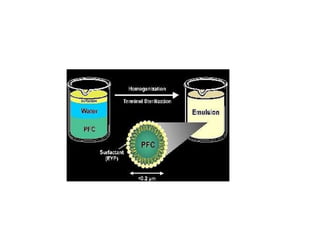
• It consists of a two-phase system prepared by combining
two immiscible liquids, one of which is dispersed
uniformly throughout the other.
• Internal phase = the dispersed phase
• External phase or dispersion medium = continuous phase
• The liquid that is dispersed into small droplets is
called the dispersed phase or internal phase or
discontinuous phase
• The other liquid is the dispersion medium
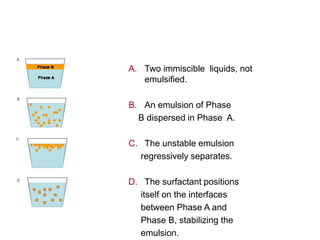
A. Two immiscible liquids, not
emulsified.
B. An emulsion of Phase
B dispersed in Phase A.
C. The unstable emulsion
regressively separates.
D. The surfactant positions
itself on the interfaces
between Phase A and
Phase B, stabilizing the
emulsion.
Emulsions are unstable because:
the globules of the dispersed liquid tend to coalesce
to form large globules until all of the dispersed
globules have coalesced.
• An emulsifying agent is usually added to the system
to prevent the coalescence of the globules and
maintain the integrity of the individual globules of
the dispersed phase.
• Emulsions tend to have a cloudy appearance, because the
many phase interfaces (the boundary between the phases
is called the interface) scatter light that passes through the
emulsion.
• Emulsions are unstable and thus do not form
spontaneously.
• Energy input through shaking, stirring, homogenizers, or
spray processes are needed to form an emulsion.
• Over time, emulsions tend to revert to the stable state of oil
separated from water.
• Surface active substances (surfactants) can increase the
kinetic stability of emulsions greatly so that, once formed, the
emulsion does not change significantly over years of storage.
• A phenomenon is called coalescence, and happens when
small droplets recombine to form bigger ones.
• Fluid emulsions can also suffer from creaming, the migration
of one of the substances to the top of the emulsion
• Emulsions are part of a more general class of two-phase
systems of matter called colloids.
• Although the terms colloid and emulsion are sometimes
used interchangeably, emulsion tends to imply that both
the dispersed and the continuous phase are liquid.
• There are three types of emulsion instability:
1. Flocculation, where the particles form clumps;
2. Creaming, where the particles concentrate towards the
surface of the mixture while staying separated; and
3. Breaking, where the particles coalesce and form a layer
of liquid.
Emulsifying Agents
• They are the substances added to an emulsion to prevent the
coalescence of the globules of the dispersed phase. They are
also known as emulgents or emulsifiers.
• They help in formation of emulsion by three mechanisms.
 Reduction in interfacial tension – thermodynamic stabilization
 Formation of a rigid interfacial film – mechanical barrier to
coalescence
 Formation of an electrical double layer – electrical barrier to
approach of particles.
• Pharmaceutically acceptable emulsifiers must also :
• Be stable .
• Be compatible with other ingredients .
• Be non – toxic .
• Possess little odor , taste , or color .
• Not interfere with the stability of efficacy of the active
agent .
Emulsifier:
• An emulsifier (or surfactant) is a substance which
stabilizes an emulsion.
• Detergents are another class of surfactant, and will
chemically interact with both oil and water, thus
stabilizing the interface between oil or water
droplets in suspension.
• This principle is exploited in soap to remove grease
for the purpose of cleaning.
• A wide variety of emulsifiers are used in pharmacy
to prepare emulsions such as creams and lotions.
• When oil is the dispersed phase and an aqueous solution
is the continuous phase, the system is designated as an
oil-in-water (O/W) emulsion.
• Conversely, where water or an aqueous solution is the
dispersed phase and oil or oleaginous material is the
continuous phase, the system is designated as water-in-
oil (W/O) emulsion.
• Oil-in-water (O/W) emulsion used for oral and intravenous
administration .
• Water-in-oil (W/O) emulsion used for intramuscular injections
for a depot effect (extended release or long acting effect).
• Hydrophobic drugs are prepared using o/w/o multiple
emulsion method.
• Hydrophilic drugs are prepared using w/o/w multiple
emulsion method.
Why would you want an o/w emulsion instead
of a w/o emulsion for an oral dosage form?
• The continuous water phase would be more palatable to the
mouth and the liquid consistency would be easier to flow
through the mouth and down the throat.
• By dispersing a foul tasting or smelling drug in the oil phase,
your taste buds and your sense of smell will be unaware of
the agent passing by.
• In addition, in the o/w emulsion the manufacturer can add
sweeteners and flavors to the continuous phase which will be
experienced by the taste buds as the medication passes over
them.
Advantages of emulsions over other liquid
forms:
1- The unpleasant taste or odor of an oil can be masked partially or wholly,
by emulsification
2- The solubility of many drugs is increased when they are incorporated
into emulsions
3- The stability of many drugs which are unstable in aqueous solutions is
increased when incorporated into an emulsion
4- Prolonged drug action and increased bioavailability are often obtained
when drugs are incorporated into emulsions
5- The appearance of oleaginous materials intended for topical
applications is usually improved when formulated in an emulsified
form
STABILITY OF EMULSION
• Physical Instability :Creaming, Flocculation, Phase Inversion
I. Flocculation
• Neighboring globules come closer to each other and form
colonies in the continuous phase.
• This is the initial stage that leads to instability.
• Flocculation of the dispersed phase may take place before,
during or after creaming
• The reversibility of flocculation depends upon strength of
interaction between particles as determined by:
a. the chemical nature of emulsifier, (are frequently called
amphiphilic (i.e. water- and oil-loving).
b. the phase volume ratio, (For fluid emulsions it has been suggested that a
40 to 60 percent internal phase volume produces acceptable emulsions with
minimal difficulty).
c. the concentration of dissolved substances, specially
electrolytes and ionic emulsifiers
• The extent of flocculation of globules depends on:
(a). Globule size distribution
• Uniform sized globules prevent flocculation.
• This can be achieved by proper size reduction process
(b). Charge on the globule surface
• A charge on the globules exert repulsive forces with the
neighboring globules.
• This can be achieved by using ionic emulsifying agent, electrolytes
etc.
(c). Viscosity of the external medium.
• If the viscosity of the external medium is increased, the globules
become relatively immobile and flocculation can be prevented
II – Creaming
• Creaming is the upward movement of dispersed droplets of
emulsion relative to the continuous phase (due to the density
difference between two phases).
• Creaming is the concentration of globules at the top or
bottom of the emulsion.
• It can be observed by a difference in color shade of the layers.
• It is a reversible process, i.e., cream can be re-dispersed easily
by agitation, this is possible because the oil globules are still
surrounded by the protective sheath of the emulsifier.
• Upward creaming, is due to the dispersed phase is less dense
than the continuous phase. This is normally observed in o/w
emulsions. The velocity of sedimentation becomes negative.
• Downward creaming occurs if the dispersed phase is heavier
than the continuous phase. Due to gravitational pull, the
globules settle down. This is normally observed in w/o
emulsions.
• Creaming can be reduced or prevented by:
1. Reducing the particle size by homogenization. Doubling the
diameter of oil globules increases the creaming rate by a
factor of four.
2. Increasing the viscosity of the external phase by adding the
thickening agents such as methyl cellulose tragacanth or
sodium alginate.
3. Reducing the difference in the densities between the
dispersed phase and dispersion medium.
• III- Coalescence
• Aggregation : Dispersed particles come together but do not
fuse.
• Coalescence is the process by which emulsified particles
merge with each to form large particles.
• Coalescence is observed due to:
 Insufficient amount of the emulsifying agent.
 Altered partitioning of the emulsifying agent.
 Incompatibilities between emulsifying agents.
• Breaking:
• Breaking is the destroying of the film surrounding the
particles.
• Separation of the internal phase from the external phase is
called breaking of the emulsion.
• This is indicated by complete separation of oil and aqueous
phases, is an irreversible process
Extemporaneous Methods
• Emulsification process can be carried out by four methods
mainly:
• Dry Gum Method:
 4 parts (volumes) of oil
 2 parts of water
 1 part of gum
 4:2:1 method
• Wet Gum Method
 4 parts (volumes) of oil
 2 parts of water
 1 part of gum
• Forbes Bottle Method:
 emulsion from volatile oils or oleaginous substance of low
viscosity. powdered acacia + 2 parts of oil
• Auxiliary Method
 hand homogenizer, which forces the emulsion through a very
small orifice, reducing the dispersed droplet size to about 5
microns or less
• A mortar and pestle is employed frequently in the
extemporaneous preparation of emulsions. It is not a very
efficient technique and is not used on a large scale. The
types of equipment available for preparing emulsions on
large scale are:
• (1) mechanical stirring
• (2) homogenizers
• (3) colloid mills
• (4) ultrasonifiers
Emulsions can be used for following
dosage forms:
• Oil Products:
a) More palatable : Objectionable taste or texture of medicinal
agents gets masked.
b) Better absorption : Due to small globule size, the medicinal agent
gets absorbed faster.
• O/W Parenteral :
a) I/V route : Lipid nutrients are emulsified and given to patients by
i/v route. Such emulsions have particle size less than 100 nm.
b) Depot injections : W/o emulsions are used to disperse water
soluble antigenic materials in mineral oil for i/m depot injection.
• Topical Products:
a) O/W emulsions are more acceptable as water washable drug
bases for cosmetic purposes. W/O emulsions are used for
treatment of dry skin.
• Emulsions have following advantages when used
for topical purpose:
a) Patient acceptance
b) washable character,
c) Acceptable viscosity,
d) Less greasiness.

EMULSIONS LECTURE presentation lecture five

  • 1.
  • 2.
    • It consistsof a two-phase system prepared by combining two immiscible liquids, one of which is dispersed uniformly throughout the other. • Internal phase = the dispersed phase • External phase or dispersion medium = continuous phase
  • 3.
    • The liquidthat is dispersed into small droplets is called the dispersed phase or internal phase or discontinuous phase • The other liquid is the dispersion medium
  • 4.
    A. Two immiscibleliquids, not emulsified. B. An emulsion of Phase B dispersed in Phase A. C. The unstable emulsion regressively separates. D. The surfactant positions itself on the interfaces between Phase A and Phase B, stabilizing the emulsion.
  • 5.
    Emulsions are unstablebecause: the globules of the dispersed liquid tend to coalesce to form large globules until all of the dispersed globules have coalesced. • An emulsifying agent is usually added to the system to prevent the coalescence of the globules and maintain the integrity of the individual globules of the dispersed phase.
  • 7.
    • Emulsions tendto have a cloudy appearance, because the many phase interfaces (the boundary between the phases is called the interface) scatter light that passes through the emulsion. • Emulsions are unstable and thus do not form spontaneously. • Energy input through shaking, stirring, homogenizers, or spray processes are needed to form an emulsion.
  • 8.
    • Over time,emulsions tend to revert to the stable state of oil separated from water. • Surface active substances (surfactants) can increase the kinetic stability of emulsions greatly so that, once formed, the emulsion does not change significantly over years of storage. • A phenomenon is called coalescence, and happens when small droplets recombine to form bigger ones. • Fluid emulsions can also suffer from creaming, the migration of one of the substances to the top of the emulsion
  • 9.
    • Emulsions arepart of a more general class of two-phase systems of matter called colloids. • Although the terms colloid and emulsion are sometimes used interchangeably, emulsion tends to imply that both the dispersed and the continuous phase are liquid.
  • 10.
    • There arethree types of emulsion instability: 1. Flocculation, where the particles form clumps; 2. Creaming, where the particles concentrate towards the surface of the mixture while staying separated; and 3. Breaking, where the particles coalesce and form a layer of liquid.
  • 11.
    Emulsifying Agents • Theyare the substances added to an emulsion to prevent the coalescence of the globules of the dispersed phase. They are also known as emulgents or emulsifiers. • They help in formation of emulsion by three mechanisms.  Reduction in interfacial tension – thermodynamic stabilization  Formation of a rigid interfacial film – mechanical barrier to coalescence  Formation of an electrical double layer – electrical barrier to approach of particles.
  • 12.
    • Pharmaceutically acceptableemulsifiers must also : • Be stable . • Be compatible with other ingredients . • Be non – toxic . • Possess little odor , taste , or color . • Not interfere with the stability of efficacy of the active agent .
  • 13.
    Emulsifier: • An emulsifier(or surfactant) is a substance which stabilizes an emulsion. • Detergents are another class of surfactant, and will chemically interact with both oil and water, thus stabilizing the interface between oil or water droplets in suspension. • This principle is exploited in soap to remove grease for the purpose of cleaning. • A wide variety of emulsifiers are used in pharmacy to prepare emulsions such as creams and lotions.
  • 14.
    • When oilis the dispersed phase and an aqueous solution is the continuous phase, the system is designated as an oil-in-water (O/W) emulsion. • Conversely, where water or an aqueous solution is the dispersed phase and oil or oleaginous material is the continuous phase, the system is designated as water-in- oil (W/O) emulsion.
  • 15.
    • Oil-in-water (O/W)emulsion used for oral and intravenous administration . • Water-in-oil (W/O) emulsion used for intramuscular injections for a depot effect (extended release or long acting effect). • Hydrophobic drugs are prepared using o/w/o multiple emulsion method. • Hydrophilic drugs are prepared using w/o/w multiple emulsion method.
  • 16.
    Why would youwant an o/w emulsion instead of a w/o emulsion for an oral dosage form? • The continuous water phase would be more palatable to the mouth and the liquid consistency would be easier to flow through the mouth and down the throat. • By dispersing a foul tasting or smelling drug in the oil phase, your taste buds and your sense of smell will be unaware of the agent passing by. • In addition, in the o/w emulsion the manufacturer can add sweeteners and flavors to the continuous phase which will be experienced by the taste buds as the medication passes over them.
  • 17.
    Advantages of emulsionsover other liquid forms: 1- The unpleasant taste or odor of an oil can be masked partially or wholly, by emulsification 2- The solubility of many drugs is increased when they are incorporated into emulsions 3- The stability of many drugs which are unstable in aqueous solutions is increased when incorporated into an emulsion 4- Prolonged drug action and increased bioavailability are often obtained when drugs are incorporated into emulsions 5- The appearance of oleaginous materials intended for topical applications is usually improved when formulated in an emulsified form
  • 18.
    STABILITY OF EMULSION •Physical Instability :Creaming, Flocculation, Phase Inversion I. Flocculation • Neighboring globules come closer to each other and form colonies in the continuous phase. • This is the initial stage that leads to instability. • Flocculation of the dispersed phase may take place before, during or after creaming
  • 19.
    • The reversibilityof flocculation depends upon strength of interaction between particles as determined by: a. the chemical nature of emulsifier, (are frequently called amphiphilic (i.e. water- and oil-loving). b. the phase volume ratio, (For fluid emulsions it has been suggested that a 40 to 60 percent internal phase volume produces acceptable emulsions with minimal difficulty). c. the concentration of dissolved substances, specially electrolytes and ionic emulsifiers
  • 20.
    • The extentof flocculation of globules depends on: (a). Globule size distribution • Uniform sized globules prevent flocculation. • This can be achieved by proper size reduction process (b). Charge on the globule surface • A charge on the globules exert repulsive forces with the neighboring globules. • This can be achieved by using ionic emulsifying agent, electrolytes etc. (c). Viscosity of the external medium. • If the viscosity of the external medium is increased, the globules become relatively immobile and flocculation can be prevented
  • 21.
    II – Creaming •Creaming is the upward movement of dispersed droplets of emulsion relative to the continuous phase (due to the density difference between two phases). • Creaming is the concentration of globules at the top or bottom of the emulsion. • It can be observed by a difference in color shade of the layers. • It is a reversible process, i.e., cream can be re-dispersed easily by agitation, this is possible because the oil globules are still surrounded by the protective sheath of the emulsifier.
  • 22.
    • Upward creaming,is due to the dispersed phase is less dense than the continuous phase. This is normally observed in o/w emulsions. The velocity of sedimentation becomes negative. • Downward creaming occurs if the dispersed phase is heavier than the continuous phase. Due to gravitational pull, the globules settle down. This is normally observed in w/o emulsions.
  • 23.
    • Creaming canbe reduced or prevented by: 1. Reducing the particle size by homogenization. Doubling the diameter of oil globules increases the creaming rate by a factor of four. 2. Increasing the viscosity of the external phase by adding the thickening agents such as methyl cellulose tragacanth or sodium alginate. 3. Reducing the difference in the densities between the dispersed phase and dispersion medium.
  • 24.
    • III- Coalescence •Aggregation : Dispersed particles come together but do not fuse. • Coalescence is the process by which emulsified particles merge with each to form large particles. • Coalescence is observed due to:  Insufficient amount of the emulsifying agent.  Altered partitioning of the emulsifying agent.  Incompatibilities between emulsifying agents.
  • 25.
    • Breaking: • Breakingis the destroying of the film surrounding the particles. • Separation of the internal phase from the external phase is called breaking of the emulsion. • This is indicated by complete separation of oil and aqueous phases, is an irreversible process
  • 26.
    Extemporaneous Methods • Emulsificationprocess can be carried out by four methods mainly: • Dry Gum Method:  4 parts (volumes) of oil  2 parts of water  1 part of gum  4:2:1 method • Wet Gum Method  4 parts (volumes) of oil  2 parts of water  1 part of gum
  • 27.
    • Forbes BottleMethod:  emulsion from volatile oils or oleaginous substance of low viscosity. powdered acacia + 2 parts of oil • Auxiliary Method  hand homogenizer, which forces the emulsion through a very small orifice, reducing the dispersed droplet size to about 5 microns or less
  • 28.
    • A mortarand pestle is employed frequently in the extemporaneous preparation of emulsions. It is not a very efficient technique and is not used on a large scale. The types of equipment available for preparing emulsions on large scale are: • (1) mechanical stirring • (2) homogenizers • (3) colloid mills • (4) ultrasonifiers
  • 29.
    Emulsions can beused for following dosage forms: • Oil Products: a) More palatable : Objectionable taste or texture of medicinal agents gets masked. b) Better absorption : Due to small globule size, the medicinal agent gets absorbed faster. • O/W Parenteral : a) I/V route : Lipid nutrients are emulsified and given to patients by i/v route. Such emulsions have particle size less than 100 nm. b) Depot injections : W/o emulsions are used to disperse water soluble antigenic materials in mineral oil for i/m depot injection.
  • 30.
    • Topical Products: a)O/W emulsions are more acceptable as water washable drug bases for cosmetic purposes. W/O emulsions are used for treatment of dry skin. • Emulsions have following advantages when used for topical purpose: a) Patient acceptance b) washable character, c) Acceptable viscosity, d) Less greasiness.