1
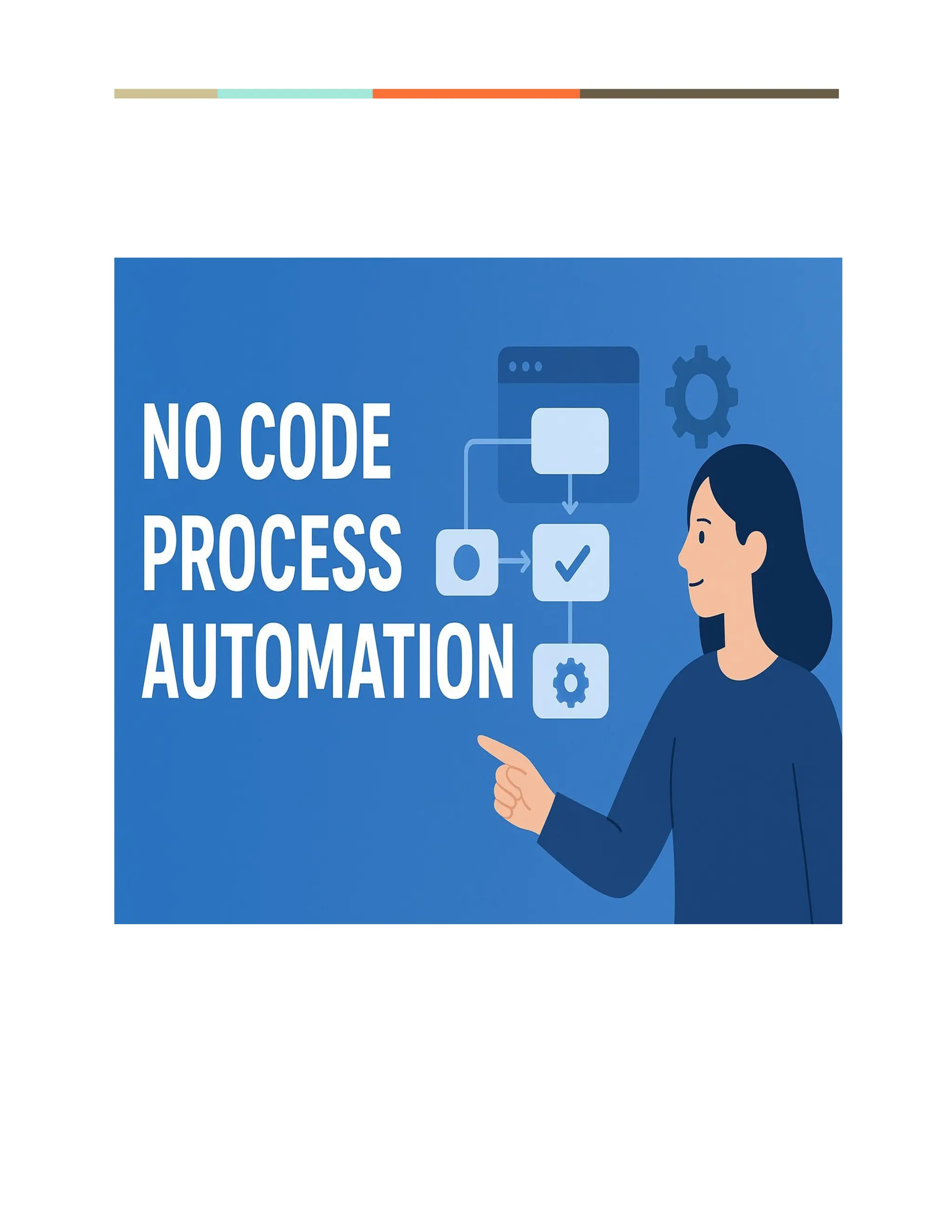
No-Code Process Automation is a novel approach to developing automation
tests that enables you to test an application without writing a single line
of code or script.
The goal is to make the setup so simple that automating a test scenario
takes less time and almost no coding. For many tasks, especially in IT
automation, the less code there is, the easier it is.
By using and reusing premade or preprogrammed blocks of activities, the
user can achieve faster results and greater simplicity.
According to Forrester, low/no-code platforms are expected to be a $20
billion+ industry.
So in this article, let us understand How no-code automation in the different
fields makes the job easy for the firms.
What Is No Code Process Automation
Platforms?
2
No-code process automation platforms are software applications that
require no coding knowledge and enable users to create enterprise-grade,
high-fidelity bespoke applications that automate otherwise
manual-intensive processes.
By bringing in a more significant number of people with diverse skill
sets, such platforms enable organizations to be proactive rather than
reactive.
For example, it expedites business processes and reduces errors
while relieving employees of mundane and repetitive tasks.
No-code has the potential to take the place of the talent, time-consuming,
inflexible, and labor-intensive hand-coded application development and
process automation methods.
It has made it easier for employees who do not have coding skills to
create simple and complex applications that transform business
processes.
Historically, these platforms were considered primarily educational tools;
however, the modern generation of no-code platforms will change the
definition of who can be a software developer.
This also helps the firm hire a person with better skills in UI, the person with
more creative attributes rather than coding attributes because good UI is one
of the most crucial for attracting an audience to your app or website.
4 Beneffits of No Code Process Automation:
01 Not able to ffind the right talent
No-code automation solves this problem by filling in the gaps and
compensating for these flaws.
Not only does this allow organizations to allocate their existing skilled
workforce away from the mundane to tasks and projects where they can
truly
3
make an impact on the business, but it also allows limited IT teams to keep
up with their demanding workload.
2. It Goes Well With Edge Computing
Edge computing, which brings “computational” work as close to the data
collection point as possible, is being hailed as one of the top technology
trends for 2021 and beyond.
According to recent reports, more than half of new enterprise IT
infrastructure will use edge computing as an alternative to massively
centralized data centers, especially for proprietary data or in situations (such
as transportation or defense) where real-time decisions are required, and
multiple trips to the cloud are not feasible.
In addition, this year
, 34% of global manufacturers plan to integrate
IoT technology into their operations and products.
Edge computing and no-code platforms work well together. For example,
no-code apps can extract actionable data and business intelligence from
connected devices quickly and easily, allowing for better decision-making.
3. Supplements Remote/Hybrid Working
No-code platforms will continue to dominate the business app development
landscape, allowing business users across organizations to deliver
high-quality apps quickly during the pandemic.
Such platforms will enable business continuity and inspire innovation in the
post-pandemic future.
4. Enhance Speed And Productivity
Non-development teams in large organizations benefit from no-code
platforms because they have more autonomy. For example, business
users
4
can use such solutions to meet their business application needs without
burdening IT with time-consuming and mundane tasks.
Without coding or development skills, business users can create functional
enterprise apps with modern user interfaces that integrate with core business
systems and automate business-critical processes using these capabilities.
This relieves a significant burden on IT and development teams while also
speeding up the pace of innovation within an organization.
It also saves money by eliminating the need to hire specialized personnel
or buy new enterprise products every time a need arises
What Is No Code Workflow Automation?
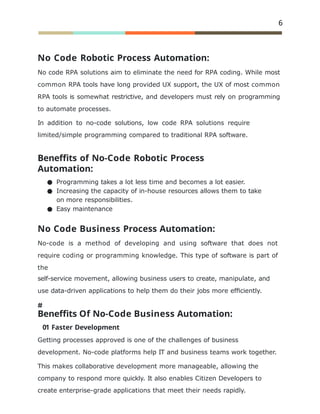
No-Code Development Platform – from the beginning, it will assist you
in
creating workflows in a matter of minutes. A visual UI builder
makes everything easier.
5
Drag and drop functionality saves time, and you won’t be frustrated or lost
because you don’t know how to ‘code.
Beneffits of No code Workflow Automation:
1. Easy to Use
Workflow automation software with no code is simple. Any employee in your
company can be designated as an administrator, and they will be able to
create workflows for various teams quickly.
2. Cost-effective
Developing new software from the ground up is costly and can cost
thousands of dollars. Furthermore, hiring experienced programmers or
coders to assist you regularly is still more expensive than utilizing
existing resources. The no-code application is the cheapest and provides
the best return on investment by helping you streamline your work.
Using a drag-and-drop interface, creating new workflows has never been
easier. To get started, drag and drop boxes wherever you need them.
3. Easy to Implement
It’s much easier to implement multiple workflows in hours than days or weeks
when you can create them in minutes. Immediately streamline different
departments in your company to work more efficiently.
Workflow automation software uses no-code development, which is both
efficient and enjoyable to use. For example, you can create attractive
workflows that display all relevant data at a glance.
There is no need to hire programmers to help you maintain the application
because it is self-contained. There are no costs or downtime, but your
workflow processes will be more reliable and secure.
6
No Code Robotic Process Automation:
No code RPA solutions aim to eliminate the need for RPA coding. While most
common RPA tools have long provided UX support, the UX of most common
RPA tools is somewhat restrictive, and developers must rely on programming
to automate processes.
In addition to no-code solutions, low code RPA solutions require
limited/simple programming compared to traditional RPA software.
Beneffits of No-Code Robotic Process
Automation:
● Programming takes a lot less time and becomes a lot easier.
● Increasing the capacity of in-house resources allows them to take
on more responsibilities.
● Easy maintenance
No Code Business Process Automation:
No-code is a method of developing and using software that does not
require coding or programming knowledge. This type of software is part of
the
self-service movement, allowing business users to create, manipulate, and
use data-driven applications to help them do their jobs more efficiently.
Beneffits Of No-Code Business Automation:
01 Faster Development
Getting processes approved is one of the challenges of business
development. No-code platforms help IT and business teams work together.
This makes collaborative development more manageable, allowing the
company to respond more quickly. It also enables Citizen Developers to
create enterprise-grade applications that meet their needs rapidly.
7
2. Increased Agility
Organizations become more agile when business users create their programs
using no-code and low-code tools. These enable them to respond more
quickly to changing market conditions and business circumstances while
better preparing for the future.
3. Decreased Training
Because these software solutions are self-service, business users don’t need
much training to do their jobs. However, this lowers costs and accelerates
time to value for business users because they can work at their own pace
without learning technical skills.
4. Reduced Costs
Using self-service tools to empower the business to be more efficient and
effective reduces the time to action and costs associated with waiting for IT
to create business applications using traditional programming approaches. As
a result, companies can save time and money in both departments by using
no-code.
5. Better Applications
End users are empowered to create apps they need, understand what’s
expected of them, and modify them as needed for iterative improvements,
thanks to no-code programming.
8
No Code Securities Process Automation:
Automation is simply a method of performing those tasks without requiring a
human to send emails, create tickets, check logs, or perform other repetitive
actions. Because security workflows are often complex, automation must be
flexible and scalable to handle the complexities.
Security professionals can use no-code automation to create the automation
they need on their own time and in their way. As a result, analysts no longer
need to rely on software developers, which cuts down on both times to value
and maintenance costs.
Another advantage is that analysts can automate more of their workflows,
freeing up time and resources to focus on higher-impact tasks like improving
security approaches, lowering risk posture, reducing false positives, and
improving awareness training.
9
For the foreseeable future, human analysts will always be in high demand.
The trick is to figure out how to deploy them best while also tinkering and
developing their tools without destroying everything if they make a
mistake.
As people and businesses become more reliant on computers, new
technological threats emerge, the most common of which are phishing,
malware, and ransomware.
Leaders in security operations should always look for ways to break
down barriers that prevent their team from performing at its best.
No-code automation is a method of putting control in the hands of
employees. It boosts productivity by energizing employees and lowering the
risk of human error and improving a company’s security posture.
No Code Insurance Process Automation:
Around the world, there is still a labor shortage, particularly among new
developers. There were 1.4 million computer science jobs in the United
States by the end of 2020, but only 400,000 graduates to fill them.
Because insurers can’t hire their way out of this problem, business and IT
leaders must figure out how to build mission-critical insurance applications
with fewer resources. Low-code and no-code platforms can help with this.
Using visual design tools and a drag-and-drop interface, development teams
can quickly build applications—whether for claims, underwriting, compliance,
or anything else—by selecting a platform that can handle complex business
problems.
1
0
Conclusion:
No-code platforms help non-development teams within large organizations
gain more autonomy. For example, business users can use such solutions to
meet their business application needs without burdening IT with tedious and
time-consuming tasks.
With these capabilities, business users who lack development skills or coding
expertise can create functional enterprise apps with modern user interfaces
that integrate with core business systems and automate business-critical
processes.
This relieves a significant burden on an organization’s busy IT and
development teams while increasing the overall pace of innovation. It also
saves costs by eliminating specialized hiring talent or regularly purchasing
new enterprise products.
Source: For more details, refer to TestGrid

Empowering Teams Through No-Code Process Automation

  • 2.
    1 No-Code Process Automationis a novel approach to developing automation tests that enables you to test an application without writing a single line of code or script. The goal is to make the setup so simple that automating a test scenario takes less time and almost no coding. For many tasks, especially in IT automation, the less code there is, the easier it is. By using and reusing premade or preprogrammed blocks of activities, the user can achieve faster results and greater simplicity. According to Forrester, low/no-code platforms are expected to be a $20 billion+ industry. So in this article, let us understand How no-code automation in the different fields makes the job easy for the firms. What Is No Code Process Automation Platforms?
  • 3.
    2 No-code process automationplatforms are software applications that require no coding knowledge and enable users to create enterprise-grade, high-fidelity bespoke applications that automate otherwise manual-intensive processes. By bringing in a more significant number of people with diverse skill sets, such platforms enable organizations to be proactive rather than reactive. For example, it expedites business processes and reduces errors while relieving employees of mundane and repetitive tasks. No-code has the potential to take the place of the talent, time-consuming, inflexible, and labor-intensive hand-coded application development and process automation methods. It has made it easier for employees who do not have coding skills to create simple and complex applications that transform business processes. Historically, these platforms were considered primarily educational tools; however, the modern generation of no-code platforms will change the definition of who can be a software developer. This also helps the firm hire a person with better skills in UI, the person with more creative attributes rather than coding attributes because good UI is one of the most crucial for attracting an audience to your app or website. 4 Beneffits of No Code Process Automation: 01 Not able to ffind the right talent No-code automation solves this problem by filling in the gaps and compensating for these flaws. Not only does this allow organizations to allocate their existing skilled workforce away from the mundane to tasks and projects where they can truly
  • 4.
    3 make an impacton the business, but it also allows limited IT teams to keep up with their demanding workload. 2. It Goes Well With Edge Computing Edge computing, which brings “computational” work as close to the data collection point as possible, is being hailed as one of the top technology trends for 2021 and beyond. According to recent reports, more than half of new enterprise IT infrastructure will use edge computing as an alternative to massively centralized data centers, especially for proprietary data or in situations (such as transportation or defense) where real-time decisions are required, and multiple trips to the cloud are not feasible. In addition, this year , 34% of global manufacturers plan to integrate IoT technology into their operations and products. Edge computing and no-code platforms work well together. For example, no-code apps can extract actionable data and business intelligence from connected devices quickly and easily, allowing for better decision-making. 3. Supplements Remote/Hybrid Working No-code platforms will continue to dominate the business app development landscape, allowing business users across organizations to deliver high-quality apps quickly during the pandemic. Such platforms will enable business continuity and inspire innovation in the post-pandemic future. 4. Enhance Speed And Productivity Non-development teams in large organizations benefit from no-code platforms because they have more autonomy. For example, business users
  • 5.
    4 can use suchsolutions to meet their business application needs without burdening IT with time-consuming and mundane tasks. Without coding or development skills, business users can create functional enterprise apps with modern user interfaces that integrate with core business systems and automate business-critical processes using these capabilities. This relieves a significant burden on IT and development teams while also speeding up the pace of innovation within an organization. It also saves money by eliminating the need to hire specialized personnel or buy new enterprise products every time a need arises What Is No Code Workflow Automation? No-Code Development Platform – from the beginning, it will assist you in creating workflows in a matter of minutes. A visual UI builder makes everything easier.
  • 6.
    5 Drag and dropfunctionality saves time, and you won’t be frustrated or lost because you don’t know how to ‘code. Beneffits of No code Workflow Automation: 1. Easy to Use Workflow automation software with no code is simple. Any employee in your company can be designated as an administrator, and they will be able to create workflows for various teams quickly. 2. Cost-effective Developing new software from the ground up is costly and can cost thousands of dollars. Furthermore, hiring experienced programmers or coders to assist you regularly is still more expensive than utilizing existing resources. The no-code application is the cheapest and provides the best return on investment by helping you streamline your work. Using a drag-and-drop interface, creating new workflows has never been easier. To get started, drag and drop boxes wherever you need them. 3. Easy to Implement It’s much easier to implement multiple workflows in hours than days or weeks when you can create them in minutes. Immediately streamline different departments in your company to work more efficiently. Workflow automation software uses no-code development, which is both efficient and enjoyable to use. For example, you can create attractive workflows that display all relevant data at a glance. There is no need to hire programmers to help you maintain the application because it is self-contained. There are no costs or downtime, but your workflow processes will be more reliable and secure.
  • 7.
    6 No Code RoboticProcess Automation: No code RPA solutions aim to eliminate the need for RPA coding. While most common RPA tools have long provided UX support, the UX of most common RPA tools is somewhat restrictive, and developers must rely on programming to automate processes. In addition to no-code solutions, low code RPA solutions require limited/simple programming compared to traditional RPA software. Beneffits of No-Code Robotic Process Automation: ● Programming takes a lot less time and becomes a lot easier. ● Increasing the capacity of in-house resources allows them to take on more responsibilities. ● Easy maintenance No Code Business Process Automation: No-code is a method of developing and using software that does not require coding or programming knowledge. This type of software is part of the self-service movement, allowing business users to create, manipulate, and use data-driven applications to help them do their jobs more efficiently. Beneffits Of No-Code Business Automation: 01 Faster Development Getting processes approved is one of the challenges of business development. No-code platforms help IT and business teams work together. This makes collaborative development more manageable, allowing the company to respond more quickly. It also enables Citizen Developers to create enterprise-grade applications that meet their needs rapidly.
  • 8.
    7 2. Increased Agility Organizationsbecome more agile when business users create their programs using no-code and low-code tools. These enable them to respond more quickly to changing market conditions and business circumstances while better preparing for the future. 3. Decreased Training Because these software solutions are self-service, business users don’t need much training to do their jobs. However, this lowers costs and accelerates time to value for business users because they can work at their own pace without learning technical skills. 4. Reduced Costs Using self-service tools to empower the business to be more efficient and effective reduces the time to action and costs associated with waiting for IT to create business applications using traditional programming approaches. As a result, companies can save time and money in both departments by using no-code. 5. Better Applications End users are empowered to create apps they need, understand what’s expected of them, and modify them as needed for iterative improvements, thanks to no-code programming.
  • 9.
    8 No Code SecuritiesProcess Automation: Automation is simply a method of performing those tasks without requiring a human to send emails, create tickets, check logs, or perform other repetitive actions. Because security workflows are often complex, automation must be flexible and scalable to handle the complexities. Security professionals can use no-code automation to create the automation they need on their own time and in their way. As a result, analysts no longer need to rely on software developers, which cuts down on both times to value and maintenance costs. Another advantage is that analysts can automate more of their workflows, freeing up time and resources to focus on higher-impact tasks like improving security approaches, lowering risk posture, reducing false positives, and improving awareness training.
  • 10.
    9 For the foreseeablefuture, human analysts will always be in high demand. The trick is to figure out how to deploy them best while also tinkering and developing their tools without destroying everything if they make a mistake. As people and businesses become more reliant on computers, new technological threats emerge, the most common of which are phishing, malware, and ransomware. Leaders in security operations should always look for ways to break down barriers that prevent their team from performing at its best. No-code automation is a method of putting control in the hands of employees. It boosts productivity by energizing employees and lowering the risk of human error and improving a company’s security posture. No Code Insurance Process Automation: Around the world, there is still a labor shortage, particularly among new developers. There were 1.4 million computer science jobs in the United States by the end of 2020, but only 400,000 graduates to fill them. Because insurers can’t hire their way out of this problem, business and IT leaders must figure out how to build mission-critical insurance applications with fewer resources. Low-code and no-code platforms can help with this. Using visual design tools and a drag-and-drop interface, development teams can quickly build applications—whether for claims, underwriting, compliance, or anything else—by selecting a platform that can handle complex business problems.
  • 11.
    1 0 Conclusion: No-code platforms helpnon-development teams within large organizations gain more autonomy. For example, business users can use such solutions to meet their business application needs without burdening IT with tedious and time-consuming tasks. With these capabilities, business users who lack development skills or coding expertise can create functional enterprise apps with modern user interfaces that integrate with core business systems and automate business-critical processes. This relieves a significant burden on an organization’s busy IT and development teams while increasing the overall pace of innovation. It also saves costs by eliminating specialized hiring talent or regularly purchasing new enterprise products. Source: For more details, refer to TestGrid