Payroll

Employer’s responsibilities
The taxman has an interest
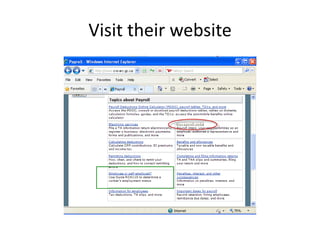
Visit their website
THE PAYROLL STEPS
1. Determine your status
• Are you an employer, trustee or payer?
1. Determine your status
• Are you an employer? , trustee or payer
  – contract of service
  – In all situations, the written contract (if applicable)
    and working conditions must be examined to
    determine if an employer-employee relationship
    exists.
  – RC4110 (Employee or Self-Employed)
2. Open a payroll account
A payroll account is an account number assigned
to an employer to identify themselves when
dealing with the Canada Revenue Agency.
• 15-digit payroll account number
  – the 9-digit BN;
  – 2 letters for the type of account
    (For payroll the letters are "RP"); and
  – 4 numbers for the specific account reference
Obtaining a BIN
• By phone
• By internet
• By mail
When?
You have to register for a payroll account before
the first remittance due date.

Your first remittance due date is the 15th day of
the month following the month in which you
began withholding deductions from your
employee's pay.
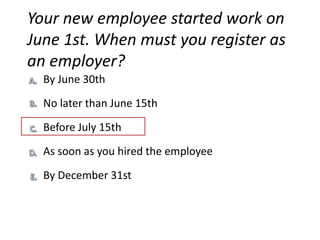
Your new employee started work on
June 1st. When must you register as
an employer?
  By June 30th
  No later than June 15th
  Before July 15th

  As soon as you hired the employee

  By December 31st
Your new employee started work on
June 1st. When must you register as
an employer?
  By June 30th
  No later than June 15th
  Before July 15th

  As soon as you hired the employee

  By December 31st
Remittance dates
Remittance due dates are always based on when
an employee is paid for his or her services
(pay day) rather than the pay period for which
the services are rendered.

New employers are considered regular
remitters.
Regular Remitter
The remittance due date is the 15th day of the
month following.
You hire an employee on March 10 and you pay
him bi-weekly. The first pay is on March 24th.

When is the remittance due?
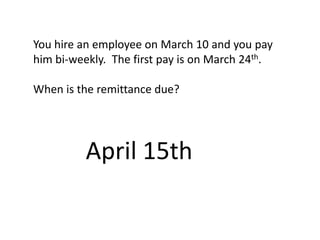
You hire an employee on March 10 and you pay
him bi-weekly. The first pay is on March 24th.

When is the remittance due?


          April 15th
The pay week starts on Monday and
ends on Sunday. The cheques are issued
the following Tuesday. When is the
remittance due?

Monday         – June 28
Sunday        – July 4
Pay date      - July 6th
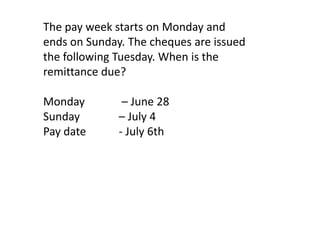
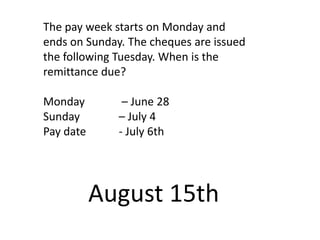
The pay week starts on Monday and
ends on Sunday. The cheques are issued
the following Tuesday. When is the
remittance due?

Monday         – June 28
Sunday        – July 4
Pay date      - July 6th


           August 15th
The pay week starts on Monday and ends on
Sunday. The cheques are issued the following
Monday. When is the remittance due? (The
employee does not work on the weekend.)

Monday         – May 26st
Sunday        – June 1st
Pay date      - June 2nd
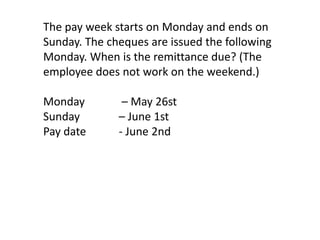
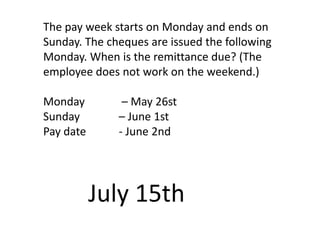
The pay week starts on Monday and ends on
Sunday. The cheques are issued the following
Monday. When is the remittance due? (The
employee does not work on the weekend.)

Monday         – May 26st
Sunday        – June 1st
Pay date      - June 2nd


           July 15th
The Payroll Steps
• Determine your status
• Open a payroll account
3. Hire employees
• Obtain the SIN from each employee who is in
  pensionable or insurable employment.
• Under the Canada Pension Plan Regulations, if
  an employee doesn't have a SIN card, you
  must inform him or her within three days of
  when they start working for you how to get
  one.
3. Hire employees
• Have the employee(s) complete a TD1
• Individuals who have a new employer have to
  complete the federal TD1 and, if more than
  the basic personal amount is claimed, the
  provincial or territorial TD1.
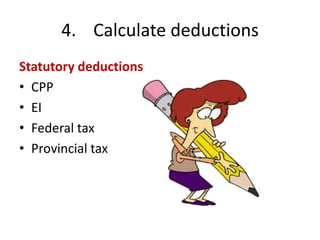
4. Calculate deductions
Statutory deductions
• CPP
• EI
• Federal tax
• Provincial tax
5. Remit deductions
6. File information returns

• Monthly remittances [PD7A]
• Annual filing
  – T4s
  – T4 summary
7. Keep records
•   The hours worked by each employee;
•   The CPP contributions
•   EI premiums
•   Taxes
•   TD1
•   Letters of authority
•   All information slips and returns
How long must you keep
 these records?
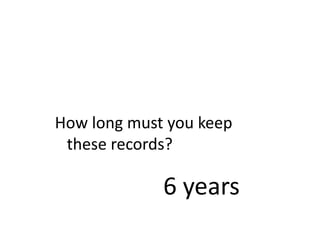
How long must you keep
 these records?

             6 years
Ministry of Labour

Ministry of labour has an interest too.

They require the following records be kept.
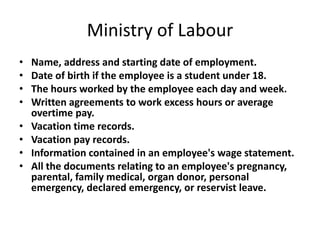
Ministry of Labour
•   Name, address and starting date of employment.
•   Date of birth if the employee is a student under 18.
•   The hours worked by the employee each day and week.
•   Written agreements to work excess hours or average
    overtime pay.
•   Vacation time records.
•   Vacation pay records.
•   Information contained in an employee's wage statement.
•   All the documents relating to an employee's pregnancy,
    parental, family medical, organ donor, personal
    emergency, declared emergency, or reservist leave.
Ministry of Labour
•   Name, address and starting date of employment.
•   Date of birth if the employee is a student under 18.
•   The hours worked by the employee each day and week.
•   Written agreements to work excess hours or average
    overtime pay.
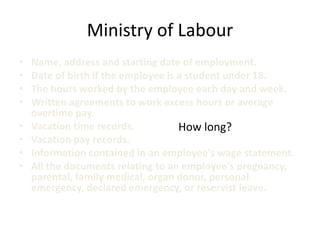
•   Vacation time records.           How long?
•   Vacation pay records.
•   Information contained in an employee's wage statement.
•   All the documents relating to an employee's pregnancy,
    parental, family medical, organ donor, personal
    emergency, declared emergency, or reservist leave.
Ministry of Labour
•   Name, address and starting date of employment.
•   Date of birth if the employee is a student under 18.
•   The hours worked by the employee each day and week.
•   Written agreements to work excess hours or average
    overtime pay.
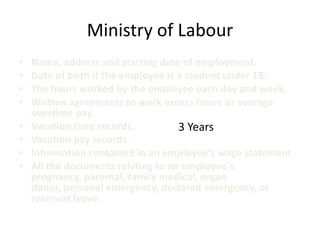
•   Vacation time records.           3 Years
•   Vacation pay records.
•   Information contained in an employee's wage statement.
•   All the documents relating to an employee's
    pregnancy, parental, family medical, organ
    donor, personal emergency, declared emergency, or
    reservist leave.
END

Employer responsibilities

  • 1.
  • 2.
    The taxman hasan interest
  • 3.
  • 4.
  • 5.
    1. Determine yourstatus • Are you an employer, trustee or payer?
  • 6.
    1. Determine yourstatus • Are you an employer? , trustee or payer – contract of service – In all situations, the written contract (if applicable) and working conditions must be examined to determine if an employer-employee relationship exists. – RC4110 (Employee or Self-Employed)
  • 7.
    2. Open apayroll account A payroll account is an account number assigned to an employer to identify themselves when dealing with the Canada Revenue Agency. • 15-digit payroll account number – the 9-digit BN; – 2 letters for the type of account (For payroll the letters are "RP"); and – 4 numbers for the specific account reference
  • 8.
    Obtaining a BIN •By phone • By internet • By mail
  • 9.
    When? You have toregister for a payroll account before the first remittance due date. Your first remittance due date is the 15th day of the month following the month in which you began withholding deductions from your employee's pay.
  • 10.
    Your new employeestarted work on June 1st. When must you register as an employer? By June 30th No later than June 15th Before July 15th As soon as you hired the employee By December 31st
  • 11.
    Your new employeestarted work on June 1st. When must you register as an employer? By June 30th No later than June 15th Before July 15th As soon as you hired the employee By December 31st
  • 12.
    Remittance dates Remittance duedates are always based on when an employee is paid for his or her services (pay day) rather than the pay period for which the services are rendered. New employers are considered regular remitters.
  • 13.
    Regular Remitter The remittancedue date is the 15th day of the month following.
  • 14.
    You hire anemployee on March 10 and you pay him bi-weekly. The first pay is on March 24th. When is the remittance due?
  • 15.
    You hire anemployee on March 10 and you pay him bi-weekly. The first pay is on March 24th. When is the remittance due? April 15th
  • 16.
    The pay weekstarts on Monday and ends on Sunday. The cheques are issued the following Tuesday. When is the remittance due? Monday – June 28 Sunday – July 4 Pay date - July 6th
  • 17.
    The pay weekstarts on Monday and ends on Sunday. The cheques are issued the following Tuesday. When is the remittance due? Monday – June 28 Sunday – July 4 Pay date - July 6th August 15th
  • 18.
    The pay weekstarts on Monday and ends on Sunday. The cheques are issued the following Monday. When is the remittance due? (The employee does not work on the weekend.) Monday – May 26st Sunday – June 1st Pay date - June 2nd
  • 19.
    The pay weekstarts on Monday and ends on Sunday. The cheques are issued the following Monday. When is the remittance due? (The employee does not work on the weekend.) Monday – May 26st Sunday – June 1st Pay date - June 2nd July 15th
  • 20.
    The Payroll Steps •Determine your status • Open a payroll account
  • 21.
    3. Hire employees •Obtain the SIN from each employee who is in pensionable or insurable employment. • Under the Canada Pension Plan Regulations, if an employee doesn't have a SIN card, you must inform him or her within three days of when they start working for you how to get one.
  • 22.
    3. Hire employees •Have the employee(s) complete a TD1 • Individuals who have a new employer have to complete the federal TD1 and, if more than the basic personal amount is claimed, the provincial or territorial TD1.
  • 23.
    4. Calculate deductions Statutorydeductions • CPP • EI • Federal tax • Provincial tax
  • 24.
  • 25.
  • 26.
    6. File informationreturns • Monthly remittances [PD7A] • Annual filing – T4s – T4 summary
  • 27.
    7. Keep records • The hours worked by each employee; • The CPP contributions • EI premiums • Taxes • TD1 • Letters of authority • All information slips and returns
  • 28.
    How long mustyou keep these records?
  • 29.
    How long mustyou keep these records? 6 years
  • 30.
    Ministry of Labour Ministryof labour has an interest too. They require the following records be kept.
  • 31.
    Ministry of Labour • Name, address and starting date of employment. • Date of birth if the employee is a student under 18. • The hours worked by the employee each day and week. • Written agreements to work excess hours or average overtime pay. • Vacation time records. • Vacation pay records. • Information contained in an employee's wage statement. • All the documents relating to an employee's pregnancy, parental, family medical, organ donor, personal emergency, declared emergency, or reservist leave.
  • 32.
    Ministry of Labour • Name, address and starting date of employment. • Date of birth if the employee is a student under 18. • The hours worked by the employee each day and week. • Written agreements to work excess hours or average overtime pay. • Vacation time records. How long? • Vacation pay records. • Information contained in an employee's wage statement. • All the documents relating to an employee's pregnancy, parental, family medical, organ donor, personal emergency, declared emergency, or reservist leave.
  • 33.
    Ministry of Labour • Name, address and starting date of employment. • Date of birth if the employee is a student under 18. • The hours worked by the employee each day and week. • Written agreements to work excess hours or average overtime pay. • Vacation time records. 3 Years • Vacation pay records. • Information contained in an employee's wage statement. • All the documents relating to an employee's pregnancy, parental, family medical, organ donor, personal emergency, declared emergency, or reservist leave.
  • 34.