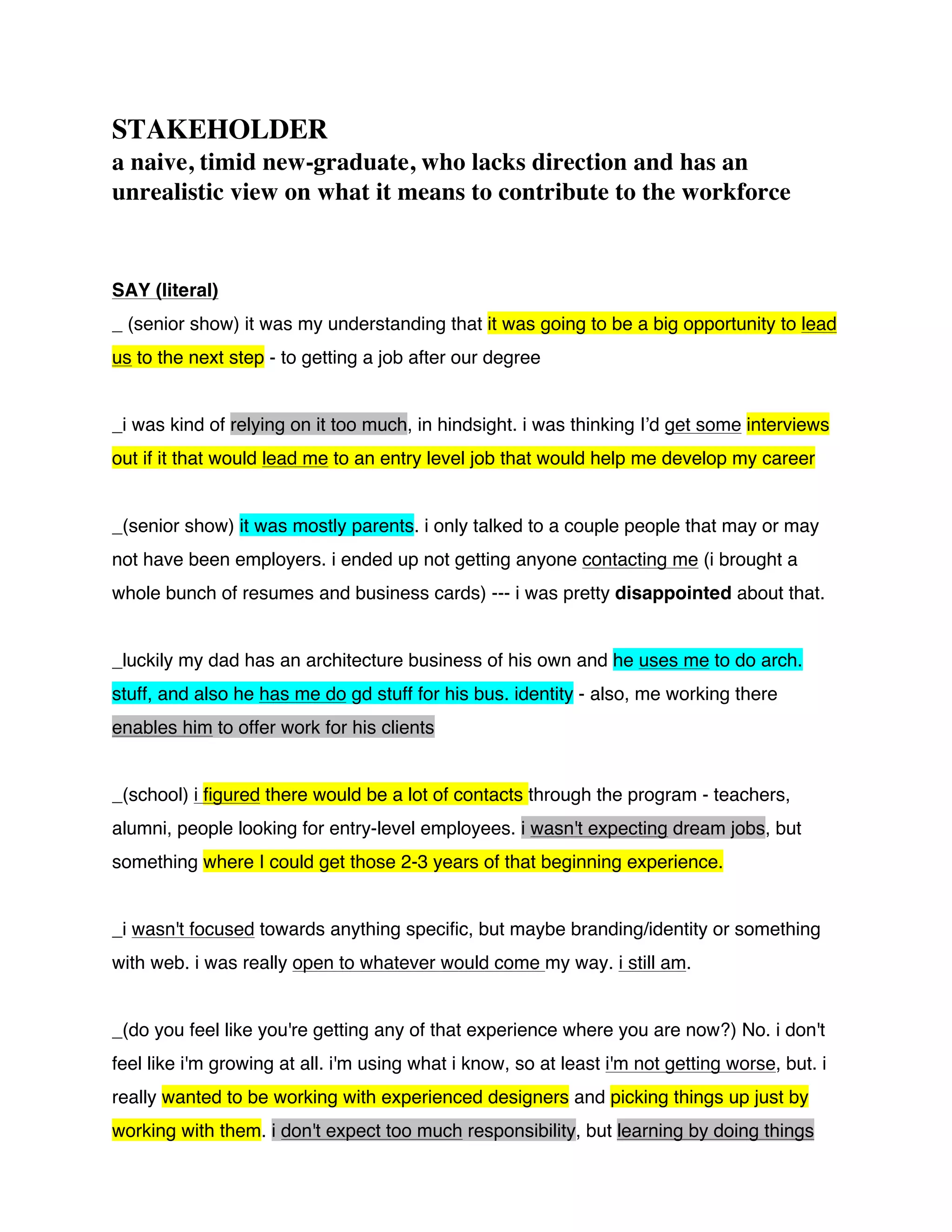
STAKEHOLDER: (Joe) A naïve, timid new graduate, who lacks direction and has an
unrealistic view of what it means to contribute to the workforce.
SAY (literal)
_ (senior show) it was my understanding that it was going to be a big opportunity to lead
us to the next step - to getting a job after our degree
_i was kind of relying on it too much, in hindsight. I was thinking I’d get some interviews
out if it that would lead me to an entry level job that would help me develop my career
_(senior show) it was mostly parents. I only talked to a couple people that may or
may not have been employers. I ended up not getting anyone contacting me (I
brought a whole bunch of resumes and business cards) --- I was pretty disappointed
about that.
_luckily my dad has an architecture business of his own and he uses me to do
architecture stuff, and also he has me do graphic design stuff for his business identity –
also, me working there enables him to offer work for his clients
_(school) I figured there would be a lot of contacts through the program – teachers
alumni, people looking for entry-level employees. I wasn't expecting dream jobs, but
something where I could get those 2-3 years of that beginning experience.
_I wasn't focused towards anything specific, but maybe branding/identity or something
with web. I was really open to whatever would come my way. I still am.
_(Do you feel like you're getting any valuable experience where you are now?) No. I feel
like I’m not growing at all. I’m using what I know, so at least I’m not getting worse,
but. I really wanted to be working with experienced designers and picking things up just
by working with them. I don't expect too much responsibility, but learning by doing
things for them.
_We had a professional practice class that was really comprehensive in practice
interviews, mailing all assignments to the prof. with personalized printed envelopes. He
was stringent—it was valuable, as a taste for higher standards in the professional world.
I’m not getting that now.
_I feel like I’m not putting to use the higher-level skills I’ve learned – there's only so
much you can learn in school, and you really need to get out – especially with a team.
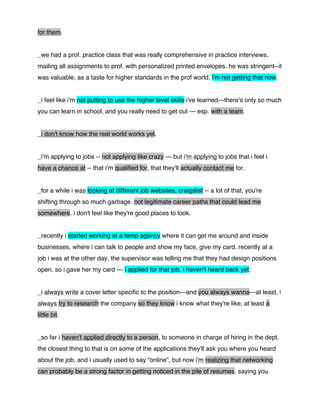
_I don't know how the real world works yet.
_I’m applying to jobs – not applying like crazy – but I’m applying to jobs that I feel I have
a chance at – that I’m qualified for, that they'll actually contact me for.
_for a while I was looking at different job websites, craigslist – a lot of that, you're
shifting through so much garbage. not legitimate career paths that could lead me
somewhere. I don't feel like they're good places to look.
_recently I started working at a temp agency where it can get me around and inside
businesses, where i can talk to people and show my face, give my card. recently at a
job I was at the other day, the supervisor was telling me that they had design positions
open. so I gave her my card – I applied for that job, I haven't heard back yet.
_I always write a cover letter specific to the position – and you always wanna – at least,
I always try to research the company so they know I know what they're like, at least a
little bit.
_so far I haven't applied directly to a person, to someone in charge of hiring in the
dept. the closest thing to that is on some of the applications they'll ask you where you
heard about the job, and I usually used to say “online”, but now I’m realizing that
networking can probably be a strong factor in getting noticed in the pile of resumes.
saying you heard from such and such person, so they’re like, oh, how do they know so
and so?
_(application) so far it's pretty standard – just the cover letter and my resume, and my
resume has a link to my website. in my cover letter I tell them to make sure they check
my website so they can see my portfolio.
_one of my friends is a java script developer, and I designed a website for him, so
luckily I’ve had a little bit of experience with that and know the capabilities, like what the
design constraints are. which, I feel, helps – well, it hasn't helped me so far.
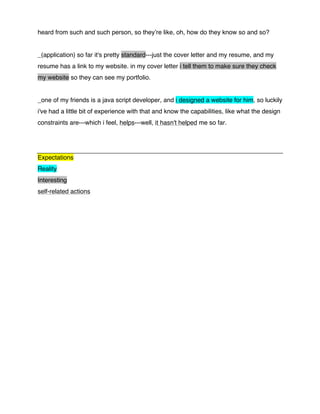
Expectations
Reality
Interesting
self-related actions of note
Some insights…
- Many of Joe’s actions are passive (done TO him, rather than BY him) – and
aimed for others, rather than himself. (ex. He has me do; working for him
enables him; I research the company so they know.)
- Joe emphasizes a lack of focus throughout his experience (and he points out
that he isn’t expecting a dream job, but I will say he doesn’t have an idea of
what his dream job would be)	


- Joe contradicts himself by saying he knows the importance of things like
networking, yet his applications aren’t even directed to a specific person.	


- Another contradiction: Joe is frustrated, yet doesn’t seem to feel it absolutely
necessary to get a job. He isn’t “applying like crazy” and cherry picking ones
he deems he’s qualified for – or rather, what others may believe he’s qualified
for. Then says he’s open to everything.	


- He admits he doesn’t know what the real world is like, though he assumes
value to certain things over others (mostly based on what school has taught
him, even though he’s already admitted that school has disappointed his
expectations)	
  
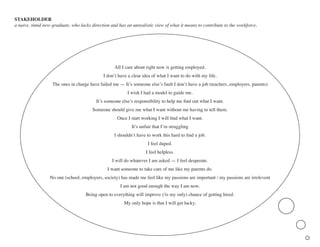
THINK/feel
I don’t have a clear idea of what I want to do.
All I care about right now is getting employed.
It’s unfair that I’m struggling — I shouldn’t have to work this hard to find a job.
The ones in charge have failed me (school/teachers, employers)
I wish I had a model to guide me.
Someone should give me what I want without me having to tell them.
Once I start working I will find what I want.
I feel duped.
I feel helpless.
I will do whatever I am asked — I feel desperate.
I want someone to take care of me like my parents do.
My passions are irrelevent.
I am not good enough the way I am now.
Being open to everything will improve chances of getting hired.
PROBLEM STATEMENT thought-process...
...NEEDS a way to understand the workforce, job availability, networking, what
employers are looking for (social skills)
(helps stakeholder get what he is immediately looking for—The Job—but there is a deeper problem being ignored –
issue will continue to be perpetuated if we )
...NEEDS a way to understand the outer limititations and how they’re affecting him
internally (self-defining)
(too vague; long-term importance but doesn’t help stakeholder adequately solve the problem - reserve for therapist)
Need is too vague. Insight seems too obvious. What’s in here, Can we go deeper?
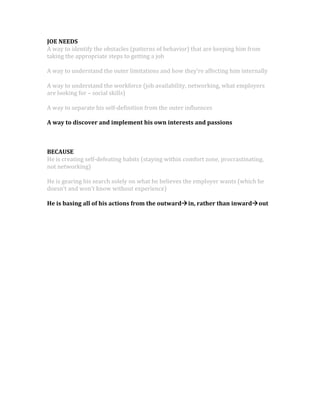
JOE NEEDS
a way to identify the obstacles (patterns of behavior) that are keeping
him from taking appropriate steps to getting a job
BECAUSE
he is creating self defeating habits
(ie. staying within comfort zone, procrastinating, not networking)
JOE NEEDS
a way to reflect and build upon his own passions/interests
BECAUSE
he is basing all of his actions from the outward-in, instead of inward-out.
(and, in doing so he sabotages his job search, his purpose... and the future of the world!)

1 // EMPATHY MAP // problem statement

  • 1.
    STAKEHOLDER: (Joe) Anaïve, timid new graduate, who lacks direction and has an unrealistic view of what it means to contribute to the workforce. SAY (literal) _ (senior show) it was my understanding that it was going to be a big opportunity to lead us to the next step - to getting a job after our degree _i was kind of relying on it too much, in hindsight. I was thinking I’d get some interviews out if it that would lead me to an entry level job that would help me develop my career _(senior show) it was mostly parents. I only talked to a couple people that may or may not have been employers. I ended up not getting anyone contacting me (I brought a whole bunch of resumes and business cards) --- I was pretty disappointed about that. _luckily my dad has an architecture business of his own and he uses me to do architecture stuff, and also he has me do graphic design stuff for his business identity – also, me working there enables him to offer work for his clients _(school) I figured there would be a lot of contacts through the program – teachers alumni, people looking for entry-level employees. I wasn't expecting dream jobs, but something where I could get those 2-3 years of that beginning experience. _I wasn't focused towards anything specific, but maybe branding/identity or something with web. I was really open to whatever would come my way. I still am. _(Do you feel like you're getting any valuable experience where you are now?) No. I feel like I’m not growing at all. I’m using what I know, so at least I’m not getting worse, but. I really wanted to be working with experienced designers and picking things up just by working with them. I don't expect too much responsibility, but learning by doing things for them. _We had a professional practice class that was really comprehensive in practice interviews, mailing all assignments to the prof. with personalized printed envelopes. He was stringent—it was valuable, as a taste for higher standards in the professional world. I’m not getting that now. _I feel like I’m not putting to use the higher-level skills I’ve learned – there's only so much you can learn in school, and you really need to get out – especially with a team.
  • 2.
    _I don't knowhow the real world works yet. _I’m applying to jobs – not applying like crazy – but I’m applying to jobs that I feel I have a chance at – that I’m qualified for, that they'll actually contact me for. _for a while I was looking at different job websites, craigslist – a lot of that, you're shifting through so much garbage. not legitimate career paths that could lead me somewhere. I don't feel like they're good places to look. _recently I started working at a temp agency where it can get me around and inside businesses, where i can talk to people and show my face, give my card. recently at a job I was at the other day, the supervisor was telling me that they had design positions open. so I gave her my card – I applied for that job, I haven't heard back yet. _I always write a cover letter specific to the position – and you always wanna – at least, I always try to research the company so they know I know what they're like, at least a little bit. _so far I haven't applied directly to a person, to someone in charge of hiring in the dept. the closest thing to that is on some of the applications they'll ask you where you heard about the job, and I usually used to say “online”, but now I’m realizing that networking can probably be a strong factor in getting noticed in the pile of resumes. saying you heard from such and such person, so they’re like, oh, how do they know so and so? _(application) so far it's pretty standard – just the cover letter and my resume, and my resume has a link to my website. in my cover letter I tell them to make sure they check my website so they can see my portfolio. _one of my friends is a java script developer, and I designed a website for him, so luckily I’ve had a little bit of experience with that and know the capabilities, like what the design constraints are. which, I feel, helps – well, it hasn't helped me so far. Expectations Reality Interesting self-related actions of note
  • 3.
    Some insights… - Manyof Joe’s actions are passive (done TO him, rather than BY him) – and aimed for others, rather than himself. (ex. He has me do; working for him enables him; I research the company so they know.) - Joe emphasizes a lack of focus throughout his experience (and he points out that he isn’t expecting a dream job, but I will say he doesn’t have an idea of what his dream job would be)     - Joe contradicts himself by saying he knows the importance of things like networking, yet his applications aren’t even directed to a specific person.     - Another contradiction: Joe is frustrated, yet doesn’t seem to feel it absolutely necessary to get a job. He isn’t “applying like crazy” and cherry picking ones he deems he’s qualified for – or rather, what others may believe he’s qualified for. Then says he’s open to everything.     - He admits he doesn’t know what the real world is like, though he assumes value to certain things over others (mostly based on what school has taught him, even though he’s already admitted that school has disappointed his expectations)  
  • 4.
    THINK/feel I don’t havea clear idea of what I want to do. All I care about right now is getting employed. It’s unfair that I’m struggling — I shouldn’t have to work this hard to find a job. The ones in charge have failed me (school/teachers, employers) I wish I had a model to guide me. Someone should give me what I want without me having to tell them. Once I start working I will find what I want. I feel duped. I feel helpless. I will do whatever I am asked — I feel desperate. I want someone to take care of me like my parents do. My passions are irrelevent. I am not good enough the way I am now. Being open to everything will improve chances of getting hired.
  • 5.
    PROBLEM STATEMENT thought-process... ...NEEDSa way to understand the workforce, job availability, networking, what employers are looking for (social skills) (helps stakeholder get what he is immediately looking for—The Job—but there is a deeper problem being ignored – issue will continue to be perpetuated if we ) ...NEEDS a way to understand the outer limititations and how they’re affecting him internally (self-defining) (too vague; long-term importance but doesn’t help stakeholder adequately solve the problem - reserve for therapist) Need is too vague. Insight seems too obvious. What’s in here, Can we go deeper? JOE NEEDS a way to identify the obstacles (patterns of behavior) that are keeping him from taking appropriate steps to getting a job BECAUSE he is creating self defeating habits (ie. staying within comfort zone, procrastinating, not networking) JOE NEEDS a way to reflect and build upon his own passions/interests BECAUSE he is basing all of his actions from the outward-in, instead of inward-out. (and, in doing so he sabotages his job search, his purpose... and the future of the world!)