EMPATHY MAP
We are looking to understand and categorize a users needs.
What have we observed, what have they done, what do they
believe?
We are looking for some insights or some aspect of the
experience of a person that can be improved.
We are looking for golden nuggets of opportunity.
2
STEP 1. PREPARE FOR THE EMPATHY WORK
Start by determining who you might interview (a student, a
graduate, an employer, etc.) and think of questions or areas
of conversation for the interview. It is strongly suggested
that you interview more than one person (2-3), to then
select one interview to move forward.
3
STEP 2. GO OUT AND TALK TO PEOPLE.
Our goal was to find out as much as you
can about the other person's experience
related to the school-to-work transition.
Explore what his/her experiences have
been in the past, how he/she felt during
key events (for instance, job
interview, first day of work, etc.), what
aspects were enjoyable and which ones
could be improved. Explore the practical
aspects of the experience, but don’t stop
there, and also inquire about the
emotional aspects of it.
4
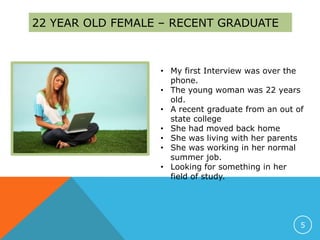
22 YEAR OLD FEMALE – RECENT GRADUATE
• My first Interview was over the
phone.
• The young woman was 22 years
old.
• A recent graduate from an out of
state college
• She had moved back home
• She was living with her parents
• She was working in her normal
summer job.
• Looking for something in her
field of study.
5
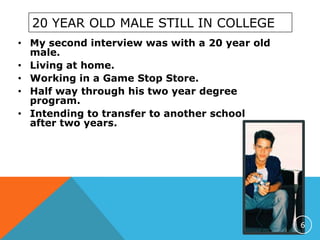
20 YEAR OLD MALE STILL IN COLLEGE
• My second interview was with a 20 year old
male.
• Living at home.
• Working in a Game Stop Store.
• Half way through his two year degree
program.
• Intending to transfer to another school
after two years.
6
20 YEAR OLD MALE IN COLLEGE, INTENDING
TO GO TO GRADUATE SCHOOL
• Interview Three was a 20 year old male
• Half way through his four year degree out
of state
• Intending to go to graduate school
• Balancing work and school, athletics and
a fraternity
7
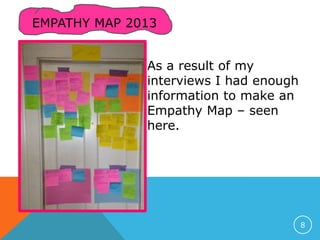
EMPATHY MAP 2013
As a result of my
interviews I had enough
information to make an
Empathy Map – seen
here.
8
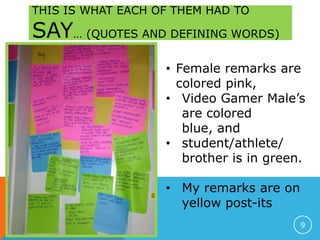
THIS IS WHAT EACH OF THEM HAD TO
SAY… (QUOTES AND DEFINING WORDS)
• Female remarks are
colored pink,
• Video Gamer Male’s
are colored
blue, and
• student/athlete/
brother is in green.
• My remarks are on
yellow post-its
9
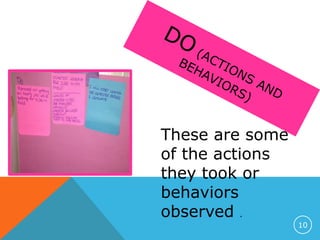
These are some
of the actions
they took or
behaviors
observed .
10
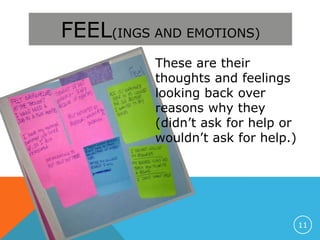
FEEL(INGS AND EMOTIONS)
These are their
thoughts and feelings
looking back over
reasons why they
(didn’t ask for help or
wouldn’t ask for help.)
11
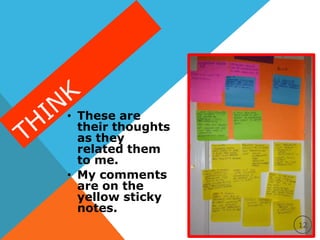
• These are
their thoughts
as they
related them
to me.
• My comments
are on the
yellow sticky
notes.
12
PROBLEM STATEMENT
My task here is to develop a problem statement where we will
then look at aspects of the experiences of a person that can
be improved (this problem/need may not always be
perceived or articulated by that person, that is, it may be
implicit).
Because we are looking at the transition points of students
heading to the work field, the following is my problem
statement:
13
PROBLEM STATEMENT: To improve the
school to work transition, student’s need a
way to be reminded of resources, be
attracted to using resources and feel as
though they are welcome and it is necessary
to use all resources throughout the life cycle
of their education. Students need to know
the value each of the types of resources
bring to them.
14

Empathize and design

  • 2.
    EMPATHY MAP We arelooking to understand and categorize a users needs. What have we observed, what have they done, what do they believe? We are looking for some insights or some aspect of the experience of a person that can be improved. We are looking for golden nuggets of opportunity. 2
  • 3.
    STEP 1. PREPAREFOR THE EMPATHY WORK Start by determining who you might interview (a student, a graduate, an employer, etc.) and think of questions or areas of conversation for the interview. It is strongly suggested that you interview more than one person (2-3), to then select one interview to move forward. 3
  • 4.
    STEP 2. GOOUT AND TALK TO PEOPLE. Our goal was to find out as much as you can about the other person's experience related to the school-to-work transition. Explore what his/her experiences have been in the past, how he/she felt during key events (for instance, job interview, first day of work, etc.), what aspects were enjoyable and which ones could be improved. Explore the practical aspects of the experience, but don’t stop there, and also inquire about the emotional aspects of it. 4
  • 5.
    22 YEAR OLDFEMALE – RECENT GRADUATE • My first Interview was over the phone. • The young woman was 22 years old. • A recent graduate from an out of state college • She had moved back home • She was living with her parents • She was working in her normal summer job. • Looking for something in her field of study. 5
  • 6.
    20 YEAR OLDMALE STILL IN COLLEGE • My second interview was with a 20 year old male. • Living at home. • Working in a Game Stop Store. • Half way through his two year degree program. • Intending to transfer to another school after two years. 6
  • 7.
    20 YEAR OLDMALE IN COLLEGE, INTENDING TO GO TO GRADUATE SCHOOL • Interview Three was a 20 year old male • Half way through his four year degree out of state • Intending to go to graduate school • Balancing work and school, athletics and a fraternity 7
  • 8.
    EMPATHY MAP 2013 Asa result of my interviews I had enough information to make an Empathy Map – seen here. 8
  • 9.
    THIS IS WHATEACH OF THEM HAD TO SAY… (QUOTES AND DEFINING WORDS) • Female remarks are colored pink, • Video Gamer Male’s are colored blue, and • student/athlete/ brother is in green. • My remarks are on yellow post-its 9
  • 10.
    These are some ofthe actions they took or behaviors observed . 10
  • 11.
    FEEL(INGS AND EMOTIONS) Theseare their thoughts and feelings looking back over reasons why they (didn’t ask for help or wouldn’t ask for help.) 11
  • 12.
    • These are theirthoughts as they related them to me. • My comments are on the yellow sticky notes. 12
  • 13.
    PROBLEM STATEMENT My taskhere is to develop a problem statement where we will then look at aspects of the experiences of a person that can be improved (this problem/need may not always be perceived or articulated by that person, that is, it may be implicit). Because we are looking at the transition points of students heading to the work field, the following is my problem statement: 13
  • 14.
    PROBLEM STATEMENT: Toimprove the school to work transition, student’s need a way to be reminded of resources, be attracted to using resources and feel as though they are welcome and it is necessary to use all resources throughout the life cycle of their education. Students need to know the value each of the types of resources bring to them. 14