What do we
know about typical
MOOC participants?
19.05.2015
Michael Kopp
Graphic items on the
front page are not included
Cardinal Questions
•  Do MOOCs really enhance teaching and learning?
•  Do MOOCs need a special instructional design?
•  How to anchor MOOCs firmly at the university?
•  How long will MOOCs remain free and for whom?
•  Are there any business models?
Participants are the answer
•  Students of the own university
•  Other domestic (employed) learners
•  International learners
(students & employees)
Ø  Demographics
Ø  Intentions of participation
Ø  Learning behavior
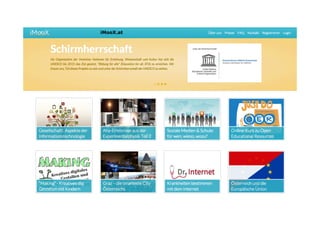
iMooX.at
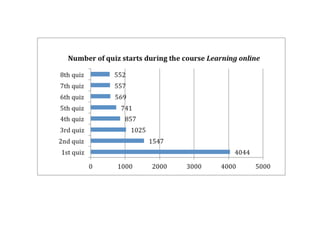
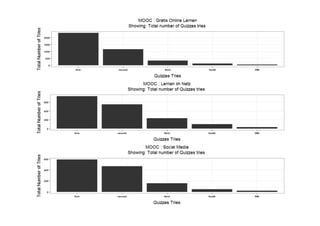
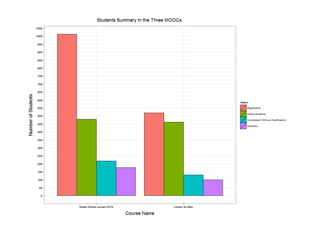
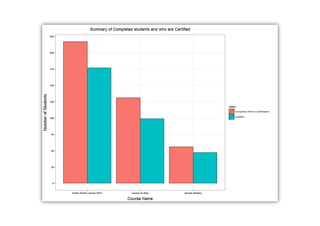
Survey Method
•  Three courses (summer-term 2014)
•  1.333 overall course-participants
•  Different survey settings
(questionnaires after the first course unit,
at the end of the course, partially connected
to certificates)
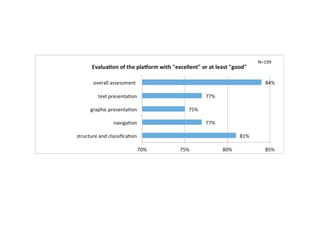
•  199 completed questionnaires
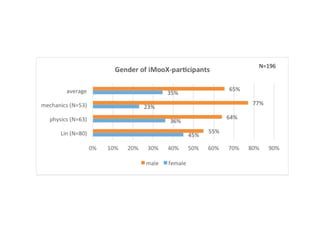
Survey
Results
Conclusion
•  MOOCS enhance learning –
but this in not true for everybody
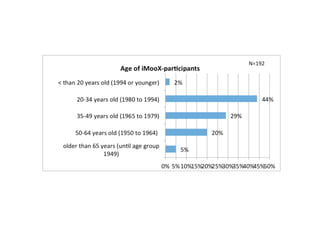
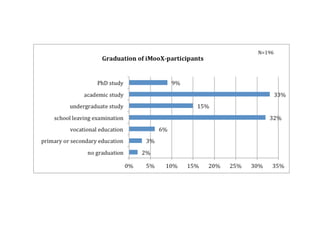
(most participants are aged between 20 and 44
54% are older than 34 years; 57% of the
participants have at least a Bachelor degree)
•  MOOCs need a special instructional design –
take care that students do not lose interest
•  MOOCs can be anchored at the university
but students are only one target group among
others (Life Long Learning)
Conclusion
•  MOOCS (hopefully) will remain free
although many participants are willing to pay a
small amount of money
using CC-licenses is a good strategy
•  There are no business models
(unless we are talking about venture capital)
Thanks for your attention
Michael Kopp
@koanmi
michael.kopp@uni-graz.at
http://akademie.uni-graz.at
www.imoox.at
Presentation on Slideshare:
http://de.slideshare.net/anmw/emoocs

What do we know about typical MOOC participants?

  • 1.
    What do we knowabout typical MOOC participants? 19.05.2015 Michael Kopp Graphic items on the front page are not included
  • 2.
    Cardinal Questions •  DoMOOCs really enhance teaching and learning? •  Do MOOCs need a special instructional design? •  How to anchor MOOCs firmly at the university? •  How long will MOOCs remain free and for whom? •  Are there any business models?
  • 3.
    Participants are theanswer •  Students of the own university •  Other domestic (employed) learners •  International learners (students & employees) Ø  Demographics Ø  Intentions of participation Ø  Learning behavior
  • 4.
  • 5.
    Survey Method •  Threecourses (summer-term 2014) •  1.333 overall course-participants •  Different survey settings (questionnaires after the first course unit, at the end of the course, partially connected to certificates) •  199 completed questionnaires
  • 6.
  • 18.
    Conclusion •  MOOCS enhancelearning – but this in not true for everybody (most participants are aged between 20 and 44 54% are older than 34 years; 57% of the participants have at least a Bachelor degree) •  MOOCs need a special instructional design – take care that students do not lose interest •  MOOCs can be anchored at the university but students are only one target group among others (Life Long Learning)
  • 19.
    Conclusion •  MOOCS (hopefully)will remain free although many participants are willing to pay a small amount of money using CC-licenses is a good strategy •  There are no business models (unless we are talking about venture capital)
  • 20.
    Thanks for yourattention Michael Kopp @koanmi michael.kopp@uni-graz.at http://akademie.uni-graz.at www.imoox.at Presentation on Slideshare: http://de.slideshare.net/anmw/emoocs