Embedded Product
Development Life Cycle
By
A.Usha Rani
Department of Physics and
Electronics
St.Ann’s College for Women
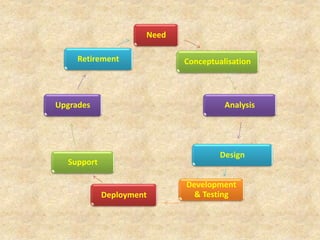
Life Cycle of Product development is referred to as
model which defines the various phases involved in
the life cycle of an embedded product.
It is based on ‘Analysis - Design – Implementation’
problem solving approach.
Number of phases involved in the EDLC depends on
complexity of the product.
Need
Conceptualisation
Analysis
Design
Development
& TestingDeployment
Support
Upgrades
Retirement
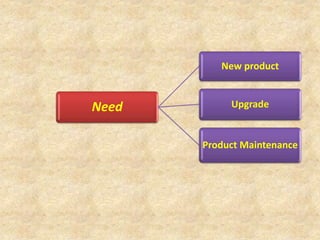
Need
New product
Upgrade
Product Maintenance
Need
An embedded product evolves as an output of a ‘Need’.
Need can arise from an individual or from public or from
company.
Based on the need, statement of need or concept proposal
is prepared.
Concept proposal is reviewed by senior management and
funding agency.
Then it is sent to product development team.
New or custom product development
This is the need for product which does not exist in the
market or a product as a competitor to an existing product.
Product Re-engineering
Re-engineering an existing product arises due to
Change in business requirements
User interface enhancements
Technology upgrades
Product maintenance
Providing technical support to the end user for an
existing product in the market.
Product maintenance is generally classified into two
categories-
•Corrective maintenance- Making corrective actions
following failure or non- functioning of components.
•Preventive maintenance – To avoid the failure or non
functioning of the product.
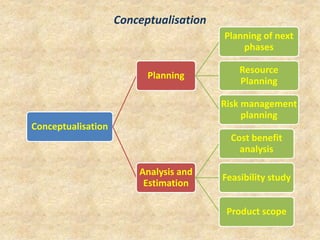
Conceptualisation
Conceptualisation
Planning
Planning of next
phases
Resource
Planning
Risk management
planning
Analysis and
Estimation
Cost benefit
analysis
Feasibility study
Product scope
It is the Product Concept development Phase and
begins immediately after Concept proposal approval.
 Defines the scope of the concept, performs cost
benefit analysis and feasibility study and prepares
project management and risk management plans.
It shapes the need of the end user, whether it is
feasible product and how the product can be realized.
Analysis and study activities
Feasibility Study – Examines the need for the product and
suggests solutions to build the Need as product.
 It analyses technical and financial feasibility of the
product.
Cost benefit analysis
 It identifies, reveals and assess the total development
cost and the profit expected from the product.
Common unit of measurement – All aspects of the product
are expressed in terms of common unit.
Market choice based benefit measurement – Ensures
that the product cost is justifying the Money the end
user spends.
Targeted end users – Understands the targeted end
users of the product and their tastes to give them best
product.
Product Scope – What is in scope and what is not in
scope of the product.
Planning activities – Various plans required for the
product development
Resource Planning – How many resources should work
on the project
Risk management plans – Technical and other kinds of
risks involved in the work.
At the end of conceptualisation phase reports on
Analysis and Study activities and Planning activities to the
project sponsor /client for review and approval.
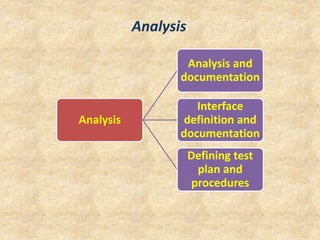
Analysis
Analysis
Analysis and
documentation
Interface
definition and
documentation
Defining test
plan and
procedures
During this phase the product is defined with respect to
inputs, processes, outputs and interfaces at functional Level.
It emphasizes on ‘ what functions must be performed by
the product’.
Analysis and Documentation
Various functional aspects and quality attributes of the
product are analyzed.
A logic model is developed describing the fundamental
processes and the data required to support the
functionalities.
The following requirements are addressed
Functional capabilities
Operational an non operational quality attributes
Product external interface requirements
Data requirements
User manuals
Operational requirements
Maintenance requirements
General assumptions
Interface definition and Documentation
Analyses the physical Interface as well as data exchange
through these interfaces and documents it.
Defining test plan and procedures
 Identifies what kind of tests are to be performed to verify
the proper functioning of the product.
Defines test procedures, test setup and test environment.
Documents the scope, methodology, sequence and
management of all kinds of tests.
The following are the various type of tests that are
defined
Unit Testing
Integration testing
System Testing
Usability testing
Load testing
Security testing
Scalability testing
Sanity testing
Smoke testing
Performance testing
Endurance testing
User acceptance testing
Design
This phase deals with the entire design of the product
taking requirements into consideration and focuses on
how the required functionalities can be delivered to the
product.
It starts with Preliminary design which establishes top
level architecture for the product, lists out various
functional blocks required for the product and defines
inputs and outputs for each functional block.
It generates detailed architecture, identifies and lists
out various components for each block, interconnection
among various blocks, control algorithm requirements ,
etc
Since an embedded product is mix of hardware
software and enclosure, hardware and software
codesign approach is followed in designing the product.
Design of operations and maintenance manual and
design of training manuals.
Development and Testing
This phase transforms the design into realizable product.
All the specifications generated during the design phase
are translated into software and hardware.
The development activities can be divided into embedded
hardware development, embedded firmware development
and product enclosure development.
Embedded hardware development – Development of
component placement platform using CAD tools and its
fabrication using CAM tools.
The testing phase consists of independent testing of
software and hardware testing of the product after their
integration, testing of the whole system on functionality and
non functionality.
 Testing of the product against all acceptance criteria
mentioned by client for each functionality.
Once the hardware and software are tested they are
integrated using firmware integration techniques and the
integrated product is tested against required functionalities.
Deployment
It is the process of launching the first fully functional
model of the product in the market or handing over to the
Client.
The product modifications as per the various integration
tests are implemented and the product is made operational.
Notification of the product deployment
When the product is ready to be launched, the
launching ceremony details are communicated to the
stake holders and to public(if it is commercial product).
The notifications are sent with following details
Deployment schedule
Brief description of the product
Targeted end users
Additional features supported with respect to an
existing product
Product support information including the support
person name, contact number,email id, etc
Execution of training plan
Proper training is given to the end user to get them
acquainted with the product as per the training plan
developed during earlier phases.
This will reduce the possible damages to the product as
well as operating person.
Product installation
•Installation of the product as per the installation
document ensures the product is fully functional.
Product post implementation review
After the launch of the product, post implementation
review is conducted to determine the success of the
product.
This helps in knowing the problems faced during
installation and solutions adopted to overcome them
which will be a reference for the future product
development.
Support
This phase deals with the operations and maintenance of
the product in product environment.
Product mal functioning or any unexpected behavior in
the products may be observed and reported during
operations phase.
support is provided to fix the bugs in the product.
Set up a dedicated support wing
A dedicated support wing is setup to ensure high
quality service to the end user.
Identify bugs and areas of improvement
The end user is given a chance to express their views
on product and suggestions in terms of modifications
required or feature enhancements.
Upgrades
This deals with development of new versions of the
product.
Upgrade results dues to major bug fixes or feature
enhancement requirements from the user.
Retirement and disposal
When the manufacturer realizes that there is another
powerful technology or component available in the market
which is more suitable for the production of the current
product, they will announce current product as obsolete
and the new version of the same product is going to be
released soon.
The disposal of a product is essential due to
rapid technology advancement
increased user needs
Thank you

Embedded Product Development Life Cycle(EDLC)

  • 1.
    Embedded Product Development LifeCycle By A.Usha Rani Department of Physics and Electronics St.Ann’s College for Women
  • 2.
    Life Cycle ofProduct development is referred to as model which defines the various phases involved in the life cycle of an embedded product. It is based on ‘Analysis - Design – Implementation’ problem solving approach. Number of phases involved in the EDLC depends on complexity of the product.
  • 3.
  • 4.
  • 5.
    Need An embedded productevolves as an output of a ‘Need’. Need can arise from an individual or from public or from company. Based on the need, statement of need or concept proposal is prepared. Concept proposal is reviewed by senior management and funding agency. Then it is sent to product development team.
  • 6.
    New or customproduct development This is the need for product which does not exist in the market or a product as a competitor to an existing product. Product Re-engineering Re-engineering an existing product arises due to Change in business requirements User interface enhancements Technology upgrades
  • 7.
    Product maintenance Providing technicalsupport to the end user for an existing product in the market. Product maintenance is generally classified into two categories- •Corrective maintenance- Making corrective actions following failure or non- functioning of components. •Preventive maintenance – To avoid the failure or non functioning of the product.
  • 8.
    Conceptualisation Conceptualisation Planning Planning of next phases Resource Planning Riskmanagement planning Analysis and Estimation Cost benefit analysis Feasibility study Product scope
  • 9.
    It is theProduct Concept development Phase and begins immediately after Concept proposal approval.  Defines the scope of the concept, performs cost benefit analysis and feasibility study and prepares project management and risk management plans. It shapes the need of the end user, whether it is feasible product and how the product can be realized.
  • 10.
    Analysis and studyactivities Feasibility Study – Examines the need for the product and suggests solutions to build the Need as product.  It analyses technical and financial feasibility of the product. Cost benefit analysis  It identifies, reveals and assess the total development cost and the profit expected from the product. Common unit of measurement – All aspects of the product are expressed in terms of common unit.
  • 11.
    Market choice basedbenefit measurement – Ensures that the product cost is justifying the Money the end user spends. Targeted end users – Understands the targeted end users of the product and their tastes to give them best product. Product Scope – What is in scope and what is not in scope of the product.
  • 12.
    Planning activities –Various plans required for the product development Resource Planning – How many resources should work on the project Risk management plans – Technical and other kinds of risks involved in the work. At the end of conceptualisation phase reports on Analysis and Study activities and Planning activities to the project sponsor /client for review and approval.
  • 13.
  • 14.
    During this phasethe product is defined with respect to inputs, processes, outputs and interfaces at functional Level. It emphasizes on ‘ what functions must be performed by the product’. Analysis and Documentation Various functional aspects and quality attributes of the product are analyzed. A logic model is developed describing the fundamental processes and the data required to support the functionalities.
  • 15.
    The following requirementsare addressed Functional capabilities Operational an non operational quality attributes Product external interface requirements Data requirements User manuals Operational requirements Maintenance requirements General assumptions
  • 16.
    Interface definition andDocumentation Analyses the physical Interface as well as data exchange through these interfaces and documents it. Defining test plan and procedures  Identifies what kind of tests are to be performed to verify the proper functioning of the product. Defines test procedures, test setup and test environment. Documents the scope, methodology, sequence and management of all kinds of tests.
  • 17.
    The following arethe various type of tests that are defined Unit Testing Integration testing System Testing Usability testing Load testing Security testing Scalability testing
  • 18.
    Sanity testing Smoke testing Performancetesting Endurance testing User acceptance testing
  • 19.
    Design This phase dealswith the entire design of the product taking requirements into consideration and focuses on how the required functionalities can be delivered to the product. It starts with Preliminary design which establishes top level architecture for the product, lists out various functional blocks required for the product and defines inputs and outputs for each functional block.
  • 20.
    It generates detailedarchitecture, identifies and lists out various components for each block, interconnection among various blocks, control algorithm requirements , etc Since an embedded product is mix of hardware software and enclosure, hardware and software codesign approach is followed in designing the product. Design of operations and maintenance manual and design of training manuals.
  • 21.
    Development and Testing Thisphase transforms the design into realizable product. All the specifications generated during the design phase are translated into software and hardware. The development activities can be divided into embedded hardware development, embedded firmware development and product enclosure development. Embedded hardware development – Development of component placement platform using CAD tools and its fabrication using CAM tools.
  • 22.
    The testing phaseconsists of independent testing of software and hardware testing of the product after their integration, testing of the whole system on functionality and non functionality.  Testing of the product against all acceptance criteria mentioned by client for each functionality. Once the hardware and software are tested they are integrated using firmware integration techniques and the integrated product is tested against required functionalities.
  • 23.
    Deployment It is theprocess of launching the first fully functional model of the product in the market or handing over to the Client. The product modifications as per the various integration tests are implemented and the product is made operational.
  • 24.
    Notification of theproduct deployment When the product is ready to be launched, the launching ceremony details are communicated to the stake holders and to public(if it is commercial product).
  • 25.
    The notifications aresent with following details Deployment schedule Brief description of the product Targeted end users Additional features supported with respect to an existing product Product support information including the support person name, contact number,email id, etc
  • 26.
    Execution of trainingplan Proper training is given to the end user to get them acquainted with the product as per the training plan developed during earlier phases. This will reduce the possible damages to the product as well as operating person. Product installation •Installation of the product as per the installation document ensures the product is fully functional.
  • 27.
    Product post implementationreview After the launch of the product, post implementation review is conducted to determine the success of the product. This helps in knowing the problems faced during installation and solutions adopted to overcome them which will be a reference for the future product development.
  • 28.
    Support This phase dealswith the operations and maintenance of the product in product environment. Product mal functioning or any unexpected behavior in the products may be observed and reported during operations phase. support is provided to fix the bugs in the product.
  • 29.
    Set up adedicated support wing A dedicated support wing is setup to ensure high quality service to the end user. Identify bugs and areas of improvement The end user is given a chance to express their views on product and suggestions in terms of modifications required or feature enhancements.
  • 30.
    Upgrades This deals withdevelopment of new versions of the product. Upgrade results dues to major bug fixes or feature enhancement requirements from the user.
  • 31.
    Retirement and disposal Whenthe manufacturer realizes that there is another powerful technology or component available in the market which is more suitable for the production of the current product, they will announce current product as obsolete and the new version of the same product is going to be released soon. The disposal of a product is essential due to rapid technology advancement increased user needs
  • 32.