How Electronic Mail Works
Presented by:
Ashutosh Sahu
MBA 1st Sem
•Email – An electronic message transmitted over a network
from one user to another.
•Over “204 million” emails are sent per minute!
•Indispensable in the 21st Century.
•Robustness &Secure
• Protocols Involved
•Mail Server-Client Interaction
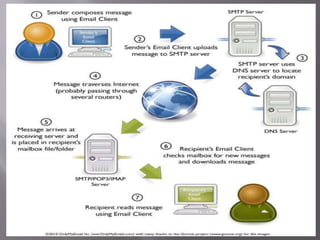
1. A user sends an email message and connects to an SMTP (Simple
Mail Transfer Protocol) server as configured in her email client or
Mail User Agent (MUA).
2. On the SMTP server, a Mail Transfer Agent (MTA) looks at the
recipient address and looks up the domain part of the address to
determine its destination.
3. After querying a Domain Name System (DNS) server for the name
of the Mail eXchanger (MX) for the recipient’s domain name.
4. The SMTP server will send the message to that server via the SMTP
protocol.
5. The receiving server will store the message and make it available to
the recipient, who can access it via web, POP, or IMAP.
1. In modern society people increasingly use email and other forms of
digital communication to create and maintain social networks.
2. Especially in academic institutions and in the business world, email
was embraced early on as an effective means of a synchronous
communication — somewhere in between the telephone and regular
mail.
3. When someone sends an email, the message is transferred from his
or her computer to the server associated with the recipient’s address,
usually via a number of other servers.

Email working

  • 1.
    How Electronic MailWorks Presented by: Ashutosh Sahu MBA 1st Sem
  • 2.
    •Email – Anelectronic message transmitted over a network from one user to another. •Over “204 million” emails are sent per minute! •Indispensable in the 21st Century. •Robustness &Secure • Protocols Involved •Mail Server-Client Interaction
  • 3.
    1. A usersends an email message and connects to an SMTP (Simple Mail Transfer Protocol) server as configured in her email client or Mail User Agent (MUA). 2. On the SMTP server, a Mail Transfer Agent (MTA) looks at the recipient address and looks up the domain part of the address to determine its destination. 3. After querying a Domain Name System (DNS) server for the name of the Mail eXchanger (MX) for the recipient’s domain name. 4. The SMTP server will send the message to that server via the SMTP protocol. 5. The receiving server will store the message and make it available to the recipient, who can access it via web, POP, or IMAP.
  • 5.
    1. In modernsociety people increasingly use email and other forms of digital communication to create and maintain social networks. 2. Especially in academic institutions and in the business world, email was embraced early on as an effective means of a synchronous communication — somewhere in between the telephone and regular mail. 3. When someone sends an email, the message is transferred from his or her computer to the server associated with the recipient’s address, usually via a number of other servers.