{           Email Marketing
            Metrics Explained                                  {


    Copyright © 2011 iContact Corp. | www.iContact.com/Greenpapers
{ Email Marketing Metrics Explained }


    How do you determine the strength of your email marketing program?


    Are you focusing on the most important email marketing metrics?


    What are you comparing your current key performance indicators (KPIs) against in order to measure success?


    Email Marketing Metrics Explained tackles these questions and leaves you with the following takeaways:
              •	 You will learn how each metric is calculated and the importance of each to your program.
              •	 You will learn how to use KPIs to assess your program’s strengths and weaknesses, overall
                   health, and impact on your business.
              •	 You will learn how to set reasonable expectations and goals for your email marketing program on
                   the basis of where your program stands today.


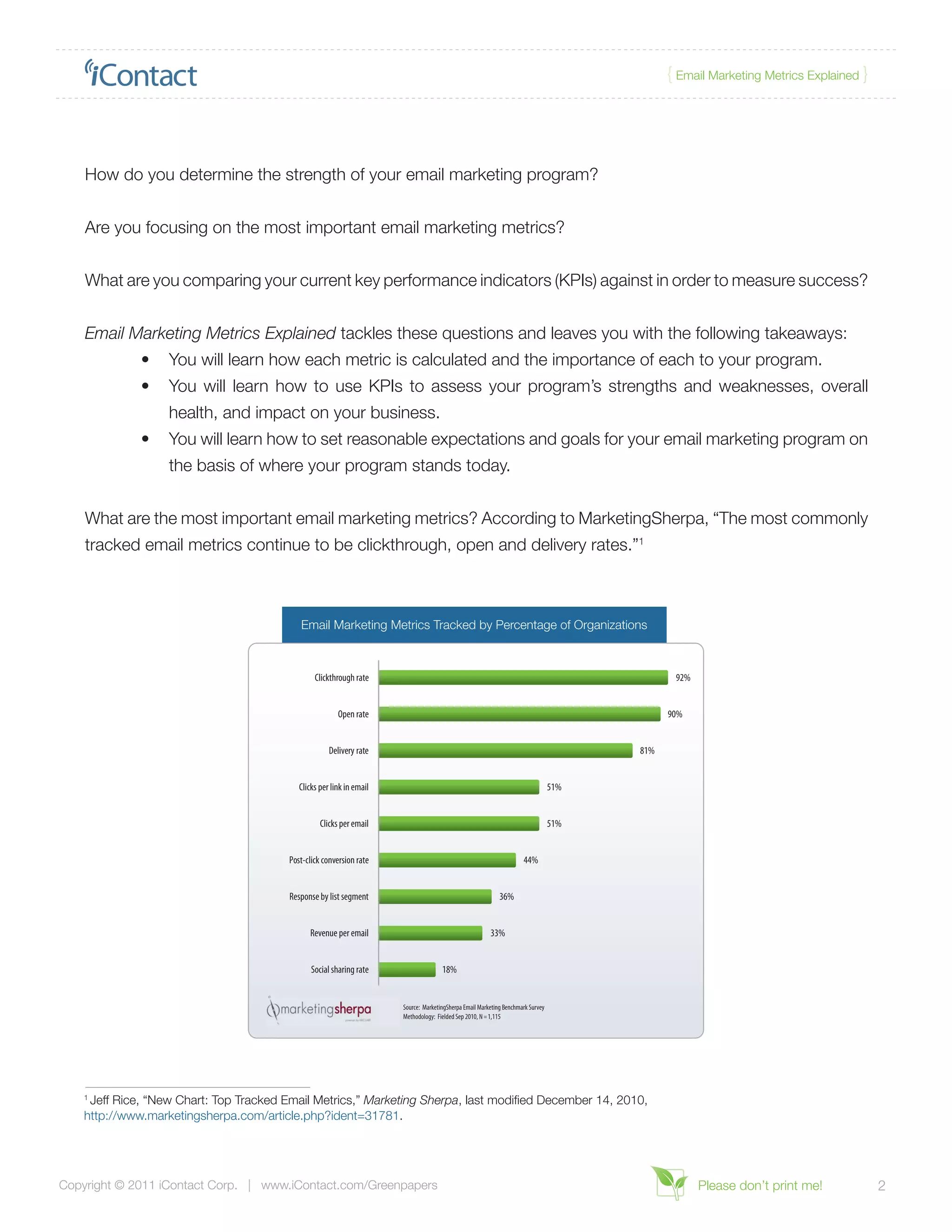
    What are the most important email marketing metrics? According to MarketingSherpa, “The most commonly
    tracked email metrics continue to be clickthrough, open and delivery rates.”1


                                            Email Marketing Metrics Tracked by Percentage of Organizations


                                                 Clickthrough rate                                                                             92%


                                                         Open rate                                                                            90%


                                                      Delivery rate                                                                     81%


                                            Clicks per link in email                                                              51%


                                                   Clicks per email                                                               51%


                                         Post-click conversion rate                                                   44%


                                         Response by list segment                                            36%


                                               Revenue per email                                         33%


                                                Social sharing rate                   18%


                                                                       Source: MarketingSherpa Email Marketing Benchmark Survey
                                                                       Methodology: Fielded Sep 2010, N = 1,115


    1
     Jeff Rice, “New Chart: Top Tracked Email Metrics,” Marketing Sherpa, last modified December 14, 2010,
    http://www.marketingsherpa.com/article.php?ident=31781.


Copyright © 2011 iContact Corp. | www.iContact.com/Greenpapers                                                                                       Please don’t print me!           2
{ Email Marketing Metrics Explained }


    Focus on Five Key Email Metrics
    Why Your Clickthrough Rate Matters More
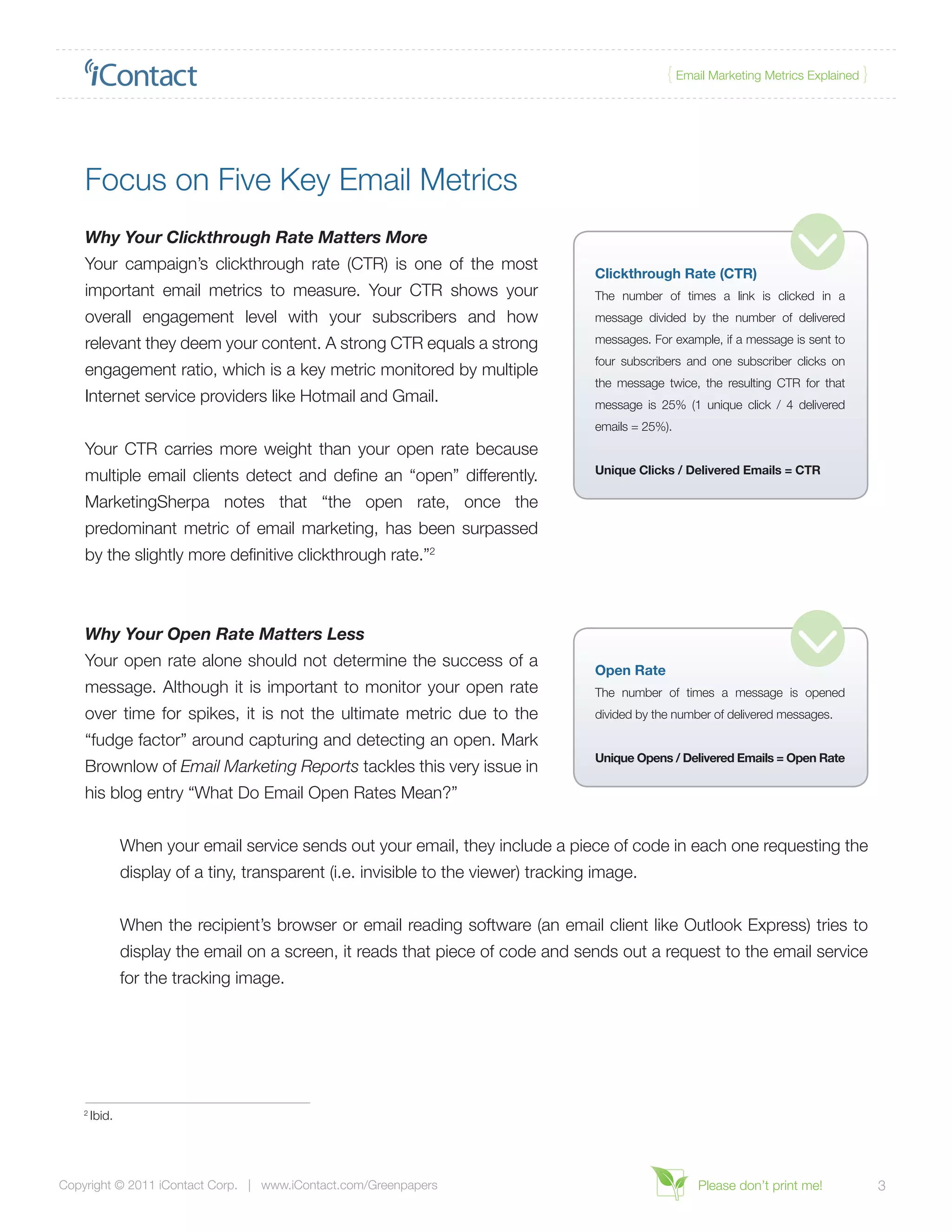
    Your campaign’s clickthrough rate (CTR) is one of the most
                                                                                      Clickthrough Rate (CTR)
    important email metrics to measure. Your CTR shows your                           The number of times a link is clicked in a
    overall engagement level with your subscribers and how                            message divided by the number of delivered

    relevant they deem your content. A strong CTR equals a strong                     messages. For example, if a message is sent to
                                                                                      four subscribers and one subscriber clicks on
    engagement ratio, which is a key metric monitored by multiple
                                                                                      the message twice, the resulting CTR for that
    Internet service providers like Hotmail and Gmail.                                message is 25% (1 unique click / 4 delivered
                                                                                      emails = 25%).
    Your CTR carries more weight than your open rate because
                                                                                      Unique Clicks / Delivered Emails = CTR
    multiple email clients detect and define an “open” differently.
    MarketingSherpa notes that “the open rate, once the
    predominant metric of email marketing, has been surpassed
    by the slightly more definitive clickthrough rate.”2


    Why Your Open Rate Matters Less
    Your open rate alone should not determine the success of a
                                                                                      Open Rate
    message. Although it is important to monitor your open rate                       The number of times a message is opened
    over time for spikes, it is not the ultimate metric due to the                    divided by the number of delivered messages.

    “fudge factor” around capturing and detecting an open. Mark
                                                                                      Unique Opens / Delivered Emails = Open Rate
    Brownlow of Email Marketing Reports tackles this very issue in
    his blog entry “What Do Email Open Rates Mean?”


                When your email service sends out your email, they include a piece of code in each one requesting the
                display of a tiny, transparent (i.e. invisible to the viewer) tracking image.


                When the recipient’s browser or email reading software (an email client like Outlook Express) tries to
                display the email on a screen, it reads that piece of code and sends out a request to the email service
                for the tracking image.


    2
        Ibid.


Copyright © 2011 iContact Corp. | www.iContact.com/Greenpapers                                           Please don’t print me!            3
{ Email Marketing Metrics Explained }


          When the service receives the request, it records it and uses it as an indication that the recipient has
          “opened” the email.3


    Unfortunately this process for tracking an open creates the following three issues, which Brownlow captures perfectly:


          1.	 An open “actually just means the recipient’s software or browser displayed the email such that the
              tracking image was requested. It says nothing about whether the recipient actually read or engaged
              with your email in any way.”


          2.	 “The tracking image can be activated without the recipient ever actually seeing the email at all. Many
              email clients have a preview function, where part of the email is displayed below or to the side of
              the list of emails in your inbox. . . . So some of those recorded opens are from recipients who never
              even looked at your email.”


          3.	 “If your recipient gets text-only emails or has an email client that only displays text versions of emails
              (like many mobile devices), then the image code is ignored and never requested. No image request
              means no record of an open. So your recorded email open rate misses out on those people.”


    Why Your Delivery Rate Is Not a Given
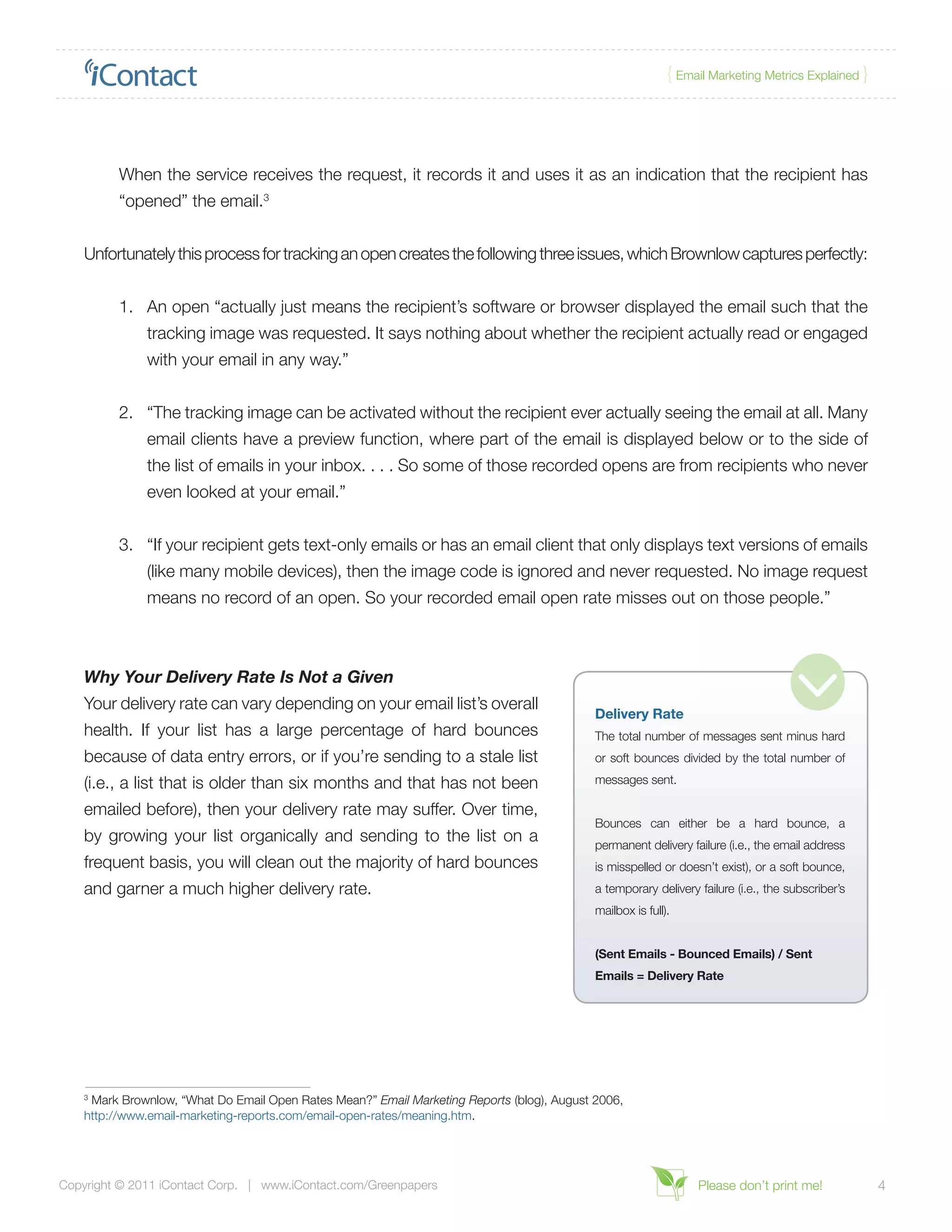
    Your delivery rate can vary depending on your email list’s overall
                                                                                            Delivery Rate
    health. If your list has a large percentage of hard bounces                             The total number of messages sent minus hard
    because of data entry errors, or if you’re sending to a stale list                      or soft bounces divided by the total number of

    (i.e., a list that is older than six months and that has not been                       messages sent.

    emailed before), then your delivery rate may suffer. Over time,
                                                                                            Bounces can either be a hard bounce, a
    by growing your list organically and sending to the list on a                           permanent delivery failure (i.e., the email address
    frequent basis, you will clean out the majority of hard bounces                         is misspelled or doesn’t exist), or a soft bounce,
    and garner a much higher delivery rate.                                                 a temporary delivery failure (i.e., the subscriber’s
                                                                                            mailbox is full).


                                                                                            (Sent Emails - Bounced Emails) / Sent
                                                                                            Emails = Delivery Rate


    3
     Mark Brownlow, “What Do Email Open Rates Mean?” Email Marketing Reports (blog), August 2006,
    http://www.email-marketing-reports.com/email-open-rates/meaning.htm.


Copyright © 2011 iContact Corp. | www.iContact.com/Greenpapers                                                   Please don’t print me!             4
{ Email Marketing Metrics Explained }


    How to Capture and Track Your Conversion Rate
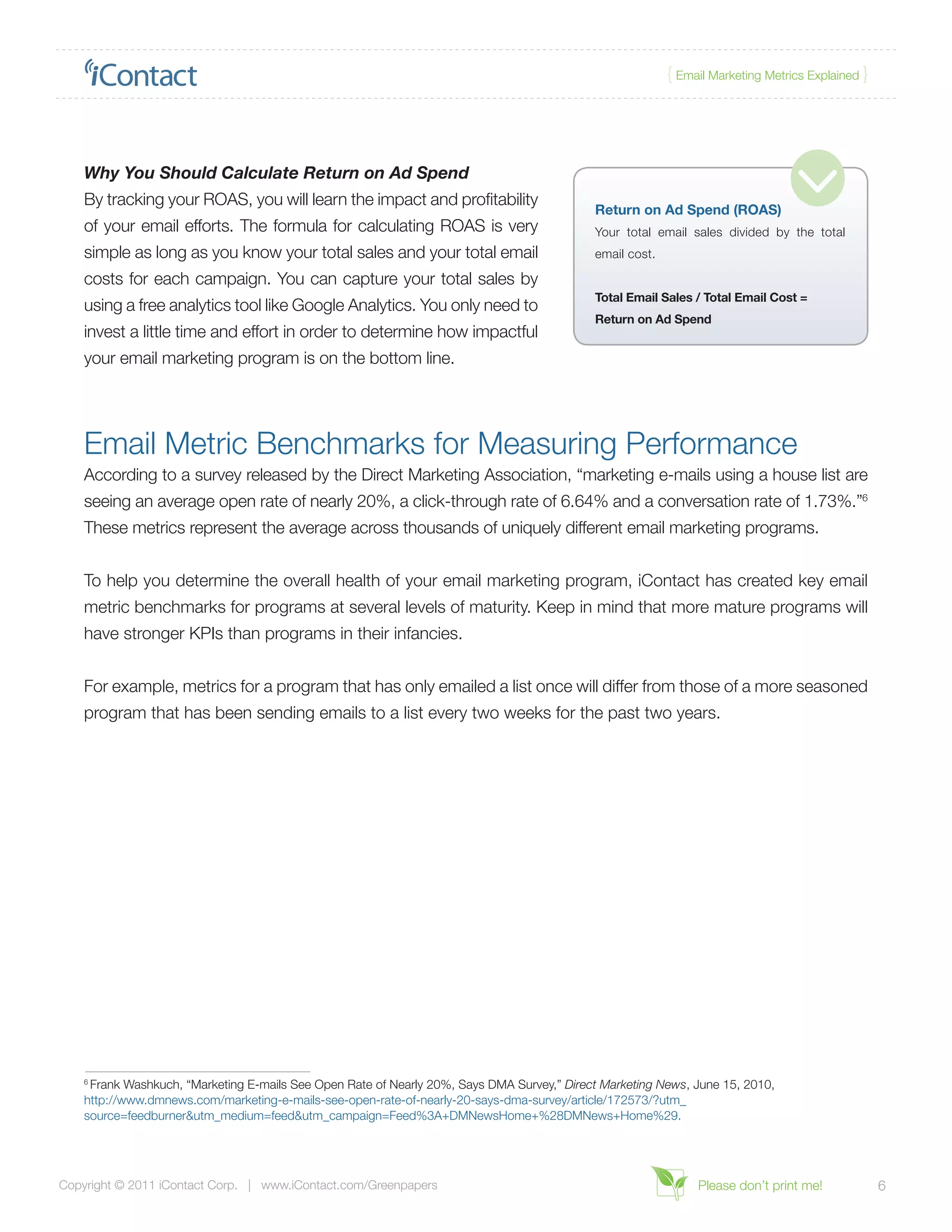
    You can use analytics programs, such as Google Analytics, to                             Conversion Rate
    measure your email conversions. These products enable you                                The total number of conversions divided by the
    to capture B2B webform or survey conversions and B2C retail                              total number of messages sent.

    conversions. Taking the time to set up conversion tracking
                                                                                             Conversions / Sent Emails = Conversion Rate
    strings and email tracking codes is well worth the effort. Karen
    Bannan notes as much in her BtoB article featuring input from
    Mark Feldman, VP of marketing at NetProspex, a sales and
    marketing database company:


                 The majority of email marketers look to traditional metrics such as open and click-
                 through rates to help shape campaigns and strategies. While this is smart, Feldman
                 said, marketers must also follow conversion rates from leads into sales. “This metric
                 shows you how effectively leads are being processed by the sales team,” he said. “Sales
                 pipeline metrics help you get a picture of your overall ROI, as well as the effectiveness
                 of your targeting.”4


    One thing to remember, though, is that not all conversions are trackable. If your email sends a customer to
    your retail storefront, for example, you won’t be able to track that the lead came from email unless you offer
    an incentive such as a coupon to redeem.


    Although measuring conversion from email marketing is simpler than for many other forms of marketing, it
    is still not a perfect measure of return on investment (ROI). MarketingSherpa noted this when it posed the
    following question in its 2011 Email Marketing Benchmark Survey: Does your organization have a method
    for quantifying ROI from email marketing? Of the respondents, 59% said they did not have a method of
    quantifying ROI, and 41% reported that they did have a method in place.5


    Unfortunately, 59% of marketers are unable to capture their email marketing program’s ROI. If you fall in this
    59%, begin by tracking your program’s return on ad spend (ROAS).


    4
      Karen J. Bannan, “Tracking the Right Email Metrics,” BtoB, May 12, 2011,
    http://www.btobonline.com/apps/pbcs.dll/article?AID=/20110512/EMAIL14/305129995/0/FREE&template=printart.

    5
     Adam T. Sutton, “Email Marketing: Show Me the ROI,” MarketingSherpa Blog, February 3, 2011,
    http://sherpablog.marketingsherpa.com/email-marketing/email-marketing-show-me-roi/.


Copyright © 2011 iContact Corp. | www.iContact.com/Greenpapers                                                 Please don’t print me!             5
{ Email Marketing Metrics Explained }


    Why You Should Calculate Return on Ad Spend
    By tracking your ROAS, you will learn the impact and profitability
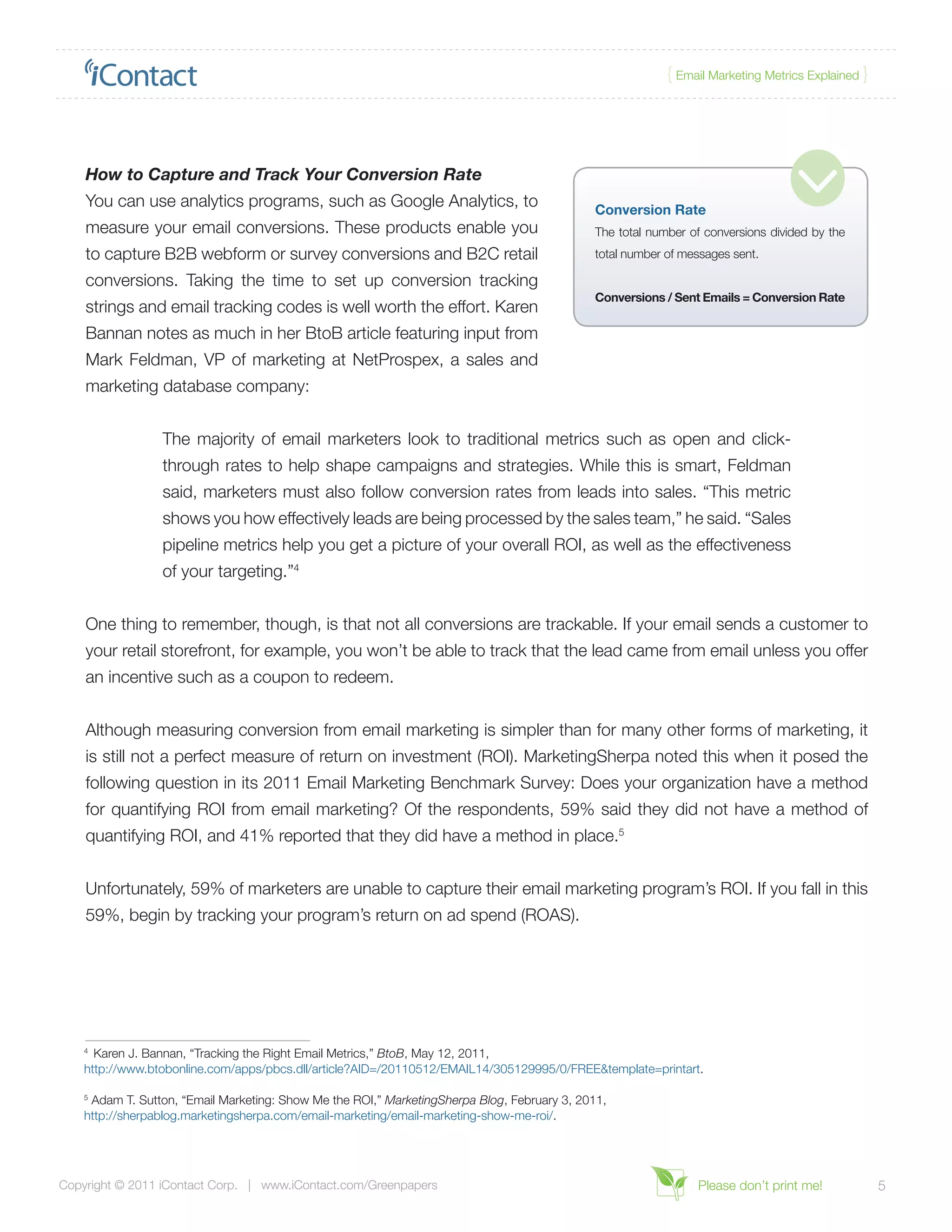
                                                                                            Return on Ad Spend (ROAS)
    of your email efforts. The formula for calculating ROAS is very                         Your total email sales divided by the total
    simple as long as you know your total sales and your total email                        email cost.

    costs for each campaign. You can capture your total sales by
                                                                                            Total Email Sales / Total Email Cost =
    using a free analytics tool like Google Analytics. You only need to
                                                                                            Return on Ad Spend
    invest a little time and effort in order to determine how impactful
    your email marketing program is on the bottom line.


    Email Metric Benchmarks for Measuring Performance
    According to a survey released by the Direct Marketing Association, “marketing e-mails using a house list are
    seeing an average open rate of nearly 20%, a click-through rate of 6.64% and a conversation rate of 1.73%.”6
    These metrics represent the average across thousands of uniquely different email marketing programs.


    To help you determine the overall health of your email marketing program, iContact has created key email
    metric benchmarks for programs at several levels of maturity. Keep in mind that more mature programs will
    have stronger KPIs than programs in their infancies.


    For example, metrics for a program that has only emailed a list once will differ from those of a more seasoned
    program that has been sending emails to a list every two weeks for the past two years.


    6
     Frank Washkuch, “Marketing E-mails See Open Rate of Nearly 20%, Says DMA Survey,” Direct Marketing News, June 15, 2010,
    http://www.dmnews.com/marketing-e-mails-see-open-rate-of-nearly-20-says-dma-survey/article/172573/?utm_
    source=feedburner&utm_medium=feed&utm_campaign=Feed%3A+DMNewsHome+%28DMNews+Home%29.


Copyright © 2011 iContact Corp. | www.iContact.com/Greenpapers                                                 Please don’t print me!             6
{ Email Marketing Metrics Explained }


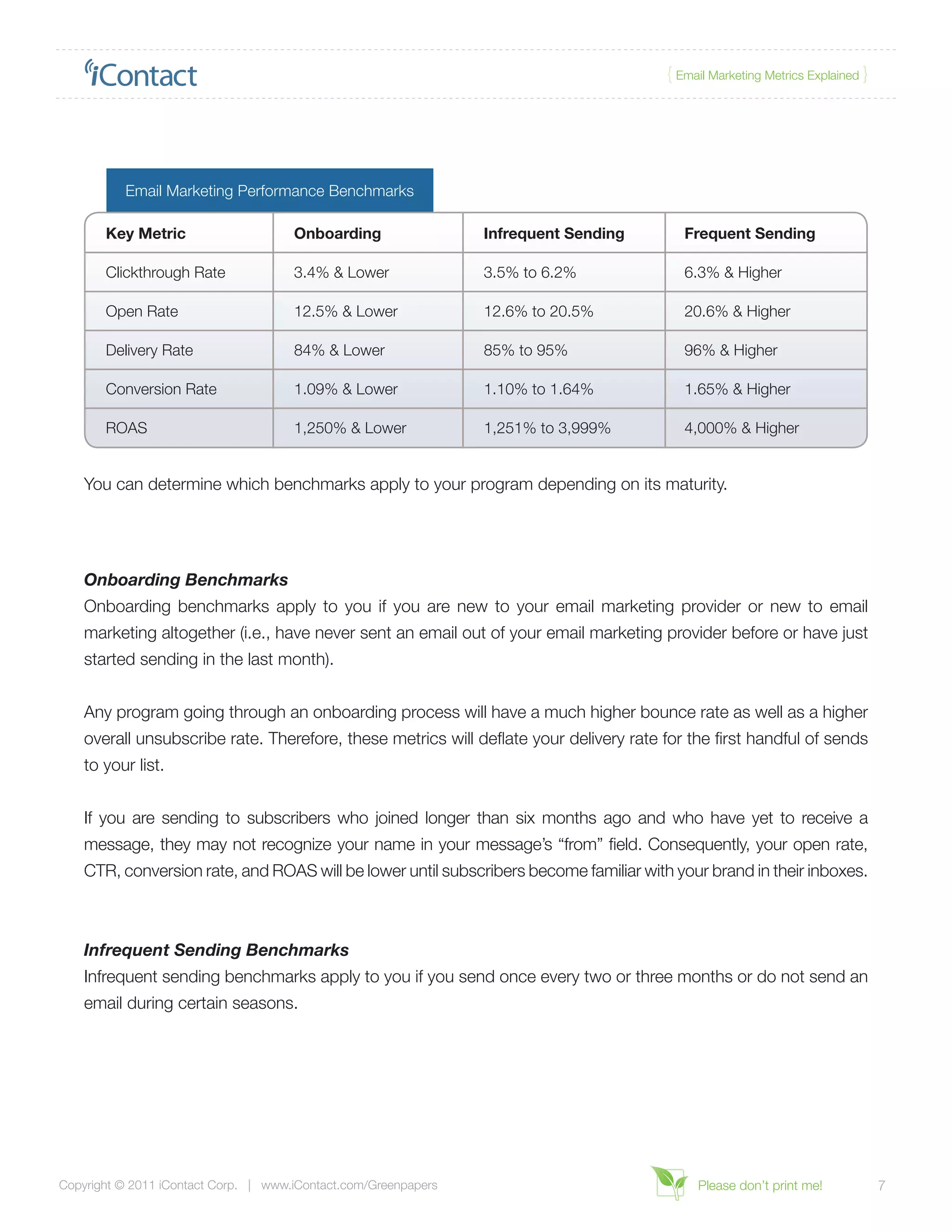
          Email Marketing Performance Benchmarks

       Key Metric                     Onboarding                 Infrequent Sending       Frequent Sending

       Clickthrough Rate              3.4% & Lower               3.5% to 6.2%             6.3% & Higher

       Open Rate                      12.5% & Lower              12.6% to 20.5%           20.6% & Higher

       Delivery Rate                  84% & Lower                85% to 95%               96% & Higher

       Conversion Rate                1.09% & Lower              1.10% to 1.64%           1.65% & Higher

       ROAS                           1,250% & Lower             1,251% to 3,999%         4,000% & Higher


    You can determine which benchmarks apply to your program depending on its maturity.


    Onboarding Benchmarks
    Onboarding benchmarks apply to you if you are new to your email marketing provider or new to email
    marketing altogether (i.e., have never sent an email out of your email marketing provider before or have just
    started sending in the last month).


    Any program going through an onboarding process will have a much higher bounce rate as well as a higher
    overall unsubscribe rate. Therefore, these metrics will deflate your delivery rate for the first handful of sends
    to your list.


    If you are sending to subscribers who joined longer than six months ago and who have yet to receive a
    message, they may not recognize your name in your message’s “from” field. Consequently, your open rate,
    CTR, conversion rate, and ROAS will be lower until subscribers become familiar with your brand in their inboxes.


    Infrequent Sending Benchmarks
    Infrequent sending benchmarks apply to you if you send once every two or three months or do not send an
    email during certain seasons.


Copyright © 2011 iContact Corp. | www.iContact.com/Greenpapers                              Please don’t print me!             7
{ Email Marketing Metrics Explained }


    By sending infrequently, your list churn (i.e., the loss of subscribers because of hard bounces, unsubscribes,
    and complaints) will always be higher than the churn for programs that send frequently. Therefore, your
    delivery rate will be weaker.


    Brand recognition within your subscribers’ inboxes will also suffer because contacts may forget about your
    program and the value you provide. By setting a steady monthly sending cadence, you capture stronger
    engagement levels and increase your open rate, CTR, conversion rate, and ROAS.


    Frequent Sending Benchmarks
    Frequent sending benchmarks apply to you if you have a more mature email marketing program (i.e., you
    consistently send emails every two weeks to your list).


    To achieve strong KPIs, you will need to maintain your overall cadence strategy. If you touch your email list
    at least once every two weeks, your list will become pristine, and your emails will not bounce. Your delivery
    rate will also be strong and stable.


    What You Can Do
    In order to push your open rates, CTRs, conversion rates, and ROAS higher, you need to optimize your email
    marketing program on a routine basis to ensure that you are sending relevant content within robust email
    templates. Monitor your metrics and set aggressive (but realistic) goals for improving your program.


    About iContact
    iContact is a purpose-driven company based in Raleigh, NC, working to make email marketing and social
    marketing easy so that small and midsized companies and causes can grow and succeed. Founded in 2003,
    iContact has more than 300 employees and more than 700,000 users of its leading email marketing software.
    iContact also provides the event marketing platform Ettend. As a B Corporation, iContact utilizes the 4-1’s
    Corporate Social Responsibility Model, donating 1% of payroll, 1% of employee time to community volunteering,
    1% of equity, and 1% of product to its local and global community as part of its social mission. iContact works
    hard to maintain a fun, creative, energetic, challenging, and community-oriented company culture.


Copyright © 2011 iContact Corp. | www.iContact.com/Greenpapers                             Please don’t print me!             8

Email metrics

  • 1.
    { Email Marketing Metrics Explained { Copyright © 2011 iContact Corp. | www.iContact.com/Greenpapers
  • 2.
    { Email MarketingMetrics Explained } How do you determine the strength of your email marketing program? Are you focusing on the most important email marketing metrics? What are you comparing your current key performance indicators (KPIs) against in order to measure success? Email Marketing Metrics Explained tackles these questions and leaves you with the following takeaways: • You will learn how each metric is calculated and the importance of each to your program. • You will learn how to use KPIs to assess your program’s strengths and weaknesses, overall health, and impact on your business. • You will learn how to set reasonable expectations and goals for your email marketing program on the basis of where your program stands today. What are the most important email marketing metrics? According to MarketingSherpa, “The most commonly tracked email metrics continue to be clickthrough, open and delivery rates.”1 Email Marketing Metrics Tracked by Percentage of Organizations Clickthrough rate 92% Open rate 90% Delivery rate 81% Clicks per link in email 51% Clicks per email 51% Post-click conversion rate 44% Response by list segment 36% Revenue per email 33% Social sharing rate 18% Source: MarketingSherpa Email Marketing Benchmark Survey Methodology: Fielded Sep 2010, N = 1,115 1 Jeff Rice, “New Chart: Top Tracked Email Metrics,” Marketing Sherpa, last modified December 14, 2010, http://www.marketingsherpa.com/article.php?ident=31781. Copyright © 2011 iContact Corp. | www.iContact.com/Greenpapers Please don’t print me! 2
  • 3.
    { Email MarketingMetrics Explained } Focus on Five Key Email Metrics Why Your Clickthrough Rate Matters More Your campaign’s clickthrough rate (CTR) is one of the most Clickthrough Rate (CTR) important email metrics to measure. Your CTR shows your The number of times a link is clicked in a overall engagement level with your subscribers and how message divided by the number of delivered relevant they deem your content. A strong CTR equals a strong messages. For example, if a message is sent to four subscribers and one subscriber clicks on engagement ratio, which is a key metric monitored by multiple the message twice, the resulting CTR for that Internet service providers like Hotmail and Gmail. message is 25% (1 unique click / 4 delivered emails = 25%). Your CTR carries more weight than your open rate because Unique Clicks / Delivered Emails = CTR multiple email clients detect and define an “open” differently. MarketingSherpa notes that “the open rate, once the predominant metric of email marketing, has been surpassed by the slightly more definitive clickthrough rate.”2 Why Your Open Rate Matters Less Your open rate alone should not determine the success of a Open Rate message. Although it is important to monitor your open rate The number of times a message is opened over time for spikes, it is not the ultimate metric due to the divided by the number of delivered messages. “fudge factor” around capturing and detecting an open. Mark Unique Opens / Delivered Emails = Open Rate Brownlow of Email Marketing Reports tackles this very issue in his blog entry “What Do Email Open Rates Mean?” When your email service sends out your email, they include a piece of code in each one requesting the display of a tiny, transparent (i.e. invisible to the viewer) tracking image. When the recipient’s browser or email reading software (an email client like Outlook Express) tries to display the email on a screen, it reads that piece of code and sends out a request to the email service for the tracking image. 2 Ibid. Copyright © 2011 iContact Corp. | www.iContact.com/Greenpapers Please don’t print me! 3
  • 4.
    { Email MarketingMetrics Explained } When the service receives the request, it records it and uses it as an indication that the recipient has “opened” the email.3 Unfortunately this process for tracking an open creates the following three issues, which Brownlow captures perfectly: 1. An open “actually just means the recipient’s software or browser displayed the email such that the tracking image was requested. It says nothing about whether the recipient actually read or engaged with your email in any way.” 2. “The tracking image can be activated without the recipient ever actually seeing the email at all. Many email clients have a preview function, where part of the email is displayed below or to the side of the list of emails in your inbox. . . . So some of those recorded opens are from recipients who never even looked at your email.” 3. “If your recipient gets text-only emails or has an email client that only displays text versions of emails (like many mobile devices), then the image code is ignored and never requested. No image request means no record of an open. So your recorded email open rate misses out on those people.” Why Your Delivery Rate Is Not a Given Your delivery rate can vary depending on your email list’s overall Delivery Rate health. If your list has a large percentage of hard bounces The total number of messages sent minus hard because of data entry errors, or if you’re sending to a stale list or soft bounces divided by the total number of (i.e., a list that is older than six months and that has not been messages sent. emailed before), then your delivery rate may suffer. Over time, Bounces can either be a hard bounce, a by growing your list organically and sending to the list on a permanent delivery failure (i.e., the email address frequent basis, you will clean out the majority of hard bounces is misspelled or doesn’t exist), or a soft bounce, and garner a much higher delivery rate. a temporary delivery failure (i.e., the subscriber’s mailbox is full). (Sent Emails - Bounced Emails) / Sent Emails = Delivery Rate 3 Mark Brownlow, “What Do Email Open Rates Mean?” Email Marketing Reports (blog), August 2006, http://www.email-marketing-reports.com/email-open-rates/meaning.htm. Copyright © 2011 iContact Corp. | www.iContact.com/Greenpapers Please don’t print me! 4
  • 5.
    { Email MarketingMetrics Explained } How to Capture and Track Your Conversion Rate You can use analytics programs, such as Google Analytics, to Conversion Rate measure your email conversions. These products enable you The total number of conversions divided by the to capture B2B webform or survey conversions and B2C retail total number of messages sent. conversions. Taking the time to set up conversion tracking Conversions / Sent Emails = Conversion Rate strings and email tracking codes is well worth the effort. Karen Bannan notes as much in her BtoB article featuring input from Mark Feldman, VP of marketing at NetProspex, a sales and marketing database company: The majority of email marketers look to traditional metrics such as open and click- through rates to help shape campaigns and strategies. While this is smart, Feldman said, marketers must also follow conversion rates from leads into sales. “This metric shows you how effectively leads are being processed by the sales team,” he said. “Sales pipeline metrics help you get a picture of your overall ROI, as well as the effectiveness of your targeting.”4 One thing to remember, though, is that not all conversions are trackable. If your email sends a customer to your retail storefront, for example, you won’t be able to track that the lead came from email unless you offer an incentive such as a coupon to redeem. Although measuring conversion from email marketing is simpler than for many other forms of marketing, it is still not a perfect measure of return on investment (ROI). MarketingSherpa noted this when it posed the following question in its 2011 Email Marketing Benchmark Survey: Does your organization have a method for quantifying ROI from email marketing? Of the respondents, 59% said they did not have a method of quantifying ROI, and 41% reported that they did have a method in place.5 Unfortunately, 59% of marketers are unable to capture their email marketing program’s ROI. If you fall in this 59%, begin by tracking your program’s return on ad spend (ROAS). 4 Karen J. Bannan, “Tracking the Right Email Metrics,” BtoB, May 12, 2011, http://www.btobonline.com/apps/pbcs.dll/article?AID=/20110512/EMAIL14/305129995/0/FREE&template=printart. 5 Adam T. Sutton, “Email Marketing: Show Me the ROI,” MarketingSherpa Blog, February 3, 2011, http://sherpablog.marketingsherpa.com/email-marketing/email-marketing-show-me-roi/. Copyright © 2011 iContact Corp. | www.iContact.com/Greenpapers Please don’t print me! 5
  • 6.
    { Email MarketingMetrics Explained } Why You Should Calculate Return on Ad Spend By tracking your ROAS, you will learn the impact and profitability Return on Ad Spend (ROAS) of your email efforts. The formula for calculating ROAS is very Your total email sales divided by the total simple as long as you know your total sales and your total email email cost. costs for each campaign. You can capture your total sales by Total Email Sales / Total Email Cost = using a free analytics tool like Google Analytics. You only need to Return on Ad Spend invest a little time and effort in order to determine how impactful your email marketing program is on the bottom line. Email Metric Benchmarks for Measuring Performance According to a survey released by the Direct Marketing Association, “marketing e-mails using a house list are seeing an average open rate of nearly 20%, a click-through rate of 6.64% and a conversation rate of 1.73%.”6 These metrics represent the average across thousands of uniquely different email marketing programs. To help you determine the overall health of your email marketing program, iContact has created key email metric benchmarks for programs at several levels of maturity. Keep in mind that more mature programs will have stronger KPIs than programs in their infancies. For example, metrics for a program that has only emailed a list once will differ from those of a more seasoned program that has been sending emails to a list every two weeks for the past two years. 6 Frank Washkuch, “Marketing E-mails See Open Rate of Nearly 20%, Says DMA Survey,” Direct Marketing News, June 15, 2010, http://www.dmnews.com/marketing-e-mails-see-open-rate-of-nearly-20-says-dma-survey/article/172573/?utm_ source=feedburner&utm_medium=feed&utm_campaign=Feed%3A+DMNewsHome+%28DMNews+Home%29. Copyright © 2011 iContact Corp. | www.iContact.com/Greenpapers Please don’t print me! 6
  • 7.
    { Email MarketingMetrics Explained } Email Marketing Performance Benchmarks Key Metric Onboarding Infrequent Sending Frequent Sending Clickthrough Rate 3.4% & Lower 3.5% to 6.2% 6.3% & Higher Open Rate 12.5% & Lower 12.6% to 20.5% 20.6% & Higher Delivery Rate 84% & Lower 85% to 95% 96% & Higher Conversion Rate 1.09% & Lower 1.10% to 1.64% 1.65% & Higher ROAS 1,250% & Lower 1,251% to 3,999% 4,000% & Higher You can determine which benchmarks apply to your program depending on its maturity. Onboarding Benchmarks Onboarding benchmarks apply to you if you are new to your email marketing provider or new to email marketing altogether (i.e., have never sent an email out of your email marketing provider before or have just started sending in the last month). Any program going through an onboarding process will have a much higher bounce rate as well as a higher overall unsubscribe rate. Therefore, these metrics will deflate your delivery rate for the first handful of sends to your list. If you are sending to subscribers who joined longer than six months ago and who have yet to receive a message, they may not recognize your name in your message’s “from” field. Consequently, your open rate, CTR, conversion rate, and ROAS will be lower until subscribers become familiar with your brand in their inboxes. Infrequent Sending Benchmarks Infrequent sending benchmarks apply to you if you send once every two or three months or do not send an email during certain seasons. Copyright © 2011 iContact Corp. | www.iContact.com/Greenpapers Please don’t print me! 7
  • 8.
    { Email MarketingMetrics Explained } By sending infrequently, your list churn (i.e., the loss of subscribers because of hard bounces, unsubscribes, and complaints) will always be higher than the churn for programs that send frequently. Therefore, your delivery rate will be weaker. Brand recognition within your subscribers’ inboxes will also suffer because contacts may forget about your program and the value you provide. By setting a steady monthly sending cadence, you capture stronger engagement levels and increase your open rate, CTR, conversion rate, and ROAS. Frequent Sending Benchmarks Frequent sending benchmarks apply to you if you have a more mature email marketing program (i.e., you consistently send emails every two weeks to your list). To achieve strong KPIs, you will need to maintain your overall cadence strategy. If you touch your email list at least once every two weeks, your list will become pristine, and your emails will not bounce. Your delivery rate will also be strong and stable. What You Can Do In order to push your open rates, CTRs, conversion rates, and ROAS higher, you need to optimize your email marketing program on a routine basis to ensure that you are sending relevant content within robust email templates. Monitor your metrics and set aggressive (but realistic) goals for improving your program. About iContact iContact is a purpose-driven company based in Raleigh, NC, working to make email marketing and social marketing easy so that small and midsized companies and causes can grow and succeed. Founded in 2003, iContact has more than 300 employees and more than 700,000 users of its leading email marketing software. iContact also provides the event marketing platform Ettend. As a B Corporation, iContact utilizes the 4-1’s Corporate Social Responsibility Model, donating 1% of payroll, 1% of employee time to community volunteering, 1% of equity, and 1% of product to its local and global community as part of its social mission. iContact works hard to maintain a fun, creative, energetic, challenging, and community-oriented company culture. Copyright © 2011 iContact Corp. | www.iContact.com/Greenpapers Please don’t print me! 8