ELEMENTS OF
DANCE
LAWAS, DARLENE A.
REPORTER
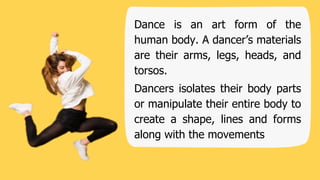
Dance is an art form of the
human body. A dancer’s materials
are their arms, legs, heads, and
torsos.
Dancers isolates their body parts
or manipulate their entire body to
create a shape, lines and forms
along with the movements
Elements of Dance are the foundation concepts and
vocabulary that help students develop movement
skills and understand dance as an artistic practice.
B-ODY
A-CTION
S-PACE
T-IME
E-NERGY
These elements of
dance are the building
block of all forms of
creative movement and
a great place to start
when talking about or
analyzing a dance
performance.
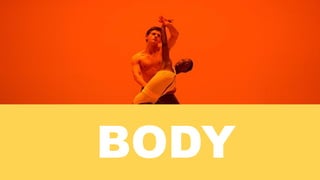
BODY
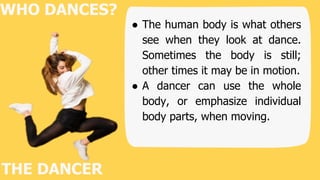
WHO DANCES?
● The human body is what others
see when they look at dance.
Sometimes the body is still;
other times it may be in motion.
● A dancer can use the whole
body, or emphasize individual
body parts, when moving.
THE DANCER
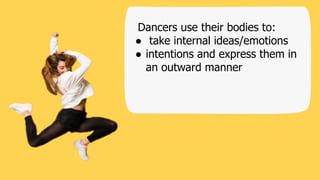
Dancers use their bodies to:
● take internal ideas/emotions
● intentions and express them in
an outward manner
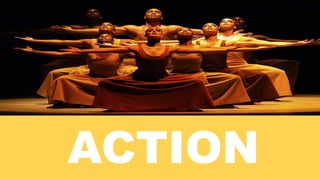
ACTION
● Any movement of the body while dancing is an
ACTION.
● Leaping, walking, hand gestures, facial expressions are
example of Action.
● Actions can be in two ways: LOCOMOTOR AND
NON-LOCOMOTOR MOVEMENTS
Non-locomotor or axial movement: Any movement
that occurs in one spot including a bend, stretch, swing,
rise, fall, shake, turn, rock, tip, suspend, and twist.
Locomotor movement: Any movement that travels
through space including a run, jump, walk, slide, hop,
skip, somersault, leap, crawl, gallop, and roll.
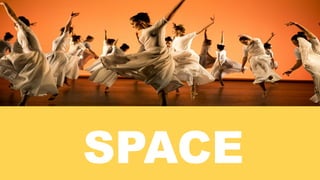
SPACE
SPACE is deïŹned as where the body moves or the area occupied by
the dancer’s body, whether in personal or general space. Movement
activity occurs within space.
● When movement is complete in an area large enough for one
individual, it is deïŹned as personal space.
- It is space that no one else invades or occupies at the same time as
another person.
● General space is a larger area that is used by several individuals
or an entire class.
1. DIRECTION
dancer movement may go in different ways:
(1) forward
(2) backward
(3) sideways
(4) up
(5) down
2. SIZE
Magnitude of a body shape or movement from small to large movements
3.PATHWAYS
Patterns made as a dancer moves through the air or on the floor.
There are three categories of pathways:
(1)straight- A straight pathway is created
when the mover propels the body or an object in a linear direction or
straight line
(2)curved- A curved pathway is created when the movement follows a
continuous S pattern.
(3)zigzag - When straight pathways are connected, forming continuous
Z’s, a zigzag pattern has been established.
4. LEVELS
● The vertical distance from the floor.
The three levels of movement
(1) high – the area above the shoulders
(2) medium – the area between
the knees and shoulders
(3) low – the area below the knees.
● Parts of the body can certainly move in all three levels. Equipment can
be manipulated at various levels as well.
5. SHAPES
the form created by the body’s position in space. Aspects of shape are
open/closed, symmetrical/asymmetrical, angular and curved.
6. RELATIONSHIP
How are the dancers positioned in space in relationship to one another.
Are they
1. close together or far apart
2. in front of Or beside
3. behind or over or under
4. alone or connected to one another
7. ORIENTATION
1. Which Ways the dancers are facing.
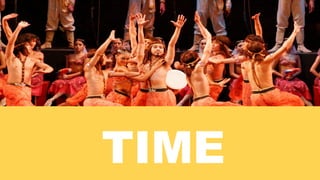
TIME
TIME: The relationship of one movement to another using the
certain rhythm and timings. We can think of time in the following ways:
1. CLOCK TIME
We use clock time to think about the length of a dance or parts of a dance
measured in seconds, minutes, or hours.
2. TIMING RELATIONSHIP
1. When dancers move in relation to each other (before, after, together).
3. METERED TIME
1. A repeated rhythmic pattern often used in music (like 2/4 time or 4/4
time). If dances are done to music, the movement can respond to the
beat of the music or can move against it. The speed of the rhythmic
pattern is called its tempo.
4. FREE RHYTHM
1. A rhythmic pattern is less predictable than metered time. Dancers may
perform movement without using music, relying on cues from one
another.
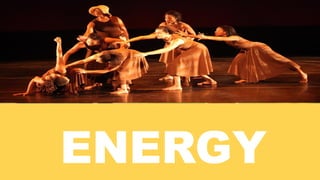
ENERGY
ENERGY
● Energy helps us to identify how the dancers move.
● Energy also represents the quality of the movement
● The effort the dancers use can communicate meaning,
depending on the energy involved.
1. ATTACK
1. The movement sharp and sudden, or smooth and sustained
2. WEIGHT
1. movement show heaviness, as if giving into gravity, or is it light with a
tendency upward.
● The qualities of heaviness are typically associated with having slower
movements without much momentum behind them which gives dancers
an opportunity to emphasize each movement
● A light quality would look like fast flowing movements with plenty of
space between steps where jumps might have height but not too much
force behind them.
3. FLOW
1. the movement seem restricted or bound, with a lot of muscle tension, or
is it relaxed, free, and easy. How smoothly you transition from one
movement to another throughout your routine.
4. QUALITY
1. the movement tight, flowing, loose, sharp, swinging, swaying,
suspended, collapsed, or smooth, vibratory
● Swinging (using legs, then arms, then whole body)
● Collapsed (swing a leg up, then collapse the body over it; repeat,
alternating legs)
● Sustained (melt gradually all the way to the floor until finishing in a
stretched shape)
● Suspended ( on both feet and allow arms to follow; find a point of
balance, balance on one foot)
● Vibratory (begin a soft beating of the feet on the floor and allow the
vibration to move up through the body like a volcano until it erupts out
through the fingers)
“When you dance, you can enjoy the luxury of
being you.” – Paulo Coelho
https://www.elementsofdance.org/
https://www.kennedy-center.org/education/resources-for-educators/clas
sroom-resources/media-and-interactives/media/dance/do-you-wanna-da
nce/
https://www.youtube.com/watch?v=hkOijGdD6jo&t=18s BODY
https://www.youtube.com/watch?v=Ha7LSrebuDI&t=52s ACTION
https://www.youtube.com/watch?v=3jinWT_xLTQ&t=120s SPACE
https://www.youtube.com/watch?v=8xQYr6P_qBc&t=50s TIME
https://www.youtube.com/watch?v=OjmzWORYfTA&t=42s ENERGY
References

Elements of-dance r2.pptx-1

  • 1.
  • 2.
    Dance is anart form of the human body. A dancer’s materials are their arms, legs, heads, and torsos. Dancers isolates their body parts or manipulate their entire body to create a shape, lines and forms along with the movements
  • 3.
    Elements of Danceare the foundation concepts and vocabulary that help students develop movement skills and understand dance as an artistic practice.
  • 4.
    B-ODY A-CTION S-PACE T-IME E-NERGY These elements of danceare the building block of all forms of creative movement and a great place to start when talking about or analyzing a dance performance.
  • 5.
  • 6.
    WHO DANCES? ● Thehuman body is what others see when they look at dance. Sometimes the body is still; other times it may be in motion. ● A dancer can use the whole body, or emphasize individual body parts, when moving. THE DANCER
  • 7.
    Dancers use theirbodies to: ● take internal ideas/emotions ● intentions and express them in an outward manner
  • 8.
  • 9.
    ● Any movementof the body while dancing is an ACTION. ● Leaping, walking, hand gestures, facial expressions are example of Action. ● Actions can be in two ways: LOCOMOTOR AND NON-LOCOMOTOR MOVEMENTS
  • 10.
    Non-locomotor or axialmovement: Any movement that occurs in one spot including a bend, stretch, swing, rise, fall, shake, turn, rock, tip, suspend, and twist. Locomotor movement: Any movement that travels through space including a run, jump, walk, slide, hop, skip, somersault, leap, crawl, gallop, and roll.
  • 11.
  • 12.
    SPACE is deïŹnedas where the body moves or the area occupied by the dancer’s body, whether in personal or general space. Movement activity occurs within space. ● When movement is complete in an area large enough for one individual, it is deïŹned as personal space. - It is space that no one else invades or occupies at the same time as another person. ● General space is a larger area that is used by several individuals or an entire class.
  • 13.
    1. DIRECTION dancer movementmay go in different ways: (1) forward (2) backward (3) sideways (4) up (5) down
  • 14.
    2. SIZE Magnitude ofa body shape or movement from small to large movements 3.PATHWAYS Patterns made as a dancer moves through the air or on the floor. There are three categories of pathways: (1)straight- A straight pathway is created when the mover propels the body or an object in a linear direction or straight line (2)curved- A curved pathway is created when the movement follows a continuous S pattern. (3)zigzag - When straight pathways are connected, forming continuous Z’s, a zigzag pattern has been established.
  • 15.
    4. LEVELS ● Thevertical distance from the floor. The three levels of movement (1) high – the area above the shoulders (2) medium – the area between the knees and shoulders (3) low – the area below the knees. ● Parts of the body can certainly move in all three levels. Equipment can be manipulated at various levels as well. 5. SHAPES the form created by the body’s position in space. Aspects of shape are open/closed, symmetrical/asymmetrical, angular and curved.
  • 16.
    6. RELATIONSHIP How arethe dancers positioned in space in relationship to one another. Are they 1. close together or far apart 2. in front of Or beside 3. behind or over or under 4. alone or connected to one another 7. ORIENTATION 1. Which Ways the dancers are facing.
  • 17.
  • 18.
    TIME: The relationshipof one movement to another using the certain rhythm and timings. We can think of time in the following ways: 1. CLOCK TIME We use clock time to think about the length of a dance or parts of a dance measured in seconds, minutes, or hours.
  • 19.
    2. TIMING RELATIONSHIP 1.When dancers move in relation to each other (before, after, together). 3. METERED TIME 1. A repeated rhythmic pattern often used in music (like 2/4 time or 4/4 time). If dances are done to music, the movement can respond to the beat of the music or can move against it. The speed of the rhythmic pattern is called its tempo. 4. FREE RHYTHM 1. A rhythmic pattern is less predictable than metered time. Dancers may perform movement without using music, relying on cues from one another.
  • 20.
  • 21.
    ENERGY ● Energy helpsus to identify how the dancers move. ● Energy also represents the quality of the movement ● The effort the dancers use can communicate meaning, depending on the energy involved.
  • 22.
    1. ATTACK 1. Themovement sharp and sudden, or smooth and sustained 2. WEIGHT 1. movement show heaviness, as if giving into gravity, or is it light with a tendency upward. ● The qualities of heaviness are typically associated with having slower movements without much momentum behind them which gives dancers an opportunity to emphasize each movement ● A light quality would look like fast flowing movements with plenty of space between steps where jumps might have height but not too much force behind them.
  • 23.
    3. FLOW 1. themovement seem restricted or bound, with a lot of muscle tension, or is it relaxed, free, and easy. How smoothly you transition from one movement to another throughout your routine.
  • 24.
    4. QUALITY 1. themovement tight, flowing, loose, sharp, swinging, swaying, suspended, collapsed, or smooth, vibratory ● Swinging (using legs, then arms, then whole body) ● Collapsed (swing a leg up, then collapse the body over it; repeat, alternating legs) ● Sustained (melt gradually all the way to the floor until finishing in a stretched shape) ● Suspended ( on both feet and allow arms to follow; find a point of balance, balance on one foot) ● Vibratory (begin a soft beating of the feet on the floor and allow the vibration to move up through the body like a volcano until it erupts out through the fingers)
  • 25.
    “When you dance,you can enjoy the luxury of being you.” – Paulo Coelho
  • 26.